With the Airmega 350, Coway brought the power and low running costs they’re well known for but in a cylindrical design, with the same retro-inspired aesthetic as the Airmega 250S and Airmega ProX.
But can this new model compete with the excellent cylindrical designs from Levoit, Winix and Xiaomi? I bought a 350 with my own money and put it through all the tests we perform here at HouseFresh to find out.
The overall score for the Coway Airmega 350 incorporates first-hand data results from our battery of tests, as well as our ratings for customer service, brand transparency, and design & UX. Check out the full scorecard below to see the split of categories.
Search for ‘Coway Airmega 350’ to see where it ranks, based on its air cleaning performance and value for money. You can also filter results to easily compare models in the same price range.
The pros and cons of the Coway Airmega 350
A summary of our top-level findings after testing this air purifier, following our methodology.
“The Airmega 350 is Coway’s alternative to the Levoit Core 600S and the Xiaomi Elite, with a good looking design that will fit even the most stylish of homes. The running costs are very fair, with $79 filter replacements that can last as long as 12 months.
When comparing to Xiaomi and Levoit, you get comparable air cleaning performance but you lose out on a laser sensor and app support. That said, you can use the 350 with a smart plug.”

HouseFresh Founder
& Lead Tester
CONS
PROS
| Clean air delivery rate (CADR): | – Top speed PM1 CADR: 352 cfm – Sub-45 dBA PM1 CADR: 100 cfm – AHAM PM2.5 CADR: 378 cfm (dust) |
| Filter technology: | Bonded cylindrical Green HEPA filter with a layer of pelleted activated carbon and a surrounding pre-filter mesh. |
| Recommended room size: | 528 sq. ft. (5 air changes per hour) |
| Dimensions: | 12 x 12 x 23 in (30.5 x 30.5 x 59 cm) |
| Weight: | 17.6 lbs (8 kg) |
| Noise level in decibels from 3 ft. away: | Sleep mode: 35.2 dBA Speed 1: 37.6 dBA Speed 2: 49.4 dBA Speed 3: 55.4 dBA Turno mode: 61.8 dBA |
| Electricity consumption in watts: | Standby: 0 watts Sleep mode: 3.1 watts Speed 1: 4.89 watts Speed 2: 17.04 watts Speed 3: 32.65 watts Trubo mode: 57.95 dBA |
| Filter lifespan: | 12 months |
| Manufacturer’s warranty: | 3 years |
| Country of origin: | South Korea |
| Country of manufacture: | China |
Filtration technology
Coway’s Green True HEPA filter with pelleted activated carbon and a pre-filter mesh.
The Airmega 350 comes with a large cylindrical filter with Coway’s signature Green True HEPA and a layer of pelleted activated carbon.
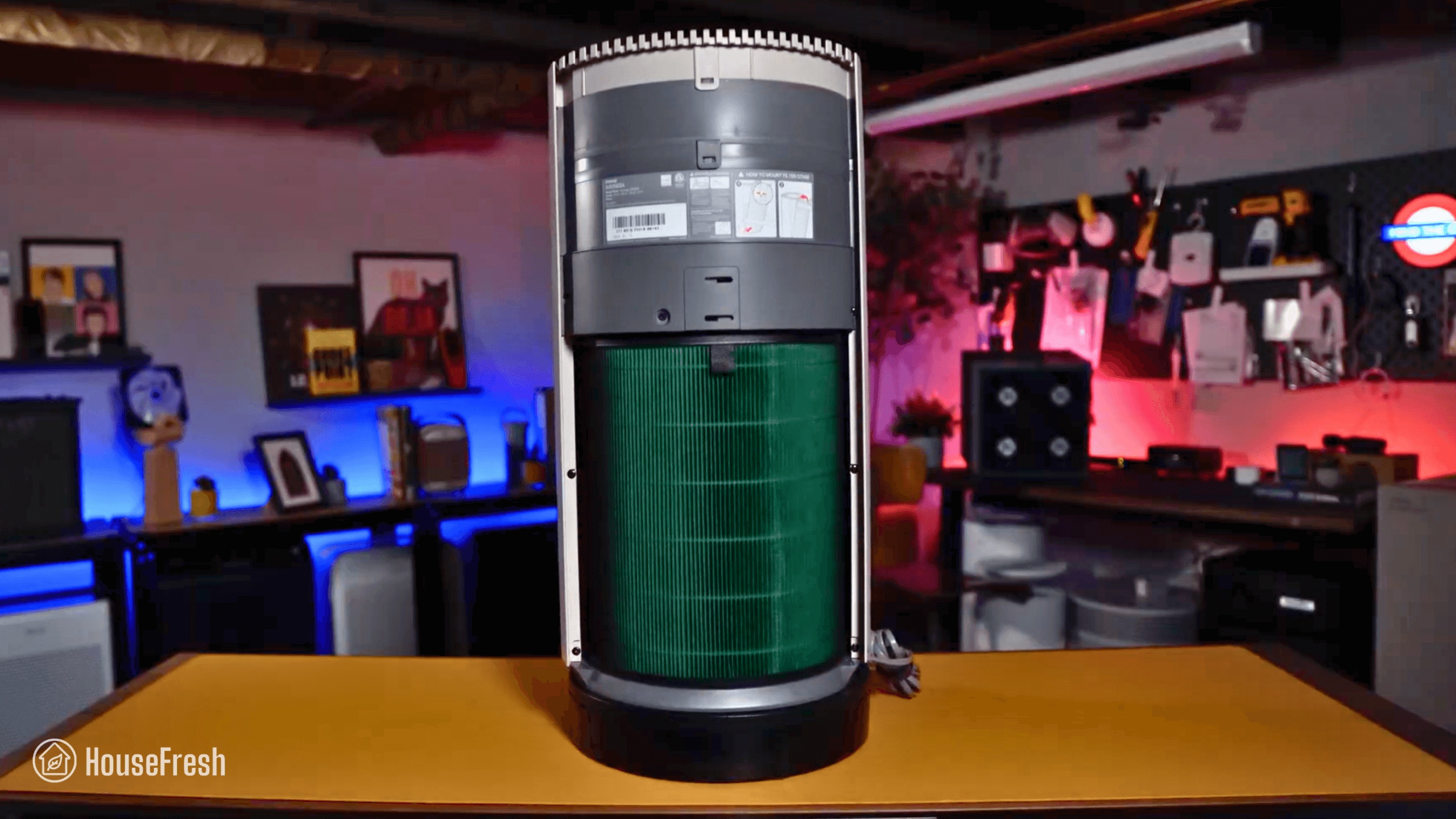
As with other cylindrical models, the pre-filter is attached to the main filter, so you will need to remove the whole thing to vacuum it.
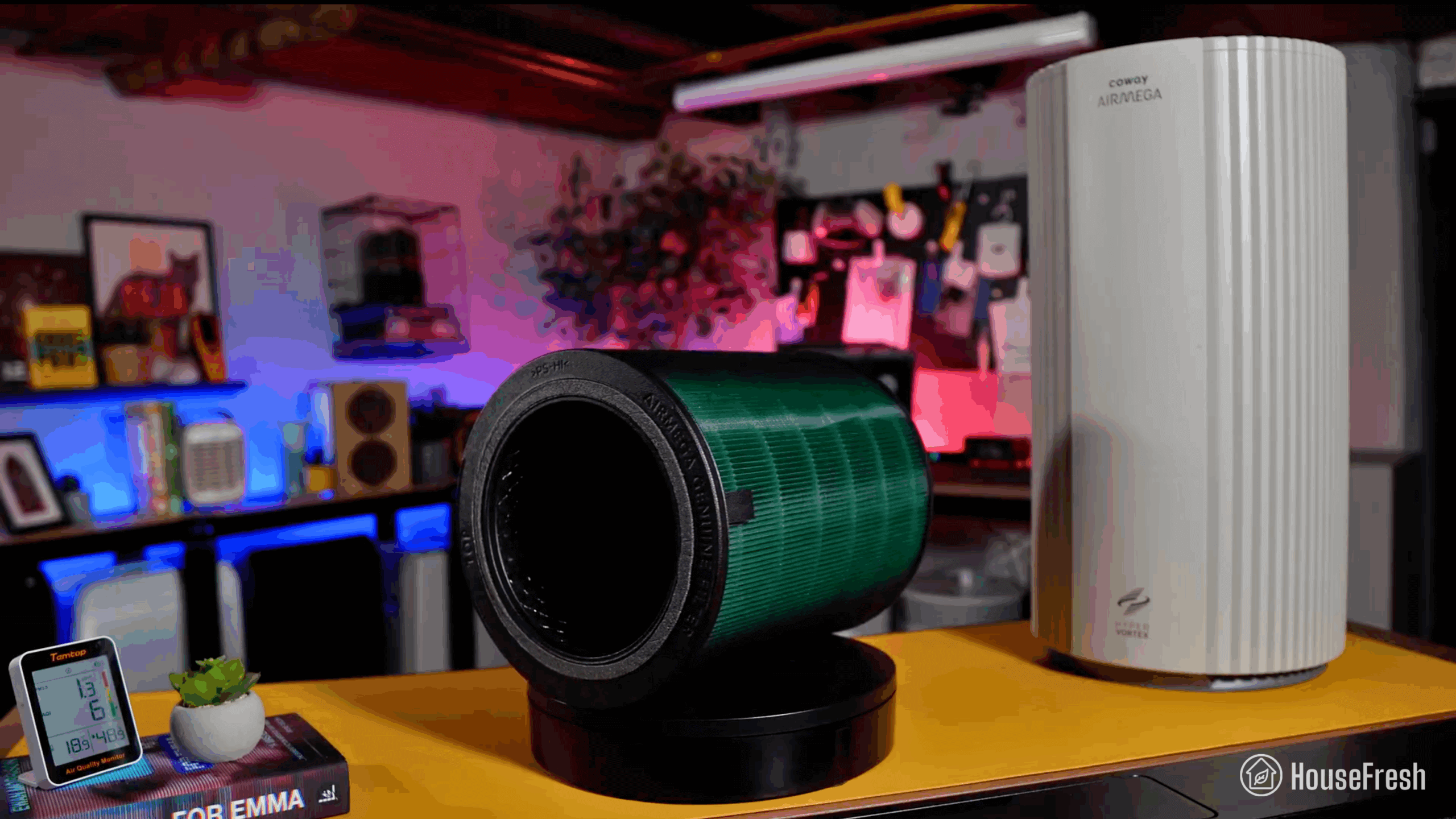
There are three different filters for the Airmega 350:
- Fresh Starter+ filter is the standard filter (above)
- Allergen+ filter, which is treated with a proprietary compound to remove allergens
- Intense Smoke+ filter, aimed at those who want to tackle smoke and VOCs

Design, controls and app features
A cylindrical addition to Coway’s new retro modern family of air purifiers.
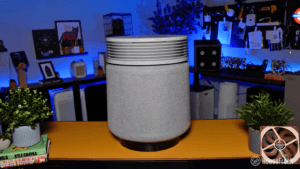
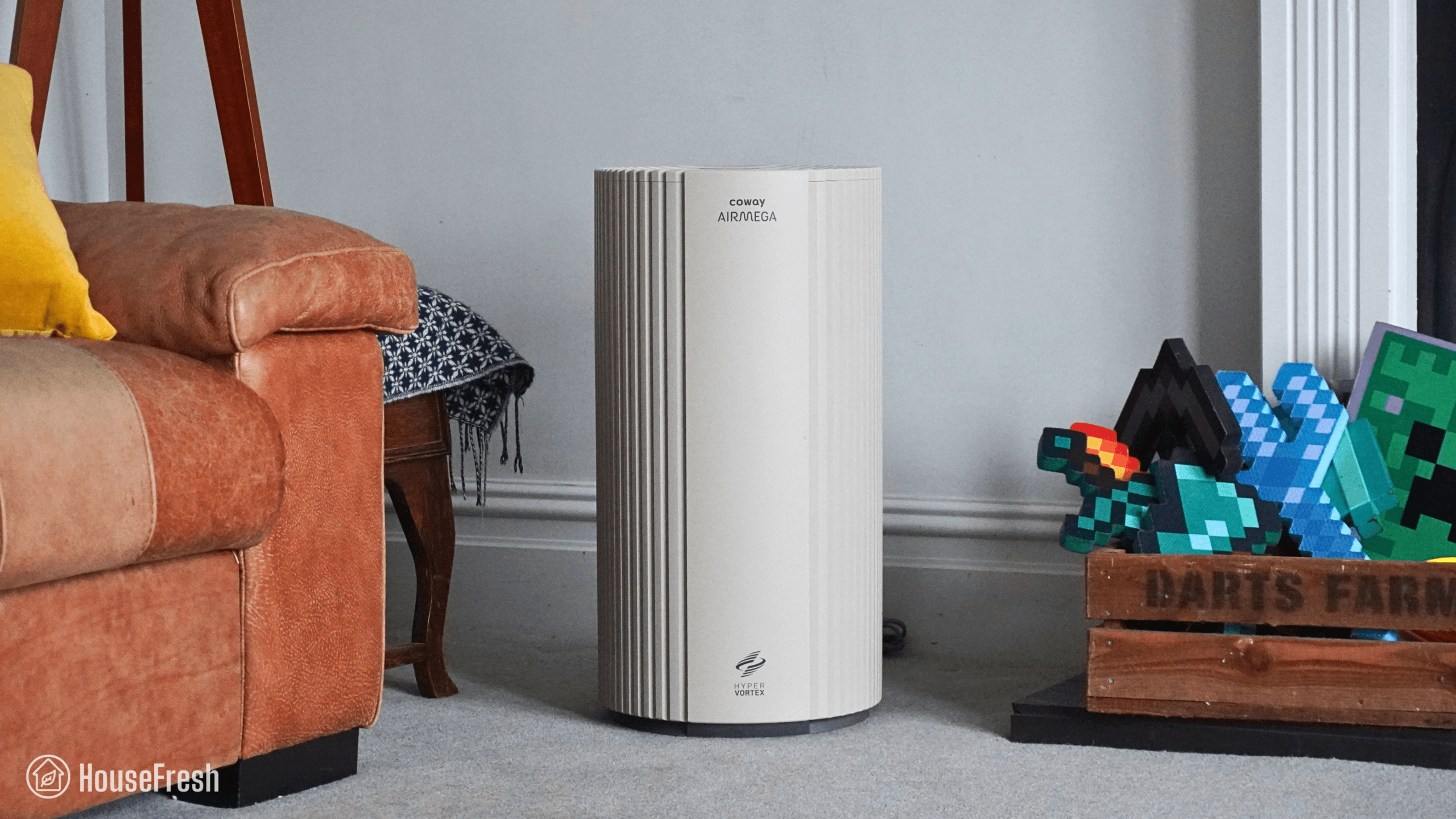
It looks like a million bucks – I know design is subjective, but I think most people will like the retro modern look of the 350.
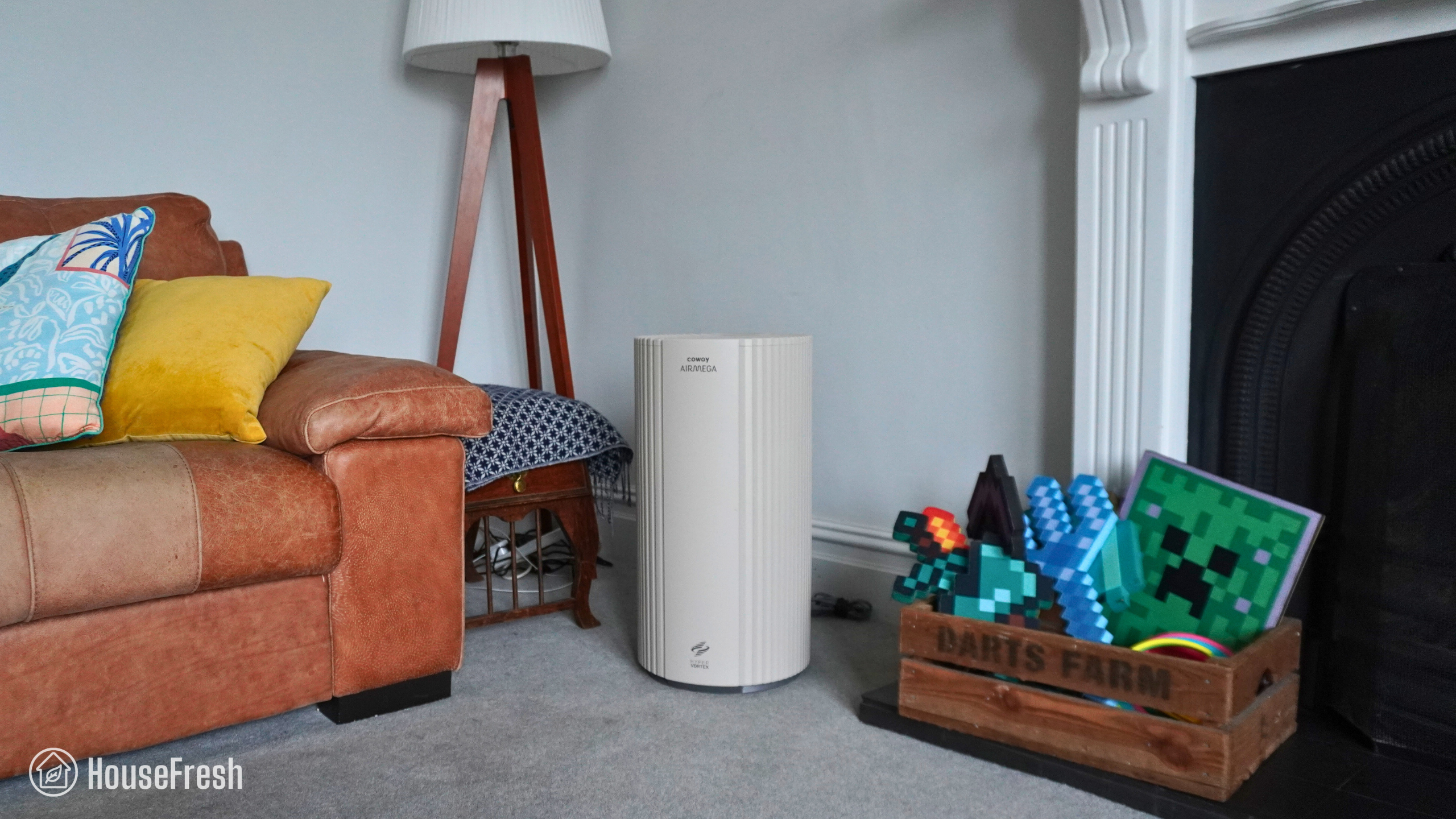
I bought the beige version that matches our 250S, but if you’re not a fan of beige, you’ll be happy to know you can also get it in white.
In terms of size, it stands at 23 inches tall (58.4 cm) and weighs 17.19 lbs (7.8 kg), so it’s on the larger side of cylindrical models.
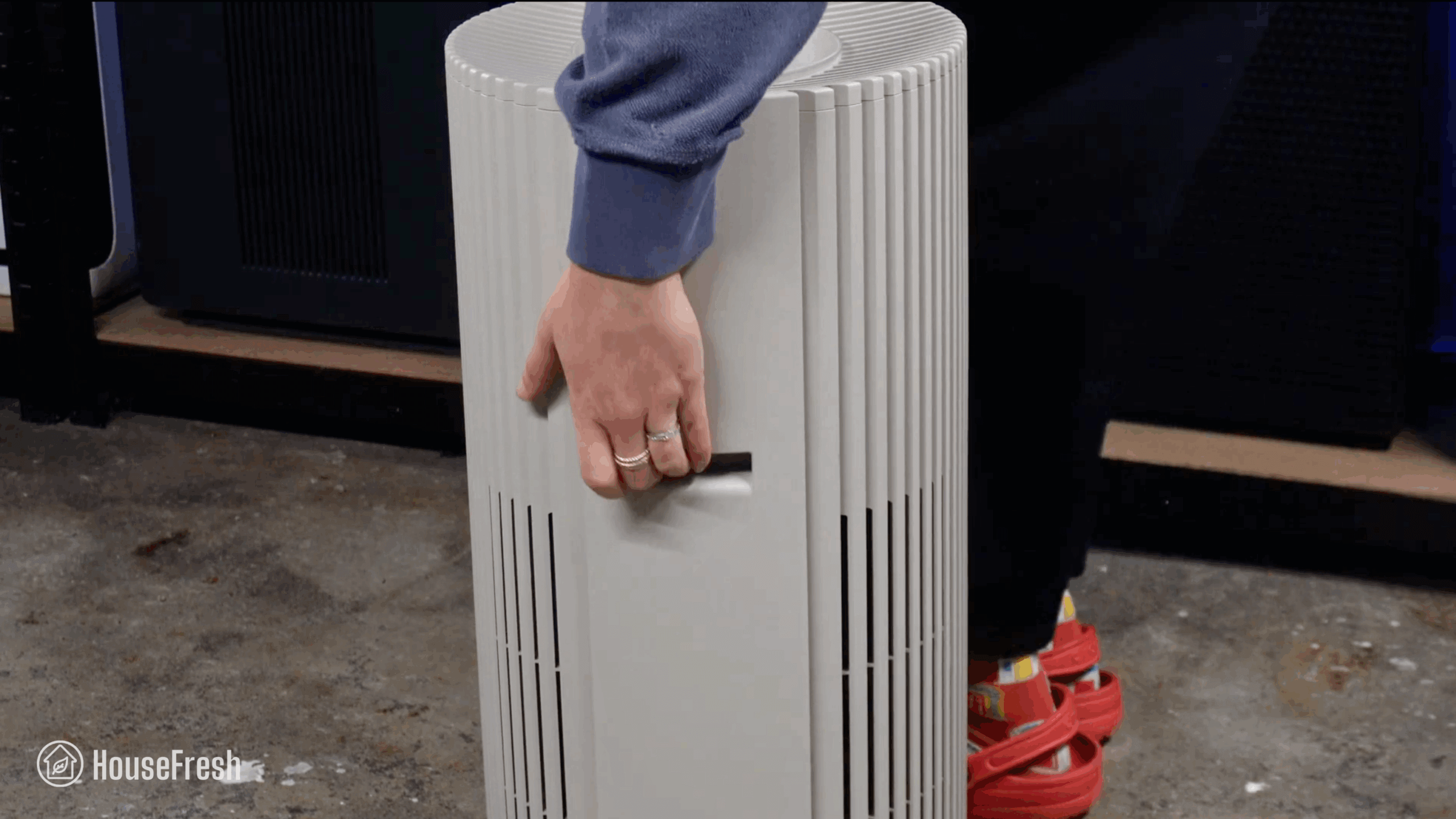
It’s great to see that Coway included a deep handle at the back, which makes it easier to move it around the house.
It has an infrared particle sensor that measures PM10 pollution and connects to the LED air quality indicator light at the top.
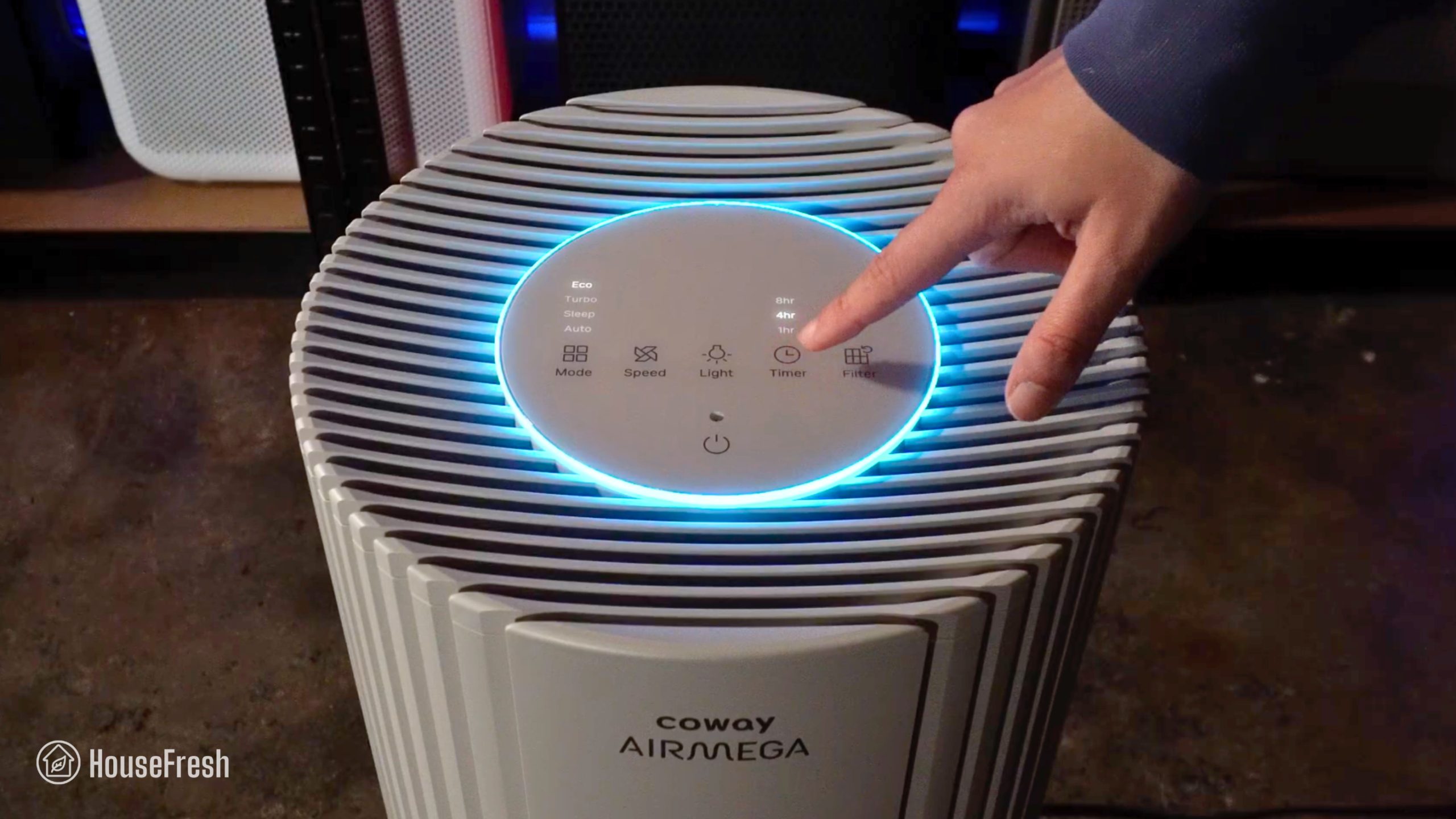
You get buttons to set fan speeds, smart modes and timers. There’s also a light button that turns off the display, the LED ring, or both.
The Coway 350 doesn’t come with an app, but you can use it with any smart plug to add simple routines. I tested it using a Philips Hue Plug and was able to switch it on and off remotely via the Hue app.
You also get a very cool hidden feature I wish more manufacturers would roll out:
If you hold down the Mode and Airflow buttons, you can adjust the sensitivity of the sensor, selecting between 1 (sensitive), 2 (default) and 3 (insensitive).
Air cleaning performance
We tested the Coway Airmega 350 in our 728 cubic ft. test room, tracking how fast it removed all PM1 particles from the air after we filled the space with incense smoke.
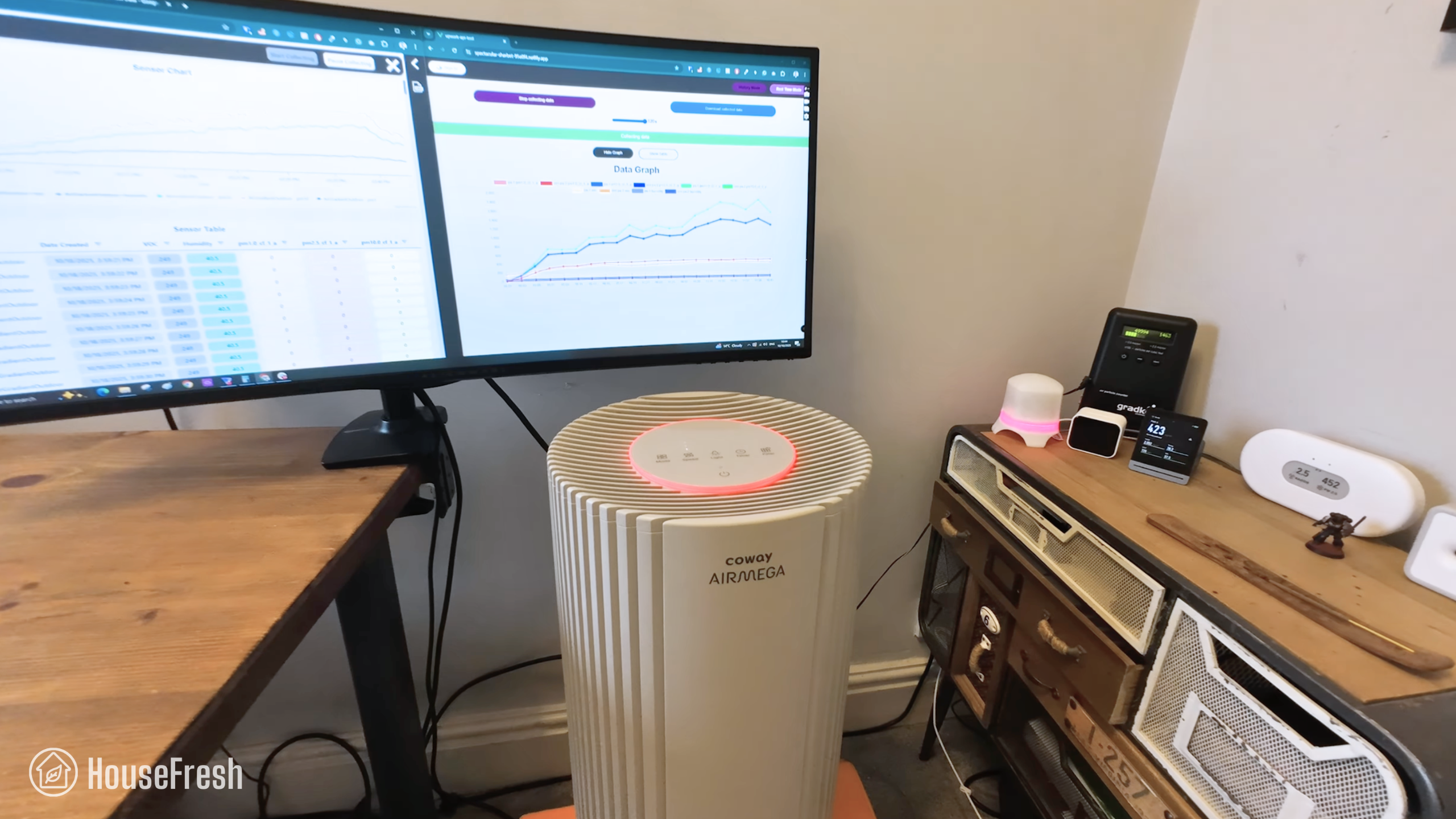
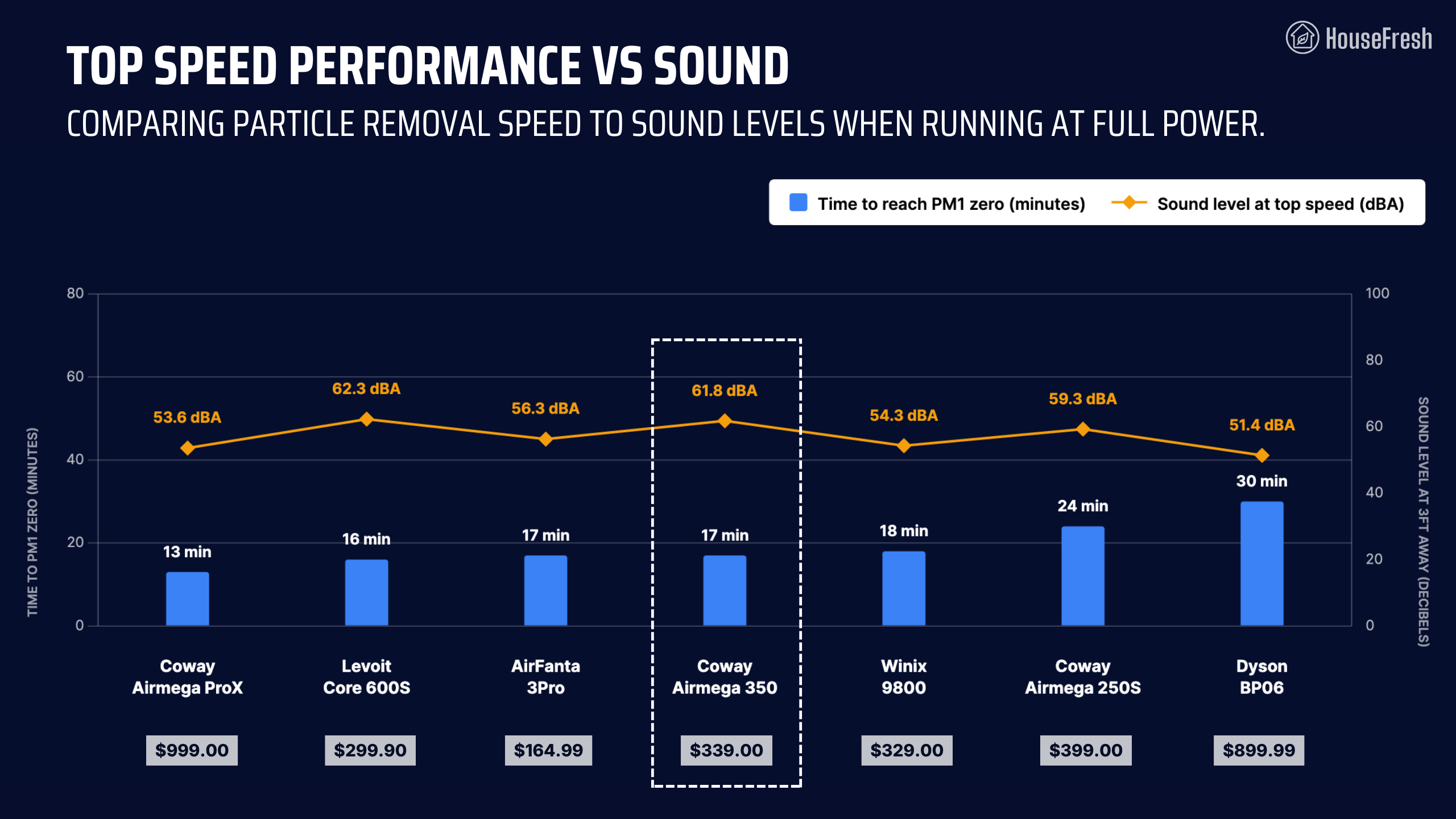
When running at top speed, our PurpleAir Zen sensor shows that the Airmega 350 needed 17 minutes to reach PM1 zero. Based on the natural ventilation of our test room, we estimate a PM1 CADR of 352 cfm.
This makes this Coway Airmega powerful enough to provide five air changes per hour in large rooms up to 528 sq. ft.
As you can see from the chart, the Airmega 350 outperformed most models we’ve benchmarked it against:
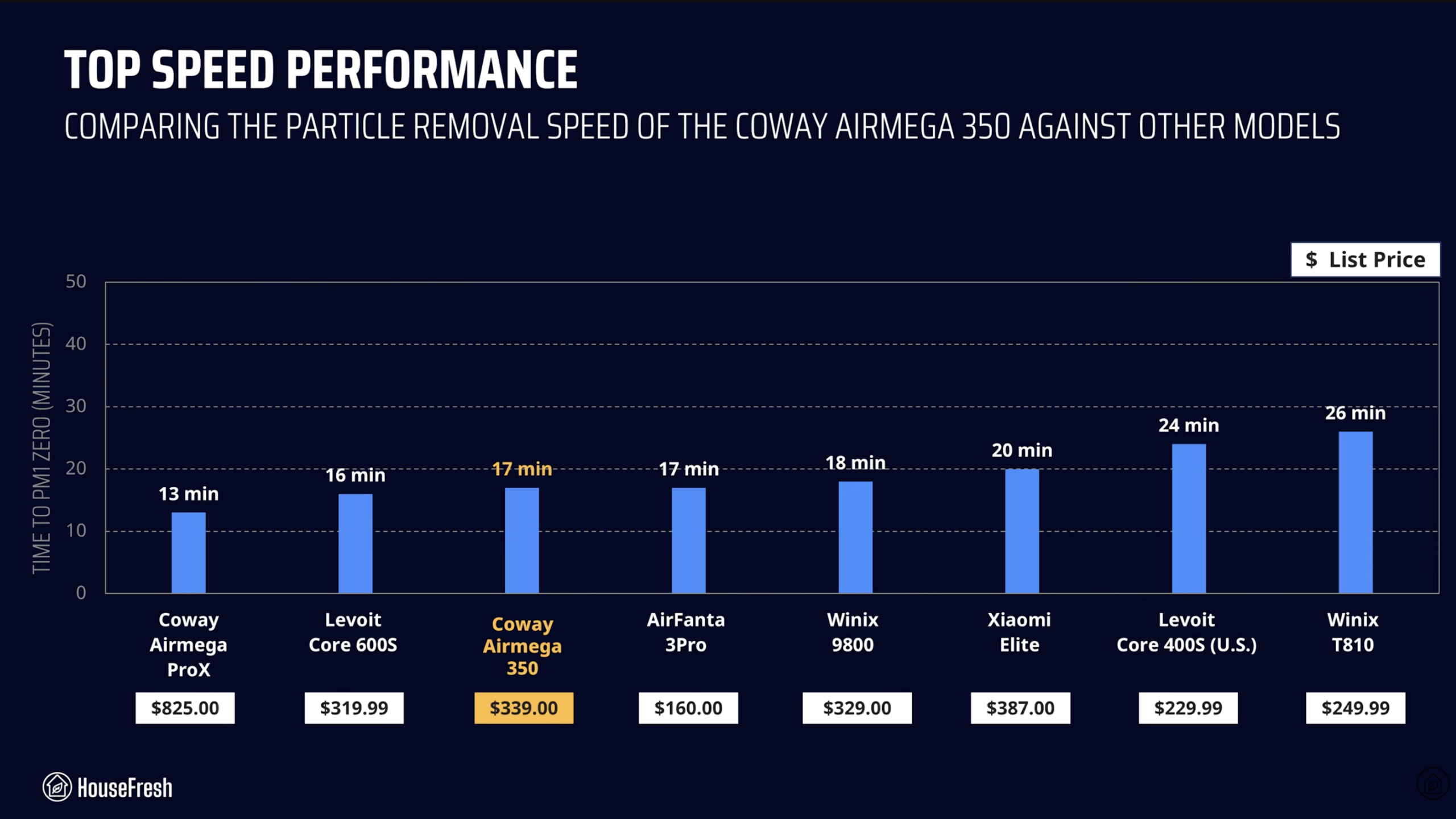
The only devices that were quicker to complete our test were the much larger Coway Airmega ProX (13 minutes) and the older (and cheaper!) Levoit Core 600S.
We repeated our particle removal test three times across all available fan speeds, which allowed me to estimate PM1 CADR at each fan speed:
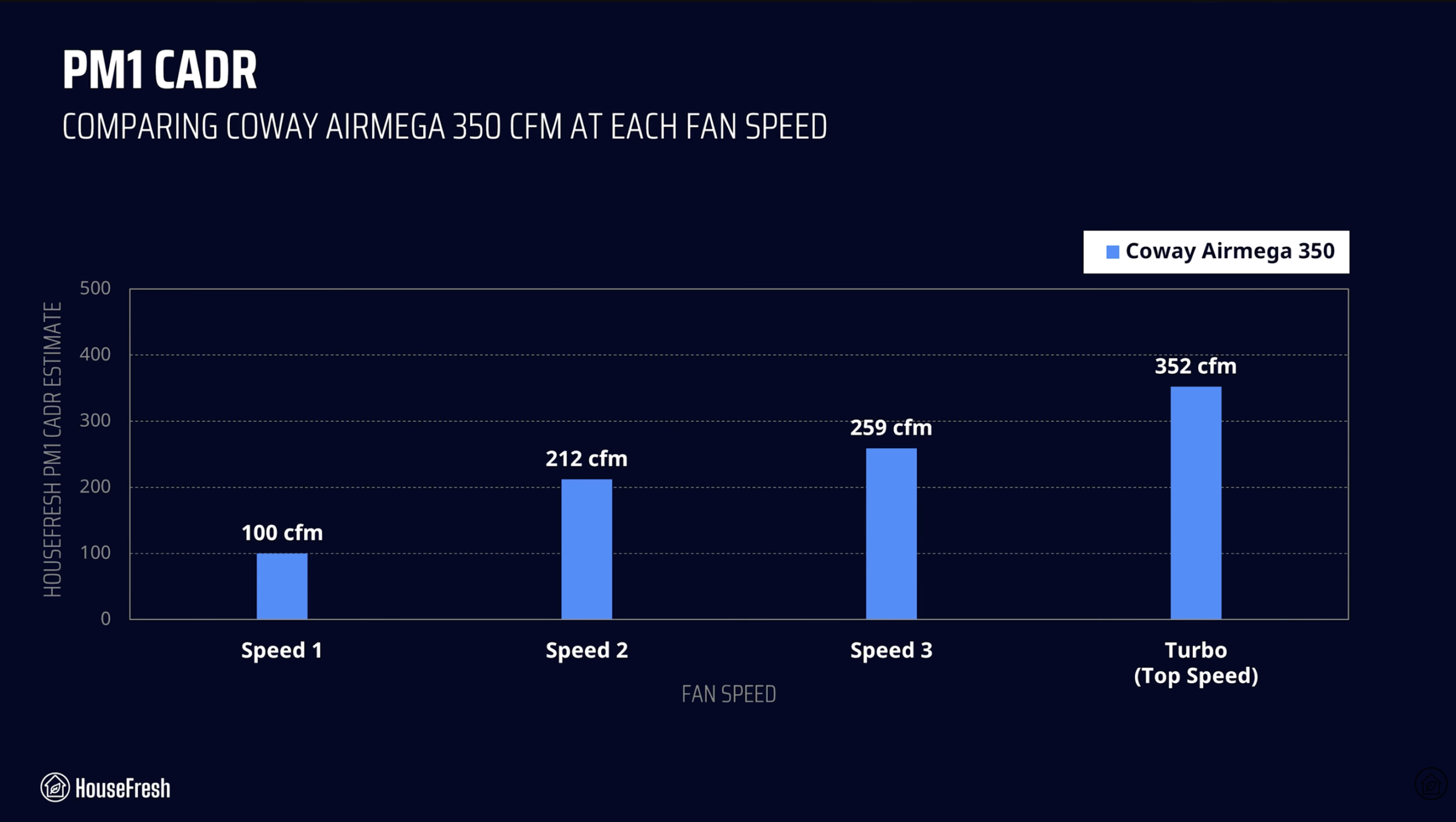
BUT, as I always say, air purifiers running at full power are usually too loud for everyday use, so we must account for noise levels…
Sound levels
The sound levels of the Coway Airmega 350 range from 35.2 dBA to 61.8 dBA — which is a little louder than most air purifiers we have benchmarked it against.

I used our BAFX sound meter to measure how much sound the Airmega 350 generates at each of its fan speeds (including sleep mode) at 3 ft away:
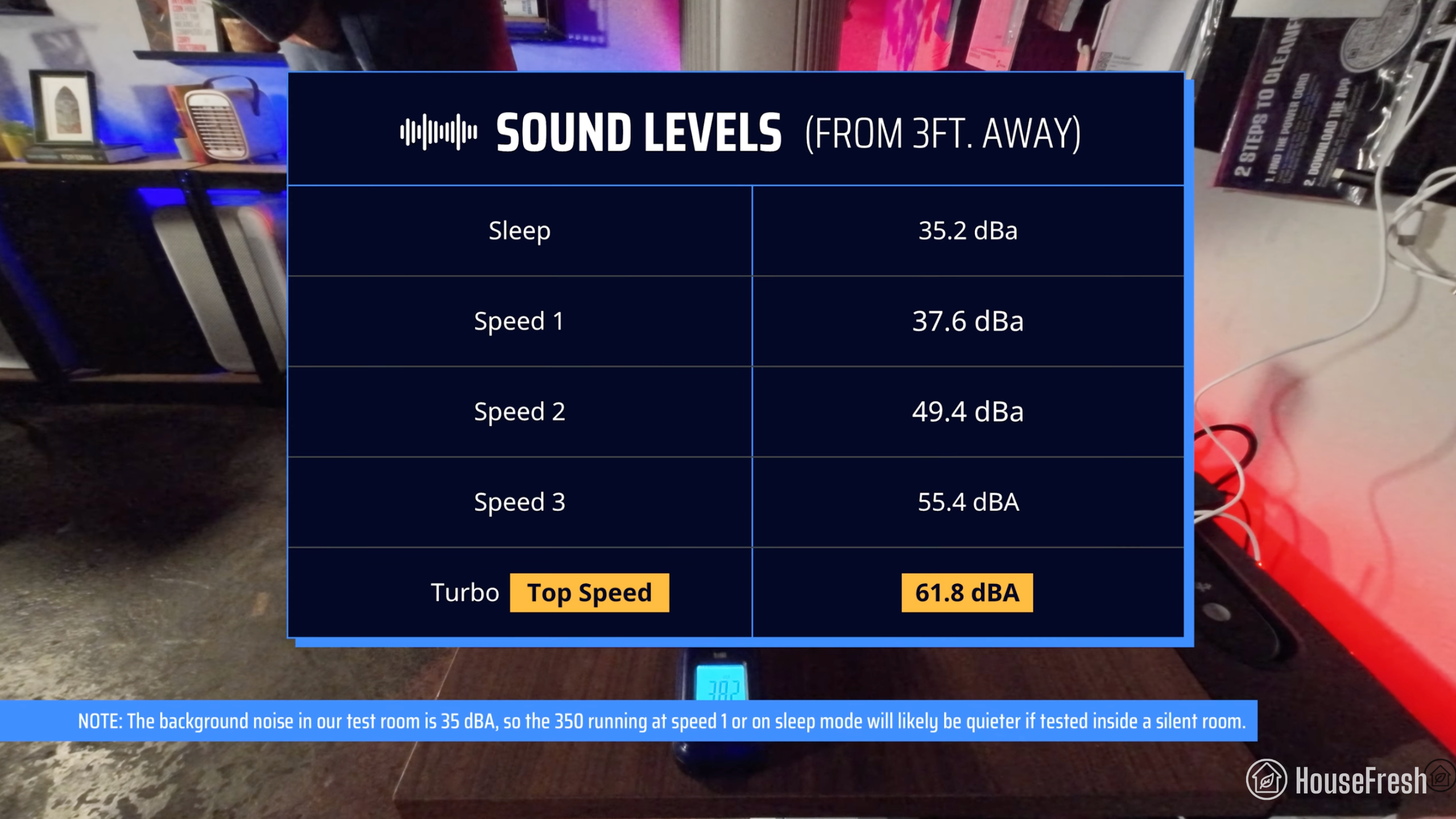
Hitting 61.8 dBA at top speed, the Airmega 350 is one of the loudest air purifiers on the chart, second only to the Core 600S and its 62.3 dBA when running full power.
When running at speed 1, it generates just 37.6 dBA and was able to complete our particle removal test in 58 minutes – slower than most other models on the table.
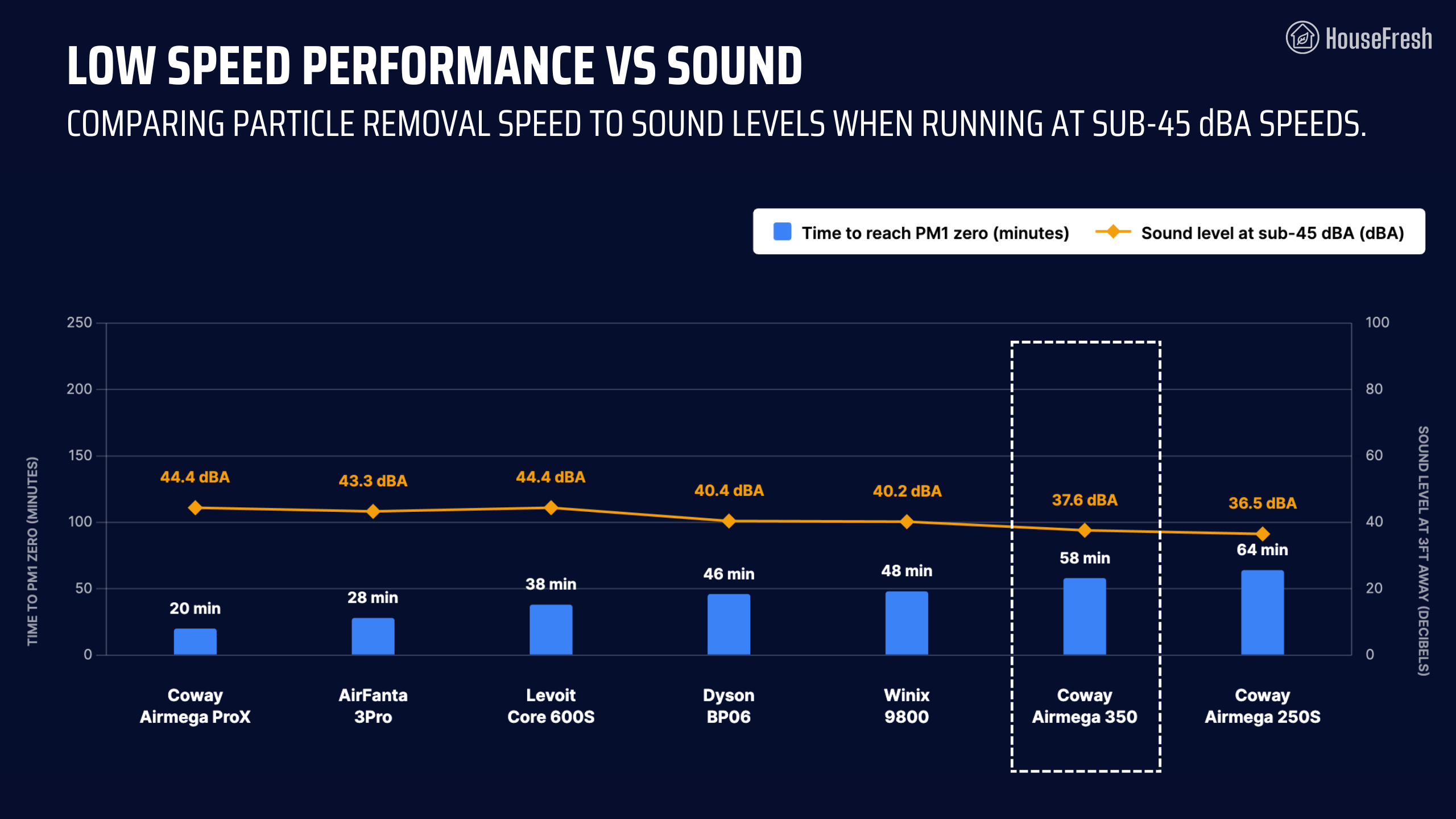
I wish Coway would add an intermediary fan speed between speed 1 and speed 2, where the 350 stays below 45 dBA.
Long-term running costs
Running a Coway Airmega 350 will cost you $115.69 per year, combining energy and filter replacement costs.
We used our energy meter to record how much electricity the Airmega 350 pulls at each fan speed and while on standby.
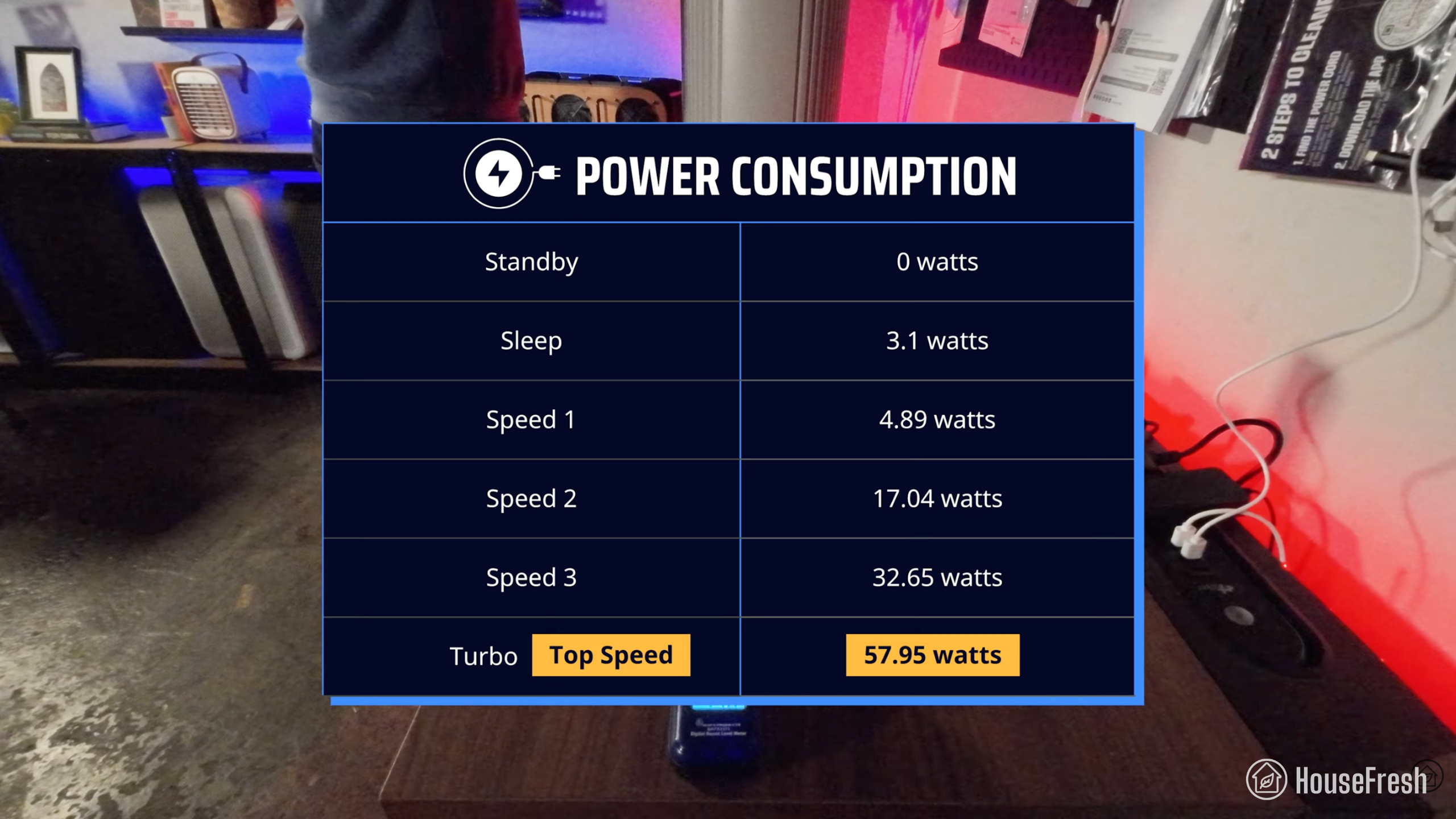
At top speed, the Airmega 350 draws 57.95 watts, so if you left it running at top speed 24/7 for one year, it would add $69.70 to your energy bill, based on the average U.S. electricity price as of March 2026.
But electricity consumption is not the only long-term cost you need to budget for; there’s also the filter replacements.
According to Coway, you need to change the filter in your Airmega 350 every 12 months. The replacement filter costs $79, so you can expect to spend that much each year on filter replacements alone.
When we add this to energy costs, we can work out that it will cost you $148.70 to run a 350 for a year. Let’s compare it with other models:
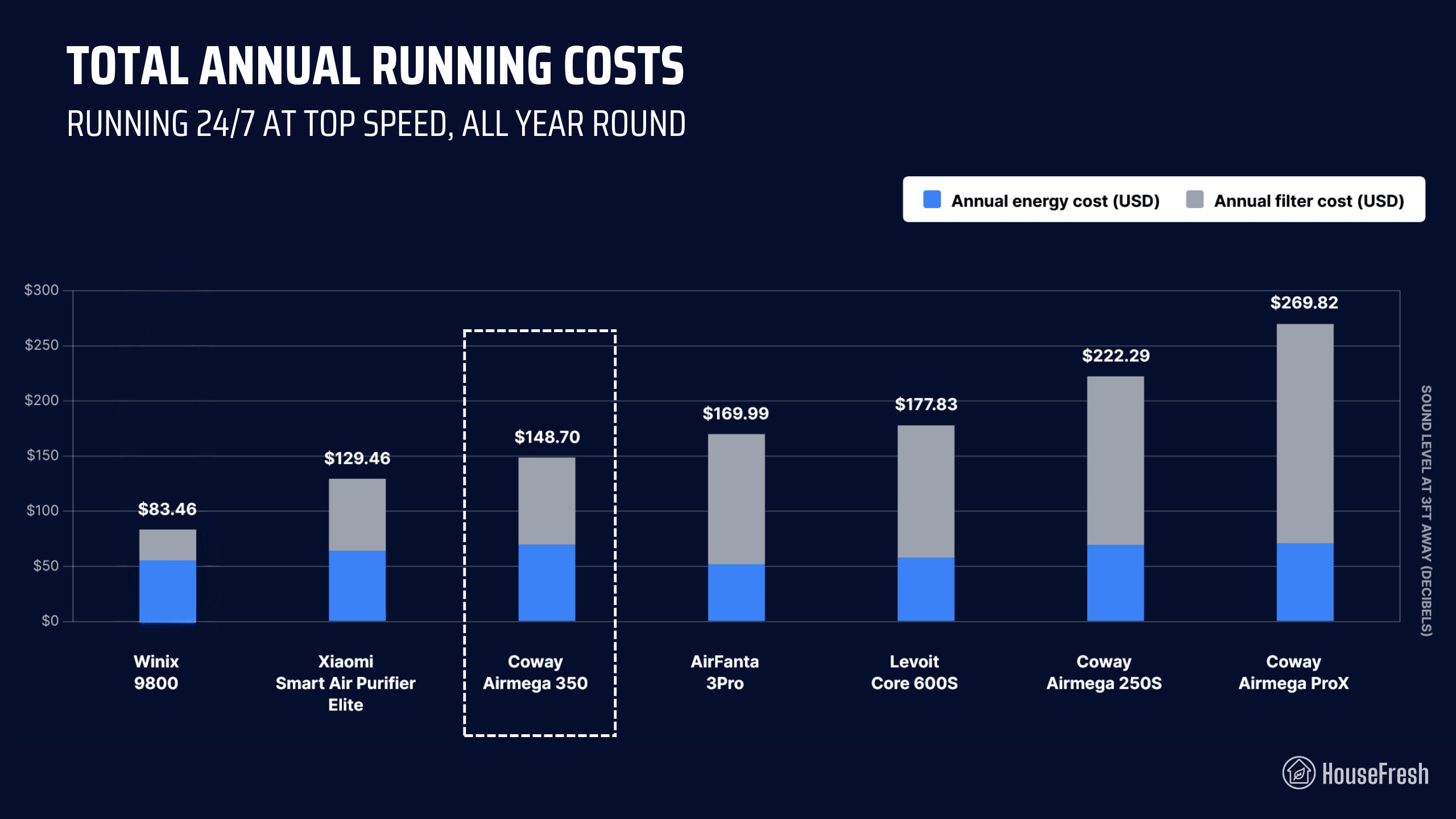
Thanks to Coway’s affordable filter replacement costs, the Airmega 350 is cheaper to run than most other high CADR models we benchmarked it against, with the exception of the Winix 9800 and the Xiaomi Elite.
Bottom line: Should you get a Coway Airmega 350?
Our data showed that the Airmega 350 offers excellent air cleaning performance when compared to other cylindrical air purifiers on the market today.
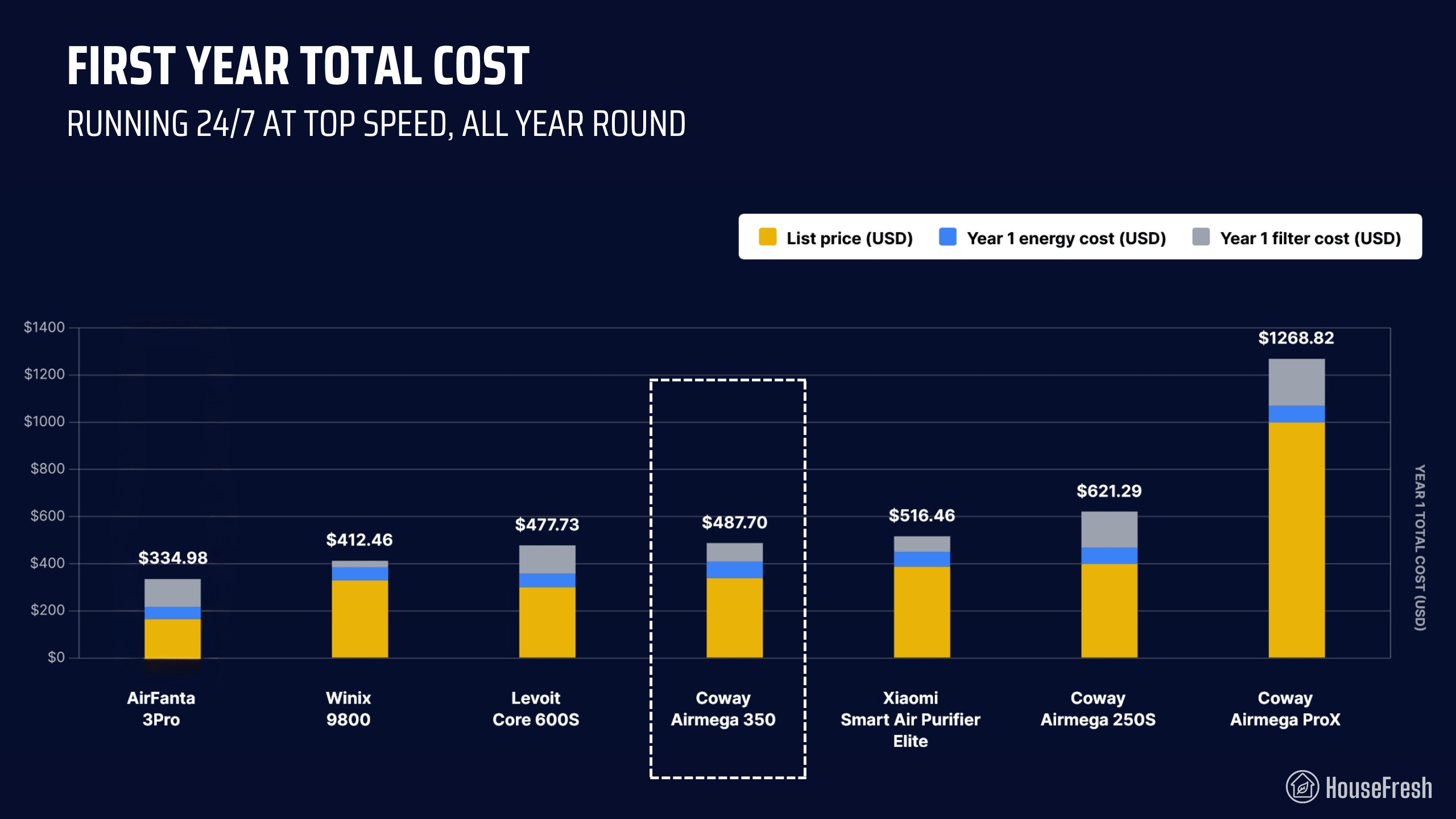
If you’re looking for the absolute best bang for your buck, the AirFanta 3Pro will offer the same level of performance at top speed as the Airmega 350, but at a lower price tag ($165).
And if you’re looking for a more traditional-looking air purifier, then the Winix 9800 costs a little less than the 350 ($329) and offers similar performance with much lower running costs courtesy of Winix’s highly affordable Type A filters.
That said, the 350’s running costs are also very fair, so at the end of the first year, the upfront cost will even out:
I also know that many consumers prefer the look and small footprint of cylindrical air purifiers, so if that is you, then the Coway Airmega 350 might be just the thing.
Personally, I much prefer the design of the 350 to the look of Xiaomi’s Elite and Levoit’s Core 600S. However, when compared to Xiaomi and Levoit, you don’t get an accurate laser sensor and app support.
But I’d swap app support any day for the granular light control and the ability to adjust the sensor’s sensitivity that you get with the Airmega 350. Plus, it’s great to know that you can use a smart plug to control your 350 remotely from your phone.
As it has become common with Coway, there is a big jump in sound from speed 1 to speed 2, which means that its performance at sub-45 dBA sound levels is less powerful than all the air purifiers we benchmarked it against. But if 49 dBA is not too loud for you, then you will get excellent performance at speed 2. For reference, we had our 350 in our bedroom for over a month running at speed 2 all day and all night without it bothering us.
Overall, I think the Airmega 350 is a great alternative to the Levoit Core 600S, and I can see myself recommending this model in the future to those looking for a mid-sized cylindrical air purifier that looks good and offers good air cleaning performance.
If you decide to get yourself a 350, please use this link to help support the work we do here at HouseFresh. If you do, we will get a small commission at no extra cost to you, which we will use to continue buying and testing air quality products.
If you have any questions about the 350 or about Coway air purifiers in general, please drop them in the comments below, and I’ll get back to you as soon as I can.