The old AirFanta 3Pro was one of my most anticipated reviews since launching HouseFresh.
After testing it, I found that it offered air cleaning performance that matched what we saw from air purifiers costing upwards of $500. But since publishing my review, I received many messages from people who just didn’t like the look of the 3Pro.
Luckily, AirFanta’s creator (Adam Wong) took the feedback seriously… The new AirFanta 5Pro looks good, has an onboard laser particle sensor and even features auto mode.
But is it as good as the cheaper 3Pro? And most importantly, can it match the incredible value proposition of the older model?
To find out, I bought one with my own money so that I could use it a home in order to test its performance, energy consumption, noise generation, yearly maintenance costs, and day-to-day user experience.
The overall score for the 5Pro incorporates first-hand data results from our battery of tests, as well as our ratings for customer service, brand transparency, and design & UX. Check out the full scorecard below to see the category breakdown.
Search for ‘5Pro’ to see where it ranks, based on its air cleaning performance and value for money. You can also filter results to easily compare models in the same price range.
The pros and cons of the AirFanta 5Pro
A summary of our top-level findings after testing this air purifier, following our methodology.
→ Get a discount when buying direct from AirFanta with code: HOUSEFRESH3
If you loved the value and performance of the AirFanta 3Pro, but didn’t get one because of how it looks… Then the 5Pro is what you’ve been waiting for.
This new AirFanta model will give you all the power and value of the 3Pro, but in a design that will look good in even the most stylish rooms. Plus, you get additional features like a PM2.5 laser sensor, an air quality indicator light, and even auto mode.
But most importantly, you get incredible air cleaning power at the same noise and energy consumption levels you can expect from traditional models from Coway, Winix and Blueair that cost twice as much.”

HouseFresh Founder
& Lead Tester
CONS
PROS
Filtration technology
You get two options: particle filtration only, or particle + gas filtration.
The AirFanta 5Pro reminds me of my humongous Corsi-Rosenthal box, with one filter on each side arranged on top of a base and locked in place with the PC fans at the top.
For particle filtration, you get E11 grade particle filters just like the old 3Pro. But unlike the 3Pro, the filters of the 5Pro sit inside a plastic cover – so no more exposed filters.
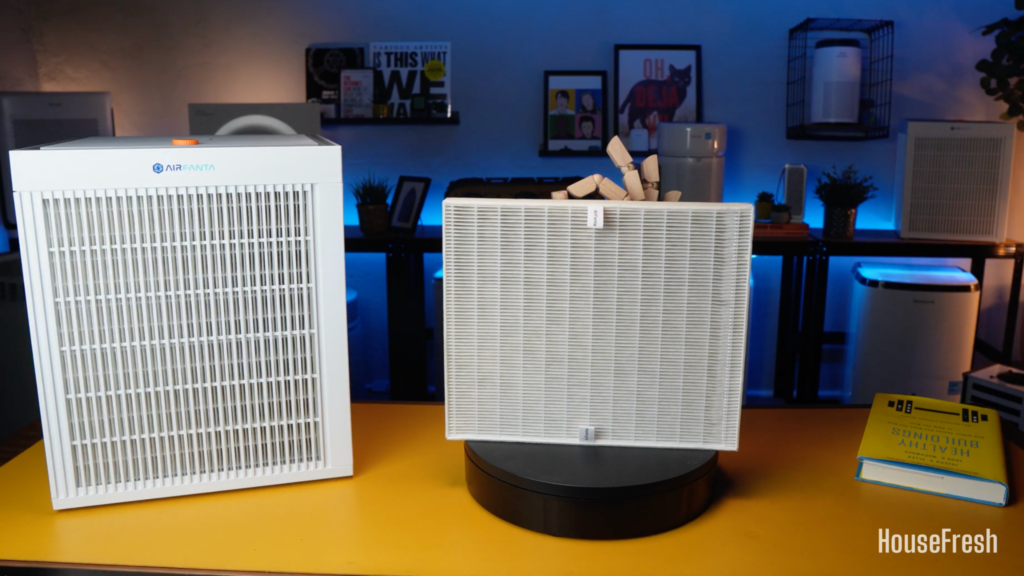
For those wondering about E11 vs HEPA filtration, know that after testing over 150 different air purifiers, I’ve found that lower grade filters like E11 help maximize CADR as they don’t restrict airflow as much as a HEPA H13 or H14 would. This is good news for allergy sufferers!
If you want to remove both particles AND gases from the air, then you can go with the all-in-one filters with a side of E11 and a side packed with activated carbon pellets.
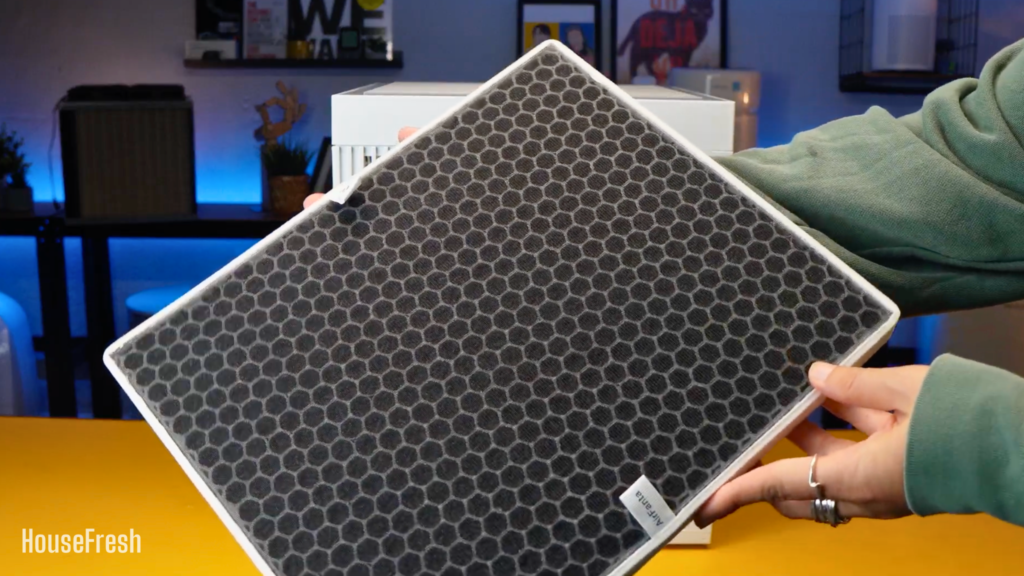
Each bonded filter comes with 120g of activated carbon pellets, so you get 480 grams in total across all four filters. This is more than what you get with the Coway Mighty2 and the Levoit Vital 200S, but less than the 600g of carbon in the older 3Pro.
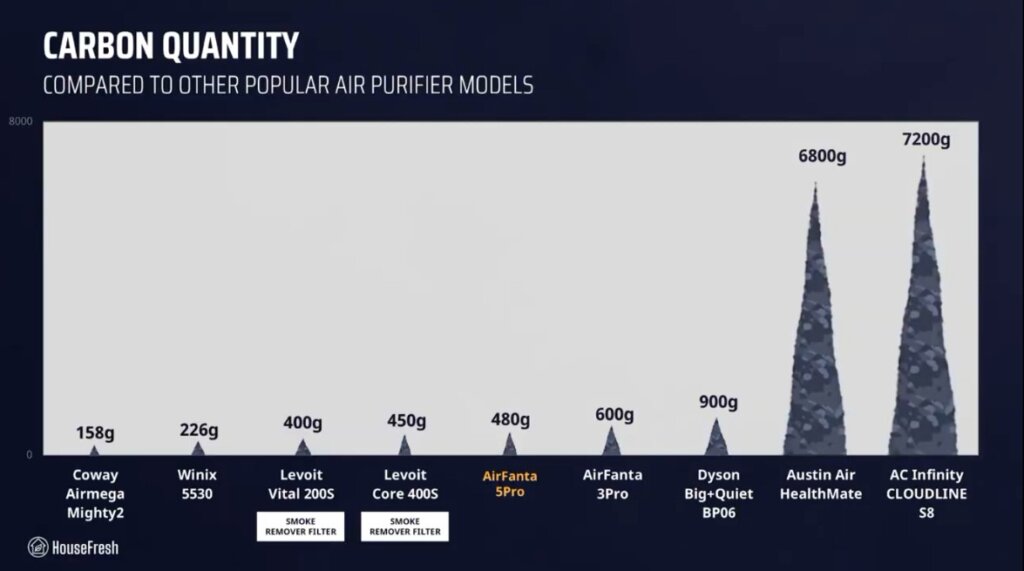
However, if don’t need odor removal and are more concerned about removing dust, pollen and mold spores, then I would recommend sticking with the E11 particle filters only.
Design, controls and features
A medium-sized air purifier with similar dimensions to other cylindrical models like the Philips 3200 Series.
The 5Pro is a medium sized air purifier shaped like a box, with a filter on each side and four PC fans on top.
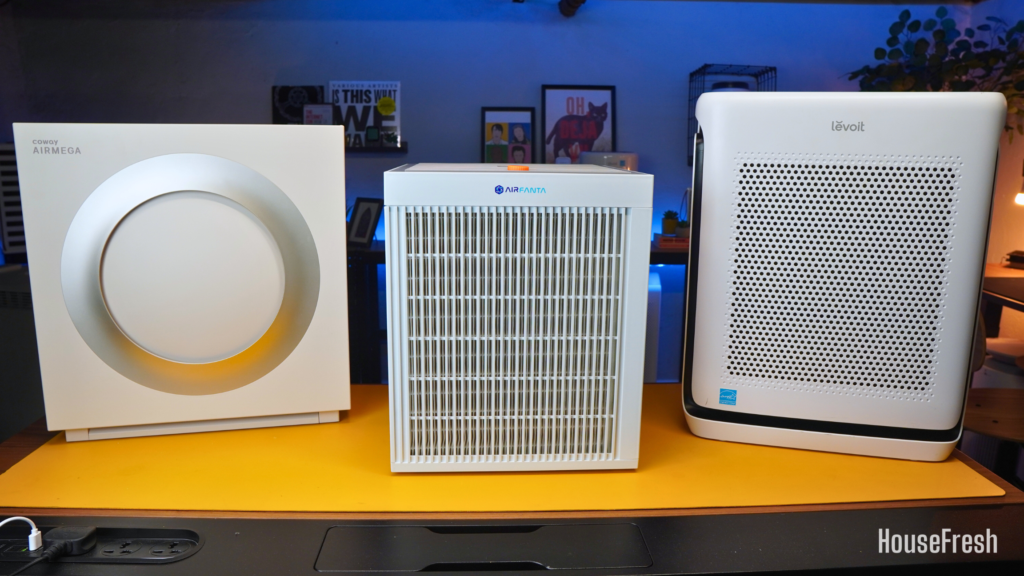
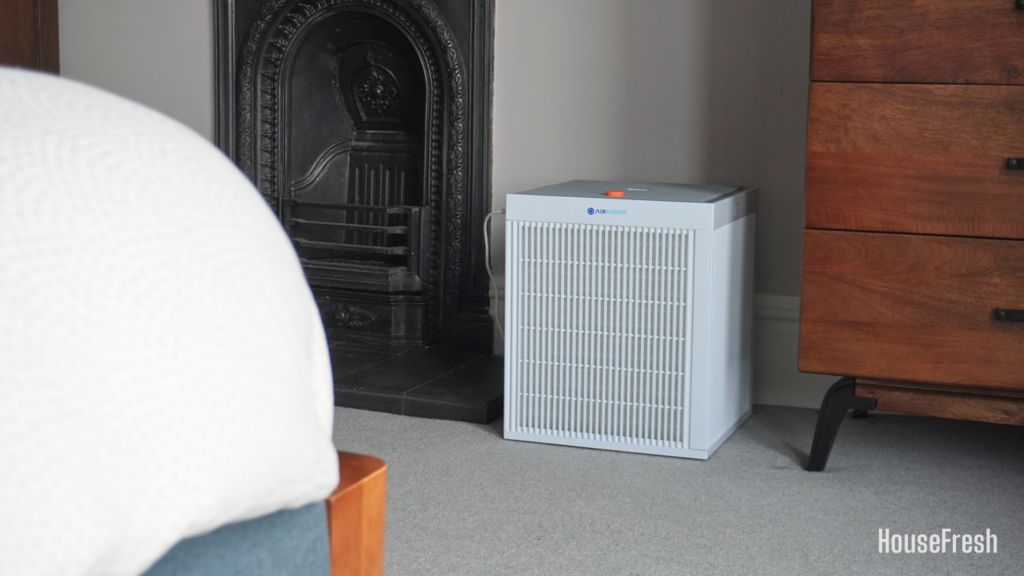
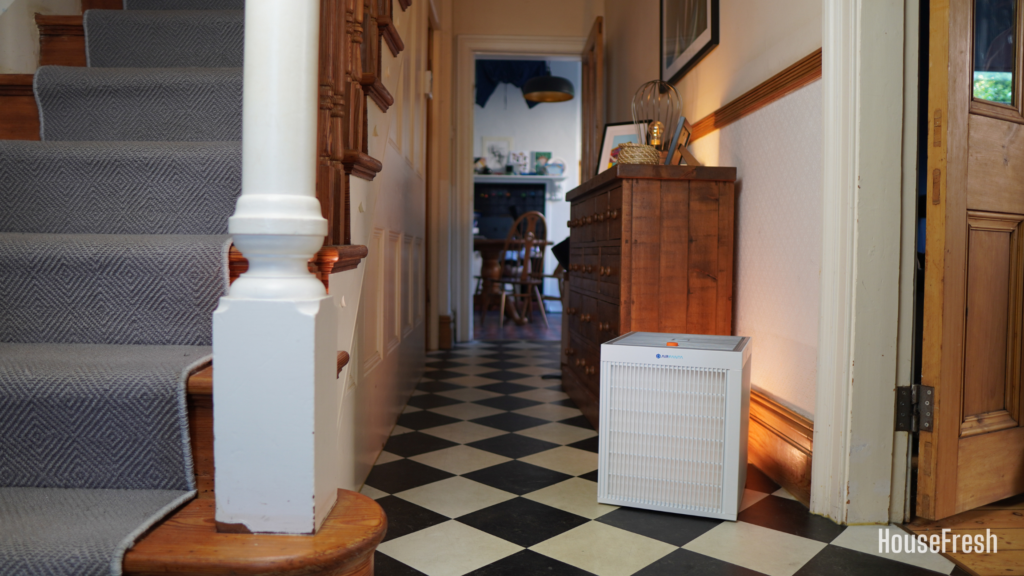
It’s a little bigger than the old AirFanta 3Pro, but a lot shorter than popular models like the Coway Mighty2 (left) and the Levoit Vital 200S (right). It will fit on top of a desk or side table.
It has an orange dial at the top to increase the speed of the fans, and when you press it and hold, it activates the auto mode.
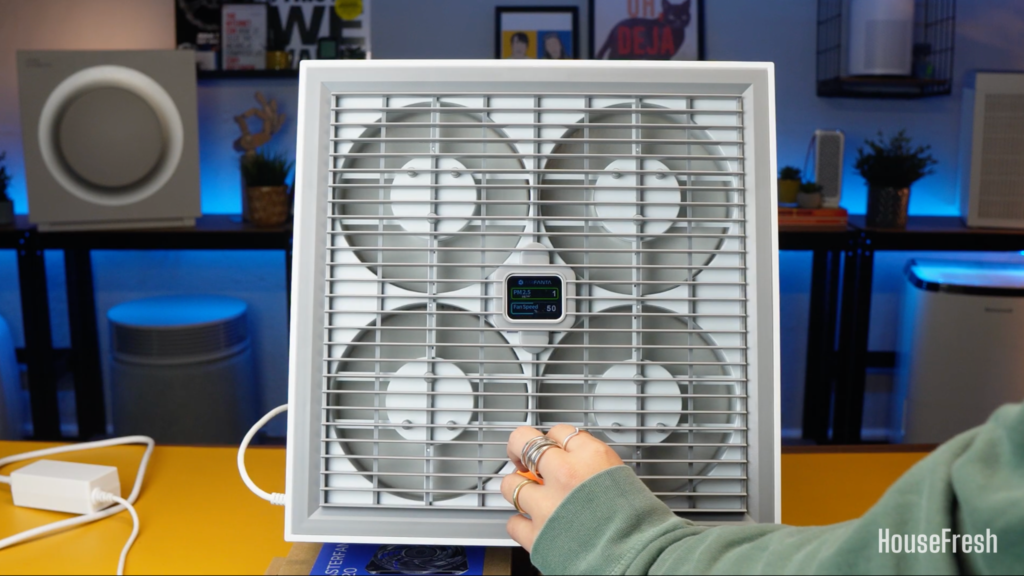
The auto mode is controlled by an in-built MFrontier MPM10 laser sensor. You can see PM2.5 readings on screen and there’s a light that changes color to alert you when your air is bad.
It can also be powered by a power bank with 12V DC output for those who want to use it on the go, or inside an RV or a car.
I have used my 5Pro with my Anker Power Bank and a little USB-C to DC adapter (5.5×2.1mm). You can see both in the video above.
The 5Pro still uses the box design we saw with the 3Pro – with a base, four filters and the fans on top.
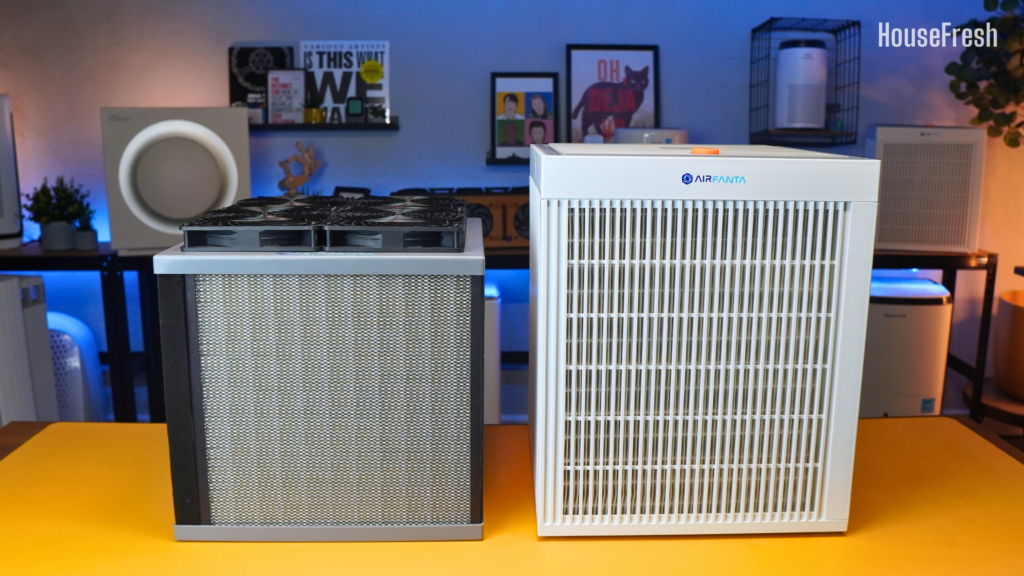
Both models use E11 particle filters but the 3Pro comes with 120g more of carbon.
The filters and the fans of the 5Pro sit inside plastic sheets, and these plastic sheets come with magnets.
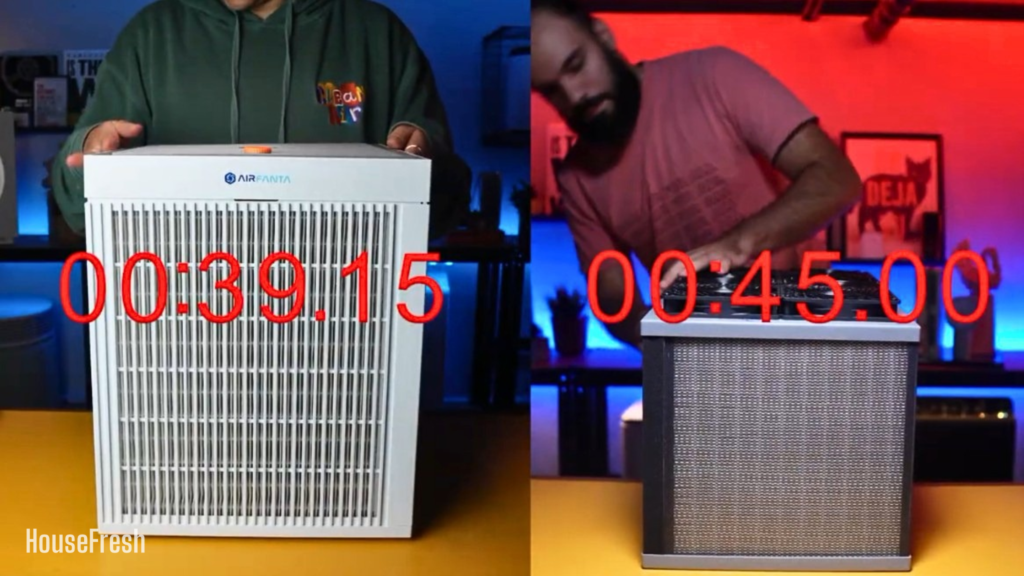
This makes the build easier so you can assemble/disassemble it faster than the 3Pro.
Once disassembled, you can fit the separate parts of your 5Pro inside a large bag or small suitcase.
This is the same as with the old 3Pro and is good news for those looking for an air purifier they can travel with.
Air cleaning performance
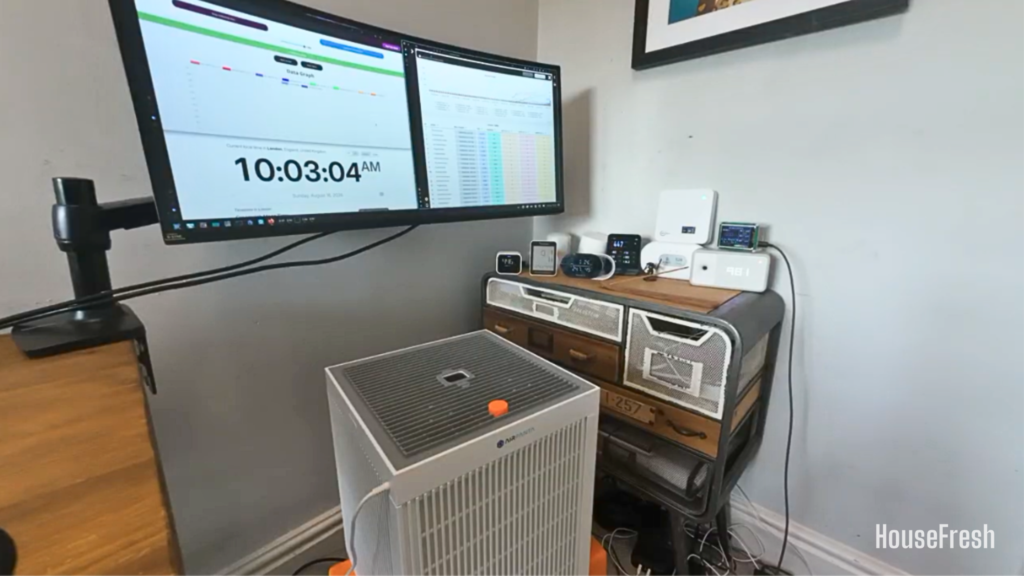
We tested the AirFanta 5Pro in our 728-cubic-ft test room, measuring how quickly it removed PM1 particles from the air after we filled the space with incense smoke.
→ Get a discount when buying direct from AirFanta with code: HOUSEFRESH3
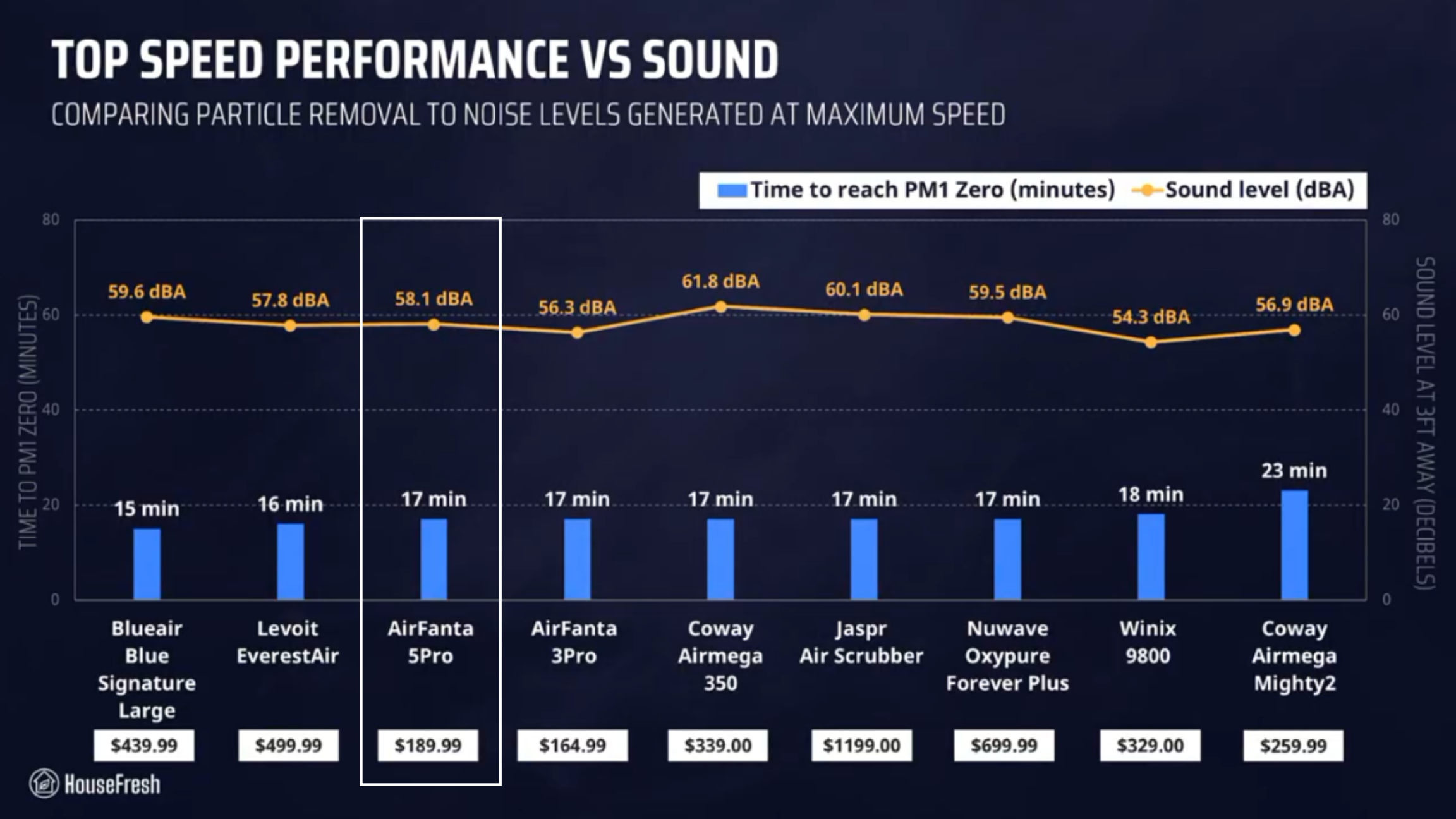
When running at top speed, our PurpleAir Zen sensor shows that the AirFanta 5Pro reached PM1 zero is a speedy 17 minutes.
This result compares well against popular mid-sized models from brands like Blueair, Winix, Levoit and Coway that offer similar or less power for a higher price and in a larger package.
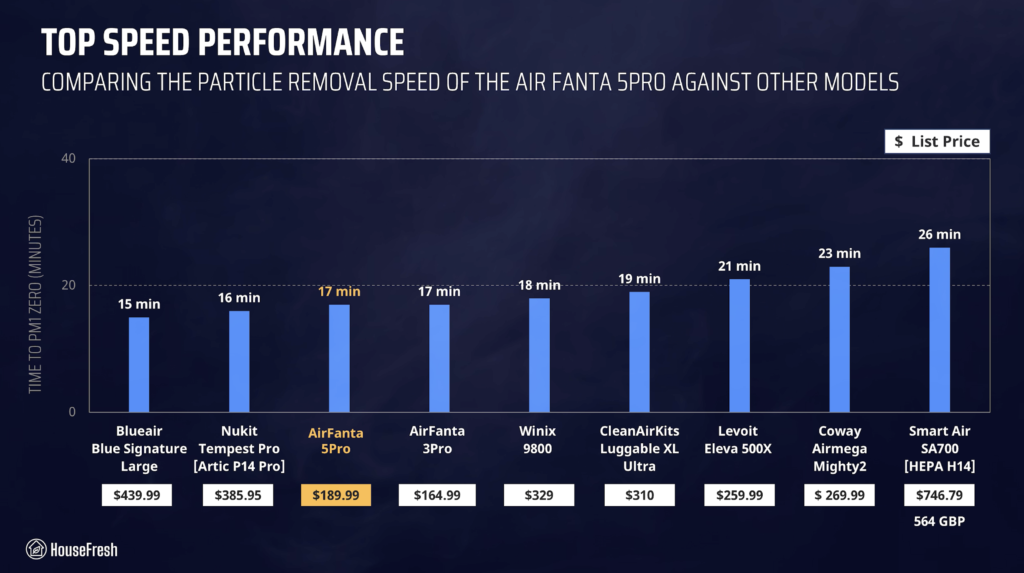
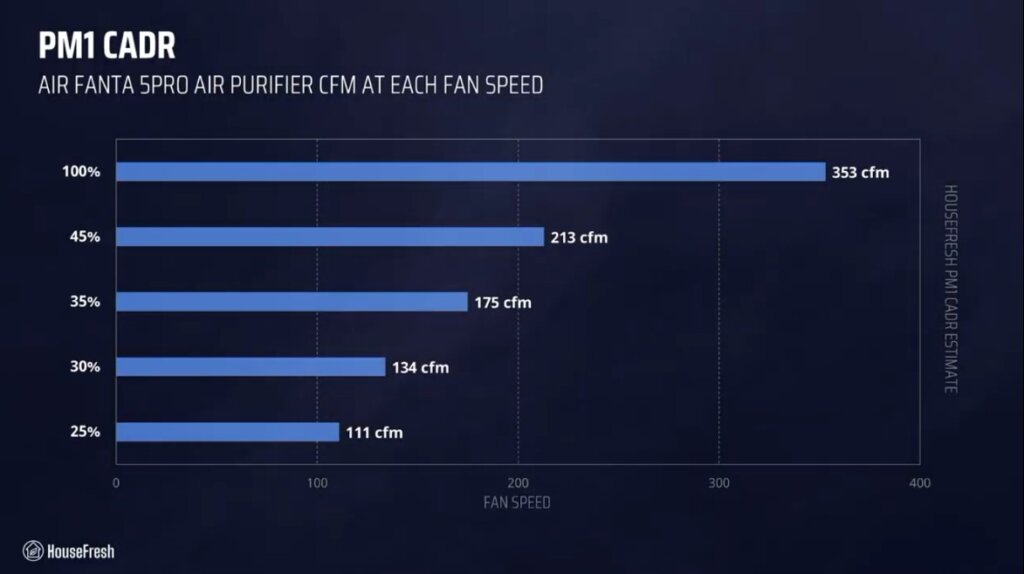
Based on the natural ventilation of our test room, we estimate a PM1 CADR of 353 cfm. This makes this new AirFanta model powerful enough to clean the air five times per hour in rooms up to 529 sq. ft. (or 49 m²).
When we account for price, we find that with a list price of $189.99, the 5Pro offers a cost per CADR of just 54 cents:
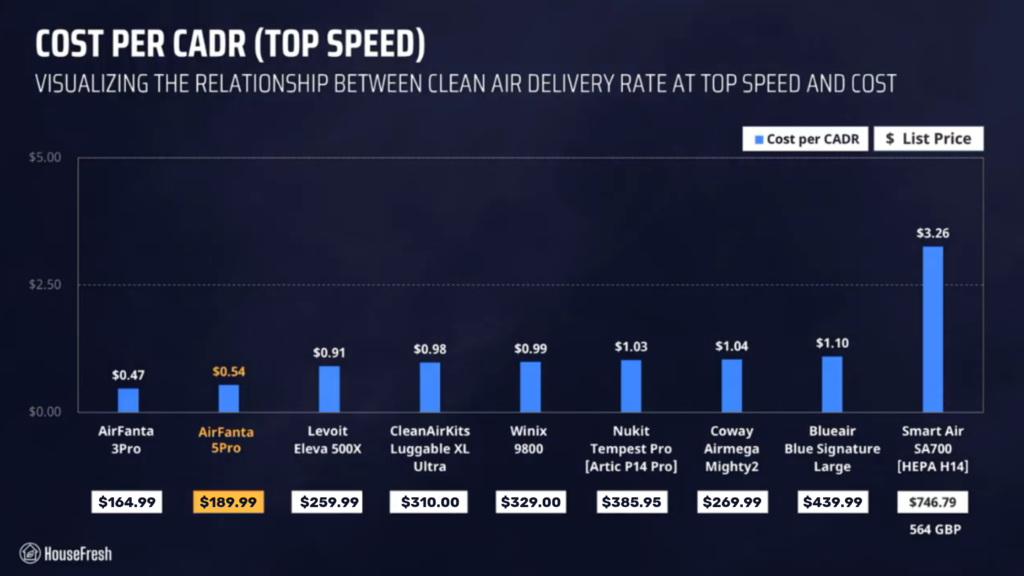
This is one of the lowest I’ve seen across all high-CADR air purifier models we’ve tested at HouseFresh. The only model with an even lower cost per CADR is the older 3Pro, which is also cheaper at just under $165.
But all these numbers are based on results at top speed, so they don’t tell us the full story…
Sound levels
The sound levels of the AirFanta 5Pro range from 36.8 dBA to 58.1 dBA – a little louder than the older model, but not by much.
As I always say, air purifiers can be as noisy as a vacuum cleaner – and nobody wants a vacuum cleaner running in the background while sleeping or trying to work.
That is why you need to find out just how loud a specific air purifier is BEFORE you buy it.
The AirFanta 5Pro has 16 fan speed options, going from 25% to 100% power, in increments of 5%. To keep things simple, I broke it into 10 speeds and measured sound levels from 3 feet away at each of these fan speeds:
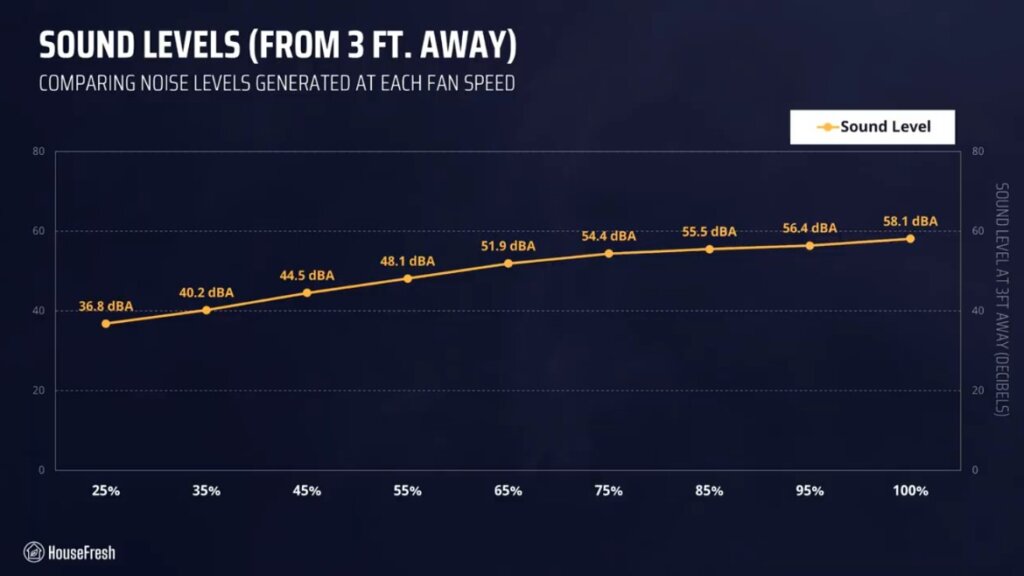
Reaching 58.1 dBA at 100% power, the 5Pro is louder than its predecessor but it’s quieter than more expensive models like the Coway 350, the Jaspr and the Nuwave Oxypure Forever Plus.
However, it’s worth mentioning that the 5Pro is louder than other PC fan-powered air purifiers like the Nukit Tempest Pro and the CleanAirKits Luggable XL Ultra.
Running at 45% power, it reached 44.5 dBA and cleared our test room in 28 minutes. With this result, it outperformed other 2026 releases like the Levoit Eleva 500X and the Coway Mighty2.
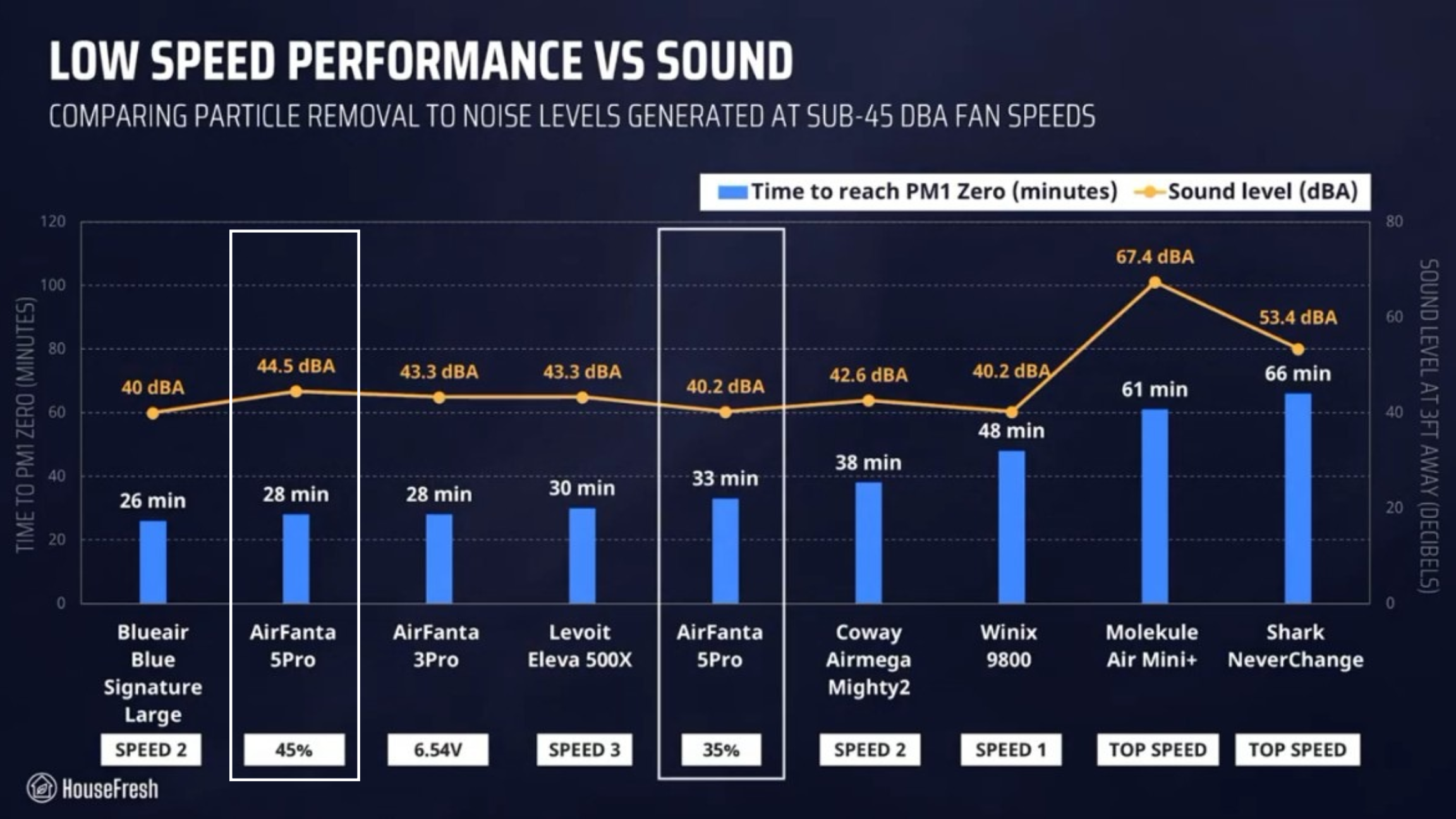
I use my 5Pro in the bedroom at 35% of its power, where it hits just over 40 decibels so I repeated the particle removal test at this speed and the result was impressive – faster than the Mighty2.
Based on the natural ventilation of our test room, I estimate a PM1 CADR of 213 cfm at 45% of its power, which can clean the air five times per hour in spaces up to 319 sq. ft. (or 29 m²) while producing less than 45 decibels of noise.
Long-term running costs
Running an AirFanta 5Pro (with E11 filters) will cost you $125.24 per year, combining energy and filter replacement costs.
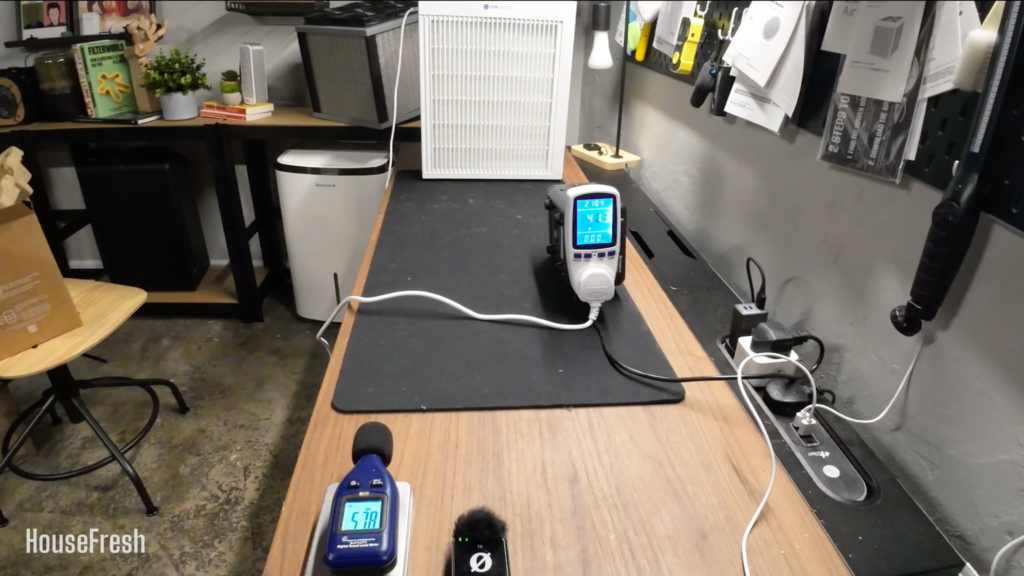
We used our energy meter to record how much electricity the new AirFanta model pulls at each fan speed and while on standby.
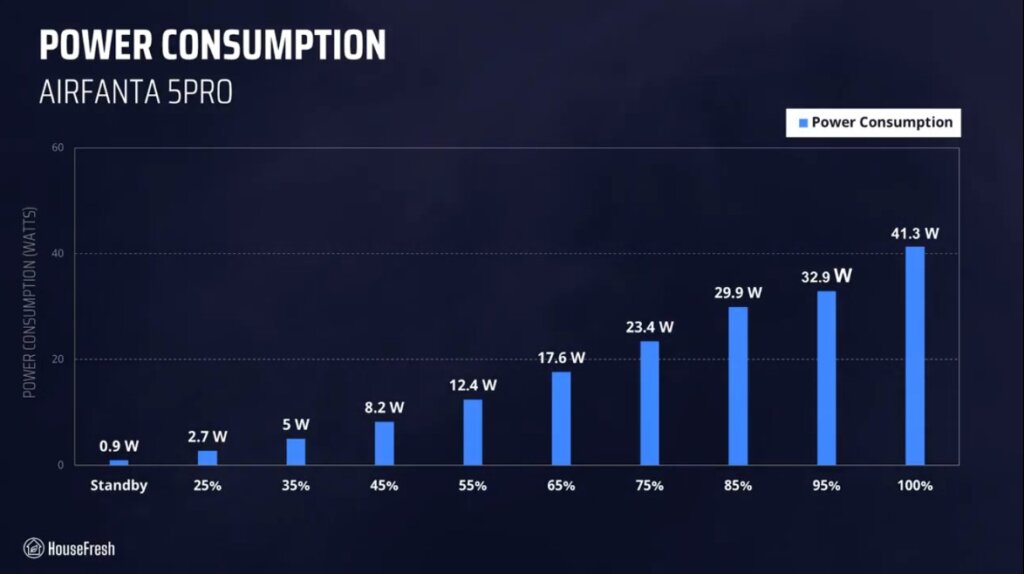
At 100% power, the 5Pro draws 41.3 watts, so if you were to leave it running at top speed 24/7 for one year, it will add $66.24 to your energy bill, based on the latest electricity prices in the U.S. as of November 2026.
In terms of filter replacements, AirFanta states that the E11 filters will last 12 months, while the E11 + carbon will last 8 months. The E11 filters cost $57 for one set of 4 filters, and the E11 + carbon cost $75.
So you can expect to spend $57 each year on E11 filter replacements, or $112.50 per year if you go for the E11 + carbon option.
I added the yearly filter replacement costs to the energy costs, and found that you’ll need to budget for $123.24 per year to keep your 5Pro running 24/7 at 100% power with just an E11 filter.
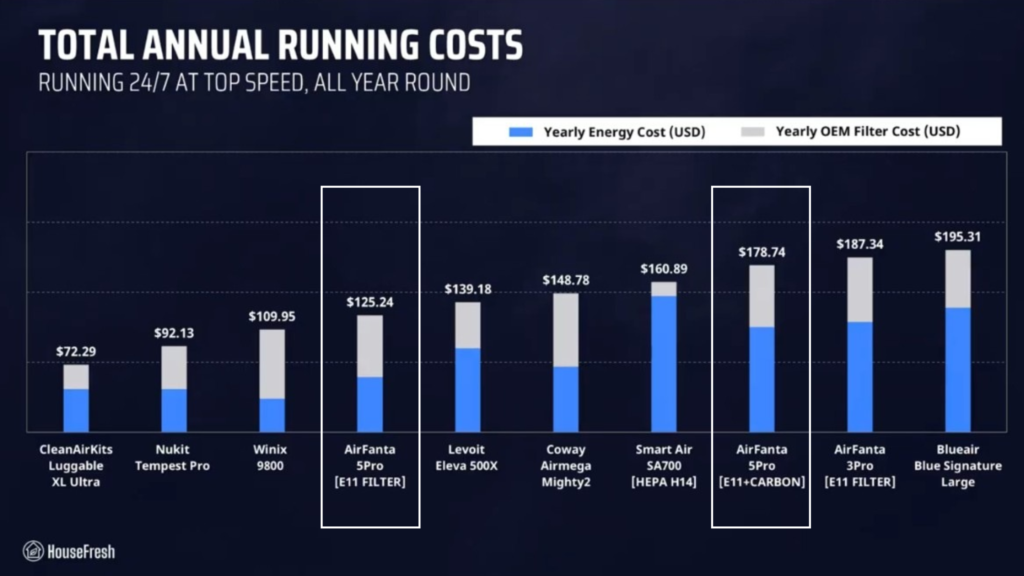
Just for reference, you will spend $187.34 to run an old 3Pro all year with just particle filters. And this is more expensive than the $178.74 you’ll spend to run an AirFanta 5Pro with particle + carbon filters.
And when using just E11 filters, the 5Pro is cheaper to run than other new models on the market like the Levoit Eleva 500X, the Coway Mighty2 and the Smart Air SA700.
But for a new buyer, the most important number is the total investment in the first year.
When you add the $189.99 retail price to that first year’s running cost of a 5Pro with E11 filters, your total investment is $313.23.
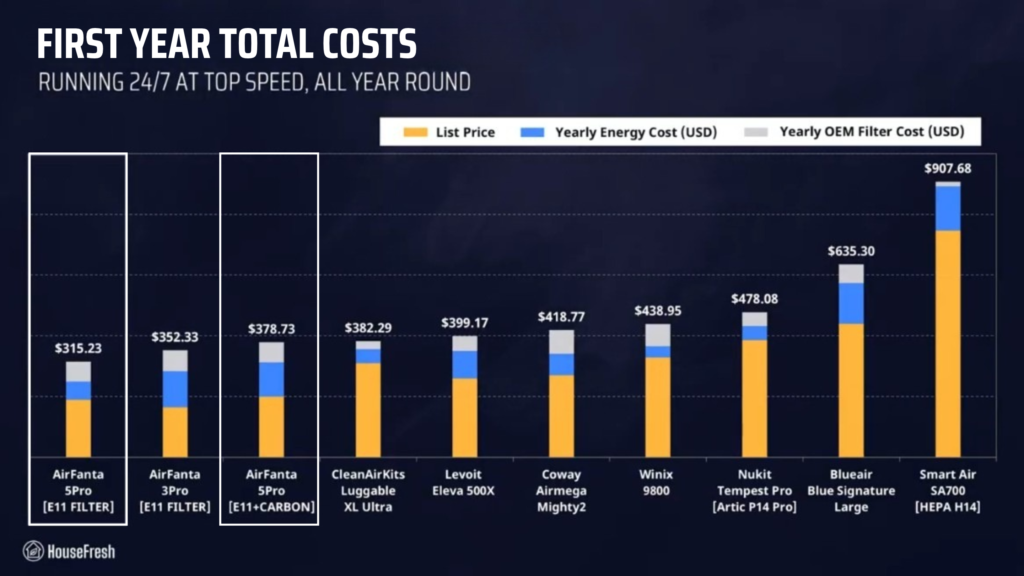
Even when accounting for the additional money you’ll pay upfront (and over a year) for the version with E11 filters and carbon, your total investment in the first year is still lower than every other model I’m benchmarking the 5Pro against.
Bottom line: Should you get an AirFanta 5Pro?
If you loved the value and performance of the AirFanta 3Pro, but didn’t get one because of how it looks, then the 5Pro is what you’ve been waiting for.
→ Get a discount when buying direct from AirFanta with code: HOUSEFRESH3
While the $190 price is higher than the $165 you’ll pay for the older AirFanta 3Pro, you have to remember that we now live in a world of tariffs and $100-oil barrels.
And the good news is that extra money will come back in benefits.
With the 5Pro, you get all the power and value of the 3Pro, but in a design that will look good in even the most stylish rooms.
Plus, you get additional features like an accurate PM2.5 laser sensor, an air quality indicator light and even auto mode.
But most importantly, you get incredible air cleaning power at the same noise and energy consumption levels you can expect from models from Coway, Winix and Blueair that will cost you twice as much.
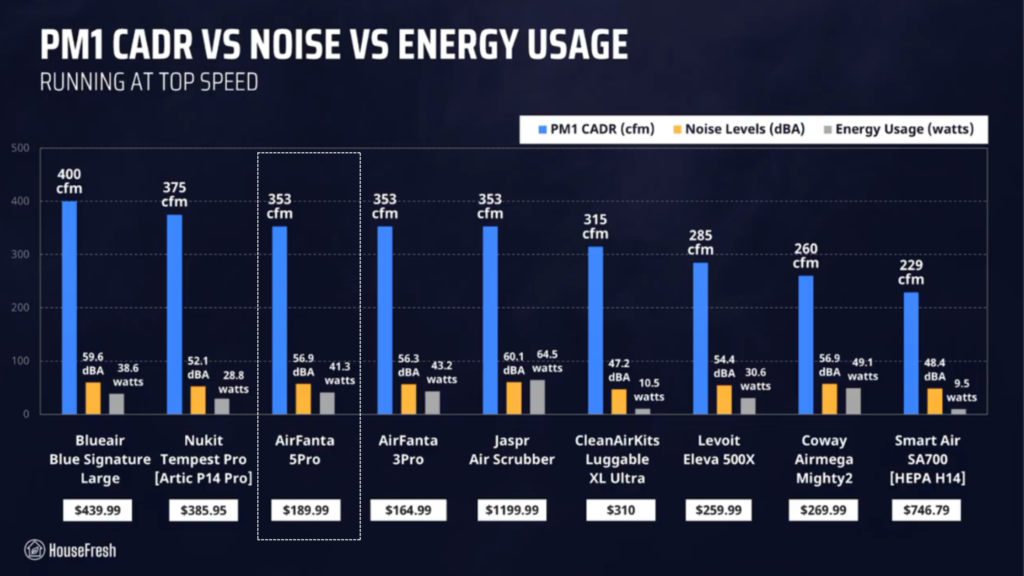
And you’re not paying an arm and a leg for this performance. In fact, our data shows that the AirFanta 5Pro is the cheapest high CADR air purifier to buy and to run in that first year of ownership.
Adam Wong did it again.
With the 5Pro, AirFanta continues their work towards a future where clean air is not a luxury.
This matters now more than ever because we’re living in a timeline where brands with big marketing budgets are pushing overpriced and sometimes underperforming air purifiers to consumers. And, in some cases, even forcing buyers to sign up for recurring filter subscriptions, whether they need them or not…
So next time you feel like every company under the sun is just doing everything they can to squeeze as much money out of you as possible… Remember that there are still people like Adam Wong and brands like AirFanta out there, actually trying to help.
Before I leave you:
If my review helped you make the decision to buy an AirFanta 5Pro, please use this link and we will get a small affiliate commission at no extra cost to you.
And if you are still on the hunt for a good air purifier, you might want to check out our air purifier comparison too — with all the data I’ve collected on the more than 150 different air purifiers I’ve tested since 2020, so you can compare them like for like.
If you have any questions about the AirFanta 5Pro or about air purifiers in general, please drop them in the comments below, and I’ll reply personally as soon as I can.