The Vital 100S is the smaller sibling of the Levoit Vital 200S, one of the air purifiers I’ve recommended to most people since I first tested it years ago.
But can this smaller model deliver the same level of powerful air cleaning performance than the larger 200S?
To find out, I bought one with my own money so that I could test its air cleaning performance, noise generation, energy consumption, annual running costs, and day-to-day user experience.
The overall score for the Levoit Vital 100S incorporates first-hand data results from our battery of tests, as well as our ratings for customer service, brand transparency, and design & UX. Check out the full scorecard below to see the category breakdown.
Search for ‘Vital 100S’ to see where it ranks, based on its air cleaning performance and value for money. You can also filter results to easily compare models in the same price range.
The pros and cons of the Levoit Vital 100S
A summary of our top-level findings after testing this air purifier, following our methodology.
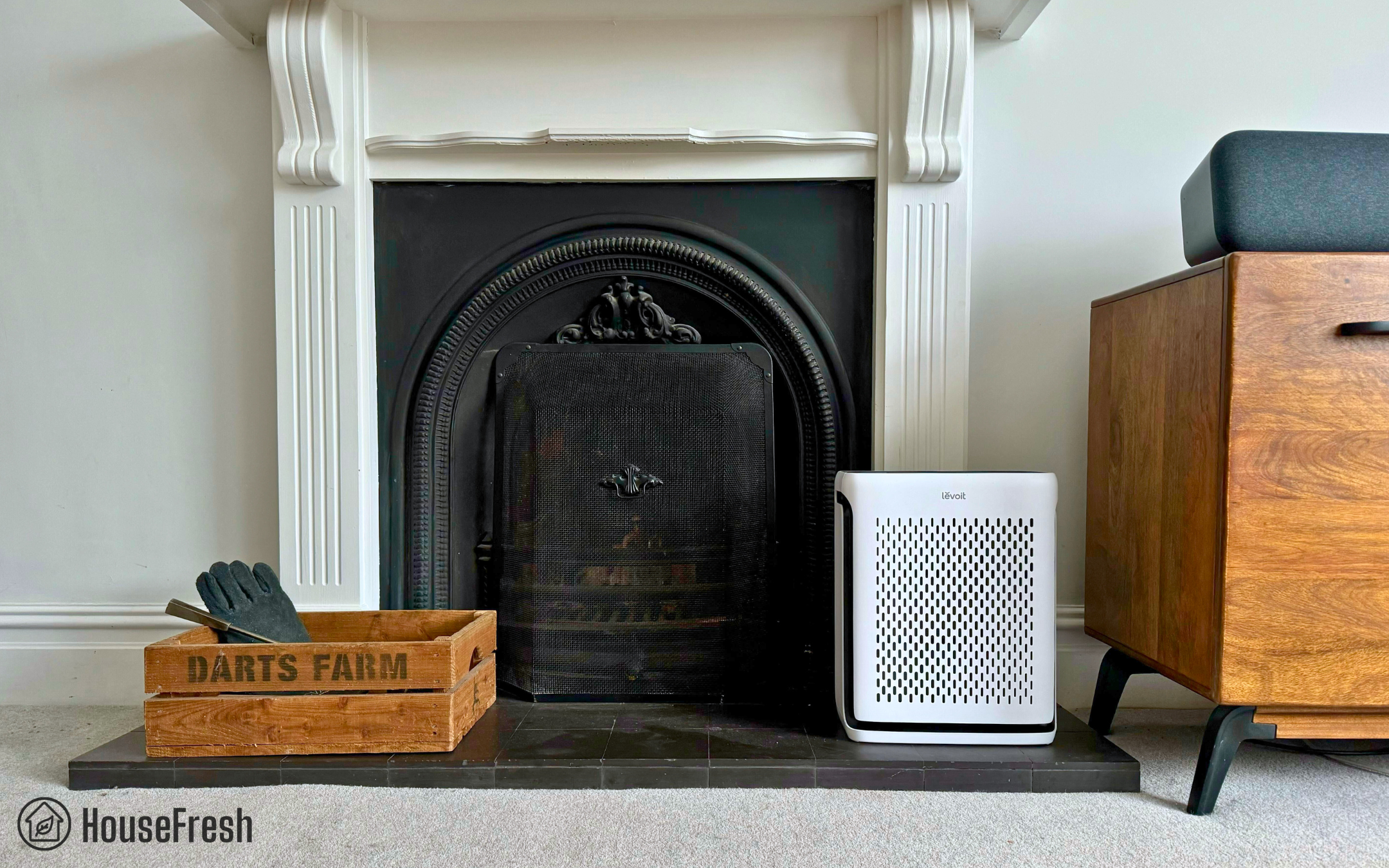
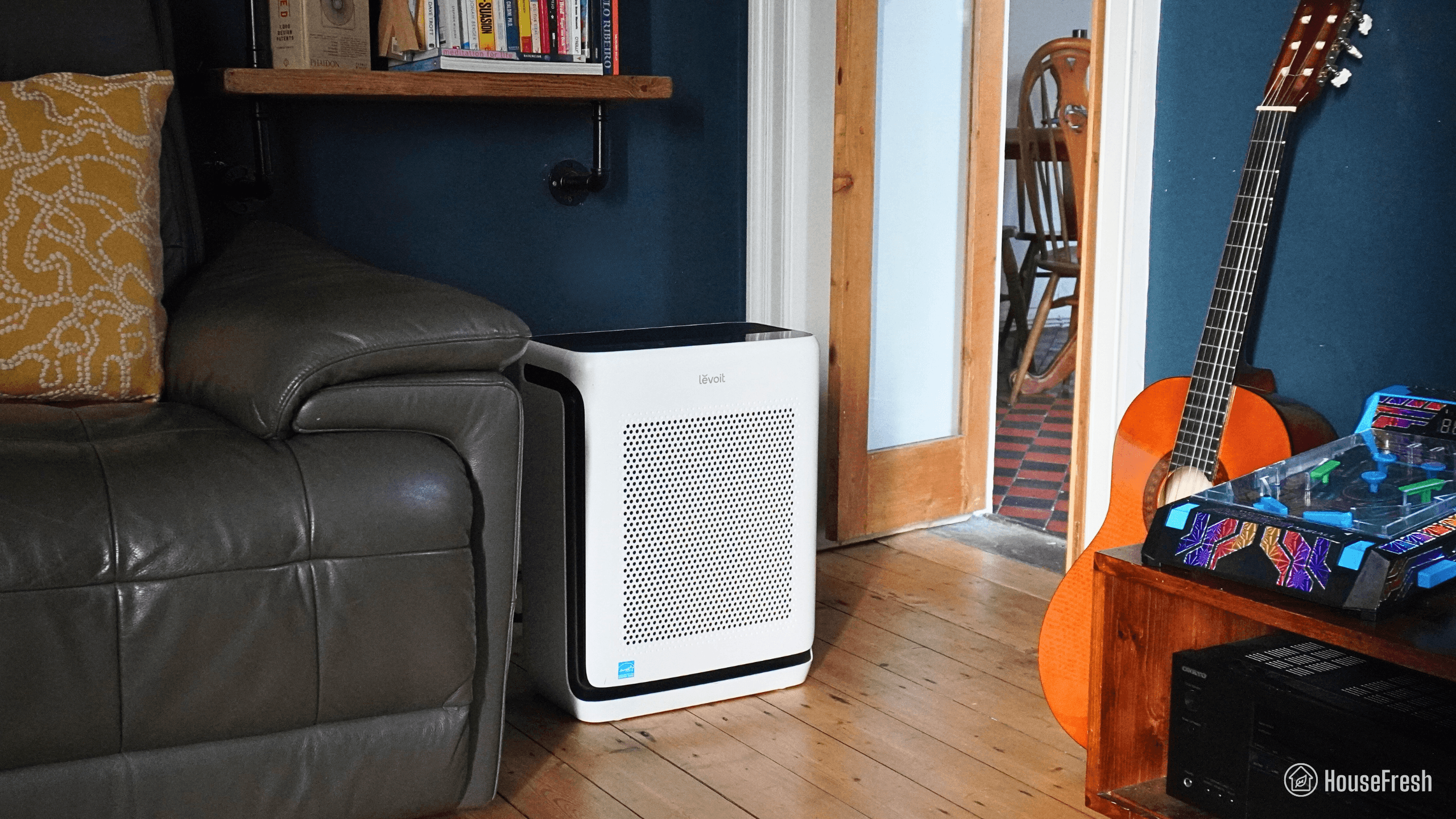
“The Levoit Vital 100S is a small rectangular air purifier that offers good air cleaning performance for rooms no larger than 222 sq. ft. (20 m²).
It also looks pretty good, following the design lines and features of the larger Vital 200S. You get a removable pre-filter, a particle sensor, auto mode, an air quality indicator ring and a straightforward touchscreen at the top, and app connectivity.”

HouseFresh Founder
& Lead Tester
CONS
PROS
| Clean air delivery rate (CADR): | – Top speed PM1 CADR: 148 cfm – Sub-45 dBA PM1 CADR: 97 cfm |
| Filter technology: | Bonded particle filter with a layer of pelleted activated carbon and a removable pre-filter |
| Recommended room size: | 222 sq. ft. (5 air changes per hour) |
| Dimensions: | 12.6 x 6.3 x 16.0 in (32.1 x 16.0 x 40.6 cm) |
| Weight: | 8.6 lb (3.9 kg) |
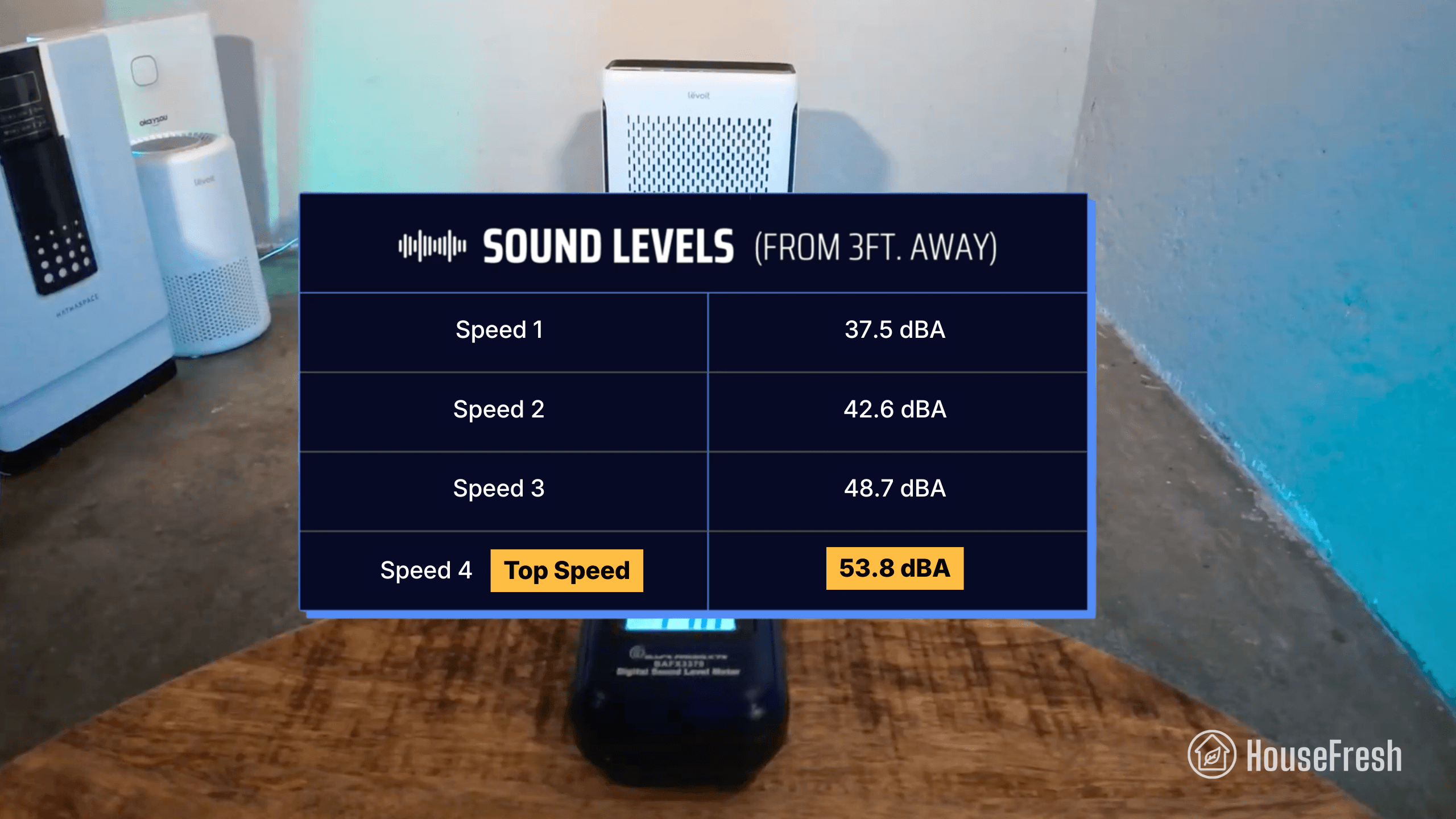
| Noise level in decibels from 3 ft. away: | Speed 1: 37.5 dBA Speed 2: 42.6 dBA Speed 3: 48.7 dBA Speed 4: 53.8 dBA |
| Electricity consumption in watts: | Standby: 1.6 watts Sleep mode: 3.2 watts Speed 1: 5.0 watts Speed 2: 8.7 watts Speed 3: 15.4 watts Speed 4: 27.3 watts |
| Filter lifespan: | 6-12 months |
| Manufacturer’s warranty: | 2 years |
| Country of origin: | United States |
| Country of manufacture: | China |
Filtration technology
An all-in-one filter with particle filtration and activated carbon.
In terms of filtration, you get a double-sided filter with particle filtration on one side and activated carbon filtration on the other.
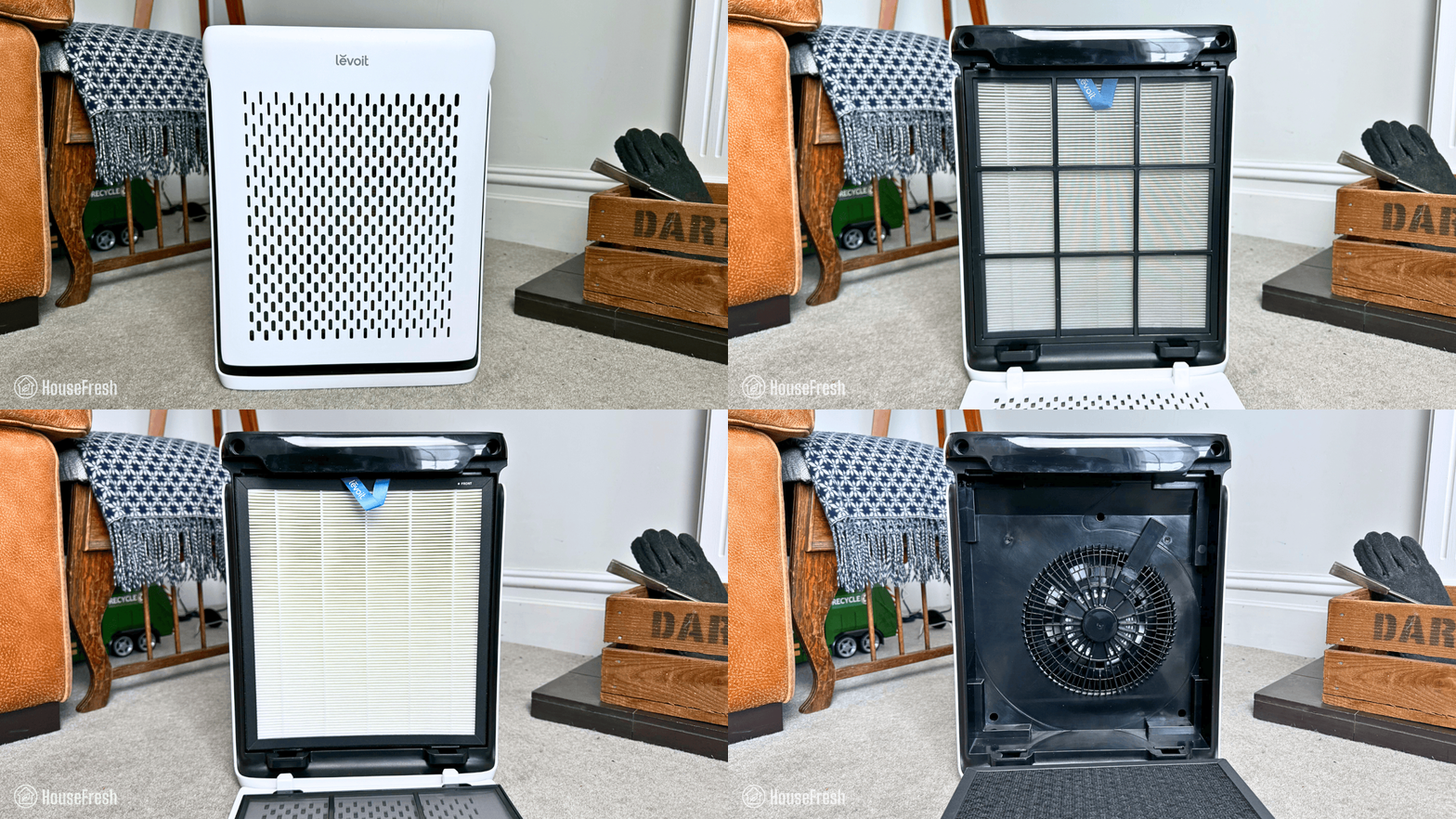
The pre-filter is removable and washable to help trap larger particles and extend the life of the main all-in-one filter. Remember to clean it every 1-2 weeks, especially if you have a pet.
I was pleased to see a good amount of activated carbon pellets in the gas filter. You get four filter options: original, pet, smoke and toxins.
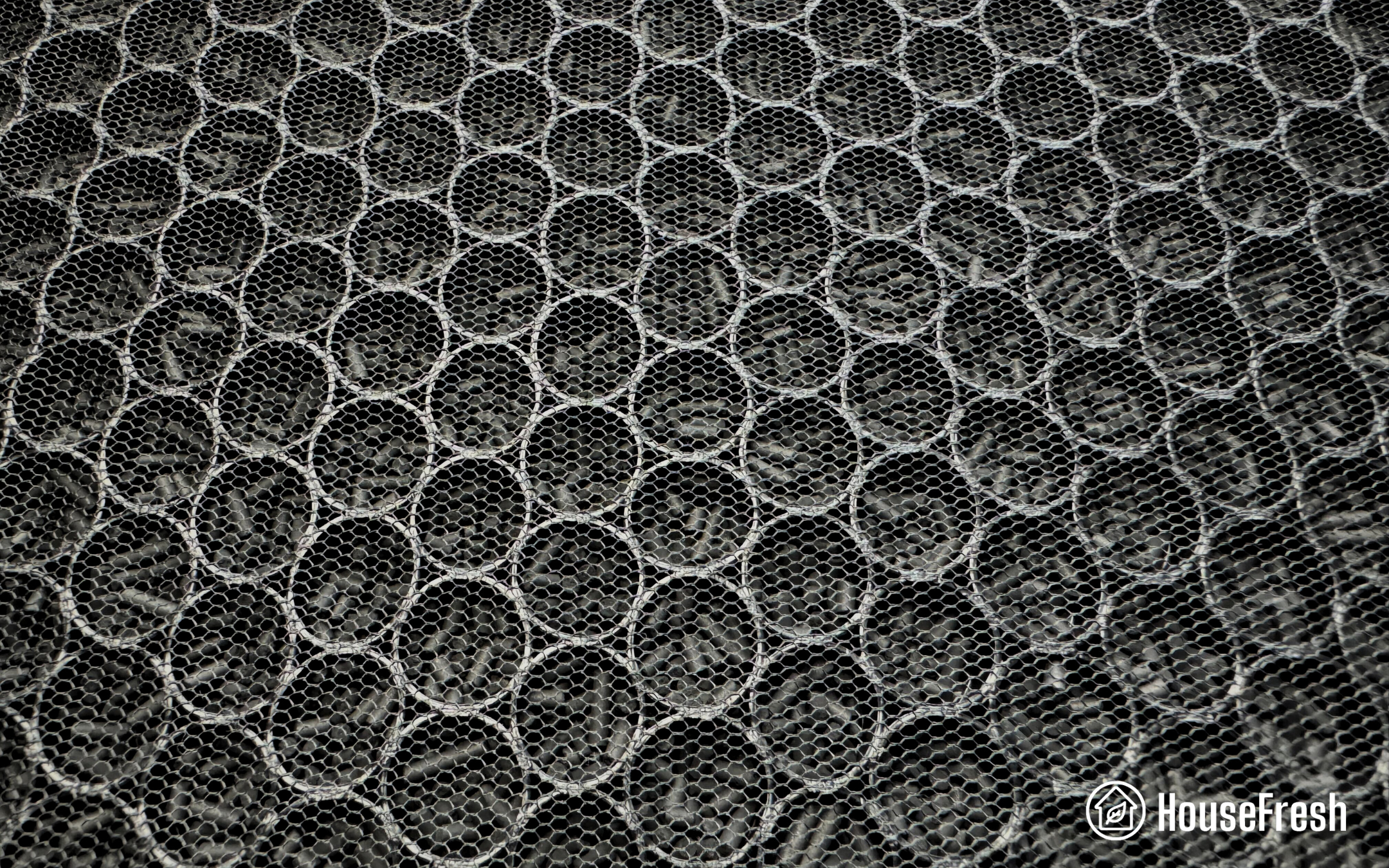
You will need to replace the whole filter once the carbon is full, which might happen sooner than the particle filter needs changing if you have serious issues with odors.
Levoit initially advertised the Vital 100S as having a HEPA filter but this was removed from all marketing materials after Dyson challenged Levoit’s claims through the BBB National Programs National Advertising Division (NAD).
We don’t appreciate manufacturers not being transparent about technical specifications. However, we must clarify that HEPA is not required to clean the air effectively, as lower grade filters still remove the smallest of particles in multiple passes.
Design, controls and app features
A rectangular air purifier with smaller dimensions than the popular Levoit Vital 200S.
It has a modern and clean look similar to its larger sibling, the Vital 200S.
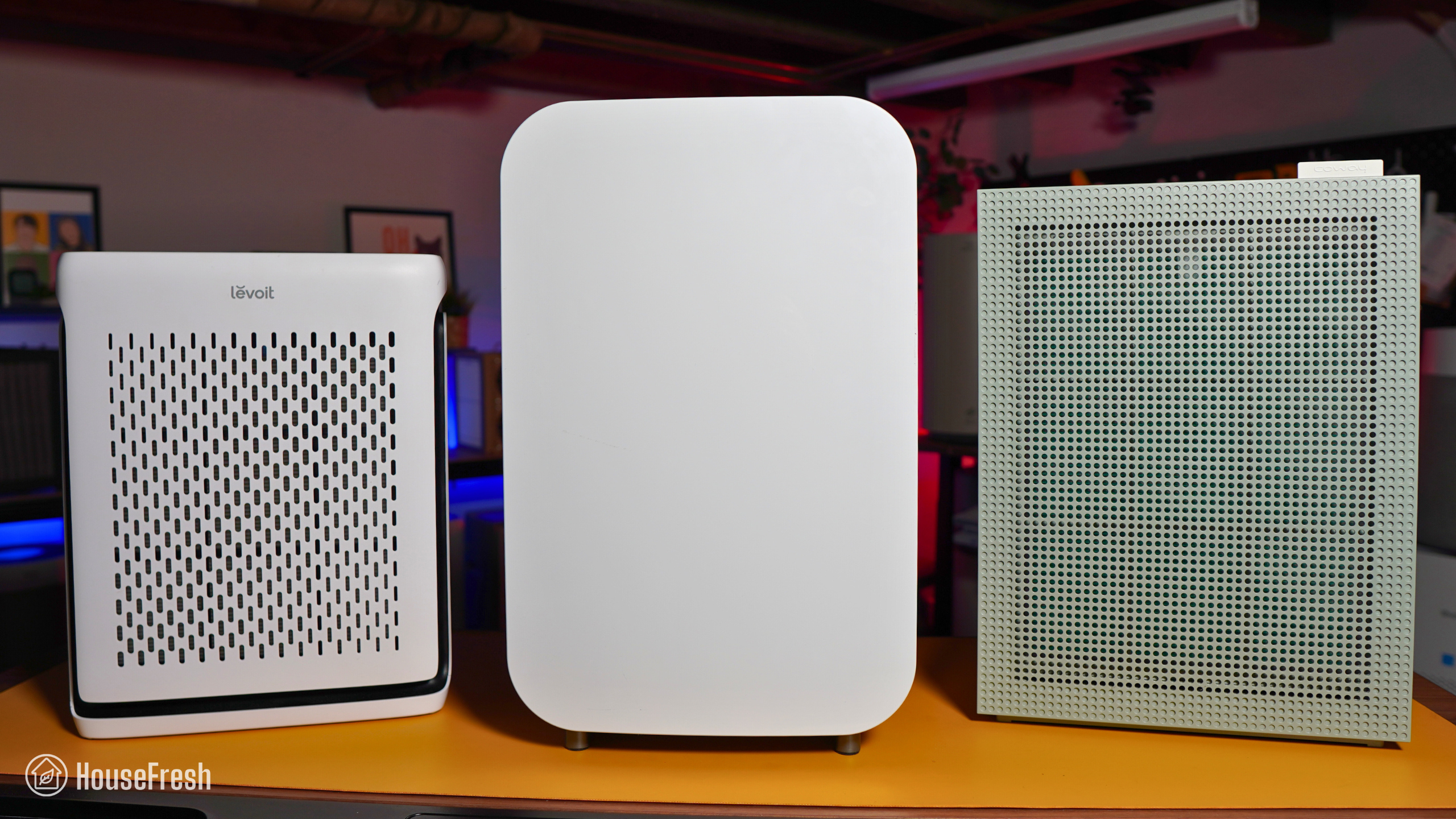
It’s smaller than small air purifier models from brands like Alen and Coway, while packing similar power.
You get buttons to adjust modes and fan speeds, set timers, switch lights off, and lock the screen.
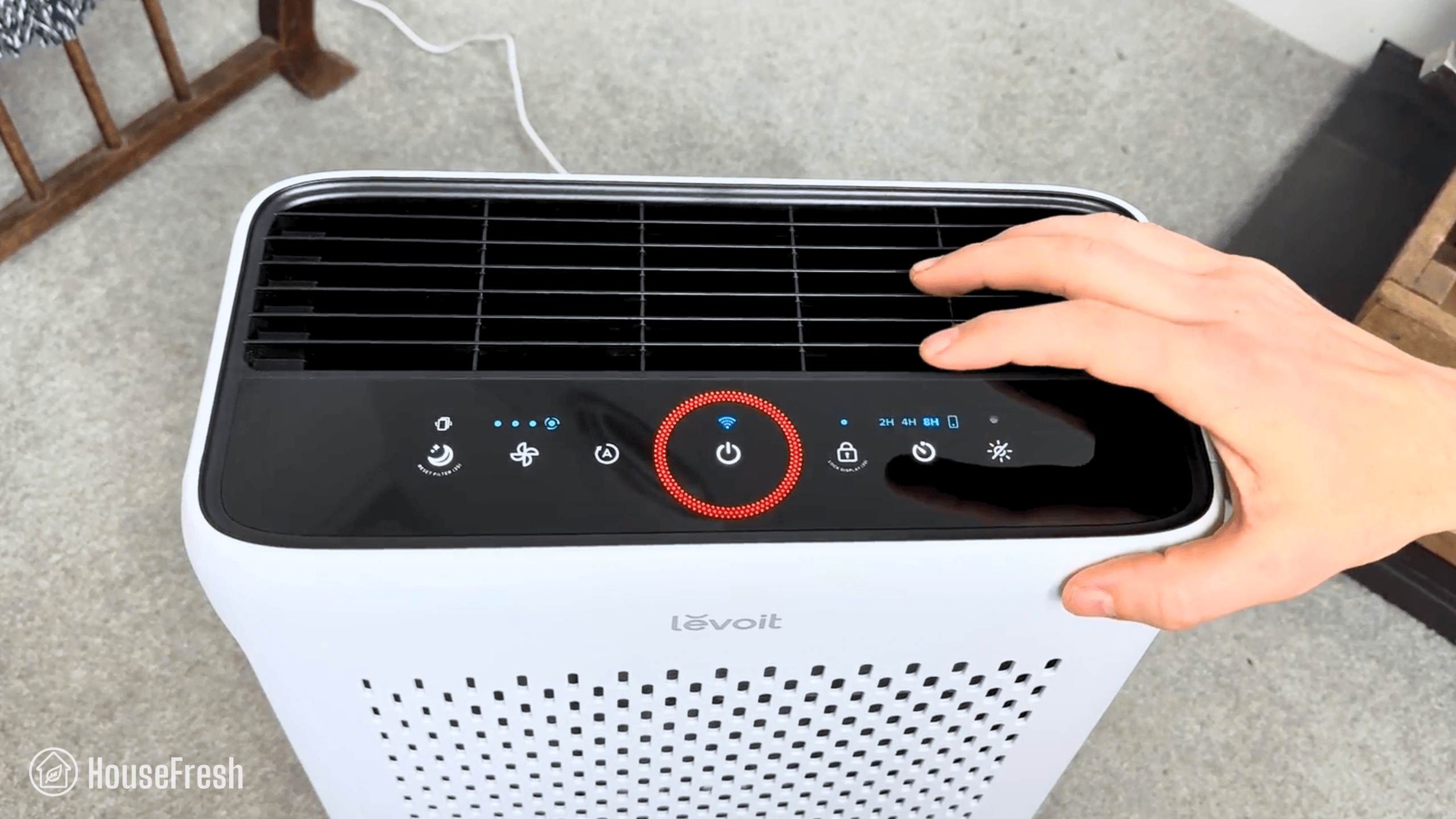
You get an LED ring around the power button that changes color depending on the quality of your air.
It has an infrared dust sensor that measures the level of PM2.5 particle pollution in the air.
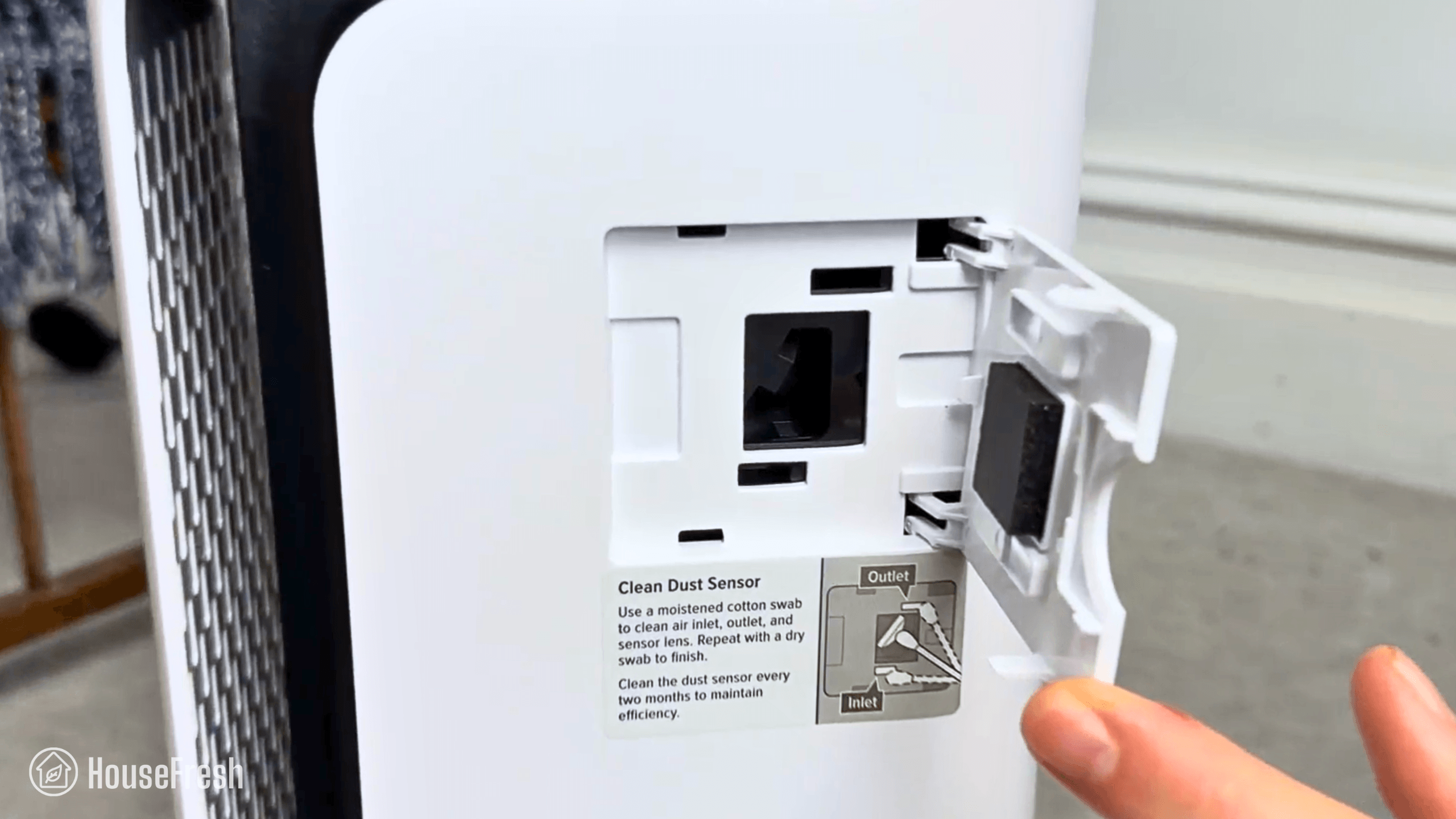
You must clean the sensor with a cotton swab every two months to ensure it stays accurate.
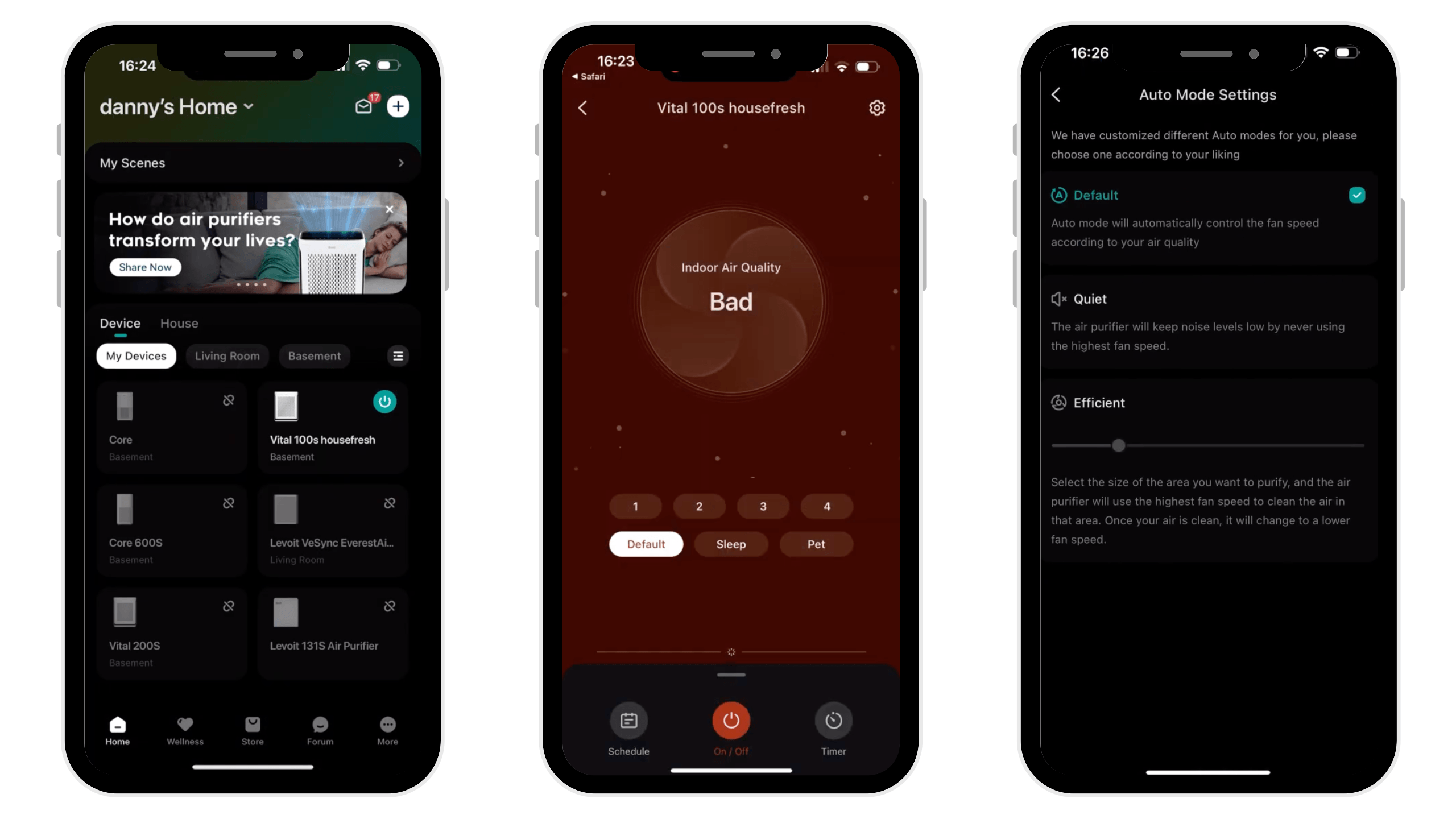
You can connect your Vital 100S to the VeSync app, which is one of my favorite apps along with Xiaomi’s and Philips’ app.
This is the same app used across all Levoit smart products. It has great UX and gets regular updates that unlock new features even on old devices.
On the app, you can control your Vital remotely, see air quality readings, customize the auto mode, and set simple automated routines and schedules.
One thing I don’t like is the number of ads you get served on the app for other Levoit products.
Air cleaning performance
We tested the Levoit Vital 100S in our 728-cubic-ft test room, measuring how quickly it removed PM1 particles from the air after we filled the space with incense smoke.
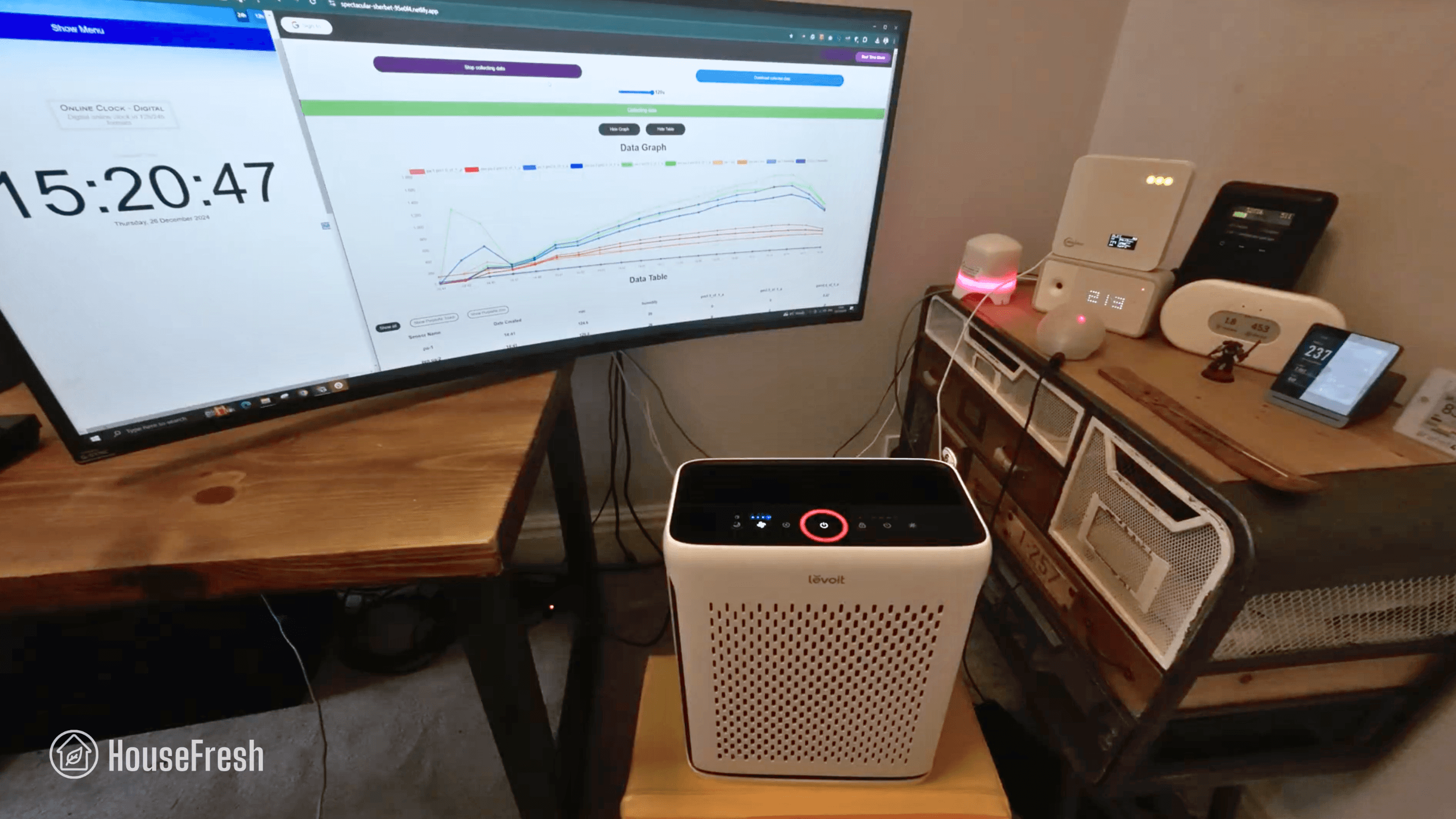
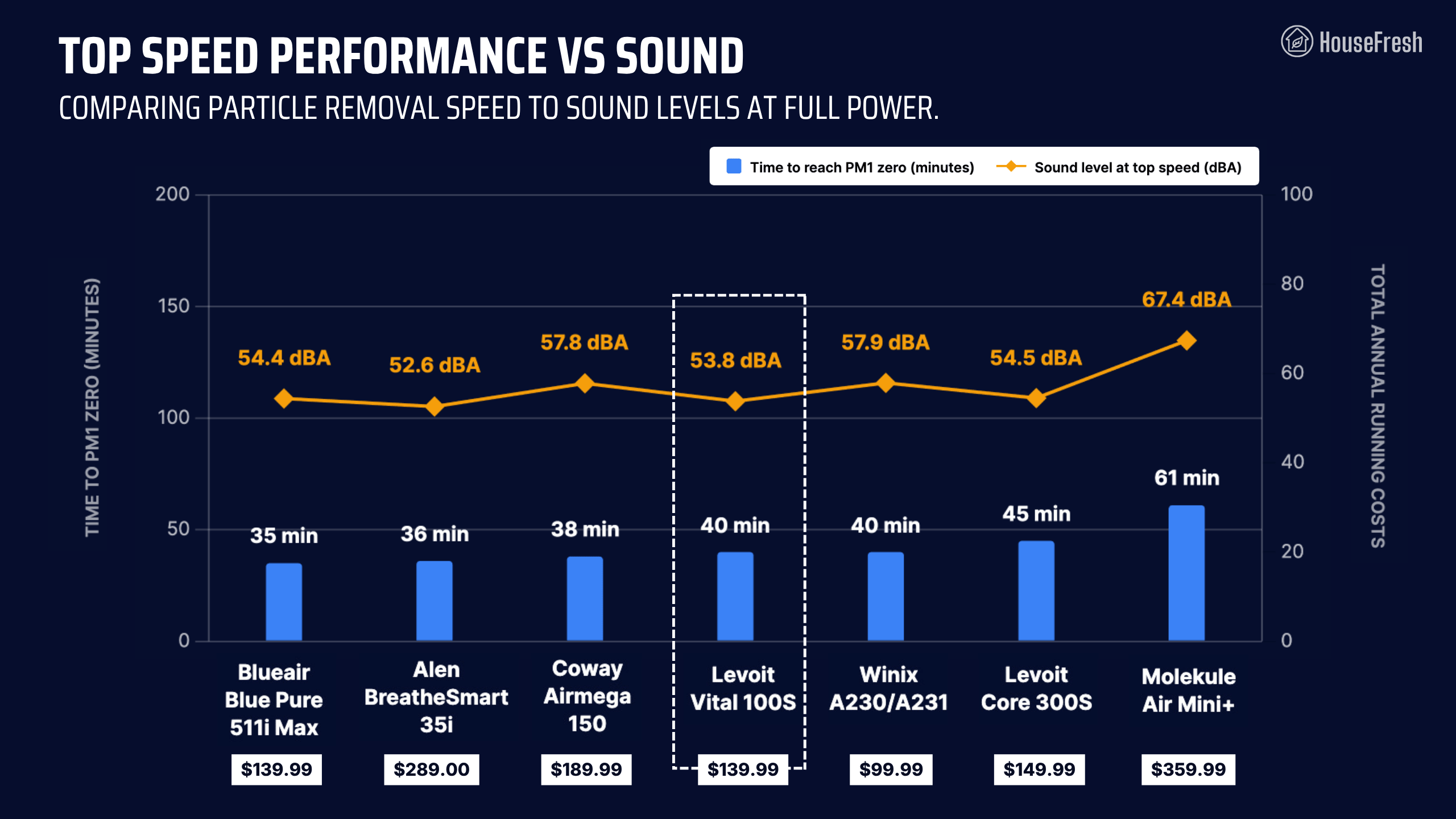
When running at top speed, our PurpleAir Zen sensor shows that the Vital 100S needed 40 minutes to reach PM1 zero. Based on the natural ventilation of our test room, we estimate a PM1 CADR of 148 cfm.
This makes the Vital 100S powerful enough to provide five air changes per hour in small rooms up to 222 sq. ft.
As you can see from the chart below, this Levoit offers good performance for its price. The only small unit under $150 that outperforms it (Blueair Blue Pure 511i Max) does so with the help of bipolar ionization, which I know many people prefer to avoid.
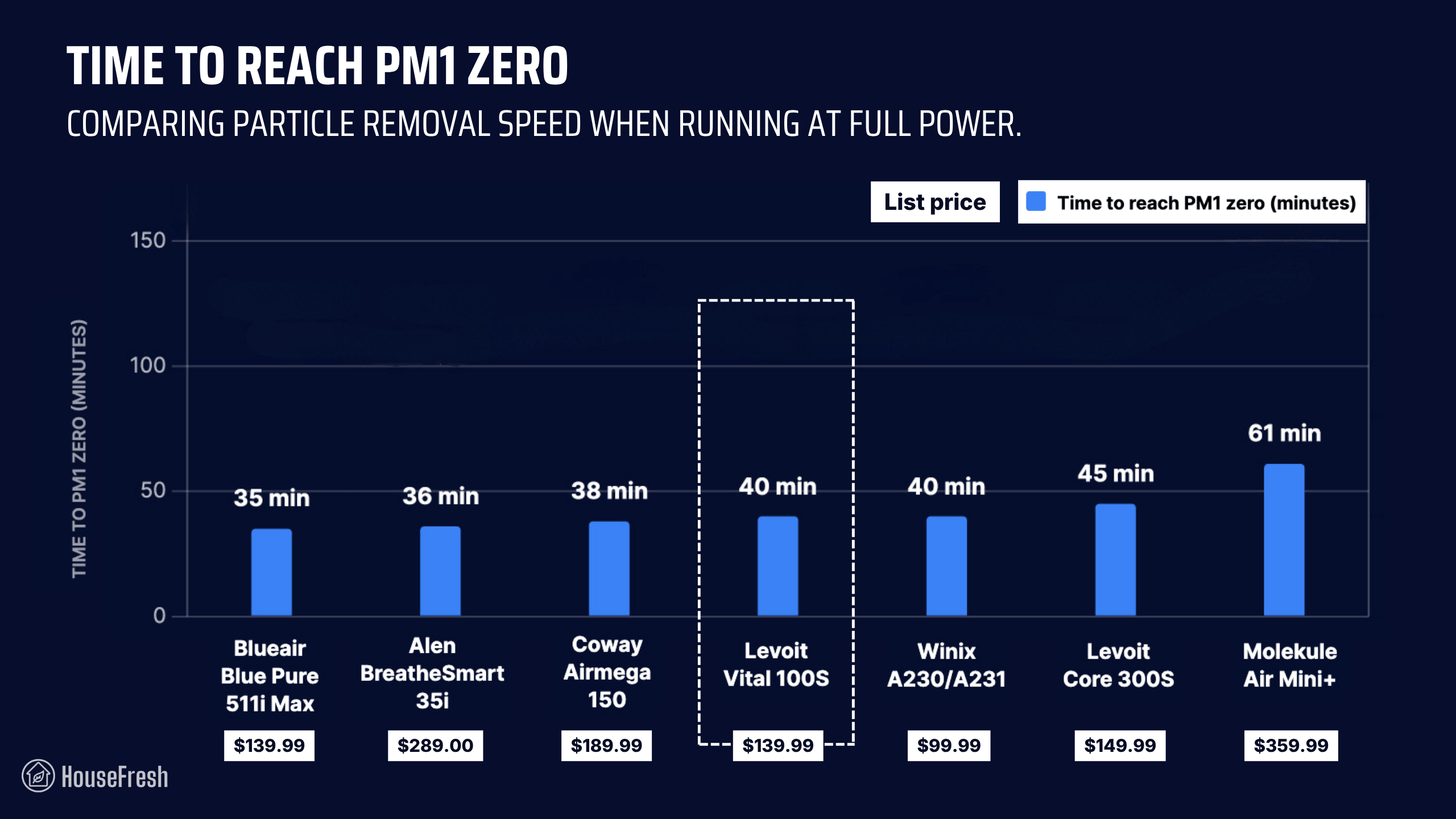
BUT this test was conducted at full power and air purifiers running at full power are usually too loud for everyday use. That is why I tested sound levels at different fan speeds so we could account for noise levels.
Sound levels
The sound levels of the Levoit Vital 100S range from 37.5 dBA to 53.8 dBA — which is quieter than small air purifiers from Coway, Winix and Blueair with similar performance.
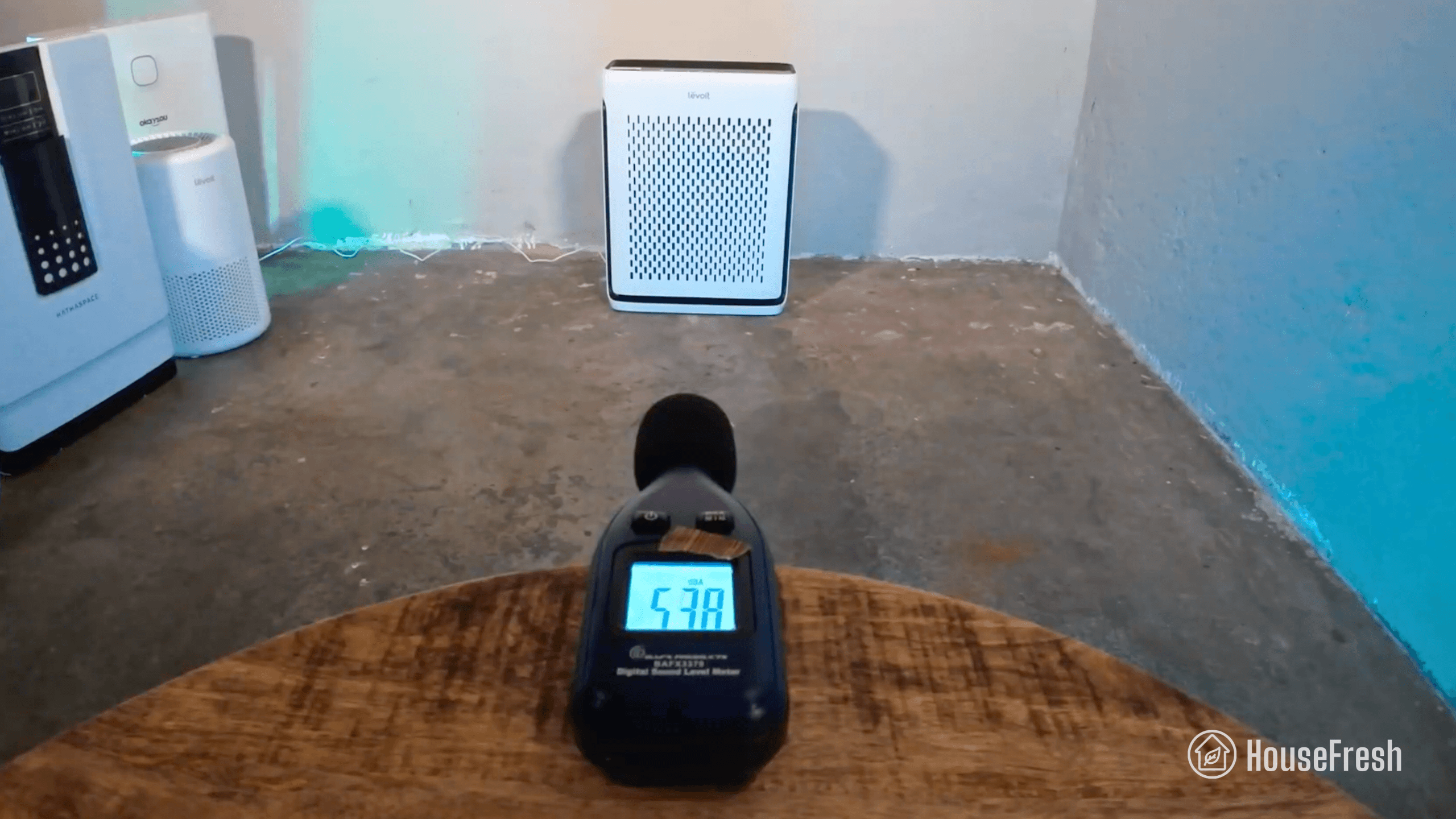
As always, I used our BAFX sound meter to measure how much sound the Vital 100S generates at each of its fan speeds at 3 ft away:
Reaching 53.8 dBA at top speed, the Vital 100S is quieter than nearly all other small air purifiers in the comparison, with the exception of the Alen 35i which costs $150 more.
Running at speed 2, it reached 42.6 dBA and cleared our test room in 60 minutes. In our comparison, it was once again outperformed by the 511i Max and the 35i.
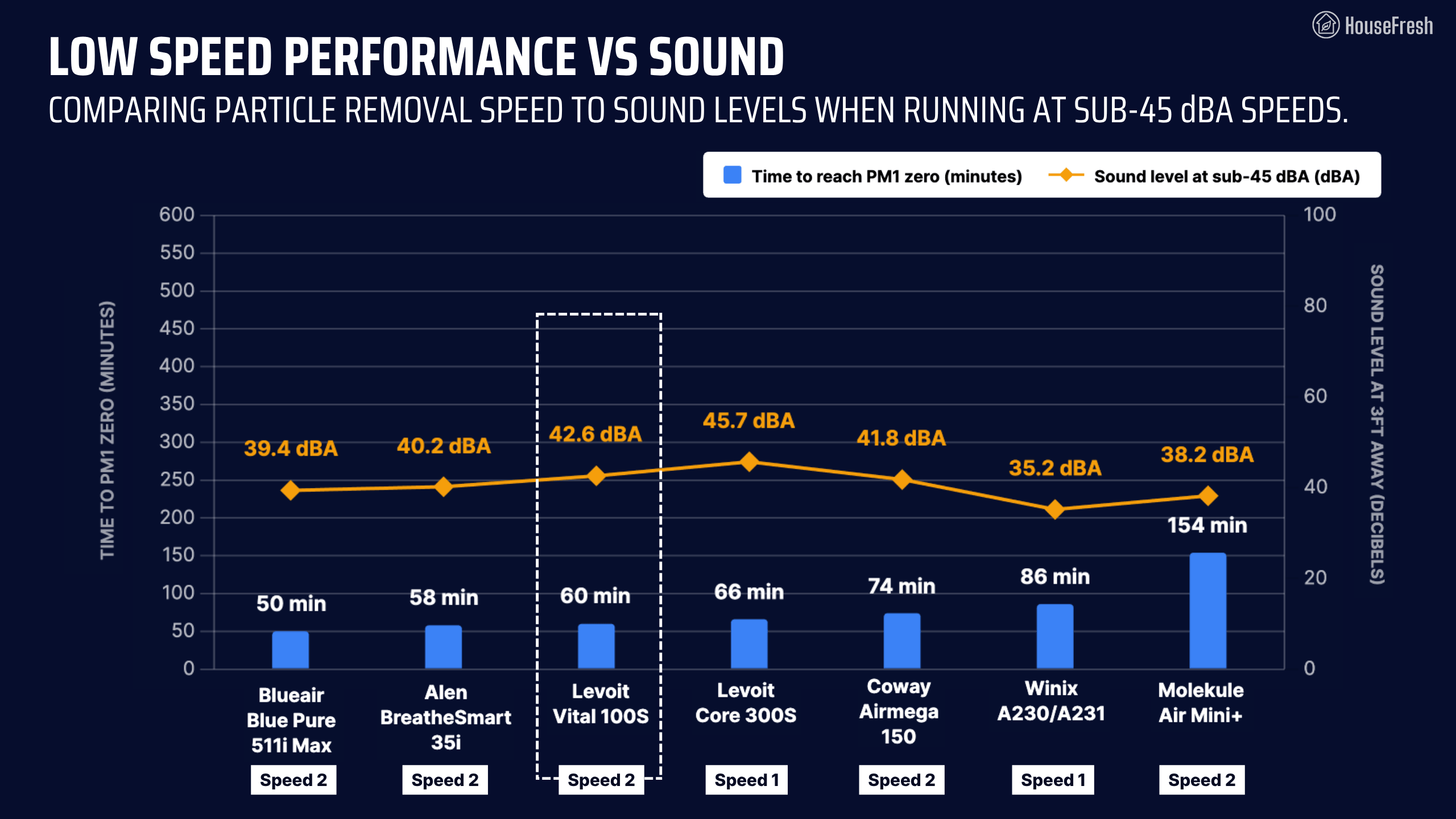
Based on the natural ventilation of our test room, I estimate a PM1 CADR of 97 cfm at speed 2, which can clean the air five times per hour in spaces up to 145 sq. ft. (or 13 m²).
Long-term running costs
Running a Levoit Vital 100S will cost you $123.84 per year, combining energy and filter replacement costs.
We used our energy meter to record how much electricity the Vital 100S pulls at each fan speed and while on standby.
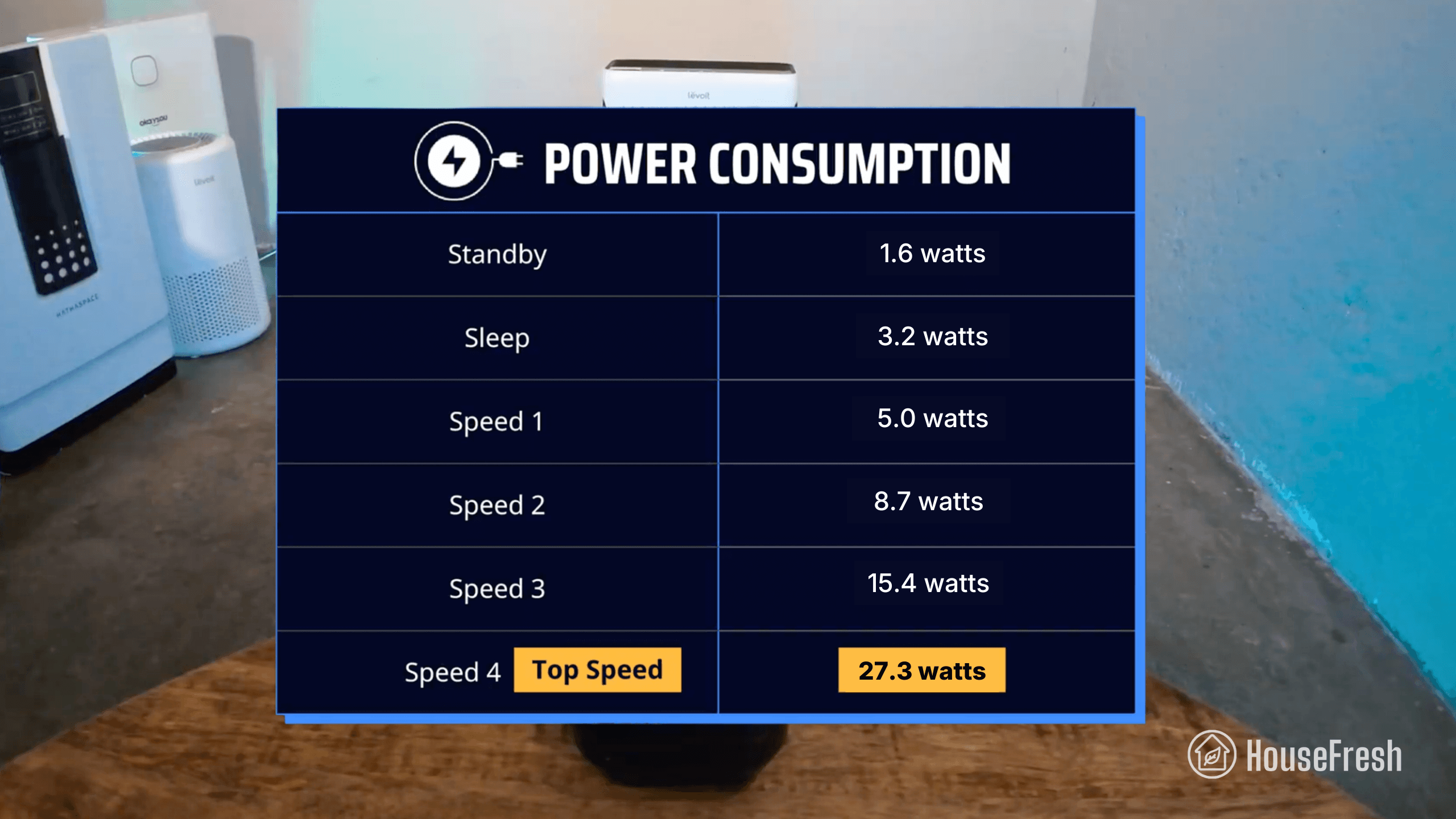
At top speed, the Vital 100S draws 27.3 watts, so if you were to leave it running at top speed 24/7 for one year, it will add $43.86 to your energy bill, based on the latest electricity prices in the U.S. as of September 2026.
This is the kind of energy efficiency Levoit has us accustomed to. But energy consumption isn’t the only cost to consider, so let’s look at replacement filters.
According to Levoit, you need to change the filter in your Vital 100S every 6-12 months. The original filter is available for $39.47, so you can expect to spend $79.98 each year on filter replacements alone, using the shortest lifespan estimation.
I added this to the energy costs and can tell you that you need to budget $123.84 each year to keep your 100S running 24/7 in your home:
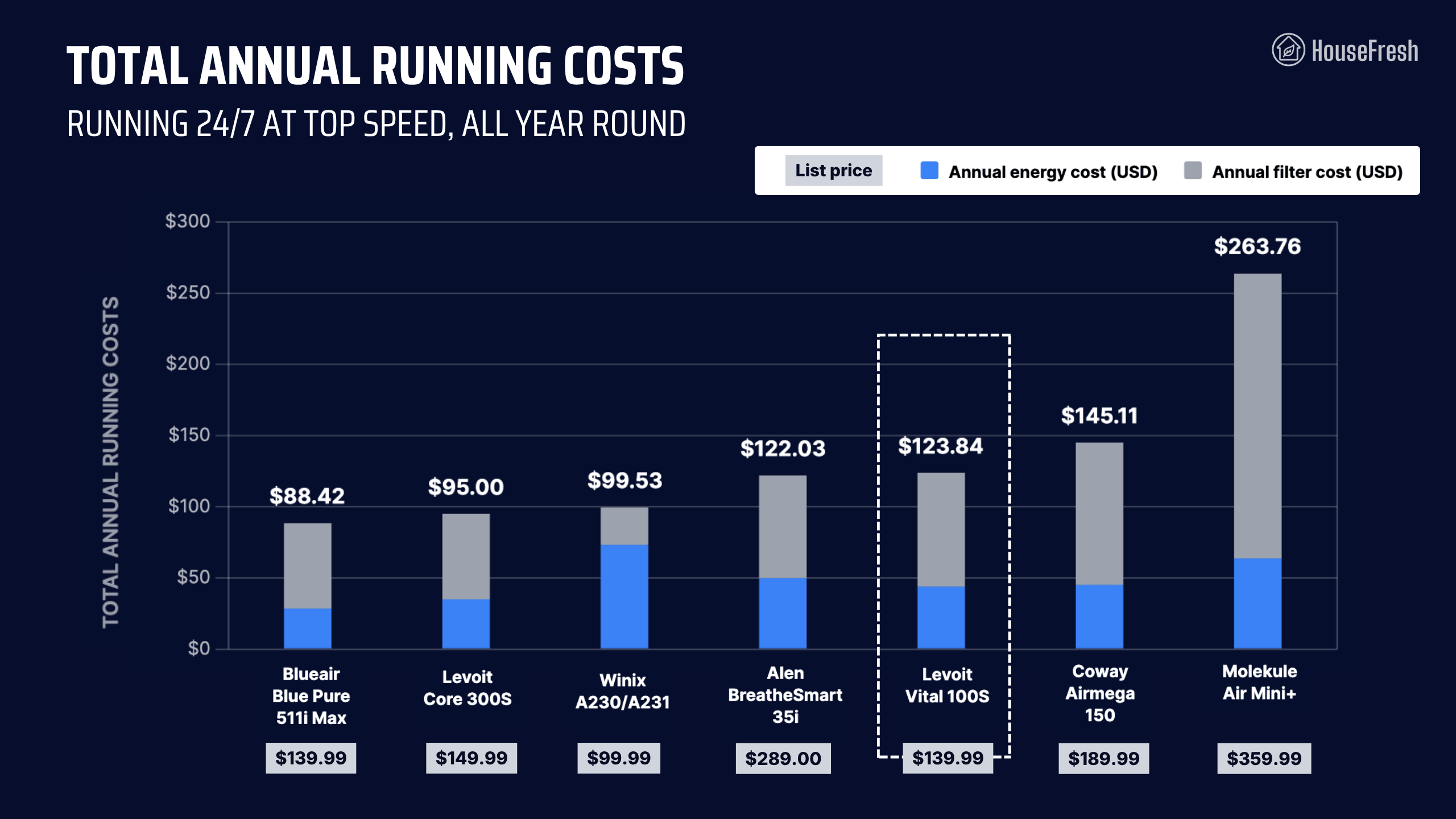
This places the Vital 100S on the ‘expensive’ side of the chart, alongside models like the Alen 35i and the Coway Airmega 150.
Smaller units like the Core 300S and the Winix A230 cost less to run, but perhaps the most important calculation for a first time buyer is the total investment cost in the first year of ownership.
When you add the $139.99 list price to that first year’s running cost, you will need to invest $263.83 in the first year of owning a Levoit Vital 100S.
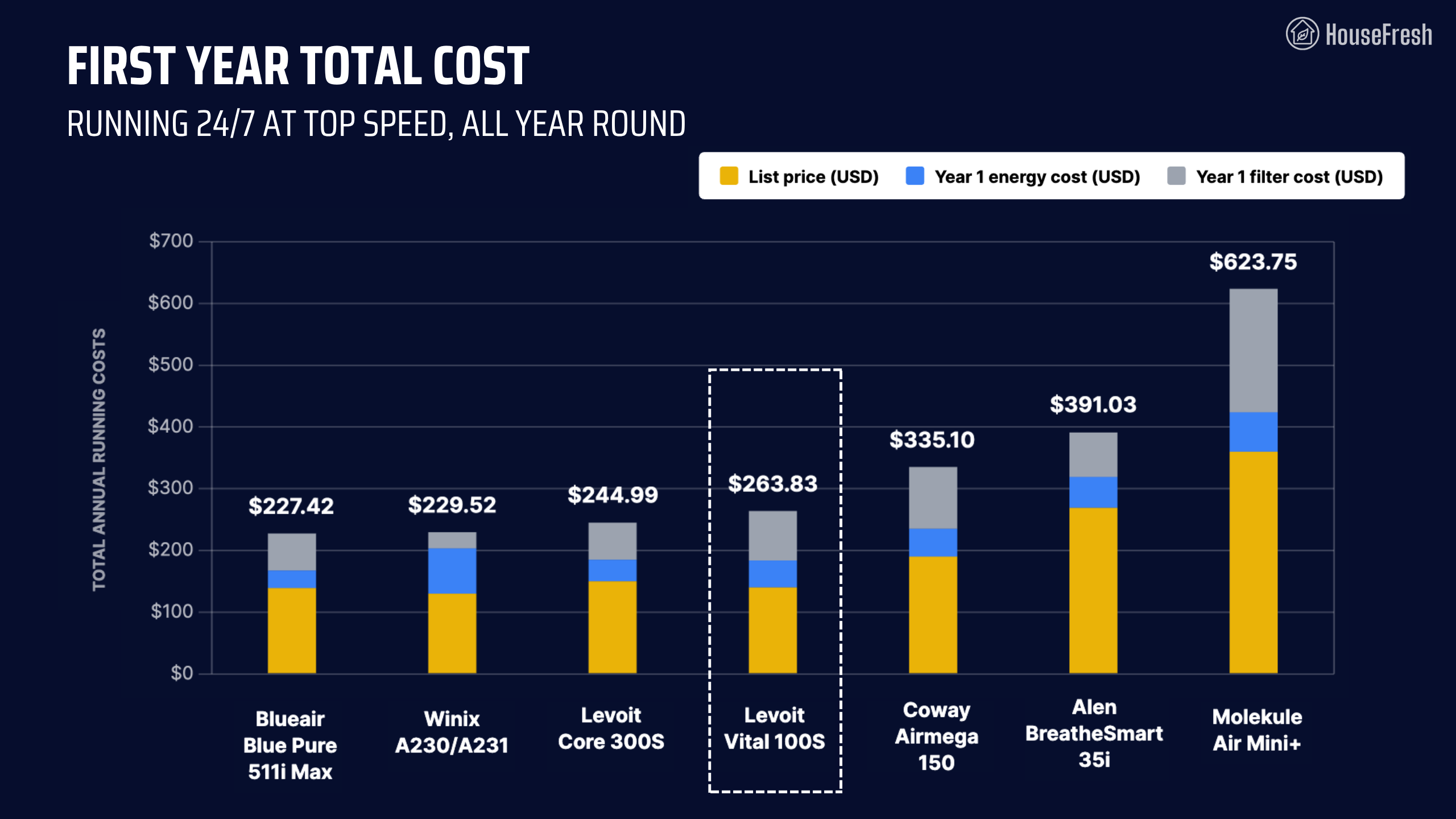
As the table shows, you could buy and run two Vital 100S air purifiers for the total year 1 cost of just one Molekule Air Mini+…
That is why you should always calculate how much you will need to spend to use an air purifier before deciding which model you’ll go with, especially with small air purifiers that will need filters replaced more often than mid-sized or larger units.
Bottom line: Should you get a Levoit Vital 100S?
If you’re looking for a small air purifier that doesn’t use an ionizer under $150, then this might be the one for you.
The Vital 100S offers good performance at top speed, matching the air cleaning power you’ll get from units like the Winix A230 and the Philips 900 Series. And it comes with an onboard particle sensor that informs an air quality indicator light and smart functions like auto-mode, which you can customize through the VeSync app.
If you’re looking for all this and you only have $150 to spare, then the Vital 100S might be the one. But if you can spare $100 more or if you don’t mind the use of bipolar ionization, then you will get more power from the Alen 35i and the Blueair 511i Max.
Okay but before I leave you, I will suggest that if space allows, you should consider choosing a mid-sized air purifier with a CADR of at least 200 cfm to get the most bang for your buck. If you like what the Vital 100S offers, then look into the Levoit Vital 200S.
If you decide to get yourself a Levoit Vital 100S, please use this link to help support the work we do here at HouseFresh. When using this link, we will receive a small affiliate commission at no extra cost to you that we will use to buy and tests more air quality products.
And if you’re still unsure, you can try using our air purifier comparison tool to see how the Vital 100S stacks up against units with similar prices:
If you have any questions about the this unit or about Levoit air purifiers in general, please drop them in the comments below, and I’ll get back to you personally as soon as I can.