The Dyson HushJet Compact Purifier is the smallest air purifier I’ve tested from Dyson and it’s also the first one to be released in their new HushJet range.
In the years I’ve been reviewing air purifiers, my opinion on Dyson models has been pretty consistent: average performance for a high price that will definitely won’t be worth it for most.
But could Dyson change my mind with the release of their first small air purifier?
To find out, I bought a Dyson HushJet Compact and have been using it at home since May 2026 to test its air cleaning performance, sound generation, energy consumption, long-term running costs and everyday user experience.
The overall score for the Dyson HushJet Compact HJ10 incorporates first-hand data results from our battery of tests, as well as our ratings for customer service, brand transparency, and design & UX. Check out the full scorecard below to see the category breakdown.
Search for ‘Dyson HushJet’ to see where it ranks, based on its air cleaning performance and value for money. You can also filter results to easily compare models in the same price range.
The pros and cons of the Dyson HushJet Compact HJ10
A summary of our top-level findings after testing this air purifier, following our methodology.
“Dyson’s HushJet Compact comes with a wide range of fan speeds, a very good app, smart functions, and solid air cleaning performance, especially considering its size.
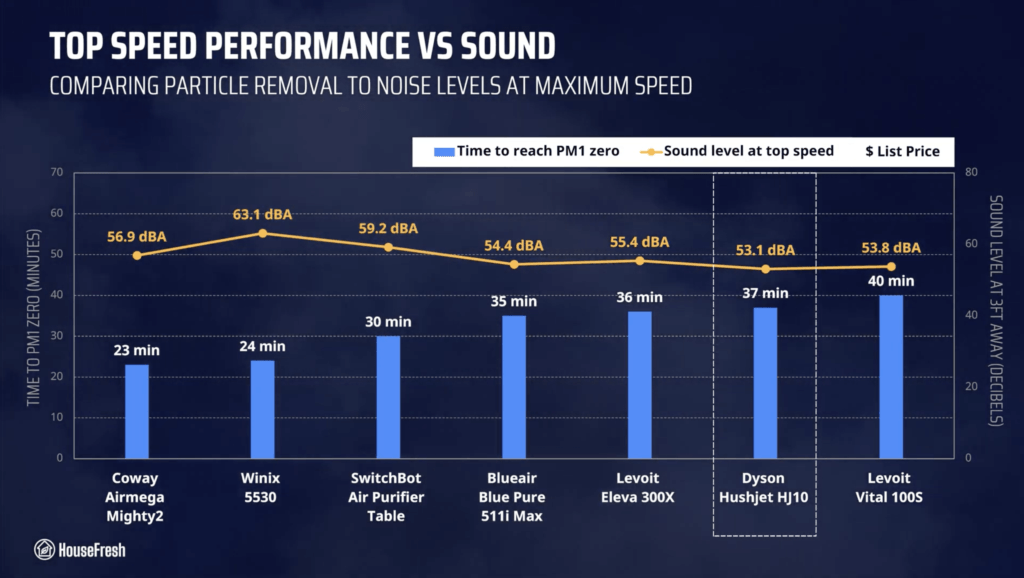
In our particle removal tests, it cleared our test room of incense smoke in 37 minutes, outperforming small units I’ve recommended over the years like the Winix A231 and the Coway Airmega 100. And it did this, generating less noise and consuming less electricity.
So if the $349 price tag doesn’t scare you, then you will be buying a tabletop air purifier with good air cleaning performance with lower yearly running costs than most.”
HouseFresh Founder
& Lead Tester
CONS
PROS
| Clean air delivery rate (CADR): | – Top speed PM1 CADR: 160 cfm – Sub-45 dBA PM1 CADR: 113 cfm |
| Filter technology: | Particle filter with electrostatic material and gas filter with 120g of carbon pellets |
| Recommended room size (5 air changes per hour): | 180 sq. ft. (17 m2) |
| Dimensions: | 18.5 x 9.0 x 9.0 in (47 x 23 x 23 cm) |
| Weight: | 6.9 lb (3.15 kg) |
| Noise level in decibels from 3 ft. away: | Sleep mode: 36.6 dBA Speed 1: 35.8 dBA Speed 2: 35.7 dBA Speed 3: 35.9 dBA Speed 4: 36.4 dBA Speed 5: 36.4 dBA Speed 6: 40.5 dBA Speed 7: 43.2 dBA Speed 8: 45.9 dBA Speed 9: 49.1 dBA Speed 4: 53.1 dBA |
| Electricity consumption in watts: | Sleep mode: 3.3 watts Speed 1: 1.8 watts Speed 2: 2.0 watts Speed 3: 2.3 watts Speed 4: 3.6 watts Speed 5: 4.6 watts Speed 6: 6.2 watts Speed 7: 7.7 watts Speed 8: 10.1 watts Speed 9: 13 watts Speed 4: 18.6 watts |
| Filter lifespan: | Particle filter: 5 years Gas filter: 6-12 months |
| Manufacturer’s warranty: | 2 years |
| Country of origin: | United Kingdom |
| Country of manufacture: | Malaysia |
Filtration technology
Two separate cylindrical filters that remove particles and odors from the air.
I was really pleased to see that Dyson designed separate filters for the HushJet Compact.
When you press the buttons at each side of the air purifier, the body disconnects from the filters inside.
Once you remove the body of the device, you’ll be met with a cylindrical particle filter.
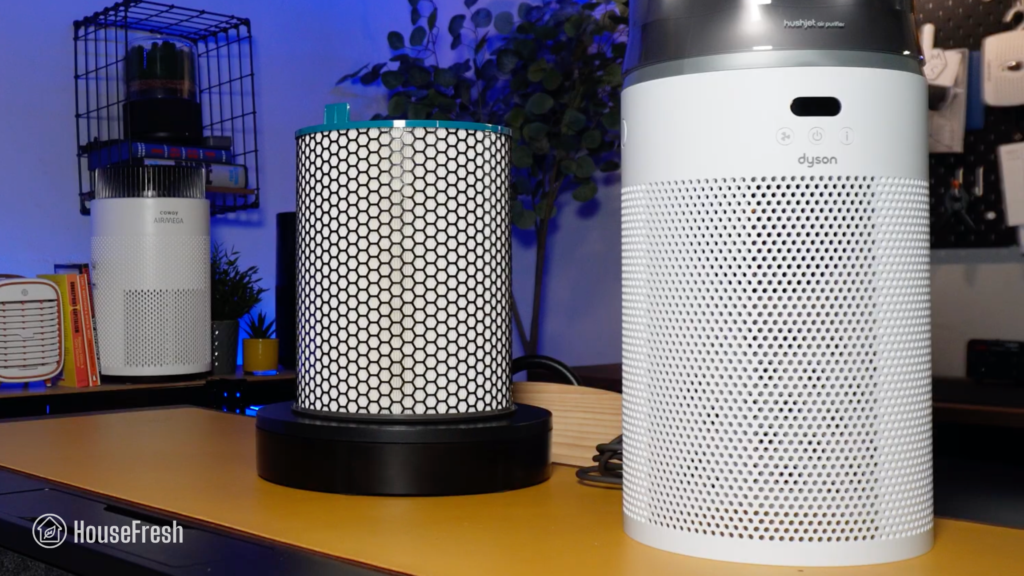
Dyson states they’ve used a material with lower resistance than HEPA that’s electrostatically charged to pull particles towards it.
Underneath the particle filter, you get a gas filter with 120 g of activated carbon to remove odors.
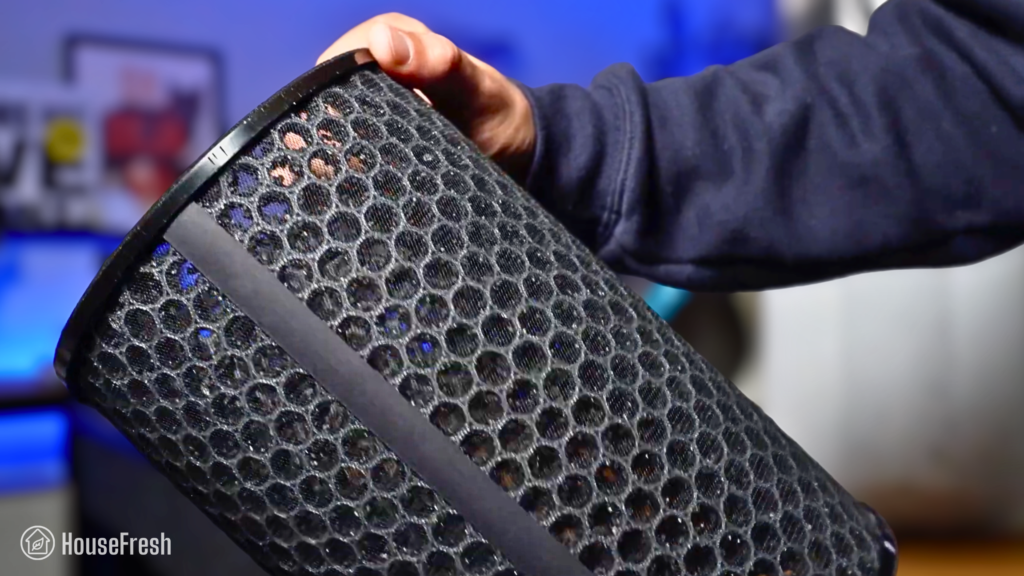
This is a small amount of carbon that will remove mild odors but won’t help with serious issues with VOCs.
One of the downsides of cylindrical air purifiers is that they generally come with all-in-one filters that combine a particle filter with a gas filter in one cylindrical design.
We’ve found that this kind of bonded filter tends to lead to slightly better air cleaning performance BUT it also forces you to buy replacements more often than you may need.
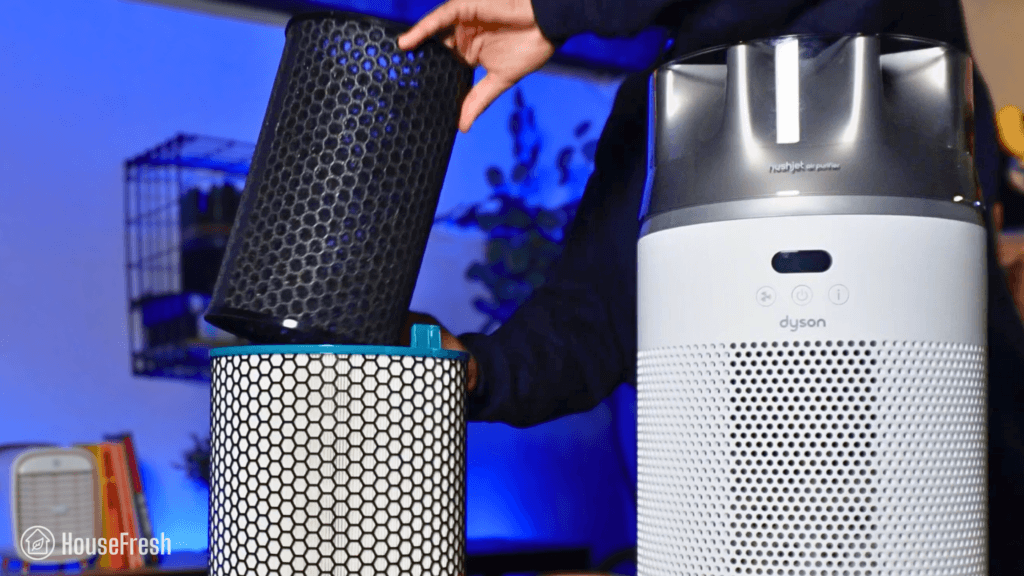
This happens because the carbon inside the gas filter portion will generally become full within 6 months or so, and you will get a sense the air isn’t as fresh as before.
So you will go ahead and replace the filter, and will likely end up throwing away a perfectly good particle filter in the process.
Particle filters generally have a longer lifespan than carbon filters, with most of them lasting around 12 months.
Design, controls and app features
A relatively small air purifier that will sit comfortable on top of a desk or side table.
This is a small cylindrical air purifier that will fit on top of a bedside table or kitchen counter.
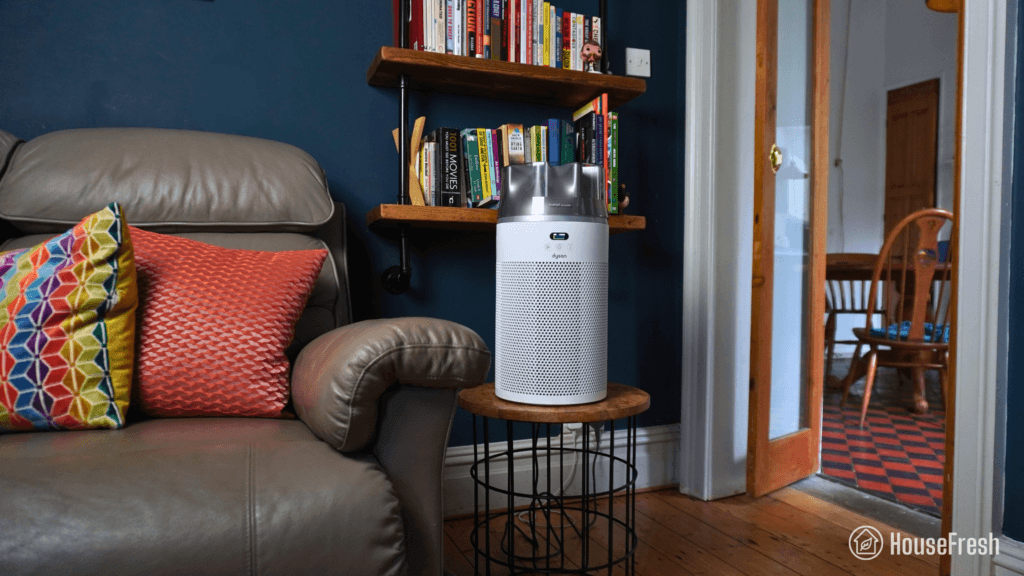
As you would expect from Dyson, the HushJet Compact HJ10 has a unique design and is manufactured to a high build quality.
It has a laser sensor and a little screen at the front where you can see particle levels in real time.
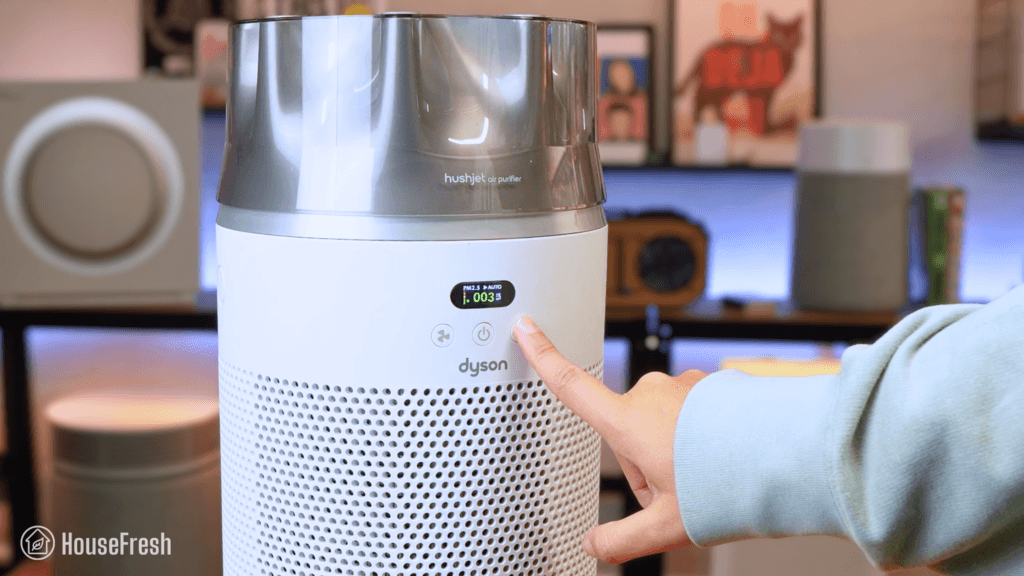
It has three buttons to adjust fan speeds, set auto/sleep mode, and switch between air quality readings and filter lifespan estimates.
It takes up as much space as other small cylindrical units BUT it’s slightly taller due to the nozzle.
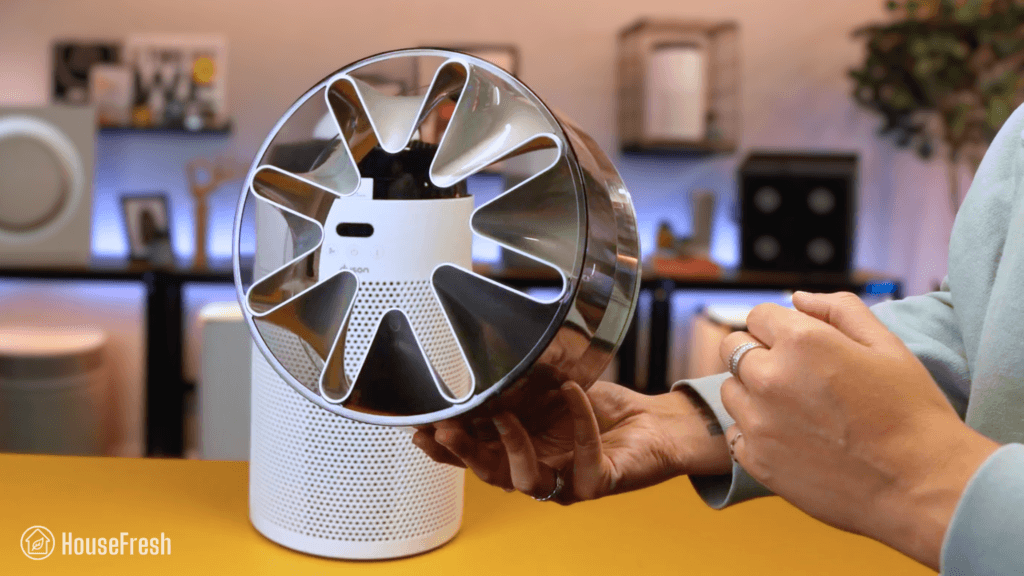
This nozzle sits at the top of all HushJet devices from Dyson and it helps reduce noise. We tested it and it was 2 full decibels louder without it.
I was glad to see that Dyson added three buttons to the HushJet HJ10, moving away from units with just one button which forces you to use the app or the remote control provided.
If you want to get access to all the different fan speeds in your HushJet Compact and get more insight into the data from the sensor, then you can download the app on your phone.
The Dyson app has a pretty clean UX and has recently had a design face lift that opened up a lot more insight into the air quality readings from the laser sensor onboard.
Air cleaning performance
We tested the Dyson HushJet Compact in our 728-cubic-feet test room, measuring how quickly it removed PM1 particles from the air after we filled the space with incense smoke.
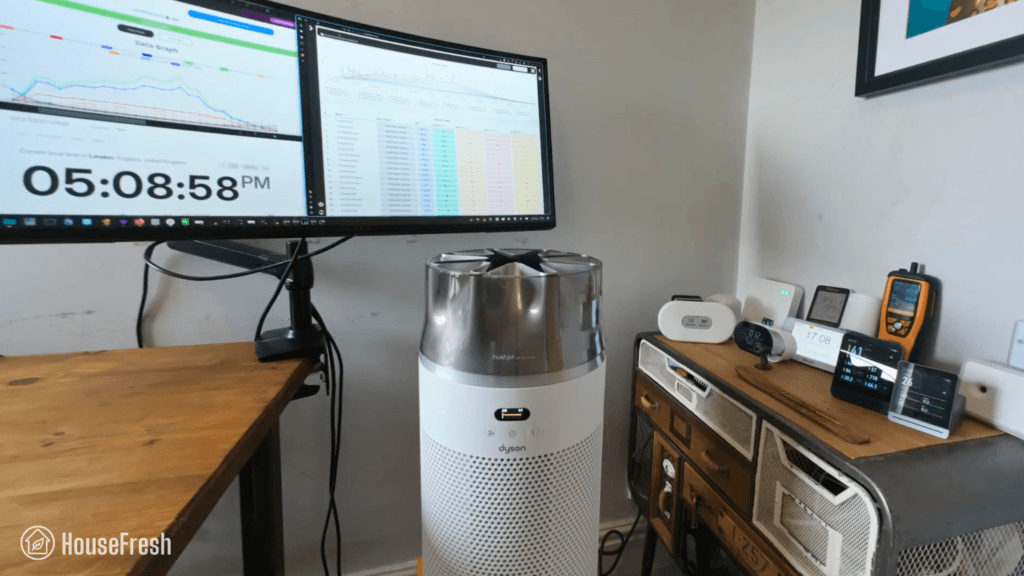
When running at top speed, our PurpleAir Zen sensor shows that the HushJet Compact needed 37 minutes to reach PM1 zero. Based on the natural ventilation of our test room, we estimate a PM1 CADR of 160 cfm.
This makes this Dyson model powerful enough to clean the air five times per hour in rooms no larger than 240 sq. ft. (or 22 m2).
To put this into context, this is faster than the 40 minutes it took popular units like the Levoit Vital 100S but it’s slower than the results achieved by the new generation of small air purifiers like the $130 Levoit Eleva 300X:
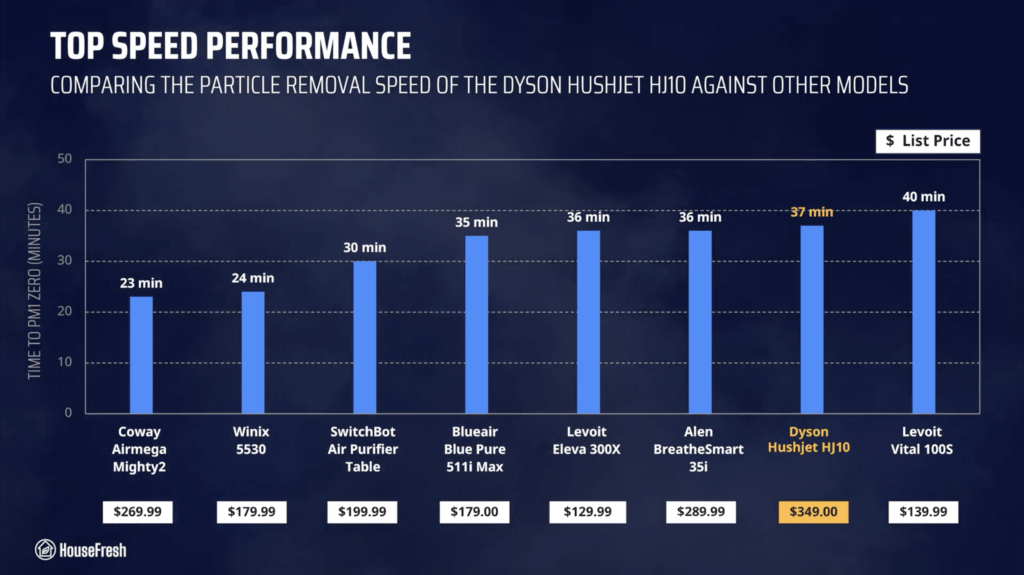
However, this test was conducted at full power and air purifiers running at full power tend to be too loud – – even small models like this one. That is why I tested sound levels at different fan speeds so we could account for noise levels.
Sound levels
The sound levels of the Dyson HushJet Compact HJ10 range from 35.8 dBA to 53.1 dBA — which is quieter than most other small models I’ve tested.
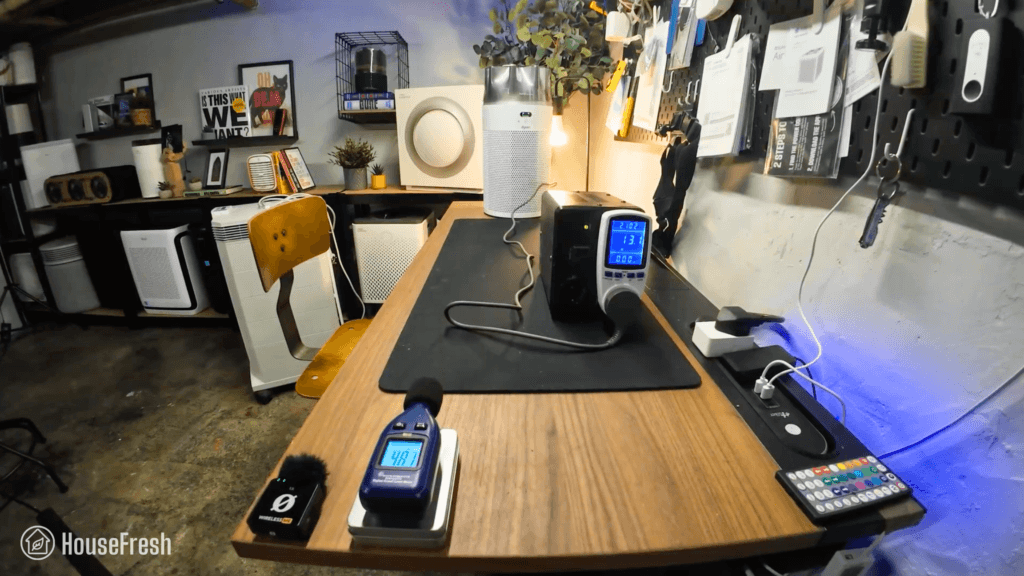
As always, I used our BAFX sound meter to how much sound the Dyson HJ10 generates at each of its fan speeds and on sleep mode from 3 ft. away:
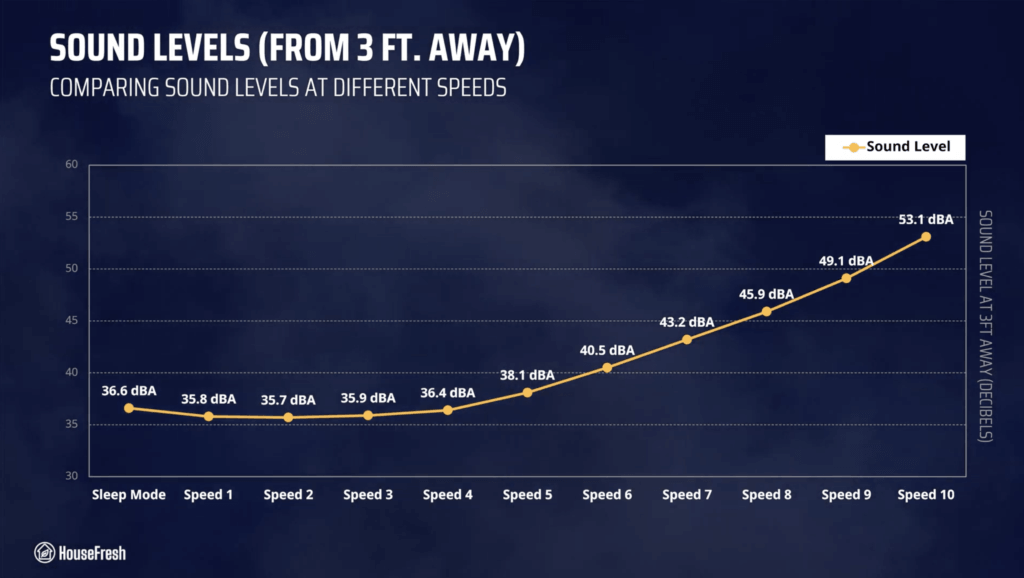
As you can see from the chart below, the HushJet Compact is the quietest small air purifier model in our comparison, reaching 53.1 dBA at top speed.
Running at speed 7, it reached 43.2 dBA and cleared our test room in 52 minutes. Based on this result, we estimate a PM1 CADR of 113 cfm at speed 7.
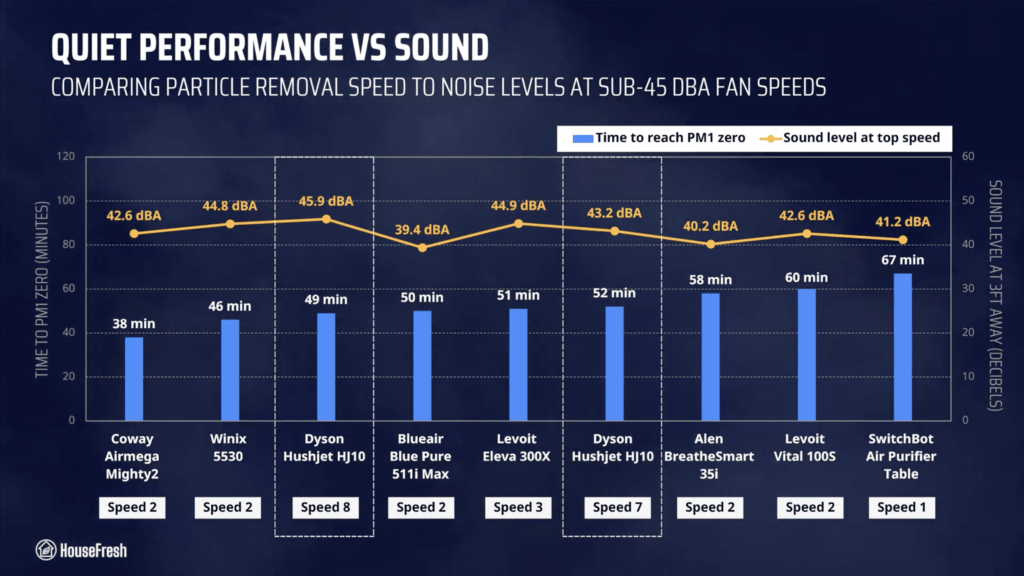
When it comes to quiet performance, the Dyson HushJet HJ10 is faster than most other small units running at sub-45 dBA fan speeds with the exception of the Levoit Eleva 300X and the Blueair Blue Pure 511i Max.
Long-term running costs
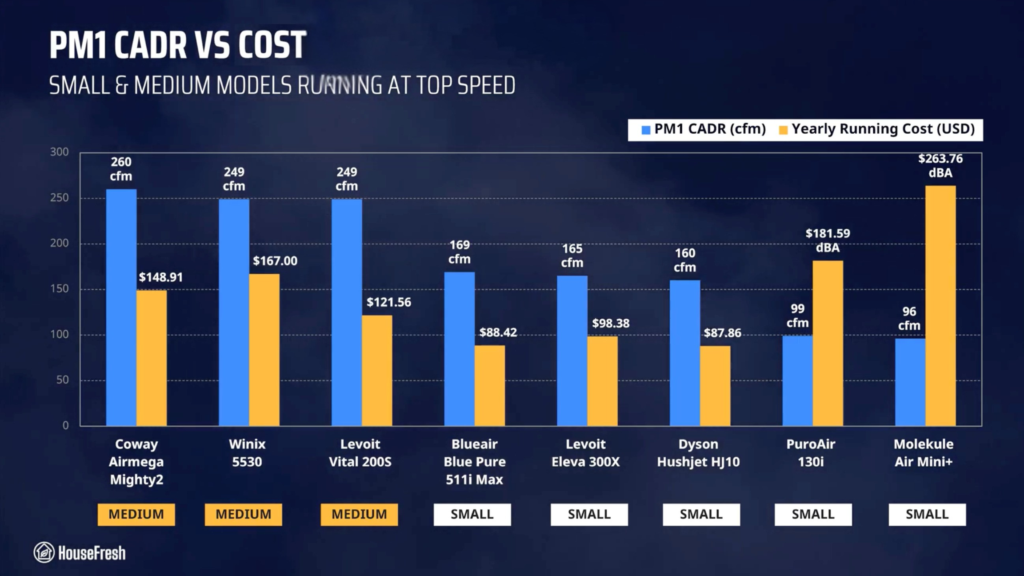
Running a Dyson HushJet Compact HJ10 will cost you $87.86 per year, combining energy and filter replacement costs.
We used our energy meter to record how much electricity the Dyson HushJet Compact pulls at each fan speed and while on standby.
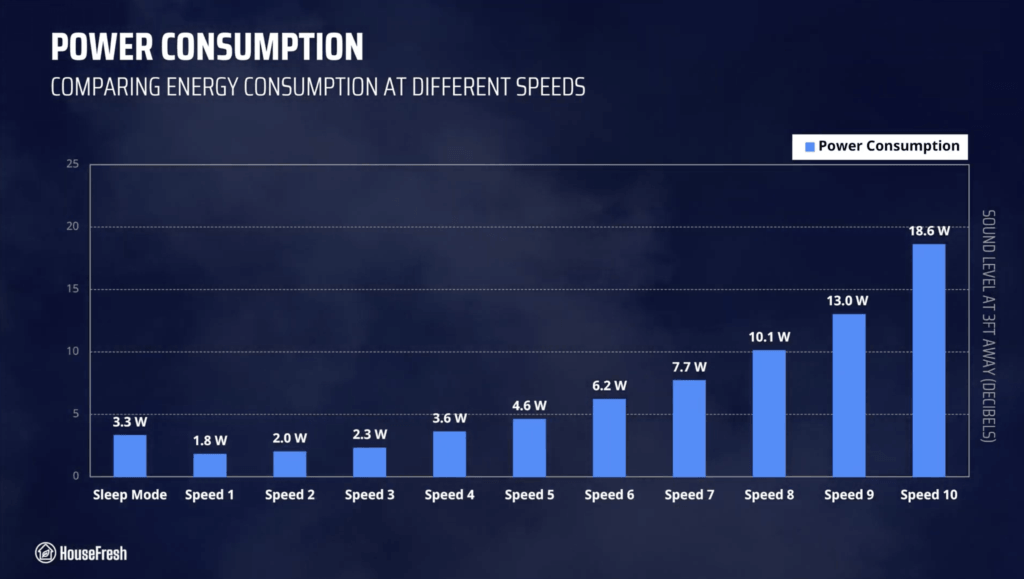
At top speed, the HushJet Compact draws 18.6 watts, so if you were to leave it running at top speed 24/7 for one year, it will add $29.88 to your energy bill, based on the latest electricity prices in the U.S. as of October 2026.
This is outstanding energy efficiency from Dyson, but electricity consumption isn’t the only cost to consider, so let’s look at replacement filters.
Dyson states that the electrostatic filter should last up to 5 years and the carbon filter up to 12 months. The electrostatic filter costs $64.99 and the carbon filter costs $44.99. So based on these lifespan calculations, yearly filter costs would go up to $58.
I added this to the energy costs and can tell you that you need to budget $87.86 each year to keep your Dyson HushJet Compact running 24/7 in your home:
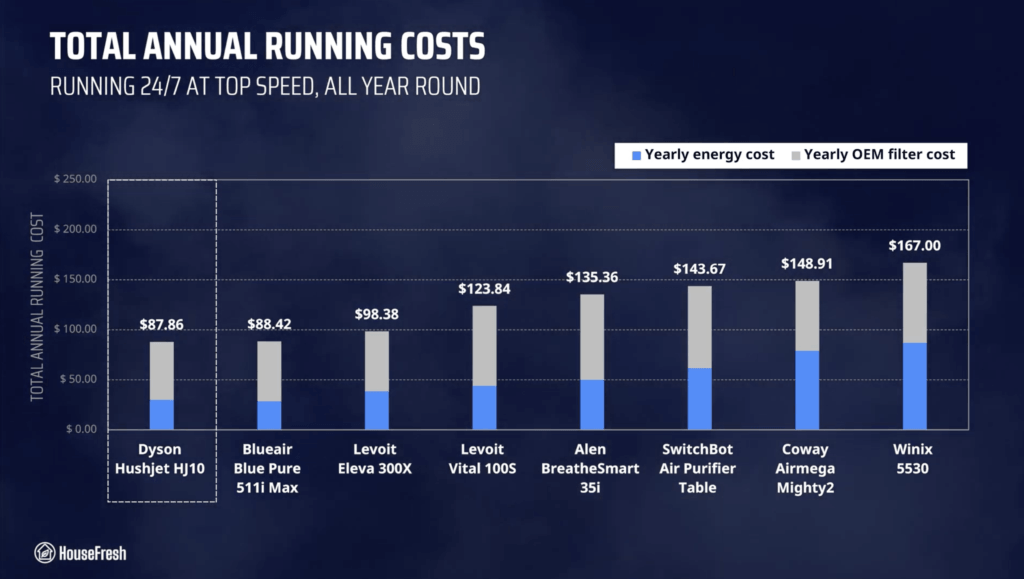
This makes the Dyson HushJet Compact HJ10 the cheapest air purifier in our yearly costs comparison, thanks to the combination of low energy usage and a 5-year filter lifespan.
Bear in mind that most other small air purifier models have filters that last just 12 months so this low filter replacement cost is dependent on the particle filter really lasting 5 years.
When you add the $349 retail price to that first year’s running cost, your total investment in the first year of ownership is $436.86.
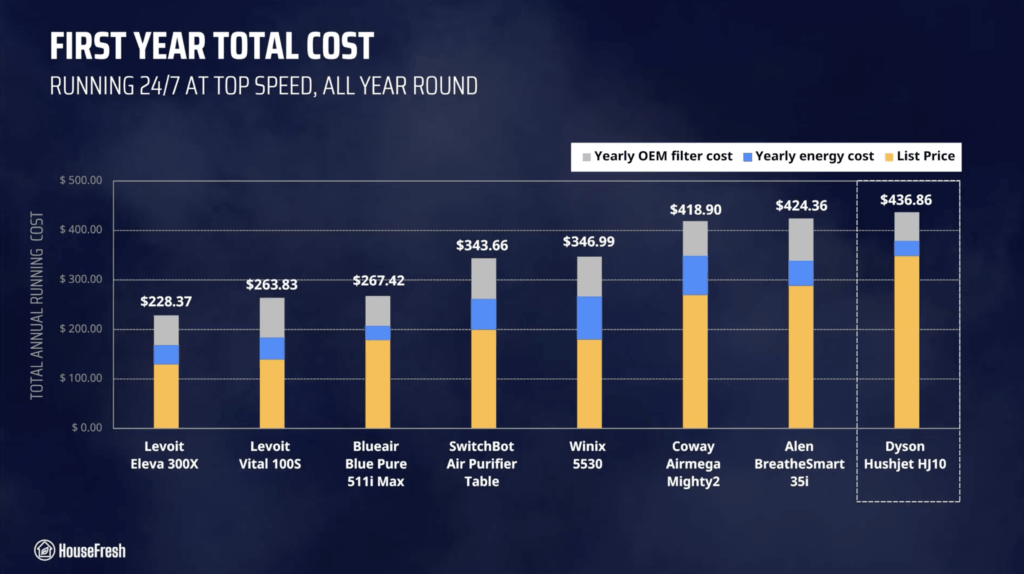
Looking at the chart, we find that the Dyson HushJet Compact is the most expensive model to buy and to run in that first year of ownership.
And bear in mind that this comparison includes midsized models that offer more air cleaning power like the Winix 5530 and the Coway Airmega Mighty2.
Bottom line: Should you get a Dyson HushJet Compact HJ10?
Is the Dyson HushJet Compact worth the $349 price tag? Well… It depends…
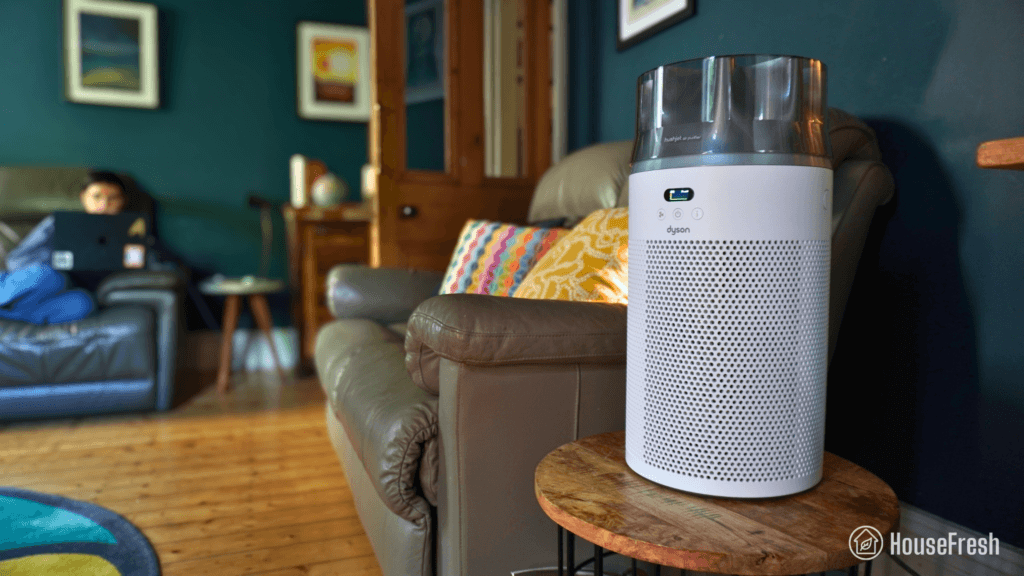
Let me start by saying that this is a good air purifier. It comes with a wide range of fan speeds, a very good app, smart functions, and solid air cleaning performance, especially considering its size.
In our particle removal tests, we found that the 40-minute mark is tough to beat for small cylindrical air purifiers. And I’ve got to say, I was worried the HushJet would cost 350 bucks and hit the same wall…
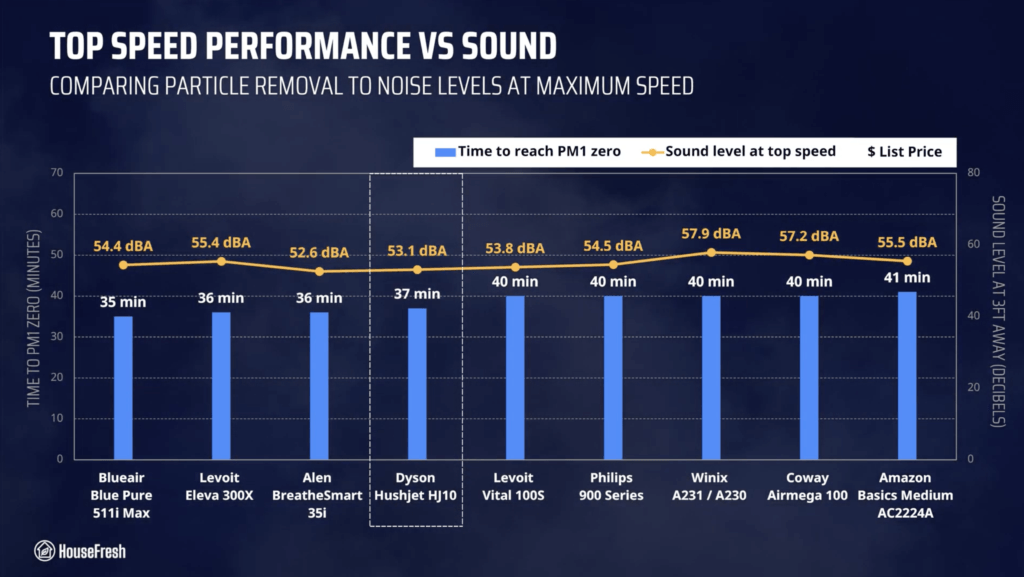
But it managed to clear our test room in 37 minutes, outperforming small units I’ve recommended over the years like the Winix A231 and the Coway 100.
Based on our test data, it offers a PM1 CADR of 160 cfm at top speed, while generating 53 dBA of noise and pulling less than 20 watts.
And this compares well to other small air purifiers…
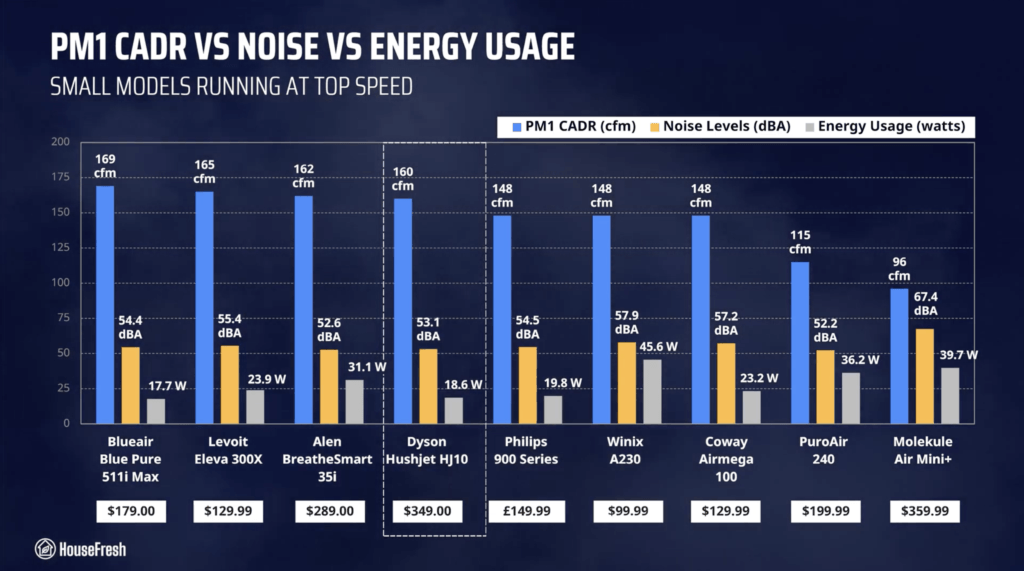
Models that offer more air cleaning power are generally louder or more power hungry than the HushJet Compact. However, they are also cheaper to buy…
The good news is that if the $349 price tag doesn’t scare you, then you will be saving money in the long run. When you combine the use of separate particle and gas filters with the fact that they have a long lifespan, this saves you money on filter replacements.
And Dyson’s engineers managed to pack a lot of power in a fan that is actually really energy efficient, so this will in turn save you money on electricity.
As I always say, if space is not an issue, I recommend that you size up and go for a midsized model instead — you will get a lot more air cleaning power with a Coway Mighty2, a Levoit Vital 200S or a Winix 5530.
If you decide to get yourself a Dyson HushJet Compact HJ10, please use this link. When doing so, we will receive a small affiliate commission at no extra cost to you.
And if you’re still unsure, you can try using our air purifier comparison tool to see how this Dyson model stacks up against air purifiers with similar prices:
If you have any questions about the this model or about Dyson air purifiers in general, please drop them in the comments below, and I’ll get back to you personally as soon as I can.