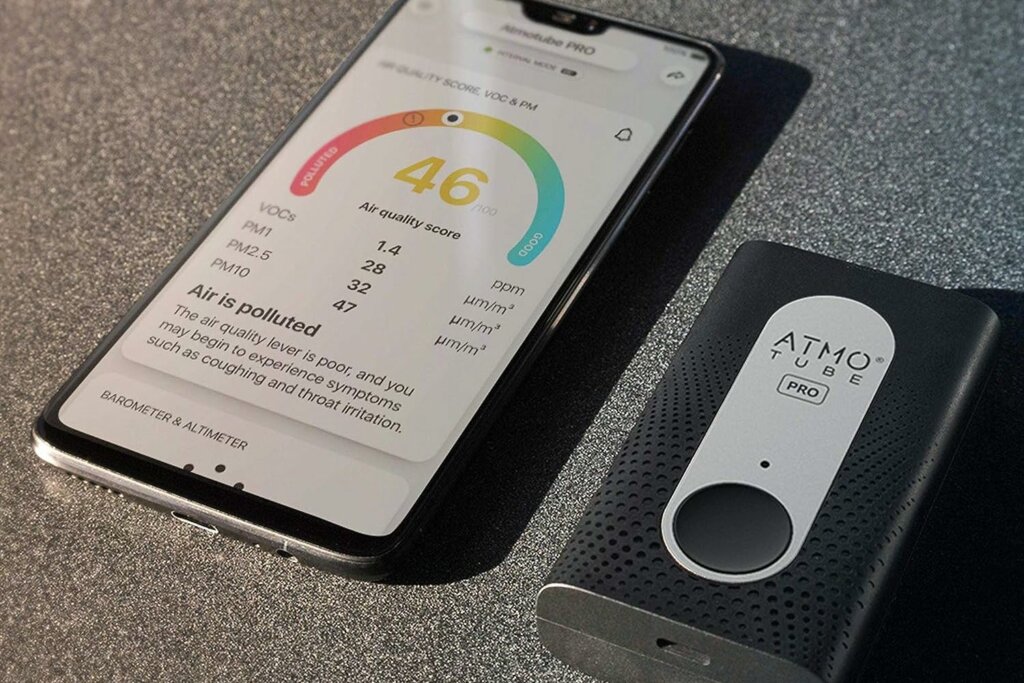
Created by Atmo, a startup based in San Francisco, California, the Atmotube PRO is designed to send air quality metrics to your smartphone. The guys at Atmo reached out and asked us to test the device.
We usually don’t accept products for review as we prefer to buy everything ourselves, but we decided to accept the offer from Atmo as were reassured that we could be 100% unbiased without the need to “soften the blow” if there was anything about the Atmotube PRO that we didn’t particularly like.
The Atmotube PRO is listed for $189.99 but can often be found for around $150. Most air quality monitors we have reviewed here at HouseFresh have a screen showing you the latest reading, but the Atmotube PRO sends all this information directly to your phone.
The high-end sensor has been tested by the AQ-Spec, so I was eager to put the Atmotube PRO to the test.
TL;DR The Low Down on the Atmotube PRO
“A unique product that enables your smartphone to tell you the air quality right now with data on PM1, PM2.5, PM10 and VOCs. It’s currently the only device on the market with a lab-level air quality sensor connecting directly to your phone. I would like to see improvements in the battery and app in future versions, but for those in high-risk areas, the Atmotube PRO is worth a look.”
If you don’t want to read my full review, these are the key things you need to know about the Atmotube PRO:
What We Really Like:
👍 It can provide readings every minute, so you can see if air quality is high risk in real time 👍 The app can trigger alerts with different air quality scores 👍 It is a small device that is easy to keep attached to your trousers or backpack 👍 The Android app is intuitive and easy-to-use for first time users 👍 The air quality sensor is highly accurate
What We Think Could Be Better:
👎 The battery runs out quickly, especially when you enable updates every minute
The Specifications
The lab-level air quality sensor on this device gives you insight into VOCs. When you realize that this sensor doesn’t have a screen, it can seem expensive compared to the QingPing Lite, which is available for less than $100.
However, the Atmotube PRO’s VOC sensor is a significant advantage over the QP Lite.
HouseFresh rating:
★★★★☆
Air quality factors detected:
PM 1, PM2.5, PM10, VOCs, temperature, humidity and atmospheric pressure
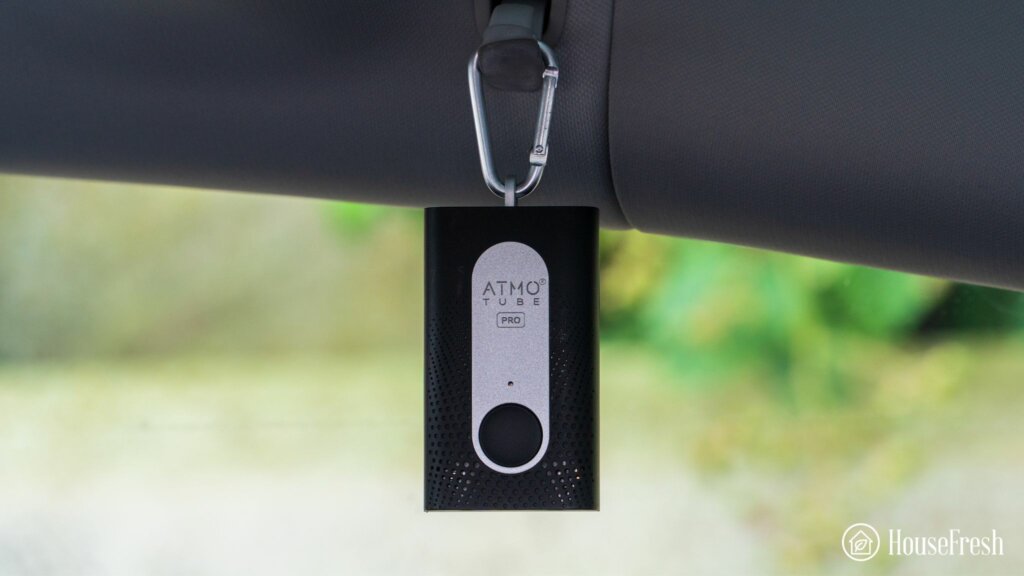
The Atmotube PRO is a simple, elegant-looking black box. It weighs close to nothing so it wouldn’t be painful to hang it from your belt or a strap on your backpack.
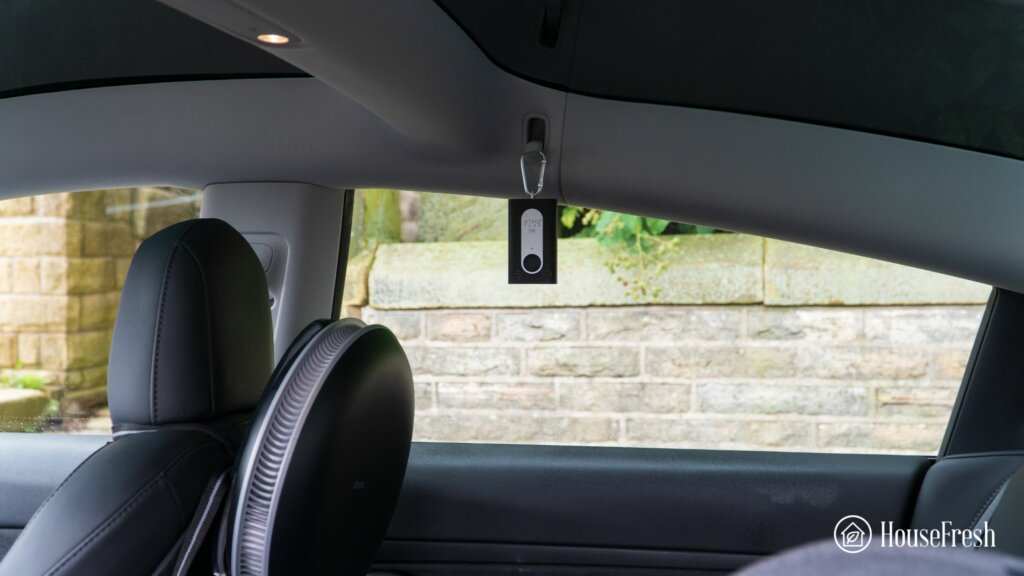
Personally, I decided to hang it from one of the hooks in my car as I didn’t have an air quality monitor on the car yet:
This is a very simple air quality monitor, so you should theoretically be able to get it to work right out of the box. That said, you’re likely to have to charge the device before you get to use it properly.
To fully charge your Atmotube PRO, you have to plug the USB Type-C cable to a power supply for a minimum of 2 hours. You will notice that the LED light on the device will change color from orange to green, this means that the Atmotube is charged and ready to go.
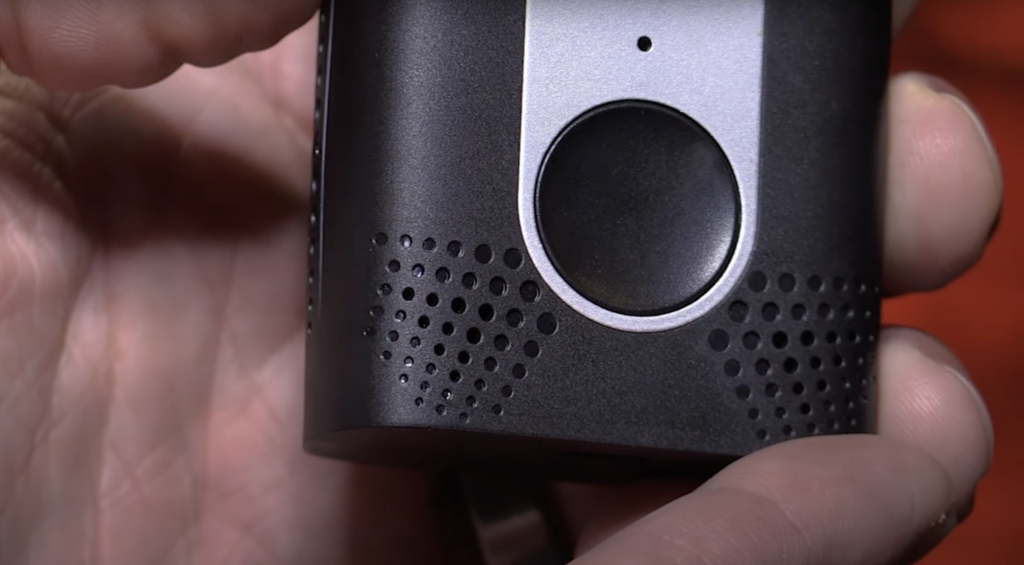
When it comes to controls, the Atmotube PRO device doesn’t have much going on – just one button:
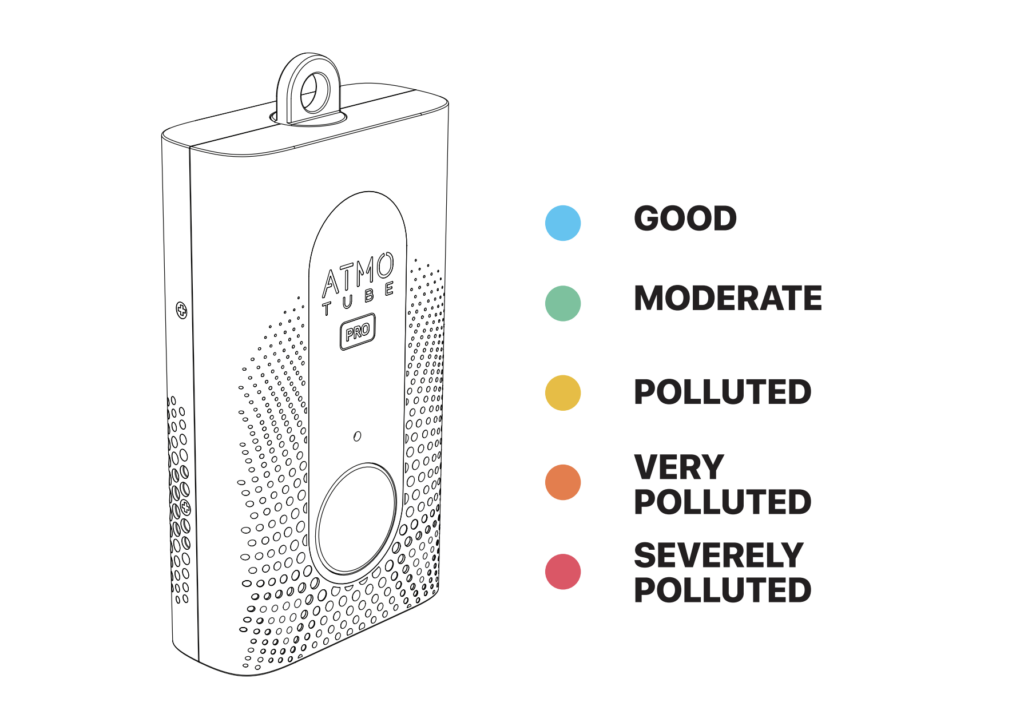
That’s right. This little device features just one button that you can press to see the current air quality score, which is indicated by the color of the LED light above the button:
💡 Pro Tip: The moment you switch on the Atmotube PRO, the device will immediately begin to measure air quality, but Atmo clarifies on the accompanying Quick Start Guide that their measurements become more accurate after the first 12 hours of use as this gives the Atmotube PRO enough time for a thorough calibration.
Simple and Straightforward Mobile App
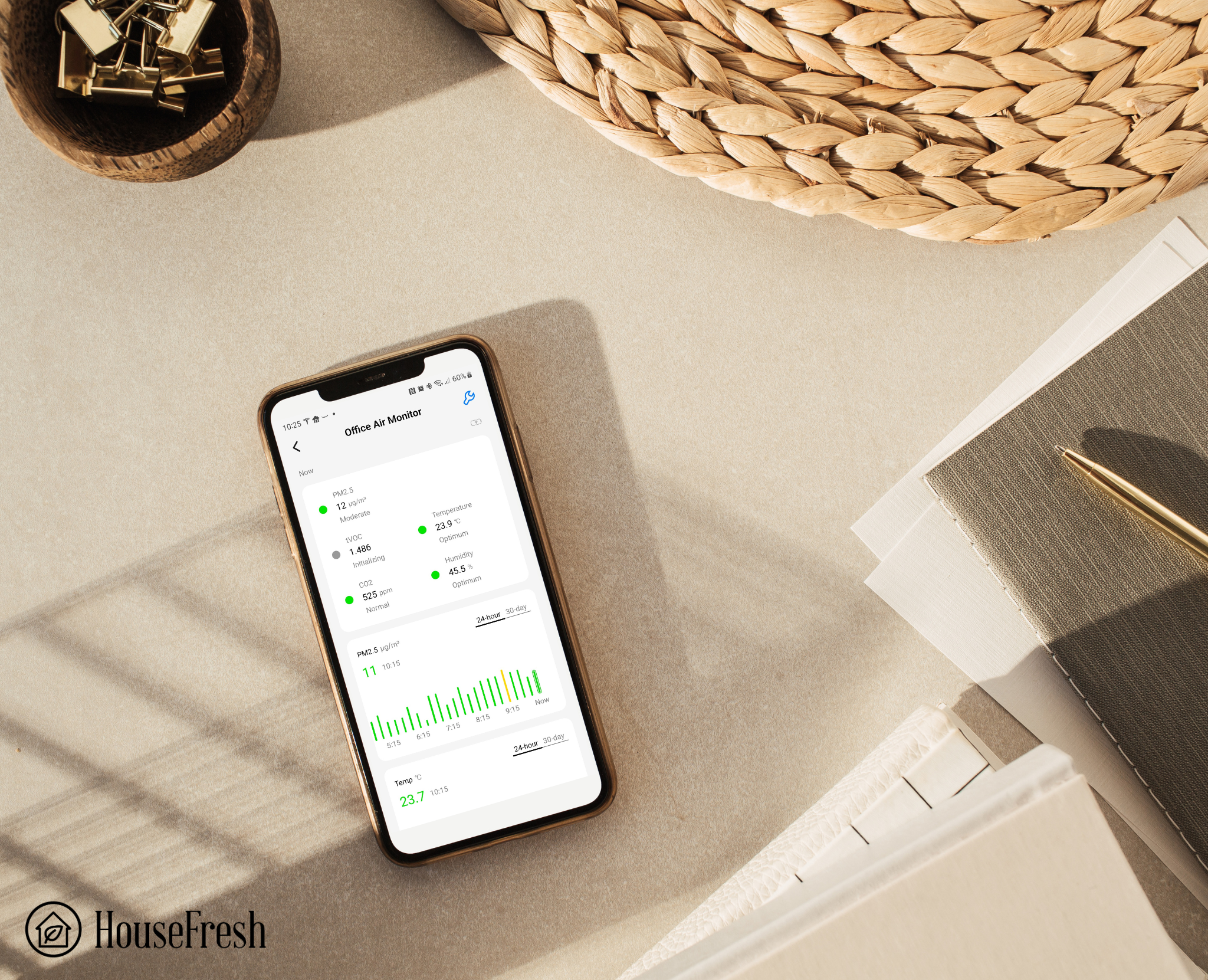
As I mentioned in the introduction to this review, the Atmotube PRO sends detailed air quality information directly to your phone. The device doesn’t have a screen, so if you want to learn more about the air quality metrics other than what you can guess through the LED light colour, then you need to get the app.
It will immediate alert you when the air you’re breathing is not safe enough
It saves historical data on the different air quality factors
Inside the Atmotube app, you can click on the different types of pollutants/factors to see historical data from hourly, daily, weekly, monthly and even over the year. This is possible thanks to the fact that the Atmotube PRO takes readings every few seconds while it’s ON. This is great but it really takes a toll on its battery.
In order to extend your Atmotubeʼs battery life, you can open the app and go to Settings. Once there, you can select one of the different Modes depending on how often you’d like the PM sensor to take its readings. I seriously suggest you do this.
Export Your Air Quality Data
You can export all the data you collect with the Atmotube PRO, including even the latitude and longitude of your location.
I tested the Atmotube PRO during a visit to a BBQ restaurant. I assumed there might be a higher level of particulates in the air but was shocked to see how high the readings reached to. By seeing the alerts on my phone as soon as we stepped into the restaurant, I chose to sit further away from the kitchen near an open window.
Having the data reported every minute was very useful for reducing exposure quickly:
Bottom Line: High Price for a Unique Air Quality Monitor
If you are on the hunt for a cheap but accurate air quality monitor, you should consider the QP Lite. That being said, the Atmotube PRO has some exciting features that might be useful for some people.
I liked that you can evaluate current air quality every minute. The app alerts give you a heads up when you’re in a situation where air quality has turned bad so you can do something about it. If you were biking or hiking in areas affected by wildfires, then the Atmotube PRO would quickly alert you that the air is polluted, allowing you to make a quick decision to get out of the area.
This pro, however, comes with a con: taking air quality readings every minute seriously reduces battery life. If you were to do this, the Atmotube PRO’s battery would last for about a day, meaning that the device could be out-of-battery by the time you really need it.
I am interested in future iterations of this device, especially if they come with a more powerful battery.
While we wait for smartphones to come with integrated air quality monitors (wouldn’t that be great?), the Atmotube PRO is the only way to access air quality readings in real time on your phone.
Yes, it’s probably the strangest brand name you’ve ever seen, but Qingping has been busy making excellent high-end quality sensors with attractive price tags.
Earlier this year, Smart Air reached out to us, and we got to test and review the smaller Qingping Lite. Its high-end sensor and screen impressed us, costing less than $100. It’s essentially a cheap air quality monitor that is as good as premium models that cost $250+
The Qingping Pro is a little more expensive at $139.99 but can track VOCs and includes a more prominent color screen. It also provides app support with the ability to download your data for analysis.
TL;DR The Lowdown on the QP Pro
“An improvement over the QP Lite with the same sensor accuracy and with the additional support for VOCs. It would still be good to have more particle sizes such as PM10 that is included with the QP Lite, but for the price, this is still one of the best budget air quality monitors on the market.” — Danny Ashton, Founder & Senior Writer
If you don’t want to read my full review, these are the key things you need to know about the QP Pro air quality monitor.
What We Really Like:
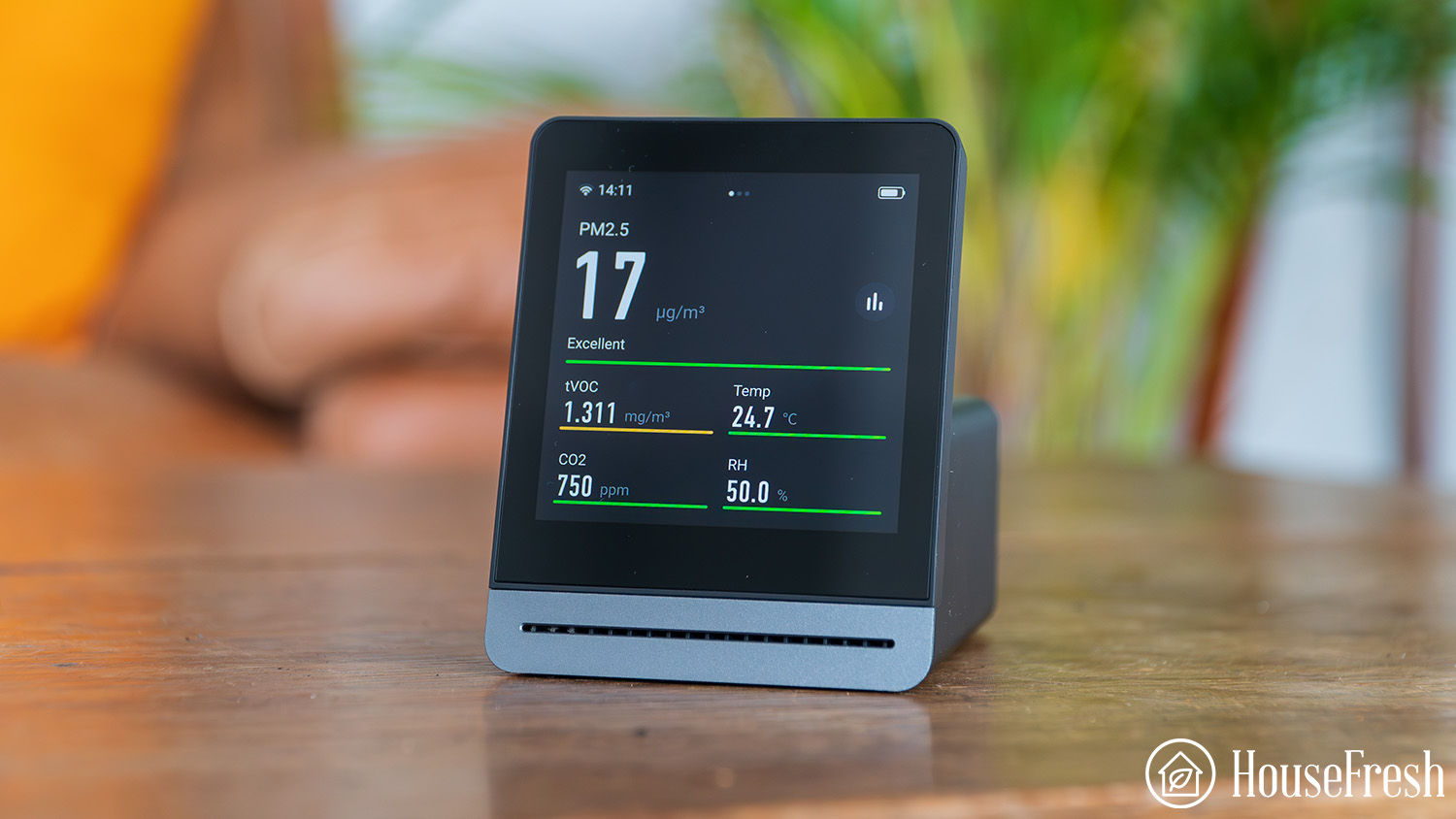
👍 The ability to track VOC and PM2.5 accurately without spending more than $150 👍 The color screen shows PM2.5, temp, tVOC, CO2 and humidifier at one time 👍 Battery mode allows you to use the sensor without having access to power 👍 You can easily pull data from the device using the QingPing+ app 👍 Size is perfect for use on a desk 👍 Screen design allows you to understand your current air quality quickly
What We Think Could Be Better:
👎 Lack of PM10 and PM1 particle sensors which would be good to have in future versions 👎 VOC sensor only shows all VOCs and is not able to provide insight on specific problematic VOCs like formaldehyde
The Specifications
Budget air quality monitor with the ability to track VOCs
Like the QP Lite, this is a cheap monitor, but it doesn’t use cheap sensors. It uses the Sensor S8 for PM2.5, an SGP30 for VOC and the same temperature and humidifier sensors used in Teslas [Sensirion].
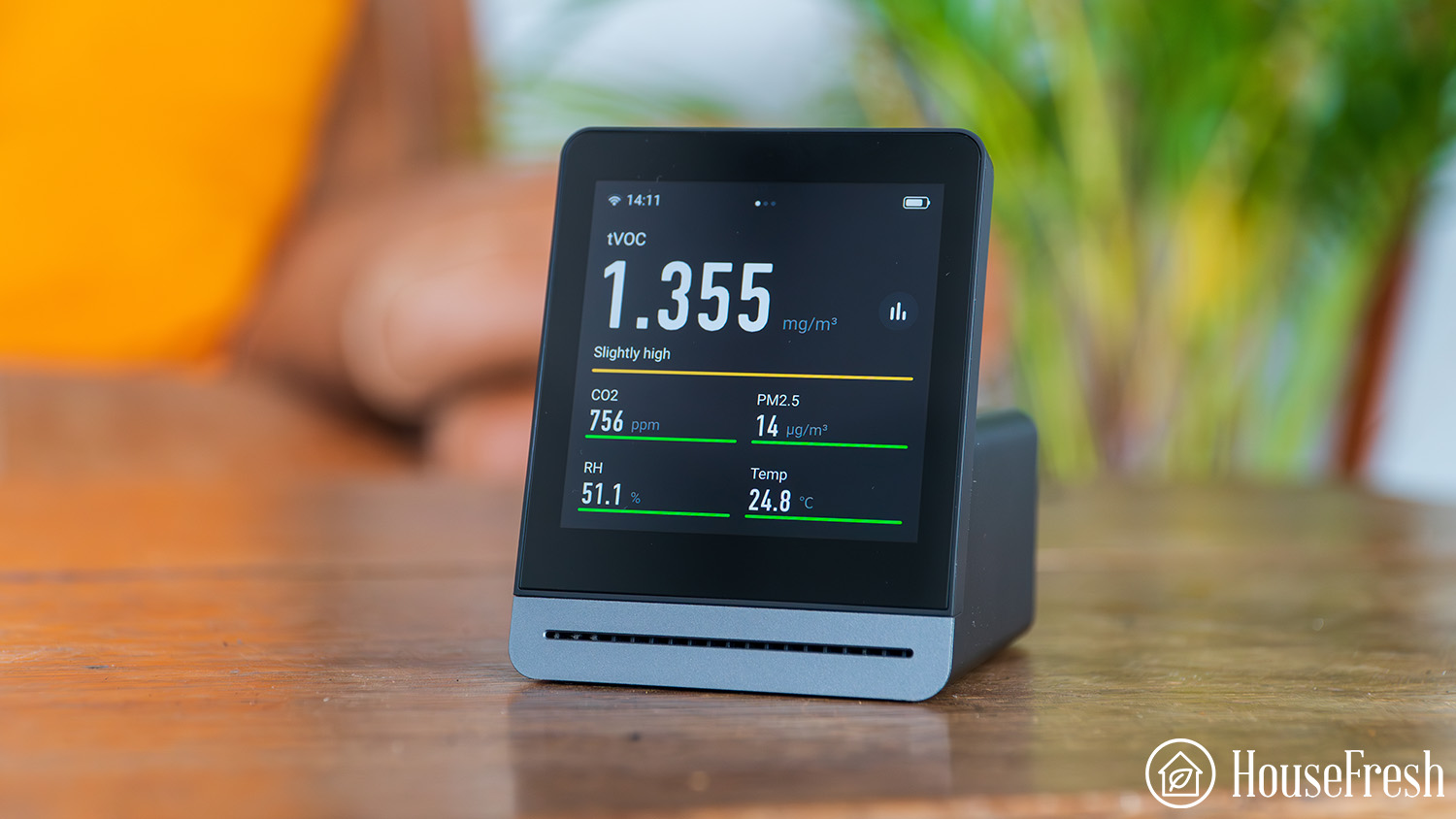
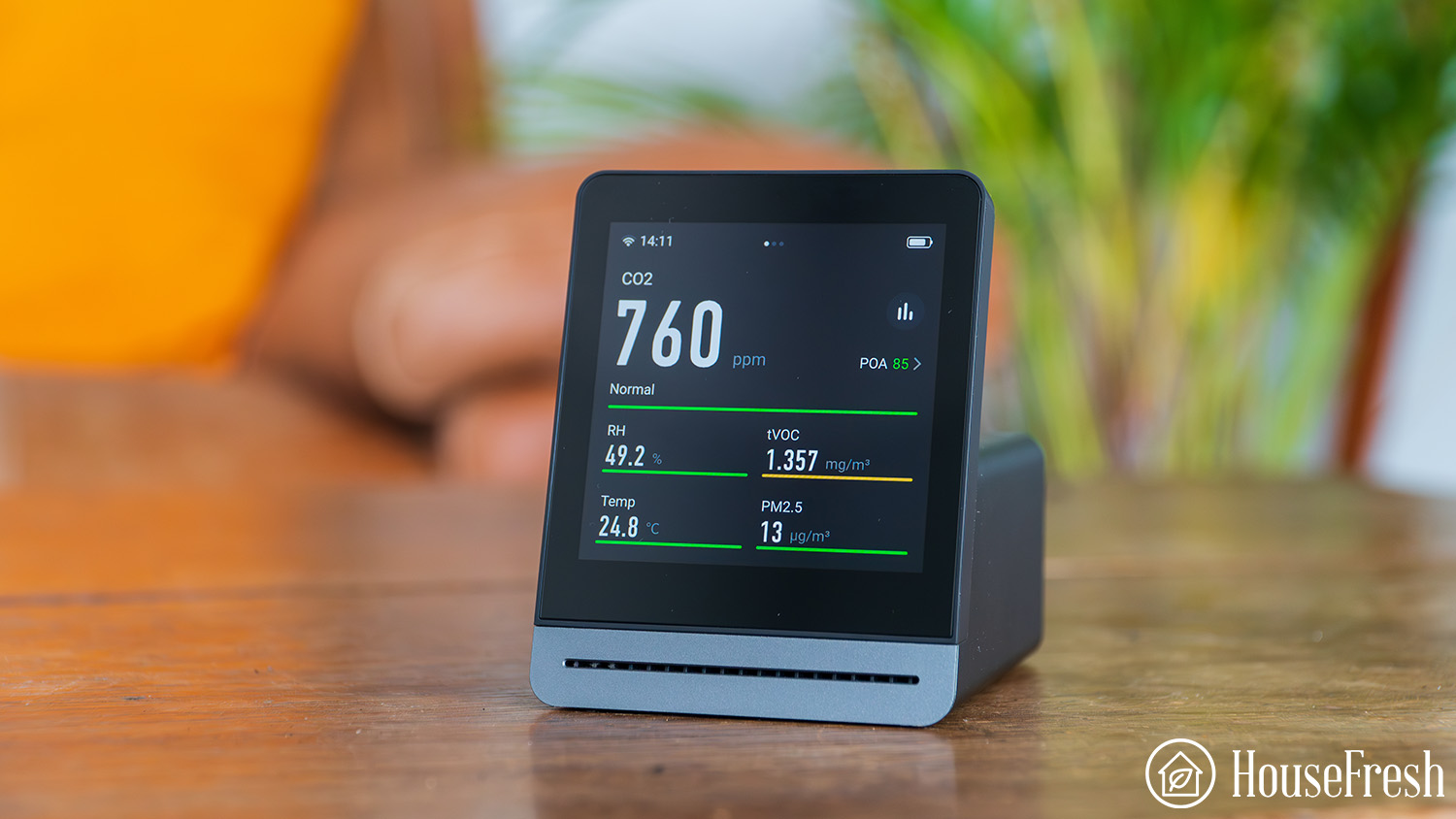
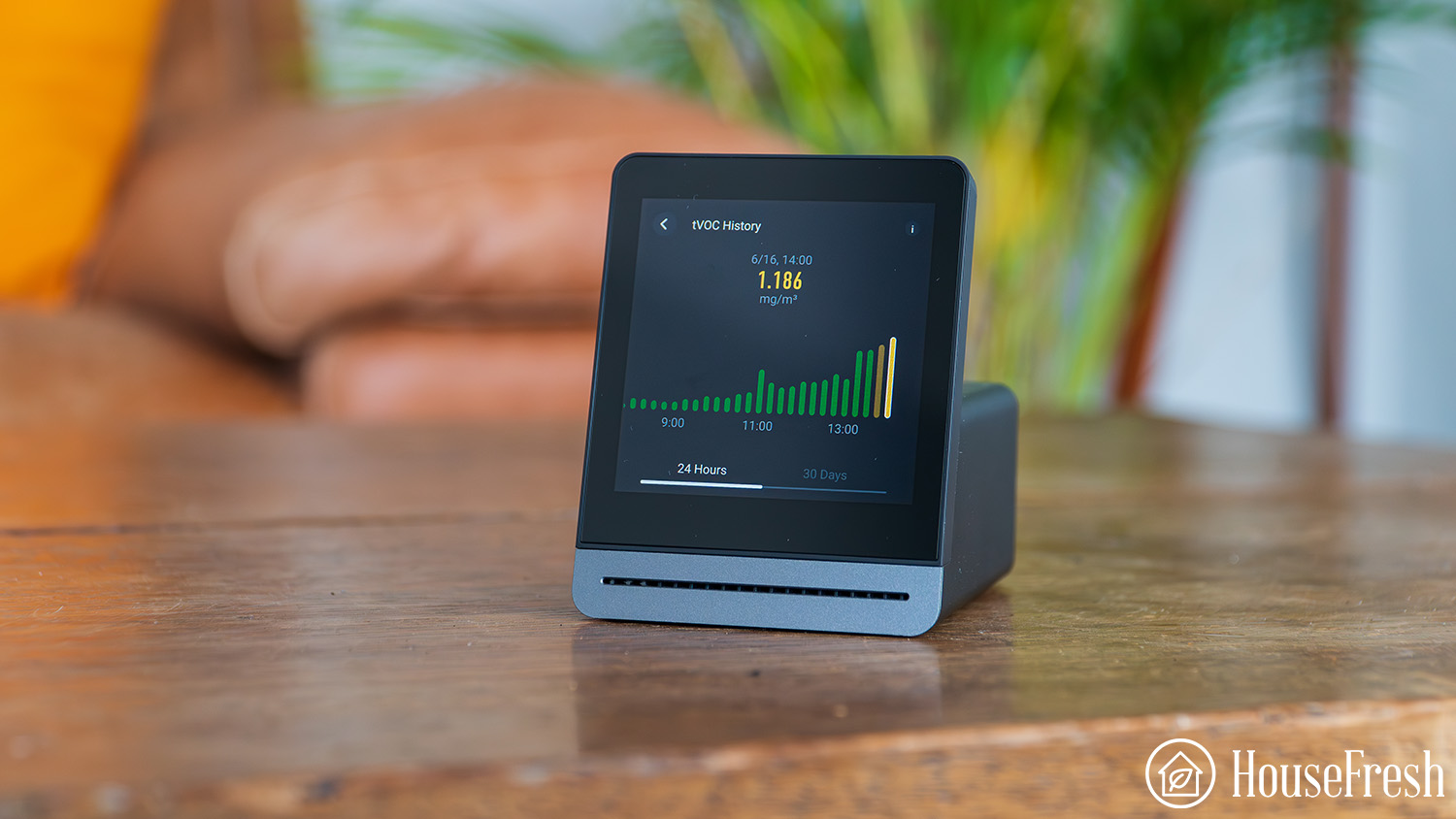
The QP Pro has an attractive screen that shows all the information in an intuitive way, allowing you to keep all the different air quality readings in one place.
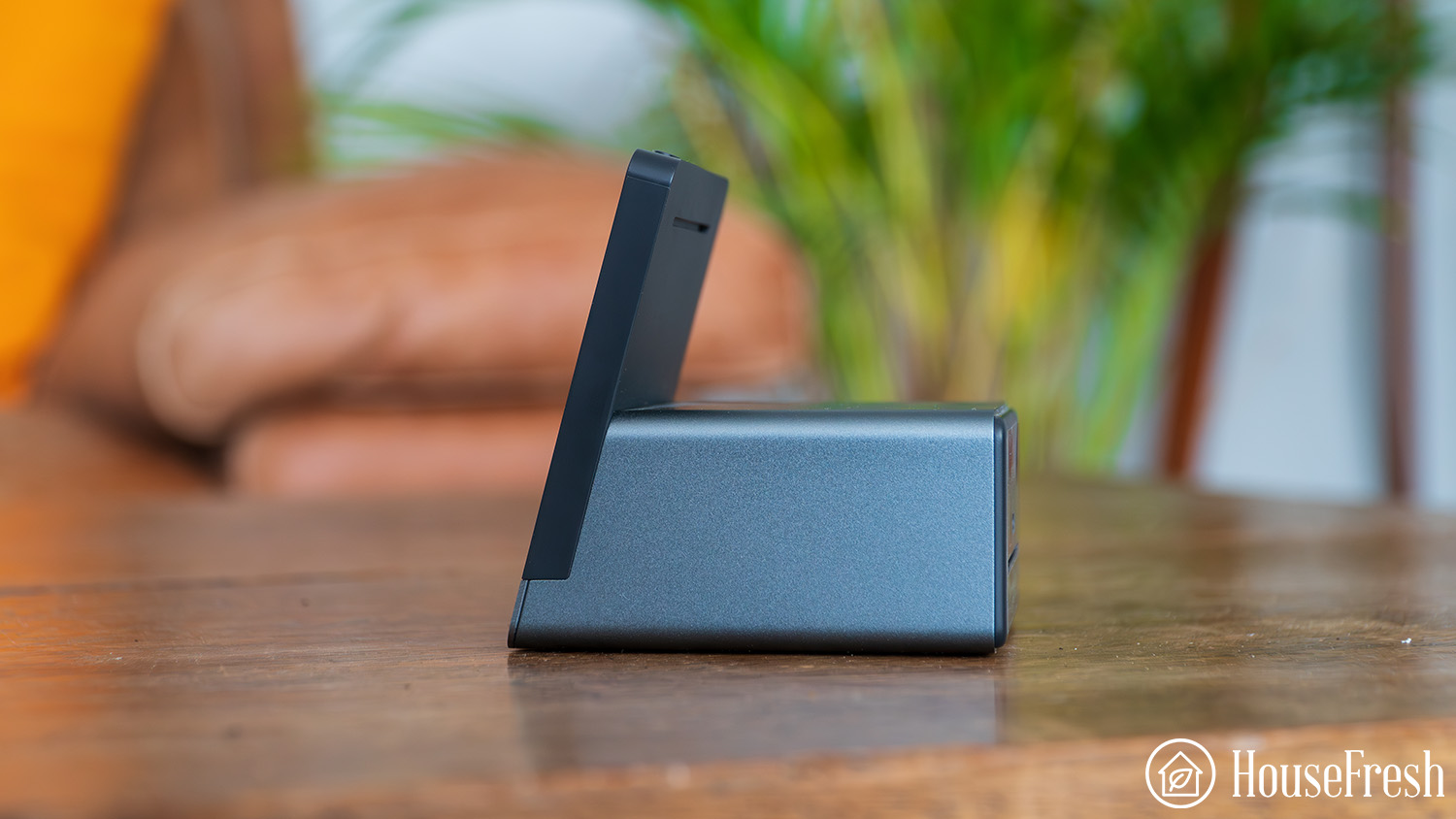
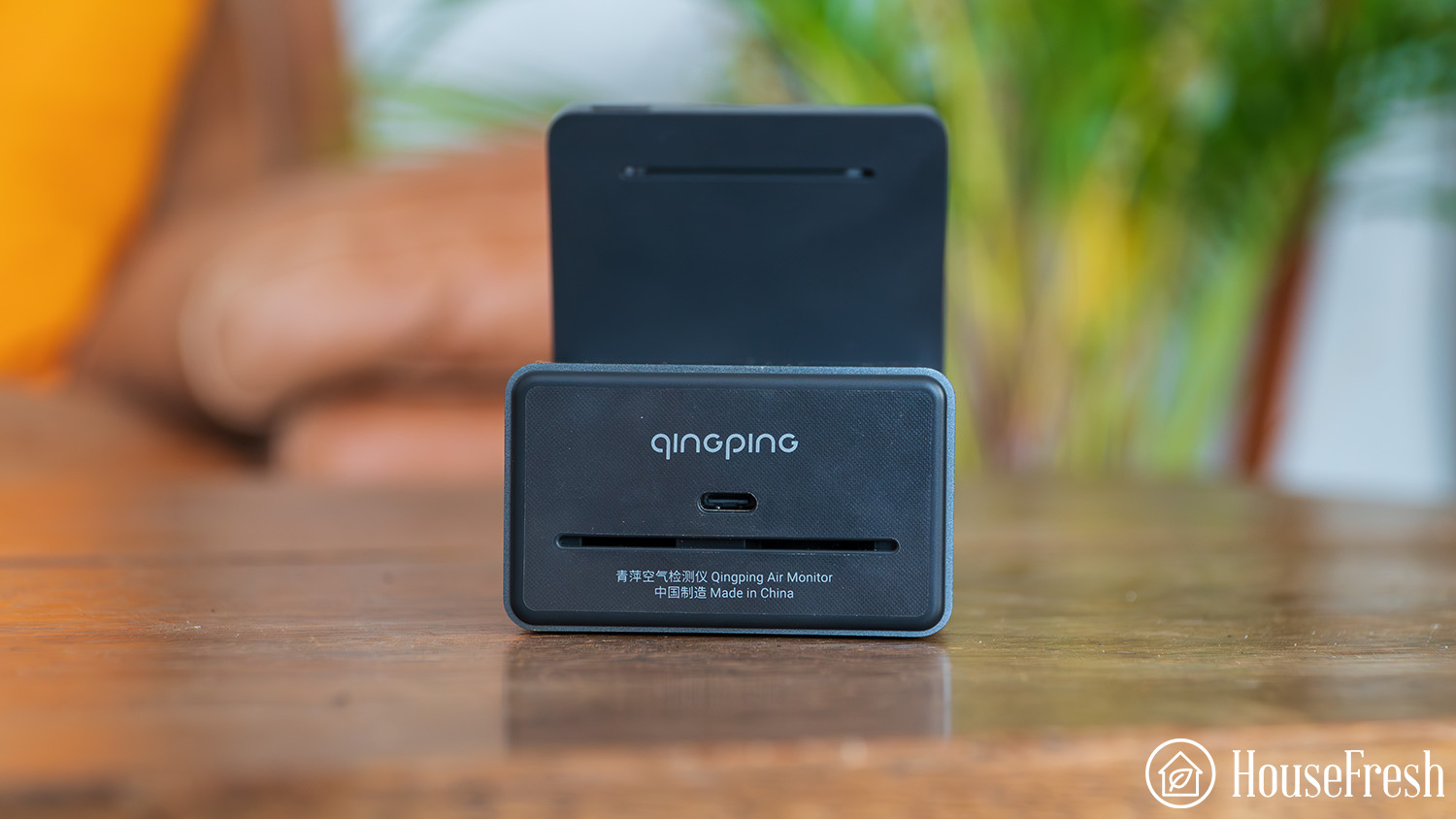
Looking at the unit from the side and the back, you can clearly see that it’s bigger than the QP Lite:
In comparison, the QP Lite is better for travel — I could see the screen getting damaged if you threw the QP Pro in your bag. Whereas the QP Lite is designed to be carried around.
Simple System
While you use the top bar to change menus with the QP Lite, you just use the screen with the QP Pro. It’s similar to a smartphone, so there is no learning curve to use it.
One significant benefit of the QP Pro over the Lite is having one screen that shows everything. With the QP Lite, you keep moving screens to see different sensor readings.
But that doesn’t mean that the QP Pro doesn’t allow you to go deeper… You will also be able to swipe the screen to move across different air quality factors.
You will have a dedicated screen for CO2 measurements:
Another screen where to track TVOC (Total Volatile Organic Compounds) levels over time:
AND a separate screen for PM2.5 particulate levels in the air:
I had no issues connecting the Qingping+ app to the QP Pro; it connected to my 5GHZ WIFI with no issues. The air quality monitor will save the latest data on PM2.5, CO2, VOC and temperature and humidifier, allowing you to export this data to see changes over time.
Like the QP Lite, data is provided every 15 minutes, which is fine for looking at historical data. However, I prefer having data every three minutes, which is the case with the Purpleair Indoor Sensor ($200 with no portable mode).
Export Your Air Quality Data
I exported the data from my QP pro and then used Flourish to create this simple line graph:
If you use specific smart appliances like those from Xiaomi, you can enable your devices to switch on based on data from your air quality sensor.
QP has also promised that a new update will allow for your data to be used with Google and Alexa, although this hasn’t been rolled out yet, so I haven’t had a chance to test it.
Bottom Line: Good Price, High-End Sensors Desk Air Quality Monitor
The QP Pro can accurately measure VOCs, PM2.5, CO2, temperature and humidity — features usually only available for $250+.
It’s always a challenge to understand VOCs, as sensors can only measure all VOCs, including those that are not harmful. I would have preferred to see PM10 and PM1 rather than VOC, so I would still recommend the QP Lite over the QP Pro, as it’s cheaper and gives more insight into particulate pollution.
If you are a big fan of having a clear screen to see your air quality on your desk, then the QP Pro might be something to look at.
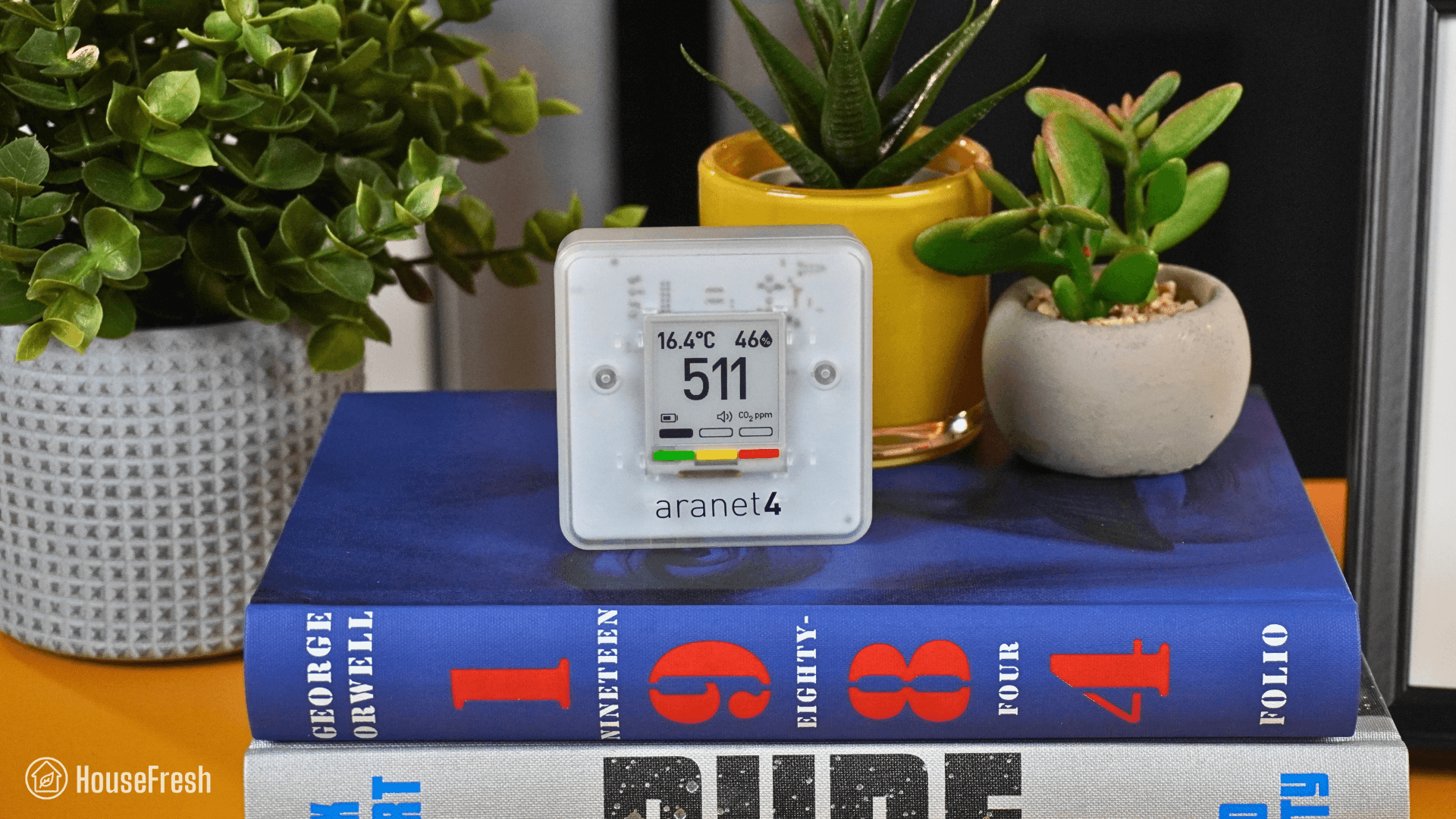
Many cheap CO2 monitors are inaccurate or hard to use, but one of the most recommended sensors around is the Aranet4. Aranet is a SAF Tehnika JSC brand traded on the Baltic Nasdaq that had a revenue of 33 million euros last year. Their big innovation is using a Non-dispersive infrared sensor (NDIR) that is typically used in industry and is the most accurate CO2 sensor currently available.
That sensor combined with an e-ink screen gives a maximum battery life of up to seven years! In comparison, the cheaper Qping Lite has a maximum battery life of only four hours.
There are two versions — the Home and the Pro, with very similar features. The pro edition is meant to be used with a base station and other units, while the home version works alone. This is the version we reviewed.
Why trust this review? We bought the Aranet4 Home with our own money, so we have zero bias and can share exactly what we like and, more importantly, what we didn’t like about this air quality sensor.
TL;DR The Lowdown on the Aranet4 Home Sensor
If you don’t want to read my entire 1500-word review, then check out my key findings about the Aranet4 below:
What We Really Like: 👍 Battery life of up to seven years when using lithium AA batteries 👍 Measurements every 10 minutes 👍 E-ink display is easy to see in sunlight 👍 Simple App has good UX and the ability to export data for any timeframe 👍 NDIR sensor that is currently the best CO2 sensor on the market 👍 Small portable unit that can easily be left in a bag for continuous tracking while traveling
What We Think Could Be Better:
👎 Not waterproof, and I found the battery cover did come off easily when it moved around in my bag 👎 Price of $250 is not affordable for many people 👎 Would be great also to get a particle sensor in a future version
The Specifications
Accurate CO2 sensor combined with high-end battery life thanks to its e-ink screen.
HouseFresh Rating:
★★★☆☆
Air quality factors detected:
CO2
Sensor used:
Non-dispersive infrared sensor
Power requirements:
Battery-powered
Battery life:
4.8 years using alkaline battery or 7 years using lithium battery
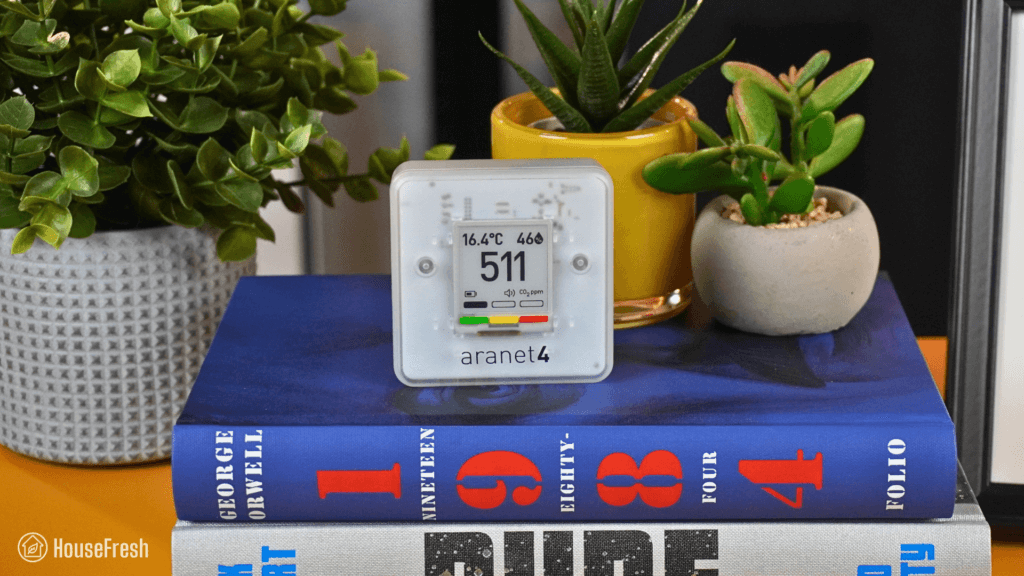
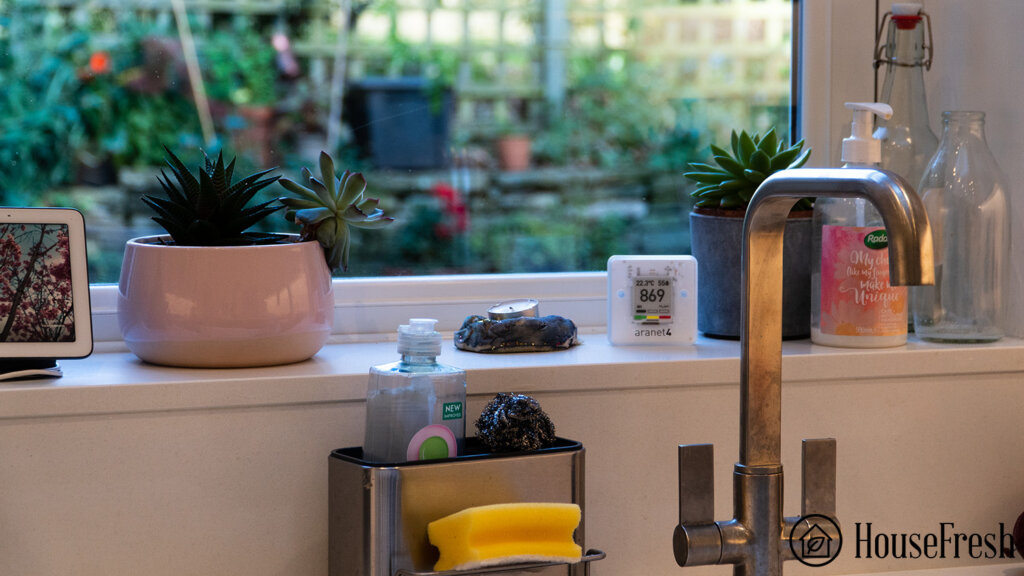
The Aranet4 Home has a super-portable design, with the main focus being the e-ink display. It’s small enough to hold in one hand and thin enough to keep in a bag without taking up too much space.
We recently got a chance to review the Qingping Lite, which includes a CO2 sensor and particle sensor. It’s similar in size, although the Qingping is much thicker than the Aranet4.
Introducing the Aranet4 Sensor
The stand-out feature of the Aranet4 is the combination of a Bluetooth 5.0 CPU, the BMD-30/39 series and the first NDIR sensor that uses LED’s from Senseair.
The Aranet4 is powered by two AA batteries and can be used with Alkaline and Lithium. Lithium batteries give the most extensive battery life of up to seven years if you only record CO2 every 10 minutes.
Simple Controls
You can use the Aranet4 with the e-ink display, which updates regularly to show you the temperature, humidity and CO2 level. You’ll get a score of Good, Average and Unhealthy.
It’s super easy to use the Aranet4 in standalone mode, but you get much more information when you connect it to your Apple or Android phone. I tested the Aranet app on Android using my Samsung S23 ultra. When you install the App, you don’t just see current sensor data, but also historical data.
By default, the App will report CO2 levels every five minutes, but you can adjust this. Bear in mind that increasing the regularity of tracking will decrease battery life.
Compared to the many apps we have tested for the smart air purifiers we review, the Aranet app is up there with the best, such as the Dyson Link app for example.
After using the app, I found myself leaving the sensor in my bag instead of getting it out to read the e-ink display. This is super useful when traveling, especially if you are wearing a mask and trying to avoid contamination with Covid-19. You can just check your phone rather than getting out the entire unit to know the current CO2 level and, thus, the Covid-19 risk.
How the Aranet4 Performs
I got a chance to test the Aranet4 in my local area and was impressed with how quickly the sensor would change, even when it was just two people talking in a reasonably sized room. Understanding CO2 levels allowed me to take action in real time and reduce it by opening windows and doors.
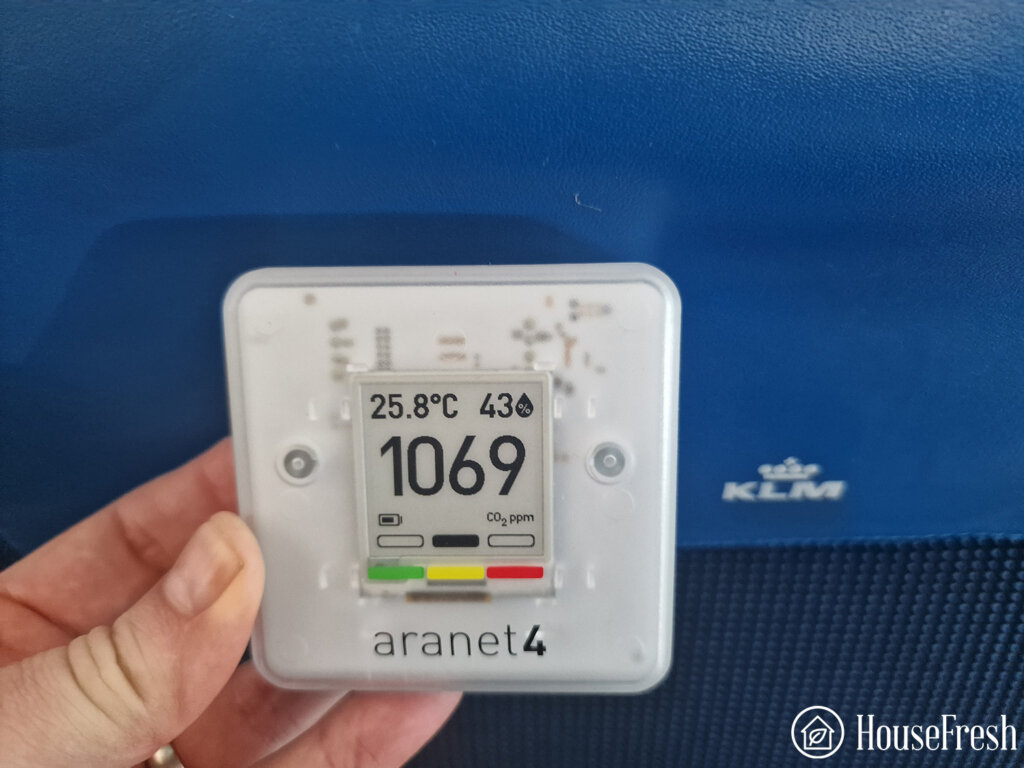
The big reason that many people will get a CO2 sensor like the Aranet4 is to understand risk when traveling, as CO2 levels can rise dramatically on public transport and planes. I tested the unit on a long-haul flight to Buenos Aires over the holiday period.
You can see from the graph how the CO2 levels peaked during the initial take-off stage and then didn’t drop below 1900 ppm until we left the first flight. I was surprised by this and wondered if the filters in use were faulty as they should go down much further, but it shows you how important wearing a mask is on flights. The risk of air-borne disease is clear, based on these CO2 levels.
Exporting Data
One of the big benefits of using the Aranet4 App is that you can export data for any time frame. I used my long-haul flight data and Flourish to create the interactive chart below:
The ability to export data is an important feature. The Aranet4 app makes this super easy without the challenges I found with the Purpleair indoor sensor, which requires using an external tool to obtain the data.
Bottom Line
The Aranet4 is the best portable CO2 sensor on the market due to its high-quality sensor and clever design that allows for a very long battery life — years compared to the hours you get with combined air quality sensors like the Qingping lite.
The big downside to the Aranet4 is the price, as it’s nearly $250, so it is far from affordable for many. Still, if you travel regularly or need to know the risk of Covid-19, then you can’t get better than the Aranet4.
Qingping started in 2015 and has had big investments from big Chinese brands such as Xiaomi and Meituan. They don’t just sell air quality monitors; they sell a variety of Internet of things devices, such as door sensors and clocks.
At $99, Qingping Lite (a.k.a. QP Lite) is hoping to unseat the big players in the air quality sensor market, including IQAir, which has a series of visual air monitors that cost upwards of $250. So I was super excited when the guys at Smart Air sent us a Qingping Lite to evaluate and review.
One area I am excited to test is the ability to export data and potentially use it to set up “smart home” routines. As all Qingping products are Internet of things devices, they allow you to do more than see the current air quality but potentially do something about it —such as switch on an air purifier or other forms of ventilation to improve air quality.
TL;DR The Lowdown on the QP Lite
Finally, a portable air quality monitor on a budget with high-quality sensors that works just as well as more expensive sensors on the market.
If you don’t want to read much more, then these are the main things I liked about this air quality monitor:
What We Really Like:
👍 High-end air quality monitor for less than $100 👍 Monitor CO2, Humidity, Temperature, PM10 and PM2.5 in one monitor 👍 Ability to export data, which is usually lacking in budget monitors 👍 Can easily switch between modes using touch button 👍 Clear screen that is easy to see when plugged in
What We Think Could Be Better:
👎 Data every 15 minutes makes sense for battery mode, but I would like to see more regular tracking when plugged in 👎 When on battery mode, switches off automatically after 30 minutes as default
At $99 this is at the lower end for air quality monitors. Still, I was glad to see that the sensors used are far from low end. Based on this teardown of the unit, we can see they used a Sensair S8 for CO2 and a Plantower PM2.5 sensor for particles. Both of these sensors are not cheap; it’s a great deal that you get both of these in such a low-priced unit. Combine them with the lithium battery, fan and casing, and it’s hard to understand how Qingping makes much money from these units, but we will not complain!
Tiny and Always Clear Crystal
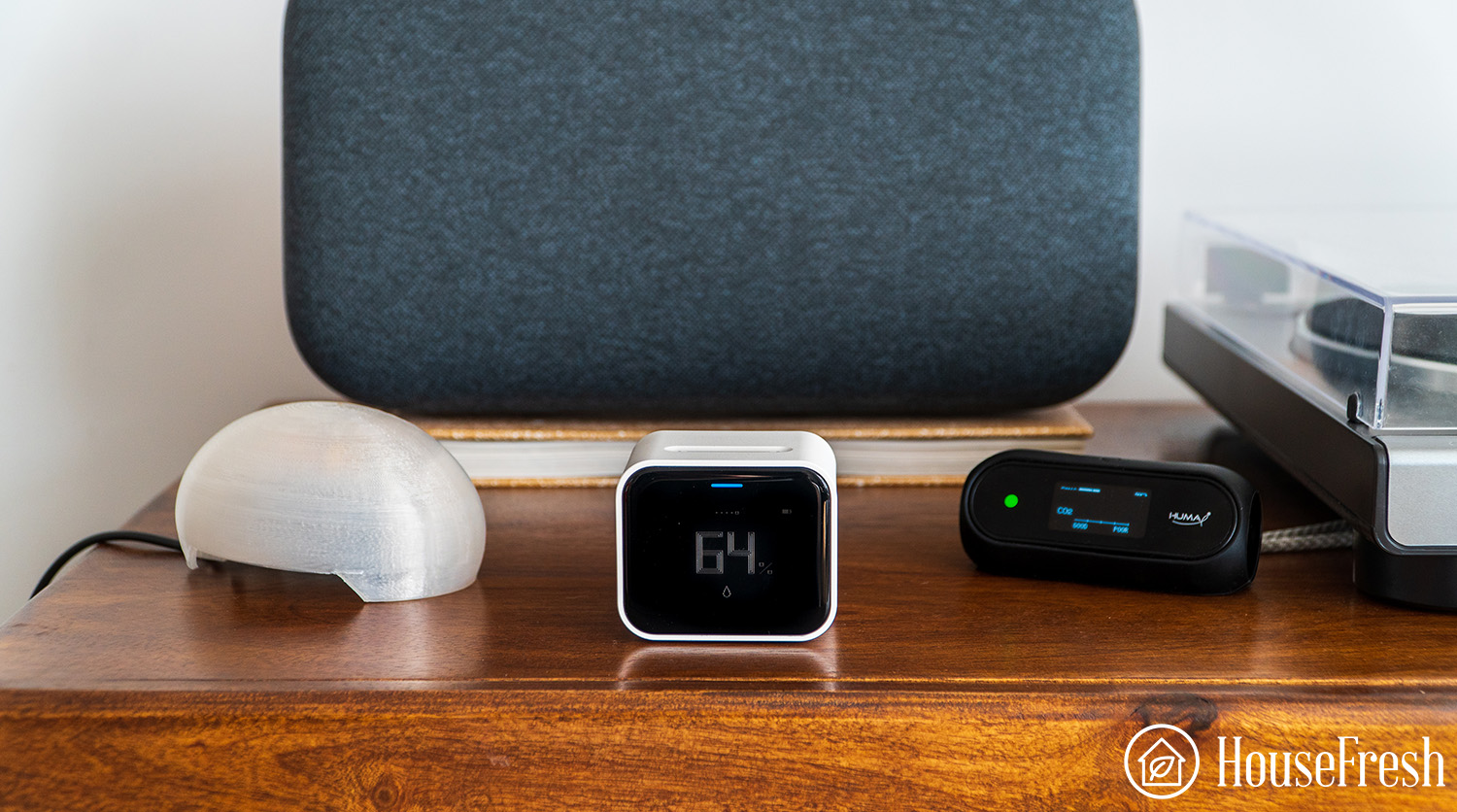
The main thing I love about this air quality monitor is its small size. I could easily see this being thrown in a bag at the last minute. The second highlight has to be the screen. I don’t know if it’s a pure OLED, but it looks like it is. You can easily see the current air quality from far across the room.
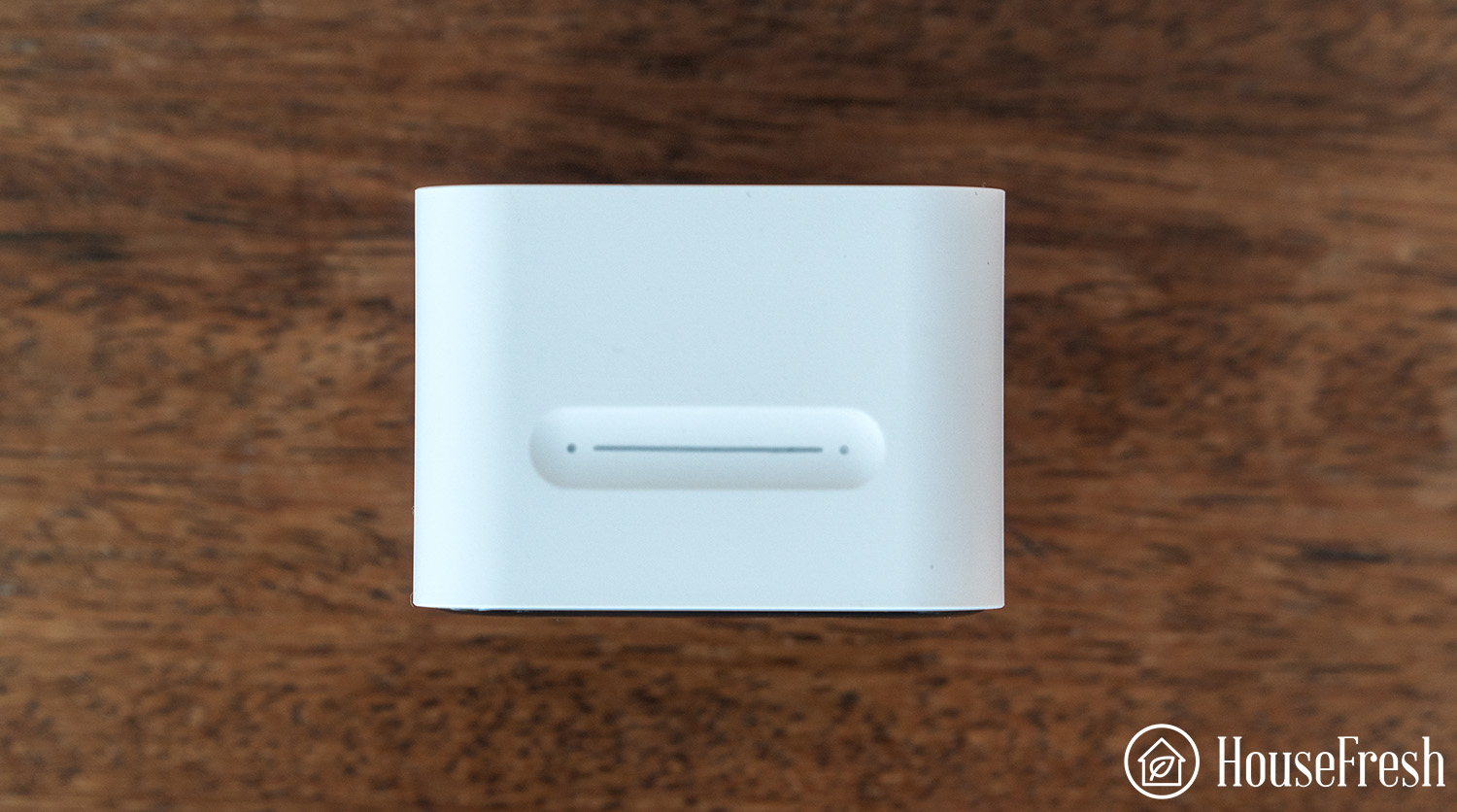
You can scroll through the measurements using a touch button at the top of the unit. It’s super responsive and quite enjoyable to slide through each option, similar to the feeling we had playing with the classic iPod wheel.
With the QP Lite, the In-screen quality stands out compared to older air-quality monitors like theHuma H-150, which looks old-fashioned with its dot-matrix-like screen. Compared with less portable units like our PurpleAir Indoor sensor, it just looks better, although I assume the PurpleAir guys put all their money into sensors as the case looks like it’s 3D printed.
Easy To Use
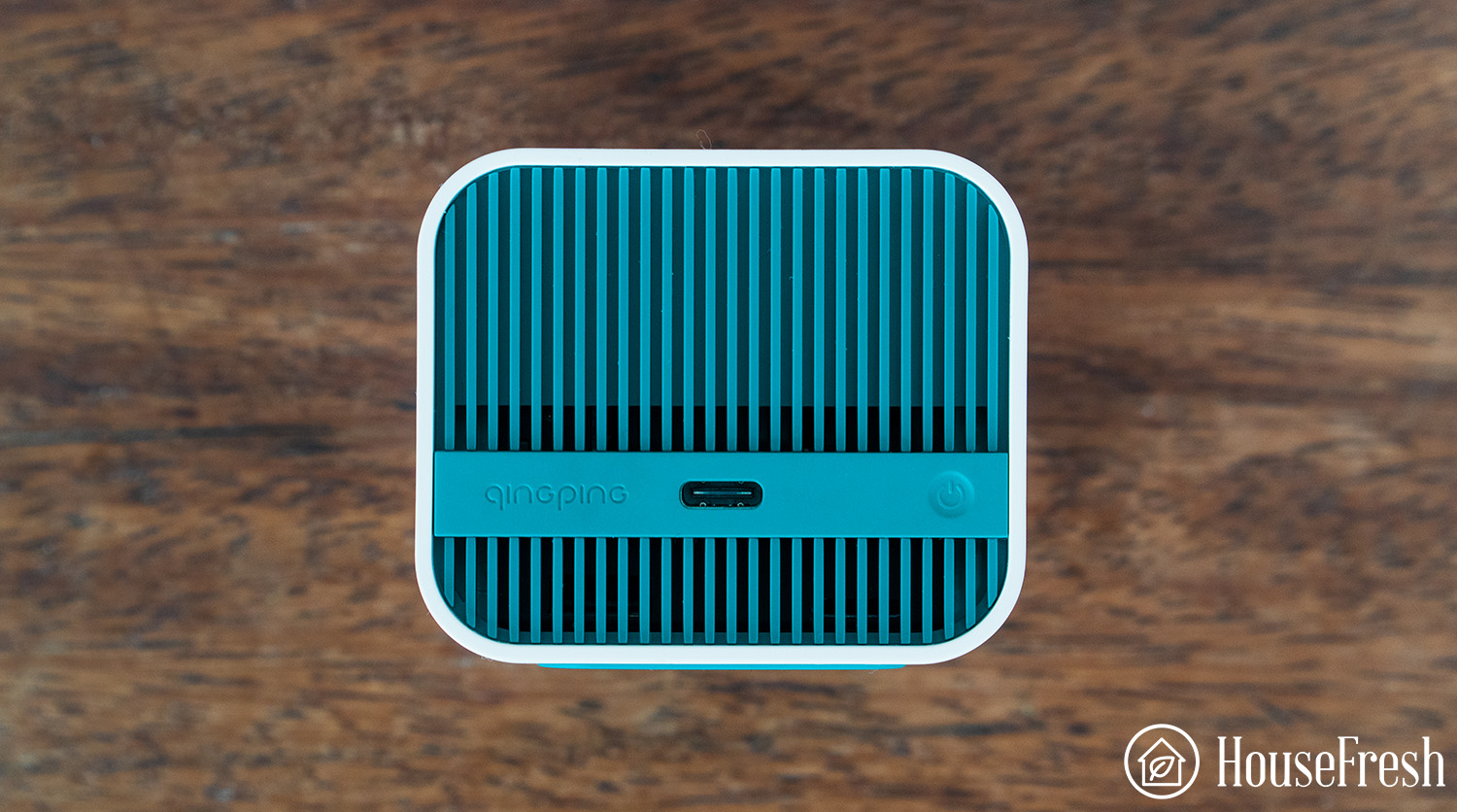
The menu system on QP Lite sensor is fairly simple, with one button on the back that you then hold for a few seconds to switch off. The menu buttons are then accessed with the touchscreen on the top.
The more exciting things happen when you connect your QP Lite to the Qingping+ app. I got the chance to test out the Android version of the app but was disappointed to see such low review scores — as of writing this review, this app has 2.4 stars based on 412 reviews.
Reading the latest reviews, there don’t seem to be any significant issues and I indeed found the app to be functional, easy to use, and has an excellent UX design, which is rare with home gadgets.
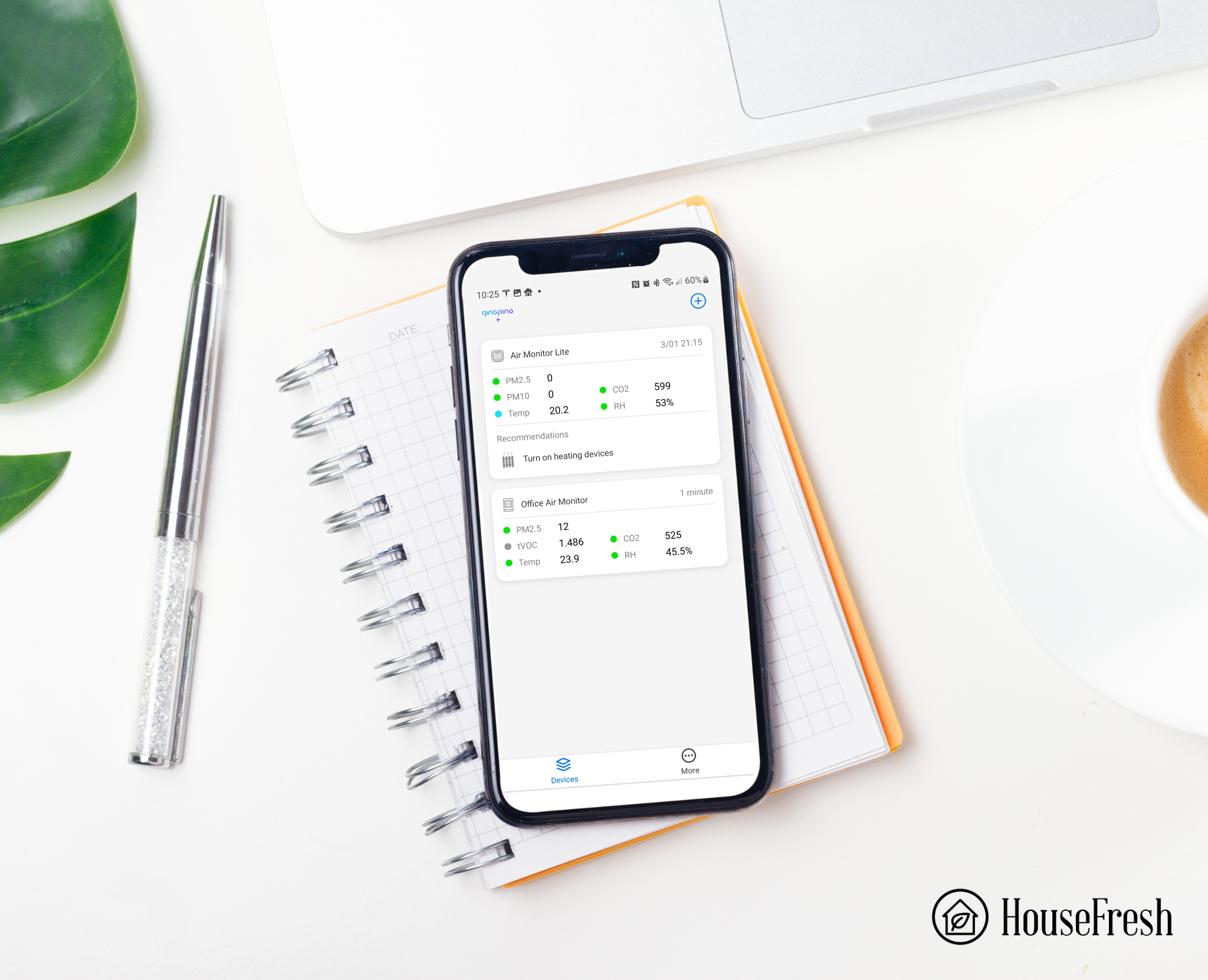
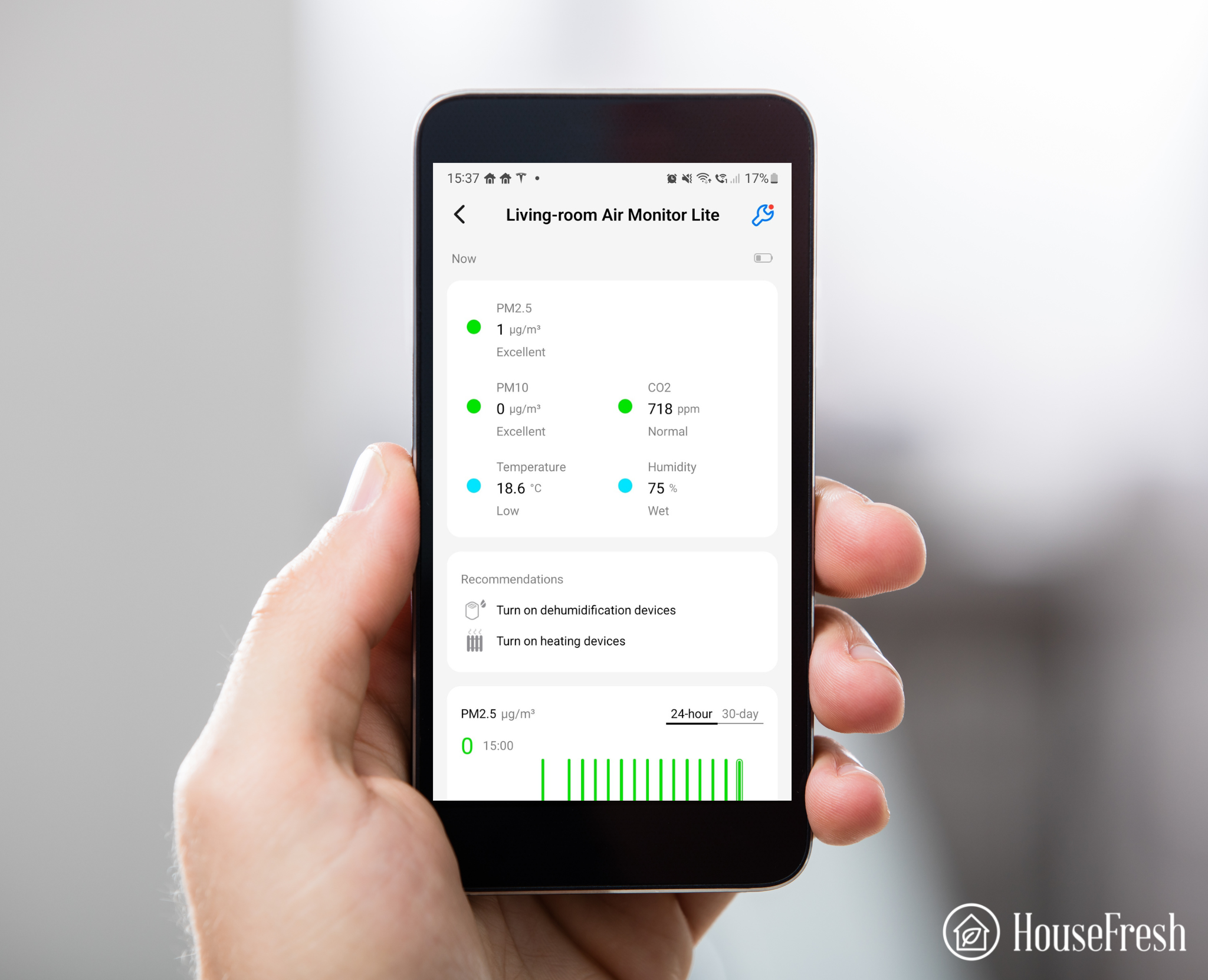
Once you connect to your home Wifi the unit will then provide updates to the app on a screen like this:
You can see your air quality scores, including PM10, PM2.5, CO2, Temperature and humidity. The other exciting feature is that data is stored on the device that you can export to email for analysis. I liked the Huma H150 due to its portability, but it lacked this essential feature, usually only available on non-battery-based air quality monitors.
The data is not tracked as often as the Purpleair indoor sensor, which checks every two minutes but instead gives you figures every 15 minutes.
Export Your Air Quality Data
The following graph is based on export from the Qingping Lite that I then used Flourish to make a graph:
This ability to export data is one of the features that stands out. Another great benefit is that it also gives recommendations in the app based on conditions such as using dehumidifiers or increasing airflow (when you have CO2).
Bottom Line: Low Price, High-End Sensors
The Qingping Lite is a premium air quality monitor for a very affordable price. The stand-out features are its ability to track pollutants on the go using its onboard battery and that you can export data for long-term analysis.
We would typically only recommend air quality monitors for some people as they cost the same as a premium air purifier which is a better purchase for most.
If you are looking for a low-cost air quality monitor that can still perform as well as monitors costing +$200 then the Qingping Lite is a great choice.
While you can download apps to find out the quality of the air outside, these apps won’t complete the picture because the air quality indoors is different. In fact, according to the EPA, indoor pollution can be 2-5 times worse than outside.
Poor air quality can lead to dizziness, headaches and fatigue in the short term — all of which can lead to respiratory diseases, cancer, and heart disease in the long term. That is why monitoring the air quality indoors matters.
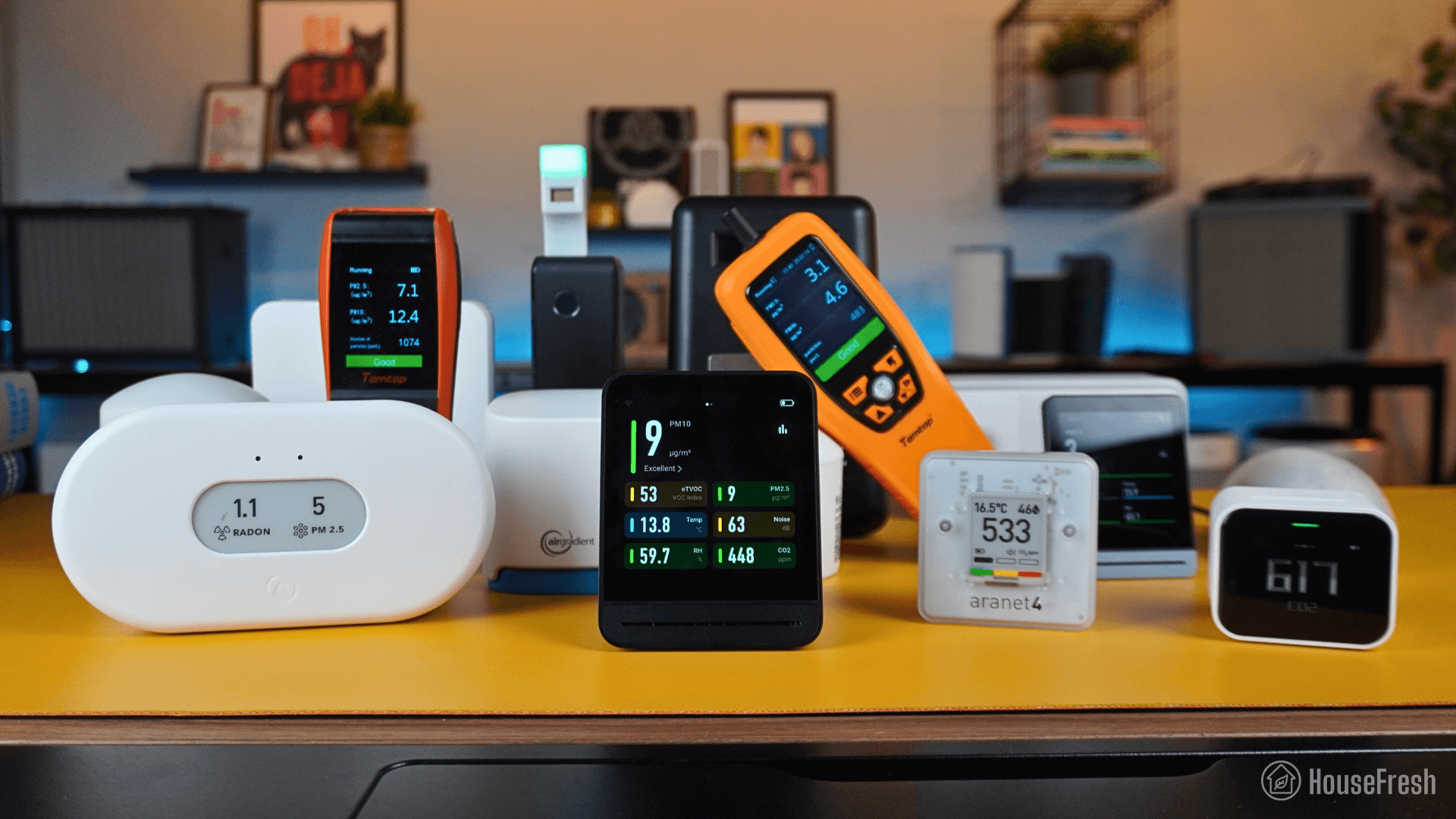
Since 2020, I have tested over 100 air purifiers, and along the way, I have used nearly 20 air quality sensors as part of our air purifier testing process. In this article, I will share my findings and highlight the best air quality monitors on the market right now.
These tools can help you get local information on air quality without spending money, which you can then use to mitigate the problem, such as investing in an air purifier. If you only have $150, you are better off investing the entire budget in a good performing (and affordable) air purifier instead of buying a cheap sensor and a cheap air purifier.
If you want to start monitoring the quality of your air indoors, then keep reading.
Staff picks: The air quality monitors we recommend
If you are short on time and can’t ready my full article, then you can watch my YouTube video below where I share some more info on the best air quality sensors we tested since 2020:
Since the start of the COVID-19 pandemic, there has been an increasing number of people who are interested in understanding the air quality in their home. The problem is that most of the cheap sensors you’ll find online are nothing more than random number machines.
Read on to learn more about the only air quality monitors we recommend here at HouseFresh.
While you might be tempted to go straight for a particle sensor, many people will find a CO2 sensor way more useful as a first step towards understanding indoor air quality. High levels of CO2 have been linked to poor decision-making, slower reaction times, and increased tiredness. Plus, a study from 2021 showed that the level of CO2 can reflect risks of COVID as it can be a proxy of how well ventilated a room is.
The Aranet4 HOME is small, portable CO2 monitor that you can bring with you wherever you go. I highly recommend this CO2 monitor for those who want a device that can quickly assess the need for better ventilation in a space.
What we really like
With lithium AA batteries, you can extend battery life to up to seven (7!) years.
Excellent e-ink display that makes it easy to see readings even under the sun.
Its NDIR sensor has a long lifespan and requires less recalibration than other types of CO2 sensors.
The buzzer emits a sound when the CO2 concentration reaches the red threshold (1400 ppm).
What we think could be better
The battery cover slid off the device a few times when I had it inside my backpack.
It is an expensive monitor and won’t be affordable for many people.
I bought the Aranet4 HOME back in 2022, when it was selling for $250. However, you can now find it for around $170. This is still a significant investment but you will be buying an air quality monitor that can last up to four (4) years on one set of batteries thanks to its e-ink screen — and battery life can be extended to up to seven (7!) years if you set it to record CO2 readings every 10 minutes.
The Aranet4 HOME uses a highly accurate NDIR (nondispersive infrared sensor) and this is a big reason why it has a high price tag. However, you can find cheaper (and smaller) CO2 sensors that use photo-acoustic sensors. These sensors have been shown to work well indoors but are not as useful outside, according to a study by AirGradient, but they can be found for less than $50.
I have also tested the Qingping CO2 Monitor from Smart Air that can be found for less than $70. It uses an NDIR sensor and is very accurate but it has a much shorter battery life compared to the Aranet4 (around 30 days).
While CO2 monitors are very useful for triggering important actions like improving ventilation, there will be times when you want to know exactly what particles are in your air and, for this, you will need a monitor with a particle sensor.
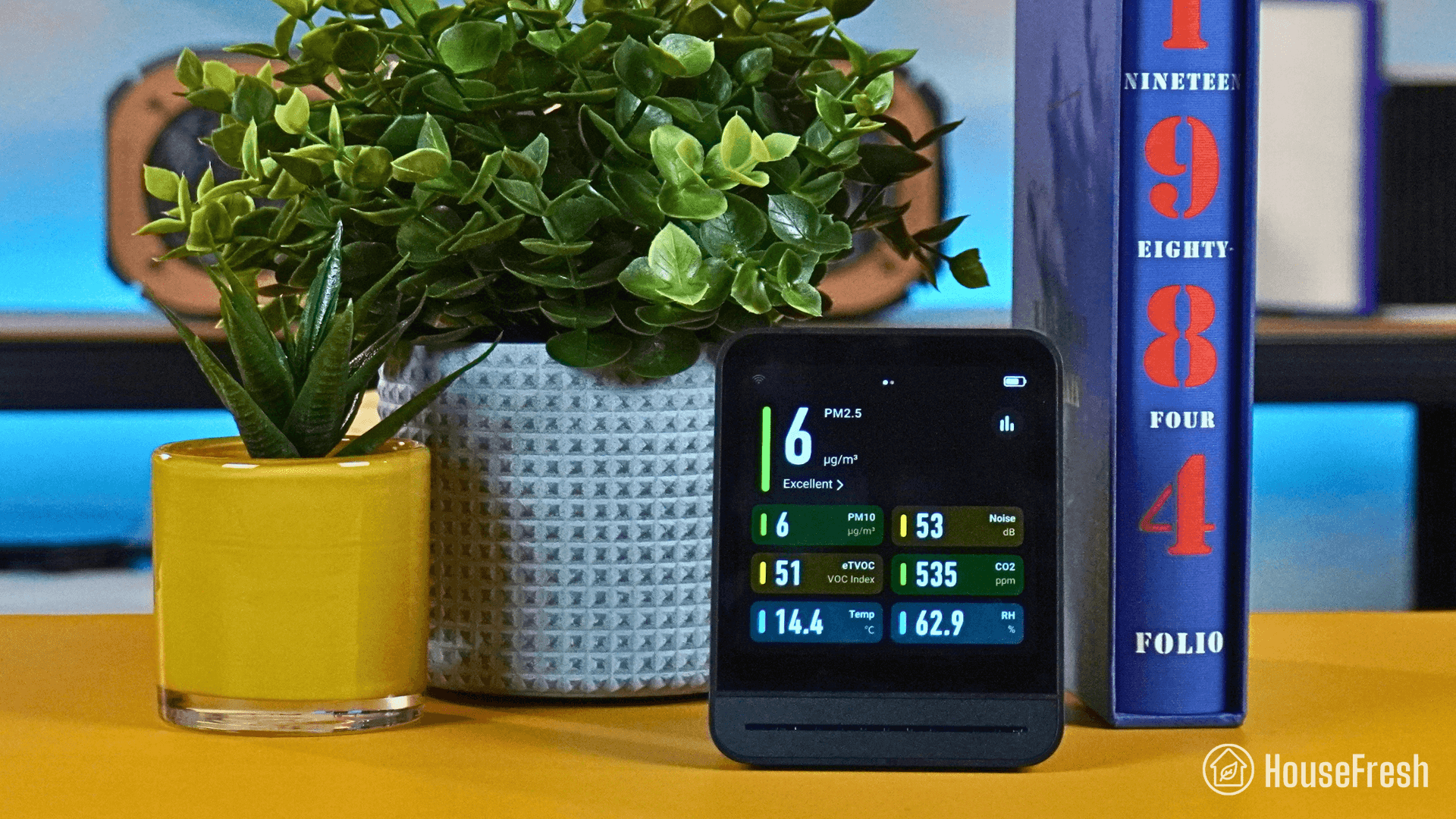
The QP Pro 2 is the second release of the Qingping Pro model. Similarly to the first generation, the QP Pro 2 not only measures CO2 levels but also PM2.5 and PM10 (particulate matter) levels. And, according to AQMD’s Air Quality Sensor Performance Evaluation Center, the Qingping series from Smart Air has been shown to perform as accurately as much higher-priced devices.
What we really like
You can replace the PM sensor when the time comes.
It has been made with high quality materials and the touchscreen displays the most important air quality data in an easy-to-digest way.
Set up takes only a few minutes, and the settings are straightforward and intuitive.
You can connect it to the Xiaomi Home app to build routines for your Xiaomi devices around air quality readings from the Qingping Pro.
What we think could be better
The Qingping+ app can be buggy — especially after updates.
The Air Quality Index data is not measured locally, so it is only available for a set list of large U.S. cities but might not show any data depending on where you are based.
On top of CO2 and PM, the QP Pro 2 also measures temperature, relative humidity and noise levels. It also detects VOCs, which is rare as VOC sensors are expensive and are hardly ever included in budget air quality monitors. Plus, the QP Pro also functions as a clock (with alarms) and it displays the weather, air quality index and UV index in your area.
And the thing about the QP Pro is that it looks GREAT thanks to the combination of a high quality aluminium outer casing that houses a replaceable sensor and a 4-inch touchscreen display.
Measurements:
CO2, PM2.5, PM10, tVOC, temperature, relative humidity and sound levels
Sensor type:
Grandway P5500 optical particle counter (non-FEM)
CO2 concentrationaccuracy:
±15%
PM2.5 concentrationaccuracy:
±10%
Mounting type:
Indoors table top
Power source:
5V, USB-C
Dimensions (in inches / in cm):
3.35 x 2.69 x 3.4 in (8.5 x 7.5 x 8.6 cm)
Weight (in pounds / in kg):
0.23 lbs (104 g)
App connectivity:
Yes
Manufacturer’s warranty:
1 year
Tip
The internal battery of the QingPing Pro Gen 2 will only last a few hours so be sure to keep the sensor plugged into a battery pack or the well with a USB-C cable if you are pulling regular readings.
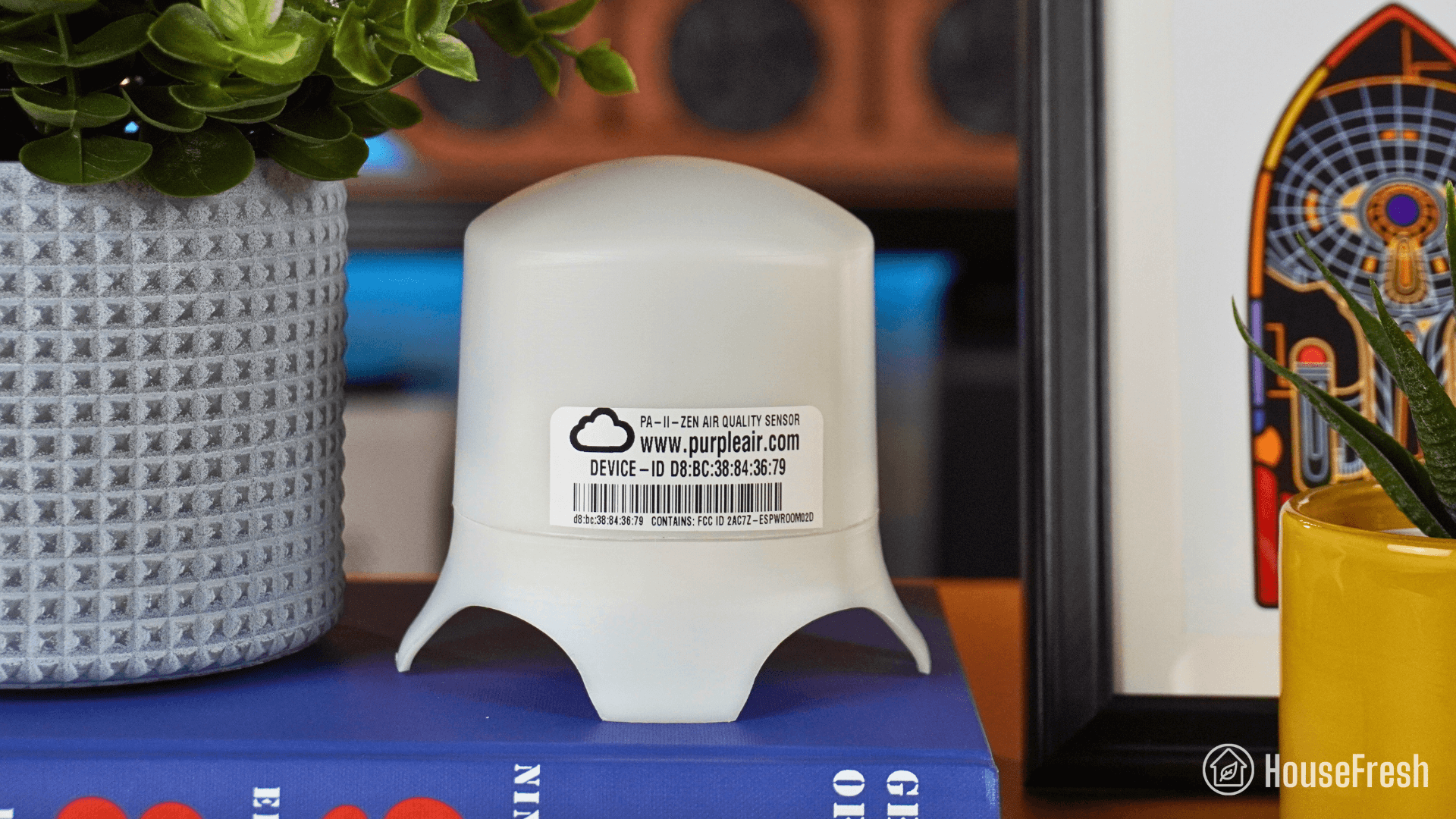
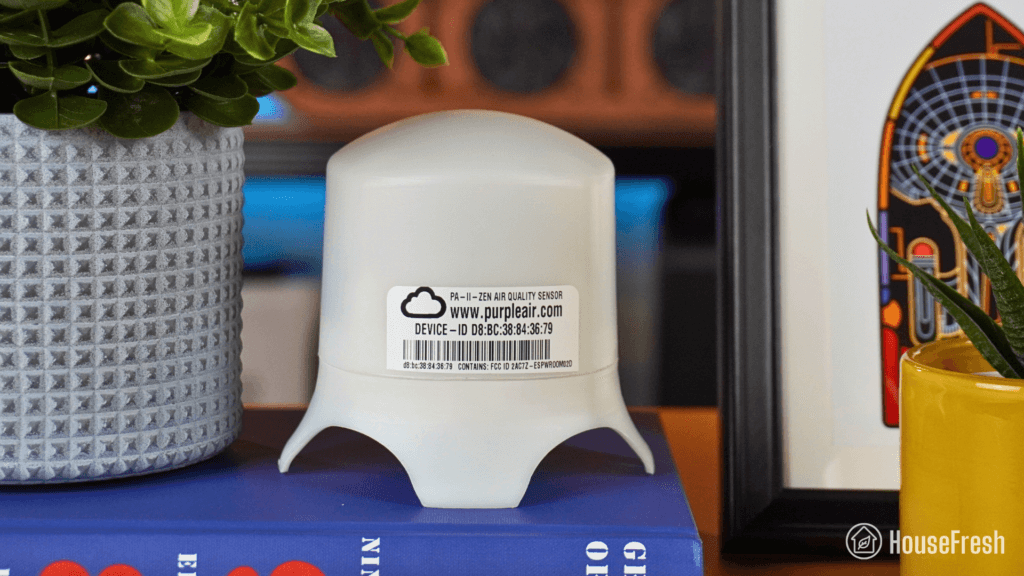
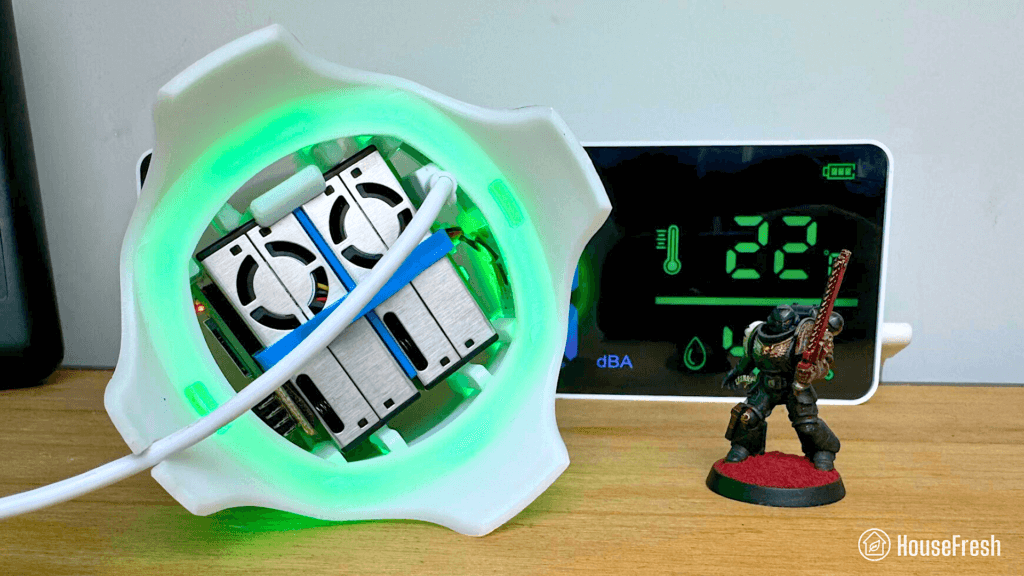
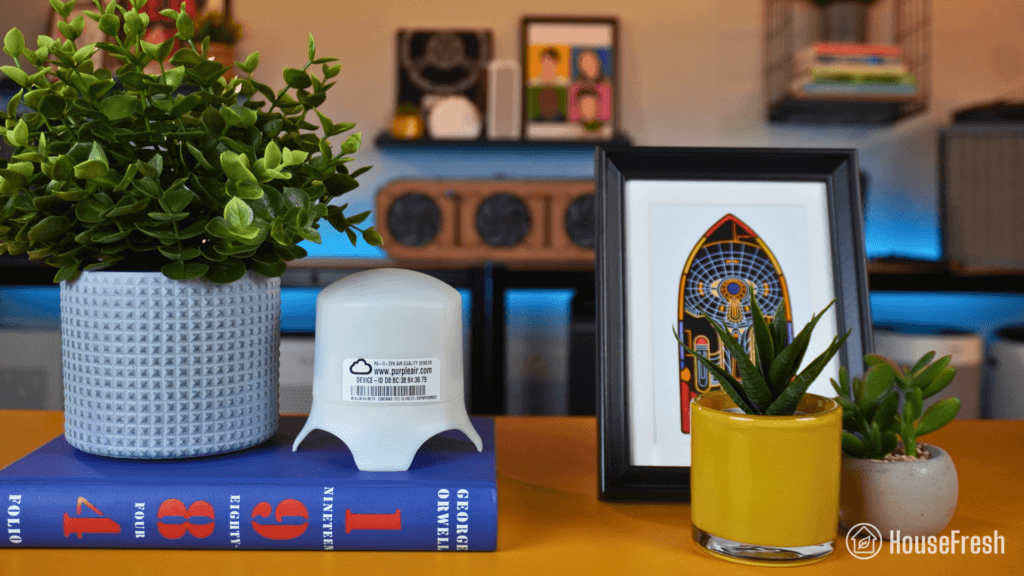
I first heard about PurpleAir sensors from a report from the South Coast Air Quality Management District (AQMD), which tests air quality monitors and compares their performance against that of reference devices that cost upwards of $20K. Inside the Zen, you will get a replaceable dual laser particle counter and a gas sensor — the most powerful combo of any of the sensors on my list.
It doesn’t come with a fancy screen but you do get an in-built color-coded LED ring that ranges from green (good) to purple (hazardous). allowing you to quickly see the overall quality of your air at a glance. This sensor can be used indoors (with the table top mount) and also outdoors (with the use of cable ties).
We use the PurpleAir Zen as our main sensor for our hands-on air purifier tests, as it allows us to track PM1, PM2.5, and PM10 every few seconds. What I love about the Zen (and one of the reasons why we use it for our testing) is that it allows you to export all your data, which is something you don’t get with many sensors.
What we really like
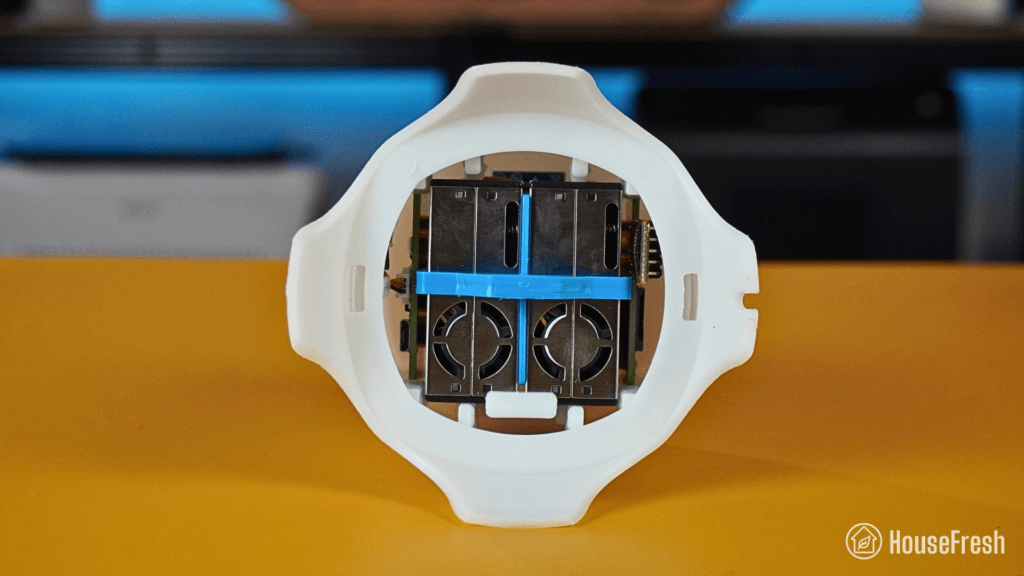
It has two Plantower PMS6003 laser particle counters and a Bosch BME688 gas sensor for improved accuracy.
The particle sensors are user-replaceable, so if you have any issues, you can swap out the sensor rather than buy a new device.
It has a color-coded LED light that shows the quality of your air and you can also view real-time data using the PurpleAir map.
What we think could be better
This device is a little ‘techy-er’ than others on this list, so if you don’t want to do any technical steps, this sensor might not be the best option.
You used to be able to download the data directly from the website but now you need to use their API. which will be trickier for non-technical people.
It doesn’t have an app like you will find in other plug-and-play sensors that I look at later on.
If accuracy is your core concern, then the PurpleAir Zen sensor is the best you can get without investing tens of thousands of dollars in reference instruments like the GRIMM EDM 180 or the Teledyne API T640.
Measurements:
PM1, PM2.5, PM10, tVOC, temperature, relative humidity and atmospheric pressure
If you like the sound of a PurpleAir sensor but you can’t justify the $200+ price tag of the Touch or the Zen sensors then check out the new PurpleAir PIXEL. It is small, portable and powered by USB. Plus, it also has an LED color coded light to show the quality of the air at a glance.
Current status:
Testing the PIXEL portable air quality monitor from @ThePurpleAir, which is powered by the world's smallest particulate matter PM2.5 sensor—the Bosch BMV080. pic.twitter.com/2xV6qs8lQU
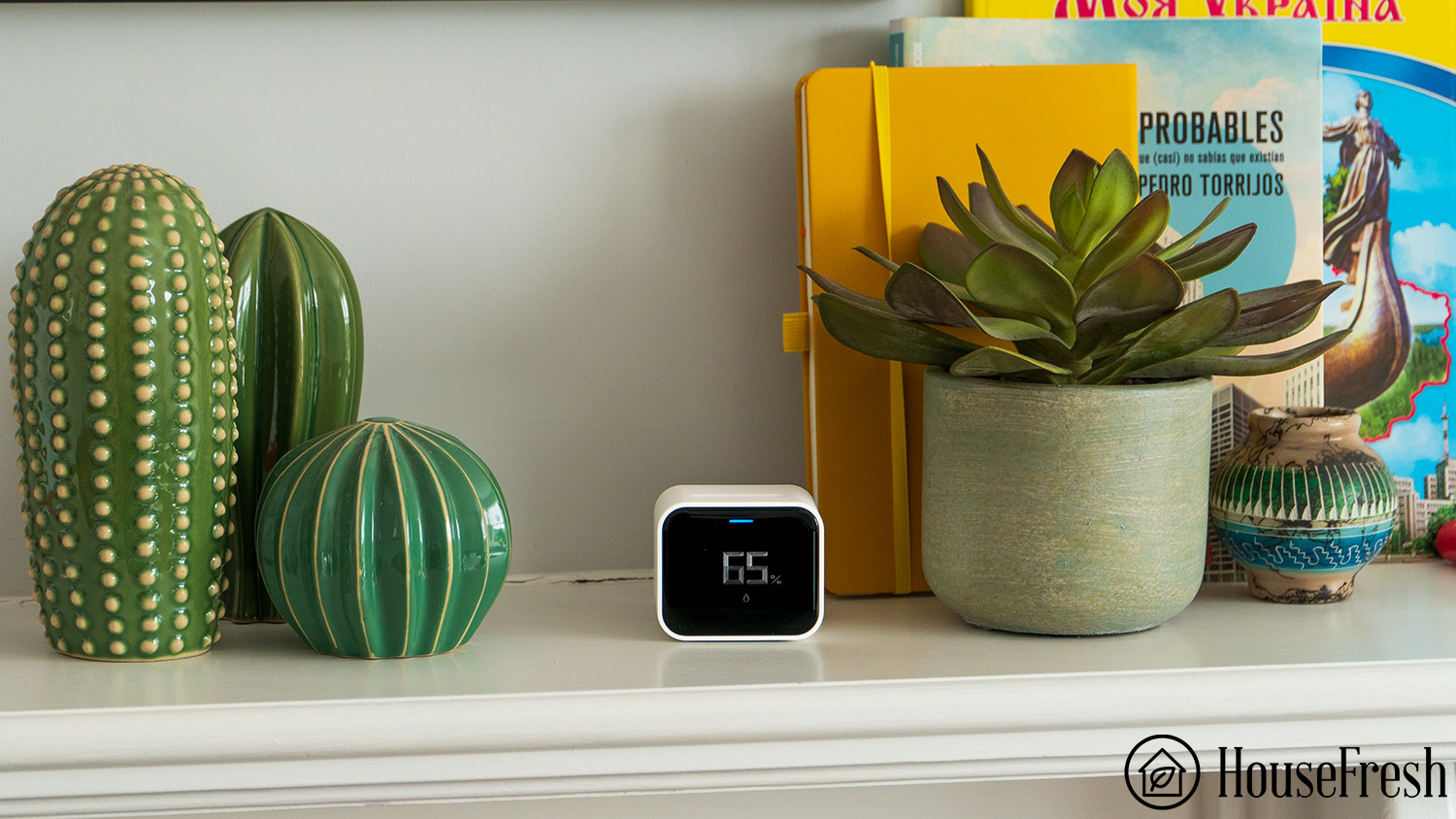
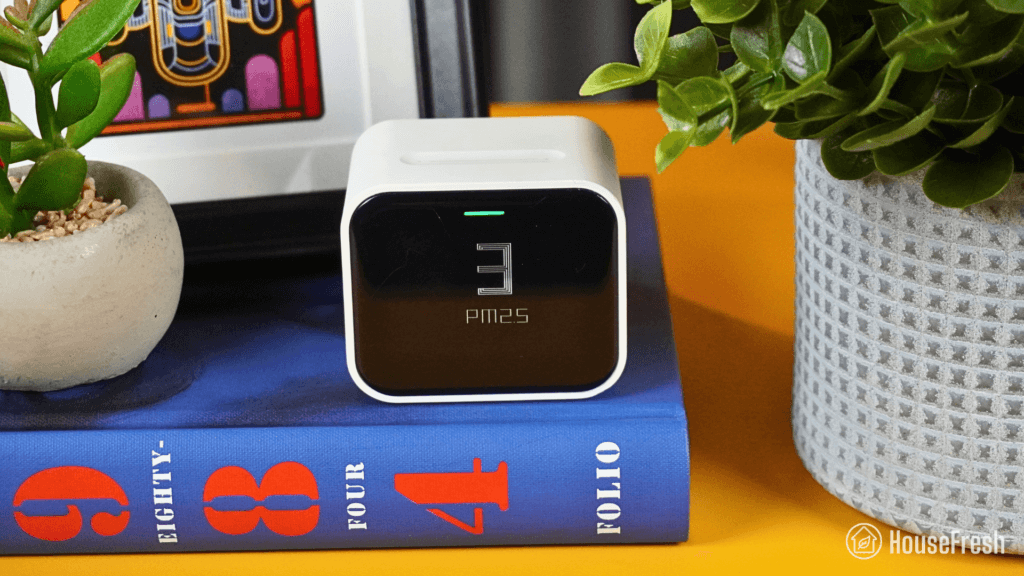
The smaller sibling of the Qingping Pro, the QP Lite is a small cube with a big OLED screen that houses a Grandway 7500 optical particle counter (non-FEM) sensor that can measure CO2, PM2.5, PM10, relative humidity and temperature.
The QP Lite can detect CO2, PM2.5, PM10, relative humidity and temperature. You can rotate through each of the measurements by tapping or sliding the touch bar on the top of the device.
What we really like
Its simplicity! This device requires no lengthy setup or manual to be read: you can use it straight out of the box.
It shows the overall air quality in your home at a glance with a color-coded LED light that sits on top of the screen.
You can connect it to the Xiaomi Home or the Apple Home app to build routines for your existing air purifiers and dehumidifiers based on the air quality readings from the monitor.
What we think could be better
When in battery mode, the sensor switches off automatically after 30 minutes as the default.
Unlike what we see with the QP Pro Gen 2, you can’t replace the particle sensor in the QP Lite so when the lifespan of the sensor comes to an end, you’ll need to buy an entire new device.
If you don’t need to take this monitor with you, I recommend you plug it in USB power all the time as it will ensure you have constant air quality readings. That said, the QP Lite has a 2000mAh lithium battery built-in, so you will be able to use it unplugged for up to seven (7) hours.
Measurements:
CO2, PM2.5, PM10, temperature and relative humidity.
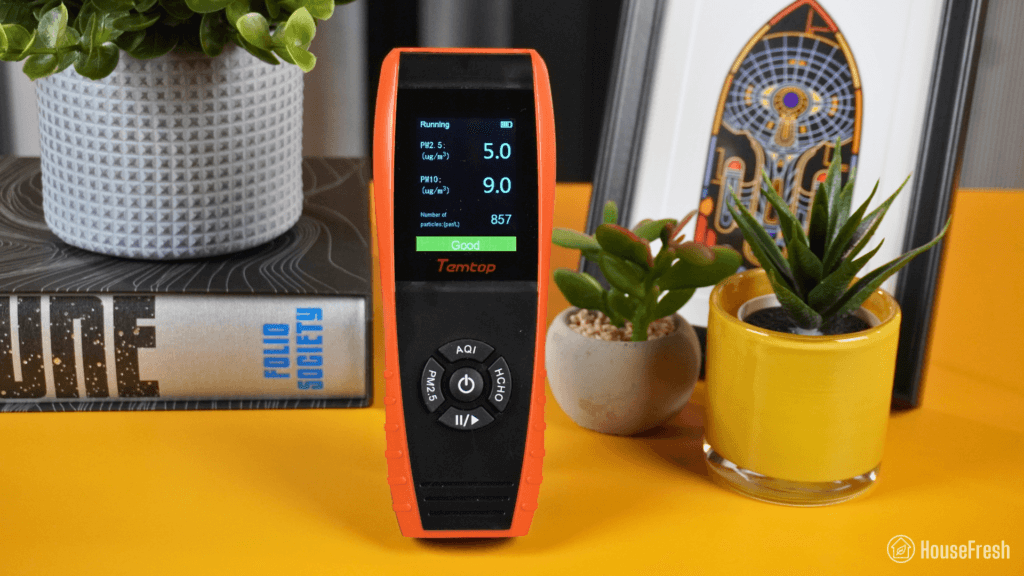
The Temtop LKC-1000S+ is a handheld air quality monitor that measures PM2.5, PM10, formaldehyde (HCHO), tVOC, temperature and relative humidity. It comes with a little stand at the back so you can place it on surfaces without the need to be holding it all the time.
Something I really like about this monitor is that it has a function that shows the changes of PM2.5 levels for the last 12 hours represented as a histogram chart, which makes it easy to digest the data as a bar chart compared to a simple line chart. However, I know this is a subjective thing because I am a sucker for data visualization 🙂
What we really like
This is my second Temptop monitor and I really appreciate the flip-out stand at the back.
The color LCD screen shows the data across all metrics clearly, including the
It can store up to three (3) months of continuous data inside the device, and you can also export the data through a USB cable.
What we think could be better
The laser particle sensor has a lifetime up to 20,000 hours but you won’t be able to replace it once the lifetime comes to an end.
It doesn’t measure CO2 levels. If you like the Temptop design but need a CO2 monitor, I’d recommend the Temtop M2000 (Gen 2).
At the bottom of the screen, you get a color-coded air quality indicator light that ranges from green (good) to maroon (hazardous) so you can quickly see what the quality of your air is at a glance.
Measurements:
PM2.5, PM10, HCHO (formaldehyde), tVOC, temperature and relative humidity
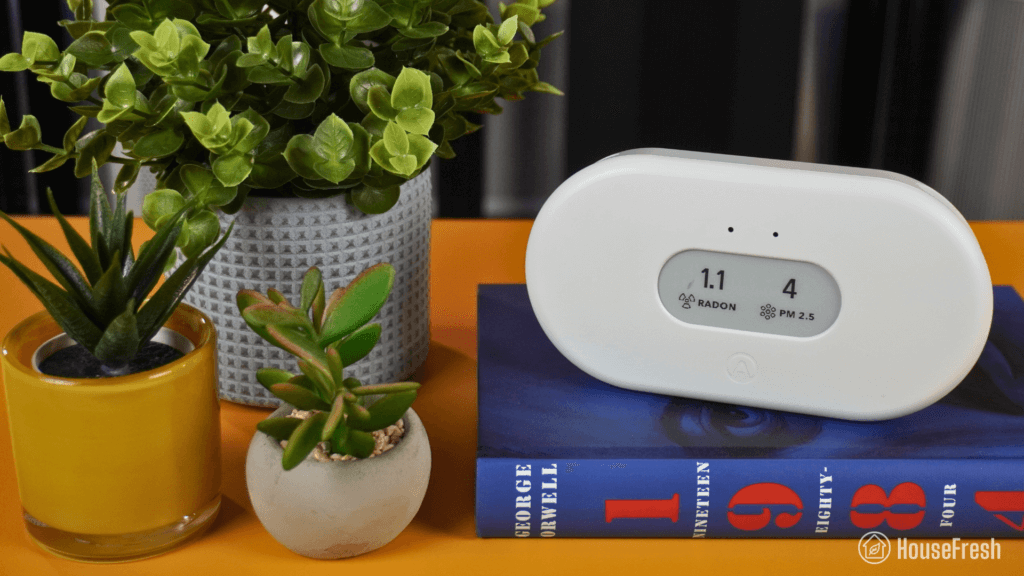
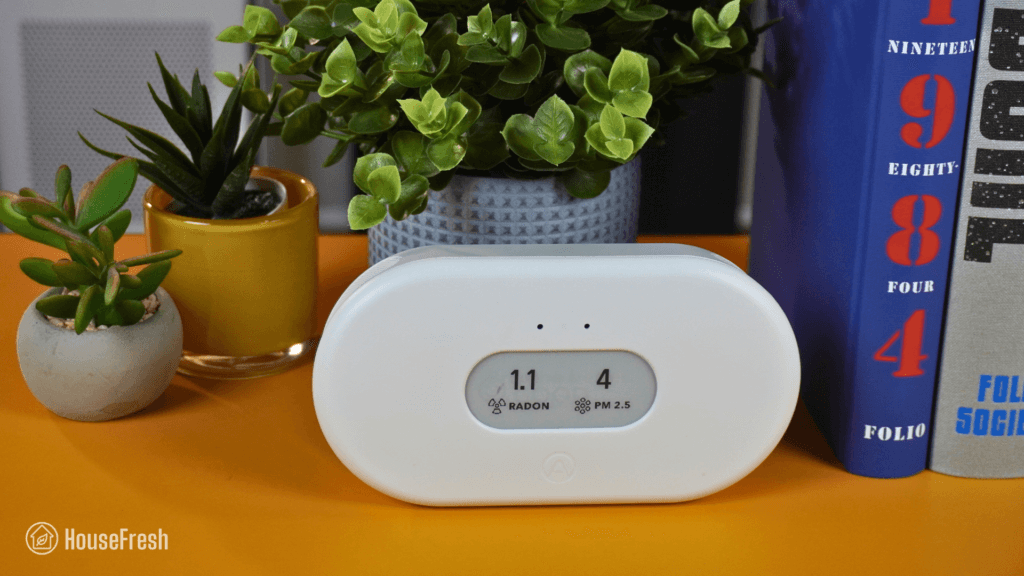
The Airthings View Plus is not cheap at just under $300, but it can detect CO2, PM2.5, tVOCs, temperature, humidity, pressure AND radon. Similarly to the Aranet4 HOME, it comes with an eInk display that can be customized to show the air quality values you want to always have on show.
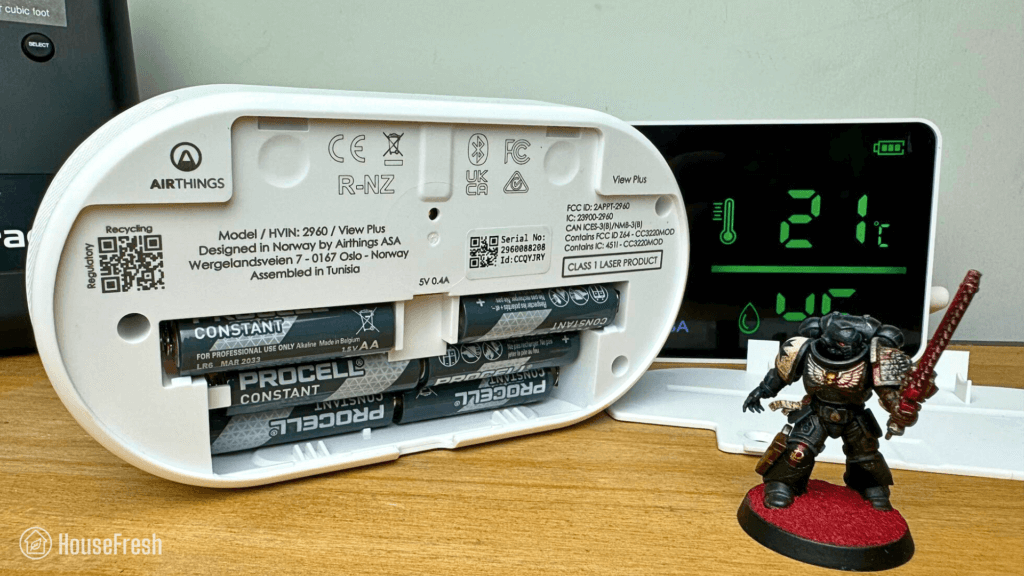
This monitor integrates with IFTTT, Alexa and Google Assistant, and it also connects to the Airthings app, where you can see historical data visualized in easy-to-digest charts. It runs with six AA batteries and you can also plug it in with a USB-C cable.
What we really like
If you wave in front of the monitor, the LED light on top of the screen activates to show the air quality in the room (green = good, yellow = fair, and red = poor).
The UX of the View Plus is super clean, compared to many of the sensors on this page.
You can can plug it with a USB cable, which also allows the View Plus to become a hub for other Airthings devices.
It works as table top and also has mounting brackets on the back to mount it on the wall.
What we think could be better
You cannot export your data. Data can only be accessed via the Airthings Wave app or the web dashboard.
The reading intervals are a lot more spaced out than other monitors on this list. The shortest interval is 2.5 minutes but this only works when the View Plus is plugged in.
It is an expensive sensor. If radon is not an issue, you’ll be able to get every other measurement for half the price with the QP Pro.
Measurements:
Radon, CO2, PM2.5, tVOC, temperature, relative humidity and atmospheric pressure
Sensor type:
Alpha-spectrometer for radon + NDIR sensor for CO2 + Laser scattering based optical particle counter
Two sensors with open-source hardware and firmware that you can assemble yourself with replaceable parts, or buy fully assembled.
AirGradient devices are the best alternative to PurpleAir monitors due to the use of high-end replaceable sensors from industry leaders like Plantower, Sensirion and SenseAir. And unlike PurpleAir, AirGradient follows an open-source model for the data whereas the terms and conditions from PurpleAir make it clear that they own all the data.
Another unique aspect of these sensors from AirGradient is that both of them are available as build-it-yourself kits. If you go for the kit version, you will get everything you need to build the monitor at home, including detailed instructions that are clear and easy to follow. And if you have any problems, you can drop a question in the AirGradient Forum and someone from the community will get back to you with their advice.
What we really like
Both monitors use high-end replaceable particle sensors from Plantower (PMS5003), gas sensors from Sensirion and NDIR CO2 sensors from SenseAir.
AirGradient states that all data is yours. They developed a simple backend for accessing your data without setting up an API, which makes exporting data a lot easier than with PurpleAir sensors.
AirGradient sensors come with Home Assistant integration, which is not something I have seen with other sensors we have reviewed. The AirGradient community has also built extensions to existing data platforms like ESPHome, Prometheus, and openHAB.
Both sensors work as table top and can be mounted on walls or poles.
What we think could be better
The sensors have not yet been tested by AQMD, but AirGradient does extensive testing and their devices are used in several universities.
Similarly to what we see with PurpleAir, AirGradient sensors are more suited to tech-savvy people who will be able to get a lot more value than just air quality readings.
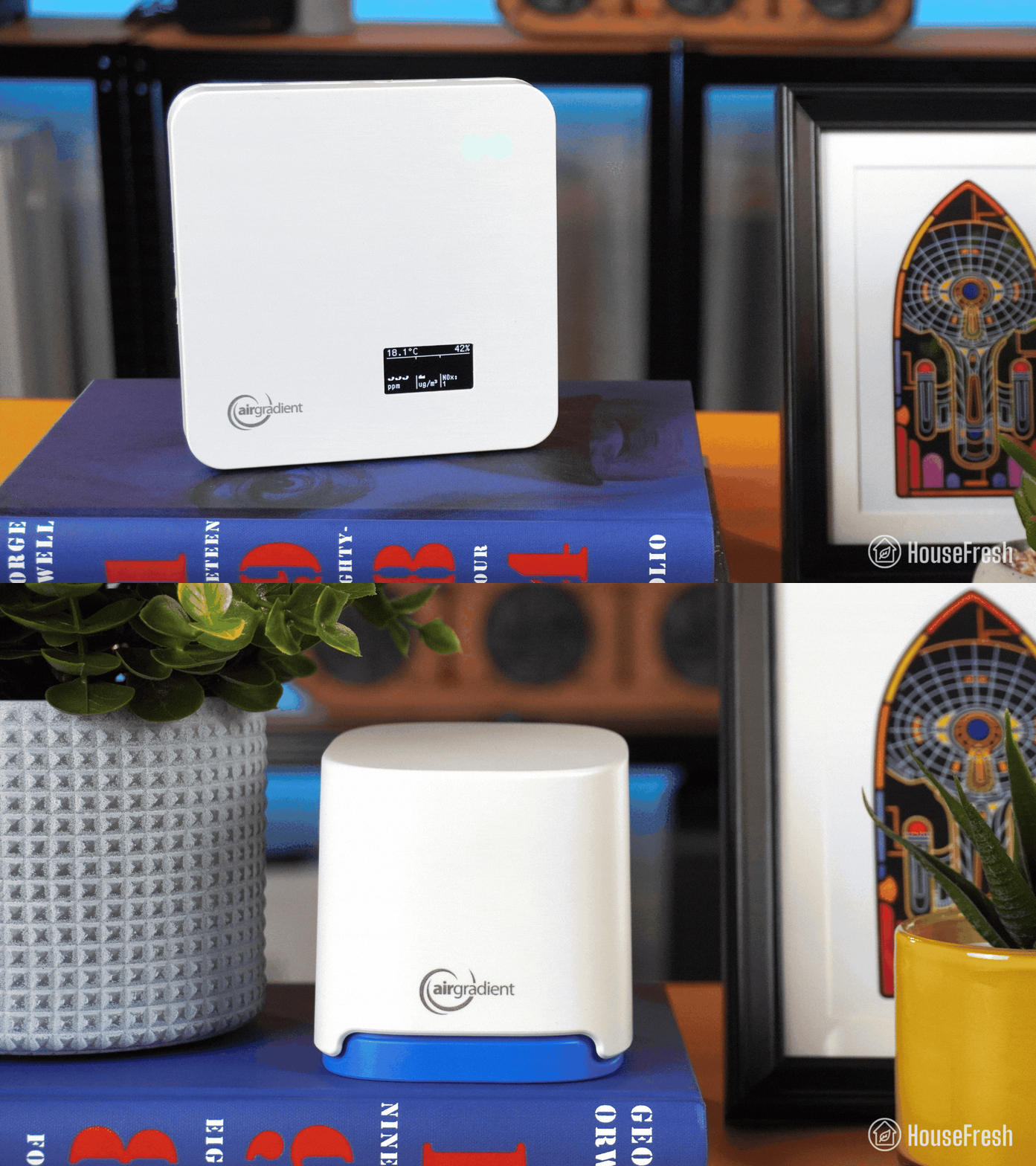
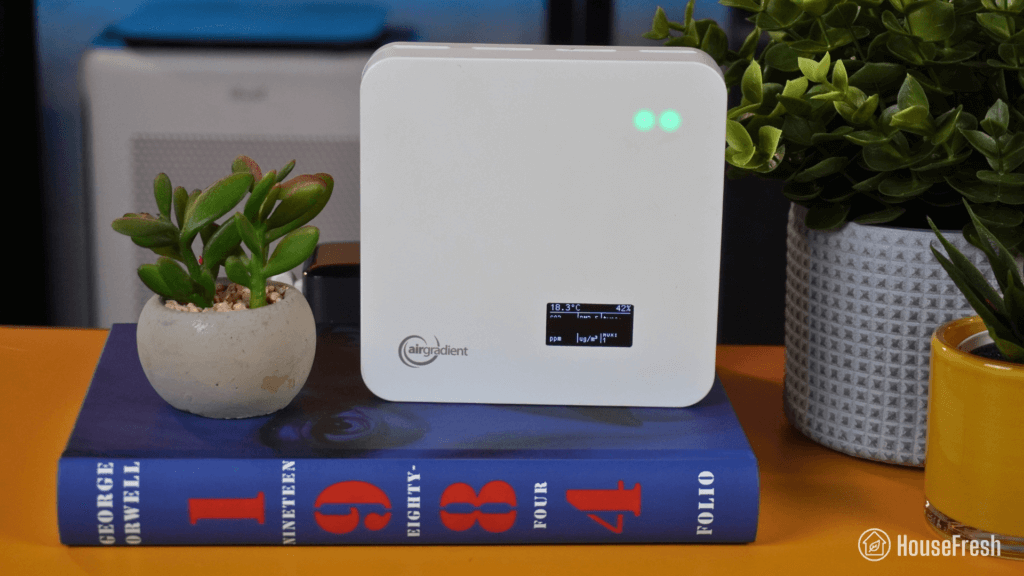
The AirGradient ONE is an indoor air quality monitor that measures CO2, PM2.5, tVOC, NOX, temperature and humidity. It has a color-coded LED bar and small 1.3-inch OLED display at the front that show the current air quality in the room. Even though it’s an indoor sensor, it comes in a plastic, UV resistant and weather proof enclosure.
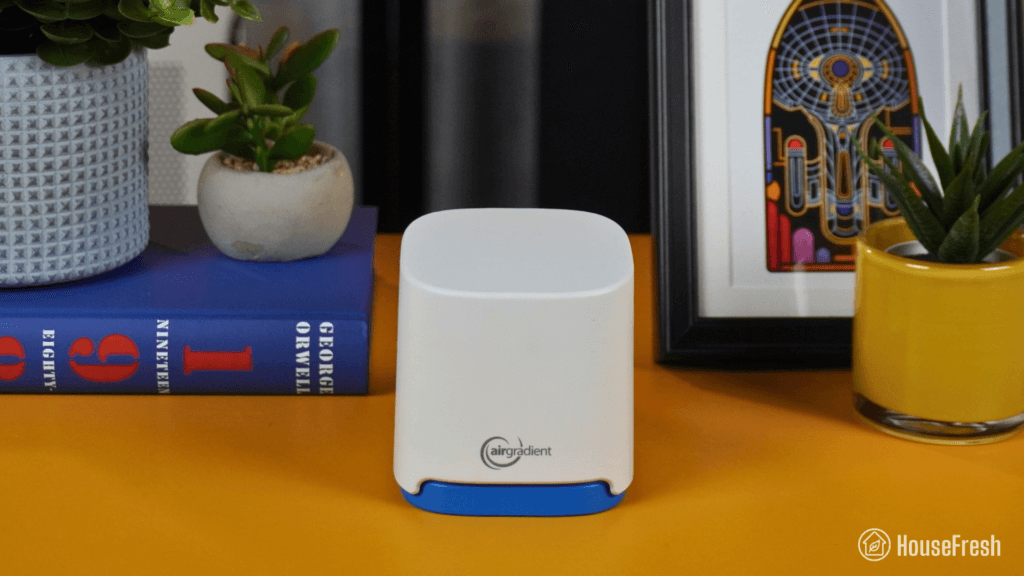
The AirGradient Open Air is an outdoor air quality monitor. Similarly to the ONE, the Open Air monitor detects CO2, PM2.5, tVOC, NOX, temperature and relative humidity. At the back of the device, you get zip tie holders you can use for pole mounting and you also get screw holes for wall mounting. There is also a small hole at the back that you can use with a secure screw to prevent the monitor from being stolen.
±40 ppm ±3% of reading at 5 to 30°C, 0-85% RH (400 – 2000ppm range)
PM2.5 concentrationaccuracy:
±10%@100-500μg/m³, ±10μg/m³@0~100μg/m³
tVOC/NOX concentration accuracy:
tVOC <±15 @ 0 to 500 VOC Index NOX <±50 @ 0 – 500 NOX Index
Mounting type:
Pole or wall mounted
Power source:
2A 5V USB-C
Dimensions (in inches / in cm):
3.60 x 3.41 x 3.34 in (9.1 x 8.6 x 8.5 cm)
Weight (in pounds / in kg):
0.38 lbs (180 g)
App connectivity:
Yes
Manufacturer’s warranty:
1 year
Common questions about air quality monitors
The air quality sensors available to consumers estimate particulate matter or gaseous pollution in the air, often based on a reading of a different but easier-to-measure substance related to the pollutant. For instance, a sensor may be designed to measure the amount of light that particulate matter scatters, which, more often than not, increases as the levels of pollution rise. These results are then interpreted by the device and shown on a scale of low to high, sometimes with associated colored bars or LEDs.
The most basic air quality monitor is one you probably already have in your home—a smoke detector, which uses a binary scale and signals whether smoke is present.
Air quality is measured by the EPA using the U.S. Air Quality Index (AQI), and it has six categories corresponding to different levels of health concerns. Each of the six categories has its own color to make it easier for the public to know if the air quality is approaching unhealthy levels. The colors and categories are:
Green – Good
Yellow – Moderate
Orange – Unhealthy for sensitive groups
Red – Unhealthy
Purple – Very unhealthy
Maroon – Hazardous
According to the CDC, “The EPA has identified six pollutants as “criteria” air pollutants”. These six air pollutants are:
Carbon Monoxide. Breathing in high levels of CO can cause confusion, unconsciousness, and death.
Lead. Lead in the air may have an adverse effect on the nervous system, kidneys, immune system, and cardiovascular system.
Nitrogen Oxides (NO2). Breathing air with high levels of NO2 can lead to respiratory problems such as asthma and can become severe.
Ozone. Increased ozone levels can cause coughing, damage your airways, and make the lungs more vulnerable to infections.
Particulate Matter. This pollutant contains solids or liquid droplets so small they can only be seen under a microscope and if inhaled, can cause serious health problems, getting into your lungs, and even into your bloodstream.
Sulfur Dioxide (SO2). Exposure to SO2 can cause harm to your respiratory system and make it difficult to breathe. Asthmatics and young children are at particular risk.
You’ve probably heard that the air inside your home can contain up to five times more pollutants than the outside air. The only way to accurately monitor the air quality in your home is to invest in a suitable quality air quality monitoring device.
An indoor air quality monitor, by definition, does precisely what the name implies: it monitors the quality of the air inside your home, continuously or periodically, depending on the type of monitor.
If you are concerned about the air quality in your home, get a monitor that tests for nearly all the pollutants found indoors such as the QP Pro.
It all depends on the technology the sensors use, the type of sensor, and lastly, the incorporated display method. Many middle- to high-end air purifiers have at least one integrated sensor. The most commonly found sensor is a PM2.5 sensor, capable of detecting particle matter up to 2.5 micrometers. They are normally the cheapest to manufacture and provide only basic readings and results. PM2.5 sensors found in air purifiers mostly use infrared technology, and while they do what they are supposed to do, the measurements are not very accurate. On the other hand, laser beam technology gives more precise air quality readings.
The display method used by the air purifier to show the quality of the air is also an important factor in determining the accuracy of the sensors. Most of them use a color scale to show the quality of the air—green for good, up to red for bad—which may look appealing, but it doesn’t tell you much. A display that shows the air quality index as a number, or a series of numbers, is more accurate.
PM2.5 is the measurement given to fine particulate matter (PM) with a thickness of fewer than 2.5 micrometers. To put that number in perspective, a grain of sand has a diameter of 90 micrometers, and a human hair measures 50-70 micrometers.
A PM2.5 sensor works by counting these fine particles suspended in the air. As air is sucked into an air quality monitoring device, particles in the air stream pass through a laser beam, which causes the light to diffract. The diffracted light will land on the sensor, placed at a right angle to the laser beam. The changes in the light intensity that the sensor picks up mean that individual particles can be counted.
VOC is an acronym for Volatile Organic Compounds and is an extremely broad classification of carbon-based chemicals. Consumer-related devices with integrated VOC sensors have become more and more available in the past few years, but they are relatively low-cost sensors that can only give a general reading as to the total amount of VOCs in the air and cannot pinpoint with any accuracy exactly what VOC it is detecting. They cannot differentiate between VOCs that are harmful and those that are not. There are some sensors on the market specifically designed to detect particular VOCs. For example, you can get a sensor that will detect formaldehyde, one for Carbon Monoxide, another for Radon, and some high-end devices have multiple sensors built-in to cover all major VOC detections with some degree of accuracy. Still, they tend to be a bit pricey.
Depending on your smartphone’s operating system, two of the best air quality apps are:
For Android users, the IQAir AirVisual app gives you historical, real-time, and forecast air quality data for your area. It provides live information on the six “criteria” for air pollutants, with health recommendations.
For Apple users, then the Air Quality Reader is an excellent choice. With this app, you can switch between the air quality data from the EPA and the air quality index readings provided by PurpleAir on their website.
So… Is it worth getting an air quality monitor?
The short answer is ‘yes’.
Whether you are getting a single-pollutant monitor (such as carbon monoxide or radon) or a sensor that can detect multiple pollutants (like particle matter or tVOCs), getting a sense of the quality of the air in your home will help you take the right precautions when needed — from simply opening a window to setting your air purifier to full speed.
If you have decided to buy your first air quality monitor, I recommend choosing a device that can detect several types of pollutants with an easy-to-understand display screen, such as the Qingping Pro or the Airthings View Plus.
Now, if you are a more technical person and/or care about getting the most accurate results possible, then you should look into the PurpleAir Zen sensor and the open-source AirGradient ONE sensor.
Tip
Once you have introduced an air quality monitor to your space, make sure to calibrate it regularly to get the most accurate results possible.