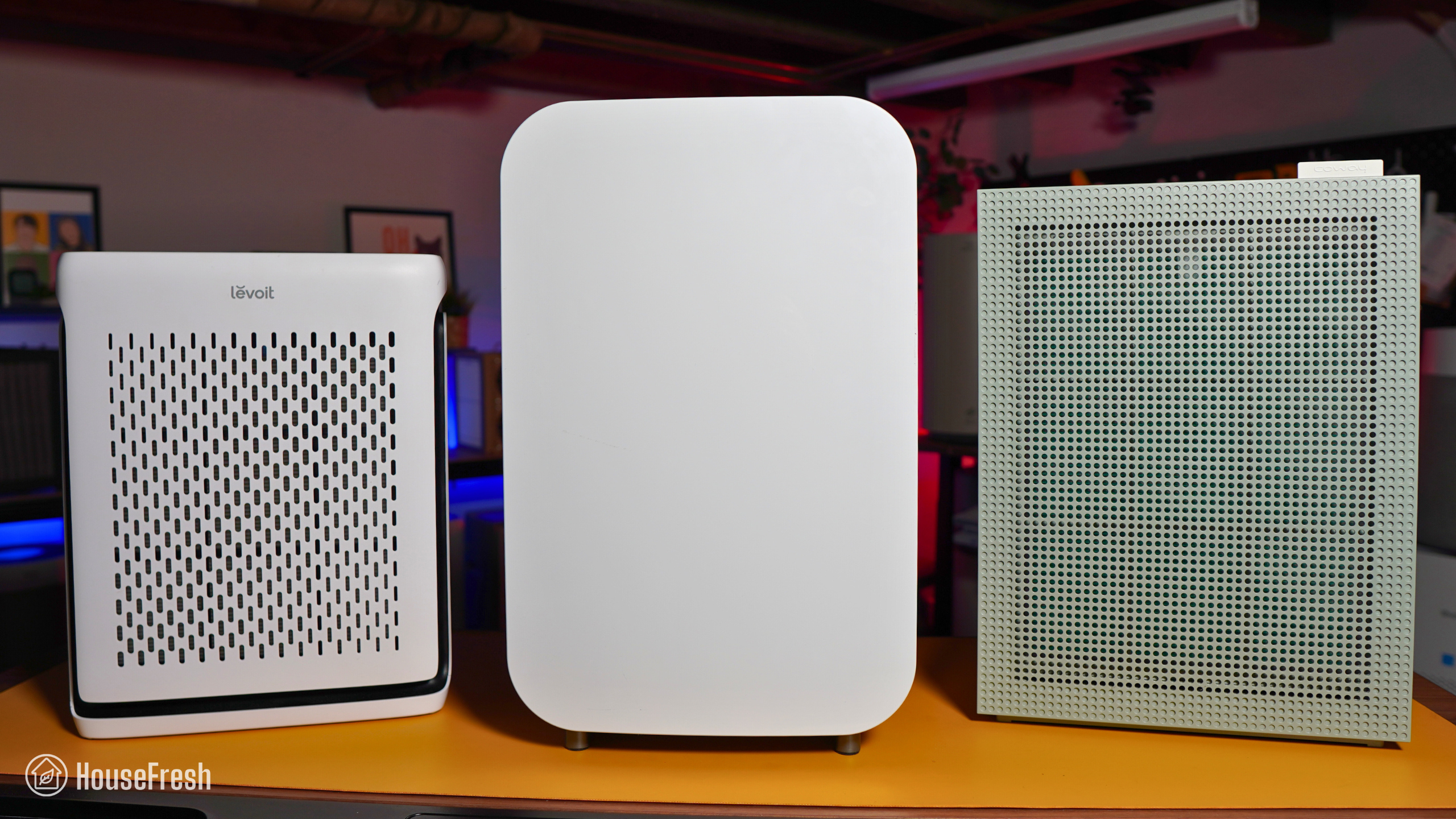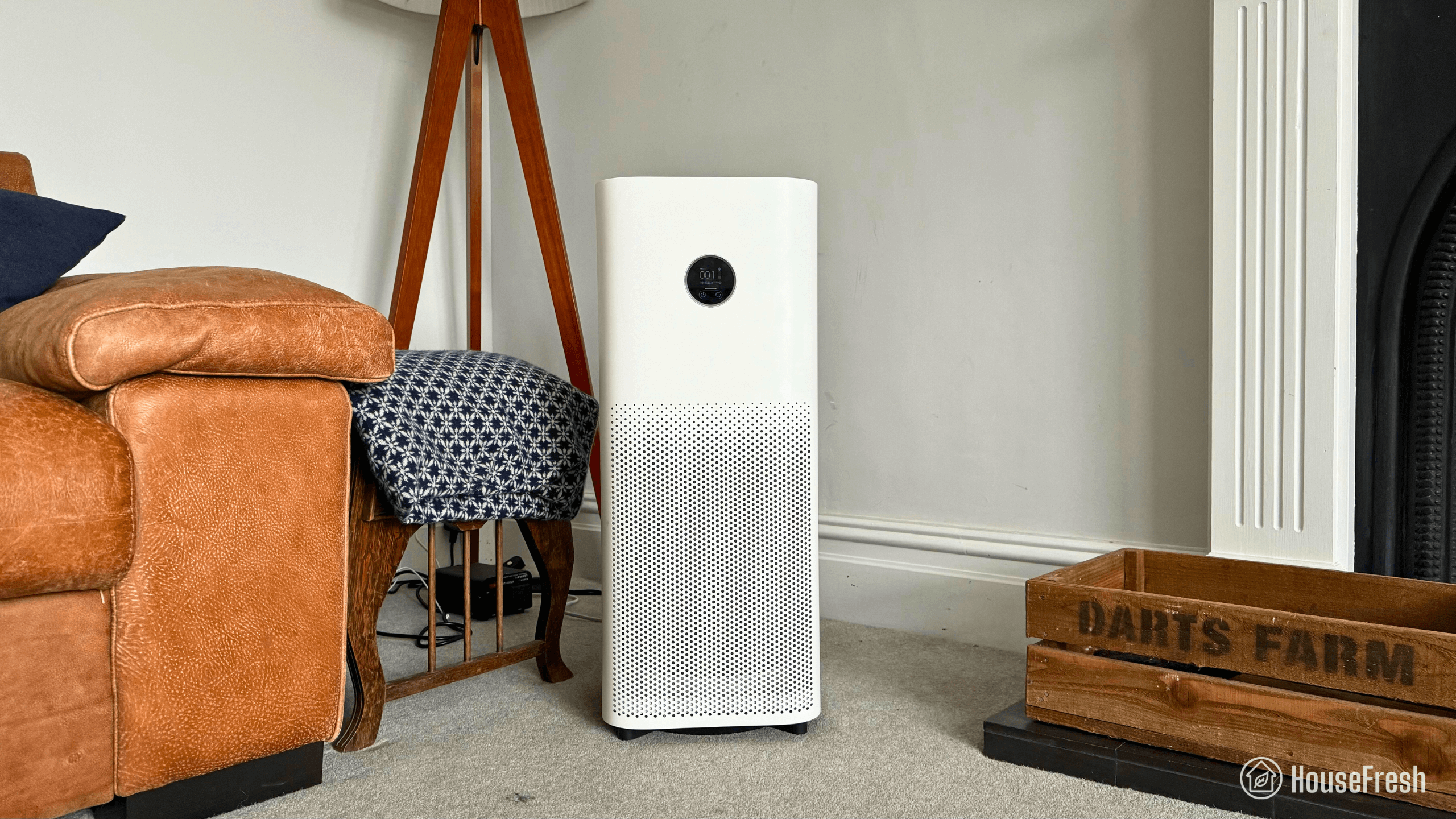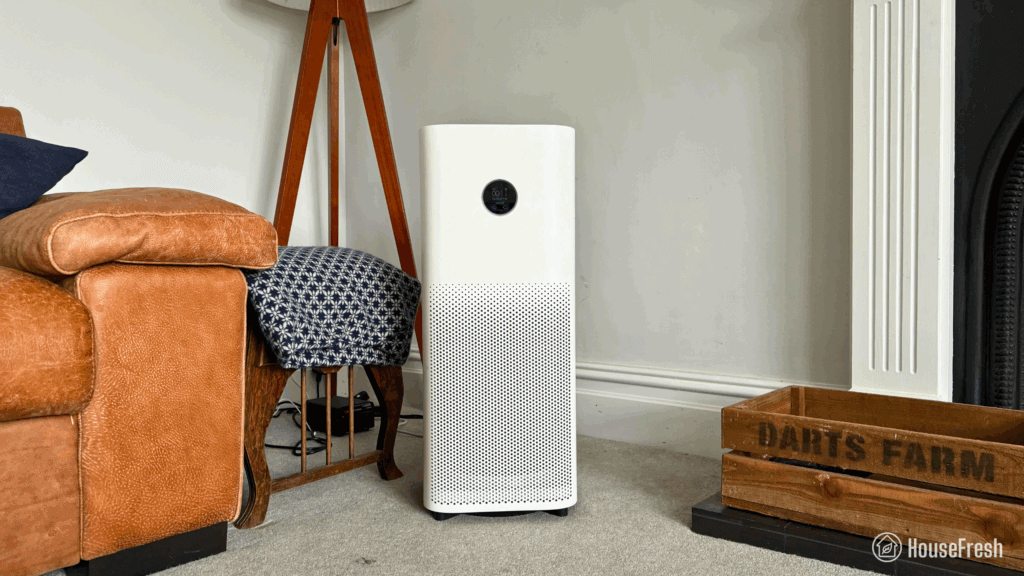
Winix 5520 review

Winix 5520 Close

The Winix 5520 was released alongside the 5510 around the same time the highly popular Winix 5500-2 was discontinued.

But can this new model deliver the same powerful air cleaning performance as its predecessor? And is it better or worse than the Winix 5510? I bought a 5520 with my own money, so that I could put it through all the tests we perform here at HouseFresh in order to find out.

The overall score for the Winix 5520 incorporates first-hand data results from our battery of tests, as well as our ratings for customer service, brand transparency, and design & UX. Check out the full scorecard below to see the split of categories.

Search for โ€˜Winix 5520โ€™ to see where it ranks, based on its air cleaning performance and value for money. You can also filter results to easily compare models in the same price range.

The pros and cons of the Winix 5520

A summary of our top-level findings after testing this air purifier, following our methodology.

“The Winix 5520 is the predecessor to the highly popular Winix 5500-2, but it comes in a smaller and better looking package. It has smart features and app support, and the running costs are fair, too.

Air cleaning performance is very good and matches what we saw with the Winix 5510 – but only when running at top speed.”

Danny Ashton HouseFresh
Danny Ashton
HouseFresh Founder
& Lead Tester

CONS

It only has one fan speed below 45 decibels (speed 1) and its performance is weak (106 cfm) compared to the sub-45 dBA performance of the Winix 5510.
The Winix Smart app is quite bare and lacks features you see in apps from Levoit, Xiaomi and Philips.
It comes with a gas sensor rather than a particle sensor, so it will respond to VOCs in the air but not to particulate matter.

PROS

It offers solid performance at top speed, matching what we saw with the Winix 5510 and the Levoit Vital 200S.
It has a smaller body than the Winix 5500-2, so it will fit in tighter spaces.
The filter replacements are fairly priced ($79.99) and can last up to 12 months.
You get app support via the Winix app, which has a clean UX and is easy to use.

Clean air delivery rate (CADR):โ€“ Top speed PM1 CADR: 248 cfm
โ€“ Sub-45 dBA PM1 CADR: 106 cfm
โ€“ AHAM PM2.5 CADR: 252 cfm (dust)
Filter technology:True HEPA filter with pelleted activated carbon and a removable pre-filter
Recommended room size:372 sq. ft. (5 air changes per hour)
Dimensions:15.9 x 11 x 25.2 in (40.3 x 27.9 x 64 cm)
Weight:13.03 lbs (5.9 kg)
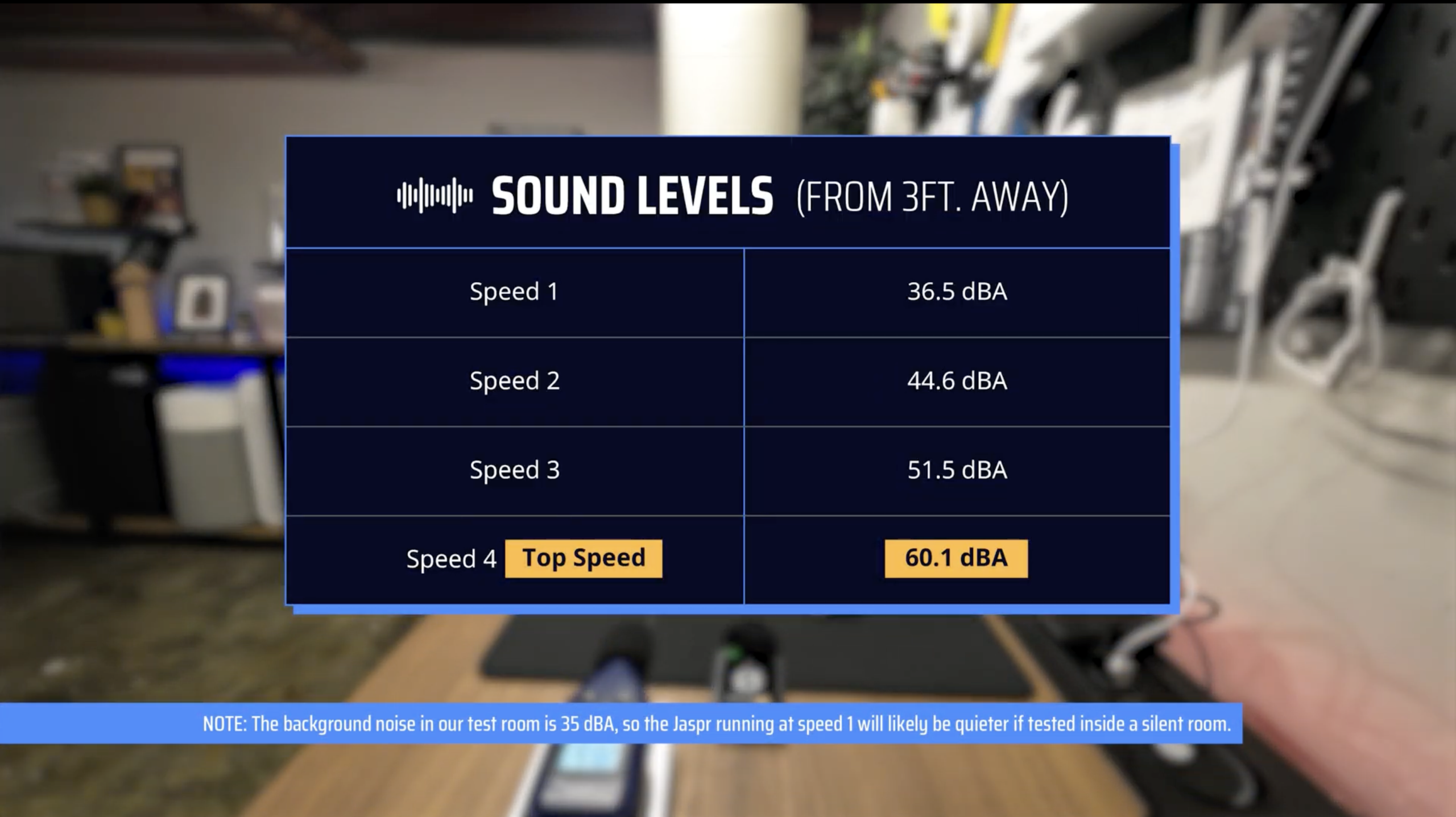
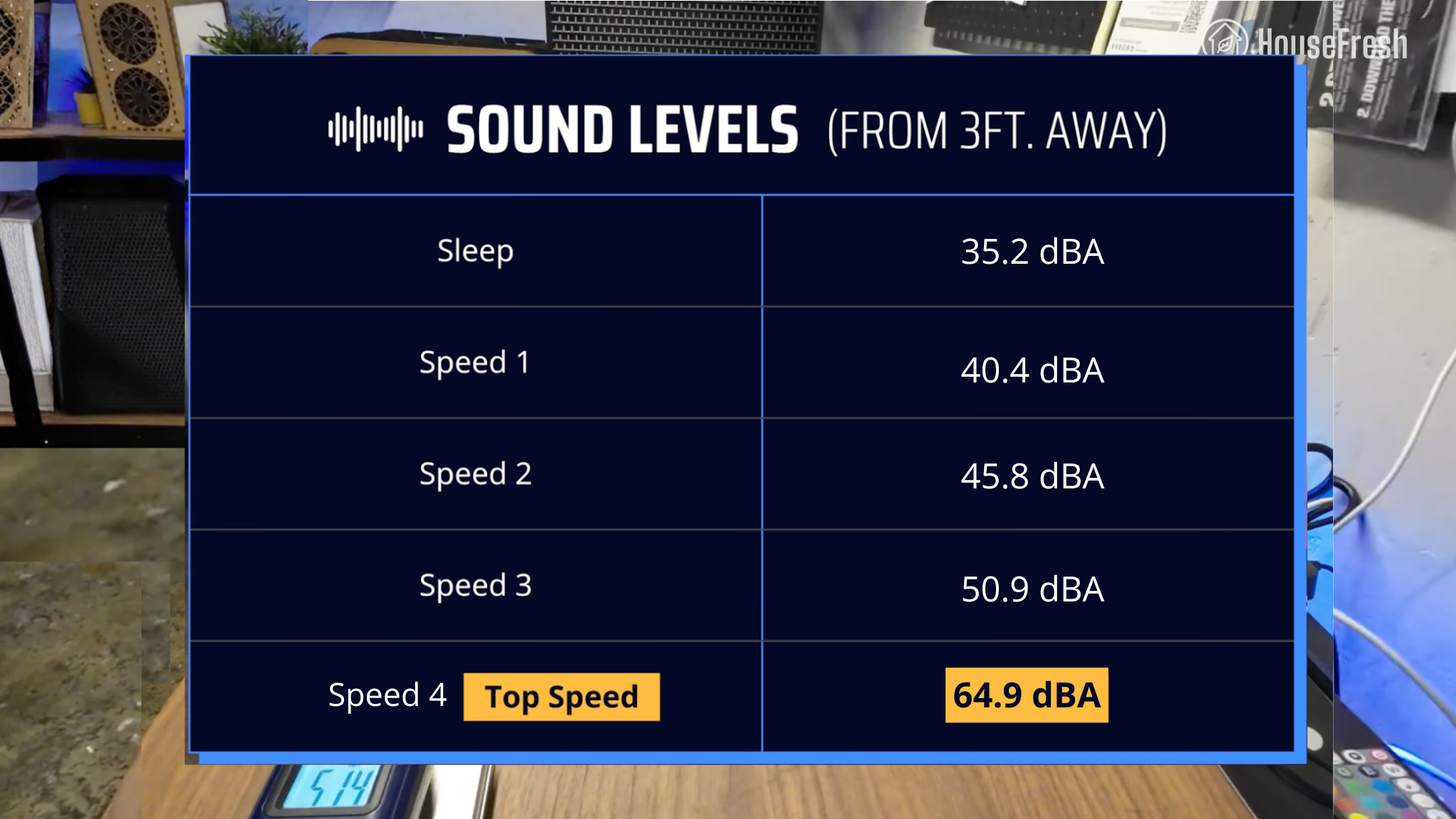
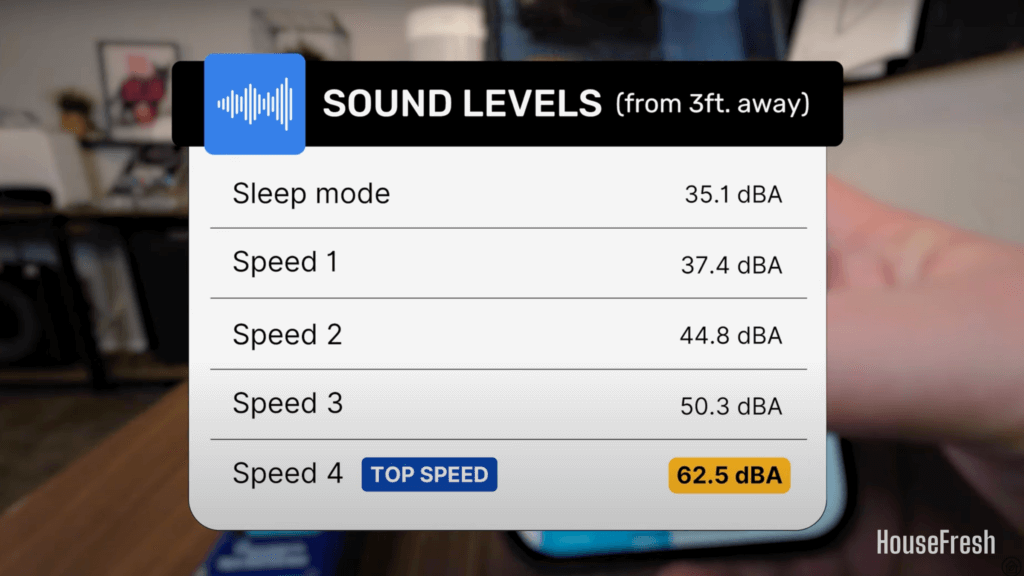
Noise level in decibels from 3 ft. away:Speed 1: 40.4 dBA
Speed 2: 45.8 dBA
Speed 3: 50.9 dBA
Speed 4: 64.9 dBA
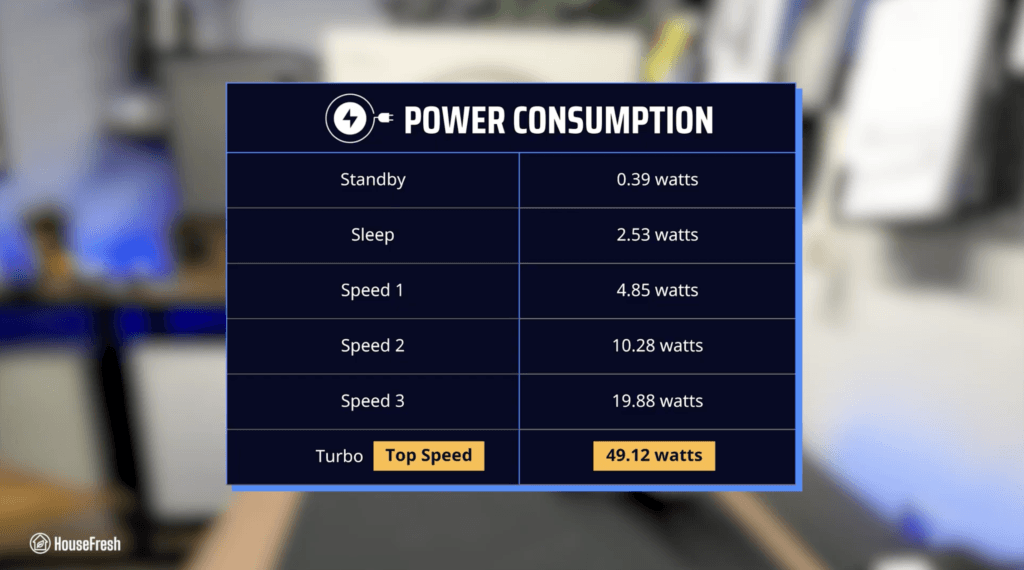
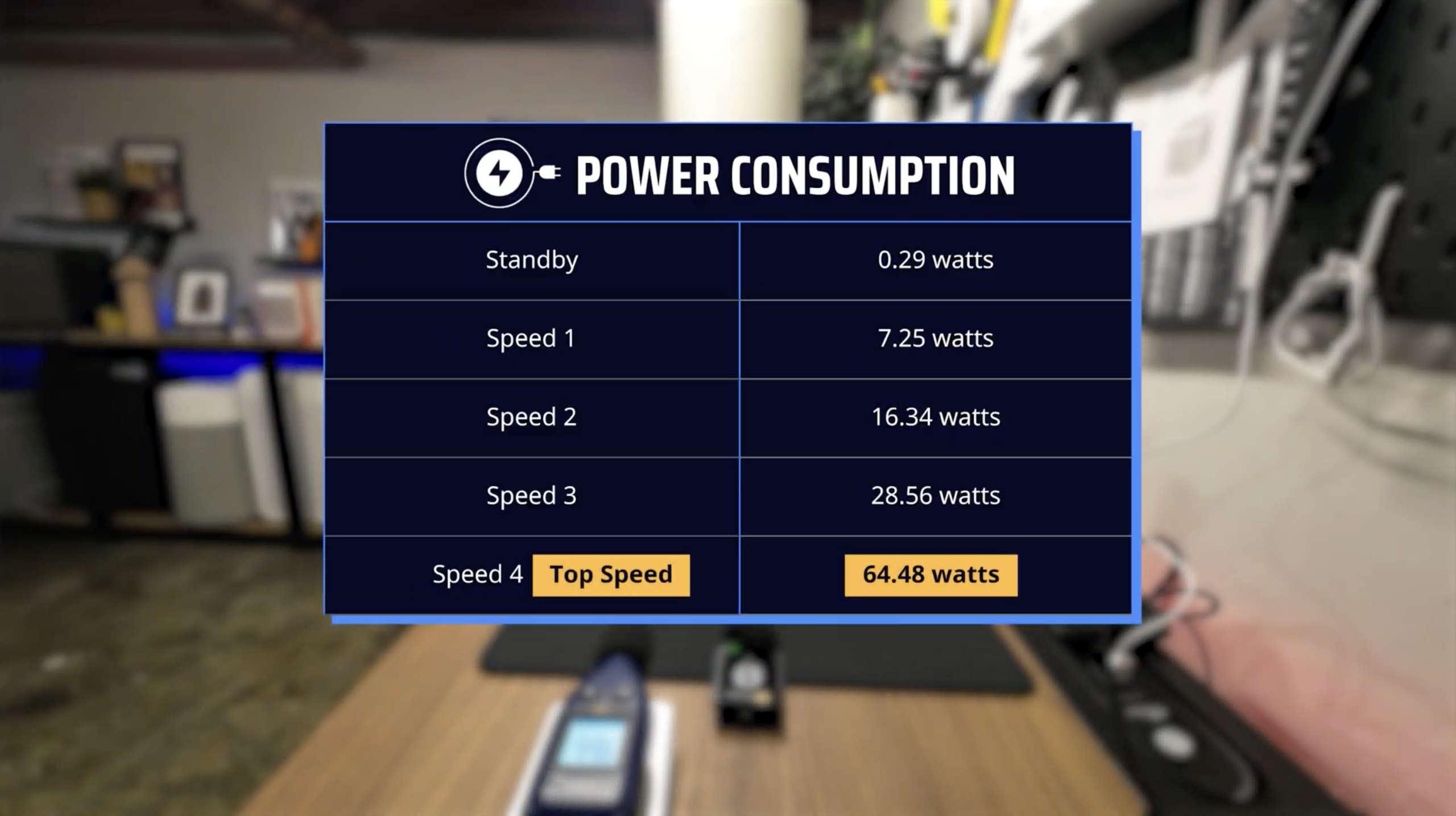
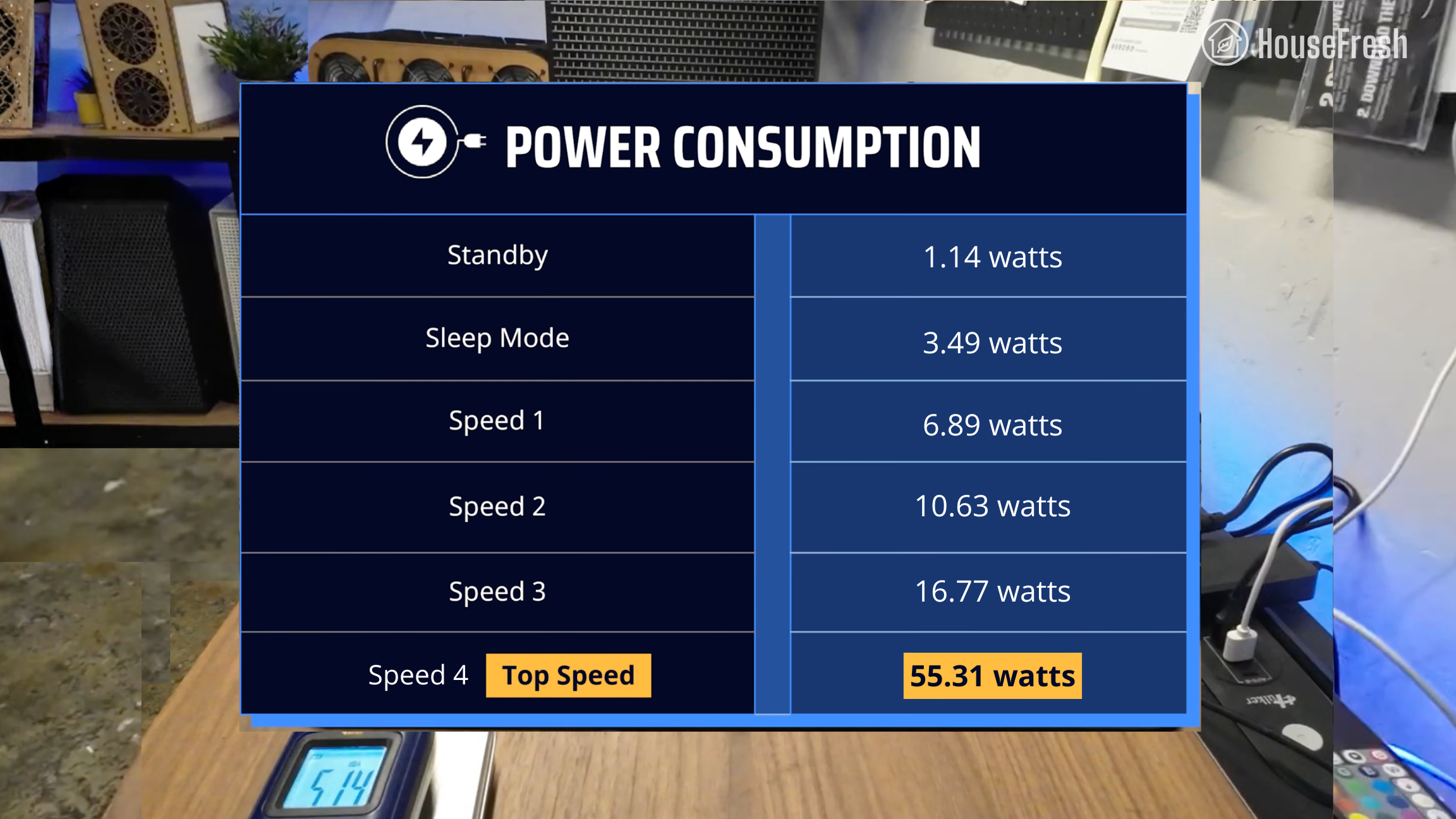
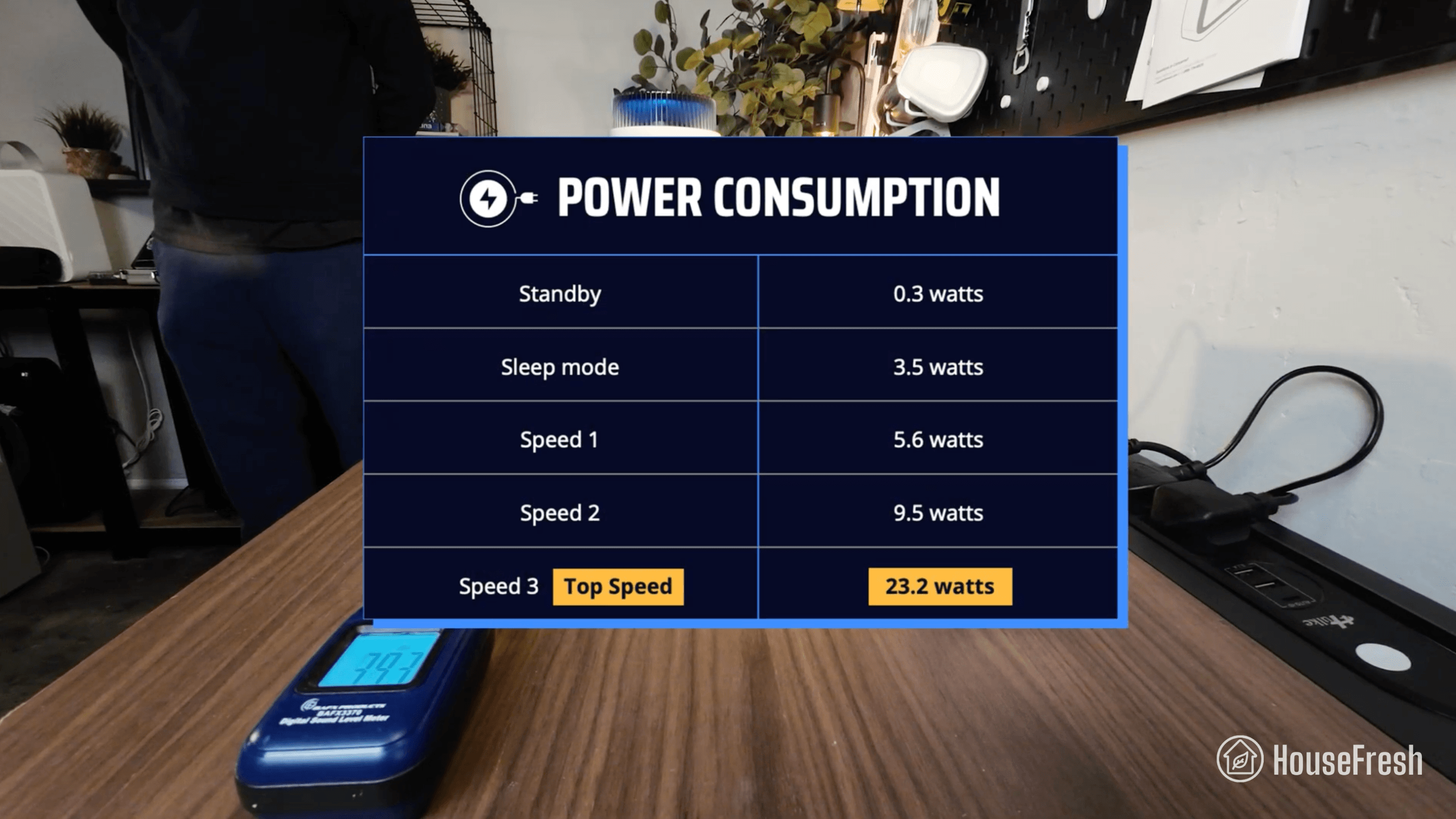
Electricity consumption in watts:Standby: 1.14 watts
Sleep mode: 3.49 watts (3.77 with PlasmaWave)
Speed 1: 6.89 watts (7.13 with PlasmaWave)
Speed 2: 10.63 watts (10.92 with PlasmaWave)
Speed 3: 16.77 watts (16.75 with PlasmaWave)
Speed 4: 55.31 watts (55.6 with PlasmaWave)
Filter lifespan:12 months
Manufacturerโ€™s warranty:2 years
Country of origin:South Korea
Country of manufacture:Thailand

Filtration technology

Three separate filters for particle and VOC filtration.

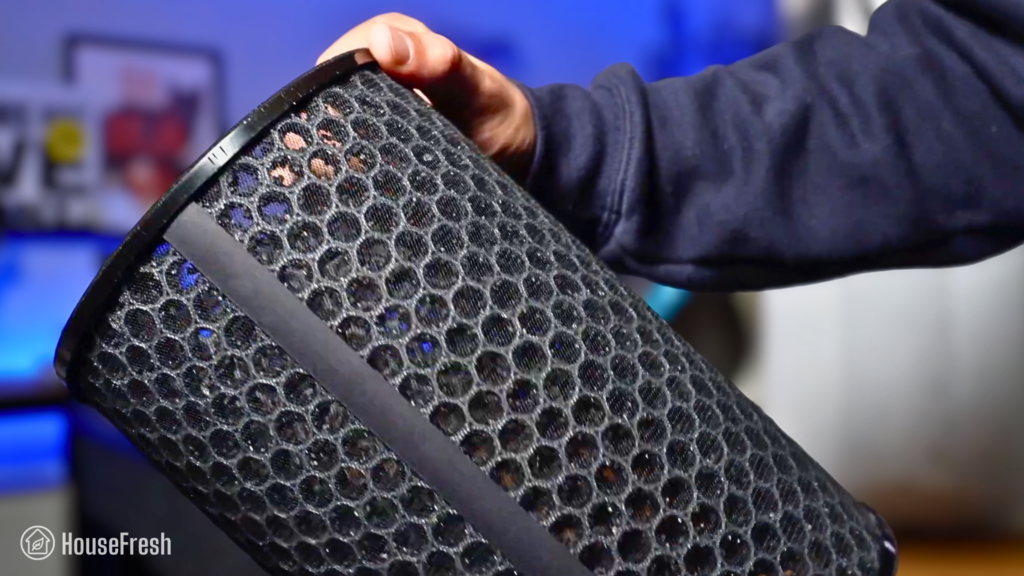
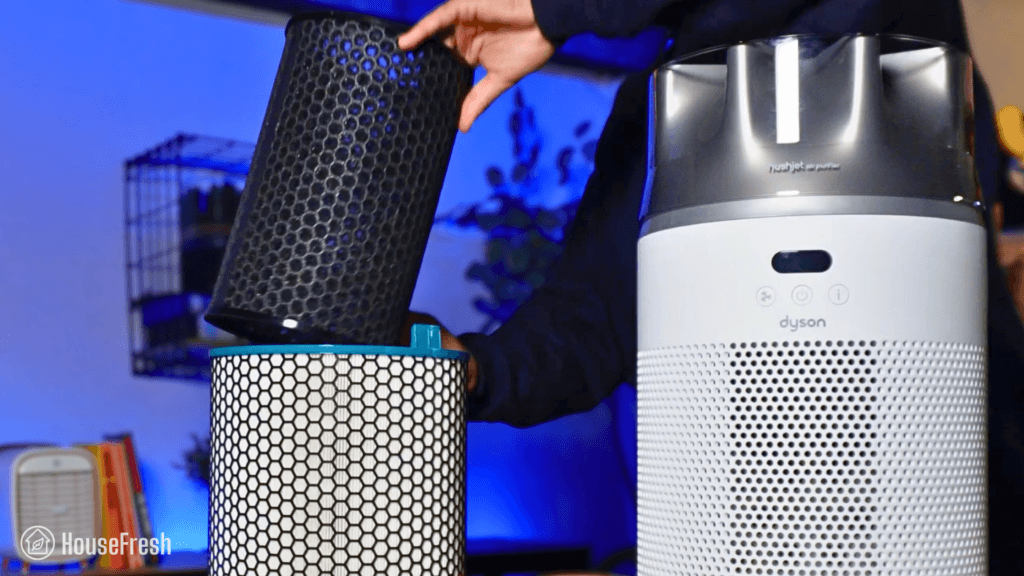
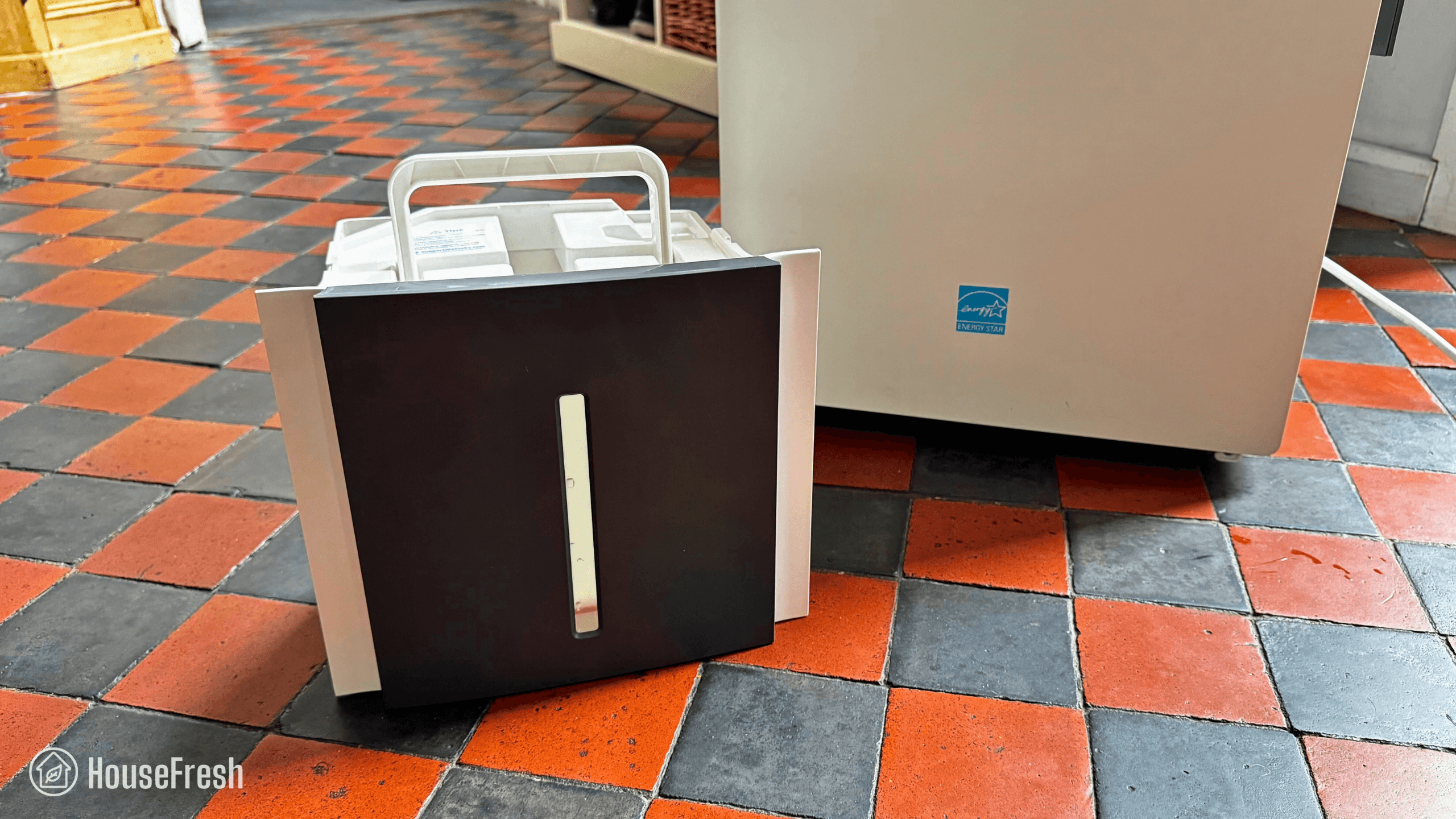
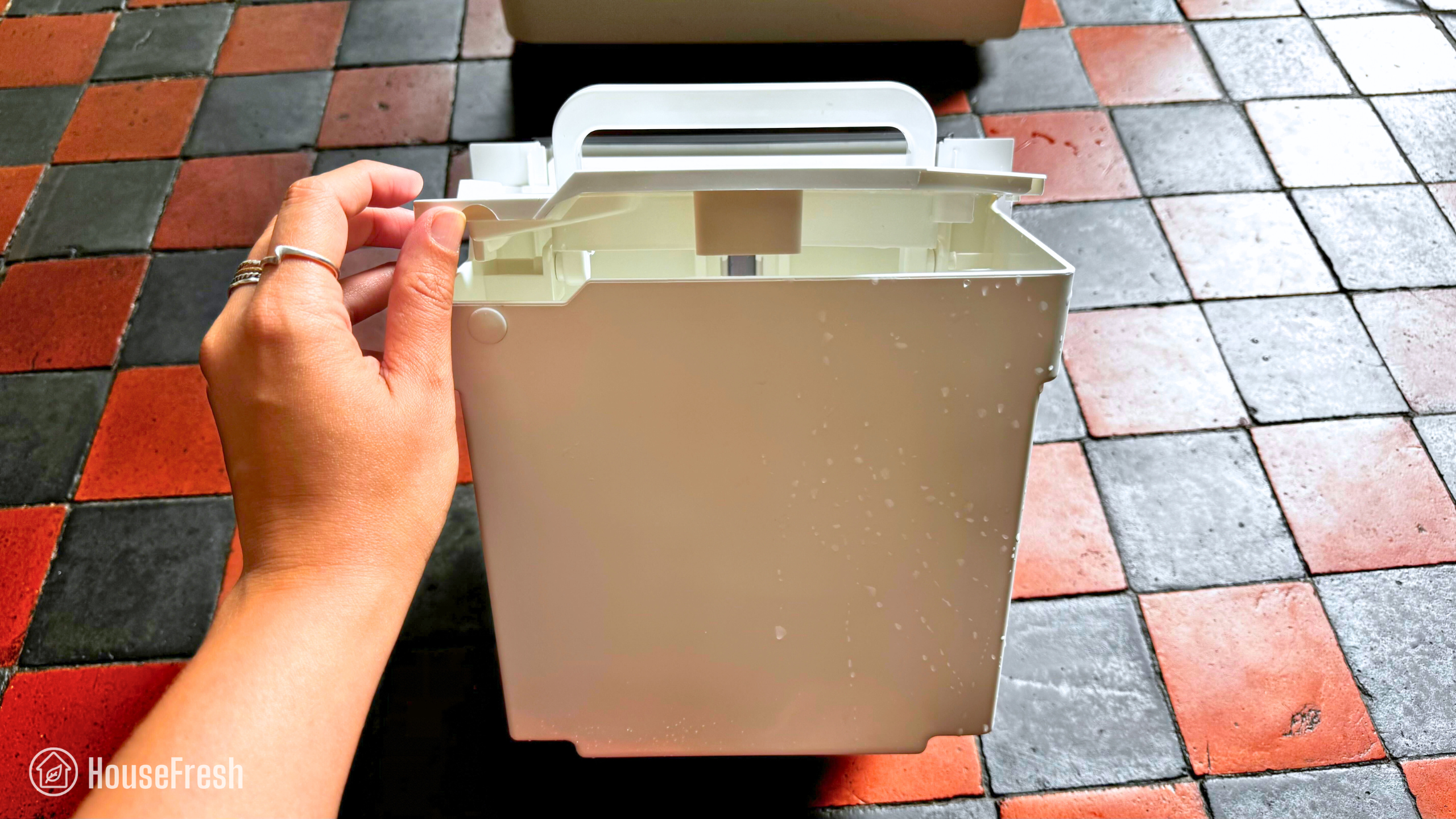
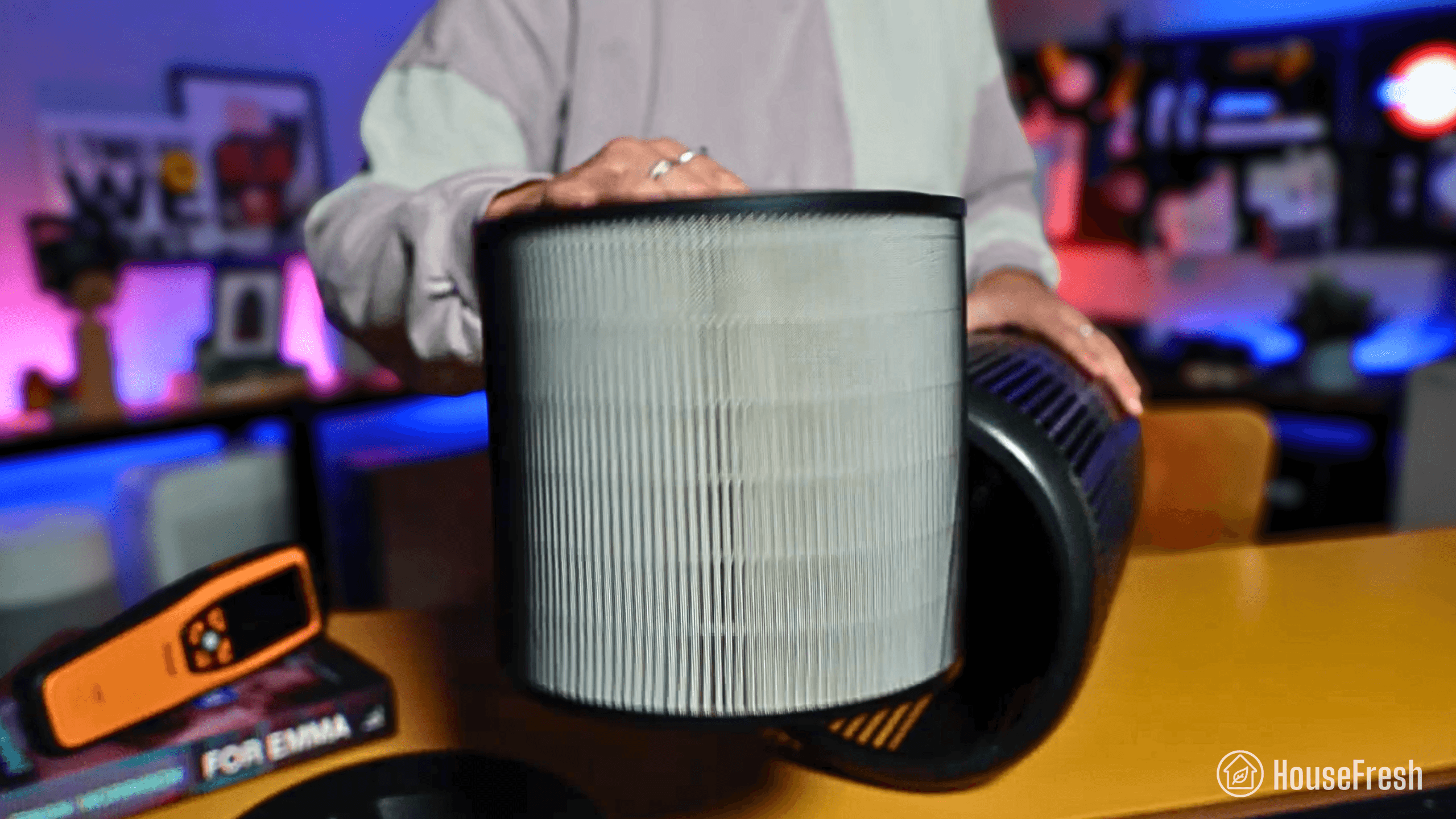
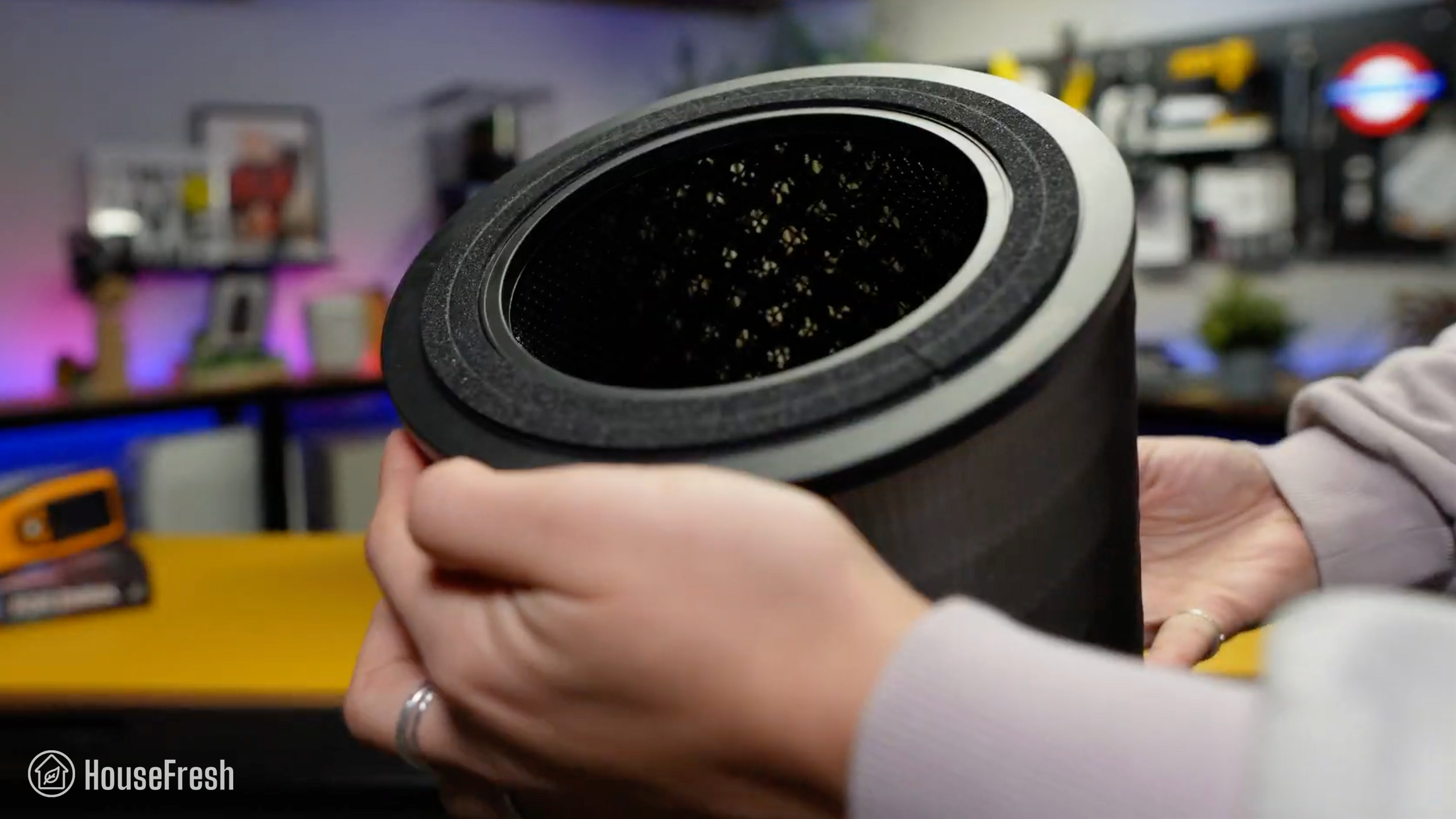
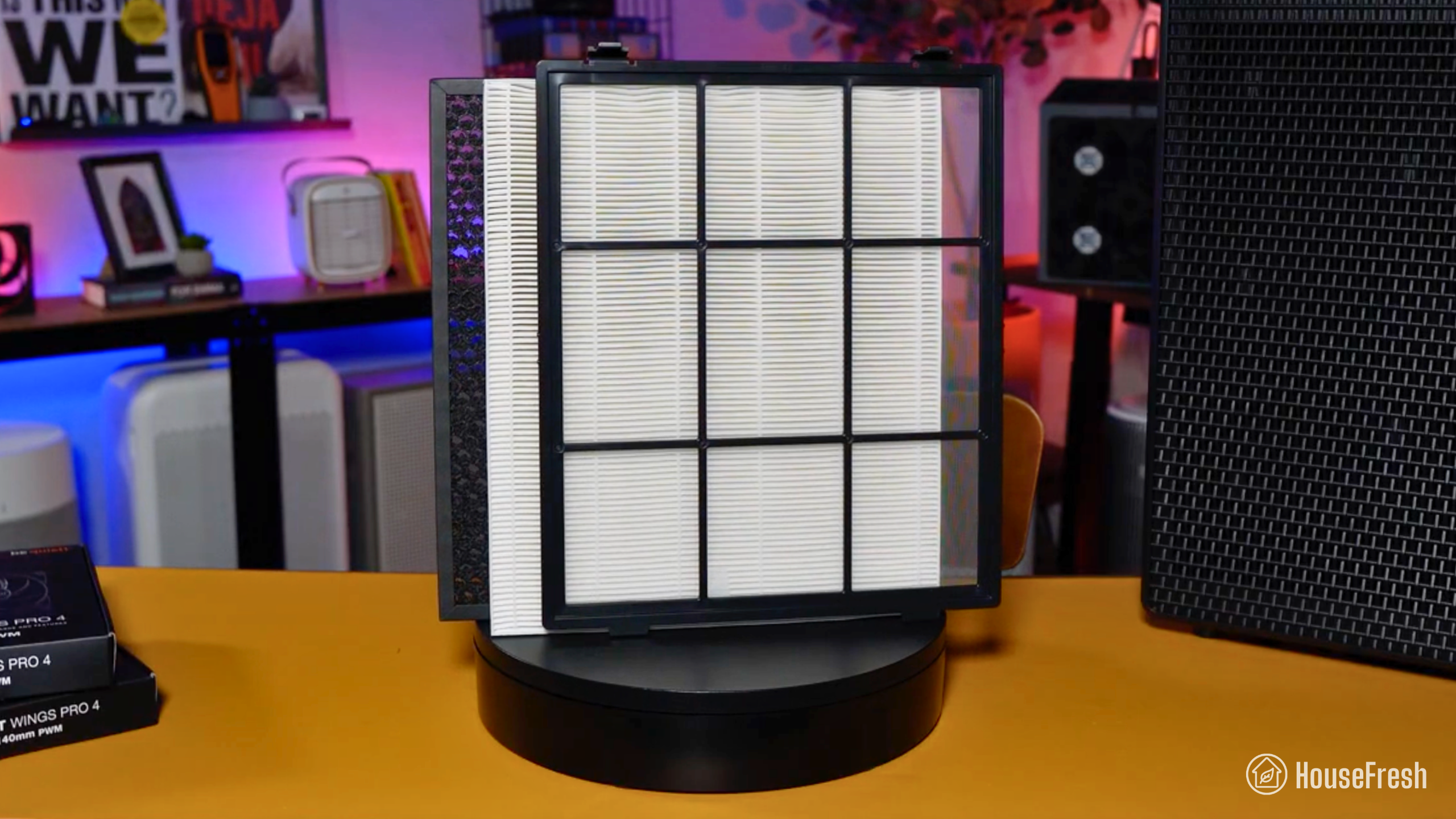
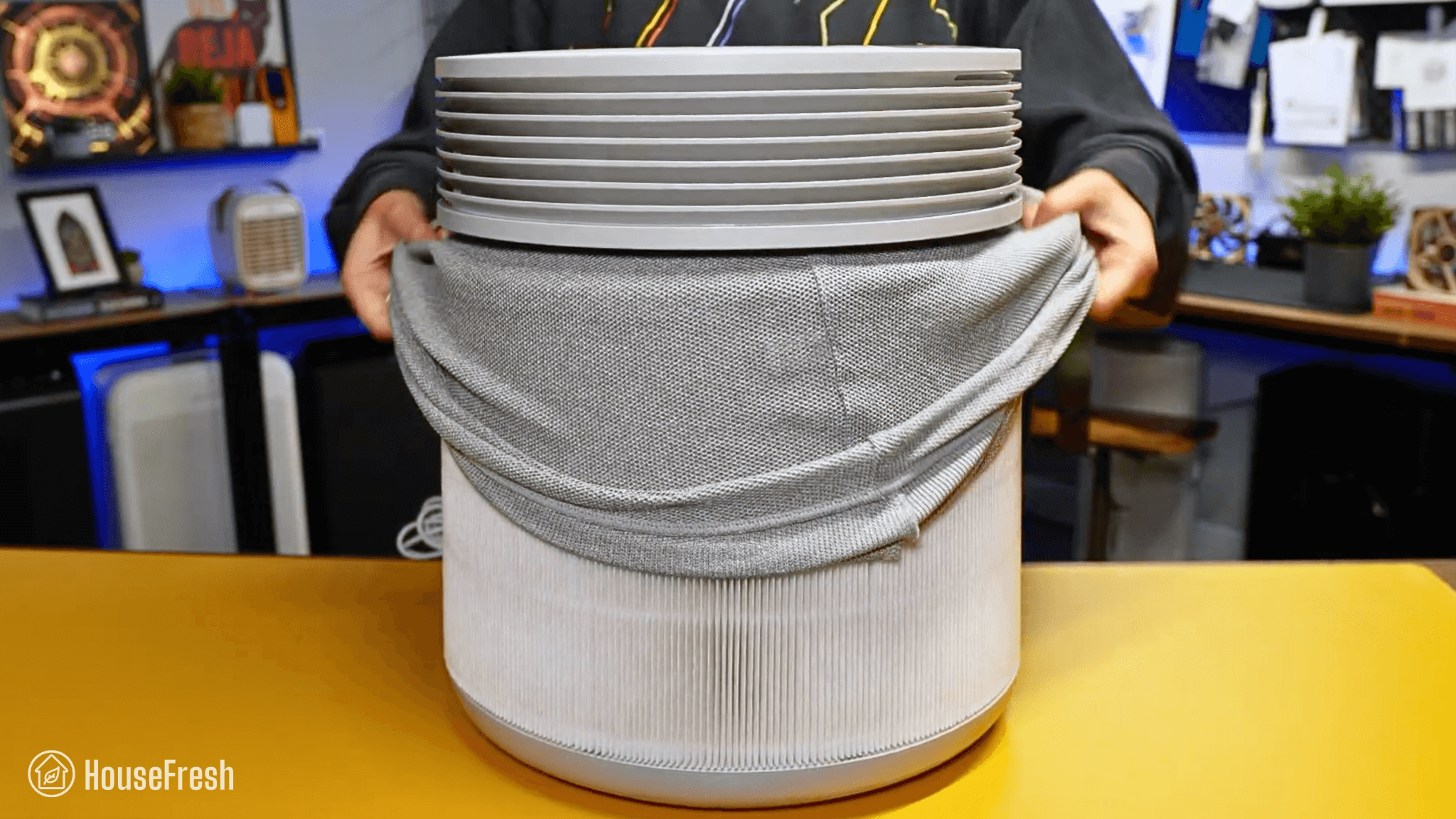
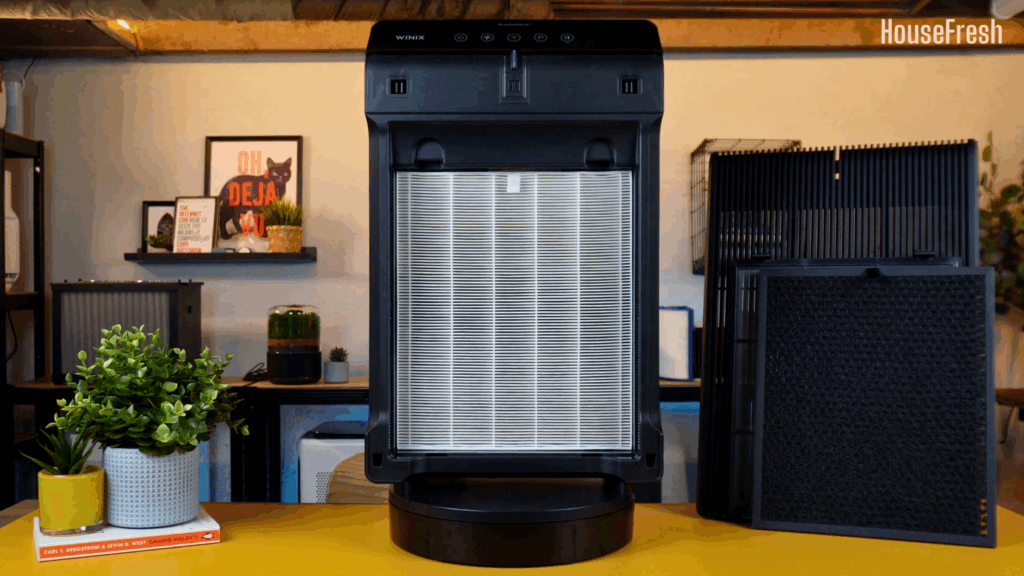
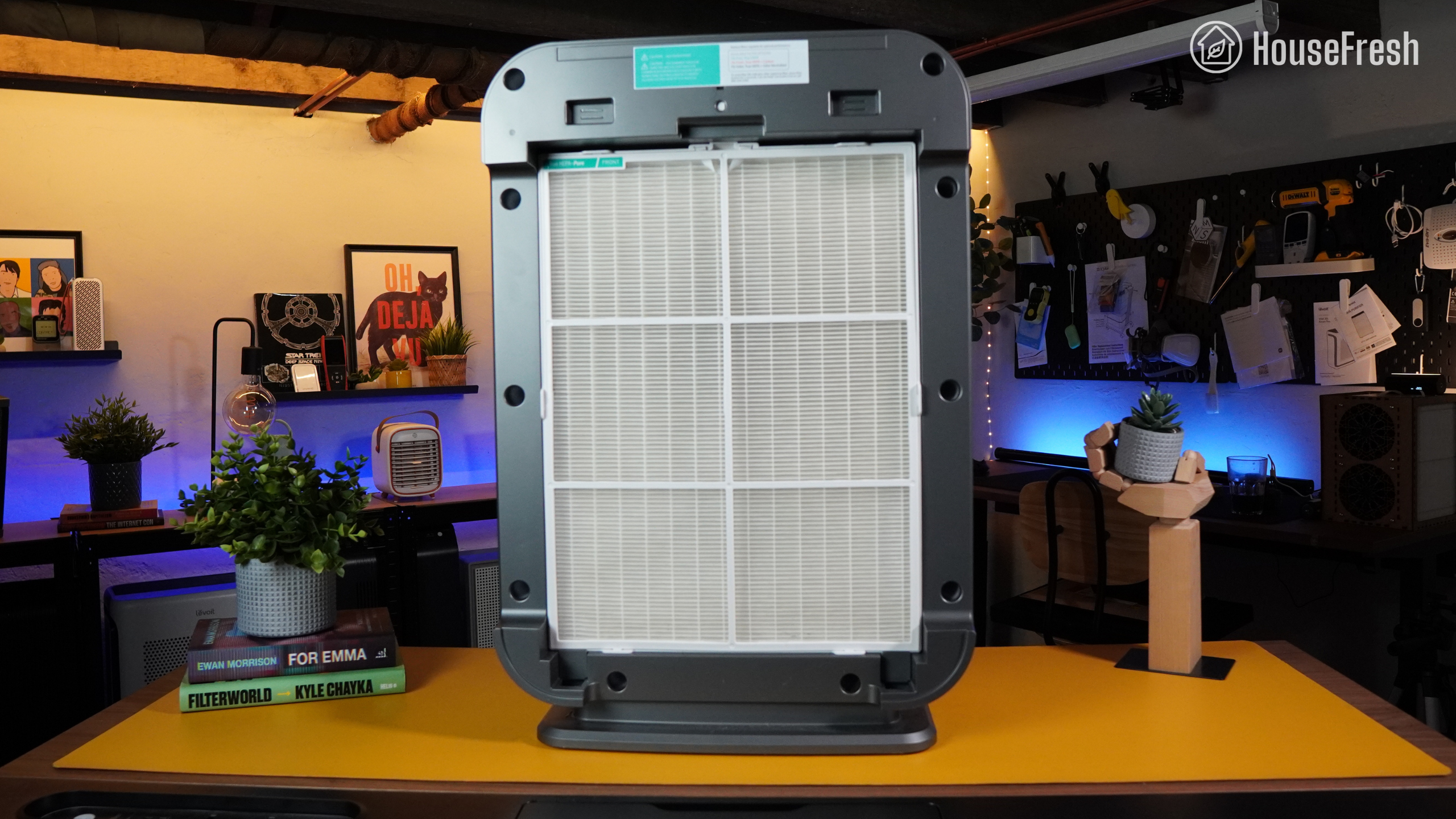
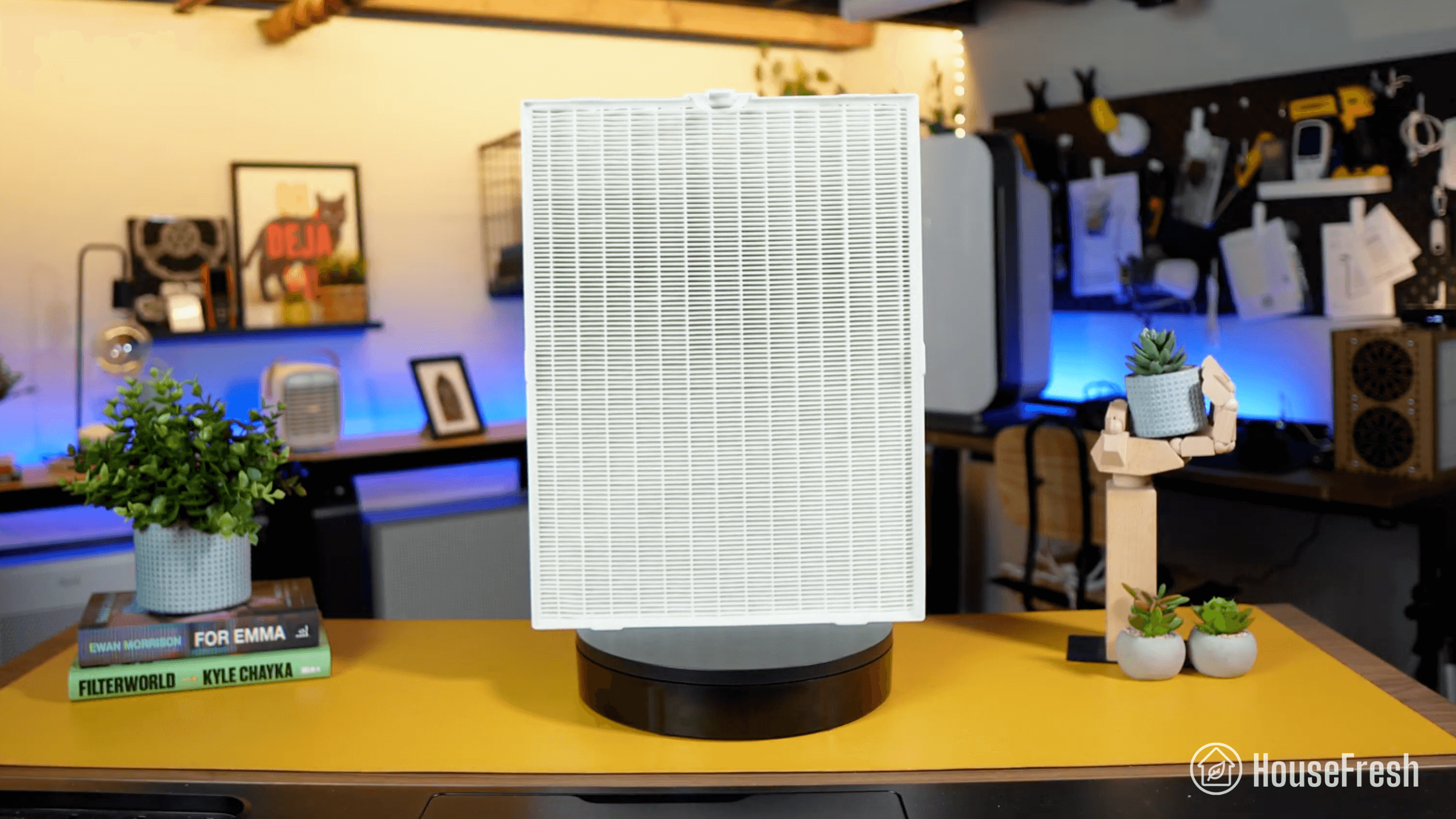
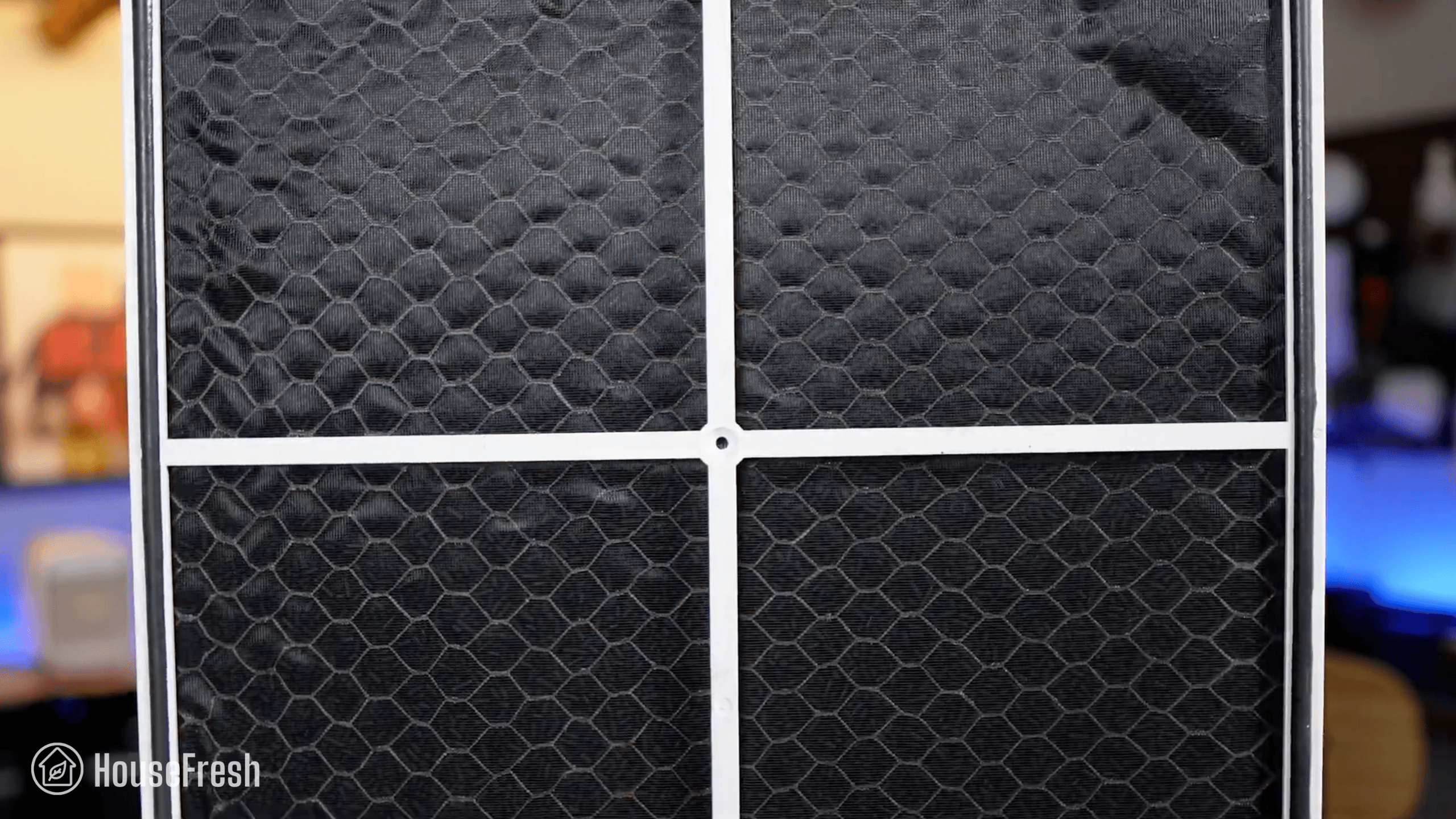
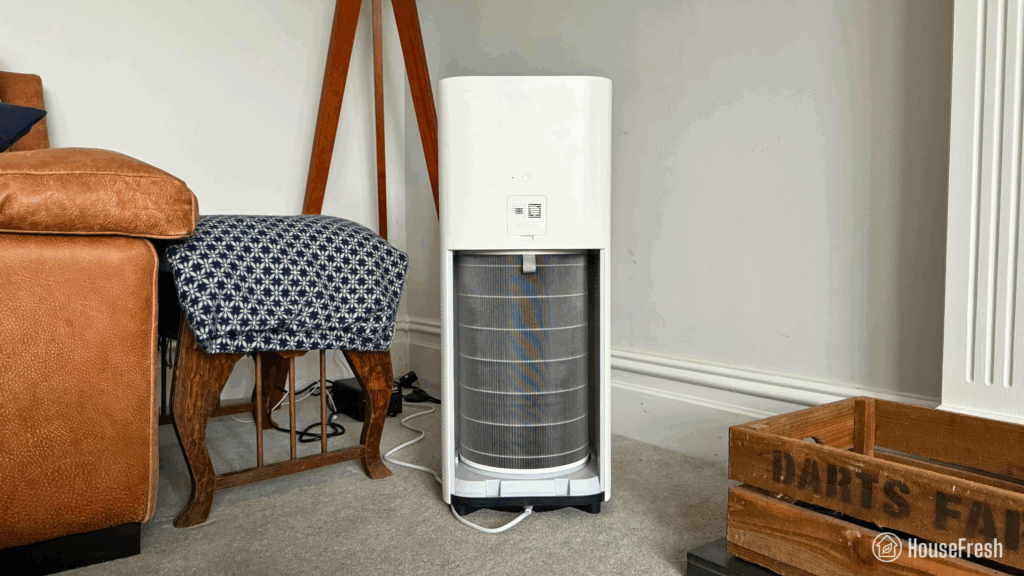
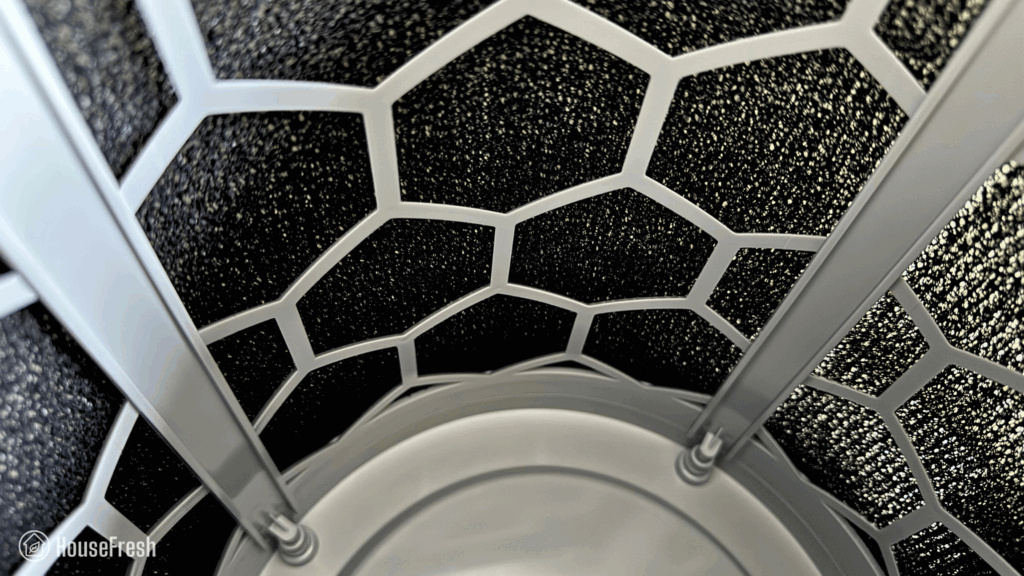
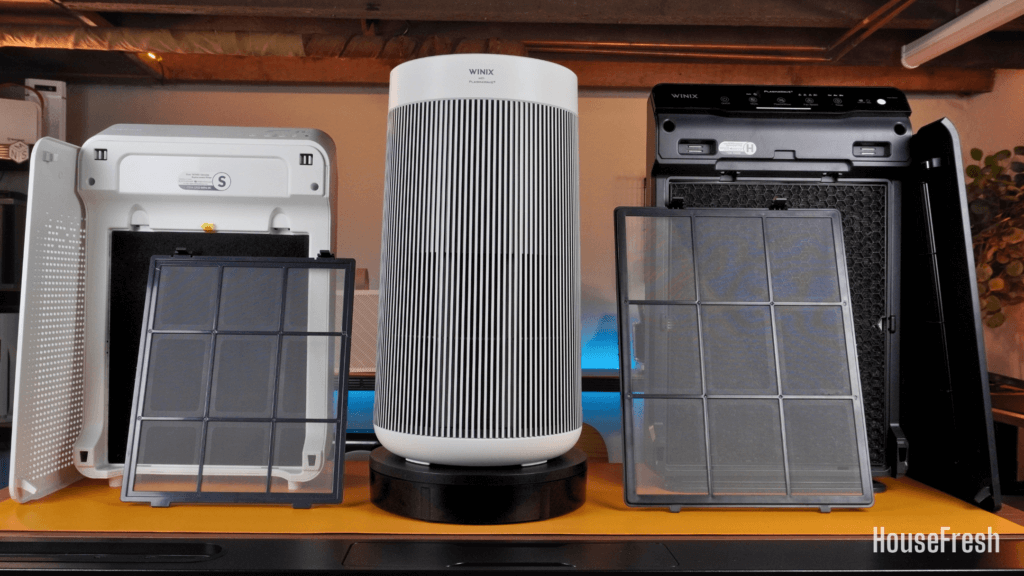
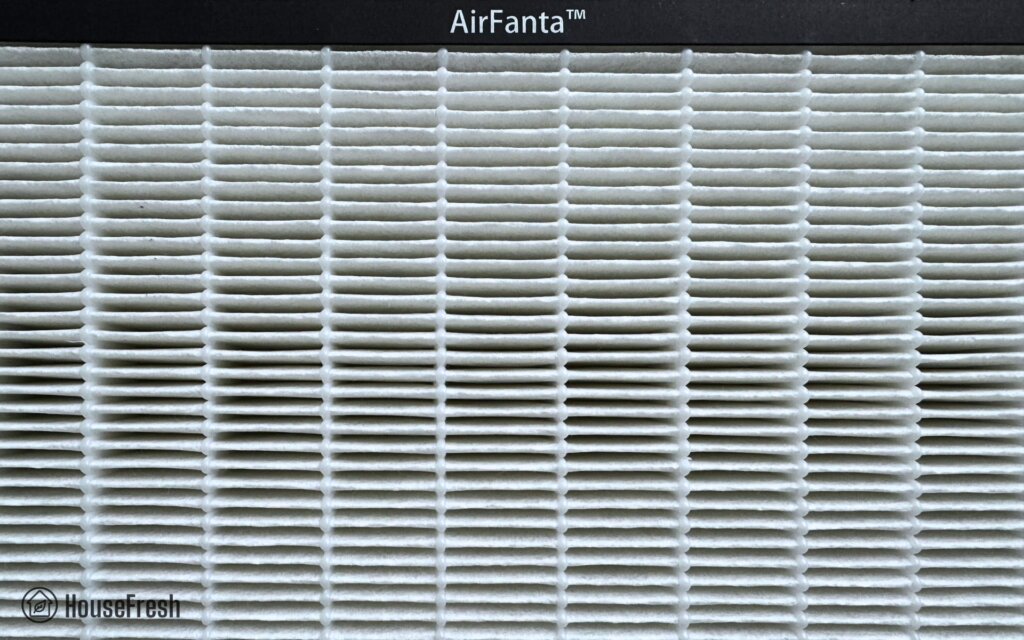
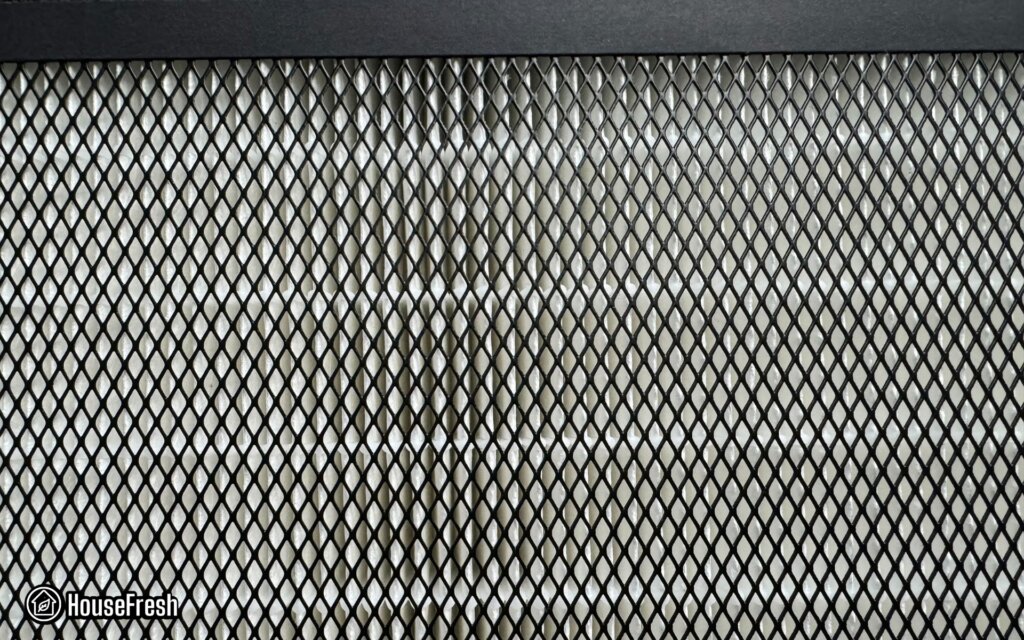
The Winix 5520 offers three layers of filtration: a pre-filter for larger particles, a True HEPA filter for small particles, and a pelleted activated carbon filter for gases and odors.

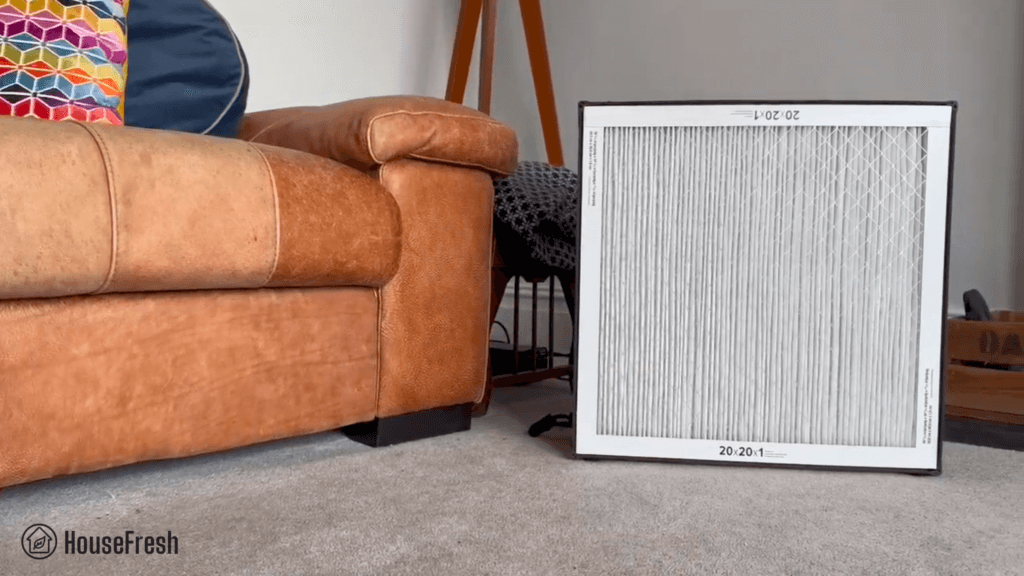
Winix 5520 Filters

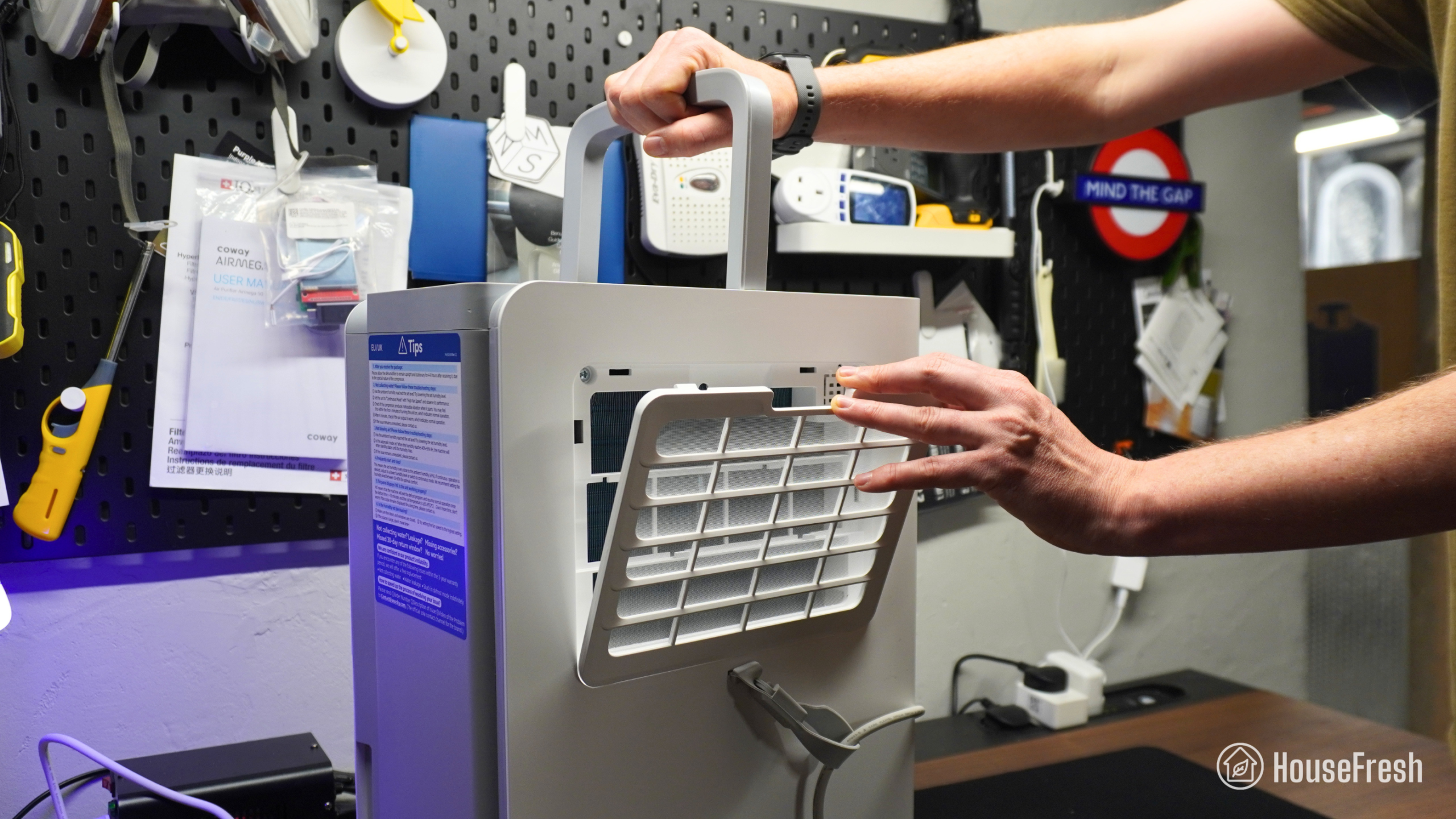
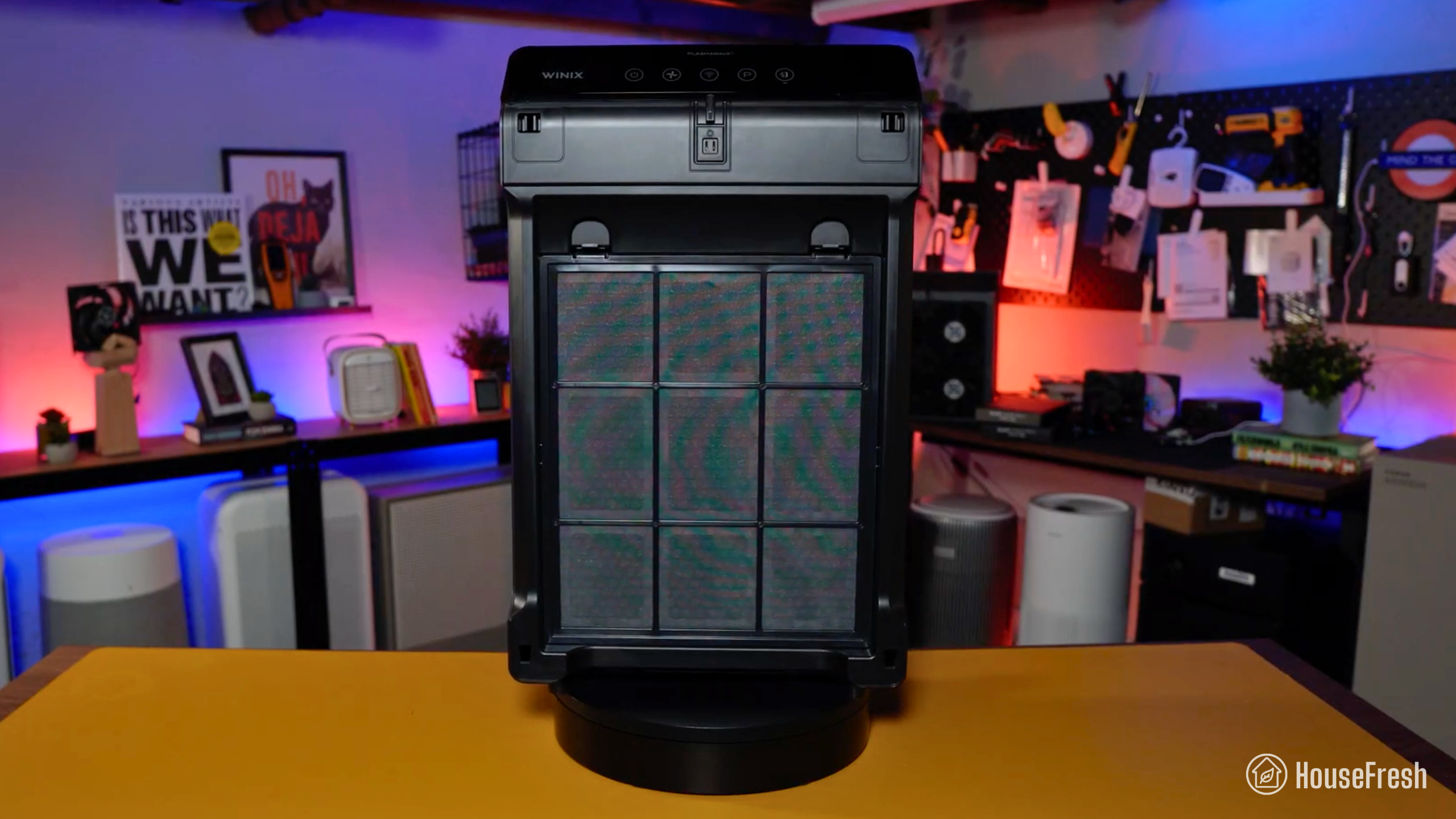
The pre-filter is removable, making it easier to vacuum and clean to remove pet hair, fluff, and large dust particles that accumulate before they block airflow.

Winix 5520 Pre filter

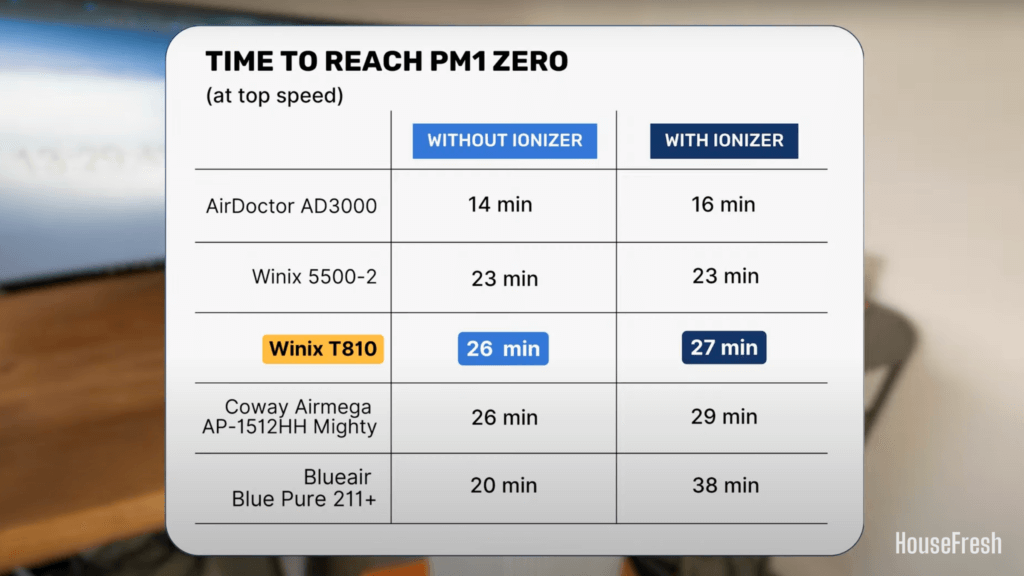
As with other Winix air purifiers, the 5520 comes with PlasmaWave, Winix’s trademarked bipolar ionization technology. This feature is meant to supercharge air cleaning performance by releasing electrical charges that make particles easier to remove from the air.

The bipolar ionization process may introduce new chemicals into the air, such as ozone. Winix makes this feature optional, so you can simply deactivate PlasmaWave by pressing the P button if you don’t want to use it.

Winix 5520 PlasmaWave

Design, controls and app features

A stylish, medium-sized air purifier with app support.

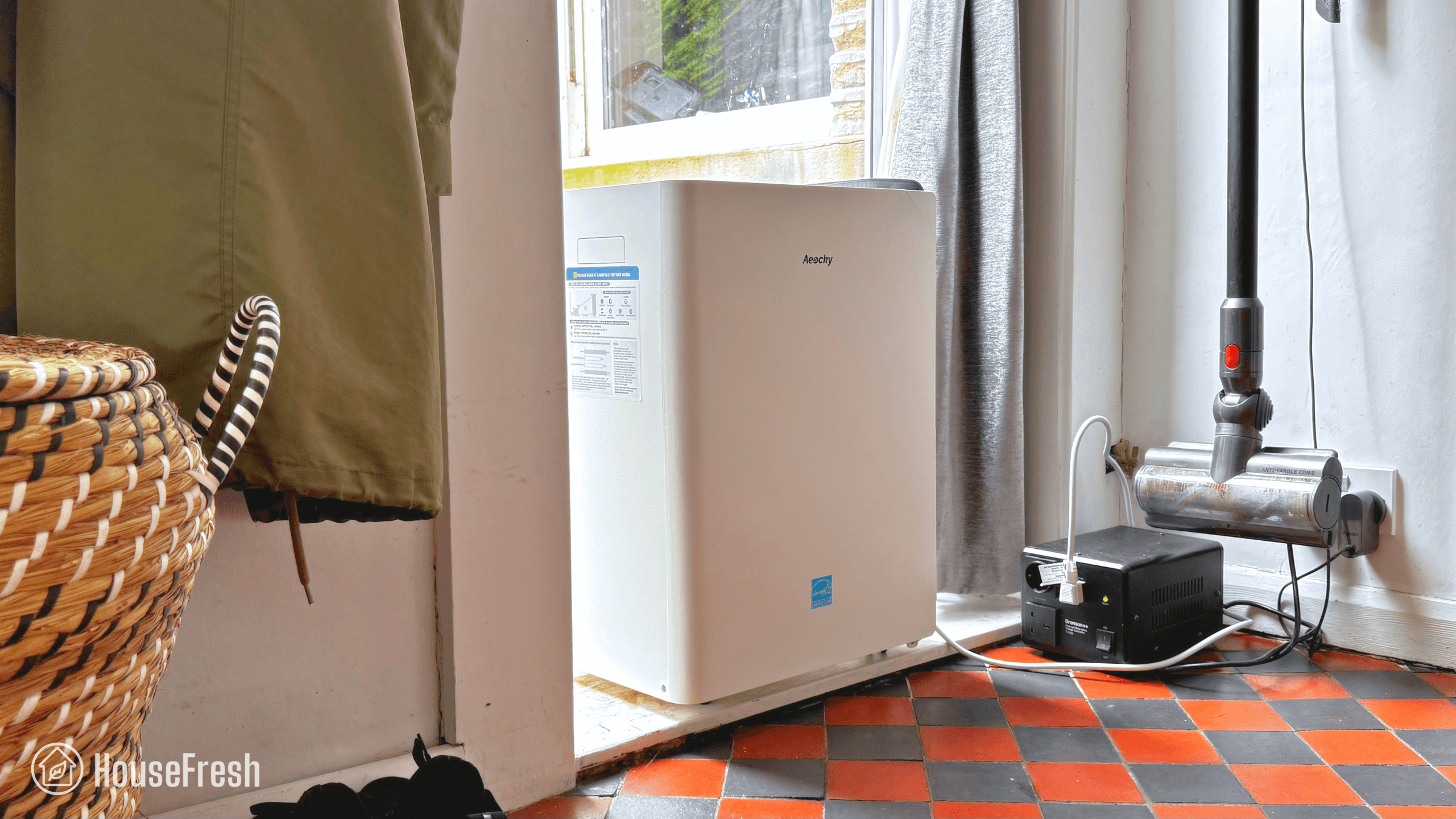
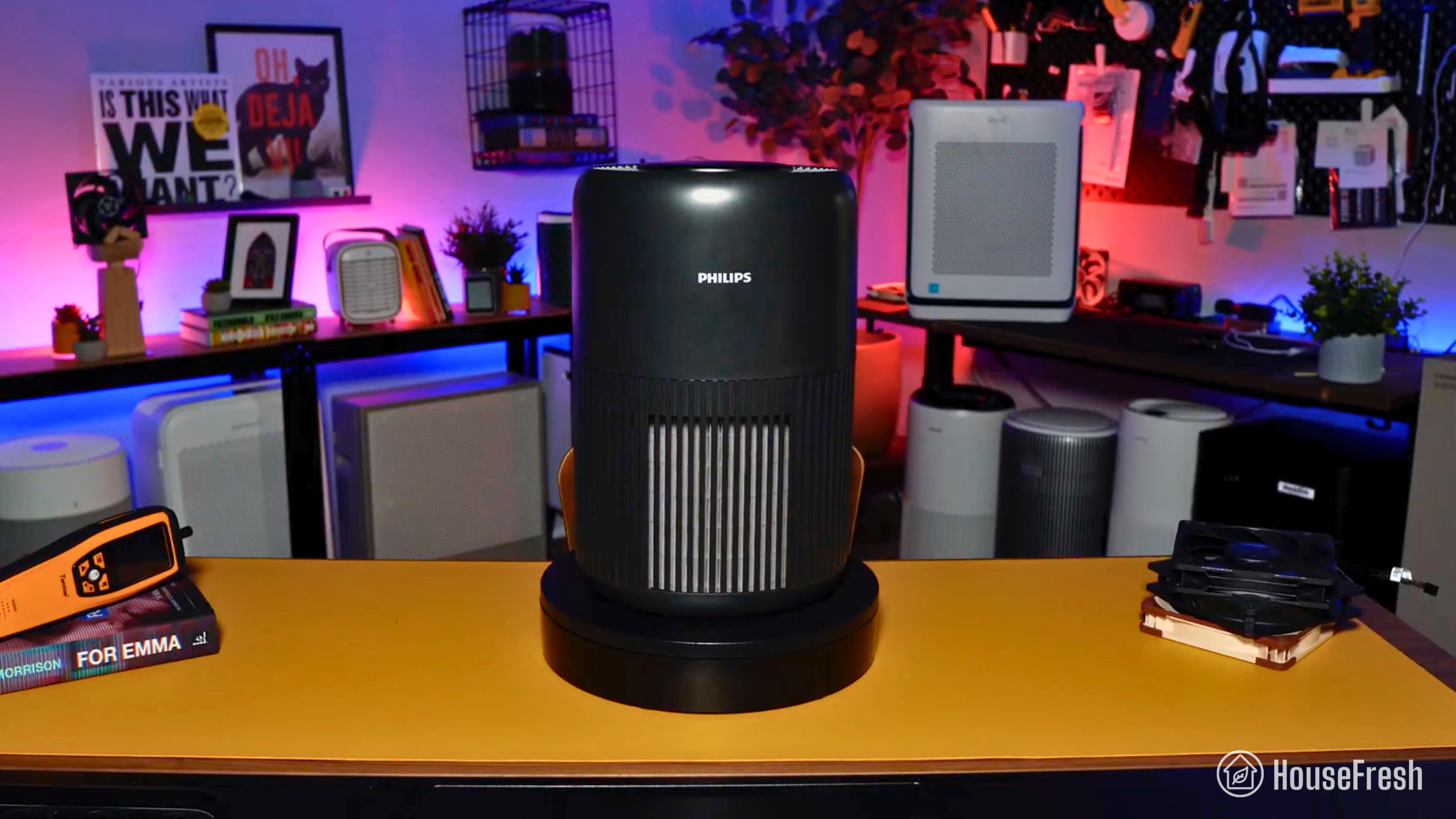
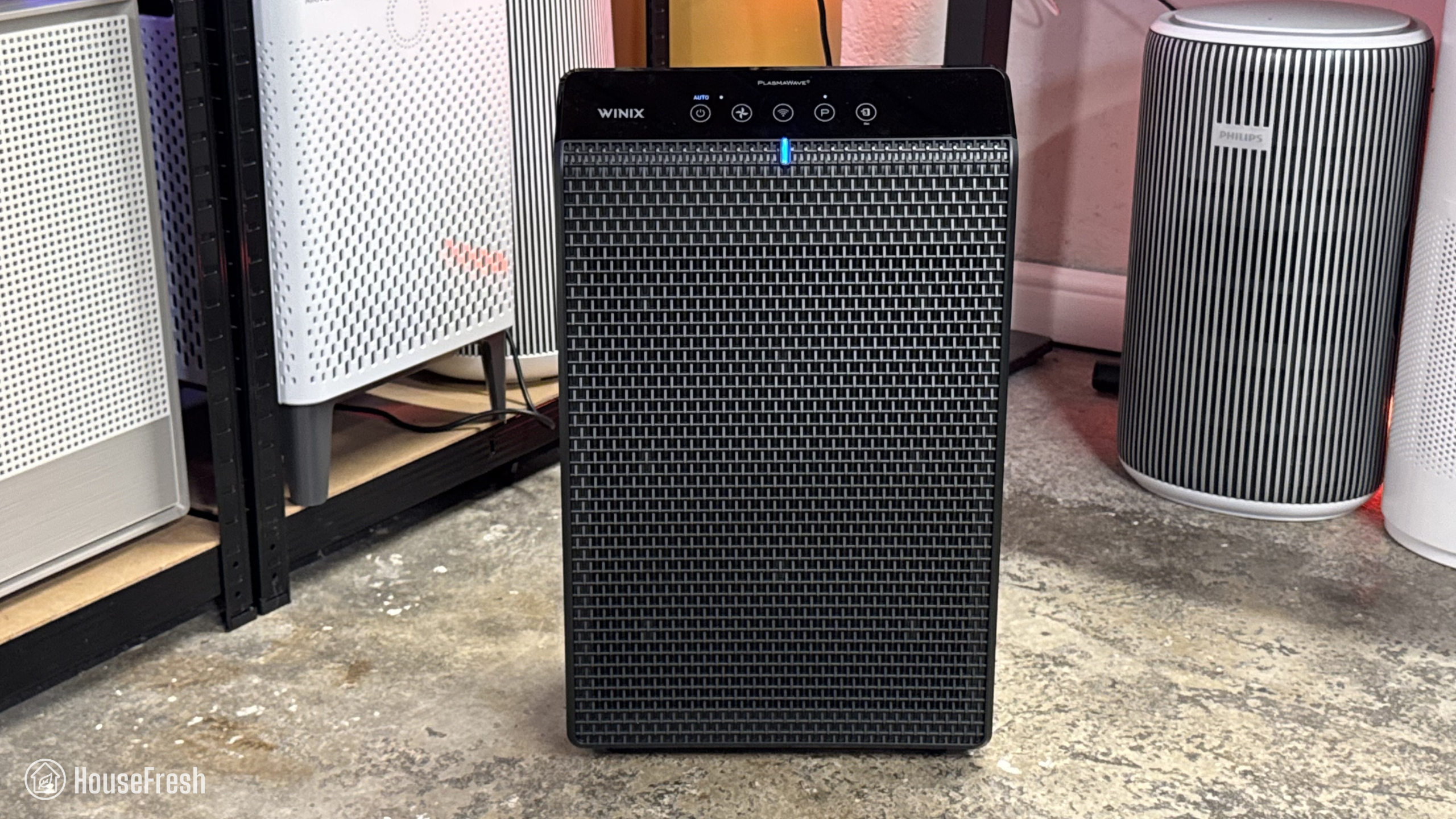
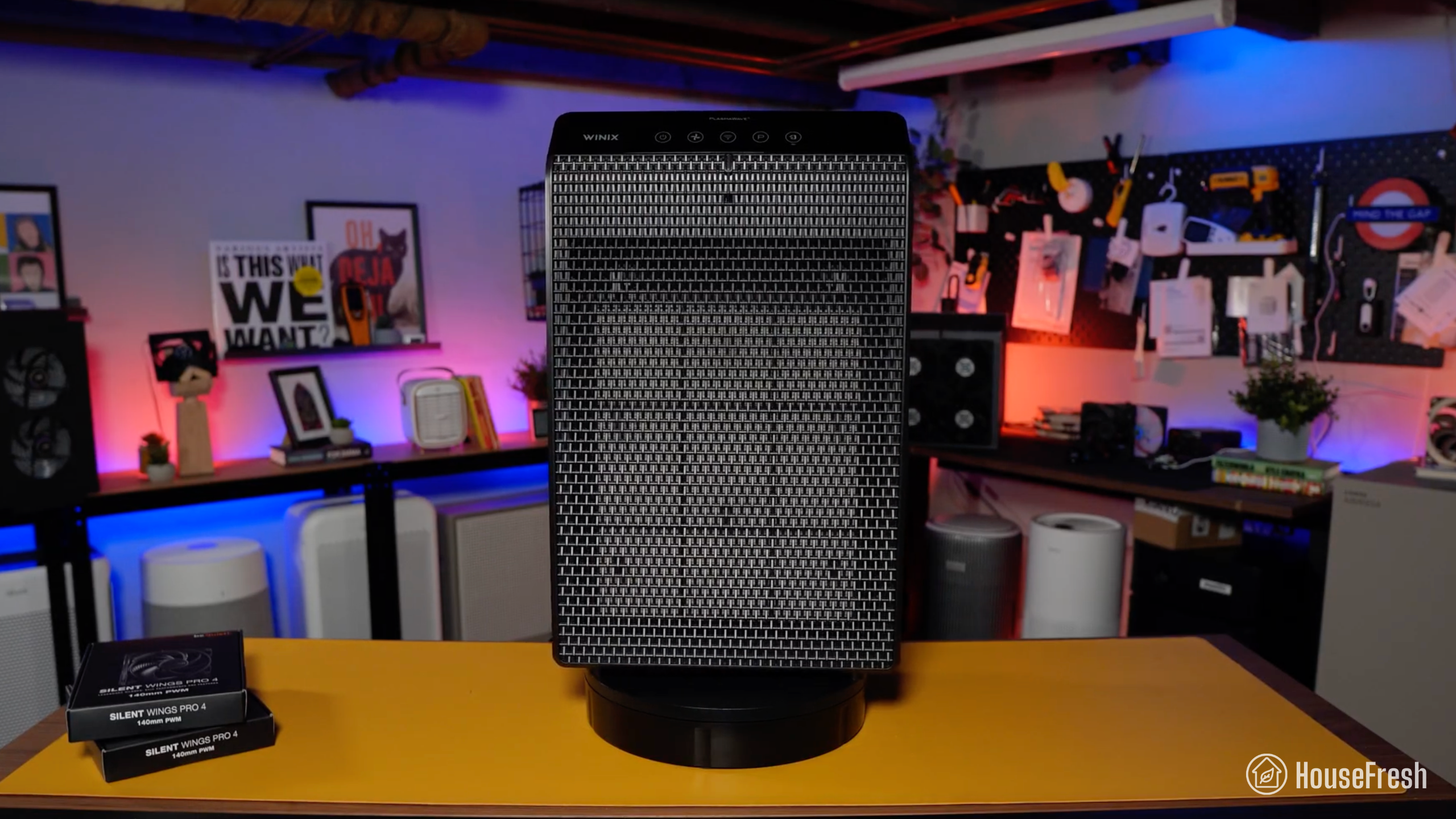
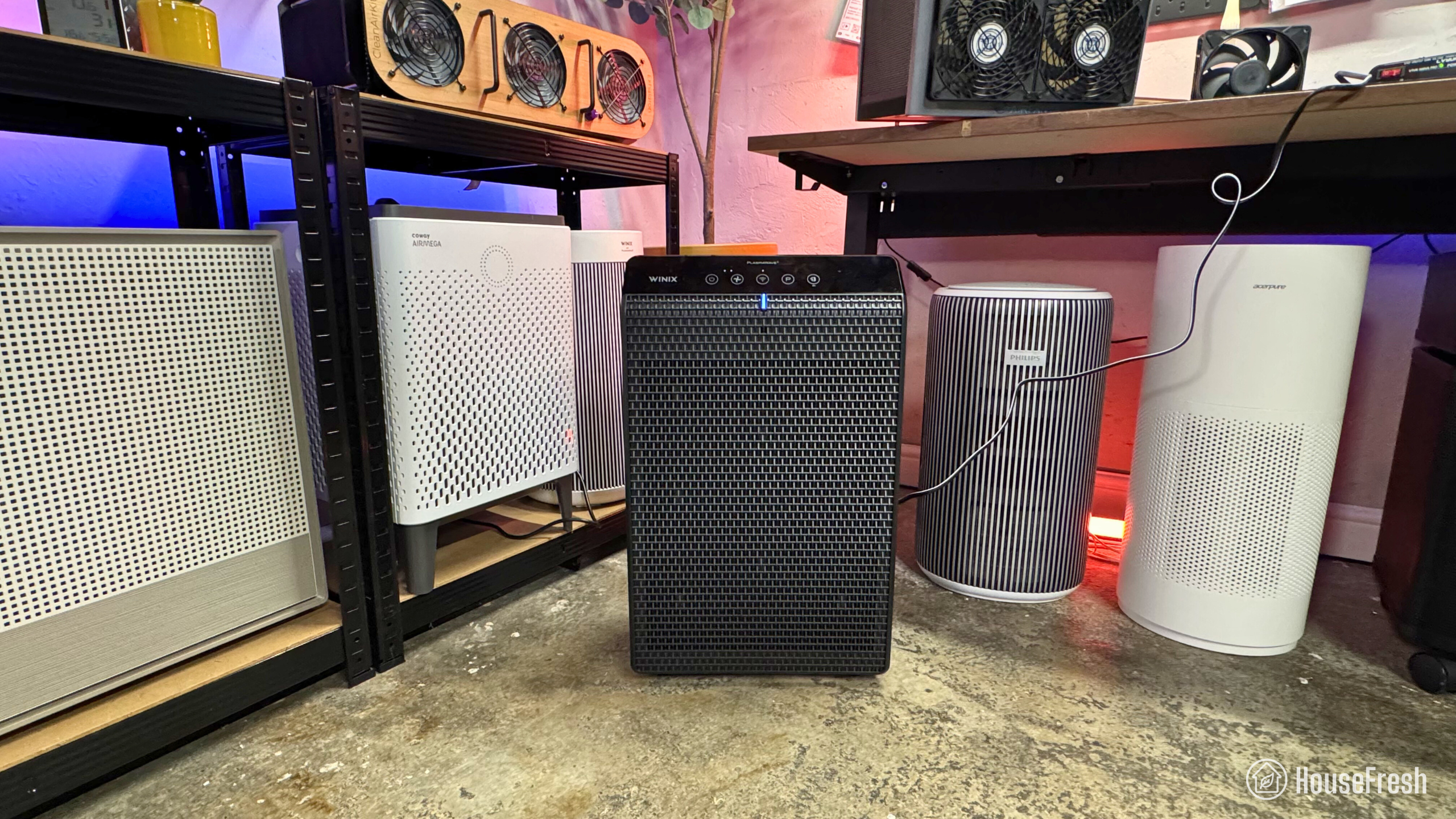
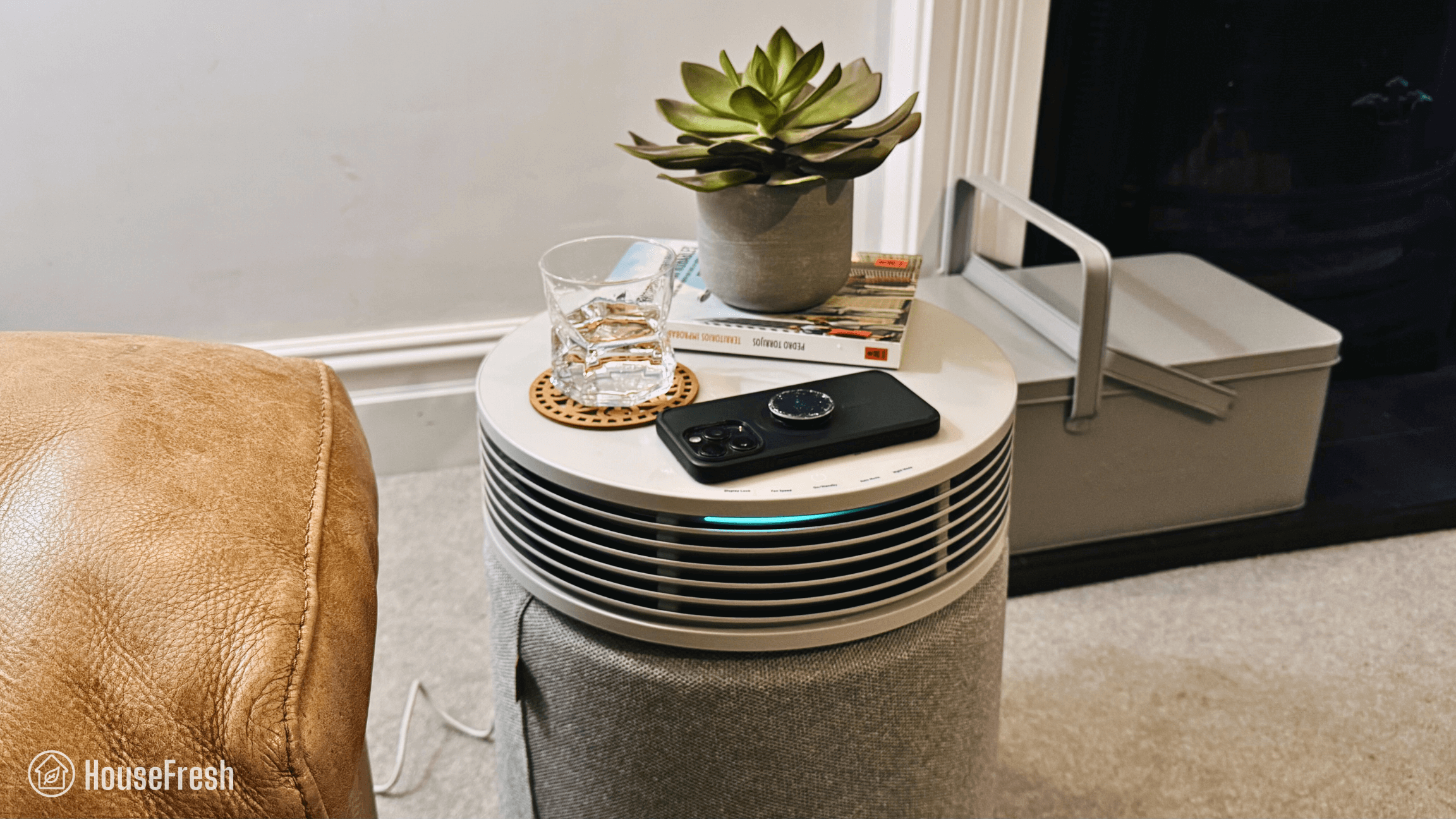
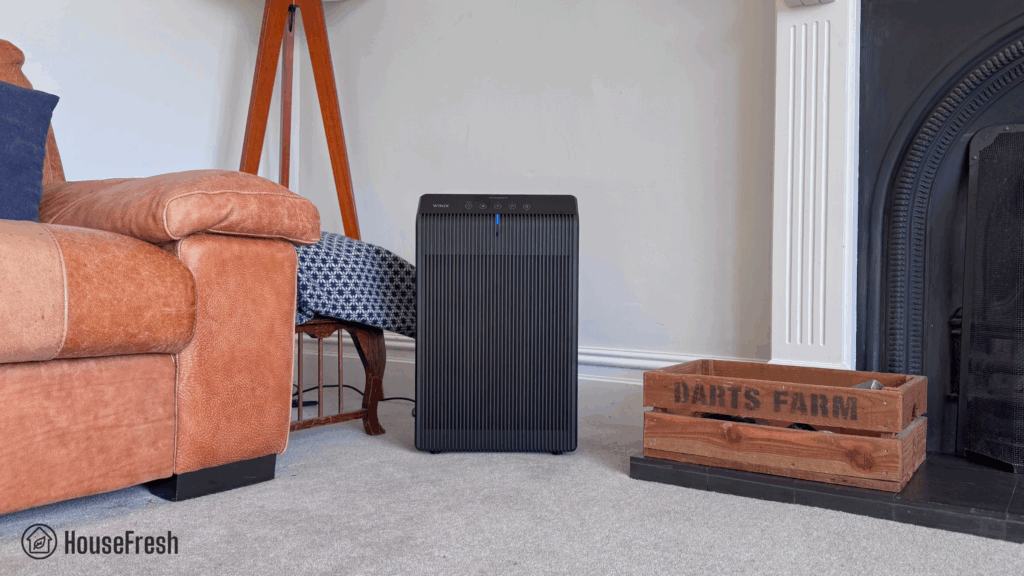
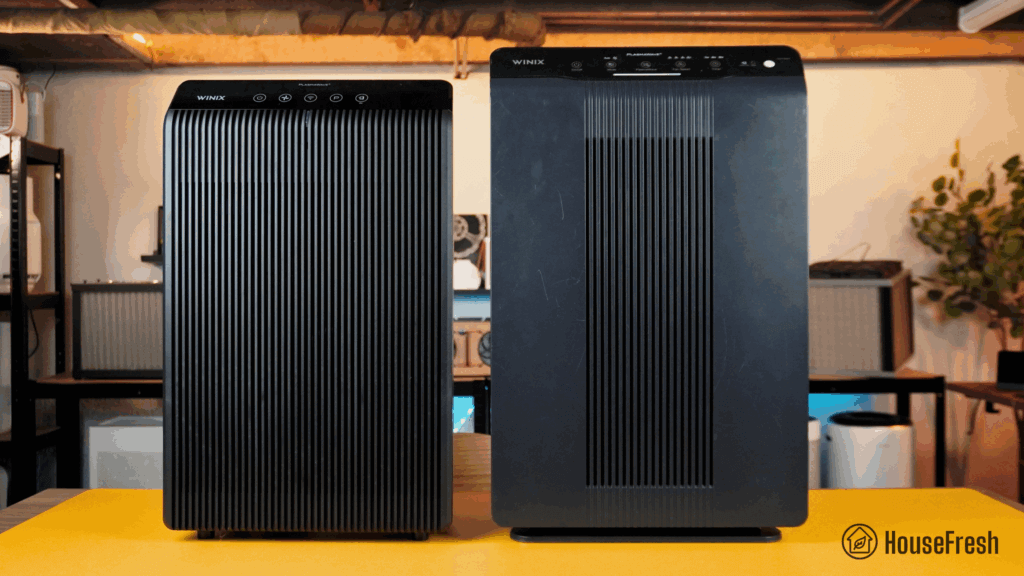
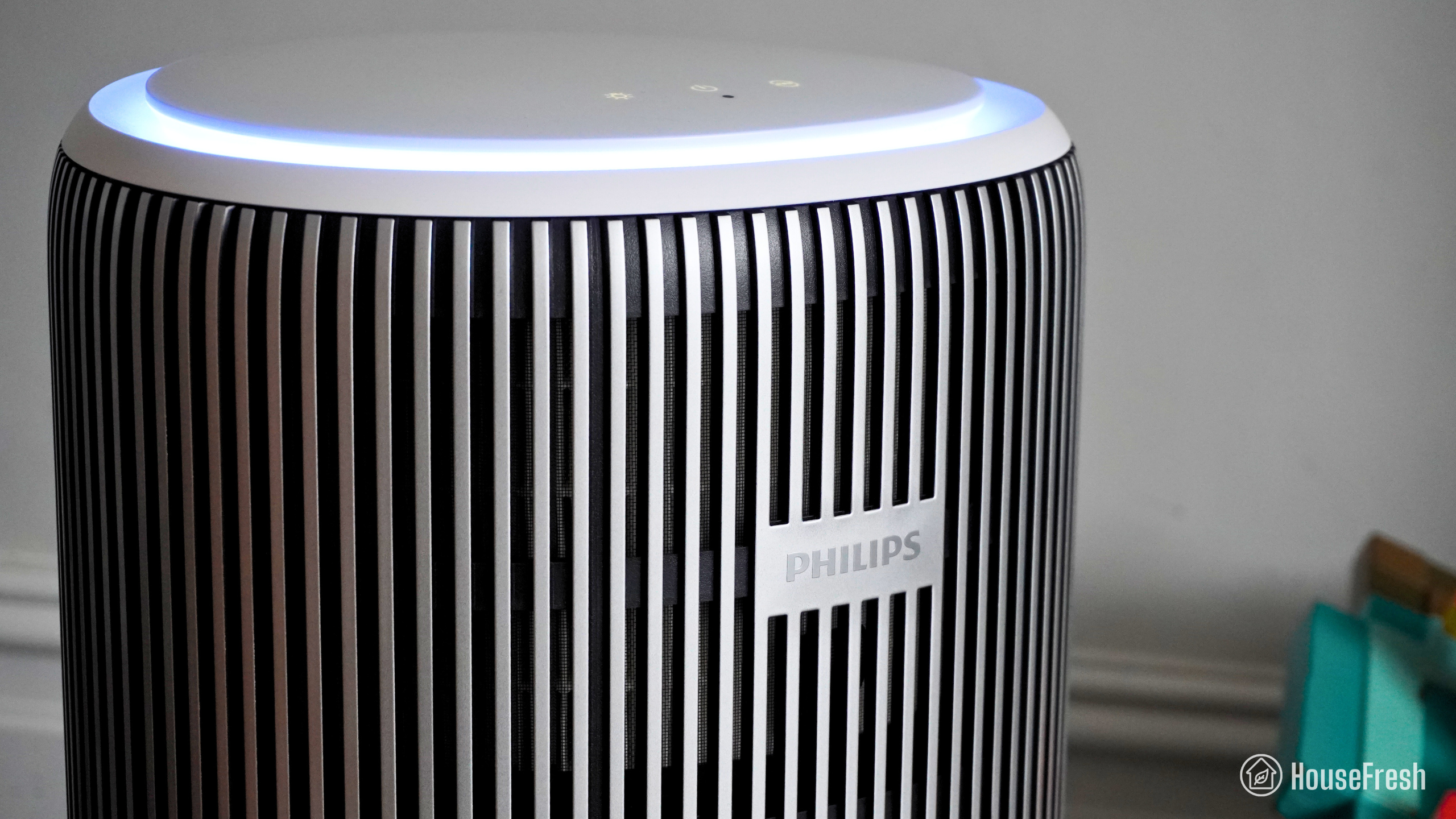
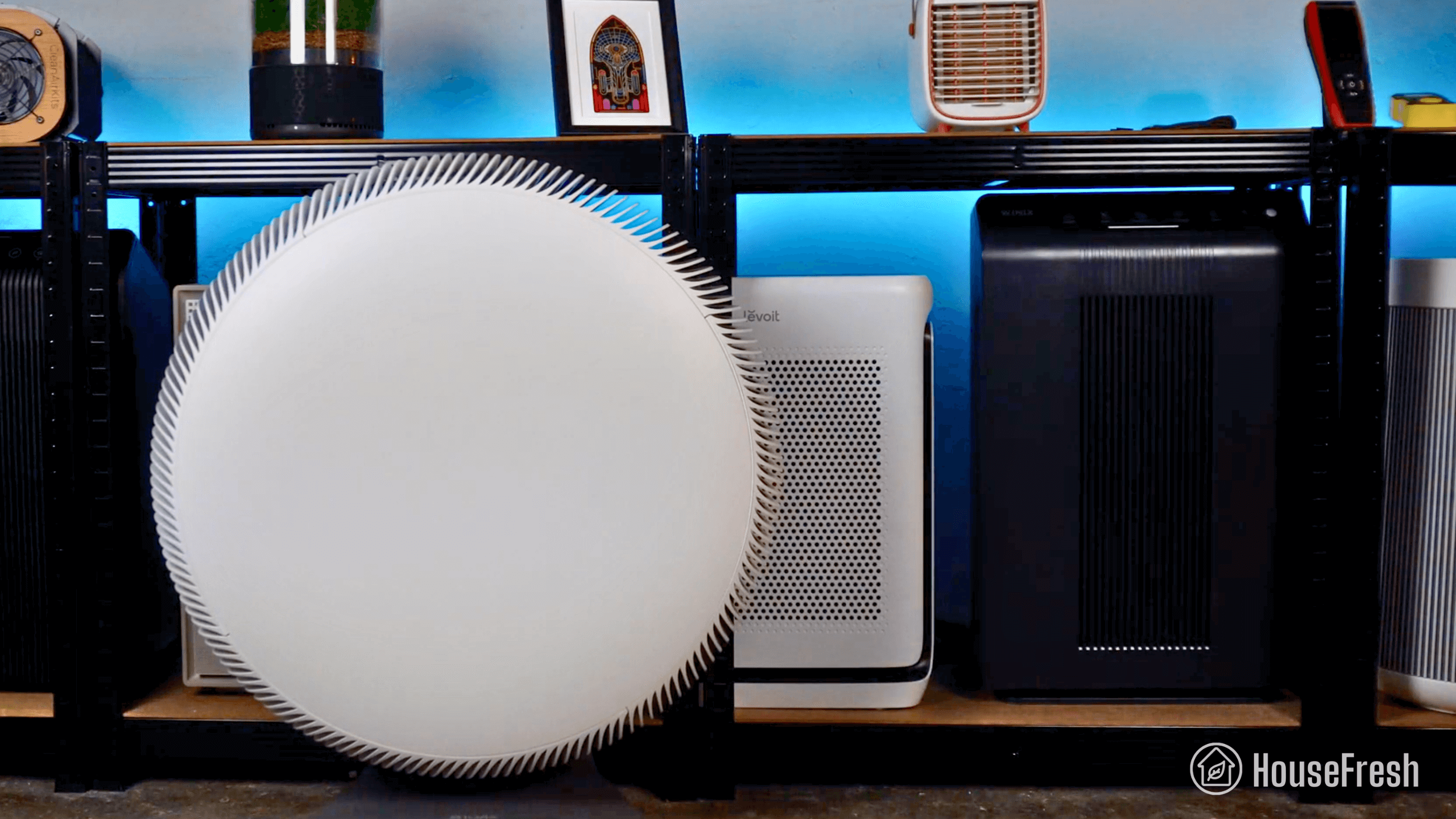
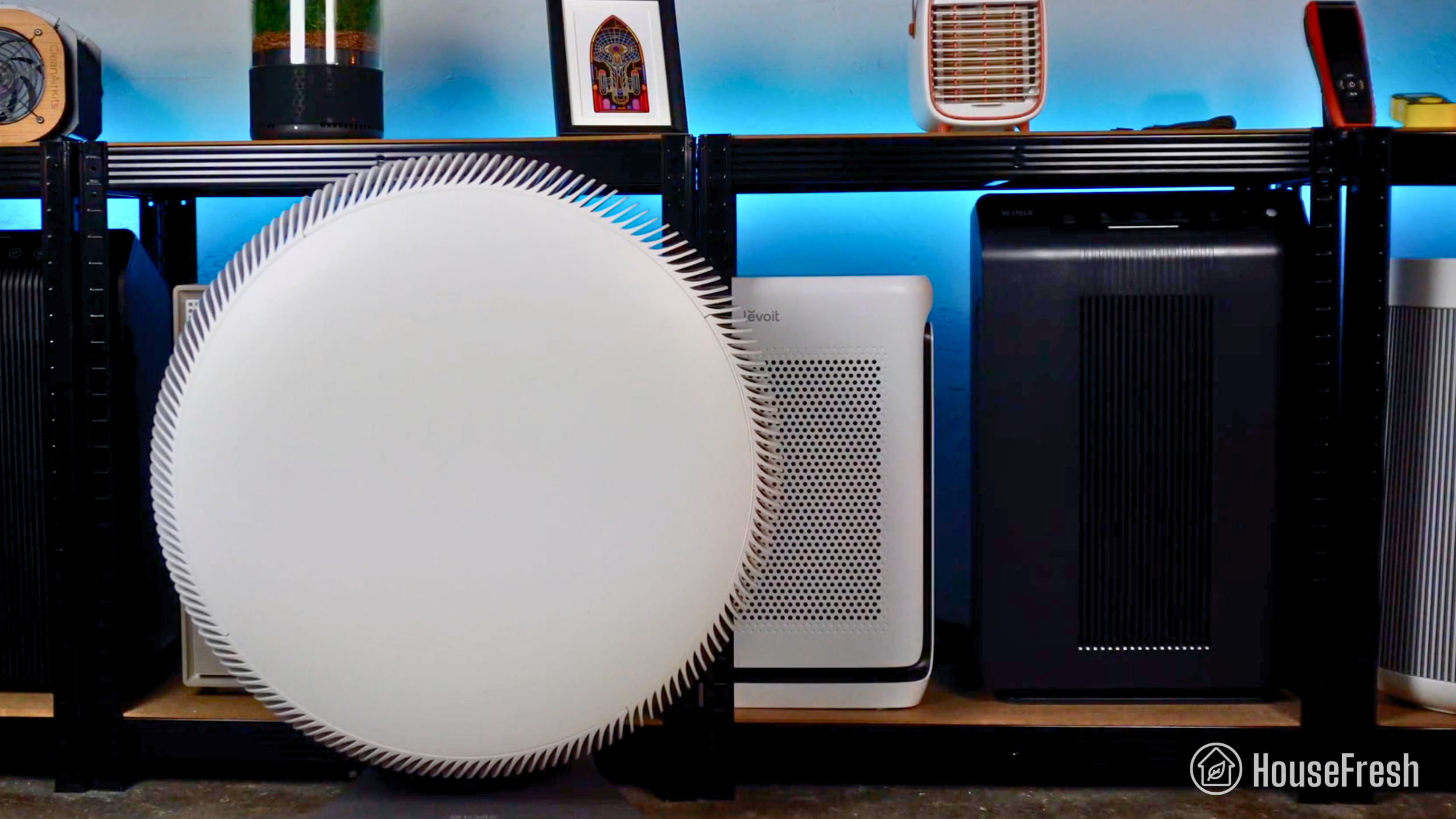
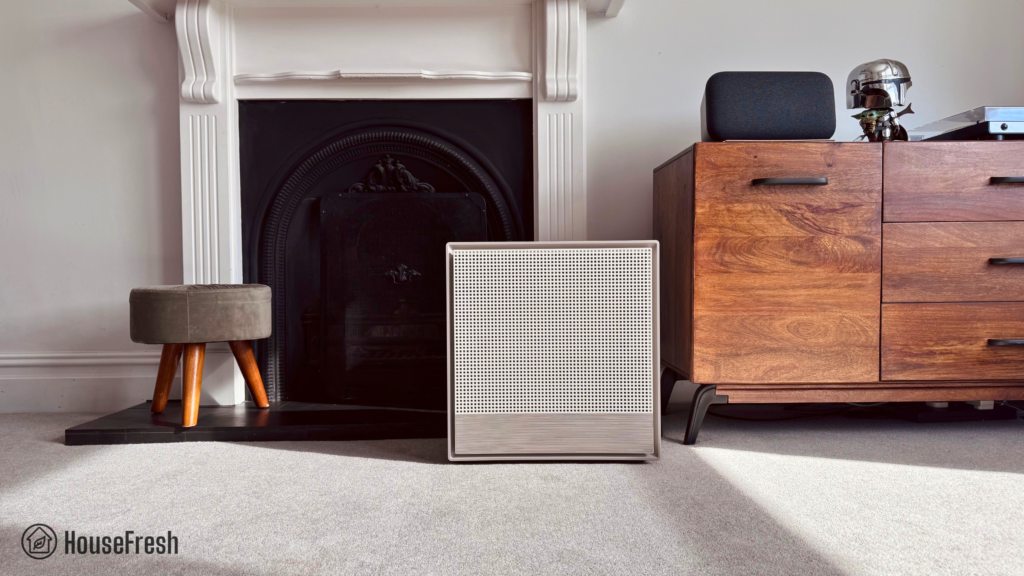
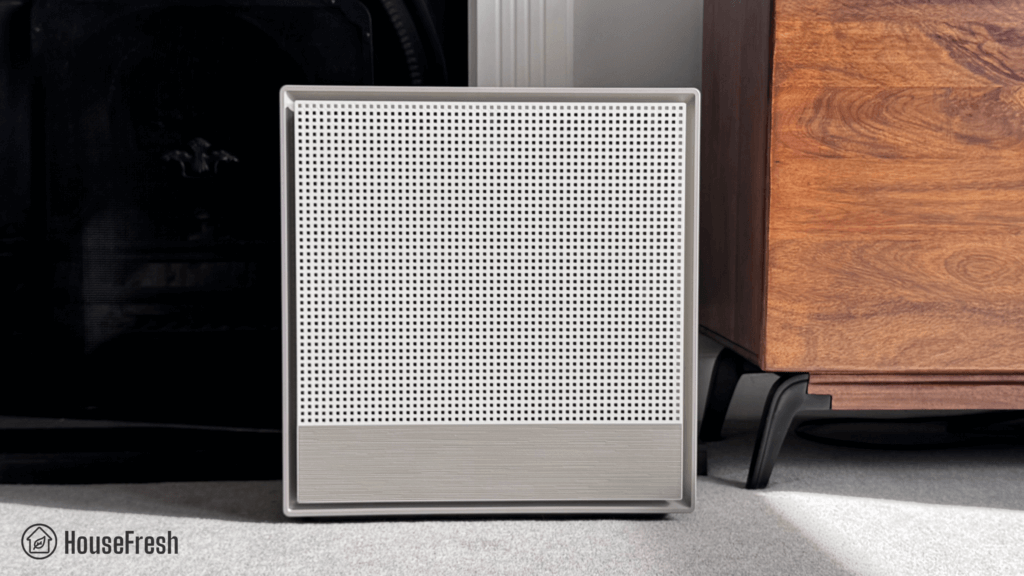
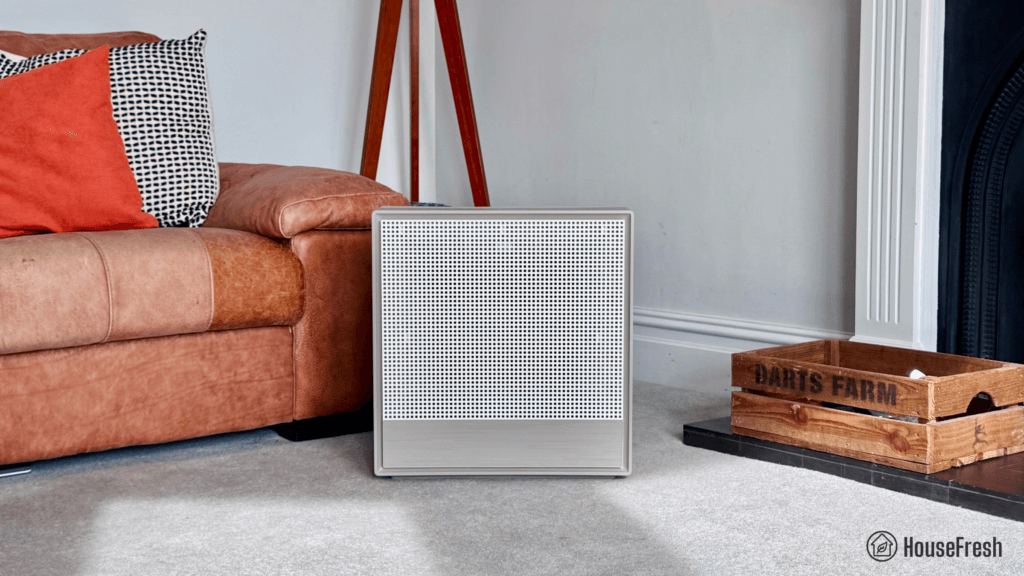
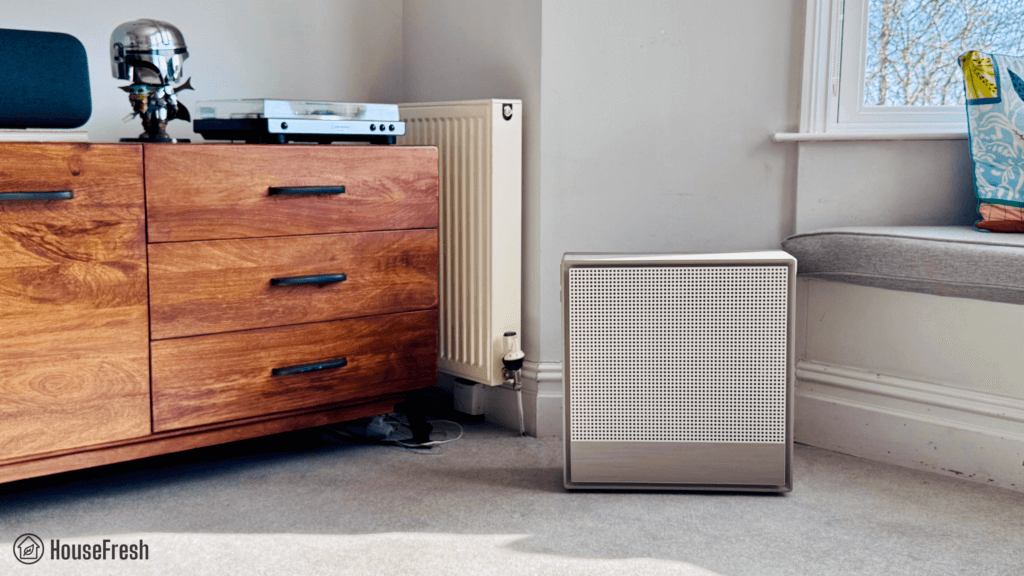
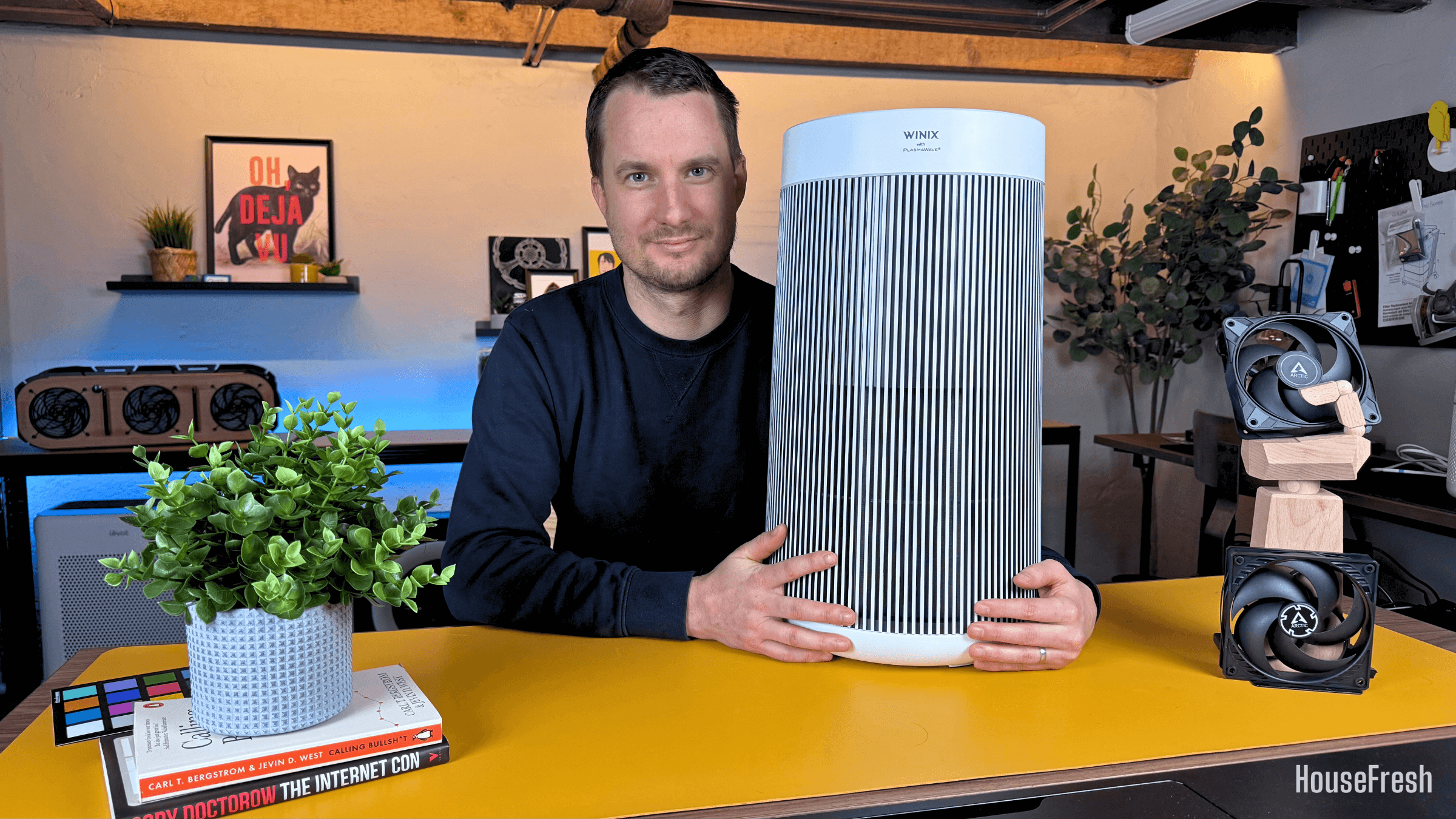
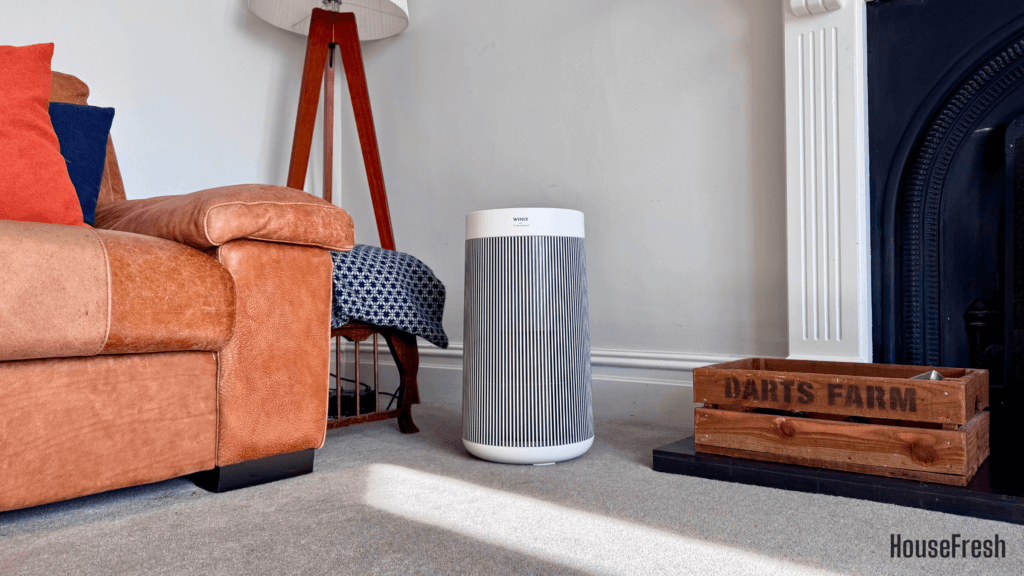
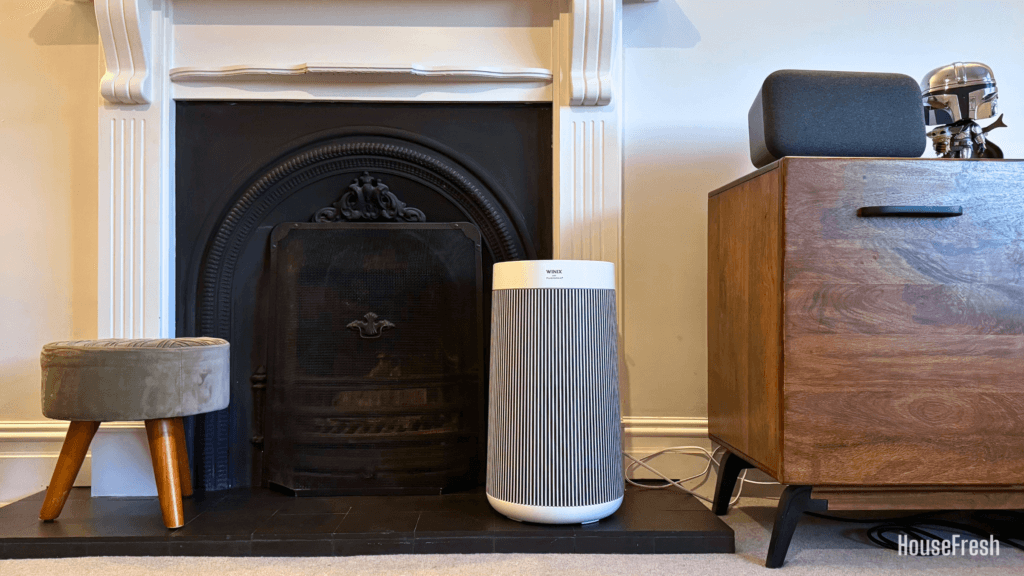
I know looks are subjective, but I really like the look of the 5520, with its understated black design and patterned cover.

Winix 5520 HouseFresh Studio

It’s smaller than the older Winix 5500-2, standing at 22.17 inches (56.31 cm) and weighing 13.3 lb (6 kg).

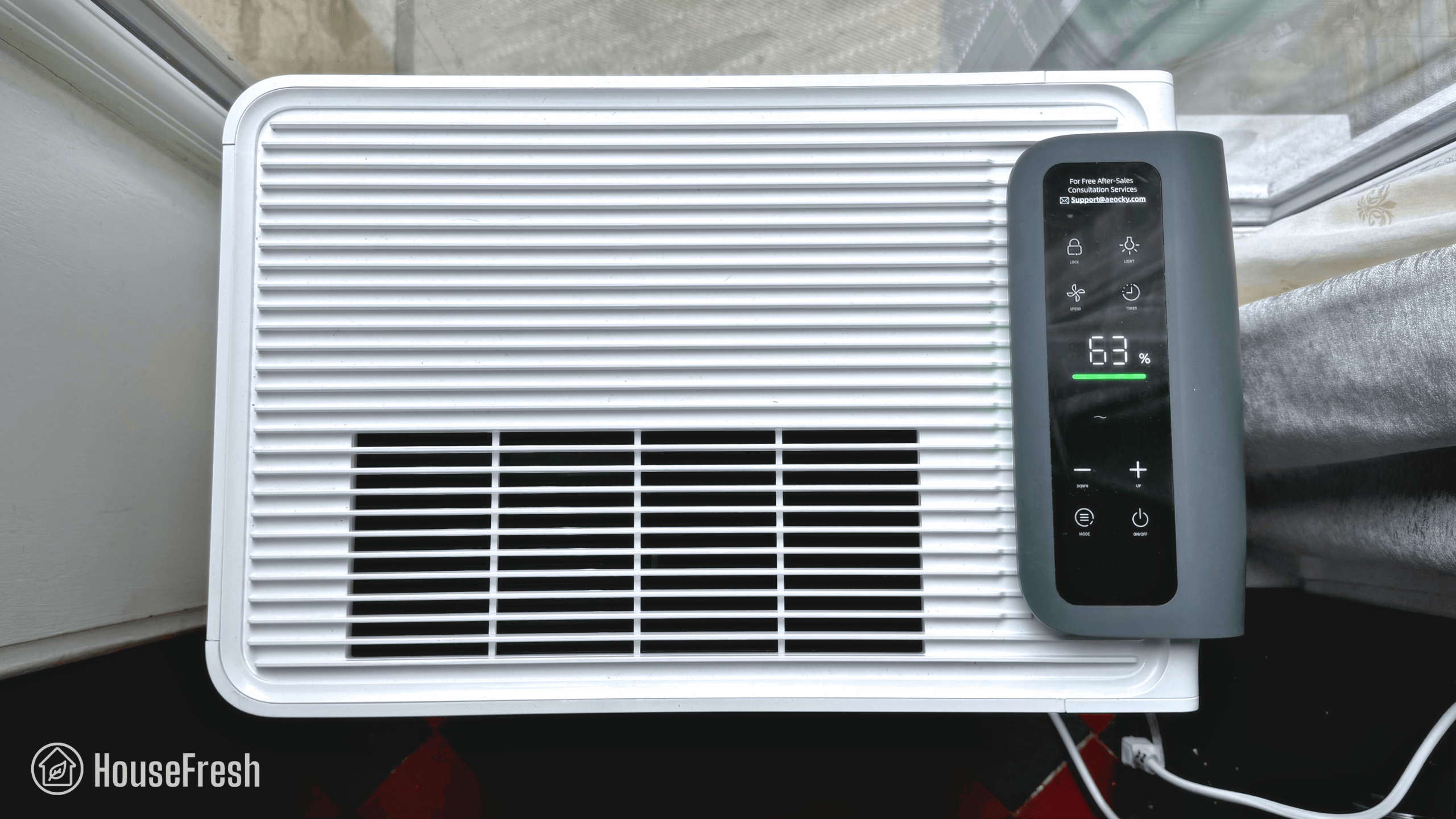
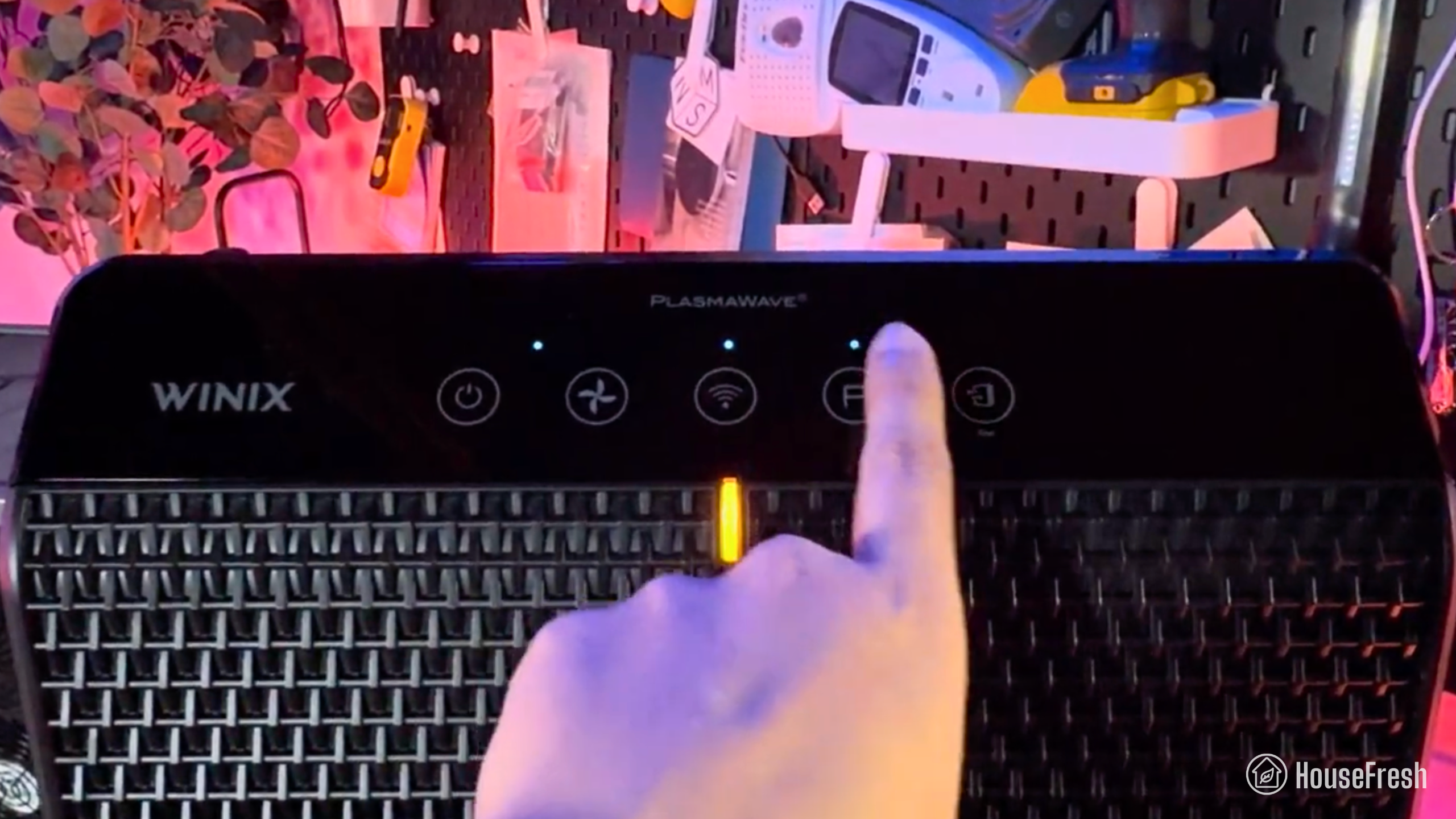
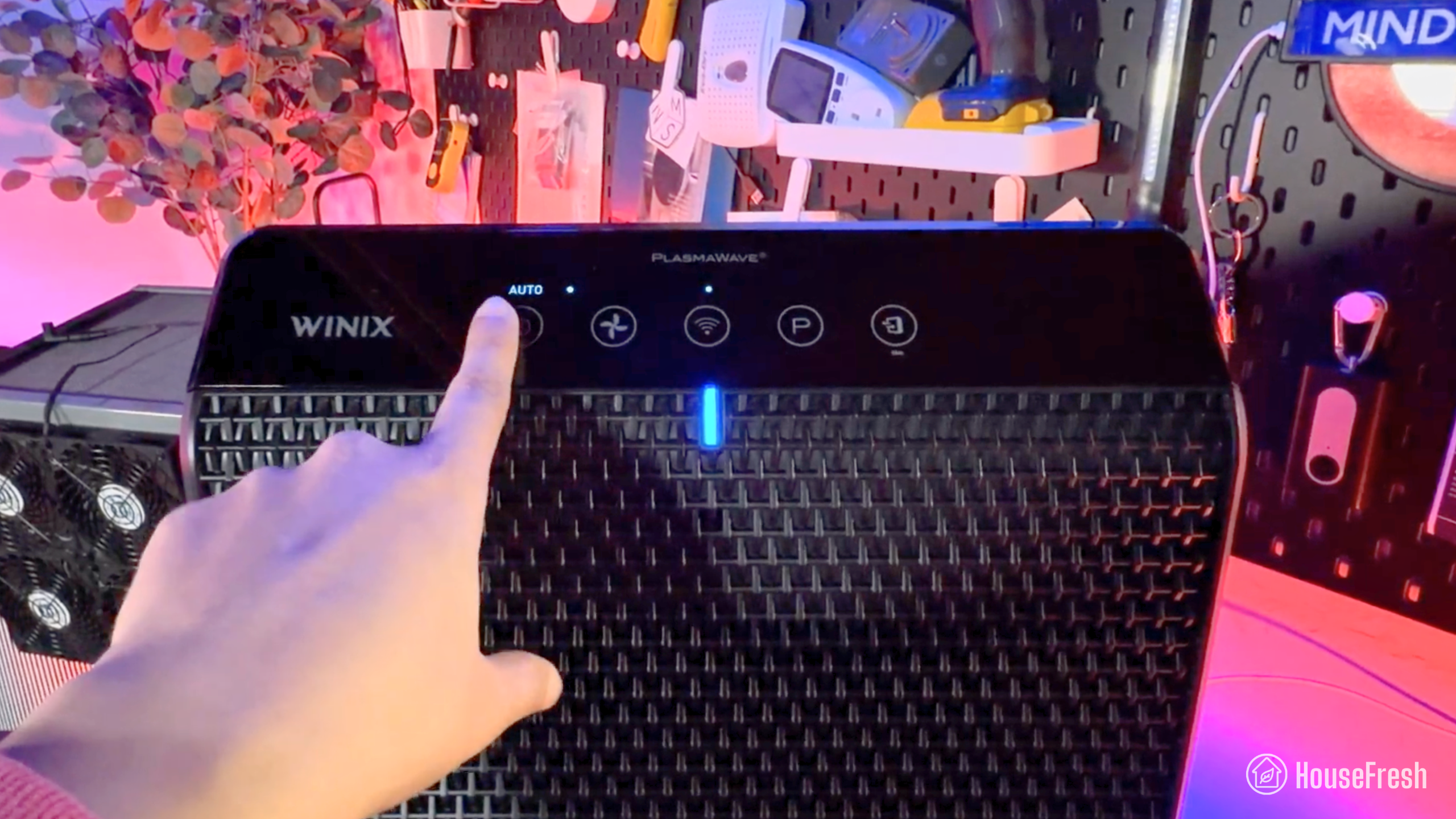
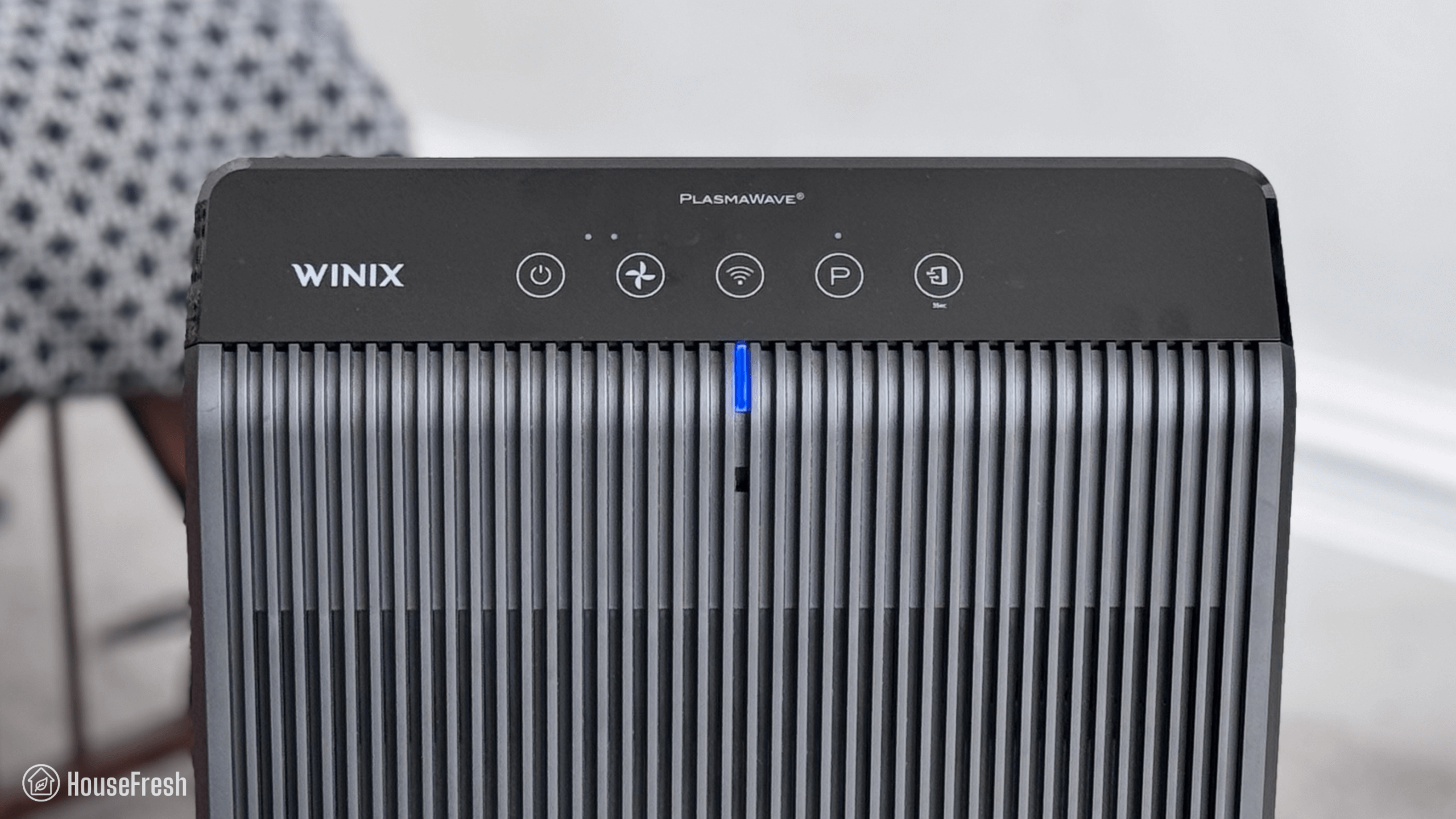
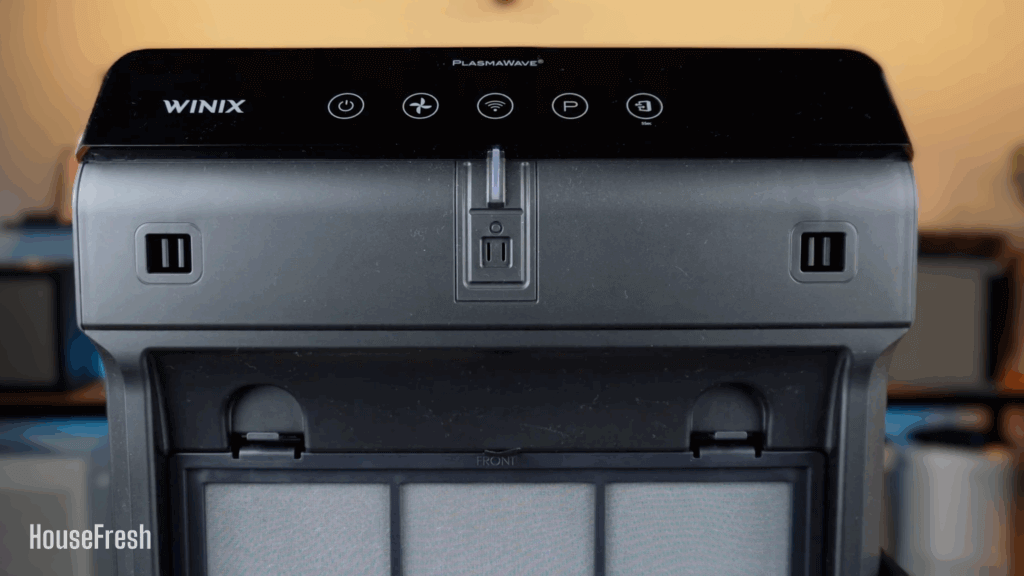
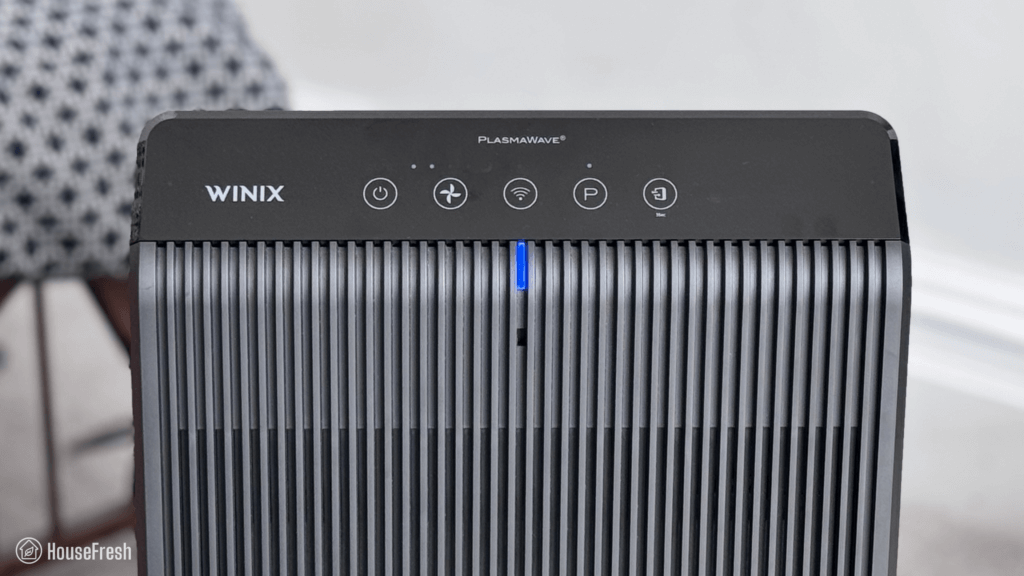
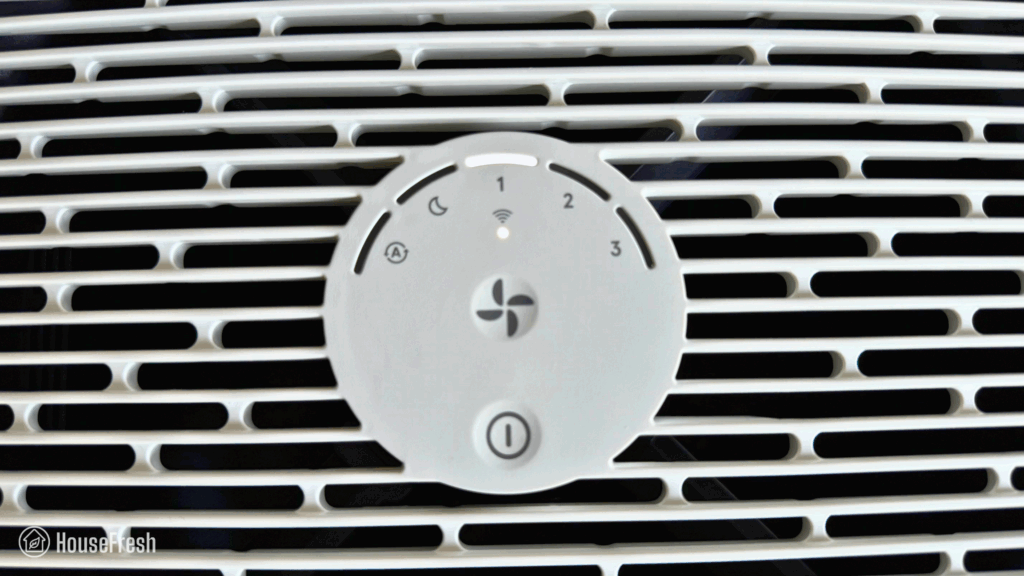
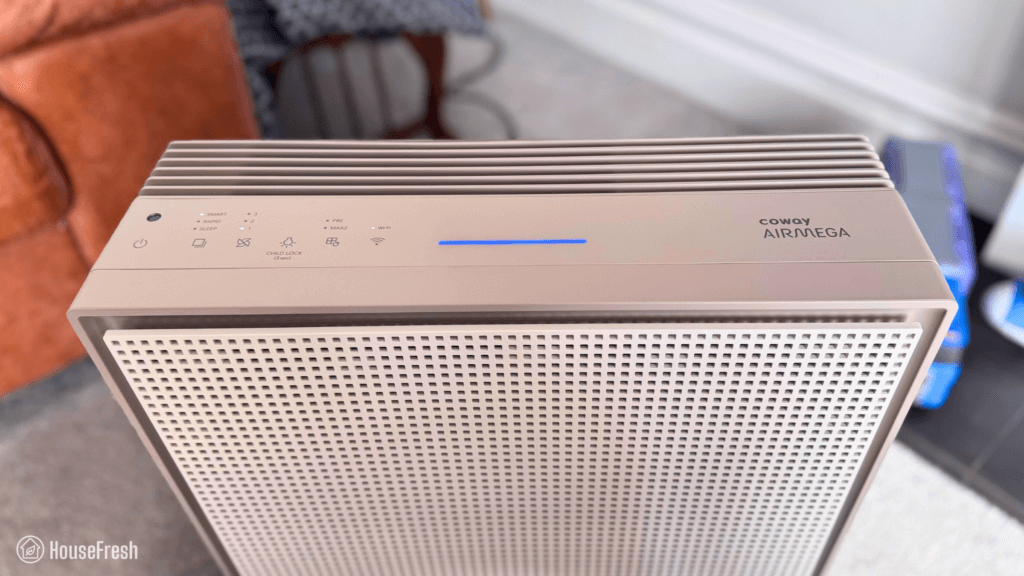
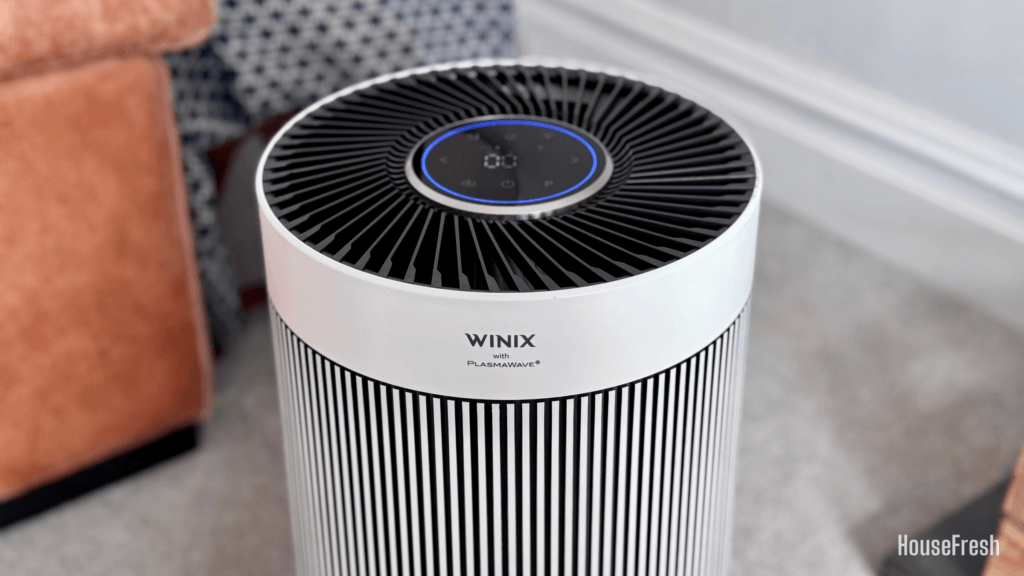
The controls are simple: a power button, a fan speed button (including Sleep and Auto Modes), and a button to engage PlasmaWave.

Winix 5520 Controls

You don’t get a child lock or a timer button, which are common features you will find in other mid-sized air purifiers.

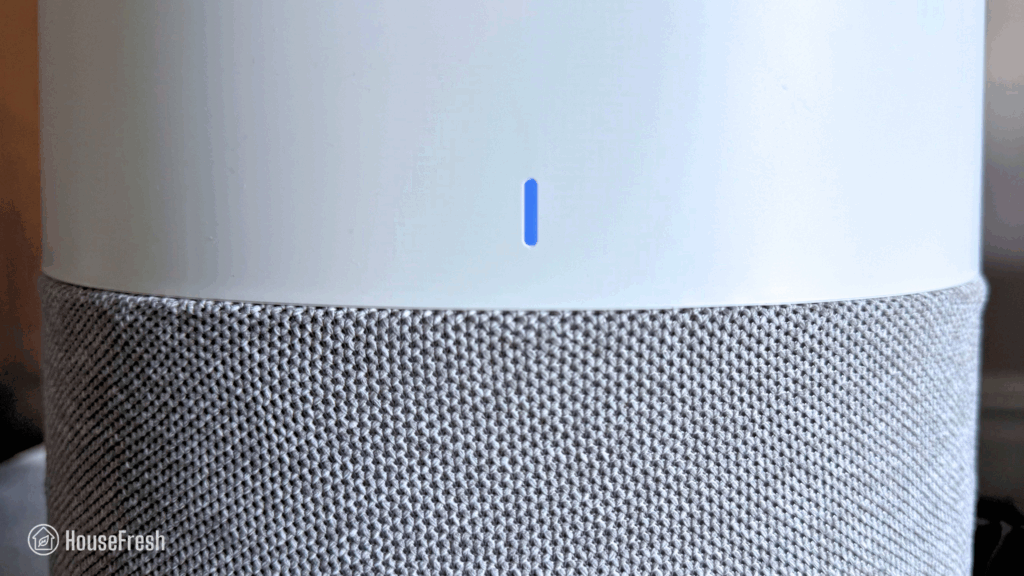
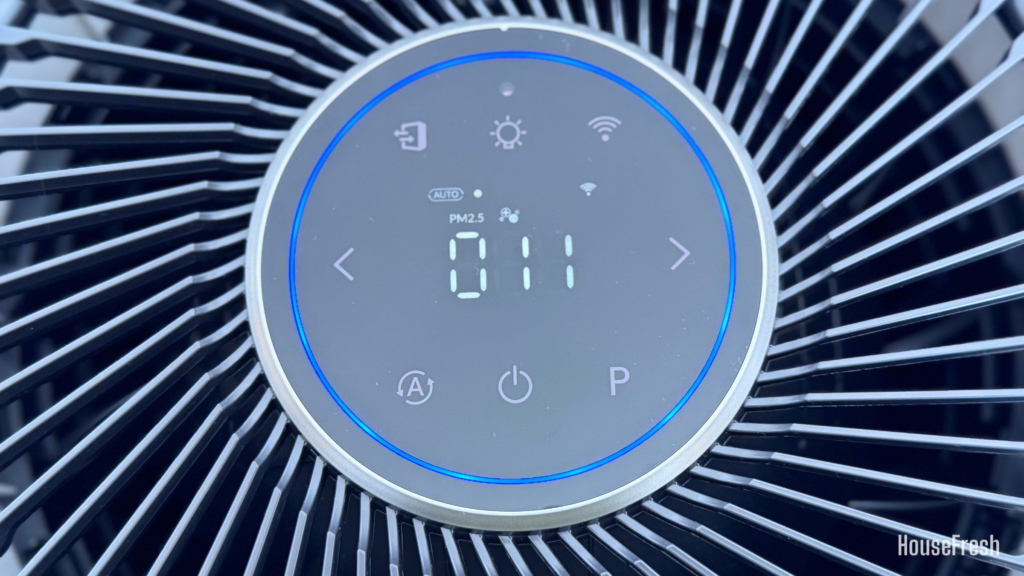
It has a gas sensor that informs the air quality indicator light at the front, which changes from Blue (good) to Amber (poor) to Red (bad).

Winix 5520 Close

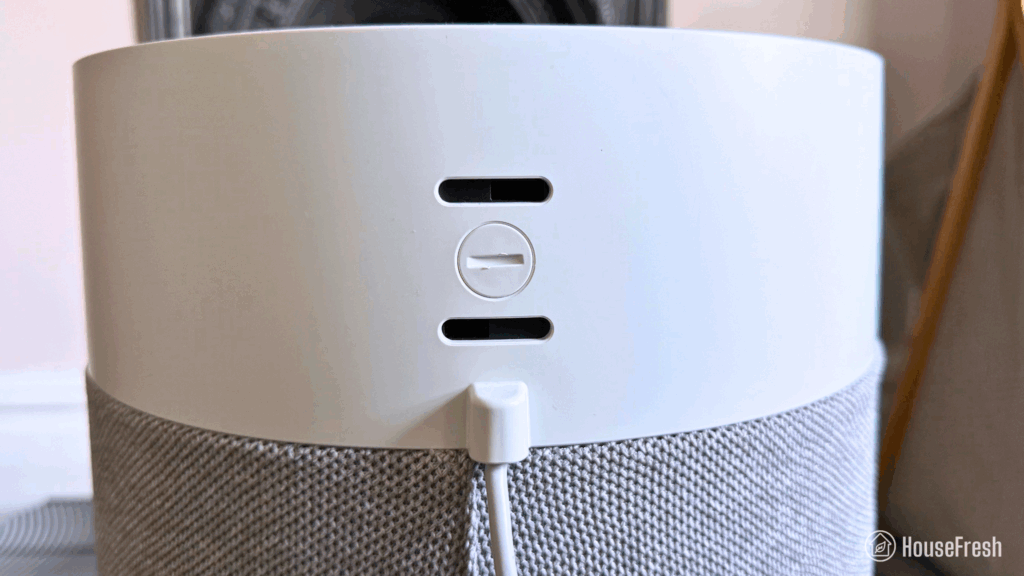
It also has a light sensor at the top, which will react to changes in ambient light, switching the air purifier to low-light in the dark.

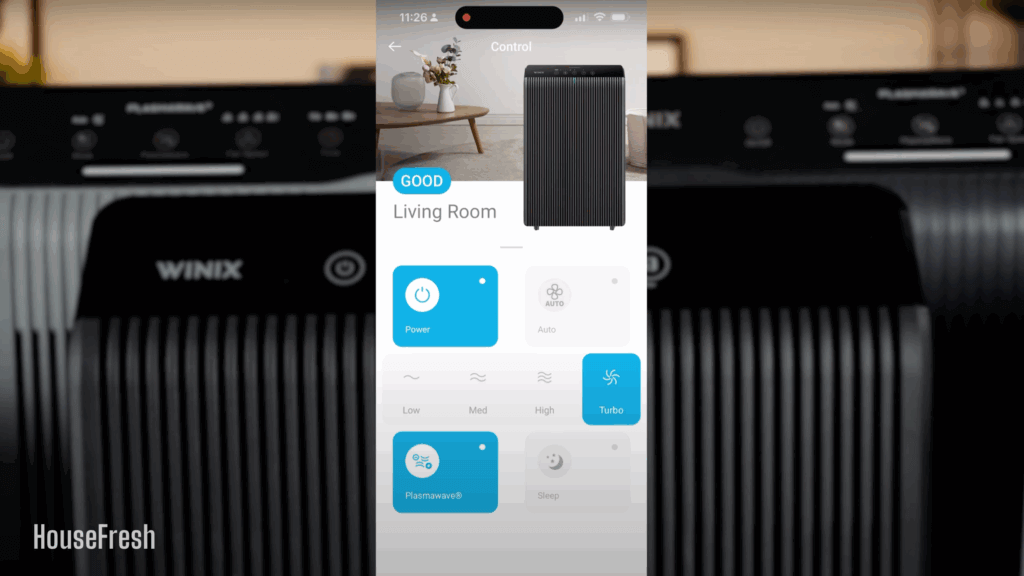
Winix 5510 App

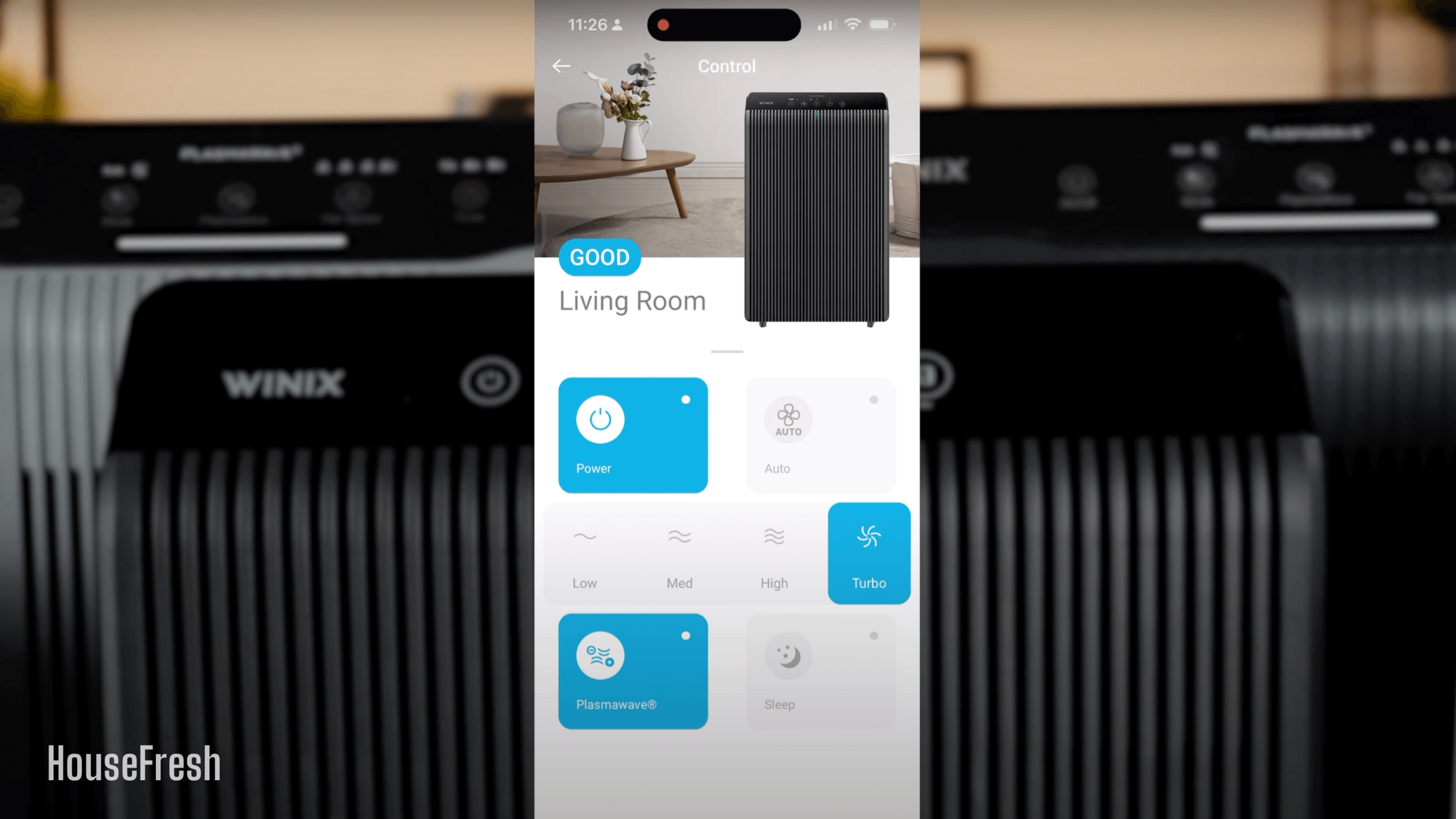
You can connect the 5520 to your smartphone via the Winix Smart app, which is available on bothย iPhoneย andย Android.

The app has a clean design and a good UX, with no major issues. It lets you adjust fan speeds remotely from your phone, monitor filter life, and track air quality data from the sensor.

After using other apps from different manufacturers, I found the Winix Smart app pretty bare – it misses features that are common in apps from brands like Xiaomi and Levoit.

Air cleaning performance

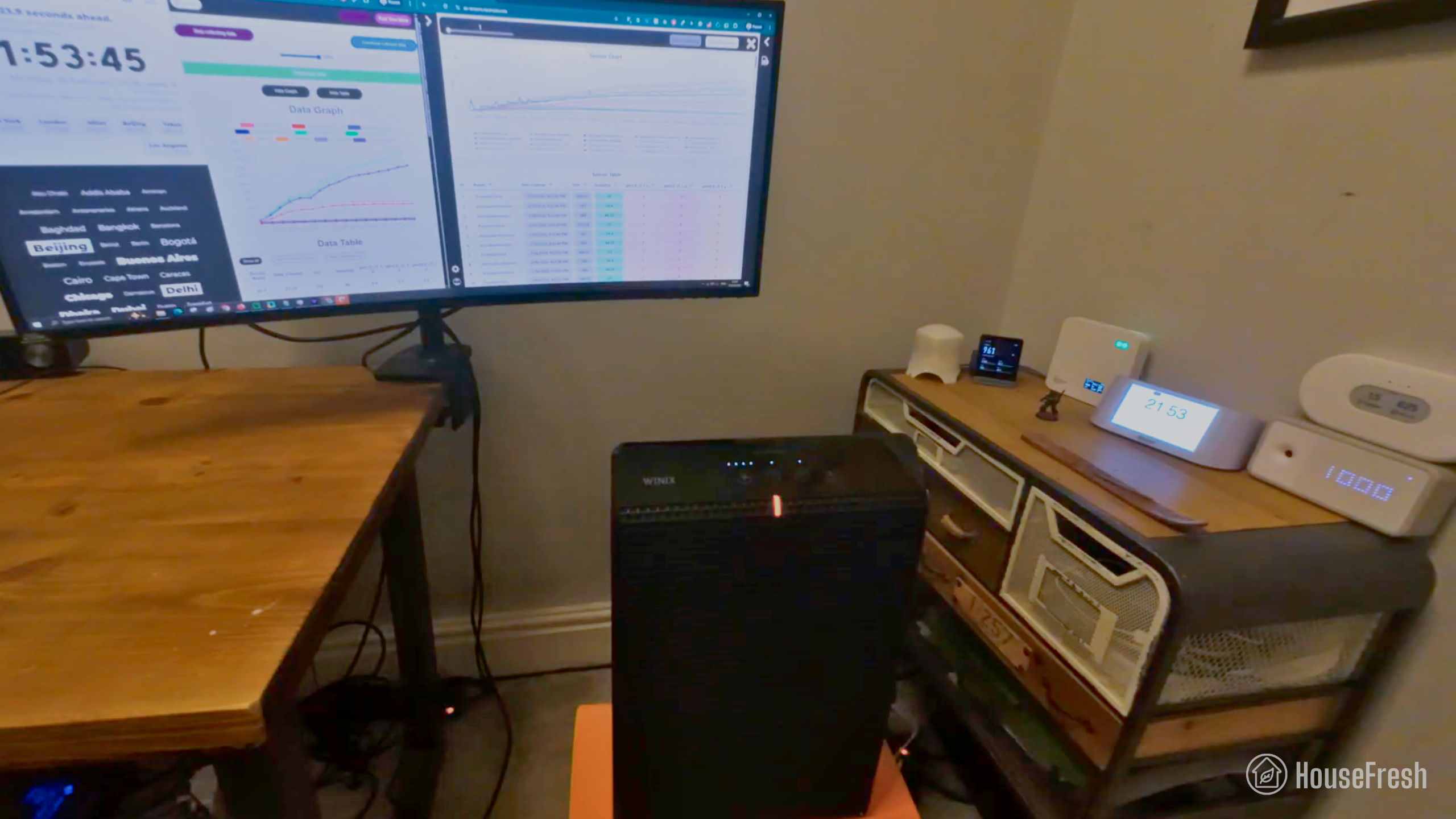
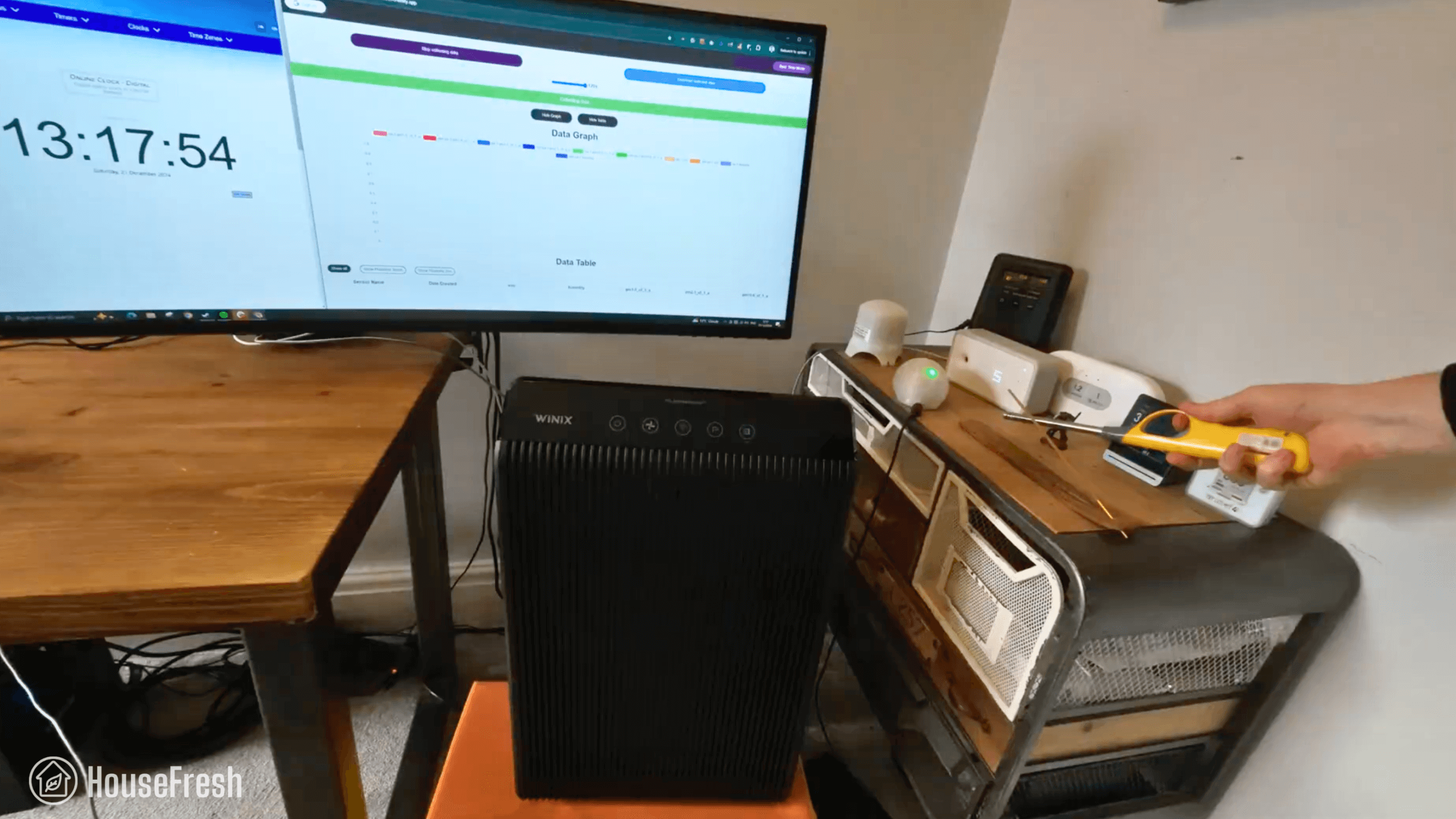
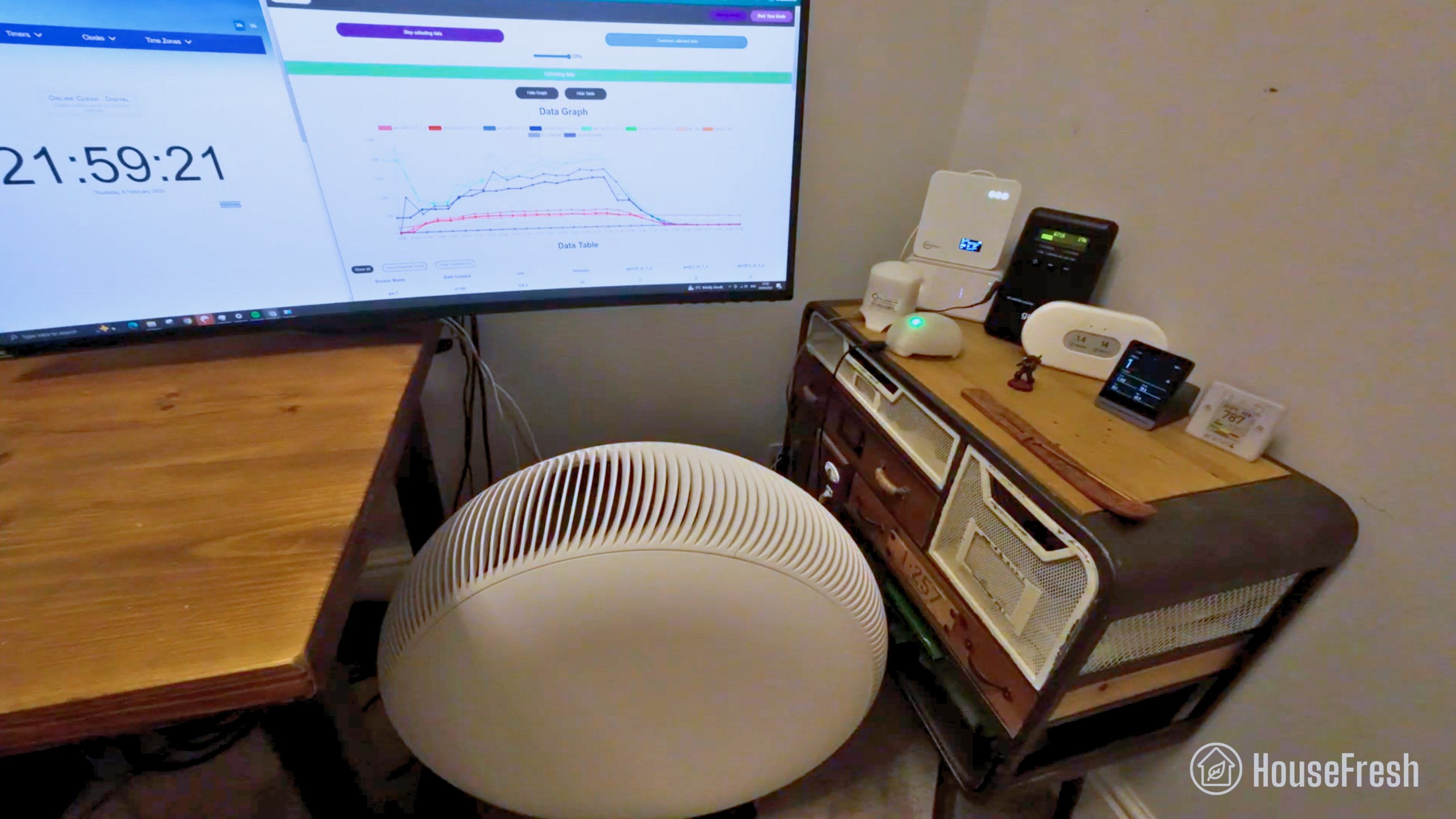
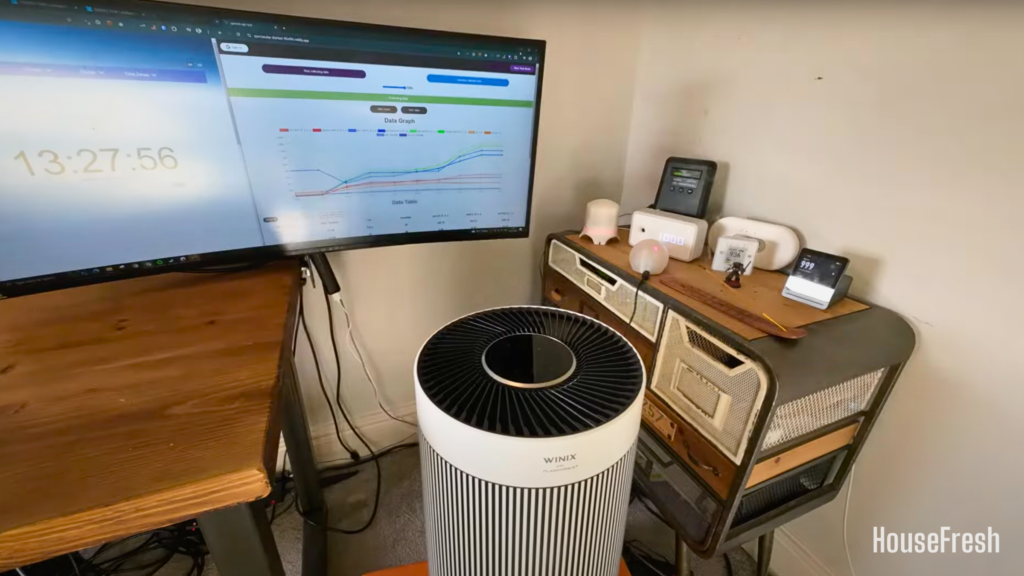
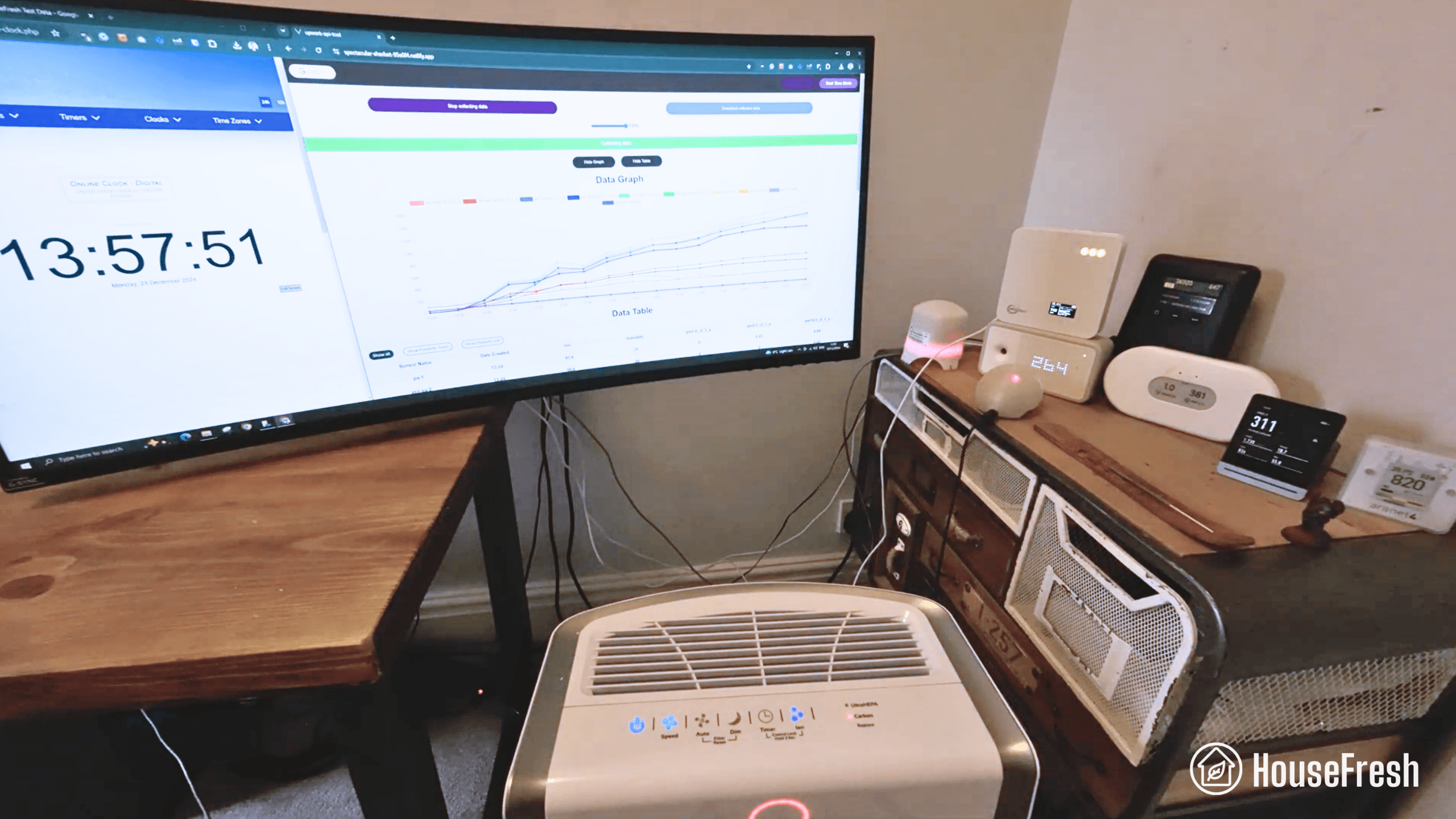
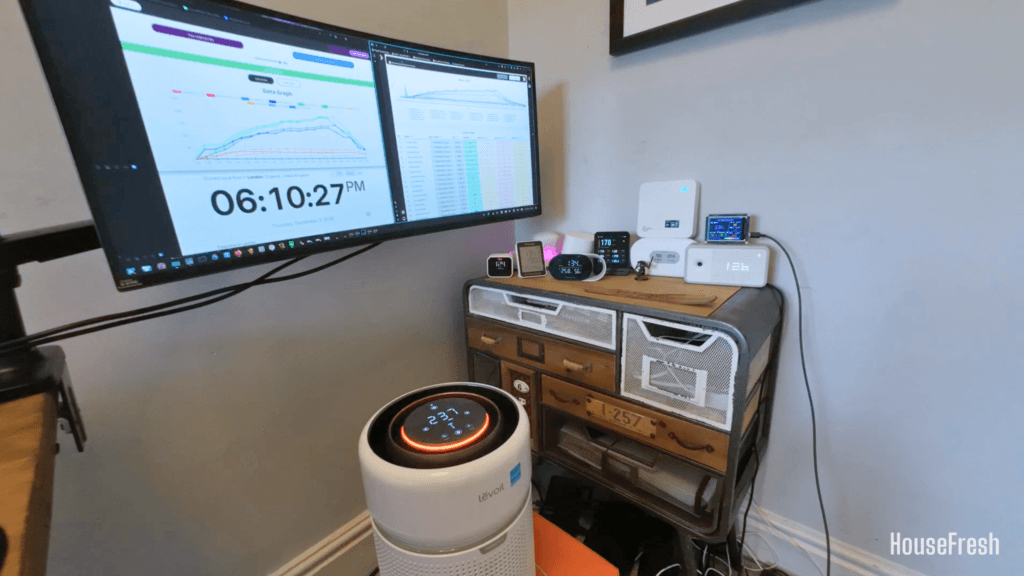
We tested the Winix 5520 in our 728 cubic ft. test room, tracking how fast it removed all PM1 particles from the air after we filled the space with incense smoke.
Winix 5520 Performance Test

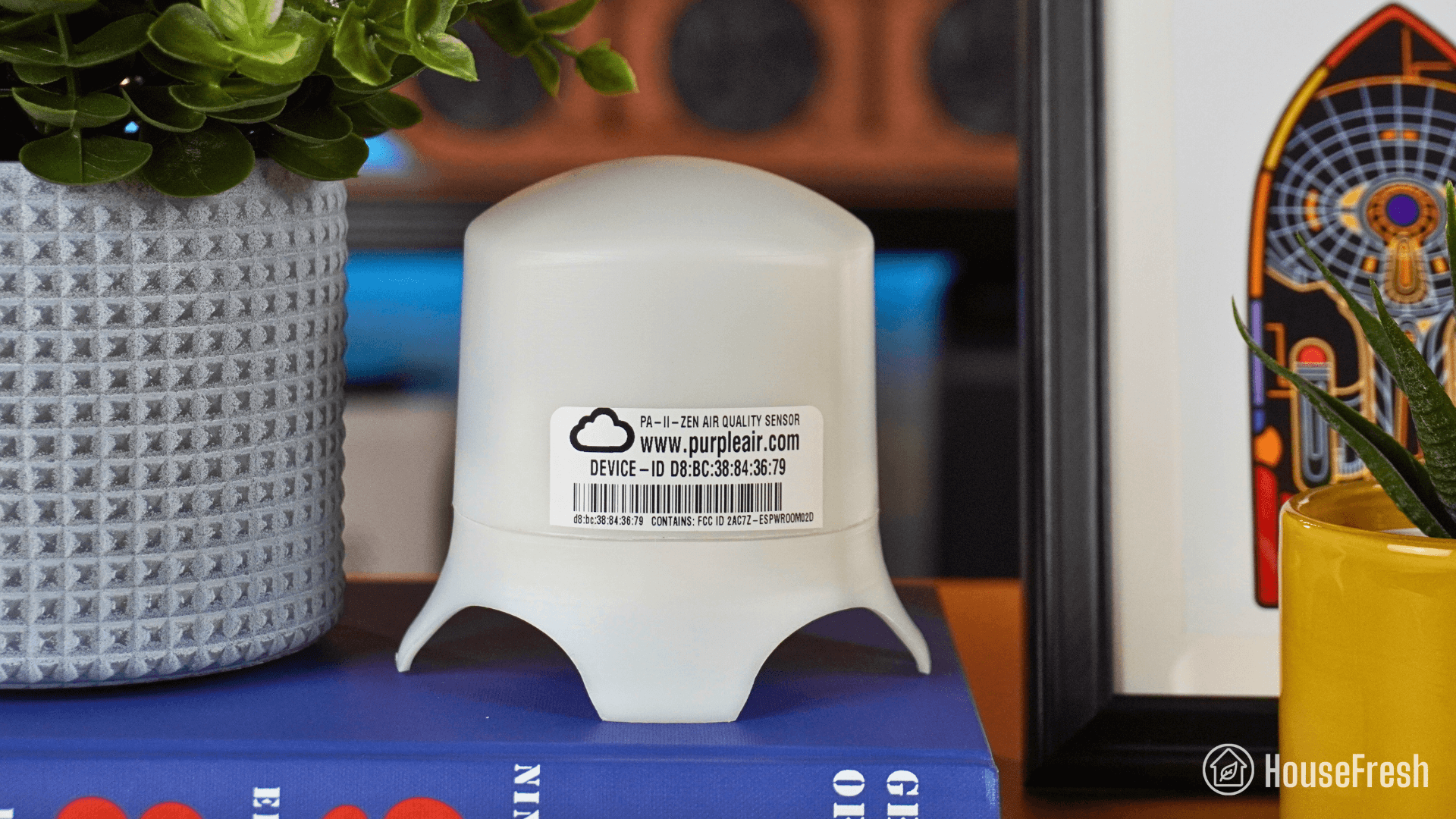
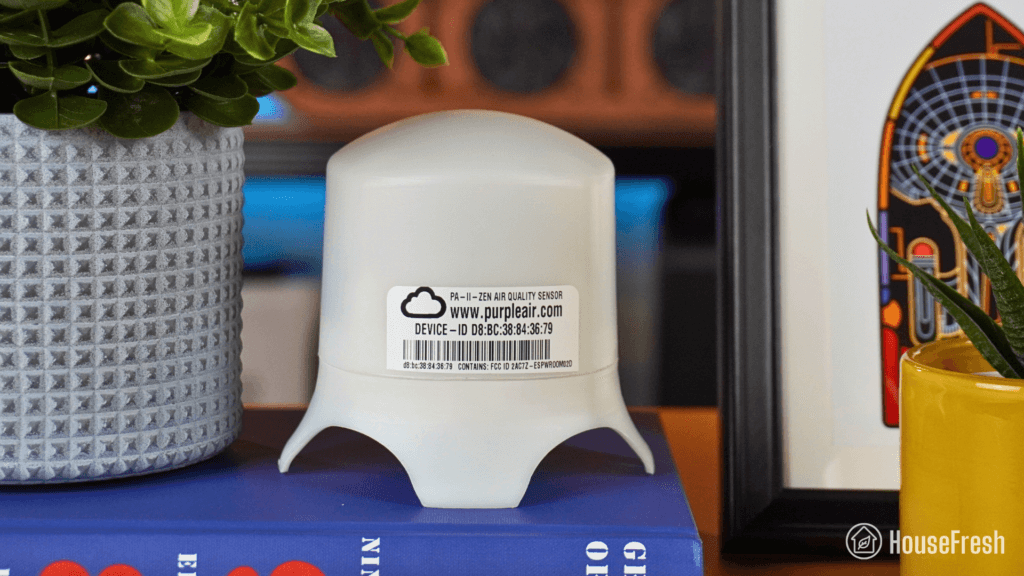
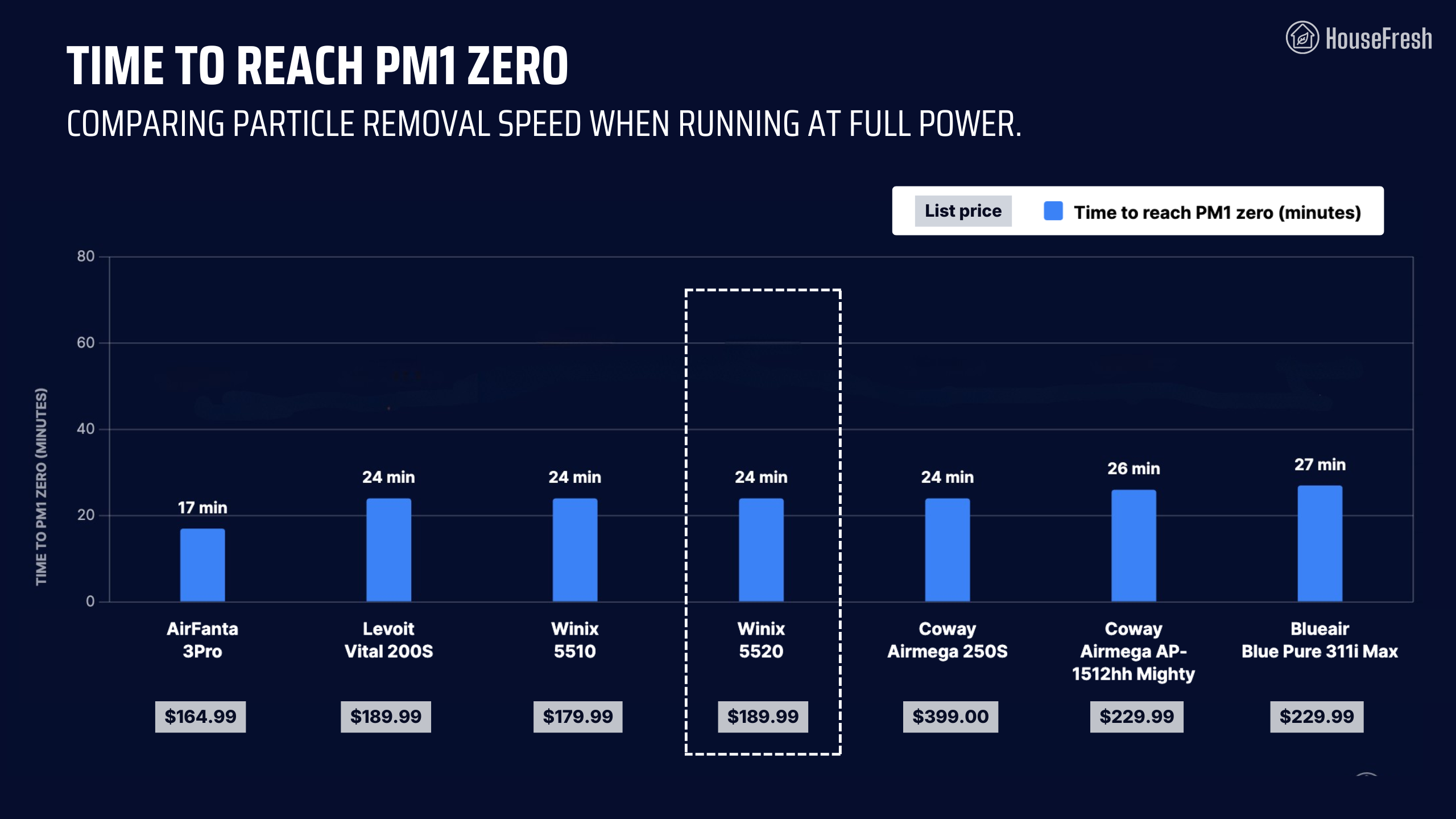
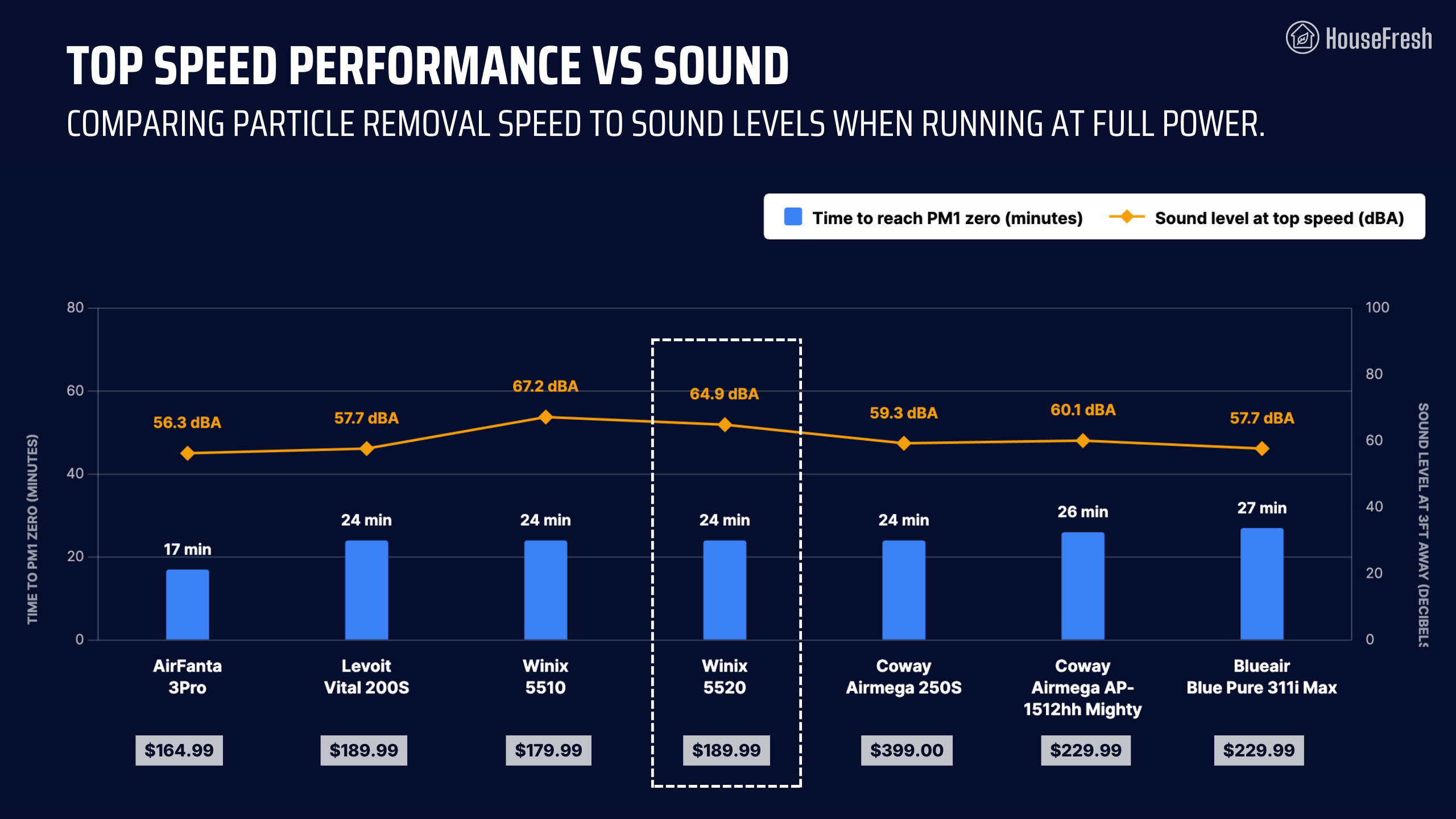
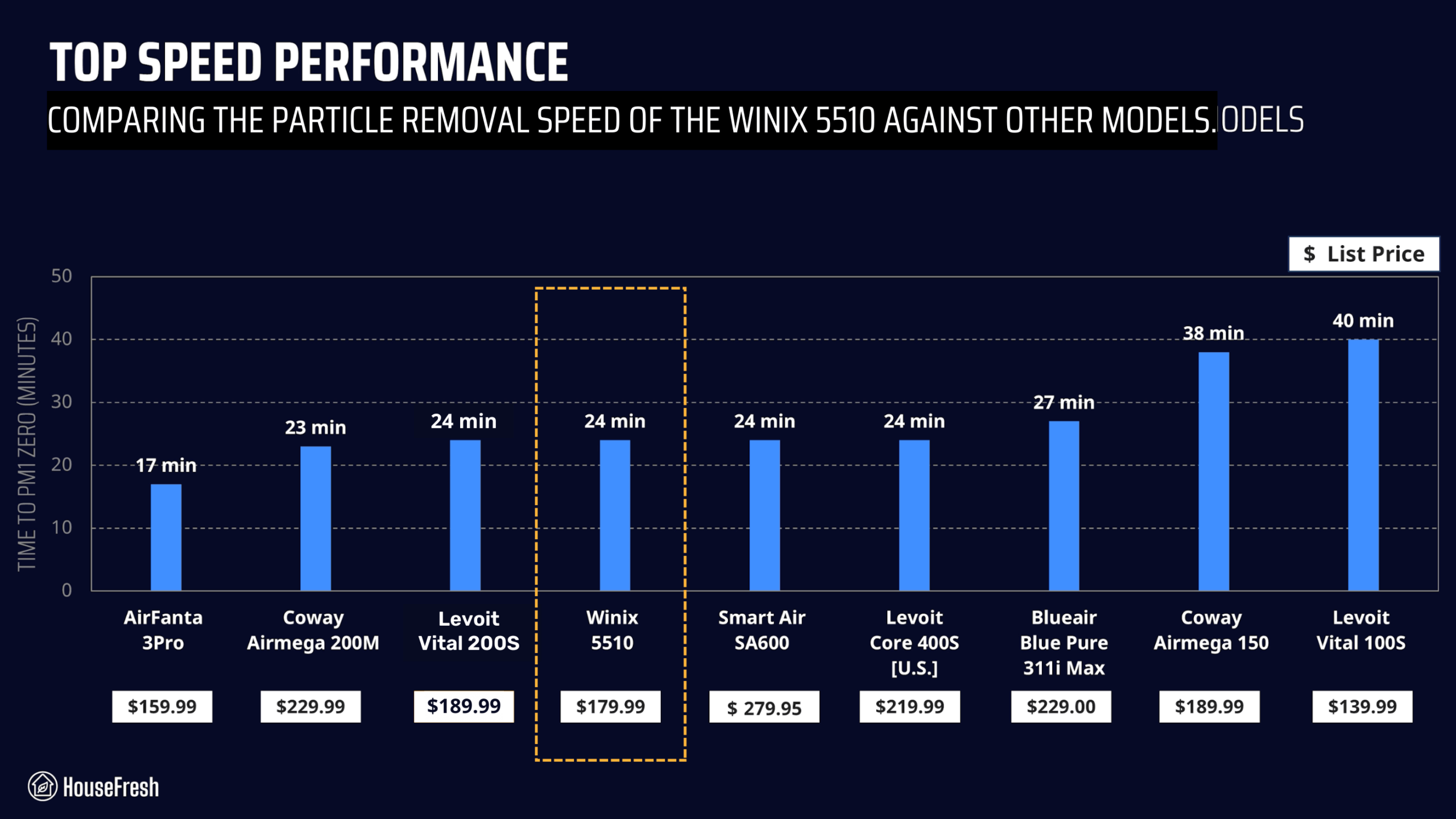
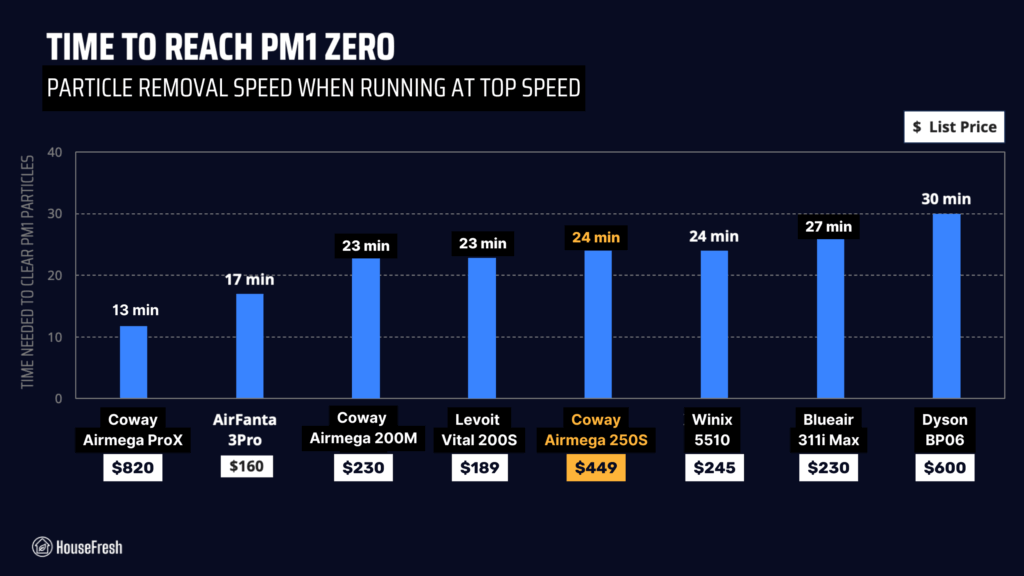
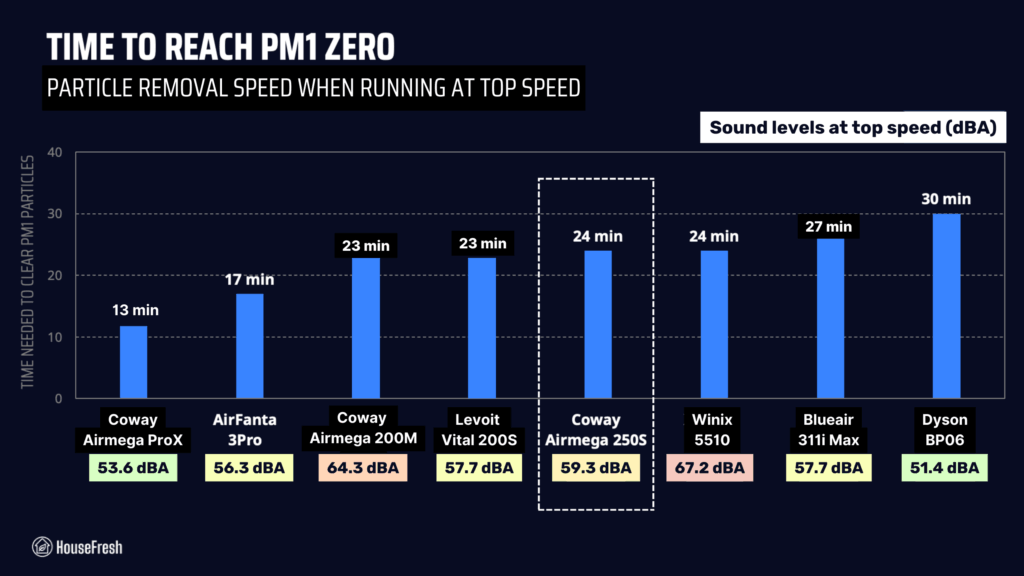
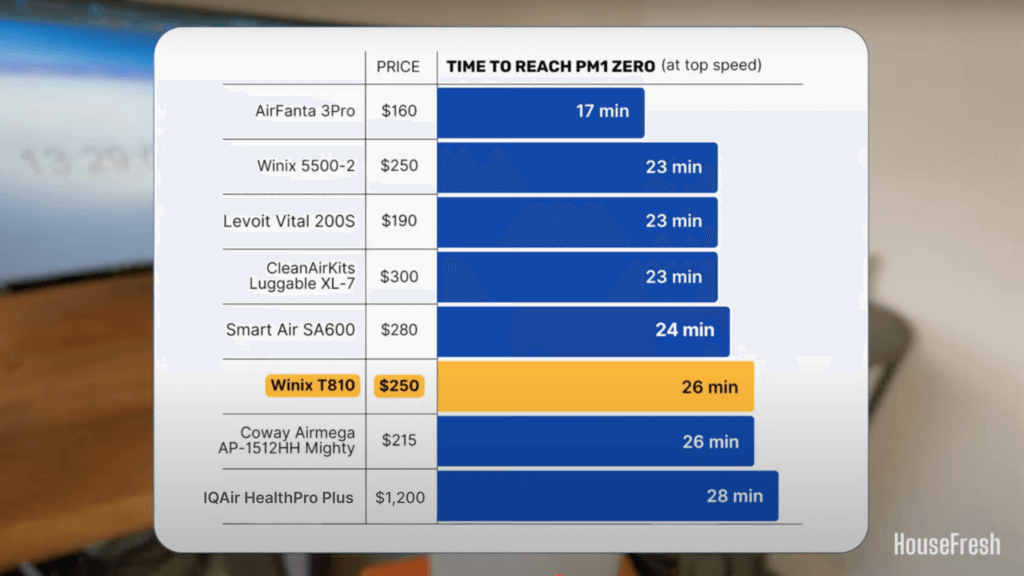
When running at top speed, our PurpleAir Zen sensor shows that the 5520 needed 24 minutes to reach PM1 zero. Based on the natural ventilation of our test room, we estimate a PM1 CADR of 249 cfm.

This makes the Winix 5520 powerful enough to provide five air changes per hour in large rooms up to 373 sq. ft.

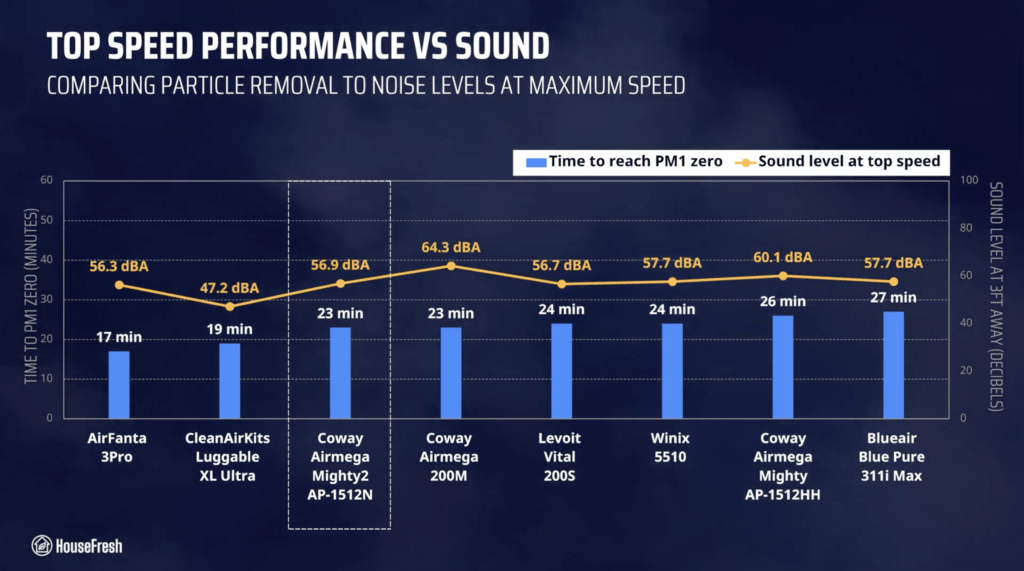
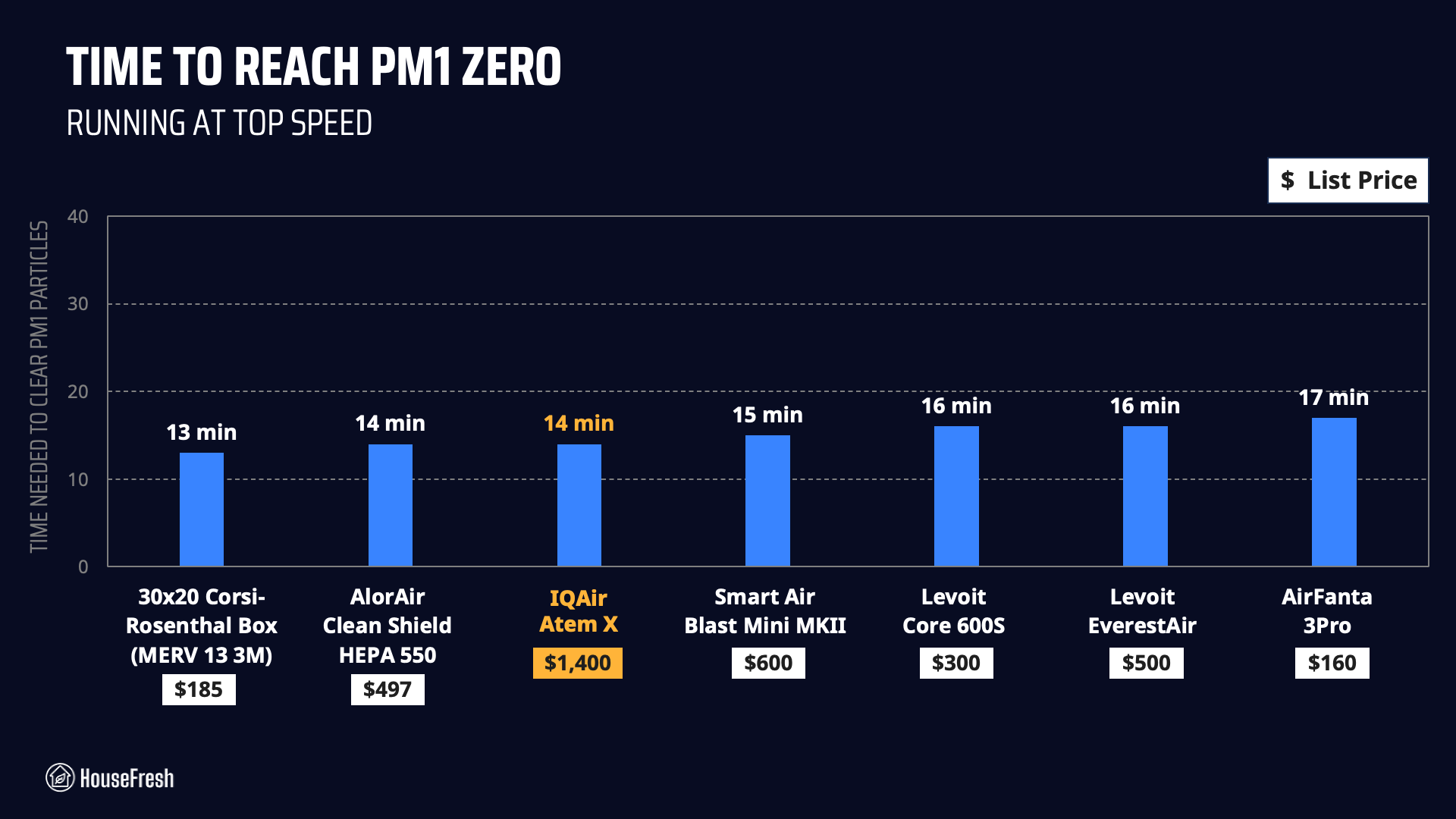
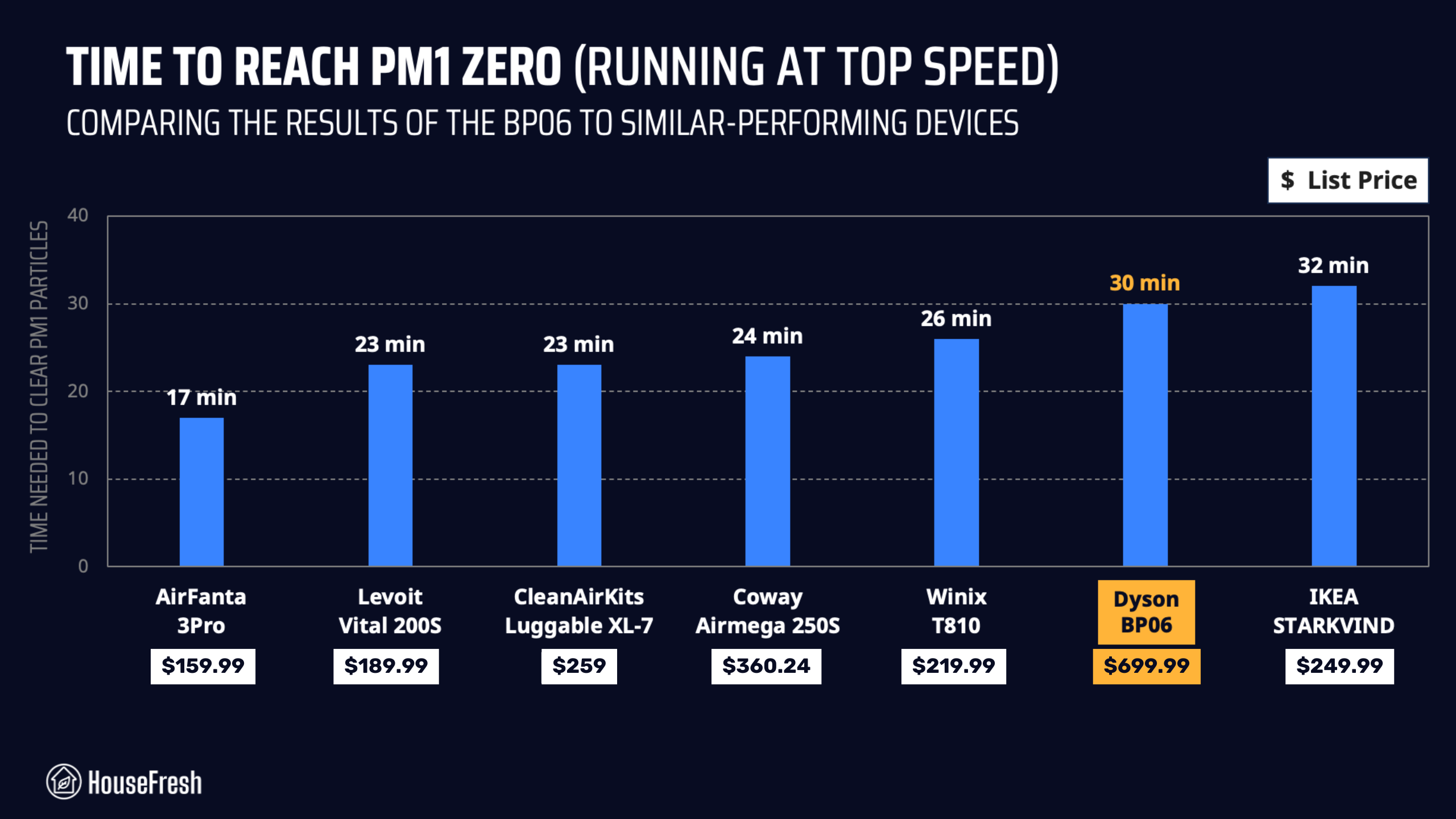
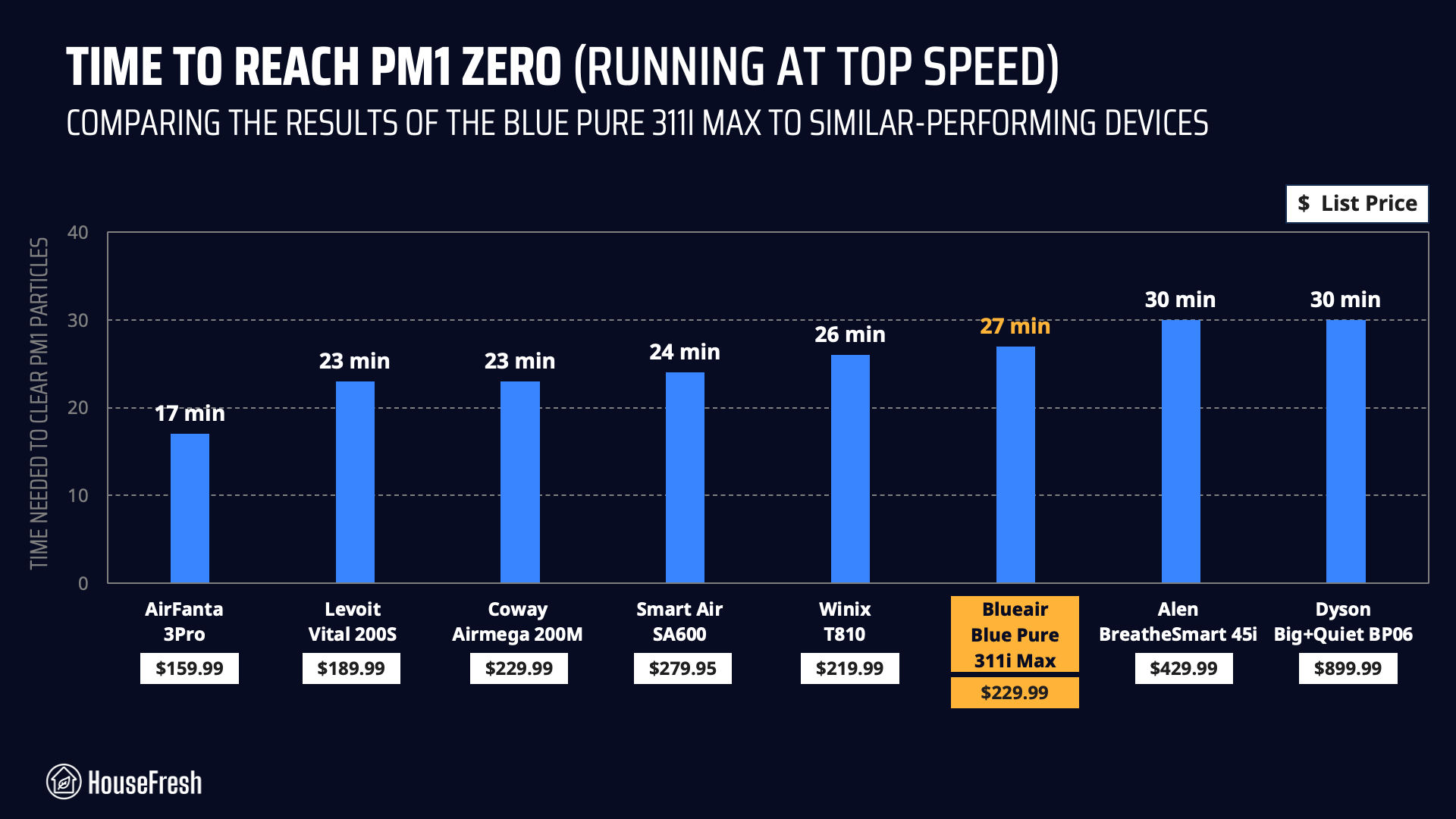
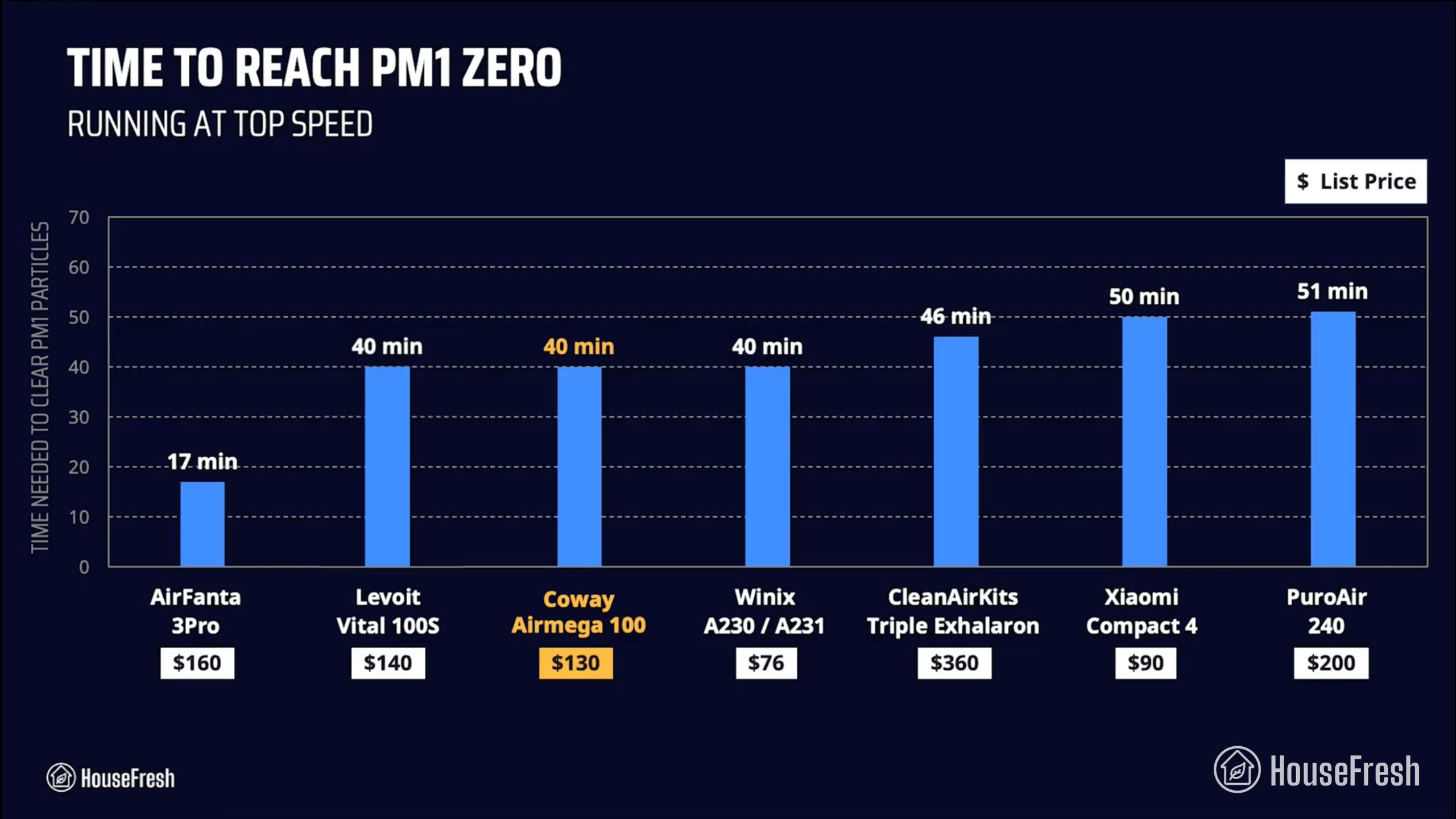
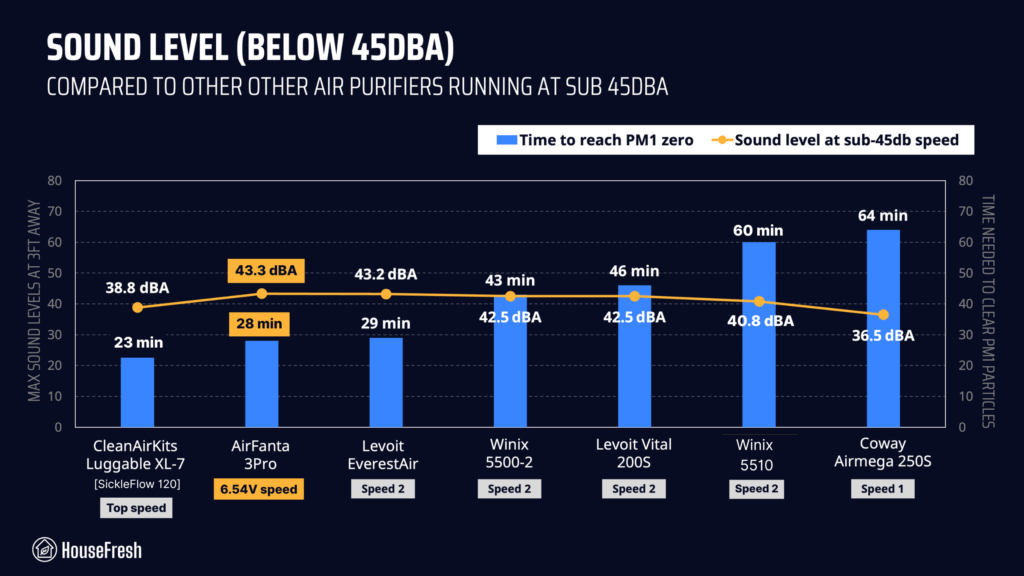
As you can see from the chart, the 5520 matched the top speed performance of its sibling (5510), the popular Levoit Vital 200S and the pricier Coway Airmega 250S:

Winix 5520 HouseFresh Particle Removal Chart

This is a good result for a medium-sized air purifier in the sub-$200 price range.

BUT, as I always say, air purifiers running at full power are usually too loud for everyday use, so we must account for noise levelsโ€ฆ

Sound levels

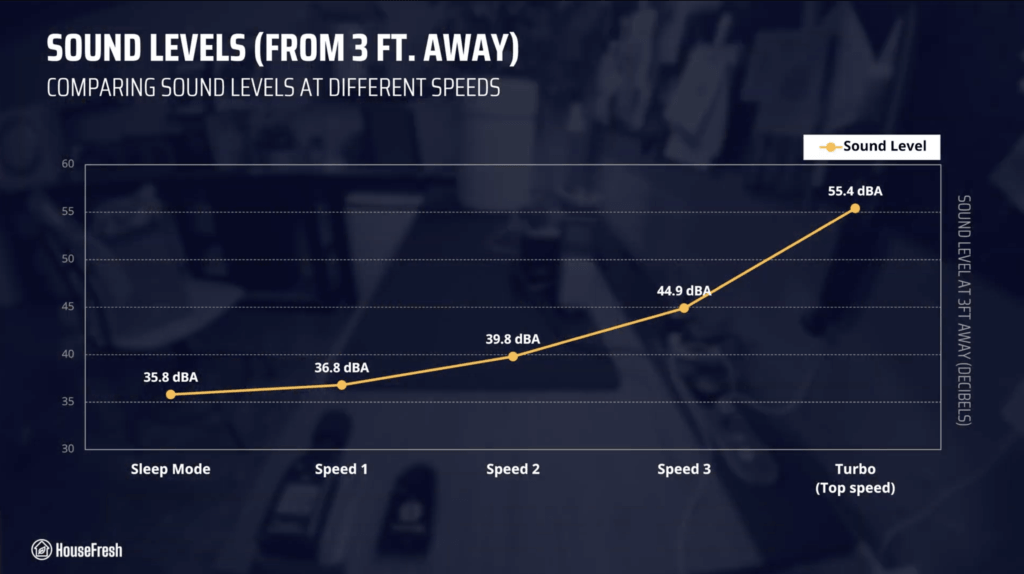
The sound levels of the Winix 5520 range from 40.4 dBA to 64.9 dBA โ€” which is louder than other mid-sized air purifiers from Levoit, Coway and Blueair.

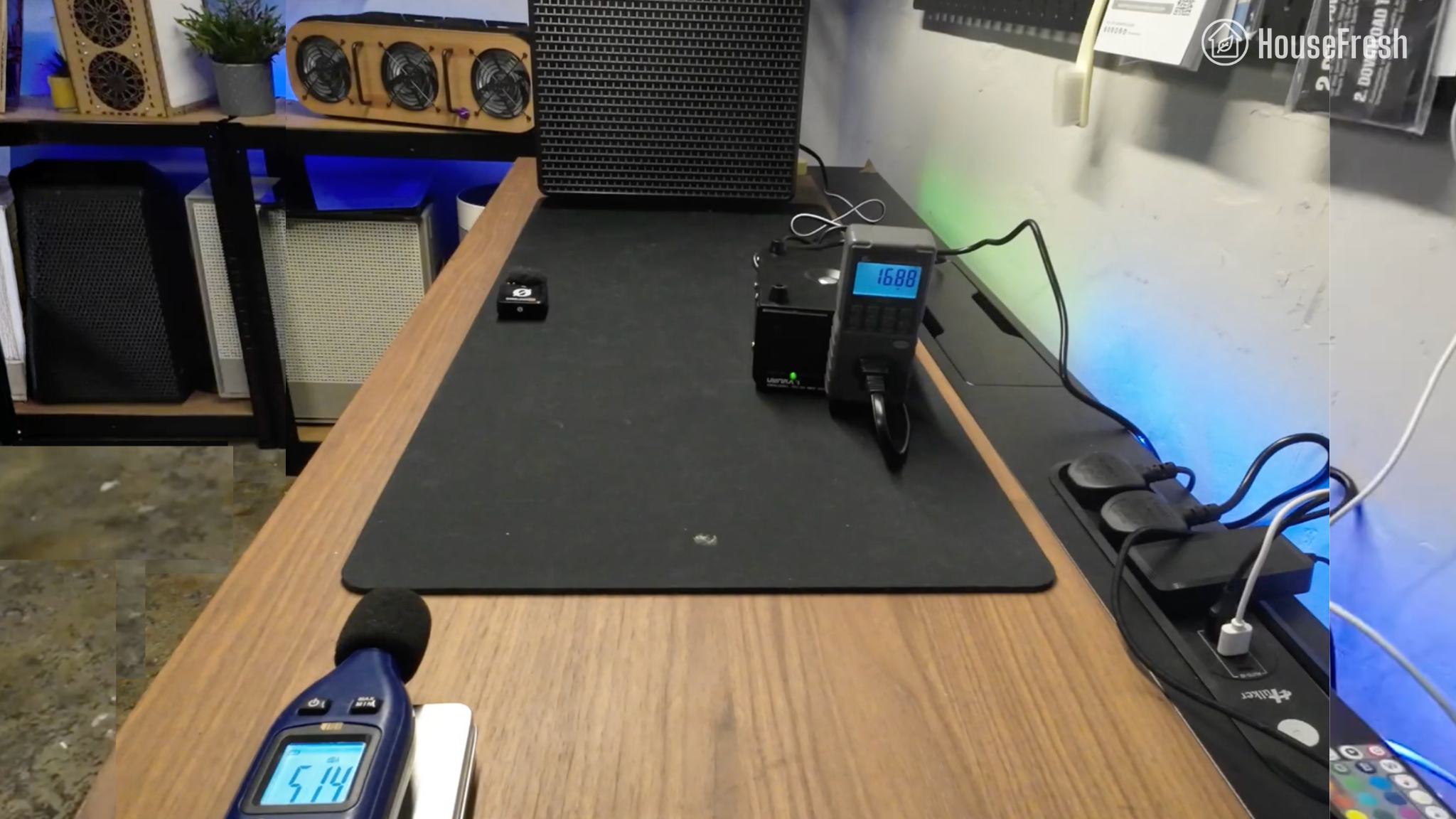
Winix 5520 Sound Energy Test

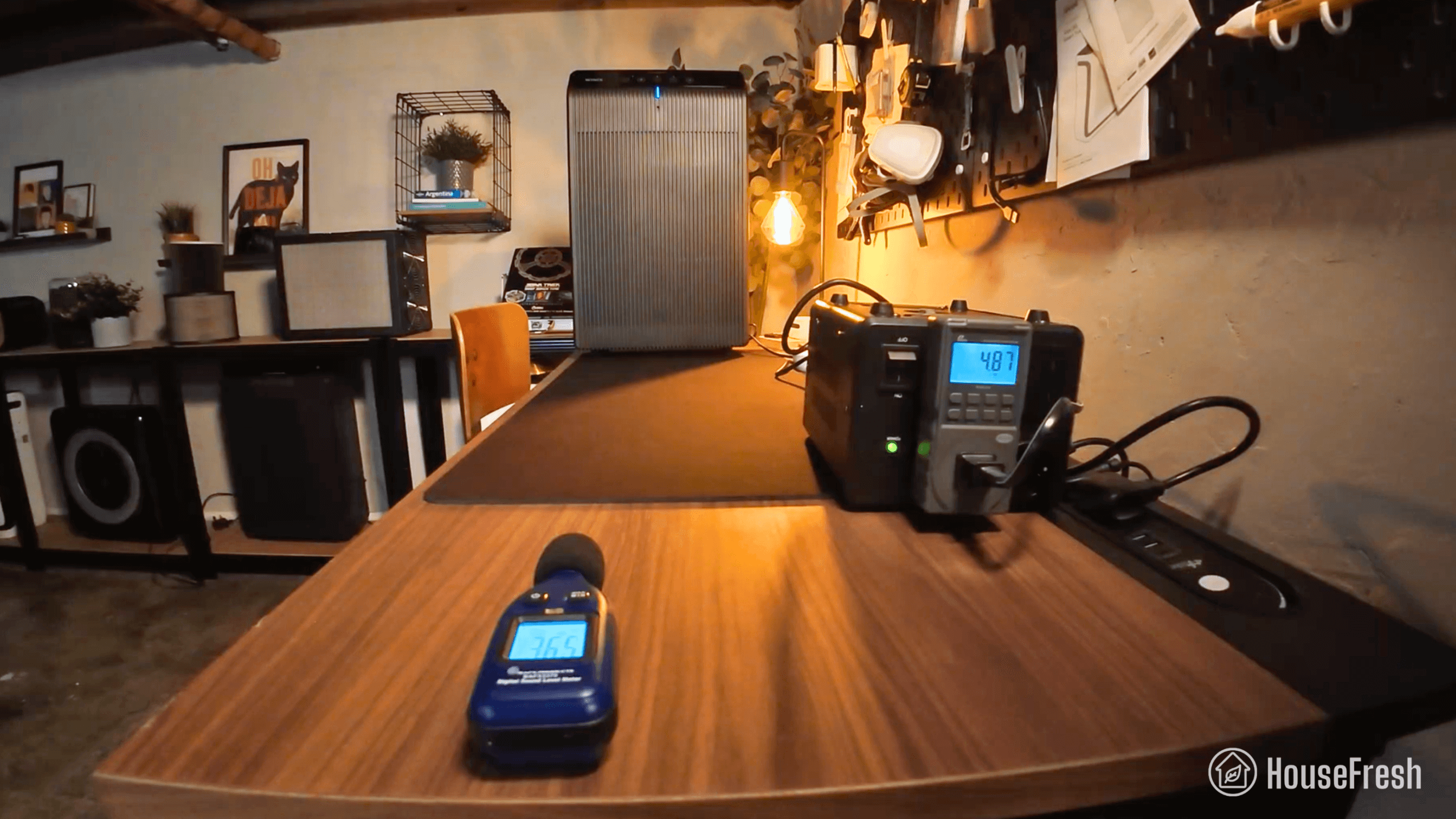
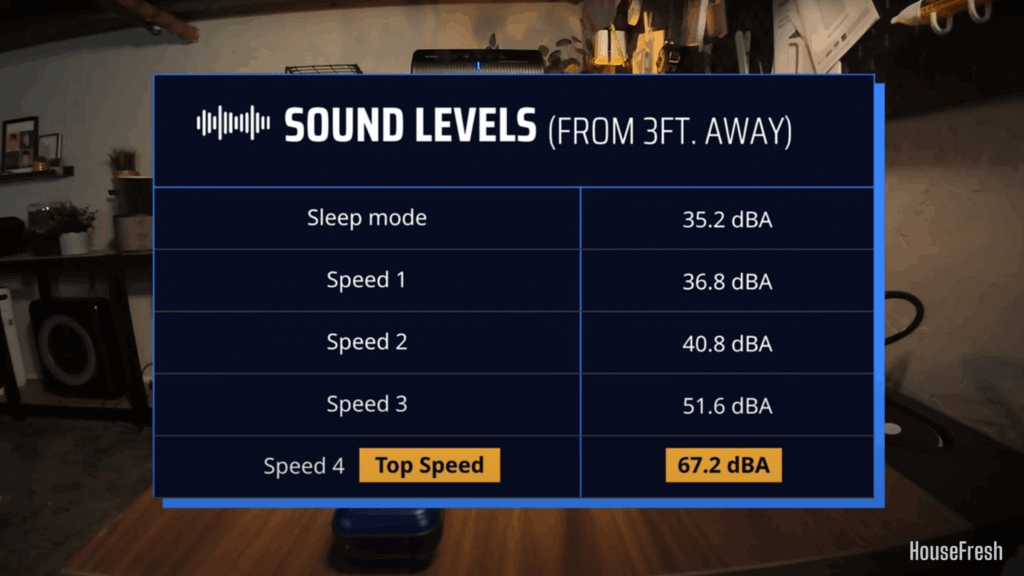
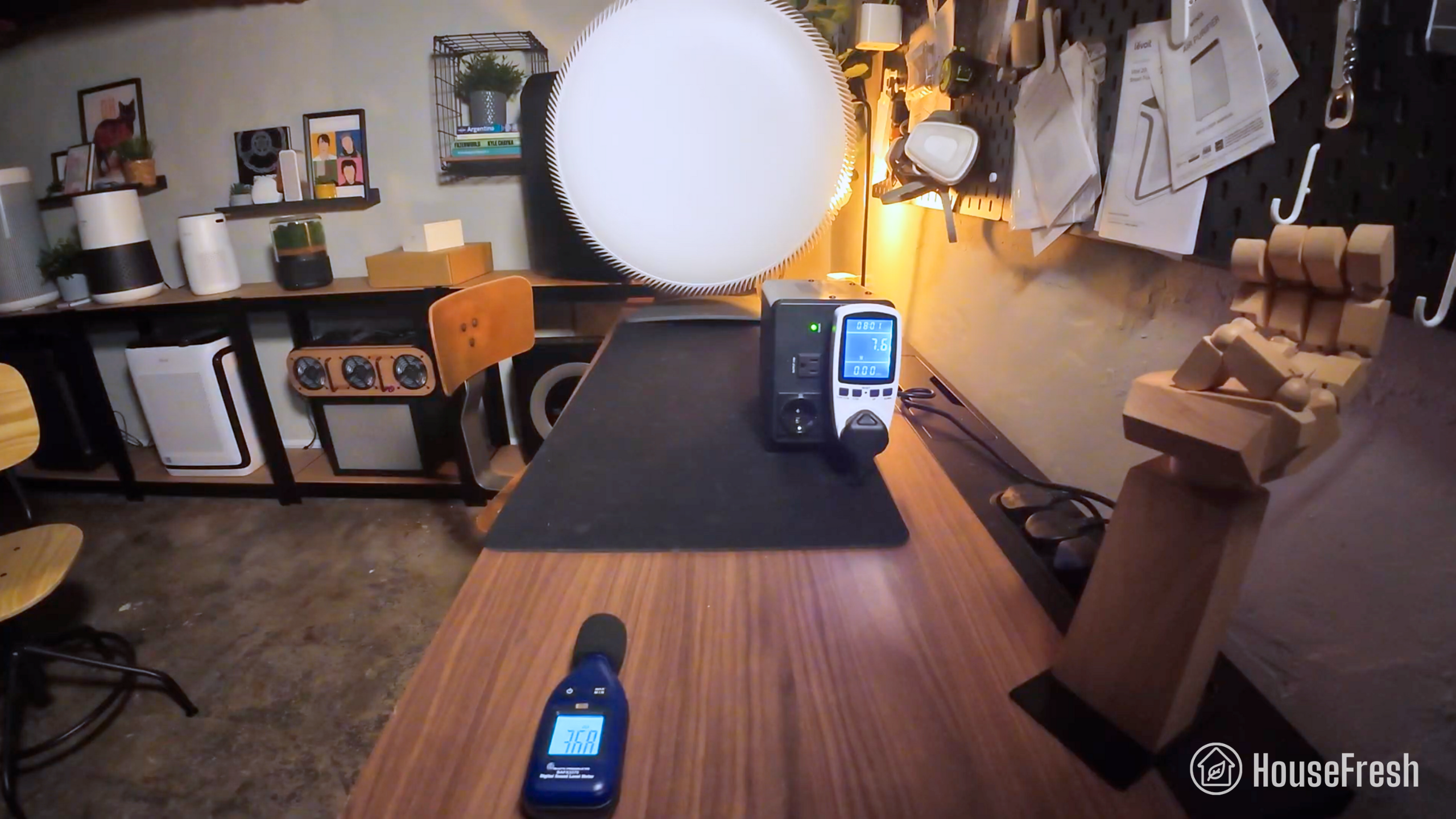
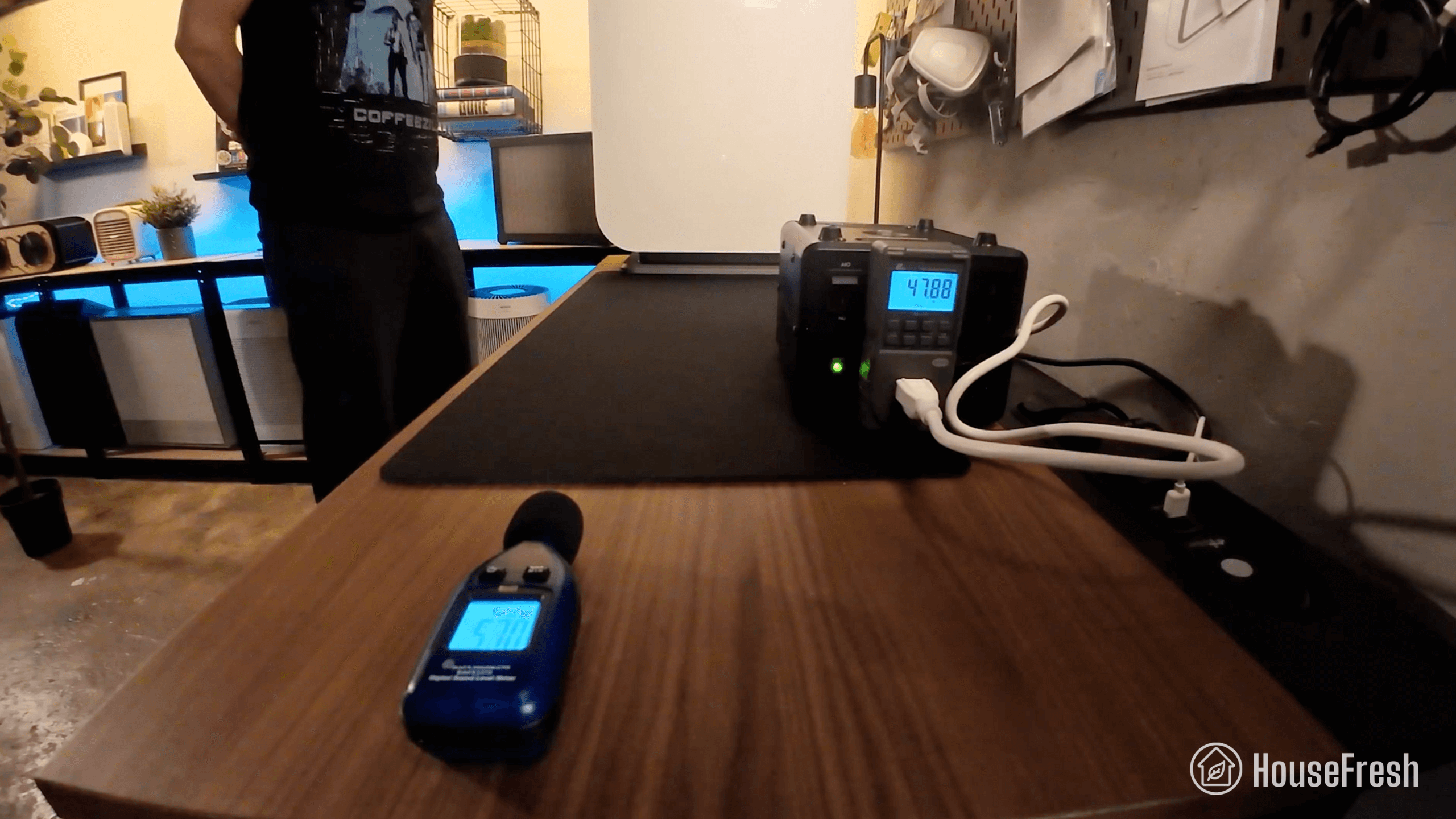
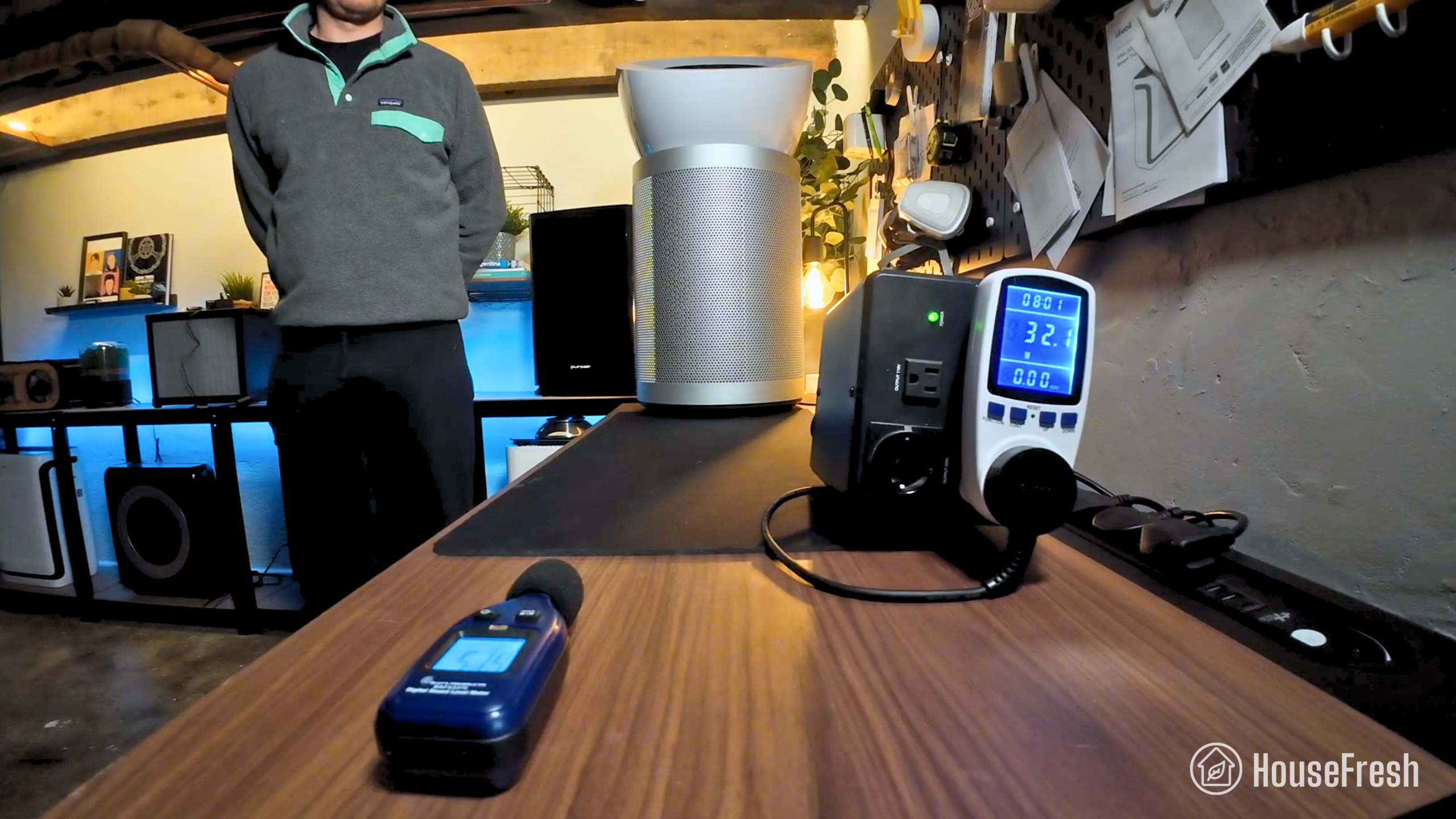
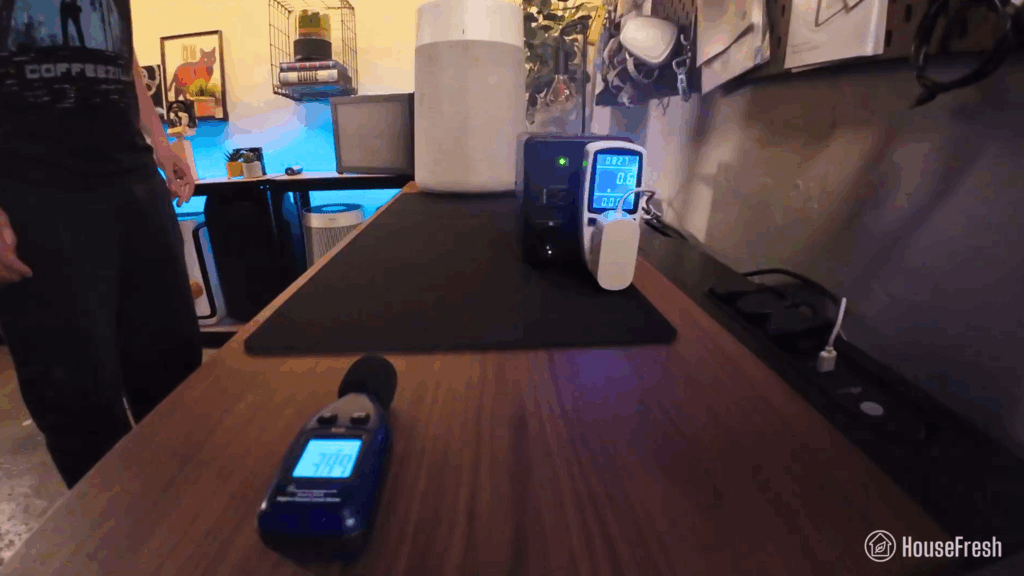
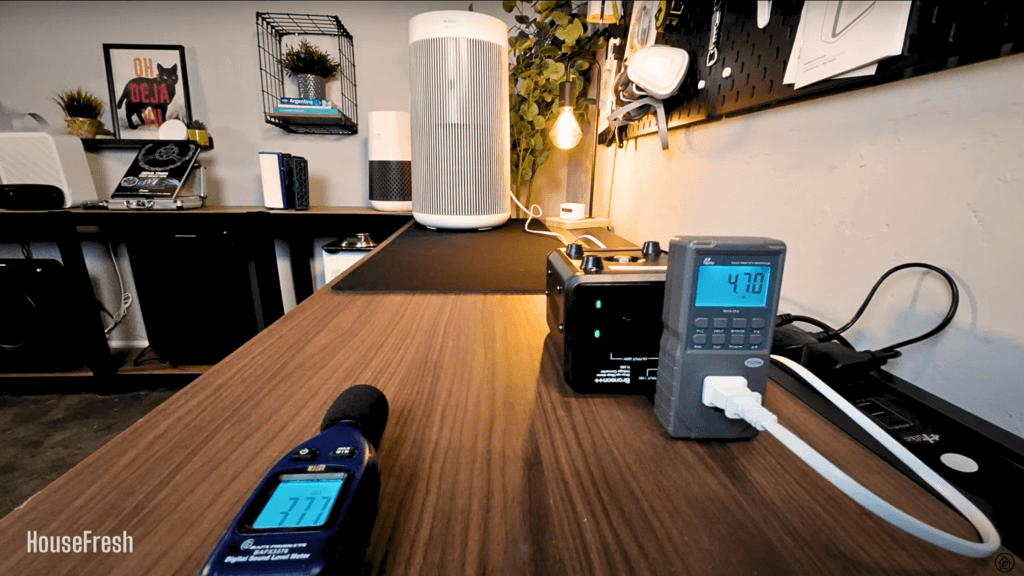
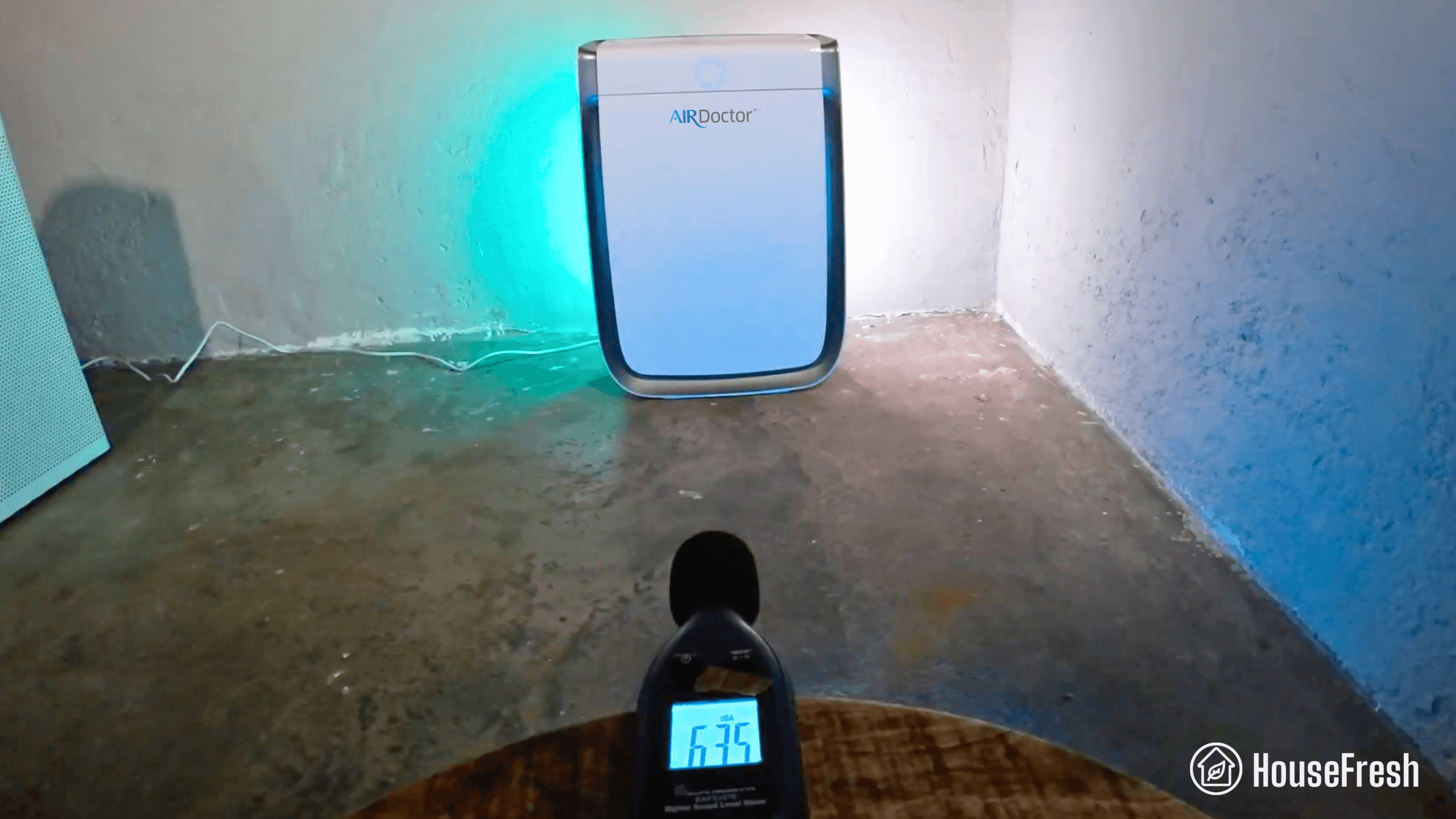
I used our BAFX sound meter to measure how much sound the 5520 generates at each of its fan speeds at 3 ft away:
Winix 5520 Sound Levels HouseFresh

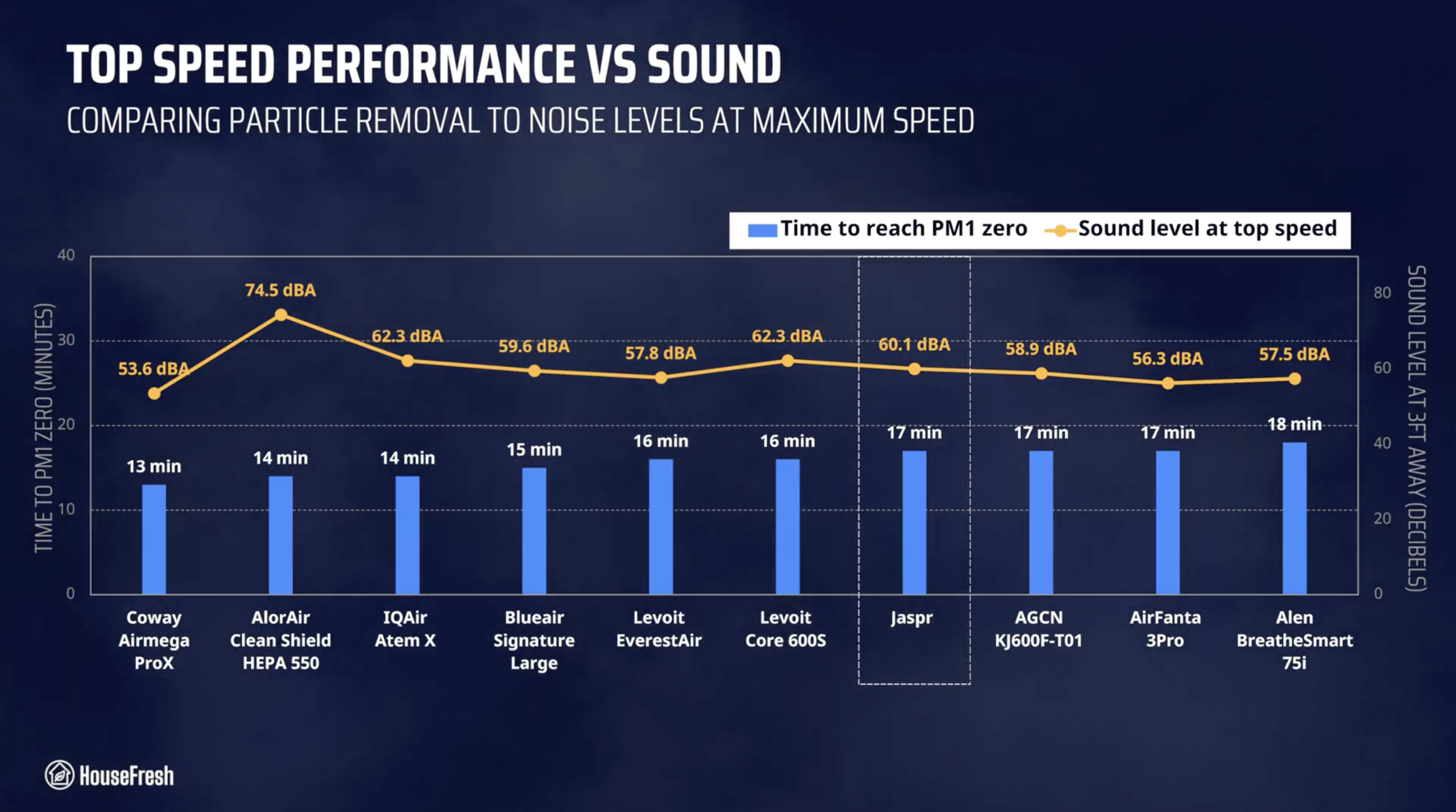
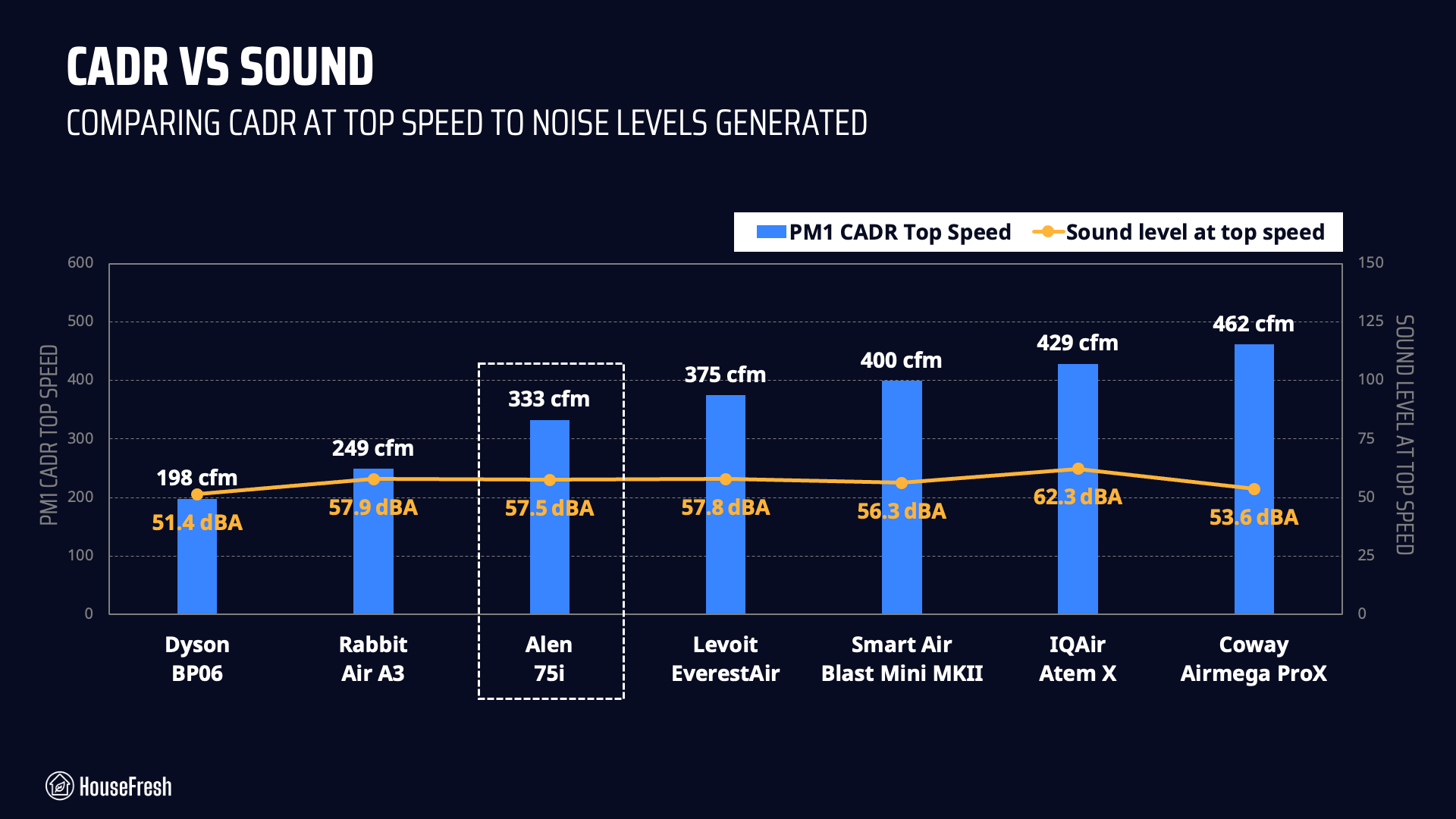
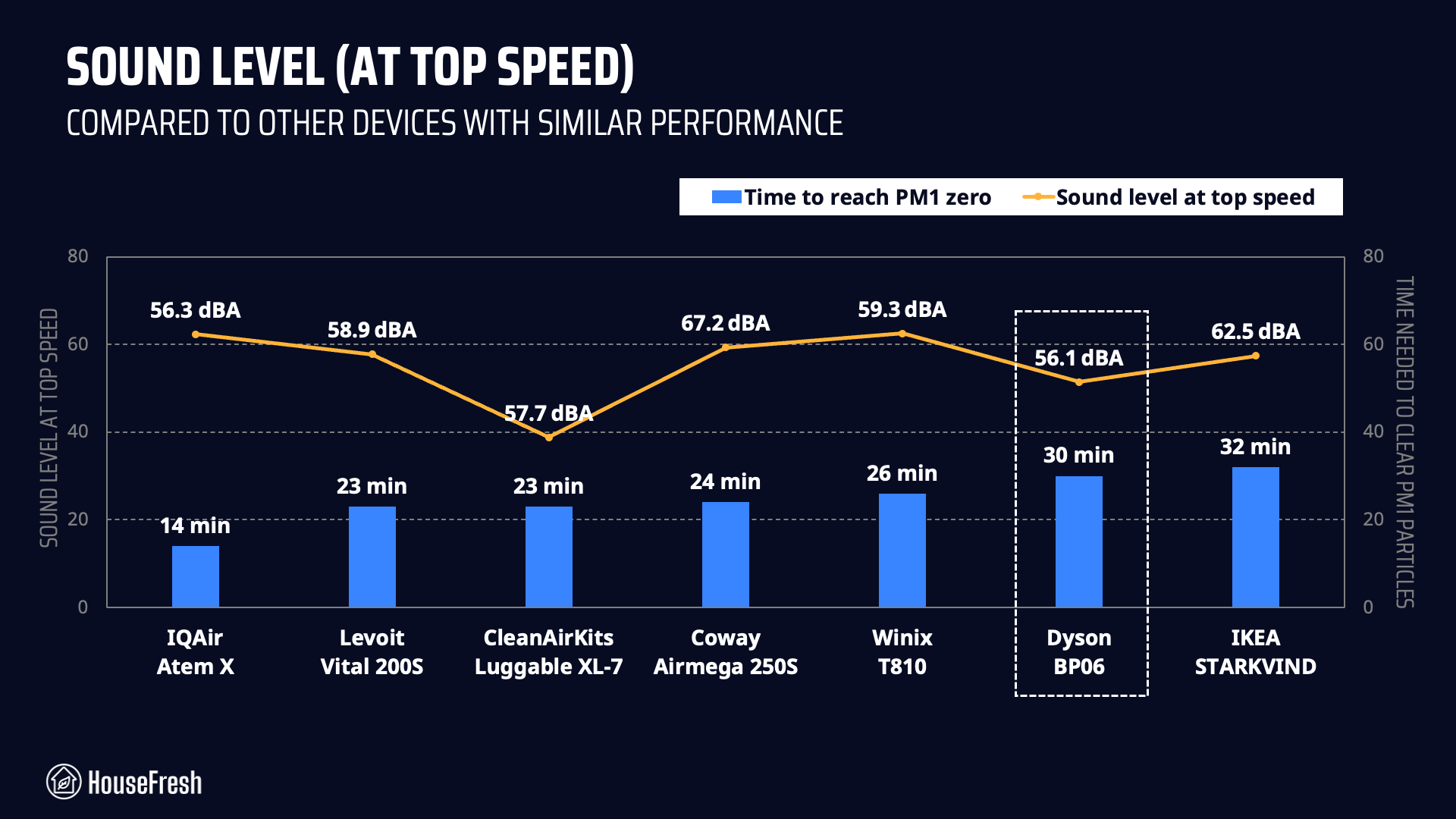
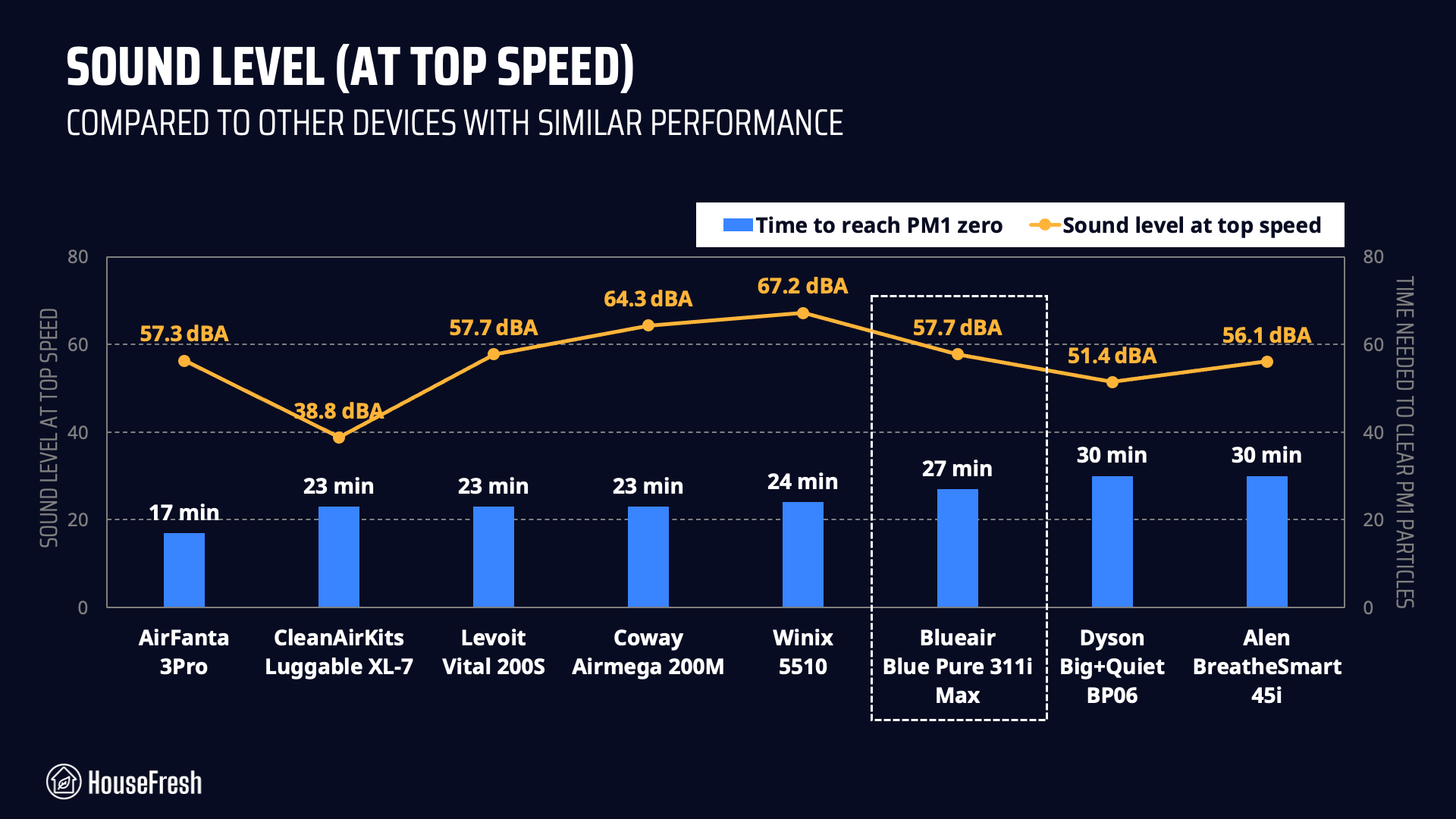
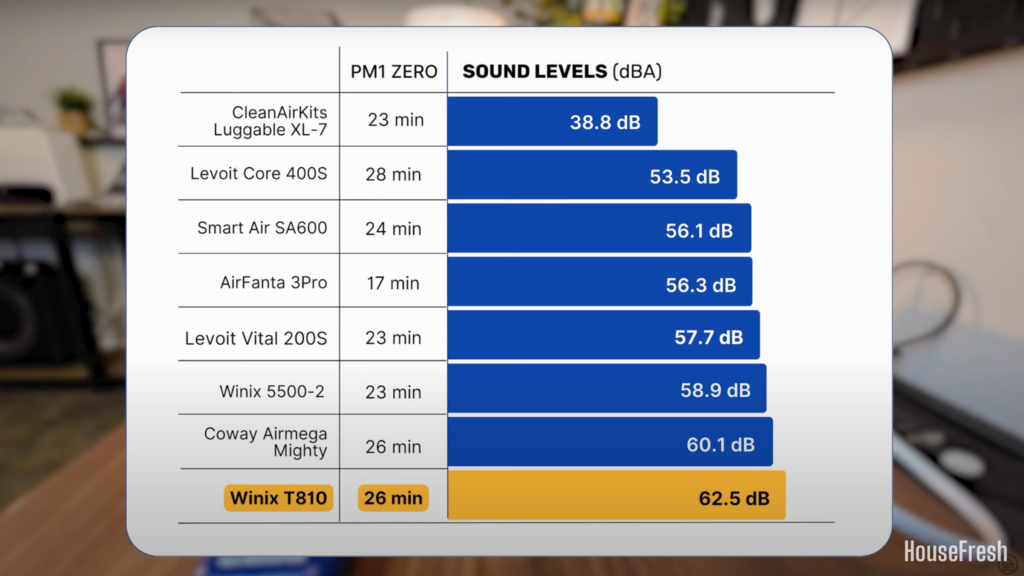
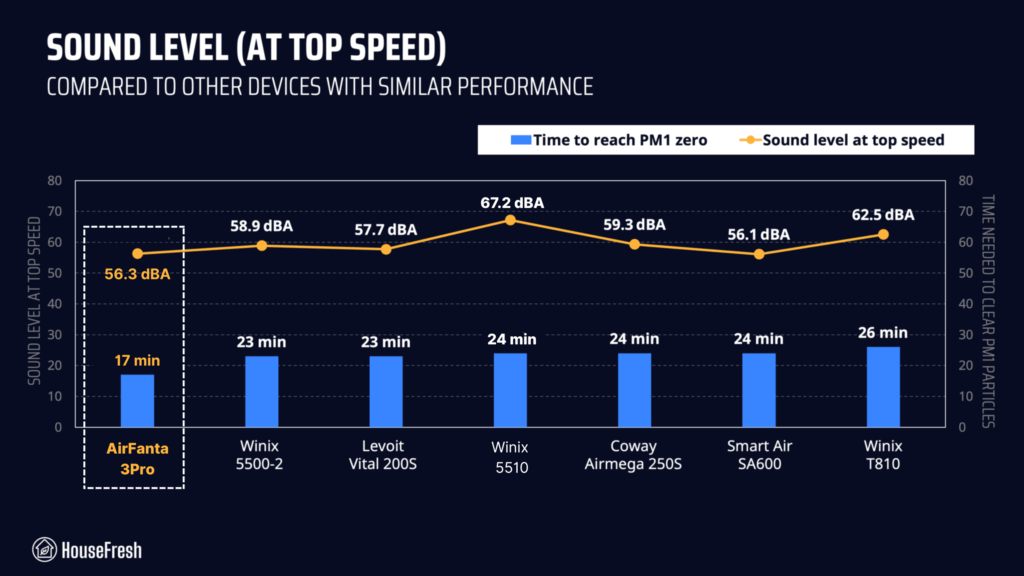
Reaching 64.9 dBA at top speed, the 5520 is one of the loudest mid-sized air purifiers on the chart, second only to the Winix 5510 and its 67.2 dBA when running at full power.

Winix 5520 Top Performance Chart

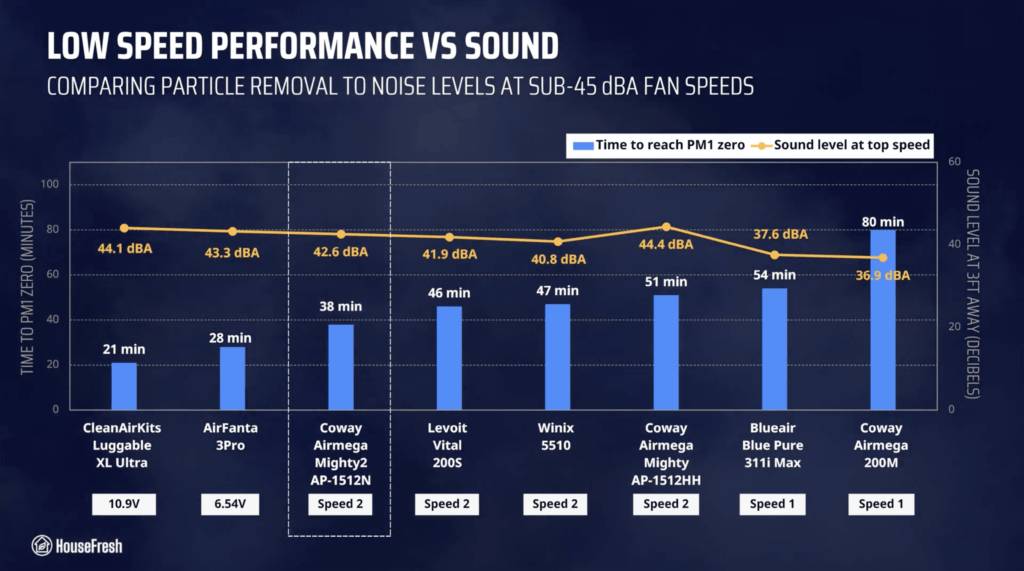
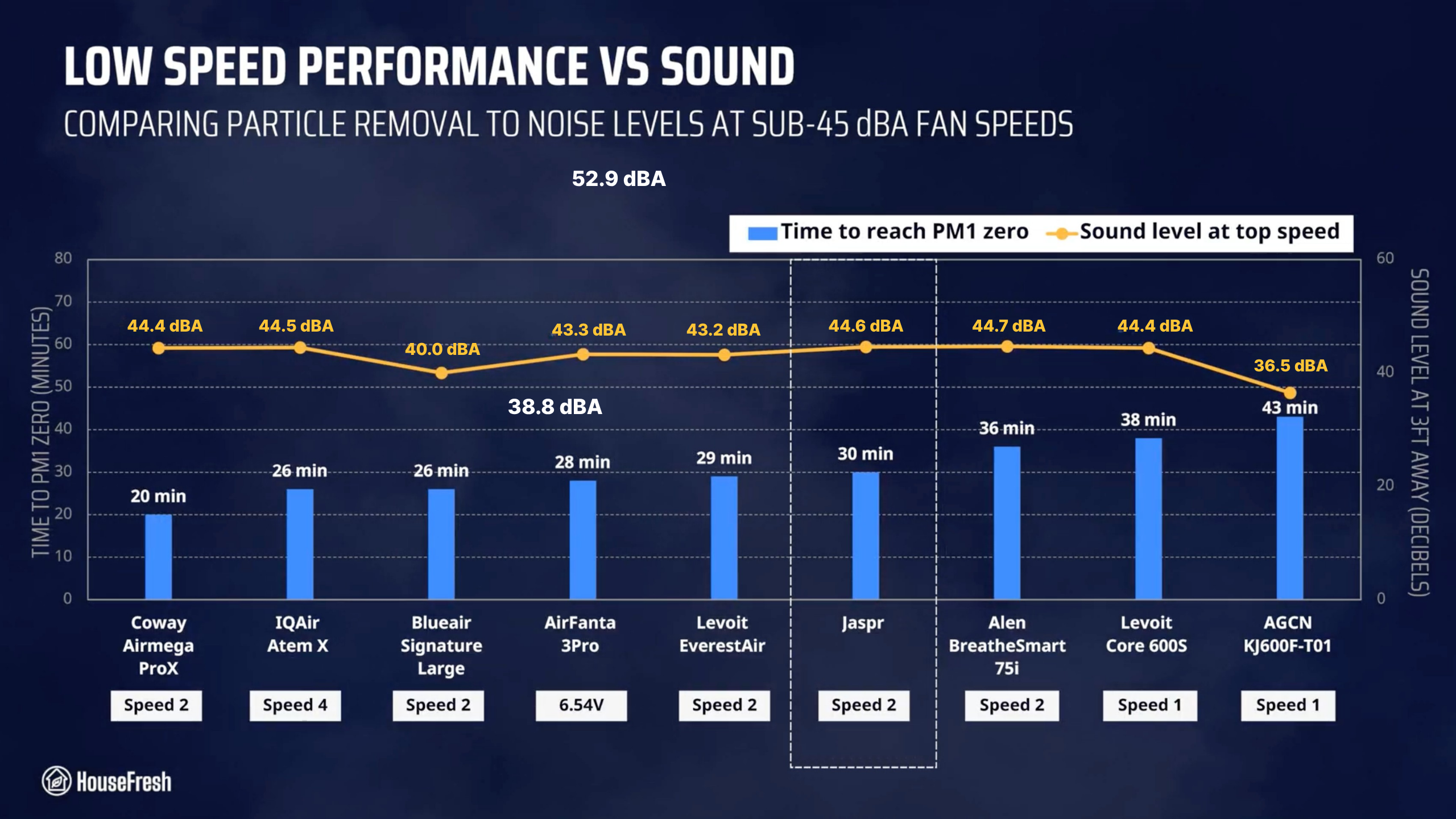
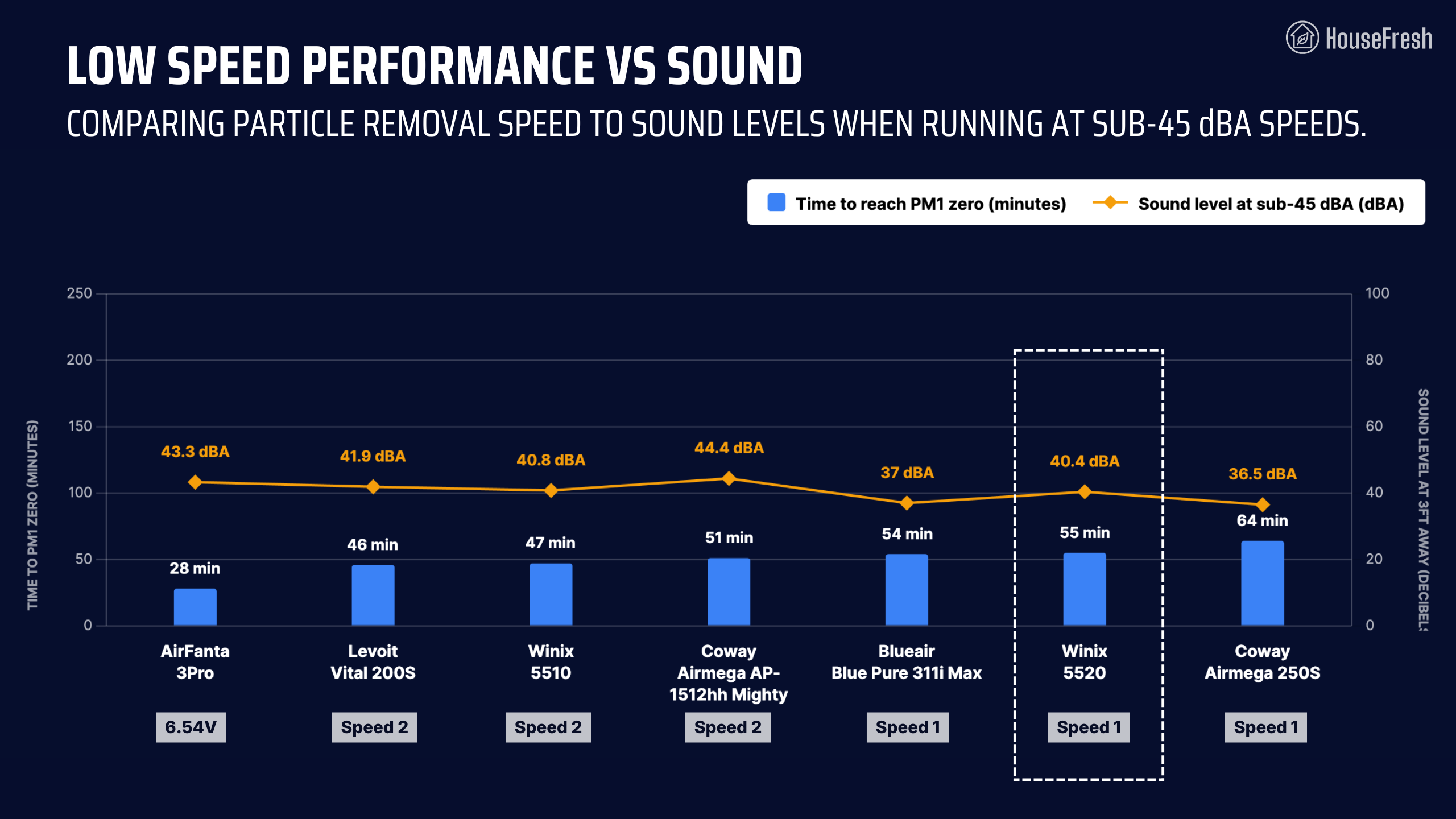
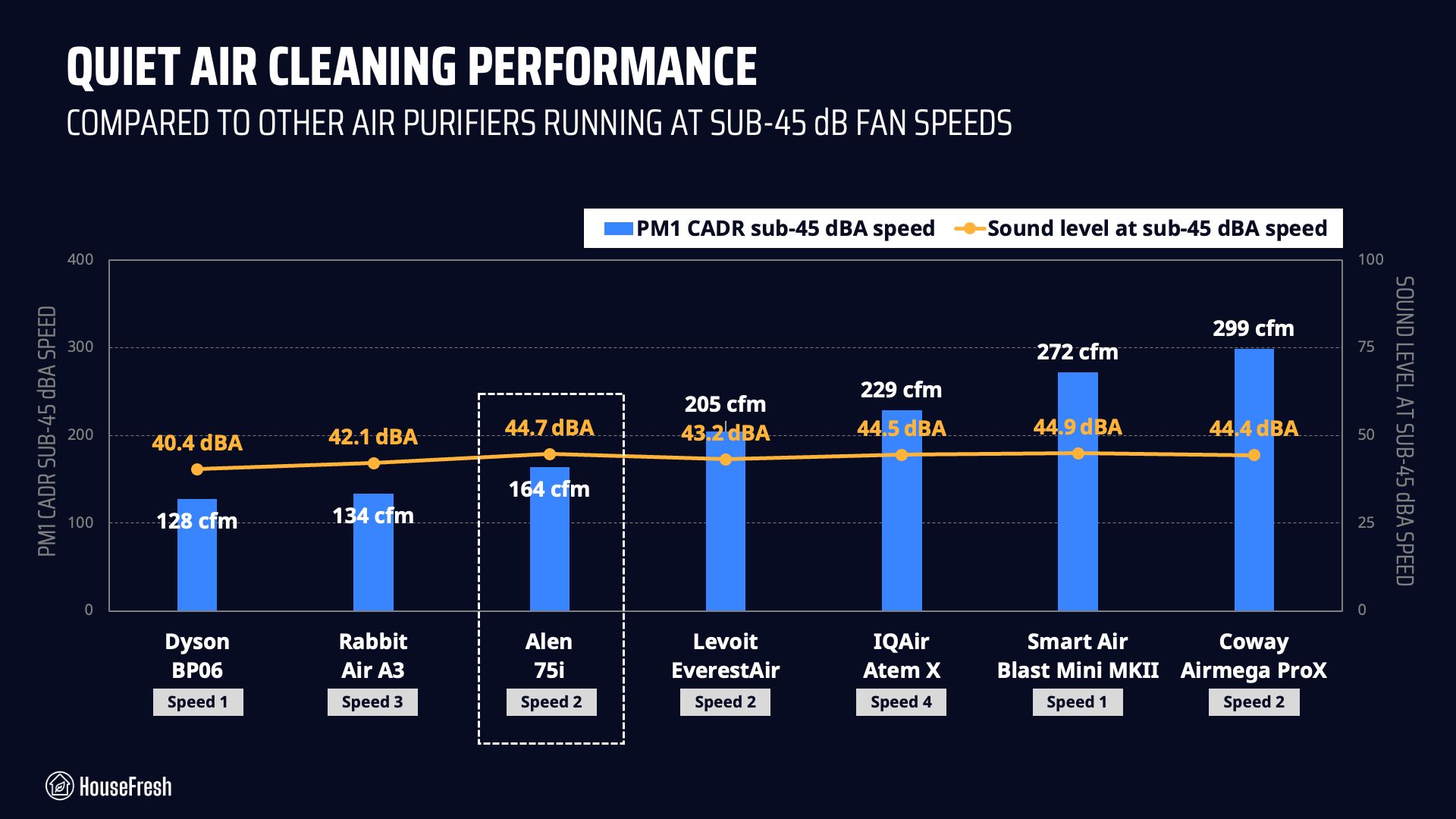
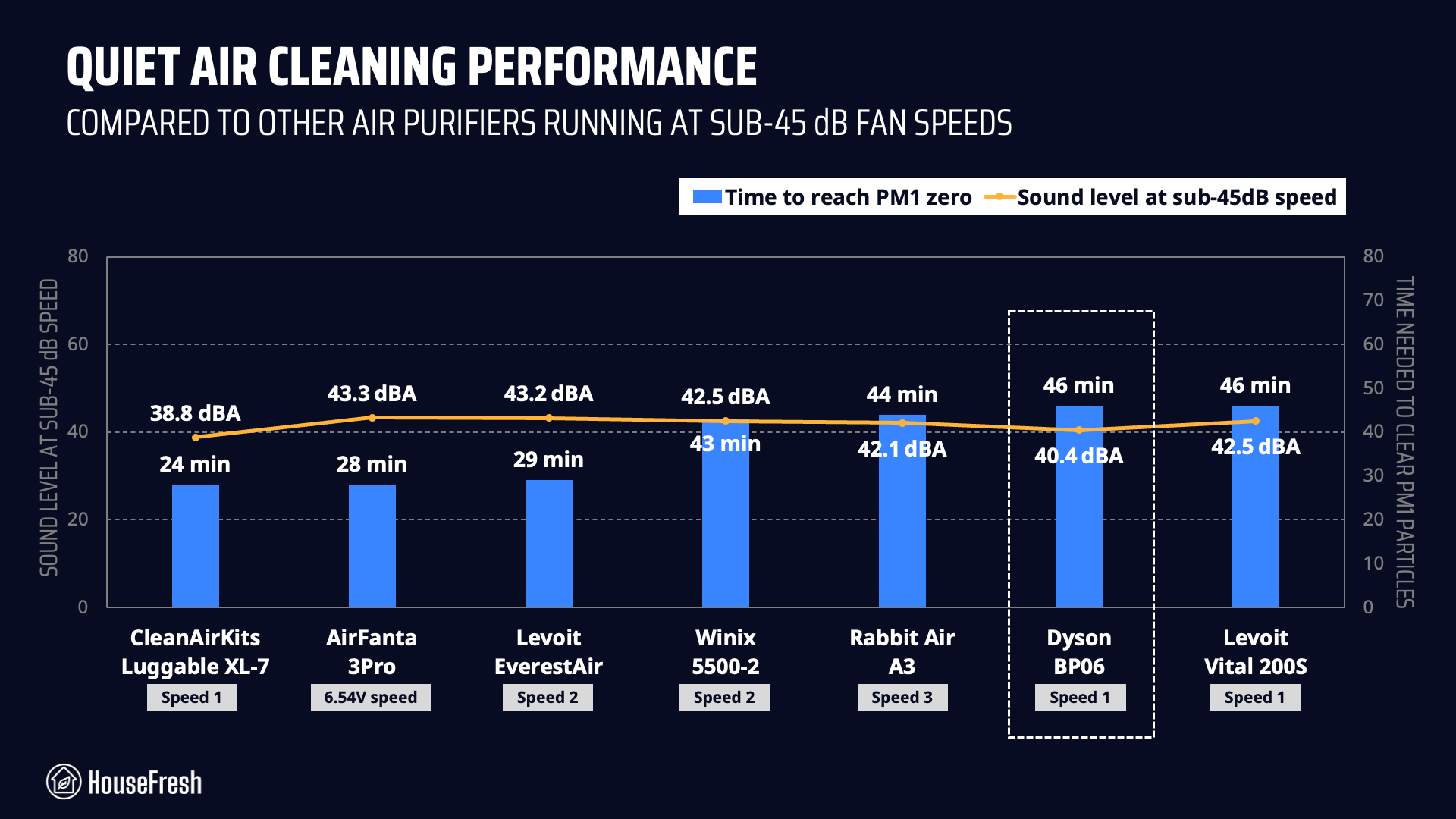
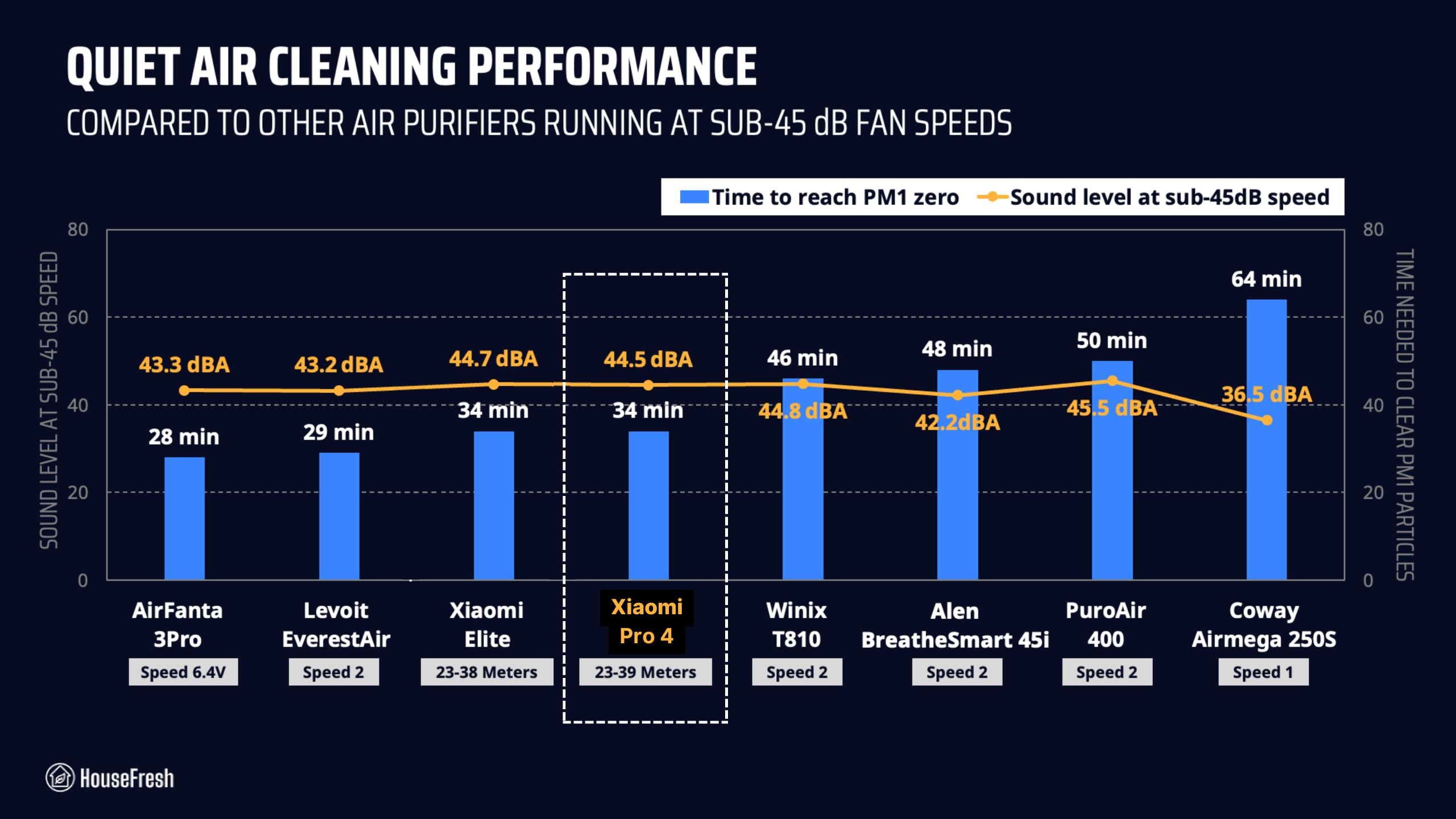
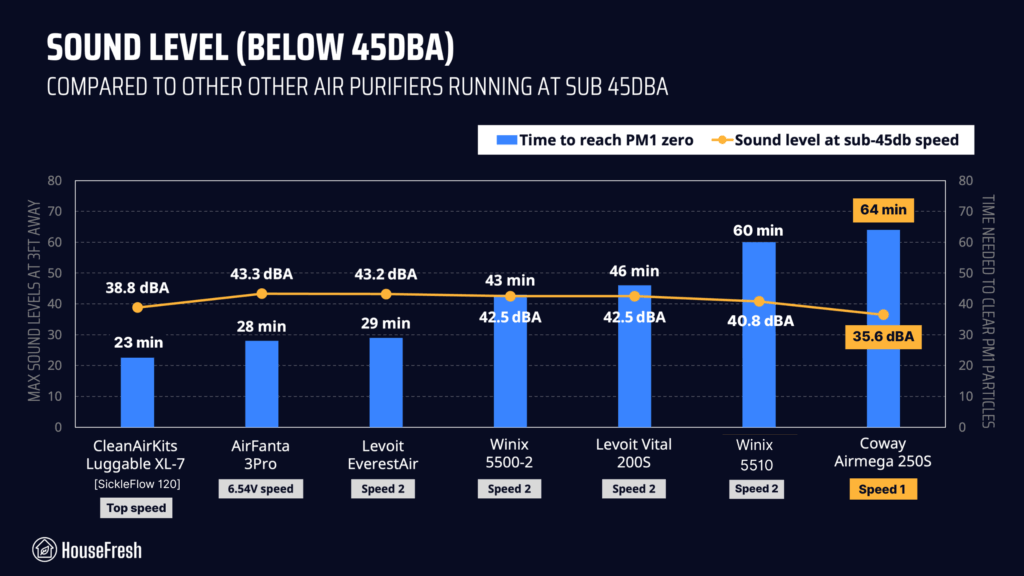
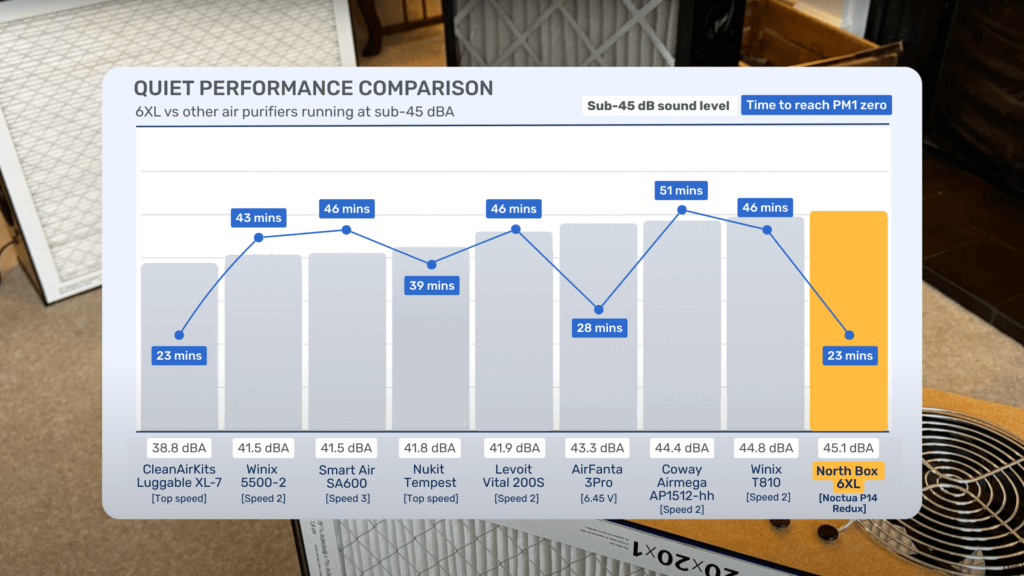
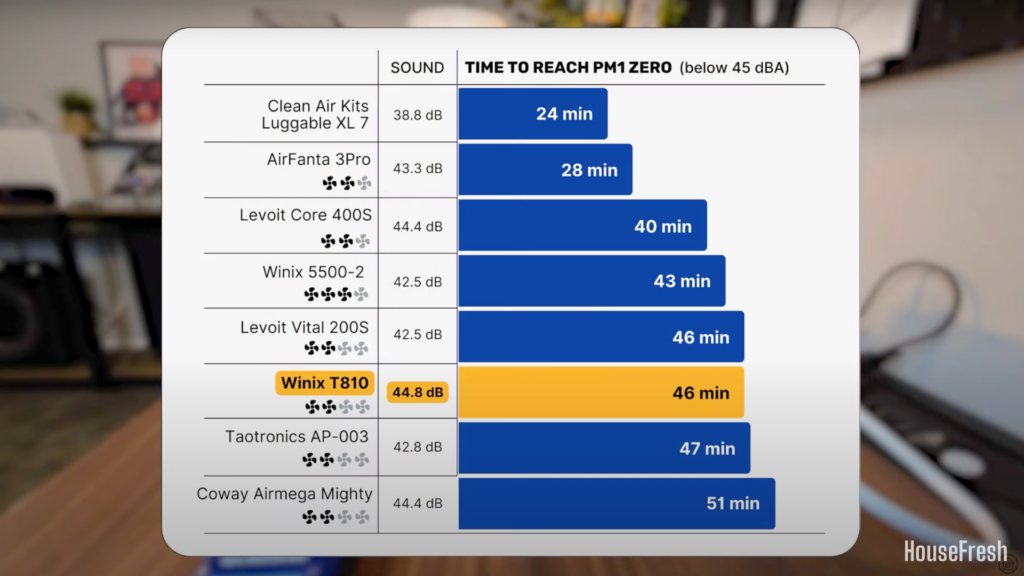
Running at speed 1, the 5520 reached 40.4 dBA and completed our particle removal test in 55 minutes. This is the only fan speed under the 45 dBA limit we set for quiet performance tests.

Winix 5520 Quiet Performance Chart

I repeated the test with the 5520 running at speed 2, and it cleared our test room in 44 minutes while generating 45.8 dBA of noise. That is not much louder than our 45 dBA limit, so if you don’t mind the extra noise, you could have the 5520 running at speed 2, and it would clean the air five times per hour in spaces up to 200 sq. ft.

Long-term running costs

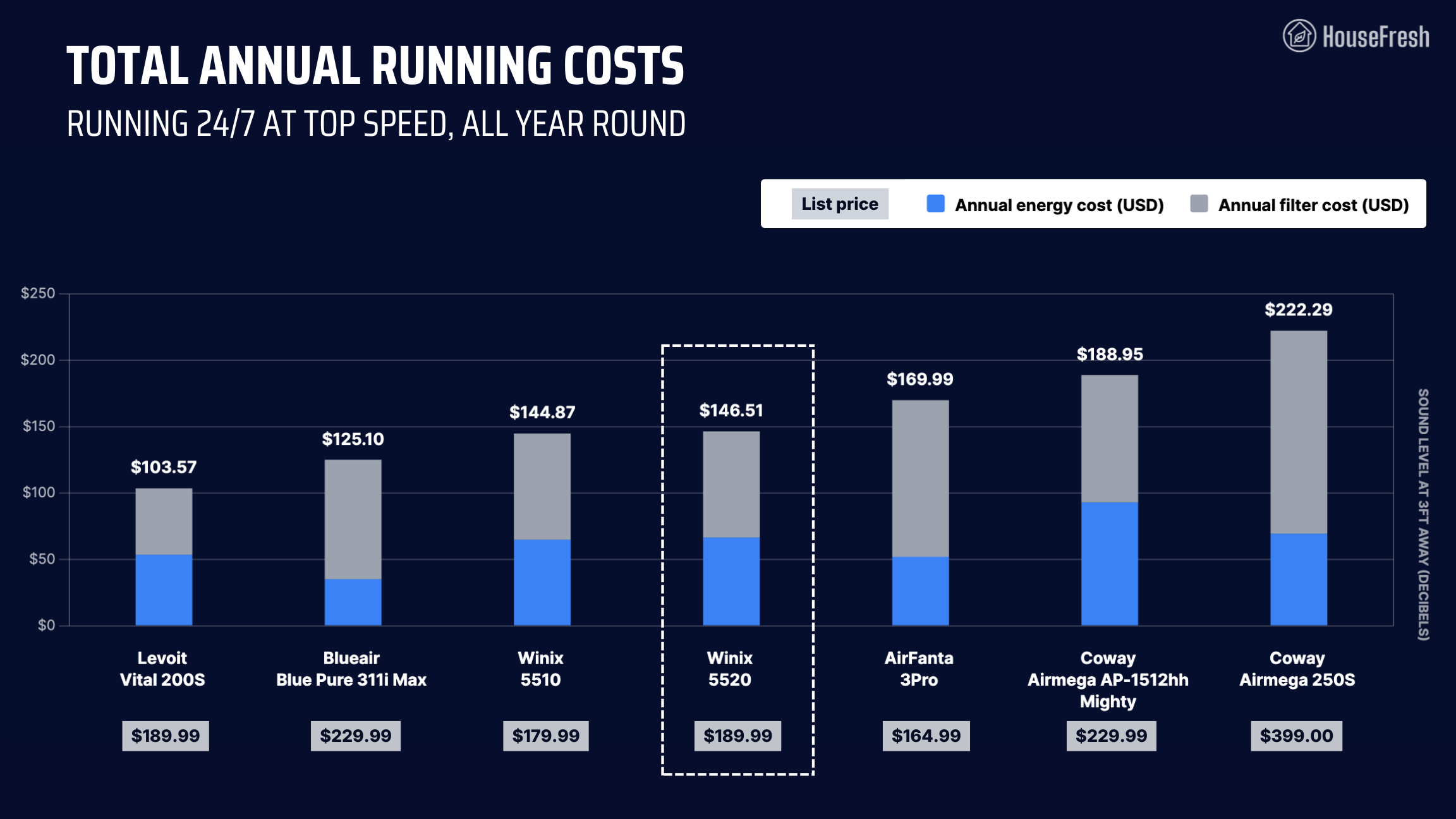
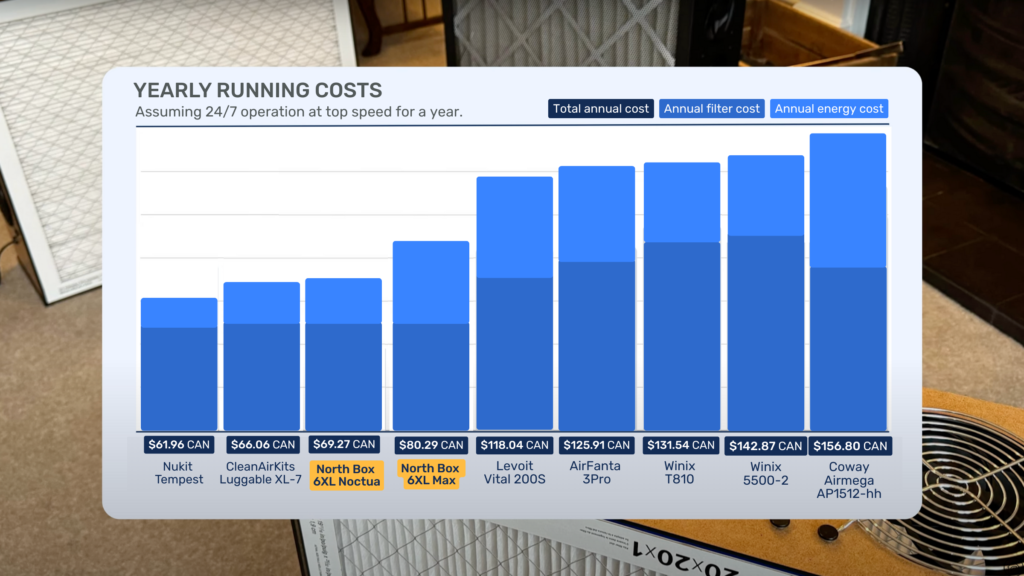
Running a Winix 5520 will cost you $146.51 per year, combining energy and filter replacement costs.

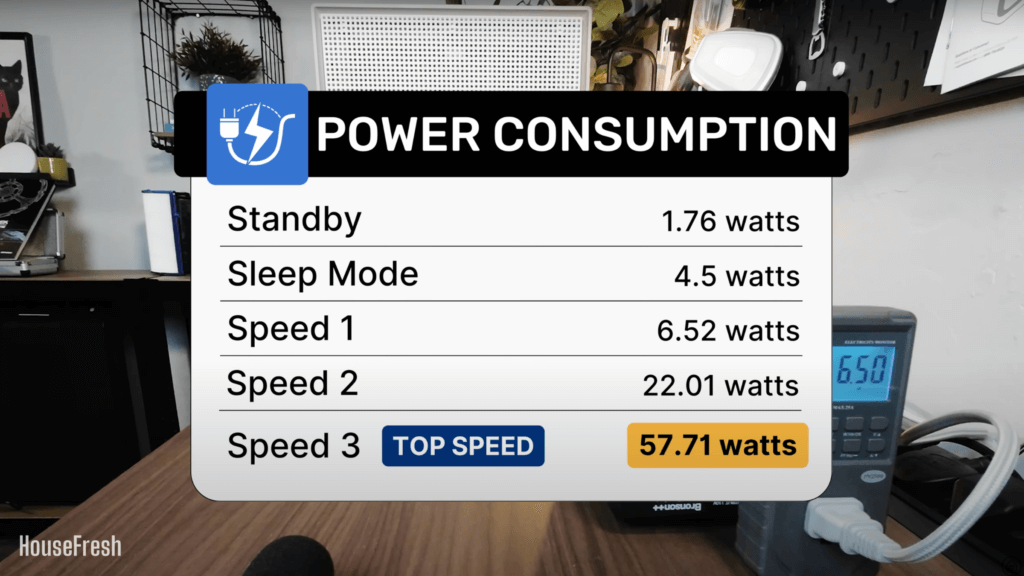
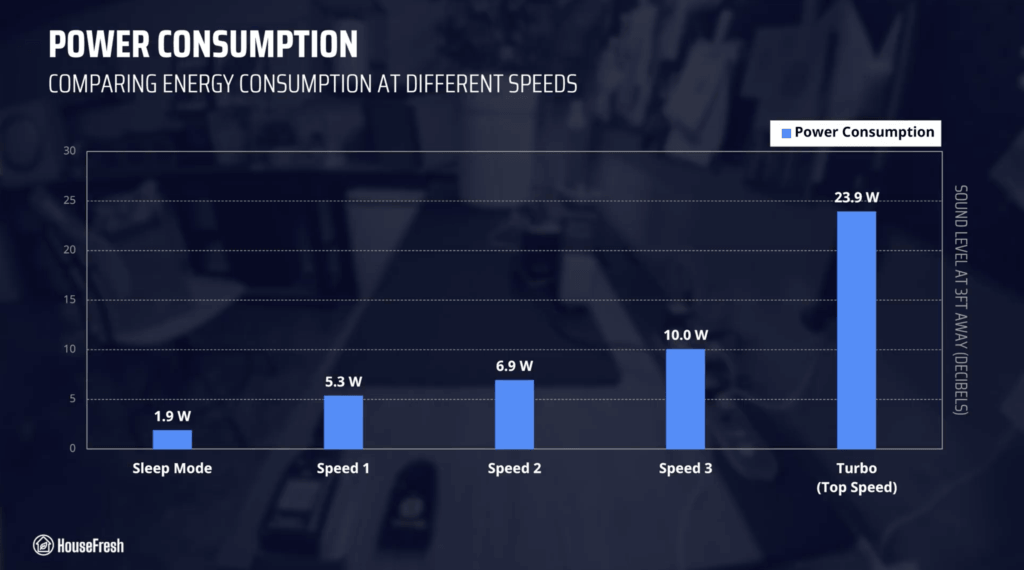
We used our energy meter to record how much electricity the 5520 pulls at each fan speed and while on standby.
Winix 5520 Energy Consumption HouseFresh

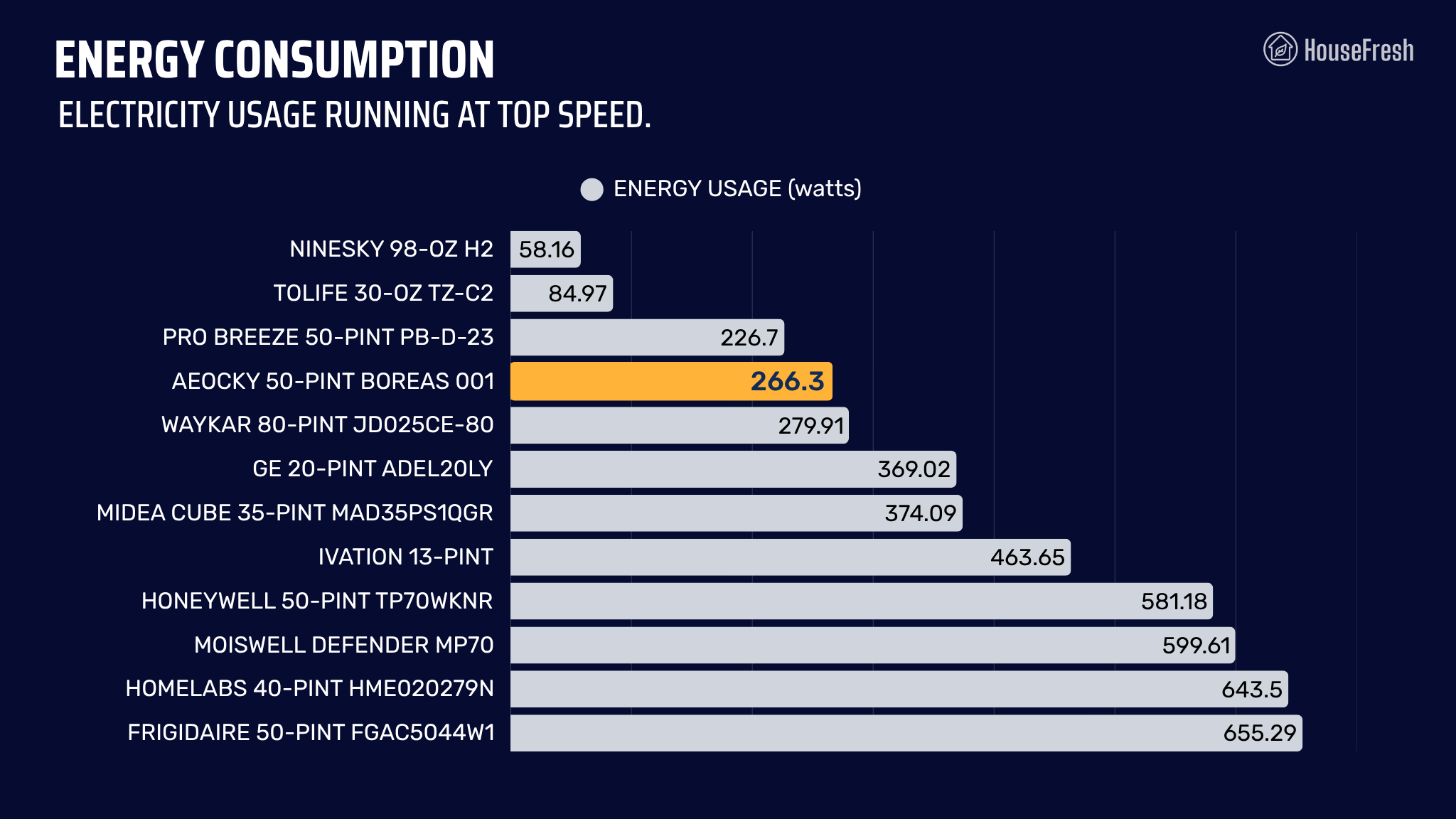
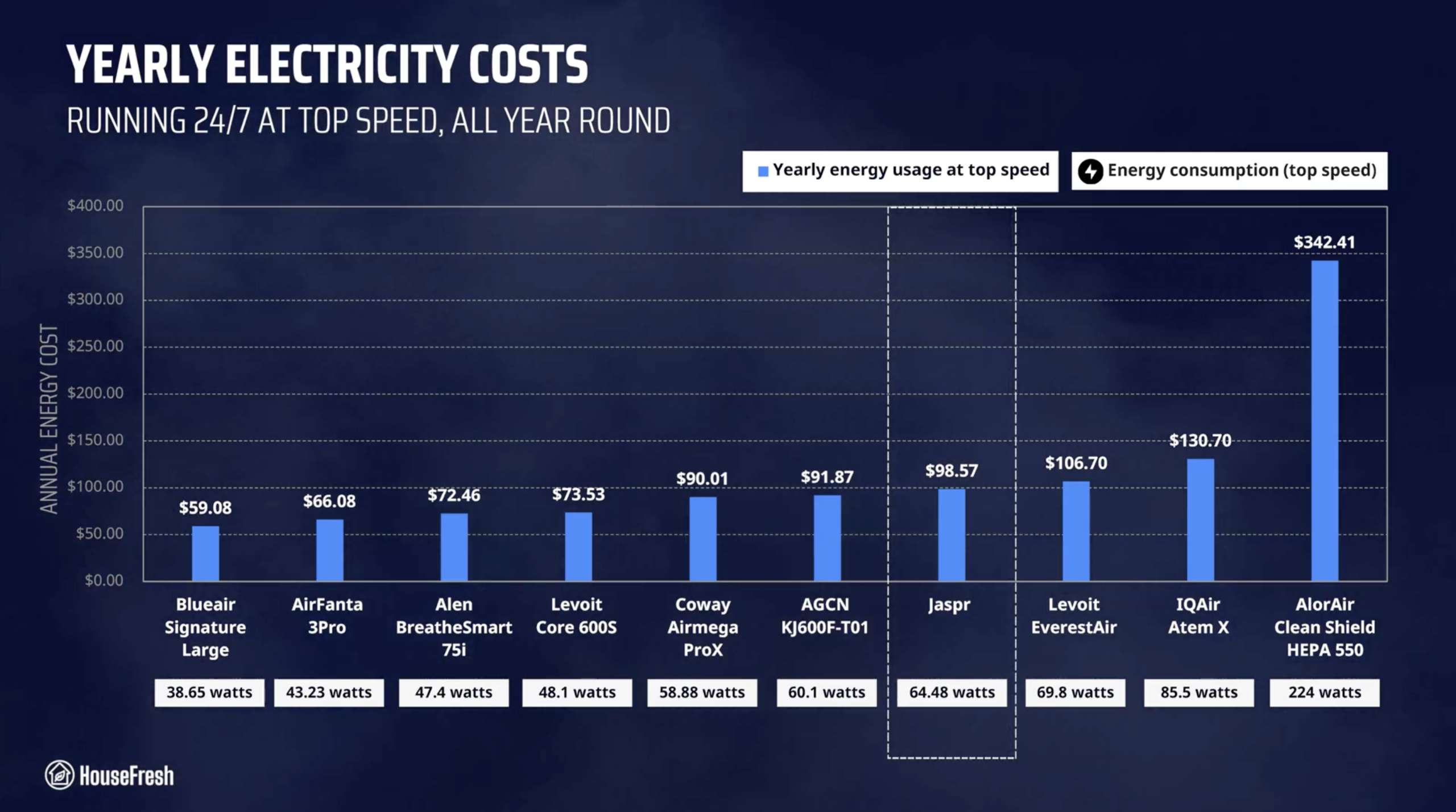
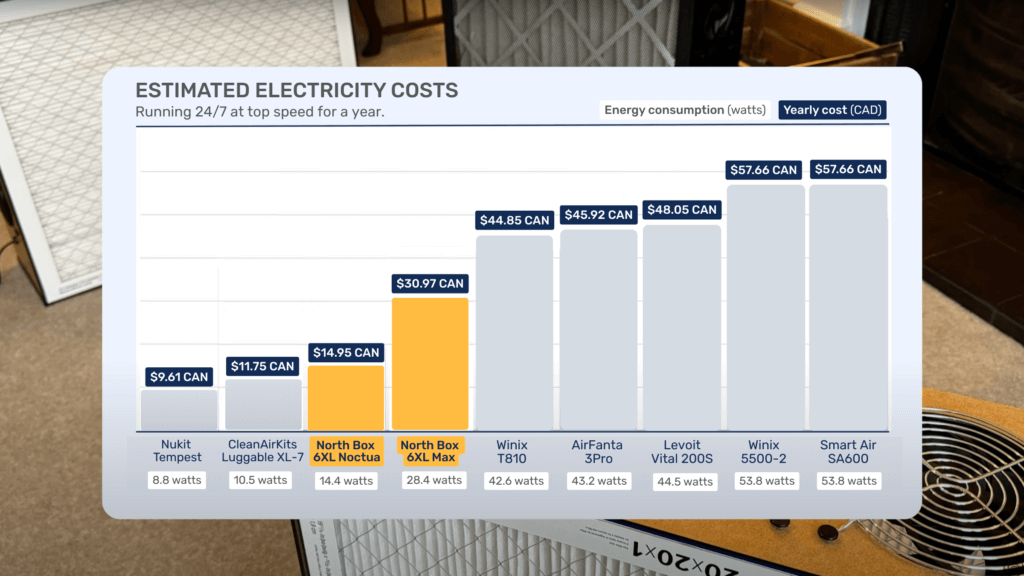
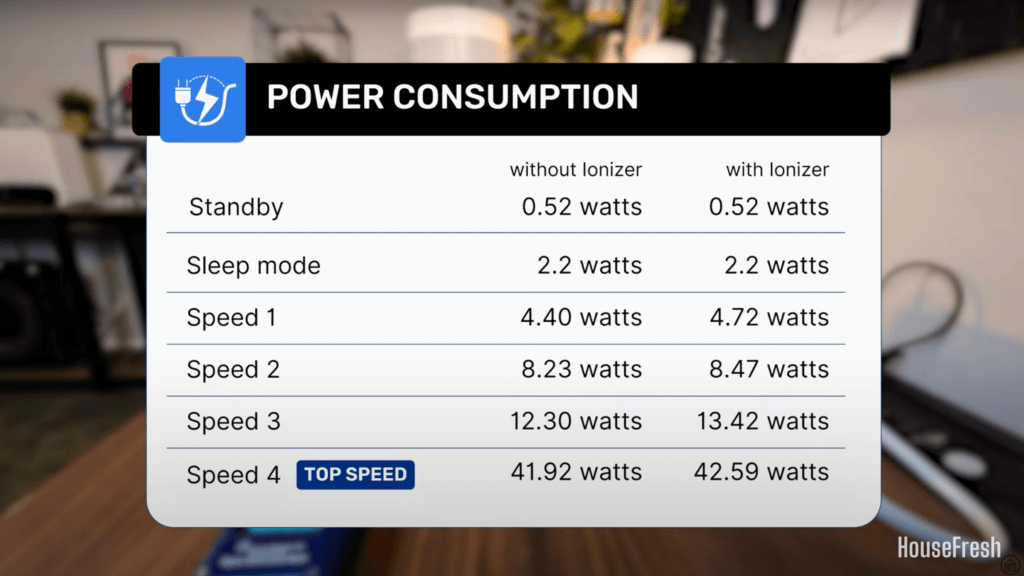
At top speed, the Winix 5520 drawsย 55.31 watts, so if you were to leave it running at full power 24/7 for a year, it would add $66.52 to your energy bill, based on the average U.S. electricity price as of March 2026.

However, electricity consumption is not the only long-term cost you should budget for when buying an air purifier… The biggest expense tends to be the filter replacements.

According to Winix, you need to change the filter in your 5520 every 12 months. The set with one True HEPA and one carbon filter costs $79.99, so you can expect to spend that much each year on filter replacements alone.

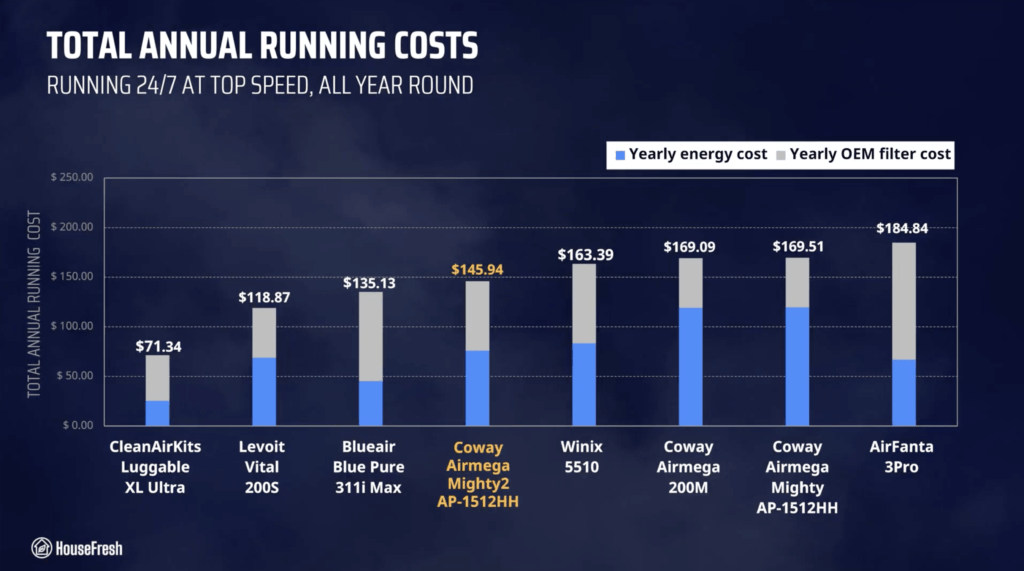
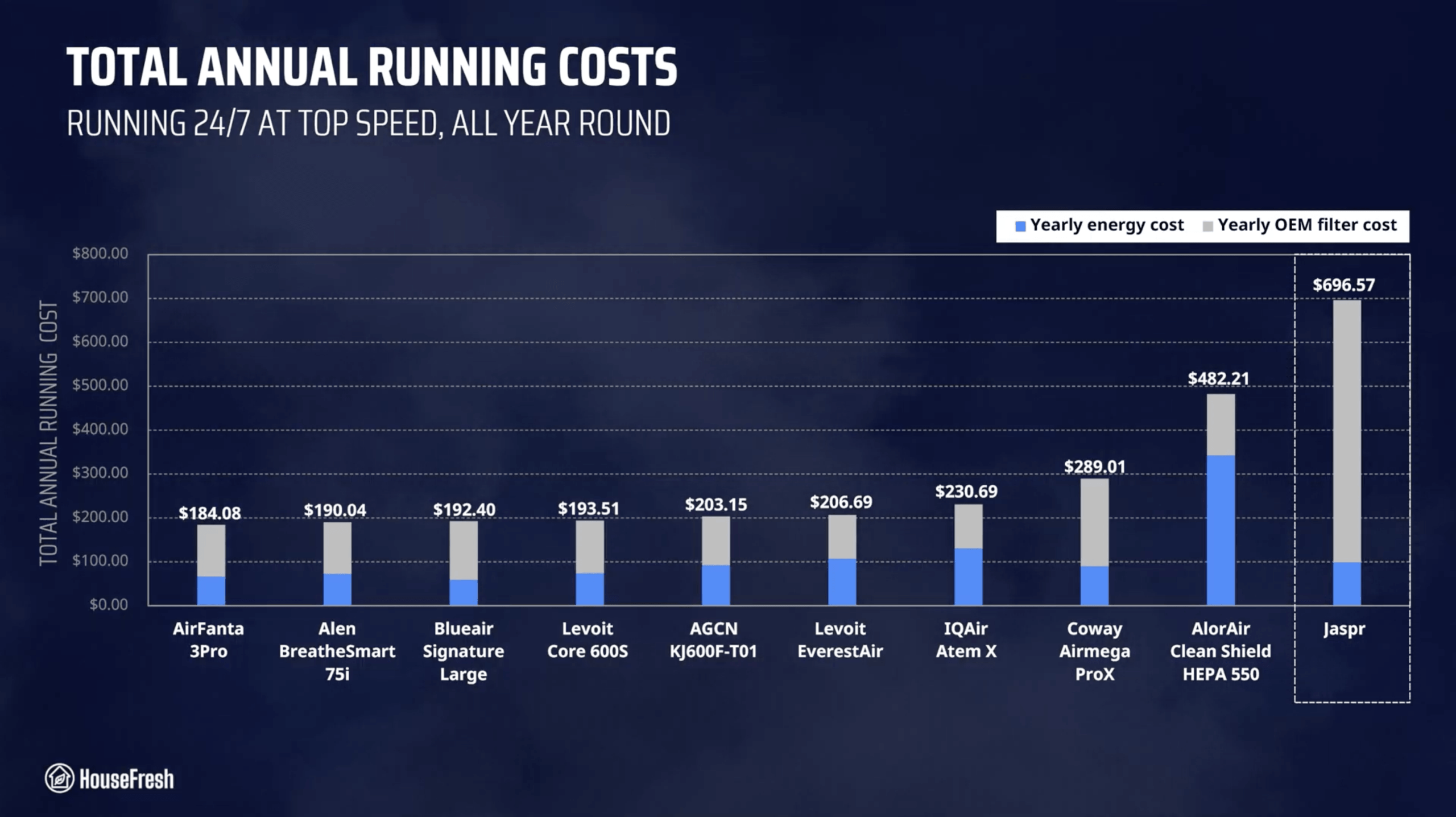
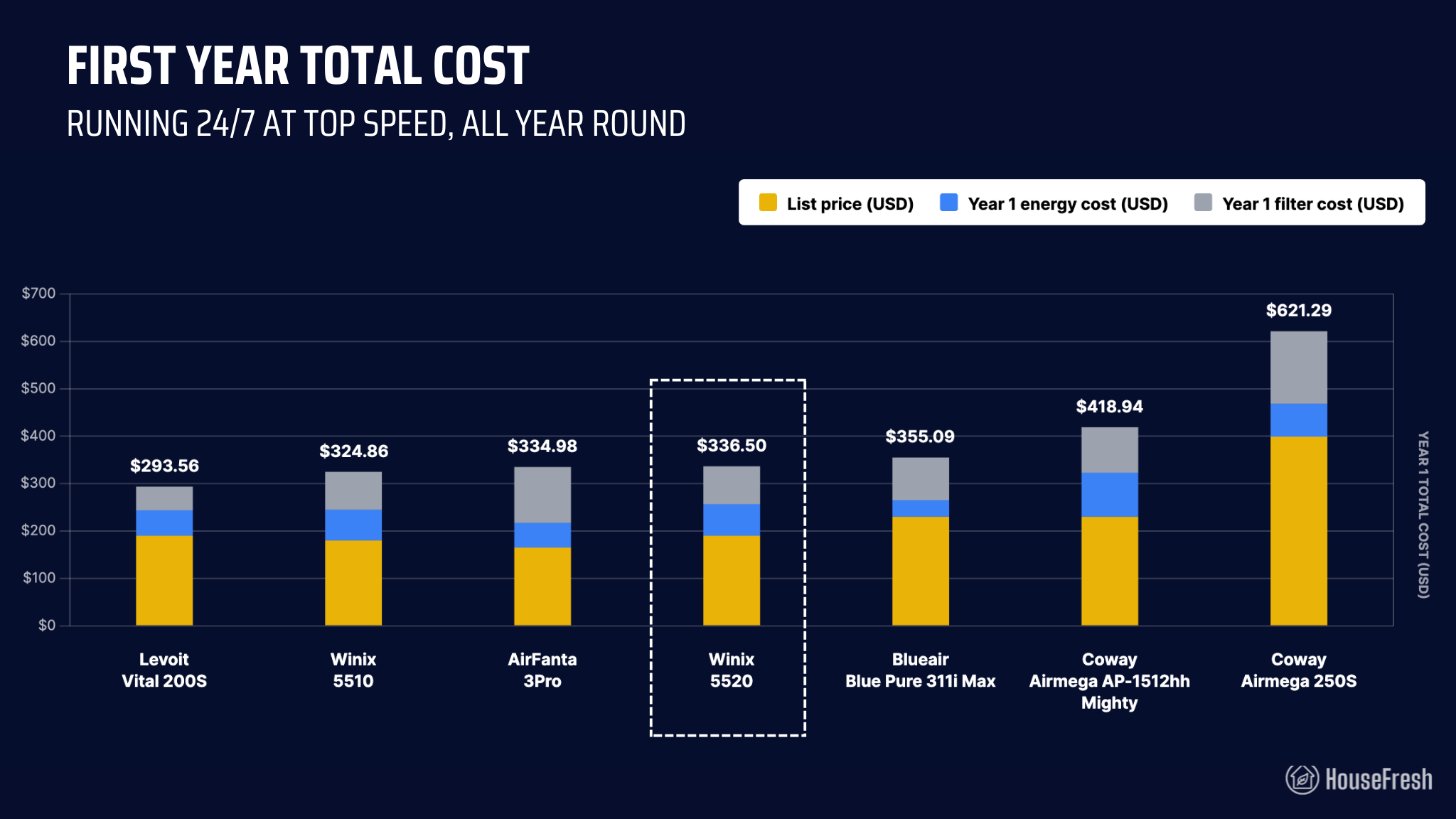
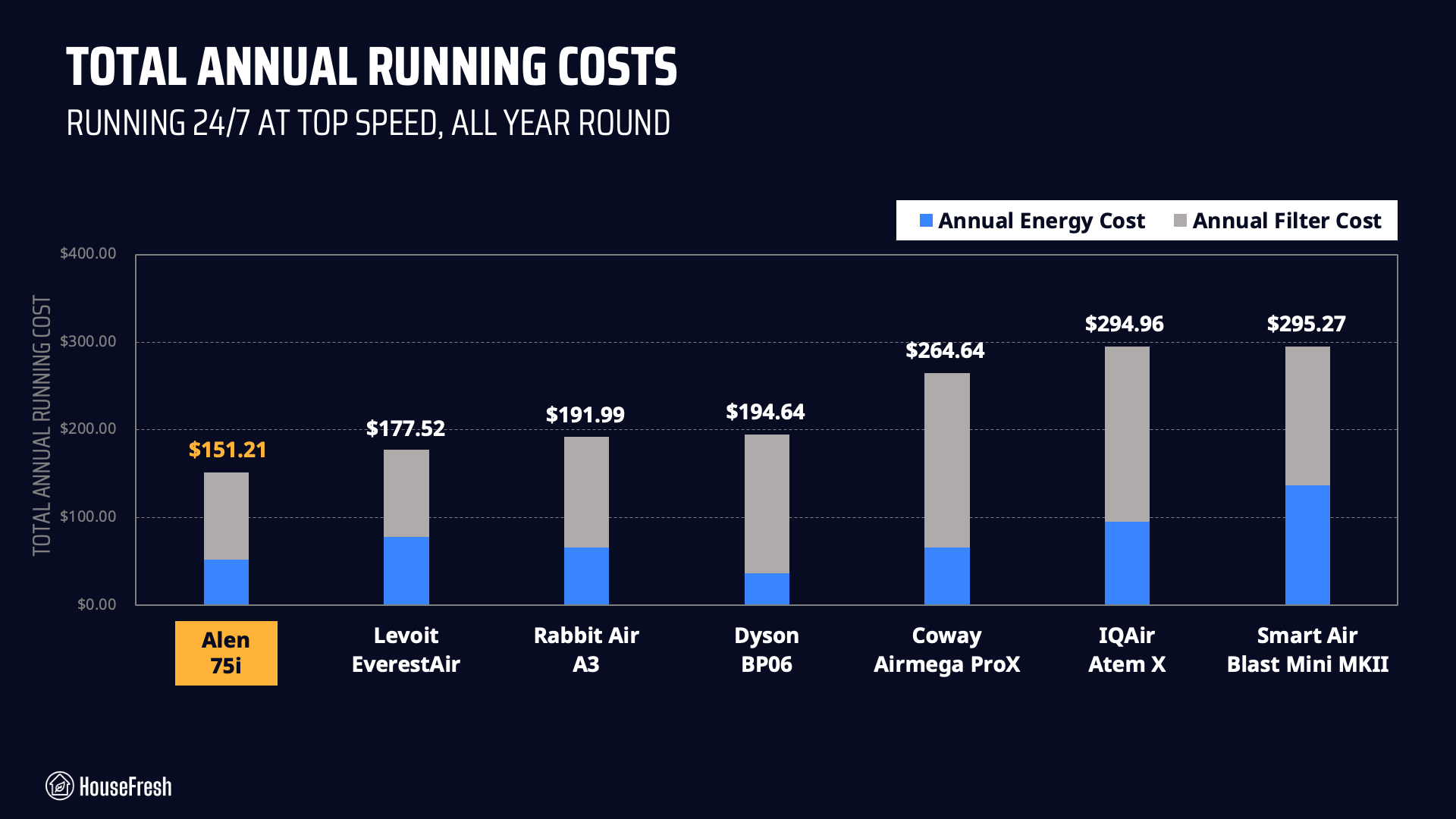
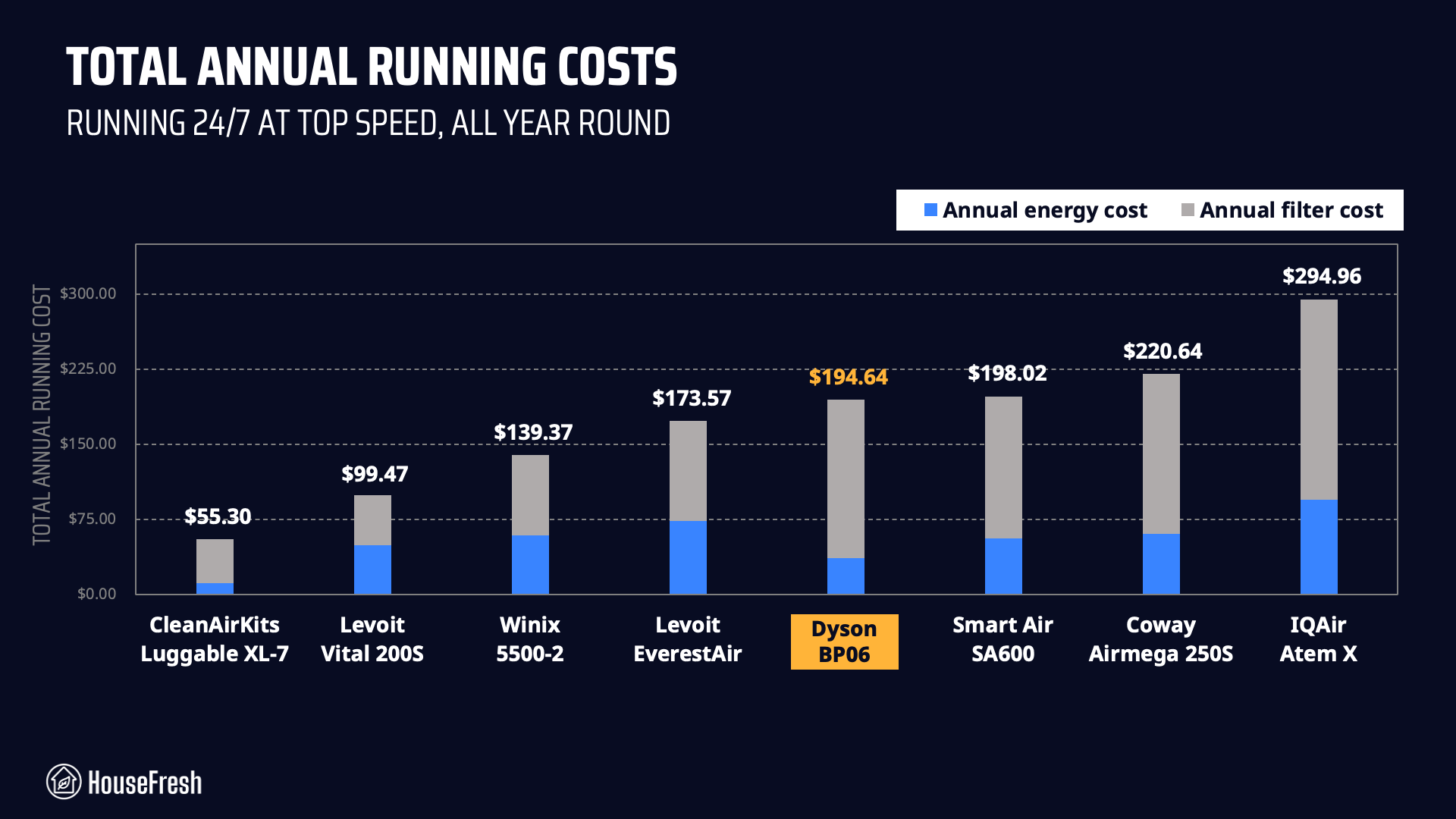
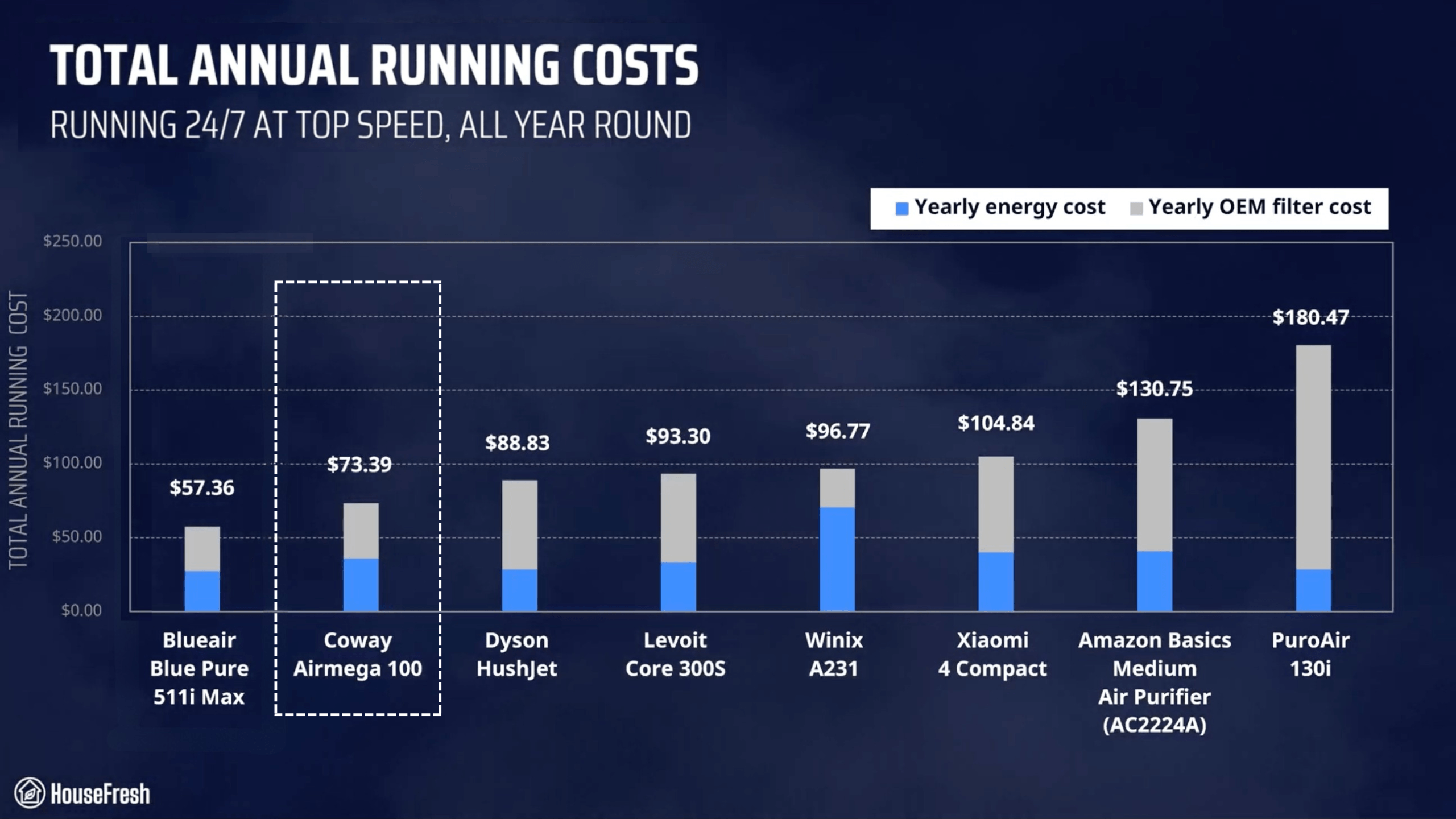
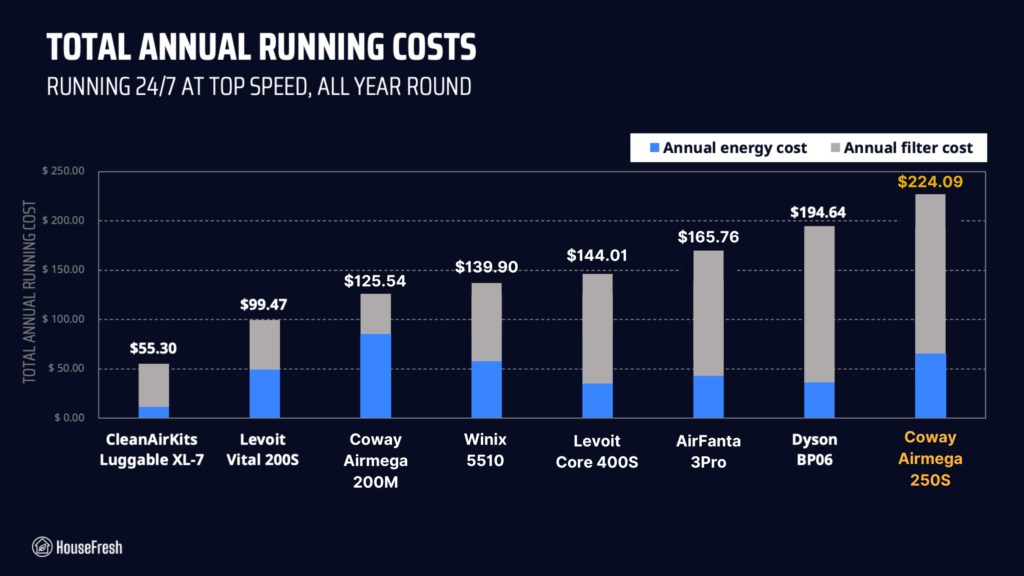
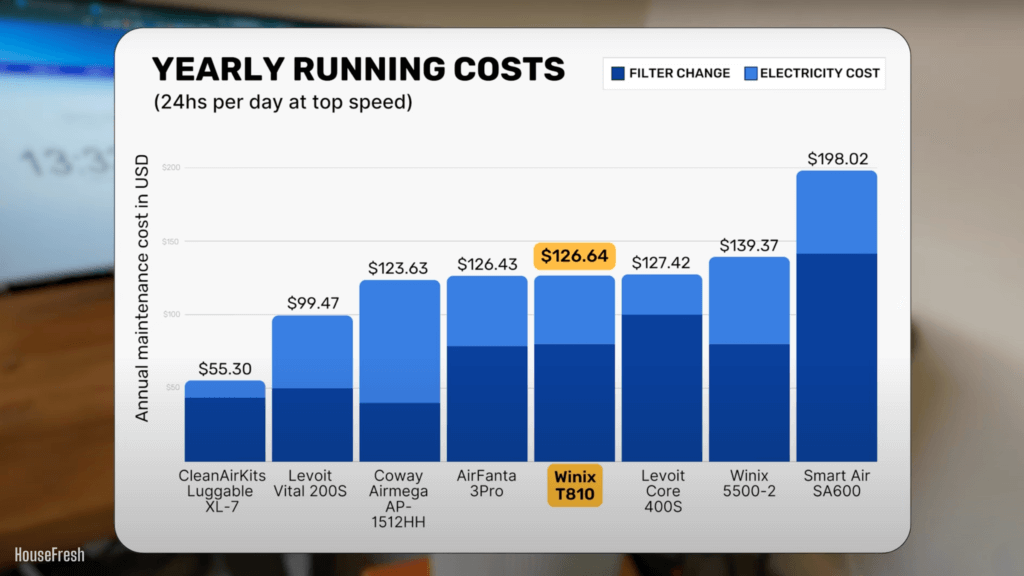
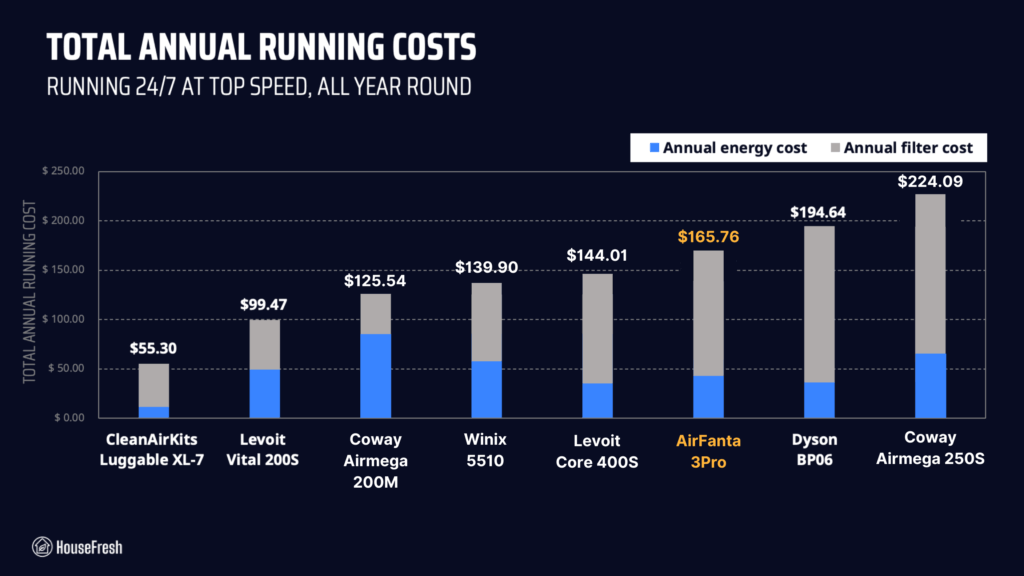
When we add this to energy costs, we can work out that it will cost you $146.51 to run a 5520 for a year. Let’s compare it with other models:

Winix 5520 Yearly Running Costs Chart

Because the 5520 is a tiny bit more power-hungry than the Winix 5510, you can expect to spend more each year on running costs, even though both units use the same filter replacements.

Bottom line: Should you get a Winix 5520?

Our data showed that the 5520 offers performance comparable to that of its sibling, the Winix 5510, BUT it comes with a higher price tag and a more power-hungry fan motor.

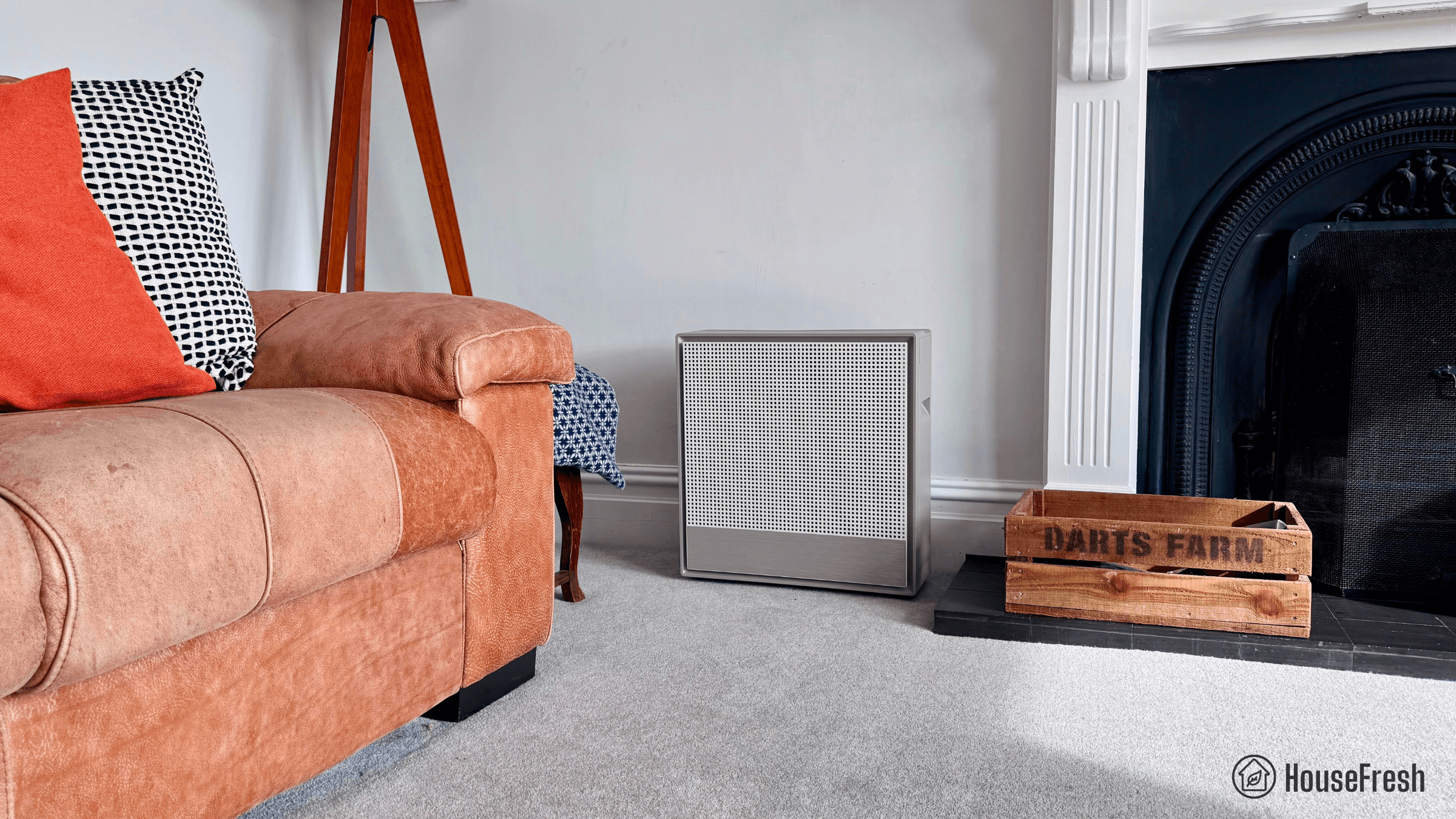
Winix 5520 Corner

The 5520 is a solid mid-sized air purifier with similar particle removal performance to that of many popular models in the segment, such as the Levoit Vital 200S, the Smart Air SA600, and even the more expensive Coway Airmega 250S.

Considering its affordable price at $189.99, this makes it a good choice for those looking for a good performing air purifier for rooms up to 373 sq. ft. that also comes with app support, an onboard air quality sensor, and auto mode.

That said, it’s hard to recommend it over the Winix 5510

Both devices look nearly identical, offer the exact same features and share the same Winix filters:

However, when it comes to air filtration, you will get better performance from the 5510 at quiet fan speeds. Plus, the 5510 costs less to buy and run, because the 5520 has a slightly higher price tag and consumes more electricity.

You will save some money upfront and in the long run with the 5510:

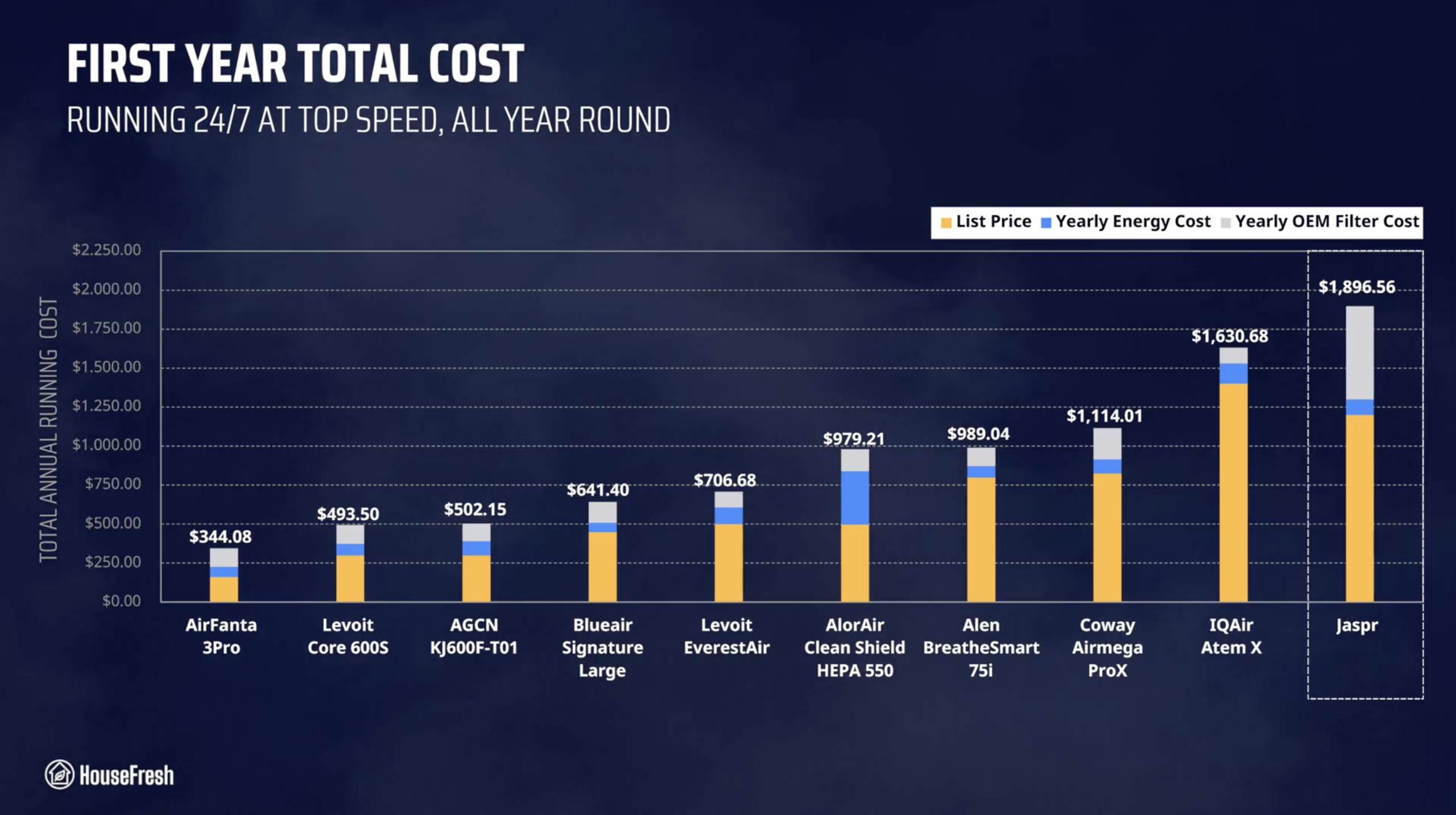
Winix 5520 Year 1 Costs Chart

That is why I wouldn’t recommend buying the 5520 over the 5510 unless you really like its front cover design – that is the main design difference between the two.

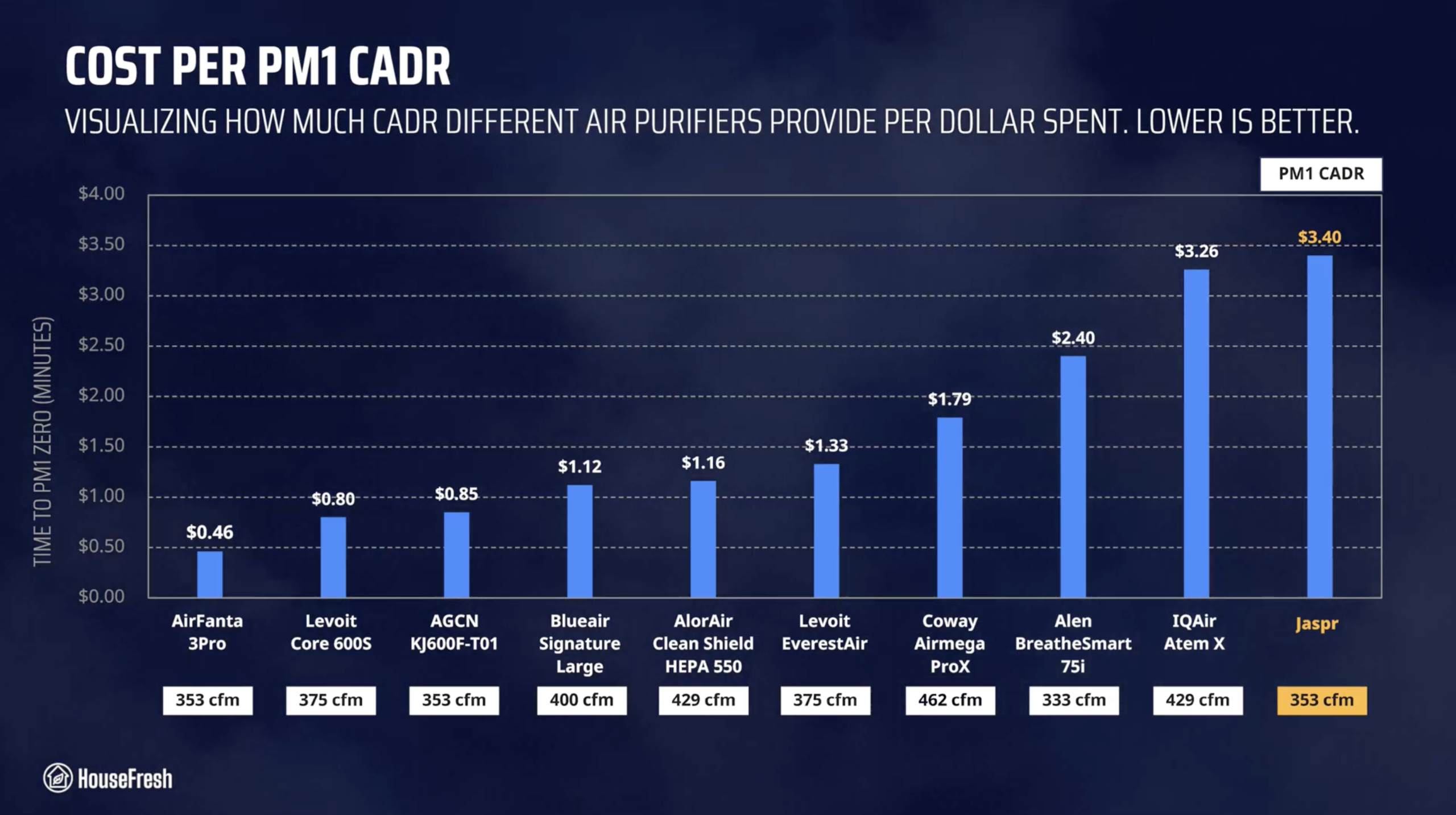
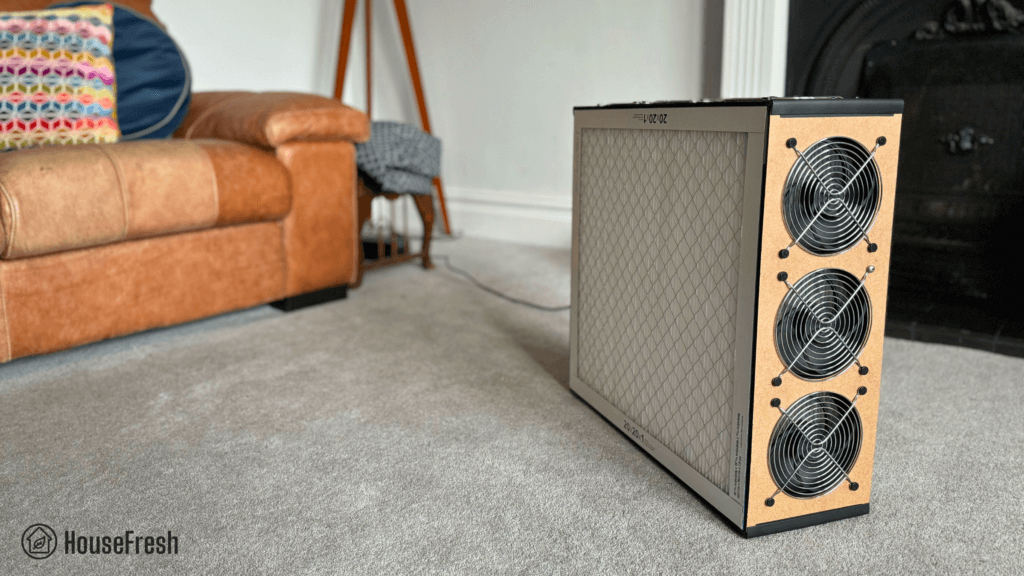
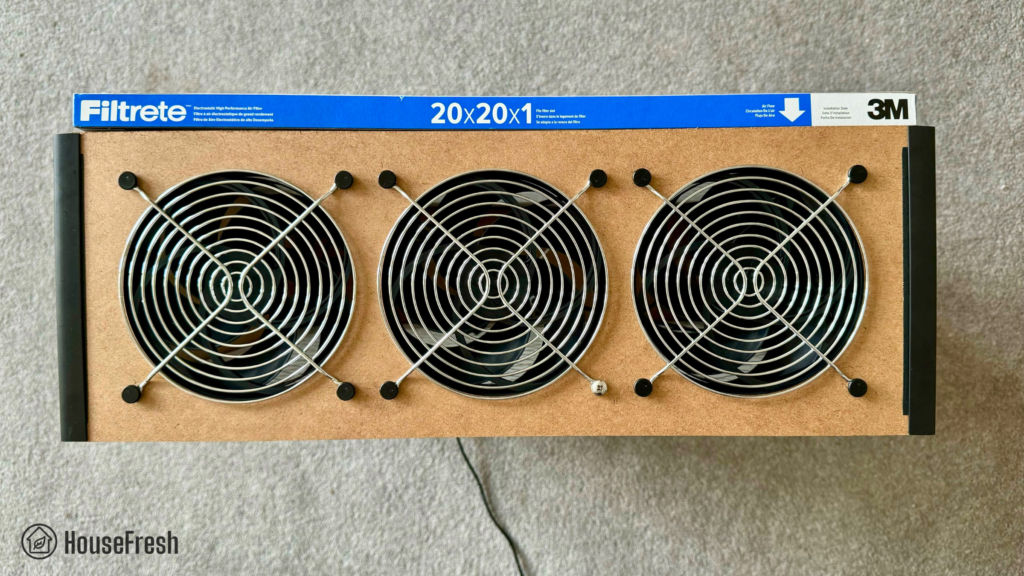
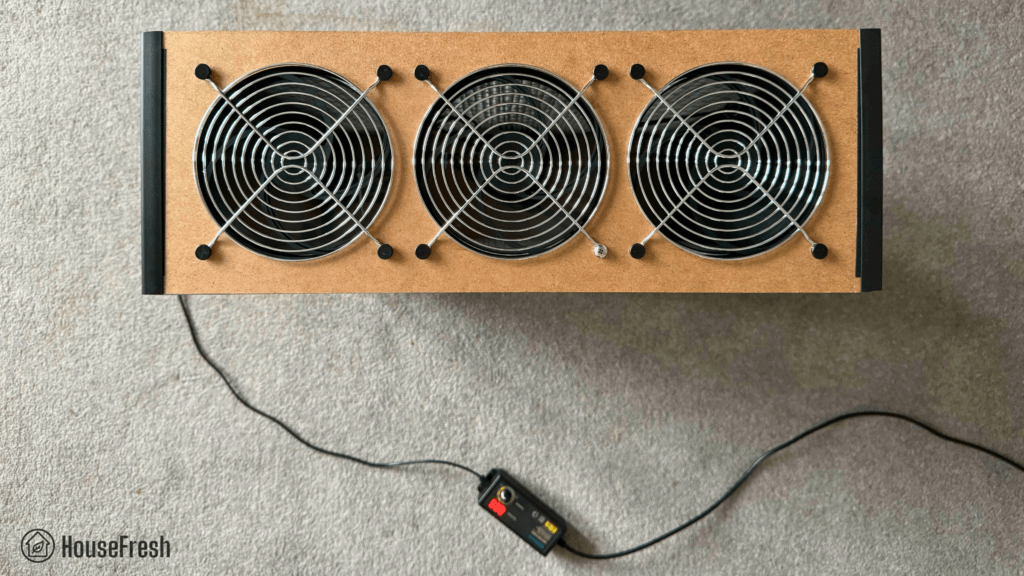
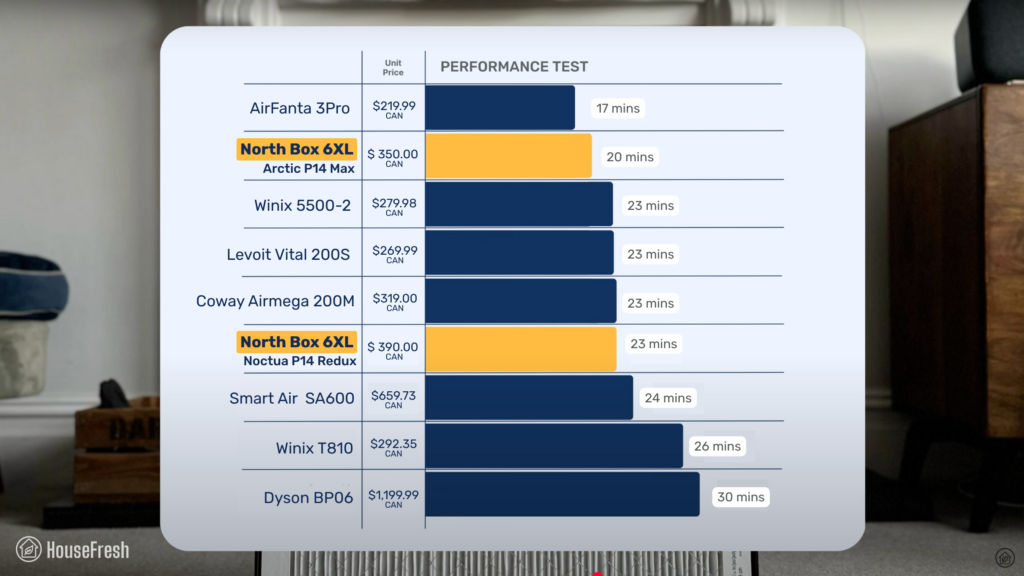
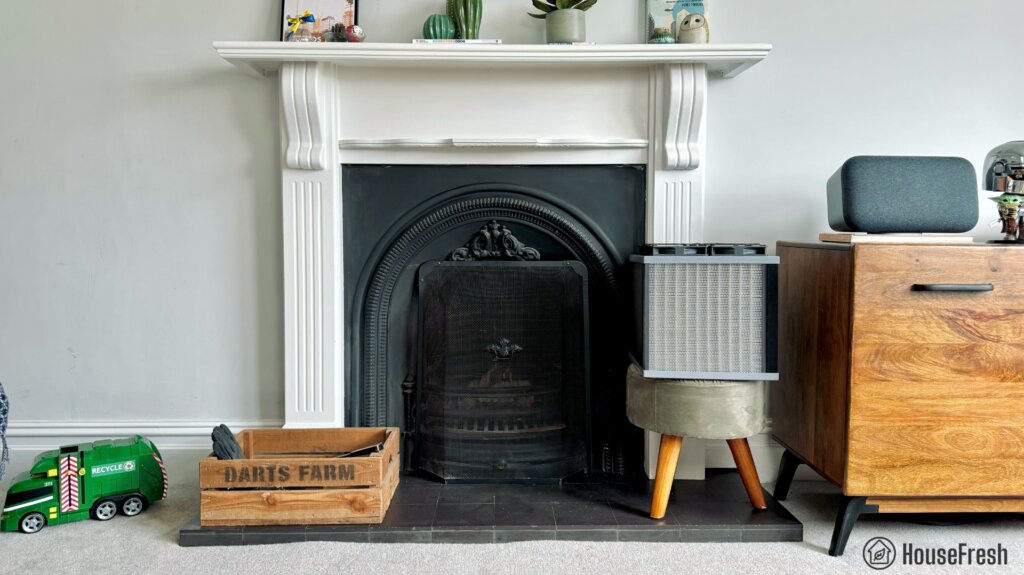
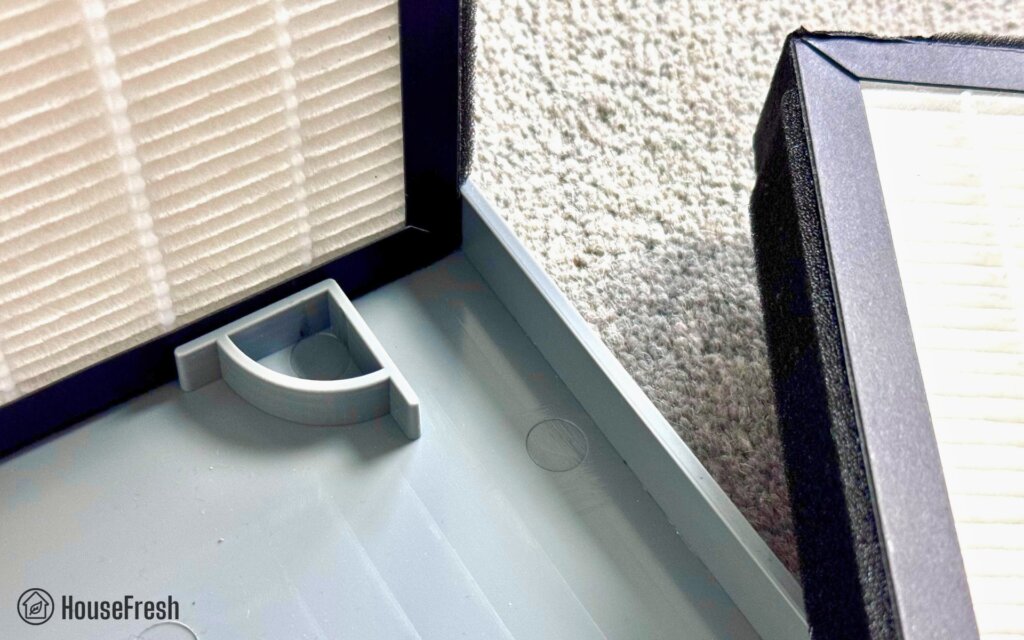
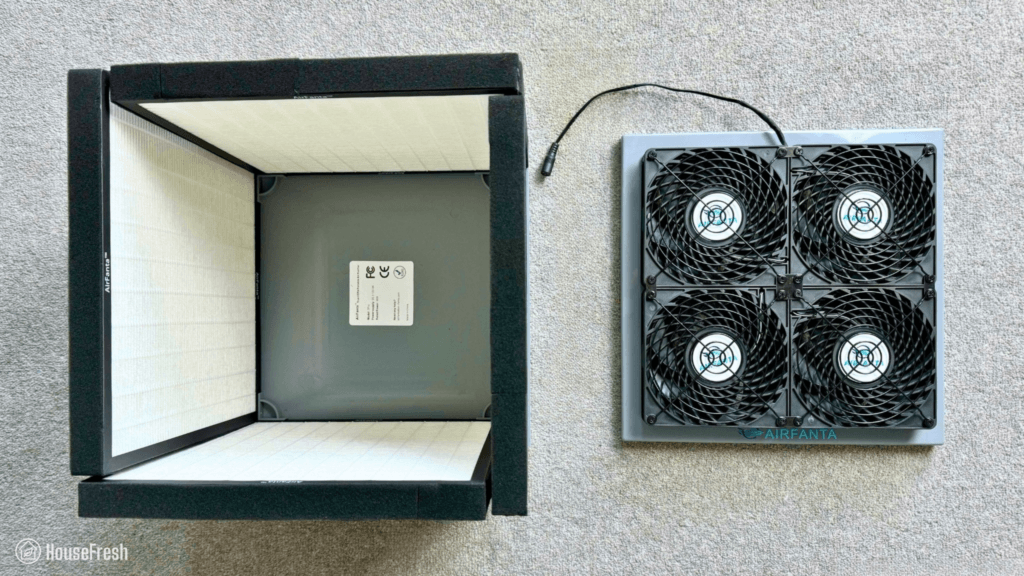
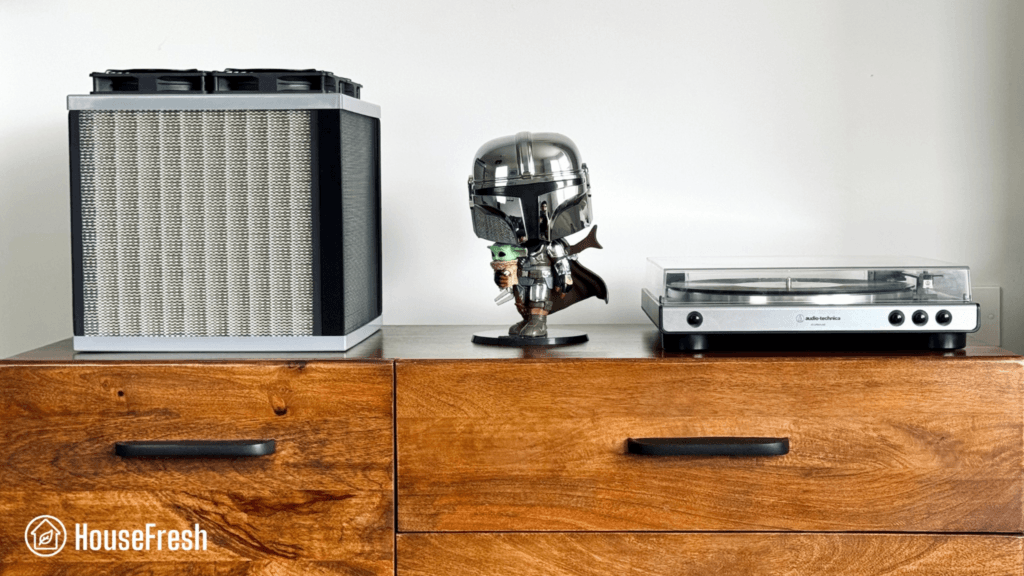
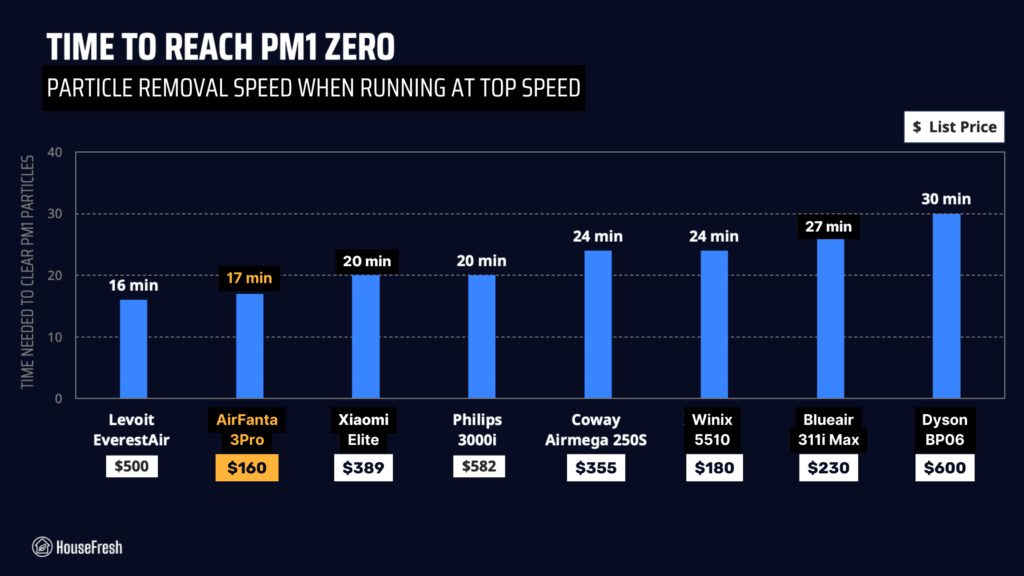
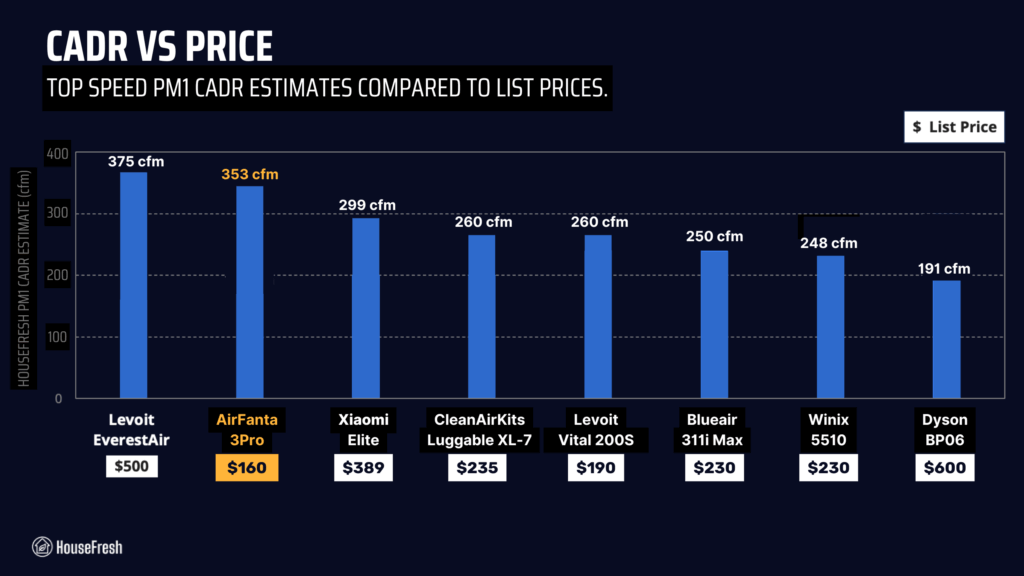
If you’re looking for a cheap air purifier to help with dust, mold, or pollen allergies, I suggest checking out the AirFanta 3Pro. For $165, you’ll get better particle removal performance in rooms as large as 529 sq. ft., thanks to a higher CADR of 353 cfm (vs the 249 cfm in the 5520). The downsides are that the $165 version doesn’t come with carbon (which you won’t need if you’re trying to tackle dust, mold, and pollen), and that the 3Pro is a PC fan-powered unit without a fancy touchscreen display or onboard sensors you’ll find in a traditional air purifier.

BUT if you like the look of the 5520 and are happy to pay the $189.99 price tag, then you will be buying a good air purifier with smart features that will help remove both particles and odors from the air.

If you decide to get yourself a 5520, please use this link to help support the work we do at HouseFresh. When you buy through that link, we will receive a small affiliate commission at no extra cost to you. We don’t run any ads and have no partnerships with air purifier brands, so we rely on those small commissions to continue buying and testing air quality products.

If you have any questions about the 5520 or about Winix air purifiers in general, please drop them in the comments below, and I’ll get back to you personally as soon as I can.
Coway Airmega 350 review

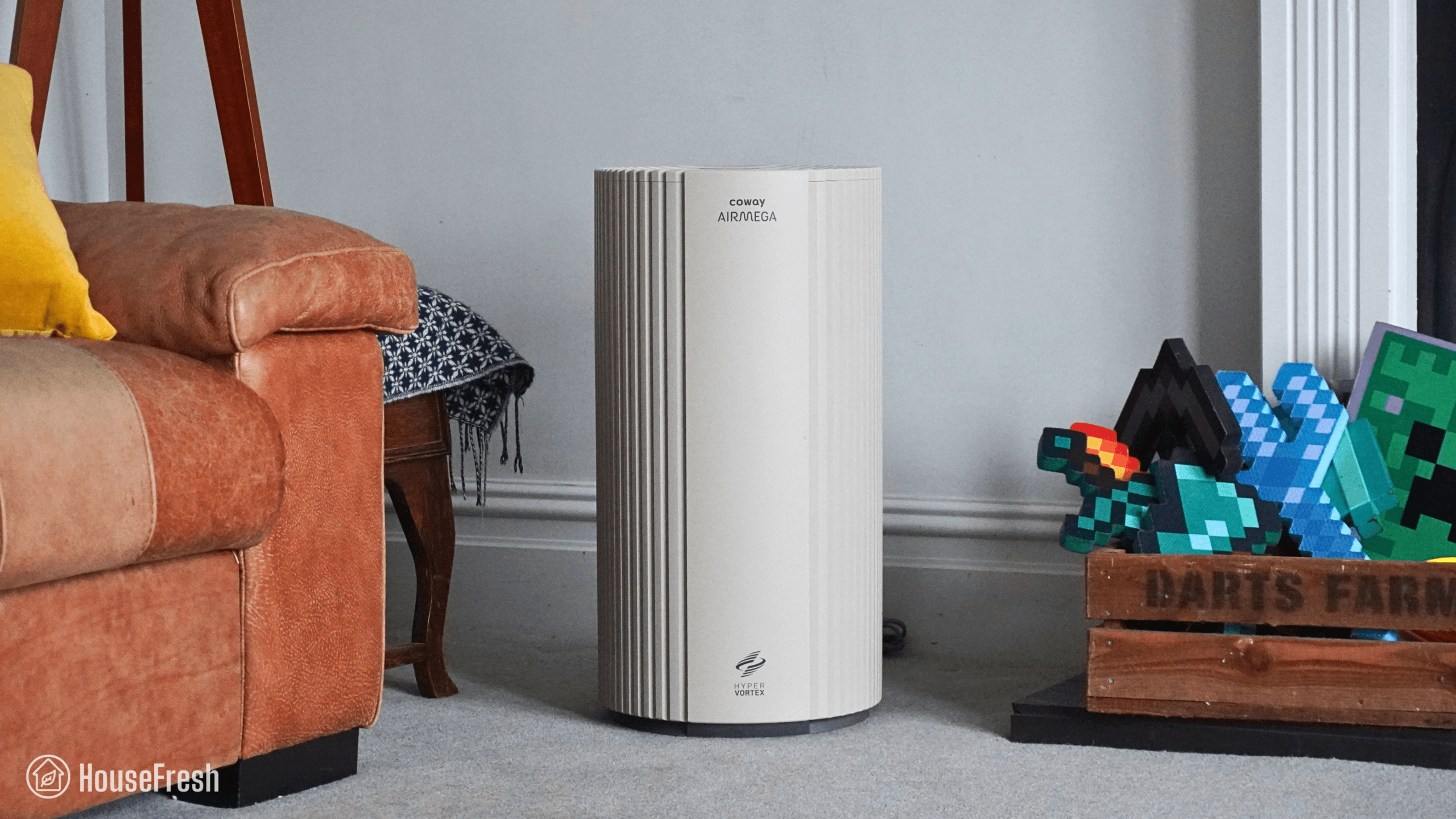
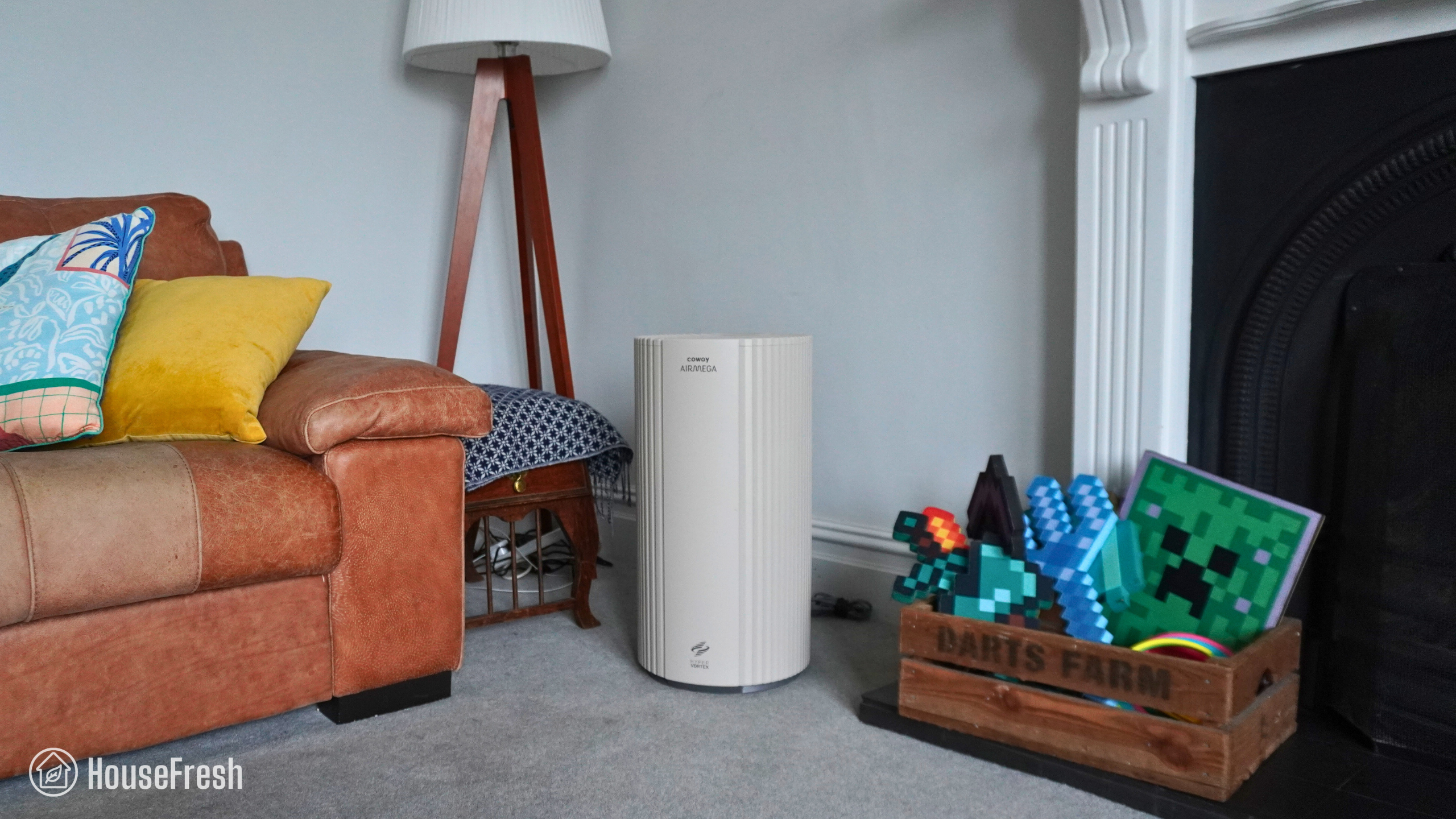
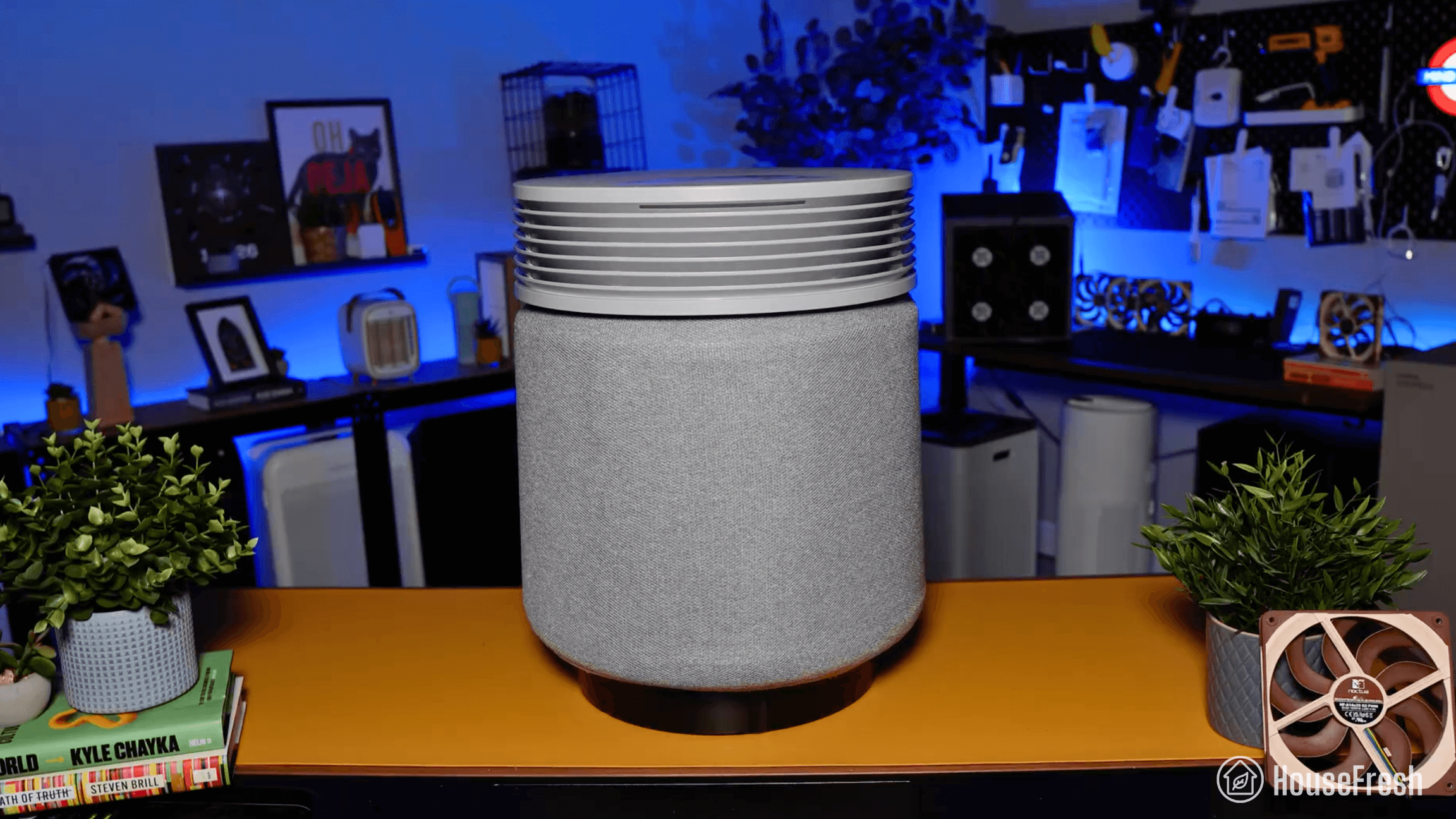
Coway Airmega 350 Living Room scaled

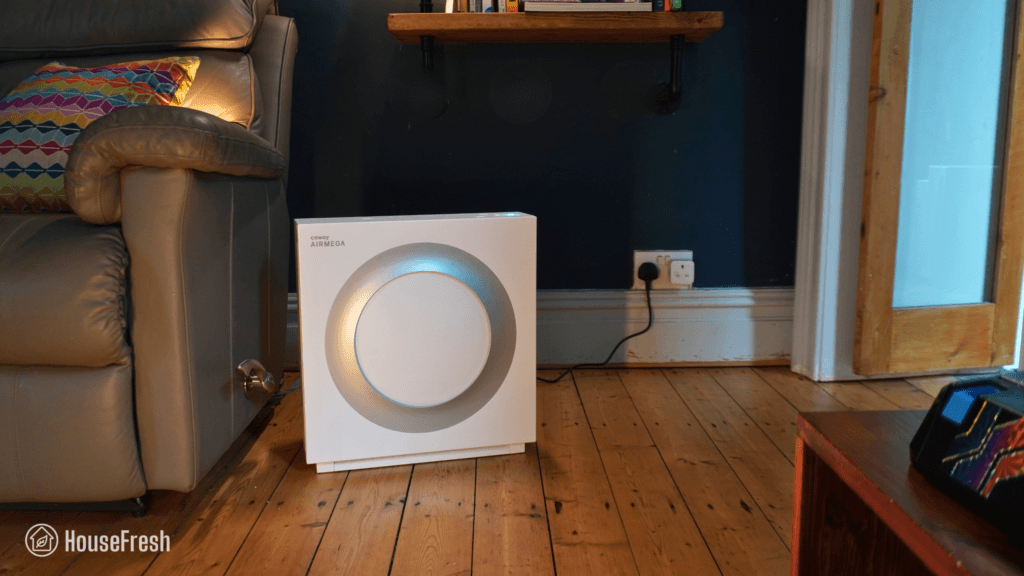
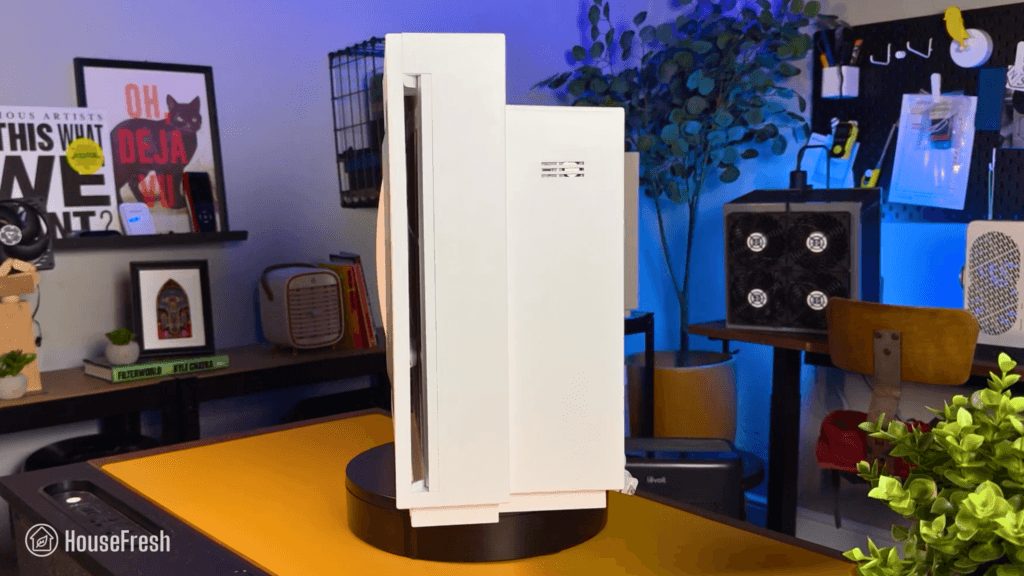
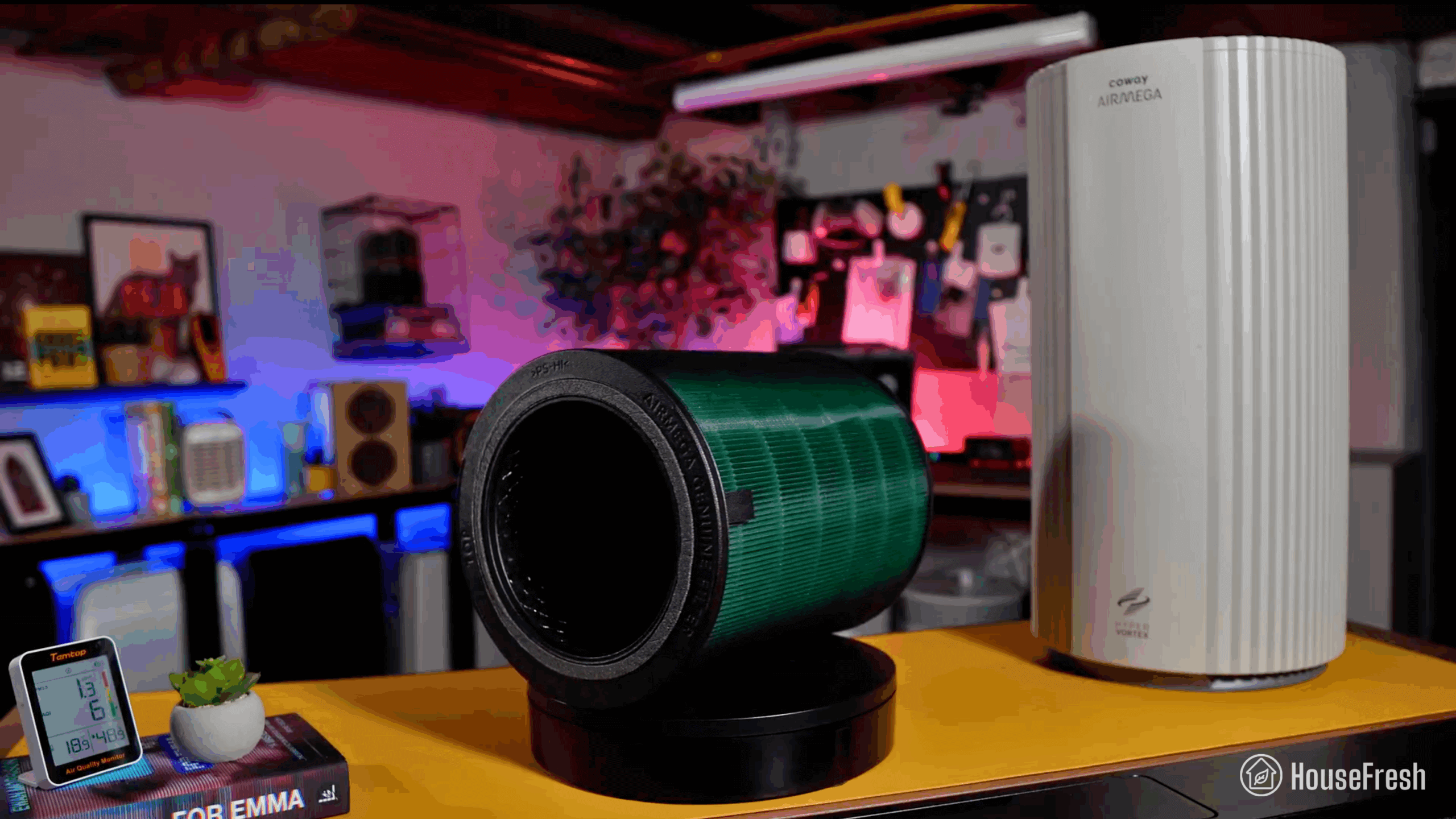
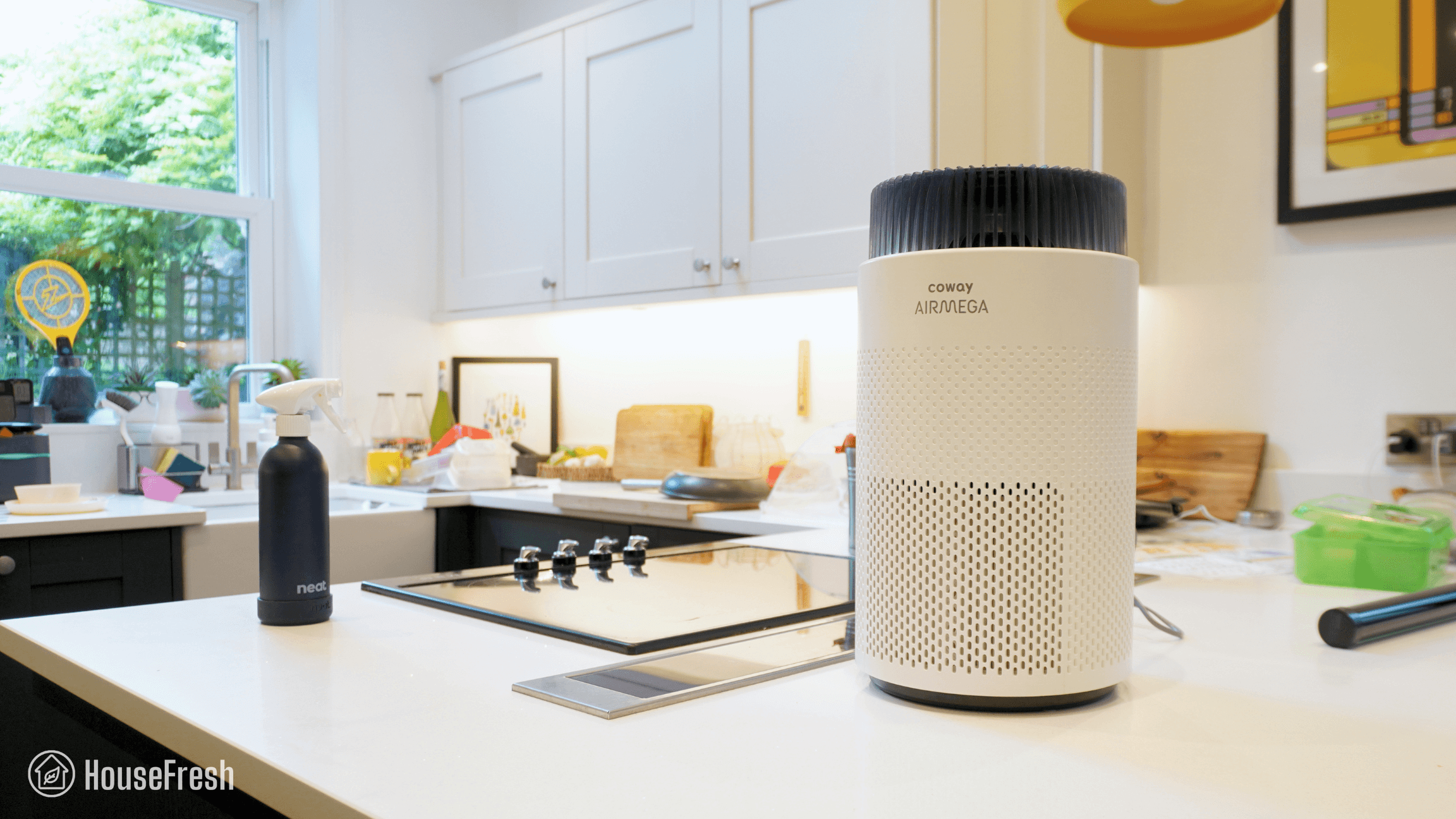
With the Airmega 350, Coway brought the power and low running costs they’re well known for but in a cylindrical design, with the same retro-inspired aesthetic as the Airmega 250S and Airmega ProX.

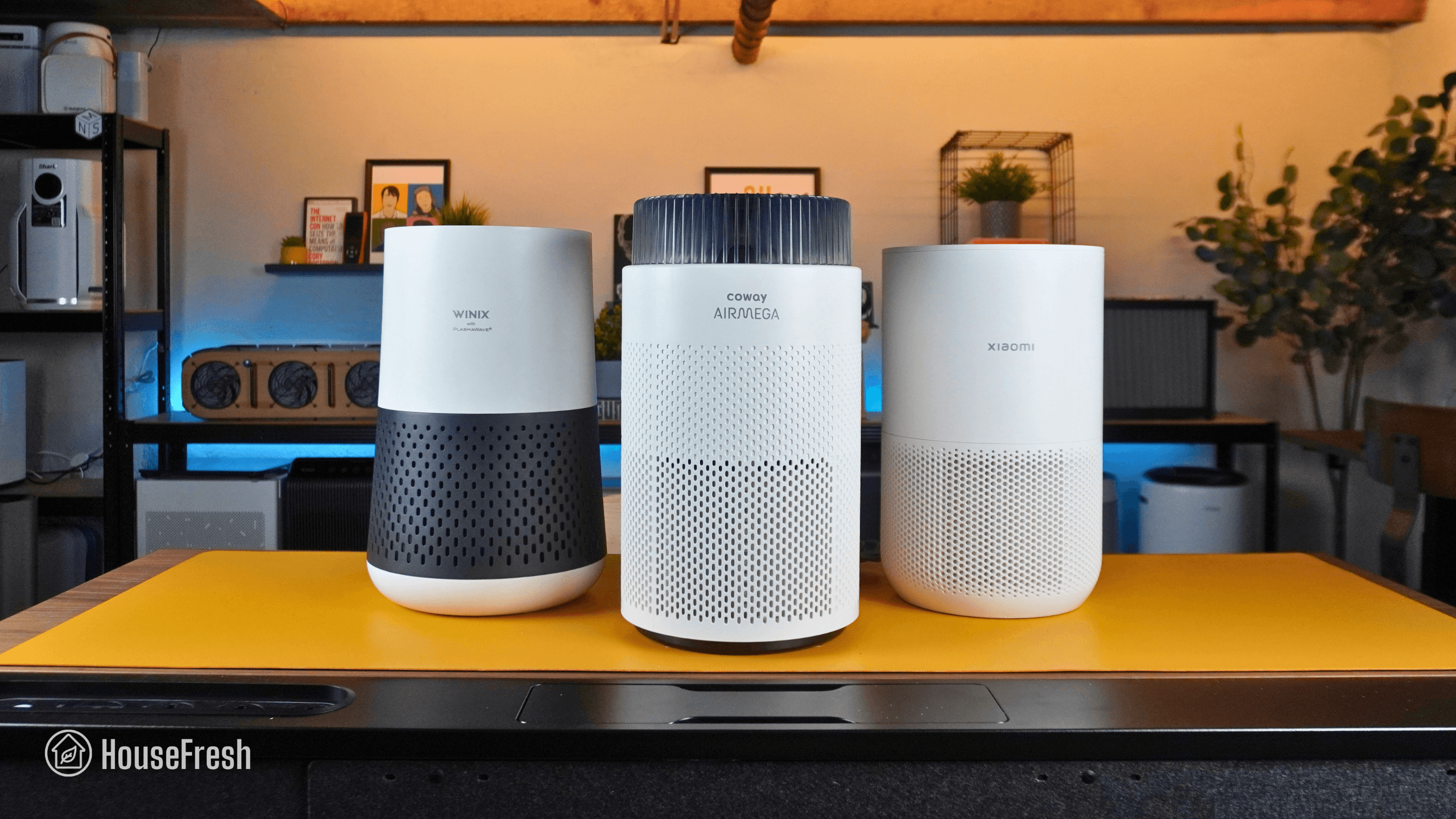
But can this new model compete with the excellent cylindrical designs from Levoit, Winix and Xiaomi? I bought a 350 with my own money and put it through all the tests we perform here at HouseFresh to find out.

The overall score for the Coway Airmega 350 incorporates first-hand data results from our battery of tests, as well as our ratings for customer service, brand transparency, and design & UX. Check out the full scorecard below to see the split of categories.

Search for โ€˜Coway Airmega 350โ€™ to see where it ranks, based on its air cleaning performance and value for money. You can also filter results to easily compare models in the same price range.

The pros and cons of the Coway Airmega 350

A summary of our top-level findings after testing this air purifier, following our methodology.

“The Airmega 350 is Coway’s alternative to the Levoit Core 600S and the Xiaomi Elite, with a good looking design that will fit even the most stylish of homes. The running costs are very fair, with $79 filter replacements that can last as long as 12 months.

When comparing to Xiaomi and Levoit, you get comparable air cleaning performance but you lose out on a laser sensor and app support. That said, you can use the 350 with a smart plug.”

Danny Ashton HouseFresh
Danny Ashton
HouseFresh Founder
& Lead Tester

CONS

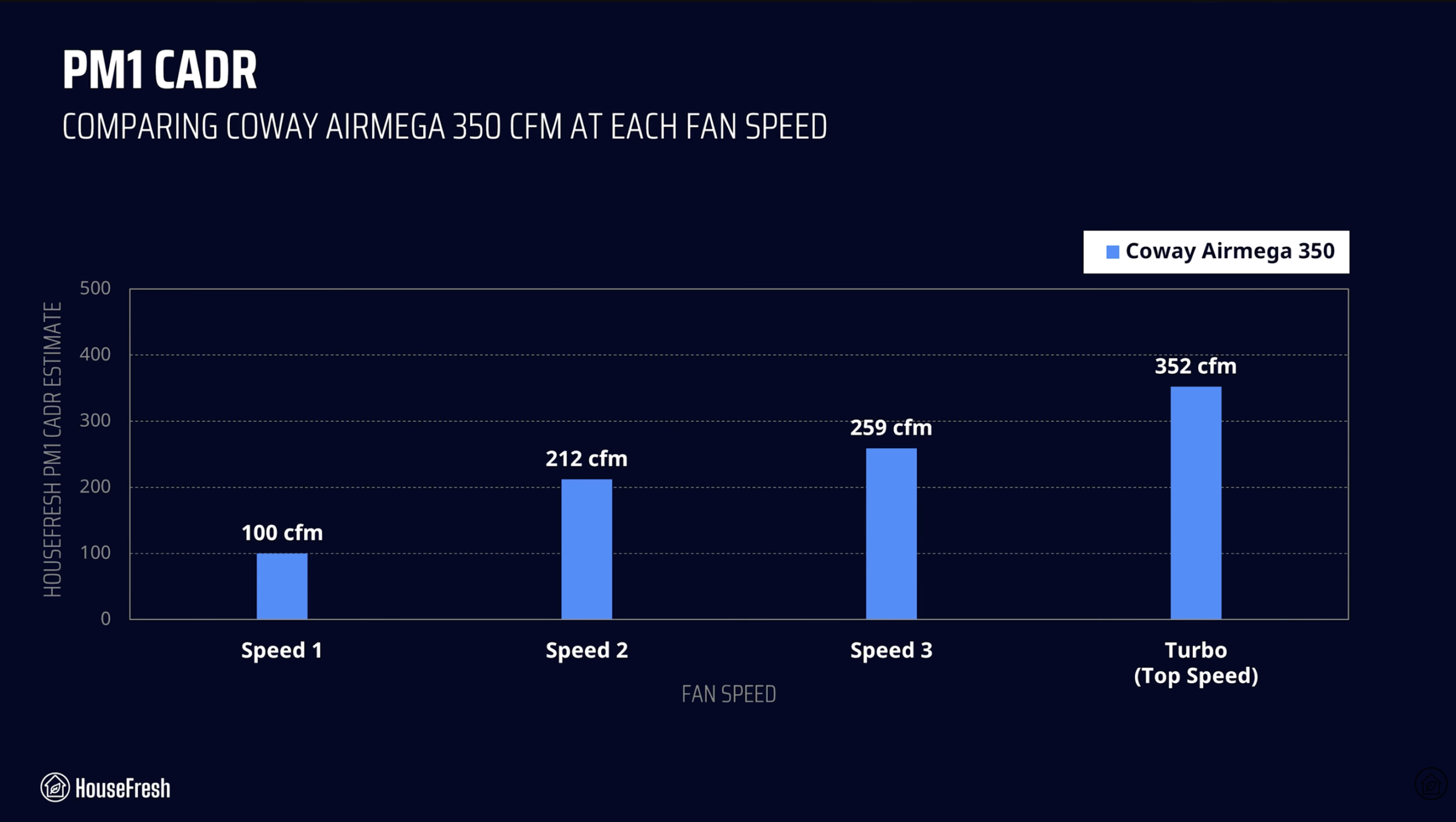
It only has one fan speed below 45 decibels (speed 1) and its performance at this speed is weak (100 cfm).
There is a big jump in how loud this thing gets when you go from speed 1 (37.6 dBA) to speed 2 (49.4 dBA).
It comes with an optical sensor rather than a laser sensor, so you canโ€™t forget to clean it regularly.

PROS

It offers excellent performance at top speed, outmatching large units like the Winix 9800 and the Xiaomi Elite.
You can use it with any smart plug, so you can connect it to your smart home system or set simple automations.
The filter replacements are fairly priced and can last up to 12 months.
It looks like a million bucks โ€“ I know design is subjective, but I think most people will like the look of the 350.

Clean air delivery rate (CADR):โ€“ Top speed PM1 CADR: 352 cfm
โ€“ Sub-45 dBA PM1 CADR: 100 cfm
– AHAM PM2.5 CADR: 378 cfm (dust)
Filter technology:Bonded cylindrical Green HEPA filter with a layer of pelleted activated carbon and a surrounding pre-filter mesh.
Recommended room size:528 sq. ft.ย (5 air changes per hour)
Dimensions:12 x 12 x 23 in (30.5 x 30.5 x 59 cm)
Weight:17.6 lbs (8 kg)
Noise level in decibels from 3 ft. away:Sleep mode: 35.2 dBA
Speed 1: 37.6 dBA
Speed 2: 49.4 dBA
Speed 3: 55.4 dBA
Turno mode: 61.8 dBA
Electricity consumption in watts:Standby: 0 watts
Sleep mode: 3.1 watts
Speed 1: 4.89 watts
Speed 2: 17.04 watts
Speed 3: 32.65 watts
Trubo mode: 57.95 dBA
Filter lifespan:12 months
Manufacturerโ€™s warranty:3 years
Country of origin:South Korea
Country of manufacture:China

Filtration technology

Coway’s Green True HEPA filter with pelleted activated carbon and a pre-filter mesh.

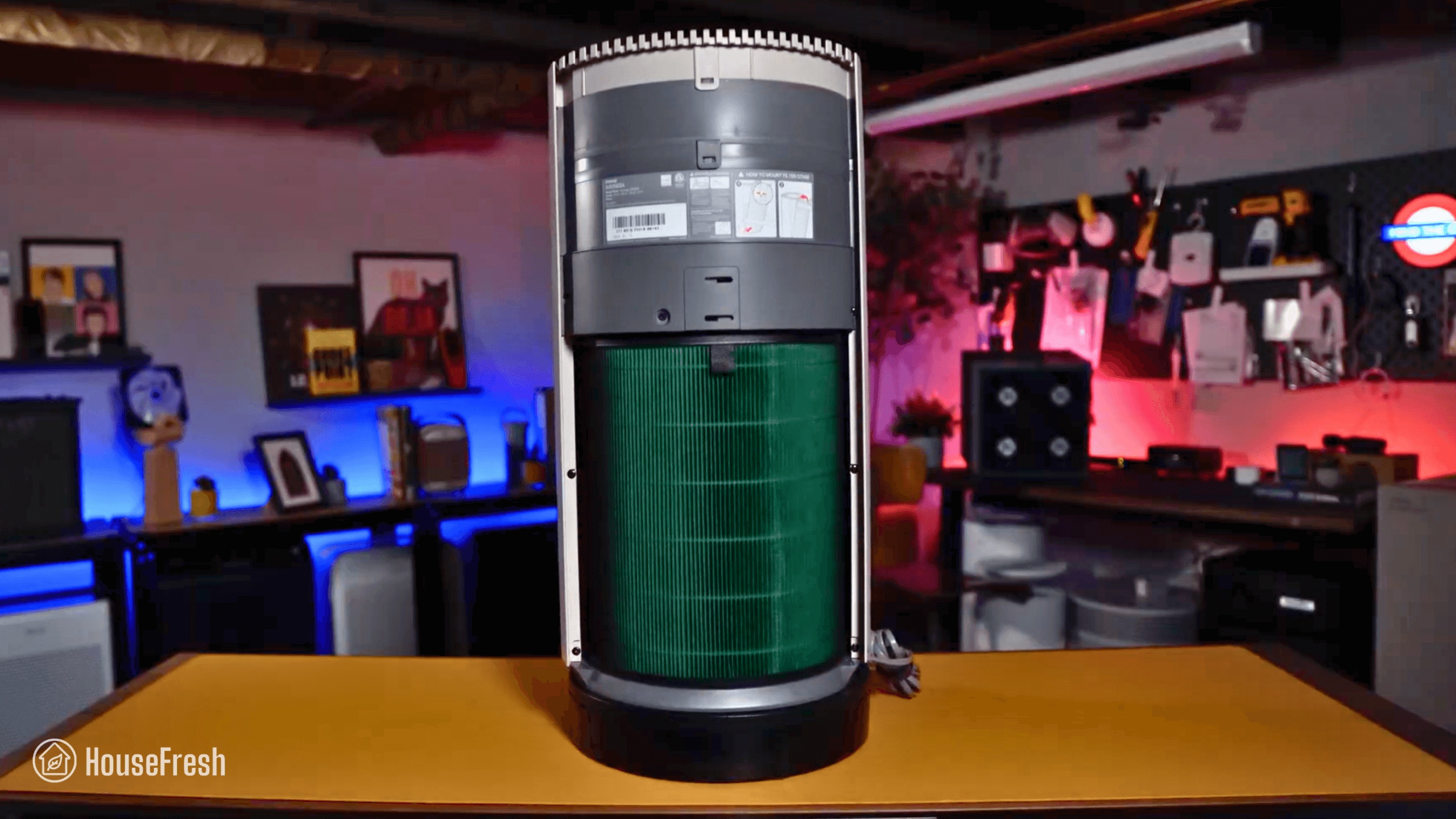
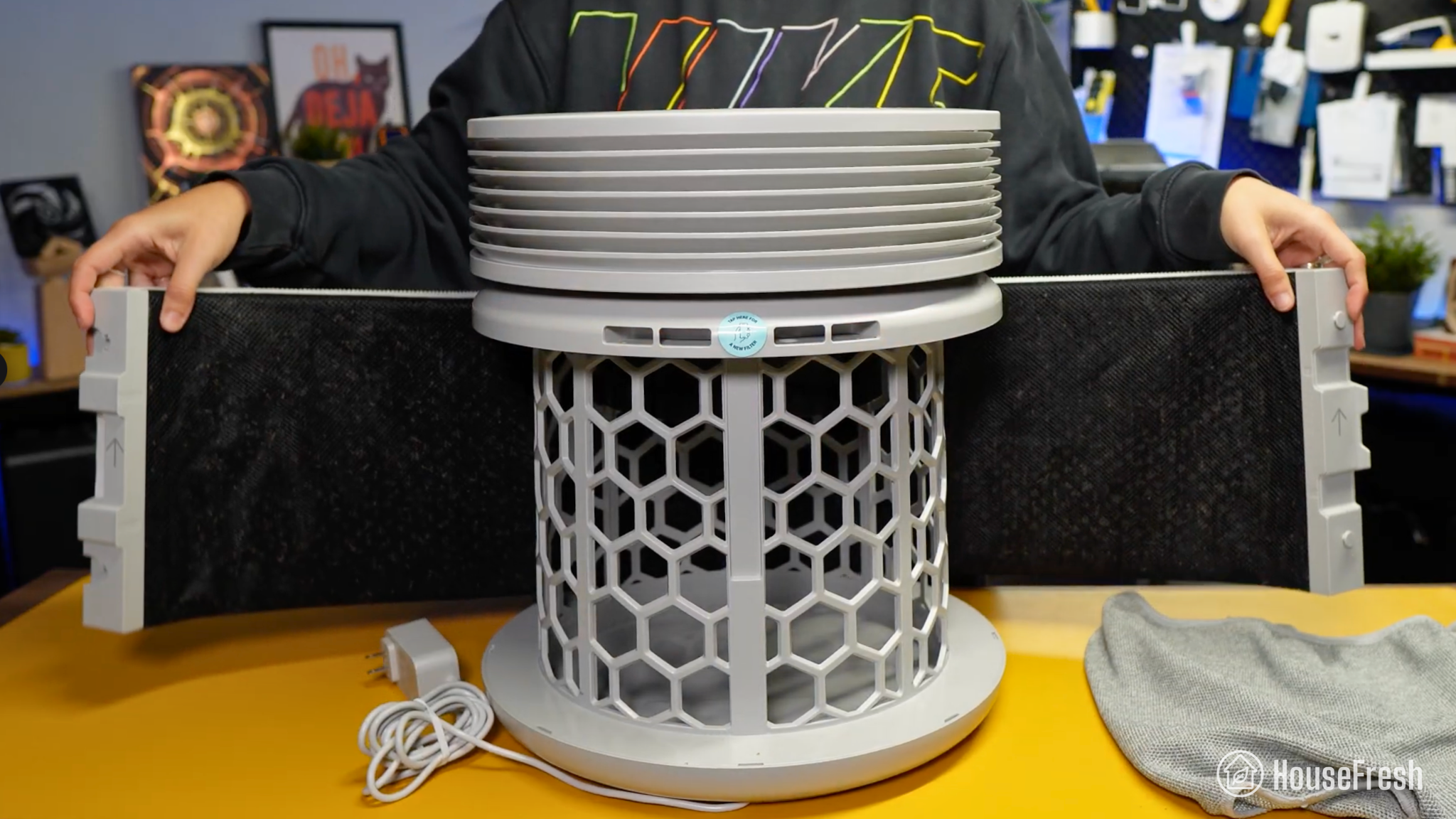
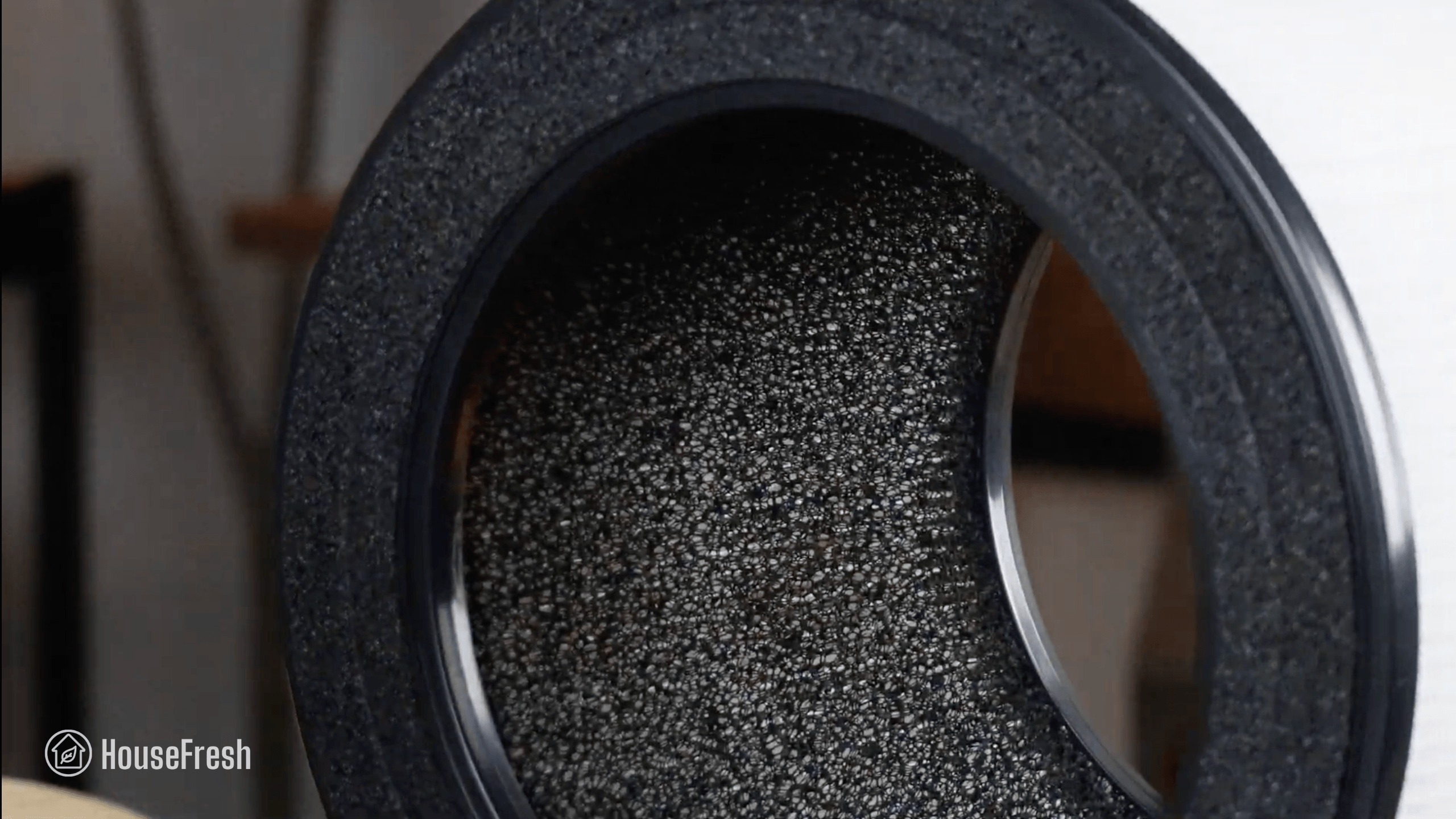
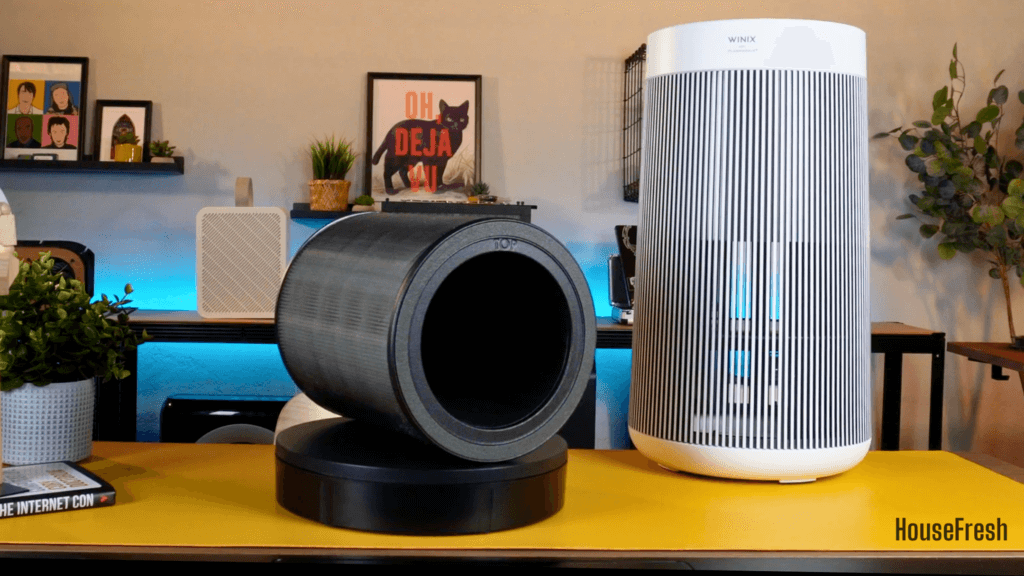
The Airmega 350 comes with a large cylindrical filter with Coway’s signature Green True HEPA and a layer of pelleted activated carbon.

Coway Airmega 350 Filter scaled

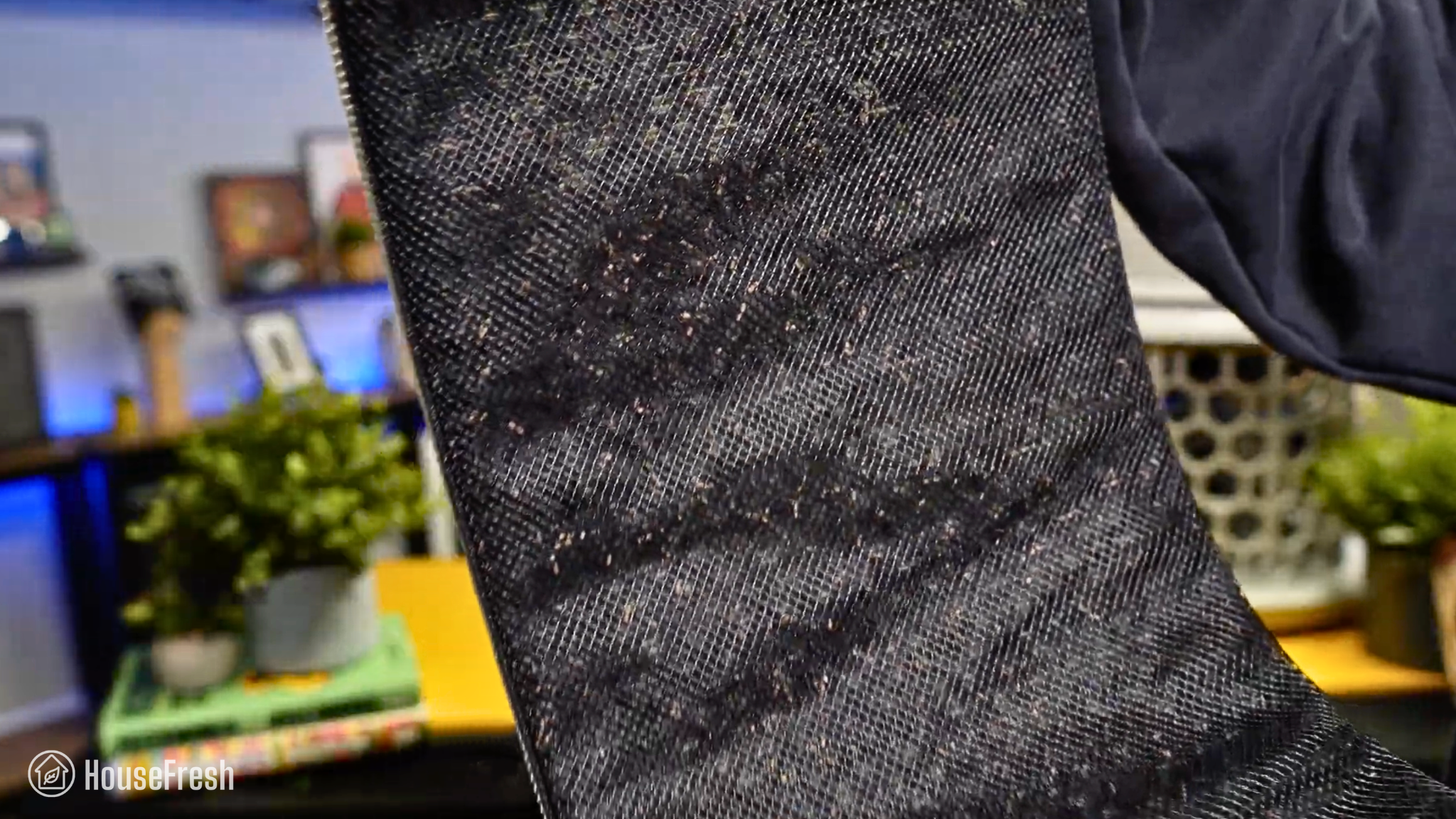
As with other cylindrical models, the pre-filter is attached to the main filter, so you will need to remove the whole thing to vacuum it.

Coway Airmega 350 Filter scaled

There are three different filters for the Airmega 350:

  • Fresh Starter+ filter is the standard filter (above)

  • Allergen+ filter, which is treated with a proprietary compound to remove allergens

  • Intense Smoke+ filter, aimed at those who want to tackle smoke and VOCs
350 airmega pdpgrid 7

Design, controls and app features

A cylindrical addition to Coway’s new retro modern family of air purifiers.

It looks like a million bucks – I know design is subjective, but I think most people will like the retro modern look of the 350.

Coway Airmega 350 Corner

I bought the beige version that matches our 250S, but if you’re not a fan of beige, you’ll be happy to know you can also get it in white.

In terms of size, it stands at 23 inches tall (58.4 cm) and weighs 17.19 lbs (7.8 kg), so it’s on the larger side of cylindrical models.

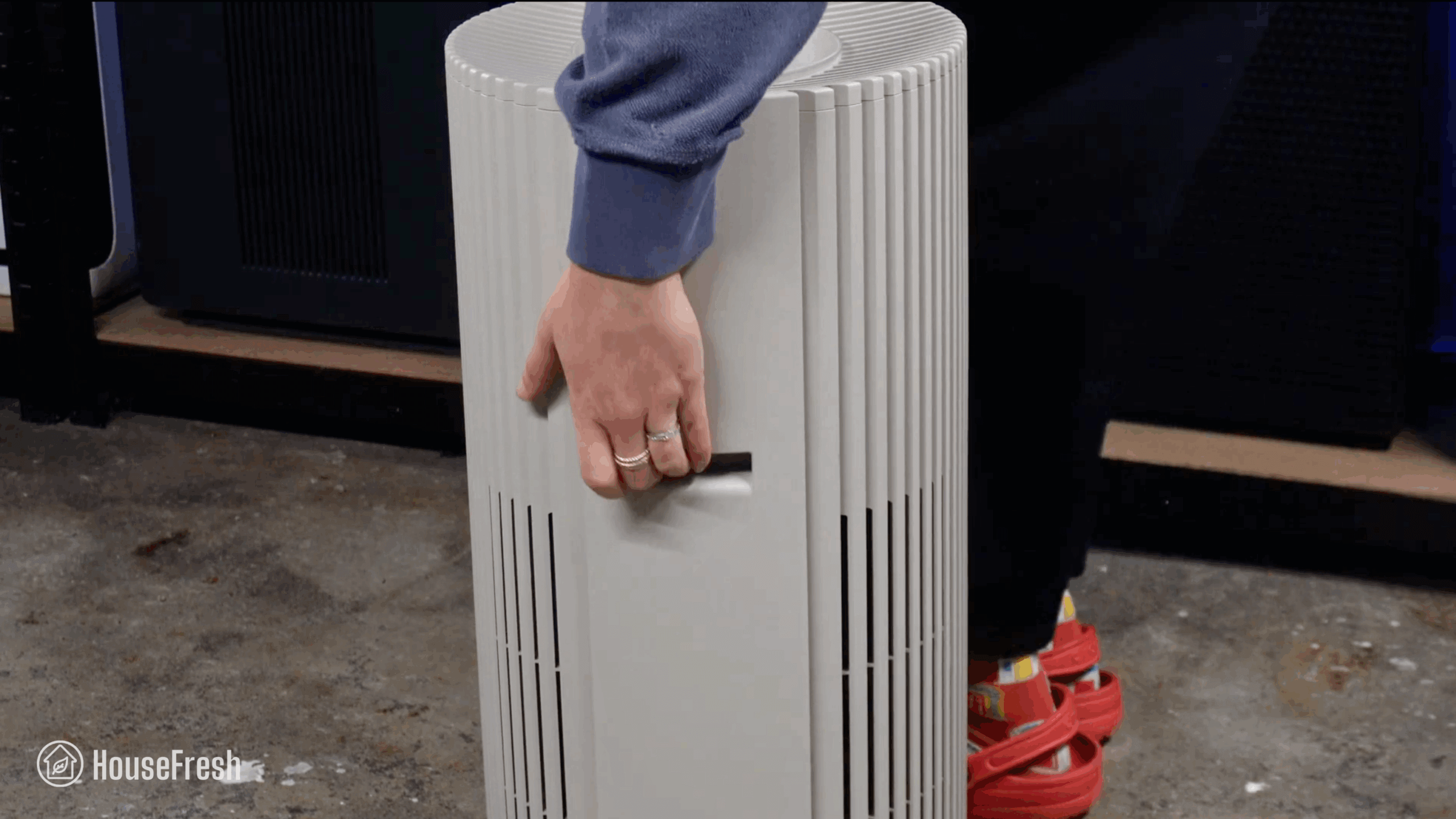
Coway Airmega 350 Handle scaled

It’s great to see that Coway included a deep handle at the back, which makes it easier to move it around the house.

It has an infrared particle sensor that measures PM10 pollution and connects to the LED air quality indicator light at the top.

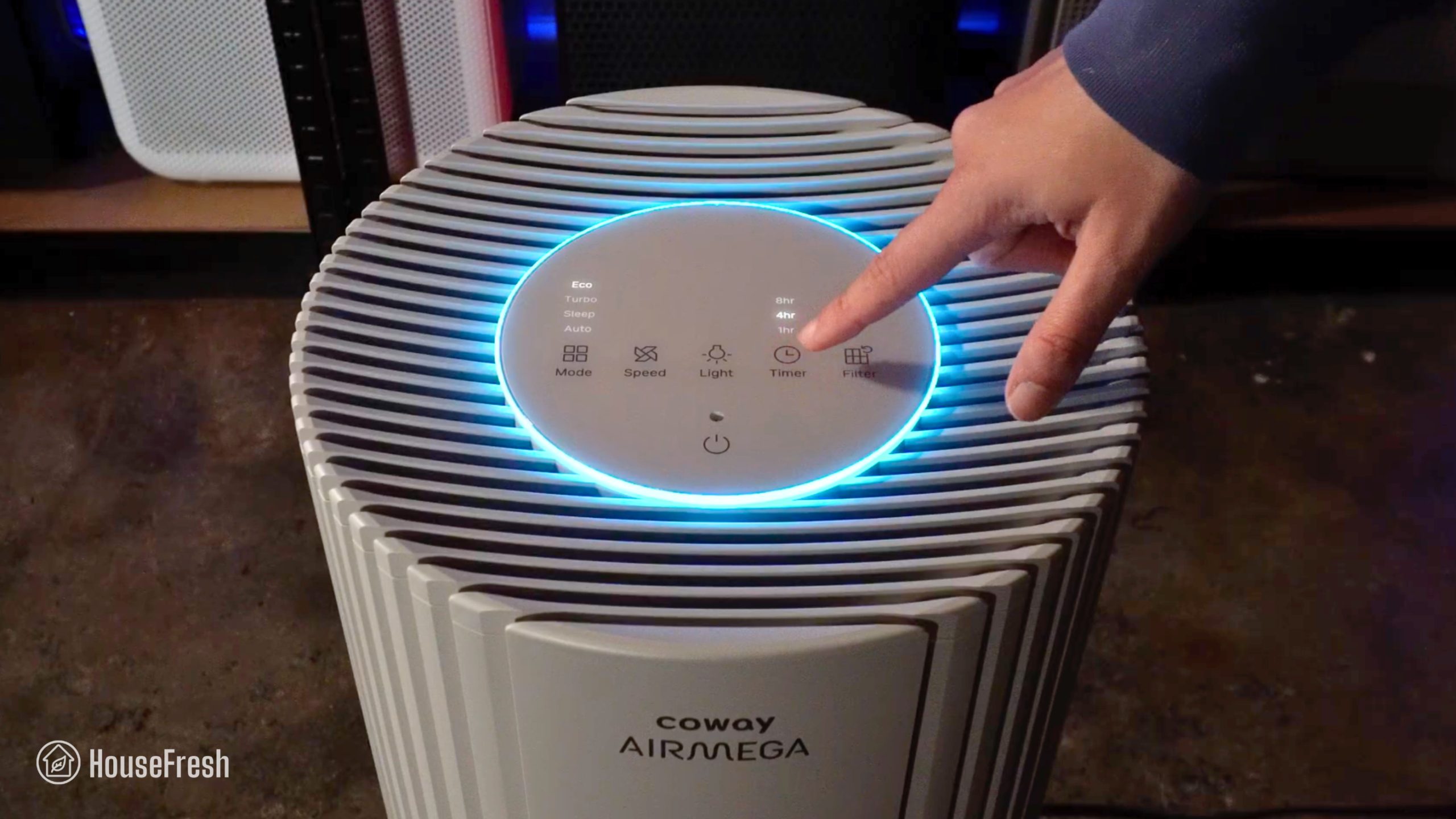
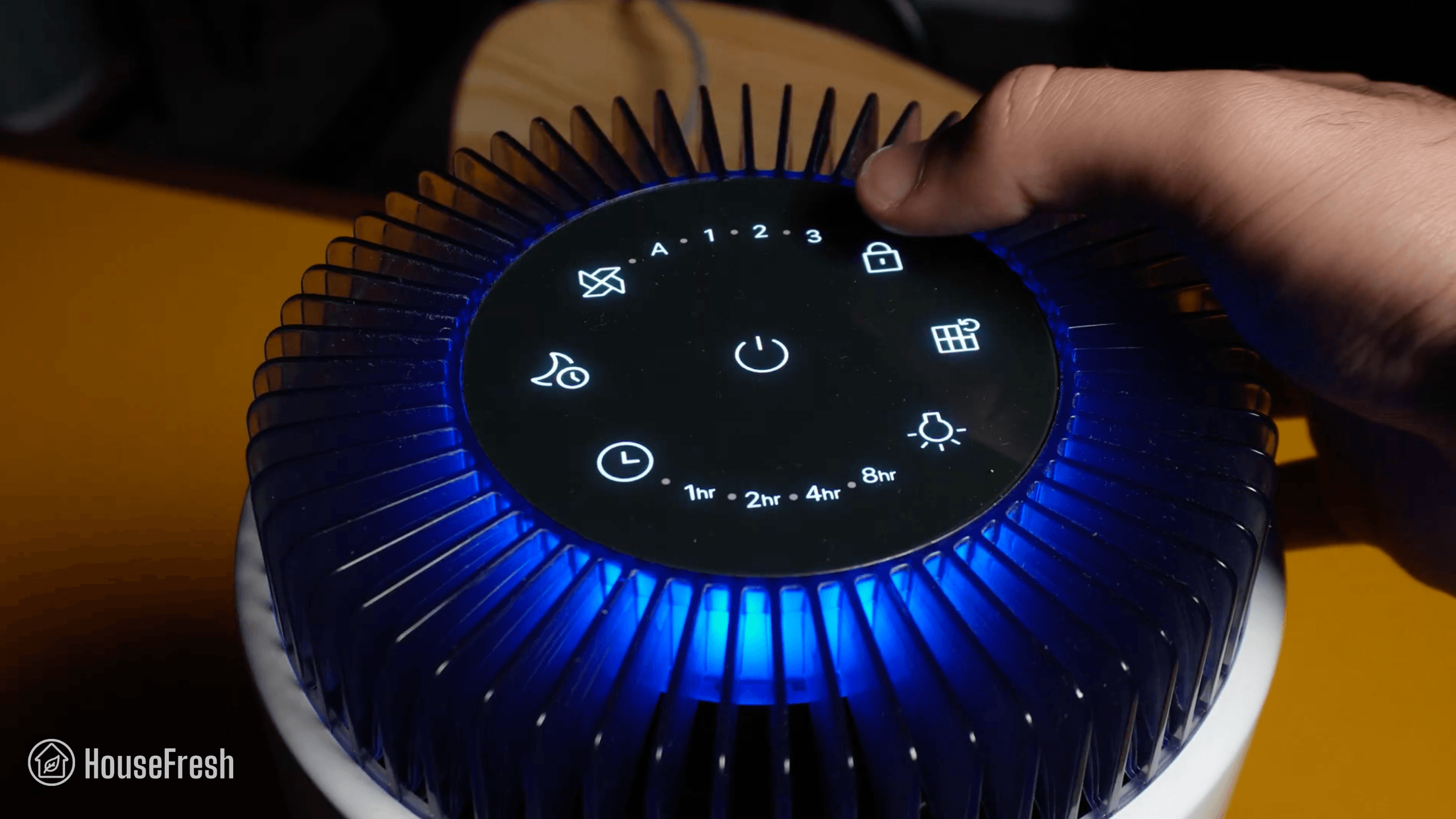
Coway Airmega 350 Controls scaled

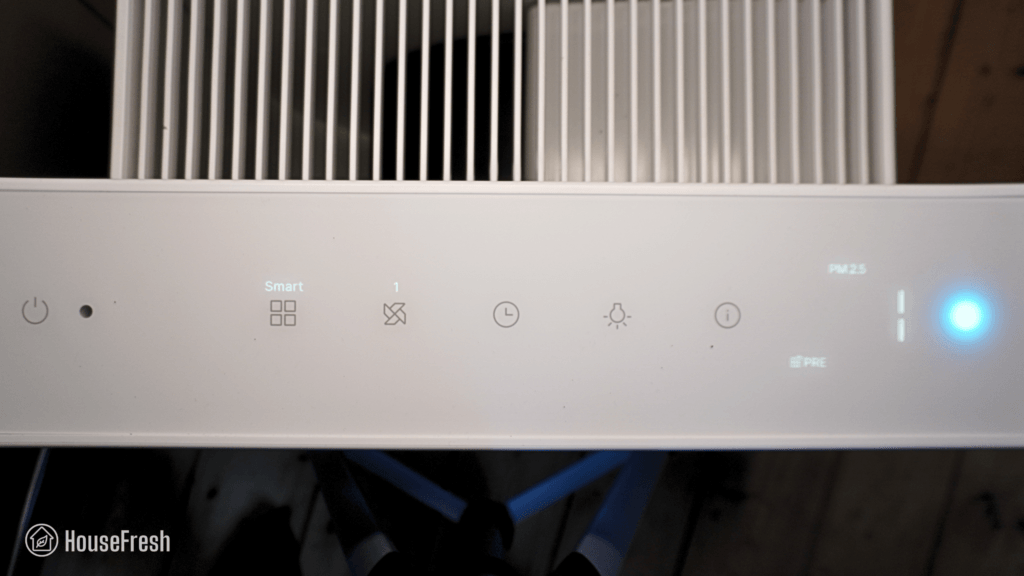
You get buttons to set fan speeds, smart modes and timers. There’s also a light button that turns off the display, the LED ring, or both.

The Coway 350 doesnโ€™t come with an app, but you can use it with any smart plug to add simple routines. I tested it using a Philips Hue Plug and was able to switch it on and off remotely via the Hue app.

You also get a very cool hidden feature I wish more manufacturers would roll out:

If you hold down the Mode and Airflow buttons, you can adjust the sensitivity of the sensor, selecting between 1 (sensitive), 2 (default) and 3 (insensitive).

Air cleaning performance

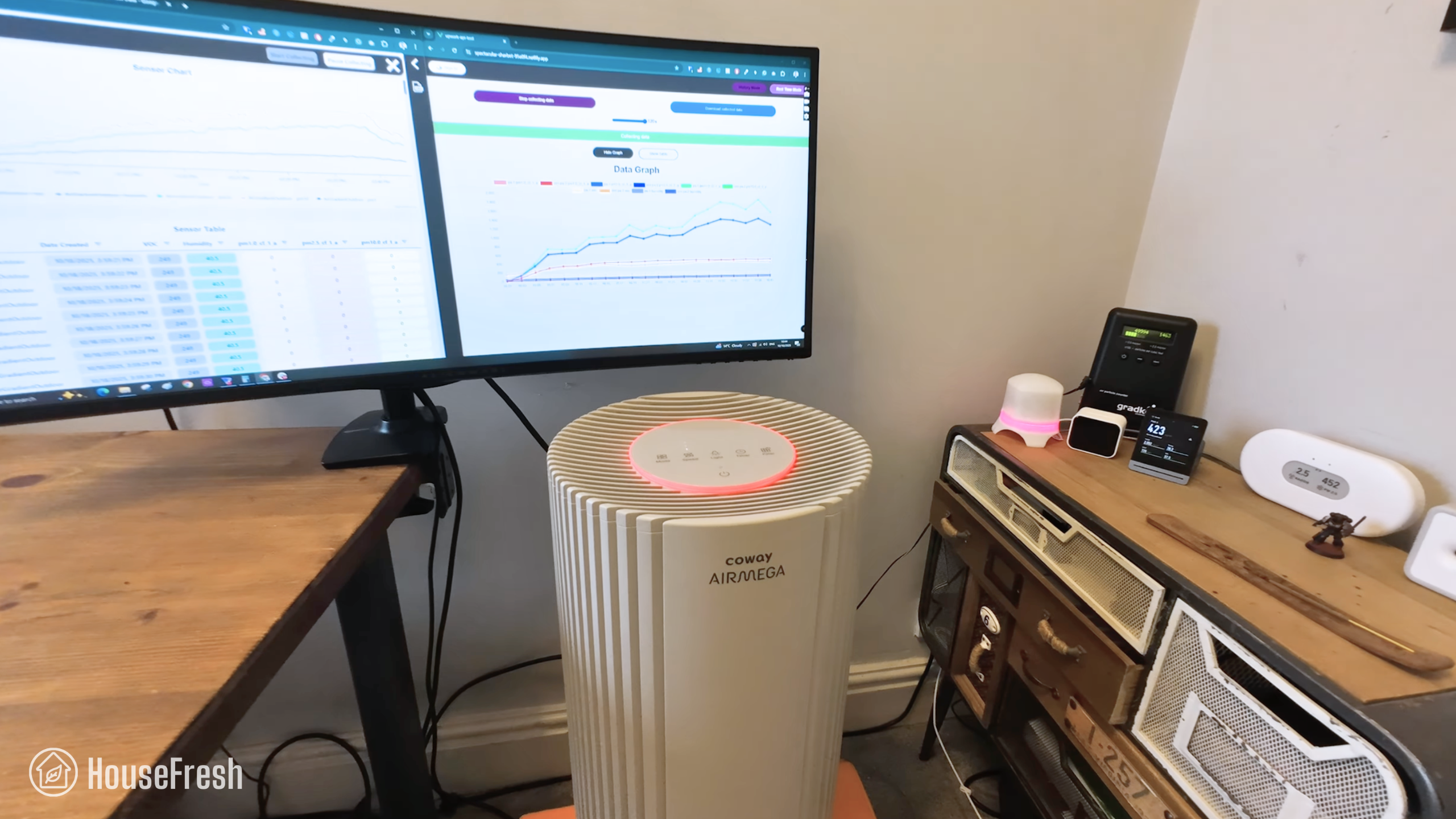
We tested the Coway Airmega 350 in our 728 cubic ft. test room, tracking how fast it removed all PM1 particles from the air after we filled the space with incense smoke.

Coway Airmega 350 Particle Removal Test

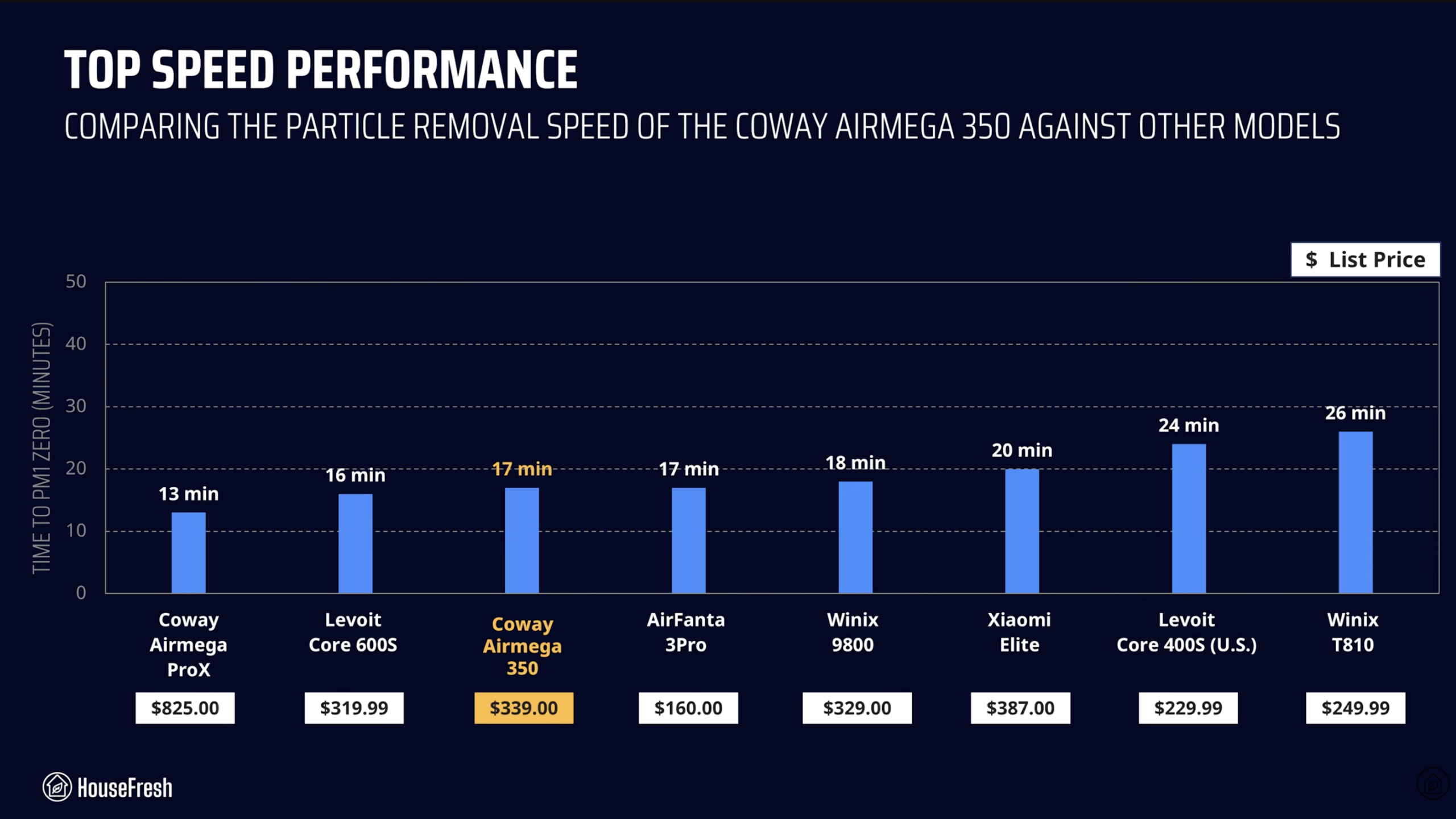
When running at top speed, our PurpleAir Zen sensor shows that the Airmega 350 needed 17 minutes to reach PM1 zero. Based on the natural ventilation of our test room, we estimate a PM1 CADR of 352 cfm.

This makes this Coway Airmega powerful enough to provide five air changes per hour in large rooms up to 528 sq. ft.

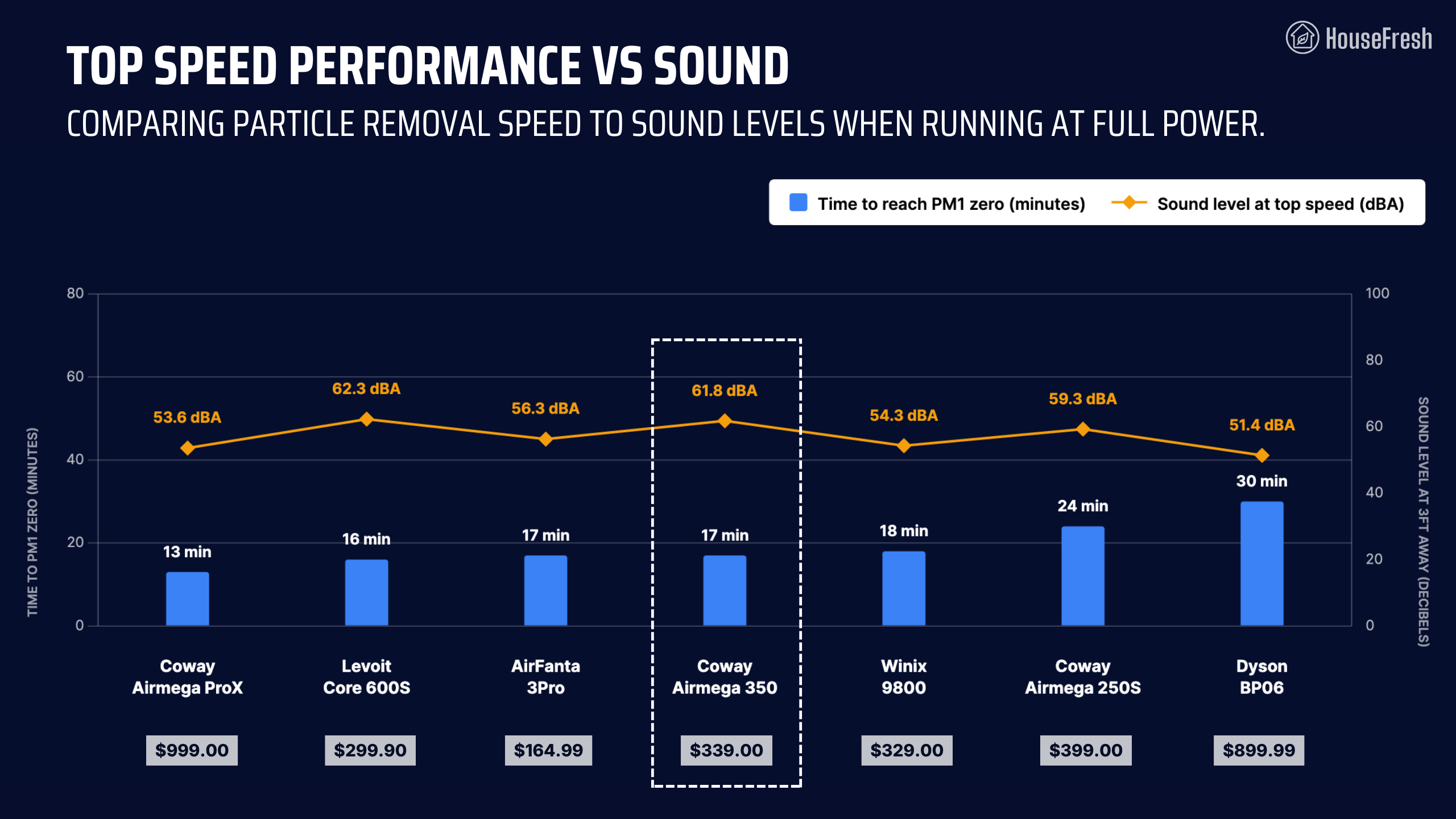
As you can see from the chart, the Airmega 350 outperformed most models we’ve benchmarked it against:

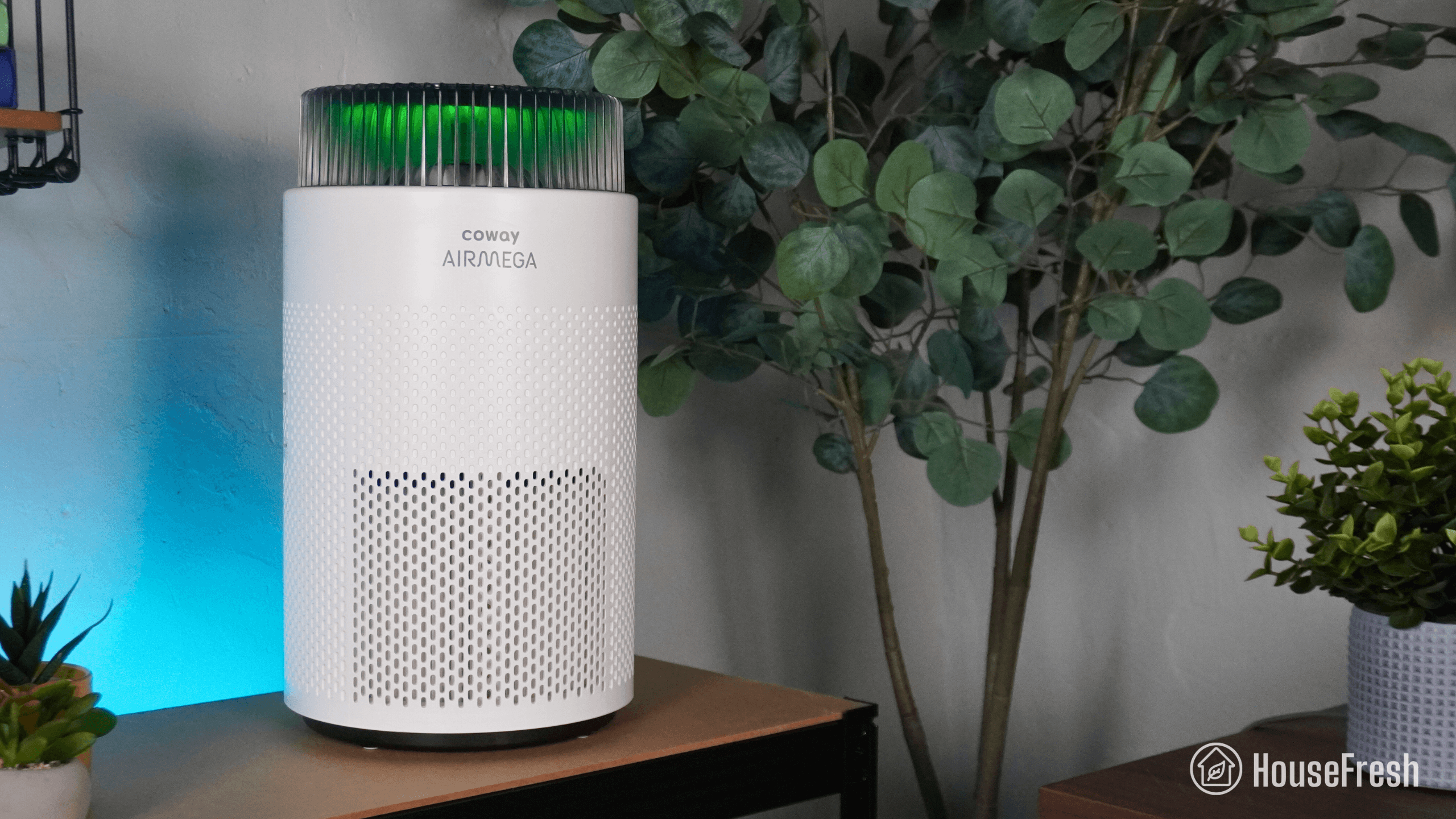
Coway Airmega 100 HouseFresh Particle Removal Test scaled

The only devices that were quicker to complete our test were the much larger Coway Airmega ProX (13 minutes) and the older (and cheaper!) Levoit Core 600S.

We repeated our particle removal test three times across all available fan speeds, which allowed me to estimate PM1 CADR at each fan speed:

Coway Airmega 350 CADR scaled

BUT, as I always say, air purifiers running at full power are usually too loud for everyday use, so we must account for noise levelsโ€ฆ

Sound levels

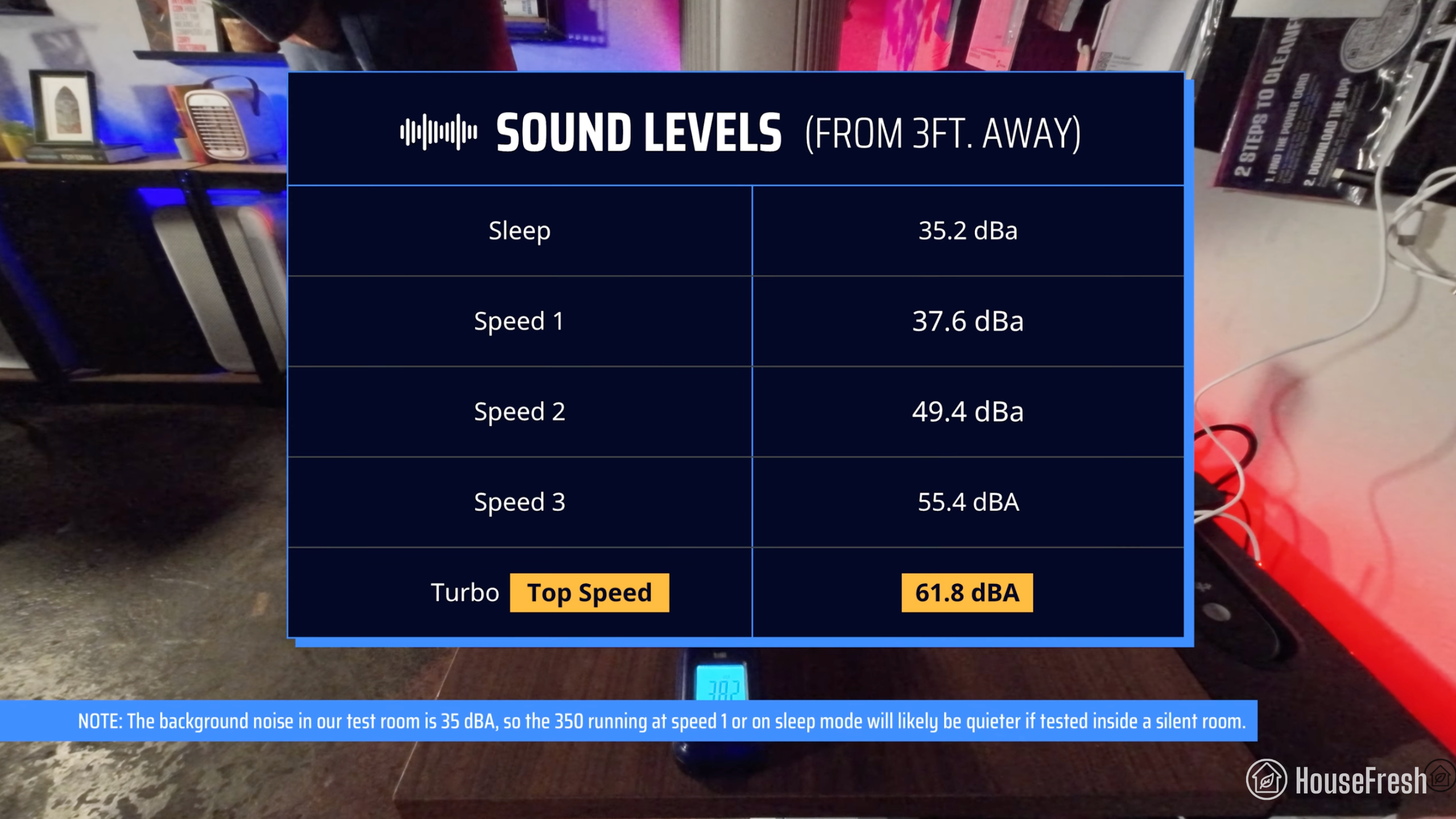
The sound levels of the Coway Airmega 350 range from 35.2 dBA to 61.8 dBA โ€” which is a little louder than most air purifiers we have benchmarked it against.

Coway Airmega 350 Sound Energy Test

I used our BAFX sound meter to measure how much sound the Airmega 350 generates at each of its fan speeds (including sleep mode) at 3 ft away:

Coway Airmega 350 Sound Levels

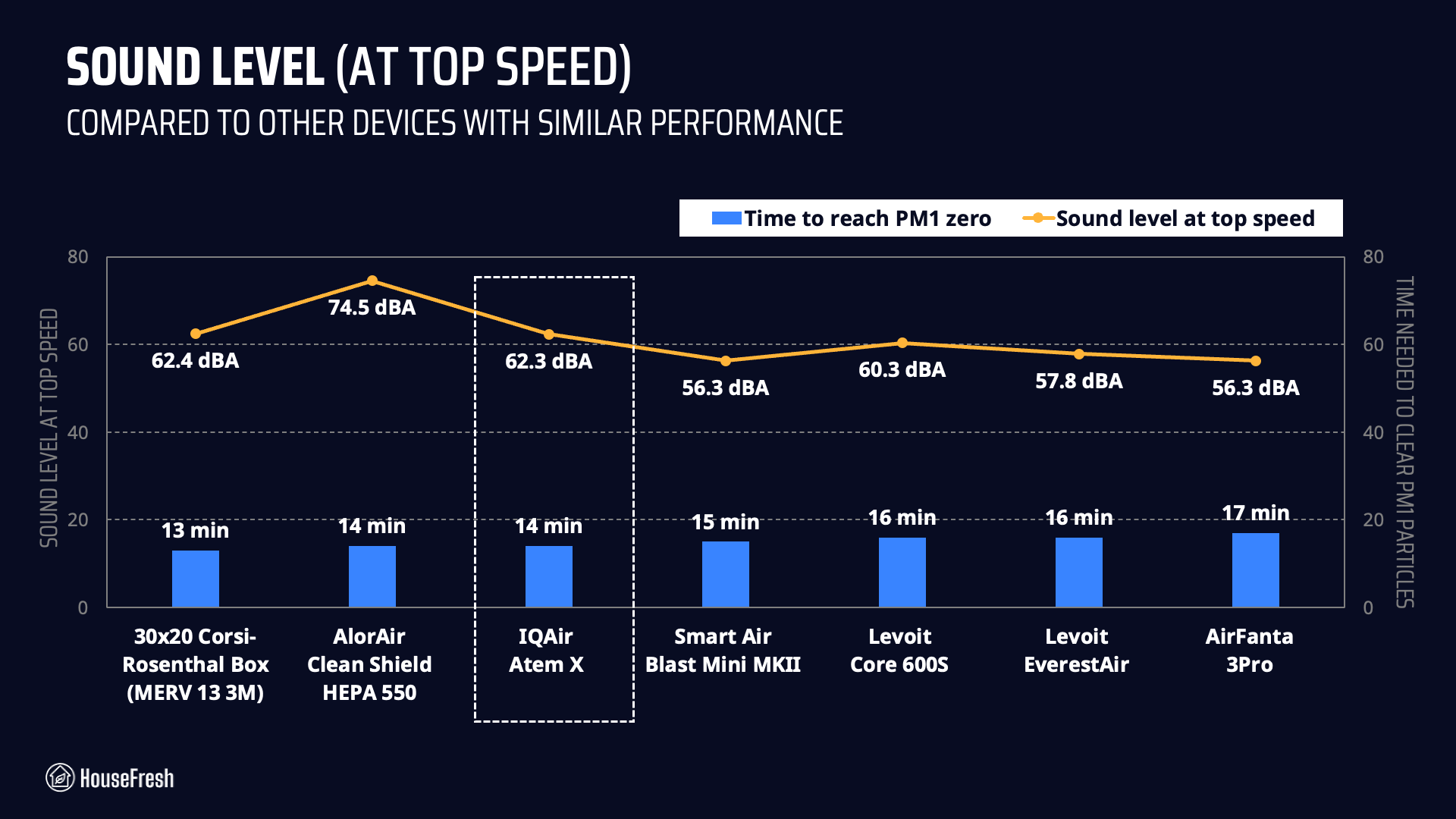
Hitting 61.8 dBA at top speed, the Airmega 350 is one of the loudest air purifiers on the chart, second only to the Core 600S and its 62.3 dBA when running full power.

Coway Airmega 350 HouseFresh Top Performance

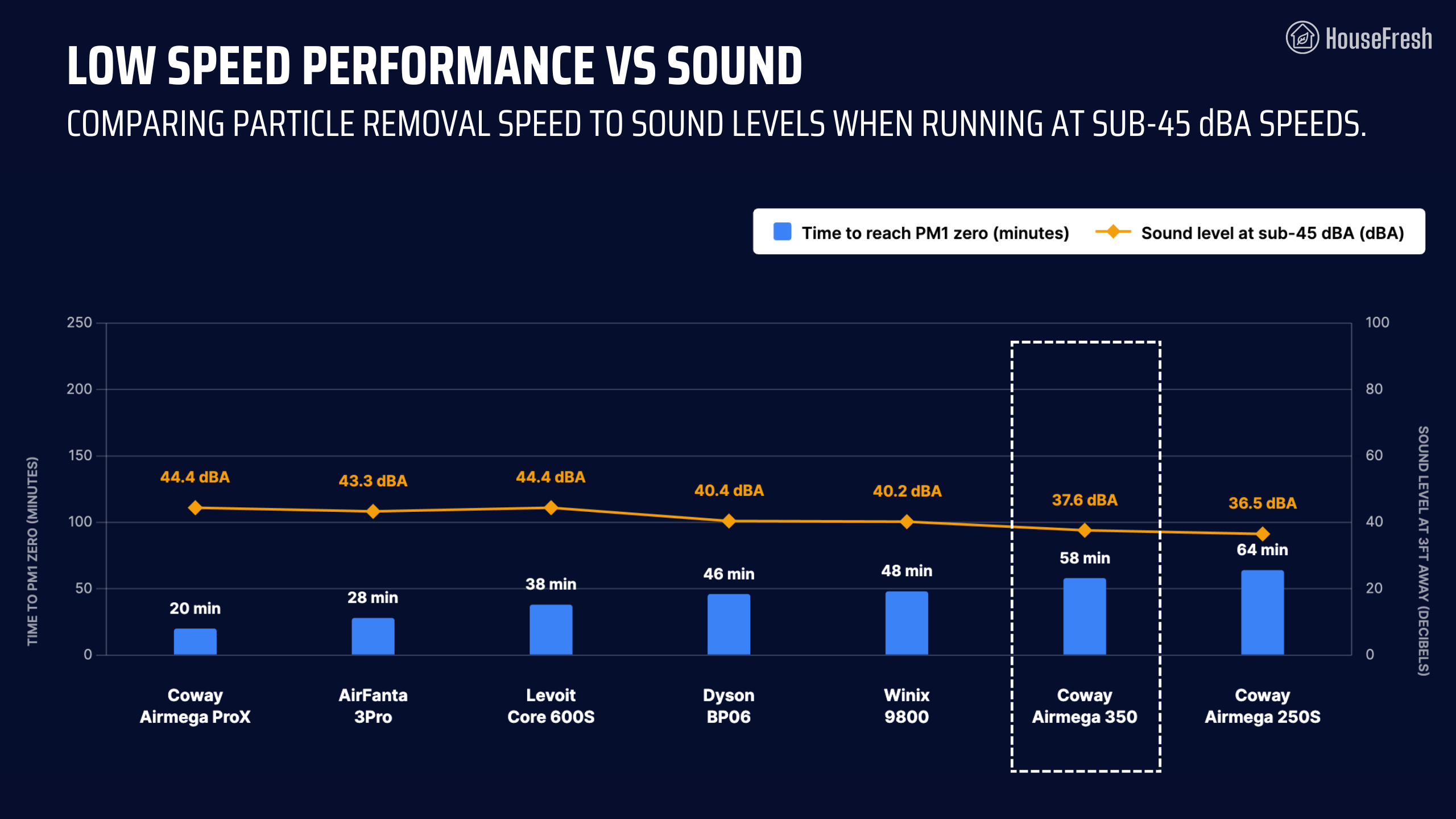
When running at speed 1, it generates just 37.6 dBA and was able to complete our particle removal test in 58 minutes – slower than most other models on the table.

Coway Airmega 350 Sub 45dBA Performance

I wish Coway would add an intermediary fan speed between speed 1 and speed 2, where the 350 stays below 45 dBA.

Long-term running costs

Running a Coway Airmega 350 will cost you $115.69 per year, combining energy and filter replacement costs.

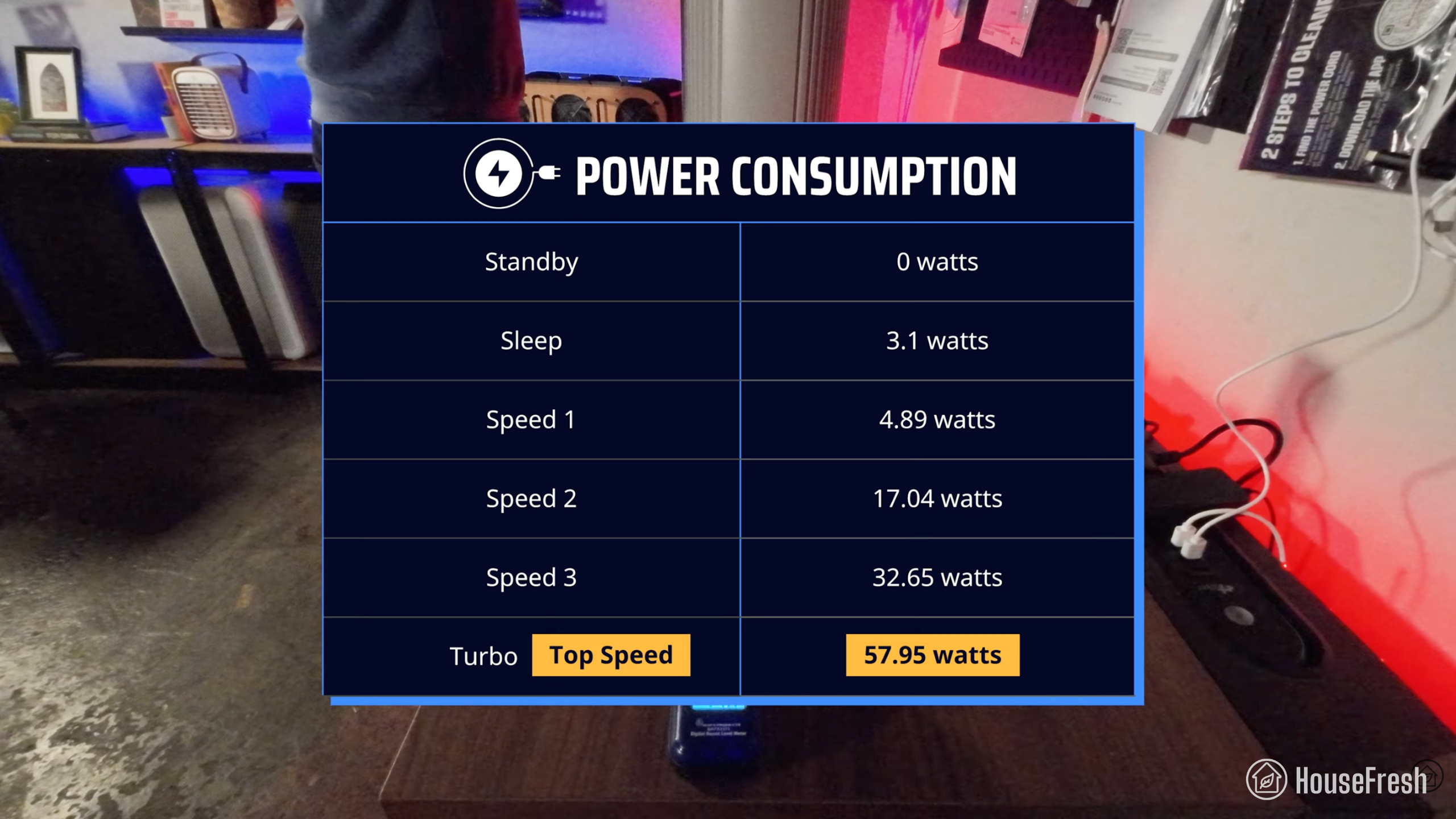
We used our energy meter to record how much electricity the Airmega 350 pulls at each fan speed and while on standby.

Coway Airmega 350 Energy

At top speed, the Airmega 350 draws 57.95 watts, so if you left it running at top speed 24/7 for one year, it would add $69.70 to your energy bill, based on the average U.S. electricity price as of March 2026.

But electricity consumption is not the only long-term cost you need to budget for; there’s also the filter replacements.

According to Coway, you need to change the filter in your Airmega 350 every 12 months. The replacement filter costs $79, so you can expect to spend that much each year on filter replacements alone.

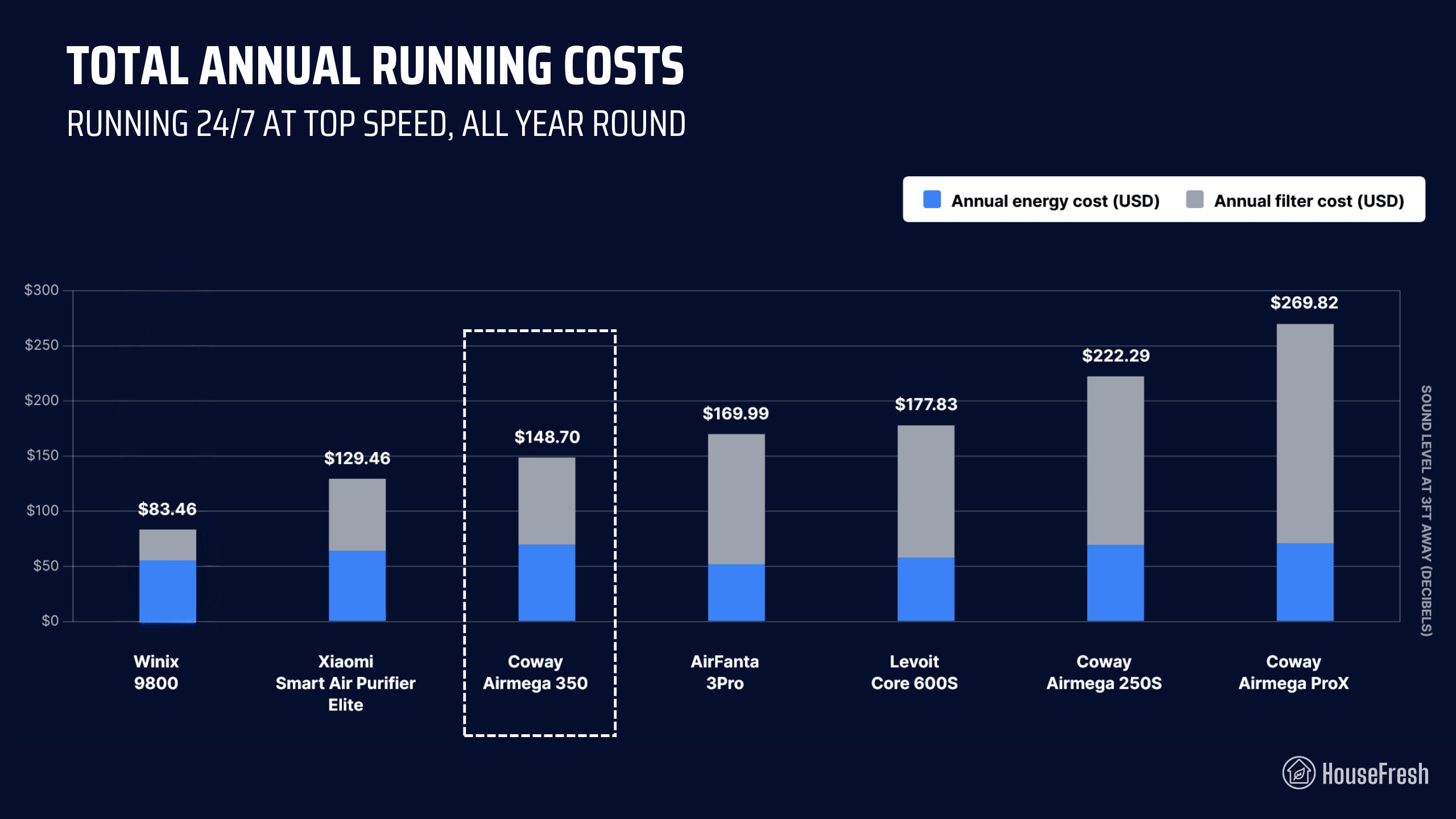
When we add this to energy costs, we can work out that it will cost you $148.70 to run a 350 for a year. Let’s compare it with other models:

Coway Airmega 350 Yearly Running Costs

Thanks to Coway’s affordable filter replacement costs, the Airmega 350 is cheaper to run than most other high CADR models we benchmarked it against, with the exception of the Winix 9800 and the Xiaomi Elite.

Bottom line: Should you get a Coway Airmega 350?

Our data showed that the Airmega 350 offers excellent air cleaning performance when compared to other cylindrical air purifiers on the market today.

Coway Airmega 350 Living Room scaled

If youโ€™re looking for the absolute best bang for your buck, the AirFanta 3Pro will offer the same level of performance at top speed as the Airmega 350, but at a lower price tag ($165).

And if youโ€™re looking for a more traditional-looking air purifier, then the Winix 9800 costs a little less than the 350 ($329) and offers similar performance with much lower running costs courtesy of Winixโ€™s highly affordable Type A filters.

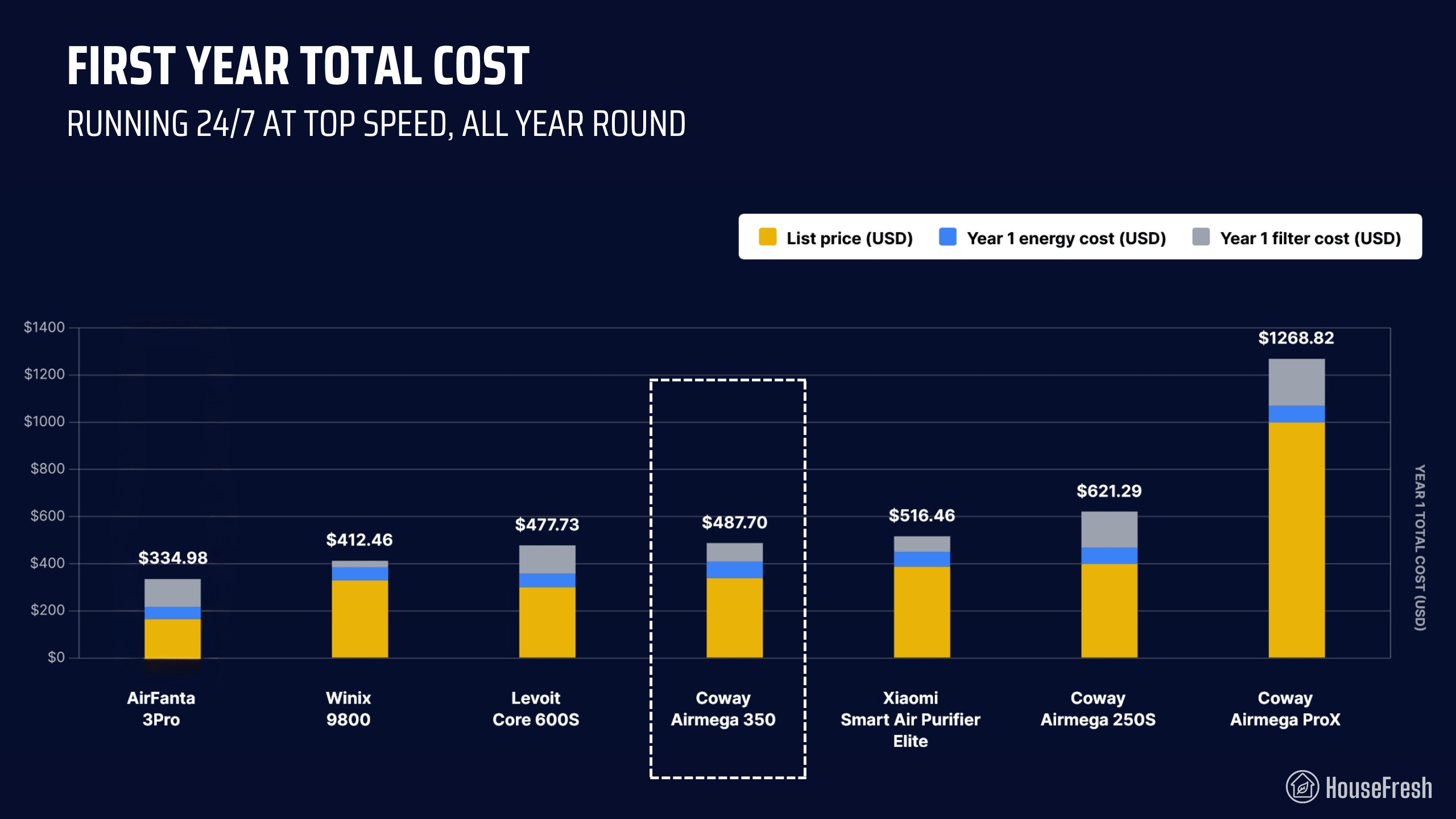
That said, the 350’s running costs are also very fair, so at the end of the first year, the upfront cost will even out:

Coway Airmega 350 Year 1 Costs

I also know that many consumers prefer the look and small footprint of cylindrical air purifiers, so if that is you, then the Coway Airmega 350 might be just the thing.

Personally, I much prefer the design of the 350 to the look of Xiaomi’s Elite and Levoit’s Core 600S. However, when compared to Xiaomi and Levoit, you don’t get an accurate laser sensor and app support.

But I’d swap app support any day for the granular light control and the ability to adjust the sensor’s sensitivity that you get with the Airmega 350. Plus, it’s great to know that you can use a smart plug to control your 350 remotely from your phone.

As it has become common with Coway, there is a big jump in sound from speed 1 to speed 2, which means that its performance at sub-45 dBA sound levels is less powerful than all the air purifiers we benchmarked it against. But if 49 dBA is not too loud for you, then you will get excellent performance at speed 2. For reference, we had our 350 in our bedroom for over a month running at speed 2 all day and all night without it bothering us.

Overall, I think the Airmega 350 is a great alternative to the Levoit Core 600S, and I can see myself recommending this model in the future to those looking for a mid-sized cylindrical air purifier that looks good and offers good air cleaning performance.

If you decide to get yourself a 350, please use this link to help support the work we do here at HouseFresh. If you do, we will get a small commission at no extra cost to you, which we will use to continue buying and testing air quality products.

If you have any questions about the 350 or about Coway air purifiers in general, please drop them in the comments below, and I’ll get back to you as soon as I can.

Blueair Blue Signature review

Blueair Signature HouseFresh

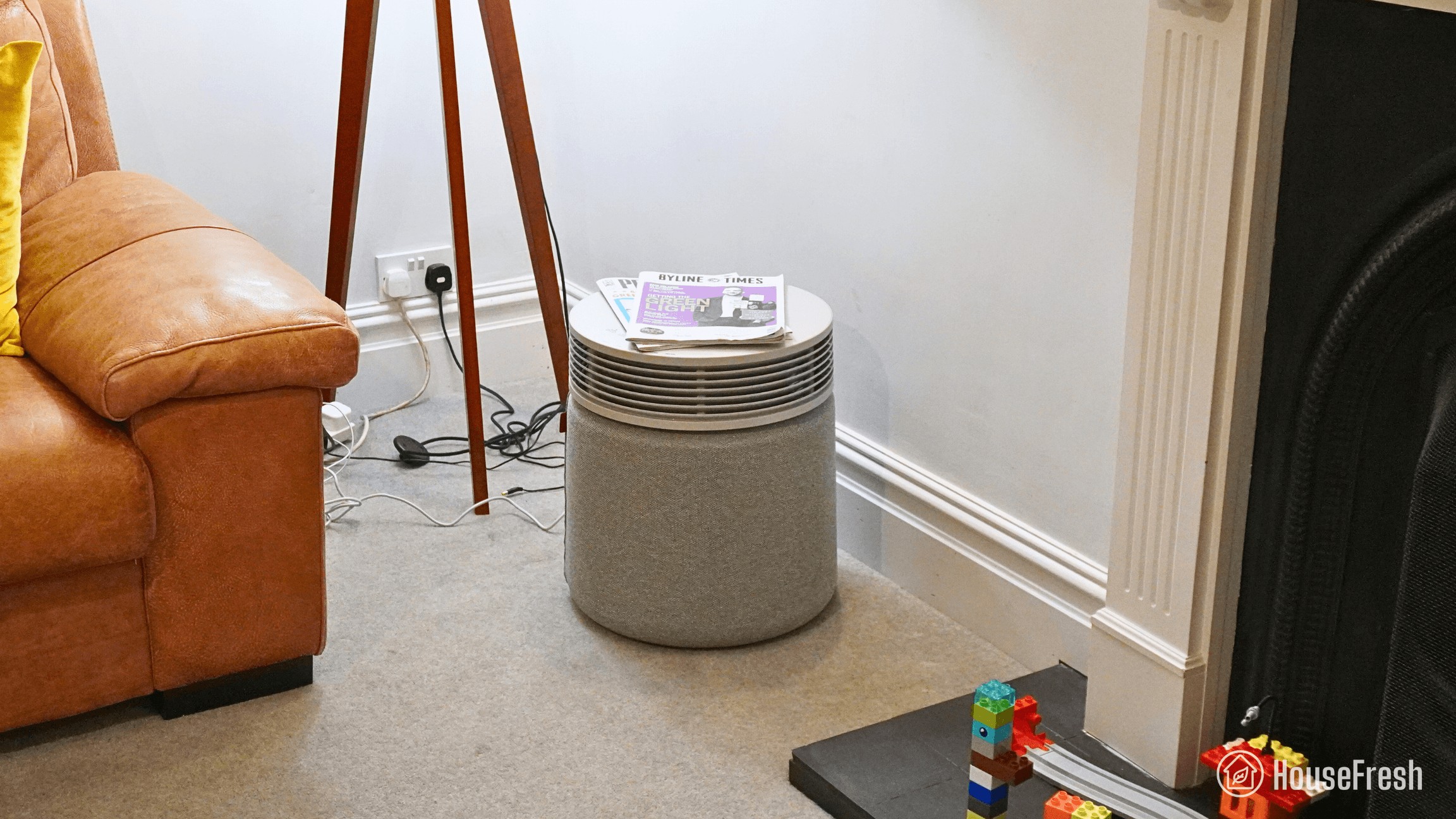
The Blueair Blue Signature looks like a piece of furniture and doubles as a table, just like the IKEA Starkvind and the air purifiers from SwitchBot.

However, unlike IKEA and Switchbot units, the Blue Signature is not cheap, with a list price of $449.99 in the U.S. and ยฃ369 in the UK.

But does beautiful design and a high price tag equal better performance? We bought one to find out.

The overall score for the Blueair Blue Signature incorporates first-hand data results from our battery of tests, as well as our ratings for customer service, brand transparency, and design & UX. Check out the full scorecard below to see the split of categories.

Search for โ€˜Blueair Blue Signatureโ€™ to see where it ranks, based on its air cleaning performance and value for money. You can also filter results to easily compare models in the same price range.

The pros and cons of the Blueair Blue Signature

A summary of our top-level findings after testing this air purifier, following our methodology.

“The Blue Signature looks like a piece of furniture and also doubles as a table. You can even add legs to lift it off the ground, with options to match your home’s decor.

It’s not cheap at just under $450, but it ticks a lot of boxes for this price: Performance is top tier at both top speed and quiet fan speeds, the running costs are fair, and it has a high quality laser sensor, a table surface, and app support.”

Danny Ashton HouseFresh
Danny Ashton
HouseFresh Founder
& Lead Tester

CONS

It is more expensive to buy and run than other mid-sized air purifiers.
There is no option to disable the electrostatic ionization function, unlike what we see from other manufacturers like Winix, Coway and Xiaomi.
The wooden legs and the chrome base to turn it into a table are not included, so youโ€™d need to pay up to $100 more to elevate your Blue Signature.

PROS

It doubles as a side table that will fit most living rooms and bedrooms – you can even buy wooden legs to give it more height.
It matches the air-cleaning performance of high-end units that cost twice as much and are twice as large.
It comes with a highly accurate laser sensor on board that doesnโ€™t need to be cleaned regularly.
The Blueair app has a clean UX and is easy to use.
You can customize the design with options for multiple pre-filter fabric colors and two different designs for the legs.

Clean air delivery rate (CADR):โ€“ Top speed PM1 CADR: 400 cfm
โ€“ Sub-45 dBA PM1 CADR: 229 cfm
โ€“ AHAM PM2.5 CADR: 434 cfm (dust)
Filter technology:HEPASilent particle filter with pelleted activated carbon and a removable pre-filter fabric.
Recommended room size:600 sq. ft. (5 air changes per hour)
Dimensions:17.3 x 15.7 x 15.7 in (44 x 40 x 40 cm)
Weight:13.2 lbs (5.98 kg)
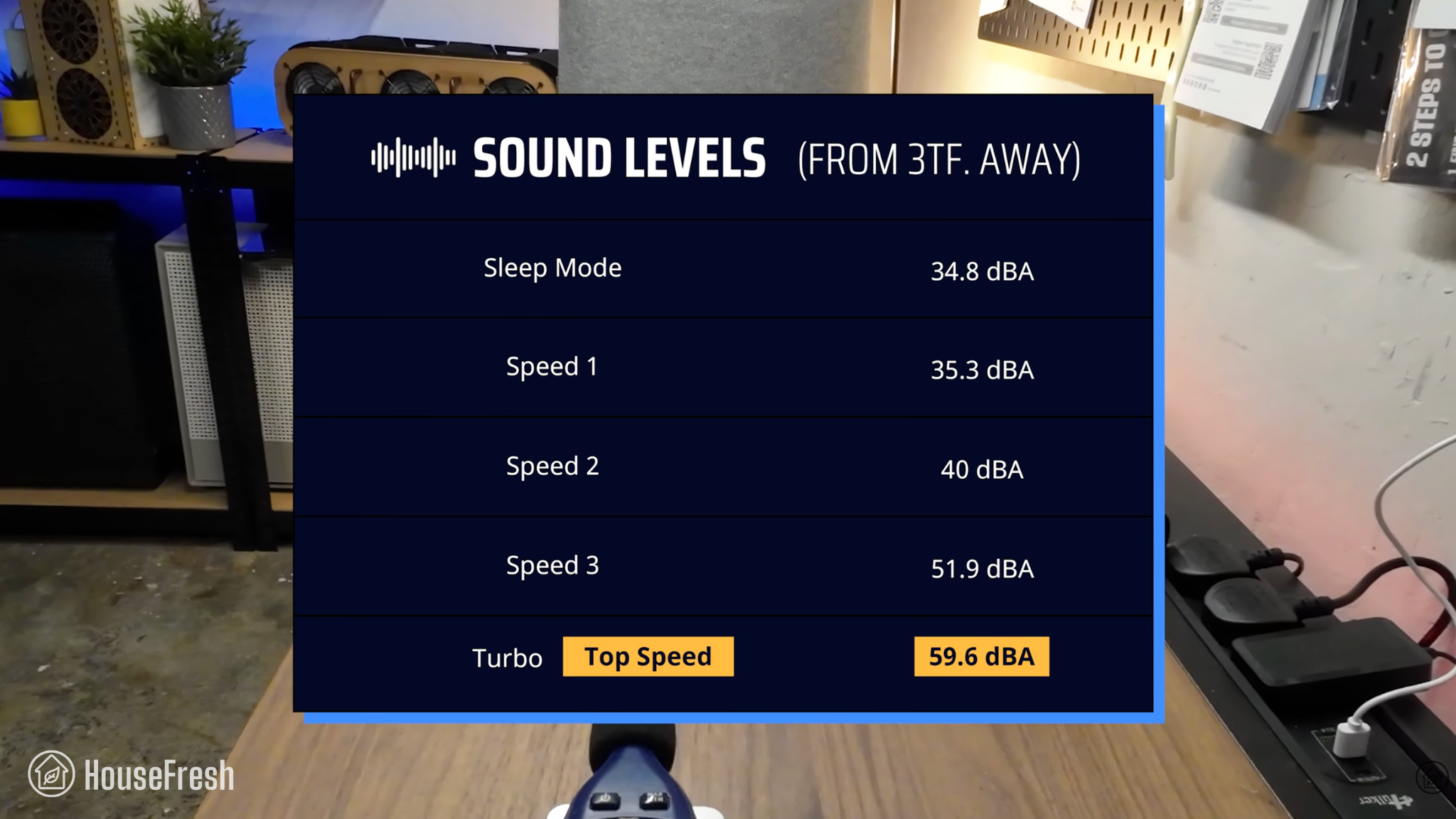
Noise level in decibels from 3 ft. away:Sleep mode: 34.8 dBA
Speed 1: 35.3 dBA
Speed 2: 40 dBA
Speed 3: 51.9 dBA
Speed 4: 59.6 dBA
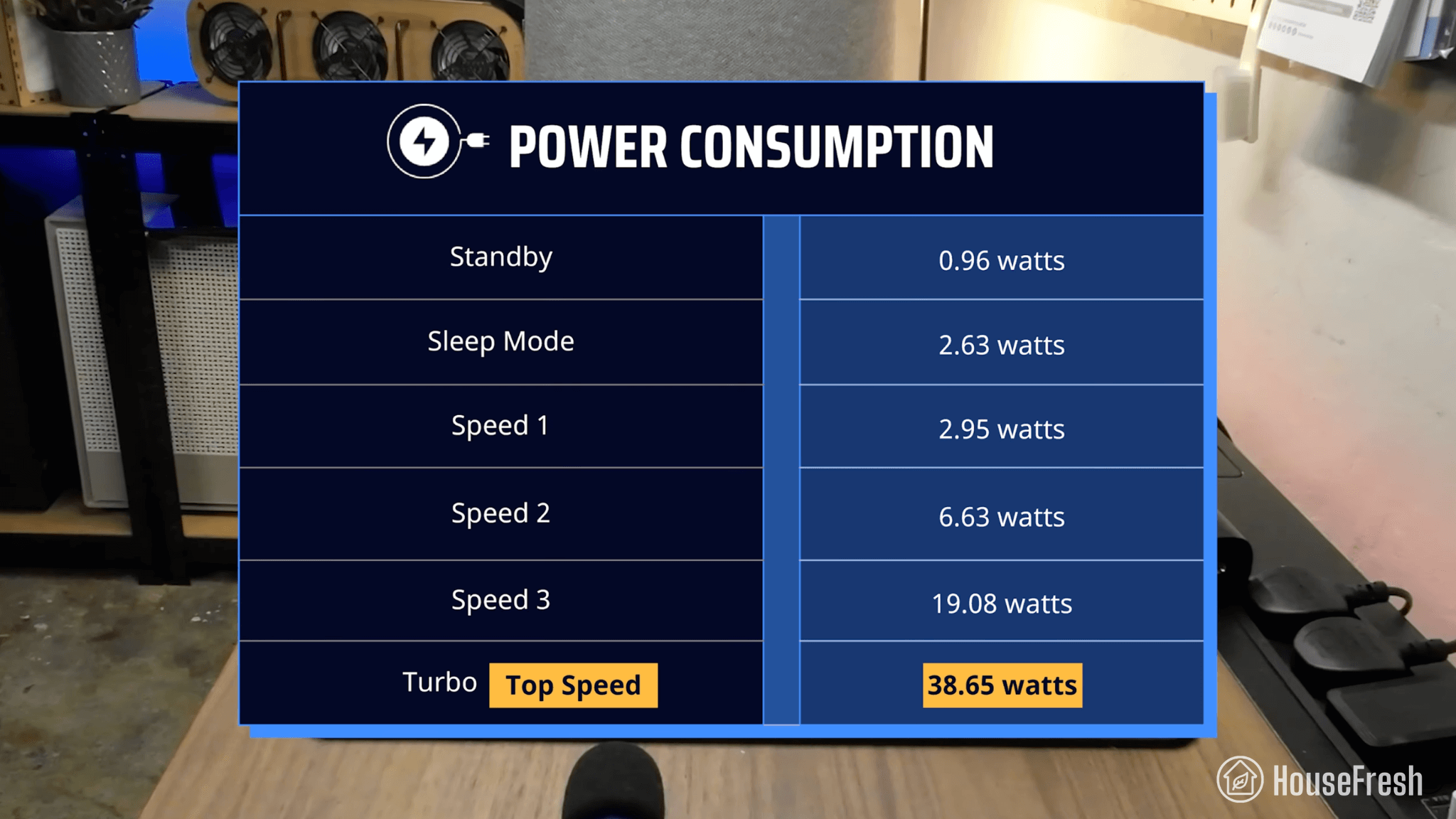
Electricity consumption in watts:Standby: 0.96 watts
Sleep mode: 2.63 watts
Speed 1: 2.95 watts
Speed 2: 6.63 watts
Speed 3: 19.08 watts
Speed 4: 38.65 watts
Filter lifespan:9 months
Manufacturerโ€™s warranty:1 year (3 years with product registration)
Country of origin:Sweden
Country of manufacture:China

Filtration technology

HEPASilent with pelleted activated carbon and a washable, removable pre-filter.

The filter wraps around and clips onto the Blue Signature’s body – something new from Blueair.

Blueair Blue Signature Main Filter

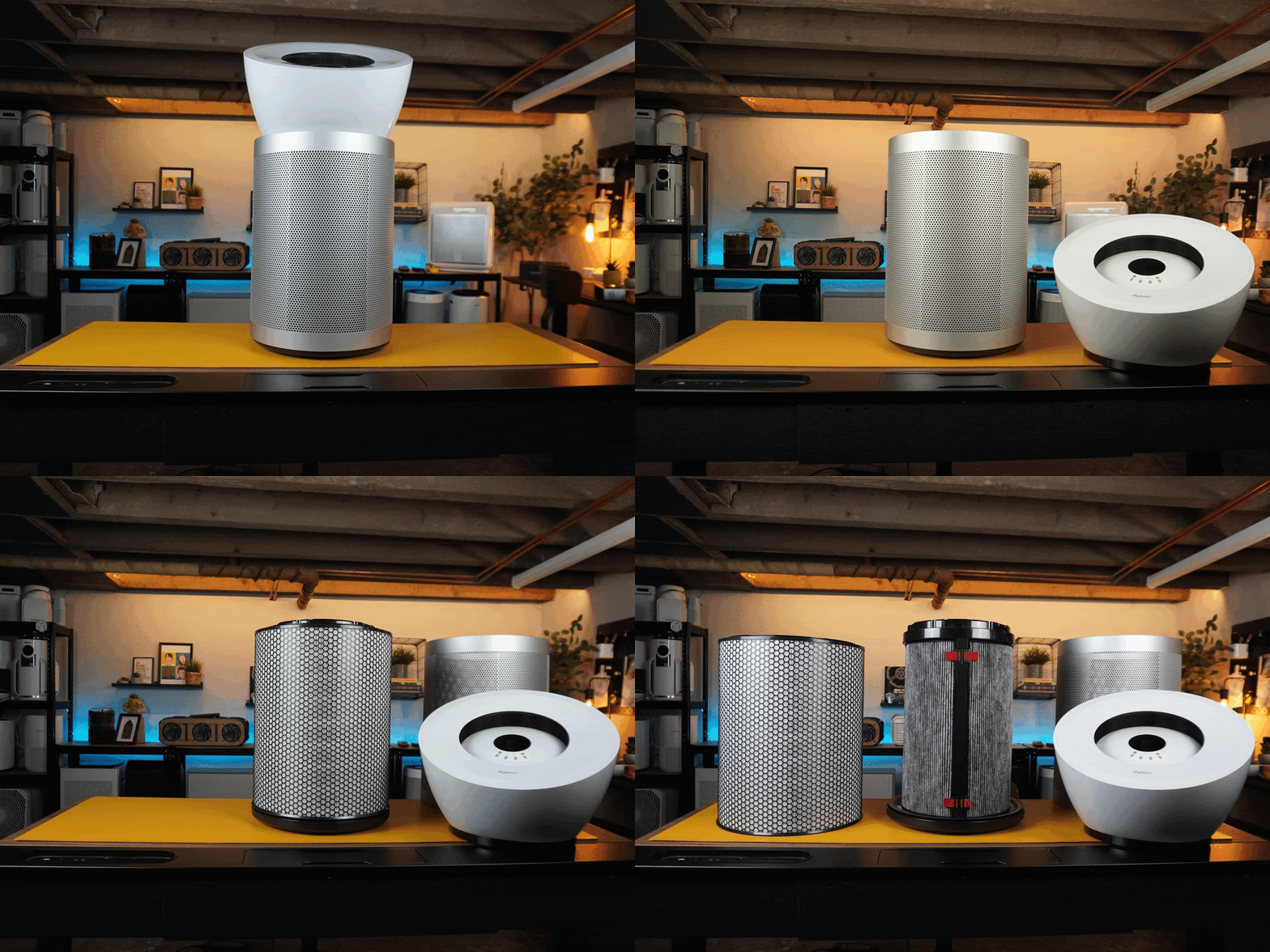
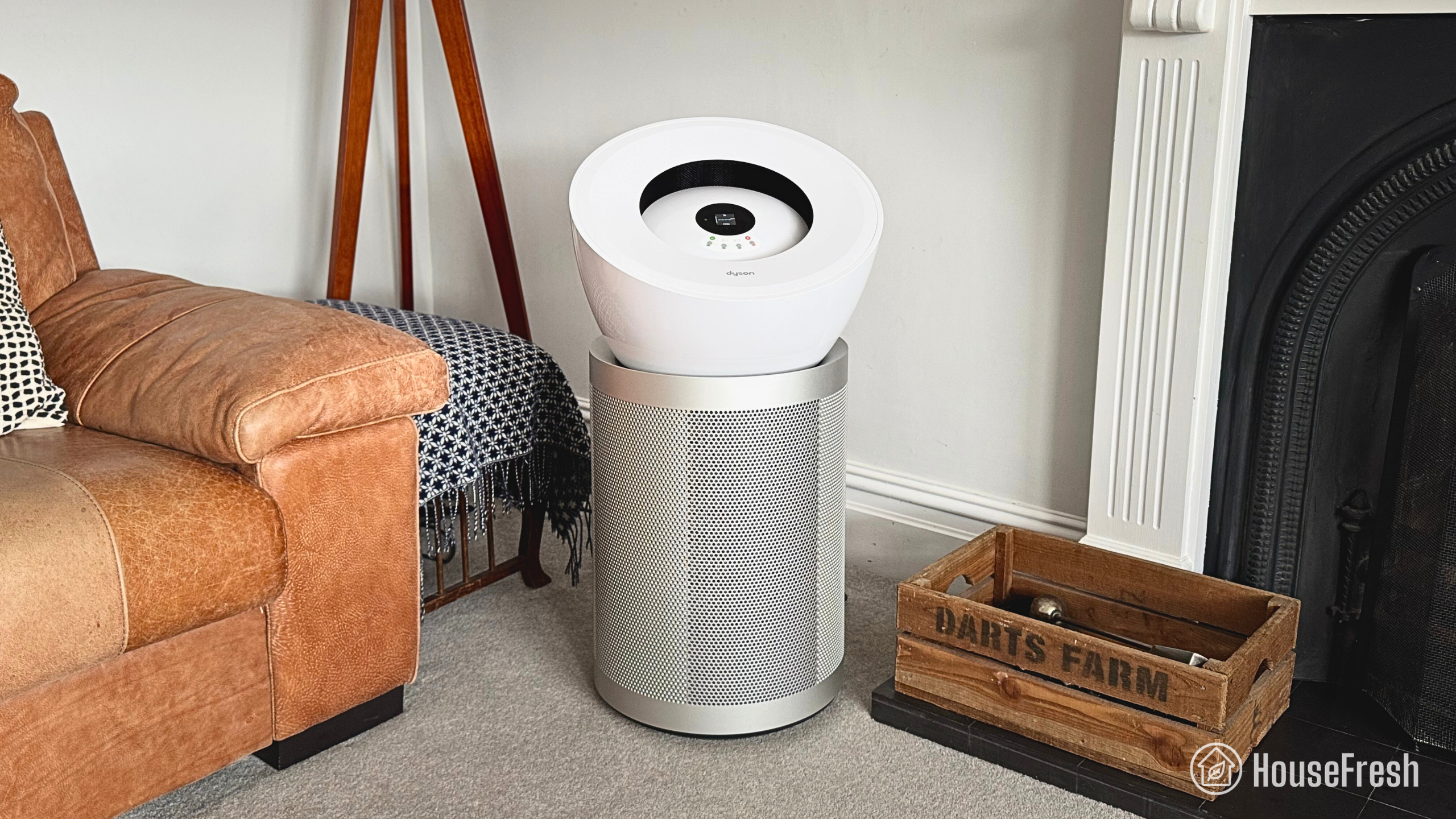
This is the first time we see something like this from Blueair, but it reminded me of the carbon filter in our Dyson Big+Quiet BP06.

On the inside of the filter, you get a layer of pelleted activated carbon.

Blueair Blue Signature Carbon

I was glad to see this, as it’s much better than the impregnated carbon fabric in other Blueair models.

Similar to previous models, the Blue Signature has a removable, washable fabric pre-filter.

Blueair Blue Signature Pre Filter

I bought the Nordic Fog pre-filter, but you can choose from a range of colors to customize your Signature’s look.

HEPASilent is Blueairโ€™s trademarked air filtration technology that combines electrostatic ionization with mechanical filtration.

The mechanical filtration element is the same as in all other air purifiers, with particle and carbon filters working in combination with a fan to remove pollutants from the air as it passes through the filters. For the electrostatic component, an ionizer inside the device generates negative ions to attract airborne particles, which are then captured by the filter.

This type of ionization process can release ozone, which can then form other chemical byproducts depending on the chemicals already in the air.

Now, the HEPASilent ionizer inside the Blue Signature produces very low levels of ozone: AHAM certified it produces just 3 ppb of ozone, which would be defined as producing zero ozone, based on the UL testing program UL2998 because it sits below the threshold of 5 ppb.

However, I still wish Blueair would include an option to disable HEPASilent, either with a button (as Alen, Winix, and Coway do) or just a setting in the app (as weโ€™ve seen from Xiaomi).

Design, controls and app features

It clearly belongs to Blueair’s family of air purifiers, but with a twist.

It is shorter and lighter than other cylindrical units, such as the popular Levoit Core 400S, but it takes up more floor space. But what you lose in floorspace, you gain in tabletop space.

Blueair Signature Table

Another big change from the usual is the option to add a base to your Signature to elevate it from the ground and give it a more โ€˜furniture lookโ€™ – you can add a metal ring base for $100 or wooden legs for $87.

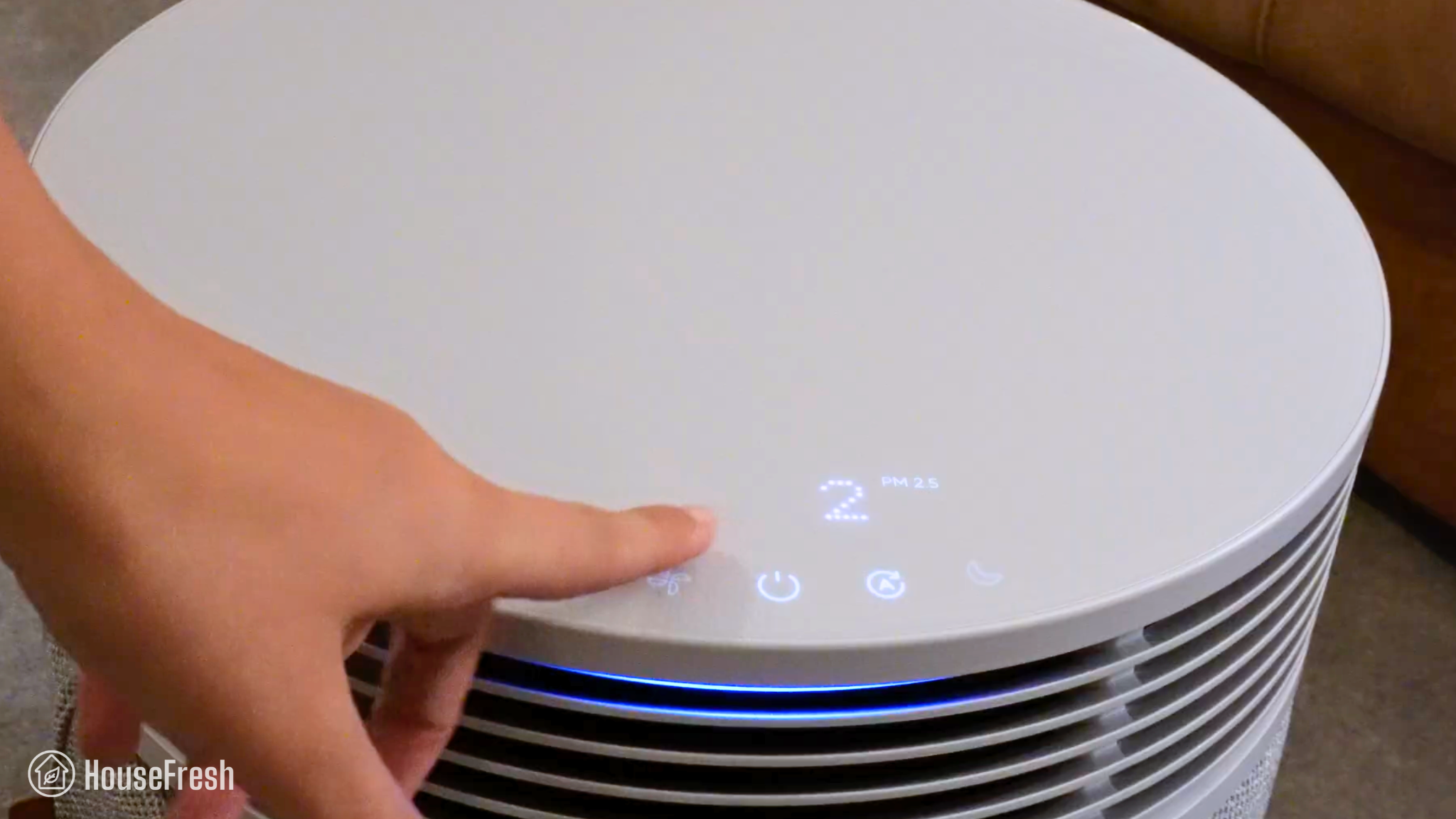
With the Blue Signature, Blueair moved away from the one-button control. It has a touchscreen with buttons to change fan speeds and modes, as well as PM2.5 readings.

Blueair Blue Signature Controls

The display turns off automatically after a few seconds, and you can wave to get the lights back on. You also get an LED light at the front that changes color based on readings from the onboard laser sensor.

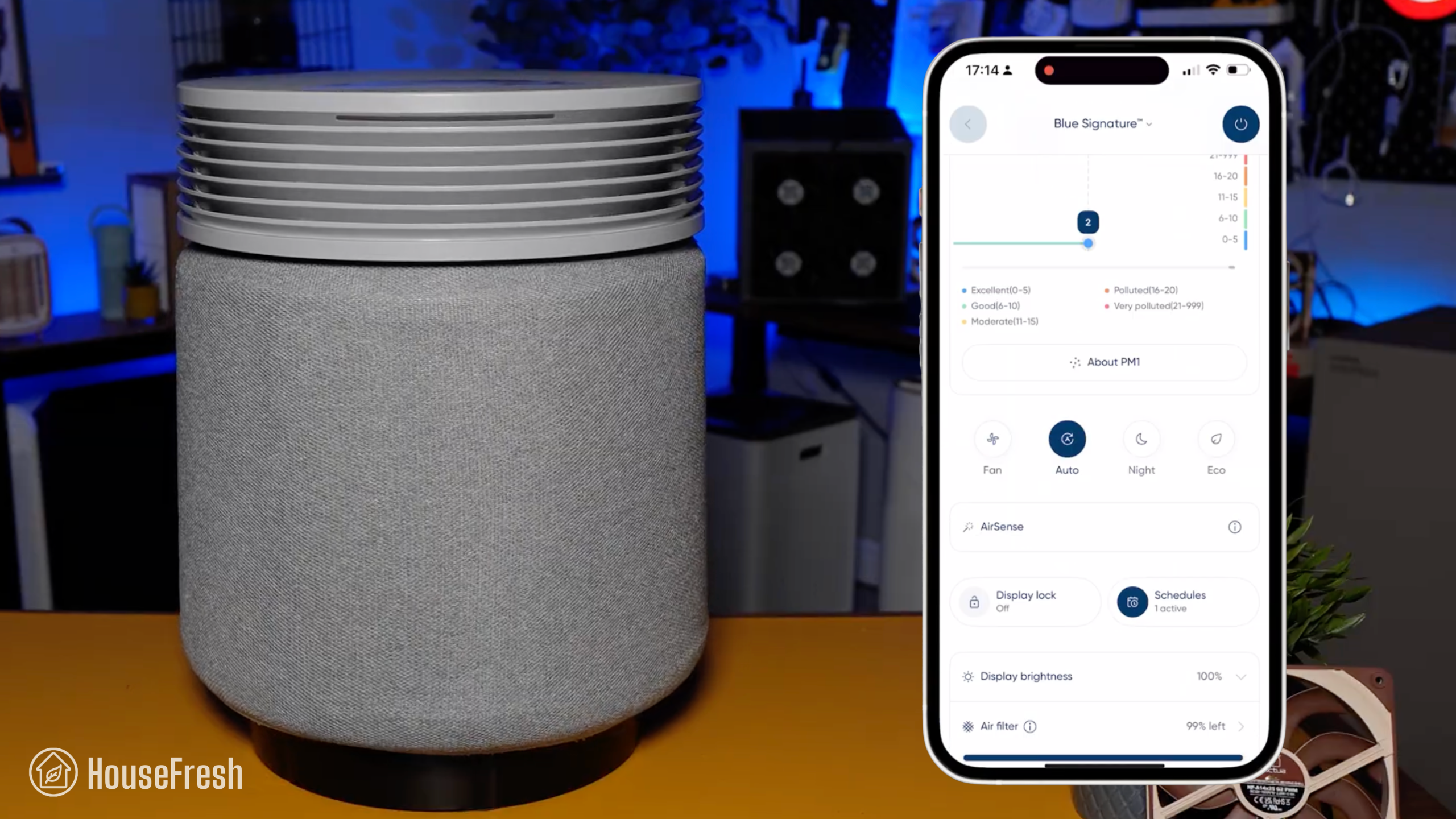
Blue Signature App

The Blueair app is quite basic compared to the apps from brands like Xiaomi, Levoit, and Philips, but the design is clean, and you can see all the info you need on one screen.

You get real-time air quality readings from the onboard laser sensor, which update quickly on the screen. Historical data is saved, so you can access it whenever you want.

Through the app, you can also control the device, set schedules, and adjust the brightness of the display at the top of the Signature.

Air cleaning performance

We tested the Blue Signature in our 728 cubic ft. test room, tracking how fast it removed all PM1 particles from the air after we filled the space with incense smoke.

Blueair Blue Signature HouseFresh CADR Test

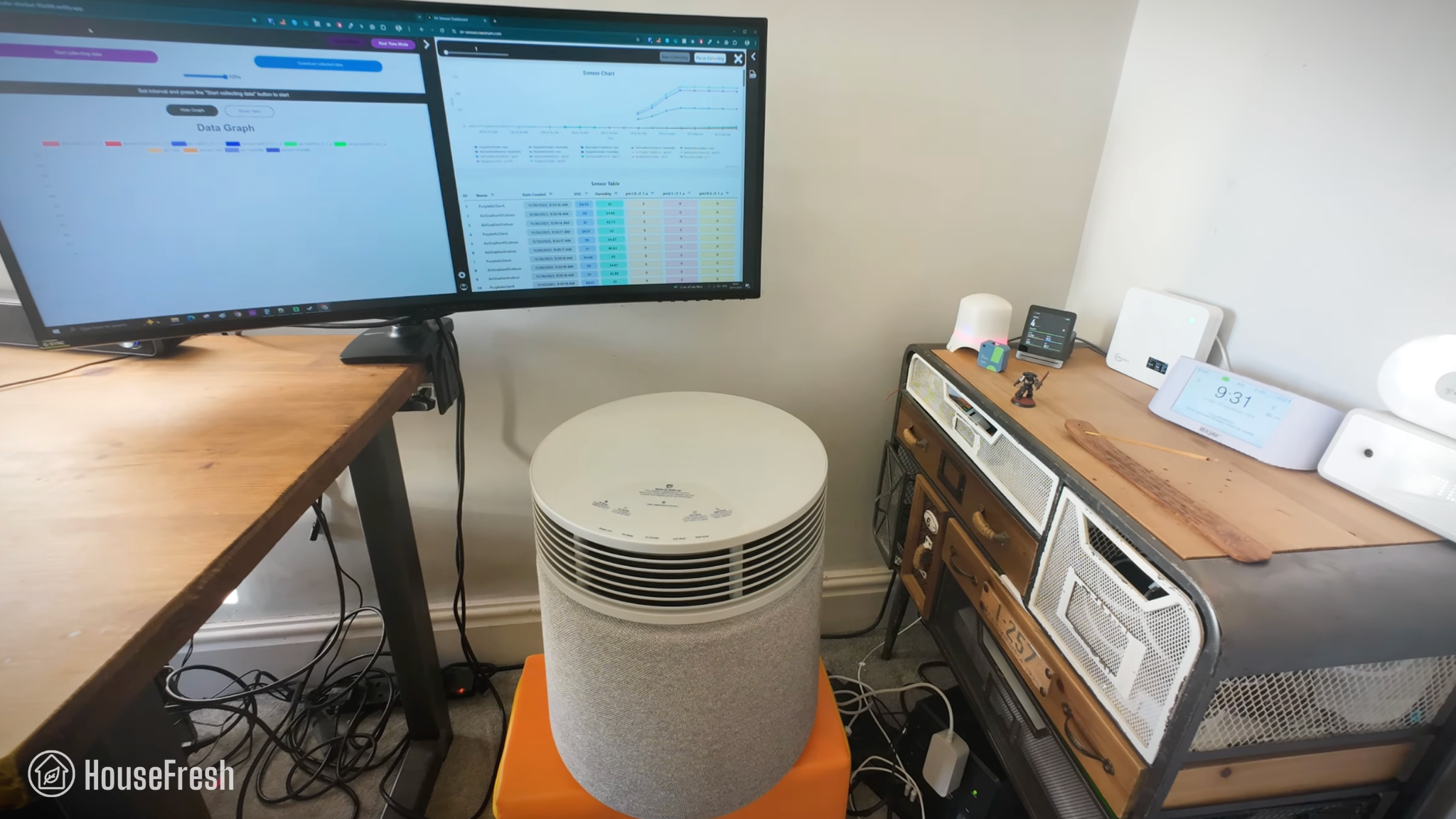
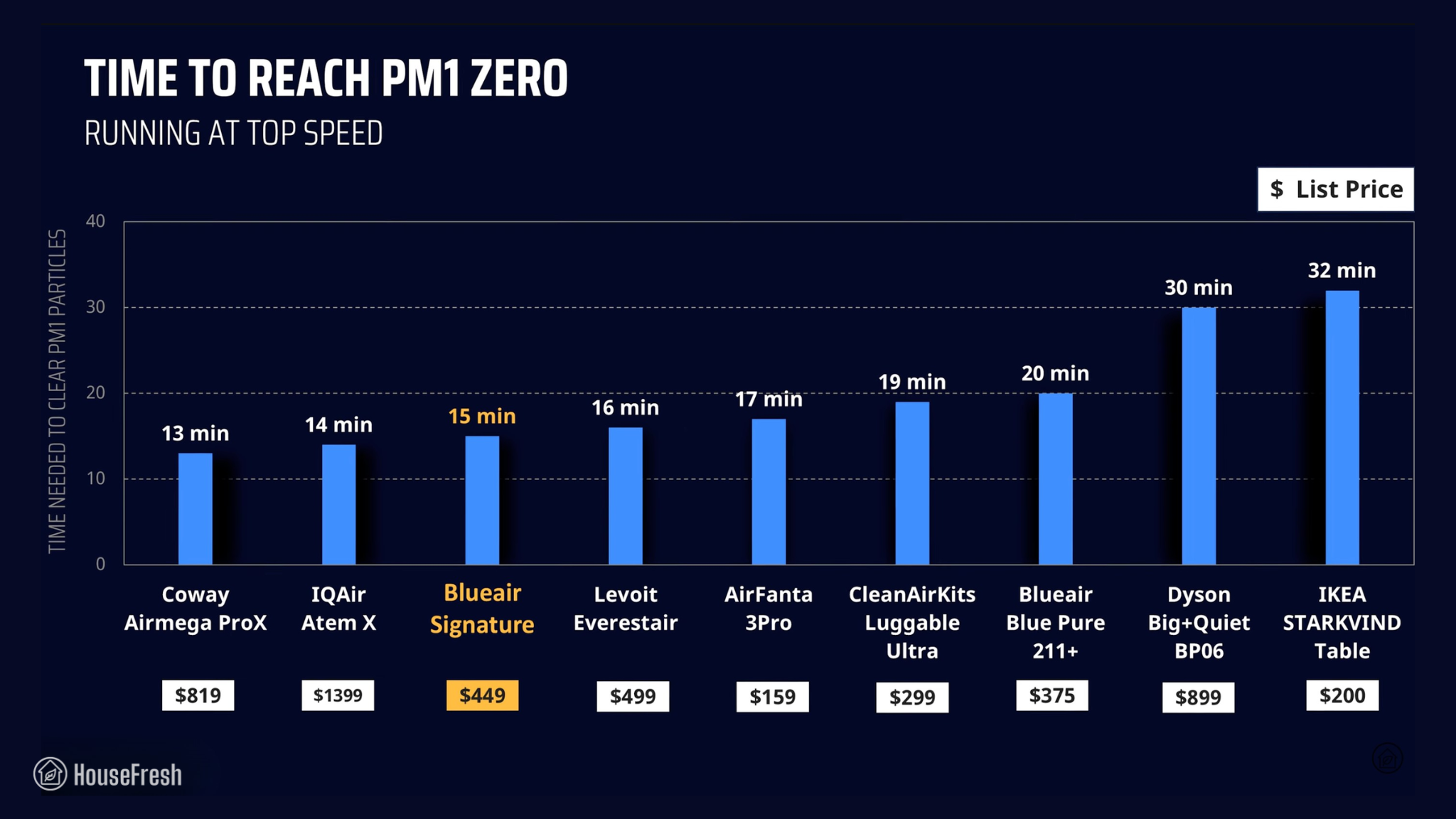
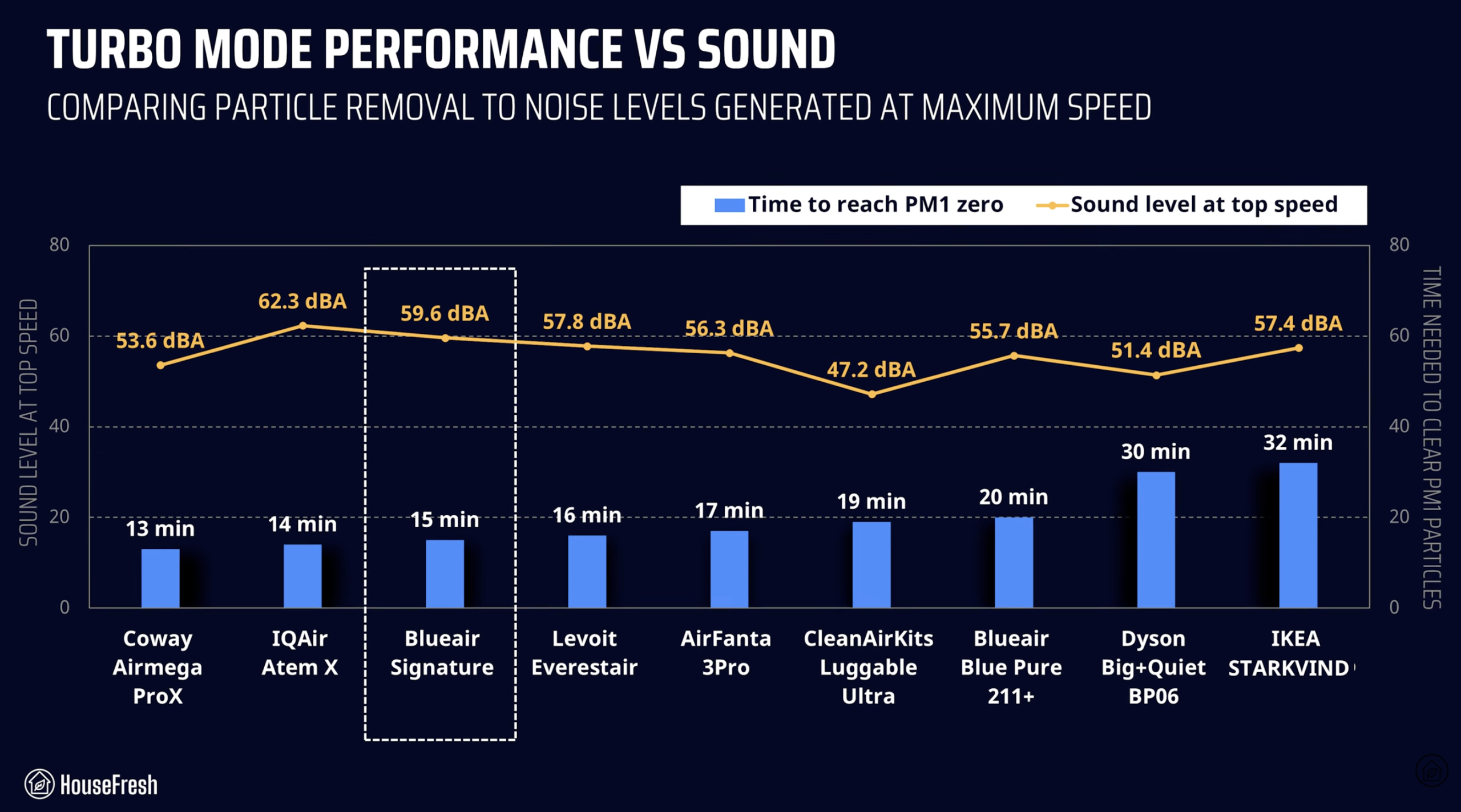
When running at top speed, our PurpleAir Zen sensor shows that the Signature needed 15 minutes to reach PM1 zero. Based on the natural ventilation of our test room, we estimate a PM1 CADR of 400 cfm.

This makes the Blue Signature powerful enough to provide five air changes per hour in large rooms up to 600 sq. ft.

As you can see from the chart, the Signature shows a significant performance jump over the older, bulkier Blue Pure 211+.

Blueair Blue Signature Performance Test

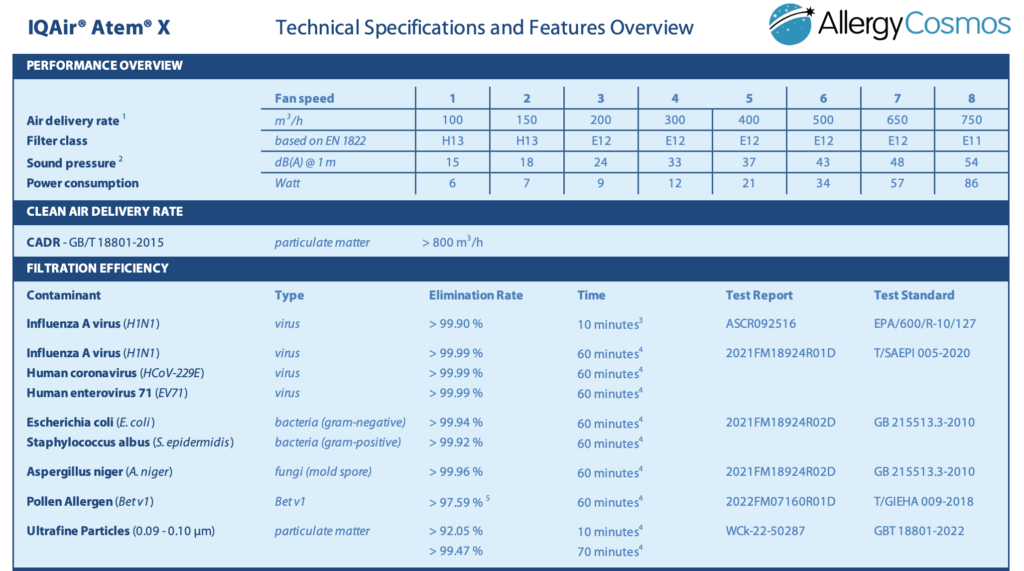
The only devices that were quicker to complete our test were the much larger Coway Airmega ProX (13 minutes) and the much, much pricier IQAir Atem X (14 minutes).

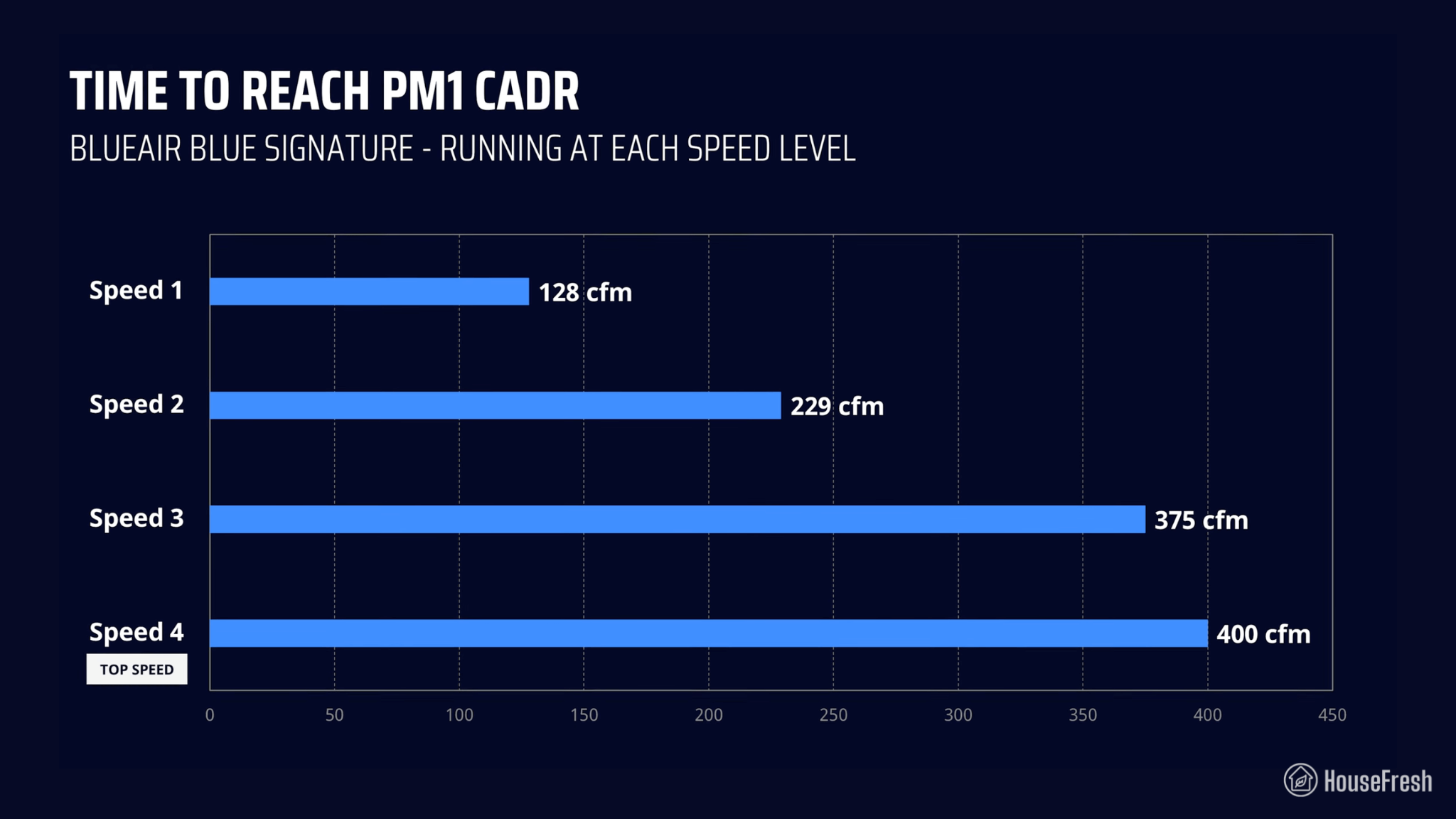
We repeated our particle removal test three times across all available fan speeds, which allowed me to estimate PM1 CADR at each fan speed:

Blueair Blue Signature CADR

BUT air purifiers running at full speed tend to be too loud for everyday use, so we must account for noise levelsโ€ฆ

Sound levels

The sound levels of the Blue Signature range from 34.8 dBA to 59.6 dBA โ€” which is a little louder than most air purifiers we have benchmarked it against.

Blueair Blue Signature Sound test

I used our BAFX sound meter to measure how much sound the Blue Signature generates at each of its 4 fan speeds and in sleep mode at 3 ft away:

Blueair Blue Signature Sound Data

Hitting 59.6 dBA at top speed, the Blue Signature is one of the loudest air purifiers on the table, second only to the Atem X, with its 62.3 dBA when running full power.

Blueair Blue Signature Performance vs Sound scaled

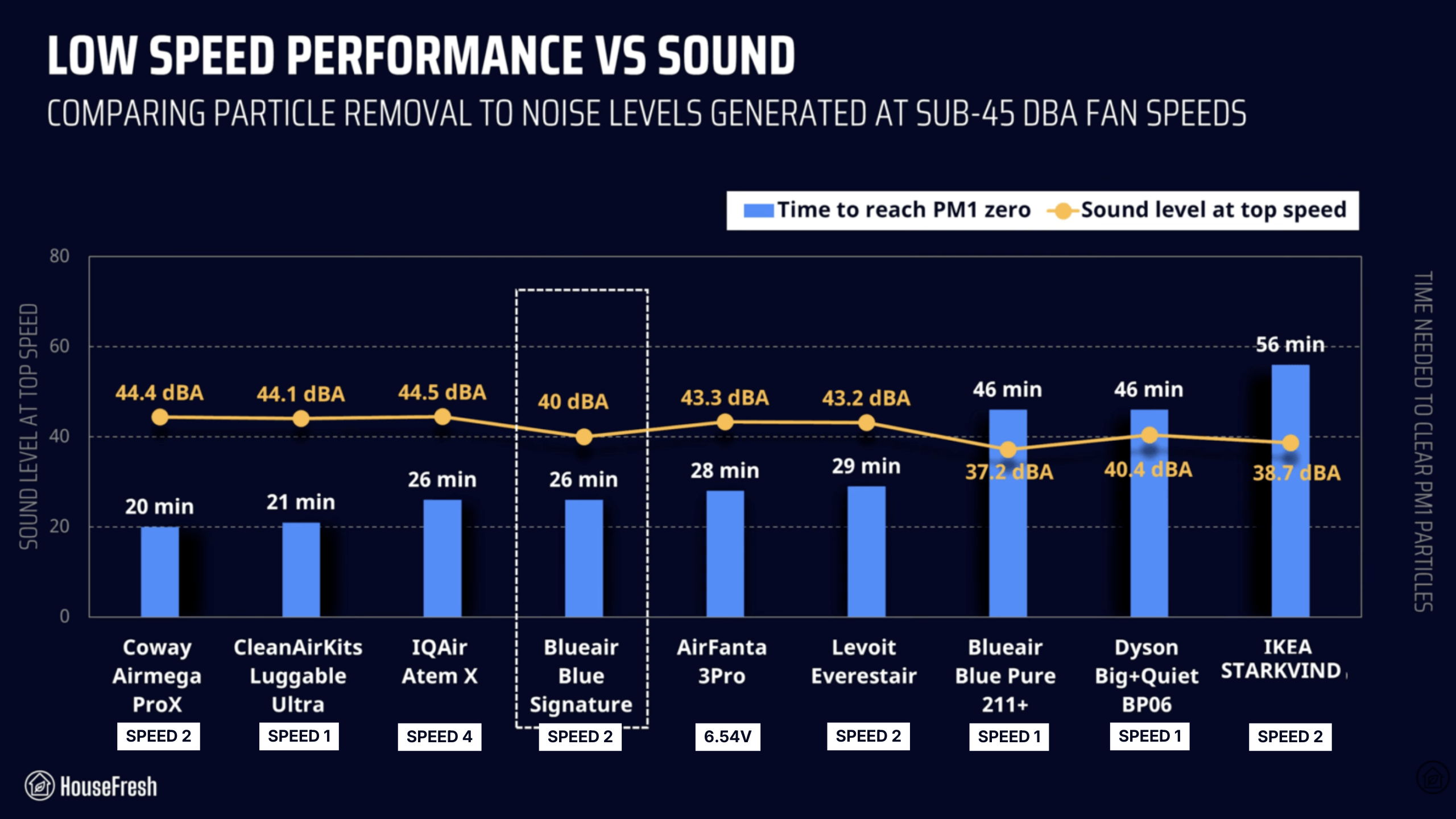
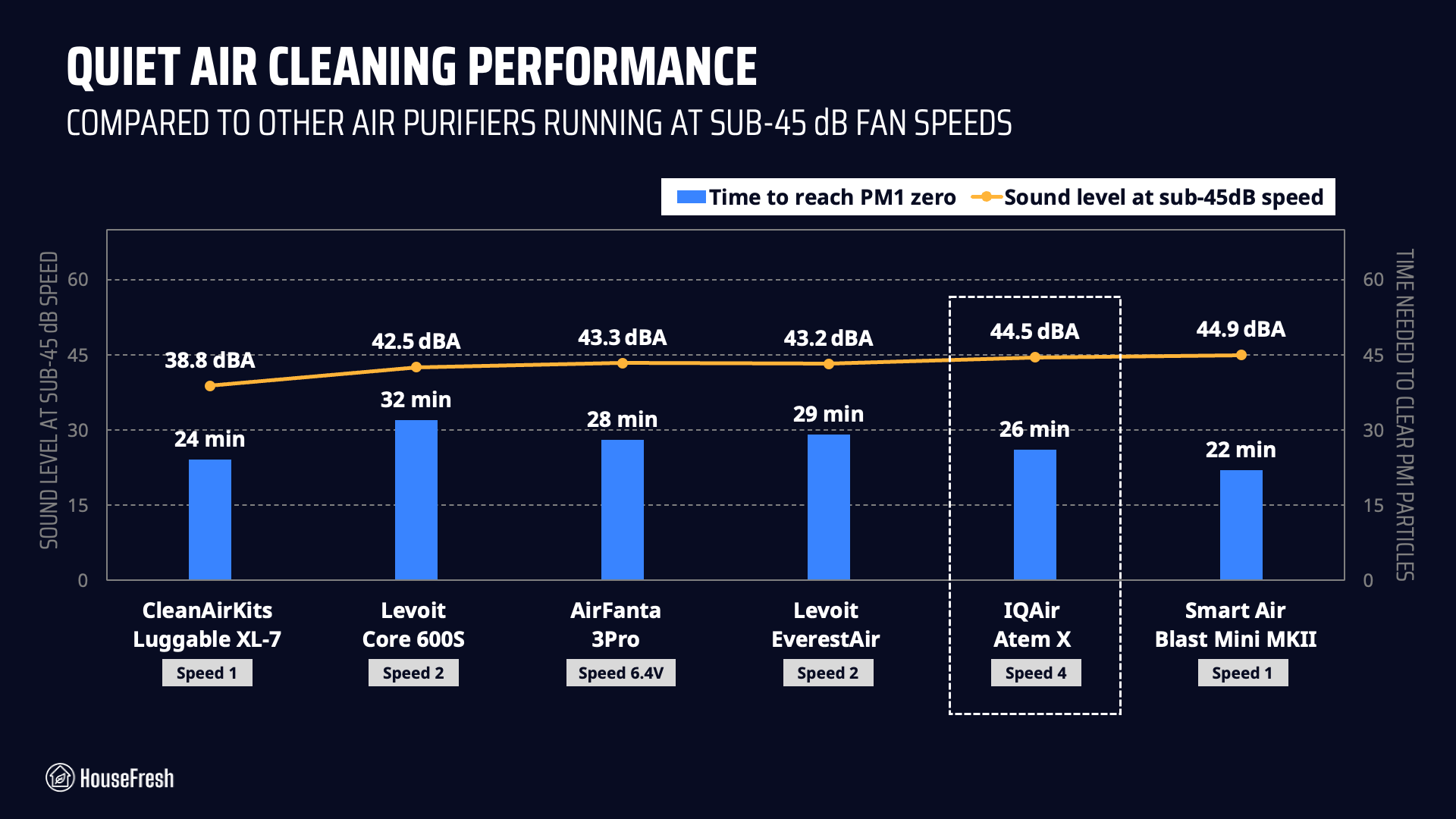
When running at speed 2, it generates just 40 dBA and was able to complete our particle removal test in 26 minutes – faster than the pricier EverestAir and BP06.

Blueair Blue Signature Quiet Performance HouseFresh

If you kept your Blue Signature running at speed 2, it would be whisper-quiet and still clean the air five times per hour in rooms up to 343 sq. ft.

Long-term running costs

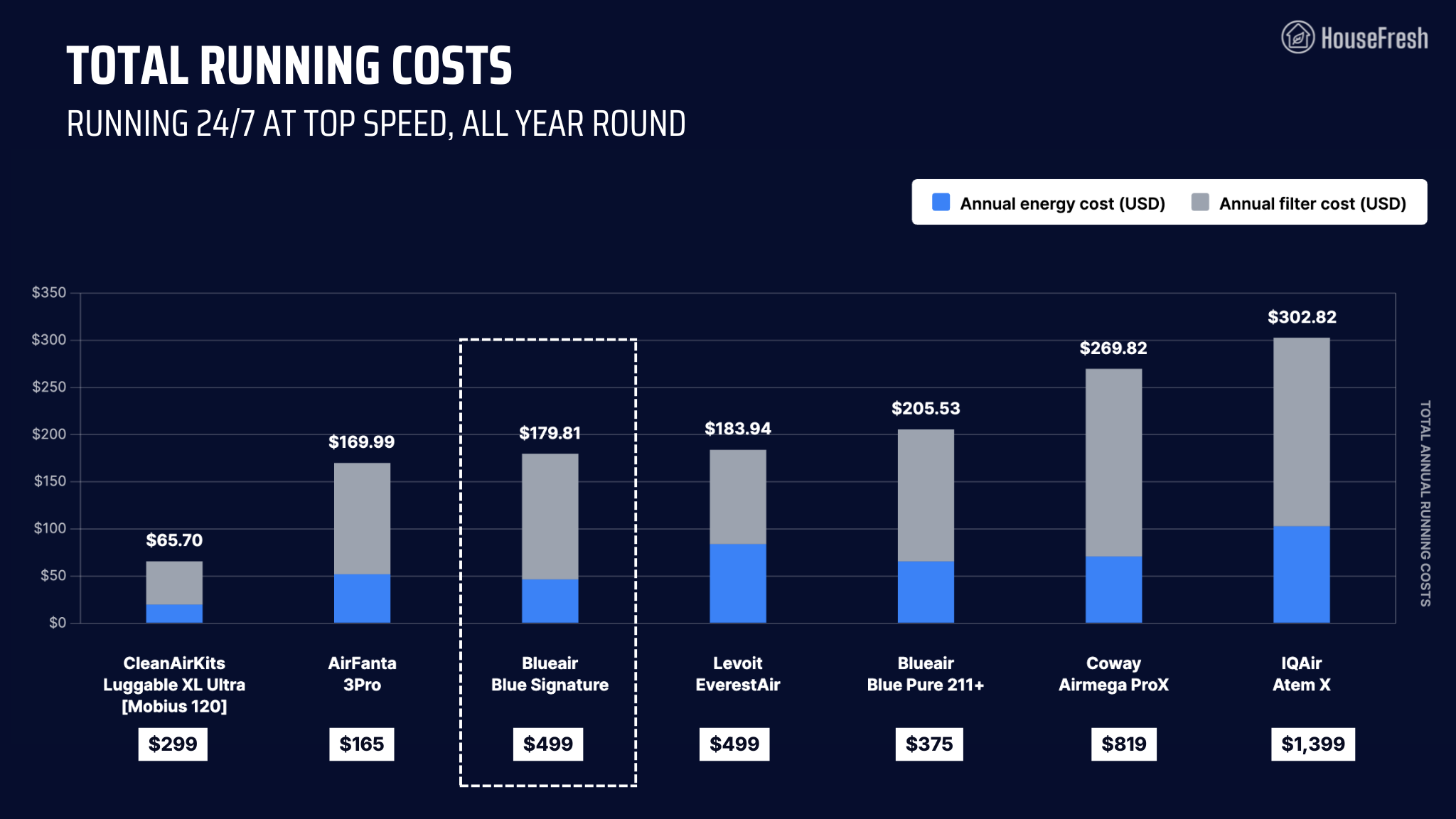
Running a Blueair Blue Signature will cost you $179.81 per year, combining energy and filter replacement costs.

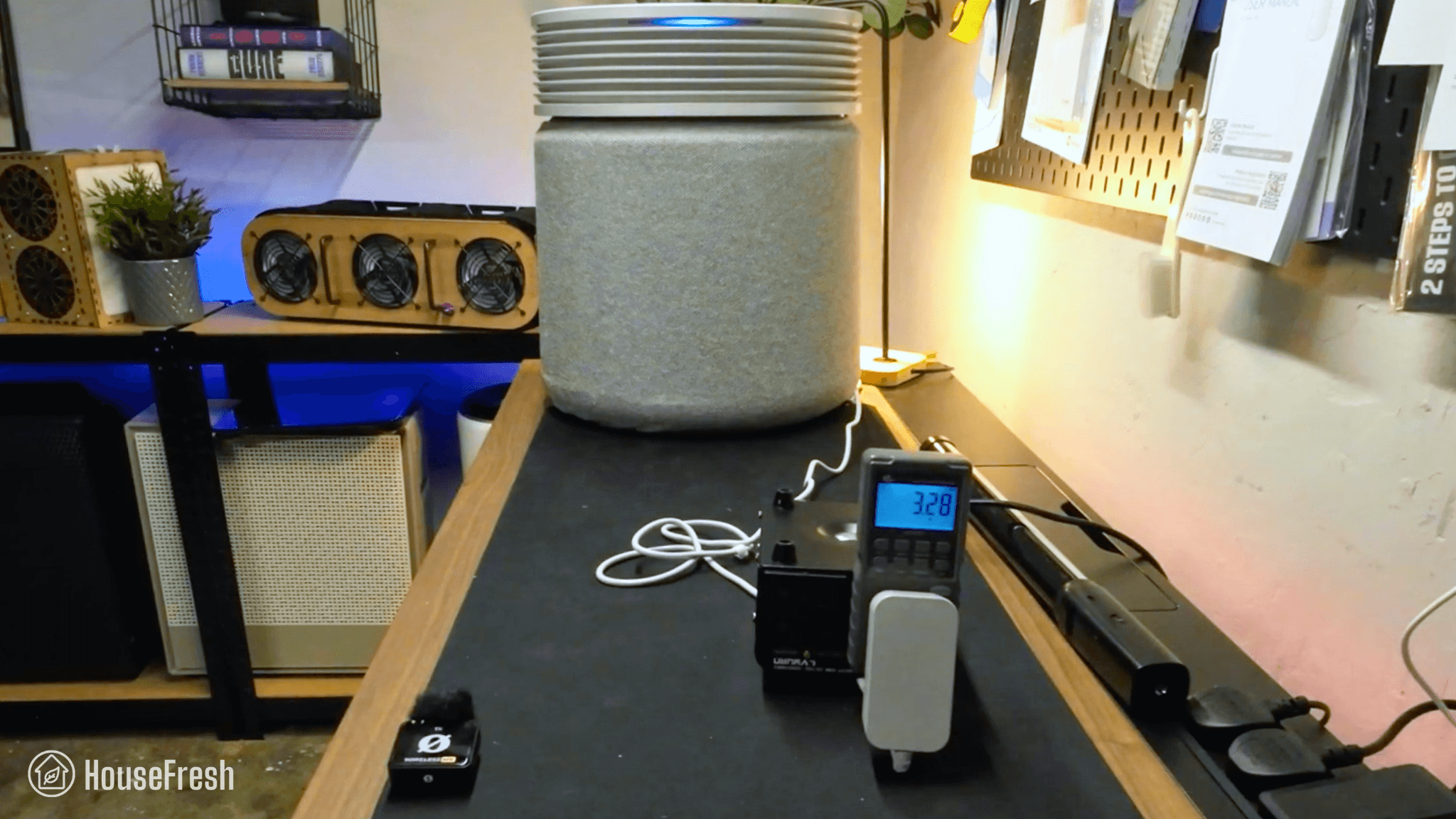
We used our energy meter to record how much electricity the Signature pulls at each fan speed and also while on standby.

Blueair Blue Signature Energy Data

At top speed, the Signature draws 38.65 watts, so if you left it running at top speed 24/7 for one year, it would add $46.49 to your energy bill, based on the average U.S. electricity price as of March 2026.

This is a huge improvement over the older 211+, and itโ€™s only beaten by the Mobius fans in the Luggable Ultra and the highly energy-efficient BP06 and Starkvind, which are less powerful than the Signature.

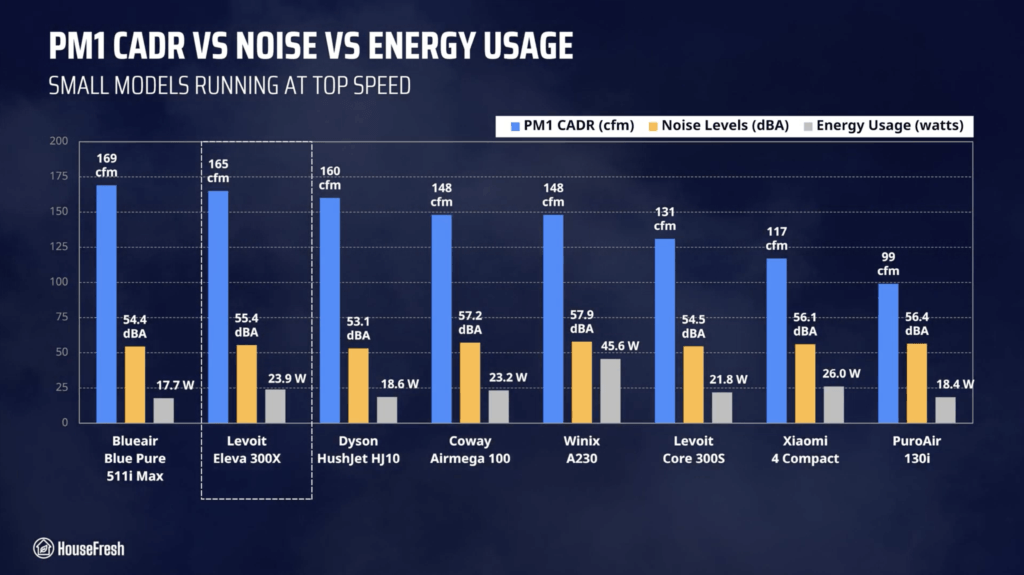
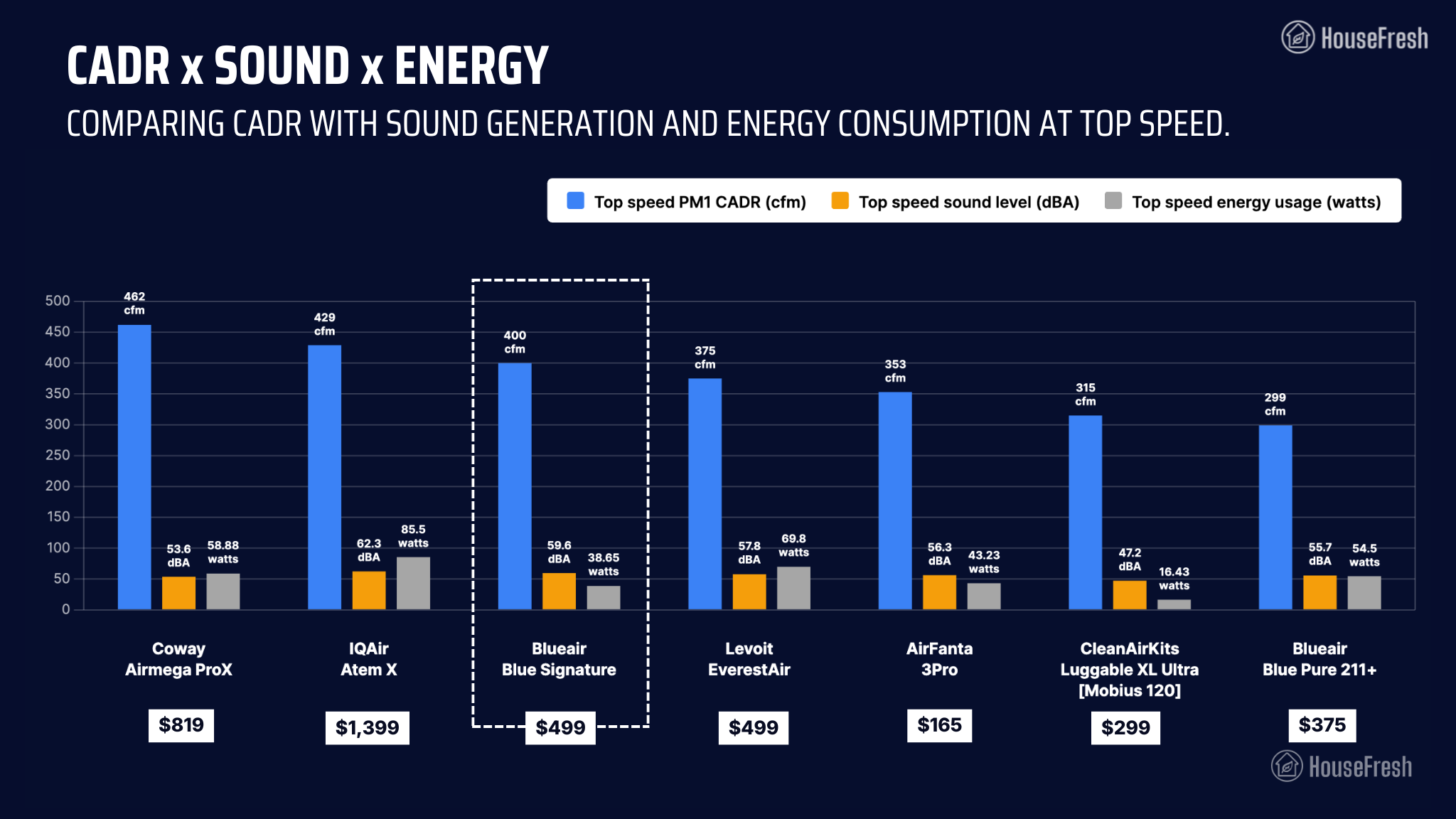
So I went one step further and created a chart to compare its CADR, noise levels AND energy usage at quiet fan speeds to see how the Blue Signature compares to other popular high-CADR air purifiers:

Blueair Blue Signature CADR Sound Energy

But let’s calculate how much you’ll need to spend to run your Blueair Blue Signature for a year.

According to Blueair, you need to change the filter in your Blue Signature every 9-12 months. And as always, I will use the lowest estimate of nine (9) months.

The replacement filter is available for $99.99. That means that you can expect to spend $133.32 each year on filter replacements alone.

We can add this to energy costs to work out the total yearly cost and compare it with the other devices Iโ€™m benchmarking the Signature against:

Blueair Blue Signature Yearly Running Cost

Thanks to the low energy costs, the Blue Signature is cheaper to run than the older Blue Pure 211+ and most other high CADR models we benchmarked it against, with the exception of the PC fan-powered AirFanta 3Pro and CleanAirKits Luggable XL Ultra.

Bottom line: Should you get a Blueair Blue Signature?

Our data showed that the Blue Signature offers high performance, even at quiet operation, in a well-designed package for less than $450.

Blueair Signature Corner

The Blue Signature looks like a piece of furniture and also doubles as a table. You can even add legs to lift it off the ground, with options to match your home’s decor.

It isn’t cheap at just under $450, but it ticks a lot of boxes for this price.

Performance is top tier at both top speed and quiet fan speeds. To match the Signature’s performance with a traditional air purifier, you would need to spend nearly double for a much more utilitarian-looking Smart Air Blast Mini, or go with a much larger machine like the Coway Airmega Pro X

And if you want the same power in a smaller, good-looking package, then you would need to spend $1,400 on the IQAir Atem X — thatโ€™s a spicy price tag if Iโ€™ve seen one!

The running costs of the Blue Signature are fair, and while the initial price is higher than that of other mid-size models on the market, you do get a high-quality laser sensor, a table surface, and app connectivity.

Soโ€ฆ This thing has the looks, the power and all the features you could ask forโ€ฆ so whatโ€™s the downside?

Even though the ozone levels from HEPASilent are very low, I still wish Blueair would include an option to disable HEPASilent, either a button (as Alen, Winix, and Coway do) or a setting in the app (as weโ€™ve seen from Xiaomi).

I have received messages from people who have adverse reactions to any form of ionization, so I think all manufacturers using ionizers should allow consumers to choose whether they want this or not — even if it does lead to reductions in CADR.

So this is the main downside you should be aware of before buying that none of the other big media publisers or YouTube creators reviewing the Blue Signature will tell you about.

If you do decide to buy one, please use this link to support the work we do here at HouseFresh. In doing so, we will receive a small affiliate commission at no extra cost to you that we will use to continue buying and testing air quality products.

Did I miss any details? Do you have any questions I left unanswered? Just drop a comment below, and I’ll get back to you as soon as I see it.

Winix 5510 review

Winix 5510 Closeup scaled

The Winix 5510 is the much-anticipated successor to the incredibly popular Winix 5500-2, which has been one of my most recommended air purifiers since I first tested it back in 2023.

We received MANY requests to review the 5510, so Iโ€™m happy to share the results of our tests with you today.

Winix 5510 HouseFresh Subs

I paid $459.65 in total, including import fees and shipping, to get the Winix 5510 delivered to me in the UK, based on a list price of $249.99. However, as of May 2025, you can find the 5510 on Amazon for $179.99 and on the Winix America store for $199.99.

The overall score for the 5510 incorporates first-hand data results from our battery of tests, as well as our ratings for customer service, brand transparency, and design & UX. Check out the full scorecard below to see the split of categories.

Search for ‘Winix 5510’ to see where it ranks, based on its air cleaning performance and value for money. You can also filter results to easily compare models in the same price range.

The pros and cons of the Winix 5510

A summary of our top-level findings after testing this air purifier, following our methodology.

โ€œThe 5510 looks good, doesnโ€™t take up too much space, and can clean the air as fast as the Levoit Vital 200S, the Philips 3200 Series and the Smart Air SA600.

So if youโ€™re looking for a mid-sized air purifier that offers excellent air cleaning performance and you value smart features with app support, then the 5510 is definitely worth your consideration.โ€

Danny Ashton HouseFresh
Danny Ashton
HouseFresh Founder
& Lead Tester

CONS

The 5510 is louder at top speed than similarly-sized air purifiers from Winix and other brands.
Its air cleaning performance drops when running at sub-45 dBA fan speeds.
The app is still quite bare and lacks features you see in apps from Levoit and Xiaomi, but this is expected as itโ€™s very new for Winix.

PROS

It has a better-looking design compared to every other rectangular Winix device Iโ€™ve tested.
When running at top speed, its air cleaning performance is on par with the SA600, the 5500-2 and the Rabbit Air A3.
The Winix app is intuitive and has no annoying ads like the ones we see in other apps.
Its body is compact and has a smaller footprint compared to the older Winix 5500-2.

Clean air delivery rate (CADR):โ€“ Top speed PM1 CADR: 248 cfm
โ€“ Sub-45 dBA PM1 CADR: 125 cfm
โ€“ AHAM PM2.5 CADR: 252 cfm (dust)
Filter technology:True HEPA filter with pelleted activated carbon and a removable pre-filter
Recommended room size:372 sq. ft. (5 air changes per hour)
Dimensions:15.9 x 11 x 25.2 in (40.3 x 27.9 x 64 cm)
Weight:13.03 lbs (5.9 kg)
Noise level in decibels from 3 ft. away:Sleep mode: 35.2 dBA
Speed 1: 36.8 dBA
Speed 2: 40.8 dBA
Speed 3: 51.6 dBA
Speed 4: 67.2 dBA
Electricity consumption in watts:Standby: 0.65 watts
Sleep mode: 3.51 watts (3.77 with PlasmaWave)
Speed 1: 4.59 watts (4.87 with PlasmaWave)
Speed 2: 6.58 watts (6.89 with PlasmaWave)
Speed 3: 15.68 watts (15.98 with PlasmaWave)
Speed 4: 52.62 watts (53.94 with PlasmaWave)
Filter lifespan:12 months
Manufacturerโ€™s warranty:2 years
Country of origin:South Korea
Country of manufacture:South Korea

Design, controls and app features

A good-looking air purifier with smart features and app connectivity

Winix 5510 Living Room

The body of the 5510 is smaller than that of the now-discontinued 5500-2 and other mid-sized Winix air purifiers.

Winix 5510 VS 5500 2 Front

After reviewing the T810 and now the 5510, it has become obvious to me at this point that Winix is focusing heavily on the aesthetics of their devices with their new generation of air purifiers.

It has a gas sensor that triggers auto mode and a light sensor that puts it to sleep mode when detecting darkness. 

Winix 5510 Sensors

The control panel is intuitive and easy to navigate. You also get an air quality indicator in the form of an LED light that changes color (from blue to red) depending on the quality of your air.

You can connect it to your smartphone via the Winix app, which is available on both iPhone and Android.

Winix 5510 App

The app has a clean UX, works well, and allows you to control the 5510 remotely from your phone. It’s bare-bones compared to other air purifier apps, but it does the job without any issues.

Filtration technology

True HEPA filtration with activated carbon and optional bipolar ionization via PlasmaWave.

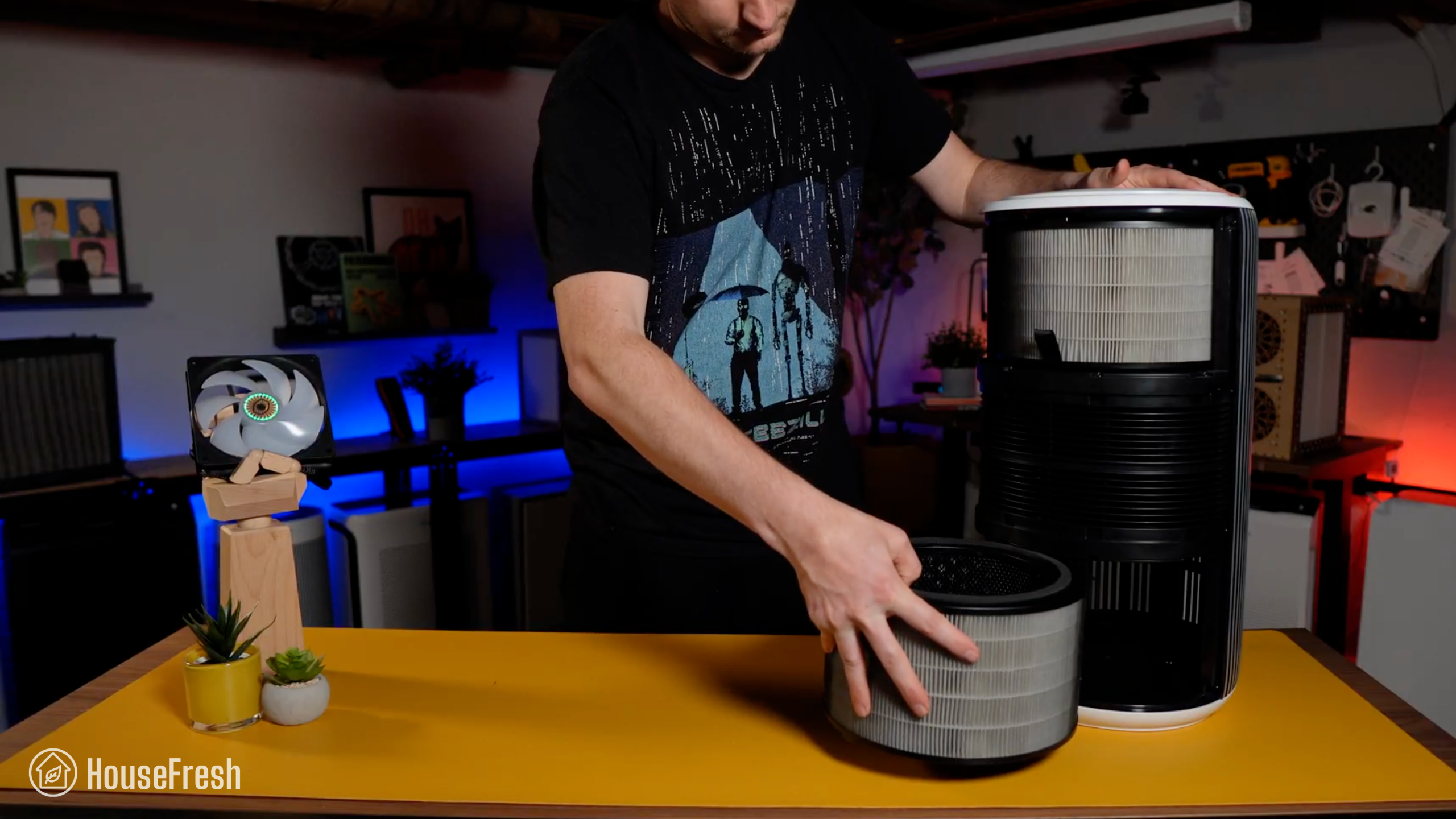
The 5510 comes with three separate mechanical filtration layers: a removable pre-filter, an activated carbon filter, and a HEPA particle filter.

Winix 5510 Filters

This means that once the carbon runs out (and starts getting smelly), you can just take it out and keep using the True HEPA filter till you can replace the carbon.

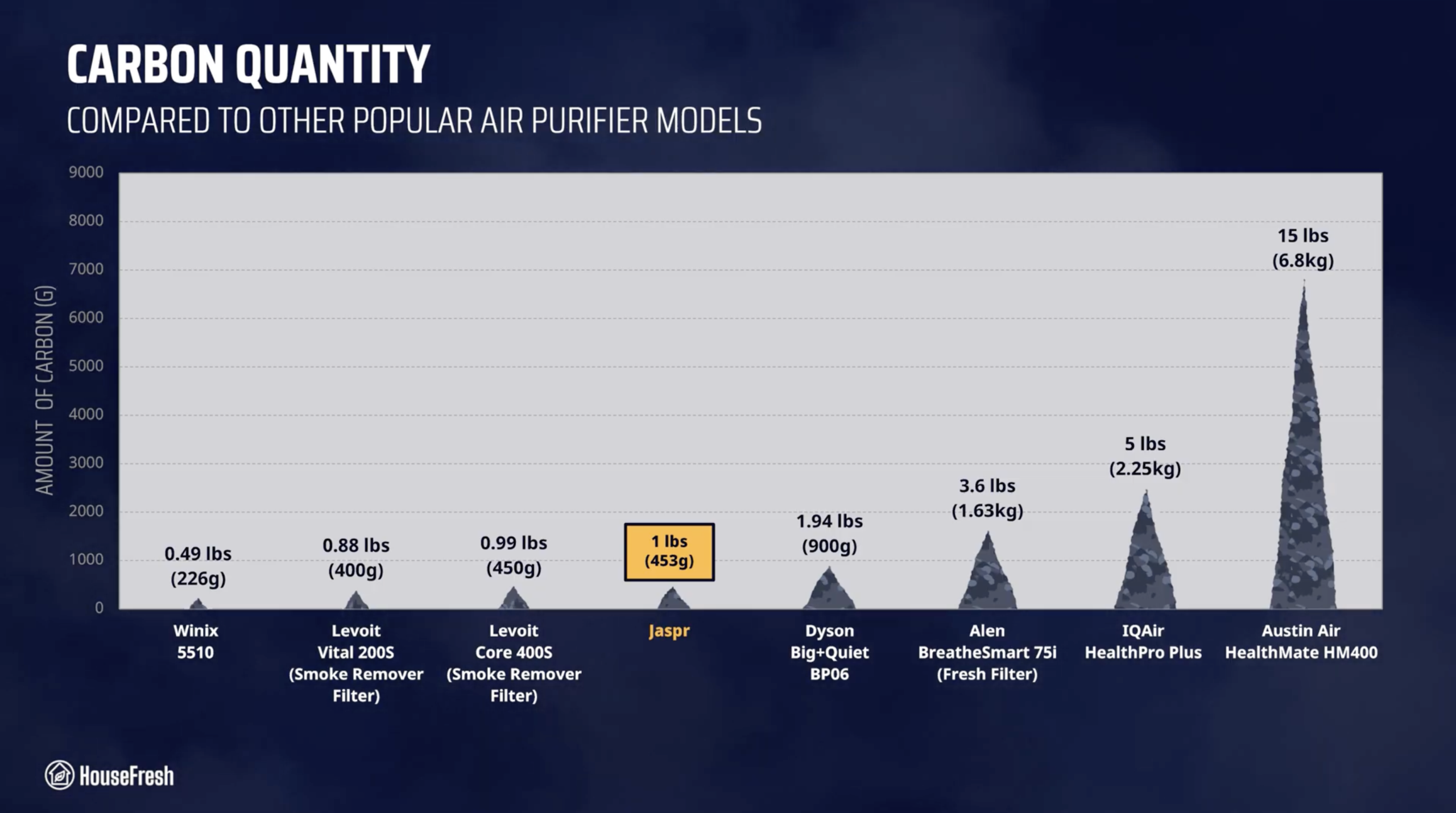
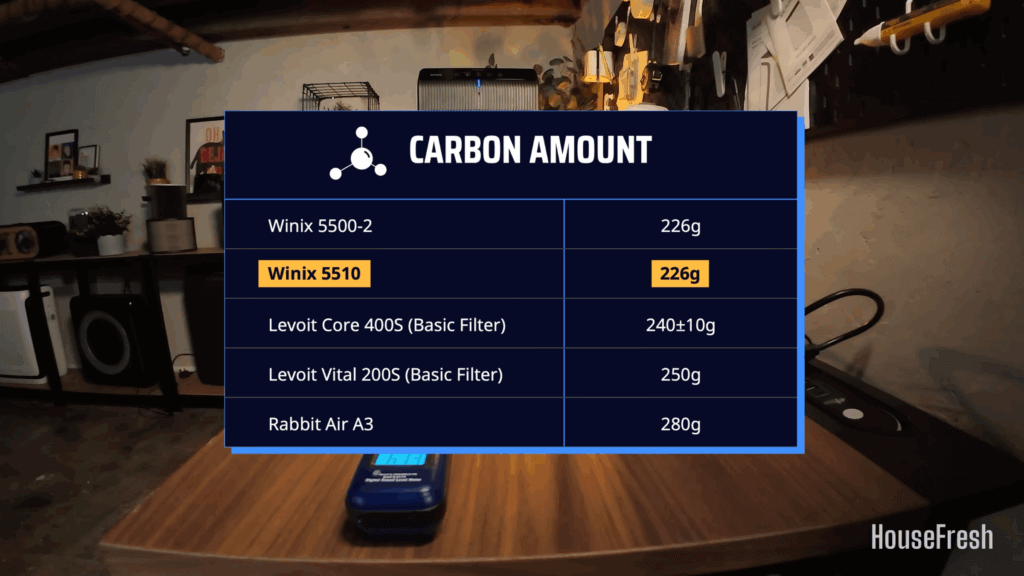
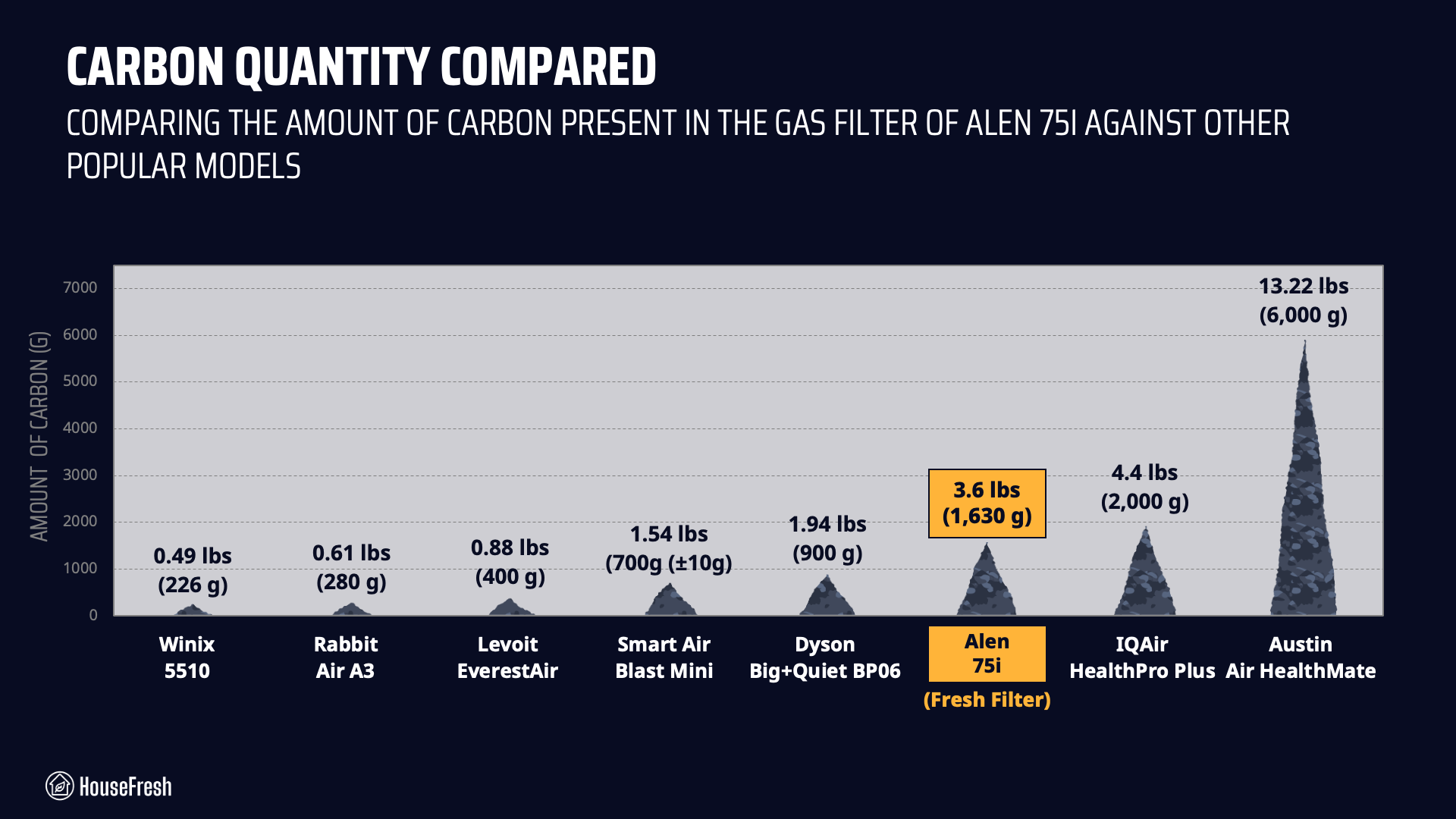
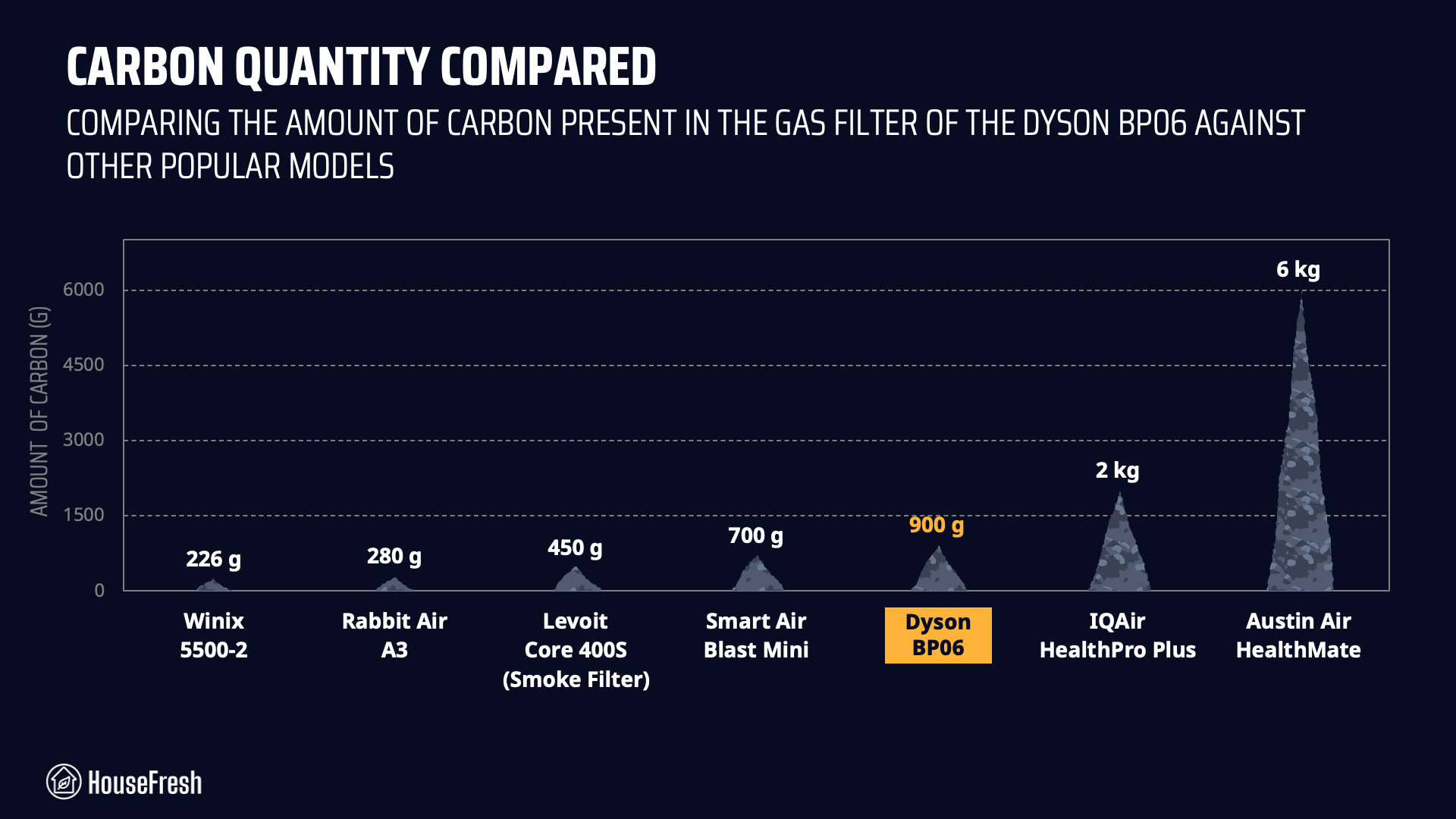
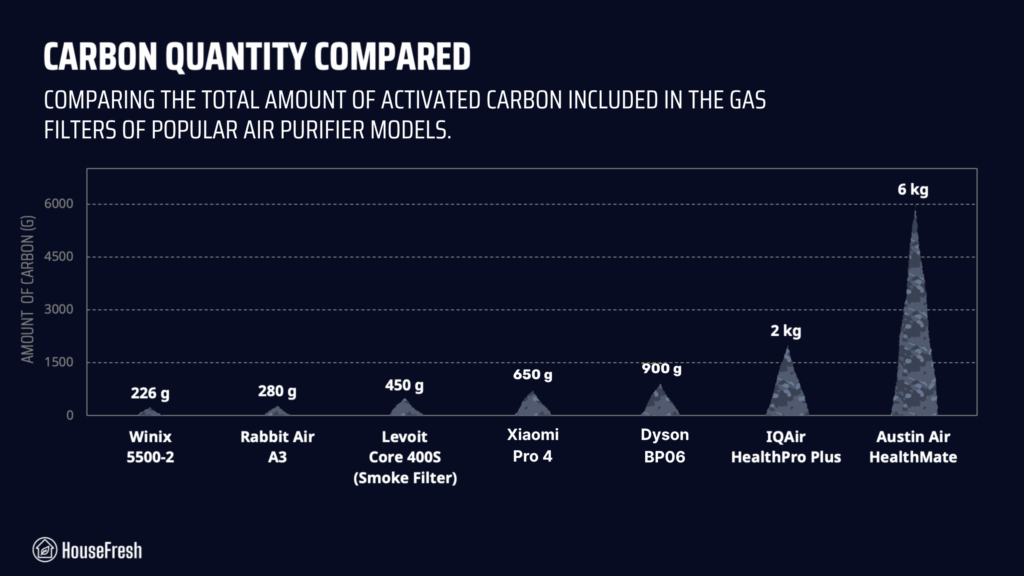
I reached out to Winix for more information and they confirmed that the 5510 comes with 226 grams of carbon – same as the older 5500-2. 

Winix 5510 Carbon amounts

As with other Winix devices, the 5510 comes with PlasmaWave, a bipolar ionization process that electrostatically charges particles, making them easier to remove. You can disable it if you prefer to avoid ionizers.

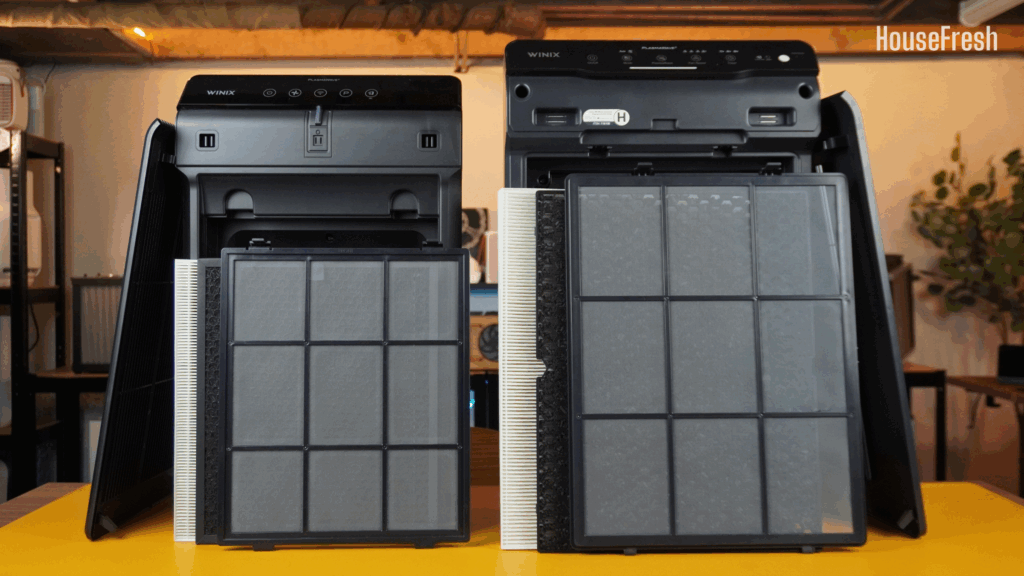
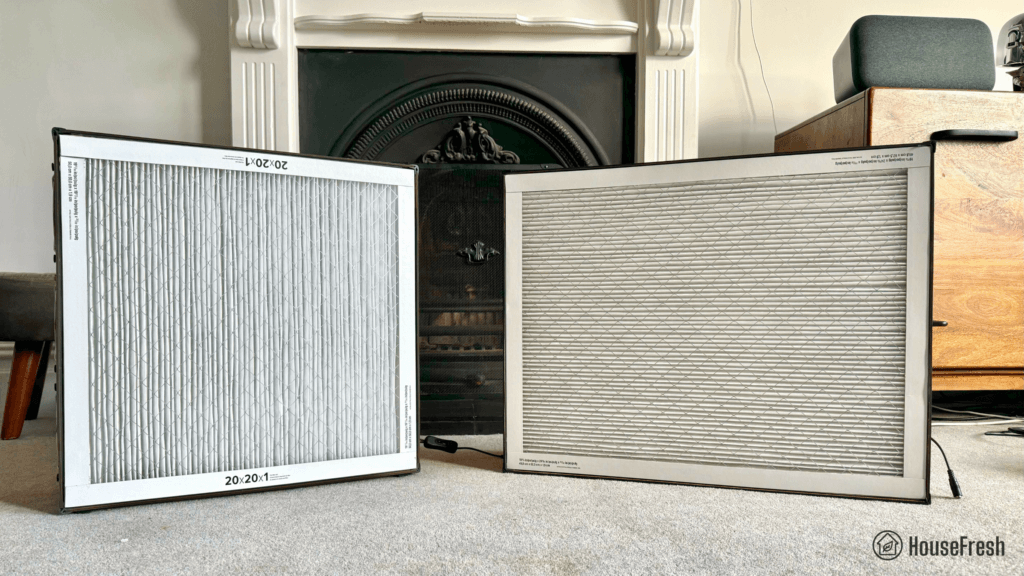
The 5510 uses a different type of filter set, Filter Q โ€” 1712*0123-00, which works with the 5510 and 5520 models but is too small for the 5500-2, the 5300-2 and other older rectangular Winix devices.

Winix 5510 VS 5500 2 Filters
The filters in the Winix 5510 (left) are smaller than those in the Winix 5500-2 (right)

Air cleaning performance

We tested the 5510 in our 728 cubic ft. test room, tracking how fast it removed all PM1 particles from the air after we filled the space with incense smoke.

Winix 5510 HouseFresh CADR test scaled

First, we tested the Winix 5510 running at top speed with PlasmaWave enabled. According to our PurpleAir Zen sensor, the 5510 needed 24 minutes to achieve PM1 zero in our 728 cubic ft. test room, which matches what we expected based on its CADR report:

Based on the natural ventilation of our test room, I estimate a top speed PM1 CADR of 249 cfm. This is powerful enough to provide five air changes per hour in large rooms up to 373 sq. ft.

Winix 5510 HouseFresh Performance Data scaled

As you can see from the table, the 5510 compares very well against some of the best mid-sized devices we have tested when looking at raw performance at top speed, but considering it is a new model, I was hoping it would be at least a little quicker than the older 5500-2.

our air cleaning tests in isolation wonโ€™t tell us the full story…

Sound levels

The sound levels of the Winix 5510 range from 35.2 dBA to 67.2 dBA โ€” considerably quieter than every single large air purifier we have benchmarked it again.

Winix 5510 HouseFresh tests scaled

The reality is that if an air purifier is too loud, then someone will turn it off eventually.

That is why I used my sound meter to measure how much noise the Winix 5510 generates from 3 ft. away at each of its fan speeds, including sleep mode:

winix 5510 sound

Be aware that our background noise is 35 dBA, so the 5510 running at speed one (1) and in sleep mode is likely to be quieter if you could measure sound levels in a silent room.

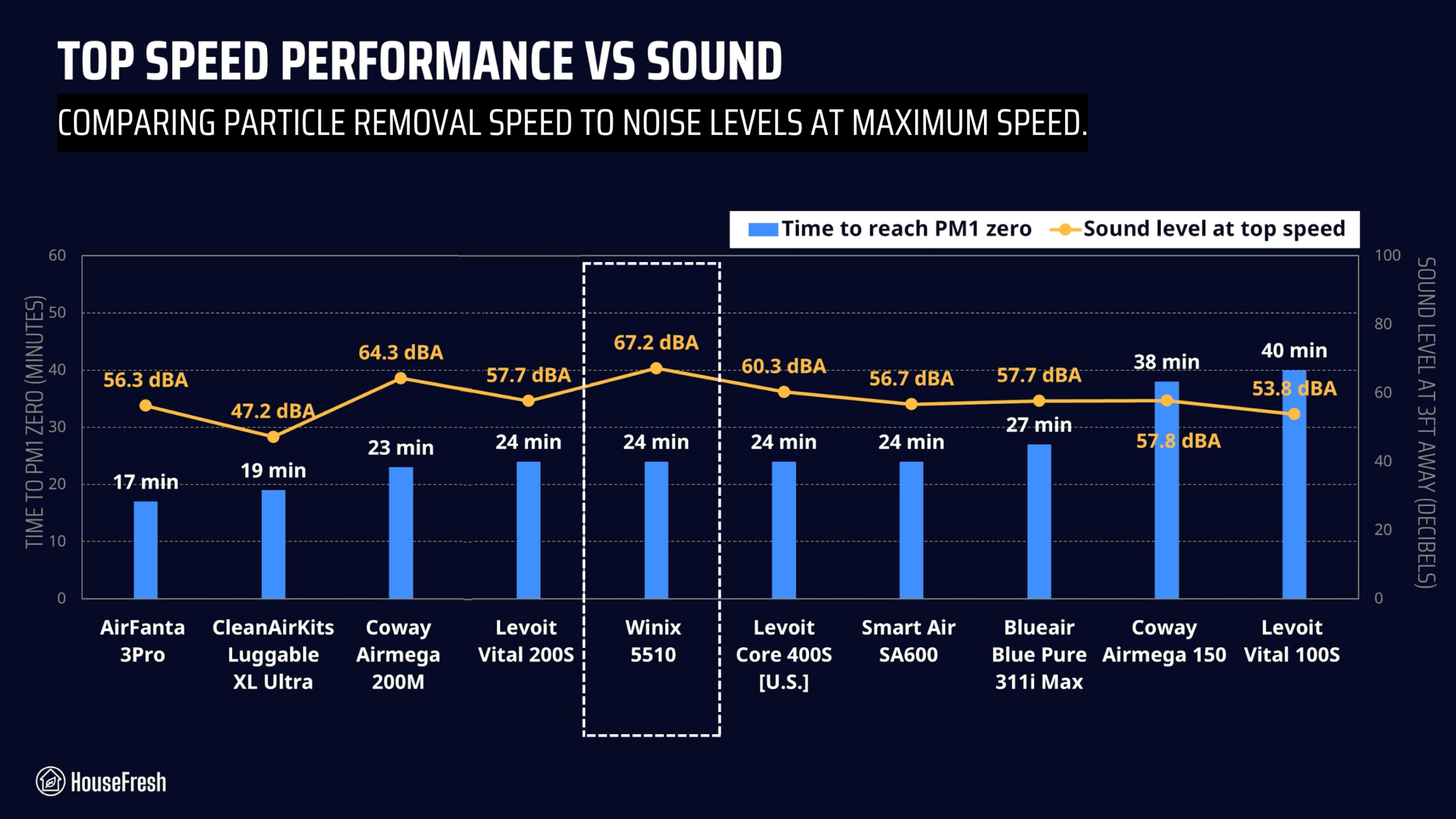
When running at top speed, it reached 67.2 dBA, which is considerably louder than other air purifiers with a similar clean air delivery rate.

Winix 5510 HouseFresh Performance VS Sound Data scaled

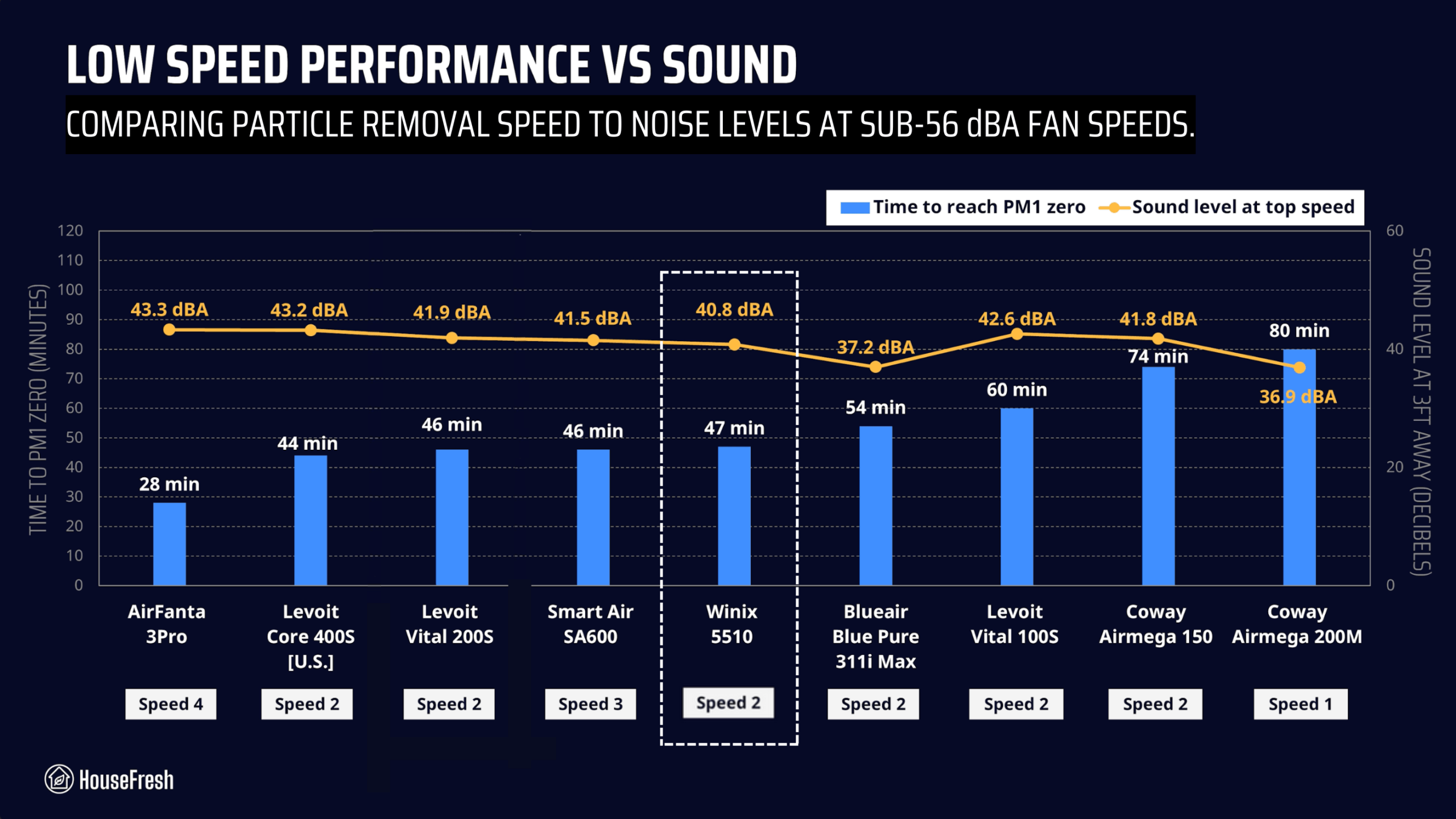
At speed 2, it reached PM1 zero in 47 minutes while generating 40.8 dBA, which is under our 45 dBA limit for daily use.

Winix 5510 Quiet Performance Test HouseFresh

Long-term running costs

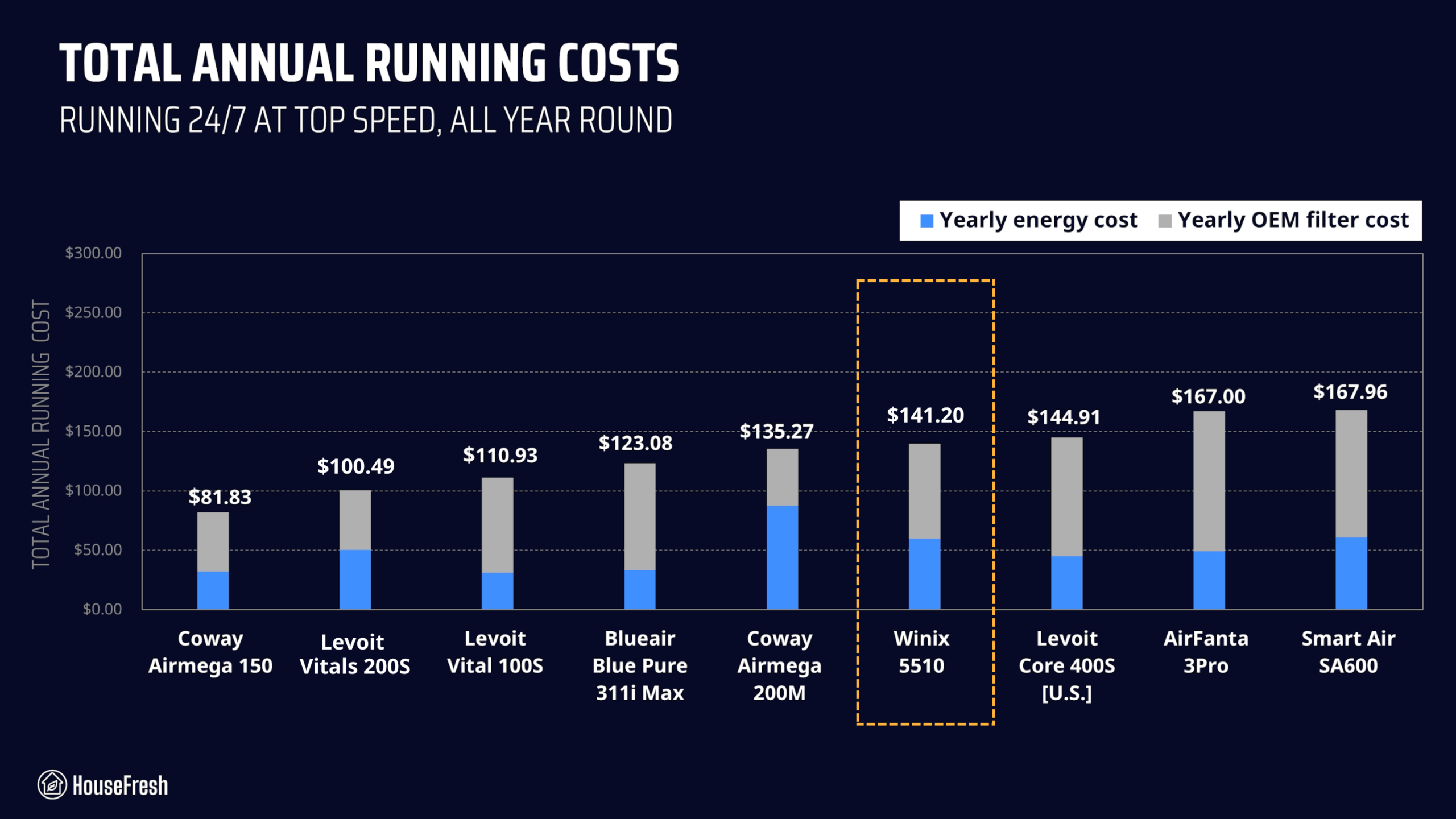
Running a Winix 5510 will cost you $141.20 per year, combining energy and filter replacement costs.

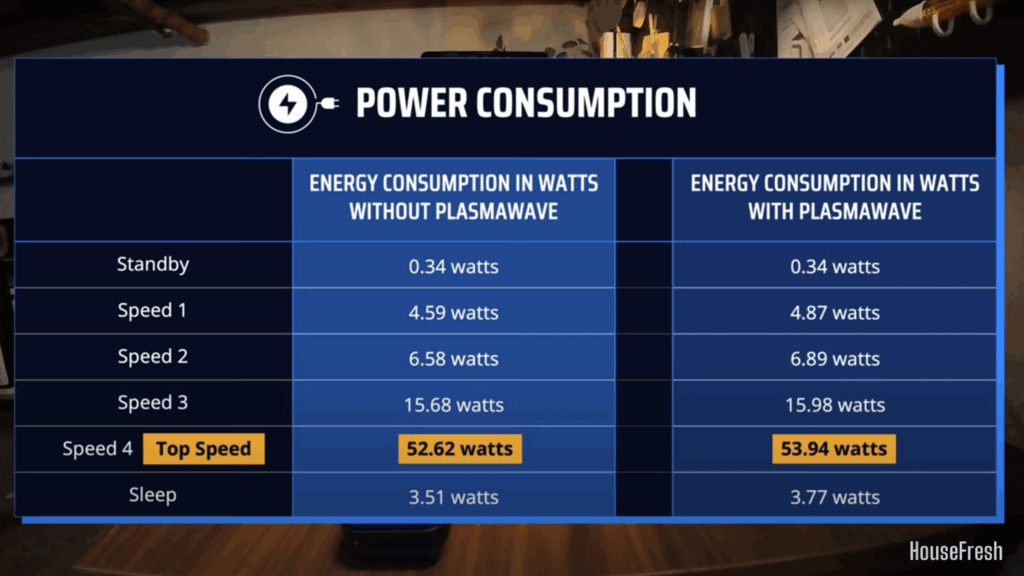
winix 5510 energy consumption

At its top speed, the 5510 draws 53.84 watts. If you had to leave your 5510 running 24/7, it would cost $61.21 in energy costs for a year.

But letโ€™s look at the other main factor affecting yearly running costs: filter replacements.

According to Winix, you can expect to change filters every 12 months, and you can buy a new filter set for $79.99, so you can expect to spend around $80 each year on filter replacements.

Winix 5510 Yearly costs scaled

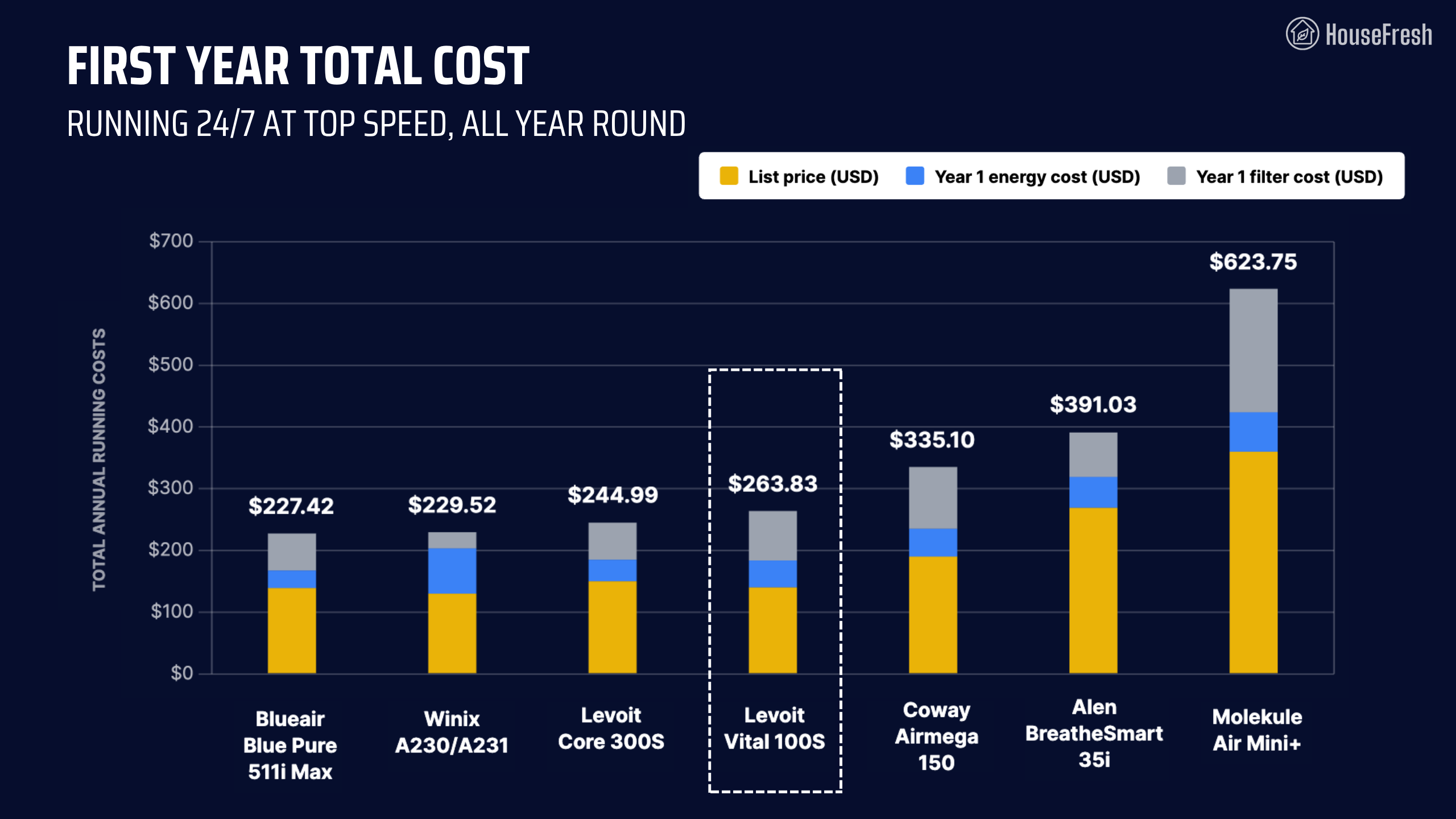
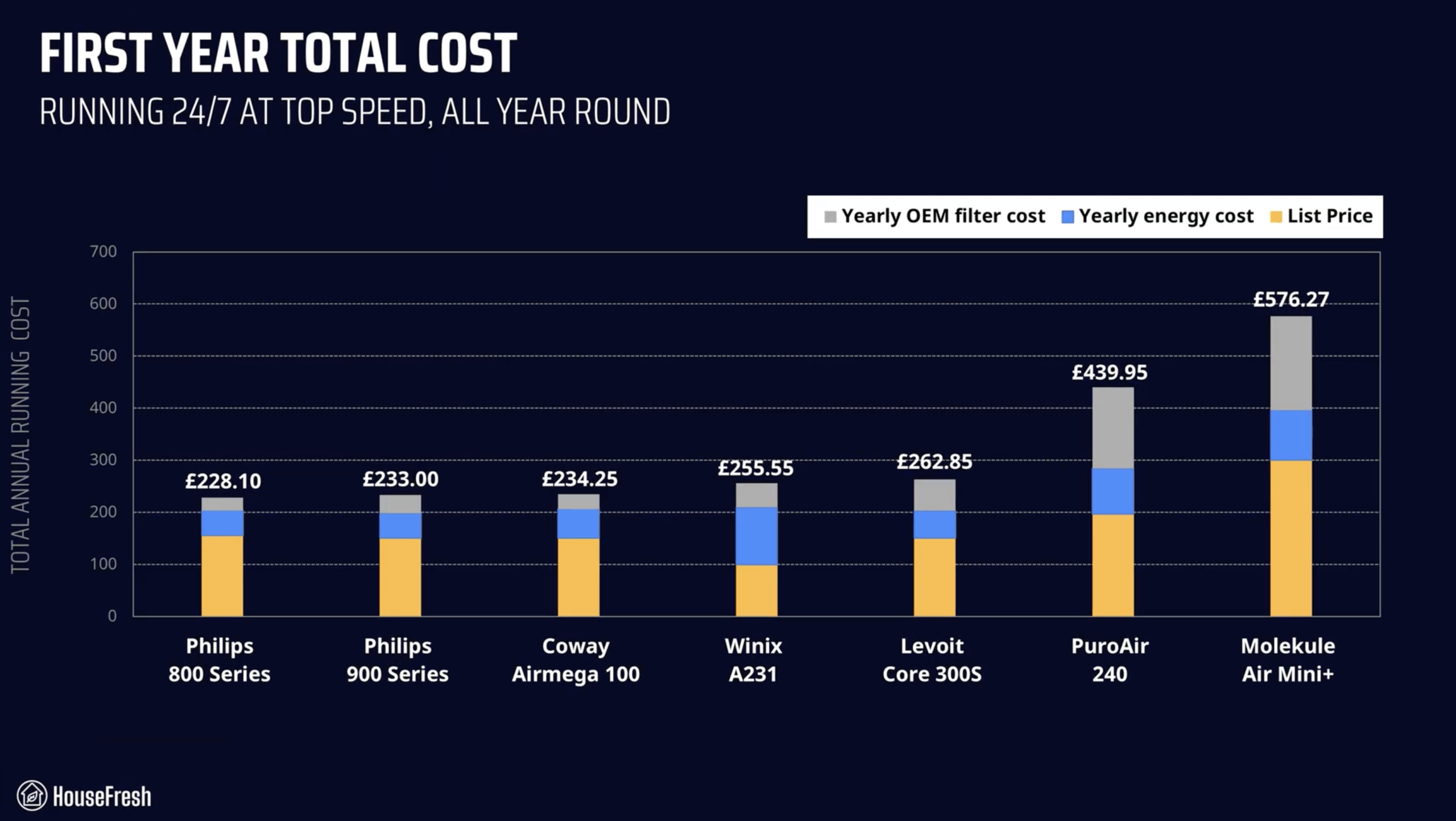
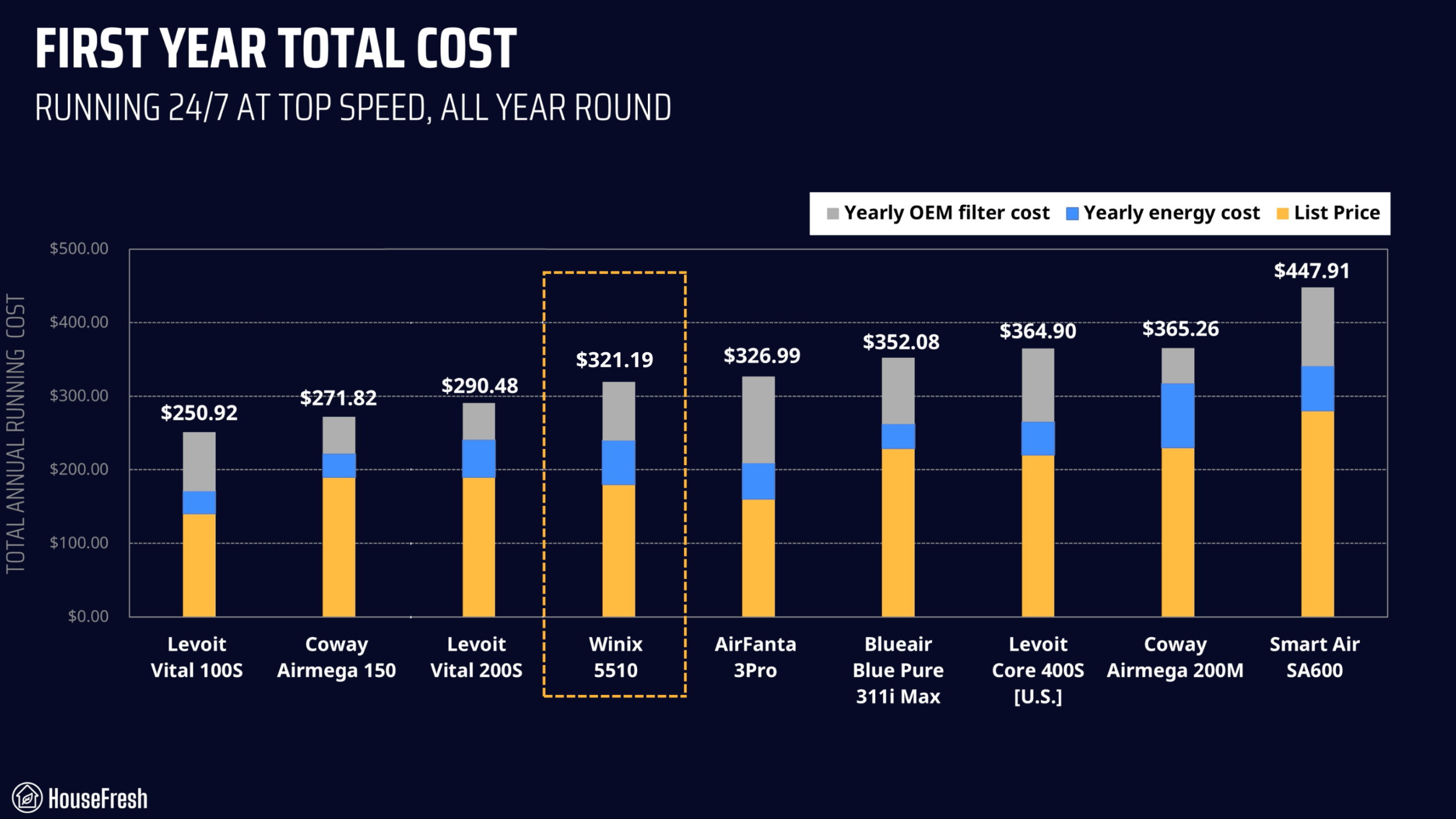
We can now combine energy and filter replacement costs with the list price to calculate how much you will spend on the first year of owning a Winix 5510, and compare this to what you’d pay with other similar performing air purifiers:

Winix 5510 First Year Cost scaled

The 5510 has a list price of $179.99, but you could find it as low as $149.99 during Prime Day or Black Friday:

Retailer Lowest Ever Highest Ever

Bottom line: Should you get the Winix 5510?

Now that the Winix 5500-2 has been discontinued, the 5510 is the best next thing from Winix.

I hate to say this, but the Winix 5510 offers less powerful air cleaning performance at louder operation than older mid-sized Winix models. Sadly, I canโ€™t recommend the 5500-2 or the 5300-2 anymore, as they have both been discontinued.

But does this mean that the 5510 is a bad investment? Wellโ€ฆ not really.

In our air-cleaning performance tests, the Winix 5510 running at top speed is just 1 minute slower than the older 5500-2. And this level of power comes in a much more compact body and smaller filters, which explains why it is louder, as the fan has to work harder.  

Plus, the 5510 looks more high-end than the 5500-2 and the 5300-2 AND it comes with smartphone connectivity through the Winix app, which has a good UX and no annoying bugs. So you get some good features that you wouldnโ€™t get access to with the older models.

Winix 5510 Closeup

However, if you are sensitive to sound and prefer to run your air purifier at low, quiet fan speeds, then I suggest you look into the Winix T810. The T810 offers similar performance at top speed to the 5510, but you will get better air cleaning power at quiet fan speeds. Plus, it also comes with smartphone connectivity through the Winix app.

If you are a big fan of app support but are not too bothered about getting a Winix device, then I recommend looking into air purifiers from brands like Levoit and Xiaomi, as their apps are much more polished and feature-rich.

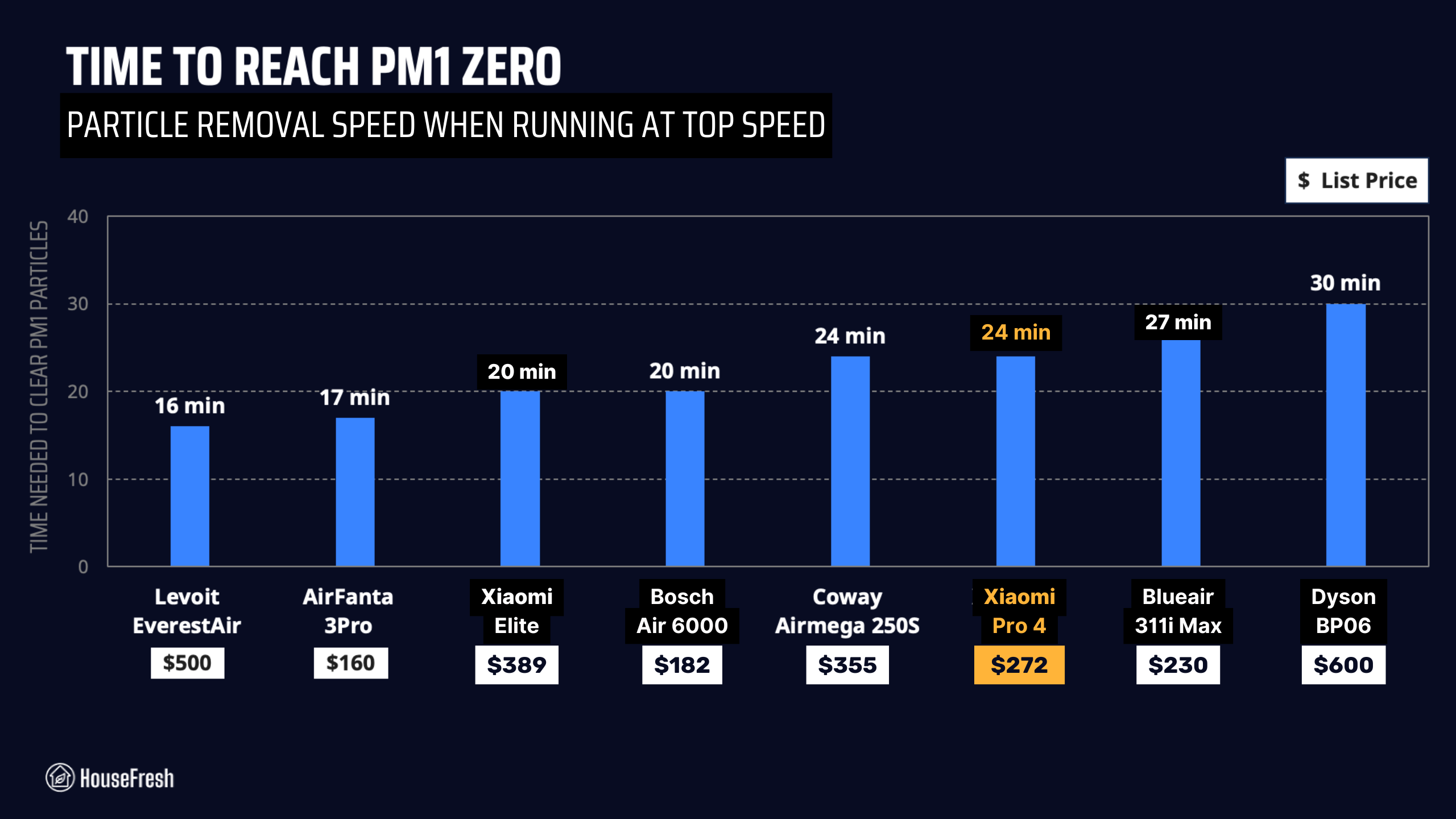
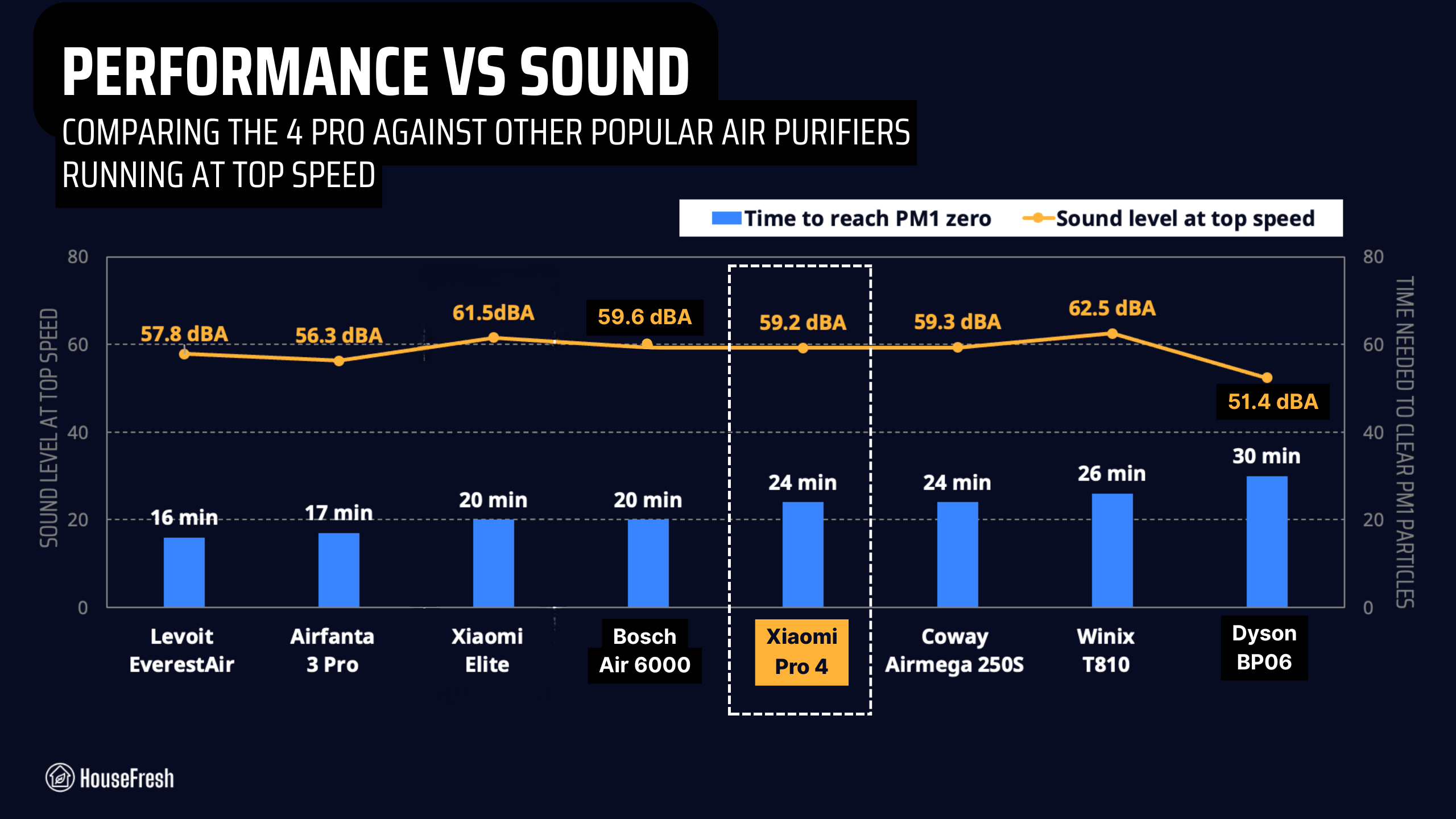
Devices like the Levoit Vital 200S or the Xiaomi Pro 4 will offer air-cleaning performance similar to that of the 5510.

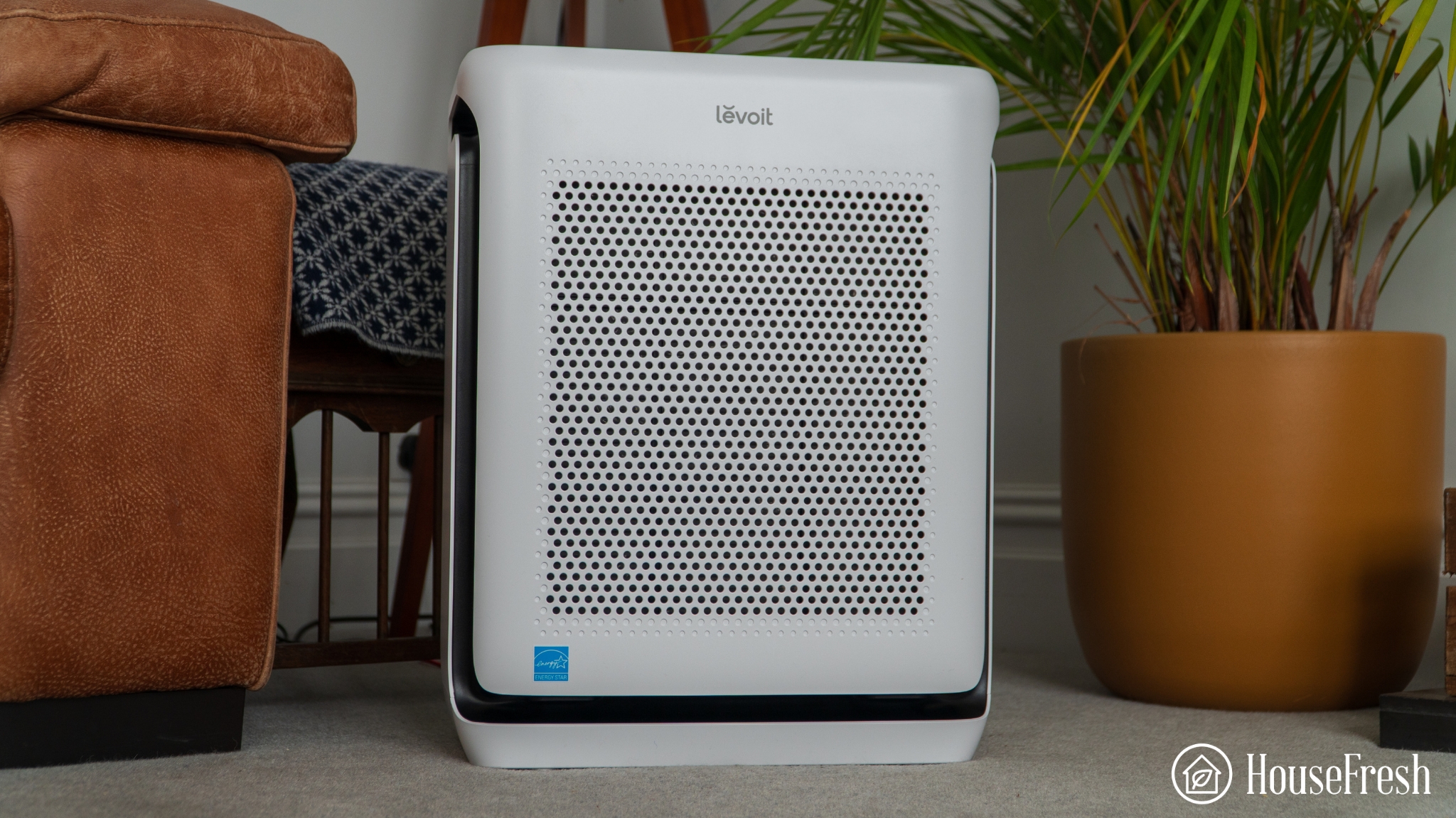
Levoit Vital 200S Corner Room

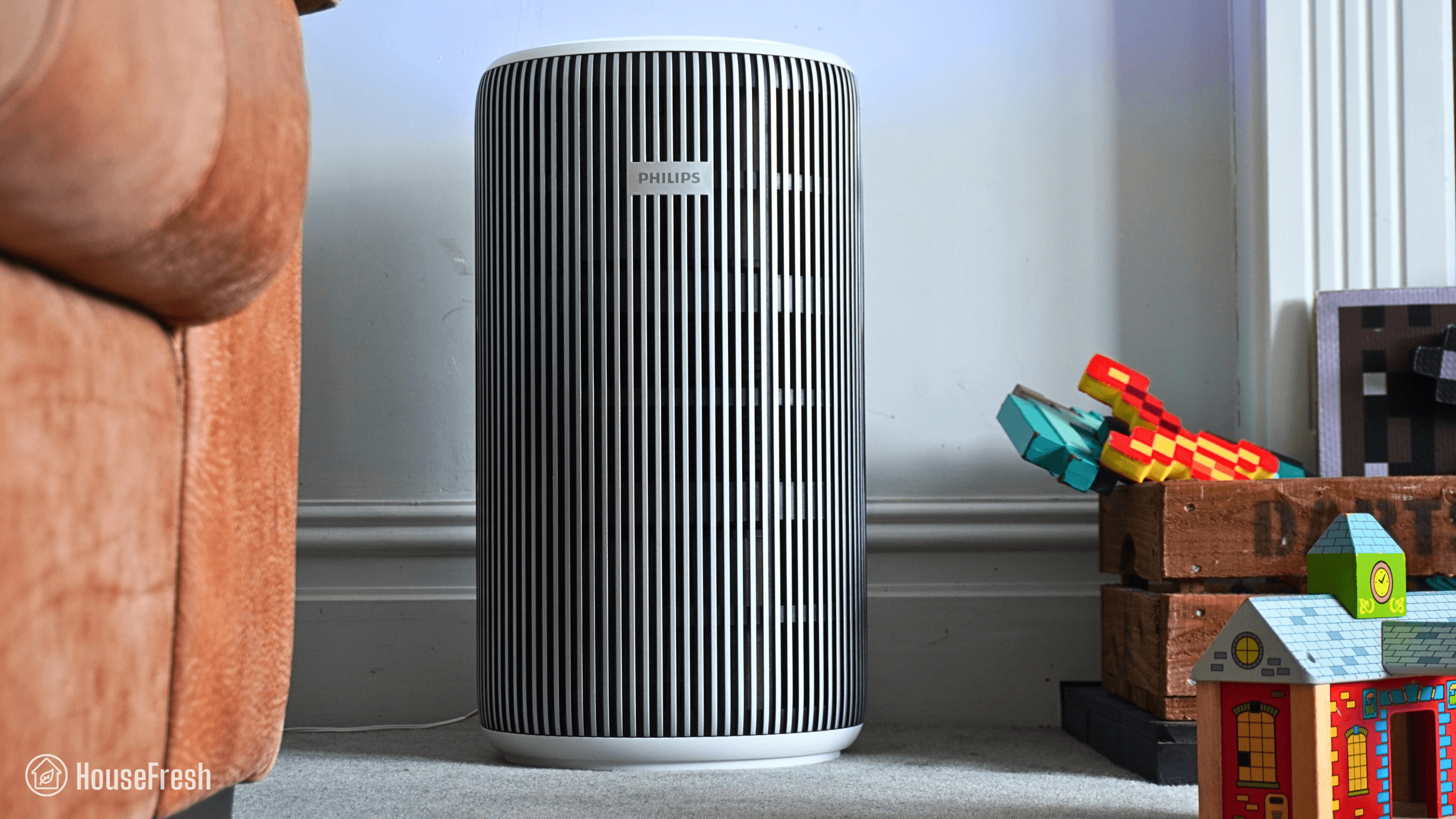
Philips 3200 Living Room

And if you are in the UK or Europe and like what the 5510 has to offer, you’ll be disappointed to hear it’s not available in your region yet.

Two good comparable models would be the Philips 3200 Series (for those who want a smart unit) and the Smart Air SA600 (for those who don’t want smart features).

If you decide to buy a 5510, please make sure to use this link to support the work we do here at HouseFresh. We will get a small commission on the sale at no extra cost to you, and this will allow us to continue to buy and test air purifiers in the future.

Are you still unsure about whether the Winix 5510 is the right air purifier for you? Just drop me a comment below and I’ll get back to you as soon as possible. Or email me if you would rather discuss in private ๐Ÿ™‚

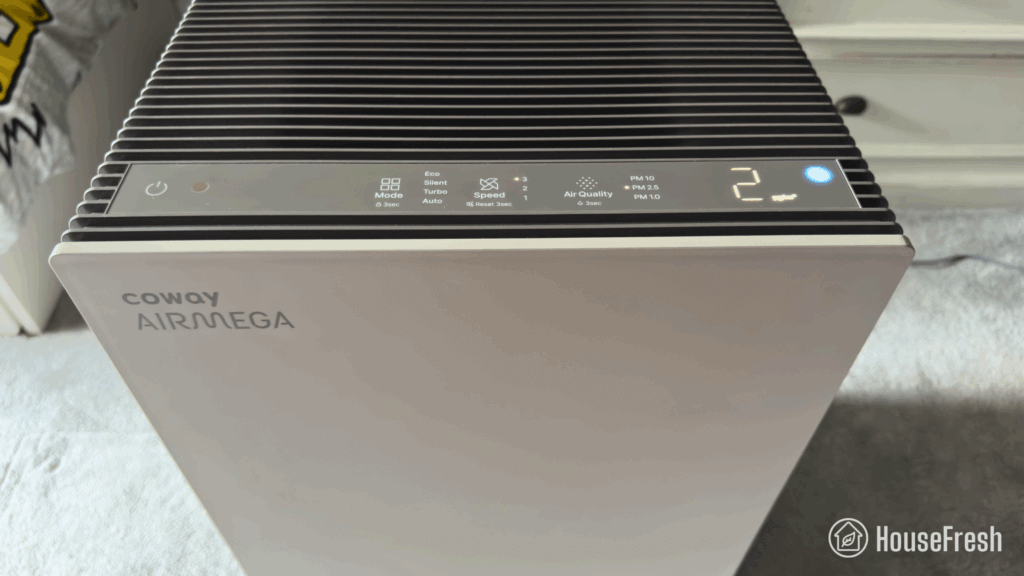
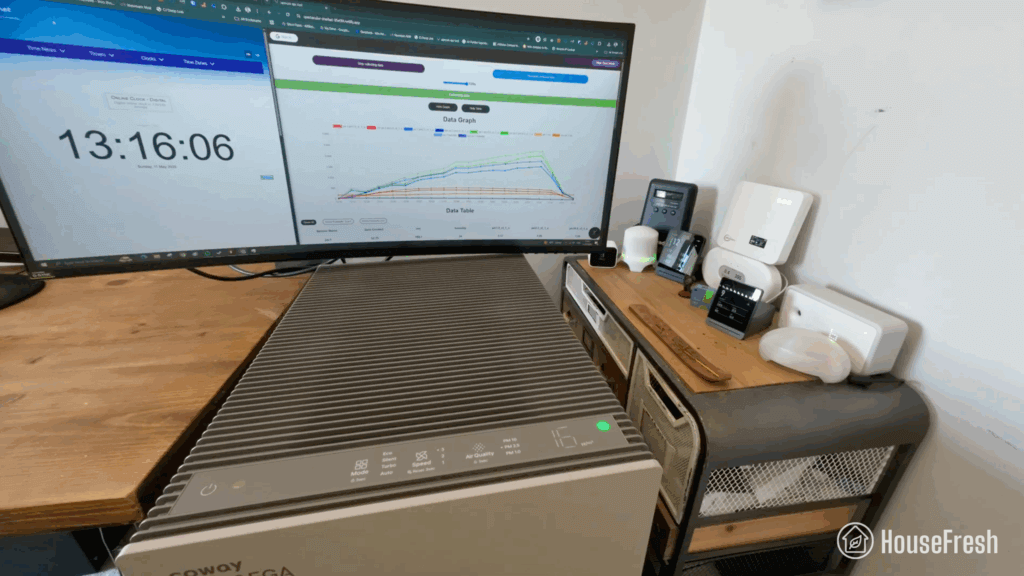
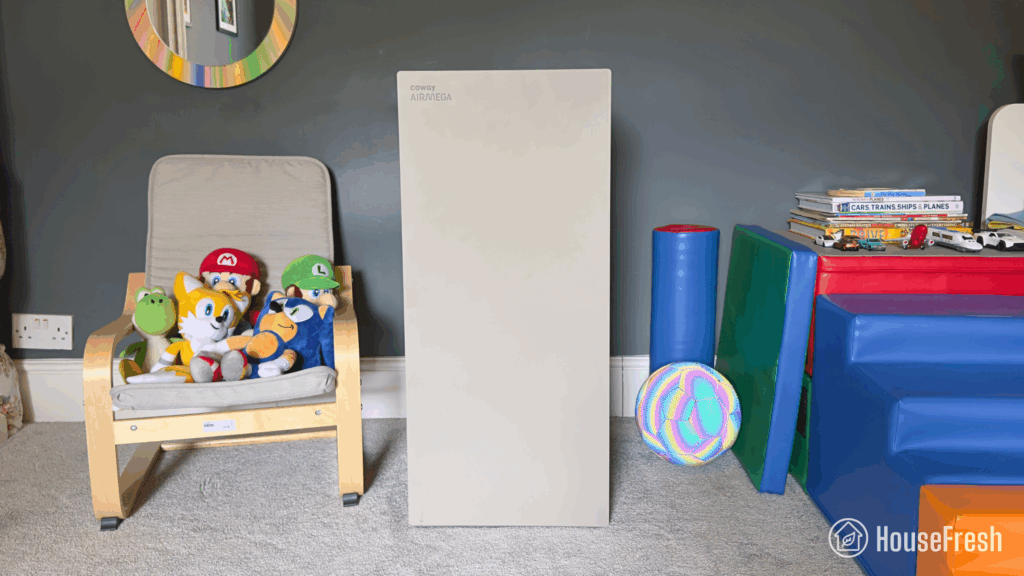
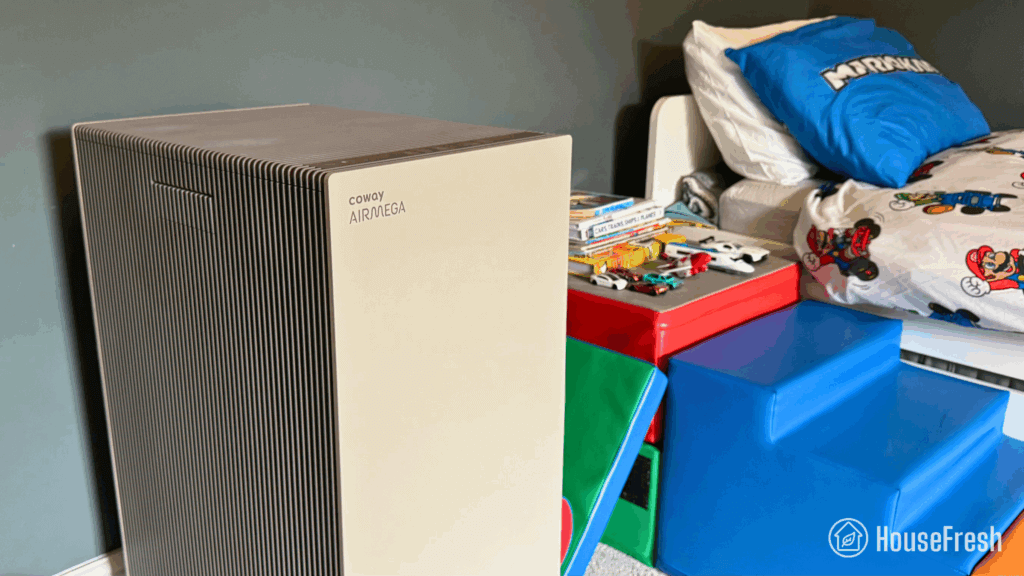
Coway Airmega ProX review

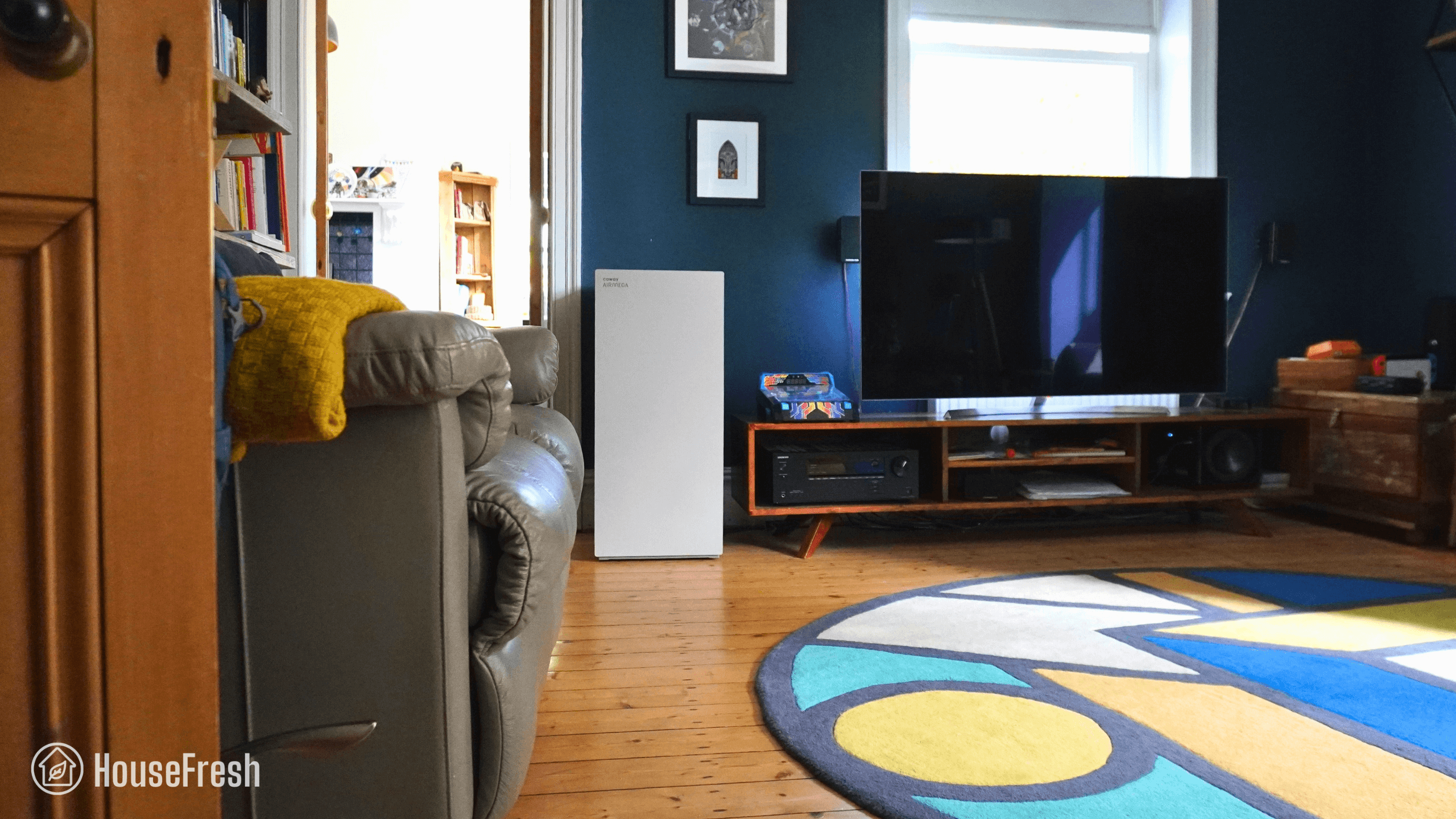
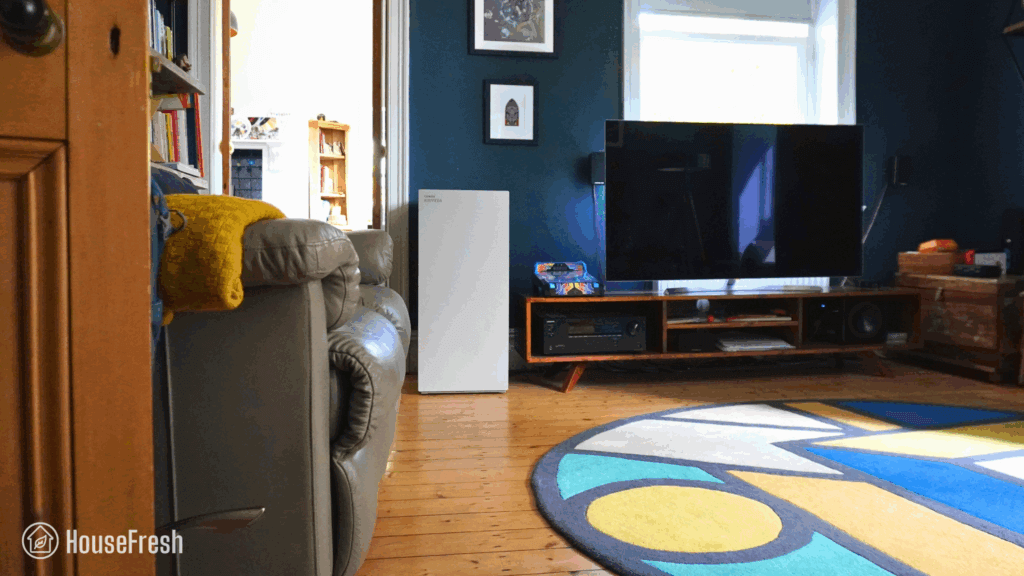
Coway Airmega ProX TV Room

The highest CADR air purifiers I have tested were designed for commercial spaces.

But what if you wanted something that not only looks good in the home but also comes with all the features you expect from a residential air purifier? Enter the Coway Airmega ProX.

The ProX is the largest model in the Coway Airmega line of air purifiers. But does size equal better performance? We bought one to find out.

The overall score for the ProX incorporates first-hand data results from our battery of tests, as well as our ratings for customer service, brand transparency, and design & UX. Check out the full scorecard below to see the split of categories.

Search for the ProX (or any other model you are researching) to see where it ranks:

The pros and cons of the Coway Airmega ProX

A summary of our top-level findings after testing this air purifier, following our methodology.

โ€œThe ProX isnโ€™t cheap, is heavy and takes up a lot of spaceโ€ฆ but I have to say Iโ€™m a big fan.

I like that Coway has dropped the use of an ionizer that we have seen in older models but still managed to provide outstanding air cleaning power with mechanical filtration alone. And they did this without the loud noise and high energy consumption that usually comes with high CADR.”

Danny Ashton HouseFresh
Danny Ashton
HouseFresh Founder
& Lead Tester

CONS

The replacement filters are expensive and will set you back around $200 each year.
The bonded filter design means you will need to replace a perfectly good HEPA filter if the carbon element runs out first.
The filter covers sometimes will pop off when you lift the ProX using the handles on each side.
It takes up a lot of space.

PROS

It has an incredible performance-to-noise ratio. It’s powerful and quiet in a way that surprised me.
It comes with a responsive and low-maintenance laser particle sensor.
It has very low energy consumption for a device with such high CADR.
Coway included thoughtful ‘smart’ features, like the light sensor for auto-sleep mode.

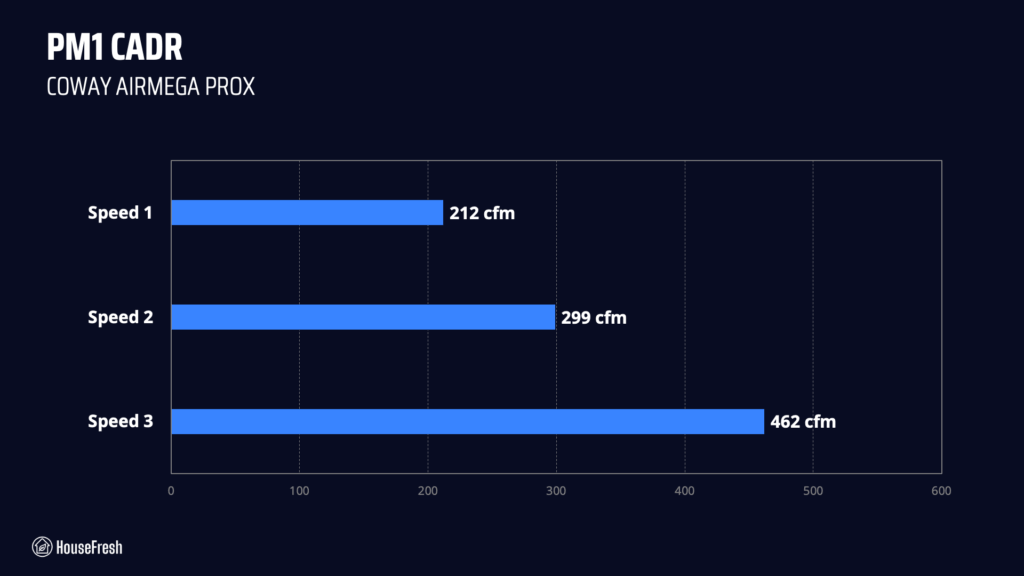
Clean air delivery rate (CADR):โ€“ Top speed PM1 CADR: 462 cfm
โ€“ Sub-45 dBA PM1 CADR: 299 cfm
โ€“ AHAM dust CADR: 586 cfm
Filter technology:Two washable pre-filters and two Max2 filters (Green True HEPA and activated carbon)
Recommended room size:693 sq. ft. (5 air changes per hour)
Dimensions:18.9 x 36.6 x 24.3 in (48 x 93 x 62 cm)
Weight:51 lbs (23kg)
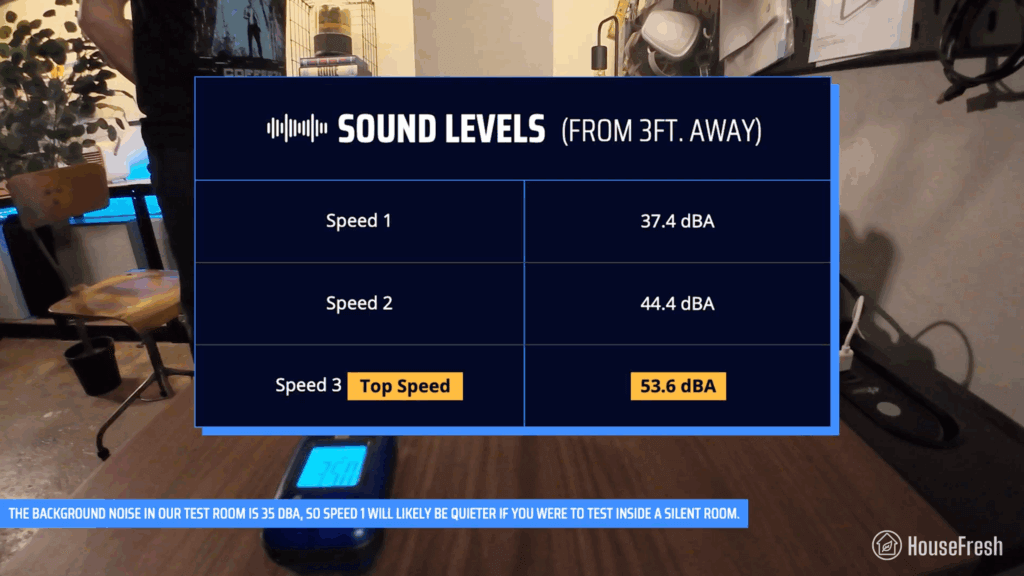
Noise level in decibels from 3 ft. away:Speed 1: 37.4 dBA
Speed 2: 44.4 dBA
Speed 3: 53.6 dBA
Electricity consumption in watts:Standby mode: 0 watts
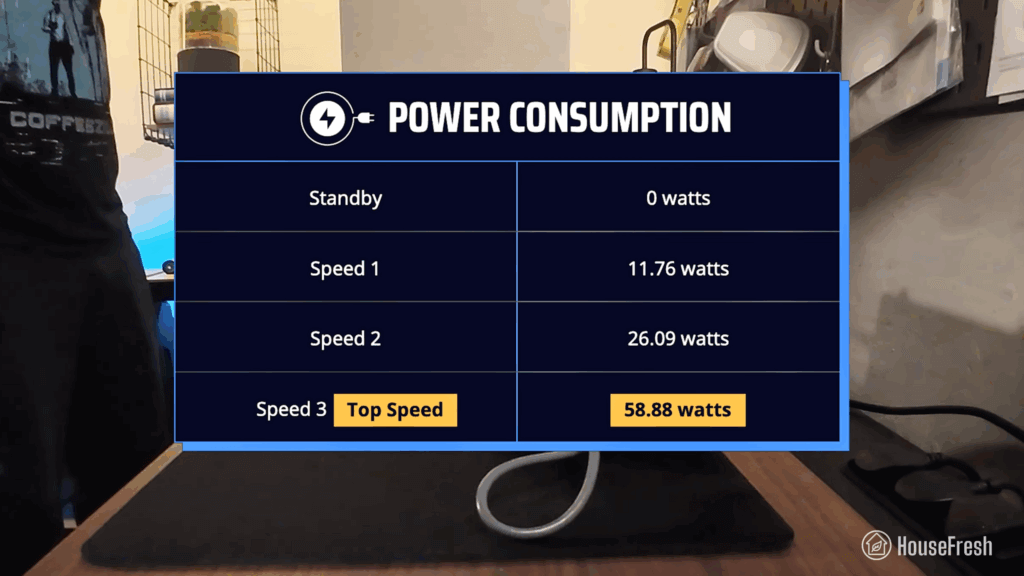
Speed 1: 11.76 watts
Speed 2: 26.09 watts
Speed 3: 58.88 watts
Filter lifespan:12 months
Manufacturerโ€™s warranty:3 years
Country of origin:South Korea
Country of manufacture:China

Filtration technology

You get Coway’s signature Green True HEPA and pelleted activated carbon, times two.

The ProX has two sets of Max2 filters, one at each side, and unlike the popular AP-1512hh, it doesnโ€™t come with an ionizer function.

Coway Airmega ProX Filters

The filters themselves are bonded filters that combine two Green True HEPA filters with an activated carbon filter.

The filters are bonded, so you’ll need to replace them once the carbon is full, which might happen before the particle filter is at the end of its life.

Coway ProX Carbon

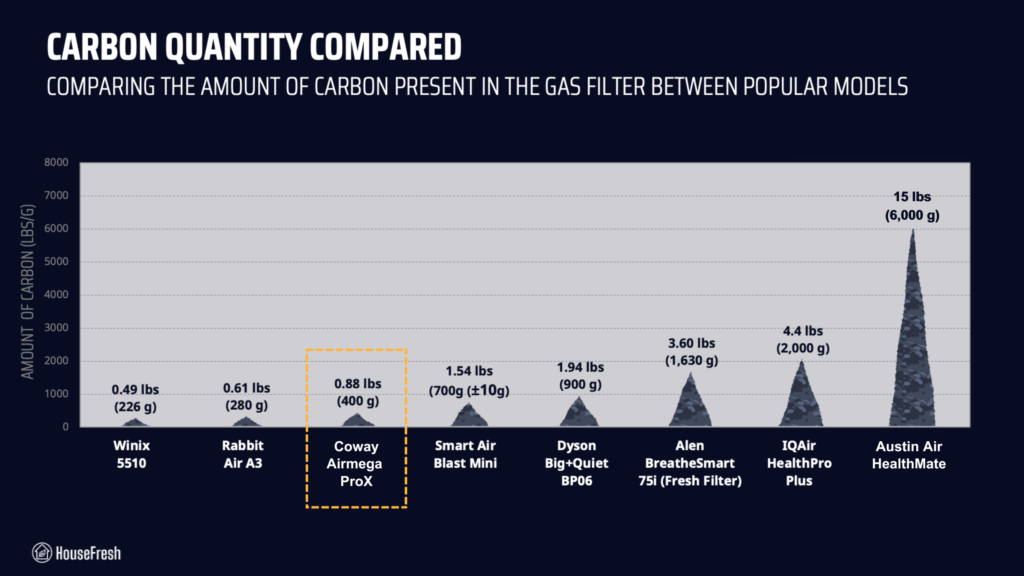
According to this Redditor, the Max2 filters in the ProX container 0.88 lbs of pelleted activated carbon. Be aware that this won’t be enough to address serious odor and VOC issues.

Design, controls and app features

It has the same retro feel as other new Airmega models, with muted colors and hard lines.

The ProX is the largest air purifier weโ€™ve tested from Coway, weighing 51 lbs (23.1 kg).

Coway Airmega ProX TV Room

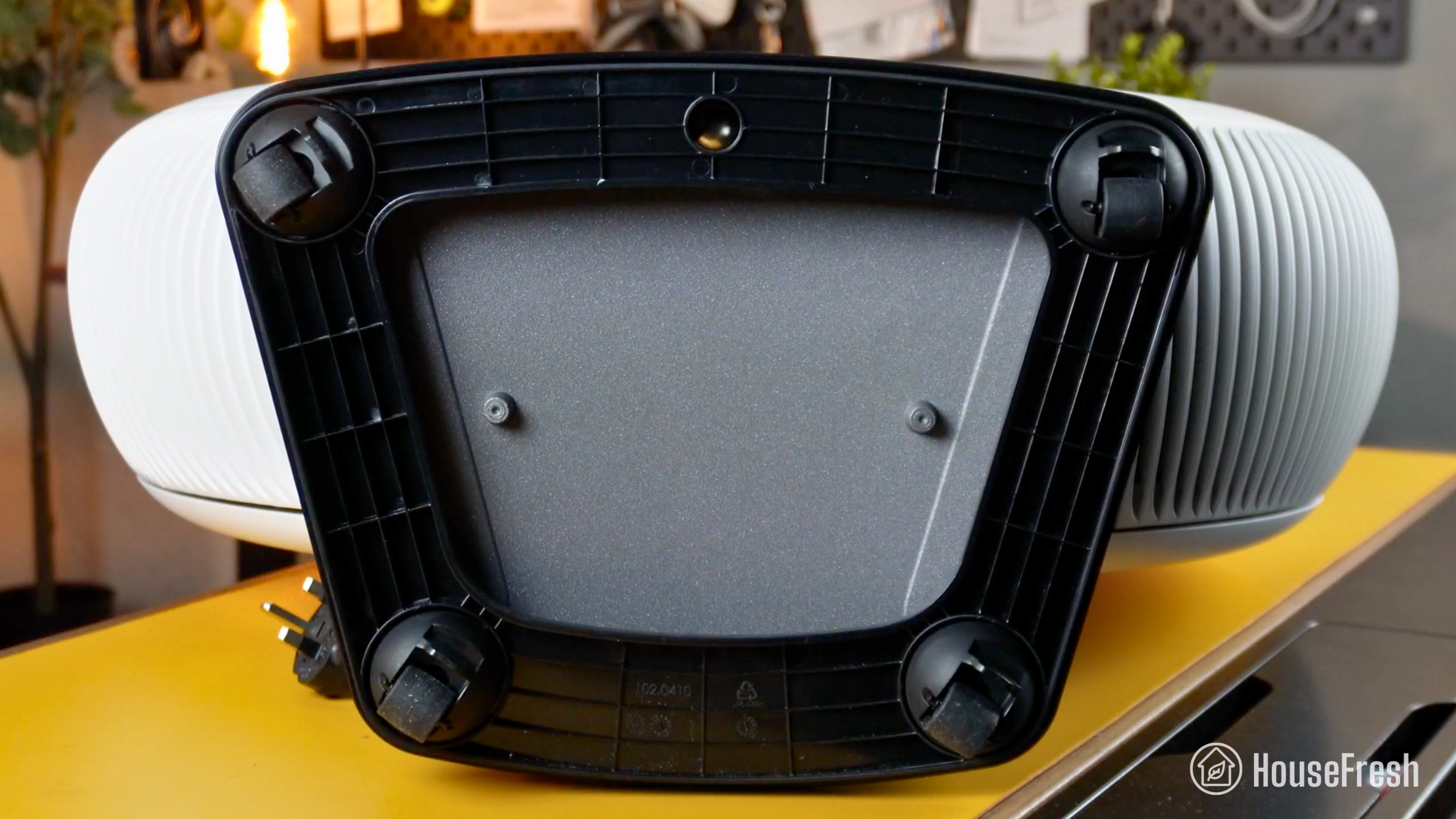
Considering how heavy it is, I was glad to see it has four wheels to move it around – great for hard floors, not so great for carpets.

If you want to lift it, you can use the handles at each side of the device.

ProX Handle issue

The only problem is that if you pull the handles from the wrong angle, you will end up removing the filter coverโ€ฆ which is a little annoying.

It doesnโ€™t include app support, but it has a laser sensor and customizable auto modes.

Coway Airmega ProX Controls

You also get an air quality indicator at the far right, in the form of an LED light that changes color based on your air quality.

Coway ProX Fans

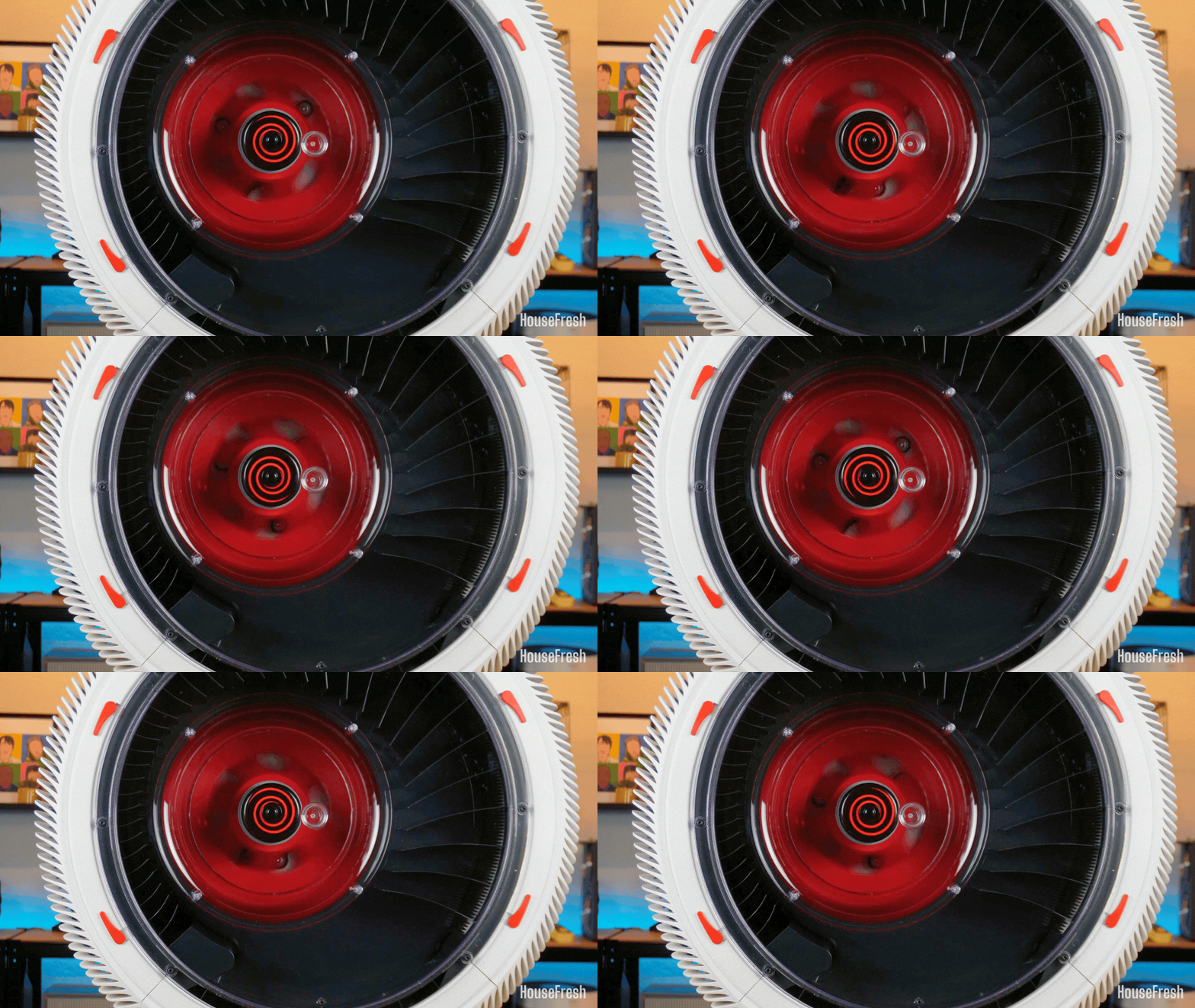
The large body of the ProX houses two fans stacked on top of each other on either side of the device, which is something I had never seen before.

Air cleaning performance

We tested the ProX in our 728 cubic ft. test room, tracking how fast it removed all PM1 particles from the air after we filled the space with incense smoke.

Coway Airmega ProX Test

When running at top speed, our PurpleAir Zen sensor shows that the ProX needed 13 minutes to reach PM1 zero. Based on the natural ventilation of our test room, we estimate a PM1 CADR of 462 cfm.

This makes the Airmega ProX powerful enough to provide five air changes per hour in large rooms up to 693 sq. ft.

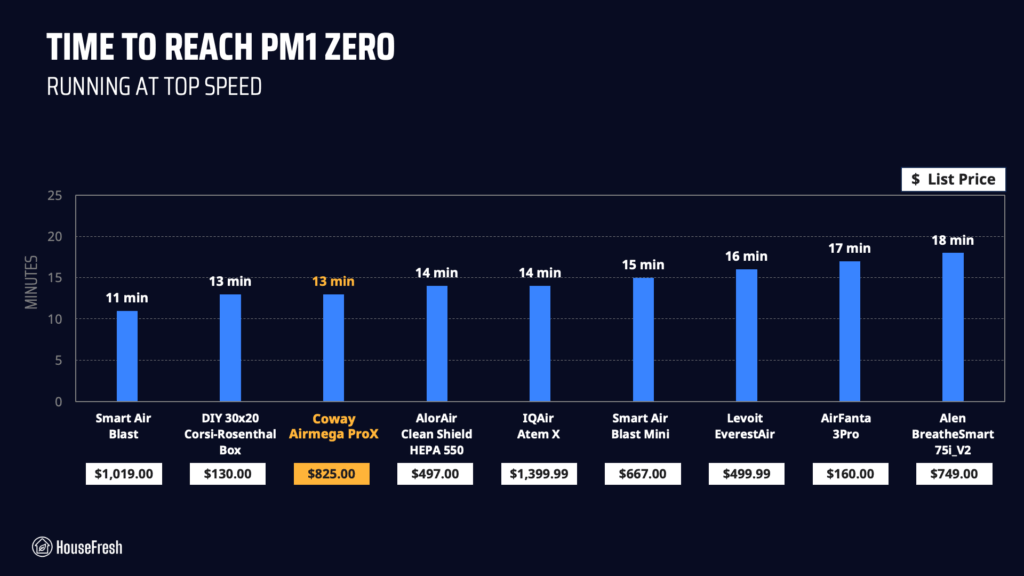
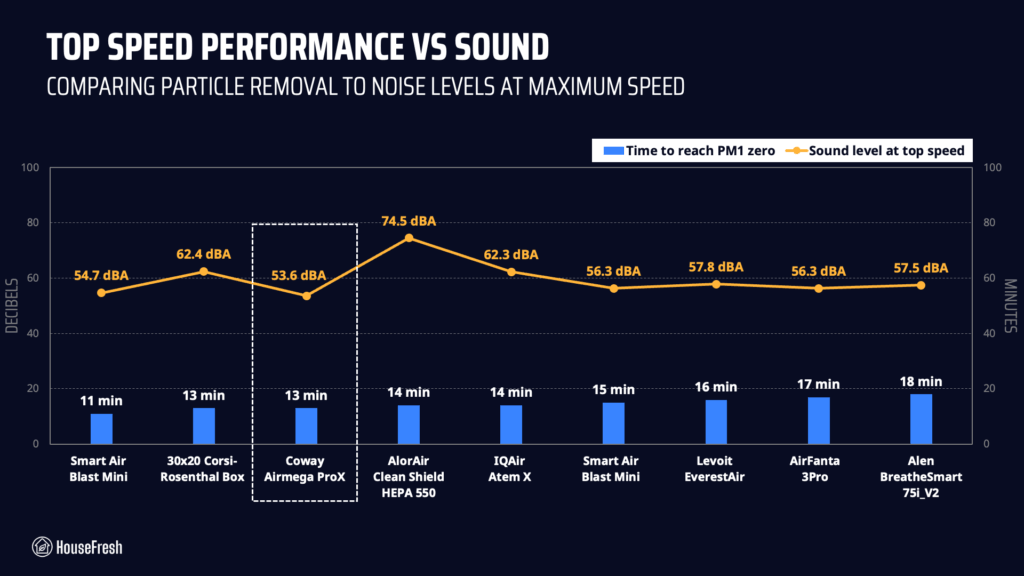
As you can see from the chart, 13 minutes is the same amount of time it took for our DIY 30×20 Corsi-Rosenthal Box to reach PM1 zero:

Coway Airmega ProX HouseFresh Test

The only device to perform quicker than this was the even larger Smart Air Blast, which completed our particle removal test in a speedy 11 minutes.

We repeated our particle removal test three times across all available fan speeds, which allowed me to estimate PM1 CADR at each fan speed:

Coway Airmega ProX CADR

BUT looking at the results of our air cleaning tests in isolation wonโ€™t tell us the full story…

Sound levels

The sound levels of the ProX range from 37.4 dBA to 53.6 dBA โ€” considerably quieter than every single large air purifier we have benchmarked it against.

Coway ProX Sound Test HouseFresh

As I always say, if your air purifier is too loud, someone in the house will eventually turn it off.

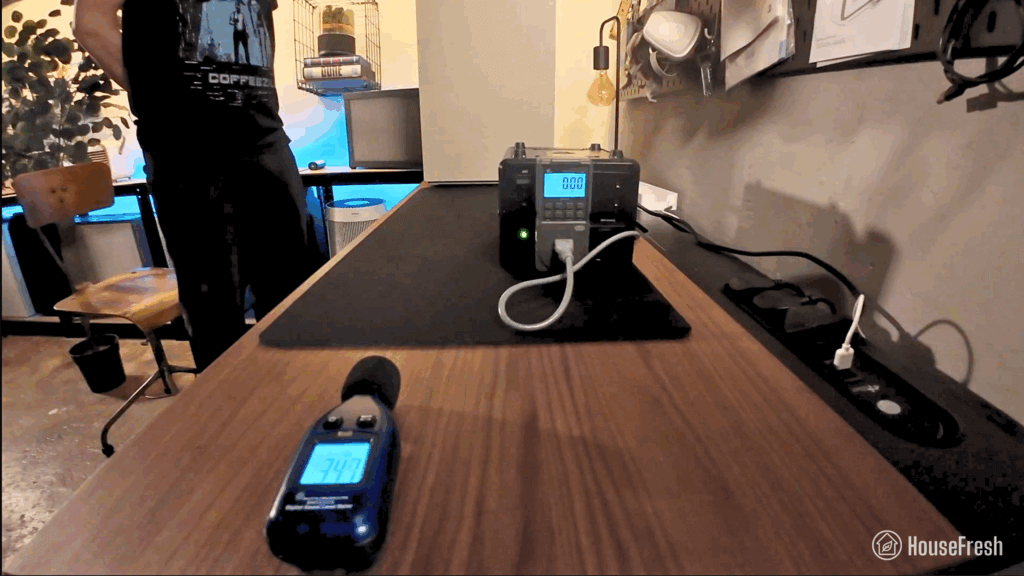
That is why I used our BAFX sound meter to measure how much noise in decibels the Airmega ProX generates at each fan speed from 3 ft. away:

Coway ProX Sound Results

I was surprised by how quiet the ProX is! Hitting 53 dBA at top speed is nothing considering its power.

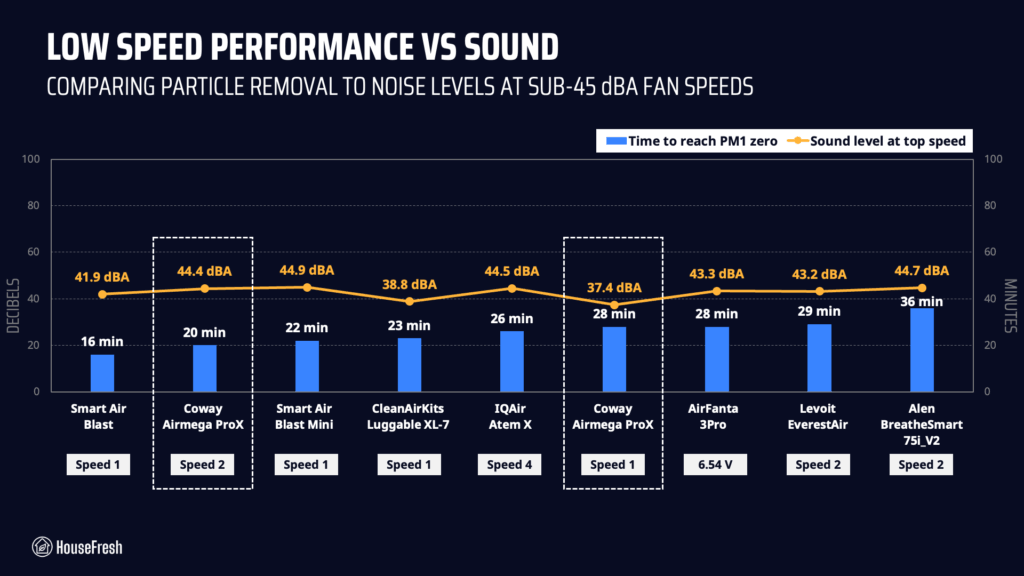
When comparing particle removal speed to noise levels at top speed, it becomes clear that Coway has nailed performance at quiet operation:

Coway Airmega ProX Top speed sound

I repeated the HouseFresh CADR test at each fan speed with excellent results.

At speed 2, it reached PM1 zero in 20 minutes while generating 44.4 dBA. And at speed 1, it took 28 minutes at just 37.4 dBA.

Coway Airmega ProX Sound

When we compare this to other high-CADR air purifiers, you can see that, in terms of quiet performance, the ProX is only outmatched by the much larger Blast from Smart Air. And itโ€™s clear that even at speed 1, this device delivers excellent air cleaning performance without the noise.

Long-term running costs

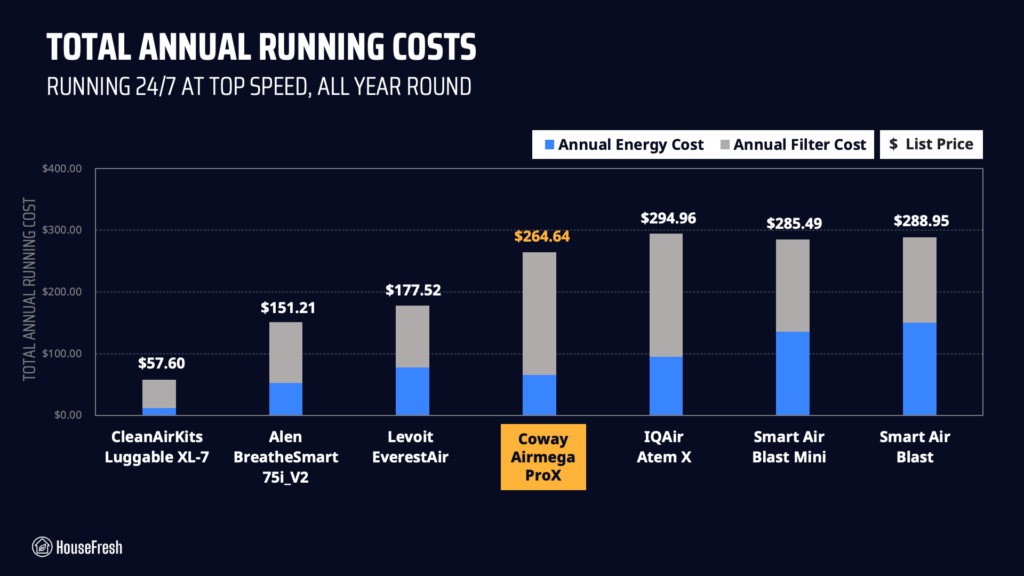
Running a Coway Airmega ProX will cost you $264.64 per year, combining energy and filter replacement costs.

We used our energy meter to record how much electricity the ProX pulls at each fan speed and also while on standby.

Coway ProX energy consumption

At speed 3, the ProX pulls 58.88 watts. Running it at top speed 24/7 for one year will add $65.54 to your energy bill, based on the average U.S. electricity price of 0.1268/kWh at the time of our test.

After conducting our particle removal test, I knew the Airmega ProX offers impressive raw performance, but I didn’t expect it would deliver this high CADR with such low energy consumption.

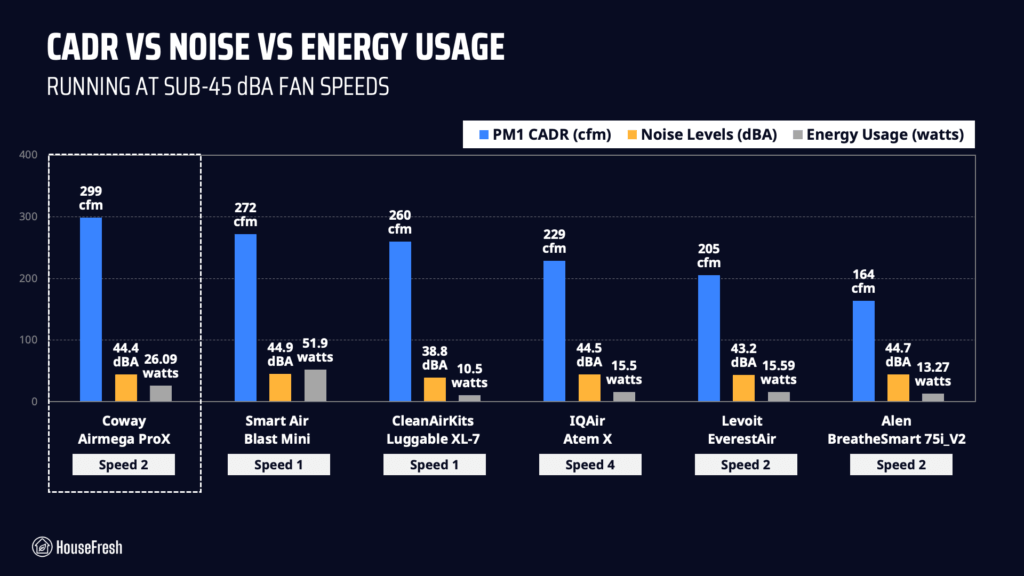
So I went one step further and created a chart to compare its CADR, noise levels AND energy usage at quiet fan speeds to see how the ProX compares to other popular high-CADR air purifiers:

Coway ProX CADR energy sound

As the table above shows, the Coway Airmega ProX delivers incredible CADR at lower fan speeds without excessive energy use or noise, vastly outperforming most large air purifiers I benchmarked it against. The exception would be the Luggable XL-7, which is A LOT more energy efficient and noticeably quieter than the ProX — that said, it’s not nearly as powerful.

But letโ€™s look at the other main factor affecting yearly running costs: filter replacements.

According to Coway, you can expect to change filters every 12 months, and you can buy a new filter set for $199, so you can expect to spend $199 each year on filter replacements alone.

We can add this to energy costs to work out the total yearly cost and compare it with the other devices Iโ€™m benchmarking the ProX against:

Coway Airmega ProX Running Costs

$199 for a set of filters is steep, and it pushes the total annual cost to over $260, which is more than the Alen 75i and Levoit EverestAir, and doesn’t come close to the CleanAirKits Luggable XL-7 with its standard 3M HVAC filters.

Bottom line: Should you get a Coway Airmega ProX?

The ProX is one of the best options for those looking for an air purifier to help with dust, pollen, pet allergens, or smoke in large spaces.

Coway Airmega ProX Kids room

The ProX isnโ€™t cheap, is heavy, and takes up a lot of spaceโ€ฆ but I have to say Iโ€™m a big fan.

I like that Coway has dropped the ionizer we saw in older models without dropping performance. Even without the ionizer, the ProX still provides outstanding air-cleaning power with mechanical filtration alone. And they did this without the loud noise and high energy consumption that usually comes with high CADR.

This air purifier doesnโ€™t have an app. However, it still comes with a ton of features that most consumers will appreciate, such as a customizable auto mode, a particle sensor, an air quality indicator, a child lock, and the ability to adjust the sensor’s sensitivity.

Coway also innovated in how the ProX handles sleep time. Instead of a useless sleep mode, the ProX running in auto mode will automatically switch all lights off without you needing to do anything else. It won’t disturb your sleep, but it will ramp up the fan speed when detecting pollutants in the air.

Coway Airmega ProX Side

And even if you were to leave your ProX running at speed 1 all day, it would still provide you a higher CADR than you would get from a medium-sized unit like the Levoit Core 400S running at full speed.

For those looking for an air purifier to help with dust, pollen, pet allergens or smoke in large spaces, the Coway Airmega ProX is one of the best options out there because it wonโ€™t cost you an arm and a leg to run, it will offer excellent performance at quiet operation AND it will look good in your home while itโ€™s at it.

Sadly, it is only available in the U.S. right now but I’ll update the review if that changes.

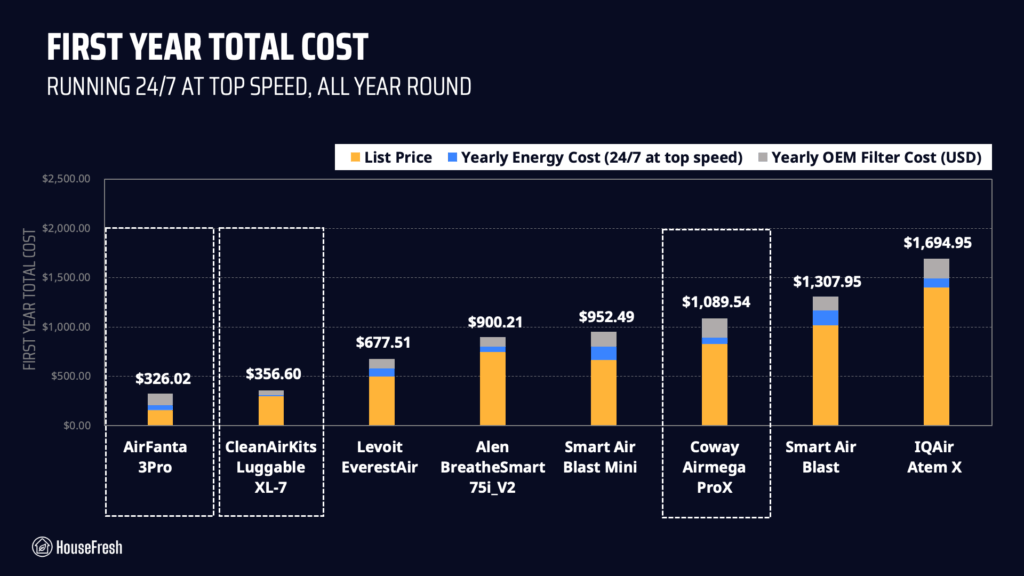
Now, for those looking for the best bang for buck, know that PC fan models like the Luggable XL-7 and the AirFanta 3Pro will still provide a lot more value — and you will be able to get multiple of these devices for the price of the ProX.

ProX first year cost

And if youโ€™re looking for a high CADR air purifier for a commercial space, an office, or a classroom, then check out the Smart Air Blast, which will offer more air cleaning power than the ProX with a full metal body and no smart features, so you can set it and forget it.

But for those who want a large unit that looks good AND has all the bells and whistles you would expect from a standard consumer air purifier, the Airmega ProX is a solid choice.

If you do decide to buy one, please use this link to support the work we do here at HouseFresh. In doing so, we will receive a small affiliate commission at no extra cost to you that we will use to continue buying and testing air quality products.

Did I miss any details? Do you have any questions I left unanswered? Just drop a comment below and I’ll get back to you as soon as I see it.

Philips 3200 Series air purifier review

Philips 3200 Living Room

Philips is a Dutch multinational company founded in 1891. In 2021, they sold the domestic appliance portion of the business to a private equity firm (Hillhouse Investments). This appliance arm of Philips is now led by Versuni, so that is the company behind their air purifier range.

The 3200 is a stylish mid-sized device that promises performance on par with the larger, now-discontinued Philips 3000i Series. But is this all too good to be true?

The overall score for the Philips PureProtect 3200 Series (AC3220/10) incorporates first-hand data results from our battery of tests, as well as our ratings for customer service, brand transparency, and design & UX. Check out the full scorecard below to see the split of categories.

Search for the 3200 (or any other model you are researching) to see where it ranks:

The pros and cons of the Philips 3200

A summary of our top-level findings after testing this air purifier, following our methodology.

โ€œAfter spending a few months with the Philips 3200 at home, I am convinced that itโ€™s a significant upgrade to the now-discontinued 3000i.

You get the same level of air cleaning performance at a lower initial price with half the energy usage and cheaper long term costs.โ€

Danny Ashton HouseFresh
Danny Ashton
HouseFresh Founder
& Lead Tester

CONS

Filter names are confusing, so itโ€™s hard to know which one to buy. For future reference: the filters are called FY3200/30.
It uses an optical sensor that needs to be cleaned regularly to ensure accurate particle readings and a responsive auto-mode.
It has two bonded filters, so you’ll have to replace the entire thing when the carbon runs out, even if the particle filter has life in it.

PROS

It offers excellent air cleaning performance at quiet fan speeds.
You can enable ‘Allergy Sleep’ mode in the app, which makes sleep mode actually useful.
It has low energy usage – nearly 50% reduction compared to the Philips 3000i Series
It has a very cool lamp mode that can be scheduled, as I do with my Philips Hue lights.

Clean air delivery rate (CADR):โ€“ Top speed PM1 CADR: 249 cfm
โ€“ Sub-45 dBA PM1 CADR: 169 cfm
– Manufacturer reported: 306 cfm
Filter technology:Two bonded HEPA NanoProtect particle filters with a layer of activated carbon and a pre-filter mash wrap.
Recommended room size:373 sq. ft. (5 air changes per hour)
Dimensions:11.2 x 11.2 x 20.4 inches (28.5 x 28.5 x 52 cm)
Weight:13.7 lbs (6.2 kg)
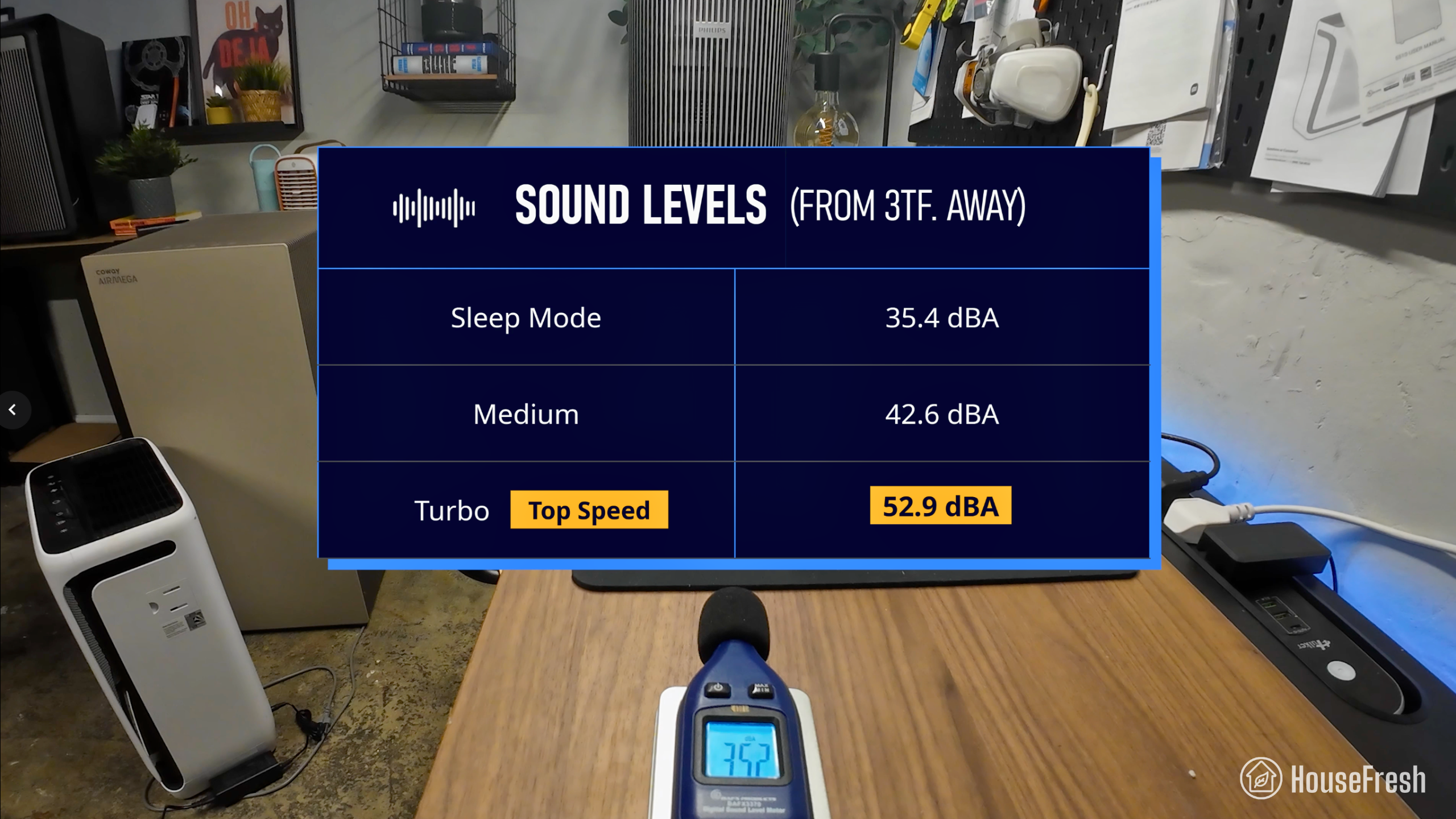
Noise level in decibels from 3 ft. away:Sleep: 35.4 dBA
Medium: 42.6 dB
Turbo: 52.9 dB
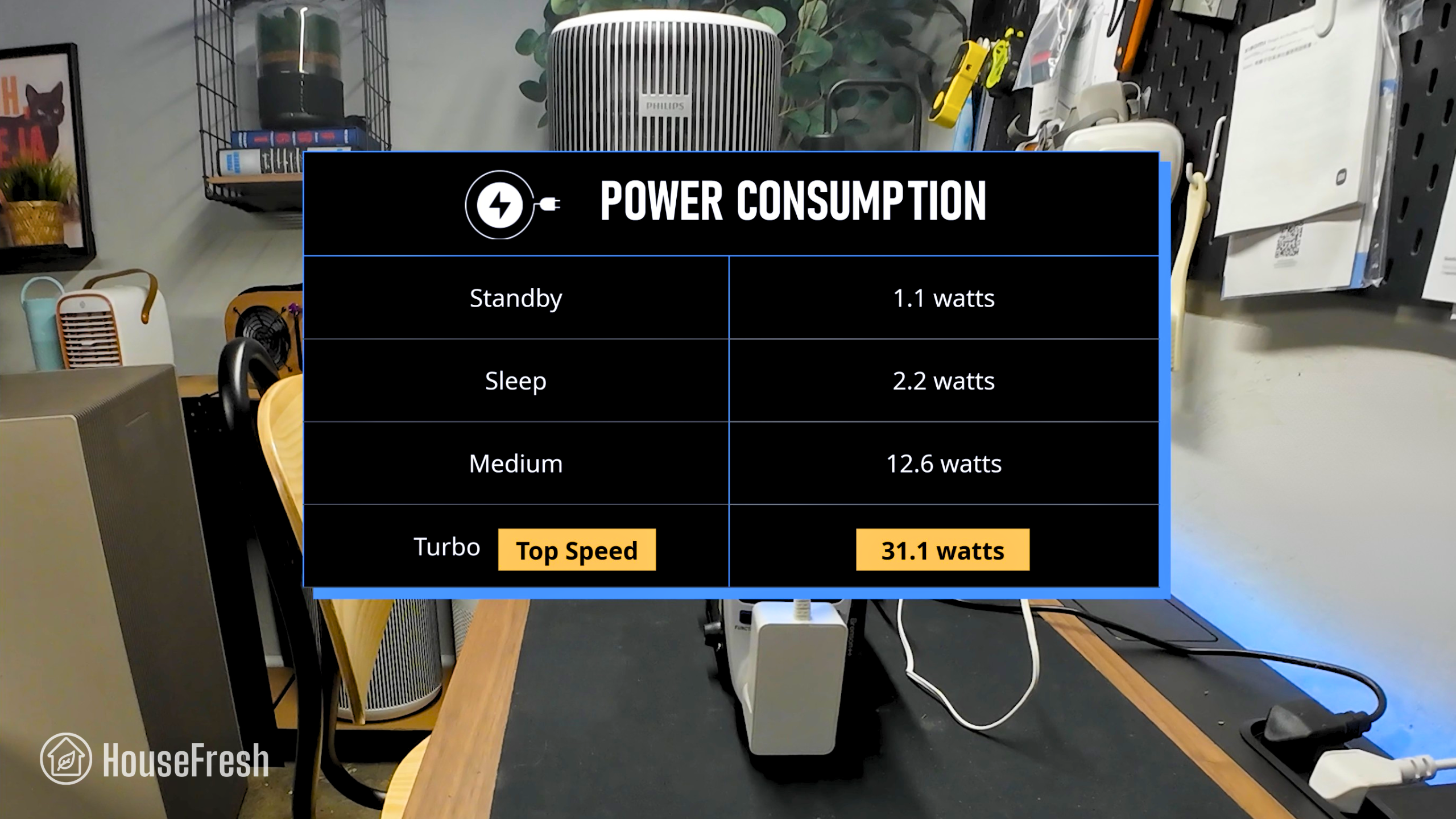
Electricity consumption in watts:Standby mode: 1.1 watts
Sleep: 2.2 watts
Medium: 12.6 watts
Turbo: 31.1 watts
Filter lifespan:12 months
Manufacturerโ€™s warranty:2 years
Country of origin:Netherlands
Country of manufacture:China

Filtration technology

The Philips 3200 comes with two 3-in-1 cylindrical filters that capture particles and reduce mild odors.

Upon removing the front cover, you will find two small 3-in-1 filters: an outer pre-filter mesh, a particle filter, and a carbon filter on the inside.

Philips 3200 Filters

The filters are bonded, so you will need to replace the whole filter when the carbon runs out, which is usually earlier than the particle filter.

When I reached out to Philips, they told me that each cylindrical filter is packed with 50g of coconut carbon, which brings the total to 100 grams:

Philips 3200 Carbon

Philips stated that โ€œcoconut carbon is more effective than standard carbon, is renewable, and uses less energy to produce.โ€

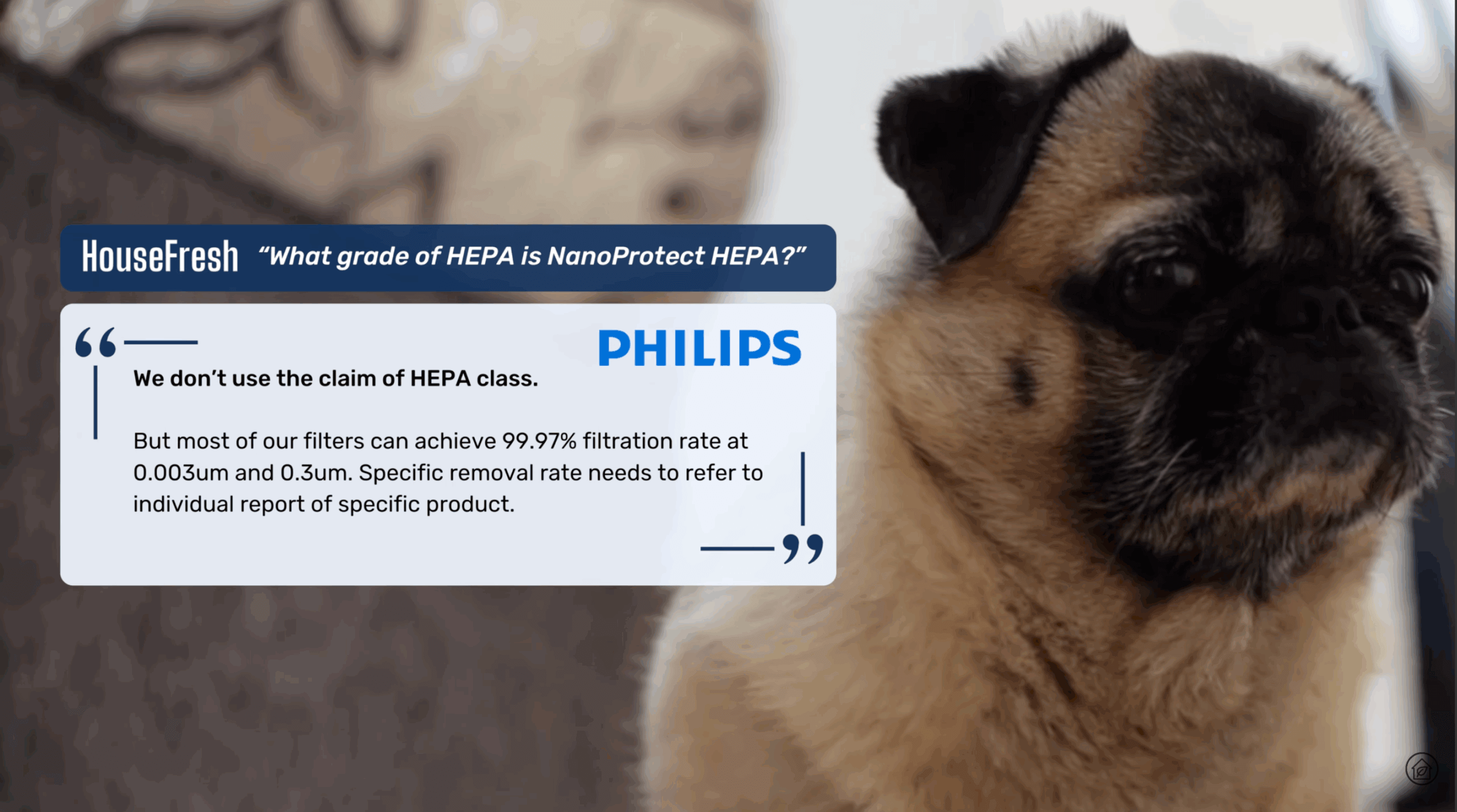
Philips NanoProtect HEPA statement scaled

In terms of particle filtration, the 3200 uses the same HEPA NanoProtect filter used in other Philips air purifiers, which most people will assume is a certified HEPA filter.

However, Philips confirmed with us that it was not the case when I reached out for comment while working on my review of the Philips 3000i.

Marketing terms like โ€˜HEPA NanoProtectโ€™ can be confusing to consumers, and mentions of how the filter “captures 99.97% at 0.003 microns” can be misleading because this level of particle removal can be achieved with a wide range of filter grades.

Design, controls and app features

A medium-sized cylindrical air purifier with smart functions, with a silver and black design that helps it stand out from the standard white we see from other brands.

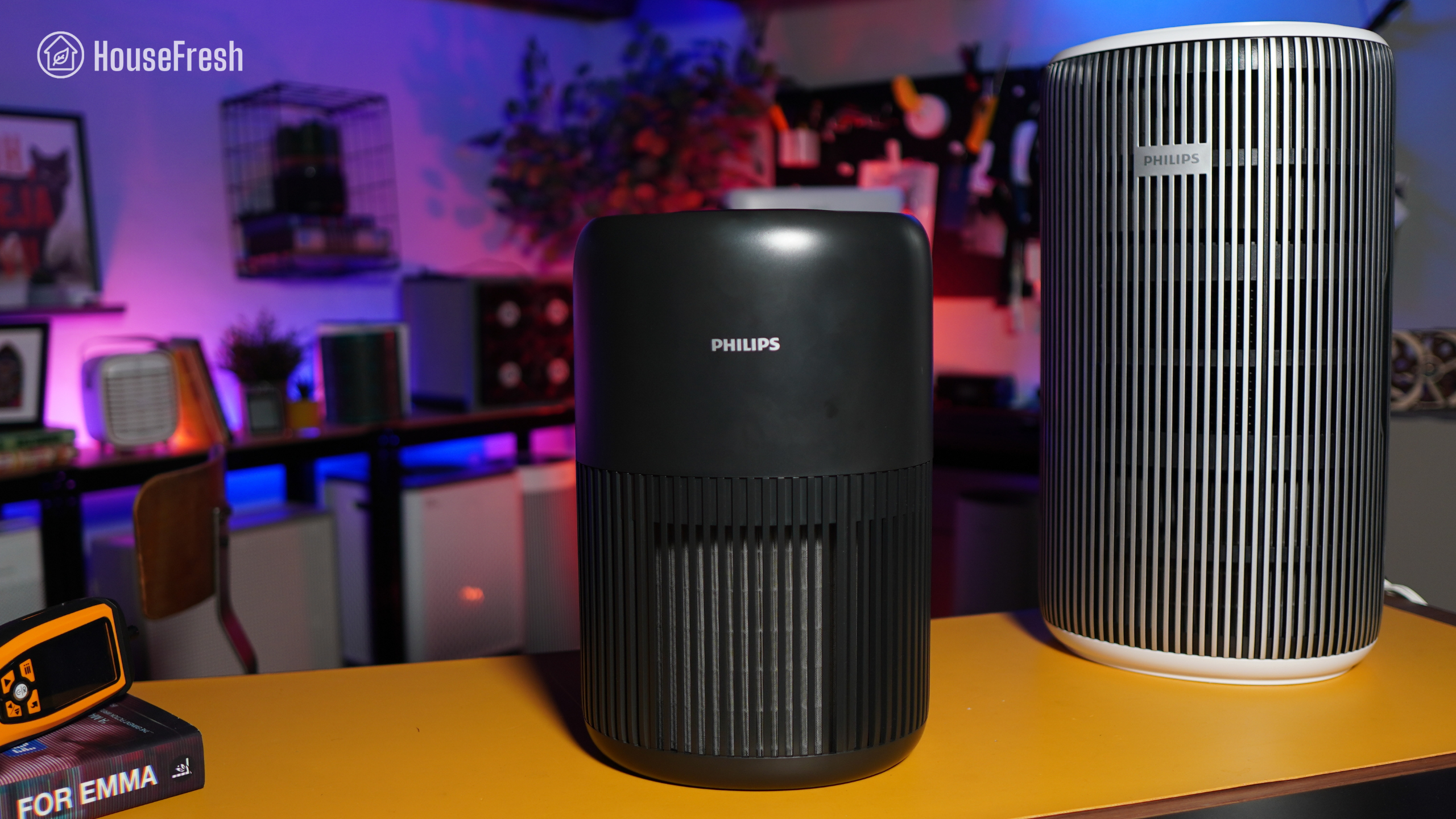
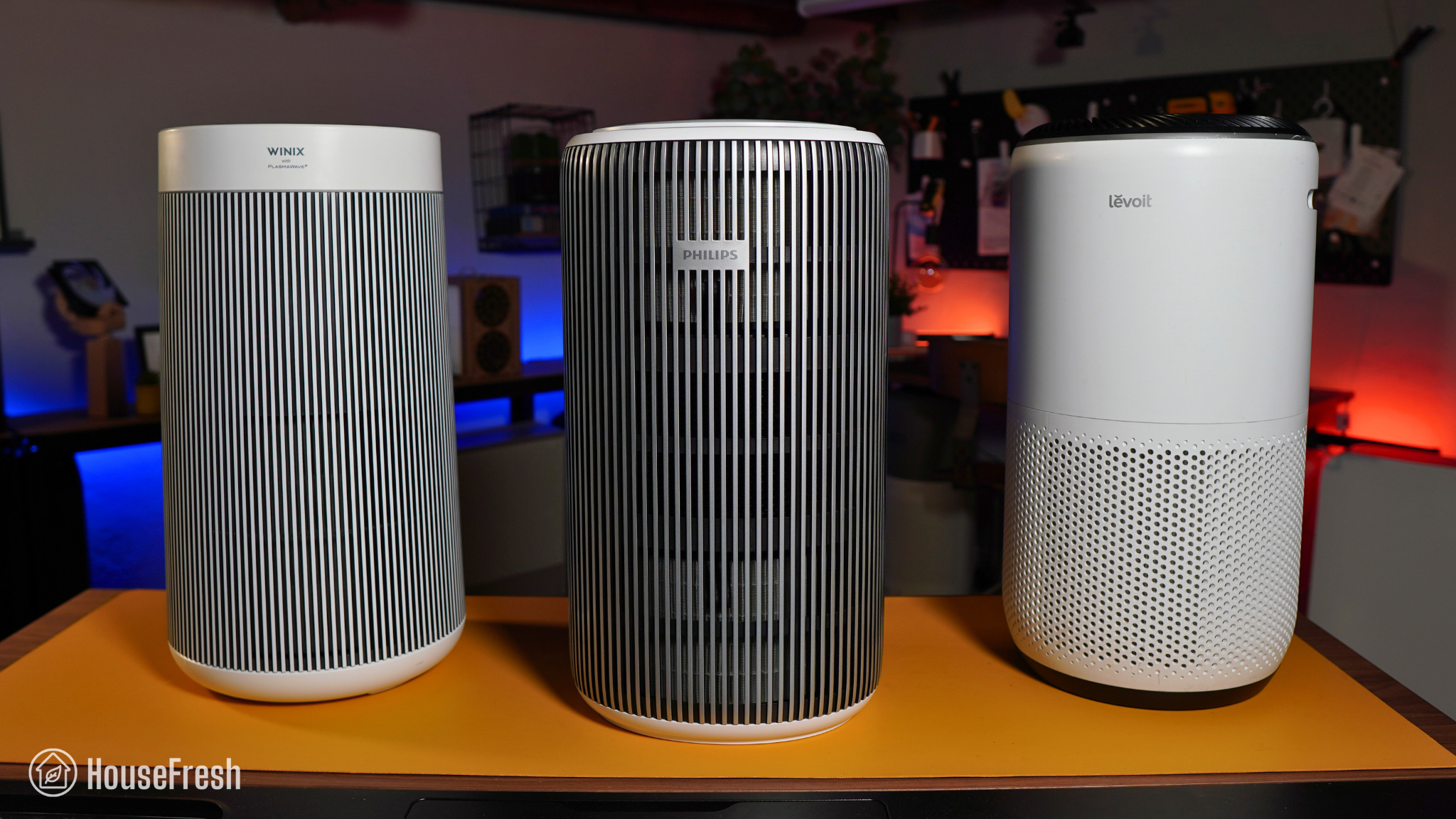
The Philips 3200 (center) is a mid-size air purifier, similar in size to the Levoit Core 400S (right) and the Winix T810 (left).

Winix T810 Philips 3200 Levoit Core 400S

It weighs 6.2kg (13.6 lbs), so itโ€™s not too heavy to move around – although I wish it had a handle somewhere so I wouldn’t have to carry it like a baby.

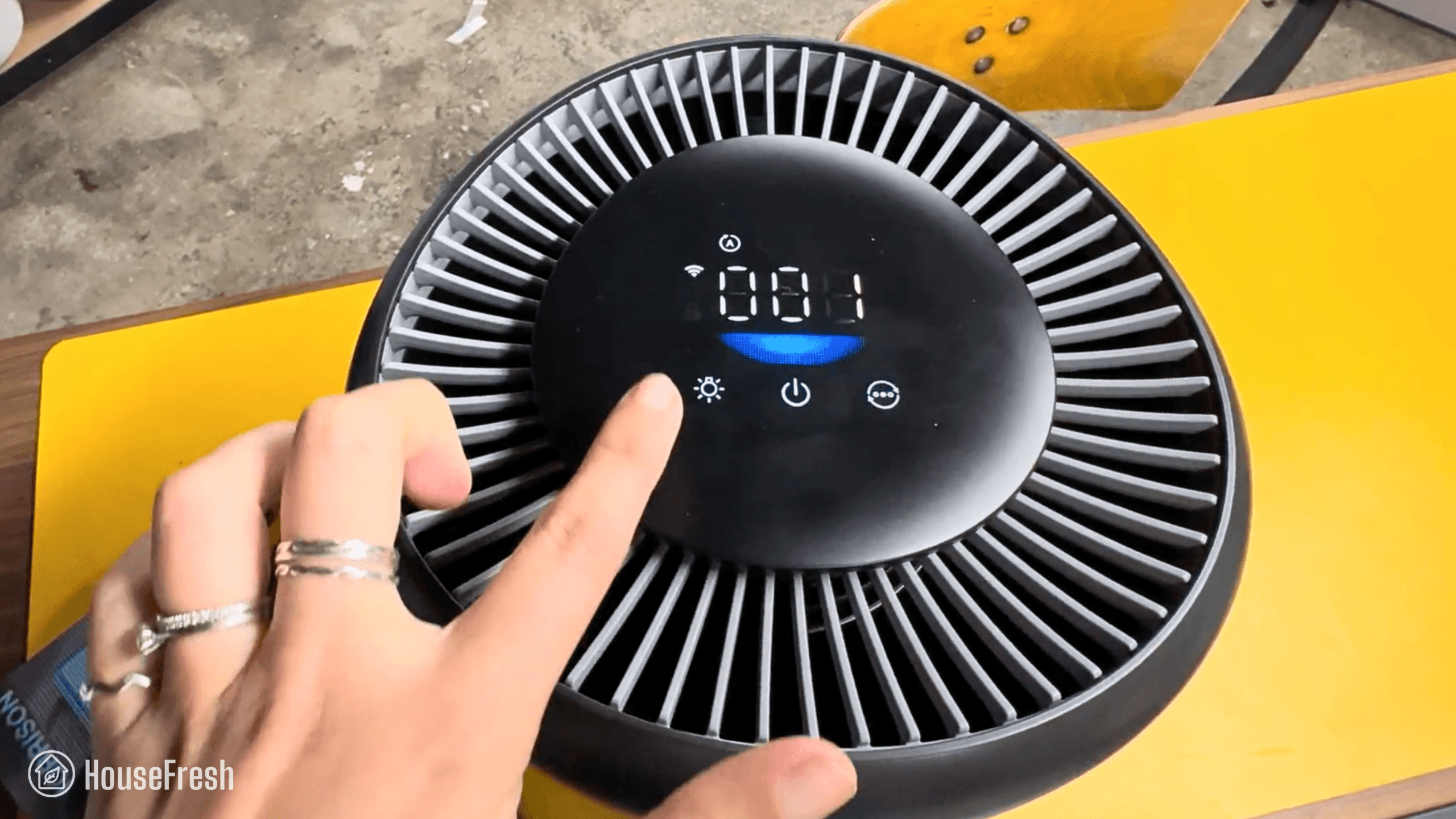
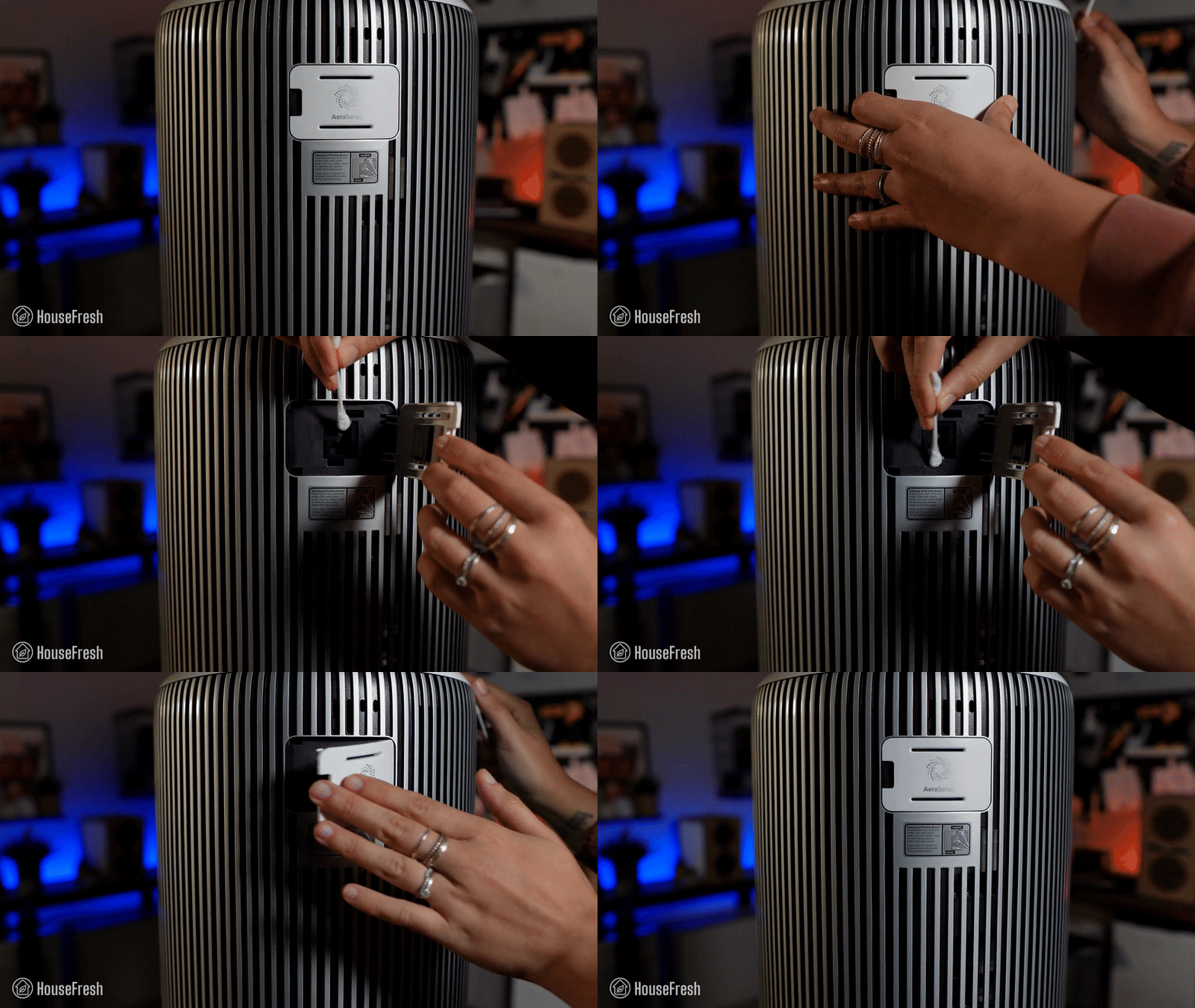
It comes with an optical sensor on the back, enabling auto-mode and PM2.5 readings, which are displayed at the top of the device.

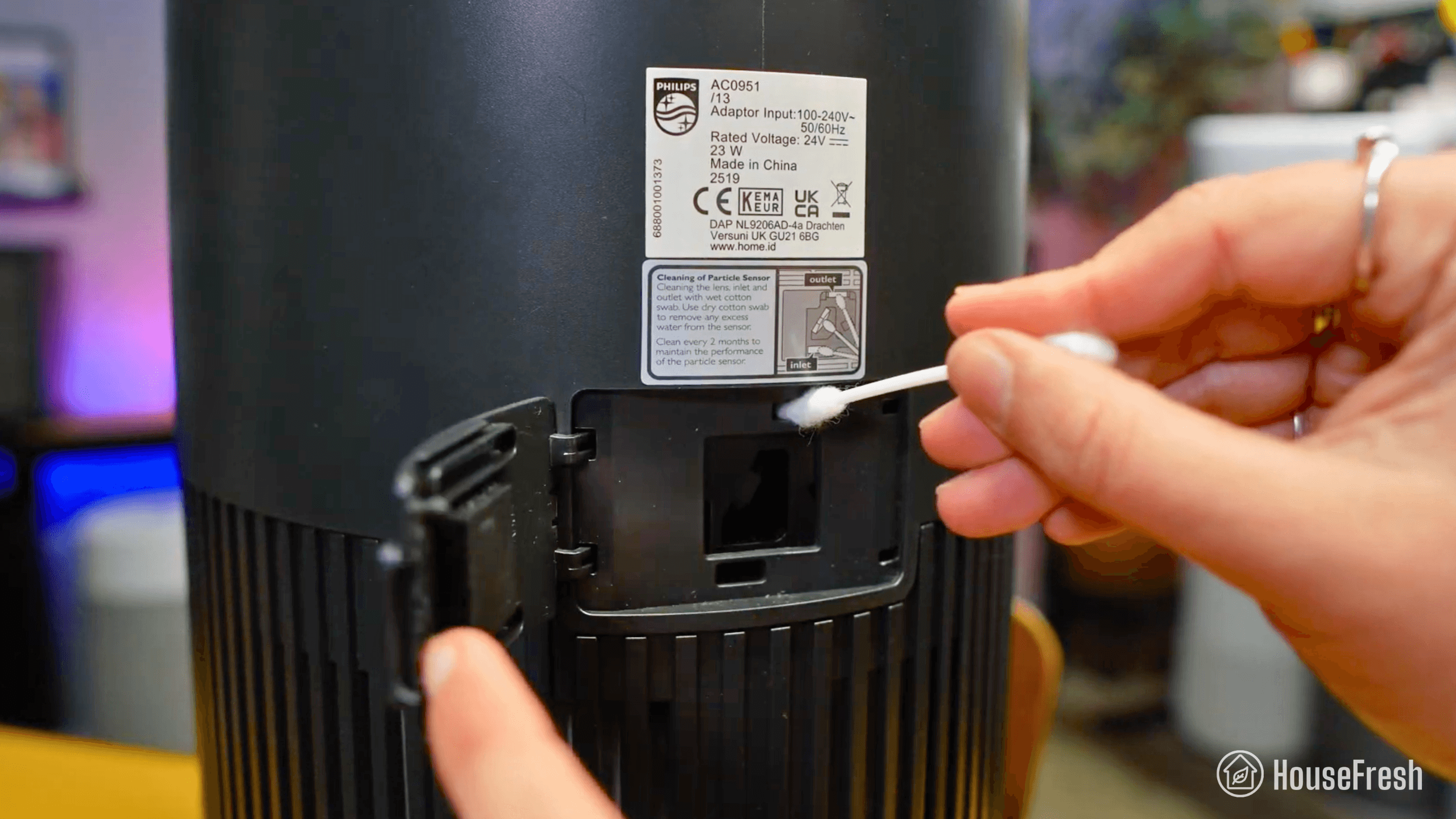
How to clean the sensor in the Philips 3200

Optical sensors require regular cleaning to prevent dust buildup, which can affect their accuracy. Philips recommends cleaning it every two months with a dry cotton swab.

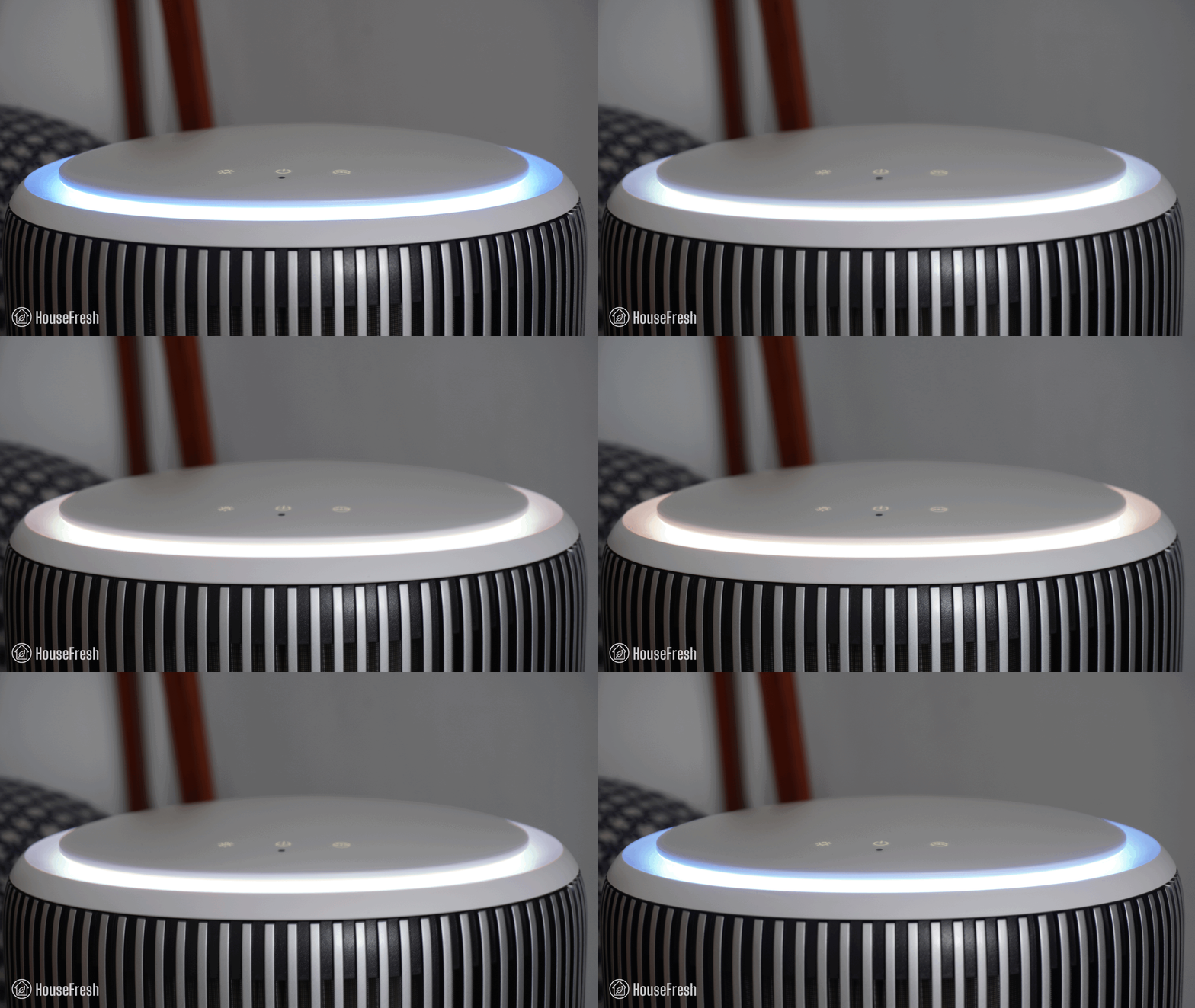
The LED ring at the top changes color based on the air quality in your room. Going from blue (good) to purple (fair) to red (poor).

Philips 3200 Ring light

If you prefer, you can also set the ring to be a lamp. When set to lamp mode, the top of the 3200 emits a nice, warm white glow.

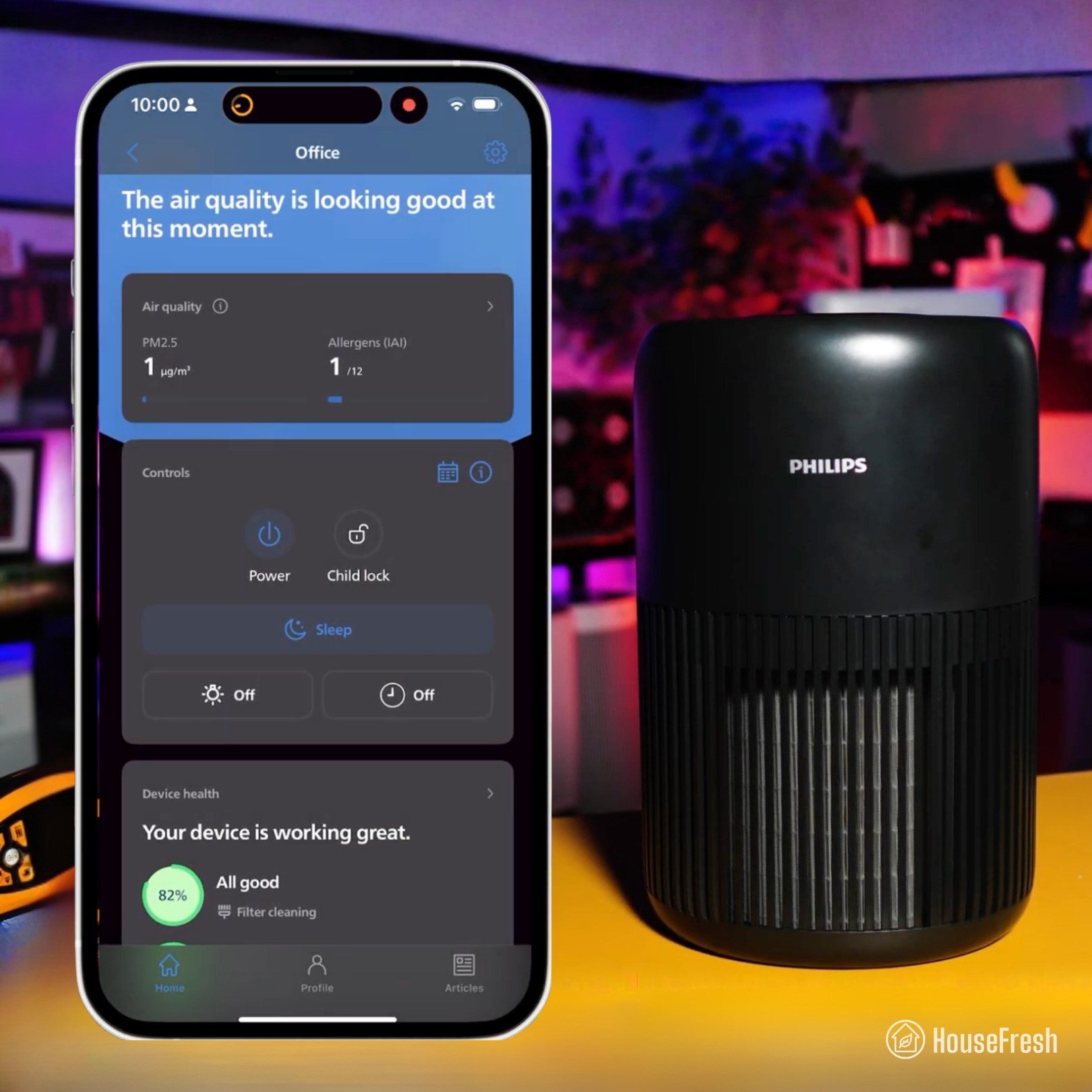
Philips 3200 App

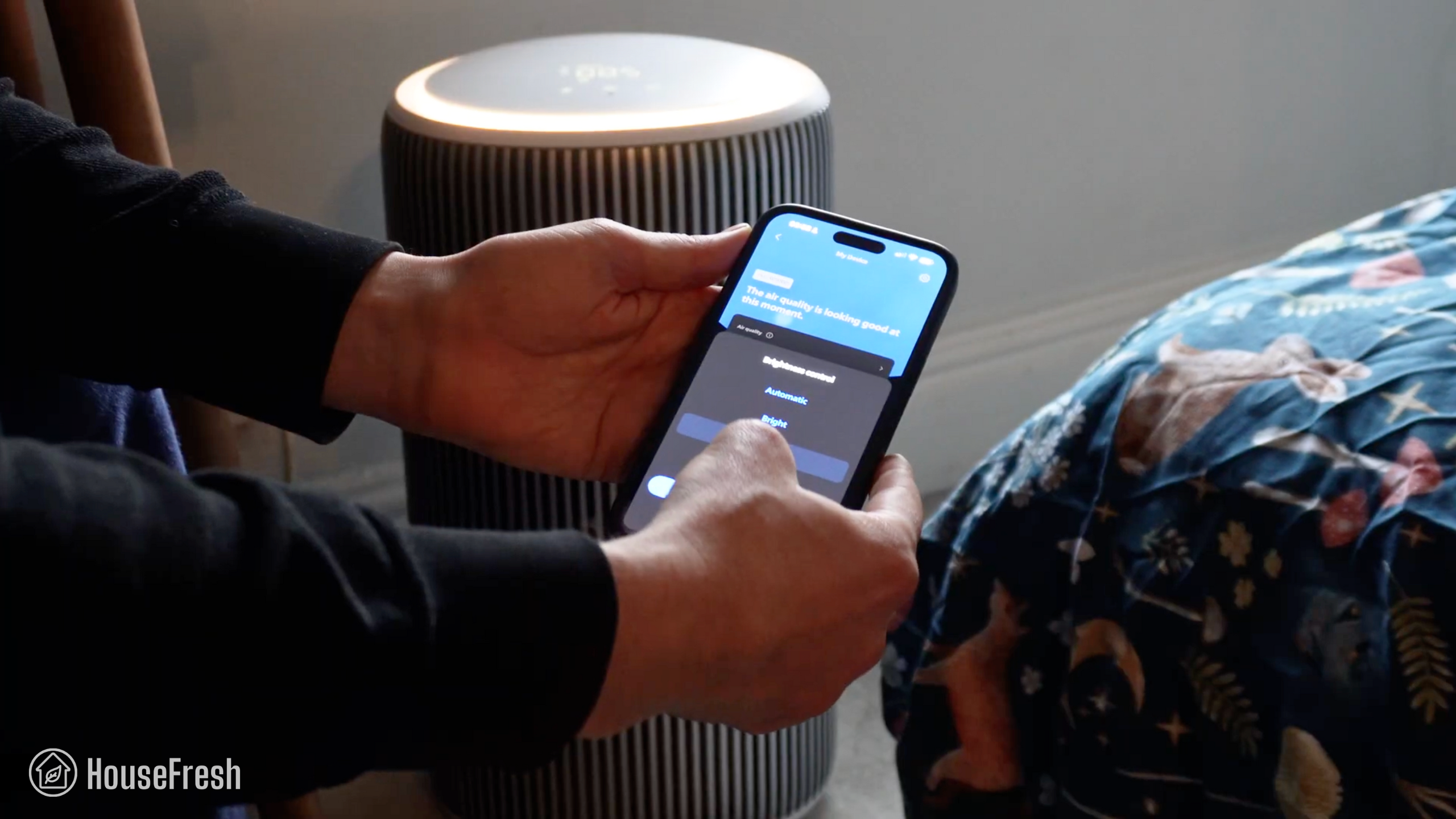
Through the Philips Air+ App, you can set schedules for different modes, switch the light to lamp mode, and receive alerts when it’s time to clean the pre-filter.

You can also enable the Allergy Sleep mode, which supercharges the normal sleep mode by allowing the air purifier to reach a more powerful yet quiet fan speed when it detects PM2.5 in the air.

This is much better than the performance of the standard sleep mode, which is capped at the lowest fan speed, regardless of the level of particles in the air.

Unlike most cylindrical air purifiers, the 3200 has two filters and two fans. Whilst I have seen two fans used in larger devices, this is the first time I have seen this dual-fan approach in a mid-sized device like this.

Read on to find out whether this two-fans-two-filters gamble paid off for Philips – and whether doubling the number of fans led to double electricity consumption…

Air cleaning performance

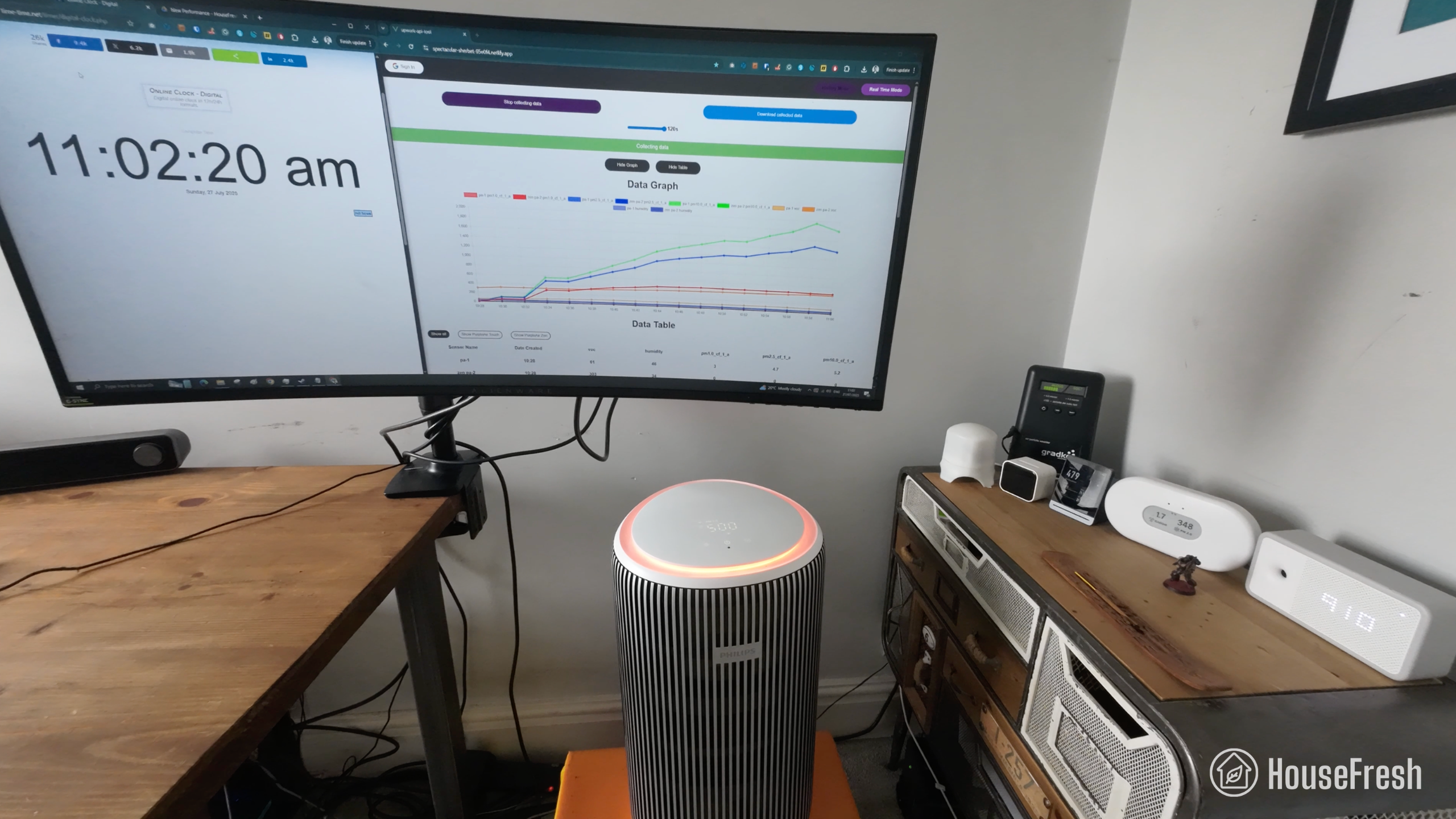
I tested the Philips 3200 in our 728 cubic ft. test room, tracking how fast it removed all PM1 particles from the air after we filled the space with incense smoke.

Philips 3200 Performance

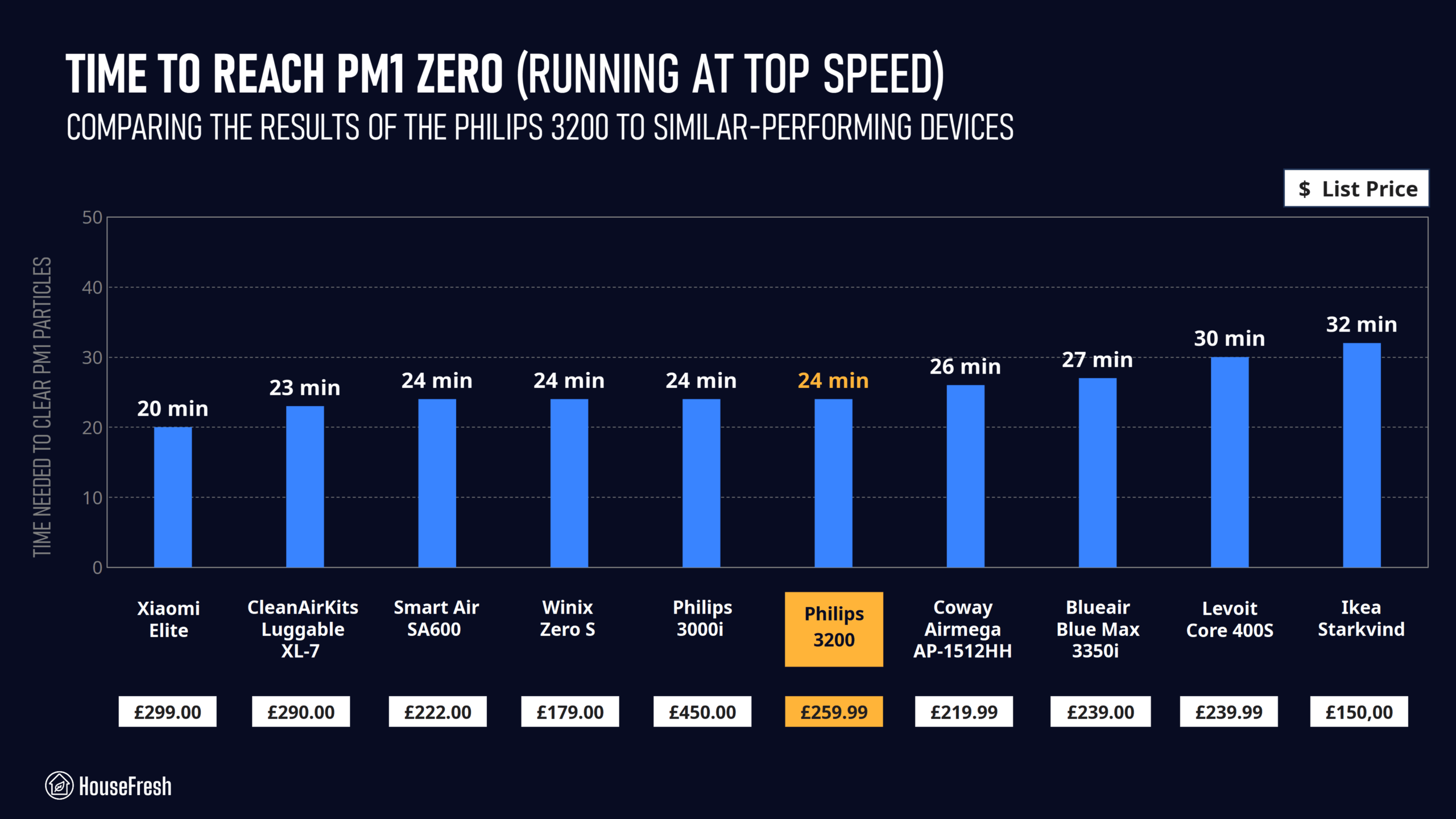
When running at Turbo speed, our PurpleAir Zen sensor shows that the 3200 needed 24 minutes to reach PM1 zero.

I was surprised to see that the 3200 matched the performance of the larger and more expensive Philips 3000i Series, which goes to show that the choice of using two fans and two filters paid off:

Philips 3200 Performance Chart scaled

That said, you could get more powerful air cleaning with the Xiaomi Elite or the CleanAirKits Luggable XL-7, if you can afford the extra ยฃ40.

Based on the natural ventilation of our test room, we estimate a PM1 CADR of 249 cfm. This makes it powerful enough to provide five air changes per hour in rooms no larger than 373 sq. ft.

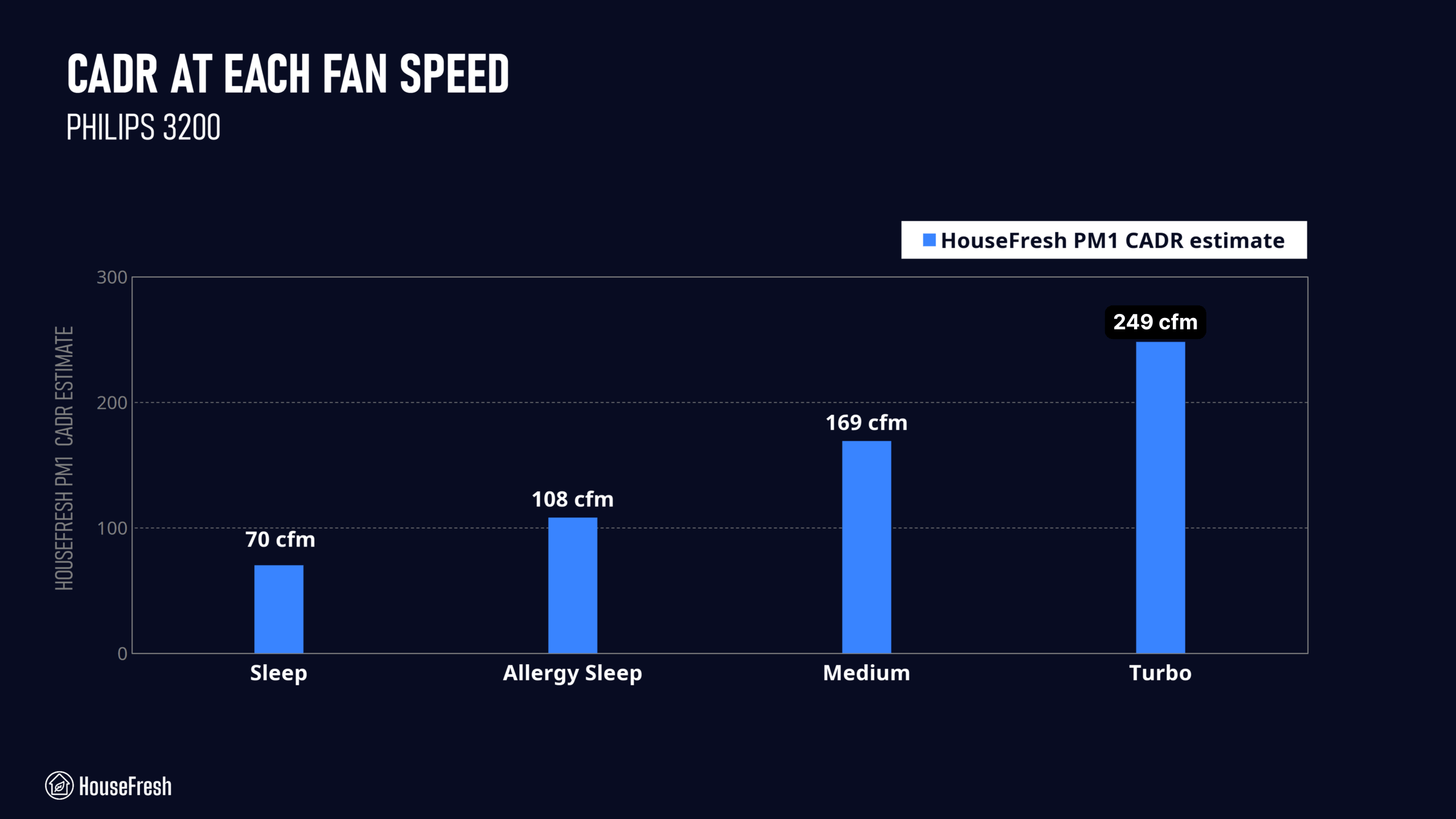
I repeated the particle removal test with the 3200 running at each available fan speed, allowing me to estimate PM1 CADR at each fan speed:

Philips 3200 PM1 CADR

Sound levels

I measured how much sound the 3200 generates at each fan speed from 3 ft. away – noise ranges from 35.4 dBA to 52.9 dBA at full speed.

Philips 3200 Sound

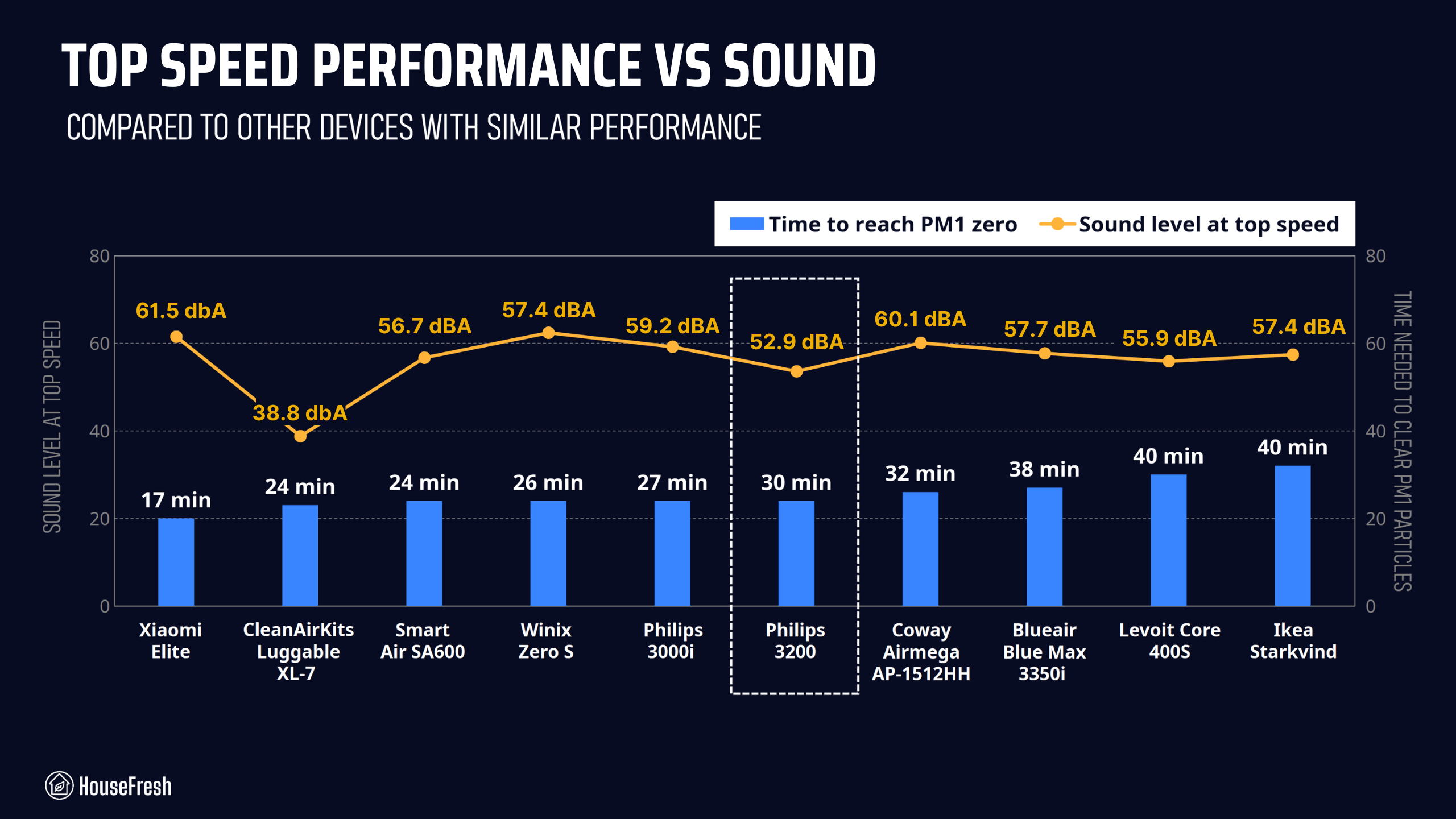
The 3200 hit 52.9 dBA at Turbo speed, so it’s much quieter than the older 3000i (59.2 dBA).

Philips 3200 Top Performance vs Sound

The 3200 is the second quietest mid-sized air purifier on our table, outmatched only by the PC fan-powered Luggable XL-7 from CleanAirKits (38.8 dBA).

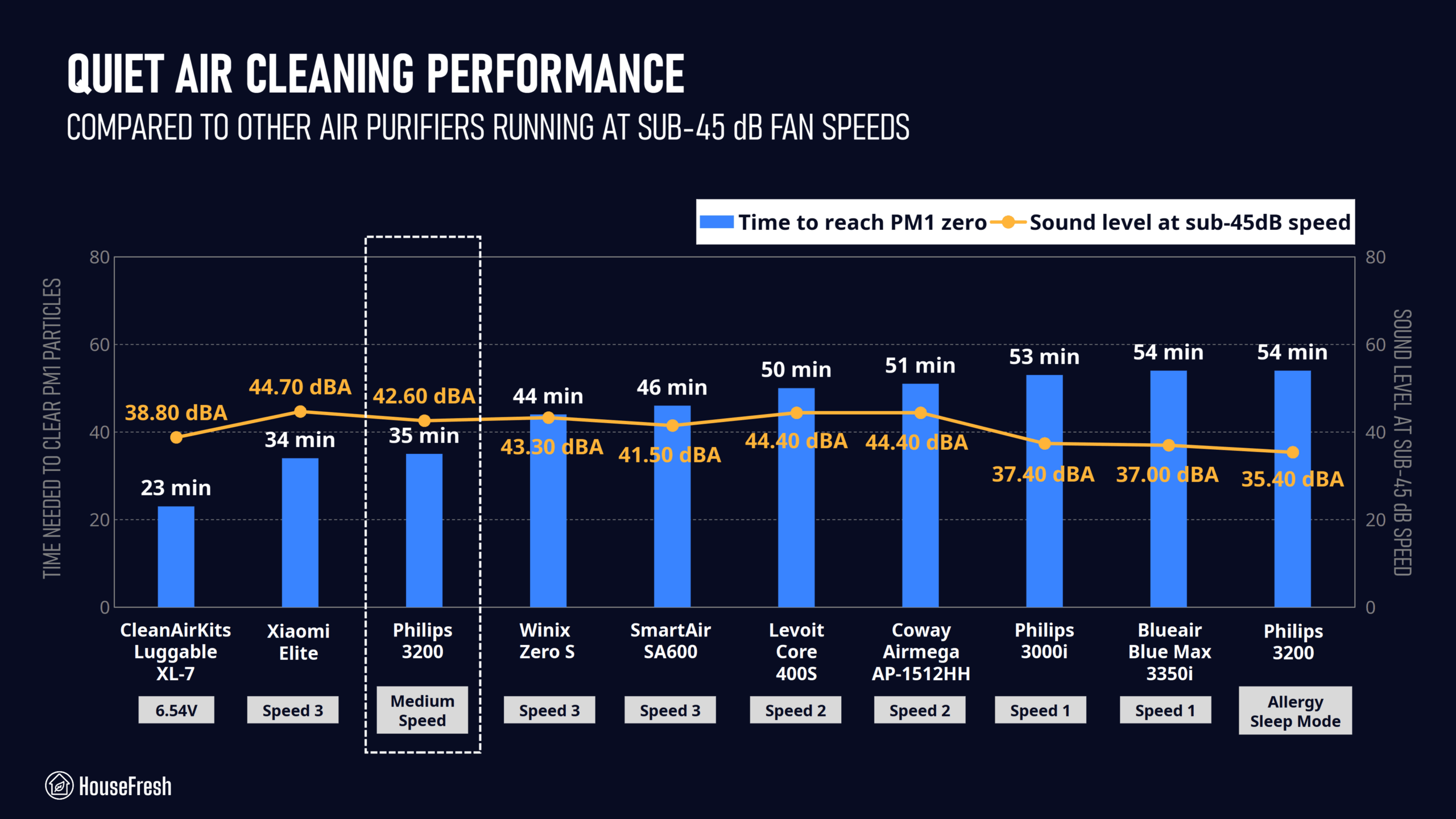
It generates 42.6 dBA at Medium speed, and it took 35 minutes to reach PM1 zero in our test room.

Philips 3200 Quiet Performance vs Sound scaled

Itโ€™s fair to say that the Philips 3200 offers excellent performance at quiet fan speeds – even though it was once again outperformed by the incredible power of the Luggable XL-7 with its seven Cooler Master Sickleflow 120 fans.

Long-term running costs

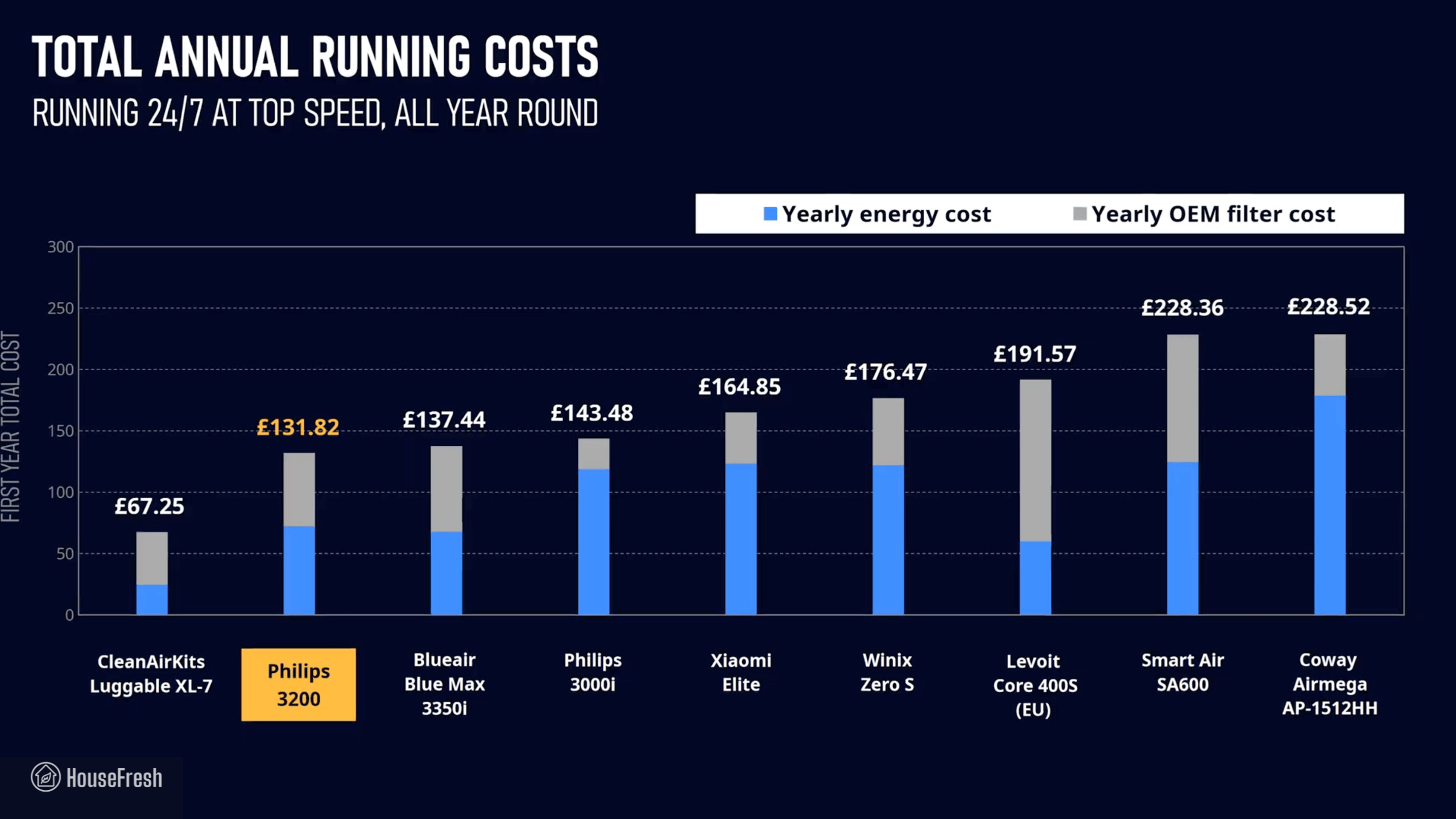
Running a Philips 3200 Series will cost you ยฃ131.82 per year, combining energy and filter replacement costs.

We used our energy meter to record how much electricity the Philips 3200 pulls at each fan speed and also while on standby:

Philips 3200 Electricity Consumption

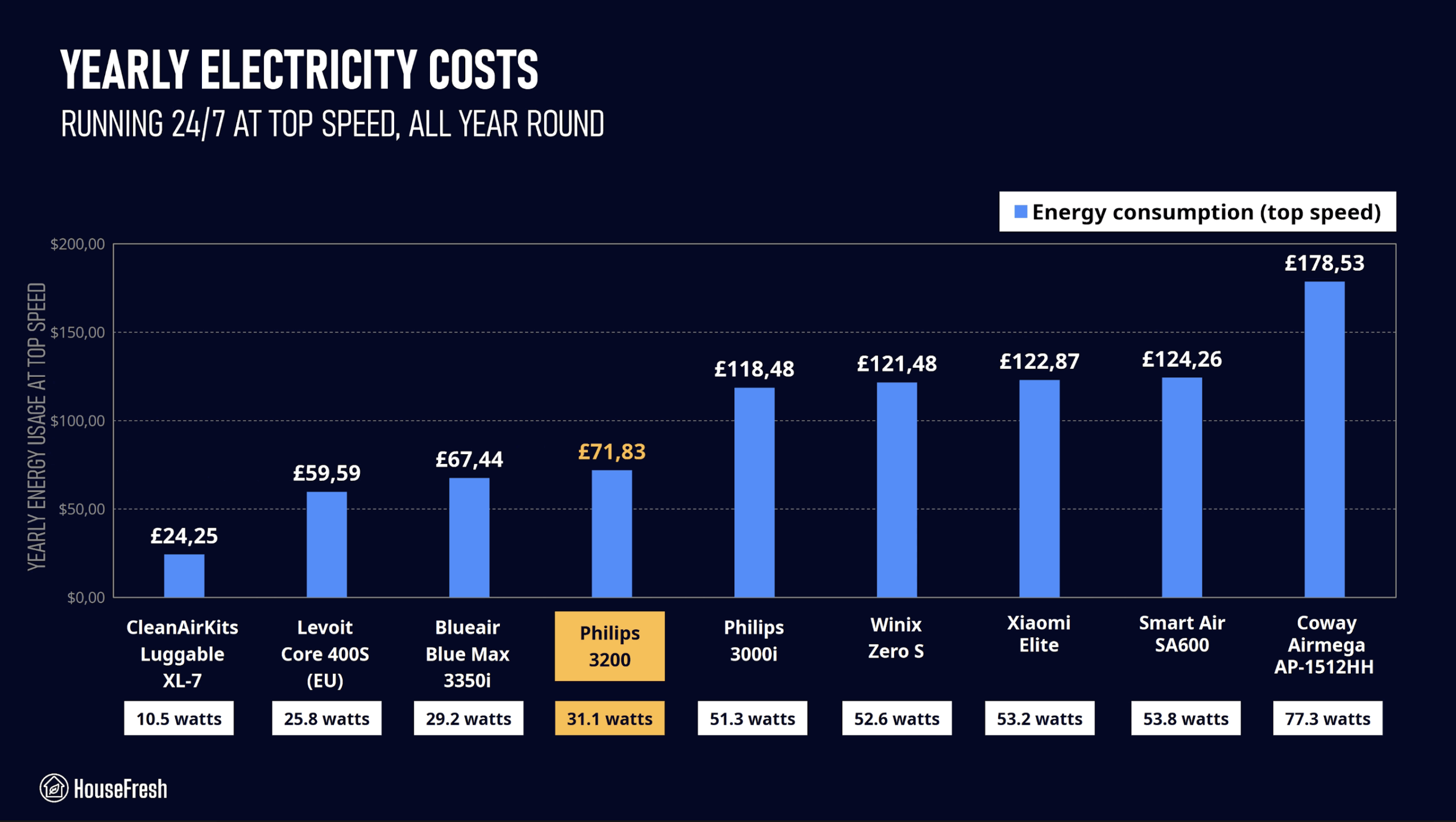
At Turbo speed, the 3200 Series pullsย 31.1 watts,ย so if you were to leave it running 24/7 at this speed for one year, it would add ยฃ71.83 to your energy bill, based on the November 2025 average UK electricity price cap of ยฃ0.26 per kWh.

Here, the Philips 3200 also does well against other similarly priced mid-sized models, although it still uses more energy than the Blueair 3350i and the European version of the Levoit Core 400S.

Philips 3200 Electricity Consumption Compared scaled

According to Philips, you can expect to change filters every 12 months, and you can buy a new filter set that includes two filters for ยฃ59.99. We can add this to energy costs to work out the total yearly cost and compare it with other mid-size devices we have tested:

Philips 3200 Yearly Costs

When accounting for both energy and filter replacements, the Philips 3200 is one of the more affordable mid-size air purifiers to run. 

Bottom line: Should you get a Philips 3200 Series?

Our data shows that the 3200 Series is a significant upgrade to the now-discontinued 3000i Series – does that make it the best air purifier in the UK?

Philips 3200 HouseFresh

On paper, the 3200 certainly looked good, but it took me a while to pull the trigger and buy it because I was super disappointed to learn that Philips had discontinued the 3000i after just a few years on the market.ย But I reached out to Philips, and they said that the 3200 is here to stay. They also confirmed that they have no plans to discontinue the filter replacements for the 3000i, so that is some good news for UK owners of the 3000i ๐Ÿ™‚

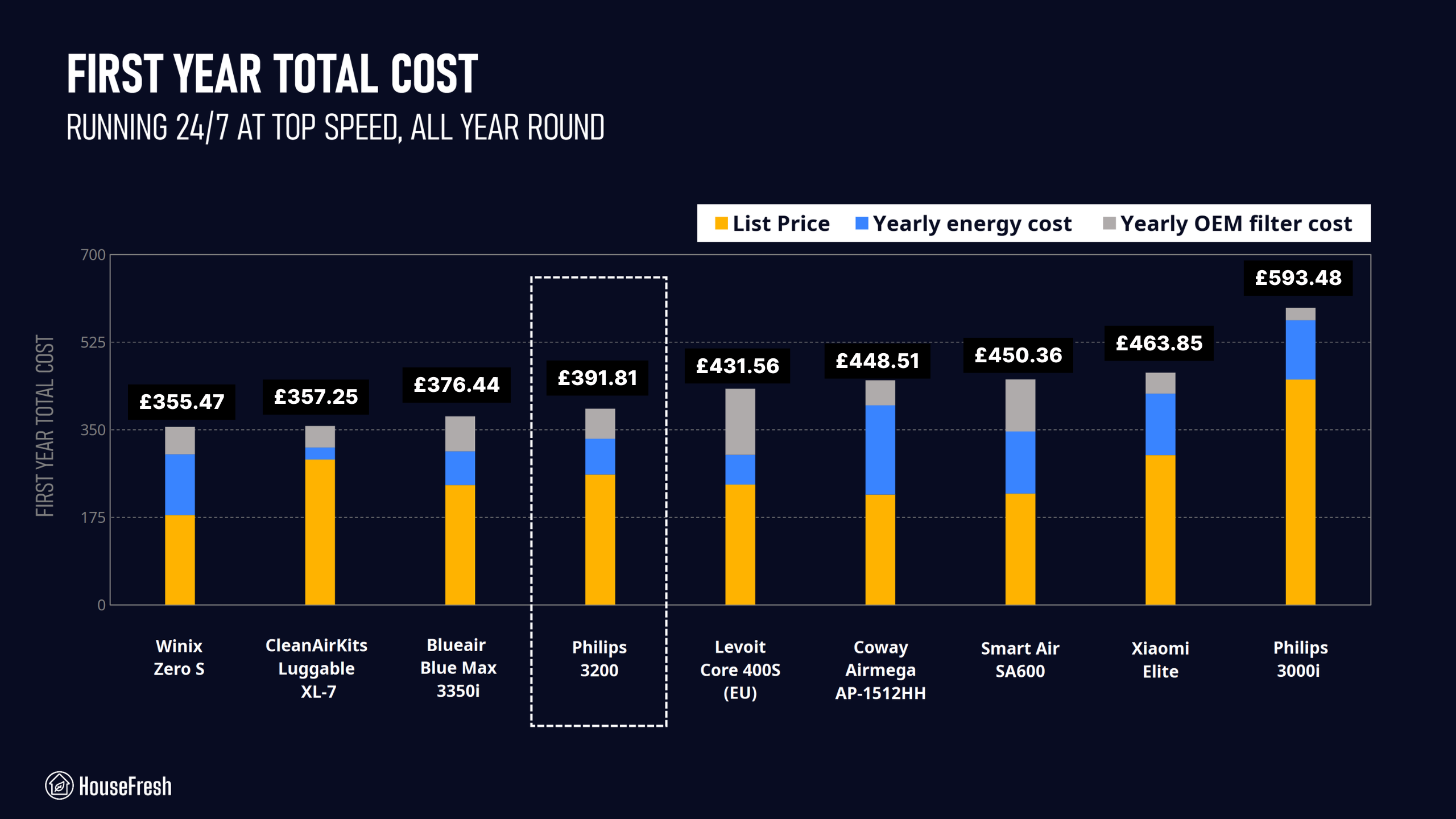
After spending a few months with the Philips 3200 at home, I am convinced that itโ€™s a significant upgrade to the now-discontinued 3000i.

Philips 3200 Year 1 Costs

You get the same level of air cleaning performance at a lower initial price with half the energy usage and cheaper long term costs.

However, aside from finances, the best feature of the 3200 is how well it performs at quiet fan speeds below 45 dBA.

Philips 3200 Quiet Performance vs Sound scaled

The use of two fans allows this device to outperform most mid-size models available in the UK and Europe.

It is clear as well that Philips has been upgrading its app by rolling out better smart features, and Iโ€™m a big fan of their Allergy Sleep mode, which dials up the CADR of the default Sleep mode.ย 

And even though I thought the lamp function would be gimmicky at first, I was surprised by the quality of the light and I soon found myself scheduling the light through the app as I do with my Philips Hue lights.

Philips 3200 Close

However, if you donโ€™t care about smart functions, apps and lights, then you should definitely check out the Luggable XL-7 from CleanAirKits, which has recently been introduced to the UK and Europe.

Or if youโ€™re looking for a traditional air purifier that offers better bang for your buck, then you should check out the Winix Zero S, which costs ยฃ179 and offers similar performance to the 3200 without the fancy app.

But for those of you who want it all (looks, smart features, app connectivity, quiet performance and a nightlight), then you canโ€™t go wrong with the Philips 3200.

If you think the 3200 is the right air purifier for you, please use our affiliate link to buy one to help support the work we do here at HouseFresh at no extra cost to you. And if you have any questions about this or any other air purifier, please drop them in the comments below and I’ll get back to you as soon as I can.

Levoit Core 600S review

Levoit Core 600S Room 5

If youโ€™ve been shopping around for a new air purifier, you will no doubt have come across Levoit. 

Having emerged on the scene in 2017, theyโ€™ve become one of the most popular manufacturers on the market, with an array of air purifiers to suit different needs and budgets.

Levoitโ€™s Core line has sold millions of units thanks to impressive performance at affordable prices. The Core 600S is the largest and most powerful unit in the range, with a particle and gas filter capable of providing five air changes per hour in spaces up to 562 sq. ft.

I have been using my 600S at home since 2022. But after over a hundred air purifier tests, is it still a top contender all these years later?

The overall score for the Levoit Core 600S incorporates first-hand data results from our battery of tests, as well as our ratings for customer service, brand transparency, and design & UX. Check out the full scorecard below to see the split of categories.

Search for the 600S (or any other model you are researching) to see where it ranks:

The pros and cons of the Levoit Core 600S

A summary of our top-level findings after testing this air purifier, following our methodology.

๐Ÿ’กexclusive code for HouseFresh for 10% off a single purchase on Levoit.com: HOUSE10

โ€œThe Core 600S is the biggest air purifier in Levoit’s Core range, with an estimated PM1 CADR at top speed of 375 cfm that matches the newer, fancier Levoit EverestAir. The main difference? The Core 600S costs less than $300.

I have been using my 600S since 2022 without any issues. In 2025, I re-tested everything about it and found that it still is a good option for those who want an air purifier with smart features and excellent raw air cleaning power at a low initial price.โ€

Danny Ashton HouseFresh
Danny Ashton
HouseFresh Founder
& Lead Tester

CONS

It’s loud at top speed (62 dBA) and, at speed 1, it makes an annoying whirring sound that might bother you if youโ€™re sensitive.
The filter isn’t HEPA as initially advertised when I bought it in 2022. This won’t affect performance for most pollutants, but it’s not good.
Its air cleaning performance at quiet fan speeds lags behind more modern large air purifiers like the Coway Airmega ProX.
It has a bonded filter, so you’ll have to replace the entire thing when the carbon runs out, even if the particle filter has life in it.

PROS

The raw air cleaning performance at top speed (375 cfm) is fantastic for the price (less than $300).
It comes with a laser sensor that reacts quickly to airborne particles and doesn’t need to be cleaned regularly.
Despite its size, it remains lightweight and easy to move around thanks to its deep handles at each side of the unit.
The app’s customisable auto-modes are a game changer, letting you tailor its performance to your exact needs.

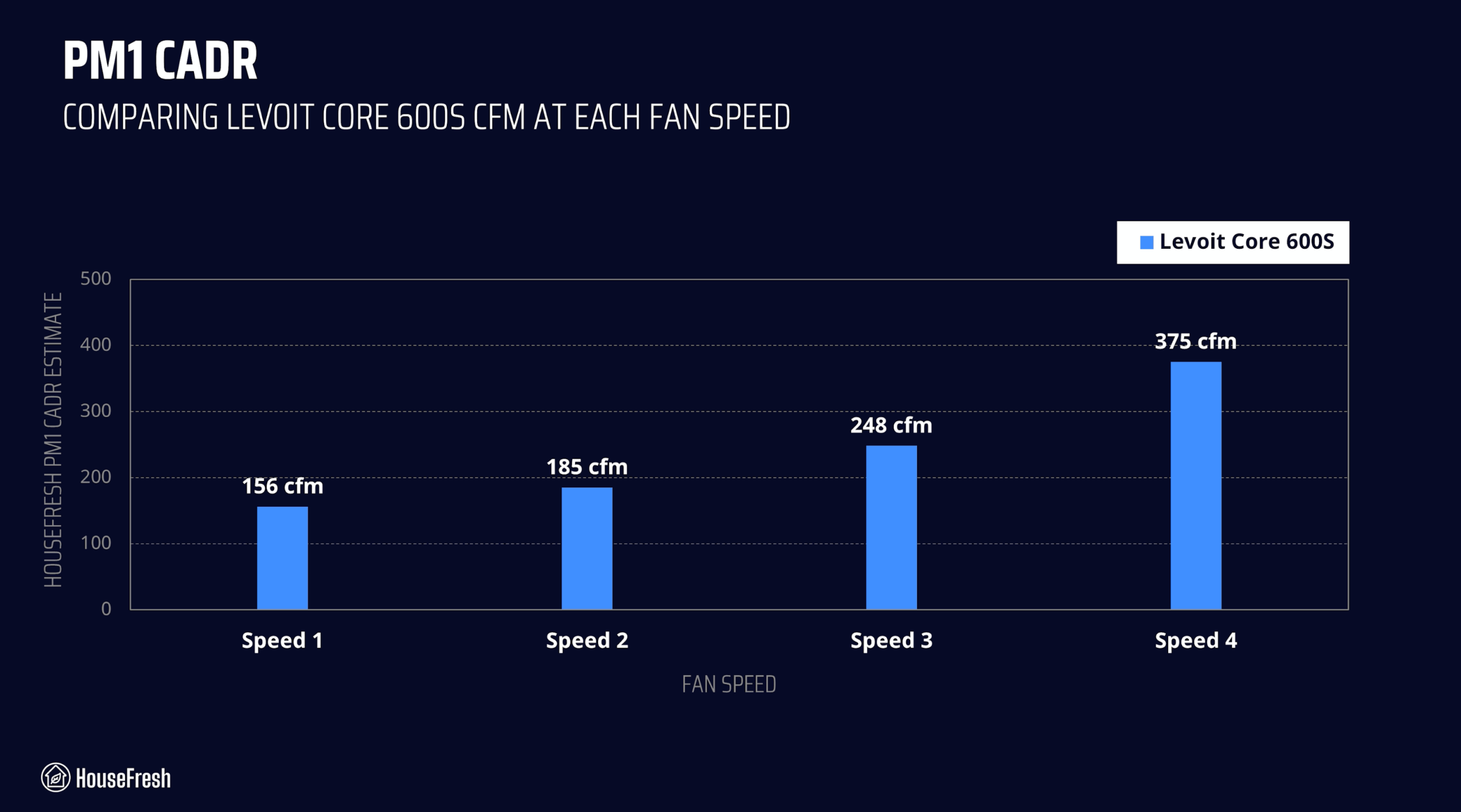
Clean air delivery rateย (CADR):โ€“ Top speed PM1 CADR: 375 cfm
โ€“ Sub-45 dBA PM1 CADR: 156 cfm
โ€“ AHAM PM2.5 CADR: 398 cfm (dust)
Filter technology:Bonded particle filter with a layer of pelleted activated carbon and a pre-filter mash wrap.
Recommended room size:562 sq. ft. (5 air changes per hour)
Dimensions:12.3 x 12.3 x 23.6 inches (31.3 x 31.3 x 60 cm)
Weight:13.7 lbs (6.2 kg)
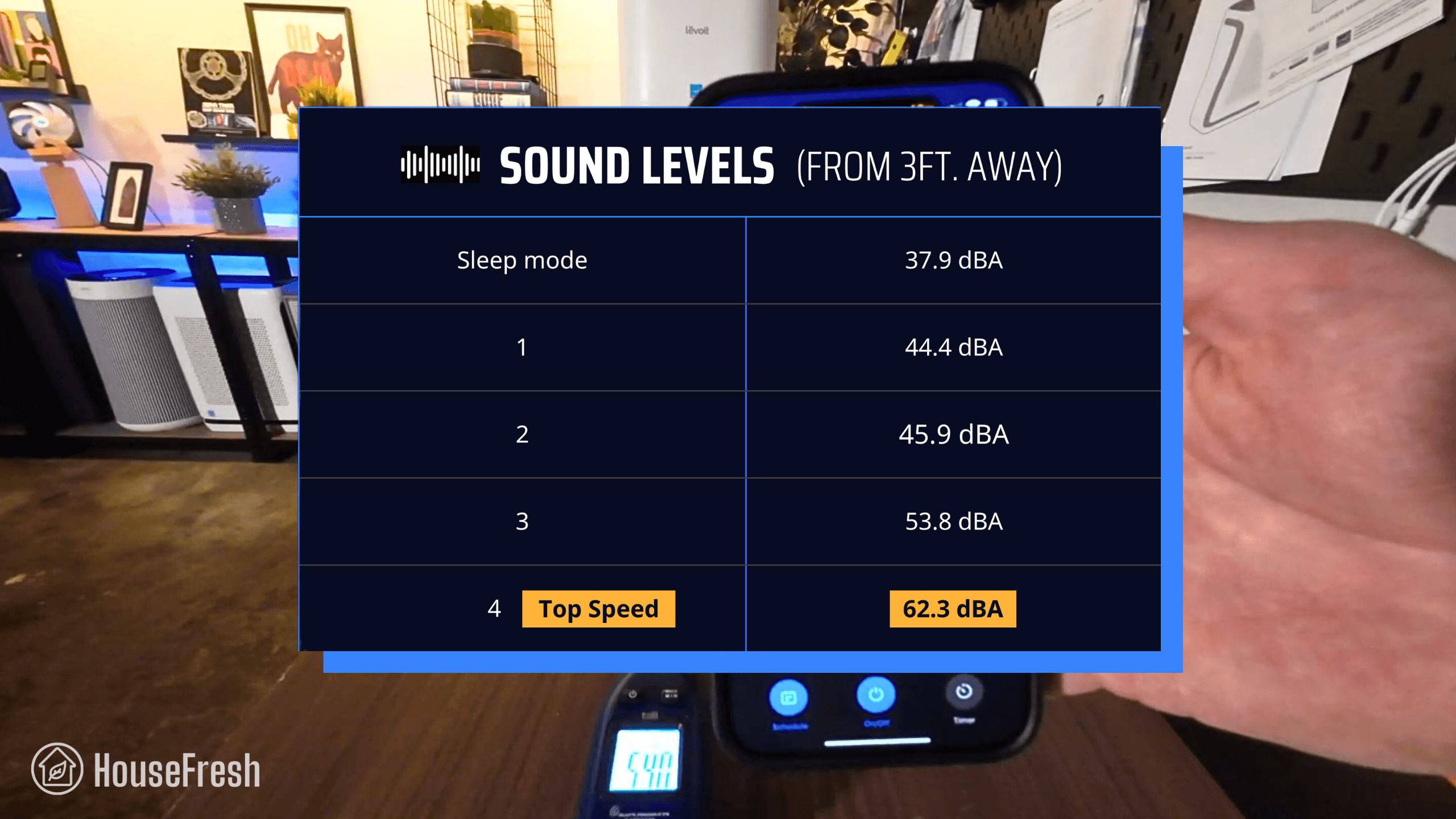
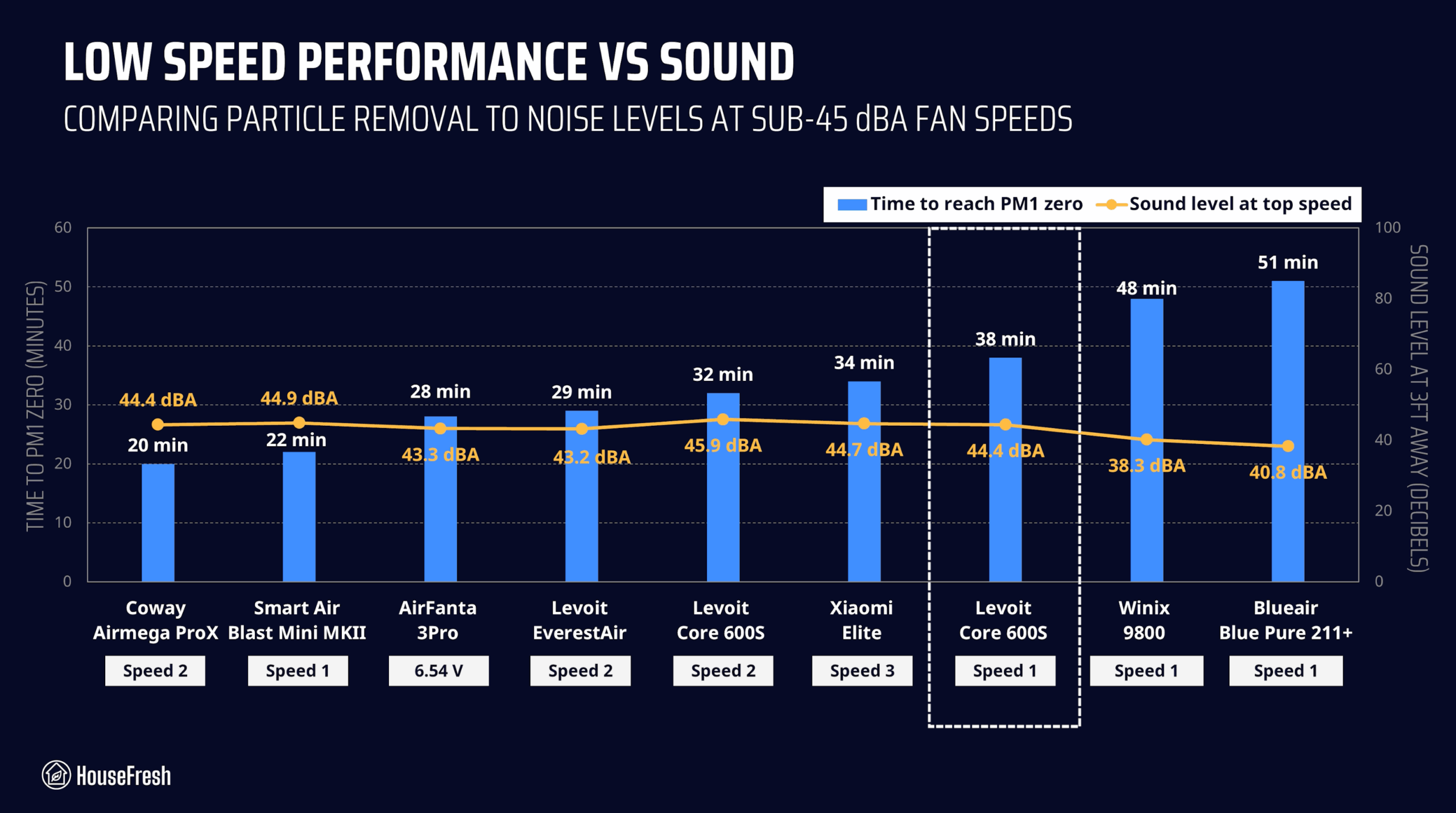
Noise level in decibels from 3 ft. away:Sleep: 37.9 dBA
Speed 1: 44.4 dB
Speed 2: 45.9 dB
Speed 3: 53.8 dBA
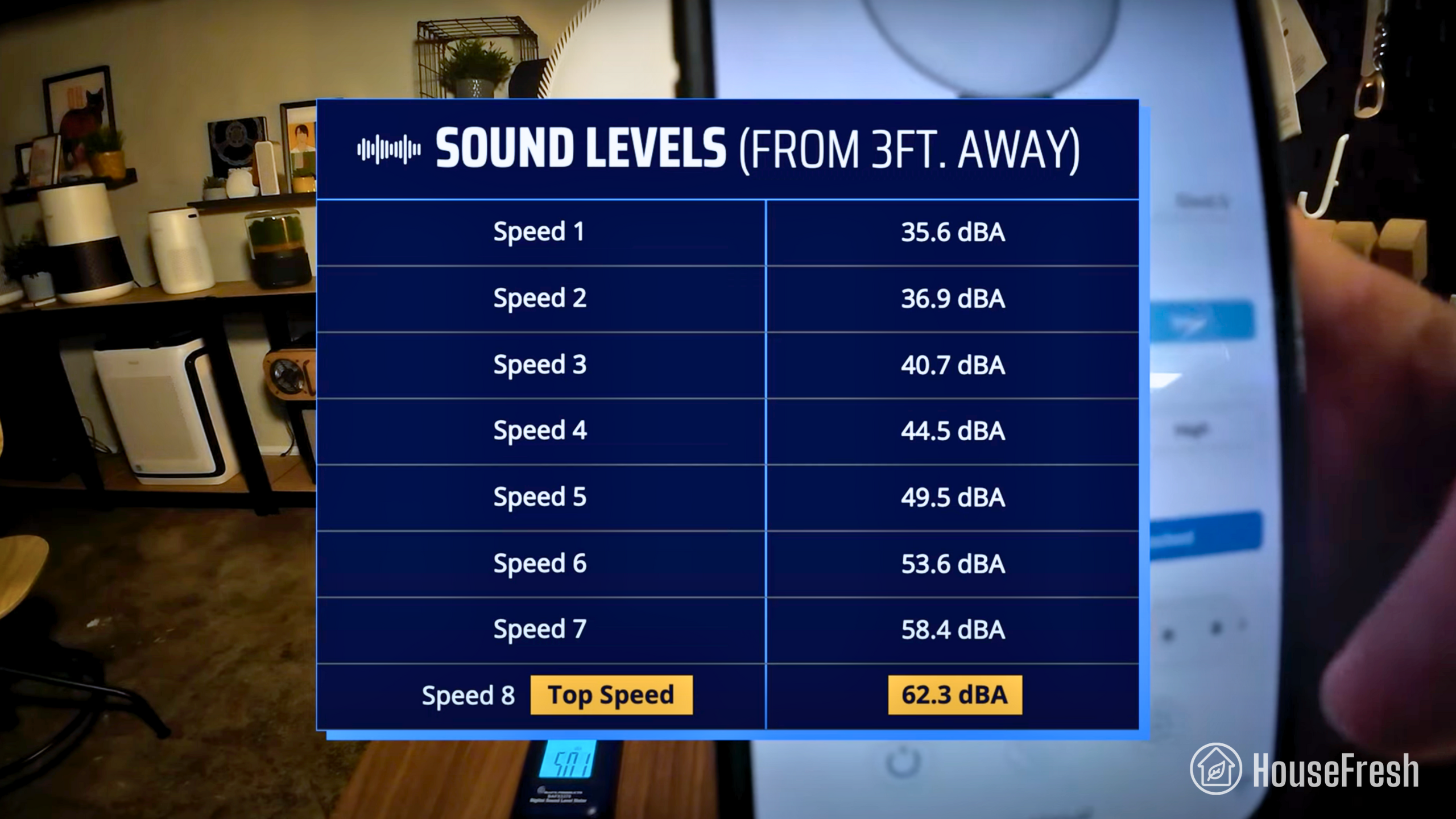
Speed 4: 62.3 dBA
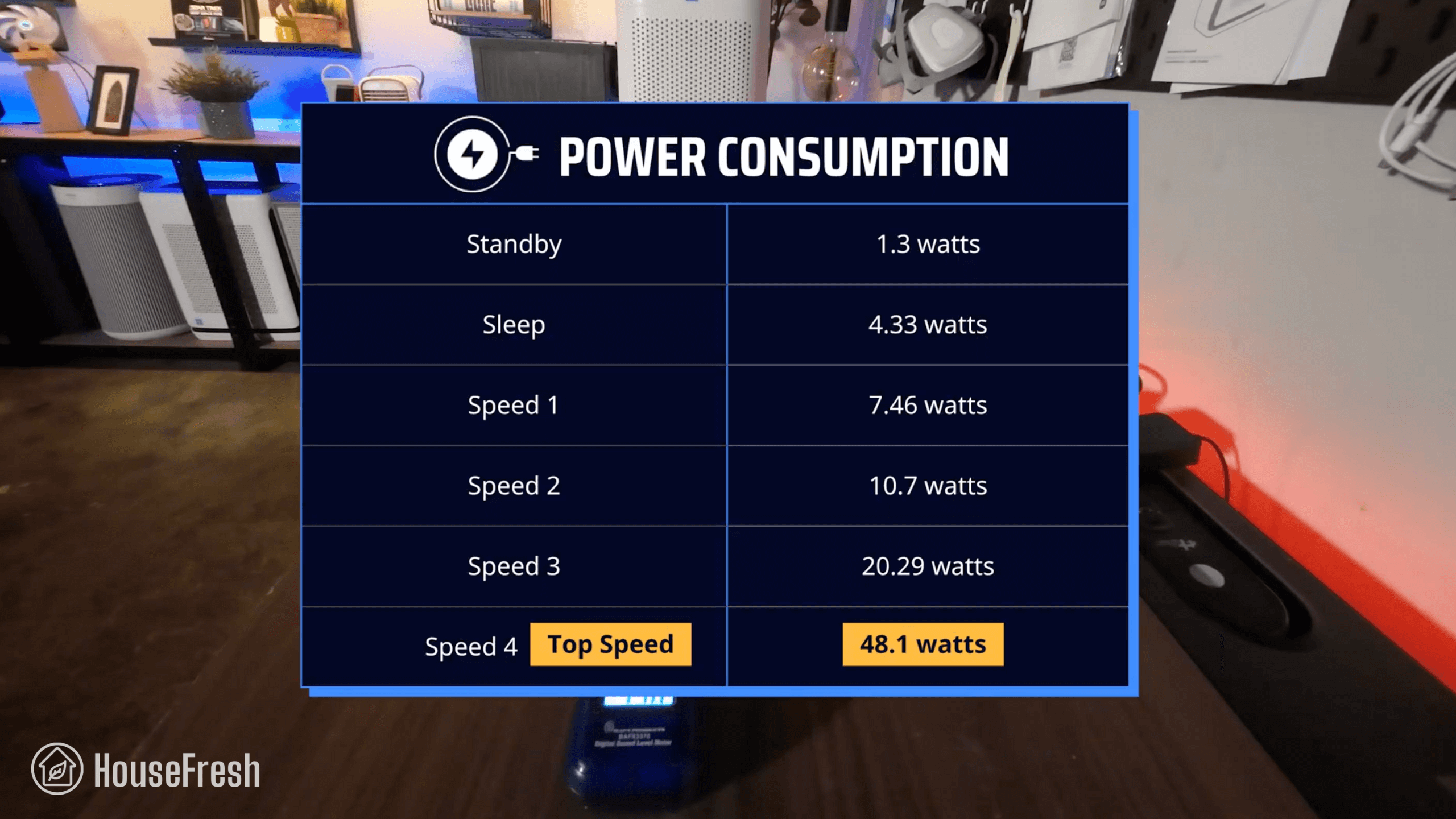
Electricity consumption in watts:Standby mode: 1.3 watts
Sleep: 4.33 watts
Speed 1: 7.46 watts
Speed 2: 10.7 watts
Speed 3: 20.29 watts
Speed 4: 48.1 watts
Filter lifespan:6-12 months
Manufacturerโ€™s warranty:2 years
Country of origin:United States
Country of manufacture:China

Filtration technology

The Core 600S comes with a 3-in-1 cylindrical filter that captures particles and helps reduce mild odors.

The large cylindrical filter has three layers: an outer pre-filter mesh, a particle filter, and a layer of pelleted activated carbon on the inside.

Levoit Core 600S Filter 3

Be aware that using a bonded filter means you will need to replace both the particle and carbon filters, even if only one needs replacing — usually the carbon, as it will likely fill sooner than the HEPA.

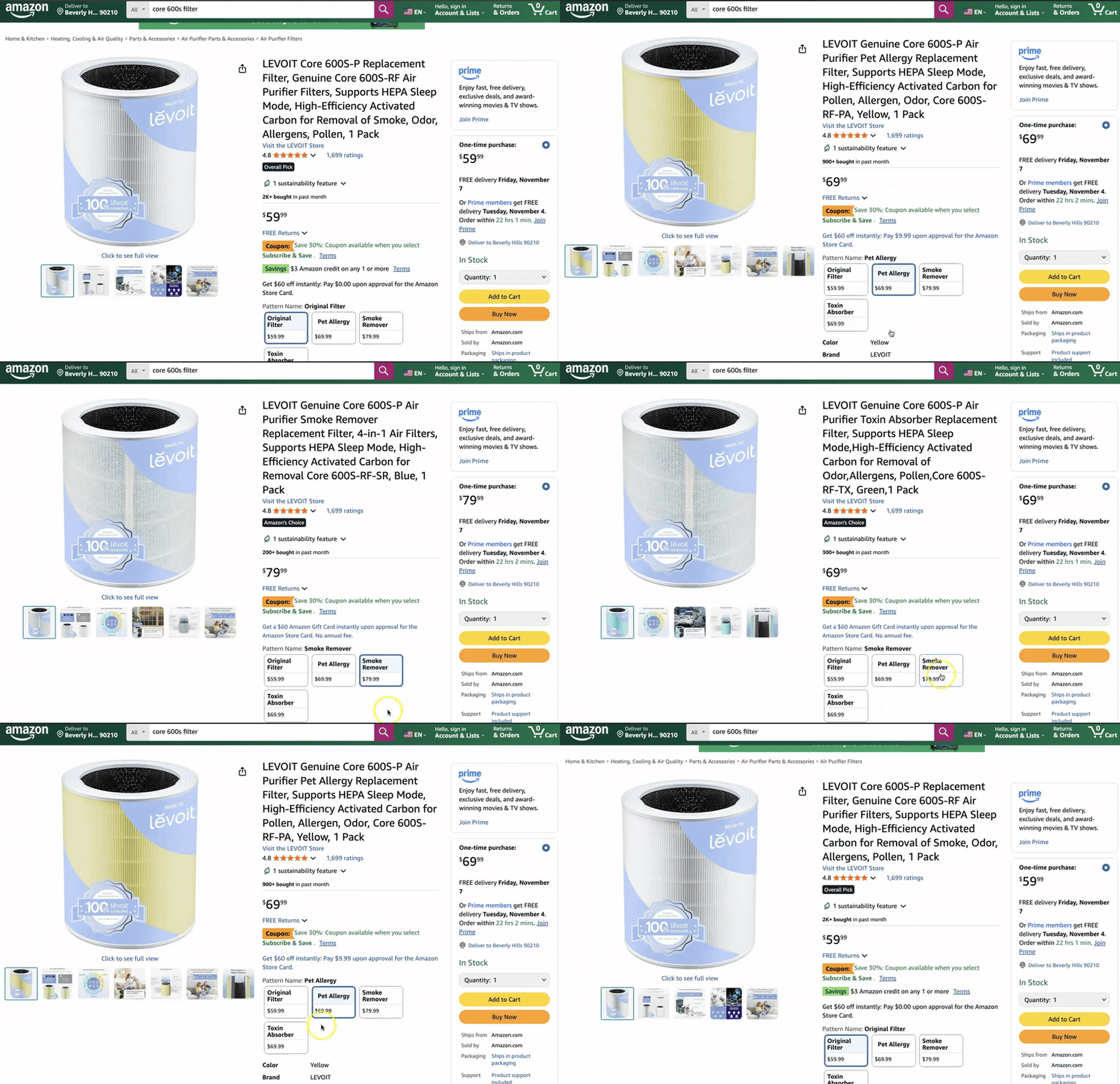
When it’s time to replace your filter, you can choose the standard filter or upgrade to the Pet Allergy, Smoke Remover, or Toxin Absorber.

levoit core 600s filter options

The specialized filters all come packed with 360g of activated carbon instead of the 160g you get in the Standard filter.

When I bought my Core 600S in 2022, Levoit advertised it as a HEPA H13 filter. Today, you won’t have ‘H13’ mentioned anywhere. The change in marketing occurred in 2023, when Levoit discontinued HEPA claims for its products following a Better Business Bureau challenge brought by Dyson.

The bad news is that Levoit seems to have misrepresented the grade of their filters. The good news is that, HEPA or no HEPA, the particle filtration of the 600S is excellent.

Installing and replacing the filter on the Core 600S couldnโ€™t be easier. Twist the body and slot in the filter with the tabs facing up. Check out our video below to see just how easy it is. 

Design, controls and app features

A large cylindrical air purifier with smart functions that is lightweight and easy to move around the room.

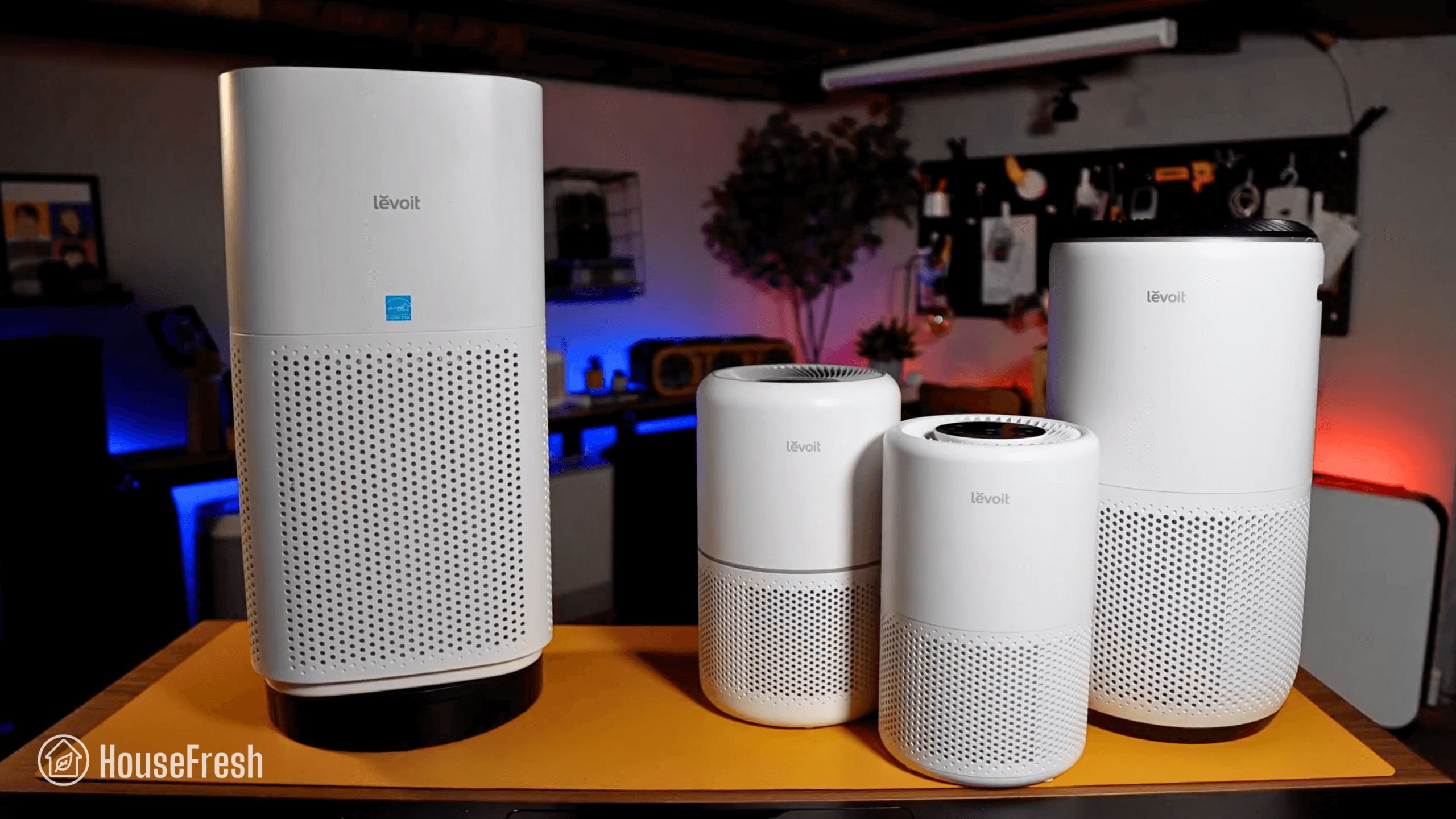
It is the largest in the Levoit Core range, which includes the 200S, 300S, and 400S.

Levoit Core Range

It weighs 13.7lbs (6.2 kg) but is easy to move around thanks to handles on each side.

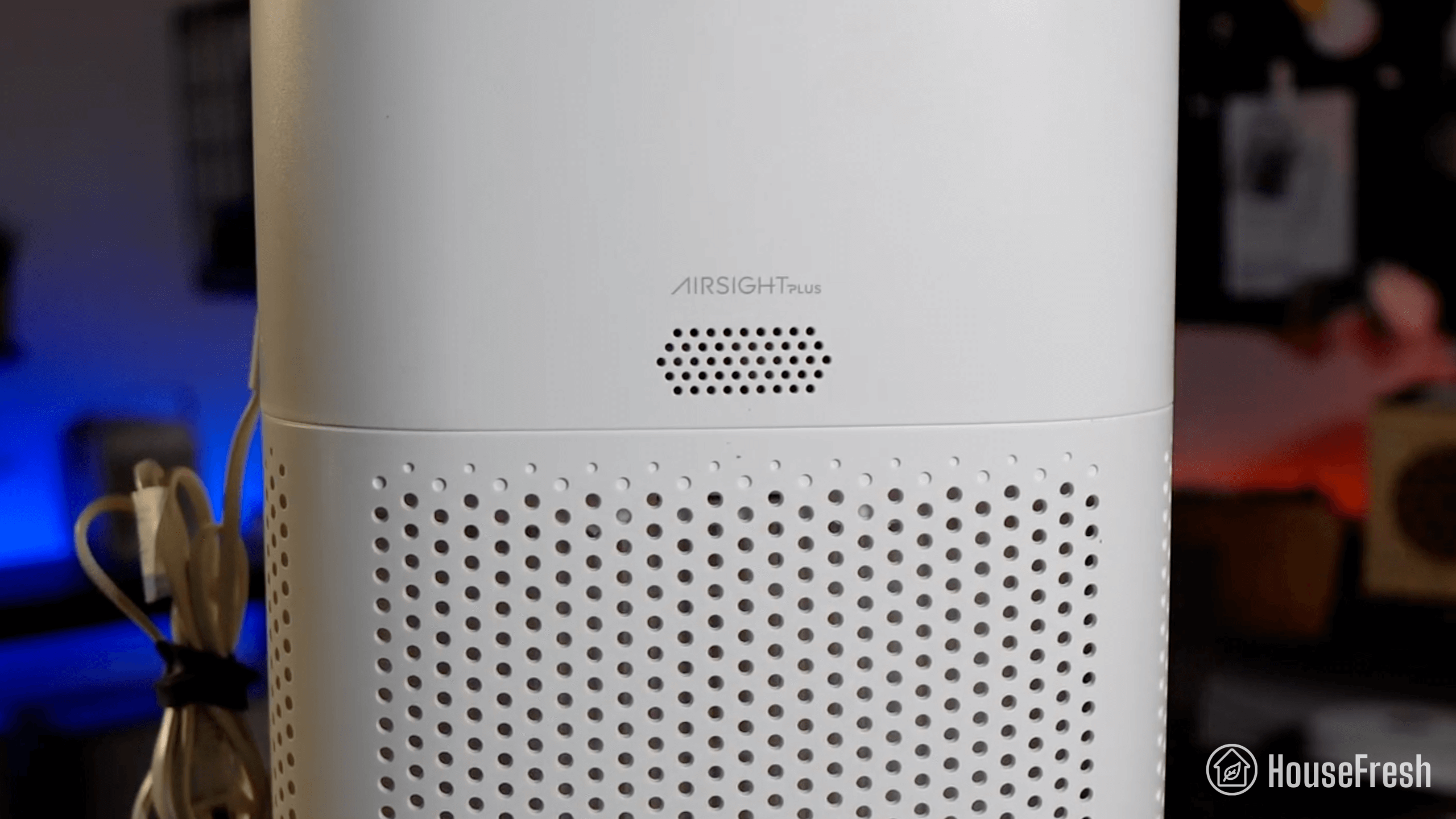
It comes with Levoitโ€™s Airsight Plus, which is a laser dust sensor on the side of the device.

Levoit Core 600S Sensor

It is quicker to react to PM2.5 particles than optical sensors, and doesnโ€™t need to be cleaned every few weeks.

The LED ring on top changes color based on your air, from blue (very good) to red (bad).

Levoit Core 600S Controls

Inside the ring, you get real-time PM2.5 particle readings in micrograms per cubic meter.

Levoit Core 600S App

When I first tested the Core 600S back in 2022, the VeSync app worked well, but it was pretty simple compared to what it is now.

Levoit has clearly invested in its app in the last few years, and all improvements have been rolled out across old models. The most exciting change in my view is that I can now adjust the auto-mode settings on my old 600S ๐Ÿ™‚

Standard auto-modes often cap the air purifier to a set speed threshold, which is usually below the top speed. This makes regular auto-modes less efficient, as they donโ€™t reach top speed even when air pollution levels are high.

Now, Levoit allows you to customize your auto-mode, offering choices for Default, Quiet, Eco and Efficient. My preference is the efficient mode, as you can set the size of your room, and the air purifier will reach full speed to provide a full air change before returning to the default auto-mode. 

I can also see the sensor and the Core 600S in my Home Assistant app, which is good news for those who want to integrate their air purifier with Home Assistant.

The warning covers 900 toxins and carcinogens that, if exposed to, can result in adverse health effects.  The 1986 act now covers any goods sold in California, which has enforced labels on everything, from bread to Starbucks coffee

Regarding the 600S, and air purifiers in general, the warning usually relates to the electrical components inside, with solder known to contain chromium and circuit boards often found to contain lead. These are trace amounts and won’t pose any danger through normal use. The Core 600S is FCC-compliant and CARB-certified, ensuring compliance with federal and California health and safety standards. 

Air cleaning performance

We tested the Core 600S in our 728 cubic ft. test room, tracking how fast it removed all PM1 particles from the air after we filled the space with incense smoke.

Levoit Core 600S CADR

When running at top speed, our PurpleAir Zen sensor shows that the 600S needed 16 minutes to reach PM1 zero. Based on the natural ventilation of our test room, we estimate a PM1 CADR of 375 cfm.

This makes it powerful enough to provide five air changes per hour in large rooms up to 562 sq. ft.

When we compare this against other similarly priced and similar performing air purifiers, you see what a good deal you get with a 600S:

Levoit Core 600S Performance scaled

The only cheaper model that matches the top speed performance of the Core 600S is the AirFanta 3Pro, with its four PC fans and four E11 filters that you can buy for less than $160.

We repeated our particle removal test three times across all available fan speeds, which allowed me to estimate PM1 CADR at each fan speed:

Levoit Core 600S CADR scaled

BUT air cleaning performance alone wonโ€™t tell us the full storyโ€ฆ

Sound levels

Levoit Core 600S Sound Test

Here’s the thing: if your air purifier is too loud, you will turn it off eventually. That is why we use a sound meter to measure how much noise in decibels the Core 600S generates at each fan speed from 3 ft. away:

Levoit Core 600S Sound Data

But I know that sound can be subjective, so please have a listen for yourself:

The Core 600S runs loud, hitting 62.3 dBA at top speed.

Every other air purifier Iโ€™ve benchmarked it against is quieter than this, with the loudest one of the pack being the Xiaomi Elite (61.5 dBA).

Levoit Core 600S Performance VS Sound scaled

The 600S generates 44.4 dBA at speed 1, so I repeated the particle removal test at this speed, and it took 38 minutes to reach PM1 zero.

We estimate a PM1 CADR of 156 cfm, based on the natural ventilation of our test room.

Levoit Core 600S Performance VS Sound 45dB scaled

When we compare this to other similarly priced devices, you can see that the 600S offers generally low performance at low fan speeds compared to other large units — with the exception of the Blueair 211+, which took much longer to clean the air.

Long-term running costs

Running a Levoit Core 600S will cost you $173.30 per year, combining energy and filter replacement costs.

We used our energy meter to record how much electricity the 600S pulls at each fan speed and also while on standby.

Levoit Core 600S Energy Data

At top speed, the Core 600S pulls 48.1 watts, so if you were to leave it running 24/7, it will add $53.32 to your yearly energy bill, based on the average U.S. electricity price as of September 2025.

When comparing against other similarly powered and similarly priced devices, it becomes clear that the 600S is one of the most energy efficient high CADR traditional air purifiers.

But letโ€™s look at the other main factor affecting yearly running costs: filter replacements.

According to Levoit, you need to change the filter in your Core 600S every 6-12 months. As always, I will take the lowest estimate for my calculations here. The original standard 600S filter is available for $59.99. That means that you can expect to spend $119.98 each year on filter replacements alone.

We can add this to energy costs to work out the total yearly cost and compare it with the other devices Iโ€™m benchmarking the 600S against:

Levoit Core 600S Running Costs scaled

The Levoit Core 600S sits right in the middle of the comparison here — it isnโ€™t the most expensive, but itโ€™s also not the cheapest to run in the long term.

Bottom line: Should you get a Levoit Core 600S?

After re-testing everything about this air purifier, I can confidently say it still holds its own against newer models — especially given its price.

Levoit Core 600S Front Room

๐Ÿ’กexclusive code for HouseFresh for 10% off a single purchase on Levoit.com: HOUSE10

I calculated how much money you can expect to pay on year 1 of owning a Core 600S and it goes to show how good a deal you get, considering its raw air cleaning power.

Levoit Core 600S Year 1 Costs scaled

And this is based on the list price of $319.99, which is usually higher than what you can find the 600S selling for online.

Now, it doesnโ€™t come without its downsides:

  • It is loud at top speed hitting 62 decibels.
  • Its only sub-45 dBA fan speed is speed 1 and at that speed it is not as powerful at cleaning the air.
  • It comes with a bonded filter so you will need to replace it once the carbon is full, which might happen sooner than the particle filter needs replacing.

But if youโ€™re not too bothered about noise and are looking for a powerful unit under $300 that comes with smart features and smartphone connectivity, then the Levoit Core 600S is a solid choice.

I have mine running in a corner of the basement, as I donโ€™t care about noise down there, it is a hardy unit and I can set automations so it only comes on when it detects particles in the air.

The big standout benefit and a big win for existing owners has been the investment that Levoit has made to the app. You now can adjust the way the Auto mode works, which was one of my main bug bears around auto-modes in general.

The fact that you can create automations using just the sensor’s information to switch it on the 600S is a game-changer. Whilst I am sure there are plenty of home automation enthusiasts out there that can do this type of thing, the fact that this works out of the box and is as simple as a few clicks is impressive.

Levoit Core 600S Room 5

Now, if sound is important to you and you donโ€™t care about smart features, then you should definitely look into the PC fan kits like the AirFanta 3Pro or the Luggable XL-7 from CleanAirKits. 

And if youโ€™re looking for a more traditional air purifier that is quieter than the 600S and does have an auto mode, then the Winix 9800 might be a better option.

However, for those who value app connectivity and raw air cleaning power at a low initial price, then the Levoit Core 600S is well worth considering.

If you decide you like this model and want to support the channel, be sure to use the affiliate links I included throughout this article. We will get a small commission at no extra cost to you that will allow me to continue to buy, test and review air quality products in the future.

Xiaomi 4 Compact review

Xiaomi 4 Compact Closeup

The 4 Compact is the smallest air purifier we have tested from Xiaomi. It is currently available in the U.S., Europe, Asia and some countries in South America, selling for under $100.

It comes with app support through Xiaomiโ€™s Mi app and has an in-built infrared laser particle sensor that feeds live data to the air purifier to enable a smart mode that automatically adjusts fan speeds based on the quality of your air. In terms of filtration technologies, the Compact 4 comes with a small 3-in-1 cylindrical filter including a pre-filter mesh cover for large particles, a low-grade particle filter for small particles and a layer of activated carbon for odors.

The overall score for the Xiaomi 4 Compact incorporates first-hand data results from our battery of tests, as well as our ratings for customer service, brand transparency and design & UX. Check out the full scorecard below to see the split of categories.

Search for the 4 Compact (or any other model you are researching) to see where it ranks:

The pros and cons of the Xiaomi 4 Compact

A summary of our top-level findings after testing this air purifier following our methodology.

FIND IT ON AMAZON FIND IT ON THE MI STORE

“If $99 is the top of your budget, then the 4 Compact is definitely a good option for you.

At this price, the 4 Compact will give you okay performance at top speed but above average performance at sub-45 decibels, which Iโ€™d argue is more important in the day to day.

It also has some of the lowest running costs when compared to other popular small devices, so you wonโ€™t be spending an arm and a leg to use this air purifier each year.”

Danny Ashton HouseFresh
Danny Ashton
HouseFresh Founder
& Lead Tester

CONS

Top speed performance is not as good as what you get with other popular small air purifiers like the Levoit Vital 100S or the Coway Airmega 100.
Minimal buttons on the control panel mean you will need to use the app to actually set manual fan speeds.
The filter doesnโ€™t come with enough carbon to make a significant difference against odors and gases.

PROS

It offers very good performance at sub-45 dBA fan speeds, outmatching the Winix A231 and the larger Coway Airmega 200M.
It has low running costs thanks to affordable OEM filter replacements and low electricity consumption.
The design is small and lightweight, so you can easily place it on top of sidetables and window sills.
The Mi app is one of my favorite ones: it’s easy to use and unlocks a wide range of fan speed options.

Clean air delivery rate (CADR):โ€“ Top speed PM1 CADR: 117 cfm
โ€“ Sub-45 dBA PM1 CADR: 77 cfm
– Manufacturer provided CADR: 135 cfm
Filter technology:Bonded cylindrical particle filter with a layer of pelleted activated carbon and a pre-filter mesh cover.
Recommended room size:175 sq. ft. (5 air changes per hour)
Dimensions:8.6 x 14 inches (21.8 x 35.5 cm)
Weight:4.85 lb (2.2 kg)
Noise level in decibels from 3 ft. away:Sleep mode: 35.6 dBA
Speed 1: 35.3 dBA
Speed 2: 35.6 dBA
Speed 3: 42.2 dBA
Speed 4: 44.5 dBA
Speed 5: 46.4 dBA
Top speed: 56.1 dBA
Electricity consumption in watts:Standby: 1.4 watts
Sleep mode: 2.2 watts
Speed 1: 2.4 watts
Speed 2: 3.6 watts
Speed 3: 8.1 watts
Speed 4: 9.5 watts
Speed 5: 11.3 watts
Top speed: 26 watts
Filter lifespan:6 months
Manufacturerโ€™s warranty:1 year
Country of origin:China
Country of manufacture:China

Filtration technology

The 4 Compact comes with a 3-in-1 cylindrical filter that can capture particles and help with mild odors.

The filter has three layers to it. First, you get an outer pre-filter mesh cover that wraps around the particle filter which has a layer of activated carbon on the inside.

Xiaomi 4 Compact Filter

However, it is worth mentioning that this is a small filter so it doesnโ€™t come with enough activated carbon to help with serious issues with VOCs or strong smells.

On their website, Xiaomi explains that the filters in the 4 Compact have a lower grade of density than traditional HEPA-grade filters, which they say will lead to higher performance at a lower noise level.

Xiaomi 4 Compact Filter

Xiaomi also states that in their testing, the filters could remove 99.9% of particles as small as 0.1 microns. It sounds impressive but is something that many particle filters can achieve, including MERV 13 filters.

Design, controls and features

A small cylindrical air purifier that doesnโ€™t take up too much floor space, similar to what you get with the Airmega 100, Core 300S, Winix A231 and PuroAir 240.

Xiaomi 4 Compact Closeup

The 4 Compact (right) is a small cylindrical air purifier, similar in size with what you get with the Winix A231 (left) and the Coway Airmega 100 (center).

Winix A231 Coway 100 Xiaomi 4 Compact scaled

It is lightweight, doesnโ€™t take up too much floor space and can easily fit on top of a desk or side table without looking too bulky.

Xiaomi 4 Compact Desk scaled

It comes with an infrared laser particle sensor, which is nice to have BUT is a cheaper sensor compared to what you get with the Xiaomi 4 Pro or the Xiaomi Elite, both of which have a laser sensor that also measures temperature and humidity.

Also, you need to remember to clean the sensor with a dry cotton swab to wipe the dust that will stick to it every few months to ensure the air quality readings are accurate.

Xiaomi 4 Compact Sensor Cleaning scaled

Like other Xiaomi air purifiers we have reviewed, the control panel consists of a touchscreen with three buttons that sits at the top of the device.

Xiaomi 4 Compact Controls scaled

From left to right, you get a button to dim or turn off the lights, a power button and a mode button to switch between auto, manual and sleep mode.

By the way, you will need to access the app in order to set manual fan speeds. Once you set what the manual speed is, the 4 Compact will automatically switch to it after you choose Manual with the mode button.

The mode button also doubles as a child lock if you press and hold the for seven seconds.

You also get a bunch of indicators on the screen, such as a child lock indicator, a Wi-Fi indicator and a filter life indicator.

There is also an LED air quality indicator bar at the top that changes color from red to yellow to green, based on the levels of pollutants in the air.

Xiaomi 4 Compact App

Through Xiaomi’s Mi Home app, you will be able to set the most optimal fan speed based on the size of your space and save your settings the Manual mode the device will go into when selecting M on the touchscreen.

You will also have the option to schedule routines, check the current filter lifespan and set automations with other Xiaomi devices.

Something disappointing is that, unlike the Xiaomi Pro 4 or the Elite, you donโ€™t get an exact reading for PM2.5 levels in the air. Instead, the app shows a combined indoor air quality score.

Personally, I havenโ€™t had any issues with the Mi app but I read some negative reviews on the App Store from people who had issues with their electric scooters and their vacuum cleaners. 

It seems most issues are happening on iOS as the current rating for the app is 3.7 from Apple users compared to 4.5 from Android users.

Air cleaning performance

We tested the 4 Compact in our 728 cubic ft. test room, tracking how fast it removed all PM1 particles from the air after we filled the space with incense smoke.

Xiaomi 4 Compact HouseFresh Test scaled

When running at top speed, our PurpleAir Zen sensor shows the 4 Compact needed 50 minutes to reach PM1 zero โ€“ and we estimate a PM1 CADR of 117 cfm which would be good enough to provide five air changes per hour in rooms no larger than 175 sq. ft.

When it comes to air cleaning performance at full power, the Compact 4 was outperformed by small models from Levoit, Coway and Winix.

Xiaomi 4 Compact Performance

But itโ€™s not just about raw particle removal performance when running at top speedโ€ฆ

Sound levels

Xiaomi 4 Compact Sound Electricity Tests scaled

The reality is that if your air purifier is too loud, you are likely to end up turning it off eventually.

That is why we use a sound meter to measure how much noise in decibels the 4 Compact generates at each fan speed from 3 ft. away:

Xiaomi 4 Compact Sound Levels scaled

Be aware that our background noise is 35 dBA, so the 4 Compact running on sleep mode and at speed 1 and 2 might be quieter if you could test sound levels in a silent room.

By the way, unlike standard air purifiers, there are no specific speed settings in the Compact 4. Instead, you get 14 options for room sizes inside the app that range from 2-4 cubic meters to 16โ€“27 cubic meters. For this test, I selected six different rooms sizes.

Reaching 56.1 dBA at top speed, this Xiaomi device generates as much noise as you can expect from other small air purifiers we have tested, although it is on the higher side compared to the Levoit Vital 100S.

Xiaomi 4 Compact Performance VS Sound

Now we have the sound levels at different fan speeds, we can find the speed that is below the 45 dBA limit we set for our quiet performance tests so we can re-test air cleaning performance.

Running at speed 4, the 4 Compact generates 44.5 dBA and was able to reach PM1 zero in 76 minutes, which we estimate to be a PM1 CADR of 77 cfm.

Xiaomi 4 Compact Performance Sub45 dBA

When accounting for sound, the Xiaomi 4 Compact ranks among the top three best performers on our table, right after the older Core 300S and the Vital 100S from Levoit.

However, part of this is down to the lack of fan speed options with the Winix and Coway models, so their sub-45 dBA fan speed is much quieter than what you get with the small Xiaomi.

But letโ€™s start adding up long-term costs to see how much money you would need to spend each year to run an 4 Compact in your home.

Long-term running costs

Running an 4 Compact will cost you $93.52 per year, combining energy consumption costs and filter replacement prices.

We used our energy meter to record how much energy the 4 Compact uses when running at each fan speed and also while on standby.

Xiaomi 4 Compact Electricity Consumption scaled

At top speed, the 4 Compact pulls just 26 watts. This means that if you were to leave it running at top speed 24/7 for one year, it would add $28.88 to your annual energy bill, assuming an average U.S. electricity prices.

However, itโ€™s not just energy costs that add to the running cost of an air purifier, you will also need to replace the filters eventually.

The OEM filter for the 4 Compact costs ยฃ24.99 (or $32.43) and Xiaomi says you need to replace it every 6-12 months.

As always, we will take the lowest estimate of six months to calculate filter replacement costs in the worst case scenario. So, according to this estimate, you will need to buy two filters per year for your 4 Compact and this will cost you ยฃ49.98 (or $64.64).

When we combine this with the electricity cost, you can expect to spend $93.52 each year to run this device all day, every day at top speed.

Xiaomi 4 Compact Running Costs

At $93.52 per year, the running costs for the Xiaomi 4 Compact are on the low side of the scale for the small air purifiers we have benchmarked against it.

Like we saw when testing the 4 Pro and the Elite, Xiaomi air purifiers generally have low running costs thanks to low-cost OEM filters and energy-efficient fan motors.

Bottom line: Should you get a Xiaomi 4 Compact?

If ยฃ70 (or $99) is the top of your budget, then Iโ€™d say yes.

At this price, the 4 Compact will give you okay performance at top speed but above average performance at sub-45 decibels, which Iโ€™d argue is more important in the day to day.

Xiaomi 4 Compact Sidetable

It also has some of the fairest annual running costs when compared to other popular small devices, so you wonโ€™t be spending an arm and a leg to use this air purifier each year.

So out of the many small air purifiers on the market, the Xiaomi 4 Compact stands out as being good value both at the point of purchase and in the long run. 

And this is a key point when it comes to small and cheap units as the low upfront cost will trick you into buying them, but then youโ€™re stuck with a device that will cost you twice as much to run as the months go by.

Xiaomi 4 Compact Small Size scaled

That being said, if you can, try to go bigger and choose a mid-size air purifier like the Winix T810, the Levoit Vital 200S or the AirFanta 3Pro that will give you more power and will make a more meaningful difference to your air much faster than the 4 Compact ever will.

But if you need a small air purifier that won’t cost you three times the price just to run it each year and you find that Xiaomi sells devices in your country, then the 4 Compact is a very good option.

By the way, if you decide to buy a 4 Compact, please use this link to support the work we do at HouseFresh, as we will get a small affiliate commission over the price of the sale at no extra cost to you.

Let me know if you have any questions in the comments below and I’ll get back to you as soon as I can.

IQAir Atem X review

IQAir Atem X Studio

IQAir is one of the longest standing air purifier manufacturers and are known for their above-average prices, innovative Swiss engineering and the uncommon offer of a 10-year warranty.

The Atem X is part of their latest generation of air purifiers, with integrated air quality sensors, smart features and app connectivity. This is undoubtedly a high-end device that promises style AND performance.

Selling at $1,400, this is officially the most expensive unit we’ve ever bought, so as you can imagine, my expectations are very very high. I tested our Atem X in the same space we’ve tested more than 100 other models, and in my review, I will break down its design features, air cleaning performance, energy consumption, user experience and more.

The overall score of the IQAir Atem X incorporates first-hand data results from our battery of tests, as well as our ratings for customer service, brand transparency and design & UX. Check out the full scorecard below to see the split of categories.

The pros and cons of the IQAir Atem X

A summary of our top-level findings after testing this air purifier following our methodology.

CHECK PRICE NEAR YOU

“If you can afford the $1,4000 and value high-end design, then you should definitely consider the Atem X over other premium models like the Dyson Big+Quiet, the Jaspr and the Molekule Air Pro due to how powerful its air cleaning performance is.

A big downside, however, is that there are currently no gas filters for the Atem X in the U.S., so you will need to buy an additional device to deal with VOC issues.”

Danny Ashton HouseFresh
Danny Ashton
HouseFresh Founder
& Lead Tester

CONS

The Rolls Royce-tier design doesnโ€™t come cheap at one cent under $1400.
It doesnโ€™t come with a carbon filter for dealing with gases and odors, so you only get particle filtration.
It runs louder at top speed (62.3 dBA) than other highly-powered traditional air purifiers.
Official IQAir filters are not cheap, selling for $199.99.

PROS

The design looks incredible and even though it is a big device, it has a footprint smaller than two sheets of A4 paper.
Performance at top speed is one full minute faster than the beast that is the Smart Air Blast Mini MKII and nearly 10 minutes faster than the highly recommended Winix 5500-2.
When running at fan speeds that generate less than 45 dBA of sound, it offers similar performance to PC fan-powered air purifiers from AirFanta, CleanAirKits, NorthBox Systems and Nukit โ€“ this is not normal for a traditional air purifier.
Transparent specs: IQAir made available factory-tested airflow reports and detailed HEPA filter grades at each fan speed.
It comes with IQAirโ€™s 10-year warranty, which certainly inspires confidence.
The app has a good UX, useful functions and you even get a web dashboard with a ton of data – which is something we have never seen before in an air purifier.

Clean air delivery rate (CADR):โ€“ Top speed PM1 CADR: 429 cfm
โ€“ Sub-45 dBA PM1 CADR: 229 cfm
โ€“ AHAM PM2.5 CADR: 435 cfm (dust)
Filter technology:HyperHEPA filtration.
Recommended room size:643 sq. ft.ย (5 air changes per hour)
Dimensions:27.08H x 25.19W x 10D inches (68.8H x 64W x 25.4D cm)
Weight:28.66 lbs (13 kg)
Noise level in decibels from 3 ft. away:Speed 1: 35.6 dBA
Speed 2: 36.9 dBA
Speed 3: 40.7 dBA
Speed 4: 44.5 dBA
Speed 5: 49.5 dBA
Speed 6: 53.6 dBA
Speed 7: 58.4 dBA
Speed 8: 62.3 dBA
Electricity consumption in watts:Standby: 1 watt
Speed 1: 5.3 watts
Speed 2: 7.5 watts
Speed 3: 10.5 watts
Speed 4: 15.5 watts
Speed 5: 24.2 watts
Speed 6: 35.9 watts
Speed 7: 57.2 watts
Speed 8: 85.5 watts
Filter lifespan:12 months
Manufacturerโ€™s warranty:10 years
Country of origin:Switzerland
Country of manufacture:Germany

Atem X AHAM

Filtration technology

The Atem X comes with IQAir’s signature HyperHEPA filter, which is highly efficient at capturing particles but it has no activated carbon to remove VOCs from the air.

IQAir Atem X Filters

The Atem X comes with three HEPA filters that surround the device.

To access the filters, you need to remove the front round cover and unclip the ‘Impaktors,’ which are blades that trap larger particles and catch them in the washable pre-filter that sits underneath.

IQAir Atem X Impaktors
IQAir Atem X HyperHEPA Filter

However, it’s disappointing that this $1,400 device doesnโ€™t come with a gas filter or any form of carbon filtration as standard. That said, in some regions like the UK and Thailand, you can get a set of HyperHEPA CF Filters if you need to tackle Formaldehyde. Hopefully, this option will be made available in the U.S. soon.

The HEPA grade will be dependant on the fan speed and ranges from H13 to E11, as you can see the full technical specifications made available by IQAir

IQAir Atem X HyperHEPA Specs

Design, controls and features

Most high CADR air purifiers are big, utilitarian-looking devices that put form over function but IQAir broke the mold with the Atem X.

IQAir Atem X VS Other Units 1

CHECK PRICE NEAR YOU

When it comes to the design, the Atem X looks very different from any other air purifier on the market right now.

IQAir Atem X VS Other Units

The only models that come close are other IQAir air purifiers in the Atem Series, such as the Atem Car.

RV Air Purifier IQair Atem

Even though the Atem X has a small footprint, itโ€™s still pretty heavy (28.7 lbs or 13.5 kg). The good news is that it comes with a strap at the back and a stand with wheels that you can clip to the base.

IQAir Atem X Wheels

One thing I didnโ€™t expect was how cool the Atem X looks once you remove the white front cover. Without it, you can see a red and black fan that sits behind a transparent plastic cover.

IQAir Atem X Fan

This means you can see the fan doing its thing, and I must say it is quite hypnotising! It was fun to show my kids.

The control panel is situated at the back and, unlike most other air purifiers, it doesnโ€™t have any screens โ€“ instead, you get a few different lights.

IQAir Atem X Controls

From left to right, you get a filter warning light, the power button, an auto mode button, a fan speed slider that is surrounded by a color-coded air quality indicator, a light dimming button, a wi-fi button and an ethernet connection indicator.

The Atem X also comes with full app support using the IQAir AirVisual App, which unlock many features that are not available on the control panel.

The app has 4.7 out of 5 rating for Android and a 4.8 on Apple, but the vast majority of the reviews are not a fair representation of the UX and functionalities in the Atem X, as most people use the app to check the air quality in their area.

Once you add the Atem X to the app, you will get to enable child lock for the controls on the device, schedule routines, adjust the brightness of the lights, see indoor and outdoor air quality data, and also customize the auto mode (which IQAir calls โ€˜Smart modeโ€™) by limiting the maximum fan speed to 5, 7 or 8 depending on the level of sound you want.

Overall, the IQAir AirVisual App app worked well and I had no issues, and I especially liked how quickly the indoor air quality data showed up on the screen.

You also get access to a web dashboard, which will be particularly useful for those who use multiple IQAir devices in one place – like in a school setting or an office. But be aware that you will need to get a paid subscription if you want to create groups of many devices, add multiple members, create widgets and other features that could be useful to those managing multiple air purifiers.

Air cleaning performance

We tested the Atem X in our 728 cubic ft. test room, tracking how fast it removed all PM1 particles from the air after we filled the space with incense stick.

IQAir Atem X Performance Test

CHECK PRICE NEAR YOU

When running at top speed, our PurpleAir Zen sensor shows the Atem X needed 14 minutes to reach PM1 zero โ€“ and we estimate a PM1 CADR of 429 cfm which would be good enough to provide five air changes per hour in rooms up to 643 sq. ft.

The Atem X provides excellent particle removal speed, outperforming some of the most powerful air purifiers we’ve tested in the the Smart Air Blast Mini and the Levoit EverestAir.

IQAir Atem X HouseFresh Test Chart

So I’m pleased to say that spending $1,399.99 on the Atem X wonโ€™t be a total waste of money as this device is officially one of the best performing air purifiers we have tested.

But itโ€™s not just about raw power when running at top speedโ€ฆ

Sound levels

IQAir Atem X Sound Electricity Test

CHECK PRICE NEAR YOU

If an air purifier is too loud, you will turn it off eventually. That is why we always measure how much sound air purifiers generate from 3 ft. away.

These are the results for the Atem X:

IQAir Atem X Sound Levels

Be aware that our background noise is 35 dBA, so the Atem X running at speed 1 and 2 is likely to be quieter if you could measure it in a silent room.

Reaching 62.3 dBA at top speed, the Atem X is quieter than the DIY 30×20 CR box (which uses a standard box fan) and the AlorAir HEPA 550 air scrubber (which is generally used in construction zones), but it is louder than the Blast Mini, the Core 600S, the EverestAir and the AirFanta 3Pro – all of which offer similar air cleaning performance.

IQAir Atem X Performance VS Sound

However, one of the benefits of larger CADR devices with multiple fan speeds is that you can run them at lower fan speeds and still clean the air effectively.

Running at speed 4, the Atem X generates 44.5 dBA and it managed to clear our test room from all PM1 pollutants in 26 minutes, which we estimate to be a PM1 CADR of 229 cfm, when accounting for the natural ventilation in our test room.

IQAir Atem X Sub 45dBA Performance

So when it comes to sub-45 dBA air cleaning performance, the Smart Air Blast Mini and the Luggable XL-7 from CleanAirKits were still able to clean the air quicker at quiet fan speeds, but the Atem X was able to outperform the AirFanta 3Pro and the EverestAir and Core 600s from Levoit.

But letโ€™s start adding up long-term costs to see how much money you would need to spend each year to run an Atem X in your home.

Long-term running costs

Running an Atem X will cost you $295.52 per year, combining energy consumption costs and filter replacement prices.

We used our energy meter to record how much energy the Atem X uses when running at each fan speed and also while on standby.

IQAir Atem X Energy Consumption

At top speed, the Atem X pulls 85.5 watts. This means that if you were to leave it running at top speed 24/7 for one year, it would add $95.53 to your annual energy bill, assuming an average U.S. electricity prices as of September 2025.

However, itโ€™s not just energy costs that add to the running cost of an air purifier, you will also need to replace the filters eventually.

On their website, IQAir states that you need to replace the filters for the Atem X every 12 months. The genuine filter set includes the three HyperHEPA filters costs $199.99, so you will spend that much each year.

When we combine this with the electricity cost, you can expect to spend $295.52 each year to run this device all day, every day at top speed. Now, this is unlikely but it is the best way for us to calculate ongoing costs in a fair, comparable way.

IQAir Atem X Running Costs

As you can see from the chart, even though the Atem X is highly energy efficient, the expensive filter replacement costs drive the yearly running costs up.

To be clear, though, these calculations are using the 12-month estimate from IQAir, as we always use manufacturerโ€™s filter lifespan information. But considering that the Atem X only uses a particle filter, I would expect that you would get a longer filter lifespan. For those in the UK, Allergy Cosmos estimates that the filters could last three years and this would mean a filter cost per year of $66.66.

Bottom line: Should you get an IQAir Atem X?

I canโ€™t make a case for it being the best bang for your buck, so I won’t.

If particle removal performance is your top priority regardless of noise levels and long-term running costs, then you should consider building your own Corsi-Rosenthal box using 20×30 MPR 1900 MERV 13 filters from Filtrete and a Lasko box fan.

However, if money is not an issue, then the Atem X is definitely worth considering. A big downside, however, is that there are currently no gas filters for the Atem X in the U.S., so you will need to buy an additional device to deal with VOC issues.

IQAir Atem X Living Room

CHECK PRICE NEAR YOU

Like a Rolls Royce, the Atem X is expensive to buy and expensive to run, but it looks incredible inside and out, and wouldnโ€™t look out of place in a 5-star hotel. Plus, it can be wall-mounted for an even cleaner look with the optional bracket.

It has an incredibly sensitive onboard sensor and auto-mode that can be adjusted to exactly what you want. The app is clean and works well, and you even get a web dashboard to access your data and control the device remotely. 

And running at lower fan speeds, it can even compete with the very large Smart Air Blast Mini or the new generation of PC fan-powered air purifiers from AirFanta and CleanAirKits.

IQAir Atem X Dining Room

But there is no way around the fact that it costs $1,399.

However, if you are okay with spending this amount of money and value design and features, it’s hard not to recommend this over the other premium models on the market like the Dyson Big+Quiet, the Jaspr and the Molekule Air Pro. With the Atem X, you will not only get the looks and the features but also a lot more air cleaning power.

So, should you buy it? If you want the best-looking, smart purifier for removing particles with a 10-year warranty and donโ€™t mind the spicy price tag, then the Atem X is it. But if youโ€™re budget-conscious, the mighty DIY 30×20 Corsi-Rosenthal box still rules.

If you do decide to buy yourself a fancy Atem X, please use the links in this article. It won’t cost you anything extra but you will be supporting the work we do at HouseFresh, as we will get a small affiliate commission over the price of the sale.

Let me know if you have any questions in the comments below and I’ll get back to you as soon as I can.

Alen BreatheSmart 75i review

Alen 75i Corner

Alen air purifiers are highly regarded for their impressive design, build quality and performance. This Texas-based manufacturer has developed an excellent reputation by being at the forefront of the industry for over 15 years.

Alen is also known for its above-average prices, and the BreatheSmart 75i, with a price tag of $799, is undoubtedly high-end. You might be here because you wonder whether it’s worth spending the extra money on this device, and that is why I bought an Alen 75i to test it in the same space I’ve tested over 100 air purifiers since 2020.

The overall score of the Alen 75i incorporates first-hand data results from our battery of tests, as well as our ratings for customer service, brand transparency and design & UX. Check out the full scorecard below to see the split of categories.

By the way, I originally reviewed the older BreatheSmart 75i back in 2022 and I have now updated my original review with the data of the newer 75i V2.

The pros and cons of the Alen BreatheSmart 75i 

A summary of our top-level findings after testing this air purifier following our methodology.

“For those looking for an air purifier for dealing with odors and VOCs in rooms up to 500 square feet, the Alen BreatheSmart 75i could be worth the $799 investment.

However, if you don’t have serious issues with gases and smells, then it might be overkill.โ€

Danny Ashton HouseFresh
Danny Ashton
HouseFresh Founder
& Lead Tester

CONS

It is considerably more expensive ($799) than other air purifiers with the same performance.
It is a large unit that takes up a lot of space.
The app is bare bones compared to many other air purifier apps.

PROS

It is more powerful than the older 75i model, with a dust CADR of 351 cfm certified by AHAM.
It offers solid performance at sub 45 dbA fan speeds: we estimate a PM1 CADR of 164 cfm at speed 2 with just 44.7 dBA of noise.
You get a laser sensor, which doesnโ€™t need cleaning regularly and is more accurate than the optical sensors we see in other models.
It is packed with up to 3.6 lbs of carbon when choosing the Fresh filters.
Alen offers lifetime warranty if you stick to their branded filter replacements.

Clean air delivery rateย (CADR):โ€“ Top speed PM1 CADR: 333 cfm
โ€“ Sub-45 dBA PM1 CADR: 164 cfm
โ€“ AHAM PM2.5 CADR: 351 cfm (dust)
Filter technology:True HEPA H13 filters with activated carbon pellets + Ionizer technology
Recommended room size:448 sq. ft.ย (5 air changes per hour)
Dimensions:27H x 18.5W x 11.5D inches (68.58H x 46.99W x 29.21D cm)
Weight:27 lbs (12.2 kg)
Noise level in decibels from 3 ft. away:Speed 1: 36.5 dBA
Speed 2: 44.7 dBA
Speed 3: 51.9 dBA
Speed 4: 54.6 dBA
Speed 5: 57.5 dBA
Electricity consumption in watts:Standby: 0.75 watts
Speed 1: 5.19 watts
Speed 2: 13.27 watts
Speed 3: 25.85 watts
Speed 4: 33.99 watts
Speed 5: 47.4 watts
Filter lifespan:12 – 15 months
Manufacturerโ€™s warranty:Lifetime (with product registration & active filter subscription)
Country of origin:United States
Country of manufacture:China

Alen BreatheSmart 75i V2 AHAM

Filtration technology

The Dyson BP06 comes with a HEPA filter as standard, and you can choose between various options with different carbon quantities to suit your needs.

Alen 75i pre filter

The first layer of filtration comes in the form of a removable pre-filter that sits in front of the HEPA filter.

Alen 75i HEPA filter

As standard, the 75i comes with their Pure filter, which is a thick H13 HEPA filter without any carbon.

Alen 75i V2 Carbon filter

You can choose between Alen’s Fresh filter and their Odor filter if you want a combination of HEPA and pelleted activated carbon.

The Fresh filter has a thinner HEPA H13 combined with a carbon section that comes packed with 3.6 lbs of pelleted activated carbon.

The Odor filter also combines a HEPA 13 filter with less carbon but it has a catalyst to neutralize unwanted smells.

From all the air purifiers we have tested, the Alen 75i with its Fresh Filter has the third largest amount of carbon after the IQAir Healthpro Plus and Austin Air Healthmate:

Alen 75i Carbon Chart

We are developing our methodology for testing VOC removal and our preliminary data shows the 75i with the Fresh filter a great option for those wanting to remove orods and VOCs from the air. 

Design, controls and features

The 75i is a large air purifier with a laser particle sensor, smart functions and app connectivity.

The 75i is Alenโ€™s largest air purifier and is much bigger than the 45i and the 35i.

Alen 35i vs 45i vs 75i 1

Build quality is solid. The plastics feel dense with no creaking, and the panel seams are tight, giving it a premium feel. 

Alen BreatheSmart 75i Dining Room

If you donโ€™t want the plain white cover, there are five other options ranging from graphite to oak BUT you will need to pay a little extra.

Alen 75i customization options

Considering its size, I appreciate the large handle at the back and the wheels underneath for when you need to move it from room to room.

Alen BreatheSmart 75i Handle Wheels

It comes with a laser sensor is that is much quicker to react to air pollution than the typical optical sensors we see in most air purifiers and doesn’t need to be cleaned regularly.

Alen 75i Sensor

You also get an air quality indicator at the top. The LED ring changes color reacting to the pollution levels, going from blue (excellent) to green (good) to yellow (fair) to red (poor) and finally purple (very poor).

Alen 75i Controls

In terms of the control panel itself, I appreciate the clearly labelled buttons and the fact that all options are available without the need to use the smartphone app – which is a concerning trend I’ve noticed with new air purifiers.

The biggest improvement I’ve found from our older 75i is that the 75i V2 comes with app connectivity through the Alen Air app, where you can create schedules, check sensor data and you get an option to turn your phone screen into a mini remote to control your 75i

The app installed quickly (and even worked on my 5ghz network!) and I had no issues with it since I started using it. I love that it visualizes sensor readings in easy to understand charts for PM2.5, tVOC, CO2, temperature and humidity – and the data is easy to export, too.

One thing this app is lacking is the option to adjust the sensitivity in the auto mode to make sure it hits top speed when it needs to. This is something that other manufacturers like Levoit, Xiaomi and IQair have introduced that I really like. However, to be fair to Alen, the auto mode in the 75i reaches full speed when there is a high level of pollutants in the air by default.

Air cleaning performance

We tested the 75i V2 in our 728 cubic ft. test room, tracking how fast it removed all PM1 particles from the air after we filled the space with incense stick.

Alen 75i HouseFresh Air Cleaning Test

First, we tested 75i V2 running at each of its fan speeds in the same 728 cubic ft. test room where we have tested over 100 air purifiers.

When running at top speed, our PurpleAir Zen sensor shows the 75i needed 18 minutes to reach PM1 zero โ€“ and we estimate a PM1 CADR of 333 cfm which would be good enough to provide five air changes per hour in rooms up to 448 sq. ft.

For raw performance to $ spend, the Alen 75i provides more value for raw CADR than the IQAir Atem X, the Dyson BP06 and the Rabbit Air A3 but sits behind the Levoit EverestAir and the Smart Air Blast Mini.

Alen 75i Performance VS Price

But results at top speed wonโ€™t tell us the full storyโ€ฆ

Sound levels

Alen 75i Sound Electricity Test

As part of our testing, I used a sound level meter to measure how much noise the Alen 75i generates at each of it fan speeds.

Reaching 57.5 dBA at top speed, the 75i is quieter than the Levoit EverestAir, the IQAir Atem X and the Rabbit Air A3 but it is louder than the Dyson BP06, the Airmega ProX and the Blast Mini from Smart Air.

Alen 75i CADR vs Sound Comparison

At speed 2, it cleared our test room from all PM1 pollutants in 36 minutes, so we estimate a PM1 CADR at sub-45 dBA of 164 cfm based on the natural ventilation of the room. At this sub-45 dBA speed, it can provide five air changes per hour in rooms up to 246 square feet.

So when it comes to quiet air cleaning performance, the 75i outperforms the Dyson Big+Quiet BP06 but its performance is worse than every other large air purifier on the table:

Alen 75i Quiet Performance

Long-term running costs

Running a 75i will cost you $170.23 per year, combining energy consumption costs and filter replacement prices.

We measured how much energy the 75i uses when running at speed 1 (5.19 watts), speed 2 (13.27 watts), speed 3 (25.85 watts), speed 4 (33.99 watts), speed 5 (47.4 watts) and on standby (0.75 watts).

If you were to leave your 75i running at top speed 24/7 for one year, it would pull 411.7 kWh and add $52.21 to your annual energy bill, assuming an average U.S. electricity prices as of August 2025.

But energy costs are not the only thing you need to budget for โ€“ the filters need to be replaced, and this can become a significant expense, depending on the lifespan of the filter and how expensive replacements are.

Alen says you need to replace the filters for the 75i every 12-15 months, and as always, we will take the lowest estimate.
So you will need to buy one Pure Filter for $99 each year as a minimum, which leads us to a yearly running cost of $151.21 combining this with the electricity cost:

Alen 75i Annual Running Costs

Thanks to the low energy usage and fair filter costs, the Alen 75i has the lowest running costs of all the large air purifiers we have benchmarked it against for this review.

And you can drop those yearly costs even further if you decide to go with a generic filter replacement from PUREBURG, which cost $75. That said, you will lose Alenโ€™s lifetime warranty if you go the generic filter route, so you would need to decide if those $25 savings are worth losing that.

Bottom line: Should you get an Alen BreatheSmart 75i?

A powerful air purifier that can be customized with filters packed with carbon for serious odors and VOCs.

I have used Alen air purifiers for many years and something I can vouch for is how they continue to support older models. I still have my old A350 here in the basement and it not only works but I can still buy filters for it from Alen directly!

This means that when you choose to spend more on an air purifier from Alen, you know that you are investing in a device you will be able to run for as long as Alen exists.

And the fact that you can choose to go with the Fresh filter and get 3.6 lbs of activated carbon is a pro for me as it is a lot of carbon compared to what you get with most other air purifiers on the market today.

Alen 75i Corner

So for those looking for an air purifier for dealing with odors and VOCs in rooms up to 500 square feet, then the 75 could be worth the $799 investment.

The app is simple but works really well and the data you get from the laser onboard sensor offers accurate readings similar to those from a high-end air quality monitor.

So if that initial price doesnโ€™t put you off, the Alen 75i is a solid contender for those looking for a premium air purifier.

But if odors are not a concern and youโ€™re looking for a more powerful particle removal performance at a cheaper price, then look into the Levoit EverestAir (which sells for $499.99) or the Blast Mini which you can buy from Smart Air for around $700.

If you liked my review and want to support the work I do here at HouseFresh, please, use the affiliate links in the description and Iโ€™ll get a 3% commission at no extra cost to you.

Dyson Big+Quiet Formaldehyde BP06 review

Dyson BigQuiet BP06

I have been open about my disappointment in the air cleaning power of Dyson combo devices like the TP07, HP04 and PH03. But the BP06 is Dysonโ€™s first pure air purifier, so my expectations are much higher.

The BP06 doesn’t have any of the smart functionalities you’ll find in other models in Dysonโ€™s Big+Quiet range. The issue is that, selling at $600, this bare bones air purifier falls into the territory of premium devices with smart features like the Levoit EverestAir. In this review, I will help you decide whether its performance is worth the investment.

The overall score for the Dyson Big+Quiet BP06 incorporates first-hand data results from our battery of tests, as well as our ratings for customer service, brand transparency and design & UX. Check out the full scorecard below to see the split of categories.

The pros and cons of the Dyson BP-06

A summary of our top-level findings after testing this air purifier following our methodology.

“The Dyson BP06 is a much better air purifier than every Dyson combination units I have tested before. It offers good performance at top (51 dBA) and bottom (40.4 dBA) fan speeds and is more affordable than other units in Dyson’s Big+Quiet range.

That said, the BP06 offers the same power you will get from cheaper air purifiers, like the Winix T810, Vital 200S the Alen 45i.”

Danny Ashton HouseFresh
Danny Ashton
HouseFresh Founder
& Lead Tester

CONS

It is considerably more expensive ($600+) than other air purifiers with the same performance.
It lacks auto mode, smart functions, app connectivity, multiple fan speeds and an on-board particle sensor. If you want those features, you need to upgrade to the BP03 and BP04.
Itโ€™s takes up a lot of space and isn’t easy to move around the house.

PROS

It is a much better air purifier than previous Dyson models we have tested, such as the TP07, PH03 and HP04.
It offers good performance at speed 1 (128 cfm) while generating just 40.4 dBA of noise.
It comes with non-bonded filters, so you can replace the used-up carbon filter without throwing away a perfectly good particle filter.
It has low energy usage (32.9 watts at top speed), adding just $36.66 per year to your energy bill when running it 24/7.
Its filter can last up to 30 months, which is much longer than the usual filter lifespan of 6-12 months.

Clean air delivery rate (CADR):โ€“ Top speed PM1 CADR: 198 cfm
– Sub-45 dBA PM1 CADR: 128 cfm
โ€“ AHAM PM2.5 CADR: 190.8 cfm (dust)
Filtration technologyH13 HEPA filter and separate filter with 900g of activated carbon
Recommended room size:297 sq. ft. (5 air changes per hour)
Dimensions:32.67 x 17.08 x 16.33 in (83H x 41.5L x 43.4W cm)
Weight:25.5 lbs (11.57 kg)
Noise level in decibels from 3 ft. away:Speed 1: 40.4 dBA
Top speed: 51.4 dBA
Electricity consumption in watts:Standby: 0.5 watts
Speed 1: 10 watts
Top speed: 32.9 watts
Filter lifespan:Particle filter: 30 months
Carbon filter: 24 months
Manufacturerโ€™s warranty:2 years
Country of origin:UK
Country of manufacture:Malaysia

Dyson bp06 CADR certificate

Filtration technology

The Dyson BP06 comes with a cylindrical HEPA filter and a separate activated carbon filter.

To access the filter, you need to remove the head (or conic amplifier) from the top and the metallic cover underneath:

How to replace the filter in the Dyson BP06

To catch particles, the BP06 comes with a large cylindrical H13 HEPA filter that Dyson recommends you to replace every 5 years.

HEPA filter inside the Dyson BP06 air purifier

The activated carbon filter is a flat piece of carbon impregnated fabric that clips into place around the internals of the device. Dyson states it comes with 900g of carbon.

Carbon filter inside the Dyson BP06 air purifier

This is a good amount of carbon and will help remove unwanted odors from the air.

Chart comparing the amount of carbon in different air filters

However, if you are looking for an air puriifer to deal with serious VOC issues, you should look into the Austin Air HealthMate instead.

Design, controls and features

The BP06 is a large air purifier without smart functions that you can operate with one button.

Dyson Big+Quiet BP06 in the living room

Love it or hate it, one canโ€™t deny that the design of the Dyson Big + Quiet range is unique in the world of air purifiers. While it still uses a cylindrical design for the filter section at the bottom of the device, the fan on top looks very different from what brands like Winix, Coway, Blueair and pretty much everyone else offers.

Chart comparing the weight of popular air purifiers

The BP06 weighs 11.57kg (or 25 lbs), which matches the weight of other large air purifiers like the Atem X from IQAir. However, it’s much heavier than mid-size devices like the Levoit Vital 200s or Winix 5500-2.

So you could say that this device lives up to the โ€˜Bigโ€™ in its name.

Person carrying the Dyson BP06 up the stairs

We found it tricky to carry it upstairs because it doesnโ€™t have any handles, so you basically have to pick it up like a giant box.

The bigger size and weight make it tricky to find a space for it, especially in smaller rooms. But it has wheels to move around the room on smooth floor surfaces.

Tip

You can upgrade the look by choosing the Nickel + Prussian Blue of the BP03 for an extra $300 or the fancy Prussian Blue + Gold of the BP04 for an extra $400.

But it’s not just the looks. Unlike the BP06, the BP03 and BP04 come with smart features, app connectivity, an on-board air quality sensor and multiple fan speeds.

In terms of operation, you get one button you can press to turn your BP06 on, rotate through the two fan speeds available, and also turn it off.

Person using the Dyson BP06 air purifier at home

Like other Dyson devices, the BP06 comes with a display screen where you can see the current fan speed and real-time air quality readings.

The BP06 doesnโ€™t have sensors for particulates or gases, but it comes with a CO2 sensor so it will show you real-time CO2 readings on screen.

How to use the controls in the Dyson BP06

While air purifiers canโ€™t remove CO2, high levels of CO2 are a good indicator of poor ventilation. This can prompt you to open the window, which will make a big difference to your air.

Air cleaning performance

We tested the Dyson BP06 in our 728 cubic ft. test room, tracking how fast it removed all PM1 particles from the air after we filled the space with incense stick.

a computer monitor showing test results next to Dyson BP06 air purifier

According to our PurpleAir Zen sensor, the BP06 needed 30 minutes to achieve PM1 zero in our 728 cubic ft. test room. We estimate a PM1 CADR of 198 cfm, which matches the AHAM PM2.5 CADR result of 190.8 cfm.

When it comes to raw particle removal speed, it’s clear from the table that you pay a lot more with the Dyson BP06.

Chart comparing air cleaning performance of various air purifiers

Now, when we compare the performance of this device to what we saw with other Dyson devices, you see that the BP06 vastly outperformed the combo units we’ve tested here in the past:

Chart showing air cleaning performance of Dyson air purifiers

However, when we compare the results of the BP06 to those of other premium air purifiers, it once again becomes clear that the Dyson tax doesn’t mean you are getting the best air cleaning power:

Chart showing air cleaning performance of luxury air purifiers

Sound levels

Dyson BP06 Sound Test HouseFresh

As part of our testing, we use a sound level meter to measure how much noise each of the air purifiers we review generates at each fan speed.

Dyson made things extra easy for me because the BP06 only has two fan speeds ๐Ÿ™‚

At top speed, it reached 51.4 dBA. We visualized how this compares to other similarly-prices air purifiers running at top speed:

Dyson BP06 Sound Levels

The Dyson Big + Quiet BP06 lives up to its name with a significant reduction in sound when compared to other similar performing HEPA retail devices. But as expected it canโ€™t compare with a PC fan powered air purifier like the Luggable XL-7 from CleanAirKits. 

Running at speed 1, the BP06 managed to reach PM1 zero in 46 minutes while generating just 40.4 dBA.

The data shows the BP06 offers the same level of performance at speed 1 than the $189.99 Vital 200S. And while it is a little quieter, it canโ€™t compete with larger CADR devices like the EverestAir and the Rabbit Air A3.

Dyson BP06 Sub 45dba Test

We estimate a PM1 CADR of 128 cfm at speed 1, which would be enough to provide five (5) air changes per hour in spaces no larger than 192 sq. ft.

Long-term running costs

Running a Dyson BP06 will cost you $194.64 per year, combining energy consumption costs and filter replacement prices.

We measured how much energy the BP06 uses when running at speed 1 (10 watts), speed 2 (32.9 watts) and on standby (0.5 watts). It would cost you $36.66 in energy costs for a year, based on 24/7 usage at top speed at the average U.S. energy rate.

And you will also need to replace the filters eventually. The original HEPA filter costs $169.99 and the carbon filter costs $89.99.

On their website, Dyson states that the lifespan is half that time: 21,900 hours (or 30 months) for the HEPA filter and 8,760 hours (or 12 months) for the carbon filter. So, you would need to budget $157.98 annually for filter replacement costs.

When combining energy costs with filter replacement costs, you can expect to spend a total of $194.64 each year to run a Dyson BP06 24/7 at full speed.

Dyson BP06 Running Costs

The running costs for the Dyson BP06 are fair compared to other popular air purifiers and as it comes with a non-bonded filters, you could also choose to run the device with HEPA only if you wanted to save money on carbon filters.

There are many generic filters available, starting at $162.22 for a set of one particle and one carbon filter. We will be testing the performance of the BP06 with generic filters as part of the experiments we share with our supporters on our Patreon.

Bottom line: Should you get a Dyson BP06?

The BP06 is a much better air purifier than any of the Dyson combo units we have tested before.

Dyson BigQuiet BP06 HouseFresh

When it comes to air cleaning, the BP06 offers good performance at top speed at a much lower sound levels than competing HEPA retail devices.

At speed 1, itโ€™s quiet enough (40.4 dBA) to leave it running in the background, with an estimated PM1 CADR of 128 cfm. This is good enough for five air changes in spaces up to 192 sq. ft., which is the same power you will get from popular devices like the Levoit Vital 200S and the Winix T810 running at fan speeds below 45 decibels.

The only fly in the ointment is the price. 

The BP06 is bare bones compared to other models in Dysonโ€™s Big+Quiet range and this lack of fan speeds and features comes at a lower price tag that is easier to swallow, selling currently at $699.99 at the time of writing this review.

However, at this price point, this bare bones BP06 falls into the territory of premium devices like the Coway Airmega ProX, the Levoit EverestAir and the Rabbit Air A3, both of which offer multiple fan speeds, app support, an onboard particle sensor, and higher performance at lower sound levels.

So, it is big and it doesnโ€™t come cheap, but if you are a fan of Dyson and are set on getting an air purifier from their range, then I can confidently say that you wonโ€™t be burning your money if you go with the BP06 โ€“ which isnโ€™t something I could say about older models.

Dyson BigQuiet BP06

Now, if you like the BP06 and want the extra features such as remote control, particle and gas sensor, app connectivity, auto mode and more fan speeds, then you may want to look at the pricier BP03 and BP04, but I think it’s much harder to make a value case for these models because the price places them in the Atem X territory and they are not nearly as powerful.

If you have any questions I haven’t answered already about the BP06, please drop them in the comments below and I’ll get back to you as soon as I can.

And if you do decide to buy an air purifier after reading one of my reviews, please use the affiliate links in the buttons or buy us a coffee to support the work we do here at HouseFresh.

Xiaomi Smart Air Purifier 4 Pro review

Xiaomi Pro 4

The 4 Pro is a mid-sized air purifier from Xiaomi, available across Asia, Europe and some countries in South America.

It comes with app support through Xiaomi’s Mi app and smart functionalities such as sleep mode and auto-mode. It also has an on-board laser particle sensor, a temperature sensor and a humidity sensor that feed live data through the app and also on screen. In terms of filtration technologies, the 4 Pro has a cylindrical particle filter with 650 grams of pelleted carbon and comes with an ionizer that can be disabled.

The overall score for the Xiaomi 4 Pro incorporates first-hand data results from our battery of tests, as well as our ratings for customer service, brand transparency and design & UX. Check out the full scorecard below to see the split of categories.

The pros and cons of the 4 Pro

A summary of our top-level findings after testing this air purifier following our methodology.

Xiaomi Pro 4

“The Xiaomi 4 Pro offers good value for money, with air cleaning performance scores that much more expensive air purifiers like the Levoit Core 400S and the Coway Airmega 250S.

The only fly in the ointment is that the in-built ionizer can only be disabled through the app.”

Danny Ashton HouseFresh
Danny Ashton
HouseFresh Founder
& Lead Tester

CONS

If you want to disable the ionizer, you will need to use the app as there are no buttons on the device to do this.
There are cheaper air purifiers with better air cleaning performance in Europe like the AirFanta 3Pro (ยฃ160) and the Winix 5500-2 (ยฃ159).
We noticed a strange whining sound when using sleep mode that only becomes apparent at night, when our home is extra quiet.

PROS

Solid air cleaning performance at top speed for a ยฃ200 device, beating more expensive devices like the Dyson BP06 and the Coway Airmega 150.
Good performance at sub-45 dBA fan speeds, for those looking for a quiet device that can still clean the air. We estimate a PM1 CADR of 186 cfm when running at speed 2.
The Xiaomi app works really well and allows you to operate the 4 Pro remotely.
One of the most affordable air purifiers to use in the long run, thanks to cheap OEM filter replacements and low energy usage.
It is quite narrow so it will fit small spaces, even though I would class it as a mid-sized device.

Clean air delivery rate (CADR):โ€“ Top speed PM1 CADR: 285 cfm
– Sub-45 dBA PM1 CADR: 174 cfm
Filter technology:Particle filter with 650g of activated carbon pellets and optional ionizer function
Recommended room size:448 sq. ft. (5 air changes per hour)
Dimensions:10.8 x 10.8 x 26.7 in (27.5 x 27.5 x 68 cm)
Weight:15 lbs (6.8 kg)
Noise level in decibels from 3 ft. away:Sleep: 35.3 dBA
Speed 1: 35.5 dBA
Speed 2: 35.3 dBA
Speed 3: 44.5 dBA
Speed 4: 53.2 dBA
Top speed: 59.2 dBA
Electricity consumption in watts:Standby: 1 watt
Sleep: 4.4 watts
Speed 1: 4.1 watts
Speed 2: 5.4 watts
Speed 3: 13.9 watts
Speed 4: 26.6 watts
Top speed: 45.9 watts
Filter lifespan:6-12 months
Manufacturerโ€™s warranty:1 year
Country of origin:China
Country of manufacture:China

Filtration technology

The Xiaomi Pro 4 features a particle filter packed with activated carbon that lasts between six and 12 months, and an ionizer function you can disable.

An all-in-one cylindrical pleated particle filter with a pre-filter mesh on the outside that you need to vacuum every few weeks.

Xiaomi Pro 4 Filter cover

The filter comes packed with 650g of pelleted activated carbon that adsorbs odors and gases but that won’t be the best for serious VOCs.

Xiaomi Pro 4 Carbon

In addition to mechanical filtration, the Xiaomi 4 Pro has an ionizer that electrically charges air molecules to produce negative ions with the goal of attracting and neutralizing positively charged particles such as dust, pollen, bacteria, and other pollutants. This process generates small amounts of ozone.

The good news for those who want to avoid ionization are that the ionizer can be disabled through the Xiaomi app โ€” although I would much prefer to get a button to disable it as you do with the Xiaomi Elite.

Design, controls and smart features

The 4 Pro is a smart air purifier you can control through an OLED screen and also from your phone.

You get an OLED screen at the front that displays air quality readings, temperature and humidity levels.

Xiaomi Pro 4 OLED

You also get a power button and a mode button to switch between sleep mode, auto mode, three fan speeds and ‘manual’ mode which you can set on the app.

You can also adjust the brightness of the screen tapping on a button that sits at the back of the device, right above the sensor.

Xiaomi Pro 4 Button back

It connects to the Mi Home app, which is the same app you will use for other Xiaomi smart devices.

Xiaomi Pro 4 App

The app itself is slick and it works well. It displays real-time air quality readings and allows you to disable the ionizer, schedule routines and set your own ‘manual’ mode based on your coverage area.

I prefer the controls and app functionalities you get with the Xiaomi Elite. You get more buttons on screen and historical data in the app.

Xiaomi Elite vs Pro 4

The Xiaomi Elite costs double of what you pay for the Pro 4, but is it worth the extra money or should you go for the Pro 4 instead? My tests show that air cleaning performance at sub-45 dBA speeds is exactly the same, but we estimate a CADR of 299 cfm a top speed for the Elite compared to a lower CADR of 285 cfm for the Pro 4 at full power.

The biggest difference, however, comes in the form of a more attractive, Dyson-inspired design, a more comprehensive control panel (which allows you to disable the ionizer with the touch of a button) and the ability to store air quality data on the app. If any of those things matter to you, then perhaps the Elite will be worth the upgrade, but watch my full review below before you decide.

Air cleaning performance

Xiaomi Pro 4 Particle removal test

According to our PurpleAir Zen sensor, the Xiaomi Pro 4 needed 24 minutes to achieve PM1 zero in our 728 cubic ft. test room. We estimate a PM1 CADR of 285 cfm, which would allow the Pro 4 to provide five air changes per hour in rooms no larger than 448 sq. ft.

But this information in isolation won’t tell you much, so check out how this compares to other popular mid-sized air purifiers on the market today:

Xiaomi Pro 4 HF Test results

The Xiaomi Pro 4 completed our particle removal test faster than the much more expensive Dyson Big+Quiet BP06 (30 minutes) but slower than the cheaper AirFanta 3Pro (17 minutes). This is a decent result but if you are looking for an air purifier with solid air cleaning at a cheaper price, then you should definitely check out the 3Pro.

Sound levels

In our testing, the sound levels of the 4 Pro ranged from 35.3 dBA to 59.2 dBA. It is much quieter than the new Winix T810 (62.5 dBA) and the Coway Airmega 200M (64.3 dBA)

Xiaomi Pro 4 Sound test

We used a sound level meter to measure how much noise our air purifiers generate at each fan speed.

At top speed, the Xiaomi Pro 4 reaches 59.2 dBA. Check out the chart below to see how this compares to other similarly-priced air purifiers running at top speed:

Xiaomi Pro 4 performance vs sound

Completing our particle removal test in 24 minutes while generating just over 59 decibels is a good result, but it is also in line with what is expected for a mid-sized air purifier like the 4 Pro.

However, sound levels at turbo fan speeds are not as important as air cleaning performance at lower fan speeds.

That is why we always identify a fan speed where the air purifier generates less than 45 dBA of noise to assess its quiet performance.

Running at the Pro 4 at speed 2 (or 23-59 meters) generates 44.5 dB(A) of sound and it needed 34 minutes to complete our particle removal test.

Xiaomi Pro 4 Quiet performance

As you can see from the table, 34 minutes is the exact same result we saw when we tested the more expensive Xiaomi Elite, so even though the Elite has a higher CADR at top speed (299 cfm) but they both have the same sub-45 dBA CADR (174 cfm) so they could provide five air changes per hour in rooms up to 261 sq. ft.

Long-term running costs

Running a Xiaomi 4 Pro will cost you $162.24 per year, combining energy consumption costs and filter replacement prices.

As always, we used our energy meter to measure how much electricity the 4 Pro uses when running at each fan speed and also while on standby. Energy consumption ranges from 4.4 watts on sleep mode to 45.9 watts when running at top speed.

This means that if you had to leave your 4 Pro running 24/7 at top speed, it would cost $51.10 in energy costs for a year, using average U.S. energy rates.

Considering you need to replace the filter every six months and that the replacement costs $55.57 (ยฃ42.99), you can expect to also spend $111.14 per year on filters.

When compared to other similar-performing air purifiers, the 4 Pro is generally cheaper to run, thanks to its low energy usage and low-cost OEM filters:

There are many generic filters available, starting at ยฃ39.22 (or $28.55) when you buy two. As they donโ€™t use a HEPA grade or pelleted activated carbon the generic filters could offer a good option for those wanting to save money. We have shared performance test results with our Pro 4 using PUREBURG filters with our Patreon supporters here.

Bottom line: Should you get the Xiaomi Pro 4?

A good option for those living in the UK, Asia and other parts of Europe looking for a mid-sized air purifier with smart functions and app support for under โ‚ฌ250 or just over ยฃ200.

Xiaomi Pro 4 OLED

This Xiaomi air purifier is faster at cleaning the air at top speed (21 minutes) than the pricier Dyson Big+Quiet BP06 (30 minutes), and its quiet performance at sub-45 dBA matches the pricier Xiaomi Elite (both with a PM1 CADR of 174 cfm at speed 2).

Both points go to show that the 4 Pro offers excellent value for its price (ยฃ210 in the UK and โ‚ฌ247 in Europe), especially considering long-term running costs are also cheap compared to most other mid-sized air purifiers.

Plus, it comes with app support, an air quality sensor and displays not only air quality but also temperature and humidity measurements on its OLED screen. And it can be connected to Google Home and Alexa, so it could be a great choice if you are looking for an air purifier for your smart home.

If you’ve got the extra budget and are a fan of Xiaomi already, check out the Xiaomi Elite. You’ll get everything you get with the 4 Pro with improved performance at top speed and lower yearly running costs thanks to a longer lasting filter.

I really wish you could disable the ionizer with a button on the control panel instead of having to open the app to do it. And I also noticed that the fan motor makes a high-pitched whining noise at low fan speeds, which in our case means we had to take this air purifier out of our room because it was disturbing our sleep.

If those two things would nag you too but are set on a smart air purifier, then check out the Winix T810 and the Levoit Core 400S, both of which sell for a similar price than the 4 Pro, come with app connectivity and offer good air cleaning performance. And if you’re not bothered by smart functionalities, then you should definitely consider the AirFanta 3Pro as it offers a higher CADR (353 cfm) for a lower price ($160).

By the way, if you decide to buy a Xiaomi 4 Pro and want to support the work we do at HouseFresh, please use this link so we can earn a commission at no extra cost to you.

Thank you so much for taking the time to read my review. Did I miss anything? Please drop a comment below and I’ll reply as soon as I can.
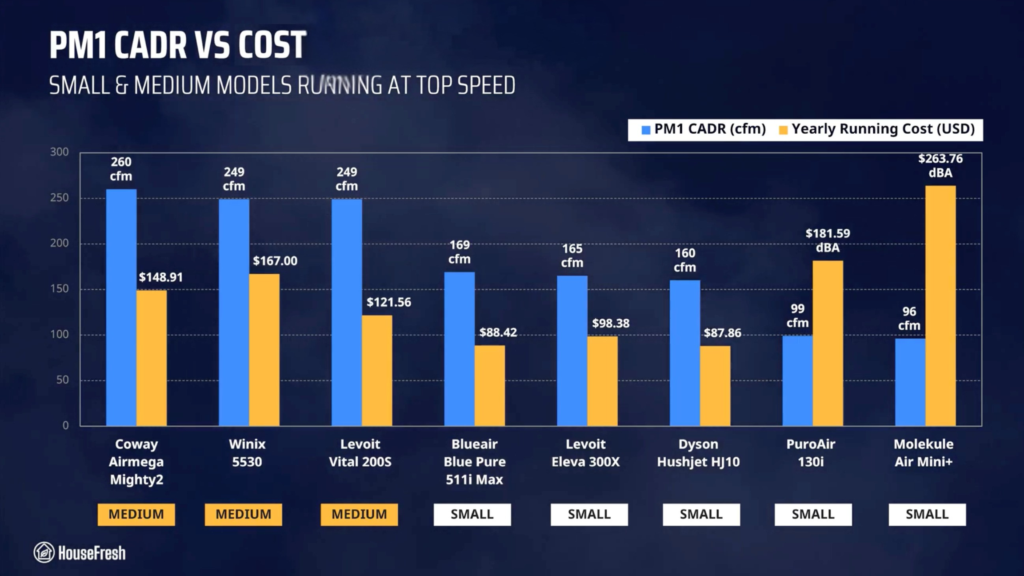
Blueair Blue Pure 311i Max review

Blueair 311i

The Blue Pure 311i Max is a mid-sized air purifier from Blueair, available worldwide under various model names, including the Blue Pure 3350i Max (Europe) and the Blue Pure 3450i Max (Oceania and parts of Asia).

The 311i Max has smart functionalities, such as WiFi connectivity, auto-mode, an LED air quality indicator and an app that allows you to control the air purifier remotely. As with other devices from Blueair, it features their trademarked HEPASilent technology which combines mechanical filtration with electrostatic ionization.

The overall score for the Blue Pure 311i Max incorporates first-hand data results from our battery of tests, as well as our ratings for customer service, brand transparency and design & UX. Check out the full scorecard below to see the split of categories.

The pros and cons of the 311i Max

A summary of our top-level findings after testing this air purifier following our methodology.

“Raw figures from our particle removal tests show that this air purifier offers solid air cleaning performance, and the use of HEPASilent allows the 311i Max to clean a lot of air without consuming too much energy.

If you don’t mind the use of electrostatic ionization, then this could be a good option for you.

Danny Ashton HouseFresh
Danny Ashton
HouseFresh Founder
& Lead Tester

What we really like

Good air cleaning performance at top speed for less than $300, comparable to what youโ€™ll get with the Winix T810 and the Dyson BP06.
Low energy usage that helps keep long-term costs low โ€“ it is less power-hungry than smaller devices like the PuroAir 240 or the Molekule Air Mini+.
The app works well and allows you to operate the 311i remotely.
It is aesthetically pleasing, as we have come to expect from Blueair devices with fabric pre-filters.
Good size for small to medium-sized rooms.

What we think could be better

It comes with an optical sensor instead of laser sensor, so youโ€™re going to have to remember to clean the sensor regularly.
You will be forced to use its in-built ionizer, in the form of Blueairโ€™s trademarked HEPASilent technology, which cannot be disabled.
With every new generation of 311 devices, Blueair introduces a new design that uses different filters, so if youโ€™re thinking about upgrading from the old 311 Auto, you wonโ€™t be able to use any filters you might already have at home.

Clean air delivery rate (CADR):โ€“ Top speed PM1 CADR: 220 cfm
– Sub-45 dBA PM1 CADR: 108 cfm
โ€“ AHAM PM2.5 CADR: 321 cfm (dust)
Filter technology:Bonded particle and carbon filter with a removable fabric pre-filter and HEPASilent electrostatic filtration.
Recommended room size:330 sq. ft. (5 air changes per hour)
Dimensions:19 x 12.5 x 12.5 in (48H x 32W x 32D cm)
Weight:7.87 lbs (3.56 kg)
Noise level in decibels from 3 ft. away:Sleep: 34.9 dBA
Speed 1: 37 dBA
Speed 2: 47.8 dBA
Top speed: 57.7 dBA
Electricity consumption in watts:Standby: 0.6 watts
Sleep: 2.8 watts
Speed 1: 5.2 watts
Speed 2: 13.4 watts
Top speed: 29.2 watts
Manufacturerโ€™s warranty:2 years
Country of origin:Sweden
Country of manufacture:China

Filtration technology

The Blue Pure 311i Max features a cylindrical filter with three layers of filtration, along with an in-built ionizer.

The first layer is a washable fabric pre-filter that comes in various colors.

blueair 311i max fabric pre filter

The second layer is a pleated particle filter that sits underneath the fabric pre-filter.

Blueair 311i Max Particle

The third layer is a carbon-impregnated fabric that sits on the inside of the main filter.

Blueair 311i Max Carbon

When buying a filter replacement, you can choose a basic particle + carbon filter, or upgrade to Blueair’s specialist filters: the SmokeBlock (with additional carbon) or the AllergenBlock (with an odor neutralizer). Personally, I’d suggest you stick to the basic filter as it’s cheaper and will do the job in 90% of cases.

In addition to mechanical filtration, the 311i Max utilizes an ionizer that electrostatically charges particles, attracting them to the filter where they are captured and removed from the air. This process generates small amounts of ozone, and unfortunately, it cannot be disabled.

Other manufacturers such as Alen, Coway, and Winix use similar ionization technologies to supercharge their particle removal speed. However, they all include buttons or app options that allow users to disable the ionizer for those who don’t want to risk introducing ozone into their air.

Controls and smart features

The 311i Max is a smart air purifier you can control with just two buttons and also from your phone.

This air purifier comes with auto mode (adjusts fan speed based on PM2.5 levels), sleep mode (quiet and with dimmed lights) and three fan speeds.

Blueair 311i Max Controls

On the back, you get a sensor that measures the level of PM2.5 particles in the air. Unfortunately, it’s just an optical sensor so you need to remember to clean it.

Blueair 311i Max Sensor

On the front, you get an air quality indicator in the form of an LED light that circles through five colors, going from blue (excellent) to red (very polluted).

Blueair 311i Max AQI

The 311i Max comes with app support through the Blueair app. I had no issues installing the app, connecting it to the device, and using it on a regular basis. From the app, you’ll be able to adjust the fan speed, set the mode (auto or night), enable the child lock, track the filter lifetime and schedule routines for the device.

Air cleaning performance

This air purifier delivers good performance at its top speed, matching our expectations based on its AHAM CADR report.

Blueair 311i Max Test

According to our PurpleAir Zen sensor, the Blueair 311i Max needed 27 minutes to achieve PM1 zero in our 728 cubic ft. test room. Based on this time, we estimate a PM1 CADR of 220 cfm.

But this information in isolation won’t tell you much, so check out how this compares to other popular mid-sized air purifiers on the market today:

blueair 311i max performance housefresh

The Blue Pure 311i Max completed our particle removal test faster than the much more expensive Dyson Big+Quiet BP06 (30 minutes) but slower than the cheaper Levoit Vital 200S (23 minutes).

Sound levels

Blueair 311i Max Sound

We used a sound level meter to measure how much noise each of the air purifiers we review generates at each fan speed.

At top speed, the Blueair Blue Pure 311i Max reaches 57.7 dBA. Check out the table below to see how this compares to other similarly-priced air purifiers running at top speed:

blueair 311i max sound top speed

Completing our particle removal test in 27 minutes while generating only 57.7 dBA is impressive, although it doesn’t make a dent on the performance of the PC fan-powered Luggable XL-7 from CleanAirKits.

The reality however is that you are unlikely to want to run your air purifier at top speed all the time, so we found a fan speed at which the 311i Max generates less than 45 dBA of noise, which is the limit we have set for our quiet performance tests.

Running at the 311i Max at speed 1 will produce 37 dB(A) of sound, which is below the 45 dB(A) limit and close to the 40 dB(A) limit that CleanAirStars recommends for quiet classrooms and offices. At this speed, the 311I Max needed 54 minutes to complete our particle removal test:

blueair 311i max quiet performance

When we repeated the test at speed 2, the 311i Max reached PM1 zero in just 32 minutes while generating 47.8 dBA of noise. At home, I’ve been using it at this speed and it is louder than I would like BUT it is also more efficient at cleaning the air.

You can see in the table below the CADR and sound levels you get with the 311i Max at each available fan speed:

blueair 311i max CADR

Long-term running costs

Running a Blueair Blue Pure 311i Max will cost you $122.19 per year, combining energy consumption costs and filter replacement prices.

As always, we used our energy meter to measure how much electricity the 311i Max uses when running at each fan speed and also while on standby. Energy consumption ranges from 2.8 watts on sleep mode to 29.2 watts when running at top speed.

This means that if you had to leave your Blueair 311i Max running 24/7 at top speed, it would cost $32.21 in energy costs for a year, using average U.S. energy rates.

Considering you need to replace the filter every six months and that the replacement costs $44.49, you can expect to also spend $89.98 per year on filters.

When compared to other similar-performing air purifiers, the 311i Max is generally cheaper to run, thanks to its low energy usage and low-cost OEM filters:

blueair 311i max long term costs

There are many generic filters available, starting at $17 per filter when you buy two. As they donโ€™t use a HEPA grade or pelleted activated carbon the generic filters could offer a good option for those wanting to save money. We will run performance tests with a range of generic filters for our Patreon supporters.

Bottom line: Should you get the Blueair 311i Max?

A good option for those looking for a mid-sized air purifier that won’t cost an arm and a leg to run, and who aren’t bothered about using an ionizer.

Blueair 311i Max living room

At top speed, the Blueair Blue Pure 311i Max will be faster at cleaning the air and MUCH cheaper to run than the pricier Dyson Big+Quiet BP06, so overall performance and value for money is very good. Even at speed 2, it can provide 185 cfm while generating 47.8 dBA of noise, which is louder than our 45 dBA limit but not by much.

Energy consumption is lower than other mid-sized air purifiers and filter replacement costs are fair, so you won’t be spending more than you should to run this device all year long.

Plus, it comes with app connectivity and an on-board air quality sensor, for those who are looking for an air purifier with smart features.

But there are two clear cases where I don’t recommend this Blueair device:

Don’t get the 311i Max if want to remove odors or chemical gases from the air. The lack of pelleted activated carbon renders this model pretty useless for VOCs. Instead, look for an air purifier with large amounts of pelleted charcoal โ€” here are my recommendations.

Don’t get the 311i Max if you are wary of ionizers or don’t want to add ozone to your air. Unlike popular air purifiers like the Coway Airmega AP-1512hh or the Winix 5500-2, Blueair doesn’t include an option for users to disable the ionizer inside their devices. If this doesn’t sit well with you, then look into models from Levoit and Smart Air, or check out my list of ozone-free air purifiers.

And if you’re not set on getting a Blueair device but love the idea of a quiet and energy-efficient model, then check out the new generation of PC fan-powered air purifiers like the CleanAirKits Luggable XL (U.S.), the NorthBox Systems 6XL (Canada) and the Nukit Tempest Euro (Europe). All of these models are able to clean the air incredibly fast while generating less than 45 dBA of noise and pulling very little electricity.

If you decide to buy a 311i Max and want to support the work we do at HouseFresh, please use this link so we can earn a commission at no extra cost to you.

January 23rd, 2026:

  • Replaced interactive comparison tables with static images that visualize performance, sound, and long-term costs data in an easy-to-digest way.
  • Added a new chart with PM1 CADR figures and sound levels in dBA for each available fan speed.
  • Added information on the new specialist filters available for this model + my advice on whether you should spend the extra money.
  • Added a link to a new AHAM CADR report for this model that has been uploaded to the Energystar database.

Coway Airmega 250S review

Coway Airmega 250S Living room

Coway is the manufacturer behind the most popular air purifier in the world, the Airmega AP-15122HH which has been the number one pick from the team at the NY TImesโ€™ Wirecutter since 2014. 

The Airmega 250S is a relatively new model that has been around since the end of 2021, and has been very well received by the press. So well received, in fact, that one reviewer referred to it as โ€œthe Wagyu Beef of Air Purifiersโ€…

Wagyu Beef of Air Purifiers

That got me even more interested in testing its performance.

As always, we bought the Airmega 250S with our own money to experience the customer journey just as you will and remain unbiased without any special deal or connection to Coway.

The overall score for the Dyson Big+Quiet BP06 incorporates first-hand data results from our battery of tests, as well as our ratings for customer service, brand transparency and design & UX. Check out the full scorecard below to see the split of categories.

The pros and cons of the Coway Airmega 250S

A summary of our top-level findings after testing this air purifier following our methodology.

โ€œThe Airmega 250S has excellent build quality and is beautifully designed, so it is a good option for those who are happy to spend a little more on an air purifier that will look great while cleaning the air.

However, if you are sensitive to noise, you might want to pass on the 250S because it doesnโ€™t offer good air cleaning performance under 45 dBA.โ€

Danny Ashton HouseFresh
Danny Ashton
HouseFresh Founder
& Lead Tester

If you donโ€™t want to read my full review of the Coway Airmega 250S, here are the three things I like and the three things I donโ€™t.

CONS

Long-term running costs are higher than similar performing devices due to the filters needing to be changed every six months.
Sub-par air cleaning at its only sub-45 dBA fan speed. There is a big jump in noise levels when moving from speed 1 to speed 2.
The app has a habit of logging you out, which is quite annoying and could explain the low user ratings in both the App store and the Google Play store.

PROS

Build quality and design are a step above the rest. The Airmega 250S is full of little design details, from the braided cable to the retro-modern aesthetic.
It offers solid air cleaning performance at top speed โ€“ earning the 250S a spot in our rankings right beside many of our top recommended air purifiers.
It is more energy efficient than previous Coway models weโ€™ve tested.

Clean air delivery rate (CADR):โ€“ Top speed PM1 CADR: 249 cfm
โ€“ Sub-45 dBA PM1 CADR: 91 cfm
– AHAM PM2.5 CADR: 261.2 cfm (dust)
Filter technology:True HEPA filter with pelleted activated carbon and a washable pre-filter
Recommended room size:373 sq. ft.ย (5 air changes per hour)
Dimensions:18.5 x 19.7 x 8.3 in (47 x 50 x 21 cm)
Weight:20.5 lb (9.3 kg)
Noise level in decibels from 3 ft. away:โ€“ Sleep mode: 35.7 dBA
โ€“ Speed 1: 36.5 dBA
โ€“ Speed 2: 50.2 dBA
โ€“ Speed 3: 59.3 dBA
Electricity consumption in watts:โ€“ Standby mode: 1.76 watts
โ€“ Sleep mode: 4.53 watts
โ€“ Speed 1: 6.52 watts
โ€“ Speed 2: 22.01 watts
โ€“ Speed 3: 57.71 watts
Filter lifespan:6 โ€“ 12 months
Manufacturerโ€™s warranty:3 years
Country of origin:South Korea
Country of manufacture:South Korea

Coway Airmega 250S AHAM

The best Airmega 250S feature: Retro-inspired design built with high quality materials

The 250S has been built to last and is guaranteed to look great in most rooms.

If youโ€™re reading this review, itโ€™s probably because you saw the 250S and thought the design was worth paying extra compared to other air purifiers from Coway. 

Iโ€™ll be honest, as soon as I unboxed this device, I became obsessed with how it looks. I am not one to care about design or aesthetics but the Airmega 250S really made me notice. And itโ€™s not just how nice the retro-inspired design looks โ€” from the plastic chassis to the braided cable, this thing has been made with high quality materials.

Filtration technology

The Airmega 250S comes with a bonded H13 HEPA filter with pelleted activated carbon and a removable pre-filter that is also washable.

With the Airmega 250S, Coway moved away from the non-bonded filters weโ€™ve seen in the past from models such as their incredibly popular AP-15122HH or the newer Airmega 200M.ย And unlike those models, the 250s also lacks an ionizer function.

It comes with an all-in-one filter they call โ€˜Max 2โ€™ filter with a Green True HEPA particle filter on one side and a gas filter with pelleted carbon on the other.

Coway Airmega 250S Filter closeup

The removable pre-filter on this unit is really high quality and slides into place beautifully. I like that it’s washable so you can rinse it, dry it and place it back.

Coway Airmega 250S Pre filter

Bonded filters can have better performance at removing particles compared to separate filters, but once the carbon runs out, you will need to replace the whole filter โ€” even if the HEPA filter didnโ€™t need to be replaced.

Design, controls and features

A customizable heavy, rectangular air purifier with two on-board sensors and app connectivity.

Coway Airmega 250S Front

Weighing 20.5 lb (or 9.3 kg), the Airmega 250 S is heavier than other similarly powered air purifiers, and it is also wider than other mid-sized devices so it will take up more space on the floor. Luckily, it has hand holds on each side, so itโ€™s fairly easy to move around the house.

It comes with two sensors: one for particles and one for gases. When on auto mode, it switches to high fan speeds as needed based on the readers of the sensors.

Coway Airmega 250S Living room 1

While it has no screen showing air quality levels, it comes with an LED bar that changes color depending on how bad the air quality is โ€” you will also get an alert through your phone once you have setup the app.

Coway Airmega 250S Controls

The AQI light bar is easy to see and will change color from blue (good) to green (moderate) to yellow (unhealthy) to red (very unhealthy), depending on the sensor readings.

Something I really like is the introduction of a โ€˜Rapidโ€™ mode, which will supercharge the usual auto mode ensuring the device will hit its highest fan speed until the air quality is improved.

Coway Airmega 250S Top

We bought the Airmega 250S in Warm Gray, but if you go with the Airmega 250 Art, you can upgrade the look of the device to include an artwork imprinted on the front cover.

Coway Airmega 250 Art

However, it will cost you an additional $50 if you buy from Coway (or an added $100 if you buy from Amazon) and you will be giving up on the app connectivity that you get with the 250S.

The Airmega 250S comes with app connectivity through the Coway IoCare app, which is easy to use and has a clean UX without invasive ads. You can access all the controls you get on the device from the app, with the added option of scheduling routines and accessing historical air quality data.

An issue I encountered with the IoCare app is that it keeps logging me out. This is especially annoying if you donโ€™t have the password handy. Based on the poor 1.4 out of 5 stars the app gets in the App store, it looks like I am not the only one having difficulties. But to be fair to Coway, I havenโ€™t had any other issues with the app apart from this.

Air cleaning performance

We tested the Airmega 250S in our 728 cubic ft. test room, tracking how fast it removed all PM1 particles from the air after we filled the space with incense stick.

We started by testing the particle removal performance of the 250S running at its highest fan speed. According to our PurpleAir Zen sensor, it needed 24 minutes to achieve PM1 zero in our 728 cubic ft. test room:

Based on the natural ventilation of our 728 cubic feet test room, we estimate that it has a top speed PM1 CADR of 249 cfm, which could provide five air changes per hour in rooms up to 373 sq. ft.

With this data in hand, we can compare the performance of the 250S to the results of other similarly-priced air purifiers running at their top speed:

Coway Airmega 250S Performance Top Speed

As you can see from the table, air cleaning performance to cost seems fair when benchmarking with other similar powered devices. That said, you still get a much better bang for your buck with something like the AirFanta 3Pro or the Vital 200S.ย 

And if you are set on getting a Coway but not too fussed about it being the 250S, then you should probably look into the Airmega 200M, as it offers better particle removal performance for a cheaper price.

Sound levels

The sound levels of the 250S range from 35.7 dBA to 59.3 dBA โ€” louder than similar performing models like the Smart Air SA600 and the Levoit Vital 200S.

Coway Airmega 250S Sound energy test

If an air purifier is too loud, you will find yourself turning it off eventually.

That is why we used a sound meter to measure how much sound the Coway Airmega 205S generates from 3 ft. away at each of its fan speeds:

Coway Airmega 250S Sound levels

Be aware our background noise is 35 dBA, so the 250S running at sleep mode and set to speed 1 is likely to be quieter than 36.5 dBA if you could measure sound levels in a silent room.

Even though it’s a larger device, when running at its highest fan speed, the 250S is quieter than the Airmega 200M. That said, it is still louder than most other mid-sized traditional air purifiers we benchmarked it against.

Coway Airmega 250S Performance VS Sound

However, it is clear that this device is much louder than a PC fan-powered air purifier like the Luggable XL-7 from CleanAirKits.

One of the benefits of going with a mid-to-large sized air purifier, is that you can run them at low (and quiet) fan speeds while still enjoying powerful air cleaning performance due to use of larger fans and filters. That is why we also test the particle removal speed of our air purifiers running at quiet fan speeds.

The Airmega 250S needed 64 minutes to remove all PM1 particles from the air running at speed 1 (36.5 dBA) and 30 minutes running at speed 2 (50.2 dBA). 

When comparing the sub-45 dBA performance of the 250S to other air purifiers running at fan speeds that generate less than 45 decibels, it becomes clear that this air purifier doesn’t offer good air cleaning at quiet operation.

Coway Airmega 250S Performance Sub 45DBA

Based on the natural ventilation of our test room, we estimate that the Coway Airmega 250S has a sub-45 dBA PM1 CADR of 91 cfm which would be powerful enough to offer five air changes per hour in rooms no larger than 136.5 sq. ft.

I would like for Coway to add a fan speed in between speed 1 and speed 2 that doesnโ€™t exceed 45 dBA, as this is a sound level that many people will have no issues hearing all day in the background.

Long-term running costs

Running a Coway Airmega 250S will cost you $224.08 per year, combining energy consumption costs and filter replacement prices.

Coway Airmega 250S Close

As always, we used our energy meter to record how much energy the Airmega 250S uses when running at each fan speed and also while on standby. If you had to leave your 250S running at its top speed 24/7, it would cost $64.10 in energy costs for a year.ย 

Coway Airmega 250S Energy consumption

Now, I know this is an unlikely scenario as you will probably prefer having the device running at a quieter fan speed in the background, but I use this โ€˜worst case scenarioโ€™ to estimate the most the 250S could add to your energy bill each year.

But it’s not just energy costs that add to the running cost of an air purifier, you will also need to replace the filters eventually. In the case of the 250S, Coway says that you need to replace the filters every 6-12 months.

The recommended official filter (AP-1720-FP) costs $79.99, which means that you will need to spend $159.98 each year in filter replacements.ย 

When we combine energy costs with filter replacement costs, we find that the Coway Airmega 250S will cost you $224.08 per year to run.

Coway Airmega 250S Yearly Costs

Due to the filters needing to be changed twice per year, the costs are higher than those models that only need changing every 12 months. In this benchmark of similar devices, the 250S ranks as the air purifier with the highest long-term running costs.

Coway Airmega 250/250S Air Purifier Replacement Filter Set, Max 2 HEPA Filter and Active Carbon Filter, AP-1720-FP
  • Coway Airmega 250/250S Replacement Filter
  • Coway Airmega Max2 filter is an all-in-one that combines Coway HEPA filter with an Activated Carbon filter.
  • Coway Airmega Max2 filter has an average of 12-month lifespan.

Bottom line: Should you get the Coway Airmega 250S?

For raw money-to-air-cleaning-performance, you will get a better deal with the older AP-15122HH or the newer Airmega 200M.

Coway Airmega 250S Sofa

The Airmega 250S has excellent build quality and is beautifully designed, so it is a good option for those who are happy to spend a little more on an air purifier with smartphone connectivity that will look great while cleaning the air.

However, if you like the look of the 250S but are not keen on having yet another app on your phone, then you may want to choose the Airmega 250 instead or even the Airmega 250 Art for a snazzier look.

Coway Airmega 250S Corner

If youโ€™re not convinced by the looks, then Iโ€™d say there are other mid-to-large sized air purifiers out there that will give you great air cleaning power even at quiet fan speeds for less or about the same price youโ€™ll pay for the 250S.

A big problem with this device is the small number of fan speeds. 

While speed 1 is very quiet, air cleaning performance is not as impressive. Switching to speed 2 will improve this, but the 250S will get noisy as this fan speed goes over 50 dBA, which is louder than most people would like to have running continuously. 

It would be much better to see a fan speed in between that runs at just under 45 dBA, as we know that many people could deal with this sound level running all the time in the background.

For those wanting a powerful air purifier with excellent quiet performance, smartphone connectivity, and a design that looks as good as the Coway 250S, check out the Levoit EverestAir

And if you want to save some money, look into the Winix 5500-2 and the Levoit Vital 200S, both of which will give you the same level of air cleaning power for a cheaper upfront and long-term cost.

I hope my review was helpful and if you have any questions about the Coway Airmega 250S, be sure to leave them in the comments below.

NorthBox 6XL review

North Box 6XL Side

After his father went into a long-term care facility at the height of the COVID-19 pandemic, Robert Fantinatto teamed up with his son Aidan to make PC-fan powered air purifiers easily available to Canadians. 

As with all the air purifiers we tested, we bought the NorthBox 6XL with our own money. We went with the DIY kit as it was easier to ship all the way to the UK, and chose the HDF hardboard version as it was cheaper at $220 CAN. 

The DIY kit came with everything we needed to build the 6XL, except for the two 20x20x1 3M Filtrete MERV13 filters and the six Arctic P14 fans. But if DIYing is not your thing, you can get the fully assembled version for $350 CAN.

In this review, I will be comparing the NorthBox 6XL against the more than 100 air purifiers I have tested to date. I will take you through my first-hand data on air cleaning performance, sound generation, electricity consumption, user experience and long-term running costs.

how we test
How we test air purifiers

Read our full testing methodology.

The lowdown on the NorthBox 6XL

Danny Ashton HouseFresh
โ€œThe NorthBox 6XL is an excellent alternative to the CleanAirKits Luggable models for those living in Canada, who will be able to buy them without worrying about tariffs while supporting a Canadian small business.

Air cleaning performance, sound generation and energy consumption are on par with what weโ€™ve come to expect from PC fan-powered devices.โ€

โ€” Danny Ashton, HouseFresh Founder & Senior Writer

If you donโ€™t want to read my full review, here are the five things I really like about the 6XL, and the three things I don’t.

What we really like

Excellent air cleaning performance comparable to the impressive Luggable XL-7 from CleanAirKits.
Outstanding particle removal speed at quiet operation with Noctua P14 Redux fans.
It is more affordable than other PC fan air purifier kits such as those from CleanAirKits and Nukit.
It uses 20x20x1 MERV 13 filters that are easily available.
It is lightweight and easy to move around.

What we think could be better

I found it trickier to build compared to the CleanAirKits Luggable XL-7 โ€” but itโ€™s definitely easier than the Nukit Tempest.
There is no mesh filter guard or pre-filter available, which is something we see with the Tempest and the Luggable.
North Box Systems doesnโ€™t have an online store, so you will need to email them to make an oder.

HouseFresh rating:โ—ผ๏ธโ—ผ๏ธโ—ผ๏ธโ—ผ๏ธโ—ผ๏ธโ—ผ๏ธโ—ผ๏ธโ—ป๏ธโ—ป๏ธโ—ป๏ธ 7/10
Time to clean our 728 cubic feet test room (with the device running at top speed):– Top speed: 21 minutes (Arctic P14 Max)
– Sub-45dBA speed: 23 minutes (Noctua P14 Redux)
Air filtration technology:MERV 13 (20x20x1 3M Filtrete MPR 1900)
Recommended room size (5 air changes per hour):427 sq. ft.
Clean air delivery rate (CADR):HouseFresh PM1: 285 cfm
Dimensions (in inches / in cm):20 x 20 X 5.5 in (50.8 x 50.8 X 14 cm)
Weight (in pounds / in kg):2.4 lbs (1.1 kg)
Filter life:12 months
Noise level in decibels (measured from 3 ft. away with a sound level meter):– Arctic P14 Max: 50.2 dBA
– Noctua P14 Redux: 45.1 cBA
Electricity consumption in watts (recorded with an electricity usage monitor):– Arctic P14 Max: 28.45 watts
– Noctua P14 Redux: 14.4 watts
Estimated running cost:โ€“ Energy consumption: $31.60 per year
โ€“ Filter replacement: $89.98 per year
Manufacturerโ€™s warranty:1 year
Country of manufacture:Canada

The best 6XL feature: Repairable, upgradeable and customizable

You can choose different types of PC fans depending on what you value most: sheer power or quiet performance.

One of my favorite features of the new generation of PC fan-powered air purifiers is the fact that you can fix and replace parts, using widely available air filters and fans. 

In the case of the NorthBox 6XL, we were able to build multiple versions of the same device without any issues. Each time, we were able to improve the performance of the air purifier in regards to its particle removal efficiency and its sound generation. 

This makes the 6XL highly customizable, depending on what you value most: quiet power or particle removal speed.

A natural HDF hardboard body that houses two 20×20 MERV 13 filters

The design of the 6XL is reminiscent of the Luggable XL-7 we reviewed from CleanAirKits.

North Box 6XL CleanAirKits XL7

The moment I finished building my 6XL, I could immediately see the resemblance with the design of the Luggable XL from CleanAirKitsโ€”especially considering the use of 3M Filtrete MERV 13 filters. 

In fact, on their website, North Box Systems highlighted CleanAirKitsโ€™ own Rob Wissmann as a source of inspiration, alongside the DIY movement around the Corsi-Rosenthal box. 

north box systems website

However, unlike CleanAirKits, you donโ€™t get a handle and wonโ€™t find an option to add a mesh guard or pre-filter on top of the MERV 13 filters. 

That said, you will get two choices for the body of your NorthBox 6XL: glossy black acrylic or natural HDF hardboard, with the first one adding $30 to the price. 

Personally, I prefer the wooden look and the cost-savings associated with the HDF hardboard, but I am aware that there might be durability benefits with the acrylic version.

North Box 6XL Side

As I mentioned in the intro, we went with the DIY kit to build our 6XL at home because it was cheaper and easier to ship to the UK. The kit comes with everything you need (bar the filters and the fans), including a UL/C 12V power supply, safety grills to place on top of the fans and a set of adjustable internal tension cords to keep the cables nice and tidy on the inside.

This was the third PC fan kit I put together and I must say that I found it a little trickier than the kit from CleanAirKits but much easier than the one from Nukit.  I really appreciate the team at North Box published a how-to video for people to follow while building the air purifier. 

And I know that Robert Fantinatto made some adjustments to the kit after my initial video, so Iโ€™m looking forward to building and testing another model from North Box Systems to see the improvements. 

In terms of fans, North Box recommends the Arctic P14 fans, which will set you back $49.99. For my build, I wanted to try something different so I went with the Artic P14 Max fans and I also tested Noctua P14 Redux fans. 

And when it comes to filters, you will be able to use any 20x20x1 MERV 13 filters you can get hold of.

North Box 6XL Top Down Filter

North Box recommends the 3M Filtrete MPR1900, so we went with those filters because we were super impressed with the particle removal efficiency of the Filtrete MPR1900 when we tested them with the Luggable XL and the Lasko 2-in-1.

The NorthBox 6XL cleared our test room in 21 minutes

Our build with Arctic P14 Max fans completed our particle removal test two minutes faster than the CleanAirKits Luggable XL-7.

North Box 6XL Top

PRICE on amazon PRICE on EBAY

We tested the NorthBox 6XL in the same 728-cubic-feet room where we have tested 100+ different air purifier models since 2020. By testing every device in the same room doing the same job of removing incense smoke, we can quickly compare performance across devices.

Our 6XL build with Arctic P14 Max fans cleared all PM1 pollutants from incense smoke in 20 minutes, which is two full minutes faster than the result achieved by the CleanAirKits Luggable XL-7 with one more PC fan than the 6XL:

That means that, by choosing to use the P14 Max fans, I managed to improve the air cleaning performance of the 6X, but as you will see later, this build has some downsides.

Next, we repeated the particle removal test with the Noctua P14 Redux fans, and this version of the 6XL took a little longer, reaching PM1 zero in 23 minutes:

You can see in the table below how these results compare to some of the most popular air purifiers we have tested:

North Box 6XL Performance compared

Similar to the Luggable XL, the NorthBox 6XL comes at a higher initial cost when compared to HEPA retail devices with similar air cleaning performance. However, you will get a lot more value out of the 6XL when looking at quiet performance and long-term running costs.

In our testing, the Noctua build of the 6XL hit 45.1 dBA and the P14 Max build hit 50.2 dBA.

North Box 6XL Sound test

While air cleaning performance is very important, it is not the only thing you should focus on when choosing an air purifier. Sound is important too. 

If an air purifier sounds like a jet engine, youโ€™re likely to end up turning it off eventually. That is why, we used our sound meter to measure how much sound is generated by the NorthBox 6XL from 3 ft. away.

Our data shows that the P14 Max build generates 50.2 dBA and the Noctua build is quieter at 45.1 dBA. But this information in isolation is not as helpful, so let me show you how this compares to other air purifiers running at their top speed:

North Box 6XL Sound compared

As you can see from the table above, in my quest to improve air cleaning performance with the use of Arctic P14 Max fans, I built a version of the 6XL that is much louder than the other PC fan kits I have tested. 

I want to be clear, this is down to me choosing these fans rather than any issue with the design from North Box. North Box recommends the use of Arctic P14 fans, which would be much quieter.

If sound is a big deal for you

If youโ€™re keen to experiment with the PC fans for the 6XL, I would suggest looking into the non-Max version of the Arctic P14 fans, which will be much quieter and we recorded reaching 41.8 dBA in our build of the Nukit Tempest.

We have been experimenting with lots of different fan models for our Nukit Tempest that you might want to check out:

While I was able to improve the CADR of our  6XL a little with the use of P14 Max filters, the downside is that youโ€™ll get much louder operation so it is probably not worth it. 

Using the Noctua P14 Redux fans, I managed to lower sound levels to the 45 dBA limit we set for our quiet performance tests. Check out the table below to see how the air cleaning performance of the 6XL compares to other air purifiers at sub-45 dBA fan speeds:

North Box 6XL Sub45 performance compared

As the chart above shows, when comparing quiet performance below 45 dBA it becomes clear that PC-fan air purifier kits offer a lot more value that youโ€™ll ever get from HEPA retail devices.

And even though that the NorthBox 6XL with Noctua P14 Redux fans is louder than other PC-fan powered devices, its particle removal performance still outmatches every other shop-bought device on the list.

The cost to run a NorthBox 6XL: $85.50 CAD per year

1. Electricity costs = $30.97 CAD per year

As part of our reviews, we use a power meter to measure how much energy is pulled at each fan speed. As the NorthBox 6XL has only one speed, we only needed to record energy consumption at its only speed.

When running the 6XL with P14 Max fans, it pulled 28.45 watts. When we swapped for Noctua P14 Redux fans, the power consumption dropped to 14.4 watts.

We can now compare the estimated energy costs associated with running a NorthBox 6XL, based on calculations we made using the appliance cost calculator from BC Hydro.

North Box 6XL Energy consumption

But itโ€™s not just electricity costs that add up to the maintenance costs of running an air purifier in your home 24/7; you also need to think about filter replacements.

2. Filter costs = $54.53 CAD per year

As with any air purifier, youโ€™re going to have to replace the filters in your NorthBox 6XL eventually. 

The 6XL uses two MERV 13 20x20x1 filters and, depending on where you live, you should be able to get 12 months of use out of them before itโ€™s time to replace them.

If you go with the recommended 3M Filtrete MPR1900, you will pay $163.58 on Amazon.ca for a set of six filters, which should last you around three years. That means that you should budget around $54.53 per year in filter replacements for your 6XL.

When we combine energy usage with filter replacement costs, we estimate that the NorthBox 6XL could cost you 

Still, when you combine the energy usage with these filter prices, the Northbox 6Xl annual running cost is $85.50 CAD. This figure compares favorably with other air purifiers we have tested: 

North Box 6XL Yearly costs

As you can see from the table above, choosing to build your 6XL with Arctic P14 Max fans, you will end up paying more in the long run due to how power-hungry those PC fans are compared to what you can expect to pay with the Noctua P14 Redux fans.

Bottom line: Should you buy a NorthBox 6XL?

If you are based in Canada, the 6XL is the best value PC fan-powered air purifier you can buy today.

North Box 6XL Corner

So before I jump into the conclusion, itโ€™s fair to say that I messed this one up when I decided to build my first iteration of the 6XL using six Arctic P14 Max fans.

When I swapped out the P14 Max fans for the Noctua Redux fans, we improved performance at quiet fan speeds. However, the Noctua fans are quite pricey so it might be better to get the standard P14 fans, as recommended by North Both.

North Box 6XL Close

All in all, Iโ€™d say that the NorthBox 6XL is an excellent alternative to the CleanAirKits Luggable models for those living in Canada, who will be able to buy them without worrying about tariffs while supporting a Canadian small business.

The 5XL and 6XL PC fan-powered air purifiers from North Box should be the top choice for those looking for a PC fan air purifier in Canada.

If you have any questions about this device, please drop them in the comments below and I’ll try to reply as soon as possible.

SOURCES

We calculated yearly costs associated with running the NorthBox 6XL for 24 hours a day, 365 days a year, based on the Canada average utility rate as of March 31st, 2025.

Winix T810 review

Winix T810 Header

After having tested multiple Winix air purifiers, I have grown to become a fan of their brand. 

In fact, their trusted and affordable Winix 5500-2 is one of my top recommendations for most people. So you can imagine my excitement with the release of the new Winix line in 2023.

The Winix T810 was first announced in September 2023 as a โ€œcutting-edgeโ€ air purifier with โ€œunparalleled 360ยฐ air care capability.โ€ These big promises were paired with photos of a sophisticated, โ€œInstagrammableโ€ design that weโ€™ve never seen from Winix.

In this review, I will compare the T810 to the more than 100 air purifiers we have tested at HouseFresh since 2020. 

My observations are based on our first-hand data on air cleaning performance, sound generation, energy efficiency, real-life user experience and long-term running costs. You can read more about how we test air purifiers here.

By the way, I bought our T810 for $421.66 on Amazon.com, including the shipping and import fees needed to get it sent to us here in the UK. If you are buying it from the U.S. you will only need to pay $215.

The lowdown on the Winix T810

Danny Ashton HouseFresh
โ€œThe Winix T810 offers good air cleaning performance in a relatively small package. 

To put it into perspective, the T810 offers better particle removal performance than what you will get from the popular Coway Airmega AP-1512hh, which has a bigger footprint and costs around the same.โ€
โ€” Danny Ashton, HouseFresh Founder & Product Tester

PRICE ON amazon PRICE ON Sylvane

If you donโ€™t want to read my full review of the Winix T810, here are the three things I like about it, and the three things I donโ€™t:

What we really like

I love the design. I have 105 air purifiers (and counting!) at home right now, and the T810 stands out because it looks like a million bucks.
It offers solid air cleaning performance in a relatively small package. The T810 offers better performance than many devices with a bigger footprint.
The Winix app has clean UX without invasive ads. Plus, the smart features work well and the onboard sensor is quick to detect changes in air quality.

What we think could be better

It can get loud. When running at turbo speed, the T810 runs louder than many similar performing air purifiers.
It has a bonded filter. The all-in-one filter is cumbersome to clean regularly and will need replacing once the carbon is full, even if the HEPA filter is perfectly fine.
It is not cheap. The T810 sells for over $200, so it’s more expensive than high-performing devices like the AirFanta 3Pro ($160) and the Levoit Vital 200S ($190).

HouseFresh rating:โ—ผ๏ธโ—ผ๏ธโ—ผ๏ธโ—ผ๏ธโ—ผ๏ธโ—ผ๏ธโ—ผ๏ธโ—ป๏ธโ—ป๏ธโ—ป๏ธ 7/10
Time to reach PM1 zero (running at top speed in our 728 cubic feet test room):– 26 minutes (top speed)
– 46 minutes (sub-45 dB speed)
Air filtration technology:True HEPA particle filter with carbon and pre-filter mesh
Ionization technology:PlasmaWave bipolar ionization that can be disabled
Recommended room size (5 air changes per hour):343 sq. ft.
Clean air delivery rate (CADR):– HouseFresh PM1: 229 cfm
– AHAM PM2.5: 267 cfm (dust)
Dimensions (in inches / in cm):11.3 x 11.3 x 20.4 in (28.7 x 28.7 x 51.8 cm)
Weight (in pounds / in kg):10.4 lbs (4.7 kg)
Filter life:12 months
Noise level in decibels (measured from 3 ft. away with a sound level meter):– Sleep mode: 35.1 dBA
– Speed 1: 37.4 dBA
– Speed 2: 44.8 dBA
– Speed 3: 50.3 dBA
– Speed 4: 62.5 dBA (top speed)
Electricity consumption in watts (recorded with an electricity usage monitor):– Standby: 0.52 watts
– Sleep more: 2.2 watts
– Speed 1: 4.40 watts (4.72 w/PlasmaWave)
– Speed 2: 8.23 watts (8.47 w/PlasmaWave)
– Speed 3: 12.30 watts (13.42 w/PlasmaWave)
– Speed 4: 41.92 watts (42.59 w/PlasmaWave)
Estimated running cost (electricity consumption + official filter replacement):– Energy consumption: $47.31 per year
– Filter replacement: $79.99 per year
Manufacturerโ€™s warranty:2 years
Country of manufacture:Thailand

The best T810 feature: A design that will make you look twice

The Winix T810 wonโ€™t look out of place in the most stylish of spaces.

Winix T810 Living room

I know looks have nothing to do with air cleaning performance, but itโ€™s hard not to comment on how beautiful the design of the T810 โ€” especially compared to other Winix air purifiers we have tested.

The Winix T810 is easy on the eye thanks to its sleek medium-sized cylindrical design with vertical lines topped by a high-end touchscreen control panel. 

If you asked me to choose the best looking air purifier out of the 104 devices Iโ€™ve got now in my home, the T810 would be my pick.

A modern and sophisticated device, packed with smart features

The T810 is one of the few air purifiers from Winix with smartphone connectivity.

Winix T810 Close Up

Normally, my wife and I disagree on what we like and dislike about the design of air purifiers, but for once, we are both in agreement that the T810 is a seriously good-looking device.

While design aesthetics shouldnโ€™t be your primary concern when shopping for an air purifier, I understand itโ€™s an important thing to consider because you will need to have the device on show all the time.

If having a better-looking design means more people are more likely to use air purifiers, then I am all for it.

The big difference over other popular Winix devices is the use of a cylindrical design vs the rectangular box we see with the 5500-2, C545, Zero Pro, 5510, Zero Sโ€ฆ etc.

T810 Winix Comparison

However, there are some downsides to the T810โ€™s cylindrical design.

The 360-degree filter combines all filters into one, so you will have to throw away the entire filter once the carbon layer is fullโ€”even if the HEPA filter is perfectly fine.

You have to remove the full filter to vacuum and clean the pre-filter cover. The process is more cumbersome compared to devices with washable removable pre-filters.

That said, the big benefit to the cylindrical design is that the T810 is less bulky and takes up less floor space than other medium-sized air purifiers with similar levels of performance.

You can see in the photo below how the T810 compares to two of our most recommended air purifiers since 2023: the 5500-2 also from Winix (right)  and the Levoit Vital 200S (left):

Winix T810 Vital 200s Winix 5500

Rather than pulling air from just the front, the T810 pulls air in from all sides of the device, which means you have higher CADR without the usual large size.

Compared to other cylindrical air purifiers such as the Levoit Core series, I much prefer the design choices that Winix has made. 

The vertical lines make the T810 feel much more stylish and sophisticated than the usual all-white cylinder shape used by many other air purifier manufacturers.

We chose to go with the Silver design, but you can also choose Blue stripes instead if you go for the T830:

Winix T810 vs T80

The one thing I dislike about some cylindrical air purifiers is having to access the filter through the bottom of the device. Sadly, this is what Winix decided to do with the T810.

So to access the filter of your T810, you will have to tip the device upside down and turn the handle counter-clockwise to release the cover:

Winix T810 Bottom Cover

Something my wife reported experiencing a few times, which is a common issue with this type of cover: if you slide the air purifier on the ground from one side to another for some reason (e.g. you’re sweeping the floor), then you might end up unintentionally opening the cover.

Moving on from the design aesthetic, one of the big differences between the T810 and most other Winix air purifiers is the inclusion of an onboard screen and app support.

Not only that.

Like the Winix ZERO Pro, the T810 also comes with two sensors: one for particles and one for gases.  This makes the T810 more responsive to air quality changes. 

Plus, people often forget to clean the particle sensor and this can negatively affect the reliability of the auto-mode. The addition of the gas sensor is a welcomed inclusion for those cases. 

The screen takes a few moments to kick in, but once it does, it shows the level of PM2.5 detected on screen.

You also get an LED light that adjusts its color based on the level of air quality, moving through red (poor) to amber (fair) to green (average) to blue (good).

Winix T810 Touchscreeh

Another innovation from Winix is the inclusion of app connectivity.

The T810 can be paired to the Winix Smart app, which I found easy to install and navigate. The app has a clean UX, without the product ads or content marketing we see with other manufacturer apps such as Levoit.

I tested the Apple app, which has better ratings (4.6 stars) than the Android app (3.3 stars), so perhaps I am one of the lucky ones but I didnโ€™t encounter any issues and I am happy with the appโ€™s functionality. The scheduling function is easy to use, and every other feature can be also controlled from the touchscreen on top of the device and the remote control.

Something I really liked about the app is having the ability to store historical air quality data from the device, but I am a data nerd so it might not be something youโ€™ll care about. I’m also glad Winix didnโ€™t move all the features to the app (as we see with Xioami) because not everyone wants another app.

An all-in-one 360ยฐcylindrical True HEPA filter with an activated carbon coating

It offers good particle filtration but doesnโ€™t come with enough carbon to be effective against serious VOCs or strong smells like cigarette smoke.

Winix T810 Filter

Overall, the filter you’ll get with the Winix T810 is very similar to other cylindrical filters we see with many other brands:

Cylindrical Filter Replacement 1

But this all-in-one bonded filter is very different from what we expected from Winix.

You see, most Winix air purifiers come with separate filters for carbon and particles. These non-bonded filters from Winix usually come with a removable (and often washable) pre-filter, which makes it easier to quickly clean the pre-filter to help extend the life of the HEPA filter.

Winix T810 Comparison Winix Filters

However, the T810 comes with an all-in-one cylindrical filter that includes a pre-filter mesh, a carbon coated layer and a True HEPA filter.

As is the case with every other Winix device, the particle filter of the T810 is HEPA-graded, which means it was independently tested and certified by a lab as True HEPA grade.

And the gas filter consists of a carbon coated layer, which is likely not going to be as effective at tackling chemical gasses and odors compared to a filter with a good amount of pelleted activated carbon.

The Winix T810 cleared our test room in 26 minutes

It matches the performance of the Coway Airmega AP-1512hh, but it was slower than the Levoit Core 400S.

Winix T810 HouseFresh Performance Test

First, we tested the particle removal speed of the Winix T810 running at top speed with PlasmaWave enabled. 

According to our PurpleAir Zen sensor, the T810 needed 26 minutes to achieve PM1 zero in our 728 cubic ft. test room:

We can compare this to other similarly-priced devices running at their top speed:

Winix T810 Top Speed Performance Compared

Considering AHAMโ€™s high CADR ratings for this device (267 cfm for dust), I was surprised that it wasnโ€™t quicker than the Winix 5500-2 and Vital 200S.

Itโ€™s also fair to say that while the list price ($250) is similar to that of other devices, many (like the Winix 5500-2) are often sold for much less so you are likely to get better value from this older Winix device.

But, these are the results with PlasmaWave enabled, which is not something everyone will want to have as many people avoid ionizers. That is why we disabled PlasmaWave and re-tested the air cleaning performance of this device.

Without using Plasmawave, the T810 needed 27 minutes to achieve PM1 zero โ€“ that is just one additional minute from our previous test. This is how this result compares to other air purifiers with and without their ionizers enabled:

Ionizer On Off Comparison

Our data shows that the T810โ€™s PlasmaWave has a fairly low effect on overall air cleaning performance hereโ€•especially when compared with what we saw with the Blueair 211+ or the Coway AP-1512HH. So, I see no downside to running your T810 without PlasmaWave enabled if you want to avoid bipolar ionization.

It is louder at top speed than other mid-sized air purifiers we recommend

In our testing, the sound levels of the Winix T810 ranged from 35.1 dBA to 62.5 dBA.

Winix T810 Sound Electricity Test

If an air purifier is too loud, you will find yourself turning it off eventually. That is why we always measure how much sound they generate from 3 ft. away with a sound monitor.

These are the results for the T810:

Winix T810 Sound Test

Tip

Be aware our background noise is 35 dBA, so the T810 running at speed one (1) is likely to generate less sound if you could measure it in a silent room.

As you can see from the table below, the T810 does run louder than many of the other similar-performing air purifiers we have benchmarked:

Winix T810 Noise Levels Compared

Next, we re-tested the particle removal performance of the T810 when running at its lower fan speeds.

Running at speed two (2), it generates 44.8 dBA, which is just below the 45 dBA limit that CleanAirStars recommends for noisy classrooms or offices. At this speed, the T810 managed to reach PM1 zero in 46 minutes.

When running at sub 45 dBA, the T810 performs similarly to other popular devices, such as the Levoit Vital 200S and Winix 5500-2 although you do get better performance at the same sound level with the Levoit Core 400S:

Winix T810 Sub 45dB Comparison

As I expected, our data shows that the T810 is completely outmatched by PC fan-powered devices like the CleanAirKits Luggable XL-7 and the AirFanta 3Pro. But this makes sense as PC fans are whisper quiet.

The cost to run a Winix T810: $126.64 per year

We look at how much the T810 will cost you in the long term, including your energy bill and filter replacement costs.

1. Electricity costs = $46.65 per year

As always, we used our energy meter to record how much energy the T810 uses when running at each fan speed and also while on standby.

I also made sure to measure how much power was used once I disabled PlasmaWave:

T810 Power Consumption

If you were to leave your Winix T810 running 24/7 at its top speed with PlasmaWave enabled, it would add $46.65 to your energy bill within a year.

With this calculation in mind, we can compare the annual energy costs you can expect from the T810 to other devices we have tested.

Winix T810 Electricity Costs Comparison

At this point, we can see the improvements WInix has made as the T810 is more energy-efficient than the popular 5500-2.  That said, if youโ€™re looking for a cheaper alternative to run, you might want to consider the Levoit Core 400S or the CleanAirKits Luggable XL-7.

2. Filter costs = $79.99 per year

Itโ€™s not just energy costs that add to the running cost of an air purifier, you will also need to replace the filters eventually. 

Winix says that you need to replace the filters for the T810 every 12 months and their OEM Filter R filter costs $79.99

Sale
Winix Genuine Replacement Filter R for T810 Air Purifier
  • Compatible with Winix air cleaner model T810
  • Fine Mesh Pre-Filter: The first line of defense against the largest airborne particles found indoors
  • True HEPA Filter: Captures 99.99%* of airborne allergens including pollen, dust, pet dander, and smoke (particles as small as 0.01 microns in size)
  • Activated Carbon Filter: Reduces VOCs and household odors from cooking, pets, and smoke. It is designed to catch airborne particles found indoors
  • Genuine Winix one year replacement filter set. For optimal performance, it is recommended to change the All-in-one True HEPA Canister Filter once every 12 months

So you can expect to pay $79.99 each year on filter replacements for the T810. 

As you can see from the chart below, the annual running costs of the T810 are higher than what you can expect from units like the Levoit Vital 200S or the Coway Airmega Mighty.

Winix T810 Yearly running costs

As this air purifier is fairly new, I was happy to see that you can already get generic filters from PUREBURG for $29.22 for one filter.

Now, I wasnโ€™t able to buy a PUREBURG filter from the UK to test it with the T810, but based on tests Iโ€™ve run with other air purifiers, I have found PUREBURG filters usually offer similar performance to genuine filters.

PUREBURG Replacement R Filter Compatible with Winix T810 T820 T830 Air Purifier 1712-0118-00,H13 HEPA Activated Carbon 3-Stage Filtration
  • H13 3-Stage Filtration True HEPA Filter,1-Pack
  • Compatible with Winix T810 T820 T830 Large Room Air Purifier 1712-0118-00 (Filter R)
  • H13 HEPA capture up to 99.97% of PM2.5 particles as small as 0.3 microns. This includes dust, pet dander and other minute particles ,Activated Carbon reduce Chemicals VOCs, tobacco smoke,PM2.5,common household bad smell,Fine Mesh Layer Prevents large particles such as dander,Pet hair
  • Please replace regularly to keep your machine fresh and clean. For the best performance, clean the filter once a month with a soft brush gently or with a vacuum cleaner.
  • Top Notch Quality Used for Maximum Customer Satisfaction Guaranteed. Every Product made by PUREBURG is Tested through Rigid Examinations and QC Procedures.

However, performance will vary depending on the amount of carbon included in the filter and the grade of HEPA you get with the particle filter. 

Tip

I will be running some experiments with my Winix T810 for our Patreon supporters, and Iโ€™ll make sure to test its performance using generic filters from PUREBURG as soon as I can buy them here in the UK.

Bottom line: Should you get the Winix T810?

Well, for most people, the older Winix 5500-2 will be a better choice.

Winix T810 Fireplace

If what you want is an air purifier with above-average air cleaning performance, then the T810 isnโ€™t it. 

You will get a better air purifier in the older Winix 5500-2 as it provides better air-cleaning performance, comes with pelleted activated carbon (which will be better for odors in the long term) and also has a removable pre-filter that you will find easier to clean regularly.

However, the 5500-2 is a big black box without app support. So, considering design and features, Iโ€™d say the main competitor to the T810 is the Levoit Core 400S, which has a similar design, comes with app support and sells for $219.99 (although youโ€™ll usually find it cheaper than that).

Now, does the Core 400S look as sleek as the Winix T810? Wellโ€ฆ no.

T810 VS Core 400S

If you are looking for a stylish air purifier that wonโ€™t look out of place in even the most well decorated spaces, then the Winix T810 is the best-looking air purifier you can buy for less than $220. I even prefer it to the also new Winix 5510, which is louder and bulkier compared to the T810.

If you end up deciding that the Winix T810 is the right air purifier for you and want to support the work we do here at HouseFresh, please make sure to use this link to make your purchase โ€” you wonโ€™t pay anything extra but we will get a 3% commission from Amazon.

Do you have any questions about the Winix T810? Have you bought the T810 and are using it at home? Please drop your question or share your experience in the comments below, and Iโ€™ll get back to you as soon as I can.
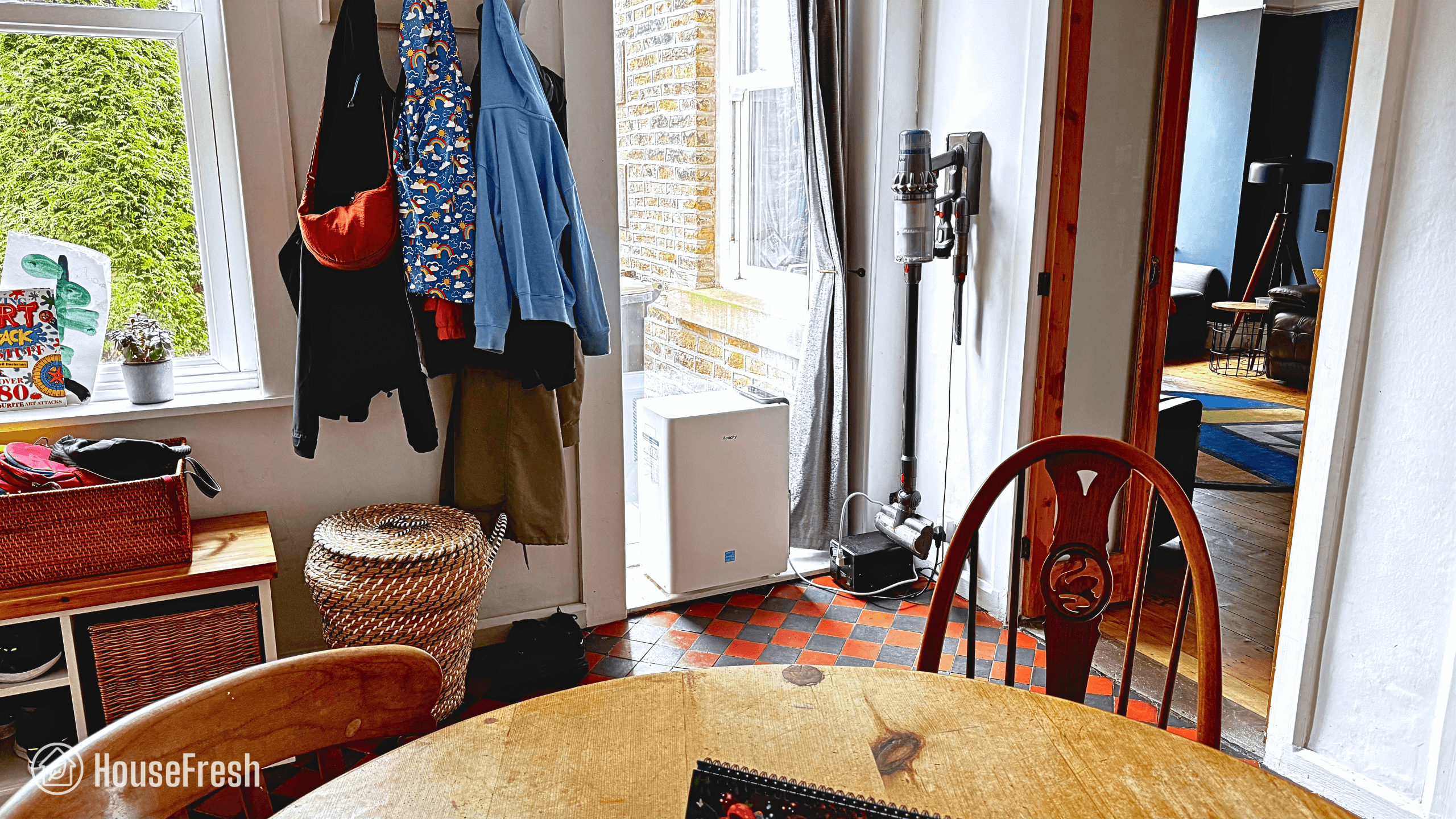
SOURCES

We calculated energy consumption costs with the help of the Department of Energyโ€™s appliance energy calculator. We calculated yearly costs associated with running the Winix T810 for 24hs a day for 365 days. We ran this calculation utilizing the U.S. average utility rate of $0.1268/kWh as of March 17th, 2025.

AirFanta 3Pro review

AirFanta 3Pro Living Room

If you like the idea of a Nukit Tempest but you worry about the process of building it yourself from scratch with multiple PC fans, parts and screws, then this device by AirFanta might be the perfect option for you.

The AirFanta 3Pro is a creation of Adam Wong, someone who is very active on social media platforms โ€” you might recognize him by his handle: @Engineer_Wong. Wong started his journey developing air purifiers in 2022, right after China left the Covid Zero policy. His beginnings involved assembling Corsi-Rosenthal boxes for friends and family, powered by his engineering background. Over time, he started receiving CR box requests from the local Covid Cautious community. This led to him designing and developing a new kind of DIY box that could be assembled and disassembled easily.

As with all the air purifiers we tested, we paid for the AirFanta 3Pro with our own money to experience the entire customer journey, conduct various tests and write an honest (and unbiased) review. If you decide to buy an AirFanta 3Pro after clicking on a link from this review, you will be supporting our work, as we will get a small commission at no extra cost to you.

The overall score for the AirFanta 3Pro incorporates first-hand data results from our battery of tests, as well as our ratings for customer service, brand transparency and design & UX. Check out the full scorecard below to see the split of categories.

The pros and cons of the AirFanta 3Pro

A summary of our top-level findings after testing this air purifier following our methodology.

Use the discount code HOUSEFRESH for 5% off when buying directly from AirFanta.

This is the only high CADR air purifier that you can disassemble and bring along wherever you go inside a backpack or suitcase.

The AirFanta 3Pro blew me away with its air cleaning performance, which is powered by a smart CR box-inspired design and the choice of combining four low-resistance H11 filters with four PC fans.

The market for PC fan air purifiers is booming, and AirFanta has made its mark with a device you can buy for a fraction of the price of its competitors ($160).โ€

Danny Ashton HouseFresh
Danny Ashton
HouseFresh Founder
& Lead Tester

If you donโ€™t want to read my full review, here are the six things we like about the AirFanta 3Pro and the three things we donโ€™t.

CONS

It is louder (56.3 dBA) than other PC fan kits we have tested (>45 dBA) when running at full speed.
Unlike other PC fan kits, the 3Pro doesnโ€™t use standard HVAC (MERV 13) filters โ€” you have to use OEM filters.
Energy costs are similar to traditional HEPA devices when running at full speed.

PROS

The highly affordable price ($159.99).
Its incredible air cleaning performance โ€” it took just 17 minutes to clean our test room, which is two minutes slower than the almighty Smart Air Blast Mini.
It is A LOT easier to put it together than a standard DIY PC fan air purifier kit.
It’s small in size, especially when compared to a Corsi-Rosenthal box.
It can be assembled and disassembled in just a few minutes.
When taken apart, the parts are small enough to fit inside a backpack or small suitcase.

Clean air delivery rate (CADR):โ€“ Top speed PM1 CADR: 353 cfm
โ€“ Sub-45 dBA PM1 CADR: 213 cfm
Filter technology:True HEPA H11 and optional pelleted activated carbon
Recommended room size:529 sq. ft. (5 air changes per hour)
Dimensions:12.6D x 12.6W x 12.6H inches (32D x 32W X 32H cm)
Weight:7.7 lbs (3.49 kg)
Noise level in decibels from 3 ft. away:3.63 volts: 36.1 dB
4.19 volts: 36.9 dB
5.24 volts: 39.7 dB
6.54 volts: 43.3 dB
7.44 volts: 46.7 dB
8.56 volts: 49.1 dB
12.6 volts: 56.3 dB
Electricity consumption in watts :43.23 watts
Filter lifespan:6 – 12 months
Manufacturerโ€™s warranty:1 year
Country of origin:China
Country of manufacture:China

The best feature: it fits inside a carry-on bag

This is the only high-CADR air purifier you can bring with you wherever you go.

AirFanta 3Pro Travel Backpack

Adam Wong designed the AirFanta 3Pro to be not only highly powered but also portable. You will not find any other air purifier with a CADR above 400 that you will be able to fit inside a large backpack or small suitcase.

The 3Pro can be disassembled and reassembled in just a few minutes, making it the best option for those looking for devices they can travel with.

You also get a long piece of cable management Velcro that you can use to wrap all the parts neatly once you have disassembled your AirFanta 3Pro:

Filtration technology

Four HEPA 11 filters (with the option of activated carbon) with an expected life of 6-12 months. Wong stated that they can last a full nine months before they need to be replaced.

AirFanta 3Pro Filters

Unlike actual DIY air purifier kits, you wonโ€™t be able to simply pick up some HVAC filters for your AirFanta 3Pro, so you will need to buy the official AirFanta filters. You can choose between HEPA 11 filters only or HEPA 11 with activated carbon. We have both because we wanted to test the performance of the 3Pro with and without activated carbon.

AirFanta 3Pro HEPA

When it comes to the HEPA 11 design, AirFanta states they developed a new pleating technology in order to produce powerful filters in such a small package. The 126×11.4โ€œ particle filter material has been pleated eleven times into a much smaller 11.4×11.4×1″ area.

AirFanta 3Pro Cover

Whether you choose to go with the particle filter only or the particle+gas filter, you will find that AirFanta filters come with an aluminium cover on the outside that protects the air filter and serves as a (sort of) pre-filter for large dust particles.

For those needing to tackle odors and gases, the best option is the carbon filter. It is a bonded filter (similar to those we see in Levoit devices) that combines a 15mm thick HEPA 11 filter with a 10mm layer of activated carbon. 

Tip

Remember to remove the filters from the plastic bag they come in before you switch on your AirFanta 3Pro.

Design and controls

The 3Pro is a small and light with a design inspired by the Corsi-Rosenthal box.

AirFanta 3Pro Fireplace

Use the discount code HOUSEFRESH for 5% off when buying directly from AirFanta.

The AirFanta 3Pro is basically a box with a base at the bottom, one filter at each side and a fan array on top โ€” much like the design of the Corsi-Rosenthal box.

The thing with the AirFanta 3Pro is that it is A LOT smaller than a CR box and that other PC fan kits using large HVAC filters:

CR Box VS AirFanta 3Pro Front CR Box VS AirFanta 3Pro Top
DIY air purifiers Size comparison

Now, while this is not a DIY kit like the Nukit Tempest or the CleanAirKits Luggable XL-7, you still need to put the AirFanta 3Pro together, but it’s a lot easier to do compared to the Tempest and the Luggable.

You just need to put the four filters in place on the sides of the base, which are clearly marked.

AirFanta 3Pro Open Corner

Once the four filters are in place at each side, you just need to clip the fan array on top.

AirFanta 3Pro Open

As I mentioned briefly above, the AirFanta 3Pro has been designed to be cheap and portable: when you take it apart, you will be able to fit it neatly inside a standard carry-on bag. It even fits snuggly inside Gisele’s Osprey Proxima backpack:

In terms of controls, the AirFanta 3Pro comes with a 110-220v AC to 3-12v stepless DC power adapter which will allow you to control the speed of the fans and the noise output.

AirFanta recently launched a new edition of the 3Pro, which is certified by CARB and is the only option if you live in California. 

This new edition has an independent speed controller that allows you to control the speed even when it is connected to a power bank of 12v/3A (or higher current) DC 5.5mm x 2.1 mm port.

Something that I really appreciate about AirFanta and Adam Wong is how committed they are to keep improving their devices based on customer feedback.

A few days after we ordered our 3Pro, I saw a tweet from Wong in which he announced the introduction of a handy Velcro strap in response to an idea from @ParentMishmash:

As mentioned at the top of this review, you can use this very same Velcro strip to strap the filters + fan array + base together once you have disassembled your 3Pro to ensure all parts fit nicely inside your suitcase or backpack. Simple yet effective!

Air cleaning performance

The AirFanta 3Pro cleared our test room in 17 minutes โ€” it is nearly as fast at cleaning the air as the MUCH larger Smart Air Blast Mini.

AirFanta 3Pro Sidetable

Iโ€™ve been really keen to test the AirFanta 3Pro because there has been a lot of hype around it โ€” especially after it was independently tested by Rob Wissmann and David Elfstrom. These are the results of their CADR tests:

  • CADR: at 13V: 436 CFM
  • CADR at 12V: 413 CFM 
  • CADR at 9V: 328 CFM 
  • CADR at 6V: 213 CFM 

Iโ€™m happy to report that the hype is completely warranted. Let me walk you through how the 3Pro performed in our tests.

According to our PurpleAir Zen sensor, the AirFanta 3Pro needed 17 minutes to achieve PM1 zero in our 728 cubic ft. test room running at top speed (12.6v). We estimate a PM1 CADR of 353 cfm, which would allow the 3Pro to provide five air changes per hour in rooms no larger than 529 sq. ft.

Swapping the filters for the HEPA + activated carbon option added three more minutes to the test, bringing the time to clean all traces of PM1 smoke pollutants to 20 minutes:

This matches the incredible CADR score tests performed by David Elfstrom and Rob Wiss, and compares quite favorably with other air much more expensive air purifiers.

As you can see in the table below, the AirFanta 3Pro is not only affordable but also incredibly fast at cleaning the air:

12v performance airfanta 3pro

Our air cleaning performance test showed that at its highest fan speed (12.6v), the AirFanta 3Pro is as powerful as devices costing upwards of $450 and more effective at removing particles from the air than much more expensive air puriifers like the Dyson BP06.

Sound levels

In our testing, the sound levels of the 3Pro ranged from 36.1 dBA to 56.3 dBA. It is much quieter than the new Winix T810 (62.5 dBA) and the Coway AIrmega 200M (64.3 dBA)

The second most important thing to look at when choosing an air purifier is the amount of sound it generates. A device that is too loud is unlikely to be used regularly or, even worse, is likely to be switched off.

That is why we record (from 3 ft. away) the sound levels generated by every air purifier we test running at each fan speed in the same location (our basement). 

The AirFanta 3Pro comes with an AC-to-DC power adapter, which includes a dial for adjusting the voltage and the sound level generated by the air purifier. Here are the results at each fan speed we measured:

VOLTAGESOUND LEVELS (decibels)
3.63 v.36.1 dBA
4.19 v.39.7 dBA
5.24 v.36.9 dBA
6.54 v.43.3 dBA
7.44 v46.7 dBA
8.56v49.1 dBA
12.6 v. (top speed)56.3 dBA

At top speed, the AirFanta 3Pro reaches 56.3 dBA, which is quieter than most mind-sized popular traditional air purifiers available on the market today:

sound top speed airfanta 3pro

However, you may be wondering how this compares to other devices, especially other PC fan-powered air purifiers. Check out our table below:

PC FAN KITSOUND AT TOP SPEED (decibels)
CleanAirKits Luggable XL-7 [Cooler Master SickleFlow 120]38.8 dBA
CleanAirKits Luggable XL-7 Ultra [Cooler Master Mobius 120]47.2 dBA
Nukit Tempest41.8 dBA
NorthBox Systems 6XL [ARCTIC P14 Max]50.2 dBA
Nukit Tempest Euro50.5 dBA
NorthBox Systems 6XL [Noctua P14s Redux]45.1 dBA
AirFanta 3Pro56.3 dBA

Compared to other PC fan devices from Nukit, CleanAirKits and NorthBox Systems, the AirFanta 3Pro is much louder at its highest fan speed. However, itโ€™s still in line with the top-speed sound levels of the traditional retail HEPA devices we have tested. 

However, sound levels at top fan speeds are not as important as air cleaning performance at lower fan speeds.

That is why we always identify a fan speed where the air purifier generates less than 45 dBA of noise to assess its quiet performance. In the case of the AirFanta 3Pro, we repeated the particle removal test multiple times across different voltages:

My recommendation is to go for 6.54V for top performance at sub-45 dB noise levels. Running at this speed, the 3Pro generates 43.3 dB of noise while still being able to clean our test room in 28 minutes.

airfanta quiet performance

When we account for sound levels, we see the performance of the AirFanta 3Pro getting beat by the CleanAirKits Luggable XL-7, which managed to clean our test room in 23 minutes even when running at only 38.8 dBA. However, the Luggable XL-7 costs upwards of $200 (plus filters), so considering the low cost of the AirFanta 3Pro ($159.99 including filters), I am super impressed. 

What impresses me the most is how incredibly well the AirFanta 3Pro compares to the shop-bought HEPA air purifiers I have tested. At its top speed, it is faster and quieter than most of the devices we have reviewed here at HouseFresh.

Tip

If youโ€™re considering getting an AirFanta 3Pro, I suggest experimenting with the voltages to find a sound level that works for you. Personally, I have stuck to having my 3Pro running at the 8-volt mark as I find it offers an excellent performance-to-sound ratio.

Long-term running costs

Running an AirFanta 3Pro will cost you $165.76 per year, combining energy consumption costs ($47.76) and filter replacement costs ($118).

AirFanta 3Pro Corner

Use the discount code HOUSEFRESH for 5% off when buying directly from AirFanta.

As always, I calculated the long-term costs associated with running your AirFanta 3Pro all day, every day at its top high speed for a full year โ€” an unlikely scenario as youโ€™ll probably want to have it running at a lower fan speed, but itโ€™s a good baseline for running costs.

I started by using our energy meter to measure how much electricity the 3Pro uses at different voltages and, when running at top speed (12.6V), it pulled 43.23 watts.

VOLTAGEENERGY CONSUMPTION (watts)
Standby0 watts
3.63 v.2.19 watts
5.24 v.5.02 watts
6.54 v.8.98 watts
7.63 v.13.31 watts
8.56 v17.46 watts
12.6 v. (top speed)43.23 watts

This means that if you had to leave your 3Pro running 24/7 at top speed, it would cost $47.76 in energy costs for a year, using average U.S. energy rates as of July 7th, 2025.

Considering you need to replace the filter every six months and that the replacement costs $59 (HEPA only), you can expect to also spend $118 per year on filters.

When compared to other similar-performing air purifiers, the 3Pro has low energy consumption costs but it’s the OEM filter replacement costs that drive the yearly running costs up.

airfanta long term costs scaled

At 43.2 watts, the AirFanta 3Pro is more energy-efficient than many popular units, such as the Winix 5510 or the Levoit Vital 200S. However, compared with another PC fan-powered air purifier like the Luggable XL-7 from CleanAirKits, itโ€™s clear that the 3Pro consumes more electricity at its maximum speed of 2900 RPM. 

That said, running costs for the 3Pro are similar to those of standard HEPA retail devices, but you do get much higher performance levels especially when you consider the much lower initial purchase cost.

cadr vs price airfanta

Tip

For a more efficient operation of the AirFanta 3Pro, I recommend going for 6.54V.

At this fan speed, the 3Pro consumes just 8.97 watts, so it will just add 10 bucks to your energy bill in a year while still being able to clean the air effectively as Levoit Core 400S or the IQAir HealthPro Plus running at full speed.

AirFanta’s creator, Adam Wong, explains how this big drop in energy consumption is possible:

“The power consumption of a fan is proportional to the cube of its RPM, while the airflow is proportional to the first power of the RPM. So higher RPM will result in less efficient of electricity consumption. The fan in the AirFanta 3Pro has a maximum speed of 2900 RPM, which is much higher than other PC-fan-based air purifiers, making it look less energy-efficient.

In fact, running it at 9V or lower would significantly improve energy efficiency. It still has a quite good CADR at lower voltage.”

โ€” Adam Wong, Founder of AirFanta

All AirFanta products come with a 1-year warranty. AirFanta will send you a new 3Pro and you won’t need to return the faulty device.

If you experience issues with your AirFanta 3Pro, all you need to do is email the AirFanta team at airfanta@air-fanta.com.
Make sure to include photos and/or videos of the issue you are experiencing.

Bottom line: Should you get the AirFanta 3Pro?

It’s totally worth it. This is the only air purifier with a a high CADR that you can travel with.

Hereโ€™s the thing: if you were to have come to me selling an air purifier with a CADR of 353 cfm for $159.99, I would have assumed it was some sort of a scam. The sheer power of such a device would surely cost a lot more, right? 

Adam Wong says no.

The AirFanta 3Pro can provide large rooms with multiple air changes for a price that is three times cheaper than what you normally pay for a standard, shop-bought HEPA air purifier. That is an incredible achievement that goes to show how brilliant Wong is and how much he actually cares about creating truly affordable solutions to clean the air. 

AirFanta 3Pro Sofa

Use the discount code HOUSEFRESH for 5% off when buying directly from AirFanta.

While the 3Pro is not totally plug-and-play (as you need to fit the filters and put the fans in place), it is MUCH easier to put together than all the other PC fan-powered DIY air purifier kits I have tested. That said, the 3Pro is also louder than all of them, so that is something to keep in mind.

For those looking for an air purifier they bring along when traveling or to events, there isnโ€™t anything on the market right now that matches the high CADR of the AirFanta 3Pro. You can simply disassemble the device and pack it in your suitcase or backpack just to reassemble it wherever you need it. 

For those wanting a quiet and energy-efficient air purifier, they can leave running in the background even when having work calls or meetings at the office, then a PC fan kit like the Luggable XL by CleanAirKits or the Tempest by Nukit will be a better choice โ€” just know that they will both cost over $100 more than the 3Pro.

Now, is sound is a concern but your budget canโ€™t stretch beyond $160, then remember you can run your AirFanta 3Pro at lower fan speeds. It will be much quieter and still outperform the standard retail HEPA air purifier you can find online, costing you less upfront and in the long run.

I really love this device, so I expect you will find it across many of our lists of recommended devices. 

One last thought before I leave you: I believe everyone living outside the U.S. will really benefit from the AirFanta 3Pro, especially those living in places like the UK, where finding box fans and HVAC filters to build your own Corsi-Rosenthal box is virtually impossible. As if that wasnโ€™t good enough, the 3Pro has a much smaller footprint than the standard CR box, is definitely quieter and offers much more adjustable fan speed options.

Do you have any questions about this device that I didnโ€™t cover in my review? Drop a comment below, and Iโ€™ll reply right away.

SOURCES

We calculated energy consumption costs with the help of the Department of Energyโ€™s appliance energy calculator. We calculated yearly costs associated with running an AirFanta 3Pro for 24hs a day for 365 days. We ran this calculation utilizing the U.S. average utility rate of 0.1235/kWh as of September 17, 2024.

Nukit Tempest review

Nukit Tempest Living Room

We have already built and tested two DIY units at HouseFresh, the Corsi-Rosenthal box and the more basic DIY Air purifier. We were impressed by their air cleaning performance and straightforwardness to build. So, when I saw CR Box creator Jim Rosenthalโ€™s tweet on the Nukit Tempest, I knew we had to give the Tempest a try.

I am a big fan of the CR box as it is incredibly reliable and can be built with just a few readily available components. However, it doesnโ€™t come without its downsides: the fan is noisy, the box itself takes up a lot of space, and the build is not as robust.

After some discussion on X (formerly Twitter) on how these setbacks could be improved, PC fans were suggested as a suitable alternative for the bigger, louder box fan. It was Zack Deis who designed the first PC Fan Corsi-Rosenthal Box before donating his design so that the Nukit Tempest could be developed.
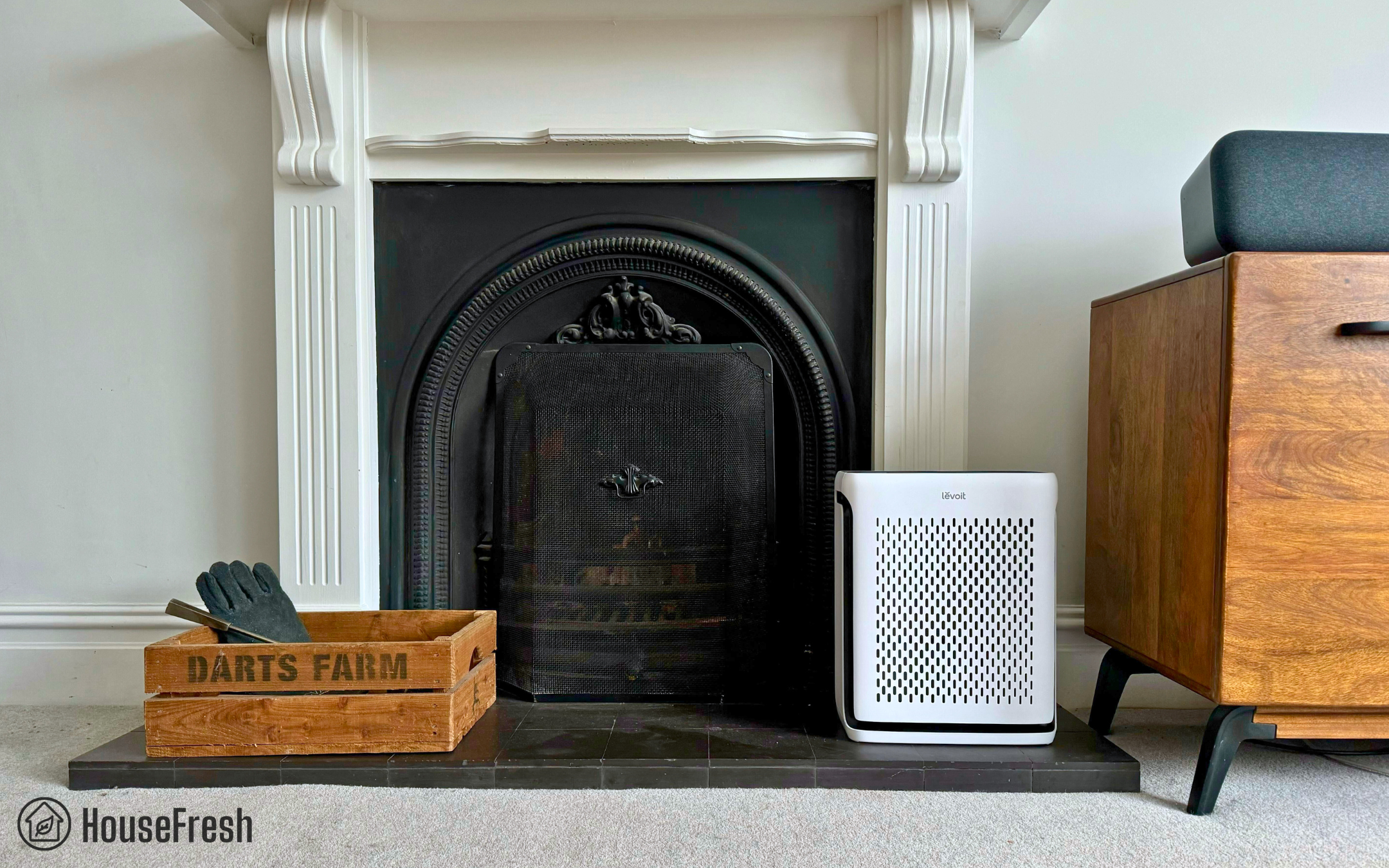
The Tempest is produced by Nukit, a Shenzhen-based startup on a mission to produce high-quality products at a fair price backed by third-party testing and supported by honest marketing and excellent customer service. Nukit has developed a small selection of products and is well known for the Nukit Torch Far-UVC Lights, which are increasingly popular online. They are always working to improve their products, and if you follow them on X, you will quickly learn that they are not shy when it comes to sharing the behind-the-scenes of their work, including new products they are developing right now.

When purchasing the Nukit Tempest kit, you get all the parts required to build the frame for $179.95. However, you still need to buy the MERV filters, DC power supply and PC fans (with fan guards, if you want them) โ€” all of which are transparently listed on The Cyber-Night Market, which is the online store were you can buy Nukit products. We estimate a total cost of $300 to get all the items. 

As always, we bought the Nukit Tempest kit and the parts with our own money to ensure we have the freedom to say what we really think after conducting the same performance tests we run on every air purifier we review.

how we test
How we test air purifiers

Read our full testing methodology.

That was a long intro, so I hope youโ€™re still with me. Letโ€™s jump into the review.

The lowdown on the Nukit Tempest

Danny Ashton HouseFresh

โ€œI am super impressed by the Nukit Tempest. This new type of air purifier uses PC fans to offer great air cleaning power without high levels of sound. While this is the first generation, Iโ€™m super excited to see where this new approach to air purifiers takes us.

Be aware that this is a kit and does need some time and effort to build, but those who do will have a great air purifier that is also incredibly quiet.โ€

โ€” Danny Ashton, HouseFresh Founder & Senior Writer

TEMPEST DIY KIT ARCTIC P14 PC FAN MERV 13 FILTERS

Before jumping into my full review, I have distilled the key strengths and weaknesses of the Tempest into pros and cons below:

What we really like

It has the best cleaning-power-to-noise ratio we have ever seen on an air purifier.
Filters are far easier to replace when compared to the CR box โ€” you donโ€™t need to rip your air purifier apart to change them.
You can choose any 20x20x2″ MERV filters you want to use, from any brand you want.
This is a truly buy-it-for-life device: all parts can be easily replaced at a low cost, allowing you to fix and maintain your unit yourself.
It is highly customizable. You can choose the 20x20x2″ MERV filters, PC fans, power switch and fan guards you want.

What we think could be better

Without activated carbon filters, it wonโ€™t be able to help with unwanted smells and gasses.
It is a hot product right now, so it might not always be available for purchase. However, you can sign up for Nukit’s mailing list on The Cyber Night-Market to get notified as soon as itโ€™s back in stock.
While most items are readily available worldwide, 20x20x2″ MERV filters may be harder (or more expensive) to find outside the U.S.
It is not a โ€œplug and playโ€ air purifier, so it will not be suitable for those who are not comfortable building it. PC building experience is highly useful.

HouseFresh rating:โ˜…โ˜…โ˜…โ˜…โ˜†
Time to clean our 728 cubic feet test room (with the device running at top speed):Without fan grills: 31 minutes
With mesh fan grills: 43 minutes
Air filtration technology:MERV 13
Recommended room size (4.8 air changes per hour):385 sq. ft. (estimated)
Clean air delivery rate (CADR):247 CFM (estimated by @VentiloAngel)
Dimensions (in inches / in cm):21.25L x 20.25W x 9.6H inches (54L x 51.5W x 24.2H cm)
Weight (in pounds / in kg):14.7lbs (6.65 kg)
Filter life:12 months
Noise level in decibels (measured from 3 ft. away with a sound level meter):41.8 dB
Electricity consumption in watts (recorded with an electricity usage monitor):8.8 watts
Estimated running cost (electricity consumption + official filter replacement):$50.11 per year
Cost per CADR cfm (based on dust CFM as reported by AHAM):$1.20
Country of manufacture:China

The best Tempest feature: Quiet yet powerful

Youโ€™ll barely notice itโ€™s running thanks to the PC cooling fans โ€” and it can still effectively cover rooms up to 385 sq. ft.

Nukit Tempest Front Room

The Nukit Tempest not only looks cool but it also offers excellent performance with cleaning power comparable to many medium-to-large air purifiers we have tested. 

Yet, despite its capacity to draw in considerable amounts of air through its filters, the Tempest runs far quieter than most.

But you donโ€™t need to take my word for it. Check out the chart below comparing the max sound levels VS air cleaning speed of the Tempest against various popular air purifiers:

A PC case-inspired design that fits two large MERV filters and six fans

Assembling the Tempest is not particularly easy, but the end result is a cool-looking device with a gamer vibe.

Nukit Tempest Design

The Nukit Tempest looks nothing like a regular air purifier. In fact, if you walked into a room with a Tempest, you are more likely to think itโ€™s a desktop computer than a DIY air cleaner. Similarly to PC building, the appearance of your Tempest will vary slightly depending on the items you choose to assemble it.

Nukit Tempest Top

It has six PC cooling fans on top and six more on one of the sides. As I have small children at home, I decided to also get 140mm mesh guards, which will protect the fans from dust but, most importantly, keep little fingers out of the way. However, it’s worth mentioning that the mesh grill restricted airflow, thus affecting the performance of the Tempest but I will tell you more about this further down the review.

Nukit Tempest Mesh Covers

140mm MESH FAN GUARDS 140mm WIRE FAN GUARDS

Another important point to consider with my kids in mind: the metal is sturdy yet smooth, and it has no sharp edges or imperfections that could cut you while moving it from room to room. Speaking of which, it was great to see all the clever little design details that improve usability, such as the two handles at the top.

Nukit Tempest Handle

The Tempest comes with wire mesh side grills to guard the filters, making the device more resistant than other DIY air purifiers, including the CR Box. Plus, it conceals a bit the fact that it is an air purifier, avoiding the attention-grabbing white filters to be the center of attention.
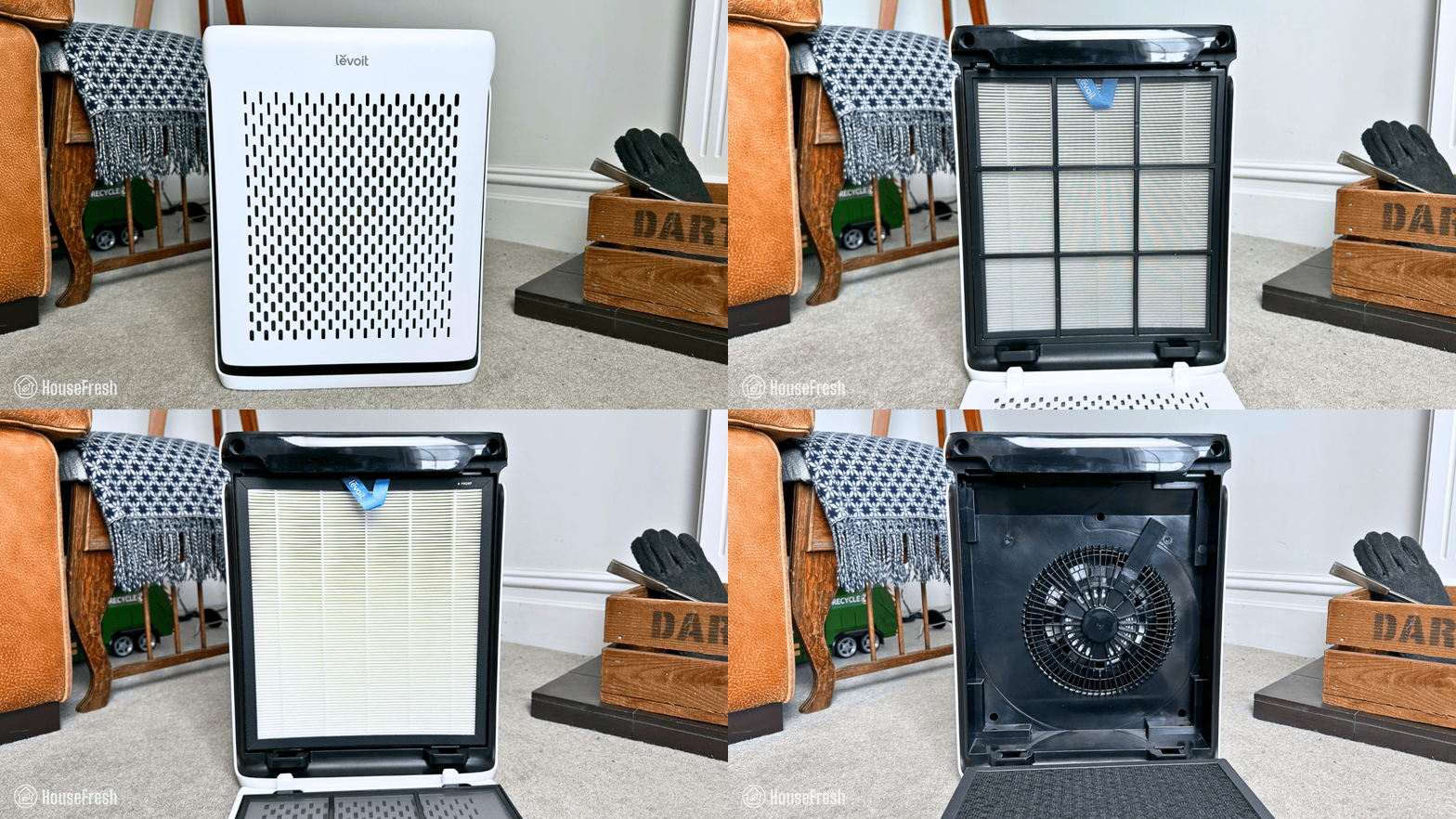
Nukit Tempest Pre Filter

Speaking of the Corsi-Rosenthal Box, I took a photo of the Tempest next to my CR Box to show you just how small and stylish the Tempest looks next to the bulky cube. 
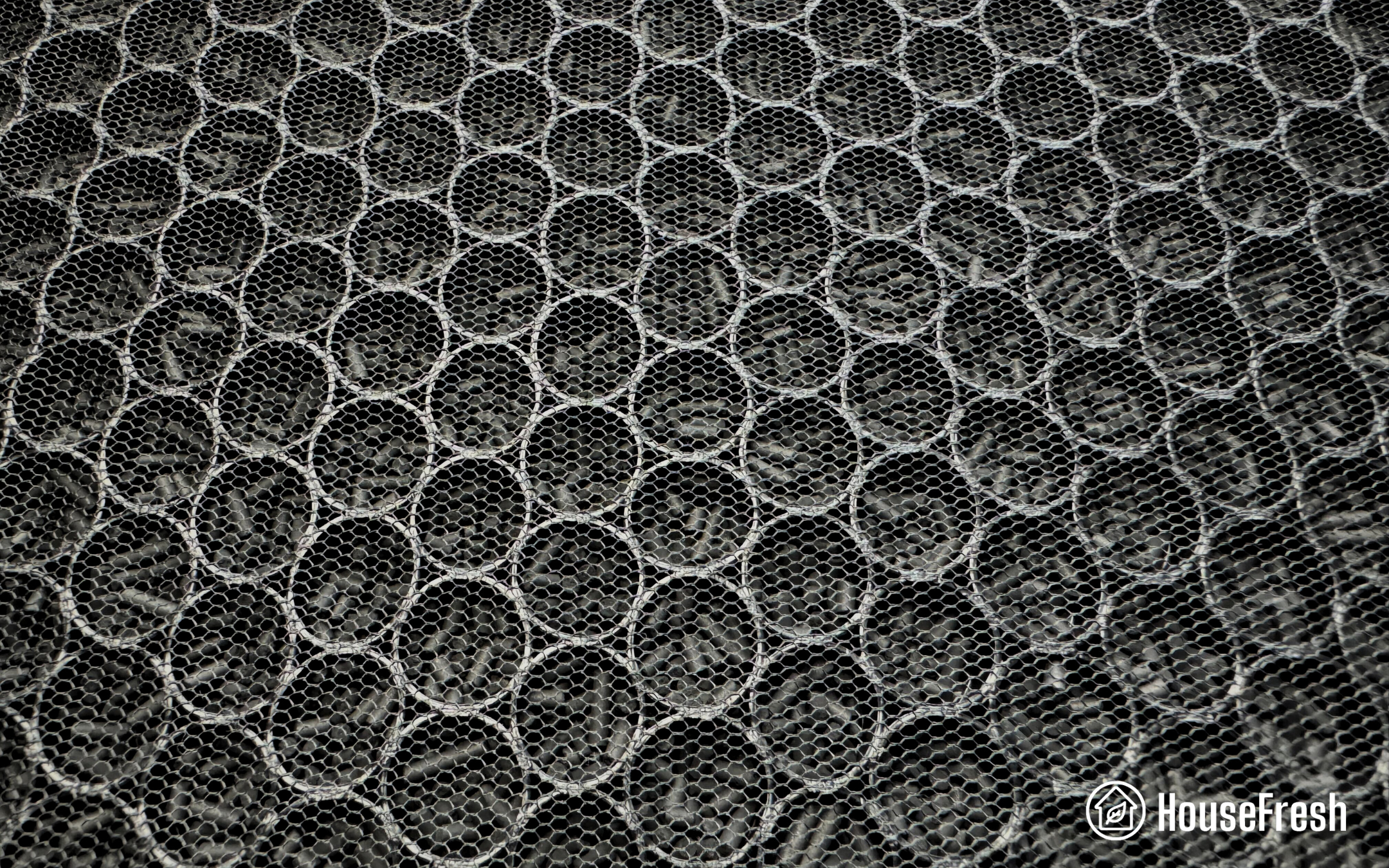
CR Box vs Nukit Tempest

As you can see, the footprint of the Nukit Tempest is much smaller, making it a great choice for spaces where the CR Box couldnโ€™t quite fit. It is also super lightweight, weighing no more than 14.7lbs.

Nukit Tempest VS CR Box Top

Another thing worth mentioning is that the Tempest does not have a control panel. It is either plugged in and running, or unplugged. That said, you could buy a power supply with an on-off switch.

Nukit Tempest Plug

DC POWER SUPPLY

The Tempest was created with homes AND public spaces (such as schools and businesses) in mind, where air purifiers should be running 24/7 but are often not. This is the quietest unit Iโ€™ve tested able to clean the air effectively โ€” for example, the Core Mini is super quiet, but it wonโ€™t be useful in most rooms.

Another example of quiet power is the Smart Air Blast Mini. I took a photo of both devices next to each other so you can see how they compare to one another in terms of size:

SmartAir Blast Mini VS Nukit Tempest

The Tempest kit comes with four metal panels, screws, a cardboard tube containing the side grills, four square, self-adhesive feet and 3mm rubber hole plugs, a 19mm rubber plug, a PWM connector, a 12v DC power connector AND zip-ties. 

What you will need thatโ€™s not included is the following:

ITEMRECOMMENDED WHAT WE BOUGHT
6 x PC cooling fansArctic P14Amazon
6 x Fan guards140mm mesh or metalAmazon
1 x DC power supply12v, 2A with 5.5x2.1mm barrel connectorAmazon
2 x FiltersMERV 13 filters, 20x20x2 inchAmazon

While assembling the Tempest might seem a tad daunting for those not so comfortable with their DIY skills, thereโ€™s a thorough step-by-step guide on The Cyber Night-Market website with photos and detailed instructions. You can also watch my video:

All pieces, screws and cables come in separate bags to make assembling easier. It is kind of building a huge Lego โ€“โ€“ a fun STEM project to be sure. 

Two 20x20x2″ MERV filters protected by side grills

The Tempest is proof that you donโ€™t actually need HEPA to achieve exceedingly good air filtration results.

Nukit Tempest Fireplace

Thatโ€™s right: HEPA is not the failsafe many manufacturers want us to believe. 

Certified HEPA filters are considered an assurance for many for their single-pass filtration efficiency, or in simpler terms, the capacity of a filter to trap particles in just one pass of air.  The thicker the filter (HEPA 12, 13 and even 14), the more particles it can catch on the fibers in a single pass. 

On their part, MERV filters have a lower single-pass filtration rate compared to HEPA filters. But air purifiers are designed to run continuously, circulating air and trapping particles on the filters in every cycle. As David Elfstrom, an engineer who has shed light on many key discussions related to indoor air pollution, puts it:

So, with no real need for HEPA, the Nukit Tempest uses affordable and readily available MERV 13 filters just like the Corsi-Rosenthal Box and the simpler DIY air purifiers. 

As MERV filters are less dense than HEPA, they allow for increased airflow. That means that they can move a lot more air than units with HEPA or HEPA-type filters, capturing more particles from the air.

Nukit Tempest MERV 13 filter

The Nukit Tempest hasnโ€™t been sent to the Association of Home Appliance Manufacturers for a CADR test, but that doesnโ€™t mean that itโ€™s not been tested by third-parties. David Elfstom estimated a CADR of 280 CFM and Nathalie Roussay (known as L’ร‰vangรฉliste de la Ventilation on X) estimated 247 CFM โ€“ all of these using the Artic P14 fans, which are the same weโ€™ve used in our own Tempest. 

I will go deeper into air cleaning performance comparisons in the next section but, with these numbers, the Nukit Tempest and its MERV 13 filters could offer similar performance than air purifiers such as the Blueair Blue Pure 311+ and the Alen BreatheSmart 45i โ€“ both good, reliable units much liked by many users.

It’s worth noting that replacing the filters in your Tempest will be much easier than disassembling your CR Box and other DIY units before you can rebuild them with the new ones. With the Tempest, you just have to unscrew the sides, remove the old filters, place the new filters and screw them back.

Tip

If you buy MERV filters in bulk, make sure each one is sealed separately or at least in twos. You donโ€™t want the filters in contact with the air before use, or they will start accumulating particulates as they are stored in a cupboard.

The Nukit Tempest cleared our test room in 31 minutes

The Tempest has the best performance-to-noise ratios across all 70+ air purifiers we have tested, and the six PC cooler fans have a lot to do with that.

Nukit Tempest Fans Close Up

To assess the real-world performance of the Nukit Tempest, we run the same tests we perform on all the air purifiers we review, including particle removal speed, noise output and energy usage.

For the speed test, we filled our 728 sq. ft. test room with incense smoke and used our two PurpleAir sensors (the Touch and the Zen) to monitor how long the Tempest took to clean the air, bringing the PM1 levels to zero.

As you will see on the chart above, it took the Nukit Tempest 31 minutes to complete our particle removal test. 

This number changes when we add the mesh guards on top of the PC fans. I wasnโ€™t expecting such a big difference, but it turned out that the mesh guards added 12 minutes to the test:

Without fan grillsWith mesh fan grills
Nukit Tempest31 minutes43 minutes

This is something to consider when building your Nukit Tempest. We havenโ€™t tested it using wire fan grills, but I imagine it will be better than the mesh grill as, clearly, the ultrafine nylon restricts airflow:

Nukit Tempest Mesh Cover Closeups

A reader shared this report on the effects of different grill patterns on fan performance. It shows that the mesh grill does, in fact, restrict airflow. The report also shows that opting for a wire grill can achieve performance results nearly as good as running your Tempest without a grill.

Air cleaning performance, compared

With an average estimated CADR of 247 CFM, the Nukit Tempestโ€™s cleaning speed definitely met our expectations.

Compared with units that boast similar CADR, the Tempest sits in the middle: the Blueair Blue Pure 311+ (250 CFM) was 10 minutes faster, but it outpaced the $428 Alen BreatheSmart 45i (207 CFM) by three minutes.

There is also a six-minute difference with the Corsi-Rosenthal Box (estimated 274 CFM). I cannot deny that Iโ€™m still a huge fan of the CR Box; it is such a practical solution for so many people and different contexts. However, if we factor in the noise output of the two, the CR Box’s speedyness becomes somewhat relative.

Let’s see how the Tempest performed noise-wise. 

Noise levels, compared

This is one of the Nukit Tempestโ€™s highlights: how quiet it runs. To measure the noise output, we used a commercial sound meter to record sound levels in dB(A) emitted by the Tempest from 3 ft. away.

As we saw in the first section, the Tempest has only one speed. When running, it emits 41.8 dB(A) of noise, which is equivalent to the (almost imperceptible) noise of a suburban area at night. 

The chart below shows how the Tempest compares to other air purifiers.

If we focus on the lowest fan speeds, the Tempest might not be the quietest unit, but it is not the loudest, either. However, the comparison changes completely when we look at the top speed values: no purifier runs as quietly as the Tempest. 

We were so impressed with these results that we decided to push our tests further. So, we compared the Tempest’s performance (speed and sound) versus some of the best units we tested but running at a similar sound level (in most cases, in Speed 2). Hereโ€™s what we found out:

AIR PURIFIER MODELSOUND LEVEL AT TOP SPEED (dBA)TIME TO CLEAN OUR TEST ROOMPRICE
Levoit Vital 200S - Speed 242.5 dB(A)40 minutes$189.99
Winix 5300-2 - Speed 2 without ionizer42.5 dB(A)43 minutes$199.99
Taotronics AP-003 - Speed 242.8 dB(A)39 minutes$99.99
Nukit Tempest41.8 dB(A)31 minutes$179.95 (plus parts)
Air Doctor 3000 - Speed 1 40.2 dB(A) 43 minutes $519.00

When noise output is the primary variable, the Nukit Tempest air cleaning performance amply outperforms all others.

I mean it when I say you will often forget the unit is running in the background. But still, donโ€™t take my word for it; listen to the Tempest running for yourself:

The cost to run a Nukit Tempest: $50.11 per year

1. Electricity costs = $9.25 per year

When choosing an air purifier, long-term costs are worth considering, especially with rising electricity prices worldwide. So, as part of all our reviews, we measure electricity consumption using an energy meter.  

Nukit Tempest Energy Test

The PC fans in the Nukit Tempest mean less noise and less energy usage. In our testing, the Tempest pulled a mere 8.8 watts. Running it 24/7 uninterruptedly would add up to less than $10 a year to your electricity bill.

As a reference, the Blueair Blue Pure 411 has an energy usage of 10 watts at top speed, and it was featured among the 2024 most efficient air purifiers at Energy Star. However, the Blue Pure 411 needed over an hour to remove all PM1 pollutants from our 728 sq. ft. room.

As with noise levels, the energy consumption of the Nukit Tempest matches the same figures you can expect from some of my favorite air purifiers when running at low fan speeds. The problem is that low fan speeds mean slower air cleaning performance, so when comparing these great devices against the Tempest, we see the Tempest win again:

AIR PURIFIER MODELENERGY CONSUMPTION AT TOP SPEED (watts)TIME TO CLEAN OUR TEST ROOM
Air Doctor 3000 - Speed 19.6 watts43 minutes
Nukit Tempest8.8 watts31 minutes
Taotronics AP-003 - Speed 210.5 watts39 minutes
Levoit Vital 200S - Speed 28.0 watts40 minutes
Winix 5300-2 - Speed 2 without ionizer 6.7 watts43 minutes

The performance-to-energy usage ratio of the Nukit Tempest is just incredible.

2. Filter costs = $40.86 per year

Filter costs are the second ongoing expense to factor in. With store-bought units, you can choose between original, branded filters (which tend to be expensive) or generic ones (for which thereโ€™s not always enough information online).

The Nukit Tempest uses standard, non-proprietary 20x20x2 MERV 13 filters. Availability may vary depending on your location, but in the U.S., there are plenty of options at a varied range of prices. 

We used Filterbuyโ€™s set of two for a little over $40. Considering filters need to be replaced about every 12 months, the Tempest has one of the lowest long-term costs weโ€™ve seen in the industry: around $50 a year. 

There are simply too many reasons to love this device.

AIR PURIFIER MODELESTIMATED ELECTRICITY COST (per year) FILTER REPLACEMENT COST (per year)YEARLY MAINTENANCE COST
Coway Airmega 150$48.12$49.99$98.11
Smart Air S$41.00$73.98$114.98
Levoit Vital 200S$67.95$59.99$127.94
Winix 5500-2$81.54$79.99$161.53
Nukit Tempest$9.25$40.86$50.11
Mila$58.45$150$208.45

Bottom line: Is the Nukit Tempest worth it?

The short answer: yes, but be aware that building it might be tricky if youโ€™re not comfortable with cables and tiny parts

The Nukit Tempest has definitely impressed us with its clear advantages over shop-bought devices: it is super quiet, cleans the air pretty fast, can cover large spaces (385 sq. ft.), and its long-term running costs are as low as they get.

One of my favorite things about it is the environmentally conscious buy-it-for-life concept that defies a whole industry of devices with built-in planned obsolescence. Say the PC fans get old and start malfunctioning; you can replace those, and thatโ€™s it. The same applies if you want to upgrade the PC fans for newer, quieter ones or if you want to add an on/off switch or Nukitโ€™s own power loss alarm. Most components in your Nukit Tempest could be swapped, upgraded and fixed at home. Besides, with standard MERV filters, you are not tied to any brand.

Nukit Tempest Design

But I get it. Sometimes a ready-to-use solution is all you want or need, and thatโ€™s understandable. There are plenty of great store-bought air purifiers that will do a fine job. But if you are at all curious about the use of PC fans or fancy a STEM project you can carry out with your kids, then I strongly suggest giving the Nukit Tempest a try.

You wonโ€™t just get an amazing air purifier; you’ll also be supporting a worthwhile project with a genuine interest in indoor air quality that is affordable and powered by honest marketing โ€” two things that the world really needs.

Iโ€™m currently testing other PC fan DIY air purifiers (the Luggable by Clean Air Kits, Adam Wongโ€™s AirFanta 3 Pro and the NorthBox Systemsโ€™ 6XL), so make sure to subscribe to our YouTube channel to watch my review without having to wait for it to be published on our site.

Tip

If you want to take the DIY spirit further, the instructions to build the Nukit Open Air Purifierโ€™s enclosure are available on GitHub (thereโ€™s even an app).

SOURCES

We calculated yearly costs associated with running the Nukit Tempest 24 hours a day, 365 days per year utilizing the latest average energy prices as reported by the Bureau of Labor Statistics of $0.174/kWh as of June 2024.

Winix C545 review

Winix C545 Living Room

With a trajectory of over 50 years, Winix has a solid background in indoor air cleaning.

During the COVID pandemic, the South Korean brand gained a foothold in the U.S. market, attaining a solid place among the most preferred brands to improve Americansโ€™ home air quality.

Winix produces budget-friendly, well-built, and high-performing air purifiers, with the corporate mission as its compass: โ€œTo deliver perfect products that are superior in Innovation, Performance and Style.โ€ 

The Winix C545 is not the brandโ€™s latest model (it was Energy Star-certified in 2019). In fact, the unit is only available as refurbished on the U.S. Winix website. But it is still trending and hyped by Costco, so we got curious about its performance. 

Besides traditional mechanical filtration, all Winix units have the built-in PlasmaWaveยฎ function, a by-polar ionizer that boosts cleaning efficiency. Ionization is a known controversial topic, so youโ€™ll be pleased to know Winix units emit less than 0.01 ppm of ozone and are CARB-certified. However, one of the highlights of these air purifiers is that the function can be easily disabled. 

We have previously reviewed three Winix units, the 5300-2, 5500-2 and A231 and found solid results. So, we decided to get the C545 and put it to the test.

how we test
How we test air purifiers

Read our full testing methodology.

As always, we bought the C545 with our own money like regular consumers โ€” no special treatment for us, no free Winix for HouseFresh. We prefer it this way. We are free to write unbiased reviews with an honest take on every unit we test.

The lowdown on the Winix C545

Danny Ashton HouseFresh
โ€œThe C545 is very similar to other Winix devices, like the 5300-2, and itโ€™s just as good for removing particles. One thing that stands out is its app support, which you donโ€™t find in other Winix models.
The fact that this device is sometimes sold cheaply at $99-$139 at Costco makes it an easy choice for those wanting a good air purifier on a budget.โ€
โ€” Danny Ashton, HouseFresh Founder & Senior Writer

Winix C545 Living Room

Before we dive into the detailed analysis of the unit, Iโ€™ve condensed the C545 highs and lows:

What we really like

All-round budget-friendly unit: low initial price and affordable long-term running costs.
Faster than more expensive units and still competitive, even when compared to newer models.
There are plenty of smart features, including app support for remote control, air quality readings and a light sensor.
An easy-to-navigate control panel that lets you switch off the ionizer at any time.

What we think could be better

It lacks a sturdy activated carbon filter. Instead, the C545 comes with carbon-impregnated fabric that needs to be replaced every three months.
Considering its size, it is not the quietest air purifier. When running at top speed, it generates 59 dB of sound.
The Winix Smart app could be improved.

HouseFresh rating:โ˜…โ˜…โ˜…โ˜…โ˜†
Time to clean our 728 cubic feet test room (with the device running at top speed):PurpleAir Touch: 19 minutes
PurpleAir Zen: 27 minutes
Air purifier technology:Washable pre-filter, activated carbon filter, True HEPA filter and Plasmawave technology
Recommended room size (4.8 air changes per hour):360 sq. ft.
Clean air delivery rate (CADR):– Smoke: 232 CFM 
– Dust: 243 CFM 
– Pollen: 246 CFM
Dimensions (in inches / in cm):13.7W ร— 8.4D ร— 20.5H inches (35W x 21D x 52H cm)
Weight (in pounds / in kg):11 lbs (5kg)
Filter life:– HEPA filter: 12 months
– Odor filter: 3 months
Noise level in decibels (measured from 3 ft. away with a sound level meter):Speed 1: 36.1 dB
Speed 2: 39.2 dB
Speed 3: 43.1 dB
Speed 4: 59.2 dB
Electricity consumption in watts (recorded with an electricity usage monitor):Standby: 0.27 watts
Speed 1: 4.15 watts (4.46 with ionizer)
Speed 2: 6.6 watts (6.9 with ionizer)
Speed 3: 10.15 watts (10.49 with ionizer)
Speed 4: 51.30 watts (51.01 with ionizer)
Estimated running cost (electricity consumption + official filter replacement):$113.6 per year
Cost per CADR cfm (based on dust CFM as reported by AHAM):$0.53
Manufacturerโ€™s warranty:2 years
Country of manufacture:

The best feature of the Winix C545: good $ to CADR ratio

Impressive 232 CFM (smoke) for $90 if you get it refurbished from Winix

As mentioned in the introduction, the Winix C545 can be bought refurbished at the manufacturerโ€™s website for a mere $89.99. At Costco, on the other hand, youโ€™ll find the new unit for $129.99. At the time of writing this review, I wouldnโ€™t recommend buying from Amazon, as the C545 rises to over $170.

This price disparity makes my job harder when trying to compare the C545 with other units in the same price and cleaning power range. But I will try my best anyway.

The TaoTronics TT-AP003, for example, has a CADR of 226 CFM for $80 and features a pelleted activated carbon filter instead of the carbon-impregnated fabric. The same goes for the Levoit Vital 200S, which outperforms both the TT-AP003 and the C545 BUT it doubles in price ($190).

Now, things are more favorable to the C545 when comparing it against the Winix C535 and 5300-2, which can be found at $140 and $135, respectively. While neither of them have smart features, they share similar CADR and are all suited for 360 sq. ft. rooms. With those numbers in mind, it is clear that the  C545 offers a great $ to CADR ratio with extra smart features, not bad.

An old design thatโ€™s compensated with a few aces up its sleeve

The Winix C545 wonโ€™t stand out from the crowd for its looks, but it remains functional and offers smart features.

Winix C545 Front

Iโ€™d venture to say classic rectangular-shaped air purifiers are making a comeback; they seem to be regaining protagonism after cylindrical units occupied the central stage for some time. Take, for example, the bold-looking Coway Airmega 150 or the sober and stylish SmartAir SA600

While the C545 is not among the latest releases in the industry, its rectangular body with a front air intake benefits from this trend.

The C545 comes in an all-white matte style with curbed edges, and is shorter and somewhat chunkier than the larger (and darker) 5500-2 and the 5300-2.

Winix 5300 2 C545 5500 2

While newer Winiexes come with a magnetized tab to fasten the front cover, the front panel on the C545 is only attached to the body by clips. True, many units on the market rely solely on tabs (take the TaoTronics TT-AP003, for example, although it has an extra clip compared to the Winix). Still, it is worth pointing out the magnet feature ensures a more secure attachment.

Winix 5300 2 C545 5500 2 Pre Filter

The controls on the Winix C545 are straightforward and self-explanatory, so you can set it up and have it running without browsing the manual – although I usually take a look when unboxing a new unit. 

Winix C545 Close Up Top

Instead of having just one button to cycle through the four different fan speeds, the C545 comes with arrow buttons to go back and forth between Auto Mode, four different fan speeds and Sleep Mode. 

The P – 3SEC legend stands for PlasmaWaveยฎ. To toggle the PlasmaWaveยฎ function, youโ€™ll need to press the two arrows for three seconds simultaneously. The white LED light will indicate when itโ€™s activated (light on) or deactivated (light off). By default, the unit will turn on with PlasmaWave enabled โ€” Iโ€™m not a fan of that.

Winix C545 Control Panel

The Auto-mode in the C545 is possible thanks to the onboard air quality sensors, which will adjust the fan speed to tackle the level of pollutants detected. The LED light on the control panel will indicate the air quality in the room with a color-coded scale:

LED indicatorFan speed
๐Ÿ”ด red for polluted airTop fan speed
๐ŸŸ  amber for fair airMedium fan speed
๐Ÿ”ต blue for good air qualityLow fan speed

Thatโ€™s the industry-standard Auto mode, but the Winix C545 has an extra perk: it has a built-in light sensor that detects the amount of ambient light in the room. 

So, when in Auto mode, the moment you turn off the lights, the unit will turn to Sleep mode automatically. It will adjust the fan speed to the lowest, reducing noise output, and turn off all LED lights (except for the night mode light, though).

Winix C545 Top Down

The Winix Smart app is usually reserved for top-tier air purifiers, such as the 9800 ($329). However, for tech enthusiasts on a budget, the C545 fits the bill โ€” at least for North American users. 

Tip

As of January 2021, the Winix Smart app is no longer available in Europe or the UK due to the EU general data protection regulation. 

Therefore, for those based in Europe or the UK to whom app support was a key driver to getting the C545, Iโ€™d suggest checking out the Winix 5500-2, which comes with a remote control and a more robust pelleted activated carbon filter.

Or check out the Levoit Vital 200S, which offers remote access to the unit through the user-friendly Vesync app.

The Winix Smart app will let you create schedules, monitor indoor and outdoor air quality, track the filter’s life (and get alerts when itโ€™s time to replace it), and logically control the unit remotely from wherever you are. As a bonus, youโ€™ll also be able to command the Winix C545 with Amazonโ€™s Alexa.

Manage Filter
In out Indoor
AQ History 1
Control Device 1

Although you get useful features and an enhanced experience with the app, I must say that itโ€™s not the most intuitive one:

  • The signing-up process is tedious and a bit of a maze. Luckily, you just need to do this once.
  • Youโ€™ll have to grant the app access to your exact location. Winix claims this is just to provide outdoor air quality readings, but it wonโ€™t let you go through the pairing process without it.
  • The app sometimes loses connection with the unit. This can be easily fixed by closing and reopening the app, but it would be nice to see the Winix team permanently solve the issue.

Winix four-stage filtration: mechanical filters boosted by PlasmaWaveยฎ

The C545 comes with a robust True HEPA filter for particles but a weak activated carbon filter that falls short when dealing with serious VOCs.

Winix C545 GIF

Almost every air purifier comes with a single set of filters for you to get the unit up and running the moment you take it out of the box. Well, Winix went the extra mile with the C545 and added an additional set (which could last up to 12 months!) That’s right, when you buy a C545, you get two years’ worth of indoor air cleaning. Nice touch, Winix!

But then, there are some highs and lows to the C545 filters worth considering before making up your mind. Letโ€™s start with the good. 

Like all Winix air purifiers, the C545 features AHAM-verified True HEPA filters capable of removing 99.97% of particulate air pollutants from the air as small as 0.3 microns. The filter traps dust, pollen, mold spores, dander, smoke particles, bacteria and more, boosted by the unitโ€™s 246 CFM Clean Air Delivery Rate.

Winix C545 HEPA Filter

A second advantage of the C545 four-stage filtration is the removable pre-filter. Picking up on the rectangular-shaped air purifiers’ comeback, Iโ€™d say this type of pre-filter is one good reason behind it.

In budget cylindrical units, like the Leoivt Core series (200S, 300, 400S and 600S) or the Shark HP102, you usually find pre-filters fitted into the HEPA, which makes maintenance a lot trickier. But when you get a removable pre-filter, you will find that it’s much easier to stay on top of vacuuming and washing the mesh.

Winix C545 Pre filter

Winix suggests cleaning their pre-filters every two weeks. Itโ€™s pretty often, for sure. But by doing this, you extend the life of your HEPA, as the pre-filter traps larger particles such as lint, hair and pet fur that would otherwise clog the main filter faster.

The greatest downside of the C545 is the activated carbon filter.

Activated carbon filters trap VOCs and odors through adsorption: the gas molecules stick to the carbon, accumulating on its surface. The Winix C545 comes with a thin fabric impregnated with activated carbon, which is less effective when compared to a filter with pelleted activated charcoal.

Winix C545 Activated carbon filter

Utilizing carbon-impregnated filters means there is a far smaller surface for the pollutants to adhere to. This leads to filters that become full (and ineffective) way faster than you’d like.

You can see how flimsy the activated carbon filter in the Winix 5300-2 and the C545 look when compared to the sturdier pelleted activated carbon on the Winix 5500-2 (right):

Winix 5300 2 C545 5500 2 Carbon Filter

Tip

The C545 carbon filter needs replacement every three months. As mentioned above, you are covered for two years as the air purifier comes with eight of these. But while the unit and app show the HEPA filterโ€™s lifespan, youโ€™ll have to keep track of the activated carbon filterโ€™s life cycle.

What you need to know about PlasmaWaveยฎ

The last stage of Winix filtration is the PlasmaWaveยฎ function. To put it in (very) plain terms, bipolar ionizers on Winix units alter the composition of airborne gas molecules and particles. These are either neutralized and turned into water (H2O) molecules or regroup into bigger, heavier clusters that are thus drawn into the ground (or any other surfaces in the house). 

As a disclaimer, Iโ€™m not 100% into ionization, no matter if it is unipolar or bipolar. Even when the air purifiersโ€™ ozone emission is tested, such as in the case of the Winix units, introducing ions into the air can alter all kinds of airborne molecules and particles, such as fumes from ordinary cleaning products, and potentially produce dangerous by-products. In my view, compensating a weak activated carbon filter with an ionizer is not the smartest (nor safest) choice. 

Besides, those re-formed ion-particle clusters will deposit all around you, the HEPA filter wonโ€™t trap them all. As proof, youโ€™ll notice more dust around the air purifier when the PlasmaWaveยฎ is on.

Tip

New filters always come in plastic wrappings. When you open the C545โ€™s front panel, youโ€™ll find the 2-years worth of filter supply, each individually packed. 

Remember to remove the plastic before placing the filters in the unit, but do so only for the set youโ€™ll be using first. Put away the remaining ones with their packaging intact: the plastic protects the filters and prevents them from trapping any airborne particles while stored.

The Winix C545 cleared our test room in 26 minutes

Although somewhat old, the C545 can still compete with newer units.

At HouseFresh, we run a series of performance tests for every single unit we review. We like taking matters into our own hands to contrast manufacturers’ specs. We evaluate the air purifiersโ€™ performance in real-life situations – mirroring the use youโ€™d give the unit at home. 

Our first step is the air cleaning performance test. We light incense to generate particulate pollution in the same 728 cubic feet we test all units. Then, we measure the time it takes to remove the smallest PM1.0 particles using two Purple Air sensors: the Touch and Zen.

These were the results of the Winix C545:

Air cleaning performance results, compared

The C545 took 26 minutes to remove all PM1 particles from our 728 cubic ft. test room. This is above average on the spectrum of mid-sized affordable air purifiers.

With such speedy results, the Winix C545 outpaced more powerful and costly units like the Mila and Levoit Core 400S

While it didnโ€™t outbeat the Levoit Vital 200S, it was three minutes faster than the TaoTronics AP-003. Similarly, upon comparison with other Winixes, the C545 felt behind the 5500-2 but trimmed off a whole minute of the non-smart but otherwise almost identical 5300-2. 

Noise levels results, compared

Cleaning efficiency is undoubtedly a key indicator of an air purifierโ€™s performance. However, considering the air purifier will be running in the background for most of your time at home, the noise output can also be a decisive factor. 

By measuring the noise levels of the Winix C545, we found out the output was:

Itโ€™s not the quietest Sleep mode weโ€™ve come across, but it is still silent enough to let you rest unbothered. At top speed, though, the C545 gets noisy. On the bright side, it comes with app support and the Winix Smart App allows you to create custom schedules. You can program or command the unit to do a deep air clean before you get home. 

Hereโ€™s how the Winix C545 compares to other units:

AIR PURIFIER MODELSOUND LEVEL AT TOP SPEED (dB) TIME TO CLEAN OUR TEST ROOM
Coway Airmega 15055.6 dB33 minutes
TaoTronics AP-00354.2 dB26 minutes
Winix C54559.2 dB19 minutes
Levoit Vital 200S57.7 dB18 minutes
Smart Air SA60052.5 dB33 minutes

I know from personal experience that noise levels are subjective. Have a listen at our full sound test to see whether the C545 is too noisy for you:

The cost to run a Winix C545: $190.52 per year

An affordable air purifier with average long-term running costs.

ElectricityTest Winix C545

1. Electricity costs = $77.79 per year

Air purifiers are like any other appliance: they add to the electricity bill. Energy costs are rising worldwide and are a pressing matter for some households. Knowing your energy consumption will help you plan your monthly expenses and decide if a unit is right for your home. 

Winix units have the PlasmaWaveยฎ feature; common sense would suggest that with the ionizer on, the unit would need more power to operate. However, we found no significant difference after measuring the energy consumption with the PlasmaWaveยฎ on and off. 

However, there is a leap when comparing the energy consumption at the bottom and top fan speeds, which range from 4.15 to 51 watts. Thereโ€™s no mystery here: the fan needs more energy to pull in extra air at the top speed than on the lowest setting.

The C545 is the most efficient than other Winix devices, such as the 5500-2 (51 watts) and 5300-2 (53.46 watts) when running at top speed. 

However, units at a similar price point and similar CADR, like the Levoit Vital 200S or the all-affordable TaoTronics TT-AP003, consume far less energy annually ($37.84 and $30.48, respectively).

AIR PURIFIER MODELENERGY CONSUMPTION AT TOP SPEED (watts)TIME TO CLEAN OUR TEST ROOM
Coway Airmega 15031.55 watts33 minutes
TaoTronics AP-00336.5 watts26 minutes
Smart Air SA60060 watts33 minutes
Levoit Vital 200S44.55 watts18 minutes
Winix C54551.30 watts19 minutes

2. Filter costs = $59.99 per year

While you get replacement filters to last for two years with the Winix C545, air purifiers are built to last longer. 

The C545 uses the S Filters. Itโ€™s worth noting that, as an older unit, genuine replacement filters are not always easy to come by. When writing this review, for example, the genuine S Filters are missing from the  Winix Store at Amazon. However, they are available on the Winix web at $60 for a year’s worth. 

On the other handโ€”and for the same reasonโ€”plenty of generic Winix S filters are available on Amazon for $34.99, which is $17.50 a year for two HEPA and four odor filters.

PUREBURG Replacement Filter Compatible with WINIX PlasmaWave P150 & B151 C545 Air Purifiers, Filter C & S,H13 HEPA Activated carbon 2+8
  • 2-Pack High efficiency Replacement True HEPA Filter Set ( 2 True HEPA + 8 Carbon Pre-Filters)
  • Compatible with WINIX PlasmaWave P150 and B151, C545 Air Purifiers , Part Number Filter C / 113050 , Filter S / 1712-0096-00
  • H13 HEPA capture 99.97% of dusts PM2.5 down to 0.3 microns in size. Remove large and airborne particles, including dust, common pollutants ,Activated carbon Pre-Filter reduce Chemicals VOCs, tobacco smoke, PM2.5,common household bad smell
  • Please replace regularly to keep your machine fresh and clean,For best results, remove the filter once a month and clean with a soft brush or gently vacuum.
  • Top-Notch Quality Used for Maximum Customer Satisfaction Guaranteed,Change the PUREBURG replacement filter in minutes, no tools required; note: please remove the new filter from the plastic bag before placing it into it.

The C545โ€™s replacement filters are not among the most expensive, but considering the odor/activated carbon filter is not exceptional, I wouldnโ€™t consider them the most affordable either. Once again, when comparing with similar units, a two-set of filters for the TaoTronics TT-AP003 costs only $35, while the Levoit Vital 200S filter price rises no further than $60 a year.

Bottom line

With affordable long-term costs and featuring app support, the C545 is a solid option.

The Costco hype that is turning the old Winix C545 into a popular unit once again is not unfunded. 

It boasts a fine CADR score and a better cost-per-CADR ratio when compared to similar air purifiers. Besides, the unobtrusive design, removable pre-filter and a fair share of smart features make the unit very easy to live with.

Winix C545 Corner Room

As for the C545 shortcomings, I would point out two. First (and most significant to me), is the lack of pelleted activated carbon on the odor filters. Having to replace these every three months just to get subpar VOCs and odor filtration in return is not great.

It would be nice to see some improvements done to the Winix Smart App, especially in terms of UI and UX as it would be good to have an app that is more intuitive for the user. Needless to say, the company should also review the appโ€™s privacy policy to comply with European and UK legislation.

SOURCES

We calculated yearly costs associated with running the Winix C545 for 24 hours a day, 365 days per year utilizing the latest average energy prices as reported by the Bureau of Labor Statistics of $0.174/kWh as of April 29th, 2024.

No schema found.

AirDoctor 3000 reviewย 

AirDoctor AD3500 Fireplace scaled

AirDoctor is a brand launched in 2016 by Peter Spiegel. It is part of Ideal Living, which has been in business since 1999 and has 146 employees, according to Linkedin

AirDoctor air purifiers are designed in the USA and made in China, which is a common combo followed by many other manufacturers, such as Alen and Honeywell.

The unique selling point of the AD3000 is the use of UltraHEPA, which AirDoctor says performs 100 times better than standard HEPA:

airdoctor hepa claim

The website mentions that this statistic was based on a study by LMS Technologies that showed the AirDoctor 3000 model removed particles as small as 0.003 microns. If true, this would mean that these UltraHEPA are similar in filter grade to the HyperHEPA used by IQAir. 

As always, we bought the AirDoctor 3000 with our own money and performed a series of tests to find out how effective their UltraHEPA is, how loud this unit can get and how much electricity it pulls. 

how we test
How we test air purifiers

Read our full testing methodology.

If this air purifier sucks, I will tell you. If itโ€™s great, I will tell you. I have no connection with AirDoctor, so I can be completely honest. 

Right, letโ€™s get to it.

The lowdown on the AirDoctor 3000

Danny Ashton HouseFresh

โ€œI assumed the AirDoctor 3000 was all marketing hype, but I decided to test this air purifier because I was impressed by its AHAM CADR report.

Iโ€™m happy to report that the AHAM CADR report matched the data from our in-house tests. 

Right now, the 3000 is the air purifier I am using in our large-sized bedroom because it runs at medium speeds on auto-mode, cleaning the air without much noise or management on my part.โ€

โ€” Danny Ashton, HouseFresh Founder & Senior Writer

AirDoctor AD3500 Living Room scaled

PRICE on amazon PRICE ON AIR DOCTOR

If you donโ€™t have time to read my full review, here is everything you need to know about the AirDoctor 3000:

What we really like

High level of particle removal with a pollen CADR of 377 CFM.
It was fast at removing particles measuring 1 micron in our in-house test โ€” cleaning our test room in just 14 minutes!
Auto-mode was quick to kick in, and you can easily see the LED sensor from across the room.
The UltraHEPA filter lasts for up to 12 months compared to most other units with a 6-month filter life.
It reaches 63.6 dB when running at its top fan speed โ€” equivalent to a normal conversation and quieter than a hair dryer.
It is not too big and can easily be used in smaller rooms, providing a lot more than 4.8 ACH.
There is a good amount of generic filters available that bring down annual filter costs to only $40 per year.

What we think could be better

It comes at a high initial price (over $500), but this cost is comparable to similarly powered devices like the Levoit EverestAir or the Alen BreatheSmart 75i.
No access to smartphone app connectivity unless you pay an extra $200 for the 3000i model โ€” not worth it IMO.
Genuine filter costs are higher than what you get with the Levoit EverestAir, but you do get more activated carbon.

HouseFresh rating:โ˜…โ˜…โ˜…โ˜…โ˜†
Time to clean our 728 cubic feet test room (with the device running at top speed):14 minutes (with ionizer function enabled)
16 minutes (without ionizer function)
Air purifier technology:UltraHEPA filter and dual-action Carbon/Gas Trap/VOC filter
Recommended room size (4.8 air changes per hour):521 sq. ft.
Clean air delivery rate (CADR):Dust: 339 CFM
Smoke: 336 CFM
Pollen: 356 CFM
Dimensions (in inches / in cm):19.87D x 27.16W x 12.38H inches (50.4D x 69W x 31.4H cm)
Weight (in pounds / in kg):18 lbs (8 kg)
Filter life:UltraHEPA filter: 12 months
Carbon/Gas Trap/VOC filter: 6 months
Noise level in decibels (measured from 3 ft. away with a sound level meter):Speed 1: 40.2 dB
Speed 2: 50.5
Speed 3: 58.2 dB
Speed 4: 63.6 dB
Electricity consumption in watts (recorded with an electricity usage monitor):Standby mode: 0.5 watts
Speed 1: 9.6 watts
Speed 2: 17.6 watts
Speed 3: 39.9 watts
Speed 4: 93.2 watts
Estimated running cost (electricity consumption + official filter replacement):$267.16 per year
Cost per CADR cfm (based on dust CFM as reported by AHAM):$1.53
Manufacturerโ€™s warranty:1 year
Country of manufacture:China

At the time of writing this review, the 3000 is being sold for $519 and based on its CADR, this is a powerful device on par with the $500 Levoit EverestAir and the Blueair Blue Pure  211+.

Simple design that doesnโ€™t take up too much space

The AD3000 has none of the bells and whistles other manufacturers add to make their units stand out

AirDoctor AD3500 Fireplace scaled

The design of the AirDoctor 3000 is definitely what you expect when you think of an air purifier. It has its own look but sticks to the standard โ€˜household appliance aestheticโ€™ used in many other air purifier models.

AirDoctor AD3500 Front scaled

Personally, I prefer the look of the EverestAir, with its high-end perforated front panel and the little wheels at the bottom to move the device from room to room.

AirDoctor AD3500 VS EverestAir scaled

But I do appreciate that the AirDoctor 3000 doesnโ€™t take up a ton of floor space, considering how powerful the air performance is (more on that later). 

Another thing I really like about the AD3000 is the positioning of the LED light that displays air quality readings as it can be seen from anywhere, without the need to walk to the unit to look from above.

AirDoctor AD3500 AQI scaled

The LED light will show three distinctive colors depending on the quality of the air in the room:

๐Ÿ”ต Good air quality

๐ŸŸ  Moderate air quality

๐Ÿ”ด Poor air quality

The control panel in the AD3000 is well-designed and clearly labeled, so you donโ€™t really need to read through their manual to figure out how to operate the air purifier. That said, I always recommend reading the manual because many manufacturers add lots of useful tips to help increase the efficiency of their devices.

In the photo below, you can see what the AirDoctor 3000 looks like from above:

AirDoctor AD3500 Top

From left to right, the control panel houses the on/off button, the fan speed control (low, medium, high, boost), the Auto mode button, the Dim mode button (to turn the LED lights off), a timer (each press adds one hour up to the total of 24 hours), and a button to turn the ionizer function on and off. 

AirDoctor AD3500 Controls

When pressing the Timer and the Ion buttons together for three seconds, the control panel will be locked to prevent kids or pets from changing the settings by mistake.

To the far right of the panel, you will see two lights that will alert you when it’s time to replace the UltraHEPA and Activated Carbon filters. 

Tip

AirDoctor has a smart version of this device called the AirDoctor 3000i, but comes at a $200 premium, which seems a little high for WiFi connection and app support. If youโ€™re unsure about which one to get, I would suggest you save yourself the $200 and stick to the AD3000.

Whatโ€™s the deal with UltraHEPA filtration?

AirDoctor states that their UltraHEPA captures particles 100 times smaller than standard HEPA

AirDoctor AD3500 Open panel

On their homepage, AirDoctor states that their UltraHEPA filter has been third-party lab tested, with the tests showing the AD3000 removed particles down to 0.003 microns. This is why they make the claim that their UltraHEPA filter is capable of capturing particles a hundred times smaller than standard HEPA filters. In reality, any type of HEPA will still remove these small particles, although it might require multiple air passes.

It would have been good to see the lab report, but AirDoctor at least mentions the company behind the tests: LMS Technologies. After doing some digging, I learned that LMS Technologies do, in fact, provide this type of testing as a service, so I assume their findings are correct.

The UltraHEPA filter is a good size, and I appreciate that they have kept the carbon filter separate, as this will require changing more often in most home situations.

AirDoctor AD3500 Filter stack

One thing I particularly liked about the design of AirDoctorโ€™s UltraHEPA filter is the use of rubber around the edges. This added bit of rubber creates a seal that will make the performance of the filter more efficient as it will prevent air from moving around the filter.

AirDoctor AD3500 HEPA filter

Good to know

While the HEPA filter is bigger than the Levoit EverestAir, itโ€™s much smaller when compared to the IQAir Healthpro Plus.

But itโ€™s not just a HyperHEPA filter, the AD 3000 comes with an activated carbon filter too, which allows the unit to deal with gases and odors.

AirDoctor AD3500 Activated carbon filter

I was glad to see pelleted activated carbon in the AirDoctor 3000 filter. You can see in the photo below that you do get a sizable amount of carbon:

AirDoctor AD3500 Activated carbon filter pellets

That said, itโ€™s not comparable to the 5 lbs you see with the IQAir Healthpro Plus or the 15 lbs you get with the AustinAir Healthmate.

When the time comes to replace the filter, the AirDoctor 3000 will flash the lights on the control panel. Replacing the filter is easy: you just need to remove the front case and you will get direct access to the pre-filter, the carbon filter and the UltraHEPA filter. 

To reset the filter replacement indicator, you just need to press the Auto and Dim buttons together for three seconds.

Tip

As with all HEPA-based air purifiers, the AirDoctor 3000 filters will come in a plastic bag you must remove before turning the device on. If you forget to do this, you will just move dirty air around your room and not clean it. 

AirDoctor AD3500 Instructions

The AirDoctor 3000 cleared our test room in 14 minutes

Impressive particle removal performance that matched its CADR report

At HouseFresh, we know we canโ€™t blindly trust what air purifier manufacturers tell us. We have seen too many situations of bold marketing claims that donโ€™t match up to real-world performance. That is why we run our own performance tests to see how well an air purifier can remove tiny particles from the air. 

AirDoctor AD3500 Air cleaning test

We use one of the most accurate sensors on the market from PurpleAir, which continually tracks PM1, PM2.5 and PM10 levels. To test a device, we first fill our test room of 728 cubic feet with smoke from incense sticks and then track how long it takes to bring the level of PM1 down to zero. 

Because we test all our air purifiers in the same room doing the same test, we can then compare models and brands with each other even when there is no reported CADR. 

Air cleaning performance test results

We first tested the AirDoctor 3000 running at its highest speed with the ionizer function enabled. Within 14 minutes, the air in our test room had reached a count of zero for PM1.0 and PM2.5 particles. As always, I ran this test twice in order to double-check these results, and in the second test, I recorded 14 minutes for the AD3000 to remove all PM1 particles.

This result was one full minute quicker than the Levoit Core 600S and three minutes quicker than the massive AlorAir CleanShield HEPA 550 Air Scrubber that is used for construction sites.

The first mode we tested was using the AirDoctor 3000 at its highest fan speed along with its ionizer function enabled. While ionizers have a bad rep due to their problematic use in older devices (Iโ€™m looking at you, Sharper Image), most modern use of ionization technology does not release ozone. I used our ozone detector to track ozone levels while running the AirDoctor 3000 all day and they oscillated between 0PPM to 0.1PPM with the ionizer function running for many hours.

However, I know some people can be very sensitive to ozone, so I appreciate that AirDoctor allows you to run the device without this feature. When I repeated the test with the ionizer off, the AirDoctor 3000 performed slightly slower, taking 16 minutes to remove all PM1 particles. 

I also wanted to see how well this device performed when running at its lowest fan speed, which is much quieter (40.2 dB), so it is perfect for those wanting to use the purifier at night or while they work. I was pleased to see that even at its lowest fan speed, the AirDoctor 3000 still managed to clean our test room in 35 minutes, which is similar to the Mila air purifier running at its highest speed:

Another thing I liked about this device was how powerful it runs at fan speed its lowest fan speed. This means that when the auto-mode doesnโ€™t detect any pollutants, it still can provide a decent level of continuous air cleaning and yet can still move higher if it detects any issues.

Air cleaning performance compared

The AirDoctor 3000 was two minutes slower than the Smart Air Blast Mini, which managed the same test in 12 minutes without ionization. That said, this still is one of the fastest results we have ever recorded, earning the AD3000 the title of the second-fastest device we have tested.

Not bad at all.

Noise levels test results

As we do with all our reviews, we used a sound meter standing 3ft away from the device to record how much sound was emitted by the AD3000 at each fan speed:

  • Fan speed one: 40.2 dB
  • Fan speed two: 50.5 dB
  • Fan speed three: 58.2 dB
  • Fan speed four: 63.6 dB
AirDoctor AD3500 Sound test scaled

You can check the table below to see how this compares to other air purifiers we have tested:

At its highest speed, the 3000 is noisier than larger devices like the IQAir Healthpro Plus (61 dB), but on lower fan speed it runs quieter than the Smart Air Blast Mini (45 dB). I was glad to see a good range of sound variance for each fan speed, so you can adjust it to match your preference. 

We know that sound can be very subjective, so we made sure to record the AirDoctor 3000 running at each fan speed so you can listen for yourself:

The cost to run an AirDoctor 3000: $282.63 per year

As well as initial purchase price, itโ€™s always wise to understand what you might pay in the long run

1. Electricity costs = $104.63 per year

We used an energy meter to track energy consumption. At its highest speed, the AirDoctor 300 pulled a maximum of 93.2 watts, which equates to $104.63 a year if you ran it at this speed every day of the year all the time. 

While this is much higher than what we see with smaller devices, you get much more air-cleaning power. Compared with similarly powered devices, it was a little higher than the 69.8 watts we saw with the EverestAir but less than the Smart Blast Mini (122.7 watts) and Healthpro Plus (145.2 watts).

2. Filter costs = $178.00 per year

All HEPA and activated charcoal filters need replacing as they become full of particles and gasses that they remove from your homeโ€™s indoor air. 

The carbon filters and prefilter for the AirDoctor 3000 need replacing every 6 months, and the UltraHEPA has a lifespan of 12 months.  

I like that AirDoctor provides a set that lasts you one year, and it costs $157 per year. This is higher than the Levoit Everest Air, which costs $99 but has less activated carbon. Itโ€™s still a lot less expensive than the $367 per year for the IQAir Healthpro Plus, but this also comes with much more activated carbon.

Official AIRDOCTOR AD3000 / AD3500 Replacement Filter Combo Pack
Each set contains 2 x genuine AirDoctor UltraHEPA filters, 2 x genuine AirDoctor Carbon VOC filters with pre-filters attached,

Overall, itโ€™s not a bad price for genuine filters, and when you look at generic filters, which there are many, the price comes down to around $99 per year. 

No products found.

Bottom line: Is the AirDoctor 3000 worth it?

The 3000 by AirDoctor is a powerful air purifier that is capable of keeping large rooms free of ultra-fine particles

I didnโ€™t expect to like this product as I was a little put off by the term โ€œAirDoctorโ€ and their claims about their UltraHEPA filter being able to capture particles 100 times smaller than the standard HEPA. Iโ€™ve seen my fair share of gaslighting from manufacturers, so I went into this review wary and ready to uncover the truth.

However, after running multiple tests and living with the AD3000 in my own home for a few months, I can confidently say that this is an excellent air purifier for medium to large spaces of up to 500 sq. ft.

AirDoctor AD3500 Sofa Area scaled

I remain impressed by this air purifier’s performance and its overall build quality. While filter costs are slightly higher than those you see with budget brands like Levoit, AirDoctorโ€™s filters are HEPA-certified and hold more activated carbon. And while itโ€™s still a much smaller carbon filter than we see with a device like the IQAir Healthpro Plus, its running costs and initial price are also lower.

It was great to see that even when running at its lowest fan speed, the AirDoctor3000 was able to remove all PM1 particles in our test room in just 35 minutes, so it has an effective CADR of around 240 CFM even when left in Auto Mode. 

This air purifier competes with the Alen BreatheSmart 75i, Blueair Blue Pure 211+ and Levoit EverestAir. Iโ€™d say that the AD3000 is a better option for cases where space is an issue as it is smaller than the 75i and the 211+, and it also offers a better filter design than the integrated filter of the EverestAir.

Be aware that there is now a new model called AirDoctor 3500, which, according to its CADR lab report, has the same level of air cleaning performance and features as the AirDoctor 3000 however, it is unable to use older generic filters due to a change they made in the design. To ensure you can access the cheapest possible filters, I recommend choosing the AD3000 as this model can use any generic filter, so it has a lower running cost as you are not forced to choose only genuine filters from AirDoctor.

SOURCES

We calculated yearly costs associated with running the AirDoctor 3000 for 24 hours a day, 365 days per year utilizing the Appliance Energy Calculators from the U.S. Department of Energy as of June 2024.

IQAir HealthPro Plus review

IQair Healthpro plus Corner

IQAir was founded in 1963 by Klaus and lifelong asthmatic Manfred Hammes to reduce indoor air pollution from coal smoke from ovens that people used in their homes at the time. All IQAir air purifiers are manufactured in Switzerland and southern Germany, which makes IQAir stand out against its competitors, who mainly produce devices in China.

The Hammes family still owns the company and is now a significant player in the air purifier markets across the U.S. and China. You can even watch Frank Hammes step into a smoke chamber with only the IQAir HealthPro Plus to protect him!

This particular model that I am reviewing is the IQAir HealthPro Plus 250, which is priced at $899 and is at the higher end of the budget for most home users. That is why I will try to uncover whether the HealthPro Plus is worth its significant price tag โ€” I donโ€™t want anybody to buy this expensive air purifier and then regret it.

As with all the air purifiers we review here at HouseFresh, we bought the IQAir HealthPro Plus with our money to test its performance, noise levels generated and electricity consumption. We don’t run ads on our site or accept freebies, so all our reviews are impartial, and we have no issues saying when a product sucks or doesn’t provide value. We do all this to compare different air purifiers side by side.

how we test
How we test air purifiers

Read our full testing methodology.

In addition to running all these experiments in our test room, I have been using the unit in my home since 2022, so I can share my impressions of having an IQAir HealthPro Plus in real-life situations.

โ€‹

The lowdown on the IQAir Healthpro Plus

Danny Ashton HouseFresh
โ€œThe IQAir HealthPro plus is one of the best pure HEPA + Activated charcoal air purifiers on the market, BUT its outstanding performance doesnโ€™t come cheap. It costs much more electricity and filter costs, which might be overkill for many household use cases.โ€
โ€” Danny Ashton, HouseFresh Founder & Senior Writer

If you donโ€™t have time to read my full review, you can just go through my pros and cons for a quick snapshot of my findings:

CONS

It comes at a high price of $1,199.99 but you get a 10-year warranty.
You can also expect to spend $161.28 each year in electricity costs — we measured the HealthPro Plus pulling 145.2 watts at top speed.
I found the wheels were challenging to fit, and a quick search on Google showed me that I wasnโ€™t the only one.
This specific model has no app or auto-mode but if you want smartphone connectivity, you can get the HealthPro Plus XE.

PROS

The gas filter has 5 lbs of activated carbon but it’s still offers solid particle removal performance.
It comes with a large HyperHEPA filter to remove allergens such as pollen, dust and other particles from the air.
It comes with a 10-year warranty and the filters can last up to 4 years, when most units come with a 1-year warranty and filters that need to be replaced every 6-12 months.
It is manufactured in Germany and the performance of each unit is manually tested before itโ€™s delivered to your home.
It doesnโ€™t use an ionizer nor generates harmful byproducts such as ozone gas.

Before we jump into the stats, itโ€™s worth taking the time to talk a little about CADR and CFM. The team at IQAir is not a fan of CADR as they believe it is biased in favor of hybrid units (those that use ionizer and HEPA). You can read more about their argument on IQAir’s blog.

In simple terms, IQAir doesnโ€™t use any ionizer technology compared to others in this space (Blueair and Alen) due to health concerns and efficiency decreases from particle charging. While hybrid technology could clean the air quicker, if you have similar concerns about ozone or ionizers, you should look closely at something like the IQAir HealthPro Plus.

Clean air delivery rateย (CADR):โ€“ Top speed PM1 CADR: 213 cfm
โ€“ Sub-45 dBA PM1 CADR: 86 cfm
Filter technology:HyperHEPA and V50-CELL with 5lbs of activated carbon + zeolite mix
Recommended room size:319 sq. ft. (5 air changes per hour)
Dimensions:28H x 18W x 16D inches (71H x 38W x 41D cm)
Weight:35 lbs (15.88 kg)
Noise level in decibels from 3 ft. away:Speed 1: 36.9 dB
Speed 2: 37.2 dB
Speed 3: 40.9 dB
Speed 4: 47.2 dB
Speed 5: 53.9 dB
Speed 6: 61.2 dB
Electricity consumption in watts:Standby mode: 1 watts
Speed 1: 16.5 watts
Speed 2: 32.7 watts
Speed 3: 47.3 watts
Speed 4: 69 watts
Speed 5: 94.3 watts
Speed 6: 145.2 watts
Filter lifespan:4 years
Manufacturerโ€™s warranty:10 years
Country of origin:Switzerland
Country of manufacture:Germany

Okay, maybe it does look like an 80s printer

โ€œIs it a printer?โ€ That was the first thing my wife said when she saw it.

IQair Healthpro plus Corner

The IQAir HealthPro Plus gives off office printer/copier vibes, but that might not be a bad thing if you are into vintage electronics.

Once I saw the IQAir HealthPro Plus box, I knew a huge unit was inside, and you would need two people to help move the box. The IQAir HealthPro Plus comes well packaged in a large box and includes a remote, wheels, and power cable packed separately.

IQAir Healthpro

Inside the box, you can also find a certificate of performance. 

IQAirโ€™s team in Switzerland ensures that every unit is tested before it goes out to you. As you can see from the certificate, my unit performed better than the published rate, with Speed 6 providing 494 m3/h vs 440 m3/h.

IQAir Healthpro Plus Certificate

As I mentioned above, inside the box, you will also find the wheels, which you must attach to your HealthPro Plus yourself. You just need to connect the wheels to the brackets at the bottom of the unit, so it should be a straightforward job, right?

IQAir Healthpro Plus Accessories

Unfortunately, it wasnโ€™t a straightforward job for me. 

Unlike most castor wheels, these didnโ€™t just click into place with the brackets. I could only make the wheels click into place by putting my entire body weight onto the unit. Throughout this process, I was very worried about the possibility of breaking the whole thing.

This was the only complication I encountered when using the IQAir HealthPro Plus. I hope I donโ€™t need to remove the wheels for whatever reason, as I worry they are now latched on super tightly and might break apart if I force them out. This is something that IQAir could improve in future versions.

Once the wheels were on, I could move the IQAir HealthPro Plus around the house to test its portability and closely inspect the unit.

IQair Healthpro Plus Living Room

The main case is a thick plastic shell housing each filter with a fan at the bottom that draws air through the pre-filter and into the other filters. 

Once I finished testing the air cleaning speed, electricity consumption and noise levels generated by the IQAir HealthPro Plus, I had to find a spot for it in my home as I was assigned to use this air purifier long-term to assess potential issues that could arise. 

IQAir Healthpro Plus Hallway logo

Right now, I have the HealthPro Plus in my hallway, and while it did get a strange look from my wife the first morning I set it up, itโ€™s now a part of the house and doesnโ€™t get in the way. 

The positioning is great because it sits in the middle of the house, and it catches any cooking smells from the kitchen or the smoke from the wood burner in the TV room before they travel to the rest of the house.

Simple controls without smart functions

The buttons on the control panel at the top of the IQAir HealthPro Plus are easy to use, without unnecessary options or cryptic icons.

IQair Healthpro plus Controls

This reasonably simple system offers users the ability to increase fan speed with the touch of a button, and also check out the amount of time left in the filters before they need to be replaced. Itโ€™s a straightforward system compared to many more modern air purifiers with multiple screens and touch buttons.

IQAir Healthpro Plus Remote

I was a little disappointed the IQAir HealthPro Plus doesnโ€™t include a smart mode that would allow it to come on automatically when it senses pollutants in the air, but this is a technology that requires an onboard air quality sensor, and that isnโ€™t available on this model.

IQAir has launched a smart air purifier model that includes an in-built air quality sensor and app support: the Atem X. It doesnโ€™t come cheap at $1,399, but we are excited to test and review it before the end of this year. 

That being said, the controls on the IQAir HealthPro Plus do include a timer button to program a routine for the air purifier to switch itself off at night or when you leave the house, for example. However, you have to set this manually daily, setting hours for the air purifier to turn on and off. Not ideal by any stretch.

Another thing that would be nice to have is a child lock. My youngest loves buttons, so it is not uncommon to find him turning the IQAir HealthPro Plus on and off.

On the plus side, the IQAir HealthPro Plus comes with a remote control that is a portable version of the control panel embedded at the top of the unit.  

IQAir HealthPro Plus Remote

Itโ€™s a super simple remote, with buttons for all six fan speeds and to set the timer. I quickly stored it because I have small children who like to play with (and misplace) remote controls. I prefer to use the buttons on the control panel anyway.

Outstanding filter technology

A beast of an activated carbon filter with over 5 lbs of carbon and zeolite mix.

IQair Healthpro V5 Cell 01

IQAirโ€™s HyperHEPA filter is a beast.

The IQAir HealthPro Plus is heavy at 46Ibs, and I was worried about how much of that weight was wasted as part of the chassis. I was wrong.

This is not a large air purifier full of empty space. When I opened the top cover of the HealthPro Plus, I could see that the engineers at IQAir had used every inch to fill it with filters. This means that we will be getting a good amount of performance for the floor space it takes up.

The initial pre-filter stops large particles like pet dander and dust particles:

IQair Healthpro plus Pre filter

The air continues to be pulled into the fan, and as it passes through the V5-Cell, this next layer of filtration removes gas and odors:

IQair Healthpro plus Activated carbon front

Upon closer inspection, one can see the individual pellets of activated carbon inside the V5-Cell Filter:

IQAir Healthpro Plus V5 Cell Close Up

The V5-Cell filter is packed with over 5 lbs of activated carbon and KMn05 alumina, making it one of the most powerful air filters on the market to deal with odors and VOCs.

You can see here how it compares with the activated carbon filter on the Levoit EverestAir:

IQair Healthpro plus Activated carbon vs Levit EverestAir

Once the air passes through the V5-Cell filter, it reaches the last layer of filtration, where the air is finally pushed through the primary HyperHEPA filter.

IQair HealthPro Plus HEPA front

Using a high-grade filter like HyperHEPA adds to the device’s cost and means more energy is required to push enough air. But this is an excellent feature for those who want to ensure that only clean air is released from the device, such as those with serious health issues or in a hospital setting.

IQair HealthPro Plus HEPA side

The benefit of this layout is that only pre-cleaned air passes through the most expensive HyperHEPA filter, which can be found for around $200 (the pre-filter is half that price.)

According to IQAir, you must replace the pre-filter every 18 months. Still, you only have to replace the HyperHEPA every four years, which compares favorably to other high-end air purifiers.

You can see in the video below how the process for replacing the filters goes:

As the case with Levoit showed us, many manufacturers will say that a filter is HEPA grade but often do prove it with third-party lab reports. We have no worries about the IQAir HealthPro Plus as Interbasic Resources, Inc. did third-party testing on it and made the report available to the public.

IQAIR third party lab report filter efficiency

They compared the effectiveness of the HyperHEPA filters with other air cleaning technologies (synthetic HEPA, fan-powered electronic air cleaners and electronic air cleaners without a fan) across a range of different particles, from viruses to pollen. IQAirโ€™s HyperHEPA was able to sustain 99-100% removal efficiency.

That said, this is not a requirement for most consumers just looking to reduce the number of particles in the air, as standard synthetic filtered devices can eventually clean the air in the room with multiple passes through the filter.

The IQAir HealthPro Plus cleared our test room in 28 minutes

Considering the amount of carbon this air purifier uses, its particle removal is impressive.

As I mentioned at the beginning of this review, we always test every air purifier performing the same job (cleaning the air from pollutants emitted by a powerful incense stick) under the same conditions in the same test room of 728 cubic feet and tracking PM1, PM2.5 and PM10 using two PurpleAir air quality sensors.

We do this because it allows us to compare different air purifiers like-for-like and calculate estimates of CADR even when manufacturers donโ€™t provide it, which is the case with IQAir. 

The IQAir HealthPro Plus took 28 minutes to return the room to a reading of zero PM1 when tracked using the PurpleAir indoor sensor and 28 minutes to achieve PM1 zero with our newer Purple Zen sensor.

From an air cleaning performance perspective, the IQAir HealthPro Plus performed as well as I expected, especially when we consider the high-grade HEPA and large amounts of activated carbon used. I can now understand why IQAir CEO Frank Hammes was so confident about using this air purifier as his primary air supply in this video, where he is locked in a smoke chamber.

The table below allows you to compare the performance of the IQAir HealthPro Plus against similarly priced or sized units, including the fastest air purifiers we have tested:

AIR PURIFIER MODELTIME TO REACH PM1 ZERO AT FULL SPEEDLIST PRICE
Smart Air Blast Mini MKII15 minutes$649.00
Levoit EverestAir16 minutes$499.99
Alen BreatheSmart 45i30 minutes$429.00
Winix 5500-223 minutes$249.99
Rabbit Air A324 minutes$749.95
Coway Airmega AP-1512hh Mighty26 minutes$229.99
IQAir HealthPro Plus28 minutes$1000.00
AirDoctor 300030 minutes$519.00
Austin Air HealthMate52 minutes$756.00

The HeathPro Plus completed our particle removal test 27 minutes faster than the Austin Air HealthMate when removing PM incense smoke pollutants inside our small 728 cubic feet test room.

Airflow test results

We also used our Testo 410i anemometer to measure directly from the air outlet how fast the airflow is at each fan speed when taken directly from the device.

We found that at speed one, airflow averaged 0.5 m/s, and at speed six, it achieved 3.65 m/s. It is worth mentioning that I measured the airflow one year after setting up the HealthPro Plus in my hallway to ensure it would perform at its best as the filters have been โ€˜broken intoโ€™.

You can see the sheer power of the IQAir HealthPro Plus by looking at how quickly the air sensor changes when put close to the airflow exit on this air purifier in the video below:

Noise levels test results

These are the results for each fan speed from 3ft away:

SpeedSound Level
136.9 dB
237.2 dB
340.9 dB
447.2 dB
553.9 dB
661.2 dB

Here is how the IQAir HealthPro Plus compares against units with a similar air-cleaning performance in regards to noise output:

AIR PURIFIER MODELSOUND LEVEL AT TOP SPEED (dB) TIME TO CLEAN OUR TEST ROOM
Coway Airmega AP-1512hh Mighty60.1 dB25 minutes
Austin Air HealthMate HM40061.5 dB37 minutes
Okaysou AirMax10L Pro55.6 dB44 minutes
Levoit Vital 200S57.7 dB18 minutes
IQAir Healthpro Plus61.2 dB26 minutes

If you are interested in hearing the noise to find out just how loud the IQAir Health Pro Plus is, then be sure to check out the video below, which shows noise levels generated by the unit as you move from the lowest to the highest speed levels:

The cost to run an IQAir HealthPro Plus: $421.47 per year

The powerful fan and high-quality filters donโ€™t come cheap.

A big unit like this does cost a lot more in the initial outlay, but another thing to consider is the extra costs for electricity and filters. 

1. Electricity costs = $221.47 per year

IQAir energy test

Rather than take the averages from the manufacturerโ€™s website, I tested the electricity usage for each different speed for this air purifier.

Fan speedEnergy consumed
116.5 watts
232.7 watts
347.3 watts
469 watts
594.3 watts
6145.2 watts

This air purifier will cost $221.47 per year at its highest fan speed, based on my calculations using the latest average electricity price per kWh reported by the U.S. Bureau of Labor Statistics and assuming you would run the HealthPro Plus 24/7.

Compared to other devices, the IQAir Healthpro is more power-hungry than many of the devices we have tested:

AIR PURIFIER MODELENERGY CONSUMPTION AT TOP SPEED (watts)TIME TO CLEAN OUR TEST ROOM
Coway Airmega AP-1512hh Mighty77.3 watts25 minutes
Austin Air HealthMate HM400147.6 watts37 minutes
Okaysou AirMax10L Pro58.05 watts44 minutes
Levoit Vital 200S44.55 watts18 minutes
IQAir Health Pro Plus145.5 watts26 minutes

2. Filter costs = $200 per year

Another area to consider is the costs associated with replacing the filters. 

  • The original IQAir pre-filter is available for $155.78. Remember, it needs to be changed every 18 months.
  • The genuine IQAir HyperHEPA costs $199.00, but it only needs to be replaced every four years.
  • IQAir’s V5-Cell Gas and Odor Control Filter lasts up to two years, and it costs $99 when writing this review.

The good news is that generic filters that fit the IQAir HealthPro Plus, with packages of all three, including V5 and HyperHEPA, come in at $249.95.

That said, IQAir does not build these filters, so their performance may differ, and they will likely not put these through the same lab tests to certify the HEPA grade.

While you would hopefully not have to change all the filters every year, you would expect to budget at least $200 per year for filter running costs on top of the unitโ€™s costs, which is at the highest level compared to other air purifiers we have reviewed.

Now, let’s compare the running costs of the HealthPro Plus against the costs we estimate for other units:

AIR PURIFIER MODELESTIMATED ELECTRICITY COST (per year) FILTER REPLACEMENT COST (per year)YEARLY MAINTENANCE COST
Coway Airmega AP-1512hh Mighty$83.64$39.99$123.63
Winix 5500-2$57.82$79.99$137.81
Levoit EverestAir$73.58$99.99 $173.57
Smart Air SA600$56.55$141.47$198.02
AirDoctor 3000$104.63 $178.00$282.63
Austin Air HealthMate$164.39$57.90$283.03
Smart Air Blast Mini MKII$136.29$236.99 $373.28
IQAir HealthPro Plus$221.47 $200.00$421.47

Bottom line: Is the IQAir HealthPro Plus worth it?

I had high expectations for the IQAir HealthPro Plus, and its performance in our real-world tests didnโ€™t disappoint.

Yes, it isnโ€™t cheap, but any level of performance of 250 CFM doesnโ€™t come cheap with comparable high-performance units such as the Blueair Classic 605 at $799.99 and the Alen BreatheSmart 75i at $749. These units can perform at this level for less money due to their hybrid use of an ionizer combined with a HEPA filter. 

IQAir Healthpro Plus Entrance

IQAir is clear that they donโ€™t recommend ionizer technology, but I could understand situations where you would benefit from this extra power without the extra cost of a pure HEPA and activated charcoal system, such as cases when you are dealing with large amounts of smoke.

Whether you should get a unit like the IQAir HealthPro Plus depends on your position on using hybrid systems that utilize ionizers and your health issues. If you have any concerns about ionizers or specific health concerns, then the HealthPro Plus is currently the most powerful HEPA + Activated Charcoal air purifier on the market.

Suppose you donโ€™t want to get the odor and VOC filter. In that case, you can buy a version that has a more powerful HyperHEPA performance at $50 less, which is the IQAir HealthPro (no plus) and IQAir HealthPro Compact โ€” both of them might make more sense, depending on your specific use case.

SOURCES

We calculated yearly costs associated with running the IQAir HealthPro Plus for 24 hours a day, 365 days a year utilizing the latest average energy prices as reported by the Bureau of Labor Statistics of $0.174/kWh as of April 2024.

Honeywell HPA060 review

Honeywell HPA060 Living Room

If youโ€™ve researched air purifiers, youโ€™ve most likely come across the name Honeywell. This big brand has earned its reputation as a trustworthy household name and prides itself on producing no-nonsense, powerful air purifiers and dehumidifiers.

Itโ€™s worth noting that, according to the manual, the HPA60 is not made directly by Honeywell. It turns out that the HPA060 comes out of a company called Kaz USA (part of Helen of Troy Limited), which licenses the Honeywell trademark. 

image1

Helen of Troy Limited made over two billion dollars in sales last year, so it is not a small company. However, it is still worth making consumers aware that this product is being sold under a license because the marketing materials donโ€™t make it clear that Honeywell International Inc does not manufacture this air purifier. 

We have a few Honeywell products in HouseFresh HQ, including the popular Honeywell HPA300 and the questionable Air Genius 5 HFD320

The Honeywell HPA060 is a smaller air purifier, which is a big market to be in. With popular units like the Levoit Core 300, Winix A231 and the Shark HP102, does the HPA060 stand tall next to the competition?

In this review, I will take you through the data we collected from using and testing the HPA060, look at its controls, features and functions, offer my opinions on the design and see how it compares to other air purifiers of similar size and CADR. 

The lowdown on the Honeywell HPA060

Danny Ashton HouseFresh
โ€œA solid, basic small air purifier from Honeywell but likely too underpowered for most use cases. I recommend our readers to spend a little extra for a device with at least 140 CFM.”
โ€” Danny Ashton, HouseFresh Founder & Senior Writer
Honeywell HPA060 Shelf

PRICE on amazon PRICE on EBAY

With all the air purifiers to consider, you may not have time to read the full review. So, Iโ€™ve condensed it down to the main points from our performance test of this unit.

What we really like

Itโ€™s lightweight and easy to move between rooms, making it possible to keep the HPA060 on a ledge or shelf.
The controls are simple and straightforward thanks to its one-dial operation.
It is small enough to fit on a desk in your home office or on the countertop in your kitchen.
The filters are easy to replace.

What we think could be better

It is lacking in power to effectively clean the air even in the smallest of rooms โ€” it took 74 minutes to complete our air cleaning performance test, compared to the 39 minutes we saw with the Levoit Core 300S.
The pre-filters only last three months.
It doesnโ€™t offer any smart features (such as Auto Mode) or an on-board air quality sensor. 

The specifications

The HPA060 is a smaller unit, so its size and performance should match its price tag. This unit retails for around $100, which is ballpark for air purifiers of this size with no smart functions. The issue comes with the performance per $ spent, and with a CADR of just 61 CFM, it is a poor result for a Honeywell unit.

HouseFresh rating:โ˜…โ˜…โ˜†โ˜†โ˜†
Time to clean our 728 cubic feet test room (with the device running at top speed):74 minutes
Air purifier technology:Pre-filter, True HEPA filter and activated carbon sheet
Recommended room size (4.8 air changes per hour):75 sq. ft. (5 ACH)
Clean air delivery rate (CADR):Dust: 61 CFM
Smoke: 48 CFM
Pollen: 75 CFM
Dimensions (in inches / in cm):10.69 x 7.72 x 15.16 inches (27.15 x 19.61 x 38.51 cm)
Weight (in pounds / in kg):6.39 lbs (2.90 kg)
Filter life:B Genuine Pre-Filter: 3 months
H Certified True HEPA Filter: 12 months
Noise level in decibels (measured from 3 ft. away with a sound level meter):Speed 1: 42.1 dB
Speed 2: 48.2 dB
Speed 3: 54.5 dB
Electricity consumption in watts (recorded with an electricity usage monitor):Standby mode: 0.01 watts
Speed 1: 11.44 watts
Speed 2: 16.13 watts
Speed 3: 21.21 watts
Estimated running cost (electricity consumption + official filter replacement):$98.34 per year
Cost per CADR cfm (based on dust CFM as reported by AHAM):$1.15
Manufacturerโ€™s warranty:5-year limited warranty
Country of manufacture:China

It looks like a Honeywell

Theyโ€™re not straying from the path of design or operation โ€” thatโ€™s not a bad thing

Honeywell HPA060 Corner

If you’re looking for a stylish air purifier to fit the aesthetic of your modern home, Honeywell isnโ€™t the usual choice. They like to stick to their black, oval-like design, but thatโ€™s because they keep their air purifiers with no-frills. 

Honeywell HPA060 Top

A smaller version of the HPA300 looks wise; the HPA060 is made of plastic with grill-like lines around the body. Thereโ€™s a handle on the pack so you can move it easily from room to room (itโ€™s also not heavy, weighing in at just over 6 lbs).

Honeywell HPA060 Back

The HPA060 is intended for those who donโ€™t have use for smart functions like an auto mode, AQI, sensors or app connectivity. The basic functionality means itโ€™s easy to use and not much can go wrong.

The controls sit nicely on the top of the unit, with the fan speed setting built into a dial instead of the usual button format. There are three fan speeds to choose from low, medium and high. There are also two filter check lights, one for the main particle filter and one for the pre-filter (Iโ€™ll get into the filters in a second).

Honeywell HPA060 Controls

When you place the HPA060 next to other units of similar size, like the Levoit Core 300, Winix A231(A230) and Coway Airmega 150, you can see that it has a different style than the others. It also doesnโ€™t take up much space, which is a big plus when running it in a small room.

Honeywell HPA060 Group

Something I donโ€™t understand about the design of the HPA060 is the position of the inlet panel. Why have they limited the airflow to a narrow section when they could have used the side area like the HPA300?

Narrow, but still HEPA

Honeywellโ€™s HEPA filters are ok, but the pre-filter is a letdown

Honeywell HPA060 Filters

Because the inlet is located where it is, the filters must also be narrow. Inside is a True HEPA filter, which is highly effective at removing microscopic contaminants from your air down to 0.3 microns. But Honeywell has restricted itself by making it so narrow with minimal surface area.

Honeywell HPA060 HEPA Instructions

The HEPA filter in the HPA060 is sturdy and well-built, with a plastic shell to keep it rigid. Honeywell says that it should last around a year before it needs to be replaced, which is a plus as itโ€™s usually half that time in other units.

Honeywell HPA060 HEPA filter

The pre-filter that Honeywell has opted for in this unit doubles as an activated carbon filter and is a disappointment. 

It is basically a wafer-thin sheet that โ€œhelps capture large particles such as dust, lint, fibers and pet fur and helps to reduce VOCs & odors from cooking, smoke, bathrooms and pets,โ€ according to their marketing.

Honeywell HPA060 Activated carbon filter

This sheet may be able to capture large particles, but there is not enough activated carbon embedded in this filter to tackle VOCs and odors. 

You can see plenty of holes when you hold the pre-filter up to a light. And it only has a lifespan of 3 months, an extra cost that could have been avoided by installing a washable pre-filter instead.

Honeywell HPA060 Activated carbon see through

I promise Iโ€™m not being unnecessarily harsh here. I am pointing out all these issues with the filters because they will significantly impact how well the HPA060 will remove pollutants and odors from the air.

You can see how flimsy the filters in the HPA060 are just by looking at the results of the CADR test in the unitโ€™s AHAM Verifide Performance Verification Certificate:

HoneywellHPA060 2024 02 21

Once the filters are ready to be replaced, an indicator light on the control panel will illuminate. Changing either of the filters is painless, but it could get annoying when you have to do it every 3 months.

Hereโ€™s what you need to do:

  1. Switch off the unit and unplug it
  2. Remove the panel at the back of the unit
  3. The pre-filter is located on the inside of the back panel; remove and replace
  4. Pull the HEPA filter out and replace it with a new one
  5. Click the back panel back into place

See how simple it is with our filter replacement video:

Tip

When you purchase a new air purifier, itโ€™s common for the HEPA filter to be wrapped in plastic packaging inside the unit. Be sure to remove all of the packaging from the HEPA filter otherwise, it wonโ€™t be able to perform its duties effectively.

The Honeywell HPA060 cleared our test room in 74 minutes

A disappointing result from a Honeywell air purifier, even for a small unit

Honeywell HPA060 Testing

We donโ€™t just rely on manufacturer numbers. We test every unit we review in our HouseFresh home lab (a room at HQ) under the same conditions. Doing this allows us to compare results with other units and share our data with you.

how we test
How we test air purifiers

Read our full testing methodology.

First, we measured the performance of the HPA060 by recording how long it took to remove incense smoke from our home lab using our indoor sensor from Purpleair. This provides us with updates on airborne PM1.0ug/m3, PM2.5ug/m3 and PM10.0 ug/m3 particles in real-time.

Once Danny exported the data, he used Flourish to visualize it so you can clearly see how long it took in an easy-to-digest way:

It took around one hour and 15 minutes for the HPA060 to reduce PM1.0 levels down to zero. 

I would say that the combination of a weak fan and a subpar HEPA filter is not working out well for this unit. Even for a small air purifier, it doesnโ€™t possess the same kick as some of its rivals. 

Air cleaning speed compared

The Honeywell HPA060 cleared our room in 74 minutes, but how does that compare to other air purifiers in the same price range or with similar capabilities? Explore the chart below to find out:

When we put this unit next to others of the same size and cost, you can see how much the HPA060 falls behind. 

To continue my previous comparison, the Levoit Core 300 took 40 minutes to clear our room, and the Winix A231(A230) took 36 minutes. All in all, it seems to take the Honeywell HPA060 around 40 minutes longer to clean the air than small units from competitor brands.

Airflow test results

More powerful fans will result in faster and more effective air cleaning. That is why, as part of this test, Danny used the Testo 410i Anemometer to measure the fan speed levels directly from the air outlet of the device at each of the three fan speeds.

At its lowest fan speed, the HPA060 averaged 2.5 m/s. When moving to its second fan speed, it averaged 3.23 m/s. When reaching its highest fan speed, the HPA060 averaged 3.88 m/s.

Noise levels test results

Air purifiers make a sound; thereโ€™s no avoiding that, but some units make more noise than others. It can mean the difference between not being able to hear the TV and having to turn the air purifier off at night because you canโ€™t sleep with the noise.

For a smaller air purifier, the HPA060 isnโ€™t as quiet as some other units, but it also wonโ€™t make your room shake like youโ€™re watching Apocolypse Now. We measured it at its lowest fan speed, producing 42.1 dB of sound and 54.5 dB at its highest.

Sound level is subjective. The volume I choose to listen to Motorhead may not be the same level my neighbors wished I listened to Motorhead. Thatโ€™s why we made this video of the HPA060 running at all of its fan speeds so that you can get an idea of volume for yourself.

The cost to run a Honeywell HPA060: $98.34 per year

The HPA060 is an energy-efficient air purifier with costly filter replacements

1. Electricity costs = $32.35 per year

A cost you must consider when buying an air purifier is how much energy it uses. Itโ€™s recommended that you run your unit 24/7 in order to effectively clean the air in your home, but that also means pulling electricity non-stop. An air purifier that pulls a lot of power can become expensive pretty quickly.

This air purifier by Honeywell is a small unit, so it doesnโ€™t require too much energy to run. When Danny used his electricity monitor during the test, he measured the HPA060 pulling 11.4 watts at its lowest fan speed and 21.2 watts at its highest.

I used the latest average electricity price per kWh reported by the U.S. Bureau of Labor Statistics to calculate how much you would spend if you were to run the HPA060 all day, every day. The total cost would come to $35.33 per year in associated energy costs.

2. Filter costs = $65.99 per year

Another running cost you need to consider is the price of replacement filters AND how often they need to be replaced. If you donโ€™t buy new filters when the air purifier indicates it wonโ€™t work effectively.

Honeywellโ€™s certified true HEPA filters must be replaced every 12 months, and they cost $25.99:

Honeywell HRF-H1 HEPA Air Purifier Filter H, 1-Pack โ€“ for HPA050/150, HPA060 & HPA160 Series โ€“ Airborne Allergen Air Filter Targets Wildfire/Smoke, Pollen, Pet Dander, and Dust
  • AIR PURIFIER FILTER REPLACEMENT โ€“ This Honeywell HEPA Air Purifier H Filter helps capture up to 99.97% of the following molecules: pollen, pet dander, debris and smoke.
  • WORKS WITH HONEYWELL AIR PURIFIERS FOR HOME โ€“ These Honeywell HEPA Filters are designed exclusively to fit Honeywell HEPA Air Purifier models HPA050 150, HPA 060 160 and HHT055 155 Series.
  • EFFECTIVE AIR CLEANING & CIRCULATION โ€“ A Honeywell Air Purifier with a Honeywell Certified filter will filter and circulate air up to 4.8x an hour in stated room size. Replace HEPA Filters 1x per year. Pre-filters used with this filter are sold separately.
  • COMPATIBLE DOESNโ€™T MEAN COMPARABLE โ€“ For best performance, use only genuine Honeywell air purifier filters. Compatible air purifier filter replacements are not guaranteed to offer the same performance or efficiency.
  • A BRAND YOU CAN TRUST โ€“ Improve your air quality and neutralize unpleasant smells for a cleaner breathing experience year round with Honeywell air cleaners, purifiers and humidifiers.

When it comes to their B pre-filters, Honeywell recommends they should be replaced every three months. The cost of swapping out filters this often will rack up over time, especially considering an official B pre-filter costs nearly $10:

Honeywell Odor-Reducing Air Purifier Replacement Pre-Filter HRF-B1/Filter (B)
  • ODOR & GAS REDUCING PRE-FILTER: This replacement filter deodorizes the air, reducing odors & helping capture harmful gases from the air that passes through the filters with activated carbon & zeolite.
  • TRAP LARGER PARTICLES: This pre-filter traps larger particles like dust, lint, fibers & pet fur from the air that passes through the filters & reduces odors more effectively than standard carbon filters.
  • FILTER & CIRCULATE: Honeywell Air Purifiers filter & circulate air in the stated room size up to 5 times an hour. Breathe easy knowing the air in your home is fresher & cleaner with fewer allergens.
  • HONEYWELL QUALITY REPLACEMENT FILTERS: For best performance use only genuine Honeywell Replacement filters. Each air purifier’s performance is tested as a system with the filters for best efficiency.
  • HONEYWELL QUALITY: Improve your air quality & neutralize odors for a clean & healthy breathing experience year round with Honeywell replacement filters for air cleaners, purifiers & humidifiers.

The good news is that you could save some money by buying non-genuine filters, but we havenโ€™t tested these, so we canโ€™t speak to their performance. You can find a 4-pack of generic HEPA filters and pre-filters for the HPA060 retailing at around $40:

Fette Filter – Filter H with Pre-Filter for Model HPA-050 HPA-060 HPA-061 HPA-150 HPA-160 HHT-055 HHT-155 (QTY4) Part # HRF-H1 HRF-H2 HRF-B1 HRF-B2 H (4+4)
  • Includes 4 (four) Premium Filter & 4 (four) Pre Filter Replacement for Select Tower Air Purifer Models.
  • Compatiable with Filter H Filter B+ Part Number HRF-H1 HRF-H2 HRF-B1 HRF-B2 (Check for Your Model Below)
  • Compatiable with Tower Air Purifer Model HPA-050 HPA-060 HPA-061 HPA-150 HPA-160 HHT-055 HHT-155
  • Replacement Filter is able to remove all of airborne particles from the air that passes through the filter.
  • Easy to Install No Tools Requried. We recommend to change your filters every 4 months to maintain your machine at optimal performance.

Bottom line

If you are looking for a small but powerful air purifier, there are better air purifiers out there than the Honeywell HPA060.

With so many great small air purifiers on the market, Honeywell hasnโ€™t hit the mark with the HPA060. 

It is relatively small and light, which makes it easy to move from room to room. It is easy to use, thanks to its one-dial control. It looks different in black and doesnโ€™t follow the โ€œwhite boxโ€ aesthetic. But the performance isn’t there when it comes to cleaning the air.

Honeywell HPA060 Fireplace

With a CADR (Clean Air Delivery Rate) of 75 CFM for pollen, the HPA060 doesnโ€™t match up to the CADR you can get with the Levoit Core 300 (145 CFM) or the Winix A231โ€™s (149 CFM).

If youโ€™re looking for an air purifier for a small room, you can find higher-performing units with additional features at the same price or for a few extra dollars.

SOURCES

We calculated yearly costs associated with running Honeywell HPA060 for 24 hours a day for 365 days utilizing the U.S. average utility rate of $0.174/kWh as of May 2024.

Honeywell Air Genius 5 HFD320 review

Honeywell Air Genius 5 HFD320 Corner

Honeywell has been a trusted brand worldwide for a long while, and itโ€™s easy to see why. They use their extensive engineering knowledge to design a variety of consumer products, including high-performance air purifiers.

We reviewed the Honeywell HPA300 two years ago and were impressed with its performance but not so happy with its running costs. With the Air Genius range, Honeywell has done something a little different by using a permanent/washable particle filter instead of one you need to replace periodically. 

But does this filter stand up next to tried and tested HEPA technology? Has Honeywell given this the same power weโ€™ve seen in previous models? Is it any good? 

I will answer all these questions as I take you through every aspect of the Air Genius 5.

how we test
How we test air purifiers

Read our full testing methodology.

The lowdown on the Honeywell Air Genius 5 HFD320

Danny Ashton HouseFresh

โ€œA washable filter seems like the perfect solution to avoid paying for costly filter replacements, but the technology is just not there yet. 

A high initial price and poor particle removal performance make it hard to recommend the Honeywell Air Genius 5.โ€

โ€” Danny Ashton, HouseFresh Founder & Senior Writer
Honeywell Air Genius 5 HFD320 Room

PRICE on amazon PRICE ON EBAY

Donโ€™t have time to read my full review? Donโ€™t worry, Iโ€™m not offended. Check out my concise list of what I liked about the Air Genius 5 and what I think could be better.

What we really like

It is easy to operate.
The washable filter means lower running costs in the long term.
It is quiet, even when running at high fan speeds.

What we think could be better

Lousy air cleaning performance.
No auto mode.
Lack of on-board air quality sensors.
The lifespan of its pre-filter is short (only three months).

The specs

Weโ€™ve come to expect more from air purifiers over $250, and this unit doesnโ€™t hit the mark for performance or smart features.

HouseFresh rating:โ˜…โ˜…โ˜†โ˜†โ˜†
Time to clean our 728 cubic feet test room (with the device running at top speed):93 minutes
Air purifier technology:True HEPA Filter K
Recommended room size (4.8 air changes per hour):250 sq. ft.
Clean air delivery rate (CADR):Dust: 160 CFM
Smoke: 161 CFM
Pollen: 170 CFM
Dimensions (in inches / in cm):9.97 x 9.92 x 26.81 inches (25.3 x 25.2 x 68 cm)
Weight (in pounds / in kg):13.05 lbs (5.91 kg)
Filter life:Pre-filter: 3 months
ifDยฎ particle filter: washable 
Noise level in decibels (measured from 3 ft. away with a sound level meter):Speed 1: 41.8 dB
Speed 2: 44.8 dB
Speed 3: 45.9 dB
Electricity consumption in watts (recorded with an electricity usage monitor):Standby mode: 0 watts
Speed 1: 26.11 watts
Speed 2: 27.2 watts
Speed 3: 28.83 watts
Speed 4: 30.75 watts
Speed 5: 35.12 watts
Estimated running cost (electricity consumption + official filter replacement):$111.57 per year
Cost per CADR cfm (based on dust CFM as reported by AHAM):$1.22
Manufacturerโ€™s warranty:5 years
Country of manufacture:China

Typical tower air purifier 

It may not be groundbreaking, but Honeywell has designed clear, easy-to-use controls and a light feature.

Animation Honeywell Air Genius 5 HFD320

Honeywell has an aesthetic they tend not to deviate from, which means you know what youโ€™re gonna get when it comes to design. With its glossy black casing and large vented grill, the Air Genius 5 sticks to this trendโ€ฆbut in a tower format.

Honeywell Air Genius 5 HFD320 Top

Donโ€™t get me wrong, in the air purifier world, itโ€™s no Elephant Man, but itโ€™s also no [insert current attractive celebrity] either. 

I feel that itโ€™s time for Honeywell to take design into the new era, especially now that other manufacturers are releasing air purifiers with innovative and modern designs like the Airmega 150 from Coway and Levoitโ€™s EverestAir.

But all is not lost, as Honeywell has added a little flare to the Air Genius 5 in the form of a blue accent light on the bottom of the unit.

Honeywell Air Genius 5 HFD320 Bottom

This blue hue matches the color of the control buttons and gives the unit a futuristic look.

Honeywell Air Genius 5 HFD320 Control panel

There are not a lot of buttons on the Air Genius 5, but they make use of the space by making them large and descriptive. Instead of โ€˜fan speed,โ€™ it says โ€˜cleaning levelโ€™ where you can choose from [1] Sleep to [5] Max. There is also a timer you can set in 2-hour increments from 2 to 12 hours, turn on the oscillation and a button to illuminate the accent light.

Honeywell Air Genius 5 HFD320 Buttons

Honeywell has also added something Iโ€™d like to see more ofโ€ฆ a filter status gauge. This gives you an idea of how full of particles your filter is so you know when itโ€™s time to clean it.

I really appreciated the quick access guide that comes with the Air Genius 5 to remind the user of what each of the modes does, as well as instructions to reset the filter replacement warning light.

Honeywell Air Genius 5 HFD320 Guide

In my view, the Air Genius 5 is lacking in smart functions. There is no auto mode, no sensors and no AQI (Air Quality Indicator). If you want/need your air purifier with extra features, you can upgrade to the Air Genius 6. But I wouldnโ€™t recommend that as there are plenty of more powerful and cheaper units available. 

Check out the TaoTronics TT-AP003, the Winix 5500-2 or the Levoit Core 300S for better performance for a fraction of the price.

Honeywell Air Genius 5 HFD320 Comparison

Washable particle filter

It makes environmental sense to use a permanent filter, but the ifDยฎ filter in this unit doesnโ€™t show much promise.

Honeywell Air Genius 5 HFD320 Unit HEPA

Honeywell has opted for something a little different for the Air Genius range. Instead of using HEPA filters that need replacing periodically, theyโ€™ve installed a permanent, washable particle filter they call the ifDยฎ. 

Honeywell Air Genius 5 HFD320 HEPA filter

ifDยฎ (intense field dielectric) technology has been described as โ€œlight-years ahead of anything else out there.โ€ Instead of using fibers to capture particles like in HEPA, these types of filters contain thin electrode sheets to generate electrical fields. When pollutants pass through, they become electrically charged, forcing them to be drawn to the filter’s surfaces.

Honeywell Air Genius 5 HFD320 Air filter

As well as the ifDยฎ filter, the Air Genius 5 has a separate โ€˜K Pre-Filterโ€™ to trap larger particles like dust and dander. Honeywell claims this filter can also remove VOCs (Volatile Organic Compounds) and โ€œodors from cooking, smoke, bathrooms and pets.โ€

In order to effectively remove odors and VOCs from the air, you need a substantial amount of activated carbon. The K Pre-Filter In this unit is a thin slice of material with little hope of removing odors and gasses. Sorry, Honeywell, thatโ€™s a poor effort.

Honeywell Air Genius 5 HFD320 Activated carbon filter

When prompted by the filter check lights, youโ€™ll need to remove the filter before you can wash it. Removing the filter is the easy part:

  1. Unplug your air purifier
  2. Detach the back panel
  3. Remove the filters
  4. Wash, leave to dry completely and put them back the same way

Hereโ€™s a quick video to show you how easy it is to remove and re-insert the filter.

Full washing instructions are printed on the side of the air purifier.

Honeywell Air Genius 5 HFD320 Replacement instructions

Tip

Filters are often wrapped in plastic and placed into the air purifier when bought new from the store. Always remember to remove all packaging from the filter before switching on your unit.

If you donโ€™t remove this packaging, the filter will not operate correctly, and youโ€™ll probably start to detect a burning smell coming from your new air purifier.

The Honeywell Air Genius 5 HFD320 cleared our test room in 93 minutes

Our air cleaning speed test showed subpar performance from a trusted brand.

The Honeywell Air Genius HFD320 was sent to the AHMA VERIFIDE program, which puts the device through a series of tests to see how well it performs at removing dust, pollen and smoke. Public results are available at the EnergyStar directory

image1

The dust CADR of 161 CFM would make me expect that it would be a little quicker than the Winix A230 (36 minutes) or the Taotronics AP 005 (36 minutes) as they have similar CADR scores. Based on this CADR rating, we would expect a result of around 36 minutes, give or take three minutes.

In order to get accurate data, we test every unit we review under the same conditions. We light an incense stick inside our 728 cubic ft. test room and use our trusted PurpleAir sensor to measure the levels of PM1.0, PM2.5, PM10 and VOCs while the air purifier is working at its highest fan speed. This allows us to see how quickly the device can clear smoke pollutants from the air in the room.

Honeywell Air Genius 5 HFD320 Air cleaning test

At its highest fan speed, the Air Genius 5 cleared our home lab of incense smoke in 93 minutes. This was a disappointing result, not only for an air purifier of this size and cost but also for a Honeywell unit, which prides itself on cleaning performance. 

I am also surprised that the AHAM CADR score is so far off from the results we found in our in-house test. I tested this device again and got the same results, which were far from what we would expect based on the reported CADR from AHAM. Itโ€™s a little worrying as AHAM is the gold standard when evaluating air cleaners’ performance, but it shows us the importance of our in-house experiments. 

Air cleaning performance results, compared

When you compare this performance to other air purifiers similar in size or cost, you see how this unit falls short. 

Two air purifiers that spring to mind are the Levoit Core 300S and the Winix A231(A230). These units are over half the size, cost a lot less $$$ to buy, have more features like an auto mode, AQI and app connectivity (Core 300S only) and cleared our home lab of contaminants over 70 minutes faster than the Air Genius 5.

Other units that surpass the Air Genius 5 on performance to consider are the Winix 5500-2, Levoit Vital 200S, TaoTronics TT-AP003, Blueair Blue Pure 311, the list goes on.

Noise levels results, compared

I need to mention one positive that the Air Genius 5 has over many other units on the market: it is VERY quiet. 

When you compare this to some of the other units weโ€™ve tested, the Honeywell shows that you can be a larger unit and still make the same sound as a ninja on a mission.

As you cycle through its fan speeds, the noise created is barely noticeable. At its highest fan speed, the Air Genius 5 produces 46dB (comparable to a refrigerator running), and at its lowest, it only makes 42dB (comparable to light rainfall).

Sound is subjective, so hereโ€™s a video of me cycling through its five fan speeds so you can hear its output for yourself.

The cost to run a Honeywell Air Genius 5 HFD320: $111.57 per year

You save money not replacing the particle filter, but the pre-filter only lasts three months.

1. Electricity costs = $53.57 per year

Unfortunately, the costs of clean air donโ€™t stop at the initial purchase of an air purifier. You need to run this electrical device, and that means energy costs. With the cost of energy continually on the rise, it pays to know a unit’s running costs (pun intended).

On paper, the Air Genius 5 comes across as a highly energy-efficient air purifier that should cost less than $60 a year to run. But, as weโ€™ve seen from our performance tests, this is because itโ€™s not exactly working as hard as other units out there.

2. Filter costs = $58 per year

Another consideration to factor into your budget is how much it costs to replace the filters when needed. This is where I usually talk about how HEPA filters need replacing periodically because of how they work, but the Air Genius 5 doesnโ€™t use a HEPA filter.

Having a washable filter may require more effort than simply ordering a new one, but you save a heck of an amount of money over time. That would be true for the AG5 if the pre-filters lasted longer than 3 months.

Why have a washable particle filter but not a washable pre-filter? 

At around $30 for a pack of two genuine Honeywell pre-filters, replacing them is the biggest expense here.

You can opt to buy unofficial filters from other brands at a cheaper price, but I canโ€™t testify to how effective they are.

CoreCarbon 4-Pack Exact Fitment Carbon Pre-Filter Designed to Fit Honeywell Air Genius 3, 4, 5, 6 Purifier – Models HFD300, HFD310, HFD314, HFD320, HD320, HFD323CV1, HFD323-TGT, HFD324, HFD360B
  • NOTICE ***** PRE-FILTERS ARE DESIGNED TO BE LARGER THAN AND PROPERLY COVER THE HEPA FILTER. NOT TO COVER THE HOUSING GRILL. NO AIR WILL BYPASS THE PRE-FILTER. REFERENCE IMAGE #2
  • DESIGNED TO FIT: Honeywell* Air Genius 3, 4, 5, 6 Air Purifier – Models HFD300, HFD310, HFD314, HFD320, HD320, HFD323CV1, HFD323-TGT, HFD324, HFD360B
  • NO SCISSORS REQUIRED: Pre-Cut for Exact Fitment 5-3/4″ x 20-5/8″
  • MADE IN USA: High Grade Powdered Activated Carbon for Superior Performance, Odor Reduction, Includes Resealable Bag To Maintain Carbon Freshness
  • PERFORMACE: Proper balance of Air Flow and Performance

Bottom line

This is a poor-performing air purifier considering its price, I suggest you look elsewhere.

Honeywell has a strong position in the air purifier world. Their products are trusted and held in high regard amongst consumers. So, why have they let this one out into the wild?

There are some redeeming features on the Air Genius 5. It doesnโ€™t look ugly, the controls are easy to use and it is seriously quiet, but none of these can outweigh the sheer lack of performance compared to its price tag. 

Honeywell Air Genius 5 HFD320 Room

Iโ€™ve never been this negative about an air purifier before, it’s probably because Iโ€™m so disappointed. I would expect this type of performance from a cheap mini-unit, not a tower unit from one of the best brands in the game.

Do yourself a favor, forget all about the Air Genius 5 and check out the long list of better air purifiers that weโ€™ve tested and reviewed, like the Winix 5500-2, Levoit Vital 200S, TaoTronics TT-AP003, Blueair Blue Pure 311.

SOURCES

We calculated yearly costs associated with running the Honeywell Air Genius 5 HFD320 24 hours a day, 365 days per year utilizing the latest average energy prices as reported by the Bureau of Labor Statistics of $0.174/kWh as of May 2024.

Winix A231 (Zero Compact) review

Winix A231 Corner

Winix is a South Korean company that has been producing air quality devices since 1973. We have previously tested and reviewed the Winix 5300-2 and 5500-2 with good results, so we know Winix knows how to produce air purifiers with excellent performance at affordable prices.

The Winix A230 comes in all black, and the A231 โ€” the device we are reviewing โ€” is white and grey. Besides the color, the Winix A230 and A231 have all the same features and functions. This same device is known as the Winix Zero Compact in Europe.

The Winix A231 is aimed at those with smaller spaces of up to 230 square feet and is a much smaller device than the popular Winix 5500-2.

All Winix devices are sent for independent CADR testing as part of AHAM/ANSI AC-1-2002, to see how well the device can remove dust, smoke and pollen. After years of testing air purifiers, I recommend you always choose a device with an AHAM CADR lab result, as this will help you get an adequately powered air purifier to keep your room clean.
All Winix devices use PlasmaWave, a bi-polar ionization technology that can improve particle removal performance beyond HEPA filtration alone. One big thing I like about Winix is that their Plasmawave technology is optional and easily switched off. I wish more air purifiers with an ionizer would offer this.

As with all the reviews we perform here at HouseFresh, we bought the Winix A230 with our own money and have no relationship with Winix. We aim to share the results of our hands-on testing, including a performance test, sound levels, long-term costs and energy usage.

When writing this review, the Winix A231 was $81.22, and the all-black A230 was $78.99 โ€” this is even cheaper than the popular Levoit Core 300, and the Winix device has a better Clean Air Delivery Rate (CADR). 

I am excited to see if Winix can offer their usual high cleaning performance in an air purifier that can be found regularly for less than $99.

The lowdown on the Winix A231

Danny Ashton HouseFresh
โ€œThe Winix A231 is an impressive small air purifier that does a good job considering its low cost.

While I would still recommend that most people choose a bigger air purifier, for those needing a smaller device, this is at the top of my list of recommendations.โ€
โ€” Danny Ashton, HouseFresh Founder & Senior Writer
Winix A231 Living room

Some people just want to know the key findings without reading the entire review, so I distilled the review down to the seven most important things to be aware of with the Winix A230/A231.

What we really like

It was five (5!) minutes quicker at cleaning our test room of PM1 particles than the Levoit Core 300.
Small design that doesnโ€™t take up too much space.
Auto-mode means it can add value in cases where there are occasional issues with air quality, like a kitchen.
Fair pricing from Winix for genuine filters, some of the cheapest on the market.
Generic filters bring filter costs down to $15 per year.

What we think could be better

No settings memory, so if the device loses power, it will go to default (with PlasmaWave enabled.
It is a small air purifier, so it will struggle to clear the air in spaces larger than 219 sq. ft.

Clean air delivery rateย (CADR):โ€“ Top speed PM1 CADR: 148 cfm
โ€“ Sub-45 dBA PM1 CADR: 67 cfm
โ€“ AHAM PM2.5 CADR: 154 cfm (dust)
Filter technology:Fine mesh pre-filter, True HEPA filter, activated carbon filter, PlasmaWave technology
Recommended room size:222 sq. ft.ย (5 air changes per hour)
Dimensions:9.5D x 9.5W x 14.6H inches (24.13D x 24.13W x 37H cm)
Weight:7.1 lbs (3.2 kg)
Noise level in decibels from 3 ft. away:Speed 1: 35.2 dB
Speed 2: 48.3 dBย 
Speed 3: 57.9 dB
Electricity consumption in watts:Standby mode: 0.06 watts
Speed 1: 35.4 watts
Speed 2: 37.7 watts
Speed 3: 45.6 watts
Filter lifespan:12 months
Manufacturerโ€™s warranty:2 years
Country of origin:South Korea
Country of manufacture:Thailand

A small air purifier that takes little space

The Winix A231 is light, bright and easy to the eye

Winix A231 Side table

This small device takes up very little space in the home and could easily be used in smaller rooms like a bedroom or office. It’s a good-looking device with a flared design that makes it stand out from the standard white cylindrical designs of other manufacturers. 

Winix A231 Front top

In terms of size and weight, the Winix A231/Zero Compact is similar to the Levoit Core 300 โ€” small and easy to move around. But similar โ‰  the same: the A231 comes with a flared design that makes it a little shorter than the Core 300. That being said, both units have a similar floor footprint.

Levoit Core 300 VS Winix A231

The control panel of this air purifier sits at the top. It is a touchscreen surrounded by the air quality indicator: a circular light that changes color depending on the current air quality (red = poor, amber = fair and blue = good).

Winix A231 Living room

In terms of buttons, you will see that there is a filter alert at the top (to let you know when itโ€™s time to change the filter) and then three buttons for enabling auto mode, sleep mode and switching PlasmaWave on and off. There are also two arrows to switch through the three fan speeds available (low, medium and high). Finally, you have a power button at the bottom of the screen.

Winix A231 Control panel

One minor issue I found with the control panel of the Winix A231 is that the arrow buttons donโ€™t light up, so it can be tricky to see them in the night or when using this unit in darker spaces.

This air purifier comes with an on-board air quality sensor, which powers the AQI light indicators and the possibility of running the unit on automatic. The sensor sits at the back of the device and you should always make sure that it is not blocked by anything.

Winix A231 AQI sensor

While this device comes with an auto-mode, it doesnโ€™t come with a smartphone app or smart speaker connectivity. This limits your ability to operate your A231 remotely. Not everyone cares about this but I always like to clarify for those who do.

H13 HEPA, carbon and an integrated pre-filter

The Winix A231 (Zero Compact) offers great CADR for less than $80!

Winix A231 Fire place

With the recent fiasco of Levoit falsely claiming their filters were HEPA-certified, we are paying close attention to other air purifier brands who might be overselling their features.

It’s reassuring that all Winix devices are third-party tested by Aham Verifide. These tests pit purifiers against the most common air pollutants, and we can see below the impressive results backing up Winixโ€™s performance claims for the A231.  

Winix A231 ENERGY STAR

Winix uses HEPA H13 for their Winix A231/Zero Compact. These filters are considered medical-grade, which means they can remove 99.99% of particles as small as 0.3 microns โ€” the equivalent of ultra-fine pet dander, dust mites and bacteria particles. 

Winix A231 HEPA filter

The Winix A231 also uses activated carbon, but itโ€™s the same impregnated fabric we saw we testing the 5300-2 rather than the pelleted carbon we saw in the latest 5500-2. As this is a small air purifier, the amount of carbon will still be tiny, so itโ€™s unlikely to make much of a difference in daily usage against gasses and odors.

Winix A231 Activated carbon filter

Tip

If you have a severe issue with VOCs or odors, you should look at specialist air purifiers that utilize high quantities of activated carbon.

Like the Levoit Core 300, you can remove the filter from the bottom of the device by twisting it in the direction of the arrows.

Winix A231 Bottom

One benefit of the A231/Zero Compact over the Levoit Core 300 is that it’s much harder to remove the base by accident when the device is standing on the floor. This is an issue that my wife uncovered: sometimes, when cleaning the floors, she will pick up the Core 300, and the filter falls out because the base of the device was unlocked. The Core 300โ€™s base can easily unlock when moving the air purifier around the floor. With the Winix A231, the base stays on unless you intentionally twist it with your hands, so it is a much better design.

Tip

Most HEPA filters will arrive in a sealed plastic bag, so be sure to remove them before you start your device, or you will fail to remove any particles from the air.

The Winix A231 cleared our test room in 40 minutes

For our performance test, we used the Purpleair Indoor Sensor with an additional BM680 gas filter that allows us to continually track the levels of PM1, PM2.5 PM10 and VOCs in our 728 cubic feet room.

At top speed and with PlasmaWave enabled, the Winix A231/Zero Compact cleared all traces of pollutants from our home test lab in 40 minutes

Without the PlasmaWave, the Winix A231 reached PM1 zero in 46 minutes, just one minute slower than the Levoit Core 300:

This is how it compares to other small air purifiers we have tested:

AIR PURIFIER MODELTIME TO CLEAN OUR TEST ROOMLIST PRICE
AirFanta 3Pro17 minutes$159.99
Levoit Vital 200S23 minutes$189.99
Coway Airmega AP-1512HH (with ionizer)26 minutes$229.99
Corsi-Rosenthal Box32 minutes$85.00
Levoit Vital 100S37 minutes$139.99
Winix A231 (with ionizer)40 minutes$99.99
Levoit Core 300S45 minutes$149.99
PuroAir 24051 minutes$199.00

Although the Winix A230/A231 is still only suitable for smaller rooms, I was very impressed by its air cleaning performance, considering its low price.

Noise levels

The final test is to see how much sound is generated at each of the three fan speeds.

Air cleaning performance is essential, but if you donโ€™t want to use the device due to the level of sound, then it wonโ€™t matter.

We recorded that the Winix A231 produced 57.9 dBA at the highest fan speed, similar to other Winix devices we reviewed. 57.9 dBA is not quiet enough to use during sleep or work, but it wasnโ€™t excessively high compared to other air purifiers we tested.

At the second fan speed, noise levels peaked at 48.3 dBA. And at the lowest speed, sound levels dropped to 35.2 dBA. This is very quiet, but we wouldn’t recommend using such a small device at its lowest speed as it just wouldnโ€™t be able to clean enough air, even in a tiny space.

We re-tested the particle removal speed of the A231 at this sub-45 dB speed and it reached PM1 zero in 86 minutes โ€• a whole 46 minutes slower than when running at its top speed:

The cost to run a Winix A231/Zero Compact: $119.54 per year

Low energy draw and affordable filters keep annual costs feasible. 

1. Electricity costs = $69.55 per year

Itโ€™s advisable to keep your air purifier running constantly to improve the number of air changes in your room. This means you must be aware of the energy costs because they can add up when running inefficient devices. 

Assuming that Winix A231 was on 24/7 every day of the year at its highest speed, it would add $69.55 to your electricity bill. This level of electricity usage aligns with other small air purifiers and is fair, considering how well it can clean the air. 

2. Filter costs = $49.99 per year

Winix states that you should change the filter every 12 months for the A231, but this will depend on how you use it and how bad the air is. Thankfully, it also includes an alert to tell you when to change the filter at the top of the device. 

Genuine filters are $20 cheaper than those from Levoit for similar-sized devices, so these filters are some of the best value on the market. 

If you want to keep costs even lower, you can also go for generic filters that bring the yearly filter costs down to just over $15 if you buy a 2-pack.

Winix Genuine Replacement Filter for A230 and A231
  • Compatible with Winix air cleaner models A230 and A231
  • Genuine up to 12 months of filtration! Longer lasting than generic compatible filters
Sale
Generic Replacement Filter for Winix A230 and A231 (2-Pack)
  • Optimized Air Filtration: This package includes 2 Premium True HEPA H13 Replacement Filters specifically designed for Winix Air Cleaner Model A230 and A231. Enjoy cleaner, healthier air in your home.
  • Perfect Compatibility: These filters are tailored to fit your air cleaner with precision. They compare to Filter Size O Part # 1712-0110-00 and 1712011000, ensuring a hassle-free replacement process.

Bottom line: Is the Winix A231 (A230 or Zero Compact) worth it?

The A231 is a great performing small air purifier for an equally small price.

I always recommend readers who email me asking for advice to oversize their air purifiers because larger devices can run at lower fan speeds without loss in performance, which means they are quieter but still pack some power for moments when you need it. 

That being said, there are times when you just need a small device or when space is limited, and those big units will be impossible to fit in. The Winix A230/A231 is a great unit for those cases โ€” for example, for a small bedroom or the top of a desk in a small home office.

Winix A231 Editorial

When it comes to competitor units, I have to compare the A231/Zero Compact to the Levoit Core 300 and the Core 300S. After our testing, itโ€™s clear that the A231 beats both of them:

  • The Winix A231 was quicker to clean our test room of PM1 than the $99 Levoit Core 300
  • It comes with an onboard air quality sensor and auto-mode, which are features you would get with the Levoit Core 300S after paying $50 extra

I recommend looking at bigger Winix devices like the 5500-2 for serious air cleaning performance, including odors and VOC-busting capabilities. However, if you are short on space or budget, the Winix A230/231 is one of the best small air purifiers I have tested.

SOURCES

We calculated yearly costs associated with running the Winix A230/231 for 24 hours a day, 365 days per year utilizing the latest average energy prices as reported by the Bureau of Labor Statistics of $0.174/kWh as of April 2024.

Dyson Purifier Cool TP07 review

Dyson TP07 Editorial

Dyson is a major player in the air quality appliance space. With a revenue of over $8 billion, they are a goliath compared to other air purifier manufacturers. 

Most of Dysonโ€™s business is from its vacuum cleaner range, but in March 2015, the company entered the air purification space, releasing its first air purifier: the Dyson Pure Cool Link.

Over the years, Dyson has focused on developing multifunctional appliances, with the Dyson Purifier Cool TP07 being the latest iteration of their air purifier and fan combo. We have already reviewed the Dyson PH03 and Dyson HP04, which offer humidifier and heating features but failed to wow us with their pure air cleaning power ratio to the high unit price. 

At first glance, the Dyson Cool TP07 ticks a lot of boxes, providing a fan and air purifier feature with third-party lab-approved HEPA H13 filters, odor-adsorbing activated charcoal, app support and auto-mode. But question marks remain over Dysonโ€™s air cleaning power, so I will be super keen to see how it performs in our PM1 particle removal test. 

Dyson doesnโ€™t value CADR (clean air delivery rate), so they donโ€™t list it on their site, but based on my experience with Dyson vacuum cleaners, they have a habit of improving performance with each new model so Iโ€™m keen to see how the Dyson Purifier Cool TP07 performs in our tests.

how we test
How we test air purifiers

Read our full testing methodology.

The lowdown on the Dyson Purifier Cool TP07

Danny Ashton HouseFresh

“Dyson does what Dyson does, and the TP07 shows major improvements in air cleaning performance and fan speed compared to earlier models. It is a high-priced device, considering its air cleaning capabilities when compared to other cheaper air cleaners.

But if you need a fan AND an air purifier with best-in-class smart features, then the Dyson TP07 is worth considering.”

โ€” Danny Ashton, HouseFresh Founder & Senior Writer

Dyson TP07 Living Room

We cover a lot of detail in our review, so if you are short on time, these are the key takeaways that you need to know about the Dyson TP07.

What we really like

Great UX for the smart app that can be used with other Dyson appliances you already have. 
Auto-mode was super quick to respond to a vape pen โ€” switching into high mode very quickly.
The design is much more attractive than most other air purifier models you find.
Fan performance was improved over previous generations โ€” the TP07 was able to push a lot more air.
Remote control attaches magnetically to the top โ€” a small item but a great way of making it easier to use the device and not lose the remote.

What we think could be better

It needed 62 minutes to clear the air in our small 728 cubic feet test room โ€” this is longer than what we saw with the Levoit Core 300 (54 minutes), which is an air purifier that costs under $100.
As with Dyson, the initial unit cost is high at $649, but this does come with a two-year warranty, and you wonโ€™t find fan features on devices only used for air purification.
Genuine filter costs are high at $80, but plenty of lower-priced generic versions are available.

Clean air delivery rate (CADR):โ€“ Top speed PM1 CADR: 94 cfm
โ€“ Sub-45 dBA PM1 CADR: 58 cfm
โ€“ AHAM PM2.5 CADR: 89.8 cfm (dust)
Filter technology:HEPA H13 and activated carbon filter
Recommended room size:141 sq. ft. (5 air changes per hour)
Dimensions:7.7 x 8 x 41 inches (19.56 x 20.32 x 104.14 cm)
Weight:11 lbs (4.99 kg)
Noise level from 3 ft. away:Speed 1: 38.9 dB
Speed 2: 44.9 dB
Speed 3: 50.2 dB
Speed 4: 56 dB
Electricity consumption in watts:Standby mode: 0.9 watts
Speed 1: 3.5 watts
Speed 2: 4.9 watts
Speed 3: 10 watts
Speed 4: 22.3 watts
Speed 5: 28.9 watts
Filter life:12 months
Manufacturerโ€™s warranty:2-year parts and labor warranty
Country of origin:UK
Country of manufacture:Malaysia

Eye-catching Dyson design

A small footprint with a design style that looks as good as any other Dyson appliance

Dyson TP07 Front

The TP07 has a modern white and silver design that looks great. Plus, there is the option to get a nickel and black colored โ€” unit only if you buy directly from Dyson. The main body contains the filter units, while the tall top section is the bladeless fan. 

The main design feature I like is that the device can rotate up to 350 degrees to circulate clean air all around the room. 

Dyson TP07 Fireplace

Compared to previous generations and variants, you can see that the Dyson TP07 is the tallest Dyson model we have reviewed. Yet it has the smallest floor space due to its smaller base compared to the variants offering heating or humidification. 

Dyson TP07 VS Dyson Combo Units

Even though there is a simple power button on the front of the unit, you will use either the remote control or the app to operate the purifier and adjust its settings. 

Dyson TP07 Controls

The remote provides options to change fan speed, degree of rotation, auto mode, night mode, change air flow direction and even check air quality and filter life. 

Dyson TP07 Remote control

With all Dyson units, the remote control can attach magnetically to the top of your Dyson Cool TP07. This is super convenient as it gives you a clear (and handy) spot where to keep the remote, guaranteeing you wonโ€™t lose it around the house.

Dyson TP07 Remote control 2

The Dysol Cool TP07 comes with onboard air quality sensors, which make it possible for the air purifier to detect pollutants in the air and get to work automatically when set to Auto mode.

Dyson TP07 AQ Sensor

When on Auto mode, the TP07 will intelligently adjust the settings according to the air quality in the room, increasing airflow speed until the target air quality has been reached. At that point, the TP07 switches the fan to low speed, running in the background until the time comes to switch on to full speed again when the air quality levels drop.

The LCD display screen on the Dyson Cool TP07 shows information about air quality, temperature, humidity, function modes and filter levels:

Dyson TP07 Screen

Thereโ€™s a lot of info in there, so itโ€™s handy to see a simple and clear explainer as part of the manual of the TP07:

Dyson Cool TP07 Screen Symbols

When it comes to smartphone connectivity, the Dyson TP07 uses the same MyDyson app you get for managing all your Dyson devices.

The MyDyson app is super simple to set up and, after a minute or so, I could check my space’s air quality levels and adjust all the same features as the remote control.

02Tev1q7QmAh8qmH3iXnCnW 11.v1621349489

Many apps from other air purifier brands are a little clunky to set up, and you can tell that Dyson invested a lot of thought into making the app user-friendly. 

Currently, the Dyson Link app is the best app we have used for any air-quality appliance we have reviewed. 

A medical grade and HEPA-certified air filter

The same H13 HEPA filter we have seen in other Dyson combo air purifiers

Dyson TP07 Filter top

I like that Dyson utilizes the same filter across its air purifier product range, unlike some brands that continually introduce new filters. When manufacturers continue to launch new filters, each new filter increases the probability that filters you need for your particular unit will become obsolete in the future.

Dyson calls its filter the 360 Combi Glass HEPA+Carbon Air, which uses a medical grade  HEPA H13 independently tested in a lab to confirm itโ€™s up to the required quality.

Itโ€™s reassuring that Dyson publishes their third-party lab test result, making it available for anyone to see. Especially as Dyson was behind the recent complaint against Levoit, forcing them to remove HEPA H13 in the marketing for several different models.

Dyson TP07 Filter front

Filter grade is just one element, but I appreciate that Dyson uses its power to improve the industry as a whole – no manufacturer should mislead consumers when it comes to harmful air quality.

Dysonโ€™s filter also contains activated charcoal designed to remove gas pollutants like chemical fumes or odor.  However, it contains a relatively small amount of carbon and will struggle to remove strong odors. If you have this issue, you should look at devices that list their carbon in lbs, such as the air purifiers we recommend for VOCs.

Dyson TP07 Filter back

Tip

Most HEPA filters come inside a plastic bag, so be sure to remove them, or you will just move particles around the room without removing them.

The Dyson TP07 has a button on each side of the device that you push down to release the filter case and filter. The filter is then removed from the casing with a push of a button and swapped out for a new one when needed. 

Dyson TP07 No filter

Iโ€™ve also given the unit design marks for encasing the filter in a rubber seal; this prevents air from escaping and increases cleaning efficiency. 

However, I donโ€™t like that so much plastic and rubber is thrown away with each filter replacement. It would be good to reduce the waste to only the filter material. Dyson seems aware of this issue and states that the material used on the filter is recycled. But for future versions, I hope Dyson could improve the design so that less waste is created when you replace the filter.

Press and hold the Night mode button (๐ŸŒ™) on the remote control. The display will countdown from five before resetting the filter life indicator.

The Dyson TP07 cleared our test room in 62 minutes

This is slower than devices that cost a fraction of its price, such as the $99 Core 300 (54 minutes) or the $150 AirFanta 3Pro (17 minutes).

As part of this review, I checked out the current ENERGY STAR certificate for the TP07 and the older generation the Dyson TP04, and I was surprised to see that both devices had the same CADR figures. 

CADR is a lab test that provides a figure for the removal of Smoke, Dust and Pollen and helps you to get the right-sized air purifier for your space. 

I was surprised that both devices had the same CADR, as my experience with Dyson is that they tend to improve with each new generation. 

Based on these CADR figures, we expect the Dyson TP07 to perform as well as the Dyson HP04 that we tested last year, which took 92 minutes to clear our test room of 728 cubic feet of particles sized 1 micron or more. 

Unlike most air purifier reviews you read, we test all our devices in the same room doing the same job. This means we can compare models, brands and even DIY options. 

We first fill our test room with incense smoke and then switch on the Dyson TP07 to its highest fan speed (10) and track the levels of PM1, PM2.5 and PM10 to see how long it takes the air purifier to remove these tiny pollutants from the air. 

The Dyson TP07 took 62 minutes to clean our test room, 30 minutes quicker than the previous generation Dyson HP04:

Itโ€™s worth noting that whilst the performance is much better than the previous generation, it still took eight minutes more than the Levoit 300 – a $99 device – so itโ€™s still not a purifier that I would recommend if you want the best bang for your buck. 

I am looking forward to finding out if Dyson can keep on improving performance with future generations as they have done with their other range of appliances, from vacuum cleaners to hair dryers. 

Noise levels test results

The reported sound levels for the Dyson TP07 at the lowest speed using air purification was 35.5 dB and went up to  54.4 dB at speed 10.  When compared with similarly powered air purifiers, this device runs considerably quiet, particularly considering its fan function. 

We know that sound levels can be personal, so we included a video of the Dyson TP07 running at its lowest and highest fan speed: 

Fan performance test results

As part of this review, we used the Testo 410i anemometer, and we compared it to one of our favorite air purifier fan combos from last year, the Blueair Pure Fan Auto.


Blueair Pure Fan Auto Dyson TP07
Overall average0.74 m/s3.03 m/s
Minimum total0.51 m/s2.90 m/s
Maximum total0.99 m/s3.16 m/s

In comparison, the Dyson Cool TP07 has a much more powerful fan function, moving more than 3 times the amount of air. 

Although it still performs worse at air cleaning, taking 49 minutes to clear our test lab compared to the 26 minutes it took for the Blueair Pure Fan Auto to do the same job.

The cost to run a Dyson Cool TP07: $124.07 per year

1. Electricity costs = $44.08 per year

When using an energy meter, we saw that the Dyson pulled a maximum of 28.9 watts on its top speed setting, which is low compared to other brands on the market. Assuming we left it running at high speed 24/7 every day of the year, it would add just under $50 to your annual electricity bill.

2. Filter costs = $79.99 per year

Dyson recommends changing the filters every 12 months, but this will depend on your particular air quality situation. The genuine filters are more expensive than other models, but we were pleased to see that Amazon now has many generic filters to choose from, bringing the price down. These generic filters may not be third-party lab tested, but as we saw with non-HEPA grade Levoit filters, they will likely still do a good job of removing particles from the air at a lower cost than going with genuine filters. 

Choosing non-genuine filters will bring the yearly filter cost down to $35-40.

Sale
Dyson TP07 Replacement Filter (2-Pack )
  • ใ€COMPATIBIE MODELSใ€‘- This TP04 HP04 filter replacement are fully compatible with Dyson Air Purifier Fan TP04 HP04 DP04 TP05 and DP05 models, for Dyson Tower Fan Sealed Two Stage 360ยฐ Air Purifier and Pure Cool Air Purifier Fan. Compared to Part # 968707-04, 968708-04, 969048-01. Please double check your model is TP04 HP04 DP04 TP05 and DP05 before order.
  • ใ€HIGH EFFICIENCY TRUE HEPA FILTERใ€‘- Our TP04 DP04 filter replacements come with Dual-Layer Filtra-tion. This HEPA replacement filter helps for attaching 99.7% of the airborne particels as small as 0.3 microns, and the activated carbon filter helps you solve the problem of unpleasant odors and gases.

Bottom line: Is the Dyson TP07 worth it?

A big upgrade over previous generations of Dyson fan air purifiers but still lacking in air quality performance

Dyson has managed to upgrade the air cleaning performance over the previous generation, shaving off 30 minutes in our air cleaning performance test. Yet this device is still only as good at removing tiny particles as a $99 air purifier. 

Dyson TP07 Living Room

If you want a good-looking fan that can clean the air in a smaller space, this is likely the best option, but it comes with a high price tag. 

I am excited to see if Dyson can continue making big improvements with future generations of the air purifier to justify the costly purchase price. 

Unless youโ€™re only in the market for a combo unit, for the same price as the Dyson Cool TP07, you can get a much more powerful air purifier such as the Levoit EverestAir โ€” and you would still have $150 left over to spend on a separate fan. 

SOURCES

We calculated yearly costs associated with running the Dyson TP07 24 hours a day, 365 days per year utilizing the latest average energy prices as reported by the Bureau of Labor Statistics of $0.174/kWh as of April 2024.

Corsiโ€“Rosenthal Box review

CR

The Corsiโ€“Rosenthal Box is the brainchild of Dr. Richard Corsi and Jim Rosenthal and it was developed to create an affordable and effective DIY air cleaner during the COVID-19 pandemic. It was designed to use common MERV-13 HVAC filters (that are easily available in the United States) in combination with a box fan. Unlike the other devices we have reviewed here at HouseFresh, it is an air purifier that you can build yourself.

After recent controversy around the use of the term ‘CR Box’ to refer to variations of the DIY filter and fan box, it is worth mentioning that the Corsiโ€“Rosenthal Box was an improvement on the DIY box fan air purifiers that have been around for many years.

The Corsi-Rosenthal Box is sometimes referred to as the Comparetto Cube. The main difference between the two is that the CR-Box uses five MERV-13 filters, whereas the Comparetto Cube uses four filters with the bottom side covered by cardboard. Rosenthal devised a further improvement by adding a “fan shroud” made of cardboard to cover the corners of the box fan, improving its performance.

Most CR Boxes you will see these days doing the rounds on Reddit or X (formerly Twitter) are what could be called Corsi-Rosenthal Boxes with a Comparetto Cube configuration.

Several studies have supported the effectiveness of the Corsiโ€“Rosenthal Box, including research by the EPA, which tested the device and showed it could be very effective at removing the tiniest particles of 0.01 ยตm โ€“ 0.6 ยตm. A study from researchers at Brown University also showed that a Corsiโ€“Rosenthal Box can help reduce PFAS and phthalate levels, which are common indoor air pollutants. The Corsiโ€“Rosenthal Box was also tested by researchers at UC Davis Energy and Efficiency Institute, who found that this DIY device performs similarly to residential portable air purifiers in terms of estimated clean air delivered, even though it costs about three times less.

As this concept aligns with our core mission of helping deliver clean air, affordable for all, we were keen to build our own Corsi-Rosenthal Box with a Comparetto Cube configuration.

But we didnโ€™t stop there. We also tested the Corsiโ€“Rosenthal Box following the exact same process we followed with every other air purifier we have reviewed to date so we could compare its performance like-for-like.

how we test
How we test air purifiers

Read our full testing methodology.

The lowdown on the Corsiโ€“Rosenthal Box

Danny Ashton HouseFresh
โ€œThe Corsiโ€“Rosenthal Box with a Comparetto Cube configuration offers the best ratio of $ spent to air cleaning performance we have seen. A simple design that even children can build, which can be a massive help in removing tiny particles from indoor air.โ€
โ€” Danny Ashton, HouseFresh Founder & Senior Writer

CR Box Living Room

BUY BOX FAN

If you donโ€™t have time to read the full review, you can just read my top-line summary of the findings when testing the CR Box:

What we really like

It offers the best air cleaning performance per dollar spent of any air purifier we have tested.
It uses items you might already have in the house (four MERV 13 filters, a box fan and duct tape).
It is powerful enough to provide five air changes per hour for rooms as large as 411 sq. ft.
Outstanding performance โ€” cleaned our test room in 30 minutes! That is faster than the much more expensive Mila and the Austin Air HealthMate.
It is super easy to build your own CR Box with the help of online instructions.

What we think could be better

It has a fairly large footprint compared to similar powered traditional shop-bought air purifiers we have tested. The CR box is not ideal for small spaces.
Box fans can be loud when running at their top speeds.
It does require you to put it together, there is no way around it.

Considering you can build this air purifier yourself, the fact that our CR Box managed to clean the air as fast as pricey shop-bought devices is impressive.

Clean air delivery rateย (CADR):โ€“ Top speed PM1 CADR: 198 cfm
โ€“ Sub-45 dBA PM1 CADR: n/a
Filter technology:MERV 13
Recommended room size:297ย sq. ft. (5 air changes per hour)
Dimensions:20L x 20W x 20H inches (50L x 50W x 50H cm)
Weight:10 lbs (4.5 kg)
Noise level in decibels from 3 ft. away:Speed 1: 49 dB
Speed 2: 55.1 dBย 
Speed 3: 60.7 dB
Electricity consumption in watts:Standby mode: 0 kWh
Speed 1: 40.5 kWh
Speed 2: 44.5 kWh
Speed 3: 46.7 kWh
Filter life:6-12 months
Manufacturerโ€™s warranty:n/a

A bulkier design compared to shop-bought units

The final look will depend on how good you are at handling duct tape โ€” Iโ€™m not great.

CR

There is no escaping that this is a box fan with a bunch of HVAC filters taped to it.

Compared to a shop-bought unit, the Corsiโ€“Rosenthal Box is fairly utilitarian, and if you are not very crafty (like me), it can look a little messy.

CR Box Shroud front

Something to keep in mind as well is that, due to the design, the Corsiโ€“Rosenthal Box takes up quite a bit of floor space โ€” you can get a better performance-to-size ratio from retail units.

Naturally, you wonโ€™t find a fancy control panel with a touchscreen display or hi-tech buttons. Personally, I love the simplicity of the controls in our CR Box. You will only need to focus on the dial of the box fanโ€”simply adjust the fan speed to match the air cleaning power you need.

Corsi Rosenthal

This is to say that if you are looking for a stylish unit, the Corsi Rosenthal Box might not be the right air purifier for you. You can see in the image below how it compares in size and in looks with other air purifiers we have around the house:

CR Box Comparison Other Units

However, many of these are devices you can buy at any retail store. So a better comparison could be looking at the CR box next to some of the trendy PC fan-powered DIY kits, such as the AirFanta 3Pro, the Nukit Tempest and the CleanAirKits Luggable XL:

DIY air purifiers Size comparison

While some of these devices use 20-inch MERV 13 filters, the fact that they are not cubes REALLY helps reduce the floorspace you will need to have one at home:

CR Box VS AirFanta 3Pro Top

A great example of why HEPA is not a requirement for clean air

The Corsiโ€“Rosenthal Box uses four MERV 13 filters, and they work like a charm.

CR Box Top view

HEPA H13 is regularly touted as an important aspect of an air purifier, but the Corsiโ€“Rosenthal Box can clean even the tiniest of particles with MERV-13. This goes to show that HEPA grade is not an absolute requirement for clean air. 

Jim Rosenthal regularly discusses that itโ€™s all about filter, fit and flow

A Corsiโ€“Rosenthal Box can move A LOT of air through each of the four MERV-13 filters. This means that this device can continue to remove even the tiniest of particles as the air passes through the filters multiple times.

Corsi Rosenthal

Another way to explain this is by sharing my experience when testing small air purifiers that use HEPA H13 filters, but that fail to clean the air in our test room โ€” hello, AROEVE MK01. The reason this happens is that these small air purifiers cannot push enough air through the filters quickly enough to make a meaningful difference to indoor air quality, no matter how high the grade of its HEPA filter.

When building your own CR Box, you need to make sure that you use at least MERV 13, as tests with lower-grade filters have shown to be less effective. Unlike a retail air purifier, you can use any MERV 13 HVAC filter brand.

CR Box Side view

Tip

When the time comes for you to replace the filters in your CR Box, you will need to remove the duct tape around the filters before you can replace them. The last step will be for you to re-tape the new filters. 

I am looking forward to the moment when I need to replace the filters in our CR Box so I can ask my wife to help me do a better job at re-retaping them โ€” V2 will look a lot tidier!

The Corsiโ€“Rosenthal Box cleared our test room in 30 minutes

I am blown away by the performance of an air purifier you can put together in 10 minutes with materials that will cost you $85.

CR

We tested the Corsiโ€“Rosenthal Box in the same test room where we tested all the air purifiers we reviewed. Our test room measures 728 cubic feet, and we use the PurpleAir Zen that can track PM1.0ug/m3, PM2.5ug/m3 and PM10.0 ug/m3 and VOCs using the additional Bosch gas sensor.

We lit an incense stick to simulate indoor pollution and then tracked how long it took the Corsi-Rosenthal Box to clean the air to the point that the PurpleAir sensor showed zero PM1.0ug/m3. It is worth mentioning that we tested our CR box with and without a cardboard shroud at the top.

The CR box without the cardboard shroud cleared all PM1 pollutants from our test room in 30 minutes:

Adding a cardboard shroud at the top of our CR box, shaved off two full minutes at no extra cost:

The Corsiโ€“Rosenthal Box compared very favorably to much costlier retail devices.

It cleaned the air nearly as fast as the $900 IQAir Healthpro Plus and was faster than the much more expensive (and super smart) Mila. However, we found it to be minutes slower than the latest budget-friendly purifier from Levoit, the Vital 200S.

Noise levels

Noise is a concern for any air cleaner as it must run consistently to be effective. If a device is too loud, then it will not be used as often. We used a sound level monitor to measure how much noise the Corsiโ€“Rosenthal Box generated when running at different fan speed levels.

Creating 60.7dB at its highest speed, the Corsiโ€“Rosenthal Box makes similar volumes to many commercially available devices but is MUCH louder than other DIY air purifiers such as the CleanAirKits Luggable XL or the AirFanta 3Pro.

Now, I know that noise can be very subjective, so after our performance test was complete, we recorded a video of our CR Box running at each fan speed.

The cost to run a Corsiโ€“Rosenthal Box: $110.88 per year

1. Electricity costs = $50.56 per year

I plugged our Corsiโ€“Rosenthal Box through an electricity usage monitor to record how many watts it pulled when running at different fan speeds. For the sake of this calculation, I am using the readings from the top speed.

When running at the highest fan speed, we saw that our CR Box pulled 46.7 watts, which adds $50.56 to your electricity bill if you use it 24 hours per day. 

2. Filter costs = $60.32 per year

Filter replacement will depend on how much use your CR Box and how dirty the air is in your specific location, but a good rule of thumb is to replace your filters every 6-12 months. 

Assuming the filter achieves a 12-month lifespan, you can get a new set of four filters every year for $60.32:

Aerostar 20x20x1 MERV 13 Air Filter, 6 Count, ACTUAL SIZE (19.75 x 19.75 x 0.75), HVAC, Air Conditioning & Furnace Filter for Allergies, Dust, Pet Dander & Smoke (MPR 1500 / FPR 10), Made in USA
  • UNIVERSAL COMPATIBILITY: Fits most standard residential and commercial HVAC systems with a standard 1-inch filter slot. Including Carrier, Bryant, Payne & Honeywell. Actual size 19.75 x 19.75 x 0.75 Comparable to Filtrete MPR 1500-1900 and Honeywell FPR 10 filters.
  • ADVANCED MERV 13 (MPR 1500 - 1900 / FPR 10) PERFORMANCE: High-efficiency filter media captures up to 98% of airborne particles including dust, pollen, pet dander, bacteria, smoke, and microscopic allergens for cleaner, healthier indoor air.
  • ELECTROSTATICALLY CHARGED DESIGN: Premium synthetic pleated fibers attract and trap more particles without restricting airflowโ€”helping maintain optimal HVAC system performance and energy efficiency.
  • LONG-LASTING, DURABLE DESIGN: Heavy-duty beverage board frame with moisture-resistant backing and reinforced pleats provides up to 3 months of reliable filtrationโ€”outlasting traditional fiberglass filters.
  • PROUDLY MADE IN THE USA: Manufactured using high-quality materials in American facilities to ensure dependable performance, sustainable production, and cleaner indoor air you can trust.

Tip

If you spot visible dirt on the filters, donโ€™t panic, as it doesnโ€™t mean your MERV-13 filters need to be replaced. Tests have shown that a Corsiโ€“Rosenthal Box will still clean the air even if the filters โ€œlookโ€ dirty.

You should wait till the soiling is noticeable or if you feel the CR box is not as effective following AQI sensor metrics.

Bottom line: Is the Corsi-Rosenthal box worth building?

The short answer: Yes! The long answer: The CR box offers powerful air cleaning performance for $85 and some duct tape!

Many air purifier brands like to overstate how complicated it is to clean the air, but the Corsiโ€“Rosenthal Box is living proof that you just need a fan and filter โ€” literally. 

Thanks to the support and knowledge of the clean air community, we can now clean the air in our homes with easily available parts that wonโ€™t require much time or money. Who knows, you may even have the required components lying around your house already!

CR

While I still think that a specially designed air purifier will make more sense to people who can invest in the right unit for the specific job they need, the Corsiโ€“Rosenthal Box is perfect for those on a tight budget or who need to deal with an unexpected (and serious) indoor air quality problem like wildfire smoke or another pandemic from an airborne virus.

It might be hard for you to trust me when I tell you that a fan, a bunch of HVAC filters and some duct tape are all you need to clean the air in your home. In fact, this might be the first time you hear about the Corsi-Rosenthal Box.

Unfortunately, in the age of big newspapers and magazines recommending the best air purifiers to their readers, you wonโ€™t see many big media companies talking about the Corsiโ€“Rosenthal Box.

Big publishers affiliate marketing

The reason none of these publications are recommending the Corsi-Rosenthal Box is that having you build your own air purifier wonโ€™t help them boost their bottom line. But here at HouseFresh, we think itโ€™s important to help you breathe clean air, even if that wonโ€™t make us rich. We wouldnโ€™t be serious about what we do if we hadnโ€™t taught you how to build a DIY air purifier or if we werenโ€™t spreading the word about how AWESOME the CR Box is.

If you have any questions about the Corsiโ€“Rosenthal Box, shoot me an email at danny@housfresh.com, and Iโ€™ll try to help. In the meantime, here is a step-by-step guide on how to build your own CR Box:

There are many people from the COVID cautious and clean air communities who are constantly innovating in the search for cost-effective air cleaners that will perform as well as shop-bought devices. I will continue to test and review these devices under the same conditions in which we test branded units, so you can decide what is best for you.

Two excellent DIY air purifiers we have tested that are inspired by the design of the Corsi-Rosenthal box are the $149 AirFanta 3Pro and the $227 CleanAirKits Luggable XL-7. Both designs are powered by PC fans, which make the devices much quieter and less energy-hungry than the CR box. If budget is not an impediment, then check out those two options as they took everything that is right about the Corsi-Rosenthal box and made it even better.

SOURCES

We calculated yearly costs associated with running the Corsiโ€“Rosenthal Box for 24 hours a day, 365 days per year utilizing the latest average energy prices as reported by the Bureau of Labor Statistics of $0.174/kWh as of January 2025.

At HouseFresh, we have been reviewing air quality products since 2010. In all these years, we learned not to rely on manufacturers’ claims and the ever-so-glowing marketing materials. That is why we buy products with our own money, so we can write unbiased reviews after we’ve had enough time to evaluate air quality products in our home lab. Every unit we recommend has been thoroughly tested to assess its performance, energy consumption, and noise levels emitted in real-life environments. If you have any questions about our testing process for different types of air quality products, just drop us an email at danny@housefresh.com.

Winix 5500-2 review

Winix 5500 2 TV Room

The Winix 5500-2 is an upgraded version of their super popular Winix 5300-2, which we reviewed in 2021. Itโ€™s a device that has many fans online, from the team from NYtimes Wirecutter to the Redditors over at r/AirPurifiers.

Winix is one of the OG air purifier manufacturers, producing air quality devices since 1973. They are a South Korean company known for creating budget-friendly products that still perform effectively. Itโ€™s worth also mentioning that all Winix devices are made in Korea rather than China (the usual manufacturing country of most air purifier brands).

Another highlight of Winix is that they send all their devices for independent testing with AHAM (Association of Home Appliance Manufacturers) Verifide, which means that a third party has confirmed the unitโ€™s CADR results. 

As always, let me clarify that we bought the 5500-2 with our own money and have no relationship with Winix. We do this because we want to be as unbiased as possible, letting our first-hand data guide us. That is why my review focuses on how this unit performed in our set of tests, including its air cleaning performance, long-term costs, energy usage and sound generation.

how we test
How we test air purifiers

Read our full testing methodology.

A few weeks ago, we started hearing rumors about the 5500-2 being discontinued so we reached out to Winix America for confirmation.

Unfortunately, the rumors are true: both the Winix 5500-2 and the 5300-2 will be discontinued in the U.S. and in Canada once their inventory comes to an end.

The lowdown on the Winix 5500-2

Danny Ashton HouseFresh
โ€œI am pleased to see that Winix made some major improvements with the 5500-2, including a new type of activated carbon filter and a remote, but the best thing about it is its air cleaning performance: I ended up testing this device a few times as I didnโ€™t expect it to clean the PM1 pollutants as quickly as it did.
It was disappointing to learn that Winix has discontinued the 5500-2 in favor of the newer Winix 5510, but depending on where you live, you might still be able to find a 5500-2 and there are lots of OEM and generic filters still available.โ€
โ€” Danny Ashton, HouseFresh Founder & Lead Tester

What we really like

With PlasmaWave enabled, the 5500-2 cleaned our test room in 23 minutes โ€” without the ionizer, it still managed to clean the air in 24 minutes
A great price-to-CADR ratio, with 1 CADR cfm costing 74 cents!
Improved activated carbon filter that uses pelleted carbon instead of the impregnated fabric we saw in the older Winix 5300-2 
Affordable filter replacements, with genuine filters available for $50 and generic filters for $15 per year 
It comes with an auto-mode and timers, so you donโ€™t have to continually adjust the settings โ€” you also get a remote control for adjusting the settings from afar
AHAM Verifide, so it has been tested by a third party to confirm CADR scores and has an EnergyStar rating

What we think could be better

Energy usage is fairly high due to this being an older model
No memory setting, so if you lose power, you lose your current settings โ€” including the PlasmaWave function, which could generate ozone without you knowing if you donโ€™t switch it off

HouseFresh rating:โ˜…โ˜…โ˜…โ˜…โ˜…
Time to clean our 728 cubic feet test room (with the device running at top speed):23 minutes (with PlasmaWave)
Air purifier technology:PlasmaWave, removable pre-filter, washable activated carbon filter and True HEPA filter
Recommended room size (4.8 air changes per hour):360 sq. ft.
Clean air delivery rate (CADR):Dust:  243 CFM
Smoke: 232 CFM
Pollen: 246 CFM
Dimensions (in inches / cm):15W x 8.2D x 23.6H inches (38W x 21D x 60H cm)
Weight (in pounds / in kg):14.8 lbs (6.7kg)
Filter life:12 months
Noise level in decibels (measured from 3 ft. away with a sound level meter):Speed 1: 38.8 dB
Speed 2: 42.5 dB 
Speed 3: 47.5 dB
Speed 4: 58.9 dB
Electricity consumption in watts (recorded with an electricity usage monitor):Standby mode: 0.34 watts
Speed 1: 6.5 watts
Speed 2: 9.11 watts
Speed 3: 14.80 watts
Speed 4: 53.46 watts
Estimated running cost (electricity consumption + official filter replacement):$161.53 per year
Cost per CADR cfm (based on dust CFM as reported by AHAM):$0.66
Manufacturerโ€™s warranty:2 year
Country of manufacture:South Korea

The best feature: it comes with an ionizer that can be disabled

It may seem like a small thing, but unfortunately, there are many air purifiers on the market that come with hidden ionizers that cannot be turned off.

Winix 5500 2 Controls

The Winix 5500-2 uses a bipolar ionization technology called PlasmaWave, but you can switch it off and still use the air purifier without this ionizer function. This is great to see because not everyone wants to use this type of technology due to the potential risks associated with it, such as ozone generation and the potential for it to introduce VOCs into the air.

Now, this is the point where Winix would correct me and say that I shouldn’t use the word ‘ionizer’ because, unlike normal ionizers that generate negative ions, their PlasmaWave technology produces both negative AND positive ions. However, even bipolar ionization technology can potentially introduce unwanted chemicals into the air.

The good news is that the Winix 5500-2 has been certified by the California Air Resource Board, meaning that this unit meets the ozone emission concentration limit of 0.050 parts per million (50 ppb). That being said, some people report negative reactions to PlasmaWave, which is why it is great to have the option to disable it.

Timeless style that fits anywhere

The twin brother of the 5300-2 for those who prefer black over grey.

Winix 5500 2 Living Room

While the older 5300-2 is gray, the 5500-2 is black. I prefer this color as it doesnโ€™t stand out as much, but then again I have a black phone, black car and black laptop โ€” so I must really like black.

Iโ€™m a fan of the dark color but if you prefer lighter colors, the C545 could be worth a look as itโ€™s a very similar device but in white. 

Whilst itโ€™s not a small device, its design means that it doesnโ€™t take up too much floor space. 

But apart from the color, the 5500-2 looks very similar to its predecessor and has the same product dimensions and floor space requirements.

Winix 5500 2 VS Winix 5300

Like the 5300-2, the 5500-2 keeps the useful removable pre-filter, which makes it super easy to remove to clean as you can quickly vacuum it or rinse it under the tap. Winix recommends you do this every three months to remove particle build-up and keep the unit running smoothly. Data from CleanAirStars has shown that HEPA particle removal efficiency can drop up to 40% when you fail to keep the pre-filter clean.

Another thing worth mentioning about the pre-filter in the 5500-2 is that it is much better than the fitted pre-filters seen on the Levoit Core devices, which are part of the main filter.

Winix 5500 2 Pre filter

The control panel is similar to the 5300-2 with a button for auto mode and sleep mode, a button to switch on PlasmaWave, a button to cycle through the 4 fan speeds and a timer button to set 1 hour, 4 hours or 8 hours running time. There is a light underneath the buttons that adjust color depending on the current air quality levels.

Winix 5500 2 Controls

One annoying thing about the older unit was that when you lost power, it would default back to using the PlasmaWave even if you had switched it off before. Sadly, the 5500-2 still has this issue, so you must adjust the settings again whenever you lose power. We have seen that Alen has managed to build in a setting memory, so it would be great to see this in place for future Winix devices.

One little thing I think is cute is the sound it makes when you switch it on and off. It seems to be a thing with Korean devices as my LG washing machine also does the same thing.

One benefit over the Winix 5300-2 is that the Winix 5500-2 comes with remote control, so you have that as an option:

Winix 5500 2 Remote Control

Be aware if you have small children that the batteries used in these remotes can be deadly if ingested.

Three-stage air cleaning filter system

The 5500-2 comes with three separate filters, including a washable pre-filter, a washable pelleted activated carbon filter and a True HEPA filter.

Winix 5500 2 3 Stage Filtration

Following the big issue of Levoit removing HEPA from their marketing after Dyson complained to the BBB National Programs National Advertising Division (NAD), I am definitely wary of manufacturers’ claims of HEPA.

WInix 5500 2 AHAM Verifide

One reason to trust the Winix 5500-2’s performance is that itโ€™s been independently tested by AHAM as part of their Verifide process.

AHAM is the gold standard when it comes to air cleaning testing and I really like that  Winix always sends their devices for a CADR test and the results for the 5500-2 are impressive. 

  • Dust CADR of 243 cfm
  • Smoke CADR: 232 cfm
  • Pollen CADR 246 cfm

Based on these results this device will provide 4.8 air changes per hour in spaces up to 360 square feet. So if you have a large space you might need a larger device or need to use multiple units.

Winix states that their True HEPA filter can remove 99.99% of particles of 0.3 microns. This is a big claim, but Winix brought receipts: their True HEPA filter has been tested by a third-party lab, so I am not worried that they are not using the filters they say.

Winix 5500 2 HEPA filter

One of my biggest issues with the older Winix was the material they used for the activated carbon filter. Winix chose to use impregnated carbon fabric, which is much cheaper and fine for light-duty issues with odors and gasses. However, ASHRAE recommends that granular media filters are better for medium-duty issues, which most homeowners will face.

I am glad to report that the 5500-2 has removed the impregnated media-infused carbon filter in favor of the granular type with activated carbon pellets.

Winix 5500 2 Activated Carbon filter

I asked Teddy to take a close-up shot of the filter so you can clearly see the activated carbon pellets:

Winix 5500 2 Activated Carbon close up

Tip

Winix states that you can clean these new activated carbon filters every three months by running them under water and then making sure to let them dry completely before putting them back into the device.

You can see the difference between the carbon filters in the Winix 5300-2 compared to that of the Winix 5500-2 in the image below:

Comparing Carbon Filters Winix 5500 VS Winix 5300

As with many air purifiers, the filters for the Winix 5500-2 come inside plastic packaging that must be removed before use. If you donโ€™t remove the plastic bags, the air purifier will move dirty air around your room without cleaning it, potentially worsening allergies.

Removing filters for the Winix 5500-2 is super easy once you have removed the pre-filter from the tabs. Be sure to always put the activated carbon filter in first and then the True HEPA filter.

The Winix 5500-2 cleaned our test room in 23 minutes

The Winix 5500-2 has one the best bang for your buck when it comes to top speed air cleaning performance

Testing air cleaning performance at top speed

For our test, I used the PurpleAir Zen sensors with an additional BM680 gas filter, which allows us to track PM1, PM2.5, PM10 and VOC levels continually. 

I first filled our 728 cubic feet test room with smoke from burning an incense stick and then switched on the Winix 5500-2 in its highest mode with PlasmaWave enabled.

We tested the Winix 5500-2 in the same area where we tested 90 other air purifier models, all of which do the same job of removing particles from incense smoke. 

By testing every air purifier in the same room doing the same job we make it much easier to compare performance across different brands and models.

We have a program that connects to Purple Air air quality sensors and creates a graph showing the levels of PM1, PM2.5 and PM10.

One of the main questions we see online is how well the Winix 5500-2 can clean the air without using the PlasmaWave ionizer function.

We decided to test this ourselves and were pleased with the results as it was still able to clean our test room of PM1 particles in 24 minutes without the PlasmaWave, which is three minutes faster than Wirecutterโ€™s top recommended air purifier: the Coway AP-15122hh Mighty (with its ionizer enabled).

I created a table to compare how the Winix 5500-2 compares with other air purifier models we have benchmarked:

AIR PURIFIER MODELTIME TO REACH PM1 ZERO AT FULL SPEEDLIST PRICE
AirFanta 3Pro17 minutes$159.99
Levoit Vital 200S23 minutes$189.99
Winix 5500-2 (with ionizer)23 minutes$249.99
CleanAirKits Luggable XL-723 minutes$299.00
Smart Air SA60024 minutes$279.95
Coway Airmega AP-1512HH (with ionizer)26 minutes$229.99
PuroAir 40030 minutes$249.00
Corsi-Rosenthal Box32 minutes$85.00

Testing air cleaning performance at sub-45 dB

Since we first published this review, we have received many requests for information on air cleaning performance at low fan speeds. This makes sense, as the top speed is unlikely to be used regularly, as most people will find it too loud. We used the 45 dBA limit that CleanAirStars sets for noisy classrooms.

For the Winix 5500-2, fan speed 2 is under 45 dBa (42.5 dBA). When we tested the Winix 5500-2 using Plasmwave at clearing incense smoke from our 728 cubic feet test room at speed 2, it needed 45 minutes to achieve PM1 zero, according to our Purpleair Zen sensor.

If you were wondering the effect Plasmwave had on the air cleaning performance, we tested again at Speed 2 with Plasmwave disabled it managed to achieve PM1 zero in 46 minutes so only 1 minute slower.

Noise level test results 

The last test is to see how much sound is generated when using the purifier, especially at its highest and lowest fan speeds.  The quieter an air purifier, the more likely you will use it, which will mean cleaner air in your home. 

Here are the sound level results from 3ft away:

ModeSound Level
Speed 138.8 dBA
Speed 242.5 dBA
Speed 347.5 dBA
Speed 458.9 dBA

Check out how this compares to other air purifiers we tested in the table below:

AIR PURIFIER MODELSOUND LEVEL AT TOP SPEED (dB) TIME TO CLEAN OUR TEST ROOM
Smart Air Blast Mini MKII56.3 dB15 minutes
Levoit EverestAir57.8 dB16 minutes
Coway Airmega AP-1512hh Mighty60.1 dB25 minutes
IQAir Healthpro Plus61.2 dB28 minutes
Winix 5500-258.9 dB23 minutes
AirDoctor 300063.6 dB20 minutes

We know the sound is highly subjective, so be sure to listen to the sound test we produced after testing the Winix 5500-2:

The cost to run a Winix 5500-2: $137.81 per year

1. Electricity costs = $57.82 per year

At the lowest fan speed, the Winix 5500-2 only pulled 6.5 watts per our energy meter and reached a maximum of 53.46 watts on its turbo speed with Plasmawave enabled.

Assuming energy prices of $0.174/kWh, running the 5500-2 continuously 24 hours per day for every day of the year would add $57.82 to your annual electricity bill. Most people will find that they will use the unit for less time than in our scenario, but others with issues with allergies might need to keep it running continuously.

Fan speedEnergy consumed (ionizer enabled)
Standby0.34 watts
Sleep3.43 watts
166.5 (7.1) watts
29.11 (9.2) watts
314.80 (15.00) watts
453.46 (53.8) watts

2. Filter costs = $79.99 per year

The genuine True HEPA and activated charcoal filters will need replacing every 12 months and have an RRP of $79.99 but are regularly available for close to $50 with sales and discounts. When I wrote this review, you could buy filters from Winix for $49.99 and Amazon for $43.99.

There are plenty of generic filters that bring the price down even more, with a year’s worth of filters costing close to $15 per year if you buy in a pack of four or $19 for a pack of two.

In the table below, we compare running costs with other similar performing air purifiers we have tested:

AIR PURIFIER MODELESTIMATED ELECTRICITY COST (per year) FILTER REPLACEMENT COST (per year)YEARLY MAINTENANCE COST
CleanAirKits Luggable XL-7$12.22$45.94 $58.16
Levoit Vital 200S$46.83$49.99$96.82
Coway Airmega AP-1512hh Mighty$83.64$39.99$123.63
AirFanta 3Pro$46.56$78.67$125.23
Levoit Core 400S$27.44$99.98$127.42
Winix 5500-2$57.82$79.99$137.81
PuroAir 400$77.75$89.00$166.75
Smart Air SA600$56.55$141.47$198.02

Bottom line: Is the Winix 5500-2 worth it?

The 5500-2 impressed me with its improved performance and use of pelleted activated carbon instead of the fabric we saw in the 5300-2.

The 5500-2 comes with an ionizer via its PlasmaWave technology that helps deal with odors and gases. However, it still offers great air cleaning performance even without using this function, as it removed all PM1 in our test in under 23 minutes without PlasmaWave enabled.

Winix 5500 2 Close Up

Filter prices are fair, considering the use of activated carbon pellets. Due to the device’s popularity, there are many choices for generic filters if you want to save more money in the long term. I much prefer the 5500-2’s removable pre-filter, which makes it much easier to clean and vacuum, than Levoit Core devices like the 400S and the 600S, which have the pre-filter integrated into the main filter.

It is worth mentioning that this air purifier doesn’t have app support, but it does have auto-mode. Just remember to keep the sensor clean of dust to ensure it works effectively. 

For the price, the Winix 5500-2 is one of the top air purifiers – especially considering the amount of pelleted activated carbon it comes with. It offers excellent air cleaning performance, relatively low long-term costs and minimal noise generated. If you prefer different colors, you may be interested in the Winix C545, and if you donโ€™t care about the particle filters, you can save a little money with the grey Winix 5300-2, which is usually sold cheaper but has a less effective gas filter. 

It is unfortunate to learn that Winix has decided to discontinue this air purifier as it was one of my top recommendations due to the incredible value for money that it offers. If you like what the 5500-2 has to offer, make sure to check out the Winix 5510 (left).

Winix 5510 VS 5500 2 Front

This new model from Winix packs the same air cleaning power as the 5500-2 in a smaller and better-looking package, with app connectivity and an on-board air quality sensor. Read my full review of the 5510 to find out more.

If you have the Winix 5500-2 or have any other questions I haven’t covered, be sure to let me in the comments section below.

SOURCES

We calculated the yearly costs associated with running the Winix 5500-2 for 24 hours a day, 365 days per year, utilizing the latest average energy prices reported by the Bureau of Labor Statistics of $0.17/kWh as of November 2024.

PuroAir HEPA 14 240 review

PuroAir HEPA 14 240 Sofa

I had never heard of the PuroAir HEPA 14 air purifier until the last quarter of 2023.

None of the several experts in air quality I follow on X (formerly Twitter) had mentioned this device. Even the excellent Clean Air Stars database, which has comprehensive data on 680 devices, has no record of PuroAir models. Yet, when analyzing sales figures on Amazon product research tool AMZScout, I saw this device listed as the best-selling air purifier of 2023 on Amazon.

According to this data, the two-device set (with a retail price of $349.99) sold an estimated $34 million in a single year. while the one-device option pulled in an estimated $22 million. Between the two listings, the PuroAir HEPA 14 240 sold an estimated $56 million worth of air purifiers in one year!=, according to data from AMZScout.

These estimations might not mean much in isolation, so I compared them to another device that usually tops the best-seller lists: the popular Levoit Core 300. The Core 300 has been on the market since 2019, and AMZScout figures show it has only sold an estimated $33 million on Amazon.com in 2023 โ€” that is $23 million less than the estimations for PuroAir 240 devices.

This fact left me wondering, How could a new brand come out of nowhere and grow to become the hottest air purifier in the United States?

As we do for all our reviews, I conducted in-depth desk research into PuroAir (and the company behind it) before writing my review.

Typically, this is a fairly straightforward exercise where I read through company websites, check social media profiles (especially LinkedIn), and trawl public business databases. However, the job wasnโ€™t as straightforward when I sat down to learn more about the company behind this air purifier.

After researching PuroAir for over a week, I couldnโ€™t find any clear information about who owns the company, their background, their connection to air quality, or the location of factories and offices.

The one thing I did find was a collection of outstanding quotes from big media publishers highlighted on the homepage of PuroAirโ€™s website, so I followed that lead.

puroair quotes

Now, I couldnโ€™t find those exact quotes on the sites of those three publishers:

puroair big media quotes

Odd. 

But, when searching for PuroAir on Google.com, I found recommendation upon recommendation as part of โ€œbest air purifierโ€ lists published by some of the largest newspapers and magazines in the world.

puroair google news

This air purifier must be incredible to receive such praise from some of the worldโ€™s most well-renowned publishers. This could be the kind of advertising that led to the PuroAir 240 becoming the best-selling air purifier of 2023.

So, naturally, I was super excited to see how this unit performed in our collection of tests designed to assess air cleaning performance (removing PM1.0 particles), energy usage, noise levels at each fan speed, and long-term running costs.

how we test
How we test air purifiers

Read our full testing methodology.

The PuroAir HEPA 14 240 retailed for $229.99 when it was first launched. At the time of writing this review, it has a retail price of $159 on Amazon.com.

The pros and cons of the Puroair 240

A summary of our top-level findings after testing this air purifier following our methodology.

PuroAir HEPA 14 240 Sofa

PRICE on amazon PRICE on EBAY

“Our hands-on tests show that the PuroAir 240 is too underpowered for the recommended room size and its air cleaning performance is worse than that of units sold for half its price.

I donโ€™t understand why journalists from big-name publishers have regularly recommended this air purifier to their readers. But thanks to this push from these trusted brands Google chooses to rank at the top of its search results, thousands of consumers have paid double for an air purifier that wonโ€™t be effective in most rooms.

Danny Ashton HouseFresh
Danny Ashton
HouseFresh Founder
& Lead Tester

Due to many issues I encountered when testing this air purifier, this is a 4000-word review. I totally understand if you donโ€™t want to read it all. Below are the key things you need to know about the PuroAir HEPA 14 240:

CONS

It took 51 minutes to clean the air in our 728 cubic ft. test room. A Winix A230 offers better performance (40 minutes) for $80.
The build quality is poor. It feels like a cheap rip-off of the Levoit Core 300.
Marketing materials state that this unit can be used in a room of up to 1,115 sq. ft, but this would allow for only one (1) air change per hour.
Filter has a sticker stating that the HEPA 14 has been lab-tested, but I canโ€™t find any evidence. 
Claims the HEPA 14 performs 10x better than HEPA H13, but the PuroAir with a H13 filter actually performed quicker in our particle removal test.
Filter costs are much higher than Levoit and Winix for what seems like the exact same filter.

PROS

Rubber pads at the bottom of the unit prevent the bottom cover from accidentally opening up when moving the device around on the floor. This is an improvement on the Core 300โ€™s design.
The black finish. Of course, this is subjective as I really like black.

HouseFresh rating:โ˜…โ˜†โ˜†โ˜†โ˜†
Time to clean our 728 cubic feet test room (with the device running at top speed):48 minutes
Air purifier technology:H14 HEPA and activated carbon filter
Recommended room size (4.8 air changes per hour):284 sq. ft.
Clean air delivery rate (CADR):Dust: 183 CFMย 
Smoke: 181 CFM
Pollen: 204 CFM
Dimensions (in inches / in cm):8.5D x 8.5W x 14.25H inches (22 x 22 x 36cm)
Weight (in pounds / in kg):8 lbs. (3.6kg)
Filter life:12 months
Noise level in decibels (measured from 3 ft. away with a sound level meter):Speed 1: 36.9 dB
Speed 2: 42.2 dB 
Speed 3: 52.2 dB
Electricity consumption in watts (recorded with an electricity usage monitor):Sleep mode: 11.6 kWh
Speed 1: 15 kWh
Speed 2: 22.3 kWh
Speed 3: 36.2 kWh
Estimated running cost (electricity consumption + official filter replacement):$135.53 per year
Cost per CADR cfm (based on dust CFM as reported by AHAM):$1.15
Manufacturerโ€™s warranty:30-day home trial with 100% refund and 1-year warranty
Country of manufacture:China

The design

PuroAir HEPA 14 240 Top

I like black, so I was instantly attracted to it when I opened the box. 

The branding is also quite sleek, which is something you donโ€™t always see when buying a new air purifier.

It didnโ€™t take long for me to start noticing all the little details that now remind me of the Levoit Core range.

PuroAir HEPA 14 240 Front

The design of the PuroAir HEPA 14 240 is reminiscent of the Levoit Core 300: there is a twist-off cover to remove the filter at the bottom of the device and the filter itself is a small tube with a handle, too.

This means that the PuroAir filter has some of the same design issues I didn’t like about the Core 300, such as an integrated pre-filter you canโ€™t easily clean. With the PuroAir 240, you must remove the filter whenever you want to clean the pre-filter, which you should do every few weeks, depending on usage.

At the top of the unit, youโ€™ll find the control panel. In the middle, thereโ€™s an on/off button. To the right is a timer button you can use to set a timer for two, four, six, and eight hours. On the left, you have an auto mode button to control the three fan speeds and switch on sleep mode. You also get a child lock and a filter replacement indicator.

PuroAir HEPA 14 240 Controls

The PuroAir HEPA 14 240 comes with an onboard air quality sensor. The red light you see in the photo above is the air quality indicator. This LED light changes color depending on the quality of your indoor air.

This air purifier has no other smart features besides auto-mode and sleep mode. It also doesnโ€™t come with app support for your phone.

Right, let me show you how much this unit looks like a Levoit Core 300โ€ฆ 

In the photo below, you can see how similar the design of the PuroAir device is to the Levoit Core 300 on the outside:

PuroAir 240 VS Levoit Core 300

When removing the filter, you can see how the chamber inside of the body looks pretty much identical for both units:

I went as far as to open up both devices, but Iโ€™ll tell you more about it in the next section of my review.

The PuroAir HEPA 14 did improve one aspect of the Levoit Core 300 design. It has added rubber feet to the base of the unit.

PuroAir HEPA 14 240 Bottom

With the Levoit Core 300, if you move the device too much, you can accidentally open up the filter, which can be annoying. With the PuroAir HEPA 14, movement doesnโ€™t open up the case, so this never happens. 

Filtration technology

It is an all-in-one filter similar to those we see in devices such as the Levoit Core 300S or the Winix A230.

PuroAir 240 HEPA filter above

PuroAirโ€™s website and marketing materials state that this is the โ€œworldโ€™s first HEPA H14 air purifier.โ€ The company also says that its filters have been lab-tested to remove 99.99% of particles, but they donโ€™t state the particle size. If itโ€™s a H14 filter, I assume it must be particles measuring 0.3 microns. I couldnโ€™t find any reports or data confirming a third-party lab had tested PuroAirโ€™s HEPA filter or that it complied with the requirements to be classed as H14. However, the company mentioned it plenty of times in its marketing materials, and even on the filter itself.

PuroAir 240 HEPA filter side

The particle filter is covered by a layer of fabric that functions as a pre-filter to filter out large particles like pet hair.

PuroAir HEPA 14 240 Activated carbon filter

On the inside of the filter, you get a small amount of activated carbon to help remove odors from the air.

PuroAir 240 HEPA 14 filter

Dyson shares third-party lab reports, but in the case of PuroAir, we have to take them at their word. 

One of the main reasons other manufacturers have not used H14 filters in portable air purifiers is that they cost a lot more, restrict airflow, and take longer to clean the air. The team at Smart Air showed that choosing a lower grade HEPA can actually improve performance, and the fact that the Corsiโ€“Rosenthal box performs so well even though it uses non-HEPA grade filters (MERV 13) shows us that HEPA grade is not a requirement when it comes to household air cleaning performance.

Iโ€™m sure H14 sounds like a shiny upgrade compared to H13 for the average consumer, but for anyone who understands air filtration, H14 is seen as sub-optimal when the goal is to remove airborne particles as quickly as possible.

Thatโ€™s why itโ€™s strange to see claims like these on the PuroAir 240 product page like: 

puroair filter lab claims

If you didnโ€™t know how these classifications work, you would think that HEPA H14 is offering 10x the performance of HEPA H13. Yet when we tested the PuroAir HEPA 14 240 using HEPA 14 filters, it was three (3) minutes quicker to clean our test room when using the HEPA 13 filters vs. the OEM HEPA 14 filters.

I contacted Harvard University and MIT to enquire about the tests they performed on the PuroAir filters, considering the company features them as organizations that backed this project. I didnโ€™t hear back from either of them. But, I did notice that the Harvard and MIT logos have been removed from some sections of the PuroAir site (see before and after) since I started working on this review in November 2023.

Another strange thing I noticed when inspecting the PuroAir 240โ€™s filter was how similar it is to the Levoit Core 300โ€™s. Check them out for yourself:

PuroAir 240 VS Core 300 Filter top

Both filters have the same dimension, the same design on the handle to remove it from the device, and even the same type of soft foam at the bottom. 

PuroAir 240 VS Core 300 Filter side

While the dimensions are practically the same, the quality of materials in the PuroAir filter is much lower, with thinner plastic and sharper edges all around. It seems as if someone sent the filter of the Core 300 to a factory and asked them to create a cheaper clone.

This got me wondering. If the filter has the exact same dimensions as Levoit filters what about the main device?

While we donโ€™t usually open devices up as part of our review process, this is something that Iโ€™ve done in the past in cases where a deep dig felt essential (looking at you, Westinghouse 1804).

So, I went one step further (once again) and opened up both air purifiers to explore the PuroAir 240 further.

Opening PuroAir 240 and Core 300

After exploring the different layers of the PuroAir 240 and the Levoit Core 300, I could clearly see how similar their internals are.

Similar to the filter, I kept finding parts that looked like a rip-off of the Levoit design with a much cheaper build quality when looking at the different elements inside the device.

PuroAir vs Levoit Fan Inside


While looking through the internal components of the PuroAir 240, I was able to find the particulate matter sensor: a PM1006 V1.1 from Cubic. This is the same sensor used in the IKEA VINDRIKTNING air quality sensor that sells for $12. So, we can assume the sensor itself costs just under $3. Itโ€™s not as accurate as a laser counter, but itโ€™s good for the price. 

If you are interested to see how you can change the filter for the PuroAir 240, see below:

I was glad to see that PuroAir added a sticker at the top of the HEPA filter warning users to remove it from the plastic bag before using the device.

Air cleaning performance

The PuroAir 240 cleared our test room 11 minutes slower than the Winix A230, which costs half the price ($78 VS $159).

PuroAir sent the 240 to the AHAM VERIFIDE program, which puts the devices through an ANSI/AHAM AC 1 2020 CADR test, and its results are publicly available on the EnergyStar directory.

Puroair 240 CADR report from Energystar website

The first thing that struck me when I saw this CADR report is that they note the recommended room size as 284 sq. ft. This is a fraction of the 1,115 sq. ft. advertised on the Amazon listings and marketing materials for the PuroAir HEPA 14 240.

puroair 240 1115 sq ft

In my opinion, PuroAir is knowingly overstating the capabilities of this air purifier. 

The marketing materials mention that it โ€œcleans rooms up to 1,115 sq ft in just 67 minutes,โ€ meaning that the 240 can provide only one air change in an hour in such a large room. Considering that the EPA recommends at least 4.8 air changes in an hour, itโ€™s clear that this device is much more suited to small rooms, as per the CADR report.

To be clear, PuroAir isnโ€™t the only brand that overstates the recommended room size like this. However, while other brands also include room size recommendations based on one air change per hour, they make this clearer in their marketing materials. For example, this is how Coway does it:

Coway mighty air changes mairketing material

I imagine many of the consumers who have bought these devices based on this marketed room size recommendation are likely to be breathing in airborne pollutants, unaware that one air change per hour is not enough to keep the air in their large rooms clean.

The other thing that shocked me about the CADR scores of the PuroAir HEPA 14 240  is how low the CADR was considering the price:

  • At $159, the PuroAir HEPA 14 240 will provide one CADR cfm for $1.15 โ€” one of the highest costs per CADR CFM we have seen with a small air purifier.

I made a little table to compare against other small and/or budget units:

AIR PURIFIERAHAM CADR (dust)COST PER CADR CFM
Taotronics AP003 202 cfm$0.49
Winix A231154 cfm$0.64
Levoit Core 300141 cfm$0.68
PuroAir 240181 cfm$1.15

A month after this review went live, a new AHAM report was published for PuroAir 240 with higher CADR ratings (181 CFM for dust) and a larger room recommendation 284 sq. ft. (still much smaller than the advertised 1,115 sq. ft.).

Without even doing any performance testing, itโ€™s clear that this device isnโ€™t good value compared to other similar models. I donโ€™t understand why so many well-known publications and magazines recommend this as the โ€œbest air purifier.โ€

As usual, I tested the air cleaning performance of the PuroAir 240 inside our 728 cubic ft. test room by measuring how long it takes to clear the air of PM1.0, PM2.5, and PM10 particles from burning a powerful incense stick with the help of our PurpleAir Touch and PurpleAir Zen sensors.

I tested this device twice. On both occasions, it took 48 minutes to bring the PM1.0 level down to zero according to the PurpleAir Touch readings and 51 minutes based on the PurpleAir Zen sensor.

Looking at our test data, the PuroAir 240’s performance-to-price ratio was much higher than that of other devices we had tested. I will come back to this later in the review.

Itโ€™s worth noting that it was still quicker to clean our test room than the Molekule Air Mini+, which costs nearly twice as much.

However, Iโ€™m shocked at how often the PuroAir 240 is chosen as the โ€œbest air purifier,โ€ considering it costs twice as much as more powerful devices.

MODELTIME TO CLEAN OUR TEST ROOM (minutes)LIST PRICE
AirFanta 3Pro17$159.99
CleanAirKits Luggable XL23$299.00
Levoit Vital 200S23$189.99
Blueair 311i Max27 $229.99
Coway Airmega 15038$189.99
Winix A23140$99.99
Levoit Core 300S45$149.99
PuroAir 24051$199.00
Molekule Air Mini+61$359.99

It seems that referring to themselves as โ€œthe Tesla of air purifiers,โ€ proclaiming they invented HEPA 14 air cleaners, and name-dropping world-renowned universities has allowed PuroAir to sell a low powered device for $159.

Either the journalists who recommend this device donโ€™t test or evaluate the performance of the products they tell you to buy, or they have chosen to include the PuroAir HEPA 14 240 for reasons unknown.

Sound levels

In our testing, the sound levels of the PuroAir 240 ranged from 36.9 dBA at speed 1 to 52.2 dBA at top speed.

PuroAirโ€™s marketing materials only show the sound level at its lowest speed. This is another unethical marketing trick, as the CADR test would have been done at the highest speed, and using the lowest speed with a small device like this will be of no value, even for a tiny room.

We used our sound meter to measure the level of noise the unit generated from three feet away, and it registered 36.9 dB at the first fan speed, 42.2 dB at the second speed and 54 dB at its highest fan speed.

This sound level is very similar to what we saw with the Levoit Core 300, which doesnโ€™t surprise me considering how many other features are similar to the Core 300.

Be aware that our location for testing has a high degree of background noise, so the lower fan speeds are likely lower than our test results show.

All in all, the PuroAir 240 is a quiet air purifier, but it is also too expensive considering its air cleaning performance.

AIR PURIFIER MODELSOUND LEVEL AT TOP SPEEDTIME TO CLEAN OUR TEST ROOMPRICE
Levoit Vital 200S57.7 dBA23 minutes$189.99
AirFanta 3Pro56.3 dBA17 minutes$159.99
Coway Airmega 15055.6 dBA38 minutes$189.99
PuroAir 24052.2 dBA51 minutes$199.00
Smart Air Sqair58.2 dBA32 minutes$179.95
Winix A23157.9 dBA40 minutes$99.99
CleanAirKits Luggable XL-738.8 dBA23 minutes$299.00

We repeated our particle removal test with the PuroAir 240 running at speed 2, where it generates 42.2 dBA of noise, which is below the 45 dBA limit we set for our quiet performance tests.

We know sound levels can be personal, and some people can hear things others canโ€™t, so we included a video of the PuroAir 240 running at each fan speed.

Long-term running costs

Running a PuroAir HEPA 14 240 will cost you $231.99 per year, combining energy consumption costs and filter replacement prices.

As always, I calculated the long-term costs you can expect when running a PuroAir 240 for 12 months.

First, I used an energy meter to measure the amount of electricity the PuroAir 240 consumes when running at each fan speed.

Sleep mode11.6 watts
Fan speed 116 watts
Fan speed 223.2 watts
Fan speed 337.6  watts

Assuming you run this air purifier at its highest speed for 24 hours every day of the year, itโ€™ll add just $39.99 to your electricity bill, using average U.S. energy rates.

Considering you need to replace the filter every three months and that the replacement costs $48, you can expect to also spend $192 per year on filters.

At $48 per filter, this is $8 more than what Levoit charges, but we assume this must be due to the use of HEPA 14. A tip: youโ€™d be better off buying the 4-filter bundle as it costs $149.

This is how the long-term costs of running a PuroAir 240 compare to other units that can be found for a similar price:

AIR PURIFIER MODELANNUAL ENERGY COST (USD) ANNUAL FILTER COST (USD)ANNUAL MAINTENANCE COST (USD)
Levoit Vital 100S30.3279.98$110.30
Xiaomi 4 Compact28.8864.64$93.52
AirFanta 3Pro48.02118.00$166.02
Coway Airmega 10025.7737.52$63.29
Winix A23150.6549.99$100.64
PuroAir 24039.99192.00$231.99
Philips 800 Series22.2238.78$61.00
Smart Air Sqair43.7689.30$133.06

Compared to small devices that can be bought for a fraction of the price, the PuroAir 240 has higher running costs: 

I saw that generic filters were available, but interestingly, they state that theyโ€™re HEPA 13 grade and bring down the replacement cost to just under $40 per year. 

Bottom line: Is the PuroAir 240 worth it?

An underperforming air purifier that highlights how big media publishers are blindly recommending Amazon best-sellers without any first-hand testing

I assumed this air purifier was another TikTok sensation that used influencer marketing to push an overpriced product. Sadly, it was much worse than I feared. The PuroAir HEPA 14 240 is a device with worse performance than the $78 Winix A23 that is sold for $159. 

In order to sell this overpriced device, PuroAir has exaggerated room size recommendations, hinted at lab tests without making them available to the public, name-dropped universities without citing actual data from these collaborations, and stated that HEPA 14 has 10x better performance than HEPA H13 (which is untrue).

I only needed to take one look at their AHAM CADR results to know that this was an overpriced air purifier that would perform worse than units you can find for less than $100, such as the A230 or the Levoit Core 300.

PuroAir HEPA 14 240 Living room

Sadly, at no point did any of the journalists from Money.com, LA Times, Popular Science or USA Today who raved about this air purifier seem to have conducted any level of basic research to compare CADR lab reports. This is especially surprising, considering these publishers go to great lengths to highlight their testing process and even include quotes from physicians and other experts in their articles. Sadly, right now, Google has no idea who is really testing products, and it gives these publishers a free pass to rank highly in their search engine on their name alone.

Our industry has seen its fair share of unethical manufacturers taking advantage of consumers with overpriced devices, such as the current class action lawsuit against Molekule for false advertising (in 2023) or the case of Sharper Image and their ionizer devices that worsened indoor air (going back more than 10 years).

Unlike vacuum cleaners or air fryers, an air purifierโ€™s work is hidden from the consumer. Brands can say that it works, and without lots of extra equipment, you wouldnโ€™t know better. Itโ€™s easy to think that you are breathing in clean air when it might still be full of particles too small to see with the naked eye.

That is why AHAM developed an air cleaning test with the latest update ANSI/AHAM AC 1 in 2006, allowing consumers to see exactly how well an air cleaner performed.

If you still like the idea of a small air purifier that is similar to the PuroAir 240, then youโ€™re much better off going with the Levoit Core 300S, which is cheaper (saves you $20), has better build quality and includes smart features like app support. Alternatively, you can save even more money and get the Core 300 or the Winix A230, both of which offer better air-cleaning performance for less than $100.

However, for most people, I recommend spending up to $180 and going for a larger device like the Vital 200S or Winix 5500 2, both of which provide significantly better air cleaning performance, more pelletized activated charcoal, and improvements like a removable pre-filter for easy cleaning.

Cases like the PuroAir 240 show how important it is for independent third parties like HouseFresh to thoroughly test and research products, going beyond the marketing materials and investigating the too-good-to-be-true claims from top-selling brands.

Coway Airmega 150 review

Coway Airmega 150 Living Room

Developing products since the late 80s, Coway has been at the forefront of performance and design. With their large range of products, they aim to challenge the boundaries of conventional air purifiers by adding innovation without compromising performance.

I was impressed with both the Airmega 300 and the Airmega AP-1512HH Mighty when we tested them in our home lab, and theyโ€™re both unique compared to the traditional looks of other boring air purifiers. (Iโ€™ve been pestering Danny to buy the Airmega IconS to review. Feel free to help me out and email him to request it.)

Another addition to the Airmega range is the 150, which Coway says is โ€œcompact, quiet, and powerful combined with unique design.โ€ This bold air purifier is available in three colors, has built-in air quality sensors, and features a color-coded AQI.

But is this a case of style over substance? In this review, I delve into the Airmega 150 to look at its design, features, filters, and, most importantly, how it performs compared to rival units on the market.

The lowdown on the Coway Airmega 150

Danny Ashton HouseFresh
โ€œItโ€™s not a bad device, and some might like its unique aesthetic, but at this price point, I much prefer the Winix 5500-2 as itโ€™s got more activated charcoal and was much faster in our test at removing particles.โ€
โ€” Danny Ashton, HouseFresh Founder & Senior Writer

Coway Airmega 150 Fireplace

Donโ€™t want to read the full review? Check out what I like about the Airmega 150 and what Coway could have done better. 

What we really like

Comes in different colors to suit your tastes
Has an auto mode and air quality indicator (AQI)
Pre-filter is easy to remove to clean
Energy-efficient with low running costs

What we think could be better

The plastic casing feels a little thin.
Iโ€™d like to see app connectivity.

HouseFresh rating:โ˜…โ˜…โ˜…โ˜†โ˜†
Time to clean our 728 cubic feet test room (with the device running at top speed):33 minutes
Air purifier technology:HyperCaptiveโ„ข GreenHEPAโ„ข filtration system
Recommended room size (4.8 air changes per hour):237 sq. ft.
Clean air delivery rate (CADR):Dust: 161.1 CFM
Smoke: 152.8 CFM
Pollen: 219.8 CFM
Dimensions (in inches / in cm):6.5 x 13.4 x 18.5in (16.5 x 34 x 46.9cm)
Weight (in pounds / in kg):12.1 lbs (5.5 kg)
Filter life:1 year
Noise level in decibels (measured from 3 ft. away with a sound level meter):Speed 1: 35.2 dB
Speed 2: 39.5 dB
Speed 3: 55.6 dB
Electricity consumption in watts (recorded with an electricity usage monitor):Standby mode: 0 watts
Speed 1: 2.38 watts
Speed 2: 6.04 watts
Speed 3: 31.55 watts
Estimated running cost (electricity consumption + official filter replacement):$98.11 per year
Cost per CADR cfm (based on dust CFM as reported by AHAM):$1.18
Manufacturerโ€™s warranty:3 months
Country of manufacture:South Korea

A new generation of air purifier design

Coway discards tradition for a look that suits a bold and modern home

Coway Airmega 150 Front

Forget bland white appliances. Get some color into your home. We at HouseFresh take our interior design quirks seriously, and it seems as if Coway caught onto that. The 150 comes in three colors: Sage Green, Peony Pink, and Dove White (I guess you canโ€™t completely dismiss the classics).

We went for Sage Green because it matched the color of my couch, and although I like pink, Peony is a little too bold for my taste.

Coway Airmega 150 Top

The unit overall is quite sparse. You could easily mistake it for a heater or a speaker from the front. 

Thereโ€™s no obnoxious branding plastered over the grill, just a tag on the top with the Coway name embossed. This tag isnโ€™t just ornamental. Pulling it upwards, youโ€™ll find itโ€™s actually attached to the pre-filter, making it especially easy to remove and clean. Nice feature, Coway.

Coway Airmega 150 Close Up

Looks are subjective, but for me, the 150 looks great. Itโ€™s modern, stylish and unassuming. My only gripe is that the whole unit feels a little thin and plasticky. I wish they had used thicker casing like most of the other air purifiers in the Airmega range.

Even then, when you compare it side-by-side with plain, white devices like the Levoit Core 300S, you can clearly see how much Coway has invested in the design stage of this unit:

Coway Airmega 150 Comparison Levoit

However, I will say that the Airmega 150โ€™s design doesnโ€™t look totally unique, as other models like the SA600 from Smart Air have similar designs. But it definitely stands out if you compare the 150 to other more traditional air purifiers.

HouseFresh Air Purifiers Reviews

Some brands pack their control panels with smart technology, touch screens, and settings on settings (check out the Mila, for example), but that wasnโ€™t what Coway wanted with the Airmega 150.

Theyโ€™ve kept it super simple with only three buttons. One controls your unitโ€™s power, another allows you to select fan speed or auto mode, and the last one allows you to configure the machineโ€™s display lights. There arenโ€™t any other notable smart features on the 150, so if you want a timer, display lock, or app connectivity, this isnโ€™t the air purifier for you.

Coway Airmega 150 Control Panel

If you look on the side of the Airmega 150, youโ€™ll notice two slots. This is where the air quality sensor lives.

Coway Airmega 150 AQ Sensor

The air quality sensor in the Airmega 150 monitors the number of pollutants present in your room in real-time. The data collected is then relayed to the unit’s auto mode, which adjusts the fan speed according to your present air quality.

Coway Airmega 150 AQI Red

When the quality of the air changes, the sensor sends this information to the color-coded AQI on top of the unit. 

๐Ÿ”ต Blue = Good air

๐ŸŸข Green = Moderate air

๐ŸŸก Yellow = Unhealthy air

๐Ÿ”ด Red = Very unhealthy air

3-stage HEPA filter that lasts

Coway covers the bases with their GreenHEPAโ„ข technology and a removable pre-filter.

Coway Airmega 150

When brands engineer their own filters, they like to give them catchy names… In the case of Coway, their team has developed the HyperCaptiveโ„ข Max2, which has three filtration stages: pre-filter, deodorization filter and

Pre-filter

The pre-filter is the first line of defense, capturing larger particles from the air, like dust and dander. Trapping these larger particles early on means the HEPA filter can focus on the microscopic particles.

Coway Airmega 150 Pre filter

I appreciate when brands let you remove the pre-filter so that you can clean it. By periodically cleaning this filter, you can prevent clogging and prolong the HEPA’s lifespan.

Coway Airmega 150 Pre filter 2

Deodorization filter

Coway’s Deodorization filter is basically the carbon layer that removes odors, gasses, and other VOCs from your room. The general rule is the more activated carbon it includes, the more effective it is. Unfortunately, in the case of the Airmega 150, Coway opted for an impregnated fabric that sticks to the front of the HEPA filter to add a layer of odor filtration.

Coway Airmega 150 Activated carbon filter

Impregnated carbon fabric is not as effective as activated carbon pellets. You can see in the photo below how flimsy the filter is:

Coway Airmega 150 See through carbon filter

Green True HEPAโ„ข Filter

HEPA filters use a tightly woven maze of tiny fibers that trap microscopic particles like flies in a spider web. HEPA filters are made in different grades. The higher the grade, the smaller the particles they can capture.

Coway states that its Green True HEPAโ„ข filter captures 99.97% of airborne pollutants, such as bacteria, viruses, fungi, and pollen. By applying an antimicrobial treatment to its HEPA filters, these pollutants are thwarted and unable to spread.

Coway Airmega 150 HEPA filter

Like all Coway devices, the Airmega 150 has been sent for third-party lab testing as part of the AHAM VERIFIDE program. You can see the lab report on the ENERGY STAR Certificate tool. Here are the CADR results:

Smoke CADR152.8 CFM
Dust CADR161.1 CFM
Pollen CADR219.8 CFM

Based on these CADR scores, it should clean our test room in around 34 minutes, give or take a couple minutes.

Tip

Find everything you need to know about HEPA filters here, including:

HEPA filters may be the most effective way of trapping pollutants in your air, but hereโ€™s the catch: they can get congested and become less effective after a while. This means you need to replace the filters in your air purifier periodically.

When itโ€™s time to replace your filters, a red light will appear on your control panel:

  • When the red light illuminates next to the PRE symbol, itโ€™s time to clean your pre-filter.
  • When it illuminates next to MAX2, itโ€™s time for a replacement HEPA filter.
Coway Airmega 250 Controls 1

Replacing the filter on the Airmega 150 takes less than a minute. Hereโ€™s how:

  1. Switch off and unplug the unit
  2. Pull the front panel open and reveal the filter
  3. Remove the old filter and replace it
  4. Click the front panel back into place

Tip

Before installing the replacement filter, make sure you remove all packaging

If you donโ€™t, the filter will not remove any contaminants from your air, and youโ€™ll probably notice a burning smell coming from your air purifier. Not cool.

The Coway Airmega 150 cleared our test room in 33 minutes

Worthy performance for a unit of this size

To make our reviews as fair and even as possible, we test all the units we review (no matter what size) in the same 728 cubic ft room.  

how we test
How we test air purifiers

Read our full testing methodology.

We start by lighting an incense stick in our home lab until the room fills with thick smoke and turn on our air purifier to the highest speed. Next, we sat back to monitor and record how long it took for the Airmega 150 to clear all pollutants from the air using our PurpleAir indoor sensor.

Coway Airmega 150 Air Cleaning Test

The Coway Airmega 150 took 33 minutes to clear all generated PM1.0 ug/m3, PM2.5 ug/m3, and PM10.0 ug/m3 pollutants from our home lab. This is about what we expected for the size of the unit. However, we would have liked to have seen it perform a little faster for an air purifier thatโ€™ll set you back over $160 from a top brand like Coway.

Air cleaning performance test results

Iโ€™m not writing this Airmega off, but when you compare it to the Levoit Vital 200S or the Winix 5500-2, you can see why we expected more.

It may not look as good, but the Winix 5500-2 is cheaper and outperformed the Airmega 150 by a massive 13 minutes. So, if youโ€™re looking for performance over design, the 5500-2 might suit you better.

Noise levels test results

A big advantage of running a smaller air purifier is that the fan is usually a lot quieter as the fan and motors are smaller. The Airmega 150 is quiet at its lowest fan speed, notching out just 35 dB, which is the same level as someone whispering nearby. At its highest fan speed, the 150 hits a respectable 55.6 dB, which is the same as moderate rainfall.

When you compare it to other air purifiers of similar size and spec, you see that it falls nicely into its size category without deviating in any particular way.

Noise is subjective; whatโ€™s quiet to some is loud to others; thatโ€™s why we video air purifiers running at each fan speed so that you have an idea of sound levels for yourself.

Cost of running a Coway Airmega 150: $98.11 per year

Energy-efficient with affordable running costs in the long-term.

When buying an air purifier, itโ€™s not only the unit’s initial cost you need to consider. You also need to look at the unit’s long-term running costs.

1. Electricity costs: $48.12 per year

The first cost you need to look at is the amount of energy the air purifier uses, as some units are more energy-efficient than others. And with energy prices ever rising, itโ€™s an important factor to consider.

Coway knows this and engineers their air purifiers to make them as energy-efficient as possible.

The Airmega 150 is a testament to this, as our energy tests show. We calculated that it should cost around $48.12 to run at full speed, 24/7, 365. This is impressive for its size. Especially when you compare it with the Winix 5500-2, which we calculated to cost almost $35 more annually.

We calculated this cost using the average price of energy in the U.S., as reported by the Bureau of Labor Statistics.

2. Filter costs: $49.99 per year

Another additional expense you canโ€™t avoid is replacing the HEPA filters in the 150. HEPA filters are so effective at trapping particles that the pollutants have nowhere to go, filling the filter up until they become blocked.

How often you change them depends on how hard it works (the amount of pollutants the filter removes). Coway advises replacing the filter in the Airmega 150 every 12 months. But you donโ€™t have to keep an eye on the calendar. Youโ€™ll know when your HEPA is full when a red light pops up on the control panel.

You can purchase an official Coway replacement for $49.99.

Coway Airmega 150 Genuine Air Purifier Replacement Filter Set, HEPA Filter and Active Carbon Filter, AP-1019C-FP
  • Coway Airmega 150 Replacement Filter
  • Only fits Airmega 150 (AP-1019C)
  • Number of pieces: 2
  • Package Dimensions: 1.0 L x 14.5 H x 11.0 W (inches)

Unofficial replacement filters are cheaper, but I canโ€™t testify to their effectiveness.

Bottom line: Should you get the Coway Airmega 150?

The 150 looks like a thousand bucks, but is it worth it when compared to other units?

Coway is never one to shy away from designing their air purifiers with a little extraโ€ฆ flare. As soon as they released the Airmega 150, I loved that they were pushing boundaries again. And the fact that theyโ€™ve made it available in different colors makes it more appealing to those who care about the style of their home appliances.

Coway Airmega 150 Corner Room

Overall, the Coway 150 is a good-looking air purifier built for a small room that will clean the air as effectively as units like the Levoit Core 300.

I do have a few reservations about 150, though. My main complaint is the lack of pelleted activated carbon. It seems odd when the Amazon listing from the official Coway store includes an image like this one that will make consumers think the filter includes pelletized activated carbon when, in fact, you only get two sheets of impregnated fabric.

If you suffer from allergies or live in a highly polluted area, you will be better off with more powerful units such as the Smart Air Blast Mini or the more affordable Winix 5500-2. However, if youโ€™re just looking to generally improve your air quality without having an ugly white box in the corner, the Airmega 150 will suit your needs.

SOURCES

We calculated yearly costs associated with running the Coway Airmega 150 24 hours a day, 365 days per year utilizing the latest average energy prices as reported by the Bureau of Labor Statistics of $0.174/kWh as of April 2024.

Smart Air SA600 review

Smart Air SA600 Fireplace

Smart Air is a social enterprise and certified B-Corp that puts 100% of its profits into helping more people breathe clean air. We have previously reviewed the Smart Air S, Smart Air Blast Mini and their portable QT3, and we are big fans of their ethos and the information that Smart Air shares with the world

Back in 2022, we accepted Smart Air’s offer to lend us an SA600 so we could review it and return it to them afterwards. Normally, we only review air purifiers that we bought with our own money to avoid biases, so when manufacturers ask us to review their products, I make it clear that we will be open and honest with our readers. Most companies ghost me when I say this, but Smart Air was happy to let us say exactly what we thought.

The problem with the arrangement was that we only had the SA600 at home for two weeks, which gave just us enough time to run our usual tests but didn’t allow us to perform long-term experiments. But in 2024, Smart Air released an updated version of the SA600 with five fan speeds (versus the three we saw in the first model we reviewed, so we decided to buy this new and updated SA600 so we could update our review.

Today, I’m sharing with you the result of months of testing the Smart Air SA600 in our home to see how it performs in the real world.

The pros and cons of the Smart Air SA600

A summary of our top-level findings after testing this air purifier following our methodology.

U.S. PRICE on SMART AIR UK PRICE on SMART AIR

โ€œOur tests show that the air cleaning performance of the Smart Air SA600 matches that of popular devices like the Winix 5500-2 and the Levoit Vital 200S when running at top speed. And thanks to its five fan speeds, the SA600 was actually able to outperform the 5500-2 and the Vital 200S when running at sub-45 dB levels of operation.

The SA600 offers solid air cleaning power but it also costs more to run than other similarly powered devices due to the fact that it uses a total of four filters (two HEPA filters and two carbon filters) at each side of the air purifier.โ€

Danny Ashton HouseFresh
Danny Ashton
HouseFresh Founder
& Lead Tester

CONS

If you want an air purifier with smartphone app connectivity, an on-board sensor or smart modes (like auto mode and sleep mode), this is not the device for you.
Retailing at $279.95, it comes at a high initial cost compared to units from AirFanta, Levoit or Winix.

PROS

With a dust CADR of 287 cfm, it offers excellent air cleaning performance โ€” even when running on lower fan speeds.
It uses a total of four filters (two H13 HEPA and two carbon) for filtering the air through both sides of the unit.
The two carbon filters use pelleted activated carbon, which we prefer to the impregnated fabric you get with other models like the Winix 5300-2 or the Coway AP-1512hh.
The control panel is intuitive and the lights switch off automatically, without the need to press any button or activate any special mode.
It restarts automatically following a power cut or after being unplugged, which is something other models don’t do.
You can use any brand of smart plug to connect it to your smart home hub, and set routines for it to come on and off automatically.

Clean air delivery rate (CADR):โ€“ Top speed PM1 CADR: 249 cfm
โ€“ Sub-45 dBA PM1 CADR: 128 cfm
โ€“ AHAM PM2.5 CADR: 287 cfm (dust)
Filter technology:H13 TrueHEPA filter with a removable pre-filter and pelleted activated charcoal filter (set of two)
Recommended room size:373 sq. ft. (5 air changes per hour)
Dimensions:20 x 13.8 x 9 inches (51 x 35 x 23 cm)
Weight:15.5 lbs (7 kg)
Noise level in decibels from 3 ft. away:Speed 1: 35.2 dBA
Speed 2: 37.2 dBA
Speed 3: 41.5 dBA
Speed 4: 46.1 dBA
Speed 5: 56.7 dBA
Electricity consumption in watts:Standby: 0.1 watts
Speed 1: 2.4 watts
Speed 2: 4.3 watts
Speed 3: 7.1 watts
Speed 4: 12.9 watts
Speed 5: 53.8 watts
Filter lifespan:18 months
Manufacturerโ€™s warranty:1 year
Country of origin:China
Country of manufacture:China

The best feature: three out of its five fan speeds generate less than 45dB of noise

Not only that, but when running at these lower fan speeds, the SA600 offers excellent air cleaning performance.

Smart Air SA600 Close up

In 2022, we reviewed the first version of the SA600 and tested its three fan speeds. The SA600 v1 offered good air cleaning performance when running at its top speed (56 db) but this power didn’t translate to its sub-45dB speeds. With the v2 of the SA600, Smart Air changed that.

The SA600 comes with five fan speeds, which range from 35 and 56 decibels:

SPEED 1SPEED 2SPEED 3SPEED 4SPEED 5
NOISE LEVEL (from 3ft away)35.2 dBA37.2 dBA41.5 dBA46.1 dBA56.7 dBA

I tested the SA600 running at speeds 3, 4 and 5 inside our 728-cubic-feet test room, using our PurpleAir Zen sensor to track how long it took for the air purifier to reach PM1 zero after we burnt an incense stick:

  • SPEED 5: 24 minutes. This is the same time it took for the Coway Airmega 250S, the RabbitAir A3 and the Winix 5510 to reach PM1 zero.
  • SPEED 4: 36 minutes. Faster than the Levoit Vital 100S (37 minutes), the Mila (38 minutes) and the Coway Airmega 150 (38 minutes) at top speed.
  • SPEED 3: 46 minutes. Faster than the Core 300S (45 minutes), the PuroAir 240 (51 minutes) and the Molekule Air Mini+ (61 minutes) at top speed.

This makes the SA600 an excellent choice for spaces that need quiet operation without sacrificing on air cleaning performance, such as offices, classrooms, bedrooms and TV rooms. However, if quiet is important to you, make sure to also research PC fan-powered air purifiers like the Luggable XL-7 from CleanAirKits.

Design, controls and features

The SA600 has two filters on each side of the unit to capture pollutants and VOCs from both sides of the device.

Smart Air SA600 Front

I like the simplicity of the SA600’s design and Smart Air’s decision to use matte plastic, as it far less prone to smudges and fingerprints compared to the shiny plastic we see in so many other devices like the Coway AP-1512hh or the PuroAir 400.

This is a mid-sized air purifier, that has similar dimensions and will take up as much floor space as devices like the Levoit Vital 200S and the Coway Airmega 150.

Vital 200S SA600 Coway 150

However, unlike the Vital 200S or the Airmega 150, the SA600 pulls air from both sides of the device and has two sets of filters through itโ€™s dual inlets.

That means you get one H13 HEPA filter and one activated carbon filter on the left side of the unit, and then another H13 HEPA + carbon combo on the right side. The SA600 also comes with a removable pre-filter at each side:

Smart Air SA600 Open

Now, this use of additional filters means you will have two pre-filters to keep clean and you will need to replace double the number of HEPA and carbon filters each year. I will break down the annual running costs further down in the review, including calculations for filter replacement and energy costs.

Like with the other devices we have reviewed from Smart Air, the controls are straightforward with simple operation. You get just four buttons: one to cycle between the five fan speeds, a lock to prevent the settings from being changed, a filter replacement indicator, and a power on/off button.

Smart Air SA600 Controls

There are three lights to the left of the fan speed button where you will be able to see what speed the SA600 has been set to, with speeds over Speed 3 showing with two lights:

Like other Smart Air air purifiers, the SA600 doesnโ€™t offer smart modes (such as auto mode or sleep mode) and it doesn’t come with a smartphone app to control the unit from afar. That being said, you can use this device with any type of smart plug to set routines as part of your smart home hub.

Although fairly commonplace in today’s appliances, the child lock and the filter reset light make this the ‘smartest’ model from Smart Air. These are quality-of-life features that wonโ€™t necessarily impact the air cleaning performance of the air purifier as much as the four filters will, but that users will appreciate in their daily lives.

To wrap up this section, let me tell you about a unique feature of the SA600 that I haven’t seen in any other air purifiers I have tested: the ‘Do Not Disturb’ mode. Without the need of you pressing any button, the SA600 turns off all control lights automatically if you donโ€™t touch the buttons for three minutes. This makes the SA600 a great choice for nursery rooms, bedrooms and TV rooms, where LED lights can become an unwanted distraction.

Filtration technology

Two HEPA H13 filters and two activated carbon filters supercharge the SA600’s air cleaning performance, by cleaning air from both sides of the device.

Smart Air SA600 Filter Tag

In 2023, Dyson made a complaint to the BBB National Programs National Advertising Division (NAD) about Levoit’s use of โ€˜HEPAโ€™ in their marketing. The complaint forced Levoit to refrain from saying their main filtration was powered by HEPA 13 filters because it wasnโ€™t true. 

With that in mind, we were glad to see that the HEPA filters for the SA600 have been third-party lab tested as per AHAM AC-1-2002, so we can be confident they are genuine H13 HEPA Filters

Smart Air SA600 HEPA Filter

The best thing is that the SA600 comes with two of these pelleted activated carbon filters, meaning that you will have A LOT more carbon to absorb unwanted odors, gasses and VOCs than the average air purifier.

Smart Air SA600 Activated Carbon Filter

As with other Smart Air air purifiers, the fan of the SA600 is a powerful little beast, which helped this unit clear the air from incense smoke in our test room in just 24 minutes.

Smart Air SA600 Fan

Tip
Smart Air SA600 Filter packaging

Remember that filters will come in plastic bags, so be sure to remove them from the bags before turning on your Smart Air SA600.

Otherwise, the air purifier wonโ€™t be able to clean the air. Plus, running the device with the filters inside the plastic bags is likely to generate burnt smells. 

When you change the filter in your Smart Air SA600, youโ€™ll find that the process is simple. Here is a video taking you step by step:

  1. The filter reset indicator will flash continuously when your filter needs replacing
  2. Pull out the front cover, then lift out the pre-filter, HEPA and activated carbon filter
  3. Remove your new HEPA filter from its bag
  4. Insert your new HEPA and activated carbon filter, making sure the arrow on the filter is in the correct direction outwards
  5. After inserting the front cover back into your purifier, hold the filter replacement indicator for 4s. This resets the filter replacement indicator and makes it stop flashing.

Air cleaning performance

The Smart Air SA600 cleared our test room in 24 minutes — the same result achieved by the Coway Airmega 250S, but a few minutes faster than the Winix 5510.

The CADR report of the SA600 stated that this devices has a dust CADR of 287 cfm, so I expected it to take between 23-25 minutes to clean the air based on our data from every other air cleaner we’ve reviewed to date.

We tested the SA600 in the same 728-cubic-feet room where we tested nearly 100 different air purifier models since 2020. By testing every device in the same room doing the same job of removing incense smoke, we can confidently compare performance across devices.

The Smart Air SA600 cleared our test room of PM1 particles in 24 minutes, when running at its highest fan speed:

The Smart Air SA600 is much faster than the more expensive Mila (38 minutes) but slower than the Vital 200S (23 minutes). See how the performance of this device compared to other similarly-priced devices:

AIR PURIFIER MODELTIME TO REACH PM1 ZERO AT FULL SPEEDLIST PRICE
AirFanta 3Pro17 minutes$159.99
Levoit Vital 200S23 minutes$189.99
Winix 5500-2 (ionizer enabled)23 minutes$249.99
CleanAirKits Luggable XL-723 minutes$299.00
Smart Air SA60024 minutes$279.95
Coway Airmega AP-1512HH (ionizer enabled)26 minutes$229.99
PuroAir 40030 minutes$249.00
Mila38 minutes$327.99

So, the real-world performance of the Smart Air SA600 matched up to the lab-reported CADR scores. This was great to see, considering that this air purifier uses two activated carbon filters that are likely to reduce the airflow for particle removal.

Based on a CADR of 287 cfm, this device could provide five air changes per hour in rooms as large as 430 sq. ft. You can use our CADR calculator to see how many air changes it will offer in your space.

Noise levels test results

While air cleaning performance is very important when shopping for an air purifier, you also need to be mindful of how loud it is. The reality is that if an air purifier is too long, it will end up being turned off eventually. 

That is why we use a sound level monitor to gather comparable data on noise level generation by recording how much sound in decibels is generated by the air purifier from three (3) feet away in the same corner of our basement studio.

In the table below, we share how much noise is generated by the SmartAir SA600 at each of its five fan speeds:

FAN SPEEDSOUND LEVELS IN DECIBELS
Speed 135.2 dBA
Speed 237.2 dBA
Speed 341.5 dBA
Speed 446.1 dBA
Speed 556.7 dBA

Be aware our background noise is very similar to what we got for speed 1, so the actual result is likely to be much quieter.

When compared to other air purifiers with similar performance, the SA600 is a little quieter than many of the HEPA retail devices we have but louder than the PC fan powered devices. 

AIR PURIFIER MODELSOUND LEVEL AT TOP SPEED (dB) TIME TO CLEAN OUR TEST ROOM
CleanAirKits Luggable XL-738.8 dBA23 minutes
AirFanta 3Pro56.3 dBA17 minutes
Smart Air SA60056.7 dBA24 minutes
Levoit Vital 200S57.7 dBA23 minutes
Winix 5500-258.9 dBA23 minutes
Philips 3000i59.2 dBA20 minutes
Coway Airmega AP-1512hh Mighty60.1 dBA26 minutes

The benefit of high CADR air purifiers is that you can use them at lower, quieter fan speeds, while still benefitting from good air cleaning performance. That is why we always re-test the particle removal performance of our air purifiers when running at sub-45dB fan speeds, which is the limit set by Clean Air Stars for offices and classrooms.

So, we ran the same incense smoke test in the same 728 cubic feet space with the Smart Air SA600 sunning at both speed 3 (41.5 dBA) and speed 4 (46.1 dBA).

AIR PURIFIER MODELSUB-45 dB SOUND LEVELTIME TO REACH PM1 ZERO
CleanAirKits Luggable XL-738.8 dBA23 minutes
AirFanta 3Pro (6.45V)43.3 dBA28 minutes
Smart Air SA600 (Speed 4)46.1 dBA36 minutes
Philips 3000i (Speed 2)45.8 dBA38 minutes
Winix 5500-2 (Speed 3)47.5 dBA43 minutes
Smart Air SA600 (Speed 3)41.5 dBA46 minutes
Levoit Vital 200S (Speed 2)41.9 dBA46 minutes
Coway Airmega AP-1512hh Mighty (Speed 2)44.4 dBA51 minutes

Of course, when accounting for lower sound levels, the PC fan-powered devices offer a more powerful air cleaning performance at whisper quiet operation compared to the Smart Air SA600 and all the other HEPA retail air purifiers in the bunch.

But have a listen for yourself, as I know that sound can be subjective:

Long-term running costs

Running a Smart Air SA600 will cost you $131.08 per year, combining energy consumption costs and filter replacement prices.

Smart Air SA600 Fireplace

As part of our reviews, we always calculate how much you can expect to spend on a yearly basis, assuming you are running the device 24/7 all year round utilizing our own energy consumption data and the manufacturer’s filter lifespan data.

1. Electricity costs = $59.98 per year

We used our power monitor to record the energy consumption of the SA600 at each fan speed and on standby mode:

FAN SPEEDENERGY CONSUMPTION IN WATTS
Standby0.1 watts
Speed 12.4 watts
Speed 24.3 watts
Speed 37.1 watts
Speed 412.9 watts
Speed 553.8 watts

If you had to leave the SA600 running 24/7 at full speed, it would cost $59.98 in energy costs for a year, and now we can compare the energy costs to other devices we have tested.

AIR PURIFIER MODELENERGY CONSUMPTION AT TOP SPEED (watts)TIME TO REACH PM1 ZEROYEARLY ENERGY COST (in USD)
Smart Air SA600 (Speed 3)7.1 watts46 minutes$7.89
Smart Air SA600 (Speed 4)12.9 watts36 minutes$14.44
CleanAirKits Luggable XL-710.5 watts23 minutes$11.66
AirFanta 3Pro43.23 watts17 minutes$48.02
Levoit Vital 200S44.55 watts23 minutes$49.48
Philips 3000i51.3 watts20 minutes$56.98
Winix 5500-253.8 watts23 minutes$59.76
Smart Air SA600 (Speed 5)53.8 watts24 minutes$59.76

Smart Air uses a very efficient fan with its SA600 to pull in a lot of air without requiring much electricity. As you can see from the table above, it benchmarks very well against the other devices, even when running at lower fan speeds.

2. Filter costs = $71.32 per year

On the U.S. website of Smart Air, they recommend replacing the four filters for the SA600 every 18 months:

image

As of January 2025, the OEM H13 HEPA filters cost $57.99 (2-pack) and the activated carbon filters cost $48.99 (2-pack). This leads to an estimated filter replacement cost of $71.32 per year, which together with the energy consumption costs, will lead to an estimated yearly running cost of $131.08.

The filter replacement cost skyrockets if you take the minimum lifespan recommendations from the official Smart Air website, which estimates the lifespan based on levels of air pollution experienced in Asia:

Price per 2-packMinimum lifespanEstimated yearly cost
H13 HEPA filters$57.99 8 months$86.99
Carbon filters$48.996 months$97.98

For those based in Asia or living in a highly polluted area, this leads to an estimated filter replacement cost of $184.97 per year, which, together with the energy consumption costs, will lead to an estimated yearly running cost of $244.73.

You can find generic filters for the SA600 on Amazon that will save you money, but they won’t offer the same performance as they will vary depending on the grade of HEPA or the amount of carbon. For example, when testing generic filters from PUREBURG, we found that they tend to pack more activated carbon than official filters, which restricts airflow and affects particle removal performance.

A benefit of choosing official Smart Air filters is that you know you’re buying third-party lab-tested H13 HEPA filters.

Smart Air (aka Smart Health) SA600 Genuine Replacement HEPA Filter (2 Pack) โ€“ 99.97% Particle Filtration, Compatible with Smart Air SA600 Air Purifier
Smart Air(aka Smart Health) SA600 Genuine Replacement Carbon Filter(2 Pack) โ€“Original VOC & Odor Removal Filters for SA600 Air Purifier, Reduces Smoke, Formaldehyde, Gases & Household Odors
Technology
2-Pack H13 HEPA Filter Replacements for Smart Air SA600
2-Pack Carbon Filter Replacements for Smart Air SA600
More information
Price
$57.99
$48.99
Smart Air (aka Smart Health) SA600 Genuine Replacement HEPA Filter (2 Pack) โ€“ 99.97% Particle Filtration, Compatible with Smart Air SA600 Air Purifier
Technology
2-Pack H13 HEPA Filter Replacements for Smart Air SA600
More information
Price
$57.99
Smart Air(aka Smart Health) SA600 Genuine Replacement Carbon Filter(2 Pack) โ€“Original VOC & Odor Removal Filters for SA600 Air Purifier, Reduces Smoke, Formaldehyde, Gases & Household Odors
Technology
2-Pack Carbon Filter Replacements for Smart Air SA600
More information
Price
$48.99

At this point of the review, we can calculate the long-term maintenance costs you need to budget for if you decide to get yourself a Smart Air SA600. See how they compare to other mid-tier air purifiers in the same price range:

AIR PURIFIER MODELESTIMATED ELECTRICITY COST (per year) FILTER REPLACEMENT COST (per year)YEARLY MAINTENANCE COST
Levoit Vital 200S$46.83$49.99$96.82
CleanAirKits Luggable XL-7$11.09$89.99$101.08
Philips 3000i$55.29$47.15$102.44
AirFanta 3Pro$46.56$78.67$125.23
Smart Air SA600$59.98$71.32$131.30
Winix 5500-2$59.98$79.99$139.97
Coway Airmega 250S$64.10$159.98$224.08
PuroAir 400$77.75$220.00$297.75
IQAir HealthPro Plus$152.83$244.53$397.36

As you can see from the table, the Smart Air SA600 will cost you more to run compared to other popular air purifiers, such as the AirFanta 3Pro or the Levoit Vital 200S. But overall, the costs are aligned with what is expected from a medium-sized air purifier โ€” quite an achievement considering the use of four filters!


Bottom line: Is the Smart Air SA600 worth it?

I’ve received many emails from people who prefer to avoid smart functionalities and phone connectivity. If that is you, then the Smart Air SA600 should be at the top of your list for consideration.

The SA600 has no ionizer function, Bluetooth or WIFI, so it is the perfect choice for those looking for a non-smart air purifier that will clean the air without chemical by-products or unnecessary (and costly) extras.

Now, if you’re set on using an app to control your air purifier, this is likely not the right device for you. However, it is worth considering that you can use a smart plug to connect the SA600 to your smart home hub.

Smart Air SA600 Bedroom

I am a huge fan of features such as having the LED lights on the control panel switch off automatically, or the device’s ability to come back on after a power cut. At home, the SA600 found a spot in our TV room, where it runs 24/7 at speed 4 and cleans the air quietly without distracting lights or sounds.

The two inlets and two sets of filters will lead to higher filter replacement costs, but I appreciate that the filters are separated (compared to the bonded designs from Levoit) as it allows you to use the device without carbon filter, if you don’t need it.

Smart Air SA600 Sofa area

Not feeling the Smart Air SA600? If you’re looking for the most powerful air purifier you can get for less than $200, then check out the AirFanta 3Pro or the Winix 5500-2. If smart functions are a must, have a look at the Coway Airmega 250S pr the the Levoit Vital 200S. Now, if you want a powerful yet whisper-quiet air purifier, then make sure to read my review of the PC fan-powered beast that is the Luggable XL-7.

If you have a space smaller than 190 sq. ft. but you like what Smart Air has to offer, then you should look into the Smart Air S instead. Lastly, if you have a space larger than 675 sq. ft., then read up on the Smart Air Blast Mini, as the SA600 will be too underpowered for a large room.

SOURCES

We calculated yearly costs associated with running the Smart Air SA600 24 hours a day, 365 days per year using the appliance calculator from the U.S. Department of Energy as of January 2025.