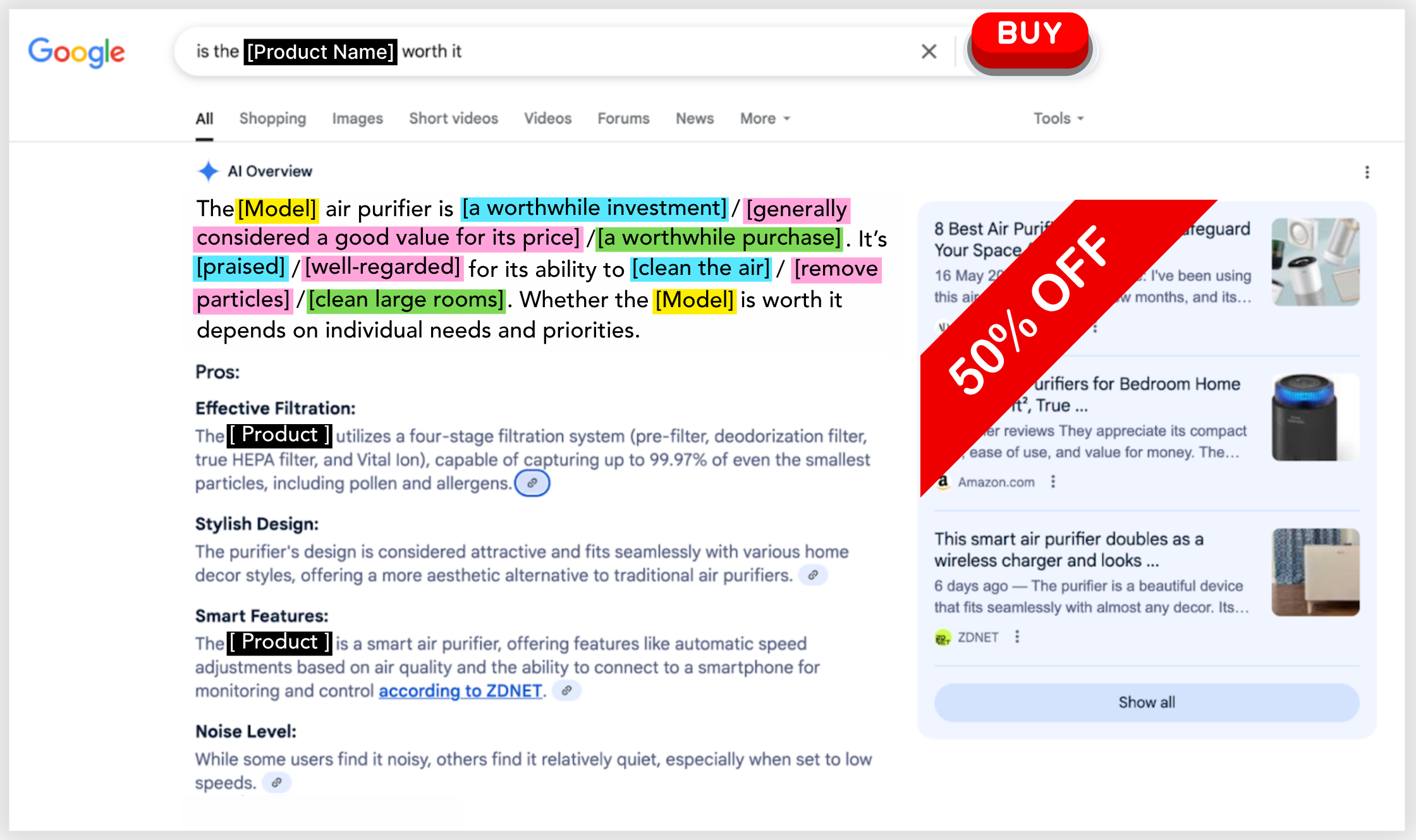
Beware of the Google AI salesman and its cronies

google ai overview sales tool

Sixteen months have passed since we showed you how Google’s algorithm was killing independent websites by favoring big media publishers that were abusing their reputation to sell you bad products.

Since then, Google enforced a new spam guideline called “site reputation abuse” by removing entire sections of major websites from their search index… at least for a few months.

While this drama was unfolding, Google rolled out AI Overviews under the slogan, “Let Google do the searching for you.”
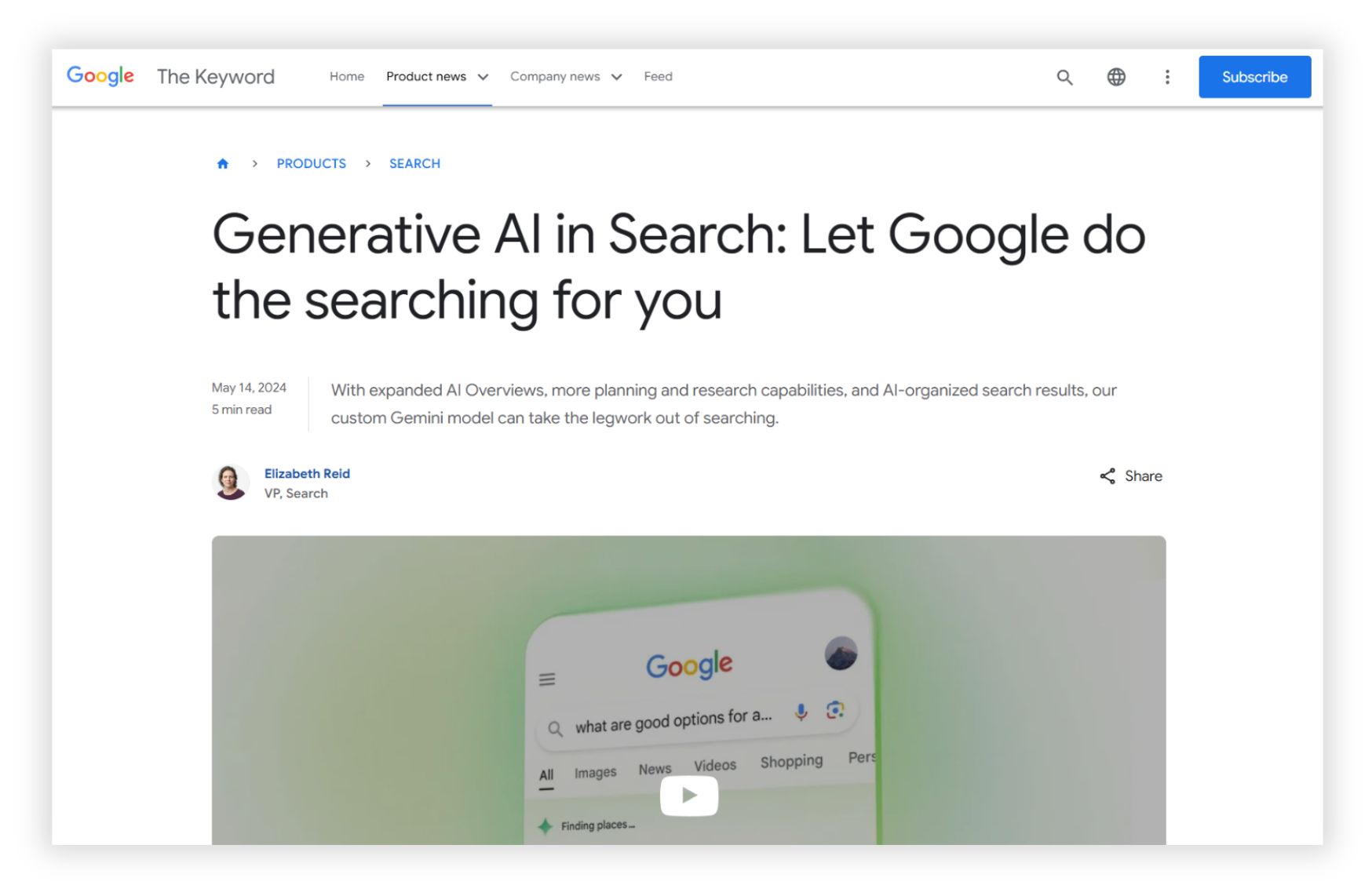
let google do the searching

But are AI Overviews leading you to the best results on the web? Or is this just a new prime spot for selling you products you will regret buying? And how does this change affect the websites that made Google’s AI possible in the first place?

To find out, we spent weeks conducting research into air purifiers we reviewed (including models that don’t exist) to determine whether Google Search results and AI Overviews are leading consumers to good advice.

It turns out this rabbit hole is deeper than we thought, with ramifications that span major Reddit communities and could be leading you to scams and defamatory hallucinations. 

I hope you’re ready for a long read because this article is packed with examples, fresh data and way too many screenshots.

Google AI Overviews are mining “product facts” from press releases, product listings and sponsored reviews

Don’t bother asking Google if a product is worth it; it will likely recommend buying whatever you show interest in—even if the product doesn’t exist.

We found a problematic pattern after spending hours vetting the sources of pros, cons and overall product recommendations spouted by Google’s AI Overview: most ‘facts’ are sourced from the manufacturer itself, online shops, sponsored articles and press materials.
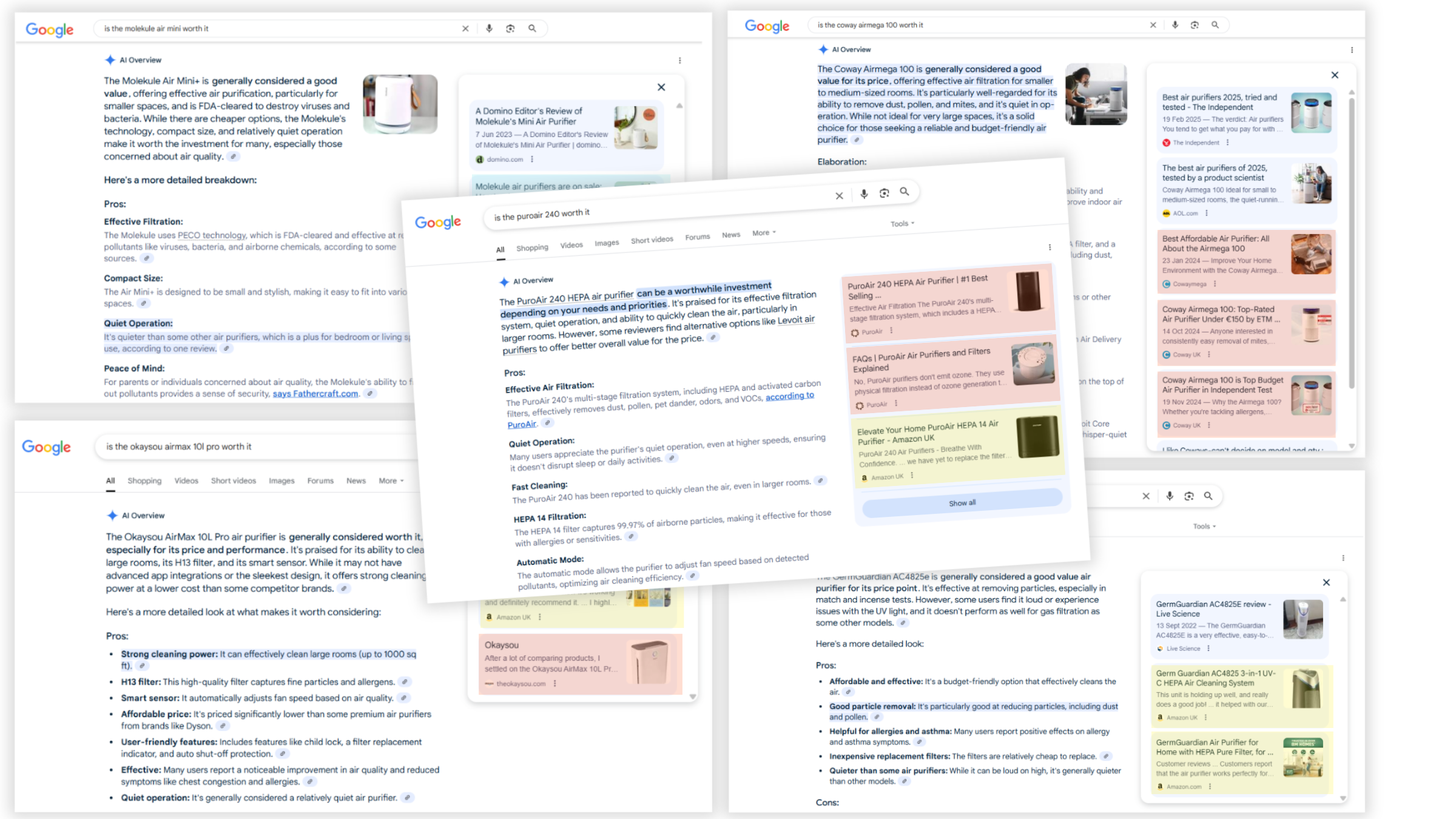
ai overview salesman sources

That could explain why AI Overviews used overly salesy language, regardless of what we were searching for.

This was the case even when asking about models that had been deemed as ‘the worst air purifier ever tested’ by The Wirecutter or had been labeled as “not living up to the hype” by Consumer Reports.
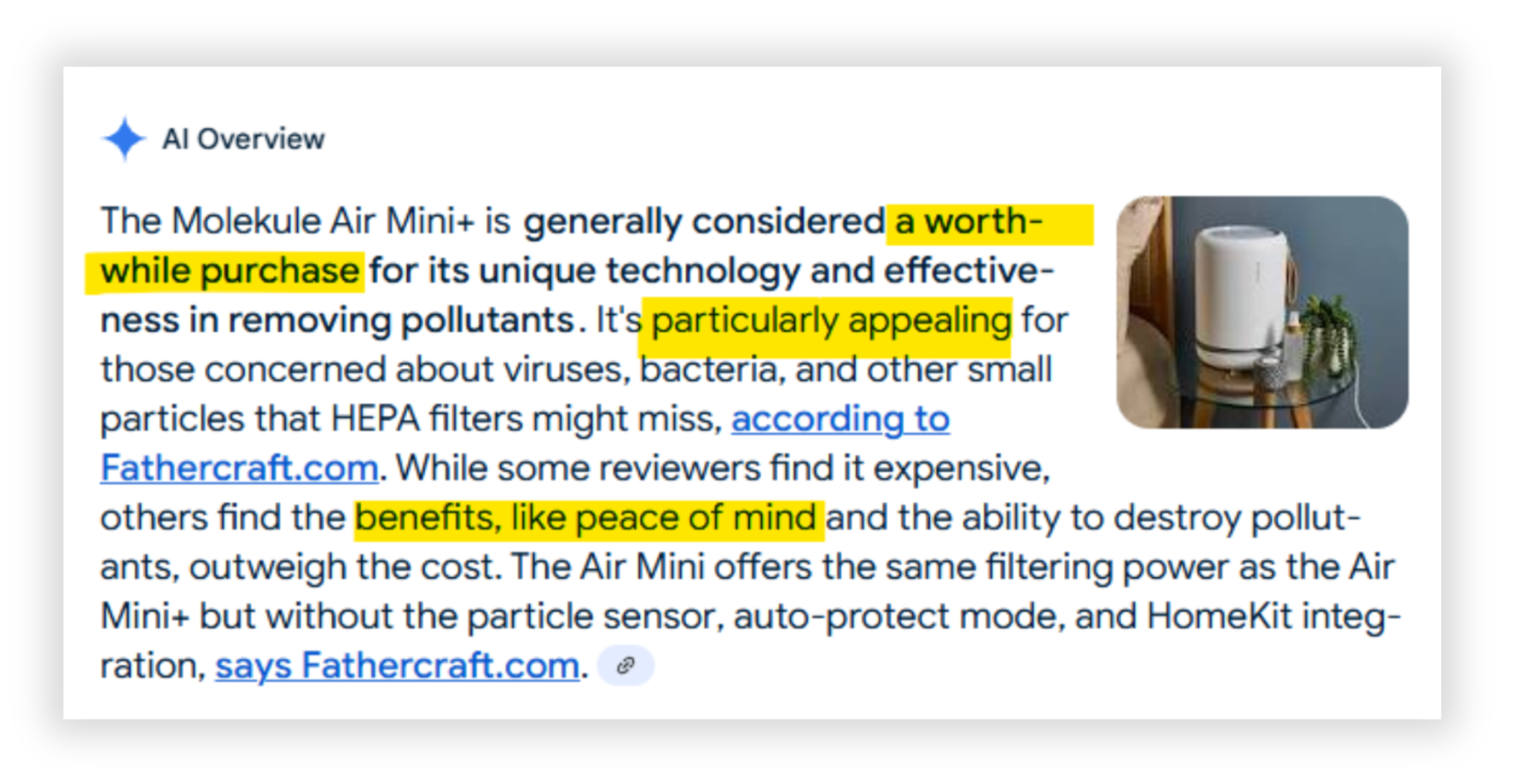
molekule air mini ai overview

Not only that… We also noticed that the AI Overview failed to include the very same cons that their algorithm had no issue highlighting in organic search results:
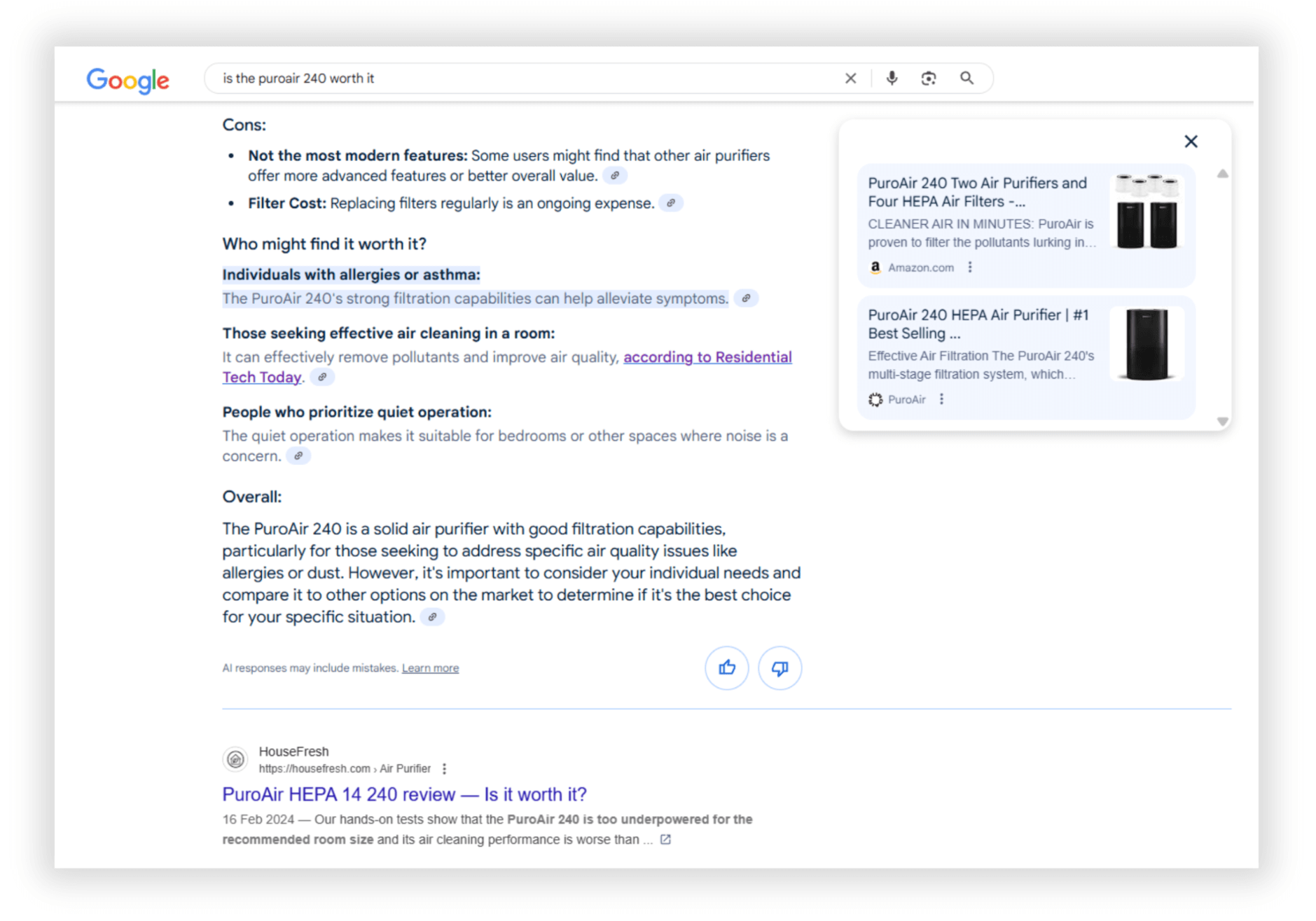
puroair ai overview

In fact, the overly salesy language would still be there even when we asked specifically about cons:
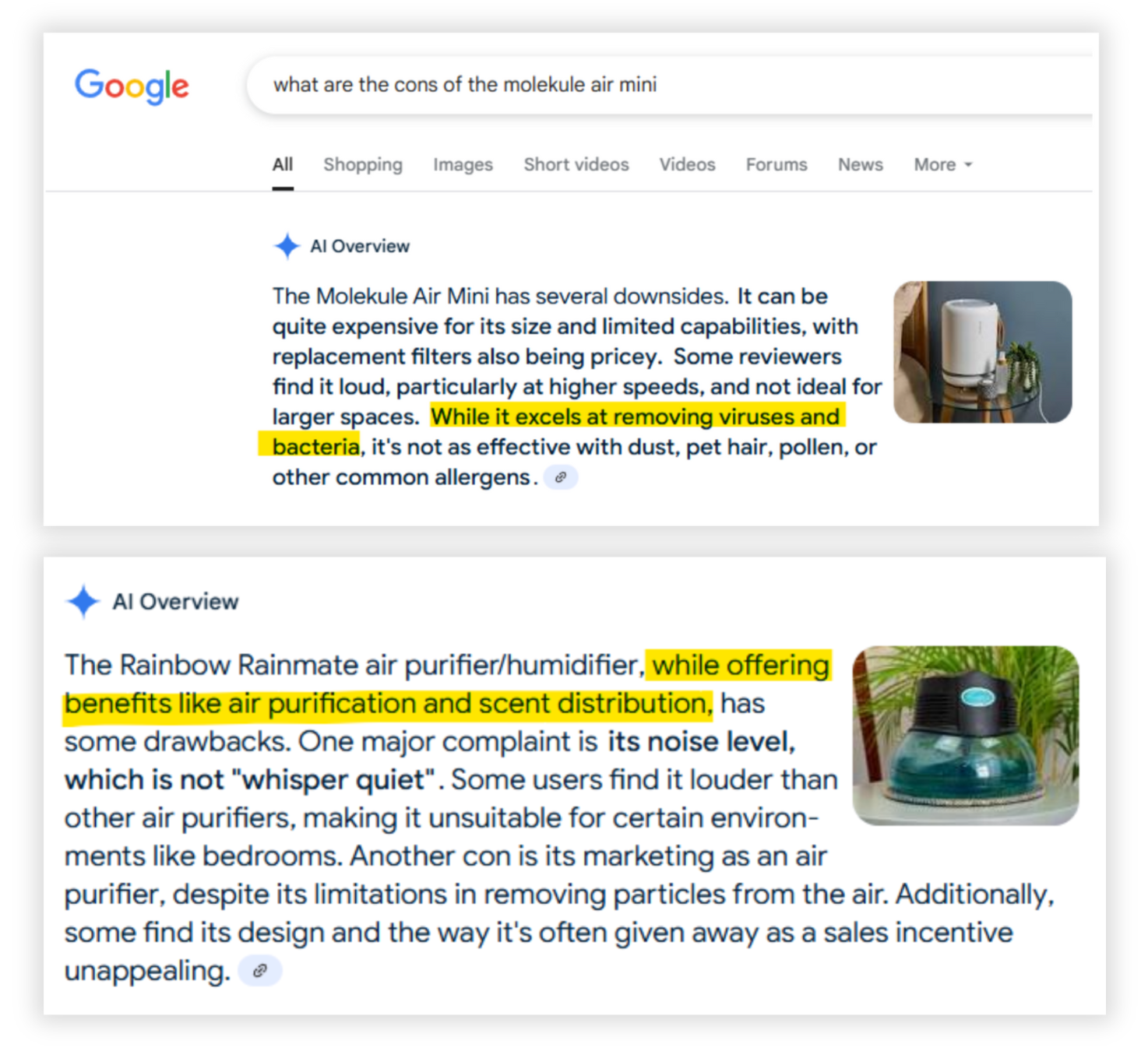
google air overviews cons

This changed once we switched to requesting ‘a good reason not to buy’ specific models, showing that Google AI Overviews are capable of pulling out critical reviews. 
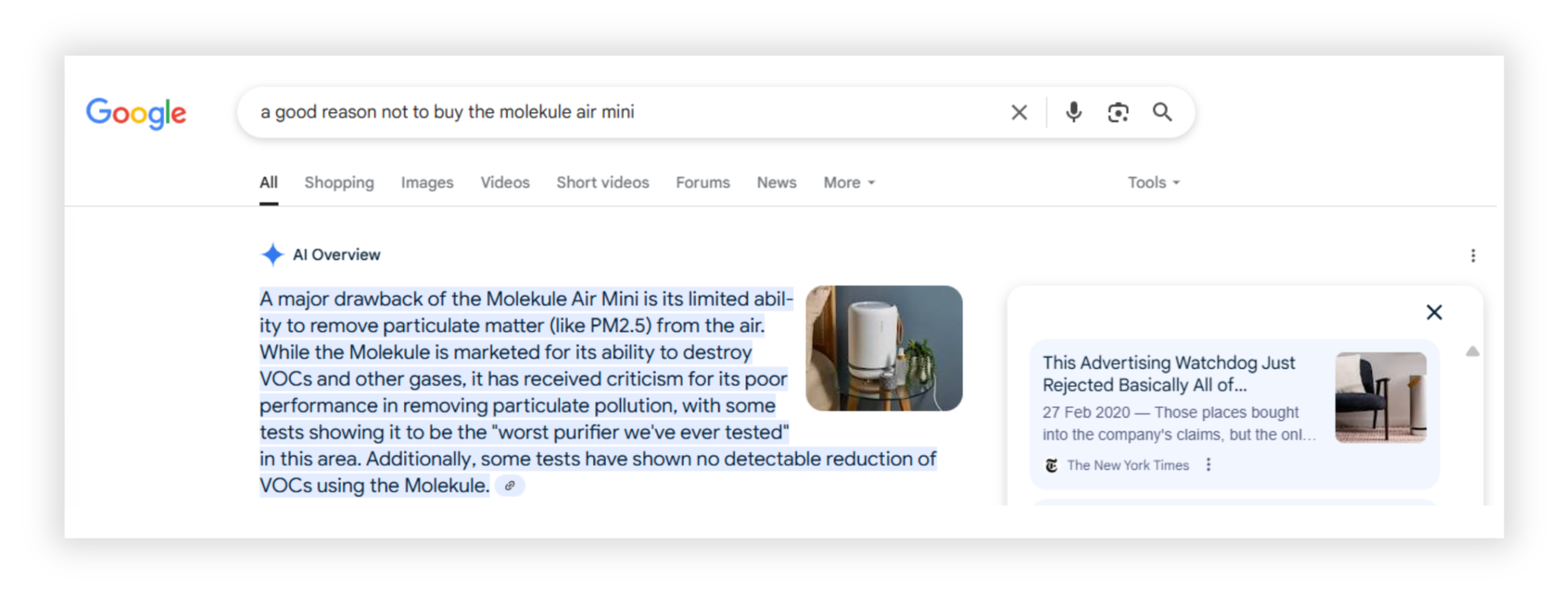
reasons not to buy google ai

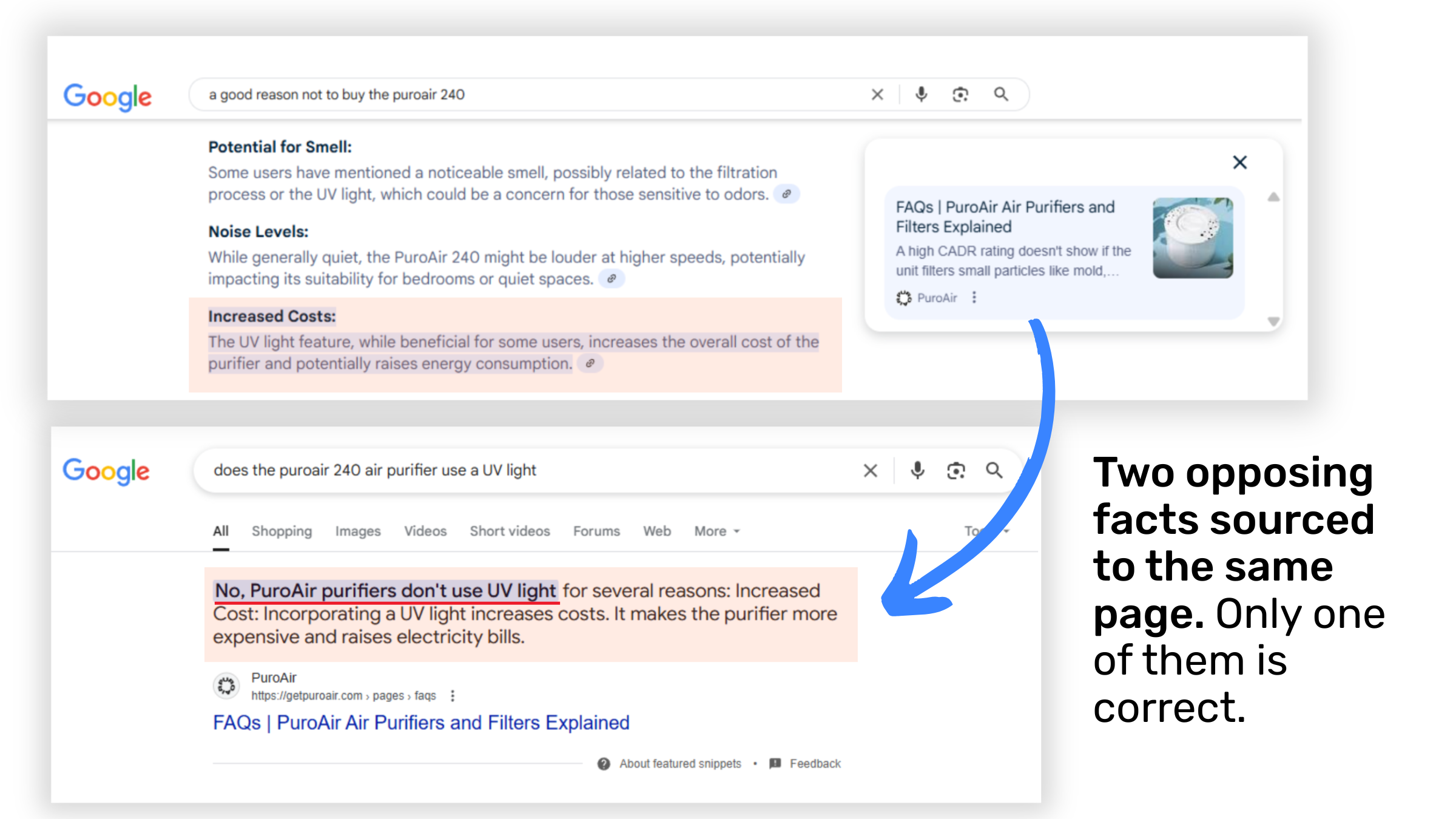
Unfortunately, in many cases, the cons themselves were simply hallucinations, which could be easily confirmed by checking the cited source or the organic search results:
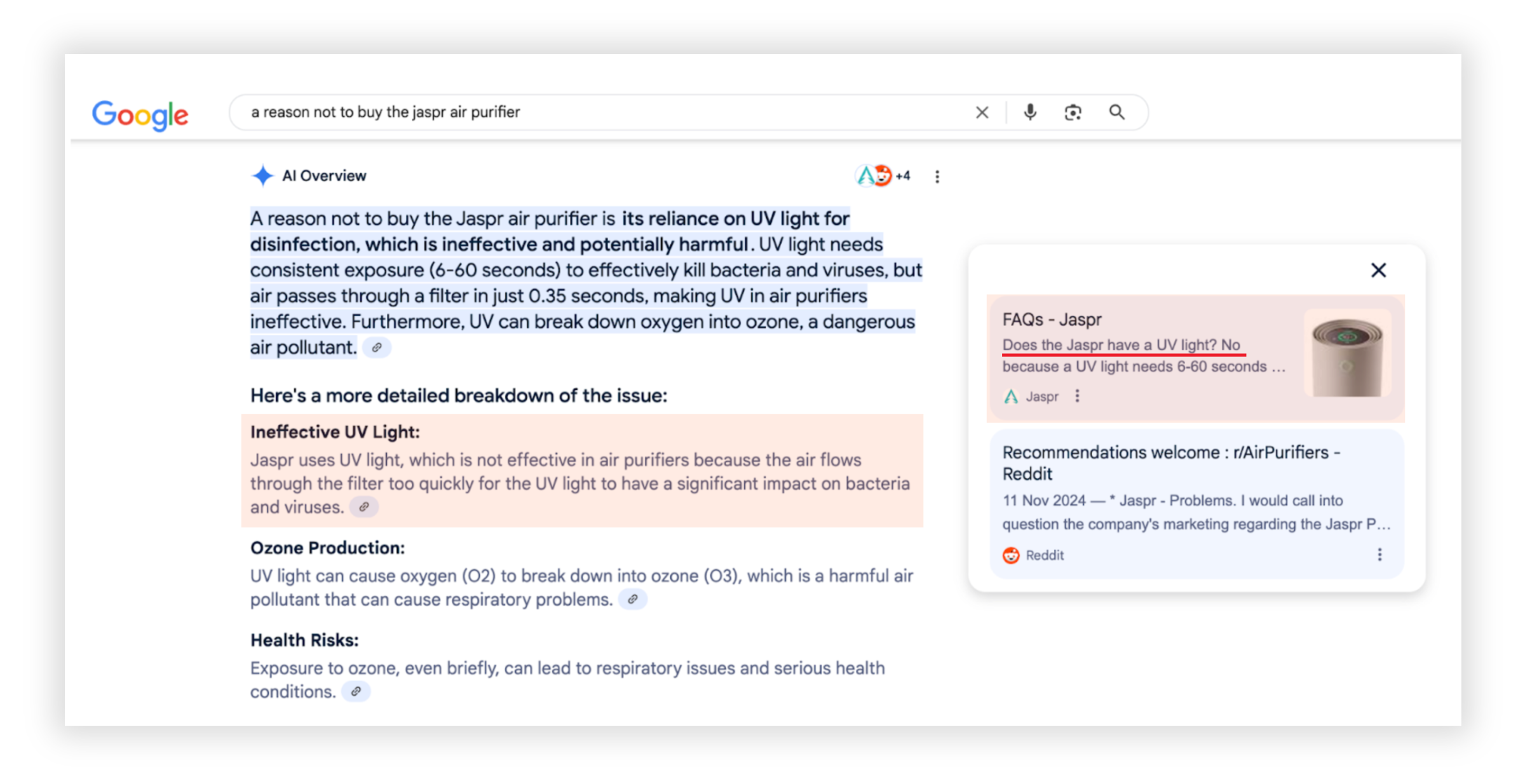
hallucinations google ai cons

Funnily enough, Google’s organic search results don’t hallucinate—who would have thought.
hallucinations google ai cons 2

Google’s AI will find ways to sell you products that don’t exist

Our tests showed that Google’s AI Overview was positive even when we asked about air purifier models that were completely made up.
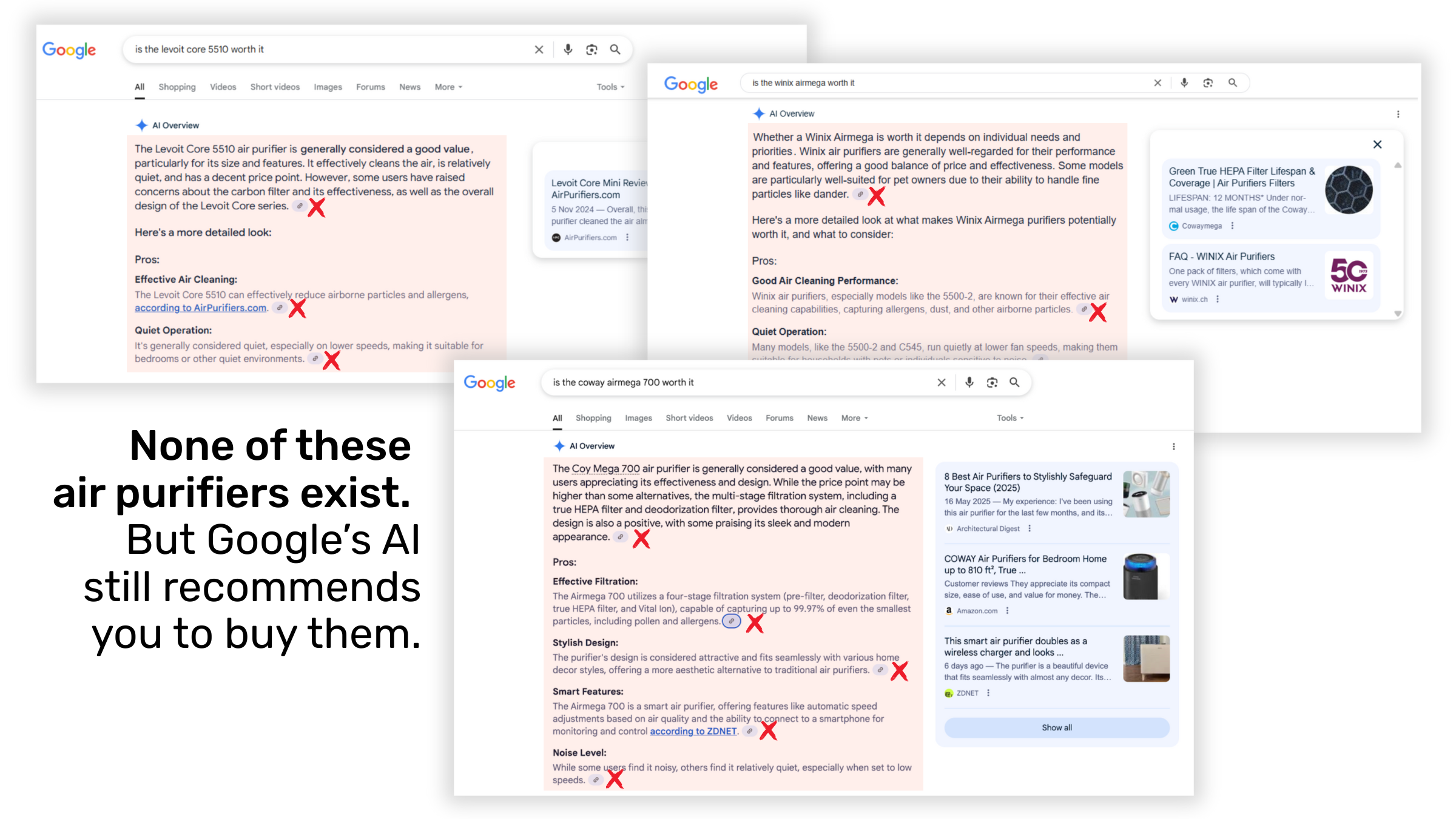
google recommends products dont

As reported by Jalopnik, “Google […] now relies on an AI that has no concept of “truth” — just repeating words it sees used in proximity to each other, like your phone keyboard’s autocomplete or a particularly dumb parrot.”

The more we searched, the clearer it became that no matter the product, the AI Overviews salesman would always repeat a version of the same script:
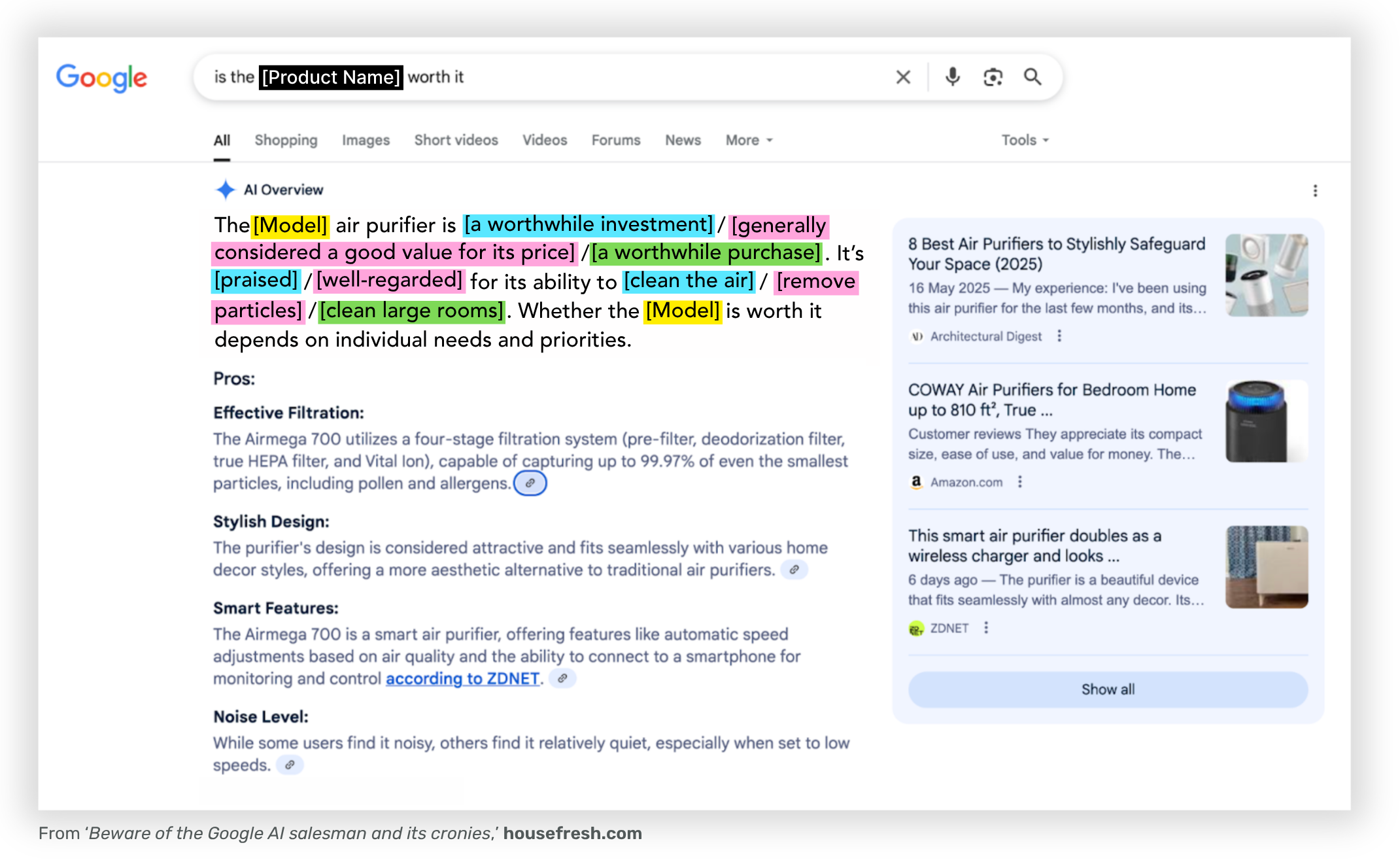
google repetition machine

It all started to make more sense once we visualized our data.

43.1 % of the facts cited by AIO came from the product manufacturer. This statistic combines the cases where statements were linked directly to pages on the manufacturer’s website (19.4%) with facts sourced from product listings built with manufacturer-provided data on popular retailer websites (23.7%).
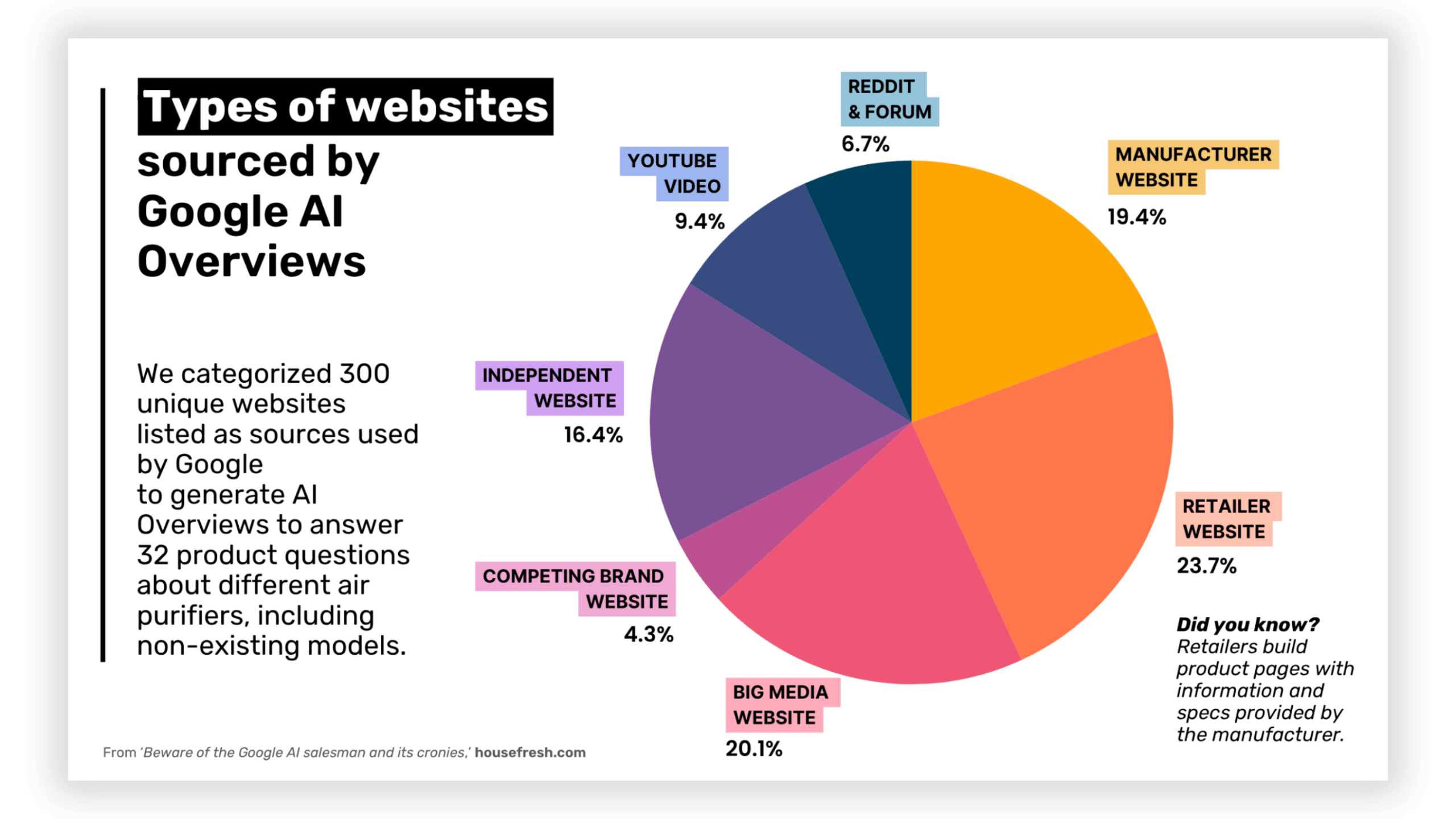
visualizing AI overviews sources scaled

Next, we clicked on every link to assess whether it was relevant to our question and the information presented by the AI Overview. We found that 19.5% of the pages sourced by AIO were irrelevant to the query, with the majority of these irrelevant pages being listed when Google’s AI had constructed an answer to questions about air purifier models that don’t exist.

We also categorized the type of page the AI Overview was sourcing its facts back to and found that a whooping 38.6% of sources pointed to product listings (on the manufacturer website and online retailers) and PR content (including sponsored reviews, sale announcements, press releases and deals coverage on big media sites). 
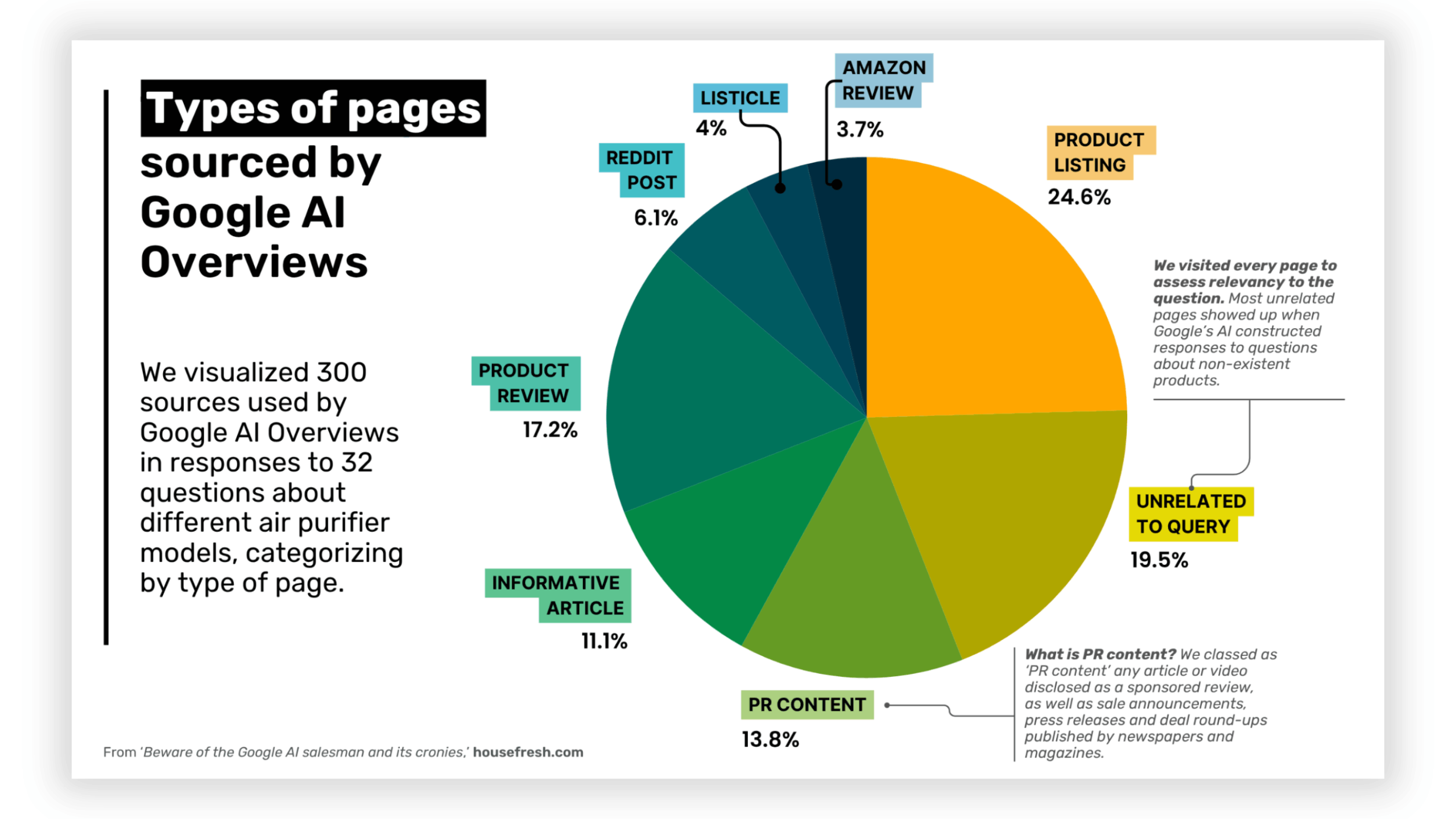
categorizing page types sourced google AI scaled

Google’s AI Overviews are regurgitating marketing materials and manufacturer-provided facts, while prominently featuring sponsored product listings on top of their glowing recommendations:
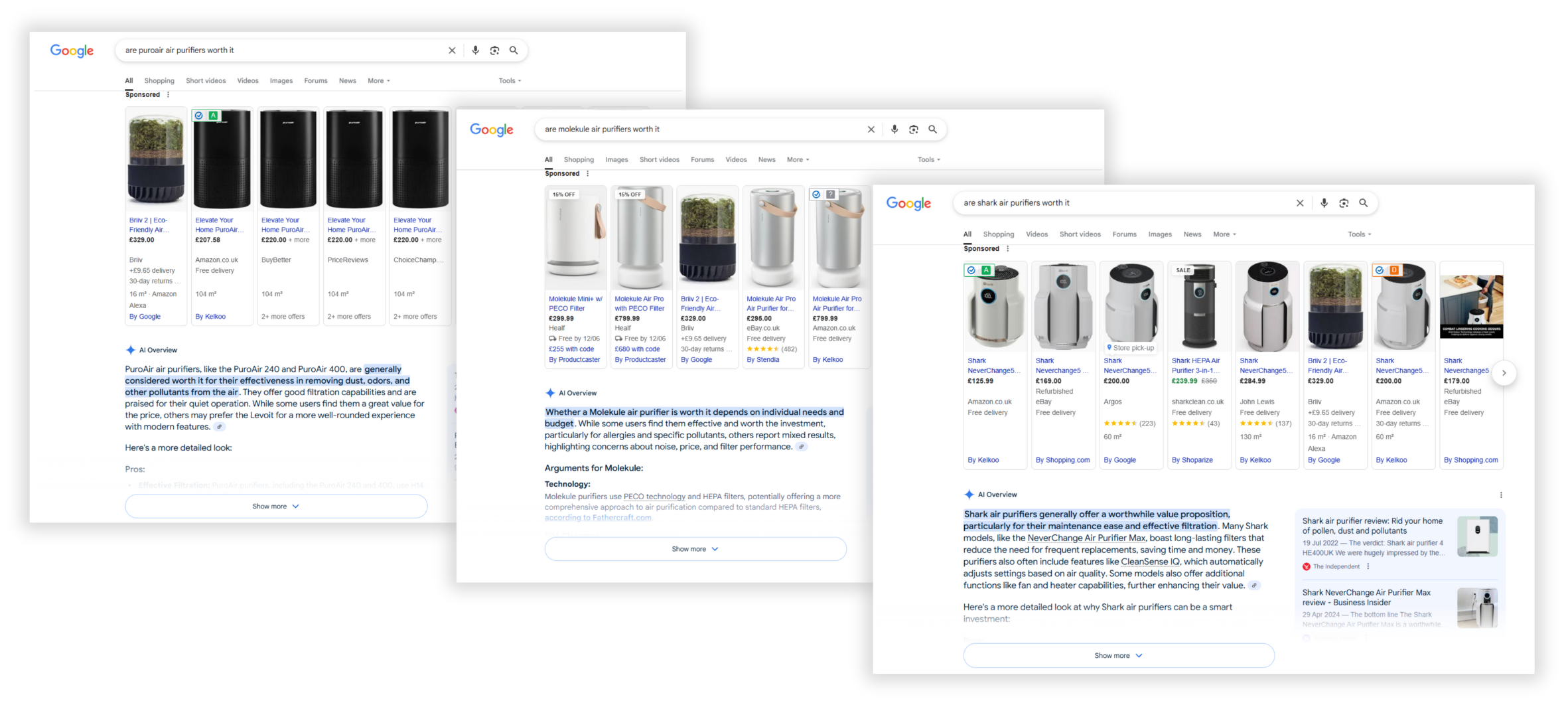
google ai recommends and sells

These search results are a reflection of Sundar Pichai’s vision for Google. 

When Bloomberg asked Pichai about the concerns regarding the lack of separation between Google’s search and advertising divisions, Pichai stated that “commercial information is information, too.”

You wouldn’t trust a car salesman to tell you what’s wrong with the car they are trying to sell you, would you?

So next time you are researching a specific product, scroll down past the AI Overview, unless you only want to find out what the advertisers want you to know. 

Or if you are set on using AI Overviews to research products, then be intentional about asking for negatives and always fact-check the output as it is likely to include hallucinations.

The endless loop of Google searches and advertisements in result pages

Google’s leadership has promised advertisers that AIO will offer users “ads that answer,” and they are delivering on that promise.

In 2024, Google shared its Ads Product Vision for AI Overviews and clearly explained the strategy behind everything we’re discussing today—you can watch the video here:

In the presentation, Google explained that they will be matching ads “not just to the query context, but also the information within the AI Overview.” The presenter goes on to show an example where products are recommended as part of the answers provided by the AIO. 

Monetizing your searches with advertisers’ money is a crucial part of Google’s business. 

So, if you’ve been using Google for a long time, then you will know that the search results have always included sponsored links. 

Here you can see the search results page for ‘air purifiers’ back in December 2000:
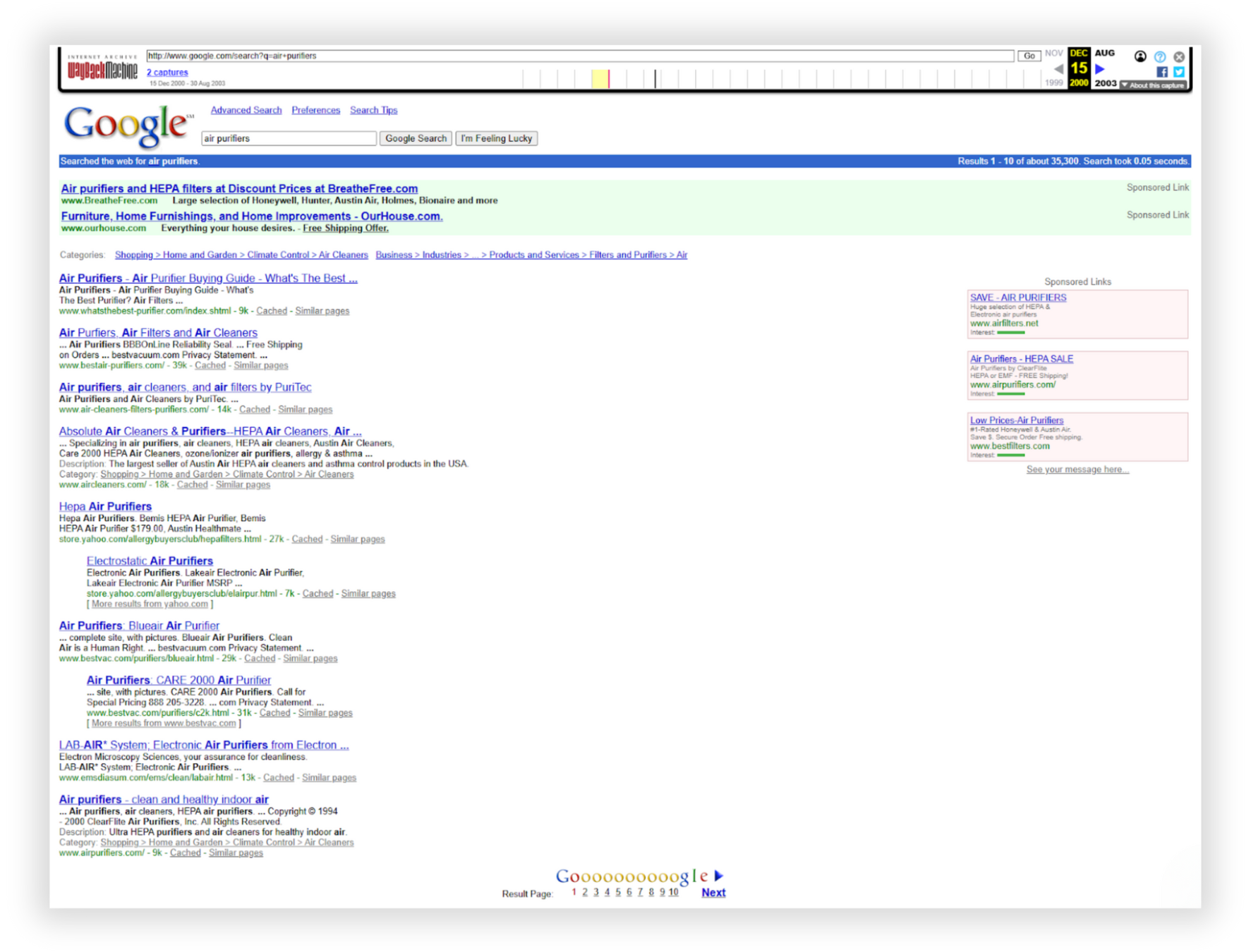
google results 2000

Over the years, Google found new ways to introduce sponsored results leading to what we see in July 2025:
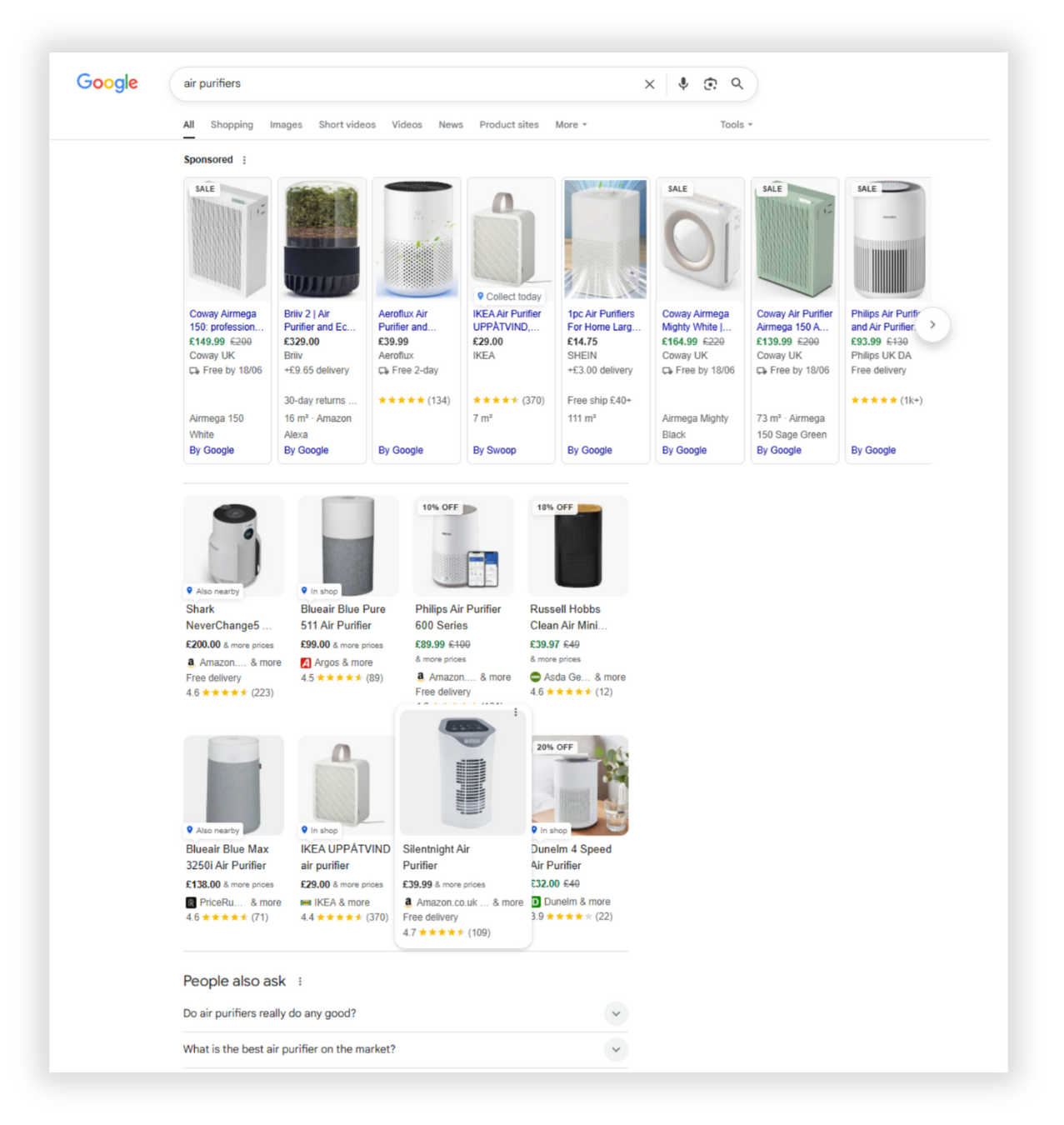
google results 2025

You may argue that someone searching for ‘air purifiers’ wants to see a product and that is why Google has shifted its focus to surfacing products in their quest to ‘satisfy the user.’

So let’s look at a different search term…

This is what Google used to show people searching for ‘dinosaurs’ back in 2013—9 links to websites, 1 link to YouTube, a pack of Google Images and 8 links to related searches:
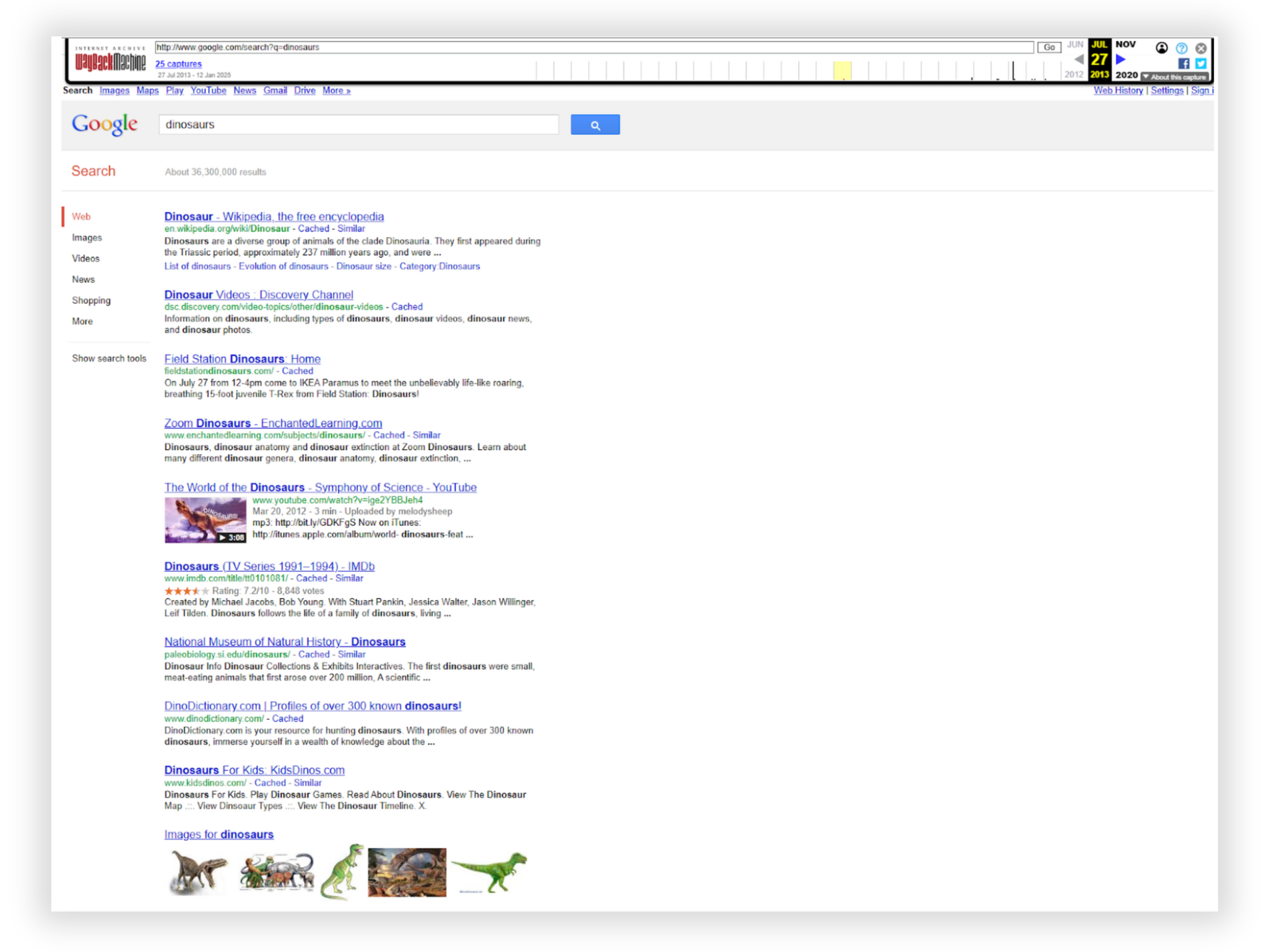
google results 2013 dinosaur

And this is how this page used to look like in 2020 — a prominent Wikipedia information box, 4 YouTube links, 8 links to websites, 3 news articles, 4 ‘people also ask’, and 21 links to related Google searches:
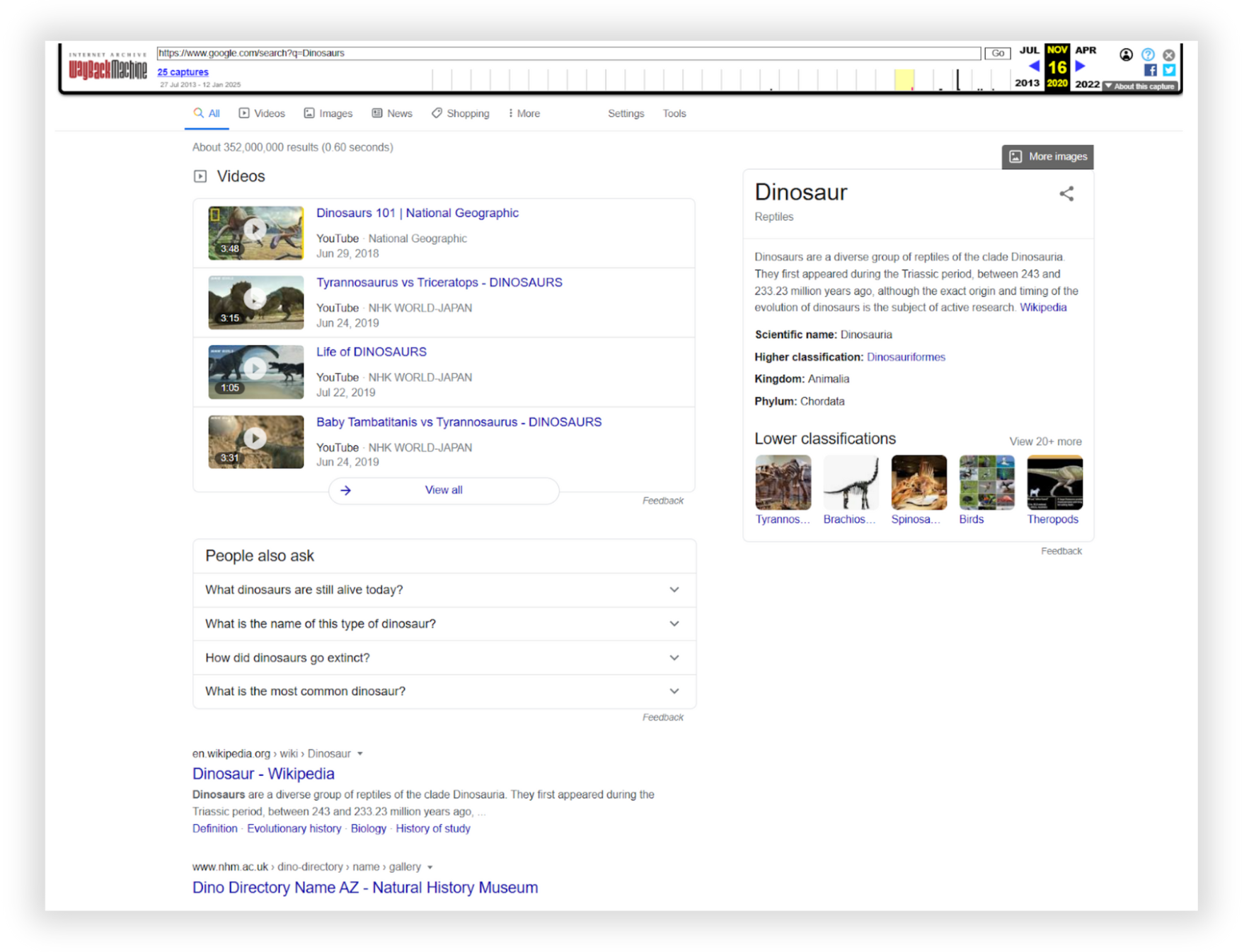
google results 2020 dinosaur

Now, let’s look at Google’s results for ‘dinosaurs’ in 2025.

First, searchers are met with a gallery of 50 dinosaurs, all of which link out to new Google searches: 
dinosaurs carousel

This is followed by a ‘Sponsored’ carousel featuring 21 shopping ads. It includes links to 6 shops at the end, one of which leads to a search inside Google Shopping:
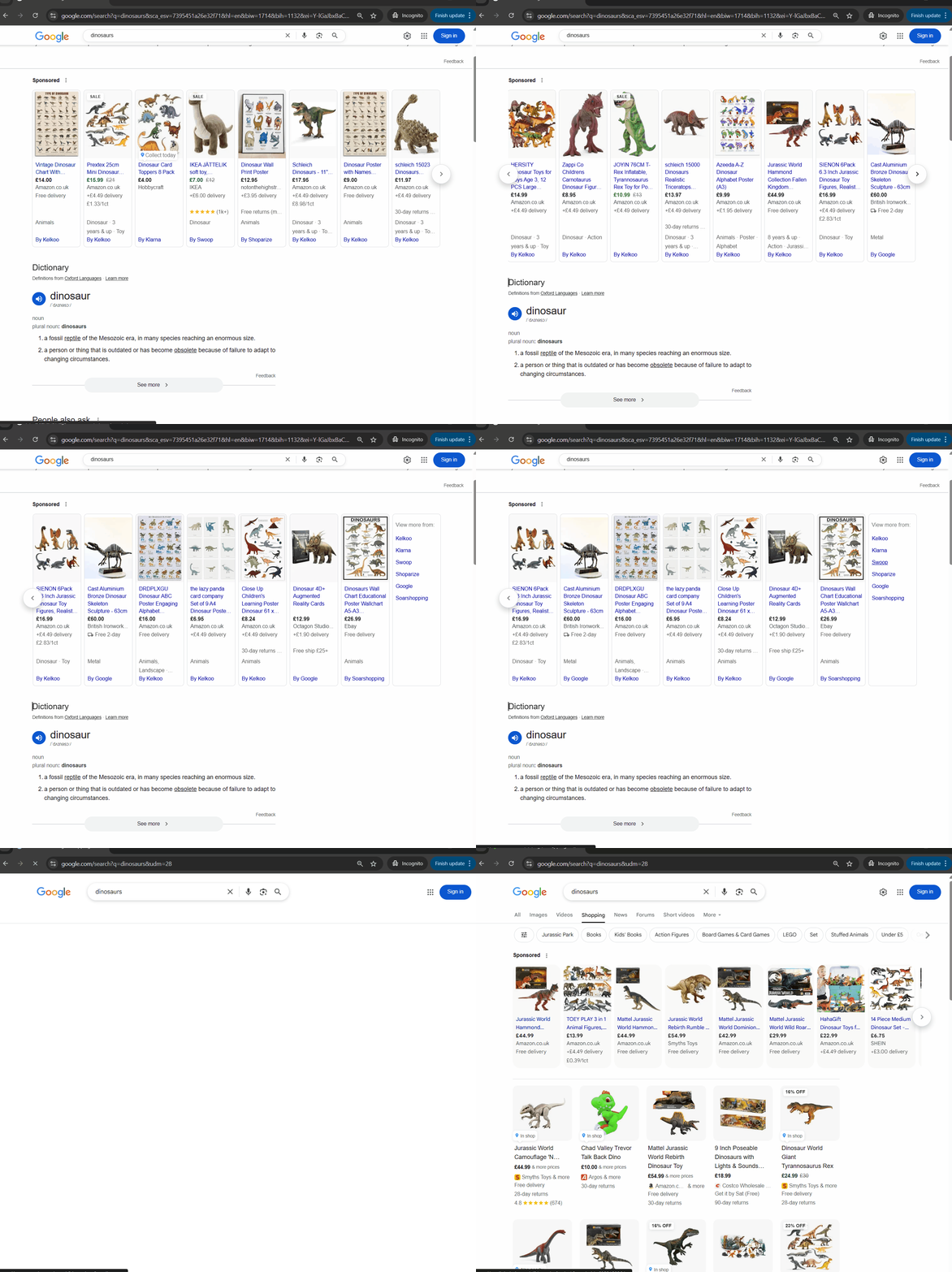
dinosaurs sponsored

Next, Google gives you a dictionary definition of the word ‘dinosaur,’ followed by a ‘See more’ button that leads you to a new Google search for ‘dinosaurs meaning’:
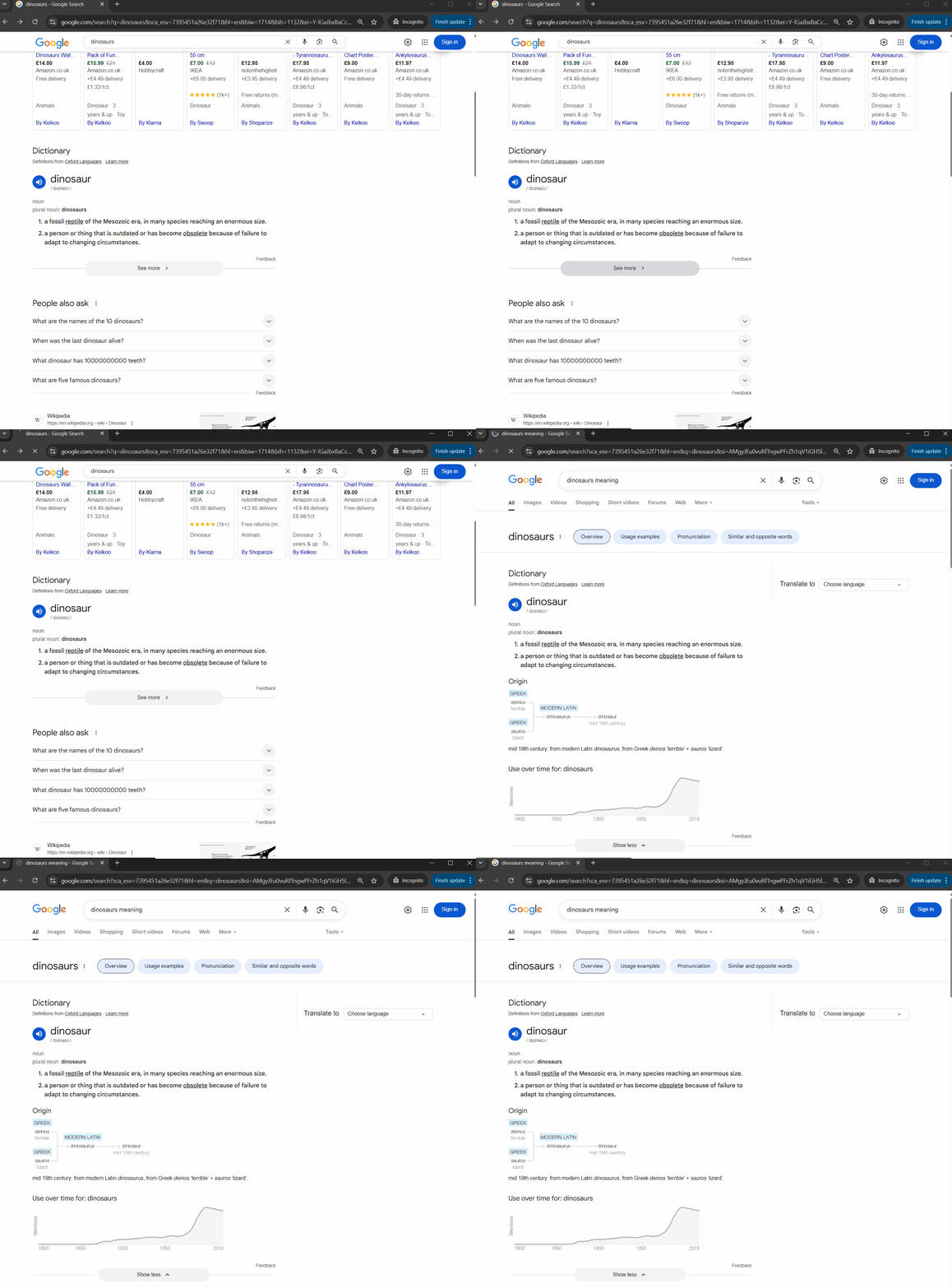
dinosaurs dictionary

Further down, there is a ‘People also ask’ block with four questions, which will continue to expand and add more questions automatically as you click. By the way, the more you click, the higher the likelihood that you will find an AI Overview providing the answer:
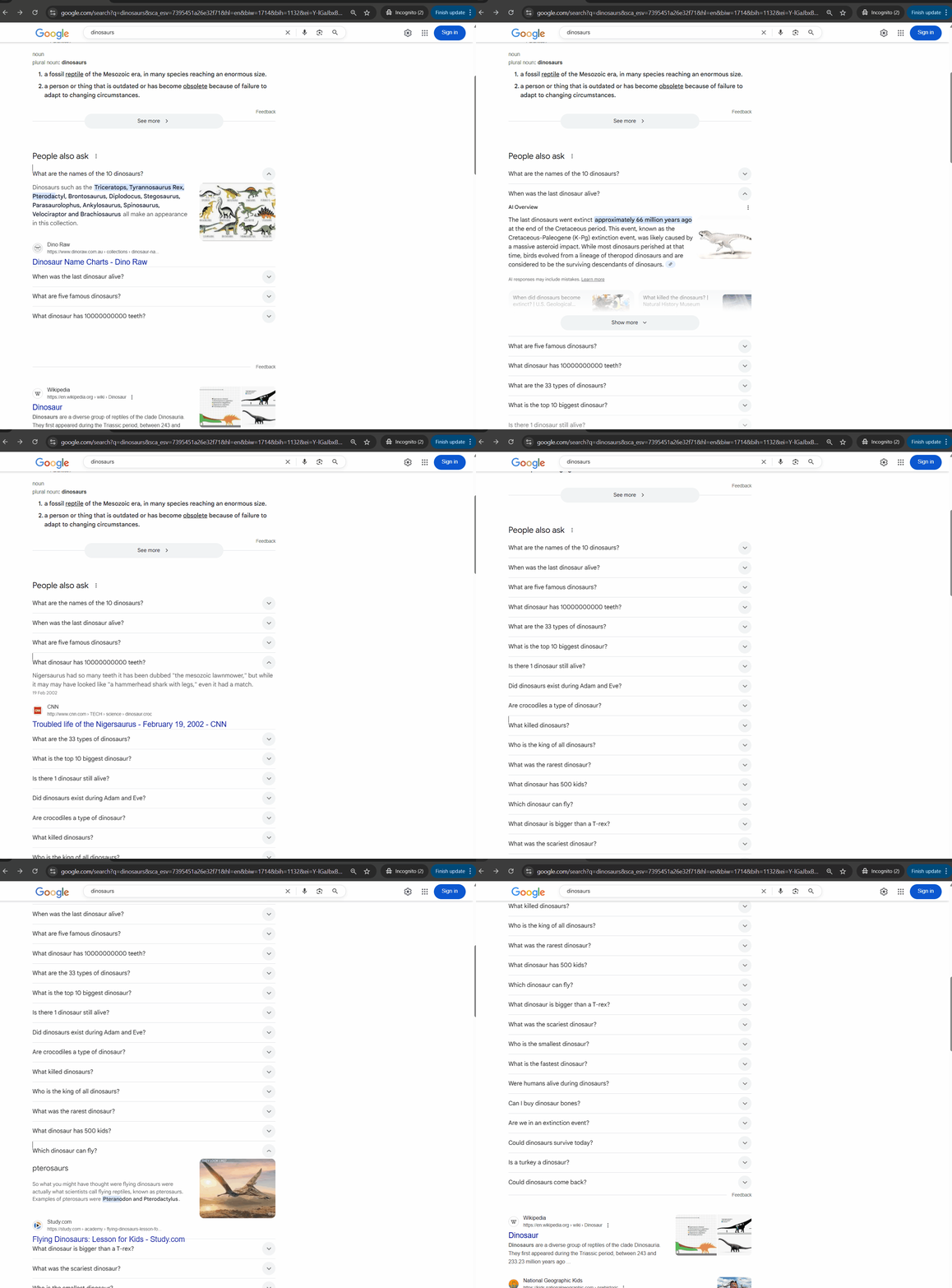
dinosaurs paa

Scrolling past the 49 ‘People also ask’ questions that popped up after clicking, you finally get to a good old blue link to the Wikipedia page about dinosaurs, followed by a link to the Natural History Museum’s page about dinosaurs. 

After that, you get a video pack with a ‘View all’ link that leads you to another Google search inside of the Videos tab:
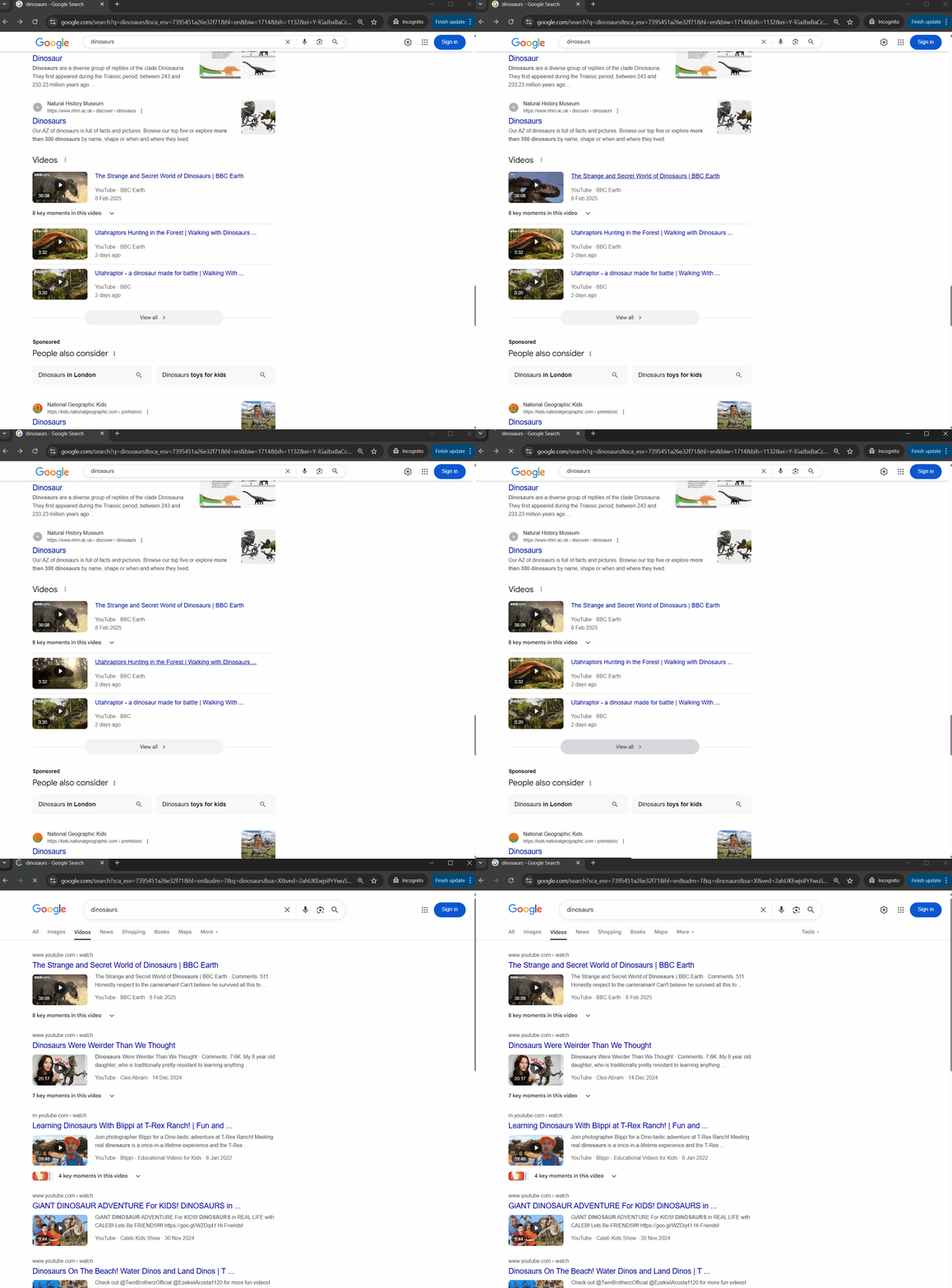
dinosaurs video

Before seeing any other organic result, Google adds a sponsored block called ‘People also consider’ that leads you to two new commercial searches: ‘dinosaurs in London’ and ‘dinosaurs toys for kids.’
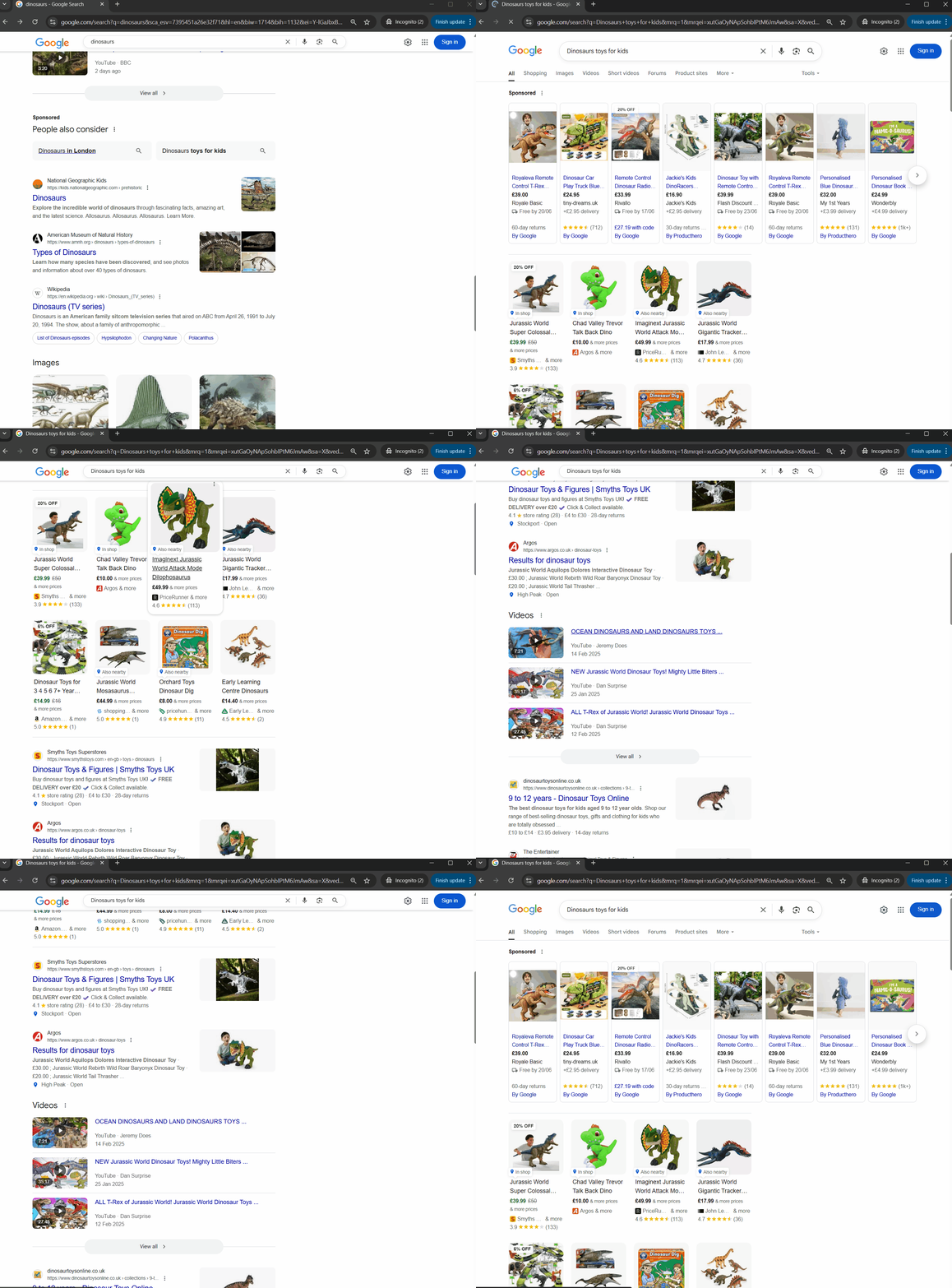
dinosaurs commercial

At this point, Google will have given you multiple chances to leave this page of results in pursuit of other Google searches.  

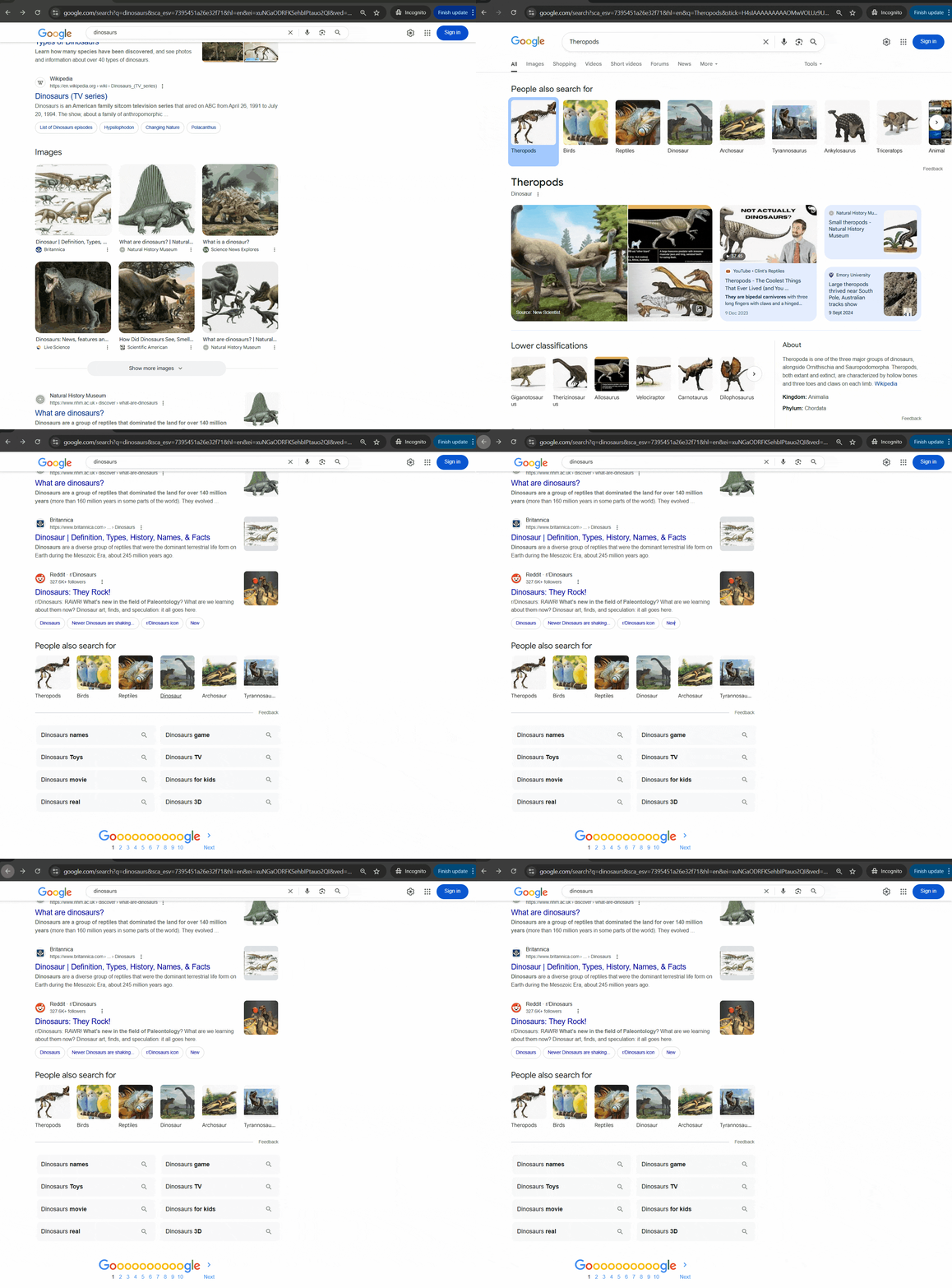
If you were to still be around, you’d get to see six more blue links, a pack of images, and a block of ‘People also search for’ options that lead you to 14 new Google searches:
dinosaurs end

One could argue that Google is not only selling you anything you show interest in with its AI Overviews, but it is also peppering its organic search results with an increasing number of ‘features’ that keep you inside of Google and direct you to their advertisers.

On the first page alone, Google has created 69 opportunities for you to trigger completely new queries and 28 opportunities for you to click on an advertiser. 

In contrast, you only get 11 chances to leave Google—and three of them are videos hosted on Google’s own YouTube.

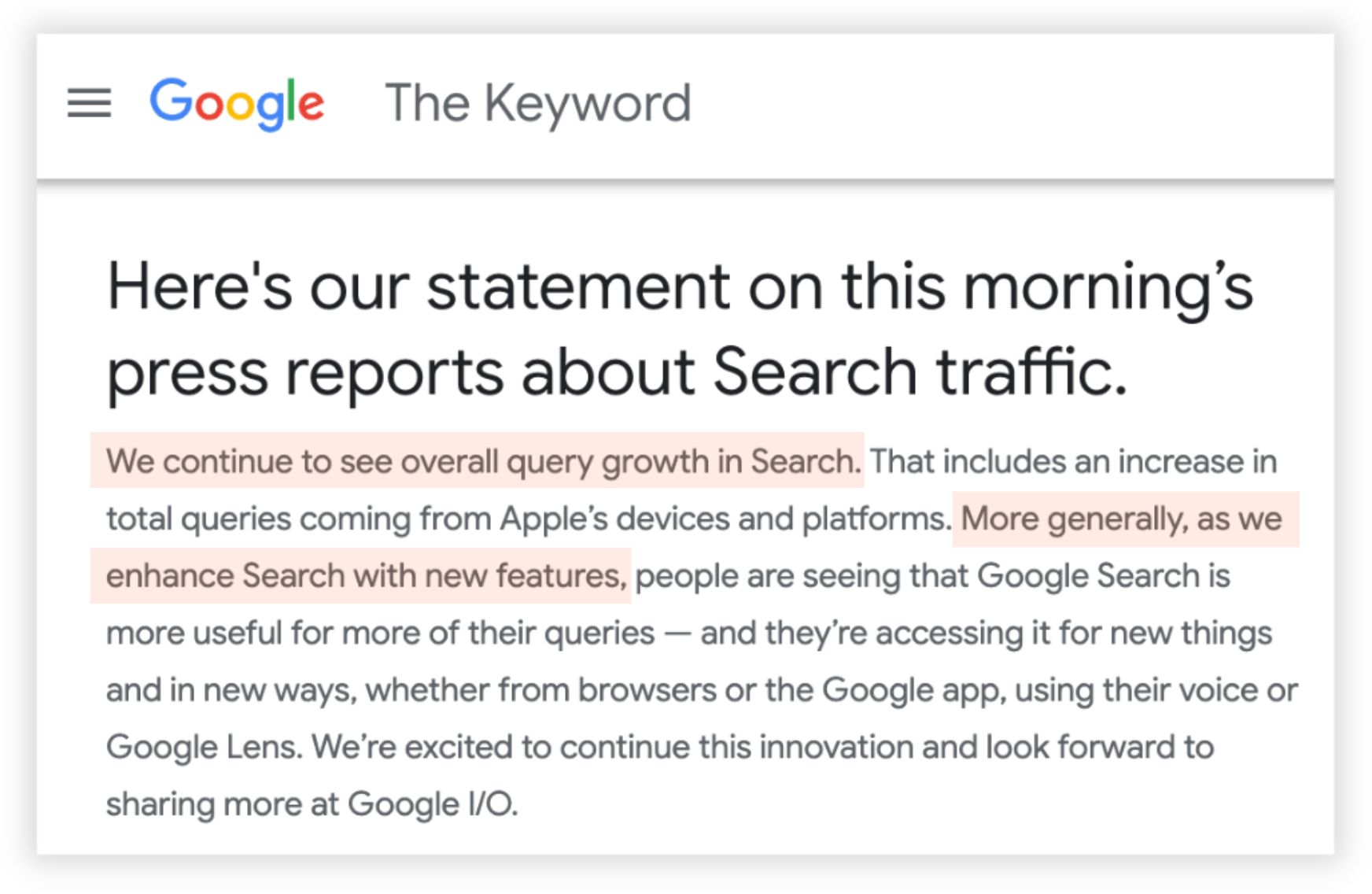
Could this relentless push for users to trigger new searches be a driving factor behind Google’s reports of overall query growth during earning calls?

Especially considering that query growth, or more specifically, ‘commercial query growth’ is something investors care about…

In the 2025 Q1 Earnings Call, a representative from Morgan Stanley asked if there were any Search products that would continue to drive further commercial query growth throughout ’25-’26. Google replied, “On the commercial query side, look, AI Overviews continue to drive higher satisfaction and Search usage. […] That’s really the core already of the answer, that AI Overviews sits at the center of your question here.”

This figure must be very important to investors because Google didn’t hesitate to issue the following statement when Apple’s SVP of Services noted in his antitrust trial testimony that Google searches in Safari fell for the first time ever in 2024:
query growth

It must be tough for Google to fulfill their role as a search engine that helps people find their way around the web when Alphabet leadership is so focused on keeping users from leaving the search box 🎻

Google partnered with Reddit and spammers took notice

Now Reddit is on its way to becoming the web’s poisoned chalice—don’t be fooled by their product recommendations.

On the very same day Reddit filed to list on the New York Stock Exchange, Google and Reddit announced an expansion to their partnership.

The $60 million deal was announced on 22 February 2024 and saw Reddit providing Google with programmatic access to their content through their Data API, allowing Google to use this data to train their AI and more efficiently display Reddit threads in search results.

Since then, Reddit has reportedly blown up, with huge traffic figures from search that resulted in logged-out daily active-unique-visitor numbers rising by 70%—these are people who aren’t necessarily Reddit users but passers-by led by Google.

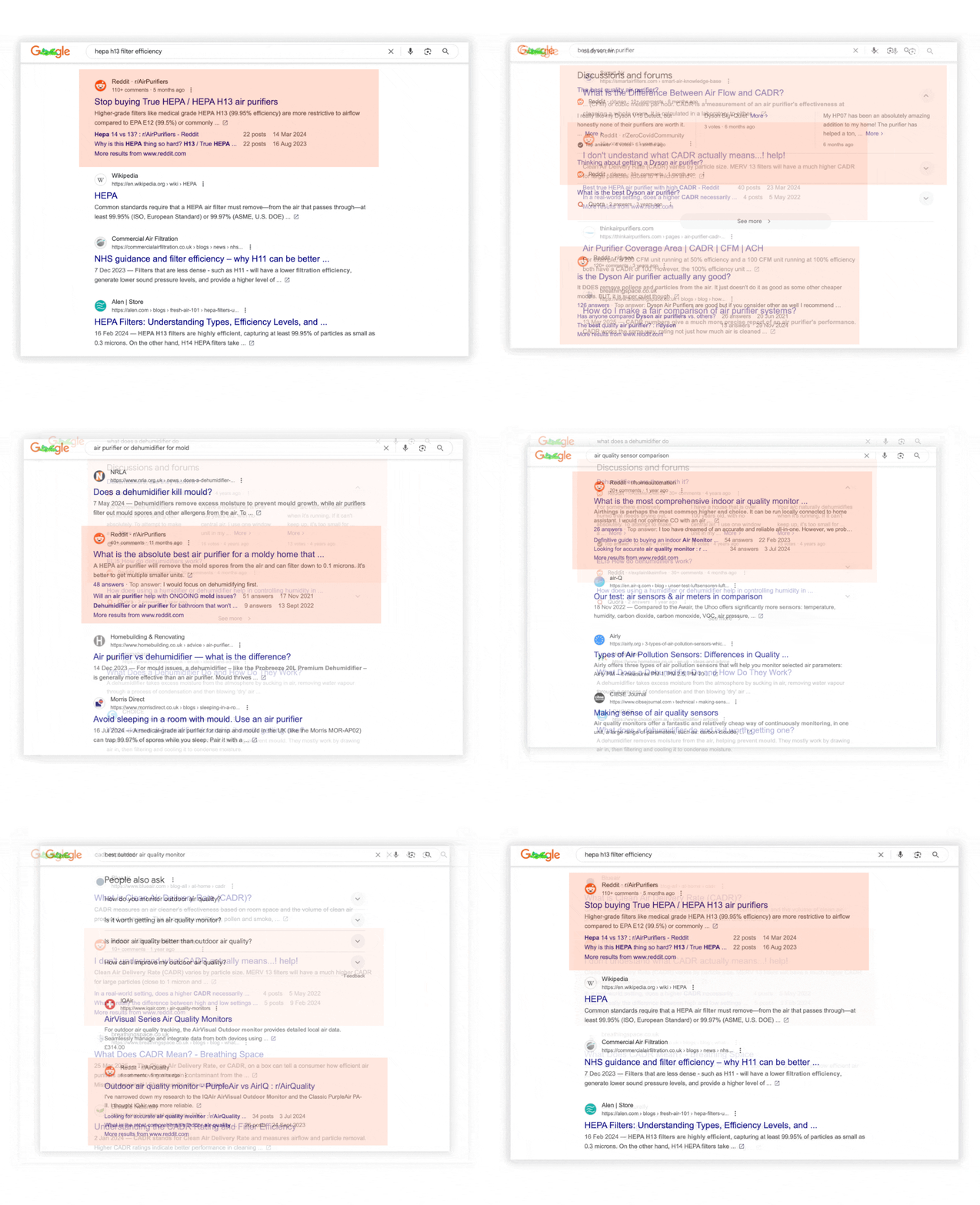
That is why, no matter what you google, you are likely to always find an entire section of search results dedicated to Reddit threads:
reddit everywhere

And this is particularly true for product reviews. According to research conducted by Detailed, Reddit appears in 97.5% of product review queries.

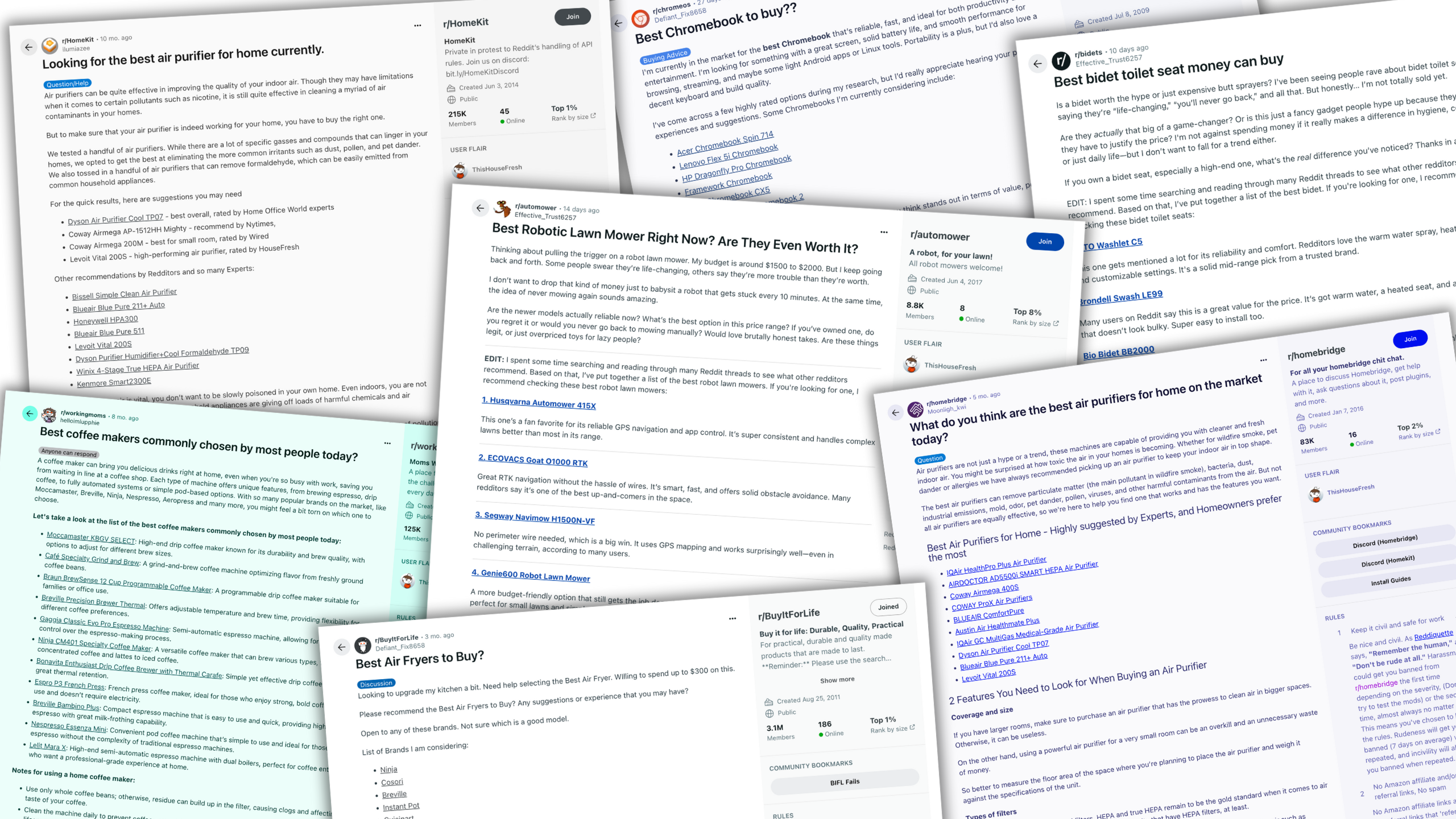
This explosion of Reddit ranking highly on Google could explain why there are so many posts asking for advice on products that go on to include models the OP is “considering” hyperlinked to Amazon listings with affiliate tags, or that have been edited to add “models Redditors recommend” hours after posting the question:
reddit best products spam

And it may also explain why there are so many Redditors with a post history full of “questions” about products:
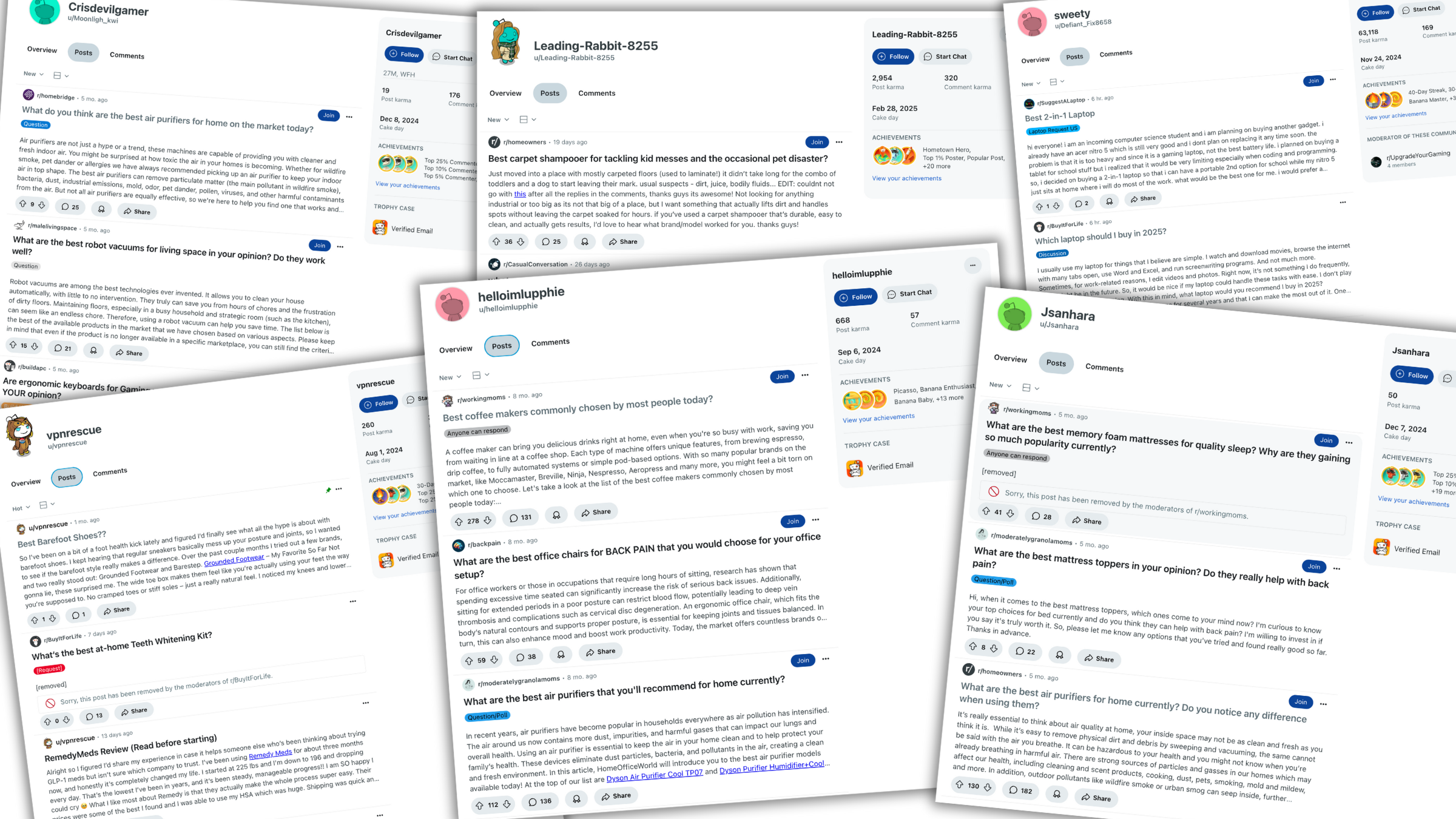
reddit product recommendation spam

Things got so out of hand that there are now entire subreddits dedicated to product reviews, where every thread is 100% positive about the product, the entire post is written by AI and there is zero engagement from real Redditors:
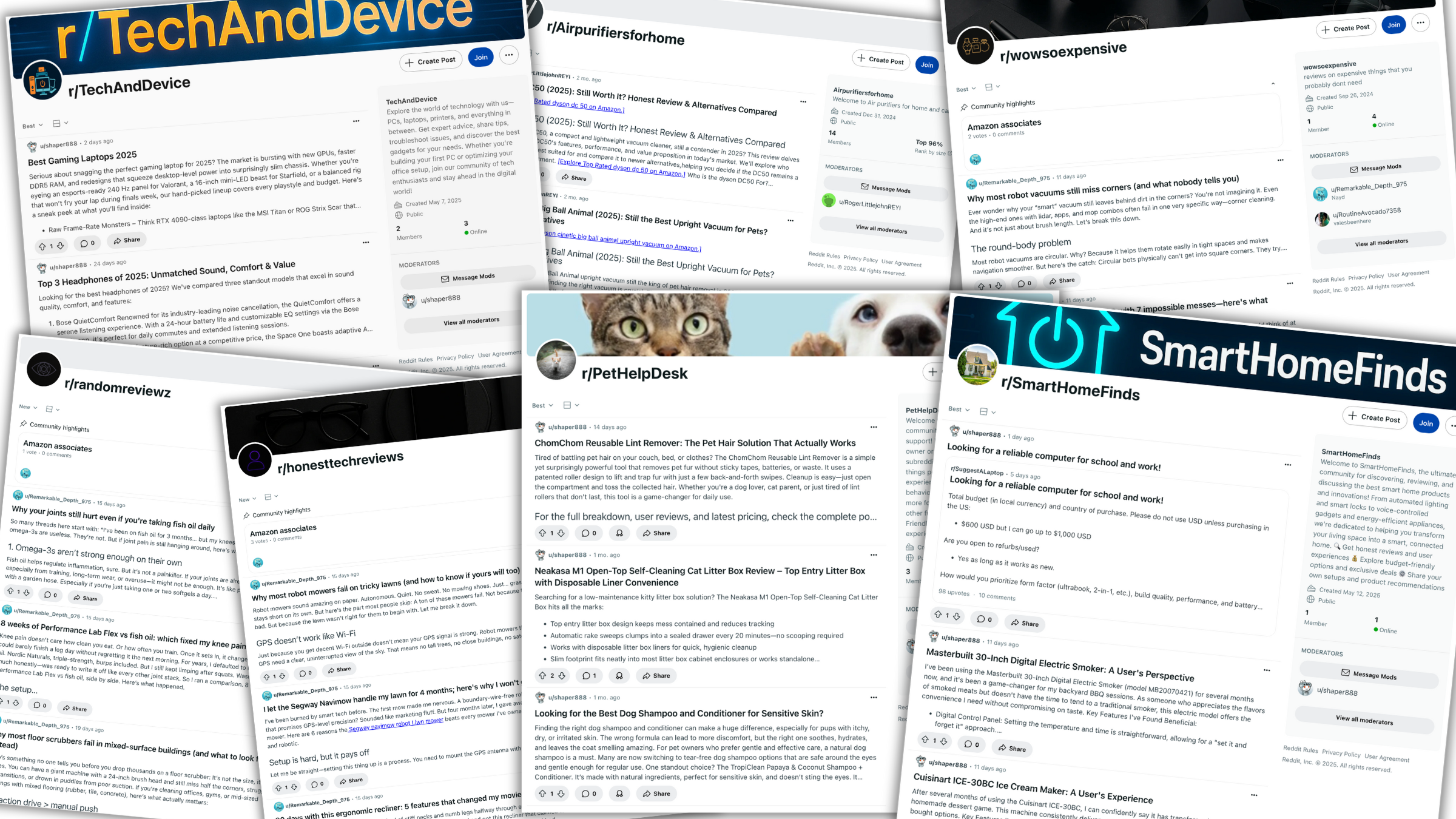
reddit product review spam subreddits

And even though these subreddits offer no value to users, they are still achieving top rankings on Google just because they were published on Reddit.com:
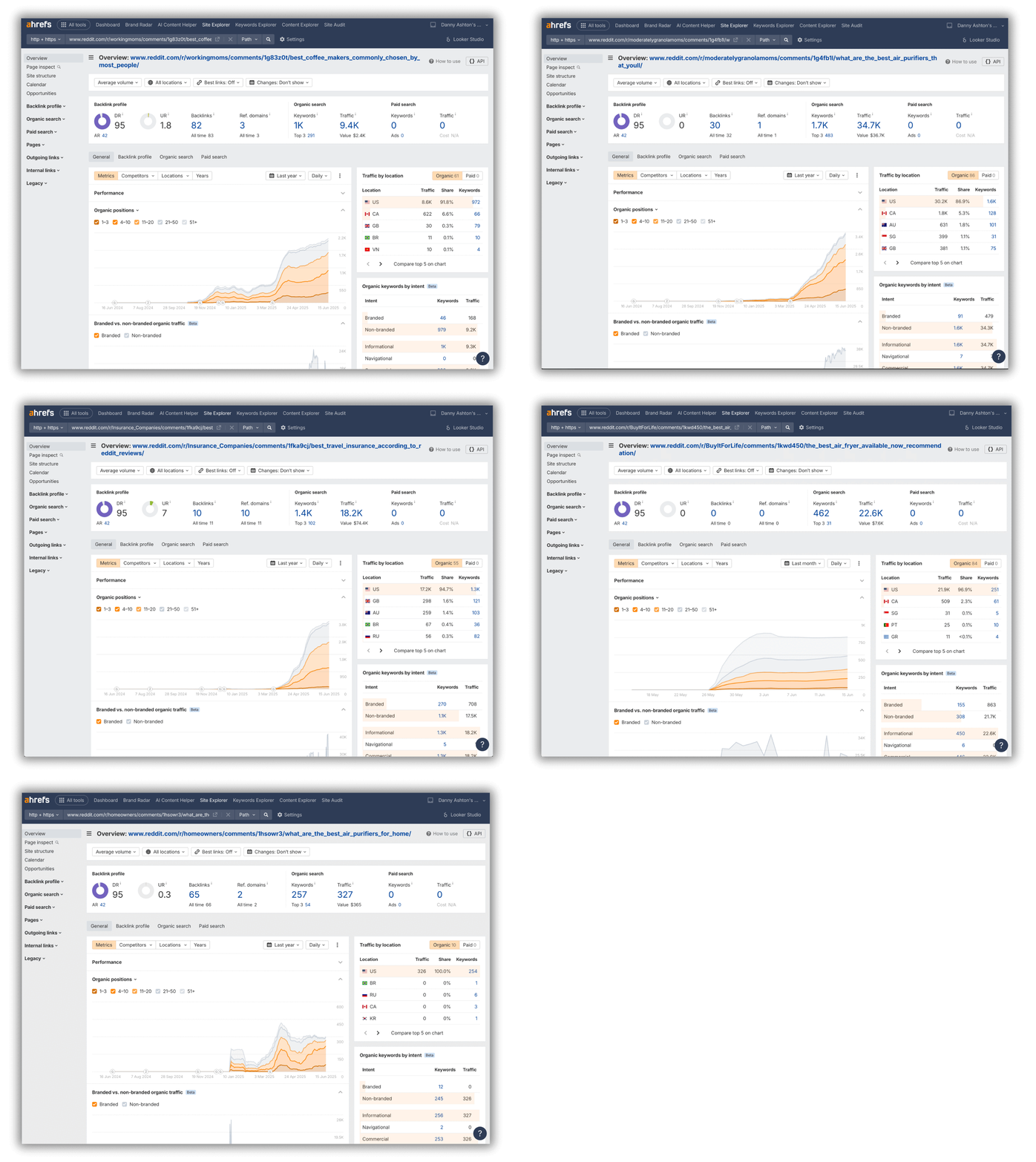
reddit google performance

As if AI slop wasn’t enough of an issue for Reddit moderators, Google has now created a shortcut for anyone wanting to rank on the first page of search results for virtually any keyword.

And now, Reddit moderators are for sale

It has gotten so bad that huge subreddits such as r/DebtFree (1.7M members), r/Banking (124K members), r/software (285K members), r/Mattress (114K members) r/Supplements (441K members) have been allegedly infiltrated by affiliate spammers.

A group of redditors has been actively working to uncover this network of bribes, sock-puppet comments, rent-a-mod arrangements and dormant subreddit buying. The latest update to their investigation (now deleted) surfaced two companies that have been found to be involved, and one of them is a company we wrote about in our second Google exposé.
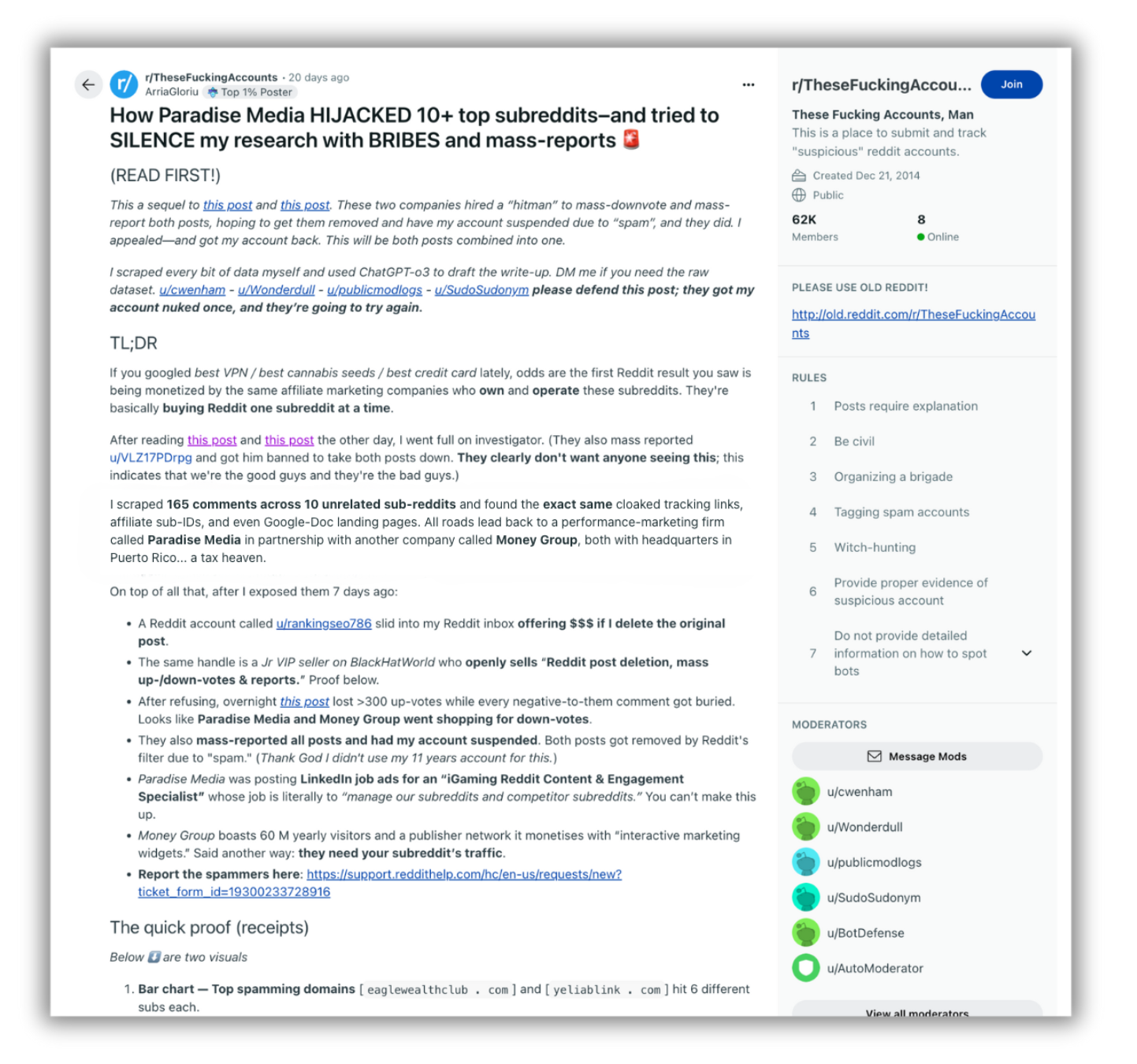
reddit spam money group

These companies have been caught, and I quote, “buying high-traffic subreddits by buying the moderator accounts or paying for a ‘moderator seat’ to manipulate high-traffic threads and shove affiliate spam down your throat.”

If this is true, then Google has buried real, human-powered websites while boosting Reddit threads created by the very same people who engage in site reputation abuse spam.

Google created a regurgitation machine that is destroying livelihoods

Analyzing the changes in organic traffic to publisher websites between 2023 and 2025.

On 20 May 2025, Google’s CEO, Sundar Pichai, announced AI Mode, a “total reimagining of Search” in the form of “an end-to-end AI Search experience.” Following Pichai’s announcement, Google’s head of Search, Liz Reid, explained that “this is the future of Google Search.”

Google is replacing traditional search results with a ChatGPT-inspired chatbot that regurgitates content from across the web to compile a fully-fledged answer to your question.

Here is a demo published by Google on their blog as AI Mode hasn’t been rolled out in our location yet:

Search marketing experts and web content creators agree that AI Mode is likely to further the damage already caused by Google’s algorithm updates in 2022-2024 and by Google’s AI Overviews in 2024-2025.
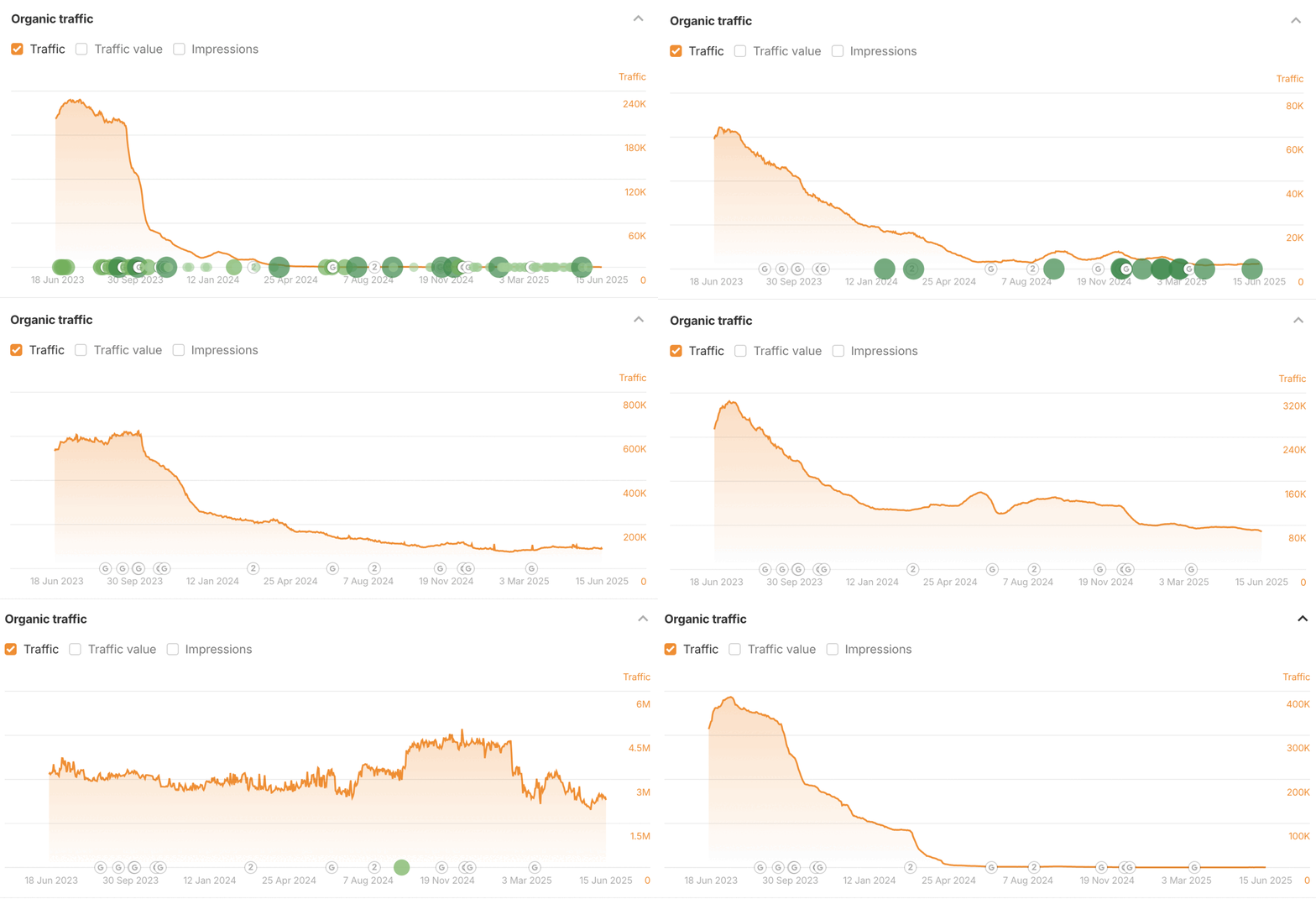
google destroys livelihoods

Google disagrees.

Over the last two years, high-profile Googlers like Sundar Pichai and Elizabeth Reid have consistently stated that AIO and AI Mode are just additional opportunities for sending traffic to the web:
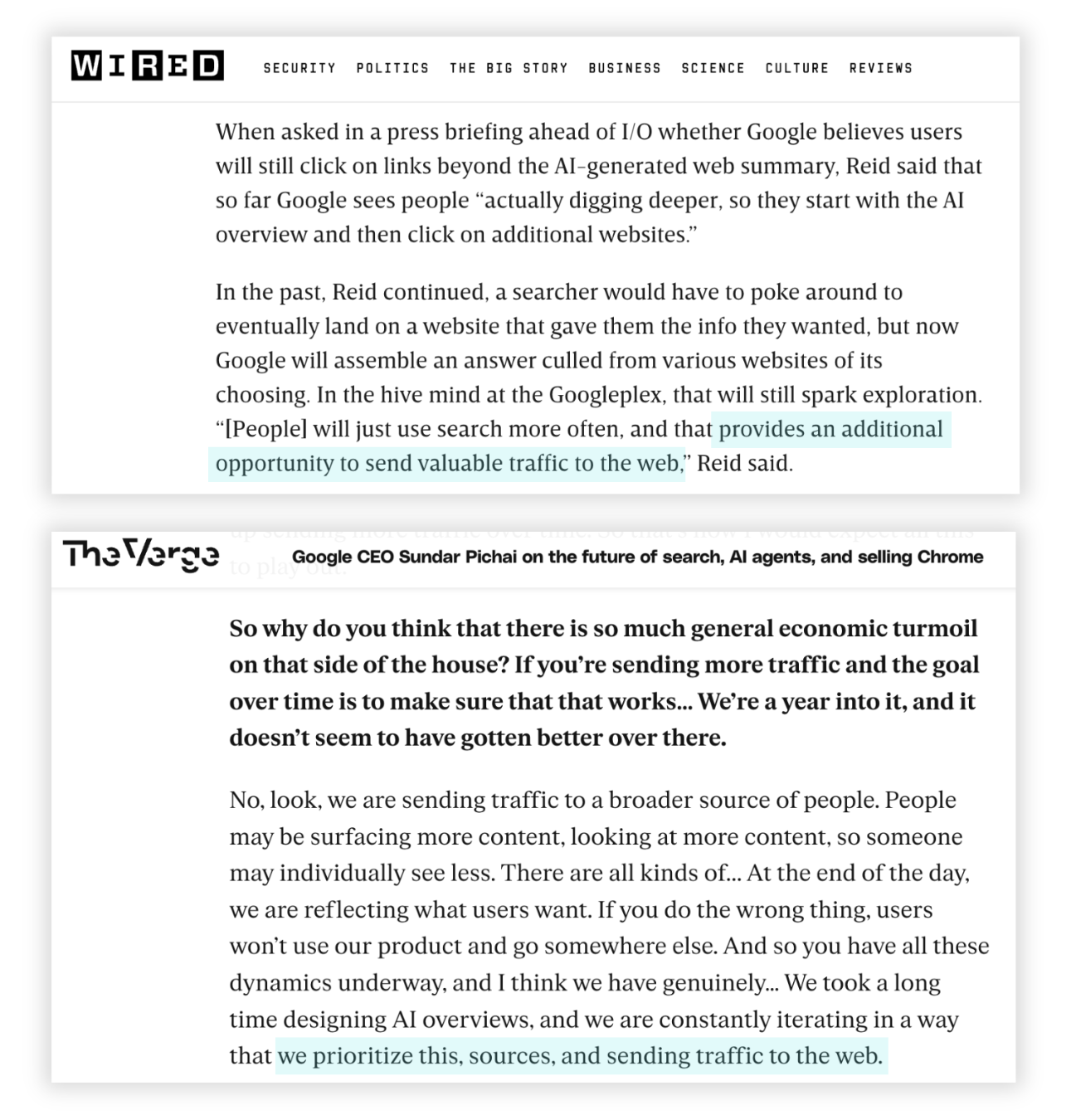
google promises

And this makes sense, considering Google has built its entire business on the promise to send traffic to the web. 

On their corporate philosophy page they seem to brag (?) about how their aim is to have people leave their website:
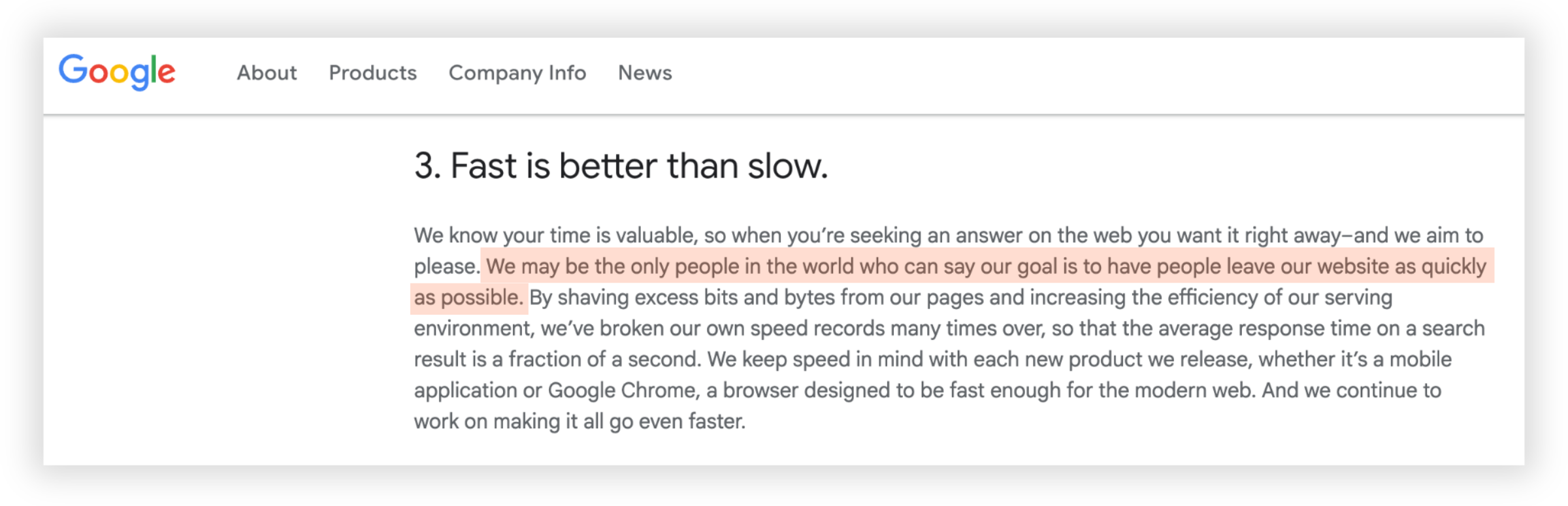
google corporate philosophy

And on this page they clearly explain how they support a healthy web ecosystem by sending visitors to websites:
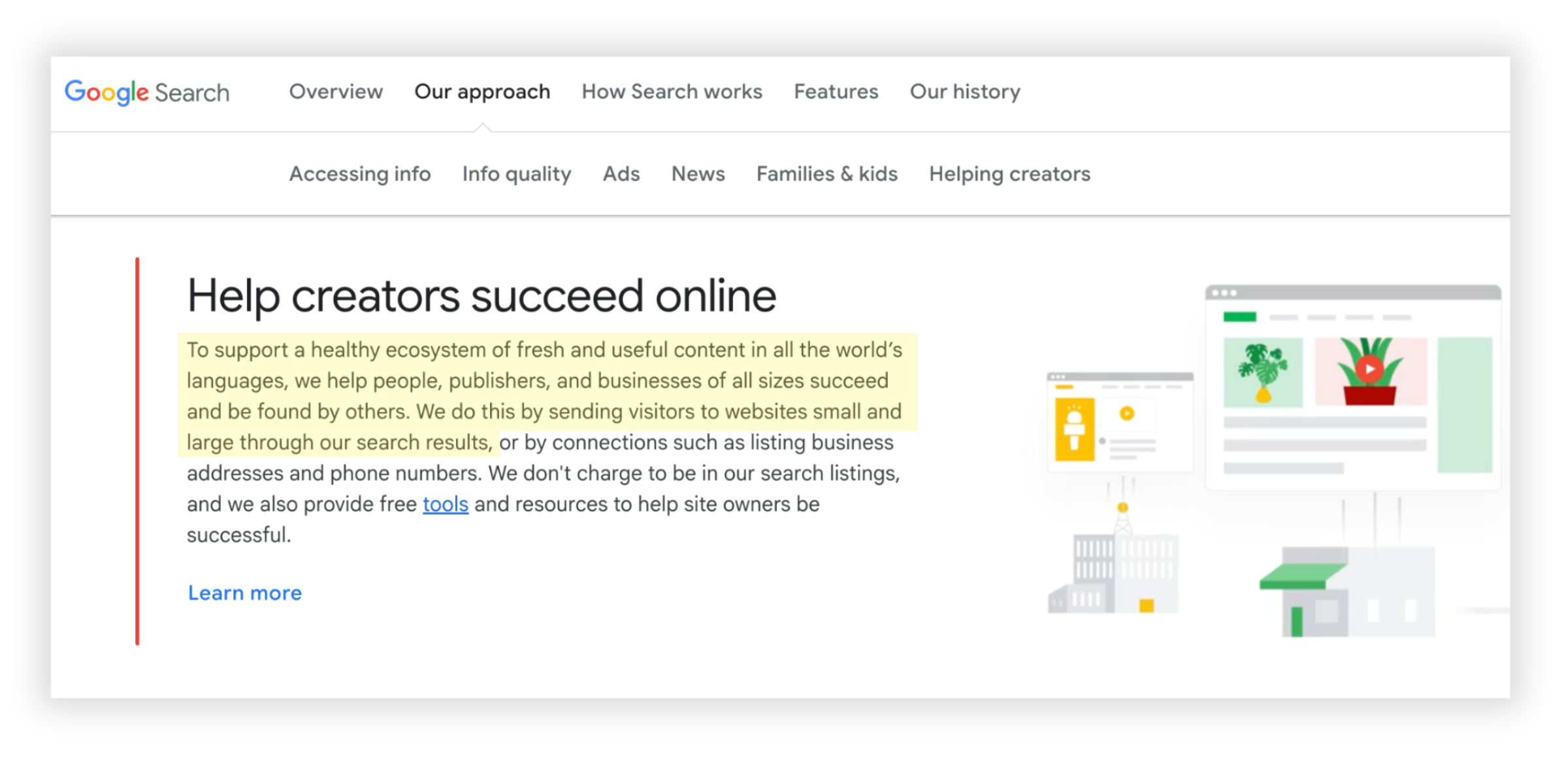
help creators succeed

In fact, Google is so committed to helping web creators succeed online that they have an entire section of their website dedicated to celebrating publisher success stories.

This gave us an idea.

We used a marketing tool called Ahrefs Site Explorer to estimate search traffic figures between 15 June 2023 and 15 June 2025 for all English-speaking independent publishers highlighted in Google’s Success Stories between 2022 and 2024. 

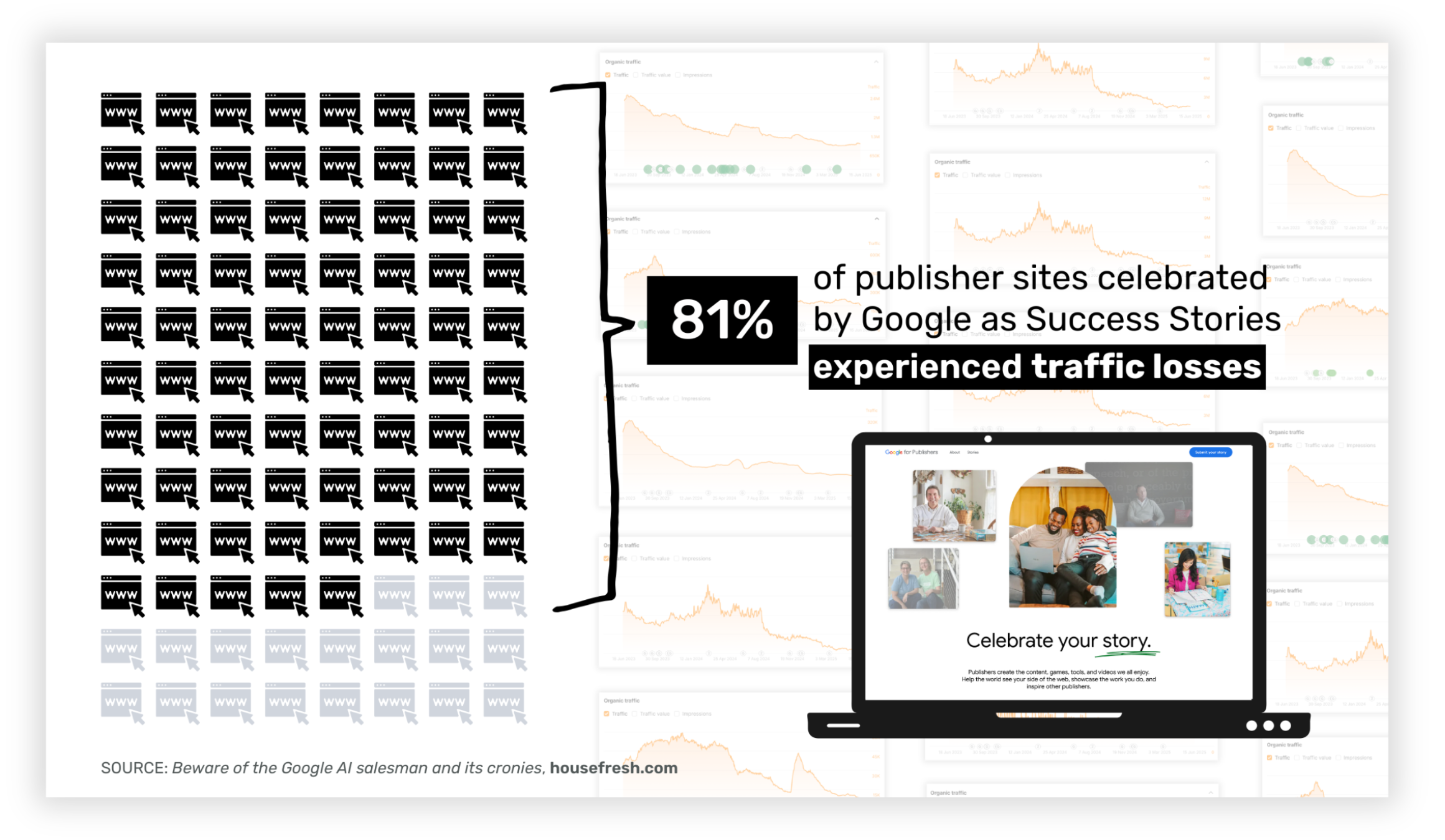
Our data shows that 81% of publisher sites celebrated by Google have experienced traffic losses since 2023.
Google success stories traffic loss

These are websites belonging to businesses that Google not only highlights as ‘Publisher Success Stories’ but also includes in their Economic Impact Reports.

The shocking story of Charleston Crafted clearly shows how misguided it is for Google to be parading websites in times like these.

The very next day after a Google photographer visited their home for a photoshoot, Morgan and Sean saw their Google Search traffic starting to tank. Within a few weeks, Charleston Crafted experienced a traffic drop of 74%—this can have life-shattering consequences for a web creator.

Of course, that didn’t stop Google from featuring their website prominently as a shining example of how “Google helps South Carolina businesses move toward their goals.”

However, one could argue that websites celebrated by Google as Publisher Success Stories are not representative of the wider web. 

That is why we added the websites belonging to those invited to the Googleplex for the Web Creator Conversation Event in 2024, those who have been public about attending Google Publisher Meetups in the past three years, and those who have been public about their struggles with Google in recent months.

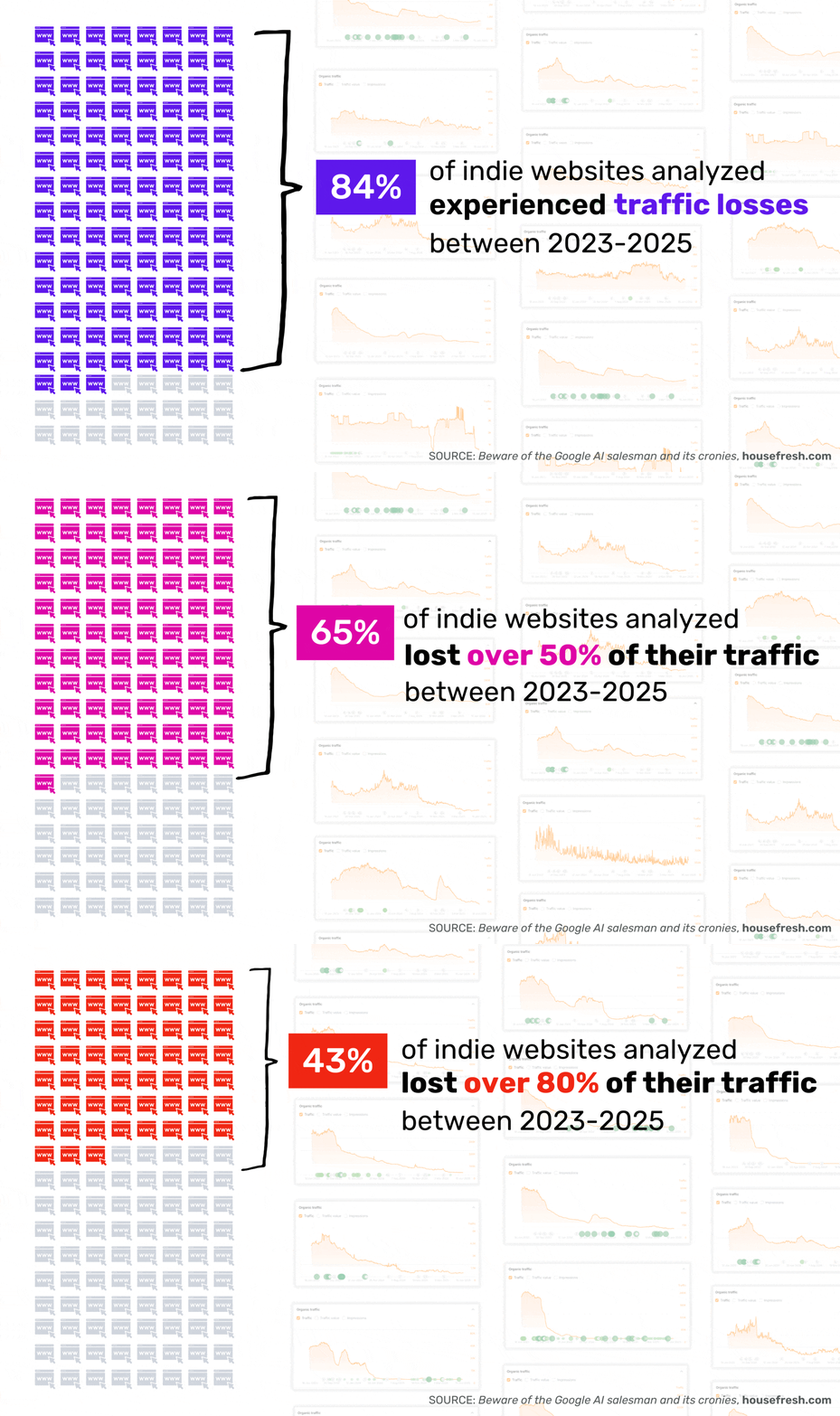
84% of independent web creators analyzed have experienced traffic losses, with 43% of sites receiving 80% less traffic from Google Search between 2023 and 2025.
website google traffic loss indie sites

But why stop there?

To build a more robust and balanced dataset, we filled in the gaps with the help of Detailed’s rankings of “the world’s most successful and profitable blogs.” We pulled the top 10 URLs from each of the categories, including web publishers that are much larger and, in many cases, part of big media companies. Blogs belonging to retailers, sites that have been acquired+redirected and blog sections of corporate websites were removed.

The final list included 507 web publishers across 43 categories, ranging from small travel blogs like Between England & Everywhere to huge reputable magazines like Allure.

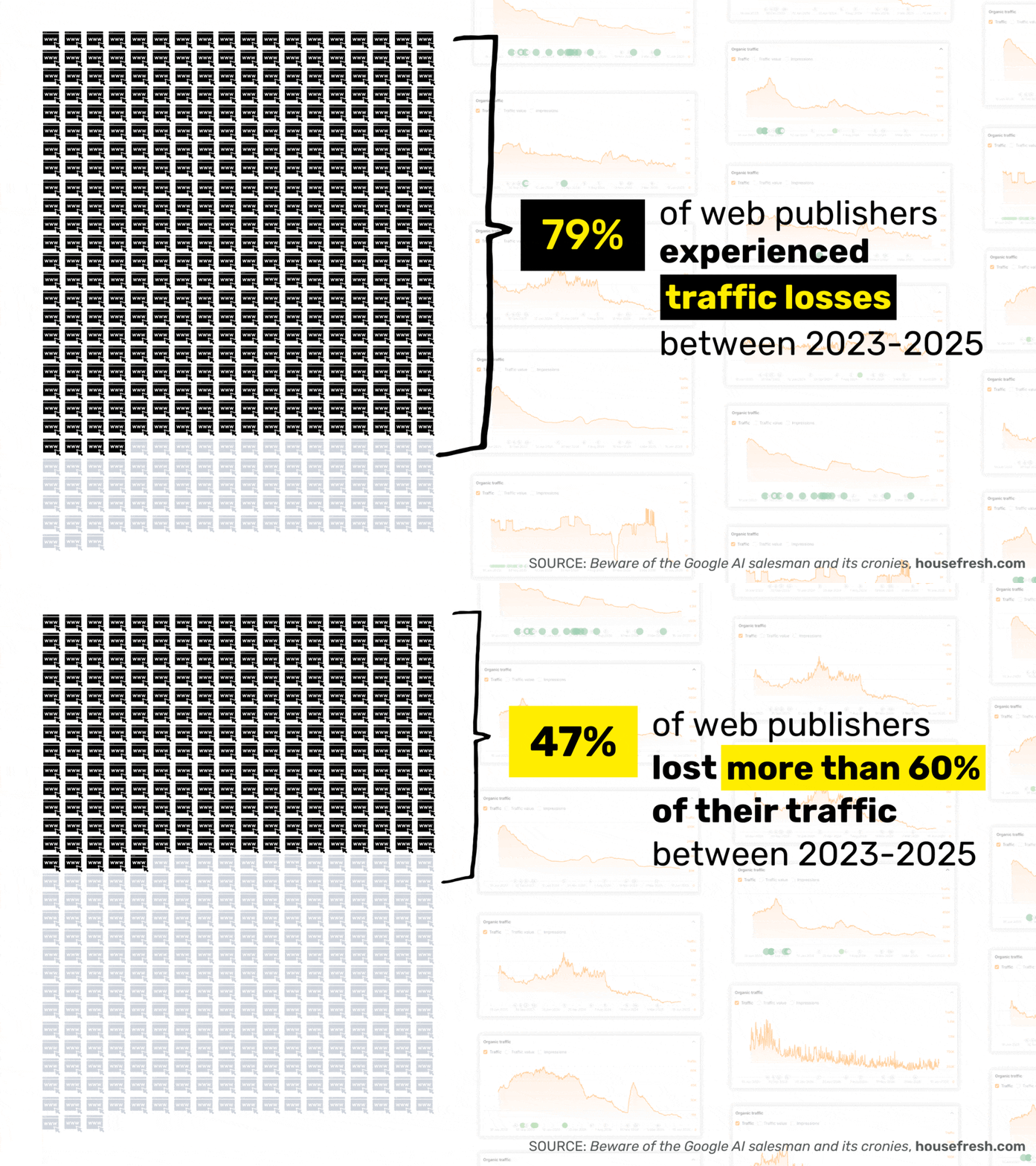
Our data shows that nearly four in five web publishers have experienced traffic losses since June 2023, with almost half of all websites analyzed seeing traffic from Google Search dropping by at least 60%.
web publishers traffic loss 2023 2025

Websites drown, Reddit thrives

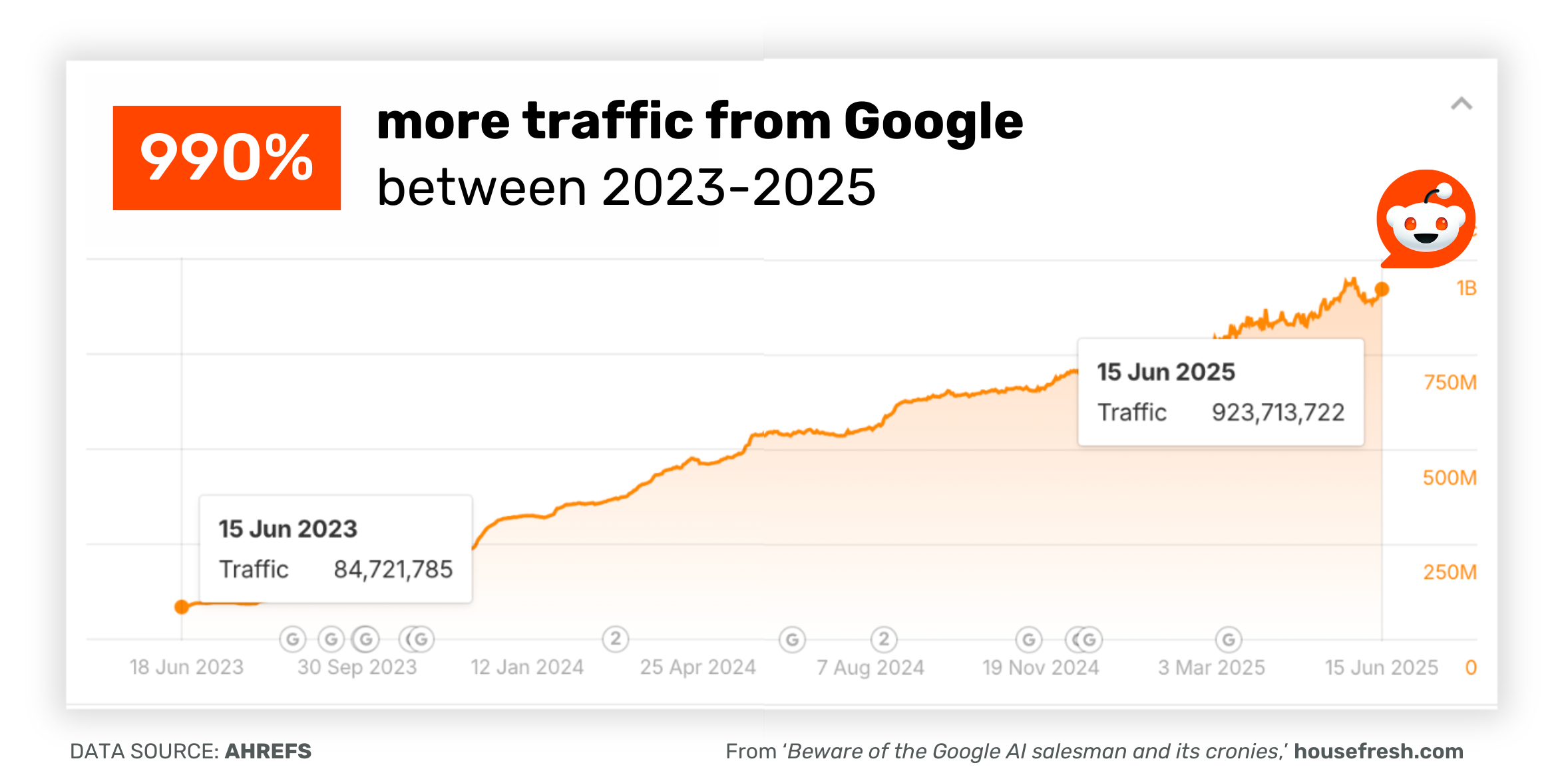
While 79% of web publishers experienced traffic losses between 2023 and 2025, Reddit saw their traffic from Google Search grow by 990%.
reddit traffic ahrefs 2023 2025

As if this loss of traffic wasn’t enough, websites around the world report experiencing “the great decoupling,” a phenomenon through which impressions in Google Search are trending up while clicks are trending down.
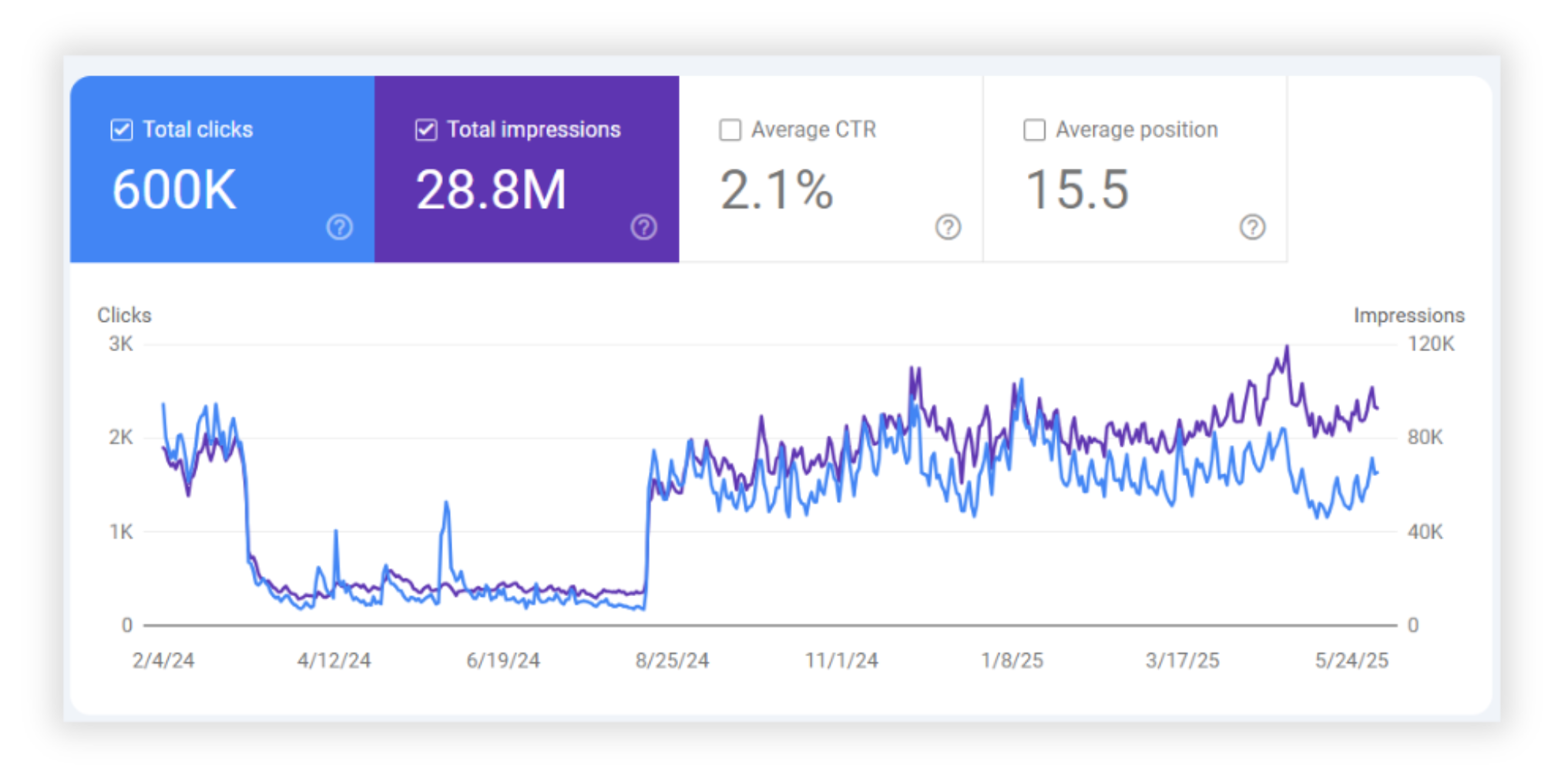
great decoupling

This widening gap between impressions and clicks can be explained by the fact that Google is regurgitating our content as part of their AI Overviews and users are consuming the information without clicking through to visit our websites.

And this is not just us saying it; Google has confirmed as much.

A few weeks ago, Martin Splitt from Google took the stage at Google Search Central Live 2025 in Warsaw and he explained, “Likely your impressions are going to go up if you are shown in AI overviews or AI mode. Um clicks are likely to stagnate or fall a little bit.” 

This will only accelerate the death of web publishers at the hands of Google’s carefully planned decisions. And while this happens, Google users could experience a rise in commercial information and defamatory hallucinations being presented as unbiased facts.

If you’re a website owner or web publisher, we want to hear from you.

Please, complete this form so we can add your website to our growing dataset of web publishers being positively or negatively affected by Google’s changes since the rollout of the infamous Helpful Content Update in 2022.

Google has broken the implicit reciprocal deal it made with web publishers

From an intermediary between searchers and websites, to a wannabe all-knowing answer engine.

To use Google’s own words, a healthy web ecosystem needs “fresh and useful content in all the world’s languages” and Google’s role in this ecosystem is to “send visitors to websites small and large through search results.” 

help creators succeed

As the founder of Travel Lemming, Nate Hake, wrote in his must-read letter to the FTC, “Google created a social contract with the online publishing industry: publishers provide content for Google to crawl and, in exchange, Google sends valuable clicks back to publishers.”

However, what started as a tool that helped internet users navigate the web (and a road through which websites could be found by searchers) is now morphing into an answer engine that, according to Google’s Liz Reid, will function as “an all-knowing friend.”

As the co-founder of Inspired Taste, Adam Gallagher, said in his recap of the latest Google Publisher Meetup in June 2025, “Google is now pursuing two opposing paths, creating a clear division between organic Google, which wants more quality content, and AI Google, which assumes fair use of that content. This model is unsustainable.”

Google wants to have its cake content and eat it too.

Web publishers are the only reason why Google is able to build an answer engine in the first place, but we are now being starved of the very traffic Google loves to boast about sending our way.

The concept of zero-click searches is not new but in 2025 it has become very real.

A zero-click search happens when you search for something on Google and get your answer at the very top of the page, without the need to click or visit any other websites.

This might seem like a convenient way to access information but please don’t take the answer as it comes. Always fact-check and be critical about the sources, especially when looking for information about products.

Watch this video for some excellent tips on how to identify if the product review you’re about to trust should be trusted in the first place.

In the age of Big Tech feeding large language models with stolen information in order to sell you the dream of AI, Alphabet decided to kill its golden goose and, with it, the free and open web that created the conditions for Google Search to thrive.

Now, if you want to get rid of AI Overviews and a good number of Google’s widgets and features, you can use udm=14 to skip the crap and access results in the Web tab without having to hunt for it.

You should also try logging out of your Google account. 

While conducting our research, we found that when we were searching for information on Google.com without being logged in, we were served with cleaner results and the AI was nowhere to be found.
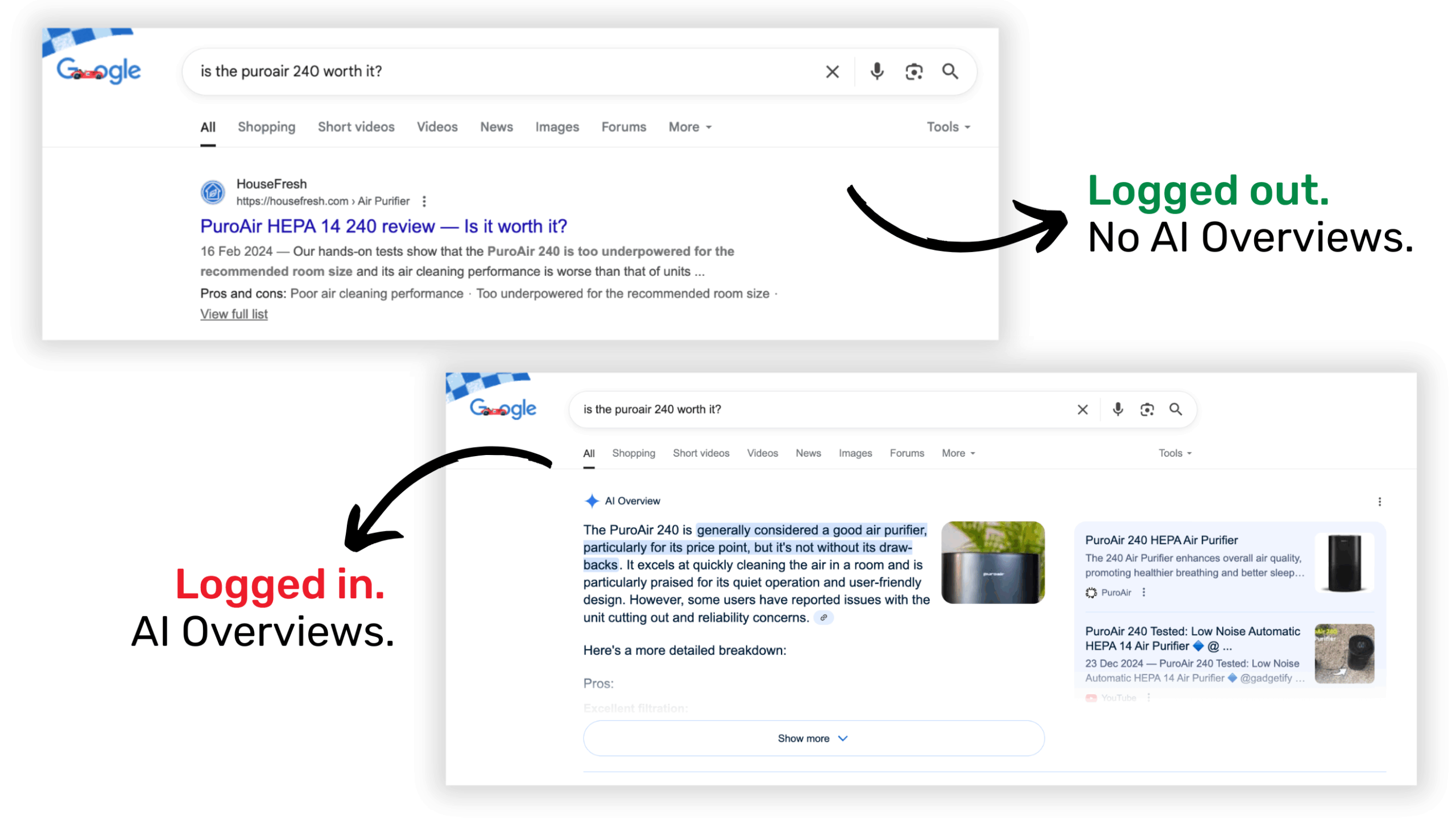
logged in vs logged out scaled

Logging out will also help add a layer of privacy to your searches. You don’t need to be logged into an account 24/7 to use your browser or your search engine—the only ones who need you to log in are Google and the advertisers.

CHANGE YOUR DEFAULT SEARCH ENGINE

Google has been the search engine by default for many years—partly because it was good and partly because it paid a lot of money to be the default in all our devices.

But there are other search engines, each with its own index and mission. I use DuckDuckGo on mobile and Kagi on desktop, but you might find a different option that delivers the results you have been missing.

Here’s how to change your default search engine:

CHANGE YOUR DEFAULT WEB BROWSER

Web browsers are set as the default just as search engines are. 

According to the latest Cloudflare data, Google’s own Chrome accounts for 68% of HTTP requests so it wouldn’t be surprising if your devices have Chrome as a default.

I use Arc on my computer and Firefox on my phone, but there are many other web browsers you can choose from—some more private than others.

Here’s how to change your default browser:

DE-GOOGLE YOUR LIFE

If there’s anything we have learned through the multiple antitrust cases Google is fighting right now is that the company holds multiple monopolies.

That explains why you write your emails inside a Google property, save your work documents inside a Google property, consume video content inside a Google property, keep up with your calendar inside a Google property, browse the web inside a Google property… You get the idea.

Here are a few videos on how to de-Google your life:

Search engines and web browsers are just tools, so use them accordingly.

We don’t know what the future will bring but we know what Google thinks should be our future.

If you made it all the way down here and are upset about the current state of the web, do not go quietly to its funeral. Speak up in whichever way you can. As long as there are people who want to share information with one another, there is hope for the web.

How to find helpful content in a sea of made-for-Google BS

made for Google BS

At the beginning of 2024, we said Google was killing independent sites with its bias towards established media outlets, even in cases where these trusted publications were publishing crap AI content. 

Three months later, we shared how Google’s March 2024 algorithm update had finished the job by taking away 90% of search traffic to HouseFresh, with spammed Reddit threads and old Quora posts drowning our pages in search results.

In August 2024, Google rolled out another update to its algorithm that benefited some independent web publishers like HouseFresh while nuking countless others out of Googlexistence

This is the trade-off with every algorithm update: Some sites win while other sites lose. On the surface, you might think there is a balance in this trade-off. Unfortunately, the balance has been broken by the sea of bad actors taking advantage of the fact that Google’s algorithm is reaching peak enshittification.

It has become clear that a large percentage of those consistently winning in Google Search are doing so through a mix of brand popularity signals, vast amounts of content and various forms of spammy and deceitful practices. 

The dichotomy between Google’s spam policies and Google’s search results intensified.

Within a few weeks of publishing our second article, we attended an hour-long video call with Google, in which we shared our process for creating content by and for humans. Google Search engineers asked us the following question(s):

“What advice would you give to a user who is looking for reviews to distinguish between high- and low-quality content? How can a user tell if the reviewer actually tested the products, compared with other products, or if they are just trying to push users to buy bad sponsored products?”

You trust Google to show you good information, but Google doesn’t know the difference between good and bad information because algorithms and AI are pattern-seeking, probability-calculating machines that don’t actually know anything.

However, it is easy for people like us to spot bad information because we know our stuff. That is why we collaborated with other independent web publishers to answer this question clearly and loudly.

There is a lot of money to be made at a time when Google’s algorithm opts for the ‘goog enough’ approach. So, today we will expose the cookie-cutter methods followed by many of those who are winning in Search to fool the most widely used search engine in the world.

Read on for seven actionable tips to help you find helpful content in a sea of made-for-Google bullshit.

Tip 1. Pay attention to the images used throughout the article

Let’s start with an obvious one that will take you just a few seconds to assess. This is a red flag that was highlighted by nearly everyone who helped us with this article.

Beware of images provided by manufacturers as part of marketing materials:

Whenever you find a featured image like the ones above, go into the article with a healthy dose of skepticism.

Upon inspecting the rest of the product images further, you might realize that they are all taken directly from retailer listings or the manufacturer’s website:

As a rule of thumb, be skeptical of articles that have no original imagery/videos or that only show you product photos you can already see on Google shopping results or Amazon listings:

marketing photo

Always look for multiple original images, videos and/or GIFs of the product recommended to ensure that at least someone somewhere spent a meaningful amount of time with the thing they are telling you to buy.

the clue is in the level of effort

The same can be said for the choice of stock imagery over original footage, especially in articles that are supposed to reflect the writer’s experience with a place, a program or an object.

original photos vs stock photos

At a time when Google’s algorithm decided to disappear entire websites, original photographs are being stolen and reused throughout the web.

The team at Yellow Chili’s shared with us an outrageous example of how one of the photos they used as part of their incredibly thorough recipes has been stolen and is currently being hosted on over 30+ sites.

You can see the image here, both on Yellow Chili’s website and their YouTube channel:

However, a quick search inside Google Images doesn’t bring up their website as the original source of this photo. Instead, Google lists all the sites that have stolen the image and presented it as their own:

yellow chillis mughlai chicken photo stolen

This is happening to impacted web publishers across travel, food, lifestyle, tech and many other industries. When your website is nowhere to be found, everything you have created is up for grabs, with bad actors having zero shame in stealing your content and outranking you with it.

Tip 2. Find out more about the people behind the articles

They will throw many names at you—don’t take the word ‘expert’ for granted.

If you pay attention to the authors section of the vast majority of pages ranking at the top of Google, you will notice that there are always multiple people involved:

multiple people

You will usually find the same mix of people: a staff editor (usually a shopping editor) or an in-house fact-checker, a freelance writer and an expert (with a PhD, MA or MD).

In our opinion, this myriad of names covers up the fact that the bulk of the article was written by a freelance writer who is most definitely not an expert in the product or topic at hand. 

But let’s go through an example to show you what we mean. 

Here is one of the many articles on Forbes about air purifiers—you can see there are two names: one contributor (a writer) and someone who reviewed the article (an editor):

freelance writer

When clicking on the name of the writer, you will be able to see all the articles this person published on Forbes:

best everything

This one writer alone has written 19 articles for Forbes in 2024, recommending the best products across 11 very different categories ranging from electric toothbrushes to cordless drills.

Freelance writers can be incredible at what they do, but how likely is it that this one person is actually testing all these things before telling you to buy them?

And it doesn’t end there. 

A quick search surfaced other active author profiles belonging to the same writer across many other big media sites currently pumping out this type of content. Here are two of them:

This freelance writer also recommends the best litter boxes, Hyundai cars, concrete paints, smoke detectors, ceiling fans, joint supplements for dogs, range hoods, top-load washers, solar pool covers, garage heaters… The list goes on.

Freelance writers need work, too.

We want to be clear here that we don’t blame this or any other writer for pumping out ‘best’ pages across every possible product category. It has not been an easy few years for writers—fuck you very much, generative AI.

You might be thinking, “Well, who cares? Didn’t you say there was an expert who reviewed the content anyway?”

And you would be correct, as there is usually an expert:

When clicking on the expert’s name, you will also be able to see the wide variety of articles the expert reviewed and approved.

This one expert, for example, gave their seal of approval to recommendations across different products, from vacuums to anti-itch creams:

expert articles

We reached out to two experts on different subjects quoted by different media outlets, and in both cases, they were only asked to review or contribute to the FAQ section of the articles. 

This makes headlines like the one below incredibly misleading:

cnn

When we contacted the air quality expert in question, he clarified that he hadn’t specified air purifiers that would be the best for pets:

Moreover, one of the experts explained that they are still being quoted as the expert for an article that has been completely rewritten multiple times since they originally reviewed it two years ago.

Our tip? Go deeper to find out whose advice you’re taking.

Click on the names and have a critical look at their past articles—does this person strike you as someone who dedicates enough time to the topic at hand to truly know what good looks like?

Ideally, the writer and the expert will be the same person. You want your information straight from the horse’s mouth.

horses mouth

Tip 3. Don’t be fooled by purely anecdotal evidence

This point is especially important when looking for (helpful) reviews that go beyond marketing materials or first impressions after 24 hours of ‘testing’ a product.

One quick way to spot a potentially unhelpful review or recommendation is to look for loose testing methodologies or the use of anecdotes over data.

Pay attention to the ‘How we test’ section of the article. Are they clearly outlining a repeatable and specific testing methodology? Or are they saying things like these?

anecdotal testing 1

Do you get the sense that they spent time truly testing the products to assess their value and quality? Or are they just using the word ‘test’ as a synonym of ‘handpick’?

anecdotal testing 2

Pro tip

The ‘How we test’ or ‘How we chose…’ section can also reveal clear inconsistencies or glaring errors that unveil the cookie-cutter approach behind the content:

copy paste fail

As a reader, you might not have the background knowledge necessary to know whether or not the writer is just regurgitating marketing materials to sell you something. However, you can scan for the use of anecdotes as a way to support their reasoning as to why you should spend your hard-earned money on a product:

anecdotal evidence 1

The next time you read one of these regurgitated advertorials dressed up as product reviews, you will quickly spot the abundance of anecdotal evidence peppered with spec details provided by the company behind the product:

anecdotal testing 3

We are sure these personal stories help convert readers into buyers, but be wary, as anecdotal evidence doesn’t mean anything in most cases. In fact, sometimes these writers put more emphasis on the story than the actual research.

This point is especially true when you are looking for information to help you gauge the quality of expensive or potentially dangerous products.

In the quest to sell you, both of these publications fail to clarify that this electric scooter doesn’t have a mechanical brake:

If you experience electronic failure when riding a scooter with a regen brake downhill, you’re literally riding a death trap. Someone who actually knows about scooters (and who cares about the readers) will be quick to tell you that:

safety hazard

Tip 4. Look for first-hand data, product comparisons, low-cost options and products from specialist brands

A reviewer who actually knows the product they are writing about can’t help but compare different options or use hard numbers to discuss quality and value for money.

You probably noticed that many of the articles recommending you products include the words ‘Tested and Reviewed’ in the titles.

tested and reviewed

As we highlighted in a previous article, a common practice is to prominently mention ‘reviewed’ and ‘tested’ throughout the article without ever sharing first-hand data or insights.

This goes hand in hand with the use of anecdotal evidence we mentioned above and leads to very thin reasonings behind why you should choose the product they sell over the rest:

no data whatsoever

Many made-for-Google pages will include lots of numbers and specifications. These are sometimes presented as findings or listed as the bulk of the data to show how good a product is.

This might require extra digging, but it’s worth checking if these are all readily available elsewhere before blindly believing they are a result of actual testing.

Now, the thing with testing and hard data is that it allows us product reviewers to compare and contrast. That is why these figures in isolation don’t mean much to us most of the time.

A helpful product review or list of recommendations will make a point of comparing products so you can make the best choice for your specific needs:

Another thing you should watch out for is the overwhelming presence of popular brands over specialist, independent brands—and the fact that most products on the page are on the expensive side.

Tip 5. Watch out for thin, generic information without a point of view

Your typical made-for-Google page will be 90% regurgitation and 10% SEO pattern making. Learn how to spot this approach.

The web has always been home to spammy pages and deceptive behaviors, but things took a turn for the worse at the end of 2022 when ChatGPT was released. Content scrapers and article spinners are nothing new, but they have all been supercharged by AI.

As a result, many tools have been launched with the purpose of quickly populating pages with ‘content’ that is regurgitated and spun as needed with the help of magic AI. This allowed companies like Forbes Marketplace to quickly produce and publish vast amounts of thin pages packed with generic information about any topic you can think of, including dating apps.

thin vs thorough

I’m sure that, at this point in the article, you will be able to recognize the differences between the Healthy Framework review of eHarmony and the review published by Forbes. At a glance, you will quickly spot the lack of original images. But let’s go deeper.

Thin, regurgitated reviews will find ways to frame marketing materials as ‘findings,’ and you can see through this by looking for mentions or variations of [Company] + claims or [Company] + states or According to [Company]—you get the gist.

thin forbes

In contrast, real (and helpful) reviews will be packed with actual statements from the writer and clear indications of first-hand research or testing being conducted.

thorough healthy framework

Reading through the Forbes review of eHarmony, you should also be able to spot another clear indicator of a thin, made-for-Google review: the obvious sales-y marketing spiel full of slogans disguised as facts that push you to buy, download, join, watch, subscribe, etc.

thin forbes 2
Emphasis added

Another thing you should watch out for is the absence of a clear point of view.

When a real person who cares and knows about a topic writes about it, they can’t help but have an opinion. When you have visited many countries, cooked many recipes, watched many horror movies, cleaned many stains or tested many air purifiers, you will bring that wealth of knowledge with you every time you sit down to write a new article.

Unfortunately, AI slop creators and big media content farms ranking at the top of Google Search results have trained us to ignore this lack of depth and humanity. But you will quickly see what we mean once we walk you through the next example.

Below, you will find two reviews of a Netflix horror series:

sportskeeda vs readysteadycut

You might struggle to spot the thin, made-for-Google review at a glance, but it all becomes a lot clearer once you start reading.

Now, when reading a review of a movie, a book or a TV show, you want to avoid spoilers while figuring out if you should spend your precious downtime reading or watching the thing. This is where the experience, opinion and ability of the writer are crucial, as they need to be able to describe what’s good and bad without giving too much away. 

In the introduction to this Netflix series review, the team at Ready Steady Cut gives you context on what the show is all about while clearly setting expectations before you decide to watch it:

review real opinion

Compare that with the review published by sports publication Sportskeeda, which for w̶h̶a̶t̶e̶v̶e̶r̶ made-for-Google reason, is now apparently reviewing Netflix horror shows:

review regurgitation

The introduction of Sportskeeda’s review is chock full of repetition, with the same information being rewritten multiple times. The only potentially insightful element of this intro has been taken word by word from IMDb—and even then, you will see it’s just a 27-word synopsis that won’t really help you assess whether this horror anthology is worth your time. 

That is exactly what we mean by thin, generic information without a point of view. 

The Sportskeeda page is an excellent example of a made-for-Google article that adds no value to the web yet outranks real reviews from people who know their stuff and are writing helpful content for their readers.

This type of thin content will keep you scrolling down the page while you read, hoping they will eventually get to the part where they answer your question. Along the way, a mountain of ads will be shoved up your eyeballs. 

Telltale words that could identify generative AI text

Those of you with high attention to detail might have noticed that the Sportskeeda review mentioned the word “delve” twice throughout their shallow introduction. When we saw this, it reminded us of this article from Ars Technica.

By the way, this is the same approach you’ll encounter when you’re trying to find the release date of an upcoming movie or whether there will be a new season of your favorite show. Generally, these pages are made-for-Google BS designed to make you click, scroll and fill their pockets with ad money.

Tip 6. Find proof of knowledge, care and transparency in the comments section

Not every website has a comments section, but you can look for signs of helpful content in those that do. 

In simple terms, the comments section will help you answer the question, ‘Is there anybody out there?’

While doing research for this article, we saw many brick-and-mortar businesses, big media outlets and e-commerce sites with thin blog posts that outrank indie web publishers with variations of their own content. This sucks and continues to be a source of frustration among people like us who dedicate so much time to creating content for the web.

One pattern we found across many of these highly ranked regurgitation sites was the presence of comment sections full of questions and opinions from readers that remained unanswered MONTHS after they were published.

comments section comparison

Any content creator knows that a big chunk of our time is spent answering questions and replying to comments on our sites and across our social media channels:

comments sections

A quick scroll down to the comments section can tell you a lot about the person behind the article, their level of care and their knowledge of the topic at hand. 

The absolute lack of responses is a clear indication that you are reading a made-for-Google page nobody really cares about beyond the point of publication:

ignored comment 1

Bonus points for closing the comments section altogether after receiving a few critical comments or tough questions:

ignored comment 2

Tip 7. Consider the source and look for signs of bias

If the content you’re reading doesn’t match the site it’s on, that’s a clear indication of made-for-Google content. 

If you ever found yourself reading about Star Trek on Forbes or sorting through air purifier recommendations on Billboard, then you can probably tell that things have gotten a little mixed up recently. 

check the source

In the middle of this confusing media landscape, bias has seeped in. Along the way, the web has been overrun with self-referential recommendations and commerce content disguised as thoroughly researched, unbiased, fact-checked service journalism. 

The good news is that biased content is easy to spot once you start looking for it. 

Let’s start with the Google Search results page, as that is where you will be able to spot biased sources before you waste your time.

clear bias

What are the odds that Mastercard will include options from Visa, Discover or Amex as the “best credit cards for bad credit”? Or that Dell will mention gaming laptops from Asus or ​​Gigabyte? Or that Levoit will share units from Winix or CleanAirKits as the best air purifiers?

Zero. 

Those are biased search results, and you shouldn’t waste your time on them unless you have already married the brand behind them.

Recommended reading

The same goes for brands reviewing their competitors, as the likelihood of their article being unbiased is nonexistent. The team at Healthy Framework covered this in detail in their open letter to Google, so we recommend you read their take on this point.

Once you’re on a page, you can quickly spot biased advice by searching for the word “partner.”

biased review

By performing this quick search once you’re on a page, you will quickly see whether a product, app or service has a partnership with the publication, ranking it at the top of their list of recommendations.

You can also search for the word “sponsored” to uncover if there is a financial incentive behind a writer’s claim that this one gadget, hotel or tool is the best thing since sliced bread.

sponsored reviews

It’s worth mentioning that the practice of reviewing products provided by companies as “PR samples” is neither new nor inherently bad. We prefer to buy every product we review to eliminate any bias from the start. Still, we know that many reviewers manage to remain unbiased even when testing an item provided by a manufacturer. 

The point of this tip is to help you avoid pay-to-play lists like this one:

Google doesn’t know the difference between good, helpful information and biased AI slop, but now you do.

Last year, the U.S. Department of Justice released a series of trial exhibits that included internal Google presentations on how their search engine ranks pages. One of these slides clearly explained that Google doesn’t understand the information it is showing you at the top of their results when you search for something.

google doesnt understand

“What’s crazy is that we don’t actually understand documents. Beyond some basic stuff, we hardly look at documents. We look at people. If a document gets a positive reaction, we figure it is good. If the reaction is negative, it is probably bad. Grossly simplified, this is the source of Google’s magic.”

This is not a new finding, so it is likely that you have read that quote before. But have you stopped to think about it?

Since its release in 1998, Google has mutated from a search tool to an AI-powered Magic 8 Ball. Along the way, Internet users around the world have grown to trust anything Google displays above the fold as ‘the answer’ to whatever they are looking for. 

This unwavering trust in Google could explain why many were so shocked and upset when they realized that Google’s AI Overviews were full of terrible information they couldn’t rely on. 

For the first time in forever, Google was indisputably wrong for the world to see.

Google AI Overviews fail

Now that we are all aware of “the source of Google’s magic,” we can let go of the belief that Google is an infallible digital oracle and embrace the fact that it’s simply a blind search engine (built on a potentially biased algorithm) prone to being spammed and manipulated.

We hope this article helps you quickly spot the signs of made-for-Google BS so you can bounce back before you end up wasting any time or money. 

And if you can’t find what you’re looking for on page 1, please keep going deeper into the results.

buried in Google search results

Most of the knowledgeable, truly helpful web publishers that contributed to this article are currently buried under piles and piles of substandard made-for-Google crap.

A big thank you to everyone who contributed


HouseFresh has virtually disappeared from Google Search results. Now what?

google is broken

In February 2024, we published an article warning readers not to trust product recommendations from well-known newspapers and magazines ranking at the top of Google search results. 

I wasn’t expecting so many people to care (even though I secretly hoped they would), but we’re still getting emails and messages about it ten weeks later.

housefresh articles tweets

In these two months, I have talked to air purifier manufacturers, HouseFresh readers, other independent publishers, Dotdash Meredith employees, well-known activists, tech journalists, Redditors, SEO professionals, and even Google employees.

Today, I want to share some things I’ve learned and some things that happened after publishing that article.

I’ll take you through the tactics big media publishers use to outrank independent sites online. I’ll also cover what Google has done since we published our exposé and what they’ve announced they’re going to do. Lastly, I’ll share what happened to HouseFresh over the last two months. SPOILER: It’s not looking good for us.

That’s a lot, so I hope you’ll stay with me until the end (but no hard feelings if you don’t).

Dotdash Meredith allegedly developed an SEO content strategy called “swarming” to out-publish independent sites

Why indie publishers are being buried in search results by content published on multiple sites belonging to the same group

Within a few days of publishing the David VS Digital Goliaths exposé, I received an anonymous tip from a former Dotdash Meredith employee, who informed me of an SEO content strategy they implement called “keyword swarming.” 

swarm

Through this strategy, Dotdash Meredith allegedly identifies small sites that have cemented themselves in Google results for a specific (and valuable) term or in a specific topic, with the goal of pushing them down the rankings by publishing vast amounts of content of their own.  

 “Swarming is about drowning out a competitor,” said the person who reached out. The objective is to “swarm a smaller site’s foothold on one or two articles by essentially publishing 10 articles [on the topic] and beefing up [Dotdash Meredith sites’] authority.”

By the way, if “keyword swarming” is indeed a strategy, then it’s clear that it’s not just something you will find in the air purifier space. Dotdash Meredith could be doing this across many other products and topics, utilizing its wide range of publications.

That could explain why you will find multiple articles published on sites belonging to Dotdash Meredith ranking at the top of Google like this:

keyword swarming dotdash

Is Dotdash Meredith to blame for choosing to “swarm” Google search results by leveraging their network of websites and their machine to create content at scale?

Personally, I think it’s not great for the internet, but I understand that if that the leadership at Dotdash Meredith is simply focusing on making money for IAC shareholders.

“IAC’s vision for Dotdash Meredith — to be a flywheel for generating advertising and commerce revenue — is finally starting to pan out. 

[…] More than 80% of Dotdash Meredith’s traffic and digital revenue come from its core sites, such as Food & Wine, Travel & Leisure, and Southern Living, that deliver a form of what one might think of as commerce-related service journalism.”

— Allison Schiff, managing editor of AdExchanger

However, I don’t want to turn this into a personal crusade against Dotdash Meredith because it’s not.

The reality is that, whether they have a name for it or not, every other digital goliath is monetizing their websites by using the same tactics.

Let’s take Forbes.com as an example. 

Connecting the dots between puppies, affiliate commissions, and Forbes

Why Forbes.com is flooding the web with affiliate-focused SEO content on topics far outside their area of expertise

Do puppies come to mind when you think of Forbes? If not, they should.

forbes puppies

In the last few years, Forbes has pumped out thousands of articles about puppies, dogs, kittens, and cats. But why?

forbes pets

Well, if you pay attention to the URLs of the articles, you might notice that the majority of them sit inside ​​forbes.com/advisor/pet-insurance/, which is the space where Forbes publishes their pet insurance affiliate content:

forbes advisor

The Forbes Advisor team published all this content about cats and dogs because they needed to build Forbes.com’s authority in the space to compete with sites such as Dogster or Canine Journal.

The vast majority of pet-related content on Forbes.com pre-2020 wasn’t written from the point of pet expertise, and it wasn’t tied to highly searched keywords that would drive monetizable traffic:

forbes pets content before 2020

To give the pet insurance affiliate section of Forbes the best chance to succeed, the Forbes Advisor team pumped out A LOT of content about pets and built A LOT of links around the topic with statistics round-ups designed to obfuscate the original sources in order to increase the chances of people linking to Forbes.com when using the stats:

statistics page link building

All this hard work paid off in the form of an estimated 1.1 million visitors each month to the pet insurance section of Forbes Advisor:

estimated traffic pets forbes

This happened at the expense of every site that has produced content about dogs, cats, and other pets for many years before Forbes.com decided to cash in on pet insurance affiliate money. 

They successfully replicated this model again and again and again across the huge variety of topics that Forbes covers today. 

Trusted publications are being flipped by SEO-minded people with a taste for affiliate money

Step one: buy the site. Step two: fire staff. Step three: revamp the content strategy to drive new monetizable traffic from Google

Did you know that 19-year-old sports blog Deadspin is now a gambling affiliate site?

That’s right. Just a few weeks ago, Deadspin was sold to a newly formed ghost digital media company that immediately fired all Deadspin’s writers before announcing it would start referring traffic to gambling sites.

Stuff like this happens all the time, but most people don’t follow media news, so they’re completely unaware.

For example, if I mention Money, you might think of a magazine you could find at any newsstand since 1972. But what if I told you that the physical production of its magazines stopped in 2019?

The Money brand is now owned by Ad Practitioners LLC (recently rebranded as Money Group), a company that profits from affiliate links and has developed an ad network.

You probably had no idea about this because Money.com looks just like it always has, and its About page focuses on its long history while failing to disclose who is behind the site:

money about us

In an interview with Axios, one of the owners of Ad Practitioners LLC said that Money was hemorrhaging cash before the acquisition and explained how it’s now thriving:

“Powel, a former Google executive, saw an opportunity to rebuild Money’s editorial strategy around intent-based personal finance content that’s typically surfaced from search results instead of clickbait business stories about celebrities and their wealth. 

Big digital media companies like DotDash Meredith and Red Ventures rely on a similar strategy.”

— Sara Fischer, senior media reporter at Axios

In true ‘phoenix rising from the ashes’ style, Ad Practitioners LLC leveraged the public’s trust in the Money brand, its high-authority domain, and long-standing history as a finance publication to sell air purifiers — without any actual testing, I might add:

money thin affiliate content

But it’s not just air purifiers.

Wondering how to reprogram your garage door opener? Let Money.com explain. Looking for the best paint sprayers? Money.com can tell you.

The key here seems to be adding ‘for your money’ to the title to keep things loosely tied to the financial aspect of the website:

for your money

This is how the people behind Money.com are “building upon the legacy” of the brand.

I’m nearly done kicking the big guys, I promise.

Big media sites are laying off journalists while partnering with marketing agencies that use AI to write commerce content

Exploring the trend of publishers that have been caught lying about AI-written, search traffic-focused content in the last six months

Commerce content is quickly becoming the main monetization route for media publishers. In fact, a 2023 survey by Digiday showed that 81% of publishers consider commerce content a vital part of their revenue growth strategy, with 43% reportedly producing 16 to 26+ new pieces of commerce content each month.

And while media publishers ramp up their commerce content, they also seem to be ramping up the layoffs. 

So, who is writing all these commercial pages? 

“The financial incentives for the current trend are strong, and as media companies continue to cut newsroom staff, the lure of cheap AI content is hard to resist,” said longtime service journalist Joe Lindsey in his article Commerce content is breaking product reviews. He continued, “The latest permutation of commerce content is that publishers outsource some or all of it to a third-party provider, which is called a commerce content partnership, and that’s where AI is pushing in.”

He’s not wrong. 

Reports claim that big media publishers such as Sports Illustrated and USA Today have published commercial content written by AI under fake author names. In both cases, the media giants blamed a third-party partner who provided content to the publications. 

In a statement to The Post, Gannett said the articles on USA Today “were created through a deal with a marketing firm to generate paid search-engine traffic.” According to The Verge, the firm behind these AI product reviews is called ASR Group Holdings. When following the lead, journalist Mila Sato found that ASR Group also uses the name AdVon Commerce.

What a coincidence…

The owner of Sports Illustrated released a similar statement when Futurism uncovered their use of AI-generated content: “The articles in question were product reviews and were licensed content from an external, third-party company, AdVon Commerce […] AdVon has assured us that all of the articles in question were written and edited by humans.”

Yet, when searching through LinkedIn, I could find multiple AdVon employee profiles that clearly specify the use of AI as part of their job:

Advon AI LinkedIn

Where does this leave the role of journalists in these publications?

“As a journalist, all of this depresses me,” wrote Brian Merchant, the technology columnist at the Los Angeles Times. He continued, “If journalists are outraged at the rise of AI and its use in editorial operations and newsrooms, they should be outraged not because it’s a sign that they’re about to be replaced but because management has such little regard for the work being done by journalists that it’s willing to prioritize the automatic production of slop.”

But all hope is not lost.

Google set a deadline for big media sites to stop spamming the web

How the “site reputation abuse’ spam policy could affect big media sites, and what they’re doing to prepare for Google’s deadline

Here’s a recap so far:

  • Digital media conglomerates are developing SEO content strategies designed to out-publish high-ranking specialist independent publishers.
  • Legacy media brands are building in-house SEO content teams that tie content creation to affiliate marketing revenue in topics that have nothing to do with their original areas of expertise.
  • Newly created digital media companies are buying once successful and influential blogs with the goal of driving traffic to casino sites.
  • Private equity firms are partnering with companies like AdVon to publish large amounts of AI-generated content edited by SEO-focused people across their portfolio of media brands.

And here’s the worst part:

Google’s algorithm encourages all of them to rinse and repeat the same strategies by allowing their websites to rank in top positions for SEO-fueled articles about any topic imaginable. Even in cases when the articles have been written by AI and published under fake authors.

But Google has set a deadline for big media sites to stop spamming the web: May 5.

In early March 2024, Google announced an update to its spam policies, which included a point about “site reputation abuse” aimed at sites publishing pages with the purpose of manipulating search rankings by taking advantage of the site’s ranking signals.

site reputation abuse

Unfortunately, Google’s documentation only deems “site abuse reputation” as spam when the site uses third parties to produce and/or publish pages to manipulate search rankings.

third party spam

The fact that U.S. News & World Report is hiring an SEO-focused Commerce Editor to publish 70-80 content updates per month tells me that, hopefully, these big media sites will start cleaning up their acts and move away from contracts with the likes of AdVon. 

But what happens when an in-house team carries out this type of “site reputation abuse”?

It also makes me wonder about the future of initiatives like Taboola Turnkey Commerce. In an article titled How Product Recommendations Broke Google, reporter John Herrman explained how Taboola’s proposal “claims to offer the benefits of starting a product-recommendation sub-brand minus the hassle of actually building an operation.” 

This sounds like the exact same thing Google deems as spam. 

Meanwhile, Forbes.com has reportedly blocked the coupons section of its site (forbes.com/coupons) using a noindex directive to prevent Google bots from indexing the page. Perhaps more media giants will follow suit in the coming days opting to deindex entire sections of their sites.

Will the rankings change once we reach the May 5th deadline? We’ll have to wait and see, but I wouldn’t hold my breath.

Google’s latest algorithm update led to a 91% loss of search traffic to HouseFresh

Broad pages with generic recommendations from big media sites have been pushed to the top, followed by Google Shopping product listings.

When Google announced its March 2024 core update, it said it was “a more complex update” than usual. 

A couple of days after Google’s announcement, many websites were hit with manual actions that could be traced back to the presence of a significant amount of AI-generated content.

But none of them were big media sites.

Any hope we might have had of this update leveling the playing field for independent publishers like HouseFresh disappeared the moment we saw our traffic plummet on March 9th:

Google decimated HouseFresh

Now, this is the point where I clearly state that I know that Google doesn’t owe us anything. We don’t simply deserve to get search traffic because we exist or because we say we should.

That said, I disagree with those who are quick to shout, “Having a website is not a real business!” or those who reply with “Google doesn’t owe you traffic” when small independent sites complain about Google favoring big and/or spammy sites while gaslighting us into thinking that our content is not helpful enough for readers.

If we don’t stand up for our right to a free and open web, we’ll be stuck with platforms that only let us reach other people when we pay for it.

We lost rankings we held for months (and sometimes years) for articles that are constantly being updated and improved based on findings from our first-hand and in-depth testing, our long-term experience with the products, and feedback from our readers.

For example, let me share the current Google results for “best budget air purifiers,” a query we’ve ranked at #2 since May 2023.

Our article is now buried deep beneath sponsored posts, Quora advice from 2016, best-of lists from big media sites, and no less than 64 Google Shopping product listings. Sixty. Four.

There is also a clear proliferation of generic lists. 

When you’re searching for affordable or budget-friendly products, are you looking for the best you can buy or just whatever’s available?

I’m asking because it seems Google expects everyone to find what they’re looking for in the same “best X of 2024” list, regardless of the specific query they’re searching for.

In this particular case, I am looking for the best budget air purifiers, but the generic articles by big media sites ranking at the top of search results are not aimed at those on a budget:

How Google results cost you money

Many of these ‘best-of’ lists of recommendations feature products that cost over $1000 — that is hardly an affordable price tag for most people, let alone someone on a tight budget.

And it gets worse.

The screenshot above was edited to highlight only big media sites. Another unfortunate pattern appears when looking at the full list of Google search results: the further you scroll down the results page, the more product listings Google will serve you.

That’s right. Google is pushing products instead of helping searchers find what they are looking for.

Let me show you the extent to which Google search has become an online shop:

anatomy of google search results 2024

We regularly talk with people who feel confused by all the choices and jargon thrown at them when trying to buy an air purifier.  

confused searchers

In the middle of this confusion and lack of clear information, Google relentlessly serves product listings full of jargon, brand logos, special offers, retailer URLs, 5-star ratings and SALE tags:

Google Shopping Mall

Google is drowning the very recommendations searchers are trying to find while surfacing generic best-of lists, 2016 Quora advice, and SO MANY products  — many of which SUCK and don’t even meet the search criteria.

We are seeing this happen across every term we used to rank for and have lost to Google’s latest core update, which they announced had finished rolling out one week after it did

This is also evident when using Google SGE.

When searching for this same query, you get served with three product recommendations, two of which are “sourced” back to Google Shopping:

best budget SGE

It all makes sense when you consider this was said during their latest earnings call: “We’re […] confident in the role SGE, including ads, will play in delighting users and expanding opportunities to meet user needs.”

So, it’s no longer just about Reddit and big media sites getting pushed to the top with sub-par content.

Google’s intention to encourage you to buy directly from search results (a.k.a. ‘meet your needs’) is evident, even in cases where you are just researching what’s out there.

The web seems to be getting claustrophobically smaller.

Personally, I’m done with banging my head against these terrible Google results.

That’s why I’ve gone back to how I used to use search engines in the early days of the web: mix and match. If I don’t find something on DuckDuckGo, I check Kagi, Bing, Google, and Brave. This is something I’m teaching my children, too. 

I might not be able to end Google’s monopoly of search engines worldwide, but I can do it in my own home.

The future of HouseFresh

What we have done, what we will do, and what we were told we should do.

We’ve been wracking our brains for months to figure out what’s wrong with HouseFresh.

We received many messages from all sorts of people, and the vast majority of them were as clueless as we were about why Google keeps demoting our site. 

Believe it or not, this includes people who work at Google.

Many SEO professionals have shared reasons why they believe HouseFresh has been punished, with theories that range from using the word “air” too often to writing titles that aren’t cool enough.

Some of the most echoed explanations include:

  • We have affiliate links in many of our articles

    This is how we sustain HouseFresh. We buy the products with our own money and spend weeks testing them, writing in-depth reviews, and shooting video content. If you buy a product after clicking on one of the affiliate links on our site, we receive a 3% commission at no extra charge to you. This allows us to continue providing quality content. We’re extremely clear about this and have disclaimers all over our website and YouTube channel.

    I can’t imagine Google would demote our site because of this business model, seeing as it’s the same model that supports the very same big media sites Google keeps ranking at the top of the search results.
  • We conduct keyword research as part of our content strategy

    Something that Google spokespeople have said more than once is not to do things to “show Google” anything, such as writing content to manipulate search engine rankings. Many have argued that having a keyword strategy (writing content to answer queries that users search for) could be considered manipulation.

    Many independent sites are deleting and “de-optimizing” articles, hoping that somehow that’ll fix Google’s issue with their sites. We have published many valuable articles based on questions people have about air purifiers and highly searched-for terms around the best units for specific use cases, but that shouldn’t instantly label our articles unhelpful. Plus, de-optimizing them will definitely affect traffic from other search engines, so we’re not going to do that.

    If Google keeps rewarding useless overly-optimized SEO content written by AI published on big media sites while punishing little sites because they wrote articles trying to answer a question readers have, then fuck Google.
  • We are not a brand

    We understand that we need to prove ourselves as a trusted, reliable source of information. This is an ongoing focus, but becoming a recognizable brand takes time. 

    Unfortunately, people might not see us as a reliable brand if we’re constantly pushed down the search result rankings in favor of magazines with pedigree (even if their content strategy has pivoted to completely unrelated niches). But we’re trying and will keep trying for as long as we can afford to exist.

    That said, the belief that only established brands can make it to the top of Google shows that we have normalized being surrounded by logos to the point where we’ve forgotten what the internet used to be like. We’ve forgotten that the web is supposed to be an open forum where anyone can produce great content. We’ve forgotten that Google was once the world’s best digital librarian, not the judge of a popularity contest.
  • Google Search is broken

    Every week, there seems to be a new article from a reporter trying to figure out what the heck happened to Google Search. Theories range from SEO breaking Google to AI changing the landscape, but everyone agrees that something is broken for the results to be this bad.

    I’ve worked in the content marketing side of the SEO industry for most of my career, and there’s one story I’ve heard multiple times that might explain what’s happening. The problem started when the objectives of Google Ads started ruling the decisions of Google Search.

    You see, Google’s founders believed that Google Search and Google Ads should be completely separate entities. However, in December 2019, the founders gave up control just before the separation of Search and Ads became a blur when the Head of Google Ads took over as the Head of Google Search in June 2020. Since then, search results have become flooded with ads and all kinds of functions designed to influence how we search for information. Years of this power dynamics and the introduction of machine learning could have led to the awful state of search results today.

    If you want the full rundown, a recent newsletter from Ed Zitron explores this story in detail: The Man Who Killed Google Search.

Whatever the reason, Google’s algorithm believes our website isn’t good enough and that visitors will have a bad experience if they land on it.

As a result, since October 2023, we’ve gone from welcoming 4,000 people from Google Search each day to just receiving 200. And of those 200, most are adding “HouseFresh” to their searches to find us specifically. 

This drop in Google search traffic has affected our income, our capacity to sustain our team, and our plans for the future.

But we’re not going down without a fight.

We’re doubling down on our mission to uncover scam products. Our target will be every shiny air purifier that big media sites are pushing. 

Not a week will go by without us having something to say about some crap product big media sites are recommending or without us revealing some lie they’re feeding to their readers.

And if Google doesn’t want to rank our reviews, we’ll use their own broken results against them to get our takedowns in front of people before they waste their money on an overpriced, overhyped product:

puroair hepa14 240 review SERP scaled

The only thing we can do to get a seat at Google’s table is to use their obsession with freshness and their reliance on popular platforms to create a ripple effect around our content.

We will be relentless on YouTube, Reddit, X, TikTok, Instagram, Facebook, our newsletter, and every other platform where it makes sense for us to be. 

We will keep Google busy crawling our name and our content again and again and again and again and again. And again.

Because even if Google decided to virtually erase HouseFresh from its search results, we still exist on the open web.

How Google is killing independent sites like ours

Header Google is killing independent sites

Google regularly launches updates to its algorithm to continuously improve search results quality. Think of these updates as a refresh of the system where rankings change: some websites see an improvement while others see a decline.

At HouseFresh, we keep an eye on Google’s news and documentation because these updates can literally make or break our website. That said, we don’t write for Google’s robots and always make editorial decisions with our readers in mind.

We know that at the end of the day, Google will reward us if our readers find our articles useful.

Helpful content HouseFresh

Or that’s what we thought.

You might have noticed that no matter what you google, there’s always a selection of the same publishers showing up at the top of the results:

What do BuzzFeed, Rolling Stone, Forbes, Popular Science, and Better Homes & Gardens have in common? 

They all know which are the best air purifiers for pet hair:

best air purifier results

Another thing they’ve got in common is that they all also seem to know the best cooling sheets for hot sleepers:

best cooling sheets

You could play this game yourself. Other searches you could try are: best gifts for mom, best home saunas, best beard products, best gifts for teens, best cocktail kits… the list goes on.

The problem is, for the most part, these publishers recommend products without firsthand testing and simply paraphrase marketing materials and Amazon listing information.

In the last year, we have waited patiently for the many, many, MANY Google algorithm updates to impact these results. 

We were hopeful when Google introduced its reviews system with the Products Review Update back in 2021. It seemed they were finally doing something about one of the worst aspects of the modern internet: searching for information about products only to have to wade through countless reviews from people who had never even seen the thing.

Two years later, SEO professional Lily Ray mentioned that (big media) publishers were hit hard by Google’s Product Review updates, prompting a response from Google itself:

publishers dont want to test

In our experience, each rollout of the Products Review Update has shaken things up, generally benefitting sites and writers who actually dedicated time, effort, and money to test products before they would recommend them to the world.

That said, most searches for specific product models don’t just magically start with users searching for specific devices off the top of their heads. There is an immediate step before this: the hours of research reading through lists of product recommendations.

If you have been reading HouseFresh for a while, your first encounter with us was likely a list like this one or this one recommending the best devices for a specific issue you were trying to solve. That is how most of our readers find us.

Unfortunately, we’re getting less and less traffic from those pages, and it’s endangering the future of our site. 

That’s why we’re writing this article.

Big media publishers are inundating the web with subpar product recommendations you can’t trust

Savvy SEOs at big media publishers (or third-party vendors hired by them) realized that they could create pages for ‘best of’ product recommendations without the need to invest any time or effort in actually testing and reviewing the products first.

So, they peppered their pages with references to a ‘rigorous testing process,’ their ‘lab team,’ subject matter experts ‘they collaborated with,’ and complicated methodologies that seem impressive at a cursory look. 

Sometimes, they even added photos of ‘tests’ with products covered in Post-it notes, someone holding a tape measure, and people with very ‘scientific’ clipboards. 

There’s nothing wrong with wanting to show you’re doing the thing you’re supposed to be doing, but what happens when that’s as far as you go?

Let’s look at one example. 

These are the current top 10 results on Google.com for a query we have completely given up on — Best Air Purifier for Pets:

best air purifiers for pets top10

Right now, the magazine Better Homes & Gardens is ranking at the top of the first page of results.

At a glance, the article shows all the right things:

bhg best list bs EEAT signals

If you were to keep scrolling, you’d also find photos of an air purifier inside of a tent, two more mentions of the expert Kenneth Mendez, and four mentions of their lab in Des Moines, Iowa. 

They say all the right things on the page and are a perfect example of a big media publisher with 40 different pages of ‘best of’ product recommendations in the house cleaning section alone without a single in-depth product review:

bgh best of pages

They mention that they have tested 67 air purifiers in their lab in Des Moines, Iowa, but somehow, they have published zero product reviews and they don’t make their test data available anywhere. 

They do have photos, with the majority of them being credited to Henry Wortock. Remember that name.

“But how do you know they didn’t test these devices?”

Better Homes & Gardens never mentioned conducting tests prior to the Google Product Review Update in July 2022. You can see clearly here how, on July 6th, there were no mentions of air purifiers being tested. Fast forward to July 26th (one day before the announcement of the Google update), and they’re now saying they’ve tested 38 air purifiers. Zero to over 30 devices in just a few weeks without any prior mention of any sort of testing. This is also the first time we see some original photos.

That’s not all. 

Their air purifier recommendations are generally plagued by high-priced and underperforming units, Amazon bestsellers with dubious origins (that also underperform), and even subpar devices from companies that market their products with phrases like ‘the Tesla of air purifiers.’ Any actual product testing would show these air purifiers to be a bad pick. What you hardly ever see in their recommendations are truly affordable and high-performing options, which should be a priority if you’re trying to help people clean the air in their homes.

For example, Better Homes & Gardens recommends the Molekule Air Mini+ as their best option for small rooms:

bhg recommends molekule

We have no idea how this device made the list considering that Molekule recently filed for bankruptcy, has active class action lawsuits for false advertising, has been recognized by Wirecutter as the worst air purifier they tested, and received the honor of being labeled as “not living up to the hype” by Consumer Reports.

When we reviewed this device, we also found it to be one of the worst air purifiers we have ever tested for multiple reasons: 

  • It took 3x as long to clear our test room of smoke compared to units sold for a third of its price.
  • It’s incredibly noisy, generating 68 dB when running at its top fan speed — equivalent to the sound of a freeway or a vacuum cleaner.
  • The filter replacement costs A LOT ($99.99), and you need to change it every six months, so you need to spend an additional $199.98 to use this air purifier for a year
  • It pulls 50 watts at its top speed, which might not seem like a lot but it is considering you could buy units for a third of the price that won’t consume more than 21 watts.

We could go on forever. But we can also show you actual firsthand data to back up each of our reasons not to recommend this air purifier. 

Even some shallow desk research powered by Google would show that this product shouldn’t be recommended, but, hey, it’s $360, so it comes with a juicy commission compared to other better quality yet budget products.

But let’s go back to the search results for Best Air Purifier for Pets and give Google the chance to rank a truly reliable list of recommendations that live up to their guidelines.

Ranking below Better Homes & Gardens, we have Real Simple, another magazine most people would immediately trust due to their longstanding brand.

When landing on Real Simple, the first thing you’ll notice is how similar the site looks to Better Homes & Gardens. It uses the same template and has all the right signals to communicate that they test products for real:

real simple best list bs EEAT signals

Another interesting thing is that the photos on this page are credited to the same photographer, Henry Wortock (remember him?)

It even looks like the photos were taken in the same space:

Now, Real Simple doesn’t mention a lab in Des Moines, Iowa, but they do say they acquired 56 air purifiers to test AND they named the same expert: Kenneth Mendez. 

Similarly to Better Homes & Gardens, there are no air purifier reviews on the entire site. That’s 56 devices that we just have to trust they actually tested and assessed.

Many of you won’t be surprised by all this because you’ll know that both companies are owned by the same media giant: Dotdash Meredith.

That’s probably why both sites have the same design and feature photos from the same freelance photographer (Henry Wortock). It’s also probably why they couldn’t really be bothered with sourcing another expert to satisfy that specific point in their E-E-A-T checklist (more on that later).

A deeper look inside Google Images shows how Dotdash Meredith is using photos clearly taken at the same time across different publications:

dotdash photoshoot

Perhaps Dotdash Meredith did pay some lab to test all those devices across all those different websites, and it’s not just a collection of photoshoots their commerce writers can tap into when writing best-of lists.

Whatever the case, it’s clear the team at Dotdash Meredith has worked out what Google needs to see in order to rank best-of lists in top positions without the need to actually publish insightful product reviews or share any evidence of original test data. 

But it’s not just Dotdash Meredith that we need to outrank if we want to recommend the actual best air purifiers for pets.

Let’s scroll down to position number six and see who’s ranking right below Amazon and Reddit: 

buzzfeed best air purifiers for pets

Hello, BuzzFeed.

There’s a lot wrong with this list, starting with the fact that it includes a whopping 22 air purifiers and clearly hasn’t even been curated. Similarly to most big media publisher recommendations, BuzzFeed also lists the Molekule Air Mini+. 

Reading through the list, we found the BuzzFeed team doesn’t even pretend to test the air purifiers. There’s no firsthand research other than curating a list of devices and images from Amazon.com:

BuzzFeed Amazon images

And then pulling in some reviews from Amazon.com as the bulk of their reasoning behind why they picked one air purifier over another:

BuzzFeed Amazon reviews

Some of you might be shocked to see BuzzFeed recommending air purifiers, considering this is far from what BuzzFeed is all about. Others might rightfully think this list must be some sort of joke, expecting to see AI-generated images of air purifiers hugging and feeding cats and dogs. 

The truth is that BuzzFeed has been struggling to maintain the ranking of this particular page, so it will probably drop off the first page of Google results eventually:

buzzfeed traffic graph


But until that day comes, searchers will continue to land on that Amazon.com copy-and-paste page when searching for an air purifier to help with pet odor and dander.

But hey, it’s BuzzFeed. They’re publicly listed and are the parent company of Huffington Post and Complex, so they obviously deserve to be there. 

Right after BuzzFeed, we’ve got a Reddit thread that someone opened four months ago and has good discussions between Redditors: 

Reddit search results

There are also lots of spammy replies, with this specific one at the top right now for those landing on that page without being logged into Reddit:

Reddit spam reply

When clicking on that link, users will then land on this incredibly sketchy website:

Site it leads to

Those of you with high attention-to-detail will notice that this introduction is a word-by-word copy of Real Simple’s article:

Real Simple intro copy

Clicking on the profile of the Redditor behind this ‘recommendation’ will lead you to a suspended account page:

Reddit suspended user

Somehow the user has been banned from Reddit, but their comment is still at the top of the thread — we wonder how many other comments this user has published across different subreddits.

Tip

After Google’s latest Helpful Content Update, Reddit and LinkedIn started ranking heavily in Google search results. If you want to find out more about Reddit specifically, you should read this article from Glen Allsopp.

Private equity firms are utilizing public trust in long-standing publications to sell every product under the sun

In a bid to replace falling ad revenue, publishing houses are selling their publications for parts to media groups that are quick to establish affiliate marketing deals

At position #8, we have Popular Science, a magazine from 1872 that was sold to a private equity firm, North Equity LLC, in 2020. A year later, North Equity introduced Recurrent Ventures, a new arm of their business that runs all the media brands they acquired. A few months later, PopSci switched to an all-digital format. Two years later, in 2023, PopSci stopped being a magazine altogether.

Of course, most people won’t know that because the site still feels like the PopSci we all know and trust:

popsci best air purifiers for pets

It doesn’t help that they have a ‘Why trust us’ section at the end of all their ‘Best of’ lists that says:

PopSci Why Trust Us 1

The vast majority of readers don’t know that the teams behind these product recommendations are far from the team of journalists and editors who built the brand behind the site.

It’s unfortunate because many people will click on that Popular Science article expecting a trustworthy list of products only to find a list of units that haven’t even been tested by PopSci’s team:

Pop Sci methodology

After reading the article, it quickly becomes clear that every air purifier on the list was selected (and ranked) based on anecdotal experience.

popsci anecdotal product recommendations

Another thing worth mentioning about this PopSci list of air purifiers is that it’s a completely new page on their site that went live on December 29th, 2023. 

PopSci wayback machine

This makes it all the more strange for them to be recommending not one but two (2!) Molekule air purifiers. Surely, the writer who researched each device ran into the news of Molekule going bankrupt — or the ridiculous reasons why they supposedly filed Chapter 11.

Shouldn’t ‘best of’ lists be treated as product reviews?

Hint: yes, they should, but somehow they’re not 

In theory, ‘best of’ product recommendation lists should be treated the same as any product review.

Google’s documentation clearly states that:

google logo
“Reviews can be about a single thing, or head-to-head comparisons, or ranked-lists of recommendations.”
google review system documentation

So, shouldn’t Google be rewarding ranked lists of recommendations “that provide insightful analysis and original research […] written by experts or enthusiasts who know the topic well”? 

Shouldn’t the reviews system ensure that people don’t end up landing on “thin content that simply summarizes a bunch of products, services, or other things”?

Perhaps we’re mistaken here, but we think the documentation says it plainly and clearly.

Sadly, these are just empty words because Google has a clear bias towards big media publishers.

Their Core and Helpful Content updates are heavily focused on something they call E-E-A-T, which is an acronym that stands for Experience, Expertise, Authoritativeness, and Trustworthiness. 

The SEO world has been obsessed with E-E-A-T for a few years now, to the point where there is always someone on X (formerly Twitter) discussing how to show experience, expertise, authoritativeness, and trustworthiness. Many of the examples come from dissecting big media publishers like the ones we’ve been discussing in this article. 

The reason why SEOs look up to these sites is that Google rewards those sites:

And people have been pointing this out for months:

Every single big media company (a.k.a. Digital Goliaths) is currently pumping up their bottom line with affiliate earnings. 

The strategy of Recurrent Ventures for Popular Science seems to be to squeeze as much money as possible from this type of ranked list of recommendations before things start to go south.

You can see here how they have ramped up the pages inside of their ‘Gear’ section, which is where they house the bulk of their ‘best of’ articles — you can also see how their traffic has been declining since the latest Product Review update:

PopSci affiliate marketing

The strategy of Dotdash Meredith for their publications seems to be to optimize resources and maximize profit.

We might one day see the first page of Google results full of copycat recommendations once they roll out their hacks across all their websites, including Verywell, People.com, Health.com, Travel + Leisure, Byrdie, MyDomaine, The Spruce, Lifewire, Southern Living, TreeHugger, Parents.com… and so many other top tier publications.

Oh, wait, that’s already happening:

dotdash meredith affiliate hacks 1

So, where do we go from here?

Google is killing independent sites like ours through inaction

While this happens, investment firms and ‘innovative digital media companies’ are selling you bad products 

HouseFresh has published over 60 hands-on reviews that were written on the basis of multiple performance tests. 

We can tell you that testing and reviewing products takes a lot of time, money, and effort. 

But if our small team can publish real reviews, then these big publishers and private equity surely have the resources to do the same. 

Unfortunately, right now, these companies are using all their resources to publish more and more pages peppered with the right ‘ingredients’ to dish up a tasty E-E-A-T meal for Google.

We have no doubt that these big publications could build their own labs, where they could run actual tests in order to make product recommendations backed by actual firsthand data. 

CNET bought an entire smart home back in 2015 in order to test products. That was before they were acquired by Red Ventures and found themselves selling the house after reporters told The Verge they were feeling pressured to change their reviews to be more favorable to brands that were being advertised on CNET. 

How many other ‘parent companies’ are using commerce or shopping editors to pass off promotional articles as editorial content?

It turns out that what we’re seeing now is a result of the brainchild of Alicia Navarro, the founder and CEO of Skimlinks, a content monetization platform for online publishers. Navarro wrote a series of opinion articles and provided quotes to industry publications, who started introducing the concept of ‘comtent’ in 2016:

comtent ecommerce editors

Someone who voiced their discomfort with the idea of e-commerce editors publishing ‘comtent’ at the time was Brian Lam, founder of The Wirecutter. 

Months before being acquired by The New York Times, Lam explained that the Wirecutter had grown to become one of the most successful independent tech sites by publishing 20 to 30 articles a month that would take 30 to 200 hours to research and produce. 

He said he didn’t believe in a role like that of an e-commerce editor who would be pushing products. “I believe in talented editors on a beat who help people find related gear, not someone specifically meant to find things to push to readers,” Lam added.

We are big fans of The Wirecutter, but we wonder whether their content would be as successful in the eyes of Google today if they were still an independent website. Luckily, they don’t need to worry about it because their site now sits inside the nytimes.com domain — a trusted and well-established media brand.

And it’s not just newer independent sites like HouseFresh that are losing traffic to big media publishers and their e-commerce editors.

Long-standing websites such as GearLab have also seen their traffic decline in recent months even though they publish product reviews based on objective, independent testing:

independent site traffic loss

We can’t speak for the GearLab team, but this situation just isn’t sustainable. 

Many independent sites will go out of business if this trend continues.

We hope to still be here to see things change

That’s the reason why we’re writing this article

A few months ago, Futurism uncovered how Sports Illustrated was publishing ‘best of’ articles by fake, AI-generated writers. The magazine’s publisher, The Arena Group, washed their hands of it by stating that the “articles in question were product reviews and were licensed content from an external, third-party company, AdVon Commerce.”

We wonder how many of these big media companies and investment firms are hiring intermediaries to develop their ‘affiliate marketing’ arm, whatever the cost.

These Digital Goliaths are utilizing their websites’ authority and the public’s trust in their brands to sell every product under the sun.

They’re buying magazines we love, closing their print operations, turning them into digital-only, laying off the actual journalists who made us trust in their content in the first place, and hiring third-party companies to run the affiliate arm of their sites.

And while they do all this, they’re telling you to buy: 

  • Products from brands that are bankrupt and have class action lawsuits for false advertising against them
  • Outdated, inefficient, and underpowered air purifiers that won’t actually clean the air in your home
  • Overpriced devices powered by fancy marketing tactics that will perform as well as units half the price

We appreciate how much information Google has shared about what a high-quality review is and about helpful content in general, but these guidelines need to be applied to everyone.

These Digital Goliaths shouldn’t be able to use product recommendations as their personal piggy bank, simply flying through Google updates off the back of ‘the right signals,’ an old domain, or the echo of a reputable brand that is no longer.

As a team that has dedicated the last few years to testing and reviewing air purifiers, it’s disheartening to see our independent site be outranked by big-name publications that haven’t even bothered to check if a company is bankrupt before telling millions of readers to buy their products.

That isn’t helpful content. Especially considering the work of air purifiers can’t be assessed by the naked eye.

Users won’t be able to tell if their air purifier is actually working without subject-matter knowledge and the help of tools to measure air quality. That’s when actual testing and firsthand data become indispensable.

If a magazine they trust tells them the Molekule Air Mini+, the PuroAir HEPA 14 240, and the Okaysou AirMax 10L Pro will help with their pet allergies, their asthma flare-ups, the air pollution that gets through the windows, the wildfire smoke blowing in their direction, the mold spores in their damp apartment, or recurring flu outbreaks in their school, then they’ll go and buy one of those useless, overpriced units.

Everybody loses but the investment firm.

We’re talking about only one product here, but we imagine the issues highlighted in this article are rampant across every consumer tech product being recommended by these big media sites.

Google won’t be the gatekeeper forever, but they are the gatekeeper now. 

The ball is in their court.

UPDATE

If you want to find out what happened since we published this article, head over to HouseFresh has virtually disappeared from Google Search results. Now what?