For an air purifier to be considered medical-grade, it must have a HEPA filter classified as H13 or H14 under EN 1822 or ISO 29463 (to ensure it can remove 99.95% to 99.995% of MPPS—most penetrating particle size—particles) that has been individually leak-tested using aerosol challenge methods (to ensure there are no performance defects or bypasses).
A medical-grade air purifier can be a great help to people suffering from asthma or COPD, are immunocompromised or have any medical issue requiring clean air that is free of viruses, bacteria or tiny harmful particles.
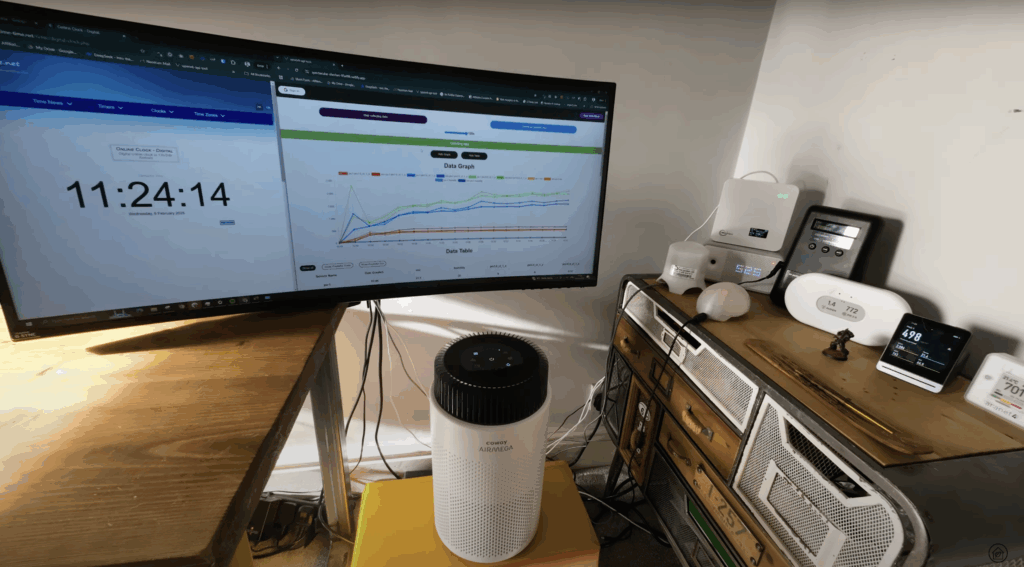
Let’s look a little deeper into my top recommendations, along with four more high-performing air purifiers and a couple of units that you should avoid at all costs.
1. Staff pick: IQAir Healthpro Plus
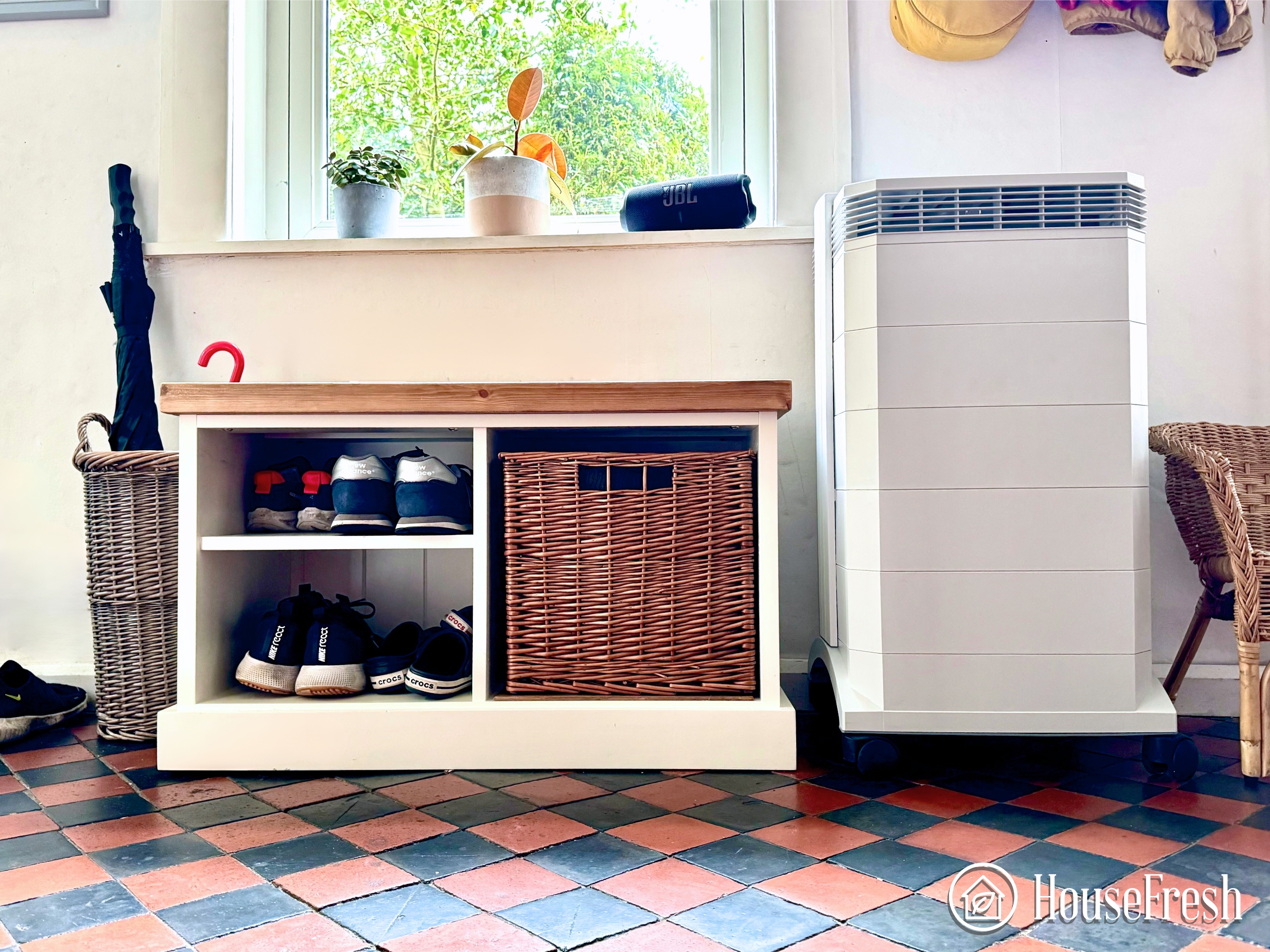
When it comes to medical grade HEPA filters, IQAir is top of the game — the Healthpro Plus offers the highest grade HEPA on the market today.
If you’re serious about air quality, suffer from severe allergies and/or respiratory disease(s) or live in a highly polluted area, the IQAir Healthpro Plus is a unit you should look into. This robust air purifier is engineered and built in Switzerland, and each unit is rigorously tested before being sent out into the world.
What we really like
What we think could be better
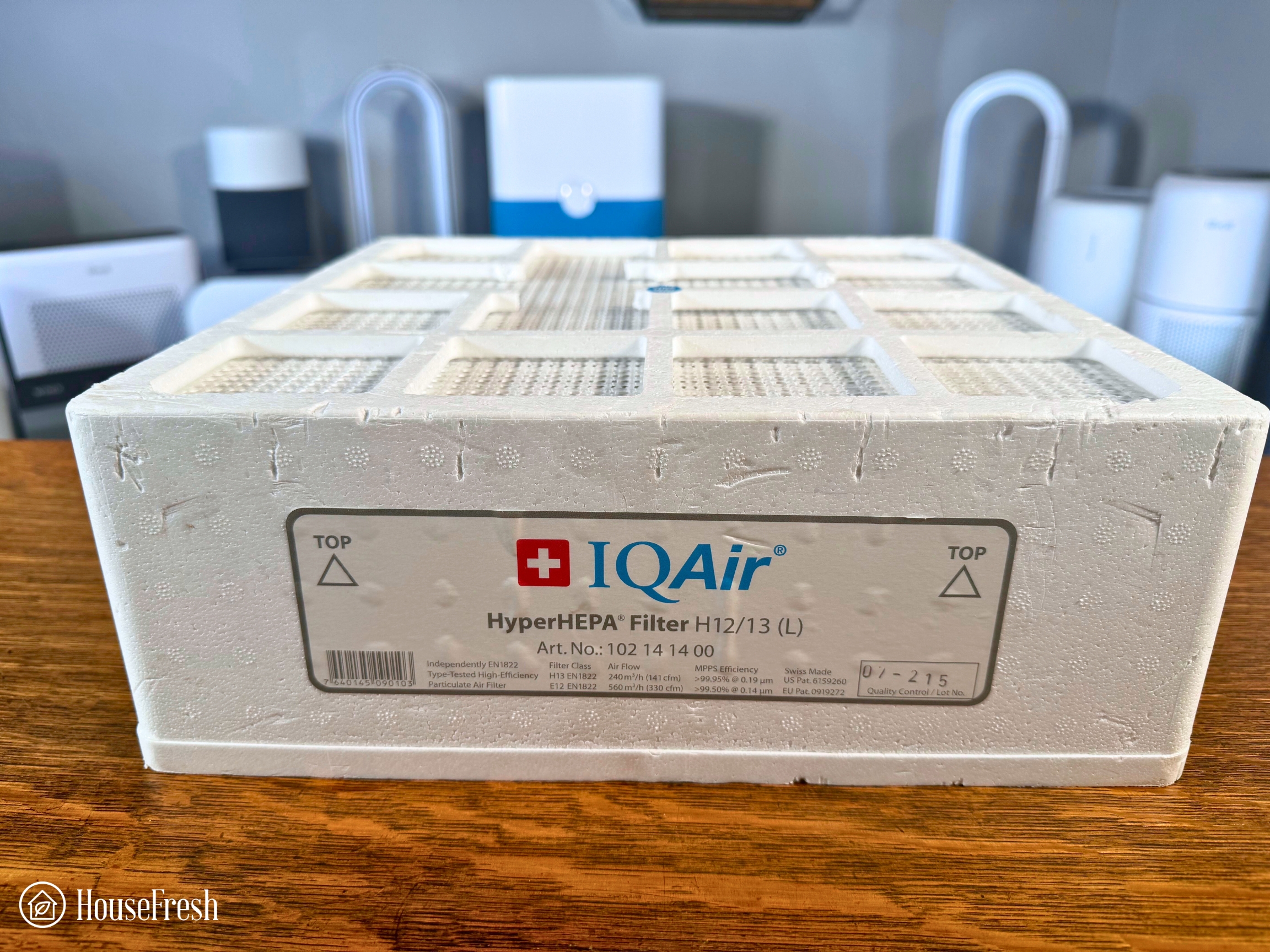
When you look under the hood of the Healthpro Plus, you’ll find its three carefully engineered filters that maximize its efficiency at removing airborne particles. IQAir’s HyperHEPA filter is the main attraction, which removes 99.5% of particles down to 0.003 microns. To put that into context, the size of SARS-CoV-2 ranges from 0.07 microns to 0.09 microns.
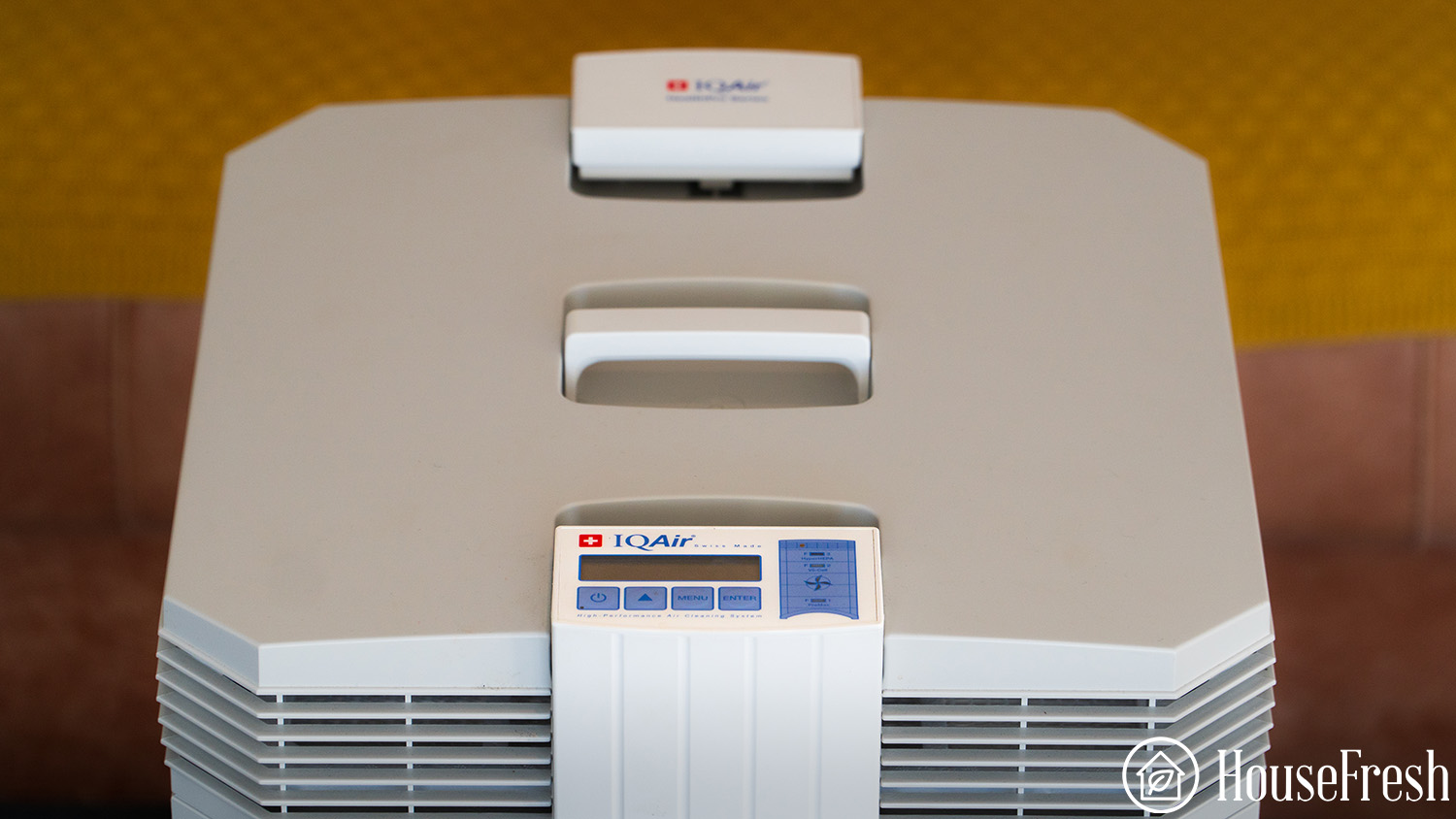
Although the IQAir Healthpro Plus may look intimidating, it’s simple to operate and has a clear screen to navigate through its settings. Plus, there’s a remote control if you need it. There are no smart functions like an auto mode or app connectivity; the Healthpro Plus strictly concentrates on air quality over gadgetry.
If you’re looking for an extremely high-performance medical-grade air purifier…you’ve just found one.
| Clean air delivery rate (CADR): | – Top speed PM1 CADR: 213 cfm – Sub-45 dBA PM1 CADR: 86 cfm |
| Filter technology: | HyperHEPA and V50-CELL with 5lbs of activated carbon + zeolite mix |
| Recommended room size: | 319 sq. ft. (5 air changes per hour) |
| Dimensions: | 28H x 18W x 16D inches (71H x 38W x 41D cm) |
| Weight: | 35 lbs (15.88 kg) |
| Noise level in decibels from 3 ft. away: | Speed 1: 36.9 dB Speed 2: 37.2 dB Speed 3: 40.9 dB Speed 4: 47.2 dB Speed 5: 53.9 dB Speed 6: 61.2 dB |
| Electricity consumption in watts: | Standby mode: 1 watts Speed 1: 16.5 watts Speed 2: 32.7 watts Speed 3: 47.3 watts Speed 4: 69 watts Speed 5: 94.3 watts Speed 6: 145.2 watts |
| Filter lifespan: | 4 years |
| Manufacturer’s warranty: | 10 years |
| Country of origin: | Switzerland |
| Country of manufacture: | Germany |
2. The best performance per $ spent: AirDoctor AD3000
If you’re looking for a fast-acting medical-grade air purifier that won’t drain your bank balance – the doctor is in.

A lot of marketing hype surrounds the AD3000, making big claims about its performance. And, if I’m honest, the hype is justified. The performance of this air purifier leaves many of its rivals in the dust (pun intended) with its UltraHEPA (medical grade) filter, auto mode, AQI and a CADR of 340 CFM.
What we really like
What we think could be better
Danny (HouseFresh founder) has the AirDoctor 3000 running in his bedroom over all the air purifiers we have because of its high performance and awesome effectiveness of its UltraHEPA filter at removing airborne pollutants down to 0.003 microns (100 times smaller than a standard HEPA filter).
As well as a medical grade filter, the AD3000 comes with the usual features we expect from modern air purifiers, like an auto mode, timer and light dimmer. It also features an ionizer that can be switched on and off (if you don’t like it).
Even though the price is slightly on the higher side, you’re paying for medical grade UltraHEPA filters and it’s one of the best performance per $ spent on the market today.


| HouseFresh rating: | ★★★★☆ |
| Time to clean our 728 cubic feet test room (with the device running at top speed): | 14 minutes (with ionizer function enabled) 16 minutes (without ionizer function) |
| Air purifier technology: | UltraHEPA filter and dual-action Carbon/Gas Trap/VOC filter |
| Recommended room size (4.8 air changes per hour): | 521 sq. ft. |
| Clean air delivery rate (CADR): | Dust: 339 CFM Smoke: 336 CFM Pollen: 356 CFM |
| Dimensions (in inches / in cm): | 19.87D x 27.16W x 12.38H inches (50.4D x 69W x 31.4H cm) |
| Weight (in pounds / in kg): | 18 lbs (8 kg) |
| Filter life: | UltraHEPA filter: 12 months Carbon/Gas Trap/VOC filter: 6 months |
| Noise level in decibels (measured from 3 ft. away with a sound level meter): | Speed 1: 40.2 dB Speed 2: 50.5 Speed 3: 58.2 dB Speed 4: 63.6 dB |
| Electricity consumption in watts (recorded with an electricity usage monitor): | Standby mode: 0.5 watts Speed 1: 9.6 watts Speed 2: 17.6 watts Speed 3: 39.9 watts Speed 4: 93.2 watts |
| Estimated running cost (electricity consumption + official filter replacement): | $267.16 per year |
| Cost per CADR cfm (based on dust CFM as reported by AHAM): | $1.53 |
| Manufacturer’s warranty: | 1 year |
| Country of manufacture: | China |
3. The quietest option: Smart Air Blast Mini
A medical grade air purifier built like a tank – This powerful unit delivers a CADR of 450 CFM with ninja-like sound.
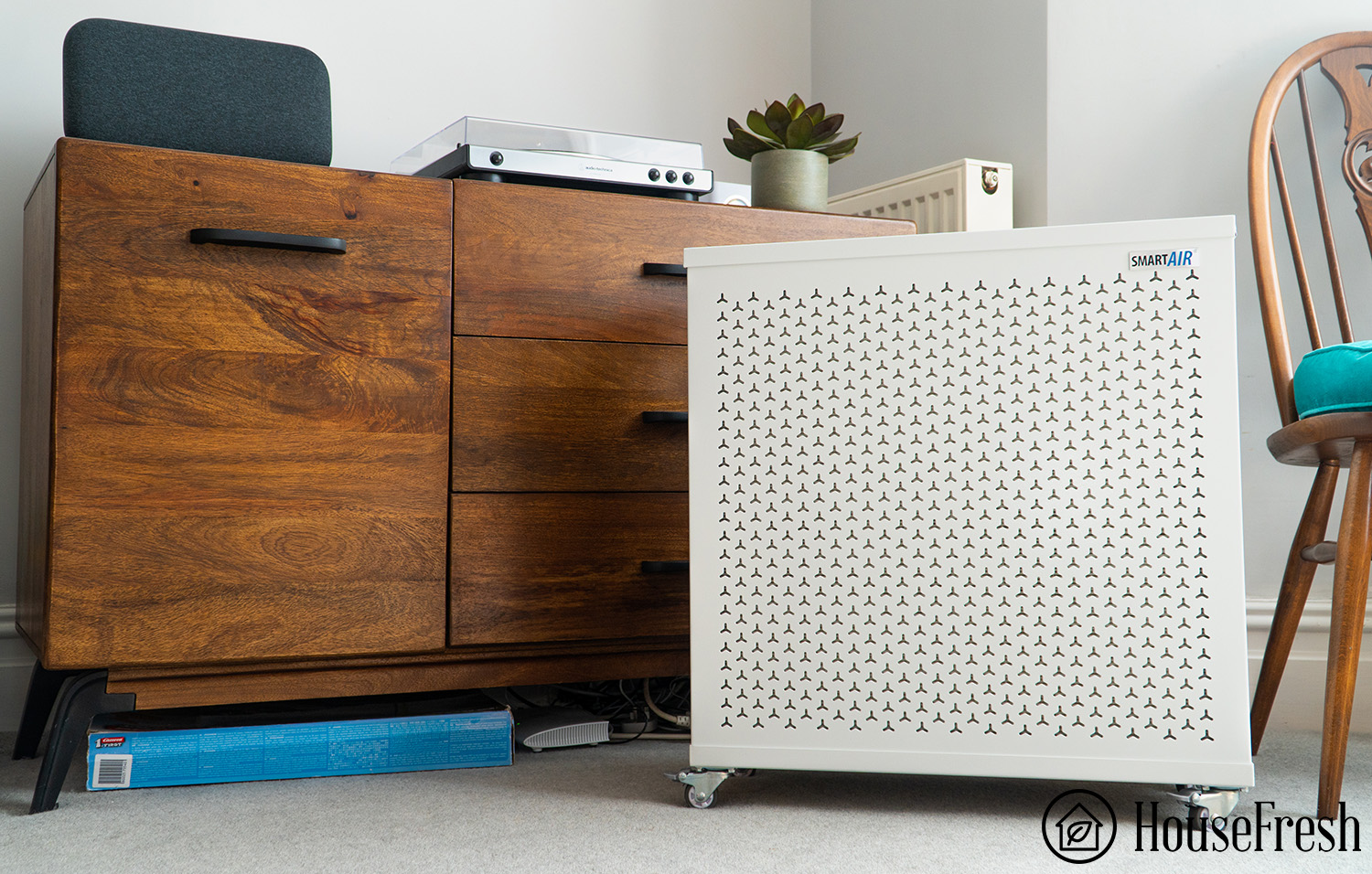
Smart Air doesn’t make air purifiers like other brands. You won’t find smart features, an AQI or control screens; they believe in the core science.
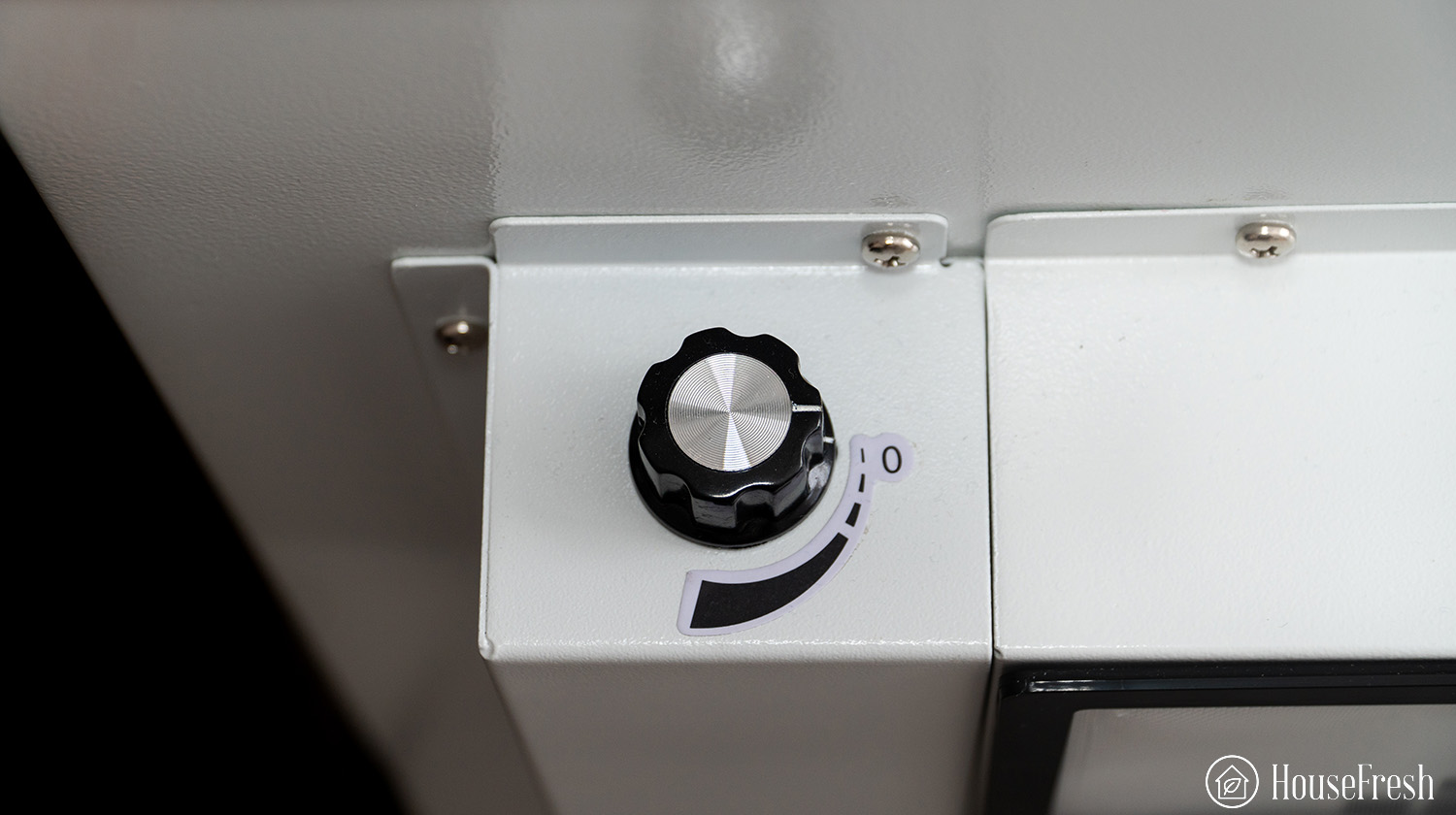
The Blast Mini is a testament to these beliefs. There’s just one dial to control the fan speed…that’s it. But that’s not a bad thing, as they put all their efforts into engineering the Blast Mini into a high-powered air-cleaning beast.
What we really like
What we think could be better
Even though this large air purifier uses a high-performance fan, Smart Air has managed to keep its sound output to a minimum. The average maximum noise produced across all air purifiers we’ve tested is 64 dB; the Blast Mini kicks out just 56 dB at its highest fan speed and 45 dB at its lowest.
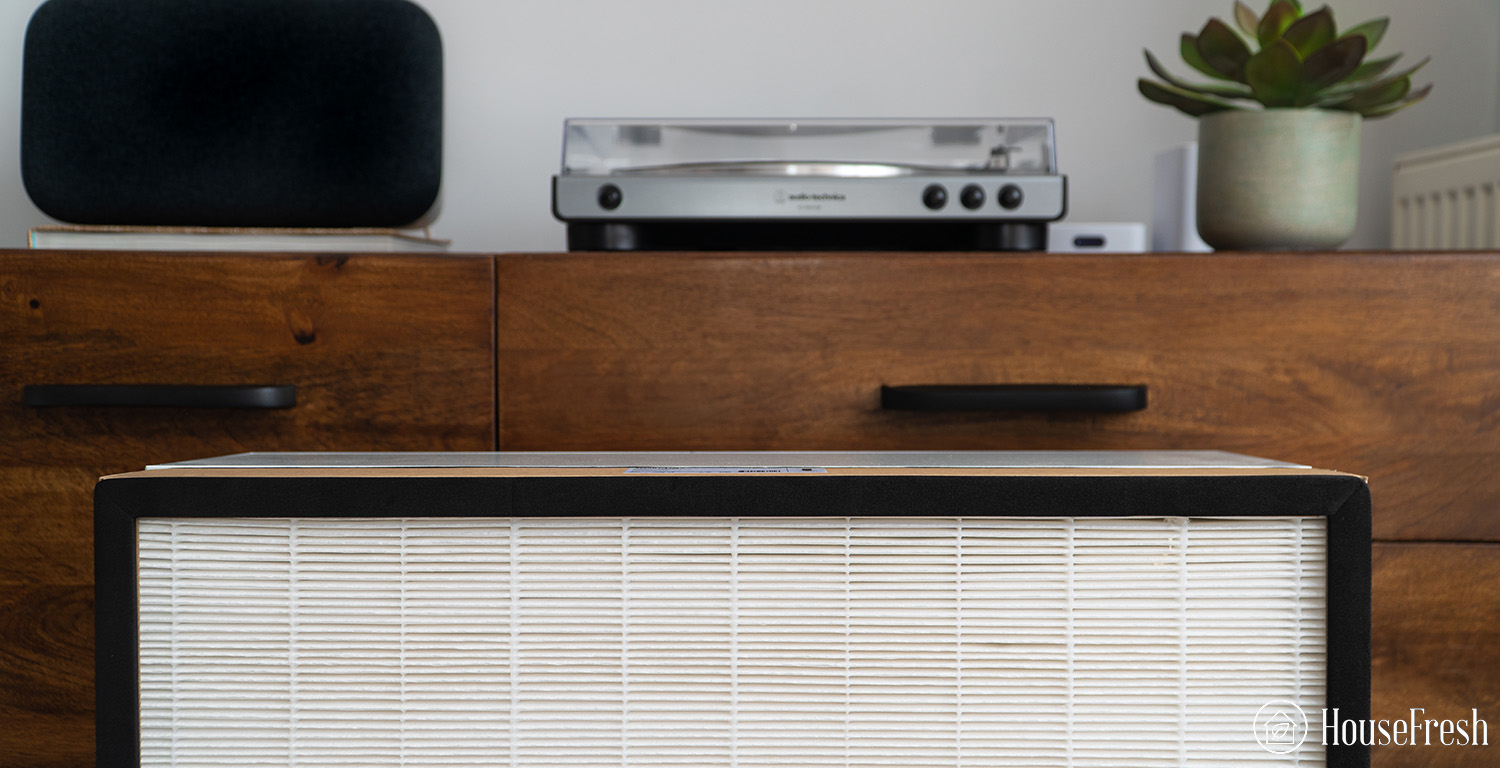
The medical-grade HEPA filter in the Blast Mini is enormous. Smart Air has wasted no room in this unit, as the filter takes up the whole front. This huge filter has a lot of surface area to capture pollutants so that it can last 12 months over the usual 6 months. This, combined with a large fan, makes the Blast Mini an excellent option for a medical-grade air purifier.

For many consumers, the main benefit of the Smart Air over the IQAir Healthpro Plus will boil down to price; it costs $600 vs $899 for the IQAir HealthPro Plus. All while providing faster results in our clean air test.
| Clean air delivery rate (CADR): | – Top speed PM1 CADR: 400 cfm – Sub-45 dBA PM1 CADR: 272 cfm – Manufacturer provided CADR: 437 cfm |
| Filter technology: | H13 HEPA filter (and optional pelleted activated carbon filter) |
| Recommended room size: | 600 sq. ft. (5 air changes per hour): |
| Dimensions: | 22.6L x 13W x 24.8H inches (57.5L × 33W × 63H cm) |
| Weight: | 59 lbs (26.8 kg) |
| Noise level in decibels from 3 ft. away: | Speed 1: 44.9 dB Speed 2: 51.2 dB Speed 3: 56.3 dB |
| Electricity consumption in watts: | Standby mode: 0 watts Speed 1: 51.9 watts Speed 2: 87.4 watts Speed 3: 122.7 watts |
| Filter lifespan: | 13 months |
| Manufacturer’s warranty: | 1 year |
| Country of origin: | China |
| Country of manufacture: | China |
4. Best wall-mounted option: Smart Air SA600
Smart Air proves that medical-grade air purifiers don’t need bells and whistles to be effective.

Smart Air has solidified itself as a trustworthy brand in the world of air purifiers. Their no-nonsense approach to engineering over gadget ingenuity has proven highly effective. With a dual-inlet comprising two medical-grade HEPA filters and two activated carbon filters, the SA600 is no different.
What we really like
What we think could be better
Compared to the Blast Mini, the SA600 couldn’t be more different on the outside, but it’s the inside that counts, right? This smaller unit still packs a punch and earned its spot in this guide with its dual H13 grade HEPA filters at the forefront of its cleaning performance.
These two medical-grade filters are engineered and tested to remove 99.97% of airborne particles in your home, like dust, pet dander, allergens and even viruses smaller than COVID-19. Combine that with Smart Air’s powerful fans and you have a strong deterrent against pollution.


| Clean air delivery rate (CADR): | – Top speed PM1 CADR: 249 cfm – Sub-45 dBA PM1 CADR: 128 cfm – AHAM PM2.5 CADR: 287 cfm (dust) |
| Filter technology: | H13 TrueHEPA filter with a removable pre-filter and pelleted activated charcoal filter (set of two) |
| Recommended room size: | 373 sq. ft. (5 air changes per hour) |
| Dimensions: | 20 x 13.8 x 9 inches (51 x 35 x 23 cm) |
| Weight: | 15.5 lbs (7 kg) |
| Noise level in decibels from 3 ft. away: | Speed 1: 35.2 dBA Speed 2: 37.2 dBA Speed 3: 41.5 dBA Speed 4: 46.1 dBA Speed 5: 56.7 dBA |
| Electricity consumption in watts: | Standby: 0.1 watts Speed 1: 2.4 watts Speed 2: 4.3 watts Speed 3: 7.1 watts Speed 4: 12.9 watts Speed 5: 53.8 watts |
| Filter lifespan: | 18 months |
| Manufacturer’s warranty: | 1 year |
| Country of origin: | China |
| Country of manufacture: | China |
What to look for when buying a medical-grade air purifier
Medical-grade air purifiers use a HEPA grade filter known as H13, which can trap 99.97% of particles sized 0.3 microns or bigger. While this type of medical-grade filter will be able to capture tiny particles such as viruses, you will still need to ensure that you can provide enough airflow to clean the air in your room.
But, with so many medical-grade air purifiers on the market, it can be tough to decide which is right for your home. Luckily, there are guidelines to follow to make sure you get the most out of your new air purifier.
Here are the top things to consider when choosing a medical-grade air purifier that are often overshadowed, yet more important than the initial cost and design of the unit.
1. Has the HEPA H13 received confirmation by independent evaluation?
The use of the term HEPA H13 is not regulated, so it’s easy for air purifier manufacturers to use this terminology even when they haven’t tested their filters through an independent body.
With Levoit recently removing the HEPA term from their marketing, it’s not just smaller brands you need to worry about.
To avoid risking buying a device that isn’t HEPA H13, you need to stick to companies that prove that they have had their HEPA filters tested by an independent body. The EU rules are BS EN 1822-1:2019; for the rest of the world, you will want to look for ISO29463.
For those with serious medical issues, you are better off spending more money on a brand like IQAir or Smart Air that are very open about their independent testing and avoiding cheaper brands that seem to offer the same features at a far cheaper price.
2. How big is your room?
It’s not just the grade of the filter that counts; it’s also the air purifier’s performance. The size of your room heavily dictates which air purifier will work effectively in it. Using the measurement CADR (Clean Air Delivery Rate), we can calculate how effective an air purifier will be at cleaning the air in different-sized rooms.
The general rule is the larger the room, the higher the CADR is needed.
As well as CADR, you also need to consider ACH (Air Changes per Hour). While first-pass filtration is helpful, it’s even more critical that an air purifier can clean enough air to provide at least 4.8 air changes per hour.
For example, for a 350 sq ft room, you would need an air purifier with at least a CADR of 224 to provide 4.8 ACH (what the EPA recommends for portable air purifiers.) This is much lower than the 98 CFM that the Dyson combo units provide, meaning a room that size would still suffer from particulate pollutants.
It is essential that you accurately measure your room first, then work out what CADR you will need to clean it effectively. Feel free to enter your room size in our CFM calculator tool to see the CADR needed to keep the air clean in your room:
3. What are the long-term costs of running an air purifier?
For those wanting to keep the air clean all the time, you will need to ensure your air purifier runs 24/7, 365 days a year. If your air purifier is inefficient, it can end up adding a higher cost to your electricity bill.
It’s not just the cost of energy you need to consider, as all HEPA filters need replacing once they become full of particles. Eventually, airflow gets restricted so that they cannot clean as efficiently so you need to buy a new filter periodically to keep your air purifier performing to its highest standard.
Some air purifier brands prey on consumers not thinking about the long-term costs when buying, so they offer cheaper units that cost much more in the long term in filter replacement costs.
There are now a lot of generic filters available for different models of air purifiers that cost much less, but if you are concerned about HEPA H13, be sure to stick to the genuine filters that will have been independently tested.
Common questions about issue
Most hospital buildings will use large air distribution systems incorporating MERV 8 pre-filters and MERV 14 final filters. High-risk areas like operating theatres will utilize medical-grade HEPA filters to achieve at least 15 air changes per hour to reduce the risk of infection. Other rooms will have different air change targets depending on the level of risk; you can see a full list of air change requirements at the CDC.
The filters that we find in air purifiers are rigorously tested beforehand. Each is rated on its ability to capture particles of different sizes. This is known as a Minimum Efficiency Reporting Values (MERV) rating, which ranges from a low H1 to a high H20.
According to NHS England, ionizers should be avoided as they have the potential to create chemical byproducts via secondary reactions. Currently, there needs to be more evidence of their efficacy in reducing microbial loads in the air.
According to the team at Commercial Air Filtration, HEPA H13 is better as it doesn’t restrict airflow as much, has a better filtration-to-airflow ratio and is less likely to suffer from air leakages.
For those with a medical issue, investing in an air purifier that uses filters with HEPA H13 is worth investing in. However, you still need to make sure that the air purifier has enough cleaning power to provide regular air changes for the space you are in. Any type of air purifier will still be able to keep the air clean eventually, even if the grade of HEPA is lower as the airflow will be increased so the devices can move air quicker so even the MERV 13 of the Corsi-Rosenthal box can still remove the tiniest of particles from the air even though the filter it uses is lower than HEPA grade.
As air purifiers have become more of a requirement than a luxury item, doctors will most likely point out how running a unit in your home is a much healthier option than not. But it all comes down to your insurance plan. Many companies like Medicaid only cover DME (Durable Medical Equipment) which air purifiers (at time of writing) don’t currently fall under.
Wrapping up
Running an air purifier in your home is the best way to remove harmful airborne pollutants from your air. The scientific data to back this up is ample and well-documented. Air purifiers that contain a medical-grade filter will stop more particles in a single pass than low grade filters.
The trick is to find an air purifier that is right for your space and has enough power to utilize its high-grade filters efficiently and effectively. Each unit I have featured in this article is high-performing; some have more brains than brawn, and vice versa.