An air purifier is just a fan and a filter. But not all fans are created equal, and filters come in all shapes and sizes.
So whether you’re looking for an air purifier to tackle odors before they escape your kitchen, or you’re trying to get rid of dust in your bedroom before your allergies get triggered at night, there will be a specific combination of a fan and a filter that will make the most sense for you.
But you need to be careful with what you buy… Because some of the models influencers seem to love (and even those endorsed by well-known newspapers and magazines) might be tricking you into overpaying for an air purifier that is just not worth it.
Since 2020, I’ve bought and tested 147 air purifiers (and counting!) to separate the good units from the absolute scams. You can read more about our testing methodology here.
In this guide, I will cut through all the marketing noise to tell you which are the best air purifiers on the market right now, based on hundreds of tests conducted in the same space over a period of six years.
Don’t buy an air purifier before watching this
These are our picks for the best air purifiers we have tested available to buy right now.
Read till the end to learn about the solid air purifier models that didn’t make the list, as well as the ones we tested that aren’t a good investment based on our data. And if there are any specific models you’ve got in mind, you can use our air purifier comparison tool to compare them side-by-side.
1. Best for most people: Coway Airmega Mighty2
A high-performing air purifier in a small package with an onboard sensor, smart features and quiet operation.
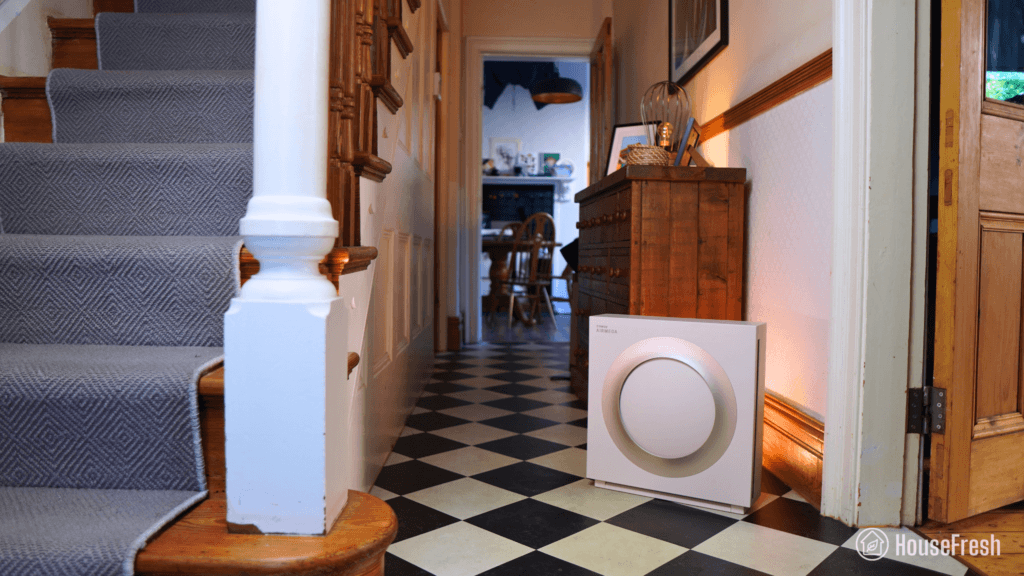
The Mighty2 is a new air purifier from Coway that will tick off all the boxes for most people because it costs just $269.99, fits small to medium-sized rooms, comes with activated carbon as default, has a high-quality laser sensor that unlocks smart features AND it offers excellent performance.
It completed our particle removal test in 23 minutes, outperforming popular models from Levoit, Winix and Blueair while generating less noise.
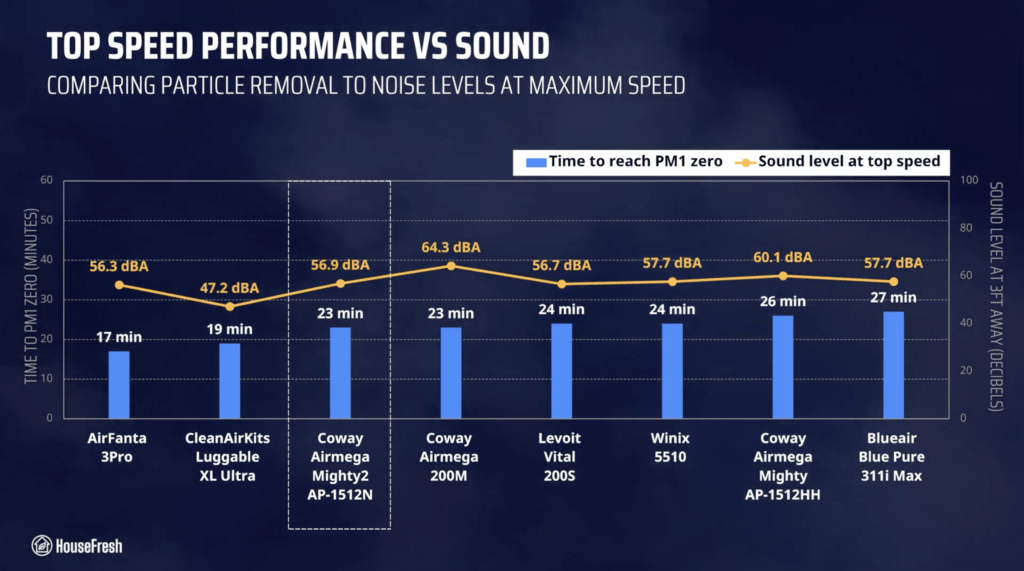
Based on this result, we estimate a PM1 CADR of 260 cfm, which will be powerful enough to provide five air changes per hour in rooms up to 36 m2 (or 390 sq. ft.) when running at top speed.
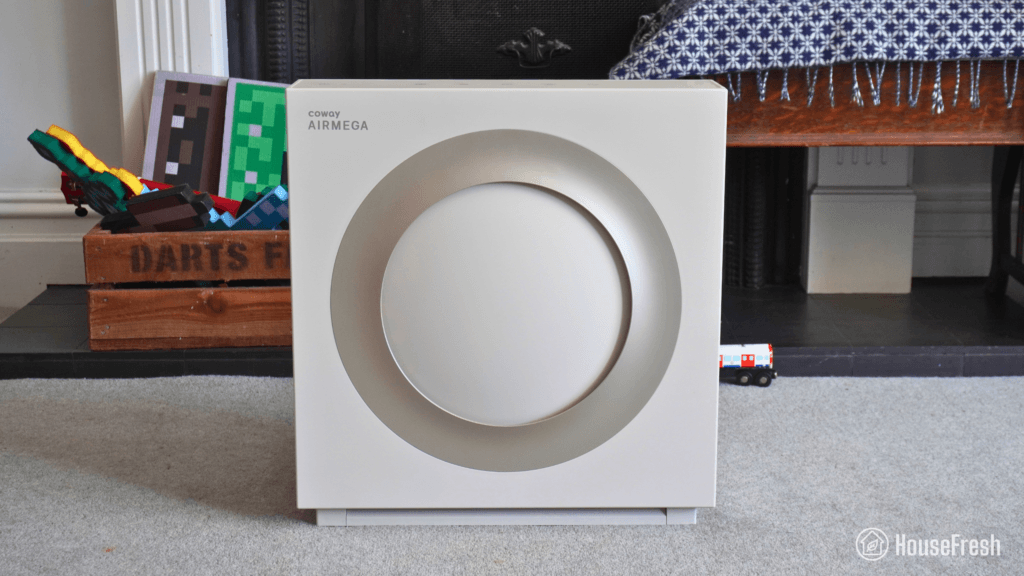
It comes with a bonded filter with a particle filter (for pollen and dust) on one side and a activated carbon pellets (for odors and gases) on the other.
The Mighty2 also comes with a washable, slidable pre-filter that can be removed to be cleaned without opening the front cover – – less mess, especially for pet owners!
CONS
PROS
| Clean air delivery rate (CADR): | Speed 1: 99 cfm Speed 2: 151 cfm Speed 3: 212 cfm Turbo speed: 260 cfm |
| Filter technology: | Washable pre-filter and bonded pelleted activated Carbon + HEPA-grade particle filter (on sleep mode) |
| Air quality sensor: | Laser particle sensor (PM1, PM2.5, PM10) |
| Recommended room size (5 air changes per hour): | 390 sq. ft. (36.23 m2) |
| Dimensions: | 16.9 x 17.9 x 9.3 in (43 x 45.5 x 23.7 cm) |
| Weight: | 15.2 lbs (6.9 kg) |
| Noise level in decibels from 3 ft. away: | Sleep mode: 35.9 dBA Speed 1: 38.1 dBA Speed 2: 42.6 dBA Speed 3: 49.3 dBA Turbo speed: 56.9 dBA |
| Electricity consumption in watts: | Standby: 0.39 watts Sleep mode: 2.53 watts Speed 1: 4.85 watts Speed 2: 10.28 watts Speed 3: 19.88 watts Turbo speed: 49.12 watts |
| Filter lifespan: | 12 months |
| Manufacturer’s warranty: | 3 years |
| Country of origin: | South Korea |
| Country of manufacture: | China |
If you’re looking for a mid-sized model that offers everything you get with the Mighty2 plus app connectivity, then I’ve got two other recommendations for you:
Levoit Vital 200S
The Vital 200S offers similar performance to the Mighty2 at a cheaper price ($189.99) and with app connectivity. The pre-filter is removable and the main filter is bonded, with particle filtration on one side and carbon on the other.
Based on our tests, we estimate a PM1 CADR of 249 cfm, making it powerful enough to provide five air changes per hour in rooms up to 33 m2 (or 360 sq. ft.). READ MY FULL REVIEW ➜
Use the discount code HOUSE10 for 10% off when buying directly from Levoit.
Philips 3200
The Philips 3200 is a great option for those living in Europe, Asia and Oceania, where the Mighty2 and the Vital 200s are rare. It comes with smart features, app support and a lamp function for just £240 (or €260).
Based on our tests, we estimate a top speed PM1 CADR of 249 cfm, so it can provide five air changes per hour in spaces up to 33 m2 (or 360 sq. ft.). READ MY FULL REVIEW ➜
2. Best value for money: AirFanta 3Pro
If you care about one thing — maximum air cleaning at the minimum price — the 3Pro is untouchable.

Use the discount code HOUSEFRESH for 5% off when buying directly from AirFanta.
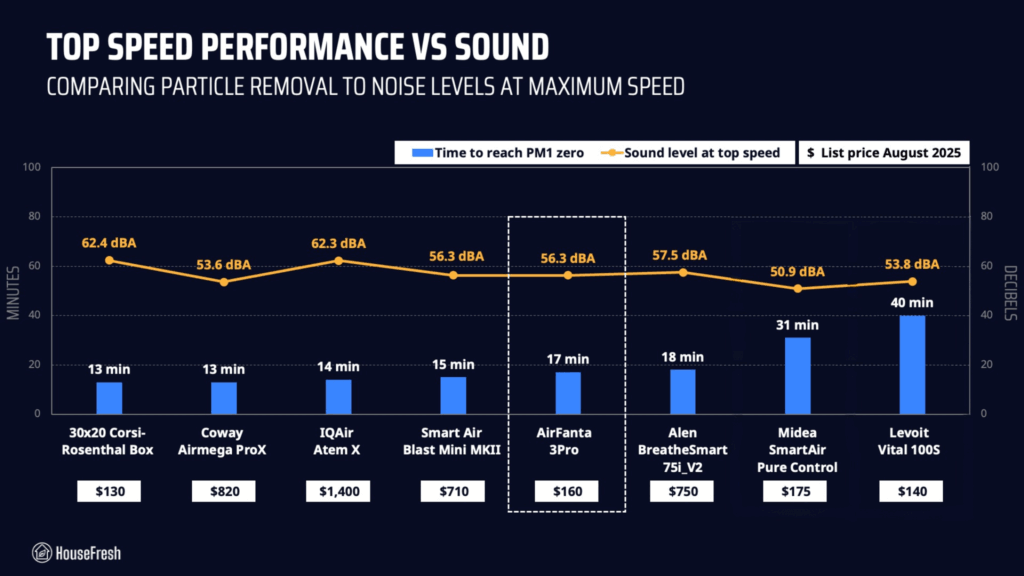
The AirFanta 3Pro is a PC fan-powered air purifier that broke the mold. Based on our tests, we estimate a PM1 CADR of 353 cfm, which is incredible considering its low price of $159.99. This makes the 3Pro capable of providing five air changes per hour in rooms up to 49 m2 (529 sq. ft.).
The 3Pro is a small box with a plastic base, an H11 HEPA filter on each side, and four PC fans on top.
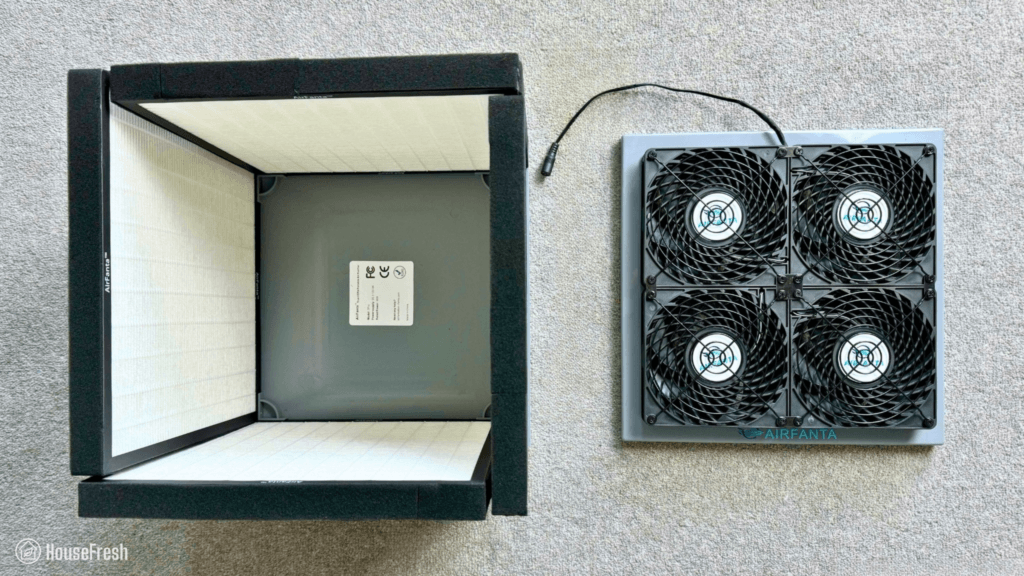
You can disassemble and reassemble it in a few minutes and it fits inside a carry-on suitcase or large backpack – a good travel option.

In terms of size, the 3Pro is relatively small and can fit comfortably on top of a side table or windowsill.
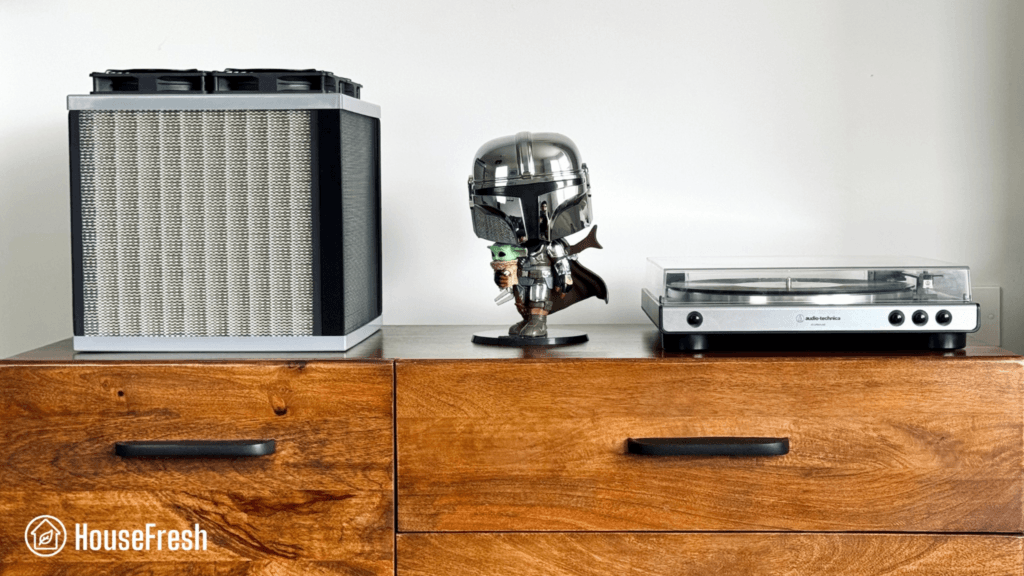
But don’t let its size trick you into thinking this is not a powerful unit. The 3Pro outperforms units twice its size that cost three times as much.
CONS
PROS
| Clean air delivery rate (CADR): | – Top speed PM1 CADR: 353 cfm – Sub-45 dBA PM1 CADR: 213 cfm |
| Filter technology: | True HEPA H11 and optional pelleted activated carbon |
| Recommended room size: | 529 sq. ft. (5 air changes per hour) |
| Dimensions: | 12.6D x 12.6W x 12.6H inches (32D x 32W X 32H cm) |
| Weight: | 7.7 lbs (3.49 kg) |
| Noise level in decibels from 3 ft. away: | 3.63 volts: 36.1 dB 4.19 volts: 36.9 dB 5.24 volts: 39.7 dB 6.54 volts: 43.3 dB 7.44 volts: 46.7 dB 8.56 volts: 49.1 dB 12.6 volts: 56.3 dB |
| Electricity consumption in watts : | 43.23 watts |
| Filter lifespan: | 6 – 12 months |
| Manufacturer’s warranty: | 1 year |
| Country of origin: | China |
| Country of manufacture: | China |
3. Best for small spaces: Coway Airmega 100
A small cylindrical air purifier with an onboard sensor and a nightlight mode that is powerful enough to clean the air in rooms smaller than 21 m2 (or 222 sq. ft.).
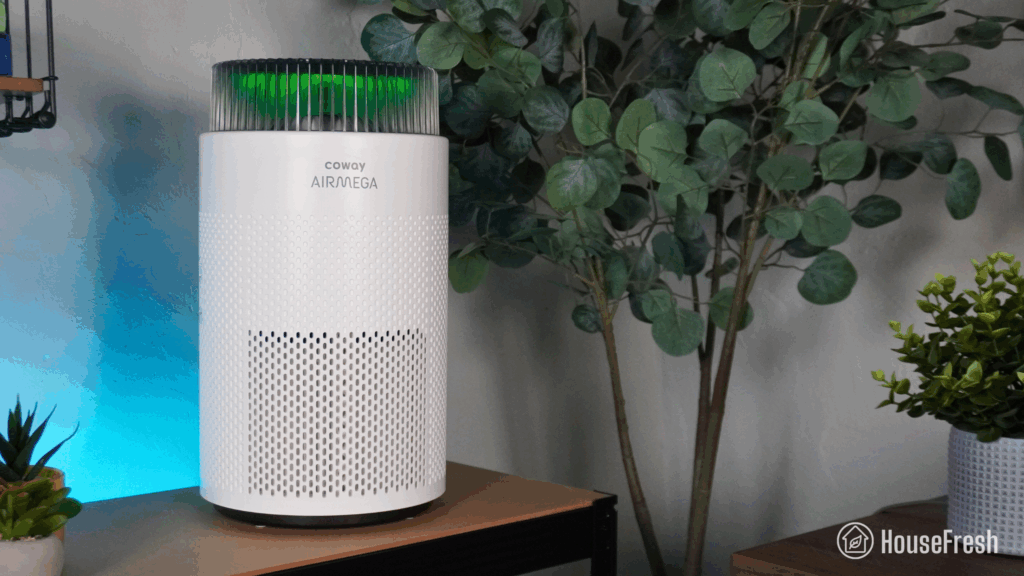
Amazon is full of small air purifiers that cost next to nothing. But unfortunately, the vast majority of them are too underpowered to make a meaningful difference to your air. After testing nearly 40 small air purifiers, my top pick right now is the Coway Airmega 100.
At top speed, it completed our test faster than most other small units. We estimate a PM1 CADR of 148 cfm and can clean the air 5 times/hour in rooms up to 20 m2 (or 222 sq. ft.).
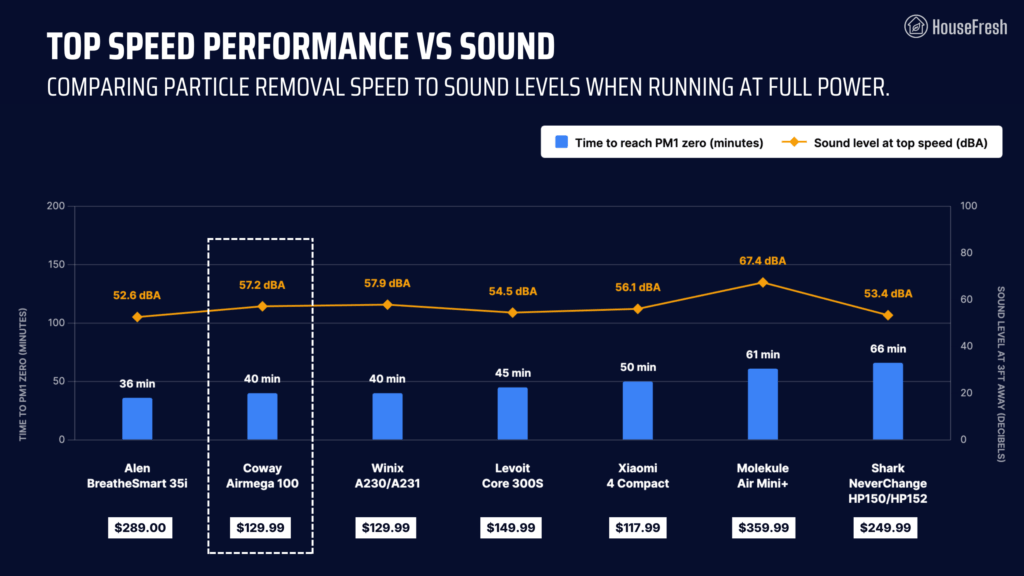
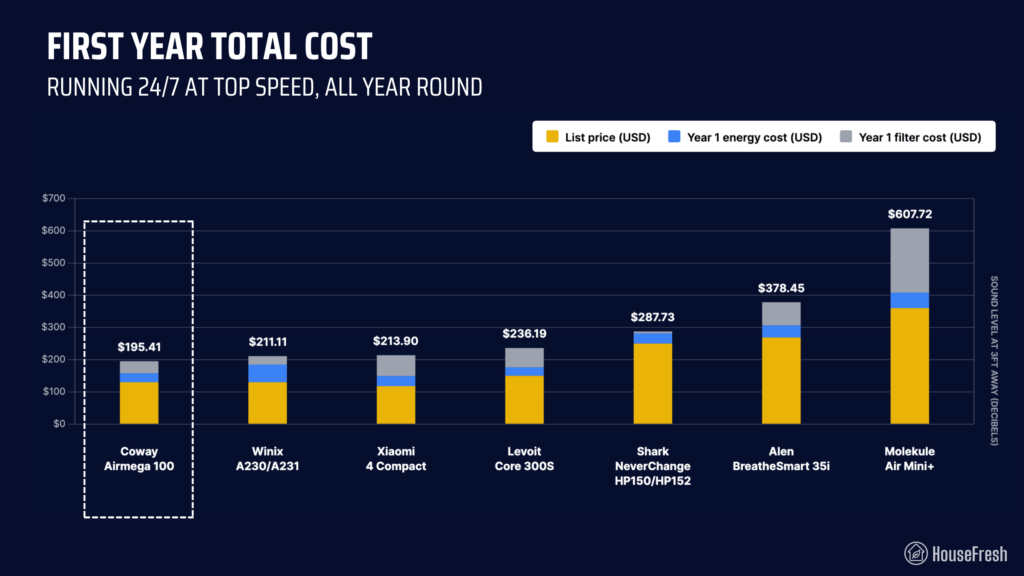
The only exception is the Alen 35i, which offers higher performance with quiet operation. But considering the low price and running costs, the Airmega 100 offers better value.
The filter has three layers: an outer pre-filter mesh cover that you should vacuum regularly, a pleated HEPA filter, and a layer of carbon-impregnated fabric on the inside.

It comes with an onboard air quality sensor that enables auto-mode and and a color-coded air quality indicator light on top (which you can also set to nightlight, with a soft yellow glow).
CONS
PROS
| Clean air delivery rate (CADR): | – Top speed PM1 CADR: 148 cfm – Sub-45 dBA PM1 CADR: 115 cfm |
| Filter technology: | Bonded particle filter with a layer of carbon-impregnated fabric. |
| Recommended room size: | 222 sq. ft. (5 air changes per hour) |
| Dimensions: | 8.6 x 8.6 x 15.5 in (22 x 22 x 39.5 cm) |
| Weight: | 6.6 lbs (3.0 kg) |
| Noise level in decibels from 3 ft. away: | Sleep mode: 35.6 dBA Speed 1: 38.9 dBA Speed 2: 46.5 dBA Speed 3: 57.2 dBA |
| Electricity consumption in watts: | Standby: 0.3 watts Sleep mode: 3.5 watts Speed 1: 5.6 watts Speed 2: 9.5 watts Speed 3: 23.2 watts |
| Filter lifespan: | 6-12 months |
| Manufacturer’s warranty: | 2 years |
| Country of origin: | South Korea |
| Country of manufacture: | China |
This is a recommendation for those of you who can afford the $269 price tag and want the absolute best small air purifier on the market.
The Alen 35i has a PM1 CADR of 162 cfm at top speed and generates 52.6 dBA – powerful enough to clean the air five times per hour in rooms up to 23 m2 (247 sq. ft.).
And when running on speed, it outperformed every other small air purifier we benchmarked it against, with the exception of PC fan-powered air purifiers.

It comes with a high-end laser sensor, smart features, and app support. Plus, the build quality is excellent, and you also get a lifetime warranty when you subscribe to Alen for filter replacements. All this makes the BreatheSmart 35i an excellent high-end alternative to the Airmega 100. READ MY FULL REVIEW ➜
4. Best for large spaces: Coway Airmega ProX
The ProX offers an impressive PM1 CADR of 462 cfm, smart modes, and an accurate air quality sensor for just over $800.
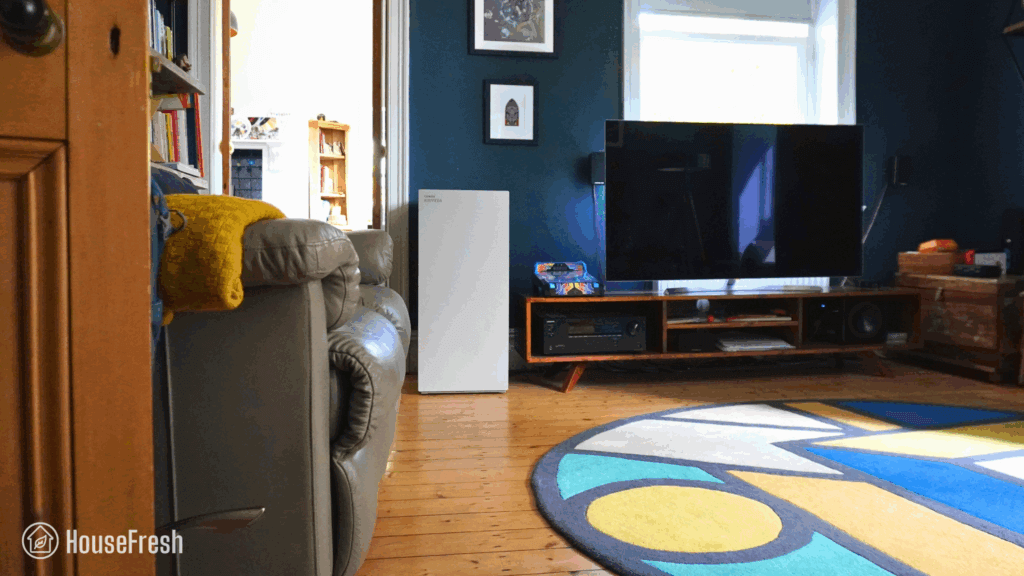
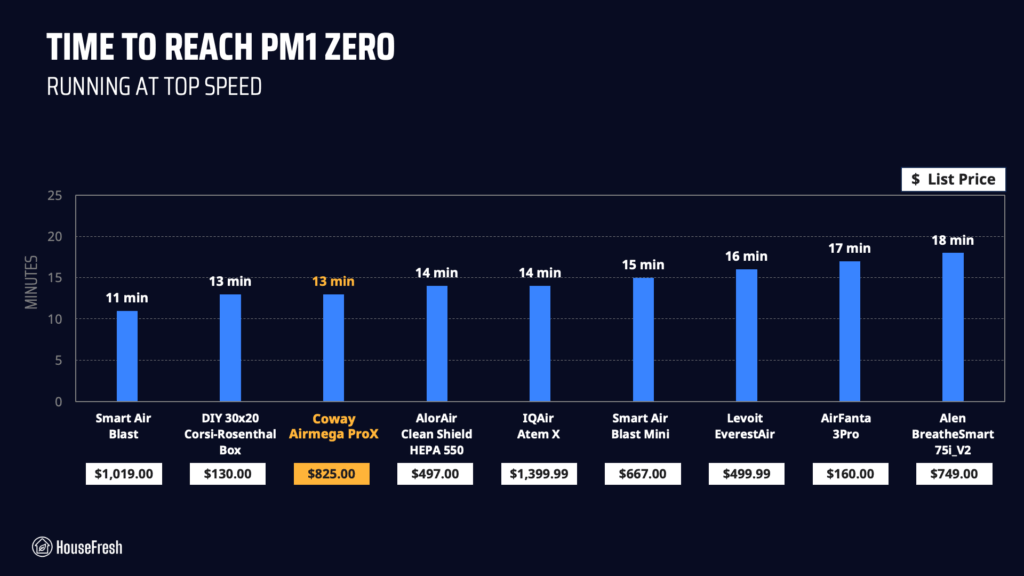
The Airmega ProX from Coway is a large, powerful air purifier that can offer five air changes per hour in spaces up to 64 m2 (or 693 sq. ft.). Running at top speed, it generates 53.6 dBA and has an estimated PM1 CADR of 462 cfm.
In our tests, it outperformed the $1,400 IQAir Atem X and currently ranks at the top of our leaderboard for large residential air purifiers.
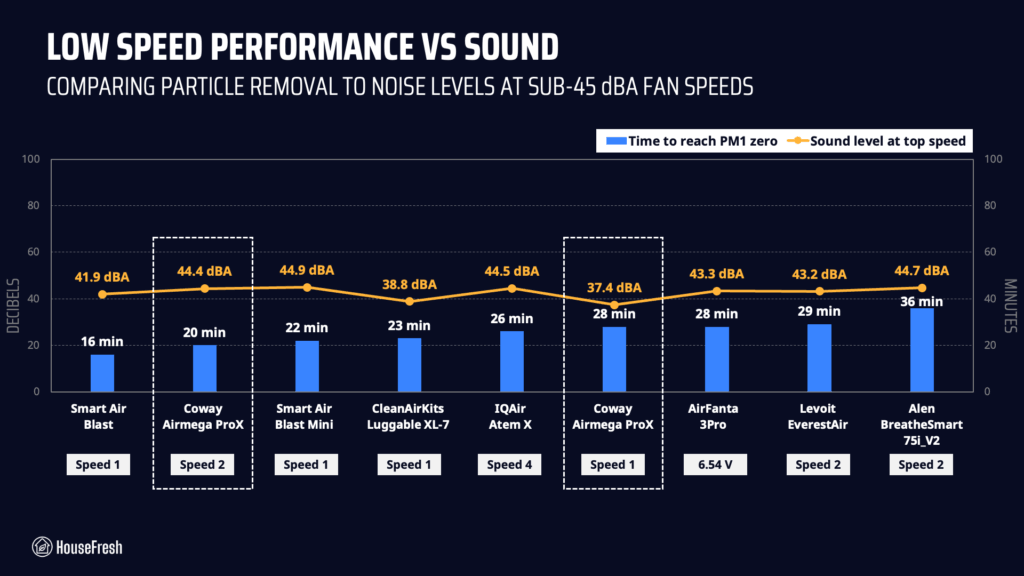
And when it comes to sound, the ProX is the only traditional air purifier that comes close to the quiet performance we saw from the PC fan models.
You get double filtration, with a True HEPA filter and a pelleted carbon filter at each side of the device. The lifespan of the filters is 12 months.
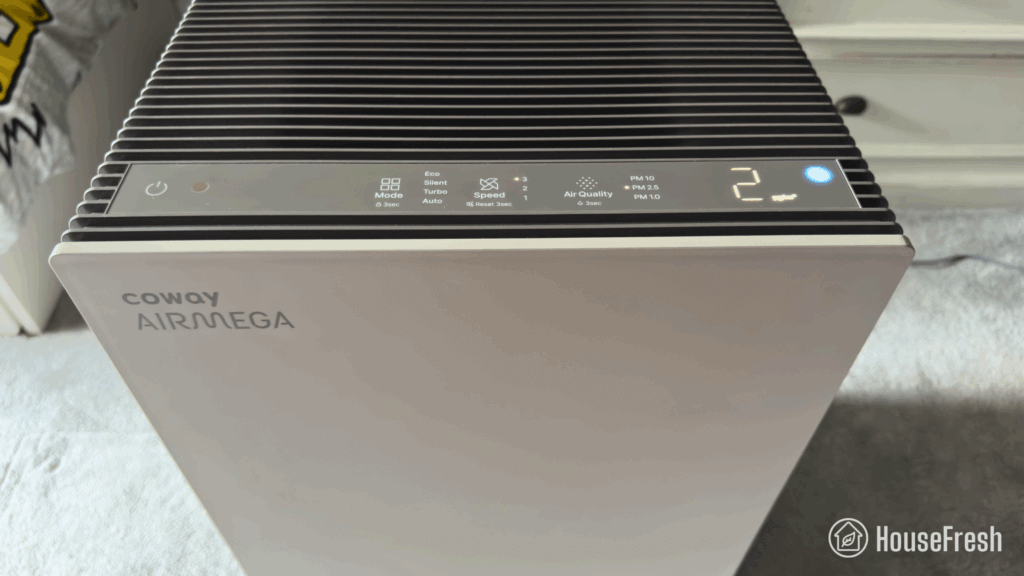
The ProX lacks app support, but it has a laser sensor and four smart modes: eco, silent, turbo + auto. You also get real-time particle readings on screen.
CONS
PROS
| Clean air delivery rate (CADR): | – Top speed PM1 CADR: 462 cfm – Sub-45 dBA PM1 CADR: 299 cfm – AHAM PM2.5 CADR: 586 cfm (dust) |
| Filter technology: | Green True HEPA filter with pelleted activated carbon |
| Recommended room size: | 693 sq. ft. (5 air changes per hour) |
| Dimensions: | 18.9 x 36.6 x 24.3 in (48 x 93 x 62 cm) |
| Weight: | 51 lbs (23kg) |
| Noise level in decibels from 3 ft. away: | Speed 1: 37.4 dBA Speed 2: 44.4 dBA Speed 3: 53.6 dBA |
| Electricity consumption in watts: | Standby: 0 watts Speed 1: 11.76 watts Speed 2: 26.09 watts Speed 3: 58.88 watts |
| Filter lifespan: | 12 months |
| Manufacturer’s warranty: | 3 years |
| Country of origin: | South Korea |
| Country of manufacture: | South Korea |
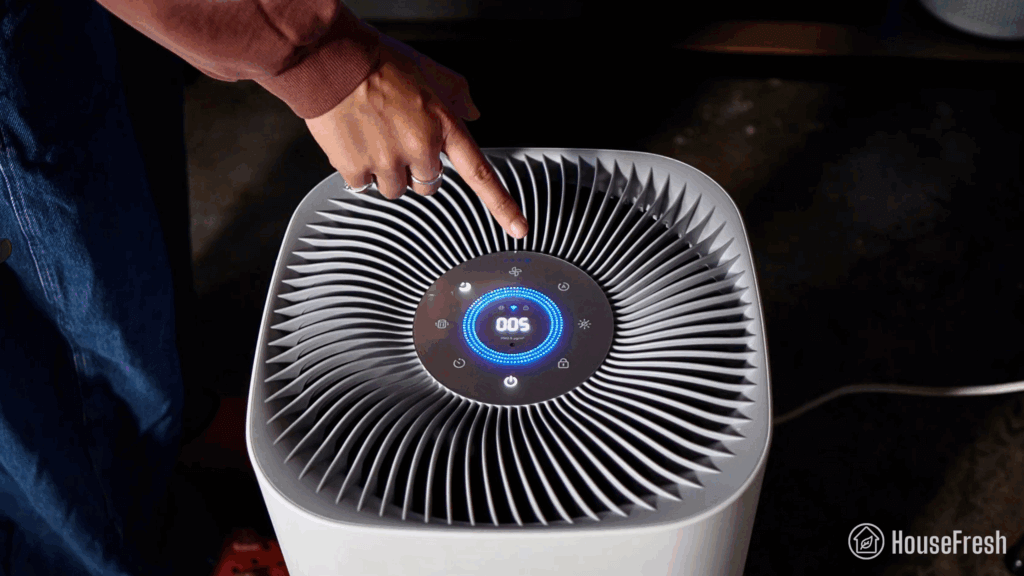
For less than $300, the Levoit Core 600S comes with a laser air quality sensor, auto-mode, and even app support. It offers the most bang for your buck, with a PM1 CADR of 375 cfm that will clean the air five times per hour in rooms up to 52m2 (562 sq. ft.). READ MY FULL REVIEW ➜

Use the discount code HOUSE10 for 10% off when buying directly from Levoit.
5. Best for smoke and odors: AC Infinity CLOUDLINE S8 fan with refillable carbon filter
If odors are your primary focus, my top pick is the AC Infinity CLOUDLINE S8 fan and one of their 8-inch refillable carbon filters.
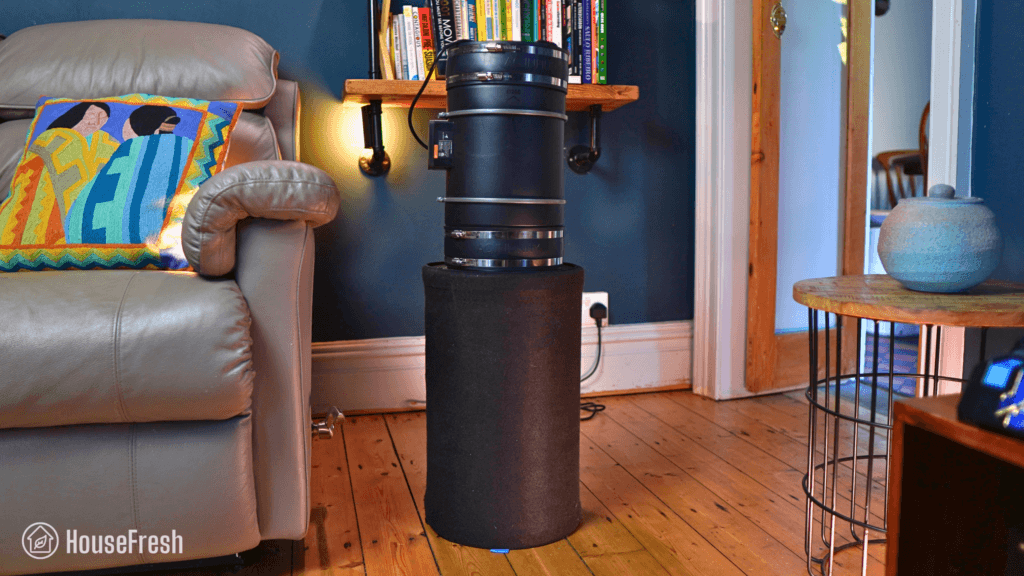
To remove serious odors and gases from your air, you need to look beyond the standard air purifiers, as they usually come with a small amount of carbon that will become saturated quickly in spaces with high levels of VOCs. My top recommendation is to build yourself your own odor-busting device using parts from AC Infinity.
Although many air purifiers come with activated carbon filters, these usually come with small quantities of carbon. Now, this is where the AC Infinity CLOUDLINE S8 truly shines, thanks to its carbon filter packed with 16 lbs of activated carbon.
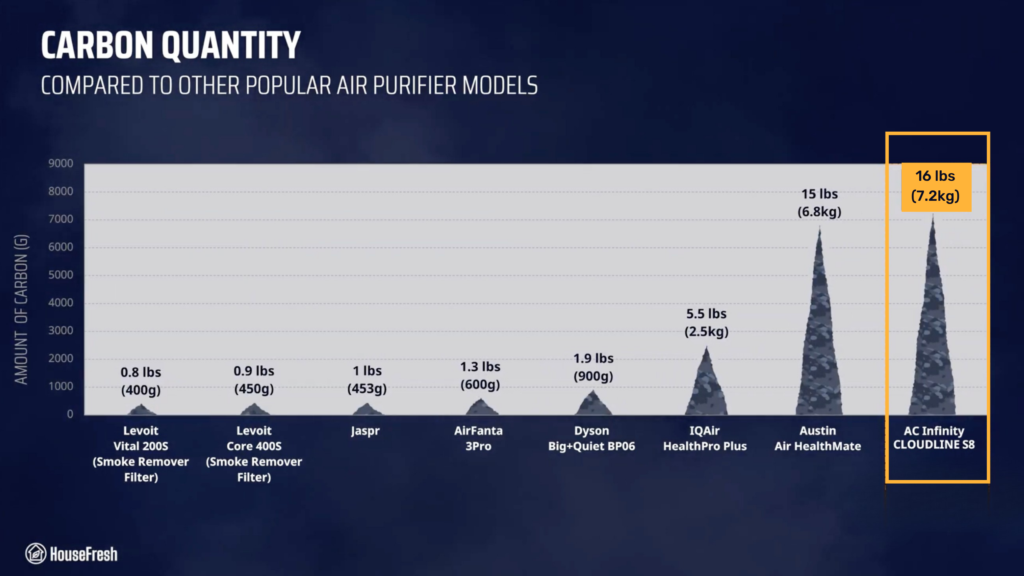
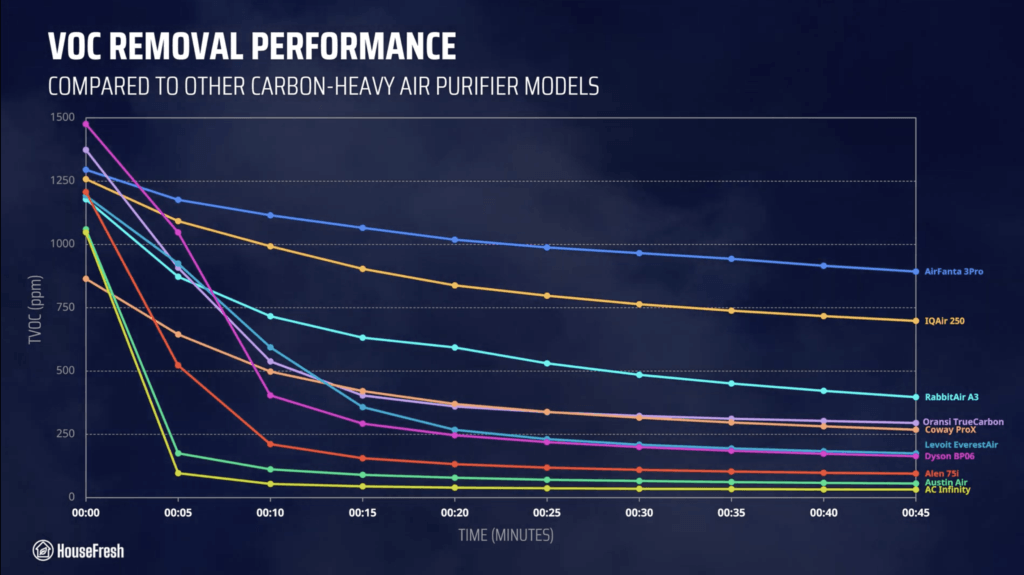
In our VOC removal tests, the AC Infinity CLOUDLINE S8 was the quickest, outperforming the mighty Austin Air HealthMate. Now, performance dropped when set to its highest fan speed – – better stick to speed 5 and below.
To build my DIY carbon filter, I decided to buy a CLOUDLINE S8 fan, two noise reduction clamps, a pre-filter cloth and an 8-inch Carbon Filter with two (2!) years’ worth of carbon refills. All in all, I spent $407.99.
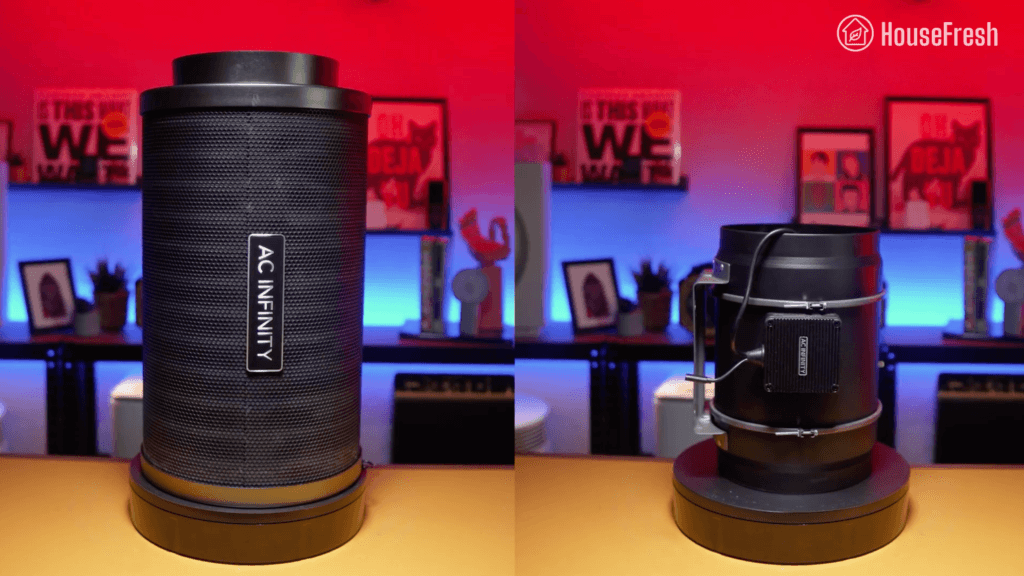
By the way, when using it on the floor, the fan blades are exposed. We’ve got children in the house so I fixed this by cutting out a piece of carbon-impregnated fabric for the top that keeps the blades away from little hands.
CONS
PROS
| Filter technology: | VOC and odor adsorption |
| Carbon type: | Australian RC412 at 1200+ IAV (38mm thickness) |
| Carbon quantity: | 16 lbs (7.2 kg) |
| Airflow: | 857 cfm |
| Dimensions: | Fan: 3.3 x 2.9 x 0.5 inches (8.5 x 3.6 x 1.3 cm) Filter: 18.1 x 10.9 inches (46 x 27.7 cm) |
| Noise level in decibels from 3 ft. away: | Speed 1: 37.6 dBA Speed 2: 45.7 dBA Speed 3: 50.8 dBA Speed 4: 57.2 dBA Speed 5: 61.9 dBA Speed 6: 66.5 dBA Speed 7: 71.9 dBA Speed 8: 74.9 dBA Speed 9: 77.8 dBA Speed 10: 79.3 dBA |
| Electricity consumption in watts: | Speed 1: 3.7 watts Speed 2: 7.4 watts Speed 3: 12.3 watts Speed 4: 20.2 watts Speed 5: 30.3 watts Speed 6: 43.2 watts Speed 7: 60.3 watts Speed 8: 86.2 watts Speed 9: 113.2 watts Speed 10: 148 watts |
| Filter lifespan: | 12 months |
| Manufacturer’s warranty: | 2 years |
| Country of origin: | United States |
| Country of manufacture: | China |
- I highly recommend the Alen BreatheSmart 75i V2. It comes with 3.6 lbs of pelleted activated carbon but was still able to clear our test room in just 18 minutes. Based on this result, we estimate a PM1 CADR of 333 cfm, which will be good enough to clean the air five times per hour in rooms no larger than 41 m2 (448 sq. ft.) WATCH MY VIDEO REVIEW ➜
- If you don’t mind paying for the Dyson tax, check out the Dyson Big+Quiet BP06, with its 1.94 lbs of carbon and super quiet operation, but still boasting good particle removal performance. Based on our tests, we estimate a PM1 CADR of 198 cfm so this is a good choice for rooms up to 27 m2 (297 sq. ft.) WATCH MY VIDEO REVIEW ➜
- If you’re looking for an air purifier with large amounts of carbon, then the Austin Air HealthMate might be the one. It comes with 16 lbs of activated carbon and zeolite mix and reached excellent results in our VOC removal test, second only to the AC Infinity. Its particle removal performance isn’t great though, with an estimated PM1 CADR of 160 cfm that will keep the air clean in rooms smaller than 15 m2 (169 sq. ft.) WATCH MY VIDEO REVIEW ➜
6. Best portable air purifier: CleanAirKits Triple Exhalaron
A PC fan-powered air purifier with a CADR of 131 cfm that you can use on the go or inside your car with a USB-C power bank.

After testing multiple portable air purifiers, I’m confident that the Triple Exhalaron is the only one you can use on the go with a battery pack that will provide enough clean air to make it useful.
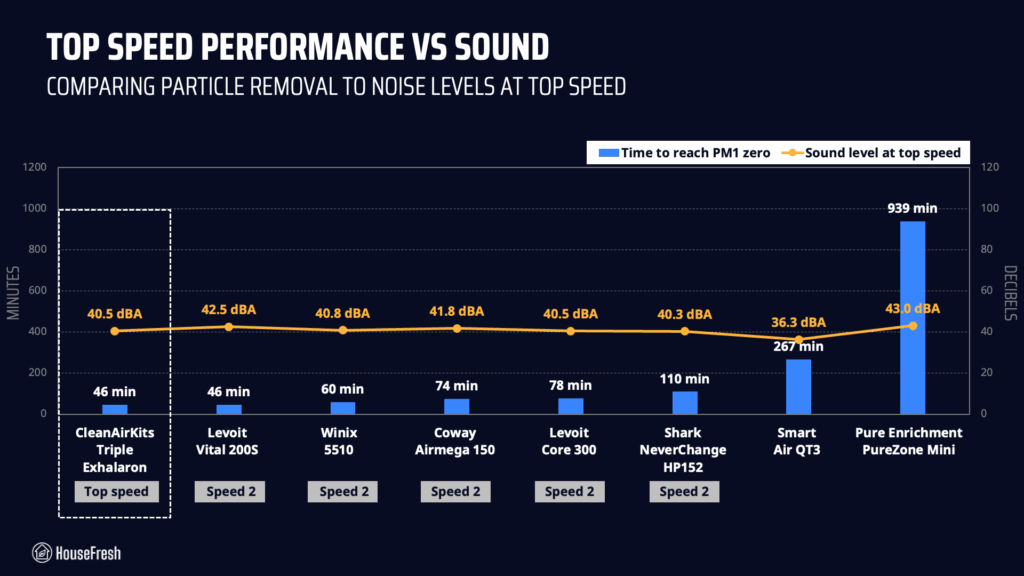
The Exhalaron cleared our test room in 46 minutes while generating just 40.5 dBA. This is outstanding for a device you can run on a battery pack – – see how it compares to mid-sized air purifiers running at sub-45 dBA speeds.
It comes with three cylindrical HEPA filters that sit between a thin wooden base and a thicker wooden top that houses three quiet and energy-efficient Cooler Master PC fans. You also get two handles at the top and a knob to adjust fan speeds.
CONS
PROS
| Clean air delivery rate (CADR): | – Top speed PM1 CADR: 128 cfm – Sub-45 dBA PM1 CADR: 128 cfm |
| Filter technology: | HEPA H10 with a layer of carbon-impregnated fabric |
| Recommended room size: | 192 sq. ft. (5 air changes per hour) |
| Dimensions: | 22W x 7.25D x 8.5H in (56W x 14D x 22 cm) |
| Weight: | 6 lbs (2.72 kg) |
| Noise level in decibels from 3 ft. away: | Speed 1: 35.2 dBA Speed 2: 37.7 dBA Speed 3: 40.5 dBA |
| Electricity consumption in watts: | Standby: 0.1 watts Speed 1: 1.1 watts Speed 2: 2.8 watts Speed 3: 6 watts |
| Filter lifespan: | 6 months |
| Manufacturer’s warranty: | 1 year |
| Country of origin: | United States |
| Country of manufacture: | United States |
7. Best commercial air purifier: Smart Air Blast
A large, powerful, quiet, no-nonsense air purifier with a massive fan and filter that can effectively clean the air in large classrooms, offices, and other high-traffic areas.
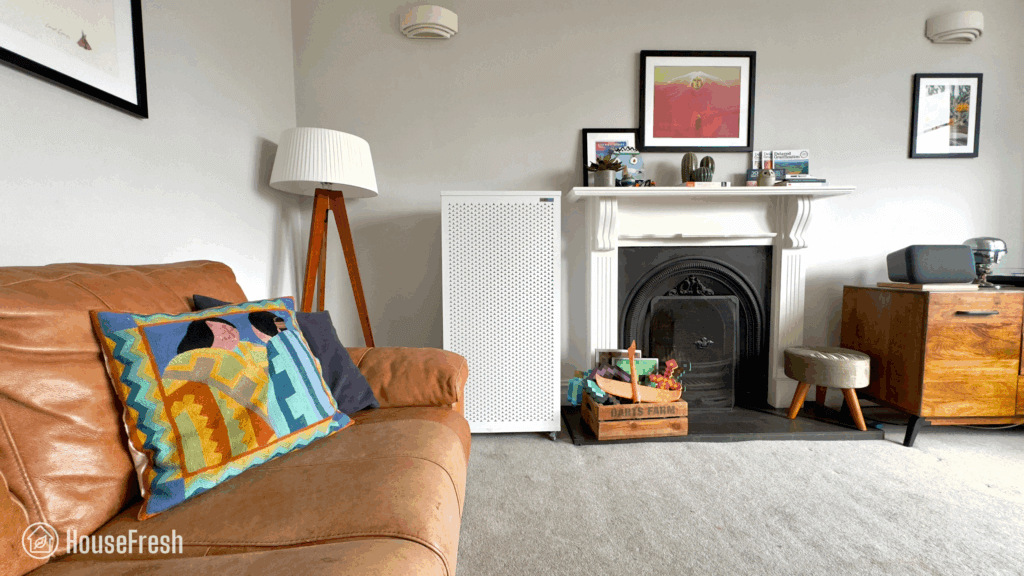
With an estimated PM1 CADR of 547 cfm, the Blast from Smart Air can provide five air changes per hour in rooms as large as 76 m2 (820 sq. ft.). But what’s incredible about it is that this power doesn’t come with a super loud noise attached to it.
At its highest fan speed, this air purifier hits only 54.7 dBA, which is quieter than the much smaller Levoit Vital 200S (57.7 dBA).
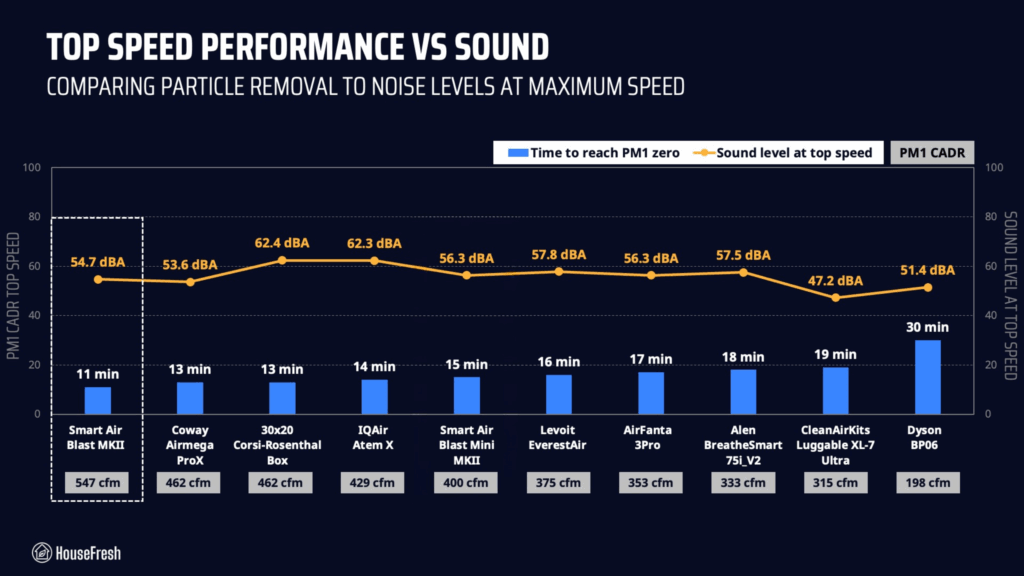
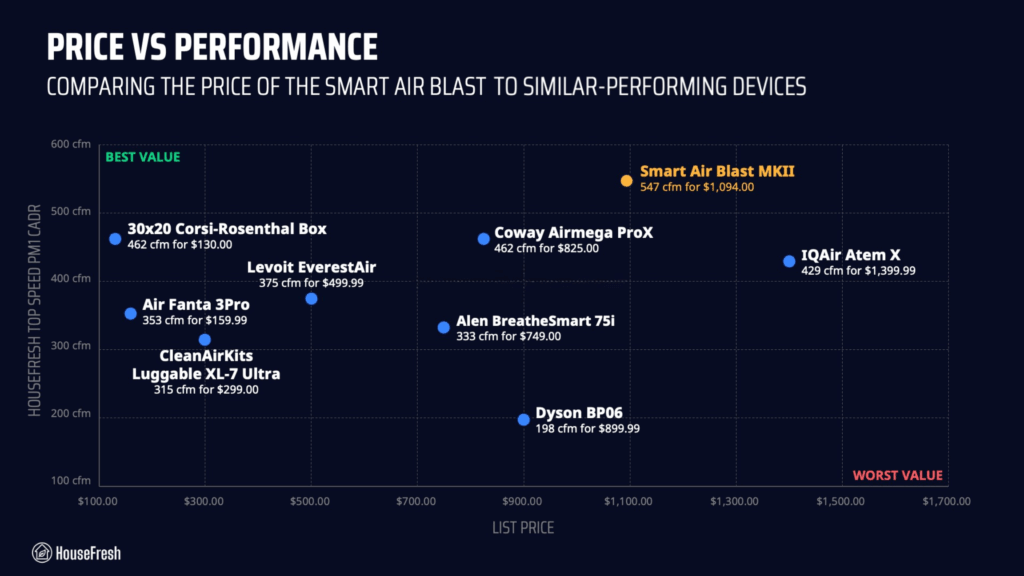
This air purifier boasts one of the highest CADR ratings across all the air purifiers we have tested to date.
It has a huge H13 HEPA filter that traps particles (dust, pollen, viruses, bacteria). You can also get an optional pelleted carbon filter for VOCs.
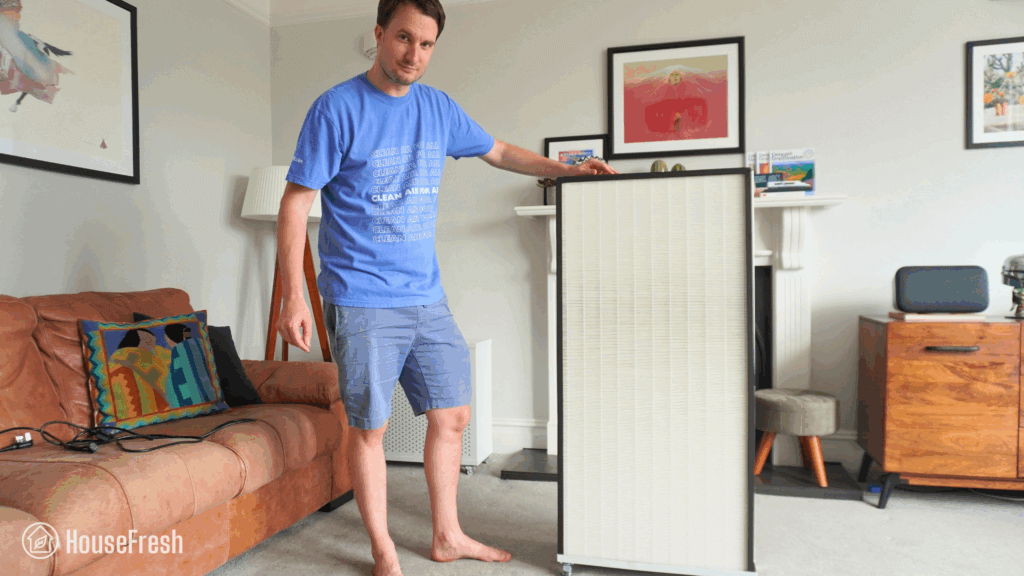
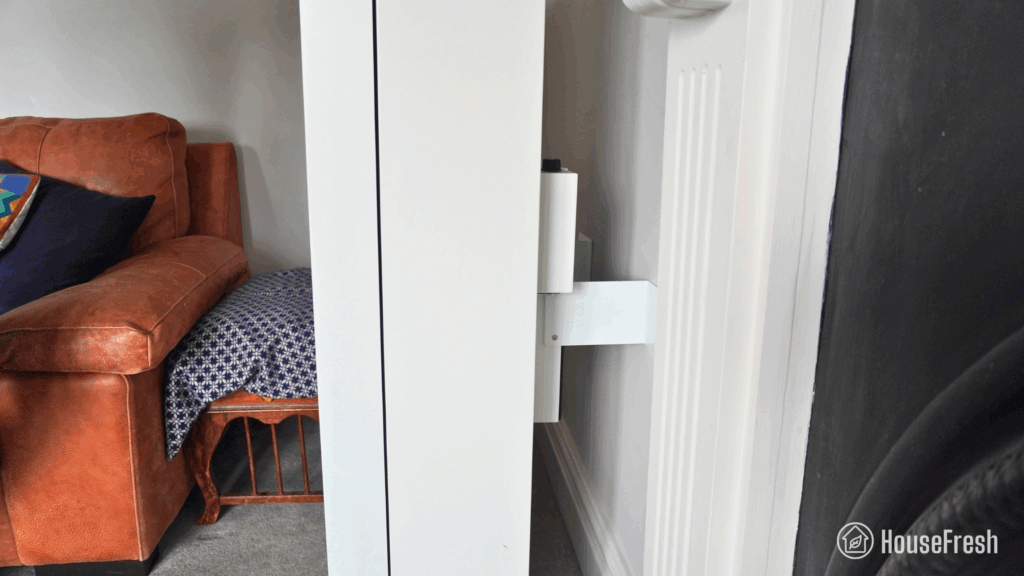
The combination of a quiet operation and a high CADR makes it the best choice for classrooms. I appreciate the brackets to fix it to the wall.
CONS
PROS
| Clean air delivery rate (CADR): | – Top speed PM1 CADR: 547 cfm – Sub-45 dBA PM1 CADR: 375 cfm – Manufacturer provided CADR: 559 cfm |
| Filter technology: | H13 HEPA filter (and optional pelleted activated carbon filter) |
| Recommended room size: | 820.5 sq. ft. (5 air changes per hour): |
| Dimensions: | 15D x 25W x 50H inches (38.1D × 63.5W × 127H cm) |
| Weight: | 84 lbs (38 kg) |
| Noise level in decibels from 3 ft. away: | Speed 1: 41.9 dB Speed 2: 49.4 dB Speed 3: 54.7 dB |
| Electricity consumption in watts: | Standby mode: 0 watts Speed 1: 56.3 watts Speed 2: 94.5 watts Speed 3: 133.5 watts |
| Filter lifespan: | 19 months |
| Manufacturer’s warranty: | 1 year |
| Country of origin: | China |
| Country of manufacture: | China |
8. Best you can build yourself: Corsi–Rosenthal Box
A DIY approach to air purifiers that democratizes indoor air cleaning, using materials easily available.
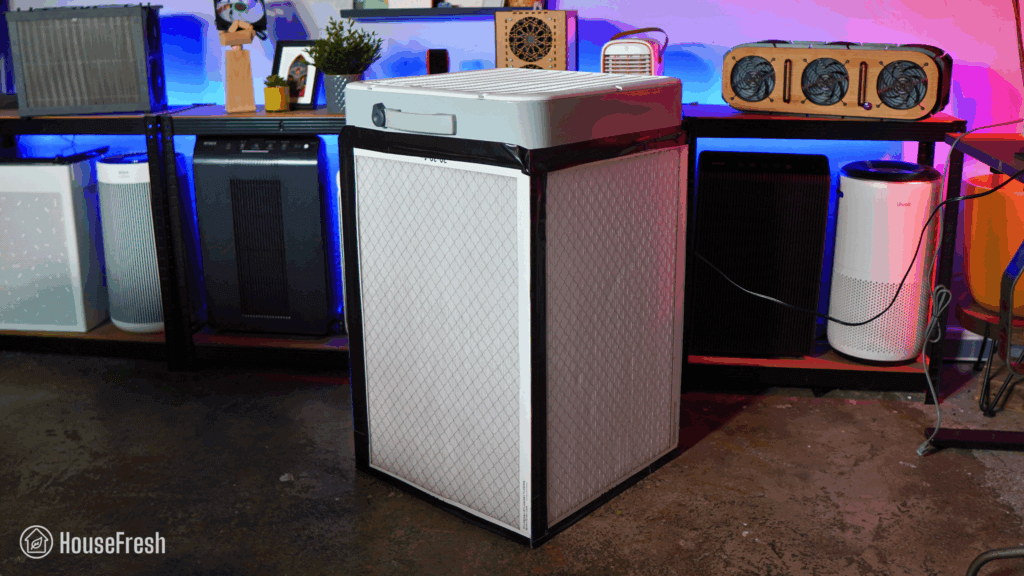
You can build a Corsi–Rosenthal Box (or CR Box for short) at home with a standard box fan, four MERV-13 HVAC filters, duct tape, and a cardboard base, making it the best low-cost option for those who need a swift air purifying solution due to wildfire smoke or an unexpected air quality issue.
Our 30×20 CR Box matched the air cleaning performance of the $800+ Airmega ProX, and it even outperformed the $1,400 Atem X!
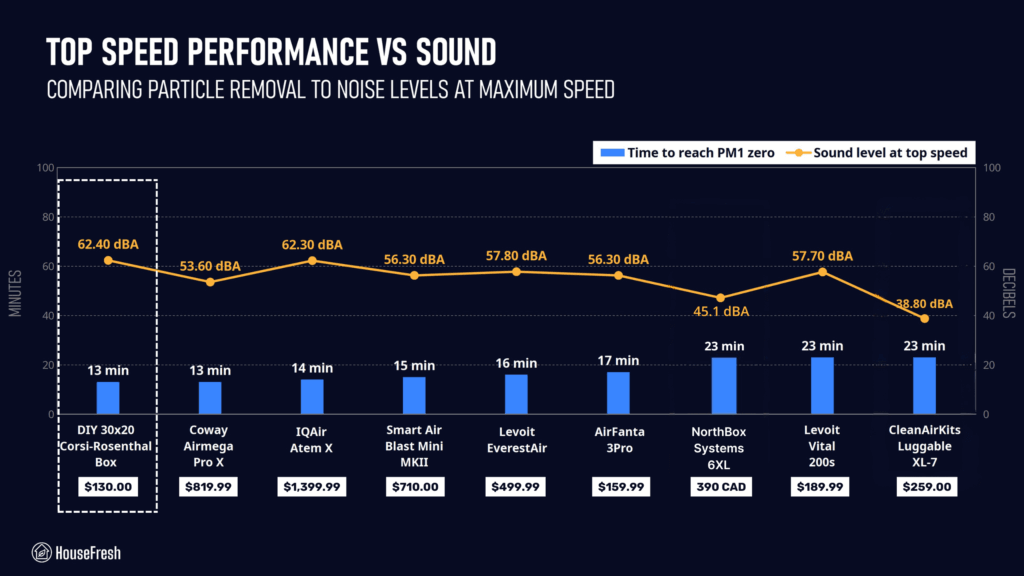
Depending on the box fan you use, it can get loud and power-hungry. And with the 30×20 MERV 13 filters, it will take up a lot of space.
CONS
PROS
| Clean air delivery rate (CADR): | 462 cfm (top speed) |
| Filter technology: | 20x30x1 3M Filtrete MPR1900 |
| Recommended room size: | 693 sq. ft. (5 air changes per hour) |
| Dimensions: | 20L x 20W x 20H inches (50L x 50W x 50H cm) |
| Weight: | 10 lbs (4.5 kg) |
| Noise level in decibels from 3 ft. away: | Speed 1: 51.5 dB Speed 2: 58.3 dB Speed 3: 62.4 dB |
| Electricity consumption in watts: | Standby mode: 0 kWh Speed 1: 72.57 kWh Speed 2: 88.55 kWh Speed 3: 103.28 kWh |
| Filter life: | 6-12 months |
| Manufacturer’s warranty: | n/a |
Special mentions
The good-performing air purifiers that didn’t make the cut, but that could be a good choice for you.
Since 2020, we have tested nearly 150 different air purifier models and, along the way, we have found some incredible units. That is why I thought it could be useful to give a shoutout to other excellent air purifiers in case they are available in countries where my top picks are not.
➜ CleanAirKits Luggable XL Ultra / Nukit Tempest Pro / NorthBox 6XL
If sound is important to you, consider buying a PC fan kit. I tested models from CleanAirKits, Nukit and Northbox Systems, and they all excelled at cleaning the air while generating minimal noise.
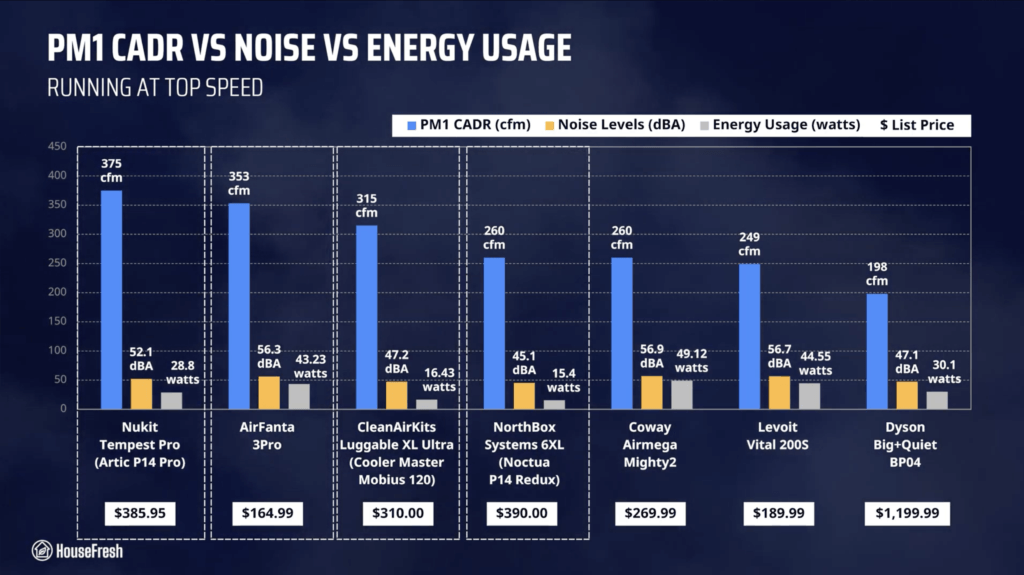
Plus, they consume very little electricity and use non-branded MERV 13 filters, which then leads to very low running costs.
You can build your PC fan kit yourself using parts from CleanAirKits, Nukit or NorthBox Systems, highly-efficient yet whisper-quiet PC fans and HVAC filters (ideally MERV13) like 3M’s Filtrete MPR1900+.
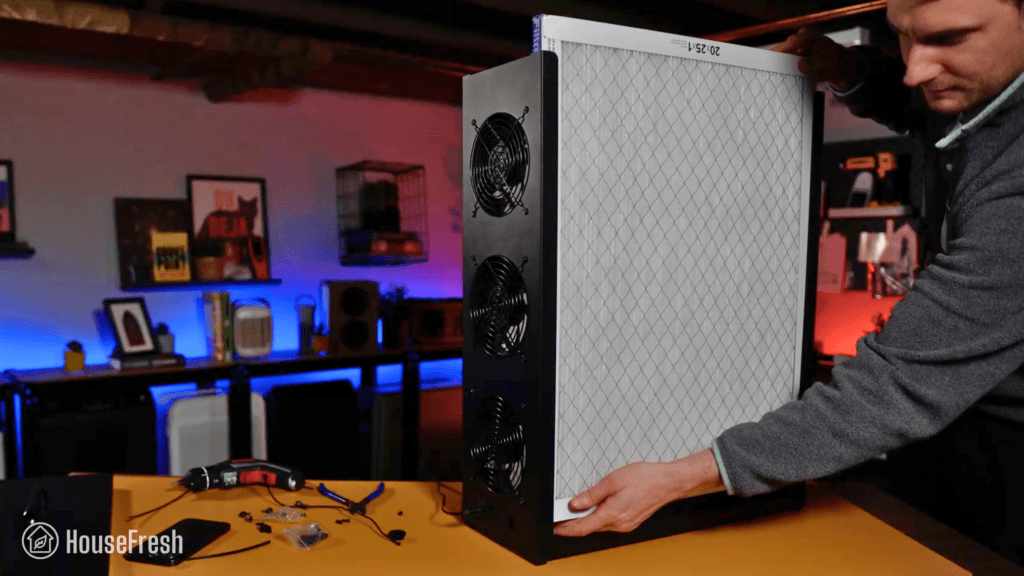
I left PC fan kits out of my list because they cost over $300 and don’t come with many features or carbon, so I know most people won’t consider them.
➜ Winix 5510 / Winix 5530 / Winix 5520
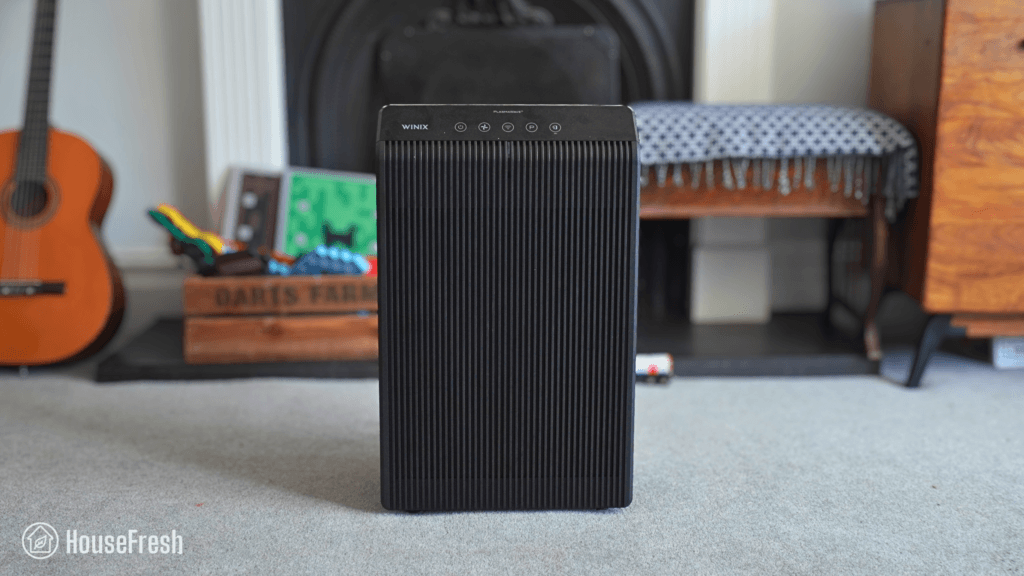
I tested the Winix 5510, the 5520 and the 5530 with great results in terms of performance, sound, energy efficiency and long-term running costs.
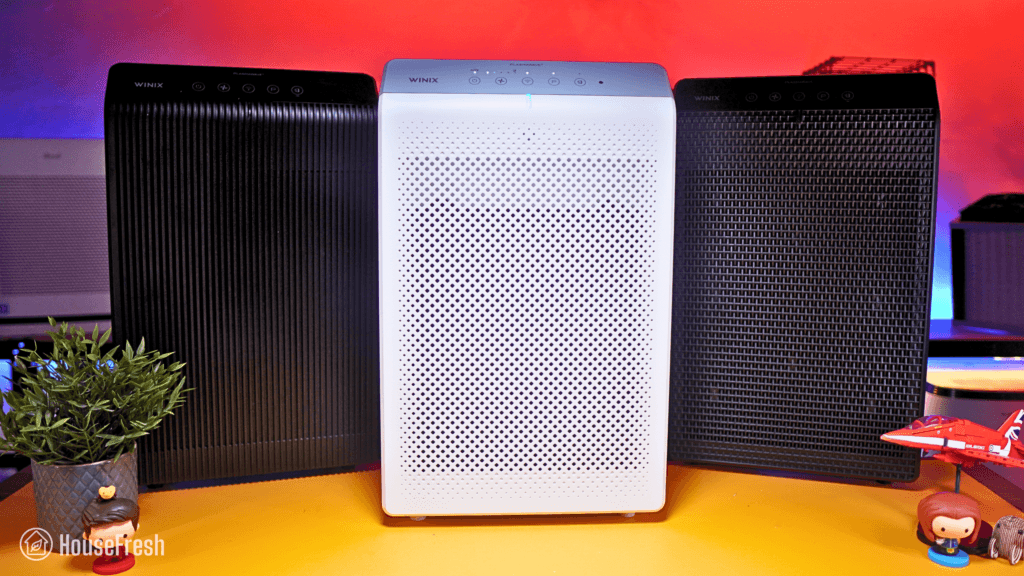
All three of them come with an onboard sensor, an ionizer function that can be switched off, and smartphone connectivity through the Winix app. WATCH MY VIDEO REVIEW ➜
Our test results were nearly identical across all three, with the 5510 being quieter and more energy-efficient than the other two.
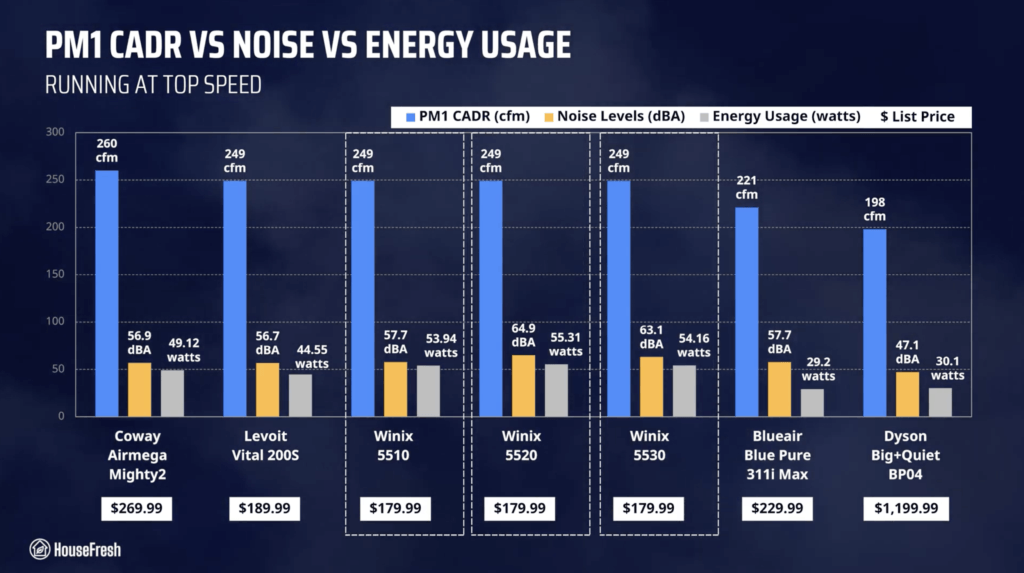
Ultimately, neither of these mid-sized Winix models made the cut because the Coway Mighty2 offers even better air cleaning power at quieter operation while pulling less energy.
➜ Winix 5500-2
Speaking of Winix, if you live in Europe, you might still be able to buy the legendary Winix 5500-2.

It is a little bulkier than the new mid-sized Winix units and it doesn’t come with app support, but it does the job without breaking the bank. READ MY FULL REVIEW ➜
It sells for £159 / € 199, so it’s affordable and has excellent performance, although it’s a bit loud.
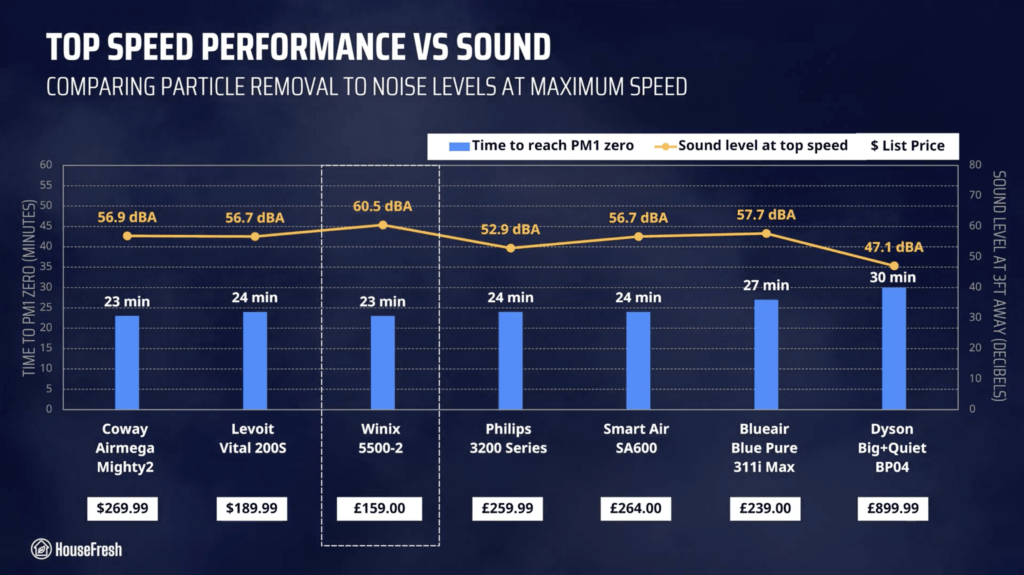
I didn’t shortlist it because it has been discontinued in North America, but it’s an incredible air purifier that we really wish was still around in the U.S. and Canada.
➜ Blueair Signature Large
The Blue Signature Large doubles as a side table, comes with an onboard sensor that unlocks smart features and includes app support. It has the looks and packs the power, too.
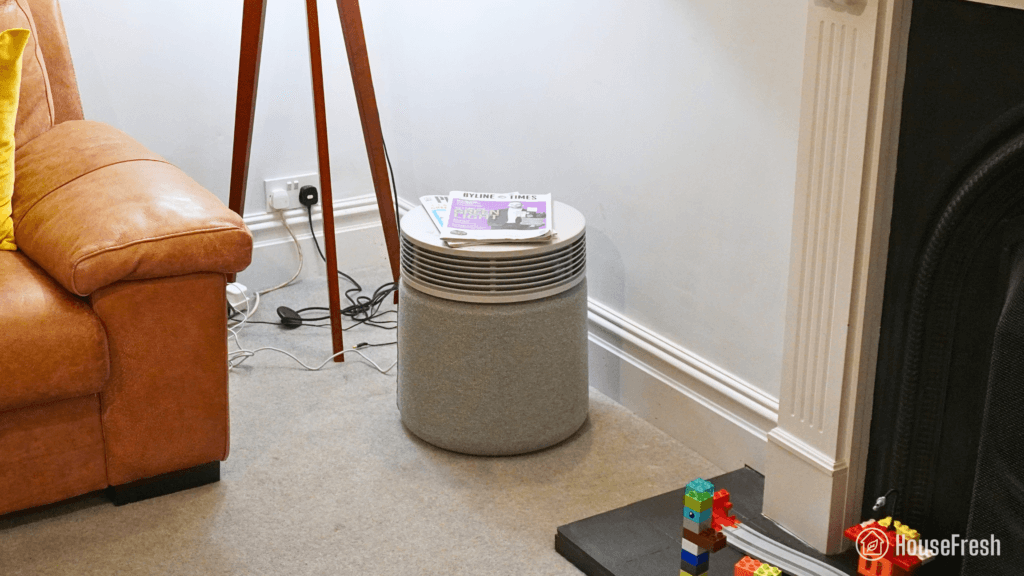
It didn’t make the cut because what you don’t get is the option to disable its HEPASilent, which is a trademarked technology that uses an ionizer that releases small levels of ozone.
In our tests, it matched the performance of bigger and pricier models. For $450, you get a CADR of 400 cfm that can clean the air 5 times / hour in rooms under 55m2 (600 sq. ft.).
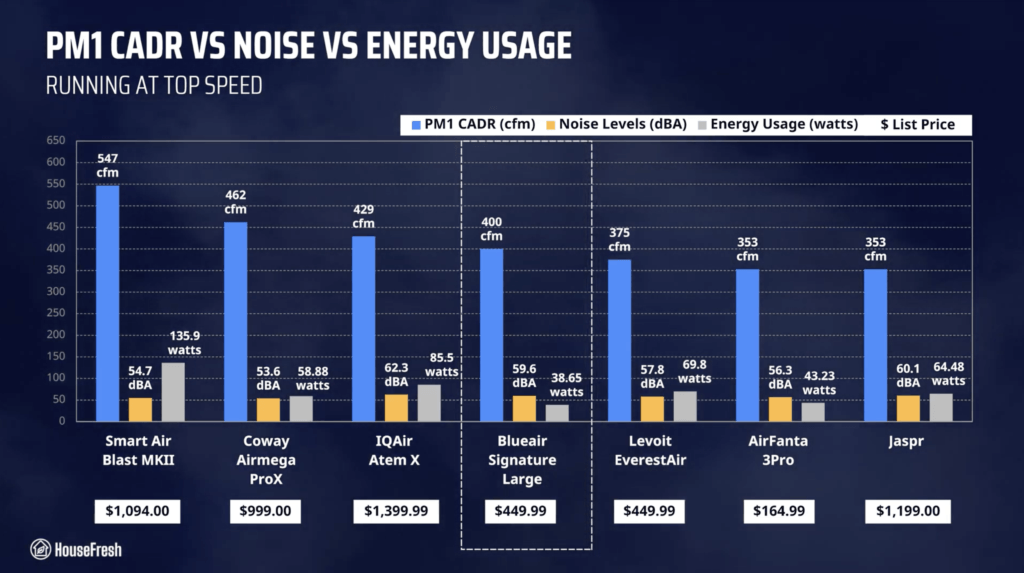
So if the use of an ionizer doesn’t bother you, then you should definitely consider getting a Blueair Signature. READ MY FULL REVIEW ➜
➜ Levoit EverestAir
With a list price of $500, this is a premium model from Levoit that comes with everything you’ll get with the Vital 200S and then some. READ MY FULL REVIEW ➜
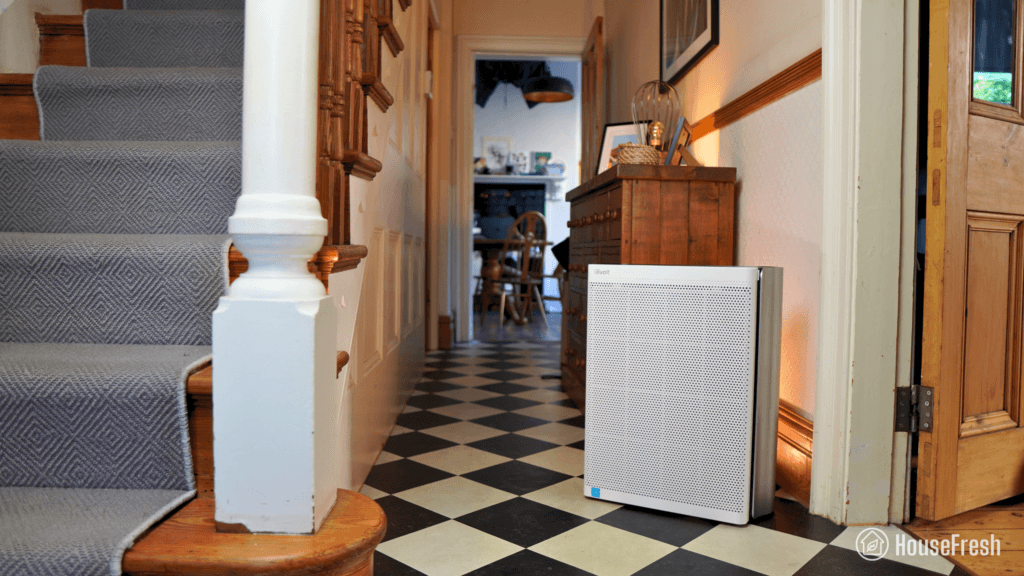
You also get app connectivity, an onboard sensor, adjustable vents at the top, a deep handle at the back and wheels at the bottom to easily move it from room to room.
It looks good and packs the power to thoroughly clean the air in large rooms up to 52 square meters (or 562 sq. ft.) without generating a lot of noise.
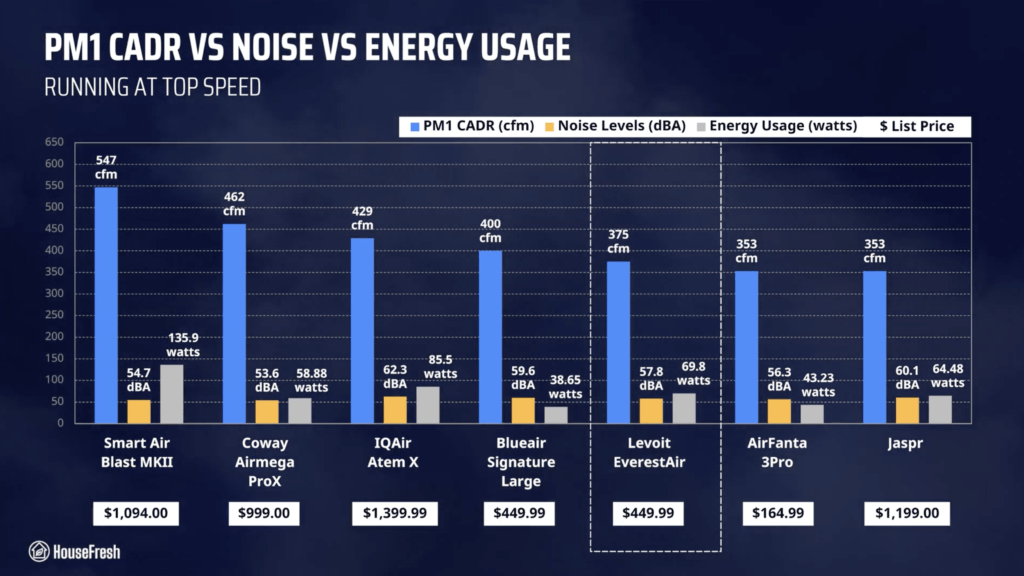
I love my EverestAir but it didn’t make the cut because the Coway ProX packs more power and the AirFanta 3Pro offers a similar CADR at a cheaper price.
Or if you already have a specific model in mind and would like to know how it compares to other models, you should definitely check out our comparison tool to see how different air purifiers did in our range of tests including air cleaning performance, sound generation, energy consumption and long term running costs.
Other models that we tested but don’t recommend
These are the popular models that other reviewers often recommend, along with what our tests show.
- Okaysou AirMax 10L Pro – This device became a best-seller on Amazon thanks to a successful influencer campaign on TikTok. In our testing, it failed to match the hype or price point. We found that Okaysou used marketing tricks to inflate its performance. I would avoid any Okaysou device. Update 26 June 2024: Okaysou is now bankrupt, and you can no longer buy it and their 5-year warranty is now worthless.
- Molekule Air Mini+ – Molekule has been touting its new PECO technology, but has had to remove many of its previous marketing messages due to misleading advertising claims and class action lawsuits resulting from underperformance. In our test, it was very poor at removing PM1 particles and emitted 86 dB at its highest fan speed – – louder than a leafblower! If this device is recommended in 2025, it’s likely due to the high commission for the publisher recommending it, as they start at $349 and go up to $999 with the Pro series.
- Rainbow RainMate – This is an old device that is still touted as being able to clean the air. However, it was the worst-performing device in our tests, making me think that water air-cleaning is totally useless in even the smallest of home rooms. Don’t rely on this device to clean your air; stick to a good old mechanical filtration.
- PuroAir 240 – Previously sold under the name ‘PuroAir HEPA 14 240’, the PuroAir 240 didn’t live up to the marketing spiel. After completing all our tests, we found that this air purifier has poor air cleaning performance for its price and is too underpowered to clean spaces of up to 1,100 sq. ft., which is something that is mentioned multiple times in the marketing materials and on PuroAir’s website.
- Jaspr – This large air purifier has a high CADR of 353 cfm but I don’t recommend it because it costs nearly $1,200 to buy and you can expect to pay an additional $704.36 per year in electricity bills and filter replacements. This means that you will spend just over $1900 in the first year of ownership – – the highest year-1 cost I’ve ever seen.
- Shark NeverChange HP152 – I liked the innovative pre-filter design for this cylindrical device, the low running costs and the use of a laser particle sensor. Those are all nice features, but unfortunately, the CADR is too low for the price, both at top speed (88 cfm) and at sub-45 dBA fan speeds (52 cfm).
What to look for when buying an air purifier
The basic things you need to consider to make sure you’re not being duped into buying a device that won’t help.
The qualities you should look for in an air purifier will differ if you want to reduce allergy triggers at home, live near a busy road, need to improve your air quality during wildfire season, or deal with pet odors and dander. However, some things will always be important.
1. The size of the room and the CADR (clean air delivery rate) of the air purifier.
It’s vital to analyze these two aspects together, considering many brands overstate the cleaning performance of their units. It’s not necessarily unfunded, but there’s a catch.
According to the EPA, for an air purifier to be truly effective, it should be able to perform 4.8 air changes per hour (or ACH) in a room. Unfortunately, some brands will advertise the room size coverage to achieve just one ACH, being able to claim a somewhat opaque wider coverage.
The rule is simple: a higher CADR (stated in CFM, or cubic feet per meter) means greater cleaning power. Instead of focusing on room sizes recommended by the manufacturer, look at the CADR rating.
The best way to go about it is to figure out how powerful an air purifier needs to be for your space’s specific dimensions. You can use our calculator to do just that:
2. The filtration system
Pure mechanical purifiers stand their ground on efficiency and safety when it comes to air filtration. The most comprehensive systems feature three stages:
- A pre-filter to trap larger particles that would otherwise clog the main filter faster. The best units feature a removable pre-filter, making it easier to vacuum, rinse and keep in top shape. But you may find the pre-filter attached to the main one in budget air purifiers. It’s better than not having one, but it’s also harder to clean.
- An activated carbon filter to adsorb gasses and smells. If you are after a device to help you reduce unwanted smells or remove chemicals and VOCs from the air, then you need a filter packed with carbon pellets. Carbon-impregnated fabric filters are okay for mild odors but won’t be powerful enough for serious issues with smells.
- Lastly, the main particle filter will remove microscopic particles from the air. If you need an air purifier to deal with dust or pet dander, for example, you will need a particle filter like HEPA or MERV 13.
But a denser filter just for the sake of it – like with PuroAir’s HEPA 14 – is not necessarily equivalent to a better performance. On the contrary, it’s important to balance fan power and filter thickness. If a filter is too dense and the air purifier is not potent enough to draw a good amount of air and pass it through, the cleaning power is reduced. It takes longer to remove airborne pollutants with restricted airflow.
Many mechanical air purifiers also feature a built-in ionizer that can boost the units’ CADR and efficiency. Although ionizing technology is continuously evolving, at HouseFresh, we prefer those units where, like in the Winix 5510 or the 5500-2 included in the special mentions, the ionizing function can be disabled at the user’s convenience.
3. Noise output
The fan that powers your air purifier can generate a lot of noise, and you are unlikely to want to use your unit regularly if this noise becomes too much. That is why it’s worth factoring in how noisy the unit will be, especially when running at its top fan speed. This is particularly important if you want an air purifier for the bedroom or your home office.
Two things to consider:
- Smaller units won’t make much of a difference to the air when running at the slowest fan speed, and they tend to be noisier than larger ones at top speed.
- Some air purifiers suited for big spaces can be whisper-quiet when running at their lowest fan speeds, so it is worth going bigger to get a unit that will run quieter.
4. Long-term costs
In addition to the upfront cost of buying an air purifier, you should also consider associated maintenance costs such as energy usage and filter replacement.
Running your air purifier 24/7 2ill substantially improve your air, but that also means an appliance adding to your electricity bill all day, year-round. The good news is that many energy-efficient units out there won’t significantly affect your monthly expenses. However, make sure to check this to avoid unpleasant surprises, as some units are on the power-hungry side.
A few things to consider in terms of filters:
- Filter replacement costs vary among brands and models – – and so does the required replacement frequency.
- The longer a unit has been on the market, the more probable good-quality generic filters will be available.
- More and more brands are offering convenient filter subscriptions that are cost-effective and include perks for happier customers.
5. Extra features
An extensive control panel with smart functions, app support, onboard air quality sensors or remote controls are handy perks that can make life easier. A no-lights mode for the bedroom, for example, is definitely something worth considering.
However, if asked, I would recommend not to sacrifice CADR or performance over fancier tech-y bonuses. After all, the purpose of an air purifier is to clean the air.
How we test air purifiers
Saying we tested over 110 air purifiers in the last five years sounds great, doesn’t it? But what does testing mean for HouseFresh?
It’s definitely not just getting the units out of their boxes to take some cool editorial pictures for our articles. On the contrary, it is a thorough process that involves reliable testing devices to cover the many aspects of air purifier evaluation.
Air cleaning performance is key, for sure. But we go further. When you decide to invest in an air purifier that will be constantly running at home, things like long-term costs and noise output are also important in a real-world context.
Our testing process includes the following steps:
Step 1. We conduct a particle removal test
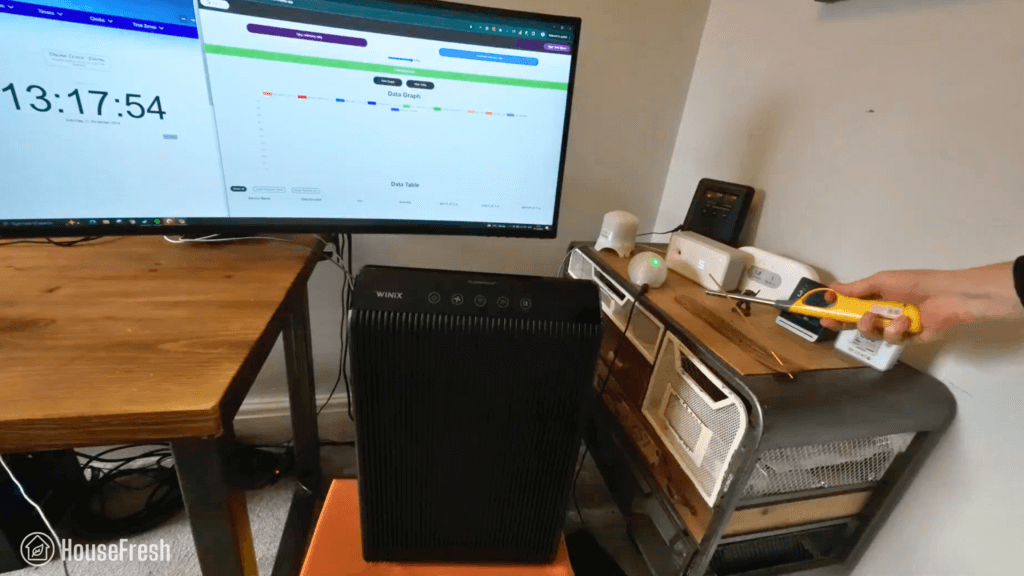
First, we burn an incense stick (always the same brand and type) to pollute the air in our 728 cubic feet test room. Using our PurpleAir and AiGradient air quality monitors, we measure how fast each air purifier can remove PM1 particles at each available fan speed. The sensors provide regular updates on particulate matter levels, allowing us to calculate the PM1 CADR of the device.
Step 2. We conduct a VOC removal test
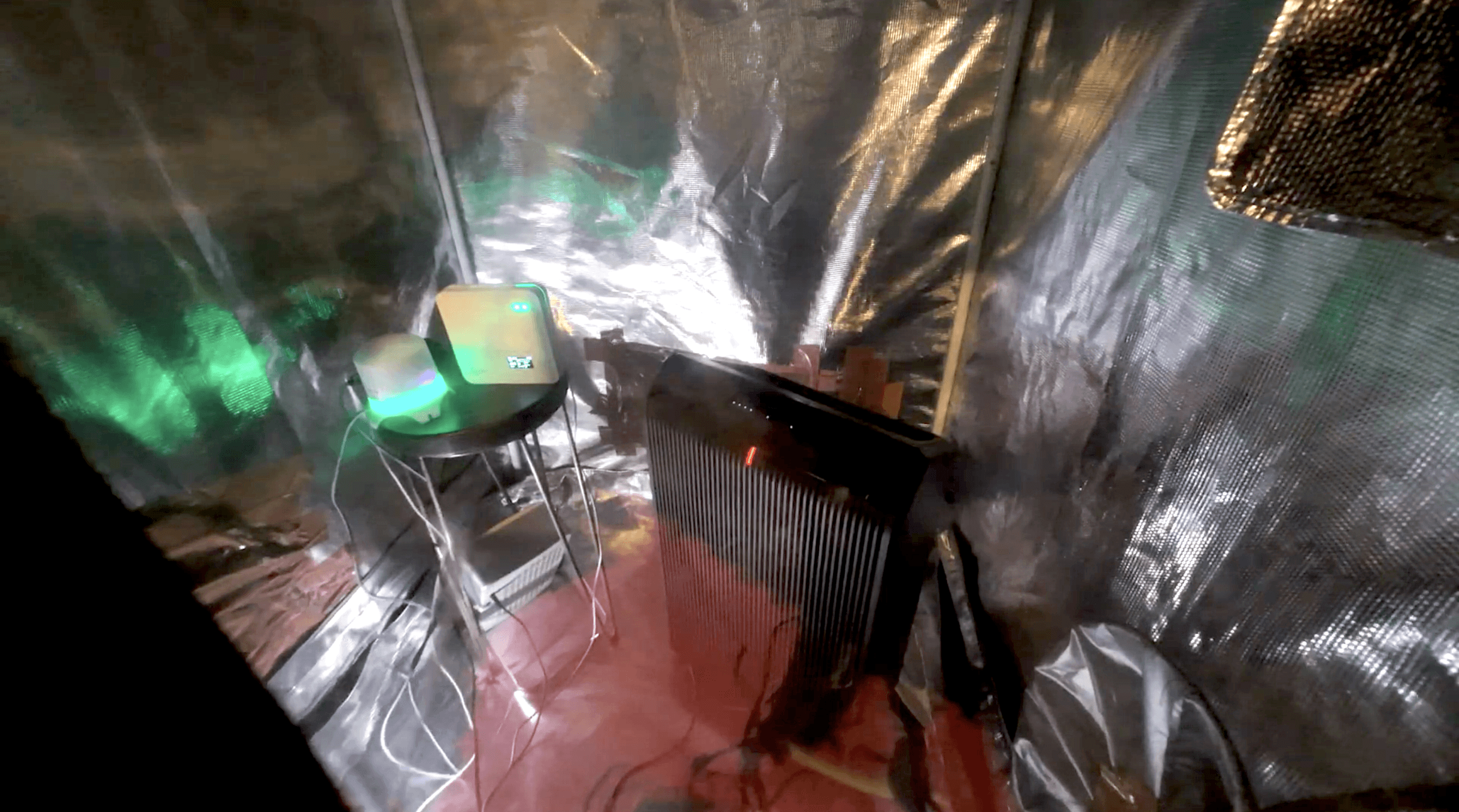
Then, we fill up our grow tent with Lynx Africa deodorant to release chemical gases into the air. We let the VOC levels stabilize before setting the air purifier to its highest fan speed for 45 minutes. We track tVOC levels with our PurpleAir and AiGradient air quality sensors before visualizing the data for comparison reasons.
Step 3. We measure sound levels generated
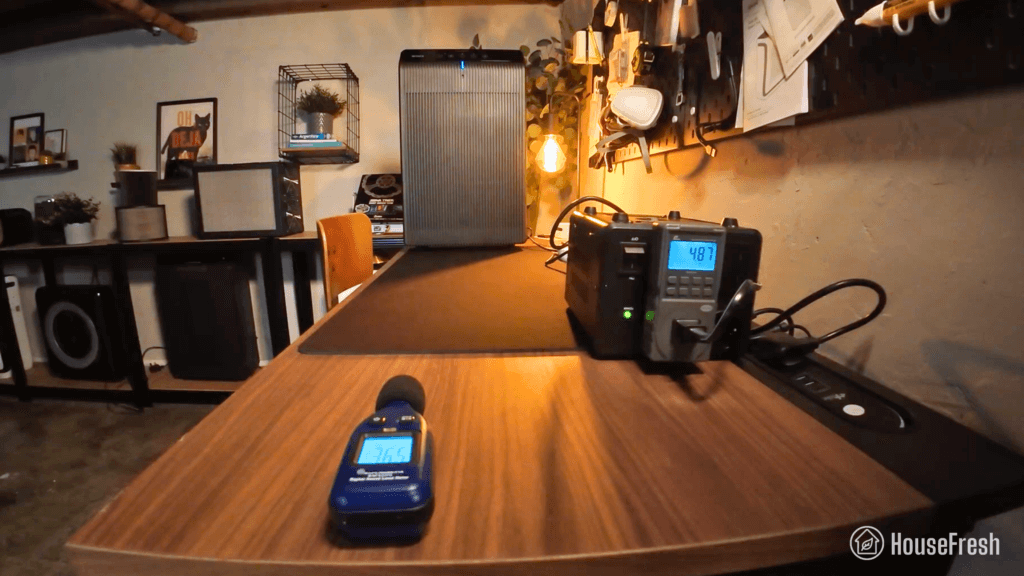
For noise levels, we use a commercial sound meter from 3 ft. away to measure how much noise in decibels (dB) is generated by the air purifier at each fan speed. Like other measurements, the data is displayed in our reviews, but we also share the results on HouseFresh YouTube channel.
Step 4. We measure electricity consumption
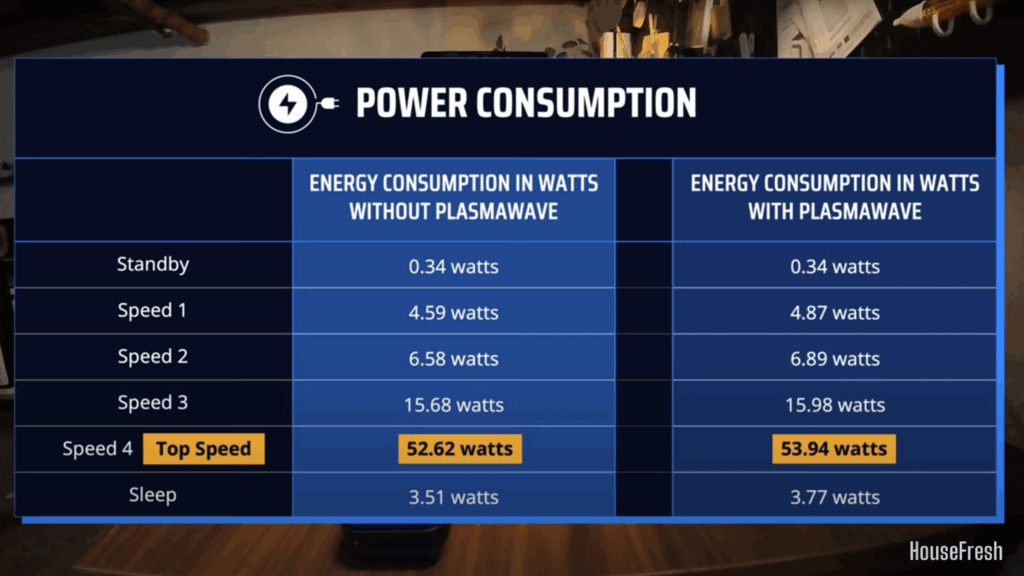
We use a power meter to record how much electricity (in watts) the air purifier consumes when running at each of its fan speeds, including sleep mode and stand-by mode.
Step 5. We estimate yearly maintenance costs
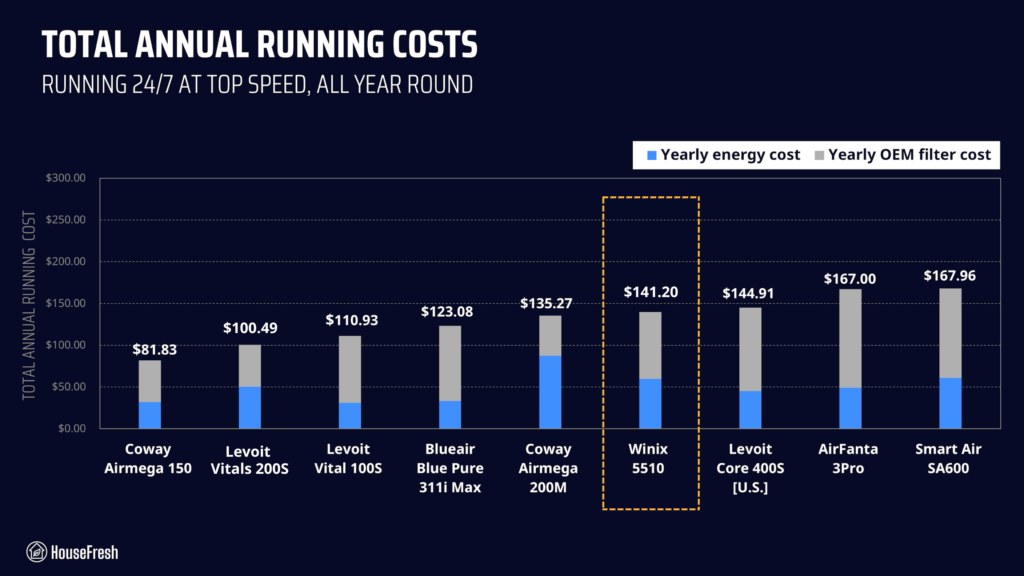
We also calculate the long-term costs you can expect to spend each year to run the air purifier. First, we calculate how much money running the air purifier will add to your yearly energy bill. Next, we conduct desk research to determine the costs of genuine and generic replacement filters, using filter lifespan information stated by the manufacturer.
Step 6. Real-life experience
All five steps comprise the core performance evaluation we run on every unit. We know the data is solid. However, there’s something about everyday use that cannot be measured in a lab-test situation. That is why our final step is using the air purifier at home in different rooms with different use cases. You can learn a lot by just living with a device.
Wrapping up
Air pollution is real. Over one-third of Americans still live in areas with unhealthy air and suffer from the consequences to their health. Improving our indoor air shouldn’t be something to take lightly.
Considering how a high-performing air purifier can improve people’s daily lives, it’s somewhat infuriating to find the internet flooded with unfounded reviews of air purifiers that lack the research and data to back them up.
Our goal at HouseFresh is to help consumers find the right air purifier to fit their needs and budgets in real-life situations. We don’t take free units from manufacturers and are not afraid to raise our voices when a hyped unit turns out to be a disappointment. Most importantly, we are driven by a transparent, hands-on approach and constantly improving methods of real-life testing.
We want our readers to find actual, helpful solutions. We may not always address all of your doubts in our articles. That’s why my mailbox is always open: danny@housefresh.com
Since 2020, we’ve been conducting our tests in the same 728-cubic-foot room to gather comparable data. We buy every device with our own money because we don’t want any strings attached. We are data-driven, and all our findings are openly published on the site.
Performing our tests in the same location under the same conditions allows us to compare air purifiers like-for-like in order to draw consistent conclusions. With all this data in hand, we are able to compare performance across different air purifiers from different manufacturers to quickly identify the best units for unique scenarios or situations, no matter how specific or average these may be.
We are confident that our tests reveal what manufacturers won’t tell you. That is why we don’t blindly repeat manufacturers’ specifications and marketing claims without further research or hands-on testing. We know that in many cases, their data has a degree of bias, with many brands overstating the capabilities of their devices with clever marketing and outright lies.
September 18th, 2026
- Replaced all animated GIFs with autoplay videos to reduce loading times for the page.
August 25th, 2026
- Replaced the Levoit Vital 200S with the Coway Airmega Mighty2 AP-1512N, which offers better air cleaning performance at top and sub-45 dBA fan speeds.
- Replaced the Austin Air HealthMate with the AC Infinity CLOUDLINE S8 fan + 8-inch filter, which offers better VOC removal performance and a refillable filter with a whopping 16 lbs of carbon.
- Added the Winix 5530 and the Winix 5520 to our list of ‘Special mentions’ alongside the Winix 5510.
- Added the Blueair Signature Large to the list of ‘Special mentions’.
- Replaced the Levoit Core 400S with the Levoit EverestAir in the ‘Special mentions’ section.
August 15th, 2026
- Added a link to our new video with our picks for 2026, replacing the 2025 video.
April 12th, 2026
- Added a link to our new air purifier comparison tool.
March 15th, 2026
- Replaced the Xiaomi 4 Compact with the Coway Airmega 100, which offers better air cleaning performance at top speed and is readily available across multiple countries.
- Added two new categories: best for medium rooms and best table air purifier.
- Added the Winix 5510 and the Winix 9800 to the Special Mentions section.
February 17th, 2026
- Replaced the Xiaomi Pro 4 recommendation for those in the UK and in Europe with the Philips 3200 Series, which offers equal levels of performance and better features for the same price.
- Replaced the Nukit Tempest Euro recommendation for those in Europe with the newer Nukit Tempest Pro.
October 29th, 2025
- Added a link to our video review of the Coway Airmega ProX.
- Replaced the Winix 5510 recommendation with the Winix 9800.
October 15th, 2025
- Updated our pick for ‘best for small spaces,’ incorporating the Xiaomi 4 Compact to our list.
- Updated our pick for ‘best for VOCs’ with the Austin Air HealthMate replacing the IQAir HealthPro Plus.
- Added two new categories: best for bedrooms and best portable air purifier.
- Updated our pick for ‘best for classrooms,’ replacing the Smart Air Blast Mini with the Smart Air Blast.
- Added new models to the list of units we don’t recommend.
- Added the Winix T810 to our list of ‘Special mentions.’
October 14th, 2025
- Added our new YouTube video with Danny’s picks for 2025.
- Updated the category of the Luggable XL-7 to ‘Best overall’ based on its CADR vs Sound vs Energy Consumption vs Running Costs.
- Added new charts to show our test data in an easy-to-digest way.
August 31st, 2025
- Added our interactive leaderboard, with a live ranking of all the units we’ve completed tests on bar those effectively discontinued.
- Updated our pick for ‘best for large spaces,’ incorporating the Coway Airmega ProX to our list.
- Moved the Levoit Core 600S as a budget option for large spaces.
- Added links to our written and video reviews for all the models in the ‘Special mentions’ section.
June 26th, 2025
- Trimmed the text for the devices under ‘Special mentions’.
- Removed the big table with all my top picks at the top, as it wasn’t working well on mobile.
May 11th, 2025
- Replace the Winix 5500-2 with the Winix 5510 after we learned that the 5500-2 has been announced to be discontinued in the U.S. and Canada soon.
- Removed auto-play videos from the ‘How we test’ section and replaced them with photos of one of our latest tests.
April 3rd, 2025
- Included a new category (best performing stylish air purifier) after receiving emails from people looking for a more ‘fashionable’ recommendation.
- Added a quick list with all the shortlisted air purifiers at the top of the article with jump links for people who want to navigate faster through the page.
January 2nd, 2025
- After learning that that the mighty TaoTronics AP-003 has been discontinued, we added a new budget option (the AirFanta 3Pro).
- Included a new category (best performing quiet air purifier) after many people requested a recommendation under 40 dB of noise.
- Updated the results of our particle removal test for all units, based on data collected with our new PurpleAir Zen sensor, replacing the data from our older PurpleAir Indoor sensor.
November 10th, 2024
- Embedded our video with 10 things you need to know before buying an air purifier into the buying guide section of the article.
- Updated the FAQ section to clarify when it makes sense to buy multiple small air purifiers over a large unit.
October 4th, 2024
- Added two alternatives to the TaoTronics AP-003 as it has become nearly impossible to find in stock. We tested two devices based on the same ODM KJ35-G-S1 model: the Lago air purifier for the U.S. and the Midea Smart Air SmartAir Pure Control for those in Europe and Asia.
July 12th, 2024
- Embedded our new CADR calculator into the buying guide of the article.
May 24th, 2024
- Removed internal links and made layout changes after receiving advice on potential reasons why Google had demoted our website, taking away 90% of our search traffic.
April 26th, 2024
- Embedded our video shortlisting the best air purifiers of 2024 based on our test data collected between 2020 and 2023.