AirFanta 3Pro review

AirFanta 3Pro Living Room

If you like the idea of a Nukit Tempest but you worry about the process of building it yourself from scratch with multiple PC fans, parts and screws, then this device by AirFanta might be the perfect option for you.

The AirFanta 3Pro is a creation of Adam Wong, someone who is very active on social media platforms — you might recognize him by his handle: @Engineer_Wong. Wong started his journey developing air purifiers in 2022, right after China left the Covid Zero policy. His beginnings involved assembling Corsi-Rosenthal boxes for friends and family, powered by his engineering background. Over time, he started receiving CR box requests from the local Covid Cautious community. This led to him designing and developing a new kind of DIY box that could be assembled and disassembled easily.

As with all the air purifiers we tested, we paid for the AirFanta 3Pro with our own money to experience the entire customer journey, conduct various tests and write an honest (and unbiased) review. If you decide to buy an AirFanta 3Pro after clicking on a link from this review, you will be supporting our work, as we will get a small commission at no extra cost to you.

The overall score for the AirFanta 3Pro incorporates first-hand data results from our battery of tests, as well as our ratings for customer service, brand transparency and design & UX. Check out the full scorecard below to see the split of categories.

The pros and cons of the AirFanta 3Pro

A summary of our top-level findings after testing this air purifier following our methodology.

Use the discount code HOUSEFRESH for 5% off when buying directly from AirFanta.

This is the only high CADR air purifier that you can disassemble and bring along wherever you go inside a backpack or suitcase.

The AirFanta 3Pro blew me away with its air cleaning performance, which is powered by a smart CR box-inspired design and the choice of combining four low-resistance H11 filters with four PC fans.

The market for PC fan air purifiers is booming, and AirFanta has made its mark with a device you can buy for a fraction of the price of its competitors ($160).”

Danny Ashton HouseFresh
Danny Ashton
HouseFresh Founder
& Lead Tester

If you don’t want to read my full review, here are the six things we like about the AirFanta 3Pro and the three things we don’t.

CONS

It is louder (56.3 dBA) than other PC fan kits we have tested (>45 dBA) when running at full speed.
Unlike other PC fan kits, the 3Pro doesn’t use standard HVAC (MERV 13) filters — you have to use OEM filters.
Energy costs are similar to traditional HEPA devices when running at full speed.

PROS

The highly affordable price ($159.99).
Its incredible air cleaning performance — it took just 17 minutes to clean our test room, which is two minutes slower than the almighty Smart Air Blast Mini.
It is A LOT easier to put it together than a standard DIY PC fan air purifier kit.
It’s small in size, especially when compared to a Corsi-Rosenthal box.
It can be assembled and disassembled in just a few minutes.
When taken apart, the parts are small enough to fit inside a backpack or small suitcase.

Clean air delivery rate (CADR):– Top speed PM1 CADR: 353 cfm
– Sub-45 dBA PM1 CADR: 213 cfm
Filter technology:True HEPA H11 and optional pelleted activated carbon
Recommended room size:529 sq. ft. (5 air changes per hour)
Dimensions:12.6D x 12.6W x 12.6H inches (32D x 32W X 32H cm)
Weight:7.7 lbs (3.49 kg)
Noise level in decibels from 3 ft. away:3.63 volts: 36.1 dB
4.19 volts: 36.9 dB
5.24 volts: 39.7 dB
6.54 volts: 43.3 dB
7.44 volts: 46.7 dB
8.56 volts: 49.1 dB
12.6 volts: 56.3 dB
Electricity consumption in watts :43.23 watts
Filter lifespan:6 – 12 months
Manufacturer’s warranty:1 year
Country of origin:China
Country of manufacture:China

The best feature: it fits inside a carry-on bag

This is the only high-CADR air purifier you can bring with you wherever you go.

AirFanta 3Pro Travel Backpack

Adam Wong designed the AirFanta 3Pro to be not only highly powered but also portable. You will not find any other air purifier with a CADR above 400 that you will be able to fit inside a large backpack or small suitcase.

The 3Pro can be disassembled and reassembled in just a few minutes, making it the best option for those looking for devices they can travel with.

You also get a long piece of cable management Velcro that you can use to wrap all the parts neatly once you have disassembled your AirFanta 3Pro:

Filtration technology

Four HEPA 11 filters (with the option of activated carbon) with an expected life of 6-12 months. Wong stated that they can last a full nine months before they need to be replaced.

AirFanta 3Pro Filters

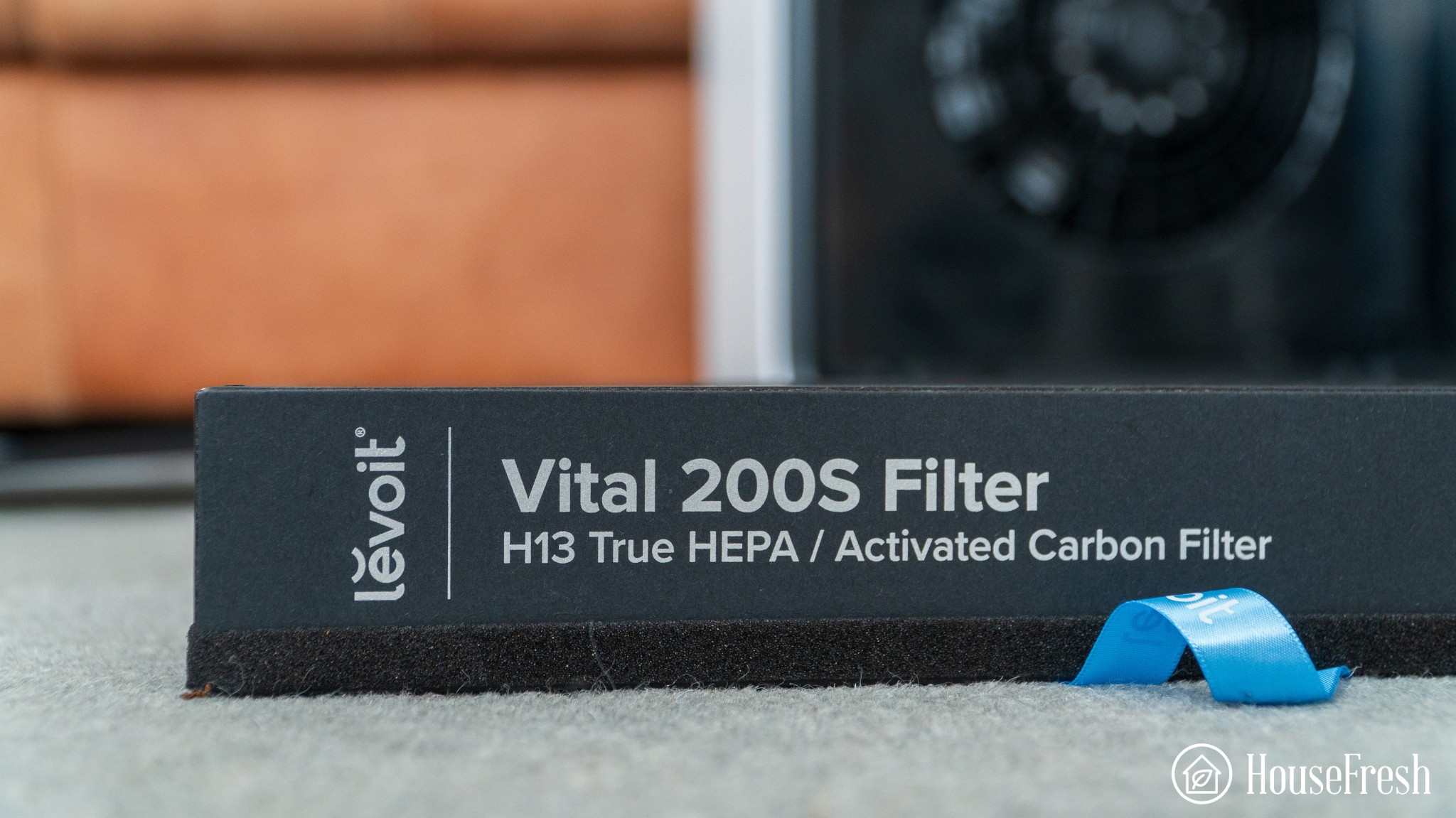
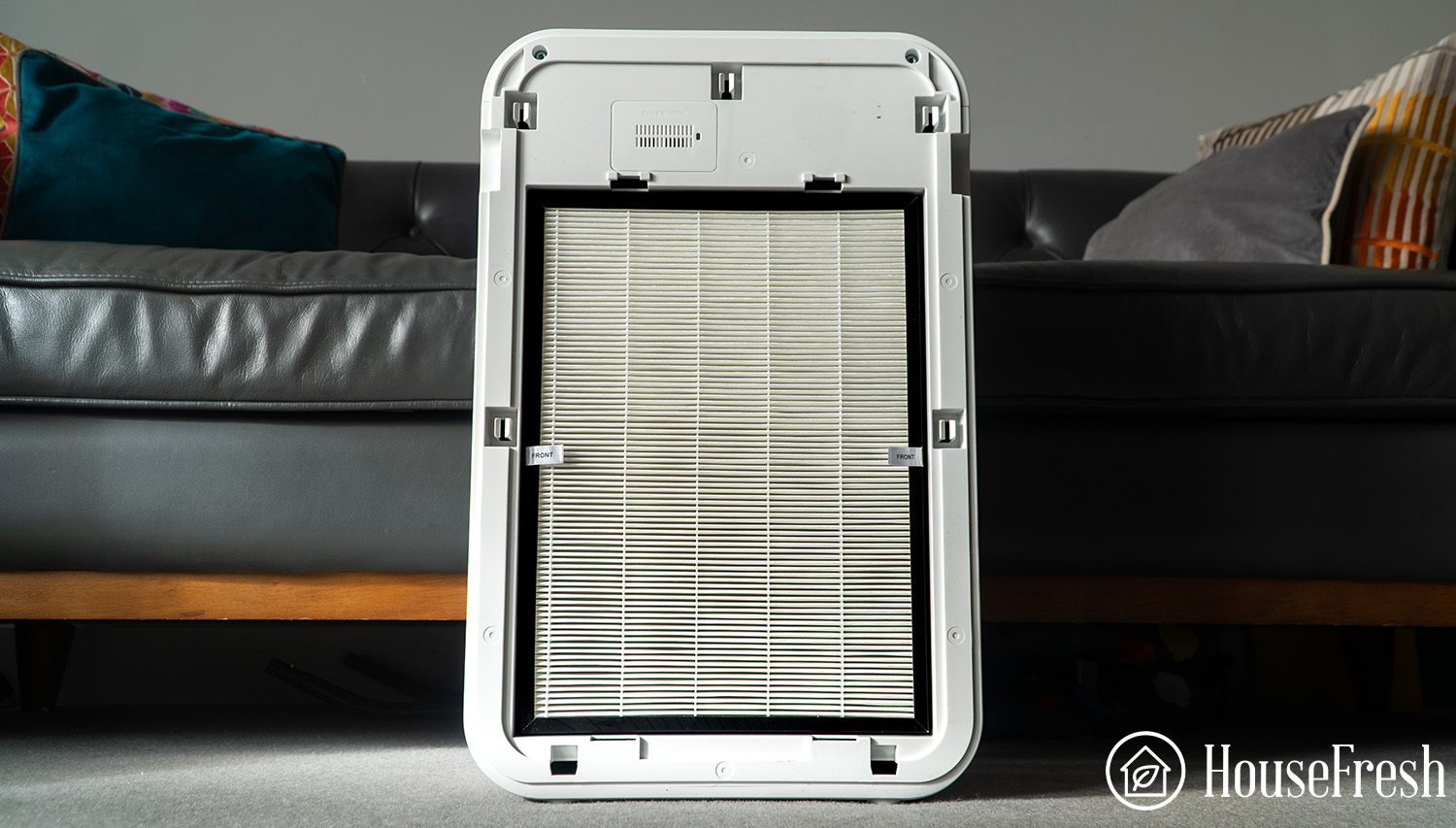
Unlike actual DIY air purifier kits, you won’t be able to simply pick up some HVAC filters for your AirFanta 3Pro, so you will need to buy the official AirFanta filters. You can choose between HEPA 11 filters only or HEPA 11 with activated carbon. We have both because we wanted to test the performance of the 3Pro with and without activated carbon.

AirFanta 3Pro HEPA

When it comes to the HEPA 11 design, AirFanta states they developed a new pleating technology in order to produce powerful filters in such a small package. The 126×11.4“ particle filter material has been pleated eleven times into a much smaller 11.4×11.4×1″ area.

AirFanta 3Pro Cover

Whether you choose to go with the particle filter only or the particle+gas filter, you will find that AirFanta filters come with an aluminium cover on the outside that protects the air filter and serves as a (sort of) pre-filter for large dust particles.

For those needing to tackle odors and gases, the best option is the carbon filter. It is a bonded filter (similar to those we see in Levoit devices) that combines a 15mm thick HEPA 11 filter with a 10mm layer of activated carbon. 

Tip

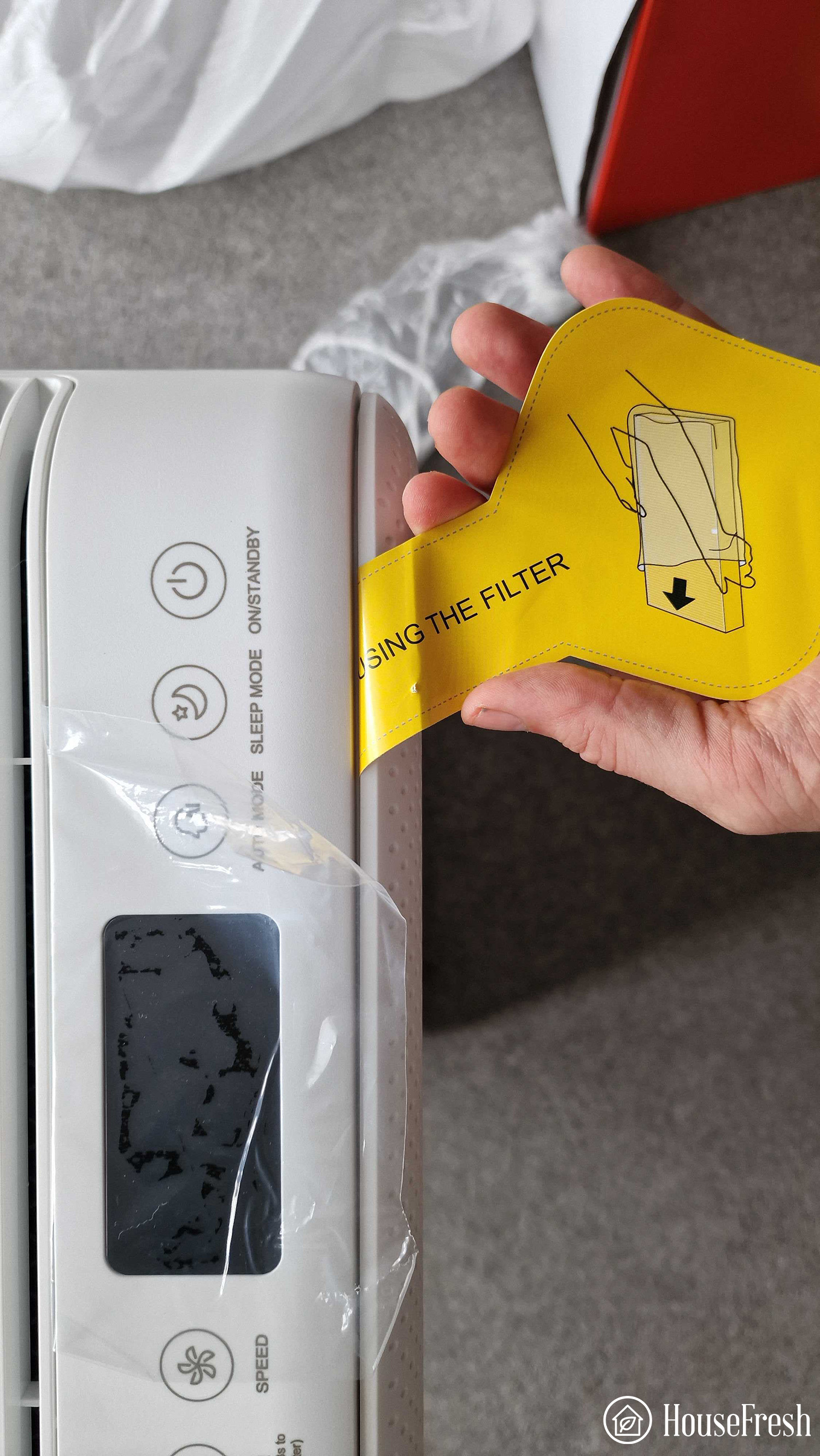
Remember to remove the filters from the plastic bag they come in before you switch on your AirFanta 3Pro.

Design and controls

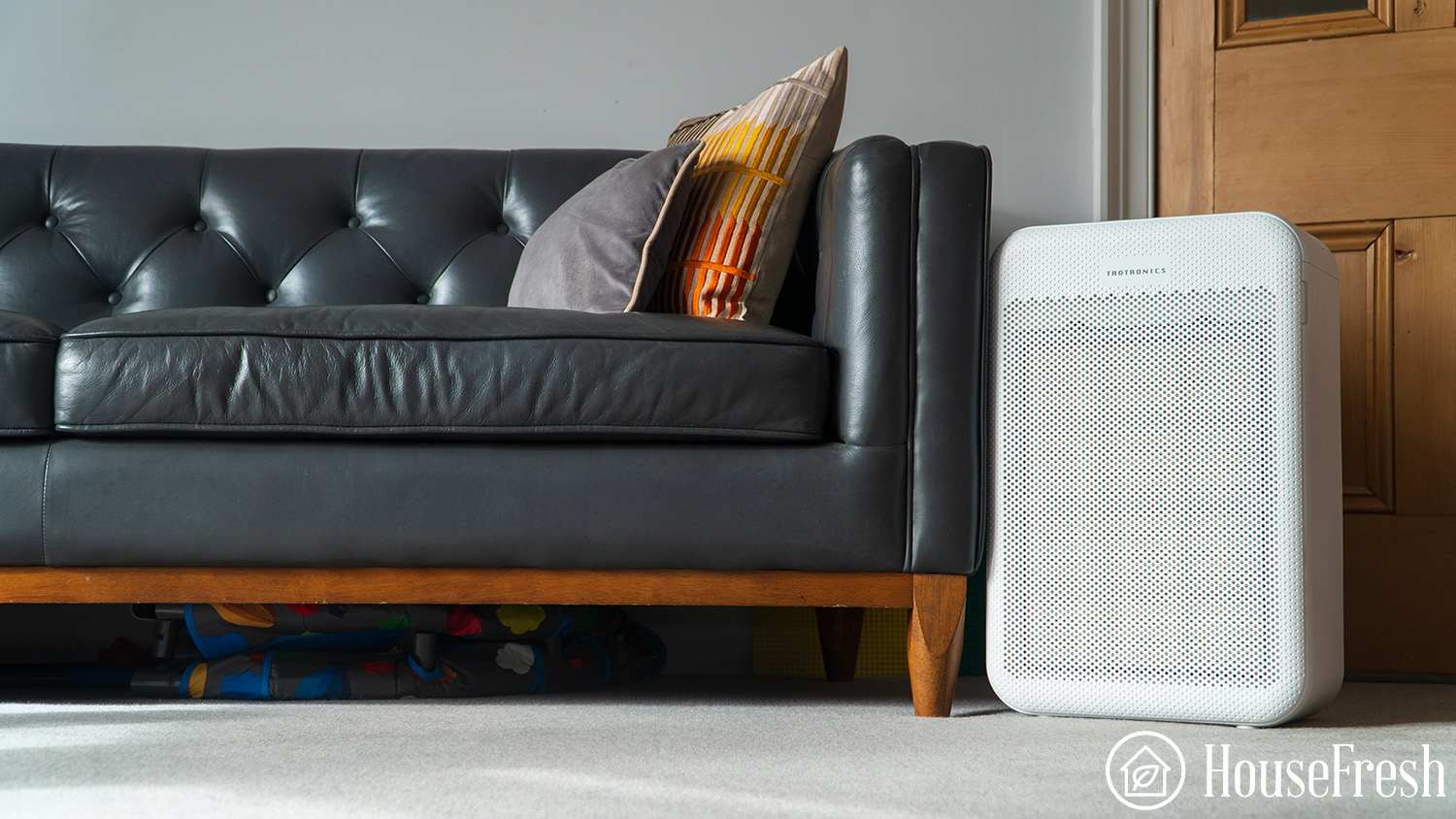
The 3Pro is a small and light with a design inspired by the Corsi-Rosenthal box.

AirFanta 3Pro Fireplace

Use the discount code HOUSEFRESH for 5% off when buying directly from AirFanta.

The AirFanta 3Pro is basically a box with a base at the bottom, one filter at each side and a fan array on top — much like the design of the Corsi-Rosenthal box.

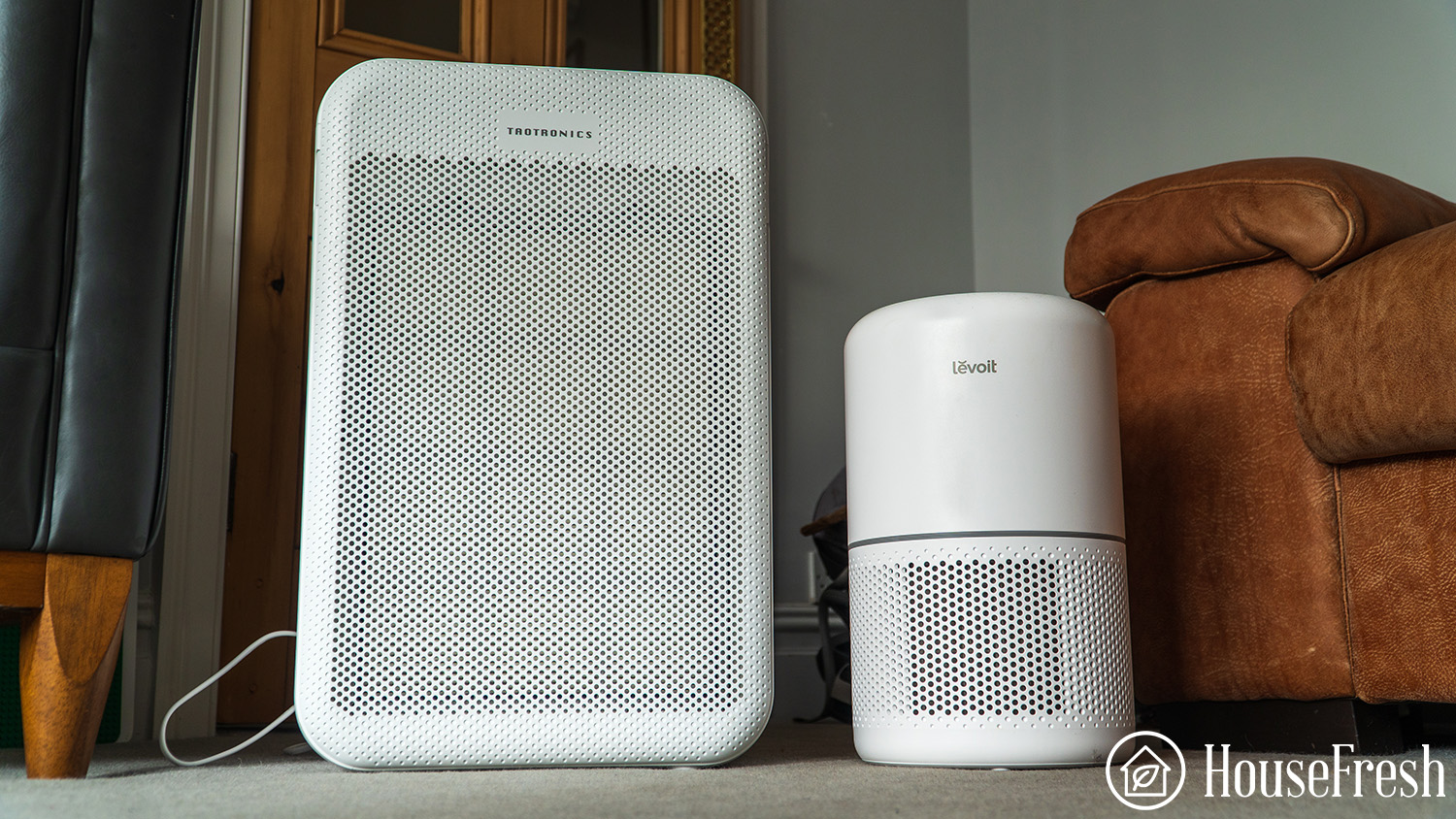
The thing with the AirFanta 3Pro is that it is A LOT smaller than a CR box and that other PC fan kits using large HVAC filters:

CR Box VS AirFanta 3Pro Front CR Box VS AirFanta 3Pro Top
DIY air purifiers Size comparison

Now, while this is not a DIY kit like the Nukit Tempest or the CleanAirKits Luggable XL-7, you still need to put the AirFanta 3Pro together, but it’s a lot easier to do compared to the Tempest and the Luggable.

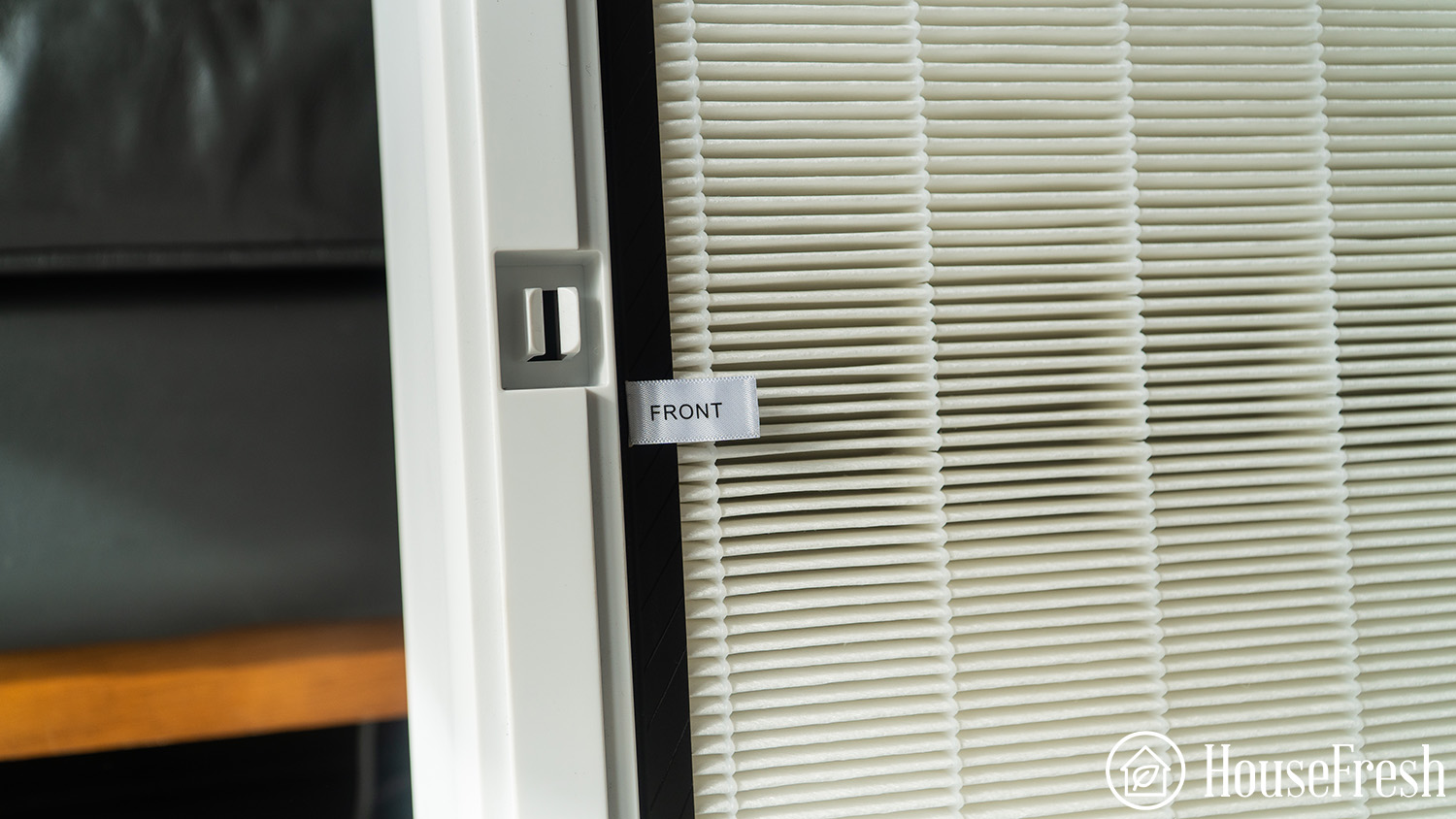
You just need to put the four filters in place on the sides of the base, which are clearly marked.

AirFanta 3Pro Open Corner

Once the four filters are in place at each side, you just need to clip the fan array on top.
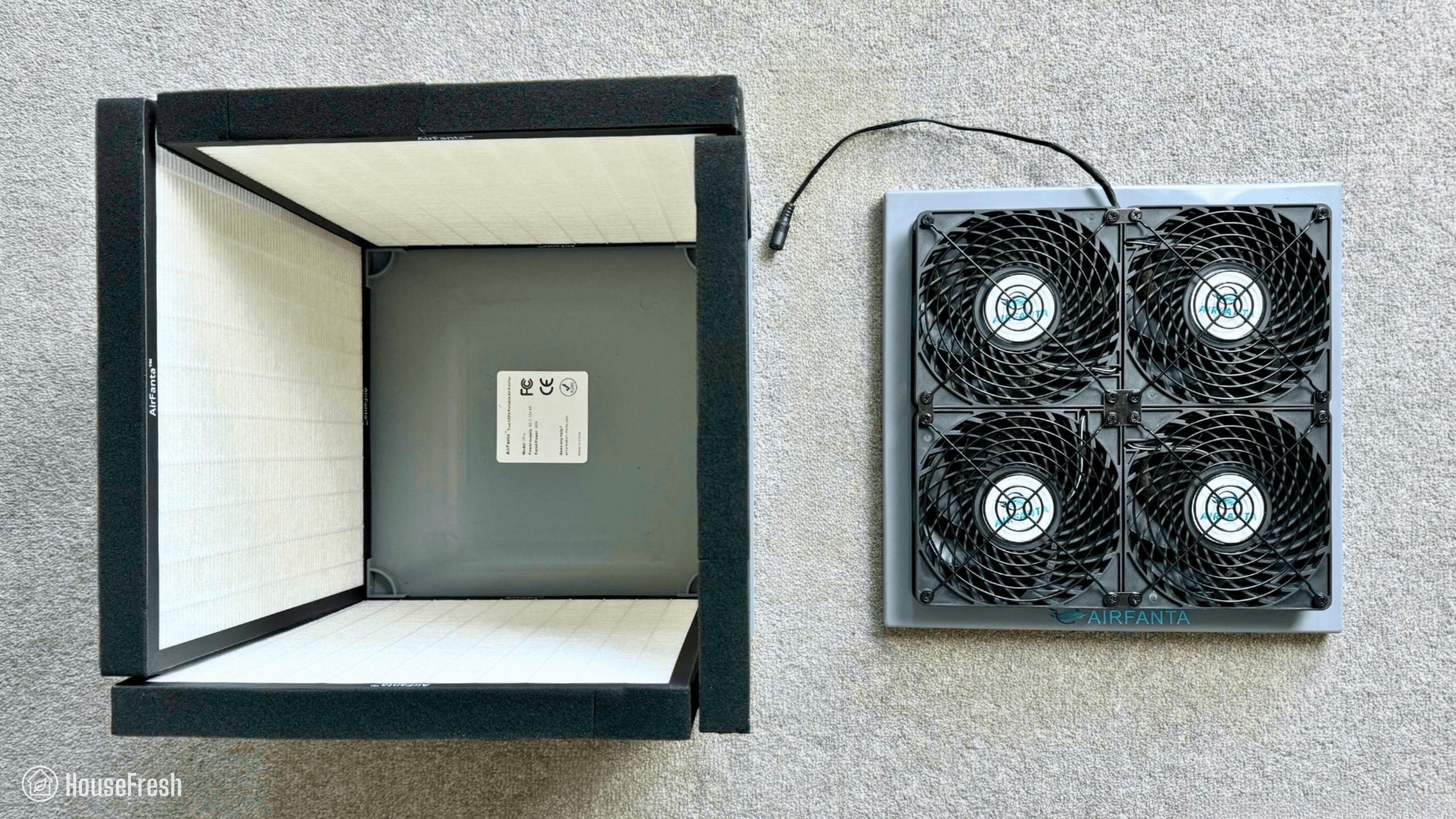
AirFanta 3Pro Open

As I mentioned briefly above, the AirFanta 3Pro has been designed to be cheap and portable: when you take it apart, you will be able to fit it neatly inside a standard carry-on bag. It even fits snuggly inside Gisele’s Osprey Proxima backpack:


In terms of controls, the AirFanta 3Pro comes with a 110-220v AC to 3-12v stepless DC power adapter which will allow you to control the speed of the fans and the noise output.

AirFanta recently launched a new edition of the 3Pro, which is certified by CARB and is the only option if you live in California. 

This new edition has an independent speed controller that allows you to control the speed even when it is connected to a power bank of 12v/3A (or higher current) DC 5.5mm x 2.1 mm port.

Something that I really appreciate about AirFanta and Adam Wong is how committed they are to keep improving their devices based on customer feedback.

A few days after we ordered our 3Pro, I saw a tweet from Wong in which he announced the introduction of a handy Velcro strap in response to an idea from @ParentMishmash:

As mentioned at the top of this review, you can use this very same Velcro strip to strap the filters + fan array + base together once you have disassembled your 3Pro to ensure all parts fit nicely inside your suitcase or backpack. Simple yet effective!

Air cleaning performance

The AirFanta 3Pro cleared our test room in 17 minutes — it is nearly as fast at cleaning the air as the MUCH larger Smart Air Blast Mini.
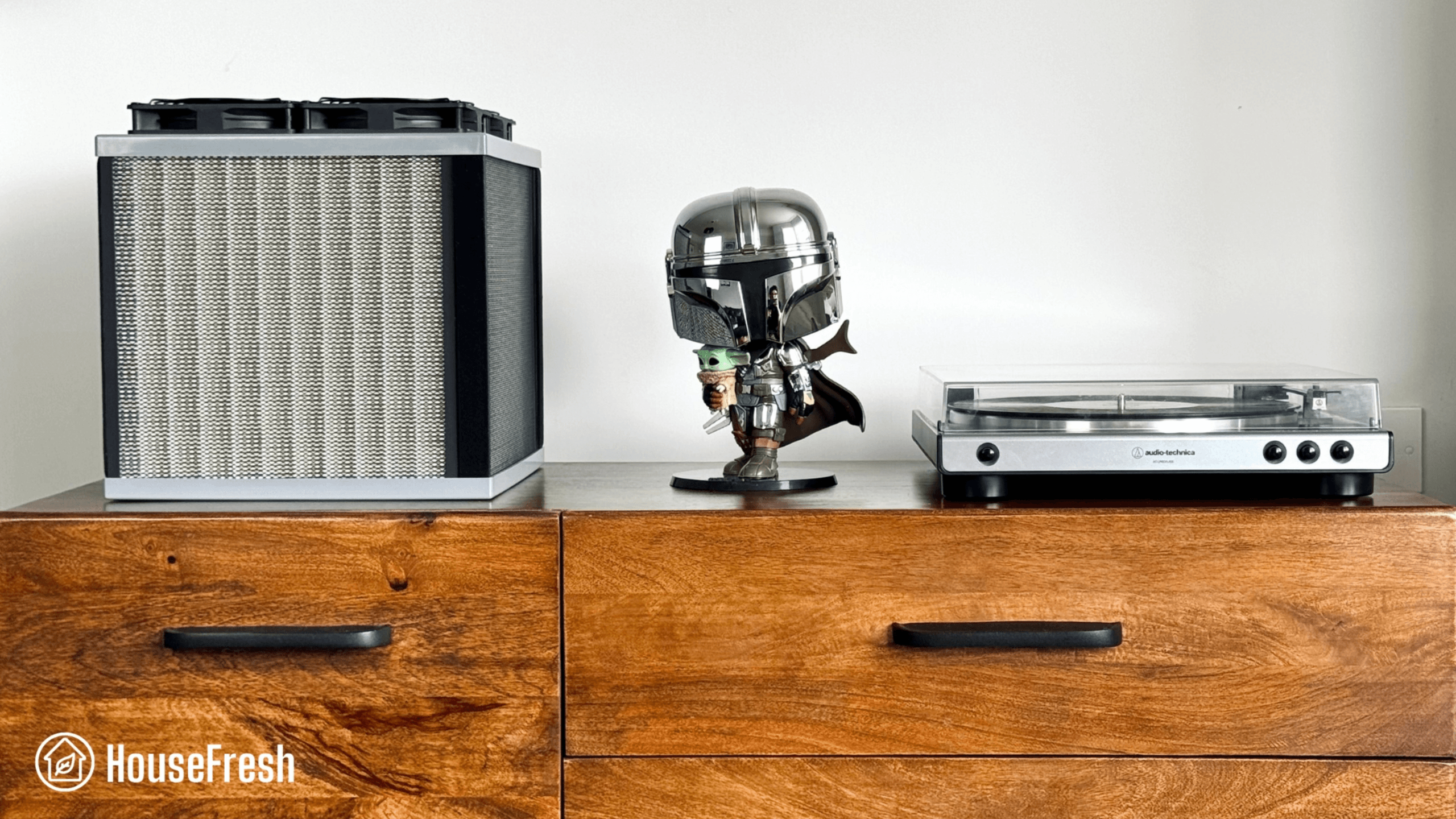
AirFanta 3Pro Sidetable

I’ve been really keen to test the AirFanta 3Pro because there has been a lot of hype around it — especially after it was independently tested by Rob Wissmann and David Elfstrom. These are the results of their CADR tests:

  • CADR: at 13V: 436 CFM
  • CADR at 12V: 413 CFM 
  • CADR at 9V: 328 CFM 
  • CADR at 6V: 213 CFM 

I’m happy to report that the hype is completely warranted. Let me walk you through how the 3Pro performed in our tests.

According to our PurpleAir Zen sensor, the AirFanta 3Pro needed 17 minutes to achieve PM1 zero in our 728 cubic ft. test room running at top speed (12.6v). We estimate a PM1 CADR of 353 cfm, which would allow the 3Pro to provide five air changes per hour in rooms no larger than 529 sq. ft.

Swapping the filters for the HEPA + activated carbon option added three more minutes to the test, bringing the time to clean all traces of PM1 smoke pollutants to 20 minutes:

This matches the incredible CADR score tests performed by David Elfstrom and Rob Wiss, and compares quite favorably with other air much more expensive air purifiers.

As you can see in the table below, the AirFanta 3Pro is not only affordable but also incredibly fast at cleaning the air:
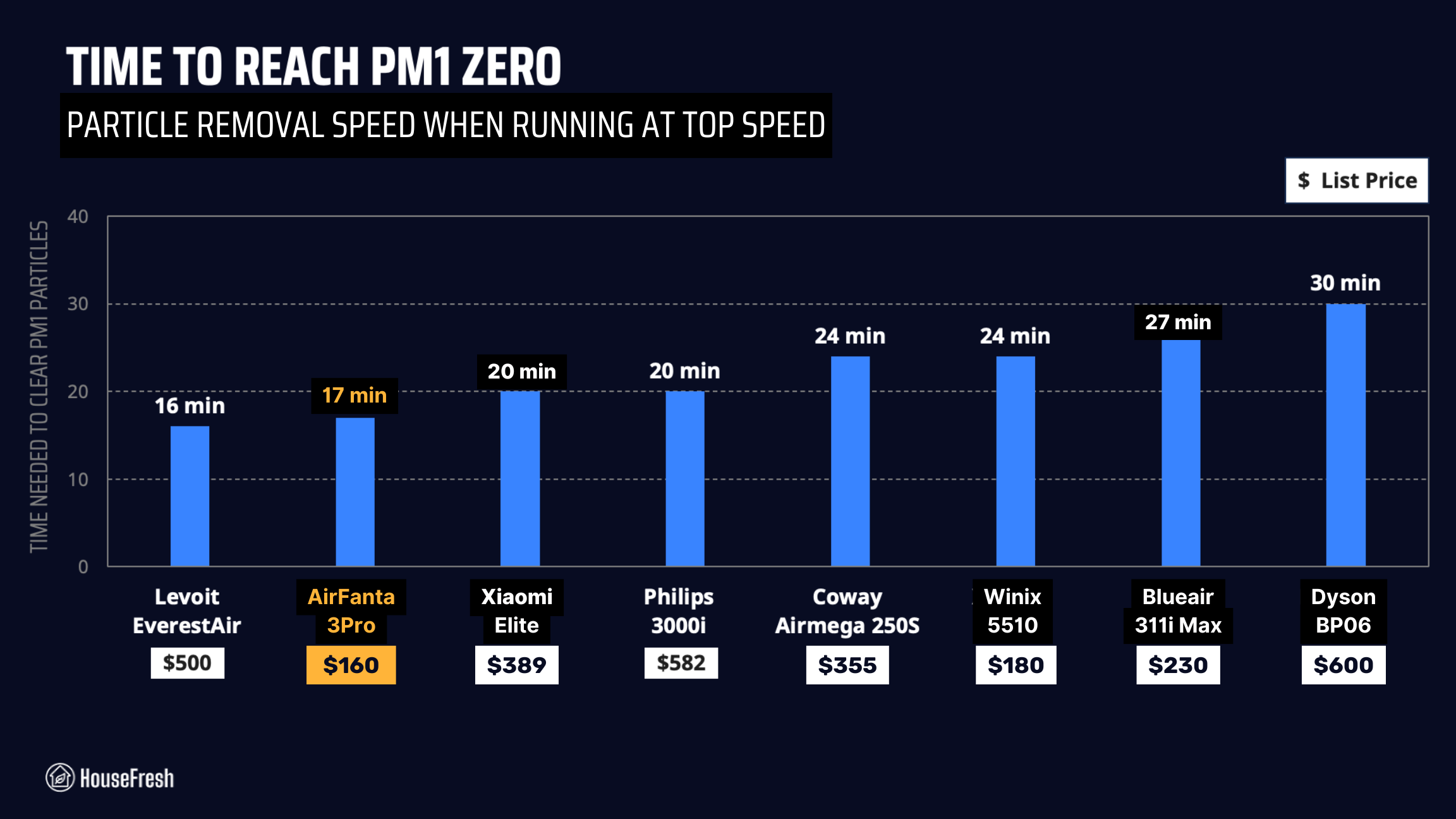
12v performance airfanta 3pro

Our air cleaning performance test showed that at its highest fan speed (12.6v), the AirFanta 3Pro is as powerful as devices costing upwards of $450 and more effective at removing particles from the air than much more expensive air puriifers like the Dyson BP06.

Sound levels

In our testing, the sound levels of the 3Pro ranged from 36.1 dBA to 56.3 dBA. It is much quieter than the new Winix T810 (62.5 dBA) and the Coway AIrmega 200M (64.3 dBA)

The second most important thing to look at when choosing an air purifier is the amount of sound it generates. A device that is too loud is unlikely to be used regularly or, even worse, is likely to be switched off.

That is why we record (from 3 ft. away) the sound levels generated by every air purifier we test running at each fan speed in the same location (our basement). 

The AirFanta 3Pro comes with an AC-to-DC power adapter, which includes a dial for adjusting the voltage and the sound level generated by the air purifier. Here are the results at each fan speed we measured:

VOLTAGESOUND LEVELS (decibels)
3.63 v.36.1 dBA
4.19 v.39.7 dBA
5.24 v.36.9 dBA
6.54 v.43.3 dBA
7.44 v46.7 dBA
8.56v49.1 dBA
12.6 v. (top speed)56.3 dBA

At top speed, the AirFanta 3Pro reaches 56.3 dBA, which is quieter than most mind-sized popular traditional air purifiers available on the market today:
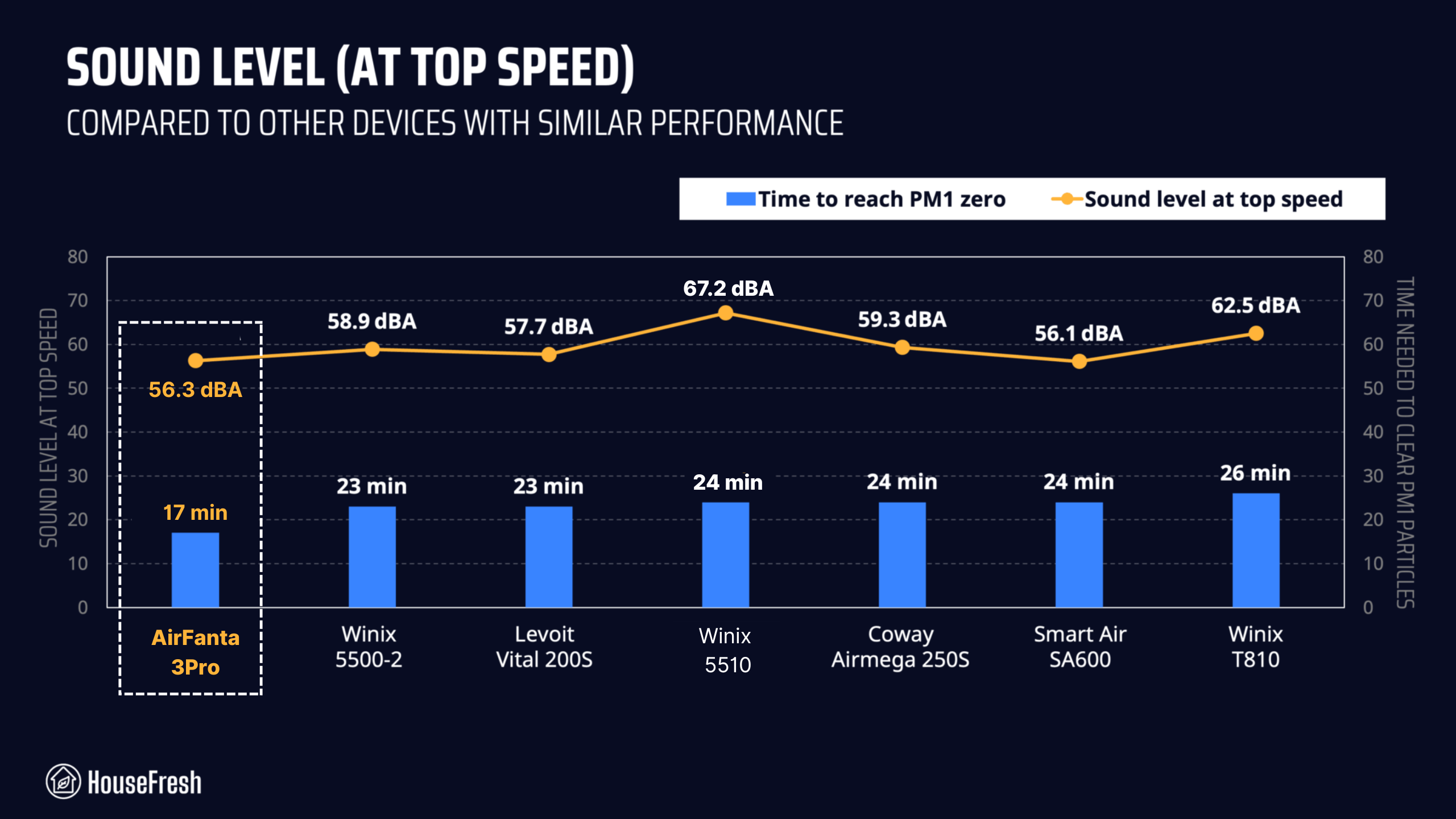
sound top speed airfanta 3pro

However, you may be wondering how this compares to other devices, especially other PC fan-powered air purifiers. Check out our table below:

PC FAN KITSOUND AT TOP SPEED (decibels)
CleanAirKits Luggable XL-7 [Cooler Master SickleFlow 120]38.8 dBA
CleanAirKits Luggable XL-7 Ultra [Cooler Master Mobius 120]47.2 dBA
Nukit Tempest41.8 dBA
NorthBox Systems 6XL [ARCTIC P14 Max]50.2 dBA
Nukit Tempest Euro50.5 dBA
NorthBox Systems 6XL [Noctua P14s Redux]45.1 dBA
AirFanta 3Pro56.3 dBA

Compared to other PC fan devices from Nukit, CleanAirKits and NorthBox Systems, the AirFanta 3Pro is much louder at its highest fan speed. However, it’s still in line with the top-speed sound levels of the traditional retail HEPA devices we have tested. 

However, sound levels at top fan speeds are not as important as air cleaning performance at lower fan speeds.

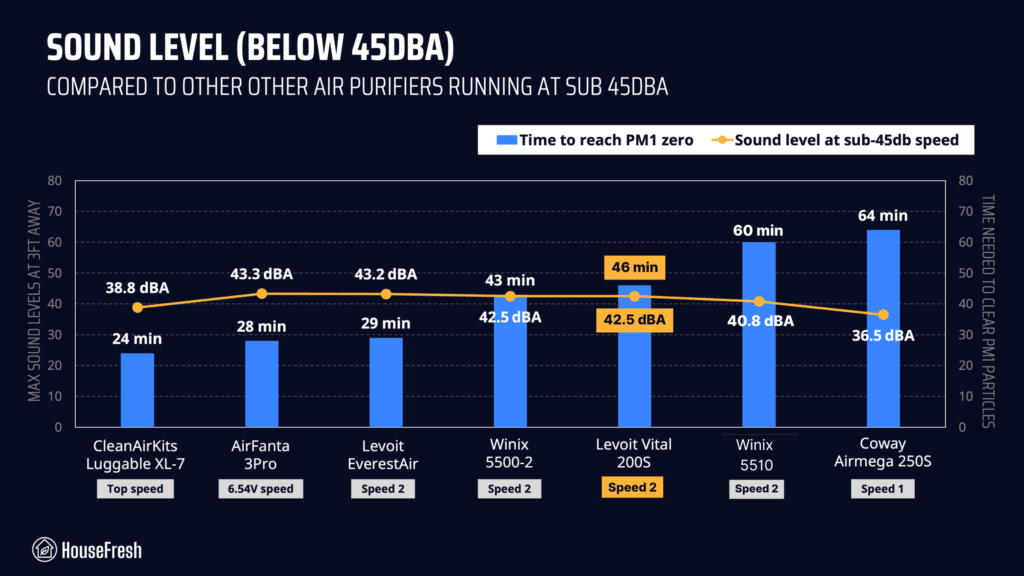
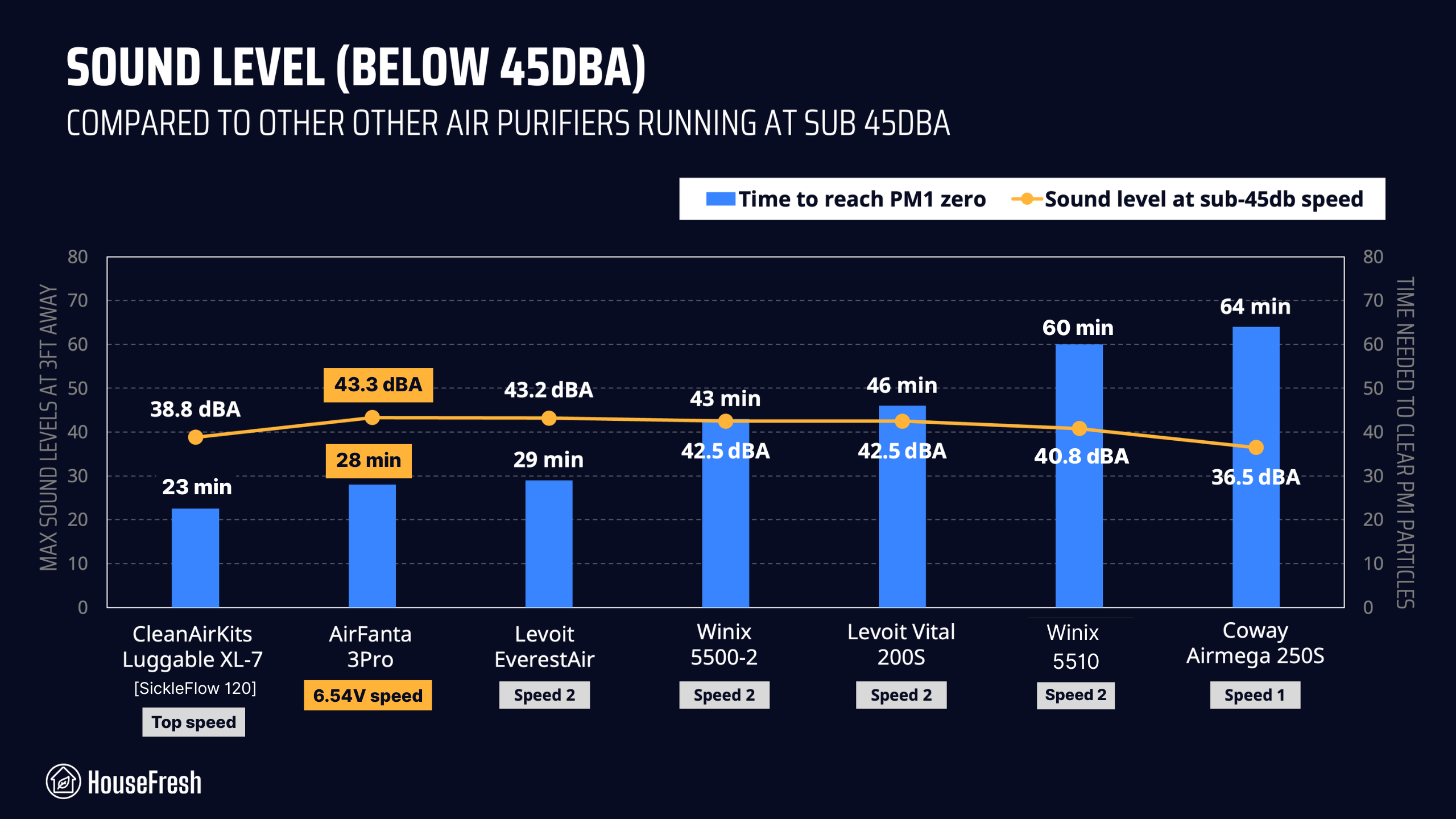
That is why we always identify a fan speed where the air purifier generates less than 45 dBA of noise to assess its quiet performance. In the case of the AirFanta 3Pro, we repeated the particle removal test multiple times across different voltages:

My recommendation is to go for 6.54V for top performance at sub-45 dB noise levels. Running at this speed, the 3Pro generates 43.3 dB of noise while still being able to clean our test room in 28 minutes.
airfanta quiet performance

When we account for sound levels, we see the performance of the AirFanta 3Pro getting beat by the CleanAirKits Luggable XL-7, which managed to clean our test room in 23 minutes even when running at only 38.8 dBA. However, the Luggable XL-7 costs upwards of $200 (plus filters), so considering the low cost of the AirFanta 3Pro ($159.99 including filters), I am super impressed. 

What impresses me the most is how incredibly well the AirFanta 3Pro compares to the shop-bought HEPA air purifiers I have tested. At its top speed, it is faster and quieter than most of the devices we have reviewed here at HouseFresh.

Tip

If you’re considering getting an AirFanta 3Pro, I suggest experimenting with the voltages to find a sound level that works for you. Personally, I have stuck to having my 3Pro running at the 8-volt mark as I find it offers an excellent performance-to-sound ratio.

Long-term running costs

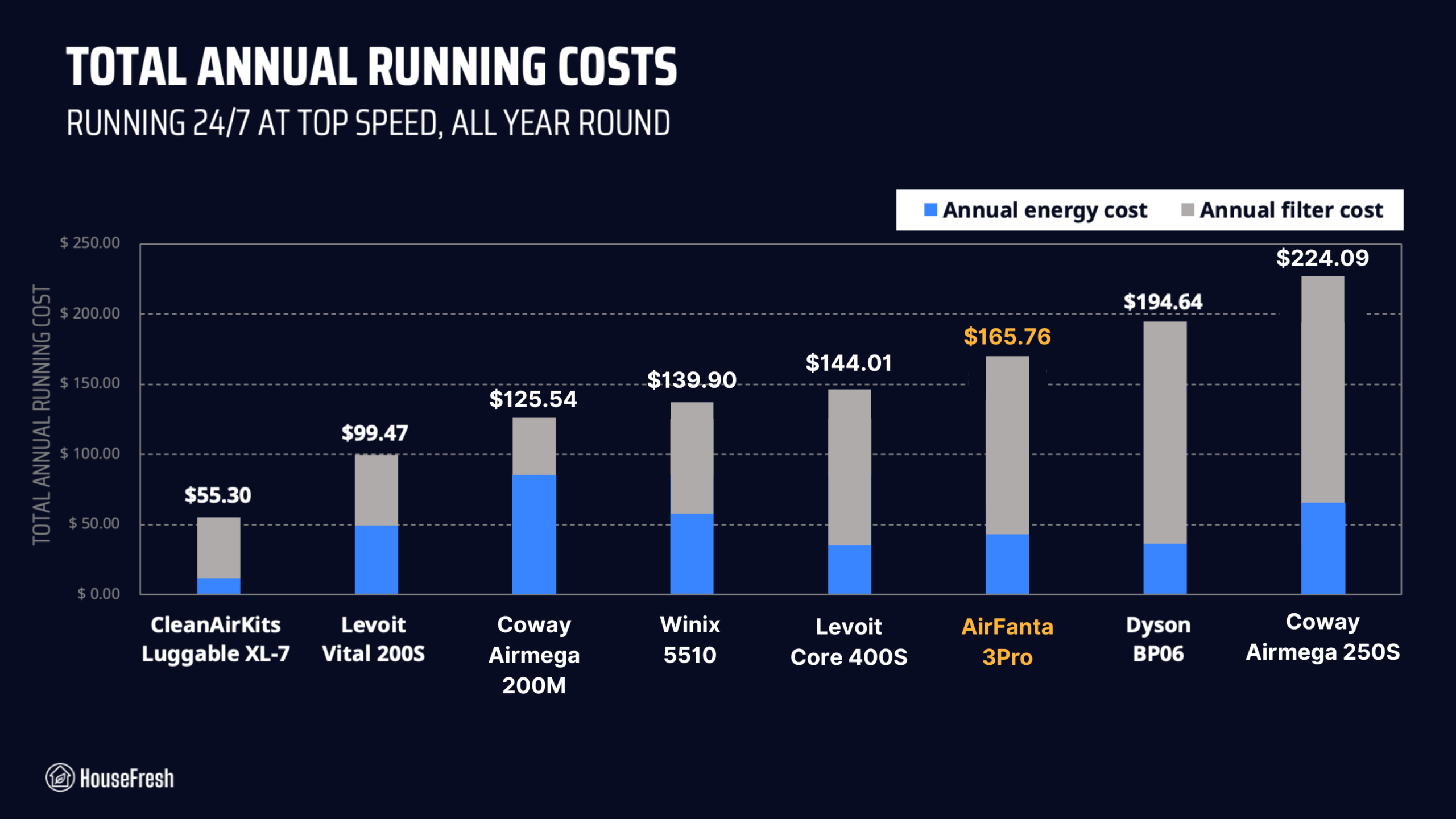
Running an AirFanta 3Pro will cost you $165.76 per year, combining energy consumption costs ($47.76) and filter replacement costs ($118).

AirFanta 3Pro Corner

Use the discount code HOUSEFRESH for 5% off when buying directly from AirFanta.

As always, I calculated the long-term costs associated with running your AirFanta 3Pro all day, every day at its top high speed for a full year — an unlikely scenario as you’ll probably want to have it running at a lower fan speed, but it’s a good baseline for running costs.

I started by using our energy meter to measure how much electricity the 3Pro uses at different voltages and, when running at top speed (12.6V), it pulled 43.23 watts.

VOLTAGEENERGY CONSUMPTION (watts)
Standby0 watts
3.63 v.2.19 watts
5.24 v.5.02 watts
6.54 v.8.98 watts
7.63 v.13.31 watts
8.56 v17.46 watts
12.6 v. (top speed)43.23 watts

This means that if you had to leave your 3Pro running 24/7 at top speed, it would cost $47.76 in energy costs for a year, using average U.S. energy rates as of July 7th, 2025.

Considering you need to replace the filter every six months and that the replacement costs $59 (HEPA only), you can expect to also spend $118 per year on filters.

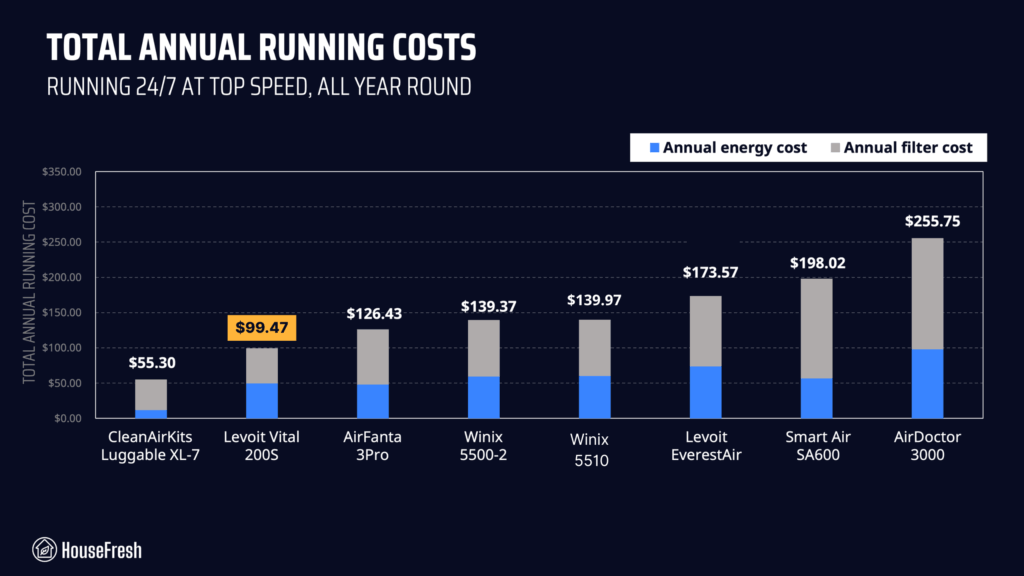
When compared to other similar-performing air purifiers, the 3Pro has low energy consumption costs but it’s the OEM filter replacement costs that drive the yearly running costs up.
airfanta long term costs scaled

At 43.2 watts, the AirFanta 3Pro is more energy-efficient than many popular units, such as the Winix 5510 or the Levoit Vital 200S. However, compared with another PC fan-powered air purifier like the Luggable XL-7 from CleanAirKits, it’s clear that the 3Pro consumes more electricity at its maximum speed of 2900 RPM. 

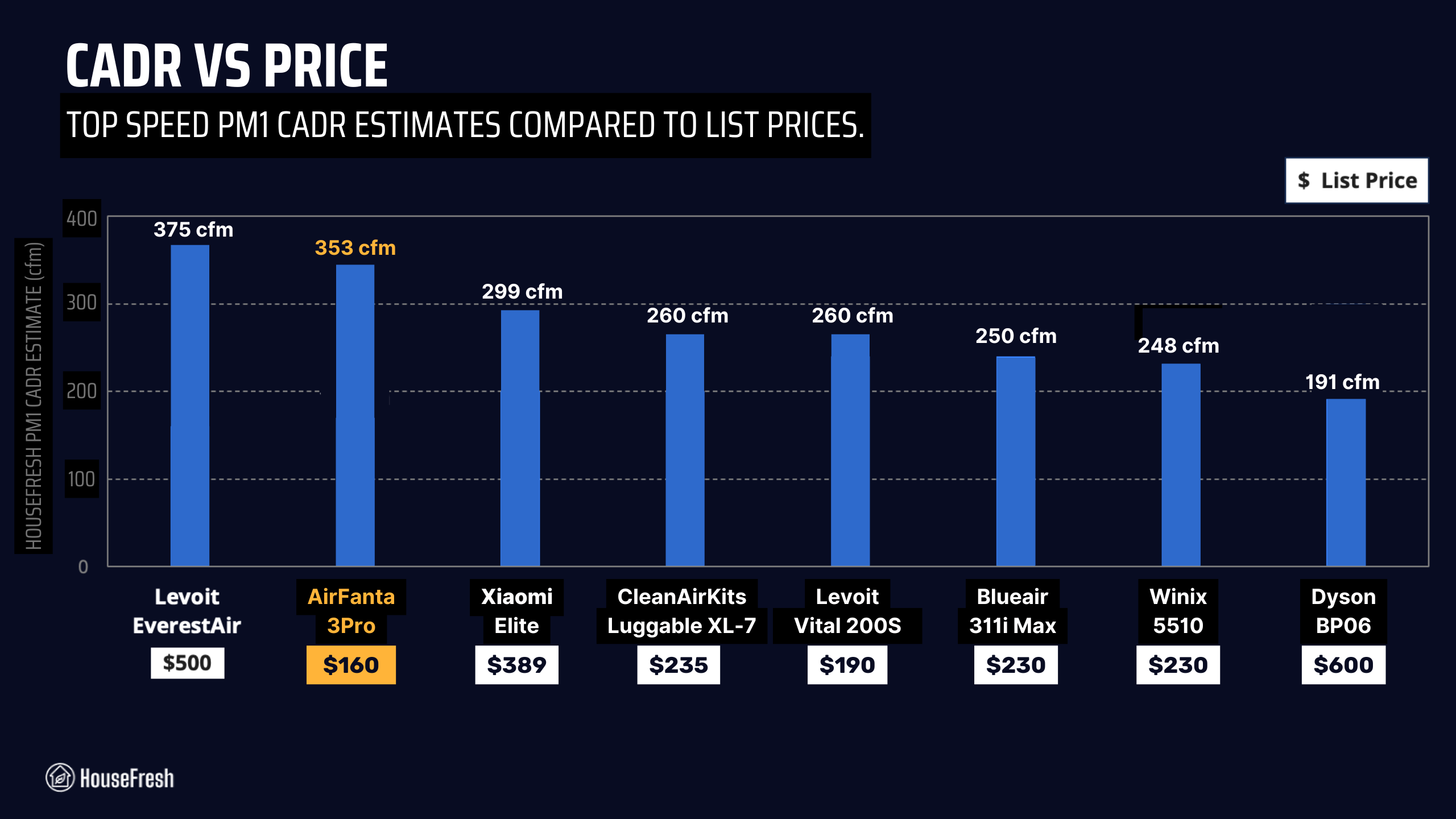
That said, running costs for the 3Pro are similar to those of standard HEPA retail devices, but you do get much higher performance levels especially when you consider the much lower initial purchase cost.
cadr vs price airfanta

Tip

For a more efficient operation of the AirFanta 3Pro, I recommend going for 6.54V.

At this fan speed, the 3Pro consumes just 8.97 watts, so it will just add 10 bucks to your energy bill in a year while still being able to clean the air effectively as Levoit Core 400S or the IQAir HealthPro Plus running at full speed.

AirFanta’s creator, Adam Wong, explains how this big drop in energy consumption is possible:
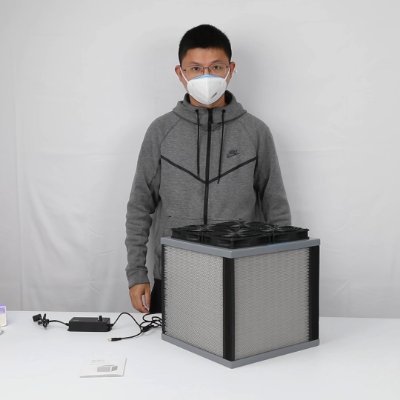
“The power consumption of a fan is proportional to the cube of its RPM, while the airflow is proportional to the first power of the RPM. So higher RPM will result in less efficient of electricity consumption. The fan in the AirFanta 3Pro has a maximum speed of 2900 RPM, which is much higher than other PC-fan-based air purifiers, making it look less energy-efficient.

In fact, running it at 9V or lower would significantly improve energy efficiency. It still has a quite good CADR at lower voltage.”

Adam Wong, Founder of AirFanta

All AirFanta products come with a 1-year warranty. AirFanta will send you a new 3Pro and you won’t need to return the faulty device.

If you experience issues with your AirFanta 3Pro, all you need to do is email the AirFanta team at airfanta@air-fanta.com.
Make sure to include photos and/or videos of the issue you are experiencing.

Bottom line: Should you get the AirFanta 3Pro?

It’s totally worth it. This is the only air purifier with a a high CADR that you can travel with.

Here’s the thing: if you were to have come to me selling an air purifier with a CADR of 353 cfm for $159.99, I would have assumed it was some sort of a scam. The sheer power of such a device would surely cost a lot more, right? 

Adam Wong says no.

The AirFanta 3Pro can provide large rooms with multiple air changes for a price that is three times cheaper than what you normally pay for a standard, shop-bought HEPA air purifier. That is an incredible achievement that goes to show how brilliant Wong is and how much he actually cares about creating truly affordable solutions to clean the air. 

AirFanta 3Pro Sofa

Use the discount code HOUSEFRESH for 5% off when buying directly from AirFanta.

While the 3Pro is not totally plug-and-play (as you need to fit the filters and put the fans in place), it is MUCH easier to put together than all the other PC fan-powered DIY air purifier kits I have tested. That said, the 3Pro is also louder than all of them, so that is something to keep in mind.

For those looking for an air purifier they bring along when traveling or to events, there isn’t anything on the market right now that matches the high CADR of the AirFanta 3Pro. You can simply disassemble the device and pack it in your suitcase or backpack just to reassemble it wherever you need it. 

For those wanting a quiet and energy-efficient air purifier, they can leave running in the background even when having work calls or meetings at the office, then a PC fan kit like the Luggable XL by CleanAirKits or the Tempest by Nukit will be a better choice — just know that they will both cost over $100 more than the 3Pro.

Now, is sound is a concern but your budget can’t stretch beyond $160, then remember you can run your AirFanta 3Pro at lower fan speeds. It will be much quieter and still outperform the standard retail HEPA air purifier you can find online, costing you less upfront and in the long run.

I really love this device, so I expect you will find it across many of our lists of recommended devices. 

One last thought before I leave you: I believe everyone living outside the U.S. will really benefit from the AirFanta 3Pro, especially those living in places like the UK, where finding box fans and HVAC filters to build your own Corsi-Rosenthal box is virtually impossible. As if that wasn’t good enough, the 3Pro has a much smaller footprint than the standard CR box, is definitely quieter and offers much more adjustable fan speed options.

Do you have any questions about this device that I didn’t cover in my review? Drop a comment below, and I’ll reply right away.

SOURCES

We calculated energy consumption costs with the help of the Department of Energy’s appliance energy calculator. We calculated yearly costs associated with running an AirFanta 3Pro for 24hs a day for 365 days. We ran this calculation utilizing the U.S. average utility rate of 0.1235/kWh as of September 17, 2024.

Winix A231 (Zero Compact) review

Winix A231 Corner

Winix is a South Korean company that has been producing air quality devices since 1973. We have previously tested and reviewed the Winix 5300-2 and 5500-2 with good results, so we know Winix knows how to produce air purifiers with excellent performance at affordable prices.

The Winix A230 comes in all black, and the A231 — the device we are reviewing — is white and grey. Besides the color, the Winix A230 and A231 have all the same features and functions. This same device is known as the Winix Zero Compact in Europe.

The Winix A231 is aimed at those with smaller spaces of up to 230 square feet and is a much smaller device than the popular Winix 5500-2.

All Winix devices are sent for independent CADR testing as part of AHAM/ANSI AC-1-2002, to see how well the device can remove dust, smoke and pollen. After years of testing air purifiers, I recommend you always choose a device with an AHAM CADR lab result, as this will help you get an adequately powered air purifier to keep your room clean.

All Winix devices use PlasmaWave, a bi-polar ionization technology that can improve particle removal performance beyond HEPA filtration alone. One big thing I like about Winix is that their Plasmawave technology is optional and easily switched off. I wish more air purifiers with an ionizer would offer this.

As with all the reviews we perform here at HouseFresh, we bought the Winix A230 with our own money and have no relationship with Winix. We aim to share the results of our hands-on testing, including a performance test, sound levels, long-term costs and energy usage.

When writing this review, the Winix A231 was $81.22, and the all-black A230 was $78.99 — this is even cheaper than the popular Levoit Core 300, and the Winix device has a better Clean Air Delivery Rate (CADR). 

I am excited to see if Winix can offer their usual high cleaning performance in an air purifier that can be found regularly for less than $99.

The lowdown on the Winix A231

Danny Ashton HouseFresh
“The Winix A231 is an impressive small air purifier that does a good job considering its low cost.

While I would still recommend that most people choose a bigger air purifier, for those needing a smaller device, this is at the top of my list of recommendations.”
— Danny Ashton, HouseFresh Founder & Senior Writer
Winix A231 Living room

Some people just want to know the key findings without reading the entire review, so I distilled the review down to the seven most important things to be aware of with the Winix A230/A231.

What we really like

It was five (5!) minutes quicker at cleaning our test room of PM1 particles than the Levoit Core 300.
Small design that doesn’t take up too much space.
Auto-mode means it can add value in cases where there are occasional issues with air quality, like a kitchen.
Fair pricing from Winix for genuine filters, some of the cheapest on the market.
Generic filters bring filter costs down to $15 per year.

What we think could be better

No settings memory, so if the device loses power, it will go to default (with PlasmaWave enabled.
It is a small air purifier, so it will struggle to clear the air in spaces larger than 219 sq. ft.

Clean air delivery rate (CADR):– Top speed PM1 CADR: 148 cfm
– Sub-45 dBA PM1 CADR: 67 cfm
– AHAM PM2.5 CADR: 154 cfm (dust)
Filter technology:Fine mesh pre-filter, True HEPA filter, activated carbon filter, PlasmaWave technology
Recommended room size:222 sq. ft. (5 air changes per hour)
Dimensions:9.5D x 9.5W x 14.6H inches (24.13D x 24.13W x 37H cm)
Weight:7.1 lbs (3.2 kg)
Noise level in decibels from 3 ft. away:Speed 1: 35.2 dB
Speed 2: 48.3 dB 
Speed 3: 57.9 dB
Electricity consumption in watts:Standby mode: 0.06 watts
Speed 1: 35.4 watts
Speed 2: 37.7 watts
Speed 3: 45.6 watts
Filter lifespan:12 months
Manufacturer’s warranty:2 years
Country of origin:South Korea
Country of manufacture:Thailand

A small air purifier that takes little space

The Winix A231 is light, bright and easy to the eye

Winix A231 Side table

This small device takes up very little space in the home and could easily be used in smaller rooms like a bedroom or office. It’s a good-looking device with a flared design that makes it stand out from the standard white cylindrical designs of other manufacturers. 

Winix A231 Front top

In terms of size and weight, the Winix A231/Zero Compact is similar to the Levoit Core 300 — small and easy to move around. But similar ≠ the same: the A231 comes with a flared design that makes it a little shorter than the Core 300. That being said, both units have a similar floor footprint.

Levoit Core 300 VS Winix A231

The control panel of this air purifier sits at the top. It is a touchscreen surrounded by the air quality indicator: a circular light that changes color depending on the current air quality (red = poor, amber = fair and blue = good).

Winix A231 Living room

In terms of buttons, you will see that there is a filter alert at the top (to let you know when it’s time to change the filter) and then three buttons for enabling auto mode, sleep mode and switching PlasmaWave on and off. There are also two arrows to switch through the three fan speeds available (low, medium and high). Finally, you have a power button at the bottom of the screen.

Winix A231 Control panel

One minor issue I found with the control panel of the Winix A231 is that the arrow buttons don’t light up, so it can be tricky to see them in the night or when using this unit in darker spaces.

This air purifier comes with an on-board air quality sensor, which powers the AQI light indicators and the possibility of running the unit on automatic. The sensor sits at the back of the device and you should always make sure that it is not blocked by anything.

Winix A231 AQI sensor

While this device comes with an auto-mode, it doesn’t come with a smartphone app or smart speaker connectivity. This limits your ability to operate your A231 remotely. Not everyone cares about this but I always like to clarify for those who do.

H13 HEPA, carbon and an integrated pre-filter

The Winix A231 (Zero Compact) offers great CADR for less than $80!

Winix A231 Fire place

With the recent fiasco of Levoit falsely claiming their filters were HEPA-certified, we are paying close attention to other air purifier brands who might be overselling their features.

It’s reassuring that all Winix devices are third-party tested by Aham Verifide. These tests pit purifiers against the most common air pollutants, and we can see below the impressive results backing up Winix’s performance claims for the A231.  

Winix A231 ENERGY STAR

Winix uses HEPA H13 for their Winix A231/Zero Compact. These filters are considered medical-grade, which means they can remove 99.99% of particles as small as 0.3 microns — the equivalent of ultra-fine pet dander, dust mites and bacteria particles. 

Winix A231 HEPA filter

The Winix A231 also uses activated carbon, but it’s the same impregnated fabric we saw we testing the 5300-2 rather than the pelleted carbon we saw in the latest 5500-2. As this is a small air purifier, the amount of carbon will still be tiny, so it’s unlikely to make much of a difference in daily usage against gasses and odors.

Winix A231 Activated carbon filter

Tip

If you have a severe issue with VOCs or odors, you should look at specialist air purifiers that utilize high quantities of activated carbon.

Like the Levoit Core 300, you can remove the filter from the bottom of the device by twisting it in the direction of the arrows.

Winix A231 Bottom

One benefit of the A231/Zero Compact over the Levoit Core 300 is that it’s much harder to remove the base by accident when the device is standing on the floor. This is an issue that my wife uncovered: sometimes, when cleaning the floors, she will pick up the Core 300, and the filter falls out because the base of the device was unlocked. The Core 300’s base can easily unlock when moving the air purifier around the floor. With the Winix A231, the base stays on unless you intentionally twist it with your hands, so it is a much better design.

Tip

Most HEPA filters will arrive in a sealed plastic bag, so be sure to remove them before you start your device, or you will fail to remove any particles from the air.

The Winix A231 cleared our test room in 40 minutes

For our performance test, we used the Purpleair Indoor Sensor with an additional BM680 gas filter that allows us to continually track the levels of PM1, PM2.5 PM10 and VOCs in our 728 cubic feet room.

At top speed and with PlasmaWave enabled, the Winix A231/Zero Compact cleared all traces of pollutants from our home test lab in 40 minutes

Without the PlasmaWave, the Winix A231 reached PM1 zero in 46 minutes, just one minute slower than the Levoit Core 300:

This is how it compares to other small air purifiers we have tested:

AIR PURIFIER MODELTIME TO CLEAN OUR TEST ROOMLIST PRICE
AirFanta 3Pro17 minutes$159.99
Levoit Vital 200S23 minutes$189.99
Coway Airmega AP-1512HH (with ionizer)26 minutes$229.99
Corsi-Rosenthal Box32 minutes$85.00
Levoit Vital 100S37 minutes$139.99
Winix A231 (with ionizer)40 minutes$99.99
Levoit Core 300S45 minutes$149.99
PuroAir 24051 minutes$199.00

Although the Winix A230/A231 is still only suitable for smaller rooms, I was very impressed by its air cleaning performance, considering its low price.

Noise levels

The final test is to see how much sound is generated at each of the three fan speeds.

Air cleaning performance is essential, but if you don’t want to use the device due to the level of sound, then it won’t matter.

We recorded that the Winix A231 produced 57.9 dBA at the highest fan speed, similar to other Winix devices we reviewed. 57.9 dBA is not quiet enough to use during sleep or work, but it wasn’t excessively high compared to other air purifiers we tested.

At the second fan speed, noise levels peaked at 48.3 dBA. And at the lowest speed, sound levels dropped to 35.2 dBA. This is very quiet, but we wouldn’t recommend using such a small device at its lowest speed as it just wouldn’t be able to clean enough air, even in a tiny space.

We re-tested the particle removal speed of the A231 at this sub-45 dB speed and it reached PM1 zero in 86 minutes ― a whole 46 minutes slower than when running at its top speed:

The cost to run a Winix A231/Zero Compact: $119.54 per year

Low energy draw and affordable filters keep annual costs feasible. 

1. Electricity costs = $69.55 per year

It’s advisable to keep your air purifier running constantly to improve the number of air changes in your room. This means you must be aware of the energy costs because they can add up when running inefficient devices. 

Assuming that Winix A231 was on 24/7 every day of the year at its highest speed, it would add $69.55 to your electricity bill. This level of electricity usage aligns with other small air purifiers and is fair, considering how well it can clean the air. 

2. Filter costs = $49.99 per year

Winix states that you should change the filter every 12 months for the A231, but this will depend on how you use it and how bad the air is. Thankfully, it also includes an alert to tell you when to change the filter at the top of the device. 

Genuine filters are $20 cheaper than those from Levoit for similar-sized devices, so these filters are some of the best value on the market. 

If you want to keep costs even lower, you can also go for generic filters that bring the yearly filter costs down to just over $15 if you buy a 2-pack.

Winix Genuine Replacement Filter for A230 and A231
  • Compatible with Winix air cleaner models A230 and A231
  • Genuine up to 12 months of filtration! Longer lasting than generic compatible filters
Sale
Generic Replacement Filter for Winix A230 and A231 (2-Pack)
  • Optimized Air Filtration: This package includes 2 Premium True HEPA H13 Replacement Filters specifically designed for Winix Air Cleaner Model A230 and A231. Enjoy cleaner, healthier air in your home.
  • Perfect Compatibility: These filters are tailored to fit your air cleaner with precision. They compare to Filter Size O Part # 1712-0110-00 and 1712011000, ensuring a hassle-free replacement process.

Bottom line: Is the Winix A231 (A230 or Zero Compact) worth it?

The A231 is a great performing small air purifier for an equally small price.

I always recommend readers who email me asking for advice to oversize their air purifiers because larger devices can run at lower fan speeds without loss in performance, which means they are quieter but still pack some power for moments when you need it. 

That being said, there are times when you just need a small device or when space is limited, and those big units will be impossible to fit in. The Winix A230/A231 is a great unit for those cases — for example, for a small bedroom or the top of a desk in a small home office.

Winix A231 Editorial

When it comes to competitor units, I have to compare the A231/Zero Compact to the Levoit Core 300 and the Core 300S. After our testing, it’s clear that the A231 beats both of them:

  • The Winix A231 was quicker to clean our test room of PM1 than the $99 Levoit Core 300
  • It comes with an onboard air quality sensor and auto-mode, which are features you would get with the Levoit Core 300S after paying $50 extra

I recommend looking at bigger Winix devices like the 5500-2 for serious air cleaning performance, including odors and VOC-busting capabilities. However, if you are short on space or budget, the Winix A230/231 is one of the best small air purifiers I have tested.

SOURCES

We calculated yearly costs associated with running the Winix A230/231 for 24 hours a day, 365 days per year utilizing the latest average energy prices as reported by the Bureau of Labor Statistics of $0.174/kWh as of April 2024.
Winix 5500-2 review

Winix 5500 2 TV Room

The Winix 5500-2 is an upgraded version of their super popular Winix 5300-2, which we reviewed in 2021. It’s a device that has many fans online, from the team from NYtimes Wirecutter to the Redditors over at r/AirPurifiers.

Winix is one of the OG air purifier manufacturers, producing air quality devices since 1973. They are a South Korean company known for creating budget-friendly products that still perform effectively. It’s worth also mentioning that all Winix devices are made in Korea rather than China (the usual manufacturing country of most air purifier brands).

Another highlight of Winix is that they send all their devices for independent testing with AHAM (Association of Home Appliance Manufacturers) Verifide, which means that a third party has confirmed the unit’s CADR results. 

As always, let me clarify that we bought the 5500-2 with our own money and have no relationship with Winix. We do this because we want to be as unbiased as possible, letting our first-hand data guide us. That is why my review focuses on how this unit performed in our set of tests, including its air cleaning performance, long-term costs, energy usage and sound generation.

how we test
How we test air purifiers

Read our full testing methodology.

A few weeks ago, we started hearing rumors about the 5500-2 being discontinued so we reached out to Winix America for confirmation.

Unfortunately, the rumors are true: both the Winix 5500-2 and the 5300-2 will be discontinued in the U.S. and in Canada once their inventory comes to an end.

The lowdown on the Winix 5500-2

Danny Ashton HouseFresh
“I am pleased to see that Winix made some major improvements with the 5500-2, including a new type of activated carbon filter and a remote, but the best thing about it is its air cleaning performance: I ended up testing this device a few times as I didn’t expect it to clean the PM1 pollutants as quickly as it did.
It was disappointing to learn that Winix has discontinued the 5500-2 in favor of the newer Winix 5510, but depending on where you live, you might still be able to find a 5500-2 and there are lots of OEM and generic filters still available.”
— Danny Ashton, HouseFresh Founder & Lead Tester

What we really like

With PlasmaWave enabled, the 5500-2 cleaned our test room in 23 minutes — without the ionizer, it still managed to clean the air in 24 minutes
A great price-to-CADR ratio, with 1 CADR cfm costing 74 cents!
Improved activated carbon filter that uses pelleted carbon instead of the impregnated fabric we saw in the older Winix 5300-2 
Affordable filter replacements, with genuine filters available for $50 and generic filters for $15 per year 
It comes with an auto-mode and timers, so you don’t have to continually adjust the settings — you also get a remote control for adjusting the settings from afar
AHAM Verifide, so it has been tested by a third party to confirm CADR scores and has an EnergyStar rating

What we think could be better

Energy usage is fairly high due to this being an older model
No memory setting, so if you lose power, you lose your current settings — including the PlasmaWave function, which could generate ozone without you knowing if you don’t switch it off

HouseFresh rating:★★★★★
Time to clean our 728 cubic feet test room (with the device running at top speed):23 minutes (with PlasmaWave)
Air purifier technology:PlasmaWave, removable pre-filter, washable activated carbon filter and True HEPA filter
Recommended room size (4.8 air changes per hour):360 sq. ft.
Clean air delivery rate (CADR):Dust:  243 CFM
Smoke: 232 CFM
Pollen: 246 CFM
Dimensions (in inches / cm):15W x 8.2D x 23.6H inches (38W x 21D x 60H cm)
Weight (in pounds / in kg):14.8 lbs (6.7kg)
Filter life:12 months
Noise level in decibels (measured from 3 ft. away with a sound level meter):Speed 1: 38.8 dB
Speed 2: 42.5 dB 
Speed 3: 47.5 dB
Speed 4: 58.9 dB
Electricity consumption in watts (recorded with an electricity usage monitor):Standby mode: 0.34 watts
Speed 1: 6.5 watts
Speed 2: 9.11 watts
Speed 3: 14.80 watts
Speed 4: 53.46 watts
Estimated running cost (electricity consumption + official filter replacement):$161.53 per year
Cost per CADR cfm (based on dust CFM as reported by AHAM):$0.66
Manufacturer’s warranty:2 year
Country of manufacture:South Korea

The best feature: it comes with an ionizer that can be disabled

It may seem like a small thing, but unfortunately, there are many air purifiers on the market that come with hidden ionizers that cannot be turned off.

Winix 5500 2 Controls

The Winix 5500-2 uses a bipolar ionization technology called PlasmaWave, but you can switch it off and still use the air purifier without this ionizer function. This is great to see because not everyone wants to use this type of technology due to the potential risks associated with it, such as ozone generation and the potential for it to introduce VOCs into the air.

Now, this is the point where Winix would correct me and say that I shouldn’t use the word ‘ionizer’ because, unlike normal ionizers that generate negative ions, their PlasmaWave technology produces both negative AND positive ions. However, even bipolar ionization technology can potentially introduce unwanted chemicals into the air.

The good news is that the Winix 5500-2 has been certified by the California Air Resource Board, meaning that this unit meets the ozone emission concentration limit of 0.050 parts per million (50 ppb). That being said, some people report negative reactions to PlasmaWave, which is why it is great to have the option to disable it.

Timeless style that fits anywhere

The twin brother of the 5300-2 for those who prefer black over grey.

Winix 5500 2 Living Room

While the older 5300-2 is gray, the 5500-2 is black. I prefer this color as it doesn’t stand out as much, but then again I have a black phone, black car and black laptop — so I must really like black.

I’m a fan of the dark color but if you prefer lighter colors, the C545 could be worth a look as it’s a very similar device but in white. 

Whilst it’s not a small device, its design means that it doesn’t take up too much floor space. 

But apart from the color, the 5500-2 looks very similar to its predecessor and has the same product dimensions and floor space requirements.

Winix 5500 2 VS Winix 5300

Like the 5300-2, the 5500-2 keeps the useful removable pre-filter, which makes it super easy to remove to clean as you can quickly vacuum it or rinse it under the tap. Winix recommends you do this every three months to remove particle build-up and keep the unit running smoothly. Data from CleanAirStars has shown that HEPA particle removal efficiency can drop up to 40% when you fail to keep the pre-filter clean.

Another thing worth mentioning about the pre-filter in the 5500-2 is that it is much better than the fitted pre-filters seen on the Levoit Core devices, which are part of the main filter.

Winix 5500 2 Pre filter

The control panel is similar to the 5300-2 with a button for auto mode and sleep mode, a button to switch on PlasmaWave, a button to cycle through the 4 fan speeds and a timer button to set 1 hour, 4 hours or 8 hours running time. There is a light underneath the buttons that adjust color depending on the current air quality levels.

Winix 5500 2 Controls

One annoying thing about the older unit was that when you lost power, it would default back to using the PlasmaWave even if you had switched it off before. Sadly, the 5500-2 still has this issue, so you must adjust the settings again whenever you lose power. We have seen that Alen has managed to build in a setting memory, so it would be great to see this in place for future Winix devices.

One little thing I think is cute is the sound it makes when you switch it on and off. It seems to be a thing with Korean devices as my LG washing machine also does the same thing.

One benefit over the Winix 5300-2 is that the Winix 5500-2 comes with remote control, so you have that as an option:

Winix 5500 2 Remote Control

Be aware if you have small children that the batteries used in these remotes can be deadly if ingested.

Three-stage air cleaning filter system

The 5500-2 comes with three separate filters, including a washable pre-filter, a washable pelleted activated carbon filter and a True HEPA filter.

Winix 5500 2 3 Stage Filtration

Following the big issue of Levoit removing HEPA from their marketing after Dyson complained to the BBB National Programs National Advertising Division (NAD), I am definitely wary of manufacturers’ claims of HEPA.

WInix 5500 2 AHAM Verifide

One reason to trust the Winix 5500-2’s performance is that it’s been independently tested by AHAM as part of their Verifide process.

AHAM is the gold standard when it comes to air cleaning testing and I really like that  Winix always sends their devices for a CADR test and the results for the 5500-2 are impressive. 

  • Dust CADR of 243 cfm
  • Smoke CADR: 232 cfm
  • Pollen CADR 246 cfm

Based on these results this device will provide 4.8 air changes per hour in spaces up to 360 square feet. So if you have a large space you might need a larger device or need to use multiple units.

Winix states that their True HEPA filter can remove 99.99% of particles of 0.3 microns. This is a big claim, but Winix brought receipts: their True HEPA filter has been tested by a third-party lab, so I am not worried that they are not using the filters they say.

Winix 5500 2 HEPA filter

One of my biggest issues with the older Winix was the material they used for the activated carbon filter. Winix chose to use impregnated carbon fabric, which is much cheaper and fine for light-duty issues with odors and gasses. However, ASHRAE recommends that granular media filters are better for medium-duty issues, which most homeowners will face.

I am glad to report that the 5500-2 has removed the impregnated media-infused carbon filter in favor of the granular type with activated carbon pellets.

Winix 5500 2 Activated Carbon filter

I asked Teddy to take a close-up shot of the filter so you can clearly see the activated carbon pellets:

Winix 5500 2 Activated Carbon close up

Tip

Winix states that you can clean these new activated carbon filters every three months by running them under water and then making sure to let them dry completely before putting them back into the device.

You can see the difference between the carbon filters in the Winix 5300-2 compared to that of the Winix 5500-2 in the image below:

Comparing Carbon Filters Winix 5500 VS Winix 5300

As with many air purifiers, the filters for the Winix 5500-2 come inside plastic packaging that must be removed before use. If you don’t remove the plastic bags, the air purifier will move dirty air around your room without cleaning it, potentially worsening allergies.

Removing filters for the Winix 5500-2 is super easy once you have removed the pre-filter from the tabs. Be sure to always put the activated carbon filter in first and then the True HEPA filter.

The Winix 5500-2 cleaned our test room in 23 minutes

The Winix 5500-2 has one the best bang for your buck when it comes to top speed air cleaning performance

Testing air cleaning performance at top speed

For our test, I used the PurpleAir Zen sensors with an additional BM680 gas filter, which allows us to track PM1, PM2.5, PM10 and VOC levels continually. 

I first filled our 728 cubic feet test room with smoke from burning an incense stick and then switched on the Winix 5500-2 in its highest mode with PlasmaWave enabled.

We tested the Winix 5500-2 in the same area where we tested 90 other air purifier models, all of which do the same job of removing particles from incense smoke. 

By testing every air purifier in the same room doing the same job we make it much easier to compare performance across different brands and models.

We have a program that connects to Purple Air air quality sensors and creates a graph showing the levels of PM1, PM2.5 and PM10.

One of the main questions we see online is how well the Winix 5500-2 can clean the air without using the PlasmaWave ionizer function.

We decided to test this ourselves and were pleased with the results as it was still able to clean our test room of PM1 particles in 24 minutes without the PlasmaWave, which is three minutes faster than Wirecutter’s top recommended air purifier: the Coway AP-15122hh Mighty (with its ionizer enabled).

I created a table to compare how the Winix 5500-2 compares with other air purifier models we have benchmarked:

AIR PURIFIER MODELTIME TO REACH PM1 ZERO AT FULL SPEEDLIST PRICE
AirFanta 3Pro17 minutes$159.99
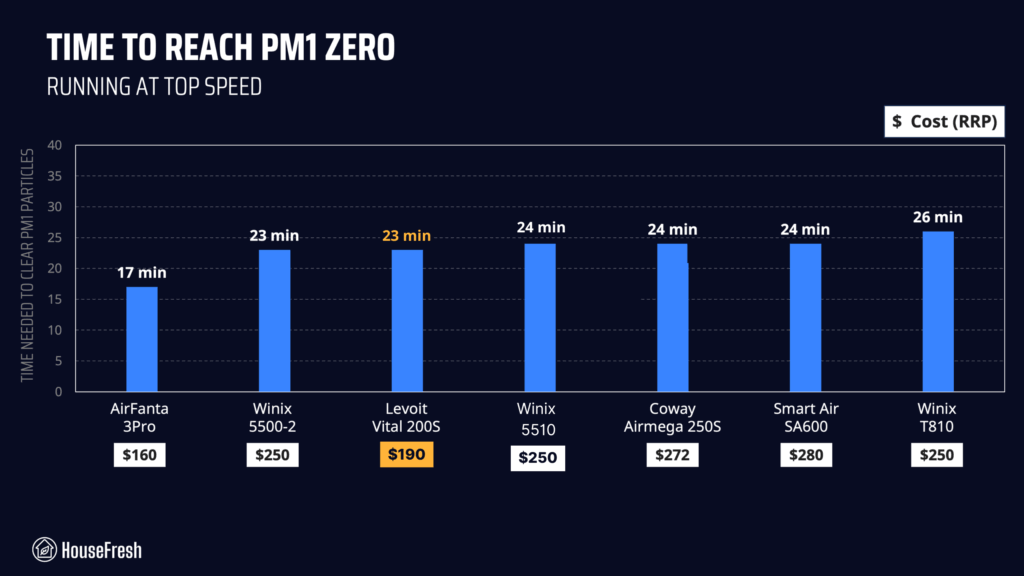
Levoit Vital 200S23 minutes$189.99
Winix 5500-2 (with ionizer)23 minutes$249.99
CleanAirKits Luggable XL-723 minutes$299.00
Smart Air SA60024 minutes$279.95
Coway Airmega AP-1512HH (with ionizer)26 minutes$229.99
PuroAir 40030 minutes$249.00
Corsi-Rosenthal Box32 minutes$85.00

Testing air cleaning performance at sub-45 dB

Since we first published this review, we have received many requests for information on air cleaning performance at low fan speeds. This makes sense, as the top speed is unlikely to be used regularly, as most people will find it too loud. We used the 45 dBA limit that CleanAirStars sets for noisy classrooms.

For the Winix 5500-2, fan speed 2 is under 45 dBa (42.5 dBA). When we tested the Winix 5500-2 using Plasmwave at clearing incense smoke from our 728 cubic feet test room at speed 2, it needed 45 minutes to achieve PM1 zero, according to our Purpleair Zen sensor.

If you were wondering the effect Plasmwave had on the air cleaning performance, we tested again at Speed 2 with Plasmwave disabled it managed to achieve PM1 zero in 46 minutes so only 1 minute slower.

Noise level test results 

The last test is to see how much sound is generated when using the purifier, especially at its highest and lowest fan speeds.  The quieter an air purifier, the more likely you will use it, which will mean cleaner air in your home. 

Here are the sound level results from 3ft away:

ModeSound Level
Speed 138.8 dBA
Speed 242.5 dBA
Speed 347.5 dBA
Speed 458.9 dBA

Check out how this compares to other air purifiers we tested in the table below:

AIR PURIFIER MODELSOUND LEVEL AT TOP SPEED (dB) TIME TO CLEAN OUR TEST ROOM
Smart Air Blast Mini MKII56.3 dB15 minutes
Levoit EverestAir57.8 dB16 minutes
Coway Airmega AP-1512hh Mighty60.1 dB25 minutes
IQAir Healthpro Plus61.2 dB28 minutes
Winix 5500-258.9 dB23 minutes
AirDoctor 300063.6 dB20 minutes

We know the sound is highly subjective, so be sure to listen to the sound test we produced after testing the Winix 5500-2:

The cost to run a Winix 5500-2: $137.81 per year

1. Electricity costs = $57.82 per year

At the lowest fan speed, the Winix 5500-2 only pulled 6.5 watts per our energy meter and reached a maximum of 53.46 watts on its turbo speed with Plasmawave enabled.

Assuming energy prices of $0.174/kWh, running the 5500-2 continuously 24 hours per day for every day of the year would add $57.82 to your annual electricity bill. Most people will find that they will use the unit for less time than in our scenario, but others with issues with allergies might need to keep it running continuously.

Fan speedEnergy consumed (ionizer enabled)
Standby0.34 watts
Sleep3.43 watts
166.5 (7.1) watts
29.11 (9.2) watts
314.80 (15.00) watts
453.46 (53.8) watts

2. Filter costs = $79.99 per year

The genuine True HEPA and activated charcoal filters will need replacing every 12 months and have an RRP of $79.99 but are regularly available for close to $50 with sales and discounts. When I wrote this review, you could buy filters from Winix for $49.99 and Amazon for $43.99.

There are plenty of generic filters that bring the price down even more, with a year’s worth of filters costing close to $15 per year if you buy in a pack of four or $19 for a pack of two.

In the table below, we compare running costs with other similar performing air purifiers we have tested:

AIR PURIFIER MODELESTIMATED ELECTRICITY COST (per year) FILTER REPLACEMENT COST (per year)YEARLY MAINTENANCE COST
CleanAirKits Luggable XL-7$12.22$45.94 $58.16
Levoit Vital 200S$46.83$49.99$96.82
Coway Airmega AP-1512hh Mighty$83.64$39.99$123.63
AirFanta 3Pro$46.56$78.67$125.23
Levoit Core 400S$27.44$99.98$127.42
Winix 5500-2$57.82$79.99$137.81
PuroAir 400$77.75$89.00$166.75
Smart Air SA600$56.55$141.47$198.02

Bottom line: Is the Winix 5500-2 worth it?

The 5500-2 impressed me with its improved performance and use of pelleted activated carbon instead of the fabric we saw in the 5300-2.

The 5500-2 comes with an ionizer via its PlasmaWave technology that helps deal with odors and gases. However, it still offers great air cleaning performance even without using this function, as it removed all PM1 in our test in under 23 minutes without PlasmaWave enabled.

Winix 5500 2 Close Up

Filter prices are fair, considering the use of activated carbon pellets. Due to the device’s popularity, there are many choices for generic filters if you want to save more money in the long term. I much prefer the 5500-2’s removable pre-filter, which makes it much easier to clean and vacuum, than Levoit Core devices like the 400S and the 600S, which have the pre-filter integrated into the main filter.

It is worth mentioning that this air purifier doesn’t have app support, but it does have auto-mode. Just remember to keep the sensor clean of dust to ensure it works effectively. 

For the price, the Winix 5500-2 is one of the top air purifiers – especially considering the amount of pelleted activated carbon it comes with. It offers excellent air cleaning performance, relatively low long-term costs and minimal noise generated. If you prefer different colors, you may be interested in the Winix C545, and if you don’t care about the particle filters, you can save a little money with the grey Winix 5300-2, which is usually sold cheaper but has a less effective gas filter. 

It is unfortunate to learn that Winix has decided to discontinue this air purifier as it was one of my top recommendations due to the incredible value for money that it offers. If you like what the 5500-2 has to offer, make sure to check out the Winix 5510 (left).

Winix 5510 VS 5500 2 Front

This new model from Winix packs the same air cleaning power as the 5500-2 in a smaller and better-looking package, with app connectivity and an on-board air quality sensor. Read my full review of the 5510 to find out more.

If you have the Winix 5500-2 or have any other questions I haven’t covered, be sure to let me in the comments section below.

SOURCES

We calculated the yearly costs associated with running the Winix 5500-2 for 24 hours a day, 365 days per year, utilizing the latest average energy prices reported by the Bureau of Labor Statistics of $0.17/kWh as of November 2024.
Levoit Vital 200S review

Levoit Vital 200S Living Room

Levoit is probably the best-selling air purifier brand in the United States. That fact will not surprise you if you, like me, have used Levoit air purifiers in your home.
Their product range includes top-end devices like the Levoit EverestAir, which is one of the fastest air purifiers we have tested, reaching PM1 zero in a swift 16 minutes. Levoit also produces budget-friendly air purifiers like the trusted Core 300, which managed to clean our room in 54 minutes.

So, we were excited to finally get a chance to test and review the Levoit Vital 200S. It has a more traditional look than the EverestAir or the Core series, and is aimed at medium-sized rooms up to 400 square feet.

We bought the Vital 200S with our own money so we could test it following the same methodology we have used to test over 100 air purifiers since 2020. In this review, I will share the results of our tests and my experience after having this device at home for well over two years now.

The pros and cons of the Levoit Vital 200S

A summary of our top-level findings after testing this air purifier following our methodology.

💡exclusive code for HouseFresh for 10% off a single purchase on Levoit.com: HOUSE10

A super efficient fan combined with a high-quality particle and activated charcoal filter results in a powerful air purifier.

Retailing at $189.99, the Levoit Vital 200S gives you plenty of bang for your buck.”

Danny Ashton HouseFresh
Danny Ashton
HouseFresh Founder
& Lead Tester

CONS

It has a bonded filter, so once the carbon runs out (which usually happens within 6 months), you’ll have to replace the whole thing, even if the particle filter still has life in it.
The air quality sensor is an optical sensor, so you need to keep it clean for it to report accurate readings.
I would like to see an independent test that could offer a filter grade after Levoit removed all mentions of HEPA from their marketing.

PROS

It offers a high level of air cleaning performance to $ ratio, completing our particle removal test as fast as units double its price.
You get smart features and smartphone connectivity through Levoit’s VeSync app.
It remembers settings and modes, so if you unplug it and plug it back in, the Vital 200S will still remember what it was last doing.
There are a ton of generic filters available that keep long-term costs low.

Clean air delivery rate (CADR):– Top speed PM1 CADR: 249 cfm
– Sub-45 dBA PM1 CADR: 128 cfm
– AHAM PM2.5 CADR: 254 cfm (dust)
Filter technology:Bonded particle filter with a layer of pelleted activated carbon and a removable pre-filter
Recommended room size:373 sq. ft. (5 air changes per hour)
Dimensions:15.6D x 8.5W x 19.8H inches (39.3D x 21.5W x 50.2H cm)
Weight:13.2 lbs (5.9 kg)
Noise level in decibels from 3 ft. away:Speed 1: 38.3 dB
Speed 2: 41.9 dB 
Speed 3: 53.8 dB
Speed 4: 57.7 dB
Electricity consumption in watts:Standby mode: 0.97 watts
Speed 1: 5.71 watts
Speed 2: 8.01 watts
Speed 3: 31.96 watts
Speed 4: 44.55 watts
Filter lifespan:12 months
Manufacturer’s warranty:2 years
Country of origin:United States
Country of manufacture:China

In August of 2023, Dyson officially challenged Levoit’s use of ‘True HEPA 13 filters’ in their marketing and advertising through the BBB National Programs National Advertising Division (NAD). As a result, Levoit removed all mentions of “HEPA H13” in their marketing materials for all their air purifiers (including the Vital 200S).

Now, it’s worth mentioning that a higher grade HEPA is not required to clean the air of even the tiniest particles, as lower grade filters still pick up these small particles in multiple passes. Still, we don’t appreciate manufacturers not being transparent about technical specifications.

Design and smart features

A rectangular design that houses a powerful fan, a bonded filter and an air quality sensor.

Levoit Vital 200S Living Room

💡exclusive code for HouseFresh for 10% off a single purchase on Levoit.com: HOUSE10

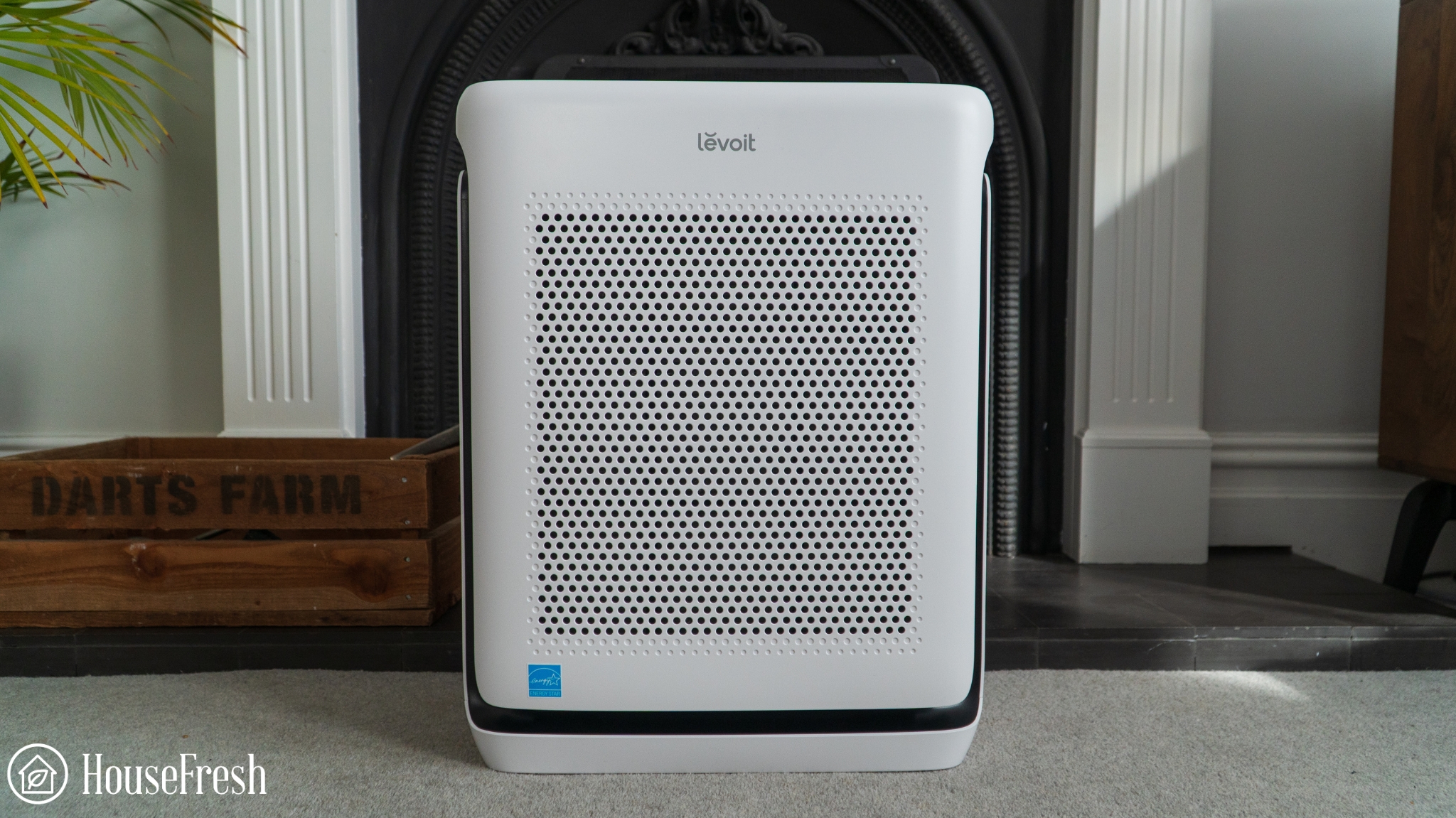
Rather than use the cylindrical design we see with the Levoit Core series, the Vital 200S is a standard rectangle that pulls air from the front and pushes it out of the top. 

Levoit Vital 200S Close Up

Compared to the Levoit air purifier range, it shares a closer resemblance to the premium Levoit EverestAir, although I have to say I prefer the look of the pricier EverestAir — do you blame me? Have a look at it:

Levoit EverestAir Fireplace
Levoit Vital 200S Sensor

You will need to clean the optical sensor every two months to ensure it continues to be accurate when using the device on auto mode. This is one of the reasons why I prefer laser sensors, as I know many people will forget to clean the sensor and this will lead to the air quality readings not being as accurate as they could be.

Levoit Vital 200S Top

From right to left you get an auto-mode button, a night mode button, the fan speed button, the power button, a timer button, a child lock button and lastly a button to turn the lights on and off. The power button is surrounded by an LED ring that changes color surrounded by lights that change color depending on indoor air quality. 

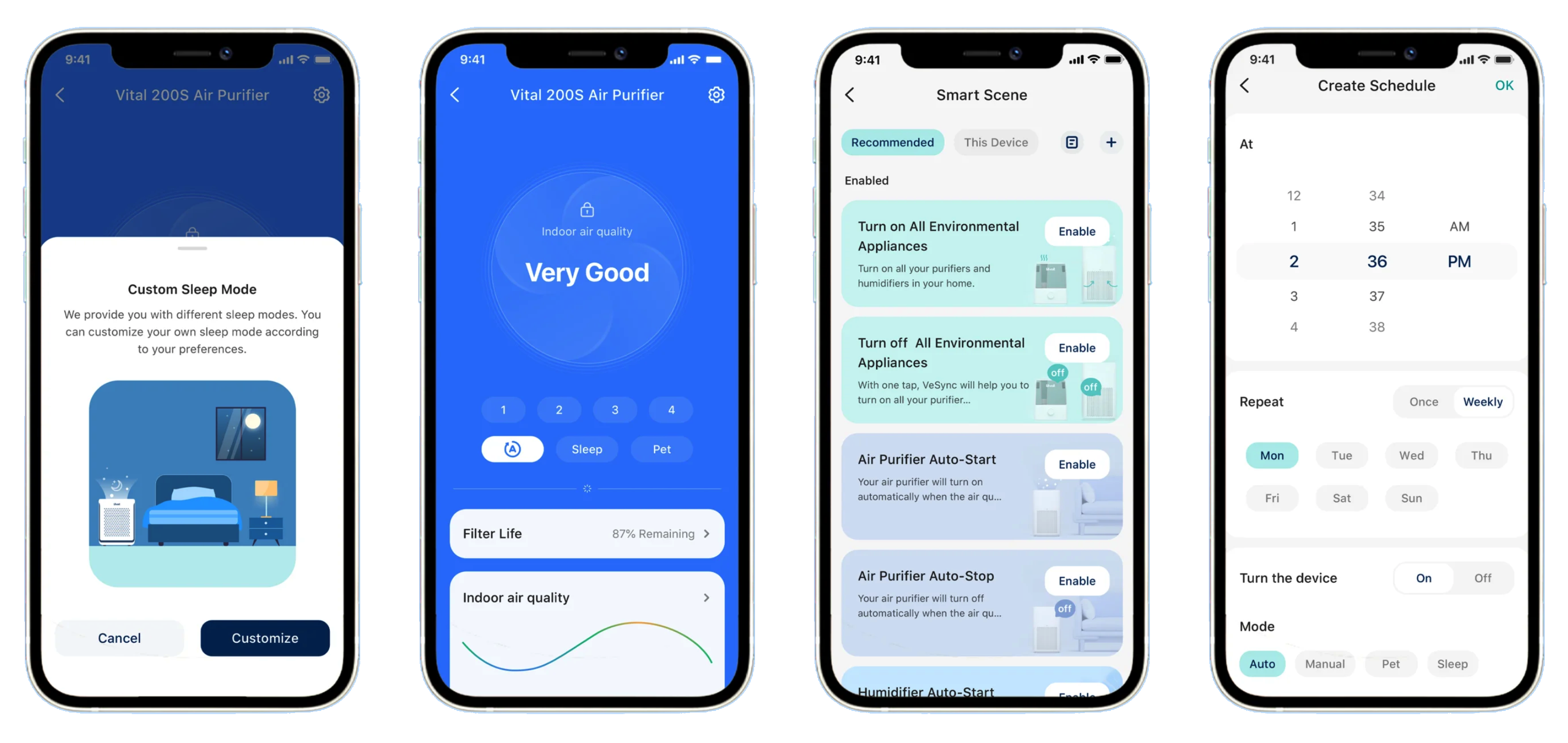
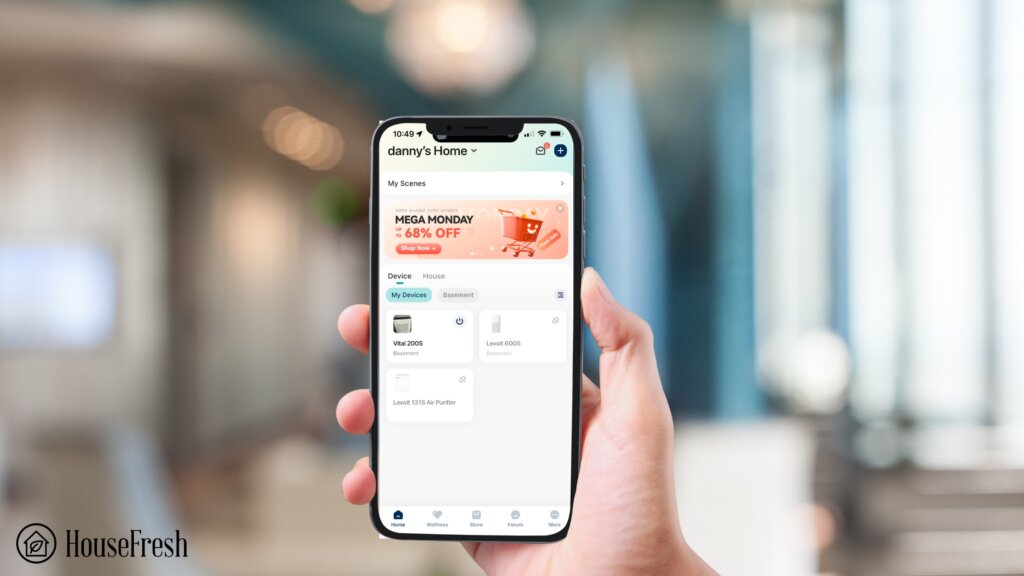
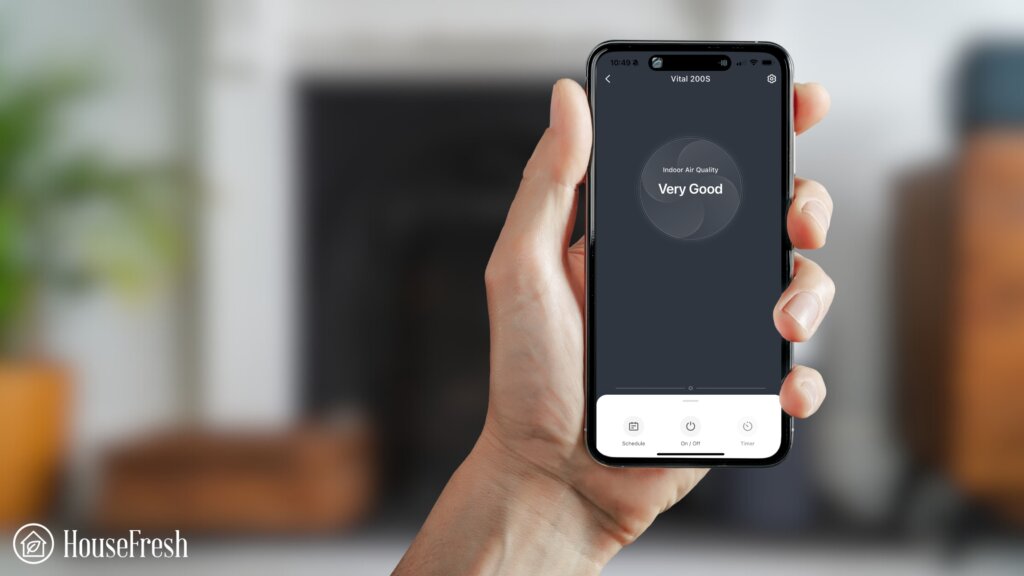
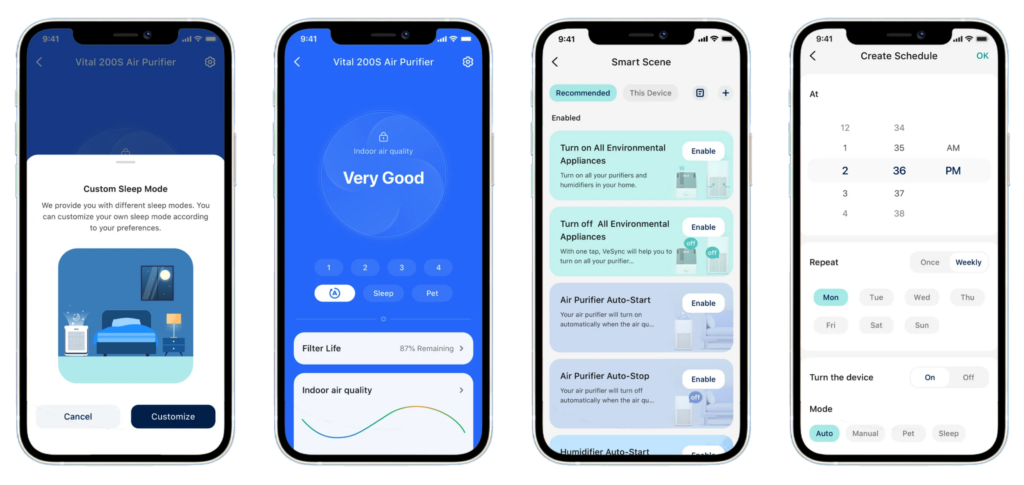
The Vital 200S comes with app connectivity through the VeSync app, which is the app used by a range of Levoit gadgets and is well-rated across Android and Apple ecosystems. 

Levoit Vesync App

The app uses Vesync, which is the app used by a range of Levoit gadgets and is well-rated across Android and Apple ecosystems. 

I tested the Apple app, and it was easy to install and add the Vital 200S quickly. You can adjust the air purifier’s settings via the app and also see what the current indoor air quality rating is in the room where it’s set.

Levoit Vesync App
Levoit Vital 200 App Ad
Levoit Vital 200 App

The main app screen has internal ads for different Levoit products, which I would prefer it didn’t, but once you go into the air purifier, there are no ads shown. 

One feature that I haven’t seen in other Levoit air purifiers is a light detection mode that allows the device to switch off the display and run extra quiet when low light is detected. This is a great feature for those wanting to use it in a bedroom. 

Levoit Vital 200S Bedroom

Filtration technology

An all-in-one particle filter with pelleted activated carbon. You will need to replace both filters even if only one of them needs replacing.

Levoit Vital 200S Filter Side

Levoit initially stated that the Vital 200S uses HEPA H13, which is medical grade and can remove 99.97% of particles measuring 0.3 microns. But as you know, Dyson’s challenges Levoit’s claims through the BBB National Programs National Advertising Division (NAD) and as a result, VeSync removed all mentions of ‘HEPA’ from their marketing materials.

Levoit Vital 200S HEPA Filter

It comes with a bonded particle and gas filter that performed very well in our particle removal test.

Levoit Vital 200S Activated Carbon Filter

The gas filter uses pelleted charcoal that is much better than the impregnated fabric we see with some manufacturers. 

How to Vacuum Air Purifier Pre Filter

It comes with a removable pre-filter which is much easier to clean than the pre-filter in the cylindrical Core 300/300S.

While you do get a good amount of activated carbon in the Vital 200S, if you have serious issues with VOCs and gasses, you should look for an air purifier with a much bigger filter with lbs of activated carbon such as the Alen BreatheSmart 75i, the IQAir HealthPro Plus and the Austin Air HealthMate.

Remember that most air purifier filters will arrive in a plastic bag, so be sure to remove the filter from the bag before you switch it on; otherwise, it will make your air quality worse!

Levoit Vital 200S Open

When the time comes to change the filter in your Levoit Vital 200S, you’ll find that the process is simple and straightforward.

Air cleaning performance

The real-world performance of the Levoit Vital 200S matches reported CADR scores.

Running at full speed, the Vital 200S brought the levels of PM1ug/m3 to zero in 23 minutes. That makes the Levoit Vital 200S one of the fastest units we have tested under $200.

The Levoit Vital 200S was able to complete our particle removal test faster than the popular Winix 5510 but without using an ionizer function.

Levoit Vital 200S Particle Removal

As the table shows, the AirFanta 3Pro offered a higher clean air delivery rate for a cheaper price. This goes to show the power of PC fans compared to retail HEPA air purifiers.

Sound levels

In our testing, the sound levels of the Vital 200S ranged from 38.3 to 57.7 dBA

Levoit Vital 200S sound test

As I always say, air purifiers that are too loud, get turned off eventually. That is why we used a sound meter to measure how much sound the Levoit Vital 200S generates from three feet away. We did this across all four fan speeds:

FAN SPEEDSOUND LEVEL
Speed 138.3 dB
Speed 241.9 dB
Speed 353.8 dB
Speed 457.7 dB

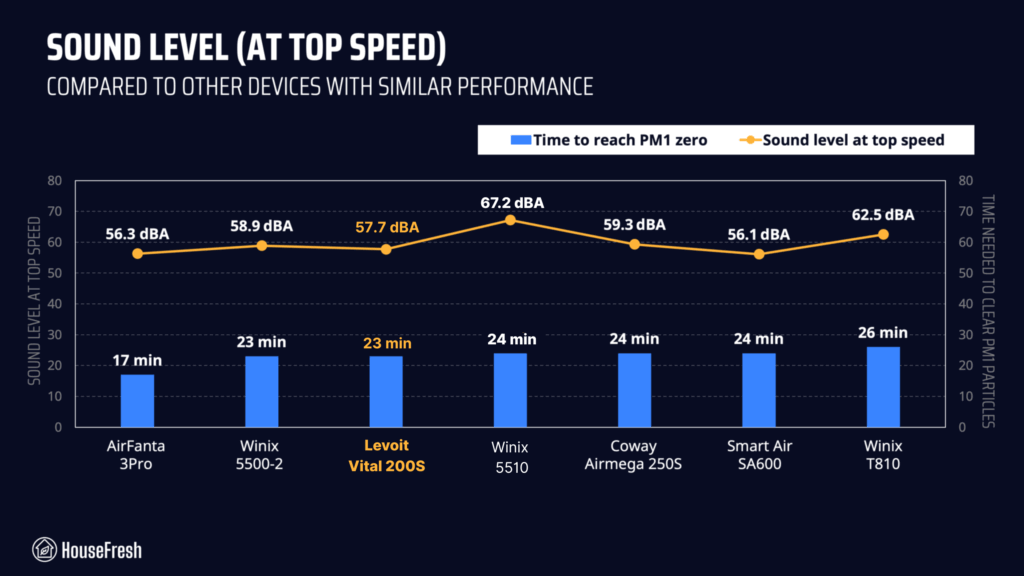
We can now compare the air cleaning performance and sound level at top speed against data from other air purifiers in the same price range:

Levoit Vital 200S Sound Performance

As you can see from the table, the sound generated by the Vital 200S at top speed is quieter than that of most other air purifiers with a similar clean air delivery rate.

Running at the Vital 200S at speed 2 generates 42.5 dBA of sound, which is below the 45 dB(A) limit we have set for our quiet performance tests.

So I repeated the particle removal test with the 200S running at speed 2, and it managed to reach PM1 zero in 46 minutes.

Levoit Vital 200S Sub45 dB

As you can see from the table, the Vital 200S offers more powerful air cleaning performance at sub-45 dBA fan speeds than popular devices such as the Winix 5510 and the Coway Airmega 250S.

However, it is still no match to PC fan-powered air purifiers such as the Luggable XL-7 from CleanAirKits and the AirFanta 3Pro.

But sound can be very subjective, so we recorded a video of the air purifier running at different fan speeds:

Long-term running costs

Running a Levoit Vital 200S will cost you $99.47 per year, combining energy consumption costs and filter replacement prices.

As always, we used our energy meter, we recorded a maximum of 44.55 watts consumed by the Vital 200S when running at full speed. This equates to $49.48 per year if you were to keep it running 24 hours per day at its highest speed. 

Here are the full results for each fan speed:

MODEENERGY USAGE
Standby0.97 watts
Sleep mode3.21 watts
Speed 15.71 watts
Speed two8.01 watts
Speed 331.96 watts
Top Speed44.55 watts

This tells me that the Levoit Vital 200S has a very efficient fan that can move a lot of air without excessive energy usage. It’s great to see that newer models of air purifiers can perform well AND be energy efficient.

Considering you need to replace the filter every 12 months and that the replacement costs $49.99, you can expect to also spend $49.99 per year on filters.

When we combine the estimated electricity costs with the filter replacement costs, you can see that the Vital 200S offers great value in the long term as well:

Levoit Vital 200S Yearly costs

Regarding the filters themselves, you have other options in addition to the original filter: one aimed at those looking to deal with pet allergies, a smoke remover filter, and one that includes toxin absorbers. The price of these filters ranges from $49 to $65 dollars, so they are not cheap but they are also not super expensive.

If you want to reduce yearly running costs further, you will be happy to hear that there are many generic filters available for half the price of the genuine filters from Levoit – it’s worth mentioning that performance will vary:

Bottom line: Is the Levoit Vital 200S worth it?

With a list price of $189.99, it offers excellent value for the money, with air cleaning performance that matches units that cost twice the price.

Levoit Vital 200S Fireplace

If you want to get the best air cleaning for $ ratio and want to avoid ionizer technology, the Levoit Vital 200S is definitely worthy of consideration.

It includes many smart features that are normally only found on more expensive models but still manages to clean the air as effectively as we’ve seen from units like the iconic Winix 5500-2 but without the use of an ionizer.

Those with larger spaces will want to look at bigger units like the Levoit Core 600S ($299.99), but for those with a space between 400-500 square feet, the Vital 200S is a great choice as it will be able to keep your air clean for an affordable price. 

Noise levels associated to the Vital 200S are lower than the average and it comes with a sleep mode and the possibility of turning off the lights of the display (not to disturb your sleep), making it a very good option for a medium-sized bedroom.

Levoit Vital 200S Bedroom

💡exclusive code for HouseFresh for 10% off a single purchase on Levoit.com: HOUSE10

Due to the lack of a True HEPA H13 filter, I don’t recommend this device for medical settings. However, as our in-house test showed, the Vital 200S can clean all tiny particles of 1 micron in 23 minutes. Air cleaning performance nearly three times as fast as the Levoit Core 300 ($99) and is only one minute slower than the larger Levoit Core 600S ($300).

For those who want to keep a medium-sized room clean of tiny particles and don’t want to spend more than $190, then the Levoit Vital 200S is well worth checking out. And if money is tighter, do check out the PC fan-powered AirFanta 3Pro.

If you decide to buy a Vital 200S and want to support the work we do at HouseFresh, please use this link so we can earn a commission at no extra cost to you. And if you have any questions about this device or about Levoit air purifiers in general, please drop them in the comments below and I’ll reply as soon as I can.

TaoTronics AP003 review

TaoTronics TT AP003 Room 1 1 e1680774717302

TaoTronics is an interesting brand that is part of the Sunvalley group based in China, which was profiled by The New York Times back in 2017. They offer a wide range of technology products, from headphones to air purifiers.

At one point, TaoTronics was making $300 million from Amazon alone, so it was a shock when I read that all brands under the Sunvalley group were kicked off Amazon last year for breaking review rules. 

As we generally focus on air purifiers readily available on Amazon, we hadn’t yet had a chance to test any of the units from TaoTronics. Still, I chose to push ahead with a review after using a tool from ClearnAirStars, an NGO run by Dr. Pieter Peach from Australia. His tool results showed the TaoTronics AP003 was at the top for best performance for non-DIY air purifiers! So, I had high hopes for this unit.

When Chinese brands first entered the U.S. market with their generic designs, they could often compete on price but were disappointed with the quality. As any consumer will now relate, Chinese versions of electrical appliances can now match the performance of Western brands and, in many cases, even outperform them.

The TaoTronics AP003 clearly focuses on the budget end of the air purifier market. With an entry price of $99.77 but a CADR of 226 CFM (384 m³/h), its performance aligns with far higher-priced units.

On paper, the AP-003 looks like ‘the Levoit Core 300 killer’, with the ability to clean more air for less money. But we must take a more in-depth look at this unit before celebrating too early.

As with all our reviews here at HouseFresh, we bought the TTAP003 with our money. In this case, we bought the unit directly from taotronics.com, and while it wasn’t as fast as Amazon, the delivery was within just a few days, and the communication was excellent along the way.

We use our own money because we don’t want any external biases. We want to say exactly what we think so that our readers can choose the right unit for their particular use case. We also don’t just take CADR figures for granted; we test using our own equipment to see how real-world performance matches up to the numbers on the box.

how we test
How we test air purifiers

Read our full testing methodology.

We believe this is the only way you can assess and compare air purifiers fairly, as we tested them all performing the exact same jobs under the exact same conditions. This is how we can uncover jewels (like the AP003) and highlight devices that don’t live up to the hype (cough, Molekule cough).

So, let me walk you through what we learned when testing this air purifier.

The lowdown on the TaoTronics AP-003

Danny Ashton HouseFresh
“The TaoTronics AP-003 is a budget air purifier that offers powerful air cleaning power and features premium functions. Unfortunately, it won’t be available on Amazon, but you can buy it directly from the TaoTronics store and also might find it on eBay for less than $99.

As of September 2024, finding this device is becoming increasingly difficult, so I recommend looking into one of the various other brands selling the exact same model as the AP-003 is a white-labeled design. I tested the Lago air purifier (available in the U.S.) and the Midea SmartAir Pure Control (available in Europe), with both devices matching the performance, noise level generation and electricity consumption of the TaoTronics AP-003.”

— Danny Ashton, HouseFresh Founder & Senior Writer

PRICE ON EBAY
PRICE IN EUROPE PRICE IN THE U.K.

If you don’t have the time to read my 3000+ word review, then get the main gist with the following bullet points:

What we really like

It costs less than $100 to achieve the high-speed air cleaning performance you can expect from devices that cost twice as much.
Sound levels are well below industry standard, which confirms the presence of a very efficient motor.
It comes with Pure HEPA and activated charcoal. There isn’t an ionizer, which means zero ozone is created.
One of the best-priced filters we have seen for units with such large filters.
It comes with activated charcoal pellets, normally only seen in premium units that cost about $200.

What we think could be better

It is currently out of stock on the TaoTronics store and finding it on eBay is becoming impossible. Fortunately, you can buy the same device sold under other brands, such as Lago in the U.S. or Midea in Europe.
There is no app support. This doesn’t bother me, but it is something to consider.
It doesn’t come with enough activated charcoal to tackle serious issues related to VOCs.

HouseFresh rating:★★★★★
Time to clean our 728 cubic feet test room (with the device running at top speed):26 minutes
Air purifier technology:H13 HEPA with activated carbon pellets
Recommended room size (4.8 air changes per hour):307 sq. ft.
Clean air delivery rate (CADR):Dust: 202 CFM
Smoke: 198 CFM
Pollen: 215 CFM
Dimensions (in inches / in cm):21.8 x 14.1 x 7.9 inches (55.4 x 35.8 x 20cm)
Weight (in pounds / in kg):13.64 lbs (6.19 kg)
Filter life:6 months
Noise level in decibels (measured from 3 ft. away with a sound level meter):Speed 1: 38.4 dB
Speed 2: 42.8 dB
Speed 3: 54.2 dB
Electricity consumption in watts (recorded with an electricity usage monitor):Standby mode: 0.7 watts
Speed 1: 5.9 watts
Speed 2: 10.5 watts
Speed 3: 36.5 watts
Estimated running cost (electricity consumption + official filter replacement):$90.66 per year
Cost per CADR cfm (based on dust CFM as reported by AHAM):$0.49
Manufacturer’s warranty:1 year
Country of manufacture:China

Looks good, modern (and expensive)

The TaoTronics AP003 comes with a sleek design and looks way more expensive than it costs.

TaoTronics TT AP003 Close

One of the big things Chinese manufacturers have been investing in is improving product design style. When my wife saw the AP-003, she thought it looked good (and expensive), which is an impressive job considering this unit is less than $100. It looks modern but doesn’t have a strange shape, so it should be easy to have in the corner of a room without looking out of place.

TaoTronics TT AP003 Sofa Corner

The main thing that stands out with this air purifier is the screen that shows the current air quality level. It doesn’t just give an estimate like many of the other air purifiers that contain sensors but it shows the exact level of pollutants to the nearest ug/m3. The screen looks high-end and doesn’t match the budget cost.

TaoTronics TT AP003 Screen

The inclusion of the screen makes a big difference compared with the Levoit Core 300S. Whilst most people can easily see that blue is clean and red is problematic, having the exact figure feels like a big step up. It is certainly bigger than the Levoit Core 300S and has a large footprint, but it’s not excessively big like the Alen 75i or IQAir Healthpro plus, both of which take up a ton more space. 

TaoTronics TT AP003 Comparrison

The TaoTronics AP003 has an uncomplicated menu system with a child lock button, timer, speed (3 options), auto mode, sleep mode, and on-off button. 

TaoTronics TT AP003 Controls

I don’t mind that there are no app-supported features, as I rarely use the app with air purifiers instead of the onboard buttons. This is especially true with purifiers that include auto-mode, as you just set, forget, and change the filters. One standout app would be that from Dyson, such as the one they include with their air purifier/fan combos, but most others are usually poorly designed with little usefulness for day-to-day use. 

For those looking to build a “smart home” you might prefer another unit, but for the rest of us, the TaoTronics AP-033 is simple enough to get going without the need to Google anything or *gasp* read the manual.

High performance filters for a low price

The filters in the TaoTronics AP003 are of excellent quality despite the low price tag.

TaoTronics TT AP003 Filters copy

Both the HEPA filter and activated charcoal filter in the AP-003 are of good quality. You will often find cheaper impregnated carbon filters such as those used in the Winix 5300-2, which still help to remove odors but are not anywhere near as effective as those that use actual charcoal pellets that you use on this unit.

Whilst odors might not be your primary concern for keeping your air clean, the addition of activated charcoal doesn’t have any negative effects on performance, and you will be surprised at the amount of odor-causing chemicals in your home. 

TaoTronics TT AP003 Unit HEPA

The actual size of the filters still constrains mechanical filter technology, so it’s good to see such a large amount of space dedicated to the filter with this unit. Adding the pre-filter is a good way to keep large particles from damaging the HEPA filter. Still, the main job of filtering the air is done using the H13 HEPA — the grade of HEPA recommended for medical uses.

In reality, all HEPA-grade filters can filter very small particles, and as we saw with the Smart Health S, even a lower-grade filter such as H11 can still perform very well in reducing PM2.5 particles in the air.

But it’s generally preferable to see a higher-grade HEPA filter if you have the right powered fan to push air through the filter, so we’re thrilled with including H13 in such a low-priced unit.

TaoTronics TT AP003 Replace Filter

The TaoTronics team did an excellent job of making new users aware that they must remove the plastic bag from the filters before usage. They use a big yellow sticker visible when you remove the air purifier from the box. You will be amazed at how many people still forget to remove the plastic, so be sure to do that before you switch on your unit, as it otherwise might worsen the air.

Taotronics AP003 Filter label

When the time comes to change the filter in your TaoTronics TT-AP003, you will be pleased to find out that it’s quite a simple task that won’t take a lot of time and won’t require you to read a manual to perform:

The TaoTronics AP-003 cleared our test room in 26 minutes

The AP-003 blew us away with its impressive air-cleaning performance, considering this is a budget-friendly air purifier.

Most air purifier reviews are written by journalists who play with the unit and take some pictures but don’t go further. At HouseFresh, our goal is to go a lot deeper into how an air purifier will work and how well it will keep your home air clean. 

Indoor air quality hasn’t always been a top priority for homeowners. Still, since Covid-19, there has been a ton of new research that has shown how important air quality is, both to your respiratory system and even your mental health

We know that most consumers will not be excited about the latest air purifier launch like they are about the latest iPhone. However, we do believe that air quality health will become a major concern for American homeowners, especially considering the rise of wildfires affecting the country. The air purifier industry has a reputation for selling products that promise a lot but fail to deliver, so we think it’s important that we help make life a little easier by thoroughly testing and assessing every unit we recommend. 

All our tests are done in the same room to compare different units, which all have the same job — removing all the pollutants generated by one incense stick in our 705 cubic ft office. We use the indoor sensor from Purpleair to track levels of PM1.0ug/m3, PM2.5ug/m3, and PM10.0ug/m3 over time so we can see how effective the air purifier is at removing these tiny particles from the air. 

The main number we track for our testing is how long the air purifier takes to bring the pollutants down to 0.

On paper, the TaoTronics AP-003 has some big numbers for its price, with a CADR of 384 m³/h/226 CFM.  This CADR is even higher than the old flagship air purifier the Alen A350, and even is in the same realm as the Levoit Core 400S (which costs $219.) If the performance test matches this CADR, it’s going to be easy to recommend this unit to those looking for cleaning on a budget.

So, how did it do?

Here are the main pointers:

  • It took 26 minutes to remove all the pollutants from our test room!
  • This was higher than the Mila (35 minutes) and even the BreatheSmart 45i (34 minutes), which was meant to have a slightly higher CADR on paper.
  • It was less than what we saw with the Alen 75i and IQAir Healthpro Plus (24 minutes), but both units are much larger, cost more and use way more electricity.

Let’s put that into perspective by comparing it to the top 10 best-performing units in our tests:

From a performance perspective, the TaoTronics AP-003 has the best air purifier performance for $ spent. 

Noise level results, compared

Another feature that makes the AP-003 stand out is the amount of sound generated. The TT AP–003 has a range of 38.4 to 54.2dB, which is fairly low compared with modern air purifiers.

Here is how the TaoTronics AP-003 compares against units with a similar air-cleaning performance:

The TaoTronics AP-003 has a very efficient fan motor, which allows it to clean a lot of air without generating a lot of noise.

The cost to run a TaoTronics AP-003: $90.66 per year

1. Electricity costs = $55.67 per year

One area many consumers of air purifiers forget is the cost of electricity. Air purifiers work best when they are running continuously so if you are not careful inefficient air purifiers can start to cost a lot of money over the long term. 

The good news is that the AP–003 manages to clean like a far more powerful unit than the amount of power it used. Using an electric meter, we saw a maximum of 36.5 watts at the top speed and 5.9 watts at the lowest speed.

This power usage is similar to the Levoit Core 300, which cleaned our test room in 40 minutes – the AP-003 is also our top unit for performance to electricity usage.

2. Filter costs = $34.99 per year

Another cost that gets forgotten is the cost of changing filters. Mechanical-based filters must be replaced every 6 months depending on usage, and costs can add up, especially for smaller units that run harder and longer. 

Genuine filters that contain both the HEPA H13 and activated charcoal are $29.99, which is a very fair price considering their size. In comparison, the IQAir HyperHEPA filters are $199 but are replaced less often but still end up costing a lot more in running costs.

If you are open to non-genuine filters, you can find two for $34.99, which is $17 per filter. This aligns with the cheapest filters we have reviewed for the FÖRNUFTIG from IKEA ($15.99) and Smart Health S from Smart HEPA ($29.99).

Long-term filter costs are very much in line with the very best in the industry.

Rioche TT-AP003 Premium H13 True HEPA Replacement Filter, Compatible with TaoTronics TT-AP003 Air Purifier, 3-in-1 Premium H13 True HEPA Filter, 2-Pack
  • ▶ Compatible with *TaoTronics *TT-AP003 Air Purifier. Compare to *VIVOSUN 5-in-1 Air Purifier (*FC-35S1A*) . Package of 2 pack.
  • ▶ H13 Grade True HEPA Filter helps remove up to 99.97% of airborne particles as small as 0.3 microns including lint, pet dander&pet fur, hair, dust, pollen, mold spores, dust mites, PM2.5, etc.
  • ▶ Activated carbon filter contains premium collumar activated carbon particles, which can efficiently absorb unwanted odors such as smoke, cooking smells pet odors and more.
  • ▶ 100% satisfaction. Recommended to replace every 3 to 6 months for optimal performance.

Bottom line: Is the TaoTronics AP003 worth it?

With a CADR of 226 CFM for less than $100, the AP003 offers incredible value for money. 

At the start of this review, I said I had high hopes for this air purifier. 

After testing this unit in our home, I’m happy to say we have found a Levoit Core 300 killer. It cleans the same level of air as much higher-priced units ($200+) and comes with low sound levels, energy usage, and filter replacement costs. 

I now understand why Dr. Pieter Peach at Clean Air Stars rates this air purifier so highly, as it offers excellent air cleaning performance at a truly affordable price, compared to the latest crop of air purifiers consistently aiming at the high-end of the market.

The only downside is the lack of app support, and you will still want more charcoal if you are looking to deal with serious odors or VOCs but for most people looking to keep their home air clean, you can’t go wrong with the AP-003 from TaoTronics.

TaoTronics TT AP003 Room 1

The main contender to the AP003 is the Levoit Core 300, but the unit from TaoTronics has it beat on both performance and short-term and long-term costs. The only challenge is where to purchase it since the main company has been kicked off Amazon, so you have two options: buying it directly from TaoTronics or hunting for it on eBay. Both of these options worked well up until mid-2024 when the AP003 started to show up as ‘Out of stock’ constantly on taotronics.com, and that seriously affected the number of units you can find on other marketplaces like eBay.

The good news is that the TaoTronics AP003 is built on a very popular ODM design that allows different brands to white-label the exact same device. You can see here the TaoTronics AP003 (right) next to the Lago air purifier (left), and you’ll notice that other than the color, the design is indistinguishable.

Lago Air Purifier VS TaoTronics AP003

BUY FROM EUROPE BUY FROM THE UK

I tested the Lago air purifier (available in the U.S.) and the Midea SmartAir Pure Control (available in Europe). Both units offer the same performance, generate the same noise levels, consume the same amount of electricity, and have the same estimated long-term costs as the TaoTronics AP003.

Let me know if you have any questions about the TaoTronics AP003 in the comments below, and I will get back to you as soon as I read your message. Also, watch out for my video review of this air purifier on our YouTube channel, where I will discuss the alternative models in more detail and share the results of our air cleaning performance test using generic filters available for a fraction of the price.

SOURCES

We calculated yearly costs associated with running the TaoTronics AP-003 for 24 hours a day, 365 days per year utilizing the latest average energy prices as reported by the Bureau of Labor Statistics of $0.17/kWh as of July 2024.