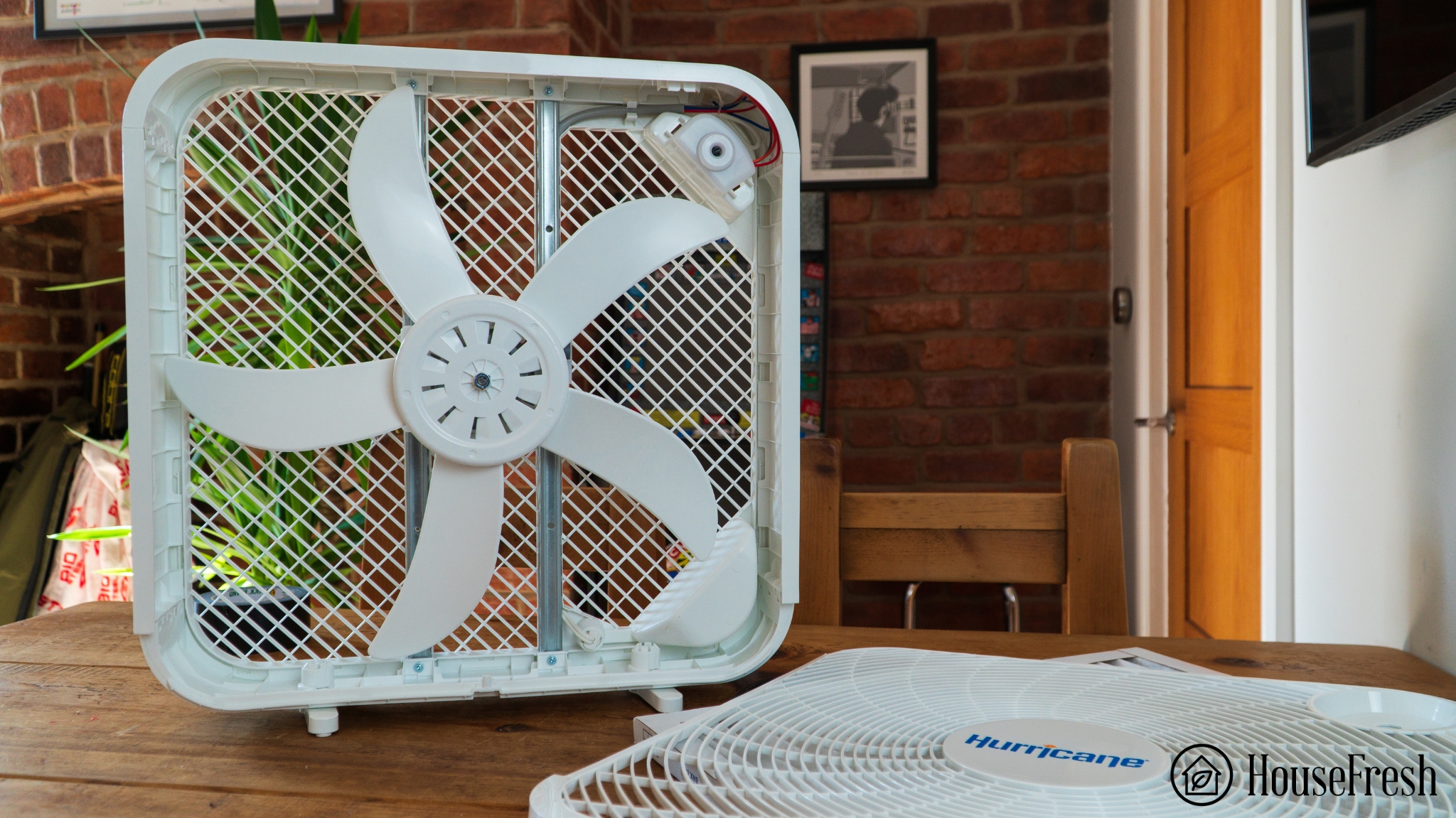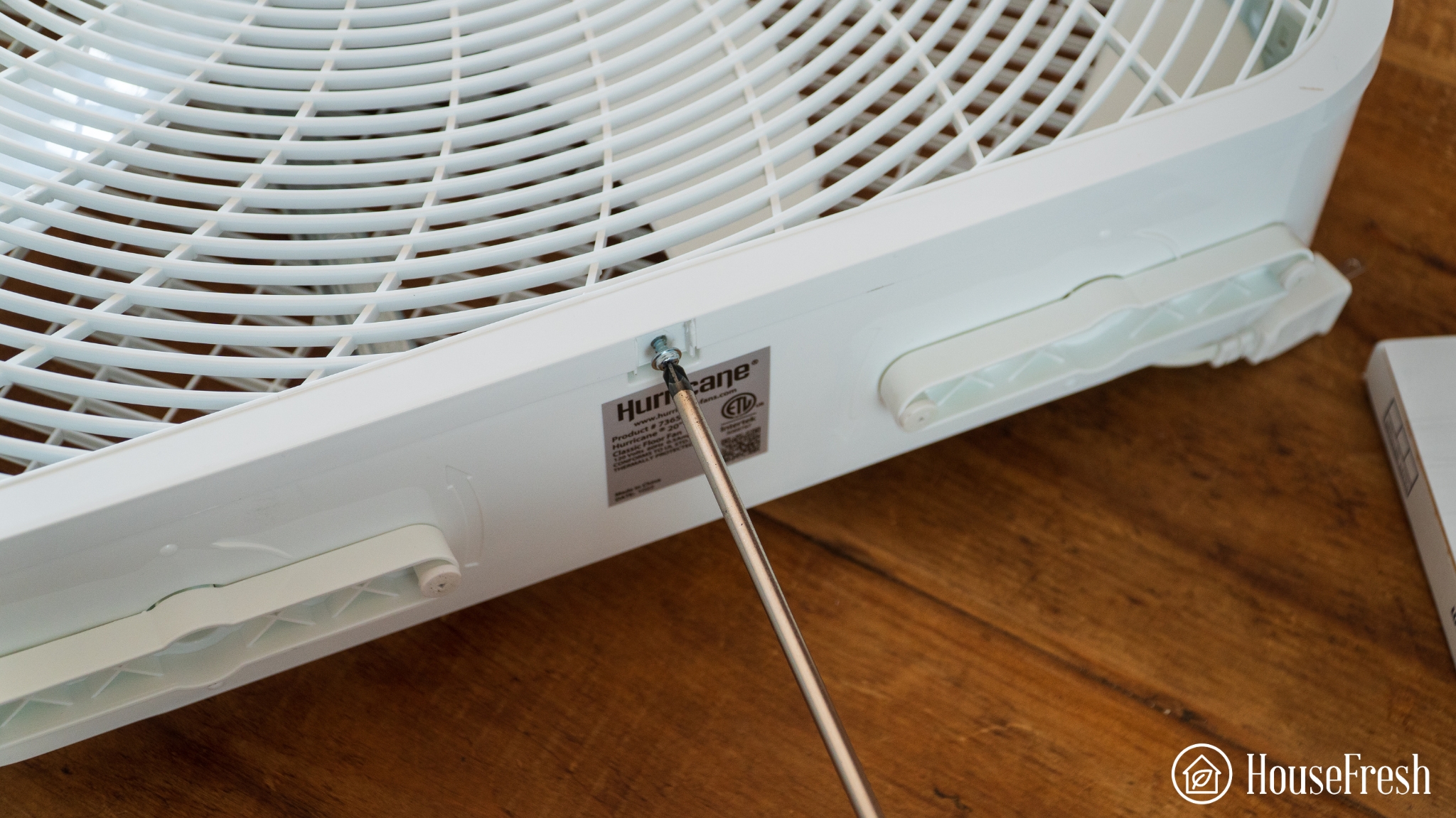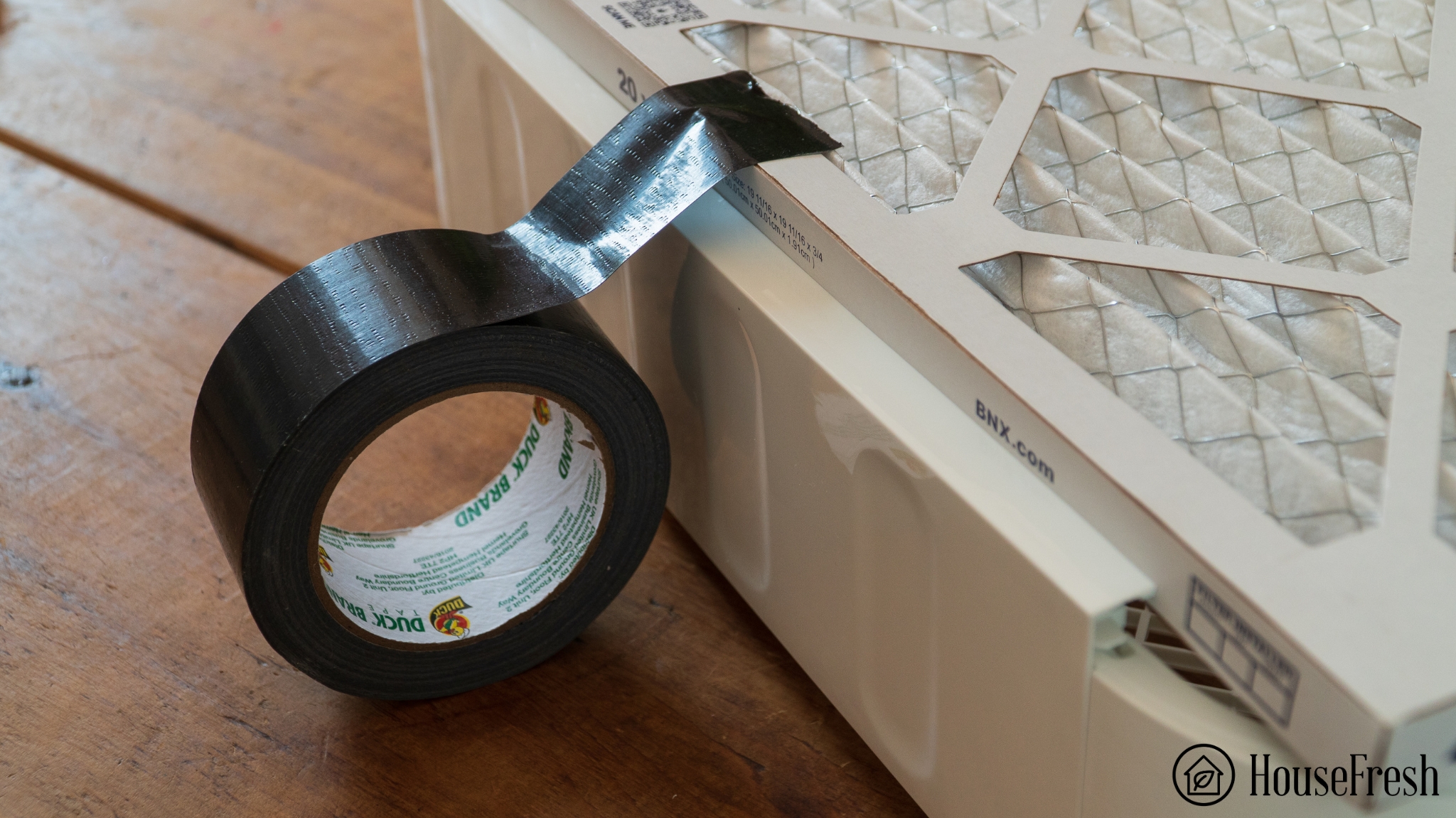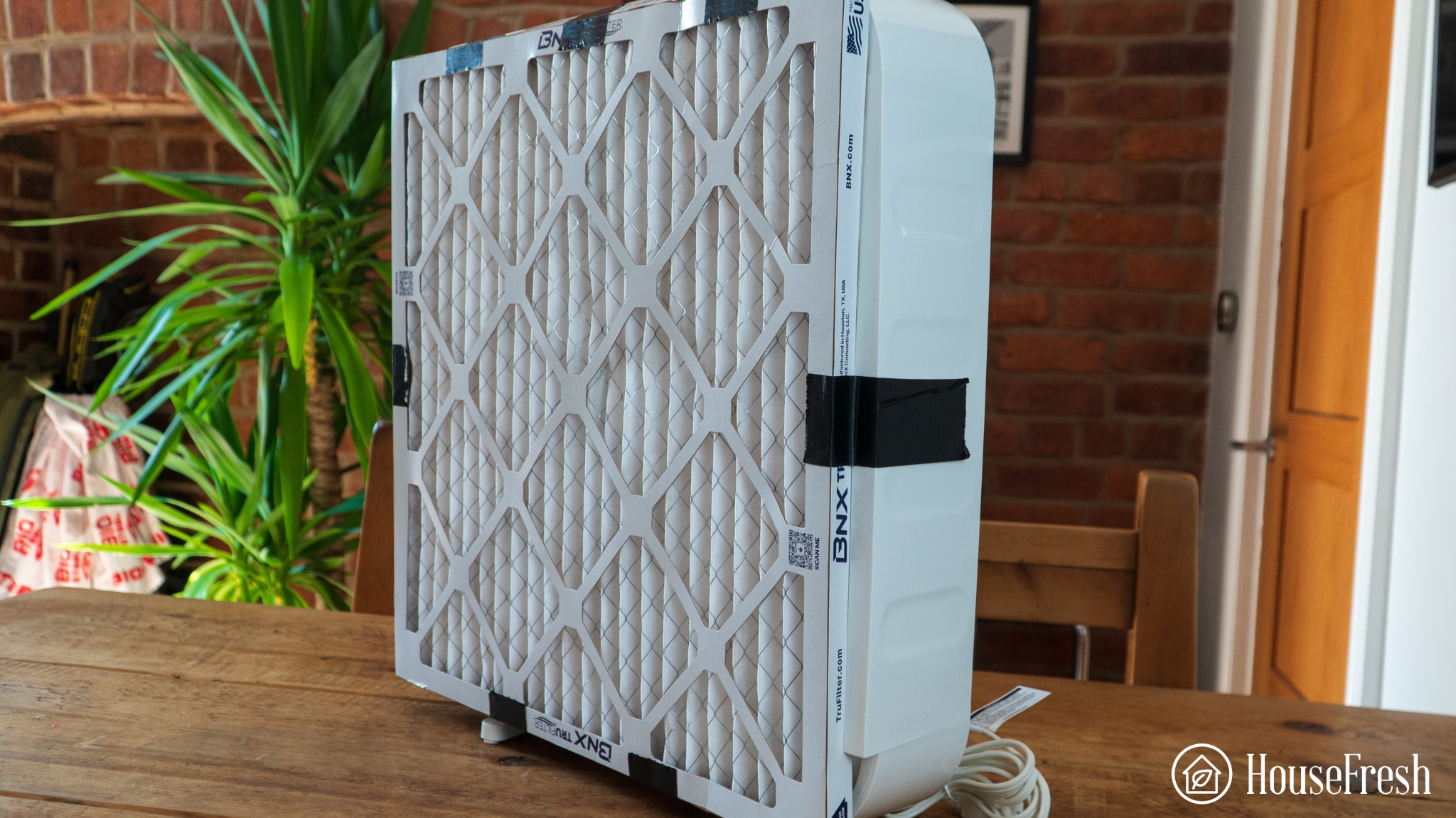
NorthBox 6XL review

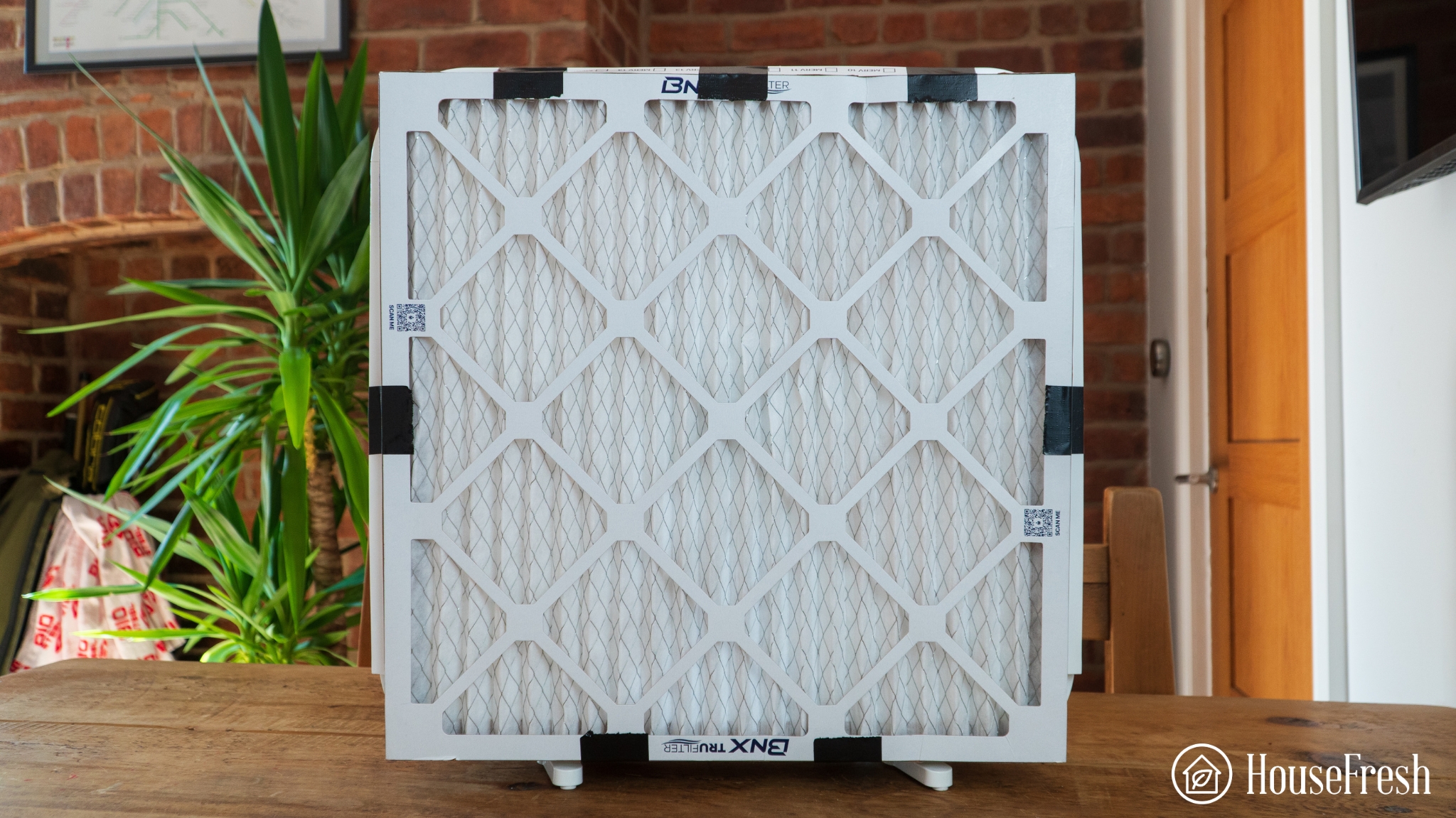
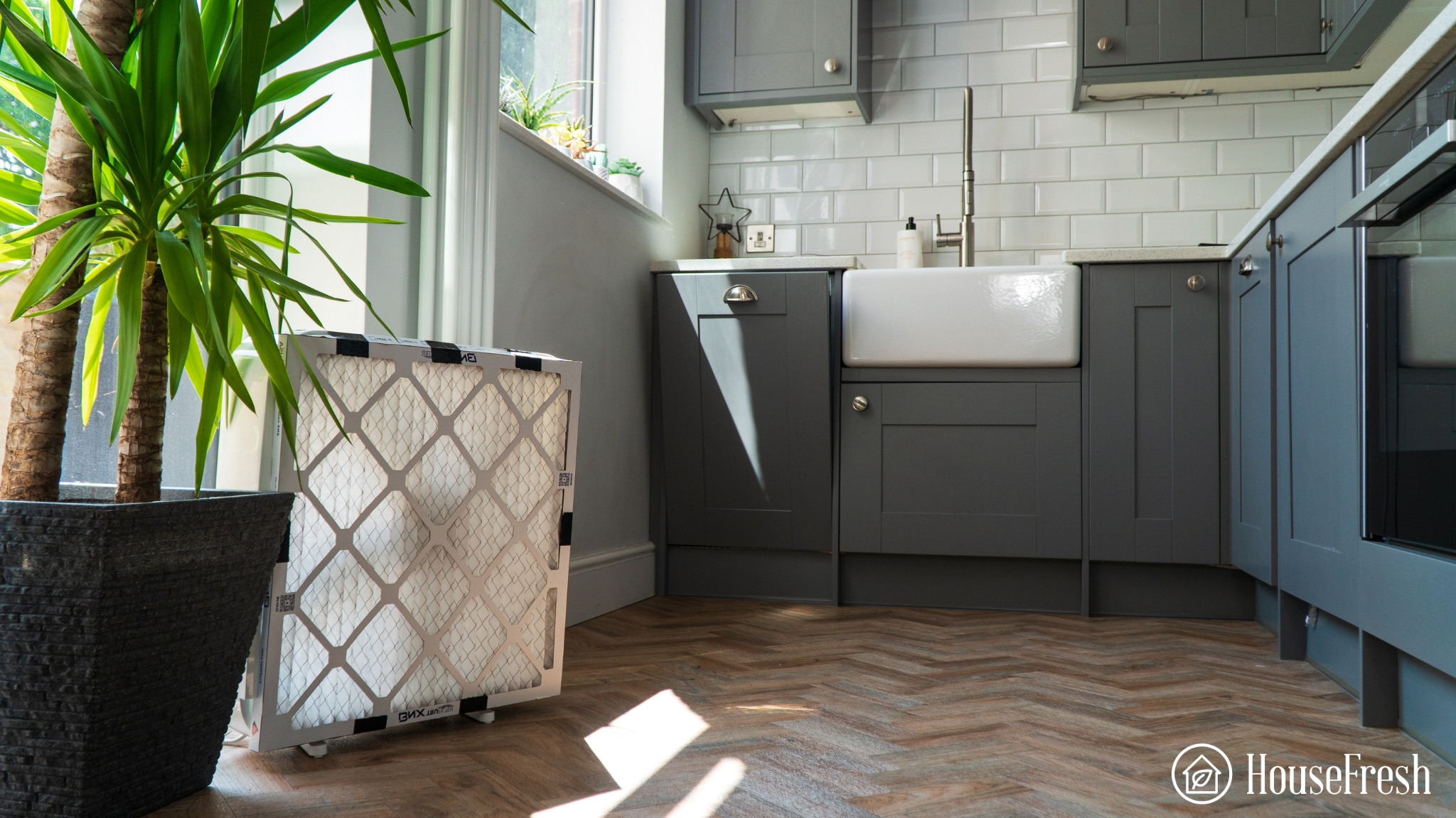
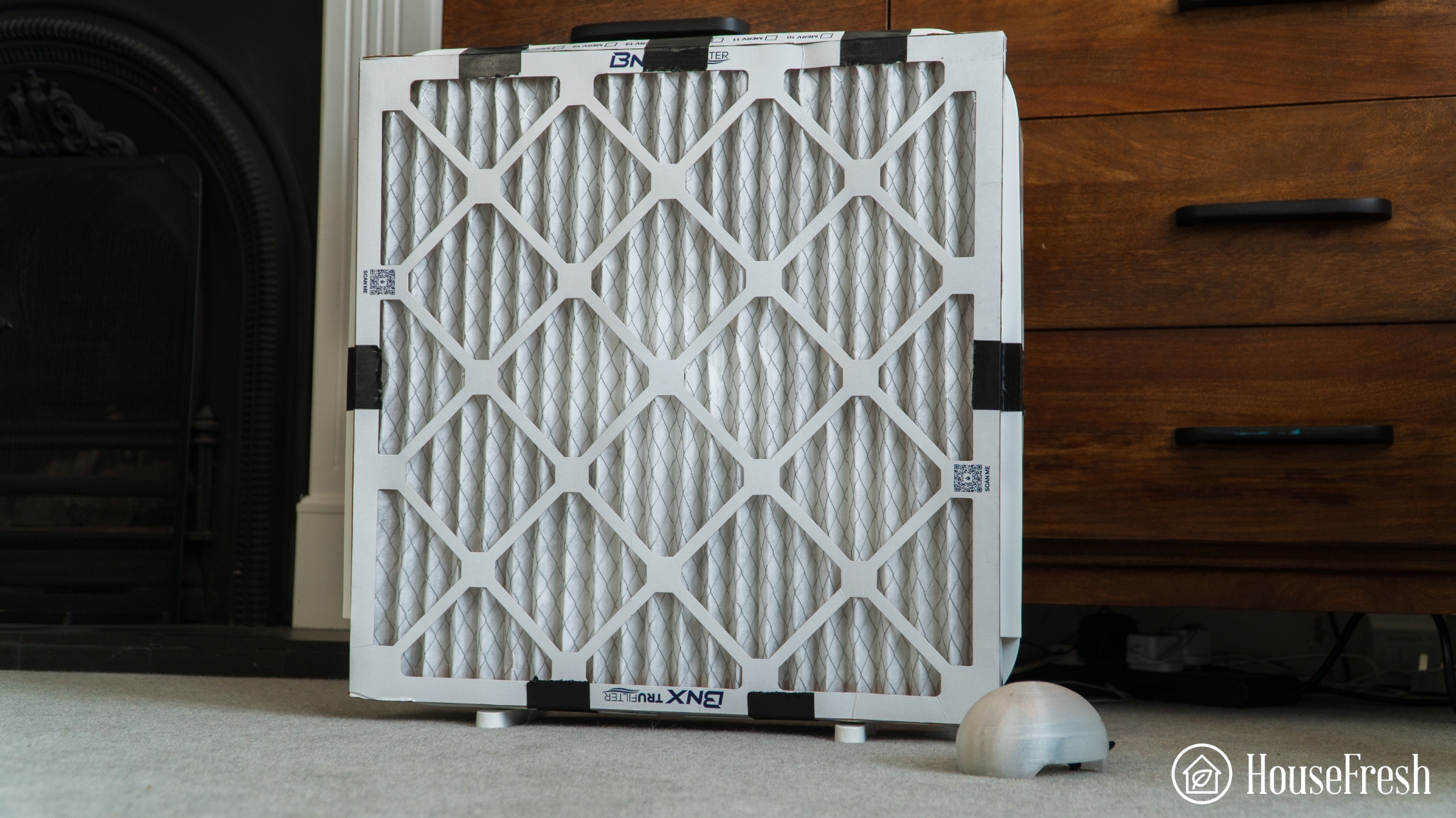
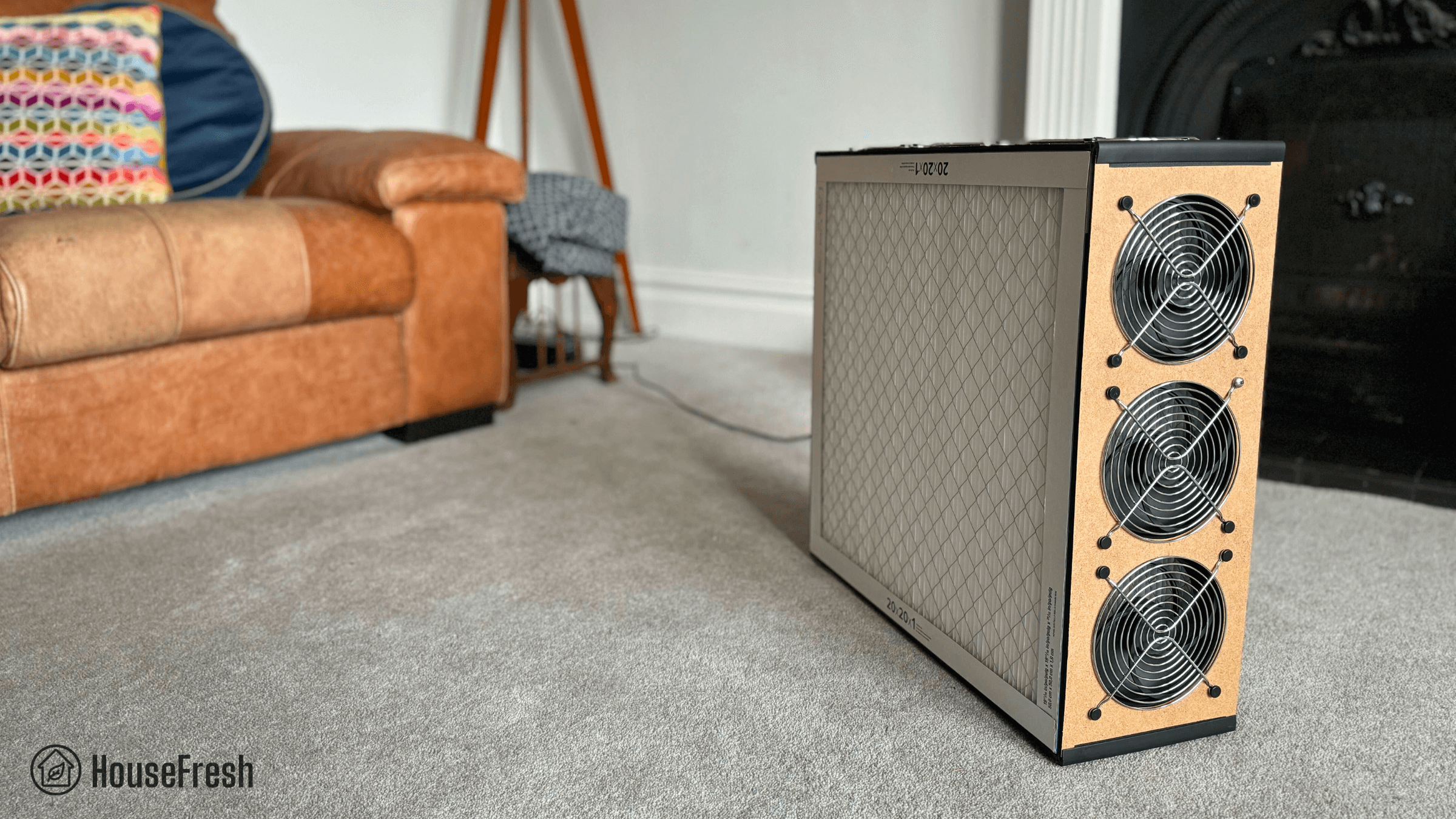
North Box 6XL Side

After his father went into a long-term care facility at the height of the COVID-19 pandemic, Robert Fantinatto teamed up with his son Aidan to make PC-fan powered air purifiers easily available to Canadians. 

As with all the air purifiers we tested, we bought the NorthBox 6XL with our own money. We went with the DIY kit as it was easier to ship all the way to the UK, and chose the HDF hardboard version as it was cheaper at $220 CAN. 

The DIY kit came with everything we needed to build the 6XL, except for the two 20x20x1 3M Filtrete MERV13 filters and the six Arctic P14 fans. But if DIYing is not your thing, you can get the fully assembled version for $350 CAN.

In this review, I will be comparing the NorthBox 6XL against the more than 100 air purifiers I have tested to date. I will take you through my first-hand data on air cleaning performance, sound generation, electricity consumption, user experience and long-term running costs.
how we test
How we test air purifiers

Read our full testing methodology.

The lowdown on the NorthBox 6XL

Danny Ashton HouseFresh
“The NorthBox 6XL is an excellent alternative to the CleanAirKits Luggable models for those living in Canada, who will be able to buy them without worrying about tariffs while supporting a Canadian small business.

Air cleaning performance, sound generation and energy consumption are on par with what we’ve come to expect from PC fan-powered devices.”

— Danny Ashton, HouseFresh Founder & Senior Writer

If you don’t want to read my full review, here are the five things I really like about the 6XL, and the three things I don’t.

What we really like

Excellent air cleaning performance comparable to the impressive Luggable XL-7 from CleanAirKits.
Outstanding particle removal speed at quiet operation with Noctua P14 Redux fans.
It is more affordable than other PC fan air purifier kits such as those from CleanAirKits and Nukit.
It uses 20x20x1 MERV 13 filters that are easily available.
It is lightweight and easy to move around.

What we think could be better

I found it trickier to build compared to the CleanAirKits Luggable XL-7 — but it’s definitely easier than the Nukit Tempest.
There is no mesh filter guard or pre-filter available, which is something we see with the Tempest and the Luggable.
North Box Systems doesn’t have an online store, so you will need to email them to make an oder.

HouseFresh rating:◼️◼️◼️◼️◼️◼️◼️◻️◻️◻️ 7/10
Time to clean our 728 cubic feet test room (with the device running at top speed):– Top speed: 21 minutes (Arctic P14 Max)
– Sub-45dBA speed: 23 minutes (Noctua P14 Redux)
Air filtration technology:MERV 13 (20x20x1 3M Filtrete MPR 1900)
Recommended room size (5 air changes per hour):427 sq. ft.
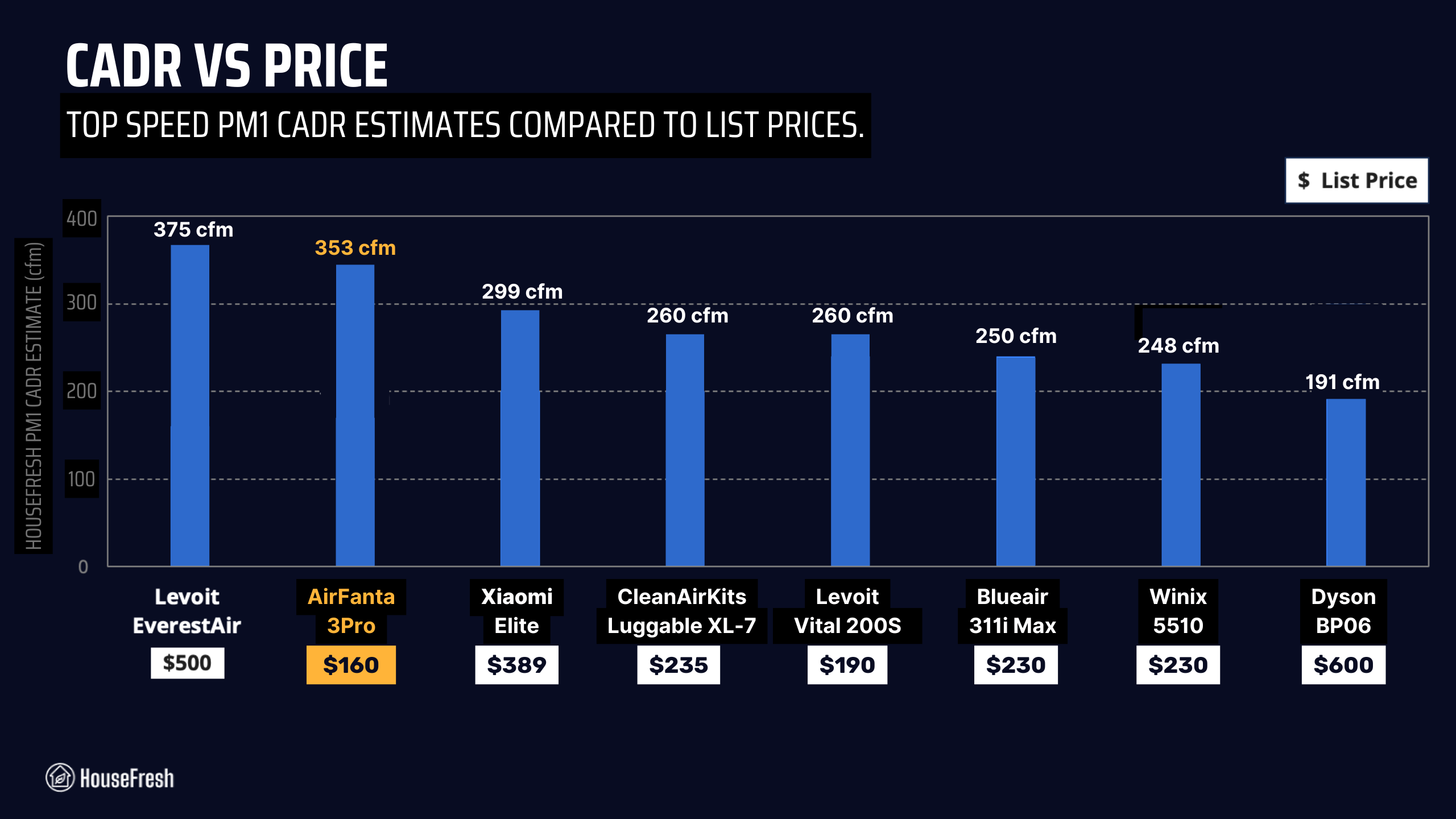
Clean air delivery rate (CADR):HouseFresh PM1: 285 cfm
Dimensions (in inches / in cm):20 x 20 X 5.5 in (50.8 x 50.8 X 14 cm)
Weight (in pounds / in kg):2.4 lbs (1.1 kg)
Filter life:12 months
Noise level in decibels (measured from 3 ft. away with a sound level meter):– Arctic P14 Max: 50.2 dBA
– Noctua P14 Redux: 45.1 cBA
Electricity consumption in watts (recorded with an electricity usage monitor):– Arctic P14 Max: 28.45 watts
– Noctua P14 Redux: 14.4 watts
Estimated running cost:– Energy consumption: $31.60 per year
– Filter replacement: $89.98 per year
Manufacturer’s warranty:1 year
Country of manufacture:Canada

The best 6XL feature: Repairable, upgradeable and customizable

You can choose different types of PC fans depending on what you value most: sheer power or quiet performance.

One of my favorite features of the new generation of PC fan-powered air purifiers is the fact that you can fix and replace parts, using widely available air filters and fans. 

In the case of the NorthBox 6XL, we were able to build multiple versions of the same device without any issues. Each time, we were able to improve the performance of the air purifier in regards to its particle removal efficiency and its sound generation. 

This makes the 6XL highly customizable, depending on what you value most: quiet power or particle removal speed.

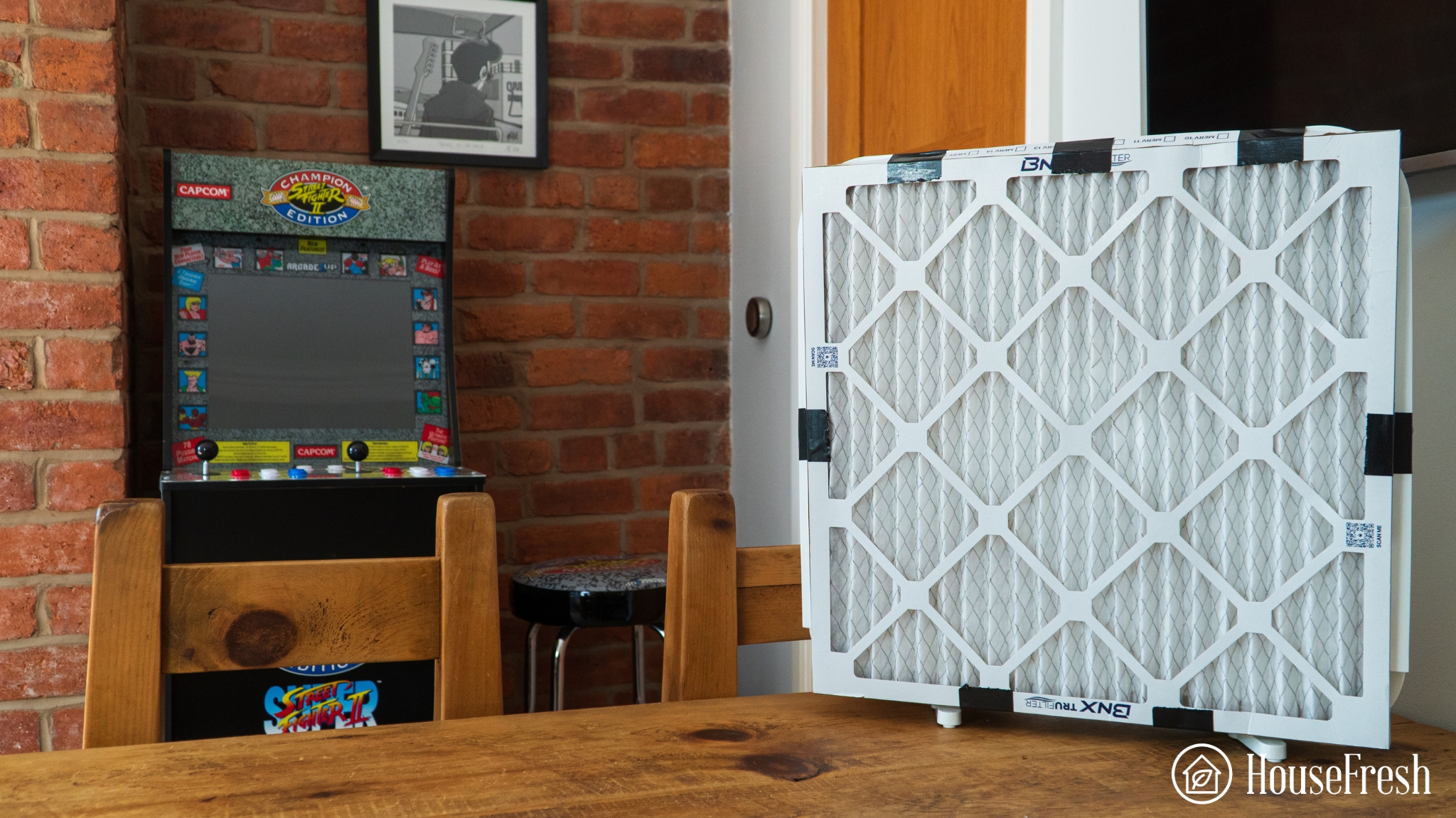
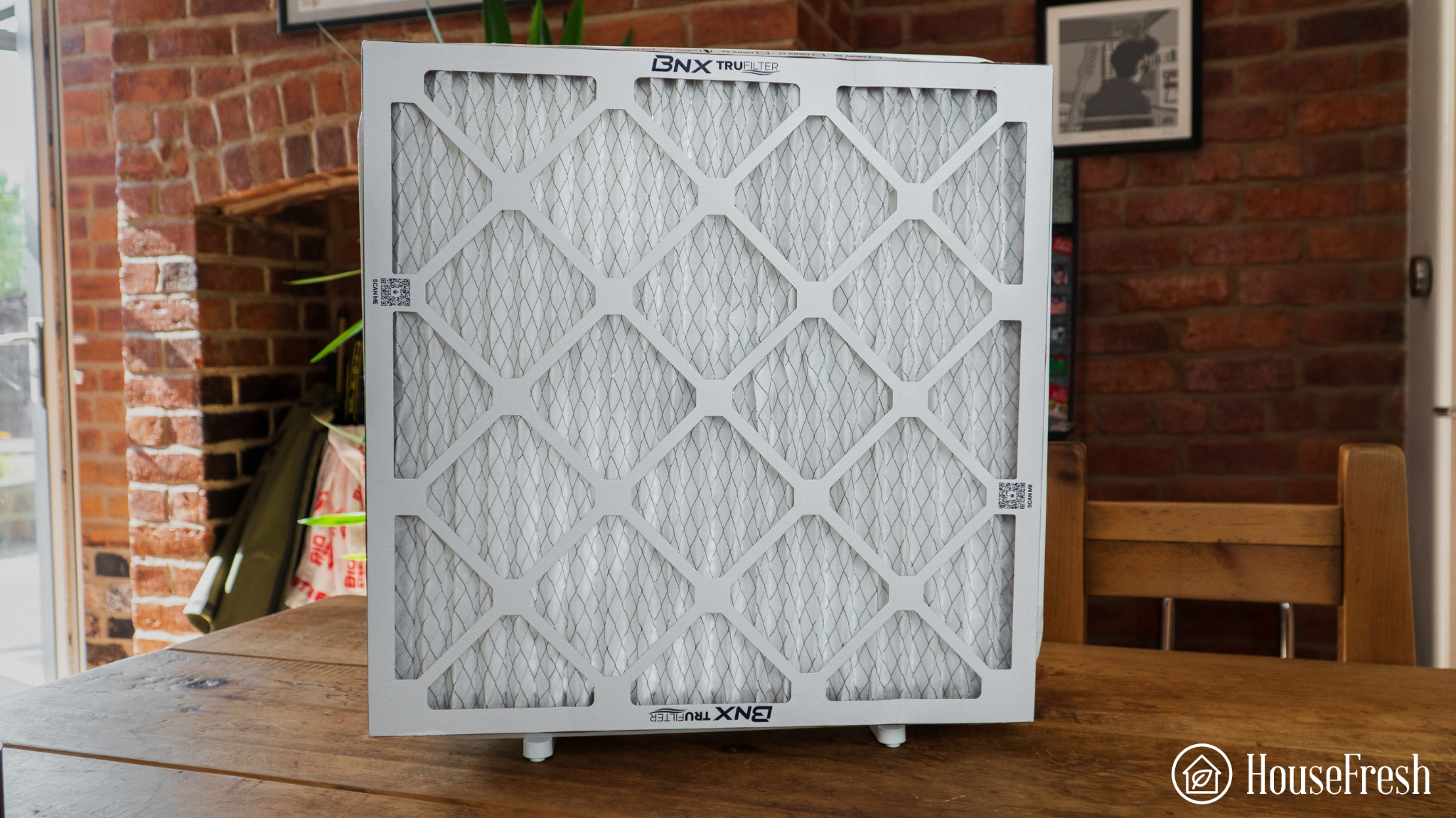
A natural HDF hardboard body that houses two 20×20 MERV 13 filters

The design of the 6XL is reminiscent of the Luggable XL-7 we reviewed from CleanAirKits.
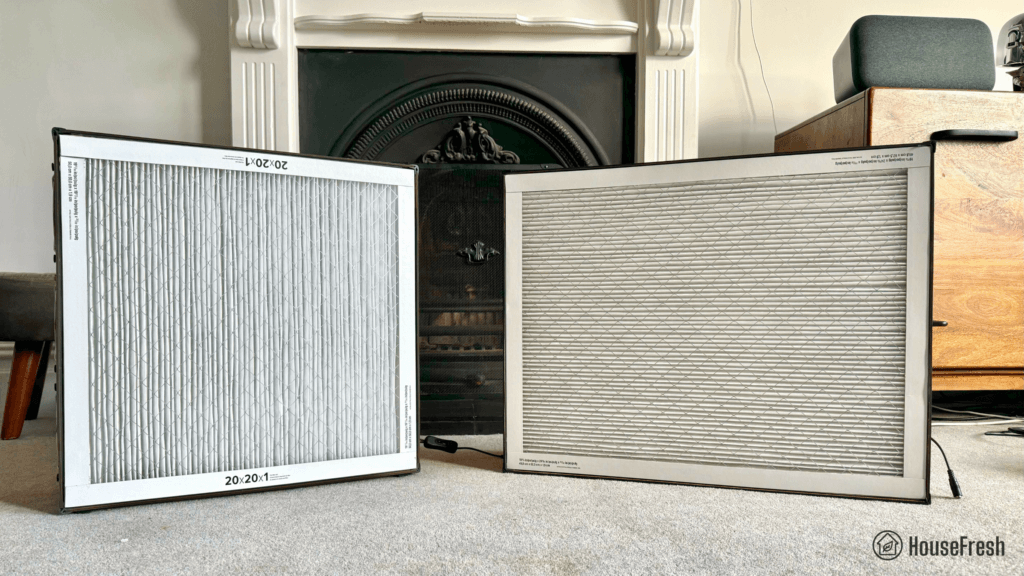
North Box 6XL CleanAirKits XL7

The moment I finished building my 6XL, I could immediately see the resemblance with the design of the Luggable XL from CleanAirKits—especially considering the use of 3M Filtrete MERV 13 filters. 

In fact, on their website, North Box Systems highlighted CleanAirKits’ own Rob Wissmann as a source of inspiration, alongside the DIY movement around the Corsi-Rosenthal box. 

north box systems website

However, unlike CleanAirKits, you don’t get a handle and won’t find an option to add a mesh guard or pre-filter on top of the MERV 13 filters. 

That said, you will get two choices for the body of your NorthBox 6XL: glossy black acrylic or natural HDF hardboard, with the first one adding $30 to the price. 

Personally, I prefer the wooden look and the cost-savings associated with the HDF hardboard, but I am aware that there might be durability benefits with the acrylic version.
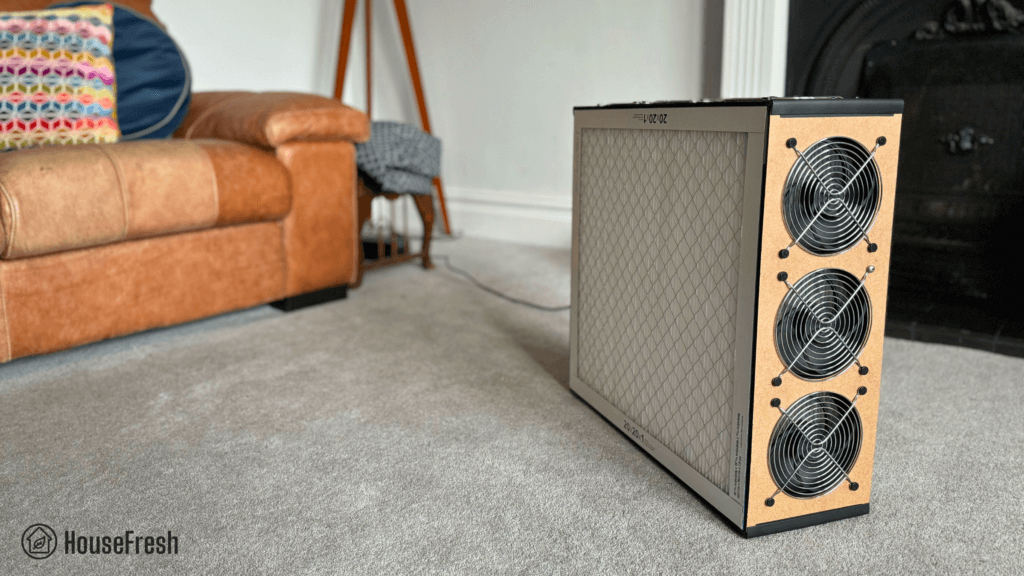
North Box 6XL Side

As I mentioned in the intro, we went with the DIY kit to build our 6XL at home because it was cheaper and easier to ship to the UK. The kit comes with everything you need (bar the filters and the fans), including a UL/C 12V power supply, safety grills to place on top of the fans and a set of adjustable internal tension cords to keep the cables nice and tidy on the inside.

This was the third PC fan kit I put together and I must say that I found it a little trickier than the kit from CleanAirKits but much easier than the one from Nukit.  I really appreciate the team at North Box published a how-to video for people to follow while building the air purifier. 

And I know that Robert Fantinatto made some adjustments to the kit after my initial video, so I’m looking forward to building and testing another model from North Box Systems to see the improvements. 

In terms of fans, North Box recommends the Arctic P14 fans, which will set you back $49.99. For my build, I wanted to try something different so I went with the Artic P14 Max fans and I also tested Noctua P14 Redux fans. 

And when it comes to filters, you will be able to use any 20x20x1 MERV 13 filters you can get hold of.
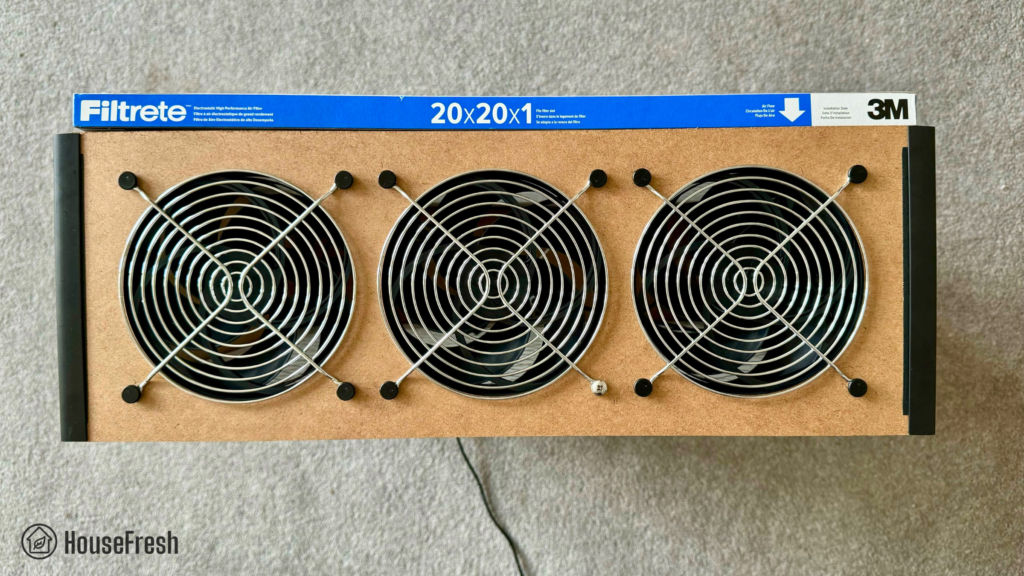
North Box 6XL Top Down Filter

North Box recommends the 3M Filtrete MPR1900, so we went with those filters because we were super impressed with the particle removal efficiency of the Filtrete MPR1900 when we tested them with the Luggable XL and the Lasko 2-in-1.

The NorthBox 6XL cleared our test room in 21 minutes

Our build with Arctic P14 Max fans completed our particle removal test two minutes faster than the CleanAirKits Luggable XL-7.
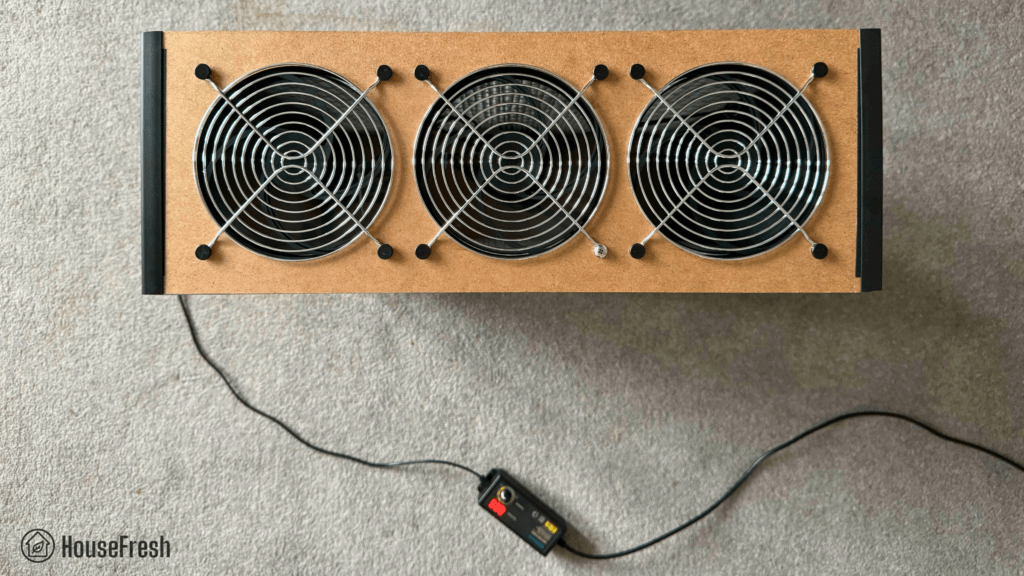
North Box 6XL Top

We tested the NorthBox 6XL in the same 728-cubic-feet room where we have tested 100+ different air purifier models since 2020. By testing every device in the same room doing the same job of removing incense smoke, we can quickly compare performance across devices.

Our 6XL build with Arctic P14 Max fans cleared all PM1 pollutants from incense smoke in 20 minutes, which is two full minutes faster than the result achieved by the CleanAirKits Luggable XL-7 with one more PC fan than the 6XL:

That means that, by choosing to use the P14 Max fans, I managed to improve the air cleaning performance of the 6X, but as you will see later, this build has some downsides.

Next, we repeated the particle removal test with the Noctua P14 Redux fans, and this version of the 6XL took a little longer, reaching PM1 zero in 23 minutes:

You can see in the table below how these results compare to some of the most popular air purifiers we have tested:
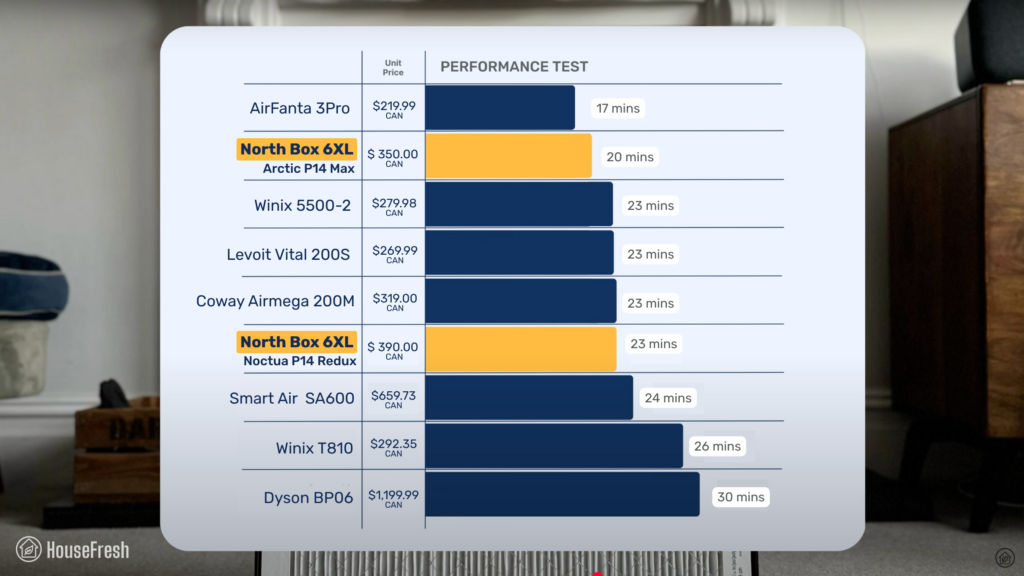
North Box 6XL Performance compared

Similar to the Luggable XL, the NorthBox 6XL comes at a higher initial cost when compared to HEPA retail devices with similar air cleaning performance. However, you will get a lot more value out of the 6XL when looking at quiet performance and long-term running costs.

In our testing, the Noctua build of the 6XL hit 45.1 dBA and the P14 Max build hit 50.2 dBA.
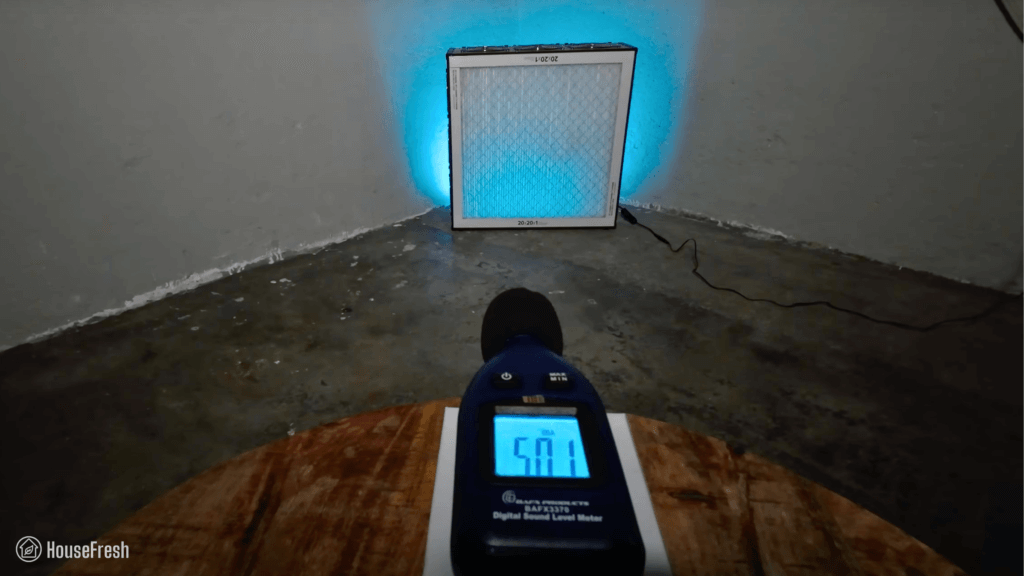
North Box 6XL Sound test

While air cleaning performance is very important, it is not the only thing you should focus on when choosing an air purifier. Sound is important too. 

If an air purifier sounds like a jet engine, you’re likely to end up turning it off eventually. That is why, we used our sound meter to measure how much sound is generated by the NorthBox 6XL from 3 ft. away.

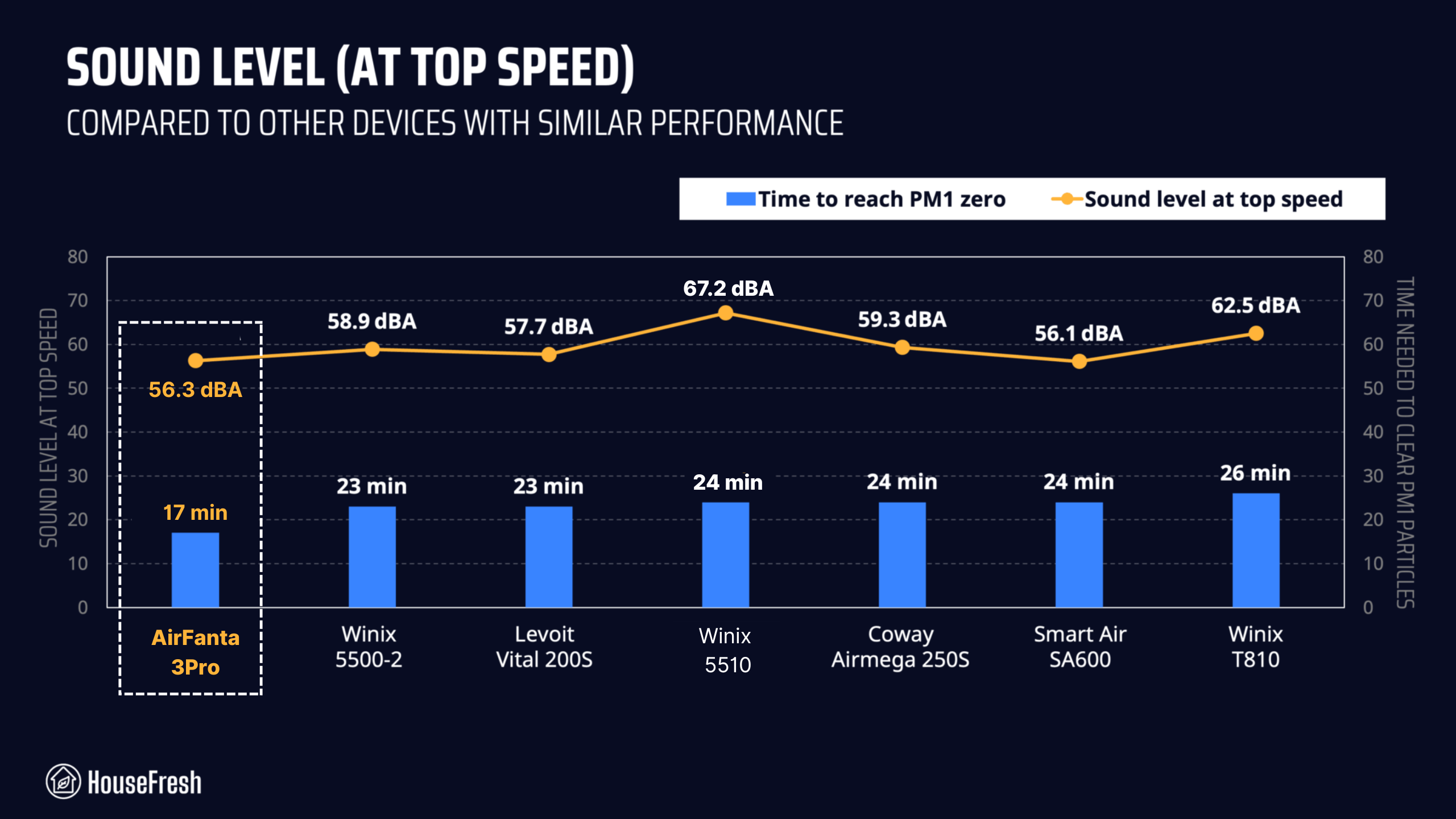
Our data shows that the P14 Max build generates 50.2 dBA and the Noctua build is quieter at 45.1 dBA. But this information in isolation is not as helpful, so let me show you how this compares to other air purifiers running at their top speed:
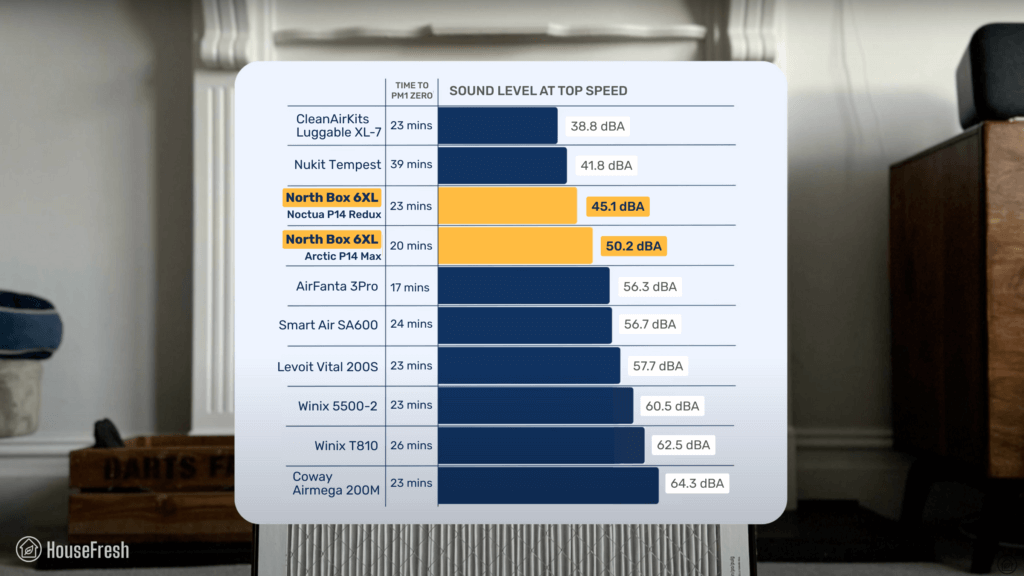
North Box 6XL Sound compared

As you can see from the table above, in my quest to improve air cleaning performance with the use of Arctic P14 Max fans, I built a version of the 6XL that is much louder than the other PC fan kits I have tested. 

I want to be clear, this is down to me choosing these fans rather than any issue with the design from North Box. North Box recommends the use of Arctic P14 fans, which would be much quieter.

If sound is a big deal for you

If you’re keen to experiment with the PC fans for the 6XL, I would suggest looking into the non-Max version of the Arctic P14 fans, which will be much quieter and we recorded reaching 41.8 dBA in our build of the Nukit Tempest.

We have been experimenting with lots of different fan models for our Nukit Tempest that you might want to check out:

While I was able to improve the CADR of our  6XL a little with the use of P14 Max filters, the downside is that you’ll get much louder operation so it is probably not worth it. 

Using the Noctua P14 Redux fans, I managed to lower sound levels to the 45 dBA limit we set for our quiet performance tests. Check out the table below to see how the air cleaning performance of the 6XL compares to other air purifiers at sub-45 dBA fan speeds:
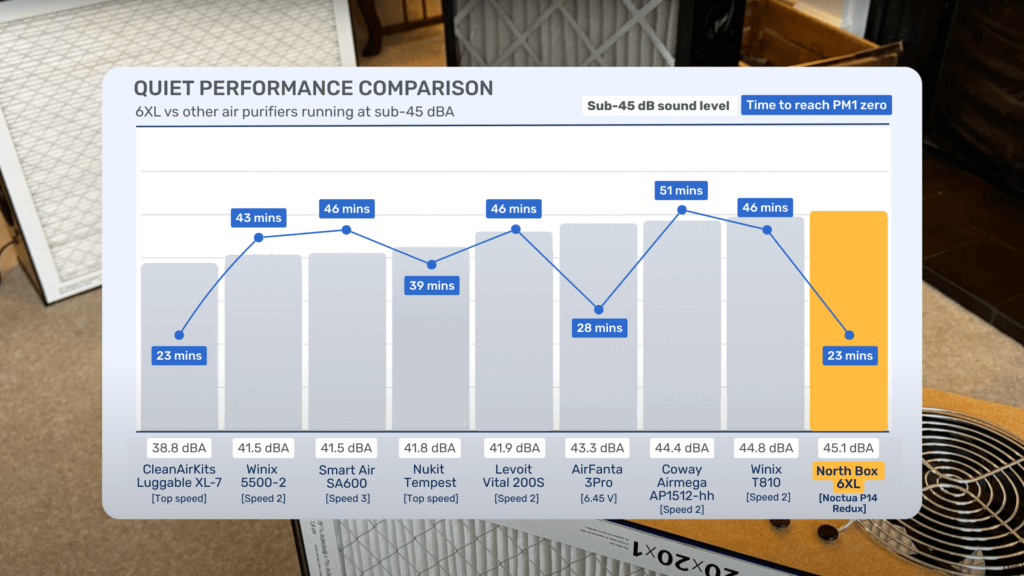
North Box 6XL Sub45 performance compared

As the chart above shows, when comparing quiet performance below 45 dBA it becomes clear that PC-fan air purifier kits offer a lot more value that you’ll ever get from HEPA retail devices.

And even though that the NorthBox 6XL with Noctua P14 Redux fans is louder than other PC-fan powered devices, its particle removal performance still outmatches every other shop-bought device on the list.

The cost to run a NorthBox 6XL: $85.50 CAD per year

1. Electricity costs = $30.97 CAD per year

As part of our reviews, we use a power meter to measure how much energy is pulled at each fan speed. As the NorthBox 6XL has only one speed, we only needed to record energy consumption at its only speed.

When running the 6XL with P14 Max fans, it pulled 28.45 watts. When we swapped for Noctua P14 Redux fans, the power consumption dropped to 14.4 watts.

We can now compare the estimated energy costs associated with running a NorthBox 6XL, based on calculations we made using the appliance cost calculator from BC Hydro.
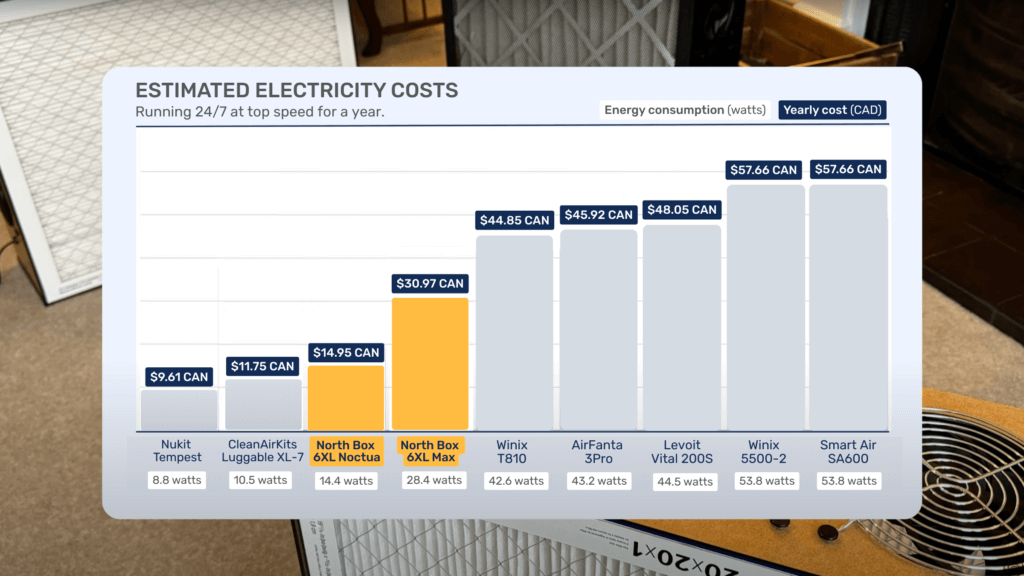
North Box 6XL Energy consumption

But it’s not just electricity costs that add up to the maintenance costs of running an air purifier in your home 24/7; you also need to think about filter replacements.

2. Filter costs = $54.53 CAD per year

As with any air purifier, you’re going to have to replace the filters in your NorthBox 6XL eventually. 

The 6XL uses two MERV 13 20x20x1 filters and, depending on where you live, you should be able to get 12 months of use out of them before it’s time to replace them.

If you go with the recommended 3M Filtrete MPR1900, you will pay $163.58 on Amazon.ca for a set of six filters, which should last you around three years. That means that you should budget around $54.53 per year in filter replacements for your 6XL.

When we combine energy usage with filter replacement costs, we estimate that the NorthBox 6XL could cost you 

Still, when you combine the energy usage with these filter prices, the Northbox 6Xl annual running cost is $85.50 CAD. This figure compares favorably with other air purifiers we have tested: 
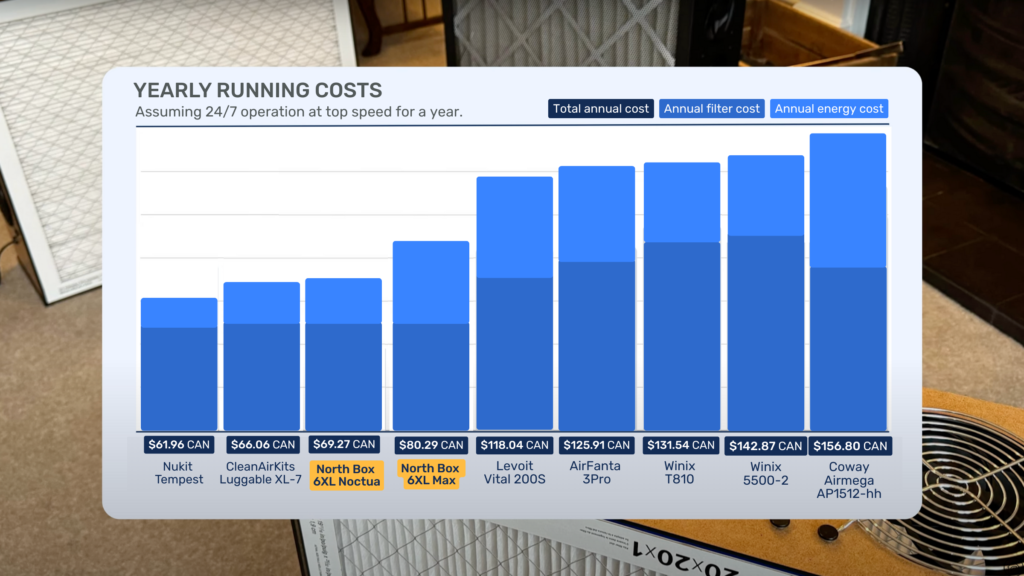
North Box 6XL Yearly costs

As you can see from the table above, choosing to build your 6XL with Arctic P14 Max fans, you will end up paying more in the long run due to how power-hungry those PC fans are compared to what you can expect to pay with the Noctua P14 Redux fans.

Bottom line: Should you buy a NorthBox 6XL?

If you are based in Canada, the 6XL is the best value PC fan-powered air purifier you can buy today.
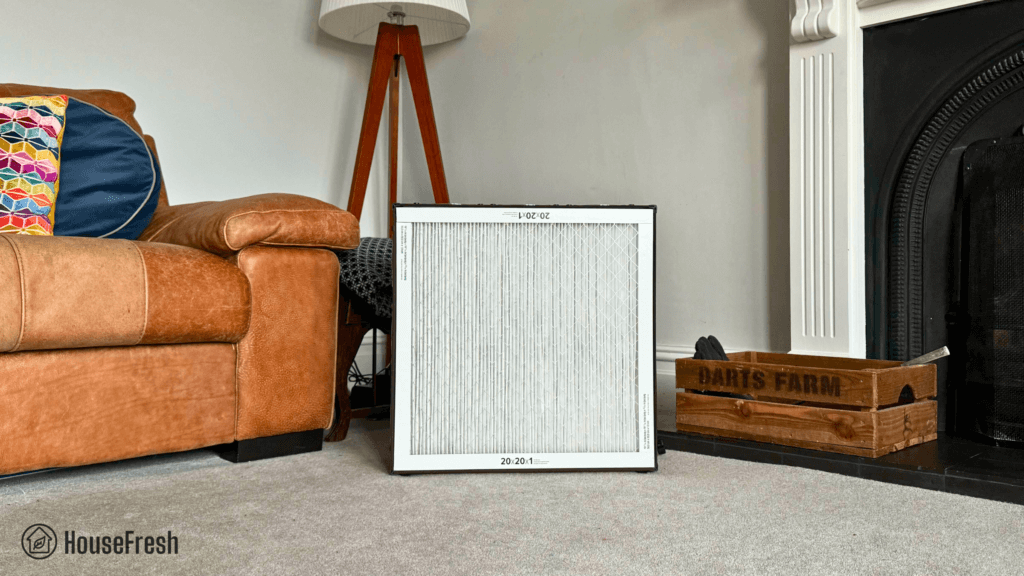
North Box 6XL Corner

So before I jump into the conclusion, it’s fair to say that I messed this one up when I decided to build my first iteration of the 6XL using six Arctic P14 Max fans.

When I swapped out the P14 Max fans for the Noctua Redux fans, we improved performance at quiet fan speeds. However, the Noctua fans are quite pricey so it might be better to get the standard P14 fans, as recommended by North Both.
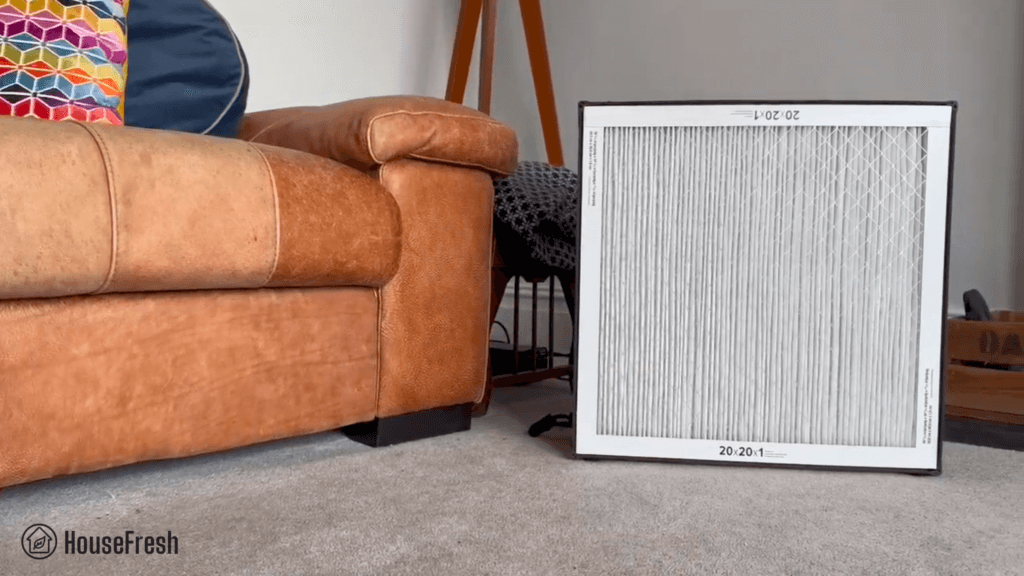
North Box 6XL Close

All in all, I’d say that the NorthBox 6XL is an excellent alternative to the CleanAirKits Luggable models for those living in Canada, who will be able to buy them without worrying about tariffs while supporting a Canadian small business.

The 5XL and 6XL PC fan-powered air purifiers from North Box should be the top choice for those looking for a PC fan air purifier in Canada.

If you have any questions about this device, please drop them in the comments below and I’ll try to reply as soon as possible.

SOURCES

We calculated yearly costs associated with running the NorthBox 6XL for 24 hours a day, 365 days a year, based on the Canada average utility rate as of March 31st, 2025.

CleanAirKits Luggable XL-7 review

CleanAirKits Luggable XL Living Room

Today, I am excited to review another PC fan-powered air purifier: the Luggable XL from CleanAirKits, a business operating out of Missouri.

CleanAirKits came about in 2022 as an online community of engineers from around the world experimenting with PC fan-powered Corsi-Rosenthal boxes. The goal was to design a solution that could offer air cleaning in a quiet, cheap and efficient way to keep classrooms’ air clean and safe after mask mandates were dropped.

The result? A series of snap-together kits that aim to bring energy-efficient and super quiet PC fan-powered air purifiers to as many people as possible. 

We received tons of messages from readers after we published our review of the Nukit Tempest asking us to test a DIY air purifier kit from CleanAirKits, so I hope you will find this review insightful and helpful in your search for the best PC fan-powered unit for your home.

It was great to see that CleanAirKits offers several different options with each device they sell on their online shop: you can choose the number of fans, the type of wood, the size, and even whether you want your kit pre-built. 

As with all the air purifiers we reviewed here at HouseFresh, we bought the device from CleanAirKits ourselves. We do this for two reasons: Firstly, we want to remain unbiased, without any special relationship or deal with the manufacturer. Secondly, we like to experience the full customer journey just as you would.

If you buy a CleanAirKits Luggable XL through one of the links on this page, we will earn a small commission at no extra cost to you—this is how we can afford to spend months testing air purifiers like this one.

how we test
How we test air purifiers

Read our full testing methodology.

I’m based in the UK, so I chose to go with one of the kits available for international customers: the CleanAirKits Luggable XL-7 Sickleflow. We paid £176 for the kit that includes everything except for the filters, and then we added two Filtrete 20x25x1 MERV 13 for £88.47. 

If you are in the U.S., you can get the same kit for $227, and the filters will be much cheaper at around $45. If you’d like to go with the pre-built option with filters included, that figure will go up to $299.

The lowdown on the CleanAirKits Luggable XL-7

Danny Ashton HouseFresh
“This DIY PC fan-powered air purifier reached the top tier of our ranking with two MERV 13 filters and without any ionization or electrostatic filtration technology.

The CleanAirKits Luggable XL-7 has convinced me that PC fans are the future of air purification.”
— Danny Ashton, HouseFresh Founder & Senior Writer

$229 AT CLEAN AIR KITS RECOMMENDED FILTERS ($45.94)

What we really like

This air purifier is the best-performing air purifier we have ever tested under 40dB.
It offers solid air cleaning performance, making it a good choice for spaces as large as 485 sq. ft.
The DIY kit comes with everything you need, except for the filters.
It was relatively easy to build, compared to other DIY kits like the Tempest or the NorthBox.
It is lightweight and looks pretty good, considering it’s a thing you can build yourself at home.

What we think could be better

The mesh filter guard is an optional extra that will set you back $100.
My wife (who is 5’2″) reported not being able to use the handle to move the Luggable from room to room without dragging the device on the floor.
The case is built with lightweight wood, which looks great but is not as durable as harder materials like the metal in the Tempest.

Clean air delivery rate (CADR):– Top speed PM1 CADR: 260 cfm
– Sub-45 dBA PM1 CADR: 260 cfm
– Intertek PM2.5: 323 cfm (dust)
Filter technology:MERV 13 (20×25)
Recommended room size:390 sq. ft. (5 air changes per hour)
Dimensions:7D x 25W x 20H in (18D x 64W x 51 cm)
Weight:8 lbs (3.63 kg)
Noise level in decibels from 3 ft. away:Only speed: 38.8 dBA
Electricity consumption in watts:Only speed: 10.5 watts
Filter lifespan:6-12 months
Manufacturer’s warranty:1 year
Country of origin:United States
Country of manufacture:United States

The best Luggable XL-7 feature: Only 38.8 dB of noise without compromising on air cleaning power

The Luggable XL is a great choice for classrooms, offices and rooms where a quiet environment is important.

CleanAirKits Luggable XL Living Room

One would think I’d get used to quiet operation after having tested and reviewed five different PC fan-powered air purifiers, but the CleanAirKits team really pushed the limits with the Luggable XL. 

When running at top speed (which is also the only speed), the Luggable XL-7 hit 38.8 dB(A). That is as quiet as leaves rustling, and it compares incredibly well against other air purifiers we have tested:

As you can see, CleanAirKits’ choice of Cooler Master SickleFlow 120 fans paid off: the Luggable XL is the quietest air purifier we have tested to date even when compared against other PC fan-powered devices (in red).

A lightweight, thin, good-looking CR box

Combining a lightweight wood case, seven PC fans and two 20x25x1 MERV 13 filters.

CleanAirKits Luggable XL Front

The design of the CleanAirKits Luggable XL is inspired by the Corsi-Rosenthal box, but looks a lot slicker and is easier to move from room to room.

The Luggable XL’s body is made of hardboard panels and houses only two filters (versus four in the CR box), one on each side. We bought the XL-7 model, which has seven PC fans on top and two more on one of its sides.

One of the big downsides of the original Corsi-Rosenthal Box is that they are very big, take up a lot of floor space and can potentially look pretty ugly if you suck at DIY as much as I do. 

CR

However, you can’t say the same about the CleanAirKits Luggable XL.

While it’s certainly less durable than the steel used for the Nukit Tempest, the Luggable XL is truly lightweight, and it looks modern and clean—especially when compared to the CR box:

CR Box VS CleanAirKits Luggable Front

However, keep in mind that even though it’s not as deep as the CR Box, the Luggable will be wider than other similarly-powered air purifiers if you use it with the five filters on top. 

That said, you can turn it on its side to have the shorter side on top and this will reduce its width. See how it compares to the Smart Air SA600 in the photo below:

CleanAirKits Luggable XL Smart Air SA600

When it was time to buy the Luggable XL, I chose the DIY kit to assemble it at home. I was pleased to see that it came with clear instructions. 

Inside the box, I received seven Cooler Master SickleFlow 120 PC fans, four hardboard panels (one with an integrated handle), a power supply, internal pre-tensioner cords, foam tape strips and seven fan guard grills. The whole process took me around 45 minutes but bear in mind that I’m not great at building stuff.

The internal pre-tensioner cord helped me neatly connect all the PC fans, while keeping the cables out of the way of the filters for when the time comes to replace them.

CleanAirKits Luggable XL Open

I particularly like the side suitcase handle as it makes it easy for me to grab my Luggable to move it around the house. That said, my wife (who is much shorter than me) mentioned that it would be great to have a handle on the longer side of the Luggable as the current placement means that she will drag the device on the floor.

CleanAirKits Luggable XL Handle

If you prefer, you can get a mesh filter guard, which may improve durability and looks. Personally, I quite like the open filter design, but if you want the mesh, it’s another $85.

For a more interesting look, they sell versions that are higher priced but made with Cherry wood, starting at $285 without filters.

cherry wood cleanairkits

Tip

If you choose to buy the DIY kit, be aware that it doesn’t come with any filters.

Two widely available MERV 13 filters

You can choose any 20×25 MERV 13 filters. CleanAirKits recommends 3M Filtrete MPR1900+, and I agree with their recommendation.

CleanAirKits Luggable XL Fireplace

On their website, CleanAirKits recommends two 3M Filtrete MPR1900+ filters, but you can use any other brand of MERV 12 or MERV 14 filters, which is the beauty of PC fan kits like this one.

However, be aware that if you don’t go with Filtrete, you will need to use 2-inch thick filters to get the same level of performance. This means that the filters will stick out a little more compared to how they look when you use the Filtrete MPR1900 or MPR2200 filters.

CleanAirKits Luggable XL Fans

After testing multiple MERV filters with other DIY air purifiers, I have to say I really like how well-constructed the filters from Filtrete are. They are sturdier and hold their shape incredibly well, thanks to the thick cardboard border.

CleanAirKits Luggable XL Filter inside

Tip

At the moment, there are no carbon filters available for the Luggable XL-7, so if you are looking for a PC fan-powered air purifier to help you deal with odors and gases, then I recommend you check out the AirFanta 3Pro instead.

The Luggable XL-7 cleared our test room in 23 minutes

As fast as the Winix 5500-2, the Levoit Vital 200S and the Smart Air SA600.

CleanAirKits Luggable XL Closeup

After some controversy with the r/AirPurifiers subreddit, CleanAirKits sent the Luggable to Intertek for AHAM AC-1 CADR testing. The report is here and shows the following figures:

  • Smoke: 259 cfm
  • Dust: 323 cfm
  • Pollen: 370 cfm

Based on dust CADR figures, I expected our performance results for the Luggable XL-7 to be somewhere between the Levoit Core 400S (247 cfm, 28 minutes in our test) and the Levoit EverestAir (365 cfm and 18 minutes in our test).

We tested the Clean Air Kits Luggable in the same 728 cubic feet test room where we tested 90+ different air purifier models since 2020. By testing every device in the same room doing the same job (removing incense smoke), we can quickly compare performance across devices.

Our trusted PurpleAir Zen laser particle counter shows that the CleanAirKits Luggable XL-7 reached PM1 zero in 23 minutes.

I knew CleanAirKits had built something special with the Luggable, but I didn’t know it would be so special.

This DIY PC fan-powered air purifier reached the top tier of our air purifier ranking with two MERV 13 filters and without any type of ionization technology.

Check out how its performance compares to other air purifiers in its same price range:

AIR PURIFIER MODELTIME TO CLEAN OUR TEST ROOMPRICE
Levoit Vital 200S23 minutes$189.99
Smart Air SA60023 minutes$279.95
AirFanta 3Pro17 minutes$159.99
Winix 5500-2 (with ionizer)23 minutes$249.99
CleanAirKits Luggable XL-723 minutes$299.00
Corsi-Rosenthal Box32 minutes$85.00
Nukit Tempest31 minutes$300.00
Coway Airmega AP-1512HH (with ionizer)26 minutes$229.99

The Luggable XL-7 performs as well as popular retail HEPA air purifiers coming from well-known brands such as Levoit, Winix, Coway and Smart Air. 

Noise levels, compared

While air cleaning performance is very important, if the air purifier sounds like a jet engine then it will be turned off. That is why we use a sound level monitor from 3 ft. away to record the sound levels generated by air purifiers at each fan speed.

Now, the CleanAirKits Luggable XL-7 has made my job easier as it has only one speed. In our test, I recorded 38.8 dB on average, which is incredible.

The first PC fan air purifier we ever reviewed was the Nukit Tempest with Artic P14 fans and it generated 41.8 dBA of noise — super quiet! However, the Luggable XL-7 with its 120 SickleFlow fans is even quieter.

AIR PURIFIER MODELSOUND LEVEL AT TOP SPEED (dBA)TIME TO CLEAN OUR TEST ROOMPRICE
Levoit Vital 200S57.7 dB(A)23 minutes$189.99
AirFanta 3Pro56.3 dB(A) 17 minutes$159.99
Smart Air Blast Mini56.3 dB(A)15 minutes$599.00
CleanAirKits Luggable XL-738.8 dB(A)23 minutes$299.00
Winix 5500-258.9 dB(A)23 minutes$249.99
Levoit EverestAir57.8 dB(A)16 minutes$499.99
Corsi-Rosenthal box60.7 dB(A)32 minutes$85.00

The background noise in our house is around 35.5 dBA, so I would often forget that the Clean Air Kits Luggable XL was running—which is exactly what you want from an air purifier.

But listen for yourself:

Most air purifiers we test sit between 50-60 dBA at their highest fan speed, could be considered too loud for some use cases such as a classroom, an office or any other space where you need quiet. That’s why we recommend that most people choose bigger devices than they need and run them at lower fan speeds. 

When comparing the Luggable XL-7 to popular air purifiers running at fan speeds that generate less than 45 dBA (suitable for classrooms and offices), we found that even at these lower speeds, other devices can’t compete with the low level of sounds generated by the CleanAirKits device:

AIR PURIFIER MODELSOUND LEVEL AT LOWEST SPEED (dBA)TIME TO CLEAN OUR TEST ROOM AT LOWEST SPEED
Levoit Vital 200S - Speed 241.9 dB(A)40 minutes
AirFanta 3Pro - 4.84v38.1 dB(A)31 minutes
AirFanta 3Pro - 8.01v47.2 dB(A)17 minutes
Smart Air Blast Mini - Speed 144.9 dB(A)16 minutes
CleanAirKits Luggable XL-738.8 dB(A)20 minutes
Winix 5500-2 - Speed 2 (no ionizer)42.5 dB(A)43 minutes
Levoit EverestAir - Speed 139.1 dB(A)25 minutes
TaoTronics AP-003 - Speed 242.8 dB(A)39 minutes
Air Doctor 3000 - Speed 140.2 dB(A)43 minutes

As you can see from the table, some of our most highly recommended air purifiers running at sub-45dBA fan speeds are still louder than the Luggable XL-7 running at its main fan speed.

The only device that got close to the Luggable XL-7 in terms of noise levels generated was the $500+ Levoit EverestAir. However, running at this low speed, the EverestAir couldn’t match the air cleaning performance of the Luggable, and needed five additional minutes to complete our particle removal test.

So, when you account for sound levels, the CleanAirKits Luggable XL-7 offers just incredible air cleaning performance.

The cost to run a CleanAirKits Luggable XL-7: $58.16 per year

The use of PC fans and HVAC filters leads to lower long-term running costs, compared to traditional HEPA retail devices.

CleanAirKits Luggable XL Dining Room

1. Electricity costs = $12.22 per year

We used a power meter to measure how much energy is pulled by the Luggable XL-7 when running at its only fan speed. Similarly to what we saw with noise levels, the energy consumption of the Luggable XL is also very low: 10.55 watts with all seven PC fans running.

Energy consumption figures are even more impressive when we compare the Luggable XL-7 with other devices running at their top speed:

AIR PURIFIER MODELENERGY CONSUMPTION AT TOP SPEED (watts)TIME TO CLEAN OUR TEST ROOM AT TOP SPEED
AirFanta 3Pro43.2 watts17 minutes
PuroAir 24036.2 watts51 minutes
NorthBox 6XL [P14Max Build]15.4 watts22 minutes
Levoit Vital 200S44.5 watts23 minutes
Smart Air SA60053.8 watts24 minutes
Winix 5500-2 53.8 watts23 minutes
CleanAirKits Luggable XL-710.5 watts23 minutes
Corsi-Rosenthal box46.7 watts32 minutes
Nukit Tempest [P14 Build]8.8 watts39 minutes

The only air purifier I have tested that pulls less energy than the Luggable XL-7 is the Tempest by Nukit.

When compared with other devices running at lower fan speeds, the energy difference is less pronounced in itself but it becomes clear how powerful the Luggable XL is in terms of air cleaning:

When you account for energy usage and air cleaning speed at sub-45 dBA fan levels, the Luggable XL-7 from CleanAirKits is much more efficient than most—especially when compared to standard retail HEPA devices.

Clearly, CleanAirKits made a solid choice going for the super energy-efficient Cooler Master SickleFlow 120 fans. 

If you were to leave your Luggable XL-7 running 24/7 all year around, it would add $12.22 to your energy bill in a year. This is one of the lowest we have seen!

The Luggable XL-7 uses a 12V power supply, so you can connect its cable directly to a battery pack using a USB-C adapter.

CleanAirKits Luggable XL Cable

This means you can use this air purifier on the go and in locations where you might not have an easily accessible power outlet. 

According to the CleanAirKits website, a 20,000mAh battery can last 12 hours. Just be aware that not all battery packs work at full voltage. My Anker PowerBank worked well, if you want to try it.

2. Filter costs = $45.94 per year

As with any air purifier, the filters for the CleanAirKits Luggable XL-7 will need to be replaced eventually.

CleanAirKits recommends replacing the filters every 12 months, but filter life will be dependent on the air quality in your area and the severity of the issues you’re tackling with your air purifier.

The recommended Filtrete MPR1900 filters cost $45.94 for two, so this is how much you’d need to spend on filters each year.

Sale
3M Filtrete MPR 1900 20x25x1
  • MAKE YOUR HOME YOUR SANCTUARY: 2-pack of 3-month pleated 1” Filtrete 20x25x1 MPR 1900 AC Furnace Air Filter helps capture unwanted particles from your household air to contribute to a cleaner, fresher home environment
  • DIFFERENT FROM NOMINAL SIZE: Slightly different from the nominal size, this air filter’s exact dimensions are 19.69 x 24.69 x 0.78
  • TOP PICK: Selected by The New York Times Wirecutter for its ability to clean the air of ultrafine particles without straining your HVAC system.
  • EXCLUSIVE TECHNOLOGY: HVAC filter designed with Filtrete 3-in-1 technology to pull in and trap unwanted particles, allowing cleaner air to flow through

The total cost of running your CleanAirKits Luggable XL-7 all year is $58.16. This also compares favorably with other air purifiers we have tested: 

AIR PURIFIER MODELESTIMATED ELECTRICITY COST (per year) FILTER REPLACEMENT COST (per year)YEARLY MAINTENANCE COST
Nukit Tempest$9.25$40.86$50.11
CleanAirKits Luggable XL-7$12.22$45.94 $58.16
Levoit Vital 200S$46.83$49.99$96.82
Corsi-Rosenthal box$50.56$60.32$110.88
AirFanta 3Pro$46.56$78.67$125.23
Winix 5500-2$57.82$79.99$137.81
Smart Air SA600$63.07$54.99$118.06

With its significantly reduced energy costs and the ability to use HVAC filters, this air purifier offers excellent performance at much lower running costs than a traditional HEPA retail device.

Bottom line: Is the Luggable XL from CleanAirKits worth it?

When you take into account sound levels generated and energy consumption, the Luggable XL-7 can out-clean anything sold in retail. 

The Luggable XL-7 is the quietest, most cost-effective high CADR air purifier we have tested. This is a highly contended spot in our rankings as we believe that the Holy Grail of air purification is a device that can move a lot of air quickly without excessive noise or long-term running costs.

CleanAirKits Luggable XL Front room

I appreciate that CleanAirKits has been making kits for a while, and it shows. They are continually improving their designs to make them easier to construct. The Luggable is easier to put together compared to the other DIY kits like the Nukit Tempest. However, it is worth mentioning that the Tempest’s steel material will likely be more durable than the Luggable’s hardboard body, That said, the fact that the case material is more flexible makes adding the filters easier compared to the inflexible metal case of the Tempest. So you get pros and cons with both.

With the Luggable XL, CleanAirKits has convinced me that the PC fan DIY kit movement is the future of air purifiers. The big benefit of DIY air purifier kits like the Luggable XL is that they are repairable and much more environmentally friendly than a traditional shop-bought air purifier. These devices have been designed with easily available parts and filters. 

CleanAirKits Luggable XL Open

If you don’t want to build anything, you can buy the pre-made version, and the kit itself is easy to put together. And if you are based in Canada, I highly recommend you check out what the team at NorthBox Systems is doing over there with the NorthBox 6XL.

Just to wrap this up, I want to touch upon the unwarranted controversy around CleanAirKits over at Reddit in the past year or so. After some negative comments made about CleanAirKits on Reddit by a former moderator of the popular r/AirPurifiers subreddit, CleanAirKits have invested into getting their device CADR tested by an independent third-party and these results match our in-house tests.

I hope that our air cleaning performance data will add to the body of work that supports the high levels of air cleaning performance you can expect from a CleanAirKits Luggable XL, compared to even the best retail HEPA devices on the market.

If you have any questions about this PC fan-powered air purifier DIY kit, please drop a comment below and I will reply as soon as possible. Thank you for reading!

SOURCES

We calculated energy consumption costs with the help of the Department of Energy’s appliance energy calculator. We calculated yearly costs associated with running a CleanAirKits Luggable XL-7 for 24hs a day for 365 days. We ran this calculation utilizing the U.S. average utility rate of $0.1268/kWh as of December 2024.

AirFanta 3Pro review

AirFanta 3Pro Living Room

If you like the idea of a Nukit Tempest but you worry about the process of building it yourself from scratch with multiple PC fans, parts and screws, then this device by AirFanta might be the perfect option for you.

The AirFanta 3Pro is a creation of Adam Wong, someone who is very active on social media platforms — you might recognize him by his handle: @Engineer_Wong. Wong started his journey developing air purifiers in 2022, right after China left the Covid Zero policy. His beginnings involved assembling Corsi-Rosenthal boxes for friends and family, powered by his engineering background. Over time, he started receiving CR box requests from the local Covid Cautious community. This led to him designing and developing a new kind of DIY box that could be assembled and disassembled easily.

As with all the air purifiers we tested, we paid for the AirFanta 3Pro with our own money to experience the entire customer journey, conduct various tests and write an honest (and unbiased) review. If you decide to buy an AirFanta 3Pro after clicking on a link from this review, you will be supporting our work, as we will get a small commission at no extra cost to you.

The overall score for the AirFanta 3Pro incorporates first-hand data results from our battery of tests, as well as our ratings for customer service, brand transparency and design & UX. Check out the full scorecard below to see the split of categories.

The pros and cons of the AirFanta 3Pro

A summary of our top-level findings after testing this air purifier following our methodology.

Use the discount code HOUSEFRESH for 5% off when buying directly from AirFanta.

This is the only high CADR air purifier that you can disassemble and bring along wherever you go inside a backpack or suitcase.

The AirFanta 3Pro blew me away with its air cleaning performance, which is powered by a smart CR box-inspired design and the choice of combining four low-resistance H11 filters with four PC fans.

The market for PC fan air purifiers is booming, and AirFanta has made its mark with a device you can buy for a fraction of the price of its competitors ($160).”

Danny Ashton HouseFresh
Danny Ashton
HouseFresh Founder
& Lead Tester

If you don’t want to read my full review, here are the six things we like about the AirFanta 3Pro and the three things we don’t.

CONS

It is louder (56.3 dBA) than other PC fan kits we have tested (>45 dBA) when running at full speed.
Unlike other PC fan kits, the 3Pro doesn’t use standard HVAC (MERV 13) filters — you have to use OEM filters.
Energy costs are similar to traditional HEPA devices when running at full speed.

PROS

The highly affordable price ($159.99).
Its incredible air cleaning performance — it took just 17 minutes to clean our test room, which is two minutes slower than the almighty Smart Air Blast Mini.
It is A LOT easier to put it together than a standard DIY PC fan air purifier kit.
It’s small in size, especially when compared to a Corsi-Rosenthal box.
It can be assembled and disassembled in just a few minutes.
When taken apart, the parts are small enough to fit inside a backpack or small suitcase.

Clean air delivery rate (CADR):– Top speed PM1 CADR: 353 cfm
– Sub-45 dBA PM1 CADR: 213 cfm
Filter technology:True HEPA H11 and optional pelleted activated carbon
Recommended room size:529 sq. ft. (5 air changes per hour)
Dimensions:12.6D x 12.6W x 12.6H inches (32D x 32W X 32H cm)
Weight:7.7 lbs (3.49 kg)
Noise level in decibels from 3 ft. away:3.63 volts: 36.1 dB
4.19 volts: 36.9 dB
5.24 volts: 39.7 dB
6.54 volts: 43.3 dB
7.44 volts: 46.7 dB
8.56 volts: 49.1 dB
12.6 volts: 56.3 dB
Electricity consumption in watts :43.23 watts
Filter lifespan:6 – 12 months
Manufacturer’s warranty:1 year
Country of origin:China
Country of manufacture:China

The best feature: it fits inside a carry-on bag

This is the only high-CADR air purifier you can bring with you wherever you go.

AirFanta 3Pro Travel Backpack

Adam Wong designed the AirFanta 3Pro to be not only highly powered but also portable. You will not find any other air purifier with a CADR above 400 that you will be able to fit inside a large backpack or small suitcase.

The 3Pro can be disassembled and reassembled in just a few minutes, making it the best option for those looking for devices they can travel with.

You also get a long piece of cable management Velcro that you can use to wrap all the parts neatly once you have disassembled your AirFanta 3Pro:

Filtration technology

Four HEPA 11 filters (with the option of activated carbon) with an expected life of 6-12 months. Wong stated that they can last a full nine months before they need to be replaced.

AirFanta 3Pro Filters

Unlike actual DIY air purifier kits, you won’t be able to simply pick up some HVAC filters for your AirFanta 3Pro, so you will need to buy the official AirFanta filters. You can choose between HEPA 11 filters only or HEPA 11 with activated carbon. We have both because we wanted to test the performance of the 3Pro with and without activated carbon.

AirFanta 3Pro HEPA

When it comes to the HEPA 11 design, AirFanta states they developed a new pleating technology in order to produce powerful filters in such a small package. The 126×11.4“ particle filter material has been pleated eleven times into a much smaller 11.4×11.4×1″ area.

AirFanta 3Pro Cover

Whether you choose to go with the particle filter only or the particle+gas filter, you will find that AirFanta filters come with an aluminium cover on the outside that protects the air filter and serves as a (sort of) pre-filter for large dust particles.

For those needing to tackle odors and gases, the best option is the carbon filter. It is a bonded filter (similar to those we see in Levoit devices) that combines a 15mm thick HEPA 11 filter with a 10mm layer of activated carbon. 

Tip

Remember to remove the filters from the plastic bag they come in before you switch on your AirFanta 3Pro.

Design and controls

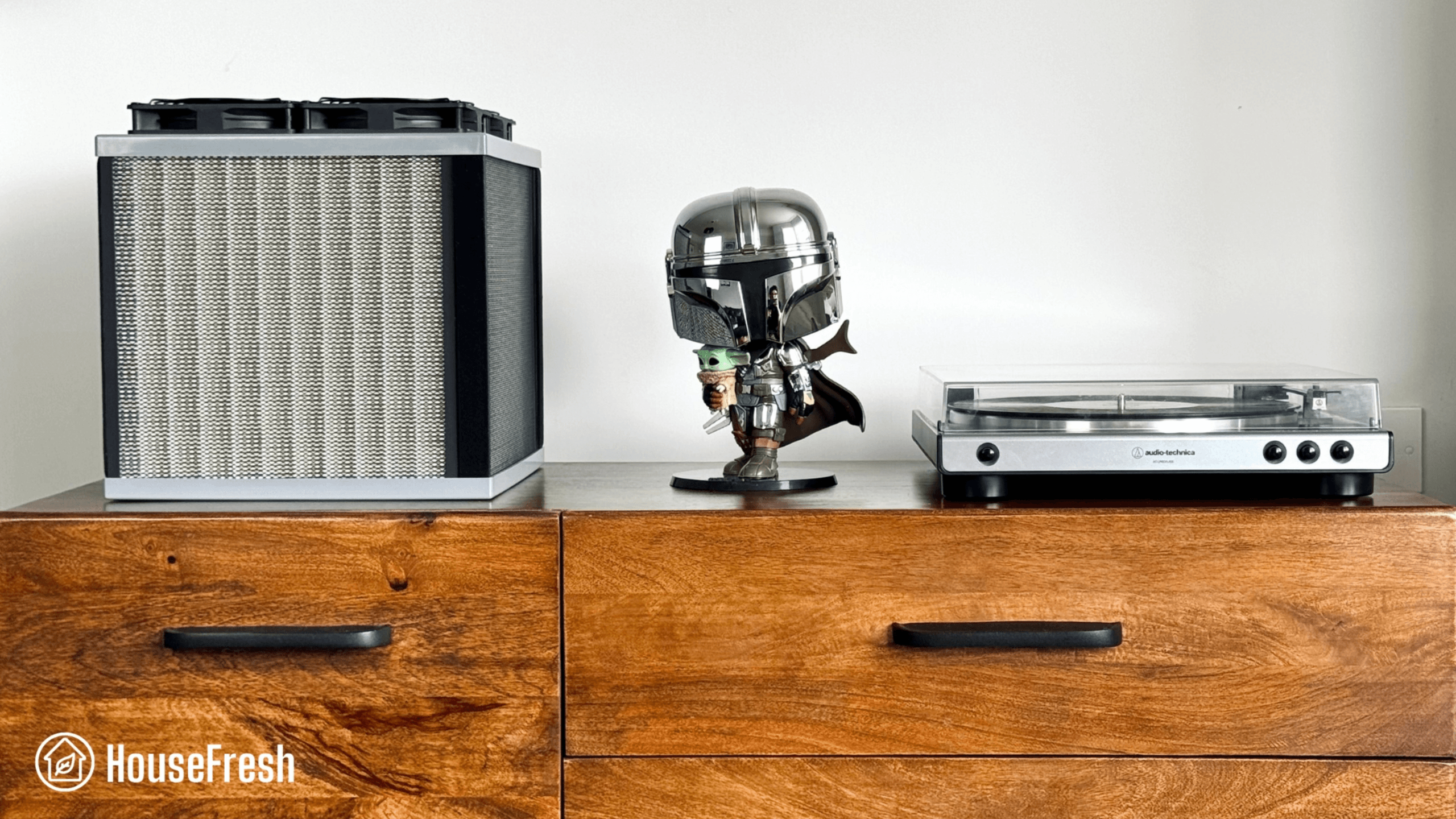
The 3Pro is a small and light with a design inspired by the Corsi-Rosenthal box.

AirFanta 3Pro Fireplace

Use the discount code HOUSEFRESH for 5% off when buying directly from AirFanta.

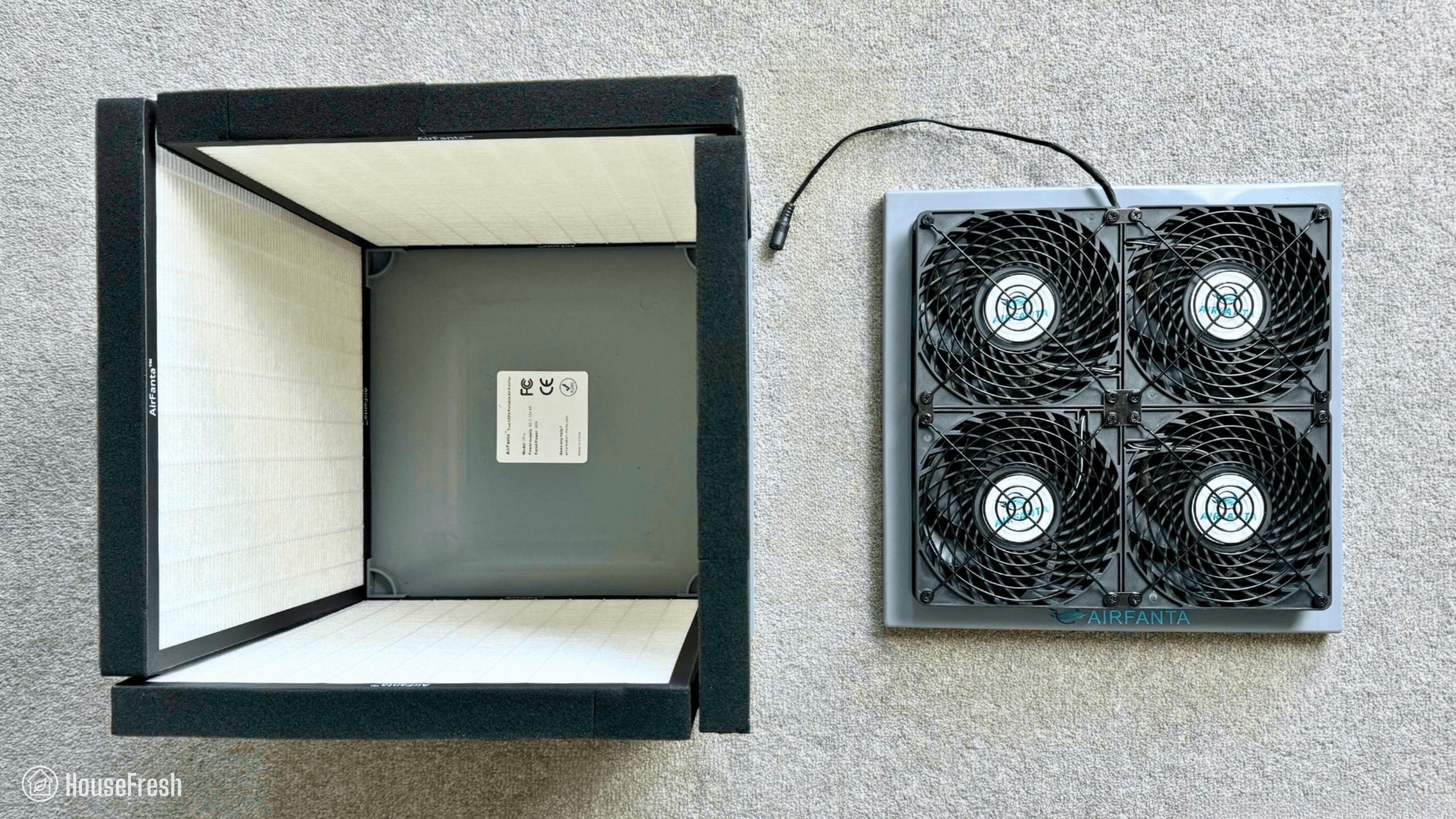
The AirFanta 3Pro is basically a box with a base at the bottom, one filter at each side and a fan array on top — much like the design of the Corsi-Rosenthal box.

The thing with the AirFanta 3Pro is that it is A LOT smaller than a CR box and that other PC fan kits using large HVAC filters:

CR Box VS AirFanta 3Pro Front CR Box VS AirFanta 3Pro Top
DIY air purifiers Size comparison

Now, while this is not a DIY kit like the Nukit Tempest or the CleanAirKits Luggable XL-7, you still need to put the AirFanta 3Pro together, but it’s a lot easier to do compared to the Tempest and the Luggable.

You just need to put the four filters in place on the sides of the base, which are clearly marked.

AirFanta 3Pro Open Corner

Once the four filters are in place at each side, you just need to clip the fan array on top.

AirFanta 3Pro Open

As I mentioned briefly above, the AirFanta 3Pro has been designed to be cheap and portable: when you take it apart, you will be able to fit it neatly inside a standard carry-on bag. It even fits snuggly inside Gisele’s Osprey Proxima backpack:

In terms of controls, the AirFanta 3Pro comes with a 110-220v AC to 3-12v stepless DC power adapter which will allow you to control the speed of the fans and the noise output.

AirFanta recently launched a new edition of the 3Pro, which is certified by CARB and is the only option if you live in California. 

This new edition has an independent speed controller that allows you to control the speed even when it is connected to a power bank of 12v/3A (or higher current) DC 5.5mm x 2.1 mm port.

Something that I really appreciate about AirFanta and Adam Wong is how committed they are to keep improving their devices based on customer feedback.

A few days after we ordered our 3Pro, I saw a tweet from Wong in which he announced the introduction of a handy Velcro strap in response to an idea from @ParentMishmash:

As mentioned at the top of this review, you can use this very same Velcro strip to strap the filters + fan array + base together once you have disassembled your 3Pro to ensure all parts fit nicely inside your suitcase or backpack. Simple yet effective!

Air cleaning performance

The AirFanta 3Pro cleared our test room in 17 minutes — it is nearly as fast at cleaning the air as the MUCH larger Smart Air Blast Mini.

AirFanta 3Pro Sidetable

I’ve been really keen to test the AirFanta 3Pro because there has been a lot of hype around it — especially after it was independently tested by Rob Wissmann and David Elfstrom. These are the results of their CADR tests:

  • CADR: at 13V: 436 CFM
  • CADR at 12V: 413 CFM 
  • CADR at 9V: 328 CFM 
  • CADR at 6V: 213 CFM 

I’m happy to report that the hype is completely warranted. Let me walk you through how the 3Pro performed in our tests.

According to our PurpleAir Zen sensor, the AirFanta 3Pro needed 17 minutes to achieve PM1 zero in our 728 cubic ft. test room running at top speed (12.6v). We estimate a PM1 CADR of 353 cfm, which would allow the 3Pro to provide five air changes per hour in rooms no larger than 529 sq. ft.

Swapping the filters for the HEPA + activated carbon option added three more minutes to the test, bringing the time to clean all traces of PM1 smoke pollutants to 20 minutes:

This matches the incredible CADR score tests performed by David Elfstrom and Rob Wiss, and compares quite favorably with other air much more expensive air purifiers.

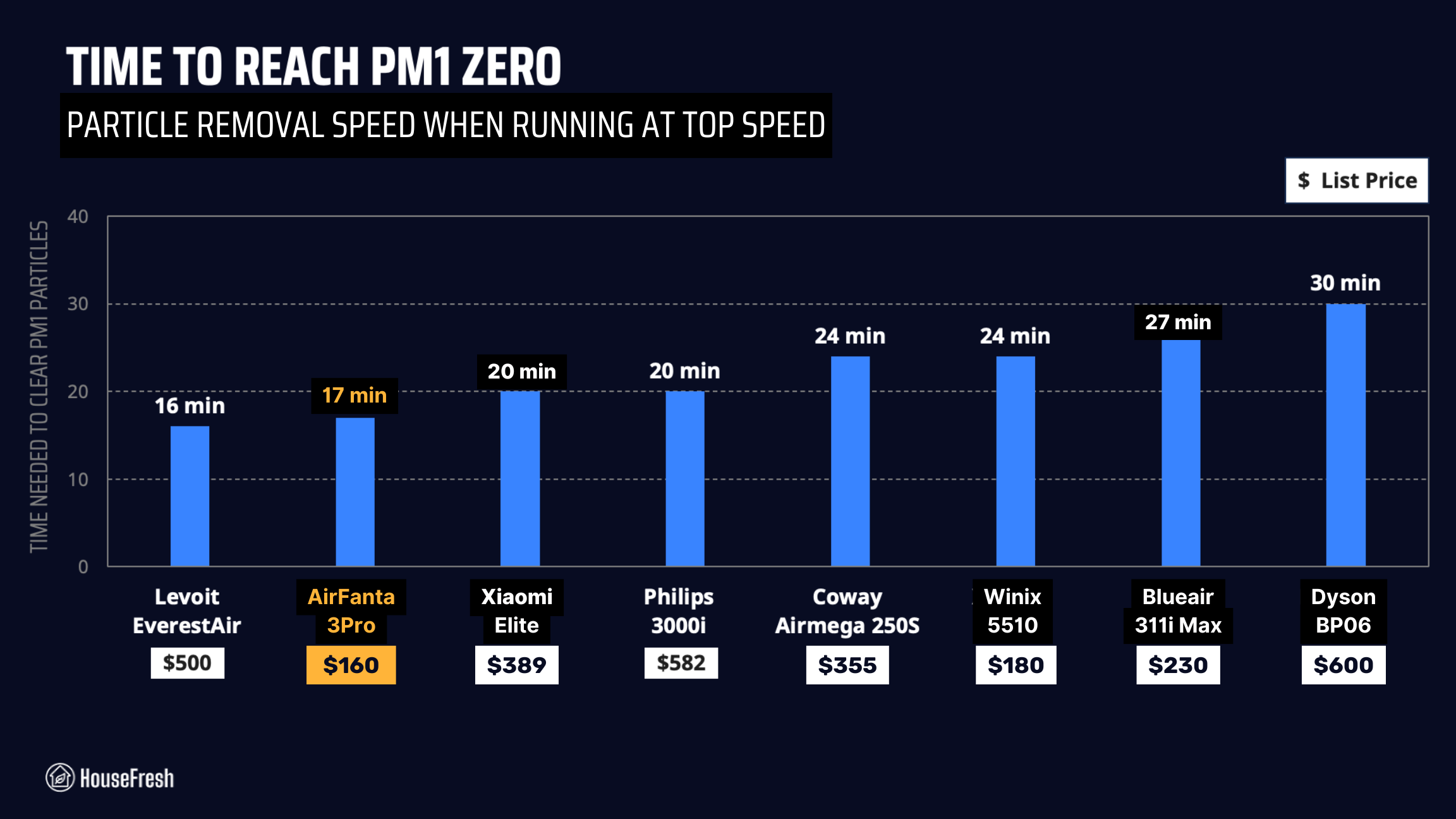
As you can see in the table below, the AirFanta 3Pro is not only affordable but also incredibly fast at cleaning the air:

12v performance airfanta 3pro

Our air cleaning performance test showed that at its highest fan speed (12.6v), the AirFanta 3Pro is as powerful as devices costing upwards of $450 and more effective at removing particles from the air than much more expensive air puriifers like the Dyson BP06.

Sound levels

In our testing, the sound levels of the 3Pro ranged from 36.1 dBA to 56.3 dBA. It is much quieter than the new Winix T810 (62.5 dBA) and the Coway AIrmega 200M (64.3 dBA)

The second most important thing to look at when choosing an air purifier is the amount of sound it generates. A device that is too loud is unlikely to be used regularly or, even worse, is likely to be switched off.

That is why we record (from 3 ft. away) the sound levels generated by every air purifier we test running at each fan speed in the same location (our basement). 

The AirFanta 3Pro comes with an AC-to-DC power adapter, which includes a dial for adjusting the voltage and the sound level generated by the air purifier. Here are the results at each fan speed we measured:

VOLTAGESOUND LEVELS (decibels)
3.63 v.36.1 dBA
4.19 v.39.7 dBA
5.24 v.36.9 dBA
6.54 v.43.3 dBA
7.44 v46.7 dBA
8.56v49.1 dBA
12.6 v. (top speed)56.3 dBA

At top speed, the AirFanta 3Pro reaches 56.3 dBA, which is quieter than most mind-sized popular traditional air purifiers available on the market today:

sound top speed airfanta 3pro

However, you may be wondering how this compares to other devices, especially other PC fan-powered air purifiers. Check out our table below:

PC FAN KITSOUND AT TOP SPEED (decibels)
CleanAirKits Luggable XL-7 [Cooler Master SickleFlow 120]38.8 dBA
CleanAirKits Luggable XL-7 Ultra [Cooler Master Mobius 120]47.2 dBA
Nukit Tempest41.8 dBA
NorthBox Systems 6XL [ARCTIC P14 Max]50.2 dBA
Nukit Tempest Euro50.5 dBA
NorthBox Systems 6XL [Noctua P14s Redux]45.1 dBA
AirFanta 3Pro56.3 dBA

Compared to other PC fan devices from Nukit, CleanAirKits and NorthBox Systems, the AirFanta 3Pro is much louder at its highest fan speed. However, it’s still in line with the top-speed sound levels of the traditional retail HEPA devices we have tested. 

However, sound levels at top fan speeds are not as important as air cleaning performance at lower fan speeds.

That is why we always identify a fan speed where the air purifier generates less than 45 dBA of noise to assess its quiet performance. In the case of the AirFanta 3Pro, we repeated the particle removal test multiple times across different voltages:

My recommendation is to go for 6.54V for top performance at sub-45 dB noise levels. Running at this speed, the 3Pro generates 43.3 dB of noise while still being able to clean our test room in 28 minutes.

airfanta quiet performance

When we account for sound levels, we see the performance of the AirFanta 3Pro getting beat by the CleanAirKits Luggable XL-7, which managed to clean our test room in 23 minutes even when running at only 38.8 dBA. However, the Luggable XL-7 costs upwards of $200 (plus filters), so considering the low cost of the AirFanta 3Pro ($159.99 including filters), I am super impressed. 

What impresses me the most is how incredibly well the AirFanta 3Pro compares to the shop-bought HEPA air purifiers I have tested. At its top speed, it is faster and quieter than most of the devices we have reviewed here at HouseFresh.

Tip

If you’re considering getting an AirFanta 3Pro, I suggest experimenting with the voltages to find a sound level that works for you. Personally, I have stuck to having my 3Pro running at the 8-volt mark as I find it offers an excellent performance-to-sound ratio.

Long-term running costs

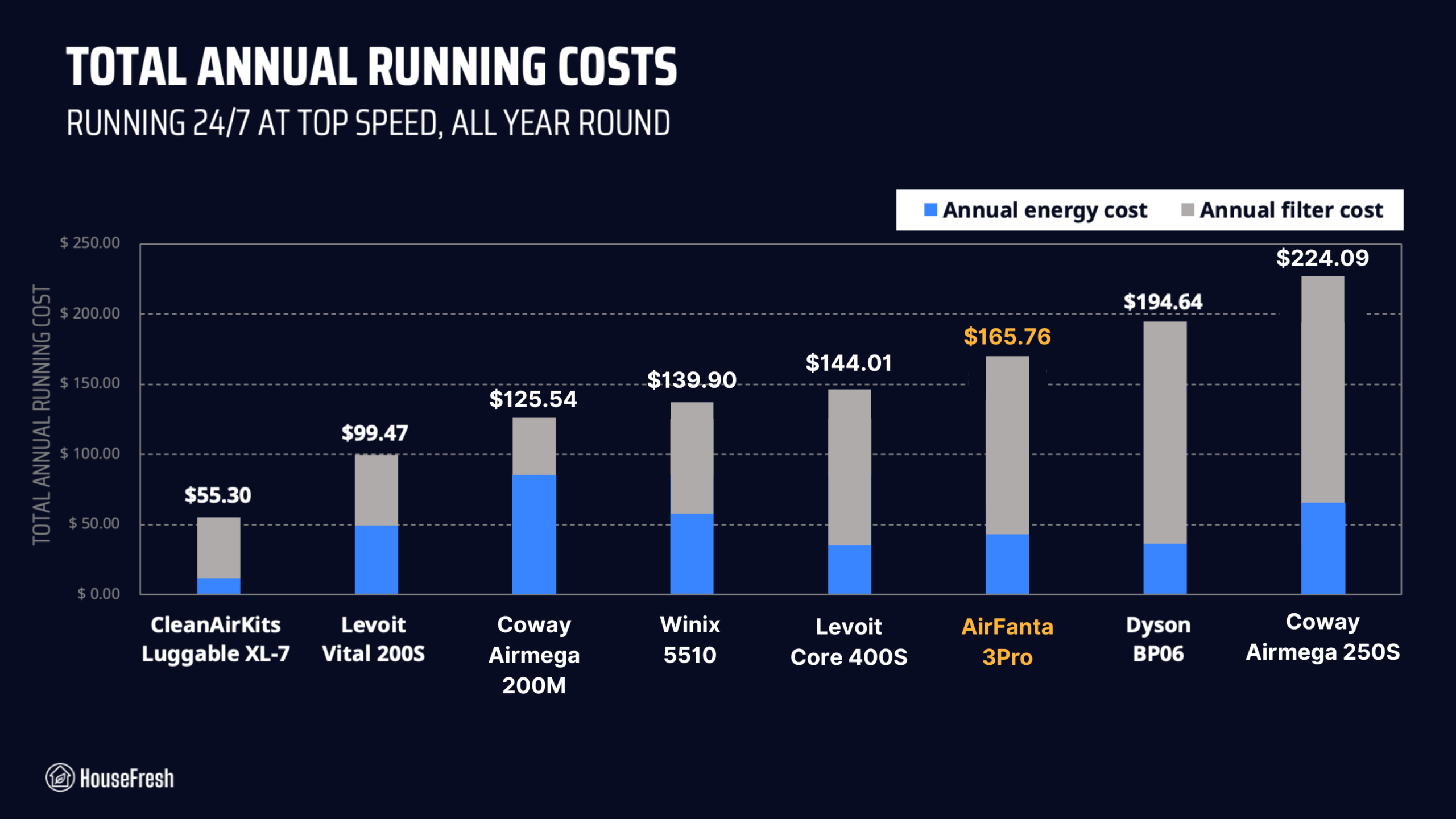
Running an AirFanta 3Pro will cost you $165.76 per year, combining energy consumption costs ($47.76) and filter replacement costs ($118).

AirFanta 3Pro Corner

Use the discount code HOUSEFRESH for 5% off when buying directly from AirFanta.

As always, I calculated the long-term costs associated with running your AirFanta 3Pro all day, every day at its top high speed for a full year — an unlikely scenario as you’ll probably want to have it running at a lower fan speed, but it’s a good baseline for running costs.

I started by using our energy meter to measure how much electricity the 3Pro uses at different voltages and, when running at top speed (12.6V), it pulled 43.23 watts.

VOLTAGEENERGY CONSUMPTION (watts)
Standby0 watts
3.63 v.2.19 watts
5.24 v.5.02 watts
6.54 v.8.98 watts
7.63 v.13.31 watts
8.56 v17.46 watts
12.6 v. (top speed)43.23 watts

This means that if you had to leave your 3Pro running 24/7 at top speed, it would cost $47.76 in energy costs for a year, using average U.S. energy rates as of July 7th, 2025.
Considering you need to replace the filter every six months and that the replacement costs $59 (HEPA only), you can expect to also spend $118 per year on filters.

When compared to other similar-performing air purifiers, the 3Pro has low energy consumption costs but it’s the OEM filter replacement costs that drive the yearly running costs up.

airfanta long term costs scaled

At 43.2 watts, the AirFanta 3Pro is more energy-efficient than many popular units, such as the Winix 5510 or the Levoit Vital 200S. However, compared with another PC fan-powered air purifier like the Luggable XL-7 from CleanAirKits, it’s clear that the 3Pro consumes more electricity at its maximum speed of 2900 RPM. 

That said, running costs for the 3Pro are similar to those of standard HEPA retail devices, but you do get much higher performance levels especially when you consider the much lower initial purchase cost.

cadr vs price airfanta

Tip

For a more efficient operation of the AirFanta 3Pro, I recommend going for 6.54V.

At this fan speed, the 3Pro consumes just 8.97 watts, so it will just add 10 bucks to your energy bill in a year while still being able to clean the air effectively as Levoit Core 400S or the IQAir HealthPro Plus running at full speed.

AirFanta’s creator, Adam Wong, explains how this big drop in energy consumption is possible:

“The power consumption of a fan is proportional to the cube of its RPM, while the airflow is proportional to the first power of the RPM. So higher RPM will result in less efficient of electricity consumption. The fan in the AirFanta 3Pro has a maximum speed of 2900 RPM, which is much higher than other PC-fan-based air purifiers, making it look less energy-efficient.

In fact, running it at 9V or lower would significantly improve energy efficiency. It still has a quite good CADR at lower voltage.”

Adam Wong, Founder of AirFanta

All AirFanta products come with a 1-year warranty. AirFanta will send you a new 3Pro and you won’t need to return the faulty device.

If you experience issues with your AirFanta 3Pro, all you need to do is email the AirFanta team at airfanta@air-fanta.com.
Make sure to include photos and/or videos of the issue you are experiencing.

Bottom line: Should you get the AirFanta 3Pro?

It’s totally worth it. This is the only air purifier with a a high CADR that you can travel with.

Here’s the thing: if you were to have come to me selling an air purifier with a CADR of 353 cfm for $159.99, I would have assumed it was some sort of a scam. The sheer power of such a device would surely cost a lot more, right? 

Adam Wong says no.

The AirFanta 3Pro can provide large rooms with multiple air changes for a price that is three times cheaper than what you normally pay for a standard, shop-bought HEPA air purifier. That is an incredible achievement that goes to show how brilliant Wong is and how much he actually cares about creating truly affordable solutions to clean the air. 

AirFanta 3Pro Sofa

Use the discount code HOUSEFRESH for 5% off when buying directly from AirFanta.

While the 3Pro is not totally plug-and-play (as you need to fit the filters and put the fans in place), it is MUCH easier to put together than all the other PC fan-powered DIY air purifier kits I have tested. That said, the 3Pro is also louder than all of them, so that is something to keep in mind.

For those looking for an air purifier they bring along when traveling or to events, there isn’t anything on the market right now that matches the high CADR of the AirFanta 3Pro. You can simply disassemble the device and pack it in your suitcase or backpack just to reassemble it wherever you need it. 

For those wanting a quiet and energy-efficient air purifier, they can leave running in the background even when having work calls or meetings at the office, then a PC fan kit like the Luggable XL by CleanAirKits or the Tempest by Nukit will be a better choice — just know that they will both cost over $100 more than the 3Pro.

Now, is sound is a concern but your budget can’t stretch beyond $160, then remember you can run your AirFanta 3Pro at lower fan speeds. It will be much quieter and still outperform the standard retail HEPA air purifier you can find online, costing you less upfront and in the long run.

I really love this device, so I expect you will find it across many of our lists of recommended devices. 

One last thought before I leave you: I believe everyone living outside the U.S. will really benefit from the AirFanta 3Pro, especially those living in places like the UK, where finding box fans and HVAC filters to build your own Corsi-Rosenthal box is virtually impossible. As if that wasn’t good enough, the 3Pro has a much smaller footprint than the standard CR box, is definitely quieter and offers much more adjustable fan speed options.

Do you have any questions about this device that I didn’t cover in my review? Drop a comment below, and I’ll reply right away.

SOURCES

We calculated energy consumption costs with the help of the Department of Energy’s appliance energy calculator. We calculated yearly costs associated with running an AirFanta 3Pro for 24hs a day for 365 days. We ran this calculation utilizing the U.S. average utility rate of 0.1235/kWh as of September 17, 2024.

Nukit Tempest review

Nukit Tempest Living Room

We have already built and tested two DIY units at HouseFresh, the Corsi-Rosenthal box and the more basic DIY Air purifier. We were impressed by their air cleaning performance and straightforwardness to build. So, when I saw CR Box creator Jim Rosenthal’s tweet on the Nukit Tempest, I knew we had to give the Tempest a try.

I am a big fan of the CR box as it is incredibly reliable and can be built with just a few readily available components. However, it doesn’t come without its downsides: the fan is noisy, the box itself takes up a lot of space, and the build is not as robust.

After some discussion on X (formerly Twitter) on how these setbacks could be improved, PC fans were suggested as a suitable alternative for the bigger, louder box fan. It was Zack Deis who designed the first PC Fan Corsi-Rosenthal Box before donating his design so that the Nukit Tempest could be developed.

The Tempest is produced by Nukit, a Shenzhen-based startup on a mission to produce high-quality products at a fair price backed by third-party testing and supported by honest marketing and excellent customer service. Nukit has developed a small selection of products and is well known for the Nukit Torch Far-UVC Lights, which are increasingly popular online. They are always working to improve their products, and if you follow them on X, you will quickly learn that they are not shy when it comes to sharing the behind-the-scenes of their work, including new products they are developing right now.

When purchasing the Nukit Tempest kit, you get all the parts required to build the frame for $179.95. However, you still need to buy the MERV filters, DC power supply and PC fans (with fan guards, if you want them) — all of which are transparently listed on The Cyber-Night Market, which is the online store were you can buy Nukit products. We estimate a total cost of $300 to get all the items. 

As always, we bought the Nukit Tempest kit and the parts with our own money to ensure we have the freedom to say what we really think after conducting the same performance tests we run on every air purifier we review.

how we test
How we test air purifiers

Read our full testing methodology.

That was a long intro, so I hope you’re still with me. Let’s jump into the review.

The lowdown on the Nukit Tempest

Danny Ashton HouseFresh

“I am super impressed by the Nukit Tempest. This new type of air purifier uses PC fans to offer great air cleaning power without high levels of sound. While this is the first generation, I’m super excited to see where this new approach to air purifiers takes us.

Be aware that this is a kit and does need some time and effort to build, but those who do will have a great air purifier that is also incredibly quiet.”

— Danny Ashton, HouseFresh Founder & Senior Writer

TEMPEST DIY KIT ARCTIC P14 PC FAN MERV 13 FILTERS

Before jumping into my full review, I have distilled the key strengths and weaknesses of the Tempest into pros and cons below:

What we really like

It has the best cleaning-power-to-noise ratio we have ever seen on an air purifier.
Filters are far easier to replace when compared to the CR box — you don’t need to rip your air purifier apart to change them.
You can choose any 20x20x2″ MERV filters you want to use, from any brand you want.
This is a truly buy-it-for-life device: all parts can be easily replaced at a low cost, allowing you to fix and maintain your unit yourself.
It is highly customizable. You can choose the 20x20x2″ MERV filters, PC fans, power switch and fan guards you want.

What we think could be better

Without activated carbon filters, it won’t be able to help with unwanted smells and gasses.
It is a hot product right now, so it might not always be available for purchase. However, you can sign up for Nukit’s mailing list on The Cyber Night-Market to get notified as soon as it’s back in stock.
While most items are readily available worldwide, 20x20x2″ MERV filters may be harder (or more expensive) to find outside the U.S.
It is not a “plug and play” air purifier, so it will not be suitable for those who are not comfortable building it. PC building experience is highly useful.

HouseFresh rating:★★★★☆
Time to clean our 728 cubic feet test room (with the device running at top speed):Without fan grills: 31 minutes
With mesh fan grills: 43 minutes
Air filtration technology:MERV 13
Recommended room size (4.8 air changes per hour):385 sq. ft. (estimated)
Clean air delivery rate (CADR):247 CFM (estimated by @VentiloAngel)
Dimensions (in inches / in cm):21.25L x 20.25W x 9.6H inches (54L x 51.5W x 24.2H cm)
Weight (in pounds / in kg):14.7lbs (6.65 kg)
Filter life:12 months
Noise level in decibels (measured from 3 ft. away with a sound level meter):41.8 dB
Electricity consumption in watts (recorded with an electricity usage monitor):8.8 watts
Estimated running cost (electricity consumption + official filter replacement):$50.11 per year
Cost per CADR cfm (based on dust CFM as reported by AHAM):$1.20
Country of manufacture:China

The best Tempest feature: Quiet yet powerful

You’ll barely notice it’s running thanks to the PC cooling fans — and it can still effectively cover rooms up to 385 sq. ft.

Nukit Tempest Front Room

The Nukit Tempest not only looks cool but it also offers excellent performance with cleaning power comparable to many medium-to-large air purifiers we have tested. 

Yet, despite its capacity to draw in considerable amounts of air through its filters, the Tempest runs far quieter than most.

But you don’t need to take my word for it. Check out the chart below comparing the max sound levels VS air cleaning speed of the Tempest against various popular air purifiers:

A PC case-inspired design that fits two large MERV filters and six fans

Assembling the Tempest is not particularly easy, but the end result is a cool-looking device with a gamer vibe.

Nukit Tempest Design

The Nukit Tempest looks nothing like a regular air purifier. In fact, if you walked into a room with a Tempest, you are more likely to think it’s a desktop computer than a DIY air cleaner. Similarly to PC building, the appearance of your Tempest will vary slightly depending on the items you choose to assemble it.

Nukit Tempest Top

It has six PC cooling fans on top and six more on one of the sides. As I have small children at home, I decided to also get 140mm mesh guards, which will protect the fans from dust but, most importantly, keep little fingers out of the way. However, it’s worth mentioning that the mesh grill restricted airflow, thus affecting the performance of the Tempest but I will tell you more about this further down the review.

Nukit Tempest Mesh Covers

140mm MESH FAN GUARDS 140mm WIRE FAN GUARDS

Another important point to consider with my kids in mind: the metal is sturdy yet smooth, and it has no sharp edges or imperfections that could cut you while moving it from room to room. Speaking of which, it was great to see all the clever little design details that improve usability, such as the two handles at the top.

Nukit Tempest Handle

The Tempest comes with wire mesh side grills to guard the filters, making the device more resistant than other DIY air purifiers, including the CR Box. Plus, it conceals a bit the fact that it is an air purifier, avoiding the attention-grabbing white filters to be the center of attention.

Nukit Tempest Pre Filter

Speaking of the Corsi-Rosenthal Box, I took a photo of the Tempest next to my CR Box to show you just how small and stylish the Tempest looks next to the bulky cube. 

CR Box vs Nukit Tempest

As you can see, the footprint of the Nukit Tempest is much smaller, making it a great choice for spaces where the CR Box couldn’t quite fit. It is also super lightweight, weighing no more than 14.7lbs.

Nukit Tempest VS CR Box Top

Another thing worth mentioning is that the Tempest does not have a control panel. It is either plugged in and running, or unplugged. That said, you could buy a power supply with an on-off switch.

Nukit Tempest Plug

DC POWER SUPPLY

The Tempest was created with homes AND public spaces (such as schools and businesses) in mind, where air purifiers should be running 24/7 but are often not. This is the quietest unit I’ve tested able to clean the air effectively — for example, the Core Mini is super quiet, but it won’t be useful in most rooms.

Another example of quiet power is the Smart Air Blast Mini. I took a photo of both devices next to each other so you can see how they compare to one another in terms of size:

SmartAir Blast Mini VS Nukit Tempest

The Tempest kit comes with four metal panels, screws, a cardboard tube containing the side grills, four square, self-adhesive feet and 3mm rubber hole plugs, a 19mm rubber plug, a PWM connector, a 12v DC power connector AND zip-ties. 

What you will need that’s not included is the following:

ITEMRECOMMENDED WHAT WE BOUGHT
6 x PC cooling fansArctic P14Amazon
6 x Fan guards140mm mesh or metalAmazon
1 x DC power supply12v, 2A with 5.5x2.1mm barrel connectorAmazon
2 x FiltersMERV 13 filters, 20x20x2 inchAmazon

While assembling the Tempest might seem a tad daunting for those not so comfortable with their DIY skills, there’s a thorough step-by-step guide on The Cyber Night-Market website with photos and detailed instructions. You can also watch my video:

All pieces, screws and cables come in separate bags to make assembling easier. It is kind of building a huge Lego –– a fun STEM project to be sure. 

Two 20x20x2″ MERV filters protected by side grills

The Tempest is proof that you don’t actually need HEPA to achieve exceedingly good air filtration results.

Nukit Tempest Fireplace

That’s right: HEPA is not the failsafe many manufacturers want us to believe. 

Certified HEPA filters are considered an assurance for many for their single-pass filtration efficiency, or in simpler terms, the capacity of a filter to trap particles in just one pass of air.  The thicker the filter (HEPA 12, 13 and even 14), the more particles it can catch on the fibers in a single pass. 

On their part, MERV filters have a lower single-pass filtration rate compared to HEPA filters. But air purifiers are designed to run continuously, circulating air and trapping particles on the filters in every cycle. As David Elfstrom, an engineer who has shed light on many key discussions related to indoor air pollution, puts it:

So, with no real need for HEPA, the Nukit Tempest uses affordable and readily available MERV 13 filters just like the Corsi-Rosenthal Box and the simpler DIY air purifiers. 

As MERV filters are less dense than HEPA, they allow for increased airflow. That means that they can move a lot more air than units with HEPA or HEPA-type filters, capturing more particles from the air.

Nukit Tempest MERV 13 filter

The Nukit Tempest hasn’t been sent to the Association of Home Appliance Manufacturers for a CADR test, but that doesn’t mean that it’s not been tested by third-parties. David Elfstom estimated a CADR of 280 CFM and Nathalie Roussay (known as L’Évangéliste de la Ventilation on X) estimated 247 CFM – all of these using the Artic P14 fans, which are the same we’ve used in our own Tempest. 

I will go deeper into air cleaning performance comparisons in the next section but, with these numbers, the Nukit Tempest and its MERV 13 filters could offer similar performance than air purifiers such as the Blueair Blue Pure 311+ and the Alen BreatheSmart 45i – both good, reliable units much liked by many users.

It’s worth noting that replacing the filters in your Tempest will be much easier than disassembling your CR Box and other DIY units before you can rebuild them with the new ones. With the Tempest, you just have to unscrew the sides, remove the old filters, place the new filters and screw them back.

Tip

If you buy MERV filters in bulk, make sure each one is sealed separately or at least in twos. You don’t want the filters in contact with the air before use, or they will start accumulating particulates as they are stored in a cupboard.

The Nukit Tempest cleared our test room in 31 minutes

The Tempest has the best performance-to-noise ratios across all 70+ air purifiers we have tested, and the six PC cooler fans have a lot to do with that.

Nukit Tempest Fans Close Up

To assess the real-world performance of the Nukit Tempest, we run the same tests we perform on all the air purifiers we review, including particle removal speed, noise output and energy usage.

For the speed test, we filled our 728 sq. ft. test room with incense smoke and used our two PurpleAir sensors (the Touch and the Zen) to monitor how long the Tempest took to clean the air, bringing the PM1 levels to zero.

As you will see on the chart above, it took the Nukit Tempest 31 minutes to complete our particle removal test. 

This number changes when we add the mesh guards on top of the PC fans. I wasn’t expecting such a big difference, but it turned out that the mesh guards added 12 minutes to the test:

Without fan grillsWith mesh fan grills
Nukit Tempest31 minutes43 minutes

This is something to consider when building your Nukit Tempest. We haven’t tested it using wire fan grills, but I imagine it will be better than the mesh grill as, clearly, the ultrafine nylon restricts airflow:

Nukit Tempest Mesh Cover Closeups

A reader shared this report on the effects of different grill patterns on fan performance. It shows that the mesh grill does, in fact, restrict airflow. The report also shows that opting for a wire grill can achieve performance results nearly as good as running your Tempest without a grill.

Air cleaning performance, compared

With an average estimated CADR of 247 CFM, the Nukit Tempest’s cleaning speed definitely met our expectations.

Compared with units that boast similar CADR, the Tempest sits in the middle: the Blueair Blue Pure 311+ (250 CFM) was 10 minutes faster, but it outpaced the $428 Alen BreatheSmart 45i (207 CFM) by three minutes.

There is also a six-minute difference with the Corsi-Rosenthal Box (estimated 274 CFM). I cannot deny that I’m still a huge fan of the CR Box; it is such a practical solution for so many people and different contexts. However, if we factor in the noise output of the two, the CR Box’s speedyness becomes somewhat relative.

Let’s see how the Tempest performed noise-wise. 

Noise levels, compared

This is one of the Nukit Tempest’s highlights: how quiet it runs. To measure the noise output, we used a commercial sound meter to record sound levels in dB(A) emitted by the Tempest from 3 ft. away.

As we saw in the first section, the Tempest has only one speed. When running, it emits 41.8 dB(A) of noise, which is equivalent to the (almost imperceptible) noise of a suburban area at night. 

The chart below shows how the Tempest compares to other air purifiers.

If we focus on the lowest fan speeds, the Tempest might not be the quietest unit, but it is not the loudest, either. However, the comparison changes completely when we look at the top speed values: no purifier runs as quietly as the Tempest. 

We were so impressed with these results that we decided to push our tests further. So, we compared the Tempest’s performance (speed and sound) versus some of the best units we tested but running at a similar sound level (in most cases, in Speed 2). Here’s what we found out:

AIR PURIFIER MODELSOUND LEVEL AT TOP SPEED (dBA)TIME TO CLEAN OUR TEST ROOMPRICE
Levoit Vital 200S - Speed 242.5 dB(A)40 minutes$189.99
Winix 5300-2 - Speed 2 without ionizer42.5 dB(A)43 minutes$199.99
Taotronics AP-003 - Speed 242.8 dB(A)39 minutes$99.99
Nukit Tempest41.8 dB(A)31 minutes$179.95 (plus parts)
Air Doctor 3000 - Speed 1 40.2 dB(A) 43 minutes $519.00

When noise output is the primary variable, the Nukit Tempest air cleaning performance amply outperforms all others.

I mean it when I say you will often forget the unit is running in the background. But still, don’t take my word for it; listen to the Tempest running for yourself:

The cost to run a Nukit Tempest: $50.11 per year

1. Electricity costs = $9.25 per year

When choosing an air purifier, long-term costs are worth considering, especially with rising electricity prices worldwide. So, as part of all our reviews, we measure electricity consumption using an energy meter.  

Nukit Tempest Energy Test

The PC fans in the Nukit Tempest mean less noise and less energy usage. In our testing, the Tempest pulled a mere 8.8 watts. Running it 24/7 uninterruptedly would add up to less than $10 a year to your electricity bill.

As a reference, the Blueair Blue Pure 411 has an energy usage of 10 watts at top speed, and it was featured among the 2024 most efficient air purifiers at Energy Star. However, the Blue Pure 411 needed over an hour to remove all PM1 pollutants from our 728 sq. ft. room.

As with noise levels, the energy consumption of the Nukit Tempest matches the same figures you can expect from some of my favorite air purifiers when running at low fan speeds. The problem is that low fan speeds mean slower air cleaning performance, so when comparing these great devices against the Tempest, we see the Tempest win again:

AIR PURIFIER MODELENERGY CONSUMPTION AT TOP SPEED (watts)TIME TO CLEAN OUR TEST ROOM
Air Doctor 3000 - Speed 19.6 watts43 minutes
Nukit Tempest8.8 watts31 minutes
Taotronics AP-003 - Speed 210.5 watts39 minutes
Levoit Vital 200S - Speed 28.0 watts40 minutes
Winix 5300-2 - Speed 2 without ionizer 6.7 watts43 minutes

The performance-to-energy usage ratio of the Nukit Tempest is just incredible.

2. Filter costs = $40.86 per year

Filter costs are the second ongoing expense to factor in. With store-bought units, you can choose between original, branded filters (which tend to be expensive) or generic ones (for which there’s not always enough information online).

The Nukit Tempest uses standard, non-proprietary 20x20x2 MERV 13 filters. Availability may vary depending on your location, but in the U.S., there are plenty of options at a varied range of prices. 

We used Filterbuy’s set of two for a little over $40. Considering filters need to be replaced about every 12 months, the Tempest has one of the lowest long-term costs we’ve seen in the industry: around $50 a year. 

There are simply too many reasons to love this device.

AIR PURIFIER MODELESTIMATED ELECTRICITY COST (per year) FILTER REPLACEMENT COST (per year)YEARLY MAINTENANCE COST
Coway Airmega 150$48.12$49.99$98.11
Smart Air S$41.00$73.98$114.98
Levoit Vital 200S$67.95$59.99$127.94
Winix 5500-2$81.54$79.99$161.53
Nukit Tempest$9.25$40.86$50.11
Mila$58.45$150$208.45

Bottom line: Is the Nukit Tempest worth it?

The short answer: yes, but be aware that building it might be tricky if you’re not comfortable with cables and tiny parts

The Nukit Tempest has definitely impressed us with its clear advantages over shop-bought devices: it is super quiet, cleans the air pretty fast, can cover large spaces (385 sq. ft.), and its long-term running costs are as low as they get.

One of my favorite things about it is the environmentally conscious buy-it-for-life concept that defies a whole industry of devices with built-in planned obsolescence. Say the PC fans get old and start malfunctioning; you can replace those, and that’s it. The same applies if you want to upgrade the PC fans for newer, quieter ones or if you want to add an on/off switch or Nukit’s own power loss alarm. Most components in your Nukit Tempest could be swapped, upgraded and fixed at home. Besides, with standard MERV filters, you are not tied to any brand.

Nukit Tempest Design

But I get it. Sometimes a ready-to-use solution is all you want or need, and that’s understandable. There are plenty of great store-bought air purifiers that will do a fine job. But if you are at all curious about the use of PC fans or fancy a STEM project you can carry out with your kids, then I strongly suggest giving the Nukit Tempest a try.

You won’t just get an amazing air purifier; you’ll also be supporting a worthwhile project with a genuine interest in indoor air quality that is affordable and powered by honest marketing — two things that the world really needs.

I’m currently testing other PC fan DIY air purifiers (the Luggable by Clean Air Kits, Adam Wong’s AirFanta 3 Pro and the NorthBox Systems’ 6XL), so make sure to subscribe to our YouTube channel to watch my review without having to wait for it to be published on our site.

Tip

If you want to take the DIY spirit further, the instructions to build the Nukit Open Air Purifier’s enclosure are available on GitHub (there’s even an app).

SOURCES

We calculated yearly costs associated with running the Nukit Tempest 24 hours a day, 365 days per year utilizing the latest average energy prices as reported by the Bureau of Labor Statistics of $0.174/kWh as of June 2024.

Corsi–Rosenthal Box review

CR

The Corsi–Rosenthal Box is the brainchild of Dr. Richard Corsi and Jim Rosenthal and it was developed to create an affordable and effective DIY air cleaner during the COVID-19 pandemic. It was designed to use common MERV-13 HVAC filters (that are easily available in the United States) in combination with a box fan. Unlike the other devices we have reviewed here at HouseFresh, it is an air purifier that you can build yourself.

After recent controversy around the use of the term ‘CR Box’ to refer to variations of the DIY filter and fan box, it is worth mentioning that the Corsi–Rosenthal Box was an improvement on the DIY box fan air purifiers that have been around for many years.

The Corsi-Rosenthal Box is sometimes referred to as the Comparetto Cube. The main difference between the two is that the CR-Box uses five MERV-13 filters, whereas the Comparetto Cube uses four filters with the bottom side covered by cardboard. Rosenthal devised a further improvement by adding a “fan shroud” made of cardboard to cover the corners of the box fan, improving its performance.

Most CR Boxes you will see these days doing the rounds on Reddit or X (formerly Twitter) are what could be called Corsi-Rosenthal Boxes with a Comparetto Cube configuration.

Several studies have supported the effectiveness of the Corsi–Rosenthal Box, including research by the EPA, which tested the device and showed it could be very effective at removing the tiniest particles of 0.01 µm – 0.6 µm. A study from researchers at Brown University also showed that a Corsi–Rosenthal Box can help reduce PFAS and phthalate levels, which are common indoor air pollutants. The Corsi–Rosenthal Box was also tested by researchers at UC Davis Energy and Efficiency Institute, who found that this DIY device performs similarly to residential portable air purifiers in terms of estimated clean air delivered, even though it costs about three times less.

As this concept aligns with our core mission of helping deliver clean air, affordable for all, we were keen to build our own Corsi-Rosenthal Box with a Comparetto Cube configuration.

But we didn’t stop there. We also tested the Corsi–Rosenthal Box following the exact same process we followed with every other air purifier we have reviewed to date so we could compare its performance like-for-like.

how we test
How we test air purifiers

Read our full testing methodology.

The lowdown on the Corsi–Rosenthal Box

Danny Ashton HouseFresh
“The Corsi–Rosenthal Box with a Comparetto Cube configuration offers the best ratio of $ spent to air cleaning performance we have seen. A simple design that even children can build, which can be a massive help in removing tiny particles from indoor air.”
— Danny Ashton, HouseFresh Founder & Senior Writer

CR Box Living Room

BUY BOX FAN

If you don’t have time to read the full review, you can just read my top-line summary of the findings when testing the CR Box:

What we really like

It offers the best air cleaning performance per dollar spent of any air purifier we have tested.
It uses items you might already have in the house (four MERV 13 filters, a box fan and duct tape).
It is powerful enough to provide five air changes per hour for rooms as large as 411 sq. ft.
Outstanding performance — cleaned our test room in 30 minutes! That is faster than the much more expensive Mila and the Austin Air HealthMate.
It is super easy to build your own CR Box with the help of online instructions.

What we think could be better

It has a fairly large footprint compared to similar powered traditional shop-bought air purifiers we have tested. The CR box is not ideal for small spaces.
Box fans can be loud when running at their top speeds.
It does require you to put it together, there is no way around it.

Considering you can build this air purifier yourself, the fact that our CR Box managed to clean the air as fast as pricey shop-bought devices is impressive.

Clean air delivery rate (CADR):– Top speed PM1 CADR: 198 cfm
– Sub-45 dBA PM1 CADR: n/a
Filter technology:MERV 13
Recommended room size:297 sq. ft. (5 air changes per hour)
Dimensions:20L x 20W x 20H inches (50L x 50W x 50H cm)
Weight:10 lbs (4.5 kg)
Noise level in decibels from 3 ft. away:Speed 1: 49 dB
Speed 2: 55.1 dB 
Speed 3: 60.7 dB
Electricity consumption in watts:Standby mode: 0 kWh
Speed 1: 40.5 kWh
Speed 2: 44.5 kWh
Speed 3: 46.7 kWh
Filter life:6-12 months
Manufacturer’s warranty:n/a

A bulkier design compared to shop-bought units

The final look will depend on how good you are at handling duct tape — I’m not great.

CR

There is no escaping that this is a box fan with a bunch of HVAC filters taped to it.

Compared to a shop-bought unit, the Corsi–Rosenthal Box is fairly utilitarian, and if you are not very crafty (like me), it can look a little messy.

CR Box Shroud front

Something to keep in mind as well is that, due to the design, the Corsi–Rosenthal Box takes up quite a bit of floor space — you can get a better performance-to-size ratio from retail units.

Naturally, you won’t find a fancy control panel with a touchscreen display or hi-tech buttons. Personally, I love the simplicity of the controls in our CR Box. You will only need to focus on the dial of the box fan—simply adjust the fan speed to match the air cleaning power you need.

Corsi Rosenthal

This is to say that if you are looking for a stylish unit, the Corsi Rosenthal Box might not be the right air purifier for you. You can see in the image below how it compares in size and in looks with other air purifiers we have around the house:

CR Box Comparison Other Units

However, many of these are devices you can buy at any retail store. So a better comparison could be looking at the CR box next to some of the trendy PC fan-powered DIY kits, such as the AirFanta 3Pro, the Nukit Tempest and the CleanAirKits Luggable XL:

DIY air purifiers Size comparison

While some of these devices use 20-inch MERV 13 filters, the fact that they are not cubes REALLY helps reduce the floorspace you will need to have one at home:

CR Box VS AirFanta 3Pro Top

A great example of why HEPA is not a requirement for clean air

The Corsi–Rosenthal Box uses four MERV 13 filters, and they work like a charm.

CR Box Top view

HEPA H13 is regularly touted as an important aspect of an air purifier, but the Corsi–Rosenthal Box can clean even the tiniest of particles with MERV-13. This goes to show that HEPA grade is not an absolute requirement for clean air. 

Jim Rosenthal regularly discusses that it’s all about filter, fit and flow

A Corsi–Rosenthal Box can move A LOT of air through each of the four MERV-13 filters. This means that this device can continue to remove even the tiniest of particles as the air passes through the filters multiple times.

Corsi Rosenthal

Another way to explain this is by sharing my experience when testing small air purifiers that use HEPA H13 filters, but that fail to clean the air in our test room — hello, AROEVE MK01. The reason this happens is that these small air purifiers cannot push enough air through the filters quickly enough to make a meaningful difference to indoor air quality, no matter how high the grade of its HEPA filter.

When building your own CR Box, you need to make sure that you use at least MERV 13, as tests with lower-grade filters have shown to be less effective. Unlike a retail air purifier, you can use any MERV 13 HVAC filter brand.

CR Box Side view

Tip

When the time comes for you to replace the filters in your CR Box, you will need to remove the duct tape around the filters before you can replace them. The last step will be for you to re-tape the new filters. 

I am looking forward to the moment when I need to replace the filters in our CR Box so I can ask my wife to help me do a better job at re-retaping them — V2 will look a lot tidier!

The Corsi–Rosenthal Box cleared our test room in 30 minutes

I am blown away by the performance of an air purifier you can put together in 10 minutes with materials that will cost you $85.

CR

We tested the Corsi–Rosenthal Box in the same test room where we tested all the air purifiers we reviewed. Our test room measures 728 cubic feet, and we use the PurpleAir Zen that can track PM1.0ug/m3, PM2.5ug/m3 and PM10.0 ug/m3 and VOCs using the additional Bosch gas sensor.

We lit an incense stick to simulate indoor pollution and then tracked how long it took the Corsi-Rosenthal Box to clean the air to the point that the PurpleAir sensor showed zero PM1.0ug/m3. It is worth mentioning that we tested our CR box with and without a cardboard shroud at the top.

The CR box without the cardboard shroud cleared all PM1 pollutants from our test room in 30 minutes:

Adding a cardboard shroud at the top of our CR box, shaved off two full minutes at no extra cost:

The Corsi–Rosenthal Box compared very favorably to much costlier retail devices.

It cleaned the air nearly as fast as the $900 IQAir Healthpro Plus and was faster than the much more expensive (and super smart) Mila. However, we found it to be minutes slower than the latest budget-friendly purifier from Levoit, the Vital 200S.

Noise levels

Noise is a concern for any air cleaner as it must run consistently to be effective. If a device is too loud, then it will not be used as often. We used a sound level monitor to measure how much noise the Corsi–Rosenthal Box generated when running at different fan speed levels.

Creating 60.7dB at its highest speed, the Corsi–Rosenthal Box makes similar volumes to many commercially available devices but is MUCH louder than other DIY air purifiers such as the CleanAirKits Luggable XL or the AirFanta 3Pro.

Now, I know that noise can be very subjective, so after our performance test was complete, we recorded a video of our CR Box running at each fan speed.

The cost to run a Corsi–Rosenthal Box: $110.88 per year

1. Electricity costs = $50.56 per year

I plugged our Corsi–Rosenthal Box through an electricity usage monitor to record how many watts it pulled when running at different fan speeds. For the sake of this calculation, I am using the readings from the top speed.

When running at the highest fan speed, we saw that our CR Box pulled 46.7 watts, which adds $50.56 to your electricity bill if you use it 24 hours per day. 

2. Filter costs = $60.32 per year

Filter replacement will depend on how much use your CR Box and how dirty the air is in your specific location, but a good rule of thumb is to replace your filters every 6-12 months. 

Assuming the filter achieves a 12-month lifespan, you can get a new set of four filters every year for $60.32:

Aerostar 20x20x1 MERV 13 Air Filter, 6 Count, ACTUAL SIZE (19.75 x 19.75 x 0.75), HVAC, Air Conditioning & Furnace Filter for Allergies, Dust, Pet Dander & Smoke (MPR 1500 / FPR 10), Made in USA
  • UNIVERSAL COMPATIBILITY: Fits most standard residential and commercial HVAC systems with a standard 1-inch filter slot. Including Carrier, Bryant, Payne & Honeywell. Actual size 19.75 x 19.75 x 0.75 Comparable to Filtrete MPR 1500-1900 and Honeywell FPR 10 filters.
  • ADVANCED MERV 13 (MPR 1500 - 1900 / FPR 10) PERFORMANCE: High-efficiency filter media captures up to 98% of airborne particles including dust, pollen, pet dander, bacteria, smoke, and microscopic allergens for cleaner, healthier indoor air.
  • ELECTROSTATICALLY CHARGED DESIGN: Premium synthetic pleated fibers attract and trap more particles without restricting airflow—helping maintain optimal HVAC system performance and energy efficiency.
  • LONG-LASTING, DURABLE DESIGN: Heavy-duty beverage board frame with moisture-resistant backing and reinforced pleats provides up to 3 months of reliable filtration—outlasting traditional fiberglass filters.
  • PROUDLY MADE IN THE USA: Manufactured using high-quality materials in American facilities to ensure dependable performance, sustainable production, and cleaner indoor air you can trust.

Tip

If you spot visible dirt on the filters, don’t panic, as it doesn’t mean your MERV-13 filters need to be replaced. Tests have shown that a Corsi–Rosenthal Box will still clean the air even if the filters “look” dirty.

You should wait till the soiling is noticeable or if you feel the CR box is not as effective following AQI sensor metrics.

Bottom line: Is the Corsi-Rosenthal box worth building?

The short answer: Yes! The long answer: The CR box offers powerful air cleaning performance for $85 and some duct tape!

Many air purifier brands like to overstate how complicated it is to clean the air, but the Corsi–Rosenthal Box is living proof that you just need a fan and filter — literally. 

Thanks to the support and knowledge of the clean air community, we can now clean the air in our homes with easily available parts that won’t require much time or money. Who knows, you may even have the required components lying around your house already!

CR

While I still think that a specially designed air purifier will make more sense to people who can invest in the right unit for the specific job they need, the Corsi–Rosenthal Box is perfect for those on a tight budget or who need to deal with an unexpected (and serious) indoor air quality problem like wildfire smoke or another pandemic from an airborne virus.

It might be hard for you to trust me when I tell you that a fan, a bunch of HVAC filters and some duct tape are all you need to clean the air in your home. In fact, this might be the first time you hear about the Corsi-Rosenthal Box.

Unfortunately, in the age of big newspapers and magazines recommending the best air purifiers to their readers, you won’t see many big media companies talking about the Corsi–Rosenthal Box.

Big publishers affiliate marketing

The reason none of these publications are recommending the Corsi-Rosenthal Box is that having you build your own air purifier won’t help them boost their bottom line. But here at HouseFresh, we think it’s important to help you breathe clean air, even if that won’t make us rich. We wouldn’t be serious about what we do if we hadn’t taught you how to build a DIY air purifier or if we weren’t spreading the word about how AWESOME the CR Box is.

If you have any questions about the Corsi–Rosenthal Box, shoot me an email at danny@housfresh.com, and I’ll try to help. In the meantime, here is a step-by-step guide on how to build your own CR Box:

There are many people from the COVID cautious and clean air communities who are constantly innovating in the search for cost-effective air cleaners that will perform as well as shop-bought devices. I will continue to test and review these devices under the same conditions in which we test branded units, so you can decide what is best for you.

Two excellent DIY air purifiers we have tested that are inspired by the design of the Corsi-Rosenthal box are the $149 AirFanta 3Pro and the $227 CleanAirKits Luggable XL-7. Both designs are powered by PC fans, which make the devices much quieter and less energy-hungry than the CR box. If budget is not an impediment, then check out those two options as they took everything that is right about the Corsi-Rosenthal box and made it even better.

SOURCES

We calculated yearly costs associated with running the Corsi–Rosenthal Box for 24 hours a day, 365 days per year utilizing the latest average energy prices as reported by the Bureau of Labor Statistics of $0.174/kWh as of January 2025.
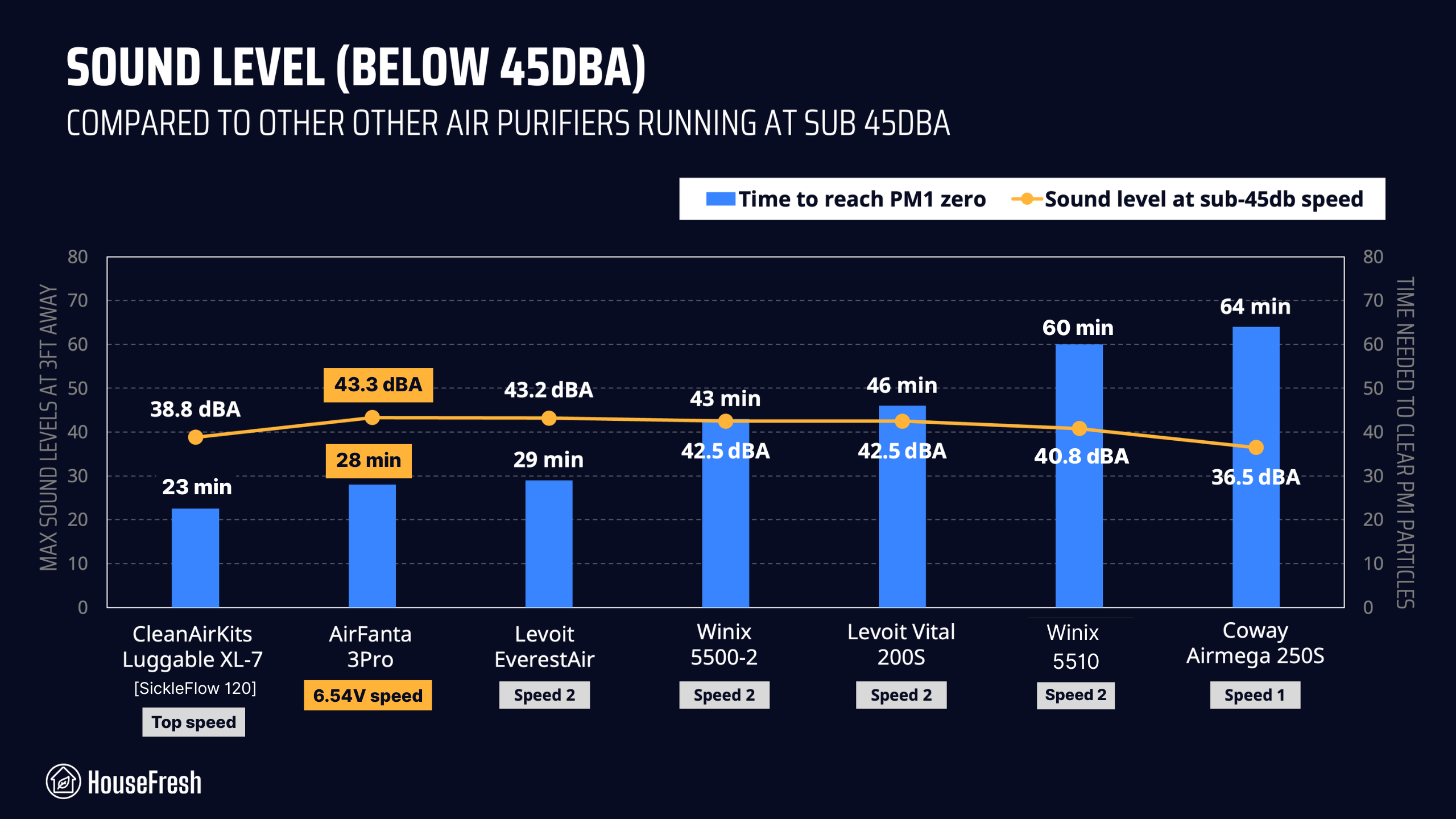
At HouseFresh, we have been reviewing air quality products since 2010. In all these years, we learned not to rely on manufacturers’ claims and the ever-so-glowing marketing materials. That is why we buy products with our own money, so we can write unbiased reviews after we’ve had enough time to evaluate air quality products in our home lab. Every unit we recommend has been thoroughly tested to assess its performance, energy consumption, and noise levels emitted in real-life environments. If you have any questions about our testing process for different types of air quality products, just drop us an email at danny@housefresh.com.

How to make a DIY air purifier

How To Make a DIY Air Purifier Dining Room

Air purifiers have become essential in the battle for good air quality in our homes. With so many pollutants in the air like dust, pollen, dander, bacteria and viruses, wildfire smoke and traffic pollution, to name a few, your home could be negatively affecting your health without you even knowing. That’s where air purifiers come in.

The price is one of the biggest turn-offs of buying an air purifier. Ranging from <$50 up to >$1000, it’s money out of your pocket on a device that does one thing, and you can’t even see it working.

Even if money isn’t the issue, what do you do when smoke fills your home when wildfire suddenly rips through your town, state, or even blown from another country altogether, and you need a quick solution so your health isn’t at risk?

An air purifier is a fan (which most of us will already have in our homes) plus a filter. With all the engineering that goes into manufacturing air purifiers, can you make your own DIY unit? Will it be cheaper? And most importantly, will it be as effective as a store-bought purifier?

In this guide, we answer those burning questions by building our own DIY air purifier.

Stay tuned, and wish me luck. 🤞

Don’t worry; you won’t need a clean room laboratory, specialty tools or a master’s in engineering to make your own DIY air purifier. All you need are a few items you could find either lying around your home or down at your local hardware store and a little aptitude:

✔️ BOX FANHow To Make a DIY Air Purifier Fan
✔️ MERV 13 FILTERHow To Make a DIY Air Purifier Filter placement
✔️ STRONG TAPEHow To Make a DIY Air Purifier Tape
✔️ SCISSORSHow To Make a DIY Air Purifier Scissors
✔️ SCREWDRIVERHow To Make a DIY Air Purifier Screwdriver

How to build your DIY air purifier 

Okay, I’m not gonna lie to you; this is the first time I’ve attempted to build my own air purifier, but I’ve used them (and taken them apart) for our reviews for a while now, so I have a firm grasp on how they work.

On that note, let’s delve in and build ourselves an air purifier.

Step 1: Buy your materials

How To Make a DIY Air Purifier Fan

BUY FAN BOX

This is the easy part; I went to Amazon.com to find my materials so you can get the same fan and MERV 13 filter and follow this guide step-by-step with me. For the fan, I went for this unit from Hurricane as it was a good size, had good reviews and didn’t look too tricky to take apart. For the filter, I went with a BNX TruFilter 20x20x1 as you can see below:

How To Make a DIY Air Purifier Filter

You may have a few spare filters hanging around for the HVAC system in your home.

The primary consideration before you purchase is the size of the filter. You need a filter covering the whole fan, but not so big that it sticks over the sides.

Tip: Check your materials 

The worst thing that can happen is that you put everything together, turn on the fan and it doesn’t work, or find a big hole in the filter that lets all those harmful particles through, rendering your hard work useless.

Unpack all your materials, check them and test them before you do anything else.

Step 2: Remove the fan speed dial

You need to remove the dial for two reasons:

  1. So you can remove the grill easily.
  1. So it doesn’t create a gap in the filter.
How To Make a DIY Air Purifier Dial

Before pulling the dial away, ensure it is set to the fan’s highest speed. This way, turning your DIY air purifier on will be set to its most effective speed. With The Hurricane, pulling the dial straight off using my hands was easy, but with other fans, you may need some pliers to grip and remove them.

How To Make a DIY Air Purifier Remove dial

Step 3: Remove the front grate from your fan

This is where the fun begins. Firstly, make sure your fan isn’t plugged in before you start.

How To Make a DIY Air Purifier Remove Grill

With some fans, you’ll find that the grill is permanently attached to the unit; you may have to purchase some tinsnips. I would advise wearing goggles if it’s made of plastic, as plastic tends to fly when cut. 

Another reason I went for the Hurricane fan is because it has a removable grill. You simply have to remove a screw at the bottom of the unit and slide the grill out. 

How To Make a DIY Air Purifier Unscrew
Tip: “A light touch is the right touch”

Remember this golden rule when deconstructing anything, if you start pulling things apart that you don’t want to be, you’re likely to damage it and maybe even yourself. 

Step 4: Attach the filter to the fan

With the hard part over with, now you just need to attach the MERV 13 filter to the front of the fan where the grill used to be.

How To Make a DIY Air Purifier Filter placement

Because I did my measurements first, the filter I purchased fits perfectly over the fan with no overhang.

How To Make a DIY Air Purifier Attach
Tip

Before attaching the filter, you must double-check that there are no gaps where particles can escape into the air.

How To Make a DIY Air Purifier Side

After those final checks, you can attach the filter to the fan. I used duct tape around different points of the fan as it’s durable and easily removed if you make a mistake, but feel free to use whatever you like, as long as it keeps the filter tightly attached and doesn’t leave any gaps.

How To Make a DIY Air Purifier Front

Step 5: Turn on your DIY air purifier and enjoy your clean air

If you’ve followed our guide correctly, your DIY air purifier should fire up immediately on its highest speed setting. It may not look like the prettiest unit on the block like the Smart Air S or have any cool smart features like the Mila, but hey, you made it and you’ve saved yourself a bundle.

How To Make a DIY Air Purifier Kitchen

I will name it… TeddAir Max!

The TeddAir Max cleared our test room in 84 minutes

Just because I put this air purifier together doesn’t mean it can escape our performance testing room. To see if our TeddAir Max affects air quality, we wanted to put it through the same rigorous tests we subject to all the other units we review.

How To Make a DIY Air Purifier Test

Our TeddAir Max air purifier cleared the simulated contaminants (incense smoke) from our performance testing room in 84 minutes. Even though it’s stuck together with tape, its performance was fair. It may not have outperformed units like the Alen BreatheSmart Flex, Smart Air S, Levoit Core 600S, Mila or the Blueair Blue Pure 311 Auto, which are all a similar size. 

Still, it did clear all our simulated pollutants from the air at the same time as the Dyson PH04 (a unit that costs around $750!)

By putting the unit through this performance test, we can also estimate a CADR (Clean Air Delivery Rate). We calculate its CADR to be around 90 CFM (Cubic Feet per Minute) which (if it was a manufactured unit) isn’t great for the size of the fan and HEPA.

Air PurifierTime To Clean Our Test Room
Levoit Core 600S
Levoit Core 600S Fireplace
15 minutes
Blueair Blue Pure 311 Auto
Blueair 311 Bedroom
21 minutes
Smart Air S
Smart Health S
29 minutes
Alen BreatheSmart Flex
Alen BreatheSmart
34 minutes
Shark HP102
Shark HP102 Side Table
38 minutes

Levoit Core 300
Levoit Core 200S Kitchen Close Up
40 minutes
Dyson HP04
Dyson HP04 Pure Hot Cool Fire Place
84 minutes
TeddAir Max
How To Make a DIY Air Purifier Dining Room
84 minutes

One issue I did find while testing was the noise. Because we removed the speed dial from the fan, it’s stuck on max speed, which is, unfortunately, pretty noisy.

Final thoughts

It may not be the most stylish-looking air purifier or the most efficient, but it shows that instead of spending hundreds of dollars on a unit, you can simply make your own at a fraction of the cost.

How To Make a DIY Air Purifier Dining Room

It’s not just about price; more and more areas in the U.S. are being affected by wildfire smoke, which can travel at an alarming rate, leaving you no time to get online to order an air purifier. You can assemble these components as a first-response action to protect yourself and your family.

There are no extra features like an auto mode, air quality sensors or an app to control your unit, but an air purifier in its purest form is still an air purifier

At the end of the day, it’s a fan and a filter and this is the message the folks at Smart Air are trying to get across with their range of units that boast high efficiency over extra functions. And as we know from our air purifier reviews, more expensive doesn’t necessarily mean better.

At HouseFresh, we have been reviewing air quality products since 2010. In all these years, we learned not to rely on manufacturers’ claims and the ever-so-glowing marketing materials. That is why we buy products with our own money, so we can write unbiased reviews after we’ve had enough time to evaluate air quality products in our home lab. Every unit we recommend has been thoroughly tested to assess its performance, energy consumption, and noise levels emitted in real-life environments. If you have any questions about our testing process for different types of air quality products, just drop us an email at danny@housefresh.com.