HouseFresh has virtually disappeared from Google Search results. Now what?

google is broken

In February 2024, we published an article warning readers not to trust product recommendations from well-known newspapers and magazines ranking at the top of Google search results. 

I wasn’t expecting so many people to care (even though I secretly hoped they would), but we’re still getting emails and messages about it ten weeks later.

housefresh articles tweets

In these two months, I have talked to air purifier manufacturers, HouseFresh readers, other independent publishers, Dotdash Meredith employees, well-known activists, tech journalists, Redditors, SEO professionals, and even Google employees.

Today, I want to share some things I’ve learned and some things that happened after publishing that article.

I’ll take you through the tactics big media publishers use to outrank independent sites online. I’ll also cover what Google has done since we published our exposé and what they’ve announced they’re going to do. Lastly, I’ll share what happened to HouseFresh over the last two months. SPOILER: It’s not looking good for us.

That’s a lot, so I hope you’ll stay with me until the end (but no hard feelings if you don’t).

Dotdash Meredith allegedly developed an SEO content strategy called “swarming” to out-publish independent sites

Why indie publishers are being buried in search results by content published on multiple sites belonging to the same group

Within a few days of publishing the David VS Digital Goliaths exposé, I received an anonymous tip from a former Dotdash Meredith employee, who informed me of an SEO content strategy they implement called “keyword swarming.” 

swarm

Through this strategy, Dotdash Meredith allegedly identifies small sites that have cemented themselves in Google results for a specific (and valuable) term or in a specific topic, with the goal of pushing them down the rankings by publishing vast amounts of content of their own.  

 “Swarming is about drowning out a competitor,” said the person who reached out. The objective is to “swarm a smaller site’s foothold on one or two articles by essentially publishing 10 articles [on the topic] and beefing up [Dotdash Meredith sites’] authority.”

By the way, if “keyword swarming” is indeed a strategy, then it’s clear that it’s not just something you will find in the air purifier space. Dotdash Meredith could be doing this across many other products and topics, utilizing its wide range of publications.

That could explain why you will find multiple articles published on sites belonging to Dotdash Meredith ranking at the top of Google like this:

keyword swarming dotdash

Is Dotdash Meredith to blame for choosing to “swarm” Google search results by leveraging their network of websites and their machine to create content at scale?

Personally, I think it’s not great for the internet, but I understand that if that the leadership at Dotdash Meredith is simply focusing on making money for IAC shareholders.

“IAC’s vision for Dotdash Meredith — to be a flywheel for generating advertising and commerce revenue — is finally starting to pan out. 

[…] More than 80% of Dotdash Meredith’s traffic and digital revenue come from its core sites, such as Food & Wine, Travel & Leisure, and Southern Living, that deliver a form of what one might think of as commerce-related service journalism.”

— Allison Schiff, managing editor of AdExchanger

However, I don’t want to turn this into a personal crusade against Dotdash Meredith because it’s not.

The reality is that, whether they have a name for it or not, every other digital goliath is monetizing their websites by using the same tactics.

Let’s take Forbes.com as an example. 

Connecting the dots between puppies, affiliate commissions, and Forbes

Why Forbes.com is flooding the web with affiliate-focused SEO content on topics far outside their area of expertise

Do puppies come to mind when you think of Forbes? If not, they should.

forbes puppies

In the last few years, Forbes has pumped out thousands of articles about puppies, dogs, kittens, and cats. But why?

forbes pets

Well, if you pay attention to the URLs of the articles, you might notice that the majority of them sit inside ​​forbes.com/advisor/pet-insurance/, which is the space where Forbes publishes their pet insurance affiliate content:

forbes advisor

The Forbes Advisor team published all this content about cats and dogs because they needed to build Forbes.com’s authority in the space to compete with sites such as Dogster or Canine Journal.

The vast majority of pet-related content on Forbes.com pre-2020 wasn’t written from the point of pet expertise, and it wasn’t tied to highly searched keywords that would drive monetizable traffic:

forbes pets content before 2020

To give the pet insurance affiliate section of Forbes the best chance to succeed, the Forbes Advisor team pumped out A LOT of content about pets and built A LOT of links around the topic with statistics round-ups designed to obfuscate the original sources in order to increase the chances of people linking to Forbes.com when using the stats:

statistics page link building

All this hard work paid off in the form of an estimated 1.1 million visitors each month to the pet insurance section of Forbes Advisor:

estimated traffic pets forbes

This happened at the expense of every site that has produced content about dogs, cats, and other pets for many years before Forbes.com decided to cash in on pet insurance affiliate money. 

They successfully replicated this model again and again and again across the huge variety of topics that Forbes covers today. 

Trusted publications are being flipped by SEO-minded people with a taste for affiliate money

Step one: buy the site. Step two: fire staff. Step three: revamp the content strategy to drive new monetizable traffic from Google

Did you know that 19-year-old sports blog Deadspin is now a gambling affiliate site?

That’s right. Just a few weeks ago, Deadspin was sold to a newly formed ghost digital media company that immediately fired all Deadspin’s writers before announcing it would start referring traffic to gambling sites.

Stuff like this happens all the time, but most people don’t follow media news, so they’re completely unaware.

For example, if I mention Money, you might think of a magazine you could find at any newsstand since 1972. But what if I told you that the physical production of its magazines stopped in 2019?

The Money brand is now owned by Ad Practitioners LLC (recently rebranded as Money Group), a company that profits from affiliate links and has developed an ad network.

You probably had no idea about this because Money.com looks just like it always has, and its About page focuses on its long history while failing to disclose who is behind the site:

money about us

In an interview with Axios, one of the owners of Ad Practitioners LLC said that Money was hemorrhaging cash before the acquisition and explained how it’s now thriving:

“Powel, a former Google executive, saw an opportunity to rebuild Money’s editorial strategy around intent-based personal finance content that’s typically surfaced from search results instead of clickbait business stories about celebrities and their wealth. 

Big digital media companies like DotDash Meredith and Red Ventures rely on a similar strategy.”

— Sara Fischer, senior media reporter at Axios

In true ‘phoenix rising from the ashes’ style, Ad Practitioners LLC leveraged the public’s trust in the Money brand, its high-authority domain, and long-standing history as a finance publication to sell air purifiers — without any actual testing, I might add:

money thin affiliate content

But it’s not just air purifiers.

Wondering how to reprogram your garage door opener? Let Money.com explain. Looking for the best paint sprayers? Money.com can tell you.

The key here seems to be adding ‘for your money’ to the title to keep things loosely tied to the financial aspect of the website:

for your money

This is how the people behind Money.com are “building upon the legacy” of the brand.

I’m nearly done kicking the big guys, I promise.

Big media sites are laying off journalists while partnering with marketing agencies that use AI to write commerce content

Exploring the trend of publishers that have been caught lying about AI-written, search traffic-focused content in the last six months

Commerce content is quickly becoming the main monetization route for media publishers. In fact, a 2023 survey by Digiday showed that 81% of publishers consider commerce content a vital part of their revenue growth strategy, with 43% reportedly producing 16 to 26+ new pieces of commerce content each month.

And while media publishers ramp up their commerce content, they also seem to be ramping up the layoffs. 

So, who is writing all these commercial pages? 

“The financial incentives for the current trend are strong, and as media companies continue to cut newsroom staff, the lure of cheap AI content is hard to resist,” said longtime service journalist Joe Lindsey in his article Commerce content is breaking product reviews. He continued, “The latest permutation of commerce content is that publishers outsource some or all of it to a third-party provider, which is called a commerce content partnership, and that’s where AI is pushing in.”

He’s not wrong. 

Reports claim that big media publishers such as Sports Illustrated and USA Today have published commercial content written by AI under fake author names. In both cases, the media giants blamed a third-party partner who provided content to the publications. 

In a statement to The Post, Gannett said the articles on USA Today “were created through a deal with a marketing firm to generate paid search-engine traffic.” According to The Verge, the firm behind these AI product reviews is called ASR Group Holdings. When following the lead, journalist Mila Sato found that ASR Group also uses the name AdVon Commerce.

What a coincidence…

The owner of Sports Illustrated released a similar statement when Futurism uncovered their use of AI-generated content: “The articles in question were product reviews and were licensed content from an external, third-party company, AdVon Commerce […] AdVon has assured us that all of the articles in question were written and edited by humans.”

Yet, when searching through LinkedIn, I could find multiple AdVon employee profiles that clearly specify the use of AI as part of their job:

Advon AI LinkedIn

Where does this leave the role of journalists in these publications?

“As a journalist, all of this depresses me,” wrote Brian Merchant, the technology columnist at the Los Angeles Times. He continued, “If journalists are outraged at the rise of AI and its use in editorial operations and newsrooms, they should be outraged not because it’s a sign that they’re about to be replaced but because management has such little regard for the work being done by journalists that it’s willing to prioritize the automatic production of slop.”

But all hope is not lost.

Google set a deadline for big media sites to stop spamming the web

How the “site reputation abuse’ spam policy could affect big media sites, and what they’re doing to prepare for Google’s deadline

Here’s a recap so far:

  • Digital media conglomerates are developing SEO content strategies designed to out-publish high-ranking specialist independent publishers.
  • Legacy media brands are building in-house SEO content teams that tie content creation to affiliate marketing revenue in topics that have nothing to do with their original areas of expertise.
  • Newly created digital media companies are buying once successful and influential blogs with the goal of driving traffic to casino sites.
  • Private equity firms are partnering with companies like AdVon to publish large amounts of AI-generated content edited by SEO-focused people across their portfolio of media brands.

And here’s the worst part:

Google’s algorithm encourages all of them to rinse and repeat the same strategies by allowing their websites to rank in top positions for SEO-fueled articles about any topic imaginable. Even in cases when the articles have been written by AI and published under fake authors.

But Google has set a deadline for big media sites to stop spamming the web: May 5.

In early March 2024, Google announced an update to its spam policies, which included a point about “site reputation abuse” aimed at sites publishing pages with the purpose of manipulating search rankings by taking advantage of the site’s ranking signals.

site reputation abuse

Unfortunately, Google’s documentation only deems “site abuse reputation” as spam when the site uses third parties to produce and/or publish pages to manipulate search rankings.

third party spam

The fact that U.S. News & World Report is hiring an SEO-focused Commerce Editor to publish 70-80 content updates per month tells me that, hopefully, these big media sites will start cleaning up their acts and move away from contracts with the likes of AdVon. 

But what happens when an in-house team carries out this type of “site reputation abuse”?

It also makes me wonder about the future of initiatives like Taboola Turnkey Commerce. In an article titled How Product Recommendations Broke Google, reporter John Herrman explained how Taboola’s proposal “claims to offer the benefits of starting a product-recommendation sub-brand minus the hassle of actually building an operation.” 

This sounds like the exact same thing Google deems as spam. 

Meanwhile, Forbes.com has reportedly blocked the coupons section of its site (forbes.com/coupons) using a noindex directive to prevent Google bots from indexing the page. Perhaps more media giants will follow suit in the coming days opting to deindex entire sections of their sites.

Will the rankings change once we reach the May 5th deadline? We’ll have to wait and see, but I wouldn’t hold my breath.

Google’s latest algorithm update led to a 91% loss of search traffic to HouseFresh

Broad pages with generic recommendations from big media sites have been pushed to the top, followed by Google Shopping product listings.

When Google announced its March 2024 core update, it said it was “a more complex update” than usual. 

A couple of days after Google’s announcement, many websites were hit with manual actions that could be traced back to the presence of a significant amount of AI-generated content.

But none of them were big media sites.

Any hope we might have had of this update leveling the playing field for independent publishers like HouseFresh disappeared the moment we saw our traffic plummet on March 9th:

Google decimated HouseFresh

Now, this is the point where I clearly state that I know that Google doesn’t owe us anything. We don’t simply deserve to get search traffic because we exist or because we say we should.

That said, I disagree with those who are quick to shout, “Having a website is not a real business!” or those who reply with “Google doesn’t owe you traffic” when small independent sites complain about Google favoring big and/or spammy sites while gaslighting us into thinking that our content is not helpful enough for readers.

If we don’t stand up for our right to a free and open web, we’ll be stuck with platforms that only let us reach other people when we pay for it.

We lost rankings we held for months (and sometimes years) for articles that are constantly being updated and improved based on findings from our first-hand and in-depth testing, our long-term experience with the products, and feedback from our readers.

For example, let me share the current Google results for “best budget air purifiers,” a query we’ve ranked at #2 since May 2023.

Our article is now buried deep beneath sponsored posts, Quora advice from 2016, best-of lists from big media sites, and no less than 64 Google Shopping product listings. Sixty. Four.

There is also a clear proliferation of generic lists. 

When you’re searching for affordable or budget-friendly products, are you looking for the best you can buy or just whatever’s available?

I’m asking because it seems Google expects everyone to find what they’re looking for in the same “best X of 2024” list, regardless of the specific query they’re searching for.

In this particular case, I am looking for the best budget air purifiers, but the generic articles by big media sites ranking at the top of search results are not aimed at those on a budget:

How Google results cost you money

Many of these ‘best-of’ lists of recommendations feature products that cost over $1000 — that is hardly an affordable price tag for most people, let alone someone on a tight budget.

And it gets worse.

The screenshot above was edited to highlight only big media sites. Another unfortunate pattern appears when looking at the full list of Google search results: the further you scroll down the results page, the more product listings Google will serve you.

That’s right. Google is pushing products instead of helping searchers find what they are looking for.

Let me show you the extent to which Google search has become an online shop:

anatomy of google search results 2024

We regularly talk with people who feel confused by all the choices and jargon thrown at them when trying to buy an air purifier.  

confused searchers

In the middle of this confusion and lack of clear information, Google relentlessly serves product listings full of jargon, brand logos, special offers, retailer URLs, 5-star ratings and SALE tags:

Google Shopping Mall

Google is drowning the very recommendations searchers are trying to find while surfacing generic best-of lists, 2016 Quora advice, and SO MANY products  — many of which SUCK and don’t even meet the search criteria.

We are seeing this happen across every term we used to rank for and have lost to Google’s latest core update, which they announced had finished rolling out one week after it did

This is also evident when using Google SGE.

When searching for this same query, you get served with three product recommendations, two of which are “sourced” back to Google Shopping:

best budget SGE

It all makes sense when you consider this was said during their latest earnings call: “We’re […] confident in the role SGE, including ads, will play in delighting users and expanding opportunities to meet user needs.”

So, it’s no longer just about Reddit and big media sites getting pushed to the top with sub-par content.

Google’s intention to encourage you to buy directly from search results (a.k.a. ‘meet your needs’) is evident, even in cases where you are just researching what’s out there.

The web seems to be getting claustrophobically smaller.

Personally, I’m done with banging my head against these terrible Google results.

That’s why I’ve gone back to how I used to use search engines in the early days of the web: mix and match. If I don’t find something on DuckDuckGo, I check Kagi, Bing, Google, and Brave. This is something I’m teaching my children, too. 

I might not be able to end Google’s monopoly of search engines worldwide, but I can do it in my own home.

The future of HouseFresh

What we have done, what we will do, and what we were told we should do.

We’ve been wracking our brains for months to figure out what’s wrong with HouseFresh.

We received many messages from all sorts of people, and the vast majority of them were as clueless as we were about why Google keeps demoting our site. 

Believe it or not, this includes people who work at Google.

Many SEO professionals have shared reasons why they believe HouseFresh has been punished, with theories that range from using the word “air” too often to writing titles that aren’t cool enough.

Some of the most echoed explanations include:

  • We have affiliate links in many of our articles

    This is how we sustain HouseFresh. We buy the products with our own money and spend weeks testing them, writing in-depth reviews, and shooting video content. If you buy a product after clicking on one of the affiliate links on our site, we receive a 3% commission at no extra charge to you. This allows us to continue providing quality content. We’re extremely clear about this and have disclaimers all over our website and YouTube channel.

    I can’t imagine Google would demote our site because of this business model, seeing as it’s the same model that supports the very same big media sites Google keeps ranking at the top of the search results.
  • We conduct keyword research as part of our content strategy

    Something that Google spokespeople have said more than once is not to do things to “show Google” anything, such as writing content to manipulate search engine rankings. Many have argued that having a keyword strategy (writing content to answer queries that users search for) could be considered manipulation.

    Many independent sites are deleting and “de-optimizing” articles, hoping that somehow that’ll fix Google’s issue with their sites. We have published many valuable articles based on questions people have about air purifiers and highly searched-for terms around the best units for specific use cases, but that shouldn’t instantly label our articles unhelpful. Plus, de-optimizing them will definitely affect traffic from other search engines, so we’re not going to do that.

    If Google keeps rewarding useless overly-optimized SEO content written by AI published on big media sites while punishing little sites because they wrote articles trying to answer a question readers have, then fuck Google.
  • We are not a brand

    We understand that we need to prove ourselves as a trusted, reliable source of information. This is an ongoing focus, but becoming a recognizable brand takes time. 

    Unfortunately, people might not see us as a reliable brand if we’re constantly pushed down the search result rankings in favor of magazines with pedigree (even if their content strategy has pivoted to completely unrelated niches). But we’re trying and will keep trying for as long as we can afford to exist.

    That said, the belief that only established brands can make it to the top of Google shows that we have normalized being surrounded by logos to the point where we’ve forgotten what the internet used to be like. We’ve forgotten that the web is supposed to be an open forum where anyone can produce great content. We’ve forgotten that Google was once the world’s best digital librarian, not the judge of a popularity contest.
  • Google Search is broken

    Every week, there seems to be a new article from a reporter trying to figure out what the heck happened to Google Search. Theories range from SEO breaking Google to AI changing the landscape, but everyone agrees that something is broken for the results to be this bad.

    I’ve worked in the content marketing side of the SEO industry for most of my career, and there’s one story I’ve heard multiple times that might explain what’s happening. The problem started when the objectives of Google Ads started ruling the decisions of Google Search.

    You see, Google’s founders believed that Google Search and Google Ads should be completely separate entities. However, in December 2019, the founders gave up control just before the separation of Search and Ads became a blur when the Head of Google Ads took over as the Head of Google Search in June 2020. Since then, search results have become flooded with ads and all kinds of functions designed to influence how we search for information. Years of this power dynamics and the introduction of machine learning could have led to the awful state of search results today.

    If you want the full rundown, a recent newsletter from Ed Zitron explores this story in detail: The Man Who Killed Google Search.

Whatever the reason, Google’s algorithm believes our website isn’t good enough and that visitors will have a bad experience if they land on it.

As a result, since October 2023, we’ve gone from welcoming 4,000 people from Google Search each day to just receiving 200. And of those 200, most are adding “HouseFresh” to their searches to find us specifically. 

This drop in Google search traffic has affected our income, our capacity to sustain our team, and our plans for the future.

But we’re not going down without a fight.

We’re doubling down on our mission to uncover scam products. Our target will be every shiny air purifier that big media sites are pushing. 

Not a week will go by without us having something to say about some crap product big media sites are recommending or without us revealing some lie they’re feeding to their readers.

And if Google doesn’t want to rank our reviews, we’ll use their own broken results against them to get our takedowns in front of people before they waste their money on an overpriced, overhyped product:

puroair hepa14 240 review SERP scaled

The only thing we can do to get a seat at Google’s table is to use their obsession with freshness and their reliance on popular platforms to create a ripple effect around our content.

We will be relentless on YouTube, Reddit, X, TikTok, Instagram, Facebook, our newsletter, and every other platform where it makes sense for us to be. 

We will keep Google busy crawling our name and our content again and again and again and again and again. And again.

Because even if Google decided to virtually erase HouseFresh from its search results, we still exist on the open web.

How Google is killing independent sites like ours

Header Google is killing independent sites

Google regularly launches updates to its algorithm to continuously improve search results quality. Think of these updates as a refresh of the system where rankings change: some websites see an improvement while others see a decline.
At HouseFresh, we keep an eye on Google’s news and documentation because these updates can literally make or break our website. That said, we don’t write for Google’s robots and always make editorial decisions with our readers in mind.

We know that at the end of the day, Google will reward us if our readers find our articles useful.

Helpful content HouseFresh

Or that’s what we thought.

You might have noticed that no matter what you google, there’s always a selection of the same publishers showing up at the top of the results:

What do BuzzFeed, Rolling Stone, Forbes, Popular Science, and Better Homes & Gardens have in common? 

They all know which are the best air purifiers for pet hair:

best air purifier results

Another thing they’ve got in common is that they all also seem to know the best cooling sheets for hot sleepers:

best cooling sheets

You could play this game yourself. Other searches you could try are: best gifts for mom, best home saunas, best beard products, best gifts for teens, best cocktail kits… the list goes on.

The problem is, for the most part, these publishers recommend products without firsthand testing and simply paraphrase marketing materials and Amazon listing information.

In the last year, we have waited patiently for the many, many, MANY Google algorithm updates to impact these results. 

We were hopeful when Google introduced its reviews system with the Products Review Update back in 2021. It seemed they were finally doing something about one of the worst aspects of the modern internet: searching for information about products only to have to wade through countless reviews from people who had never even seen the thing.

Two years later, SEO professional Lily Ray mentioned that (big media) publishers were hit hard by Google’s Product Review updates, prompting a response from Google itself:

publishers dont want to test

In our experience, each rollout of the Products Review Update has shaken things up, generally benefitting sites and writers who actually dedicated time, effort, and money to test products before they would recommend them to the world.

That said, most searches for specific product models don’t just magically start with users searching for specific devices off the top of their heads. There is an immediate step before this: the hours of research reading through lists of product recommendations.

If you have been reading HouseFresh for a while, your first encounter with us was likely a list like this one or this one recommending the best devices for a specific issue you were trying to solve. That is how most of our readers find us.

Unfortunately, we’re getting less and less traffic from those pages, and it’s endangering the future of our site. 

That’s why we’re writing this article.

Big media publishers are inundating the web with subpar product recommendations you can’t trust

Savvy SEOs at big media publishers (or third-party vendors hired by them) realized that they could create pages for ‘best of’ product recommendations without the need to invest any time or effort in actually testing and reviewing the products first.

So, they peppered their pages with references to a ‘rigorous testing process,’ their ‘lab team,’ subject matter experts ‘they collaborated with,’ and complicated methodologies that seem impressive at a cursory look. 

Sometimes, they even added photos of ‘tests’ with products covered in Post-it notes, someone holding a tape measure, and people with very ‘scientific’ clipboards. 

There’s nothing wrong with wanting to show you’re doing the thing you’re supposed to be doing, but what happens when that’s as far as you go?

Let’s look at one example. 

These are the current top 10 results on Google.com for a query we have completely given up on — Best Air Purifier for Pets:

best air purifiers for pets top10

Right now, the magazine Better Homes & Gardens is ranking at the top of the first page of results.

At a glance, the article shows all the right things:

bhg best list bs EEAT signals

If you were to keep scrolling, you’d also find photos of an air purifier inside of a tent, two more mentions of the expert Kenneth Mendez, and four mentions of their lab in Des Moines, Iowa. 

They say all the right things on the page and are a perfect example of a big media publisher with 40 different pages of ‘best of’ product recommendations in the house cleaning section alone without a single in-depth product review:

bgh best of pages

They mention that they have tested 67 air purifiers in their lab in Des Moines, Iowa, but somehow, they have published zero product reviews and they don’t make their test data available anywhere. 

They do have photos, with the majority of them being credited to Henry Wortock. Remember that name.

“But how do you know they didn’t test these devices?”

Better Homes & Gardens never mentioned conducting tests prior to the Google Product Review Update in July 2022. You can see clearly here how, on July 6th, there were no mentions of air purifiers being tested. Fast forward to July 26th (one day before the announcement of the Google update), and they’re now saying they’ve tested 38 air purifiers. Zero to over 30 devices in just a few weeks without any prior mention of any sort of testing. This is also the first time we see some original photos.

That’s not all. 

Their air purifier recommendations are generally plagued by high-priced and underperforming units, Amazon bestsellers with dubious origins (that also underperform), and even subpar devices from companies that market their products with phrases like ‘the Tesla of air purifiers.’ Any actual product testing would show these air purifiers to be a bad pick. What you hardly ever see in their recommendations are truly affordable and high-performing options, which should be a priority if you’re trying to help people clean the air in their homes.

For example, Better Homes & Gardens recommends the Molekule Air Mini+ as their best option for small rooms:

bhg recommends molekule

We have no idea how this device made the list considering that Molekule recently filed for bankruptcy, has active class action lawsuits for false advertising, has been recognized by Wirecutter as the worst air purifier they tested, and received the honor of being labeled as “not living up to the hype” by Consumer Reports.

When we reviewed this device, we also found it to be one of the worst air purifiers we have ever tested for multiple reasons: 

  • It took 3x as long to clear our test room of smoke compared to units sold for a third of its price.
  • It’s incredibly noisy, generating 68 dB when running at its top fan speed — equivalent to the sound of a freeway or a vacuum cleaner.
  • The filter replacement costs A LOT ($99.99), and you need to change it every six months, so you need to spend an additional $199.98 to use this air purifier for a year
  • It pulls 50 watts at its top speed, which might not seem like a lot but it is considering you could buy units for a third of the price that won’t consume more than 21 watts.

We could go on forever. But we can also show you actual firsthand data to back up each of our reasons not to recommend this air purifier. 

Even some shallow desk research powered by Google would show that this product shouldn’t be recommended, but, hey, it’s $360, so it comes with a juicy commission compared to other better quality yet budget products.

But let’s go back to the search results for Best Air Purifier for Pets and give Google the chance to rank a truly reliable list of recommendations that live up to their guidelines.

Ranking below Better Homes & Gardens, we have Real Simple, another magazine most people would immediately trust due to their longstanding brand.

When landing on Real Simple, the first thing you’ll notice is how similar the site looks to Better Homes & Gardens. It uses the same template and has all the right signals to communicate that they test products for real:

real simple best list bs EEAT signals

Another interesting thing is that the photos on this page are credited to the same photographer, Henry Wortock (remember him?)

It even looks like the photos were taken in the same space:

Now, Real Simple doesn’t mention a lab in Des Moines, Iowa, but they do say they acquired 56 air purifiers to test AND they named the same expert: Kenneth Mendez. 

Similarly to Better Homes & Gardens, there are no air purifier reviews on the entire site. That’s 56 devices that we just have to trust they actually tested and assessed.

Many of you won’t be surprised by all this because you’ll know that both companies are owned by the same media giant: Dotdash Meredith.

That’s probably why both sites have the same design and feature photos from the same freelance photographer (Henry Wortock). It’s also probably why they couldn’t really be bothered with sourcing another expert to satisfy that specific point in their E-E-A-T checklist (more on that later).

A deeper look inside Google Images shows how Dotdash Meredith is using photos clearly taken at the same time across different publications:

dotdash photoshoot

Perhaps Dotdash Meredith did pay some lab to test all those devices across all those different websites, and it’s not just a collection of photoshoots their commerce writers can tap into when writing best-of lists.

Whatever the case, it’s clear the team at Dotdash Meredith has worked out what Google needs to see in order to rank best-of lists in top positions without the need to actually publish insightful product reviews or share any evidence of original test data. 

But it’s not just Dotdash Meredith that we need to outrank if we want to recommend the actual best air purifiers for pets.

Let’s scroll down to position number six and see who’s ranking right below Amazon and Reddit: 

buzzfeed best air purifiers for pets

Hello, BuzzFeed.

There’s a lot wrong with this list, starting with the fact that it includes a whopping 22 air purifiers and clearly hasn’t even been curated. Similarly to most big media publisher recommendations, BuzzFeed also lists the Molekule Air Mini+. 

Reading through the list, we found the BuzzFeed team doesn’t even pretend to test the air purifiers. There’s no firsthand research other than curating a list of devices and images from Amazon.com:

BuzzFeed Amazon images

And then pulling in some reviews from Amazon.com as the bulk of their reasoning behind why they picked one air purifier over another:

BuzzFeed Amazon reviews

Some of you might be shocked to see BuzzFeed recommending air purifiers, considering this is far from what BuzzFeed is all about. Others might rightfully think this list must be some sort of joke, expecting to see AI-generated images of air purifiers hugging and feeding cats and dogs. 

The truth is that BuzzFeed has been struggling to maintain the ranking of this particular page, so it will probably drop off the first page of Google results eventually:

buzzfeed traffic graph


But until that day comes, searchers will continue to land on that Amazon.com copy-and-paste page when searching for an air purifier to help with pet odor and dander.

But hey, it’s BuzzFeed. They’re publicly listed and are the parent company of Huffington Post and Complex, so they obviously deserve to be there. 

Right after BuzzFeed, we’ve got a Reddit thread that someone opened four months ago and has good discussions between Redditors: 

Reddit search results

There are also lots of spammy replies, with this specific one at the top right now for those landing on that page without being logged into Reddit:

Reddit spam reply

When clicking on that link, users will then land on this incredibly sketchy website:

Site it leads to

Those of you with high attention-to-detail will notice that this introduction is a word-by-word copy of Real Simple’s article:

Real Simple intro copy

Clicking on the profile of the Redditor behind this ‘recommendation’ will lead you to a suspended account page:

Reddit suspended user

Somehow the user has been banned from Reddit, but their comment is still at the top of the thread — we wonder how many other comments this user has published across different subreddits.

Tip

After Google’s latest Helpful Content Update, Reddit and LinkedIn started ranking heavily in Google search results. If you want to find out more about Reddit specifically, you should read this article from Glen Allsopp.

Private equity firms are utilizing public trust in long-standing publications to sell every product under the sun

In a bid to replace falling ad revenue, publishing houses are selling their publications for parts to media groups that are quick to establish affiliate marketing deals

At position #8, we have Popular Science, a magazine from 1872 that was sold to a private equity firm, North Equity LLC, in 2020. A year later, North Equity introduced Recurrent Ventures, a new arm of their business that runs all the media brands they acquired. A few months later, PopSci switched to an all-digital format. Two years later, in 2023, PopSci stopped being a magazine altogether.

Of course, most people won’t know that because the site still feels like the PopSci we all know and trust:

popsci best air purifiers for pets

It doesn’t help that they have a ‘Why trust us’ section at the end of all their ‘Best of’ lists that says:

PopSci Why Trust Us 1

The vast majority of readers don’t know that the teams behind these product recommendations are far from the team of journalists and editors who built the brand behind the site.

It’s unfortunate because many people will click on that Popular Science article expecting a trustworthy list of products only to find a list of units that haven’t even been tested by PopSci’s team:

Pop Sci methodology

After reading the article, it quickly becomes clear that every air purifier on the list was selected (and ranked) based on anecdotal experience.

popsci anecdotal product recommendations

Another thing worth mentioning about this PopSci list of air purifiers is that it’s a completely new page on their site that went live on December 29th, 2023. 

PopSci wayback machine

This makes it all the more strange for them to be recommending not one but two (2!) Molekule air purifiers. Surely, the writer who researched each device ran into the news of Molekule going bankrupt — or the ridiculous reasons why they supposedly filed Chapter 11.

Shouldn’t ‘best of’ lists be treated as product reviews?

Hint: yes, they should, but somehow they’re not 

In theory, ‘best of’ product recommendation lists should be treated the same as any product review.

Google’s documentation clearly states that:

google logo
“Reviews can be about a single thing, or head-to-head comparisons, or ranked-lists of recommendations.”
google review system documentation

So, shouldn’t Google be rewarding ranked lists of recommendations “that provide insightful analysis and original research […] written by experts or enthusiasts who know the topic well”? 

Shouldn’t the reviews system ensure that people don’t end up landing on “thin content that simply summarizes a bunch of products, services, or other things”?

Perhaps we’re mistaken here, but we think the documentation says it plainly and clearly.

Sadly, these are just empty words because Google has a clear bias towards big media publishers.

Their Core and Helpful Content updates are heavily focused on something they call E-E-A-T, which is an acronym that stands for Experience, Expertise, Authoritativeness, and Trustworthiness. 

The SEO world has been obsessed with E-E-A-T for a few years now, to the point where there is always someone on X (formerly Twitter) discussing how to show experience, expertise, authoritativeness, and trustworthiness. Many of the examples come from dissecting big media publishers like the ones we’ve been discussing in this article. 

The reason why SEOs look up to these sites is that Google rewards those sites:

And people have been pointing this out for months:

Every single big media company (a.k.a. Digital Goliaths) is currently pumping up their bottom line with affiliate earnings. 

The strategy of Recurrent Ventures for Popular Science seems to be to squeeze as much money as possible from this type of ranked list of recommendations before things start to go south.

You can see here how they have ramped up the pages inside of their ‘Gear’ section, which is where they house the bulk of their ‘best of’ articles — you can also see how their traffic has been declining since the latest Product Review update:

PopSci affiliate marketing

The strategy of Dotdash Meredith for their publications seems to be to optimize resources and maximize profit.

We might one day see the first page of Google results full of copycat recommendations once they roll out their hacks across all their websites, including Verywell, People.com, Health.com, Travel + Leisure, Byrdie, MyDomaine, The Spruce, Lifewire, Southern Living, TreeHugger, Parents.com… and so many other top tier publications.

Oh, wait, that’s already happening:

dotdash meredith affiliate hacks 1

So, where do we go from here?

Google is killing independent sites like ours through inaction

While this happens, investment firms and ‘innovative digital media companies’ are selling you bad products 

HouseFresh has published over 60 hands-on reviews that were written on the basis of multiple performance tests. 

We can tell you that testing and reviewing products takes a lot of time, money, and effort. 

But if our small team can publish real reviews, then these big publishers and private equity surely have the resources to do the same. 

Unfortunately, right now, these companies are using all their resources to publish more and more pages peppered with the right ‘ingredients’ to dish up a tasty E-E-A-T meal for Google.

We have no doubt that these big publications could build their own labs, where they could run actual tests in order to make product recommendations backed by actual firsthand data. 

CNET bought an entire smart home back in 2015 in order to test products. That was before they were acquired by Red Ventures and found themselves selling the house after reporters told The Verge they were feeling pressured to change their reviews to be more favorable to brands that were being advertised on CNET. 

How many other ‘parent companies’ are using commerce or shopping editors to pass off promotional articles as editorial content?

It turns out that what we’re seeing now is a result of the brainchild of Alicia Navarro, the founder and CEO of Skimlinks, a content monetization platform for online publishers. Navarro wrote a series of opinion articles and provided quotes to industry publications, who started introducing the concept of ‘comtent’ in 2016:

comtent ecommerce editors

Someone who voiced their discomfort with the idea of e-commerce editors publishing ‘comtent’ at the time was Brian Lam, founder of The Wirecutter. 

Months before being acquired by The New York Times, Lam explained that the Wirecutter had grown to become one of the most successful independent tech sites by publishing 20 to 30 articles a month that would take 30 to 200 hours to research and produce. 

He said he didn’t believe in a role like that of an e-commerce editor who would be pushing products. “I believe in talented editors on a beat who help people find related gear, not someone specifically meant to find things to push to readers,” Lam added.

We are big fans of The Wirecutter, but we wonder whether their content would be as successful in the eyes of Google today if they were still an independent website. Luckily, they don’t need to worry about it because their site now sits inside the nytimes.com domain — a trusted and well-established media brand.

And it’s not just newer independent sites like HouseFresh that are losing traffic to big media publishers and their e-commerce editors.

Long-standing websites such as GearLab have also seen their traffic decline in recent months even though they publish product reviews based on objective, independent testing:

independent site traffic loss

We can’t speak for the GearLab team, but this situation just isn’t sustainable. 

Many independent sites will go out of business if this trend continues.

We hope to still be here to see things change

That’s the reason why we’re writing this article

A few months ago, Futurism uncovered how Sports Illustrated was publishing ‘best of’ articles by fake, AI-generated writers. The magazine’s publisher, The Arena Group, washed their hands of it by stating that the “articles in question were product reviews and were licensed content from an external, third-party company, AdVon Commerce.”

We wonder how many of these big media companies and investment firms are hiring intermediaries to develop their ‘affiliate marketing’ arm, whatever the cost.

These Digital Goliaths are utilizing their websites’ authority and the public’s trust in their brands to sell every product under the sun.

They’re buying magazines we love, closing their print operations, turning them into digital-only, laying off the actual journalists who made us trust in their content in the first place, and hiring third-party companies to run the affiliate arm of their sites.

And while they do all this, they’re telling you to buy: 

  • Products from brands that are bankrupt and have class action lawsuits for false advertising against them
  • Outdated, inefficient, and underpowered air purifiers that won’t actually clean the air in your home
  • Overpriced devices powered by fancy marketing tactics that will perform as well as units half the price

We appreciate how much information Google has shared about what a high-quality review is and about helpful content in general, but these guidelines need to be applied to everyone.

These Digital Goliaths shouldn’t be able to use product recommendations as their personal piggy bank, simply flying through Google updates off the back of ‘the right signals,’ an old domain, or the echo of a reputable brand that is no longer.

As a team that has dedicated the last few years to testing and reviewing air purifiers, it’s disheartening to see our independent site be outranked by big-name publications that haven’t even bothered to check if a company is bankrupt before telling millions of readers to buy their products.

That isn’t helpful content. Especially considering the work of air purifiers can’t be assessed by the naked eye.

Users won’t be able to tell if their air purifier is actually working without subject-matter knowledge and the help of tools to measure air quality. That’s when actual testing and firsthand data become indispensable.

If a magazine they trust tells them the Molekule Air Mini+, the PuroAir HEPA 14 240, and the Okaysou AirMax 10L Pro will help with their pet allergies, their asthma flare-ups, the air pollution that gets through the windows, the wildfire smoke blowing in their direction, the mold spores in their damp apartment, or recurring flu outbreaks in their school, then they’ll go and buy one of those useless, overpriced units.

Everybody loses but the investment firm.

We’re talking about only one product here, but we imagine the issues highlighted in this article are rampant across every consumer tech product being recommended by these big media sites.

Google won’t be the gatekeeper forever, but they are the gatekeeper now. 

The ball is in their court.

UPDATE

If you want to find out what happened since we published this article, head over to HouseFresh has virtually disappeared from Google Search results. Now what?

Levoit Vital 200S review

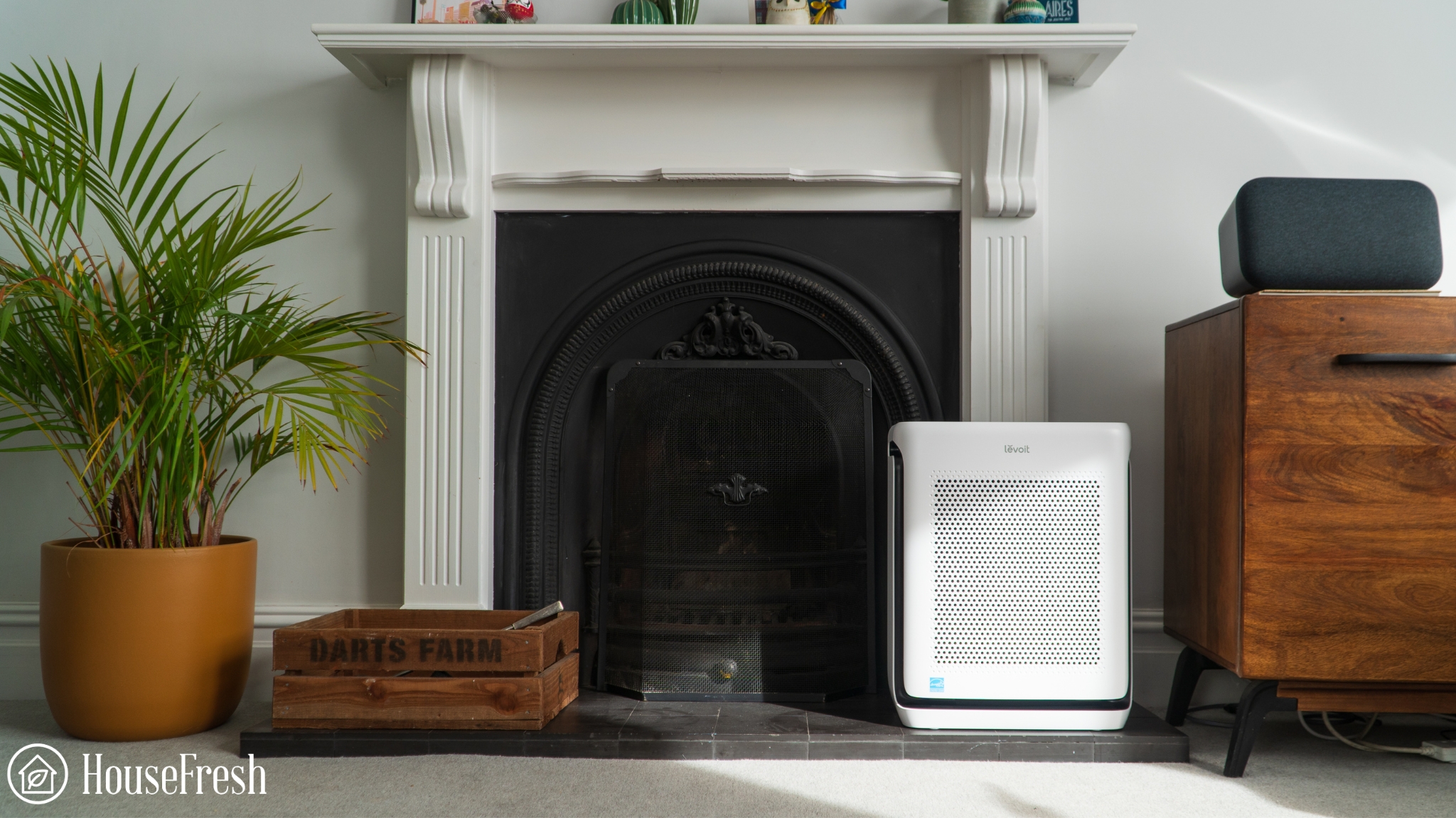
Levoit Vital 200S Living Room

Levoit is probably the best-selling air purifier brand in the United States. That fact will not surprise you if you, like me, have used Levoit air purifiers in your home.

Their product range includes top-end devices like the Levoit EverestAir, which is one of the fastest air purifiers we have tested, reaching PM1 zero in a swift 16 minutes. Levoit also produces budget-friendly air purifiers like the trusted Core 300, which managed to clean our room in 54 minutes.

So, we were excited to finally get a chance to test and review the Levoit Vital 200S. It has a more traditional look than the EverestAir or the Core series, and is aimed at medium-sized rooms up to 400 square feet.

We bought the Vital 200S with our own money so we could test it following the same methodology we have used to test over 100 air purifiers since 2020. In this review, I will share the results of our tests and my experience after having this device at home for well over two years now.

The pros and cons of the Levoit Vital 200S

A summary of our top-level findings after testing this air purifier following our methodology.

💡exclusive code for HouseFresh for 10% off a single purchase on Levoit.com: HOUSE10

A super efficient fan combined with a high-quality particle and activated charcoal filter results in a powerful air purifier.

Retailing at $189.99, the Levoit Vital 200S gives you plenty of bang for your buck.”

Danny Ashton HouseFresh
Danny Ashton
HouseFresh Founder
& Lead Tester

CONS

It has a bonded filter, so once the carbon runs out (which usually happens within 6 months), you’ll have to replace the whole thing, even if the particle filter still has life in it.
The air quality sensor is an optical sensor, so you need to keep it clean for it to report accurate readings.
I would like to see an independent test that could offer a filter grade after Levoit removed all mentions of HEPA from their marketing.

PROS

It offers a high level of air cleaning performance to $ ratio, completing our particle removal test as fast as units double its price.
You get smart features and smartphone connectivity through Levoit’s VeSync app.
It remembers settings and modes, so if you unplug it and plug it back in, the Vital 200S will still remember what it was last doing.
There are a ton of generic filters available that keep long-term costs low.

Clean air delivery rate (CADR):– Top speed PM1 CADR: 249 cfm
– Sub-45 dBA PM1 CADR: 128 cfm
– AHAM PM2.5 CADR: 254 cfm (dust)
Filter technology:Bonded particle filter with a layer of pelleted activated carbon and a removable pre-filter
Recommended room size:373 sq. ft. (5 air changes per hour)
Dimensions:15.6D x 8.5W x 19.8H inches (39.3D x 21.5W x 50.2H cm)
Weight:13.2 lbs (5.9 kg)
Noise level in decibels from 3 ft. away:Speed 1: 38.3 dB
Speed 2: 41.9 dB 
Speed 3: 53.8 dB
Speed 4: 57.7 dB
Electricity consumption in watts:Standby mode: 0.97 watts
Speed 1: 5.71 watts
Speed 2: 8.01 watts
Speed 3: 31.96 watts
Speed 4: 44.55 watts
Filter lifespan:12 months
Manufacturer’s warranty:2 years
Country of origin:United States
Country of manufacture:China

In August of 2023, Dyson officially challenged Levoit’s use of ‘True HEPA 13 filters’ in their marketing and advertising through the BBB National Programs National Advertising Division (NAD). As a result, Levoit removed all mentions of “HEPA H13” in their marketing materials for all their air purifiers (including the Vital 200S).

Now, it’s worth mentioning that a higher grade HEPA is not required to clean the air of even the tiniest particles, as lower grade filters still pick up these small particles in multiple passes. Still, we don’t appreciate manufacturers not being transparent about technical specifications.

Design and smart features

A rectangular design that houses a powerful fan, a bonded filter and an air quality sensor.

Levoit Vital 200S Living Room

💡exclusive code for HouseFresh for 10% off a single purchase on Levoit.com: HOUSE10

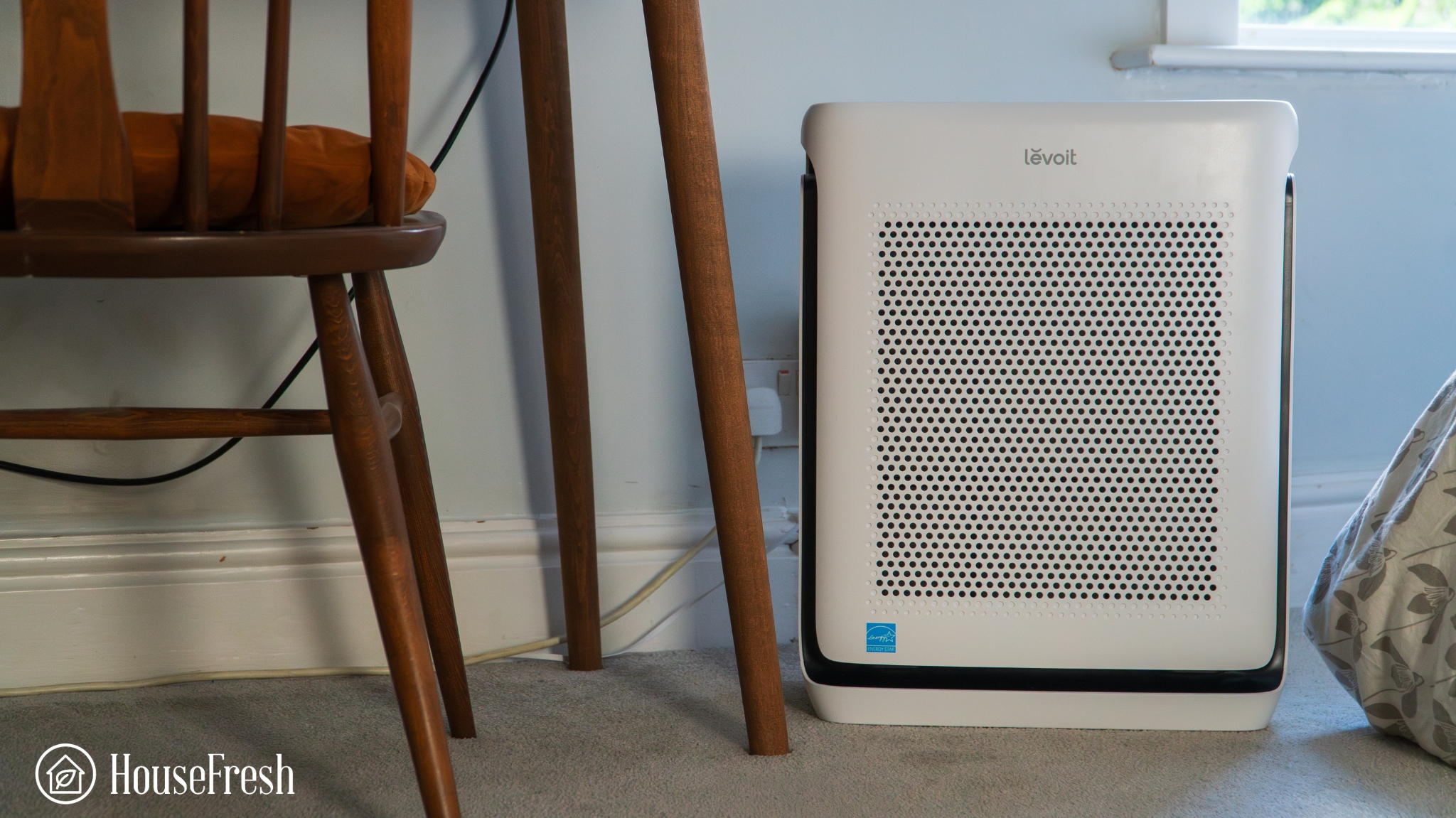
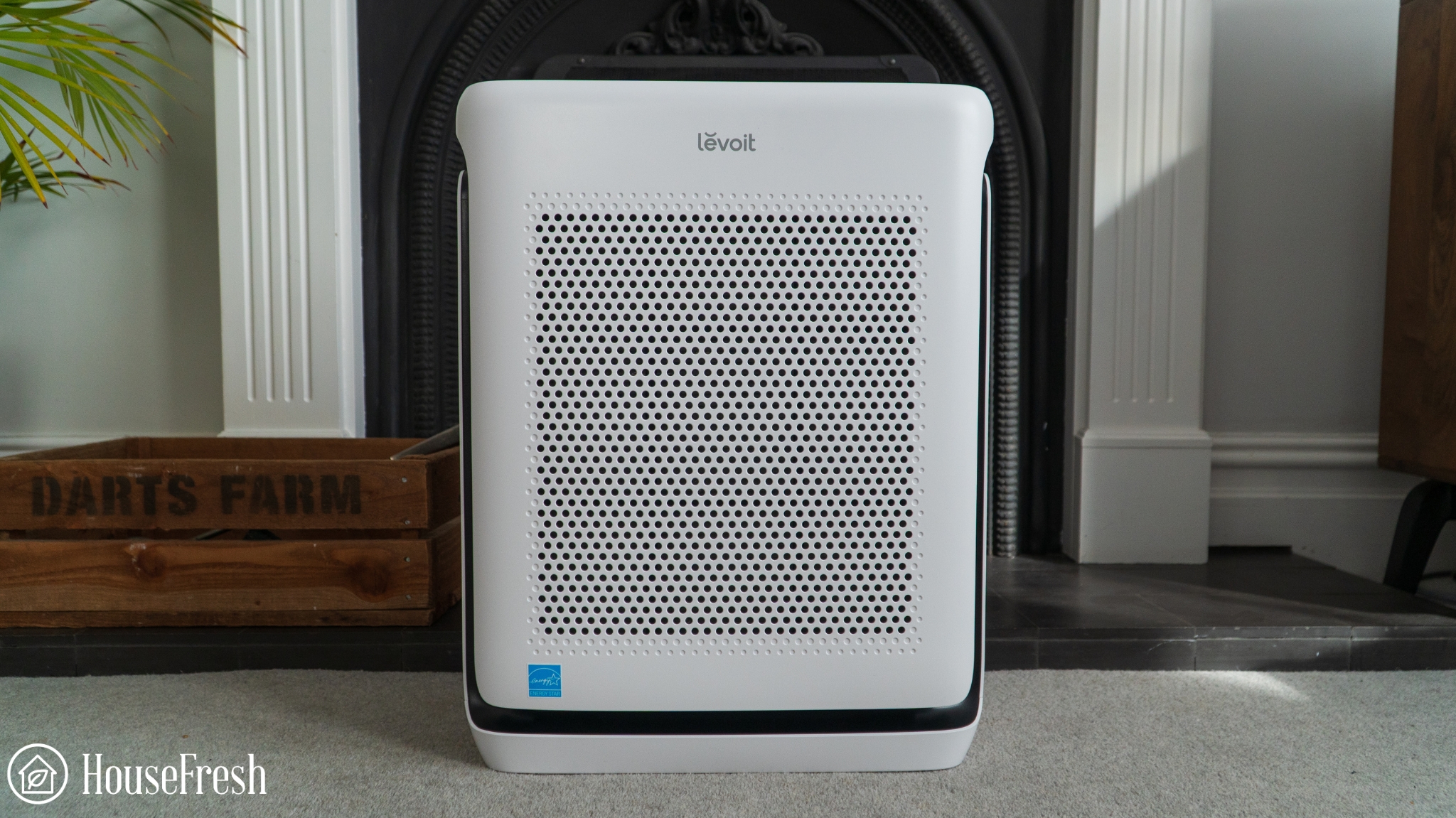
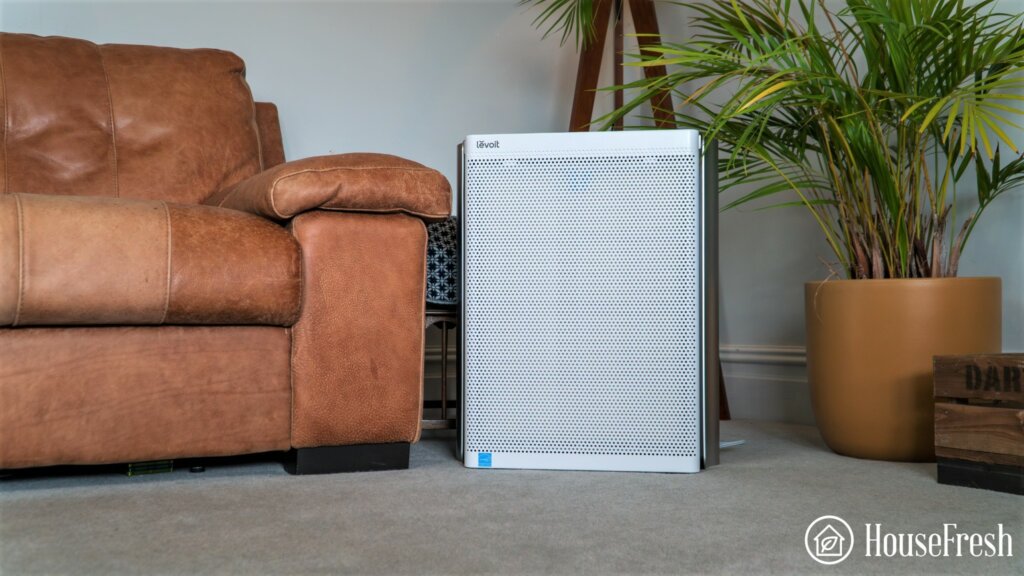
Rather than use the cylindrical design we see with the Levoit Core series, the Vital 200S is a standard rectangle that pulls air from the front and pushes it out of the top. 

Levoit Vital 200S Close Up

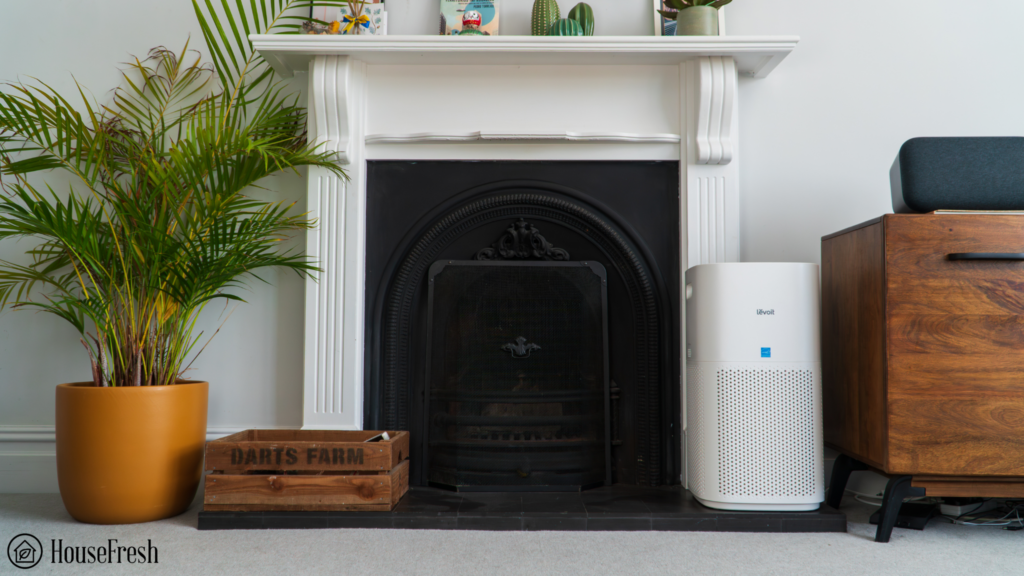
Compared to the Levoit air purifier range, it shares a closer resemblance to the premium Levoit EverestAir, although I have to say I prefer the look of the pricier EverestAir — do you blame me? Have a look at it:

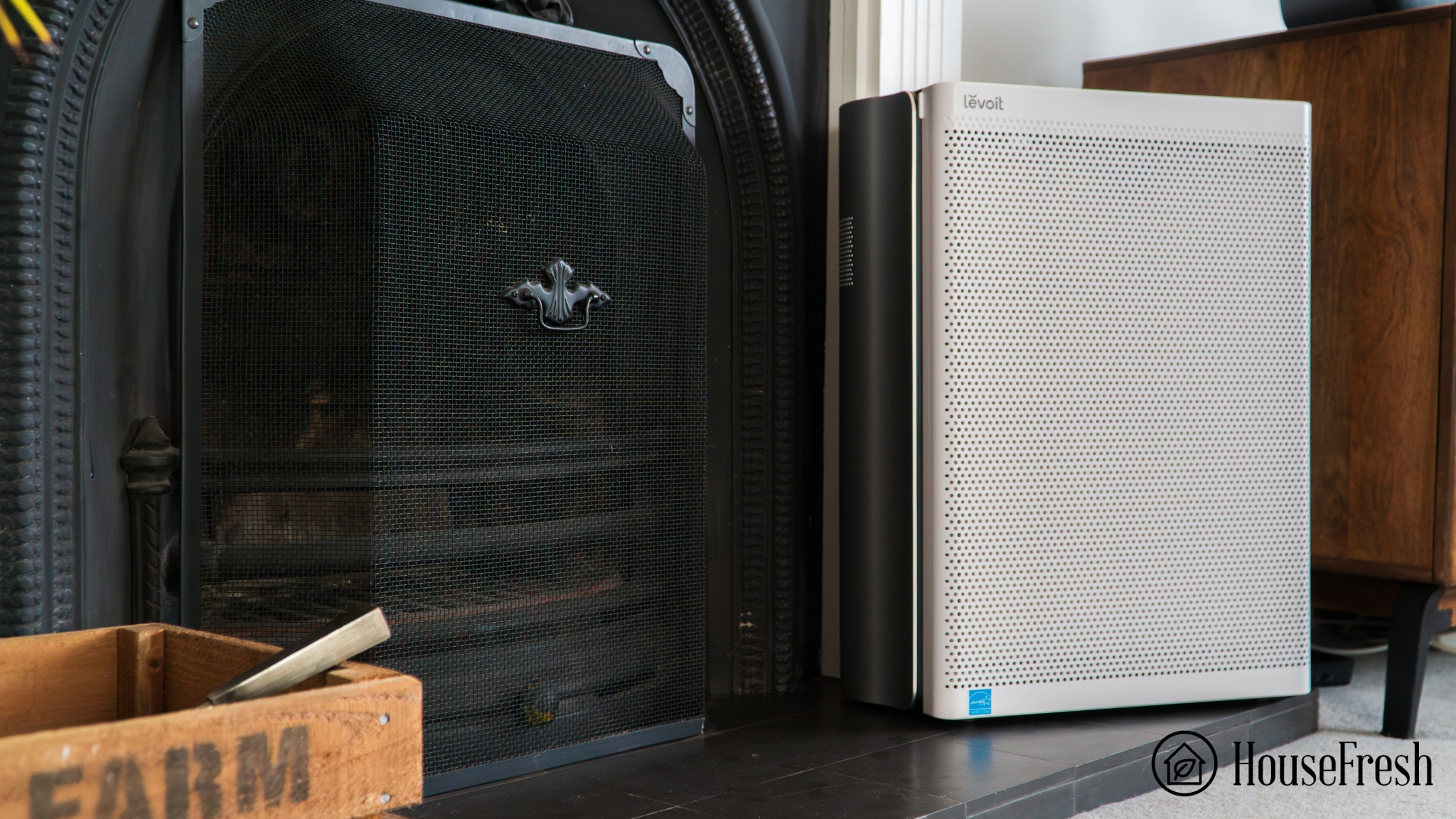
Levoit EverestAir Fireplace
Levoit Vital 200S Sensor

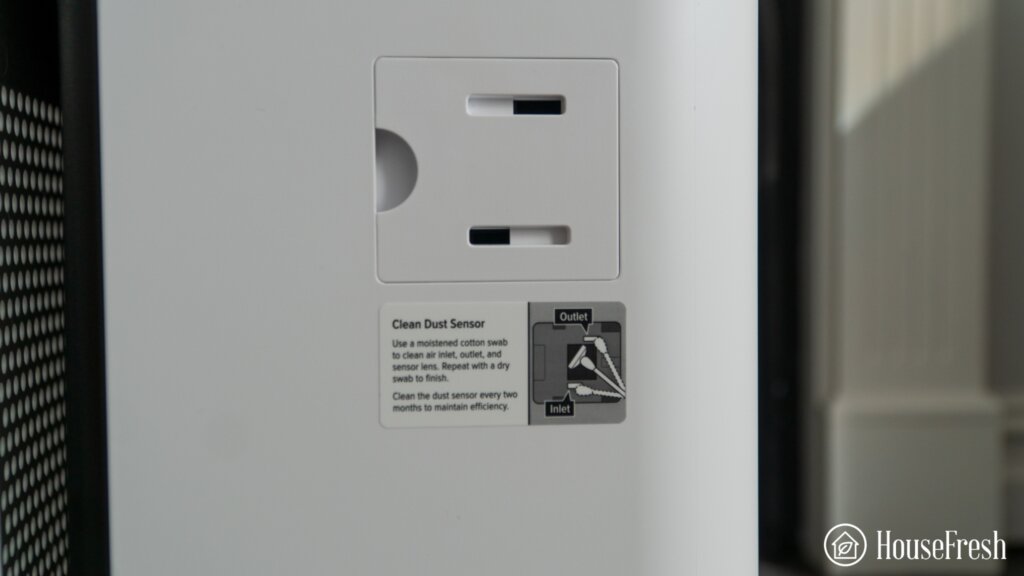
You will need to clean the optical sensor every two months to ensure it continues to be accurate when using the device on auto mode. This is one of the reasons why I prefer laser sensors, as I know many people will forget to clean the sensor and this will lead to the air quality readings not being as accurate as they could be.

Levoit Vital 200S Top

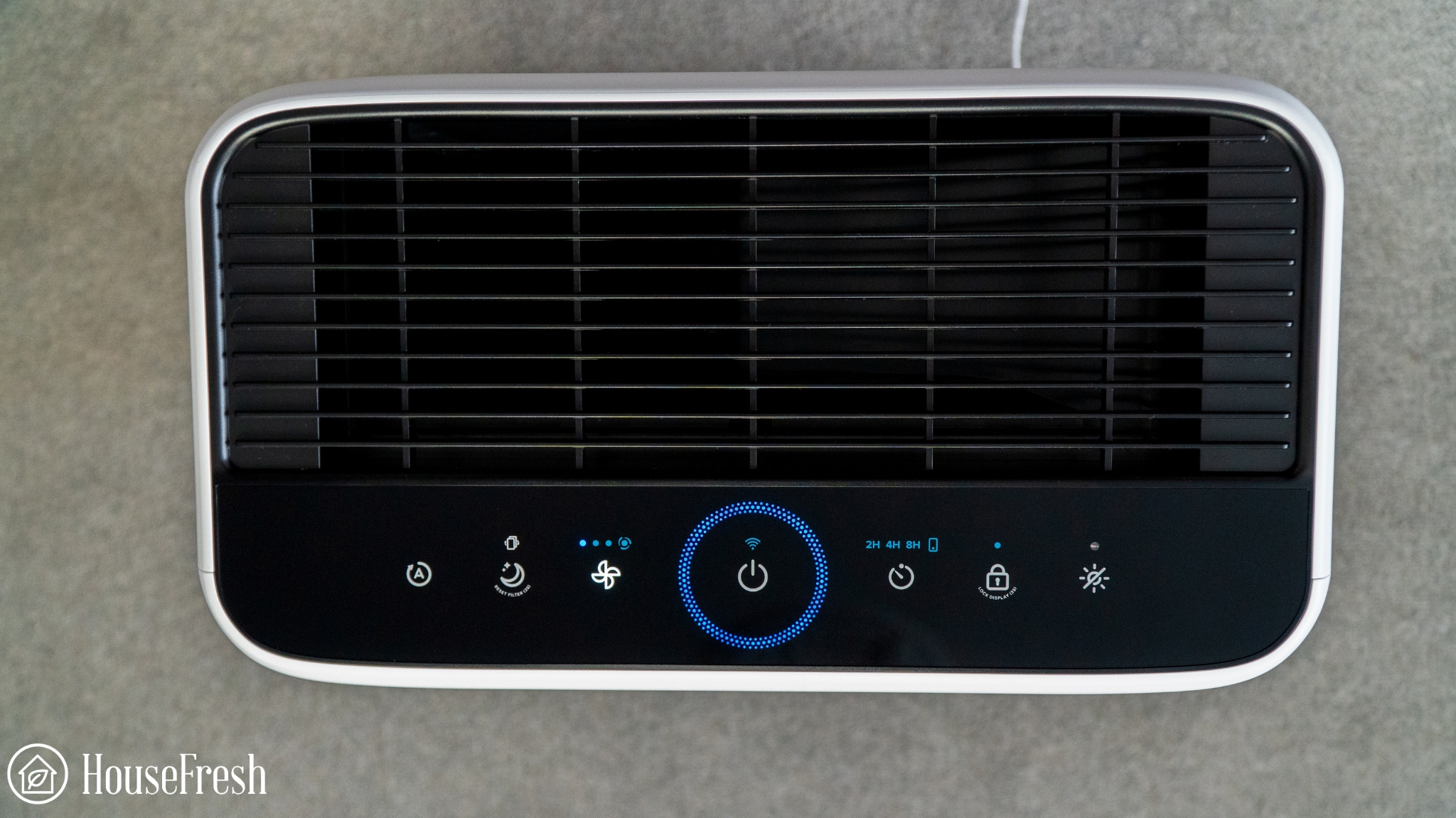
From right to left you get an auto-mode button, a night mode button, the fan speed button, the power button, a timer button, a child lock button and lastly a button to turn the lights on and off. The power button is surrounded by an LED ring that changes color surrounded by lights that change color depending on indoor air quality. 

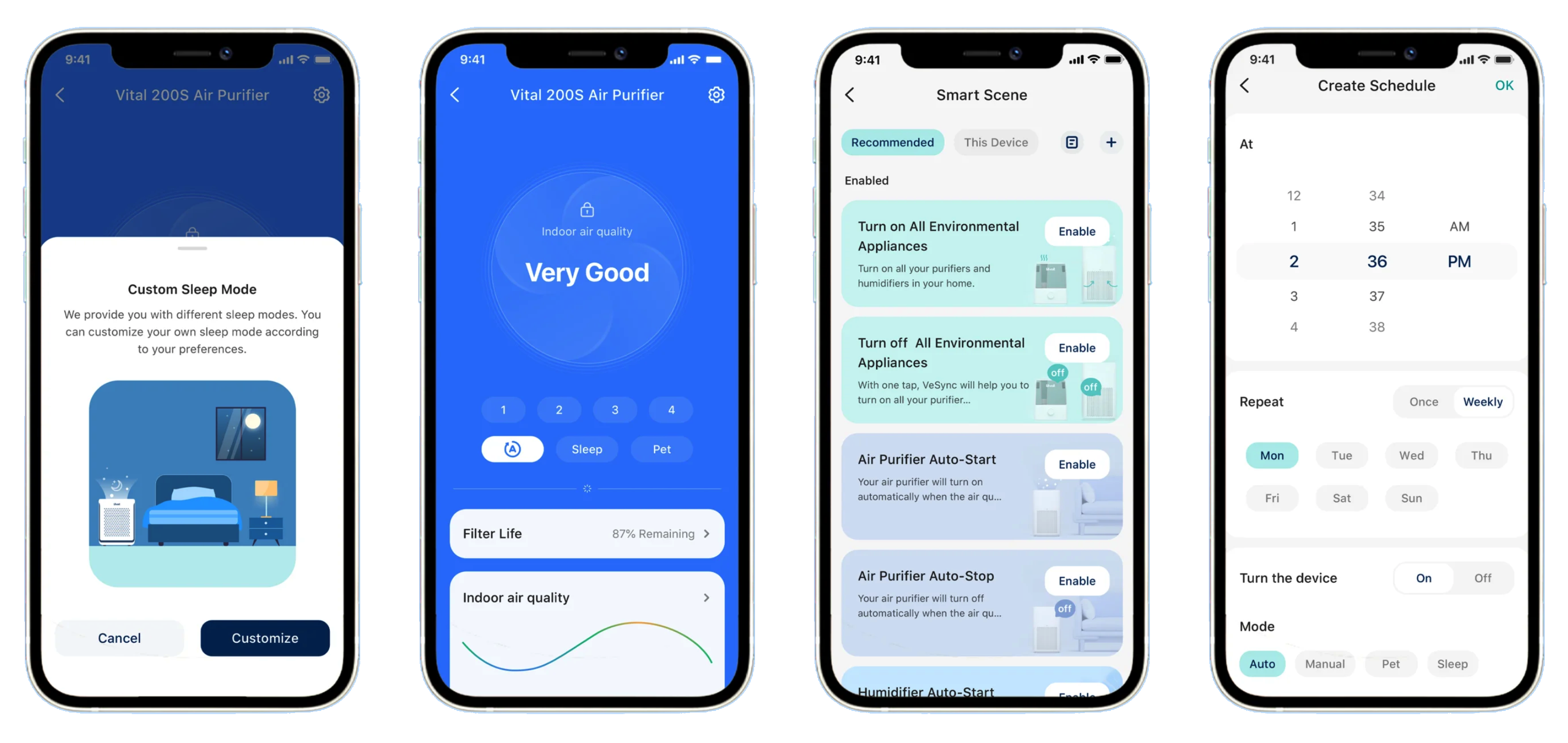
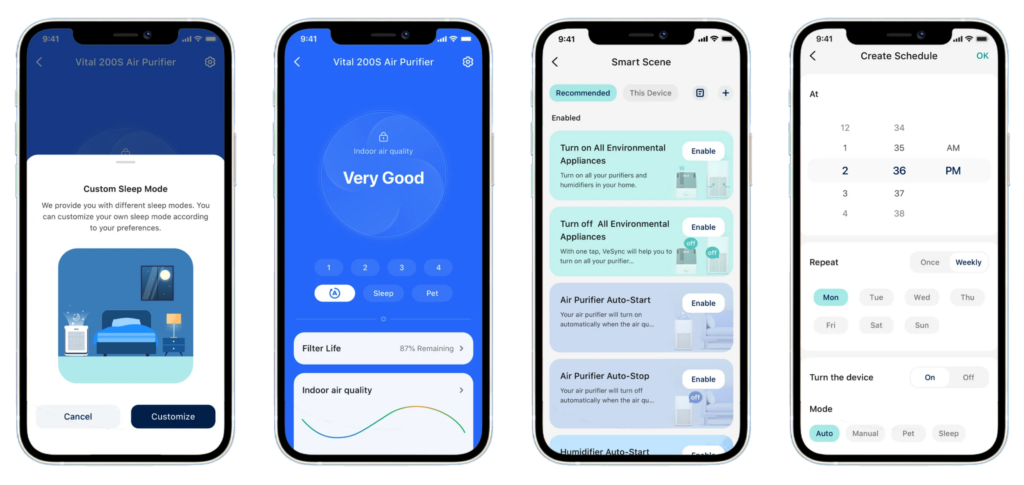
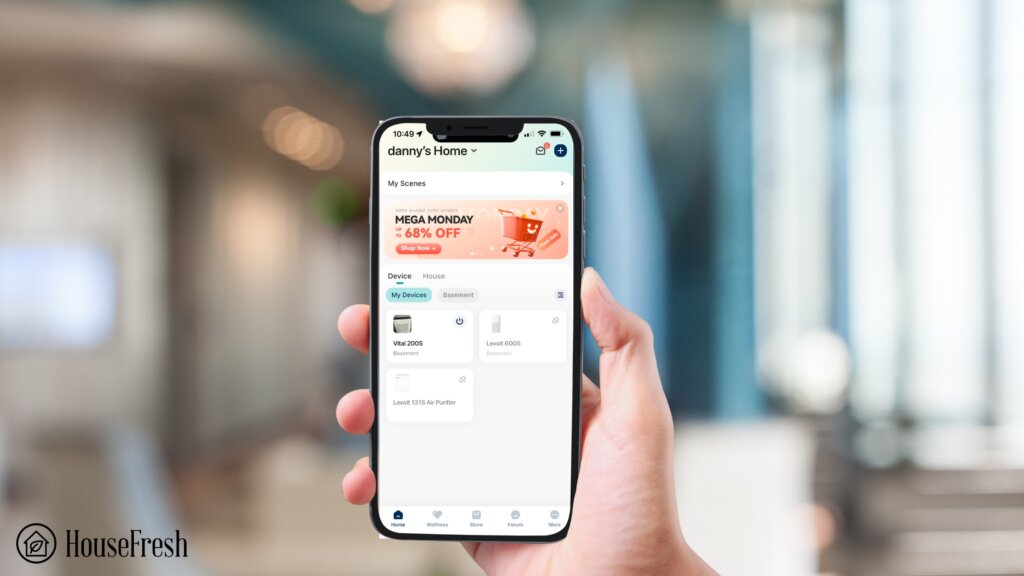
The Vital 200S comes with app connectivity through the VeSync app, which is the app used by a range of Levoit gadgets and is well-rated across Android and Apple ecosystems. 

Levoit Vesync App

The app uses Vesync, which is the app used by a range of Levoit gadgets and is well-rated across Android and Apple ecosystems. 

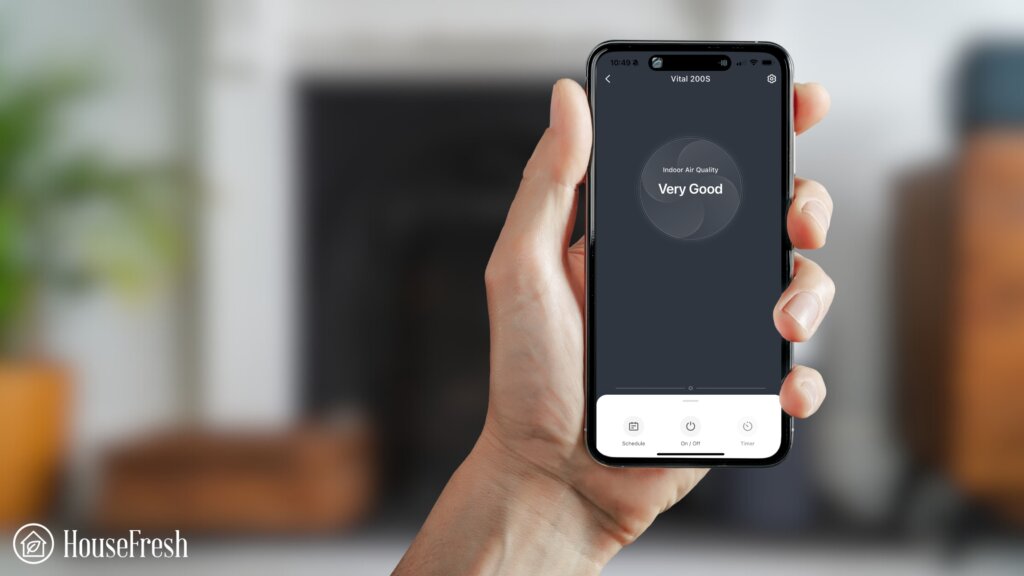
I tested the Apple app, and it was easy to install and add the Vital 200S quickly. You can adjust the air purifier’s settings via the app and also see what the current indoor air quality rating is in the room where it’s set.

Levoit Vesync App
Levoit Vital 200 App Ad
Levoit Vital 200 App

The main app screen has internal ads for different Levoit products, which I would prefer it didn’t, but once you go into the air purifier, there are no ads shown. 

One feature that I haven’t seen in other Levoit air purifiers is a light detection mode that allows the device to switch off the display and run extra quiet when low light is detected. This is a great feature for those wanting to use it in a bedroom. 

Levoit Vital 200S Bedroom

Filtration technology

An all-in-one particle filter with pelleted activated carbon. You will need to replace both filters even if only one of them needs replacing.

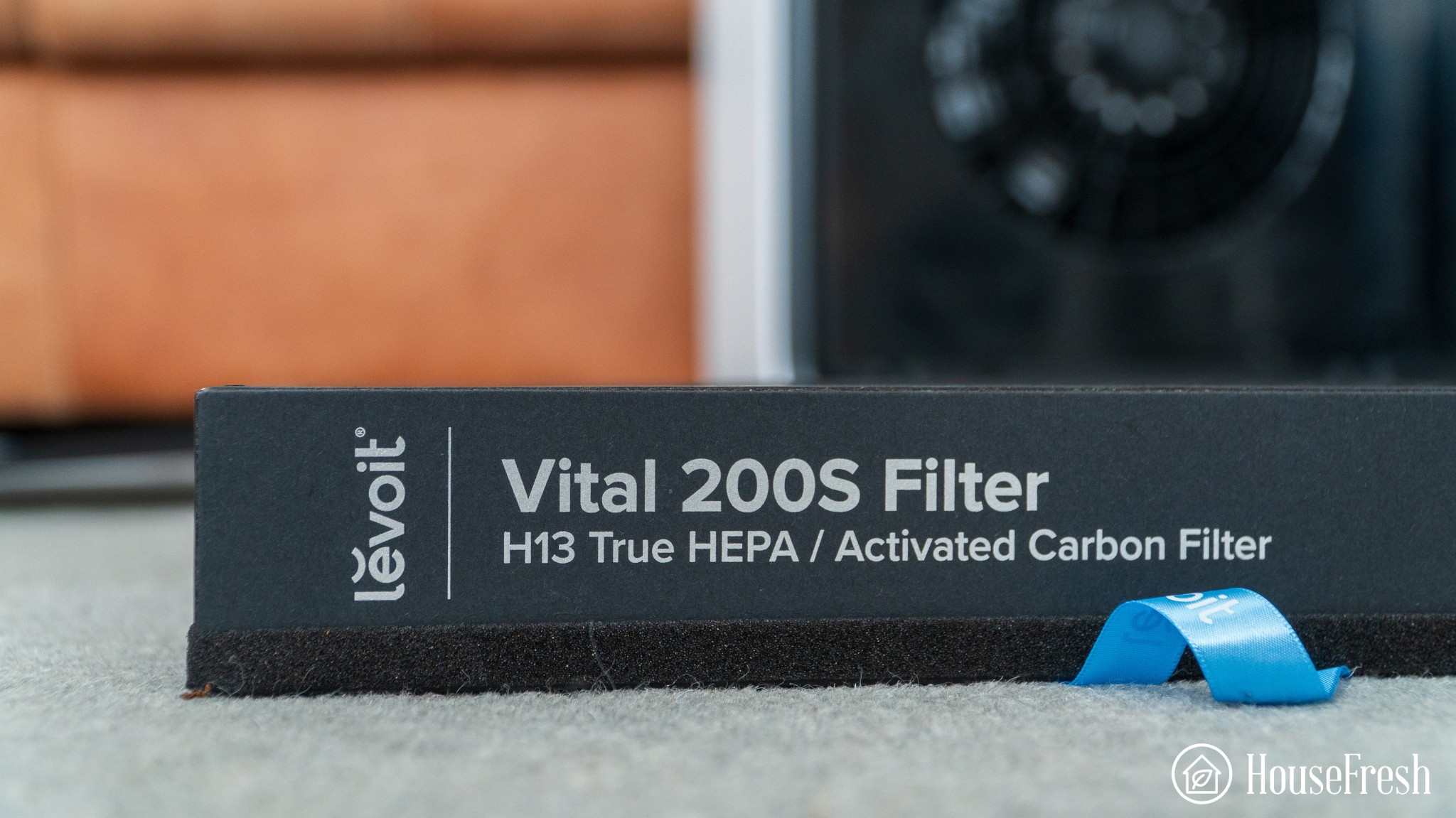
Levoit Vital 200S Filter Side

Levoit initially stated that the Vital 200S uses HEPA H13, which is medical grade and can remove 99.97% of particles measuring 0.3 microns. But as you know, Dyson’s challenges Levoit’s claims through the BBB National Programs National Advertising Division (NAD) and as a result, VeSync removed all mentions of ‘HEPA’ from their marketing materials.

Levoit Vital 200S HEPA Filter

It comes with a bonded particle and gas filter that performed very well in our particle removal test.

Levoit Vital 200S Activated Carbon Filter

The gas filter uses pelleted charcoal that is much better than the impregnated fabric we see with some manufacturers. 

How to Vacuum Air Purifier Pre Filter

It comes with a removable pre-filter which is much easier to clean than the pre-filter in the cylindrical Core 300/300S.

While you do get a good amount of activated carbon in the Vital 200S, if you have serious issues with VOCs and gasses, you should look for an air purifier with a much bigger filter with lbs of activated carbon such as the Alen BreatheSmart 75i, the IQAir HealthPro Plus and the Austin Air HealthMate.

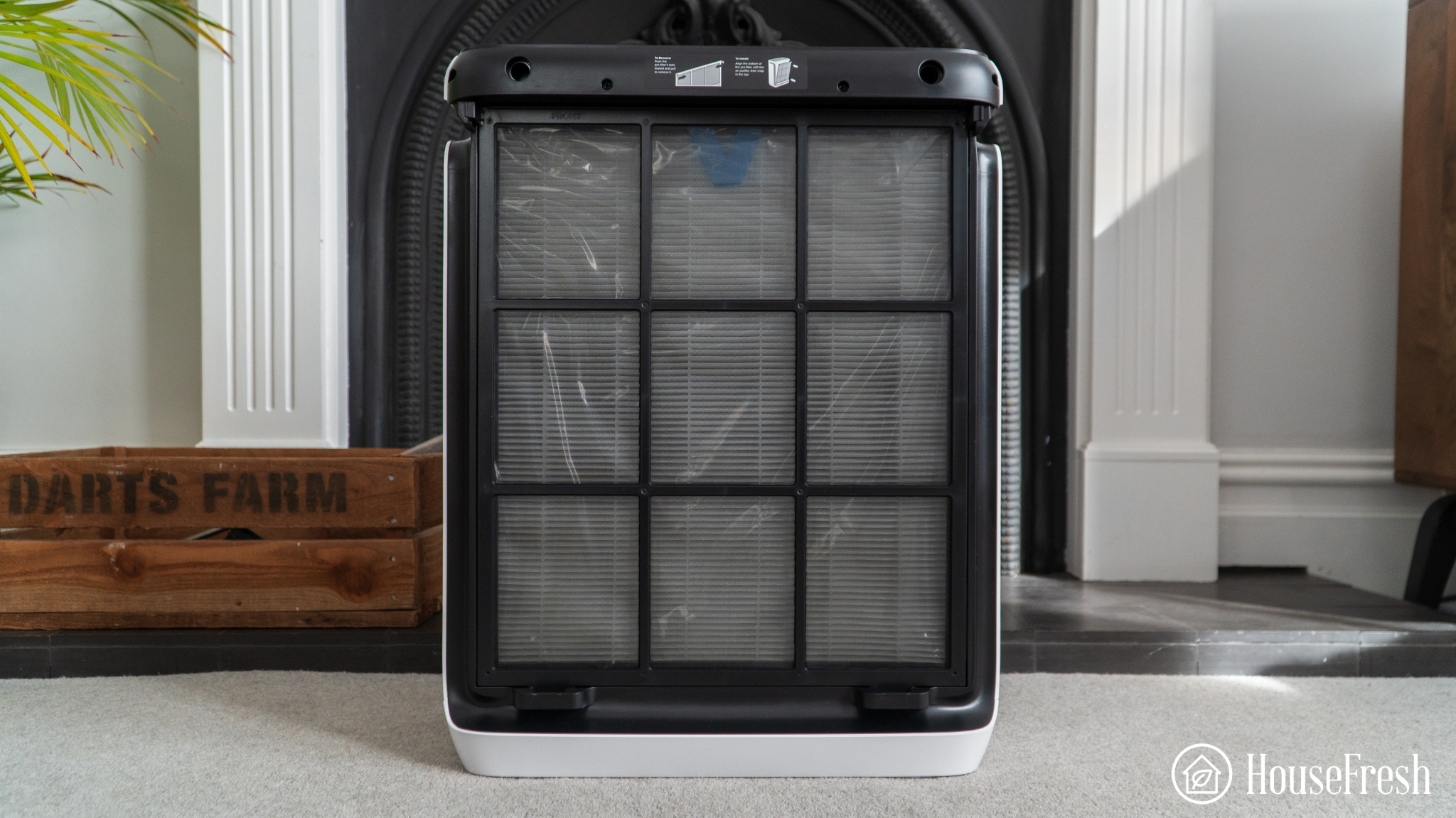
Remember that most air purifier filters will arrive in a plastic bag, so be sure to remove the filter from the bag before you switch it on; otherwise, it will make your air quality worse!

Levoit Vital 200S Open

When the time comes to change the filter in your Levoit Vital 200S, you’ll find that the process is simple and straightforward.

Air cleaning performance

The real-world performance of the Levoit Vital 200S matches reported CADR scores.

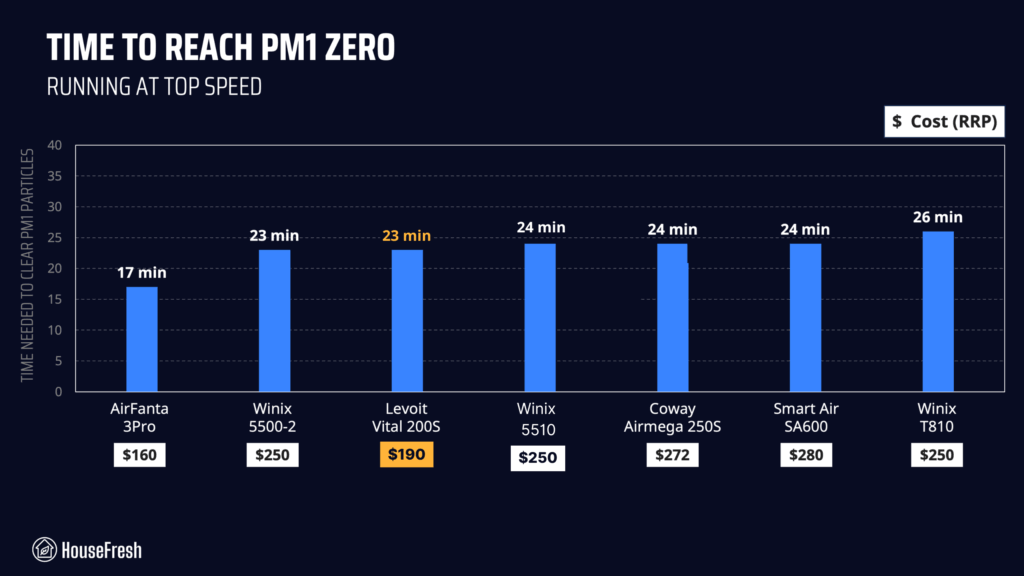
Running at full speed, the Vital 200S brought the levels of PM1ug/m3 to zero in 23 minutes. That makes the Levoit Vital 200S one of the fastest units we have tested under $200.

The Levoit Vital 200S was able to complete our particle removal test faster than the popular Winix 5510 but without using an ionizer function.

Levoit Vital 200S Particle Removal

As the table shows, the AirFanta 3Pro offered a higher clean air delivery rate for a cheaper price. This goes to show the power of PC fans compared to retail HEPA air purifiers.

Sound levels

In our testing, the sound levels of the Vital 200S ranged from 38.3 to 57.7 dBA

Levoit Vital 200S sound test

As I always say, air purifiers that are too loud, get turned off eventually. That is why we used a sound meter to measure how much sound the Levoit Vital 200S generates from three feet away. We did this across all four fan speeds:

FAN SPEEDSOUND LEVEL
Speed 138.3 dB
Speed 241.9 dB
Speed 353.8 dB
Speed 457.7 dB

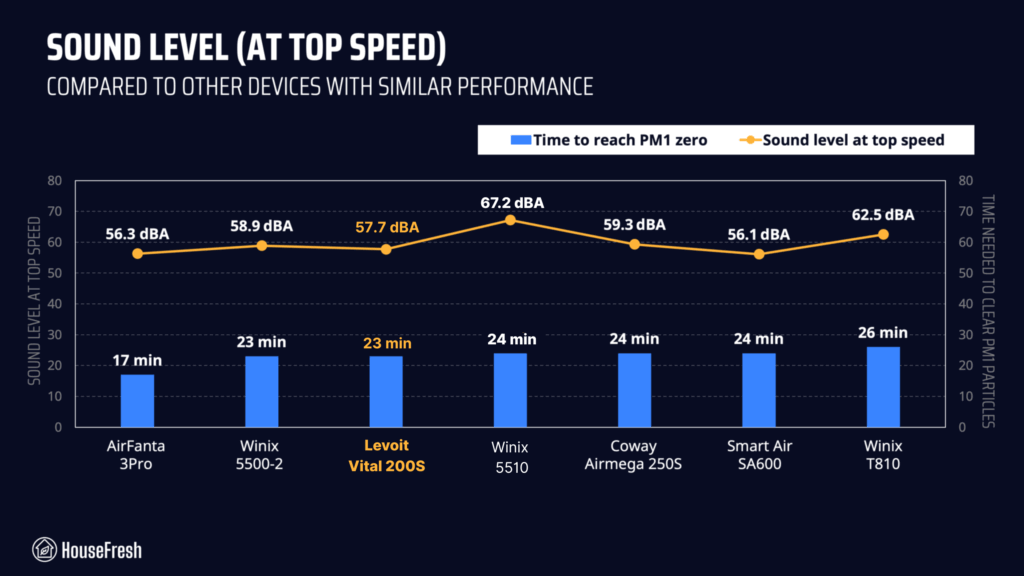
We can now compare the air cleaning performance and sound level at top speed against data from other air purifiers in the same price range:

Levoit Vital 200S Sound Performance

As you can see from the table, the sound generated by the Vital 200S at top speed is quieter than that of most other air purifiers with a similar clean air delivery rate.

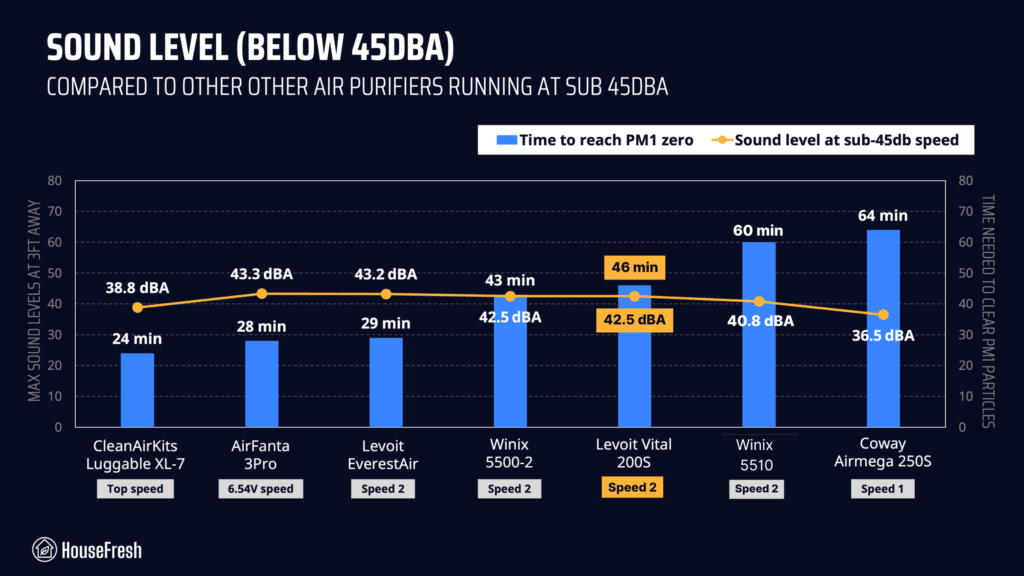
Running at the Vital 200S at speed 2 generates 42.5 dBA of sound, which is below the 45 dB(A) limit we have set for our quiet performance tests.

So I repeated the particle removal test with the 200S running at speed 2, and it managed to reach PM1 zero in 46 minutes.

Levoit Vital 200S Sub45 dB

As you can see from the table, the Vital 200S offers more powerful air cleaning performance at sub-45 dBA fan speeds than popular devices such as the Winix 5510 and the Coway Airmega 250S.

However, it is still no match to PC fan-powered air purifiers such as the Luggable XL-7 from CleanAirKits and the AirFanta 3Pro.

But sound can be very subjective, so we recorded a video of the air purifier running at different fan speeds:

Long-term running costs

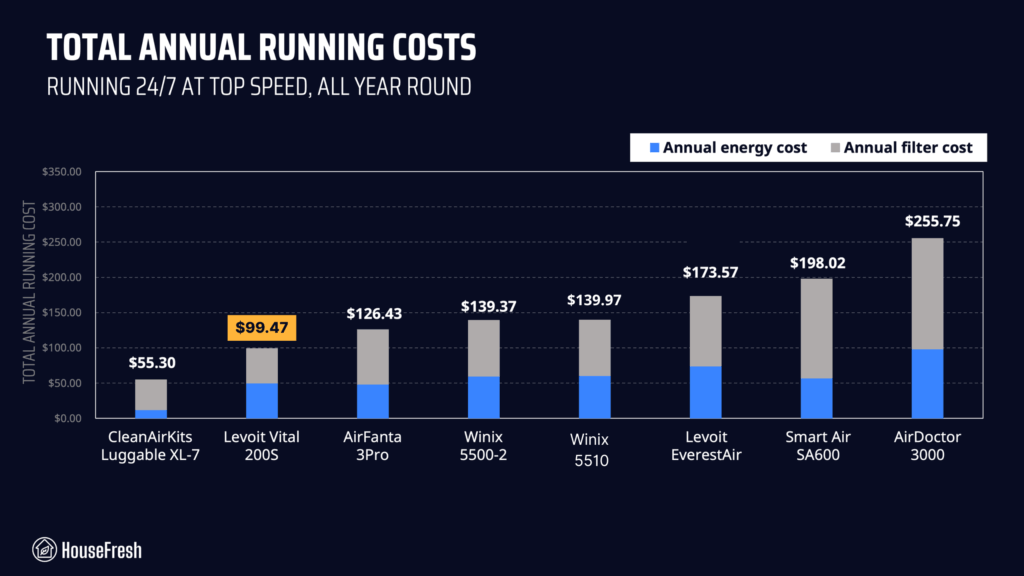
Running a Levoit Vital 200S will cost you $99.47 per year, combining energy consumption costs and filter replacement prices.

As always, we used our energy meter, we recorded a maximum of 44.55 watts consumed by the Vital 200S when running at full speed. This equates to $49.48 per year if you were to keep it running 24 hours per day at its highest speed. 

Here are the full results for each fan speed:

MODEENERGY USAGE
Standby0.97 watts
Sleep mode3.21 watts
Speed 15.71 watts
Speed two8.01 watts
Speed 331.96 watts
Top Speed44.55 watts

This tells me that the Levoit Vital 200S has a very efficient fan that can move a lot of air without excessive energy usage. It’s great to see that newer models of air purifiers can perform well AND be energy efficient.

Considering you need to replace the filter every 12 months and that the replacement costs $49.99, you can expect to also spend $49.99 per year on filters.

When we combine the estimated electricity costs with the filter replacement costs, you can see that the Vital 200S offers great value in the long term as well:

Levoit Vital 200S Yearly costs

Regarding the filters themselves, you have other options in addition to the original filter: one aimed at those looking to deal with pet allergies, a smoke remover filter, and one that includes toxin absorbers. The price of these filters ranges from $49 to $65 dollars, so they are not cheap but they are also not super expensive.

If you want to reduce yearly running costs further, you will be happy to hear that there are many generic filters available for half the price of the genuine filters from Levoit – it’s worth mentioning that performance will vary:

Bottom line: Is the Levoit Vital 200S worth it?

With a list price of $189.99, it offers excellent value for the money, with air cleaning performance that matches units that cost twice the price.

Levoit Vital 200S Fireplace

If you want to get the best air cleaning for $ ratio and want to avoid ionizer technology, the Levoit Vital 200S is definitely worthy of consideration.

It includes many smart features that are normally only found on more expensive models but still manages to clean the air as effectively as we’ve seen from units like the iconic Winix 5500-2 but without the use of an ionizer.

Those with larger spaces will want to look at bigger units like the Levoit Core 600S ($299.99), but for those with a space between 400-500 square feet, the Vital 200S is a great choice as it will be able to keep your air clean for an affordable price. 

Noise levels associated to the Vital 200S are lower than the average and it comes with a sleep mode and the possibility of turning off the lights of the display (not to disturb your sleep), making it a very good option for a medium-sized bedroom.

Levoit Vital 200S Bedroom

💡exclusive code for HouseFresh for 10% off a single purchase on Levoit.com: HOUSE10

Due to the lack of a True HEPA H13 filter, I don’t recommend this device for medical settings. However, as our in-house test showed, the Vital 200S can clean all tiny particles of 1 micron in 23 minutes. Air cleaning performance nearly three times as fast as the Levoit Core 300 ($99) and is only one minute slower than the larger Levoit Core 600S ($300).

For those who want to keep a medium-sized room clean of tiny particles and don’t want to spend more than $190, then the Levoit Vital 200S is well worth checking out. And if money is tighter, do check out the PC fan-powered AirFanta 3Pro.

If you decide to buy a Vital 200S and want to support the work we do at HouseFresh, please use this link so we can earn a commission at no extra cost to you. And if you have any questions about this device or about Levoit air purifiers in general, please drop them in the comments below and I’ll reply as soon as I can.

Top performing air purifiers for wildfire smoke (+ DIY units)

Wildfires Dominate Newspapers

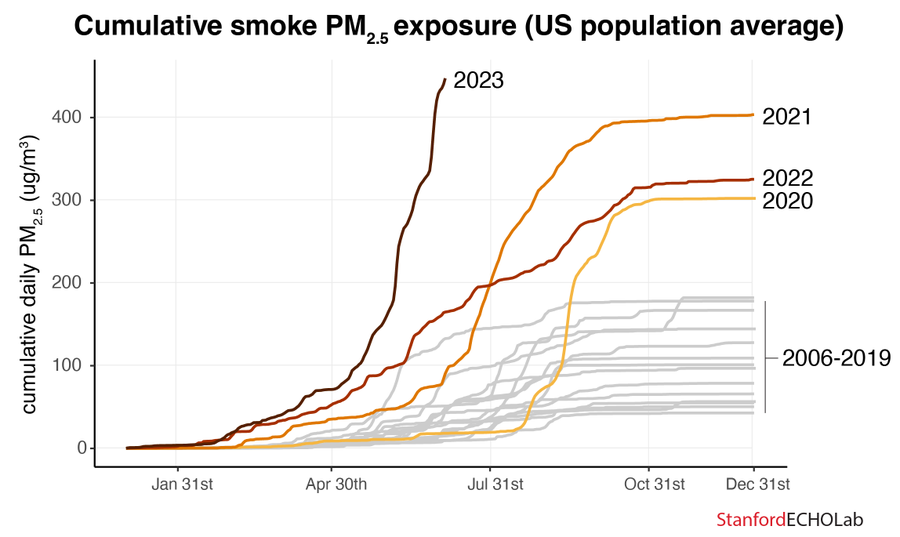
As the tinted red skyline of New York City showed the world during Canada’s wildfire season, even areas that are not at high risk of wildfires can be impacted many hundreds of miles away. In fact, Americans breathed more wildfire smoke in the first eight months of 2023 than they had during any previous full year since 2016. 

stanford study cumulative PM2.5 for americans in 2023

Wildfire smoke generates tiny particulate pollution (PM1, PM2.5 and PM10), odor (VOCs), and other gasses. The most dangerous pollutants are tiny particles measuring 1-10 microns, which are small enough to pass through lung tissue and get into the bloodstream. The good news is that high-performing air purifiers with the right filters can remove these particles from the air before we breathe them into our bodies.

My recommendations today are based on more than 90 air purifier tests, where we assessed the air cleaning performance of different brands and models to find the units powerful enough to quickly clear wildfire smoke from the air without breaking the bank.

how we test
How we test air purifiers

Read our full testing methodology.

Let me point out that I included two air purifiers that you can build at home: the Corsi-Rosenthal Box and a simple fan+filter DIY air purifier. I did this because wildfire smoke can accumulate very quickly, so the best solution is to get a device to clean your air ASAP.

If you suffer from regular issues with indoor air quality or live in an area prone to wildfires, investing in a high-performing air purifier will make the most sense in the long term. But not everyone has the means to buy a powerful air purifier, so these DIY alternatives are definitely worth considering if that’s you.

HouseFresh picks: The best air purifiers for wildfire smoke

Below, you’ll find a more detailed yet compact overview of each unit in my shortlist for this type of smoke pollution.

DIY OPTIONBUDGET OPTIONLARGE SPACESSMALL SPACES
Corsi-Rosenthal boxAirFanta 3ProSmartAir Blast MiniLevoit Vital 200S
Corsi RosenthalAirFanta 3Pro CornerBlast Mini MKII Kids RoomLevoit Vital 200S Bedroom
Air cleaning speed30 minutes14 minutes12 minutes18 minutes
CADR274 CFM430 CFM435 CFM242 CFM
Filter techMERV 13True HEPA H11 + carbonH13 HEPA filter + carbonBonded particle + carbon
Filter life6-12 months6-12 months13 months12 months
Max room size680 sq. ft.671 sq. ft.703 sq. ft.375 sq. ft.
Sound levels49-60 dB36-56 dB44-56 dB38-57 dB
Long-term running costs$110.88 / year$125.23 / year$311.89 / year$127.94 per year
Upfront cost$85.00$159.99$599.00$189.99

Read on to learn more about each of my top picks. Make sure to scroll down to find out which air purifiers I definitely don’t recommend for wildfire smoke.

Right, without further ado, these are my recommendations.

1. DIY option: Corsi-Rosenthal Box 

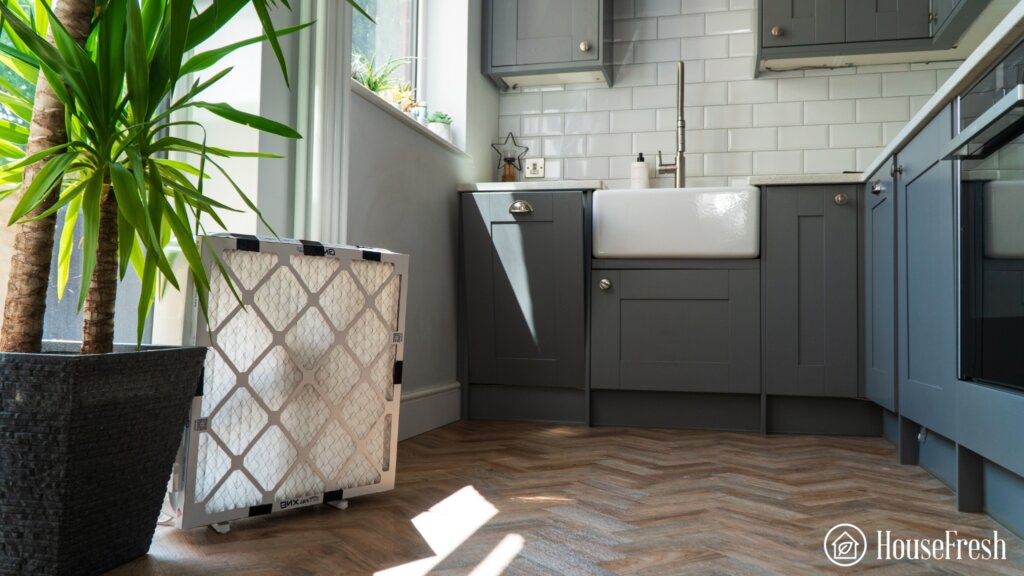
For those reacting to the immediate threat of wildfire smoke, you can build your own Corsi-Rosenthal Box with a box fan, four HVAC MERV 13 filters, cardboard and duct tape.

Corsi-Rosenthal box in a corner

BUY MERV 13 FILTERS
BUY BOX FAN

The main reason this air purifier is the one on my list is that it can be built using items you already have in the home. Engineers Richard Corsi and Jim Rosenthal popularized the Corsi-Rosenthal box during the COVID-19 pandemic to reduce the viral particles in indoor environments. While designed for airborne viruses, the CR box can still help remove the dangerous tiny particles created by wildfire smoke. 

What we really like

You can build your own Corsi-Rosenthal box with four HVAC filters, a box fan, some cardboard and tape. Easy and affordable.
It is relatively easy to put together and can be an activity to do with kids at home.
Despite being a DIY air purifier, it cleaned our test room in 30 minutes — that’s more than twice as fast as the average speed across all units we tested.
It’s highly customizable. You can choose the fan and filters you want to use to build it.

What we think could be better

There is no option to add activated carbon, so the CR box will only be able to clear the air from particles but it won’t be effective against the odors and gases generated by wildfires.
It has a large footprint, so it will take up a fair share of space.
Box fans can be loud. The noise levels vary from fan to fan, so make sure to find one that is comfortably quiet.
To change the filters, you’ll need to remove the duct tape and re-tape the new ones. Make sure to have MERV 13 stock available during wildfires, as the filters will need regular replacement.

The Corsi-Rosenthal box does require you to put it together, but it’s relatively simple, and while it takes up a large amount of floor space, its performance at removing pollutants is worth it. Be sure to use HVAC filters that are at least MERV-13. I used the BNX Tru filters MERV 13 and the Hurricane 20-inch box fan in our CR Box, but you can use any 20-inch box fan and filters as long as they are MERV-13 or higher grade.

As with all the air purifiers we review here at HouseFresh, we tested our 20×20 Corsi-Rosenthal box in the same 728-cubic-ft test room where we have tested nearly 100 air purifiers to date. The CR box impressed me: it was able to bring down the levels of PM1 to zero in 30 minutes. This is eight minutes faster than the $850 Austin Air HealthMate HM400 and 14 minutes faster than the Intellipure Compact device used in NYC schools.

Clean air delivery rate (CADR):– Top speed PM1 CADR: 198 cfm
– Sub-45 dBA PM1 CADR: n/a
Filter technology:MERV 13
Recommended room size:297 sq. ft. (5 air changes per hour)
Dimensions:20L x 20W x 20H inches (50L x 50W x 50H cm)
Weight:10 lbs (4.5 kg)
Noise level in decibels from 3 ft. away:Speed 1: 49 dB
Speed 2: 55.1 dB 
Speed 3: 60.7 dB
Electricity consumption in watts:Standby mode: 0 kWh
Speed 1: 40.5 kWh
Speed 2: 44.5 kWh
Speed 3: 46.7 kWh
Filter life:6-12 months
Manufacturer’s warranty:n/a

Read our full review

DIY fan and filter air purifier

Air purifiers are essentially just a fan and a filter, and that is exactly what this DIY air purifier is.

You can read our full guide and review of this simple DIY Air Purifier, but in simple terms, you just attach a MERV-13 filter to a box fan and voilà.

In terms of air cleaning performance, it needed more than twice as much time to clear our small test room of PM1 smoke particles but when dealing with wildfire smoke, this simple DIY device is most definitely better than having no air purifier at all.

Alternatively, you can look for a ready-made fan and filter device in the Lasko AirFlex 2-in-1. A pro tip for those who choose for this option: we swapped the Lasko filter for a 3M Filtrete 20×20 filter and this doubled its air cleaning performance:

2. Best budget option: AirFanta 3Pro

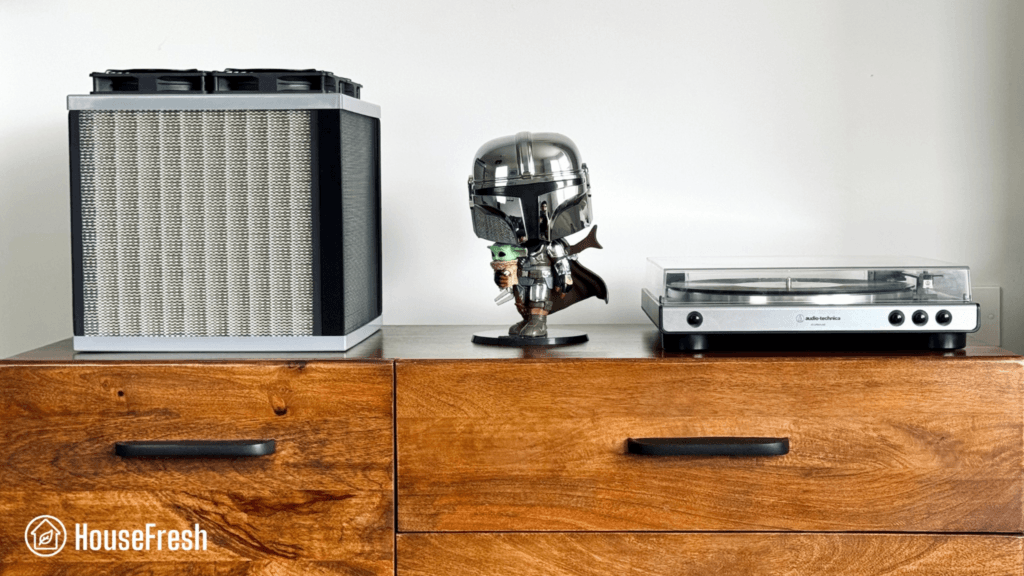
At under $150, the AirFanta 3Pro boasts outstanding air cleaning performance thanks to four 140mm PC fans — plus, it can cover areas as big as 671 sq. ft.

AirFanta 3Pro on bench

Use the discount code HOUSEFRESH for 5% off when buying directly from AirFanta.

The design of the AirFanta 3Pro is inspired by the Corsi-Rosenthal box (above): a cube with a filter on each side, fans on top and a base at the bottom. But here’s the main difference: the 3Pro uses four PC cooling fans instead of a regular box fan.

The AirFanta 3Pro comes with four low-resistance H11 filters, which quickly remove smoke particles from the air with each pass. I recommend you to choose the filters that combine HEPA + activated carbon to clear your air from particles AND the gases and odors that come with wildfire smoke.

What we really like

With an estimated CADR of 430 CFM and a price of $149.99, this is the most affordable high CADR air purifier on the market today.
It offers outstanding air cleaning performance — it cleared all incense smoke from our test room in 17 minutes, which is only two minutes slower than the fastest air purifier we have tested.
It is easy to build in just a few minutes. Once disassembled, you can fit it inside a carry-on bag or small suitcase to take with you.
It is a small 12.6×12.6 inches (32×32 cm) box, so it will fit most spaces — especially when compared to a Corsi-Rosenthal box.

What we think could be better

Running at 56.3 dBA, it is louder than other PC fan powered-air purifiers we have tested when running at full speed, but it is also A LOT cheaper.
It is less energy-efficient than other (much more expensive) PC fan air purifiers.

Unlike other air purifiers on this list, the AirFanta 3Pro is quite small, and there is a reason for that: once disassembled, the 3Pro is the only high-CADR air purifier that can fit inside a carry-on bag. This can be particularly handy during wildfires, as you will be able to pack your air purifier to bring it with you wherever you go.

Clean air delivery rate (CADR):– Top speed PM1 CADR: 353 cfm
– Sub-45 dBA PM1 CADR: 213 cfm
Filter technology:True HEPA H11 and optional pelleted activated carbon
Recommended room size:529 sq. ft. (5 air changes per hour)
Dimensions:12.6D x 12.6W x 12.6H inches (32D x 32W X 32H cm)
Weight:7.7 lbs (3.49 kg)
Noise level in decibels from 3 ft. away:3.63 volts: 36.1 dB
4.19 volts: 36.9 dB
5.24 volts: 39.7 dB
6.54 volts: 43.3 dB
7.44 volts: 46.7 dB
8.56 volts: 49.1 dB
12.6 volts: 56.3 dB
Electricity consumption in watts :43.23 watts
Filter lifespan:6 – 12 months
Manufacturer’s warranty:1 year
Country of origin:China
Country of manufacture:China

Read our full review

Watch our video review

3. Best for large spaces: Smart Air Blast Mini

A fast and quiet powerhouse that can achieve five air changes per hour in spaces as large as 675 sq. ft.

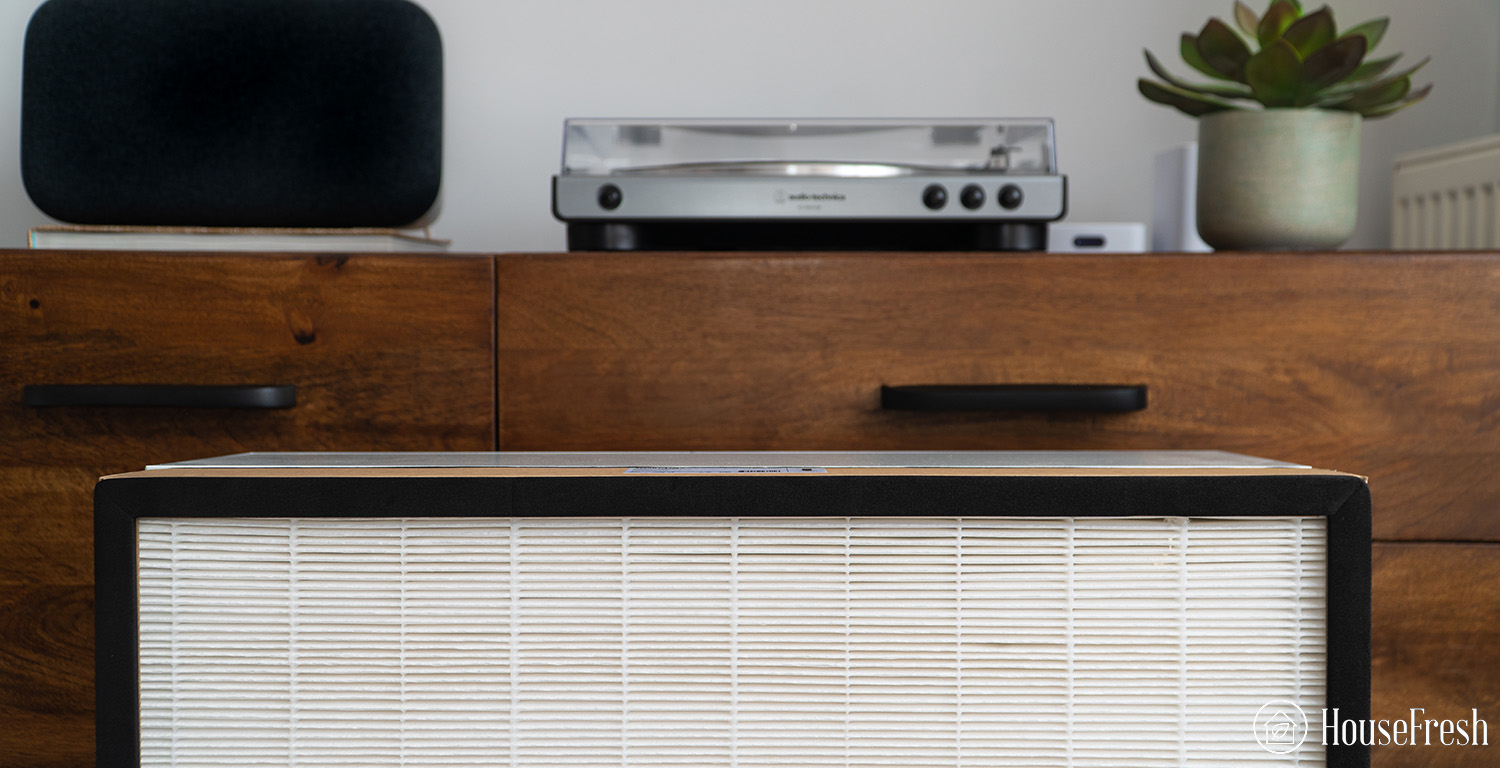
Smart Air Blast Mini MKII in kids room

PRICE AT SMART AIR U.S.
£432 AT SMART AIR UK

Speedyness is key when there’s a wildfire nearby. At $650, the Blast Mini is not as affordable as the AirFanta 3Pro, but it comes with such a powerful fan that it bested all 94 units we tested so far, completing our particle removal test in just 15 minutes. 

The massive size of the medical-grade HEPA filter in the Blast Mini is perfect for capturing the fine particles (PM2.5) produced by wildfires. Although the activated carbon filter is not included in the standard purchase, I strongly recommend getting one, even if it means an extra $90. The 2.6 lbs of loose-fill carbon will remove VOCs and gasses produced by wildfires, and it will also help with the pervasive smoke odors.

What we really like

For such a powerful unit, the Blast Mini noise output tops at 56 dB when running at full speed. A significant advantage, considering during wildfire season you’ll be running the air purifier 24/7. 
It comes with one of the largest H13 HEPA filters available on the market, which can also last longer than the average (13 months).
Super simple to operate, with no more than a dial to choose between three fan speed levels.
Top-notch lockable, metal castor wheels to move around in any direction.
It is made of metal, which makes it a more sustainable and long-lasting choice than most plastic air purifiers.

What we think could be better

A powerful fan comes at a cost. This power-hungry unit will add $130 to your annual energy bill.
Filter replacements don’t come cheap, costing $236.99 per year if you get both HEPA and activated carbon filters.
It’s not exactly mini, but rather a big, heavy unit weighing 59 lbs. However, it comes on four caster wheels that make it easy to move around the house.

The reliable Blast Mini doesn’t just stand out for its air cleaning speed and large filters. It is also designed for large spaces and is able to provide five air changes per hour in rooms as big as 675 sq. ft. It has a high price tag but if you are looking for outstanding air cleaning power, then the Blast Mini won’t disappoint.

Clean air delivery rate (CADR):– Top speed PM1 CADR: 400 cfm
– Sub-45 dBA PM1 CADR: 272 cfm
– Manufacturer provided CADR: 437 cfm
Filter technology:H13 HEPA filter (and optional pelleted activated carbon filter)
Recommended room size:600 sq. ft. (5 air changes per hour):
Dimensions:22.6L x 13W x 24.8H inches (57.5L × 33W × 63H cm)
Weight:59 lbs (26.8 kg)
Noise level in decibels from 3 ft. away:Speed 1: 44.9 dB
Speed 2: 51.2 dB
Speed 3: 56.3 dB
Electricity consumption in watts:Standby mode: 0 watts
Speed 1: 51.9 watts
Speed 2: 87.4 watts
Speed 3: 122.7 watts
Filter lifespan:13 months
Manufacturer’s warranty:1 year
Country of origin:China
Country of manufacture:China

Read our full review

4. Best for small spaces: Levoit Vital 200S

This is our top recommendation for those looking for a smart air purifier with particle and carbon filters for under $200.

Levoit Vital 200S in our living room

You don’t need ultra-powerful air purifiers for smaller spaces. However, I strongly recommend choosing a unit with a minimum CADR of 200 CFM, even more so if you need to deal with wildfire smoke pollutants. That is why I am recommending the Vital 200S as it has a smoke CADR of 242 CFM and will be able to clean the air five times per hour in rooms as large as 395 sq. ft.

The Vital 200S comes with a removable pre-filter (which makes washing far easier and can extend the filter’s lifespan for up to 12 months), and a bonded particle and activated carbon filter. The 200S is also powered by an energy-efficient yet powerful fan, making it possible for it to complete our particle removal test in 23 minutes, which is three minutes faster than the popular Coway Airmega AP-1512hh and seven minutes faster than the $400 Alen BreatheSmart 45i.

It’s worth noting that the filters are no longer advertised as True HEPA after Dyson complained to the BBB. Instead, according to Energy Star, it uses a HEPA-type main particle filter. However, as we’ve seen with the outstanding performance of Corsi-Rosenthal box and the CleanAirKits Luggable XL-7 (both of which use MERV 13 filters), HEPA filters are not a requirement for optimal particle filtration.

What we really like

Outstanding cleaning power for under $200, with an efficient $ per CADR ratio and affordable long-term running costs.
Despite being budget-friendly, the Vital 200S features a top-tier control panel with air quality readings and a light detection mode to react to ambient light.
It runs quietly at its top speed (57 dB). This is Turbo mode, or Speed 4, which is not a common feature in budget units like this one. At Speed 3, the noise output lowers to 53 dB (equal to the sound of a quiet suburb).
It is a compact unit with a reduced footprint, so it’s easy to find a spot for it in small rooms. It is as sleek as a budget-friendly air purifier can get.
It comes with smart features such as an air quality indicator on-screen, auto-mode and smartphone connectivity.

What we think could be better

It is more expensive than small air purifiers, such as the Winix A230, but it will give you enough CADR to achieve safe indoor air quality levels in small rooms during wildfires.
The air quality sensors need periodic cleaning (every two months) to work properly. Dust and particulates accumulated in the sensors will affect this unit’s auto-mode performance.
Levoit advertised medical-grade HEPA filters for this unit at launch, but they removed all mentions of HEPA after being challenged by Dyson. Not great.

Intensive use during wildfires won’t break the bank, if you consider the long-term running costs: it will cost less than $130 a year to run the Vital 200S 24/7, including the added cost to your electricity bill and the price of filter replacements.

Clean air delivery rate (CADR):– Top speed PM1 CADR: 249 cfm
– Sub-45 dBA PM1 CADR: 128 cfm
– AHAM PM2.5 CADR: 254 cfm (dust)
Filter technology:Bonded particle filter with a layer of pelleted activated carbon and a removable pre-filter
Recommended room size:373 sq. ft. (5 air changes per hour)
Dimensions:15.6D x 8.5W x 19.8H inches (39.3D x 21.5W x 50.2H cm)
Weight:13.2 lbs (5.9 kg)
Noise level in decibels from 3 ft. away:Speed 1: 38.3 dB
Speed 2: 41.9 dB 
Speed 3: 53.8 dB
Speed 4: 57.7 dB
Electricity consumption in watts:Standby mode: 0.97 watts
Speed 1: 5.71 watts
Speed 2: 8.01 watts
Speed 3: 31.96 watts
Speed 4: 44.55 watts
Filter lifespan:12 months
Manufacturer’s warranty:2 years
Country of origin:United States
Country of manufacture:China

Read our full review

Watch our video review

Only three minutes slower than the Blast Mini, the Core 600S will remove wildfire smoke from your home quickly for just $299. It has a high CADR for the price – 410 CFM overall and 377 CFM for smoke — and still boasts a solid amount of smart features usually seen in similarly powerful units that are twice as expensive.

Like most high-performing units, the Core 600S is big. Inside, you’ll find Levoit’s three-in-one filters, featuring a pre-filter, a large particle filter and, if you opt for the Smoke Remover filter, 0.79 lbs of pelletized activated carbon. Be aware, though, that the Core 600S needs filter replacements every six months.

Our Levoit Core 600S in our front room

💡exclusive code for HouseFresh for 10% off a single purchase on Levoit.com: HOUSE10

For those looking for cost-effective, high-quality air purification for spaces that the Vital 200S will struggle in, the Core 600S is a solid option:

What we really like

It is the most affordable option for large spaces: for $299, the Core 600S can perform 4.8 air changes per hour in areas as big as 584 sq. ft.
It completed our speed test in only 15 minutes. You get similar results with units like the Levoit EverestAir ($500) or the AirDoctor 3000 ($519).
It tracks PM2.5 levels in your home, with a numeric display on the control panel (not just the regular color-coded indicator) and the app – which also showcases PM2.5 levels.
It only weighs 13.70 lbs, so it’s not too heavy to move between rooms.

What we think could be better

At top speed, it will get a tad loud. The Core 600S’s 61 dB noise output is equivalent to the sound of a normal conversation.
The air quality sensor is at the back of the unit, so it won’t work accurately if the unit is placed too close to a wall.
While the three-in-one filter is straightforward to replace, a removable pre-filter would be a better option for cleaning.

Four other solid air purifiers that didn’t make the cut

If none of the options above seem like the right fit, consider the devices in this section.

We have thoroughly tested and reviewed 94 air purifiers (and counting) so when we shortlisted our picks for this list, we had to make some tough cuts. Below I’ll tell you about three devices that are worth considering as well.

IQAir Healthpro Plus Entrance

IQAir HealthPro Plus

The HealthPro Plus has been in the market since the 90s and it’s still one of the most recommended air purifiers due to its powerful fan, HyperHEPA filter and impressive gas filter with 5 lbs of activated carbon and zeolite.

These features make this device an excellent choice for wildfire smoke but the reason why I didn’t include it in my short list is that this is an expensive option for the vast majority of people. The HealthPro Plus comes with an upfront cost of $949.99, plus an additional $300 per year in electricity and filter replacement costs.

That said, if budget is not a concern to you, then the IQAir HealthPro Plus is a solid air purifier that will be able to clear your air from both particles and the VOCs associated with wildfire smoke thanks to its combination of high quality filters.

Levoit EverestAir Front Design

Levoit EverestAir

The EverestAir is the top of the range for Levoit air purifiers and is one of the fastest (16 minutes) air purifier we have tested — the EverestAir reached PM1 zero in our 728 cubic feet test room in just 16 minutes, which is just one minute slower than the Smart Air Blast Mini.

It comes with a removable pre-filter, a high quality HEPA-like particle filter and pelleted activated carbon. It also has an in-built air quality sensor, auto-mode, adjustable vents, an LED air quality indicator, and smartphone connectivity.

The EverestAir comes with all the bells and whistles, but as with the IQAir above, I left it out because it is quite expensive at $499.99.

Winix 5500 2 TV Room

Winix 5500-2

This is a reliable air purifier with a washable pre-filter, a washable pelleted activated carbon filter and a True HEPA filter.

The 5500-2 cleaned our test room in 23 minutes, which is the exact same time it took the Levoit Vital 200S. The difference, however, is that the 5500-2 reached this result with PlasmaWave enabled, which is Winix’s ionizer technology.

For those looking to keep a room up to 364 square feet clean, the 5500-2 is definitely worth of your consideration. I opted for the Vital 200S instead because it offers the same performance for a cheaper price.

Smart Air SA600 Bedroom

Smart Air SA600

The Smart Air SA600 has two sets of removable pre-filters, HEPA H13 filters and activated carbon filters, two at each side of the device. This combination of filters paired with a powerful fan motor allowed the SA600 to clear the air in our 729 cubic feet test room in 24 minutes, which is just one minute slower than the Vital 200S.

All of this means that the SA600 is an excellent option for dealing with wildfire smoke, as it comes at a good price ($279.95). However, the yearly running costs are higher than most devices ($198.02) due to the use of twice as many filters. That’s why I didn’t shortlisted it.

Other units we tested but don’t recommend for wildfire smoke

If you can’t find what you’re looking for in the list above, email me before you end up buying a useless air purifier.

The five air purifiers below are on my do-not-buy list for those looking to clear the air from wildfire smoke:

  • Levoit Core 300 We love this budget air purifier, but it will be too underpowered to deal with a severe issue like wildfire smoke. You are much better off spending a little more for the Levoit LV-H133, which still has the same air-cleaning power as the Corsi-Rosenthal box.
  • Austin Air HealthMate This air purifier has a large amount of carbon (15 lbs), but its particle removal could be better considering its price of over $700. Wildfire smoke generates a ton of particulate matter, so you need better performance than the estimated 150 CFM, which took 37 minutes to remove all PM1 particles from our test room. 
  • Blueair Blue Pure 211+ Big media sites regularly recommend this air purifier, but it uses an ionizer that you can’t turn off that potentially can bring ozone into your environment. Considering that many non-ionizer units are available, there is no need to recommend this device for wildfire smoke.
  • AROEVE MK01 This popular cheap air purifier on Amazon could not fully clean our air of incense smoke even when we left it for 5 hours, so it would be useless with the particulates generated by a major wildfire.
  • PuroAir 240 – This air purifier is too underpowered to deal with wildfire smoke effectively. Not only that: you will find it discounted on Amazon all year round, but even with a discount, it is overpriced considering its performance.

Tips for protecting yourself from wildfire smoke

As we saw in New York in 2023, wildfire smoke can travel hundreds of miles from the source of the fire, so it’s important to be aware of the problem even if you don’t live in a high-risk zone. 

Using a DIY air purifier like the Corsi-Rosenthal box or buying a unit like the Smart Air Blast Mini is a great way to remove particulate pollution, but there are other things you can do to reduce the risk of wildfire smoke in your home.

  1. Seal Up: Wildfire smoke can pass through any gaps in your home, so seal up any spaces around windows and doors. Close any vents and outdoor intake dampers if you have a central AC. 
  1. Mask up: If you have to leave your home or use any rooms that don’t have air purifiers, then be sure to use an approved face mask and, if possible, also wear goggles as wildfire smoke can irritate your eyes. 
  1. Recirculate: You will still want to use your AC as temperatures will rise due to wildfire smoke, but you will want to enable the “recirculate mode” as this will mean it won’t pull polluted air from outside. 
  1. Run air purifiers 24/7: Wildfire smoke is a severe issue, so you will want to ensure that this smoke is continuously removed from your home air, as even when you seal windows and doors, it will still find a way to enter your home air.  Smart Air showed in their experiment that pollutants will increase when you switch your unit off, so be sure to keep it running until the wildfire risk is over.  

Tip

Be sure to check out our full guide for more tips on how to protect your home from wildfire, including how to clean up afterward.

Why should you trust me on this?

Most guides for air purifiers are written by freelance writers working for large media companies who say all the right things but often don’t perform in-depth performance tests. Instead, they often recommend air purifiers for commercial reasons, focusing solely on those units that will earn the highest affiliate commissions.

That is not us.

HouseFresh is 100% independent and not part of a large media company. We don’t do this to maximize our profits, we do it because we care about clean air. We are a husband and wife team, and buy the air purifiers we review with our own money to ensure we will be free to tell you which ones to avoid. We spend a lot of time gathering data on air purifier performance and share all our findings via our in-depth reviews.

If you have any questions that we haven’t covered in this wildfire smoke guide, then be sure to email me directly: danny@housefresh.com