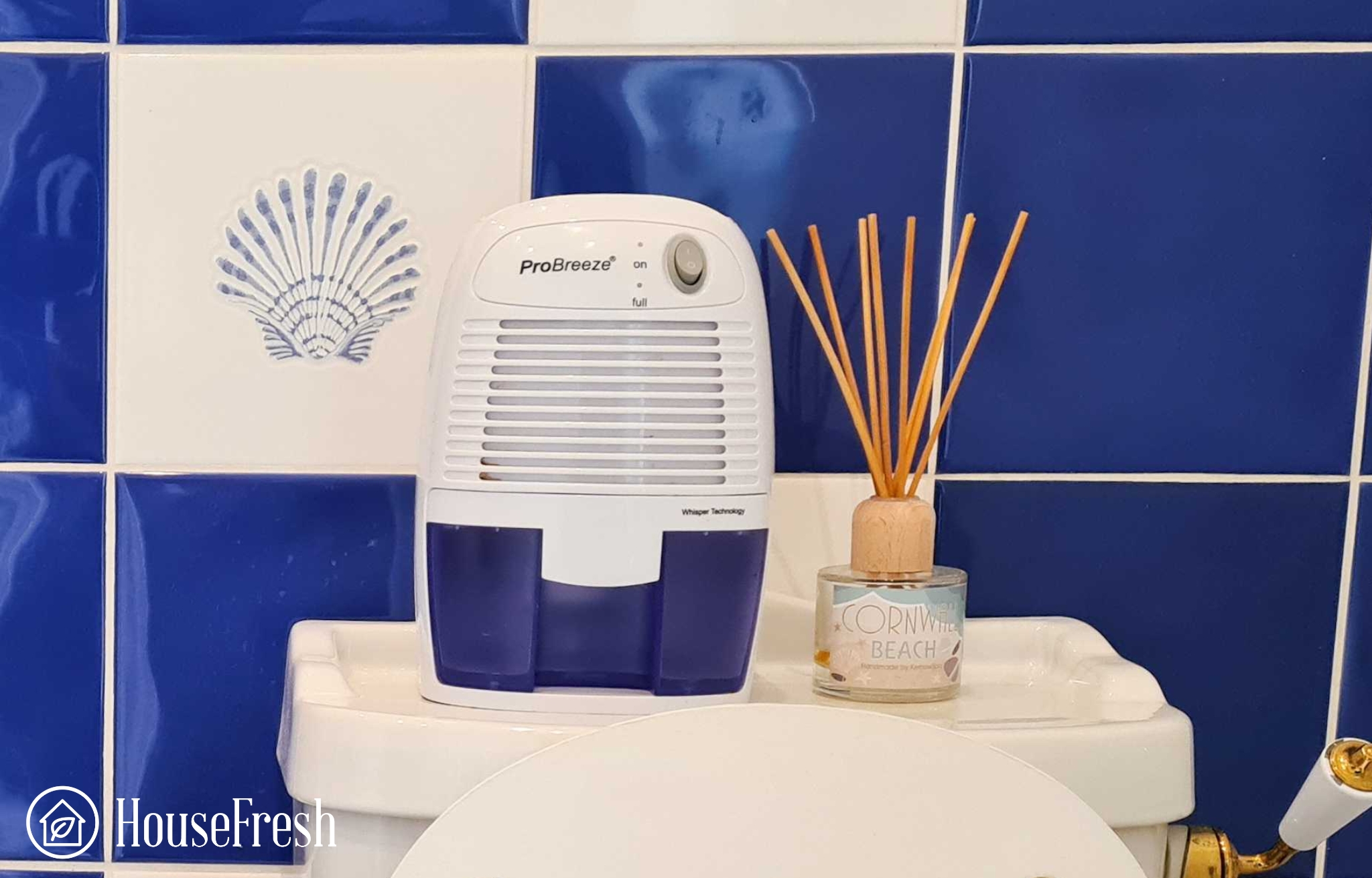
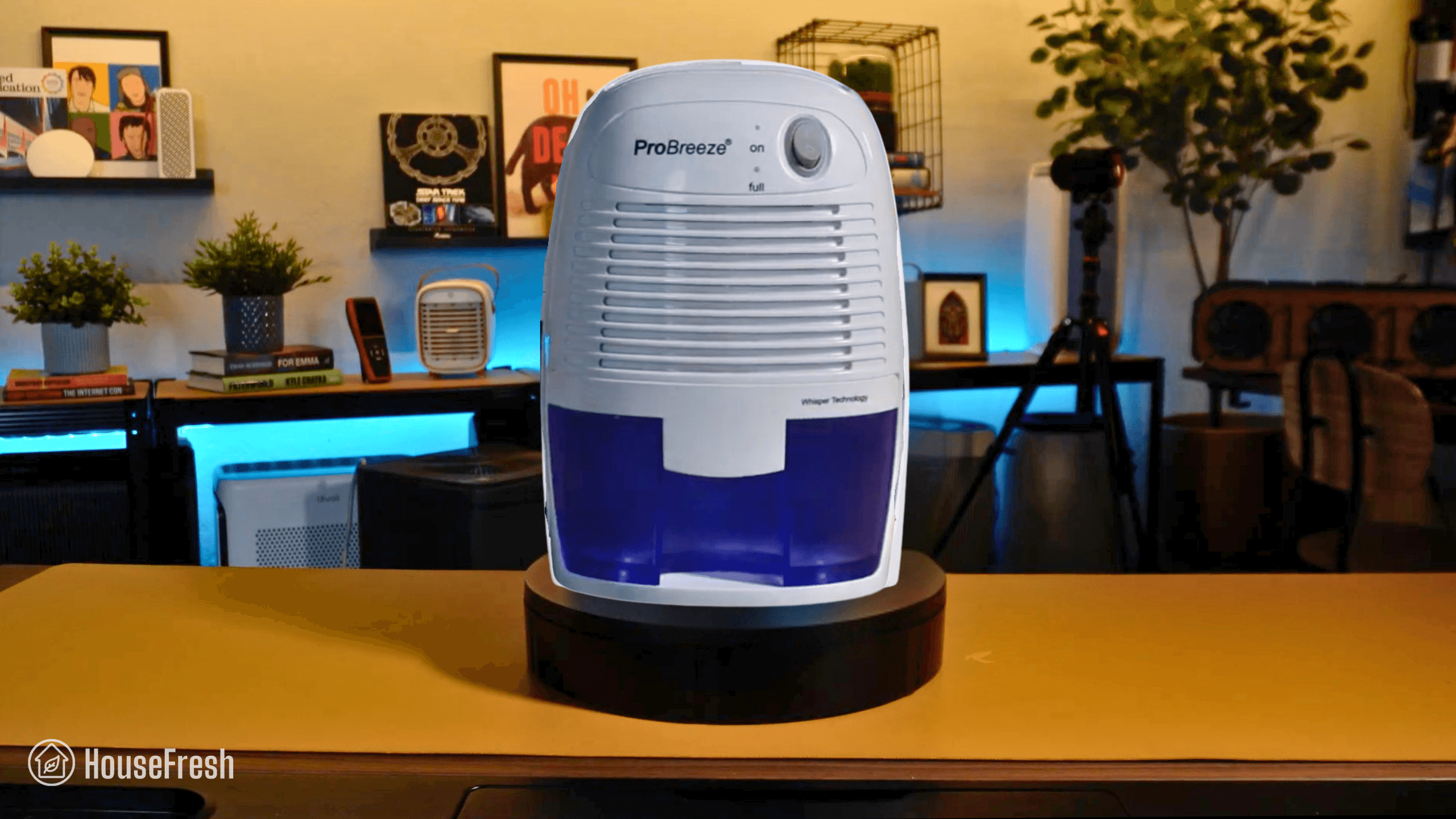
On paper, the Pro Breeze mini dehumidifier seems like the perfect dehumidifier: it’s tiny, silent and costs less than $50.
But is it a good use of 50 bucks?
In our tests, this 500ml (17oz) mini dehumidifier couldn’t extract enough moisture from the air to have a meaningful effect in the test room – especially when compared to other dehumidifier models we tested.
Let me walk you through the data.
The pros and cons of the Pro Breeze Mini Dehumidifier
A summary of our top-level findings after testing this dehumidifier in our home.
“After testing the Pro Breeze Mini Dehumidifier, I wouldn’t recommend it to anyone unless you have a very specific case where you need a very small dehumidifier for a very small space like a tiny closet.
But for most people, I suggest you try to stretch your budget and get a larger dehumidifier that will be powerful enough to remove a meaningful amount of water from the air – check out the AEOCKY Boreas for an affordable option.”
The water extraction rate is too low for spaces larger than a small cupboard.
The LED light is super dim, so it’s hard to know whether the dehumidifier is on during the day.
PROS
It’s small and easy to find a spot for, even in the smallest of places.
It’s silent, reaching just 35.5 decibels.
One-button operation makes it incredibly easy to use.
It costs less than $50, so most people will find it affordable.
Water removal capacity (per day):
5.8 pints (0.25 liters)
Recommended room size:
500– 800 sq. ft. (50-90% relative humidity)
Water tank capacity:
0.53 pints (0.71 gallons)
Dimensions (in inches / in cm):
6.1 x 5.1 x 8.6 in (15.6 x 13 x 22 cm)
Weight (in pounds / in kg):
2.2 lbs (1 kg)
Dehumidifier type:
Peltier
Noise level:
35.5 dBA
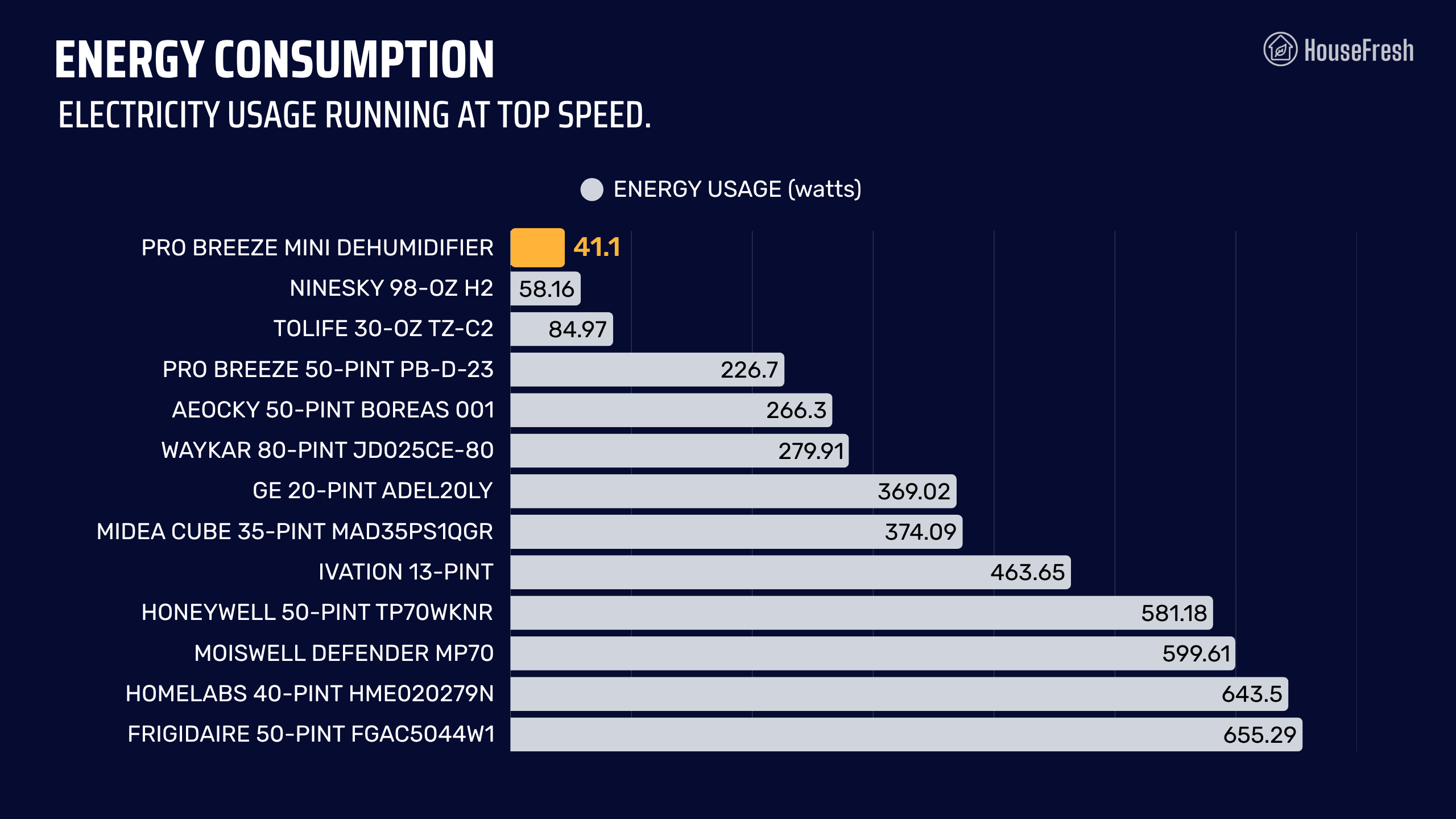
Electricity consumption(top speed):
41.1 watts
Manufacturer’s warranty:
1 year
Country of manufacture:
China
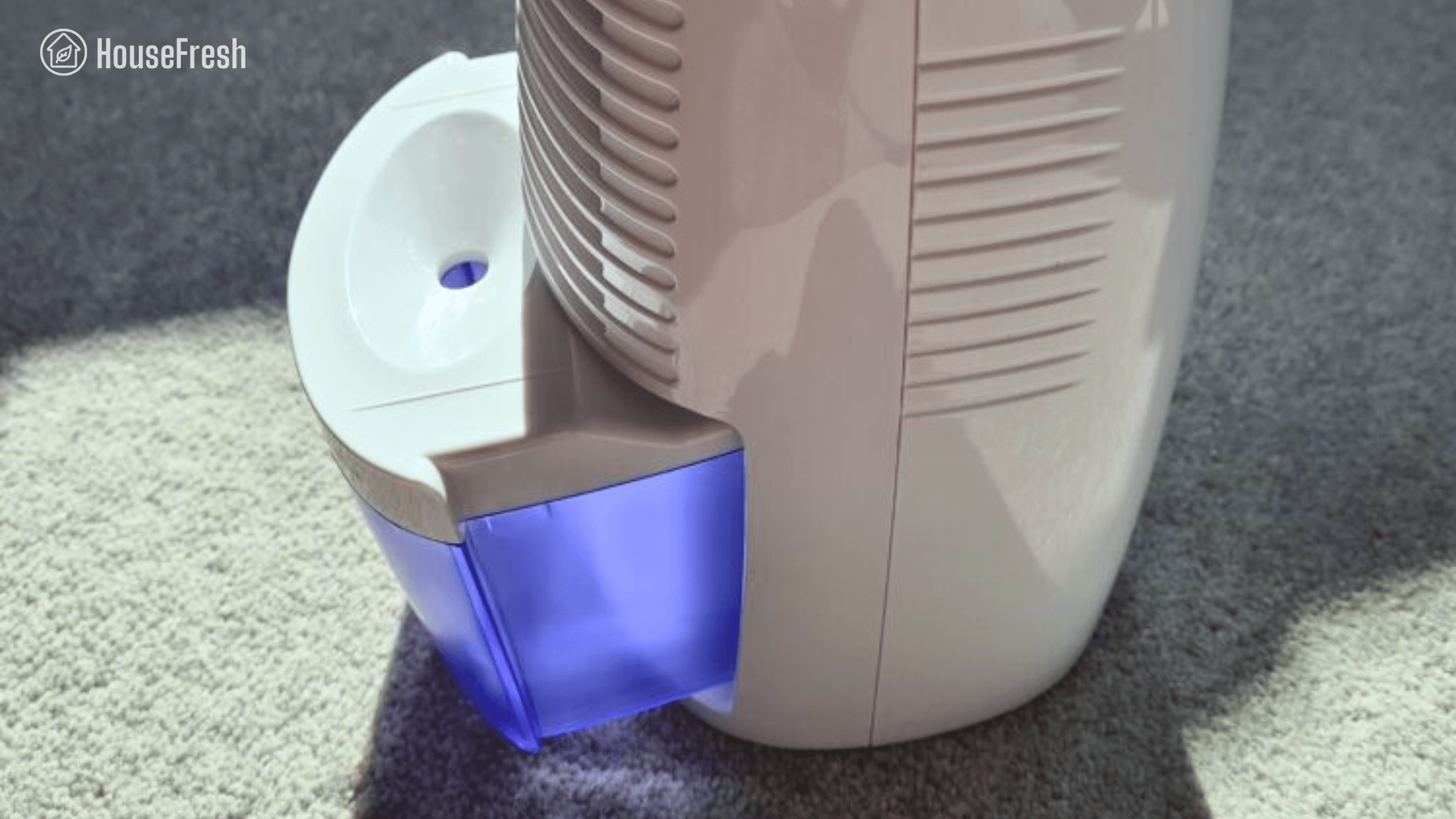
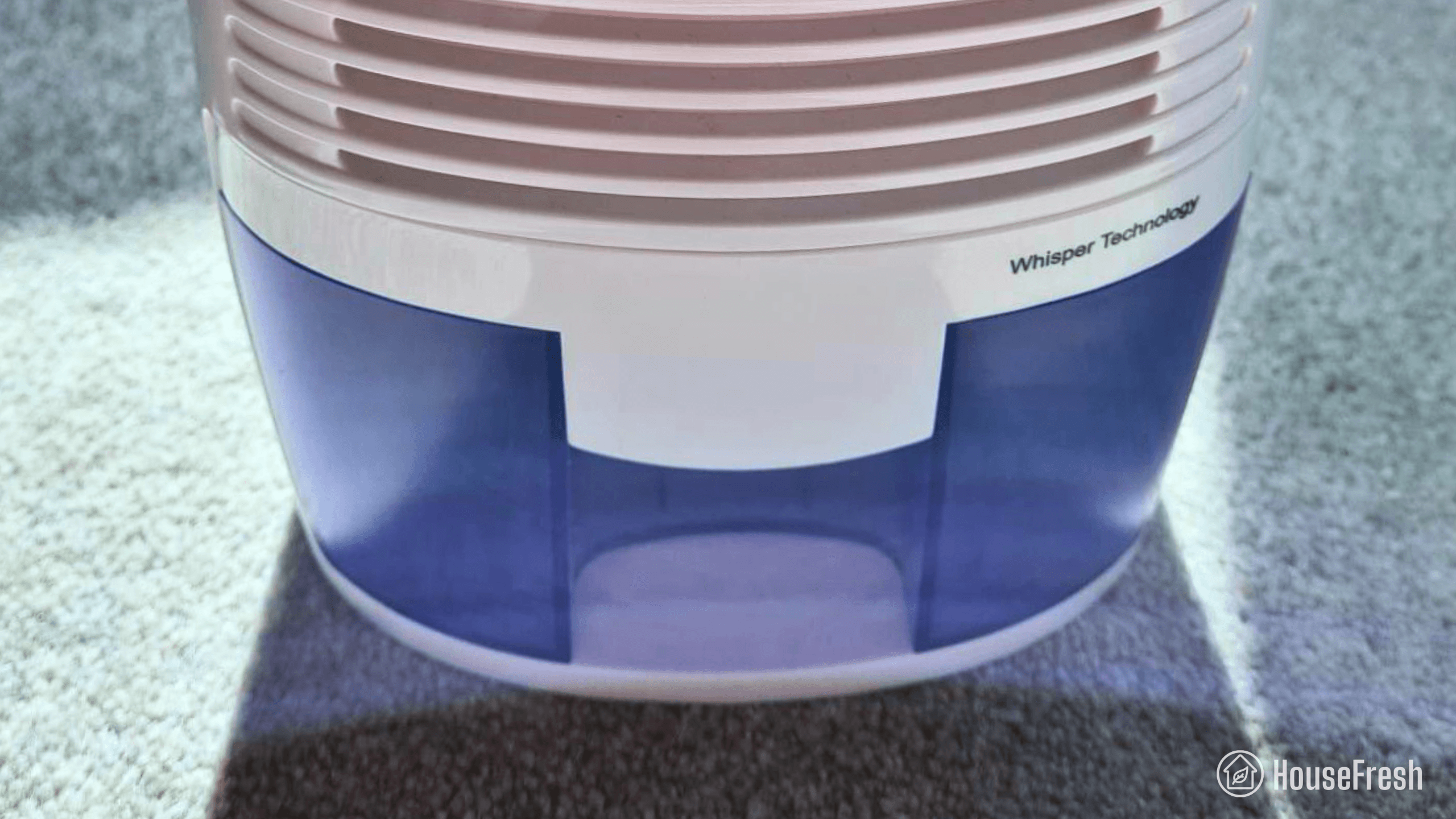
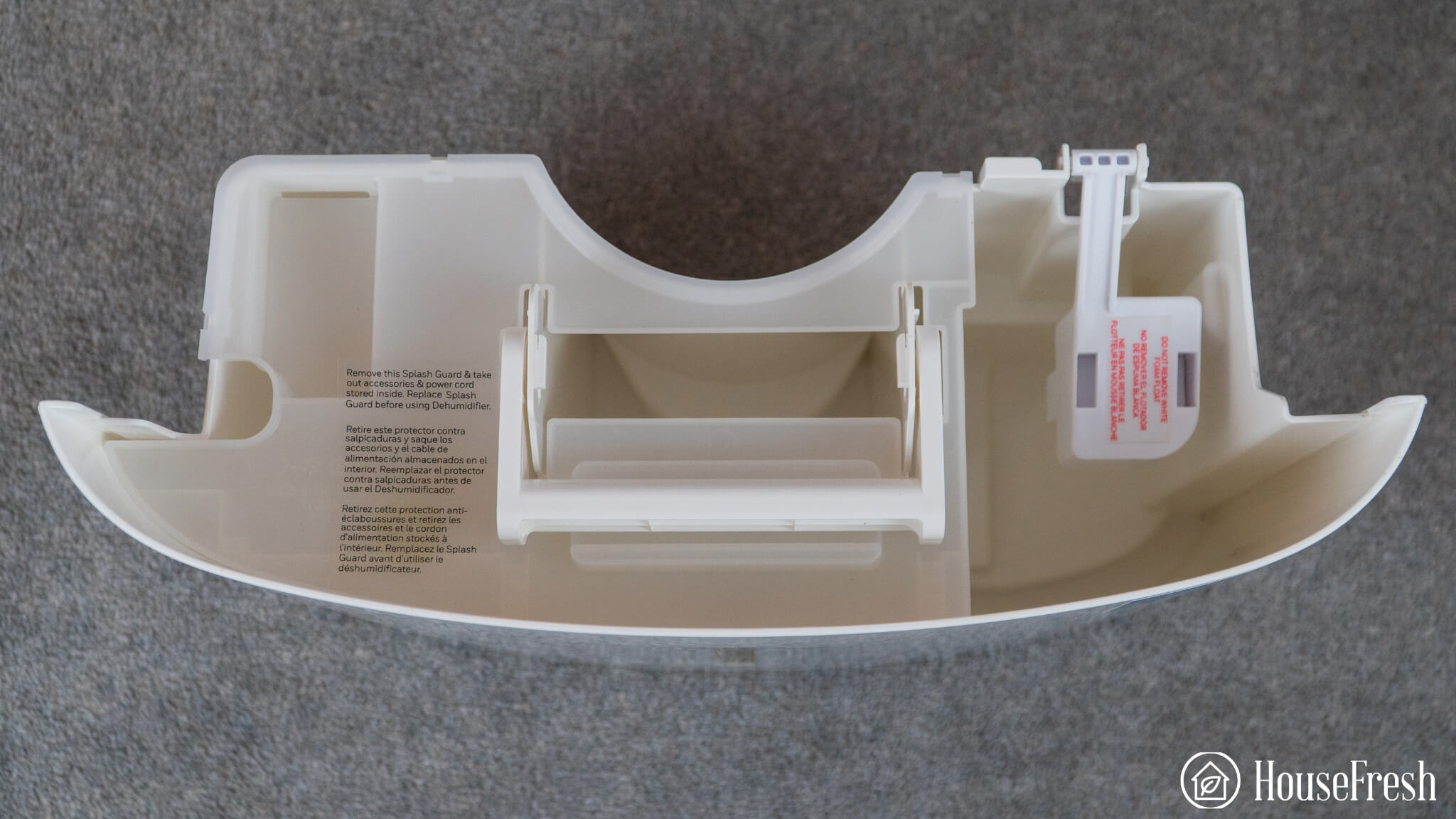
Water bucket
A small water container that sits at the front.
The bucket slides out from the front. This is more convenient than with models with the bucket at the back, like the larger Pro Breeze PB-D-23.
With a capacity of 0.5 liters, this is one of the smallest containers across all dehumidifiers I’ve tested and needs to be emptied more often than most.
Design, features and controls
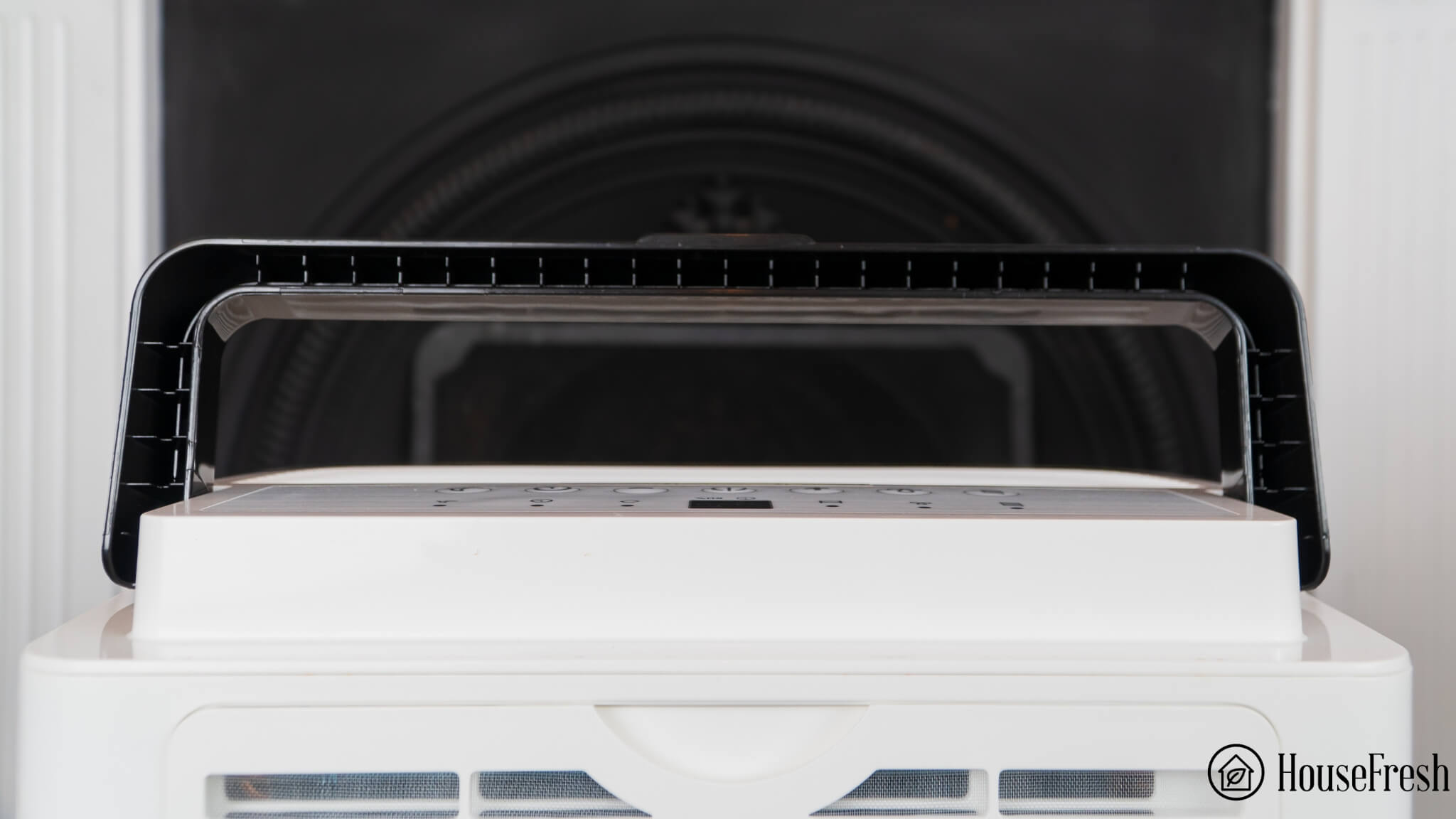
A tiny body that can be carried with one hand.
This dehumidifier is super small and light – one of the smallest in my collection.
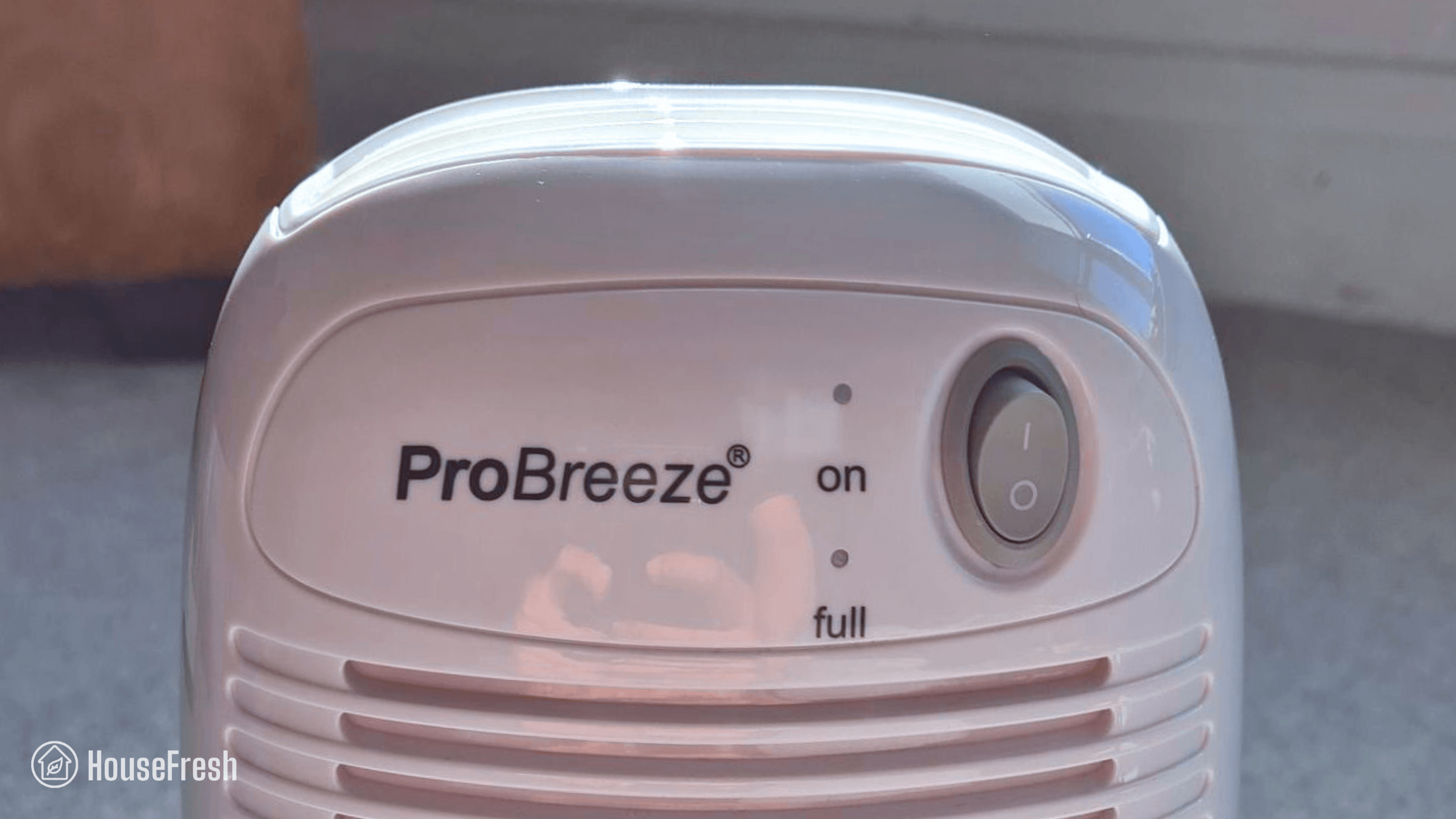
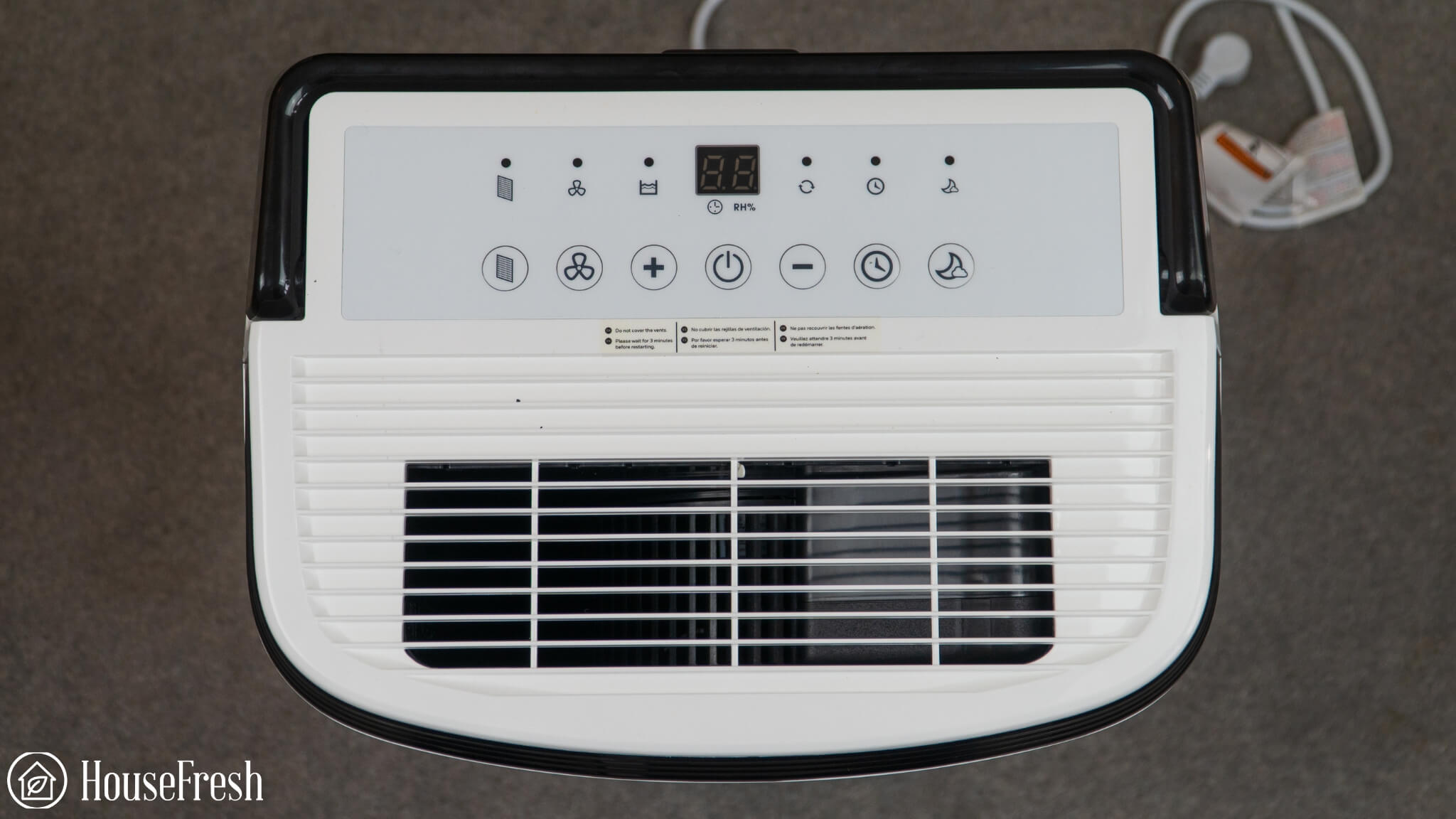
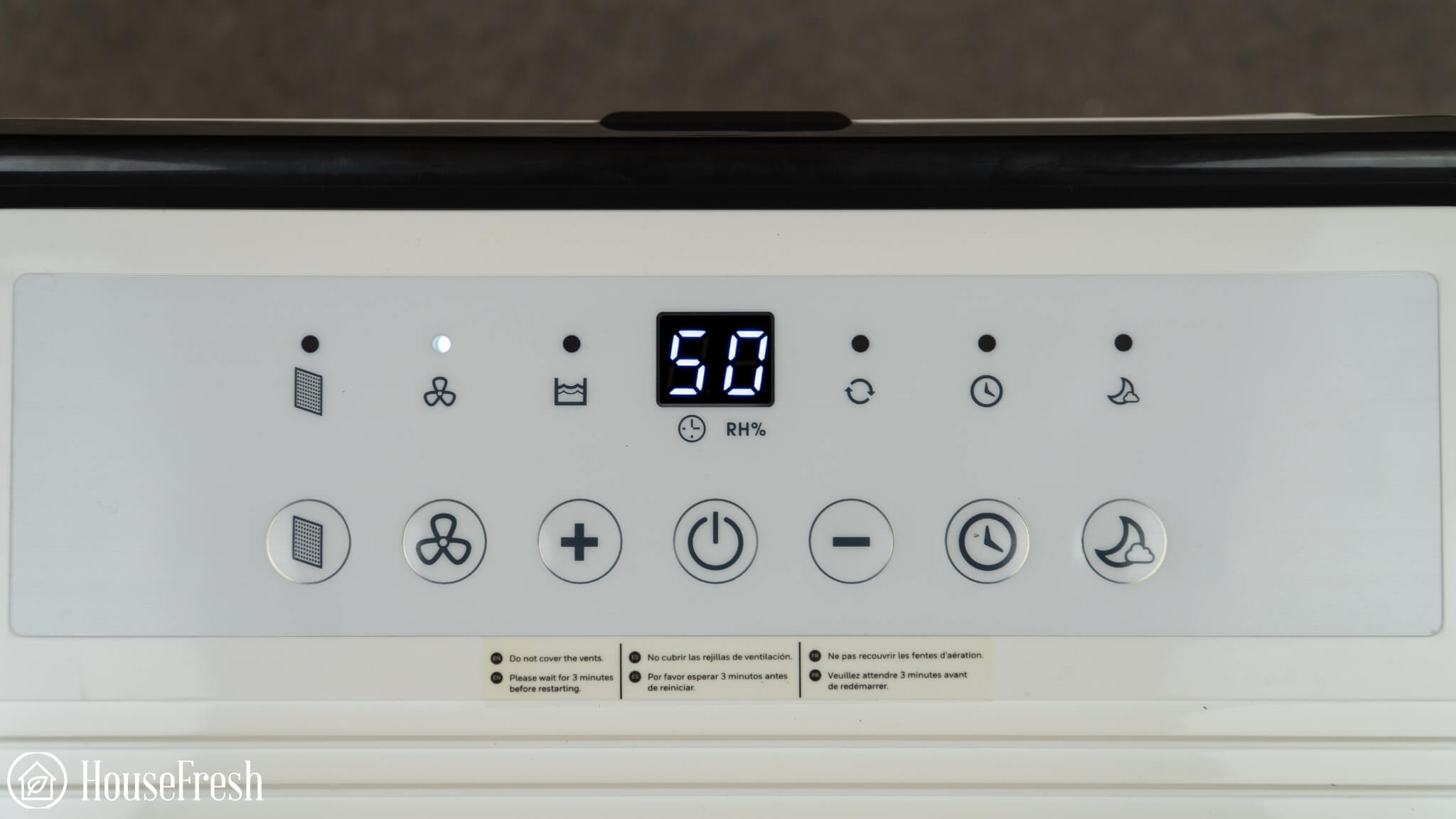
The control panel is as simple as it can be, with only two buttons – on and off.
Dehumidification performance
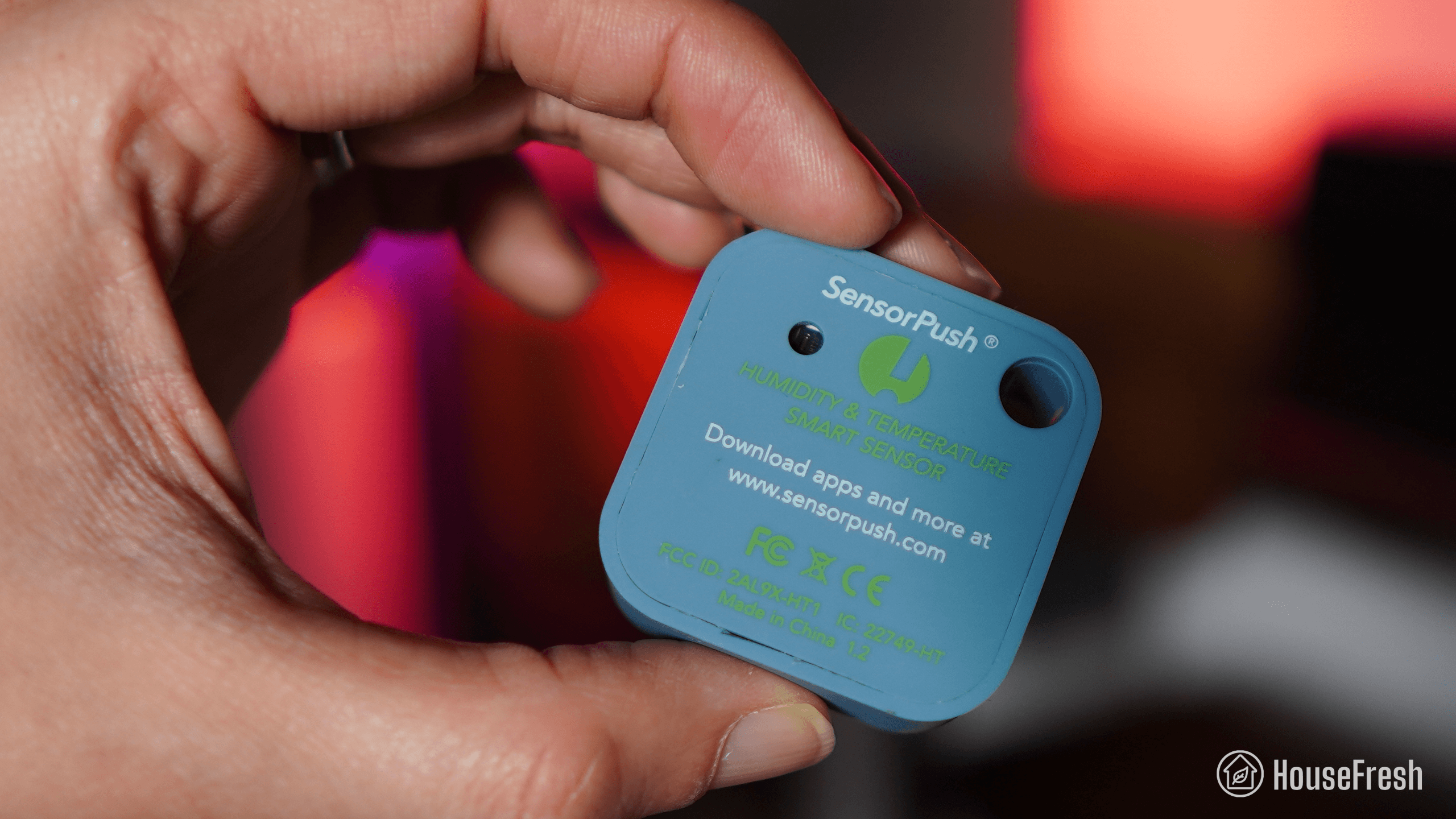
We tested the Pro Breeze Mini Dehumidifier 500ml with our trusted hygrometer.
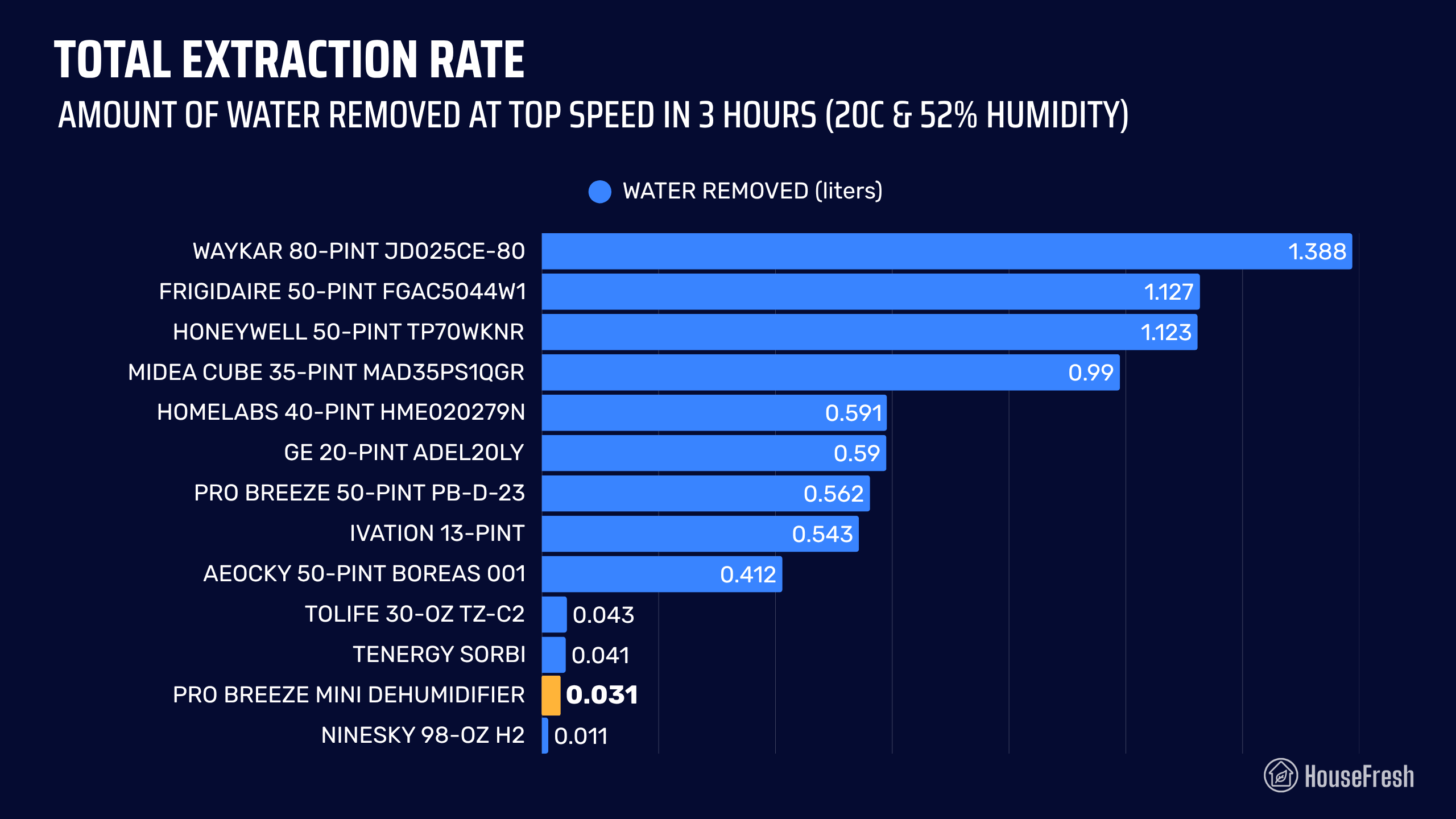
In our tests, this Pro Breeze Mini Dehumidifier extracted 0.412 liters of water in three hours. This result is more in line with 20 to 35-pint dehumidifiers than with 50-pint models.
This is better than the NineSky H2, but it’s very underpowered to make a meaningful difference to the humidity levels in a room.
Sound levels
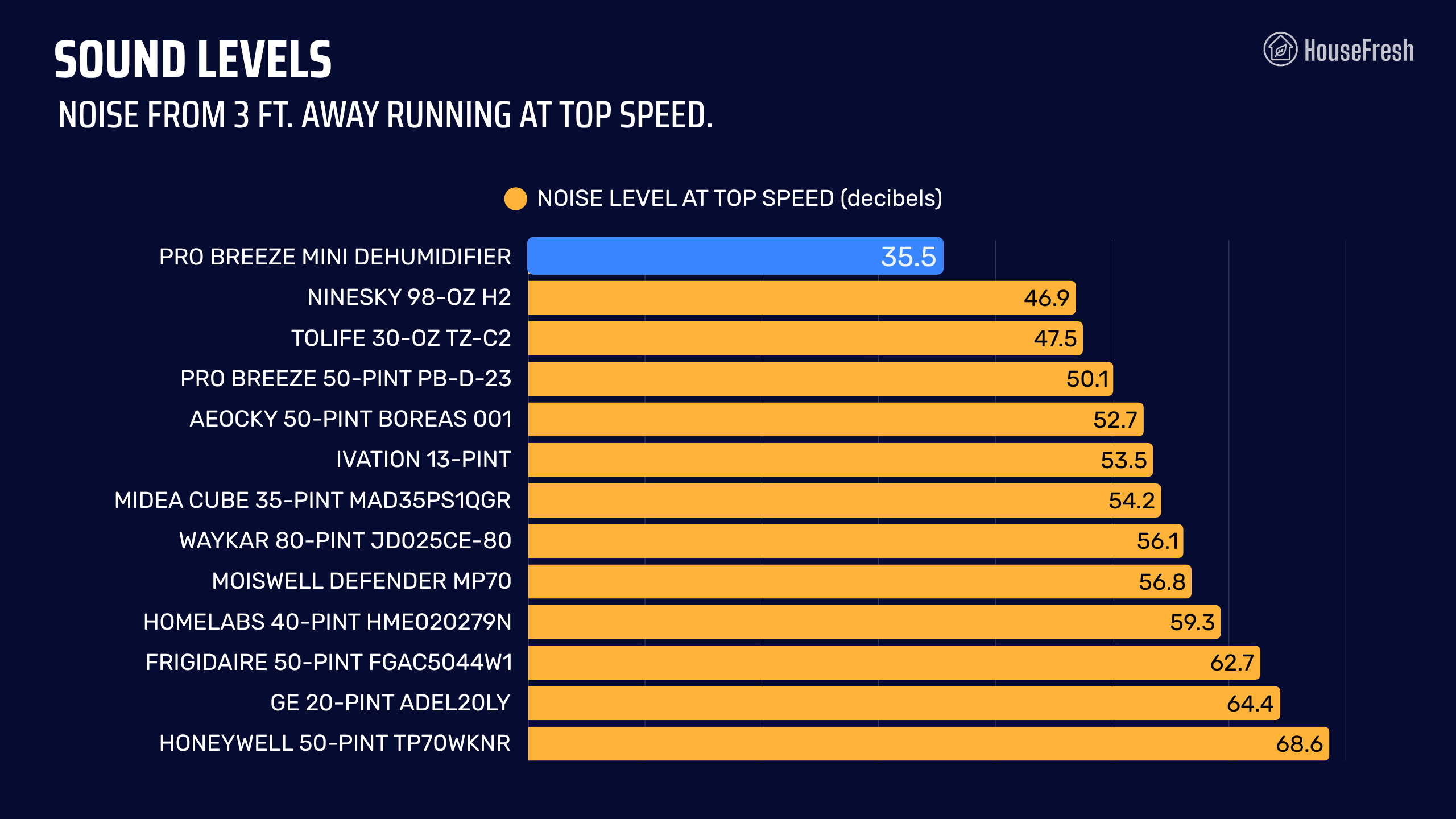
The sound levels of the Pro Breeze Mini Dehumidifier reached 35.5 dBA, so it’s whisper-quiet
I used our BAFX sound meter to measure how much sound the Pro Breeze Mini Dehumidifier 500ml generated. At a distance of 3 ft., I recorded 35.5 dBA.
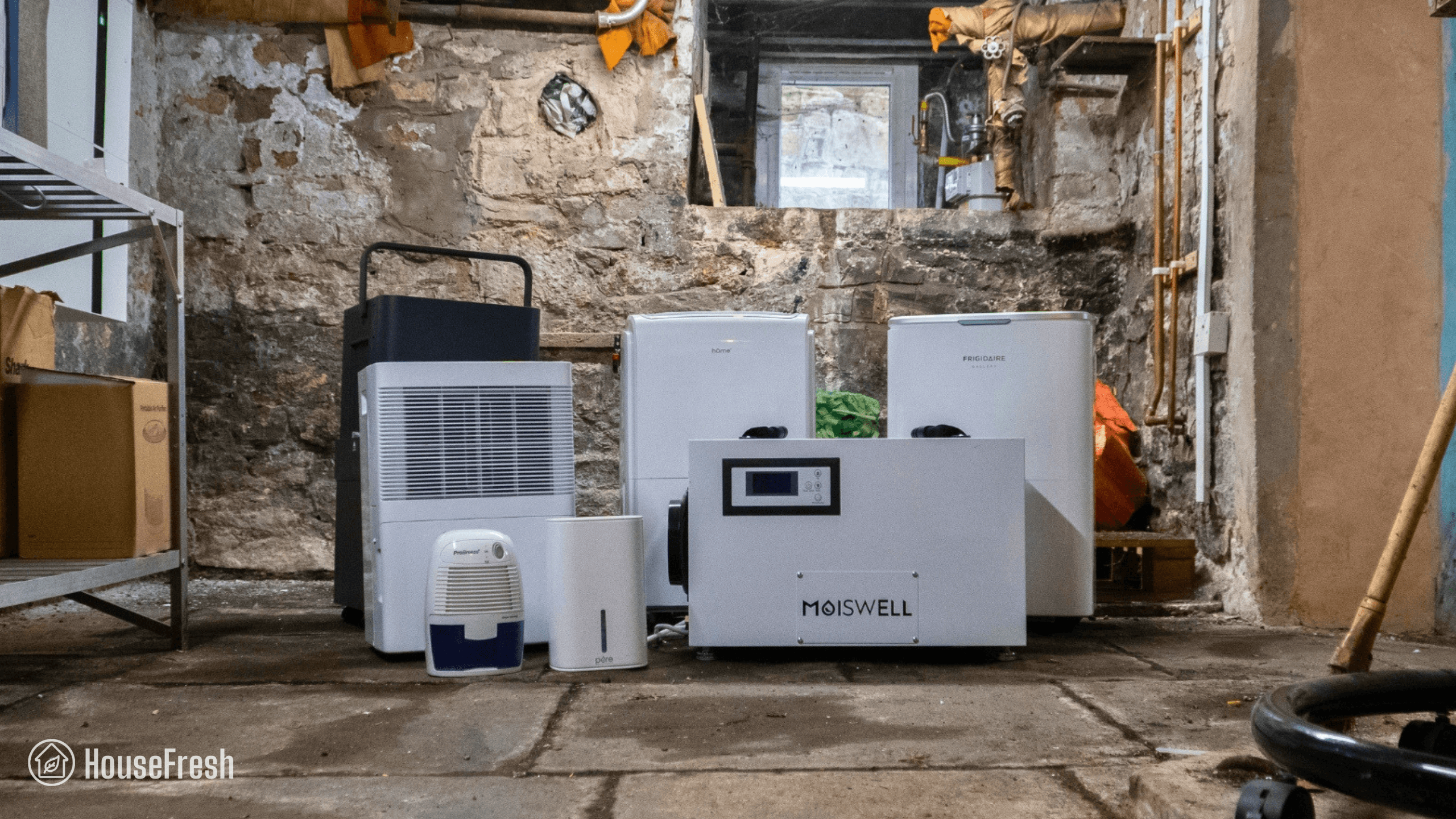
As you can see from the table, this is considerably quieter than other dehumidifiers we tested.
Also, keep in mind that the ambient noise level in our test room is 35 dBA, so it’s possible that this mini dehumidifier would reach even quieter results if we could test it in a silent room.
Long-term running costs
Running your Pro Breeze Mini Dehumidifier will cost you $31.77 per year, assuming you run it 12 hours per day.
We used our energy meter to record how much electricity this dehumidifier pulls when running at top speed.
As we saw with sound, power consumption is super low at 41.1 watts.
Bottom line: Should you get a Pro Breeze Mini Dehumidifier 500ml?
I certainly didn’t expect that this mini dehumidifier was going to perform super well compared with models that are four or five times more expensive and 10 times its size, and I was right.
Since buying this Pro Breeze, I started noticing it everywhere! And I can see why, as it’s small and cheap to buy, so most people will be attracted to it.
However, I live in the UK, where humidity is high all the time, and every time I see one of these mini dehumidifiers, I feel like telling the owner that they really need to size up.
If you have a tight budget and live in the UK, the smallest dehumidifier I would recommend is the MeacoDry Arete One 6L. In our tests, it removed nearly five times the amount of moisture from the air as this small Pro Breeze unit. Plus, you get a lot of other features like an on-board sensor, auto mode, and a 5-year warranty.
And if you’re in the U.S., I would recommend the 20 Pint Midea Cube. It is larger, noisier and less energy efficient BUT in terms of performance, it is light years ahead. Check out my review of its 50-Pint sibling to learn more about it, and keep an eye out for deal days when you can find it selling for as low as $149.99.
Or if you like the Pro Breeze brand, the larger 20 Liter Pro Breeze PB-D-23 can go for around $179 on Prime Day or deal days and it offers excellent performance in a more traditional design than the Midea Cube.
If you decide to get yourself a Pro Breeze Mini Dehumidifier, regardless, please use this link – we will receive a small affiliate commission at no extra cost to you that we will reinvest into buying and testing new dehumidifiers. We don’t run any ads and have no partnerships with brands, so we rely on those commissions to continue the work we do.
If you have any questions about this model or about dehumidifiers in general, please drop them in the comments below, and I’ll get back to you personally as soon as I can.
In winter our home gets super damp so I wanted a way to control the humidity in the bedroom as my wife and child both suffer from asthma and excess humidity can be a trigger for them.
I was attracted to the Honeywell brand as I have tested multiple air purifiers from them. Plus, Honeywell is a brand that has been going since 1906 so it inspired trust.
If you have ever looked on amazon.com for dehumidifiers it’s full of brand names that are often very strange sounding Chinese sellers selling generic units (COSVII, SEAVON, Donatello, LEEL, etc.) There is nothing inherently wrong with these units but for my bedroom dehumidifier, I wanted to go with a brand I trusted and had my back if anything went wrong and Honeywell provides a 5-year guarantee.
As with all the hands-on reviews we do here at HouseFresh, this unit was bought with our hard-earned money so we don’t have a bias to give a more positive review to keep the manufacturers happy. If this dehumidifier stinks, we have no problem with telling you so that you can find a model that does the job for your needs and budget.
The lowdown on the Honeywell TP30WKN
“If you are looking for a dehumidifier for a fairly small space like a bedroom, then the TP30WKN might be one of the best options available.
Sadly due to its popularity, the price can be higher than the usual retail price, so it is always worth checking it against large units like the TP50WKN as they sometimes can be found for the same or cheaper price.”
— Danny Ashton, HouseFresh Founder & Senior Writer
If you don’t want to read my full review, here are the things I like about this dehumidifier and the things I don’t:
CONS
The 7-pint tank will need emptying multiple times in a 24-hour period if you can’t use the continuous hose.
Smart functionality and app connectivity is not worth paying for.
PROS
It can remove 20 pints per day, which is around 10 large McDonald’s sodas — a fair amount of water.
It comes with a 5-year guarantee, which is not something you usually see for a dehumidifier at this price point.
Easy to use — it took me less than two minutes to get my head around the settings.
The filter clips easily without requiring too much pressure.
The handle and wheels make it super easy to move around
It includes a filter for trapping dust coming into the unit, which will need to be replaced/cleaned on a regular basis.
The design
The TP30WKN includes a few key touches that make a big difference.
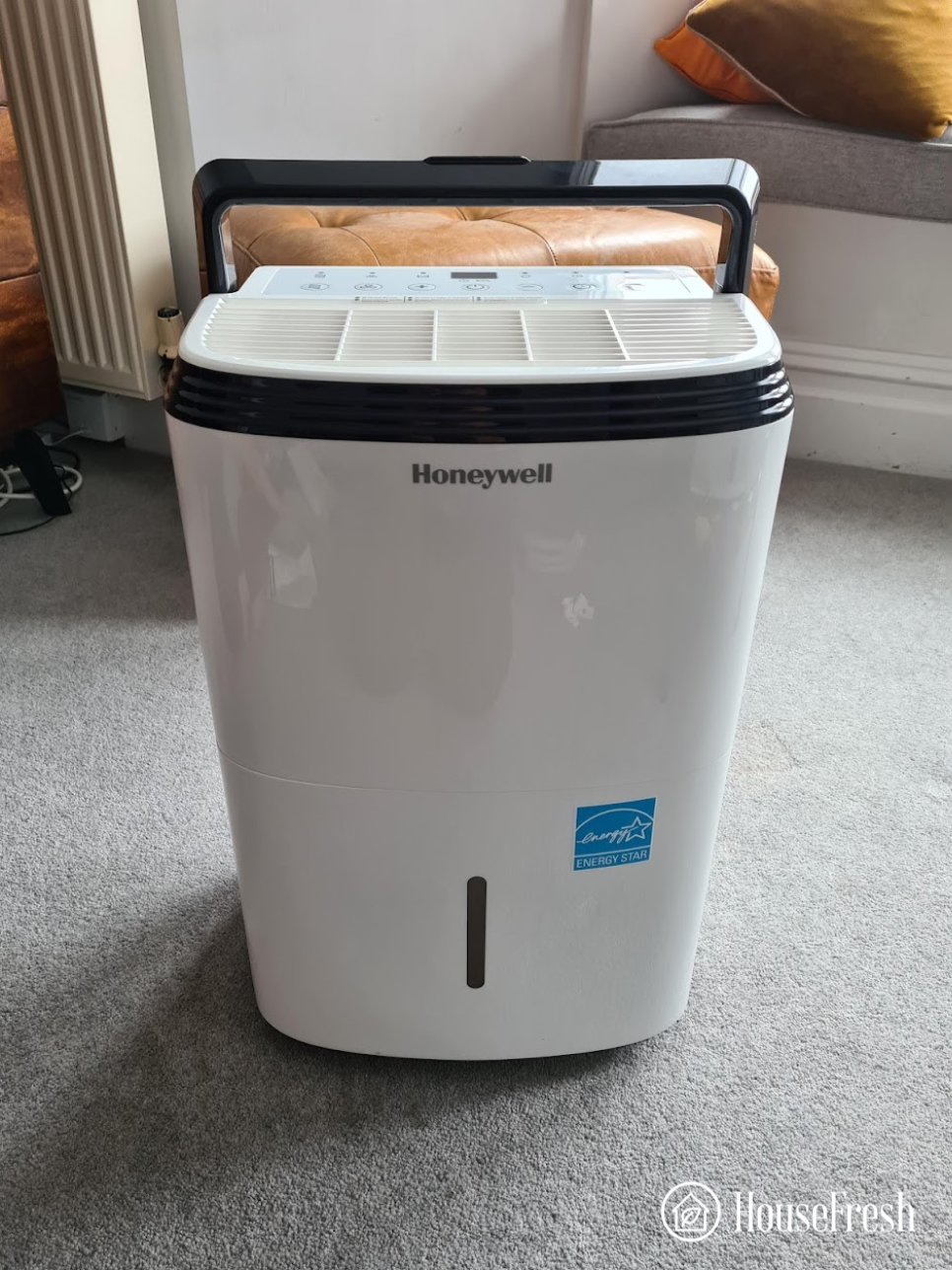
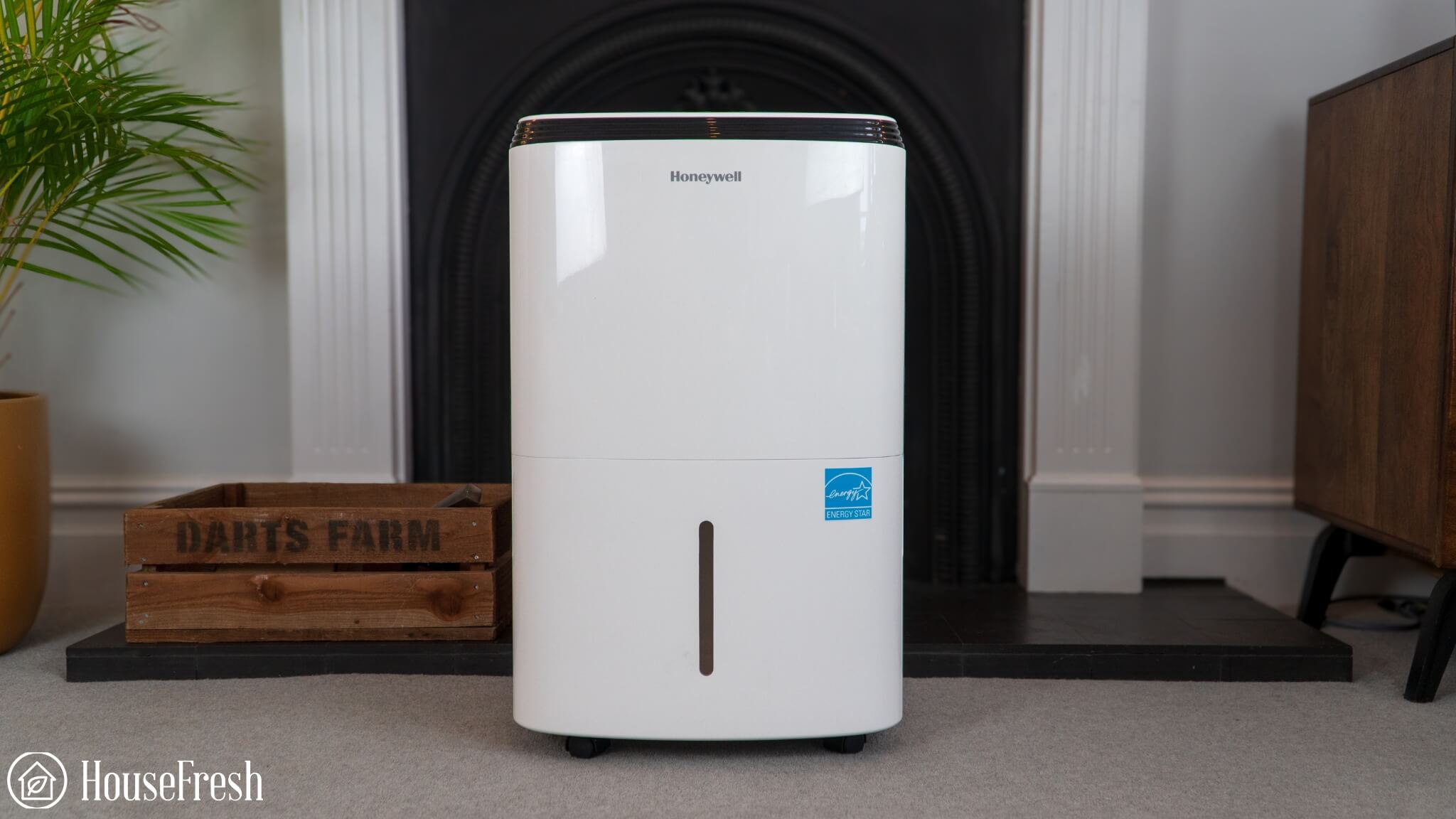
It looks like what you’d expect of a dehumidifier, with the control panel on top and the bucket accessible through the front.
You get a continuous drain tube so you don’t have to rely on the tank capacity (seven pints) and end up emptying the bucket multiple times per day.
Inside the box, you will also find two accessories you can use for mounting it on your wall. I didn’t mount it on my wall but it is definitely something useful if you plan to use it in one location 24/7.
I really like it comes with a chunky handle and wheels, as this makes it easy to move to another room – although, do make sure you empty the bucket as it is super heavy when it’s full of water!
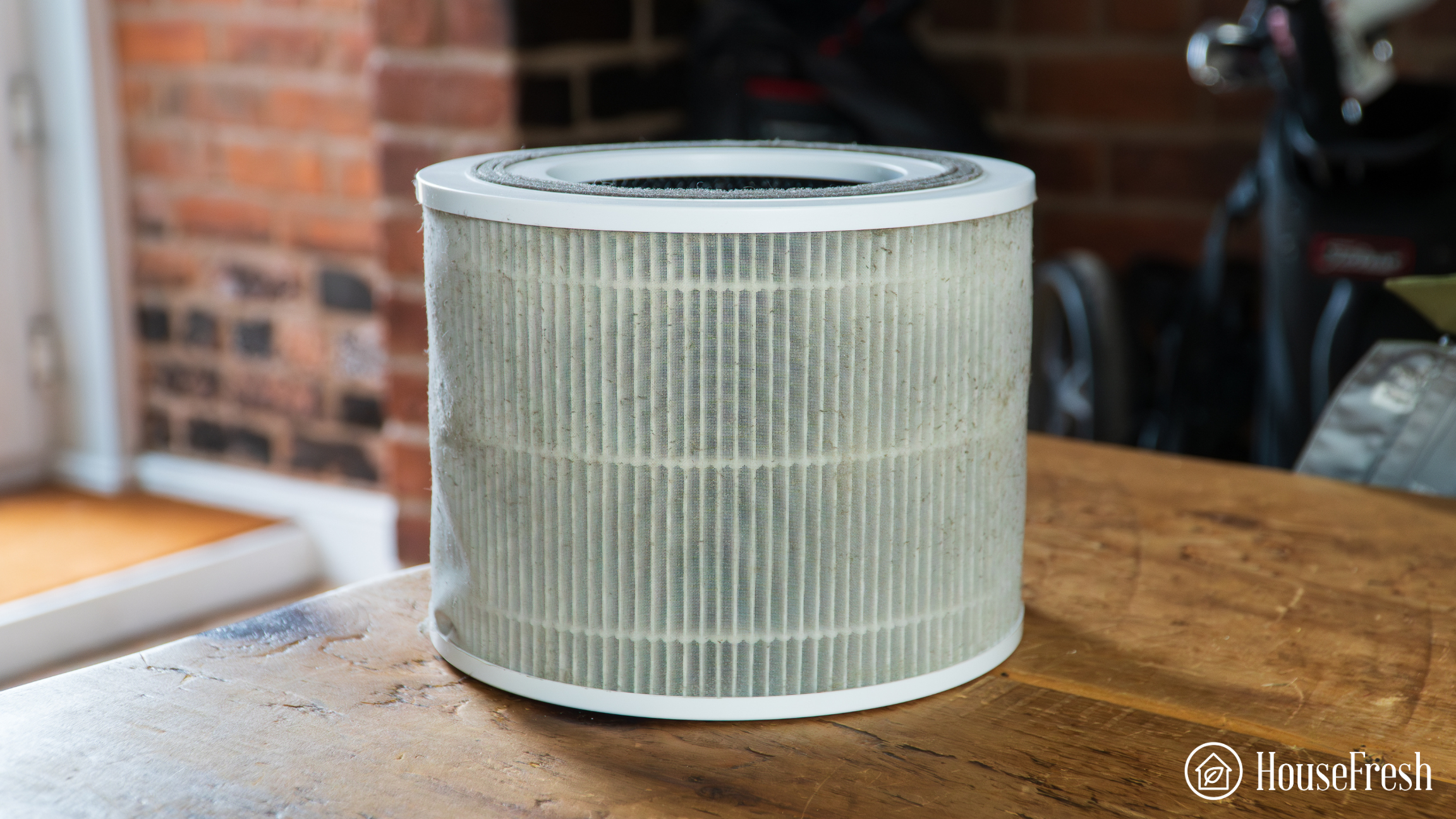
All dehumidifiers need to pull air from the room around them so this also means they pull in any dirty, dust or other nasty things in the air. Thankfully this dehumidifier includes a filter so it catches these before they create problems inside the machine. You do need to keep it clean so remember to clean it on a regular basis.
Unlike air purifiers, dehumidifiers don’t clean the air but this also means you don’t need to spend extra on filter replacements.
From a day-to-day operation perspective, the TP30WKN is fairly simple to use:
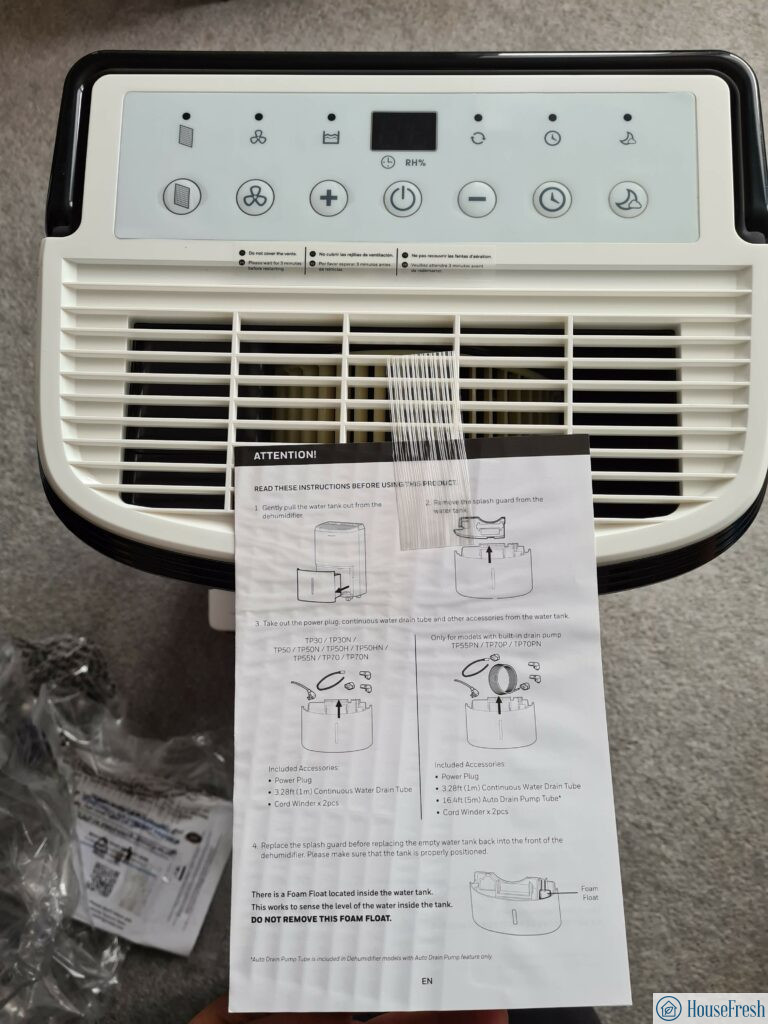
From left to right, we have a filter clean light that will light up when the filter needs cleaning manually.
Next, you get a button to adjust fan speeds. A tip: you will want maximum when you first use it and then reduce it during the night to keep the sound to a minimum.
Then, you get a button to set the humidity level you want to achieve. So if you set it to 60% humidity, the TP30WKN will come on and off until it achieves this level. This means that you will spend less on electricity compared to setting it to run 24/7 on high.
You also get a timer button that allows you to set a timer for the device to automatically switch off, Next to that, you get a sleep mode button, which switches all the lights off.
Tip
When you first unbox it, the continuous drain pump hose is actually tucked inside the water tank. Make sure you remove it before turning on the dehumidifier – although the guys at Honeywell make this super clear with the instructions.
There are two options for this dehumidifier, the TP30WKN and TP30AWKN. The AWKN is the one that includes a smart app. If you have read my reviews, you will know I am not a big fan of apps for simple devices like this and this is no exception. The app requires details for registration and the app itself has very poor ratings on the Google Play store:
For the extra money that the “smart” version requires, I would just invest in a smart hygrometer sensor like Govee H5179 as it has a ton of features for less money than the “smart” version of the Honeywell 30 pint dehumidifier.
Cost of running the TP30WKN: $306.57 per year
If you use this unit with the supplied hose, it’s able to run continuously. If not, it will automatically shut off when the included 7-pint tank fills up – which will be more than twice every day, so it really becomes a chore if used in this way.
Based on our tests, it can remove 20 pints per day, which is around 10 large McDonald’s sodas — a fair amount of water.
When running 24/7, it will pull 276 watts on the lowest fan setting. This will translate to $306.57 per year, which isn’t bad when compared with older units that are used far more power to achieve the same level of dehumidification.
Bottom line: Is the Honeywell TP30WKN worth it?
It has everything you will need from a dehumidifier such as a timer, sleep mode, and a continuous hose for those wanting to use it all the time.
30 pints is perfect for those wanting something that is still portable but doesn’t expect it to be able to dry out a large basement of an open plan room. If you do want a similar unit for a larger space, then check out the TP50WKN and TP70WKN which have 50-70 pint capabilities but are much larger and won’t be as easy to carry to different rooms.
The big issue for this unit is the supply chain issue with a lack of supply meaning that this unit regularly being out of stock and often priced higher than the bigger 50-pint units so be sure to do your research and don’t overpay. I honestly don’t think that smart edition – TP30AWKN is worth the extra $30 so just go for the standard model that is regularly priced at sub $200.
Founded in Sweden by Bengt Rittri, Blueair has been around for over 20 years. Rittri wanted his children to breathe the same clean Stockholm Archipelago air while they spent time in the city. Thus, faithful to this vision, he started the company, creating simple and efficient air purifiers inspired by nature.
Back in 2016, Blueair became a Unilever brand. According to Rittri, the global company would help expand Bluair’s capability to reach more people in need of simple and affordable solutions for air pollution. The brand obtained a B Corp certification in 2023 with a clear mission of improving air quality in homes, schools and offices worldwide, focusing on children’s right to clean air.
I love the social and environmental commitment of the brand, as well as Rittri’s belief that freedom to breathe is a basic right. But we’re not here for the charms and chimes of brand positioning and marketing.
When it comes to cleaning power, Blueair mixes simplicity with efficiency and offers an array of models for different space sizes. All units, however, feature the trademark HEPASilent™ Technology that combines electrostatic and mechanical filtration. I’m not a big fan of ionization, but we’ll get into that later.
As for the Blue Pure 411, it’s better suited for small rooms. It’s worth noting, though, that since Blueair became part of the Unilever family, its product range has broadly expanded. The launching of the Pure Max line in 2023 replaced some of the older models, including the Blue Pure 411.
With such a prolific portfolio, navigating models can be a bit confusing, especially regarding filter replacements. Blue Pure 411, 411 Auto, and 411+ are three separate models but share the same filter; the 411a Max, on the other hand, use different ones. In a core comparison, however, they are not that far apart: the CADR rating, filter mechanism and Blueair’s HEPASilent™ Technology are scarcely different when not the same. As of 2025, Blueair has released a smaller Blue Pure 511i Max ‘s that is cheaper and has a lower CADR.
How we test air purifiers
Read our full testing methodology.
But if you’re here, you probably want to know more about the Pure 411 and its performance. So, let’s get to it.
The lowdown on the Blueair Pure 411
Innovative concept but has no outstanding cleaning power.
“A very efficient device thanks to its HEPASilent™ process that combines an ionizer with a lower-grade filter than HEPA. This means it can clean the air quickly and with a low level of noise generation. The only downside is that you can’t disable the ionizer; something to be aware of if you just want mechanical filtration. A little outdated now with much lower air cleaning performance ratio when compared with the latest budget devices.”
— Danny Ashton, HouseFresh Founder & Senior Writer
We’ll delve into a detailed analysis of the Blue Pure 411, covering design, performance and noise output, among other things. But if you want to know black over white, our take on the pros and cons of the unit, check out the chart below:
What we really like
Made the 2024 Energy Star Most Efficient list, for its low energy consumption.
The washable (and interchangeable) pre-filter is functional and stylish.
Straightforward operation with the one-button control.
It’s lightweight and compact.
What we think could be better
It is not a fast unit, nor does it have a high CADR.
There’s no option to turn off the ionizer.
Not having a protecting grill for the filter makes it somewhat fragile.
The specs
The range of small air purifiers was much more limited when the Blueair Blue Puro 411 was launched. It wasn’t the most budget-friendly air purifier back then, but its CADR was ok (120 CFM) compared to other popular small units, such as the Levoit Core 200S (118 CFM).
However, the standout point of the Puro 411 was the original design that disrupted the scene with lively colors and scandic aesthetics. Since the newer Max Pro line became the key product Bluair focuses its communication on, the Puro 411 can now be found at $119 on Amazon — although still more expensive than the reliable Levoit Core 300 or newer and highly efficient units like the Winix A230.
HouseFresh rating:
★★★☆☆
Time to clean our 728 cubic feet test room (with the device running at top speed):
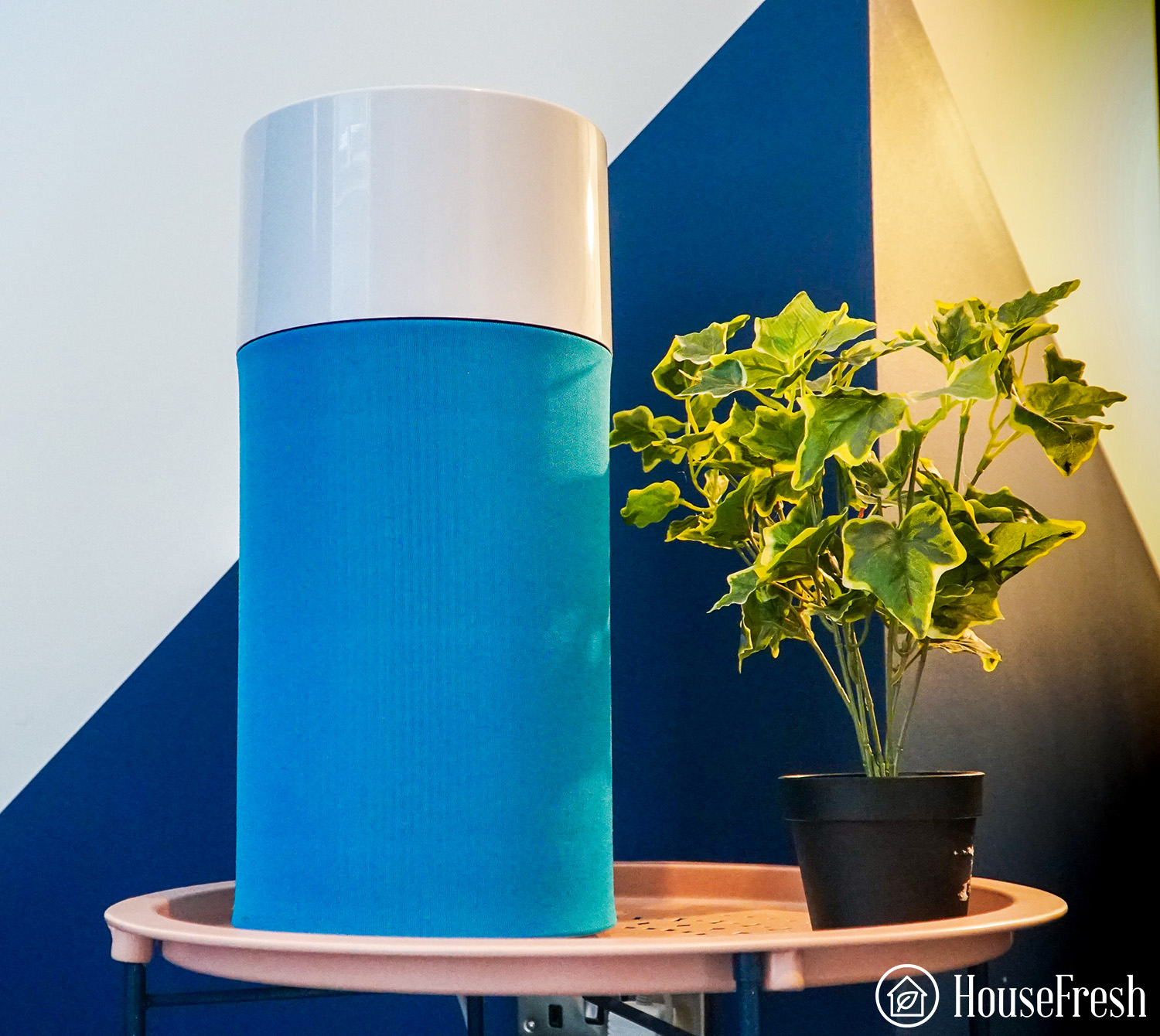
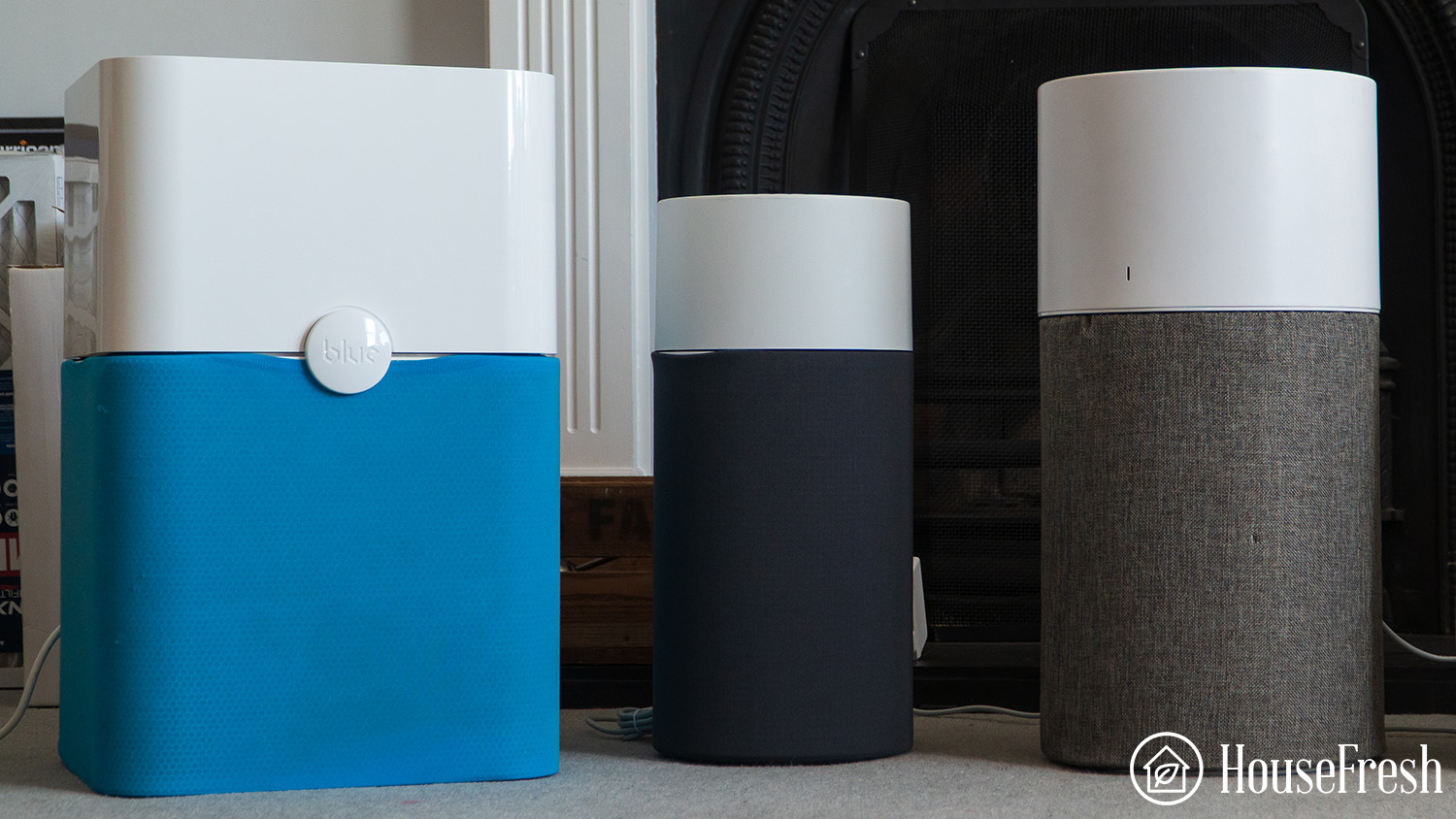
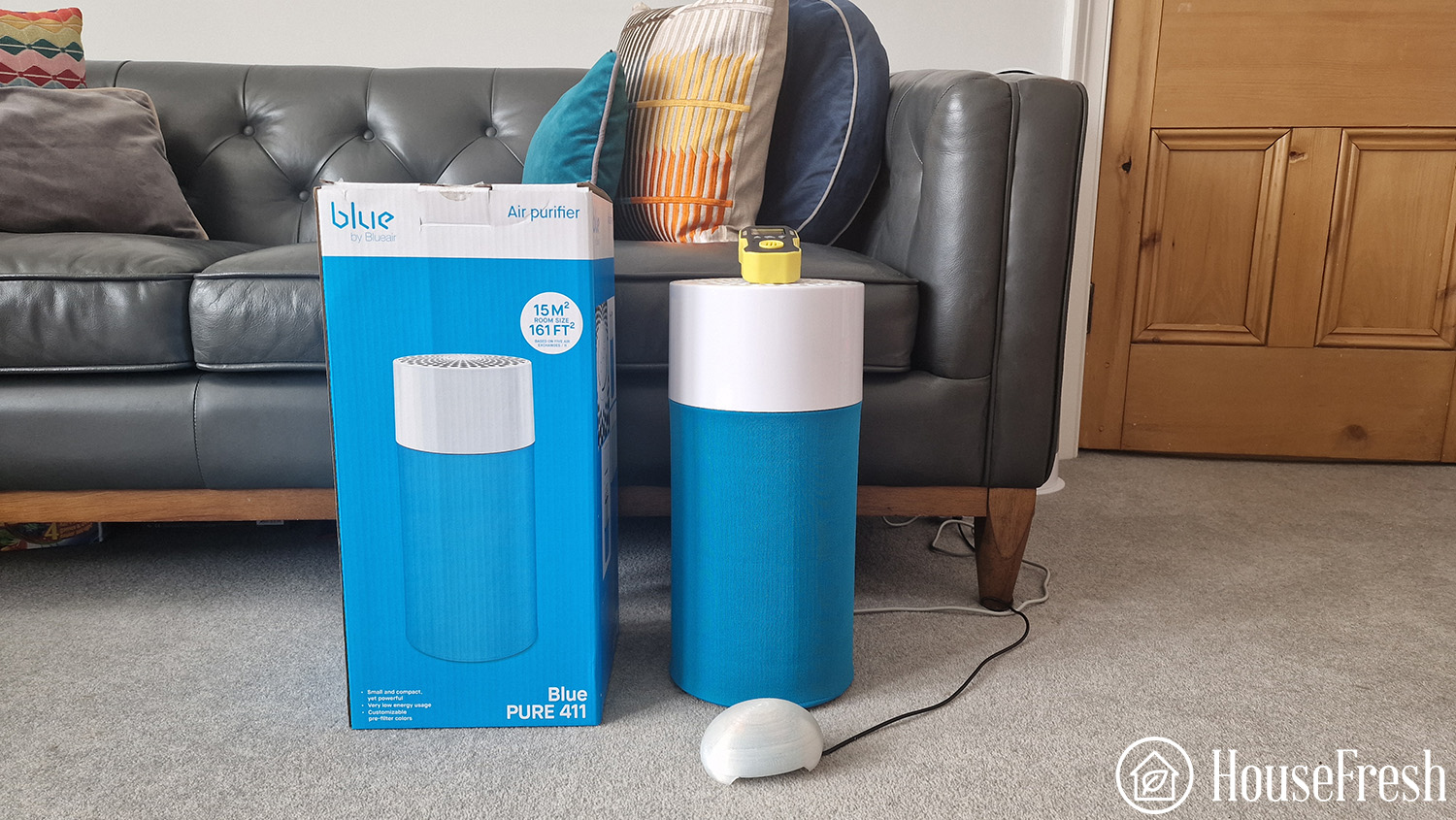
Blueair was created with children in mind. It only makes sense that the original Blue Pure line is so colorful and lively yet has straightforward controls. I opted for the Diva Blue fabric pre-filter (which brings this iconic Diva to mind), but there are six colors to choose from, ranging from buff yellow to a sober dark gray for those who prefer a more subtle approach.
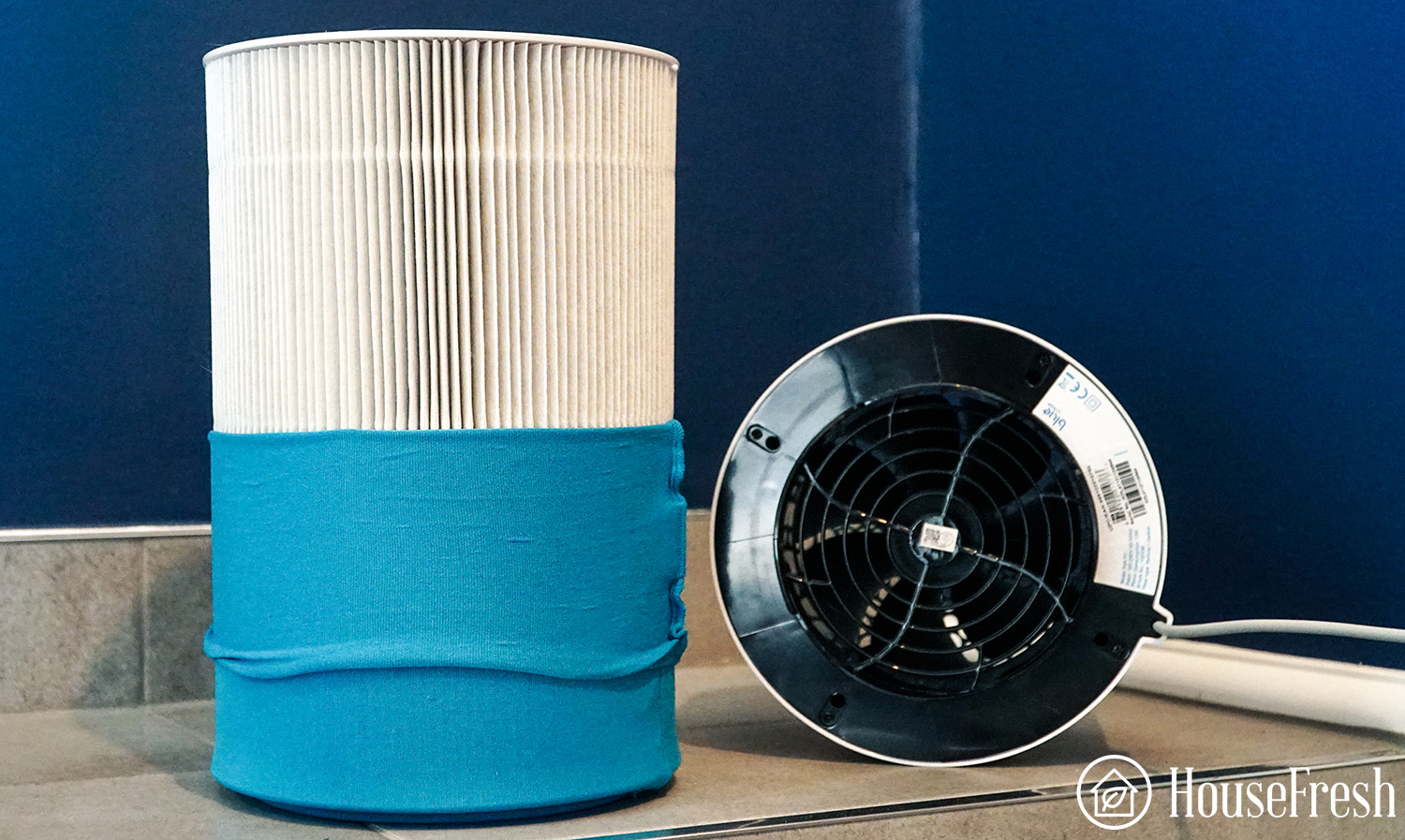
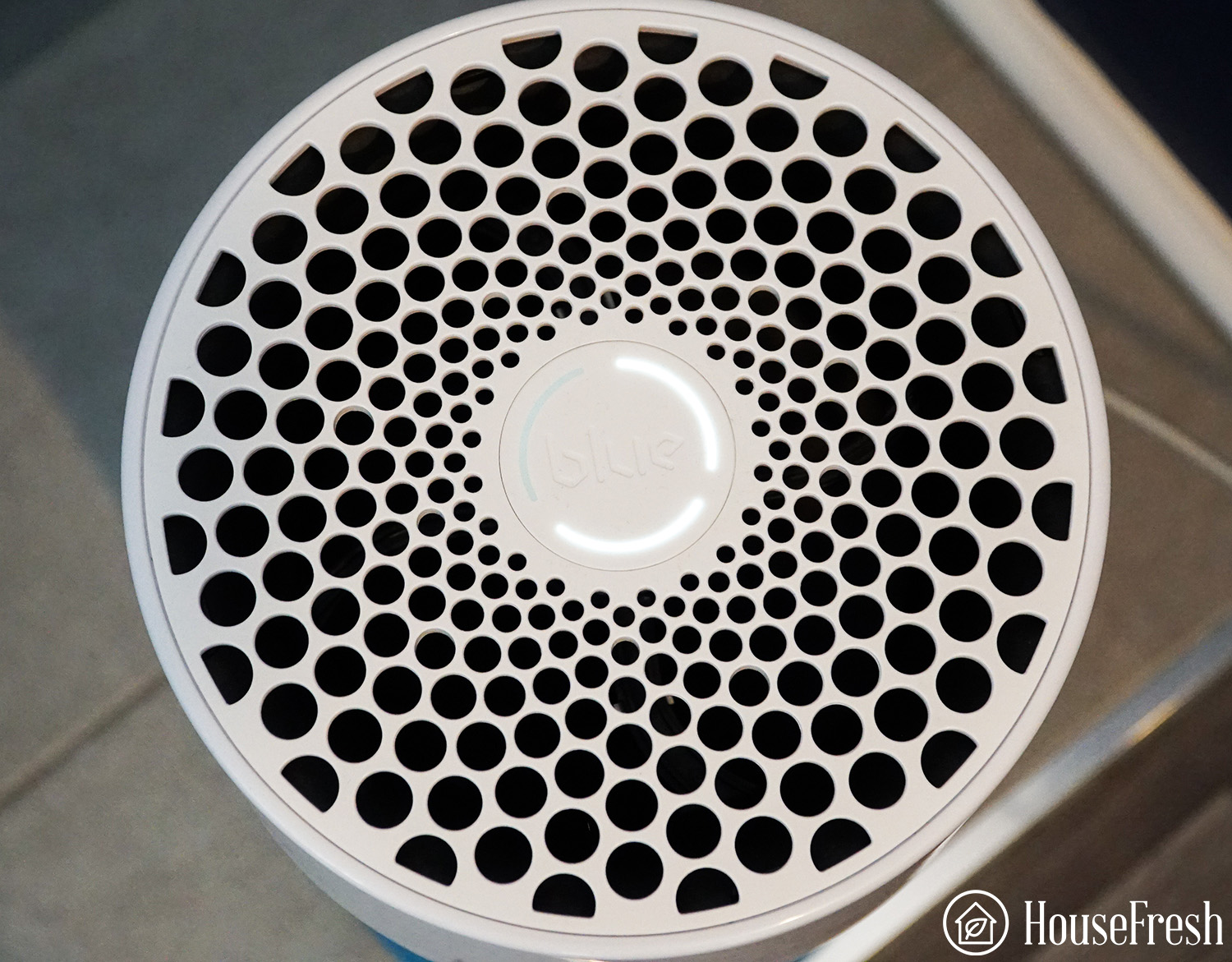
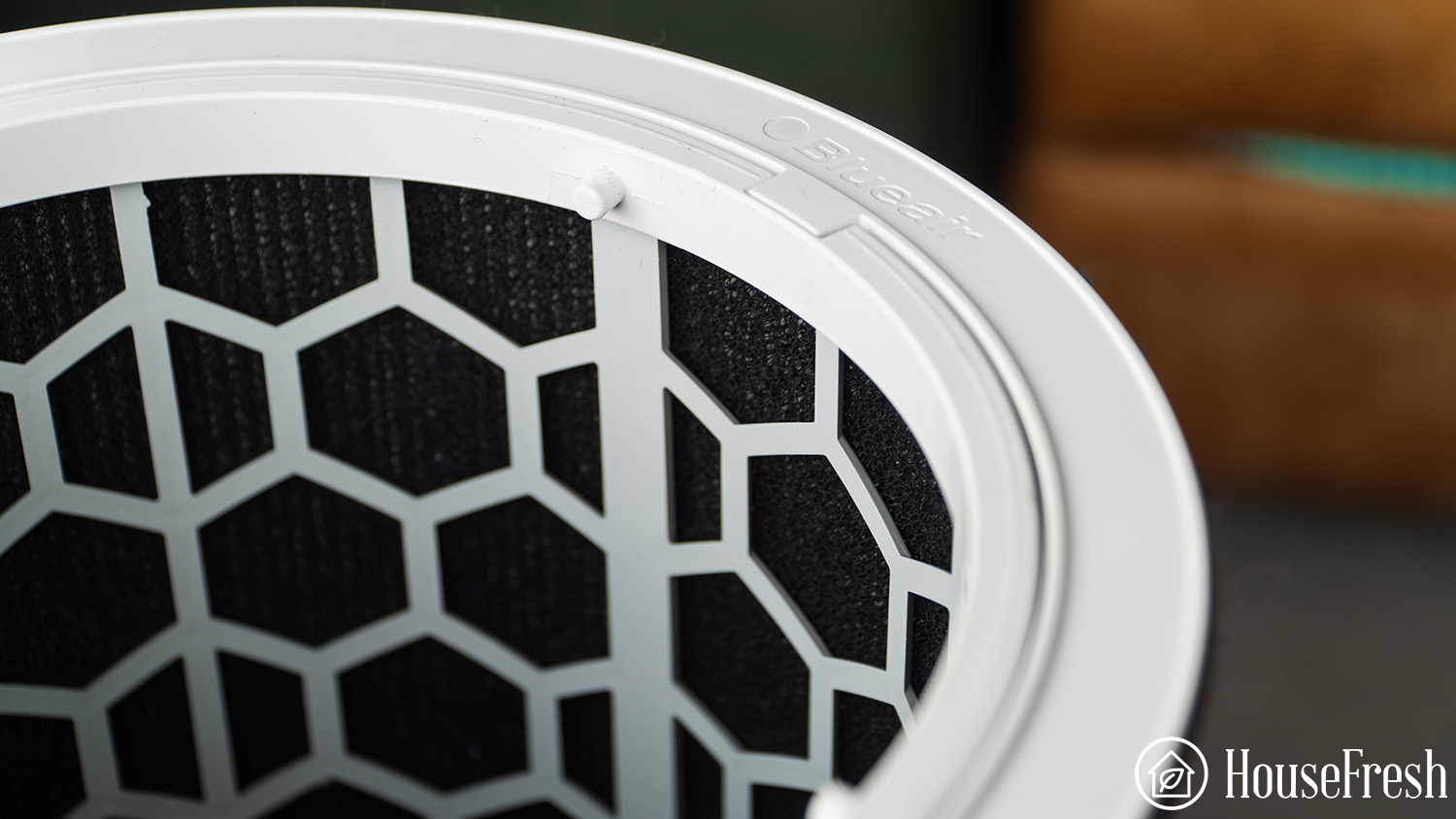
The top white cylinder houses the fan and ionizer, crowned by an organic-shaped control panel. The lower body accommodates the pre-filter and main filter, which fit neatly into a plastic honeycomb structure. The rounded body allows for an efficient 360 air inlet, while the clean air is then released from the top grill.
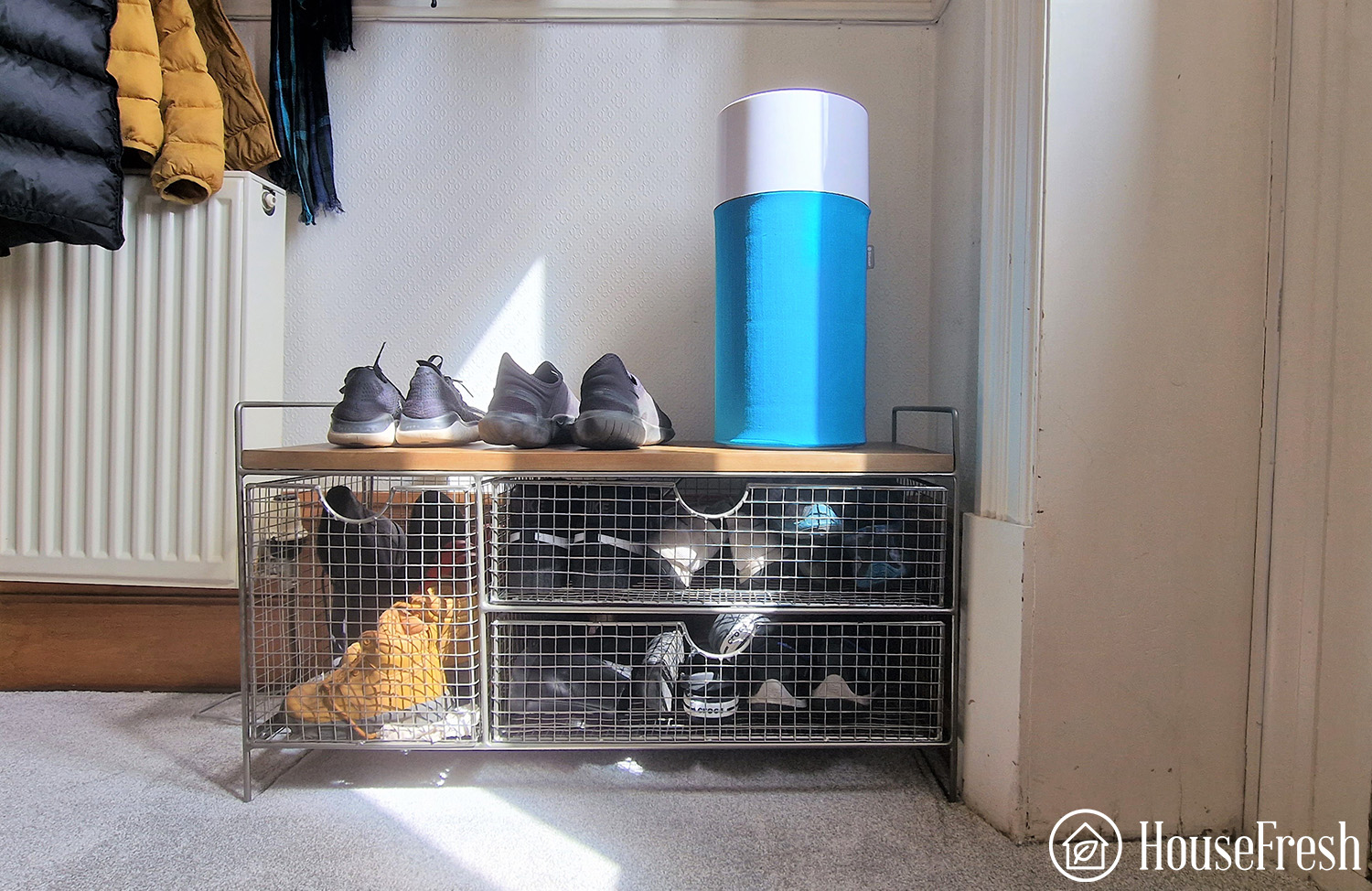
Designed for ergonomic efficiency with the minimum amount of elements, the Pure 411 is both compact and lightweight (5.3 lbs). As the smallest unit of the Blue Pure line, it will easily fit even in tiny rooms, not using up too much space, while it weighs close to nothing to move around.
However, this also means the structure requires gentle handling as there’s no outer casing or grill to protect the filer when manipulating the unit. Besides, most of the weight is at the top cylinder, so it’s somewhat flimsy and easier to tip over.
Simplicity peaks with the control panel. There’s only one button on the Blue Pure 411 to switch on and off and cycle through three fan speeds. That’s right, even the young members of the family could operate it.
Press the big round button once to start the air purifier at the lowest speed; a second and third press will step up the unit to the following fan speeds. One last touch will switch it off. The white LED lights around the button indicating the speed it’s on will dim after seven seconds of no interaction.
This is one of those nice touches that show how thoughtful Blueair designers are, especially if you’ll be placing the unit in the bedroom. For that matter, however, it would be nice to have a no-lights function.
Although the one-button control is modest and straightforward, the Pure 411 has a built-in memory, so if you unplug the unit, the unit will remember your settings once replugged. Yet, this is the only “smart” feature, as there’s no auto mode, timer or app support.
Blueair’s trademark HEPASilent™ filtration system
What’s this technology all Blueair purifiers feature?
In short, HEPASilent™ technology is no more than a HEPA-type filter boosted by an ionizer. It’s a bit misleading, as the filter is not a real HEPA. But many brands coin creative names for their products using keywords we look out for to feel secure about our purchases. With this trademark, brand communications can use the word without the certification required for it to be real HEPA.
Blueair filters are less dense than HEPA. This is not all bad, as a thinner filter media requires less power to create an airflow capable of passing through it. That’s how their units can clean the air with low energy consumption and more silently —hence the HEPASilent™.
But to remove 99.97% of airborne pollutants, this type of filter is not enough. That’s why Blueair combines mechanical (HEPA-type) with electrostatic filtration. An ionizer within the fan’s hood produces an electrostatic discharge, releasing ions that attach to airborne pollutants making them stickier and heavier, thus easier for the unit to capture and filter.
The downside of this technology is that it produces ozone as a byproduct. According to Blueair’s website:
All Blueair air purifiers are CARB certified which means that they are considered safe and do not exceed ozone emission limits.
Not exceeding ozone emission limits isn’t the same as not producing ozone at all. And then, even a slight amount of ozone can react with common gasses found in every home (including fumes from cleaning products) and produce further VOCs such as formaldehyde.
However this type of combination device is unlikely to introduce any ozone as the particle and carbon filters will help to remove the ozone from the ionizer before it leaves the device. The larger 211 of the Blue Pure series has a certificate showing that it produces zero ozone emissions —check the certificate at Intertek— so we can assume the same with this smaller device in the series.
Sadly, the ionizer cannot be switched off on Blueair purifiers. Both technologies are engineered to work together, unlike other units that have an ionizer as a plus (such as the Winix Plasmawave).
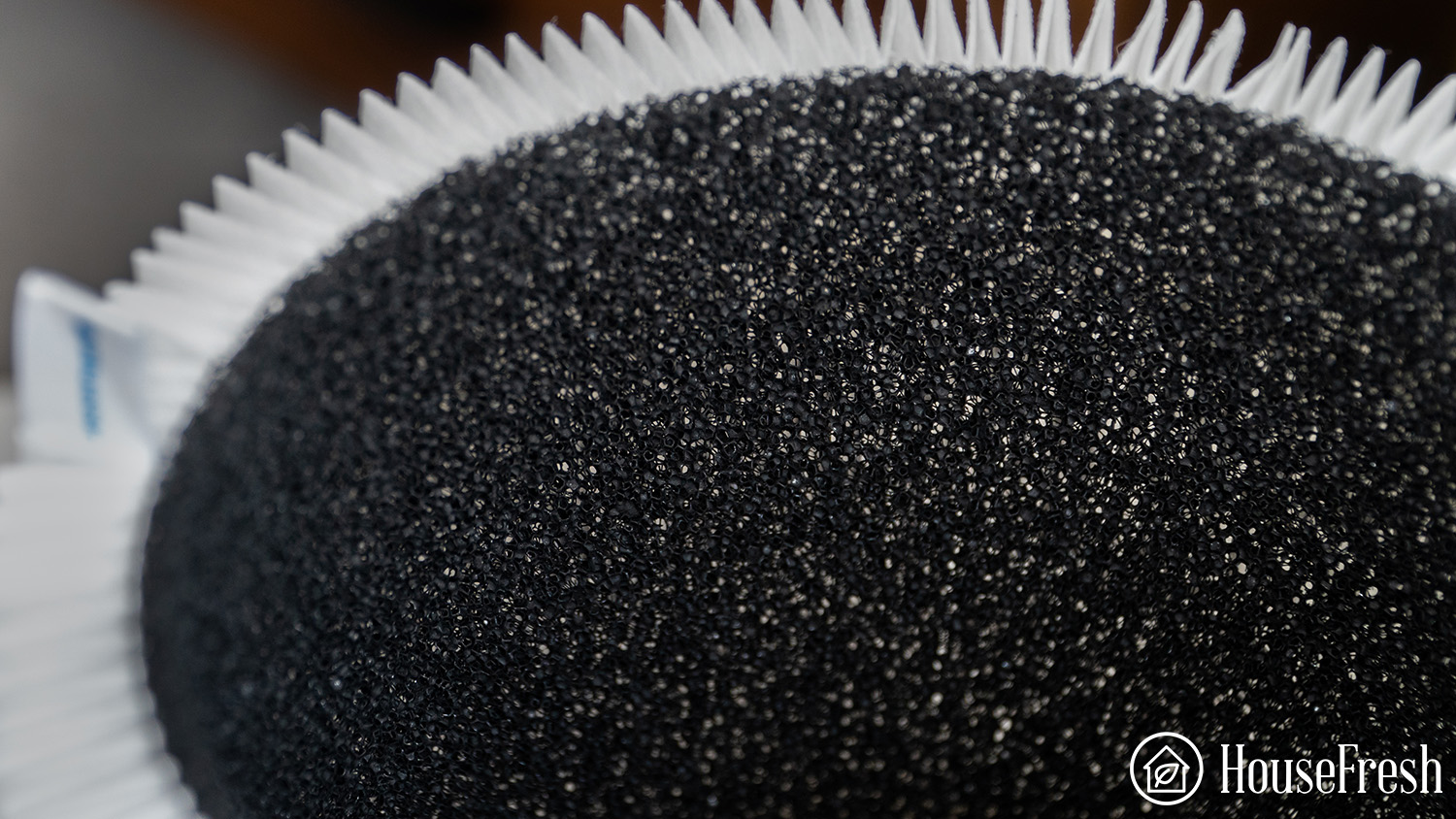
The filters also feature an activated carbon layer, although it’s an impregnated fabric instead of granular or pelleted charcoal.
This media is not robust enough to deal with serious odor or VOC issues, but it will help with mild everyday smells.
Lastly, there’s the outer pre-filter that traps bigger particles such as lint, dust and pet fur before they reach the mail filter. Washable prefilters are a functional upgrade as they can be thrown into the washing machine or vacuumed easily. Blueair recommends cleaning the pre-filter every three months to extend the lifespan of the main filter.
Now, the steps to change the Blue Pure 411 filter are somewhat different compared to other more traditional air purifiers. But the process is still pretty straightforward.
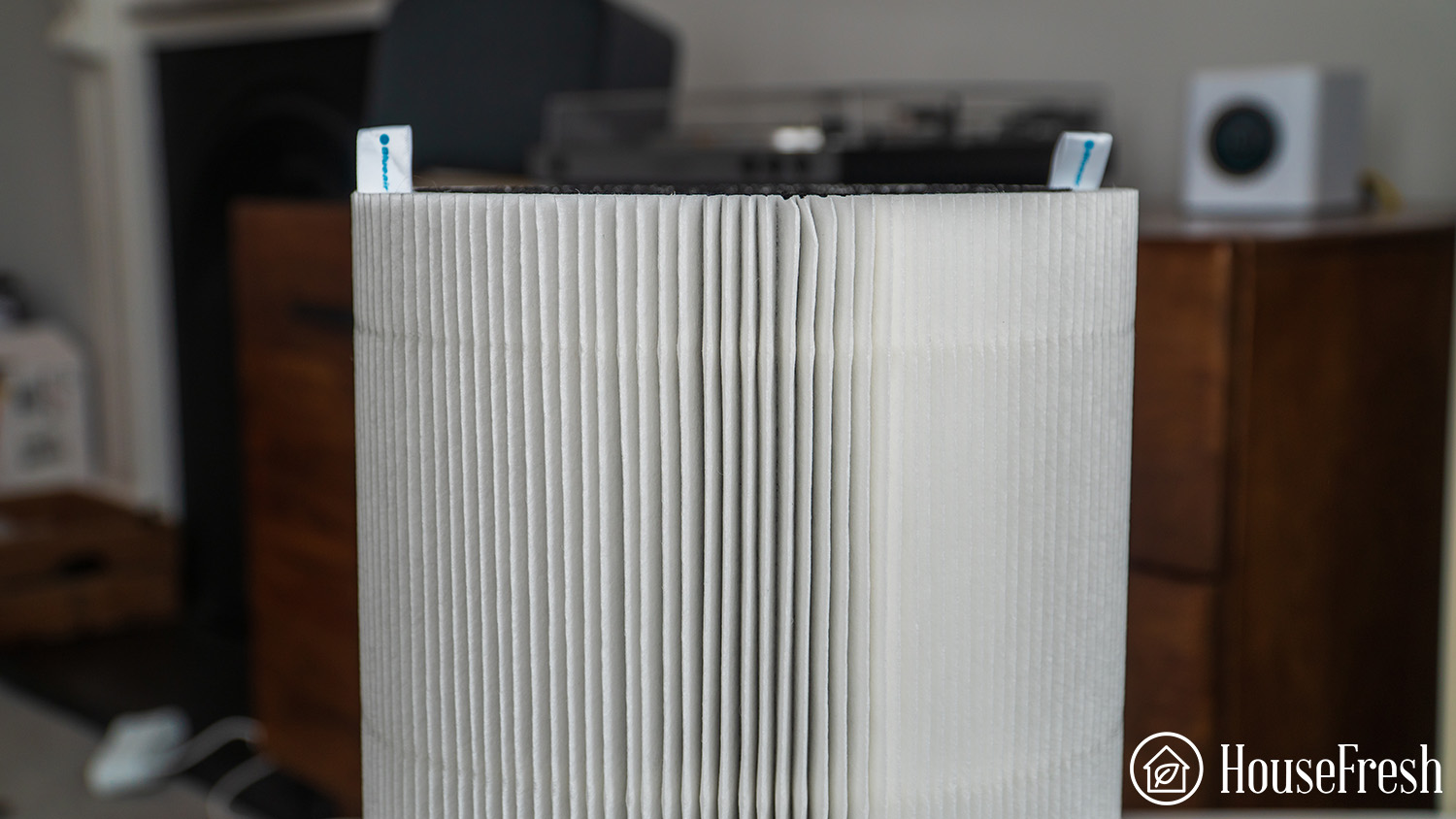
After six months of continuous use, the LED lights on the one-button control will turn red, indicating it’s time for a filter replacement. After unplugging the unit, unscrew the top cap with a gentle twist. Remove the fabric pre-filter and pull out the main filter using the tabs on the sides. Place the new filter on the plastic structure, then the pre-filter and finally, replace the cap.
Tip
Like with most air purifiers, Blueair filters come sealed in a plastic bag to protect them until it’s time they get to work. When unboxing your new Blue Pure 411, make sure to remove any packaging from the inside of the unit before running it. The same applies to filter replacements. Otherwise, the unit won’t be able to operate properly.
The Blueair Blue Pure 411 cleared our test room in 68 minutes
Silent and easy to look at, but far from being the fastest.
We often find that brands claim (and big publishing companies spread all over the internet) far more than their products actually deliver. That’s why, at HouseFresh, we like to take things into our own hands.
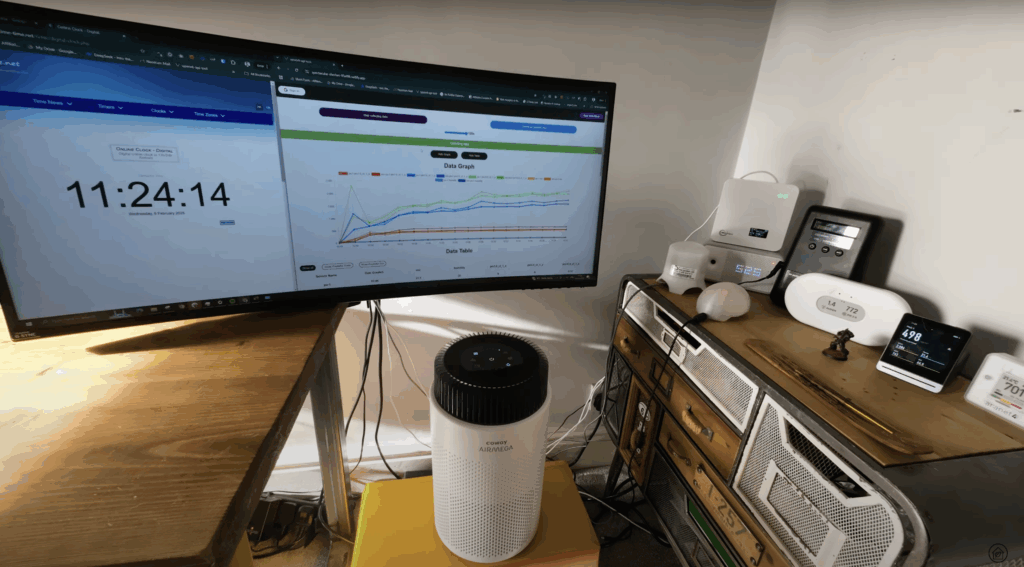
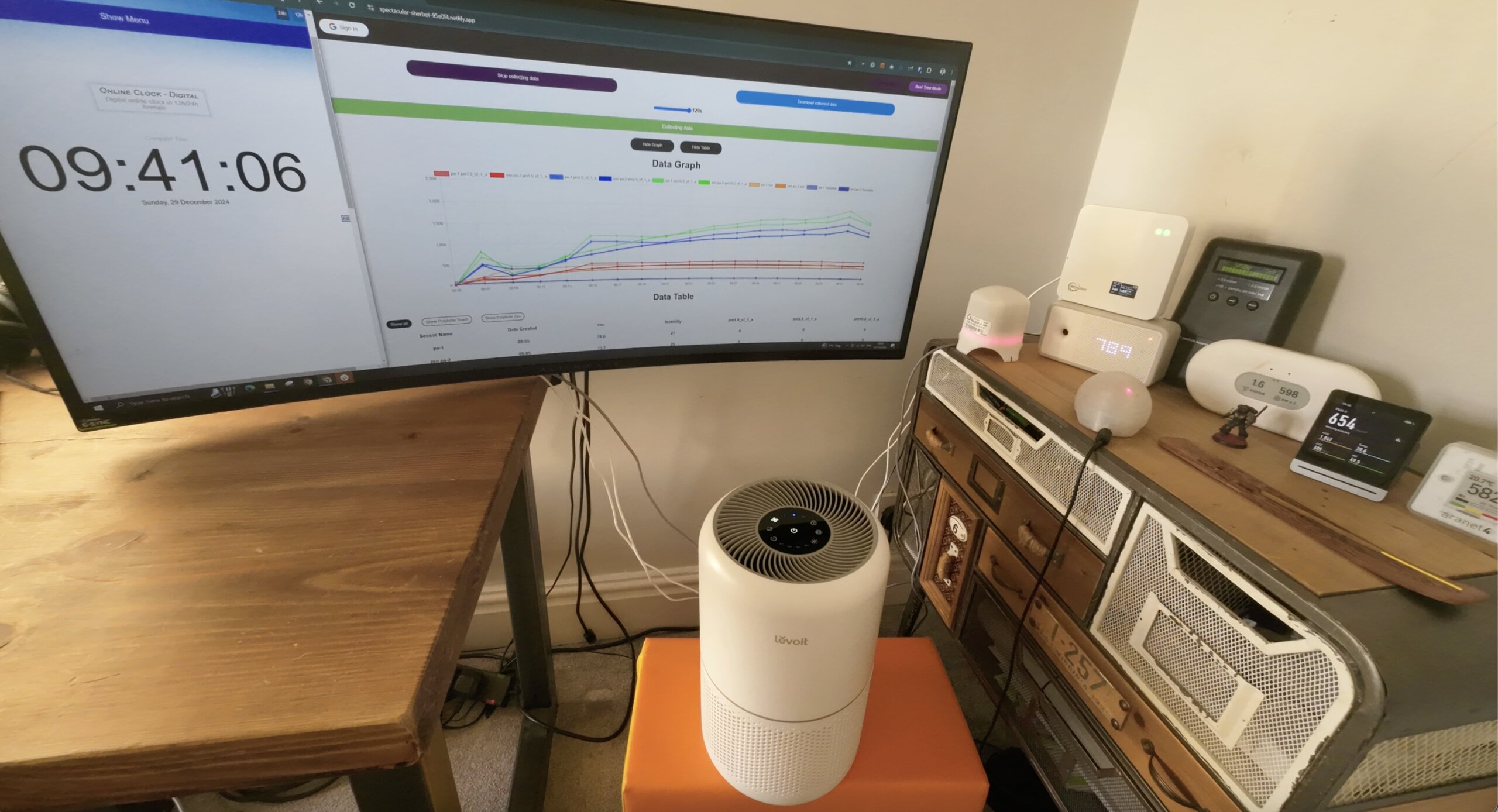
We conduct our performance tests in our 728 cubic ft. home laboratory. What does the HouseFresh testing process involve? We first generate pollutants by burning incense sticks. The PurpleAir Touch Indoor Air Quality Monitor —one of the most accurate sensors in the market— then helps us track how fast (or slow) each unit removes the PM1, PM2.5 and PM10 produced by the incense smoke.
As all of our tests are conducted in the same space, we can easily compare results across units.
Now, without further ado, let’s get a look at the data:
Air cleaning performance, compared
Cleaning speed is a good indicator to asses an air purifier’s performance. Knowing the Blue Pure 411 took 68 minutes already gives us an idea of its efficiency. But it’s usually not as graphic as comparing it with other units.
Let’s start by saying the Blue Pure 411 is an air purifier designed for small rooms. According to the Energy Star testing, it can achieve five air changes per hour in spaces of 163 sq. ft, with a CADR rating of 120 CFM.
It’s only fair, then, to compare its performance with other small air purifiers. The most straightforward comparison is with its upgraded version, the Blue Pure 411+ (which is not the 411 Auto nor the 411 Max models). The 411+ is not only 25 minutes faster, but it also comes with smart features and app support.
The Levoit Core 200S is another similar unit that, with a lower CADR (118 CFM) and for less money, cleaned our lab seven minutes faster than the Blue Pure 411. Besides, Levoit units only use mechanical filtration.
It’s not all bad news, though. There are slower air purifiers on the market, such as theAroeve MK01 or the $700 Dyson PH03. In truth, neither of these are air purifiers we recommend. But, then, speed is not the only determining factor in choosing an air purifier. Other aspects of the Blue Pure 411 make it a suitable option for small rooms— take the noise output, for example.
Noise levels test results, compared
Using a commercial sound meter, we registered the decibels (dB) emitted by the Blue Pure 411 at every fan speed from three ft. away.
The HEPASilent ™ technology is indeed quiet, at least to a certain extent: at its lowest fan speed, the noise output was 36.2 dB — which is equivalent to a soft whisper. Plus it gets quieter in Sleep Mode. In fact, you need to be really close to the unit to hear its hum in this setting.
But then, at top speed, there’s a noticeable change. The dB rises to 53.1 dB at its fastest. For reference, 50 dB sounds like a quiet office.
With these results, I can only say the Blue Pure 411 delivers the Silent promise to a limited extent. Yes, at 36.2 dB is fairly quiet. But then, we should factor in the fan’s power at each speed.
As you can see, the airflow changes drastically among speeds. It can be quiet at the lowest, alright, but the cleaning power is significantly reduced. With that fan power, the small Blue Pure 411 would make little changes to your air.
Besides, the AHAM CADR testing is always done at an air purifier’s highest speed, meaning that the unit should be running at top speed to achieve the 120 CFM and five air changes per hour in a small room.
But decibels are a rather abstract measurement. And perception of sound varies from person to person. That’s why we’ve recorded the unit’s noise output. Hear the Blue Pure 411 in action for yourself.
The cost to run a Blueair Blue Pure 411: $57.03 per year
An outstandingly energy-efficient unit with affordable replacement filters.
1. Electricity costs = $15.25 per year
The initial purchase price is only one variable to determine if an air purifier is a good investment. Then there’s the fixed costs you’ll be facing in the long run, including energy consumption and filter replacements.
In terms of electricity costs, Blueair’s HEPASilent™ technology is remarkably efficient. The Blue Pure 411 is no exception: it made the 2024 Energy Star Most Efficient list, which features the year’s most energy-conscious appliances. For a somewhat old model, this is saying a lot.
The 411’s power consumption ranges from 0.1 W to 10 W at the lowest and fastest speeds, respectively. This means that if you were to use the unit all year round, 24/7, at top speed, the cost would be $1.3 a month. To put it into perspective, an average LED light bulb uses about 10 watts. Not bad at all.
2. Filter costs = $41.78 per year
In addition to energy usage, it’s important to factor in the filter costs. Eventually, all HEPA (and HEPA-type) filters need replacement. The airborne pollutants trapped by the air purifier accumulate on the filter’s surface — which, in the long run, becomes clogged with those same filtered particles.
Now, the frequency of filter replacement depends on how much you use the unit and the level of air pollution in your area. But as a general rule, Blueair recommends changing the Pure 411 filters every six months. This brings us to two filters per year, summing up to $41.78 if you buy the original ones.
When compared to similar units, Blueair’s filters are reasonably priced. The Levoit Core 200S and 300S filters, for example, cost between $25 and $30, slightly varying on the unit. Then, the Winix A230 replacement filters can be found at $49.99, although you need to replace these only once a year.
Besides, as the Blue Pure 411 has been around for quite a long time, there are plenty of generic, cheaper options available. Although we’ve only tested the unit with genuine Blueair filters, so we cannot vouch for their performance.
Compatible with Blueair Air Purifier 411 Auto, 411, 411+ Model. Premium 2-in-1 PARTICLE and ACTIVATED CARBON filter. Get back to having a clean air to breathe again!
Particle 411 Auto, 411, 411+ filters can clean up 99.97% airborne particles, including dust, pet dander, common pollutants, and fabric fibers.
Bottom line
There’s a playfulness about the Blue Pure 411 that makes it unique.
The simple one-button control adds the perfect touch to that lively flair I miss in the new Blueair Max line. The brand has taken a more sober turn on the latest designs, aligning with current trends that demand desaturated colors and textures. But I kind of miss the old cheerfulness.
In terms of performance and functionality, the Blue Pure 411 is compact, has low running costs and operates reasonably well. All these features make it a good choice for small rooms like bedrooms.
However, if you prefer pure mechanical filtration, then the Levoit Core 300 (or 300S if you would like to upgrade to a smart unit) is one reliable unit I know I can trust. Then, if you are looking for an air purifier for bigger rooms, I’d take a look at the Levoit Vital 200S, which can achieve five air changes per hour in 375 sq. ft. in 21 minutes.
SOURCES
We calculated yearly costs associated with running the Blueair Blue Pure 411 24 hours a day, 365 days per year utilizing the latest average energy prices as reported by the Bureau of Labor Statistics of $0.174/kWh as of April 2024.
Levoit has been making waves in the air purifier market since they first arrived in 2017 thanks to the quality of their air purifying technology at an accessible price. Levoit’s air purifiers perform at the level of much more expensive units from older, more well-known brands.
Levoit changed my view on “cheap” air purifiers with their Core 300, so I was VERY excited to test a larger unit: the LV-PUR131.
At $180, the Levoit LV-PUR131 seems like an excellent option for cleaning the air in a medium-sized room with a unit that includes features like automatic mode, which are normally only found on units that cost well over $200. After seeing glowing reviews for this unit on Amazon, I decided it was time to test it.
As with all our reviews here at HouseFresh, we bought the Levoit LV-PUR131 with our own money to make sure we would be free to give our unbiased opinion.
We also bought the unit so we could test its air cleaning performance in our home lab. That’s right, unlike the vast majority of air purifier reviews you will read from ‘reputable’ lifestyle magazines or even tech sites, I actually tested the LV-PUR131 as opposed to just describing it based on the marketing materials from Levoit.
How we test air purifiers
Read our full testing methodology.
This is to say that you can rest assured that this review is impartial and that you will read an accurate account of the unit’s pros and cons.
The lowdown on the Levoit LV-PUR131
“At this point in the history of Levoit, there are better options than the Levoit PUR131.
The LV-PU131 is underpowered, it pulls a lot of energy (which will add to long-term costs), and I have received reports from readers who explained various issues they experienced with this unit outside the warranty.
My Levoit PUR131 hasn’t broken yet, but it lives in my basement, so it doesn’t get used as often as other units I’ve got in my home.”
— Danny Ashton, HouseFresh Founder & Senior Writer
Don’t want to read the full review? If you can find the Levoit PUR131 in stock and have a room size of 500 sq. ft, this is the best performance air purifier you can get without spending more than $180.
What we really like
The simple touchscreen control panel is easy to understand and use.
It comes with an on-board air quality sensor and an LED air quality indicator (but it will only work when on auto mode).
It’s light and easy to move around the house.
It is one of the few Levoit units you could find today with a separate set of filters — the particle filter is separate from the activated carbon filter.
What we think could be better
It is underpowered compared to other more modern Levoit devices, such as the Levoit Vital 200S.
It doesn’t come with a pre-filter for capturing larger particles. This is unfortunate as pre-filters extend the life of main particle filters.
Something small, but that matters to me as I have two young children in the house: the controls don’t include a child lock.
HouseFresh rating:
★★☆☆☆
Time to clean our 728 cubic feet test room (with the device running at top speed):
60 minutes
Air purifier technology:
Main particle filter and activated carbon filter
Recommended room size (4.8 air changes per hour):
152 sq. ft.
Clean air delivery rate (CADR):
Dust: 102 CFM Smoke: 98 CFM Pollen: 138 CFM
Dimensions (in inches / in cm):
18.5H x 14.6W x 7.2D inches (47H x 37.1W x 18.3D cm)
Weight (in pounds / in kg):
11.22 lbs (5.1 kg)
Filter life:
6 months
Noise level in decibels (measured from 3 ft. away with a sound level meter):
Sleep mode: 37.5 dB Speed 1: 39.9 dB Speed 2: 45.2 dB Speed 3: 50.5 dB
Electricity consumption in watts (recorded with an electricity usage monitor):
The LV-PUR131 is a simple-looking, white and boxy air purifier that stands just under half a meter tall and has oversized branding across the top corner. It certainly looks like what most people probably think of when they think of an air purifier.
It isn’t the worst-looking unit I’ve seen but it definitely looks plain and boring compared to the Smart Air S, which combines different materials, design lines and textures.
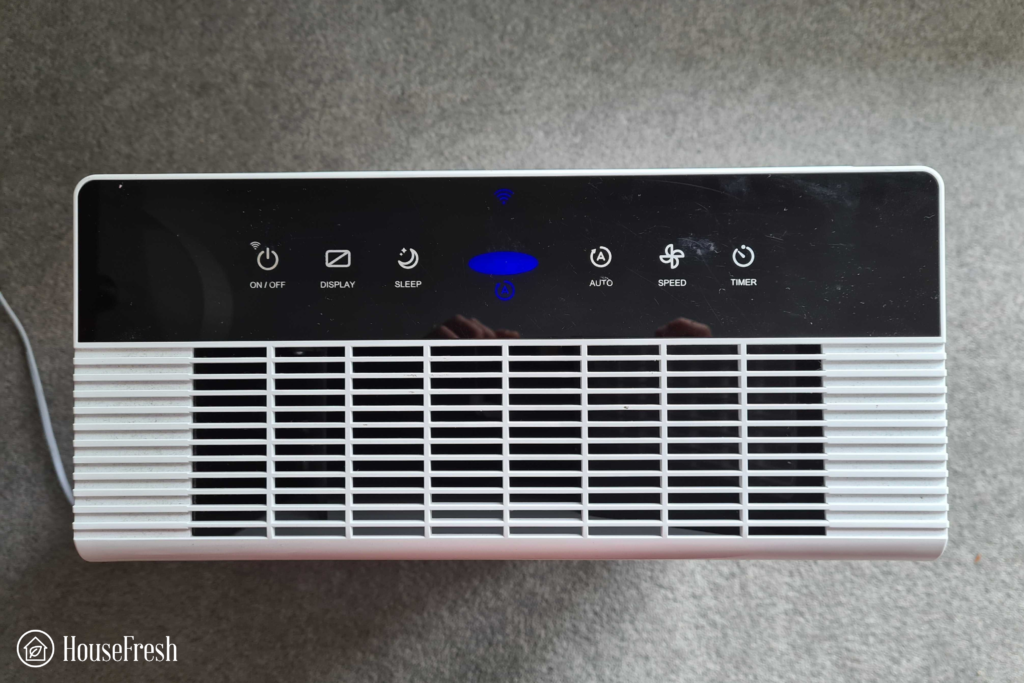
The Levoit LV-PUR131 has an easy-to-navigate touchscreen control panel on top of the unit. Each button has a clearly labelled icon, so you will quickly figure out how to operate the air purifier straight out of the box with little instruction.
You can turn the machine on/off through the control panel and cycle through its three fan speed settings:
For use during the night, you can hit the Display button to turn off the LED lights and press Sleep to switch the fan speed to its lowest fan speed, which only emits a whisper-like sound at 27dB.
The unit also comes with a programmable 12-hour timer so you can leave the unit to run without worrying about switching it off again.
While the Auto setting utilizes the inbuilt air quality sensor to monitor for pollutants and automatically adjust the fan speeds for minimal fuss and maximum peace of mind.
Three stages of filtration
The LV-PUR131 is one of the few Levoit units with separate particle and gas filters. We wish they did this for more devices.
Before purchasing an air purifier, it is important to know what filters the unit uses and what effect they will have. The LV-PUR131 comes with a main HEPA-like particle filter and a large pelletized activated carbon filter.
The primary filter will capture ultra-fine particles commonly found indoors, such as dust, pollen and mold spores. It is worth mentioning here that Levoit has removed all mentions of HEPA from its advertising and marketing materials after Dyson complained to the BBB National Programs National Advertising Division.
As I briefly mentioned above, the LV-PUR131 also comes with an activated carbon filter. This layer of filtration will tackle volatile organic compounds (VOCs) such as chemical fumes, smoke, and household odors.
My favorite thing about the filters in the LV-PUR131 is that they are two separate filters, which means that you won’t need to throw away both filters if you only need to replace one. Most other Levoit units come with bonded filters, where you get one chunky filter with one side for particles and another for gasses. The biggest issue with this is that activated carbon filters generally have a shorter lifespan, so in many cases with units like the Levoit Core 400S or the Vital 200S, you will need to get rid of the entire thing, even when the particle filter might still be effectively removing particles.
All this to say, the filter setup in the LV-PUR131 is definitely a pro.
Tip
At the risk of stating the obvious, we always like to remind readers that the filters will come in plastic wrapping that needs to be removed before using the air purifier. As the filters usually come delivered pre-fitted, this often trips users up as they think they are ready to use.
Simply remove the filters, remove any packaging and re-fit, and then you’re good to go.
The Levoit LV-PUR131 cleared our test room in 60 minutes
This was impressive when we first tested it, but four years later, the air cleaning speed of the LV-PUR131 is not good enough.
To put an air purifier through its paces, we utilize our home office, which measures up to 728 cubic ft, so it is roughly the same as a small to medium-sized bedroom.
We burn incense sticks to fill the room with airborne pollutants and measure how quickly the purifier can remove all PM1.0ug/m3, PM2.5ug/m3, and PM10.0 ug/m3 particles using our indoor sensor from Purpleair.
We keep these conditions the same for each test, allowing us to compare and contrast different purifiers and see which unit performs the best in a home setting against common pollutants.
Let’s see how the LV-PUR131 did:
Once the incense had finished burning at 12:15pm, we recorded the number of pollutants in the room, with levels reaching:
PM10.0 – 1847.99 ug/m3
PM2.5 – 1577.53 ug/m3
PM1.0 – 581.41 ug/m3
We then fired up the LV-PUR131 at its highest speed, allowing it to tackle the airborne pollutants head-on.
Within 60 minutes, each particle reading had reached 0.0, showing that within one hour, the unit had performed three air cycles and removed all traces of pollutants.
Air cleaning performance, compared
When comparing these results to alternative purifiers within a similar price range, we found the Levoit eradicated all pollutants faster than the Blueair Blue Pure 411, which took 1 hour and 8 minutes and the GermGuardian AC4825, which took 1 hour and 44 minutes.
However, the Levoit Core 300 (which is $100 cheaper than the LV-PUR131( completed the same test in just 40 minutes, proving that there are other better alternatives. The one I would suggest is the Levoit Vital 200S, which is being sold for the same price as the LV-PUR131, yet it can clean the air A LOT faster as our air cleaning speed shows (the Vital 200S completed the test in just 18 minutes).
Noise levels, compared
Alongside purifying performance, it’s essential to gauge how loud this unit is when operating on its various fan speeds.
When cycling between the three standard fan speeds, this unit runs between 52.2 – 65.6 dB, which is louder than most of the other air purifiers we have tested. However, when set to the Sleep setting, this comes down to a much more tolerable 27 dB.
Check out our sound guide below to hear the LV-PUR131 for yourself.
The cost to run a Levoit LV-PUR131: $108.58 per year
1. Electricity costs = $32.59 per year
Many of us are feeling the pinch as soaring energy prices affect the cost of living. So it’s a good idea to figure out what you’re likely to pay across the lifetime of your air purifier.
We used the Department of Energy’s appliance energy calculator to estimate how this unit might impact your electricity bill to save you the headache of doing the math.
This unit uses 30.5 watts of power on its highest speed setting, which is pretty efficient. If we imagine you run the air purifier on this setting 24 hours a day, 365 days a year, the LV-PUR131 will set you back $32.59 a year.
Bearing in mind as you’re more likely to run the unit on its lowest speed for around 8 hours a day, it won’t cost much at all to operate this air purifier.
2. Filter costs = $75.99 per year
Over time, as your HEPA and Activated Carbon filters work their magic, they will become clogged with pollutant particles and eventually lose efficiency.
To keep your purifier performing at its peak, you must replace the filters, adding another additional cost to consider before you purchase.
The LV-PUR131 has two filters that need replacement every 6 months (both the Activated Charcoal and the HEPA filter). They are both available in replacement packs for $45.99 but the 2-pack will set you back $75.99 per year.
However, several filters available from third-party manufacturers on Amazon are cheaper than the official Levoit filters (which are often out of stock across the U.S.) These alternative filters come with great reviews from fellow users who claim there is no difference in performance when used.
Shortly after releasing the LV-PUR131, Levoit launched the LV-PUR131S to offer users a purifier with enhanced smart features.
In addition to the Auto mode found on the original model, the S includes the option to connect your purifier to your phone or smart device such as Alexa.
This enables the user to operate the purifier remotely using voice activation or at your fingertips through your phone.
The app also allows you to remotely set timers and create schedules, providing updates on the current air quality in your space.
Features
Levoit LV-PUR131
Levoit LV-PUR131S
Purifier technology:
H13 HEPA and Activated Carbon Filter
H13 HEPA and Activated Carbon Filter
Recommended room size:
360 sq. ft.
360 sq. ft.
Filter life:
6 months
6 months
Weight (in pounds / in kg):
11.22 lbs / 5.1 kg
11.22 lbs / 5.1 kg
Energy consumption:
$66.26 per year
$66.26 per year
Auto Mode
✅
✅
Smartphone Functionality
❌
✅
User reviews
List Price
$179.99
$189.99
So, should you pay more for the S?
In reality, these two units are identical. The only difference is that the S is compatible with Levoit’s smartphone app and can be connected to smart devices such as Alexa for voice control.
At only $10.00 more, it seems reasonable to pay the extra if you feel these additional features will be of use. However, if you can’t see yourself utilizing such features, then why not save yourself 10 bucks?
Bottom line: Is the LV-PUR131 worth it?
A good choice for those who want a Levoit unit with separate particle and carbon filters — but look at newer models if you want better air cleaning performance.
Your particular use case will depend on your situation. The team at Levoit produced a unit with top performance at an affordable price compared to most other air purifiers on the market.
That being said, the Levoit LV-PUR131 doesn’t have the power to deal with serious air pollutants, such as those from traffic pollution or cigarette smoke. The reality is that there are many other devices that are currently available for cheaper prices that will do a much better job of cleaning the air.
If you like the rectangular look, I suggest you check out the Levoit Vital series instead. The Levoit Vital 200S performed much better than the LV-PUR131 in our tests (cleaning the air in our test room in just 18 minutes), and it costs roughly the same. Alternatively, you can save yourself $60 and go with the smaller Levoit Vital 100S, which still managed the clean the air in our small test room in 28 minutes — that’s 32 minutes faster than the PUR131.
And if you’re not specifically looking for a Levoit unit, then you should definitely check out the Winix 5500-2, which can be found for $159.99 (around $30 less than the PUR131), has separate filters and was 40 minutes quicker at completing our air cleaning performance test.
The Levoit LV-PUR131 doesn’t have the power to deal with serious air pollutants, such as those from traffic pollution or cigarette smoke. And the reality is that there are many other devices that are currently available for cheaper prices that will do a much better job at cleaning the air.
SOURCES
We used the Department of Energy’s appliance energy calculator to calculate yearly costs associated with running the Levoit LV-PUR131 24 hours a day for 365 days. We ran this calculation utilizing the U.S. average utility rate of $0.12/kWh as of May 9th, 2023.
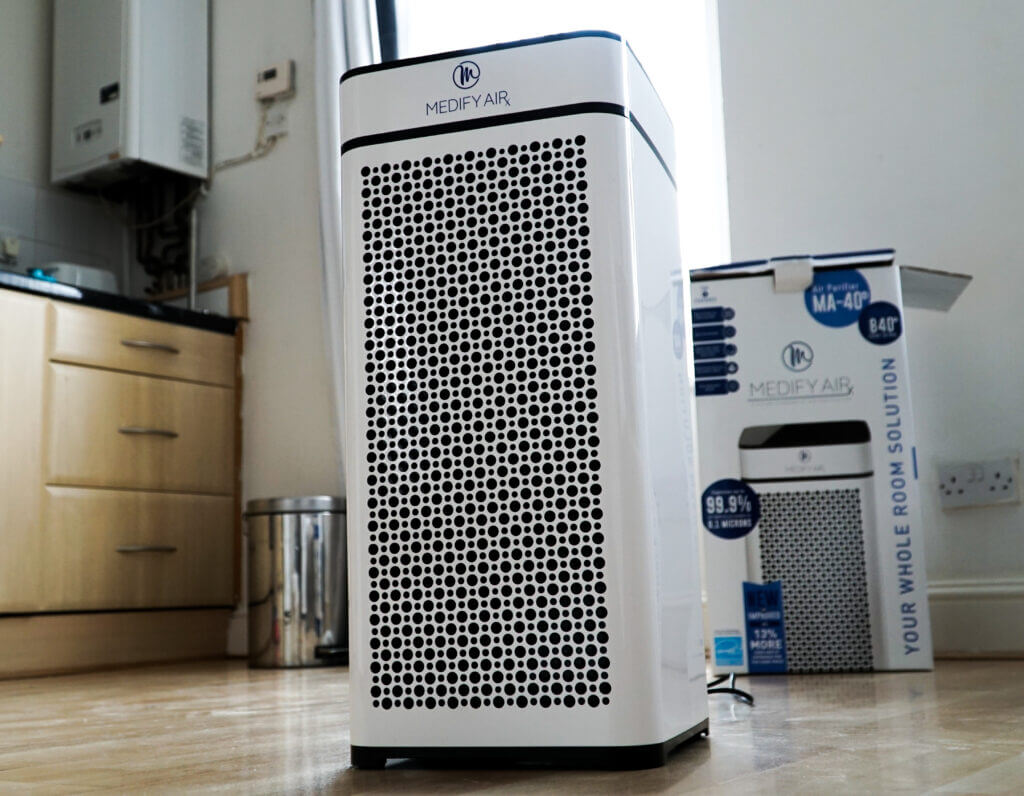
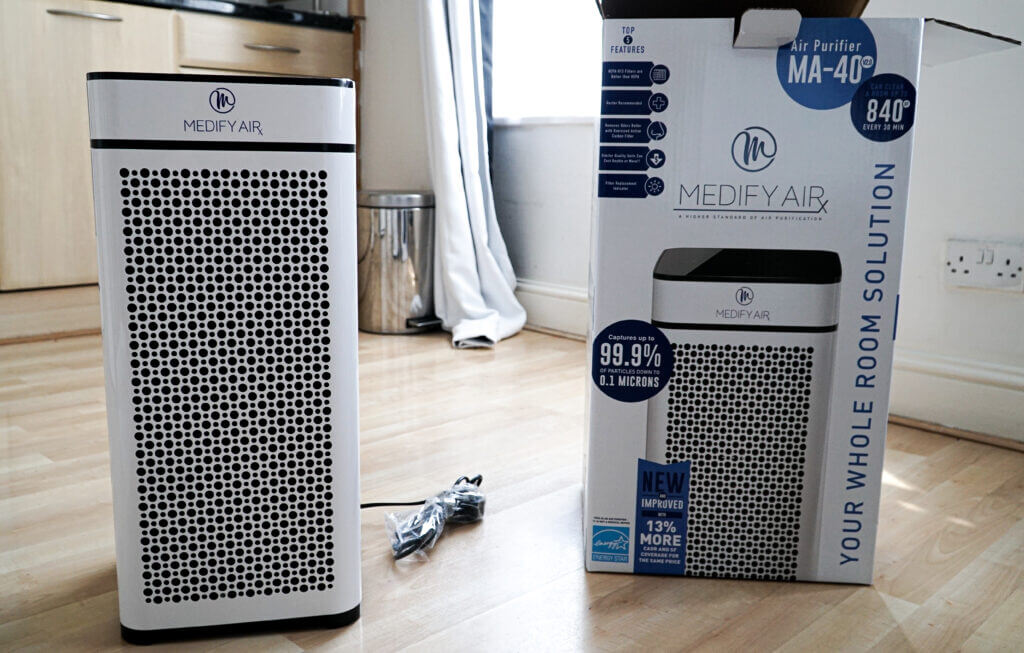
The body sports a glossy premium-feeling finish, and it won’t look out of place in a modern apartment or house.
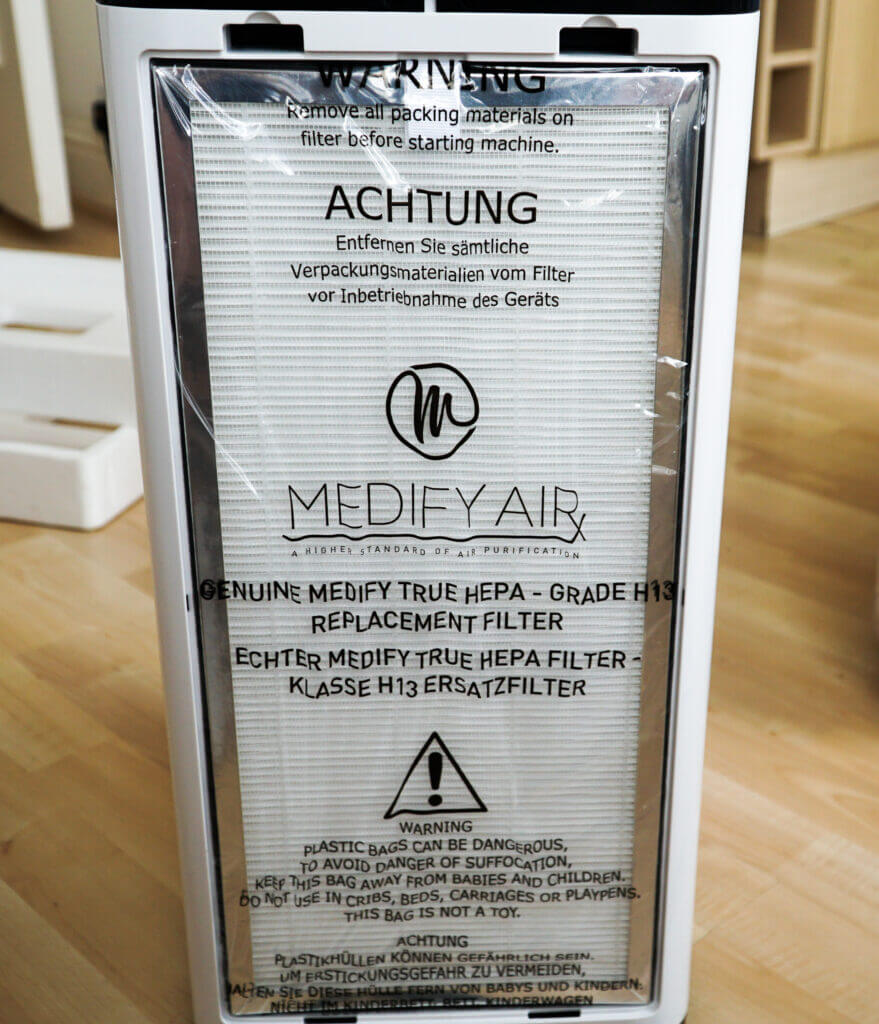
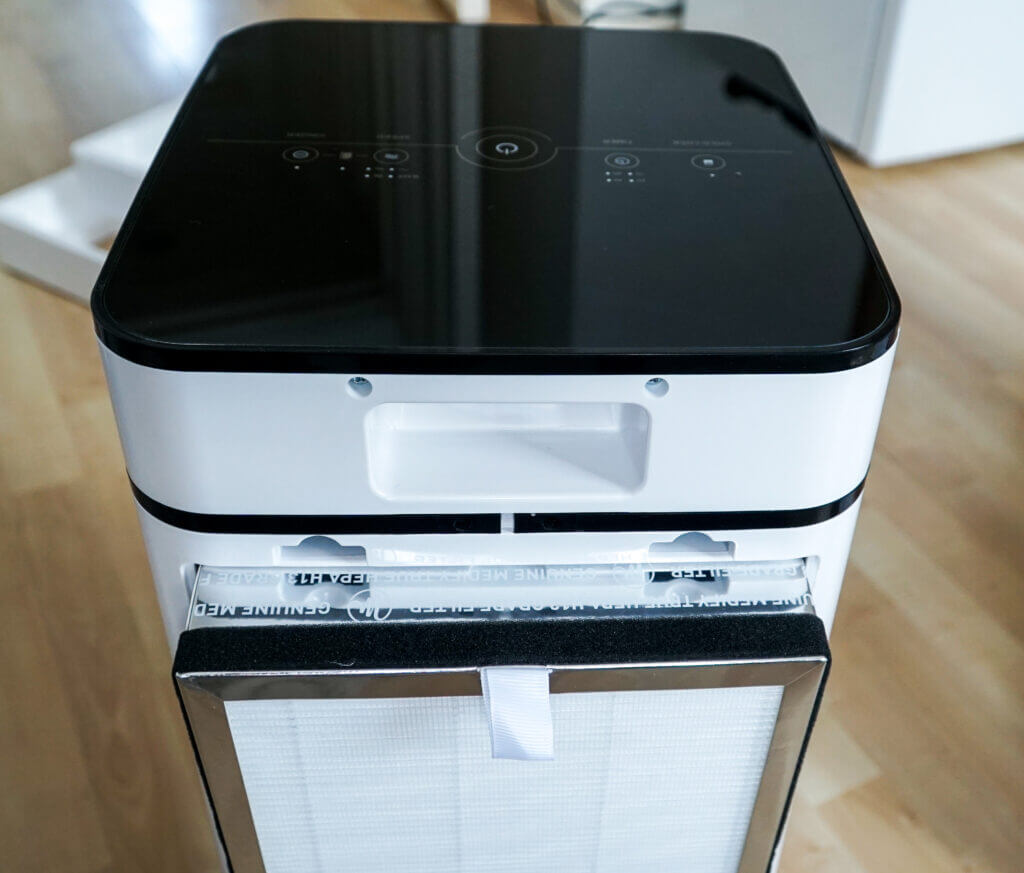
On the front, you have the larger air outlet, and on the back, there is a large air inlet and a handle, which comes in handy when moving the unit around. It was super easy to install the composite 3-in-1 filter, and the back cover has magnets for easy locking. So far so convenient.
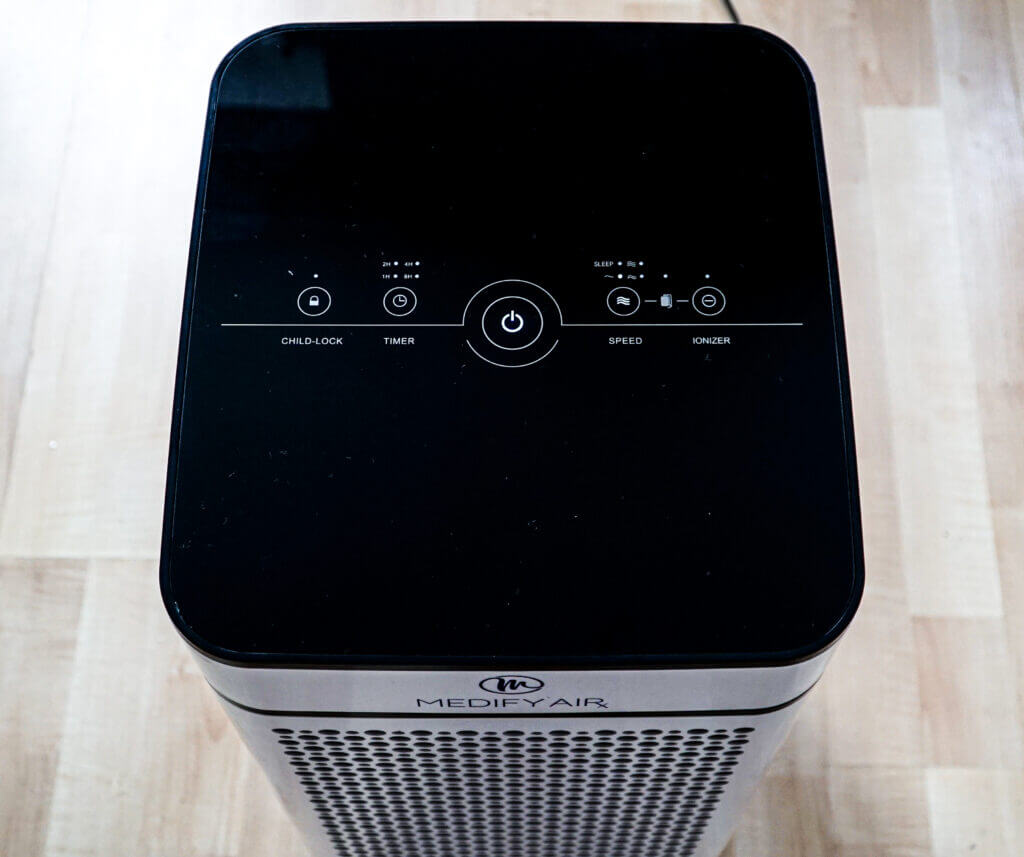
The top is very handsome indeed, with classy minimal looking tempered glass and an easy-to-navigate display panel.
The controls feature the latest capacitive touch technology, but if you don’t know what that means don’t worry, just press the power switch, timer, fan speed, and ionizer switches and you’re good to go. Oh, and there’s a child lock too to stop the little ones meddling with the settings and giving the whole family a cold (the Medify MA-40 pumps out cool air, which is awesome in summer, but leave it on too long and you’ll end up with a freezer for a living room).
There are 3 manual fan speeds settings and a sleep mode. It’s nice to see a filter replacement indicator on the top panel too, meaning you shouldn’t forget to replace the filter when the time comes.
All in all, it’s a slick-looking unit with a solid feel.
Filtration
Now for the technical bits — the filtration system on any air purifier is basically the single most important thing to look at if you want to know how well it’s going to work. The Medify MA-40 comes with a pre-filter, an H13-grade True HEPA filter, and an activated carbon filter.
Let’s take a closer look at the numbers: the removal efficiency of this filter is 99.9% at 0.1microns (MPPS). That means it can capture tiny airborne pollutants such as fine dust, smoke particles, and microorganisms like bacteria, fungi, archaea, or protists. The first line of defense is a pre-filter net, which traps larger pollutants such as lint, pet dander, mold spores, and dust. It also stops the core HEPA filter from getting clogged up.
Next, we have the pellet-based Activated carbon filter, which takes care of all your odor and gas filtration needs. The honeycomb-shaped filter is filled with activated carbon pellets, which adsorb odors and VOCs from the air including smoke, pet smells, and all those odors that come from cooking.
This filter needs to be replaced every six months or after 3000 hours of usage. These are easy to come by online and do cost a little more than some smaller units. Medify does offer a service they call Filter Club. If you sign up, they will send replacement filters to your door every six months and you save 10% on the list price plus free shipping. This isn’t only a money-saving tip but will make sure you’re never left without a new filter.
EXTENDED FILTER LIFE & COST-EFFICIENCY: Our long-lasting filters deliver up to 3,000 hours or 4-5 months of continuous, high-quality air purification. With fewer filter changes needed, enjoy cost savings and a healthier, cleaner home environment.
EFFORTLESS FILTER REPLACEMENT: Our user-friendly design ensures a hassle-free filter change. Keep every room in your home, school, or office filled with fresh, irritant-free air. Regularly updated filters effectively neutralize lingering odors.
SUPERIOR TRUE HEPA H14 FILTRATION: Our advanced HEPA H14 filters capture 99.99% of airborne particles as small as 0.1 microns. Breathe easier with effective removal of dust, pollen, allergens, smoke, and pet dander—better than HEPA H11.
3-STAGE PURIFICATION PROCESS: The MA-40 boasts a three-layer filtration system—pre-filter for large particles, HEPA H14 for microscopic contaminants, and activated carbon for odor elimination. Ideal for pet owners, allergy sufferers, and smokers.
EXTENDED FILTER LIFE & COST-EFFICIENCY: Our long-lasting filters deliver up to 3,000 hours or 4-5 months of continuous, high-quality air purification. With fewer filter changes needed, enjoy cost savings and a healthier, cleaner home environment.
The Medify MA-40 has an optional ionizer — when it’s turned on, it releases charged particles that attach to any dust floating in the air. Then the heavy particles fall to the ground, just like magic! Beware though, you shouldn’t use this feature if someone has asthma or breathing difficulties at home.
Noise
Aside from the filter, noise is probably the next most important thing to consider if you’re in the market for an air purifier. Clean air is essential, but noise pollution is a thing too, especially in a small flat.
The Medify MA-40’s noise level is 46 decibels on the lowest fan speed and 66 decibels on the top fan speed. 70 decibels is the level of noise generated by a vacuum cleaner, so, this thing can seem pretty loud on its highest setting, but will only take around 30 minutes to completely clean the air then you can knock it down a speed or two.
Cost of running
Another worry I had was with energy consumption. Clean, pollution-free air must come at a price, right?
Wrong. Running the Medify MA-40 eight hours a day can cost as little as $24 a year. This sets top models like the MA-40 apart from the cheaper units on the market.
Combine that with the initial cost of the unit and replacement filters and you’ve got a great deal for clean, fresh air in your home keeping you and your family healthy and allergen-free.
What I love:
Easy to navigate, responsive touch panel controls
Replacement filters are easy to come by, especially with Filter Club
It’s lightweight and super easy to move between rooms
What I don’t like as much:
Its flat top does collect surface dust
I would prefer a longer power cable
Bottom Line
When purchasing an air purifier, a little research is required. With so many on the market right now, it’s paramount that you find one for your needs.
I chose the Medify MA-40 because it fit the size of my apartment perfectly. I was concerned with both pollution and VOCs coming in from the busy traffic outside and with my open plan kitchen/living room, I didn’t want to be smelling of my cooking whilst I chill on the sofa.
The filters in this unit promised to address these issues and they didn’t fail to deliver.
I can now cook the most fragrant of dishes without worry of stinking out the place and whilst I can still hear the hustle and bustle of the city streets, I no longer fear what it might be doing to my health.
To be honest, I’m sure how I ever lived without it.
MAXIMUM COVERAGE: Cleans large spaces up to 1,793 sq ft in one hour, 896 sq ft in 30 minutes (CADR 406). Ideal for homes, apartments, bedrooms, living rooms, offices, schools, universities, classrooms, hospitals, restaurants, and other businesses.
HEPA H13 FILTRATION: Trusted to remove 99.9% of harmful particles including allergens, odors, VOCs, smoke, pollen, pet dander, dust, smog, contaminants, and more down to 0.1 microns in size. Captures finer particles than HEPA H11 (0.3 microns).
ULTRA QUIET: Choose from 3 fan speeds, with the lowest setting operating virtually silent. Runs at 110 Volts at a min noise level of 46dB and max of 66dB. For the most discreet operation, enable sleep mode to completely dim the unit's panel lights.
EASY TO USE FEATURES: Includes a sleek touch screen operation panel with 0-8 hour timer, fan speed, sleep mode, filter replacement indicator, and child lock, great for both kids and pets.
QUALITY TESTED & BACKED: CARB and ETL. Backed by a USA registered Lifetime Warranty. The replacement filter (B07MTQFFNT) lasts 3,000 hours or about 6 months.
The Vesync Corporation launched the Levoit brand in 2016. Since then, Levoit has become a game-changer in the air purifier market. The Core series presented consumers with affordable prices, innovation, and everyday needs in mind. In 2023, they launched the EverestAir, which quickly reached the top of plenty of our Best Guides due to its performance and surprising air cleaning speed.
Now, back to the Core 300. Released in 2019, it quickly became a popular option in the context of the COVID-19 pandemic. It reached the #1 position for Amazon sales in Air Purifiers that year. And even though eradicating viruses from our homes may not be the drive it was a couple of years ago, air pollution is still a rising concern for many of us.
Fast forward to 2025, the air purifying industry has evolved significantly. Many new brands and models have flooded the market, some delivering a high-performance and smart features combo (such as the Shark HP102), some even competing directly with the Core 300 and showing amazing results (hello Winix A230/A231), others turning out to be no more than a disappointing overpromise. Yet, the Levoit Core 300 remains a best-selling unit to this day.
True, it has no smart features or auto mode, but this was the budget air purifier to beat for a long time. With improvements to other models in the core series I don’t think this is the case as the OG Core 300 uses more energy and has lower performance to the newer models.
The Core 300 is a great entry-level air purifier, and it has been solid and reliable to date, but unless you can get it for very cheap, the Core 300S is a better choice but if you can try to go for a larger model like the Core 400S or Vital 200S as you will get much higher performance at lower fan speeds for similar running costs.
“The Core 300 set the bar for what a budget air purifier could do. Still one of the best value small air purifiers, but I recommend that most people pay a little extra and get a device like the Vital 200S that provides higher air cleaning performance, washable pre-filter, app support and auto mode.”
— Danny Ashton, HouseFresh Founder & Senior Writer
💡exclusive code for HouseFresh for 10% off a single purchase on Levoit.com: HOUSE10
So, let’s get straight to it. These are, in a nutshell, the strengths and weaknesses we see on the Levoit Core 300 after putting it to the test:
What we really like
You get good CADR for under $100.
Replacement filters are very affordable.
It’s a small unit, easy to place in small rooms and to move around.
Uncomplicated to set up and navigate, it requires low maintenance.
It’s whisper-quiet in sleep mode.
What we think could be better
It doesn’t feature onboard sensors, therefore no auto mode either.
It’s not as energy-efficient as the Core 300S.
It would be nice to have a filter with more activated carbon.
For less than $100, the Core 300 has a solid CADR of 145 CFM. This has been the best price-to-CADR ratio in the market for years, although lately, new units like the Winix A230 or the TaoTronics TT-AP003 have surpassed the Core 300 CARD for less than $80.
HouseFresh rating:
★★★★☆
Time to clean our 728cubic feet test room (with the device running at top speed):
54 minutes
Air purifier technology:
Pre-filter, non-HEPA grade particle filter and activated carbon pellets
Recommended room size (4.8 air changes per hour):
219 sq. ft.
Clean air delivery rate (CADR):
Dust: 134 CFM Smoke: 126 CFM Pollen: 154 CFM
Dimensions (in inches / in cm):
8.7L x 8.7W x 14.2H inches (22L x 22W x 36H cm)
Weight (in pounds / in kg):
7.48 lbs (3.39 kg)
Filter life:
6 months
Noise level in decibels(measured from 3 ft. away with a sound level meter):
Speed 1: 38.9 dB Speed 2: 45.7 dB Speed 3: 50.2 dB
Electricity consumption in watts (recorded with an electricity usage monitor):
Cost per CADR cfm (based on dust CFM as reported by AHAM):
$0.63
Manufacturer’s warranty:
2 years
Country of manufacture:
China
Compact, smooth and easy to use
The cylindrical body and rounded edges of the Core 300 allow for a small floor footprint and user-friendly controls.
💡exclusive code for HouseFresh for 10% off a single purchase on Levoit.com: HOUSE10
With a cleaning power suited for 200 sq. ft. spaces, such as average-sized bedrooms, home offices or small kitchens, it only makes sense that this unit is petite enough to fit cozily on desks, kitchen counters or night tables. It doesn’t take up much space, so it can be placed near the source of pollutants without interrupting your activity or needing much setup rearrangement. Besides, weighing only 7.5 lbs, it’s easy to move around.
The tubular design is the same as most of the Core series. With the 360º air intake, all the way around the bottom of the unit, you get air flowing in from all sides and coming out clean at the top. Enhanced by the cylindrical shape, Levoit’s Vortex Air technology produces a swirling airflow to maximize the air circulation on all fanspeeds.
Among Levoit’s wide range of air purifiers, the Core 300 stands as the middle-sized unit, equal in dimensions to the Core 300S and only slightly bigger than the 200S and the Mini — both suited for smaller spaces.
It’s also very similar in size to the Winix A230/A231, the new contender in town, with an almost identical floor footprint. The Core 300 is slightly taller and somewhat less organic than the conic Winix. On the other hand, it’s entirely white, which I like because it blends easily into the room, allowing for a more unobtrusive presence.
The control panel is a strong point for Levoit.
It’s a neat white-over-black touchscreen, very responsive yet not overly sensitive. The Core 300 doesn’t have onboard sensors, so the controls could feel a tad basic, but they’re far from it. It’s one of the simplest, most straightforward units that doesn’t lose perspective on what users need.
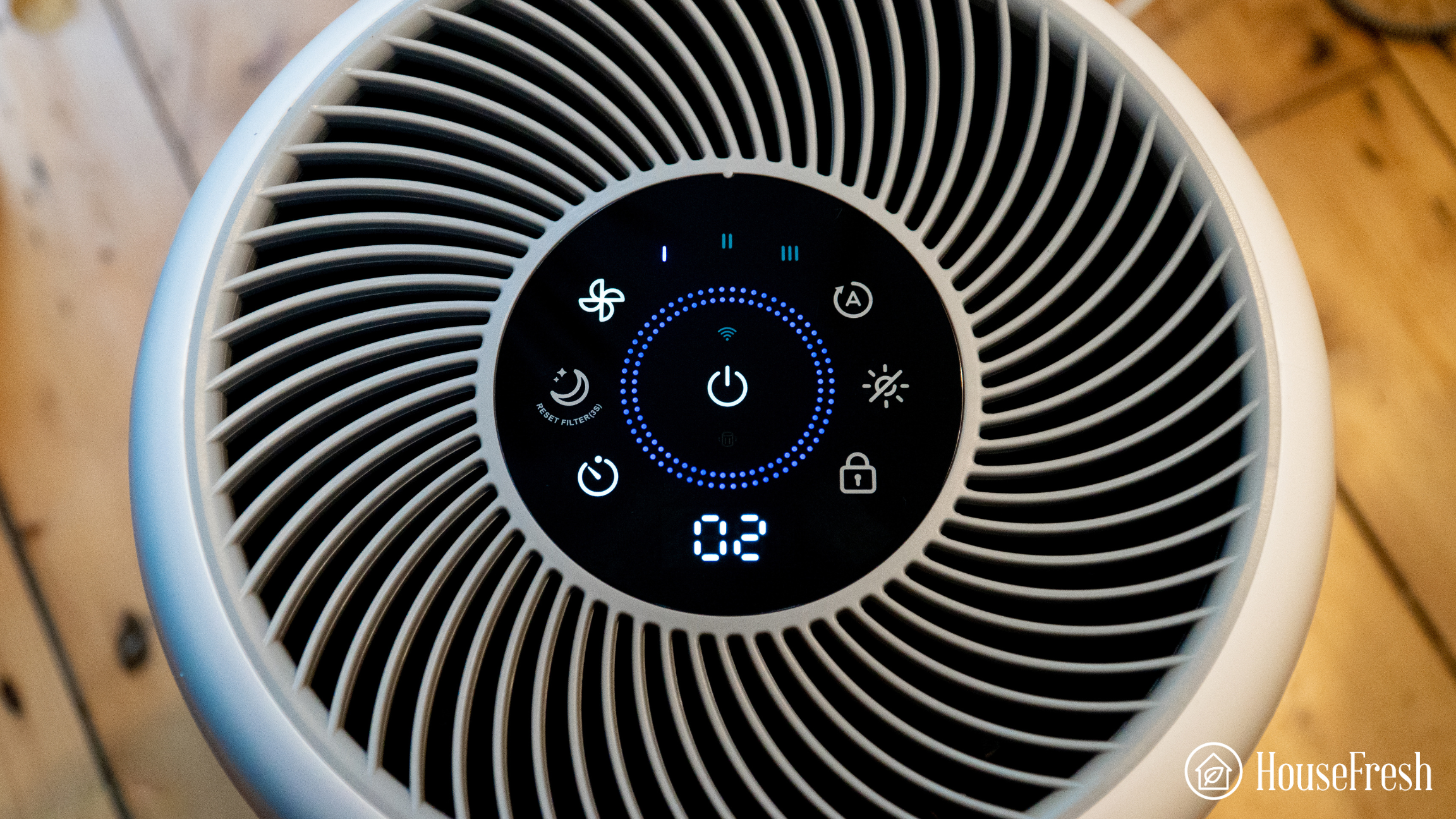
Let me explain. On the Core 300 control panel, you’ll see the wheel of self-explanatory icons: the on/off button, a fan button to navigate through three different fan speeds, a lock button that will come in handy for those placing the unit in kids’ rooms, a filter replacement light that will turn red when it needs replacement, a timer to set the unit to run for 2, 4, 6 or 8 hours, a sleep mode that lowers the fan to the minimum, and a lights-off button that will be a blessing for those who use this unit in the bedroom.
With no smart features onboard, such as app support or auto mode, the Core 300 is not a unit for technophiles. It’s ideal for those seeking a simple air purifier with an uncomplicated setup and straightforward controls.
It does come with a built-in memory, so if you unplug the unit to move it to another room, it will remember your last setting as soon as you plug it back in. This may seem trivial, but it’s actually quite helpful, and many brands have been cutting down on costs to make more accessible yet powerful units; the memory is something we’ve often seen removed.
Plus, there’s no worrying about opaque data sharing consents, which is not just an issue with Vesync’s app. Most apps have never-ending privacy policies many of us never read and usually request access to our phone camera or location. However, we’re often unaware of the many ways big companies use that information.
A comprehensive three-stage filtration system
An ideal filter for everyday air pollutants.
💡exclusive code for HouseFresh for 10% off a single purchase on Levoit.com: HOUSE10
Since 2023, Levoit decided to remove all mentions of HEPA filters from the marketing materials for many of their air purifiers, including the Core series and the EverestAir. While other units, such as the Vital 100S and 200S, are advertised as featuring HEPA filters, we haven’t seen any third-party testing yet.
Despite this issue, which can no doubt create distrust in the brand and the filter’s efficiency, at HouseFresh, we believe in hands-on testing. And our results show that the Core 300 filter performs really well.
I’ll get to the cleaning efficiency in a bit, but for now, let me say the filter features all three stages that make a robust filtration system:
A pre-filter for larger particles. It’s the outer nylon layer that traps hair, fibers, dust and lint. The pre-filter is not removable like in other Levoit units, but it can be vacuumed to extend the primary filter’s life.
A main filter. The dense fiber maze is designed to capture airborne fine particles such as pollen, dust, mold spores, dander and other microscopic pollutants or allergens.
An activated carbon filter with granular activated carbon —a nice detail compared to other impregnated fabric carbon filters. The charcoal traps VOCs and odors on its surface by adsorption (similar but not entirely the same as absorption), so the higher amount of carbon a filter has, the more gasses and odors it will be able to adsorb.
Tip
There are four genuine Levoit filters to choose from, the main difference being the amount of carbon. The Original filter contains between 40 and 50 grams, while the Pet Allergy, Toxin Absorber and Smoke Remover filters have 90 grams. These also come with Levoit’s ARC Formula, which breaks down particles to make the activated carbon last longer.
But it’s worth noting that this amount of charcoal won’t be enough if you have severe issues with toxic gasses or fumes.
Replacing the filter on the Core 300 is easy to do
The access to the filter compartment is at the bottom of the unit. The lid can be opened by twisting counterclockwise and closed clockwise. In three easy steps, the Core 300 will be ready to start cleaning the air again:
Unscroll the bottom cover of the device.
Remove the old (and dusty) filter; have a bag ready to dispose of it with minimal particles reentering your home.
Place the new one in its place and then put the cap back on.
Or else, see how easily it is done in this video:
Removing the filter from the unit is fairly easy, and it can be done in three simple steps:
Tip
All new air purifiers come with their filters packed in plastic wrapping. This is common practice in the industry to ensure filters are not already doing their work while inside the box.
If this is your first air purifier, you may not know about the wrapping and plan to plug and run it right away. So here’s a friendly heads-up: remember to remove the filter’s wrapping before turning on your new Core 300.
The Core 300 cleared our test room in 54 minutes with an estimate PM1 CADR of 109 cfm
This is actually pretty good for a small-to-mid-ranged air purifier released in 2019 and selling for under $100 but is starting to show its age.
How we test air purifiers
Read our full testing methodology.
The Core 300 has a CADR (clean air delivery rate) of 140 CFM for smoke, 141 CFM for dust and 145 CFM for pollen, according to the Energy Star profile.
While it’s becoming common practice to have third-party testing —and it’s actually reassuring, especially after Levoit’s HEPA / not HEPA filters issue— we still carry out our own first-hand evaluation process.
We tested all the units in the same 728-cubic-foot office so we could evaluate each air purifier’s cleaning performance and speed and compare results across all units.
With the help of our PurpleAir sensors, we measured how long it took the Core 300 to remove all the PM1.0ug/m3, PM2.5ug/m3 and PM10.0 ug/m3 produced by incense smoke.
The results speak for themselves:
According to our Purpleair Zen sensor it took 54 minutes to remove all particulate matter from our test room, the Core 300 is 38 minutes quicker than the much more expensive Dyson HP04 Pure Hot + Cool ($529.99) and you do get around 17% higher CADR with the pricier 300S 45 minutes to clean our test room of all PM1.
Air Purifier
Air Cleaning Performance FULL POWER (in minutes w/ PA Zen)
It’s only fair to say that there are newer units for small or mid-sized rooms that can clean the air faster. While the Core 300 is cheap, usually less than $100, most consumers are better off with some of the newer models like the 300S and 200S for improved performance and access to features like auto-mode and onboard air quality sensors.
Noise levels test results
Whether you work from home or are shopping for an air purifier for your bedroom or study room, noise levels are essential data to consider. All air purifiers produce some noise; engineering hasn’t evolved to create completely silent fans and motors. We’ll probably get there sooner or later, but for now, knowing beforehand how loud a unit can be will help avoid unpleasant surprises.
That’s why this is the final step of our testing process, we measure every unit’s decibel (dB) output at the lowest and highest fan speeds.
It is worth clarifying that we do this in a home environment and not a lab, so our measurements might be louder than the manufacturer’s because our noise level meter will pick up the hum of a fridge or a boiler in the background. We do this because we want to test how noisy air purifiers will be when used in the average home, aggregated on top of common household noise levels.
The Core 300 noise levels fall below the average decibels, emitting 37.1 dB in its most silent mode (sleep mode) and topping at 50.2 dB. For reference, Levoit’s marketing materials state 24 dB at the Core 300 lowest fan speed and 50dB at its highest fan speed.
Fan speed
HouseFresh noise level measurements
Levoit marketing materials
Speed 1
37.1 dBA
24 dBA
Speed 2
40.5 dBA
Top Speed
50.2 dBA
50 dBA
This is how the noise levels emitted by the Core 300 compare to other units:
The Blueair 411+ tops the list as one of the quietest units we’ve tested, thanks to Blueair’s trademark HEPAsilent technology that combines mechanical (HEPA) filtration and ionization (electrically charging pollutants to make them weigh more and become easier to trap by the HEPA filter).
While the Core 300 is louder, its filtration system is purely mechanical, with zero chemical by-products entering your space. It’s barely noticeable in speed 1 (37.1B), and I got used to the noise level of speed one pretty quickly and forgot it was running. If you live in a location with very low background noise, it might be more noticeable.
It’s worth noting, though, that you’ll probably be running a small unit like this at the second or highest fan speed to ensure it cleans the air in your space, even if it’s a small room.
At speed two, we ran another performance test and accounted for natural ventilation of our test room to calculate a Usable CADR where the sound levels are sub 45dBA at 3 feet away.
The Levoit Core 300 is now looking a little old compared to the newer, similar-priced models from Levoit, like the Core 200S and Vital 100S, which both have better performance at usable sound levels.
I do like that Levoit has managed to keep the highest sound level at 50.2dB level as above this level is when it can become a problem and irritate those around when in use.
But when it comes to sounds, words usually fall short. That’s why we recorded this video, allowing you to hear the Core 300 at all its speeds.
The cost to run a Levoit Core 300: $109.14 per year
Even if it’s not the most energy-efficient air purifier, its annual costs are considerably low — a true reflection of the key selling point of the Core 300: a budget-friendly unit.
1. Electricity costs = $54.15 per year
Understanding the annual operating cost of an air purifier can be a deciding factor in narrowing down your preselection. We understand energy costs are not something to take lightly, especially when these are on the rise worldwide.
We tested the wattage energy usage for the Levoit Core 300 at all fan speeds and recorded the experiment so you can see the results for yourself:
Fan speed
HouseFresh energy usage measurements
Standby
0.1 watts
Speed 1
19.7 watts
Speed 2
24 watts
Speed 3 [Top speed]
35.5 watts
Besides, ideally, an air purifier should run continuously to achieve true, clean air. That being said, the Levoit Core 300 pulls 35.5 watts at maximum power. In more understandable terms, that means $54.15 per year or $0.14 a day. You’ll unlikely run the unit at top fan speed 24/7, but it’s good to know the priceiest it can get.
However, compared to other Levoit units, the Core 300 is not the most energy-efficient. With the Core 300S, the manufacturer managed to reduce energy consumption to only 22 watts, while the 400S pulls no more than 38 watts, both at their highest fan speed. While the initial price on these two units is higher, it’s worth noting they are less power-hungry.
2. Filter costs = $54.99 per year
The second fixed cost to consider is the filters, which, in the case of the Core 300, are replaced every six to eight months, but we will use 6 months as this is a fairly small unit.
Regarding filters, Levoit realized that if they wanted to keep leading the budget air purifiers game, they needed to lower the costs. The first genuine replacement filters we got for the Core 300 cost $60; now, you can find the original filter for $29.99 per filter with deals on buying 2 at once that bring it to $54.99
We were also pleased to see that you can find two generic filters for just $29.99. Considering that the Levoit Core 300 does not have approved HEPA, I see no reason why you shouldn’t save money and go with generics as it brings the running costs down significantly.
These yearly running costs compare well with other small air purifiers:
Model
Yearly Cost
Levoit Core 200S
$82.46
Levoit Core 300
$109.14
Winix A230
$95.1
Okaysou AirMax 10L
$166.13
Molekule Air Mini
$244.10
We tested the Pureburg generic filters that were available for $24 for two filters in our test room and found they slowed air cleaning performance a little but did use pelleted activated carbon like the OEM filters.
The main differences between the Core 300 and the Core 300S
Although quite similar in appearance, the Core 300S has the upper hand in terms of smart features.
In 2021, Levoit released the Core 300S, an improved and Smart version of the Core 300. On the outside, both units look exactly alike, and they even use the same filters. However, there are some differences worth considering.
1. Performance
If you’ve read my review up at this point, you will know that the Levoit Core 300 took 9 minutes longer to complete our air cleaning performance test, but I’ll say it again in case you just skipped to this section.
2. Auto mode
The Core 300S incorporates air quality sensors that enable the auto mode, a feature loved by many.
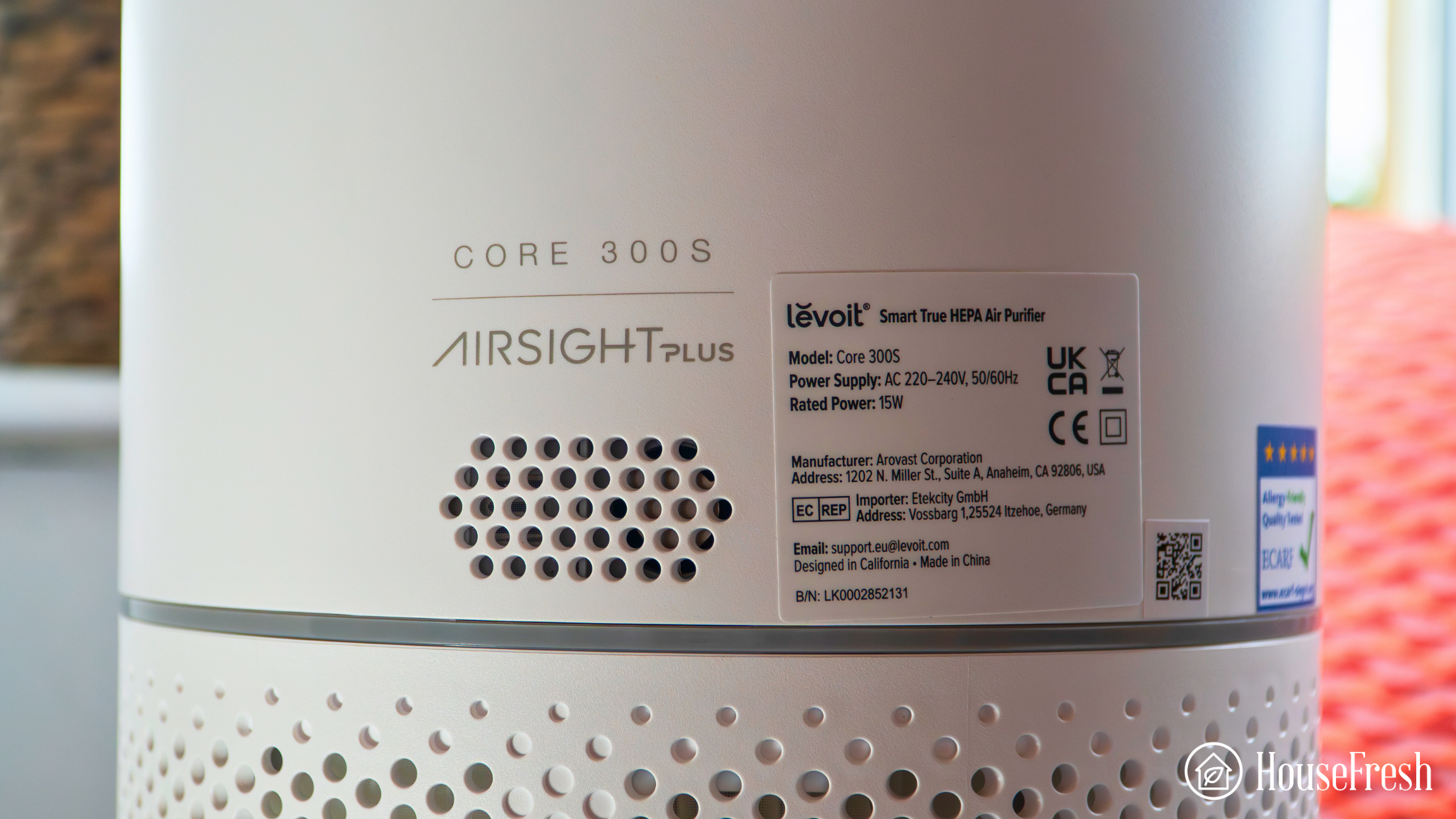
The AirSight™ Plus sensors monitor the air in the environment, scanning for particulate matter. When the auto mode is on, the unit will adjust the fan speed according to the pollutants in your space, ramping up when the air is worse and conserving energy when it’s cleaner.
The sensor also powers the real-time air quality readings in the control panel. Levoit integrated these smoothly without complicating the user-friendly display with an LED color-scaled wheel, which changes color depending on the air quality of the room. The 300S also uses a laser air quality sensor that is is more accurate than most other small air purifiers that either use gas sensors or cheaper infared sensors that are a little slower to detect and also require regulary cleaning every few months.
The air quality readings are also uploaded and synced with Levoit’s VeSync app, which is the next item on this list.
2. Internet connectivity and app support
While the Core 300 doesn’t include smart features, the user-friendly and comprehensive Vesync app enhances the usability of the Core 300S.
Some useful functions include tracking your home air quality and filter lifespan from wherever you are, navigating through mode settings and fan speed and connecting the unit to Google Home, Alexa and Apple Home.
3. Energy costs
To me, this is one of the most significant strengths the Core 300S has when compared to the Core 300. The Levoit team managed a great efficiency improvement achieving a max draw of 21.8 watts at top speed for the Smart unit. It reduces the yearly cost of running the Core 300S to $33.25 — a whole 40% vs the Core 300.
4. Initial price
Smart features and optimized energy costs do come at a cost. There’s a $50 cost difference between the two models —and so it’s been since the launch of the Core 300S. This may be too pricey for some while, but for others, it will make perfect sense to pay the difference upfront.
Tip
Each unit has clear pros and cons. If you would like to probe deeper into these two units’ comparison, read on in our Levoit Core 300 VS Core 300S review.
Bottom line
Looking a little old compared to the latest and greatest from Levoit
There are many things to like about the Core 300; It was the first “small” air purifier with enough power to be useful. It’s now looking a little old compared to the newer models on the market.
💡exclusive code for HouseFresh for 10% off a single purchase on Levoit.com: HOUSE10
The sleek control panel is straightforward and easy to navigate. Plus, maintenance is minimal, only requiring a filter replacement twice a year (although you can go the extra mile to keep the unit in top shape).
Many years after its release, the Levoit Core 300 was still a great option. Still, as of 2025 I have to suggest you look at the newer models from Levoit and Winix that offer better performance for the money, including the Core 300S (its younger sibling), Core 200S and the Winix A230/Compact Zero.
If budget is not an issue, you might also want to consider upgrading to the Levoit Vital 200S or Core 400S; for less than $200, you will get a CADR of 245 CFM and a much higher amount of pelleted activated carbon. The 400S even comes with a laser air quality sensor.
SOURCES
We calculated yearly costs associated with running the Levoit Core 300 24 hours a day, 365 days per year utilizing the latest average energy prices as reported by the Bureau of Labor Statistics of $0.174/kWh as of May 2024.
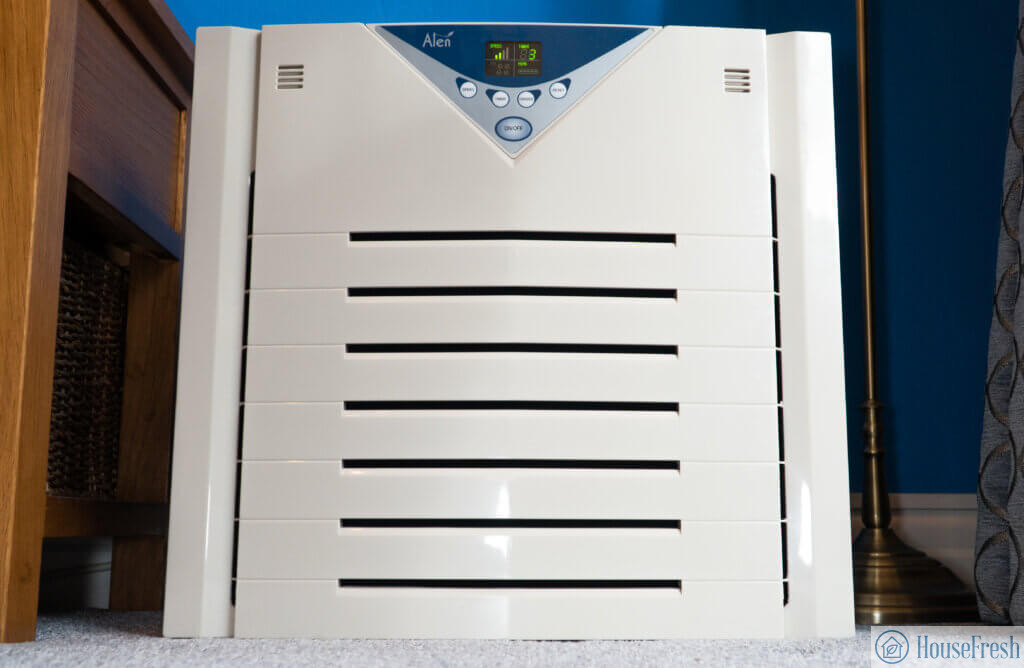
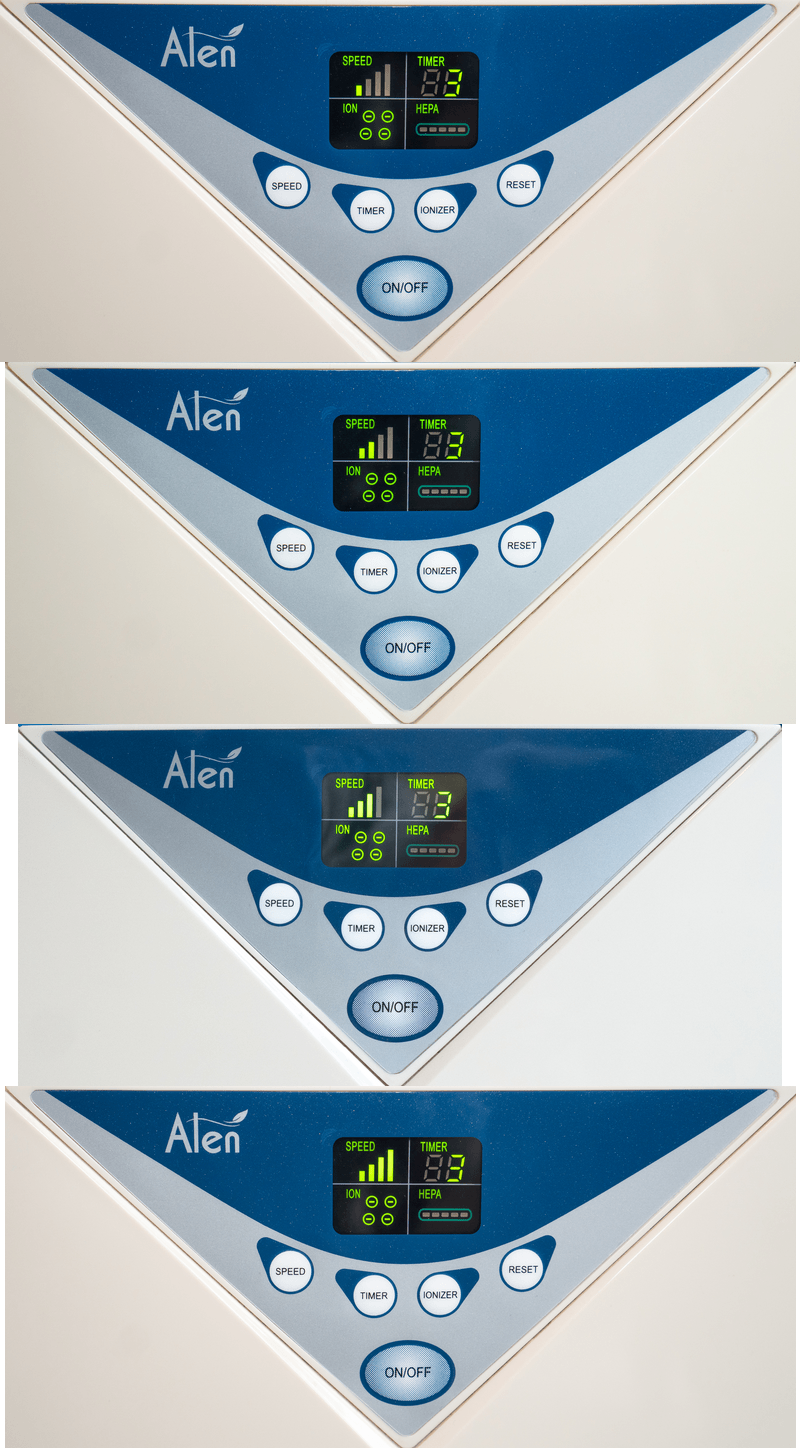
The Alen A350 managed to clean our test room of 700ft in 35 minutes which is better than the recent Levoit Core 300, which is an air purifier that we recommend and which cleaned the same room in 49 minutes.
Performance:
The downside of the A350 is its power consumption at a whopping 86.7 watts, which is equal to $133.67 a year in California’s electricity costs. Compare that to the far more powerful Levoit Core 400S that has 24.5watts at full power which would only cost residents of California $37 for the year it’s hard to recommend buying an Alen A350 but if you got one still in operation you don’t mind the extra costs of energy to save more plastic being thrown away then you might be tempted to keep it running.
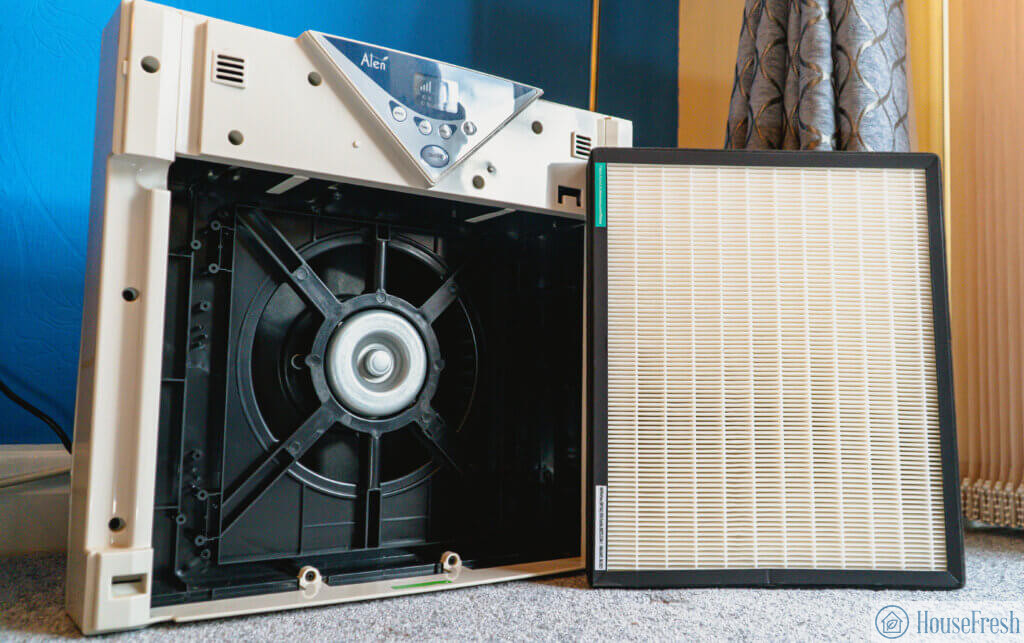
The Alen A350 was an air purifier that was first sold in 2010, if you already have one of these units then congrats on keeping your unit running for 10 years. You will also be happy to know that you can still buy filters for these units:
Silver-Ion Technology protects the filter against growth of harmful bacteria and microbes
Creates an allergy and asthma friendly environment by removing dust, pet dander, mold spores and pollen from the air
Provides pure, breathable air by capturing VOCs (Volatile Organic Compounds) from cleaning products, personal care items and other household materials
Pre-Filter layer extends the life of the filter
Our standard medical-grade H13 True HEPA air filter offers outstanding protection by removing 99.9% of dust, allergens, and harmful fine pollutants as small as 0.1 microns. Every 30 minutes, our product can purify your home or office air depending on the model of Alen air purifier.
Sadly the Alen A350 is no longer for sale but there are several new Alen units that you might be in interested in that have a similar specifications:
HEPA Pure Filter: Eliminates 99.9% of allergens and pollutants as small as 0.1 micron so you can breathe easy. Ideal for allergy, asthma, and virus concerns.
Proven by SleepScore Labs to enhance sleep according to a peer study. Its ultra-quiet operation emits pink noise, optimizing lower octave frequencies, and ensuring a restful night.
The BreatheSmart 45i quietly and efficiently circulates air up to 1600 sq. ft. every hour. Perfect for large bedrooms, living rooms, and dining rooms ensuring clean, fresh air throughout your space.
Alen air purifiers offer superior performance through the combination of a powerful fan, quiet motor, and advanced filtration. Medical-grade filters capture particles as small as 0.1 micron.
SmartSensor technology adjusts fan speed based on air quality, with color-coded feedback. Monitor air purity easily with this home essential.
With a CADR rating of 245, the Breathsmart 45i would be the A350 for the modern era. This unit comes with the same Alen lifetime guarantee so you can expect this air purifier to keep performing beyond 2030!
COMPACT AND MIGHTY: Experience powerful air purification with the Alen T500 Air Purifier, designed to clean 500 SqFt every 30 minutes. Its compact size makes it a perfect fit for small bedrooms, walk-in closets, dens, nurseries, home offices, and utility rooms. Breathe fresh air without compromising on space or performance.
FRESH HEPA Air Filter: Breathe cleaner air with the Alen Air Purifier's high-quality HEPA filter. This advanced filter captures allergens, dust, mold, and germs, plus carbon to absorb common household odors, ensuring a healthier and safer environment for you and your loved ones.
MEDICAL-GRADE H-13 TRUE HEPA FILTER: Discover the exceptional power of our medical-grade H-13 True HEPA filter within your home. Our filter has an impressive 99.9% elimination rate of airborne particles as small as 0.1 micron, this technology guarantees clean and fresh air throughout your space. Take control of your indoor air quality and create a safe haven for your family.
EXTENDED FILTER LIFE: Say goodbye to frequent filter replacements. The Alen Air Purifier offers the convenience of extended filter life, lasting between 6 to 12 months. Enjoy continuous and hassle-free air purification without the worry of constantly replacing filters. Experience the freedom of clean air, day in and day out.
IDEAL FOR GIFTING: Show your loved ones you care by gifting them the Alen T500 Air Purifier, a versatile and essential addition to any home. Perfect housewarming gift for a new home, this purifier effectively removes allergens and impurities from the air, promoting a clean and fresh living environment. Its sleek design adds elegance while improving indoor air quality, making it a valuable household essential.
This unit is a little cheaper but still has a CADR rating for dust of 159 so less powerful than the A350 but can often be found for less than $250 so it is significantly cheaper. This is a low-priced unit but still comes with the Alen lifetime guarantee. This unit comes with the H13 which are the same filters used for medical-grade air purifiers.
The following article is our original review of the Alen A350 Air Purifier from 2010:
Before we start to dig deep into the pros and cons of this particular purifier. It’s worth having a look at what consumers at the major retailers think of this purifier. Most large internet retailers allow consumers the ability to provide a rating for their purchase. I use this rating as an initial way to quickly gauge the performance of an air purifier.
In recent assessments by air-purifiers-america.com this A-350 eliminated 98% of the contaminants in the device and 97% of the contaminants within the room.
The A 350 purifier is great at airborne dirt and dust and plant pollen elimination, yet is also competitively cost-effective costing under $300..
So the projected CADR (for basic comparability to mid priced store-bought models without having chemical substance blocking capability ) is 203.
The manufacturer guarantees 95% of purchases will be delivered within Twenty-four hours, and also features a straightforward return policy.
Problems:
Significant gas and smell elimination is really a necessity if health benefits can be envisioned: Models with actual carbon VOC ability position higher.
Alen A350 air purifier sound amounts will be over normal: 36 decibels(A)on low setting, 65 decibels(A)@214cfm on highest setting. 65 decibels(A) isn’t the loudest, but 214cfm is fairly weak for that amount of noise.
The organization doesn’t sell direct, yet drop ships air cleaners marketed by merchants.
Provides some reservations that the A350 should only be used in smaller rooms.
Benefits:
Highlights that this particular purifier can be mounted on the wall
States that the replacement filters are relatively cheap
Mentions that the A350 comes with a Lifetime warranty
Problems:
Talks about how come, consumers, mention that the power supply causes a “humming” sound
Indicates that this air purifier should only be used in smaller rooms
CADR Results:
Sadly the A350 has not undergone a CADR test so we can not provide these results for this test. Thankfully Ed at air-purifier-power has worked out that this purifier has a similar ranking to a CADR ranking of 203.
The Alen A350, therefore, has an estimated score of:203 CADR Ranking
Technology Used:
1.HEPA Filter
The Alen A350 uses one combined HEPA, carbon, and pre-filter in one unit. The only issue this raises is the price as the purifier requires this combined filter to be changed every six months. Currently, you can purchase the A350 filters on amazon.com for $49.99 which is not too bad but bear in mind that you will need to replace these twice each year – so it’s $100 per year. If I compare this with other purifiers that use Lifetime HEPA such as the Honeywell 50250-N, the A350 is considerably more costly to run.
2. Ionizer Function
One of the nice benefits of the Alen A350 is that it comes packaged with an inbuilt non-ozone ionizer unit. Normally I would suggest that people steer clear of ionizer-only units but when combined with a strong HEPA filter it can help improve cleaning efficiency. The ionizer unit will charge the surrounding particles with a negative charge which means that these particles are heavier and thus picked up more easily by the HEPA filter. Negative ions have also been shown to imbue of sense of well-being but this still has not been confirmed by scientific studies. If you are not sure about the ionizer then you can easily disable the function using the on-off switch at the top of the unit.
Power Consumption
The A350 has an Energy Star Rating but compared to modern air purifiers it’s uses a lot of electricity with a maximum of 86.7 watts.
Addressing the Sound Problem
Some reviews have mentioned that the A350 has a whining sound when running. In tests, we came across no such noise and believe that this whining sound was down to broken air purifiers. On the highest setting, the A350 creates a noise level of 65 dB, which is relatively loud. In the video below I show the Alen a350 working at each different sound level so you can evaluate if it’s too loud for your home.
While the purifier is loud at the level 5 setting, it’s unlikely that you would need to leave it at this level for much time. I am quite happy with the sound output at the lowest level and so I would not find a problem sleeping with it running in my bedroom.
Performance Test
To test the A350’s performance, we set it up in our HouseFresh testing room.
We use this 705 cubic ft bedroom to test all our air purifiers to ensure it is done fairly, in the same conditions for a more accurate comparison.
To create pollution, we use incense sticks which contaminate the room with large amounts of pollutants. When the room is sufficiently polluted, we turned the Alen on at full fan power and left it to see how long it took to clear it of contaminants.
As with all our performance tests, we used the Purple Air Indoor sensor to track the number of small particles down to 1ug in the room, in real-time, allowing us to view the data on a graph.
Here’s what we found:
The highest point on the graph is where pollutants from the incense reach their maximum contamination.
As you can see from the sharp drop, the A350 goes straight to work on the larger particles in the room, while dealing with the smaller ones at a slightly slower pace.
The A350 cleared the room of contaminants in 35 minutes. Even though this unit is no longer sold, it holds its own against the newer, more modern units on the market.
Conclusion
This purifier provides a significant amount of cleaning for a small price of just under $400. It can be used in medium-sized rooms (400 square feet recommended) and can successfully remove all types of particles. My only issue with this purifier is the cost of replacement filters ($100 annually) and the lack of VOC capabilities.
When comparing with other purifiers, you should make sure that you take into account the $100 a year cost, as some Lifetime HEPA filters will work out far cheaper in the long run and may outweigh the initial extra cost.
The Alen A350 air purifier is currently the highest-rated purifier in my medium range ($200-$700), and I give it a 5-star rating.