Crawl spaces are easy to ignore. Without the utility of a basement, they’re often literally “out of sight, out of mind” for homeowners unless there’s an obvious problem. But if you want to protect your home from trouble down the road, there’s one aspect of your crawl space you should pay close attention to: Its humidity levels.
High humidity in a crawl space can result in problems like
Mold
Dry rot in floor joists
Foundation damage
Pests like cockroaches
To avoid these problems, your crawl space should consistently have humidity below 60% and above 30%. About 55% relative humidity is ideal in most cases.
5 tips for keeping your crawl space dry
Humidity can be a challenge in your crawl space because there are many factors that contribute to higher levels of water vapor in the air. There are several ways to combat the problem.
1. Install a vapor barrier
One of the easiest ways to reduce crawl space humidity is to install a vapor barrier (a plastic sheet that lays over the ground) blocking moisture from rising up.
A sump pump is a pumping system utilizing a shallow pit where water collects until it reaches a prescribed level and is pumped out, preventing water levels from rising above the ground.
A qualified plumbing professional can install a sump system in less than a day.
3. Use a dehumidifier or fan
Humidity in a crawl space can be the result of overall climate conditions. A high-quality dehumidifier rated for the size of your crawl space can keep humidity levels lower via continuous operation.
Crawl spaces can be vented for passive air exchange or non-vented; older homes tend to have vented crawl spaces. Venting a crawl space can reduce humidity if the humidity levels outside are low, but can have the opposite effect in very humid climates. If your home is located in a very humid area, closing the vents and sealing off other openings can be effective at reducing humidity levels.
Tip
Consider encapsulating a crawl space.
If you want to seal off your crawl space from exterior humidity, consider encapsulating it. This is an augmented form of vapor barrier that seals the space off entirely, keeping outside air (and pests) from infiltrating.
5. Check the grade and gutters
A properly designed home will divert water away from the foundation when it rains, but clogged gutters and incorrect grading of the ground around a house may be allowing water to pool near the home. Cleaning out the gutters and inspecting the drainage around the home can help prevent water from entering the crawl space.
Uncovering the source of water in your crawl space
Knowing where the moisture is coming from in the first place will help you choose a strategy to battle humidity in a crawl space.
Most humidity issues in a crawl space can be traced to some common causes:
Plumbing leaks. If you notice water puddling in your crawl space under pipes, inspect them for leaks. These are most commonly found at connections where two or more pipes meet.
Groundwater or runoff. If the water table under your house rises, the dirt can become saturated, raising overall humidity levels. A sump pump can help dry out the ground.
Condensation. High humidity in your crawlspace causes water vapor to condense on colder surfaces, like ductwork or pipes. This water then drips down onto the floor.
Infiltration. If water pools against your house after rainfall, it can seep through the foundation walls and leak into your crawlspace. Inspecting and repairing gutters and re-grading landscaping can alleviate this.
Common questions about crawl space humidity
Crawl spaces can be claustrophobic, mysterious places filled with dirt and spiderwebs. Many homeowners don’t know much about what’s normal in a crawl space. In this section, I will try to answer some of the most frequently asked questions about crawl space humidity.
Your crawl space should be dry. A well-maintained crawl space will have no standing water, no condensation issues, and moderate humidity levels. Any spikes in humidity or signs of standing water should be investigated and dealt with immediately.
The ideal humidity level for a crawl space is about 55%. The acceptable range is between 30% and 60%. Crawl space humidity can also be too low; levels below 30% can lead to wood shrinkage, which can also damage your home.
If your crawl space is experiencing higher-than-normal humidity due to a specific event—a plumbing leak or local flooding, for example—it may dry out over time. Most humidity issues in crawl spaces will require more direct interventions to rectify the source of the moisture.
Absolutely. A damp crawlspace is an ideal breeding ground for mold, and easily transmits mold spores to the living areas of the home. Mold can cause a wide range of negative health issues, including allergic reactions, upper respiratory issues, fever, and possibly more severe conditions. If your crawl space is damp, it’s imperative that you locate the source of the moisture and make repairs and changes as needed to reduce the humidity.
Final thoughts
It’s easy to ignore your crawl space if there are no overt problems. But even something as seemingly minor as high or low humidity in the space below your main floor can have a devastating effect on your property and even your health. Monitor the humidity levels in your crawl space regularly, and take action to repair leaks and reduce those levels as needed.
A quick rule of thumb is that the closer the dew point is to the temperature of the air, the more likely the air will feel humid. However, the air temperature will affect your perception of humidity, so you may not always feel uncomfortable.
This handy table shows what dew point temperatures will likely make you uncomfortable:
Dew point
How it feels
40°
Nice summer day
50°
Comfortable
60°
Uncomfortable
75°
Unbearable
That’s it, nice and simple. But the question is, ‘Why?‘
Why am I talking about dew point when you clicked on an article about humidity? Shouldn’t I be writing about relative humidity levels?
Your confusion is totally justified, given that relative humidity is the metric that weather reporters use to forecast rain, fog, frost and what temperature will “feel like“.
To understand the table above, you need to learn more about the relationship between air, water and temperature, and how this relationship affects our experience of humidity.
Understanding the relationship between air, water and temperature
When the air is hot, it expands and rises. When the air is cold, it gets denser (contracts) and sinks. This change in temperature affects the air’s ability to hold water vapor.
Air can hold twice the amount of water vapor at higher temperatures (say 70°F or 21°C) than at lower temperatures (say 50°F or 10°C).
This is where the term relative humidity comes into play. Relative humidity quantifies the amount of water vapor present in the air compared to the maximum amount that the air can hold at the same temperature.
When relative humidity reaches 100%, that means that the air is holding as much water as it can at the current temperature. When this happens, the air becomes saturated with water.
Now, here is where temperaturecan make a big difference:
When saturated air warms up, it can hold more water, which makes relative humidity drop — that’s the reason why your dryer uses warm air to absorb moisture in your clothes.
When saturated air cools down, condensation happens as the air forces water out because it can’t hold it anymore — that’s the reason why your glass of cold iced tea leaves water rings on the table, as the moisture from the air condenses on the sides of the glass and this ‘sweat’ drips down to the table.
The dew point is the temperature at which the amount of water vapor in the air exceeds the amount of water vapor the air can hold. This is the point when water starts condensing and forming dew on surfaces below this cooler temperature threshold. It’s worth clarifying that in cases where the dew point is below freezing (32°F or 0°C), the water vapor turns directly into frost (frost point).
The connection between relative humidity (RH) and dew point
You may be used to seeing humidity described as ‘relative humidity’ (RH) in weather reports, but very little is said about ‘dew point’.
Say you watch the weather report for your area, and the reporter says that the RH today will be 50%, but once you leave your house, you are hit with a front of muggy air and within minutes, you feel yourself sweating. The next morning, the forecast says RH will be at 100%, so you head out wearing a t-shirt — because 50% more humidity would surely mean you will be sweating buckets, right? — but when you reach the porch, you realize you’re going to need a coat.
How could this be?
Well, RH is relative to the temperature of the air. What we’re missing from that scenario is what the temperature of the air was on those days.
Relative humidity could be 100% on a day when the temperature is at 86ºF (30ºC) and also on a day with 14ºF (-10ºC). But the reality is that no matter what the RH is at such a low temperature, it’s doubtful that you’ll be sweating and the air will feel muggy. However, if the temperature is 86ºF (30ºC) and the RH is at 60%, it will likely feel humid when the dew point sits at 70ºF (21ºC).
But why do some dew points feel more uncomfortable than others?
At higher dew points, the air around you becomes packed with water vapor, leaving little room for anything else. This inhibits the evaporation of sweat, making it impossible for your body to cool down.
At lower dew points, the lack of humidity in the air can cause skin irritation and cracking. It can also dry out your airways, which can be linked to the spread of certain viruses (such as cold, flu and even COVID-19) because the hair-like organelles outside of cell membranes become less effective at expelling viral particles.
Something to keep in mind is that humidity perception varies from person to person. People who were born in warmer climates (where higher dew points are the norm) will be more comfortable on ‘muggy days’ than those who were born in colder climates.
According to the Environmental Protection Agency, indoor relative humidity (RH) should be kept below 60% — ideally between 30% and 50%.
But as you know, humidity doesn’t function in isolation. Temperature is another important thing to consider.
Remember that at higher temperatures, the air can hold more moisture, which means that keeping your house nice and warm will help control the moisture levels in the air before condensation starts. This, in turn, will help avoid issues such as mold growth and other water-based damages.
Final thoughts
We believe thedew point is the best indicator of how you will feel regarding humidity. If the dew point is high, it will be muggier, and you’ll feel more uncomfortable. RH here is defunct when figuring out how humid the outside air is.
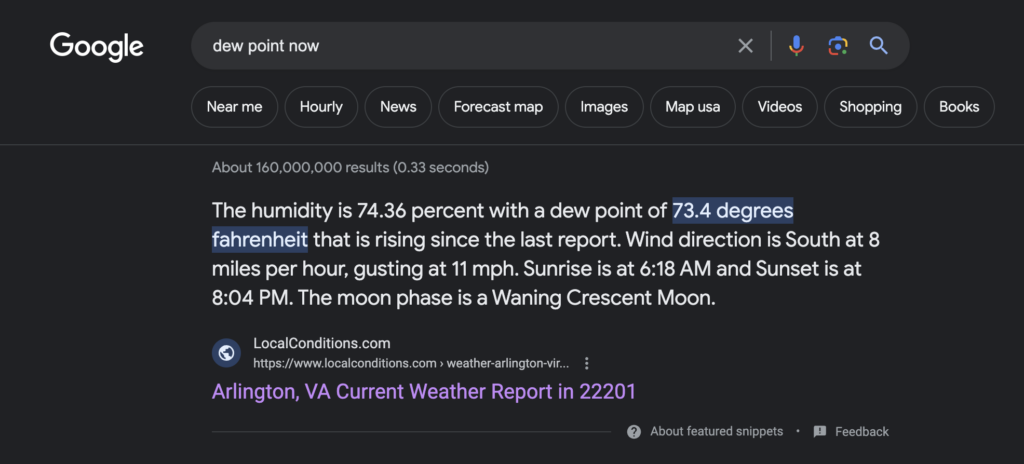
When Googling, try searching for “dew point now” to see the current dew point in your location:
The top hit will likely be https://www.accuweather.com, which has a handy chart telling you the dew point. Alternatively, you could use the dew point calculator found at http://www.dpcalc.org to calculate the dew point yourself based on the weather forecast for the day (you just need to enter the temperature and the RH percentage).
Lastly, if you have issues with either excess moisture or the opposite in your home, consider investing in a dehumidifier or humidifier. These tools can help you to regulate your home’s humidity levels.
Between increased wildfire smoke throughout 2023 and COVID-19, many people want to know how they can at least make the air in their homes purer. Enter the idea of house plants.
Easy to place around, inexpensive to purchase and an immediate uplifting addition to any décor style, it’s easy to see why the belief of house plants cleaning your air would be an appealing one.
Plus, there’s the idea that since they take in carbon and produce oxygen, maybe they’d clean the air in other ways, too. Unfortunately, plants do not clean air, and we’ll explore why.
Why does everyone believe plants clean the air?
It’s a common statement that house plants can clean your air.
The origins of this belief can be traced back to a 1989 NASA study. It looked at using different types of plants to reduce air pollution in combination with a type of carbon filter.
The study did state: “Low-light-requiring house plants, along with activated carbon plant filters, have demonstrated the potential for improving indoor air quality by removing trace organic pollutants from the air in energy-efficient buildings.”
Just by reading that statement, you may be able to see how easy it is to assume house plants can be of some benefit.
The biggest misconceptions of the NASA Clean Air Study
There are a number of problems with taking this study at face value. These include:
1. The study wasn’t for home use
The NASA study looked at improving air breathability in large-scale work settings. Simply placing plants in your home and expecting them to clean the air is an apples-to-oranges situation.
2. It’s an old study
It’s important to reiterate that the NASA experiment was a decades-old study from 1989. A further memo from the U.S. Environmental Protection Agency in 1992 stated that someone would have to put 680 house plants in their home to meet the same results of the NASA study, which happened in a test chamber.
3. The study used carbon filters
That’s right, the study used carbon filters in addition to the plants.
The study went on to state: “Activated carbon filters containing fans have the capacity for rapidly filtering large volumes of polluted air and should be considered an integral part of any plan using house plants for solving indoor air pollution problems.”
In short, even by the measures of this study, placing plants in your home is not the way to magically get perfect, clean air.
4. At best, results are modest
One study only found that house plants had a 0.9 – 9% to indoor ozone removal effectiveness.
5. Other studies outright suggest plants cannot remove VOCs
A literature review in Nature from 2020 discussed how someone would need to place 10-1,000 plants per square meter to equate to the same VOC removal that already happens when outdoor-to-indoor exchange happens in modern buildings.
Another problem with the NASA study is it looked at increasing air quality in old energy-efficient buildings from the 1970s, where air quality was already remarkably poor.
6. It would take genetically modified plants to clean the air
A startup called Neoplants wants to grow genetically modified plants specifically with the purpose of being able to clean harmful chemicals from the air.
6 science-backed benefits of indoor plants (beyond cleaning the air)
None of this means you should throw the fern plant from grandma’s estate out the window. There are very real emotional, mental and health benefits to house plants.
1. House plants may make you healthier
One study suggested that house plants can even improve diastolic blood pressure.
2. House plants can help improve your grades
The same review as above also found that house plants may help with academic achievement. Another study found that adding indoor plants to classrooms helped improve self-reported attention and well-being.
3. The most beautiful house plants create the most well-being
Research found that the more beautiful the plant was to those surveyed, the higher the participants rated their subjective well-being. Some of the most popular plants were bright, leafy specimens like palms, Ficus plants and Epipremnum.
4. Greenery even helped people feel better during lockdown
Another study looked at how house plants or green window views helped students at home during Covid-19. Greenery both indoors and outdoors helped support the mental health of the participants.
5. House plants can improve your mindfulness skills
One study looking at Chinese adults suggested that those who care for indoor house plants reported more mental well-being and had a greater mindfulness trait.
6. You may feel physically better with house plants
In addition to reporting increased positive emotions and less negative feelings, one study found that house plants helped reduce physical discomfort in participants.
Final thoughts
It turns out that, no, house plants are not magical little air purifiers straight from nature. This assumption has its origins in a 1989 NASA study that sought to use house plants in conjunction with carbon filters to clean up the air in 1970s energy-efficient work buildings. That doesn’t mean house plants are useless: they may make us healthier, happier, help with grades, reduce discomfort and even make us more mindful. Yet they’re still not air purifiers.
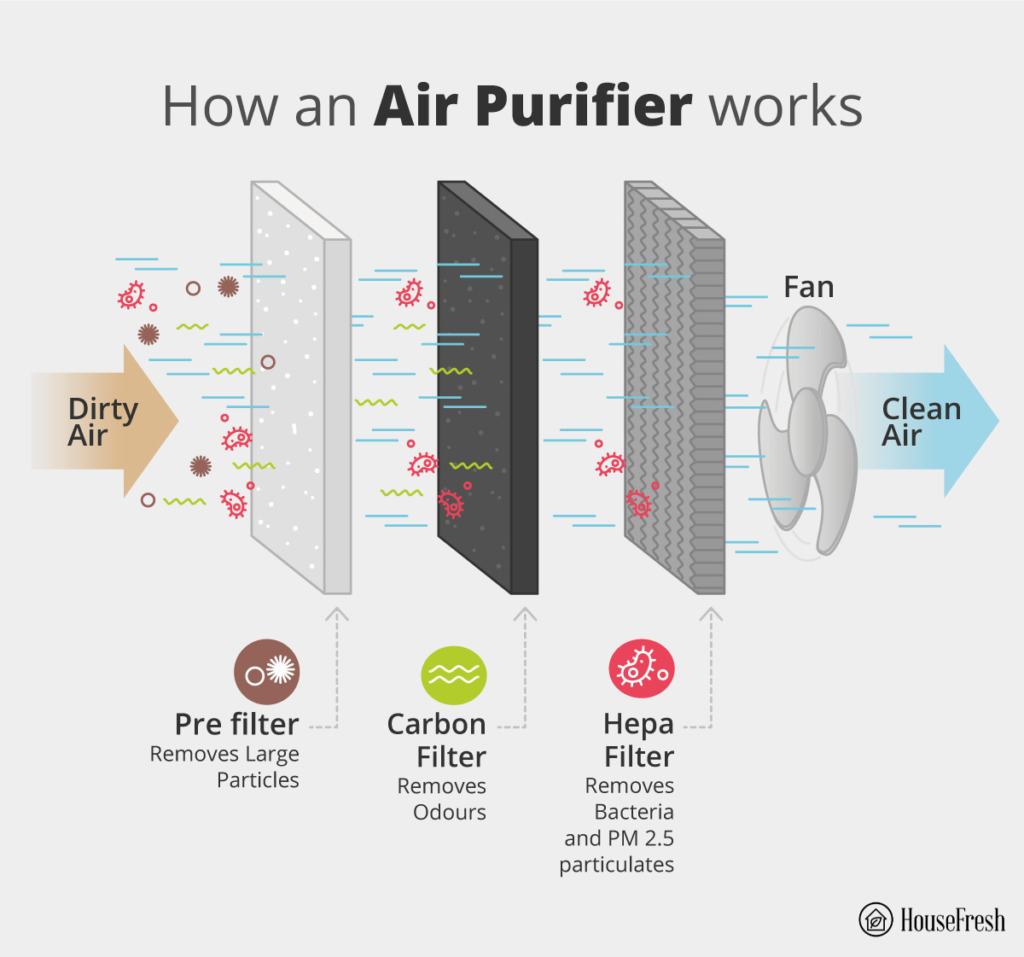
If you want truly clean indoor air, you’ll still need to use a mechanical air purifier. An air purifier works by forcing dirty air through a series of filters to remove large particles like dust, odors and even bacteria and PM 2.5 particulates. You can see the process here:
Levoit is one of the biggest air purifier manufacturers on the market, having sold millions of devices around the world.
The reason why Levoit units are so popular is because they managed to produce low-cost air purifiers with high performance and good quality materials. Knowing this, it’s no surprise why some of the best air purifiers we’ve tested came from Levoit, including the EverestAir, the Core 600S and the Vital 200S.
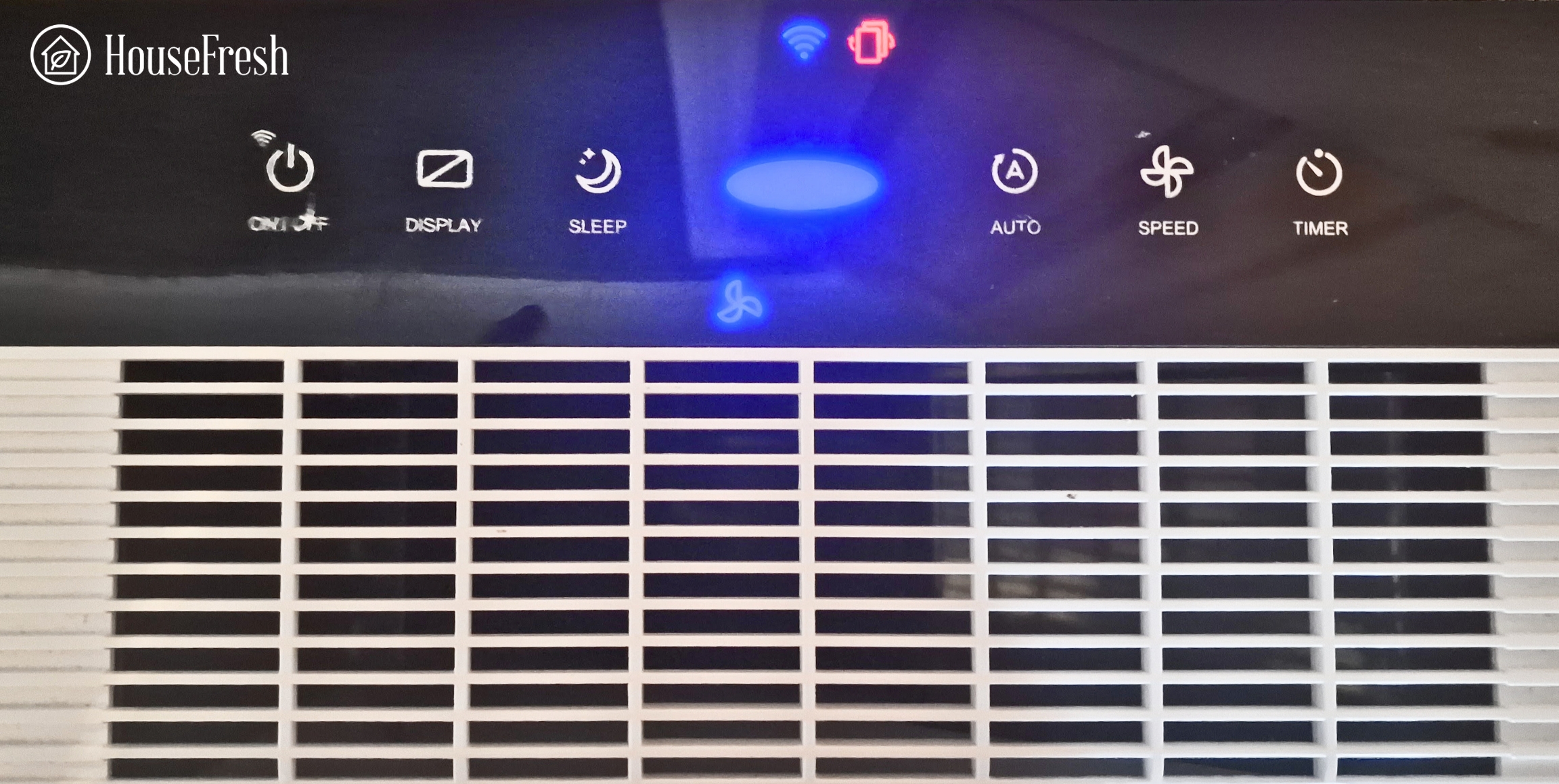
But, like any electrical appliance, issues can sometimes occur. In this article, we’ll look into the dreaded red light you will sometimes find flashing on the control panel of your Levoit.
What does the red light mean in a Levoit unit?
If the red light appears on your Levoit air purifier, you may as well throw it in the trash right now.
Just kidding!
This warning light is not the end of the world. In fact, it’s one of the most common issues Levoit users face, and there is usually a super simple solution.
The most common reason why there might be a red light on your Levoit right now is because the filter has reached the end of its lifespan. As Levoit uses mechanical filters, they will become saturated with particulate matter and, over time, lose efficiency.
However, you may also experience the red light if your filter is broken or incorrectly installed. And I’ve also encountered the red light after installing a new filter due to an internal glitch.
Four steps to fix the Levoit air purifier red light warning
Getting rid of the Levoit red light should be an easy fix. Follow these simple steps to get rid of it:
Step 1: Open the filter compartment
First things first, disconnect your device from the power source.
Once it is safe to proceed, open the filter compartment. The filter compartment will vary between models but is usually located inside the purifier chamber, which you access by twisting the casing or top/bottom of the device. Alternatively, it may be a simple hatch door located at the rear.
Step 2: Remove the filter from the unit
Levoit filters usually need to be replaced every 6-8 months. If you can’t quite remember the last time you changed yours, take a peek inside to check its condition.
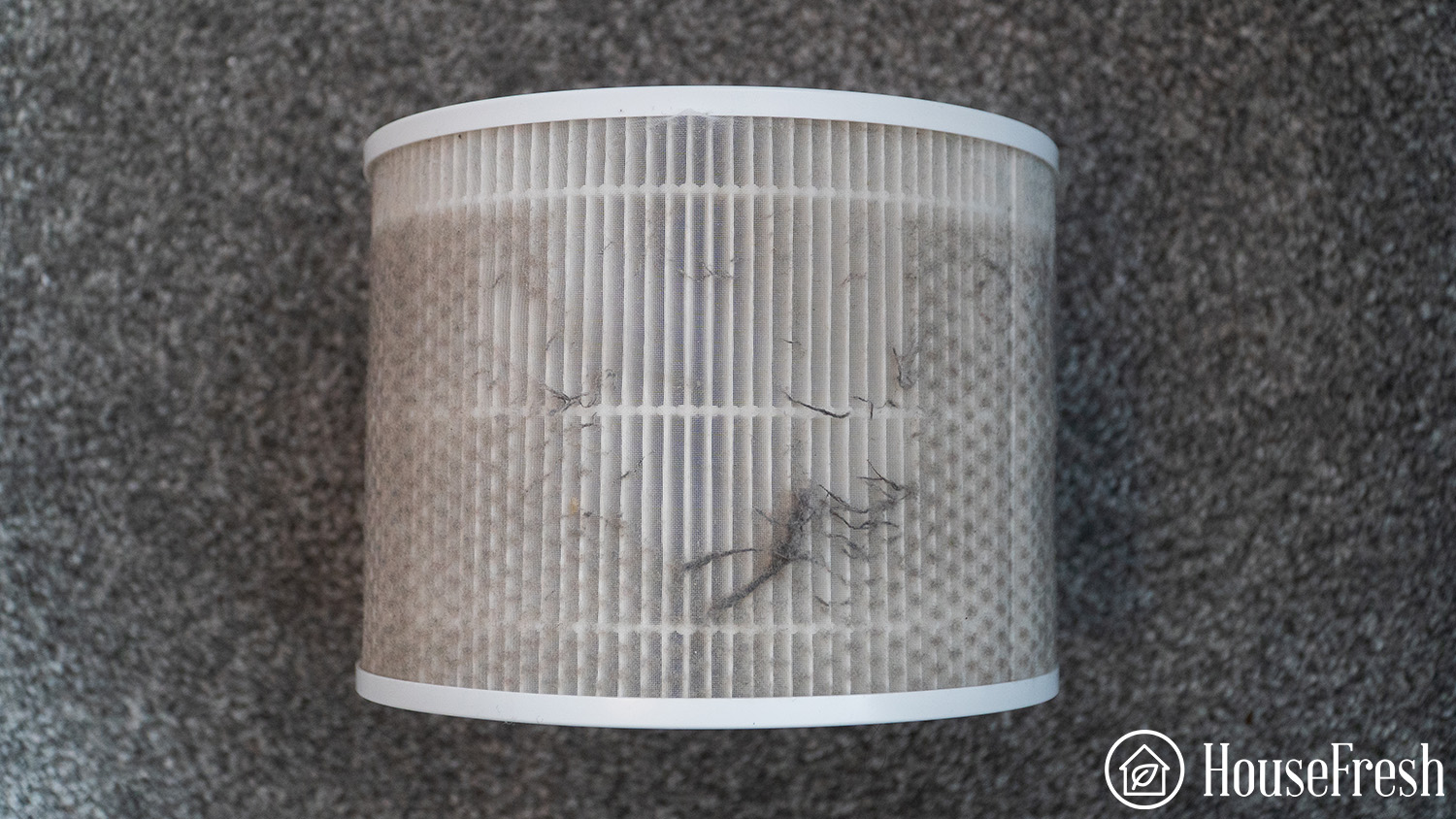
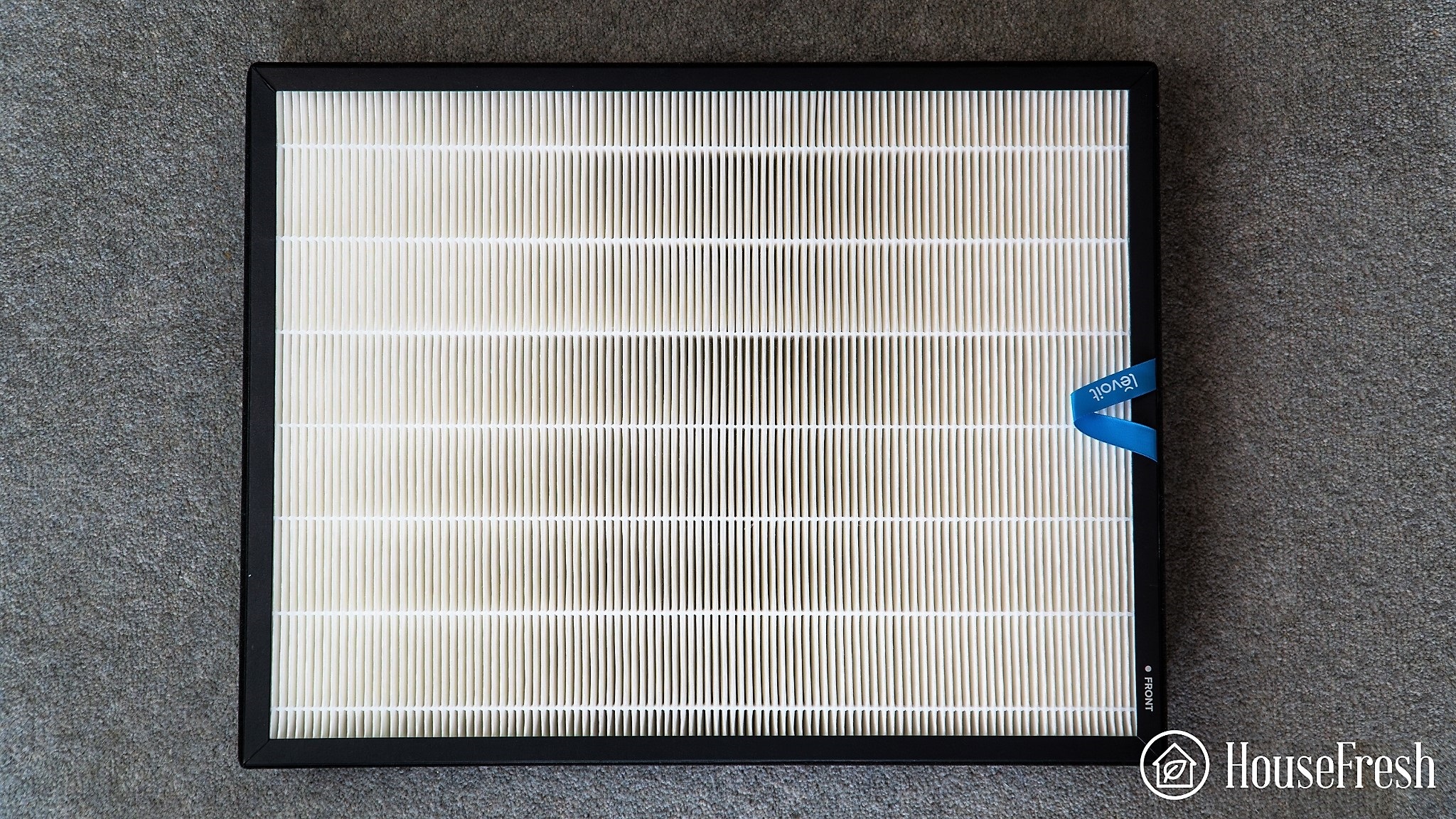
Filters will display a deteriorated condition over time as they capture polluting particles such as hair, dust and smoke. If your filter resembles the one above, it’s time to clean the pre-filter.
Tip
Before going the filter replacement route (step 3), it’s worth testing if the red light is flashing due to the filter not being correctly installed.
If you remove the filter from your Levoit and you can see it’s clean (or if you’ve just installed a new filter but can’t seem to get rid of the red light), try reinstalling the filter and skipping to step 4 in order to reset the red light to see if that fixes the issue.
Levoit Core units have a cylindrical filter that is pretty straightforward to install. Some of them have a top with a legend, so you know the filter goes on top.
The filter on the LV-H132 is a bit different from most Levoit filters, so check out this video to learn how to place it correctly.
The filter in Levoit Vital units is completely different from the two above. Here is a video showing how to remove and replace it:
Lastly, if you own a Levoit EverestAir, then here is a video you can watch to see how to open the filter cover to properly remove and replace the filter:
Step 3: Change your filter
Whether your filter is clogged with pollutants or has broken entirely, you will need to replace it to continue cleaning the air effectively.
Start by carefully removing the old filter and disposing of it appropriately. Next, remove the outer plastic wrapping on your new filter and slot it into place before reassembling the purifier.
Step 4: Hit reset
Some users may find that the red light is still illuminated after you’ve changed the filter. If this is the case, you’ll need to manually reset the filter change timer.
To do this, hold down the filter change button for 3-5 seconds. After that, the light should disappear until it is time to replace the filter again.
For those using the Levoit PUR131, you will need to locate the reset button on the back of the unit and insert a small screwdriver for 5 seconds or until the unit beeps.
Common questions about the red light in Levoit units
If the red light has appeared on your Levoit as a routine filter change warning, there’s nothing stopping you from continuing to use your air purifier while you wait for the replacement to arrive. However, you can expect to see decreased efficiency during this time.
If you are confident the filter doesn’t need to be replaced, reset the warning light and make a mental note to manually schedule future filter changes
The recommended life span of a Levoit filter is between six and eight months, or as long as 15 months for their premium models, such as the Everest Air.
However, it’s important to clarify that a filter’s lifespan may differ between users, depending on how often they use their air purifier and the types of pollutants they commonly face. For example, cigarette smoke and construction dust will clog their filters much faster than everyday pollutants like pollen.
You can also slightly extend the working life of your filter by carefully vacuuming and cleaning the pre-filter from time to time. Never use water or cleaning solutions on the filter.
Once filters become saturated with pollutants, they dramatically lose performance.
As dirty air enters the unit, it passes through the filter, where pollutants are removed. If the filter is full, it hampers airflow (meaning less power) and allows more pollutants to slip through and recirculate into your space.
This is why filters are advertised with a lifespan and why it is so important to keep up with regular filter changes.
Final thoughts
The Levoit red light is one of the most common issues users face and, in the vast majority of cases, will be straightforward to rectify. Remember that red lights on Levoit air purifiers serve as filter warnings, so nine times out of ten, all you need to do is replace the filter.
If none of the solutions above worked for your Levoit red light issue, there may be an internal fault with the appliance. In this case, I recommend getting in touch with Levoit’s Help Center directly.
The “old house” smell is something we all know about and probably have felt at some time or another. However, there is no universal definition of it:
Some may describe it as a ‘musty’, ‘funky’ or ‘stale’ stench
Others might refer to it as a ‘dusty’ or ‘stuffy’ odor
There are those who would compare it to ‘BO’ or ‘smoker-house’ smell
The list goes on, but you get the idea.
For what it’s worth, there are many possible reasons for a house to smell “old.” Depending on the sources, the odor will vary. And the means to tackle the issue will, too.
Living with that smell can be tiring. The good news is that there are simple things you can do today to help you remove that old lingering smell. Let’s get to it!
6 quick-fire tips to get rid of old house smell
When houses are not properly ventilated, dampness and odors become trapped inside, lingering. In addition to dealing with high humidity levels and more structural fixes, you should address some common causes of stale smell.
Step 1: Ventilate the space to allow fresh air into the house
Increasing airflow is a straightforward and highly effective way of reducing humidity levels. Fresh air and sunlight will prevent home spaces from becoming damp, reducing the presence of mold and lingering odors in the long run.
To boost airflow, consider using fans to create cross-breezes, ensuring the air circulates into the darker corners of the house.
Tip
The sun’s UV rays are natural deterrents for microorganisms like bacteria, viruses and, most importantly, mold. Regular window glass filters out UV rays, so letting in the actual light is key.
Step 2: Thoroughly clean soft goods
Furniture and soft fabrics, like carpets, curtains or even the blanket you use to get cozy in front of the TV, hold onto odors. If these are not regularly cleaned, they will contribute to the stuffy smell in the house because over time, moisture can get trapped in the fibers of the fabric.
Give your furniture, upholstery and carpets a deep clean:
Sprinkle baking soda over your furniture and carpets
Leave it overnight to soak up the odor
Vacuum it up the next day
It usually takes at least 24 hours to do its job, but it might need a few days for stubborn smells. If the odor persists, you can repeat the process.
Tip
Mold spores are airborne and easily spread all over a room, including furnishings and upholstery. To clean the mold you must follow these steps:
Wear a mask and open the window of the room where you will be cleaning
Spray your furniture with 50% white vinegar, 50% water and a few drops of Tea Tree Oil mix
Scrub lightly any visible mold or mildew. Don’t get the furniture too wet in the process and make sure it dries completely. Otherwise, moisture will build up again.
Vacuum the surfaces with a HEPA filter vacuum. Regular vacuums will only spread the spores into the air.
Pro tip: For machine-washable items, adding borax and vinegar to the wash will help eliminate any spores.
Step 3: Deep-clean old appliances
Over time and with regular use, everyday appliances can unknowingly become reservoirs of old bits of food, grease and dirt. Leaks can also be hiding behind them. Vent hoods can get old and smelly and fail at removing odors from the air while you cook.
A thorough cleaning will go a long way:
Pull out your stove, fridge, washingmachine and dryer to clean under and behind them. Make sure there are no leaks.
Vaccum the fridge’s coils and clean the top as well.
Keep vents clean and replace old filters.
Step 4: Clean your floors, baseboards and fixtures
Unwanted odors can come from dust accumulating in floors and corners. If you have pets, pet dander and fur around the house will also cause smells to linger for longer. Dust, mop and vacuum frequently to maintain a clean and fresh environment.
Even seemingly overlooked areas like baseboards, light fixtures, ceiling fans and hard window treatments (such as blinds or shades) can absorb odors. Make sure to give these areas a thorough cleaning as well.
Tip
You can make your own natural DIY cleaner using:
✅ ½ cup of borax ✅ 2 cups of distilled white vinegar ✅ 16 ounces of hydrogen peroxide
Mix the borax with 32 ounces of hot water
Add the rest of the ingredients and mix
Use a sponge to apply the mixture to your walls and ceilings
Open a window and let it air dry
If there are still some areas where the smell lingers, just give them a touch-up
If you prefer a more radical take on walls and paint them anew, you can try using an odor-blocking primer.
Step 6: Clean and maintain your drains
Regular maintenance of drains will make a notable difference. Baking soda and white vinegar make an efficient, pipe-safe cleaner:
Put two tablespoons of baking soda down the drain
Pour ¼ cup of vinegar
Let it fizz for a few minutes
Pour hot water into the drain
Don’t use the sink for a couple of hours
Bonus: You can add a few drops of Tea Tree Essential Oil. It will give the drain a fresh-smelling scent and it also has an inhibitory effect on mold.
Tip
Regularly unclog kitchen and bathroom drains to reduce funky smells due to clogged p-traps or pipes.
In the kitchen, throwing greasy materials down the drain is rather common.
In the bathroom, soap residue can react to calcium in the water forming “soap scum” that will deposit in the lines.
Step 6: Use smell neutralizers
It takes time to completely banish lingering smells from a home. While you’re working on repairs and a whole house deep clean, from cupboards to furnaces and upholstery, having some natural odor absorbers distributed around the house can make a huge difference.
These absorbents will reduce the odor and freshen up your living space:
Place small bowls with baking soda, distilled white vinegar or coffee grounds in unintrusive spots around your home.
Slip dryer sheets into built-in cabinets and closets to help absorb excess humidity.
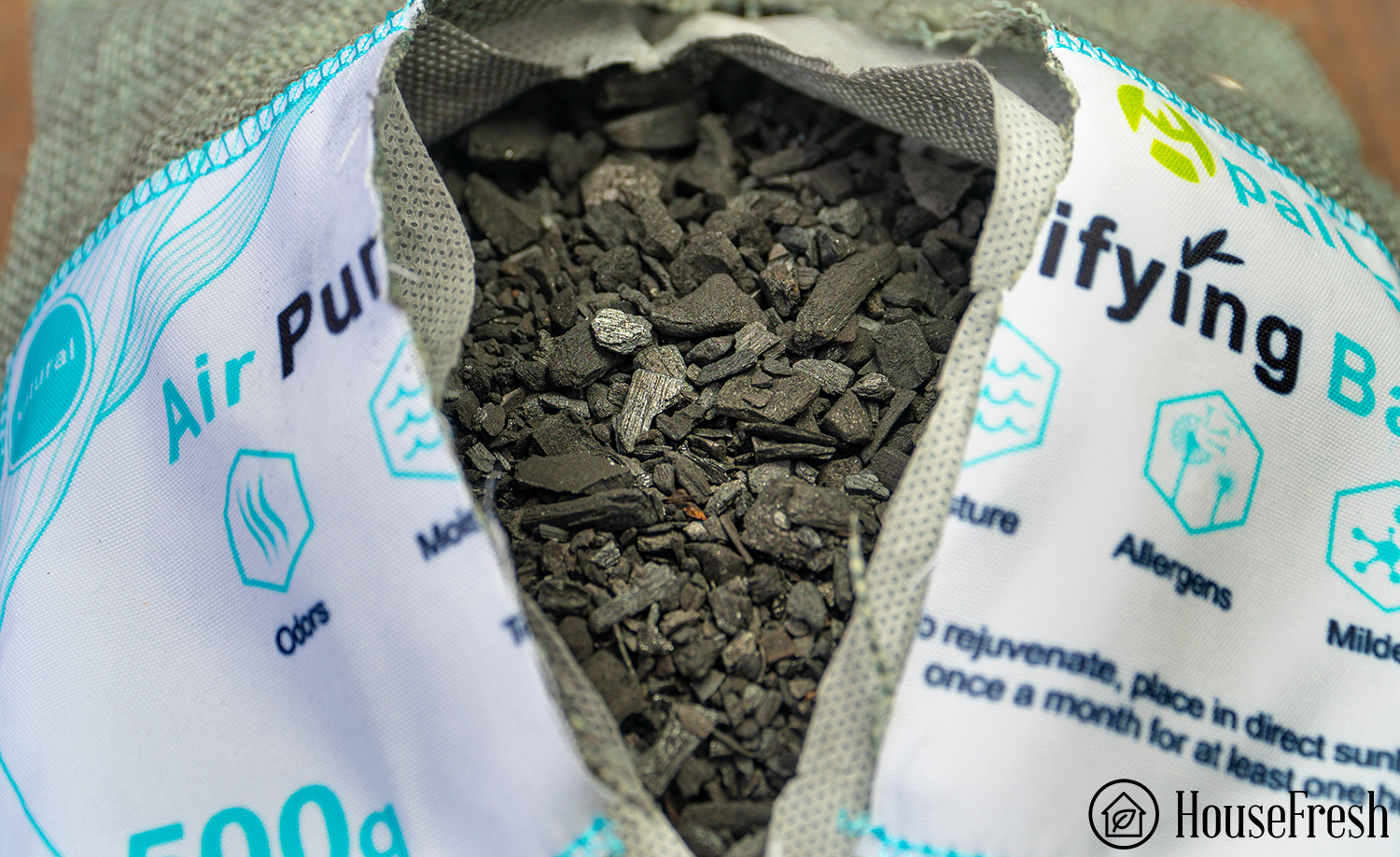
Place activated charcoal bags in enclosed spaces like kitchen drawers or closets.
What to do if the old house smell persists
A thorough clean will go a long way. It will improve your indoor air and eliminate more than a few lingering odors. However, more often than not, some stubborn smells are related to structural issues. While these may seem challenging to address, there are specific and actually manageable steps to take.
1. Check for pests
Rodents and roaches are not uncommon in old houses and buildings. They can hide and nest in walls, attics, crawl spaces and behind baseboards. Any small crack or damaged insulation is an entry to your home. Roach infestations produce a nutty, ugly odor, while rat pee and droppings will smell like musty ammonia.
You need to deal with the intruders to get to the root of the smell. However, you can use natural odor absorbers to ease the issue.
💡 Pro Tip: Looking for a pest control specialist in your area? Check out Angi’s database of certified professionals. If you are positive about having pests in your home, call a few different companies to compare budgets and proposed solutions. Good technicians should do a full inspection before issuing a quote.
2. Clean the air ducts and pipes of your HVAC system
The heating, ventilation and air conditioning (HVAC) system removes moisture from the air before redistributing it through the whole house or building. As the system dries the inside air, water vapor is removed through the condensate drain line. However, pipes can get clogged with dirt and debris, accumulating moisture and potentially leading to mold and mildew growth inside the system or the walls.
In particularly old houses, air ducts may accumulate dust, cigarette smoke residues, mold, grease and even the remnants of possible pest infestations. As a result, the air coming from the HVAC will smell stuffy, and the system will distribute the unwanted smell throughout the whole house.
Make sure the HVAC system works properly by doing regular maintenance. Check air intakes and replace filters every 60 to 90 days. With old, stuffy air filters, the HVAC unit needs to work harder and is more susceptible to malfunction.
💡 Pro Tip: Duct cleaning is not something to take lightly. If you plan to have the air ducts clean, take these EPA suggestions into consideration.
3. Uncover the most humid corners of your home
One of the most frequent causes of bad smell in a house is dampness, which can, in turn, lead to mold and mildew. According to the EPA, the ideal relative humidity in a home should be between 30% and 50%.
Fixing excessive humidity should be a top priority, as it can ruin your floors, paint or carpet and lead to mold lurking around the house and eventually to structural problems.
Here are some places you should check with the help of a humidity sensor:
Area of the House
Humidity Causes
How to Reduce Humidity
Foundations & Crawlspaces
If not well insulated or air-sealed, the base of your home will release an earthy, musty odor known as a “rising floor smell” that will soon impregnate the whole house from beneath.
Fix problems with seals and insulation. If the relative humidity is higher than 55%, a crawl space dehumidifier can help keep moisture levels in check.
Attics & Roofs
Leaky roofs, condensation, deficient insulation, or poor ventilation can cause excess moisture in your attic.
Fix any leaks and insulation issues. Consider getting a dehumidifier as it will extract water vapor and recirculate dryer air.
Pipes & Drains
Slow but constant drips under the sink or within the pipe chases will create a perfect humid, dark environment for mold and mildew to thrive, releasing a musty smell in the space.
Check the whole house for leaky pipes and fix them.
Walls
When walls are under-insulated or have no insulation, air can leak and condense inside, leading to moisture and dampness. Air leaks in the wall frequently lead to mold growth.
Keep an eye out for these common signs to detect mold growing inside a wall: 🚩 Yellow or brown water stains or discolorations 🚩 A cooler feeling on the wall compared to the surrounding areas 🚩 ‘Weeping’ walls (condensation) 🚩 Discolored spots, often mistaken for cooking oil splatters 🚩 Cracking, peeling, or bubbling paint
4. Call the chimney sweep
If your house has a chimney, make sure to get it swept at least once a year. This will ensure there are no dead animals, leaves or other debris clogging the chimney, leading to unpleasant smells in the room.
💡 Pro Tip: Look for certified, insured chimney sweeps to do the job. There are no licensing requirements for chimney sweeps in most U.S. states, so the safest way is to call a certified professional. The NCSG is the largest US chimney guild, with a comprehensive list of trusty sweepers.
5. Treat old wooden furniture and fixtures
A somewhat unexpected source of musty smell is old wood that, with time, has accumulated moisture and potentially developed mold to some extent.
All of these are oftentimes overlooked and yet a common source of unpleasant odors:
Doors
Trim around windows
Window treatments (such as blinds or shades)
Cupboards and cabinets
When it comes to these items, the best course of action will depend on the state of the wood. If it’s too degraded, it may be best to replace it. If that’s not the case, a fresh coat of paint will eliminate the musty smell stemming from them.
6. Get an air purifier
Air purifiers are efficient at removing airborne pollutants from your home air. Think dust, pollen, pet dander, mold spores and toxins. But they are also quite capable of dealing with the old house smell.
However, not all air purifiers are designed to tackle odors. When it comes to combating stubborn smells, air purifiers equipped with HEPAfilters (which can trap over 99% of airborne particles) and activated carbonfilters (which neutralize and eliminate odors) are your go-to choice.
Here are some tips to help you find the right unit for you:
Look for filters with a minimum of 5 lbs of loose-fill activated carbon to get the best results. Two large air purifiers that have large amounts of activated carbon are the Austin Healthmate and IQAir Healthpro Plus.
Get the right air purifier for your room size, guaranteeing 4.8 air changes per hour which is what the EPA recommends. If you have your floor space figure, you can use our CFM calculator to find what CADR you will need:
Final thoughts
The ill-famed old house smell is something we all want to avoid in our homes. Besides, it can be a sign of structural problems — the more reason to deal with it sooner than later. While finding the root cause is essential to address the issue, there are many DIY steps you can try to tackle the smell.
Dehumidifiers and air purifiers are efficient devices to consider. However, if you choose to get any of them, remember to keep your dehumidifier clean and regularly empty the water collection bin. For air purifiers, change the filter regularly, according to the manufacturer’s instructions and be sure to check that the CADR matches the room site you want to use it in.
You may have heard of the dangers of ozone in passing. Ozone carries vaguely sinister connotations of threats to our breathing and our planet. You may have even heard it contributes to the haze we can sometimes see out in the distance.
But what is ozone, what does it smell like, and how do you even recognize it?
According to the EPA, ozone is a type of gas that naturally occurs in the upper atmosphere. It comprises three oxygen atoms and is formed when UV radiation with the sun interacts with oxygen molecules. In its natural state in the upper atmosphere, it’s a force for good because it blocks out the amount of harmful radiation that can reach us.
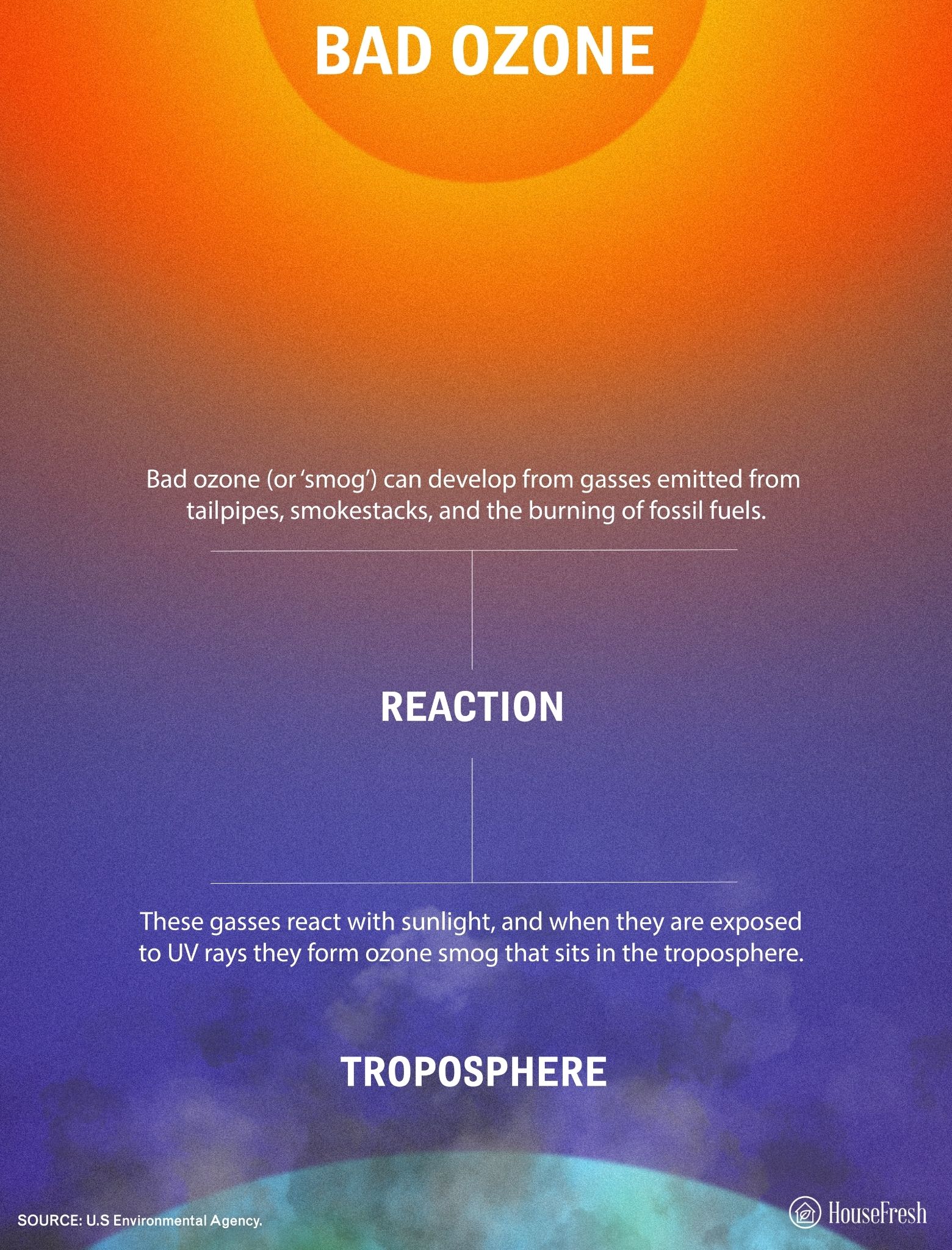
However, ozone can also be manmade and ground-level, or tropospheric. High amounts of heat and sunlight can cause reactions between volatile organic compounds (VOC) and nitrogen oxides (NOx), two common air pollutants. Common sources of these pollutants include cars, trucks, gasoline vapors, chemical plants and oil-based paints. Because heat and sunlight usually cause the reactions, the smog or haze associated with ozone tends to happen in the summer. However, high mountain regions with snow or southern climates can still get ozone haze in other months, including winter.
So, what does ozone smell like?
Ozone has a distinctive smell. The California Air Resources Board reports that people say it smells like chlorine bleach. There are those who have described the smell of ozone as an electrical smell or even as a strange, sweet smell of burning plastic.
Whether you can smell it can depend on your own sensitivity levels. Some people can smell ozone when the levels are as low as 0.05 ppm (parts per million). And there are those who can even smell it during electrical charges or after lightning strikes.
8 serious health effects of ozone pollution
Ozone can cause a wide range of average effects on the body. The risks, as listed by the American Lung Association and the EPA, include:
1. Breathing problems
Greater obstruction in the airways can happen when breathing ozone, according to the EPA. Some noticeable immediate breathing problems include shortness of breath, wheezing, pain in the chest when taking a deep breath, coughing, throat irritation, chest tightness, asthma attacks, increased respiratory infection risk, pulmonary inflammation and increased hospital trips for those who have lung diseases like COPD.
2. Metabolic disorders
Research carried out by the School of Public Health in Taiwan has suggested that there is an increased risk of metabolic disorders such as diabetes if you breathe ozone for periods longer than eight hours for days, months or years, defined as long-term exposure.
3. Nervous system issues
Studies by Mexico’s National Institute of Neurology and Neurosurgery have shown that long-term ozone exposure can lead to headaches, decreased cognitive response, disturbances in the sleep-wake cycle, decrease in motor activity, neuronal dysfunctions, cell degeneration, and neurochemical alterations.
Different types of cancer can come from long-term ozone exposure, as well:
A study by the University of Washington Center for Clean Air Research suggests ozone exposure increases the risk for lung cancer. However, the carcinogenic effects of ozone are not fully understood, but it is known that ozone can damage DNA and proteins in lung cells, leading to cancer. Ozone can also increase the risk of lung infection, which in turn, can lead to cancer.
Research shows a correlation between ozone depletion and increased skin cancer incidence. This is likely because more harmful UV radiation can reach the Earth’s surface when the ozone layer is depleted, increasing a person’s risk of developing skin cancer. UV radiation is a known carcinogen, meaning it can cause cancer.
6. Cardiovascular mortality
A Peking University study showed that subjects without hypertension had a higher risk for CVD mortality associated with long-term exposure to ozone. This increased risk of cardiovascular mortality can lead to premature death.
7. Greater response to allergies
Breathing ozone can make your lungs more responsive and sensitive. According to the American Lung Association, eople with allergies may notice a stronger response to allergens from breathing ozone.
8. Premature death
When combined with other risk factors, long-term exposure to ozone can lead to premature death. A 2017 study by the Stockholm Environment Institute, showed that older adults had a higher risk of premature death, even when the ozone level was below the U.S. national standard.
Final thoughts
No one wants to die early because the air is smoggy. There are things we can all do to help.
If it’s possible, try carpooling or using public transportation over driving
Be careful not to spill fuel and keep gas caps tight
Keep your vehicle’s engine properly tuned
Choosing environmentally safe cleaning products or paints (zero-VOC)
Start mulching/composting yard waste
Use gas logs to replace wood
If you’re considering buying an air purifier, make sure to buy a unit without an ionizer function to ensure it will be ozone-free. We have shortlisted the best ozone-free air purifiers in a previous article.
SOURCES
American Lung Association. (2023). Ozone. lung.org
California Air Resources Board. (2020). What is Ozone? arb.ca.gov
When we think about being comfortable in our homes, we often focus on the temperature. While it’s true that an uncomfortably hot house makes it difficult to enjoy our home, high humidity also has a powerful impact on our comfort.
High indoor humidity can also cause a long list of negative effects on our health and the health of our property, even if the temperature is maintained at a comfortable level. Luckily, if the humidity in your house is too high, there are several steps you can take to reduce it, from lifestyle changes to technological solutions like dehumidifiers.
How to reduce humidity room by room
If your humidity problems are centered on one specific area of your house, you can apply more targeted solutions:
🛁 Reducing humidity in your bathroom
Bathrooms are naturally humid spaces. If your bathroom doesn’t have a ventilation fan or window, consider installing one to improve ventilation, or a bathroom dehumidifier that is designed to keep a smaller room clean without being very large and running without making too much noise.
If it does have a ventilation fan, inspect it to see where it vents to; many older homes vented these fans into attics or crawl spaces instead of outside the home. If that’s the case, you may need to install ductwork to direct humid air outside the house.
🍳 Reducing humidity in your kitchen
If your kitchen has a vented hood over the stove, running it more often or at a higher setting can help pull moisture out of the air. Try to fix leaky pipes or taps as soon as you uncover them to keep kitchen moisture under control.
🚪Reducing humidity in your basement
Moisture rises from the ground under your home and can infiltrate your foundation walls. Inspect for water intrusion, looking for staining, damp areas, or persistent puddling and repair as needed. A vapor barrier on the ground will block moisture.
Tip
A dehumidifier designed specifically for basements can be a worthwhile investment.
🏠 Reducing humidity in your attic
The hot, moist air in your home will rise into your attic, where it can be trapped. Roof leaks can also contribute to the humidity levels in an attic. Repairing leaks and sealing air gaps can improve humidity levels. A dehumidifier can also be very helpful.
🧦 Reducing humidity in your laundry
One of the main culprits for humidity in a laundry room is inadequate venting of the dryer. Check your dryer to make sure that the vent hose is connected properly and is not blocked by excess lint or other obstructions.
How to reduce moisture levels in the air
If your home experiences high humidity regularly, you can take some general steps to reduce the moisture levels in the air:
Improve ventilation and repair leaks. Consider replacing caulk around windows or weather stripping on doors. If you discover a water leak, have it repaired before tackling the humidity issues. You can also run fans and open windows to push humid air out of the house.
Alter behaviors. Shorter showers and not drying laundry inside the home can reduce humidity levels noticeably.
Air conditioning. Running air conditioners even when the temperature is not too high outside will help dry out the air in your home. Some AC systems also come with a specific dehumidifying setting.
Baking soda or rock salt. Many substances absorb moisture from the air naturally, but baking soda or rock salt will be the most effective. Fill a container with the material and leave it in the area you need to dry out.
Get a dehumidifier. A high-quality dehumidifier can be very effective at reducing humidity in a home. The key is to ensure the dehumidifier’s capacity is appropriate for the space you need to dry out.
It can be challenging to figure out what’s causing high humidity levels in your house because several things can contribute to humidity levels, including:
Activity. Any activity you engage in that produces steam or evaporating water can increase the humidity in the house. These activities include showering, cooking, or hanging laundry to dry inside the home.
Poor ventilation. If your house is closed up and air cannot move through the interior, humidity levels can rise because the moisture in the air cannot escape.
Inadequate seal. If the humidity is coming from outside the house, a poorly sealed “building envelope” can be the cause. Checking the seals around windows and doors and repairing old, failing caulk can help keep dry air in and moist air out.
Houseplants. Plants can add beauty to a home and freshen the air—but some houseplants can increase the humidity in your home as they release moisture into the air, while others can reduce humidity by absorbing it. Take stock of your indoor plants and make changes as needed.
Inadequate moisture barriers. A lot of the moisture that finds its way into your home comes up from the ground.
Water leaks. If the high humidity in your home is a new phenomenon, inspect your home for water intrusion. Roof leaks, plumbing leaks inside cabinets or walls, and foundation leaks are common areas of the home where water gets in, damaging the home and raising humidity.
The negative impact of high humidity in your house
High humidity levels in your home can have several unpleasant impacts on:
1. Your comfort level
Humidity is measured in two ways: Relative humidity and the dew point of the air. The dew point is the best reference for how humidity will feel for you, and anything over 50° will feel increasingly uncomfortable.
2. Your health
High, sustained humidity can have a negative impact on our health. When humidity is high, the sweat on our skin doesn’t easily evaporate, compromising our ability to regulate temperature (this is the heat index—a measurement of what the air temperature actually feels like).
Almost all of the materials used to construct and finish your home are designed to function in moderate humidity. High humidity in your home can cause a wide range of damage, including:
Discoloration
Mold growth
Deformed or rotted wood
Peeling or blistering paint
Cracked and crumbling masonry
It’s imperative that you deal with high humidity in your home, even if you aren’t concerned about your comfort.
Final thoughts
High humidity in your home can make what should be a place of enjoyment into an unpleasant experience—and it can put your health and your investment in danger. Managing humidity levels requires a combination of proactive maintenance and repair, mindfulness about water usage, and technologies such as dehumidifiers.
Few things affect a person’s quality of life more than good air. Data from the Institute for Health Metrics and Evaluation shows ambient particulate matter as the sixth leading cause of global excess deaths each year. The World Health Organization (WHO) claims that 93% of the world’s children breathe air with higher levels of pollution, and medical studies have demonstrated the connection to respiratory diseases, including lung cancer.
While rising global temperatures and the climate crisis are existential threats to humanity, air pollution from fossil fuels is an immediate risk to human life, with a study from Harvard University linking fine particulate matter (PM 2.5) to one in five excess deaths globally. These air particles, which occur naturally and through man-made activity, are roughly 2.5 micrometers in diameter — around 30 times smaller than a strand of human hair.
Removing pollution from the atmosphere and exposing the world’s population to clean air is a major priority, with the United Nations listing it as one of their Sustainable Development Goals. The benefits of clean air are plain to see: reduced illnesses and death, improved quality of life and healthier and more sustainable cities.
The U.S. Air Quality Index (AQI) is a widely-accepted barometer for air quality and ranks pollution levels based on the concentration of PM 2.5 particles in the atmosphere. These range from “Good,” with less than 12 µg/m3, to “Hazardous,” with more than 35 μg/m3.
To find out which cities around the world have the cleanest air, HouseFresh analyzed pollution levels in more than 500 global urban areas, ranking them to see which locations have the most and fewest good air days.
How we conducted this study
Particulate matter (PM 2.5) pollution data was sourced from the World Air Quality Index database of air quality measures, with supplementary data from the AirNet API. Pollution values represent PM 2.5 pollution levels in each city, expressed as micrograms per cubic meter of air, or µg/m3, an average of daily observations during a given year.
The number of “Good Air Days,” as defined under the U.S. Air Quality Index (AQI), was taken as the total number of days where the PM 2.5 concentration was below 12 µg/m3.
We have reviewed the data and, according to the World Air Quality Index, all air quality monitoring stations in Calama report good air quality, with three stations reporting that there has been good air quality for the last 12 months. We have double-checked this data against IQAir’s air quality data for Chile, and it also shows Calama as one of the cities with the cleanest air in the country regarding PM2.5 air pollution.
Even though this data is correct from a methodological point of view, it might not be reflective of other types of air quality issues experienced by residents of Calama. In fact, there is currently a decontamination plan being discussed by the local government to tackle PM10 pollution by regulating mining activities and their associated emissions in the area.
Key findings
Nine cities, including six in Australia and New Zealand, have 365 days of good air every year.
Zürich, Switzerland, and Reykjavik, Iceland, have the most ‘good air days’ in Europe, with 365 days of low pollution.
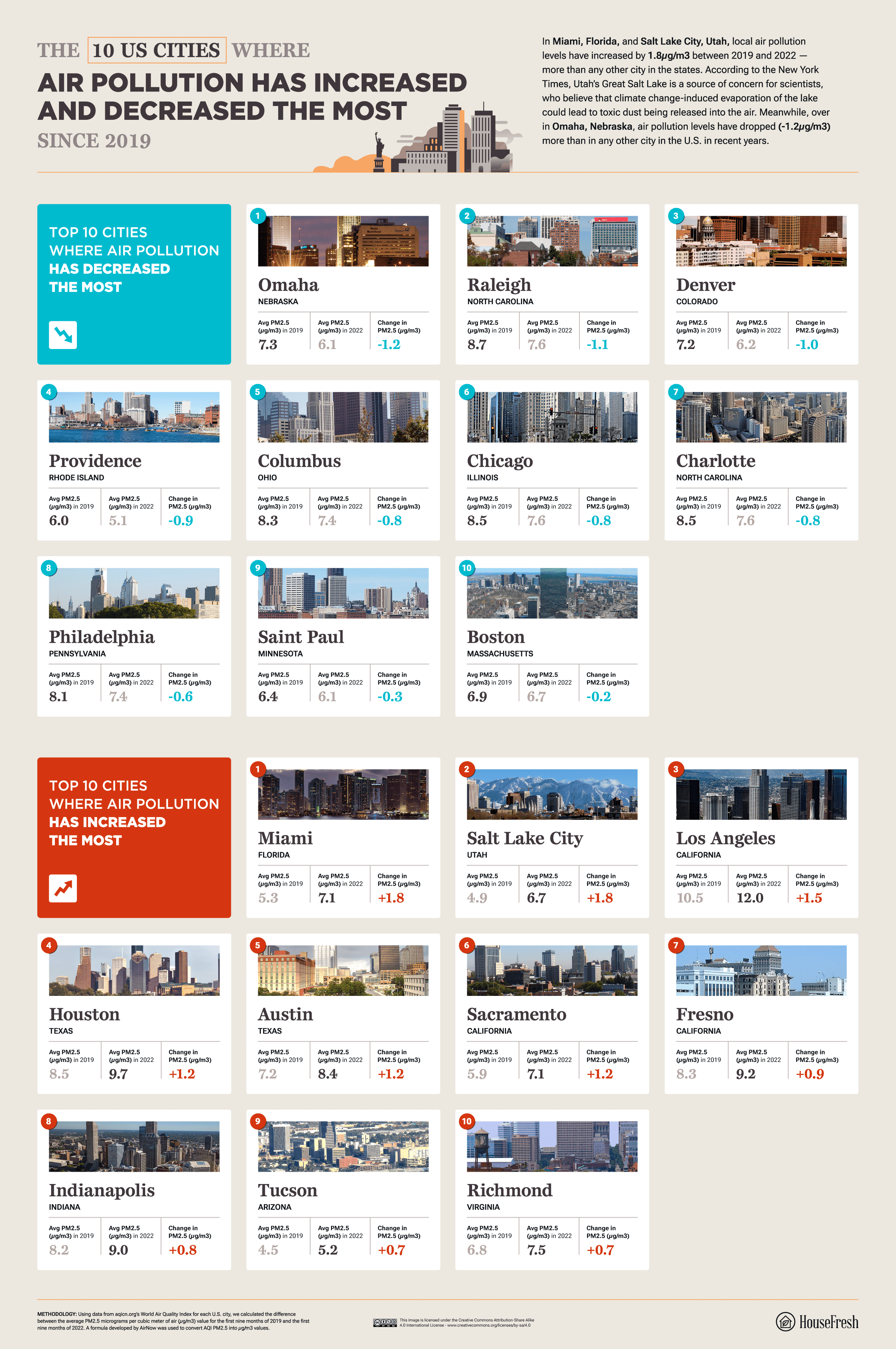
Los Angeles, Fresno and San Diego — all in California, have the lowest amount of good air days in the U.S., with less than 250 days with low pollution during the year.
Honolulu, Hawaii, has America’s lowest pollution for a major city, with 365 days where the PM 2.5 concentration is below 12 µg/m3.
Looking for clean air? Move to Australia
Improving air quality in major cities is an expensive challenge for metropolitan mayors around the world. WHO data shows that 9 in 10 people living in cities breathe polluted air. From transportation schemes to reduce car and bus emissions to renewable energy programs to decarbonize a city’s power grid, the world’s major cities are taking serious steps to reduce air pollution and improve the quality of life for their residents.
But if you’re looking to move to a city with clean air, our research shows that the best place to start is Australia. Six of the ten global urban areas with the most good air days can be found there, all of which benefit from 365 days a year without high levels of PM 2.5 matter in the atmosphere.
Sydney, Australia’s largest urban area, is one of these locations. It is frequently recognized as one of the world’s most livable cities and is home to more than 400 parks and green spaces. However, the city is growing rapidly. Research from the University of Wollongong has created a blueprint for Sydney to lower its air pollution moving forward, from banning diesel vehicles to reducing smoke pollution from wood heaters.
Only one city in the Americas enjoys 365 days of good air per year — Honolulu, Hawaii. Located around 2,000 miles from the U.S. mainland, its residents benefit from some of the cleanest city air in the world. This is likely a result of Hawaii’s strict anti-pollution regulations, and the state is recognized by the American Lung Association for its low PM 2.5 levels.
At the opposite end of the spectrum, four of India’s major cities have one day or less each year of good air. This could be a result of the country’s geography, where pollution in the country’s northern states is trapped by the Himalayan mountains — an occurrence felt especially in the winter months. As an emerging economy reliant on heavy industry and fossil fuel usage, 93% of its population is exposed to unsafe levels of PM 2.5 matter.
Los Angeles has fewer than five months of clean air each year
The White House Office of Science and Technology Policy lists a range of benefits from cleaner air, from the improvement of cognition and productivity to the reduction of environmental triggers for conditions like asthma and allergies. However, a report from the American Lung Association shows that 63 million Americans in 96 counties are subject to the country’s poorest levels of air quality.
Our research shows that six major urban areas in California have the lowest total number of good air days in the country, and its largest city Los Angeles has 71 fewer days with low pollution than anywhere else. With a sprawling urban population of 18 million people, the City of Angels is notorious for its smog and pollution.
It has some of the worst traffic corridors in the U.S., and reports from the Environmental Protection Agency suggest that pollution levels have been at their highest in the area since 2010. While other major urban areas in the state, including Fresno (240 good air days), San Diego (246 days) and Sacramento (294 days), are short of good air days, California’s state government has taken action to improve the state’s air quality record.
In November 2022, Governor Gavin Newsom unveiled a plan to reduce air pollution by 71% and greenhouse gas emissions by 85%. At the same time, the state is facing a battle to secure funding for a proposed high-speed rail line to connect Los Angeles and San Francisco — a plan that would cut carbon emissions by 100 million metric tons within 50 years.
America’s largest metropolitan area New York is a stark contrast to its West Coast counterpart. Despite being home to two million more residents than Los Angeles, it sees good air days for 340 days of the year, making it one of the country’s cleanest cities. New York City has cut its PM 2.5 pollution levels by 40% over the last 20 years, transforming itself away from toxic air quality that plagued the health of its residents for decades.
Nordic cities among Europe’s cleanest air locations
Air quality in Europe is subject to tougher regulation than other parts of the world. For the 27 countries in the European Union, a directive restricts the quantity of fine particulate matter in the atmosphere. Brussels took this a step further in November 2022, limiting PM 2.5 matter to 10 µg/m3 in response to data from the European Environment Agency, which links 307,000 excess deaths in the continent to air pollution.
Our research shows that two major European cities (both outside of the EU) have 365 days a year of good air — Zurich, Switzerland, and Reykjavik, Iceland. Located 600 miles off the coast of continental Europe, Iceland’s small population (approx. 300,000) and clean energy production contribute to its low particulate matter levels. Reykjavik is one of six Nordic cities with the most good air days, according to our research. Sweden, Finland, Denmark, Norway and Iceland cooperate directly on air quality through the Nordic Council.
However, three major cities in southeastern Europe have less than 100 good air days each year. The capitals of Pristina (27 days), Nicosia (75 days) and Sarajevo (97 days) are among Europe’s most polluted, according to our research. Kosovo’s energy sector is predominantly reliant on coal, with two major plants polluting Pristina’s air to such an extent that residents have protested against the state’s policy.
Lowering air pollution in the world’s major cities
Air pollution in major cities is a huge stumbling block for the world’s climate scientists. United Nations data predicts that 68% of the global population will live in urban areas by 2050. Yet air quality data shows that residents in many of the world’s largest cities struggle to enjoy good air days, potentially causing long-term damage to their respiratory health and well-being.
You can explore our full dataset of 500+ urban areas below, allowing you to see which cities have the most and fewest good air days where you live.
As our cities continue to grow and population centers become more concentrated, how can societies ensure sustainable living conditions for decades to come? Getting it right is central to the commitment made by national governments to the UN’s Sustainable Development Goals. A 2021 report on this issue found that most cities are shifting their focus toward the decarbonization of heavy industry and low-carbon transportation (e.g., vehicle emissions standards).
However, the clock is ticking on air quality as the urgency of the climate crisis mounts. With WHO data indicating that 80% of city dwellers are still exposed to excessive fine particulate matter levels, major metropolitan areas must continue to prioritize the health of their residents by directly targeting air pollution.
The method behind the study
To find the global and American Cities with the most and fewest good air days, we sourced particulate matter (PM 2.5) pollution from the World Air Quality Index database of air quality measures, with supplementary data from the AirNet API. Only cities that have data from at least two (2) monitoring stations for at least 300 days of the year 2022 were included in the dataset.
Pollution values represent PM 2.5 pollution levels in each city, expressed as micrograms per cubic meter of air, or µg/m3, an average of daily observations during a given year.
To arrive at these numbers, AQI PM2.5 was converted into µg/m3 values using a formula developed by AirNow, a partnership of the U.S. Environmental Protection Agency, National Oceanic and Atmospheric Administration (NOAA), National Park Service, NASA, Centers for Disease Control and tribal, state and local air quality agencies.
The number of “Good Air Days” was taken as the total number of days where the PM 2.5 concentration was below 12 µg/m3. This is defined under the U.S. Air Quality Index (AQI).
Cities in Ukraine were excluded from the comparison due to the ongoing military conflict having an inevitable impact on the level of air pollution.
New York City pollution levels were calculated by aggregating the data from Manhattan, The Bronx, Staten Island, Brooklyn and Queens by taking the median pm2.5 values on each day.
At HouseFresh, we have been reviewing air quality products since 2010, and this includes air quality monitors like the Purpleair Indoor Sensor II, which also provides shared air quality data with the world that helps support big data campaigns like this. If you have any questions about our testing process for different air-quality products, just email us at hello@housefresh.com.
Hopping into the driver’s seat, you may be met by a multitude of smells. Whether it’s that new car smell or less desirable odors such as last night’s takeaway.
But for weed smokers, the overpowering aroma is usually the skunky, earthy or even citrus odor that ignites the senses at first whiff.
While some pot smokers may be partial to weed’s lasting scent, most drivers would prefer their day-to-day vehicle not to honk of lemon haze. That’s why we’ve devised a five-step plan to remove stubborn odor and offered some top tips to keep your car smelling fresher for longer.
5 steps to get rid of weed smell in your car
Need to eliminate the lingering smell of weed in your car? Follow these five simple steps and you’ll have a brand-new smelling car in a flash.
Step 1: Let the breeze tackle the bud
Let’s get you started with an easy one. Roll down the windows and take a trip around the block.
Flooding your car with fresh air can work wonders at removing weed’s smell. While it might get chilly, aim to ventilate the car for at least 15-30 minutes to notice a difference.
Step 2: Clear junk out of the cabin
If your car looks anything like mine, it’s probably scattered with rolling papers, candy wrappers, empty cups and more.
Grab a trash can and clear all the rubbish out of the car. Don’t forget to look in all compartments, cup holders, door panels or anywhere else where litter could be hiding.
Once you’ve cleared out all the junk, it’s time to clean.
Using your preferred cleaning solution, freshen up your car’s interior, removing any dust, debris and any odour along with it.
Scents can cling to hard surfaces such as plastic, so don’t cut corners. Be sure to wipe down the dash, steering wheel and trim thoroughly.
Step 3: Vacuum the upholstery
The odor particles found in weed are notoriously clingy. As a result, fibrous materials, such as carpets, floor mats or seats, are likely to stink.
Start by vacuuming each section of upholstery. Don’t be afraid to get deep between the cracks, seek out any crevices and target under the front seats, too.
For leather seating, start by gently vacuuming, then move to a specialist cleaner and conditioner so not to cause any permanent damage.
Tip
Use a steam cleaner to remove stubborn, deep-rooted smells. (but try step 4 first)
Step 4: Absorb unwanted weed odors
At this point, you may not even recognize your shiny new car. But if weed smell persists, it is time to turn up the odor-busting ante.
Activated charcoal, baking soda and even coffee granules help eradicate odor. Liberally sprinkle these substances onto the floor and seating of your car and leave them overnight to absorb weed’s persistent smell. The next day, simply vacuum the granules away.
Step 5: Spray away smells
If you need fast results in a pinch, you can turn to deodorizing sprays or air fresheners.
Bear in mind that these will merely mask the scent of lingering weed. Whether you use essential oils, perfume or cleaning solutions, applying fragranced products to your car’s interior will achieve temporary rest bite from unwanted odor.
Air fresheners are filled with chemicals known as VOCs, which can be harmful to breathe.
Instead, consider using natural solutions such as lemon juice or vinegar. Or create your own potpourri using herbs, flowers and spices.
How to prevent weed smell in your car
Having spent time, energy and money removing the smell of weed from your car, it’s a good idea to keep it odor-free.
To help you do so, here are the 10 commandments of keeping weed’s smell at bay.
1. Don’t roll up a joint without rolling the windows down first. In an ideal world, you wouldn’t be smoking weed inside your car. If you’re just hanging out in your car and decide to roll a joint, remember that weed odor can spread fast. Don’t allow it to sink into your seats or carpets by simply increasing ventilation.
2. Cast away disused joints, papers and other paraphernalia. Leaving a roach or other pieces of trash in the car is sure to smell when you return.
3. Keep weed sealed. Storing your weed in an airtight container or resealable bags will lock away smells and prolong the quality of your buds.
4. Seek out alternative weed products. Enter any dispensary and you’ll find tons of odor-free products, from mojito-inspired mocktails to vapes or classic edibles, each of which is sure to get you high without leaving a scent.
5. Switch off the air recirculation feature. Air recirculation is great when using your car’s AC. But by switching it off, you’ll allow for extra airflow to enter from outside.
6. Deploy activated charcoal. A secret weapon for anyone looking to eradicate unwanted smells, activated charcoal captures odor particles in the porous substrate inside.
7. Reach for a dryer sheet. Can’t get your hands on activated charcoal? Raid the laundry room for dryer sheets, which can capture odors effectively, too.
8. Replace your car’s air filter. These filters suck up dust and debris, along with countless other odors. Replace them every six months, which can be done quickly at home or by a local mechanic.
9. Invest in ambiance. Smoking weed should be a relaxing and pleasurable experience. Why not utilize your favorite essential oil or look into Weed Odor Eliminators while smoking in your car?
10. Use an air purifier. Last but not least is one of the most effective methods to eradicate weed’s smell. Using a portable air purifier will improve airflow and capture odor particles as they pass through the unit.
Wrapping up
One of the downsides of weed is the lingering smell it leaves, long after the last joint has been smoked.
This smell can be made ten times worse when smoked or stored in a confined space like a car.
Be sure to keep your car clean, increase ventilation whenever smoking and invest in some odor-busting material such as activated carbon bags or, better yet, an air purifier with carbon filters.
Here at HouseFresh, we believe everyone should use an air purifier. After all, the air we breathe is literally killing us.
Figuring out if you need one for your home can be a long and winding journey, filled with endless statistics, jargon and miracle claims, which can often sound too good to be true.
To help you in your search, I’ve set out to answer the age-old question of do you actually need an air purifier, demystified what these machines can do to help improve your air quality and even given you a helping hand on how to find the perfect purifier for your needs.
So, do you really need an air purifier?
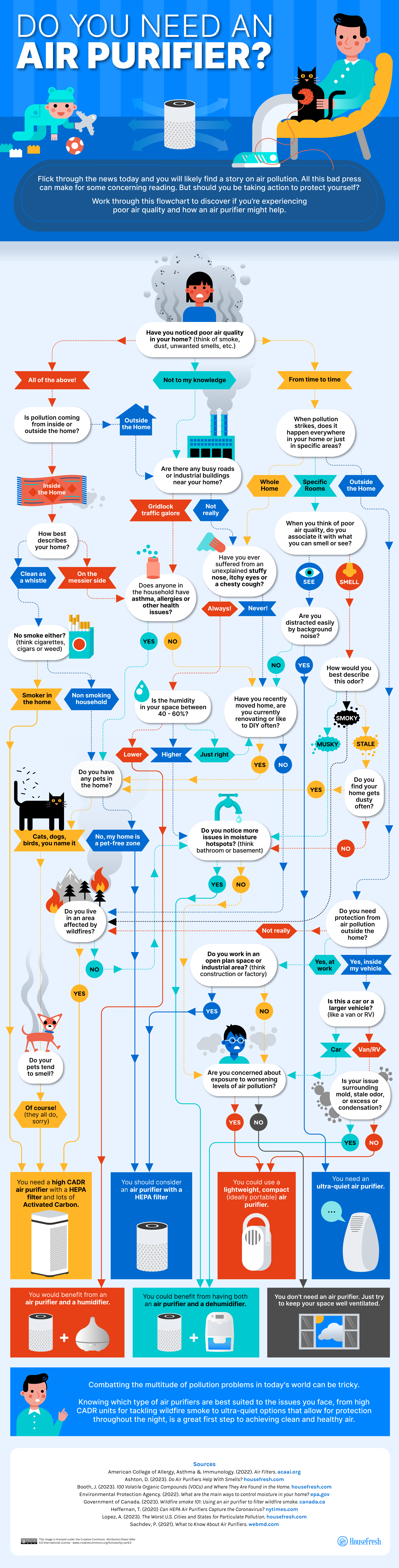
Not sure where to start or even if you need an air purifier? Work your way through this easy-to-digest flowchart to discover what’s best for you.
I’ve covered all the most common pollution types you might find in the average home and pointed you in the right direction should you find you might benefit from an air purifier.
If the flowchart led you to an air purifier, you might want to keep reading to learn more about it before spending any money.
How to choose the right air purifier for you
So, you’ve seen the light and been converted to the clean air crew. Now, all you have to do is pick the perfect unit for your specific needs. Sounds simple, right?
Not quite. A quick search for an air purifier on Amazon.com brings back thousands of results. And the kicker? Most of these are poorly designed and poorly made, so they won’t make a tangible difference to the air you breathe.
Fortunately, I’ve done the heavy lifting for you, researching the ins and outs of countless air purifiers and seeing how well they perform in our impartial reviews.
Just follow these five easy steps, and you’ll be well on your way to a clean-air oasis.
1. Identify the source(s) contributing to your dirty air
We can categorize pollutants as either external (pollution that occurs outdoors) or internal (pollution that stems from inside the home). It is worth clarifying that outdoor pollution will likely make its way indoors.
Here are some of the most likely culprits that might be affecting your space:
Internal sources
External sources
Pet dander
Traffic fumes
Cooking odors
Wildfire smoke
Gas stoves
Pollen
Mold and mildew
Bacteria and viruses
Dust
VOCs (chemical gases)
Weed/Cigarette smoke
Radon
2. Pick the right air filtration technology to eradicate these pollutants
Fighting fire with fire is the best form of attack when it comes to removing pollutants from your space. And by fire, we mean filters.
New technologies, such as Ionizers, Peco and UV lights, always crop up in the air purifier world. Many of them make big promises but deliver very little.
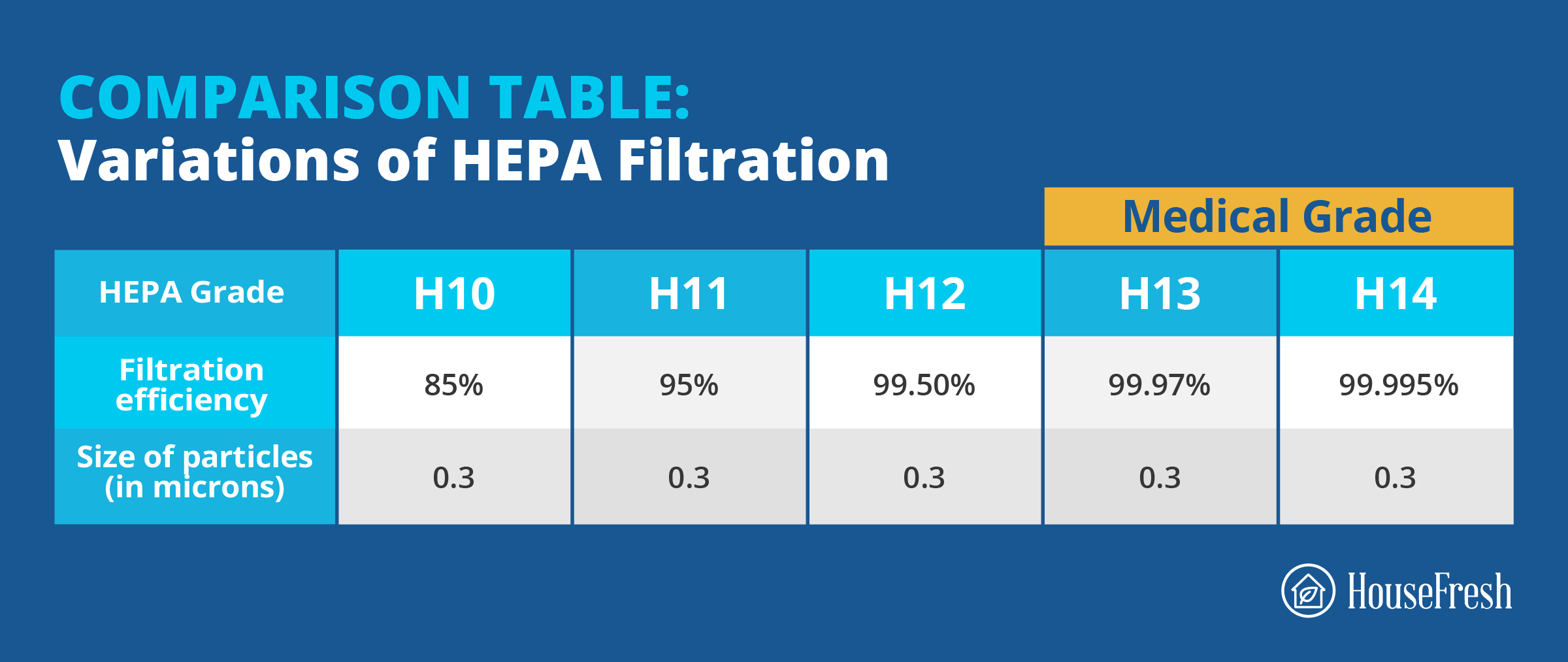
To remove pollutants from your space, I suggest you opt for tried and tested mechanical filters such as High Efficiency Particulate Air (HEPA), which are certified to remove at least 99.7% of particulate matter such as dust, pollen and smoke, as small as 0.3 microns in size.
The other subset of pollutants you’ll find in the home are Volatile Organic Compounds (VOCs). This term covers all the gasses and odors you’ll find in the average home, including carbon monoxide, secondhand cigarette smoke and even the dogs farts. You’ll need activated carbon filters to work alongside your HEPA filter to remove these from your space.
3. Measure the space you will use your air purifier in
This is where most people go wrong. Air purifiers are designed to work their magic in a specific-sized space. So if you buy a budget unit with small fans and a weaker motor, it will struggle to make a difference in a larger room.
Manufacturers often share a recommended room size to use the purifier in. Be sure to double-check this will:
A. Cover the intended space
Volume = room area (length x width) x ceiling height i.e 20ft length x 15ft width x 10ft height = 3000 cubic feet
B. Circulate the air in this space more than once an hour (to reap the best rewards, you should look for a unit that can perform at least four air changes per hour)
Minimum CADR = room volume x four air changes ÷ 60 minutes i.e 3000 cubic feet x 4 air changes ÷ 60 minutes = 200 CFM
If math wasn’t your strong suit at school you can put your room size into our CFM calculator and it will tell you what CADR you will need to achieve 4.8 air changes per hour which is what the EPA reccomends:
Tip
In addition to the size of the space, you should also consider the positioning of the unit. Bookmark our guide with tips on where to place your air purifier as you will need it once you buy a device.
4. Assess your budget
Investing in clean air is a shrewd move to make, but a good quality air purifier can range in price from 100 bucks up to 1000.
Prices will vary depending on how powerful the unit is, the technology it utilizes and the features it possesses. Units from industry-leading manufacturers such as IQAir and Alen will set you back more than those produced by value-for-money brands such as Levoit.
Tip
If your budget is stretched, prioritize cleaning power (CADR) and quality filters over fancy features, such as air sensors and apps.
Remember that there are ongoing costs associated with using an air purifier. As time passes and pollutants are captured, your filters will become saturated and need to be replaced. If you require constant protection from pollutants (i.e, live near the highway), you may also wish to find an energy-efficient purifier.
5. Closely evaluate your shortlisted air purifiers
Having ascertained the filtration type and room size suitability, you’ve probably added a few potential air purifiers to your wishlist. At this point, you’ll want to see how well the unit will slot into your space and whether it boasts any additional features.
If you live in a smaller home or apartment, avoiding the bulkier purifiers is probably best. Instead, why not opt for a compact and lightweight unit that can be popped on a shelf or moved from room to room?
For light sleepers, check out the operating volumes or look for a unit with a specialist Sleep mode that will enable you to breathe clean air throughout the night. Other handy Smart features include in-built air sensors, Auto or Eco modes that react to the changing air pollution levels, or even smart speaker compatibility, allowing you to activate your unit with voice commands.
Whether you have allergies or live near a busy road, you don’t have to suffer poor air quality inside your own home. But knowing if you need an air purifier, and which option to choose amongst the wealth of units available, can be somewhat overwhelming.
Most of us are familiar with the strong smell of chlorine that comes from a dip in the swimming pool. The chlorine helps to keep the water clean and is entirely safe.
But chlorine gas is a different story.
When chlorine compounds react with other substances in the environment, chlorine gas (Cl2) is formed. For example, if bleach is mixed with other cleaning agents, such as ammonia or acetic acid (present in vinegar), it can release chlorine gas.
When chlorine gas enters the air, it can pose a serious health risk. Exposure may be through inhalation, or bodily contact, and it can damage your lungs, skin, and eyes – this is why you should never mix household cleaners.
A bit like bleach, chlorine gas has a very strong odor, but you can also see it in the atmosphere due to its green or yellowish tint. It is heavier than air, which means that it tends to sink and settle closer to the floor or lower ground levels and spread rapidly.
Inhaling or coming into contact with chlorine gas can lead to health problems, from a sore throat to serious breathing difficulties.
The reactive nature of chlorine gas means that it can stay in the air longer than many other gasses. However, there are various factors that affect how long it does remain present. These primarily include:
Concentration levels and how much gas has been released
Size of the space, for example, whether the area is big or small
Degree of ventilation and fresh air circulation
Atmospheric/environmental conditions, including temperature and humidity
Chlorine gas can stay in indoor air for just a few minutes or hours (between 1-8 on average) before dissipating. This is generally when the concentrations are fairly low and there is adequate ventilation.
Yet in some cases, the gas can linger for several days, weeks or even months, especially when it has been released into an enclosed space with little fresh air circulation.
Equally, low temperatures coupled with high humidity can mean that the gas remains airborne for longer as both of these conditions will slow down the evaporation process. The reverse is also true; high temperatures and low humidity can speed up the process and cause the chlorine gas to dissipate faster.
Essentially, chlorine gas will stay in the air until it is removed by ventilation or the processes that contribute to its natural decay.
Yet even when chlorine gas has fully dissipated from a space, the area may not be completely safe. This is because it can settle on surfaces or be absorbed into materials like clothing and carpets. Such materials may then continue to release chlorine gas into the air and remain a health risk.
How do you neutralize chlorine gas in the air?
There are a few ways to counteract the impact of chlorine gas:
1. Ventilate the space
Opening windows and doors as soon as possible means that fresh air from the outside is able to replace stale, toxic air quickly. The increased airflow helps to reduce concentrations of chlorine gas particles that can invade your home.
While natural ventilation like opening windows is effective, you could also use mechanical systems, such as fans. This will further help to bring in fresh air from outdoors and distribute it around the area.
2. Use activated carbon filters
Activated carbon filters are used in the home and in businesses, such as hotels and restaurants. They’re highly efficient at trapping harmful airborne particles like chlorine gas. After the filter has captured the particles, it’s then able to release clean, fresher air back into the space.
Running an air purifier with an activated carbon filter is one of the most effective ways you can use this kind of technique for neutralizing chlorine gas. Be sure to check out our list of the best air purifiers we tested in 2024 for inspiration.
3. In extreme cases, evacuate and call 911
In extreme situations, it may be the case that you need to completely evacuate the space and call a trained professional. They will be able to neutralize the chlorine gas quickly while using the proper safety precautions and equipment.
If you suspect you do need further assistance, be sure to contact a professional straight away as waiting too long might have serious implications for your health.
Tip
If you need further assistance, don’t hesitate to contact a professional organization for expert guidance and advice:
If the chlorine gas was released from household cleaners, open windows and doors to let fresh air in and circulate around the space.
Get away from the area so that you can also breathe fresh air.
Get the chlorine off your body. Firstly, remove accessories, jewelry, and all items of clothing but avoid pulling the clothing over your head. If you have to undress this way, hold your breath and close your eyes and mouth. If possible, pull the clothing down your body or cut it off to prevent further exposure and damage to your body.
Place everything in a plastic bag.
Remove contact lenses if you wear them and place them with your clothing. Do not put the lenses back in later.
Ideally, get in the shower as this is the most effective method for removing chlorine. Using mild soap (you don’t need a special soap) and warm water, wash your face, hair, and hands, then the rest of your body, starting with your head. This includes armpits, groin, and feet. Do not scrub. Finish off by rinsing in plain water, yet avoid letting it run into your eyes, mouth, or nose.
If you can’t see properly or your eyes are burning, use lukewarm water to flush your eyes for 10-15 minutes. Do not use eye drops at all.
Dry off carefully. Start with your face, then tilt your head back to dry your hair. Finally, dry down your body.
Chlorine exposure symptoms
Chlorine forms acids when it comes into contact with water. Since the human body contains many areas that are wet or moist, such as the eyes, throat, and lungs, chlorine exposure can be especially harmful.
There are several factors that affect the severity of symptoms, and the amount of chlorine you were exposed to is critical. Minor exposure, for example, could mean fewer or less serious health problems. Whereas more significant exposure can cause major health issues, and even lead to death.
Similarly, the length of time you were exposed to the chlorine, as well as how you were exposed to it (through inhalation or touching, etc.) can also affect the degree of reaction.
🚩Throat. A sore throat is the most common, but you might experience a burning feeling, which may be accompanied by burning in your nose or chest.
🚩Eyes. Eye irritation and redness are also two of the most common symptoms, as are red or watery eyes, and blurry vision.
🚩Skin. Chlorine exposure can lead to numerous skin complaints, including pain, irritation, itching, redness, rashes, and blisters.
🚩Respiratory system. Breathing difficulties include coughing, wheezing, chest pain or tightness, and fluid buildup in the lungs. It’s important to note that people with asthma or other chronic lung disease may be more vulnerable to the effects of chlorine exposure. In serious cases, exposure may even lead to respiratory failure and death.
🚩Gastrointestinal system. Following chlorine exposure, gastrointestinal symptoms like diarrhoea can appear almost straight away, or they may take a number of hours.
🚩Nervous/neurological system. Symptoms that affect your nervous system include light-headedness, confusion, and headache. You might also experience nausea and vomiting.
Whether your symptoms are mild, moderate, or severe, it’s vital to seek medical attention as soon as you can. If symptoms aren’t treated properly, you may go on to suffer from long-term effects and develop chronic health problems. Yet with supportive medical care, most people fully recover from chlorine exposure.
Final thoughts
Chlorine gas can cause various health problems, and the length of time it stays in the air depends on several factors. These include how much gas has been released, the size of the space it has been released into, and the degree of ventilation.
Yet there are effective ways to reduce exposure. Chlorine gas can dissipate more quickly, for example, when ventilation is increased. Plus, the use of activated carbon filters can help to facilitate fresh, clean air circulation, which will further minimize exposure.
Most pet parents are no strangers to pee accidents around their home. A puppy in toilet training can have an occasional mishap, or a territorial cat may want to spray a corner to mark it as its own. Sometimes, you move to a home with old urine stains and just need to remove that ammonia-like odor from your life.
When pets pee on the carpet, and the spot is not properly treated in time, the urine penetrates deep into the carpet fibers; it can soak into the padding and subflooring before drying. The longer it sits, the farther it will expand, and the more deeply it will bind to the fibers.
That’s why, in this article, we’ll explore some natural cleaners and methods to treat pet urine stains. So that if an accident does happen, it becomes less stressful to deal with.
Three cleaning solutions for neutralizing pet urine smells
One key thing to understand about pet urine is that it’s not fresh pee that smells bad. Instead, the foul smell is produced by bacteria decomposing the urine. With time, urine crystallizes, sticking into the carpet’s fibers as it dries. Urine crystals trap bacteria that transform the urea contained in the urine into ammonia, gaining that pungent, irritating odor.
So, the quicker you act, the better, as you won’t give bacteria time to produce the stale, old urine smell. Your best bet is to use one of the following cleaning solutions:
1. Enzymatic cleaners
Efficient stain and odor removers, these cleaners have a bacteria-based formula capable of breaking down the organic compounds found in pet urine and droppings. The protease-based bacteria can break up new and old urine molecules, dissolve lingering odors and remove carpet stains without toxic chemicals.
Tip
You’ll need a good amount of enzymatic cleaners to remove urine from your carpet so opt for galon-sizede bottles of brands like Nature’s Miracle or unscented Anti Icky Poo.
2. Vinegar and baking soda
This miracle-maker duo is widely praised by the internet for dealing with unwanted smells. Pet-safe, eco-friendly, affordable and easy to find, vinegar and baking soda are great odor neutralizers. However, their efficiency largely depends on how they are used.
Vinegar is acidic (its main component is acetic acid) and neutralizes the alkaline salts in dried urine. On the other hand, baking soda is alkaline, hence an anti-acid capable of neutralizing acidic odors, like urine. However, when mixed, they produce a chemical reaction (the fizzing bubbling) that will cancel the properties of each, producing salted water as a result.
If used properly, each one will play its role in removing urine odors by neutralizing the bacteria in the urine, while the fizzy reaction will act on the carpet stains.
3. Hydrogen peroxide
Although widely known for its first aid uses, hydrogen peroxide is also a powerful cleaner capable of removing stubborn stains through an oxidation process (the same chemical reaction as bleach). Commonly found at a 3% H2O2 dilution, hydrogen peroxide is safe for many household uses and very efficient when dealing with stained fabrics.
Tip
Hydrogen peroxide is less aggressive than regular bleach but can still bleach out the dye of darker carpets. Try it in a corner to see how your carpet reacts before applying it on a wider surface.
Do not use hot water or steam cleaners. Heat can bind urine proteins into the carpet fibers, permanently setting the stain and odor. Besides, steam cleaners will introduce more moisture to the area and can drive the urine down into the carpet padding and subflooring, even if dry.
How to clean fresh pet urine from your carpet
As mentioned before, the sooner you get to deal with the pee on your carpet, the more manageable it will be. Taking swift action will greatly lessen the hassle, sparing you from long-term struggles with stubborn stains and lingering odors.
Upon finding pee on the carpet, follow these steps:
Step 1: Use paper towels or rags to soak up as much moisture as possible, fast
You want to avoid the pee from filtrating into the padding and subflooring. Start by soaking up as much urine as possible from the carpet surface with the help of paper towels or rags. Press down gently to help the paper towels blot down the moisture, but don’t scrub or press down too hard to avoid working the urine further down into the carpet.
Replace the paper towels with new ones and repeat the process until the area is barely damp.
Tip
If you can lift the carpet, put some paper towels under the soiled area to avoid further filtration.
Step 2: Use tape to delineate the problematic area
Once you have soaked as much liquid as possible and the stain starts to dry up, it can be tricky to see or remember the whole area that needs to be thoroughly cleaned. That’s why delimitating it can come in really handy for the whole process. You can use tape, display objects around it or even draw a circle on the carpet surface with your fingers.
Tip
Make a circle slightly bigger than the stain, as urine can spread through the fibers. Once you are at it, you want to make sure no patch is left untreated or that some drops of pee go unnoticed, only to develop a foul smell over time.
Step 3: Cover the area with baking soda and scrub the carpet
Sprinkle a generous amount of baking soda and let it stick to any remaining dampness. Scrub and rub the powder onto the carpet, as far down as possible, ideally to the bottom of the carpet backing. Add a tad more baking soda and let it absorb the smell as long as possible, at least a few hours. After that, vacuum the carpet to remove the baking soda.
Tip
It can take a couple of vacuuming sessions to fully remove all the leftovers. Empty and clean the vacuum’s bin once you are finished; don’t let the urine-smelling grime to sit on it.
Step 4: Clean any remaining stains with hydrogen peroxide or white vinegar
Once you have removed the urine and neutralized the odor, check for any remaining darker spots on the carpet. It is best to address them sooner rather than later; otherwise, they will be harder to eliminate.
Pour a small amount of hydrogen peroxide over the stains and gently dab them.
If hydrogen peroxide is too strong for your carpet, sprinkle more baking soda and spray white vinegar over it for the fizzing reaction.
Let it sit for about an hour, and then scrub it.
Lastly, vacuum the area to remove any leftover residue.
Bonus Tip: If an hour has passed, soak urine with an enzymatic cleaner
If the urine has been sitting there for longer than an hour, it probably got into the carpet padding. It’s best to bring in an enzymatic cleaner or white vinegar to soak the area with either of the two.
If you go for an enzymatic cleaner:
You want to completely soak the area with it. Enzymatic cleaners work better on damp, humid surfaces.
Keep spraying for as long as the manufacturers’ instructions say it takes the cleaner to eradicate stains and odors.
Make sure the cleaner penetrates the carpet fibers by rubbing it in.
After applying, let it dry naturally.
Caustic chemicals and detergents will kill the bacteria of the enzymatic cleaners, so if you choose to treat the urine using this type of cleaner, don’t apply any other product beforehand.
If you go for white vinegar:
Fill a spray bottle with a mix of 50% vinegar and 50% water.
Spray the delimited area with a generous amount of the vinegar mix.
While you spray, rub the area to help the liquid penetrate the fibers and get deep down.
Once applied, let it air dry. The smell of white vinegar will evaporate in a few days.
Tip
If you are trying to clean a pet urine stain in a carpet with tough fibers that won’t decolorate, you can spray 100% vinegar without the water.
How to get old cat urine smell out of your carpet
When urine has had time sitting on your carpet, it likely soaked through the carpet into the padding and subflooring, so you’ll have to clean deep. Besides, the smell will get more intense over time.
There are a few tricks to try before considering reflooring the room:
Step 1: Use a black light to uncover the dried urine spot(s)
Dried urine may not be visible to the naked eye. You’ll know it’s there because it smells, but the tricky part is finding the actual spot that needs cleaning.
Use a black light to track down the stain; the damaged areas will glow with a greenish or yellowish light thanks to the phosphorus in the urine. Once you’ve spotted it, make sure to mark it.
Tip
You don’t want to skimp here: urine may have soaked into the carpet pad, spreading through an area at least twice as large as it appears on the surface.
Step 2: Vacuum and rehydrate the area
Start by vacuuming the area thoroughly to remove as much soil as possible. It will make the cleaning process easier, with no debris or dirt interfering. Then, spray a small amount of cold water to rehydrate the urine.
At this point, the smell will probably intensify; that’s normal. As it gets moist, the urine will smell worse. But no cleaner will be able to break down the dried, crystallized urine either.
Step 3: Apply an enzymatic cleaner directly on the carpet
The protease enzymes will work their way through the slightly humid fiber and break down the urine molecules.
Instead of spraying, directly pour the enzymatic cleaner liberally into the carpet surface.
Rub it in to help the cleaner reach the underside of the carpet and the padding.
Let it sit for as long as the manufacturer’s instructions recommend.
Cover the area to keep it from completely drying out while the cleaner does its job.
Finally, let it air dry.
Tip
The urine smell is persistent; it probably won’t go away on the first try. Make a second and third application if necessary. However, let the spot dry between enzyme treatments.
Step 4: Clean the carpet with baking soda and vaccum
Once the enzymatic cleaner is dry, sprinkle the area with baking soda and let it neutralize any remaining odors. Vacuum the whole area. If the spot is near any walls or baseboards, wash those as well with the enzymatic cleaner.
If the smell lingers after this thorough cleaning, then the urine probably leached onto the subflooring.
Subfloorings are generally made of materials like wood that can absorb liquids, including urine. So, to completely eradicate the smell, you’ll need to neutralize it down there.
A professional can help eradicate smells by treating the subfloor and replacing the padding.
If you are up to doing it yourself, follow these steps:
Pull up the carpet and pad to get to the subfloor and find the stain.
Pour enzymatic cleaner into the stained area as you did in the carpet and then let it dry
Seal the area with a layer of oil-based, stain-blocking primer.
Check the padding condition; if it retains even a mild odor, it would be best to replace that bit.
Reinstall the carpet in the treated area.
How an air purifier can help remove pet urine smells
The best way to deal with cat urine smell around the house is to address any recent or old mishap and remove all traces from the carpet. Introducing an air purifier can help deal with the smell while the cleaning process is underway.
If you are planning on investing in an air purifier to tackle urine smell, make sure the unit you choose fits the following criteria:
✅ Activated carbon filtration — The only way an air purifier can help deal with unwanted smells is by filtrating odors with a layer of activated carbon that can adsorb contaminants in a gaseous state.
✅ HEPA filtration — While activated carbon is excellent for odor control, we still want to remove any particles generated from pet hair and dander, which can add to odor issues.
✅ Enough power to clean the air in your room — You need to choose an air purifier that will be able to effectively clean the air in a room as big as yours. If you have your floor space figure, you can use our CFM calculator to find what CADR you will need to look for before buying a unit:
At HouseFresh, we believe in providing honest air purifier reviews, even if a unit falls short of our expectations (or exceeds them). That is why we buy and test the units’ real-world performance in our own home lab.
Tip
Based on our results and hands-on experience, we’ve selected three air purifiers capable of combating urine smells effectively:
Our top pick is the EverestAir. The fastest air purifier we have ever tested, the EverestAir looks as good as it cleans the air.
Our budget pick is the Levoit Core 300. Excellent air cleaning performance for less than $100.
Dealing with pet urine stains and their lingering odors may feel like a daunting task. Yet, with the right knowledge and cleaners, you can tackle the problem and get rid of the unwanted smells.
Besides, if your pet is repeatedly urinating in a particular spot, eliminating any trace of it will also discourage them from any potential reoffending.
The sooner you address the stains, the better your chances of completely eliminating the smell. But while you are at it, an air purifier with HEPA and activated carbon filters will freshen up the air until you get to the root of it.
What exactly are VOCs and why must we be aware of them?
Perhaps you’ve heard about ‘Volatile Organic Compounds’ health risks. Maybe you’ve seen the acronym on your feed and want to know what VOCs are about. Either way, we can help you crack the case on VOCs.
In this article, you’ll find a comprehensive long list of every known VOC and the potential sources for each one. You’ll also discover precisely what VOCs are and how they might affect your health.
However you decide to handle volatile organic compounds, you must have all the facts.
What are VOCs?
VOCs are ‘Volatile Organic Compounds.’ These compounds are characterized by their extremely low boiling points. They quickly become vaporous, so they are considered ‘volatile.’
Most smells we can detect with the human nose are byproducts of volatile organic compounds. Many animals, including humans, have strong responses to various VOCs. These responses can be emotional, intuitive, hormonal, or medical.
Perfumes are made of VOCs that vaporize on our warm skin and release pleasant scents. Organic odors, flowers and hormonal scents are all spread via VOCs. Unfortunately, perfumes and flowers aren’t the full VOC story.
Many chemical compounds contain VOCs, some of which pose significant health risks. Unfortunately, these compounds are frequently used in various household products. Household cleaners, polishes, paints, waxes, adhesives and degreasing solutions release potentially harmful VOCs.
Homes are hotbeds of VOCs. They are often found at concentrations 2-5 times higher inside than outside — in urban and rural residences. This is due to VOC build-up from furniture, clothes, cleaning products and polishes.
Where do VOCs come from? List of 100 sources of VOCs at home
Anything you can smell (and some things you can’t) leech VOCs into your home. Here is our VOCs master list:
VOLATILE ORGANIC COMPOUND (VOC)
COMMON SOURCES IN HOME
Formaldehyde
Furniture, carpets, plywood, paints, adhesives, cosmetics, certain insulation materials
Alcoholic beverages, cleaners, paints, personal care products
2-butoxyethanol (EGBE)
Paint strippers, window cleaners, carpet cleaners
Acrolein
Cooking oils, tobacco smoke, burning candles
Isoprene
Vehicle exhaust, cigarette smoke, certain personal care products
Tetrahydrofuran (THF)
Adhesives, magnetic tape, PVC cement
Propylene Glycol
De-icing fluids, laundry detergent, cosmetics
Ethyl Acetate
Nail polish remover, glues, paints
2-Ethoxyethanol
Paints, varnishes, cleaning products
Butanal
Resins, rubber, plastics
Hexane
Glues, cleaning agents, paint thinners
Phenol
Resins, textiles, detergents
Cyclohexane
Oil-based paints, varnishes
Methyl Isobutyl Ketone (MIBK)
Lacquers, paint strippers, adhesives
Octane
Gasoline, paints, adhesives
Isobutane
Refrigeration coolants, fuel, aerosol propellant
Methyl Methacrylate
Resins, floor polishes, paints
1,2-Dichloroethane (DCE)
Solvents, degreasers
Dichloromethane (DCM)
Paint strippers, degreasers
Tetrachloroethene (PCE)
Dry cleaning fluids, degreasers
Carbon Tetrachloride
Cleaning agents, degreasers
Methyl tert-butyl ether (MTBE)
Gasoline, paint thinners
Vinyl Acetate
Adhesives, textiles, paper coatings
Acetaldehyde
Disinfectants, fruit and vegetable wash products
Acrylonitrile
Plastics, synthetic rubbers
Phthalates
Plasticizers in PVC items, toys, flooring, food packaging
Butyl Acrylate
Adhesives, sealants, paints
Methyl Ethyl Ketone (MEK)
Paint thinners, varnishes, lacquers
Ethylbenzene
Paints, inks, adhesives
Methyl Chloride
Refrigerants, aerosol propellants
Methylcyclohexane
Solvents, paint removers
Methylcyclopentane
Solvents, paint removers
2-Propanol
Cleaning agents, disinfectants
Propionaldehyde
Resins, plastics, rubber
Propyl Acetate
Inks, coatings, adhesives
Propylene Oxide
Polyurethane foams, fumigants
Styrene Monomer
Plastics, resins, rubber
Toluene Diisocyanate (TDI)
Polyurethane foams, coatings
Trichlorofluoromethane
Refrigerants, aerosol propellants
Vinyl Chloride Monomer
PVC resins, coatings
Xylenes (mixed isomers)
Paint thinners, varnishes, pesticides
Isopropyl Alcohol
Disinfectants, antiseptics, cleaning agents
Acetonitrile
Adhesives, pharmaceuticals, photography films
Acrylamide
Contact lenses, paper, dyes
Allyl Chloride
Epoxy resins, water treatment
Aniline
Rubber, dyes, pharmaceuticals
Benzyl Chloride
Dyes, pharmaceuticals, photographic materials
Bisphenol A
Plastics, epoxy resins, polycarbonate plastics
Butyl Benzyl Phthalate
PVC flooring, car-care products
Butylated Hydroxyanisole (BHA)
Food packaging, cosmetics
Cadmium & Cadmium Compounds
Batteries, pigments, coatings
Caprolactam
Nylon, polyurethanes
Chlorobenzene
Degreasers, moth repellents, chemical synthesis
Chlorodifluoromethane
Refrigerants, aerosol propellants
Chloroethane
Refrigerants, aerosol propellants
Chloroform
Chlorinated water, certain cleaners and disinfectants
Chloromethane
Refrigerants, aerosol propellants
Cobalt & Cobalt Compounds
Pigments, rubber adhesion promoters
Cresol
Disinfectants, resins, wire insulation
Cumene
Gasoline, rubber, resins
Cyclohexanol
Solvents, oil extraction, textiles
Dibutyl Phthalate
PVC plastics, printing inks
Dicyclopentadiene
Insecticides, resins, wire insulation
Diethanolamine
Textile lubricants, pH adjusters, detergents
Diethylhexyl Phthalate (DEHP)
PVC plastics, adhesives, cosmetics
Dimethylformamide
Resins, pharmaceuticals, acrylic fibers
Epichlorohydrin
Epoxy resins, water treatment chemicals
What are the health effects of VOCs?
Some VOCs are perfectly harmless. Others pose serious health risks. Let’s check out a few symptoms and health effects VOCs can cause.
Irritation of the sinuses and the respiratory system is common.
This can manifest in symptoms such as:
Itchy or weepy eyes
Painful sinuses
A sore or swollen throat
Nosebleeds
Shortness of breath
Effects may worsen over time or present immediately. These can include serious issues such as:
Violent headaches
Nausea
Confusion and loss of coordination
Vomiting
VOC exposure can lead to permanent and life-threatening health conditions in worst-case scenarios. These include:
Kidney damage
Liver damage
Damage to the central nervous system
Cancers
If you are experiencing the following symptoms, you may have been exposed to malignant VOCs:
Irritated eyes, sinuses, or throat
Headaches, nausea, vomiting, or dizziness
Rashes or skin irritation
Nosebleeds
Difficulty breathing
Fatigue
Tip
If you want to reduce the airborne VOCs in your home, a good air purifier is worth investing in. Air purifiers filter VOCs out of the atmosphere and form a first line of defense against ill effects.
Final thoughts
All homes contain products and items that produce VOCs. These VOCs quickly accumulate — often reaching unsafe levels. Many people experience adverse effects on their health and well-being following prolonged VOC exposure. Consider investing in a suitable air purifier to avoid VOC exposure and prevent illness.
If you think you are suffering from VOC exposure, you should contact a medical professional for immediate assistance.
The COVID-19 pandemic fundamentally changed how we operated as a society. The “new normal,” a concept coined in 2008 after the financial crisis but then promptly forgotten, made a jarring comeback.
Fast-forward to 2024, a few years after the worst of the pandemic, and things seem to have returned to the “old normal.” But still, it’s crucial not to become complacent. According to the CDC, 123.5 out of 100,000 people in the U.S. still get hospitalized for COVID-19, which means taking care of your air quality to prevent the spread of viruses and pathogens remains essential.
But you may remember that there was a time when we weren’t sure how exactly SARS-CoV-2 spread. It wasn’t only until May 2021 that the CDC updated its guidance and acknowledged the virus was airborne. The World Health Organization then corroborated that in December 2021 and has updated their definition to “through the air transmission” in April 2024.
All this (finally) leads us to the pressing question: Do HEPA filters really remove airborne viruses? Let’s examine how they work to see what they can do for the regular consumer.
What HEPA filtration science says about virus removal
HEPA (high-efficiency particulate air) filters are pleated sheets of the thinnest fibers intertwined to form a maze. According to the Environmental Protection Agency, HEPA filters can remove at least 99.97% of dust, pollen, mold, bacteria, and any airborne particles with a size of 0.3 microns (µm).
But this doesn’t mean that it only works on particles this size.
HEPA grades are given for particles of 0.3 microns because these are the most penetrating size and the hardest to deal with by a filter.
In fact, HEPA filters can pick up smaller particles more easily. This is because the virus particles are pushed around by gas particles, increasing the chance of colliding with the filter fibers.
Viruses range from 0.02 to 0.5 microns. Influenza (the common flu) and SARS-CoV-2, for example, are approximately 0.1 microns. This means virus-size particles can easily be removed with HEPA-grade filters.
There have also been several studies that look directly at how well air filters work at removing COVID-19 virus particles.
Research carried out on coronavirus wards at Addenbrooke’s Hospital suggests that air filter machines removed almost all traces of airborne COVID-19 virus. To corroborate that research, a Japanese study showed that filtration using HEPA filters can consistently remove infectious SARS-CoV-2 from the air.
Bottom line: HEPA filters can effectively deal with airborne viruses.
There’s a lot of scientific research on how activated carbon filters can remove viruses and bacteria from water. Unfortunately, outside of the water, activated carbon filters can only adsorb gasses in the air, so they won’t do anything for airborne virus particles.
Five tips for using an air purifier when you’re sick
Research has told us that air purifiers are effective tools for fighting off viruses. If it’s within your budget, you might want to consider investing in one to help ensure you keep a healthy home environment.
Here are some things to consider when using an air purifier to stave off sickness.
Tip #1: Make sure the air purifier has the right CADR for your room size
CADR (or clean air delivery rate) is how air purifiers are rated based on their particle removal performance.
A small air purifier will be too weak for a huge space, so you will want to choose one with a CADR high enough to provide at least 4.8 air changes per hour (or ACH).
As a rule of thumb, choose large air purifiers for large rooms, and be wary of tiny devices, as they are unlikely to provide enough air changes per hour in even the smallest of rooms.
Be aware that each room of your house will need an air purifier, so look for the right size for each room you want to keep clean.
Tip
We created a CADR calculator to make this easy to quickly figure out what is the right CADR for a specific room.
Tip #2: Run the air purifier 24/7
According to Faye McNeill of Columbia University, air purifiers’ auto modes aren’t adequate when trying to filter out airborne viruses or pathogens. Instead, you should run your air purifier at its strongest setting 24/7 while you or anybody in your household is sick to maximize the filtration of pollution and pathogens.
Tip #3: Place the unit strategically
If you live in a small apartment and have a very large air purifier that can cover it entirely, you won’t have to worry about this too much. If not, experts suggest placing the air purifier three feet away from the person who is sick. Make sure there are no objects or walls blocking airflow.
Tip #4: Keep your pre-filter clean
Many air purifiers include a pre-filter used to catch large particles. Unless you clean it regularly, a dirty pre-filter can reduce the effectiveness of your device by up to 40%.
Through our own tests, we confirmed that dirty pre-filters can impact performance. So, we recommend purchasing air purifiers with a removable pre-filter to make it easier and healthier for you to vacuum and wipe them (or rinse them if it’s a washable pre-filter) every few weeks.
Tip #4: Change the filters periodically
HEPA filters become more effective at capturing particles over time, but all the trapped particles eventually clog the filter, making it more difficult for air to pass through it.
That is why it is important to replace your HEPA filter periodically.
Many air purifiers have in-built systems that notify you when the filter needs to be replaced. However, as a general rule, you should assess whether you need to replace your filters every six months.
When replacing a dirty HEPA filter after sickness, wear protective gear (face mask, goggles, gloves) and place the used filter in a disposal bag. This is also a good moment to give your air purifier a disinfecting scrub.
Yes, HEPA filters will help remove viruses from your air
The tiny particles associated with viruses like COVID-19 and influenza are so small that our bodies naturally can’t block them.
To maximize your protection when someone is sick in your home, you should still consider minimizing contact with that person (although we know that might not be at all possible in some cases) and ventilating your house.
Whether you live in an apartment building or a condo, the smell of weed creeping into your own home can really impact your quality of life. The good news is that there are plenty of effective ways to eliminate the odor.
If you’re sensitive to weed smoke or just don’t like it, follow the steps below to lessen the problem.
1. Chat with your neighbors
It might be that your neighbors aren’t even aware the smoke is traveling into your home. So, first and foremost, talk to them and let them know that it’s causing you a problem.
Speak to them politely and kindly — there’s more chance the issue can be resolved amicably. For example, suggest to them that they might smoke in a different room or use an air purifier.
Anti-smoking laws can vary nationwide and recreational marijuana smoking is legal in states such as Oregon and Washington. This means that if you live in one of these states, you could suggest that your neighbor smokes on a back porch or backyard.
2. Open the windows
Ventilation is crucial when it comes to removing weed smoke. Opening windows (and doors) can help to air out your home and mitigate the smell.
Tip
If you have a fan, you could also create a cross-breeze by sticking one in the window — facing outwards — to help recirculate the air and freshen up your home.
3. Use natural odor absorbers
There are lots of essential store-cupboard items that can absorb and reduce smoke odors. Place small bowls of baking soda, coffee grinds, or vinegar around your place to help soak up the weed smell.
Tip
You can try using an activated charcoal bag as it has proven to be effective at eliminating pesky odors. You can even try to make your own, following our step-by-step guide to making a charcoal air purifier bag.
4. Try air fresheners
Air fresheners (sprays or plug-ins) are an excellent choice to offset the smell quickly. Just be aware, however, that these won’t eradicate the odor (or the smoke!) but will only mask it for a time.
5. Use essential oils
As with the above, essential oils can effectively mask the smell of weed and help make your home smell fresh. You could place some drops in a bowl or use an oil diffuser. Another option is to use scented candles.
Tip
The following essential oils are well known for masking unwanted smells:
🍋 Lemon 🌿 Eucalyptus 🌱 Tea tree oil
6. Cover your electrical outlets
Electrical outlets can be one of the main ways weed smoke infiltrates your home: when your neighbor smokes weed, part of it goes through their outlets and comes out through those in your own place.
Ensure all your sockets are covered with plugs or outlet seals to help prevent the smoke from getting into your space.
7. Seal gaps with weather stripping
Weed smoke can easily travel between apartments through windows, particularly if your neighbor smokes marijuana on a balcony or patio. Using weather stripping to fill gaps in your window frames will help block the weed smell from coming into your home.
8. Use a door sweep or thick towel to seal gaps beneath your door
Like windows, smoke can also travel between apartments by sneaking in under the doors. Fitting a rubber door sweep between your hallway door and the floor will help block the smoke from traveling to your home.
Tip
Alternatively, simply roll a damp, thick towel to cover the gap under your door.
9. Consider an air purifier with a powerful carbon filter
Air purifiers are great for removing all sorts of pollutants from indoor air, including weed smoke particles. It’s best to go for a device with a high-quality HEPA filter AND a solid activated carbon filter – you will need both types of filtration in order to remove weed smell as well as smoke pollutants.
Tip
Pay attention to the CADR (Clean Air Delivery Rate), as this lets you know how much air the device will clean per minute. The higher the rate, the more effective it’ll be.
Not sure which air purifier to get? We’ve put over 40 air purifiers through our rigorous testing process in the last year alone. These are our top three picks for weed smell:
10. Talk to your landlord
If you rent, make sure that you and the neighbor smoking weed are clear on the rules and policies of the building.The landlord is responsible for sorting out the problem if your neighbor continually violates the rules.
How to get rid of weed smell from previous owners
If you’ve recently moved into your new home and there’s a definite whiff of weed smell, follow these tips:
1. Clean the whole place from top to bottom
You need to go deep and give your home a thorough cleaning. If you’re forgetful, why not print out this handy checklist?
☐ Wash walls, ceilings and hard surfaces — simply use a mild soap or another appropriate cleaning product and rinse well. Also, be sure to scrub inside cabinets, drawers and closets.
☐ Steam-clean your upholstery — you can purchase special shampoos that actively remove odors rather than just masking them.
☐ Wash the curtains — don’t forget about blinds as well. Using an all-purpose cleaner, you can soak these in a bathtub. After scrubbing, hang to dry.
☐ Clean the carpets —smoke particles can get embedded in carpets, so it’s essential to clean them to remove the smell.For a deep clean, it’s worth getting them professionally cleaned.
☐ Wash the windows— hot sunshine can warm windows covered in smoke and then spread the smell throughout your home.
2. Use natural deodorizers
As we already talked about, some great natural deodorizers can remove smoke smells. White vinegar and activated charcoal, in particular, are highly effective. You could pour some into a bowl (or bowls) and leave overnight to absorb the smell.
Tip
You can also sprinkle baking soda on carpets and upholstery. Let it sit for a few hours, and then vacuum it up.
3. Repaint your walls
If you can still detect weed smells after deep cleaning, you may need to repaint the walls.
Tip
Be sure to go for a high-quality paint that has a primer, however, as this will help lock in lingering odors.
Just like tobacco, the smell of weed can easily travel through to your home if your neighbor smokes, especially if they do so inside their apartment. And as marijuana has such a pungent odor, it can be even more noticeable than cigarette or cigar smoke.
This is because the particles within smoke are airborne and incredibly small, meaning that they can get through surfaces such as plaster. That said, it’s more likely that smoke particles will stick to the walls rather than travel through them.
However, you might be experiencing weed odors because the smoke might be getting into your home via small cracks, tiny holes or pores in the shared walls. Another alternative is that weed smoke and its associated smells are coming through the electrical outlets, windows and doors.
The intensity of the smell depends on various factors, such as how much your neighbor smokes, the thickness of the walls and your building or unit’s ventilation quality.
Final thoughts
Whether it’s creeping into your apartment from next-door neighbors or still lingering from previous owners, removing weed smoke odor from your home can be tricky. Yet you can do many things to make your apartment smell fresh again.
Ventilation is crucial, but you can also try using some natural odor-absorbers like white vinegar and charcoal. An air purifier with HEPA and activated carbon filters can also mitigate strong odors.
And don’t forget that simply having a friendly chat with a neighbor who smokes weed may just do the trick.
If you don’t have time to read this full article, here’s a summary of what we will cover:
Ionizers can slightly improve the efficiency of mechanical air filtration of HEPA and activated carbon filters, boosting the ability of the unit to remove particulate matter and odors from your environment.
Unfortunately, they do this by generating and releasing negative ions into the air, which can produce a harmful gas called ozone and also increase small particulate matter (PM2.5) levels along the way.
In this article, we’ll dig deeper into what an air ionizer is, its potential harm and its limitations.
Ready to learn more? Let’s get to it!
What does an air ionizer do?
For this one, you’ll have to think back to your high school chemistry lessons.
Ions are so minuscule that they’re invisible to the human eye. Nevertheless, they’re all around us, floating in the air.
Remember particles and molecules? They’re all made up of ions, which can have either positive (cation) or negative (anion) charges. Negative ions (anions) become negative when they gain an electron, whereas positive ions (cations) become positive when they lose an electron.
Unlike an air purifier, which works by filtering through a series of finer and finer filters, an air ionizer generates negative ions, which are then released into the surrounding air.
These are then attracted to positive particles in your atmosphere, such as cigarette smoke. This creates an electric charge, which causes the particles to stick together.
Once stuck together, they land on surfaces around you. This can include your ceiling and walls, floors and tabletops and furnishings, such as curtains, rugs and carpets.
These clumped-together particles can then be removed and cleaned away. Sometimes, the ionizer will have metal plates built-in, which collect the particles for you. You will, however, need to wipe these down from time to time.
Are you still with me?
Now that you understand how ionizers work, let’s go over some research about their air cleaning efficiency and the effects they can have on our health.
The pros and cons of air ionizers
While ionizers can be beneficial, they can’t completely clean up your environment.
Let’s get into the pros and cons:
Air ionizer pros
Ionizers can remove certain-sized particles from your environment. The result is that odors may be removed, which can help make your air feel fresh.
A 2018 study found that negative ions could efficiently remove particulate matter, even including ultrafine particulate matter. They were also able to kill mold and fungi.
A 2013 study also found that exposure to negative ions in high-density could contribute to a lower depression score, decrease stress and positively affect sleep and comfort levels.
Another study conducted in 2021 also found that positive and negative ions could significantly create an antibacterial atmosphere against bacteria. The study concluded that air ionizers would be handy for tackling airborne bacteria and infections.
Air ionizer cons
The EPA notes that ionizers are ineffective at removing gasses (such as VOCs), odors, pollen and house dust from your environment. They can even create VOCs as a by-product.
Ozone is also generated as a by-product of ionizers, a known lung irritant harmful to your health. There can be all sorts of harmful side effects from inhaling ozone, which in the short term can include:
– Irritation of the throat – Chest pains – Coughing and shortness of breath – Breathing difficulties
In the long term, you could also be looking at more serious lung conditions. A 2008 study found that ionizers were generally not strong enough to affect particulate levels unless they were particularly strong.
Another 2008 study also found that in addition to ozone, formaldehyde and ultrafine particulate matter were released into the atmosphere by ionizers.
HouseFresh doesn’t recommend air ionizers
“Research shows that negative ions could enhance the ability of an air purifier to remove particulate matter and odors, including mold, fungi and even bacteria.
However, ionizers can generate ozone, VOCs and nitric oxide, leading to many health problems. That is why we do not recommend air purifiers that use this technology to anybody with respiratory issues or serious illness.
In our opinion, ionizers are not worth any risk when HEPA and activated charcoal don’t create chemical byproducts and work exceptionally well at removing harmful particles and gases from the air.
That being said, there are many good air purifiers on the market with ionization technology that can be turned on and off (such as the Winix 5500-2) for those who want to supercharge the air-cleaning performance of their units in specific situations but who prefer not to have an ionizer running in the background all the time.”
— Danny Ashton, HouseFresh Founder & Senior Writer
When you walk into a room that smells like fruit or flowers, there’s probably a diffuser humming somewhere.
Diffusers are a great tool to safely disperse essential oils, which can burn your skin if directly applied. Humidifiers, on the other hand, add moisture to the air, which acts as a temporary remedy for dry skin and congestion.
Though similar in mechanics, their purposes differ; understanding these differences is essential before purchasing one or the other. What’s the fuss about these two products, and what makes them useful and different from each other?
This handy table breaks the basics down:
Humidifier
It adds water moisture to the air
It is great for dry climates and winter weather
It improves your skin’s hydration
It can help unclog your stuffy nose
It allows for easy breathing and helps prevent itching in your nose and throat
It prevents sore throat, sinus problems, dry cough and itchy nose
Diffuser
It releases fragrances into the air
It won’t add moisture or help increase humidity levels in the air
Oils evoke different feelings and moods
It can improve your mental and physical state
From these differences, it’s easy to see that a humidifier is your friend if you need additional moisture. However, to make the air smell nicer, go for a diffuser.
If you’re unsure if a product is a humidifier or a diffuser, check its tank size. Humidifiers often have large tanks holding about a gallon, while diffusers have a capacity equal only to about a cup of water.
Read on for more detailed ins and outs of diffusers and humidifiers.
What is a humidifier?
Simply put, a humidifier releases moisture into the air. If you live in a dry climate, humidifiers are made for you.
Humidifiers rely on water to increase the moisture level in a room and can typically hold around half a gallon of water. Humidifiers aren’t usually necessary in wet or humid climates; a dehumidifier is your best bet. If too much moisture is in the air, mold can form around the house.
There are three main types of humidifiers:
Evaporative humidifiers use a reservoir that stores cold water and empties it into a basin. A wicking filter absorbs water from the basin. It then blasts air through the wet filter with a fan.
Ultrasonic humidifiers generate water droplets by vibrating a metal diaphragm at an ultrasonic frequency.
Steam humidifiers heat water and distribute it into the room as warm steam. This is the most basic and hence least expensive way of introducing moisture to the air.
The benefits of a humidifier
Humid weather doesn’t appeal to anybody, given that awful hot and sticky feeling. You likely already understand the frustration of having dry skin and a scratchy throat. Adding water to the air via a humidifier will help improve your skin’s hydration and can even unclog your stuffy nose.
Additionally, more water in the air allows for easy breathing and helps prevent itching in your nose and throat. Breathing in dry air puts you at risk for a sore throat, sinus problems, dry cough and itchy nose. Increasing moisture in the air reduces these risks and soothes irritation in your airways.
For productive coughs, humidity can also help your body clear mucus for more comfortable breathing. People with sinus problems will significantly benefit from these humidifiers designed to play nicely with their noses.
If you’ve bought a portable humidifier, you can hydrate one room at a time. The time it takes to raise the humidity levels in a room depends on your humidifier’s size and the volume of the room.
Tip
For those with large rooms, buy humidifiers specifically built for them.
Humidifiers are most commonly used in winter when the air is dehydrated. You can buy both “cool mist” and “warm mist” varieties, letting you adhere to your desired room temperature while protecting your skin and keeping you fresh and comfortable.
What is a diffuser?
Diffusers release fragrance into the air. Though they sometimes release a little water, raising moisture levels isn’t their primary purpose.
Diffusers are a safe way to disperse essential oils around your home. Oils evoke different feelings and moods and improve your mental and physical state. This art of choosing scents is called aromatherapy.
Not all diffusers are designed the same. There are four common types:
Evaporative diffusers are fitted with little fans that blow air through a piece of tissue or pad holding drops of essential oil. The air that comes out of the machine is beautifully scented.
Heated diffusers work by evaporating water and essential oils into the air. Typically, you drop your oil into the water, and the solution is heated gently. The resulting vapor is then released into the air.
Ultrasonic diffusers don’t use heat; they use high-pitched sound frequencies that produce vibrations, jostling the essential oil particles and releasing them as mist.
Nebulizer diffusers are recognized by their “droplet” shape that tapers into a thin nozzle at the top. Pressurized air breaks down essential oils into particles and shoots them as a mist. Uniquely, no heat or water is required.
The benefits of a diffuser
Diffusers are useful tools for aromatherapy. Breathing in certain smells can alter your mood, making you feel refreshed or relaxed. You can use your diffuser during meditation or a massage for added serenity.
Another upside is that diffusers are also easy to use. You may need to add water or insert a cotton pad with drops of essential oil, but that’s just about it.
Some diffusers also come with blinking lights, but if this interrupts your sleep, buy one that allows you to control this feature. Additionally, most diffusers operate quietly, so getting a good night’s sleep is a lot easier.
Once you’ve got the hang of aromatherapy, feel free to try out any essential oil you like. Citrus, rose, tea tree, sandalwood and peppermint are great options for starting out.
What about humidifier and diffuser combos?
Using one for the other is not recommended if you have an older humidifier or diffuser. That is, you generally shouldn’t use a humidifier as a diffuser (or vice versa). Essential oils can damage your humidifier and diffusers simply don’t hold enough water to be effective at moistening the air. You should have a separate diffuser for your aromatherapy needs.
Understandably, buying two devices can be costly or appear unsightly. Fortunately, it’s now possible to buy humidifiers that double as diffusers.
If you’re a fan of a two-in-one, Honeywell has a range of warm mist and ultrasonic cool mist humidifiers specially designed to hold essential oils. This way, you gain access to the benefits of moist air while also having the option to add some fragrance depending on your mood.
For a compact humidifier + diffuser combo that fits perfectly on your work desk, check out Honeywell’s Ultra Glow Light Changing Humidifier and Diffuser. It even has a neat adjustable light feature that’s perfect anywhere in the house, any time of the day.
Final thoughts
Despite being different products, humidifiers and diffusers create a cozy, soothing home atmosphere that helps improve your mental and physical well-being.
The added moisture in the air treats dehydrated skin and relieves an itchy, congested nose and throat. With a diffuser, you can set the mood for a relaxing night or a meaningful meditation session. These two products will refresh you and are just the pick-me-ups you need in your home.
And with modern technologies, you can even combine them into one product. With this duo combo, a house truly becomes a home.
There’s often nothing worse than being in a stuffy, sticky room. Yet not only does a humid atmosphere feel unpleasant, but it can also lead to health problems. Condensation and damp smells are other unwanted side effects of too much moisture.
This is where dehumidifiers come in: they can effectively reduce indoor moisture levels, making you feel much more comfortable.
We’ll explore how they do that in this article, so keep reading. We’ll also go into more detail about their uses and (occasionally surprising) benefits.
Finally, you’ll find info about spotting signs that you might need a dehumidifier.
How a dehumidifier works
The term “humidity” essentially means the amount of water vapor in the air and dehumidifiers are designed to eliminate or minimize this vapor.
Dehumidifiers can help decrease condensation and dampness and prevent mold growth by reducing excess moisture in the home. The devices may also help to relieve conditions such as allergies and asthma.
But how do they actually work?
After drawing warm air currents via a fan, the warm air contracts and is fed through cold, refrigerated coils inside the machine. Water subsequently condenses on the coils and is left inside the dehumidifier.
As the water droplets collect, they fall into a storage tank connected to the dehumidifier. The other side of the device then releases cooler, drier air back into your room.
The goal of a dehumidifier is to reduce indoor moisture levels in the air to a relative humidity (RH) of between 30-50%, as recommended by the EPA.
This is considered the optimum level for most buildings, as anything above this scale can lead to the growth of bacteria.
Fortunately, many dehumidifiers are fitted with digital humidistats performing two functions. One of these is to measure and tell you the RH levels in the area or room that it’s placed in. The second is that it allows you to set your own preferred RH level. The dehumidifier will then cycle on and off repeatedly to keep it to the desired level.
Tip
If the dehumidifier’s humidistat doesn’t show RH levels (or isn’t fitted with one), you can purchase a handy device called a hygrometer.. If you hang this near the dehumidifier, it will be able to measure the RH levels so that you can gauge when to turn your dehumidifier on and off.
You might be curious about whether dehumidifiers can also clean the air. The answer is: not really… but then again, kind of.
Check out the reasons why here.
Dehumidifiers: uses and benefits
Aside from simply improving the comfort of a room by removing sticky, moist air, dehumidifiers have a wide variety of uses and benefits.
One of the best ways it can improve your health is by reducing allergy triggers. Common triggers in the home include mold, dust mites, pet dander and pollen. Suppose you suffer from one or more of these allergies.
In that case, you may recognize some of the symptoms:
Sneezing
Chest pain
Eye irritation
Itching
Runny nose
Wheezing
Mold and mildew can be especially problematic for people who are sensitive to them. As mold needs moisture to thrive, dehumidifying the air prevents and inhibits its growth, combating mold allergies.
Like mold, dust mites need a certain amount of warmth and humidity to survive and breed. With regular cleaning, using a dehumidifier will help ease the symptoms of a dust mite allergy by keeping moisture levels low. Ideally, this should be between 35-50%, according to a 2016 study.
Dehumidifiers may also help to relieve and control asthma. High moisture levels can make breathing difficult, whereas drier air (as long as it isn’t too dry) is much easier on the lungs.
People who suffer from the lung condition COPD (chronic obstructive pulmonary disease) may also find that their symptoms, such as difficulty breathing, improve. Again, keeping RH levels below 50% is ideal, and a dehumidifier will help.
On top of the health benefits, using a dehumidifier can lead to other advantages. And one surprising plus is that the device could lower your energy bill. Dehumidifiers make the air cooler, so you won’t need to run the air conditioning system as much. Similarly, it can also help the AC to work more efficiently.
One final bonus of dehumidifiers is that cleaning your home becomes easier!Humidity makes lots of things moist — including surfaces. Dust is likely to cling to wet surfaces, objects and ceiling fans. Reducing humidity can help prevent dust from building up and sticking to such feelings.
Signs you need a dehumidifier
If you’re not sure whether a dehumidifier might benefit you and your family, here are some key signs you might want to consider:
🚩 You or anyone in your home suffers from persistent allergies all year round and year after year.
🚩 There are consistent symptoms of a respiratory illness, for example, a runny nose and coughing.
🚩 You or anyone you live with has a dust mite allergy.
🚩 Moving into a new home has caused your allergies to flare up or seem more intense.
🚩 You notice a continual damp smell in a specific area of your home.
🚩 Clothes and linens always seem to smell damp not long after you’ve washed them.
🚩 There is often condensation on windows and windowsills.
🚩 You spot mold and mildew, particularly dark spots on walls, ceilings and around the shower and toilet.
🚩 When you enter your home, you can feel that the air is muggy and can see the water vapor literally.
🚩 You keep noticing unwanted pests like silverfish, spiders, moths and cockroaches.
🚩 There is water leakage following heavy rainfall.
🚩 You notice water stain marks and think your home may have been flooded in the past.
🚩 The wood in your home, such as on a windowsill, is soft to the touch, indicating that it’s rotting.
If any of these things seem familiar, don’t worry because we’re here to help. Be sure to check out our advice on the best dehumidifiers. You can also find guidance about the most effective dehumidifiers for apartments and bathrooms.
Final thoughts
From condensation on windows to health problems like asthma and allergies, there are often key ways to tell that your home has high humidity.
Fortunately, using a dehumidifier will help to combat the issue. It’s a good idea to go for a device that has an inbuilt digital humidistat, as this can tell you the RH levels in your room.
This means that you can always keep to that 30-50% humidity sweet spot.
Here are five things you should do regularly to remove dog smells throughout your home.
1. Use enzymatic cleaners
You can use these on upholstery, carpets and fabrics and clothing. The enzymes break down the molecules that create odors and can eradicate dog smells without leaving harsh chemicals or fragrances behind, making them safe to use around both pets and children.
The cleaners come in both spray and liquid forms and you can buy them at most major stores.
Step 1: Spray or pour the liquid cleaner onto the affected area Step 2: Let it sit for a few minutes Step 3: Wipe the area clean with a damp cloth
2. Vacuum with a HEPA device
While your dog may not be too keen on the sight and sound of the vacuum cleaner, it’s essential to hoover carpets and rugs frequently. Devices that use a HEPA (High-Efficiency Particulate Air) filter are the most effective for eliminating odors. This is because they capture dog fur, dander and odor particles rather than recirculate them back into the air like regular vacuums.
Alongside rugs and carpets, don’t neglect other areas in your home, such as curtains and furniture. Anything that can be vacuumed should be.
3. Sweep and mop floors
If you have wood, laminate or tile floors, give them a good sweep to remove dirt and dust and then get to work with your mop. But before you reach for the store-bought floor cleaner, consider using vinegar instead. Due to its high acidic content, vinegar is excellent for breaking down and neutralizing odor particles, thus obliterating dog smells.
Step 1: Mix ½ cup of vinegar with 1 gallon of warm water for the solution Step 2: After each dip in the bucket, ring out the mop thoroughly and let the floors air dry when finished
4. Freshen up with baking soda
The various chemicals within the soda neutralize and absorb other smells. Unlike vinegar, which has its own pungent smell, baking soda is odorless.
Step 1: Sprinkle baking soda onto your carpets Step 2: Let it sit for a few minutes Step 3: Vacuum it up
💡 You can also pour baking soda into shallow bowls and place these around areas of your home.
5. Wash your dog’s bedding and toys
A dog’s bed is often a significant odor source due to all that fur, dander and saliva. And when their saliva gets all over their toys, the odor can permeate your home.
Step 1: Shake out the bedding to remove as many hairs as possible Step 2: Place both the bedding and toys in the wash — you can add half a cup of white vinegar to your usual detergent to eliminate smells Step 3: Hang the bedding to dry
Why does my house smell of dog? (and how to prevent it)
Now, let’s look at the potential causes of that dog smell and how you can fix each one.
Odor Cause 1: Poor hygiene
If your dog gets wet from the rain or has rolled about in muddy patches and puddles, this can lead to a very pungent “wet dog smell.” When your dog’s coat gets wet, microorganisms in dog hair effectively break free as the water evaporates. Waste products in the dog’s skin, like bacteria and yeast, fill your home with odors.
Equally, some dogs’ fur can become matted with dirt and bacteria, causing unpleasant smells.
Step 1: Gently coax or place your dog carefully in the tub (you might need a treat to encourage them) Step 2: Dilute the special dog shampoo by adding some to a bowl full of water Step 3: Check the water is warm, then wet your dog Step 4: Shampoo your dog twice. The first time removes dirt and the second means you can properly wash their skin Step 5: Ensure you clean areas like the pads of their feet, armpits and stomachs Step 6: Next, use the dog conditioner. Be sure to leave it on for a few minutes before rinsing away Step 7: Give your dog another rinse to ensure no soap is left on their fur Step 8: Dry them thoroughly with a towel and blower
Odor Cause 2: Skin infections
If you notice that your hand smells after stroking the dog, their skin could be to blame. Microbes, including bacteria and yeast, cover the skin and injury or disease can affect the skin’s natural barrier, leading to smelly infections. Skin infections can also result from poor hygiene, so bathing regularly, as described above, will help.
Chafing is another cause of odors and often affects parts of the dog where there’s enfolded skin. For example, skin folds on their face, particularly the ears and body, such as the feet, anus and vulva.
Be sure to check, clean and dry these areas regularly and notice if the skin looks inflamed or sore. You might need to visit the vet if you spot blemishes or if your dog’s skin is itchy and uncomfortable.
Odor Cause 3: Ear infections
Dog ears are often warm, moist environments, yet certain breeds may be more prone to problems. For example, Springer Spaniels and Basset Hounds have notably hairy and floppy ears. This could make them more susceptible to ear infections, commonly caused by increased bacteria and yeast.
Similarly, if your dog has allergies or experiences hormonal imbalances, this can create a bacterial surge, leading to a toxic smell.
If you suspect your dog might have an ear infection, be sure to visit your vet.
❌ Do not attempt to put anything inside the ear; this can be dangerous if the eardrum is damaged.
Odor Cause 4: Bad breath
Poor dental health is often the cause of bad breath, particularly the build-up of tartar and plaque. All mouths contain bacteria, but when plaque and tartar form on the teeth, the bacteria rise. Dental infections can then occur, which results in a putrid smell.Hair and food can also get caught in the tartar and inflamed gums, exacerbating the stench.
An underlying condition or disease can sometimes cause strong doggy breath, so visit your vet if you’re worried.
Brushing your dog’s teeth is the best way to prevent plaque formation.Use suitable canine toothpaste, and toothbrushes and brush daily (or at least weekly).
Odor Cause 5: Flatulence and poor diet
As much as we love them, dogs can be pretty disgusting regarding some of the things they consume. They can also eat very quickly, which may trigger digestive issues. Usually, however, if they ingest rotten food, any flatulence (aka farting) will be temporary. But the odor can still be a real problem.
Avoid letting your dog scavenge and feed them a plain, easily digestible diet to ease flatulence. If it continues, visit your vet if they have an underlying condition affecting their digestion.
Encourage your dog to eat more slowly using a food mat or dispensing toy.
Odor Cause 6: Anal glands
The anal glands are a natural part of your dog’s anatomy and are two tiny sacs on both sides of the rectum. They fill with pheromones to mark your dog’s territory and then empty again when the dog passes feces. However, they can become impacted and infected if they don’t empty.
It’s not just a terrible smell you’ll notice because the dog will probably also be very uncomfortable, dragging their bottom on the floor and scratching and licking their anus.
Visityour vet as soon as possible, as they can empty the anal glands. A higher fiber diet or fiber supplement can also help prevent this problem in the long term.
Can air purifiers ged rid of dog odors?
In a word: Yes.
The best air purifiers can sanitize the air inside your home while eliminating odors like dog smells. However, choosing a device with both a HEPA filter (just like with a vacuum) and an activated carbon filter is essential.
The HEPA can capture and trap tiny, airborne particles like pet dander, while the activated carbon (sometimes called charcoal) removes smells. The latter uses adsorption, meaning that odor particles stick to the carbon. Note that the more activated carbon a filter contains, the better it will be at removing odors.
The top 3 air purifiers for dog smells
We’ve tested many air purifiers at HouseFresh. We have our own testing room, which we fill with incense smoke and track how fast and effectively the purifier cleans the air.
Last update on 2026-04-04 / Affiliate links / Images from Amazon Product Advertising API
Final thoughts
It’s important to know what might be causing dog smells, and sometimes there can be a serious cause. Generally, however, simple things like regular bathing and teeth brushing can solve the problem.
If dog smells are a particular issue in your house, you can do many things to eliminate the odor. On top of methods such as vacuuming and utilizing vinegar and baking soda, an air purifier is one of the most effective ways to eliminate smells.
They call it Zillow porn. And yes, viewing a desirable home online delivers a rewarding dopamine hit. But it also feeds our longing to improve our own lot and satisfies (or never quite satisfies) our curiosity to see inside the homes of others. Zillow counted 10.2 billion visits to its house listing site in 2021. Even allowing for multiple homes watched by genuine buyers, that figure reflects a nation of virtual carpet treaders.
And there is a lot more ‘looking’ than ‘doing’ right now. Sales of existing homes dropped by 19% between August 2021-22, while monthly mortgage payments rose by up to 59%. But with post-pandemic prices soaring, sellers have flooded the market — and with supply outstripping demand, prices are starting to cool. Buyers could be about to stop browsing and start spending.
High-interest rates and economic precarity mean that active American buyers will need to make some tough decisions. It could mean tightening the purse strings to make repayments affordable, or it could mean settling for a less desirable neighborhood. But which neighborhoods do we want to move to? HouseFresh analyzed Zillow user patterns to find out.
HouseFresh collected Zillow sales listings from America’s 100 most populous cities and identified each home’s neighborhood, the number of days listed on Zillow and the number of page views. We then calculated the page views per day for each listing and averaged the number of daily views across each neighborhood.
Key findings
Northeast Dallas in Texas is the neighborhood buyers are most interested in, with 36,113 daily views on Zillow.
Durham’sWarehouse District in North Carolina has just 12 daily views, the least of any neighborhood on Zillow.
The Upper East Side is New York City’s most desired ‘hood, with 24,125 daily views.
Central City East is LA’s least desired hood, with just 408 Zillow property views per day.
Northeast Dallas has something for everyone and is America’s most-sought neighborhood
Homebuyer outlook has changed since the pandemic hit. Owners have been thinking about second homes to escape to, bigger suburban houses with room to work from home… or downsizing while they rebuild their careers. This is reflected in Zillow view patterns, where relatively affordable areas stand shoulder to shoulder with more expensive, glamorous neighborhoods.
Homes for sale in Northeast Dallas get the most views by a gap of nearly 4,000 per day. The average price is $465,173, a fraction of that in second-place Hollywood Hills ($2.3m). While LA’s celebrity mecca gets plenty of curiosity clicks, Northeast Dallas can likely attribute its popularity to genuine buyer interest since the market caters well to a wide range of property hunters including families, migrants and singles.
House prices in Durham’s Warehouse District in North Carolina are up 15.9% in a year but remain reasonable (for a trendy area) at $305,830. As a small neighborhood with a lot going on, there are few properties for sale. This may create less of a buzz about buying around here, while local buyers may be looking to live a little more peripheral to the action (particularly during phases of aggressive redevelopment) — altogether bringing down the hits the area gets on Zillow.
Upper East Side property is New York’s most wanted
With homes averaging $1.43m (albeit with a relatively low 6.2% annual rise), it seems safe to assume that many of the 24,125 daily clicks on Manhattan’s Upper East Side properties are aspirational — the former ‘hood’ of Rockefellers, Roosevelts and Kennedys is known for its grand residences. This neighborhood gets over 300 times more attention than New York’s most ignored location: Fordham (79 clicks). However, Fordham is one of the places where the cost of buying is most favorable compared to the cost of renting.
LA’s most-browsed neighborhood on Zillow is Hollywood Hills
LA’s most-browsed neighborhood has nearly twice the clicks as second-placed Encino (16,736). So, it is likely that many of the 32,216 daily property views on Hollywood Hills pads are from casual internet surfers hoping for a glimpse of how the glitterati live. However, it is a large area with a variety of smaller ‘sub’ neighborhoods, such as the “artsy, creative” Laurel Canyon and rustic Beachwood Canyon.
Lakeview is the jewel in Chicago’s crown
Area real estate broker Mike Opyd sings the praises of Chicago as a big city with low prices and neighborhoods that buck the general perception of Chicago life. “You could buy a two-bed, two-bath condo with parking in River North (our version of Manhattan) for around $500,000, which would be impossible in New York City,” says Opyd, while the LGBTQ+-friendly neighborhood of Rogers Park has average prices at $195,000. Picturesque Lakeview gets the most hits on Zillow, although — like many of the most desired spots — it is more expensive than surrounding neighborhoods.
Pecan Park and Kashmere Gardens are less desirable than they sound
Despite their dreamy names, Pecan Park and Kashmere Gardens are the Houston neighborhoods in which buyers are least interested. The majority of homes in Pecan Park are rentals, and there is not as much green space as the name suggests. In fact, the area is bordered by interstates on two sides and is also troublingly close to local industrial facilities, raising fears about air quality. Conversely, three-quarters of Kingwood’s residents own their property, and the development has been built around a landscape of varying natural attractions.
Trendy but gentrified Fishtown among Philly’s hot spots
Philadelphia’s hoods get fewer daily clicks than the most popular areas in the other cities we’ve focused on, but the top five still pull in a combined 21,713 daily views. It may sound like a Pixar movie waiting to happen, but Fishtown is touted as “Philly’s truest harbor of artistic, culinary and musical action” and “America’s Hottest New Neighborhood.” Fishtown also has strong travel links, making it an attractive prospect for young professionals — while established residents face the hiked prices and social alienation that comes with a period of gentrification.
When real estate gets realer
Ever wondered how many potential buyers are clicking around your district? We collected Zillow view data for hundreds of U.S. neighborhoods, and you can browse and search them all in the interactive table below.
The desire for safe shelter is a basic survival instinct, but the sequential desire to view ever-weirder and more wonderful homes you have no intention of buying is a very modern neurosis. And it’s an itch that buying your dream home won’t necessarily scratch, as one Guardian columnist’s encounter with a serial Zilllower demonstrates:
“Just to clarify, you bought a house, but you’re still looking at Zillow?” asked the columnist.
“Every day,” came the reply.
METHODOLOGY & SOURCES
We collated the 100 most populous U.S. cities from Wikipedia. Using Zillow, we collected listings of properties for sale in these cities, focusing on houses, townhomes, apartments and condos. In particular, we extracted information from the listings about the neighborhood, the number of days a property is listed on Zillow and the number of property page views. Where the indicated time was measured in hours, we converted this to days by dividing the number of hours by 24.
We then calculated the page views per day for each listing collected and computed the average number of daily views across all property listings in each neighborhood.
We excluded neighborhoods in all rankings that didn’t have at least ten listings.
PlasmaWave technology is a bipolar ionization process developed by Winix to boost the air cleaning capabilities of their air purifiers, while generating minimal levels of potentially harmful chemical byproducts like ozone.
But is this something you should be worried about?
The reason I ask is that most people become concerned about ozone generation upon reading the words ‘ionizer’ or ‘ionization’.
It is a valid concern, especially considering there have been a number of high-profile class action lawsuits involving ionizer air purifier models releasing ozone into the air to help remove pollutants. These lawsuits have led to very public bankruptcies of air purifier companies and even a blanket recommendation from Consumer Reports in 2003 to avoid ionizers altogether.
By 2010, all portable air purifiers sold in California had to be certified by the California Air Resources Board after being tested for ozone emissions to ensure devices meet the ozone emission concentration limit of 0.050 parts per million (50 ppb).
All these events led to big changes in the way in which air purifier manufacturers design these devices.
The original ionizer air purifiers used high voltage to release negative oxygen ions that would attach themselves to mid-sized particles, forcing them to fall onto surfaces. The problem was that this process also produced high levels of ozone and could lead to other potentially dangerous chemical byproducts.
Enter PlasmaWave.
How is PlasmaWave different from old-fashioned ionizers?
The team at Winix developed a new approach to ionization, with chemical by-products in mind—the result was PlasmaWave.
Winix designed a new type of low-voltage ionization process that help reduce air pollutants, while producing much lower levels of ozone.
PlasmaWave releases electrical discharges that alter the molecules in the air to create positive hydrogen and negative oxygen ions (a.k.a. hydroxyl radicals). These hydroxyl radicals attach themselves to air pollutants to break down their chemistry but they are considered safer than ozone as they have a much shorter life.
To be clear, when enabling PlasmaWave, the air purifier will still produce ozone as a byproduct—but it’s a very low concentration that is well below the 50 ppb limit established by CARB.
For example, the EnergyStar report for the Winix 5500-2 shows zero ozone production, as any ozone is likely removed by the activated carbon filter in the air purifier before the air leaves the machine.
Another air purifier that has been certified as ozone-free even though it uses ionization technology is the Blueair 211+ (check out the Intertek certificate)—Blueair has trademarked their ionization process under HEPASilent technology.
But real life is not reflected in lab tests and those who have a sensitivity to ozone might disagree with the 50 ppb limits. Plus, older and broken devices may, over time, release higher levels of ozone.
My tip is to look for models that will allow you to enable and disable the ionizer function, as is the case with Winix devices. I hear from consumers who only realized they are sensitive to the chemicals produced by ionization technologies after buying devices without an on/off button.
That’s why we don’t recommend devices that don’t allow you to disable the ionizer function, as we see with Blueair Blue Pure models.
How effective is Plasmawave?
Our data shows that this Winix technology leads to an improvement in particle removal performance.
We don’t test for VOC removal performance yet, so we don’t have any firsthand data on how effective PlasmaWave can be at dealing with unwanted smells and gases. We have read a 2022 study into the effectiveness of ionizer technology (not PlasmaWave specifically) that showed mixed reports, as researchers found a reduction of some VOC levels while recording an increase in others.
The good news is that we have collected firsthand data on the particle removal performance of PlasmaWave-enabled air purifiers.
We used our PurpleAir Zen sensor to record how long it took for each of the following Winix air purifiers to clear the air of all PM1 incense smoke particles inside our 728 cubic feet test room:
With PlasmaWave
Without PlasmaWave
% Improvement in Particle Removal CADR
Winix 5500-2
259 cfm
248 cfm
4.33%
Winix 5510
248 cfm
229 cfm
7.94%
Winix T810
229 cfm
229 cfm
0%
The CADR figures above are based on our own testing. We compared PM1 removal rates achieved by each device with and without PlasmaWave enabled against the natural ventilation rate of our 728 cubic feet test room using the Air Cleaner Efficacy Investigation tool (ACE IT).
As you can see from the table, our data shows that PlasmaWave generally helps remove small particles quicker when combined with the True HEPA particle filter used in the Winix devices, leading to a small increase in overall CADR of around 5% on average.
Modern mechanical-powered air filters are much better than in previous years, so high CADR can still be achieved without any bipolar ionization process.
If you have more questions about PlasmaWave or ionizers in general, please leave them in the comments below, and I will do my best to answer them.
According to the World Health Organisation, in 2022, 99% of the world’s population is breathing polluted air. It’s not a new issue, either: air pollution and its health effects have been on humanity’s radar for thousands of years. But while the phrase ‘air pollution’ might conjure up images of thick smog and eye-watering smoke, the most harmful type of air pollution particles are invisible to the naked eye.
Particulate matter 2.5 (PM2.5) describes pollutant particles so small that they can pass into your bloodstream and cause a range of health problems. In fact, they’re responsible for the deaths of around 4.2 million people worldwide each year. As it won’t disappear completely anytime soon, the WHO wants to reduce average annual levels to no more than five micrograms per cubic meter of air (µg/m3).
Much of the world still has a long way to go in reducing harmful air pollution levels, but the good news is that some cities are making great strides toward cleaning up the air. With this in mind, our researchers at HouseFresh wondered: based on changing local levels of PM2.5, where in the world has air pollution improved — or worsened — the most in recent years?
For each of the 480 global cities in our analysis, we calculated the average air pollution level of the first nine months of 2019 and 2022 (measured in PM2.5 micrograms per cubic meter of air, or µg/m3). We then worked out the value difference between 2019 and 2022 to discover the cities where air pollution levels had increased or decreased the most.
Key findings
Out of 480 global cities, Dammam in Saudi Arabia has seen air pollution levels increase the most (+111.1µg/m3).
Ulan Bator, Mongolia, has seen air pollution levels decrease the most (-23.4µg/m3).
In Europe, Salamanca, Spain, saw air pollution levels rise the most (+5.1µg/m3), while levels in Skopje, North Macedonia, have dropped the most (-12.4µg/m3).
In the U.S., Miami (FL) and Salt Lake City (UT) saw air pollution increase the most (+1.8µg/m3), and Omaha (NE) saw the biggest decrease (-1.2µg/m3).
Which capital cities have seen the biggest change in air pollution levels?
Generated primarily by burning oil and wood, PM2.5 — also known as fine particles — is the most unhealthy type of particulate matter (particles of pollution suspended in the air) to breathe in.
While the WHO has made clear that even very low levels of PM2.5 can cause harm to someone’s health, its new guideline for average annual concentrations is five micrograms per cubic meter of air (µg/m3). In other words, any location with an average annual PM2.5 level higher than that is considered to have unhealthier air. For example, the average annual concentration of PM2.5 in Beijing, China, was 40.54µg/m3 in 2021 — much higher than the WHO guideline.
To find out how air pollution is changing in 70 capital cities around the world, we calculated the difference between local levels of PM2.5 in the air in 2019 and 2022. Explore our map to view our results.
Of all capital cities, Baghdad, Iraq, has seen the most drastic rise (+31.6µg/m3) in PM2.5 levels since 2019. One 2015 study found that 81% of PM2.5 from the city is “dominated by dust, sulfate, gasoline and diesel.” The biggest change for the better can be found in Ulan Bator, the capital of Mongolia, where PM2.5 levels have dropped by 23.4µg/m3.
Dammam, Saudi Arabia, has seen air pollution increase more than in any other city
Our data reveals the top 10 global cities where air pollution levels have increased the most since 2019. Claiming the unfortunate top spot is Dammam, Saudi Arabia, where local PM2.5 levels have risen by 111.1µg/m3 — more than any other city on the planet. Dammam is a significant center for the Saudi oil industry and is home to both the largest port in the Persian Gulf and the largest airport in the world. One study labels airports as “hotspots” for harmful PM2.5 air pollution.
In Europe, air pollution levels have dropped the most in Skopje, North Macedonia
Our analysis of changing air pollution levels in European cities reveals that Salamanca, Spain, has seen PM2.5 levels increase the most (+5.1µg/m3) since 2019. Another Spanish city, Palma, comes second (+3.7µg/m3). According to IQAir, vehicles are the main source of pollution in the country’s urban areas. On the plus side, both cities are required to introduce low-emission zones for vehicles from 2023 as part of Spain’s plan to reach climate neutrality by 2050.
Skopje, the capital of North Macedonia, was once the most polluted capital city in Europe due to emissions from local industry, outdated cars and residents burning wood and plastic to keep warm. The good news is that local levels of PM2.5 have dropped (-12.4µg/m3) more than in any other European city since 2019. In recent years, concerned locals have been campaigning for better air quality, and the city’s Green City Action Plan has prioritized improving the air.
Air quality in Miami and Salt Lake City has worsened more than any other U.S. city
In the U.S., our analysis reveals that air pollution has increased the most in Miami, Florida, and Salt Lake City, Utah: in both cities, PM2.5 levels have risen by 1.8µg/m3 since 2019. Salt Lake City, in particular, is at a natural disadvantage when it comes to poor air quality: situated in a valley, the city is prone to a meteorological effect known as inversion, which is when the cooler air of the city is trapped underneath the warmer air above it, keeping pollution close to ground level.
The situation is brighter in Omaha, Nebraska, where air pollution levels have decreased by 1.2µg/m3 since 2019 — more than any other city in the U.S. Raleigh in North Carolina has seen the next biggest drop in air pollution (-1.1µg/m3). In 2022, the Governor of North Carolina issued an executive order to increase the number of sales of zero-emission trucks and buses. According to the Environmental Defense Fund, transportation is one of the most polluting sectors in the state.
The cities where air pollution has increased and decreased the most since 2019
From one city to the next, air pollution levels can vary drastically. To find out how air pollution levels have changed since 2019 in a city of your choice, explore our interactive table below.
It’s only natural to be concerned about high levels of air pollution where you live. Fortunately, there are steps you can take to look after your health. If you’re in the U.S., you can use AirNow to find out what your local area’s Air Quality Index score is and follow their guidance depending on the result. This might mean limiting time outside on days with particularly high levels of air pollution.
On a wider scale, making small changes to your daily life can help lower the level of harmful particulate matter in the air. For example, you might want to consider using public transportation, and if you do need to use your car, make sure you don’t leave it idling. If you want to make a bigger change, the American Lung Association has more information on taking part in their Healthy Air Campaign.
METHODOLOGY
Using data from aqicn.org’s World Air Quality Index for each city, we calculated the difference between the average PM2.5 micrograms per cubic meter of air (µg/m3) value for the first nine months of 2019 and the first nine months of 2022. A formula developed by AirNow was used to convert AQI PM2.5 into µg/m3 values.
The original data for New York City is split into its constituent boroughs, so we used the average value of pollution levels across all boroughs. Cities in Ukraine were excluded from the comparison due to the ongoing military conflict having an inevitable impact on the level of air pollution. The data was collected in October 2022.
When considering investing in an air purifier to deal with pet odors and allergies, the question may come to mind: are air purifiers safe for pets?
I’m here to tell you that not all air purifiers are 100% safe for animals or for people. Some air cleaners can produce toxic chemicals as a by-product of their process, introducing harmful gases into your home air that both you and your pet would be exposed to.
In this article, we’ll go through those types of technology and analyze the dangers they pose. We’ll also explore the benefits of safe air purifiers and the things you should look for if you are considering getting one for you and your loved domestic fauna.
Dangerous air purifiers pet owners should avoid
All appliances or electronic devices carry a potential risk and require certain precautions in pet-friendly homes. Some mischievous pets like chewing through power cables and might even get tangled in them, depending on their size. Not only that, electronics can get knocked over in a night burst of zoomies or by clumsy waggy tails (placement is, no doubt, something to consider).
When it comes to air purifiers, you also need to factor in the technology these gadgets use to clean the air. Not all air purifiers work the same way; some can even pose health hazards.
For the purpose of this article, we’ll classify air purification technologies into three categories:
They remove particles and gases (VOCs and odors) from the indoor air by capturing them on the surfaces by filtration (HEPA) and adsorption (activated carbon).
Electronic pollutants removal
Ionizers and Electrostatic Precipitators (ESP)
An electrical charge makes the airborne particles drop out of the air onto any surface or get trapped in the units’ oppositely charged plates.
Pollutant destruction
Ozone generators and UV Light cleaners (including Ultraviolet Germicidal Irradiation (UVGI) and Photocatalytic Oxidation (PCO) cleaners)
Ozone and UV light decompose particles and gas molecules through chemical reactions.
Long story short, air purifiers with mechanical filtration systems are the safest ones. Both HEPA and activated carbon filters are inert and don’t release any chemicals in their process. You and your pets will be safe around them and even benefit from the improved air quality in your home.
These technologies are effective (some more than others) and will remove a certain amount of airborne pollutants. But, in the process, they will also release chemical byproducts, including ozone, into your indoor air, which are harmful to pets and people alike.
Ozone is a highly toxic air pollutant that affects humans and pets (dogs, cats, rodents, birds) similarly by:
irritating the respiratory system
causing irreversible lung damage
generating metabolic disorders and nervous system issues
worsening asthma symptoms (in people and equivalent disorders in animals).
Besides, even at concentrations below public health standards, ozone also reacts with chemicals found in household cleaning products, air fresheners, deodorizers and certain paints, producing ultrafine particles and VOCs (including formaldehyde, peroxides and other harmful gasses).
But let’s dig deeper into each of them to further understand how these technologies work — and what downsides they present.
How ionizers can affect your pet
This type of technology has many names: ion air purifiers, air ionizers, electrostatic precipitation, bipolar needlepoint ionization and plasma technology, to name a few.
Despite the creative advertising, all of these cleaners use a similar mechanism: they release ions into the air through electrical discharges. The ions attach to airborne particles and either force them to drop into any horizontal surface (including rugs, beds, couches, you get the idea) or are sucked into the unit’s oppositely charged plates to collect them.
However, pollutants and molecules in the environment react with the electrical discharges. Units with built-in high-voltage coronas or pin/needle ionizers, for example, can alter oxygen molecules, recombining them to form ozone. Acetone, ethanol and toluene are other common byproducts of ionization.
All these chemicals can trigger an array of health issues in pets, including kidney, liver, retinal and nerve damage.
Besides, the VOCs generated by ionization can react with other compounds in the air found in any home and produce new fine particles (PM2.5) that are harmful to breathe.
For the cherry on top, according to the EPA, there’s doubt about their efficiency at removing large particles, such as house dust allergens (which includes the pet dander you are probably looking to eradicate if you have pets at home).
Tip
The U.S. Food and Drug Administration’s Code of Federal Regulations limits ozone emission from devices like ionizers at 0.05 ppb. Some units in the market may comply with this regulation and be advertised as safe. But this doesn’t take into consideration that ionizing technology can also produce other toxic chemicals and fine particles. Besides, no matter how small the amount, it’s better to avoid ozone altogether when looking for a device for pets.
How ozone generators can affect your pet
These devices purposefully create ozone, allegedly to remove air pollutants, VOCs, mold, viruses, bacteria and odors from the air. They use UV light or an electrical discharge (just like ionizers) to transform oxygen molecules (O2) into ozone (O3) by breaking them apart and making them available to bind with other molecules in the air.
As mentioned above, the dangers of ozone are well studied and accounted for. And yet, ozone generators are still recommended on the internet to deal with pet odors (particularly old urine), among other uses.
Even if used when no people or pets are present, the EPA warns that there’s not much information about the chemical by-products left behind by ozone generators.
Besides, according to the California Air Resources Board, ozone can fiddle with the sense of smell, disguising rather than eliminating odors. What’s more, ozone cannot remove particles (dust, pollen, pet dander) from the air in concentrations below public health standards set by the FDA.
How UV light cleaners can affect your pet
Ultraviolet Germicidal Irradiation (UVGI) air cleaners became very popular during the COVID-19 pandemic due to their capacity to kill or neutralize viruses and bacteria. They can be effective against mold, too. However, their efficiency relies on the use of a particularly dangerous UV light: UV-C.
High-powered UV-C light can damage any living thing —not just viruses, bacteria or mold— and creates ozone as a byproduct.
To make most portable air purifiers safe to use in homes, the UV-C lights used are not powerful enough to deteriorate any of those biological pollutants to the point of neutralizing them. Yet, they are still capable of introducing ozone into your home. As a result, you’ll end up with the negative effects but without any actual cleaning power.
Besides, UV light does not remove particles. The CDC recommends the use of UVGI technology as long as it is supplemented with an air filtration system. Otherwise, airborne particles (either active or inactive) will remain inhalable in the environment.
Something similar happens with Photocatalytic Oxidation (PCO) air cleaners, which use UV-A, UV-C or UV-V (which produces ozone as a by-product) lights and a catalyst to produce an oxidation process (hence the name) that breaks down VOCs. One of the biggest downsides of this kind of cleaner is that catalytic oxidation can produce dangerous byproducts, including sulfur, phosphorus, formaldehyde and ozone.
The benefits of HEPA (mechanical) air purifiers for pets and their humans
Our home is an essential part of our lives as it is to our pets. They spend most of their time there, dozing off on the couch, playing around or resting in our lap as we remote-work or watch our favorite TV show. And yet, according to the EPA, indoor air pollution can be two to five times higher than outdoors.
The thing is, air pollutants have a negative effect on people —that’s well documented—but they can also affect our pets. Dogs and cats, for sure, but also the rabbits, birds, mice, guinea pigs and any animal we share our lives with will be adversely affected by poor indoor air quality.
Just like with humans, younger and older pets, as well as those with preexisting conditions, are more at risk than healthy adults.
But there’s no need to freak out. Thorough and regular cleaning routines with safe cleaning products can boost the air quality in our homes. And for those unavoidable pollutants that enter through our window as we ventilate, an air purifier will do the trick. With a mechanical air filtration system, such as portable HEPA and activated carbon filter air purifiers, you and your dear pets can:
Reduce respiratory problems associated with airborne particles. HEPA filters are capable of removing 99.97% of mold spores, smoke and cooking-related particles, pollen, dust and dander that irritate the whole respiratory tract of people and pets like dogs and cats.
Lessen negative effects of VOCs and gaseous indoor pollutants. Everyday cleaning products, varnishes and paints, furnaces and heating appliances can release a myriad of VOCs harmful to all. Birds, for example, are particularly susceptible to gaseous pollutants, which cause severe respiratory issues, higher stress levels and changes in behavior. Cats also are especially prone to respiratory problems, which worsen in the presence of pollutants.
Reduce the risk of chronic diseases and immune system damage related to air pollution. Some studies link air pollution to oxidative stress and the over-production of white blood cells, which can point to excessive work of the immune system. Both lead to cell inflammation that affects healthy cells, tissues and organs and can increase the risk of chronic diseases. This study detected a direct connection between PM2.5 from wildfire smoke and high levels of oxidative stress in dogs.
Cut down allergies. Pet fur, dander, saliva and urine can trigger allergies in people. Removing pet–related pollutants from the air with a HEPA filter air purifier can make a huge difference and improve the quality of life in pet-friendly homes. But humans aren’t the only ones who can suffer from allergies: dogs, cats, birds, rabbits and guinea pigs can suffer from allergies as well. These can be triggered by biological pollutants and VOCs in the air.
Minimize unwanted smells. Pet parents will know how unpleasant the smell of litter boxes, rodent enclosures or bird cages can be. While it’s essential to keep these neat and tidy for our pet’s well-being, sometimes, even with regular cleaning, they can still give off a foul smell. Or maybe you are struggling to get the dog scent out of the couch. Activated carbon filters on air purifiers can adsorb those lingering pet odors.
What to look for when buying an air purifier for a home with pets
So, we’ve analyzed the types of air cleaners that aren’t safe for pets (or humans) and should be avoided. Now, let’s go through the things you should look for in an air purifier to make the most of it:
1. Three staged filtration air purifiers
This comprehensive filtration that can tackle all kinds of indoor airborne pollutants includes:
Pre-filter:
Not all purifiers have pre-filters, but when it comes to homes with furry companions, this filtration stage can make a huge difference. As the name indicates, these come before the HEPA filter to trap larger particles (such as pet hair but feather bits as well) before they reach the main filter. Shed fur and other debris can clog the machine, tampering with its filtration capacity and reducing the life of HEPA filters. The best pre-filters are removable (and washable), as they make the cleaning process much easier for you (either vacuuming or rinsing the particles out).
HEPA Filter:
High-efficiency particulate air filters are made of thousands of intertwined glass fibers. They form a maze capable of capturing airborne particles as small as 0.3 microns, including allergens like pollen, mold spores, dander and fine dust. As the air purifier draws air in, the particles go through the filter and get trapped, thus removing them from the home environment.
Activated carbon filter:
This third filtering stage will deal with the gaseous pollutants (like VOCs and smells) that can pass through the other two and re-enter your home air. When gases and odor molecules reach the activated carbon filter, they get stuck in the porous surface (this process is called adsorption), unable to flow back into the airstream.
Tip
Air purifiers with mechanical filtration systems sometimes have built-in ionizers or emit ozone as they work to boost their performance. In some cases, like the Alen BreatheSmart 75i and 45i, the ion function can be turned off.
Some others, like Blueair units with their HEPASilent filtration technology, use an ionizer you cannot disable. Double-check the unit’s features before making your decision.
2. Silent units
All mechanical air purifiers make sounds as the fans draw in the air to filter. But the noise levels vary from one unit to another, even at the same fan speed or power to achieve the same air cleaning results.
As animals have a much more keen sense of hearing than humans, it is best to opt for an air purifier that runs as quietly as possible to avoid stressing out your pet. HouseFresh recommendation is to opt for models with an average noise level of around 40dB.
3. The right cleaning power
Air purifiers are designed to efficiently clean the air within specific-sized areas. This means less powerful air purifiers will be best suited to remove most airborne particles from smaller rooms (such as bedrooms, studies, or small kitchens), while more potent units will be the best option to keep larger areas (such as integrated kitchens or ample living rooms) free of pollutants.
However, greater power usually means an elevated energy consumption that translates into the general costs of running an air purifier. That’s why finding the unit with the right cleaning power and Clean Air Delivery Rate (CADR) rating is important.
As this may be a bit tricky to grasp at first, we’ve developed our own CADR calculator that will indicate the rating you need according to the exact size of your space. You’ll notice the Air changes per hour (ACH) field is pre-filed. That’s because 4.8 is the ACH the EPA recommends to keep up with any unfiltered air entering the room.
4. Button lock
This is a useful feature to prevent mischievous or clumsy pets from tampering with the settings (or switching the air purifier off!). Most units have one-touch control settings that, as technology evolves, are becoming really sensitive to the point of responding even to the touch of a sneaky paw.
Wrapping up
After exploring different air purifier technologies, the dangers some of them may pose and the benefits of clean indoor air, it’s safe to say that mechanical air filtration is definitely something to consider.
An air purifier with HEPA+activated carbon filters and the power to clean and renew the air in your space will make your environment healthier —and make it smell fresher as a bonus!
Ozone generators intentionally create ozone and are advertised as effective in controlling particulate matter in your environment. But do they work?
And more importantly, are they safe?
This article will examine what ozone machines are, how they work and the potential health dangers.
What does an ozone generator do?
In a nutshell, ozone generators work by converting oxygen into ozone. They do this by adding energy to oxygen molecules. This process causes the molecules to break apart, temporarily joining up with other molecules in your environment.
Manufacturers of ozone generators claim that the ozone produced can purify the air and remove:
Airborne particles
Chemicals
Mold
Viruses
Bacteria
Odors
Ambient air is pulled into the ozone generator. Then, either a corona mechanism creates a corona discharge— splitting the atoms— or a UV bulb hits the oxygen atoms, forcing them to split and reform. This produces O3 (ozone).
How effective are ozone generators?
While manufacturers may claim that ozone generators can improve air quality, few scientific studies support these claims. Overall, there is a lack of evidence that ozone generators are particularly effective, especially at the ozone levels they can produce.
Ozone generators are considered ineffectual at preventing either bacteria or mold in your environment.
This 1983 study from Queen Elizabeth Hospital found that an ozone device could not suppress fungal or bacterial growth in a hospital room over six hours.
VOCs are not effectively reduced or removed by ozone generators.
In 1995, a research study was conducted by the National Institute for Occupational Safety and Health Education and Information Division, analyzing how long and at what concentration ozone could effectively remove VOCs from the environment. The results found that it took nearly a millennium to break down less than half of the pollutants tested to their half-lives.
That being said, the University of California found that when it comes to removing odors in your environment, there are mixed results.
You’ll likely have heard of ozone in relation to the Earth’s stratosphere. This ozone protects us from the sun’s UV rays and is considered “good” ozone. However, there is also “bad” ozone. Ozone pollution—otherwise known as smog—can now be found in our troposphere and poses a severe health risk. According to the EPA, ozone can reach exceptionally high and unhealthy levels during sunny and hot days.
Whether produced naturally or with a machine, ozone affects our lungs and can lead to many health problems.
Health problems caused by ozone include:
A sore, scratchy throat and persistent cough
Inflammation of the airways
Aggravation of conditions such as asthma, chronic bronchitis and emphysema.
Those with preexisting lung conditions (such as asthma), older folks and children are particularly at risk. Ozone is also known to deaden or weaken our sense of smell.
When does it make sense to use an ozone generator?
It might be a good solution if you’re a hotel owner and want to convert some rooms from smoking to non-smoking.
But, there are several much safer and more effective ways to clean the air at home than using a device that generates ozone. Simply remove the sources of odors or pollutants for a start. Then, try ventilating the area to allow for better air circulation in your home.
An air purifier will be more than enough for ongoing air quality issues. Air purifiers that utilize HEPA filters are the most efficient at removing pollutants, while activated carbon filters will take care of VOCs quickly and safely.
The best air purifiers combine both HEPA and activated carbon filters:
Final thoughts
Manufacturers of ozone generators make all sorts of claims. But we have looked at this carefully and found that the products are dangerous and often don’t even work as the makers claim.
Moreover, ozone is a very problematic gas for several reasons and should be avoided when looking for an air purifier for the home.
Tip
Do you want to learn more about ozone? Read our article all about what ozone really is here.
Founded in 1982, Holmes is an American company that produces various appliances, including humidifiers, fans and air purifiers. With their carbon and HEPA filtration systems, Holmes’ purifiers, such as the HAP625 model, can reduce odors and eliminate harmful, airborne particles.
However, some customers have experienced problems with these devices, such as the unit and fan not working and reduced airflow. Luckily, we’re on hand to help you fix any issues. You’ll find some of the most common problems in Holmes air purifiers, along with our solutions. We’ll also educate you about your unit’s correct power rating and room size, and explain how to contact Holmes directly.
As with all electrical devices, ensure your air purifier is unplugged before trying to perform any of these solutions, especially when opening up the unit. Always consult the manual before doing anything.
Problem 1: My Holmes air purifier isn’t working
If your device won’t switch on or isn’t functioning, you can try these solutions:
❓ Is the unit properly plugged in?
Ensure the air purifier is well plugged in, and there is power coming from the outlet (120V).
❓ Is the power switch on?
Double-check that the power button is set to the “On” position. You can then select a speed to turn on the unit.
❓ Is the door firmly closed?
The purifier’s door needs to be fully closed to operate efficiently.
❓ Have you checked the front grille?
If the front grill doesn’t fit properly, your purifier won’t operate. Be sure that the front grill is seated correctly and also that the filters are properly installed.
❓ Is the purifier in the ideal room size?
Your Holmes purifier needs to be placed in a room that’s suitable for its capacity. Check your device below.
Holmes Air Purifier Model
Ideal Room Size in Square Feet
Ideal Room Size in Square Meters
True HEPA ConsoleHAP8650
349
32.4
Mini Tower HEPAHAP9413
116
10.7
Personal Air Purifier HAP120
Small
Small
Tower True HEPA HAP9423
192
17.8
Desktop HEPAHAP9241
109
10.1
Smoke Grabber Ashtray and Odor Eliminator HAP75
Small
Small
HEPA Type TowerHAP1203
188
17.4
Tower True HEPA HAP9435
188
17.4
Small Room HEPAHAP600
74
6.8
Desktop HEPAHAP242
Small
Small
True HEPA Allergen Remover HAP706
85
7.8
True HEPA 360° Air PurifierHAP360
155
14.4
Desktop True HEPAHAP9243
132
12.2
Mini Tower True HEPAHAP9415
138
12.8
Tower HEPAHAP9425
202
18.7
Personal Space 2-Speed HAP116
Small
Small
Germ-Reducing True HEPAHAP537
250
23.2
Allergen Remover True HEPAHAP2081
201
18.6
Problem 2: The orange light is flashing
Generally, there’s one primary reason why this is happening, and it’s to do with the filters…
❓ Have you checked the carbon filter?
When the orange light flashes, the carbon filter needs to be replaced. It’s recommended that you change this filter every one-three months. Here’s how to do it:
Firstly, switch off the purifier and unplug it from the outlet.
Next, you need to access the filter compartment: open the front air inlet grill door by pressing the “Door Release Button”.
Remove the old carbon filter from the unit by pulling it towards you carefully.
Using the plastic tab as a guideline, insert the new carbon filter (be sure to remove the plastic wrapping/bag).
Close the front air inlet grill door.
Finally, you need to reset the filter life indicator. To do this, insert a small object such as a paperclip into the tiny hole under the light. Then hold down the “Filter Reset Button” for three seconds. You should see the green light indicating that the filter monitor has been reset successfully.
Problem 3: The red light stays on
In most cases, you’ll find that this problem is also connected to the filter.
❓ Have you checked the HEPA filter?
Although these can last between 12-18 months, a red light means that you’ll need to replace the HEPA filter.
Simply follow the first two steps from problem two then:
Remove the carbon and HEPA filters by pulling them towards you gently.
Dispose of the old HEPA filter carefully (don’t attempt to clean it).
Place the carbon filter back on the new HEPA filter.
Insert the new HEPA filter into the unit by sliding it onto the hang tabs.
Close the front air inlet grill door.
Reset the filter life indicator as above.
Problem 4: The fan isn’t working
If you’re experiencing this problem, you can try a couple of troubleshooting methods:
❓ Have you attempted to spin the fan blade by hand?
Spinning the fan blade by hand will let you know if you need to replace the motor because the blade won’t be able to spin freely. However, if the blade does spin easily, you can test the motor for continuity using a multimeter — a device that can measure such things as voltage, current and resistance.
You might need to replace the motor if it doesn’t have continuity. Be sure to contact Holmes customer service if you need any assistance.
If the motor does spin freely and it has continuity, the next thing you can do is make sure that it’s getting enough power. If the motor isn’t getting power, you’ll have to replace it.
❓ Does the fan need cleaning?
It’s possible that the fan simply needs a good cleaning. Follow our step-by-step guide on how to do this:
Switch off and unplug the purifier from the outlet, then place it on a table.
Remove the front grill from inside the unit.
Hold the indentation on the right side of the purifier’s front cover and pull it open gently. Then grab the top area of the grill and pull it up and out of the unit slowly.
Fill a sink with warm, soapy water using two tsp of mild liquid dish soap. Place the grill into the water. Using an old rag, gently wipe the grill to remove dust and dirt. Rinse the grill thoroughly in warm water and dry with a dish towel.
Wipe the cover of the purifier with a soft, clean cloth, using an old toothbrush to remove any dirt in the air vents. Then wipe the inside of the device with a cloth.
Dry the grill completely and place it back inside the purifier.
Close the purifier door, ensuring it snaps shut.
❓ Is the power rating inaccurate?
It’s important to use the correct power rating for your purifier so that it works successfully. Use our table below to find the right wattage for your device.
Holmes Air Purifier
Power Source
Rated Power
True HEPA ConsoleHAP8650
2-Prong Plug (Polarity type)
100W
Mini Tower HEPAHAP9413
2-Prong Plug (Polarity type)
38W
Personal Air Purifier HAP120
USB
4.5W
Tower True HEPA HAP9423
2-Prong Plug (Polarity type)
95W
Desktop HEPAHAP9241
2-Prong Plug (Polarity type)
38W
Smoke Grabber Ashtray and Odor Eliminator HAP75
D Batteries
NA
HEPA Type TowerHAP1203
2-Prong Plug (Polarity type)
High: 87 – 102W Medium: 63 – 80W Low: 50 – 60W
Tower True HEPA HAP9435
2-Prong Plug (Polarity type)
90W
Small Room HEPAHAP600
2-Prong Plug (Polarity type)
38W
Desktop HEPAHAP242
2-Prong Plug (Polarity type)
45W
True HEPA Allergen Remover HAP706
2-Prong Plug (Polarity type)
43W
True HEPA 360° Air PurifierHAP360
2-Prong Plug (Polarity type)
30W
Desktop True HEPAHAP9243
2-Prong Plug (Polarity type)
37W
Mini Tower True HEPAHAP9415
2-Prong Plug (Polarity type)
37W
Tower HEPAHAP9425
2-Prong Plug (Polarity type)
90W
Personal Space 2-Speed HAP116
2-Prong Plug (Polarity type)
36W
Germ-Reducing True HEPAHAP537
2-Prong Plug (Polarity type)
60W
Allergen Remover True HEPAHAP2081
2-Prong Plug (Polarity type)
High: 30W Medium: 26W Low: 22W
Problem 5: The air flow has decreased
It’s super important that your purifier has sufficient airflow. Let’s have a look at why this might not be working properly.
❓ Have you checked for blockages?
Be sure to check the air inlets for any blockages obstructing the flow of air and clear them away.
❓ Does the air inlet grill need cleaning?
Washing the air inlet grill in warm soapy water (after removing it from the purifier first) should improve the airflow and remove dust and dirt build-up. Remember to let the grill dry thoroughly before putting it back. Tip: You can also clean the outlet grills with a soft brush if you notice lots of dirt or dust.
❓ Does the pre-filter need cleaning?
For your device to work effectively, it’s recommended that you check the washable foam pre-filter every 2-3 weeks and wash it at least every 30 days. Here’s how to clean it well:
Make sure the unit is switched off and unplugged from the outlet
Examine the pre-filter. To do this, open the front door and remove the pre-filter frame.
If there’s a lot of dust, lint or particulate accumulation, wash the pre-filter by hand in warm soapy water. Do not attempt to wash it in an automatic washer. If the pre-filter is damaged or worn out, it’s best to replace it.
Rinse and dry the pre-filter thoroughly and then replace it with the purifier’s door. Avoid drying it in an automatic dryer; simply dab the pre-filter gently using a dry, cloth hand towel.
Close the door and reattach the pre-filter frame.
❓ Have you checked the condition of the permanent filter?
For optimal performance of the unit, regularly cleaning the permanent filter is recommended and you should check its condition every few weeks.
Follow our guide on how to clean it effectively:
Switch off the purifier and unplug it from the outlet.
Carefully remove the air inlet grill by pulling on the tab.
Inspect the foam pre-filter and follow the steps from above if it needs cleaning.
Now check the condition of the permanent filters and remove them.
Using your vacuum cleaner, run the brush attachment along both sides of the filter and clean between the pleated layers. Use only this method and do not attempt to clean with water, household cleaners, or detergents.
Don’t worry if the filter appears discolored after vacuuming. This is normal and doesn’t affect the filter’s performance or mean that you need a new one.
Problem 6: The ionizer isn’t working
Many Holmes air purifiers include an ionizer that binds negative ions to help trap dust, smoke, pet dander, pollen, etc. Let’s have a look at why this might have stopped working.
❓ Is the purifier switched on and running?
The ionizer simply won’t work if the unit isn’t running. After switching it on, press the ionizer button to activate this feature. The outer ring of the button should then illuminate in blue, which lets you know it’s working.
Problem 7: The ionizer is causing a static charge
You might notice that the ionizer has caused a static charge to build up on the air outlet grill. Here’s what to look out for when this happens:
❓ Is the purifier grounded properly?
In electrical terms, grounding happens when there’s a fault in the wiring, and extra power is sent away from your devices and into the ground. This helps to prevent a power surge that could overload your purifier.
To avoid a static charge, you can make sure that the unit is grounded well. To do this, plug the 3-prong plug of the purifier into a grounded outlet. Or you can try installing a grounding adaptor. The static charge shouldn’t occur if the ionizer is switched off.
Problem 8: My Holmes air purifier is producing excessive noise
An unusually loud purifier can be a real nuisance, especially if you’re resting or want to sleep. Try these troubleshooting methods:
❓ Have you removed the plastic packaging from the filters?
It may seem obvious but this can easily happen when you’re eager to fit new filters. Checking for this should hopefully eradicate excess noise.
❓ Are all the parts firmly in place?
Be sure that all the device’s components are secure and in place.
How to contact Holmes
If you need more assistance with your Holmes purifier, there are lots of ways you can get in touch. For all appliances queries, you can call them on 1-800-546-5637 and they’re available Mon-Fri, 9AM – 5PM ET.
You can also use their chat function by filling out theform on their Contact Us page. It’s recommended that you upload an image of your model to the form so that they can help you as quickly as possible. They’re available to chat Mon – Fri, 8AM – 12 AM EST every day, seven days a week.
Find the manual for your holmes air purifier
For more help with your device, click on the link below to access the manual.
Fresh president, fresh look. Every time the U.S. votes in a new leader, the incoming POTUS gets to redecorate the Oval Office – the White House room where they keep the (leather and maple wood) seat of power.
When a president is not even allowed to throw open their own windows, the least they want is a new lick of paint and a virgin desk chair to dispel the fug of the outgoing POTUS. Priorities differ from one administration to the next: Lyndon B. Johnson put down new lino to cover the holes Eisenhower made with his golf spikes; President Biden removed Trump’s famous bright red emergency Diet Coke button.
America’s royalty gets to work with top designers. Still, today’s hot interior brands offer style and affordability to turn the eye of a prudent Treasury Secretary, especially in a moment of economic instability. So, HouseFresh wondered what the Oval Office might look like with an overhaul in the style of the iconic home brands that readers might consider for their own home office shake-up.
What we did
HouseFresh identified six iconic home stores in the U.S. and trawled their websites to curate alternative furniture choices and design details for those commonly visible in the Oval Office. We chose pieces that matched the purpose of the Oval Office originals as closely as possible while best representing the respective brand identities of the different stores. And we noted the RRP of each in case readers should feel like recreating the branded President experience at home.
Would you like a Diet Coke with your meatballs, Your Excellency?
1. The IKEA Oval Office
There are 52 IKEAs in the U.S., and the closest to the White House is just a half-hour drive up to College Park. IKEA is known for maintaining meticulous design principles and low prices but suffers from good season/bad season syndrome: while some pieces become design classics and collector’s items, others are best consigned to an anonymous warehouse alongside the lost Ark of the Covenant.
An IKEA president would need to balance IKEA’s talking-point objects with its more conservative, practical-led designs. Examples of the latter include the BEKANT desk ($249) and MILLBERGET swivel chair ($99.99), which are light, modern, and unpretentious. Meanwhile, an eye-catching pair of mushroomy DEJSA table lamps ($42.99) would work equally well for a Super Mario Bros. veteran or the leader of the free world.
2. The Pottery Barn Oval Office
Pottery Barn is a trans-American phenomenon. Having launched in Manhattan in 1949, the store is now headquartered in San Francisco and remains a brand name everybody loves to utter. Those two words capture it all: the Secon brothers established Pottery Barn to resell three barns full of dead stock stoneware and made it big after a popular New Yorker columnist namechecked the brand for its quality but uniquely flawed wares.
So it’s a twee president who would capitalize on Pottery Barn’s rustic, farmhouse style. Dark wood, rattan or seagrass details, and muted colors (check that Eva Persian-Style Hand-Tufted Wool Rug, $699) create an airy family-friendly space that gives the impression the prez has been in office for way more than two terms.
3. The Urban Outfitters Oval Office
You’re a hipster who just got your first job, and it’s “President of the United States”? You can deck out your whole office without leaving the Urban Outfitters app. The Pennsylvania brand launched at the tail end of the 1960s and has retained everything swinging about that era while embracing modern tools and trends.
Urban Outfitters does good rugs, and this Lucina Watercolor Printed Chenille number ($189) takes on the iconic role as Oval Office rug with flamboyant disregard for sober tradition – particularly topped with the wavy Ines coffee table ($499). But the Ria desk ($1,199) takes pride of place, balancing form and texture, vintage and modern, with rattan-paneled drawers that look like they could tell a few stories.
4. The CB2 Oval Office
Crate & Barrel launched its CB2 brand in 2002 to indoctrinate young adults into their exotic but affordable line of designer furniture. Head-to-head with Urban Outfitters, but minus the hippie/hipster sensibility, CB2 works with indie designers to deliver modernist interiors with a stately presence.
First of all, let’s hear it for that Burl rotating coffee table ($899). A huge push-to-open (let’s say “hidden”) drawer holds space for secret documents, stashed liquor, and cold cereal. And the “luxe layer of Italian Mappa burl wood” on top is pure Trump-era bling. We’ve balanced this imposing feature with more modest acrylic details, such as the transparent 38″ Peekaboo console table ($399), to prevent the room from feeling heavy.
5. The Anthropologie Oval Office
Anthropologie, a cousin store to Urban Outfitters, is “an oasis for the discerning woman with an appetite for worldly inspiration.” Catering primarily to women around 30-50, the clothing and homeware brand counts Julia Roberts among its loyal customers. IKEA-style room layouts in-store communicate Anthropologie’s signature interior aesthetics: “the more boho look that’s geared toward textiles and pattern play and then the kind of chateau-meets-English town home, more traditional vibe,” according to department manager Kelly Cameron.
Despite its middle-aged profile, there is plenty that’s playful about Anthropologie’s interiors – and plenty that’s playful about our Anthropologie POTUS. Note the Flamingo table lamps ($228), whose heads are most definitely not in the sand (one might even say they’re enlightened) – the attention to detail extends to their feather-themed finials. The Optical Inlay end tables ($148) holding the Flamingo lamps are sure to dizzy any visiting world leader. And the Sonali coffee table with ash wood veneer ($1,498) and spherical legs will remind more insular presidents not to sweep global affairs under the table.
6. The Restoration Hardware (RH) Oval Office
Shopping at an RH “gallery” is a definite statement of intent and budget: with a focus on design, quality, and unusual imported wares, the RH Oval Office is the most expensive among our refurbishments. A sense of refinement flows through the pared-back color palette, although studies suggest gray and white may not be the most upbeat scheme for a place of work.
Still, with that 45”-deep, post-modern Italian Cortona sofa ($9,595), this is less a room for work and more a place for lounging around feeling important and fabulous. The handsome, enticing, handcrafted Drew swivel chairs ($3,295) next to the sofa make it even less likely that the RH President will make it past the rug to sign executive orders at their Reynor brass- and walnut-finished desk ($8,010).
The All-American Office
As President Obama reminded us about 1600 Pennsylvania Avenue, “this house belongs to the American people.” What changes might you make given the freedom to redecorate the Oval Office with your favorite home brand loyalty card in hand? And how might you freshen up your home office with a bit of presidential style – but with distinctly less than a $22k rugs and wallpaper budget?
Buying an air purifier isn’t as simple as it may first seem. Before you take the plunge, there is a lot to consider, from the initial purchase to the ongoing operational costs. While some consumers are left wondering if an air purifier is worth it?
What we know for sure, however, is that owning an air purifier can bring about a huge transformation to your air quality. Relieving asthma and allergy symptoms, eliminating harmful bacteria and viruses and even helping to rid your home of unpleasant odors, making them a worthy investment for millions of users.
To help you decide which air purifier is right for your home, we’ve delved into the true costs of an air purifier and what you can expect when looking into different price points.
How much does it cost to buy an air purifier?
With many machines on the market, from budget options for under $100 to whole home appliances that cost more than $1000, finding the right air purifier for your space takes some careful consideration.
By breaking down the market into three sections, we can provide a clearer picture of what each purifier can deliver: a budget, mid-range or top-of-the-line unit.
The budget end of air purifiers: $99 – $200
For those looking for a cost-effective way to transform your air quality, you’ll more than likely be looking at purifiers at the lower end of the market. Thanks to the continued development of air purifier technology, you can now find an excellent unit that won’t break the bank, with plenty to choose from for less than $200 or even less than $100.
At this price range, you can find an air purifier with much of the same mechanical filter technology that you would find at the higher end of the market. In particular, looking for a purifier with three stages of protection, including a Pre-filter, HEPA and Activated Carbon filters, as found on the Taotronics AP003.
For an air purifier to be effective, having fans and motors powerful enough to circulate the air within your space is paramount. This is often where budget purifiers fall short, partly down to their smaller stature, which can’t house large mechanics.
That’s not to say they won’t work; just that budget units may be best suited to smaller rooms with an average room size suitability of between 150 and 400 square feet. The Smart Air Sqair is an excellent example of a wallet-friendly yet powerful purifier that can work its magic in space as large as 430 ft².
You may also find that cheaper air purifiers lack some features in more expensive units, which offer increased functionality. This, of course, may appeal to many users who see Smart features or high-tech displays as overkill for an air purifier, with options such as the Blueair Pure 411, which offers fuss-free features for simple operation.
Three stages of filtration including a Pre-filter, H13 True HEPA and high-efficiency Activated Carbon filter.
VortexAir technology which draws air in from 360 degrees, allowing for increased circulation.
CADR score of 145 CFM, making this a great option for rooms up to 219 ft².
Features including a 2/4/6/8 hour timer and Sleep Mode.
The middle point of air purifier budget: $200 – $500
When looking at the mid-range purifiers on the market, you’ll see a noticeable step up in design, power and even more user-friendly functions and smart features. If your budget can stretch to between $200 and $500, you’ll be able to purchase from some of the leading names in the industry.
This is clear when looking at more premium units from purifier manufacturers such as Levoit. While their Core 300 makes a great budget option, if you can afford to pay a bit more, then you quickly see the increase in performance.
The 400S and 600S, for example, still from the Core range, make excellent mid-range purifiers, boasting greater room coverage (as high as 1,588 ft²) and impressive CADR scores of 260 CFM and 410 CFM retrospectively.
Another top air purifier in this price range is the Coway Airmega 300S. This impeccably designed unit introduces a host of features that will make cleaning your air super simple.
HEPASilent Technology that removes up to 99.99% of particles as small as 0.1 micron.
Auto mode for reactive protection to changing pollutant levels.
Highly energy efficient and whisper quiet when on lowest fan speed.
Cleared our test space of all traces of pollutants in just 18 minutes.
The top end of air purifier budget: Over $500
Air purifiers that cost over $500 can be considered some of the top units on the market. Although not everyone can afford a purifier from the upper echelons of the market, if you are eager to effortlessly achieve an excellent level of air quality for your home or workplace, then opting for a top-range purifier is something you should consider. And for a good reason too.
At this price range, you will find the highest level of protection, with filters that go above and beyond what many people may expect of a home air purifier. Units such as the IQAir HealthPro Plus are trusted to transform air in the home and are utilized in hospitals to help handle the Covid-19 pandemic.
This is thanks to the medical grade filtration they employ, with IQAir combining a Pre Max Micro Filter, V5 Cell Activated Carbon and HyperHEPA filter that can tackle any pollutant you could throw at it. It is certified to eliminate 99.95% of all particles down to 0.003 microns – the smallest particles that exist.
IQAir doesn’t just set this level of protection, however, with the Smart Air Blast Mini and Blueair Pro laying down the gauntlet with some of the highest CADR scores we’ve witnessed, reaching as high as a whopping 600 CFM (1020 m³/h), making them an excellent option for large, open plan homes.
For a premium price tag, you can even roll multiple appliances into one, as seen in Dyson’s range of products that combine air purification with their trademark fan and heater technology, as seen in the HP04 and their range of air purifiers and fan combos.
High-quality and long-lasting filters, utilizing three stages of Pre-filter, HEPA and Activated Carbon to protect you from the smallest of particles.
Powerful performance with a CADR score of 350 CFM.
Capable of cleaning the air in a room as large as 1300 ft².
Removes 99.9% of particles greater than 0.1 microns.
Comes with a lifetime warranty.
How much does it cost to run an air purifier?
Once you’ve found the perfect purifier to suit your needs, you’ll then need to assess how much it’ll cost to run in the long term.
Not everyone will realize that there are ongoing costs to consider when purchasing an air purifier, so it’s best to make yourself aware of what to expect to avoid any nasty surprises down the line.
The first key cost is how much replacing your filters will set you back. As mechanical filters, such as HEPA or Activated Carbon, capture polluting particles from the air, they have a finite lifespan that is reached when the filter becomes saturated. Once this happens, your unit will struggle to push air through effectively, and you will ultimately see a notable decrease in cleaning performance.
Each filter will come with a suggested lifespan from the manufacturer; this can range from a couple of months to a few years but essentially will come down to how often you use the purifier and how polluted your environment is.
We’ve included some examples below to understand better the varying levels and costs associated with filter replacements.
The second key cost that you will incur is energy usage. Again this will vary from purifier to purifier as each unit uses different amounts of power to operate on its different speed settings.
To obtain an estimate of energy costs, we’ve created a tool to calculate how much energy your unit will use and the average energy price in your local area. To use the tool, look for the rated power of a unit and enter this with your state. You can often find this information in the product description online or in the manual if you already own the device.
How to choose an air purifier that is worth your budget
When selecting the right air purifier for you, much of the decision can be determined by the size of your space.
Beyond the immediate benefits of being able to filter between budget purifiers for small rooms or premium units for larger spaces, it will help you identify the minimum power requirements to effectively clean the air, allowing you to avoid purchasing an underpowered unit and save on energy costs too.
To do so, follow this simple three-step process or check out our in-depth guide for more information.
Step 1: Measure the volume of your room
A room with a square footage of 525 square feet and a ceiling height of 10 feet would have a volume of 5,250 cubic feet.
Volume = room area (length x width) x ceiling height
This will give you a clear indication of what range of purifiers you will need to look for based on the manufactures suggested room coverage.
Step 2: Calculate the minimum clean air delivery rate (CADR)
CADR is measured in cubic feet per minute, so we can now determine the minimum rating required for our space. To do this, we must remember to completely cycle the air four times an hour for best results.
Minimum CADR = room volume x four air changes ÷ 60 minutes
Meaning a room with a volume of 5,250 cubic feet x 4 air changes ÷ 60 minutes results in a minimum CADR score of 350 CFM.
Step 3: Identify the ideal unit for your space
With this invaluable data in hand, you can identify the perfect unit for your home.
Remember that if you opt for a unit that doesn’t meet the minimum requirements, you will have to run it on the higher fan speeds for longer periods and go through more filters as they struggle to combat the volume of pollutants – costing you more in the long run.
Final thoughts
Prices between air purifiers can vary for several reasons. Whether a purifier is powerful enough to clean the air in a large or small space, the range of features each unit boasts or how effective its filters are.
While the old proverb ‘you get what you pay for’ rings true regarding air purifiers, you needn’t pay over the odds for an air purifier if your space doesn’t require a large and powerful unit.
Remember to assess the needs of your space by measuring the room and calculating the minimum Clean Air Delivery Rate first, then work out the long-term costs of filter replacements and energy usage to determine which air purifier is right for you.
We are an image culture – so what happens when our visual field is littered with billboards, cables, building sites, and actual litter?
It’s called visual pollution, and yes, it looks bad. But it also leads to anxiety, fatigue, and depression. Our brains process images at an astonishing pace: bombarding them with complex, unwanted, and conflicting sights takes its toll. And all this visual noise is particularly galling when you think of the natural and architectural beauty that it masks.
This phenomenon also wreaks economic and sociological harm. Visual pollution impacts house prices and the economic and historical value of heritage sites. The ‘same-ification’ of urban areas with advertising and cheap, mass-produced infrastructure reduces civic pride and damages our sense of identity. These blights cheapen the very fabric of our daily lives.
So, inspired by Rinat Rizvanov’s images of Times Square without the ads, HouseFresh decided to freshen up the view of eight celebrated but tarnished locations: famous places that get a new life when you peel back the visual pollution.
Shibuya Crossing, Japan
With 2,500 pedestrians on the crossing at any time, why shouldn’t CapitalismTM monetize all those eyes with glowing adverts? Perhaps because the pink and purple sunsets that hide the crossing of the ancient Uda and Onden rivers beneath the road deserve better.
Like Times Square, visual ‘pollution’ is part of the identity of Shibuya Crossing. But how might the junction look with a more sensitive approach to aestheticizing the blander buildings – particularly an approach that minimized its round-the-clock light pollution?
Mong Kok District, Hong Kong
Hong Kong’s neon signs are integral to the “image and heritage” of the city, according to some. But many such boards are illegal structures that are not just distracting but physically dangerous. As the world’s most densely populated place, getting buyers’ attention in the shopping district of Mong Kok requires merchants to shine their lights brightly.
What lies beneath is hardly pretty, but it is astonishing. Mong Kok could be a much more pleasant and healthy place to live and shop if its stacked dwelling spaces got a solarpunk makeover. Or at least an exterior living wall or two.
Hollywood Boulevard, USA
Efforts to declutter LA’s visual space go back decades. But some argue that Tinseltown without the tinsel would just be like any other town: the ‘image culture’ is the city’s bread-and-butter, and the boulevard’s billboard heritage veers from kitsch iconography to high art.
However, with palm trees, a wealth of art deco architecture, and golden sunsets, does Hollywood Boulevard really need cheesy exhibition ads and movie posters for films you probably know about already? The road looks close to paradise without them. Now, if only they’ll pedestrianize it…
Delhi, India
Visual pollution knows no limits in India’s capital. Dust and smog blight the air. Trash lands where it will. And, as our source image of this Old Delhi neighborhood shows, make-shift wiring and cables leave little room for the sort of overhanging billboards you’d find in other big cities.
A clean-up operation has begun in some areas, where haphazard additions to the phone and power infrastructure have become one with their environment, tangling together and getting stuck solid to the buildings. On the other hand, the colorfully painted walls beyond the cables hint at another point of view: that Delhi’s hanging cables are an art form in their own right.
Times Square, New York, USA
Times Square is the literal poster child for “visual pollution.” Its glowing billboards are protected by law to conserve the ‘identity’ (and revenue) of the commercial intersection. The city requires buildings to have illuminated signage and, in the 1980s set out a requirement for new developments to put aside 5% of floor space for entertainment. Presumably, forest bathing doesn’t count as entertainment.
Given its unique position in the American imagination, Times Square is at the heart of the debate over whether one person’s visual pollution is another’s natural modern habitat. In fact, some argue that the square’s previous form of visual pollution – grime, aging billboards, and lurid cinema signs – is a tragic loss, having formed a welcoming backdrop for the city’s outcasts. Meanwhile, the present Times Square continues to evoke the greed and waste of the 1980s, when the square’s ‘Disneyfication’ began. Is there a more sensitive way we could freshen up that visual field for the mid-21st-century?
Kampala, Uganda
Our Ugandan before-and-after raises a question that lurks through our other visualizations: are cars “visual pollution”? We’ve left them in our pictures because their passengers are among those experiencing the visual pollution in each location. But think about how many times a car has blighted an otherwise Instagram-ready snapshot in your viewfinder – let alone left you with a buzzing head after a walk down your local high street.
Cars are often ugly, dirty, distracting, and out of place, generating further distracting visual pollution, such as fumes, moving reflections, and extra signage. Thankfully, Kampala is tackling visual and air pollution head-on, having been designated Africa’s first Tree City for its efforts to plant and protect urban trees.
Las Vegas, USA
Quite what constitutes visual pollution in Las Vegas is up for debate. There would certainly be visitors who’d want their money back on arrival at our cleaned-up Vegas in the second picture. Yet, light pollution in Las Vegas is significant enough to bleach the night sky of the meteorites and stars (remember those?) you might otherwise see from the desert city.
The light from Vegas spills into natural environments, disrupting the life cycles of flora and fauna. And, if part of the purpose of the Vegas lights is to disrupt gamblers’ sleep patterns and keep them awake all night, this just highlights some of the worst human effects of the phenomenon. All-night light shows might save your coffee bill, but messing with your circadian rhythms like this can lead to obesity, heart disease, diabetes, depression, and cancer.
Piccadilly Circus, London, UK
Illuminated signs have featured at this busy London transport hub since the incandescent bulbs of a 1908 Perrier advert; the first neon sign appeared here in the 1940s. As early as 1928, The Times opined that “it would be a decided gain, from the aesthetic point of view, to get rid of the illuminated signs on the façades of these buildings. By day as well as by night, they are a hideous eyesore which no civilized community ought to tolerate, especially in so prominent and important a position.”
In fact, today there is only one giant sign with advertising banned from buildings owned by the Crown Estate. But the scale of this sign and the area’s importance as a junction and entertainment district means it remains known as ‘London’s Times Square.’ The advertising lights were switched off for an hour during the Lights Out London campaign in 2007 but otherwise have only dimmed for war, energy shortage, and for mourning the likes of Winston Churchill and Diana, Princess of Wales.
A world without billboards
When the mayor of São Paolo banned outdoor advertising and removed 15,000 billboards and 300,000 imposing store signs from the Brazilian city, the new look was rather mixed. On the one hand, locals could now use art deco frontages and handsome historical architecture to navigate the city. On the other, the ads had also covered a multitude of less handsome views of urban decay and inequality – which would, to some extent, be addressed once out in the open.
Some forms of visual pollution don’t just impose; they decorate and conceal. And while our images remove the billboards from these urban environments, they don’t propose replacements. Indeed, Times Square, in our quieter image, looks like a melancholy place, if friendlier to those vulnerable to sensory overload (with stores perhaps only identifiable through an AR eye-set).
But humans desire ornamentation and have a right to beautiful cities. In the attention economy, your eye is a battlefield, and it seems a shame to leave these decisions to those who will profit from our exploitation. In the final call, who gets to decide what visual pollution is – and what we might have instead?
If the air quality in your home isn’t ideal, an air purifier is essential. Not only do they remove airborne allergens that can make us (and our pets) miserable, but they also make our homes more comfortable and pleasant. They can even improve our health and sleep quality.
Like anything else, the effectiveness of your air purifier depends on if you’re using it properly. And one of the most important considerations is its placement. Having your air purifier in the wrong spot can significantly reduce its effectiveness and longevity.
Factors to keep in mind when placing an air purifier
You put a lot of research and thought into choosing an air purifier. The top considerations are usually the filter type and the size of your room. You should apply the same consideration when choosing a place for it, as putting an air purifier in the wrong spot can reduce its effectiveness.
Here are a few factors to consider:
1. Keep intake and outflow vents clear
Air purifiers work by drawing in your room’s air, filtering it to remove contaminants, and then blowing the purified air back out to circulate. For an air purifier to work properly, keep it away from walls or furniture so its intake and outflow vents aren’t blocked.
Obstructed vents will not only degrade performance but can damage the unit. Ideally, you should have a minimum of 2 in (around 5 cm) of clear space around the unit.
Tip
Although maximizing airflow for your air purifier will help it operate at peak efficiency, limit the amount of time you leave windows open in the room. Leaving them open for more than 20 minutes increases the amount of pollutants coming in.
2. Consider how high you put it
When placing an air purifier, elevate it so it’s about 4-5 feet off the ground in rooms where you primarily stand (like the kitchen), and 2-3 feet off the ground in rooms where you primarily sit or sleep (your bedroom). Keeping your air purifier at around the same height as your nose will maximize its effectiveness.
3. Keep away from heat and moisture
Like any other motorized device, excessive heat or moisture can damage the inner mechanisms of your air purifier and reduce its effectiveness. Or worse, cause it to malfunction. Avoid placing your purifier near heat sources or damp, humid areas.
Tip
Remember that other electronic devices can produce heat. Keep your air purifier away from televisions, computers, and other devices that can run hot.
4. Place near sources of smells and pollutants
Let’s say you have a conjoined kitchen and living room and also have a gas stove. You’ll want to place your air purifier somewhere in the kitchen and close to the gas source so that it can filter out pollutants immediately.
The closer you place your air purifier to the source, the more impact it has.
Tip
If there’s air pollution outside the house (e.g., wildfire smoke), it’s a good idea to switch your air conditioning unit to “recirculate mode” combined with your air purifier.
This mode stops taking in air from outside and reuses the purified air inside your home instead, reducing the contaminants that need to be removed.
What’s the advice from air purifier manufacturers?
It’s always wise to follow the advice of air purifier manufacturers, as they have a vested interest in helping you place your device properly.
“For purifiers to work best, it needs enough space to draw in and circulate air throughout the room. If it’s backed up against the wall, it can’t take in as much air and limit its airflow.”
“If you’ve bought your first air purifier, put it in the bedroom. You spend a significant amount of time in your bedroom, so purifying your air there will have the biggest “bang for the buck.”
“Place the air purifier closest to the source. The closer the air purifier is to the contaminant, the faster it will trap the particles that are giving you grief.”
In general terms, manufacturers advise to maximize airflow around the purifier and to think about the specific dimensions of the space where it’ll be used.
The companies that build air purifiers conduct a lot of research, test diligently, and make constant improvements to their products. They know what they’re talking about.
Wrapping up: The do’s and don’ts of air purifier placement
An air purifier can be a hefty investment, and if it’s not working as intended, then you’re wasting money.
These general guidelines can help you get the most bang for your buck:
What you should do
Leave at least 12 in of space around your air purifier
Place your air purifier higher in rooms where you stand and lower in rooms where you sit or sleep
Target contaminants by placing your air purifier as near to the source as you can
Keep windows closed or open for up to 20 minutes
Keep your air purifier cool and dry
What you shouldn’t do
Block the intake and outflow vents by placing the air purifier against walls or near furniture
Place your air purifier on the floor, where it won’t have much impact on the air you’re actually breathing
Place your air purifier in out-of-the-way areas where it will have a limited impact on the overall air quality
Leave windows open for more than 20 minutes at a time
Place your air purifier near heat sources, including other electronics, or in moist or humid areas
Like any other device, an air purifier will be most effective if you put a little strategic thought into its placement. The closer it is to the source of problems and the air you’re breathing while using the room, the more benefit you’ll get from the device.
Kitchen: Target the middle of the room, and place it up on a counter. An island is the ideal spot. Don’t place it right next to any ventilation, like a hood vent, that can interfere with the purifier.
Living room: If there’s a specific source of air pollution, place as close to it as possible (e.g. near a dog bed). Otherwise, place it as close to the middle of the room as possible, and elevate it so it’s at head level when people sit.
Bedroom: Place your air purifier near your bed and at the same level as your mattress to ensure you breathe purified air all night.
Home office: Place as near your workspace as possible. Elevate to match the position of your head (e.g. if you use a standing desk, raise the purifier to match).
Basement: Basements tend to be damp and are often breeding grounds for mold. Target areas where there are signs of excess moisture — but keep in mind that an air purifier cannot eliminate mold. Mold will still need to be addressed separately.
We’ve all had those days where our skin is not looking its best, despite doing all the right things to keep it happy and healthy. Lots of things can affect our skin from the inside out, like hormonal changes and health conditions, but if you’re having trouble with your skin, it might also be down to some environmental factors at play where you live.
Unhealthy levels of air pollution, for example, still affect more than 40% of Americans, despite great strides made by the U.S. government since the Clean Air Act of 1970. And while you might be aware that air pollution can cause a range of health problems when inhaled, did you know that it can also cause the skin to age prematurely and worsen conditions like eczema?
Air pollution is not the only environmental factor affecting your skin. Hard water (water with high levels of dissolved calcium and magnesium) and UV light from the sun are also proven to cause skin damage, with health problems resulting from exposure ranging from dry and itchy skin to skin cancer.
From city to city, individual measurements of air pollution, hard water and UV light will vary — but where in the country can you find the very worst skin health conditions based on all of the factors combined?
What we did
To find out which cities have the harshest effect on the skin,HouseFresh gave 328 U.S. cities a score for skin health. To create the index score, each metric (air pollution, UV light and water hardness) was given a weight of 33.33 to add up to 100 total.
Cities that were awarded high scores boast cleaner air, less UV radiation and softer water. Cities with lower scores have higher pollution levels, more UV radiation and harder water – and are subsequently worse for the skin.
Key findings
Scottsdale, Arizona, is the worst city in the U.S. for skin health.
The best city in the country for skin health is Auburn, Maine.
Cities in Arizona and California are among the worst for skin health.
Maine and five other states bordering Canada are home to the best cities for your skin.
The worst city for your skin in every state
We’ve given each U.S. city in our analysis an index score based on local levels of hard water, UV light and air pollution, with lower scores indicating that the city is worse for skin health. The map below reveals the lowest-scoring city in each state. The worst cities in the country include Scottsdale, Arizona (3.67), Corona, California (5.20), and McAllen, Texas (12.73).
Skin health is important to many people in the U.S. One 2022 poll revealed that over half of Americans feel confident on a day when their skin feels and looks its best — which is probably one reason why the U.S. spends billions of dollars annually on skin care products.
Arizona and California are home to the worst cities for your skin
Our research reveals the 20 worst cities in the U.S. for your skin based on local levels of hard water, UV light and air pollution. Scottsdale, Arizona, takes the top spot with an index score of 3.67, which is lower than any other city in the U.S. Unfortunately for Arizonans, six different cities in the state also feature in our ranking, including Phoenix, but what makes the Grand Canyon state so unfriendly to your skin?
Not only is Arizona the sunniest state, exposing residents to high levels of UV light all year round, but it also scores poorly on air pollution levels. Inside the home, Arizona has some of the hardest water in the U.S., and residents spend more on air-conditioning — which can dry out the skin — to combat the high temperatures than anywhere else in the country.
Eight cities in California also feature in our ranking of the worst U.S. cities for skin health. Like Arizona, California has the honor of being one of the sunniest states as well as one of the least humid. Not only is humidity essential for keeping your skin hydrated, but research has shown that low levels of humidity in the air can cause wrinkles to form.
Maine and other states bordering canada are the best for skin health
According to our research, the kindest city on the skin is Auburn, Maine, with an index score of 95.1, followed closely by Bangor, also in Maine, with a score of 95. Five Maine cities appear in our top 10 rankings, including the state’s capital Augusta (92.6) and the worst-scoring city in the state (Portland: 88.6) still scores higher than the highest-scoring cities in 44 other states.
One factor behind Maine’s magic is that it boasts soft water, which lacks the high levels of minerals in hard water that can leave a residue on your body and cause dry and irritated skin. Another reason is that it is one of the most humid states, which can help to keep skin hydrated. Maine’s clean air is also a bonus, as high levels of air pollution can prematurely age the skin by causing wrinkles and age spots.
Every other city in our top 10 rankings is in a state that borders Canada. While Canada has some of the cleanest air in the world, the border region between Canada and the U.S. has enjoyed a reduction in annual ozone levels in recent years thanks to an ongoing agreement between the two countries.
Some of these states are also among the cloudiest in the country, but it’s a myth that sunlight can’t cause damage to your skin on cloudy days. While clouds do block some of the harmful UV rays from the sun, they don’t block it all and that’s why experts recommend wearing an SPF 30 or higher sunscreen every day.
The best and worst U.S. cities for your skin
Explore our table below to find out if your city ranks as one of the best or one of the worst places in the U.S. for skin health based on an index score that combines local levels of hard water, UV light and air pollution. The lower the score, the worse the city is for skin health.
How hard water, UV levels and pollution levels affect the skin
Did you know that your skin is your body’s largest organ? It’s also the most visible indicator of your age, which is why protecting yourself against the premature aging effects of UV light and air pollution is so important. These aging effects include yellowed and bumpy skin, wrinkles and age spots.
Too much exposure to UV levels can cause more dangerous health problems to develop, like skin cancer. In fact, getting five or more sunburns in your life more than doubles your risk of developing melanoma and your skin can be damaged by UV light even without an apparent burn.
Luckily, it’s relatively easy and inexpensive to protect yourself from skin damage caused by either UV light, hard water or air pollution. Read on for a breakdown of each factor’s harmful effects up close and for our tips on how to protect your skin’s health like a pro.
Take care of your skin wherever you live
To some people, the phrase “skincare routine” will conjure up convoluted images of cucumber slices, chemical peels and Patrick Bateman’s iconic morning ritual. In reality, taking care of your skin doesn’t have to be complicated or expensive and the benefits you’ll reap are worth the extra time you invest.
One easy thing you can do is cover up in the sun and wear an SPF 30 or higher sunscreen every day, even when it’s cloudy. Studies have shown that even applying an SPF 15 sunscreen daily reduces your risk of skin cancer by 40%.
Wherever you live in the country, and whatever your skincare routine, take care of your skin as best you can and make a note of anything out of the ordinary. If you have any skin concerns or notice any changes to a mole, speak to your doctor or a dermatologist.
Methodology & sources
Air pollution data was taken from the Environmental Protection Agency’sAir Quality Data andState of the Air report by the American Lung Association. A higher value represents more air pollution.
The UV Index Scale is a standard measurement of the strength of sunburn-producing ultraviolet radiation at a particular place and time. Usually ranging from 0 to 11 (higher = more ultraviolet radiation), an average figure was taken for each U.S. city across all the months of the year. UV index data was sourced fromWeatherUS andWeatherWX.
Water hardness is measured in parts of calcium carbonate per million, with higher values signifying harder water and lower values signifying softer water. Data was collated fromHydroflow-USA.
Where possible, city-level data was used; however, where data wasn’t available at city level, metro- or county-level estimates were used instead. The final list of cities includes 328 cities, for which all three data points were available.
Each of the above metrics was given a weight of 33.33 to add up to 100 total and each city was scored on its air pollution, UV index and water hardness, with higher scores indicating being better for skin and lower scores being worse. High-scoring cities are places with cleaner air, less UV radiation and softer water. Cities with lower scores have higher pollution levels, more UV radiation and harder water.