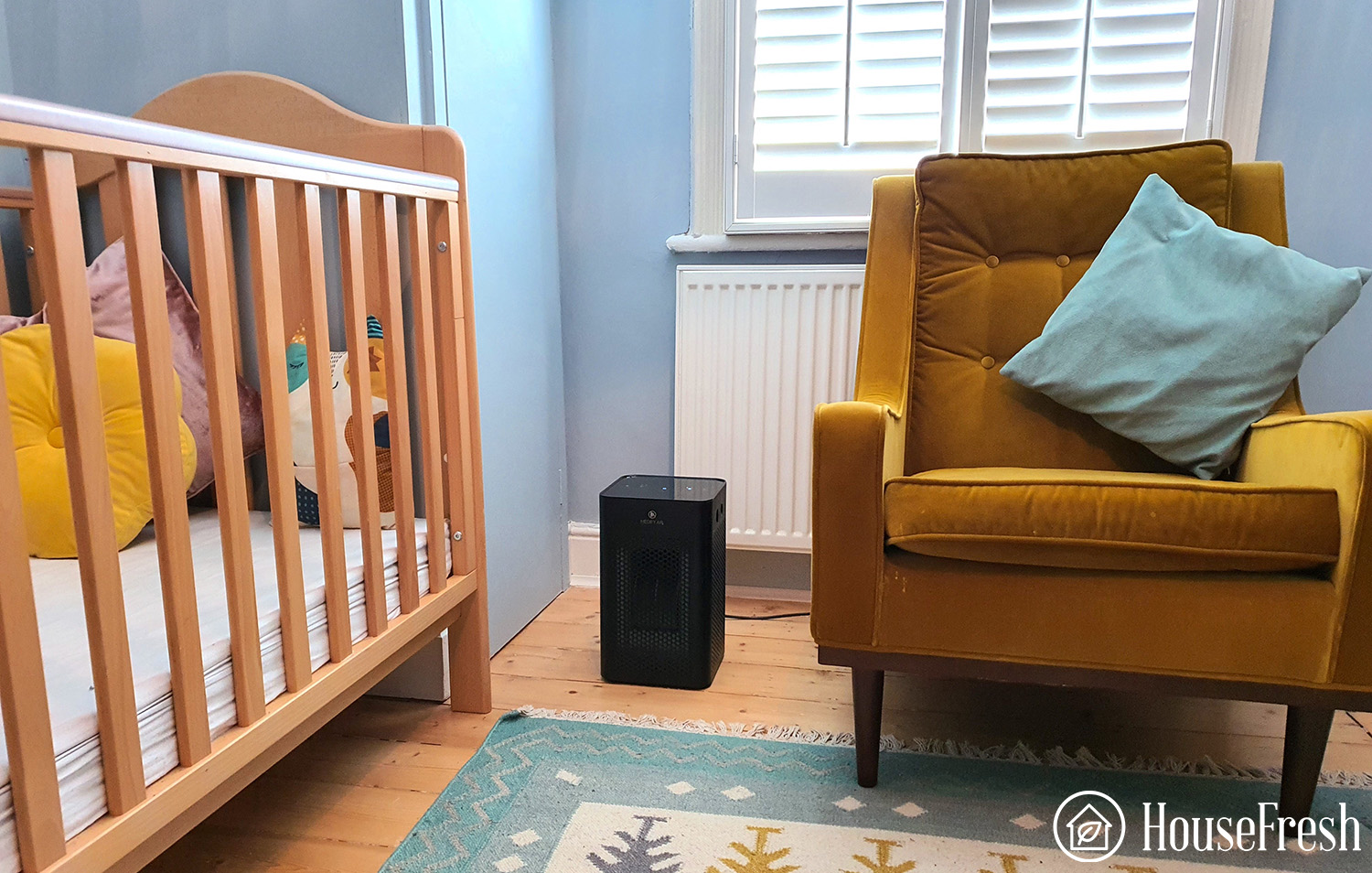
The air purifiers we recommend for your baby’s nursery room

Medify MA 25 Baby nursery room logo

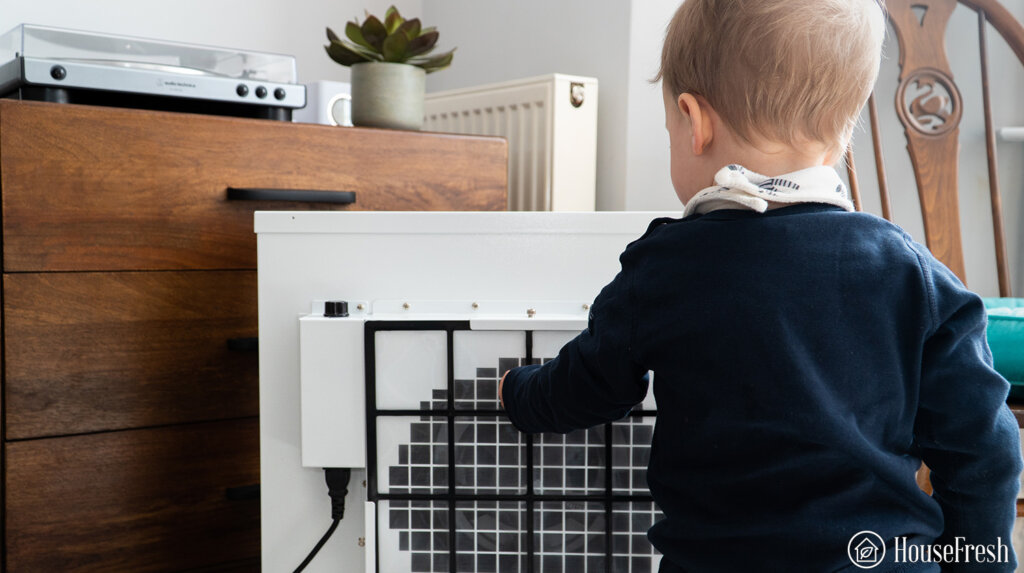
Our health is important, but when you bring a new life into this world, their health becomes paramount. You may have spent much time ensuring their environment is safe and comfortable, but have you considered what you can’t see? 

Infants spend most of their time indoors, away from the pollution that plagues the outdoors, but the pollution present in our homes can be just as harmful to new lungs. So, how do we protect them?

The most effective way of removing pollutants from the air in your home is by introducing an air purifier to the environment. These devices use specially engineered fans and filters to trap and remove airborne microscopic particles that could cause harm to your baby.

Unfortunately, it’s not as easy as buying any old air purifier for a baby’s room; you need to find the right unit to match the space, check it uses the right technology and ensure it’s not too loud. The last thing you want is more sleepless nights due to a loud fan whirling in their ears.

Finding the right air purifiers matters, but don’t panic; we’re here to help. We’ve done all the hard work, so you don’t have to. 

There are many air purifier review sites out there, but we’ve found that many of them don’t test the units themselves. Here at HouseFresh, we don’t rely on data gathered by manufacturers; we buy and test units ourselves in actual rooms in real homes.  

Staff picks: Top 3 air purifiers for a baby’s nursery room

Life is fast-paced and every second counts, even more so when you have a new addition to the family. If you don’t have time to read every review, I got you. Here are my top three recommendations.

👑 BEST OVERALL💰 FOR TIGHT BUDGETS🛋️ For Quiet
Levoit Core 600SLevoit Core 300SAlen BreathSmart Flex
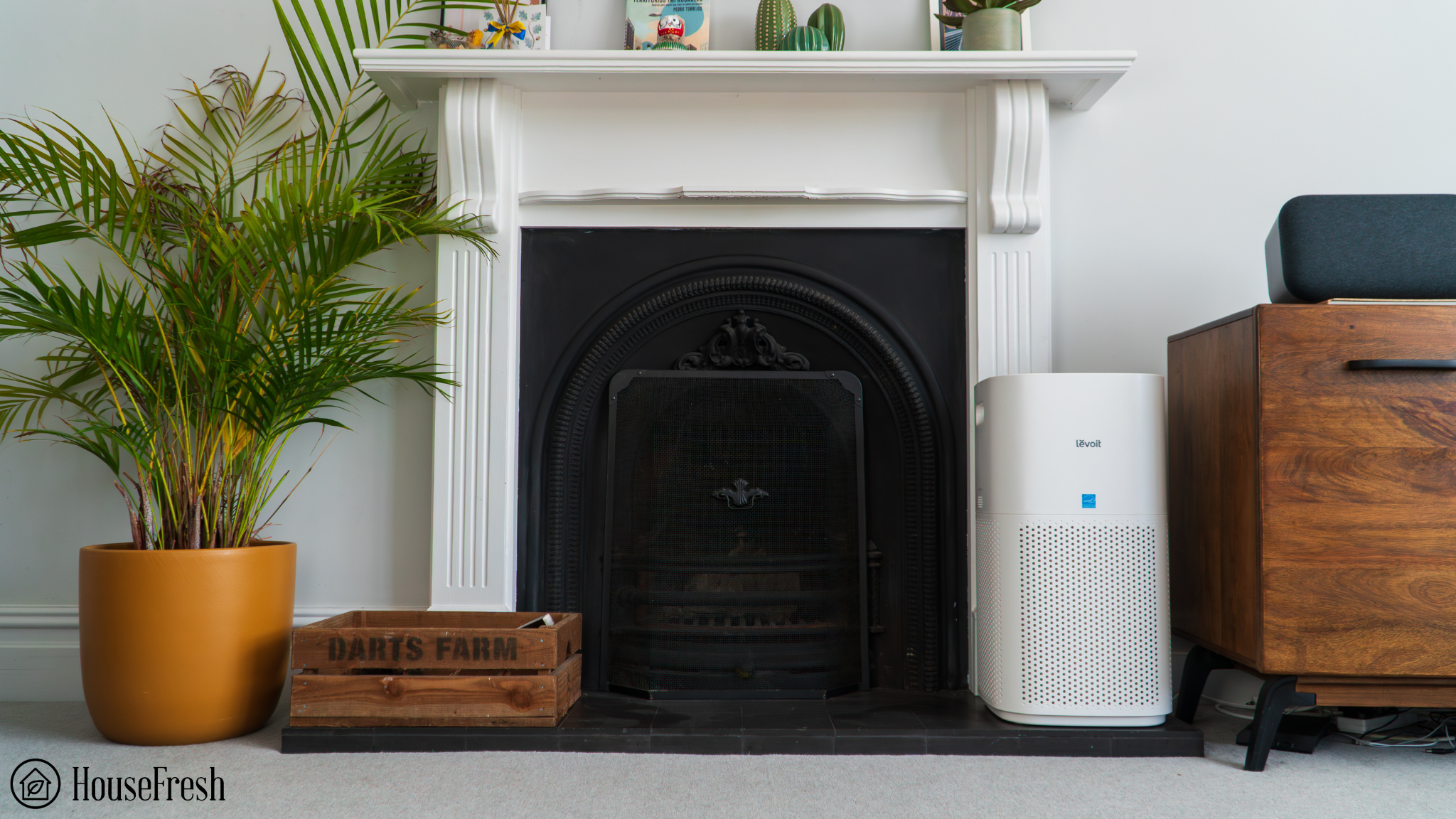
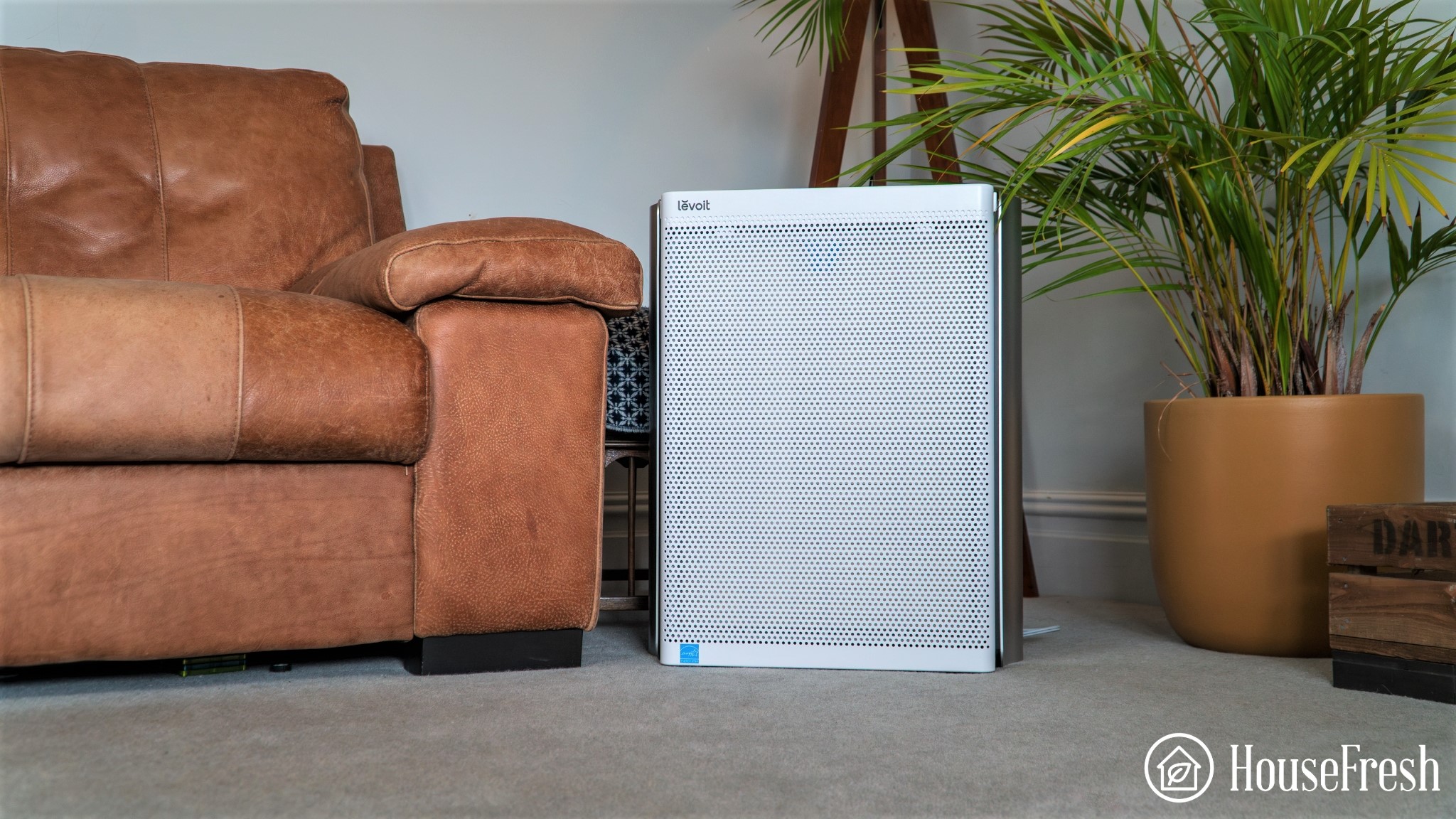
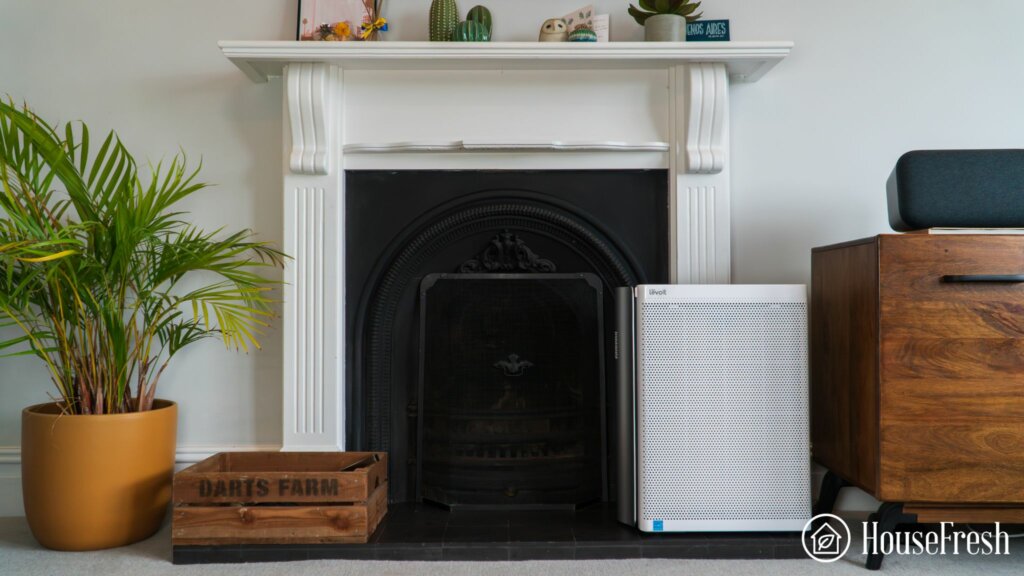
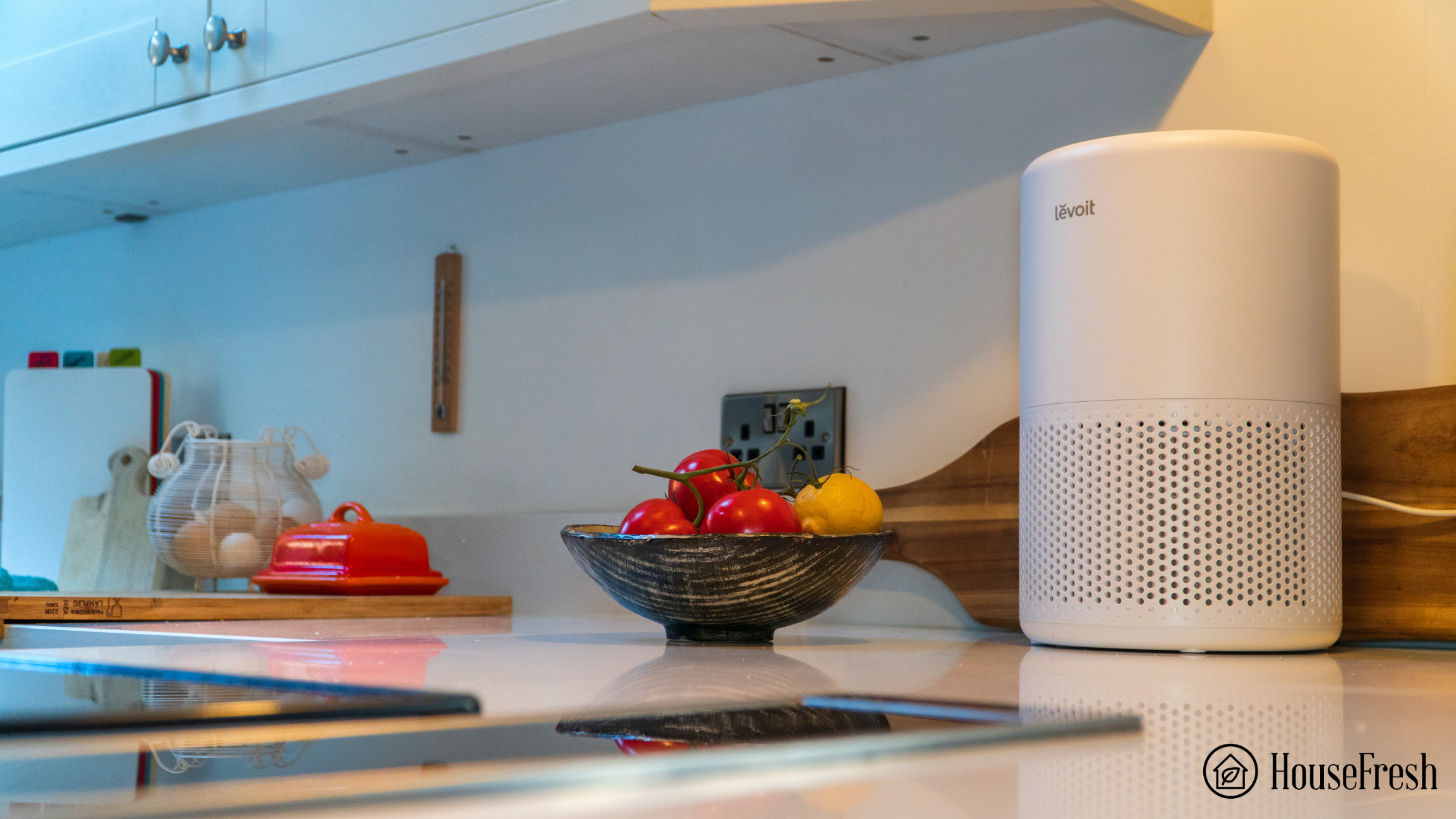
Levoit Core 600S Room 1 logoLevoit Core 300 Living RoomAlen BreatheSmart
AIR CLEANING SPEED ⚡15 minutes32 minutes34 minutes
CADR 👩‍🔬410 CFM141 CFM191 CFM
FILTER TECHNOLOGY 💨3-Stage Filtration3-Stage FiltrationH13 HEPA Filter
MAX ROOM SIZE 📏584 sq. ft.219 sq. ft.296 sq. ft.
NOISE LEVELS 👂Speed 1: 41 dB
Speed 2: 46 dB
Speed 3: 61 dB
Speed 1: 39 dB
Speed 2: 46 dB
Speed 3: 54 dB
Speed 1: 35.7 dB
Speed 2: 45.5 dB
Speed 3: 50.7 dB
WEIGHT ⚖️13.7 lbs (6.2 kg)5.95 lbs (2.7 kg)15 lbs (6.8 kg)
OUR REVIEW 🔍Levoit Core 600S reviewLevoit Core 300S reviewAlen Breathsmart Flex review
PRICE 💵$269.99No products found.$349

Last update on 2026-04-04 / Affiliate links / Images from Amazon Product Advertising API

  1. In our home lab of 728 cubic ft, we light an incense stick to generate particle pollution and VOCs.
  2. We set up our trusted Purpleair Indoor Sensor with the latest Bosch gas sensor to track levels of PM1ug/m3, PM2.5ug/m3 and PM10ug/m3 and VOCs in the air.
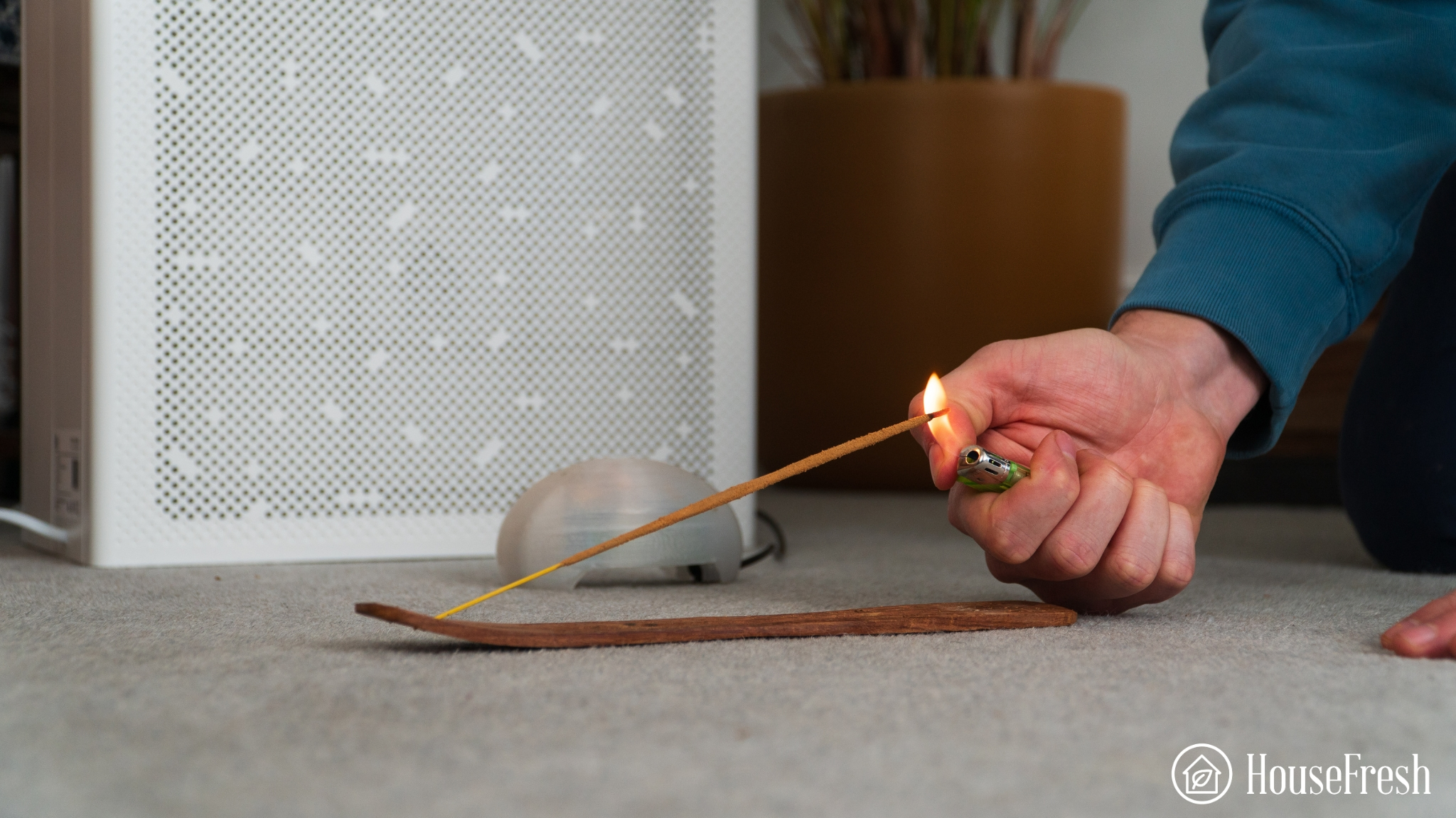
    purpleair
  3. We switch the air purifier to its highest speed and measure how long it takes to get our room air quality down to PM1 level to 0.
  4. We use an energy meter to measure precisely how much electricity is used when running the unit at the lowest and highest fan speed settings.
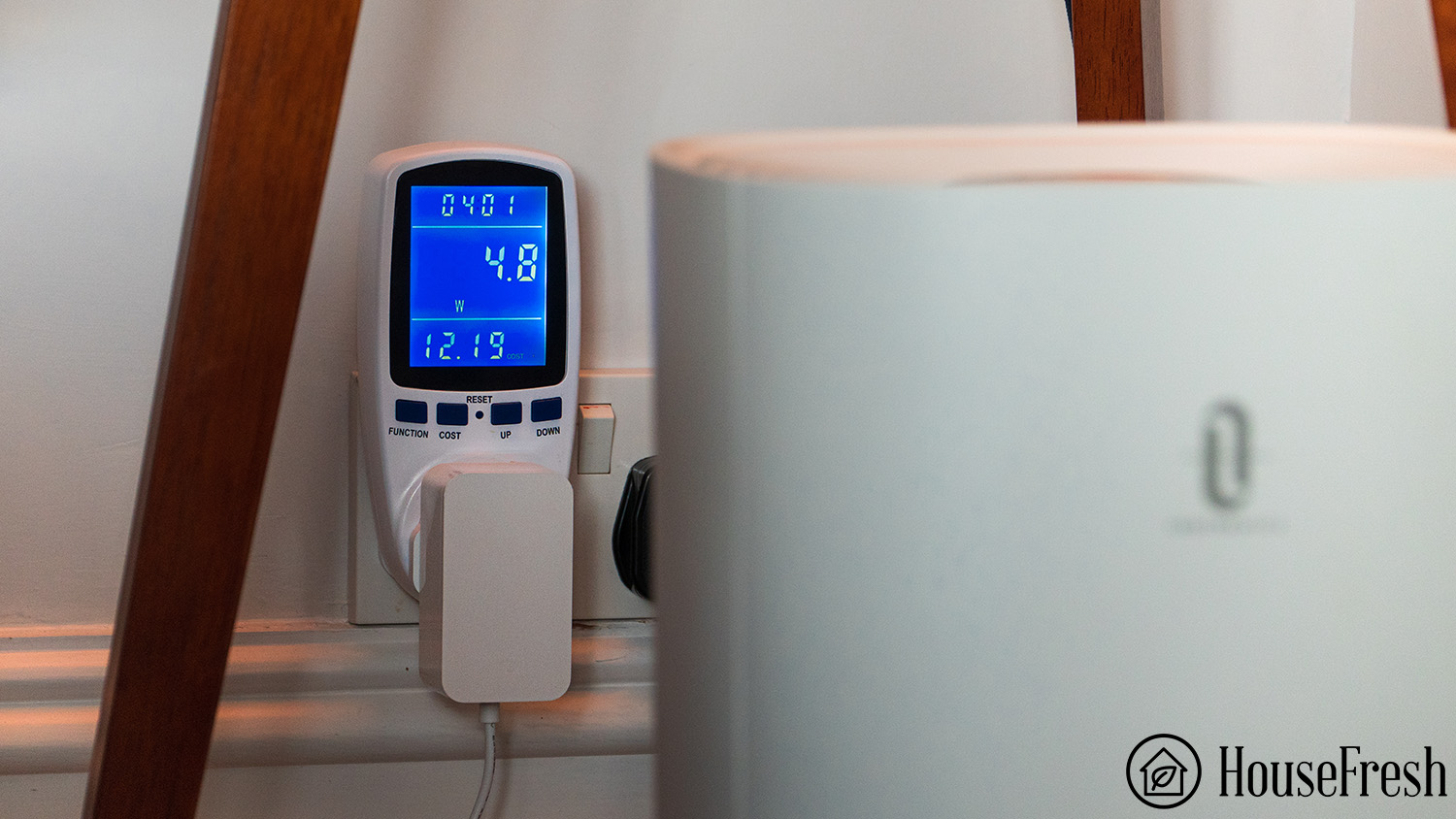
    How Much Energy Does an Air Purifier Use
  5. We track sound levels emitted by the air purifier at different fan speeds with the help of a commercial sound meter.
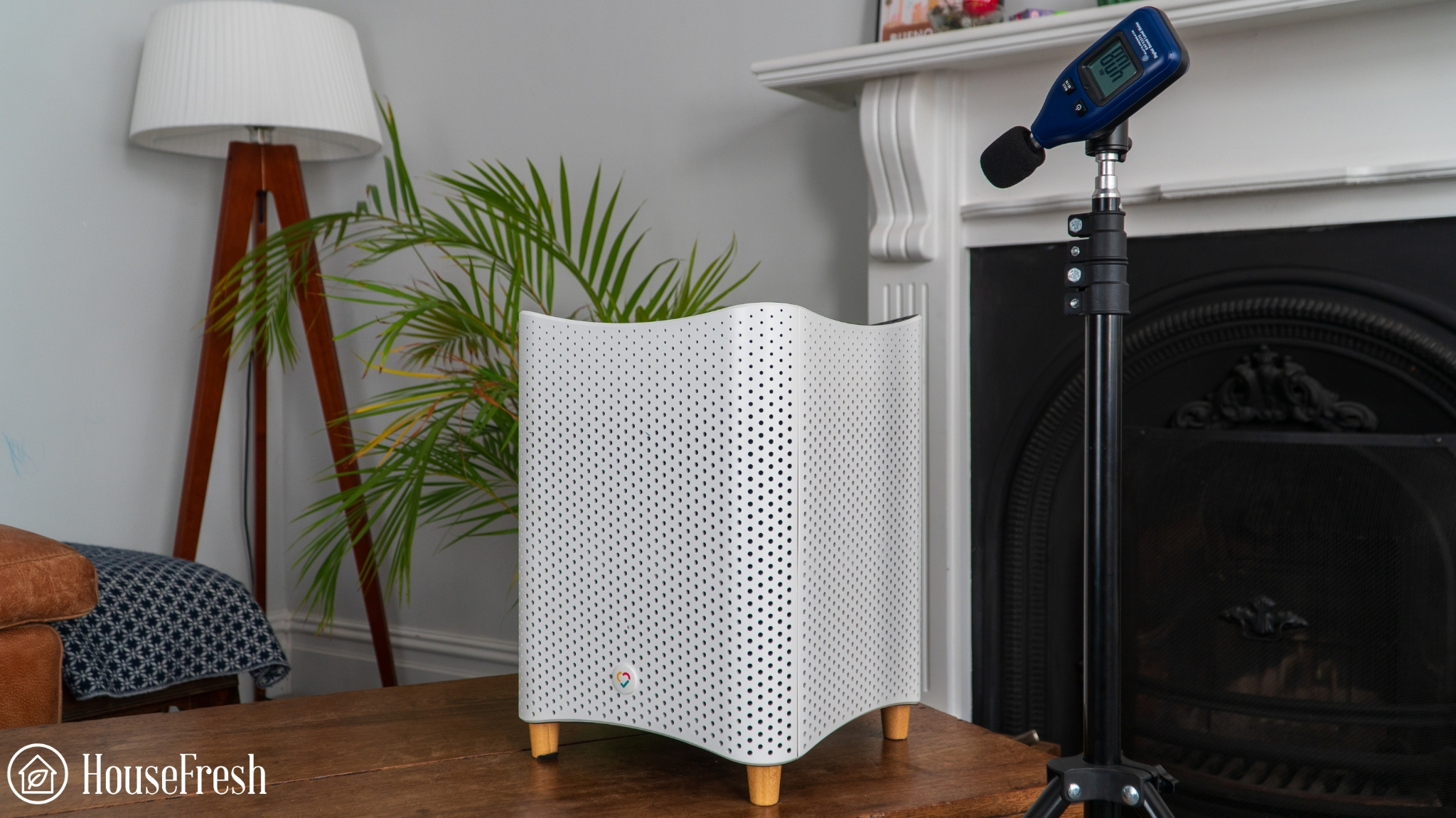
    sound meter

Your baby’s health is paramount, so you’ll need to ensure the air purifier you purchase has all the features needed to protect them while not disturbing their routine. 

When looking for the perfect air purifiers for babies’ rooms, we had a few specifications in mind:

  • HEPA Filters – HEPA filters are the most effective filter for removing harmful particles from the air. Using a tight maze of fibers, pollutants become trapped as the air passes through. 
  • Air Cleaning Performance – Air purifiers are not created equal; when finding the right one, consider its performance rating by checking the unit’s CADR (Clean Air Delivery Rate; learn more here).
  • Noise – When you have a baby, you know noise is everything, especially when you’ve just got them down after a long battle with tears. The sound from a unit’s fan varies between air purifiers, so finding a quiet yet highly-efficient unit is essential.

Still with me? Great. Let’s go into a bit more detail on each recommended air purifier so that you can choose which will fit perfectly into your baby’s nursery room.

1. Best overall: Levoit Core 600S

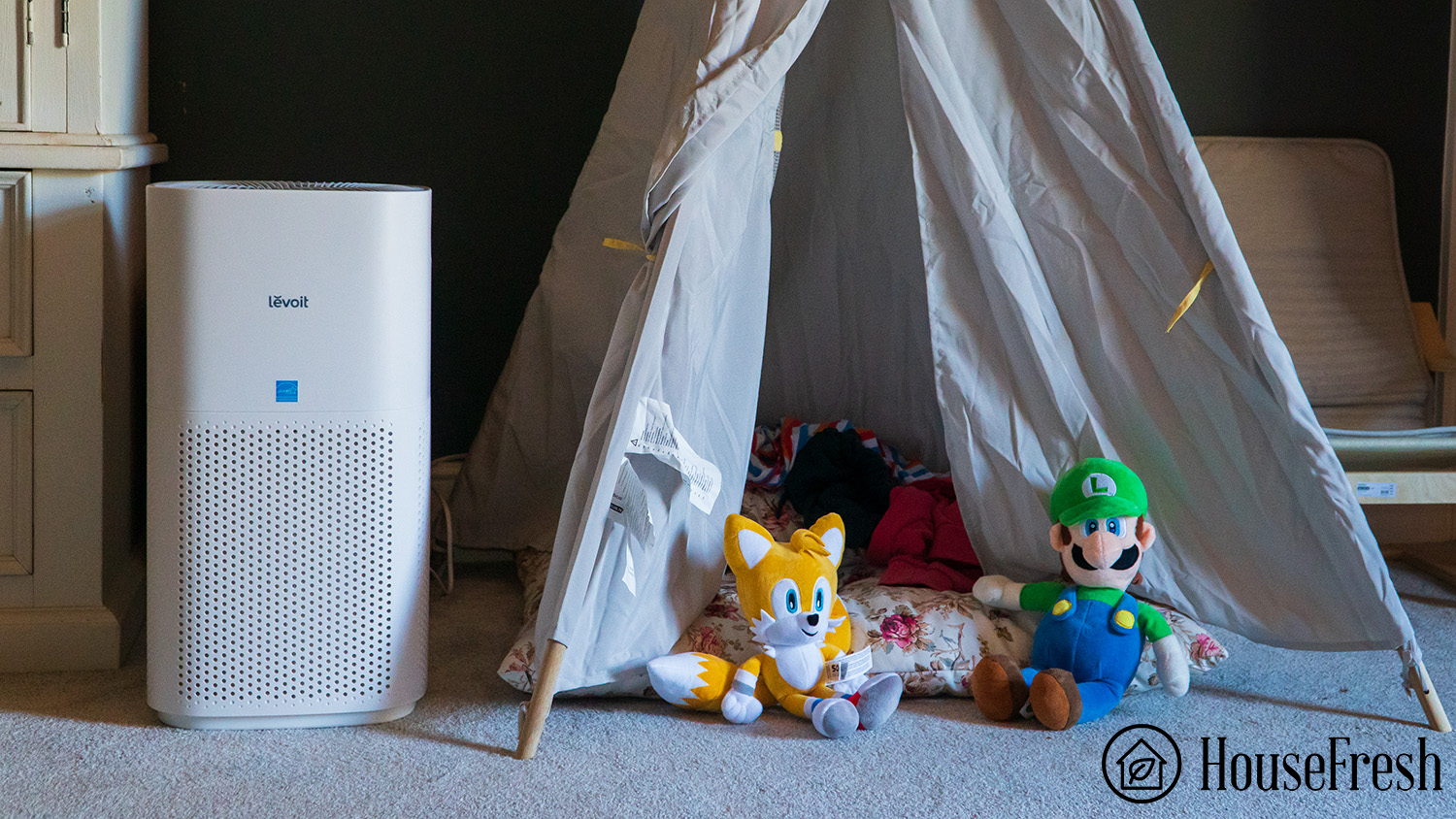
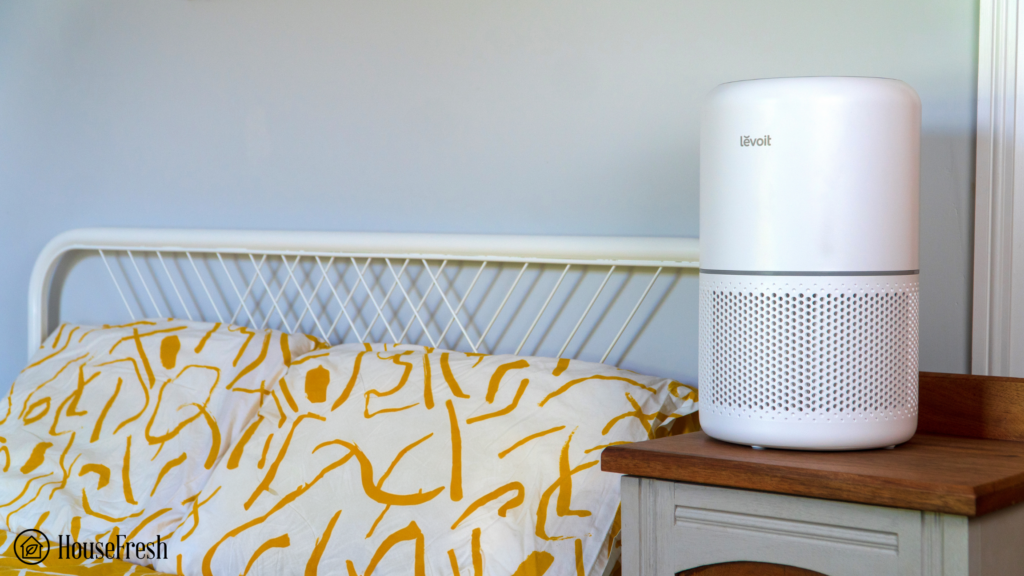
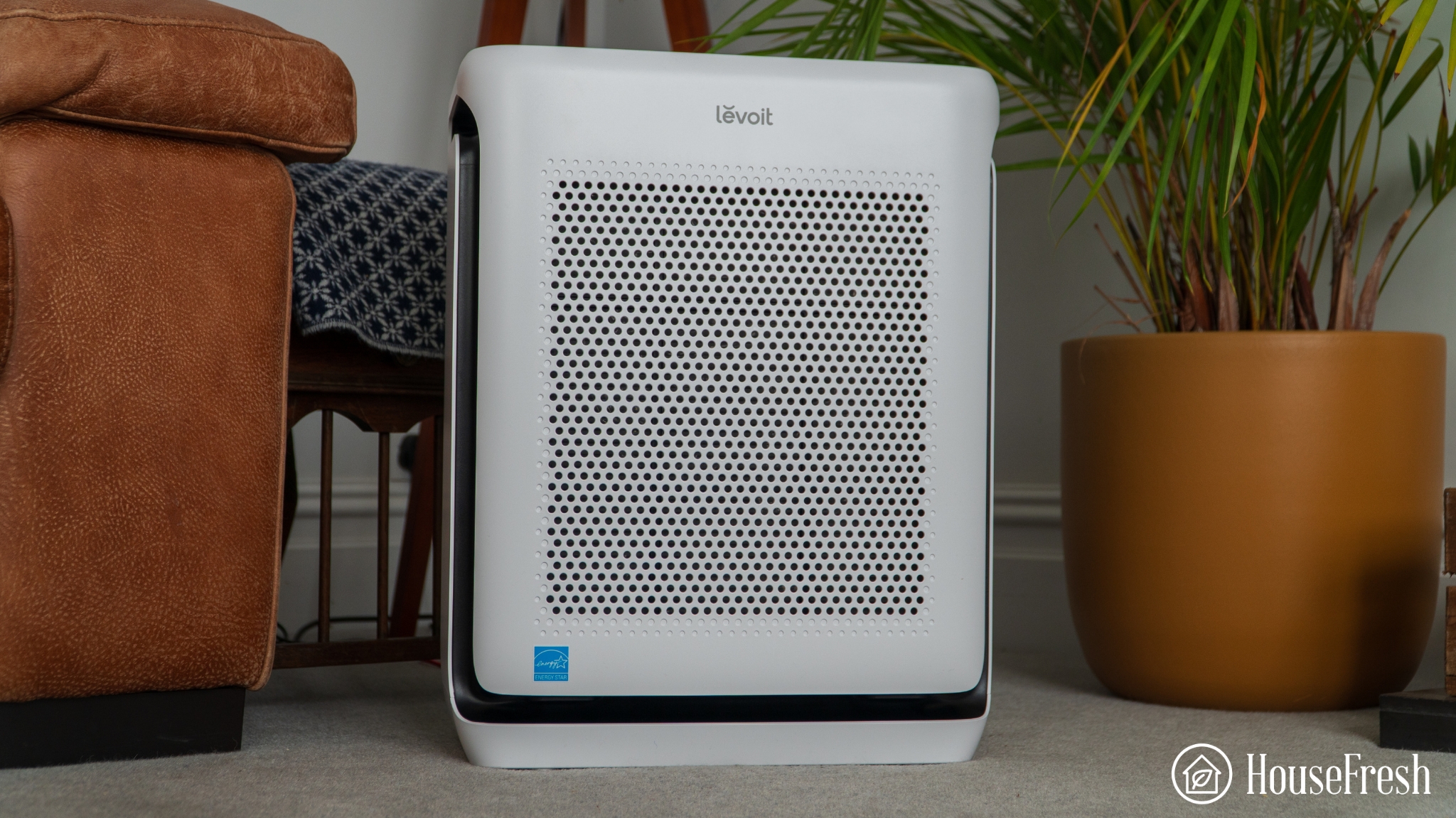
When it comes to air purifiers, Levoit is the brand you will hear about time and again. Levoit has been producing highly effective units for over ten years. The Core S series shows you can combine cleaning technology and smart features into a budget air purifier for a baby’s nursery.
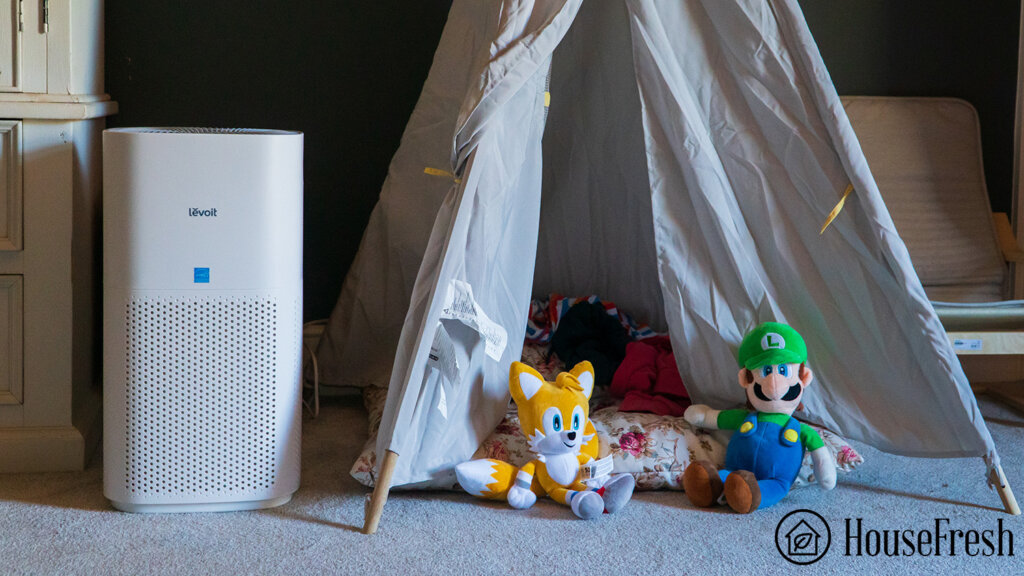
Levoit Core 600S Room 1 logo

💡exclusive code for HouseFresh for 10% off a single purchase on Levoit.com: HOUSE10

The Core 600S blew us away with its cleaning power when we tested it in our home, clearing our simulated contaminants in just 15 minutes, making it one of the fastest units we’ve ever tested. 

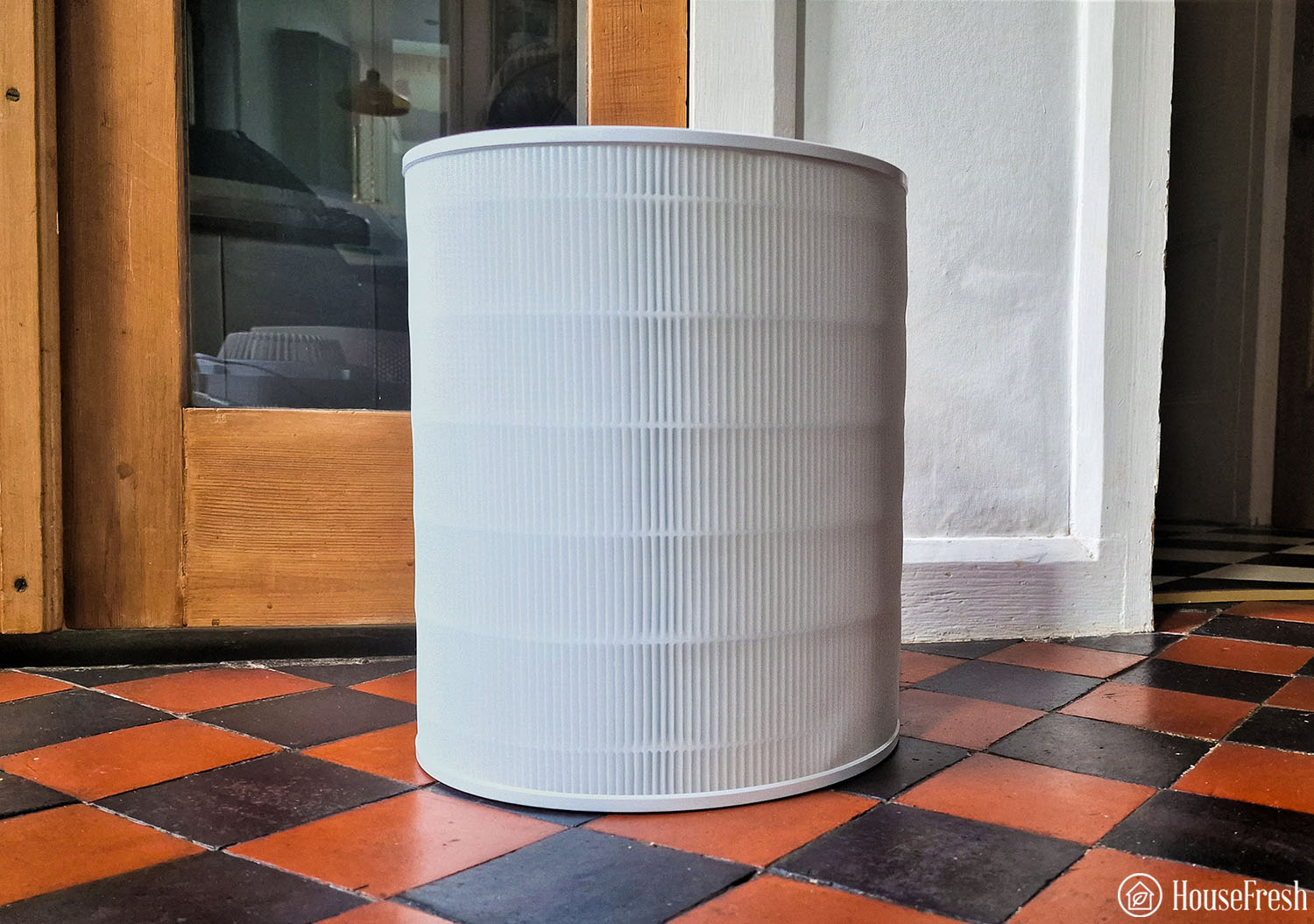
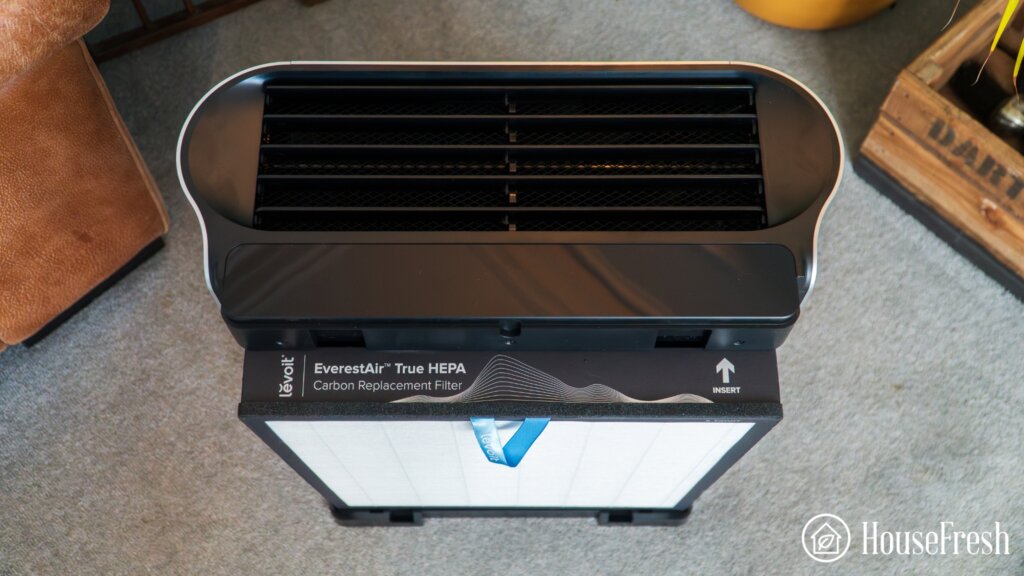
Inside the 600S is a high-powered fan and a three stages filter comprised of a pre-filter, an main HEPASmart™ filter and pieces of activated carbon with ARC Formula™. The pre-filter traps larger particles like dust, and the main filter traps harmful, microscopic particles like mold, bacteria and viruses, removing them from the air in your baby’s nursery, and the activated carbon adsorbs odors and VOCs (Volatile Organic Compounds).

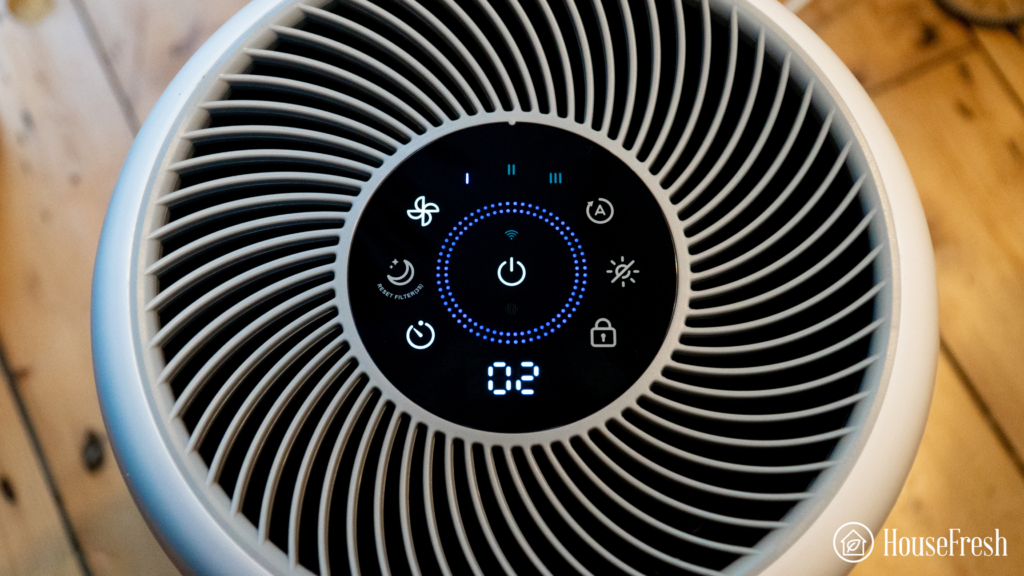
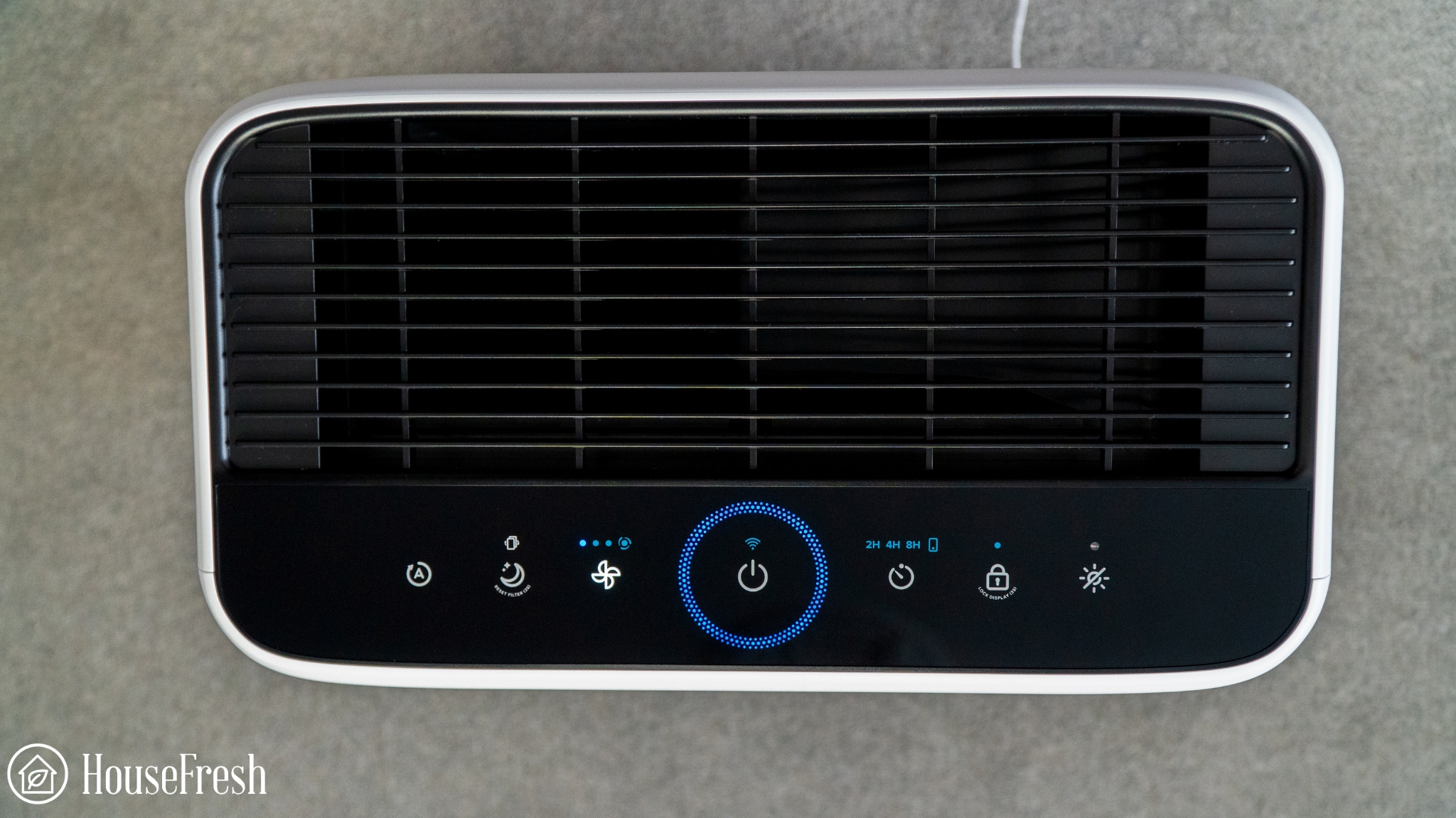
What makes the 600S ideal for nurseries is its AirSight Plus™ smart laser dust sensor that monitors the quality of the air in real time. When in Auto Mode, the fan will automatically adjust to the data from the sensor, meaning you can turn it on and have a sound mind that your little one is protected.

Tip

You can also monitor the air quality from your smartphone using Levoits’ VeSync app.

What we really like

The app allows you to control the unit and monitor air quality.
Energy efficient, low running costs.
Only emits 41 dB on the lowest fan speed.
Impressive CADR for the price of the unit

What we think could be better

Not very stylish.
You cannot remove the pre-filter to clean.

Clean air delivery rate (CADR):– Top speed PM1 CADR: 375 cfm
– Sub-45 dBA PM1 CADR: 156 cfm
– AHAM PM2.5 CADR: 398 cfm (dust)
Filter technology:Bonded particle filter with a layer of pelleted activated carbon and a pre-filter mash wrap.
Recommended room size:562 sq. ft. (5 air changes per hour)
Dimensions:12.3 x 12.3 x 23.6 inches (31.3 x 31.3 x 60 cm)
Weight:13.7 lbs (6.2 kg)
Noise level in decibels from 3 ft. away:Sleep: 37.9 dBA
Speed 1: 44.4 dB
Speed 2: 45.9 dB
Speed 3: 53.8 dBA
Speed 4: 62.3 dBA
Electricity consumption in watts:Standby mode: 1.3 watts
Sleep: 4.33 watts
Speed 1: 7.46 watts
Speed 2: 10.7 watts
Speed 3: 20.29 watts
Speed 4: 48.1 watts
Filter lifespan:6-12 months
Manufacturer’s warranty:2 years
Country of origin:United States
Country of manufacture:China

2. Best for larger baby rooms: Smart Air Blast Mini

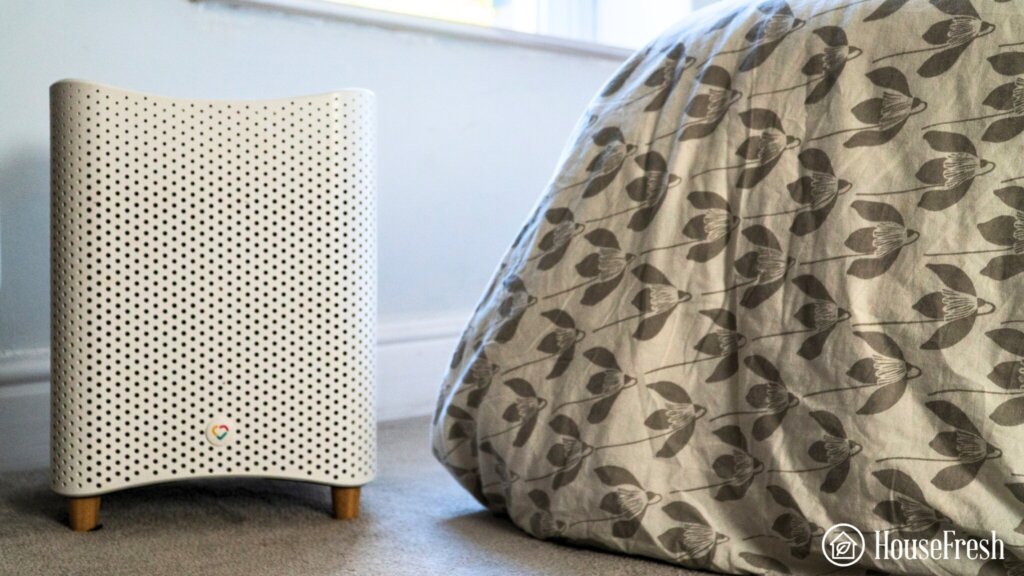
Smart Air aims to make no-nonsense, powerful air purifiers that don’t cost the world. They focus on making units that perform to high standards in various sizes for different spaces, like the cute Smart Air S

Blast Mini Living room

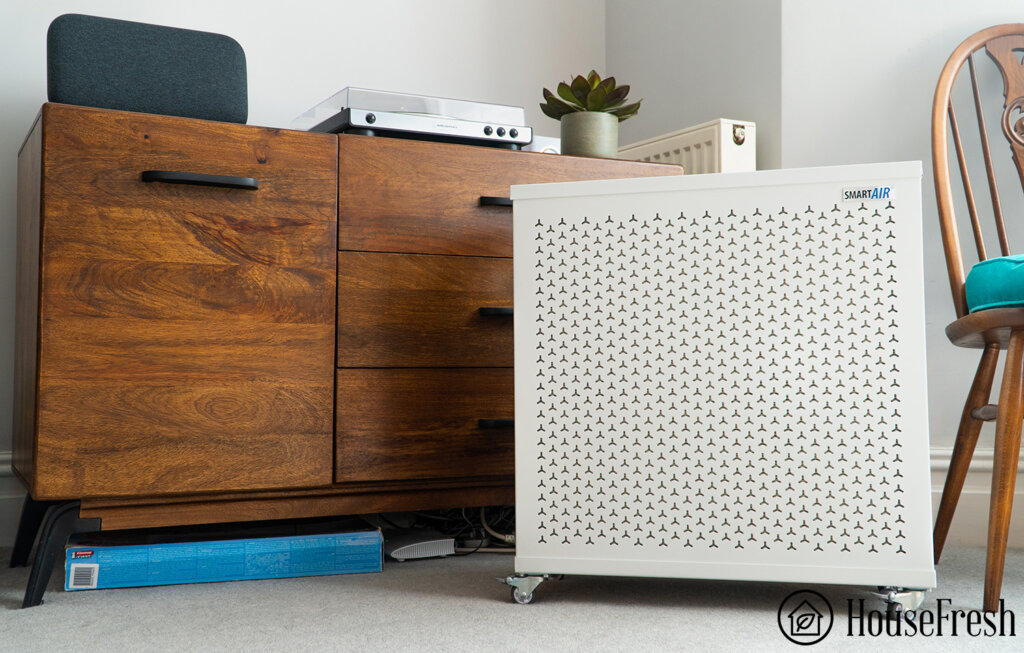
If you have the luxury of a larger nursery, you will need an air purifier that can tackle that amount of air to clean. That’s why we recommend the Blast Mini (don’t let the name fool you, it’s pretty big). 

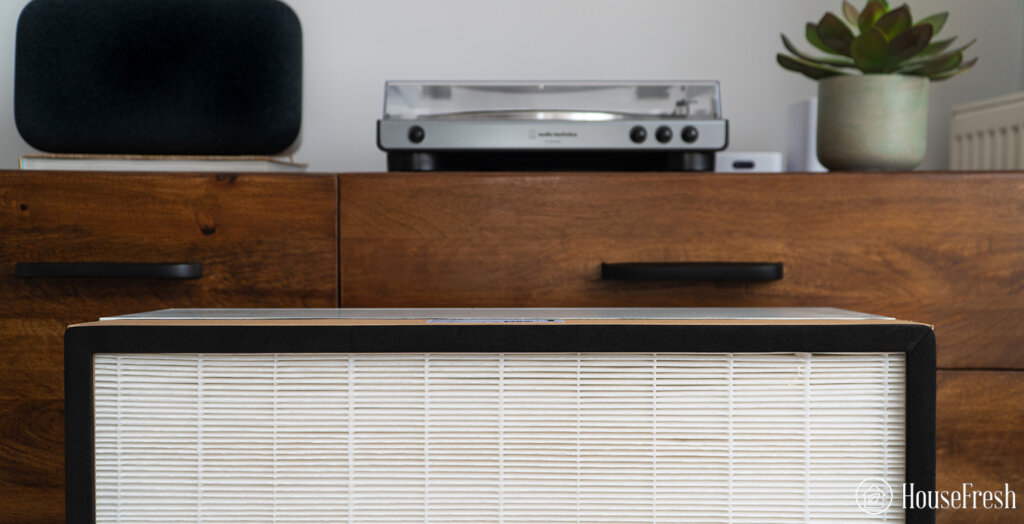
This beast of a unit is made from metal, making it one of the hardest-wearing air purifiers on the market. It can clean spaces up to 702 sq. ft with its high-performance fan and thick H13 HEPA filter. The Blast Mini doesn’t just talk the talk; it walks the walk, clearing our performance testing room in 12 minutes.

So, if you have the space and you’re more focused on cleaning pollutants from your nursery fast and efficiently over gadgets and extra functions, the Blast Mini will keep any nasty contaminants out of the air your baby breathes every day. And something worth mentioning, the unit has been designed to be safe for kids.

What we really like

Super durable.
It has a high CADR of 450 CFM.
The fastest air purifier we have tested.
Simple to use with only one dial to operate.

What we think could be better

Weighing 59 lbs, it’s a heavy unit.
I wish the control dial was on the front of the unit.

Clean air delivery rate (CADR):– Top speed PM1 CADR: 400 cfm
– Sub-45 dBA PM1 CADR: 272 cfm
– Manufacturer provided CADR: 437 cfm
Filter technology:H13 HEPA filter (and optional pelleted activated carbon filter)
Recommended room size:600 sq. ft. (5 air changes per hour):
Dimensions:22.6L x 13W x 24.8H inches (57.5L × 33W × 63H cm)
Weight:59 lbs (26.8 kg)
Noise level in decibels from 3 ft. away:Speed 1: 44.9 dB
Speed 2: 51.2 dB
Speed 3: 56.3 dB
Electricity consumption in watts:Standby mode: 0 watts
Speed 1: 51.9 watts
Speed 2: 87.4 watts
Speed 3: 122.7 watts
Filter lifespan:13 months
Manufacturer’s warranty:1 year
Country of origin:China
Country of manufacture:China

3. Best budget option: Levoit Core 300S

We all know that sacrifices have to be made when you have a new addition to the family, and budgets get a little tighter. Luckily Levoit is on hand with their Core S range. These high-performing air purifiers have the cleaning power and the technology to give you peace of mind when your baby is asleep in their nursery.

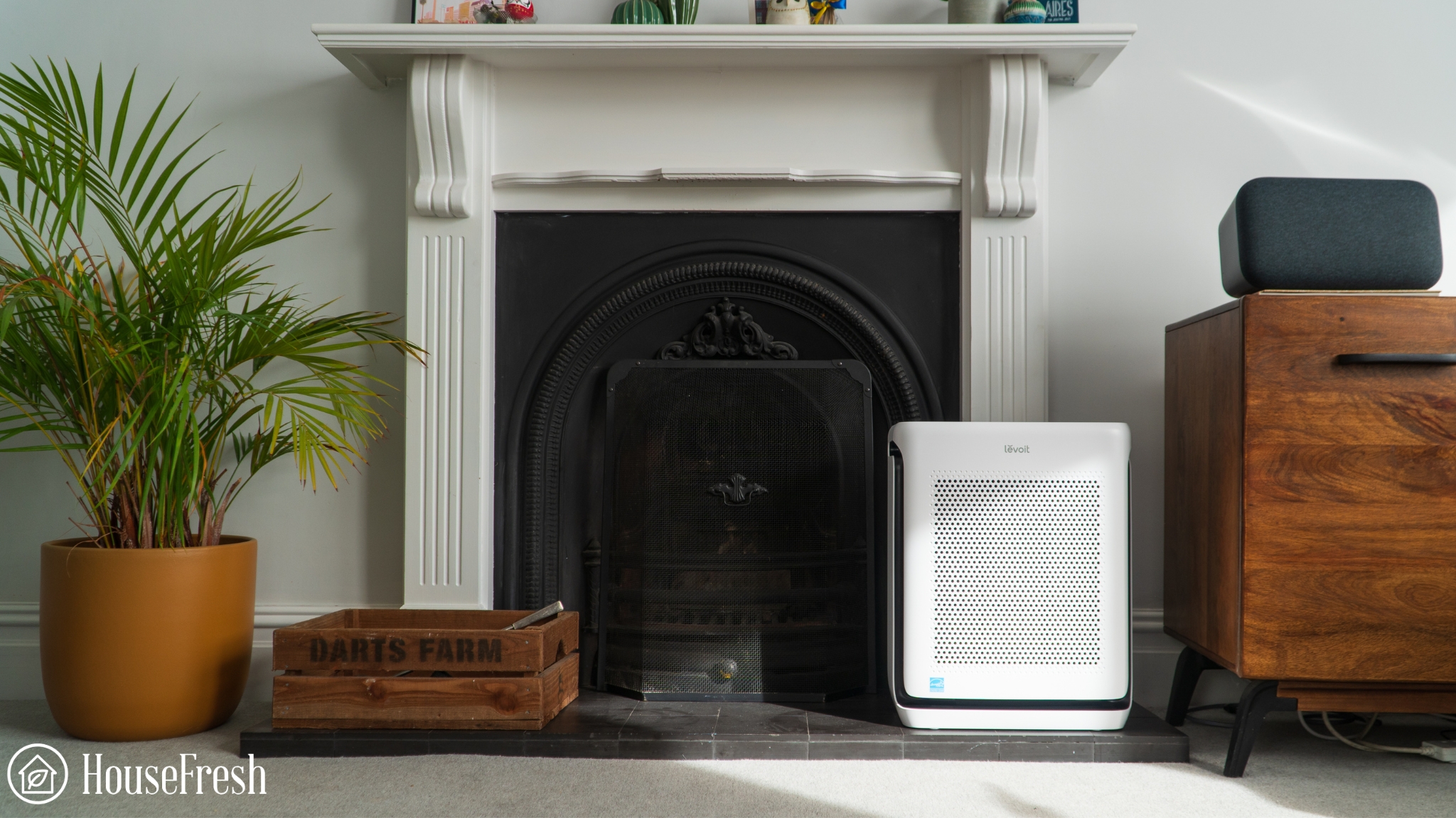
Levoit Core 300S Living Area logo

💡exclusive code for HouseFresh for 10% off a single purchase on Levoit.com: HOUSE10

Like the Core 600S, the 300S has the same app connectivity that allows you to monitor the air quality in your baby’s nursery, adjust the fan speed and control the settings like the built-in timer, Auto Mode, Sleep Mode and Child Lock in case you have an inquisitive infant on your hands.

Under the hood is Levoit’s three-stage filter comprising a pre-filter, a main filter and an activated carbon filter. Levoit offers three different filter options to customize your unit to your situation. For nurseries, we recommend going for the most powerful of them all: the four-stage Smoke Remover Filter that includes a custom high-efficiency activated carbon.

Levoit Core 200S-P Air Purifier Genuine Replacement Filter, AHAM VERIFIDE, Supports HEPA Sleep Mode, High-Efficiency Activated Carbon, Removes Smoke, Odors, Allergens, Core 200S-RF, 1 Pack
LEVOIT Core 300-P Replacement Filter Air Purifier Pet Allergy, Genuine Core300S-P Filters, Supports HEPA Sleep Mode, High-Efficiency Activated Carbon, Core 300-RF-PA, Yellow, 1 Pack
LEVOIT Core 300-P Replacement Filter for Toxin Absorber, Genuine Core300S-P Air Purifier Filters, Supports HEPA Sleep Mode, High-Efficiency Activated Carbon, Core 300-RF-TX, Green
LEVOIT Core 300-P Replacement Filter for Air Purifier Smoke Remover, Genuine Core300S-P Filters, Supports HEPA Sleep Mode, High-Efficiency Activated Carbon, Core 300-RF-SR, 1 Pack, Blue
Technology
H13 (Medical) Grade HEPA and Activated Charcoal
3-in-1 HEPA, High-Efficiency Activated Carbon
4-in-1 HEPA, High-Efficiency Activated Carbon
Price
$21.34
$35.99
$35.99
$39.99
Levoit Core 200S-P Air Purifier Genuine Replacement Filter, AHAM VERIFIDE, Supports HEPA Sleep Mode, High-Efficiency Activated Carbon, Removes Smoke, Odors, Allergens, Core 200S-RF, 1 Pack
Technology
H13 (Medical) Grade HEPA and Activated Charcoal
More information
Price
$21.34
LEVOIT Core 300-P Replacement Filter Air Purifier Pet Allergy, Genuine Core300S-P Filters, Supports HEPA Sleep Mode, High-Efficiency Activated Carbon, Core 300-RF-PA, Yellow, 1 Pack
Technology
3-in-1 HEPA, High-Efficiency Activated Carbon
More information
Price
$35.99
LEVOIT Core 300-P Replacement Filter for Toxin Absorber, Genuine Core300S-P Air Purifier Filters, Supports HEPA Sleep Mode, High-Efficiency Activated Carbon, Core 300-RF-TX, Green
Technology
3-in-1 HEPA, High-Efficiency Activated Carbon
More information
Price
$35.99
LEVOIT Core 300-P Replacement Filter for Air Purifier Smoke Remover, Genuine Core300S-P Filters, Supports HEPA Sleep Mode, High-Efficiency Activated Carbon, Core 300-RF-SR, 1 Pack, Blue
Technology
4-in-1 HEPA, High-Efficiency Activated Carbon
More information
Price
$39.99

What we really like

App connectivity.
Sleep mode turns off all the lights on the unit.
Lightweight at 5.95 lbs.
Choice of filter replacements.

What we think could be better

If you move it around when it’s on the floor, you might find that the cover at the bottom of the unit opens up.

HouseFresh rating:★★★★☆
Time to clean our 728 cubic feet test room (with the device running at top speed):45 minutes
Air purifier technology:3-Stage Filtration (pre-filter, main particle filter, high-efficiency activated carbon filter)
Recommended room size (4.8 air changes per hour):219 sq. ft.
Clean air delivery rate (CADR):Dust: 134 CFM
Smoke: 126 CFM
Pollen: 154 CFM
Dimensions (in inches / in cm):8.7L x 8.7W x 14.2H inches (22L x 22W x 36H cm)
Weight (in pounds / in kg):5.95 lbs (2.7 kg)
Filter life:6 – 8 months
Noise level in decibels (measured from 3 ft. away with a sound level meter):Speed 1: 38.9 dB
Speed 2: 45.7 dB
Speed 3: 54.5 dB
Electricity consumption in watts (recorded with an electricity usage monitor):Standby mode: 1.7 watts
Speed 1: 5.9 watts
Speed 2: 9.8 watts
Speed 3: 21.8 watts
Estimated running cost (electricity consumption + official filter replacement):$79.43 per year
Cost per CADR cfm (based on dust CFM as reported by AHAM):$1.12
Manufacturer’s warranty:2 years
Country of manufacture:China

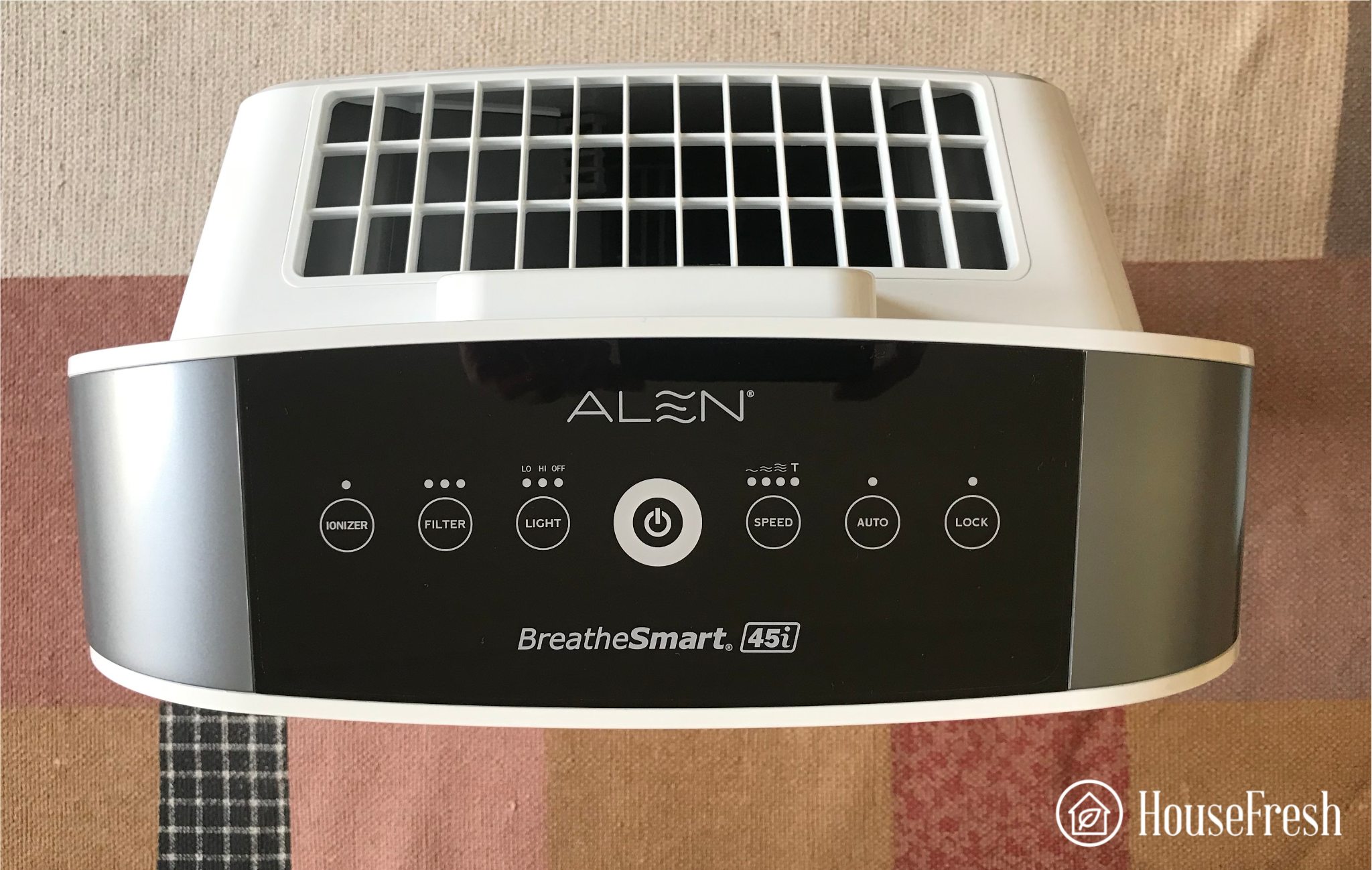
4. Alen BreatheSmart Flex

Alen is another well-known brand in the world of air purification, proven by their 20+ years in the game. Along with its large variety of units to suit a plethora of different-sized rooms, Alen is known for their heavy-duty filters and a lifetime guarantee, which comes in handy when you’ve got curious little ones around.
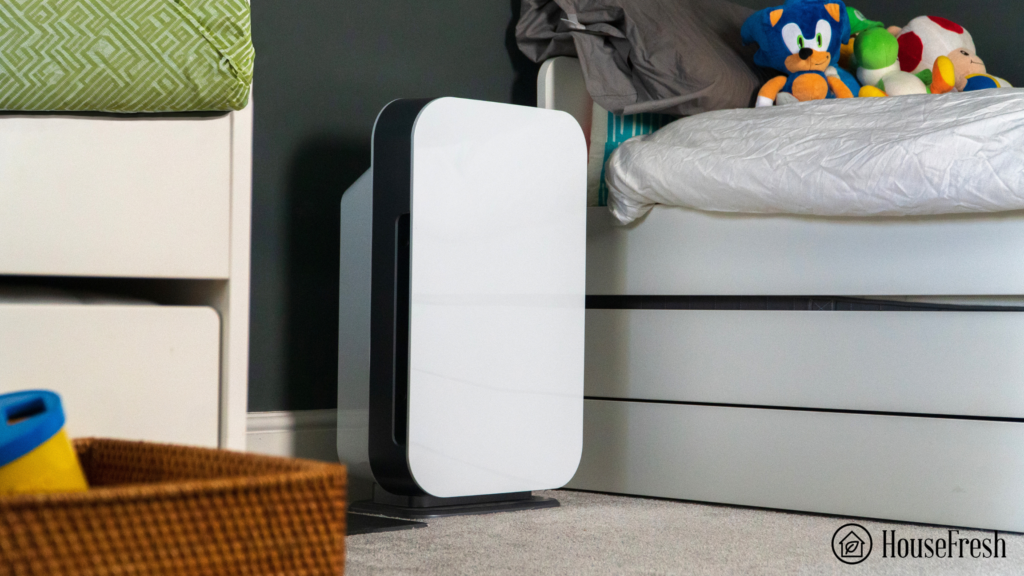
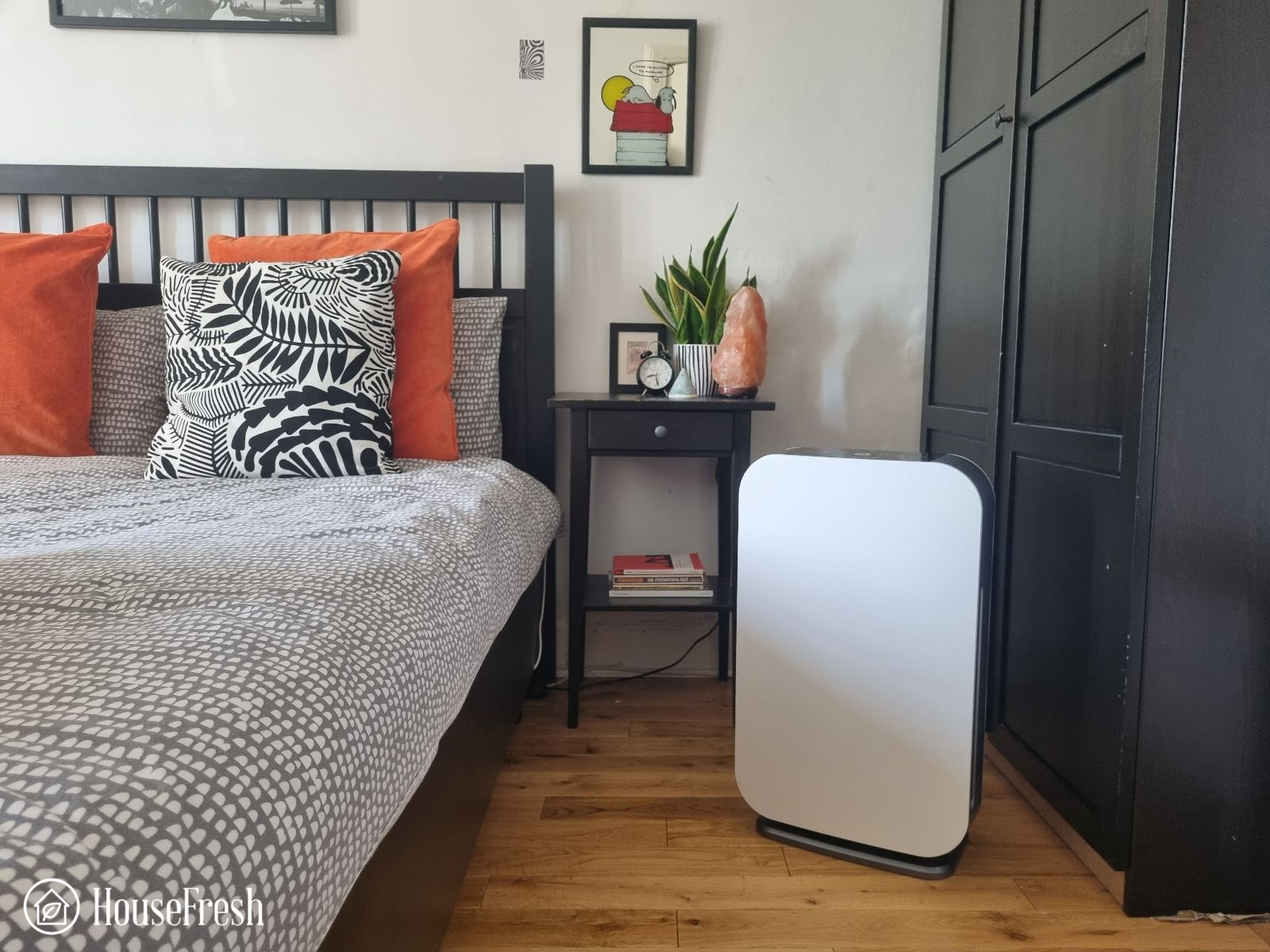
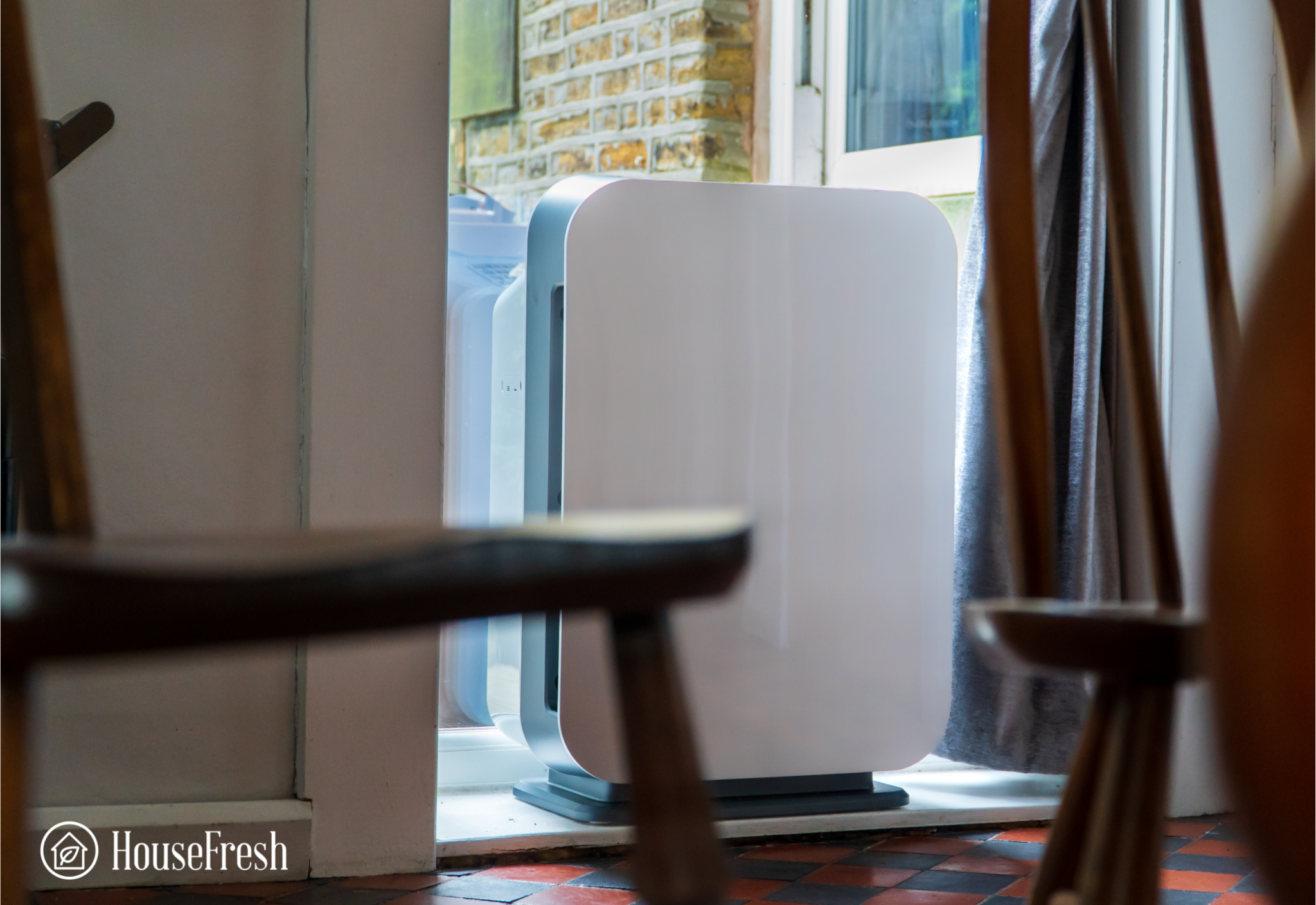
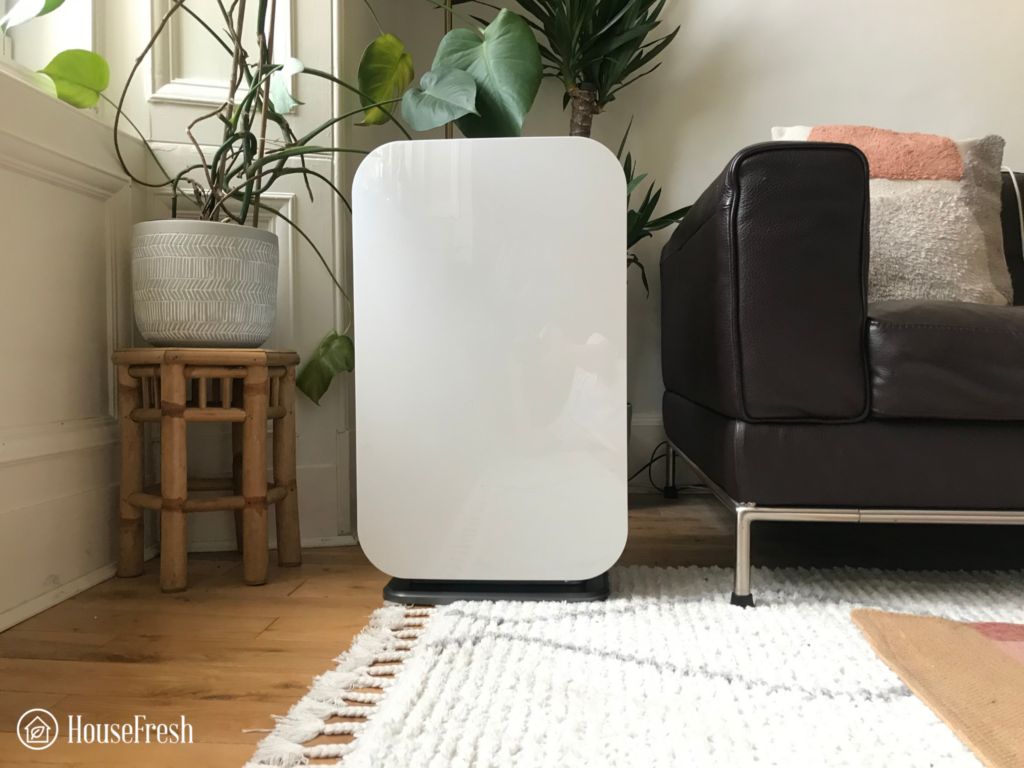
Alen BreatheSmart Flex Bedroom

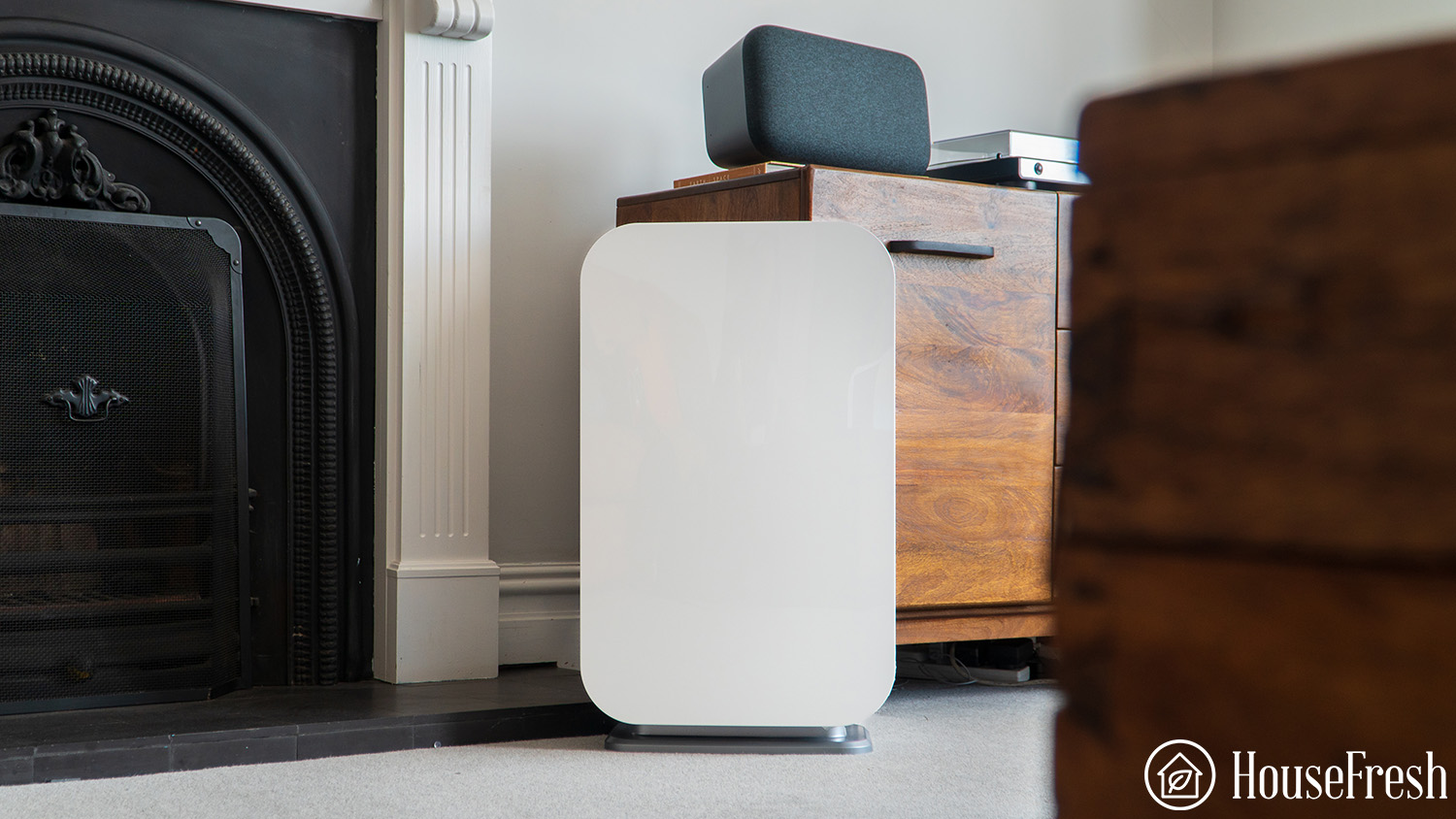
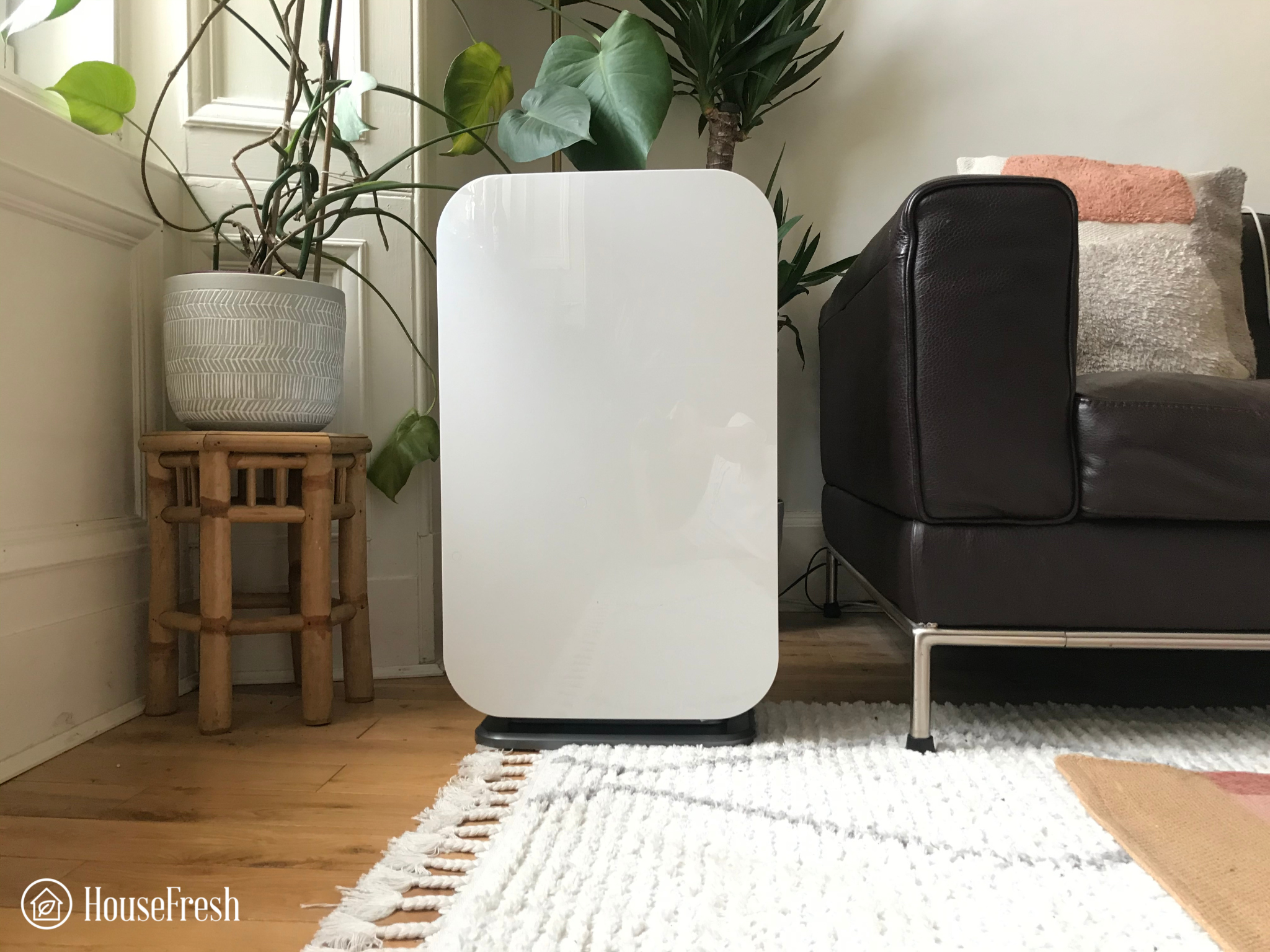
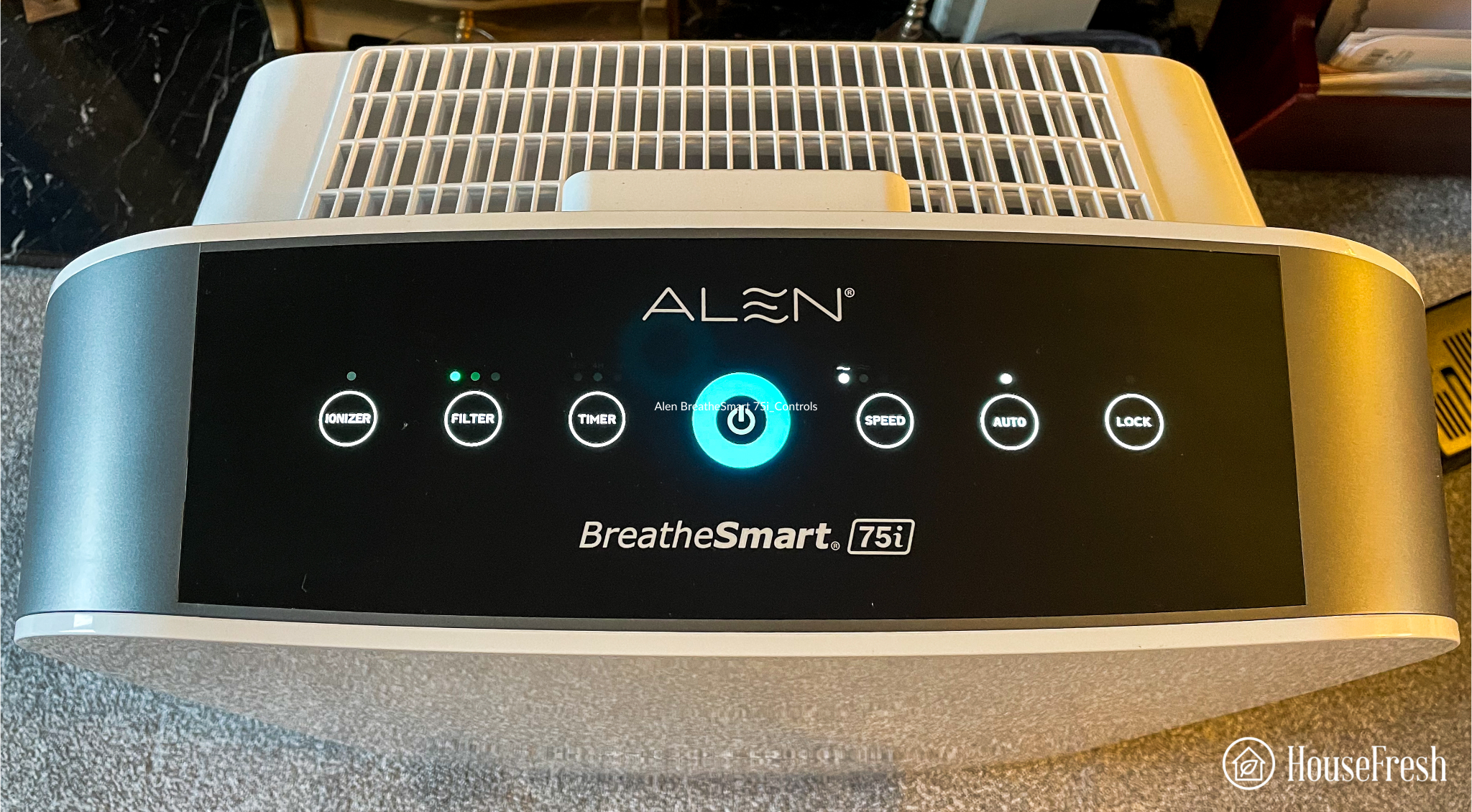
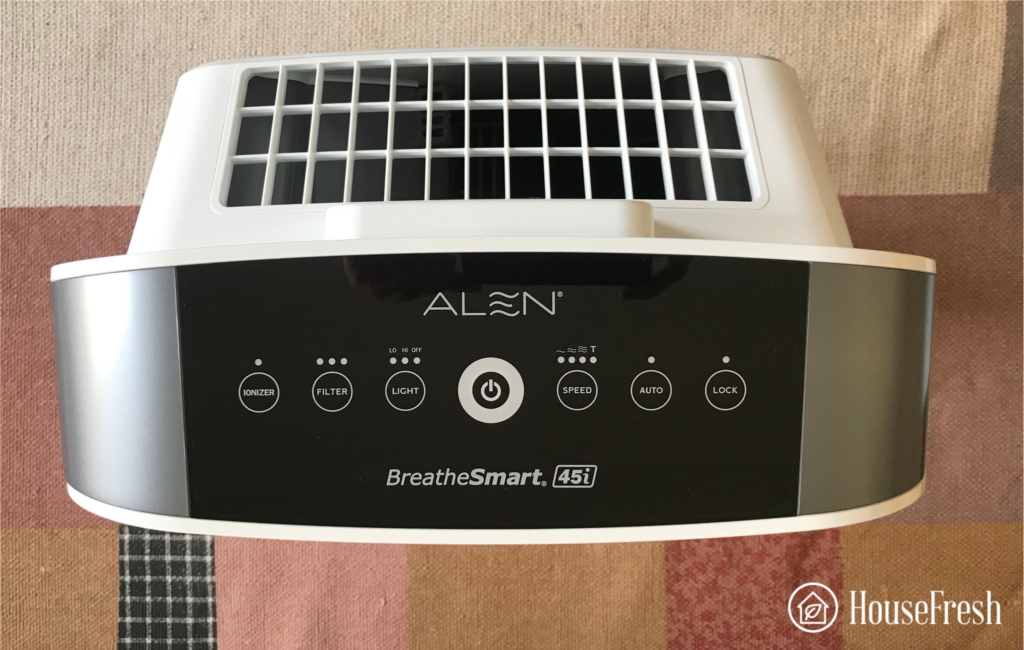
We’ve reviewed a few models from Alen, like the 75i and the 45i, but we recommend the BreatheSmart Flex for nurseries. The flex is Alen’s answer for those who want a powerful unit without all the bells and whistles that brands add to ramp up the price.

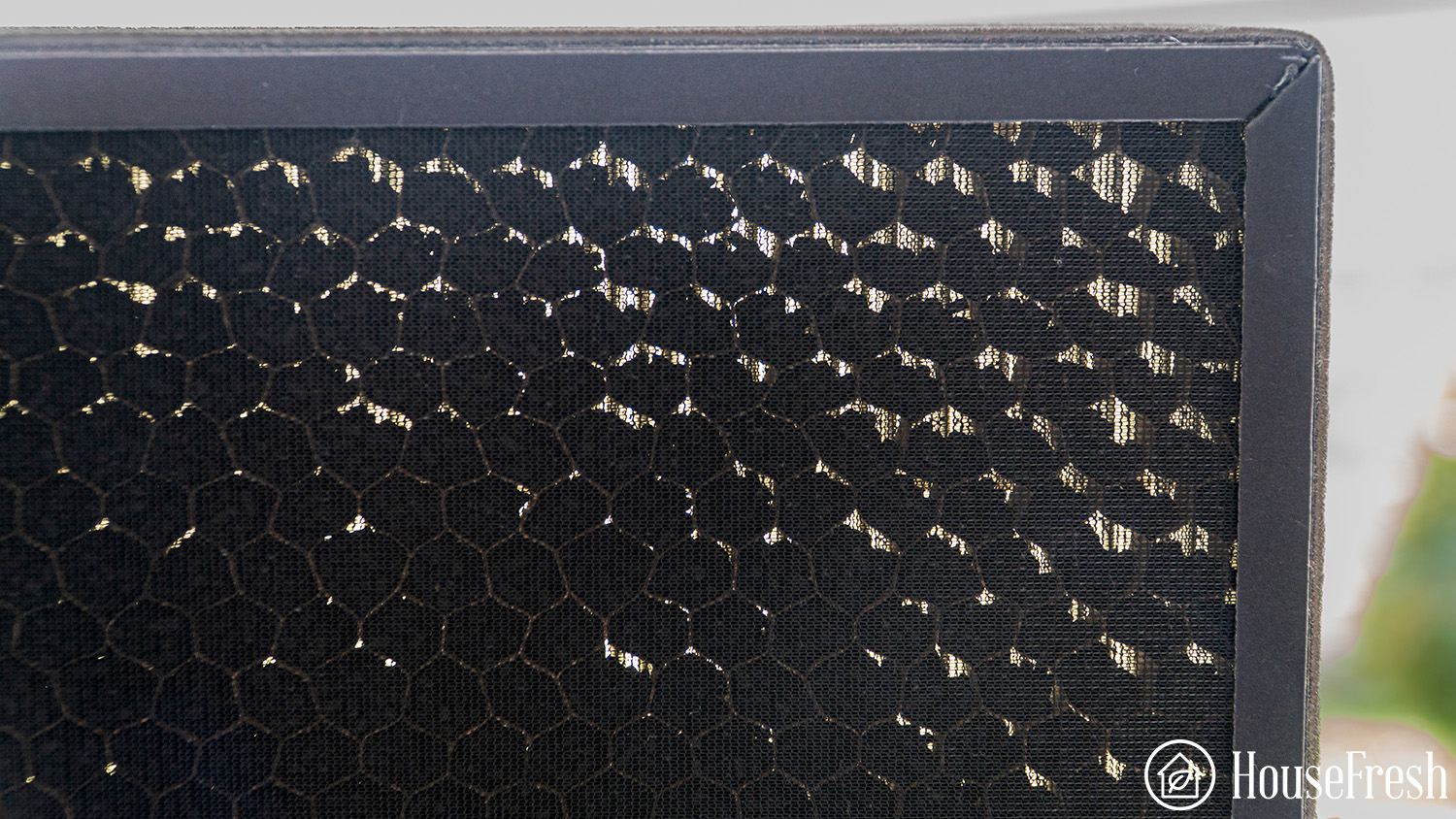
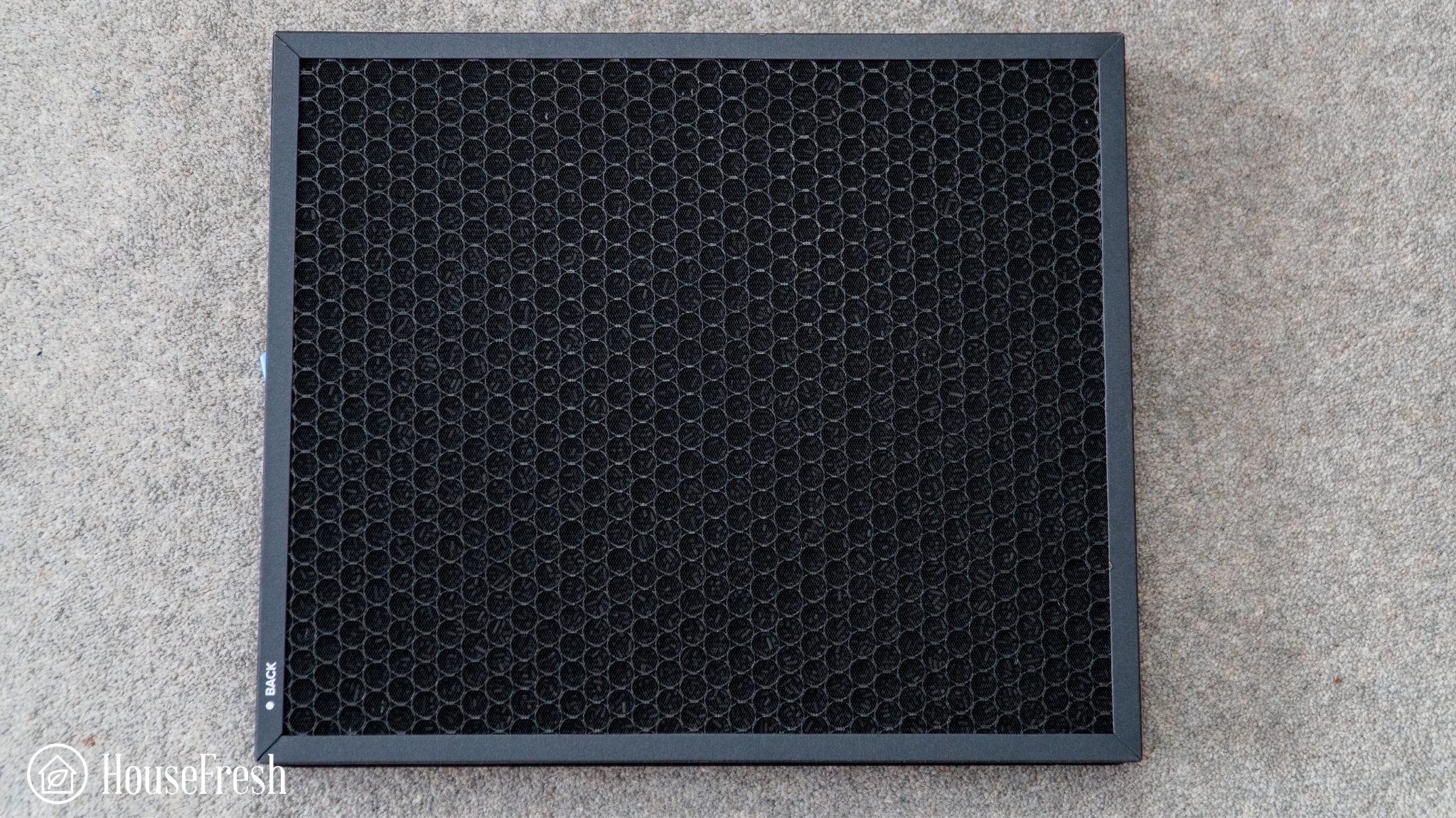
Let’s talk filters as four to choose from fit the Flex: the B4-Pure Filter, B4-Fresh Filter, B4-Odor Filter and FL40-H Heavy Smoke Filter. Each uses H13 HEPA but adds more activated carbon as they get higher in price. Activated carbon uses adsorption to remove odors and VOCs from the air. 

The basic rule is that if your nursery is susceptible to VOCs, you’ll need more activated carbon in a filter. The Alen Flex won’t disappoint.

What we really like

Similar CADR to the 45i at a lower cost.
Different filter options.
Energy efficient.
Comes with a lifetime warranty.

What we think could be better

No smart features.
Replacement filters can cost more than other leading brands.

HouseFresh rating:★★★★☆
Time to clean our 728 cubic feet test room (with the device running at top speed):34 minutes
Air purifier technology:H13 HEPA with an option for activated charcoal (Fresh, Odorcell and Heavy Smoke options available)
Recommended room size (4.8 air changes per hour):296 sq. ft.
Clean air delivery rate (CADR):Dust: 208.8 CFM
Smoke: 191 CFM
Pollen: 245.4 CFM
Dimensions (in inches / in cm):25H x 15W x 8.5D inches (63.5 x 38.1 x 21.59 cm)
Weight (in pounds / in kg):15 lbs (6.8 kg)
Filter life:9-12 months
Noise level in decibels (measured from 3 ft. away with a sound level meter):Speed 1: 35.7 dB
Speed 2: 45.5 dB
Speed 3: 50.7 dB
Electricity consumption in watts (recorded with an electricity usage monitor):Standby mode: 0.8 watts
Speed 1: 2.9 watts
Speed 2: 6.3 watts
Speed 3: 14 watts
Speed 4: 24.2 watts
Estimated running cost (electricity consumption + official filter replacement):$105.91 per year
Cost per CADR cfm (based on dust CFM as reported by AHAM):$1.21
Manufacturer’s warranty:Lifetime (with product registration & active filter subscription)
Country of manufacture:China

5. Mila Air Purifier

For those of you that like your electrical devices drenched in smart technology, let me introduce you to Mila. Founded in 2015, Mila is about making your life easier through tech. The Mila Air Purifier is a testament to this with its informative display, many settings and customizable filter choices.
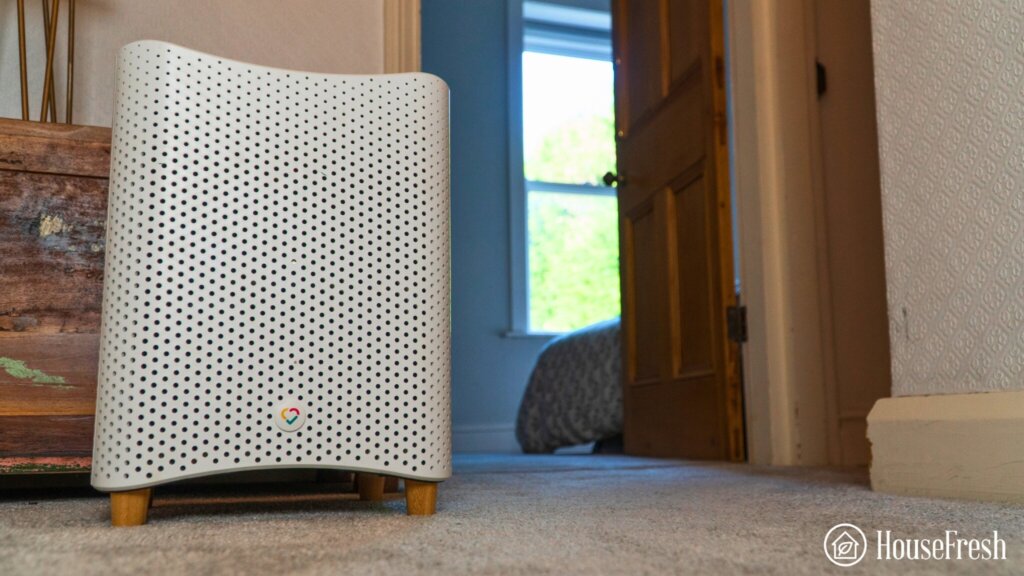
Mila Air Purifier Hallway

When you first turn on the Mila, the unit calibrates and tells you, “Jiu-jitsu, I’m going to learn Jiu-Jitsu?” a nerdy nod to The Matrix for all you tech heads. There are plenty of settings to manually tune the Mila to how you want it and eight modes to choose from, but we mainly stuck to the “automagik” (Auto) mode.

The Mila app (available on iPhone and Android) looks fantastic and is easy to navigate. It allows you to change settings, check indoor and outdoor air quality in real-time and gives daily and weekly insights into your Air Quality Index; if all that wasn’t enough, Mila goes the extra mile by giving you data on VOCs, temperature, humidity and carbon monoxide levels in your home. When you have a new immune system to protect, all this information will give you peace of mind.

What we really like

Ideal for smart home connoisseurs.
Has an air quality monitor.
Auto Mode takes care of all settings.
Well designed, looks great.

What we think could be better

Replacement filters are on the expensive side.
On its highest fan speed, it reaches 59 dB.

Another pro of the Mila is how quiet it is when running at its lowest speed: only 37 decibels, which is equivalent to the sound of a quiet urban area. But don’t take my word for it, listen for yourself:

HouseFresh rating:★★★★☆
Time to clean our 728 cubic feet test room (with the device running at top speed):35 minutes
Air purifier technology:HEPA (ranges from H12-H14) and ganular activated carbon filter
Recommended room size (4.8 air changes per hour):217 sq. ft.
Clean air delivery rate (CADR):Dust: 146 CFM
Smoke: 140 CFM
Pollen: 152 CFM
Dimensions (in inches / in cm):12L x 12W x 15H inches (30.48L x 30.48W x 38.1H cm)
Weight (in pounds / in kg):18 lbs (8.16 kg)
Filter life:6 months 
Noise level in decibels (measured from 3 ft. away with a sound level meter):Speed 1: 37.5 dB
Speed 3: 42.2 dB
Speed 6: 54.8 dB
Speed 8: 58.8 dB
Speed 10: 59.2 dB
Electricity consumption in watts (recorded with an electricity usage monitor):Standby mode: 5.62 watts
Speed 1: 8.42 watts
Speed 3: 10.1 watts
Speed 6: 20.45 watts
Speed 8: 36.2 watts
Speed 10: 38.32 watts
Estimated running cost (electricity consumption + official filter replacement):$208.45 per year
Cost per CADR cfm (based on dust CFM as reported by AHAM):$3.22
Manufacturer’s warranty:1 year
Country of manufacture:Designed in the U.S., assembled in China

What to look for when buying an air purifier for your baby’s nursery room

The EPA tells us that, on average, Americans spend approximately 90 percent of their time indoors, which may increase with the anxiety of taking a baby outdoors with their delicate immune systems, so the air in their nursery room (and the rest of the house) must be clear of pollutants.

Many different types of pollution can invade your baby’s nursery room and affect their health. For example:

When protecting our children, only the best will do. In the case of air purification, the “best” air purifier means the “right” purifier. When buying an air purifier for your baby’s nursery, there are some features an air purifier should have. 

1. What filters does the air purifier use?

When it comes to removing microscopic pollutants from the air in your home, HEPA rules the game. That’s why all the air purifiers we’ve recommended use HEPA filters, as they are hands down the most effective way of keeping the air in your nursery clear of contaminants.

2. How loud is this air purifier?

If you have a baby, you’ll know that when they’re asleep, silence is paramount. Infant sleep is so important but can be very sporadic, so you don’t want to add any noise that may affect that. Unfortunately, you’ll never find a silent air purifier, as they need a spinning fan to work, but you can find quieter units than others.

In this guide, we purposely chose air purifiers with quiet running noise on low levels. We gather this data when we rigorously test each unit, measuring the sound they emit on all fan levels.

Here’s a comparison chart of each unit we’ve recommended:

📻 Sound is subjective; that’s why we also record videos of all the air purifiers we review, scrolling through each fan speed so that you can make your own mind up.

3. How much energy does the air purifier use?

Babies aren’t cheap; every penny counts. Air purifiers use electricity to run, but some use more than others. That’s why we add running costs to every review we publish so that you can compare each unit to find the one that matches your budget.

Common questions about air purifiers for a nursery room

Congestion is very common in babies due to their small nasal passages. It’s usually caused by breathing in pollutants like dust, bacteria, viruses, pollen and other allergens we can’t see in the air. While a lot of the time, these won’t cause any significant problems, it’s still uncomfortable for the baby to breathe and may mean a sleepless night.

Introducing an air purifier to their nursery will eliminate those pollutants from the air by capturing them in its HEPA filter. 

Air purifiers don’t have to be in the center of the room but must be in a good position to capture airborne contaminants from your nursery. It comes down to the amount of space you have and the size of the unit you buy, but there are a few key do’s and don’ts when it comes to placement.

DO: Know where the air inlet and outlet vents are located.
DON’T: Block either air vents with furniture or bulky belongings.
DO: Place your purifier near known pollutant sources such as mold, dust or odors.
DON’T: Place your purifier near other large electricals that run on similar wavelengths.
DO: Position the air purifier near doorways, vents or passages to maximize airflow.
DON’T: Obstruct pathways through a room or block an exit.

Want to know more? Check out our full guide for more tips on where to place your air purifier.

Pollution doesn’t clock in and out daily, so air purifiers are designed to run 24/7. That’s why it’s important to consider the running costs of a unit before buying it. Our Specs & Features section includes the average cost to run each unit per year so you can match it to your budget.

Check out our full guide on how long should you run your air purifier.

Wrapping up

As you’ve read, it’s essential to have clean, fresh, pollution-free air for your baby to breathe in their nursery, as prolonged exposure to contaminants can harm their development and overall health. Introducing an air purifier will drastically reduce pollution by removing those microscopic particles from the air. 

Finding the right air purifier for your baby’s nursery doesn’t need to be daunting or expensive. Simply follow our guide and choose a unit that fits your budget, the size of your space and the features you want from an air purifier. Easy.

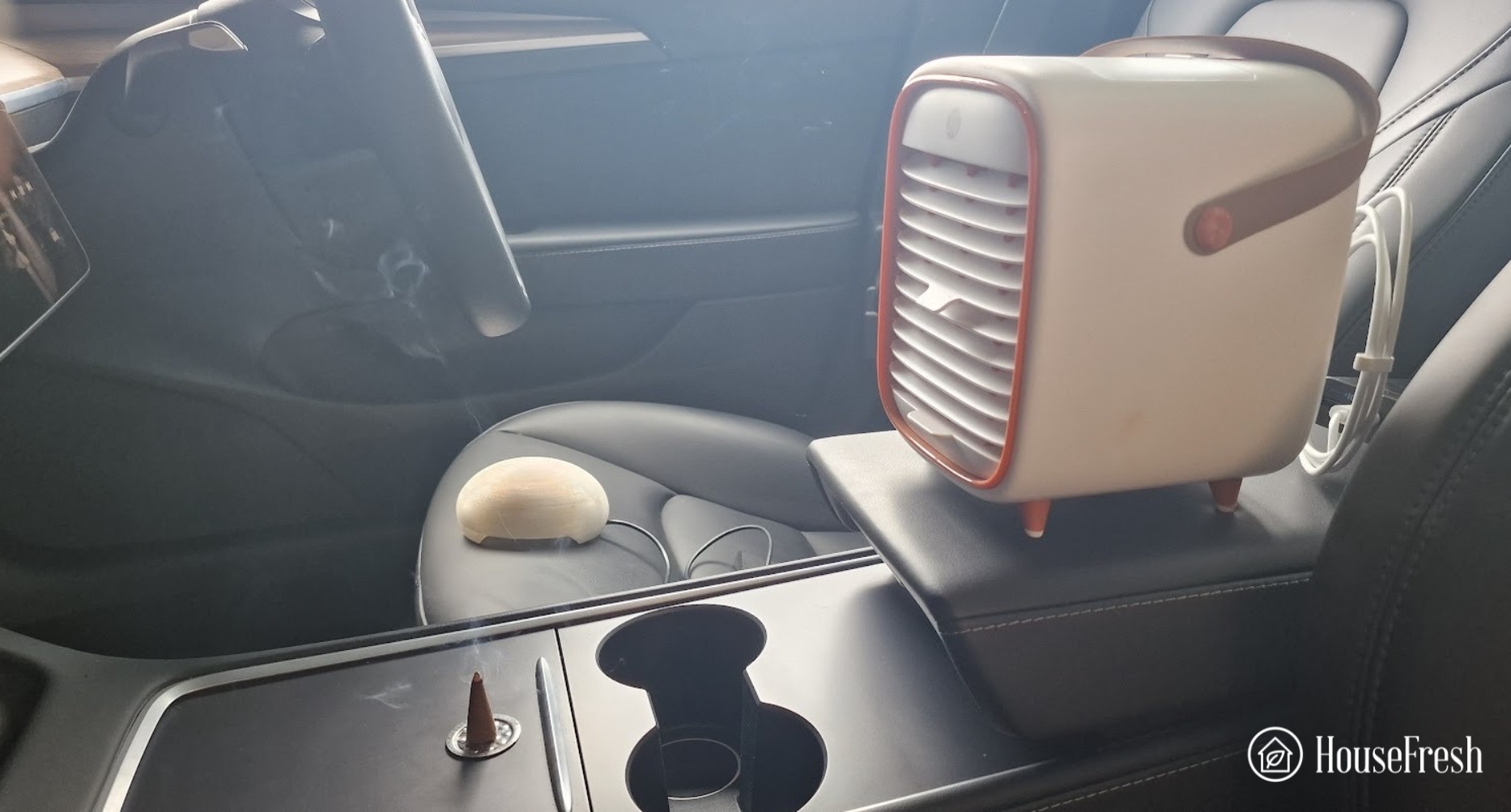
The best air purifiers you can get for your RV

Best Air Purifiers for RVs

Hitting the open road in your RV is guaranteed to be a fun-filled adventure. But as well as collecting memories on your travels, you’ll also bring some pretty polluted air on board.

This may sound at odds with the pristine air you often find in nature. However, inside your RV, you will commonly find particulate matter from traffic fumes and road dust, harmful VOCs emitted by gas stoves and may even face nature’s nastier side in wildfire smoke and allergies. Not to mention the stale smells that can occur if you have the whole family along for the ride.

  • Gas stoves emit nitrogen dioxide that irritates the lungs. Studies show that children exposed to VOCs created by such cookers are 42% more likely to develop asthma.
  • You are most exposed to harmful air pollution when traveling in a vehicle. Although RV’s will have an air filter, these struggle to keep exhaust fumes such as carbon monoxide and PM2.5 such as road dust out of the cabin. While rolling down your window increases your exposure by 80%.  
  • Cooking, cleaning and even breathing contribute to excess moisture inside your RV, meaning mold can quickly become an issue. Inhaling mold particles can cause allergy-like symptoms, including stuffy nose, wheezing and itchy eyes and skin. 
  • Being closer to nature can result in greater exposure to allergens. Pollen particles typically range between 2.5 and 25 microns, which can enter the respiratory system and seriously affect your vacation
  • Wildfires are getting worse, affecting further reaches of the country for longer periods of time. This means you can quickly become exposed to harmful particulates when traveling in your RV during the spring and summer. 

Remember that all of these harmful pollutants will be exemplified in the confined space of your RV. The EPA has conducted numerous studies that show indoor air pollution is 2-5 times worse than what we find outdoors, as pollutants become trapped and concentrated inside. 

It’s simple to remove these pollutants by using an air purifier to capture the most minuscule particles and allow you to enjoy your vacation without the threat of toxic air. 

You’ll also benefit from being able to invest in a more compact (and cheaper) unit, as cleaning the air in an RV is much easier than in a traditional home. 

  1. In our home lab of 728 cubic ft, we light an incense stick to generate particle pollution and VOCs.
  2. We set up our trusted Purpleair Indoor Sensor with the latest Bosch gas sensor to track levels of PM1ug/m3, PM2.5ug/m3 and PM10ug/m3 and VOCs in the air.
    purpleair
  3. We switch the air purifier to its highest speed and measure how long it takes to get our room air quality down to PM1 level to 0.
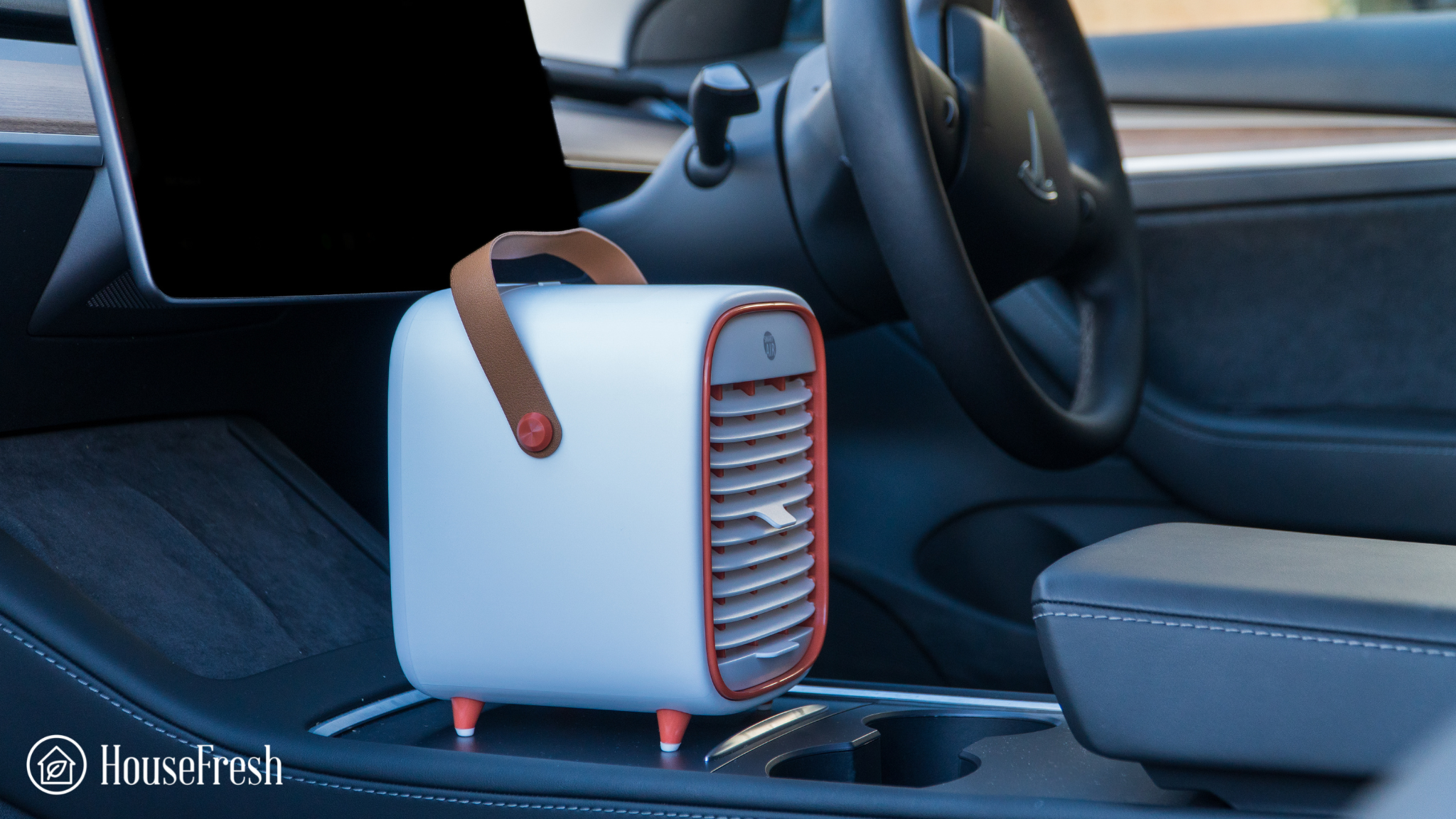
  4. For portable air purifiers, we repeat this test inside our Tesla Model 3 to see how good the unit is at cleaning the air in a small enclosed space.
    Testing QT3 in Tesla
  5. We use an energy meter to measure precisely how much electricity is used when running the unit at the lowest and highest fan speed settings.
    enery meter
  6. We track sound levels emitted by the air purifier at different fan speeds with the help of a commercial sound meter.
    sound meter

With our test data in hand, I was then able to select seven of the best air purifiers on the market that will help transform the air in your RV. 

Staff Picks: The top 3 air purifiers for RVs

If you’re in a hurry to hit the road, here are our three top picks, allowing you to find a speedy solution to your air quality concerns.

👑 BEST OVERALL💰 FOR TIGHT BUDGETS🛋️ FOR LARGE SPACES
IQAir AtemSmart Air QT3Levoit Core 300S
RV Air Purifier IQair Atem Close UpRV Air Purifier Smart Air QT3 Close UpRV Air Purifier Levoit Core 300S Close Up
AIR CLEANING SPEED ⚡37 minutes (Tesla)47 minutes (Tesla)39 minutes (home lab)
CADR 👩‍🔬39 CFM24 CFM 141 CFM
FILTER TECHNOLOGY 💨HyperHEPA Plus FilterHEPA3-Stage Filtration
MAX ROOM SIZE 📏150 sq. ft.12.9 sq. ft.219 sq. ft.
WEIGHT ⚖️5.2 lbs (2.4 kg)1.375 lbs (0.624 kg)5.95 lbs (2.7 kg)
OUR REVIEW 🔍IQAir Atem reviewSmart Air QT3 reviewLevoit Core 300S review
PRICE 💵$399.99$47.99No products found.

Last update on 2026-04-04 / Affiliate links / Images from Amazon Product Advertising API

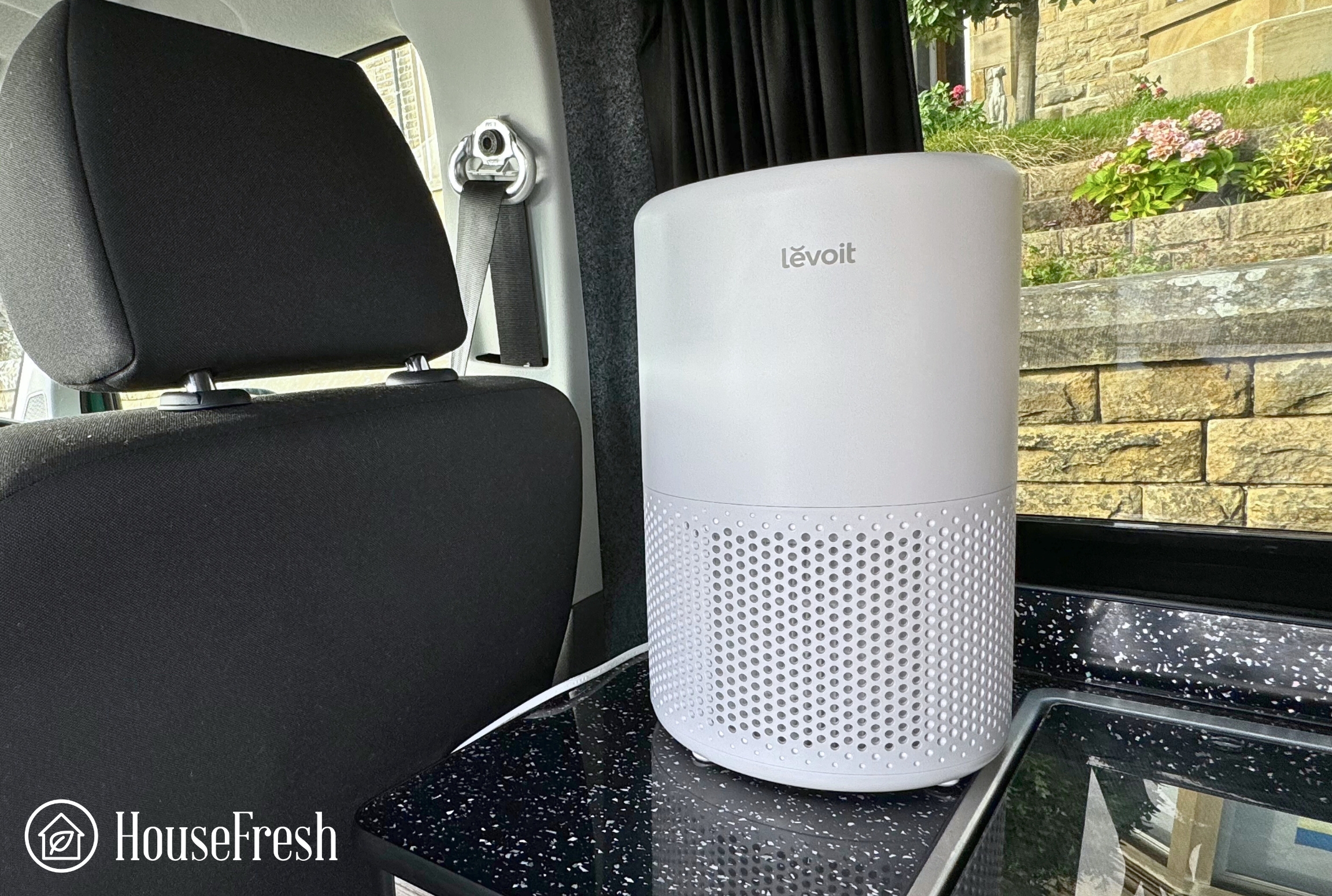
Whether you travel in a Tiny Home campervan or a house-on-wheels RV, your space can quickly turn from sanctuary to cesspit if you ignore your air quality. With all recreational vehicles being different, assessing your options to find the right purifier is essential. 

Check out the complete list below to see various options suited to varying-sized spaces, styles and budgets. 

1. Best overall: IQAir Atem Car

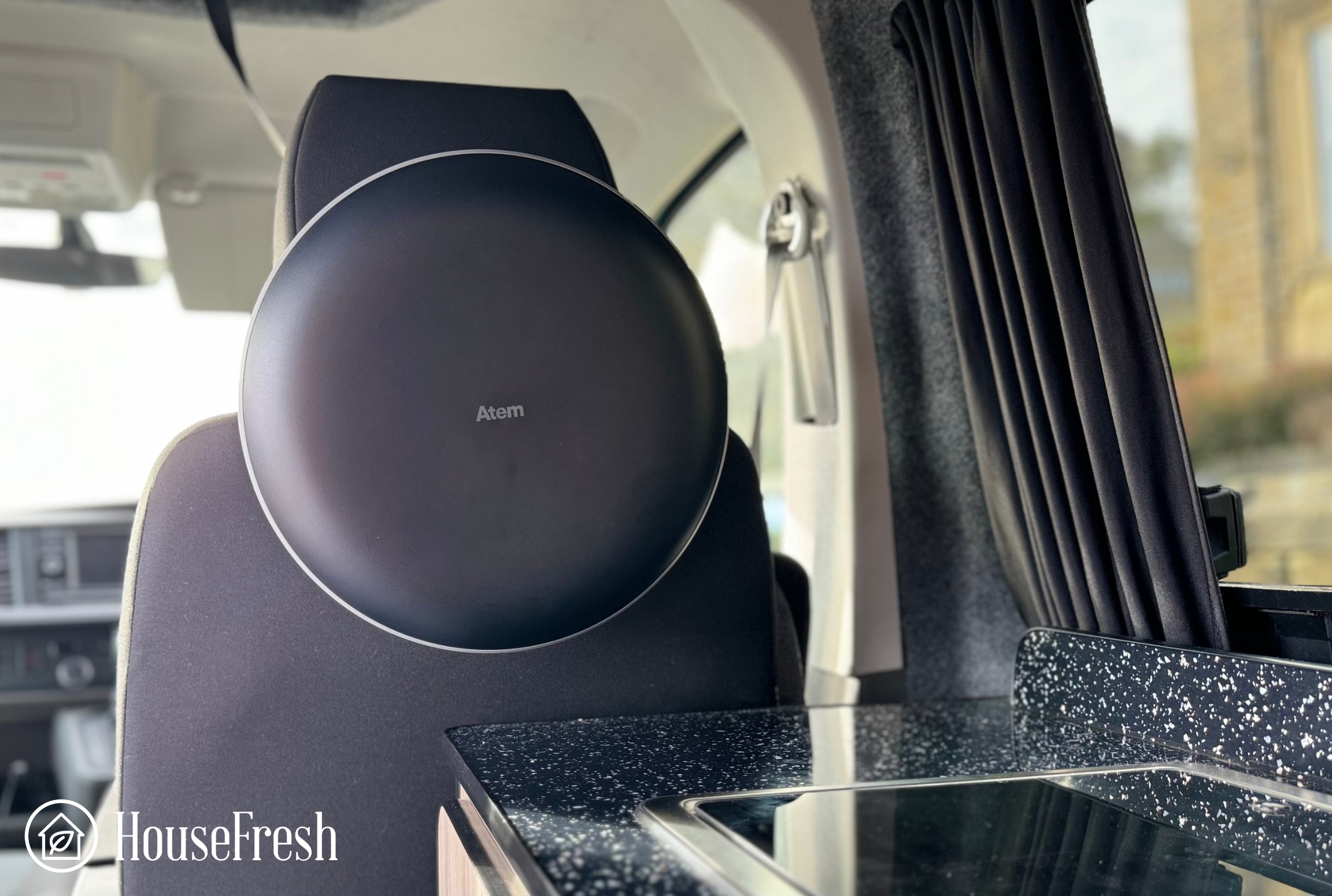
The IQAir Atem is our top pick, having completed our in-car clean air speed test in 37 minutes – the fastest portable air purifier we’ve tested.

RV Air Purifier IQair Atem

PRICE on amazon PRICE on IQAIR

The IQAir Atem eclipsed other portable units during our tests, clearing all traces of PM1 particles 10 minutes faster than the next best unit. Powered by a decent fan that achieves an airflow of 39 CFM and IQAir’s outstanding HyperHEPA Plus filter technology.

These filters can remove 99% of the smallest PM and gas particles. This means everything from exhaust fumes to road dust will be removed from your RV. Despite being a portable unit, the filter also comes with a 1-year lifespan — the longest-lasting filter on this list.  

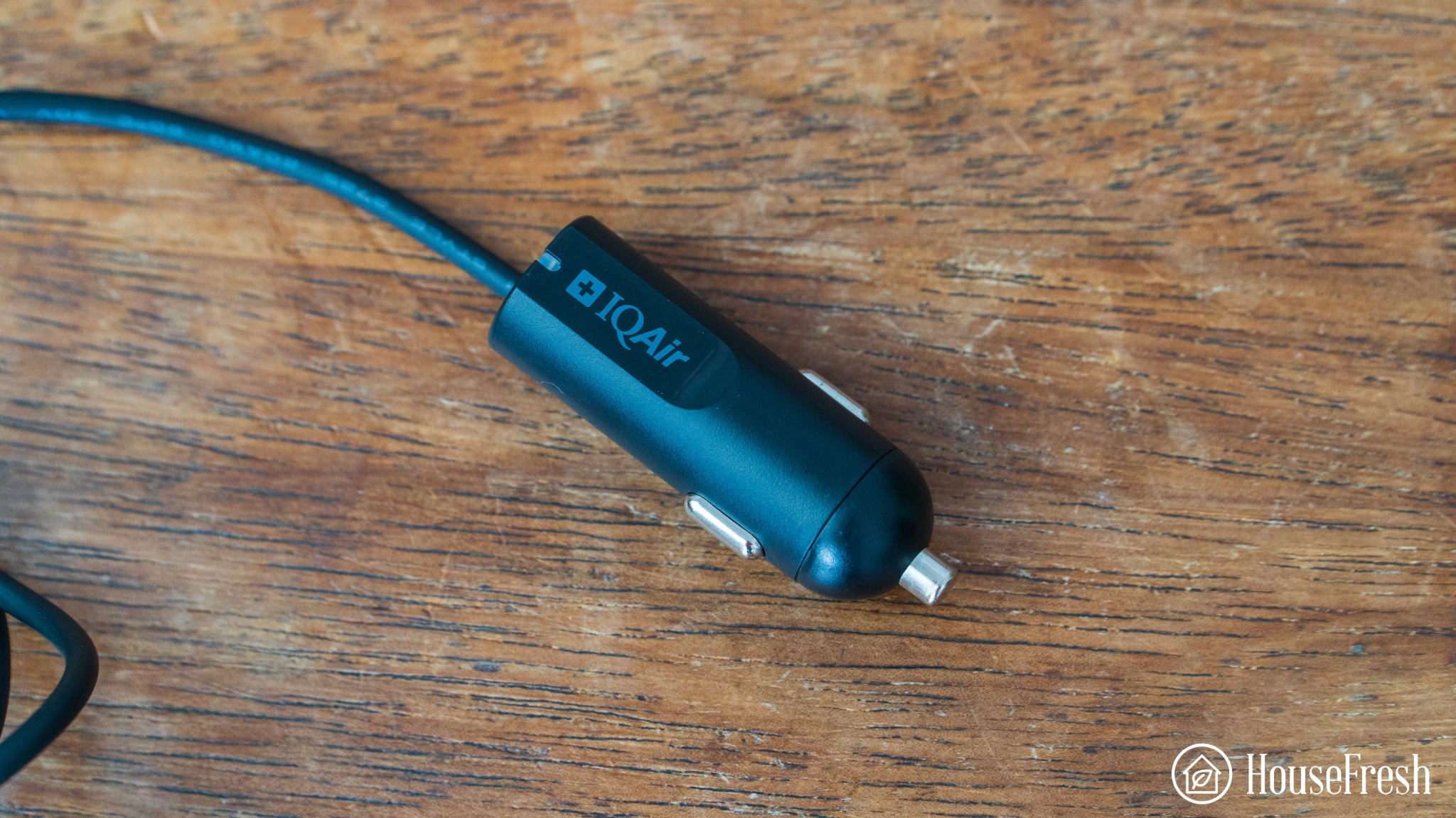
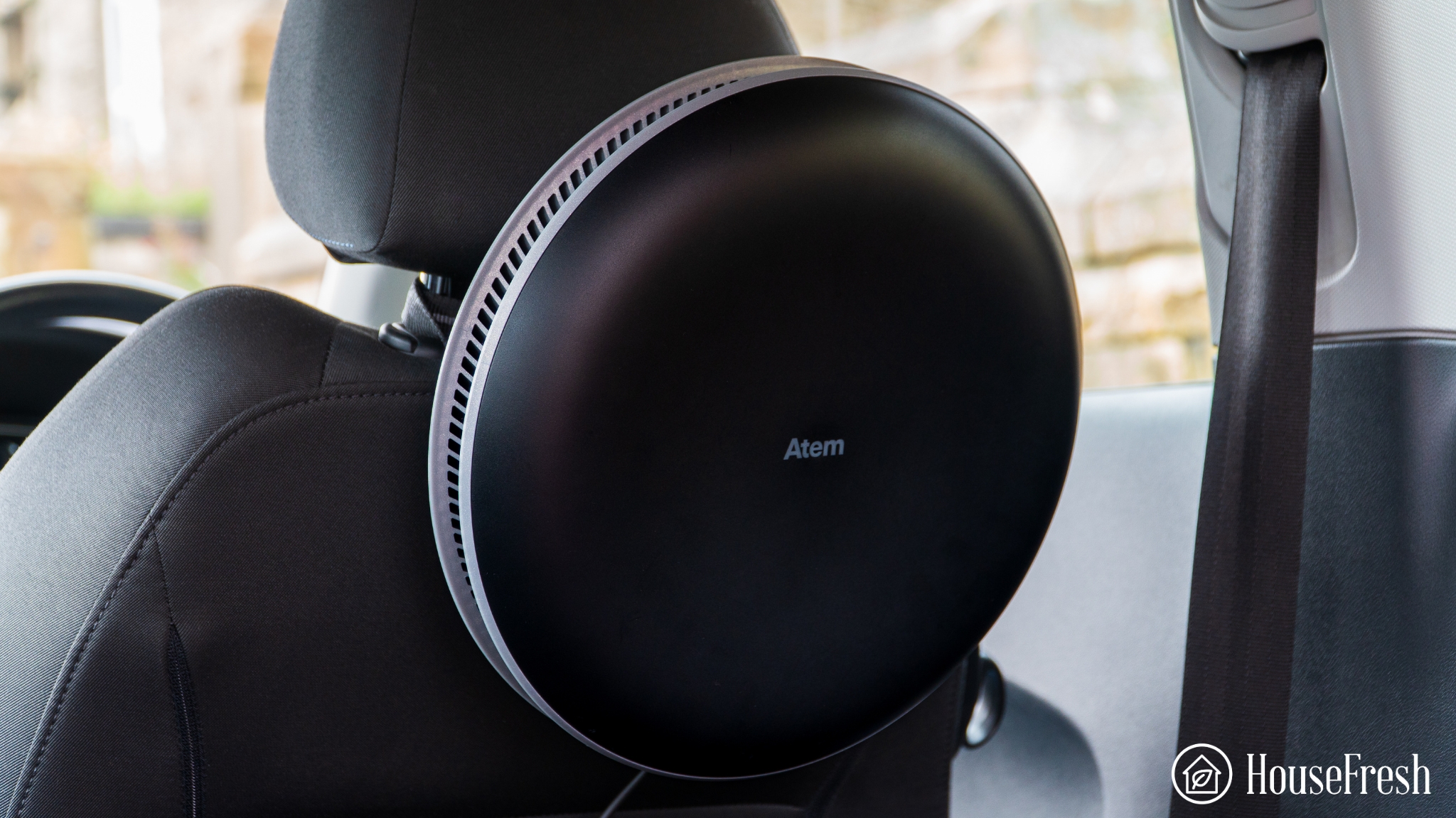
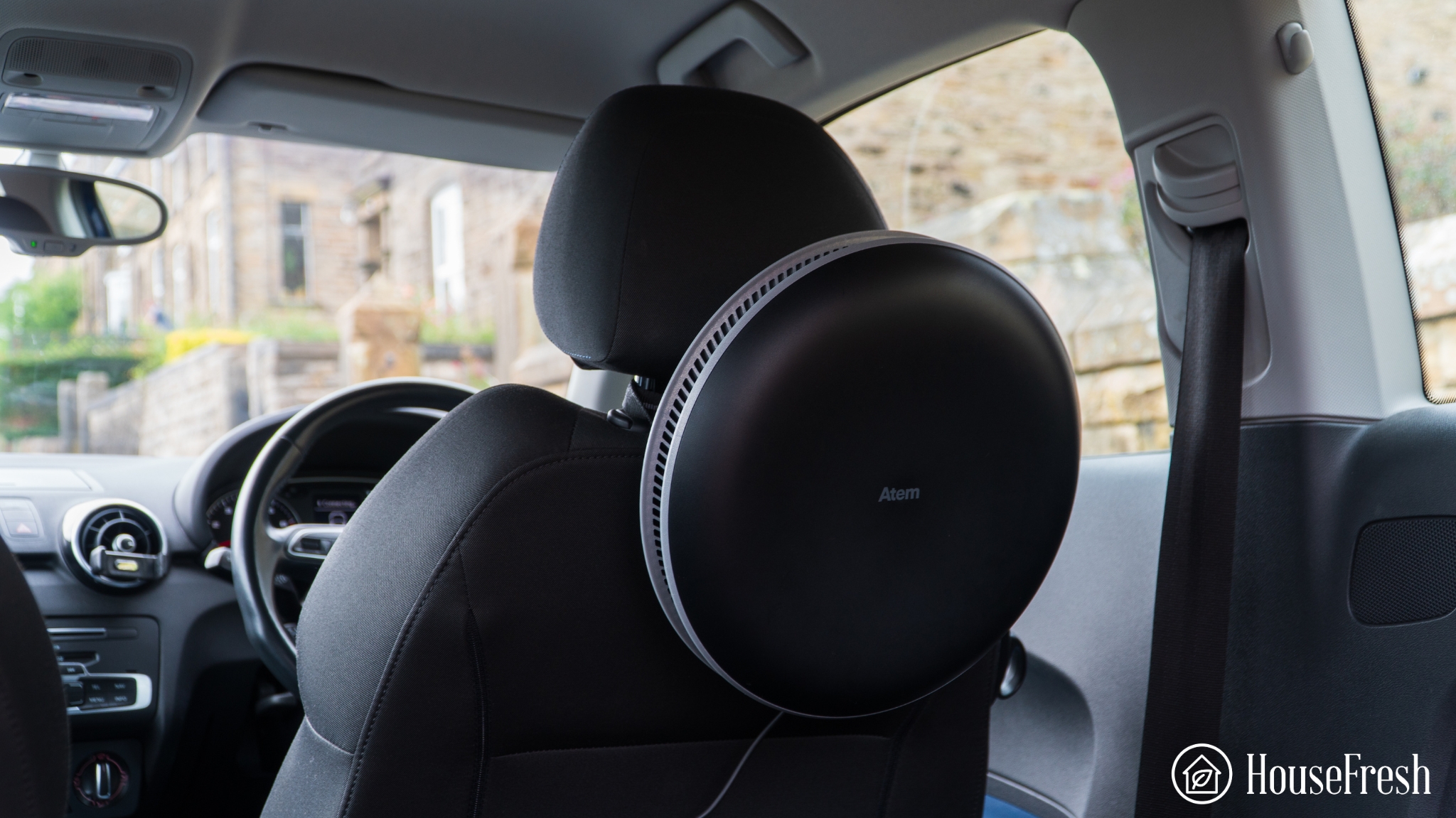
This option looks sleek, and IQAir has clearly thought about how this unit will be used in a vehicle. You can simply sit it atop a surface inside your RV’s living quarters or attach it to the cabin’s headrest for targeted protection while you drive. Even the way you power this unit is geared toward RVs, connecting to the 12V DC adapter in your vehicle while drawing a minimal 3.4 watts at its highest speed.

What we really like

Rapid particulate removal for a portable air purifier
High quality, HEPA-certified filters
DC power makes it ideal for use on the road
The app is a valuable addition, offering enhanced controls even when you’re not near the purifier

What we think could be better

The controls are less responsive, but the app makes up for it
It will be out of many people’s budget

The downside is that you have to pay a lot more for this performance than elsewhere on the market. At $400, this is undoubtedly a premium option that may not appeal to all RV users.

HouseFresh rating:★★★★☆
Time to clean our Tesla Model 3 (with the device running at top speed):37 minutes  
Time to clean our 728 cubic feet test room (with the device running at top speed):1 hour and 55 minutes
Air purifier technology:HyperHEPA Plus Filter
Recommended room size (4.8 air changes per hour):150 sq. ft. for car mode
Clean air delivery rate (CADR):Dust: 39 CFM
Dimensions (in inches / in cm):17.7H x 9W x 17.7D inches (29H cm x 29W x 10D cm)
Weight (in pounds / in kg):5.2 lbs (2.4 kg)
Filter life:1 year
Noise level in decibels (measured from 3 ft. away with a sound level meter):Speed 1: 35.5 dB
Speed 2: 40.5 dB
Speed 3: 58.2 dB
Electricity consumption in watts (recorded with an electricity usage monitor):Standby mode: 0.4 watts
Speed 1: 1.7 watts
Speed 2: 3.8 watts
Speed 3: 10.81 watts
Estimated running cost (electricity consumption + official filter replacement):$106.46 per year
Cost per CADR cfm (based on dust CFM as reported by AHAM):$10.23
Manufacturer’s warranty:2 years
Country of manufacture:Switzerland and Germany

2. Best performance per $ spent: Smart Air QT3

If you’re looking for a cost-effective solution to your RV’s air pollution, then the Smart Air QT3 is the unit for you.

RV Air Purifier Smart Air QT3

U.S. PRICE UK PRICE

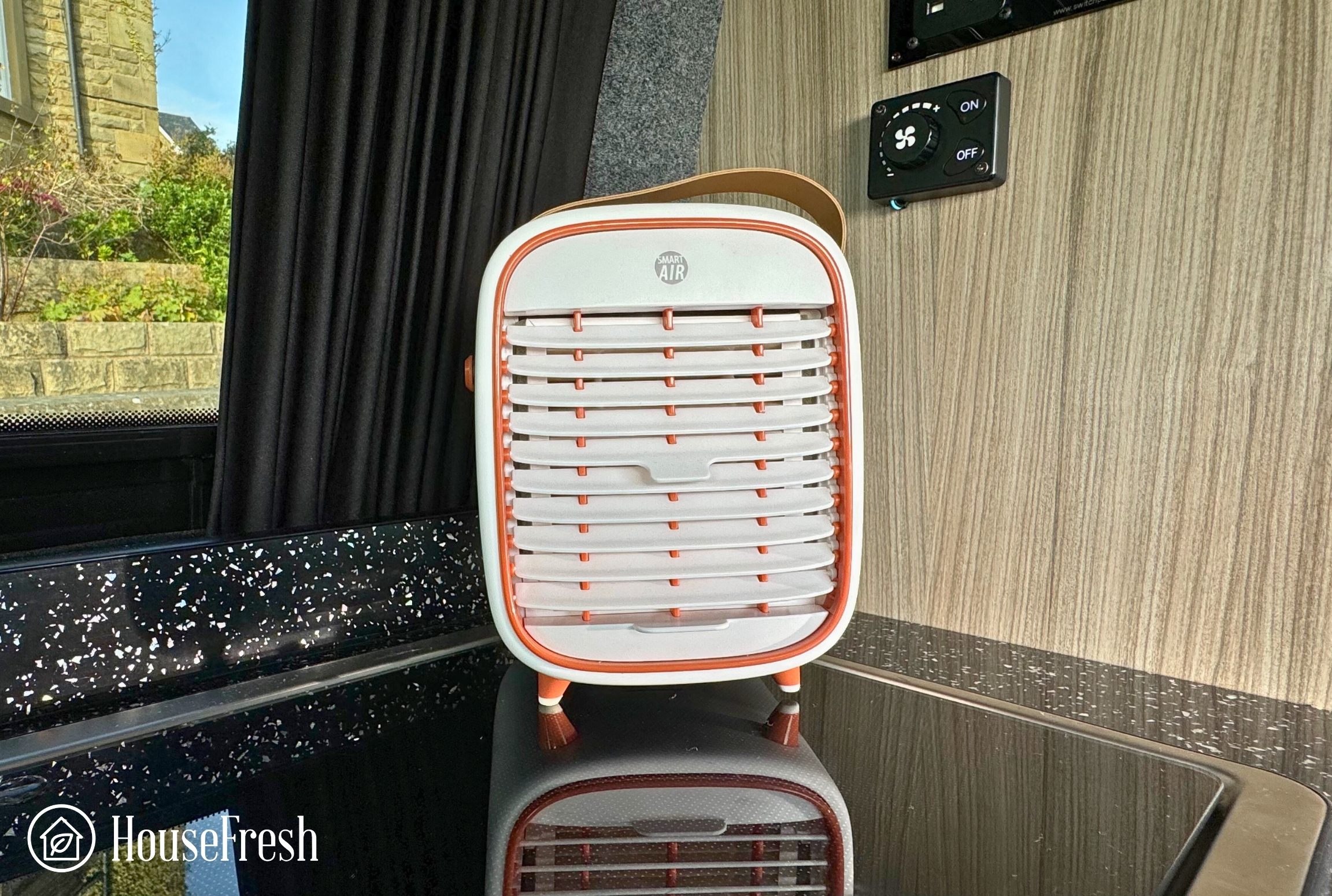
At $54.99, this option offers an excellent CADR to $ ratio, achieving 24 CFM in a campervan or trailer. During our in-vehicle tests, we saw impressive results in removing the smallest particles as the QT3 cleared the Tesla in 47 minutes, which is not bad at all considering the price. 

Equipped with a HEPA filter, this purifier is tailor-made to tackle dust, dander and road debris, capturing PM2.5 particles in a single pass. The QT3 also gets bonus marks for having an in-built fan, which will help to regulate the RV temperature on hotter days.

What we really like

Decent performance and dual-action fan for a great price
Rechargeable so there is no need for an electricity connection
It comes with HEPA-certified filters that can capture minute pollutants
It’s lightweight and compact design makes it uber-portable

What we think could be better

No activated carbon filter, so it can’t target VOCs or odor
Less versatile than other units as it took almost 4.5 hours to clear our home test lab

The Smart Air QT3 is ideal for use on the road thanks to its rechargeable battery. From a single charge, the QT3  provides four hours of cool, clean air delivered throughout your RV. Thanks to the USB-C charging port, you can even top up the battery while it’s in use. 

I’m also a huge fan of this unit’s lightweight and ultra-modern design, making it easy to take with you on your travels and slot effortlessly into place inside your RV.

HouseFresh rating:★★★★☆
Time to clean our Tesla Model 3 (with the device running at top speed):47 minutes
Time to clean our 728 cubic feet test room (with the device running at top speed):4 hours and 27 minutes
Air purifier technology:HEPA filter made with polypropylene (PP) and polyester (PET) with an 800-hour lifespan 
Recommended room size (4.8 air changes per hour):12.9 sq. ft.
Clean air delivery rate (CADR):Dust: 21 CFM
Smoke: 21 CFM
Dimensions (in inches / in cm):5.9L x 5.7W x 7.1H inches (15cm L x 14.5cm W x 18cm H)
Weight (in pounds / in kg):1.375 lbs (0.624 kg)
Filter life:6 months
Noise level in decibels (measured from 3 ft. away with a sound level meter):Speed 1: 36.3 dB
Estimated running cost (electricity consumption + official filter replacement):$39.72 per year
Cost per CADR cfm (based on dust CFM as reported by AHAM):$0.41
Manufacturer’s warranty:1 year
Country of manufacture:China

3. Best option for large RVs: Levoit Core 300S

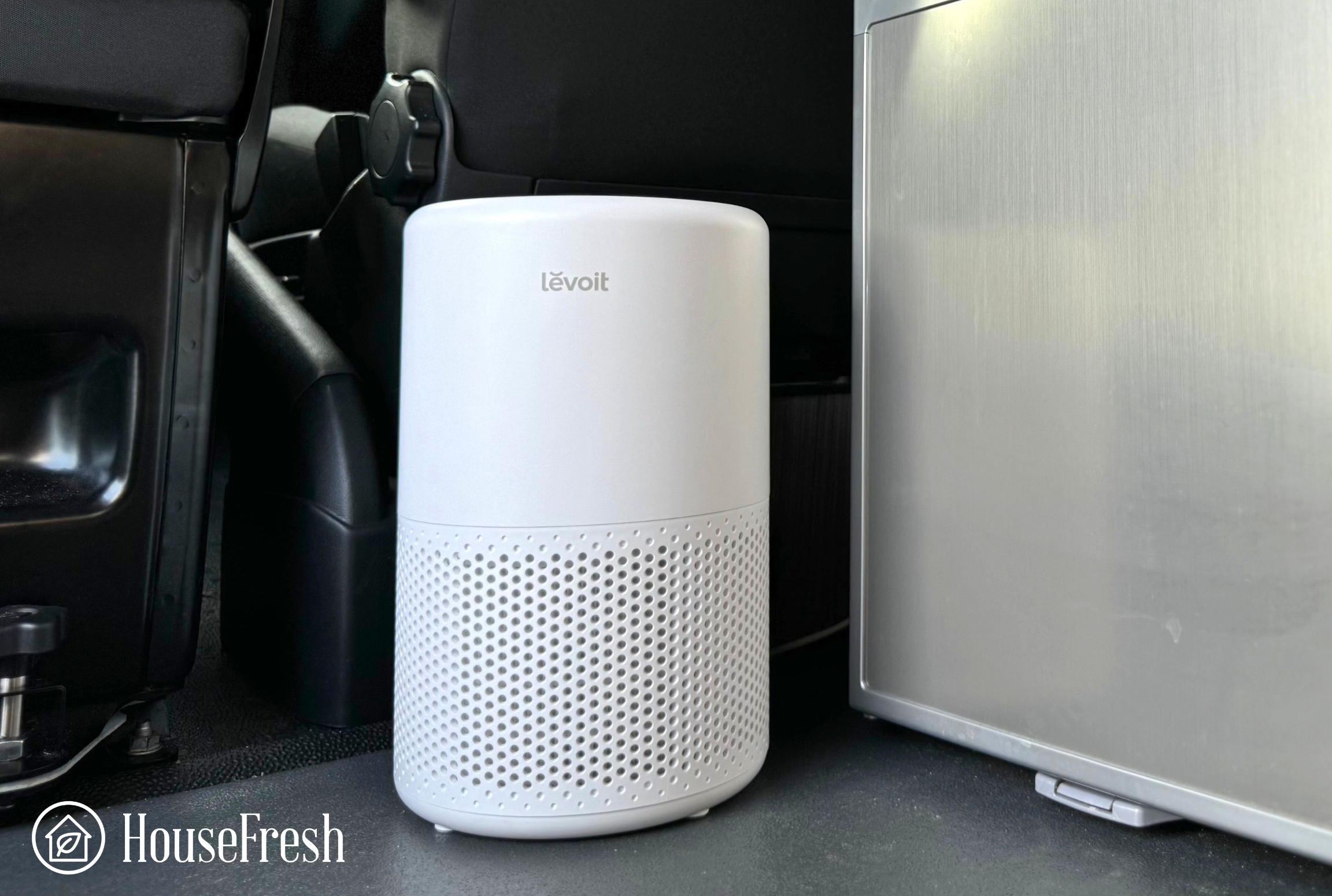
The Core 300S is the most powerful air purifier on this list, boasting a Clean Air Delivery Rate (CADR) of 141 CFM, making it excellent for large RVs.

RV Air Purifier Levoit Core 300S

💡exclusive code for HouseFresh for 10% off a single purchase on Levoit.com: HOUSE10

This unit uses Levoit’s three-stage filter to combat a wide range of pollutants. Its pre and primary filters cover particulate matter such as road

dust, mold spores and allergens that are rife when roadtripping. While the activated carbon filter takes care of VOCs found in traffic fumes, nitrous oxide emitted from gas cookers and unpleasant odors can take hold when living in a confined space.

What we really like

Super speedy performance, this unit cleared our 705 cubic foot test lab in just 39 minutes
High quality filters including a activated carbon filter with ARC technology to capture and kill VOC pollutants
Smart features such as Auto mode and app support are really useful
With a room size suitability of 219 sq. ft this is ample coverage for even the largest RV

What we think could be better

It requires to be plugged into the mains electricity 
This is the largest unit on this list so might not be ideal for those in a smaller RV

Being an S model, you can expect to find some pretty handy smart features that will make cleaning the air in your RV even easier. One of the stand-out smart features is the 300S’ ability to connect wirelessly to Levoit’s VeSync app. 

Here, you can check the air quality in your RV, adjust fan speeds, engage auto mode and set the timer function. You can even use its voice-activated controls to change any settings while driving.

HouseFresh rating:★★★★☆
Time to clean our 728 cubic feet test room (with the device running at top speed):45 minutes
Air purifier technology:3-Stage Filtration (pre-filter, main particle filter, high-efficiency activated carbon filter)
Recommended room size (4.8 air changes per hour):219 sq. ft.
Clean air delivery rate (CADR):Dust: 134 CFM
Smoke: 126 CFM
Pollen: 154 CFM
Dimensions (in inches / in cm):8.7L x 8.7W x 14.2H inches (22L x 22W x 36H cm)
Weight (in pounds / in kg):5.95 lbs (2.7 kg)
Filter life:6 – 8 months
Noise level in decibels (measured from 3 ft. away with a sound level meter):Speed 1: 38.9 dB
Speed 2: 45.7 dB
Speed 3: 54.5 dB
Electricity consumption in watts (recorded with an electricity usage monitor):Standby mode: 1.7 watts
Speed 1: 5.9 watts
Speed 2: 9.8 watts
Speed 3: 21.8 watts
Estimated running cost (electricity consumption + official filter replacement):$79.43 per year
Cost per CADR cfm (based on dust CFM as reported by AHAM):$1.12
Manufacturer’s warranty:2 years
Country of manufacture:China

4. Best option for mid-sized RVs: Levoit Core 200S

The 200S is tailored for spaces as large as 183 sq. ft, being able to perform 4.8 air changes in a space this size.

RV Air Purifier Levoit Core 200S

💡exclusive code for HouseFresh for 10% off a single purchase on Levoit.com: HOUSE10

With a higher rate of airflow, you can expect to eradicate harmful particulates and gasses found when traveling in an RV in record speed. Using Levoit’s hallmark 3-stage filtration, you can breathe easy knowing that all the common RV pollutants will be taken care of. From road dust to exhaust fumes and even the stinky odors that accumulate when vacationing with the whole family.

What we really like

It can clean a large area of all pollutants in an hour
More compact than the 300S for those tight on space
On sleep mode, it makes just 24 dB, allowing for round-the-clock protection 
Low energy draw is ideal for solar or leisure battery use

What we think could be better

It requires to be plugged into the mains electricity 
No on-board air sensor for real-time feedback or Auto mode

When we assess the CADR to $ ratio on offer from the 200S, it is seriously a shrewd investment. Add this to the fact you can also connect the purifier to a smartspeaker or the VeSync app and it really feels like a bargain. 

You won’t find an in-built air sensor nor see the same speedy results as the more powerful 300S. However, you will notice a lower power draw, which is preferable when running on limited electricity and enjoy a more compact design that will slot into a medium-sized RV without stealing too much living space. 

HouseFresh rating:★★★☆☆
Time to clean our 728 cubic feet test room (with the device running at top speed):61 minutes
Air purifier technology:3-Stage Filtration (Pre-filter for large particles, main filter for airborne particles, high-efficiency activated carbon filter for odors and gasses)
Recommended room size (4.8 air changes per hour):152 sq. ft.
Clean air delivery rate (CADR):Dust: 109 CFM
Smoke: 98 CFM
Pollen: 104 CFM
Dimensions (in inches / in cm):12.6H x 8.07W x 8.07D inches (32H x 20.5W x 20.5D cm)
Weight (in pounds / in kg):6.59 lbs (2.99 kg)
Filter life:6 – 8 months
Noise level in decibels (measured from 3 ft. away with a sound level meter):Speed 1: 39.6 dB
Speed 2: 43.7 dB
Speed 3: 49.1 dB
Electricity consumption in watts (recorded with an electricity usage monitor):Standby mode: 1.1 watts
Speed 1: 19.3 watts
Speed 2: 22.6 watts
Speed 3: 28.4 watts
Estimated running cost (electricity consumption + official filter replacement):$97.83 per year
Cost per CADR cfm (based on dust CFM as reported by AHAM):$0.83
Manufacturer’s warranty:2 years
Country of manufacture:China

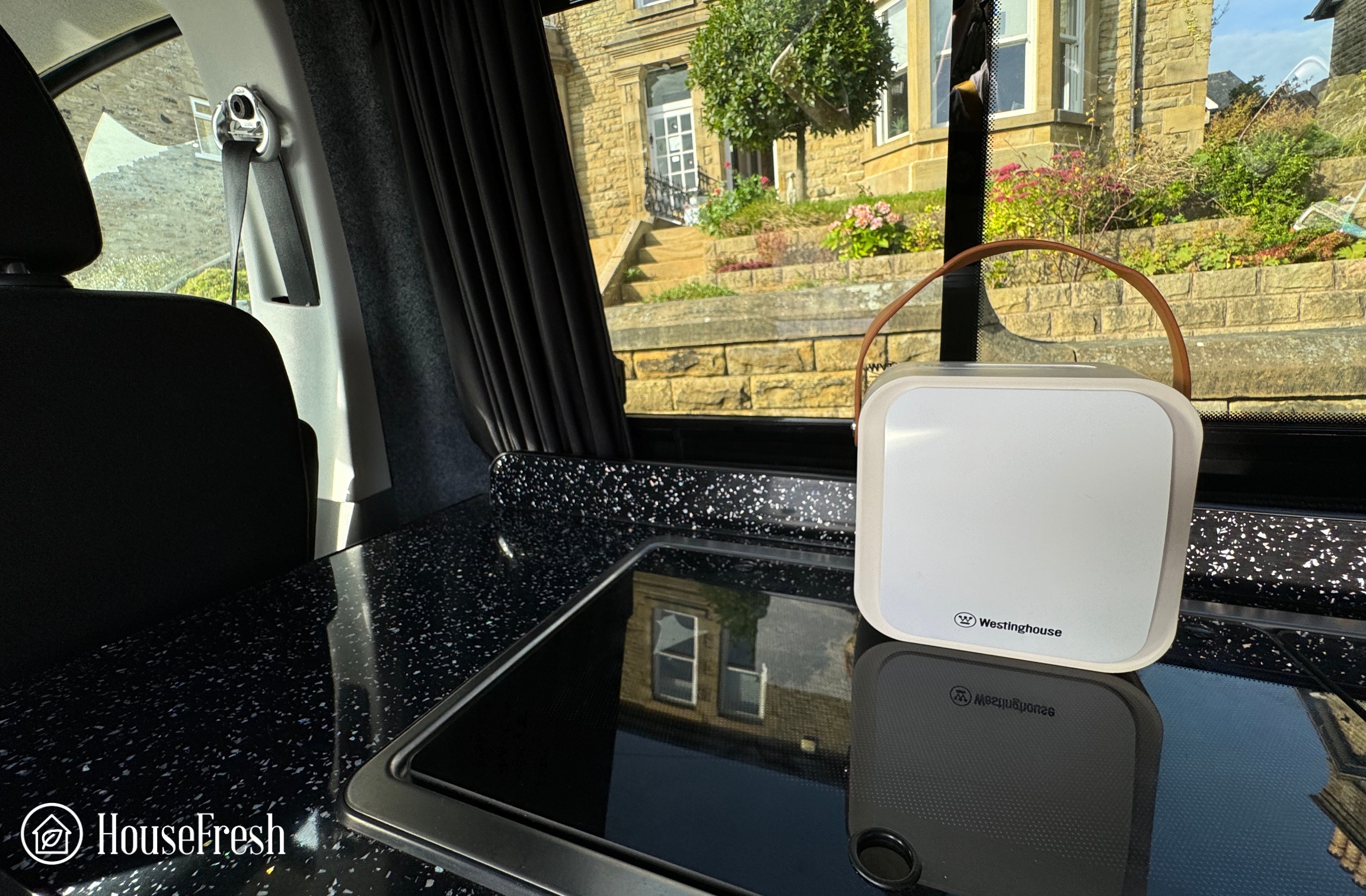
5. Best ionizer function: Westinghouse 1804

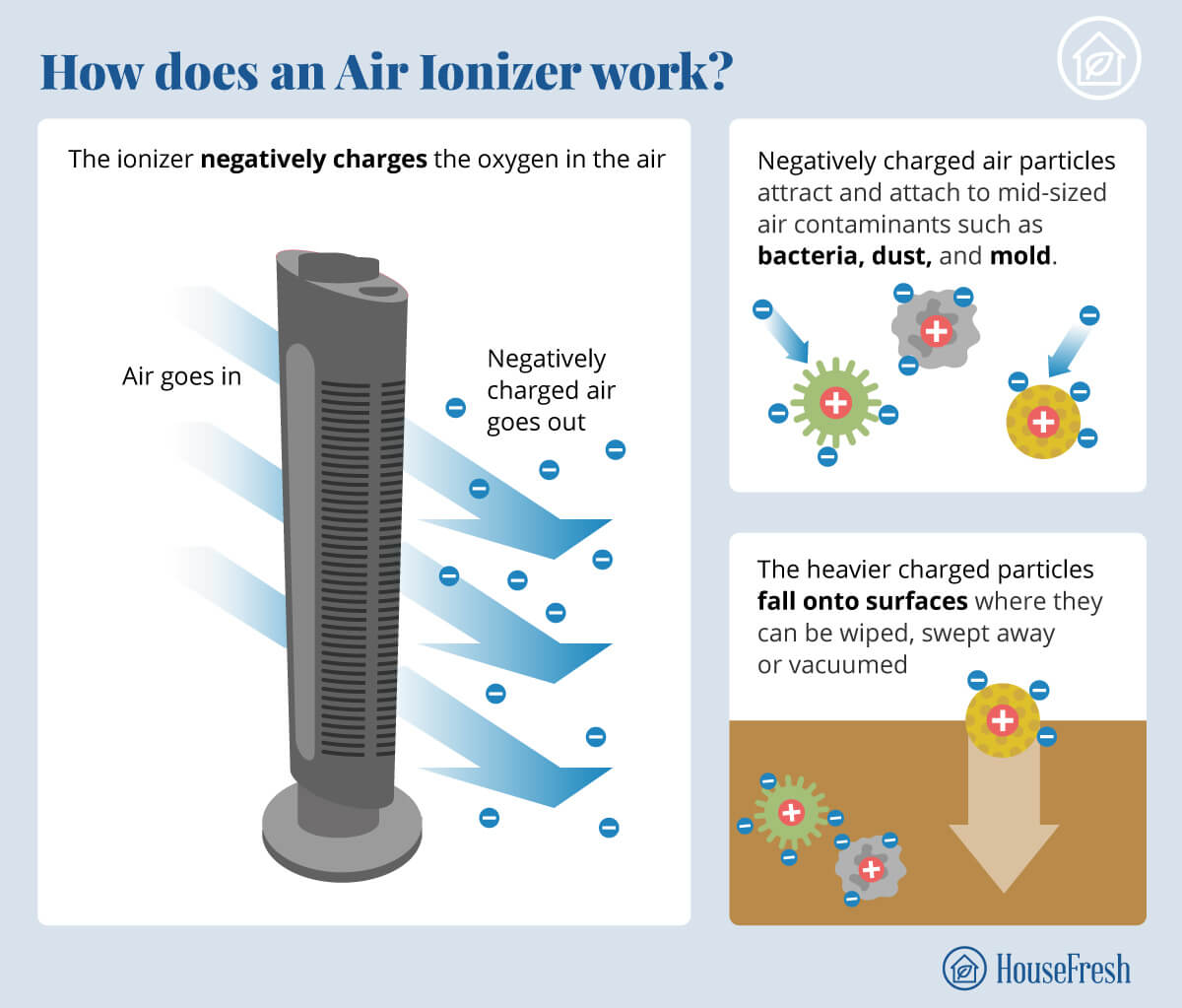
The Westinghouse 1804 utilizes ionizer technology for quicker removal of pollutants at lower operating volumes, all while being CARB-certified.

RV Air Purifier Westinghouse 1804

PRICE on amazon PRICE on EBAY

This increase in performance is evident when comparing test data with the ionizer-free Smart Air QT3. Despite the QT3 being a more powerful unit, they both cleared our Tesla of all pollutants in 47 minutes. An excellent time for both units.

Inside the 1804 is a HEPA filter to remove particulates and their patented NCCO (Nano Confined Catalytic Oxidation) reactor, which (much like activated carbon) removes VOCs and odors from the air in your RV. 

What we really like

Build-in battery is great for use on the go
Well designed to fit in a multitude of spaces in your RV without eating up much space
It comes with a built-in battery that can go on for up to eight hours 

What we think could be better

NCCO filter means this might not be the best option for those with respiratory conditions 
Only two fan speeds, which limits your response to changing pollutant levels

There’s no denying that the 1804 is an excellently designed air purifier. It comes with a  modern aesthetic, a carry handle and a choice of four colors. Plus, its compact size means it will sit comfortably on a tabletop, nightstand, or even beside you in the cockpit as you go on your next adventure.

Another key feature that makes the Westinghouse excellent for use in an RV is its in-built battery. Providing enough juice for up to eight hours of pollutant-free air on a single charge. 

HouseFresh rating:★★★☆☆
Time to clean our Tesla Model 3 (with the device running at top speed):47 minutes  
Time to clean our 728 cubic feet test room (with the device running at top speed):4 hours and 40 minutes
Air purifier technology:True HEPA and NCCO
Recommended room size (4.8 air changes per hour):23 sq. ft.
Clean air delivery rate (CADR):Estimated: 15 CFM
Dimensions (in inches / in cm):6.3L x 6.3W x 3.5H inches ( ‎28.39 x 21.41 x 18.28 cm)
Weight (in pounds / in kg):2.12 lbs (0.96 kg)
Filter life:3-4 months
Noise level in decibels (measured from 3 ft. away with a sound level meter):Speed 1: 36.7 dB
Speed 2: 39.8 dB
Estimated running cost (electricity consumption + official filter replacement):$27.81 per year
Cost per CADR cfm (based on dust CFM as reported by AHAM):$0.37
Manufacturer’s warranty:3 years
Country of manufacture:China

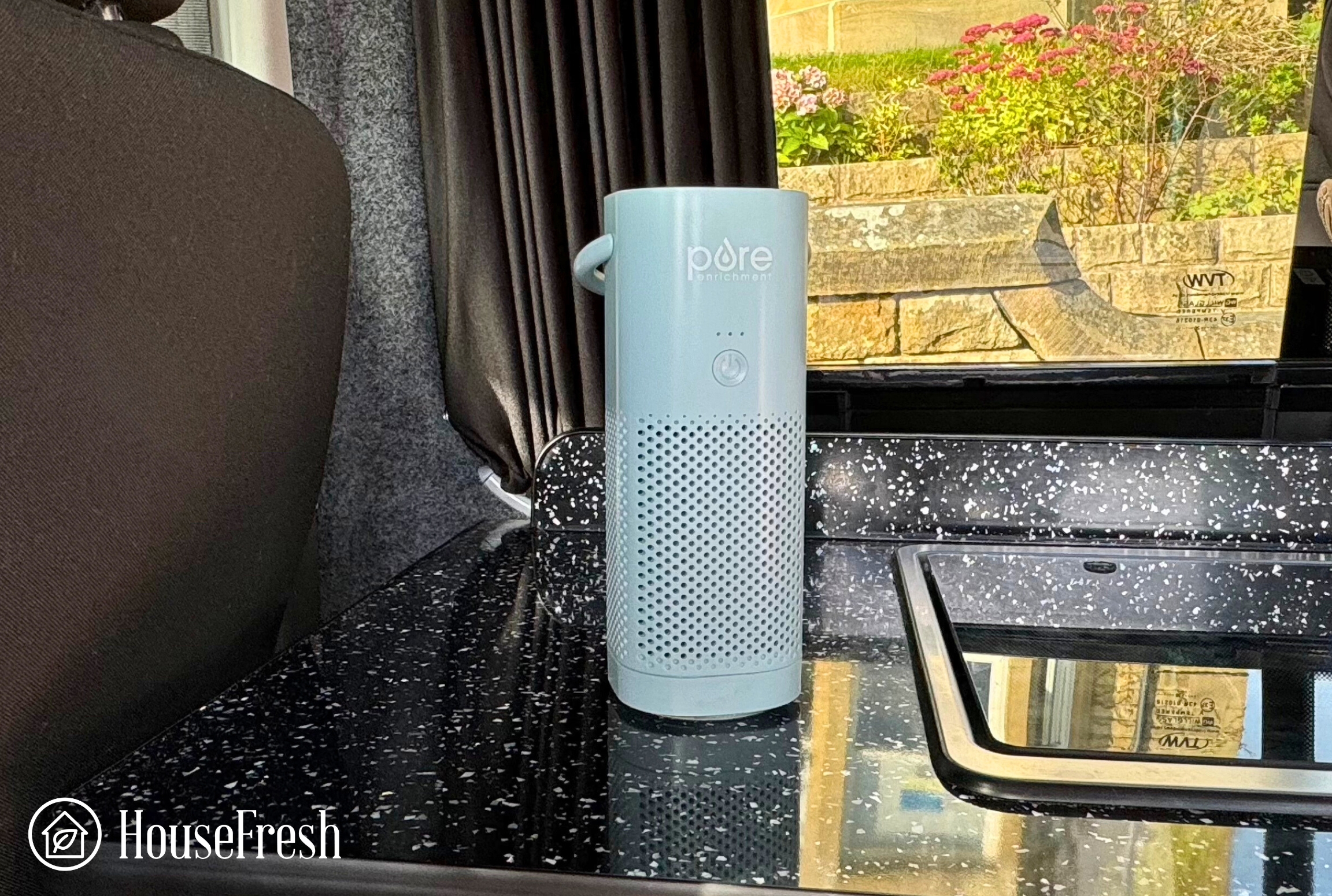
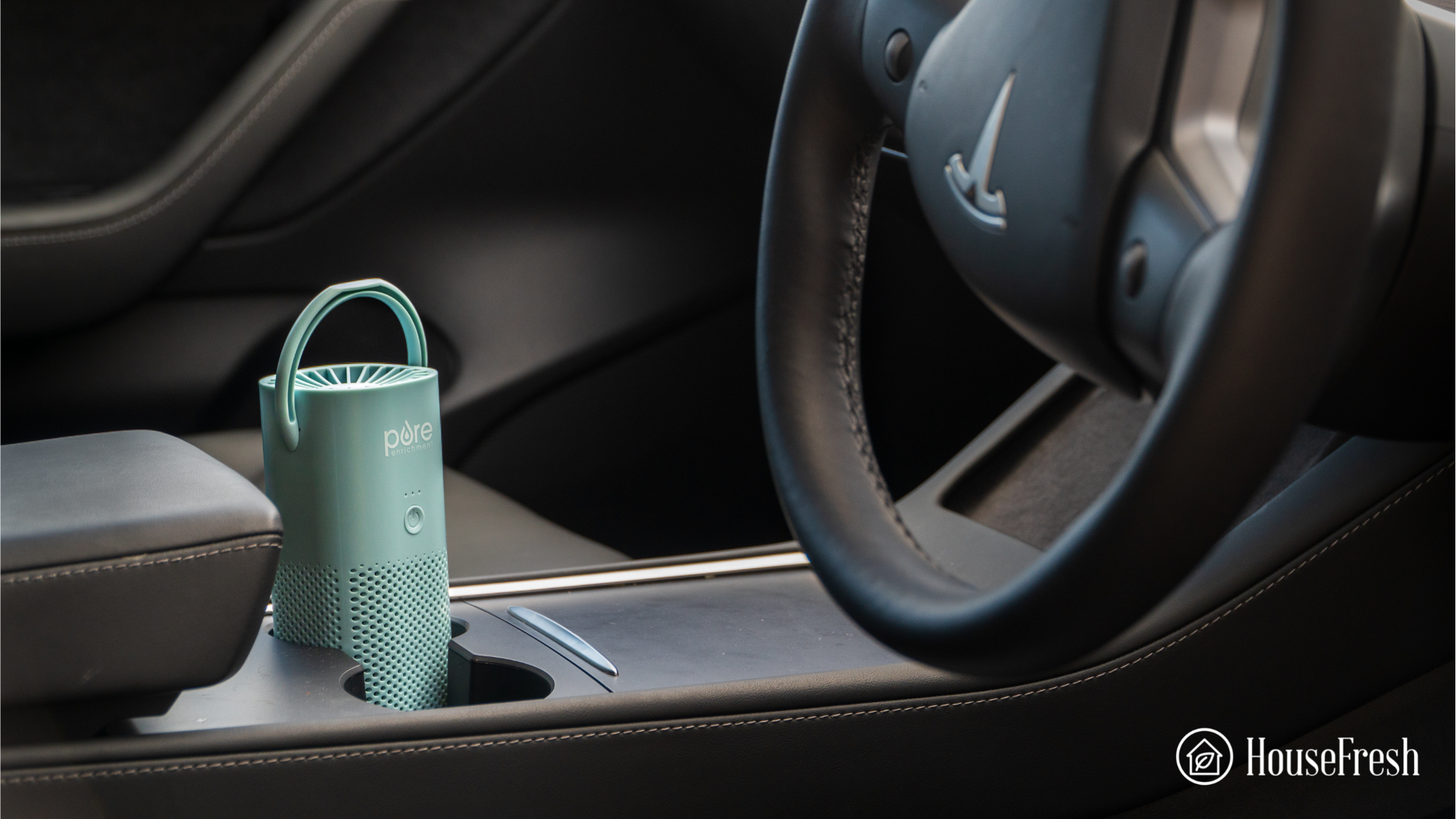
6. Cheapest option: Pure Enrichment PureZone Mini

For a bargain-basement price of $39.99, the Pure Enrichment PureZone Mini is a highly portable purifier that utilizes True HEPA filters. 

RV Air Purifier Pure Enrichment PureZone Mini

PRICE on amazon PRICE on EBAY

For an air purifier that costs less than $40, I’m not going to tell you this option will change your life. But for car campers, campervans or targeted use in small areas like the driver’s cabin, you will benefit from much cleaner air with this unit by your side.

That’s because this unit uses HEPA filters that are guaranteed to remove particles like road dust. What’s more, it comes with an activated carbon-impregnated pre-filter that will even take the edge off those unpleasant smells that all too often arise in an RV.

What we really like

Super portable thanks to a lightweight design and carry handle
Rechargeable battery that lasts longer than any other portable option on this list
Makes just 15 dB on its lowest fan speed
An absolute steal at less than $40

What we think could be better

It took a long time to bring pollutant levels down to zero
It is quite underpowered in comparison to the other units on this list

The PureZone mini is also a doddle to use. It has a simple one-button control panel to select from its three fan speed options. It weighs less than 1 lb and will fit right into your luggage. There’s a nifty carry handle and its lithium-ion battery can last up to 12 hours before you need to put it back on charge.

You’ll also notice that this is the quietest option on the list, meaning it won’t distract you when sleeping, working or listening to your favorite road trip playlist.

HouseFresh rating:★★☆☆☆
Time to clean our Tesla Model 3 (with the device running at top speed):3 hours and 41 minutes
Time to clean our 728 cubic feet test room (with the device running at top speed):6 hours and 49 minutes
Air purifier technology:Pre-filter, HEPA filter and Activated Carbon filter 
Recommended room size (4.8 air changes per hour):54 sq. ft.
Clean air delivery rate (CADR):Estimated: 10 CFM
Dimensions (in inches / in cm):8.5H x 2.7D x 3.3W inches / 21.5H x 6.8D x 8.8W cm
Weight (in pounds / in kg):0.27 kg / 0.58 lbs
Filter life:6 months
Noise level in decibels (measured from 3 ft. away with a sound level meter):Speed 1: 35.7 dB
Speed 2: 37.5 dB
Speed 3: 43 dB
Electricity consumption in watts (recorded with an electricity usage monitor):Standby mode: 0 watts
Speed 1: 12.1 watts
Speed 2: 7.5 watts
Estimated running cost (electricity consumption + official filter replacement):$29.44 per year
Cost per CADR cfm (based on dust CFM as reported by AHAM):$0.20
Manufacturer’s warranty:5 years
Country of manufacture:China

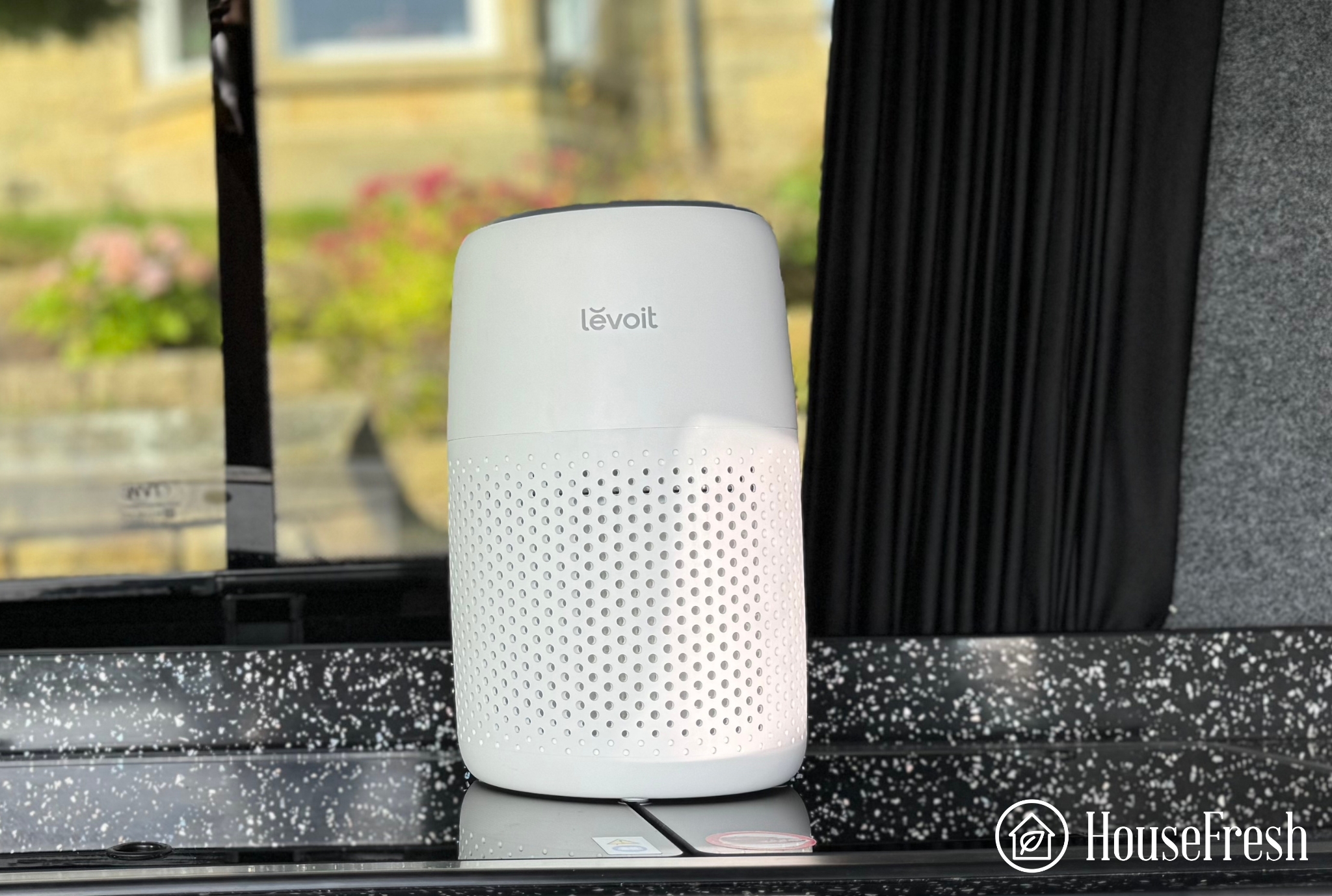
7. An option including essential oils diffuser: Levoit Core Mini

The smallest Levoit air purifier in the Core line, the Mini is perfectly sized to fit into your RV without eating up precious floor space.

RV Air Purifier Levoit Core Mini

💡exclusive code for HouseFresh for 10% off a single purchase on Levoit.com: HOUSE10

The Levoit Core Mini proves that good things can come in small packages. Despite being the cheapest air purifier from the brand, it still shares the same technology as their high-end units. 

You’ll find VortexAir™ technology, which pulls in air from 360 degrees, leaving no corner of your RV safe for pollutants to lurk in. As well as Levoit’s 3-stage filter that tackles the smallest dust, pollen and smoke particles, along with combatting odor and VOCs.

What we really like

Only air purifier to include an essential oil feature
Super compact, so won’t take up too much space in your RV
Low energy draw is ideal when you only have limited power supply
It comes with Levoit’s excellent 3-stage filters

What we think could be better

Fairly low CADR for a mains-powered unit
I think it would struggle to clean the air in the advertised 178 sq. ft. space 

Levoit decided to forego smart features and stick to a simple one-touch operation with three fan speeds on this unit. This makes operation simple and helps keep costs below $50, which is ideal for a unit used in an RV.  

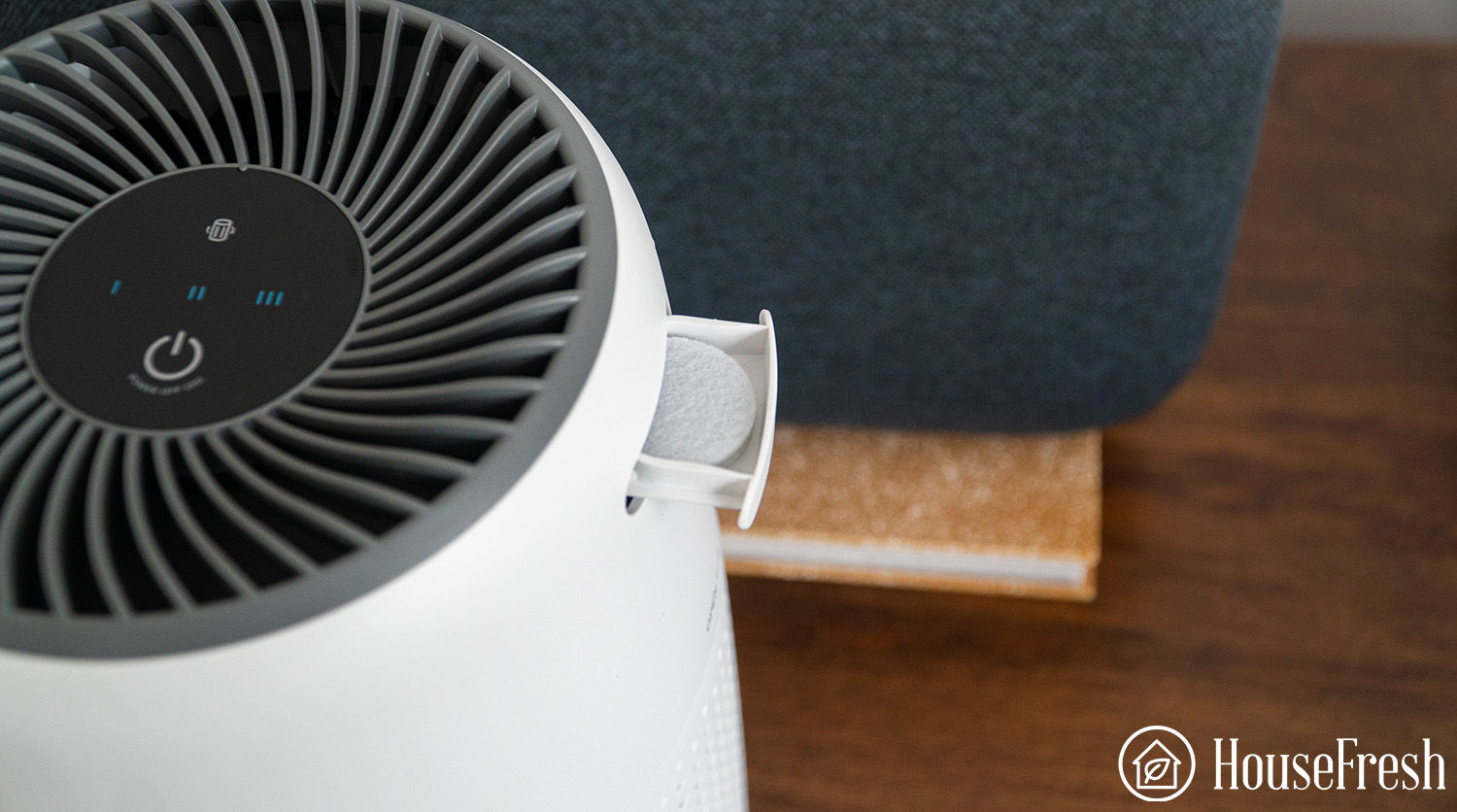
The Core Mini also has a secret weapon up its sleeve that will help with the stale and stinky smells that can overwhelm an RV. An essential oil tray on the side of the unit allows you to add your favorite fragrance and banish bad odor from your home on wheels.

Clean air delivery rate (CADR):– Top speed PM1 CADR: 41 cfm
– AHAM PM2.5 CADR: 41 cfm (smoke)
Filter technology:Bonded filter including a pre-filter mesh, a particle filter and a carbon layer.
Recommended room size:28 sq. ft. (5 air changes per hour)
Dimensions:10.4H x 6.5D x 6.5W inches (26.4H x 16.4D x 16.4W cm)
Weight:2.2 lbs (1 kg)
Noise level in decibels from 3 ft. away:Speed 1: 37 dB
Speed 2: 38 dB
Speed 3: 44.5 dB
Electricity consumption in watts:Standby mode: 1.2 watts
Speed 1: 2.8 watts
Speed 2: 5.9 watts
Speed 3: 6.4 watts
Filter lifespan:4 – 6 months
Manufacturer’s warranty:2 years
Country of origin:United States
Country of manufacture:China

What to look for when buying an air purifier for your RV

RVs are homes on wheels and with that come all the pollutants we find daily in our properties. With everyone sharing the same space, cooking dinner, sleeping and using the bathroom, pollutants can quickly build up. Not to mention the added exposure to traffic fumes, road dust and allergies you experience when traveling in a vehicle. 

To find the right air purifier for your RV, consider these five key features that will help protect you when out on the road. 

1. Does the air purifier utilize quality filters?

An air purifier is only as good as its filter technology. While varying forms are cropping up in newer appliances, the best (and safest) bet is to opt for mechanical filters that capture particles as they pass through the unit. 

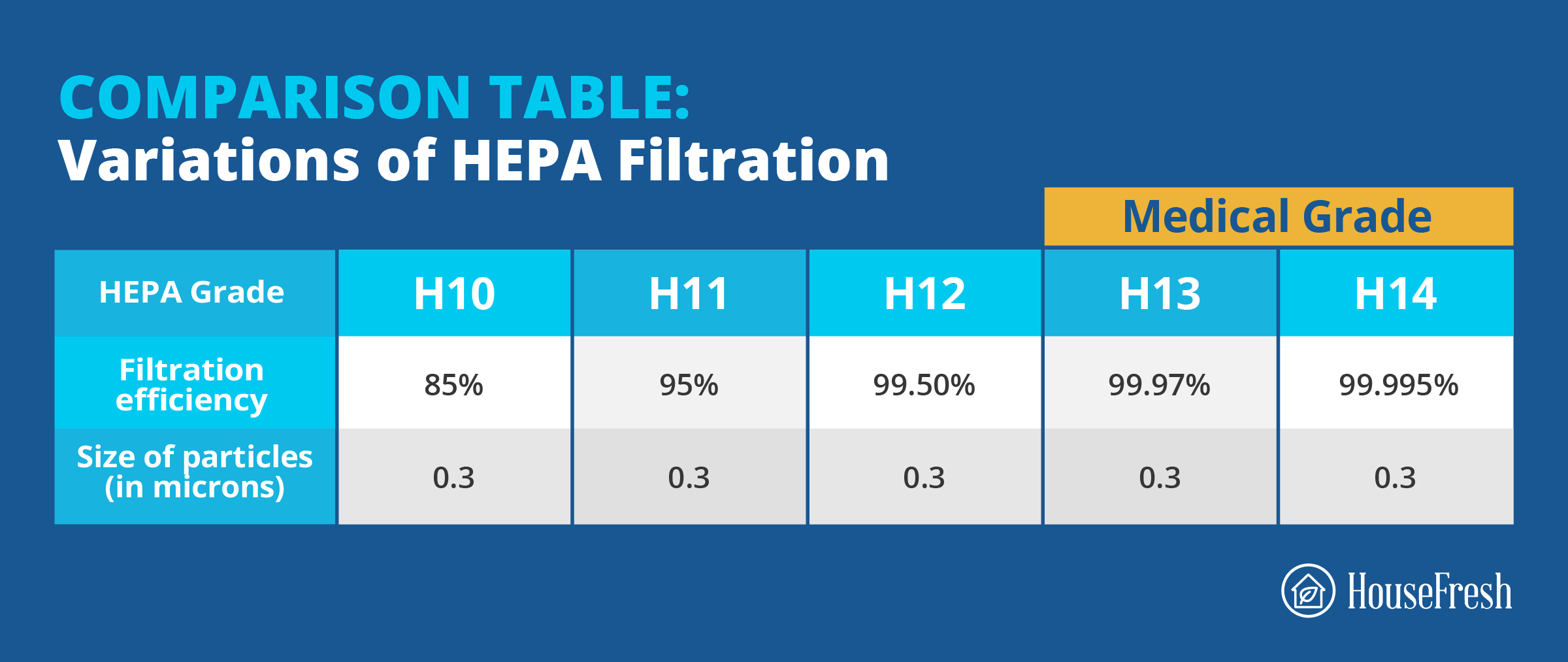
HEPA and Activated Carbon filters are peer-reviewed and proven to work. The HEPA stamp of approval indicates that a purifier can capture at least 99.97% of polluting particles as small as 0.3 microns, making it the ideal choice for the range of particles you’ll encounter inside your RV.

It’s worth noting that Levoit recently changed the terminology of their filters from H13 HEPA to simply a primary filter. While this would usually set off alarm bells, we are confident that Levoit air purifiers can still capture the tiniest particles, as we’ve experienced it firsthand during our hands-on reviews. 

2. Can the purifier clean the air effectively inside your RV?

Each purifier is designed to work in a specific sized room, so you’ll need to measure your space and compare it to different unit’s suggested room sizes. 

You’ll want to find a unit capable of completing at least four air changes per hour (ACH). This means intaking, cleaning and redistributing the air from your whole RV four times over to ensure it is free from pollutants.  

Having recently spent my vacation in a classic VW Campervan, I know that to achieve 4.8 air changes per hour, the minimum power an air purifier needs is 19.55 CFM. 

Those of you with larger vehicles will need more powerful units, so be sure to measure up and use our CFM Calculator below.

3. How much energy does the purifier use?

You may be relying on a limited power supply when on the road. So the last thing you’ll want to do is drain your solar or leisure battery or only be able to utilize the purifier when connected to an electrical hookup. 

By opting for an air purifier that draws minimal energy, you can preserve your power supply while keeping your air fresh for longer. 

Alternatively, looking for rechargeable options with internal power sources will pay dividends for those seeking a more off-grid RV experience. 

Such units include the Smart Air QT3, Westinghouse 1804 and Pure Enrichment PureZone Mini, while the IQAir Atem utilizes the in-cabin 12V power supply. Bear in mind that the Levoit Core Mini, 200S and 300S require a traditional power supply as these units are more powerful than their portable alternatives. 

4. Will the air purifier get in the way?

Space is always in short supply when spending time in an RV. 

Assess where the air purifier would work best in your RV. You’ll want to keep it near to where you spend the most time (i.e., the bed or driving cabin) or as close as possible to any known pollutant sources. This will give you a good idea of how much space you have to spare and what size purifier you can purchase.  

Opting for a smaller air purifier that can fit neatly on the worktop or shelf is a logical choice, but remember not to purchase an underpowered unit.

Each purifier will also make varying sound levels, so if you’re a light sleeper, will be working while traveling or simply enjoy the sound of silence, it’s best to know what you’re letting yourself in for before you take the plunge. Many manufacturers are now developing quieter and quieter appliances, with technology such as Levoits QuietKEAP keeping volumes as minimal as possible.

Tip

To find a purifier’s decibel range, check out our Specs and Features table for each option or consult the manufacturer.

5. Will you benefit from any additional features?

Air purifiers are increasingly offering new and innovative ways to make cleaning the air simpler. Smart features such as Auto or Eco modes monitor the air and adjust the fan speeds to respond to the current air quality levels, while Smartspearker or App connectivity allows you greater control, even when you’re away from the appliance. 

Some units also combine technologies, offering two devices in one, such as fans, heaters and humidity control. This can be particularly beneficial in an RV, with interchangeable weather conditions and often issues surrounding excess moisture.

Common questions about air purifiers for RVs

The best way to improve air quality is to reduce exposure to pollutants. This might mean avoiding driving at peak traffic hours, steering clear of dusty backcountry roads or keeping on top of RV cleaning chores.

While you can throw open your windows and doors when parked up and away from pollutant sources, doing so while driving will increase particle levels substantially.

Using an air purifier in your RV is a failsafe approach to improving air quality, as it captures all particles, from pollen to dust to mold, wherever you are in the world.

Air purifiers work really well inside an RV as they can circulate air more effectively in a compact single-room space (compared to a house or apartment). More air changes mean far fewer pollutants, even when the source is prevalent at the time. 

Remember that air purifiers require electricity to operate, so be sure to consider how you will power the unit before making a purchase.

How you power an air purifier depends on the individual unit. 

Traditional air purifiers used in a home setting will connect to a power socket like any other appliance. These can still be used in an RV if you have the correct power supply or will stay at RV parks or campgrounds with electrical hookups. Such units include the Lvoit Core 300S and Core 200S, which make great additions to larger RVs that require more powerful fan speeds. 

Portable or personal air purifiers usually have an in-built power supply. Units like the Smart Air QT3 can be charged at home and used on the road without electricity. Purifiers such as the IQAir Atem have special power adapters to use in your vehicle – reducing the risk of running out of juice.

The Levoit Core 300S offers the best protection from a wide range of pollutants for those with access to mains electricity. It’s the most powerful personal air purifier on this list and is ideal for larger RVs with multiple occupants.

For those without the luxury of a full electric hookup, the IQAir Atem is your best choice. This portable air purifier boasts the highest CADR score, allowing for rapid removal of pollutants from your RV.

Wrapping up

Whether you love getting away for the weekend or are a full-time van lifer, paying close attention to the air you breathe on the road is essential. Remember that when residing in a vehicle, you’ll face all the same pollutants in the home but with added traffic, dust and allergen concerns. 

Opt for a quality purifier with quality filters to combat harmful particles. Combining HEPA and Activated Carbon filters will provide you with the best protection. To see a real difference in your air quality, measure your RV and find a suitably powerful option. Otherwise, you’ll lose precious RV space and energy without seeing the benefit. 

At HouseFresh, we have been reviewing air quality products since 2010. In all these years, we learned not to rely on manufacturers’ claims and the ever-so-glowing marketing materials. That is why we buy products with our own money, so we can write unbiased reviews after we’ve had enough time to evaluate air quality products in our home lab. Every unit we recommend has been thoroughly tested to assess its performance, energy consumption, and noise levels emitted in real-life environments. If you have any questions about our testing process for different types of air quality products, just drop us an email at danny@housefresh.com.

These are the best air purifiers for dorm rooms

CleanAirKits Triple

Moving away from home can be an exciting experience, but living in close quarters with one or more roommates can be a daunting experience.

As you prepare to get your first taste of independent living, it makes sense to consider bringing an air purifier with you to fend off unwanted smells and protect your personal space from the dreaded freshman plague rife on campus, ready to strike against weary students.

The right air purifier will draw in air from your dorm and pass it through a series of filters that capture dust, pollen, smoke, odors and viruses. What’s left behind is clean, fresh air that will be redistributed into the space.

In this article, I shortlisted a handful of budget-friendly air purifiers that will not take up a lot of space but that are powerful enough to actually make a difference. We bought each device on this list with our own money so that we could run our usual battery of tests to assess their air cleaning performance, noise levels generated, energy consumption, yearly running costs and long-term user experience.

how we test
How we test air purifiers

Read our full testing methodology.

If you don’t have time to read my full article, check out the table below for a quick TL;DR of all the air purifiers I recommend for dorm rooms:

SMALL DORMSLARGE DORMSSMART OPTIONTABLETOP OPTION
Winix A231/A230AirFanta 3ProLevoit Vital 100SCleanAirKits Triple Exhalaron
Winix A231 Side tableAirFanta 3Pro SidetableLevoit Vital 100S CornerCleanAirKits Triple
Time to PM1 zero40 minutes17 minutes37 minutes46 minutes
CADR154 cfm430 cfm146 cfm128 cfm
Filter techTrue HEPA + carbon + ionizerH11 HEPA + carbonBonded particle + carbonHEPA H10 + carbon
Max room size231 sq. ft.671 sq. ft.219 sq. ft.192 sq. ft.
Yearly running costs$119.54 $125.23$81.98$110.88
List price$75.99$159.99$139.99$359.00

1. Best air purifier for small dorm rooms: Winix A231 (or A230)

Our top pick for dorm rooms no larger than 231 sq. ft. is a small air purifier with no smart features that you can find for less than $80.

Winix A231 Side table

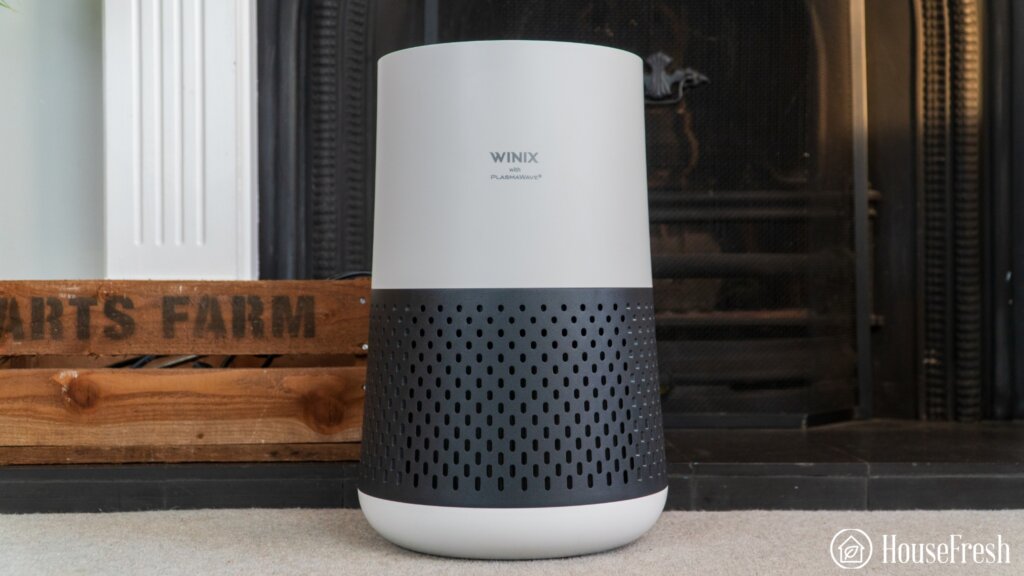
Before I tell you more about this device, let me clarify that I’m writing here about the A231 because that is the model I tested: the white and grey device you can see in our photos. But if you prefer black, you can instead get the Winix A230, which is exactly the same as the A231 but in all black. Both devices have the exactly same internals, so it’s just a matter of taste. Right, with that info out of the way, let me tell you more about this unit.

If you are looking for a small air purifier you can have beside your bed or, on a narrow window sill or on top your desk, then the Winix A231 might be just what you want. With a CADR of 154 cfm, the Winix A231 can provide five air changes per hour in dorm rooms up to 231 sq. ft. thanks to a powerful fan and a high quality True HEPA filter packed with activated carbon. This combination allows the A231 to tackle both particles and gases, removing everything from dust to unwanted odors.

What we really like

It is small and compact, so it won’t take up too much space.
It cleaned our test room of PM1 pollutants in 40 minutes, which is 14 minutes faster than the similarly priced Levoit Core 300.
You can expect to spend $49.99 per year in filter replacements if you choose OEM filters, which is cheaper than most small air purifiers.
There are generic filters available on Amazon, which would bring long-term filter replacement costs down to under $20 per year.

What we think could be better

As with most small air purifiers, it can get loud at its top fan speed, reaching 57.9 dB, which will be too loud for some — especially if you need to study.
If it loses power, the A231 will go back to default, with PlasmaWave enabled.

The Winix A231 comes with an inbuilt air quality sensor, so you get an auto-mode that will kick in autonomously as soon as the sensor detects pollutants in the air. This can come in handy if you want to set your air purifier and forget it. And, as with other Winix air purifiers, the A231 comes with PlasmaWave bipolar ionizer technology but you can disable it if you have concerns about ionization and ozone.

Clean air delivery rate (CADR):– Top speed PM1 CADR: 148 cfm
– Sub-45 dBA PM1 CADR: 67 cfm
– AHAM PM2.5 CADR: 154 cfm (dust)
Filter technology:Fine mesh pre-filter, True HEPA filter, activated carbon filter, PlasmaWave technology
Recommended room size:222 sq. ft. (5 air changes per hour)
Dimensions:9.5D x 9.5W x 14.6H inches (24.13D x 24.13W x 37H cm)
Weight:7.1 lbs (3.2 kg)
Noise level in decibels from 3 ft. away:Speed 1: 35.2 dB
Speed 2: 48.3 dB 
Speed 3: 57.9 dB
Electricity consumption in watts:Standby mode: 0.06 watts
Speed 1: 35.4 watts
Speed 2: 37.7 watts
Speed 3: 45.6 watts
Filter lifespan:12 months
Manufacturer’s warranty:2 years
Country of origin:South Korea
Country of manufacture:Thailand

Read our full review

2. Best for large rooms: AirFanta 3Pro

With a CADR of 430 cfm, the 3Pro can clean the air in larger dorm rooms (up to 671 sq. ft.) for just $175.99 if you go for the HEPA + carbon version.

Use the discount code HOUSEFRESH for 5% off when buying directly from AirFanta.

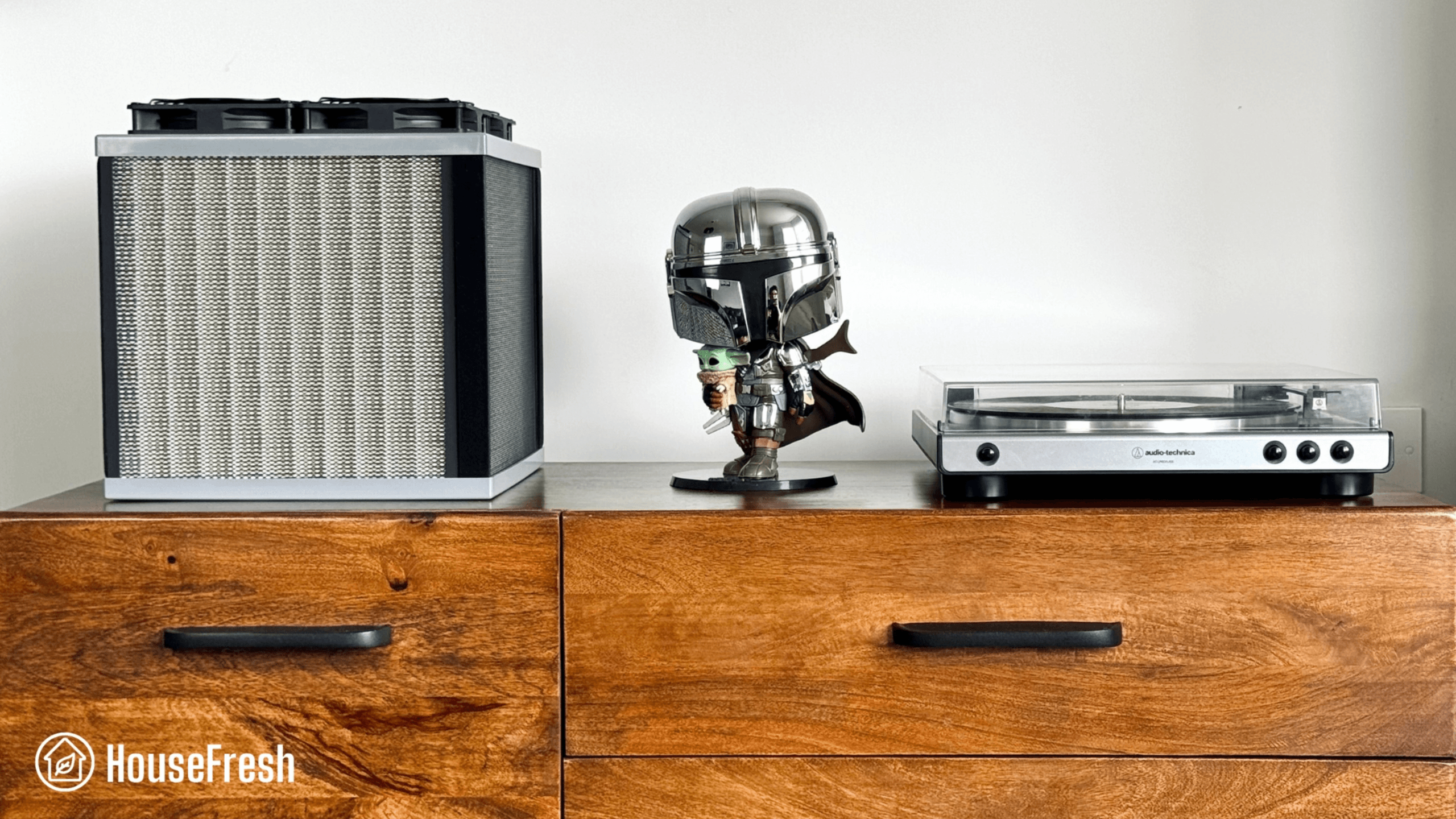
The AirFanta 3Pro is part of a new generation of air purifiers that are powered by PC fans, which make them a lot quieter and more energy efficient than traditional devices you will find at a retail store. The design of the 3Pro is inspired by a popular DIY air purifier you might have heard of called the Corsi-Rosenthal Box, with a base around which you get four filters that are topped with four PC fans which create the perfect cube.

The 3Pro is one of the most powerful air purifiers I have tested and it truly blew my mind in 2024, becoming one of our top recommendations. If you are looking for a relatively compact device (12.6 x inches, or 32 x 32 cm) that you can assemble yourself (and disassemble, when the time comes to go back home or move to a new place), then read on as the AirFanta 3Pro might be just what you’ve been looking for.

What we really like

It offers excellent value — it has an estimated CADR of 430 cfm and you can buy it for $160-$175, whereas most air purifiers this powerful will cost you more than $500.
You can assemble it and disassemble it in just a couple of minutes, so you can take it with you wherever you go inside a small suitcase or big backpack.
It is relatively quiet considering its outstanding air cleaning power, hitting 56 dB at top speed.
Amazing performance, cleaning our test room in 17 minutes — this is just two minutes slower than the much bigger and much more expensive Smart Air Blast Mini, which is a popular air purifier used in classrooms and offices.

What we think could be better

It is often out of stock on Amazon, but you should be able to find it on the official AirFanta store. By the way, when buying directly from AirFanta, you will get a 5% off when using the discount code HOUSEFRESH.
It is much louder (56.3 dBA) than other PC fan-powered air purifiers we have tested when running at full speed. Check out my CleanAirKits Luggable-XL review to see what I mean.

Traditional retail air purifiers come with a control panel at the top of the device with buttons or a screen for you to switch modes and fan speeds, but the AirFanta 3Pro doesn’t. Instead, you will get a 110-220v AC to 3-12v DC power adapter which will allow you to control the speed of the fans and the noise output.

Tip

We found that setting it to 6.54V is a sweet spot where the 3Pro offers excellent air cleaning while generating just 43dB, which is quieter than the recommended 45dB for classrooms — a good sound level to keep it running in the back without it disturbing your sleep or study time.

Clean air delivery rate (CADR):– Top speed PM1 CADR: 353 cfm
– Sub-45 dBA PM1 CADR: 213 cfm
Filter technology:True HEPA H11 and optional pelleted activated carbon
Recommended room size:529 sq. ft. (5 air changes per hour)
Dimensions:12.6D x 12.6W x 12.6H inches (32D x 32W X 32H cm)
Weight:7.7 lbs (3.49 kg)
Noise level in decibels from 3 ft. away:3.63 volts: 36.1 dB
4.19 volts: 36.9 dB
5.24 volts: 39.7 dB
6.54 volts: 43.3 dB
7.44 volts: 46.7 dB
8.56 volts: 49.1 dB
12.6 volts: 56.3 dB
Electricity consumption in watts :43.23 watts
Filter lifespan:6 – 12 months
Manufacturer’s warranty:1 year
Country of origin:China
Country of manufacture:China

Read our full review

Watch our video review

3. Best smart option: Levoit Vital 100S

The Vital 100s is a smart air purifier suitable for dorm rooms no larger than 219 sq. ft. with an on-board air quality sensor that connects to your smartphone for $139.99.

The Levoit Vital 100S has a dust CADR of 146, so this relatively small air purifier will be able to provide five air changes per hour in dorm rooms of up to 219 sq. ft. It comes with a removable pre-filter and a bonded main filter with a combination of activated carbon (to deal with odors and gases) and a HEPA-like particle filter (to filter out dust, pollen and other small particles).

If you are looking for a smart air purifier that you will be able to control and manage from your phone, then the Levoit Vital 100S is worthy of consideration. As with the Winix A231, the Vital 100S comes in an on-board air quality sensor that unlocks an auto-mode that will automatically adjust fan speeds based on the quality of your air. But it doesn’t stop there. You can also connect to your 100S from your smartphone through Levoit’s VeSync app, which is one of the most polished air purifier apps out there.

What we really like

It comes with a removable pre-filter that you can clean to extend the life of the main filter.
It comes with an auto-mode and app support, something rare in air purifiers selling for less than $200.
It is super energy efficient, with a max draw of 27.3 watts.
It comes with pelleted activated carbon for dealing with odors and gases, which is much better than the cheap impregnated fabric we see with air purifiers in this price range.
Weighting less than 7.5 lbs and measuring 6.4 x 12.8 x 16.1 in (or 16.3 x 32.5 x 40.8 cm), this is a relatively small air purifier that will fit most dorm rooms.

What we think could be better

The particle and the carbon filters are stuck together (a.k.a. bonded), so you will need to replace both of them even if the only one that needs replacing is the carbon filter (which usually runs out faster than the particle filter).
Levoit initially marketed the Vital 100S as having a HEPA filter but after Dyson complained to the BBB, they removed all mentions of HEPA without any explanation to the public. This doesn’t affect the performance of the 100S but it’s not a good look on Levoit.

The Levoit Vital 100S is the upgraded, smarter version of the older Vital 100 and the little sibling of the popular Vital 200S. The Vital 100S cleared our small 728 cubic feet test room of all PM1 particles in 37 minutes — this is 11 minutes faster than the non-smart Vital 100 (48 minutes) and 17 minutes faster than the $99 Levoit Core 300 (54 minutes).

HouseFresh rating:★★★★☆
Time to clean our 728 cubic feet test room (with the device running at top speed):37 minutes
Air filtration technology:Pre-filter and bonded particle + activated carbon filter.
Recommended room size (4.8 air changes per hour):219 sq. ft. 
Clean air delivery rate (CADR):Smoke: 134 cfm
Dust: 146 cfm
Pollen: 186 cfm
Dimensions (in inches / in cm):6.4 x 12.8 x 16.1 in (16.3D x 32.5W x 40.8H cm)
Weight (in pounds / in kg):7.28 lbs (3.3 kg)
Filter life:9 months
Noise level in decibels (measured from 3 ft. away with a sound level meter):Speed 1: 37.5 dB
Speed 2: 42.6 dB
Speed 3: 48.7 dB
Speed 4: 53.8 dB
Electricity consumption in watts (recorded with an electricity usage monitor):Standby: 1.6 watts
Sleep mode: 3.2 watts
Speed 1: 5 watts
Speed 2: 8.7 watts
Speed 3: 15.4 watts
Speed 4: 27.3 watts
Estimated running cost (electricity consumption + official filter replacement):$81.98 per year
Cost per CADR cfm (based on dust CFM as reported by AHAM):$0.96
Manufacturer’s warranty:2 years
Country of manufacture:China

Watch our video review

4. Best tabletop option: CleanAirKits Triple Exhalaron

Designed to be used as a table centerpiece, the Triple Exhalaron is a PC fan-powered air purifier with a CADR of 128 cfm that can be used in dorms no larger than 192 sq. ft.

$359 AT CLEAN AIR KITS

The Triple Exhalaron is another PC fan-powered air purifier, this time manufactured by the team at CleanAirKits. The design of the Exhalaron is quite unique, with three cylindrical HEPA H10 filters (with activated carbon inside) that sit between a thin wooden base and a thick wooden top home to three CoolerMaster Mobius argb (2400 rpm) PC fans.

If you are looking for a small air purifier you can use in your dorm but also take with you to the library or bring to study groups, then look no further than the Triple Exhalaron from CleanAirKits as this is the only air purifier we have tested that has been designed from the ground up to be used as a table centerpiece ensuring it will reduce viral load.

What we really like

It is designed to be powered by a battery pack (with a male USBC pigtail), so you can take it with you around campus. You get up to 10 hours of use with a 20,000 mAh battery.
It is super quiet, ranging from 35.2 dB to 40.5 dB from its lowest to its highest fan speeds.
It looks pretty cool – I know it’s a personal preference, but I really like the steampunk feel of the Exhalaron. Now, I know it won’t be everyone’s cup of tea.

What we think could be better

Initial price is much higher than all the other air purifiers on this list ($359.00).
Filter costs are higher but do last longer than cheaper Core series units — up to 15 months

It has a CADR of 128 cfm, so it will be able to give you five air changes per hour in dorm rooms no larger than 192 sq. ft. This air purifier is super quiet, hitting just 40.5 dB when running at its top fan speed, while still being able to clean the air faster than popular small devices like the Levoit Core 300.

Clean air delivery rate (CADR):– Top speed PM1 CADR: 128 cfm
– Sub-45 dBA PM1 CADR: 128 cfm
Filter technology:HEPA H11 with a layer of carbon-impregnated fabric
Recommended room size:192 sq. ft. (5 air changes per hour)
Dimensions:22W x 7.25D x 8.5H in (56W x 14D x 22 cm)
Weight:6 lbs (2.72 kg)
Noise level in decibels from 3 ft. away:Speed 1: 35.2 dBA
Speed 2: 37.7 dBA
Speed 3: 40.5 dBA
Electricity consumption in watts:Standby: 0.1 watts
Speed 1: 1.1 watts
Speed 2: 2.8 watts
Speed 3: 6 watts
Filter lifespan:6 months
Manufacturer’s warranty:1 year
Country of origin:United States
Country of manufacture:United States

Watch our video review

Three other good air purifiers for dorm rooms you should consider

These devices didn’t make the final list but they are solid performers and might be a better fit for what you’re looking for.

Coway Airmega AP 1512HH Corner

Coway Airmega AP-1512HH Mighty

The Coway AP-1512HH is one of the most recommended air purifiers on the web, so you will probably have seen it if you’ve been doing your research for a while. This oldie but goodie will deliver five air changes per hour in dorm rooms of up to 360 sq. ft. thanks to its CADR of 240 cfm and its combination of a removable pre-filter, a True HEPA filter, a carbon impregnated filter and its bipolar ionizer (which you can disable if you prefer not to use). Filter replacement costs are some of the lowest we have seen.

The reason why I didn’t include it on this list is that in 2025, I think there are newer air purifiers that offer more value for a better upfront price. Plus, it is quite big and could be too bulky for small dorms. But if you like the look of it, or if you prefer to go with a device that has been on the market for over a decade, then the Coway Airmega AP-1512HH Mighty could be the best pick for you.

Smart Health S Close up logo

Smart Air S

This small(ish) air purifier has a CADR of 185 cfm, making it a good choice for dorm rooms no larger than 277 sq. ft. It comes with H13 medical-grade HEPA filters that will be able to remove not just dust and pollen particles from the air but also bacteria and viruses. If odors and chemicals are an issue, you can buy the optional activated carbon filter, too.

This is a great air purifier on paper but I didn’t include it as one of my main picks because it generates nearly 60 decibels of noise at top speed (58.2 dB), which is likely to be too loud for a dorm where people are going to be studying and need quiet to concentrate.

But if you are looking for an air purifier that looks like a piece of furniture and are not too bothered by smart functions or loud noises, then the Smart Air S could be just the thing.

Levoit Core 300S Kitchen

Levoit Core 300S

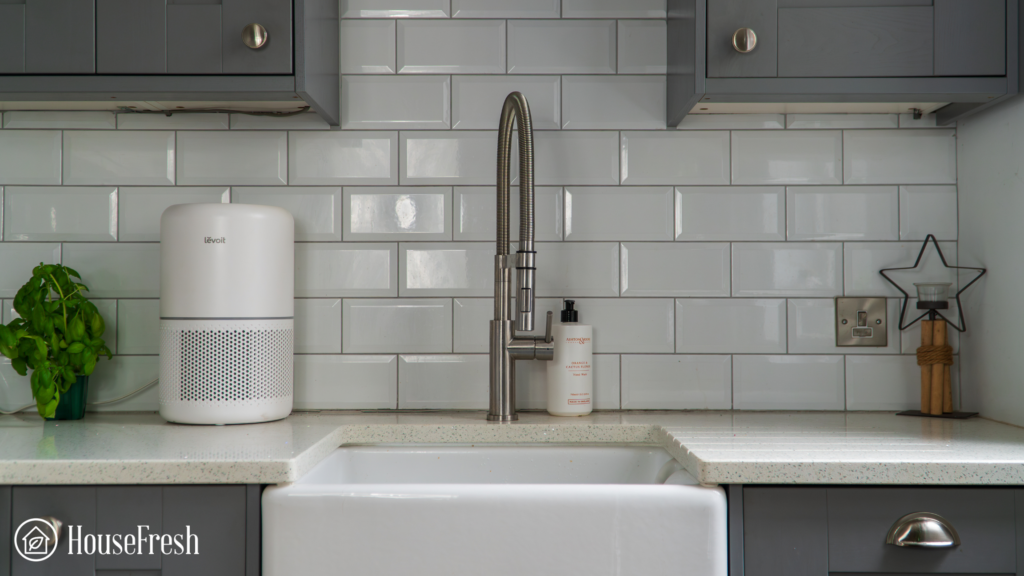
The Levoit Core 300S is the upgrade to the older, $99 Core 300, now sporting smart features such as smartphone connectivity and app support. The Core 300S is also more energy-efficient and much faster (45 minutes) at cleaning the air compared to its older counterpart (54 minutes), which is impressive considering it costs just $50 more.

It has a CADR of 141 cfm so it can clean the air five times per hour in dorm rooms as large as 211 sq. ft., and comes with a bonded filter including a pre-filter mesh, a particle filter and a layer of activated carbon. I chose to go with the Vital 100S instead of the Core 300S because it offers a higher CADR (146 cfm) for a lower price ($139.99).

But if you prefer a cylindrical design and want an air purifier that you will be able to manage from your phone, then the Levoit Core 300S might be the best option for you and your dorm room.

Other units we tested but don’t recommend for dorm rooms

  • Levoit Core Mini: In testing, this device took 1 hour and 53 minutes and had a CADR of 32 CFM, making it too small even for the smallest dorm rooms. You are better off saving up more and going for the bigger Core 200S or Core 300.
  • Medify MA-25: While this is cheap, the filter replacement costs were much higher than similar-performing units.
  • Blueair 411+ Auto: All Blueair air purifiers use a technology called HEPASilent, which uses an ionizer, but you can’t disable its use. The activated carbon used in these units is the fabric carbon, which we found far less effective than the pelleted carbon. 
  • PuroAir 240: This is an air purifier that you will often find at the top of Amazon as a sponsored option but that doesn’t offer a good enough value for your money, based on the results of our performance tests.

What to look for in an air purifier for a dorm room

Sadly, many dorm rooms in America are in older buildings with poor ventilation, which can mean levels of indoor pollutants can quickly rise and cause problems.

Indoor air pollutants can cause health problems and can even affect grades; a study from Israel showed that those students who breathed in the air with a higher count of fine particles scored on average 2.3% lower. The EPA stated that children in classrooms in highly ventilated spaces perform better on standardized tests than children in poorly ventilated rooms. 

To get the most from college, you must create a space in your dorm room free of tiny particle pollutants that have been shown to create health problems and reduced cognitive ability. 

You should try to ventilate the dorm room as much as possible, but when this isn’t possible, an air purifier can do a great job of keeping the air clean of these tiny harm-causing particles. 

But to get the right air purifier for a dorm, you need to consider the following:

1. Consider the size of your dorm room

The average dorm room in the United States measures around 228 square feet for a dorm room with two students. The good news is that smaller spaces need smaller air purifiers to be effective. Most air purifiers are given a CADR score that is used to give you an indication of an air purifier’s cleaning power. Higher CADR will allow you to keep a large space clean. 

An average double-person dorm room of 228 square feet with an 8ft ceiling will need a CADR score of 145 CFM to provide the 4.8 air changes per hour that the EPA recommends for portable air cleaners. This is exactly the CADR of our number 1 pick, the Levoit Core 300.

You can use our CFM calculator to find out what CADR you need to clean the air in your dorm room at least four times per hour: 

2. Look for activated carbon filtration if you worry about odors

Particle filters like HEPA or MERV are great for removing the tiny particles from the air in a dorm room but won’t do anything about the odors that come with student living. An activated carbon filter can help to catch these odor gasses and keep the dorm room smelling better.

As a rule of thumb, you will want to choose an air purifier that uses pelleted carbon vs. the impregnated carbon fabric as we found that the latter will quickly lose effectiveness at removing odors. 

3. Calculate long-term running costs

Most dorm rooms include free electricity usage. However, you will still need to replace the filters every six months for smaller air purifiers and potentially longer with larger devices.

We include the latest price for the genuine and generic filters for each recommended air purifier we review so you can know the accurate long-term running costs. 

Westinghouse 1804 Filter Packaging

Tip

Be aware that running a large air purifier is often cheaper than you need as the filters are bigger and need replacing less often but often cost very similar.  

4. Decide whether you need to get an air purifier with smart features

It feels like every appliance is smart nowadays, from your refrigerator to your television. It turns out that the same can be said for air purifiers.

The benefit of smart features is that they come with an onboard air quality sensor so that the air purifier will only kick in when it detects pollutants in the air. It is super useful for a kitchen but not mission-critical for a dorm room, so feel free to save money on a non-smart version.

Shark HP102 Air Quality Sensor

But if budget is a concern, you can often find non-smart versions for cheaper prices. Sure, they won’t turn on and off automatically but you can simply keep the device running at a fan speed that you don’t find intrusive so it works all the time.

Why you should trust our recommendations

Unlike most guides to air purifiers you will come across on the internet, we actually put the air purifier we recommend through an in-depth testing process and share this data with our readers. We have reviewed over 90 air purifiers since 2020, and based on this original data, we have identified what we think are the best air purifiers suited for those living in dorm rooms.

We are 100% independent and don’t take review units in exchange for review; we pay retail like everyone else. This means we are free to say when an air purifier fails to deliver, and we don’t have any outside pressure to push certain brands or models.

If you still can’t find the right air purifier for your dorm room or just want to ask me more about our performance testing, please reach out to me directly danny@housefresh.com

The air purifiers for the bedroom that won’t disturb your sleep

Alen BreatheSmart 45i Bedroom

The bedroom as the private area of the house we know today dates back to the 17th century, a period not so distant considering the world’s oldest bed is approximately 77,000 years old. Bedrooms have widely evolved since then, achieving the high level of comfort we are used to today.

Yet, more often than not, that same coziness makes bedrooms ideal places for dust and other allergens to build up. The bedding, cushions, pillows, the chairdrobe with partially used clothes piling up accumulate dead skin cells, dander and lint while shedding tiny fibers, contributing to further dust buildups — a true feast for dust mites, also known to be common allergy triggers.

Then there’s ambient pollution that can slip in through the window, such as pollen, traffic fumes or the dust of a nearby construction.

As an allergic, compulsive morning sneezer, I can confidently say that sleeping with an air purifier in the bedroom can drastically alleviate congestion and most allergy symptoms. 

Needless to say, you’ll need the right air purifier for the job. Whether you have a spacious master bedroom, a cozy small room or live in an ample studio, we’ve handpicked four units to fit all needs. All our recommendations are backed up by multiple performance tests to ensure they meet our short and long-term standards.

how we test
How we test air purifiers

Read our full testing methodology.

We also made sure to check the noise output, power and speed capable of cleaning the air without disrupting your rest.

Staff picks: Top 3 air purifiers for bedrooms

From the over 50 units we have tested, we’ve run down our selection to these three units for improving the air quality in your bedroom:

👑 BEST OVERALL💰 FOR TIGHT BUDGETS🛋️ FOR LARGE SPACES
Levoit Core 300SWinix A230/A231Alen BreatheSmart Flex
Levoit Core 300S BedroomWinix A231 Living roomAlen BreatheSmart Flex Bedroom
AIR CLEANING SPEED ⚡32 minutes35 minutes34 minutes
CADR 👩‍🔬Dust: 134 CFM
Smoke: 126 CFM
Pollen: 154 CFM
Dust: 149 CFM 
Smoke: 147 CFM
Pollen: 154 CFM 
Dust: 208.8 CFM
Smoke: 191 CFM
Pollen: 245.4 CFM
FILTER TECHNOLOGY 💨3-Stage Filtration (Pre-filter for large particles, main filter for airborne particles, high-efficiency activated carbon filter for odors and gasses)Fine mesh pre-filter, True HEPA filter, activated carbon filter, PlasmaWave technologyH13 HEPA with an option for activated charcoal (Fresh, Odorcell and Heavy Smoke options available)
MAX ROOM SIZE 📏Up to 219 sq. ft.Up to 230 sq. ft.Up to 296 sq. ft.
WEIGHT ⚖️5.95 lbs (2.7 kg)7.1 lbs (3.2 kg)15 lbs (6.8 kg)
OUR REVIEW 🔍Core 300S reviewWinix A230 reviewAlen Flex review
PRICE 💵No products found.Price not available$299.00

Last update on 2026-04-04 / Affiliate links / Images from Amazon Product Advertising API

Read on to discover all the details and perks our recommended units could bring to your night’s sleep.

1. Best overall: Levoit Vital 200S

The Vital 200S is an excellent option for small to mid-sized bedrooms, offering excellent air cleaning performance for less than $200.

Levoit Vital 200S Living Room

We’ve been favorably impressed by this unit’s performance, particularly considering its more than reasonable price. The Vital 200S is powerful and efficient. It can complete five air changes per hour in rooms of up to 375 sq. ft.

It is fast, too. With a CADR of 245 CFM, it cleaned our test room in 18 minutes, which is only three minutes slower than the mighty Core 600S and a six-minute difference compared to the Smart Air Blast Mini —the quickest (and a far more expensive unit) of the 55 units we have reviewed. 

There are four fan speeds to choose from, including a turbo mode, which not all Levoit units feature. This is quite convenient for bedrooms, as it can thoroughly clean the air in the room before it’s time for bed. 

With better, cleaner air in the room, you can safely set the unit to sleep mode for the night, which means a lower fan speed and lower noise levels (24dB) for a peaceful rest.

What we really like

Well equipped with smart features, normally found on more costly models.
Despite boasting the perks of more expensive models and having an incredibly reasonable price tag, none of this compromises the unit’s cleaning power.
The washable pre-filter allows for a longer filter lifespan. 
The filter includes a pelleted activated carbon layer, good enough to control any unwanted smells.

What we think could be better

There isn’t any independent testing to certify the HEPA filters.
It is an averagely plain-looking unit.
Turbo mode is powerful but really loud.

Another handy feature Levoit has incorporated into this unit is the light detection mode. It allows the Vital 200S to automatically turn off the display lights when the room gets dark without needing you to manually set them off, which can also be done if you prefer. 

Plus, like all other S(mart) Levoit models, the VeSync mobile app allows remote control and voice command through Alexa and Google Home to tweak the settings from bed. It also lets you create custom sleep schedules to match personal routines and keep track of the filter life, displaying the filter’s remaining life percentage.

Clean air delivery rate (CADR):– Top speed PM1 CADR: 249 cfm
– Sub-45 dBA PM1 CADR: 128 cfm
– AHAM PM2.5 CADR: 254 cfm (dust)
Filter technology:Bonded particle filter with a layer of pelleted activated carbon and a removable pre-filter
Recommended room size:373 sq. ft. (5 air changes per hour)
Dimensions:15.6D x 8.5W x 19.8H inches (39.3D x 21.5W x 50.2H cm)
Weight:13.2 lbs (5.9 kg)
Noise level in decibels from 3 ft. away:Speed 1: 38.3 dB
Speed 2: 41.9 dB 
Speed 3: 53.8 dB
Speed 4: 57.7 dB
Electricity consumption in watts:Standby mode: 0.97 watts
Speed 1: 5.71 watts
Speed 2: 8.01 watts
Speed 3: 31.96 watts
Speed 4: 44.55 watts
Filter lifespan:12 months
Manufacturer’s warranty:2 years
Country of origin:United States
Country of manufacture:China

Read our review

2. Best for large bedrooms: Alen BreatheSmart Flex

A stylish yet powerful option to rely on for the biggest bedroom in your home.

Alen BreatheSmart Flex Bedroom

This is a trustworthy air purifier. We chose this unit for larger bedrooms because of its CADR of 208 CFM. The Alen Flex is able to completely renew the air in a 700 sq. ft. room every 30 minutes at top speed. 

It would be perfect for ample master bedrooms, studios or bedrooms with a walk-in closet: the Alen Flex can reduce the dust that would otherwise land on your clothes or remove the fiber particles that the clothes release into the air. 

I also find this unit reliable because of the medical-grade H13 HEPA filters. The robust filter is ideal for reducing allergy symptoms from pollen in the early morning, dust mite particles and other common allergens that would otherwise hinder your sleep. 

What we really like

It’s highly energy-efficient, consuming far fewer watts than other units with the same air-cleaning performance.
It’s very quiet for its fan power: 36 dB at the lowest fan speed and 50dB at top speed.
Compared with other Alen units, this one doesn’t come with an ionizer, a controversial technology that can introduce ozone into your space.
Alen offers a lifetime warranty when you subscribe to their filter replacement program. 

What we think could be better

Unlike the 45i and 75i, the Flex doesn’t offer app support or auto mode.
Filter options with activated carbon are more expensive than the Pure filter included in the initial unit price.
It would be nice not to have to sign up for the filter subscription to get the lifetime warranty. 

Another thing I like about this air purifier is that you can choose the filter that best fits your needs. So, if you are looking for a unit that will also deal with VOCs and odors, you could either choose between the Fresh filter, with 3.6 lbs of activated carbon, or the Odor filter, with OdorCell technology that neutralizes odors.

There’s just one downside worth mentioning. As Alen Breathsmart’s most affordable unit, the Flex has no auto or sleep mode. It does allow you to turn off the control panel lights during nighttime, though. So, you can set the fan speed for the night and press the power button once to make the lights go out and enjoy a peaceful sleep. 

As a bonus for a cozy rest, Alen units produce pink noise on all fan speeds — which is said to be more soothing and less irritating than the white noise most units on the market emit.

HouseFresh rating:★★★★☆
Time to clean our 728 cubic feet test room (with the device running at top speed):34 minutes
Air purifier technology:H13 HEPA with an option for activated charcoal (Fresh, Odorcell and Heavy Smoke options available)
Recommended room size (4.8 air changes per hour):296 sq. ft.
Clean air delivery rate (CADR):Dust: 208.8 CFM
Smoke: 191 CFM
Pollen: 245.4 CFM
Dimensions (in inches / in cm):25H x 15W x 8.5D inches (63.5 x 38.1 x 21.59 cm)
Weight (in pounds / in kg):15 lbs (6.8 kg)
Filter life:9-12 months
Noise level in decibels (measured from 3 ft. away with a sound level meter):Speed 1: 35.7 dB
Speed 2: 45.5 dB
Speed 3: 50.7 dB
Electricity consumption in watts (recorded with an electricity usage monitor):Standby mode: 0.8 watts
Speed 1: 2.9 watts
Speed 2: 6.3 watts
Speed 3: 14 watts
Speed 4: 24.2 watts
Estimated running cost (electricity consumption + official filter replacement):$105.91 per year
Cost per CADR cfm (based on dust CFM as reported by AHAM):$1.21
Manufacturer’s warranty:Lifetime (with product registration & active filter subscription)
Country of manufacture:China

Read our review

3. Best for less than $100: Winix A230/A231

For those on a tight budget or limited space, the Winix A230/A231 delivers great cleaning performance with low long-term costs.

Winix A231 Side table

There are some ups and downs to the Winix A230, but after our hands-on tests, I can say it will do a beyond-fair job in small bedrooms of up to 230 sq. ft for a very reasonable price.

Among the outstanding features of this unit —and its twin black version, the A231— is that for a small, budget-friendly air purifier, it has an impressive CADR (Dust: 149 CFM – Pollen: 154 CFM – Smoke: 147 CFM), which is also AHAM verified

The True-HEPA filters under the A230/231 hood are also third-party certified and capable of removing 99.97% of airborne allergens as small as 0.3 microns. Plus, thanks to its small size, the unit is versatile enough to be placed on the night table or a shelf close to the bed without taking up too much space.

What we really like

Affordable genuine replacement filters and even cheaper generic ones. 
The PlasmaWave feature —Winix’s name for their ionizer— makes the unit faster, but for those who don’t fancy this technology, it can easily be switched off. 
It has plenty of features for its price point.
Small and lightweight, it’s easy to move around.

What we think could be better

It’s not the quietest air purifier.
It doesn’t come with app support.
It has no settings memory, so you’ll need to choose your favorite setting every time you unplug the unit.

When it comes to removing VOCs and gasses, the A230 is not as well equipped as other more robust units. Instead of having a pelleted carbon filter, there’s just a carbon-impregnated fabric. However, if you are looking for an air purifier to deal with night (and morning) allergies, the True-HEPA filter on this unit stands its ground.

Besides, this air purifier comes with an in-built sensor and auto mode, which, for the price, is quite rare. The sensors also allow for a color-coded air quality light indicator in the control panel, but these can be switched off in sleep mode. Yet, there’s no option for switching all the lights off: on sleep mode, the moon icon would still be lit. All in all, for a budget option, the Winix A230 boasts plenty of virtues.

Clean air delivery rate (CADR):– Top speed PM1 CADR: 148 cfm
– Sub-45 dBA PM1 CADR: 67 cfm
– AHAM PM2.5 CADR: 154 cfm (dust)
Filter technology:Fine mesh pre-filter, True HEPA filter, activated carbon filter, PlasmaWave technology
Recommended room size:222 sq. ft. (5 air changes per hour)
Dimensions:9.5D x 9.5W x 14.6H inches (24.13D x 24.13W x 37H cm)
Weight:7.1 lbs (3.2 kg)
Noise level in decibels from 3 ft. away:Speed 1: 35.2 dB
Speed 2: 48.3 dB 
Speed 3: 57.9 dB
Electricity consumption in watts:Standby mode: 0.06 watts
Speed 1: 35.4 watts
Speed 2: 37.7 watts
Speed 3: 45.6 watts
Filter lifespan:12 months
Manufacturer’s warranty:2 years
Country of origin:South Korea
Country of manufacture:Thailand

Read our review

Other units we tested but don’t recommend for bedrooms:

  • Levoit Core Mini: This is the smallest unit within Levoit’s Core series. Despite boasting an impressive performance for its size and power consumption, it still falls too short for most bedrooms. It’s better suited for even smaller places; as such, it secured the top spot on our best air purifiers for cars list.
  • AROEVE MK01: The price of this unit can be tempting, as it can easily be the cheapest unit in the market. However, how good is that if the air purifier won’t be able to clean your air? Just like with all the units we reviewed, we tested the Aroeve MK01 to find out it could not remove all the pollutants in the room, not even after five hours of running it. 
  • Rainbow RainMate: If the Aroeve was bad, the Rainbow RainMate is worse. This cheap, toy-looking device showed a poorer performance when we put it to the test, as the PM2.5 levels wouldn’t go lower than 270 microns after two consecutive hours of running the Rainbow RainMate — 201 to 300 ug/m3 is considered to be very unhealthy air by AirNow.

What to look for when buying an air purifier for a bedroom

When shopping for a bedroom air purifier that will actually improve the air quality in your space but will also guarantee an unbothered night’s sleep, I’d suggest you take a look at the following:

1. Does the unit have a robust main filter?

By this, I’m referring to high-quality particle filters capable of removing common pollutants and allergens such as dust, pollen, dust mites, pet dander and mold spores. 

High-efficiency particulate air (or HEPA) filters are made of pleated sheets, usually fiberglass, cotton, or foam, that trap particles as small as 0.3 microns, which includes all common allergens, on their woven fibers. Looking out for certified HEPA filters ensures the air purifier you get will remove at least 99.97% of airborne particles.

However, don’t rule out the Levoit Core 300S for the lack of a HEPA filter. We stand by this unit, not just because we fancy it, but because of its outstanding performance in our tests. Besides, just having a True HEPA filter isn’t always enough to ensure effective air filtration. Otherwise, look at the Aroeve MK01’s poor performance.

2. Does it have an activated carbon filter?

HEPA filters are excellent at removing microscopic particles. But they can’t filter VOCs or odors. That’s what the activated carbon filter is for. The activated carbon adsorbs gasses and smells, trapping them on the material’s surface and removing them from your space.

Activated carbon filters are convenient for bedrooms with poor ventilation or with windows facing busy streets that let car exhaust and other toxic fumes seep in. 

Filters with pelleted or granular activated carbon are significantly more efficient than impregnated fabrics, which contain inferior amounts of activated carbon.

3. How loud (and quiet) is the unit?

All purifiers produce a certain amount of noise as the fan and motor draw in and release the air. Most units emit white noise, which can actually be soothing for some, particularly in buzzy areas or bustling big metropolises.

However, the dB levels vary from one unit to another. While I’m sure it’s crucial for light sleepers, the noise levels should always be factored in — even more so when shopping for the bedroom. It will avoid unpleasant surprises the first night you put the air purifier to work.

At HouseFresh, we always measure how loud units are using a commercial sound meter.  We do this both at the lowest and fastest fan speed. If you’re wondering how the four units would perform on this topic, here’s a chat comparing noise levels:

4. Does it have a no-lights mode?

The option to switch off the control panel lights may not be the first requirement to choose a “BuyItForLife” air purifier. But, from experience, it’s definitely something to consider. 

A bright light projecting into the bedroom walls and ceilings all night can disrupt rest. And having to tape or cover the lights every night can be an obnoxious step to add to the night routine. That’s why the units we’ve selected have a no-lights mode. 

Then, having Sleep Mode or being able to create customized settings specifically for the night, like the Vesync app on the Levoit units, are also worthy features to consider. 

Levoit Vital 200S Top

5. What’s the square footage of your bedroom?

The size of the room you are choosing the air purifier for matters. Smaller air purifiers are better suited for smaller rooms, while bigger bedrooms will require more powerful units. 

Most manufacturers include an ideal room size and a maximum sq. footage their units can cover. But these can sometimes be deceiving. As a general guideline, you’ll be best off checking the units’ CADR, or clean air delivery rate, and the air changes per hour the purifier can achieve in a specific area.

The higher the CADR, the more powerful the unit will be. But usually, this also means a more elevated energy consumption and higher noise output.

To make things easier, we’ve created a CADR calculator where you can input your bedroom dimensions and the system will do the math for you. 

Common questions about air purifiers in the bedroom

They do. They can, in fact, improve your sleep. You just need to find the right unit for your room size. Also, as mentioned in the buying guide, a robust main filter is key for the unit to remove the air pollutants found in most bedrooms.

Definitely yes.

High-quality sleep is vital for our health. As well as reducing our exposure to toxic pollutants. We spend around a third of our lives sleeping, so the quality of the substantial amount of air that we breathe during this time has an impact on our overall well-being.

An air purifier with HEPA filters and activated carbon filters will remove hazardous ultrafine particles and toxic fumes from the bedroom, allowing you to breathe better, fresher air. It can reduce snoring, morning allergies and nighttime allergy symptoms, boosting your rest.

Placement is as important as choosing the right air purifier. When choosing the perfect spot for the unit, consider the following:

  • Keep it in your breathing zone to get as much clean, filtered air as possible. However, it’s best to have the air intake face towards the bed instead of the outlet. The air in the sleeping area will be filtered first, and you’ll avoid having air blowing directly at you, which can disrupt your rest. 
  • Put the unit at least three feet off the ground to take advantage of airflow in the room. This is especially important for smaller units that could otherwise struggle to clean the air with the night temperature changes.
  • Keep the unit away from corners or obstructions. If the air purifier cannot draw in air properly, it won’t be able to do its job correctly. Check where the vents are on your unit and be sure the air can flow freely around them.
  • Don’t obstruct pathways: Make sure the unit is safely placed out of foot traffic and that you won’t accidentally trip on the cord if you wake up half-asleep in the middle of the night.

It depends on what you are looking to achieve. Purifiers remove hazardous airborne pollutants, while humidifiers add moisture or humidity to the air  —but don’t clean it. 

The optimal humidity levels for sleep are around 30 and 50%. Humidity levels over 60% can alter the sleep cycle, increase allergy symptoms and create a favorable environment for mold and dust mites to thrive. It’s worth mentioning that excessive dryness can also trigger allergies.

If you are considering investing in a humidifier, I’d suggest checking the humidity levels in your bedroom first.

There’s no one-size-fits-all perfect air purifier. For some, a larger unit will be best suited to fit their needs. On the other hand, small air purifiers are usually more affordable, easier to place and less power-hungry. They are definitely worth it if they have the cleaning power and proper filters to clean your space.

Wrapping up

Regularly changing your bedding, ventilating, vacuuming and keeping that chairdrobe as light as possible is key for creating a healthy and comfortable sleep environment. However, getting an air purifier for the bedroom is a game changer.

As the air purifier market expands and new models and brands flourish, finding a unit you can trust can be complicated.

That’s what we’re here for. Remember to look for high-quality particle and activated carbon filters. Plus, check the noise output and make sure there’s a sleep mode that enables all lights to be off while you sleep. Lastly, be sure to choose a unit with the right CADR for your room size. 

Why trust HouseFresh?

I became interested in air quality back in 2010 when it wasn’t as hyped as it is today. The air purifier industry evolved a lot since then. As consumers started taking an interest in these devices, many new models and brands appeared, not all with the same credentials, certifications or proof of their performances. 

Unfortunately, there are many opaque marketing materials that mislead those seeking air purifiers that can actually help improve their air quality.

I also know that probing through the internet in search of a good air purifier is a daunting task. Tons of articles talk about their lab tests but don’t any of their process or results. Many big media companies publish commissioned reviews. And why should we all know all there is to know about everything?

That’s why in 2020, I decided to set up our in-home testing lab. At HouseFresh, we buy all the units we review with our own money. We run performance tests and are not afraid of speaking our minds, either if a unit impresses or disappoints us. 

We believe transparent, straightforward information is the key to making a good decision. And that’s what we work every day for.  

My inbox is always open to feedback. So if you have doubts about something that I haven’t covered in this guide, or would like to know more about our testing process, don’t hesitate to reach me at danny@housefresh.com

These are the air purifiers we recommend for a basement

we buy every air purifier

Basements are usually the most neglected space in the house. The “ugly duckling” room — filled with pipes, exposed walls, and limited natural light (if any). It can feel like a dingy dungeon, an outlier compared to the rest of the home.

There are many reasons why your basement can turn out this way, from external factors such as radon or rising damp to dusty old belongings stored away. All of these are made much worse by the fact that the basement has restricted ventilation, which intensifies pollutants.

One good way to ensure your basement is free from particulates, gasses, and odors is to install an air purifier with HEPA and activated carbon filters. 

An air purifier in the basement means airborne particulates like mold will be trapped in the filter instead of on your walls. Additionally, the activated charcoal filter catches nasty odors to boost freshness.

But knowing which air purifier is best for you isn’t simple. So, the HouseFresh team tested over 80 different devices to truly understand which devices work and which don’t.

how we test
How we test air purifiers

Read our full testing methodology.

Using our in-house data, I’ve hand-picked the five best air purifiers that can tackle basement maintenance, paying close attention to filters, purification speed, and long-term running costs.

Staff picks: Top 3 air purifiers for basements

For those in a hurry, here’s a look at our top three purifier picks for your basement. 

BEST OVERALLFOR TIGHT BUDGETSFOR LARGE SPACES
Levoit Core 600STaoTronics AP003 or Lago Air PurifierAlen Breathsmart 75i
Levoit Core 600S Room 1 logoTaoTronics AP003 VS Lago Air PurifierAlen BreatheSmart 75i Living Room logo
Air cleaning speed15 minutes26 minutes24 minutes
CADRDust: 373 CFM
Smoke: 377 CFM
Pollen: 437 CFM
Dust: 202 CFM
Smoke: 198 CFM
Pollen: 215 CFM
Dust: 335.3 CFM
Smoke: 330.5 CFM
Pollen: 403.4 CFM
Filter tech3-stage filtration (Pre-filter for large particles, main filter for airborne particles, high-efficiency activated carbon filter for odors and gasses)Pre-filter, H13 HEPA with activated carbon pelletsTrue HEPA H13 filters with activated carbon pellets + Ionizer technology
Max room size635 sq. ft.322 sq. ft.512 sq. ft.
Weight13.7 lbs (6.2 kg)18 lbs (8.16 kg)27 lbs (12.2 kg)
ReviewLevoit Core 600S reviewTaoTronics reviewAlen 75i review
Price$269.99Price not available

Last update on 2026-04-04 / Affiliate links / Images from Amazon Product Advertising API

Of course, all basements are different. So, it’s important to understand your specific needs and assess all available options. Read on to find a range of units that cover different-sized spaces, have multiple features, and fit into various budgets. 

1. Best overall: Levoit Core 600S

The Levoit Core 600S is the best basement air purifier on the market that provides rapid results, even in larger spaces.

Levoit Core 600S Fireplace

💡exclusive code for HouseFresh for 10% off a single purchase on Levoit.com: HOUSE10

The Core 600S is a no-brainer when facing the stubborn pollutants found in basements. Its powerful fans can clean large volumes of air every minute with a CADR of 373 CFM. Another plus is its relatively inexpensive price tag ( just $0.61 per CADR), which means you probably won’t mind keeping it on around the clock. 

Our review shows that Levoit’s filters can remove even the smallest airborne particles. The 600S uses a high-quality 3-in-1 filter consisting of a pre-filter for larger pollutants like dust, a primary filter for smaller particles such as mold spores, and an activated carbon filter for odors and other VOCs rife in the space. 

What we really like

Provides excellent cleaning power without being too costly
Designed for speedy particle removal, even in larger basements
Low energy use and reasonable filter replacements keep costs down
Auto mode and app support give you greater control over your air quality

What we think could be better

Relatively low amount of carbon in the standard filter (160g), so it’s worth upgrading to the Toxin Adsorber (360g) if you want to tackle odor and VOCs
Levoit no longer advertises its filters as being tested to the HEPA standard
The location of the AIRSIGHT sensor is on the back of the unit, so must be placed away from walls and furnishings

During our clean air speed test, the unit removed all traces of pollutants in just 15 minutes — the second-fastest purifier to do so. Although our test space is slightly smaller than the average basement, Levoit designed this unit to perform 4.8 air changes every hour in spaces up to 584 sq. ft., providing plenty of fresh air to larger rooms.  

Despite this powerful performance, this unit is also ultra-energy efficient. This will be particularly useful as you can leave the device to run at its top speed around the clock to ensure it cleans up any pollutants. Once you’re happy that the air is safer to breathe, you can utilize the 600S’s auto mode to operate at lower fan speeds and automatically react snappily whenever pollutant levels rise. 

Clean air delivery rate (CADR):– Top speed PM1 CADR: 375 cfm
– Sub-45 dBA PM1 CADR: 156 cfm
– AHAM PM2.5 CADR: 398 cfm (dust)
Filter technology:Bonded particle filter with a layer of pelleted activated carbon and a pre-filter mash wrap.
Recommended room size:562 sq. ft. (5 air changes per hour)
Dimensions:12.3 x 12.3 x 23.6 inches (31.3 x 31.3 x 60 cm)
Weight:13.7 lbs (6.2 kg)
Noise level in decibels from 3 ft. away:Sleep: 37.9 dBA
Speed 1: 44.4 dB
Speed 2: 45.9 dB
Speed 3: 53.8 dBA
Speed 4: 62.3 dBA
Electricity consumption in watts:Standby mode: 1.3 watts
Sleep: 4.33 watts
Speed 1: 7.46 watts
Speed 2: 10.7 watts
Speed 3: 20.29 watts
Speed 4: 48.1 watts
Filter lifespan:6-12 months
Manufacturer’s warranty:2 years
Country of origin:United States
Country of manufacture:China

Read our full review

2. Less than $100: TaoTronics AP-003

If you want a cost-effective solution to your basement’s poor air quality, look no further than the TaoTronics AP-003.

TaoTronics TT AP003 Room 2

PRICE IN EUROPE PRICE IN THE U.K.

The TaoTronics AP-003 is proof that not all cheap electronics made in China are junk. This unit from a lowkey brand promised a lot in its sales pitch, but boy, did it deliver with performance and specifications to rival units 2-3 times its RRP. 

Setting you back just $79.99, this air purifier has many features to combat basement pollutants. First up is its medical grade H13 HEPA filter. It’s proven to capture 99.97% of particles as small as 0.3 microns, which is far smaller than the average dust or mold particle. Couple this with a granular carbon filter, and the TaoTronics AP-003 will take care of any musky odors, too.  

What we really like

One of the best-value air purifiers for CADR to $ ratio
Comes with a medical-grade filter to capture minuscule particulates
You get carbon pellets, which are much more efficient than other VOC filter types
Features a highly accurate air quality sensor for real-time feedback

What we think could be better

Rarely in stock on Amazon, which is annoying
Shorter filter lifespan, but with cheap replacements
Tricky to gauge customer support and warranty as the unit’s from a newer brand

One of the main features that jumped off the spec sheet for this unit was a CADR of 202 CFM. This is super powerful for a unit costing less than 100 bucks, so we had to see it for ourselves. Lo and behold, the AP-003 made light work of our speed test, removing the smallest PM1 particles in less than half an hour, which is exactly what you’ll need when cleaning a basement. 

With a low energy draw and a highly accurate air sensor to monitor pollutant levels, this purifier continues to prove its worth. You might be wondering what the catch is. Well, it can be tricky to find in stock online (perhaps an indicator of its popularity). Still, we discovered that many other brands use this model as part of ODM, so there are models available that use the same design, and we had a chance to test one of them, the Lago air purifier.

Lago Air Purifier VS TaoTronics AP003

Its performance in our test room was the same as that of the Taotronics AP003, and even the filter that came with it looks to be exactly the same and has the same model number.

The only downside of the Lago is that its price seems a little higher than Taotronics, but it is available on Amazon.com, so if you have trouble getting it from Taotronics.com, then this might be a better option for keeping your basement clean.

BUY FROM EUROPE BUY FROM THE UK

HouseFresh rating:★★★★★
Time to clean our 728 cubic feet test room (with the device running at top speed):26 minutes
Air purifier technology:H13 HEPA with activated carbon pellets
Recommended room size (4.8 air changes per hour):307 sq. ft.
Clean air delivery rate (CADR):Dust: 202 CFM
Smoke: 198 CFM
Pollen: 215 CFM
Dimensions (in inches / in cm):21.8 x 14.1 x 7.9 inches (55.4 x 35.8 x 20cm)
Weight (in pounds / in kg):13.64 lbs (6.19 kg)
Filter life:6 months
Noise level in decibels (measured from 3 ft. away with a sound level meter):Speed 1: 38.4 dB
Speed 2: 42.8 dB
Speed 3: 54.2 dB
Electricity consumption in watts (recorded with an electricity usage monitor):Standby mode: 0.7 watts
Speed 1: 5.9 watts
Speed 2: 10.5 watts
Speed 3: 36.5 watts
Estimated running cost (electricity consumption + official filter replacement):$90.66 per year
Cost per CADR cfm (based on dust CFM as reported by AHAM):$0.49
Manufacturer’s warranty:1 year
Country of manufacture:China

Read our full review

3. Oldie but goodie: Honeywell HPA300

Honeywell’s HPA300 offers powerful performance without the premium price tag. 

Honeywell HPA300 Editorial logo

PRICE on amazon PRICE on EBAY

To put it simply, the HPA300 is a workhorse of an air purifier. It may not come with the latest smart features or a shiny new design, but it clears pollutants quickly thanks to its powerful fan and quality HEPA filters.

What we really like

Super powerful fans make this a stellar choice for large basements
Easy to set up and use straight out of the box
Clear control panel makes operating this unit fool-proof
Timer functions come in handy when using the unit in a basement

What we think could be better

Carbon filter is integrated into the pre-filter, so don’t expect much protection from VOCs
Lacks features like auto mode or app support
Operating volumes do run on the louder side

Available for less than $200, this air purifier offers valuable bang for your buck. With a CADR of 300 CFM, this equates to just 80 cents per CFM, which is incredibly cost-efficient. 

This power makes the HPA300 a great option for use in basements as large as 465 sq. ft, as we saw when reviewing the unit, taking just 14 minutes to clear our test space of all PM1 particles.

Being an older unit, it’s not quite as energy efficient or quiet as its counterparts on this list, but this is traded off by a low initial purchase price and cheap True-HEPA filter replacements that are readily available online and in many stores, allowing you to keep your basement’s air clean and healthy long into the future.

HouseFresh rating:★★★☆☆
Time to clean our 728 cubic feet test room (with the device running at top speed):20 minutes
Air purifier technology:Activated Carbon pre-filter and True HEPA filter
Recommended room size (4.8 air changes per hour):465 sq. ft.
Clean air delivery rate (CADR):Dust: 320 CFM
Smoke: 300 CFM
Pollen: 300 CFM
Dimensions (in inches / in cm):20.8L x 10.83W x 22.38H inches (52.8L x 27.5W x 56.8H cm)
Weight (in pounds / in kg):17 lbs (7.7 kg)
Filter life:HEPA every 12 months, Pre-filters every 3 months
Noise level in decibels (measured from 3 ft. away with a sound level meter):Speed 1: 43.6 dB
Speed 2: 48.8 dB 
Speed 3: 53.9 dB
Speed 4: 59.5 dB
Electricity consumption in watts (recorded with an electricity usage monitor):Standby mode: 0 watts
Speed 1: 28.35 watts
Speed 2: 42.92 watts
Speed 3: 55.8 watts
Speed 4: 76.2 watts
Estimated running cost (electricity consumption + official filter replacement):$205.22 per year
Cost per CADR cfm (based on dust CFM as reported by AHAM):$0.84
Manufacturer’s warranty:5 years
Country of manufacture:China

Read our full review

4. For large basements: Alen BreatheSmart 75i

Big basements meet their match with the Alen BreatheSmart 75i. 

Alen BreatheSmart 75i Dining Room

The 75i is a giant among air purifiers. As the largest of Alen’s BreatheSmart range, it takes on the mantle of the beefy big bro to the average-sized 45i and FLEX. With this added size comes added versatility, as the unit can take on huge spaces and eliminate larger quantities of pollutants thanks to its customizable filters.

What we really like

Perfectly suited for large basements
Comes with highly effective H13 HEPA filters 
Use of Alen’s app or smart features such as auto mode make cleaning the air even simpler
Customizable filters allow you to target the VOCs that affect your space
Comes with a lifetime warranty

What we think could be better

Most expensive option on this list
Giant size makes it stand out (sometimes in a bad way)
Unit’s weight might make moving it to the basement challenging

So just how large of a basement are we talking about? Alen designed this unit to circulate air 4.8 times per hour in a 512 sq. ft. space, with a generous CADR of 335 CFM. Yet somehow, this unit draws a meager 45 watts on its top speed setting, allowing you to run the purifier for longer without racking up higher energy bills. 

What I love about this option is that Alen offers a range of filters to suit your needs. Each option includes an H13 HEPA that captures particles as small as 0.1 microns with impressive effectiveness, but you can also tailor the amount of activated carbon the filter contains. Higher carbon quantities (found in the Odor or Smoke filter) provide enhanced protection from VOCs and odor, which is paramount if your basement is subject to radon or other chemical pollutants.

Clean air delivery rate (CADR):– Top speed PM1 CADR: 333 cfm
– Sub-45 dBA PM1 CADR: 164 cfm
– AHAM PM2.5 CADR: 351 cfm (dust)
Filter technology:True HEPA H13 filters with activated carbon pellets + Ionizer technology
Recommended room size:448 sq. ft. (5 air changes per hour)
Dimensions:27H x 18.5W x 11.5D inches (68.58H x 46.99W x 29.21D cm)
Weight:27 lbs (12.2 kg)
Noise level in decibels from 3 ft. away:Speed 1: 36.5 dBA
Speed 2: 44.7 dBA
Speed 3: 51.9 dBA
Speed 4: 54.6 dBA
Speed 5: 57.5 dBA
Electricity consumption in watts:Standby: 0.75 watts
Speed 1: 5.19 watts
Speed 2: 13.27 watts
Speed 3: 25.85 watts
Speed 4: 33.99 watts
Speed 5: 47.4 watts
Filter lifespan:12 – 15 months
Manufacturer’s warranty:Lifetime (with product registration & active filter subscription)
Country of origin:United States
Country of manufacture:China

Read our full review

5. On/off ionizer function: Winix 5500-2

Sleek style meets speedy performance. The Winix 5500-2 is one of the latest units to light up our clean air speed test.

Winix 5500 2 TV Room

Winix has been making air purifiers for a while. But with the 5500-2, the company has mastered its craft. This air purifier utilizes four stages of purification, including Winix’s trademark PlasmaWave technology (a type of bipolar ionizer), which can help remove particles from the air even faster.

What we really like

It provides excellent value for money, costing just $160
Rapid particle removal and top-quality filtration 
Washable pre-filter and activated carbon filter for extra longevity and cost savings
Auto mode, timers and a remote control make it super user-friendly 
Excellent air cleaning performance even without the ionizer function on — the 5500-2 took just four minutes longer to clean our home lab without ionizer

What we think could be better

It offers fast cleaning in smaller spaces, but it struggles if your basement is larger than 360 sq. ft.
Some users with respiratory conditions may prefer to stay away from the ionizer technology
No memory settings means you have to reset all settings if you lose power, including the ionizer

This unit blends style and function, with impressive qualities under the hood. As well as Plasmawave technology, you’ll find a washable pre-filter ideal for dirty spaces, a granular activated carbon filter for odors and VOCs and a True HEPA filter to remove the smallest dust and mold particulates. 

Boasting a CADR score of 243 CFM when independently tested against dust makes for a highly efficient unit to use in a basement environment. We were blown away by how fast the 5500-2 performed in our speed test, clearing all pollutants in just 20 minutes. 

HouseFresh rating:★★★★★
Time to clean our 728 cubic feet test room (with the device running at top speed):23 minutes (with PlasmaWave)
Air purifier technology:PlasmaWave, removable pre-filter, washable activated carbon filter and True HEPA filter
Recommended room size (4.8 air changes per hour):360 sq. ft.
Clean air delivery rate (CADR):Dust:  243 CFM
Smoke: 232 CFM
Pollen: 246 CFM
Dimensions (in inches / cm):15W x 8.2D x 23.6H inches (38W x 21D x 60H cm)
Weight (in pounds / in kg):14.8 lbs (6.7kg)
Filter life:12 months
Noise level in decibels (measured from 3 ft. away with a sound level meter):Speed 1: 38.8 dB
Speed 2: 42.5 dB 
Speed 3: 47.5 dB
Speed 4: 58.9 dB
Electricity consumption in watts (recorded with an electricity usage monitor):Standby mode: 0.34 watts
Speed 1: 6.5 watts
Speed 2: 9.11 watts
Speed 3: 14.80 watts
Speed 4: 53.46 watts
Estimated running cost (electricity consumption + official filter replacement):$161.53 per year
Cost per CADR cfm (based on dust CFM as reported by AHAM):$0.66
Manufacturer’s warranty:2 year
Country of manufacture:South Korea

Read our full review

Other air purifiers we tested but don’t recommend for basements

Having reviewed and tested over 50 different air purifiers, there were more than many that didn’t quite meet our high standards. To help our readers avoid wasting their money, we’ll happily call out a disappointment when we see one. So, if you’re looking to improve the air quality in your basement, steer clear of these units: 

  • GermGuardian AC4825eGermGuardian has been a staple in the air purifier world for some time. Yet, its products are unfortunately stuck in the past. When we tested the AC4825e, it took almost 2 hours to clear our test space of pollutants. At the same time, its bacteria-killing UV-C technology failed to impress and instead managed to spike electricity use. 
  • AROEVE MK01Billed as a medical-grade air purifier, AROEVE seemingly put all its eggs in the H13 HEPA basket, forgetting that for the filter to work, the purifier must circulate air effectively. With lackluster fans providing a poor CADR of 25 cfm, this unit would always struggle to reduce indoor air pollution, especially in an enclosed basement environment.  

What to look for when buying an air purifier for basements

Basements are usually where you’ll find the worst air quality in your home. 

The reason is simple: basements lack ventilation. This means that excess moisture has nowhere to escape, resulting in mold, mildew, and an unmistakable musky odor. Other pollutants, such as dust, allergens, and VOCs, are left to linger, exacerbating the issue further. 

To fix this, you need to take action by increasing airflow and rooting out the causes of your air pollution problem. Utilizing an air purifier is an easy solution. However, to guarantee you get a device up to the task at hand, be sure to look for the following features: 

1. High-quality filters

It’s vital that your air purifier can remove the smallest particles to improve air quality. It’ll need tightly woven filters to capture minuscule dust, mold, and any other particulate lurking in your basement. 

As a rule of thumb, HEPA filters guarantee results. They’re rigorously tested to show they can remove 99.97% of particles as small as 0.3 microns. The average dust and mold spore particles vary in size between 2 and 10 microns, so they fall comfortably within the HEPA range.

While not all manufacturers use HEPA-certified filters (see Levoit), we’ve tested each option on this list, making sure each unit is a safe choice for you. 

2. Odor-busting activated carbon

As well as an excellent primary or HEPA filter, you’ll need activated carbon to remove VOCs such as musky odor and chemical fumes. 

These filters work by trapping gaseous pollutants in the pores of a carbon substrate found inside the filter in a process known as adsorption. The more carbon a filter possesses, the more effective it will be, so keep an eye out for that when purchasing your device.

3. Energy efficiency

Tackling build-ups of air pollution in your basement is a big task for any air purifier. You’ll need to use your air purifier 24/7 to remove these pollutants as quickly as possible. 

If you opt for a power-hungry unit, this could skyrocket your electricity bill. 

Look for an air purifier with an Energy Star rating, or check out our annual energy expenses for each unit we test, where we measure how many watts a unit uses at its top speed and calculate an estimated cost using the Department of Energy’s appliance energy calculator

4. Room size suitability

Air purifiers are most effective when used in an appropriate-sized space. Some units are effective in smaller rooms, and others can clean the air in much larger rooms, like a basement. 

Ensuring you’ve found a suitably sized air purifier is critical, as an underpowered unit used in a basement will struggle to make a difference in your air quality. 

The advertised space should indicate that the device can perform 4-5 air changes every hour, helping to increase ventilation and deliver much-needed clean air throughout your basement. 

Manufacturers usually share what size room they have developed the unit for, so take a close look at the specifications or check out our specs and features table, where we always list the correct room size. 

Common questions about air purifiers in the basement

Place your air purifier as close as possible to the source of the pollutants. Leave at least five centimeters between your purifier and any wall or large furniture to allow air to flow freely in and out of the unit

Radon is a radioactive gas that seeps through cracks in a building’s foundation or vents. Seal any entry points before using a HEPA and activated carbon filter air purifier.

Air purifiers remove harmful airborne pollutants, while dehumidifiers expel excess moisture from the air. If you have a damp basement, using a quality dehumidifier and air purifier together can eradicate musty air and stop its spread or inhalation.

Using an air purifier if you live in a basement improves airflow and captures pollutants. This means less exposure to allergens, dust particles, and odors, creating a happier and healthier living environment.

Wrapping up

Basements are notorious for their poor air quality, so investing in an air purifier is a surefire way to keep the space cleaner and healthier.

As these spaces have a large footprint, measuring the space and purchasing a purifier that can circulate the air is extra important. Opt for as high a CADR as your budget will allow, even if this means overlooking smart features and operating volumes that are less useful in a basement. Finally, make sure the unit you choose is cheap to run, as you’ll likely use it much more to combat the challenges in a basement setting.

What is the best whole house air purifier?

HVAC Whole House Air Purifier

When we talk about ‘Whole House’ air purifiers, there is often some confusion about which types of units we’re referring to. While most might assume this includes large air purifiers like the IQAir HealthPro Plus or Levoit Core 600S because they can clear contaminants from vast spaces, these are still classified as ‘Portable’ air purifiers.

A whole-house air purifier is a unit that installs directly into your existing HVAC system. When attached, your air purifier will use its filters to remove harmful pollutants that can plague the air you breathe, including dust, pollen and other allergens.

An HVAC (Heating, Ventilation and Air Conditioning) system pulls air through its vents. The air travels through ductwork in your home as it is heated, cooled or simply used like a fan. The air is then blown into your room(s).

When introducing an air purifier into your HVAC system, the air is passed through a series of strong filters that eliminate airborne particles, leaving fresh, clean, unpolluted air circulating throughout your home.

Whole-house air purifiers can feature a combination of filters to remove pollutants:

  • Media Filters: This thick stack of professional-grade filters is installed into the ductwork of your HVAC system. The design of these filters differs from system to system, but all do the same job.

  • Electrostatic Filters: Also known as UV air purification filters or germicidal light filters, they discharge concentrations of charged particles that attach to contaminants and force them to stick to other surfaces, removing them from the air. They are usually installed near the cooling coils of your HVAC system.

  • Electronic Filter: These types of filters use the principle of electrostatic filters. But, instead of releasing a flurry of charged particles, they feature a network of wires that creates a constant electrostatic field to capture contaminants.

What to look for when buying a whole house air purifier 

If you have a suitable space, buying a whole-house air purifier can be more effective than buying a portable one.

  • It will efficiently remove harmful contaminants from all the air in your entire home without boundaries
  • You won’t have to buy an air purifier for each room, which saves on money and floor space
  • The filters will work constantly when your HVAC system is on
  • It doesn’t emit any extra noise

If you live in a home with many rooms, a whole-house air purifier will simultaneously provide clean air to each room so that you don’t need to worry about moving a portable air purifier.

Here’s how to choose the right solution for you:

1. Consider the type of filter you will need

You must choose the kind that best suits your needs. There are three main types of filters to be aware of:

Media FilterCapture pollutants in a maze of tiny fiberglass filaments. They are highly effective but need replacing when they become full of the particles they’ve removed from the air. 👉 Ideal if the air outside your home is contaminated with suspended particles like dust and pet dander.
Electrostatic Filter Ca​​n produce ozone as a by-product, which can be harmful to our health. They don’t need to be replaced periodically; they only require cleaning occasionally. 👉 The most effective at removing bacteria and viruses from the air.
Electronic Filter Great at removing smoke particles that may slip by media filters. They don’t need replacing either, but they do need a lot of energy to run, so the cost to run them is more significant. 👉 Good choice if you live in an area of smoke pollution.

2. Consider the upfront and long-term costs

When you’re in the market for a whole-house air purifier, it’s crucial to factor in the upfront cost and ongoing operating costs. Whole-house air purifiers are commonly more expensive than portable units, so you will need to consider your budget carefully.

According to the latest data from Angi, a new HVAC unit could cost between $3,000 and $16,000. This is without accounting for professional installation costs, which could amount to $1,500 on average. 

But it will all depend on the design of the system, the size of the unit, where in your home you want to install it, and other factors. And as with every other appliance, you will also be paying more or less depending on the brand you go with:

HVAC BrandAverage Price
Amana/Goodman$2,750
American Standard$3,750
Bryant$3,000
Carrier$4,250
Coleman$3,000
Lennox$3,500
Magic Pak$4,750
Mitsubishi$4,500
Trane$6,000
Rheem/Ruud$3,250
York$7,500

It is also worth mentioning that not all units consume the same amount of power; some will have higher energy costs than others. Also, pay attention to the expense of replacing the filters if needed. They don’t all have the same lifespan or carry the same price tag.

3. Consider whether other options could be better suited

Apart from the initial and running costs of a whole-house air purifier, you need to consider whether a whole-house air purifier is right for your home. If the contaminants come from outdoors, a whole-house air purifier is right for you. If the source of your pollution is indoors, you might be better off with a portable air purifier.

Ask yourself: 

  • Do you have an HVAC system installed in your home?
  • Do you have the budget for a whole-house air purifier?
  • Is your home the right size for a whole-house air purifier?

If you’ve checked every box, a whole-house air purifier would be the best way. 

But what if a whole house air purifier is not an option?

If buying a whole-house air purifier isn’t possible for you, I recommend purchasing a portable unit for your home that will still be powerful enough to clean the air in large spaces.

I’ve picked out three of the best high-powered enough to purify the air in a large area: 

BEST OVERALLFOR TIGHT BUDGETSFOR LARGE SPACES
Levoit EverestAirLevoit Core 600SIQAir HealthPro Plus
Levoit EverestAir Front DesignLevoit Core 600S FireplaceIQair Healthpro plus Corner
Air cleaning speed14 minutes15 minutes25 minutes
CADR363 CFM377 CFM250 CFM
Filter technologyPre-filter, particle filter and carbon filterPre-filter, particle filter and carbon filterPre-filter, HyperHEPA and V50-CELL carbon filter
Max room size563 sq. ft.584 sq. ft.1,125 sq. ft
Weight20.7 lbs (9.38 kg)13.7 lbs (6.2 kg)35 lbs (16 kg)
Our reviewEverestAir reviewCore 600S reviewHealthPro Plus review
Price$189.99$99.00Price not available

Last update on 2026-04-04 / Affiliate links / Images from Amazon Product Advertising API

As each of you will have different-sized homes and requirements, I’ve included three excellent options to suit varying needs and budgets. Each unit has the powerful fans, filters and technology required to clean air in large spaces, so check out the complete list below. 

how we test
How we test air purifiers

Read our full testing methodology.

1. Best overall: Levoit EverestAir

The EverestAir is the best Levoit air purifier I’ve tested. It looks good and it cleans the air incredibly fast.

Levoit EverestAir Front Design

💡exclusive code for HouseFresh for 10% off a single purchase on Levoit.com: HOUSE10

On paper, the Levoit EverestAir looks like a powerhouse of an air purifier as it boasts a large fan and a robust Clean Air Delivery Rate (CADR) of 360 CFM, so I was excited to test it in our performance room and it’s safe to say…I was impressed. It cleared the contaminants from the HouseFresh testing room in just 14 minutes, making it the second-best-performing air purifier we’ve ever tested.

I lifted off the front grill to reveal Levoit’s 3-filter setup, which includes a washable pre-filter, a HEPA and an activated carbon filter. This thick H13 True HEPA filter will remove more than 99% of particles as small as 0.3 microns, including allergens, viruses, pollen and bacteria. The activated carbon filter will deal with cooking odors, pet smells, and VOCs.

What we really like

Levoit’s already great Auto Mode is even better on this unit
Features a smart control panel that displays PM1.0, PM2.5 and PM10 readings 
Sleek design
Voice control with Amazon Alexa or Google Assistant 

What we think could be better

The manufacturer’s warranty spans only two years, which seems brief for a premium-level device

One feature I was surprised to see was the ability to change the airflow direction with the touch of a button. With four distinct vent angles, the EverestAir allows you to direct the air output precisely where you need it in your home.

It also includes a timer, sleep mode, turbo mode and an auto mode that automatically adjusts fan speed to counter the amount of pollutants in the air. I tested this out by blowing vape smoke towards the unit. The sensor immediately detected new contaminants, set the fan to a higher speed and showed me how polluted the air was on its AQI (Air Quality Indicator).

SPECS & FEATURES

Clean air delivery rate (CADR):– Top speed PM1 CADR: 375 cfm
– Sub-45 dBA PM1 CADR: 205 cfm
– AHAM PM2.5 CADR: 365 cfm (dust)
Filtration technology:Removable pre-filter, particle filter and 400g of pelleted activated carbon.
Recommended room size:562 sq. ft. (5 air changes per hour)
Dimensions:18.9L x 8.5W x 23.2H inches (48L x 21.6W x 58.9H cm)
Weight:20.7 lbs (9.39 kg)
Filter lifespan:12-15 months
Noise level in decibels from 3 ft. away:Speed 1: 39.1 dB
Speed 2: 43.2 dB
Speed 3: 48.6 dB
Turbo: 57.8 dB
Electricity consumption in watts:Standby mode: 1.26 watts
Speed 1: 9.85 watts
Speed 2: 15.59 watts
Speed 3: 26.6 watts
Turbo: 69.8 watts
Manufacturer’s warranty:2 years
Country of origin:United States
Country of manufacture:China

➜ Read our full review

2. Best budget option: Levoit Core 600S

This is the second best performing air purifier we have tested and it costs less than $300, offering excellent air cleaning speed for spaces of up to 584 sq. ft. 

Levoit Core 600S Dining Room

💡exclusive code for HouseFresh for 10% off a single purchase on Levoit.com: HOUSE10

Before we bought the EverestAir, the Levoit Core 600S was the king of cleaning performance among our units. With its high Clean Air Delivery Rating (CADR) of 410 CFM combined with a powerful motor, the 600S made light work of our performance tests, is easy to use and comes with all the features I’ve come to expect from a modern air purifier.

After filling our performance testing room with simulated contaminants, the 600S managed to eliminate them in an outstanding time of 15 minutes at its highest fan speed. When I compare this to some of the other air purifiers we’ve tested, you can see why it’s so impressive.

Their trademarked VortextAir fans allow the unit to draw in vast air from the room through a top-of-the-line H13 True HEPA filter with activated carbon pellets wrapped in a pre-filter, eradicating even the smallest particles.

What we really like

Three stages of filtration, protecting you from both VOC and Particulate Matter particles
Rapid removal of pollutants, even in large spaces
Ultra-quiet on low fan speeds for round-the-clock purification
Easy to control, with a simple touchscreen panel, along with App and Smartspeaker compatibility

What we think could be better

The design of this unit isn’t the most attractive
It would be great to see longer-lasting filters

With a host of smart features, including a timer, sleep mode, display lock and an auto mode that uses the unit’s in-built sensor to monitor the air quality in your room and automatically adjusts its fan speed accordingly. The 600S also uses this data to display your air quality numerically and through an LED light color wheel.

SPECS & FEATURES

Clean air delivery rate (CADR):– Top speed PM1 CADR: 375 cfm
– Sub-45 dBA PM1 CADR: 156 cfm
– AHAM PM2.5 CADR: 398 cfm (dust)
Filter technology:Bonded particle filter with a layer of pelleted activated carbon and a pre-filter mash wrap.
Recommended room size:562 sq. ft. (5 air changes per hour)
Dimensions:12.3 x 12.3 x 23.6 inches (31.3 x 31.3 x 60 cm)
Weight:13.7 lbs (6.2 kg)
Noise level in decibels from 3 ft. away:Sleep: 37.9 dBA
Speed 1: 44.4 dB
Speed 2: 45.9 dB
Speed 3: 53.8 dBA
Speed 4: 62.3 dBA
Electricity consumption in watts:Standby mode: 1.3 watts
Sleep: 4.33 watts
Speed 1: 7.46 watts
Speed 2: 10.7 watts
Speed 3: 20.29 watts
Speed 4: 48.1 watts
Filter lifespan:6-12 months
Manufacturer’s warranty:2 years
Country of origin:United States
Country of manufacture:China

➜  Read our full review

3. Best for larger spaces: IQAir HealthPro Plus

This Sweadish-made air purifier is one of the top units on the market and is perfect for spaces as big as 1125 sq. ft. 

IQAir Healthpro Plus Hallway logo

$1,199.99 at IQAIR U.S. $1,199.99 at amazon

If you have a larger space to clean, check out the HealthPro Plus from IQAir. This Sweadish-made air purifier is one of the top units on the market and will offer true peace of mind that your home will be protected from pollutants. When Danny (Founder and Senior Writer) saw this beast of a unit, he bought it with zero hesitation.

What we really like

Incredible filters that last for 5 years!
Trusted by hospitals and schools to clean the air from harmful allergens and viruses
Unrivaled particle removal efficiency
320° EvenFlow air distribution  

What we think could be better

It is a huge purifier that will need a designated space
Higher initial cost and long-term operating costs than other units on this list

When I first lifted off the top to take a closer look at the HealthPro Plus’s filters, I found three stages of protection. The first is a Pre-Max Filter tackling larger particles such as hair, dust or lint. 

The second is a V5-Cell Filter that contains over 5 lbs of Activated Carbon, and I’m not talking tiny pieces; there are actual chunks of carbon packed into these filters to capture VOCs, chemicals and odors from the air. HealthPro Plus contains the most activated carbon I’ve ever seen in an air purifier.

This third was IQAir’s patented HyperHEPA filter, whose innovative design goes above and beyond what you will find in other purifiers, removing 99.95% of ultrafine particles down to 0.003 microns in size. 

It may not be as fast at clearing contaminants as the two Levoit units above, but with its vast size, it can clear rooms up to 1125 sq. ft., making it our top recommendation for those of you who have an ample space to clean.

SPECS & FEATURES

Clean air delivery rate (CADR):– Top speed PM1 CADR: 213 cfm
– Sub-45 dBA PM1 CADR: 86 cfm
Filter technology:HyperHEPA and V50-CELL with 5lbs of activated carbon + zeolite mix
Recommended room size:319 sq. ft. (5 air changes per hour)
Dimensions:28H x 18W x 16D inches (71H x 38W x 41D cm)
Weight:35 lbs (15.88 kg)
Noise level in decibels from 3 ft. away:Speed 1: 36.9 dB
Speed 2: 37.2 dB
Speed 3: 40.9 dB
Speed 4: 47.2 dB
Speed 5: 53.9 dB
Speed 6: 61.2 dB
Electricity consumption in watts:Standby mode: 1 watts
Speed 1: 16.5 watts
Speed 2: 32.7 watts
Speed 3: 47.3 watts
Speed 4: 69 watts
Speed 5: 94.3 watts
Speed 6: 145.2 watts
Filter lifespan:4 years
Manufacturer’s warranty:10 years
Country of origin:Switzerland
Country of manufacture:Germany

➜ Read our full review


Wrapping up

Whole house air purifiers are great if you have an HVAC system installed in your home. They have the ability to filter contaminants from the air that gets circulated into your rooms. They are great if you live in a highly polluted area. But they are expensive to buy, install and operate, so make sure you’ve calculated all the running costs first.

The simple answer is no; they have a similar objective but use different methods to achieve it.

An HVAC filter is installed to remove particles from the air that it pumps into your entire home. These filters are designed to stop larger particles from passing through but aren’t the strongest at removing the smallest particles that can enter your home, like bacteria & viruses.

A central air purifier is designed to clean the air of a specific space. Air purifiers that use high-grade HEPA filters can remove up to 99.99% of airborne particles. 

Yes, if you have the budget.

If you live in an area with a high amount of outdoor pollution (e.g., If you live in a city, by a busy road, by a factory), an air purifier in an HVAC system will significantly reduce the number of airborne contaminants that enter your home by removing them with its filters.

It all depends on what you need it for.

Whole house air purifiers are able to filter pollutants from outdoor air blown throughout your home utilizing only one unit installed in an HVAC system. Unfortunately, they are only active when the HVAC system is turned on.

Portable air purifiers concentrate on removing contaminants from indoor air in specific spaces. They usually come with highly efficient HEPA filters, and some have extra features like auto mode and air quality monitoring. The downside is they are designed to work in one room at a time.

These are the kitchen air purifiers you won’t regret buying

Shark HP102 Kitchen Top

There’s nothing quite like the inviting aroma of a homemade meal filling the air, stirring up appetites. Yet, we’ve all had those moments when a little mishap occurs—maybe something got a bit too crispy, or the scent of onions decided to take over the entire house. It’s in these instances that things become a bit problematic.

And yet, undesirable, stubborn smells are only half of the problem. Preparing meals and using kitchen appliances can quietly produce indoor air pollutants. Smoke can disperse, gas stoves may emit substances like carbon monoxide and formaldehyde, and the cooking process itself can release a mix of odorous volatile organic compounds (VOCs), nitrogen dioxide and particles into the air.

To avoid unwanted exposure to these harmful pollutants, finding the right air purifier tailored to your needs is a vital step toward a healthier kitchen atmosphere.

Since 2021, we have performed in-depth, hands-on testing for 72 different air purifiers to obtain unique data on air cleaning performance, sound levels, long-term costs, and features. Using this data, we have identified what we think are the best air purifiers for dealing with cooking odors.

how we test
How we test air purifiers

Read our full testing methodology.

With all this data in hand, we have analyzed all the air purifiers we have tested, looking for the most important features required from an air purifier to tackle cooking smells successfully. 

We chose air purifiers that have the following:

  • Activated carbon filters. Activated carbon will get rid of cooking odors and gases through a process known as adsorption. 
  • HEPA filters or similar primary filters. A HEPA filter can remove the small particles of smoke generated by cooking, roasting, baking and frying.
  • Fast air cleaning performance. The longer cooking smoke is in the atmosphere, the more it will stick to your clothes while cooking and any soft furnishings in the kitchen. 
  • Onboard air quality sensor and auto mode. Sometimes, whatever you are doing occupies both your hands. In those moments, an air purifier that switches on automatically reacting to air quality changes is crucial.
  • Good CADR for the price. Pollutants like kitchen smoke from frying or roasting meals can be difficult to clean, so we looked for powerful air purifiers with a high clean air delivery rate.
  • Fair long-term running costs. We research the price of genuine and generic filters to get a clear idea of the cost of filter replacements and the increase in your electricity bill.

Staff picks: Top 3 air purifiers for kitchens

Time is a precious commodity, indeed. Here are our top three air purifiers to tackle kitchen odors, tried and true.

🍴 BEST OVERALL💰 BEST FOR SMALL BUDGETS🍳 FOR LARGE KITCHENS
Shark HP102Levoit Core 300SAlen BreatheSmart 45i
Shark HP102 Kitchen CounterLevoit Core 300S KitchenAlen BreatheSmart
Air cleaning speed38 minutes32 minutes34 minutes
CADR ratingDust: 91 CFM
Smoke: 80 CFM
Pollen: 94 CFM
Dust: 134 CFM
Smoke: 126 CFM
Pollen: 154 CFM
Dust: 207.9 CFM
Smoke: 193.9 CFM
Pollen: 230.4 CFM
Filter technologyNanoSeal™ filter with activated carbon3-stage filtration with activated carbonTrue HEPA H13 filters with activated carbon + ionizer
Max room size124 sq. ft.219 sq. ft.301 sq. ft.
Weight5.85 lbs (2.7 kg)5.95 lbs (2.7 kg)9.1 kg (20.1 lbs)
Our reviewShark HP102 reviewLevoit Core 300S reviewAlen BreatheSmart 45i review
Price$199.99No products found.$189.99

Last update on 2026-04-04 / Affiliate links / Images from Amazon Product Advertising API

Now that you’ve explored our top recommendations let’s dive into the full list of air purifiers crafted specifically for combatting cooking odors. 

In this detailed guide, we’ve gathered a range of units, each designed to cater to different needs and budgets. From advanced models to more budget-friendly options, there’s a perfect cleaner for every kitchen.

1. Best overall: Shark HP102

The HP102 offers excellent air cleaning performance, an accurate onboard air quality sensor and must-have smart features.

Shark HP102 Kitchen Counter

The HP102 is the first air purifier produced by SharkNinja, the creators of the famous Ninja air fryers and blenders — it is not a surprise to see another excellent kitchen appliance coming from these guys!

With a CADR score on par with the Core 300, an effective auto-mode and just a lightweight body, the Shark HP102 is a new force to reckon with in the world of air purifiers. I instantly liked the look of it when I unboxed it, but what really got me was its air-cleaning performance.

In terms of filtration, the HP102 features a Shark NanoSeal™ filter. This True HEPA filter has a Microban® coating against bacterial growth, which is particularly beneficial in the kitchen. With its pelletized high-efficiency activated carbon, it’s also well-equipped to tackle kitchen odors.

What we really like

Great air cleaning performance — cleaned our test room in 38 minutes, that’s one full minute faster than the Core 300S and two minutes faster than the Core 300.
Both the display and the control panel screens are of excellent quality.
The air quality sensor is highly accurate and adjusts quickly when it detects pollutants.
There are lots of cheaper generic filters available.

What we think could be better

It doesn’t come with smartphone app support.

As you know, we test all the air purifiers we recommend by measuring how fast they can clear the air from thick incense smoke inside our home lab of 728 cubic ft. In that test, the HP102 performed a lot better than I had envisioned based on its CADR rating — the HP102 cleaned the air two full minutes faster than our previous top pick for kitchens, the Core 300.

In addition to excellent air cleaning speed, the Shark HP102 comes with an accurate onboard air quality sensor and two jazzy screens: a display where you can see the air quality in the kitchen at all times and another screen where you can control the different functions of the unit.

The HP102 may not boast app integration, but it compensates with two practical modes: Auto and Eco. When in Auto Mode, the HP102 transitions seamlessly to Eco Mode once it senses the air is clean. This thoughtful feature becomes particularly handy after a cooking session. The HP102 diligently purifies the air, then shifts to Eco Mode, ensuring the filter’s longevity and allowing you to dive right into your meal without a second thought about the purifier.

HouseFresh rating:★★★★☆
Time to clean our 728 cubic feet test room (with the device running at top speed):38 minutes
Air purifier technology:NanoSeal™ Filter (True HEPA Multi-Filter with Microban® antimicrobial coating)
Recommended room size (4.8 air changes per hour):124 sq. ft.
Clean air delivery rate (CADR):Dust: 91 CFM
Smoke: 80 CFM
Pollen: 94 CFM
Dimensions (in inches / in cm):8.66D x 8.66W x 14.56H inches (22D x 22W x 27H cm)
Weight (in pounds / in kg):5.85 lbs (2.65 kg)
Filter life:6-12 months
Noise level in decibels (measured from 3 ft. away with a sound level meter):Speed 1: 36.1 dB
Speed 2: 37.2 dB
Speed 3: 44.6 dB
Speed 4: 52.2 dB
Electricity consumption in watts (recorded with an electricity usage monitor):Standby mode: 0.02 watts
Speed 1: 4.3 watts
Speed 2: 5.6 watts
Speed 3: 10.8 watts
Speed 4: 20.42 watts
Estimated running cost (electricity consumption + official filter replacement):$61.15 per year
Cost per CADR cfm (based on dust CFM as reported by AHAM):$1.65
Manufacturer’s warranty:2 year limited warranty
Country of manufacture:China

Read our full review

2. Best budget option: Levoit Core 300S

The Levoit Core 300S is like a trusty sidekick in the kitchen. Compact yet powerful, it offers a cost-effective solution for improving the air quality in your cooking space. 

Levoit Core 300S Kitchen Smells

💡exclusive code for HouseFresh for 10% off a single purchase on Levoit.com: HOUSE10

During our hands-on test, the Core 300S cleaned the room of airborne particles and pollutants in just under 32 minutes. This feat owes much to the high CADR (Clean Air Delivery Rate) and its powerful fan, especially considering the unit’s size and price.


It can purify the air in an average-sized kitchen, covering areas of up to 219 square feet.

The Core 300S features the familiar three-stage filtration system, a hallmark of the Levoit Core series. It starts with a nylon pre-filter, followed by the main airborne particle filter. This duo diligently can capture cooking-related smoke particles and other small particles like fine dust and pollen. Additionally, it employs a high-performance activated carbon filter to combat persistent cooking odors and VOCs.

What we really like

Use of pelleted carbon in its activated charcoal, which is better than the impregnated fabric we see with other budget brands
Auto-mode is quick to react to any particles in the air created by cooking
360 design means it can pull air from all around the kitchen
Performance to $ is one of the best in the market
A good selection of generic filters available means long-term running costs are very low

What we think could be better

Genuine filters are not cheap at $50, but generic versions are available for less than $30
You can’t remove the pre-filter to clean, and some people find that there is a slight wine at the lower fan speeds. This is less of an issue when you use it on auto-mode, but it is still worth checking out the video of it running in our review

Besides, the 300S features Levoit’s AirSight Plus™ technology, displaying your kitchen’s air quality in an intuitive, color-coded light ring on the control panel. ​The built-in air sensor also allows you to set the auto mode so you can focus on your cooking while the Core 300S automatically adjusts its fan speed to match your kitchen’s needs. When using it long-term in my kitchen, I found that the sensor was very quick to adjust and that you didn’t need to leave it on all the time to deal quickly with issues. 

Likewise, the app support also makes interaction straightforward. You can connect it to Amazon Alexa and Google Assistant and command it even with your hands on dough.

HouseFresh rating:★★★★☆
Time to clean our 728 cubic feet test room (with the device running at top speed):45 minutes
Air purifier technology:3-Stage Filtration (pre-filter, main particle filter, high-efficiency activated carbon filter)
Recommended room size (4.8 air changes per hour):219 sq. ft.
Clean air delivery rate (CADR):Dust: 134 CFM
Smoke: 126 CFM
Pollen: 154 CFM
Dimensions (in inches / in cm):8.7L x 8.7W x 14.2H inches (22L x 22W x 36H cm)
Weight (in pounds / in kg):5.95 lbs (2.7 kg)
Filter life:6 – 8 months
Noise level in decibels (measured from 3 ft. away with a sound level meter):Speed 1: 38.9 dB
Speed 2: 45.7 dB
Speed 3: 54.5 dB
Electricity consumption in watts (recorded with an electricity usage monitor):Standby mode: 1.7 watts
Speed 1: 5.9 watts
Speed 2: 9.8 watts
Speed 3: 21.8 watts
Estimated running cost (electricity consumption + official filter replacement):$79.43 per year
Cost per CADR cfm (based on dust CFM as reported by AHAM):$1.12
Manufacturer’s warranty:2 years
Country of manufacture:China

Read our full review

3. Best for small kitchens: Levoit Core 200S

The little brother of the Core 300S that costs less than $100 and can perform really well inside small kitchens no larger than 150 sq. ft.

Levoit Core 200S Kitchen Close Up

💡exclusive code for HouseFresh for 10% off a single purchase on Levoit.com: HOUSE10

The Levoit Core 200S is like the younger sibling of the Core 300S, sharing many of the same features but with a few differences in size, power, initial costs and electricity usage. It still surprises me how this compact purifier, priced under $100, manages to pack in smart functions usually seen in larger, pricier models.

Despite its smaller size, the 200S doesn’t compromise on performance. Like the Core 300S, this air purifier also features Levoit’s three-stage filtration system, with a nylon pre-filter, a main airborne particle filter and a pellet-based carbon filter — an excellent combination to deal with the cooking pollutants and smells you can expect in a small kitchen.

What we really like

It’s the smallest unit on the list, so it can fit snugly in small kitchens 
It’s very quiet, so it won’t distract you while you’re cooking dinner
The control panel is intuitive and easy to navigate
It comes with smart features that are not usual for this price range, such as app support via the Vesync app

What we think could be better

Doesn’t have an air quality indicator and can’t be used in auto-mode
Filter costs end up being similar to the Levoit Core 300 but with less air-cleaning power

With a slightly lower CADR of 109 CFM compared to the 300S’s 134 CFM, the 200S is tailor-made for cozier kitchens. Its compact frame allows it to find a snug spot on countertops or nearby cooking stations, blending seamlessly with your kitchen setup.

Unfortunately, unlike the 300S, the 200S doesn’t come with an auto mode or air quality sensor. However, it does offer app support and compatibility with Amazon Alexa and Google Assistant, much like the 300S. This means you can give voice commands without stepping away from your cooking. It’s a practical touch and quite convenient while you whip up your dishes.

HouseFresh rating:★★★☆☆
Time to clean our 728 cubic feet test room (with the device running at top speed):61 minutes
Air purifier technology:3-Stage Filtration (Pre-filter for large particles, main filter for airborne particles, high-efficiency activated carbon filter for odors and gasses)
Recommended room size (4.8 air changes per hour):152 sq. ft.
Clean air delivery rate (CADR):Dust: 109 CFM
Smoke: 98 CFM
Pollen: 104 CFM
Dimensions (in inches / in cm):12.6H x 8.07W x 8.07D inches (32H x 20.5W x 20.5D cm)
Weight (in pounds / in kg):6.59 lbs (2.99 kg)
Filter life:6 – 8 months
Noise level in decibels (measured from 3 ft. away with a sound level meter):Speed 1: 39.6 dB
Speed 2: 43.7 dB
Speed 3: 49.1 dB
Electricity consumption in watts (recorded with an electricity usage monitor):Standby mode: 1.1 watts
Speed 1: 19.3 watts
Speed 2: 22.6 watts
Speed 3: 28.4 watts
Estimated running cost (electricity consumption + official filter replacement):$97.83 per year
Cost per CADR cfm (based on dust CFM as reported by AHAM):$0.83
Manufacturer’s warranty:2 years
Country of manufacture:China

Read our full review

4. Best for large kitchens: Alen BreatheSmart 45i

This air purifier has a powerful fan that can pull air from kitchens up to 300 sq. ft. and clean it effectively thanks to its True HEPA filter with activated carbon.

Alen BreatheSmart

If your kitchen is big and spacious, or if you have an open plan kitchen and the smells can spread through the house easily, then the Alen 45i would be my go-to choice. This unit has a powerful fan that can pull air from rooms up to 300 sq. ft.

But despite being powerful, it doesn’t take up too much space. The air intakes are conveniently located along the sides, allowing you to place this unit close to the wall. This is especially handy when you’re bustling around the kitchen; it will spare you the hassle of navigating around a bulky object in the middle of the room. 

What we really like

The intuitive control panel has a color-coded air quality indicator that provides real-time updates on your home’s air condition that is easier to see from anywhere in the kitchen
High level of pelleted activated carbon when you choose the Pure filter option
Setting the mode will save even if you unplug it – we don’t see this with other brands.
Amazing air cleaning performance — cleaned our test room in 34 minutes
Auto-mode that adjusts fans based on the amount of particles detected by the onboard sensor
Lifetime warranty when you have an active filter subscription

What we think could be better

Filters do cost a little more but do last up to 12 months
Higher price for extra features and better build quality than budget air purifier brands

For those new to Alen air purifiers, they have various filter options to choose from: Pure, Fresh, OdorCell and Smoke filters. The Pure filter is the only one without activated carbon, while the Smoke variant may be overkill for everyday kitchen odors. Opting for Fresh or OdorCell filters should suffice. My recommendation, though, would be to go for the OdorCell filter to tackle even the most stubborn kitchen smells. 

The 45i also has built-in ionizing technology, which can further enhance its performance. In our tests, employing the ionizer with HEPA and activated charcoal filters allowed the 45i to clear our test room in just 34 minutes. However, I prefer to trust the 45i’s capabilities without the ionizer, which is more than sufficient on its own.

Clean air delivery rate (CADR):– Top speed PM1 CADR: 198 cfm
– Sub-45 dBA PM1 CADR: 123 cfm
– AHAM PM2.5 CADR: 207.9 cfm (dust)
Filter technology:True HEPA H13 filter with activated carbon pellets + Ionizer technology
Recommended room size:297 sq. ft. (5 air changes per hour)
Dimensions:25H x 15W x 8.5D inches (63.5H x 38.1W x 21.6D cm)
Weight:15 lbs (6.80 kg)
Noise level in decibels from 3 ft. away:Speed 1: 36.2 dB
Speed 2: 42.2 dB
Speed 3: 51.1 dB
Speed 4: 56.1 dB
Electricity consumption in watts:Standby: 0.8 watts
Speed 1: 4.4 watts (5.1 w/ionizer)
Speed 2: 9.3 watts (10.1 w/ionizer)
Speed 3: 22.3 watts (22.8 w/ionizer)
Speed 4: 38.5 watts (38.7 w/ionizer)
Filter lifespan:9-12 months
Manufacturer’s warranty:Lifetime (with product registration & active filter subscription)
Country of origin:United States
Country of manufacture:China

Read our full review

Other units we tested but don’t recommend for kitchens and cooking odors

  • Levoit Core 300We are a big fan of the older Core 300, but its lack of auto-mode means it’s not good for occasional pollutants in the kitchen.
  • AROEVE MK01: This is one of the most popular air purifiers on the market, but in our testing, it was nearly useless at removing pollutants from our fairly small test lab.
  • Molekule Mini: It has a great design, but it failed to perform well in our home lab performance test, and it ran as high as 68dB, so far too loud for use in a kitchen setting.
  • Okaysou AirMax 10L Pro: Another best-seller thanks to its influence on TikTok campaigns, but in our testing, it fell short as it was much slower than we would expect based on its stated CADR. Their marketing for their 5-in-1 filter system is incorrect, making us trust the brand far less than others we have featured.
  • Blueair Blue Pure 411+: This small air purifier was fairly quick at removing pollutants, but we don’t like that you are forced to use an ionizer as part of its HEPASilent technology. We also don’t like that they have created a totally new version that doesn’t use the old filters.

What to look for in an air purifier for your kitchen

Many studies show that kitchens are a significant source of indoor pollution, including smoke, VOCs, nitrogen dioxide and particulate matter. It’s worth taking the time to ensure that the air purifier you choose will do an excellent job of keeping your air clean whenever you cook.

Health experts warn that long-term exposure to poor-quality air can negatively impact your health, so you must prioritize air purification.

To find the right air purifier for your kitchen, you need to consider the size of your cooking space, the type of filter and any features you can’t live without.

1. Go for high-quality HEPA and activated carbon filters

High-efficiency particulate air (HEPA) filters are the gold standard in ultrafine particle filtration. They have been shown to remove 99.97% of air particles within a given area. 

Coway Airmega 250 HEPA Filter

However, HEPA technology won’t filter odors, which are chemicals or gasses in nature. That’s what activated carbon deals with, through a process called adsorption

As such, going for a device that has both filters installed will guarantee maximum efficiency. 

2. Consider the size of your kitchen

One of the most overlooked factors when buying an air purifier is the size of the room where the device will be used. You want to invest in a product that will operate at optimum efficiency, notwithstanding how much energy the device will consume.

Levoit Vital 100 Kitchen

A common mistake is opting for an undersized air purifier for a given space. If the unit is not big or powerful enough, it will consume filters more than necessary, and the area won’t be thoroughly cleaned.

You should consider the air purifier’s Clean Air Delivery Rate (CADR) rating. The CADR rating measures how much clean air the unit can produce within a given time. It’s worth mentioning that CADR is an industry measurement, but some manufacturers don’t share this data, so it’s worth looking at independent tests like those we do here at HouseFresh.

The standard practice is an air purifier with a CADR rating that matches at least two-thirds of the kitchen space. So, for example, if your kitchen has an area of 240 square feet, you can go for a device with a CADR rating of at least 160.

Alternatively, every big brand in the air purifier space will give you a suggested room size for every unit based on two air changes per hour, so ensure it matches your specific needs.

Feel free to input your kitchen size into our calculator below and it will output the CADR you should aim for if you want to achieve 4.8 air changes per hour:

3. Think about an onboard air quality sensor that allows for smart features

If you’re cooking, you are unlikely to be able to move away from the stove to turn on your air purifier or change the fan settings. 

Air purifiers with an inbuilt air quality sensor can get to work automatically in the background as soon as they detect a change in the quality of the air — for example, the moment when you open the oven and a cloud of smoke fills in the kitchen.

Levoit Core 300S Controls

Some smart air purifiers also allow you to control the device from a mobile app, giving you a better understanding of your kitchen’s air quality in real-time.

4. Consider the initial unit cost but factor in replacement filter and running costs 

Air purifiers can be a significant investment. So, don’t just focus on the device’s initial price; consider all associated costs. This includes ongoing expenses for replacement filters and the energy required for operation.

Our specifications table details each unit’s recommended filter replacement frequencies and operational expenses.

Common questions about air purifiers for cooking odors

There isn’t a requirement to put your air purifier in a specific location in your kitchen, but make sure the vents are not blocked, so keep it at least two inches from the nearest wall.

We recommend having smaller units on a countertop, but large units must sit on the floor. 

A kitchen hood serves a specific purpose: swiftly removing smoke, steam, grease and cooking odors directly outside. This maintains air quality and helps prevent grease buildup on kitchen surfaces.

A dedicated kitchen hood is a go-to choice when ensuring optimal kitchen ventilation, particularly in heavy smoke and grease situations. In such cases, combining an air purifier with your kitchen hood can offer a comprehensive approach to improving the air quality in your kitchen space.

However, if you don’t have a kitchen hood, an air purifier can step in to assist. It will eliminate lingering cooking odors and smoke particles and capture any airborne contaminants that might be released during cooking. You can also use an air purifier in combination with an existing kitchen ventilation solution to improve how fast you can clean the air of tiny particles.

Of course, you can tailor the use of your air purifier to suit your home’s specific air quality needs. If you’re primarily concerned about managing odors, you can choose to run it only during specific times or even keep it off when not needed. 

However, we recommend running an air purifier continuously for the best results. This ensures that your indoor air remains consistently clean and free from pollutants, enhancing the overall air quality in your home. Especially if you have pets, live in an area with poor air quality, or deal with high pollen levels.

Eliminating unpleasant odors is crucial, but it’s equally important to consider the potential health effects of continuous exposure to Volatile Organic Compounds (VOC) from cooking emissions. These can lead to unwanted side effects, including:

  • Dizziness
  • Fatigue
  • Lack of coordination
  • Chest tightness
  • Rashes
  • Shortness of breath

Numerous academic studies have also shown that chemicals from smoke and cooking on gas can cause significant health issues, especially for those using gas stoves

Why should you trust HouseFresh

I have personally tested over over 70 air purifiers since 2020, and our team uses our recommended air purifiers in their homes so we can provide updates for long-term usage. Unlike most other people writing about air purifiers, we share all our performance data via our in-depth reviews for every single air purifier we include in our best guides for specific issues. In this case, it’s all about what air purifier is the best for the kitchen to remove occasional odors. 

We don’t have a problem saying if a unit fails to live up to the hype or even when a low-priced generic device blows us away with its performance. Our ultimate mission is always to help more people improve their home indoor air quality.

If ever any specific issue we haven’t answered or want to report how one of our recommended units performed in your home, email me directly: danny@neomam.com

The best car air purifiers, based on our tests inside a Tesla Model 3

Westinghouse 1804 Car Panel

Every ride in your car includes various decisions that protect your health. Putting on your seatbelt, watching your speed and ensuring the vehicle is well-maintained are all prerequisites for a safe journey. But the air you breathe when driving is often overlooked despite roads being a hotspot for air pollution.

It may come as no surprise to hear that burning gas and diesel generates a ton of harmful pollutants. Whether carbon monoxide, ultrafine PM2.5 and PM10 particulates, or even VOCs like benzene and formaldehyde, many nasty particles are emitted by vehicles and make their way into our cars, posing a threat to drivers and passengers.   

And it’s not just direct respiratory health issues that you should be worried about; a study by Lung showed that adults living close to a high-traffic road have increased risks of dementia.

Although some newer models of cars, such as high-end Teslas and Volvos, come with a HEPA filter as part of the system to keep your air clean, most cars only use a pollen filter that will be unable to protect against smaller particles. That’s why I suggest adding an air purifier equipped with HEPA filters to your car’s arsenal. 

You should also invest in a purifier that contains activated carbon to combat VOCs such as formaldehyde and benzene. This adsorbs gaseous pollutants while also removing odors as a secondary benefit. 

Sadly, most lists of the “best car air purifiers” are nothing more than an updated list of the best-selling devices on Amazon.com. But here at HouseFresh, we don’t recommend any device without testing it thoroughly. We bought all the air purifiers on this list with our own money to stay as unbiased as possible.

For each of the car air purifiers we recommend in this list, we tracked how long it took to remove all the PM1 particles of incense smoke from inside our Tesla Model 3, which has a volume of 97 cubic feet. We also recorded electricity consumption and noise levels generated.

If you don’t have much time to go through my full article, then here are the main takeaways:

Staff picks: Top 3 air purifiers for cars

👑 BEST OVERALL💰 FOR TIGHT BUDGETS🛋️ FOR SMALL CARS
IQAir Atem CarSmart Air QT3Westinghouse 1804
IQAir Atem Car 1Smart Air QT3 CarWestinghouse 1804 Car Panel
Air cleaning speed37 minutes43 minutes47 minutes
CADR rating39 CFM (66 m3/h)24 CFM (40.7 m3/h)14.7 CFM (24 m3/h)
Filter technologyHyperHEPA plus activated carbonHEPA filter with an 800-hour lifespan True HEPA and NCCO reactor
Max room size150 sq. ft.12.9 sq. ft.100 sq. ft.
Weight8.25 lbs (3.74 kg)1.375 lbs (0.624 kg)2.12 lbs (0.96 kg)
Our reviewIQAir Atem Car reviewSmart Air QT3 reviewWestinghouse 1804 review
PricePrice not available$44.99 – $47.99$189.99
  1. In our Tesla Model 3, we light an incense stick to generate particle pollution and VOCs.
  2. We set up our trusted Purpleair Indoor Sensor with the latest Bosch gas sensor to track levels of PM1ug/m3, PM2.5ug/m3 and PM10ug/m3 and VOCs in the air.
    Testing QT3 in Tesla
  3. We switch the air purifier to its highest speed and measure how long it takes to get the air quality in the cabin down to PM1 level to 0.
  4. We then repeat this test inside our home lab of 728 cubic ft to see how good the unit is at cleaning the air in a small room.
    purpleair
  5. We use an energy meter to measure precisely how much electricity is used when running the unit at the lowest and highest fan speed settings.
    How Much Energy Does an Air Purifier Use
  6. We track sound levels emitted by the air purifier at different fan speeds with the help of a commercial sound meter.
    sound meter

We used the data from our car experiment to look beyond the marketing hype to truly identify what is the best car air purifier right now.

With a wide range of air purifiers on the market, finding the ideal unit for your car isn’t always easy. In this article, I’ve highlighted four options across a range of budgets, styles and filtration methods:
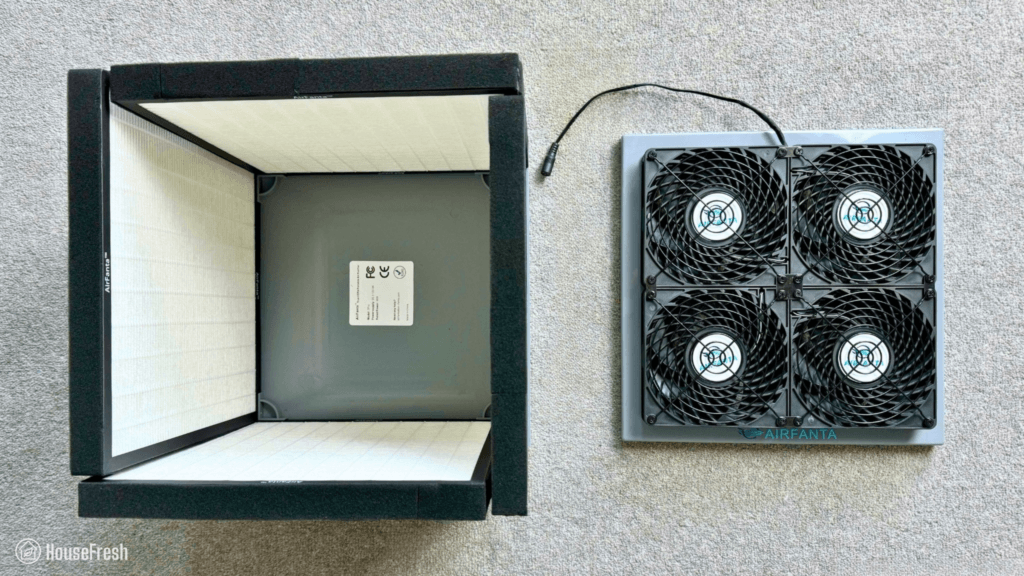
Portable Air Purifiers Comparison

1. Best option for large vehicles: IQAir Atem

If budget is not a concern, I would recommend the IQAir Atem regardless of the size of your car because it is the best-performing unit we’ve tested that doesn’t use an ionizer function.

IQAir Atem Car 2

Let’s get the downside of this unit out of the way – it costs $399.99. Yes, this falls in the same price range as many whole-house air purifiers, so it isn’t a budget option. But it is made by Swiss-based IQAir, one of the world’s most well-respected air purifier manufacturers and the Atem takes the mantle as the most powerful unit on this list, with a CADR score of 39 CFM and cleaned our Tesla Model 3 in the fastest time of all the air purifier on the list at 37 minutes.

What we really like

The largest Activated Charcoal and HEPA filters, with no ozone production at all
It can be attached to the back of the driver’s seat to target the breathing zone directly
Manufactured in Germany — I expect this unit to last for many years
A powerful unit considering its portability — it cleaned our Tesla Model 3 in just 37 minutes

What we think could be better

No rechargeable battery pack — so it can’t be used outside the car
Power switches off to save car battery after 30 minutes — I wish there was an option to disable this

I was a big fan of the IQAir’s flagship purifier, the Healthpro Plus, (which is the primary unit I use at home in our large open hallway). This is because their HyperHEPA filters offer the most comprehensive protection on the market and is the same technology that IQAir uses in the Atem Car 

When you open up the IQAir Atem,  you can feel the quality of the HEPA filter, which is also impregnated with activated carbon, so it can also deal with gasses and odors, which is super important for pollution from traffic. 

If you have the funds, I would choose this car air purifier for my car. If $400 exceeds your budget, check out the rest of the units on this list.

HouseFresh rating:★★★★☆
Time to clean our Tesla Model 3 (with the device running at top speed):37 minutes  
Time to clean our 728 cubic feet test room (with the device running at top speed):1 hour and 55 minutes
Air purifier technology:HyperHEPA Plus Filter
Recommended room size (4.8 air changes per hour):150 sq. ft. for car mode
Clean air delivery rate (CADR):Dust: 39 CFM
Dimensions (in inches / in cm):17.7H x 9W x 17.7D inches (29H cm x 29W x 10D cm)
Weight (in pounds / in kg):5.2 lbs (2.4 kg)
Filter life:1 year
Noise level in decibels (measured from 3 ft. away with a sound level meter):Speed 1: 35.5 dB
Speed 2: 40.5 dB
Speed 3: 58.2 dB
Electricity consumption in watts (recorded with an electricity usage monitor):Standby mode: 0.4 watts
Speed 1: 1.7 watts
Speed 2: 3.8 watts
Speed 3: 10.81 watts
Estimated running cost (electricity consumption + official filter replacement):$106.46 per year
Cost per CADR cfm (based on dust CFM as reported by AHAM):$10.23
Manufacturer’s warranty:2 years
Country of manufacture:Switzerland and Germany

Read our full review

2. Best option for small vehicles: Westinghouse 1804

The 1804 boasts a powerful air cleaning power thanks to its combination of HEPA filtration and an NCCO reactor, which utilizes a form of ionization to supercharge its performance.

Westinghouse 1804 Car Panel

The Westinghouse 1804 combines a HEPA H13 filter with their version of an ionizer called an NCCO reactor. In the old days, these ionizers generated a lot of ozone and could lead to further air quality issues. As used by Blueair and other leading manufacturers, this new type removes any ozone before it leaves the unit, and it is certified by CARB. I would still avoid any sort of ionizer if you suffer any issues with asthma, but the Westinghouse 1804 has passed both CARB, cETL and UL867 ozone standard testing. 

The benefit of the HEPA combined with the NCCO means that the Westinghouse 1804 can also deal with VOCs and gasses from traffic pollution, making it a great air purifier for the car. In our tests, it was only 10 minutes slower than the IQAir Atem, removing all pollutants from our Tesla Model 3 in 47 minutes.

What we really like

Portable with up to eight hours of use
Powerful cleaning power with the NCCO and HEPA used in combination
The design comes in a variety of colors
It is easy to move around with the handle

What we think could be better

The NCCO reactor may put off some users who prefer to avoid any sort of ionizer functionality
The charging port is awkward to access 

Although this isn’t the smallest option on our list, this extra size allows more powerful fans to circulate your car’s air more effectively. It is also one of the more stylish portable air purifiers on the market, coming in a range of colors and with a nice finish to the exterior.

The Westinghouse 1804 comes with a 3,000 mAh lithium-ion battery, providing up to eight hours of use on a single charge, which is good enough for even the longest of drives. Filter replacement costs also offer bang for your buck, with a set of 4 HEPA filters costing $31.99, making each filter cost just $8. 

HouseFresh rating:★★★☆☆
Time to clean our Tesla Model 3 (with the device running at top speed):47 minutes  
Time to clean our 728 cubic feet test room (with the device running at top speed):4 hours and 40 minutes
Air purifier technology:True HEPA and NCCO
Recommended room size (4.8 air changes per hour):23 sq. ft.
Clean air delivery rate (CADR):Estimated: 15 CFM
Dimensions (in inches / in cm):6.3L x 6.3W x 3.5H inches ( ‎28.39 x 21.41 x 18.28 cm)
Weight (in pounds / in kg):2.12 lbs (0.96 kg)
Filter life:3-4 months
Noise level in decibels (measured from 3 ft. away with a sound level meter):Speed 1: 36.7 dB
Speed 2: 39.8 dB
Estimated running cost (electricity consumption + official filter replacement):$27.81 per year
Cost per CADR cfm (based on dust CFM as reported by AHAM):$0.37
Manufacturer’s warranty:3 years
Country of manufacture:China

Read our full review

3. Best budget option: Smart Air QT3

With a CADR score of 21 CFM, this air purifier from Smart Air provides high-end performance at a budget price.

Smart Air QT3 Car

The travel version has a battery that lasts up to four hours, perfect for road trips or commuting. It also comes with a USB-C cable, so you can use an existing portable charger to keep it running longer when on the go.

The QT3 is an excellently designed purifier, being both highly portable and easy on the eye. Running costs won’t rack up too much either, with economical airflow keeping energy use down and filter replacements primarying $12.50 per unit when you buy in packs of two. If you have read any of my other reviews of Smart Air purifiers like the Blast Mini or the Smart Health S, you will know I’m a big fan of their devices and what they bring to the industry.

What we really like

Pure HEPA cleaning for less than $50
No ozone production at all 
Great design for use on the move
Battery lasts for up to four hours, plus the USB-C cable can be used to power it on the go

What we think could be better

No way to deal with VOCs and odors as only uses HEPA
Needs more places to purchase, currently missing from Amazon.com

The only major downside is that the Smart Air QT3 only uses HEPA filtration so it won’t protect against odors or VOCs. However, the benefit of this is that you don’t have to worry about any ozone production with just a tried and tested mechanical filter at work. 
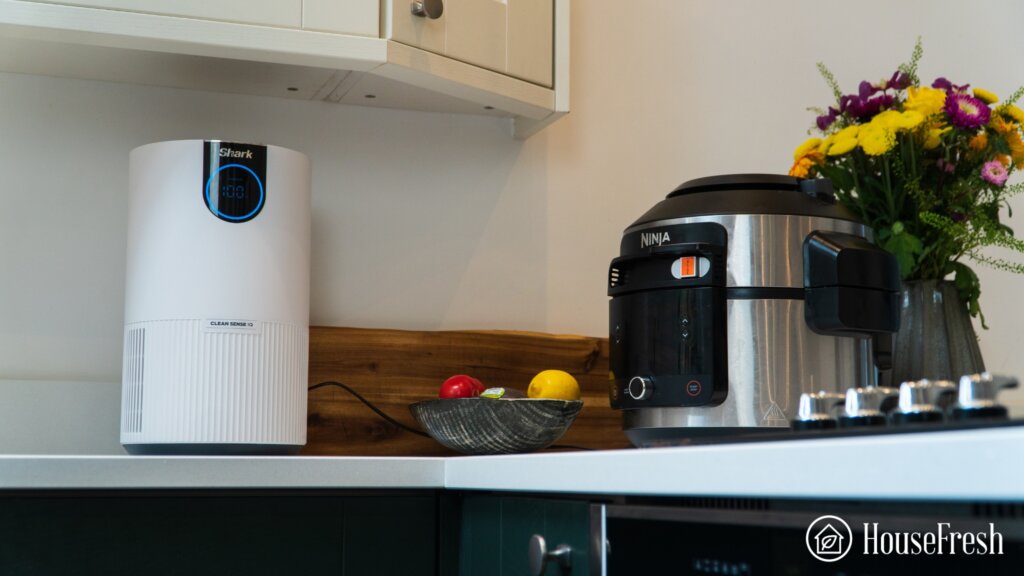
Considering the cost, I was impressed that it could clean our Tesla Model 3 of all particulate pollutants in 43 minutes.

HouseFresh rating:★★★★☆
Time to clean our Tesla Model 3 (with the device running at top speed):47 minutes
Time to clean our 728 cubic feet test room (with the device running at top speed):4 hours and 27 minutes
Air purifier technology:HEPA filter made with polypropylene (PP) and polyester (PET) with an 800-hour lifespan 
Recommended room size (4.8 air changes per hour):12.9 sq. ft.
Clean air delivery rate (CADR):Dust: 21 CFM
Smoke: 21 CFM
Dimensions (in inches / in cm):5.9L x 5.7W x 7.1H inches (15cm L x 14.5cm W x 18cm H)
Weight (in pounds / in kg):1.375 lbs (0.624 kg)
Filter life:6 months
Noise level in decibels (measured from 3 ft. away with a sound level meter):Speed 1: 36.3 dB
Estimated running cost (electricity consumption + official filter replacement):$39.72 per year
Cost per CADR cfm (based on dust CFM as reported by AHAM):$0.41
Manufacturer’s warranty:1 year
Country of manufacture:China

Read our full review

4. Pure Enrichment PureZone Mini Air

Pure Enrichment PreZone Mini Air provides HEPA and Activated Carbon filtration for less than $50. A CADR score of 10 CFM will not break any records for air cleaning, but it will provide protection for those in smaller cars.

Pure Enrichment PureZone Mini Car

Thanks to its lightweight and compact design, this unit is undoubtedly an excellent option for air purification on the go. The battery on this air purifier lasts up to 12 hours, depending on the speed you use, so there is plenty of juice for longer commutes. The USB cable also makes charging the battery more convenient, but it’s worth noting this option isn’t compatible with USB-C charging. 

What we really like

Battery allows you to use this air purifier anywhere
No ionization technology — just pure HEPA and Activated Carbon, so zero ozone
Easy handle at the top will enable you to move it around quickly
Filter replacements are cheap, with genuine filters costing just $9.99 

What we think could be better

Underpowered for any space larger than a small-sized car — definitely not suitable for an SUV or RV
Not as quiet as the manufacturer suggests, as you will need to run this unit at higher (and louder) speeds to see results

The PureZone Mini provides clean air in smaller cars. Still, I recommend getting a bigger unit if you want added versatility for public transport, hotel rooms, or home use. 

HouseFresh rating:★★☆☆☆
Time to clean our Tesla Model 3 (with the device running at top speed):3 hours and 41 minutes
Time to clean our 728 cubic feet test room (with the device running at top speed):6 hours and 49 minutes
Air purifier technology:Pre-filter, HEPA filter and Activated Carbon filter 
Recommended room size (4.8 air changes per hour):54 sq. ft.
Clean air delivery rate (CADR):Estimated: 10 CFM
Dimensions (in inches / in cm):8.5H x 2.7D x 3.3W inches / 21.5H x 6.8D x 8.8W cm
Weight (in pounds / in kg):0.27 kg / 0.58 lbs
Filter life:6 months
Noise level in decibels (measured from 3 ft. away with a sound level meter):Speed 1: 35.7 dB
Speed 2: 37.5 dB
Speed 3: 43 dB
Electricity consumption in watts (recorded with an electricity usage monitor):Standby mode: 0 watts
Speed 1: 12.1 watts
Speed 2: 7.5 watts
Estimated running cost (electricity consumption + official filter replacement):$29.44 per year
Cost per CADR cfm (based on dust CFM as reported by AHAM):$0.20
Manufacturer’s warranty:5 years
Country of manufacture:China

Read our full review

What to look for when buying an air purifier for your car

You can’t just use any type of air purifier in a car; it needs to be able to run off its own battery, a CAR 12v DC cable or even USB-powered if you have this feature in your vehicle. 

In most cases, the larger the HEPA filter, the better the performance, and we saw that in our Tesla Model 3 test with the largest unit from IQAir, the Atem was quicked at removing all the PM1 particles from the cabin air. 

What to look for in your air purifier:

1. True HEPA filtration

Does the air purifier you are considering use a True HEPA filter? True HEPA technology is highly effective at removing particles as small as 0.3 microns from the air – much smaller than the average mold spore, around 10 microns.

Variations of HEPA Filtration

2. Say no to ionizers

Avoid the ionizer units that directly plug into your cigarette socket like these:

Car Air Ionizer Recommended By Forbes

They are usually cheap, but they can cost you your health in the long run.

I am shocked to see major publishers and magazines (ahem, Forbes) recommend them, as these plug-in units are actually air ionizers. Ionizer technology is dangerous. Air ionizers emit ozone, harmful VOCs and fine particulate matter as a by-product:

how does an air ionizer work logo

You might be wondering about the Westinghouse 1804. Even though it does use a combination of a HEPA H13 filter and what they call, an NCCO reactor, this type of ionizing technology doesn’t generate ozone at the level plug-in air ionizers will. In the case of 1804, the air purifier itself removes traces of ozone from the air before it gets the chance to leave the unit, and that is why the Westinghouse 1804 achieved a CARB certification.

3. Activated carbon filtration

You will want an activated carbon filter as part of an air purifier for your car, as it is the only type of filtration that can successfully deal with odors. HEPA filtration won’t be enough as smells will pass right through a HEPA filter without being dealt with because they are gases and not particles. 

4. Suitable car cabin size

We tested all the air purifiers we recommended in this list in our Tesla Model 3, which measures around 97 cubic feet. If you have a much larger car and choose too small a unit like the Pure Enrichment PureZone Mini Air, you will find that it takes a very long time to remove pollutants from the air. That is why I recommend the biggest purifier on the list for large vehicles and RVs: the IQAir Atem Car.

5. Power source requirements

12-volt DC plugs are mandatory in all cars in the United States, so you should be able to use them in your vehicle. You need to check what your car will be able to handle better. If you end up buying a unit that plugs into your car via USB but you don’t have a USB port, then you may need an adaptor or a solid battery pack.

We found that having a battery pack to go with your portable air purifier allows for more extended usage once the onboard battery is emptied. Yes, the battery adds extra weight but it also means you can take your portable air purifier with you when commuting or to crowded spaces like an office. 

Here is a quick view of the power source of the four car air purifiers I recommend:

Power SourceTime to clean our tesla of PM1 pollutants*
IQAir Atem CarDC37 minutes
Smart Air QT3Battery-powered and USB 43 minutes
Westinghouse 1804Battery-owered and household plug47 minutes
Pure Enrichment PureZone Mini AirBattery-powered and USB 221 minutes

Common questions about air purifiers for your car

Some of the early air purifiers that plugged into the car’s cigarette lighter gave the industry a bad name as they generated ozone to clean the air, which can lead to health problems. Nowadays, most car air purifiers are as safe as those used in the home, but you will still want to avoid those cheap ozone-emitting ionizers as they are unlikely to do anything good for the air quality in your cabin.

It depends on the specific model, but smaller portable units can be placed in the cup holder, and larger units will need to be attached to the seat, like the IQAir Atem. Whatever you decide to do, ensure that the air vents are not blocked so that the fan in the air purifier can run continuously.

To remove smells, you must choose an air purifier with air filtration technology that can remove gasses like activated carbon or NCCO. A HEPA filter alone will only remove particles and won’t be able to remove odors, gasses or VOCs from the air.

Most cars are similar to rooms in our home but much smaller, so you can use a smaller unit you would need in your bedroom. Our performance tests show that air purifiers using HEPA filters can greatly remove tiny particles.

Cars are small, enclosed spaces that allow air from outside inside the cabin. This results in toxins, fumes and other pollutant particles beginning to fill the space, affecting all passengers and drivers inside. 

So much so, medical scientists advising the UK government have warned that air pollution is worse for children and the vulnerable inside a car than if they were to walk along the street. 

If you’re still not convinced or unsure whether your car is already filtering pollutants (as some newer Teslas do), you can always test your car’s air quality to determine if you need an air purifier. However, an accurate air quality monitor can cost as much as a small portable air purifier. 

Another good reason for getting an air purifier is to handle tobacco, vaping, or cannabis smoke. This helps if you’re a smoker or you ride with smokers and non-smokers alike. Even getting rid of the odor of fast food can make air purifiers worth it in the long run but do look for a unit that can deal with odors using an Activated Carbon filter or another sort of gas filter technology.

While most of us know that cars contribute to air pollution, few fully understand the dangers of these emissions to our health.

With little to no protection installed by car manufacturers, drivers and passengers are exposed to a range of toxic pollutants each time they go for a drive. These pollutants can vary greatly. 

The emissions created when burning fuel include particulate matter, carbon monoxide and nitrogen dioxide

These are fine enough to enter the lungs and play a role in severe respiratory issues and heart conditions

To that ‘new car smell,’ which despite being deemed as desirable, comprises a VOC concoction, including formaldehyde, benzene, toluene, xylene and acetaldehyde, all at levels dangerous to our health

A recent study published in the Cell Reports Physical Science found that exposure to this range of pollutants can increase our cancer risk.

Your car might already have a carbon filter, so upgrading this filter is one simple way to improve air quality. You can search your car model + cabin air filter and find lots of options. Bosch and other large companies make good quality versions that cost a little more but worth it. Be aware if air quality is very bad in your location, this cabin filter will need replacing. The amount of carbon in some of these filters is low, so they are unlikely to be able to do a lot for strong odors/gasses.

For more information, check out advice from the American Lung Association.

When driving, switch to recirculation when near polluting sources and then back to normal to pull in new, clean air.

Remove any car fragrances. They will release VOCs into the cabin, which we want to avoid.

Wrapping up

The average American drives just under an hour daily, so it makes sense that we want to keep the air inside our cars clean of any pollutants. 

With many outdoor pollutants capable of entering the car’s cabin, from poisonous carbon monoxide to irreparable pollen allergens, it’s wise to invest in an air purifier to keep you and your passengers breathing easily. 

To reap the best results, remember to ensure the purifier you choose comes equipped with HEPA and Activated Carbon filters while also being able to cover the space inside your vehicle. 

At HouseFresh, we have been reviewing air quality products since 2010. In all these years, we learned not to rely on manufacturers’ claims and the ever-so-glowing marketing materials. That is why we buy products with our own money, so we can write unbiased reviews after we’ve had enough time to evaluate air quality products in our home lab. Every unit we recommend has been thoroughly tested to assess its performance, energy consumption, and noise levels emitted in real-life environments. If you have any questions about our testing process for different types of air quality products, just drop us an email at danny@housefresh.com.