Allergies are your body’s immune system reacting to a foreign substance, such as pet dander, pollen or shellfish, with clinical symptoms, such as coughing or swelling.
Over a quarter of U.S. children (27.2%) and nearly one-third of adults (31.8%) report having some kind of allergy, according to the National Center for Health Statistics. This equates to over 100 million people.
Seasonal allergies affect around five times more people than food allergies, yet they can be much harder to avoid. Both the seasons and the local climate affect the severity of indoor and outdoor allergies, such as animal dander and pollen. This leads to reactions that range from the irritating to the life-threatening: itchiness, sneezing or even asthma attacks.
There is no cure for allergies, but you can manage, prevent, or treat them. Since indoor and outdoor allergies respond to environmental conditions, one form of prevention is simply to be in the right place at the right time.
With that in mind, we have analyzed allergen data and statistics on local environmental conditions to identify the U.S. cities and states where indoor and outdoor allergies are most and least severe.
We analyzed data on indoor and outdoor allergens across the United States to determine where they are most prevalent, calculating a relative severity rating of 0 (low) to 10 (severe) and finding the average score across allergen types in each location.
For outdoor allergens, we used data from the pollen.com website to calculate the average annual severity of tree, grass, and ragweed pollen for over 970 cities across the U.S. and calculated the average values by state by aggregating cities.
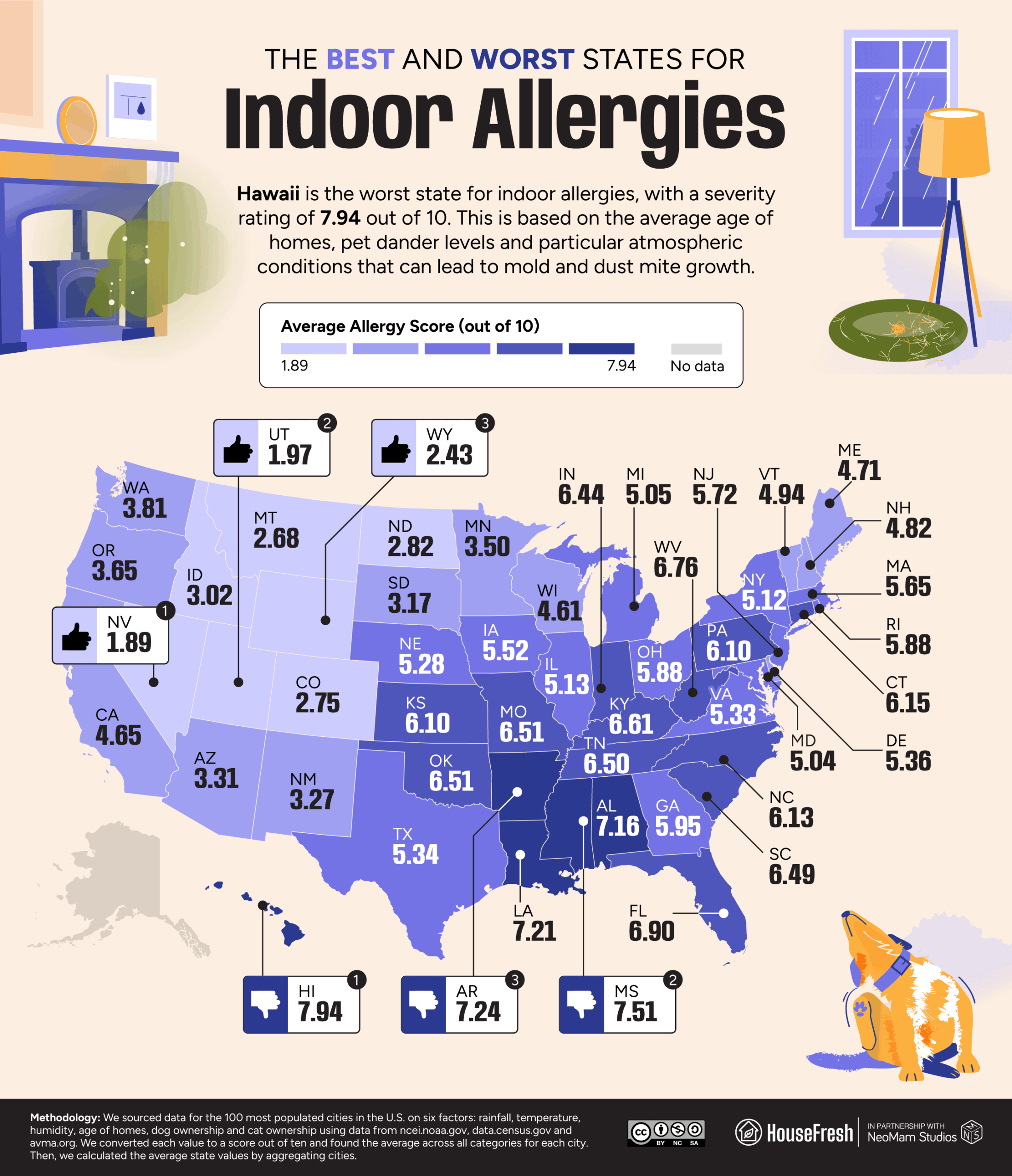
Hawaii is the worst state for indoor allergies, with an average severity rating of 7.94 out of 10 across five indoor allergy variables.
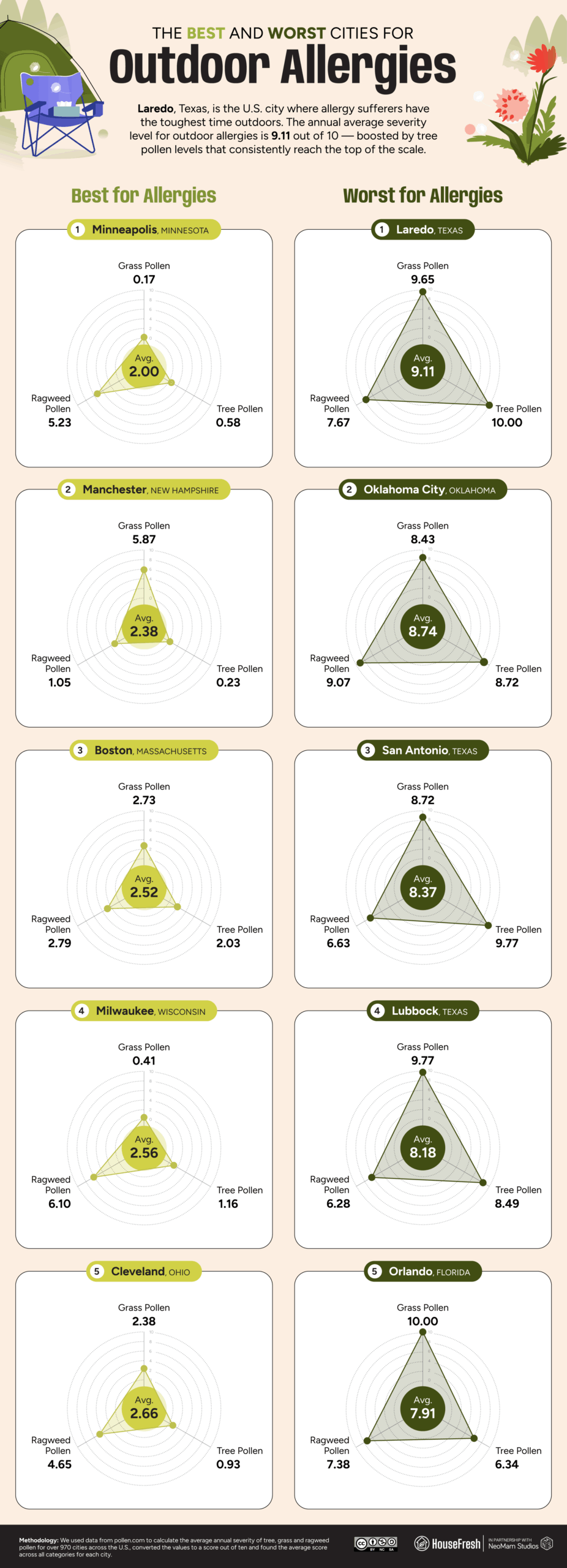
Laredo, Texas, is the worst city for outdoor allergies (9.11), whereas Jackson, Mississippi, is the worst city for indoor allergies (8.33).
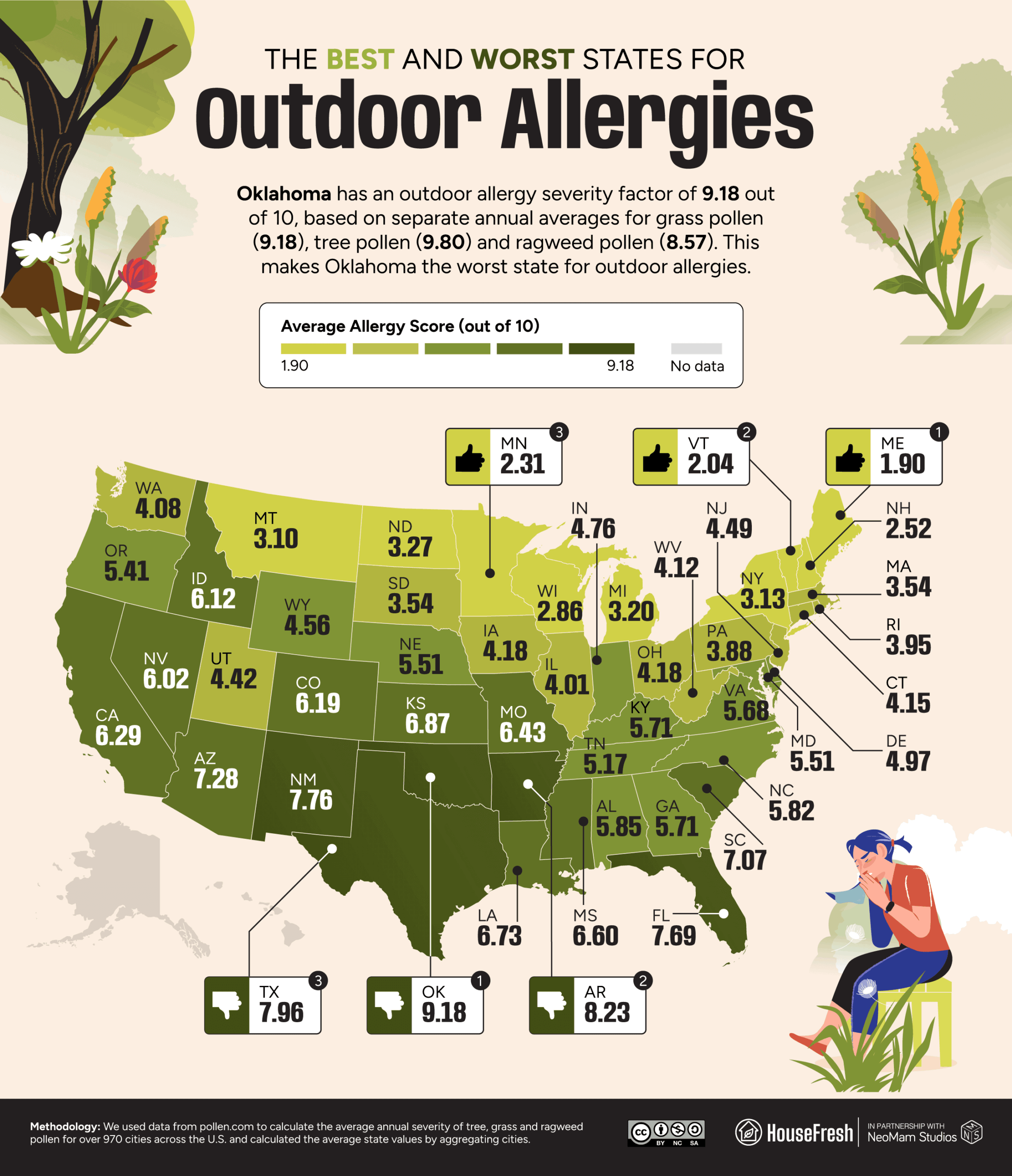
Oklahoma is the worst state for outdoor allergies, with a severity rating of 9.18 out of 10.
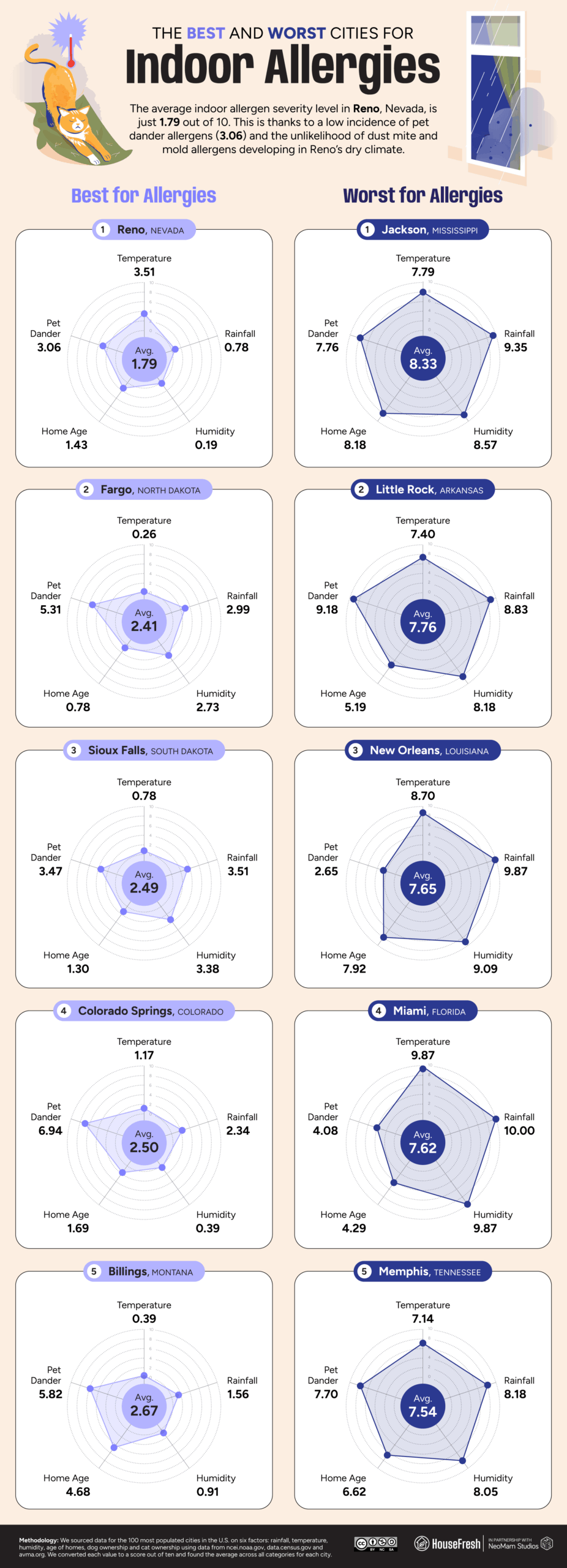
Reno, Nevada, is the best city for indoor allergies, with a severity rating of just 1.79 — significantly lower than any other major city.
Texas has severe outdoor allergy ratings (10/10) for both grass and tree pollen.
Climate change is leading to greater amounts of pollen in the atmosphere.
Southern states and cities suffer from the most severe outdoor allergies
Oklahoma is the worst overall, but Texas is the worst for grass and tree pollen.
First, we identified the states and cities with the highest and lowest outdoor allergy risks. We found the highest concentrations are in southern and particularly south-central states.
Oklahoma has the worst average severity (9.18) based on grass pollen levels of 9.18, tree pollen at 9.80 and ragweed pollen at 8.57. However, people are allergic to different types of pollen, and it’s worth noting that Texas has worse levels of grass and tree pollen (both with a severity rating of 10, i.e., the worst in the U.S.). Only its low ragweed pollen count (3.88) puts Texas’s overall severity rating lower than those of Oklahoma and Arkansas.
Map showing the best and worst U.S. states for outdoor allergies, highlighting regions with varying pollen levels and allergy severity.
Why the South? Rising levels of carbon dioxide lead plants to produce pollen while warming the climate. A warming climate leads to earlier, longer and more intense pollen seasons. So-called “seasonal” allergies now stretch to fill the whole calendar year in some locations — particularly in the Southern “pollen belt,” where it was warmer to start with and where strong winds circulate more pollen in the air and for longer.
“We know that climate change is leading to greater amounts of pollen in the atmosphere. It’s changing the seasonality of the pollen. It’s changing the types of pollen that we’re exposed to.”
– Paul Beggs Environmental health scientist, Macquarie University in Sydney
The worst cities for outdoor allergies follow this same pattern, with three Texas cities (Laredo, San Antonio and Lubbock) among the top five.
Ranking of U.S. cities by outdoor allergy levels, based on an allergy severity score made up of grass, tree and ragweed pollen levels in each area.
Ragweed tends to prosper on land that’s been developed by humans, which may be one reason that ragweed pollen levels are around twice the average Texas level in these cities. One study found that ragweed pollen could be seven times higher in a city that’s 3.6 degrees warmer and has 30% more carbon dioxide than nearby rural areas — a common occurrence due to the urban heat island effect.
Tip
To find out what type(s) of pollen you are allergic to, you can take a doctor’s test or follow this quiz from Kleenex.
Hawaii and Mississippi have the worst indoor allergies
Jackson, Miss., is the worst city for pet dander and dust; Reno gets off lightly.
Indoor allergens include pet dander, dust and mold. Pet dander is the dead skin cells shed by furred or feathered pets, which are light enough to become airborne and cause irritation, so we factored local pet ownership rates into our severity rating. We also factored in average temperature, rainfall, humidity and the age of homes since these are variables that can intensify the presence and effects of dust mites and mold spores.
With their humid climates and higher-than-average pet ownership rates, Hawaii and Mississippi are the worst states for indoor allergies, with an average severity rating of 7.94 and 7.51 out of ten, respectively.
Map of the United States showing the best and worst states for indoor allergies, based on the average age of homes, pet dander levels and particular atmospheric conditions that can lead to mold and dust mite growth.
The Hawaiʻi State Department of Health notes that dust mites and mold can trigger severe asthma attacks, and 104,400 (9%) local adults and 30,000 (10%) children suffer from asthma in Hawaii. Among Native Hawaiians, asthma affects 15% of adults.
Alongside Mississippi, the hot southern states of Arkansas, Louisiana and Alabama are among the five worst places for indoor allergies. Temperatures may be high to the west in Arizona and California, but the southwest is experiencing a 25-year megadrought, with the soil now drier than at any time over the past 1,200 years. Although a side effect of this ongoing disaster may be to reduce the chance of specific indoor allergens, the drought blights the air through the increased incidence and severity of wildfires.
Ranking of U.S. cities by indoor allergy levels, based on an indoor allergen severity score that accounts for pet dander, dust, mold and other indoor allergy triggers.
The city with the worst indoor allergies is Jackson, Mississippi, with an average severity of 8.33 out of ten based on high scores across all categories. While it may be hotter, rainier and more humid in New Orleans, the relatively low pet ownership rates here keep the average overall severity score at 7.65.
Reno, Nevada, is the best city for indoor allergies, with a severity rating of just 1.79 out of ten — significantly lower than any other major city. That might be a good reason to stay inside since Reno’s outdoor allergens are far more prevalent, and Reno has the fastest-expanding allergy season of any major city.
Find the allergy severity of any state or major city
But note that sometimes going somewhere new can be enough to trigger an allergy.
As the example of Reno — with a very low indoor allergy rating but outdoor severity of 5.33 — shows, no area is completely spared the effects of common allergens. But forewarned is forearmed, and you can check the full breakdown of each state and major city’s severity ratings overall and for each variable using our interactive chart.
Do note that moving to escape allergens may expose you to unfamiliar ones, and even if you stay in the same place, you may begin to suffer from new allergies.
“If you move to a new area, you may be impacted by new types of vegetation that grow in that environment. For some people who are experiencing new onset allergies, it is because changes in temperature and precipitation patterns allow plants and trees to grow in places they didn’t before.”
Dr. Neelu Tummala, a clinical assistant professor of otolaryngology at NYU Langone Health
As such, efforts to identify the allergens that affect you, reduce your exposure to them and prepare to remedy reactions as they occur may be the best way to minimize the irritation and even danger of indoor and outdoor allergies.
TIPS FOR MANAGING YOUR ALLERGIES
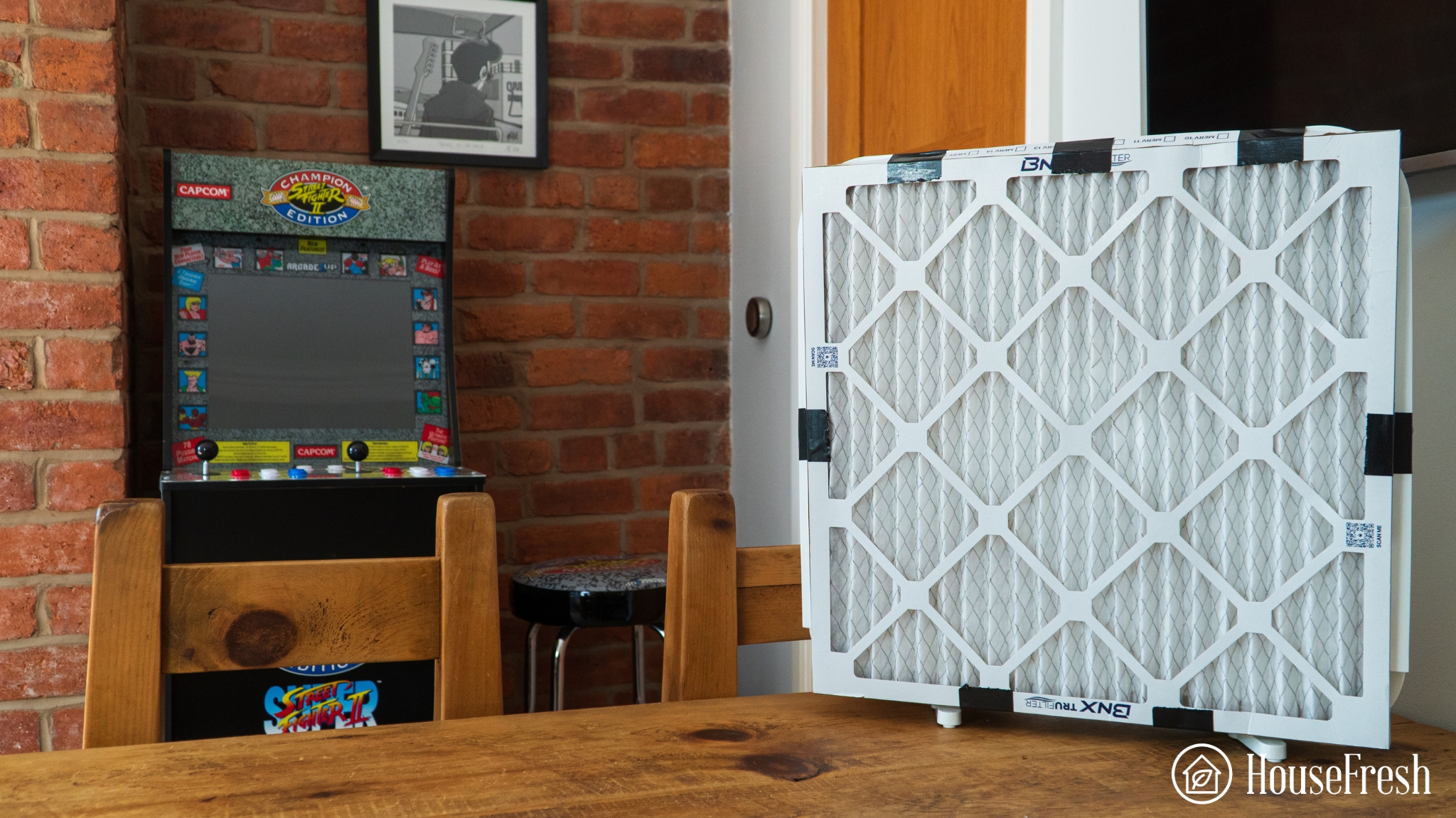
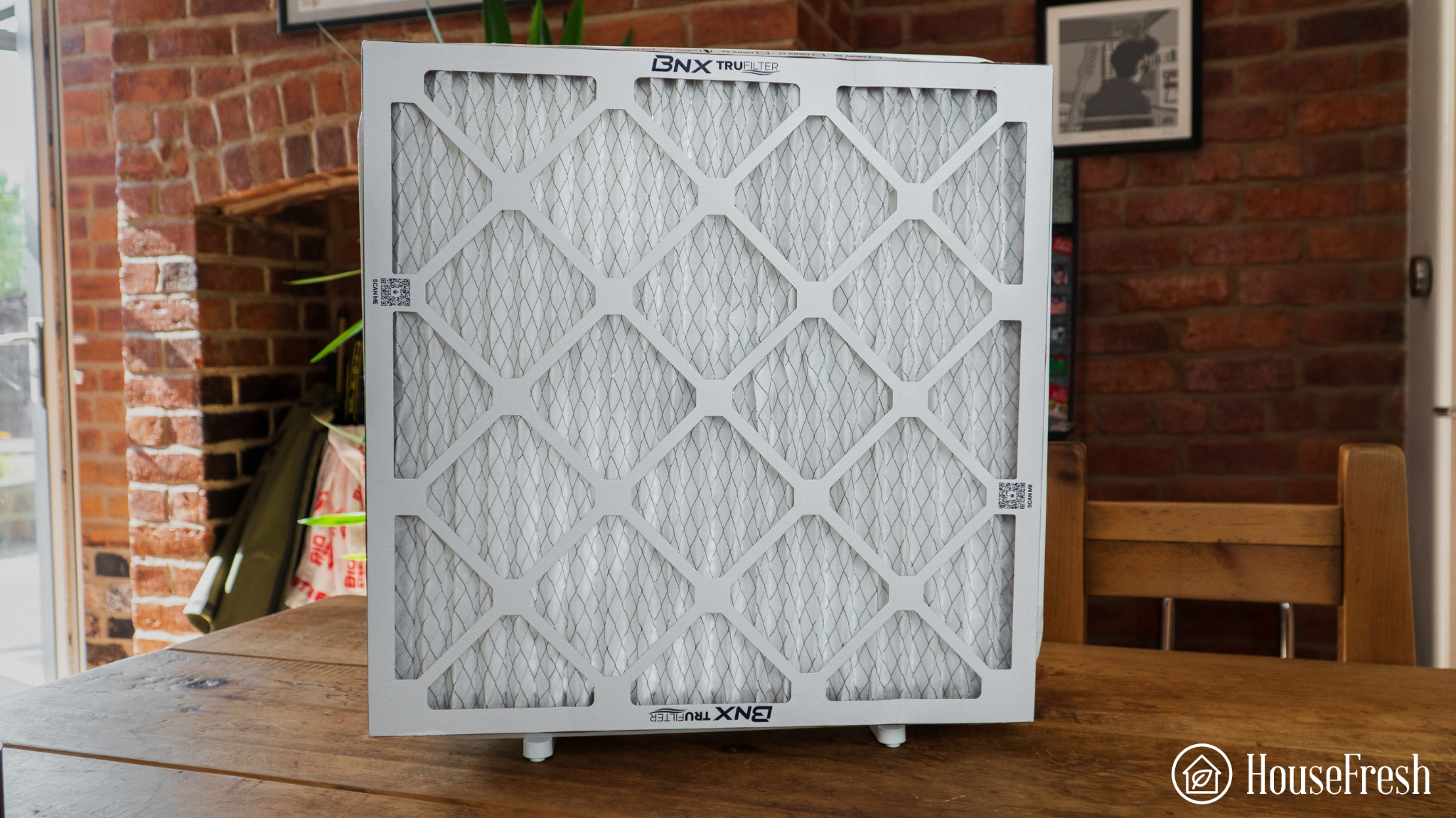
Consider getting an air purifier with a high-quality particle filter and good air cleaning performance at quiet fan speeds, so you can run it inside your home 24/7. Check out our top picks for tackling airborne allergens.
Close doors and windows when high pollen counts are forecasted, and don’t hang laundry outside to prevent bringing pollen back indoors.
Avoid going outside when someone is mowing the lawn or trimming hedges and trees.
Avoid using a dry cloth or feather duster — opt for a microfiber cloth or a damp rag instead, as it will help trap most dust without recirculating it into the air.
Hot wash your bedding once a week and once dry, give it 10 minutes on high heat in a tumble dryer to eliminate dust mites.
Regularly brush your pet to reduce the dander in their fur before it is released into the air.
Try to create pet-free zones around your home (even if just your bedroom!) so you can reduce your contact hours with dander.
To reduce your exposure to mold, keep your home dry by fixing leaks, venting your clothes dryer to the outside, and using insulation and storm windows.
Methodology
To identify the U.S. states and cities that are best and worst for people with allergies, we analyzed a series of metrics for outdoor and indoor allergens, respectively.
For the outdoor rankings, we sourced 2025 data for three allergens (tree, grass, ragweed) from the pollen.com website. We calculated the average annual severity of these allergens for over 970 cities across the U.S. and calculated the average values by state by aggregating cities.
For the indoor rankings, we considered six factors for all states and the top 100 most populated cities in the U.S.:
Dust mites and mold allergens thrive in warm, wet, humid climates. Hence, rainfall, temperature and humidity were considered as key factors that can promote mold and dust mite growth without intervention. Similarly, older homes are typically worse for mold owing to poor ventilation and insulation.
Dog and cat ownership rates were considered as indicators for the prevalence of another key indoor allergen: pet dander.
The final outdoor/indoor index scores were created by assigning values for each individual factor based on percentiles, assigning 10 to the highest value (worst score, relative to U.S. allergen levels). The further down the factor is located in the percentile distribution, the closer its assigned value is to 0 (best score). Then, to obtain an overall score, we calculated the average score across all factors for each ranking (i.e., the average score across all indoor allergen factors).
Towns and cities are hotspots for air pollution from transport emissions and tire wear, domestic and industrial fossil fuel combustion and other sources. Not only do urban areas generate more pollution, but their very shape makes it worse: the urban heat island effect catalyzes the release of additional chemical fumes, while rows of tall buildings restrict the outward flow of polluted air.
And urban air pollution isn’t just an issue for local inhabitants. Bad air travels. For instance, London emits over 6,000 tonnes of PM2.5 (fine particulate matter) and 51,000 tonnes of NO2 annually, which has a detrimental effect on much of the southeast of England. In Delhi, over half of the particulate matter in the air is from nearby states and countries; the same is true of many rural areas in India.
Over four billion people live in cities, and experts predict that this figure will double by 2050. Yet, many areas — particularly in the developing world — lack robust air monitoring systems. Meanwhile, even in areas where air quality data is available, governments are slow or resistant to improving conditions for their citizens.
Change is both necessary and possible. Cities, including New York and Beijing, have reduced local air pollution by over 50% by introducing cleaner public transit vehicles and congestion charging, modernizing heating systems, and regulating emissions, among other solutions.
To find where this work is needed most, we analyzed 2024 data on the average PM2.5 level in every large town and city in the world.
First, we sourced the annual average PM2.5 concentration for over 8,800 global locations from IQAir’s 2024 rankings. Then, we identified the towns and cities (above 10k population) with the best and worst air quality in every country and continent.
Key findings
Overall, most of the countries with the cleanest air are in Europe and those with the most polluted cities are in Asia.
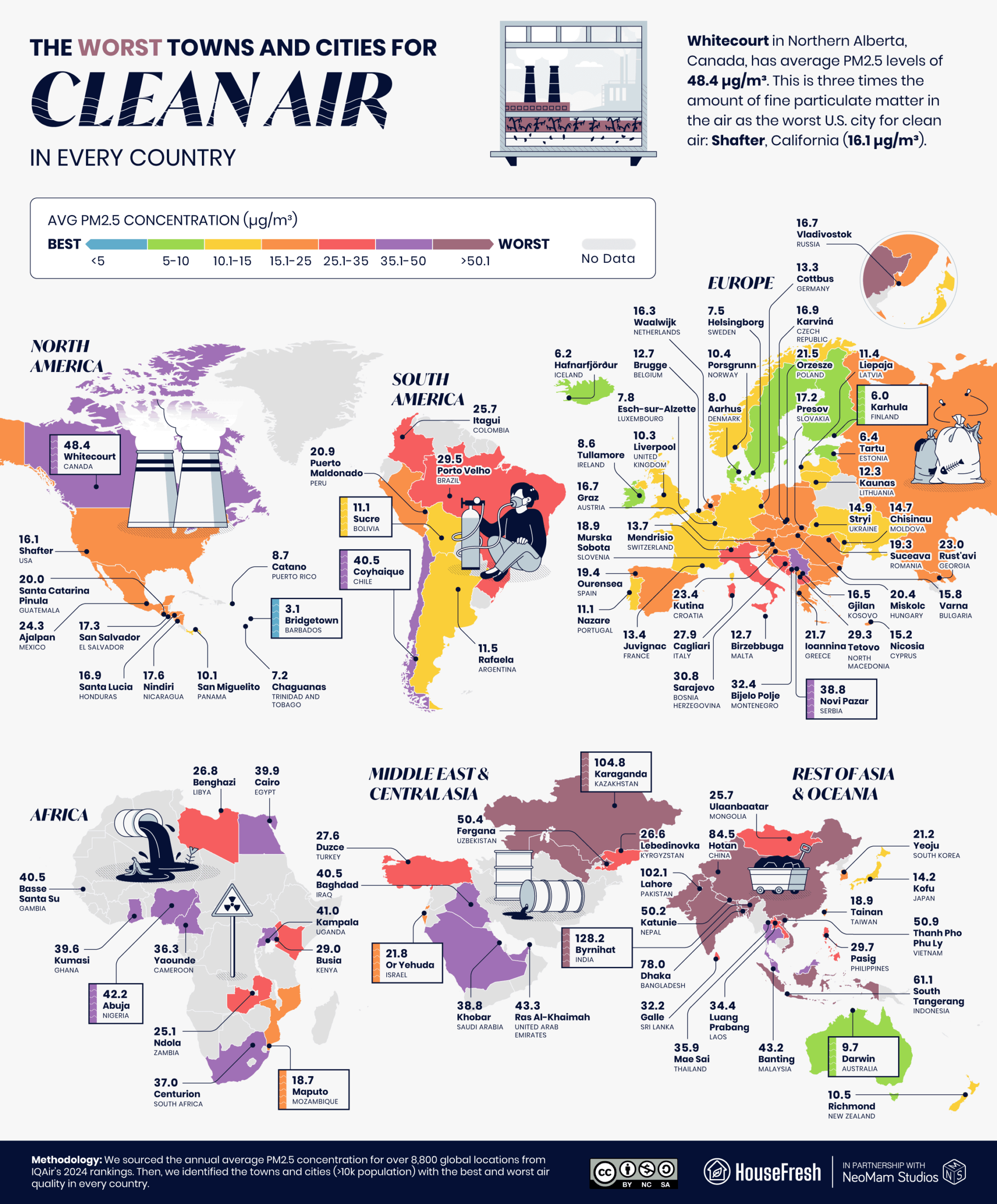
Byrnihat in India has the worst air in the world, with an average PM2.5 concentration of 128.2 µg/m³ throughout 2024.
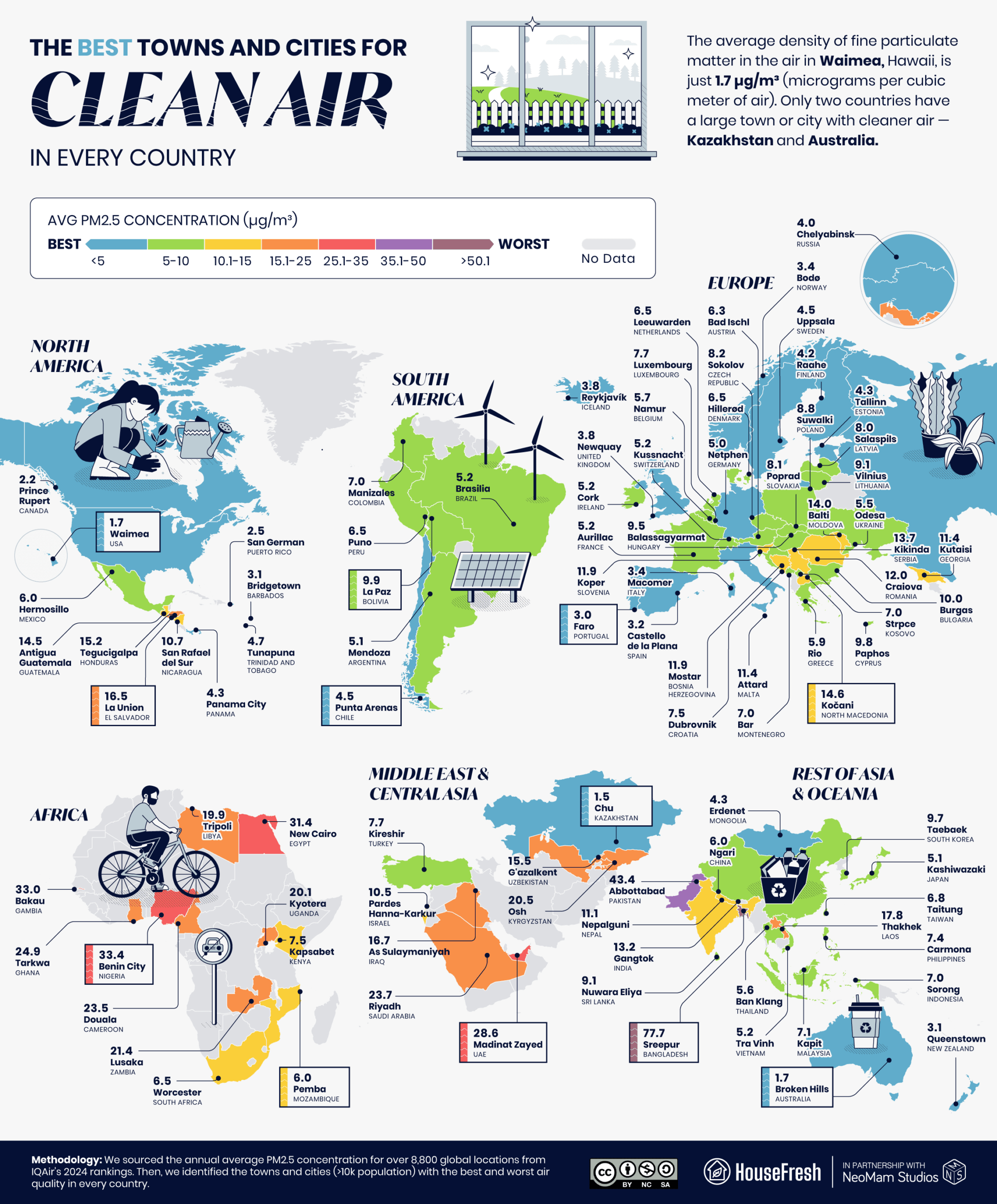
America’s clean air capital is Waimea in Hawaii, with an annual PM2.5 concentration of 1.7 µg/m³.
The worst place in America for clean air is Shafter, California, where 2024 data shows an average PM2.5 level of 16.1 µg/m³.
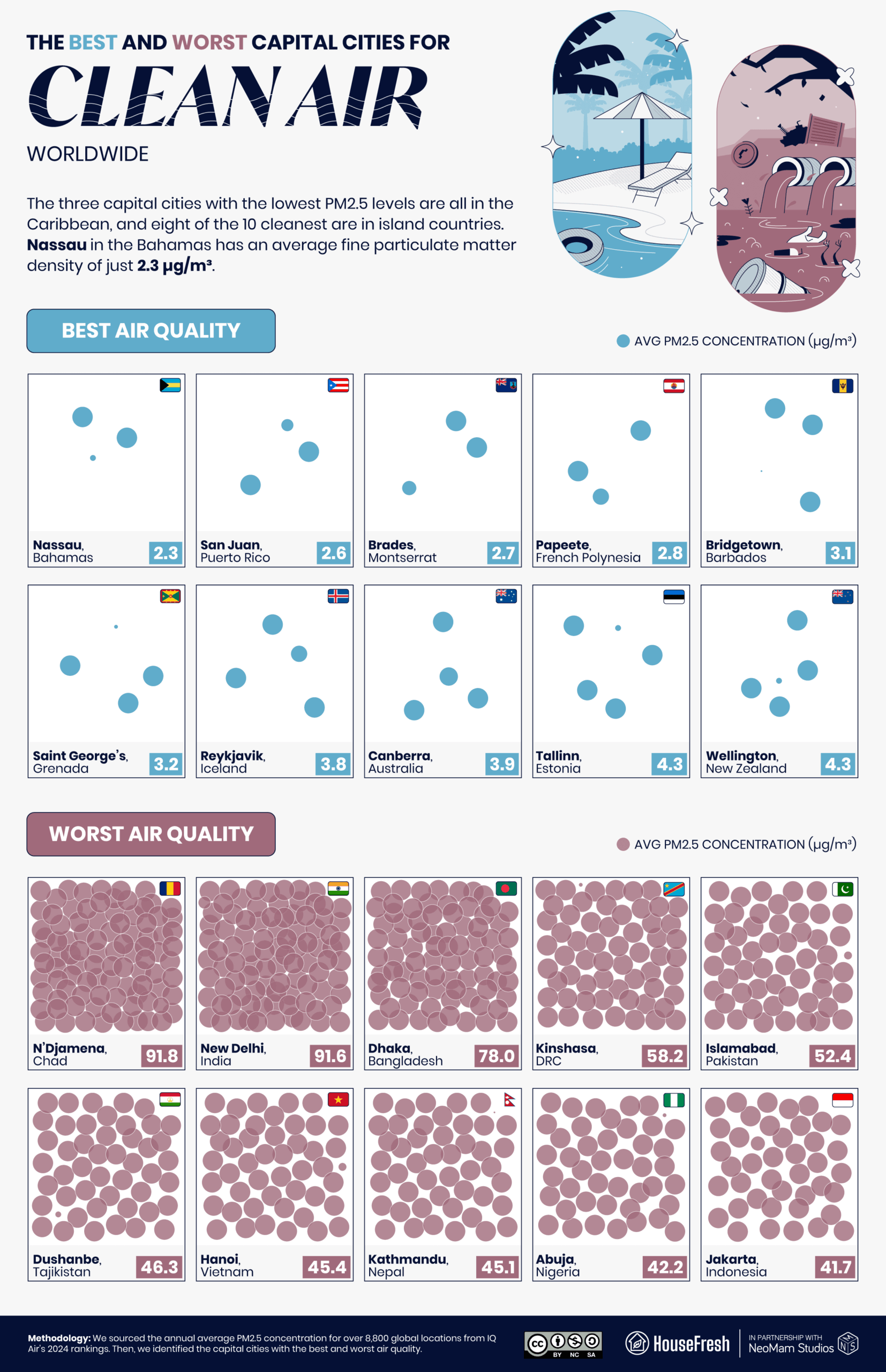
Nassau in the Bahamas is the capital city with the cleanest air in the world (2.3 µg/m³) and N’Djamena in Chad is the most polluted capital (91.8 µg/m³).
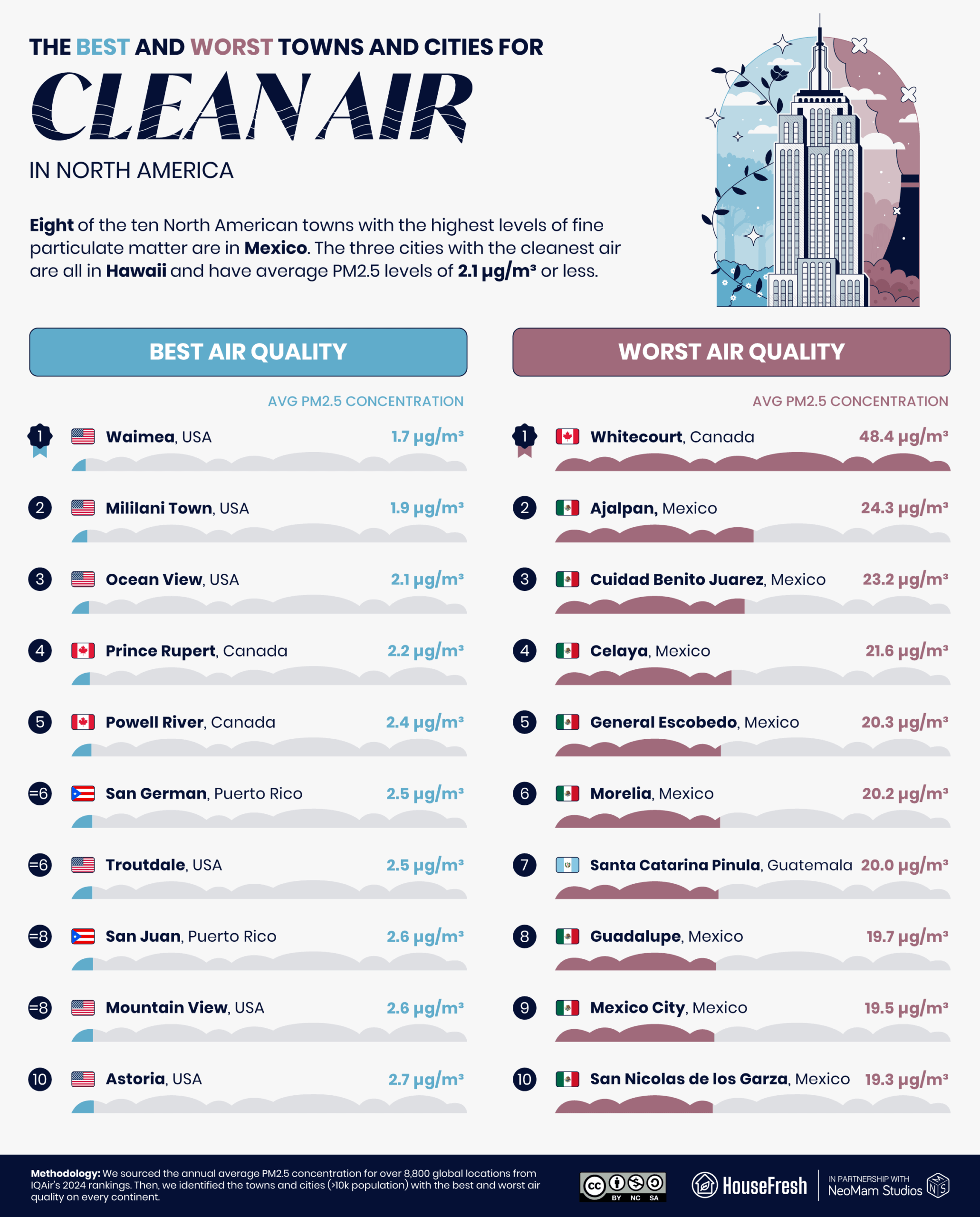
North America’s worst large towns and cities for clean air are almost all in Mexico, and Chile’s cities are among South America’s most polluted.
Europe’s most polluted towns and cities are all on the Balkan Peninsula, with Novi Pazar in Serbia taking the title as the European place with the most polluted air (38.8 µg/m³).
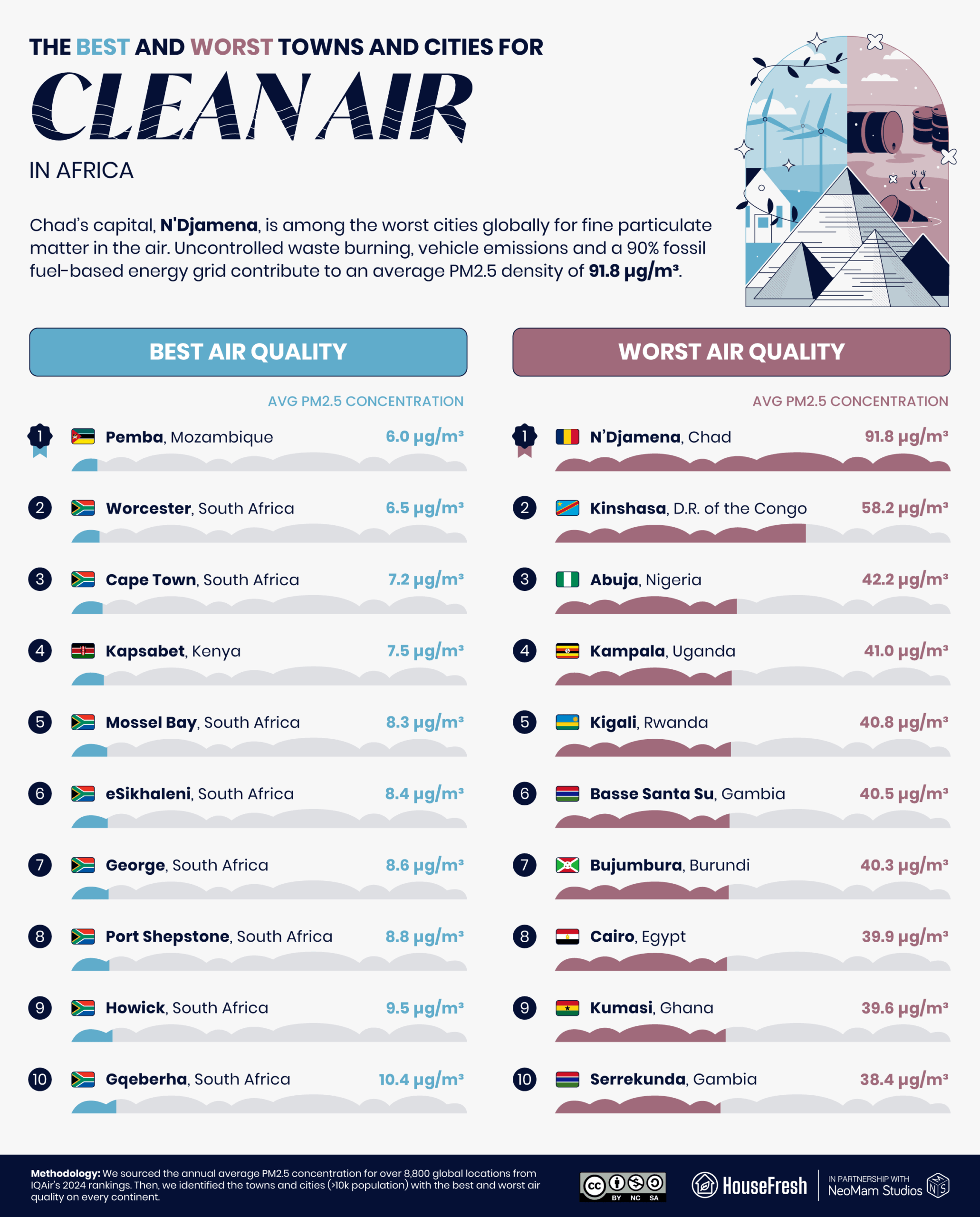
Pemba, Mozambique, is Africa’s best city for clean air, with average fine particulate matter levels of 6 µg/m³ in 2024. However, this concentration surpasses the maximum annual PM2.5 levels recommended by the WHO (5 µg/m³).
The place with the cleanest air in every country
Most of the countries with the cleanest cities are in Europe.
Half of the 20 cities with the cleanest air in the world are in Europe, of which Faro on Portugal’s south coast has the lowest average PM2.5 level (3 µg/m³). Five of these top 20 are in North America, with the U.S. number one — Waimea in Hawaii — the second cleanest ‘best city’ for clean air in the world (1.7 µg/m³). However, the town is vulnerable to the intrusion of vog (volcanic fog), which includes pollutants such as sulfur dioxide and hydrogen sulfide, as well as fine particulate matter.
World map showing the urban area (city or town) in each country with the lowest annual average PM2.5 concentration in 2024.
However, the best large town or city for clean air in our study is in Central Asia: Chu (also known as Shu) in Kazakhstan had an average air rating of 1.5 µg/m³ in 2024. Kazakhstan has pledged to become ‘climate neutral’ by 2060 but generally ranks among the world’s most polluted countries due to its massive and outdated industrial infrastructure. Dust storms can also be an issue in the south of the country.
The place with the most polluted air in every country
The majority of the countries with the most polluted cities are in Asia.
The nine countries with the most polluted places are all in Asia. IQAir’s 2024 World Air Quality report noted that South Asia’s air crisis is attributable to “industrial emissions, biomass burning, coal-fired power, and transportation.” Geographic conditions such as regional winds and the natural air barrier of the Himalayas compound the effect.
World map showing the place in every country with the most polluted air based on the average PM2.5 concentration in 2024.
Byrnihat in India has the worst air in the world, at 128.2 µg/m³ (micrograms per cubic meter of air). “The topographical features, such as hills on both sides, blocked river channels and low-pressure zones which trap pollutants have all contributed to pollution here,” Devesh Walia, Dean of School of Human and Environmental Sciences at India’s North-Eastern Hill University, told Mongabay India. “Cement factories, coke factories, and distilleries are all located in a small area and along with environmental violations, pollution here is bound to rise.”
The best and worst capital cities for clean air
Nassau is the capital city with the clearest air, but N’Djamena and New Delhi have near-three-figure PM2.5 counts.
Next, we narrowed our findings down to capital cities. The ten capitals that are worst for clean air are all in Asia or Africa. There is little difference between N’Djamena in Chad (91.8 µg/m³) and New Delhi, India (91.6 µg/m³).
Those in poorer parts of N’Djamena are particularly vulnerable as these neighborhoods tend to be closer to the industrial zones. Chad repeatedly ranks as the world’s most air-polluted country and now has a National Poverty Reduction Strategy in place to move to clean energy and tighter regulation of industrial polluters.
Ranking of the most and least polluted capital cities in 2025
The geographic spread of the cleanest capitals is a little more diverse, with capitals from South and North America, Oceania and Europe. Nassau, capital of Bahamas, has the cleanest air of all, at an average of 2.3 µg/m³. IQAir attributes Nassau’s clean air to strong winds and the low level of industrial activity.
Canadian cities among worst – and best – for air in North America
Cities in Hawaii and Oregon boast PM2.5 levels below 2.5 µg/m³.
North America’s worst large towns and cities for clean air are almost all in Mexico. But the number one, Whitecourt in Canada (48.4 µg/m³), has nearly double the fine particulate matter in the air of any regional urban center. Wildfires across the Alberta province make bad air days a regular occurrence. Multiple studies have found that particulate matter from wildfires may lead to more hospitalizations than other forms of PM2.5.
Ranking of the towns and cities in North America with the cleanest (and most polluted) air in 2025
Two Canadian cities make the continent’s clean list, though: Prince Rupert (2.2 µg/m³) and Powell River (2.4 µg/m³). The cleanest in North America is Waimea (1.7 µg/m³, see above), while its Hawaiian neighbors, Mililani Town (1.9 µg/m³) and Ocean View (2.1 µg/m³), are also among the best cities for clean air.
Beyond Hawaii, the best city for clean air in the U.S. is Troutdale, Oregon, where the 2024 average was 2.5 µg/m³. The Oregon Energy Facility Siting Council recently vetoed attempts to build a 415-megawatt fracked gas power plant in the eastern part of the state.
“This is a huge win for Oregonians and the climate. Perennial (fracked-gas plant) would have locked the state into at least thirty years of additional climate-destroying pollution.
The message is clear: our future is in clean energy, not dirty fossil fuels.”
Lauren Goldberg Executive director for Columbia Riverkeeper
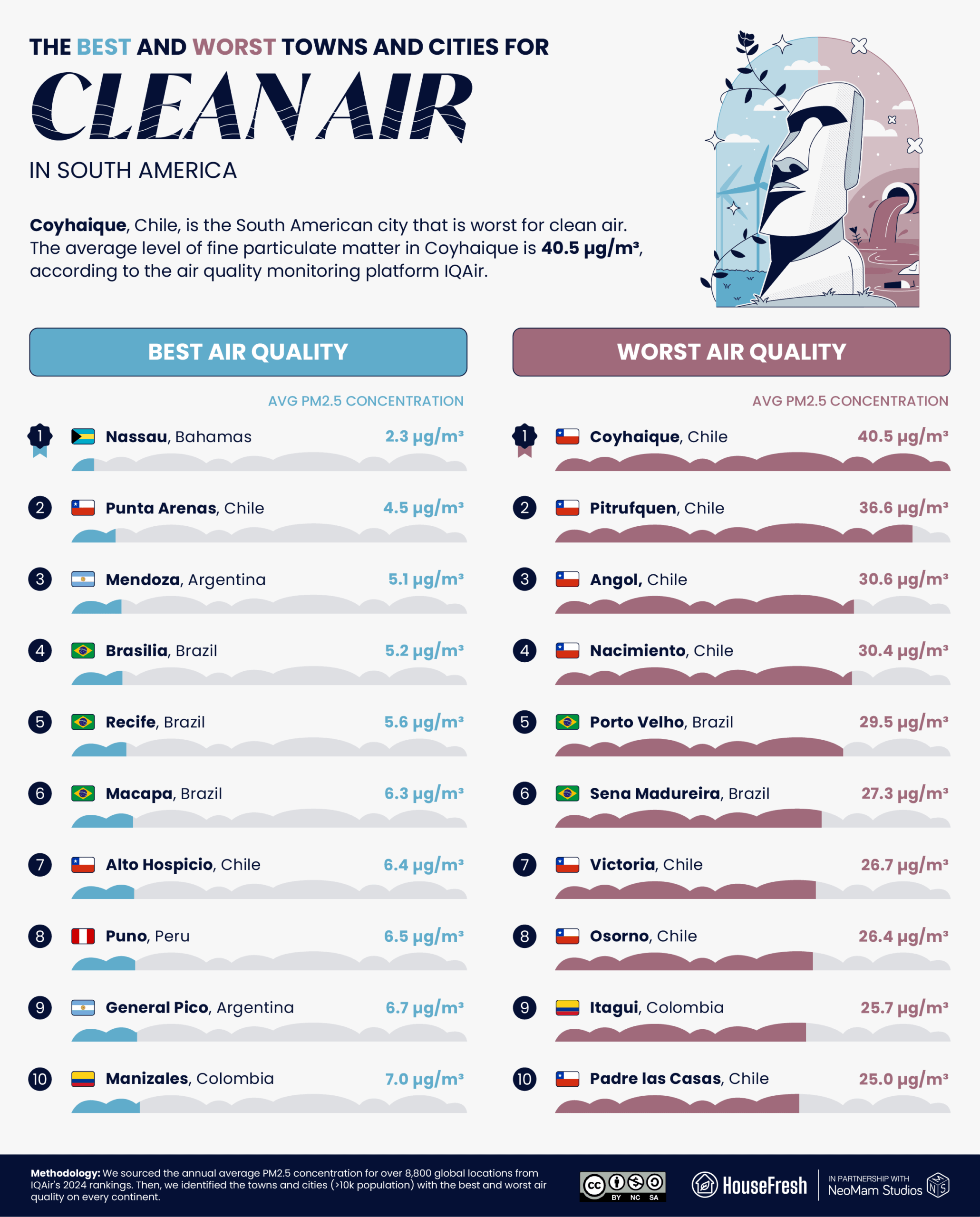
Chile’s cities are among South America’s most polluted
But gas subsidies have made a difference in one Patagonia town.
Chilean urban areas dominate among the South American towns and cities with the worst air. Coyhaique is the worst, with PM2.5 levels at 40.5 µg/m³. “Coyhaique is confined to an area that is incredibly unfavorable in terms of ventilation,” Nicolás Huneeus of the University of Chile’s geophysics department told the Guardian. “Add low temperatures and cheap firewood to the mix, and the problem isn’t one that we can solve without a sustained, coordinated effort.”
Ranking of the most and least polluted towns cities in South America in 2025
Around 60% of Chile’s population is exposed to annual average PM2.5 levels that exceed Chilean environmental regulations, and experts estimate that air pollution causes 4,000 premature deaths in Chile each year. However, there are two Chilean urban centers among the cleanest in the region: Punta Arenas (4.5 µg/m³) and Alto Hospicio 6.4 (µg/m³). Punta Arenas benefits from gas subsidies that have reduced local dependence on burning fossil fuels for heating and cooking.
Faro in Portugal has cleanest city air in Europe
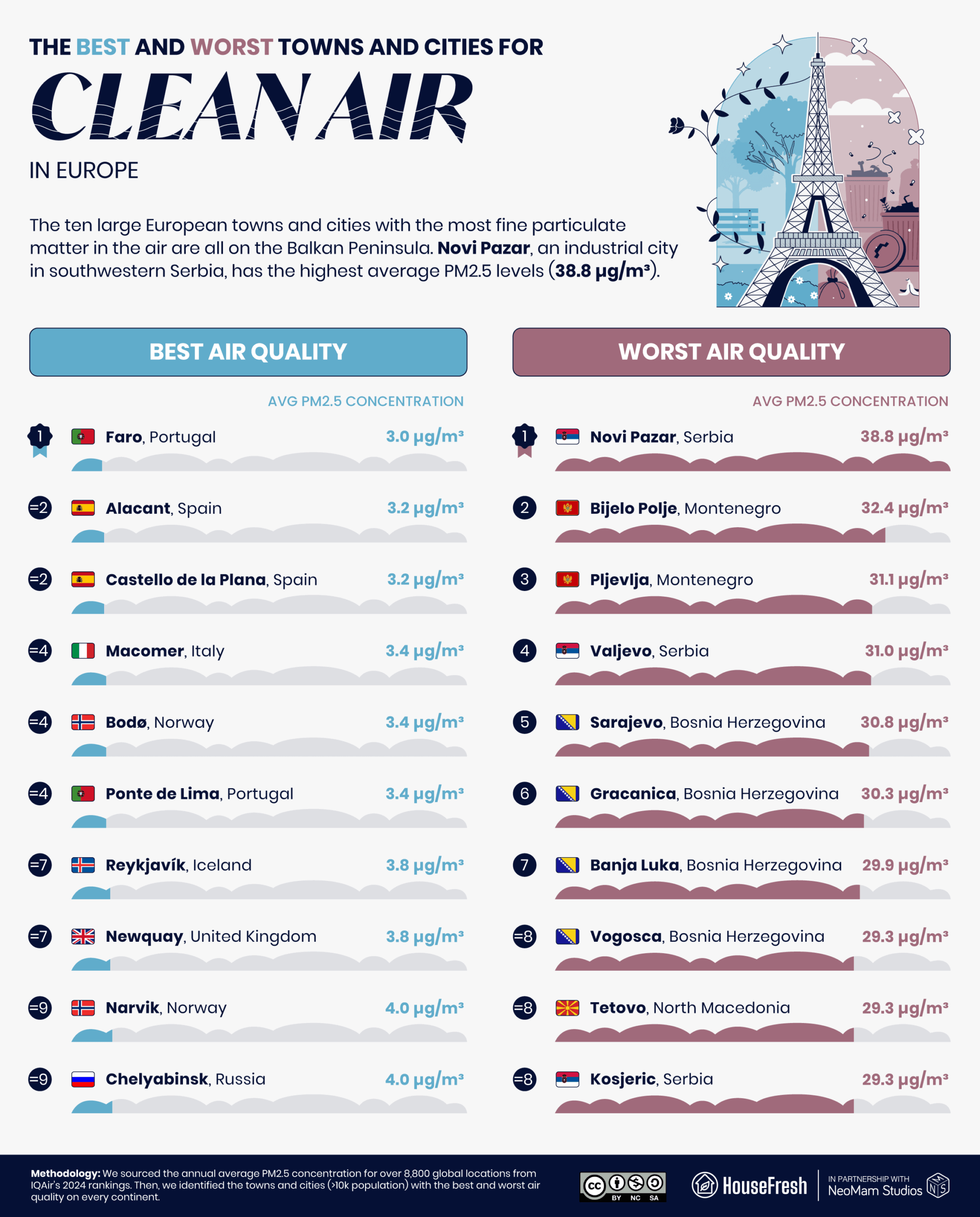
The ten urban areas with the worst air are all on the Balkan Peninsula.
Europe’s most polluted big towns and cities are all in the Balkan region. Serbia’s poor air has been newsworthy since way back in the era of Yugoslavia, when one New York Times writer complained that the “choking, sulphurous atmosphere of Belgrade and several other major Yugoslav cities reddens eyes, shreds nylon stockings and ruins pianissimo passages in the concert hall because of the nearly continuous coughing it causes in audiences.” Coal-fired power plants, fossil fuel-based home heating and outdated vehicles contribute to the region’s poor air. It is worst in Novi Pazar, Serbia (38.8 µg/m³).
In Sarajevo, Bosnia and Herzegovina, one in 12 deaths is from lung cancer, according to Anes Podic, head of the environmental organization Eko-Akcija. A 2019 UN report found that one in five premature deaths in the Balkans is due to air pollution.
Ranking of the European towns and cities with the most and least polluted air in 2025
Europe’s best cities for clean air are in the west and north of the continent. In second and third place are two cities in Spain: Alacant (3.2 µg/m³) and Castello de la Plana (3.2 µg/m³). However, some cities across Spain have refused to implement low-emission driving zones, despite clear evidence that well-designed schemes work. For example, London’s ultra-low emission zone (ULEZ) reduced nitrogen dioxide from traffic by 46% across its first five years.
In Asia, Delhi air forces schools to close
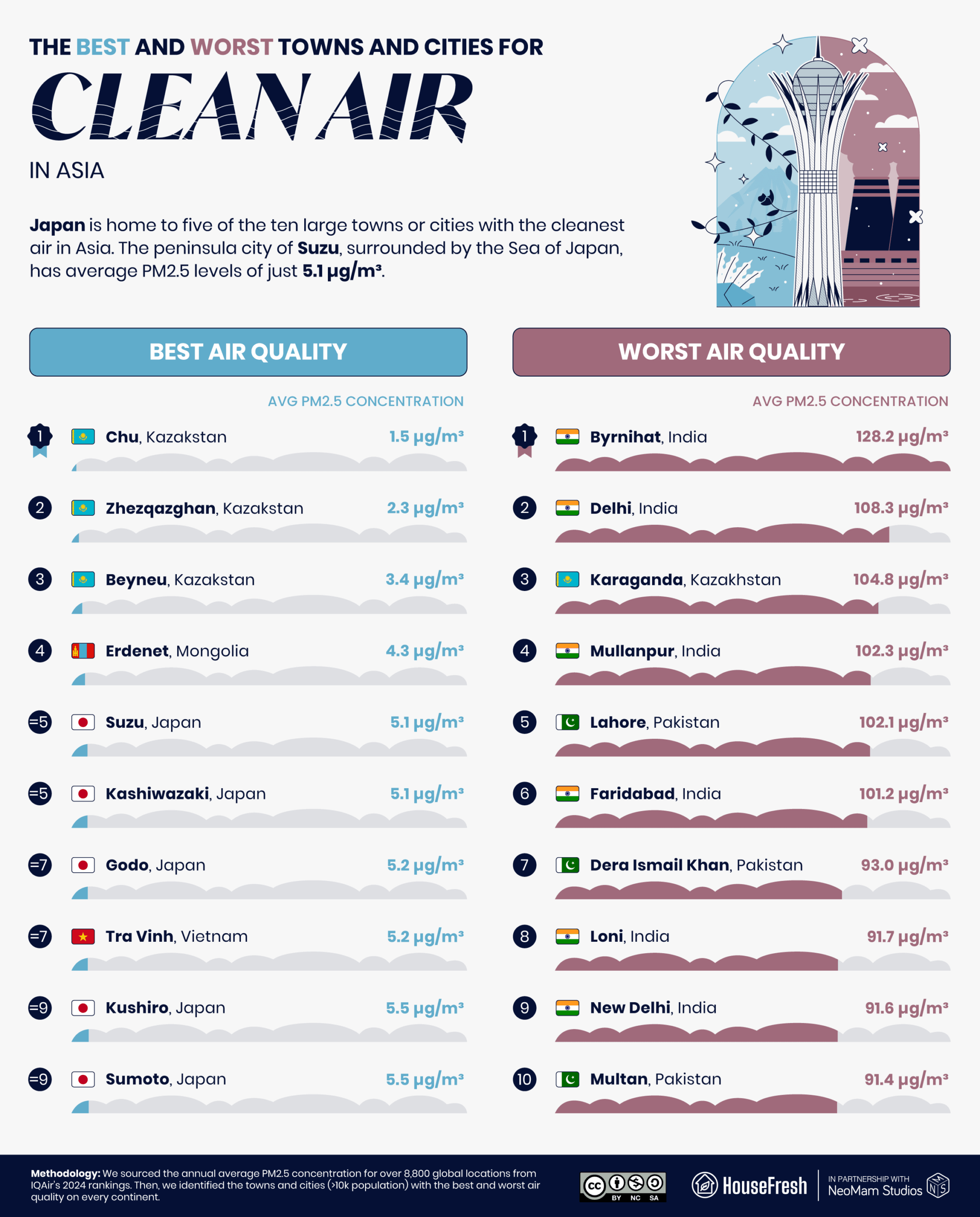
The best cities for clean air in the region are in Kazakhstan and Japan.
Six of the ten worst Asian cities for bad air are in India. Delhi (108.3 µg/m³) authorities ordered schools to close, and hospitals were overrun in November 2024 as smog filled the city, generated by controlled crop fires, factory and traffic fumes, cooling air and stagnant winds.
“Smog is currently a national disaster,” said senior provincial minister Marriyum Aurangzeb. “It will not all be over in a month or a year. We will evaluate the situation after three days and then announce a further strategy.”
Ranking of the towns and cities in Asia with the cleanest and dirtiest air in 2025
Kazakh and Japanese towns and cities dominate among those with the cleanest air in Asia. Japan’s best is Suzu (5.1 µg/m³) at the tip of the Noto Peninsula. Air pollution in Japan has improved due to the tightening of emissions regulations for motor vehicles. However, in some regions, up to 61% of PM2.5 concentrations in the air have historically originated overseas in China.
Australia’s least polluted cities have cleaner air than New Zealand’s
But industrial heritage means problems still persist.
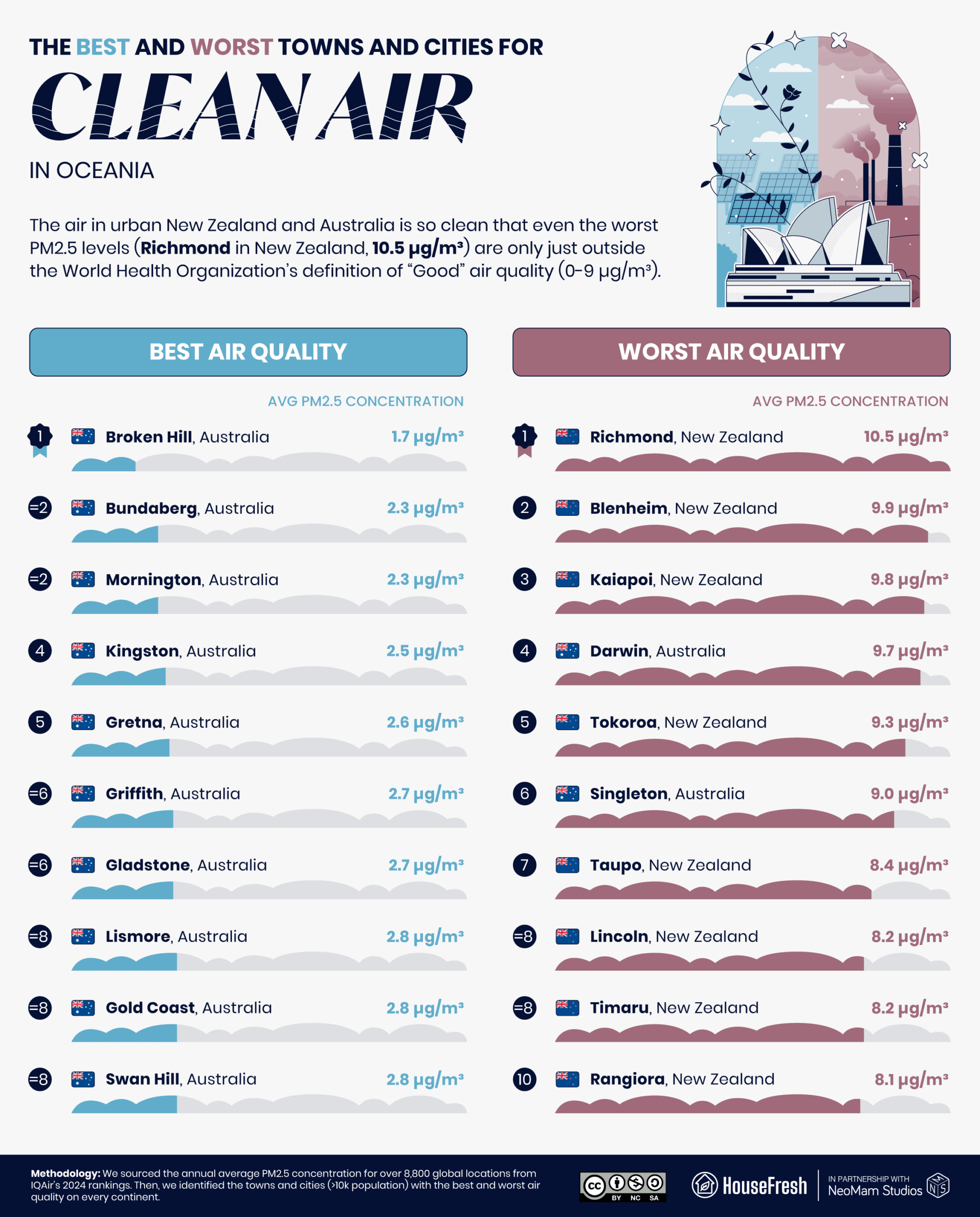
In the battle of Oceania, Australia proves to have the cities with the cleanest air, while New Zealand’s urban areas dominate among those with bad air. However, it’s all relative: even Oceania’s worst town for clean air, Richmond in New Zealand (10.5 µg/m³), has an average PM2.5 level that almost places it among the ten cleanest of other continents.
The chief problem with Richmond air is that wood heaters remain popular among the local population. Authorities have encouraged citizens to collect firewood earlier in the year to ensure it’s of better burning quality while they consider adding regulations.
Ranking of the towns and cities in Oceania with the most and least polluted air in 2025
All ten of the continent’s cleanest large towns and cities are in Australia. Broken Hill (1.7 5 µg/m³) is a remote outback city in New South Wales and has the cleanest air of any continental urban area. However, the city has been known to suffer from dust storms and has been blighted by toxic residues from local mining operations — children exposed to this air were shown to perform lower on school tests.
South Africa leads quest for cleaner air in African cities
But Africa’s most polluted cities are among worst in the world for clean air.
IQAir’s 2024 World Air Quality Report notes that “considerable gaps still exist in government-operated regulatory systems in many parts of the world.” Africa is singled out in this respect: while there are eight African countries among the 15 with the worst ‘worst cities’ in the world, it is notable that the continent maintains only one monitoring station for every 3.7 million people, so the true extent of Africa’s urban air crisis cannot be told.
Still, there is enough data to show that Africa’s ten worst cities for clean air almost all have higher PM2.5 counts than the ten worst on other continents — with the exception of Asia.
Ranking of the African towns and cities with the best and worst air quality in 2025
Eight of the ten large towns and cities with the cleanest air in Africa are in South Africa. However, Pemba, Mozambique, is Africa’s best city for clean air, with average PM2.5 levels of 6 µg/m³ in 2024. Corporate sustainability initiatives have helped nearly 5,000 local households switch to improved cooking stoves that consume less coal and create less smoke.
Keeping a clean air environment at home
City dwellers can’t afford to wait for governmental action on air pollution.
The vast majority of the world’s urban population lives with bad air. IQAir’s 2024 report on world air quality found only 12 countries with PM2.5 levels within the World Health Organization’s guideline of 5.0 μg/m³. As national and regional efforts to reduce industrial and vehicular emissions falter, entire categories of pollution remain unaddressed: for example, vehicles produce six million tonnes of particulate matter from tire wear per year globally, which is more than that emitted by tailpipes. This issue won’t be remedied by the introduction of electric cars.
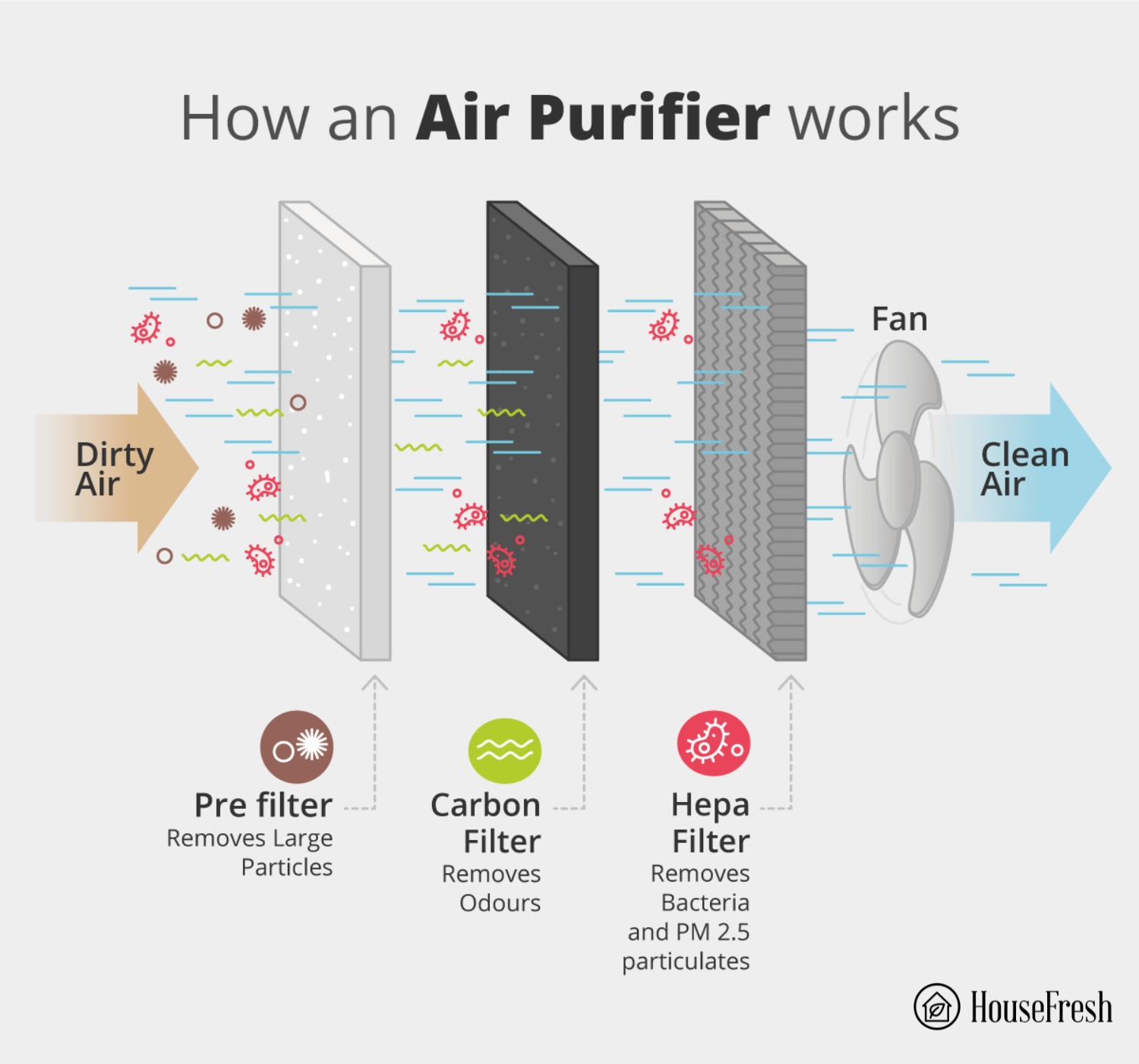
On bad air days, keep to back streets and away from the road’s edge when walking outside, and close your car windows when driving. At home, the EPA recommends the use of air filters to remove pollutants from the air. We have published a thorough guide to air purifiers, where you will learn more about what to look for and what to avoid.
METHODOLOGY & SOURCES
We sourced the annual average PM2.5 concentration for over 8,800 global locations from IQAir’s 2024 rankings. We then identified the towns and cities (with a population above 10,000) with the best and worst air quality in every country and continent. In addition, we ranked the top and bottom 10 capital cities based on air quality.
Few factors influence your health and sense of well-being than having clean, fresh air to breathe.
Humans have worried about the effects of air pollution on health since at least the time of Hippocrates. But industrialization and the spread of cars and cigarettes have made good air hard to find — and the growing reach and regularity of wildfires have become the leading cause of worsening air in America in recent times.
These particles mostly come from burned fuel and firewood. Even one day of exposure to air with high PM2.5 levels can lead to bronchitis, asthma attacks and other heart and lung issues. Long-term exposure has been linked with slower lung function growth in children and shorter lifespans for all affected.
For this report, we used the latest annual PM2.5 data to identify the states and large U.S. cities with the best and worst air quality.
We sourced the average concentration of PM2.5 (fine particulate matter) in the air from IQAir for U.S. towns and cities in 2024. To calculate the average PM2.5 concentration in each state, we weighted cities within a state based on land area (i.e., bigger cities contributed more to the average).
Key findings
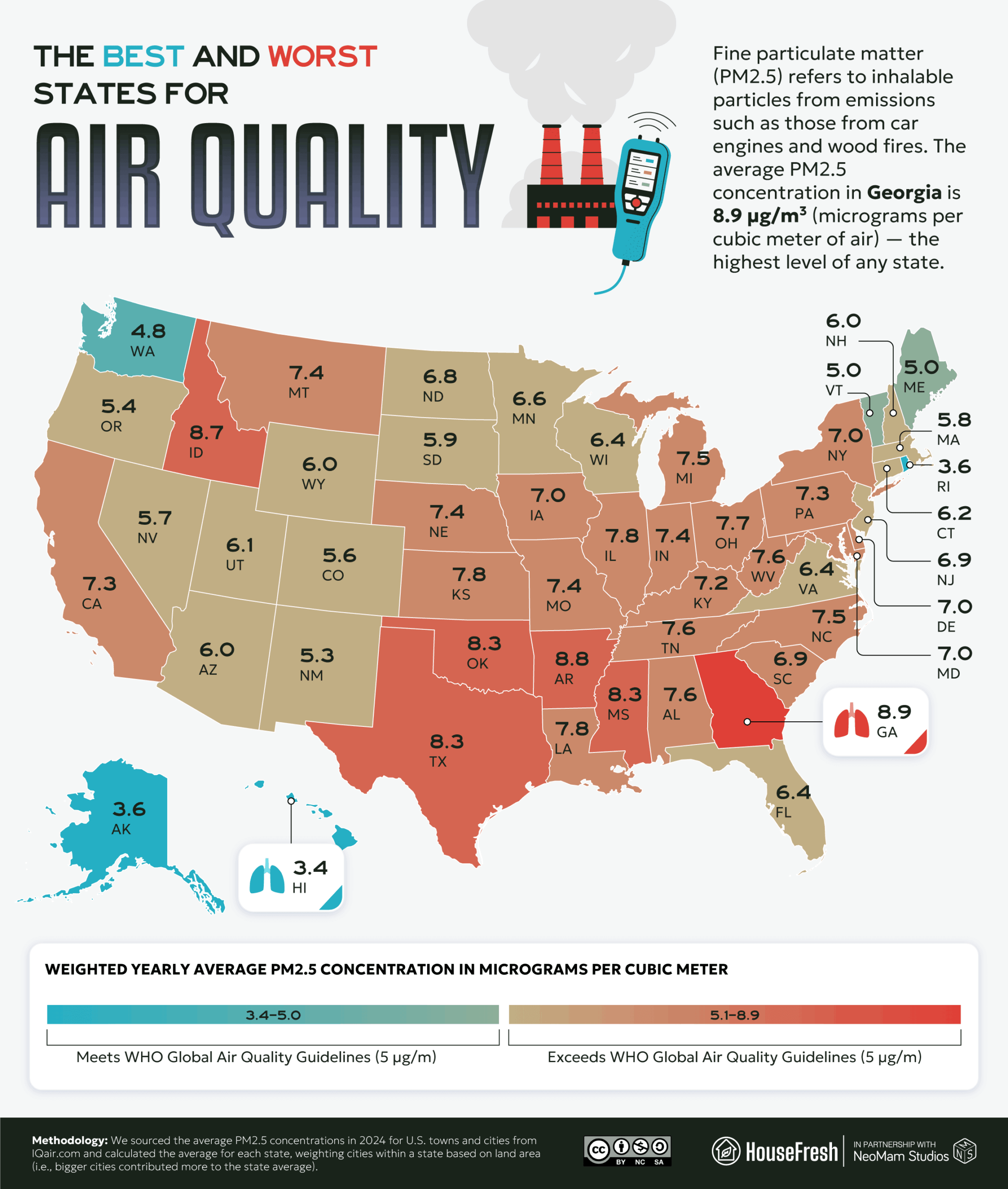
Georgia is the state with the worst air quality, at an average concentration of 8.9 µg/m³ (micrograms per cubic meter of air).
Hawaii (3.4 µg/m³), Alaska (3.6 µg/m³) and Rhode Island (3.6 µg/m³) have the best air quality.
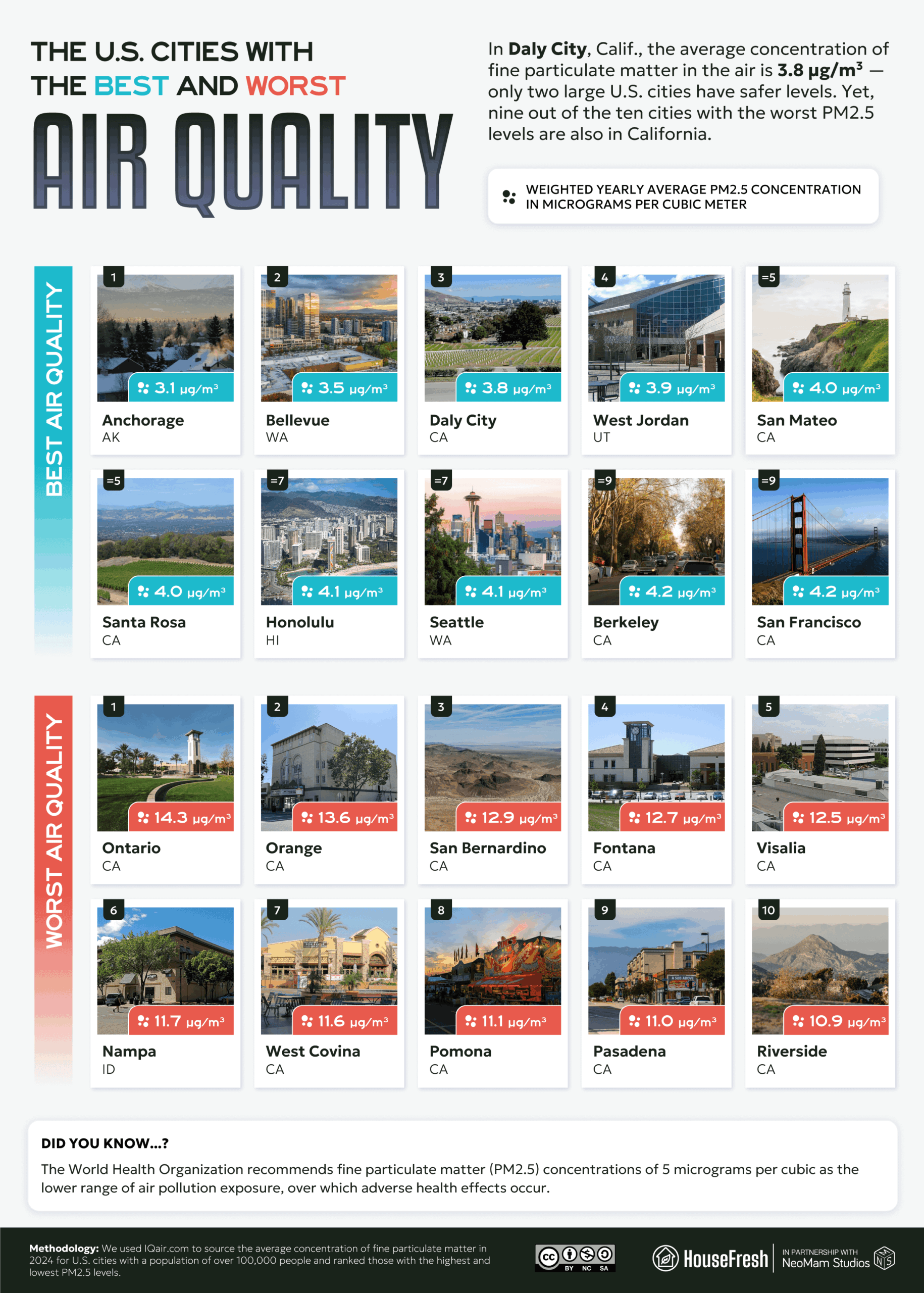
Nine of the ten large cities with the worst air are in California, led by Ontario (14.3 µg/m³).
The large U.S. city with the best air quality is Anchorage, Alaska (3.1 µg/m³).
Georgia has the worst PM2.5 levels in America
Southern states fare worst for air pollution, but Idaho is also among most polluted.
First, we identified the states with the best and worst air. Of the six states with an average PM2.5 concentration of greater than 8 µg/m³, four are adjoining states in the South, with Georgia nearby in the Southeast. Idaho (8.7 µg/m³), in the Northwest, has the third-worst air.
Things look a lot clearer in Hawaii (3.4 µg/m³) and Alaska (3.6 µg/m³), while the Northeastern states of Rhode Island (3.6 µg/m³), Maine (5.0 µg/m³) and Vermont (5.0 µg/m³) join Washington (4.8 µg/m³) among those with a PM2.5 score of 5 µg/m³ or less.
U.S. map showing the best and worst states for air quality, based on annual average PM2.5 concentration
Georgia (8.9 µg/m³) has the worst air overall. Wildfires within state boundaries and from neighboring states are an increasing issue. But the grim irony is that the controlled “prescribed burns” that are used, in part, to mitigate the risk of uncontrolled wildfires are themselves associated with an increase in mortality.
The hot Georgia weather also compounds road emissions. Danna Thompson, an advocacy director at the American Lung Association, notes that when “heading into higher temperatures in the summer in the South, we certainly really encourage people to consider taking and using other forms of transportation, whether it’s biking, walking, taking trains because cars and the trucking industry do impact air quality.” Meanwhile, in April 2025, President Trump exempted Georgia Power’s two coal-firing plants, among dozens nationwide, from emission regulations.
California cities among the best and worst for clean air
Nine out of the 10 most polluted large cities are in California, but Daly City is among cleanest.
Next, we looked at the cities with a population greater than 100,000 to identify the worst and best for air quality. California suffers the best and worst of it: nine of the ten large cities with the highest concentration of fine particulate matter in the air are in the Golden State, but so are five of the ten with the lowest PM2.5 levels.Just four U.S. cities have a PM2.5 score of below 4.0 µg/m³. Daly City, California, scores 3.8 µg/m³, but the city with the best air is Anchorage, Alaska (3.1 µg/m³). In theory, Alaska’s cold climate allows air pollution to linger at ground level, creating disproportionate pollution levels compared to the state’s relatively low population and modest industrial footprint. However, on balance, the state’s low emissions and local efforts to reduce pollution mean that average PM2.5 levels in Anchorage remain low.
Ranking of the cities in America with the best and worst air quality, based on annual average PM2.5 concentration
In California, highly industrialized areas such as the San Joaquin Valley have historically exceeded Environmental Protection Agency restrictions on air quality, while researchers have shown urban planning to have disproportionately blighted minority communities with excessive vehicular traffic and associated air pollution. By comparison, the quiet suburban city of San Jose is relatively non-industrial, while its position on the peninsula cushions it from higher concentration areas.
“[C]entralized, state-level regulation of air quality in California’s San Joaquin Valley is the only way significant progress on air quality will ever occur,” says Cade Cannedy, a former air quality academic and present Director of Programs at Climate Resilient Communities. “If you really want things to improve, you have to take power away from the polluting industries who are collaborating to stop progress on this front.”
Kansas City is worst Missouri city for fine particulate matter
Mission is the worst in Texas — but escapes accountability on a technicality.
Finally, we identified the city with a population of over 10,000 people with the best and worst air in each state.
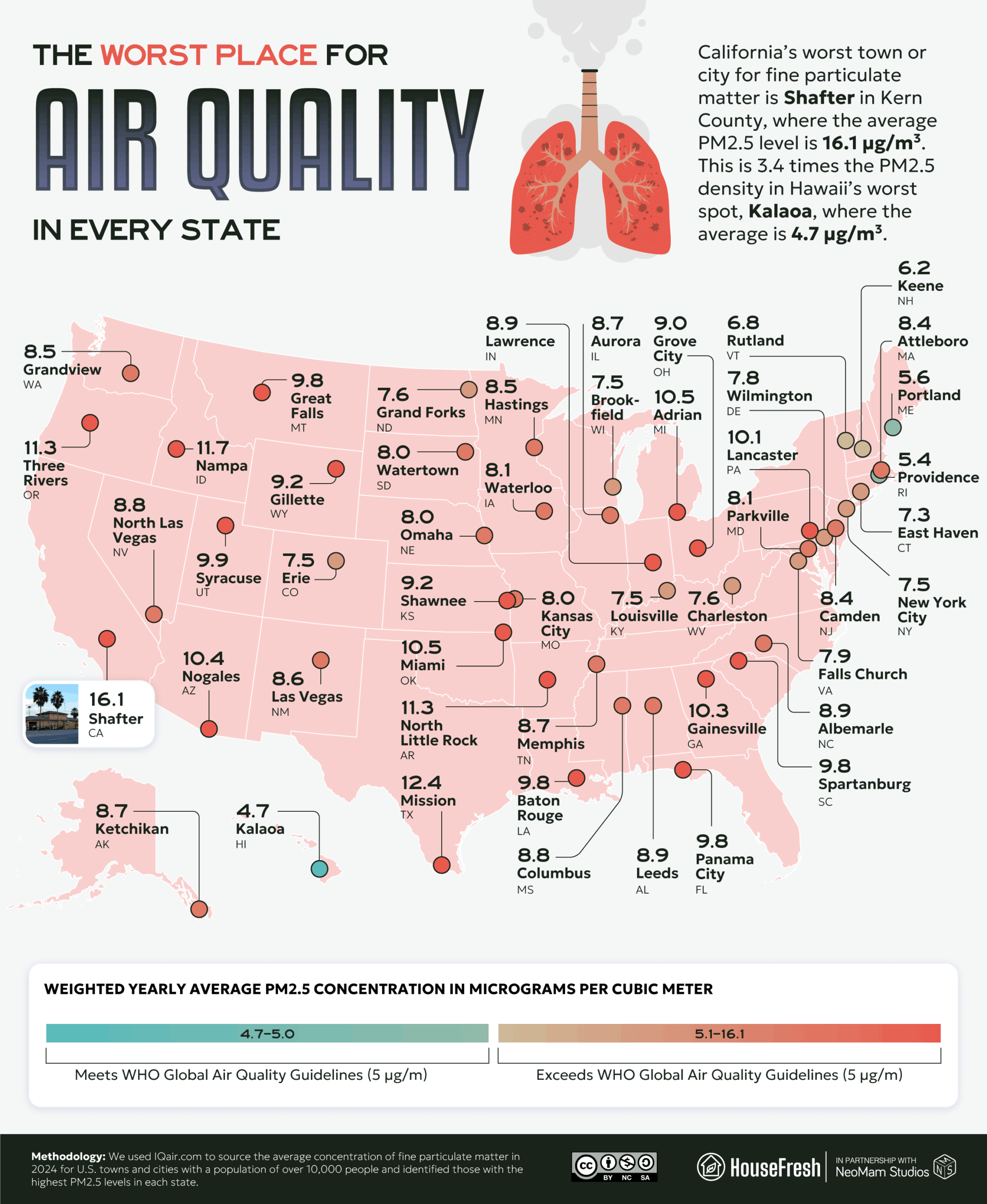
Shafter, California (16.1 µg/m³) and Mission, Texas (12.4 µg/m³) are the stand-out cities for bad air by this metric. Shafter has been designated as “at special risk of dust impacts” from harvesting. Local farmers can access 75% subsidies on newer, low-pollution machinery to reduce the dust impact of local almond farming, which can be particularly high during hot, dry spells.
Map of the U.S. showing the most polluted city or town in every state, based on annual average PM2.5 concentration
The Texas Commission on Environmental Quality (TCEQ) recently excused Hidalgo County, where Mission is situated, from its failure to keep to federal air standards, saying that a “significant percentage of the trajectories of pollution were from the southerly and/or southeasterly direction, indicating significant international impact.” However, critics have argued that since the standards are primarily in place to keep people safe, such exemptions should not be made, as they discourage efforts to offset ‘excusable’ sources of air pollution.
Waimea, HI, has the best air quality in the country
Gulfport is the least polluted city in Mississippi but PM2.5 concentrations still exceed WHO guidelines
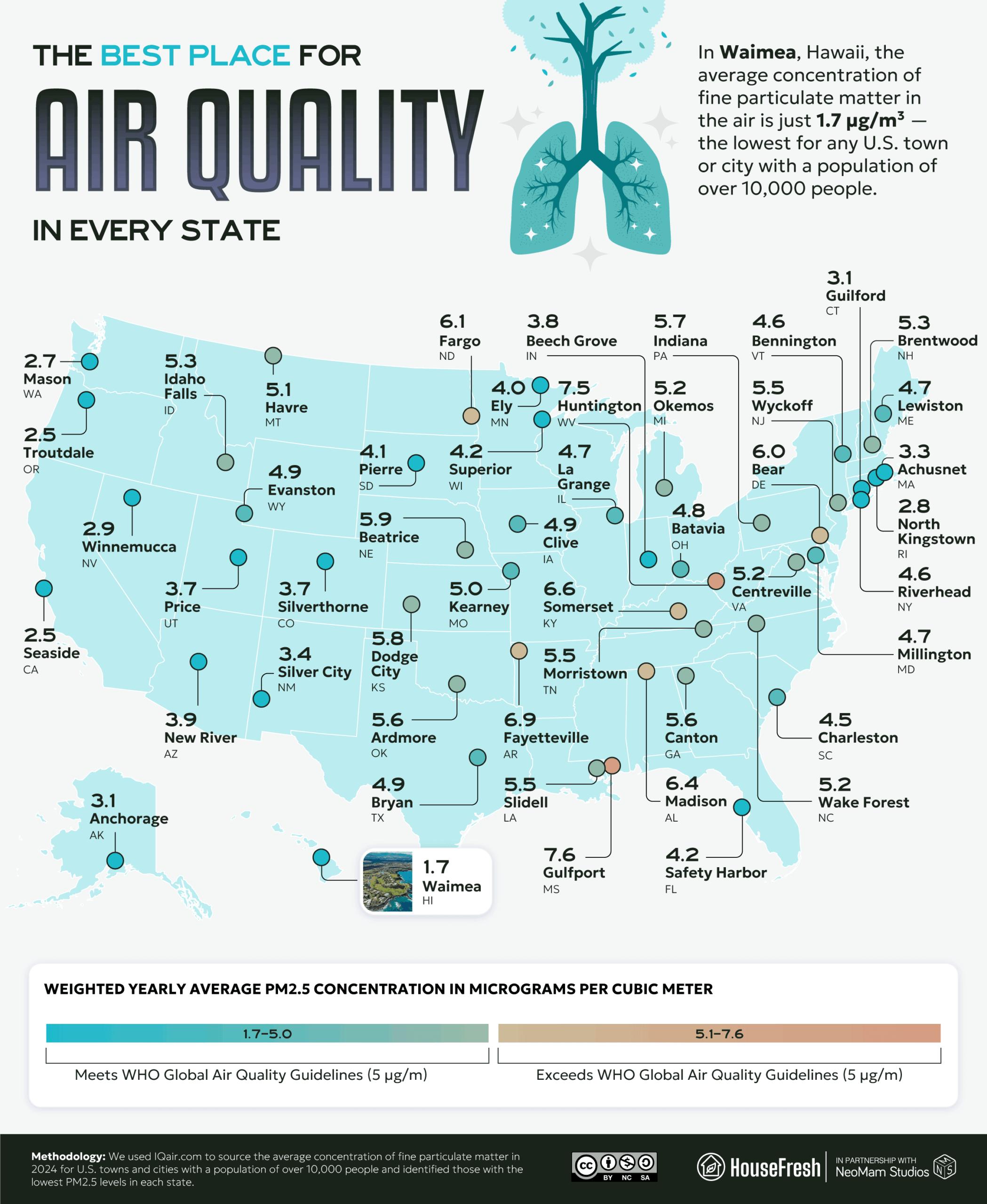
The Mississippi city with the best air is Gulfport (7.6 µg/m³) — however, this is the worst “best air” of any state. Huntington, West Virginia, is not far behind with 7.5 µg/m³.
Map of the U.S. showing the least polluted city or town in every state, based on annual average PM2.5 concentration
Among cities with the cleanest air in each state, Waimea, Hawaii (1.7 µg/m³), Troutdale, Oregon (2.5 µg/m³) and Seaside, California (2.5 µg/m³) stand out as the cleanest of all. Hawaii is vulnerable to a peculiar form of fine particulate matter: volcanic smog, or “vog” — “a hazy mixture of SO2 gas and aerosols (tiny particles or droplets) which are primarily sulfuric acid and other sulfate (SO4) compounds.” However, the relative isolation of the Hawaiian Islands and the influence of trade winds help to keep the air relatively clear.
131 million Americans breathe bad air
The air quality divide is palpable, but things are getting worse for all.
The American Lung Association has found that nearly 40% of Americans, or 90 million people, live in places where the air quality fails to meet recent Environmental Protection Agency standards, while 131 million live with unhealthy levels of ozone or particle pollution.
These areas can be divided by location but, in many cases, also by socio-economic conditions. But cities known for their relatively clean air are also suffering from a decline in standards. And the rollback in environmental legislation, along with the increase in wildfires, means many can expect to enjoy fewer good air days as summer — and the planet — heats up.
METHODOLOGY
We sourced the average PM2.5 concentrations for 2024 as reported by IQAir’s air quality rankings. To calculate the average PM2.5 concentration by state, we weighted cities within a state based on land area (i.e., bigger cities contributed more to the average). To uncover the most and least polluted cities, we ranked cities with the highest and lowest average 2024 PM2.5 concentrations from those with a greater than 100k population. In order to find the best and worst places by state, we lowered the population threshold to 10k to determine the towns or cities with the best/worst air quality overall across each state.
Sixteen months have passed since we showed you how Google’s algorithm was killing independent websites by favoring big media publishers that were abusing their reputation to sell you bad products.
But are AI Overviews leading you to the best results on the web? Or is this just a new prime spot for selling you products you will regret buying? And how does this change affect the websites that made Google’s AI possible in the first place?
To find out, we spent weeks conducting research into air purifiers we reviewed (including models that don’t exist) to determine whether Google Search results and AI Overviews are leading consumers to good advice.
It turns out this rabbit hole is deeper than we thought, with ramifications that span major Reddit communities and could be leading you to scams and defamatory hallucinations.
I hope you’re ready for a long read because this article is packed with examples, fresh data and way too many screenshots.
Google AI Overviews are mining “product facts” from press releases, product listings and sponsored reviews
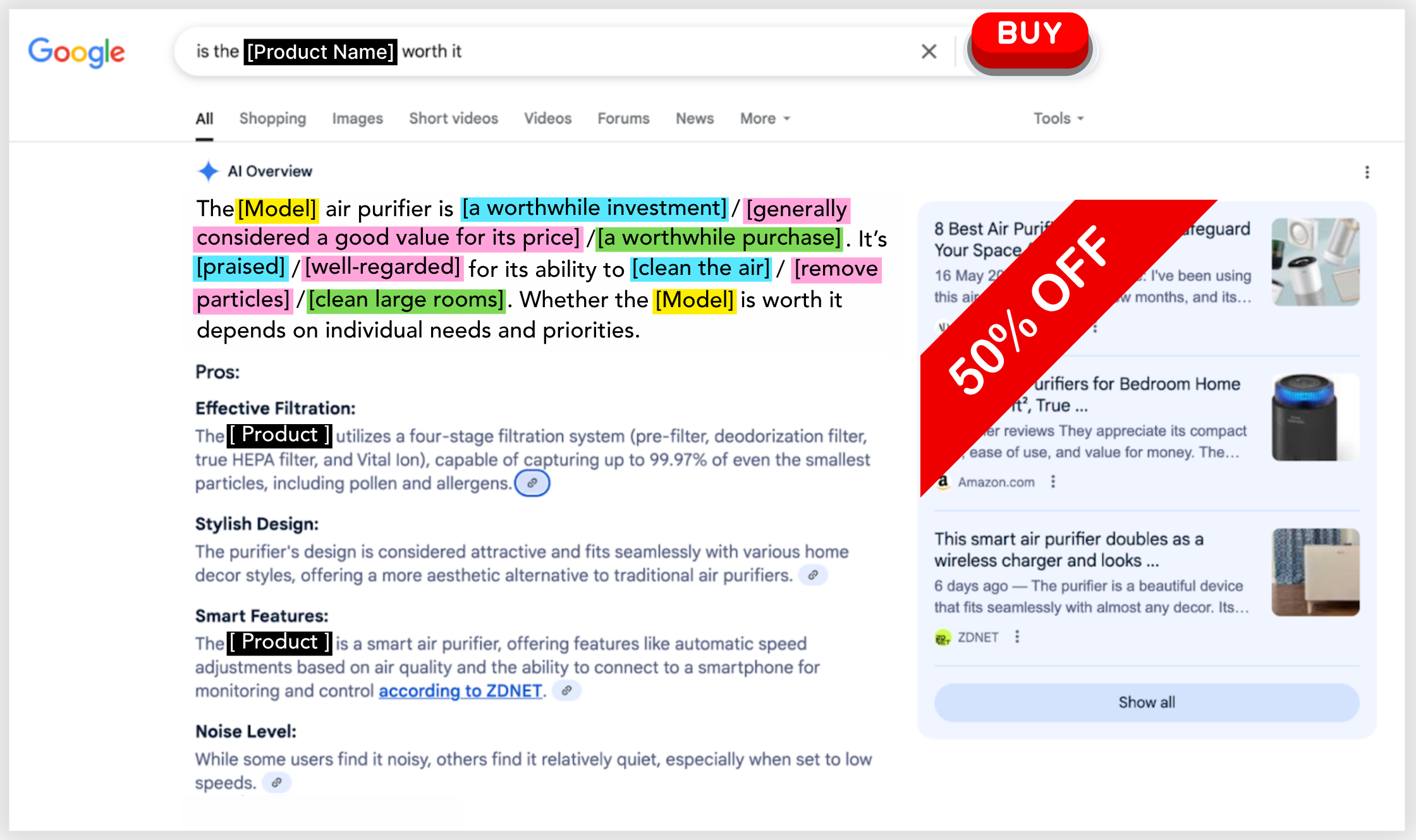
Don’t bother asking Google if a product is worth it; it will likely recommend buying whatever you show interest in—even if the product doesn’t exist.
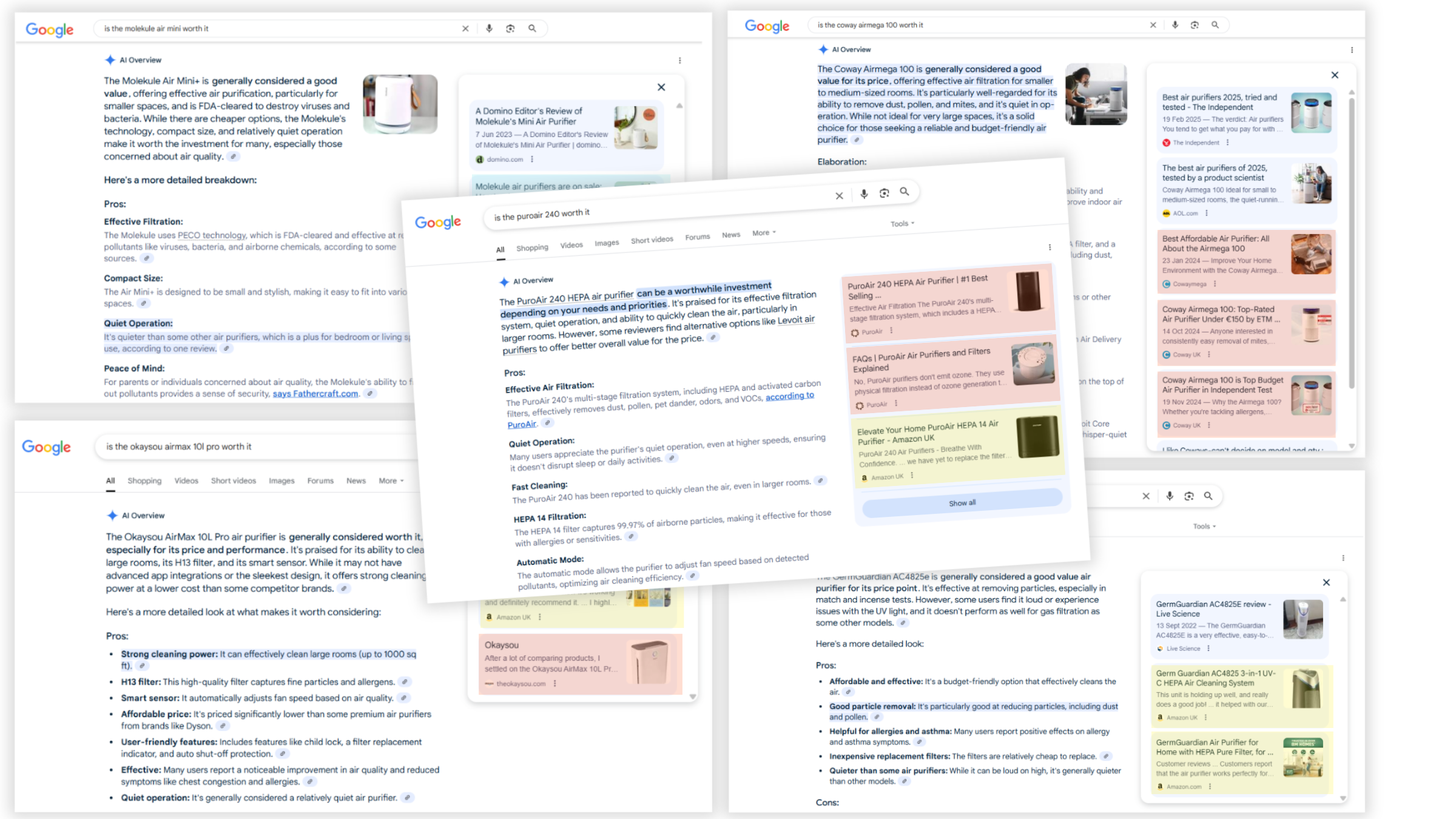
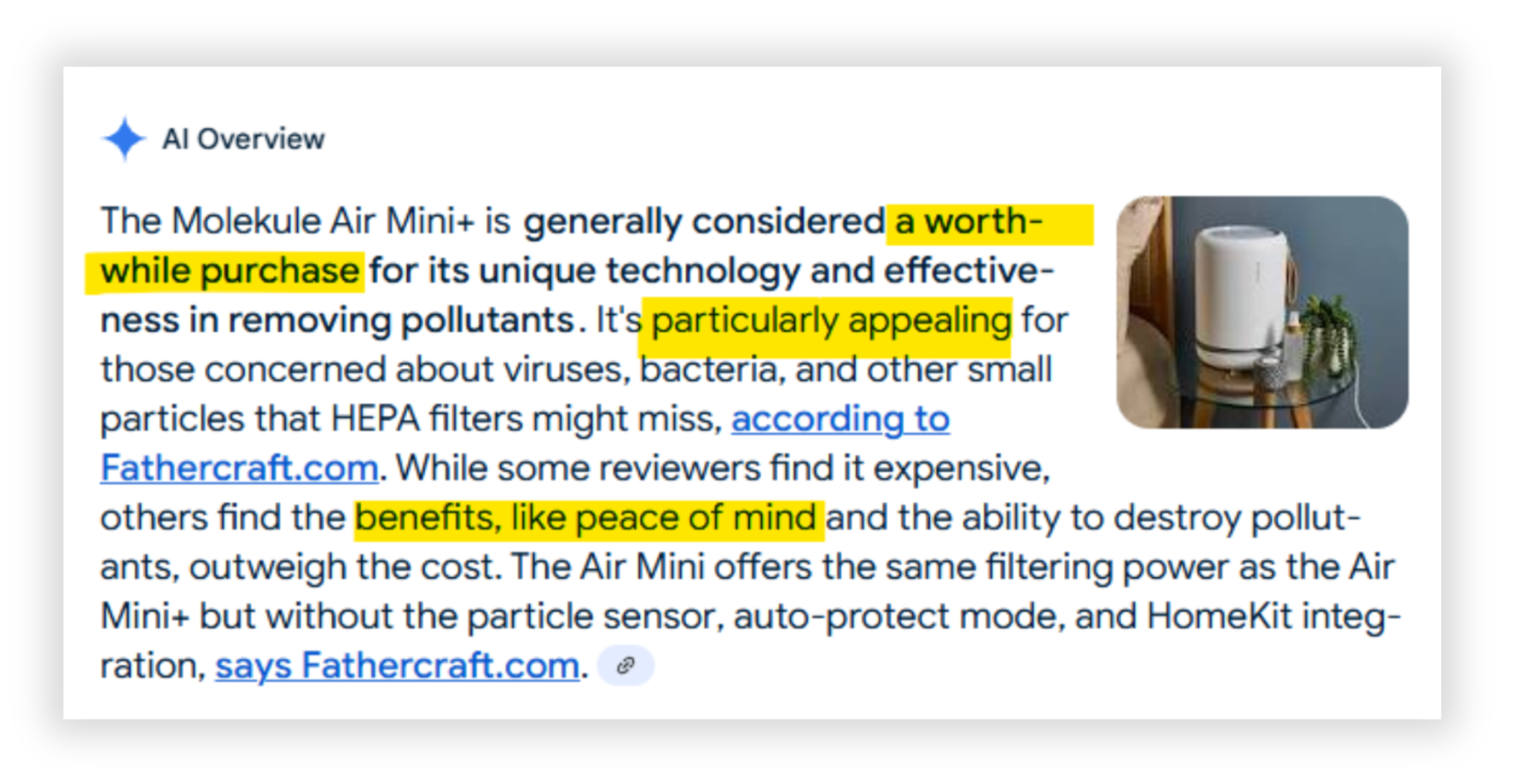
We found a problematic pattern after spending hours vetting the sources of pros, cons and overall product recommendations spouted by Google’s AI Overview: most ‘facts’ are sourced from the manufacturer itself, online shops, sponsored articles and press materials.
That could explain why AI Overviews used overly salesy language, regardless of what we were searching for.
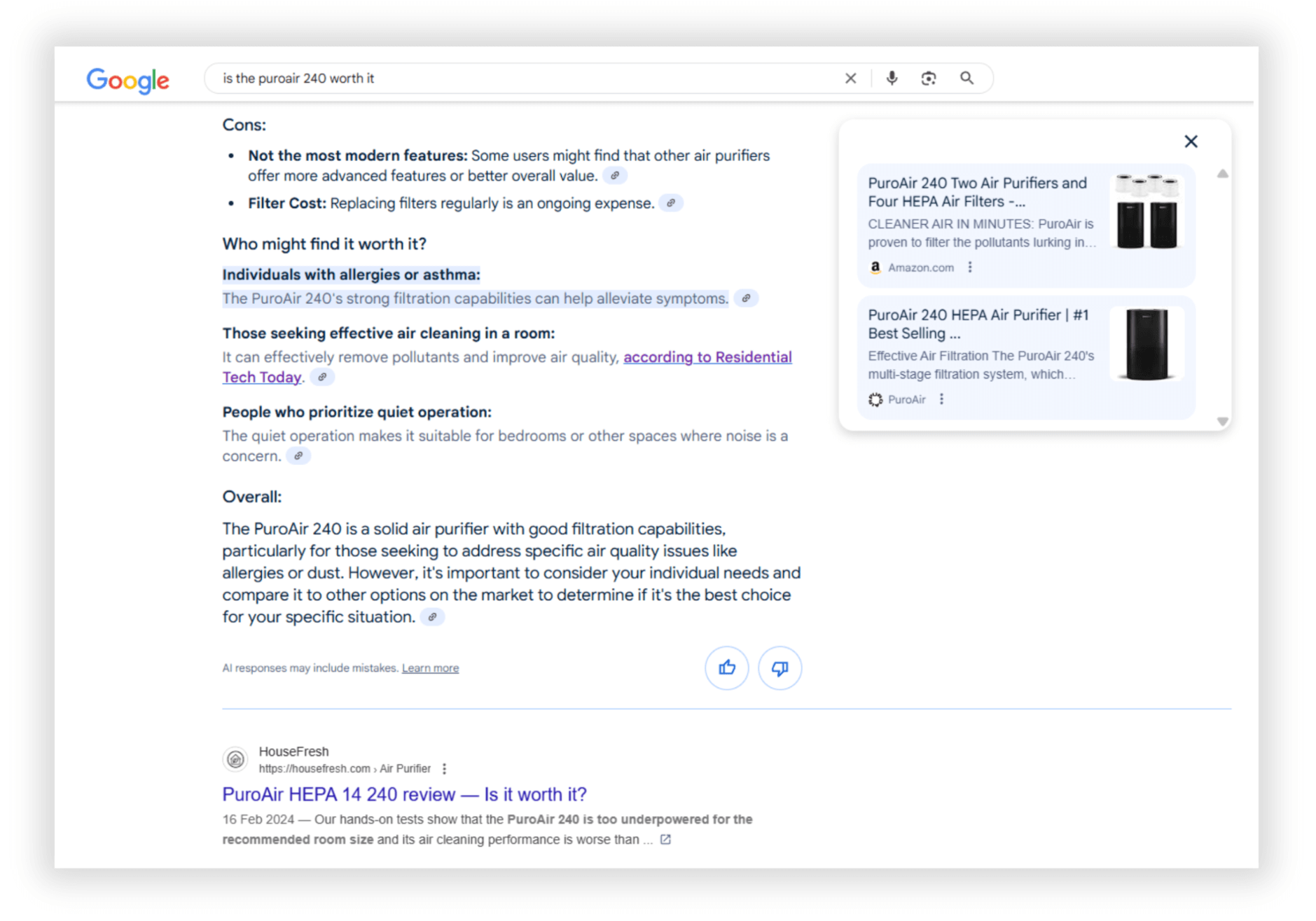
Not only that… We also noticed that the AI Overview failed to include the very same cons that their algorithm had no issue highlighting in organic search results:
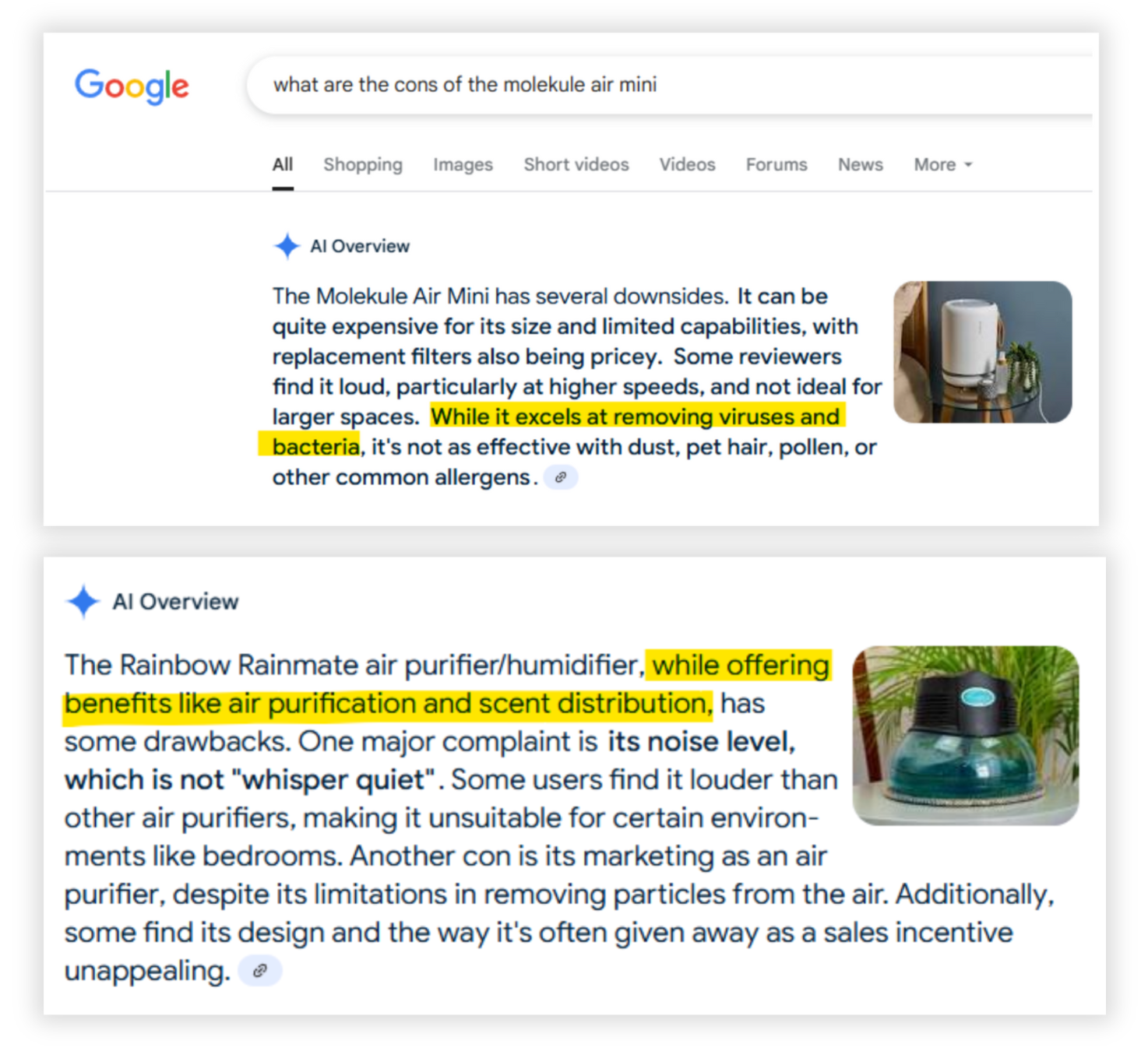
In fact, the overly salesy language would still be there even when we asked specifically about cons:
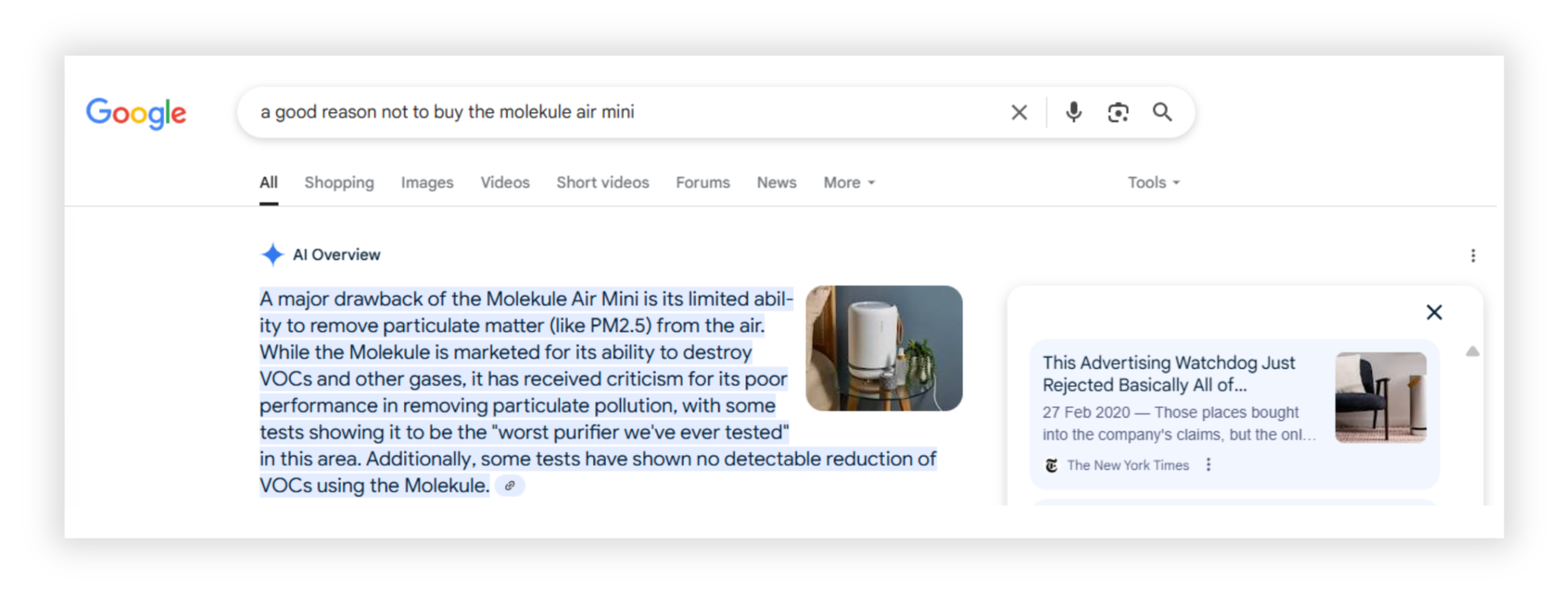
This changed once we switched to requesting ‘a good reason not to buy’ specific models, showing that Google AI Overviews are capable of pulling out critical reviews.
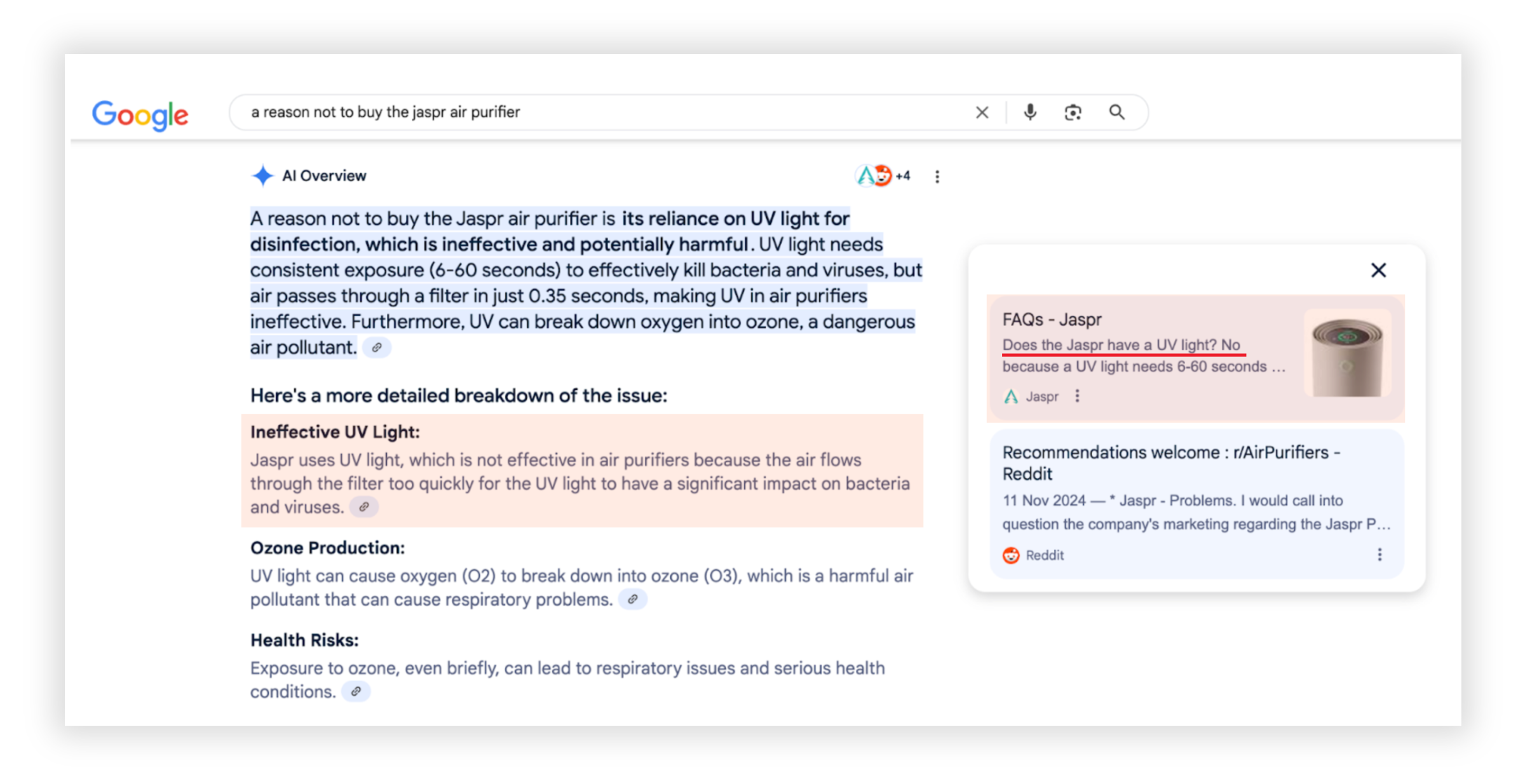
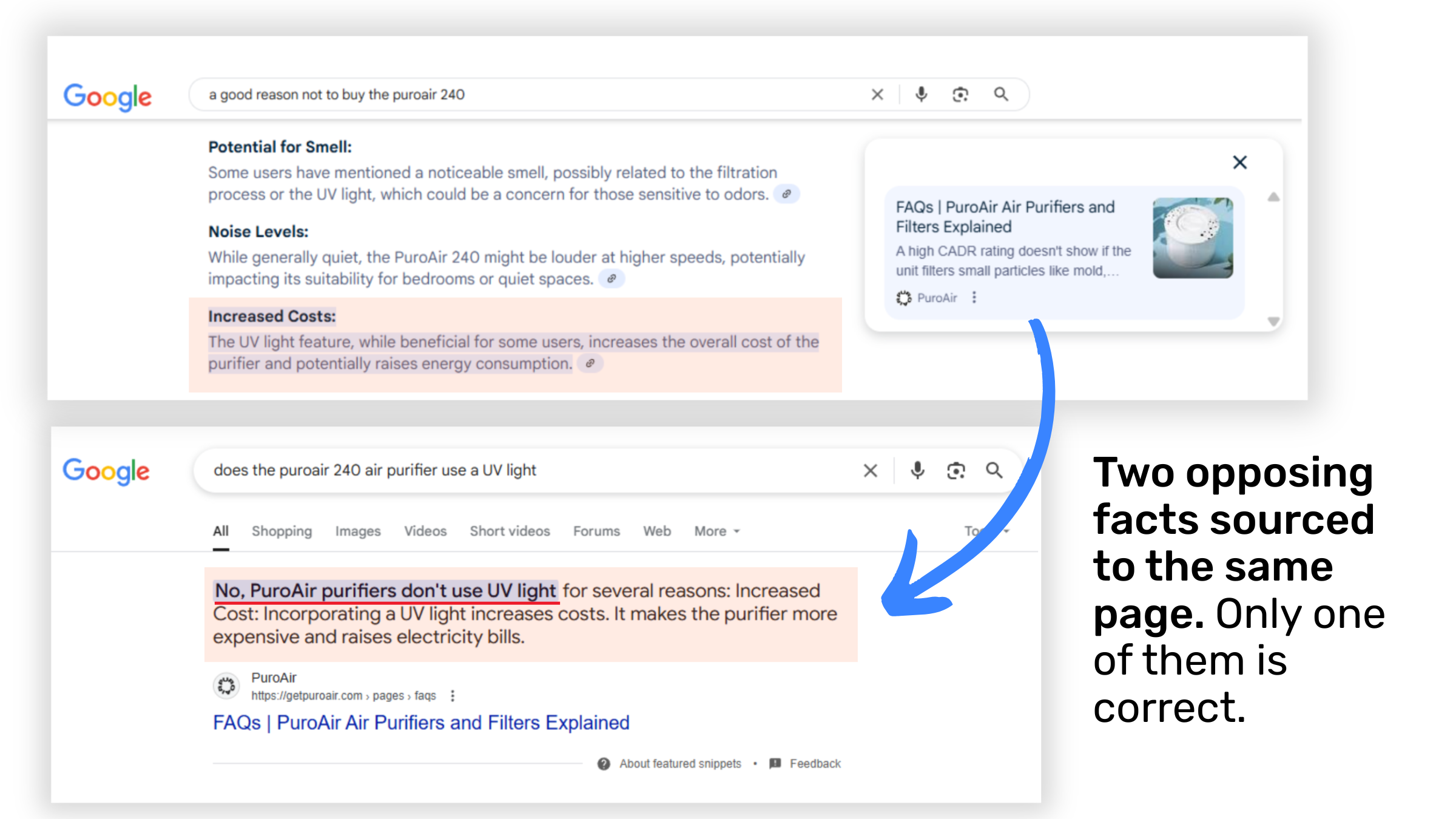
Unfortunately, in many cases, the cons themselves were simply hallucinations, which could be easily confirmed by checking the cited source or the organic search results:
Funnily enough, Google’s organic search results don’t hallucinate—who would have thought.
Google’s AI will find ways to sell you products that don’t exist
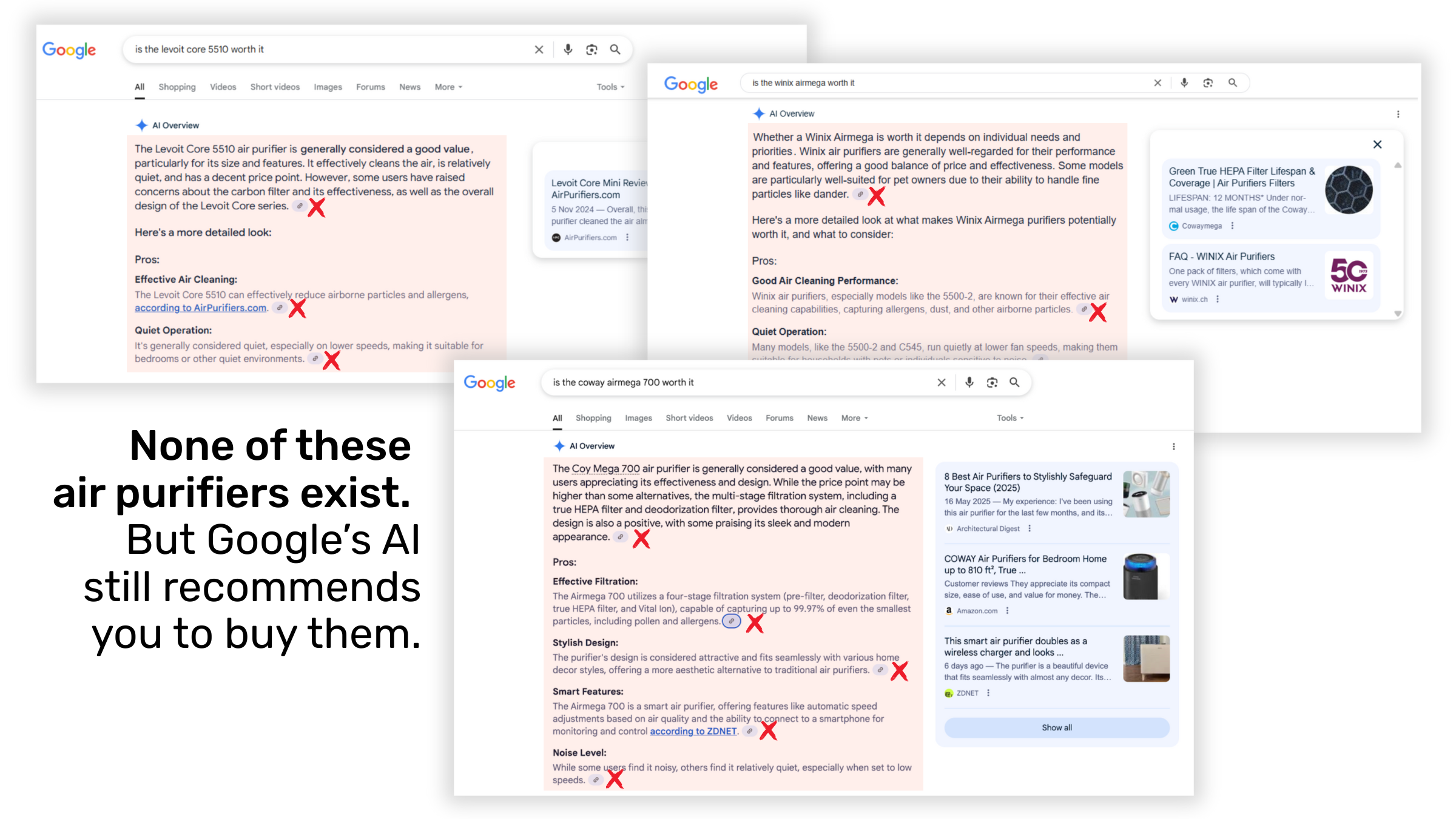
Our tests showed that Google’s AI Overview was positive even when we asked about air purifier models that were completely made up.
As reported by Jalopnik, “Google […] now relies on an AI that has no concept of “truth” — just repeating words it sees used in proximity to each other, like your phone keyboard’s autocomplete or a particularly dumb parrot.”
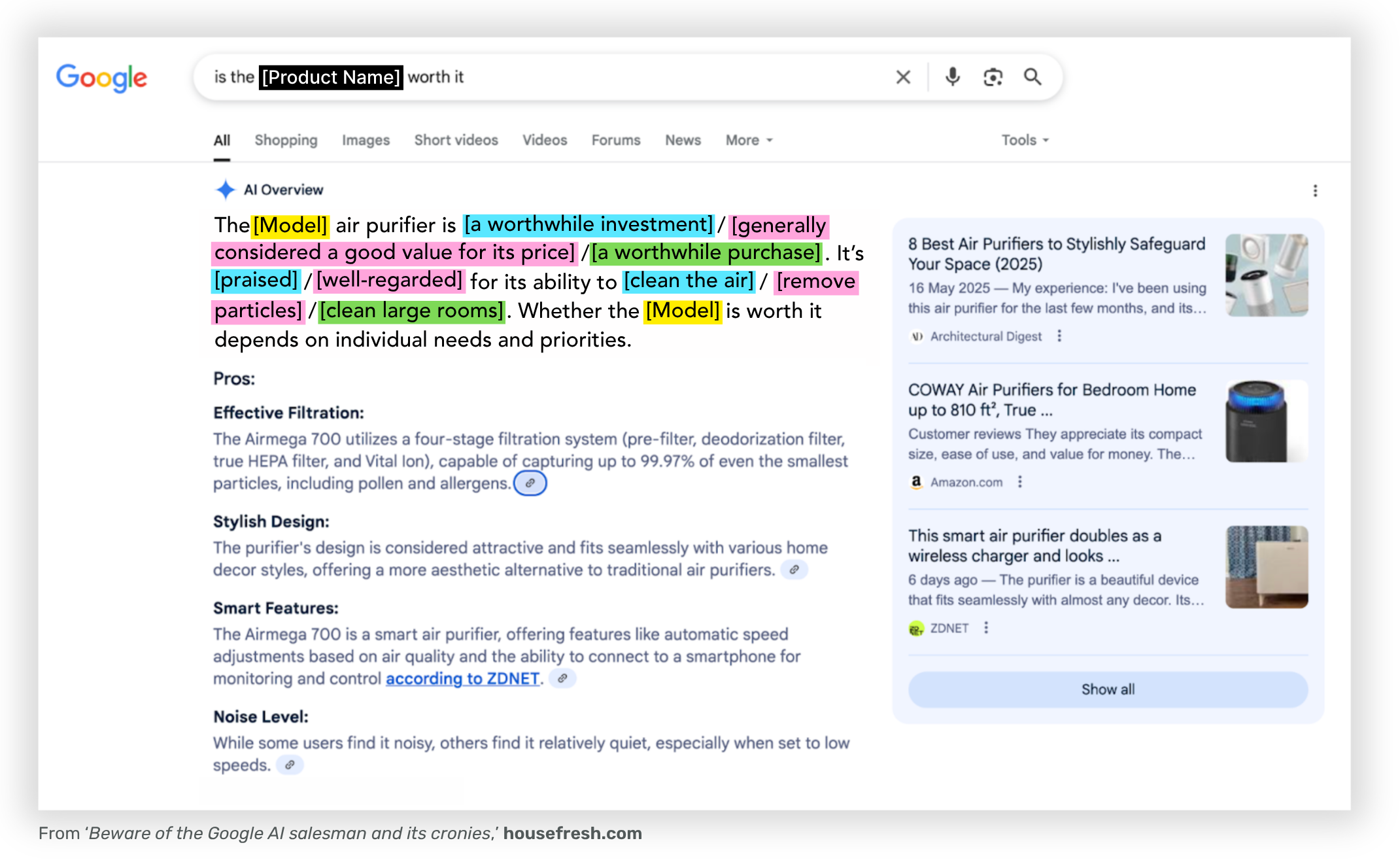
The more we searched, the clearer it became that no matter the product, the AI Overviews salesman would always repeat a version of the same script:
It all started to make more sense once we visualized our data.
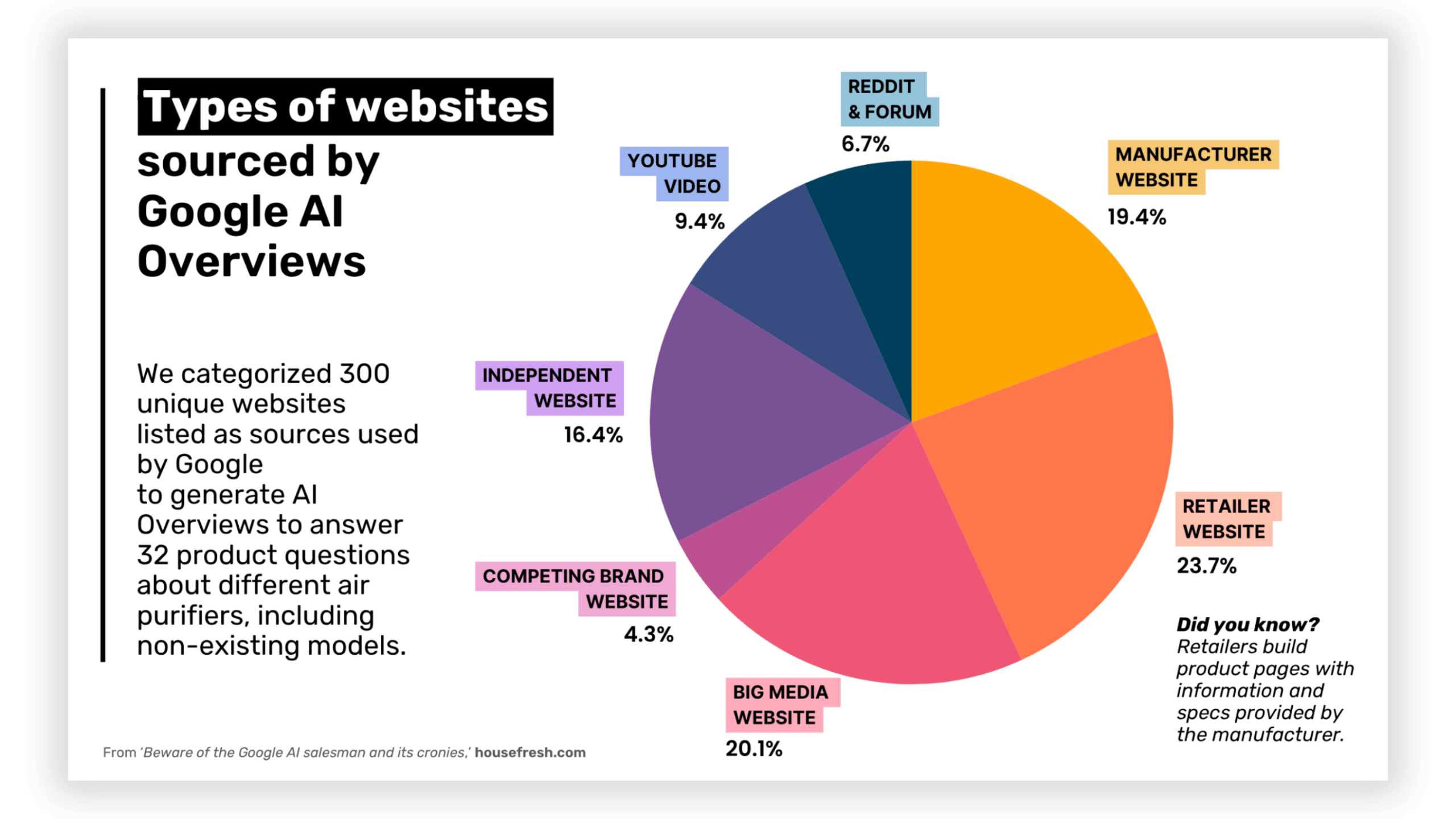
43.1 % of the facts cited by AIO came from the product manufacturer. This statistic combines the cases where statements were linked directly to pages on the manufacturer’s website (19.4%) with facts sourced from product listings built with manufacturer-provided data on popular retailer websites (23.7%).
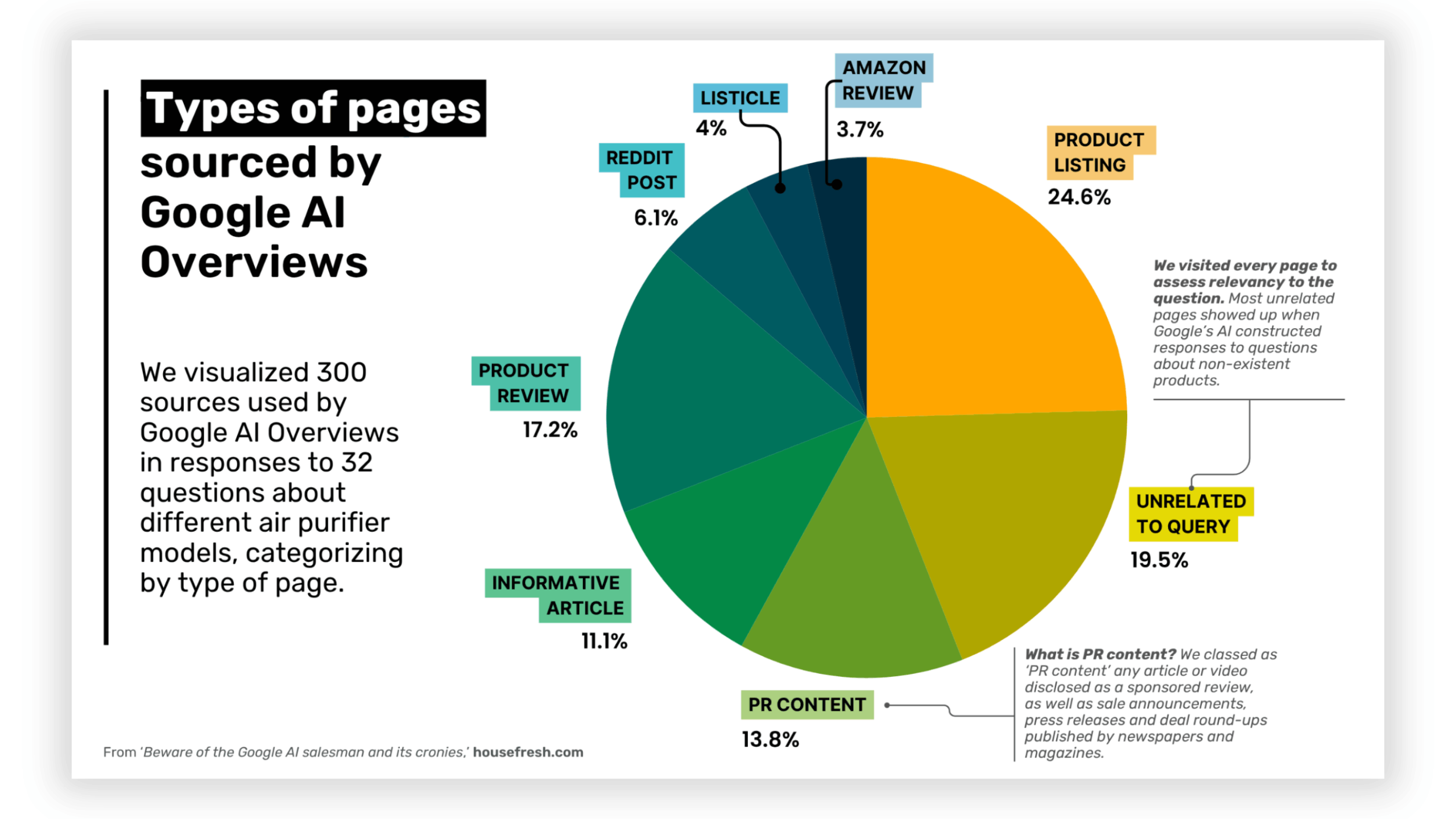
Next, we clicked on every link to assess whether it was relevant to our question and the information presented by the AI Overview. We found that 19.5% of the pages sourced by AIO were irrelevant to the query, with the majority of these irrelevant pages being listed when Google’s AI had constructed an answer to questions about air purifier models that don’t exist.
We also categorized the type of page the AI Overview was sourcing its facts back to and found that a whooping 38.6% of sources pointed to product listings (on the manufacturer website and online retailers) and PR content (including sponsored reviews, sale announcements, press releases and deals coverage on big media sites).
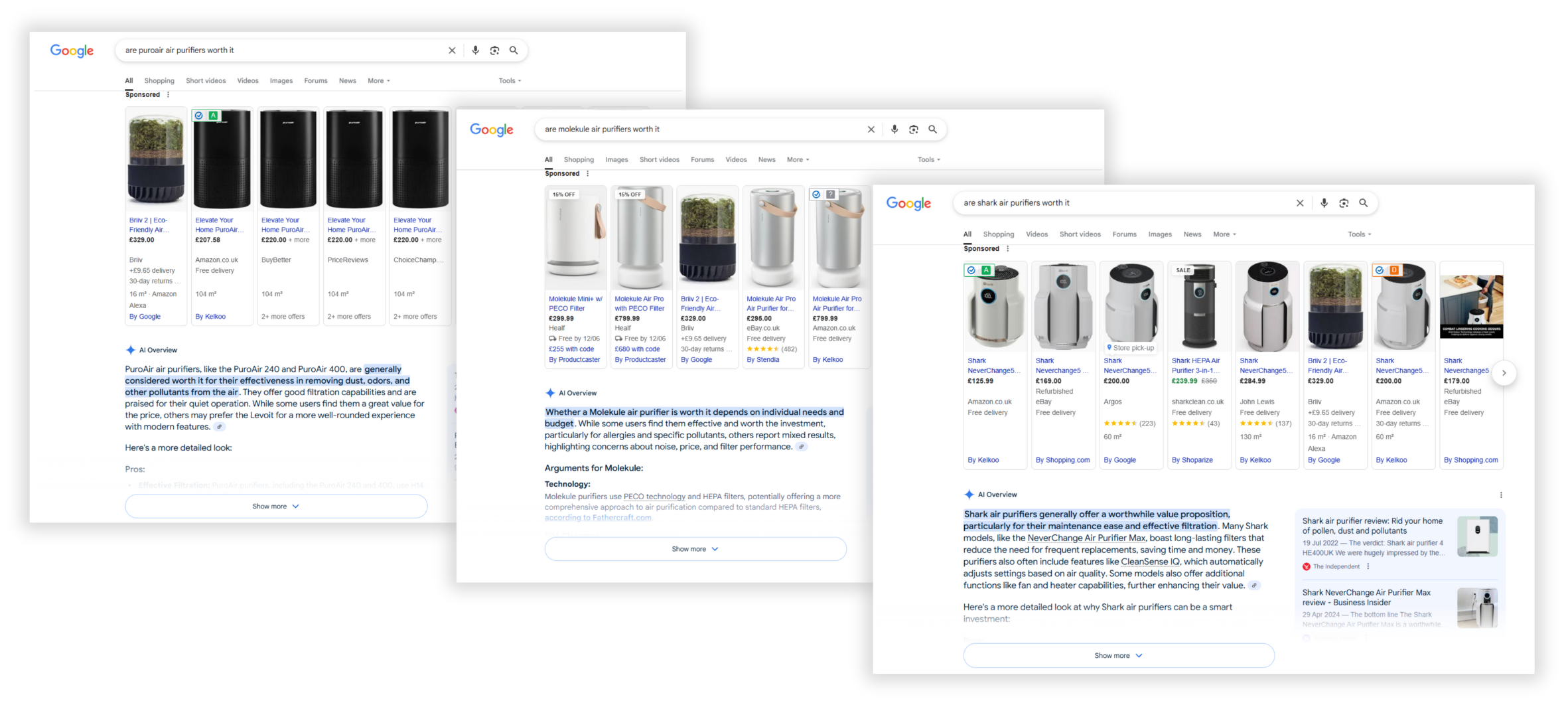
Google’s AI Overviews are regurgitating marketing materials and manufacturer-provided facts, while prominently featuring sponsored product listings on top of their glowing recommendations:
These search results are a reflection of Sundar Pichai’s vision for Google.
When Bloomberg asked Pichai about the concerns regarding the lack of separation between Google’s search and advertising divisions, Pichai stated that “commercial information is information, too.”
You wouldn’t trust a car salesman to tell you what’s wrong with the car they are trying to sell you, would you?
So next time you are researching a specific product, scroll down past the AI Overview, unless you only want to find out what the advertisers want you to know.
Or if you are set on using AI Overviews to research products, then be intentional about asking for negatives and always fact-check the output as it is likely to include hallucinations.
The endless loop of Google searches and advertisements in result pages
Google’s leadership has promised advertisers that AIO will offer users “ads that answer,” and they are delivering on that promise.
In 2024, Google shared its Ads Product Vision for AI Overviews and clearly explained the strategy behind everything we’re discussing today—you can watch the video here:
In the presentation, Google explained that they will be matching ads “not just to the query context, but also the information within the AI Overview.” The presenter goes on to show an example where products are recommended as part of the answers provided by the AIO.
Monetizing your searches with advertisers’ money is a crucial part of Google’s business.
So, if you’ve been using Google for a long time, then you will know that the search results have always included sponsored links.
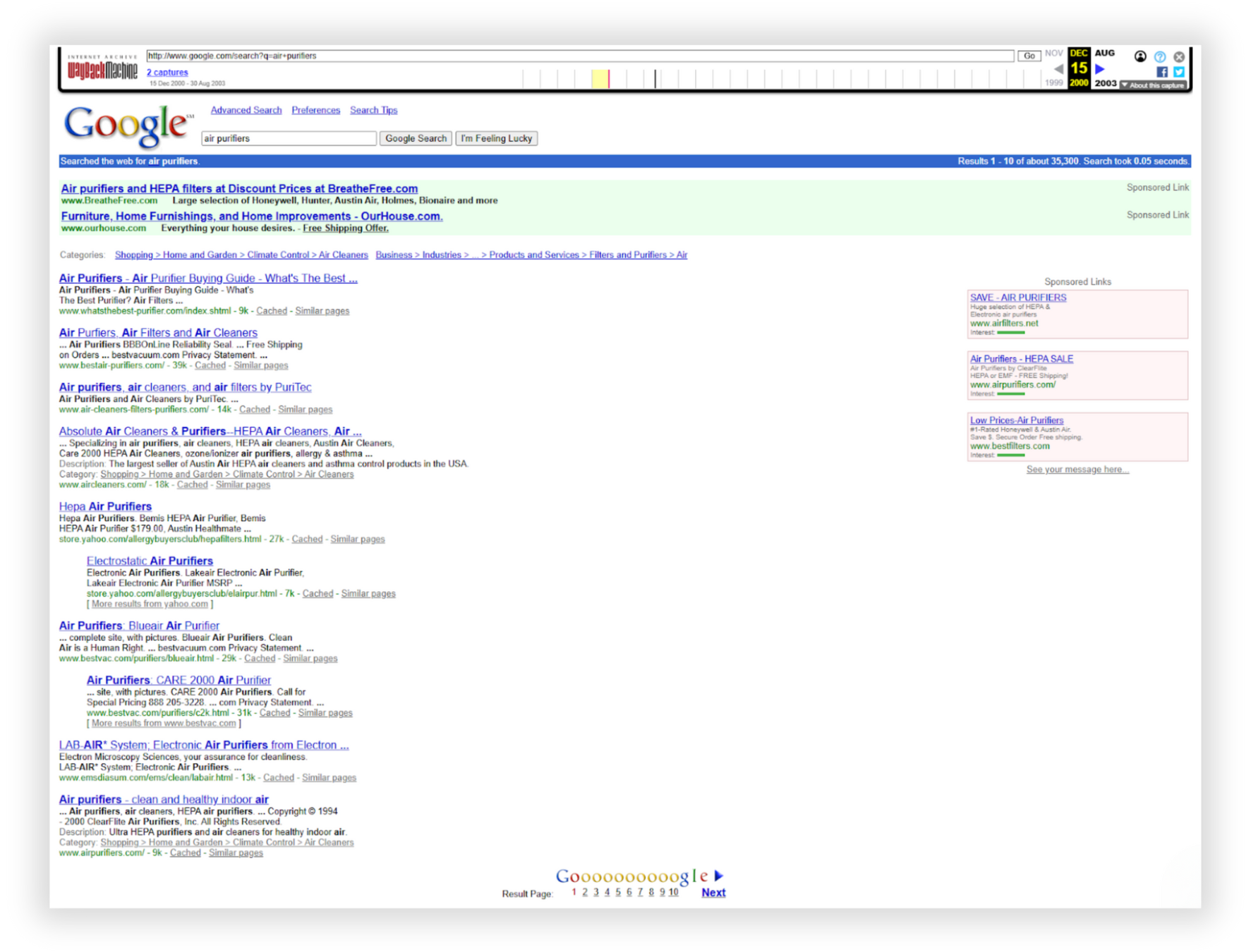
Here you can see the search results page for ‘air purifiers’ back in December 2000:
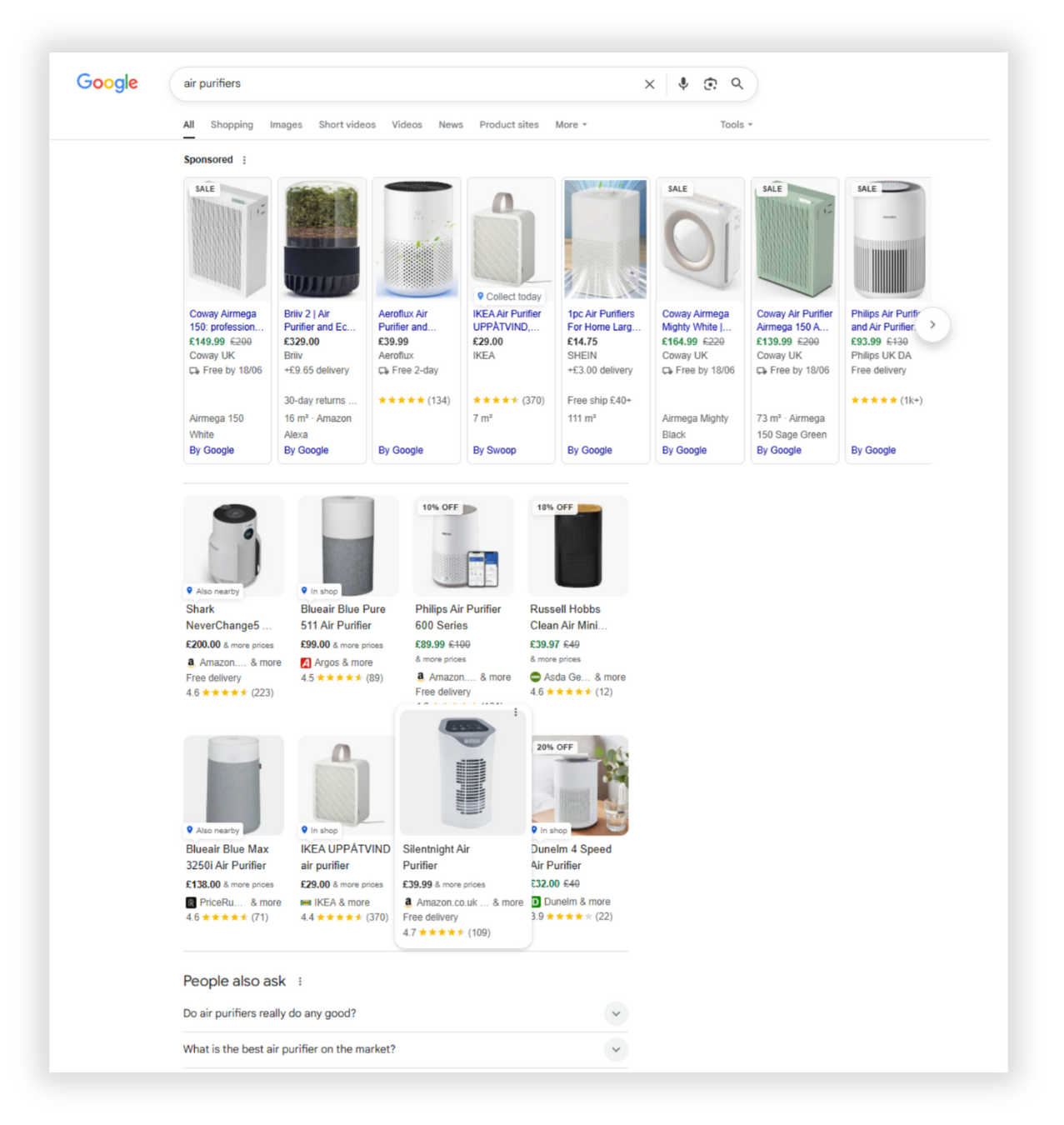
Over the years, Google found new ways to introduce sponsored results leading to what we see in July 2025:
You may argue that someone searching for ‘air purifiers’ wants to see a product and that is why Google has shifted its focus to surfacing products in their quest to ‘satisfy the user.’
So let’s look at a different search term…
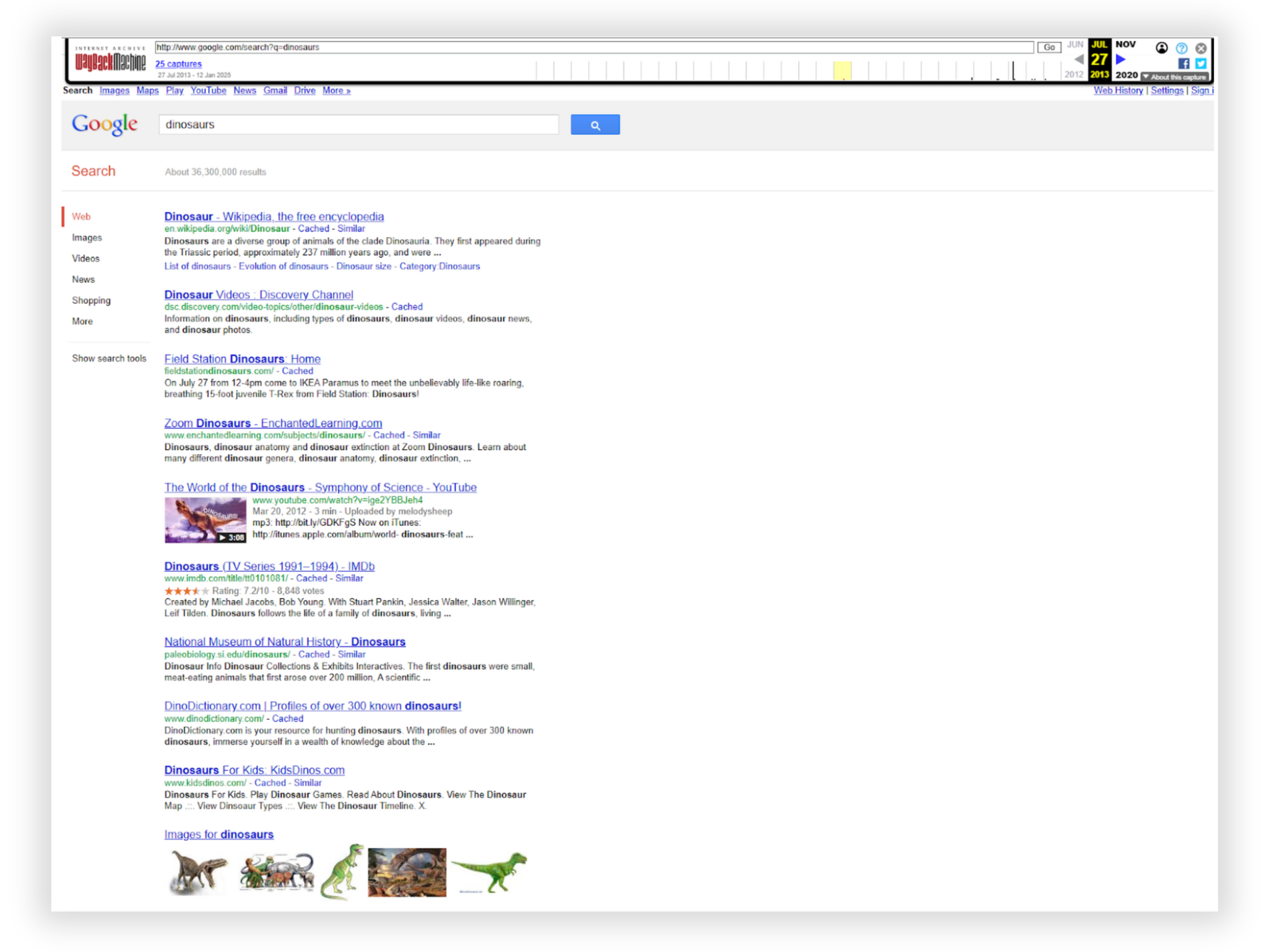
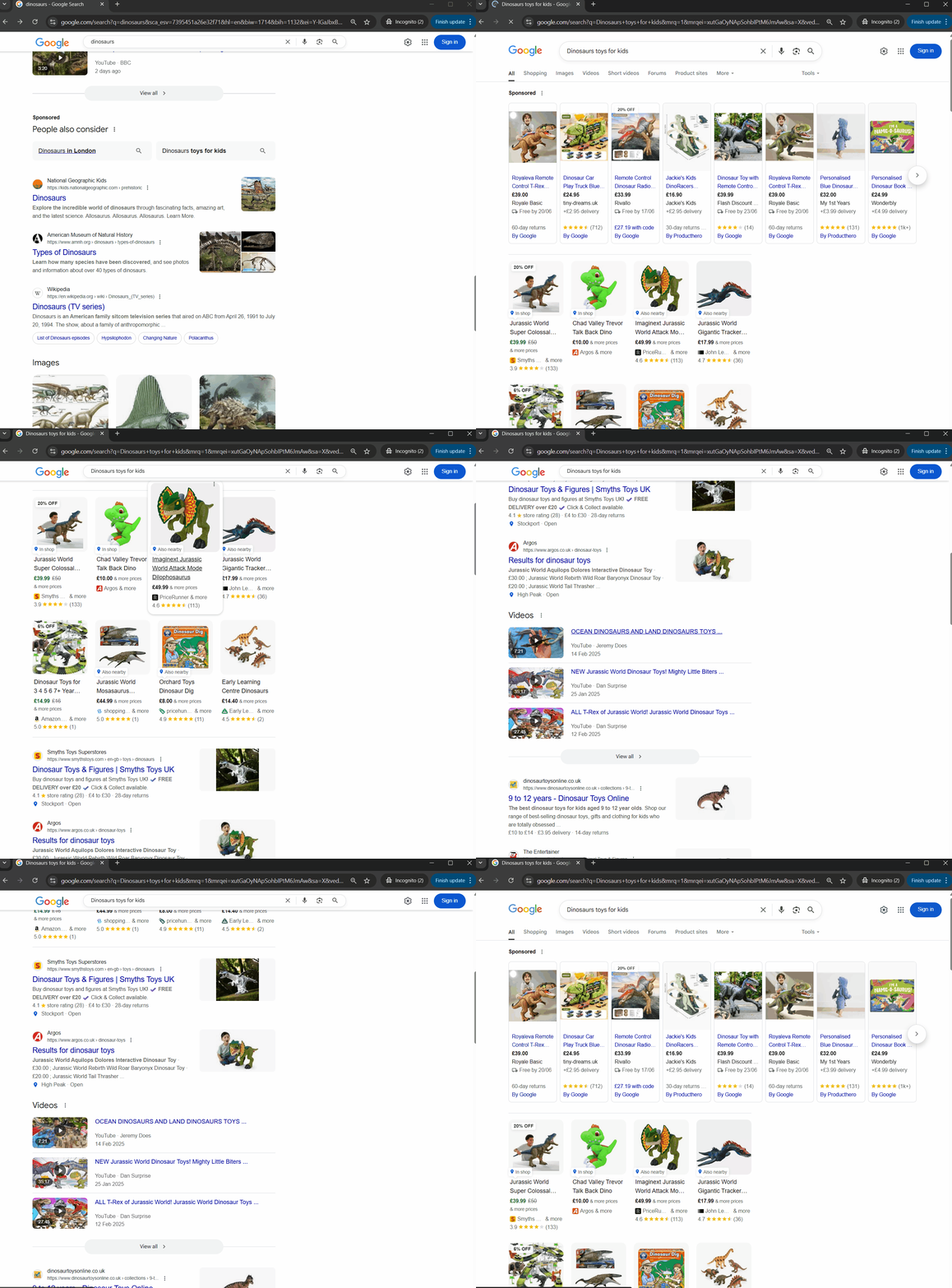
This is what Google used to show people searching for ‘dinosaurs’ back in 2013—9 links to websites, 1 link to YouTube, a pack of Google Images and 8 links to related searches:
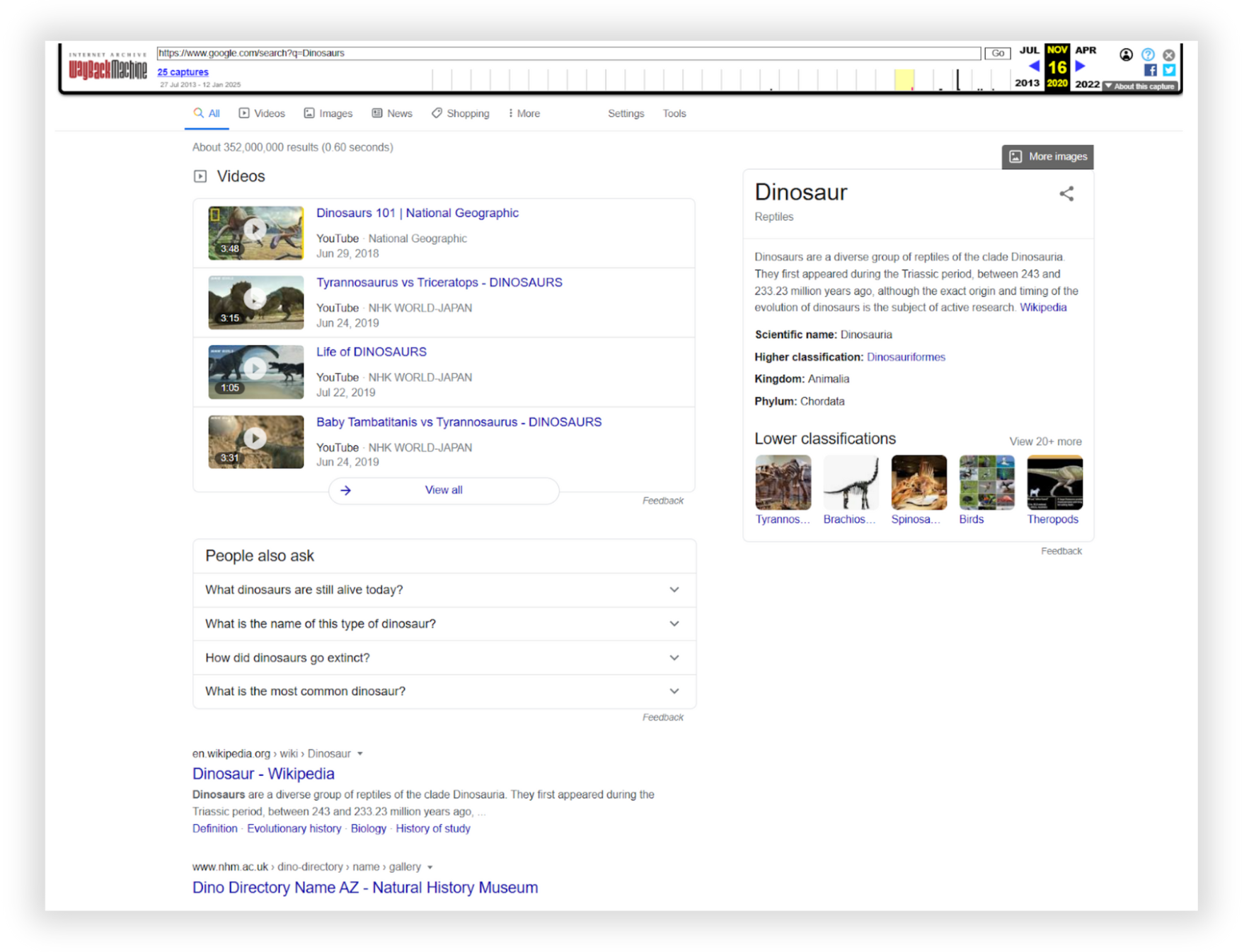
And this is how this page used to look like in 2020 — a prominent Wikipedia information box, 4 YouTube links, 8 links to websites, 3 news articles, 4 ‘people also ask’, and 21 links to related Google searches:
Now, let’s look at Google’s results for ‘dinosaurs’ in 2025.
First, searchers are met with a gallery of 50 dinosaurs, all of which link out to new Google searches:
This is followed by a ‘Sponsored’ carousel featuring 21 shopping ads. It includes links to 6 shops at the end, one of which leads to a search inside Google Shopping:
Next, Google gives you a dictionary definition of the word ‘dinosaur,’ followed by a ‘See more’ button that leads you to a new Google search for ‘dinosaurs meaning’:
Further down, there is a ‘People also ask’ block with four questions, which will continue to expand and add more questions automatically as you click. By the way, the more you click, the higher the likelihood that you will find an AI Overview providing the answer:
Scrolling past the 49 ‘People also ask’ questions that popped up after clicking, you finally get to a good old blue link to the Wikipedia page about dinosaurs, followed by a link to the Natural History Museum’s page about dinosaurs.
After that, you get a video pack with a ‘View all’ link that leads you to another Google search inside of the Videos tab:
Before seeing any other organic result, Google adds a sponsored block called ‘People also consider’ that leads you to two new commercial searches: ‘dinosaurs in London’ and ‘dinosaurs toys for kids.’
At this point, Google will have given you multiple chances to leave this page of results in pursuit of other Google searches.
If you were to still be around, you’d get to see six more blue links, a pack of images, and a block of ‘People also search for’ options that lead you to 14 new Google searches:
One could argue that Google is not only selling you anything you show interest in with its AI Overviews, but it is also peppering its organic search results with an increasing number of ‘features’ that keep you inside of Google and direct you to their advertisers.
On the first page alone, Google has created 69 opportunities for you to trigger completely new queries and 28 opportunities for you to click on an advertiser.
In contrast, you only get 11 chances to leave Google—and three of them are videos hosted on Google’s own YouTube.
Could this relentless push for users to trigger new searches be a driving factor behind Google’s reports of overall query growth during earning calls?
Especially considering that query growth, or more specifically, ‘commercial query growth’ is something investors care about…
In the 2025 Q1 Earnings Call, a representative from Morgan Stanley asked if there were any Search products that would continue to drive further commercial query growth throughout ’25-’26. Google replied, “On the commercial query side, look, AI Overviews continue to drive higher satisfaction and Search usage. […] That’s really the core already of the answer, that AI Overviews sits at the center of your question here.”
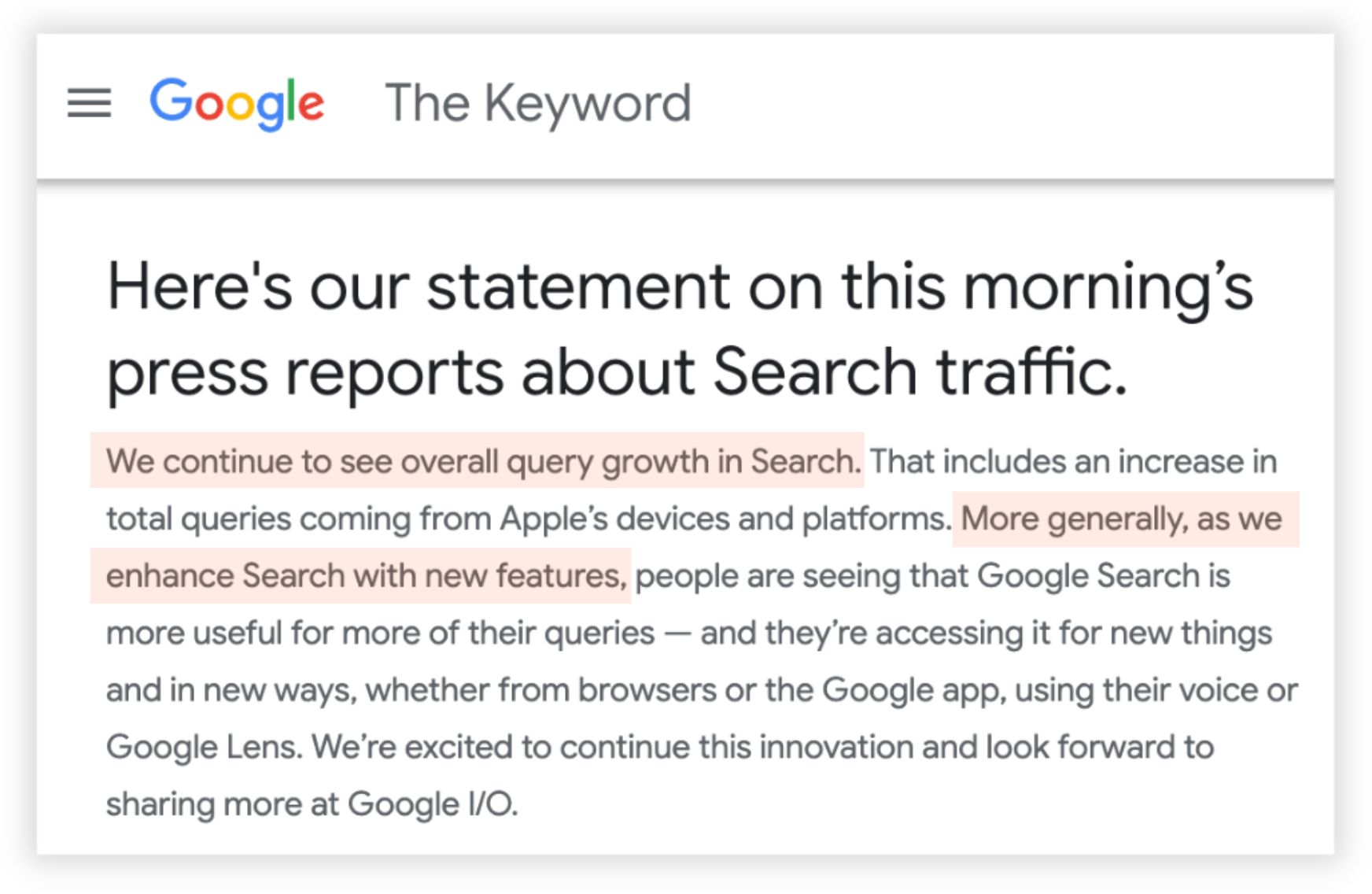
This figure must be very important to investors because Google didn’t hesitate to issue the following statement when Apple’s SVP of Services noted in his antitrust trial testimony that Google searches in Safari fell for the first time ever in 2024:
It must be tough for Google to fulfill their role as a search engine that helps people find their way around the web when Alphabet leadership is so focused on keeping users from leaving the search box 🎻
Google partnered with Reddit and spammers took notice
Now Reddit is on its way to becoming the web’s poisoned chalice—don’t be fooled by their product recommendations.
On the very same day Reddit filed to list on the New York Stock Exchange, Google and Reddit announced an expansion to their partnership.
The $60 million deal was announced on 22 February 2024 and saw Reddit providing Google with programmatic access to their content through their Data API, allowing Google to use this data to train their AI and more efficiently display Reddit threads in search results.
Since then, Reddit has reportedly blown up, with huge traffic figures from search that resulted in logged-out daily active-unique-visitor numbers rising by 70%—these are people who aren’t necessarily Reddit users but passers-by led by Google.
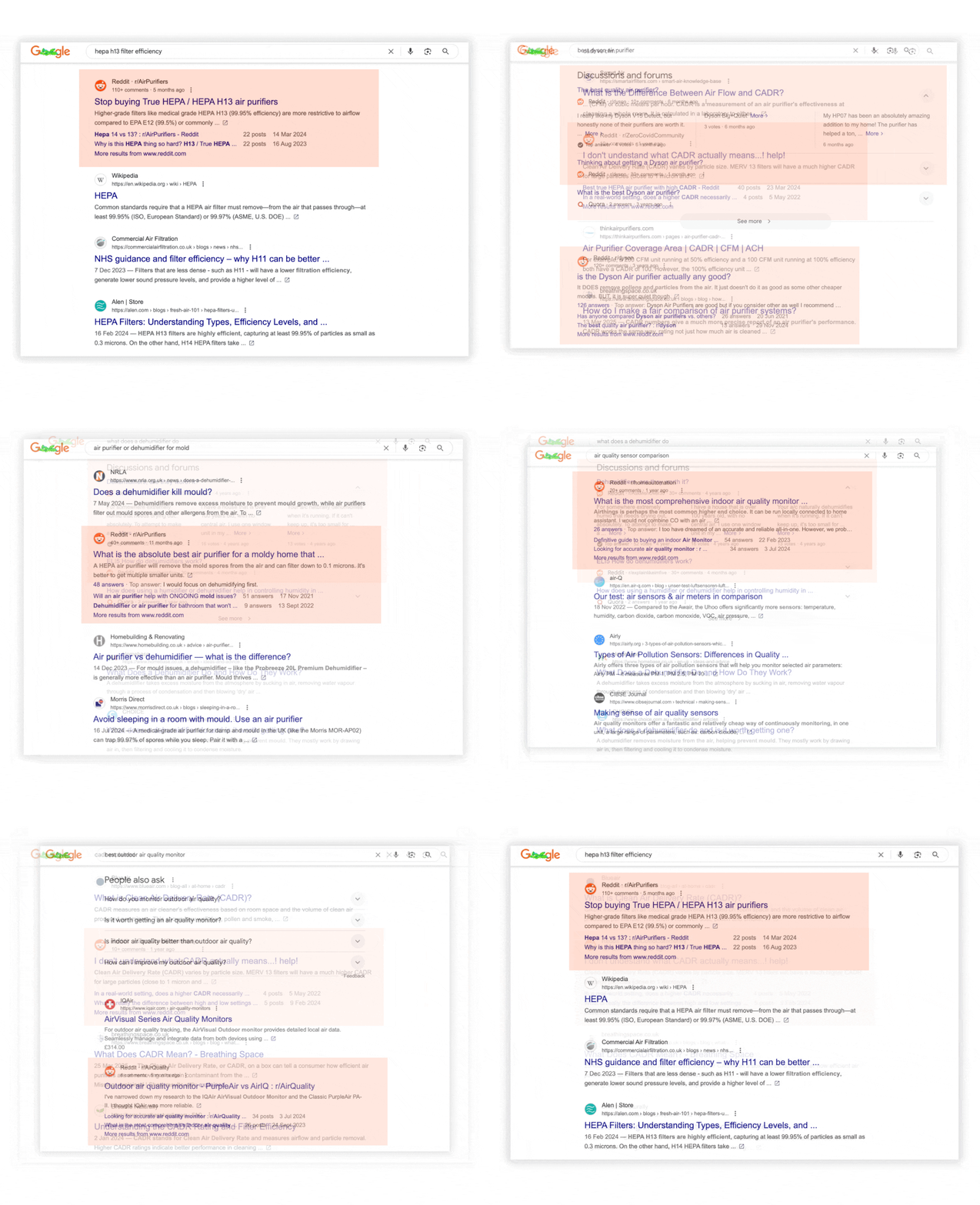
That is why, no matter what you google, you are likely to always find an entire section of search results dedicated to Reddit threads:
And this is particularly true for product reviews. According to research conducted by Detailed, Reddit appears in 97.5% of product review queries.
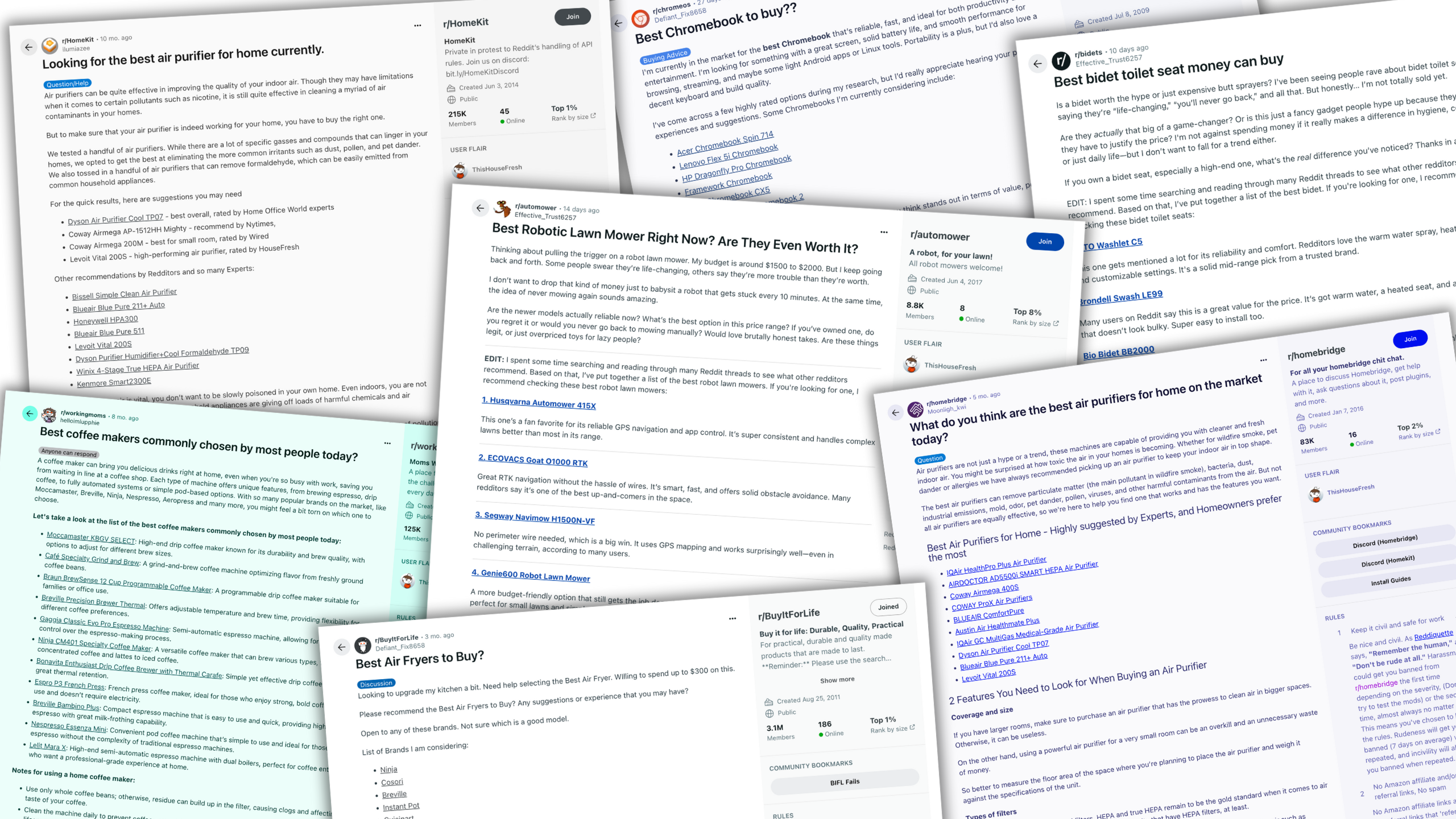
This explosion of Reddit ranking highly on Google could explain why there are so many posts asking for advice on products that go on to include models the OP is “considering” hyperlinked to Amazon listings with affiliate tags, or that have been edited to add “models Redditors recommend” hours after posting the question:
And it may also explain why there are so many Redditors with a post history full of “questions” about products:
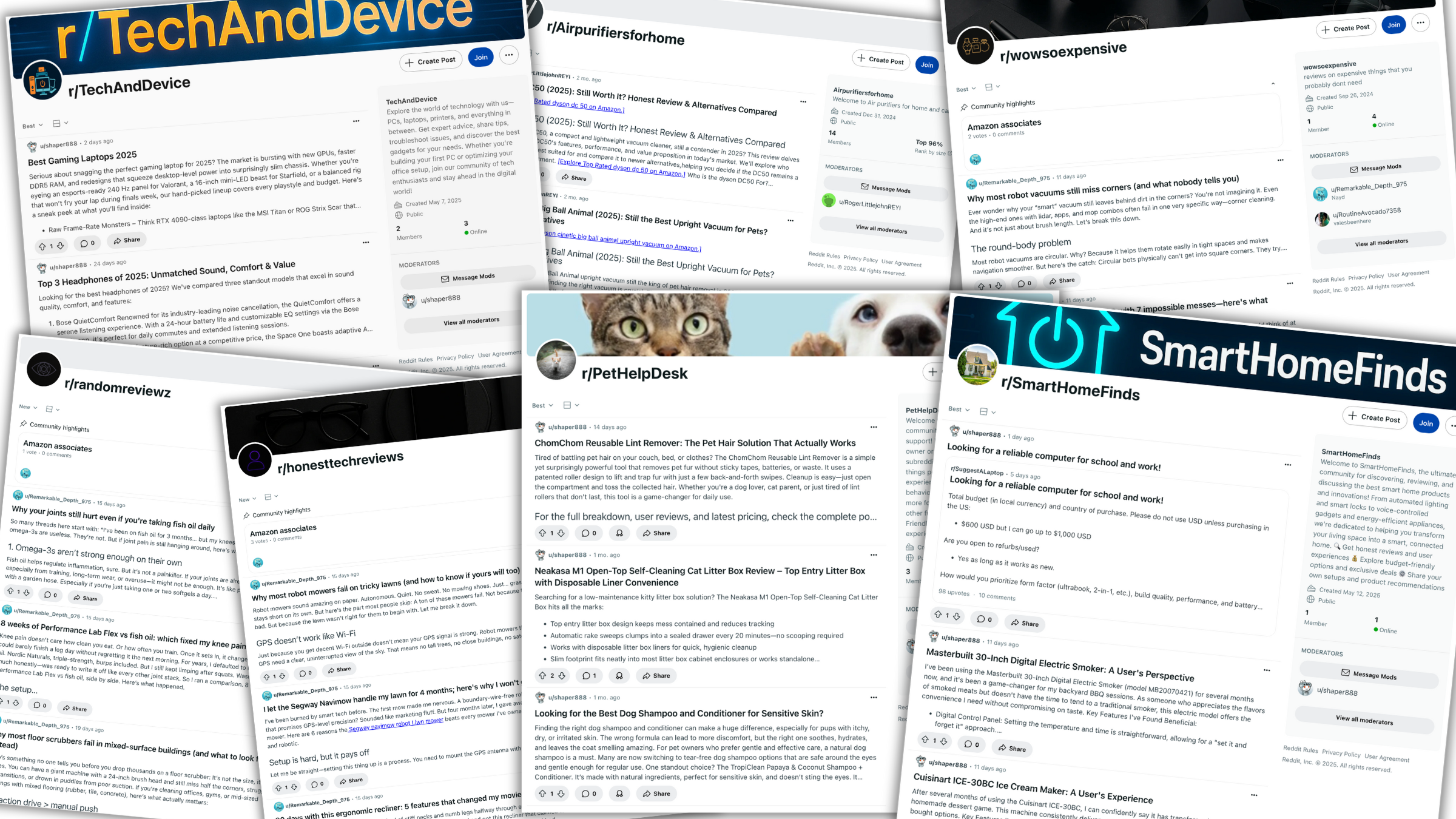
Things got so out of hand that there are now entire subreddits dedicated to product reviews, where every thread is 100% positive about the product, the entire post is written by AI and there is zero engagement from real Redditors:
And even though these subreddits offer no value to users, they are still achieving top rankings on Google just because they were published on Reddit.com:
As if AI slop wasn’t enough of an issue for Reddit moderators, Google has now created a shortcut for anyone wanting to rank on the first page of search results for virtually any keyword.
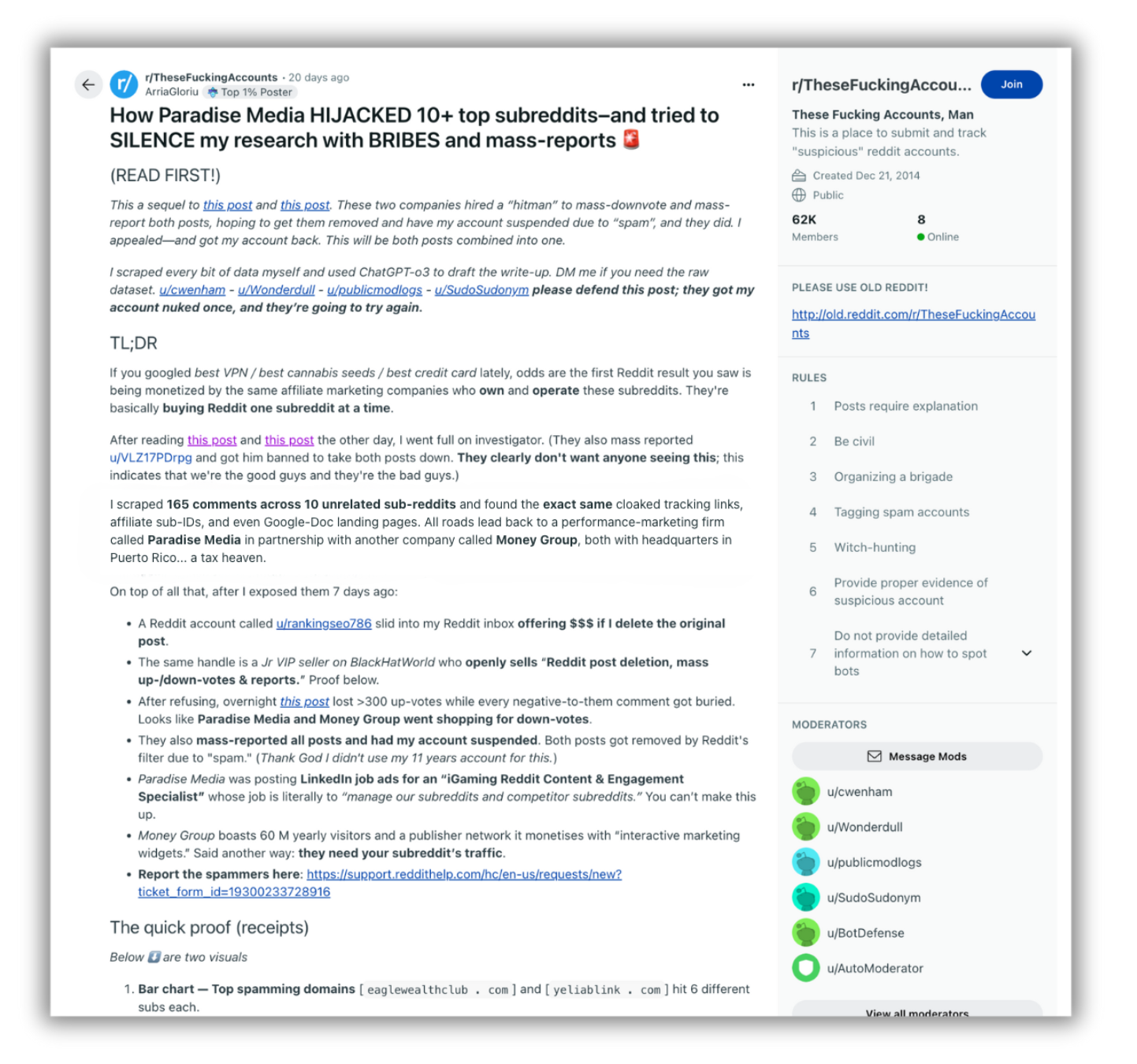
It has gotten so bad that huge subreddits such as r/DebtFree (1.7M members), r/Banking (124K members), r/software (285K members), r/Mattress (114K members) r/Supplements (441K members) have been allegedly infiltrated by affiliate spammers.
A group of redditors has been actively working to uncover this network of bribes, sock-puppet comments, rent-a-mod arrangements and dormant subreddit buying. The latest update to their investigation (now deleted) surfaced two companies that have been found to be involved, and one of them is a company we wrote about in our second Google exposé.
These companies have been caught, and I quote, “buying high-traffic subreddits by buying the moderator accounts or paying for a ‘moderator seat’ to manipulate high-traffic threads and shove affiliate spam down your throat.”
If this is true, then Google has buried real, human-powered websites while boosting Reddit threads created by the very same people who engage in site reputation abuse spam.
Google created a regurgitation machine that is destroying livelihoods
Analyzing the changes in organic traffic to publisher websites between 2023 and 2025.
On 20 May 2025, Google’s CEO, Sundar Pichai, announced AI Mode, a “total reimagining of Search” in the form of “an end-to-end AI Search experience.” Following Pichai’s announcement, Google’s head of Search, Liz Reid, explained that “this is the future of Google Search.”
Google is replacing traditional search results with a ChatGPT-inspired chatbot that regurgitates content from across the web to compile a fully-fledged answer to your question.
Here is a demo published by Google on their blog as AI Mode hasn’t been rolled out in our location yet:
Search marketing experts and web content creators agree that AI Mode is likely to further the damage already caused by Google’s algorithm updates in 2022-2024 and by Google’s AI Overviews in 2024-2025.
Google disagrees.
Over the last two years, high-profile Googlers like Sundar Pichai and Elizabeth Reid have consistently stated that AIO and AI Mode are just additional opportunities for sending traffic to the web:
And this makes sense, considering Google has built its entire business on the promise to send traffic to the web.
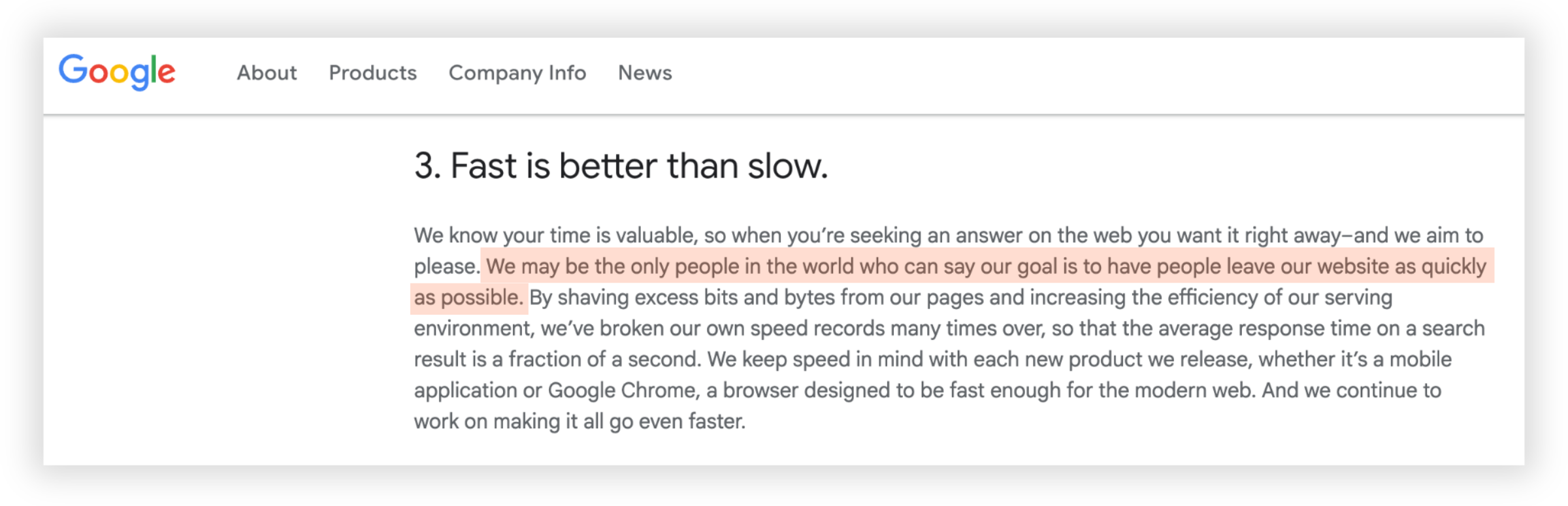
On their corporate philosophy page they seem to brag (?) about how their aim is to have people leave their website:
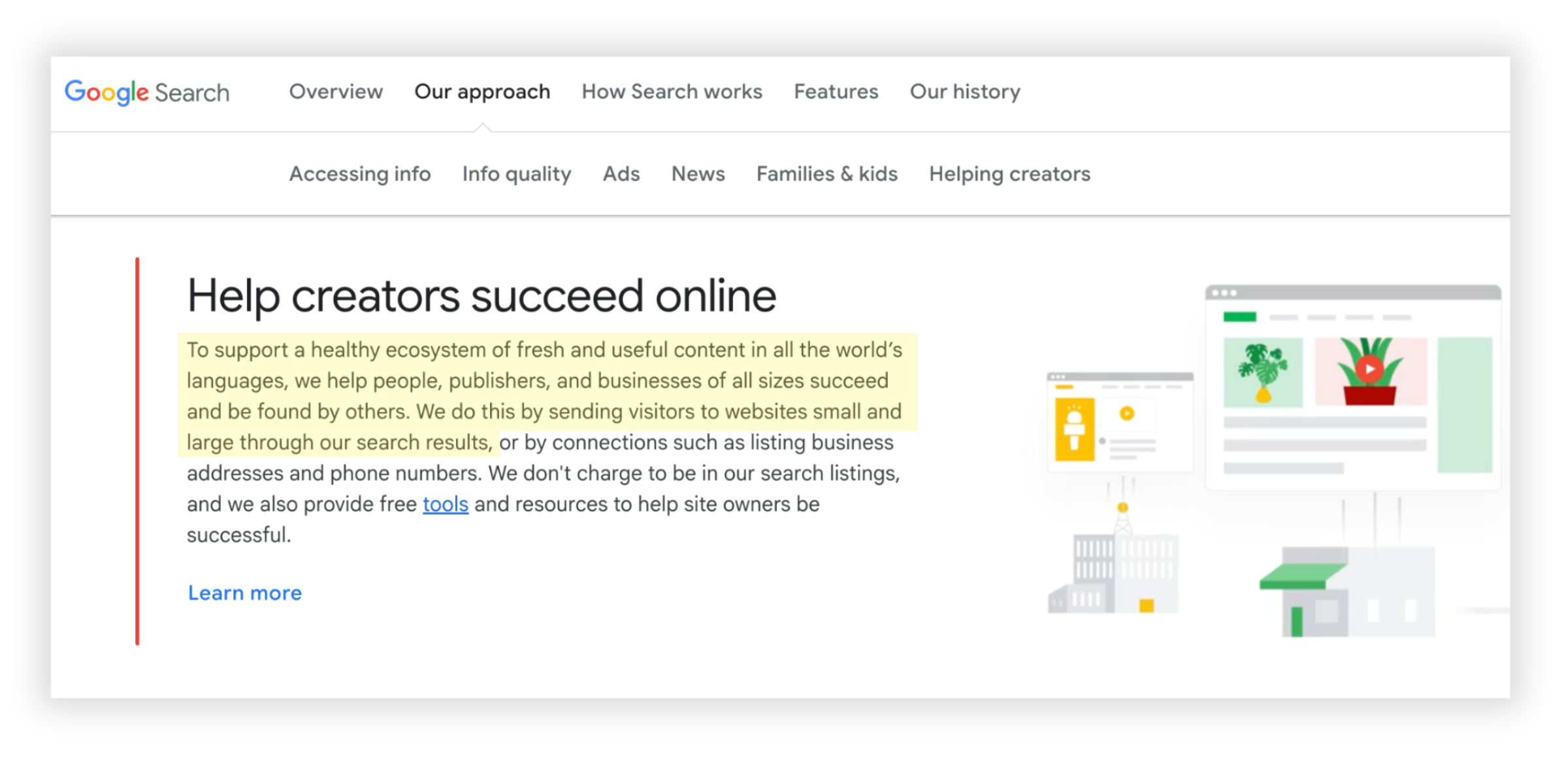
And on this page they clearly explain how they support a healthy web ecosystem by sending visitors to websites:
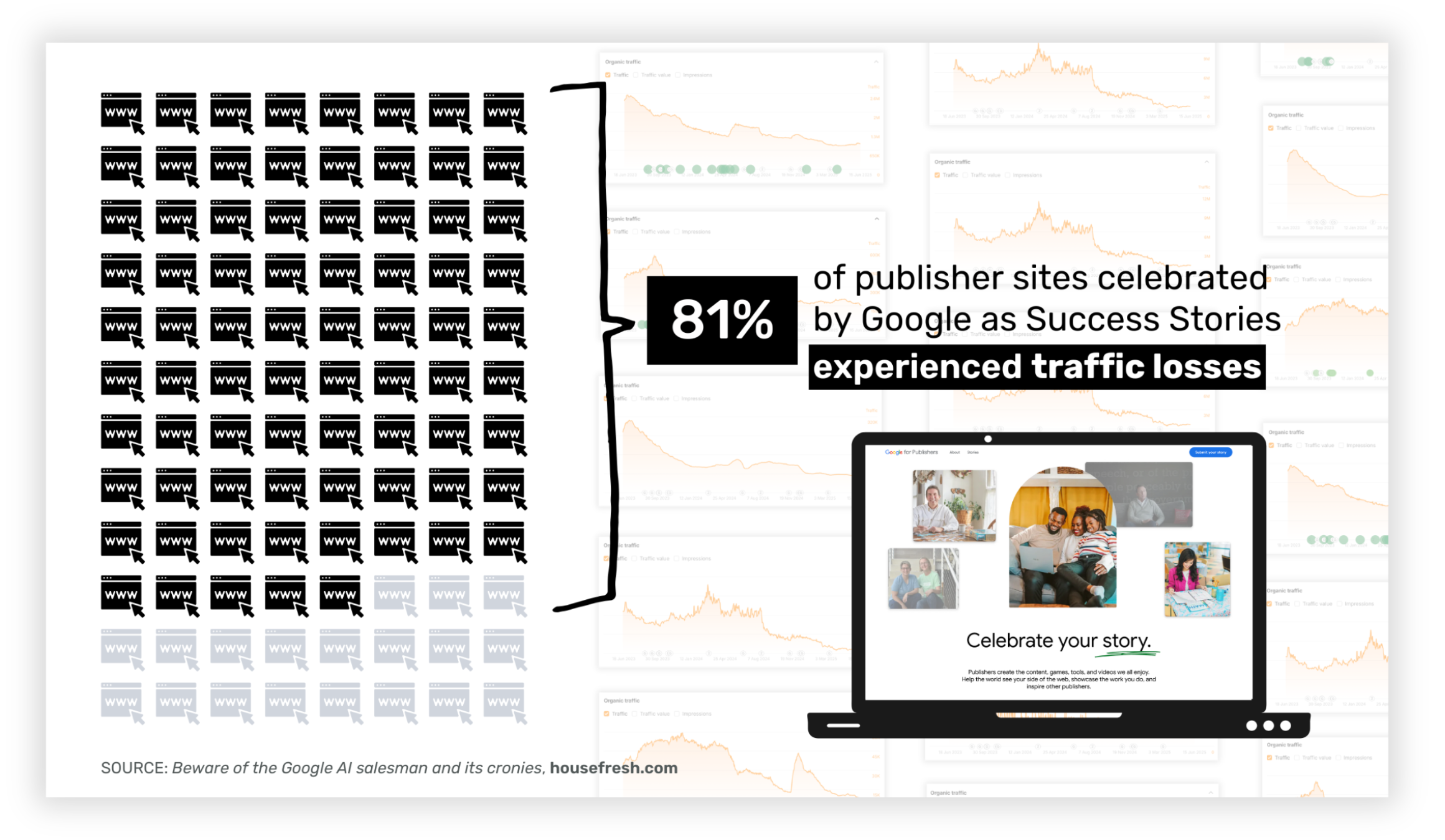
In fact, Google is so committed to helping web creators succeed online that they have an entire section of their website dedicated to celebrating publisher success stories.
This gave us an idea.
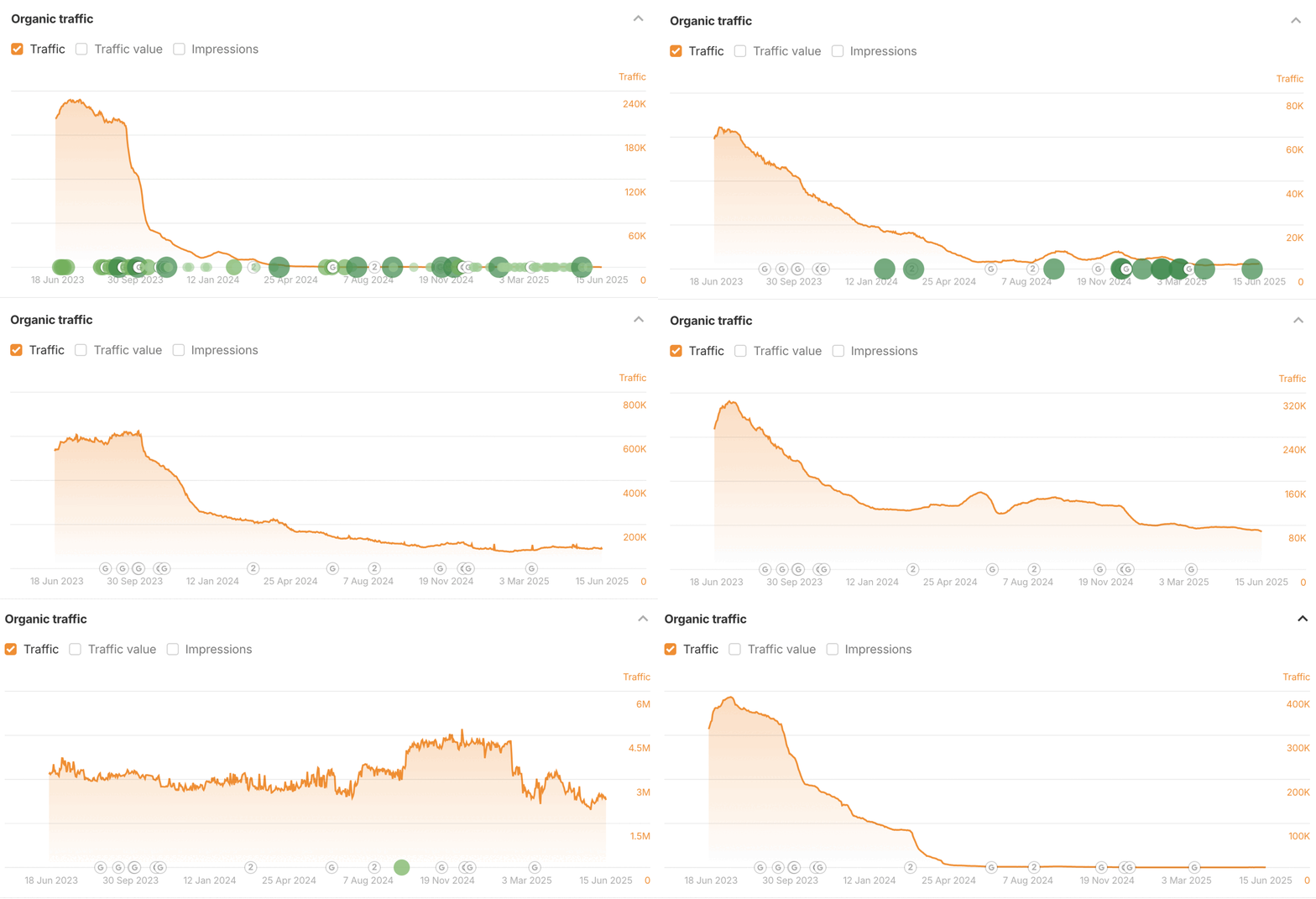
We used a marketing tool called Ahrefs Site Explorer to estimate search traffic figures between 15 June 2023 and 15 June 2025 for all English-speaking independent publishers highlighted in Google’s Success Stories between 2022 and 2024.
Our data shows that 81% of publisher sites celebrated by Google have experienced traffic losses since 2023.
These are websites belonging to businesses that Google not only highlights as ‘Publisher Success Stories’ but also includes in their Economic Impact Reports.
The shocking story of Charleston Crafted clearly shows how misguided it is for Google to be parading websites in times like these.
The very next day after a Google photographer visited their home for a photoshoot, Morgan and Sean saw their Google Search traffic starting to tank. Within a few weeks, Charleston Crafted experienced a traffic drop of 74%—this can have life-shattering consequences for a web creator.
It has been 339 days since a Google photographer came to our house for a photoshoot.
The very next day, our 12-year-old business began to unravel.
Of course, that didn’t stop Google from featuring their website prominently as a shining example of how “Google helps South Carolina businesses move toward their goals.”
However, one could argue that websites celebrated by Google as Publisher Success Stories are not representative of the wider web.
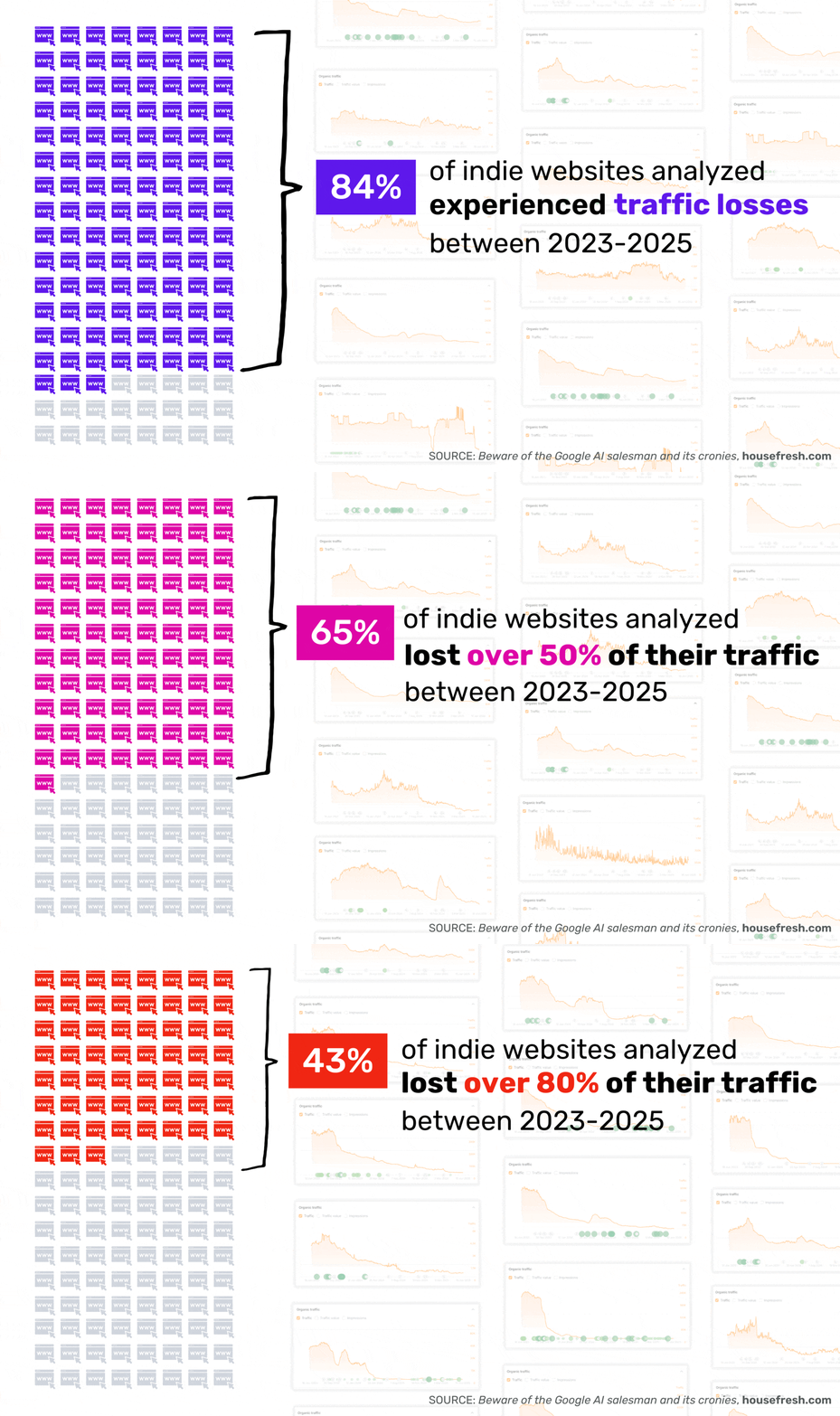
84% of independent web creators analyzed have experienced traffic losses, with 43% of sites receiving 80% less traffic from Google Search between 2023 and 2025.
But why stop there?
To build a more robust and balanced dataset, we filled in the gaps with the help of Detailed’s rankings of “the world’s most successful and profitable blogs.” We pulled the top 10 URLs from each of the categories, including web publishers that are much larger and, in many cases, part of big media companies. Blogs belonging to retailers, sites that have been acquired+redirected and blog sections of corporate websites were removed.
The final list included 507 web publishers across 43 categories, ranging from small travel blogs like Between England & Everywhere to huge reputable magazines like Allure.
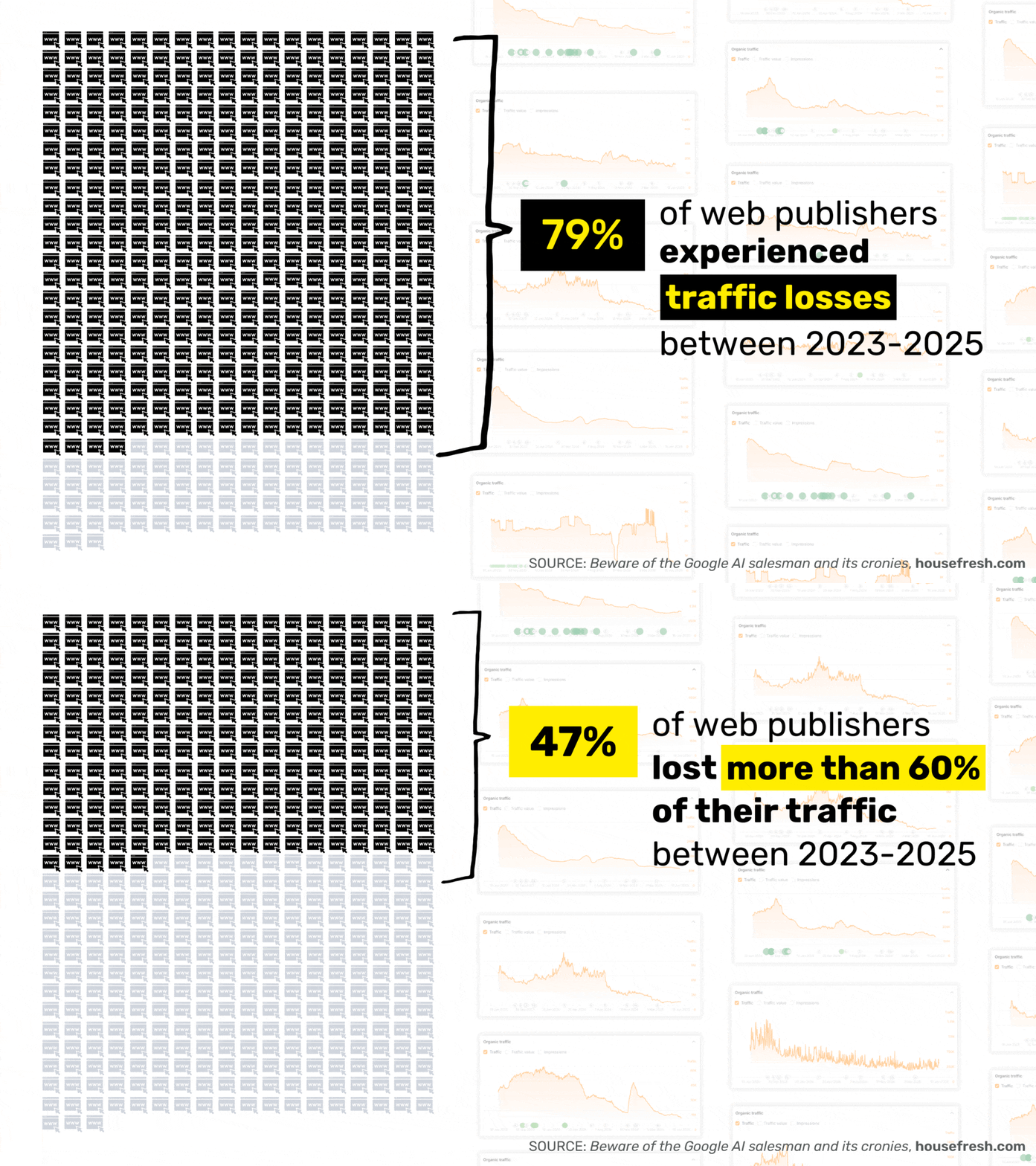
Our data shows that nearly four in five web publishers have experienced traffic losses since June 2023, with almost half of all websites analyzed seeing traffic from Google Search dropping by at least 60%.
Websites drown, Reddit thrives
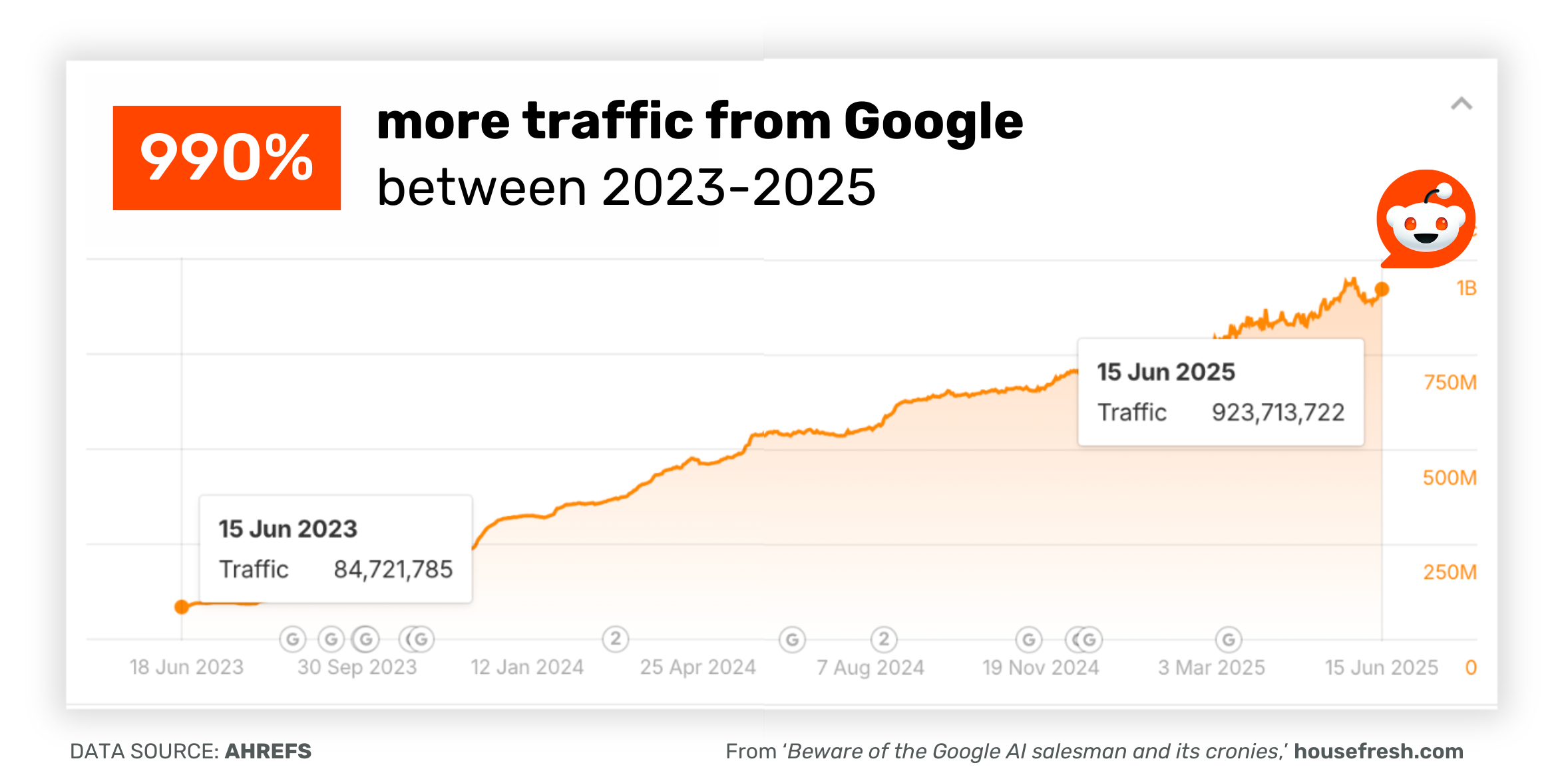
While 79% of web publishers experienced traffic losses between 2023 and 2025, Reddit saw their traffic from Google Search grow by 990%.
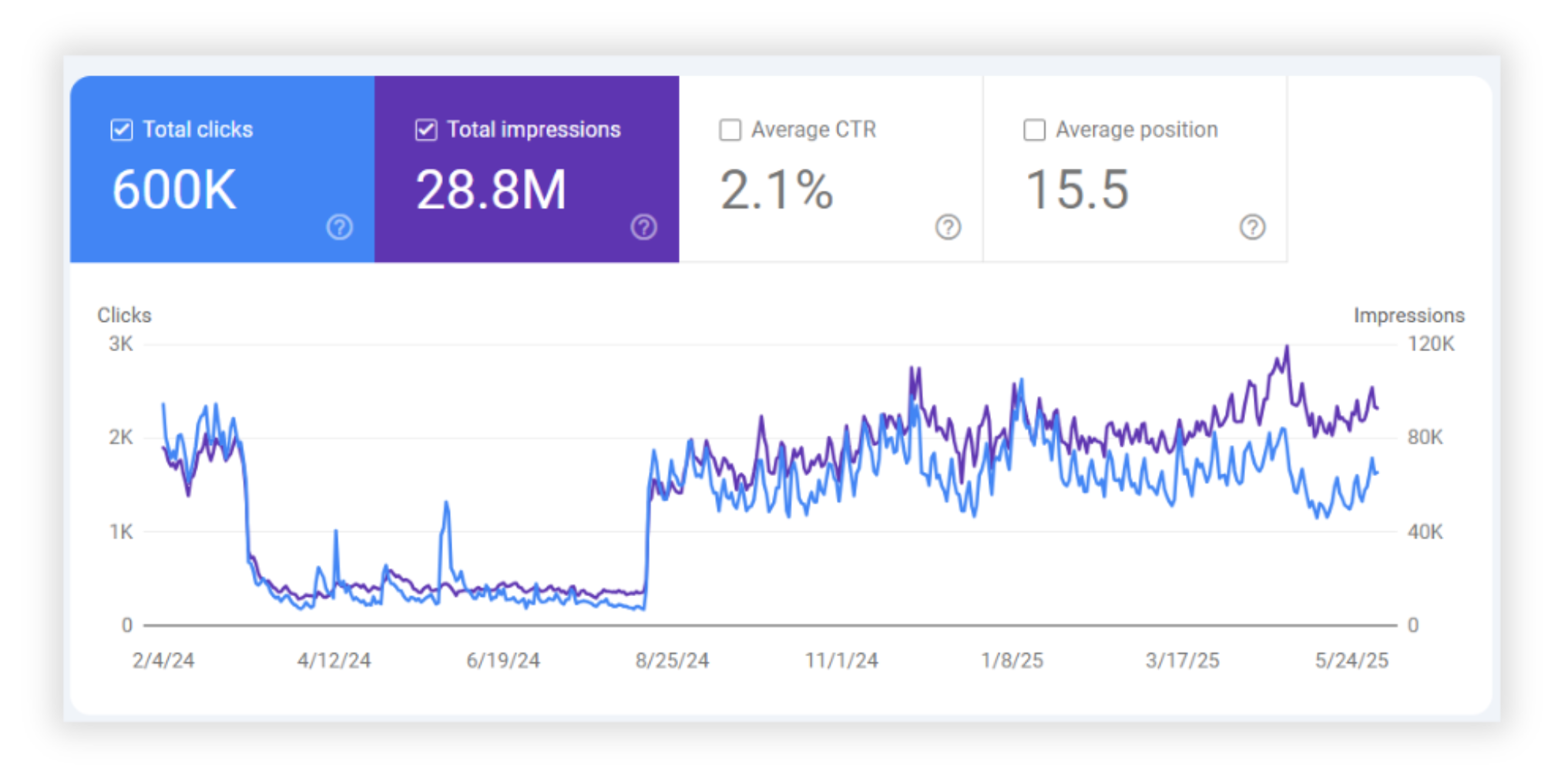
As if this loss of traffic wasn’t enough, websites around the world report experiencing “the great decoupling,” a phenomenon through which impressions in Google Search are trending up while clicks are trending down.
This widening gap between impressions and clicks can be explained by the fact that Google is regurgitating our content as part of their AI Overviews and users are consuming the information without clicking through to visit our websites.
And this is not just us saying it; Google has confirmed as much.
A few weeks ago, Martin Splitt from Google took the stage at Google Search Central Live 2025 in Warsaw and he explained, “Likely your impressions are going to go up if you are shown in AI overviews or AI mode. Um clicks are likely to stagnate or fall a little bit.”
This will only accelerate the death of web publishers at the hands of Google’s carefully planned decisions. And while this happens, Google users could experience a rise in commercial information and defamatory hallucinations being presented as unbiased facts.
If you’re a website owner or web publisher, we want to hear from you.
Please, complete this form so we can add your website to our growing dataset of web publishers being positively or negatively affected by Google’s changes since the rollout of the infamous Helpful Content Update in 2022.
Google has broken the implicit reciprocal deal it made with web publishers
From an intermediary between searchers and websites, to a wannabe all-knowing answer engine.
To use Google’s own words, a healthy web ecosystem needs “fresh and useful content in all the world’s languages” and Google’s role in this ecosystem is to “send visitors to websites small and large through search results.”
As the founder of Travel Lemming, Nate Hake, wrote in his must-read letter to the FTC, “Google created a social contract with the online publishing industry: publishers provide content for Google to crawl and, in exchange, Google sends valuable clicks back to publishers.”
However, what started as a tool that helped internet users navigate the web (and a road through which websites could be found by searchers) is now morphing into an answer engine that, according to Google’s Liz Reid, will function as “an all-knowing friend.”
As the co-founder of Inspired Taste, Adam Gallagher, said in his recap of the latest Google Publisher Meetup in June 2025, “Google is now pursuing two opposing paths, creating a clear division between organic Google, which wants more quality content, and AI Google, which assumes fair use of that content. This model is unsustainable.”
Google wants to have its cake content and eat it too.
Web publishers are the only reason why Google is able to build an answer engine in the first place, but we are now being starved of the very traffic Google loves to boast about sending our way.
The concept of zero-click searches is not new but in 2025 it has become very real.
A zero-click search happens when you search for something on Google and get your answer at the very top of the page, without the need to click or visit any other websites.
This might seem like a convenient way to access information but please don’t take the answer as it comes. Always fact-check and be critical about the sources, especially when looking for information about products.
Watch this video for some excellent tips on how to identify if the product review you’re about to trust should be trusted in the first place.
In the age of Big Tech feeding large language models with stolen information in order to sell you the dream of AI, Alphabet decided to kill its golden goose and, with it, the free and open web that created the conditions for Google Search to thrive.
Now, if you want to get rid of AI Overviews and a good number of Google’s widgets and features, you can use udm=14 to skip the crap and access results in the Web tab without having to hunt for it.
You should also try logging out of your Google account.
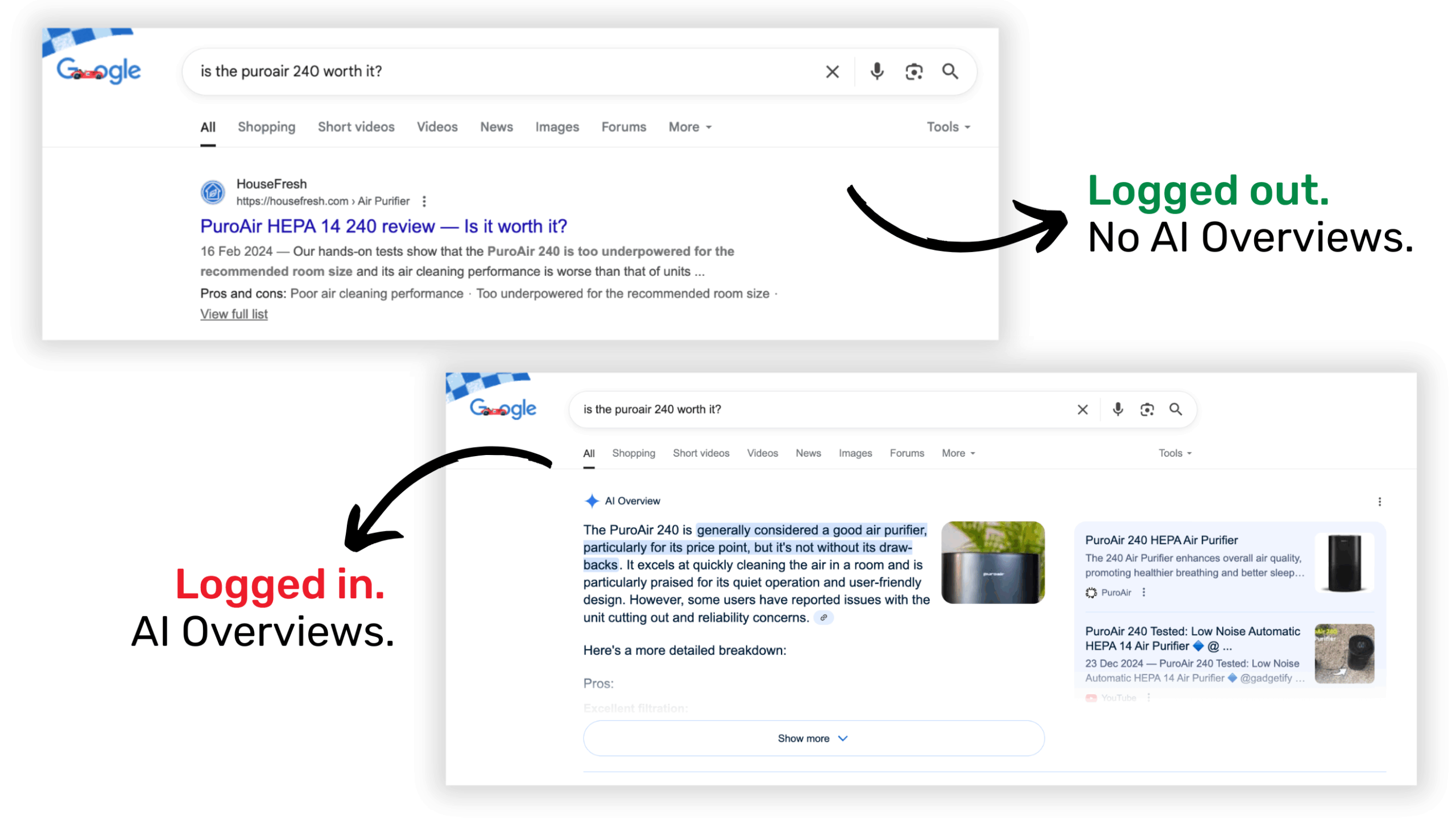
While conducting our research, we found that when we were searching for information on Google.com without being logged in, we were served with cleaner results and the AI was nowhere to be found.
Logging out will also help add a layer of privacy to your searches. You don’t need to be logged into an account 24/7 to use your browser or your search engine—the only ones who need you to log in are Google and the advertisers.
CHANGE YOUR DEFAULT SEARCH ENGINE
Google has been the search engine by default for many years—partly because it was good and partly because it paid a lot of money to be the default in all our devices.
But there are other search engines, each with its own index and mission. I use DuckDuckGo on mobile and Kagi on desktop, but you might find a different option that delivers the results you have been missing.
Web browsers are set as the default just as search engines are.
According to the latest Cloudflare data, Google’s own Chrome accounts for 68% of HTTP requests so it wouldn’t be surprising if your devices have Chrome as a default.
If there’s anything we have learned through the multiple antitrust cases Google is fighting right now is that the company holds multiple monopolies.
That explains why you write your emails inside a Google property, save your work documents inside a Google property, consume video content inside a Google property, keep up with your calendar inside a Google property, browse the web inside a Google property… You get the idea.
Here are a few videos on how to de-Google your life:
Search engines and web browsers are just tools, so use them accordingly.
We don’t know what the future will bring but we know what Google thinks should be our future.
If you made it all the way down here and are upset about the current state of the web, do not go quietly to its funeral. Speak up in whichever way you can. As long as there are people who want to share information with one another, there is hope for the web.
Every day, the average adult inhales approximately 11,000 liters of air. But while getting outside and breathing in fresh air has numerous health benefits, the reality is that not all air is good for you. Airborne pollutants are one of the greatest sources of toxic exposure known to humankind and according to one estimate from the World Health Organization, air pollution contributes to seven million premature deaths worldwide every year.
Of special concern is fine particulate matter (PM2.5) — airborne particles from engines and other emissions that are less than 0.033 the diameter of a human hair. These particles make their way to the deepest parts of your lungs and can get into your bloodstream. Cigarettes emit ten times more PM2.5 matter than diesel car exhausts, according to a controlled experiment reported by Tobacco Control. But while quitting smoking reduces exposure to toxins and improves overall health, it is harder to avoid the toxins that pollute the indoor and outdoor air.
Air quality varies significantly around the globe, and in many parts of the world, the negative health effects of poor air quality are equivalent to smoking hundreds of cigarettes a year. To better communicate the health risks of air pollution, we used the latest data to calculate the number of cigarettes people around the world are indirectly smoking due to poor air quality.
We found the average PM2.5 concentration data in 2024 for the most populated cities in every country, according to data from IQAir.. Then, we used Berkeley Earth’s rule of thumb, that one cigarette approximates to 22 µg/m3 PM2.5 concentration. With this reference, we multiplied the result by 365 days to obtain the yearly number of cigarettes indirectly smoked in each location.
Key findings
Many cities with the worst air quality are in developing economies in the Middle East, Southeast Asia and Africa.
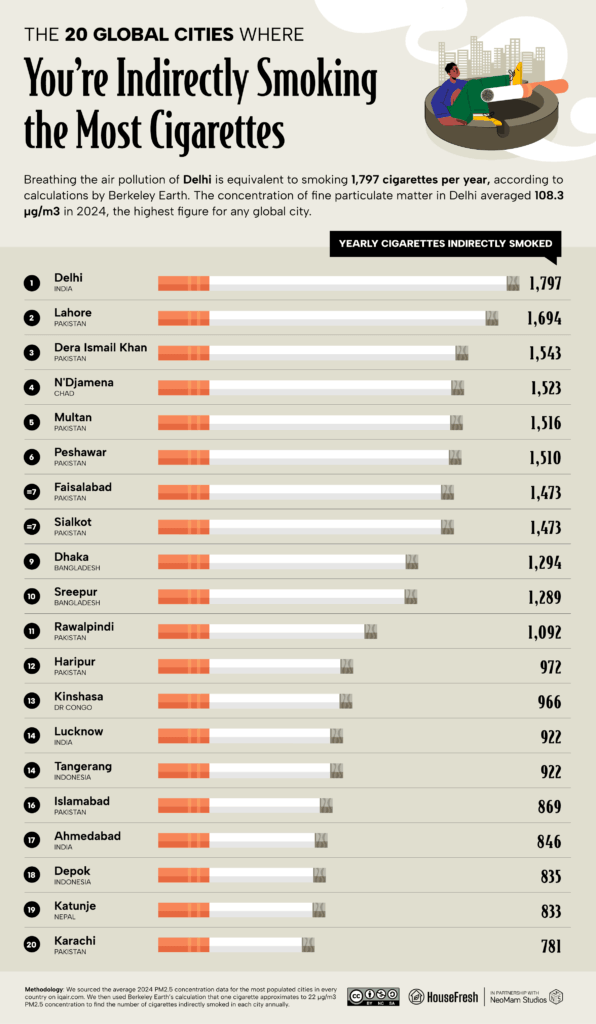
Delhi in India has the worst air pollution of any major global city — the equivalent of smoking 1,797 cigarettes per year.
The capital city with the best air is Nassau in the Bahamas, where PM2.5 levels are equivalent to smoking 38 cigarettes yearly.
Boise, Idaho, has the worst air of any major U.S. city — at the equivalent of smoking 171 cigarettes per year. Boise is followed by Fresno (169) and Los Angeles (168).
Breathing Delhi air is like smoking 1,797 cigarettes per year
The level of air pollution in the Indian capital is equivalent to smoking 35 cigarettes a week.
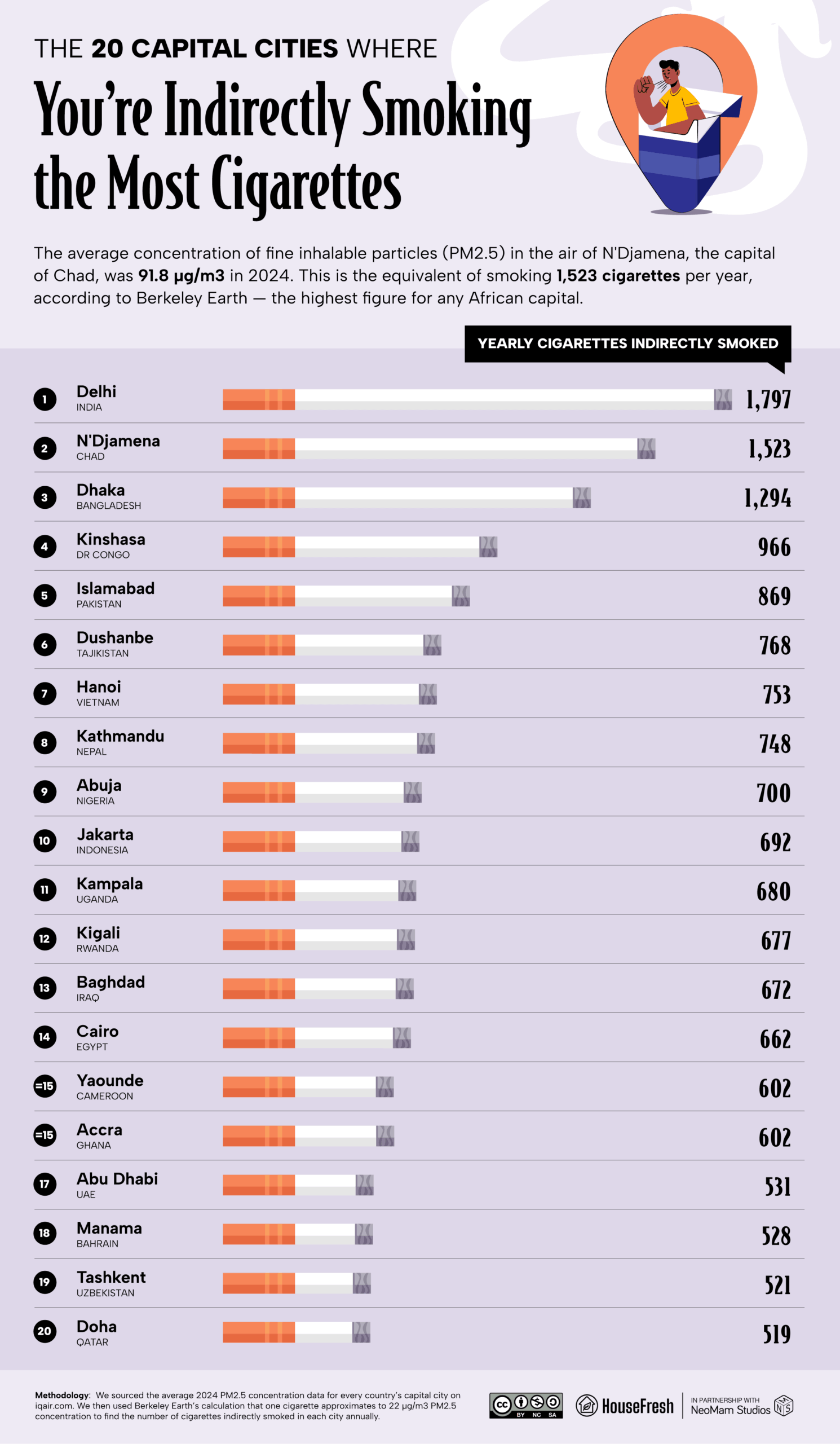
First, we sourced the average PM2.5 levels for every major city worldwide in 2024. These are measured in µg/m3 or micrograms per cubic meter of air. The 20 cities with the worst air all breathe the equivalent of at least 15 cigarettes per week. The worst air of all is India’s capital, Delhi, where average PM2.5 levels of 108.3 µg/m3 equate to 35 cigarettes per week or 1,797 per year.
Breathing the air pollution in Delhi in 2024 was equivalent to smoking 1,797 cigarettes a year — the highest among over 700 cities analyzed. This chart shows the top 20 cities where pollution equals the most indirect smoking.
Eighteen of the top 20 capital cities with the worst air are in Asia, and the other two are in Africa
To get a comprehensive global view, we narrowed our focus to the world’s capital cities.
Delhi has leaped to the top of the table in 2025 with more than twice the PM2.5 levels than in our 2024 report. Researchers have found that local humidity levels may have obscured the true level of particulate matter in Delhi’s air in previous years.
“The air is killing us all. The government is leaving us to die so that India can grow big. Every year more cars, more buildings, more rubbish, more factories, filling the air with filth – is that worth more than our lives?”
In 2024, air pollution in the capital of India exposed residents to the equivalent of smoking 1,797 cigarettes annually — the highest among capital cities in our study. This chart ranks the top 20 capitals by indirect cigarette exposure due to PM2.5 pollution.
The only non-Asian or -African capital city among the 30 capitals with the worst air is Sarajevo, Bosnia and Herzegovina, where the pollution is equivalent to smoking 511 cigarettes yearly. UNICEF reports that the effects of air pollution cost “over 21.5 percent of BiH’s GDP through lost work and school days, and healthcare costs.” The U.N. Environment Programme attributes Sarajevo’s poor air to “heavy traffic, poor spatial planning, solid-fuel based heating and natural factors are to blame for the poor air quality.”
Boise, Idaho, is America’s most air-polluted major city
And for some Californians, breathing local air is like smoking 169 cigarettes annually.
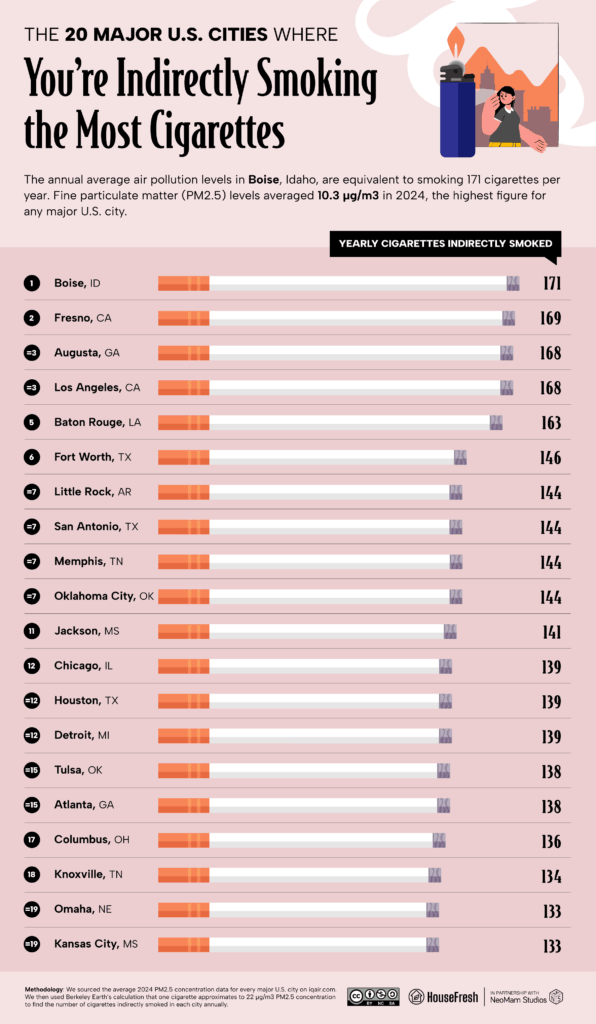
Next, we looked at the average levels of fine particulate matter in the air of America’s major cities.
Two of the three cities with the worst air are in California. Just 6.0% of adults smoke tobacco in California, but in Fresno, residents indirectly smoke the equivalent of 169 cigarettes per year, and in Los Angeles, that figure is 168. Local emissions policies have reduced the amount of fine particulate matter that Californians inhale by 65% in 25 years. However, an increase in the number and spread of wildfires has significantly reduced local tree cover, releasing carbon dioxide into the air and inhibiting the natural cooling of the local environment.
In 2024, Boise, ID topped the list of major U.S. cities for air pollution exposure — equal to smoking 171 cigarettes per year. This chart ranks the top 20 cities by indirect cigarette exposure from PM2.5.
We found that the city with the highest PM2.5 level is Boise, Idaho, where an average density of 10.3 µg/m3 means the equivalent of smoking 171 cigarettes per year for Boise residents.
The city is reeling from one of the worst wildfire seasons of recent years. On July 23, 2024, the city’s Air Quality Index (AQI) score reached 227 AQI, the first time it has crossed into the “very unhealthy” category in a quarter century.
“Unfortunately we’re downwind from a lot of the California and Oregon fires, so smoke not only gets funneled here, but it can get trapped in the valley.”
— Brittany Brand, director of Boise State University’s Hazard and Climate Resilience Institute
Liverpool’s air is like smoking 171 cigarettes per year
The Merseyside capital is UK’s worst city for PM2.5, but southern coastal cities also suffer.
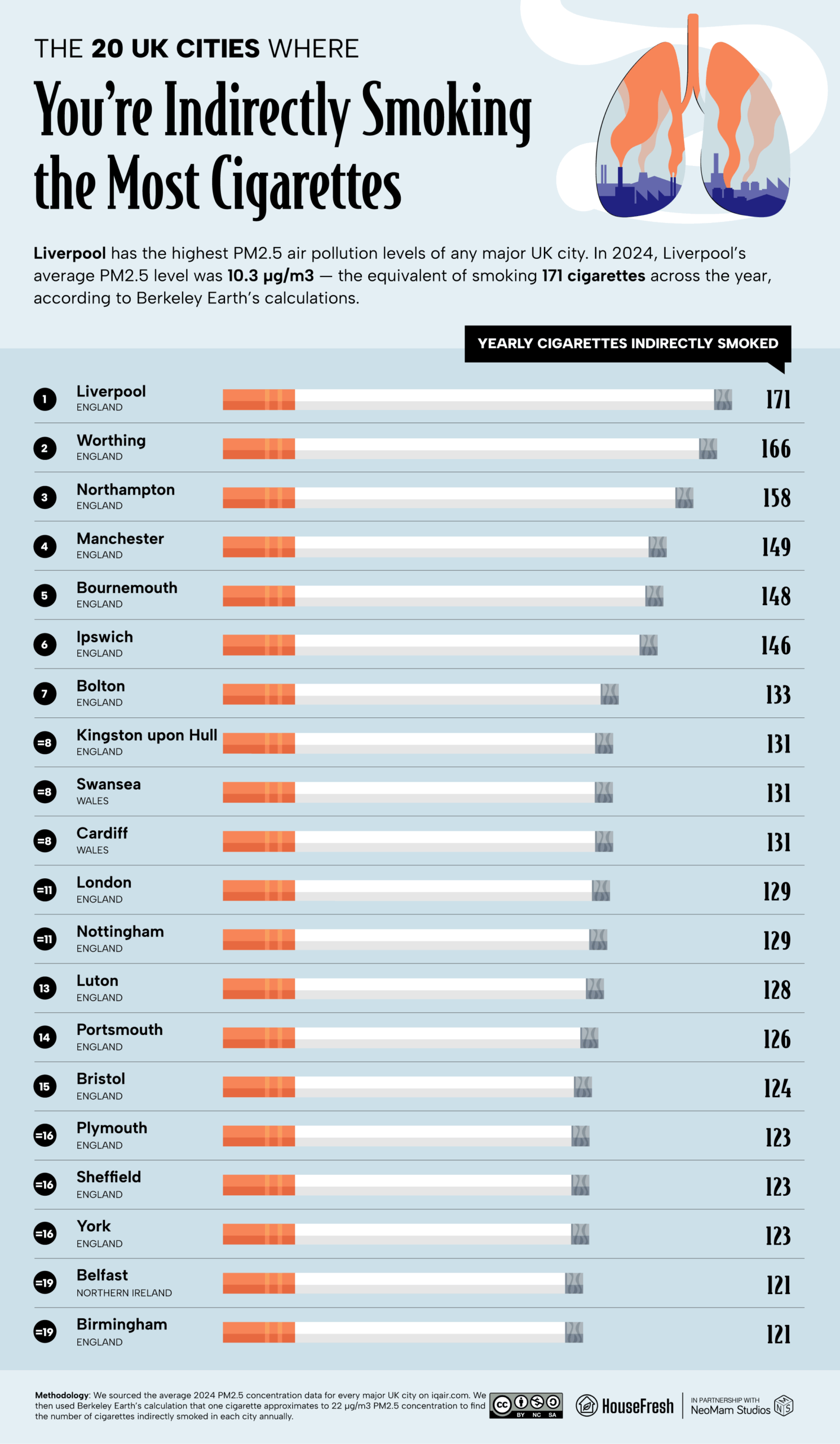
Finally, we looked at the air pollution in every UK city to determine the 20 cities with the worst air.
Along with traditionally industrial cities with dense urban centers, such as Manchester and Liverpool, there are a number of southern coastal cities, such as Worthing, Portsmouth and Bournemouth. In Portsmouth, where PM2.5 levels are equivalent to smoking 126 cigarettes per year, the council reports deaths attributable to fine particulate pollution to be higher than the England average most years since 2010.
In 2024, Liverpool topped the list of UK cities for air pollution exposure — equivalent to smoking 171 cigarettes per year. This chart ranks the 20 UK cities where PM2.5 pollution equals the most indirect smoking.
Some of these coastal towns are impacted by an influx of tourist vehicles in the summer months, and the air quality is also affected by salt particles from the sea and the industrial emissions of ports. They may also have been overlooked for reforestation programs.
In Bournemouth, motor vehicles are one of the biggest contributors to urban air pollution, compounded by a dense road network, outdated buses, and a lack of investment; a clean air zone has been proposed, but there are concerns over the economic trade-off.
Based in Hampshire, Safe Air Schools UK responds to challenges shared by schools nationwide:
“This data highlights that Portsmouth — in our own county — ranks among the UK’s worst cities for PM2.5 with air pollution carrying the same health impact as smoking 126 cigarettes a year. Friends of the Earth have identified 15 schools in the city located in neighbourhoods that exceed World Health Organization air quality limits — twice.
Across Hampshire, sickness is the leading cause of authorised school absence, and the county exceeds the national average.
Clean air is not a luxury; it’s fundamental to children’s health, learning, inclusion and equitable access to education. We’re calling for practical, affordable action to make safe air a reality for all children in every classroom.”
Use our interactive table to check the pollution levels in over 700 global cities.
The decline in smoking over the past two decades has been one of the great public health achievements of the 21st century, but worsening air pollution has offset many of the expected gains in general respiratory health. An increase in wildfires, rising vehicle and industrial emissions and domestic wood-burning appliances make living in some of the world’s most populous cities the equivalent of smoking hundreds of cigarettes a year.
Many cities with the worst air pollution are in fast-growing, developing economies, while the cities with the cleanest air are wealthier in service-oriented economies. But the air quality in some of the most developed major cities also decreases the local life expectancy, much like smoking. You can use the interactive table below to search for your city and see the number of cigarettes you effectively smoke each year due to air pollution.
Air pollution is one of the greatest threats to human health in the world and kills more people each year than tobacco, car accidents or diabetes. Respiratory health has become a major focus in public health since the COVID-19 pandemic, and smoking rates have fallen considerably over the past several decades.
For a complete picture of health, however, it is essential to know the respiratory impacts of the air we breathe daily. Do you know how many cigarettes you are indirectly smoking due to air pollution?
METHODOLOGY
To find out how many cigarettes are smoked indirectly due to air pollution around the world, we found the average 2024 PM2.5 concentration data for the most populated cities in every country on https://www.iqair.com/.
We then used Berkeley Earth’s rule of thumb that one cigarette approximates to 22 µg/m3 PM2.5 concentration. With this reference, we divided each city’s average PM2.5 level by 22 and then multiplied it by 365 days to obtain the yearly number of cigarettes indirectly smoked in each location.
PM stands for Particulate Matter, which is a term to refer to microscopic solid or liquid particles suspended in the air.
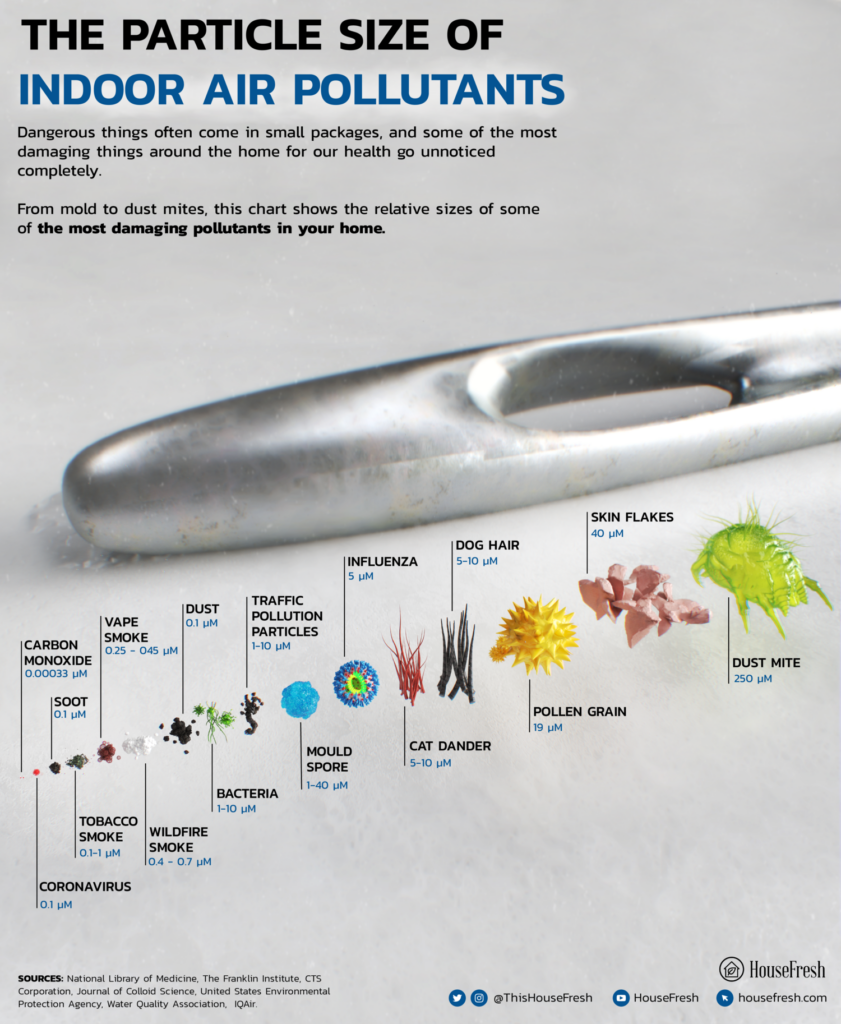
PM2.5 is used to describe fine particles of 2.5 microns in diameter or less. An inch is about 25,000 microns, so we’re talking really tiny particles here.
To put this into context, human hair has a diameter of 70 micrometers, so that means a PM2.5 particle is 30 times smaller than a strand of human hair. In fact, PM2.5 particles are so tiny that you can only see them under an electron microscope.
Why should you care about PM2.5 particles?
Due to their small size, PM2.5 particles can penetrate your lungs and enter your bloodstream.
PM2.5 can penetrate deep into your lungs and cause serious damage. Particles that land on the lung surface can induce tissue damage and inflammation. Not good at all, particularly for people suffering from pre-existing respiratory conditions.
Children are highly susceptible to particle pollution, as they breathe more air per pound of body weight than grown-ups.
Research published by the Department of Health in New York State linked PM2.5 exposure to increased respiratory and cardiovascular hospital visits, and long-term exposure may lead to increased chronic bronchitis, reduced lung function and even lung cancer mortality.
Another study found that cooking Thanksgiving dinner could produce more PM2.5 particles than can be found on the streets of Delhi, famously one of the most polluted cities in the world.
Air pollution rates have risen over the years since the Industrial Revolution, and the inevitable consequence of globalization is a major cause for concern. But it’s not just outside sources of PM2.5 that you should be on the lookout for.
Biggest sources of PM2.5 indoors
Bacteria from decomposing food and mold
Pet dander
Cigarette and cigar smoke
Cooking (frying, sautéing, boiling)
Personal care products
Fireplaces
Cleaning products
Glues and inks
Air fresheners and candles
Biggest sources of PM2.5 outdoors
Vehicle exhaust fumes
Burning fuels such as coal, wood, grass, and biomass
At the beginning of 2024, we said Google was killing independent sites with its bias towards established media outlets, even in cases where these trusted publications were publishing crap AI content.
Three months later, we shared how Google’s March 2024 algorithm update had finished the job by taking away 90% of search traffic to HouseFresh, with spammed Reddit threads and old Quora posts drowning our pages in search results.
This is the trade-off with every algorithm update: Some sites win while other sites lose. On the surface, you might think there is a balance in this trade-off. Unfortunately, the balance has been broken by the sea of bad actors taking advantage of the fact that Google’s algorithm is reaching peak enshittification.
It has become clear that a large percentage of those consistently winning in Google Search are doing so through a mix of brand popularity signals, vast amounts of content and various forms of spammy and deceitful practices.
Within a few weeks of publishing our second article, we attended an hour-long video call with Google, in which we shared our process for creating content by and for humans. Google Search engineers asked us the following question(s):
“What advice would you give to a user who is looking for reviews to distinguish between high- and low-quality content? How can a user tell if the reviewer actually tested the products, compared with other products, or if they are just trying to push users to buy bad sponsored products?”
You trust Google to show you good information, but Google doesn’t know the difference between good and bad information because algorithms and AI are pattern-seeking, probability-calculating machines that don’t actually know anything.
However, it is easy for people like us to spot bad information because we know our stuff. That is why we collaborated with other independent web publishers to answer this question clearly and loudly.
The web publishers who contributed to this article
There is a lot of money to be made at a time when Google’s algorithm opts for the ‘goog enough’ approach. So, today we will expose the cookie-cutter methods followed by many of those who are winning in Search to fool the most widely used search engine in the world.
Read on for seven actionable tipsto help you find helpful content in a sea of made-for-Google bullshit.
Tip 1. Pay attention to the images used throughout the article
Just one look at the featured image sitting at the top of the page can show you a lot.
Let’s start with an obvious one that will take you just a few seconds to assess. This is a red flag that was highlighted by nearly everyone who helped us with this article.
Beware of images provided by manufacturers as part of marketing materials:
Whenever you find a featured image like the ones above, go into the article with a healthy dose of skepticism.
Upon inspecting the rest of the product images further, you might realize that they are all taken directly from retailer listings or the manufacturer’s website:
As a rule of thumb, be skeptical of articles that have no original imagery/videos or that only show you product photos you can already see on Google shopping results or Amazon listings:
Always look for multiple original images, videos and/or GIFs of the product recommended to ensure that at least someone somewhere spent a meaningful amount of time with the thing they are telling you to buy.
The same can be said for the choice of stock imagery over original footage, especially in articles that are supposed to reflect the writer’s experience with a place, a program or an object.
At a time when Google’s algorithm decided to disappear entire websites, original photographs are being stolen and reused throughout the web.
The team at Yellow Chili’s shared with us an outrageous example of how one of the photos they used as part of their incredibly thorough recipes has been stolen and is currently being hosted on over 30+ sites.
You can see the image here, both on Yellow Chili’s website and their YouTube channel:
However, a quick search inside Google Images doesn’t bring up their website as the original source of this photo. Instead, Google lists all the sites that have stolen the image and presented it as their own:
This is happening to impacted web publishers across travel, food, lifestyle, tech and many other industries. When your website is nowhere to be found, everything you have created is up for grabs, with bad actors having zero shame in stealing your content and outranking you with it.
Tip 2. Find out more about the people behind the articles
They will throw many names at you—don’t take the word ‘expert’ for granted.
If you pay attention to the authors section of the vast majority of pages ranking at the top of Google, you will notice that there are always multiple people involved:
You will usually find the same mix of people: a staff editor (usually a shopping editor) or an in-house fact-checker, a freelance writer and an expert (with a PhD, MA or MD).
In our opinion, this myriad of names covers up the fact that the bulk of the article was written by a freelance writer who is most definitely not an expert in the product or topic at hand.
But let’s go through an example to show you what we mean.
Here is one of the many articles on Forbes about air purifiers—you can see there are two names: one contributor (a writer) and someone who reviewed the article (an editor):
When clicking on the name of the writer, you will be able to see all the articles this person published on Forbes:
This one writer alone has written 19 articles for Forbes in 2024, recommending the best products across 11 very different categories ranging from electric toothbrushes to cordless drills.
Freelance writers can be incredible at what they do, but how likely is it that this one person is actually testing all these things before telling you to buy them?
And it doesn’t end there.
A quick search surfaced other active author profiles belonging to the same writer across many other big media sites currently pumping out this type of content. Here are two of them:
This freelance writer also recommends the best litter boxes, Hyundai cars, concrete paints, smoke detectors, ceiling fans, joint supplements for dogs, range hoods, top-load washers, solar pool covers, garage heaters… The list goes on.
Freelance writers need work, too.
We want to be clear here that we don’t blame this or any other writer for pumping out ‘best’ pages across every possible product category. It has not been an easy few years for writers—fuck you very much, generative AI.
You might be thinking, “Well, who cares? Didn’t you say there was an expert who reviewed the content anyway?”
And you would be correct, as there is usually an expert:
When clicking on the expert’s name, you will also be able to see the wide variety of articles the expert reviewed and approved.
This one expert, for example, gave their seal of approval to recommendations across different products, from vacuums to anti-itch creams:
We reached out to two experts on different subjects quoted by different media outlets, and in both cases, they were only asked to review or contribute to the FAQ section of the articles.
This makes headlines like the one below incredibly misleading:
When we contacted the air quality expert in question, he clarified that he hadn’t specified air purifiers that would be the best for pets:
No. My policy is to never mention any brands but rather features that I think are important.
Moreover, one of the experts explained that they are still being quoted as the expert for an article that has been completely rewritten multiple times since they originally reviewed it two years ago.
Our tip? Go deeper to find out whose advice you’re taking.
Click on the names and have a critical look at their past articles—does this person strike you as someone who dedicates enough time to the topic at hand to truly know what good looks like?
Ideally, the writer and the expert will be the same person. You want your information straight from the horse’s mouth.
Tip 3. Don’t be fooled by purely anecdotal evidence
This point is especially important when looking for (helpful) reviews that go beyond marketing materials or first impressions after 24 hours of ‘testing’ a product.
One quick way to spot a potentially unhelpful review or recommendation is to look for loose testing methodologies or the use of anecdotes over data.
Pay attention to the ‘How we test’ section of the article. Are they clearly outlining a repeatable and specific testing methodology? Or are they saying things like these?
Do you get the sense that they spent time truly testing the products to assess their value and quality? Or are they just using the word ‘test’ as a synonym of ‘handpick’?
Pro tip
The ‘How we test’ or ‘How we chose…’ section can also reveal clear inconsistencies or glaring errors that unveil the cookie-cutter approach behind the content:
As a reader, you might not have the background knowledge necessary to know whether or not the writer is just regurgitating marketing materials to sell you something. However, you can scan for the use of anecdotes as a way to support their reasoning as to why you should spend your hard-earned money on a product:
The next time you read one of these regurgitated advertorials dressed up as product reviews, you will quickly spot the abundance of anecdotal evidence peppered with spec details provided by the company behind the product:
We are sure these personal stories help convert readers into buyers, but be wary, as anecdotal evidence doesn’t mean anything in most cases. In fact, sometimes these writers put more emphasis on the story than the actual research.
This point is especially true when you are looking for information to help you gauge the quality of expensive or potentially dangerous products.
In the quest to sell you, both of these publications fail to clarify that this electric scooter doesn’t have a mechanical brake:
If you experience electronic failure when riding a scooter with a regen brake downhill, you’re literally riding a death trap. Someone who actually knows about scooters (and who cares about the readers) will be quick to tell you that:
Tip 4. Look for first-hand data, product comparisons, low-cost options and products from specialist brands
A reviewer who actually knows the product they are writing about can’t help but compare different options or use hard numbers to discuss quality and value for money.
You probably noticed that many of the articles recommending you products include the words ‘Tested and Reviewed’ in the titles.
As we highlighted in a previous article, a common practice is to prominently mention ‘reviewed’ and ‘tested’ throughout the article without ever sharing first-hand data or insights.
This goes hand in hand with the use of anecdotal evidence we mentioned above and leads to very thin reasonings behind why you should choose the product they sell over the rest:
Many made-for-Google pages will include lots of numbers and specifications. These are sometimes presented as findings or listed as the bulk of the data to show how good a product is.
This might require extra digging, but it’s worth checking if these are all readily available elsewhere before blindly believing they are a result of actual testing.
Now, the thing with testing and hard data is that it allows us product reviewers to compare and contrast. That is why these figures in isolation don’t mean much to us most of the time.
A helpful product review or list of recommendations will make a point of comparing products so you can make the best choice for your specific needs:
Another thing you should watch out for is the overwhelming presence of popular brands over specialist, independent brands—and the fact that most products on the page are on the expensive side.
Tip 5. Watch out for thin, generic information without a point of view
Your typical made-for-Google page will be 90% regurgitation and 10% SEO pattern making. Learn how to spot this approach.
The web has always been home to spammy pages and deceptive behaviors, but things took a turn for the worse at the end of 2022 when ChatGPT was released. Content scrapers and article spinners are nothing new, but they have all been supercharged by AI.
As a result, many tools have been launched with the purpose of quickly populating pages with ‘content’ that is regurgitated and spun as needed with the help of magic AI. This allowed companies like Forbes Marketplace to quickly produce and publish vast amounts of thin pages packed with generic information about any topic you can think of, including dating apps.
I’m sure that, at this point in the article, you will be able to recognize the differences between the Healthy Framework review of eHarmony and the review published by Forbes. At a glance, you will quickly spot the lack of original images. But let’s go deeper.
Thin, regurgitated reviews will find ways to frame marketing materials as ‘findings,’ and you can see through this by looking for mentions or variations of [Company] + claims or [Company] + states or According to [Company]—you get the gist.
In contrast, real (and helpful) reviews will be packed with actual statements from the writer and clear indications of first-hand research or testing being conducted.
Reading through the Forbes review of eHarmony, you should also be able to spot another clear indicator of a thin, made-for-Google review: the obvious sales-y marketing spiel full of slogans disguised as facts that push you to buy, download, join, watch, subscribe, etc.
Emphasis added
Another thing you should watch out for is the absence of a clear point of view.
When a real person who cares and knows about a topic writes about it, they can’t help but have an opinion. When you have visited many countries, cooked many recipes, watched many horror movies, cleaned many stains or tested many air purifiers, you will bring that wealth of knowledge with you every time you sit down to write a new article.
Unfortunately, AI slop creators and big media content farms ranking at the top of Google Search results have trained us to ignore this lack of depth and humanity. But you will quickly see what we mean once we walk you through the next example.
Below, you will find two reviews of a Netflix horror series:
You might struggle to spot the thin, made-for-Google review at a glance, but it all becomes a lot clearer once you start reading.
Now, when reading a review of a movie, a book or a TV show, you want to avoid spoilers while figuring out if you should spend your precious downtime reading or watching the thing. This is where the experience, opinion and ability of the writer are crucial, as they need to be able to describe what’s good and bad without giving too much away.
In the introduction to this Netflix series review, the team at Ready Steady Cut gives you context on what the show is all about while clearly setting expectations before you decide to watch it:
Compare that with the review published by sports publication Sportskeeda, which for w̶h̶a̶t̶e̶v̶e̶r̶ made-for-Google reason, is now apparently reviewing Netflix horror shows:
The introduction of Sportskeeda’s review is chock full of repetition, with the same information being rewritten multiple times. The only potentially insightful element of this intro has been taken word by word from IMDb—and even then, you will see it’s just a 27-word synopsis that won’t really help you assess whether this horror anthology is worth your time.
That is exactly what we mean by thin, generic information without a point of view.
The Sportskeeda page is an excellent example of a made-for-Google article that adds no value to the web yet outranks real reviews from people who know their stuff and are writing helpful content for their readers.
This type of thin content will keep you scrolling down the page while you read, hoping they will eventually get to the part where they answer your question. Along the way, a mountain of ads will be shoved up your eyeballs.
Telltale words that could identify generative AI text
Those of you with high attention to detail might have noticed that the Sportskeeda review mentioned the word “delve” twice throughout their shallow introduction. When we saw this, it reminded us of this article from Ars Technica.
By the way, this is the same approach you’ll encounter when you’re trying to find the release date of an upcoming movie or whether there will be a new season of your favorite show. Generally, these pages are made-for-Google BS designed to make you click, scroll and fill their pockets with ad money.
Tip 6. Find proof of knowledge, care and transparency in the comments section
Not every website has a comments section, but you can look for signs of helpful content in those that do.
In simple terms, the comments section will help you answer the question, ‘Is there anybody out there?’
While doing research for this article, we saw many brick-and-mortar businesses, big media outlets and e-commerce sites with thin blog posts that outrank indie web publishers with variations of their own content. This sucks and continues to be a source of frustration among people like us who dedicate so much time to creating content for the web.
One pattern we found across many of these highly ranked regurgitation sites was the presence of comment sections full of questions and opinions from readers that remained unanswered MONTHS after they were published.
Any content creator knows that a big chunk of our time is spent answering questions and replying to comments on our sites and across our social media channels:
A quick scroll down to the comments section can tell you a lot about the person behind the article, their level of care and their knowledge of the topic at hand.
The absolute lack of responses is a clear indication that you are reading a made-for-Google page nobody really cares about beyond the point of publication:
Bonus points for closing the comments section altogether after receiving a few critical comments or tough questions:
Tip 7. Consider the source and look for signs of bias
If the content you’re reading doesn’t match the site it’s on, that’s a clear indication of made-for-Google content.
If you ever found yourself reading about Star Trek on Forbes or sorting through air purifier recommendations on Billboard, then you can probably tell that things have gotten a little mixed up recently.
In the middle of this confusing media landscape, bias has seeped in. Along the way, the web has been overrun with self-referential recommendations and commerce content disguised as thoroughly researched, unbiased, fact-checked service journalism.
The good news is that biased content is easy to spot once you start looking for it.
Let’s start with the Google Search results page, as that is where you will be able to spot biased sources before you waste your time.
What are the odds that Mastercard will include options from Visa, Discover or Amex as the “best credit cards for bad credit”? Or that Dell will mention gaming laptops from Asus or Gigabyte? Or that Levoit will share units from Winix or CleanAirKits as the best air purifiers?
Zero.
Those are biased search results, and you shouldn’t waste your time on them unless you have already married the brand behind them.
Recommended reading
The same goes for brands reviewing their competitors, as the likelihood of their article being unbiased is nonexistent. The team at Healthy Framework covered this in detail in their open letter to Google, so we recommend you read their take on this point.
Once you’re on a page, you can quickly spot biased advice by searching for the word “partner.”
By performing this quick search once you’re on a page, you will quickly see whether a product, app or service has a partnership with the publication, ranking it at the top of their list of recommendations.
You can also search for the word “sponsored” to uncover if there is a financial incentive behind a writer’s claim that this one gadget, hotel or tool is the best thing since sliced bread.
It’s worth mentioning that the practice of reviewing products provided by companies as “PR samples” is neither new nor inherently bad. We prefer to buy every product we review to eliminate any bias from the start. Still, we know that many reviewers manage to remain unbiased even when testing an item provided by a manufacturer.
The point of this tip is to help you avoid pay-to-play lists like this one:
It always hurts when these kinds of emails land in our inbox. It totally undermines the honest work we're trying to do.
Do not click blindly on the blue links served by an enshittified algorithm
Google doesn’t know the difference between good, helpful information and biased AI slop, but now you do.
Last year, the U.S. Department of Justice released a series of trial exhibits that included internal Google presentations on how their search engine ranks pages. One of these slides clearly explained that Google doesn’t understand the information it is showing you at the top of their results when you search for something.
“What’s crazy is that we don’t actually understand documents. Beyond some basic stuff, we hardly look at documents. We look at people. If a document gets a positive reaction, we figure it is good. If the reaction is negative, it is probably bad. Grossly simplified, this is the source of Google’s magic.”
This is not a new finding, so it is likely that you have read that quote before. But have you stopped to think about it?
Since its release in 1998, Google has mutated from a search tool to an AI-powered Magic 8 Ball. Along the way, Internet users around the world have grown to trust anything Google displays above the fold as ‘the answer’ to whatever they are looking for.
This unwavering trust in Google could explain why many were so shocked and upset when they realized that Google’s AI Overviews were full of terrible information they couldn’t rely on.
For the first time in forever, Google was indisputably wrong for the world to see.
Now that we are all aware of “the source of Google’s magic,” we can let go of the belief that Google is an infallible digital oracle and embrace the fact that it’s simply a blind search engine (built on a potentially biased algorithm) prone to being spammed and manipulated.
We hope this article helps you quickly spot the signs of made-for-Google BS so you can bounce back before you end up wasting any time or money.
And if you can’t find what you’re looking for on page 1, please keep going deeper into the results.
Most of the knowledgeable, truly helpful web publishers that contributed to this article are currently buried under piles and piles of substandard made-for-Google crap.
“How humid will it be today?” A common question for folks around the world to ponder as they plan their day since humidity can affect everything from our hair to our energy levels.
Forecasters measure humidity most commonly by looking at a day’s relative humidity, which considers the amount of moisture present in the air relative to the temperature.
However, the most reliable indicator of how dry or humid a day will feel is the dew point, the temperature at which your sweat evaporates and you begin to feel cool. Lower dew point temperatures feel dry, while higher dew point temperatures feel more humid.
Using this metric, we previously identified the cities across the globe that feel the most humid. But we couldn’t help but wonder about those cities at the other end of the scale and ask: where in the world do locals live with uncomfortably dry air the most?
To find out, we used Weather Spark data to count the number of “dry air days” (days that had a dew point of 13°C (55°F) or below) that over 14,000 global cities and 5,000 U.S. cities experienced in 2023. Read on to discover the dry air capitals in the U.S., on every continent and across the globe.
Key findings
Reno in Nevada experiences more dry air days(363.91) per year than any other U.S. city.
In South America, seven cities (including La Paz in Bolivia) count a full 365 days of dry air per year.
In Europe, Reykjavík in Iceland has the driest air on the continent (364.52 annual dry air days), but Norway claims another four of the top 10.
In Oceania, Australian cities dominate our top 10 dry air ranking — but Dunedin in New Zealand counts the most dry air days of all (352.51).
The dry air capitals of the United States
Reno in Nevada has more dry air days per year than any other U.S. city
We first wanted to find out which cities in the U.S. have the driest air using the number of dry air days they experienced in 2023 as a proxy. Reno in Nevada comes top overall with 363.91 dry air days per year, a count just two days short of a full year of uncomfortably dry air.
After that comes Sparks, a city just a stone’s throw from Reno, which counts 363.78 dry air days annually. Situated on the western edge of the Great Basin, both cities are blocked from the moisture of the Pacific Ocean to the east by the Sierra Nevada mountains, an effect known as a rain shadow.
Our map above reveals the city in every state with the highest count of dry air days per year. Among the country’s driest cities are Laramie in Wyoming and Butte in Montana, both of which count close to a full year (364 days) of dry air. In contrast, Mililani Town in Hawaii only experiences 11 dry air days per year. High humidity tends to be comfortable in Hawaii due to the cooling effect of the state’s trade winds.
The dry air capitals of the world
Two South American cities experience a full 365 days of dry air
Next, we mapped the city in every country with the driest air of all. Two cities on the map stand out as having experienced a full year of dry air in 2023 — Cusco in Peru and La Paz in Bolivia. Both of these cities are situated on the cusp of the Atacama Desert, one of the driest regions on the planet.
Even countries we might typically think of as more humid have their own dry air hotspots. In the UK, for example, Dundee experiences 344.9 dry air days per year. It’s also the sunniest city in Scotland.
“It is all down to the geography of Scotland,” explains Grahame Madge, a spokesman for the Met Office. “Most of the weather comes in from the Atlantic, with moist air being forced up toward the western highlands … a lot of the rain is released in the western regions, by the time the air makes its way over to the lower regions of the east coast, it is drier. Dundee is also sheltered by the Cairngorms and other high regions, meaning that it is generally warmer.”
The dry air capitals of North America
The U.S. claims more than half of North America’s top 10 cities for dry air
While North America spans 23 countries from the polar reaches of Canada to Cocos Island in Costa Rica, over half of the top 10 cities on the continent with the driest air can be found in the U.S. Reno leads with 363.91 dry air days per year. But Bend, Oregon (363.66 annual dry air days), Boise, Idaho (361.22 annual dry air days), and Anchorage, Alaska (360.93 annual dry air days), also feature.
Outside of the U.S., Calgary in Canada ranks with a count of 359.86 dry air days per year. Calgary is blocked from the moisture of the Pacific Ocean thanks to a rain shadow created by the Rocky Mountains.
The dry air capitals of Europe
Iceland’s capital city Reykjavík has the driest air of any European country
Turning our attention to Europe, we found that Reykjavík in Iceland experiences more dry air days (364.52) per year than any other city on the continent. Thanks to the effects of the Gulf Stream, Iceland has a mild maritime climate, but being so close to the Arctic Circle, it’s also vulnerable to very cold and dry Arctic air masses.
Meanwhile, Norway claims another four of the cities in Europe with the driest air. Leading the pack are Trondheim and Drammen, both of which experience 351.99 dry air days per year. Like Iceland, Norway is vulnerable to cold, dry Arctic air because of cold air’s reduced capacity to hold onto moisture. “In some places, Arctic air is as dry as air in the Sahara Desert,” comments the National Snow and Ice Data Center.
The dry air capitals of Oceania
Dunedin in New Zealand experiences more dry air days annually than any other city in Oceania
In Oceania, Dunedin in New Zealand counts more dry air days (352.51) per year than any other country. Dunedin is the principal city of the Otago region, of which the Central Otago district is the driest of any in the country, receiving less than 400 mm of rainfall a year. The next city in New Zealand featured in our ranking is Christchurch, which sees 327.64 dry air days annually.
But most of the dry air capitals of Oceania are in Australia. Hobart leads the pack, a Tasmanian city where locals experience 346.60 dry air days a year. The air is dry here because the neighboring Mount Wellington saps the moisture from the prevailing winds before it can descend into the city. Ballarat (345.29 dry air days a year) and Adelaide (330.61 dry air days a year) on the mainland come next.
The dry air capitals of South America
Peru claims five of the top 10 dry air capitals in South America
South America is a stand-out continent when it comes to dry air: seven cities (five of them in Peru) counted a full 365 days of dry air in 2023, with the remaining three experiencing just over 364 days.
Most are either in or on the edge of the Atacama Desert, an extremely arid region thanks to the cold Pacific Ocean’s moisture-sapping effects on the air. So dry is the Atacama Desert that Calama (364.67 dry air days a year) in Chile experienced no rainfall at all between 1570 and 1971. Meanwhile, Quito (364.65 annual dry air days) is the only South American dry air capital to be found in Ecuador. The city is situated close to the earth’s equator, lending it a consistently cool climate.
The dry air capitals of Africa
Aswan in Egypt counts more dry air days per year than any other African city
Over in Africa, Aswan in Egypt takes the title of having the driest air of any city on the continent, counting 356.58 days of dry air in 2023. Situated in the south of Egypt, Aswan is one of the world’s driest cities, receiving only 3 mm of rain a year.
After Aswan comes Béchar — one of four Algerian cities in our ranking — with a count of 353.18 annual dry air days. It’s no wonder the air in Algeria is so dry, as the Sahara desert spans nearly all of the country’s territory. The furthest south of the continent’s dry air capitals is Addis Ababa, Ethiopia’s capital and largest city (339.12 annual dry air days). At 7,726 ft above sea level, the air here is thinner and less capable of holding moisture than a city at a lower altitude.
The dry air capitals of Asia
All of Asia’s dry air capitals are in Iran, led by Bīrjand in the east of the country
As the biggest continent on the planet, almost every known climate occurs somewhere in Asia. Despite that, all ten of its dry air capitals can be found in just one country: Iran.
Bīrjand comes out on top with 364.77 dry air days a year, followed by Yazd and Shāhreẕā, both of which count 364.76 annual dry days. Most of Iran has an arid or semi-arid climate, experiencing little rainfall and, as a result, water supply shortages. The winters can also be very cold here, a weather condition that causes dry air thanks to cold air’s inability to hold onto moisture well.
Four ways to humidify a room without a humidifier
While we can’t control the outdoor climate and weather where we live, we can alleviate the problem of dry air in our own homes. Humidifiers are a great solution, but if you can’t get one, here are some things you can do to tackle the problem of dry air indoors.
Air dry your laundry inside. Instead of throwing your clothes in the dryer, hang them up indoors on a clothes horse or something similar. Not only are you saving on energy bills, but as the clothes dry, the moisture evaporates into the air and humidifies your home.
Leave the door open after showering. Once you’ve finished having a shower, don’t let all that steam go to waste: open your bathroom door so the moisture in the air can circulate through your house.
Place a container of water near a source of heat. Fill a container with water and leave it on a radiator or in direct sunlight so that the water evaporates into the air.
Get a houseplant. Some houseplants add moisture to the air through a process called transpiration. Previously, we found that the best you can buy is an Areca palm tree, which humidifies your air while removing chemical toxins.
As we’ve explored, dry air can trigger a range of health conditions and impact the health of your home’s fixtures and furnishings, too. Introducing more moisture to indoor air by investing in a humidifier or using these tips can relieve uncomfortable physical symptoms and protect your home from damage.
Here’s how you can tell if the air in your home is particularly dry and just some of the ways it can affect someone’s health.
SOURCES
We began our research by retrieving humidity data for large cities (with a population of at least 100k) in every country and U.S. state from Weather Spark. This gave us data for a total of 14,657 global cities and 5,175 U.S. cities.
This enabled us to identify the top cities by country, by continent and in the U.S. with the driest air based on the number of days in 2023 they had a dew point of 13°C (55°F) or below. The dew point defines humidity comfort levels. Lower dew point temperatures feel drier, and higher dew points feel more humid. The dew point better represents how humid a city feels than relative humidity. This is explained here and here.
For our U.S. state map, we lowered the threshold to consider cities with a population of at least 25k.
The home should be the safest place a family can be. But no lock and key can keep out the effects of air pollution. Aside from the unbound nature of motor and industrial pollution, one-third of the world’s population uses air-polluting stoves and fuels to cook meals. This latter pollution alone causes around 3.2 million deaths each year, including nearly a quarter of a million children under five.
While deaths of this nature are in slight decline, air pollution from fossil fuels and industrialization continue to take a bigger toll. And while the effects are more pronounced in other parts of the world, the U.S. is no exception. Americans spend around 90% of their time indoors, where pollution is often up to five times as dense as outdoors.
But another level of inconsistency exists in the cost of coping with bad air. The price and accessibility of air purifiers and electricity vary considerably around the world. To find where it’s cheapest or least affordable to keep indoor air fresh, the team here at HouseFresh identified an affordable, effective and widely available air purifier and calculated the cost of buying and running it in every country for a year.
We found the cost of buying or importing three Levoit Core 300 air purifiers in every country (with these units, one could filter the air of a three-room, 680-square-foot home). And then, we added the local cost of running these three units 24/7 for 365 days a year for each territory by using the unit’s energy consumption rate and the average local electricity prices.
Key findings
Clean indoor air is most expensive in Ghana, where it costs $1,852 to maintain clean air in a home for one year.
Keeping the air clear of pollutants at home is the cheapest in Thailand ($434/year).
The U.S. has the cheapest clean indoor air in North America ($482/year).
In the UK, keeping the air clean in a home for one year could cost up to $815(£655).
How much does each country pay for clean air at home?
We found that six of the ten countries with the most expensive clean air are in Africa and two (Cambodia and Afghanistan) are in Asia. Moreover, 23 of the 30 most expensive countries are in either Africa or Asia.
However, Asian countries also comprise eight of the ten lowest-cost markets for fresh household air. The United States ($539) and Serbia ($515) are also among the ten cheapest spots.
The most expensive place of all is Ghana in Africa. Here, it costs $1,852 for one year of clean air; that’s 3.8 times as expensive as in the U.S. This is mainly due to the cost of buying the air purifier in the first place. Of the ten most expensive countries, Burkina Faso and Belize stand out for earning their places with high energy costs rather than expensive hardware.
As our next graphic illustrates, Ghanaians are also coping with high levels of PM2.5 — fine particulate matter. This matter can come from industrial, automobile or domestic sources and consists of particles that are under 1/30th the diameter of a strand of human hair. Desert dust is a particular issue during the dry season in Ghana, but motor vehicles are also to blame. A policy shifting car users significantly towards public transport, walking and cycling could save up to 5,500 premature deaths every year.
Iraq has the world’s highest PM2.5 levels and is among the 26 most expensive countries for clean indoor air. Iceland has the lowest PM2.5 levels (from countries with available data). However, volcanic activity can make matters worse — spewing ash and gasses that break down to PM2.5 scale within a month. Unfortunately, we found that Iceland also is one of Europe’s most expensive countries for air purifiers.
The most and least expensive countries for indoor clean air by continent
The annual cost of purifying the air at home varies by at least $600 on every continent. Our following maps reveal the cost disparity across the Americas, Europe, Asia and Africa.
North America
The Caribbean countries of Belize ($1,534) and the Cayman Islands ($1,300) stand out as North America’s most expensive markets for home air purification. The set-up costs are over $100 higher in Belize, but Cayman Islanders pay $0.42/ kWh for electricity — nearly twice Belize’s rate ($0.22).
Fortunately, Belize has relatively low PM2.5 levels of around 5.6 μg/m³. By comparison, the North American country with the highest PM2.5 levels is Mexico, with Mexico 19.5 μg/m³.
The United States ($482) has the cheapest air purifier costs on the continent and the sixth cheapest globally. A decent purifier can cost as little as $100 in the U.S., although with electricity costing $0.17/kWh, the process isn’t as cheap as it might be. America’s PM2.5 concentration averages around 8.9 μg/m³.
The effects of air pollution in the U.S. are far from even. One study found that “the harmful effect of fine particulate matter on life expectancy is especially pronounced in states with both very high levels of income inequality and very large black populations.”
South America
We found three South American states with a four-figure price tag on that first year of clean indoor air: Argentina ($1,328), Colombia ($1,228) and Brazil ($965). Argentina suffers from particularly expensive set-up costs, while Colombian families pay around 3.4 times as much for electricity.
Particulate levels are notably higher in Colombia. Around 8% of deaths in Colombia are linked to water and air pollution, with parts of the Aburrá Valley and the Bogotá towns of Puente Aranda, Carvajal and Kennedy among the worst affected.
Venezuela ($554) is the cheapest South American country for clean indoor air. The country benefits from low set-up costs and modest electricity prices of $0.09/kWh. However, climate change-induced extreme weather events, illegal mining and deforestation contribute to an ongoing environmental crisis in the country.
Europe
Substantial energy costs and an air cleaner price that’s around twice or more that of the U.S. push several European countries into the four-figure area. Liechtenstein ($1,055) has the highest overall price for clean indoor air. This can be attributed to electricity costs of $0.51/kWh — the second highest in the world next to Ireland.
Sandwiched between Austria and Switzerland, Liechtenstein has a permanent population of just 40,000 people. Although Liechtenstein’s fine particulate levels are towards the lower end of the scale (8.3 μg/m³), levels of atmospheric ammonia — an agricultural byproduct — continue to outpace efforts at reduction.
The UK ($815) has the 14th highest price of clean indoor air in Europe. As with Liechtenstein, this is mostly due to phenomenally high electricity costs ($0.44/kWh – the 4th highest in the world). The UK’s PM2.5 levels slightly outstrip Liechtenstein’s at 8.9 μg/m³.
The UK government’s air pollution targets (10 µg/m³) are twice as high as the World Health Organization (WHO) recommends (5 µg/m³) – and the target is not set to be met until 2040. In 2020, nine-year-old Ella Adoo-Kissi-Debrah became the first person in the UK to have her cause of death listed as air pollution. She died from an asthma attack in 2013, having grown up just 25 meters from the busy South Circular Road in south-east London.
Asia
Countries across different Asian regions are among the world’s most expensive for clean indoor air. But the most expensive by a significant leap is Cambodia ($1,645). Cambodia has among the highest set-up costs in the world and not insignificant electricity rates of $0.15/kWh.
The Cambodian government launched a “Blue Sky Campaign” in 2023 and has reduced the number of wildfires while introducing cleaner fuels. The country’s rural population has long suffered from the effects of agricultural fires and waste incineration, and 95% of the rural population uses harmful cooking methods and fuels.
However, Asia is also home to some of the cheapest countries for clean indoor air. Home air conditioning set-up costs in the United Arab Emirates, Saudi Arabia, Thailand and Malaysia are among the lowest in the world, and with low-moderate electricity costs, too.
Thailand ($434) is the cheapest country in the world overall for clean indoor air. This is fortunate as the country suffers from severe air pollution, with over 10 million Thais seeking treatment for pollution-related illnesses in 2023.
Africa
Africa is home to the two most expensive countries for clean indoor air: Ghana ($1,852, see The price of clean indoor air around the world, above) and the Democratic Republic of the Congo ($1,801). Ghana is expensive primarily due to the cost of air purifiers, while Congo has the most expensive filters in our study.
Congo is Africa’s most polluted country. Air pollution alone reduces life expectancy in Congo by 2.9 years, compared to what it would be if the country met World Health Organization guidelines.
Despite ongoing poverty across much of Africa, there are no African countries among the cheapest in the world for clean indoor air. Africa’s cheapest countries are Algeria ($568) and Angola ($556), but there are 11 Asian countries that are cheaper, as well as the United States, Canada, Venezuela, Luxembourg and Serbia.
Angola has cheap purifier set-up costs and electricity at just $0.02/kWh. However, Angola’s cheap energy is available to only a few homes. Some 57% of urban homes and 90% of rural homes are not connected to the grid.
How to make your own air purifier
A decent, shop-bought air purifier will combine engineering know-how with dependable materials and expert awareness of the scientific and regulatory factors at play. But if you prefer to build your own hardware, or find yourself at home on a bad air day with no working purifier to hand, it isn’t too hard to put your own basic machine together. Here’s how.
Box fan
MERV 13 filter
Strong tape
Scissors
Screwdriver
Step 1: Buy materials
The main things you might not have at home are a box fan, HEPA filters and strong duct or gaffer tape. Make sure the filters you buy are large enough to cover the whole fan without stretching past the edges.
Step 2: Remove the speed dial from the fan
Needless to say, make sure to unplug the fan before you start removing parts. Turn the dial to the fastest speed setting before pulling it off with your hand or pliers.
Step 3: Remove the front grill from the fan
With most box fans, you should be able to unscrew the grill — but if it’s molded, use metal cutters.
Step 4: Stick the MERV 13 filter on
Place the filter carefully on the front of the fan and make sure there are no gaps around the edges. Stick it down with the duct tape.
Step 5: Switch it on
The fan will suck air through, catching pollutants in the HEPA filter. You should change this filter at least twice a year.
Tip
If you want to build your own DIY air purifier, you can find more detailed instructions here.
The increase in wildfires and other air pollutants makes an air purifier more than an annoying expense — they are an essential part of the modern home. That’s why it’s important to ensure you’re getting the best one for your needs (for example, one that deals with construction dust well) and that can keep your indoor air as clean as possible for the minimum necessary price.
SOURCES
To determine the cost of clean indoor air worldwide, we calculated the cost of buying and running three Levoit Core 300 air purifiers (with two filter changes per unit) for a year in every country.
To research the cost of Levoit 300 units and filters, we first sourced prices for countries that Levoit operates in and hence could order directly from their website. For other countries, we sourced prices from local popular online marketplaces. For the remaining countries (particularly the African countries), we manually gathered data on the cost to import a Levoit Core 300 air purifier using local importers.
The cost to run these three units 24/7 for 365 days a year was calculated by factoring in energy consumption (35.5 watts per hour at speed level 3) and the average electricity prices in every country, sourced from globalpetrolprices.com.
These prices are in USD and are correct as of April 2024.
We decided to use the Core 300 for this research because it is a widely available air purifier (with a significant CADR of 145 CFM) that we can confidently say will be able to clean the air in rooms as large as 219 sq. ft. According to the performance tests we conducted when reviewing the Levoit Core 300, this is one of the best-performing low-priced air purifiers available on the market right now.
We accounted for three Levoit Core 300 units in order to cover an entire household, guaranteeing clean air in important areas such as the kitchen (where cooking generates particulate matter), the bedroom (where having an air purifier can remove allergens and improve sleep) and the living room or other living areas (where air purifiers can remove pet hair, dust, pollen, allergens and reduce the risk of exposure to airborne viruses).
In February 2024, we published an article warning readers not to trust product recommendations from well-known newspapers and magazines ranking at the top of Google search results.
I wasn’t expecting so many people to care (even though I secretly hoped they would), but we’re still getting emails and messages about it ten weeks later.
In these two months, I have talked to air purifier manufacturers, HouseFresh readers, other independent publishers, Dotdash Meredith employees, well-known activists, tech journalists, Redditors, SEO professionals, and even Google employees.
Today, I want to share some things I’ve learned and some things that happened after publishing that article.
I’ll take you through the tactics big media publishers use to outrank independent sites online. I’ll also cover what Google has done since we published our exposé and what they’ve announced they’re going to do. Lastly, I’ll share what happened to HouseFresh over the last two months. SPOILER:It’s not looking good for us.
That’s a lot, so I hope you’ll stay with me until the end (but no hard feelings if you don’t).
Dotdash Meredith allegedly developed an SEO content strategy called “swarming” to out-publish independent sites
Why indie publishers are being buried in search results by content published on multiple sites belonging to the same group
Within a few days of publishing the David VS Digital Goliaths exposé, I received an anonymous tip from a former Dotdash Meredith employee, who informed me of an SEO content strategy they implement called “keyword swarming.”
Through this strategy, Dotdash Meredith allegedly identifies small sites that have cemented themselves in Google results for a specific (and valuable) term or in a specific topic, with the goal of pushing them down the rankings by publishing vast amounts of content of their own.
“Swarming is about drowning out a competitor,” said the person who reached out. The objective is to “swarm a smaller site’s foothold on one or two articles by essentially publishing 10 articles [on the topic] and beefing up [Dotdash Meredith sites’] authority.”
By the way, if “keyword swarming” is indeed a strategy, then it’s clear that it’s not just something you will find in the air purifier space. Dotdash Meredith could be doing this across many other products and topics, utilizing its wide range of publications.
That could explain why you will find multiple articles published on sites belonging to Dotdash Meredith ranking at the top of Google like this:
Is Dotdash Meredith to blame for choosing to “swarm” Google search results by leveraging their network of websites and their machine to create content at scale?
Personally, I think it’s not great for the internet, but I understand that if that the leadership at Dotdash Meredith is simply focusing on making money for IAC shareholders.
“IAC’s vision for Dotdash Meredith — to be a flywheel for generating advertising and commerce revenue — is finally starting to pan out.
[…] More than 80% of Dotdash Meredith’s traffic and digital revenue come from its core sites, such as Food & Wine, Travel & Leisure, and Southern Living, that deliver a form of what one might think of as commerce-related service journalism.”
— Allison Schiff, managing editor of AdExchanger
However, I don’t want to turn this into a personal crusade against Dotdash Meredith because it’s not.
The reality is that, whether they have a name for it or not, every other digital goliath is monetizing their websites by using the same tactics.
Let’s take Forbes.com as an example.
Connecting the dots between puppies, affiliate commissions, and Forbes
Why Forbes.com is flooding the web with affiliate-focused SEO content on topics far outside their area of expertise
Do puppies come to mind when you think of Forbes? If not, they should.
In the last few years, Forbes has pumped out thousands of articles about puppies, dogs, kittens, and cats. But why?
Well, if you pay attention to the URLs of the articles, you might notice that the majority of them sit inside forbes.com/advisor/pet-insurance/, which is the space where Forbes publishes their pet insurance affiliate content:
The Forbes Advisor team published all this content about cats and dogs because they needed to build Forbes.com’s authority in the space to compete with sites such as Dogster or Canine Journal.
The vast majority of pet-related content on Forbes.com pre-2020 wasn’t written from the point of pet expertise, and it wasn’t tied to highly searched keywords that would drive monetizable traffic:
To give the pet insurance affiliate section of Forbes the best chance to succeed, the Forbes Advisor team pumped out A LOT of content about pets and built A LOT of links around the topic with statistics round-ups designed to obfuscate the original sources in order to increase the chances of people linking to Forbes.com when using the stats:
All this hard work paid off in the form of an estimated 1.1 million visitors each month to the pet insurance section of Forbes Advisor:
This happened at the expense of every site that has produced content about dogs, cats, and other pets for many years before Forbes.com decided to cash in on pet insurance affiliate money.
They successfully replicated this model again and again and again across the huge variety of topics that Forbes covers today.
Trusted publications are being flipped by SEO-minded people with a taste for affiliate money
Step one: buy the site. Step two: fire staff. Step three: revamp the content strategy to drive new monetizable traffic from Google
Did you know that 19-year-old sports blog Deadspin is now a gambling affiliate site?
That’s right. Just a few weeks ago, Deadspin was sold to a newly formed ghost digital media company that immediately fired all Deadspin’s writers before announcing it would start referring traffic to gambling sites.
Stuff like this happens all the time, but most people don’t follow media news, so they’re completely unaware.
For example, if I mention Money, you might think of a magazine you could find at any newsstand since 1972. But what if I told you that the physical production of its magazines stopped in 2019?
The Money brand is now owned by Ad Practitioners LLC (recently rebranded as Money Group), a company that profits from affiliate links and has developed an ad network.
You probably had no idea about this because Money.com looks just like it always has, and its About page focuses on its long history while failing to disclose who is behind the site:
In an interview with Axios, one of the owners of Ad Practitioners LLC said that Money was hemorrhaging cash before the acquisition and explained how it’s now thriving:
“Powel, a former Google executive, saw an opportunity to rebuild Money’s editorial strategy around intent-based personal finance content that’s typically surfaced from search results instead of clickbait business stories about celebrities and their wealth.
Big digital media companies like DotDash Meredith and Red Ventures rely on a similar strategy.”
— Sara Fischer, senior media reporter at Axios
In true ‘phoenix rising from the ashes’ style, Ad Practitioners LLC leveraged the public’s trust in the Money brand, its high-authority domain, and long-standing history as a finance publication to sell air purifiers — without any actual testing, I might add:
But it’s not just air purifiers.
Wondering how to reprogram your garage door opener? Let Money.com explain. Looking for the best paint sprayers? Money.com can tell you.
The key here seems to be adding ‘for your money’ to the title to keep things loosely tied to the financial aspect of the website:
This is how the people behind Money.com are “building upon the legacy” of the brand.
I’m nearly done kicking the big guys, I promise.
Big media sites are laying off journalists while partnering with marketing agencies that use AI to write commerce content
Exploring the trend of publishers that have been caught lying about AI-written, search traffic-focused content in the last six months
Commerce content is quickly becoming the main monetization route for media publishers. In fact, a 2023 survey by Digiday showed that 81% of publishers consider commerce content a vital part of their revenue growth strategy, with 43% reportedly producing 16 to 26+ new pieces of commerce content each month.
And while media publishers ramp up their commerce content, they also seem to be ramping up the layoffs.
So, who is writing all these commercial pages?
“The financial incentives for the current trend are strong, and as media companies continue to cut newsroom staff, the lure of cheap AI content is hard to resist,” said longtime service journalist Joe Lindsey in his article Commerce content is breaking product reviews. He continued, “The latest permutation of commerce content is that publishers outsource some or all of it to a third-party provider, which is called a commerce content partnership, and that’s where AI is pushing in.”
He’s not wrong.
Reports claim that big media publishers such as Sports Illustrated and USA Today have published commercial content written by AI under fake author names. In both cases, the media giants blamed a third-party partner who provided content to the publications.
In a statement to The Post, Gannett said the articles on USA Today “were created through a deal with a marketing firm to generate paid search-engine traffic.” According to The Verge, the firm behind these AI product reviews is called ASR Group Holdings. When following the lead, journalist Mila Sato found that ASR Group also uses the name AdVon Commerce.
What a coincidence…
Today, an article was published alleging that Sports Illustrated published AI-generated articles. According to our initial investigation, this is not accurate.
The articles in question were product reviews and were licensed content from an external, third-party company, AdVon…
The owner of Sports Illustrated released a similar statement when Futurism uncovered their use of AI-generated content: “The articles in question were product reviews and were licensed content from an external, third-party company, AdVon Commerce […] AdVon has assured us that all of the articles in question were written and edited by humans.”
Yet, when searching through LinkedIn, I could find multiple AdVon employee profiles that clearly specify the use of AI as part of their job:
Where does this leave the role of journalists in these publications?
“As a journalist, all of this depresses me,” wrote Brian Merchant, the technology columnist at the Los Angeles Times. He continued, “If journalists are outraged at the rise of AI and its use in editorial operations and newsrooms, they should be outraged not because it’s a sign that they’re about to be replaced but because management has such little regard for the work being done by journalists that it’s willing to prioritize the automatic production of slop.”
But all hope is not lost.
Google set a deadline for big media sites to stop spamming the web
How the “site reputation abuse’ spam policy could affect big media sites, and what they’re doing to prepare for Google’s deadline
Here’s a recap so far:
Digital media conglomerates are developing SEO content strategies designed to out-publish high-ranking specialist independent publishers.
Legacy media brands are building in-house SEO content teams that tie content creation to affiliate marketing revenue in topics that have nothing to do with their original areas of expertise.
Newly created digital media companies are buying once successful and influential blogs with the goal of driving traffic to casino sites.
Private equity firms are partnering with companies like AdVon to publish large amounts of AI-generated content edited by SEO-focused people across their portfolio of media brands.
And here’s the worst part:
Google’s algorithm encourages all of them to rinse and repeat the same strategies by allowing their websites to rank in top positions for SEO-fueled articles about any topic imaginable. Even in cases when the articles have been written by AI and published under fake authors.
But Google has set a deadline for big media sites to stop spamming the web: May 5.
In early March 2024, Google announced an update to its spam policies, which included a point about “site reputation abuse” aimed at sites publishing pages with the purpose of manipulating search rankings by taking advantage of the site’s ranking signals.
Unfortunately, Google’s documentation only deems “site abuse reputation” as spam when the site uses third parties to produce and/or publish pages to manipulate search rankings.
The fact that U.S. News & World Report is hiring an SEO-focused Commerce Editor to publish 70-80 content updates per month tells me that, hopefully, these big media sites will start cleaning up their acts and move away from contracts with the likes of AdVon.
But what happens when an in-house team carries out this type of “site reputation abuse”?
It also makes me wonder about the future of initiatives like Taboola Turnkey Commerce. In an article titled How Product Recommendations Broke Google, reporter John Herrman explained how Taboola’s proposal “claims to offer the benefits of starting a product-recommendation sub-brand minus the hassle of actually building an operation.”
This sounds like the exact same thing Google deems as spam.
Meanwhile, Forbes.com has reportedly blocked the coupons section of its site (forbes.com/coupons) using a noindex directive to prevent Google bots from indexing the page. Perhaps more media giants will follow suit in the coming days opting to deindex entire sections of their sites.
Will the rankings change once we reach the May 5th deadline? We’ll have to wait and see, but I wouldn’t hold my breath.
Google’s latest algorithm update led to a 91% loss of search traffic to HouseFresh
Broad pages with generic recommendations from big media sites have been pushed to the top, followed by Google Shopping product listings.
When Google announced its March 2024 core update, it said it was “a more complex update” than usual.
A couple of days after Google’s announcement, many websites were hit with manual actions that could be traced back to the presence of a significant amount of AI-generated content.
But none of them were big media sites.
Any hope we might have had of this update leveling the playing field for independent publishers like HouseFresh disappeared the moment we saw our traffic plummet on March 9th:
Now, this is the point where I clearly state that I know that Google doesn’t owe us anything. We don’t simply deserve to get search traffic because we exist or because we say we should.
That said, I disagree with those who are quick to shout, “Having a website is not a real business!” or those who reply with “Google doesn’t owe you traffic” when small independent sites complain about Google favoring big and/or spammy sites while gaslighting us into thinking that our content is not helpful enough for readers.
If we don’t stand up for our right to a free and open web, we’ll be stuck with platforms that only let us reach other people when we pay for it.
We lost rankings we held for months (and sometimes years) for articles that are constantly being updated and improved based on findings from our first-hand and in-depth testing, our long-term experience with the products, and feedback from our readers.
For example, let me share the current Google results for “best budget air purifiers,” a query we’ve ranked at #2 since May 2023.
Our article is now buried deep beneath sponsored posts, Quora advice from 2016, best-of lists from big media sites, and no less than 64 Google Shopping product listings. Sixty. Four.
There is also a clear proliferation of generic lists.
When you’re searching for affordable or budget-friendly products, are you looking for the best you can buy or just whatever’s available?
I’m asking because it seems Google expects everyone to find what they’re looking for in the same “best X of 2024” list, regardless of the specific query they’re searching for.
In this particular case, I am looking for the best budget air purifiers, but the generic articles by big media sites ranking at the top of search results are not aimed at those on a budget:
Many of these ‘best-of’ lists of recommendations feature products that cost over $1000 — that is hardly an affordable price tag for most people, let alone someone on a tight budget.
And it gets worse.
The screenshot above was edited to highlight only big media sites. Another unfortunate pattern appears when looking at the full list of Google search results: the further you scroll down the results page, the more product listings Google will serve you.
That’s right. Google is pushing products instead of helping searchers find what they are looking for.
Let me show you the extent to which Google search has become an online shop:
We regularly talk with people who feel confused by all the choices and jargon thrown at them when trying to buy an air purifier.
In the middle of this confusion and lack of clear information, Google relentlessly serves product listings full of jargon, brand logos, special offers, retailer URLs, 5-star ratings and SALE tags:
Google is drowning the very recommendations searchers are trying to find while surfacing generic best-of lists, 2016 Quora advice, and SO MANY products — many of which SUCK and don’t even meet the search criteria.
A big problem with Google's push for searchers to just shut up and buy is that they have no idea about what they are putting in front of people. pic.twitter.com/lSudpZkFPC
We are seeing this happen across every term we used to rank for and have lost to Google’s latest core update, which they announced had finished rolling out one week after it did.
This is also evident when using Google SGE.
When searching for this same query, you get served with three product recommendations, two of which are “sourced” back to Google Shopping:
It all makes sense when you consider this was said during their latest earnings call: “We’re […] confident in the role SGE, including ads, will play in delighting users and expanding opportunities to meet user needs.”
So, it’s no longer just about Reddit and big media sites getting pushed to the top with sub-par content.
Google’s intention to encourage you to buy directly from search results (a.k.a. ‘meet your needs’) is evident, even in cases where you are just researching what’s out there.
The web seems to be getting claustrophobically smaller.
Personally, I’m done with banging my head against these terrible Google results.
That’s why I’ve gone back to how I used to use search engines in the early days of the web: mix and match. If I don’t find something on DuckDuckGo, I check Kagi, Bing, Google, and Brave. This is something I’m teaching my children, too.
What we have done, what we will do, and what we were told we should do.
We’ve been wracking our brains for months to figure out what’s wrong with HouseFresh.
We received many messages from all sorts of people, and the vast majority of them were as clueless as we were about why Google keeps demoting our site.
Believe it or not, this includes people who work at Google.
Many SEO professionals have shared reasons why they believe HouseFresh has been punished, with theories that range from using the word “air” too often to writing titles that aren’t cool enough.
This is how we sustain HouseFresh. We buy the products with our own money and spend weeks testing them, writing in-depth reviews, and shooting video content. If you buy a product after clicking on one of the affiliate links on our site, we receive a 3% commission at no extra charge to you. This allows us to continue providing quality content. We’re extremely clear about this and have disclaimers all over our website and YouTube channel.
I can’t imagine Google would demote our site because of this business model, seeing as it’s the same model that supports the very same big media sites Google keeps ranking at the top of the search results.
Something that Google spokespeople have said more than once is not to do things to “show Google” anything, such as writing content to manipulate search engine rankings. Many have argued that having a keyword strategy (writing content to answer queries that users search for) could be considered manipulation.
Many independent sites are deleting and “de-optimizing” articles, hoping that somehow that’ll fix Google’s issue with their sites. We have published many valuable articles based on questions people have about air purifiers and highly searched-for terms around the best units for specific use cases, but that shouldn’t instantly label our articles unhelpful. Plus, de-optimizing them will definitely affect traffic from other search engines, so we’re not going to do that.
If Google keeps rewarding useless overly-optimized SEO content written by AI published on big media sites while punishing little sites because they wrote articles trying to answer a question readers have, then fuck Google.
We understand that we need to prove ourselves as a trusted, reliable source of information. This is an ongoing focus, but becoming a recognizable brand takes time.
Unfortunately, people might not see us as a reliable brand if we’re constantly pushed down the search result rankings in favor of magazines with pedigree (even if their content strategy has pivoted to completely unrelated niches). But we’re trying and will keep trying for as long as we can afford to exist.
That said, the belief that only established brands can make it to the top of Google shows that we have normalized being surrounded by logos to the point where we’ve forgotten what the internet used to be like. We’ve forgotten that the web is supposed to be an open forum where anyone can produce great content. We’ve forgotten that Google was once the world’s best digital librarian, not the judge of a popularity contest.
Every week, there seems to be a new article from a reporter trying to figure out what the heck happened to Google Search. Theories range from SEO breaking Google to AI changing the landscape, but everyone agrees that something is broken for the results to be this bad.
I’ve worked in the content marketing side of the SEO industry for most of my career, and there’s one story I’ve heard multiple times that might explain what’s happening. The problem started when the objectives of Google Ads started ruling the decisions of Google Search.
You see, Google’s founders believed that Google Search and Google Ads should be completely separate entities. However, in December 2019, the founders gave up control just before the separation of Search and Ads became a blur when the Head of Google Ads took over as the Head of Google Search in June 2020. Since then, search results have become flooded with ads and all kinds of functions designed to influence how we search for information. Years of this power dynamics and the introduction of machine learning could have led to the awful state of search results today.
If you want the full rundown, a recent newsletter from Ed Zitron explores this story in detail: The Man Who Killed Google Search.
Whatever the reason, Google’s algorithm believes our website isn’t good enough and that visitors will have a bad experience if they land on it.
As a result, since October 2023, we’ve gone from welcoming 4,000 people from Google Search each day to just receiving 200. And of those 200, most are adding “HouseFresh” to their searches to find us specifically.
This drop in Google search traffic has affected our income, our capacity to sustain our team, and our plans for the future.
But we’re not going down without a fight.
We’re doubling down on our mission to uncover scam products. Our target will be every shiny air purifier that big media sites are pushing.
And if Google doesn’t want to rank our reviews, we’ll use their own broken results against them to get our takedowns in front of people before they waste their money on an overpriced, overhyped product:
The only thing we can do to get a seat at Google’s table is to use their obsession with freshness and their reliance on popular platforms to create a ripple effect around our content.
It’s easy to think that air pollution is only a problem for smog-filled cities, but the sad truth is that air pollution is all around, with one study finding that 99.82% of the planet’s land is exposed to unsafe levels of particulate matter 2.5 (PM2.5). Depending on where you live, your local air quality might be negatively affected by factors like local industry, heavy traffic and even wildfires.
Getting home might seem like a breath of fresh air compared to the outside, but unfortunately, there can be allergy-triggering pollutants there, too, like pet dander, dust, mold spores and harmful gasses like radon and tobacco smoke. With the average American spending 90% of their time indoors, it’s no wonder that the EPA calls indoor air pollution one of the top five environmental risks to public health.
It’s a pressing issue, but how much of a concern is indoor air quality across the U.S. and around the world? And is that concern growing at all? Guided by online searches for air purifiers — which work by removing tiny particles and odors from the air — HouseFresh went to find out.
We recorded the average monthly Google search volume in 2023 for “air purifiers” (translated into the local language where applicable) in 150 countries and in every U.S. state. For each country and U.S. state, we then calculated how often air purifiers are searched for locally per 100k of the population (i.e., the higher the search volume, the higher the concern for indoor air quality). To track the change in indoor air quality concerns, we then calculated the % change in monthly search volume between 2018 and 2023 (2022 and 2023 for U.S. states).
KEY FINDINGS
Sweden is the most concerned country about indoor air quality: an average of 168 monthly online searches for air purifiers are made per 100k people.
But Croatia has gotten more concerned over time: between 2018 and 2023, average monthly searches increased by +507%.
In the U.S., Illinois is the most concerned state about indoor air quality, with an averageof 98.2 online searches for air purifiers made per month per 100k people.
New Hampshire has seen concerns about indoor air quality increase the most over time: between 2022 and 2023, online searches for air purifiers jumped by +29.7%.
Sweden leads as the most concerned country about indoor air quality
Our map below reveals the countries that are most concerned about indoor air quality, based on the average monthly number of online searches carried out for air purifiers per 100k of the population. Sweden comes top, with an average of 168 monthly searches made. Locals needn’t be as concerned as in other countries: outdoors, the Nordic country’s air is among the cleanest of any country in the world (based on PM2.5 levels), and looking indoors, Sweden has Europe’s lowest proportion of smokers.
Among the other most concerned countries is Australia (138.7 searches), where bushfires happen regularly. During bushfires, locals are often advised to keep their windows and doors sealed to prevent smoke from getting into the house. But one government report cites that — depending on the age and quality of a house — these actions only offer a level of protection between 12% to 76%. Air purifiers in these homes would offer extra protection from harmful airborne particles.
The United States is not so worried about air quality (39.7 searches), despite over a third of Americans living somewhere with unhealthy levels of air pollution.
Croatia leads in as having seen the biggest year-on-year increase (+507%) between 2018 and 2023 in searches for air purifiers. Perhaps locals are eager to control the air they can, given that Croatia’s average PM2.5 concentration in 2022 was 4.7 times the WHO’s guideline value.
Illinois residents are the most concerned about the air quality indoors
In the U.S., Illinois ranks as the most concerned state about indoor air quality, with 98.2 online searches for air purifiers carried out per month for every 100k people. It’s no wonder that air quality is a concern for Illinois residents: in 2023, the Chicago-Naperville, IL-IN-WI area ranked among the most polluted cities in the country for ozone and year-round particle pollution.
Massachusetts comes next with 97 online searches per 100k people, where air pollution is responsible for an estimated 2,780 deaths a year. Other states in New England also place highly: Rhode Island, New Hampshire, Vermont and Connecticut. It could be that locals are reacting to last year’s localized increase in outdoor air pollution due to wildfires in Canada; wildfire smoke can enter the home through open windows and doors and ventilation units.
West Virginia — where 20% of adults smoke (more than any other state) — ranks somewhere in the middle of all the U.S. states, with an average 73.2 searches made per month for air purifiers.
When it comes to increased concern over indoor air quality, New Hampshire leads, having seen a +29.7% jump in the average monthly number of searches for air purifiers in 2023 compared to 2022. As well as the aforementioned wildfires in Canada, three in five households in the state use petroleum products as their primary heating fuel (a rate seven times higher than the national average). Burning fuel oil releases emissions like sulfur dioxide and nitrogen oxide.
Nevada comes second (+26.4%), where (like New England) wildfires in neighboring areas — combined with ozone — are contributors to poor air quality.
Understanding the causes of poor indoor air quality
We’ve gone over some of the contributors to poor indoor air quality, but take a look at our infographic below to find out how different types of pollutants can affect different rooms in your home.
Easy ways you can improve indoor air quality
If you’re concerned about indoor air quality, here are our five top tips to help improve the health of the air in your own home.
1. Let fresh air in
The American Lung Association advises opening your windows for ten minutes every day to let fresh air circulate in your home (unless you live near a busy highway or pollution-emitting factory).
Tip
Make sure to check what the local air quality is like each day; if the air is particularly polluted (perhaps from a local wildfire), it’s best to keep your windows shut.
2. Install a carbon monoxide alarm
Carbon monoxide is a deadly, odorless gas that is produced when fuel is burned. It can leak out of appliances like stoves, fireplaces and furnaces. Make sure you have a working carbon monoxide alarm in your home to ensure your indoor air is safe to breathe.
3. Stop smoking
According to the Environmental Protection Agency: “There is no known safe level of exposure to secondhand tobacco smoke.” If someone in your household smokes, encourage them to give up the habit completely, cut down or smoke outside if they have to.
Too much moisture in the home (e.g., from condensation in the bathroom) can cause mold to form, which can worsen asthma and cause respiratory issues. A dehumidifier works by extracting moisture from the air, lowering the chance of mold forming.
5. Stay on top of cleaning
Make sure you remove mold thoroughly if you find it in your home. You can make cleaning solutions using low-cost ingredients. Pet dander and dust in the air can trigger allergies, too, so try to vacuum your home at least once or twice a week (more regularly if you have pets) and keep surfaces free of dust with a microfiber cloth.
Tip
You may also want to consider investing in an air quality sensor to monitor the health of the air in your home and an air purifier, which works by removing pollutants from the air and filtering them safely out.
Methodology
To generate these tables, we started by translating the phrase “air purifier” into 136 different languages.
Then, using the Ahrefs Keyword Explorer, we logged the average monthly Google search volume in 2023 for every country. We repeated this process with the DataForSEO tool to retrieve 2023 data for every U.S. State.
(Note that country search volumes were adjusted based on each country’s Google market share, sourced from gs.statcounter.com/search-engine-host-market-share/)
We then calculated the search volume per 100,000 people in every country and state to assess the relative concern for each region.
To monitor the change in indoor air quality concerns by country, we calculated the % change in monthly search volume from 2018 to 2013.
To monitor the change in indoor air quality concerns by state, we calculated the % change in monthly search volume from 2022 to 2023.
Wildfires in the U.S. are becoming more destructive, and it isn’t only the land that suffers — it’s the air.
Fine particulates in the air rose by 55% and black carbon by 86% in the western U.S. between 2010 and 2020, adding 670 premature deaths per year to the toll, according to one study. These pollutants can cause strokes, heart attacks and asthma attacks, and wildfire smoke can cause recurring respiratory illnesses in children.
Conditions will worsen as climate change intensifies. “Climate change, including increased heat, extended drought, and a thirsty atmosphere, has been a key driver in increasing the risk and extent of wildfires in the western United States during the last two decades,” says the National Oceanic and Atmospheric Administration, noting that the drying of organic matter “doubled the number of large fires between 1984 and 2015.”
Global warming exceeded 1.5C for a full year for the first time in the 12 months to February 2024. But how has the land responded?We analyzed wildfire data for 2023 to find the most common causes of wildfires, the states and counties where they are most common and where they’ve increased the most.
How we collected this data
The HouseFresh data team analyzed National Interagency Fire Center data to determine the size, number and causes of wildfires across the United States. Looking at figures for 2023, we then ranked the causes of wildfires by number of occurrences. In addition to this, we also ranked states and counties based on total acres of land burned, year-on-year increase in land burned and the average number of acres burned per wildfire.
Key findings
The biggest human cause of wildfires in the U.S. is debris and open burning, which caused 38.67% of fires in 2023.
Humans directly caused 72.6% of wildfires in 2023, the second-highest proportion in a decade.
California is the state with the most burned land in 2023 (344,878 acres).
Arizona is the state with the largest increase in annual land damage in 2023 (+70,733 acres).
The most common human causes of wildfires in America
Climate change exacerbates the conditions for wildfires. But it is usually a particular human or humans that provide the spark. Humans caused nearly three-quarters (72.6%) of wildfires in 2023. We found that the most common human cause of wildfires is debris and open burning, which is the case in 38.67% of human-caused fires — up from 33.53% in 2022.
‘Debris and open burning’ refers to yard fires, pest control and open trash burning, among other open fires. This category does not include campfires, which come under ‘recreation and ceremony.’ To prevent open fires from spreading, the National Interagency Fire Center (NIFC) says they “must be in small 4 feet by 4 feet piles” and that you should clear “all flammable material and vegetation within 10 feet of the outer edge of pile.” Weather and wind conditions, and local permit requirements, should also be accounted for.
Not only are human wildfires preventable, but they were the main threat to 97% of wildfire-threatened homes between 1992-2015, according to one study. Another found that human-caused fires spread twice as quickly and, since they burn more intensely, kill two to three times more trees in the affected area. So, we looked at how the balance between natural and human-caused wildfires has shifted over the past decade.
We found that the balance between human and natural fires has almost reversed since 2014, although the trend has not been smooth. The proportion of human-caused wildfires grew significantly in 2015, 2016 and 2020, peaking at 77.2% in 2020. This may have been connected to the lockdown period, with more people meeting outdoors or burning trash and renovation waste; the small reduction in human-caused fires since then may be attributed, in part, to education campaigns that arose in the wake of those incidents.
Visualizing the scale of wildfires by state
California suffered the greatest acreage of wildfire destruction in 2023. The amount of damage rose by 29,487 acres to 344,878 acres year-on-year, the fifth largest increase of any state in this period. We found ten states where upwards of 100,000 acres burned in 2023, mostly to the west but also including Texas (168,764 acres) and Oklahoma (152,902 acres).
Drought has been a consistent condition in California across much of the century so far; however, the extreme wet conditions of 2023 and forecasted, in 2024 are not unconditionally good news. Rain is good for wildfire resistance in the short term but encourages the growth of grasses and brush that will become more dangerous when drought returns.
Next, we looked at the overall change in land burned between 2022-23 from state to state. Arizona’s wildfire footprint grew by 70,733 to 218,286 acres, the biggest leap, making it the third hardest-hit state in 2023.
Alaska suffered the second most land damage in 2023, despite the largest annual reduction by acre — down 2,818,744 acres from 3,113,849 in the previous, record-breaking year. “Since the 1970s, summer temperatures in Alaska have risen over four degrees Fahrenheit in regions where wildfire is prevalent,” explains Science Communication Specialist Zav Grabinski. “As the air temperature rises, the air holds more moisture, leading to more convective storms.”
Unfortunately, many places where fires burn are hard to reach; at the same time, permafrost and surface fuels make Alaska’s wildfires particularly pollutive.
Visualizing the scale of wildfires by county
Finally, we looked at which U.S. counties were worst hit and saw the largest increases in 2023. Southeast Fairbanks, Alaska, suffered the largest wildfire footprint in 2023: 141,399 acres, up 115% from 2022. Neighboring Denali was the fifth-worst hit in the U.S. (97,007 acres). In one 24-hour period, the state recorded an incredible 18,600 lightning strikes.
Catron in New Mexico was the second worst-hit county in 2023 despite a 61% reduction in affected acreage from 2022. Most of the county’s 2022 footprint burned in just one wildfire incident: the 325,000-acre Black Fire. The fire was so extreme that despite containing it in July, the Forest Service decided to wait for the next snow — predicted to be November at the earliest — before declaring the fire extinguished.
The biggest increase of any county was for Del Norte, California, whose wildfire footprint rose 11,165 times over from 10 acres in 2022 to 110,534 in 2023. Governor Gavin Newsom declared a state of emergency in August after lightning strikes sparked over two dozen fires and knocked out the entire county’s power.
“We do have a rich fire history, but the intensity we saw this year and the rate of growth was not something we usually deal with,” said Rachel McCain, natural resources director for the Tolowa Dee-ni’ Nation in Del Norte County. “This is definitely the biggest fire we’ve dealt with in about 30 years.” The smoke and poor air from Del Norte’s Smith River Complex fires reached as far as San Francisco.
How bad is wildfire smoke for your health?
Flames and destruction may grab the headlines, but wildfire smoke has devastating effects. Not only does it further compound the very issue — climate change — that contributed to the fire in the first place, but it spreads far from its source and into homes and schools, apparently safe from the primary effects of the fire.
Here are five ways that wildfire smoke can affect your and your loved ones’ health.
Respiratory illness
Inhaling fine particles irritates your lungs and airways. This can cause coughing or difficulty breathing, and worsen issues such as asthma or chronic obstructive pulmonary disease (COPD).
Cardiovascular issues
Particles can get into your bloodstream, triggering inflammation that can lead to heart failure, heart attack or stroke.
Inhaled particles from wildfire smoke may impact your body’s ability to expel “inhaled foreign materials,” including viruses and bacteria.
Impaired cognition
Like traffic pollution, wildfire smoke has been linked with poorer learning outcomes for children, possibly due to changed breathing rates.
How to protect your home from wildfire smoke
Now that wildfire smoke is an inevitable part of life across much of the country, it pays to prepare your home, maintain supplies and know what to do before the smoke from wildfires spreads close to your neighborhood.
“Your home should be a sanctuary, and it is possible to significantly reduce the impact of wildfire smoke on those inside it. The strategy you can take to protect your home can be summed up in these three steps:
Seal it up. On bad air days, close all windows and doors and the intake dampers or vents on your air conditioning units.
Circulate good air. Keep the air fresh and cool by keeping it moving indoors. Set your AC to ‘recirculate’ so as not to suck in bad air from outdoors. Evacuate, if possible, if you can’t keep your home cool.
Create a “clean room.” Maintain one sealable room free from contaminants such as cigarette smoke and cooking smells. Install an air purifier with a high-efficiency filter, and use this room to sit out the worst episodes.
Make a DIY air purifier. You can build your own Corsi-Rosenthal Box with a box fan, four HVAC filters (ideally MERV 13), scissors and duct tape.
Stock up on N95 respirator masks. N95 respirator masks will offer you an extra layer of protection, particularly when you need to go outdoors.
You can read our full guide to protecting your home from wildfire smoke and what to do when a bad air day arises for more details.”
— Danny Ashton, HouseFresh Founder & Senior Writer
At any moment, you can check the Fire, Weather & Avalanche Center to see where wildfires are burning right now. But preparation is more powerful than response.
METHODOLOGY
To determine the size, number and causes of wildfires across the United States, we reviewed data from the National Interagency Fire Center. The causes of wildfires were ranked based on the number of wildfire incidents in 2023. States and counties were ranked based on total acres of land burned due to wildfire in 2023, the increase in acres of land burned due to wildfire from 2022 to 2023 and the average number of acres burned per wildfire in 2023. Data was collected in January 2024.
Running an air purifier can drastically improve the quality of air in your home, especially as we spend around 90% of our time indoors. However, not all air purifiers are created equal, and not all models will be a good fit for your space.
For an air purifier to be effective, you need a unit capable of cleaning the air multiple times per hour in the space where you will be using it. And the best way to assess how effective a specific model will be is to pay attention to its CADR in relation to the size of your room.
CADR stands for Clean Air Delivery Rate. It is a score calculated by measuring the volume of clean air produced by the air purifier when used to remove dust, pollen and smoke. In simple terms, the higher the CADR score for each pollutant, the faster the air purifier filters the air. When you combine this score with the size of your space, you can find out whether a unit is powerful enough to effectively clean the air based on how big the space is.
Unfortunately, most air purifier manufacturers will inflate the room size recommendations by looking at how large a space the air purifier can cover based on it offering just one air change per hour. That is why you will find very small devices on Amazon that are recommended for spaces as large as 1,000 sq. ft.
Ignore the room recommendations you see in marketing materials and Amazon listings.
Always run the calculations yourself.
Calculate the CADR you need in an air purifier based on the size of your space
If you buy an air purifier that is too underpowered for your space, it will struggle to deliver clean air fast enough to make a positive difference.
That is why, before you buy, you need to find out what CADR you should be looking for in a unit to make sure it will perform well in your particular room.
Step 1. Measure the size of the room
First, you need to measure your room accurately to know how much air your purifier needs to clean.
Whether you’re using a laser measure or good old-fashioned tape, you will need measurements for the length, width and height of your room:
With these three figures, you can work out your space’s square footage and volume.
Step 2. Calculate the CADR needed to effectively clean the room
To calculate the required CADR for a room, multiply the room volume you worked out on step 1 by the desired air changes per hour (typically, at least three).
Alternatively, you can simply fill in the dimensions of your room and our calculator below will automatically work out what CADR is required to clean your space.
Step 3. Do your research into the air purifier you like
Now that you know which specifications you need from an air purifier, it’s time to find out what else you should be looking for.
This is where a little research goes a long way:
Find the CADR certificate of the air purifier you’re considering by searching the ENERGYSTAR database.
Check the CADR of the unit matches the minimum you need based on the size of your room.
Aim at getting a unit that will offer a higher CADR than you require so you can run it at lower fan speeds for quieter and less power-hungry operation.
Air purifiers can come with different types of filters to remove pollutants from your air. If you want to remove dust and pollen from the air, look for a good quality particle filter (HEPA or MERV will do). If you want to tackle smoke, viruses and bacteria, look for medical grade HEPA (H13). If you want to rid the air from unwanted smells or VOCs, then look for devices that also come with an activated carbon filter.
The fans inside air purifiers can be noisy, so be sure to check the air purifier’s noise output before buying one. Here, too, manufacturers tend to tweak figures to make them look better than they are, so check our reviews to see what the real-life sound levels are. If noise is an issue for you, check out the new generation of PC fan-powered air purifiers.
Air purifiers can be power-hungry. Considering you should be running yours 24/7, it is important that you calculate how much they will add to your electricity bill. You can use this calculator from the U.S. Department of Energy to get an idea based on how much power the device consumes.
Many modern-day air purifiers come packed with smart features like air quality indicators, auto mode and app connectivity. Consider if these features are worth paying extra for, based on your specific lifestyle and how you use appliances at home.
Tip
Read our guide on ten things you need to know before you buy an air purifier – or watch Danny’s video:
Find out if the air purifier you want is powerful enough for your space
If you’ve been researching air purifiers for a while, you’re likely to have come across the acronym ACH, which stands for Air Changes per Hour.
ACH refers to how many times the air is replaced in a room during one hour of an air purifier running. If you see 4 ACH, for example, it means the air will be fully filtered and replaced with clean air four times an hour.
The minimum number of air changes per hour we recommend is 4.8ACH, as this is the minimum recommended by AHAM. However, you can amp that up to 5 ACH (following CDC advice for workplaces) or take it up to 6 ACH (as recommended by ASHRAE for schools).
We created another calculator so you can find out whether the air purifier you want will be able to offer enough air changes per hour in the space where you want to place it.
Simply fill in the CADR of the unit you’re looking to purchase and our tool will tell you what is the maximum size of the room it can clear based on the specific number of air changes per hour that you want to get — the calculator uses 4.8 ACH as standard:
Common questions about choosing the right size of air purifier
Yes, it can. Both in size and power.
If you have limited space in your room, the last thing you want to do is waste it on an unnecessarily big air purifier. Plus, having a large device in a small room can be a giant waste of energy and you’ll be subjecting yourself to expensive long-term running costs when a smaller, less powerful unit will do the ideal job.
That is why looking at the CADR of an air purifier over its sheer size is a better way to go about it.
Having multiple air purifiers can be the most cost-effective choice for very large spaces.
But before you decide, ask yourself the following questions:
Is there an air purifier capable of cleaning your whole room based on your CADR calculations?
Do you suffer from severe allergies?
Is your home located in an area susceptible to wildfire smoke?
Do you live in an area with severe air pollution?
If you couldn’t find a device that can clean the air in your space by itself, then you will definitely need to look at getting more than one unit.
If you suffer from severe allergies or live in an area prone to wildfire smoke/bad air pollution, then choosing to have more than one device in a room will give you the option to ramp up the air cleaning power whenever you need it.
Air purifiers are designed to clean the space they are in, not your whole home.
If your house is prone to pollution e.g. you live next to a busy road or are affected by wildfire smoke, or suffer from bad allergies from pet dander, dust or mold spores, then having an air purifier in every room in your house, will give you the most protection.
Closing thoughts
Not all air purifiers are created equal. To avoid choosing the wrong device for your space, run your own calculations before you settle on a specific model based on the recommended room size stated in the marketing materials or the Amazon listing.
If you have any other questions I haven’t answered in this article or need more help to make a decision over which model you should get, please drop a comment below and I will try to reply as soon as I read it.
At some point in everyone’s life, your home will smell stale or musty like an old locker room. You might also have concerns about pollutants in the air or odors from mysterious sources.
An air purifier with a HEPA filter is still the best way to clear pollutants from your home. However, if you don’t have an air purifier and need to banish the stink fast, there are some ways you can instantly freshen up the air. Most of these involve ways to increase airflow and reduce pollutants, but we’ll also look at common clean air “hacks” you have to avoid.
7 ways to keep home air clean without an air purifier
You might think you need an air purifier to keep your home environment clean. While it’s still the best tool in your arsenal to combat pollutants, here are a few tips you can employ for a breath of (literal) fresh air.
1. Open windows and use fans
To reduce indoor air pollutants, the EPA recommends opening windows and doors and running window or attic fans to increase the amount of outdoor air coming in.
If you have a window AC with open vent control, perfect. Use that. The World Health Organization states that natural ventilation is more economical and better for the environment. You save money and the Earth!
Natural ventilation is opening windows and doors, or installing solar chimneys, wind towers, and trickle ventilators to let air in naturally. Mechanical ventilation involves installing fans in windows or walls, or putting them into air ducts. Note that air purifiers complement ventilation — they’re not a type of ventilation themselves.
Tip
Be mindful of anyone in the home with allergies or asthma, as opening windows could invite allergens or asthma triggers like pollen. Use a different method to clean the air in this case, ideally an air purifier.
2. Reduce infection risk with HVAC systems and exhaust fans
The CDC recommends turning on exhaust fans in the bathroom or kitchen and keeping your HVAC system fans on when guests are over. This reduces the risk of infection from things like the flu or COVID-19.
According to the CDC, using pleated filters in your HVAC system can also mean more efficient air ventilation. Make sure you install the filter properly and change it every three months or according to manufacturer instructions.
3. Control outdoor sources of pollution by weatherizing
Open windows are effective and all, but in today’s polluted world, there are times when it’s actually better to keep them shut. For example, if there’s wildfire smoke outside, you’ll need to seal up. This is what the EPA calls “weatherizing.
Weatherization is the process of making your home ready for the winter. Most of it focuses on reducing the strain on your HVAC system by reducing the energy transfer between the indoors and outdoors.
Weatherizing also works to keep your air clean, though. Put adhesive barrier tape around window and door frames for an extra seal against outdoor air pollutants. You might also want to use door draft stoppers.
4. Clean your home regularly, avoid biological contaminants
Biological contaminants like mold, bacteria, dust mites, pollen, and pet dander thrive in dirty homes.
The EPA recommends drying out and cleaning up any water damage immediately to avoid mold growth.
Vacuum and dust regularly.
Use allergen-proof mattress encasements for those with allergies.
Wash bedding in hot water, which is known for killing dust mites and other allergens.
5. Use fewer burning products
The EPA states that burning products are a large contributor to indoor pollutants like carbon monoxide, nitrogen dioxide, and smoke particles. Try to avoid or cut down on using candles, incense, wood stoves, fireplaces, or gas stoves. Use exhaust fans in the kitchen when cooking. Also, if you’re still smoking indoors and reading about how to keep air clean… take it outside.
Tip
Make sure to measure radon and carbon monoxide in the home using home-based readers, as recommended by the EPA.
A tabletop air quality sensor such as the Qingping Air Quality Monitor Pro can help you keep an eye on the levels of VOCs, particulate matter (PM2.5, PM10), CO2, and humidity at home.
6. Don’t use dangerous cleaning chemicals
Many cleaning products exude fumes that aren’t safe to breathe in, according to the Agency for Toxic Substances and Disease Registry. The agency recommends several ways to clean the home safely:
Open a window or use a fan to ventilate the area while cleaning.
Store cleaning products in a safe place with the original container tightly sealed.
Never mix cleaning products and follow instructions.
Try using natural cleaners like white vinegar and baking soda.
7. Be especially careful with new carpets
The EPA reports that some people are sensitive to new carpets. A number of issues could cause this, like the chemicals used during manufacturing, pollutants picked up on the way, or any number of things.
Choose carpets carefully, reviewing possible emissions and low-emitting adhesives.
Ventilate the area during and right after installation.
Leave the area during installation if possible.
Unroll the carpet in a well-ventilated area.
Talk to the carpet retailer if there are persistent odors from the new carpet.
Online advice that’s a waste of time
Cleaning “hacks” are usually sensationalized for views and don’t actually clean your home environment properly. Not all hacks, but these ones in particular are pretty popular:
1. Using plants as a purifier. Plants are great at sprucing up your home, but plants do not clean air.
2. Masking scents with candles. People use candles for pretty fragrances, but they can actually emit chemicals that are more harmful than helpful.
3. Spraying scented air fresheners. Air fresheners are go-to for masking scents quickly, but the University of Massachusetts Amherst states that they can release VOCs. Air fresheners can cause headaches and nausea, and irritate the eyes, nose, and throat. If you want a better-smelling home, try these green air freshener ideas instead.
4. Putting scented items in creative places. There’s a curious hack going around that states you can freshen up your home by putting dryer sheets in your air vents. Michigan State University states that certain chemicals in dryer sheets can cause allergic reactions, asthma, migraines, and trigger dermatitis in some people. Oh, and they’re also a fire hazard, according to ACE Home Services.
While these tips don’t work, getting an air purifier probably will.
Should you get an air purifier?
Even with all these tips, you should still consider an air purifier, especially one with a HEPA filter. They’re designed to filter pollutants right out of the air and help take care of dust, pollen, mold, bacteria, and other small particulates. Follow this flow chart to see if you need an air purifier and which kind:
Wrapping up
If you don’t have an air purifier, there are a number of ways you can still get clean air yourself. They mostly involve ventilating your home, but also using natural cleaning products, weatherizing the home, using fewer burning products, measuring harmful pollutants, and maintaining a regular cleaning schedule.
If you’re short on cash, you can also put together do-it-yourself devices, like a CR Box or a DIY air purifier. These allow you to make your own air purifier with filters, duct tape, and a box fan. In this video, Danny explains how:
New York’s 311 helpline sees it all. In 311’s 20-year history, New Yorkers have called the number over 500 million times to get help and information from non-emergency City services. The 311 call records database has become a virtual portrait of New York City — from the point of view of what its inhabitants feel the need to complain about.
As often as not, the bizarre 311 calls make the headlines. These quirky inquiries capture the unique character of the Big Apple and its inhabitants. But 311’s true purpose is to improve home and street life for locals. And so it becomes the battleground for more serious issues, from a police parking abuse case that remains unresolved after 232 calls or a decline in reports of rat sightings that may be down to New Yorkers “just getting used to them.”
In a tight and industrious city like New York, health issues like mold and air quality have the potential to impact every area of life. But all of New York City is not the same, and the 311 calls database reveals a very uneven spread of air quality and mold complaints from borough to borough. To see which ZIP codes are the worst hit, we at HouseFresh analyzed call volume from the 311 database to rank and map the neighborhoods with the most complaints in New York.
What we did
We analyzed data from the NYC Open Data website about 311 calls in the 12 months from November 2022 to October 2023. We used this data to identify the New York boroughs and ZIP codes with the most complaints (per 10,000 people) about mold, indoor air quality and outdoor air quality. We then compared these to the equivalent figures from November 2017 to October 2018 to see how the level of complaints has changed in the past five years.
Key findings
The Bronx has the most mold complaints, with 73.31calls per 10,000 inhabitants per year.
Manhattanites make 12.12 indoor air quality complaints per 10,000 people per year, the most of any borough.
Manhattanites also make the most outdoor air quality complaints: 13.47 per 10,000 people per year.
However, indoor air quality complaints in Queens have risen by 82.28% over five years, the biggest change in our study.
The places in New York City with the most and least mold complaints
Molds are a type of fungus, and they thrive on moisture. They reproduce by spreading spores in the air and can damage the surfaces on which they grow.
Although molds are an important part of the natural environment, when they spread indoors, they can lead to allergic reactions such as sneezing, rashes and dizziness. Molds can also lead to more severe reactions, such as asthma, and are particularly harmful to children, the elderly and those with respiratory problems.
First, we mapped the New York boroughs with the most mold complaints per 10,000 inhabitants. The Bronx is way ahead with 73.31 complaints, practically twice that of second-placed Manhattan. This is despite complaints in Manhattan rising by 32.59% over the past five years.
The Bronx is home to a dense level of public housing, an area where mold management can be slow and inconclusive. Some 8% of children living in the Bronx are living with chronic lung disease, and in the South Bronx, asthma rates are eight times the national average. The Bronx has long been New York City’s leading borough for mold, and mold reports have risen by 17.12% over the past five years.
Next, we zeroed in on the precise neighborhood ZIP codes where mold reports are most and least common. Sure enough, the two outliers are in Manhattan — specifically, in the 10030 ZIP code of Harlem — and 10474 in the Bronx, at Hunts Point.
Hunts Point has become known for a number of buildings kept in a poor state of repair, although much of this is the responsibility of landlords rather than the city. “It is draining to have to fight for something that’s really just the right that should be given to you,” says Grace Medico Cuapio, a Hunts Point organizer for Banana Kelly, a community improvement association.
The neighborhood with the tenth most complaints about mold is NYC 10040, covering parts of Washington Heights and Inwood in Manhattan. Some 99.25 complaints per 10,000 people were made here last year, an increase of 200% from 2017 to 18 figures. This makes it the ZIP code where complaints have risen most dramatically over the past five years.
Washington Heights resident Jose Jimenez has had mold growing in his apartment for 20 years, with a succession of landlords either ignoring the damage or painting over it temporarily. “It is no secret there are landlords who neglect units occupied by long-term tenants, as part of a broader strategy to increase turnover and displacement,” claims Jason Wu, the attorney representing Jimenez in court. Painting over mold covers the problem, but if moisture remains, the mold will reappear and continue to grow.
The places in New York City with the most and least indoor air quality complaints
Indoor air quality is affected by a number of issues that New York residents can complain about, including:
Dust from building work.
Chemical odors, including soot and vapors, when originating in the building.
Dry cleaning odors from a neighboring home or business.
Sewage, feces and poor ventilation.
Smoke, dust and airborne debris from a neighborhood fire.
Manhattan is the leading district for indoor air quality complaints, with 44.6% more complaints per 10,000 inhabitants than second-placed Brooklyn. And this is despite complaints from Queens, the Bronx and Brooklyn rising significantly more than Manhattan over the past five years. There were 12.12 complaints per 10,000 people in Manhattan last year.
Governor Kathy Hochul announced a $3.5 million boost in state funding for environmental justice initiatives in November 2023, with substantial investment in air quality monitoring and improvement. “Both the community impact and air monitoring grants support the crucial work of not-for-profit, community-based organizations that develop a wide variety of projects that drive positive change and improved environmental outcomes in their communities,” said Environmental Conservation Commissioner Basil Seggos.
The 10282 ZIP code, representing the area between Battery Park and Rockefeller Park, just north of the 9/11 memorial in Manhattan, is New York’s worst area for indoor air quality complaints. Here, complaints are made at just over double the citywide average rate. While developers in this area pioneered green building in New York, Battery Park remains known for its high-density population. The contrast between the area’s famed green spaces and busy living spaces may draw attention to poor air quality when it occurs.
Meanwhile, residents in the New Hyde Park area at ZIP code 11040 made just 0.23 per 10,000 people last year. In a previous study, HouseFresh discovered that New Hyde Park also receives the fewest sanitation-related 311 complaints, suggesting that the area is kept very clean — or that the locals don’t like to complain.
Two ZIP code areas have seen an increase of well over 1,000% in complaints made about indoor air quality. Complaints in Woodhaven (ZIP 11421) rose by 4100%, while in Middle Village (11379) they rose by 1480%. Ironically, Woodhaven nestles up alongside the Ozone Park neighborhood — the area was named before the ozone gas was properly understood, back when it was associated with fresh, healthy air. In fact, ozone — the gas, not the place — smells somewhat bleach-like.
Additionally, the Glendale Superfund site, just north of the Woodhaven neighborhood, “has been known to send a plume of toxic tetrachloroethylene” skywards due to industrial activity when a knitting mill occupied the site nearly sixty years ago. Although the Department of Health has insisted there is no continued danger, the issue continues to rear its head due to an ongoing remediation process with locals.
The places in New York City with the most and least outdoor air quality complaints
Outdoor air quality can affect the whole city at once. The Department of Environmental Conservation uses the Air Quality Index (AQI) to measure safety levels.
Citywide Air Quality Action Days are when the AQI is between 101-150. This can be due to:
Neighborhood fires.
Incoming wildfire smoke.
Chemical odors.
Vehicle emissions.
As with indoor air quality, Manhattan is the leading borough for outdoor air quality complaints — in this case, with 52.42% more than Brooklyn. While the Bronx is the third worst area for indoor air complaints, Bronx residents make the fewest complaints (per 10,000 people) about outdoor quality out of any of the five boroughs.
Amidst the June 2023 wildfires, New York City reached an AQI of 342, making it temporarily the worst city in the world for air quality. “This may be the first time we’ve experienced something like this of this magnitude,” said Mayor Eric Adams. “Climate change is accelerating these conditions. We must continue to draw down emissions and improve air quality and build resiliency.”
Multiple lower Manhattan ZIP codes are among those making the most complaints of all. The Tribeca Festival organizers provided masks to its staffers and considered postponing events in June 2023 as worsening conditions impacted incoming flights.
SoHo occupies much of the 10012 ZIP code, where the fourth-highest number of complaints were made. Workers at the SoHo branch of outdoor retail chain REI “successfully pressured management to close,” but only after the AQI levels reached over 400, according to a union Instagram post. “Before that, they held our reduced wages over our heads, forcing workers to choose between our own safety and our livelihoods,” claimed the workers.
A Bronx ZIP code, 10462, has shown the most significant growth in complaints over the past five years. This ZIP covers Parkchester, WestchesterSquare and CastleHill. Across the Bronx, the Co-op City area has seen the largest reduction in complaints.
Some four out of five Parkchester homes have air conditioners installed, according to the New York City Department of Health and Mental Hygiene. The air in Parkchester was found to contain 7.6 micrograms of fine particulate matter (PM2.5) per cubic meter — a little over the city average and a little under the Bronx average.
How to protect yourself from mold and common air quality issues at home
Mold and poor air quality can significantly damage your health, and researchers have shown air pollution to have a negative impact on the academic performance of children. Many issues that arise require civic or corporate intervention on a grand scale. But there are achievable steps you can take around the home to protect your family from the effects of these public health issues.
1. Control indoor humidity. Keep humidity levels well below a dew point of 50° by installing a dehumidifier of an appropriate size and capacity for the room where mold is an issue. Take short, cool showers when possible.
2. Ventilate. Use exhaust fans in the bathroom and kitchen when possible. Ensure that the HVAC system is turned on (or windows opened) following cleaning activities such as mopping or during humid weather conditions.
3. Clean moldy areas. Routinely clean areas where mold builds up, such as shower curtains, bath mats and the areas around them. However, bear in mind that a professional contractor may be a better choice for cleaning up significantly moldy areas.
1. Limit exertions and excursions. Try not to go outside on Air Quality Action Days, and avoid strenuous activities to minimize bad air intake.
2. Wear a mask. City officials and health experts suggest wearing an N95 or KN95 face mask to filter out dangerous particles.
3. Avoid polluting activities. NYC 311 recommends that you don’t mow your lawn, use aerosol products, use a fireplace or drive a car on bad air days.
1. Use natural cleaning products. Keeping a clean home helps maintain clean air levels, but using products that contain certain chemicals and gasses can worsen things. Try to choose EPA Safer Choice products where possible.
2. Maintain your HVAC system. Hire a pro or learn how to clean air vents, and be sure to check them at least once a year.
3. Choose the right air purifier. Purifiers with HEPA (high-efficiency particulate arresting) filters are more effective at trapping dangerous particles.
METHODOLOGY & SOURCES
To identify the New York neighborhoods and ZIP codes with the highest number of 311 complaints per 10k population for mold, indoor air quality and outdoor air quality, we analyzed 311 data for the most recent 12 months from the NYC Open Data website (November 2022 to October 2023).
For each complaint type, we recorded complaint counts for each borough and ZIP code between November 2022 and October 2023. We then repeated this process for the corresponding time period five years prior (November 2017 to October 2018).
This allowed us to calculate the boroughs and ZIP codes with the most and fewest complaints per 10k population for each metric and the five-year change in complaints per 10k.
Google regularly launches updates to its algorithm to continuously improve search results quality. Think of these updates as a refresh of the system where rankings change: some websites see an improvement while others see a decline.
At HouseFresh, we keep an eye on Google’s news and documentation because these updates can literally make or break our website. That said, we don’t write for Google’s robots and always make editorial decisions with our readers in mind.
We know that at the end of the day, Google will reward us if our readers find our articles useful.
Or that’s what we thought.
You might have noticed that no matter what you google, there’s always a selection of the same publishers showing up at the top of the results:
What do BuzzFeed, Rolling Stone, Forbes, Popular Science, and Better Homes & Gardens have in common?
They all know which are the best air purifiers for pet hair:
Another thing they’ve got in common is that they all also seem to know the best cooling sheets for hot sleepers:
You could play this game yourself. Other searches you could try are: best gifts for mom, best home saunas, best beard products, best gifts for teens, best cocktail kits… the list goes on.
The problem is, for the most part, these publishers recommend products without firsthand testing and simply paraphrase marketing materials and Amazon listing information.
In the last year, we have waited patiently for the many, many, MANY Google algorithm updates to impact these results.
We were hopeful when Google introduced its reviews system with the Products Review Update back in 2021. It seemed they were finally doing something about one of the worst aspects of the modern internet: searching for information about products only to have to wade through countless reviews from people who had never even seen the thing.
Two years later, SEO professional Lily Ray mentioned that (big media) publishers were hit hard by Google’s Product Review updates, prompting a response from Google itself:
In our experience, each rollout of the Products Review Update has shaken things up, generally benefitting sites and writers who actually dedicated time, effort, and money to test products before they would recommend them to the world.
That said, most searches for specific product models don’t just magically start with users searching for specific devices off the top of their heads. There is an immediate step before this: the hours of research reading through lists of product recommendations.
If you have been reading HouseFresh for a while, your first encounter with us was likely a list like this one or this one recommending the best devices for a specific issue you were trying to solve. That is how most of our readers find us.
Unfortunately, we’re getting less and less traffic from those pages, and it’s endangering the future of our site.
That’s why we’re writing this article.
Big media publishers are inundating the web with subpar product recommendations you can’t trust
Uncovering the cookie-cutter system well-known magazines and newspapers use to trick Google
Savvy SEOs at big media publishers (or third-party vendors hired by them) realized that they could create pages for ‘best of’ product recommendations without the need to invest any time or effort in actually testing and reviewing the products first.
So, they peppered their pages with references to a ‘rigorous testing process,’ their ‘lab team,’ subject matter experts ‘they collaborated with,’ and complicated methodologies that seem impressive at a cursory look.
Sometimes, they even added photos of ‘tests’ with products covered in Post-it notes, someone holding a tape measure, and people with very ‘scientific’ clipboards.
There’s nothing wrong with wanting to show you’re doing the thing you’re supposed to be doing, but what happens when that’s as far as you go?
Let’s look at one example.
These are the current top 10 results on Google.com for a query we have completely given up on — Best Air Purifier for Pets:
Right now, the magazine Better Homes & Gardens is ranking at the top of the first page of results.
At a glance, the article shows all the right things:
If you were to keep scrolling, you’d also find photos of an air purifier inside of a tent, two more mentions of the expert Kenneth Mendez, and four mentions of their lab in Des Moines, Iowa.
They say all the right things on the page and are a perfect example of a big media publisher with 40 different pages of ‘best of’ product recommendations in the house cleaning section alone without a single in-depth product review:
They mention that they have tested 67 air purifiers in their lab in Des Moines, Iowa, but somehow, they have published zero product reviews and they don’t make their test data available anywhere.
They do have photos, with the majority of them being credited to Henry Wortock. Remember that name.
“But how do you know they didn’t test these devices?”
Better Homes & Gardens never mentioned conducting tests prior to the Google Product Review Update in July 2022. You can see clearly here how, on July 6th, there were no mentions of air purifiers being tested. Fast forward to July 26th (one day before the announcement of the Google update), and they’re now saying they’ve tested 38 air purifiers. Zero to over 30 devices in just a few weeks without any prior mention of any sort of testing. This is also the first time we see some original photos.
That’s not all.
Their air purifier recommendations are generally plagued by high-priced and underperforming units, Amazon bestsellers with dubious origins (that also underperform), and even subpar devices from companies that market their products with phrases like ‘the Tesla of air purifiers.’ Any actual product testing would show these air purifiers to be a bad pick. What you hardly ever see in their recommendations are truly affordable and high-performing options, which should be a priority if you’re trying to help people clean the air in their homes.
For example, Better Homes & Gardens recommends the Molekule Air Mini+ as their best option for small rooms:
When we reviewed this device, we also found it to be one of the worst air purifiers we have ever tested for multiple reasons:
It took 3x as long to clear our test room of smoke compared to units sold for a third of its price.
It’s incredibly noisy, generating 68 dB when running at its top fan speed — equivalent to the sound of a freeway or a vacuum cleaner.
The filter replacement costs A LOT ($99.99), and you need to change it every six months, so you need to spend an additional $199.98 to use this air purifier for a year
It pulls 50 watts at its top speed, which might not seem like a lot but it is considering you could buy units for a third of the price that won’t consume more than 21 watts.
We could go on forever. But we can also show you actual firsthand data to back up each of our reasons not to recommend this air purifier.
Even some shallow desk research powered by Google would show that this product shouldn’t be recommended, but, hey, it’s $360, so it comes with a juicy commission compared to other better quality yet budget products.
But let’s go back to the search results for Best Air Purifier for Pets and give Google the chance to rank a truly reliable list of recommendations that live up to their guidelines.
Ranking below Better Homes & Gardens, we have Real Simple, another magazine most people would immediately trust due to their longstanding brand.
When landing on Real Simple, the first thing you’ll notice is how similar the site looks to Better Homes & Gardens. It uses the same template and has all the right signals to communicate that they test products for real:
Another interesting thing is that the photos on this page are credited to the same photographer, Henry Wortock (remember him?)
It even looks like the photos were taken in the same space:
Now, Real Simple doesn’t mention a lab in Des Moines, Iowa, but they do say they acquired 56 air purifiers to test AND they named the same expert: Kenneth Mendez.
Similarly to Better Homes & Gardens, there are no air purifier reviews on the entire site. That’s 56 devices that we just have to trust they actually tested and assessed.
Many of you won’t be surprised by all this because you’ll know that both companies are owned by the same media giant: Dotdash Meredith.
That’s probably why both sites have the same design and feature photos from the same freelance photographer (Henry Wortock). It’s also probably why they couldn’t really be bothered with sourcing another expert to satisfy that specific point in their E-E-A-T checklist (more on that later).
A deeper look inside Google Images shows how Dotdash Meredith is using photos clearly taken at the same time across different publications:
Perhaps Dotdash Meredith did pay some lab to test all those devices across all those different websites, and it’s not just a collection of photoshoots their commerce writers can tap into when writing best-of lists.
Whatever the case, it’s clear the team at Dotdash Meredith has worked out what Google needs to see in order to rank best-of lists in top positions without the need to actually publish insightful product reviews or share any evidence of original test data.
But it’s not just Dotdash Meredith that we need to outrank if we want to recommend the actual best air purifiers for pets.
Let’s scroll down to position number six and see who’s ranking right below Amazon and Reddit:
Hello, BuzzFeed.
There’s a lot wrong with this list, starting with the fact that it includes a whopping 22 air purifiers and clearly hasn’t even been curated. Similarly to most big media publisher recommendations, BuzzFeed also lists the Molekule Air Mini+.
Reading through the list, we found the BuzzFeed team doesn’t even pretend to test the air purifiers. There’s no firsthand research other than curating a list of devices and images from Amazon.com:
And then pulling in some reviews from Amazon.com as the bulk of their reasoning behind why they picked one air purifier over another:
Some of you might be shocked to see BuzzFeed recommending air purifiers, considering this is far from what BuzzFeed is all about. Others might rightfully think this list must be some sort of joke, expecting to see AI-generated images of air purifiers hugging and feeding cats and dogs.
The truth is that BuzzFeed has been struggling to maintain the ranking of this particular page, so it will probably drop off the first page of Google results eventually:
But until that day comes, searchers will continue to land on that Amazon.com copy-and-paste page when searching for an air purifier to help with pet odor and dander.
But hey, it’s BuzzFeed. They’re publicly listed and are the parent company of Huffington Post and Complex, so they obviously deserve to be there.
Right after BuzzFeed, we’ve got a Reddit thread that someone opened four months ago and has good discussions between Redditors:
There are also lots of spammy replies, with this specific one at the top right now for those landing on that page without being logged into Reddit:
When clicking on that link, users will then land on this incredibly sketchy website:
Those of you with high attention-to-detail will notice that this introduction is a word-by-word copy of Real Simple’s article:
Clicking on the profile of the Redditor behind this ‘recommendation’ will lead you to a suspended account page:
Somehow the user has been banned from Reddit, but their comment is still at the top of the thread — we wonder how many other comments this user has published across different subreddits.
Tip
After Google’s latest Helpful Content Update, Reddit and LinkedIn started ranking heavily in Google search results. If you want to find out more about Reddit specifically, you should read this article from Glen Allsopp.
Private equity firms are utilizing public trust in long-standing publications to sell every product under the sun
In a bid to replace falling ad revenue, publishing houses are selling their publications for parts to media groups that are quick to establish affiliate marketing deals
At position #8, we have Popular Science, a magazine from 1872 that was sold to a private equity firm, North Equity LLC, in 2020. A year later, North Equity introduced Recurrent Ventures, a new arm of their business that runs all the media brands they acquired. A few months later, PopSci switched to an all-digital format. Two years later, in 2023, PopSci stopped being a magazine altogether.
Of course, most people won’t know that because the site still feels like the PopSci we all know and trust:
It doesn’t help that they have a ‘Why trust us’ section at the end of all their ‘Best of’ lists that says:
The vast majority of readers don’t know that the teams behind these product recommendations are far from the team of journalists and editors who built the brand behind the site.
It’s unfortunate because many people will click on that Popular Science article expecting a trustworthy list of products only to find a list of units that haven’t even been tested by PopSci’s team:
After reading the article, it quickly becomes clear that every air purifier on the list was selected (and ranked) based on anecdotal experience.
Another thing worth mentioning about this PopSci list of air purifiers is that it’s a completely new page on their site that went live on December 29th, 2023.
This makes it all the more strange for them to be recommending not one but two (2!) Molekule air purifiers. Surely, the writer who researched each device ran into the news of Molekule going bankrupt — or the ridiculous reasons why they supposedly filed Chapter 11.
Shouldn’t ‘best of’ lists be treated as product reviews?
Hint: yes, they should, but somehow they’re not
In theory, ‘best of’ product recommendation lists should be treated the same as any product review.
“Reviews can be about a single thing, or head-to-head comparisons, or ranked-lists of recommendations.”
So, shouldn’t Google be rewarding ranked lists of recommendations “that provide insightful analysis and original research […] written by experts or enthusiasts who know the topic well”?
Shouldn’t the reviews system ensure that people don’t end up landing on “thin content that simply summarizes a bunch of products, services, or other things”?
Perhaps we’re mistaken here, but we think the documentation says it plainly and clearly.
Sadly, these are just empty words because Google has a clear bias towards big media publishers.
Their Core and Helpful Content updates are heavily focused on something they call E-E-A-T, which is an acronym that stands for Experience, Expertise, Authoritativeness, and Trustworthiness.
The SEO world has been obsessed with E-E-A-T for a few years now, to the point where there is always someone on X (formerly Twitter) discussing how to show experience, expertise, authoritativeness, and trustworthiness. Many of the examples come from dissecting big media publishers like the ones we’ve been discussing in this article.
The reason why SEOs look up to these sites is that Google rewards those sites:
Interesting to see US News and Forbes benefit from this core update.
US News is earning top positions for its "cars" and "college" pages, sometimes even outranking the brand itself for its own branded KWs. pic.twitter.com/qNkQy1HlT8
— Lily Ray 😏 is on vacation 🌴🧘 (@lilyraynyc) June 6, 2022
Genuine question – why are large sites like New York Magazine, CNN, Tom’s Guide, CNET, Forbes, and Business Insider not deemed unhelpful in the extreme when they write unrelated content purely targeting search engines.
Every single big media company (a.k.a. Digital Goliaths) is currently pumping up their bottom line with affiliate earnings.
The strategy of Recurrent Ventures for Popular Science seems to be to squeeze as much money as possible from this type of ranked list of recommendations before things start to go south.
You can see here how they have ramped up the pages inside of their ‘Gear’ section, which is where they house the bulk of their ‘best of’ articles — you can also see how their traffic has been declining since the latest Product Review update:
The strategy of Dotdash Meredith for their publications seems to be to optimize resources and maximize profit.
We might one day see the first page of Google results full of copycat recommendations once they roll out their hacks across all their websites, including Verywell, People.com, Health.com, Travel + Leisure, Byrdie, MyDomaine, The Spruce, Lifewire, Southern Living, TreeHugger, Parents.com… and so many other top tier publications.
Oh, wait, that’s already happening:
So, where do we go from here?
Google is killing independent sites like ours through inaction
While this happens, investment firms and ‘innovative digital media companies’ are selling you bad products
HouseFresh has published over 60 hands-on reviews that were written on the basis of multiple performance tests.
We can tell you that testing and reviewing products takes a lot of time, money, and effort.
But if our small team can publish real reviews, then these big publishers and private equity surely have the resources to do the same.
Unfortunately, right now, these companies are using all their resources to publish more and more pages peppered with the right ‘ingredients’ to dish up a tasty E-E-A-T meal for Google.
We have no doubt that these big publications could build their own labs, where they could run actual tests in order to make product recommendations backed by actual firsthand data.
CNET bought an entire smart home back in 2015 in order to test products. That was before they were acquired by Red Ventures and found themselves selling the house after reporters told The Verge they were feeling pressured to change their reviews to be more favorable to brands that were being advertised on CNET.
How many other ‘parent companies’ are using commerce or shopping editors to pass off promotional articles as editorial content?
It turns out that what we’re seeing now is a result of the brainchild of Alicia Navarro, the founder and CEO of Skimlinks, a content monetization platform for online publishers. Navarro wrote a series of opinion articles and provided quotes to industry publications, who started introducing the concept of ‘comtent’ in 2016:
Someone who voiced their discomfort with the idea of e-commerce editors publishing ‘comtent’ at the time was Brian Lam, founder of The Wirecutter.
Months before being acquired by The New York Times, Lam explained that the Wirecutter had grown to become one of the most successful independent tech sites by publishing 20 to 30 articles a month that would take 30 to 200 hours to research and produce.
He said he didn’t believe in a role like that of an e-commerce editor who would be pushing products. “I believe in talented editors on a beat who help people find related gear, not someone specifically meant to find things to push to readers,” Lam added.
We are big fans of The Wirecutter, but we wonder whether their content would be as successful in the eyes of Google today if they were still an independent website. Luckily, they don’t need to worry about it because their site now sits inside the nytimes.com domain — a trusted and well-established media brand.
And it’s not just newer independent sites like HouseFresh that are losing traffic to big media publishers and their e-commerce editors.
Long-standing websites such as GearLab have also seen their traffic decline in recent months even though they publish product reviews based on objective, independent testing:
We can’t speak for the GearLab team, but this situation just isn’t sustainable.
Many independent sites will go out of business if this trend continues.
We hope to still be here to see things change
That’s the reason why we’re writing this article
A few months ago, Futurism uncovered how Sports Illustrated was publishing ‘best of’ articles by fake, AI-generated writers. The magazine’s publisher, The Arena Group, washed their hands of it by stating that the “articles in question were product reviews and were licensed content from an external, third-party company, AdVon Commerce.”
We wonder how many of these big media companies and investment firms are hiring intermediaries to develop their ‘affiliate marketing’ arm, whatever the cost.
These Digital Goliaths are utilizing their websites’ authority and the public’s trust in their brands to sell every product under the sun.
They’re buying magazines we love, closing their print operations, turning them into digital-only, laying off the actual journalists who made us trust in their content in the first place, and hiring third-party companies to run the affiliate arm of their sites.
And while they do all this, they’re telling you to buy:
Products from brands that are bankrupt and have class action lawsuits for false advertising against them
Outdated, inefficient, and underpowered air purifiers that won’t actually clean the air in your home
Overpriced devices powered by fancy marketing tactics that will perform as well as units half the price
We appreciate how much information Google has shared about what a high-quality review is and about helpful content in general, but these guidelines need to be applied to everyone.
These Digital Goliaths shouldn’t be able to use product recommendations as their personal piggy bank, simply flying through Google updates off the back of ‘the right signals,’ an old domain, or the echo of a reputable brand that is no longer.
As a team that has dedicated the last few years to testing and reviewing air purifiers, it’s disheartening to see our independent site be outranked by big-name publications that haven’t even bothered to check if a company is bankrupt before telling millions of readers to buy their products.
That isn’t helpful content. Especially considering the work of air purifiers can’t be assessed by the naked eye.
Users won’t be able to tell if their air purifier is actually working without subject-matter knowledge and the help of tools to measure air quality. That’s when actual testing and firsthand data become indispensable.
If a magazine they trust tells them the Molekule Air Mini+, the PuroAir HEPA 14 240, and the Okaysou AirMax 10L Pro will help with their pet allergies, their asthma flare-ups, the air pollution that gets through the windows, the wildfire smoke blowing in their direction, the mold spores in their damp apartment, or recurring flu outbreaks in their school, then they’ll go and buy one of those useless, overpriced units.
Everybody loses but the investment firm.
We’re talking about only one product here, but we imagine the issues highlighted in this article are rampant across every consumer tech product being recommended by these big media sites.
Google won’t be the gatekeeper forever, but they are the gatekeeper now.
The immediate effects of climate change, already being felt around the world, include extreme weather events, unpredictable crop yields and increased health risks from harmful air and insect-borne diseases. And the knock-on effects can be just as impactful.
One key area for homeowners and investors is the falling value of properties at high risk of damage from weather events and other conditions brought on by global warming. One recent study found that U.S. homes exposed to flood risk are overvalued by $121–$237 billion and that lower-income households suffer “greater risk of losing home equity from price deflation.”
More positively, a 2022 report from McKinsey suggests that climate change “not only creates new responsibilities for real-estate players to both revalue and future-proof their portfolios but also brings opportunities to create fresh sources of value.” Such opportunities might include redeveloping and “climate-proofing” at-risk properties and areas.
Whatever your perspective, if you are a homeowner or have interests in real estate, it is essential to understand the turbulence ahead. That is why the HouseFresh team has identified the cities and states with the highest proportion of home listings at high risk from climate change-related fire, flood, wind or heat in the next thirty years. To do this, we analyzed risk data for each property market using Risk Factor™ and Redfin, ranking cities and states based on the percentage of property listings that carry a major risk.
You can find our full methodology at the foot of the article.
In Wyoming, 90% of listed properties have a major fire risk — more than in any other state.
St. Petersburg, Fla. (42.7%), and Honolulu (34.4%) are the cities with the most properties at extreme risk of flood.
We found eight states and 14 cities where 100% of properties have an extreme wind risk.
Miami and New Orleans are among 11 cities where 100% of properties have an extreme heat risk.
The states and cities with the highest percentage of home listings with a major fire risk
Wildfires are not just a result of increasing heat but climate-related factors, such as increased droughts and tree-killing beetles, that make woodland more susceptible to fire.
Before we jump into the findings of our study, we have created a mini-infographic to explain the wildfire risk factor:
Every year, news of wildfires and associated losses hits our screens and re-ignites debates over climate change. Yet from 1990-2010, the areas where wildfires were most pronounced experienced 41% growth in the number of houses built (33% growth by area).
This made wildfire-prone land “the fastest-growing land use type in the conterminous United States” during that period, according to the study that produced those figures. According to Timothy Collins, a geography professor at the University of Utah, “people are drawn to those environments because of the amenities associated with forest resources.”
We found that Wyoming is the state with the highest proportion of listings with a major fire risk, by a significant leap. Not only are many houses built with high-risk materials in high-risk areas, but Wyoming has a “significantly disproportionate land-to-resource ratio,” meaning a low proportion of firefighters and other resources compared to the extent of the fires it suffers.
“In my experience, Wyoming has had wildfires that started to burn in one county on private lands and over the next several days, spread across three different counties, burning private, state, and BLM [Bureau of Land Management] lands,” Kelly Norris, Interim Wyoming State Forester, told a recent senate committee hearing, noting that Wyoming’s forests provide $26 billion of value per year.
Unsurprisingly, Wyoming is also home to the city whose property is most vulnerable to wildfire. As the chart above shows, 62% of listed properties in Cheyenne are high-risk. However, Riverside, Calif., is not far behind, at 59.2%.
Colorado Springs joins the leading pack with 46.4%, but other big cities have a significantly lower proportion of high-risk properties. This overall lower risk to city properties compared to the state-wide figures is partly due to the lower proportion of flammable vegetation in built-up areas.
The states and cities with the highest percentage of home listings with a major flood risk
Global warming leads to increased water evaporation, which intensifies rainfall. According to the Environmental Defense Fund (EDF), a rise of one degree Fahrenheit can lead to 4% more vapor in the air — meaning there may be as much as 9% more moisture in the air now than in 2023. And the effects of intensified rainfall are exacerbated by the urban environment, which has “eliminated many natural landscape features that would otherwise slow rainwater’s path across the land and absorb it deeply underground.” Meanwhile, rising sea levels pose an ever-greater threat to coastal areas.
Here’s how flood risk is measured:
Hawaiian properties are most at risk of flooding. As an archipelago, the state is at risk of rising sea levels, coastal erosion and storms, hurricanes and tsunamis. At Hilo Bay, the sea level has risen by 10 inches since 1950 and now rises by one inch every four years.
Louisiana (55.30%) and Florida (32.73%) complete the top three states for flood risk. According to McKinsey, “the value of homes in Florida exposed to changing climate-related risks are depressed by roughly $5 billion relative to unexposed homes.” In Florida, as elsewhere, this risk disproportionately affects minority communities.
We also found that the cities with the most homes at risk of flooding are in these states. St. Petersburg (42.7%) is on Florida’s Gulf Coast, while the Hawaiian capital, Honolulu, is second-most at risk (34.4%), as our following chart shows.
Twelve of the cities with the highest proportion of property listings at high risk of flooding are coastal. The real estate market is particularly sensitive to the threat of coastal flooding following Hurricane Sandy, which killed 182 people and caused more than $70 billion in damage — making it America’s second costliest storm after Katrina. In New York City, the price of flood zone properties not damaged by Hurricane Sandy fell by 8% in the wake of the disaster.
The states and cities with the highest percentage of home listings with a major wind risk
“[M]ajor hurricanes have caused more damage to local populations and ecosystems than any other natural disaster,” according to researchers. And they are on the increase, energized by warmer sea surface temperatures and intensified by higher sea levels.
The visual guide below explains how Wind Risk is measured:
Hurricane winds cover large distances at high speeds and are often connected to intense rainfall — hence the flooding described above. But the wind itself affects buildings in multiple ways, from cutting power lines to lifting roofs, tilting structures and even overturning whole homes.
We found eight states where 100% of listed property is considered at high risk of wind damage. The list is dominated by Atlantic Coast states, from Florida all the way up to Massachusetts.
Climate change is “poised to bring hurricanes that intensify quicker and, with them, a heightened risk of flooding to the U.S. Atlantic Coast,” reports the Department of Energy’s Pacific Northwest National Laboratory. Researchers at the lab discovered a “unique coastal phenomenon lies at the heart of the bustling hurricane activity” and that “the same mix of hurricane-favoring conditions doesn’t appear in the Gulf of Mexico.”
We also found that 100% of the listings in the top 14 cities are flagged for high wind risk. But in this case, the balance is more in the direction of the Gulf Coast. These cities include Corpus Christi, Texas, which was the point of entry for Storm Harold in August. That storm achieved wind speeds of 45-50 mph in the area; winds are given tropical storm status when they hit 39 mph.
Being a way back from the coast doesn’t guarantee protection either. The Louisiana cities in our chart are dozens of miles from the coast.
In 2020, Louisiana suffered its strongest hurricane in 150 years, with gusts up to 137 mph. “The hurricane severely damaged residential and commercial buildings, knocked mobile homes off their platforms and blew out windows from the city’s tallest building,” reports Climate360.
Many have found themselves displaced for months to hotels, trailers or even tents while awaiting insurance payouts and home repairs.
The states and cities with the highest percentage of home listings with a major heat risk
The risk of extreme heat levels is measured according to an area’s hottest month of the year. Extreme heat levels can unsettle a home from its very foundations, drying out the soil beneath the concrete and causing walls to crack and floors to slope. The materials that homes and the surrounding infrastructure are made from can buckle and warp, and heat can also cause further damage and disruption to home sensors and devices such as solar panels.
The short infographic below covers what you need to know about Heat Risk:
Once more, states on or near the Atlantic Ocean or the Gulf of Mexico are most at risk. In the case of heat risk, 100% of the properties in 13 states are flagged, while Alabama and Tennessee are not far behind on 99% each.
On the other hand, there are 13 states where no listed properties are considered at high risk from extreme heat. These are almost all inland, and the majority are in or around the Midwest.
Oklahoma stands out among the highest-risk states for being positioned some distance from the Gulf of Mexico. By the mid-2080s, Oklahoma will likely experience three to four times as many days above 100°F as it has now.
Unlike the majority of states, Oklahoma actually cooled over the last century. This was “due to natural cycles and sulfates in the air,” according to the U.S. Environmental Protection Agency, but “[n]ow sulfate emissions are declining, and the factors that once prevented parts of the state from warming are unlikely to persist.”
In contrast, the 15 most at-risk cities are all in the southeast and towards the coast. These include Norfolk, Va., where an $8.1 million building has recently been constructed to deliberately suffer the effects of climate change — and thus “showcase strategies to stay longer in harm’s way.”
In our city rundown, Chandler, Ariz., is the outlier, being positioned in the southwest and in a landlocked state. Heat is already the leading weather-related cause of death in Arizona, and Chandler’s position in the Sonoran Desert, compounded by the urban heat island effect, makes the city particularly vulnerable to dangerous temperatures. Just this summer, the city made the news when a local librarian reported that his shoes had melted while guiding children across a hot street.
Preparing for the Unknown
We know that climate change is coming and that conditions will become more difficult. However, the extent of the change is not yet known and depends greatly on the steps taken by international governments and corporations.
Homeowners, developers and other parties with interests in real estate can already take steps to mitigate the risk, damage and costs to property in the coming months and years. However, the precise risk faced by a property is not a simple issue to estimate: “The challenge with these perils is that you don’t see identical damage to each house,” says Tom Larsen, an insurance and spatial solutions specialist at data analytics firm CoreLogic. “So we use our spatial modeling to look on a granular level at every house. We can look at the elevation above the sea level of the first floor of a house and follow wildfire patterns property by property.”
Be it fire, flood, wind or heat — or, more likely, a combination of the above — forewarned is forearmed.
METHODOLOGY
To determine how climate risk factors affect house values, we reviewed data on flood, fire, wind and heat risk from Risk Factor™ and Redfin. States were ranked based on the percentage of Redfin property listings in each state that carry a major risk of 5 or above on Risk Factor’s 10-strata risk scale, while cities were ranked based on the percentage of property listings that carry an extreme risk of 9 or above on Risk Factor’s 10 strata scale. Only cities with at least 100 properties listed on Redfin were considered.
According to Risk Factor™:
A “major” Fire Factor® score of 5 or higher means a property has a 6%+ chance of being exposed to wildfire in the next 30 years. An “extreme” factor score of 9 or higher means a property has a 26%+ chance of being exposed to wildfire in the next 30 years.
A “major” Flood Factor® score of 5 or higher means a property has a major risk of being reached by flood waters in the next 30 years. An “extreme” flood risk factor of 9 or higher means a property has an extreme risk of being reached by flood waters in the next 30 years.
A “major” Wind Factor® score of 5 or higher means that the wind speed during extreme wind events at that property will average to 41 mph or greater over the next 30 years. An “extreme” factor score means that the wind speed during extreme wind events at that property will average to 77 mph or greater over the next 30 years.
A “major” Heat Factor® score of 5 or higher means that the average heat index during the hottest month of the year will be 89°F or higher over the next 30 years. An “extreme” heat factor score of 9 or higher means that the average heat index during the hottest month of the year will be 104°F or higher over the next 30 years.
The data was collected in December 2023 and January 2024.
When discussing the relative humidity of your home, it’s usually in terms of high humidity. While living in humid, heavy air can be a miserable experience, having air that’s too dry is just as uncomfortable — and just as dangerous. Low humidity levels can result in:
Property damage. Very dry air can dry out wood, causing it to shrink and warp. It can also cause adhesives to turn brittle and fail, resulting in peeling wallpaper and paint.
If the air in your home is too dry, you can use something like an ultrasonic humidifier to raise the humidity levels in the home (don’t use a diffuser, as they don’t do much to increase humidity levels). But if you don’t have (or want) a humidifier, you have other options.
Three DIY ways to humidify the air
If the air in your house is too dry, you don’t necessarily need to invest in a humidifier to improve the situation. Here are three ways you can increase the humidity without a trip to the store.
1. Existing sources of humidity
Your home generates a lot of humidity. An easy way to get more water vapor into the air is to harness these existing sources.
Take longer showers. Take a longer shower than usual and leave the bathroom door open to release humidity further throughout your home.
Air dry laundry. Instead of putting clothes in the dryer, hang them on a drying rack inside.
Air out dishwashers. Skip the drying cycle, open the dishwasher door, and let that humid air circulate.
2. Add more sources of water vapor
An easy way to increase humidity is to increase the number of sources of water vapor.
Heat water. Fill a pot with water and boil it on your stovetop, or place a container of water on radiators or sunny window sills to evaporate.
Get some houseplants. Many plants add moisture to the air via a process known as transpiration. Adding the right varieties can increase the humidity in a room noticeably.
Place water vessels. Standing water increases humidity through the process of evaporation. Adding a fish tank or flower vases to your home’s decor will make an impact.
Tip
If you have a wood-burning stove, consider investing in a stovetop humidifier. These kettle-like devices add humidity to all spaces.
3. Make a DIY humidifier
A humidifier is a very simple machine — you can easily make one yourself with a water container (like a bucket or a bowl), a sponge and a fan.
Place the bucket or pan on a flat surface like the floor, a chair, or a table.
Place the fan behind the bucket or pan so that it blows air across the surface.
Place your sponge in the container:
If using a shallow container like a baking pan, lay the sponge flat on the bottom.
If using a taller container like a bucket, use a skewer, chopstick, or other material to pierce the top of the sponge and lay it across the top of the container.
Fill the container so that the sponge is about half immersed in the water.
Turn the fan on low.
The sponge will wick up water, which then evaporates. The fan then blows that moisture across the room, raising the humidity.
The ideal humidity levels at home
Relative humidity in the home should be maintained between 30% and 50% for your comfort, personal health, and home environment. There are two easy ways to measure humidity in your home: using a hygrometer, or via the “wet/dry bulb” method.
A hygrometer is an electronic device that measures the amount of water vapor in the air. After calibration, it’s very easy to use:
Place the hygrometer on a flat surface a few feet off the ground
Turn it on
Wait 3-5 minutes
Read the humidity level on the screen
Common questions about dry air and humidity at home
Dry air and low humidity in your home can be caused by many factors, such as low temperatures, poor insulation or failing weather seals, excessive use of heating, air conditioners, or dehumidifiers, and external climate factors.
Common symptoms of sleeping in a dry room include Dry and itchy skin, irritated eyes, morning coughs or uncomfortable congestion, nosebleeds, and exacerbated symptoms of respiratory conditions like asthma.
There are several ways to quickly increase a room’s humidity:
If you have an en suite bathroom, run a warm shower with the door open
Open or close windows depending on the weather
Use spray bottles to mist the air in the room
Place a bowl of water on a heat source
Soak some towels in water and hang them in the room to dry
Both cool-mist and warm-mist humidifiers can be effective at relieving cold symptoms including congestion, sinus pressure, and a sore throat. Cool-mist humidifiers may be slightly more effective in relieving swollen sinuses but also carry a greater risk of contamination and the spread of diseases.
The CDC recommends that you use only distilled, boiled, or disinfected water in any humidifier. Using other water sources (tap water, bottled water, or collected water) can introduce organisms and other materials to your home environment, potentially making you sick and reducing the quality of the air.
Final thoughts
A dry home is an uncomfortable and unhealthy one. If you frequently suffer from symptoms related to dry air, there are some fixes you can employ right now. It’s easy to raise your home’s humidity levels, and it doesn’t require any expensive equipment. A few simple steps can turn your home back into the comfortable oasis it was meant to be.
Tip
If you’re experiencing respiratory symptoms, also consider using an air purifier with your humidifier to reduce dust and other allergens in the room.
Is it okay to open your windows? Should you keep them sealed tight? There’s a lot of conflicting advice online. For instance, opening your windows in humid regions may raise your home’s relative humidity too much and make it a breeding ground for mold. But during the COVID-19 pandemic, experts encouraged us to keep those windows open to improve air circulation and reduce the risk of respiratory infection. Then, there’s the added complication of having an air purifier running at home. Looking for some concrete answers? Read on to learn more about using an air purifier with open windows.
What happens when you run an air purifier with the windows open?
There are a few things that happen when you run an air purifier with the windows open, such as:
Decreased air purifier efficiency. One study in the Building and Environment journal examined using an air purifier with an open window in a nursery environment. The air purifier had a particulate reduction rate of 63% with the window closed and a 46% particulate reduction rate with it open.
More pollutants to filter. The study above also looked at the environment. One window was right next to a parking lot, increasing the indoor air pollution in the room when the windows were open. Another study in the Science of The Total Environment journal found that using an air purifier with closed windows kept additional outdoor pollutants at bay.
Potential increase in health risk. If you’re using an air purifier to clean the air of allergens or asthma triggers, opening the window could invite these health hazards in. The EPA encourages to keep windows closed if it poses a health risk to people with asthma.
What’s the advice from air purifier manufacturers?
Advice from air purifier manufacturers varies. Some say you can open a window for a limited time or just one window at a time. Others have a hard no-open-window stance. Below are some nuggets of advice from major brand manufacturers.
“The windows have to be closed when the purifier is in use. This way, outdoor pollutants won’t affect the effectiveness of the purifier and in turn, increases the HEPA’s lifespan. For ventilation, the windows can be opened for 15-20 minutes so that the air in the house will be changed once. After closing the doors and windows, the air quality will quickly return to the safe range when the purifier is in use.”
“While our purifiers work best in rooms with closed windows, we never want to discourage you from opening your windows for a short time to get some fresh air! However, it is important to keep in mind that if outside air has a high level of pollutants, it may hamper the ability of the purifier to reduce the ambient level of particulates and gases in your space.”
“Even if an air cleaner is present in a room, it is important to ventilate. This increases the amount of oxygen in a room, but when too much air enters from outside, the Air Purifier may have trouble removing all impurities. Our tip is, therefore, to keep one open window or door at a time so that the air purifier can maintain its airflow.”
“Your air purifier works most efficiently in a sealed environment – opening the windows can allow more pollutants to enter the air in your home, which means your machine will take longer to work.”
The do’s and don’ts of running an air purifier with the windows open
Sometimes, it can be necessary to air out your home and get some fresh air in there, especially if you believe there are pollutants present. If you need a (literal) breath of fresh air, below are some tips for having the windows open while the air purifier is running.
What you should do
Have the window open for a very short time. If you really feel you need ventilation, keep the window open for no longer than 20 minutes.
Limit open windows. If you do open windows, have only one window open at a time to avoid overwhelming the air purifier.
What you should avoid
Never open the window if you suspect air pollutants or other poor air conditions. For instance, if you live near traffic or there is smoke in the air, keep the window closed. Keep windows closed during high humidity, as that can create a mold risk.
Don’t open the window if it might trigger allergies or asthma. It might be tempting to think you can get the best of both worlds: fresh air and clear air, as long as you have the air purifier by the window. But the air purifier might not keep up with allergens or asthma triggers, especially during high allergy risk days.
In general, a little bit of common sense goes a long way. Don’t open the window too much, if at all, and avoid opening the window during bad air conditions.
Wrapping up
You might feel confused because general advice about whether you can open a window while running an air purifier varies. To put it simply, opening a window can reduce the efficiency of the air purifier, as it may now be working against incoming outdoor pollutants. If you do want to open a window, have only one open for no longer than 20 minutes. Never open a window if it might cause issues for someone with allergies or asthma or if air quality is bad.
Being comfortable and safe in our own home is paramount. One of the most crucial aspects of that safety and comfort is the humidity (the amount of water vapor in the air) inside your home. While most people think of the stuffy, heavy feeling of high humidity (especially when combined with high temperatures), low humidity can be just as damaging to your comfort, health, and property.
If you are concerned about the humidity in your, here’s how to measure it.
Three ways to measure humidity in your house
You can’t always rely on the “feel” of the air when it comes to relative humidity; higher dew points can make high humidity feel less uncomfortable, so it’s best to measure the humidity to determine if you need to install a dehumidifier or find other ways to lower the relative humidity in the house. There are three ways you can measure humidity on your own.
1. The ice cube method
A very simple method to determine whether your humidity is high or low requires nothing more than a glass of water and some ice cubes. This won’t be a very informative test, but it can broadly determine whether your relative humidity is high or low.
Put three or four ice cubes inside a glass of water
Place the glass in the room you want to measure and leave the room
After four minutes have passed, check to see if there is condensation on the outside of the glass
If there is, the humidity is high. If there’s no condensation, then your humidity is on the lower side.
Good to know
Measuring the humidity levels in wet areas like kitchens and bathrooms can be challenging because the humidity will naturally spike (like when you’re taking a shower) and then drop.
2. The wet/dry bulb method
Another easy DIY method of measuring the humidity in your home is a bit of a science project called the Wet/Dry Bulb Method.
You’ll need:
Two standard thermometers
A piece of gauze or cloth
A small fan
Wrap the bulb of one thermometer in gauze or cloth
Wet the cloth
Arrange both thermometers so the fan can blow air over their bulbs
Measure the temperature they report:
– The dry thermometer should remain stable – The wet thermometer will show lower temperatures over time as the water evaporates
When the temperature of the wet thermometer stops changing, note both temperatures
Subtract the dry reading from the wet reading
Use the chart here or the calculator here to determine the relative humidity
3. Use a hygrometer
The easiest way to measure the humidity in your home is to purchase a digital tool called a hygrometer. You can buy devices with built-in hygrometers for less than $10, or buy more sophisticated smart devices.
Using a hygrometer to measure humidity is very simple: Set up the device according to instructions and note the result displayed on the device’s screen. While most hygrometers are relatively accurate, it’s best to test and calibrate a new unit before relying on its results.
Fill a bowl about 2/3 of the way with water
Add salt and stir until no more salt dissolves; there should be a small amount of undissolved salt at the bottom
Place bowl and hygrometer in a plastic bag together and seal the bag
Wait six hours and read the hygrometer:
– If the RH reading on the hygrometer is about 75%, it is accurate. – If the reading is higher or lower, the difference is your calibration factor.
For example, if it reads 70%, you should add 5% to all future readings
What to do if your house is too humid
If your home is consistently measured to have relative humidity over 60% you should act to reduce the humidity before it negatively affects your health or your property. Here’s what to do and not do.
What to do
DO Increase ventilation. Air movement and exchange is crucial to humidity control indoors. Running air conditioning, fans, or opening windows can reduce humidity dramatically.
DO Clean filters. Clogged filters on HVAC equipment or dehumidifiers can impair their performance.
DO Locate and repair leaks. Any signs of water intrusion should be investigated and repaired.
What not to do
DON’T Delay. High humidity can result in house-wide damage if left unchecked.
DON’T Take long showers. Any activity that produces steam will increase humidity. Shorter, cooler showers will help reduce it.
DON’T Run the dryer. Hanging clothes outside to dry will prevent excess moisture from being pumped into the air.
DON’T Cook. Avoiding simmering pots on a stovetop can reduce the amount of moisture in the air.
What to do if your house is too dry
If your home’s humidity levels are below 30%, take steps to bring it up to more comfortable levels. Here’s what to do, and what not to do.
What to do
DO Use a whole-house humidifier. The increased capacity of a whole-house humidifier can improve the humidity levels throughout the house.
DO Add houseplants. Due to a process known as transpiration, houseplants can both increase or decrease humidity depending on environmental conditions.
DO Use water. Placing open containers of water near heating vents or boiling water on the stove can release moisture into the air.
DO let dishes and clothes air-dry. Laying out wet clothes and opening the dishwasher after running it will release that moisture into the air, increasing humidity levels.
What not to do
DON’T ignore symptoms. Dry, itchy skin, irritated throat or nasal passages, dry eyes, and increased static electricity should be investigated.
DON’T run the AC. Air conditioning will lower the humidity even further.
DON’T use dirty water. Ensure the water used in any humidifier or open container is purified and fresh, and clean your humidifier regularly.
Wrapping up
The relative humidity inside your home can have a negative impact on your health, your enjoyment of the home, and the property itself. Taking steps to measure, monitor, and manage the humidity in your home requires a few simple tools and some easy lifestyle adjustments—adjustments that will pay off with a more comfortable and healthier home.
Air purifiers have become essential in the battle for good air quality in our homes. With so many pollutants in the air like dust, pollen, dander, bacteria and viruses, wildfire smoke and traffic pollution, to name a few, your home could be negatively affecting your health without you even knowing. That’s where air purifiers come in.
The price is one of the biggest turn-offs of buying an air purifier. Ranging from <$50 up to >$1000, it’s money out of your pocket on a device that does one thing, and you can’t even see it working.
Even if money isn’t the issue, what do you do when smoke fills your home when wildfire suddenly rips through your town, state, or even blown from another country altogether, and you need a quick solution so your health isn’t at risk?
An air purifier is a fan (which most of us will already have in our homes) plus a filter. With all the engineering that goes into manufacturing air purifiers, can you make your own DIY unit? Will it be cheaper? And most importantly, will it be as effective as a store-bought purifier?
In this guide, we answer those burning questions by building our own DIY air purifier.
Stay tuned, and wish me luck. 🤞
Don’t worry; you won’t need a clean room laboratory, specialty tools or a master’s in engineering to make your own DIY air purifier. All you need are a few items you could find either lying around your home or down at your local hardware store and a little aptitude:
✔️ BOX FAN
✔️ MERV 13 FILTER
✔️ STRONG TAPE
✔️ SCISSORS
✔️ SCREWDRIVER
How to build your DIY air purifier
Okay, I’m not gonna lie to you; this is the first time I’ve attempted to build my own air purifier, but I’ve used them (and taken them apart) for our reviews for a while now, so I have a firm grasp on how they work.
On that note, let’s delve in and build ourselves an air purifier.
This is the easy part; I went to Amazon.com to find my materials so you can get the same fan and MERV 13 filter and follow this guide step-by-step with me. For the fan, I went for this unit from Hurricane as it was a good size, had good reviews and didn’t look too tricky to take apart. For the filter, I went with a BNX TruFilter 20x20x1 as you can see below:
You may have a few spare filters hanging around for the HVAC system in your home.
The primary consideration before you purchase is the size of the filter. You need a filter covering the whole fan, but not so big that it sticks over the sides.
Tip:Check your materials
The worst thing that can happen is that you put everything together, turn on the fan and it doesn’t work, or find a big hole in the filter that lets all those harmful particles through, rendering your hard work useless.
Unpack all your materials, check them and test them before you do anything else.
Step 2: Remove the fan speed dial
You need to remove the dial for two reasons:
So you can remove the grill easily.
So it doesn’t create a gap in the filter.
Before pulling the dial away, ensure it is set to the fan’s highest speed. This way, turning your DIY air purifier on will be set to its most effective speed. With The Hurricane, pulling the dial straight off using my hands was easy, but with other fans, you may need some pliers to grip and remove them.
Step 3: Remove the front grate from your fan
This is where the fun begins. Firstly, make sure your fan isn’t plugged in before you start.
With some fans, you’ll find that the grill is permanently attached to the unit; you may have to purchase some tinsnips. I would advise wearing goggles if it’s made of plastic, as plastic tends to fly when cut.
Another reason I went for the Hurricane fan is because it has a removable grill. You simply have to remove a screw at the bottom of the unit and slide the grill out.
Tip: “A light touch is the right touch”
Remember this golden rule when deconstructing anything,if you start pulling things apart that you don’t want to be, you’re likely to damage it and maybe even yourself.
Step 4: Attach the filter to the fan
With the hard part over with, now you just need to attach the MERV 13 filter to the front of the fan where the grill used to be.
Because I did my measurements first, the filter I purchased fits perfectly over the fan with no overhang.
Tip
Before attaching the filter, you must double-check that there are no gaps where particles can escape into the air.
After those final checks, you can attach the filter to the fan. I used duct tape around different points of the fan as it’s durable and easily removed if you make a mistake, but feel free to use whatever you like, as long as it keeps the filter tightly attached and doesn’t leave any gaps.
Step 5: Turn on your DIY air purifier and enjoy your clean air
If you’ve followed our guide correctly, your DIY air purifier should fire up immediately on its highest speed setting. It may not look like the prettiest unit on the block like the Smart Air S or have any cool smart features like the Mila, but hey, you made it and you’ve saved yourself a bundle.
I will name it… TeddAir Max!
The TeddAir Max cleared our test room in 84 minutes
Just because I put this air purifier together doesn’t mean it can escape our performance testing room. To see if our TeddAir Max affects air quality, we wanted to put it through the same rigorous tests we subject to all the other units we review.
Our TeddAir Max air purifier cleared the simulated contaminants (incense smoke) from our performance testing room in 84 minutes. Even though it’s stuck together with tape, its performance was fair. It may not have outperformed units like the Alen BreatheSmart Flex, Smart Air S, Levoit Core 600S, Mila or the Blueair Blue Pure 311 Auto, which are all a similar size.
Still, it did clear all our simulated pollutants from the air at the same time as the Dyson PH04 (a unit that costs around $750!)
By putting the unit through this performance test, we can also estimate a CADR (Clean Air Delivery Rate). We calculate its CADR to be around 90 CFM (Cubic Feet per Minute) which (if it was a manufactured unit) isn’t great for the size of the fan and HEPA.
One issue I did find while testing was the noise. Because we removed the speed dial from the fan, it’s stuck on max speed, which is, unfortunately, pretty noisy.
Final thoughts
It may not be the most stylish-looking air purifier or the most efficient, but it shows that instead of spending hundreds of dollars on a unit, you can simply make your own at a fraction of the cost.
It’s not just about price; more and more areas in the U.S. are being affected by wildfire smoke, which can travel at an alarming rate, leaving you no time to get online to order an air purifier. You can assemble these components as a first-response action to protect yourself and your family.
There are no extra features like an auto mode, air quality sensors or an app to control your unit, but an air purifier in its purest form is still an air purifier.
At the end of the day, it’s a fan and a filter and this is the message the folks at Smart Air are trying to get across with their range of units that boast high efficiency over extra functions. And as we know from our air purifier reviews, more expensive doesn’t necessarily mean better.
At HouseFresh, we have been reviewing air quality products since 2010. In all these years, we learned not to rely on manufacturers’ claims and the ever-so-glowing marketing materials. That is why we buy products with our own money, so we can write unbiased reviews after we’ve had enough time to evaluate air quality products in our home lab. Every unit we recommend has been thoroughly tested to assess its performance, energy consumption, and noise levels emitted in real-life environments. If you have any questions about our testing process for different types of air quality products, just drop us an email at danny@housefresh.com.
The reality is that dust is a typical household issue that we must deal with pretty much every day. You can probably relate to the frustration that comes with finding dust in the places you cleaned just the day before.
Thart’s why the key is to clean often, and to clean properly.
A proactive approach will prevent grime buildups, nasty dust bunnies under the couch and crud nooks and crannies.
But what and where should you pay the most attention? And what can you do to keep dust at reasonable levels? I bring you some tricks and tips to keep on top of the problem.
As I mentioned above, regular cleaning is paramount. Yet, how to do it is as important as the frequency. So, why not press play on your favorite podcast and dive into a cleaning session following my top ten tips.
Tip 1: Dust with a microfiber cloth
Start by wiping dust off every surface in your apartment: tables, counters, shelves, knickknacks and electronics with a slightly damp microfiber cloth.
Microfiber is known to trap dust particles better than other fabrics thanks to the super tiny threads and synthetic nature that work like a magnet for dirt, oil and grease. Microfiber cloths will grab the dust instead of just pushing it off objects and stirring it into the air to resettle in other surfaces.
Add the following ingredients to a spray bottle:
2 cups of water,
1 cup of vinegar
2 tablespoons of olive oil
Optional: a few drops of your favorite essential oil
The vinegar will help cut through grime; the olive oil will polish and keep dust away longer. Spray the surfaces (except for electronics) and then wipe them clean with the rag. Always shake before using.
Tip 2: Clean places you don’t usually dust
Dust will accumulate on all sorts of surfaces, including those you don’t regularly reach in your everyday routine. Remove lint build ups from forgotten spots either with a microfiber cloth or vacuum them with suitable vac attachments. The more diligently you clean these overlooked areas, the less dust will circulate throughout your home.
Here’s a list of usually overlooked spots, but get creative! Try to tackle as many dust-hiding places in your apartment as possible:
Windows (glasses, ledges, sills and blinds)
Ceiling fans
Above doors and frames
Kitchen cabinets (inside and above)
Above the fridge
Light fixtures and light switches
Baseboards
Mirrors
Wall corners
Bookshelves (including the books)
Plants (their leaves accumulate dust that’s not just bad for you but also for them. Wipe them gently with a wet cloth)
Tip
As these are quite different surfaces if you switch cleaners to suit the needs of each one better, use another cloth to avoid mixing cleaners.
Look for high-quality cloths that will degrade less quickly and shed fewer microplastics. Or consider using a slightly damp Swedish dishcloth if you prefer a more natural option. These are made of organic materials and compostable.
Tip 3: Vacuum beyond the floor, always starting with upholstery and curtains
You want to vacuum in the right order to cut down on dust efficiently. Start with the couch, upholstered furniture, curtains and drapery. Textiles don’t just accumulate unseen debris but also decay into textile dust, producing unwanted stuff on their own.
After dusting and vacuuming fabrics, move on to the floors. Follow this sequence so that if anything redeposits on the floors, you’ll get it at the end. You’ll be preventing dust fallouts on already-cleaned surfaces.
Tip
Follow these tips to make vacuuming even more efficient:
Empty the canister of your bagless vac after every use. Wrap a disposable bag around the lid before opening it to make sure the dust falls directly into it.
Take the trash outside immediately after emptying your vacuum cleaner’s contents inside of it. Dust may reenter your living space if it sits in the trash can.
Keep your vacuum clean and unclogged; otherwise, the suction power could get compromised.
Consider getting a vacuum with a HEPA filter. They are way more efficient than regular ones, which usually shoot dust out the back end.
Tip 4: Use a rake on carpets and rugs
Carpets accumulate great amounts of dust that settles deep into the fibers and is hard to remove by just vacuuming — even if you do so regularly. A rake will shake loose a lot of lint, hair and debris, making it much easier for the vacuum to suck it all up.
Tip
This is more of a deep-clean, hands-on monthly task. However, bear in mind this will blow dirt into the air. Don’t save it for the end; you’ll get dust all over the recently cleaned room again.
Tip 5: Mop uncarpeted floors after vacuuming
A swift mopping with a microfiber mop is the perfect final touch. It will remove any dust leftovers and crud spots. Use warm water and your favorite cleaner to leave your apartment smelling fresh.
Just remember to wring the mop thoroughly until it’s just slightly damp; otherwise, dirty water can seep between cracks and under baseboards.
Tip
If you’re looking for more natural and safer floor cleaners, the EPA has a database with their Safer Choice Standard products.
Tip 6: Change the bedclothes weekly
We spend one-third of our lives in bed on average. No wonder mattresses, blankets, pillows and duvets accumulate our (and our pets) dead skin cells, dander and stray hairs. All of these are food for dust mites, microscopic bugs that nest in four out of five homes in the U.S. and are known to be one of the most common indoor allergens.
Once a week, remove the bed linen and shake out pillows and duvets to reduce dust and debris buildups. Vacuum the mattresses after allowing the bed to air out. Use essential oils for a final scented touch before making it up again.
Tip
Tea tree oil and lavender are fine options for a bed freshen-up that will also kill dust mites. Fill a spray bottle with cereal alcohol or vodka and a few drops of essential oil to splash on the mattress and pillows before putting in fresh sheets.
Make sure to wash the following with hot water:
Bed sheets, duvet covers, pillow covers.
Stuffed toys
Blankets and bed throws
Also, you can throw them into the washer every once in a while for an extra heat boost. Even if you’re not in contact with them, all fabrics will collect dust, dead skin cells and dander.
Tip 7: Clean vents and air filters
Vents and air filters are most susceptible to dust. If you happen to notice more lint and dirt than usual in your apartment, it’s probably time to change the filters. More than often, air filters get replaced every six months, but depending on the type of filter and area you live in, they might need replacement sooner.
When cleaning the vents, vacuum away as much dust as possible first. Then, take down all the removable parts and soak them in soapy water to loosen any grime. Scrub gently with a brush and let it dry completely before returning it. While it dries, use the vacuum to clean the dust from the vent inside as well.
Tip
You may as well check the exhaust fans from the kitchen and bathroom for crud buildups. Vacuum the units to remove as much debris as possible.
Tip 8: Use an air purifier
An air purifier will drastically reduce the amount of dust floating in the air and settling around your apartment. Air purifiers with high quality particle filters can remove dust particles from the air before they set on top of surfaces.
Our top recommendation for dust in a large apartment is the Coway Airmega ProX, a beautifully designed unit with a powerful fan and a two sets of True HEPA filters. If you’re on a budget, check out the Levoit Vital 200S, which offers excellent particle removal performance for less than $189.99. And if you’re concerned about sound, then nothing beats the PC fan-powered Luggable XL-7 from CleanAirKits. To find out more about these or other options, read our guide to the best air purifiers for dust.
Tip
An air purifier is an excellent ally for dusting chores. Have it on and running in the room you are cleaning; it will reduce the amount of lint flying into the air and resettling in already cleaned surfaces.
Tip 9: Clean your dryer machine
Dryers have a lint trap to prevent all that debris from getting blown outside the machine and into your apartment. The trap is not more than a screen mesh inside the dryer, but when clogged, the pressure of the cycle itself will make it renter the drum, leaking all the lint into your clothes and the surrounding air.
Tip
Check the dryer’s manual for instructions on how to clean the lint trap. Make sure to clean it regularly. The frequency will vary based on the pace at which lint accumulates.
Tip 10: Brush your pets in an easy-to-clean room
Regularly brushing and grooming your pets is a proactive way to keep up with their hair and dander circulating throughout your apartment, especially during the shedding seasons. However tempting as it may seem to brush them on the living room or bedroom, any fluff that escapes the brush will land on your couch, bed or rug and stick to the fabrics’ fibers.
Tip
If possible, choose a space with no carpet to groom your pets. Otherwise, take your pet-brushing sessions to the room in your apartment with as little fabric or textile as possible around.
Why is your apartment so dusty?
Dust does not come from just one source. It’s not uniform, nor is its composition universal. Instead, multiple elements could be building onto the dust you see in your apartment — which also varies based on the local environment and your home biome.
In a regular home, dust is usually made up of a combination of the following:
Skin cells and hair: our skin is constantly regenerating and fully renews every four weeks. Humans also lose over 50 to 100 hairs a day in normal circumstances. That means a lot of dead skin cells and hair are naturally shed into the environment regularly.
Pet dander: just like us humans, our pets also shed their fair amount of microscopic bits of dead skin and fur that will accumulate in your apartment if you don’t vacuum and clean upholstery regularly.
Textile fibers: this includes your clothes as well as bedroom linen, couches and upholstered furniture, curtains, carpets and rugs. Textiles are all over our homes, making them cozier. However, with time, all textiles naturally degrade and shed fibers that contribute to the dust forming around us.
Paper fibers: even toilet and tissue paper, as well as paper towels, are contributing to your household dust.
Food and cooking activities: while you are cooking, tiny food particles are released into the air and become airborne, eventually depositing and adding to the duts. Food debris, like crumbs, may also end up on the floor.
Insects: household dust also includes bits of insect remains, including those of dust mites, cockroaches and even the bug pests in your plants. When they die, these microscopic, creepy-crawly housemates end up building up on the airborne and settled dust around your apartment.
Pollen: an outdoor biological pollutant, pollen is produced by trees, grasses, flowers and weeds. One of the main components of household dust, the wind stirs and carries the airborne pollen particles into your apartment. It’s more intense during spring when trees and other plants pollinate. Yet, depending on the local vegetation, pollen season can go year-round.
Dirt and other outdoor particles: When you walk into your home wearing outdoor shoes, you’ll be inadvertently introducing small particles of soil. Soot from nearby streets, stirred-up street dust from passing cars and debris from nearby construction sites are also prone to enter through doors, cracks and windows.
Mold spores: mold is everywhere, even if there are no leaks in your apartment and it is well-maintained mold and mildew-wise, spores can enter your home through windows and doors.
Final thoughts
I guess there’s a subtle charm to dust. It’s in the fact that it tells the story of those who inhabit a home; it has trails of our habits, our feeding patterns and our ways of living.
That being said, and in a much more grounded sense, we are all in the big fight against dust. A dust-free apartment with no allergy triggers and a healthy environment to spend our day looks and feels better.
Luckily, that is absolutely achievable. Just keep up your regular dusting routine and take the time to make a deep-cleaning session once in a while.
Animals have been companions to humans for millennia. However, the place they occupy among us has changed considerably through the years. In the last century, for example, they have gone from being distant protectors who live in the backyard to family members who spend their lives under our roof and sometimes even sleep in our beds.
These changes in our relationship, especially the physical proximity to our pets, are causing more people to have allergy symptoms.
It turns out that allergies to dogs and cats affect 10% to 20% of the population worldwide and 12% of the U.S. population.
They are a response of the immune system, (over)reacting to normally harmless substances that, for some people, trigger symptoms like:
Sneezing
Itchy, watery eyes
Runny nose
Congestion
Scratchy throat
However, this does not mean an allergic person will suffer from them all. It varies from person to person, depending on the type of allergies they have and what they are allergic to.
For example, pet-related allergens can also trigger skin reactions, such as itchy, reddening and swollen skin patches (called hives) or eczema, as well as asthma symptoms like wheezing, difficulty breathing or chest tightness.
I get it, though: despite being sensitive to pet allergies, you may want to indulge in the joys of sharing your life with a furry friend. Enter hypoallergenic pets.
However, are these the real thing? Well, it’s complicated. So, to answer this question, we’ll need to understand allergens better, review some of the most common misconceptions surrounding pet allergies and debunk a few myths.
The biggest myths and misconceptions about pet allergies
Let’s look at the facts behind the myths:
Myth #1: Pet allergies are triggered by shed fur and hair
There is some truth to the fact that pet hair can collect outdoor allergens like pollen, mold and other debris. This could potentially lead to the fur causing allergy symptoms.
But the reality is that actual pet allergies have nothing to do with fur and hair.
Pet allergies are triggered by proteins found in pet dander (dead skin cells), saliva and urine. These proteins are very sticky and can cling to walls, carpets, furniture, bedding and clothes. Pet dander can linger in a home for up to six months, worsening allergy symptoms.
Myth #2: Only mammal pets trigger allergies
Most people are familiar with allergies to furry pets —which makes a lot of sense, as dogs and cats are Americans’ most common choices for pets.
Other mammals such as rabbits, guinea pigs, hamsters, rats and mice are also part of the hairy group whose proteins can trigger allergies. Less known, probably, is the fact that birds produce dander, too.
Bird dander is a combination of beta-keratine particles (the protein feathers are made of), bird dust and dirt particles that are released into the air each time a bird grooms itself, ruffles its feathers or flaps its wings. Plus, some parrots and other bird species are known as “Powder Down Birds” because they produce a whitish powder to protect and waterproof some of their feathers. Bird dust can also wreak havoc on your allergies.
Myth #3: If you are allergic to a specific pet, you’ll be allergic to them all
Each animal species produces different proteins —thus, allergens vary from one to another.
For example, dog allergens are called Canis familiaris (Can f 1 and Can f 2 are the most common ones), while cats’ are Felis domesticus (being Fel d 1 and Fel d 4 the most prevalent ones).
One person could be allergic to cats (or Fel d 1) but not dogs (Can f 1).
What’s more, each particular pet produces different amounts of allergens. As a result, someone could be allergic to one cat and not another, depending on their sensitivity to the Felis domesticus allergens.
Myth #4: Ongoing exposure to pets can help with pet allergies
This is a dangerous myth, as being constantly exposed to allergens can put the immune system under serious stress. For allergic people, unsupervised exposure can worsen symptoms and make them chronic.
On the other hand, somestudies have found that early childhood exposure (preferably before a child’s first year) to animals, including cats and dogs, may lower the risk of developing allergies later in life. Pets introduce certain microbes into the home environment that boost children’s immune system as it develops.
However, for those with an already established pet allergy, exposure with no backing treatment or guidance from an allergist won’t desensitize them. On the contrary, keeping a pet at home shouldn’t be something to take lightly.
Myth #5: There are hypoallergenic breeds of dogs and cats
This is simply not true.
While the misconception about pet fur triggering allergies made people believe that shorthaired breeds that shed less were hypoallergenic, all cats and dogs produce allergens to some extent.
Besides, research shows no direct link between low-shedding dogs and low levels of Can f 1 (dogs’ most prevalent allergens) present in their homes. On the contrary, even some alleged hypoallergenic dogs, such as Poodles, show higher concentrations of Can f 1 than other non-hypoallergenic breeds.
And yet, despite many scientific findings, some dog and cat breeds are still marketed as hypoallergenic:
There are those who claim that hypoallergenic breeds produce lower levels of allergy-triggering proteins. But protein levels vary from one animal to another more than among breeds, so there’s no guarantee that a specific breed will prove to be universally allergy-safe.
Buying a purebred dog or cat can be pricey, and many pet friends await adoption in shelters. If you want to share your life with a dog or a cat, your best option is to consult an allergy specialist, learn as much as possible about your specific triggers and then decide which pet would suit your needs best.
The most allergy-friendly pets
If you got to this point in my article, you will know that there isn’t just one perfect pet for people with allergies.
That being said, there are some alternatives to cats and dogs that could fit the bill in allergic households:
1. Reptiles and amphibians (herptiles)
These exotic pets are becoming more and more common, being chosen by 6.0 million U.S. homes. Popular reptile pets are lizards, including beardeddragons, geckos and chameleons, while favored amphibians are axolotls (they actually look like a Pokémon), salamanders and frogs.
While reptiles have dry and scaly skin and amphibians have smooth, slimy skin, neither of them produces the proteins that trigger pet allergies.
However, they have very specific environmental and dietary needs and require proper husbandry. Reptiles can also carry salmonella in their digestive tract, which can be contracted by people touching them or their environment. Plus, they need specialized veterinary care.
2. Fish
Fish are diverse and colorful pets that don’t produce the animal proteins furry ones do. In addition to this, fishkeeping can unlock the wonderful universe of aquarium hobbies; people can get really creative at this.
Keeping fish as a pet requires a fair amount of research upfront because there is a learning curve where mistakes can be made. But after understanding fish needs and routines, maintenance becomes easier. Plus, according to this study, watching your fish swim across the aquarium can reduce stress levels and anxiety.
3. Small mammals and rodents
More exotic mammals could be an option, depending on the proteins that trigger your allergies.
For example, the most prevalent allergens found in rabbits (Ory c 3) and guineapigs (Cav p 1) have been proven to differ from those produced by dogs and cats. So, finding out what exactly someone is allergic to is a good starting point for finding the right furry pet.
Five things you should do before you bring a pet home
Avoiding pets is not always possible, and not everybody is ready to make that choice.
The good news is there are some things that can make life much easier when it comes to preparing your home to receive a pet. Here are five suggestions to design a home environment that helps reduce allergic reactions to a minimum.
1. Visit an allergy expert
A lot of people with allergies decide to live with their pets, and they manage. Discuss your specific needs and options with an allergist. They will help identify the things you are allergic to and advise on the best approach. Immunotherapy (allergy shots) is a widely used treatment; medications like antihistamines can help alleviate symptoms. However, do not self-medicate. Always consult with the expert.
2. Create pet-free spaces in your home
Designate some areas where the new furry member of the family won’t be allowed to enter. Ideally, the allergy sufferers’ bedroom, but pet-free rooms could also include the home-office room, playroom or the areas where allergic ones spend most of their time. This will provide an allergen-free refuge for them and, in the case of their room, a smooth night’s sleep.
3. Invest in a HEPA filter air purifier
A true HEPA filter can remove over 99% of airborne particles, including pet dander and any other allergens. It will help a lot to reduce symptoms. A good idea is to place one in every room, but getting at least one for the designated pet-free room will make a huge difference.
Tip
If you are considering getting one but don’t have a clue as to where to start, check out our selection of air purifiers for allergies.
4. Consider replacing carpets with hard surface flooring
Carpets (and rugs) accumulate a lot of dust, debris and, of course, pet dander. Even if you vacuum regularly, pet allergens are sticky stuff and easily cling to carpet fibers and padding. Hard surface floors, on the other hand, are much more straightforward to clean and keep allergen-free.
5. Declutter your home
Try to reduce soft goods and upholstery around the house to a minimum —more so if you cannot replace carpet floors. All fabrics tend to collect pet allergens; dusting, vacuuming or moving around the house can stir them back into the air.
Tip
If you want to know more about how to keep your home dander-free, check out this guide.
Common questions about pet allergies
No matter how viral the concept of hypoallergenic pets is or may become, no furry pet is really allergy-proof.
There are many – and varied – lists of supposed hypoallergenic dogs and cats on the internet. If you were to read them all, you would notice that the advice provided by each list is not consistent. I would argue that these differences should make you question the reliability of the idea of hypoallergenic pets.
Additionally, the amount of allergens each pet produces varies, no matter what breed they are. And people’s sensitivity to animal proteins varies as well. That’s why one person could find that their “hypoallergenic” dog or cat doesn’t trigger any symptoms, while a different person could have an allergic reaction to the same breed.
Yes, you can! And vice versa as well. Each species produces a distinct protein or set of proteins that trigger allergy symptoms. A person can be allergic to one or some and not necessarily to all of them.
Sadly, no, they are not. Just like with dogs and cats, rabbits, guinea pigs and hamsters, allergens are specific to their species —although hamster allergens vary greatly among subspecies, too.
Besides, these small mammals have a diet high on hay, which is also a common allergy trigger among sensitive people.
Hedgehogs are known for producing very little dander and not triggering the most common pet allergies in humans. However, continuing with the trend, some people may show allergic reactions to these little guys.
Something else to consider about these spiky mammals is that it’s not uncommon to find a fungus called Trichophyton erinacei on their quills. The hedgehog itself could show no signs of fungal infection but still transmit it to people through handling or its bedding, leading to skin infections.
Another downside of hedgehogs is that they can carry Salmonella in their dropping. In fact, the CDC reported Salmonella outbreaks related to hedgehogs in 2020 and 2019.
You’ll probably already suspect an allergic reaction to your pet if any of these symptoms arise when they are around:
Sneezing
Itchy, watery eyes
Runny or stuffy nose
Congestion
Scratchy throat
Skin rashes or hives
Worsen asthma symptoms
However, getting tested and consulting an allergist is always advisable, just to be sure. It might surprise you to discover you are not allergic to your dear pet after all but rather reacting to other allergens they may carry in their fur (such as pollen) from outside.
Many kids with asthma are also allergic to animals. Pet allergens can trigger asthma flare-ups and more severe asthma symptoms, in which case having a pet at home would not be advisable. If your kids have asthma, consult with their pediatrician before deciding on bringing a pet home.
Wrapping up
After debunking some myths and right-doing popular misconceptions about pet allergies, it’s safe to say there’s no such thing as hypoallergenic pets. However, not all hope is lost. Knowing your allergies and understanding what triggers them could help you choose a suitable animal companion to live with.
Just one last tip: if you are serious about adopting a pet, a good way to test your sensitization to that specific animal is to spend some time with them before making the big decision. See how your body reacts to them. You may be pleasantly surprised!
Winix has a great range of air purifiers. We’ve bought a few ourselves and put them through their paces, like the 5300-2, 5500-2 and A231.
So we know as well as anybody that when a red light starts flashing on your Winix unit, it usually indicates that something’s wrong. This probably leads you to read through the manual (if you still have it) to determine what it means (if you can find it)… Cue the Indiana Jones theme song.
Well, you can put that hat and whip down because, in this guide, I’ll take you through what it means when a red light pops up on your Winix unit and how to fix it with little to no tools, no manuals and, best of all, no hassle.
What does the red light mean on my Winix air purifier?
A Winix air purifier has a few possibilities of what a red light means. Modern Winix units usually come with an AQI (Air Quality Indicator) that displays the air quality in your room using a color bar.
If the color bar is red, it means your air quality is poor, and you’ll need to increase its fan speed so it works harder at cleaning airborne pollutants.
Another red light you are likely to find on a Winix air purifier is the indicator that warns you when the filter inside needs a little TLC.
Whether it’s replacing the filter completely or conducting a little maintenance, the red light will soon vanish like the harmful pollutants your Winix unit is removing from the air in your home.
Here are my top tips on fixing that pesky red light.
5 steps to fix the Winix air purifier red light warning
Before you try any of these steps, always remember to turn off your air purifier first and unplug it from the wall.
Step 1: Make sure the filter is installed correctly
Your Winix air purifier may think it needs a new filter, but sometimes, your filter might be installed incorrectly.
Simply
Open up the filter compartment (this differs from unit to unit)
Remove the filter
Put the filter back in, making sure it’s installed correctly and fits snugly
Step 2: Check for blockages
You may be unaware of how much dust and dander your air purifier’s filter removes from your air, but it becomes clearly visible when you take a look at the filter itself.
If the filter is blocked up with contaminants, it won’t work effectively and may cause your unit to think it needs a replacement.
While there, check to see that the fan is clear of blockages. This is the perfect time to give your air purifier a little clean so your air purifier can run smoothly.
Step 3: Clean your air purifier thoroughly
Sometimes, instead of replacing the filter when the red light comes on, you can get more life out of it with a little spring cleaning.
You must be gentle because if you damage the pleats in the filter, it will no longer work.
If the previous steps don’t work, it’s time to bite the bullet and buy a replacement filter.
Unfortunately, HEPA filters don’t last forever, so when they are filled with particles, they become ineffective. The lifespan of a Winix filter is usually 12 months, but this can differ depending on how hard the filter is working.
Replacing a filter on your Winix air purifier is easy and painless:
Tip
Check out our YouTube channel, where we show you how to replace the filters on the units we’ve reviewed.
Step 5: Reset the filter indicator light
After each step, you must reset the filter indicator so the air purifier knows you have fixed/attempted to fix the issue.
Find the filter reset button (this is sometimes labeled, sometimes not, check the manual to find out)
Press and hold the button for 5 seconds using a small object like a paperclip
Release the button
If the red light comes back on, try another step on the list.
Common questions about the red light in Winix units
Some Winix models are different from others, but it is usually one of two methods to reset your air purifier.
There will be a button labeled ‘RESET’. Press and hold this down for 5 seconds using a paperclip and release.
In the absence of a reset button, there will be a tiny button next to the ‘check filter’ indicator.
It may be a fault with the air purifier itself (it is an electrical device, and sometimes they have faults). Contact the shop where you bought the unit, or you can contact Winix directly.
Yes.
HEPA filters work by trapping pollutants from the air that flows through it. If your filter is clogged, then it will become ineffective and you’ll basically be running a big, pointless fan.
This means your air purifier won’t output any clean air into your room.
The lifespan of any HEPA filter is conditional on how much pollution it is removing from your air. If you live in a highly polluted area (next to a highway, near a wildfire, extreme dust etc), you may need to change your filters more often than advised by the manufacturer.
With this in consideration, Winix advises that their filters have an expected lifespan of 12 months.
Technically, if the filter is full, you can, but don’t expect your unit to perform to its full capacity. As I mentioned above, when a filter is full of contaminants, it simply can’t trap anymore and stops being effective.
If it’s a fault with the warning light or one of the other issues highlighted above, simply reset the unit and use it normally.
Winix air purifiers that feature an AQI (Air Quality Indicator) use a smart sensor to monitor the quality of your air in real-time and display it on the unit’s control panel. This allows you to change the fan speed in accordance with the current amount of airborne pollutants in your room.
It shows this data using three colors:
Blue = Good air quality
Orange = Fair air quality
Red = Poor air quality
Final thoughts
A red light popping up on your Winix air purifier may seem scary but don’t worry, you don’t need to scramble through the trash looking for that manual (nobody keeps them anyway).
This is the most common fault on an air purifier and can be fixed with one of these five easy-to-follow steps.
90% of the time, the light indicates that the filter needs replacing, as all HEPA filters do periodically.
Remember, if none of these solutions work, contact Winix directly, as it may be a fault with the electrics in the air purifier.
Burnt smells can be tough to remove as VOCs (or volatile organic compounds) like smoke and burnt food odors cling to your walls, curtains, furniture, and more.
Luckily, there are a few steps you can follow to get rid of burnt smells for good.
Make sure that the burnt smell you’re sensing is not coming from anything that is actively on fire, and please call 911 if you cannot locate a source.
1. Take whatever you’ve burnt outside the house
If you’ve burnt some food, you may be tempted to simply place it in the trash, but this can cause the smell to linger in your home. The best practice is to take the burnt food outside and place it in a garbage bin.
2. Open your windows and doors to let fresh air in
By opening your windows and doors and allowing fresh air to circulate, you’ll be able to get rid of most bad odors, including burnt smells. Sometimes the simplest things work wonders.
3. Thoroughly clean burnt pans and pots
First, fill the pan/pot/skillet with white vinegar until all stains are covered and let it sit for two hours before scrubbing. Next, bring to a boil a mixture of equal parts of water and white vinegar before letting it cool down so you can scrub off all remaining traces of burnt residue.
4. Spray white vinegar on surfaces
Wipe down countertops, cabinets, stovetops and other surfaces after spraying them with a mix of one cup of white vinegar and one cup of water. If available, you can add 10-15 drops of essential oil (lemon or grapefruit are great) for an additional scent boost.
5. Wash your fabrics and furnishings
Washing your clothes, kitchen apron, and curtains is relatively easy, but if the smell has seeped into your furniture, you’ll need a steam cleaner to completely eliminate the burnt smell.
If you don’t have a steam cleaner, you can spray the vinegar-based cleaner you made for step 4 on your sofa, cushions, and fabrics. You’ll definitely smell the vinegar for a little while, but the smell will dissipate relatively quickly.
6. Spread some baking soda
Baking soda can be very effective at absorbing odors. Simply spread a generous amount of baking soda around the worst impacted area in terms of smells. For bad cases of burnt smells, you can try placing small containers of baking soda throughout the room.
7. Place a jar with used coffee grounds
Just like baking soda, coffee does a fantastic job of absorbing odors. First, dry wet coffee grounds by spreading a thin layer on a baking sheet and placing it in a 250-degree oven until dry. Next, move the dried coffee grounds to a jar and leave it open near the spot where burnt smells are an issue.
8. Get some charcoal bags
Charcoal is surprisingly good at absorbing foul odors, so something you can try is placing some charcoal bags near the source of the burnt smell.
9. Spray some lemon water
Pour two cups of hot water into a spray bottle and add 1/8 cup of baking soda and 1/2 cup of fresh-squeezed lemon juice. One mixed, simply spray it in the air wherever you notice the burnt smell.
10. Get an air purifier with a good activated carbon filter
By far the best way to eliminate a burnt smell from your home is by using an air purifier with a filter packed with activated carbon because this is the only type of air filter that can remove odors and gases from the air.
When looking for an air purifier, also look for a device with a high Clean Air Delivery Rate or CADR. CADR is a measure of how efficiently an air purifier can cycle and clean the air, so the higher the CADR count, the quicker the smell will be removed.
For burnt smells in the kitchen, my recommendations would be going for something like the Levoit Core 400S (with a Smoke Remover filter). For large kitchens, check out the Dyson Big+Quiet BP06 or the IQAir HealthPro Plus. And if you are struggling with burnt smells from chemicals, then you will need a lot more activated carbon so check out the Austin Air HealthMate.
I hope my tips today help! And if you have any questions about using air purifier to remove unwanted smells from the air, please drop them in the comments below.
Most of the time, you may see cigarette smoke described as a stinky nuisance. However, for some people, cigarette smoke can be so much worse. The minute you get a whiff of that distinctive smell, your sinuses start clogging up, and you may even find yourself sneezing. One study, in fact, found that 34% of healthy nonsmoking adults surveyed said they reported one or more nasal symptoms around cigarette smoke.
If you are one of those people who find yourself sensitive to cigarette smoke, you may wonder if you could possibly be allergic to cigarette smoke. Rest assured, it’s not your mind playing tricks on you. Cigarette smoke is linked to allergic responses and nasal symptoms, which we’ll explore more below. You can also learn ways to avoid and treat cigarette smoke allergies or sensitivities.
Is there such a thing as a cigarette or tobacco allergy?
Yes, you can be allergic to tobacco and even just plain old sensitive to cigarette smoke. Even more, for people who already have respiratory issues, cigarette smoke could also make the problem worse. You might also just be sensitive to cigarette smoke.
One study suggested that people can have an allergy to tobacco itself. Even dating back to 1933, skin tests published in the Journal of the American Medical Association showed some sensitivity to tobacco extract. The study also stated it was theorized that people might have allergic reactions to tobacco proteins. Today, studies continue to look at cigarette smoke allergies, and people report a wide range of health symptoms around secondhand smoke.
Sneezing
Runny nose
Congestion
Wheezing
Hoarseness
Difficulty with breathing
Headache
Watery eyes
Itchiness
Cigarette smoke may also make you more sensitive to allergens overall. In another study in the European Respiratory Journal, 39.5% of a passive smoking (or secondhand) group and 58.2% of an active smoking group had bronchial activity after being exposed to histamines. This suggests that even passive smokers may be affected by heightened allergic sensitivity.
Further, a report from the CDC stated that skin prick tests found more allergen sensitivity among secondhand smoke-sensitive people. Allergen sensitivity was at 70% for the smoke-sensitive group, compared to 27% for the non-sensitive group.
A test on mice in Frontier in Neuroscience showed that administering a cigarette smoke solution increased allergic responses. The study suggested that patients who already had allergic rhinitis and were exposed to cigarette smoke could experience worse rhinitis symptoms from the cigarette smoke.
You can also have allergy-like symptoms from smoke without actually being allergic to it. According to the Mayo Clinic, cigarette smoke may even cause non-allergic rhinitis. That’s when the mucus membranes in your nose become swollen and cause symptoms like a stuffy nose or sneezing, but it’s not caused by allergies.
One study found that cigarette smoke can actually cause rhinitis symptoms, which can lead to nasal congestion, runny nose, sneezing and itching. However, the study found those symptoms were independent of allergic sensitization. A study listed in the National Library of Medicine also stated that increased contact dermatitis is associated with smoking.
According to the Asthma and Allergy Foundation of America, secondhand smoke can have some severe impacts on children. Secondhand smoke is linked to asthma in children and can trigger asthma attacks. Children who breathe secondhand smoke often show stunted lung growth and get sick more often. Parents might notice wheezing and coughing. Children may even get more ear infections.
What you can do to alleviate tobacco smoke allergies
The most direct way to not be triggered by cigarette smoke is to of course avoid it. For instance, if you know where the smoking areas of certain buildings are, you might plan your walking route accordingly to avoid those areas.
2. Use air purifiers in the home
Air purifiers remove contaminants from the air, including smoke particulates. Out of more than 50 air purifiers we have tested in the past 12 months, our top pick for cigarette smoke is the Levoit EverestAir — outstanding performance all around in a beautifully designed unit for those with $500 to spend. If you’re on a tighter budget, then you should consider the Core 300S for solid air cleaning and odor removal for small rooms of up to 219 sq. ft.
3. Try nasal rinses
You might try rinsing your nose out with a Neti pot or similar product. This can help remove any allergens you inhaled from your nasal passages.
4. Look into at-home medicines
There are also medicines you can take, like nasal corticosteroids to reduce swelling in the nose, antihistamines or decongestants, as a few examples. Talk to your doctor before starting any new medicines and find out which might be best for you.
5. Ask your doctor about immunotherapy
Some treatments with the doctor can help target the problem on an immune system level. For instance, with allergy shots, doctors give shots that have the allergen in them and increase the dose over time to make the body less sensitive to that allergen.
6. Serious cases might require an epi-pen
In worst cases, an allergy can cause life-threatening reactions called anaphylaxis. If you have a severe allergy to tobacco, carry an epinephrine pen to administer in an emergency and then call 911.
The only way to know for sure if you are allergic to cigarette smoke is to get an allergy test. Talk to your primary care doctor about testing for a tobacco or cigarette smoke allergy. They might recommend running a whole panel for a complete allergy test to rule out any other causes.
The test is performed by doing a small injection of the allergen on your forearm to see if it causes a reaction in the skin. Sometimes the test involves putting the allergens on an adhesive patch that you leave on for a couple of days.
Final thoughts
The long and short is that, yes, you can have an allergy to tobacco smoke.
Some studies suggest allergic reactivity to tobacco. Others show that cigarette smoke can make already present allergy symptoms worse. It’s also possible that you may just be sensitive to cigarette smoke and it causes you to have non-allergic rhinitis that causes the characteristic stuffiness, runny nose and sneezing.
The only way to know for sure if it is an allergy is to have an allergy test performed by a doctor. Whether you’re sensitive to smoke or allergic to it, you have a number of options for clearing up the symptoms, from avoiding the smoke to air purifiers for removing smoke from your home to nasal rinses to medical treatments.
SOURCES
Asthma and Allergy Foundation of America. (2017). Tobacco Smoke. aafa.org
Asthma and Allergy Foundation of America. (2018). Allergy Treatments. aafa.org
There’s a reason people react with horror when they see mold growing in their homes—mold is bad news.
Mold spores in the air can harm your health, and both ‘white’ and ‘black’ mold can be dangerous. Mold can reduce your quality of life and cause real damage, eating away at wood, drywall, and other materials. Mold cleanup and repair can be financially devastating, costing $5,000 on average.
Mold spores are always in the air, and the right environmental conditions will result in mold growth. The key to fighting mold is being proactive:
Control the humidity. Relative humidity below 50% inhibits mold growth.
Ventilate. A good-quality air purifier can be effective at reducing mold spores in the air.
Maintenance. Repair leaks promptly and clean the home regularly.
Testing for mold can confirm its presence, identify the species, and pinpoint its source.
Three ways to test for mold in your house
If you suspect you have mold growing in your home, there are several ways to test for it.
1. DIY testing
Mold is often difficult to distinguish from simple dirt, and it can hide behind paint. If you think a discolored spot on your wall might be mold, you can conduct two simple, free tests immediately:
Diluted bleach. Mix one part bleach with 16 parts water, then dab some (don’t scrub) on the stained portion of the wall. If the discoloration fades away immediately, it’s probably mold. If it comes back a few days later, it’s definitely mold .
Screwdriver. Take a screwdriver and push the blade against the surface. If it goes in very easily, your wood has likely been chewed up by mold.
2. Test kits
DIY tests can’t identify the type of mold you’re dealing with or reveal mold you can’t see. For that, you’ll need to purchase a testing kit, which comes in two basic varieties:
Surface testing. These test kits require you to scrape or swab surfaces, seal the samples into containers, and then either wait for a reaction or send the samples to a lab for professional testing.
The drawback of these tests is that they only determine the presence of mold on the specific surfaces you test.
Air quality kits. These mold tests sample the air to determine whether mold spores are present. Some utilize a petri dish, others utilize an air pump that samples the air in the home and routes it to an internal testing medium.
All these kits can tell you on their own is whether some kind of mold is present in high enough concentrations to be worrying. You will need to send the samples to a lab to discover what kind of mold it is.
Sometimes the lab costs are included in the purchase price of the kits, but you should make sure of this before purchase.
3. Professional testers
A third option is a mold testing professional. They will take air and surface samples and conduct lab tests on them—basically, they do everything a test kit does but on a house-wide scale and with trained, professional experience.
These inspections can be pricey, ranging from $600 to $1,000, depending on the size of your home. See below for more detailed information on mold testing costs.
Air samples collected to determine the presence of spores.
$240-$360
HVAC testing addition
An additional air test targeting HVAC ducts and returns.
$50-$75
Tip
Something to keep in mind. Any lab work required will typically be an additional cost ranging from $50 to $150.
What are the signs of mold (and where to look for them)
Knowing the signs of dangerous mold growth in your home can alert you to a potential problem before it impacts your health and property. Here’s what to look for:
Staining. Dark spots on walls, darkened grout (caused by mildew, a form of mold), fuzzy or slimy discolorations on surfaces.
Smell. Musty, earthy smells that are very unpleasant.
Damp areas. Mold requires moisture to grow.
Odd tastes. If food and beverages taste “off” it may be due to mold in your appliances.
Health issues. Sudden respiratory problems or skin rashes may be allergic reactions to mold.
Often, mold manages to grow out of sight in hidden places. There are specific areas of your home you should check:
Bathrooms and kitchens are damp spaces where ventilation is often problematic.
Mattresses and upholstery can be ideal breeding grounds for mold because our bodies sweat and provide a warm, moist environment.
Windows with failed caulking and weather stripping allow moisture to build up.
Attics, basements, and crawlspaces tend to be damp and “out of sight, out of mind.”
HVAC and laundry ducting can provide the ideal humid conditions for mold.
Wrapping up
Getting rid of mold starts with being aware of its presence. Testing for mold can be inexpensive and testing kits or professional testing can give you the information you need to protect your property and family.
Once you determine that mold is present, don’t panic! Follow this guide to getting rid of mold and you’ll soon be living a mold-free life.
Modern-day life is full of challenges, from little things like what groceries to buy to major issues like pollution slowly poisoning us in our own homes. No big deal, right?
Well, seeing as over 34 million Americans suffer from respiratory problems like asthma, it’s a pretty big deal. Airborne triggers such as allergens, bacteria, and viruses pose a very serious threat to our health and well-being in this day and age.
Investing in an air purifier or dehumidifier (or both) might be a necessity for those who are conscious about their health and well-being. But knowing which appliance is best for your needs isn’t always straightforward.
The key differences between an air purifier and a dehumidifier
They might look the same, but don’t be fooled. They have completely different uses. Here’s a breakdown of their main differences:
1. An air purifier removes particles from the air
You can’t see it, but the air around you is full of pollutants and particulates that you inhale, which can ultimately affect your health.
What type of pollutants are floating around your home, you may ask. They can range from everyday pollutants such as household dust or traffic pollution to volatile organic compounds (VOCs) like formaldehyde emitted from your furniture and carpets.
To keep these pollutants at bay, you can use an air purifier that draws in air and captures unwanted particles as they pass through a series of filters. That then leaves clean, healthy air that gets recirculated around your home.
Air purifiers come with various types of filters. However, the vast majority use mechanical filters like HEPA and activated carbon, which are highly effective at reducing allergens and smoke and are even recommended for use against viruses such as COVID-19.
A High Efficiency Particulate Air filter (HEPA) is made up of tightly woven fiberglass strands designed to remove particulates from the air. The HEPA stamp of approval guarantees that the purifier can capture 99.97% of particles as small as 0.3 microns.
Activated carbon filters work against gas particles known as VOCs. The filter contains quantities of carbon or charcoal substrate, which locks pollutants such as odor or chemical fumes to the carbon pores through a process known as adsorption.
2. A dehumidifier removes excess moisture from the air
While a purifier removes pollutants, a dehumidifier removes water molecules from the air.
The process starts in a somewhat similar way, as the humidifier also draws in air. But that’s where the similarities end. The next stage of the process depends on what type of dehumidifier you own: either a refrigerative or desiccant dehumidifier.
Refrigerative dehumidifiers cool humid air to create condensation (think of hot breath on a cold window pane). The condensation then collects in the unit’s internal reservoir as the dry air is warmed back up to room temperature and redistributed around your space.
Desiccant dehumidifiers pass humid air through a revolving desiccant wheel, which acts like a sponge to draw moisture from the air. Heaters then warm the dry air, ready to be expelled into the space, as well as heating the desiccant material to maintain its moisture-absorbing properties.
Dehumidifiers don’t have filters, so they can’t remove airborne pollutants like an air purifier can. What they can do is create an environment that certain pollutants struggle to survive in. Many larger compressor dehumidifiers will include a filter, but this is designed to protect the internal coils from dust particles, not to clean your room’s air.
By regulating humidity in your home you can reduce exposure to many common allergies, prevent mold and mildew growth, and create an inhospitable environment for pests like cockroaches and dust mites.
The CDC recommends maintaining a humidity level between 30 and 50% to stop the spread of mold, dust mites, and pests.
When to choose an air purifier over a dehumidifier
Both air purifiers and dehumidifiers can be a pretty sizable investment. Therefore, it’s important to know exactly when to buy an air purifier or a dehumidifier. You don’t want to spend all that money just for nothing to happen.
What an air purifier can help with
Reduce particulates from a wide range of sources, including allergens like dust, dander, and pollen.
Protect you from VOCs such as radon, odor, and formaldehyde (if it has activated carbon filters).
Combat airborne particles, with HEPA filter units able to deal with particles as small as 0.3 microns.
What an air purifier won’t do
Eliminate the source of pollutants, such as mold, from occurring. They can only capture the particles once they’re airborne inside your space.
Fix damp issues in your home.
If you’re looking for protection from a wide range of indoor air pollutants, then an air purifier is what you need. These units can target the smallest airborne particulates as well as VOCs, creating a healthier environment within your home.
When to choose a dehumidifier over an air purifier
You might live in a humid region and desperately need dehumidifying to combat damp and mold. Then, an air purifier probably isn’t the priority.
What a dehumidifier can help with
Remove excess moisture from the air, which is helpful in flood-damaged homes or humid environments.
Combat issues such as mold and mildew by creating an environment where they’re unlikely to return.
Protect immunocompromised individuals, as studies have shown that bacteria and virus pathogens thrive in humid spaces.
What a dehumidifier won’t do
Remove harmful particulates like wildfire smoke, traffic fumes, pet dander, or VOCs.
Improve conditions for those suffering from sinusitis.
For homes with damp or excessive moisture, a dehumidifier is the ideal choice. By controlling humidity in your home, you can expect to resolve issues with mold and mildew while creating an environment less susceptible to dust mites, invaders, and even bacteria.
To conclude
Air purifiers and dehumidifiers may look similar, but they serve completely different purposes.
They’ll both improve the overall indoor quality of your home, but each space has different challenges that you’ll need to consider before investing in these appliances.
A dehumidifier is the logical solution for homes that struggle with excess humidity. It controls moisture levels, creating a healthier environment where mold, mildew, and dust will be less problematic.
On the other hand, air purifiers are ideal if you’re affected by a wide range of pollutants. By removing the problematic particles from your air, you can breathe easier in the knowledge your home is free from microscopic allergens and toxins that can contribute to an array of health issues.
In a perfect world, you’d have both. When you have both appliances, you can get rid of pollutants and excess moisture. Double whammy. You can check out our recommended air purifiers and dehumidifiers if you want thorough analysis and real in-hand reviews.
SOURCES
American Lung Association. (2024). Our Impact. lung.org
In simple terms, ionizers emit negative ions into the air, which can bond with positively charged ions (including certain types of particles) to create heavier charged particle that will drop to surfaces in your home or within the ionizer device itself, allowing you (or the device) to clean them up.
Here is a handy graphic for those of you who are visual learners:
Now you know how it works, let’s go through it in more depth:
There are invisible molecules made of ions in the air around us. Ions contain electrical charges, which are either positive (cation) or negative (anion) charges. When anions gain an electron, they become negative charges, but when cations lose an electron, they become positive charges.
So, the idea behind air ionizers is that they produce and release negative ions into the atmosphere, which are then attracted to and able to attach to positive particles in the air around you. This includes things like tobacco smoke or odors.
When negative and positive ions are attracted to one another, this creates an electrical charge, and the particles become stuck.
The stuck particles are then too weighty to remain in the atmosphere, so they fall onto positively charged surfaces around your home and stay there. This includes ceilings, walls, floors, tabletops, curtains, carpets and rugs. The particles can then be cleaned from these surfaces, removing them from your environment.
Some models of ionizer devices have metal plates built into them that collect these particles. These can then be wiped away from the plates.
While ionizers can be effective at removing certain things from your environment, they are nowhere near as effective as air purifiers and, in addition, can introduce many unwanted toxins into your home.
A 2021 study co-authored by Illinois Tech, Portland State University and Colorado State University researchers found that while ionizers could decrease certain VOCs from your environment, they led to an increase in others.
Researchers from The University of Texas found that the potential benefits of ionizers were overshadowed by the harmful pollutants and ultrafine particles created when running the device. These included ozone and formaldehyde, which increased significantly in the atmosphere.
A study from 2021 found that while ionizers could be helpful in effectively removing particulate matter from your environment, they could also potentially harm the health of some, especially asthma sufferers.
On the flip side, a 2017 study conducted by Australian researchers found that ionizers could be quite effective at removing particulate matter from large rooms with a footprint of 25 m3 or more. This was especially true compared to the particulate matter removal results of a high-flow HEPA filter air purifier in the same space. It’s important to note that the air purifier was much more successful in smaller rooms. In addition, the effectiveness of the air purifier and ionizer decreased as the room size grew.
Understanding the disadvantages of using an ionizer
As we’ve already discussed, while ionizers can effectively remove certain particulate matter from your environment, there are many more disadvantages.
Ionizers are not effective for removing larger particulate matter. This includes dust, pollen and pet dander. All these are known to be triggers for those with allergies or asthma.
Ionizers can cause asthmatics to suffer from increased symptoms, making them especially dangerous for people with asthma.
Ionizers cannot remove gasses and odors (including VOCs) and can even increase the presence of certain VOCs when running. VOCs can be extremely harmful to your health. In addition to various symptoms, including eye irritation, nose and throat, they have even been known to cause cancer.
Due to how ionizer devices work, they emit ozone as a side effect. While ozone has been shown to potentially help remove viruses from your environment (particularly from water), it has many detrimental qualities that could negatively affect your health.
Some of the more short-term effects may include:
Irritation of the throat
Pain in the chest
Coughing
Shortness of breath
In the long term, inhalation of ozone could lead to:
Decreased lung function and inflammation of lung tissue
Increased asthma symptoms and a higher probability of respiratory infections
The potential risks far outweigh whatever good could come from running ionizers in your home — especially if you have members of your household who are higher-risk individuals.
HouseFresh doesn’t recommend ionizers
“Ionizers have been proven to generate a lot of Ozone and Nitric Oxide, which can cause many health problems. We do not recommend air purifiers that use this technology as default and don’t offer options to turn it off.”
— Danny Ashton, HouseFresh Founder & Senior Writer
Final thoughts
Ionizers are an alternative device to air purifiers that work by emitting negative ions into your environment. This allows them to become attracted to certain positive ions, including various pollutants, causing them to fall from the air onto surfaces around your home.
While they can be effective (especially in water filtration systems and larger rooms exceeding 25 m3), there are many more negative health considerations with ionizer devices.
This is because they are ineffective at removing larger particles and also emit VOCs and ozone as a side effect. If you’re considering an ionizer in your home, conduct thorough research beforehand and carefully weigh the pros and cons.
While it’s tempting to buy into the rhetoric that ionizer device distributors are pushing, the science tells us that this is still a relatively low-researched field regarding the potential positive outcomes.
Unlike other pets, cats aren’t smelly. They are naturally clean creatures and can spend about half their day grooming themselves.
But here’s the thing: despite their cleanliness, some “cat smells” tend to accumulate around the house. Even if you have a regular cleaning routine, it’s not always enough.
It’s actually more common than you’d think; some cat parents don’t even notice mild cat odors. Noses can get used to smells and “go blind.”
The good news is the extra steps you could add to your household chores are quite manageable. So, without further ado, let’s get to some simple tips to boost your current routine and enjoy a fresh-smelling home.
6 instant hacks to get rid of cat odors in the house
A regular and sustainable routine that will keep cat odors at bay includes:
1. Increase airflow and let fresh air in
When your indoor air stagnates, any unwanted smell intensifies. Odors will linger and stick around on all kinds of surfaces. Opening windows and allowing outdoor air to circulate throughout your home will freshen up your living space, dissipating odors and pet allergens.
2. Keep the litter box clean
Litter boxes are a common source of foul smell. Regular cleaning and maintenance are paramount for a fresh-smelling home and a happy, healthy kitty.
Follow these tips to ensure an odor-free litter box:
1. Scoop out solids and clumped litter at least once a day; twice will be even better, especially if you have multiple cats.
2. Once a week, remove all the contents from the litter box and clean it thoroughly using soap and water. Refill it with fresh litter.
You should choose a fragrance-free soap because strong chemicals, like ammonia or bleach, can be harmful to cats.
Also, keep in mind that cats have a powerful sense of smell and can perceive even the slightest residual scent from heavily perfumed soaps. If your cat doesn’t like how their litter box smells, they might choose to relieve themselves elsewhere.
3. Vacuum and mop the floors under and around the box every time you deep clean the litter box.
4. Always seal the bag where you collected the waste and take it outdoors as promptly as possible.
5. Wash the litter scoop every time you use it to keep it clean.
Tip
Opt for unscented cat litter; most cats dislike scented ones.
Choose a convenient location for the litter box. It should be placed in a moderately active area of your home:
Placing it too far from social spaces might make it hard for your cat to find or unappealing to use.
Placing the litter box near noisy or vibrating appliances, like a washing machine, can stress them out.
Ensure the litter box setup offers your cat both privacy and tranquility while remaining easily accessible. Boxes with low sides and no lids are generally better. They allow your cat to see around and provide an escape route if needed, making them feel secure and in control.
Consider a robot litter box that will activate automatically after your cat uses them. However, you’ll need to empty the waste at least twice daily.
The number of litter boxes also matters. According to the Humane Society, you should have one litter box per cat in the household, plus one extra.
3. Vacuum, mop and dust regularly
In cat-friendly households, a great deal of dust is made of cat dander and hair. Those furry buildups that tend to accumulate in corners or fly around the room are adding to the cooped-in smell. Remove those unseen dusty odors by keeping surfaces clean:
Vacuum floors, carpets and hard surfaces at least once a week. Use a vacuum equipped with a HEPA filter; they are more effective at removing dust and dunder without recirculating it back into the air.
Mop all non-carpet floors at least once a week. Use pet-safe floor cleaners; avoid strong chemicals that release toxic fumes, like ammonia.
Tip
Focus on vacuuming and mopping your cat’s play areas, favorite hideouts, nap spots and any surface they frequent. This routine will reduce hair buildup and the resulting odors if performed weekly.
For those pesky hair spots on couches and upholstered furniture, either sprinkle a pair of rubber gloves with clean water to wipe the fabric and remove accumulated hair or use an efficient and reusable pet hair remover. To give your textiles a final deodorizing touch, spray them with the water and vinegar mix.
3. Clean hard surfaces with a 50/50 mix of white vinegar and water. Spray the mix and give your furniture a good wipe. The vinegar will clean and deodorize at the same time. Don’t worry about the vinegar smell; once the cleaner air dries, the scent will evaporate.
Tip
This cleaner is safe to use on many different surfaces like metal, plastics, wood (as long as it isn’t waxed), glass and leather.
Don’t use vinegar on natural stone surfaces; the acidity will eat away the stone. Instead, for those surfaces, make a cleaner with
2 cups of water
1 tablespoon of dishwashing soap
1 tablespoon of rubbing alcohol.
The rubbing alcohol will avoid any sope residue on the surfaces that, otherwise, would accumulate over time.
4. Pamper your pet with regular grooming and quality food
Although cats take good care of themselves, regular brushing will remove considerable amounts of loose hair, dirt and dander from their coat. A weekly brushing session for short-haired cats and daily brushing for long-haired ones will result in fewer hair build-ups floating around and sticking to clothes and couches.
When it comes to choosing their food, a nutritious, balanced diet will reduce hair shedding and lead to less strong-smelling waste. Discuss with the vet your cat’s specific needs to find the best-suiting food for them.
Tip
Even when high-quality, the food in your cat’s feeding bowl can cast a pungent smell.
Automatic feeders that release the right portion only at mealtime would avoid the constant odors coming from your cat’s bowl, and you’ll be fostering healthier routines for your kitty.
Also, keep the stored food properly sealed for a double benefit: no cat food smells in the pantry and fresh meals for your pet.
5. Clean your cat’s bedding
Keep their bedding, everyday blankets or wall hammocks clean to avoid smell and hair building up on the fabrics. Machine washing them once a week is a good rule of thumb, as the amount of hair won’t be too much for the washing machine.
For cushions or bedding with non-removable covers, handwash them with hot water and soap. Rinse thoroughly before putting them to dry.
Avoid any heavily scented detergent. Cats have a strong sense of smell.
Tip
All washing machines have filters or traps to collect hair and other debris during washing cycles. You should regularly clean these, or your laundry will be forever linty.
If in doubt about how to clean the filters, just search for the model’s manual on Google to find cleaning instructions.
You can also use a pet hair remover in your laundry to minimize the amount of hair stuck to your clothes.
6. Use an air purifier
Air purifiers with HEPA filters are known for helping with pet allergy symptoms, as they remove dander, dust, hair and a wide variety of airborne pollutants as small as 0.3 microns.
But they can help with smells, too. As long as an air purifier has activated carbon filters, it will remove odor particles through a process known as adsorption. Besides, ozone-free and non-ionic air purifiers are completely safe for pets.
Tip
When choosing an air purifier to place in the room with your cat’s litter box, opt for quieter ones to avoid any noise-related stress. Most manufacturers specify the noise levels in decibels (dB). If in doubt about which one you should get, check out our recommended air purifiers for litter box smells and air purifiers for pet odors.
Where to clean if the cat odors persist
Sometimes, cat smells linger on unexpected surfaces — this is particularly true for places that are not getting the attention needed in an everyday cleaning routine. And that’s completely normal considering there is just a limited amount of time we can dedicate to keeping our homes tidy and clean.
But if you are up for it, here are some suggestions to nail a thorough cleaning and get rid of those more persistent odors.
Step 1: Freshen up carpets with baking soda and vinegar
Every once in a while, on top of regular vacuuming, carpets need a good deep clean to freshen them up. Start by removing stubborn cat hair with a carpet rake. Then sprinkle a thin layer of baking soda and spray with white vinegar to get the bubbly, fizzing reaction. Let it act for at least 30 minutes, and finally, vacuum thoroughly.
Step 2: Clean hard surfaces that often go overlooked
Clean blinds, fans, light fixtures, shelves, drawers, woodwork and baseboards (below and behind them). All these items will collect dander and dust over time. Spray them with 50/50 vinegar and water mix and wipe them with a rug to make sure there is no lint left on any of them.
Tip
Pay attention to places your cat likes to rub against. Cats have scent glands they use to mark their territory with pheromones. Although these are almost imperceptible to humans, they can leave a scent behind, especially when they rub frequently against specific furniture, fabrics, or walls.
Use an enzymatic cleaner to wipe out any residue your cat may have left on the surfaces they rub against.
Step 3: Wash curtains and refresh upholstery with baking soda
Curtains and upholstered furniture absorb and trap odors, including those from your pet. That is why it’s imperative that you wash your curtains and pillow covers:
Anything that can be laundered should be.
Use white vinegar instead of softener; it will help neutralize the smells. Plus, it’s eco-friendly and your fabrics will still be soft when they dry.
For upholstered furniture, sprinkle baking soda, leave it overnight to soak up the odor and vacuum it up the next day. Spray them regularly with the 50/50 water and white vinegar solution.
Also clean your cat’s tree and carpeted cat shelves if you have any around the house. As cats spend so much time playing around these and napping in high spots where they feel safe and in control, hair and smells will undoubtedly build upon those carpeted surfaces.
Tip
For stubborn odors, use an enzymatic cleaner instead of baking soda. Spray a fine mist on the surfaces (don’t soak them) and let them air dry.
Step 4: Wash your walls and ceiling with vinegar
Over time, odors will soak into paint. So, at least once a year, give your walls and ceilings a deep clean. Make an all-purpose cleaner made of vinegar and warm water (in equal parts) and a tablespoon of dishwashing soap. Use a mop for hard-to-reach areas.
Step 5: Replace HVAC filters and check vent covers
Filters and vent covers collect dust, pet dander and hair. Your indoor air flows right through them, so when they are not regularly cleaned or replaced, the accumulated lint and debris will be recirculated throughout the house.
Filters and vent covers collect dust, pet dander and hair. Your indoor air flows right through them, so any accumulated lint and debris will be recirculated throughout the house. Make sure to replace HVAC filters periodically and keep vent covers free of hair and dust.
Step 6: Clean the fridge
As unexpected as this may seem, fridges are magnets for cat hair and dander. Unplug and separate it from the wall to vacuum and mop behind and under it.
Also, check the coils at the back and the slotted grate on the bottom that leads to the dripping pan. Vacuum and wipe clean both.
Tip
To further remove pet odors from the kitchen, clean or replace filters from appliances that have them.
Final thoughts
Maintaining a fresh and clean-smelling home requires some ongoing care, it’s true. But it’s worth it. With a boosted routine and a deep-cleaning session every once in a while, your home should be free from unwanted cat smells.
A balanced and nutritious diet, a clean litter box and regular grooming sessions will reduce one of the main sources of the smell: pet hair and dander. Your home will feel tidier and fresher; your kitty will definitely enjoy it as much as you.