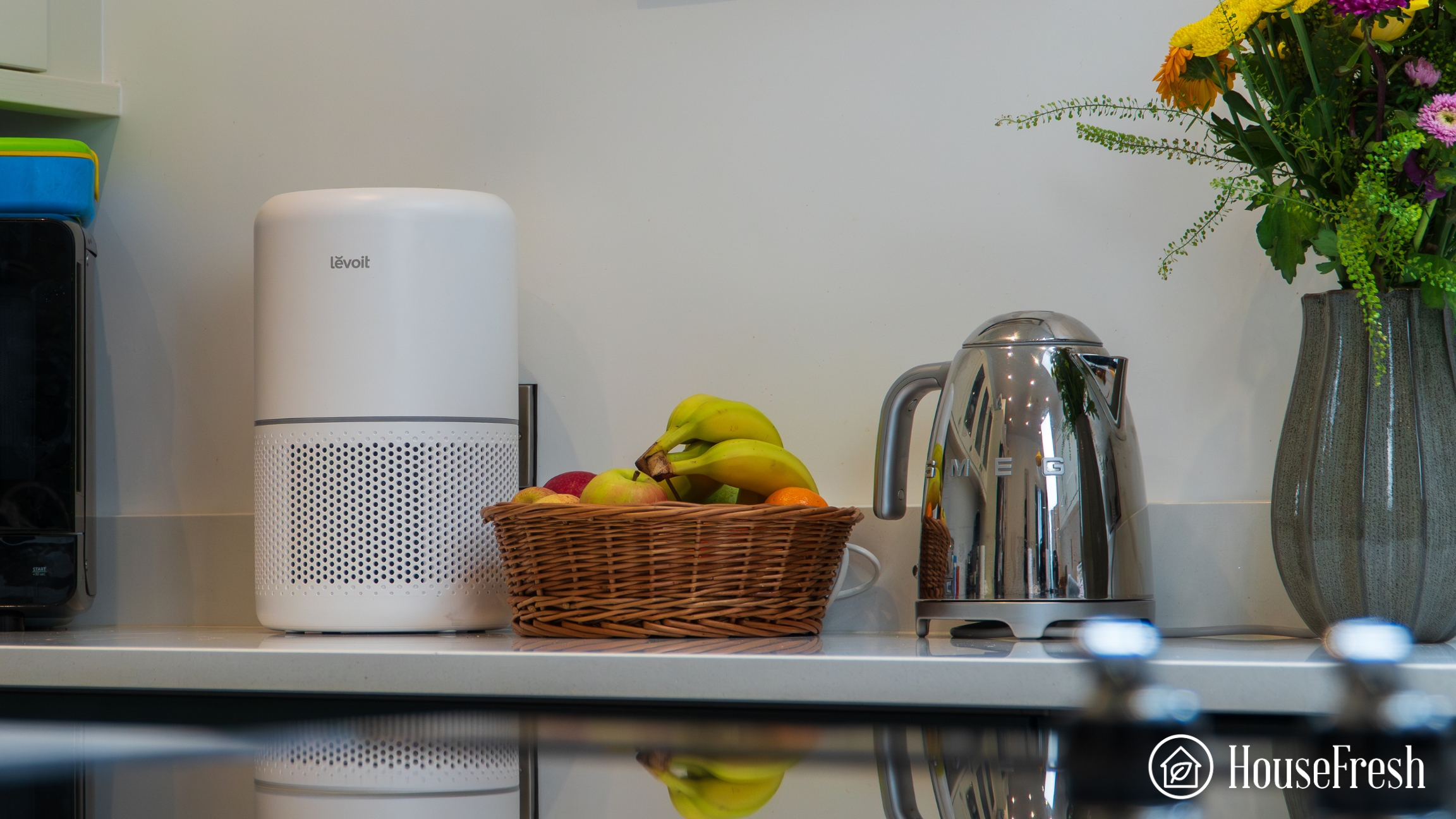
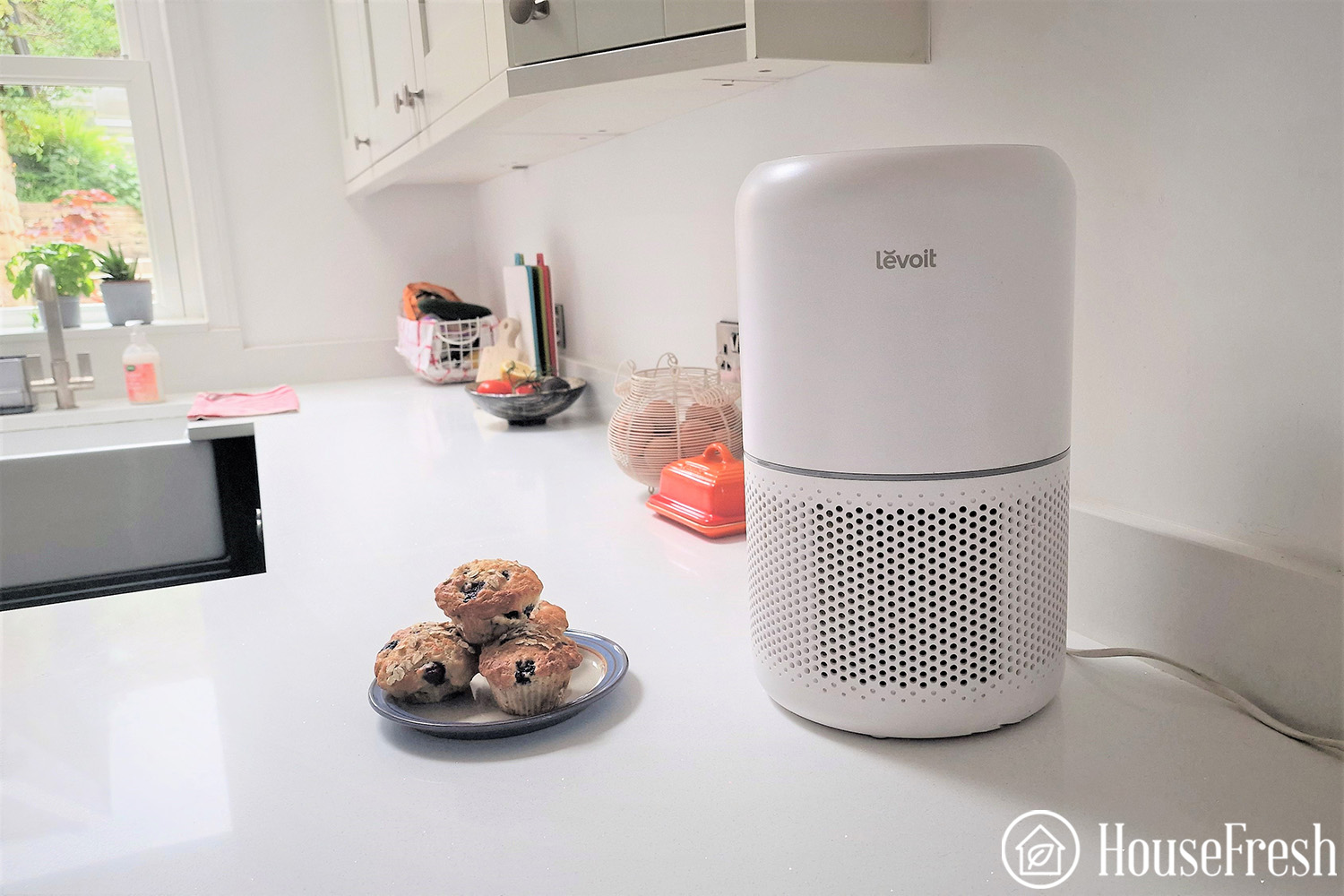
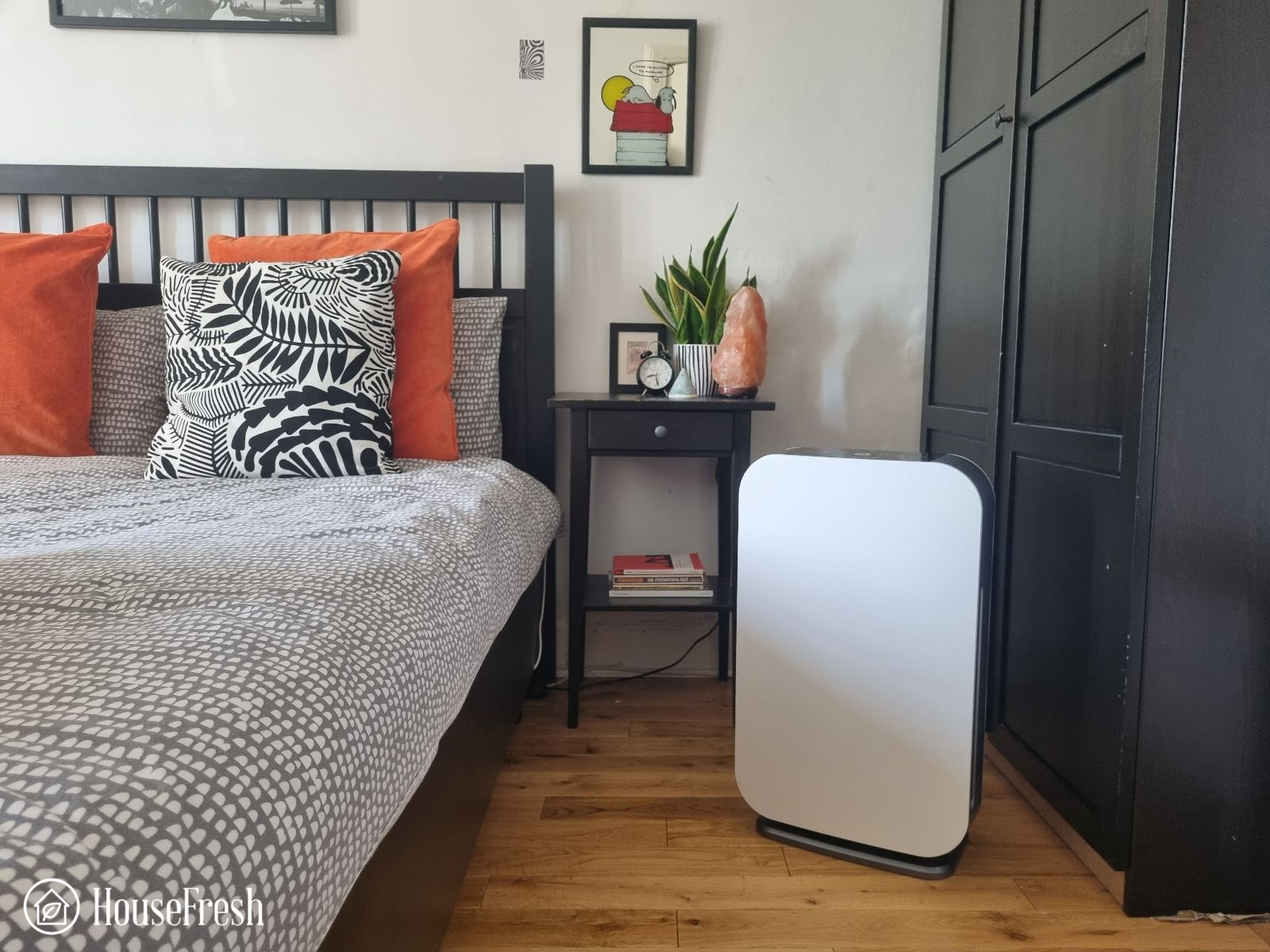
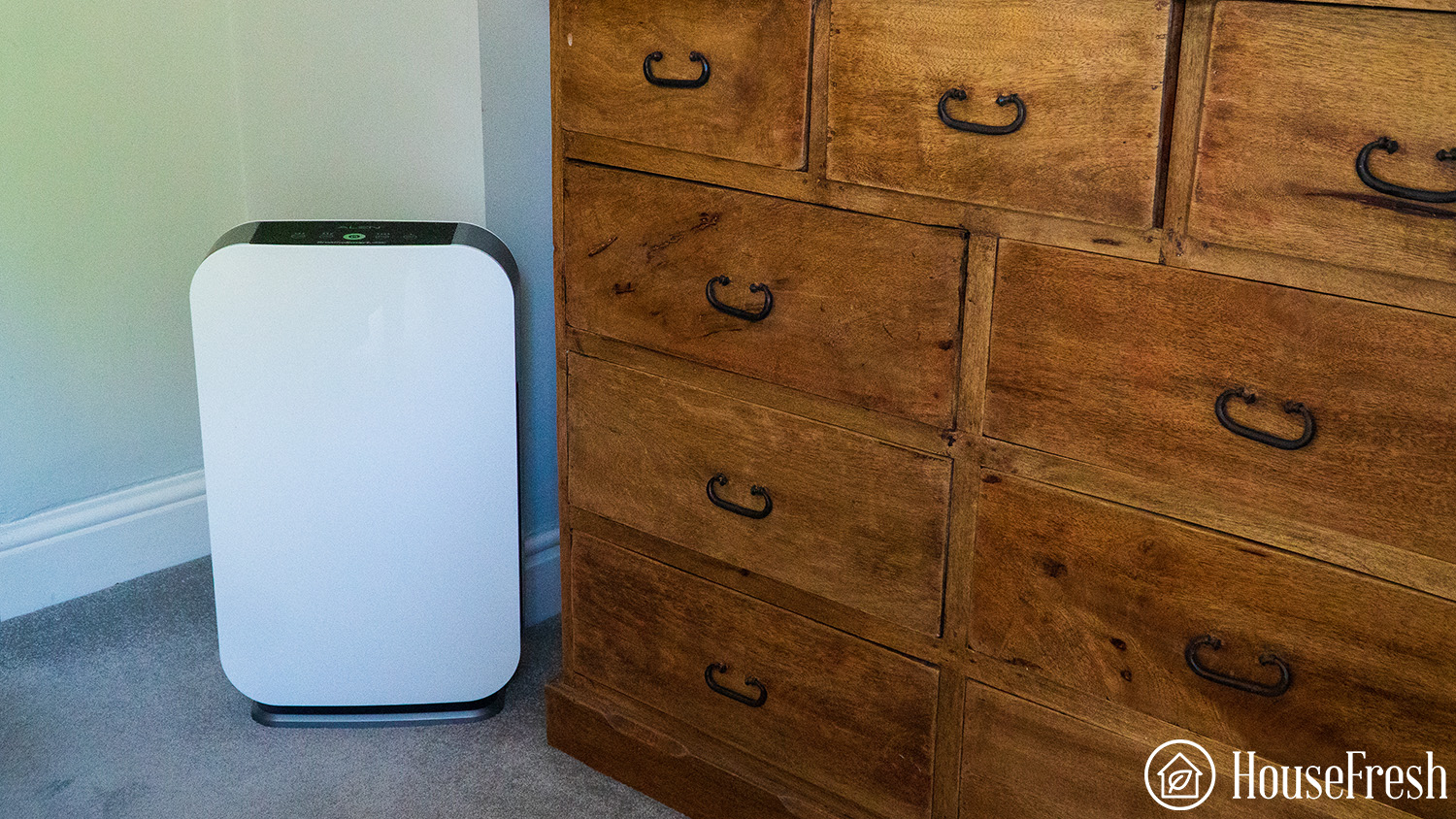
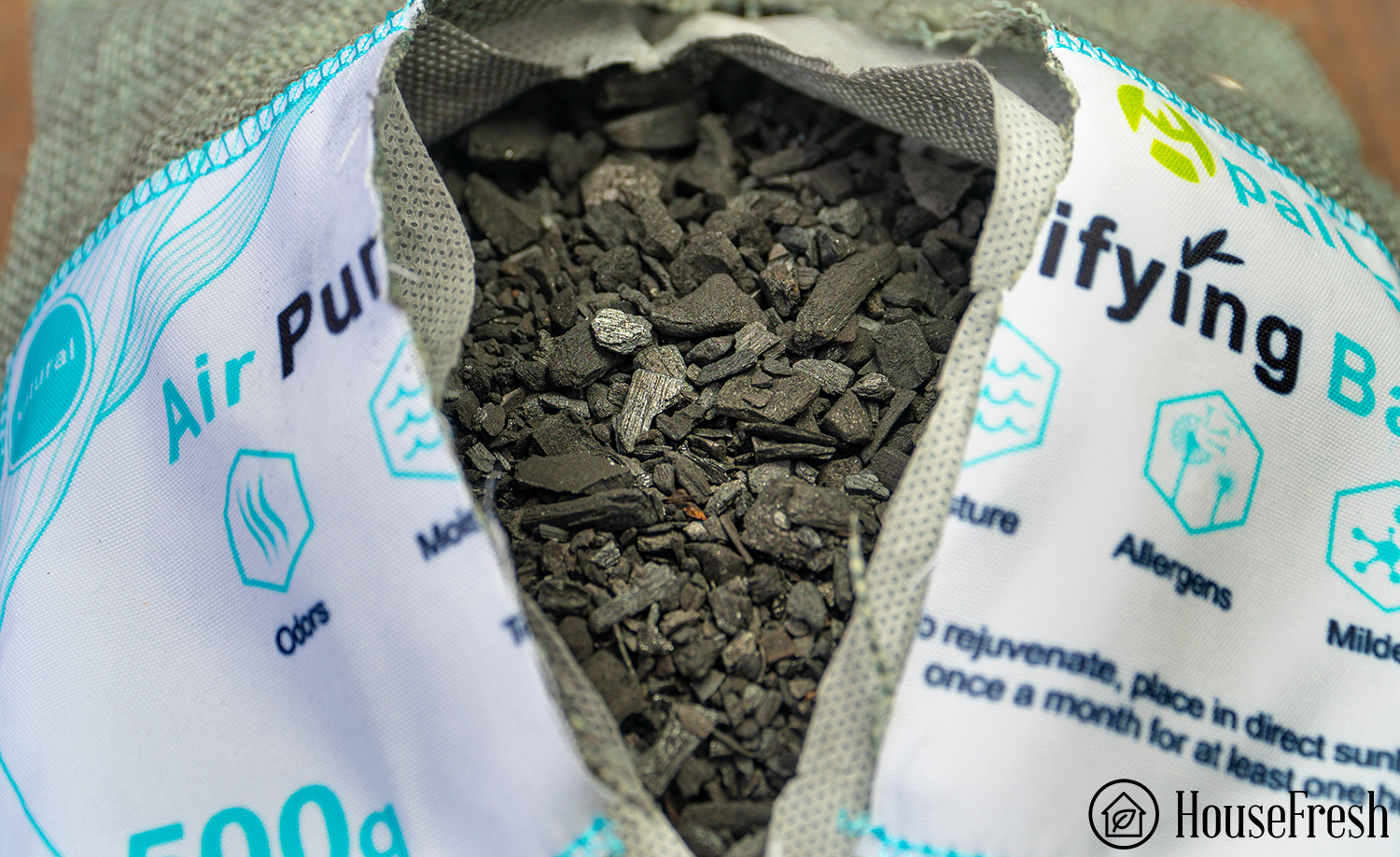
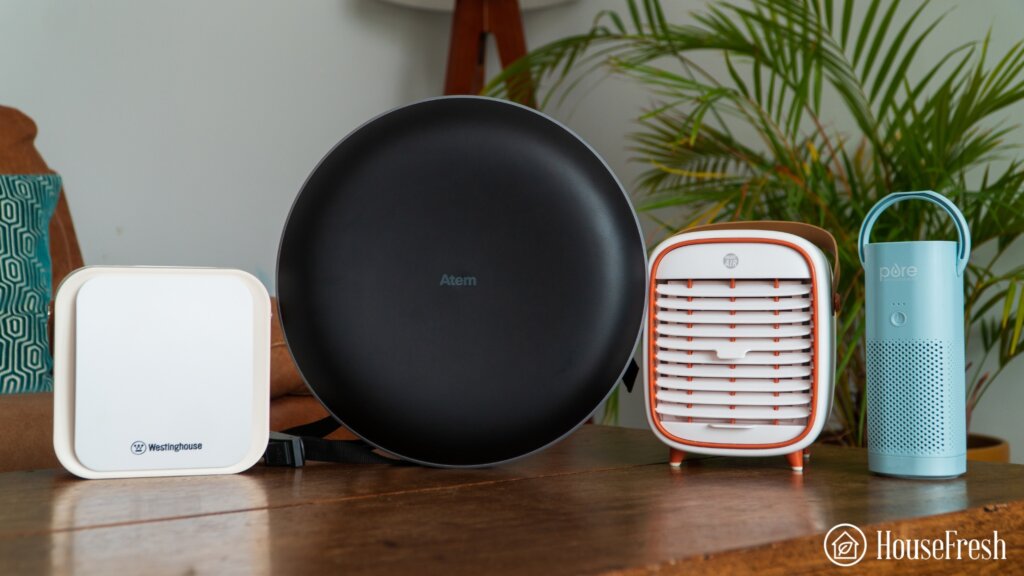
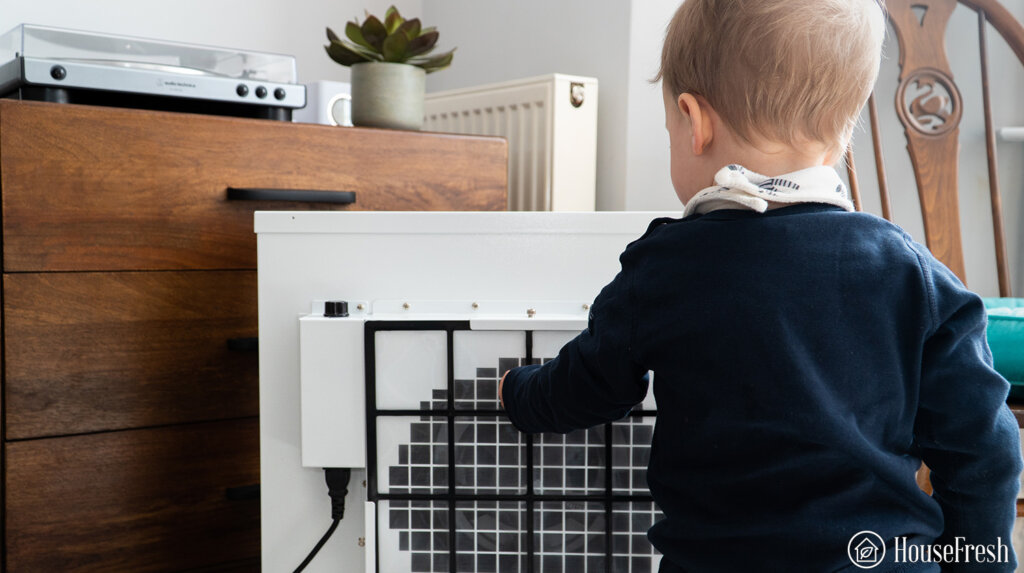
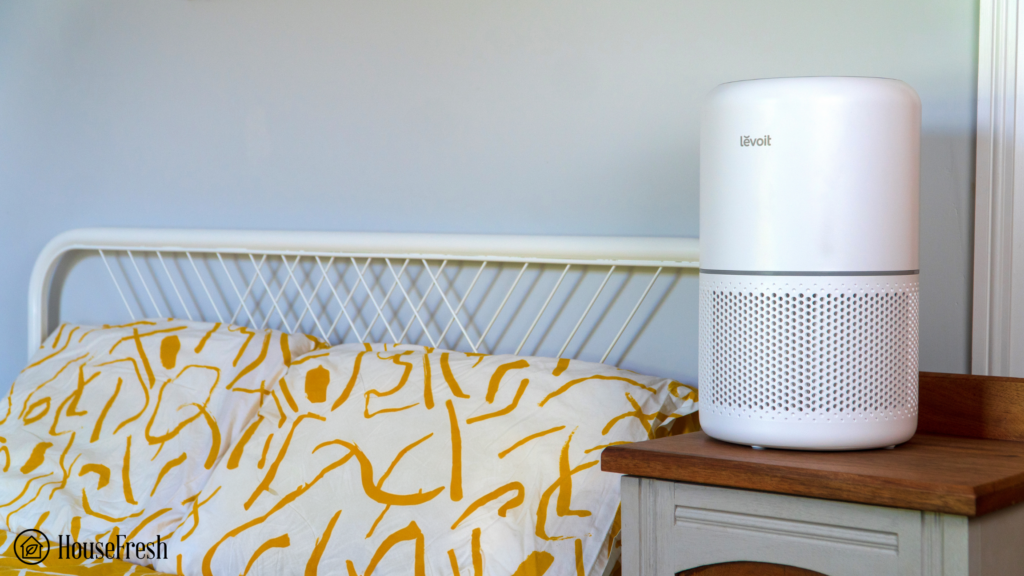
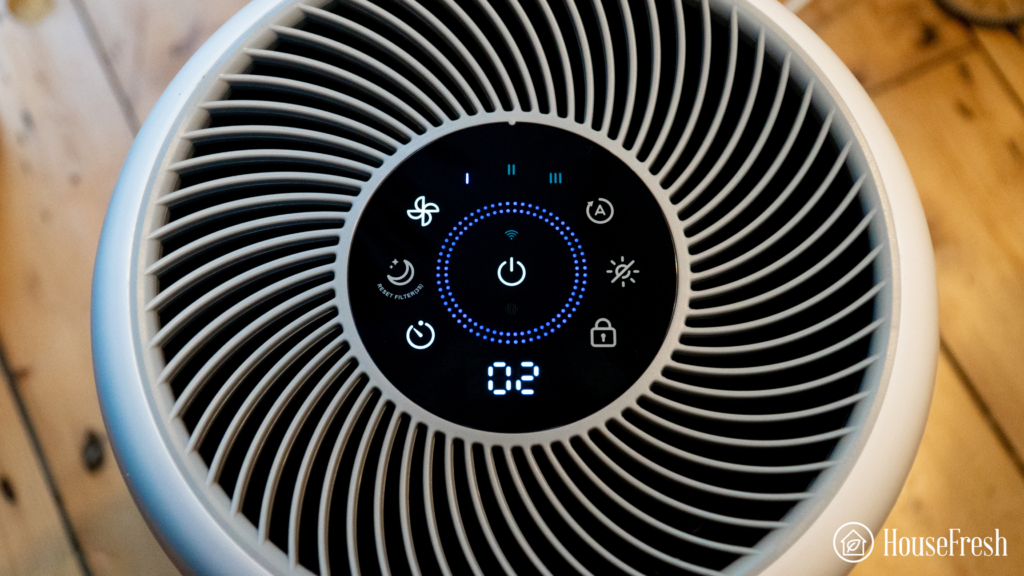
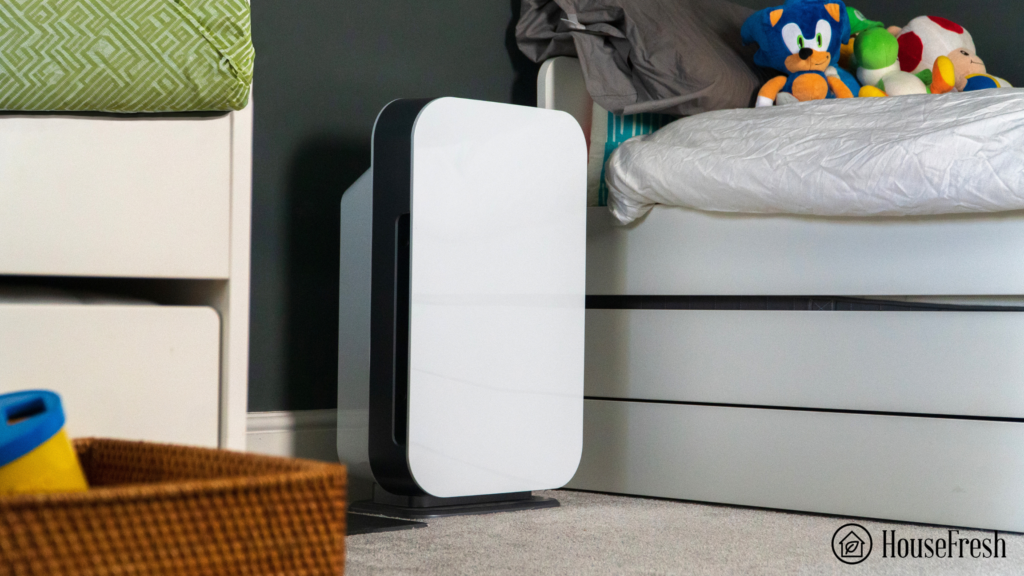
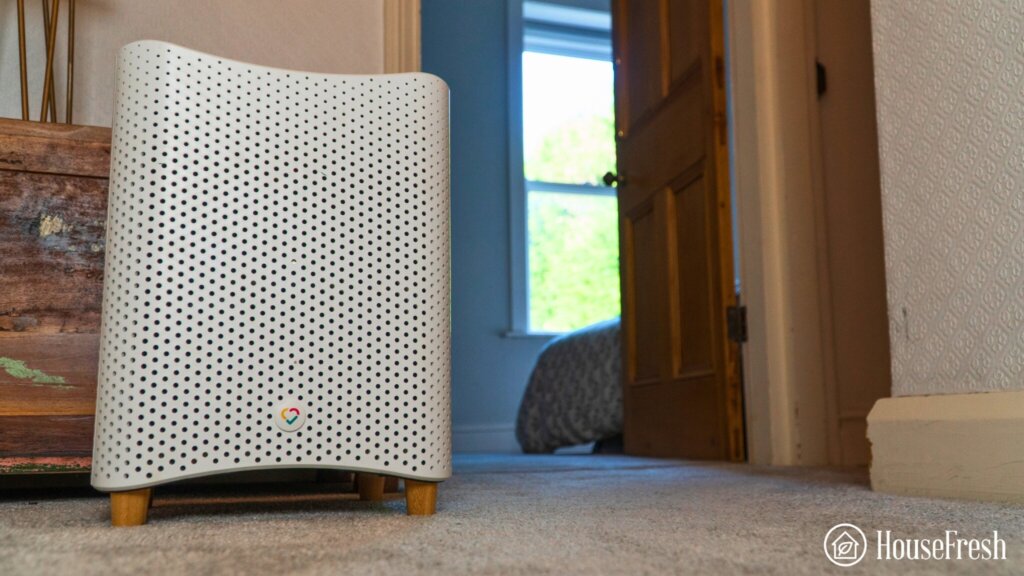
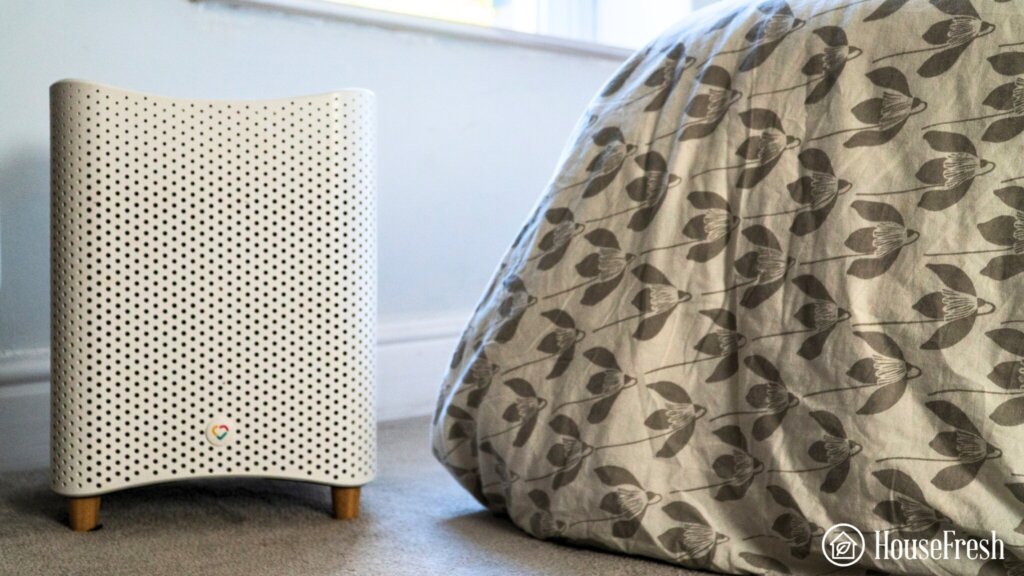
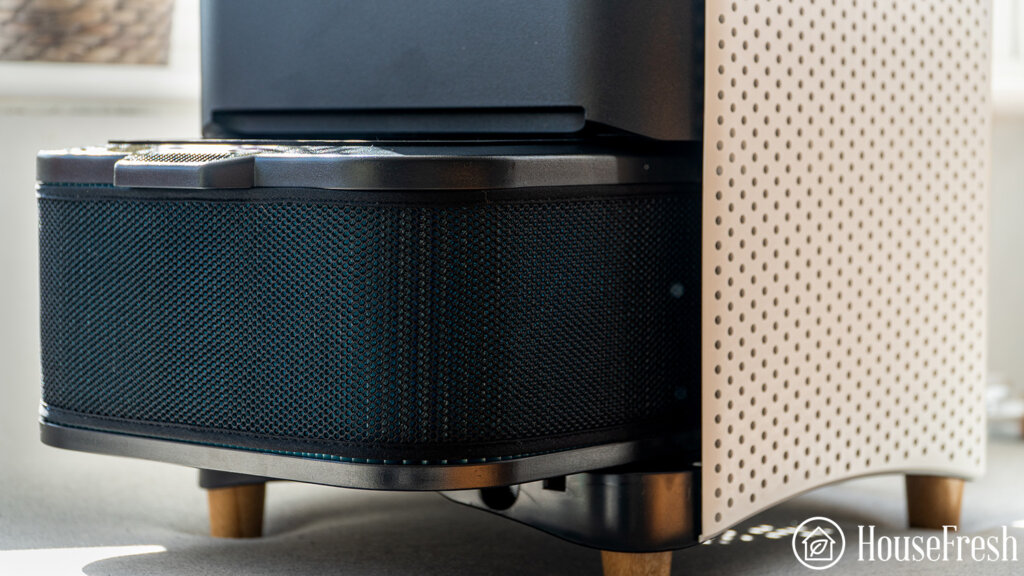
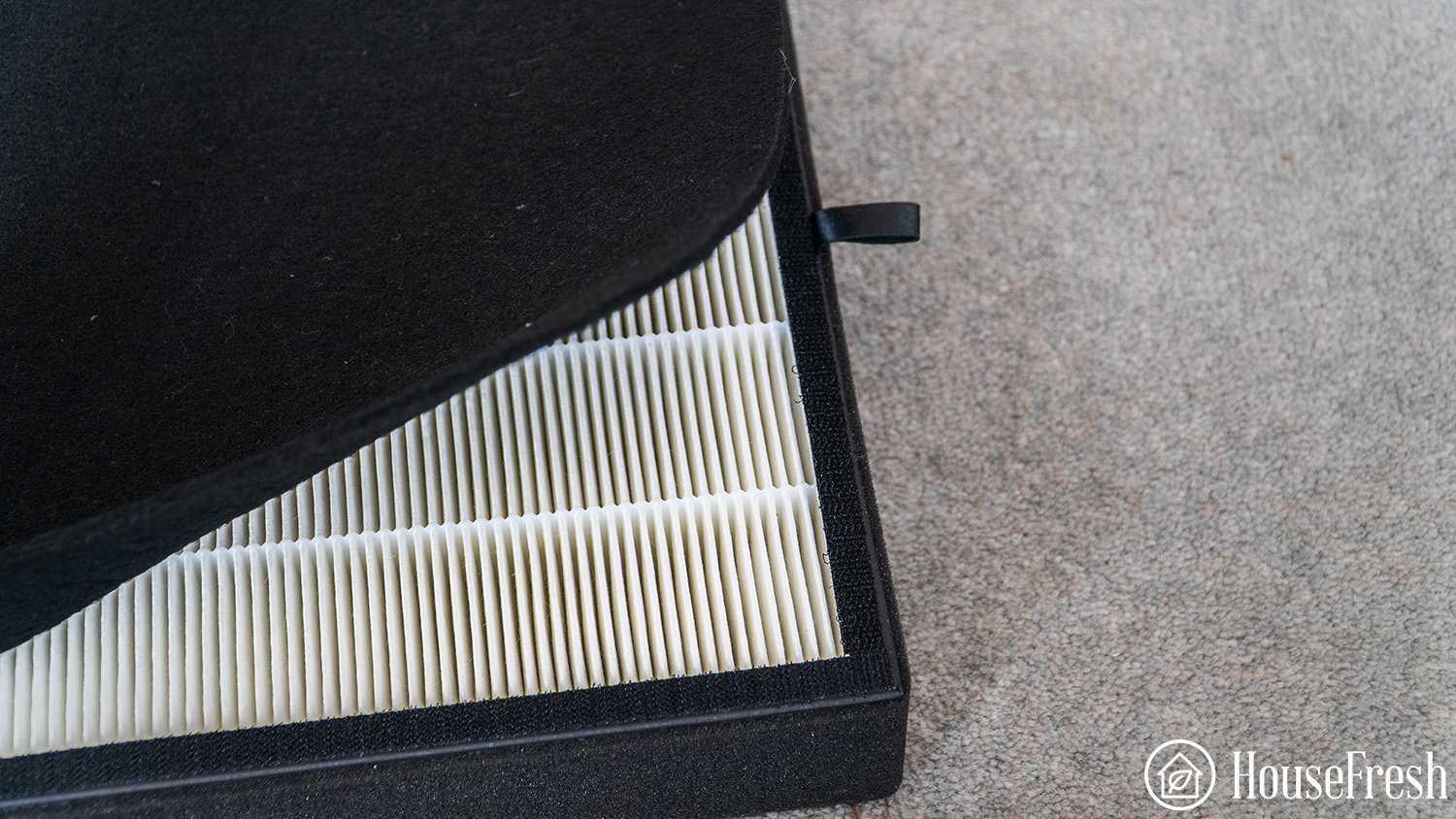
Is it okay to open your windows? Should you keep them sealed tight? There’s a lot of conflicting advice online. For instance, opening your windows in humid regions may raise your home’s relative humidity too much and make it a breeding ground for mold. But during the COVID-19 pandemic, experts encouraged us to keep those windows open to improve air circulation and reduce the risk of respiratory infection. Then, there’s the added complication of having an air purifier running at home. Looking for some concrete answers? Read on to learn more about using an air purifier with open windows.
What happens when you run an air purifier with the windows open?
There are a few things that happen when you run an air purifier with the windows open, such as:
Decreased air purifier efficiency. One study in the Building and Environment journal examined using an air purifier with an open window in a nursery environment. The air purifier had a particulate reduction rate of 63% with the window closed and a 46% particulate reduction rate with it open.
More pollutants to filter. The study above also looked at the environment. One window was right next to a parking lot, increasing the indoor air pollution in the room when the windows were open. Another study in the Science of The Total Environment journal found that using an air purifier with closed windows kept additional outdoor pollutants at bay.
Potential increase in health risk. If you’re using an air purifier to clean the air of allergens or asthma triggers, opening the window could invite these health hazards in. The EPA encourages to keep windows closed if it poses a health risk to people with asthma.
What’s the advice from air purifier manufacturers?
Advice from air purifier manufacturers varies. Some say you can open a window for a limited time or just one window at a time. Others have a hard no-open-window stance. Below are some nuggets of advice from major brand manufacturers.
“The windows have to be closed when the purifier is in use. This way, outdoor pollutants won’t affect the effectiveness of the purifier and in turn, increases the HEPA’s lifespan. For ventilation, the windows can be opened for 15-20 minutes so that the air in the house will be changed once. After closing the doors and windows, the air quality will quickly return to the safe range when the purifier is in use.”
“While our purifiers work best in rooms with closed windows, we never want to discourage you from opening your windows for a short time to get some fresh air! However, it is important to keep in mind that if outside air has a high level of pollutants, it may hamper the ability of the purifier to reduce the ambient level of particulates and gases in your space.”
“Even if an air cleaner is present in a room, it is important to ventilate. This increases the amount of oxygen in a room, but when too much air enters from outside, the Air Purifier may have trouble removing all impurities. Our tip is, therefore, to keep one open window or door at a time so that the air purifier can maintain its airflow.”
“Your air purifier works most efficiently in a sealed environment – opening the windows can allow more pollutants to enter the air in your home, which means your machine will take longer to work.”
The do’s and don’ts of running an air purifier with the windows open
Sometimes, it can be necessary to air out your home and get some fresh air in there, especially if you believe there are pollutants present. If you need a (literal) breath of fresh air, below are some tips for having the windows open while the air purifier is running.
What you should do
Have the window open for a very short time. If you really feel you need ventilation, keep the window open for no longer than 20 minutes.
Limit open windows. If you do open windows, have only one window open at a time to avoid overwhelming the air purifier.
What you should avoid
Never open the window if you suspect air pollutants or other poor air conditions. For instance, if you live near traffic or there is smoke in the air, keep the window closed. Keep windows closed during high humidity, as that can create a mold risk.
Don’t open the window if it might trigger allergies or asthma. It might be tempting to think you can get the best of both worlds: fresh air and clear air, as long as you have the air purifier by the window. But the air purifier might not keep up with allergens or asthma triggers, especially during high allergy risk days.
In general, a little bit of common sense goes a long way. Don’t open the window too much, if at all, and avoid opening the window during bad air conditions.
Wrapping up
You might feel confused because general advice about whether you can open a window while running an air purifier varies. To put it simply, opening a window can reduce the efficiency of the air purifier, as it may now be working against incoming outdoor pollutants. If you do want to open a window, have only one open for no longer than 20 minutes. Never open a window if it might cause issues for someone with allergies or asthma or if air quality is bad.
Smart Air is a social enterprise and certified B-Corp that puts 100% of its profits into helping more people breathe clean air. We have previously reviewed the Smart Air S, Smart Air Blast Mini and their portable QT3, and we are big fans of their ethos and the information that Smart Air shares with the world.
Back in 2022, we accepted Smart Air’s offer to lend us an SA600 so we could review it and return it to them afterwards. Normally, we only review air purifiers that we bought with our own money to avoid biases, so when manufacturers ask us to review their products, I make it clear that we will be open and honest with our readers. Most companies ghost me when I say this, but Smart Air was happy to let us say exactly what we thought.
The problem with the arrangement was that we only had the SA600 at home for two weeks, which gave just us enough time to run our usual tests but didn’t allow us to perform long-term experiments. But in 2024, Smart Air released an updated version of the SA600 with five fan speeds (versus the three we saw in the first model we reviewed, so we decided to buy this new and updated SA600 so we could update our review.
Today, I’m sharing with you the result of months of testing the Smart Air SA600 in our home to see how it performs in the real world.
The pros and cons of the Smart Air SA600
A summary of our top-level findings after testing this air purifier following our methodology.
“Our tests show that the air cleaning performance of the Smart Air SA600 matches that of popular devices like the Winix 5500-2 and the Levoit Vital 200S when running at top speed. And thanks to its five fan speeds, the SA600 was actually able to outperform the 5500-2 and the Vital 200S when running at sub-45 dB levels of operation.
The SA600 offers solid air cleaning power but it also costs more to run than other similarly powered devices due to the fact that it uses a total of four filters (two HEPA filters and two carbon filters) at each side of the air purifier.”
If you want an air purifier with smartphone app connectivity, an on-board sensor or smart modes (like auto mode and sleep mode), this is not the device for you.
Retailing at $279.95, it comes at a high initial cost compared to units from AirFanta, Levoit or Winix.
PROS
With a dust CADR of 287 cfm, it offers excellent air cleaning performance — even when running on lower fan speeds.
It uses a total of four filters (two H13 HEPA and two carbon) for filtering the air through both sides of the unit.
The two carbon filters use pelleted activated carbon, which we prefer to the impregnated fabric you get with other models like the Winix 5300-2 or the Coway AP-1512hh.
The control panel is intuitive and the lights switch off automatically, without the need to press any button or activate any special mode.
It restarts automatically following a power cut or after being unplugged, which is something other models don’t do.
You can use any brand of smart plug to connect it to your smart home hub, and set routines for it to come on and off automatically.
In 2022, we reviewed the first version of the SA600 and tested its three fan speeds. The SA600 v1 offered good air cleaning performance when running at its top speed (56 db) but this power didn’t translate to its sub-45dB speeds. With the v2 of the SA600, Smart Air changed that.
The SA600 comes with five fan speeds, which range from 35 and 56 decibels:
SPEED 1
SPEED 2
SPEED 3
SPEED 4
SPEED 5
NOISE LEVEL (from 3ft away)
35.2 dBA
37.2 dBA
41.5 dBA
46.1 dBA
56.7 dBA
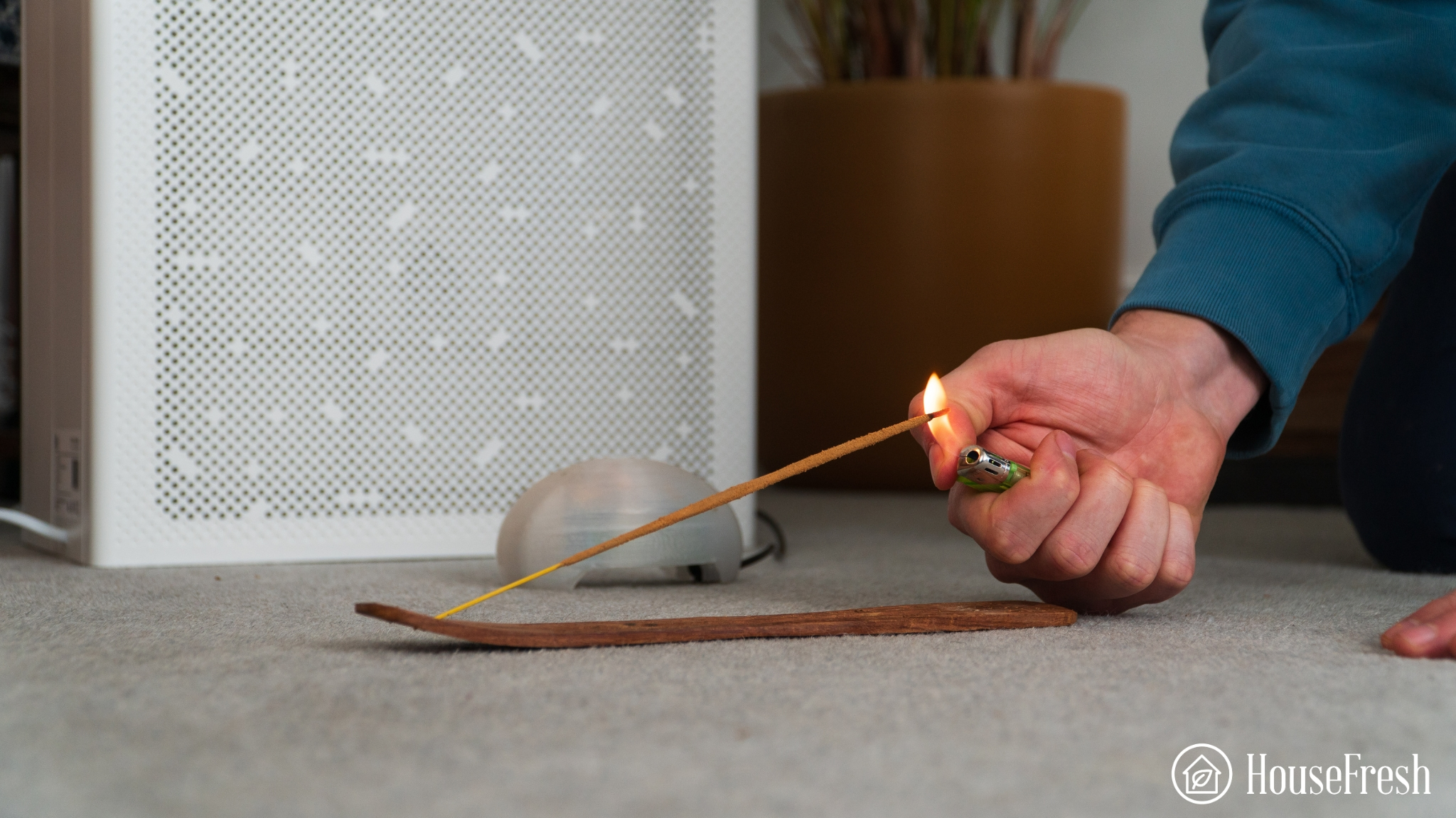
I tested the SA600 running at speeds 3, 4 and 5 inside our 728-cubic-feet test room, using our PurpleAir Zen sensor to track how long it took for the air purifier to reach PM1 zero after we burnt an incense stick:
SPEED 5: 24 minutes. This is the same time it took for the Coway Airmega 250S, the RabbitAir A3 and the Winix 5510 to reach PM1 zero.
This makes the SA600 an excellent choice for spaces that need quiet operation without sacrificing on air cleaning performance, such as offices, classrooms, bedrooms and TV rooms. However, if quiet is important to you, make sure to also research PC fan-powered air purifiers like the Luggable XL-7 from CleanAirKits.
Design, controls and features
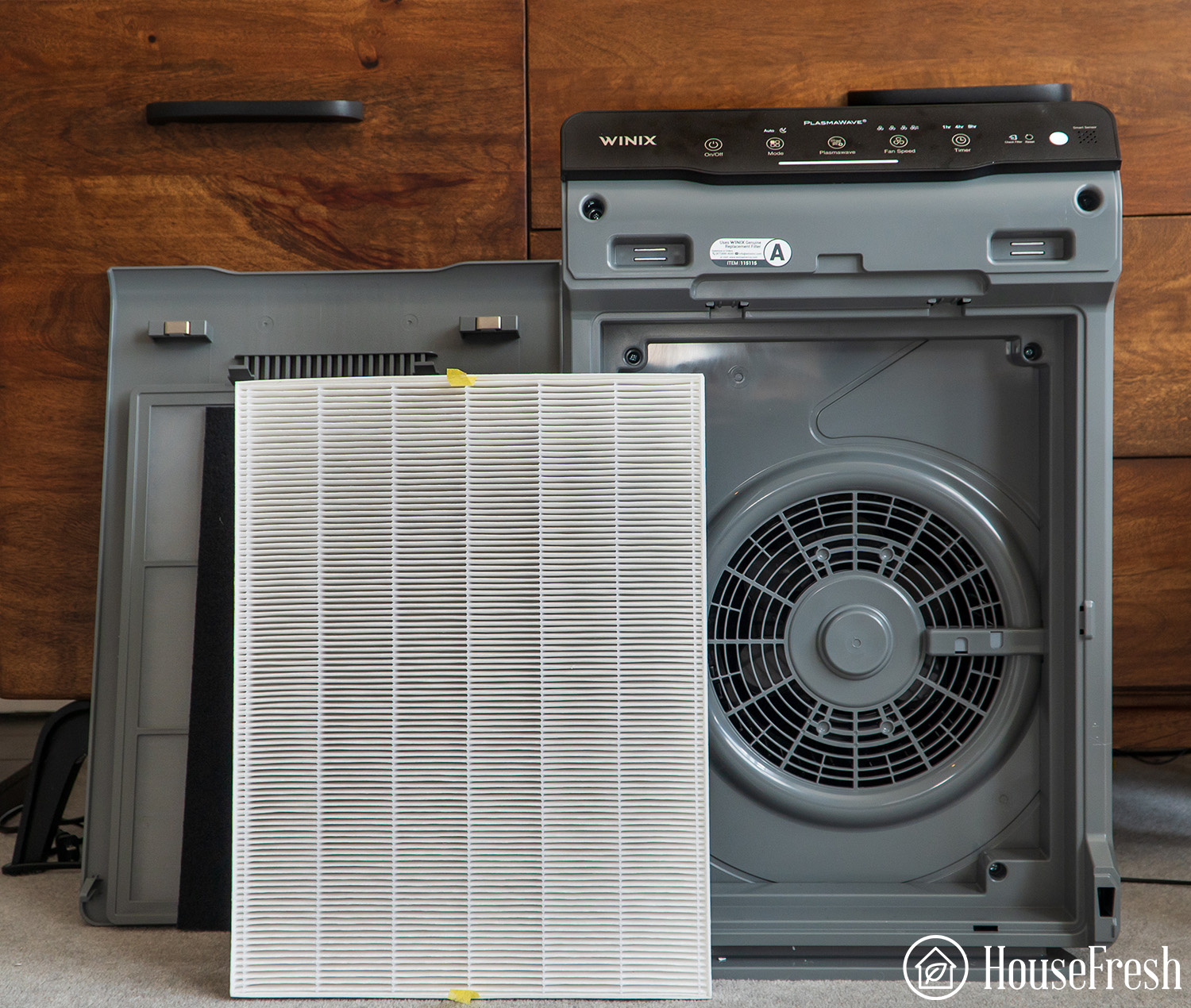
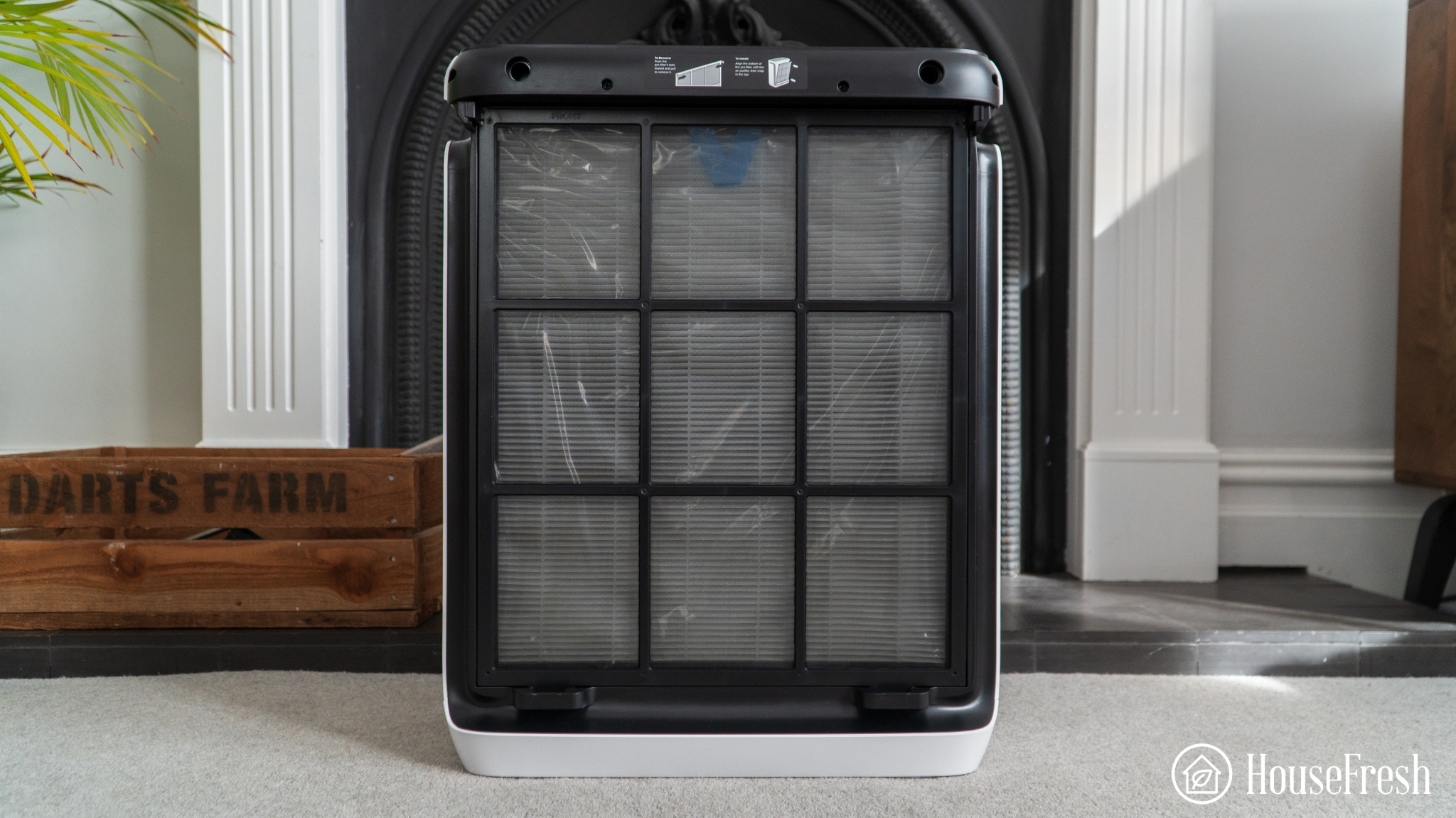
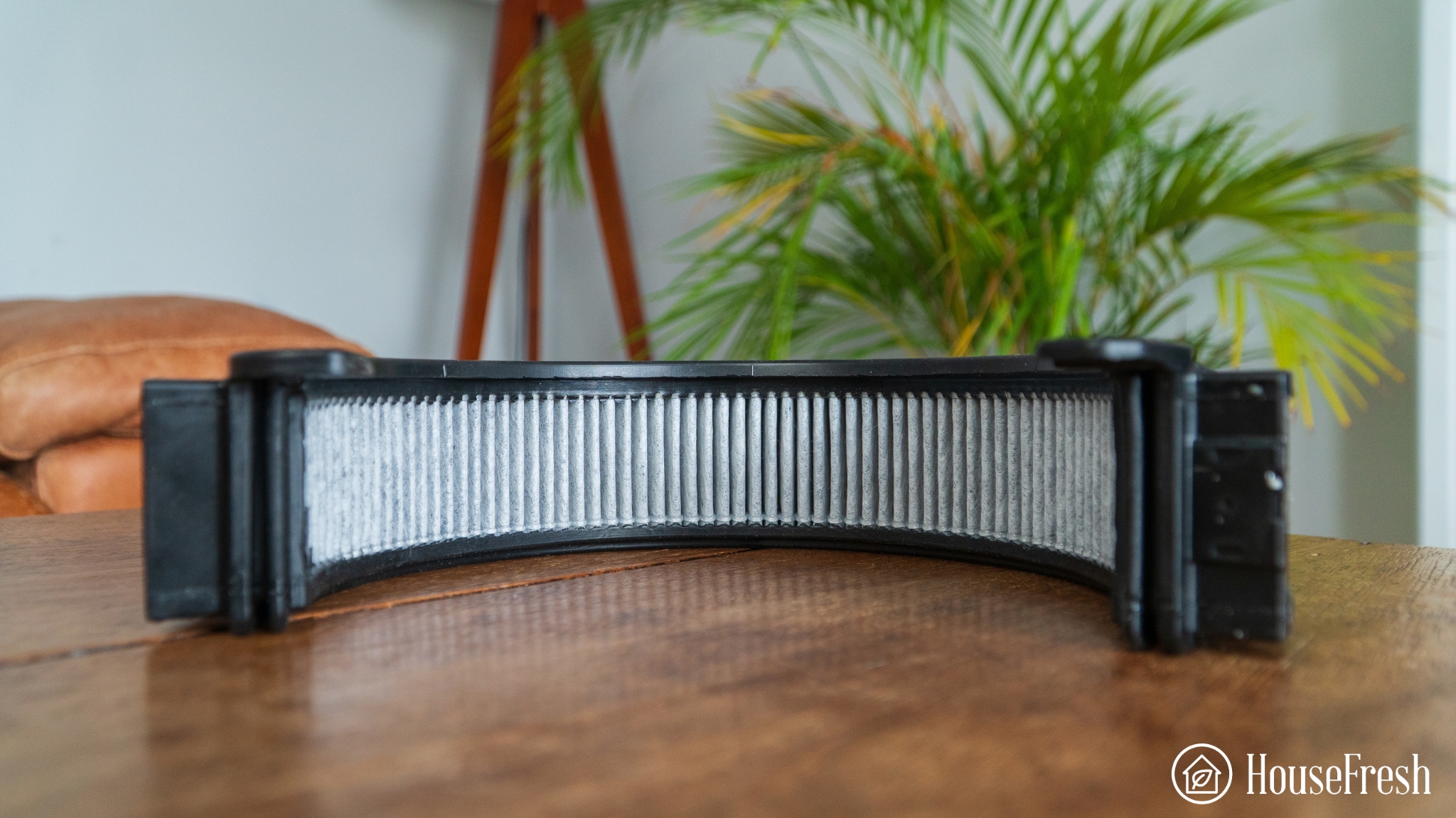
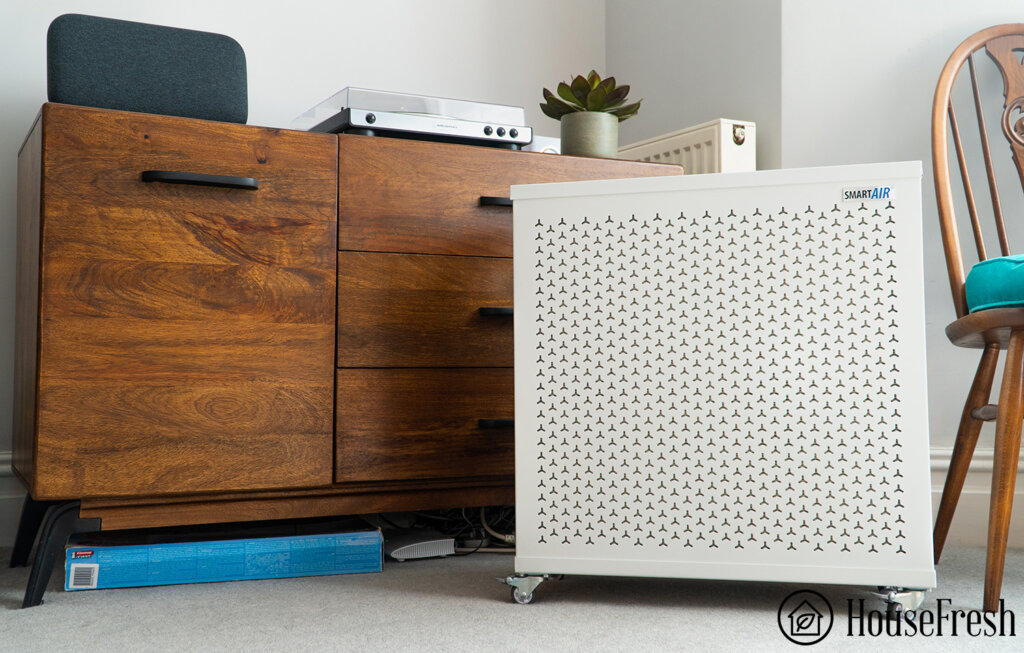
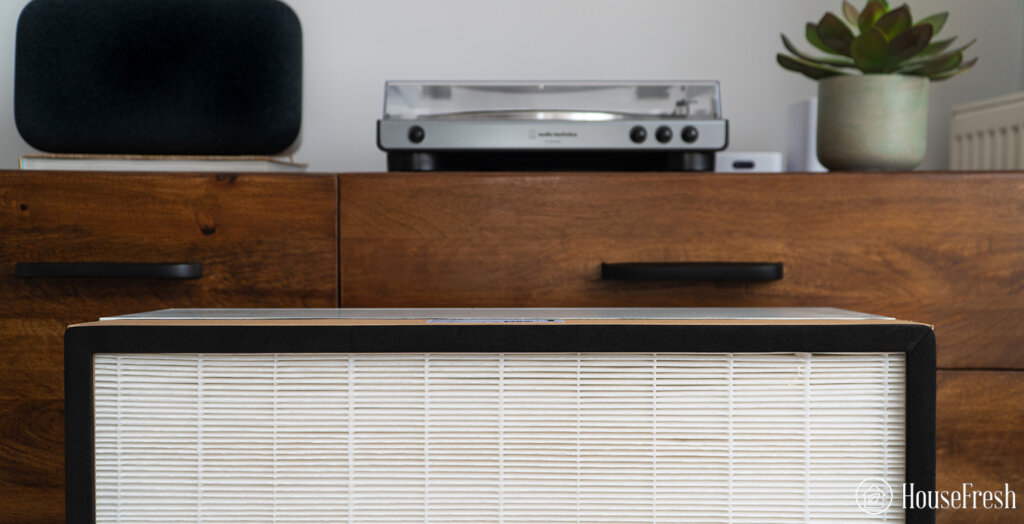
The SA600 has two filters on each side of the unit to capture pollutants and VOCs from both sides of the device.
I like the simplicity of the SA600’s design and Smart Air’s decision to use matte plastic, as it far less prone to smudges and fingerprints compared to the shiny plastic we see in so many other devices like the Coway AP-1512hh or the PuroAir 400.
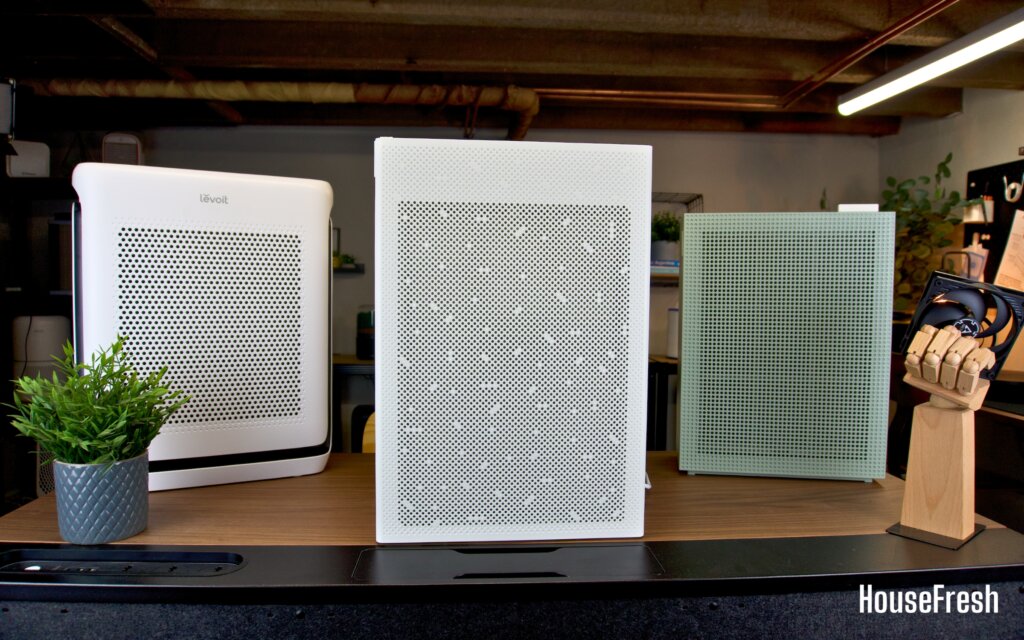
This is a mid-sized air purifier, that has similar dimensions and will take up as much floor space as devices like the Levoit Vital 200S and the Coway Airmega 150.
However, unlike the Vital 200S or the Airmega 150, the SA600 pulls air from both sides of the device and has two sets of filters through it’s dual inlets.
That means you get one H13 HEPA filter and one activated carbon filter on the left side of the unit, and then another H13 HEPA + carbon combo on the right side. The SA600 also comes with a removable pre-filter at each side:
Now, this use of additional filters means you will have two pre-filters to keep clean and you will need to replace double the number of HEPA and carbon filters each year. I will break down the annual running costs further down in the review, including calculations for filter replacement and energy costs.
Like with the other devices we have reviewed from Smart Air, the controls are straightforward with simple operation. You get just four buttons: one to cycle between the five fan speeds, a lock to prevent the settings from being changed, a filter replacement indicator, and a power on/off button.
There are three lights to the left of the fan speed button where you will be able to see what speed the SA600 has been set to, with speeds over Speed 3 showing with two lights:
Like other Smart Air air purifiers, the SA600 doesn’t offer smart modes (such as auto mode or sleep mode) and it doesn’t come with a smartphone app to control the unit from afar. That being said, you can use this device with any type of smart plug to set routines as part of your smart home hub.
Although fairly commonplace in today’s appliances, the child lock and the filter reset light make this the ‘smartest’ model from Smart Air. These are quality-of-life features that won’t necessarily impact the air cleaning performance of the air purifier as much as the four filters will, but that users will appreciate in their daily lives.
To wrap up this section, let me tell you about a unique feature of the SA600 that I haven’t seen in any other air purifiers I have tested: the ‘Do Not Disturb’ mode. Without the need of you pressing any button, the SA600 turns off all control lights automatically if you don’t touch the buttons for three minutes. This makes the SA600 a great choice for nursery rooms, bedrooms and TV rooms, where LED lights can become an unwanted distraction.
Filtration technology
Two HEPA H13 filters and two activated carbon filters supercharge the SA600’s air cleaning performance, by cleaning air from both sides of the device.
In 2023, Dyson made a complaint to the BBB National Programs National Advertising Division (NAD) about Levoit’s use of ‘HEPA’ in their marketing. The complaint forced Levoit to refrain from saying their main filtration was powered by HEPA 13 filters because it wasn’t true.
With that in mind, we were glad to see that the HEPA filters for the SA600 have been third-party lab tested as per AHAM AC-1-2002, so we can be confident they are genuine H13 HEPA Filters
The best thing is that the SA600 comes with two of these pelleted activated carbon filters, meaning that you will have A LOT more carbon to absorb unwanted odors, gasses and VOCs than the average air purifier.
As with other Smart Air air purifiers, the fan of the SA600 is a powerful little beast, which helped this unit clear the air from incense smoke in our test room in just 24 minutes.
Tip
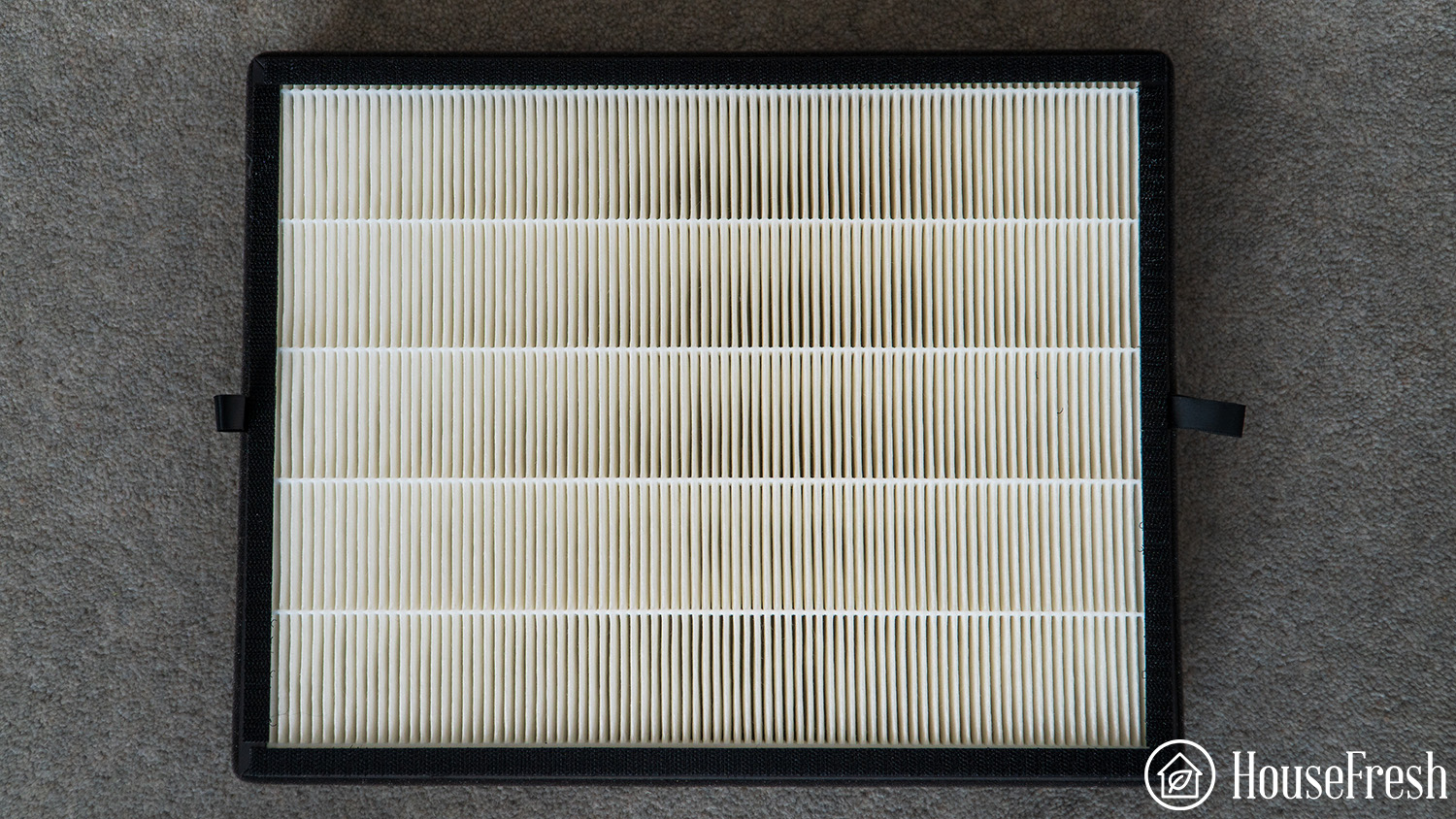
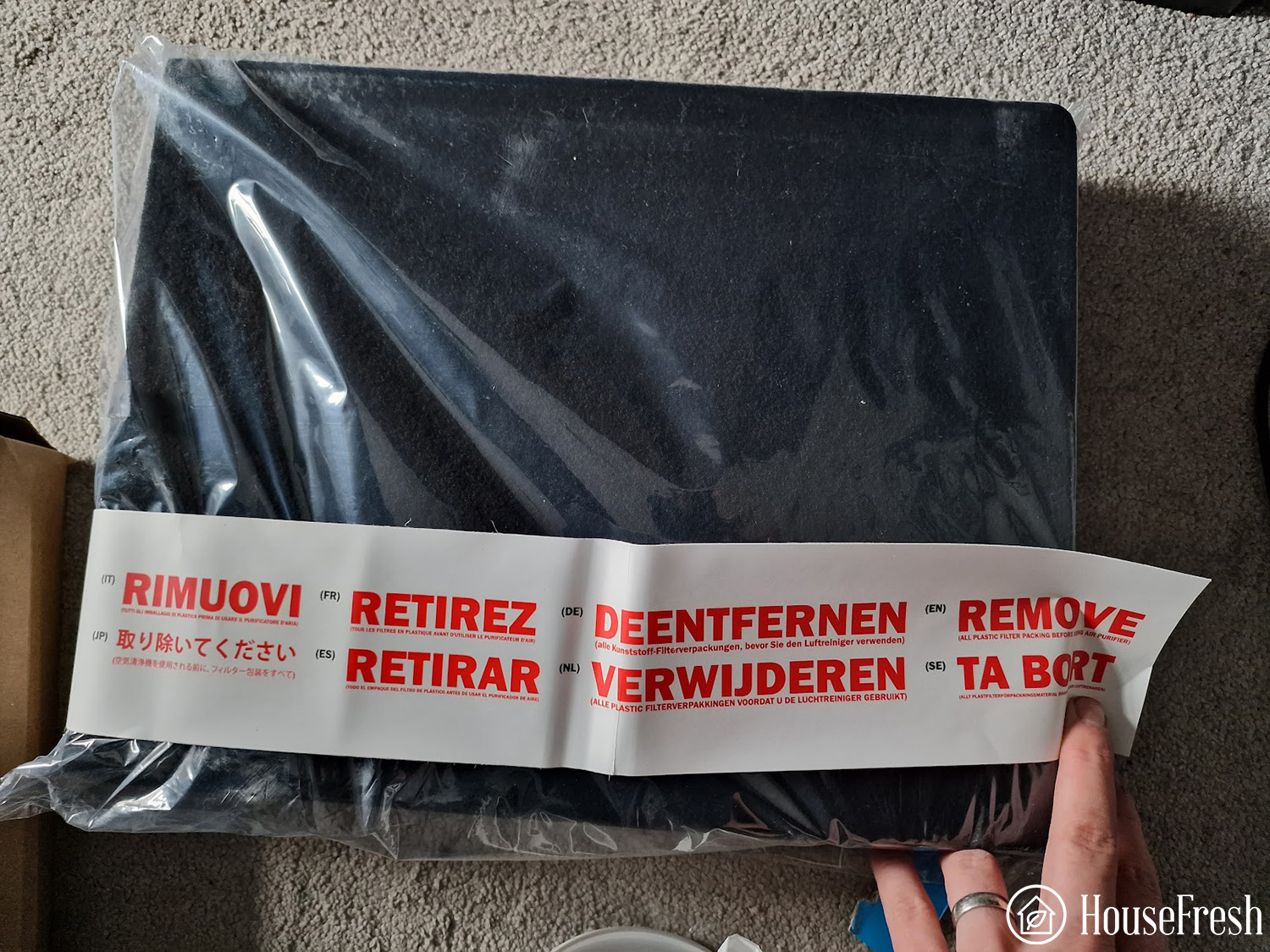
Remember that filters will come in plastic bags, so be sure to remove them from the bags before turning on your Smart Air SA600.
Otherwise, the air purifier won’t be able to clean the air. Plus, running the device with the filters inside the plastic bags is likely to generate burnt smells.
When you change the filter in your Smart Air SA600, you’ll find that the process is simple. Here is a video taking you step by step:
The filter reset indicator will flash continuously when your filter needs replacing
Pull out the front cover, then lift out the pre-filter, HEPA and activated carbon filter
Remove your new HEPA filter from its bag
Insert your new HEPA and activated carbon filter, making sure the arrow on the filter is in the correct direction outwards
After inserting the front cover back into your purifier, hold the filter replacement indicator for 4s. This resets the filter replacement indicator and makes it stop flashing.
Air cleaning performance
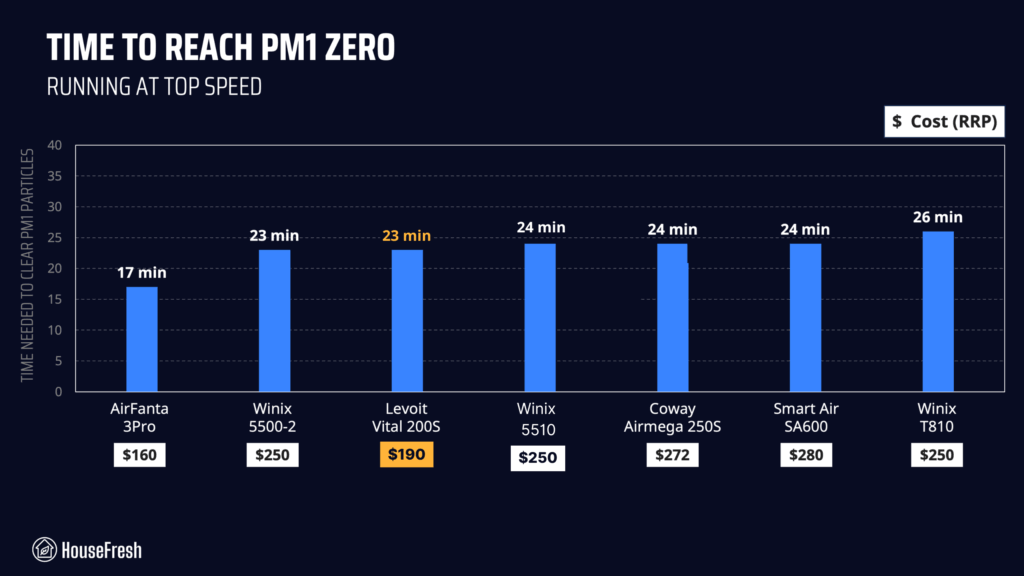
The Smart Air SA600 cleared our test room in 24 minutes — the same result achieved by the Coway Airmega 250S, but a few minutes faster than the Winix 5510.
The CADR report of the SA600 stated that this devices has a dust CADR of 287 cfm, so I expected it to take between 23-25 minutes to clean the air based on our data from every other air cleaner we’ve reviewed to date.
We tested the SA600 in the same 728-cubic-feet room where we tested nearly 100 different air purifier models since 2020. By testing every device in the same room doing the same job of removing incense smoke, we can confidently compare performance across devices.
The Smart Air SA600 cleared our test room of PM1 particles in 24 minutes, when running at its highest fan speed:
The Smart Air SA600 is much faster than the more expensive Mila (38 minutes) but slower than the Vital 200S (23 minutes). See how the performance of this device compared to other similarly-priced devices:
AIR PURIFIER MODEL
TIME TO REACH PM1 ZERO AT FULL SPEED
LIST PRICE
AirFanta 3Pro
17 minutes
$159.99
Levoit Vital 200S
23 minutes
$189.99
Winix 5500-2 (ionizer enabled)
23 minutes
$249.99
CleanAirKits Luggable XL-7
23 minutes
$299.00
Smart Air SA600
24 minutes
$279.95
Coway Airmega AP-1512HH (ionizer enabled)
26 minutes
$229.99
PuroAir 400
30 minutes
$249.00
Mila
38 minutes
$327.99
So, the real-world performance of the Smart Air SA600 matched up to the lab-reported CADR scores. This was great to see, considering that this air purifier uses two activated carbon filters that are likely to reduce the airflow for particle removal.
Based on a CADR of 287 cfm, this device could provide five air changes per hour in rooms as large as 430 sq. ft. You can use our CADR calculator to see how many air changes it will offer in your space.
Noise levels test results
While air cleaning performance is very important when shopping for an air purifier, you also need to be mindful of how loud it is. The reality is that if an air purifier is too long, it will end up being turned off eventually.
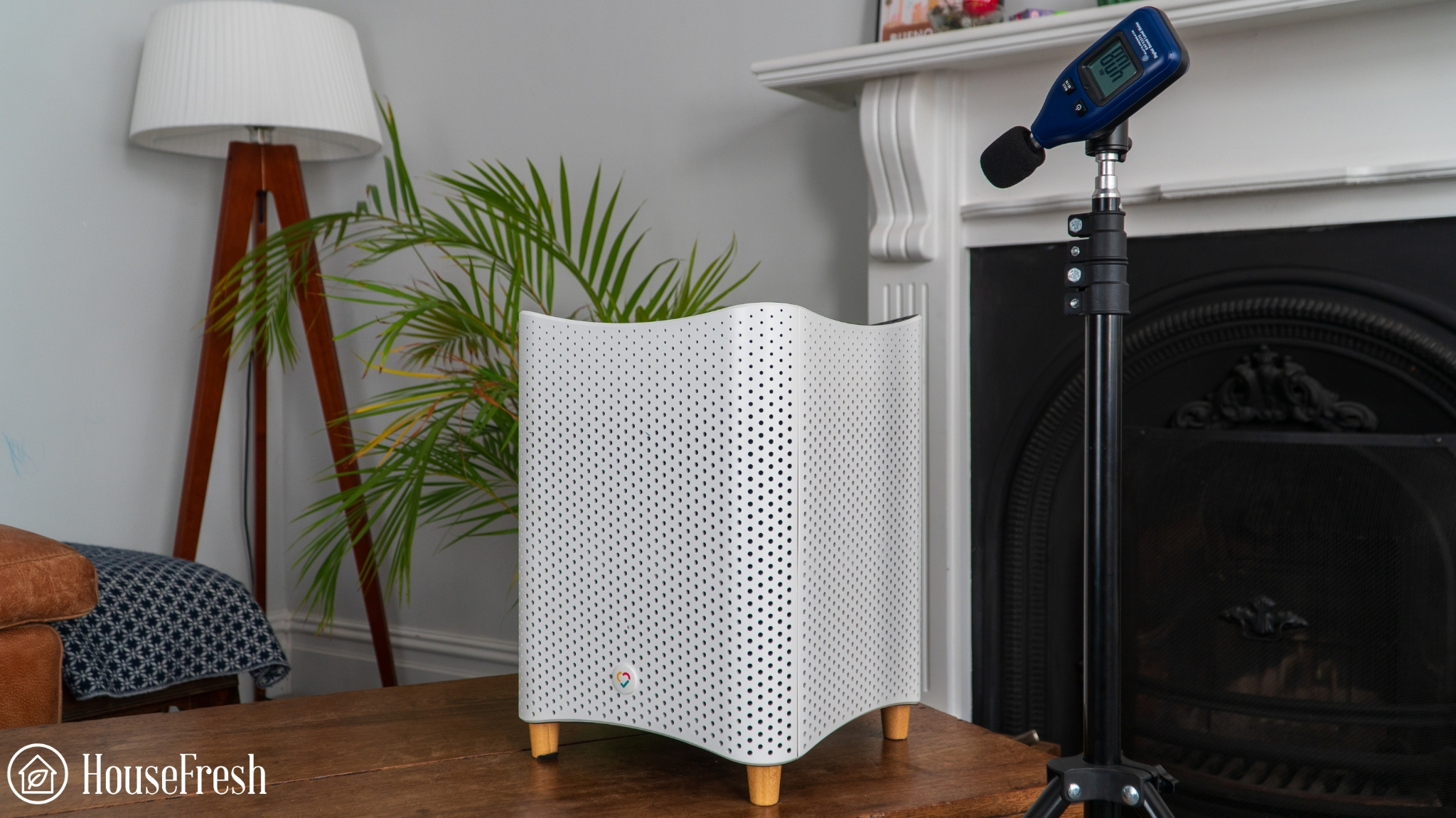
That is why we use a sound level monitor to gather comparable data on noise level generation by recording how much sound in decibels is generated by the air purifier from three (3) feet away in the same corner of our basement studio.
In the table below, we share how much noise is generated by the SmartAir SA600 at each of its five fan speeds:
FAN SPEED
SOUND LEVELS IN DECIBELS
Speed 1
35.2 dBA
Speed 2
37.2 dBA
Speed 3
41.5 dBA
Speed 4
46.1 dBA
Speed 5
56.7 dBA
Be aware our background noise is very similar to what we got for speed 1, so the actual result is likely to be much quieter.
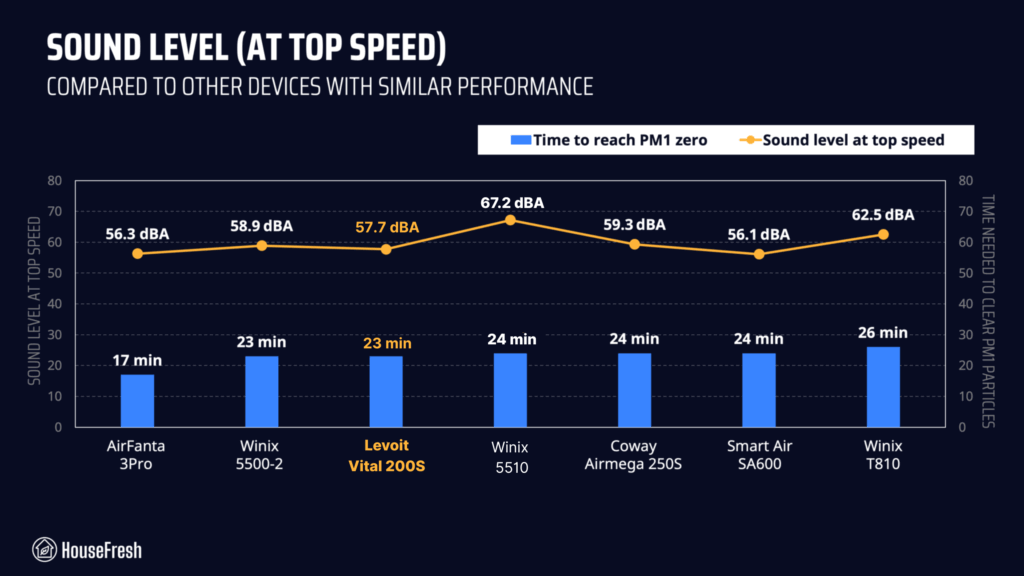
When compared to other air purifiers with similar performance, the SA600 is a little quieter than many of the HEPA retail devices we have but louder than the PC fan powered devices.
AIR PURIFIER MODEL
SOUND LEVEL AT TOP SPEED (dB)
TIME TO CLEAN OUR TEST ROOM
CleanAirKits Luggable XL-7
38.8 dBA
23 minutes
AirFanta 3Pro
56.3 dBA
17 minutes
Smart Air SA600
56.7 dBA
24 minutes
Levoit Vital 200S
57.7 dBA
23 minutes
Winix 5500-2
58.9 dBA
23 minutes
Philips 3000i
59.2 dBA
20 minutes
Coway Airmega AP-1512hh Mighty
60.1 dBA
26 minutes
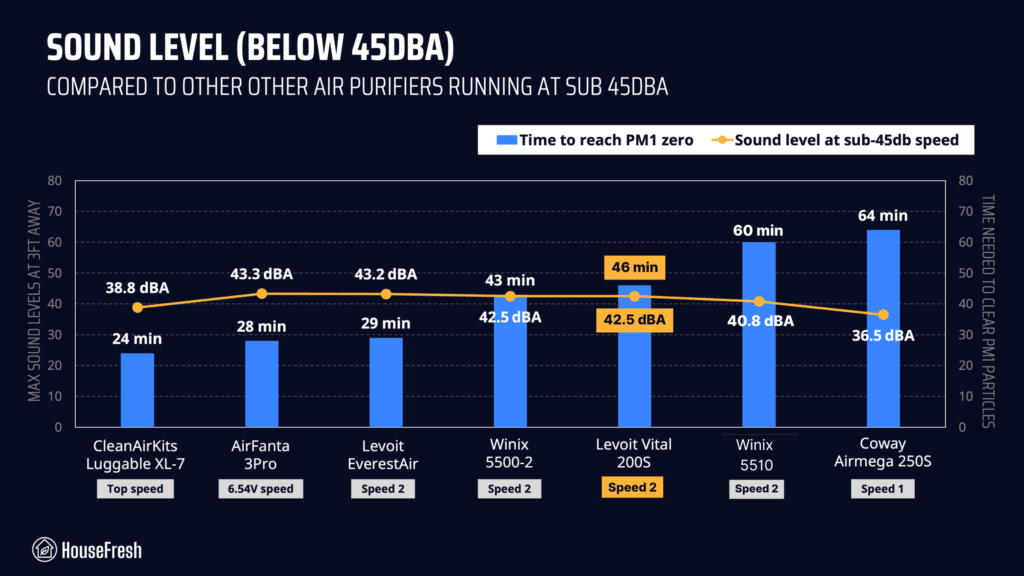
The benefit of high CADR air purifiers is that you can use them at lower, quieter fan speeds, while still benefitting from good air cleaning performance. That is why we always re-test the particle removal performance of our air purifiers when running at sub-45dB fan speeds, which is the limit set by Clean Air Stars for offices and classrooms.
So, we ran the same incense smoke test in the same 728 cubic feet space with the Smart Air SA600 sunning at both speed 3 (41.5 dBA) and speed 4 (46.1 dBA).
AIR PURIFIER MODEL
SUB-45 dB SOUND LEVEL
TIME TO REACH PM1 ZERO
CleanAirKits Luggable XL-7
38.8 dBA
23 minutes
AirFanta 3Pro (6.45V)
43.3 dBA
28 minutes
Smart Air SA600 (Speed 4)
46.1 dBA
36 minutes
Philips 3000i (Speed 2)
45.8 dBA
38 minutes
Winix 5500-2 (Speed 3)
47.5 dBA
43 minutes
Smart Air SA600 (Speed 3)
41.5 dBA
46 minutes
Levoit Vital 200S (Speed 2)
41.9 dBA
46 minutes
Coway Airmega AP-1512hh Mighty (Speed 2)
44.4 dBA
51 minutes
Of course, when accounting for lower sound levels, the PC fan-powered devices offer a more powerful air cleaning performance at whisper quiet operation compared to the Smart Air SA600 and all the other HEPA retail air purifiers in the bunch.
But have a listen for yourself, as I know that sound can be subjective:
Long-term running costs
Running a Smart Air SA600 will cost you $131.08 per year, combining energy consumption costs and filter replacement prices.
As part of our reviews, we always calculate how much you can expect to spend on a yearly basis, assuming you are running the device 24/7 all year round utilizing our own energy consumption data and the manufacturer’s filter lifespan data.
1. Electricity costs = $59.98 per year
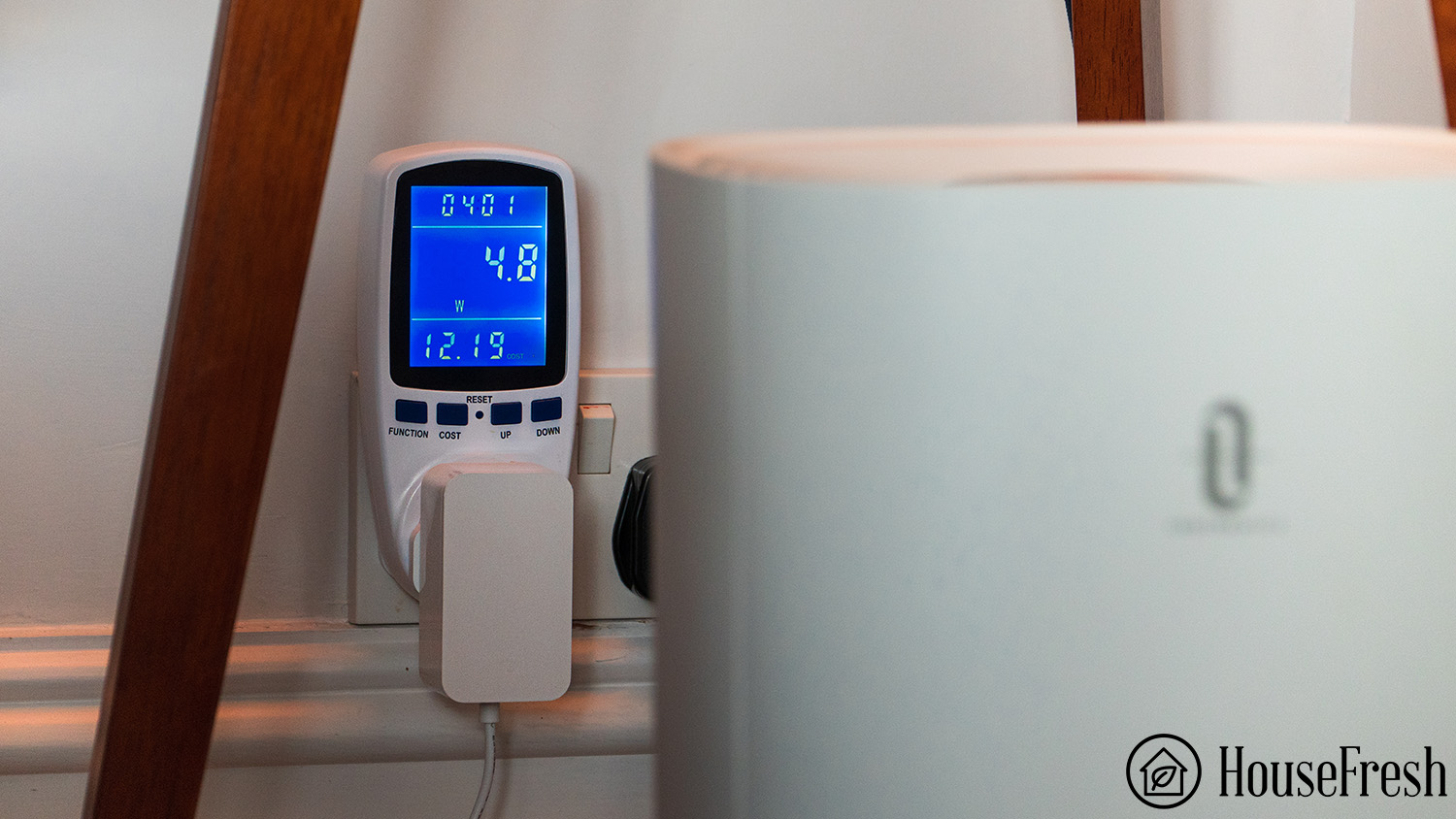
We used our power monitor to record the energy consumption of the SA600 at each fan speed and on standby mode:
FAN SPEED
ENERGY CONSUMPTION IN WATTS
Standby
0.1 watts
Speed 1
2.4 watts
Speed 2
4.3 watts
Speed 3
7.1 watts
Speed 4
12.9 watts
Speed 5
53.8 watts
If you had to leave the SA600 running 24/7 at full speed, it would cost $59.98 in energy costs for a year, and now we can compare the energy costs to other devices we have tested.
AIR PURIFIER MODEL
ENERGY CONSUMPTION AT TOP SPEED (watts)
TIME TO REACH PM1 ZERO
YEARLY ENERGY COST (in USD)
Smart Air SA600 (Speed 3)
7.1 watts
46 minutes
$7.89
Smart Air SA600 (Speed 4)
12.9 watts
36 minutes
$14.44
CleanAirKits Luggable XL-7
10.5 watts
23 minutes
$11.66
AirFanta 3Pro
43.23 watts
17 minutes
$48.02
Levoit Vital 200S
44.55 watts
23 minutes
$49.48
Philips 3000i
51.3 watts
20 minutes
$56.98
Winix 5500-2
53.8 watts
23 minutes
$59.76
Smart Air SA600 (Speed 5)
53.8 watts
24 minutes
$59.76
Smart Air uses a very efficient fan with its SA600 to pull in a lot of air without requiring much electricity. As you can see from the table above, it benchmarks very well against the other devices, even when running at lower fan speeds.
2. Filter costs = $71.32 per year
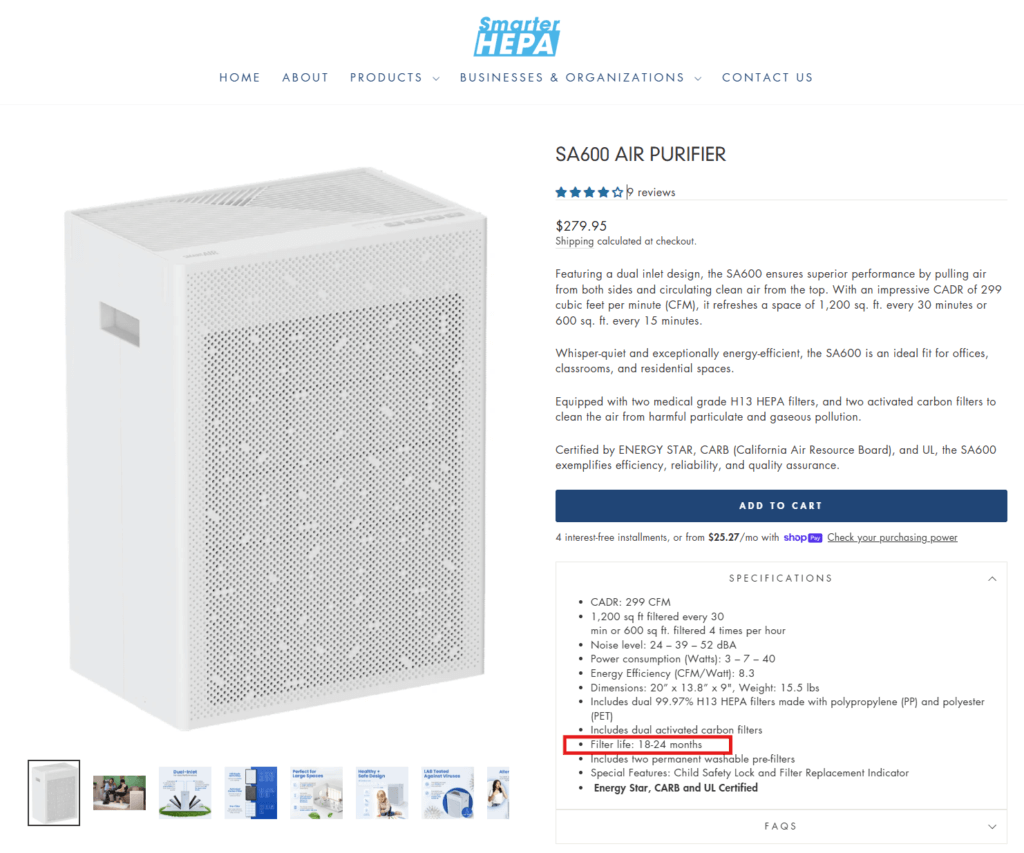
On the U.S. website of Smart Air, they recommend replacing the four filters for the SA600 every 18 months:
As of January 2025, the OEM H13 HEPA filters cost $57.99 (2-pack) and the activated carbon filters cost $48.99 (2-pack). This leads to an estimated filter replacement cost of $71.32 per year, which together with the energy consumption costs, will lead to an estimated yearly running cost of $131.08.
The filter replacement cost skyrockets if you take the minimum lifespan recommendations from the official Smart Air website, which estimates the lifespan based on levels of air pollution experienced in Asia:
Price per 2-pack
Minimum lifespan
Estimated yearly cost
H13 HEPA filters
$57.99
8 months
$86.99
Carbon filters
$48.99
6 months
$97.98
For those based in Asia or living in a highly polluted area, this leads to an estimated filter replacement cost of $184.97 per year, which, together with the energy consumption costs, will lead to an estimated yearly running cost of $244.73.
You can find generic filters for the SA600 on Amazon that will save you money, but they won’t offer the same performance as they will vary depending on the grade of HEPA or the amount of carbon. For example, when testing generic filters from PUREBURG, we found that they tend to pack more activated carbon than official filters, which restricts airflow and affects particle removal performance.
A benefit of choosing official Smart Air filters is that you know you’re buying third-party lab-tested H13 HEPA filters.
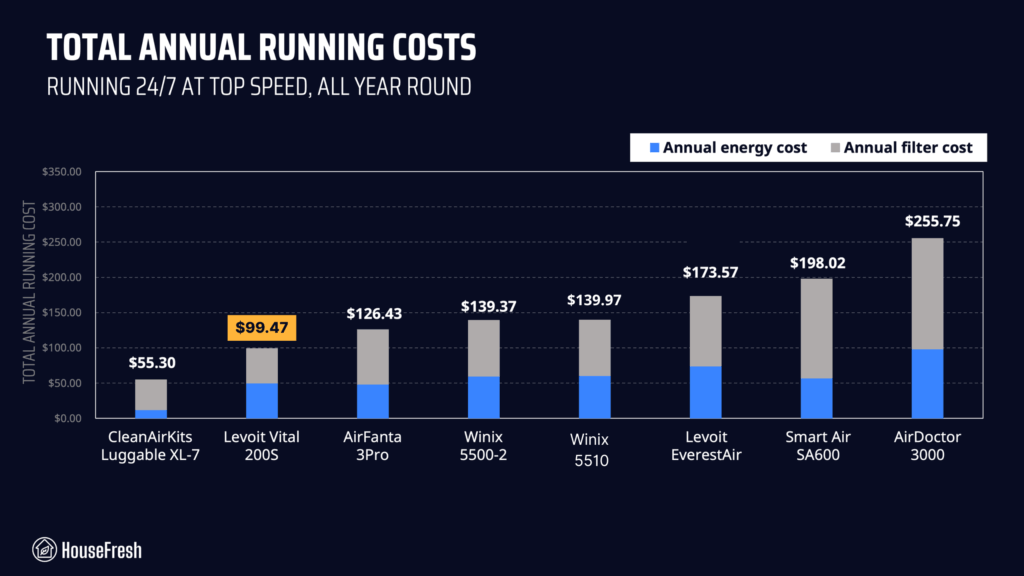
At this point of the review, we can calculate the long-term maintenance costs you need to budget for if you decide to get yourself a Smart Air SA600. See how they compare to other mid-tier air purifiers in the same price range:
AIR PURIFIER MODEL
ESTIMATED ELECTRICITY COST (per year)
FILTER REPLACEMENT COST (per year)
YEARLY MAINTENANCE COST
Levoit Vital 200S
$46.83
$49.99
$96.82
CleanAirKits Luggable XL-7
$11.09
$89.99
$101.08
Philips 3000i
$55.29
$47.15
$102.44
AirFanta 3Pro
$46.56
$78.67
$125.23
Smart Air SA600
$59.98
$71.32
$131.30
Winix 5500-2
$59.98
$79.99
$139.97
Coway Airmega 250S
$64.10
$159.98
$224.08
PuroAir 400
$77.75
$220.00
$297.75
IQAir HealthPro Plus
$152.83
$244.53
$397.36
As you can see from the table, the Smart Air SA600 will cost you more to run compared to other popular air purifiers, such as the AirFanta 3Pro or the Levoit Vital 200S. But overall, the costs are aligned with what is expected from a medium-sized air purifier — quite an achievement considering the use of four filters!
Bottom line: Is the Smart Air SA600 worth it?
A mid-sized air purifier that offers 360-degree air cleaning, with performance that rivals popular units from Winix and Levoit.
I’ve received many emails from people who prefer to avoid smart functionalities and phone connectivity. If that is you, then the Smart Air SA600 should be at the top of your list for consideration.
The SA600 has no ionizer function, Bluetooth or WIFI, so it is the perfect choice for those looking for a non-smart air purifier that will clean the air without chemical by-products or unnecessary (and costly) extras.
Now, if you’re set on using an app to control your air purifier, this is likely not the right device for you. However, it is worth considering that you can use a smart plug to connect the SA600 to your smart home hub.
I am a huge fan of features such as having the LED lights on the control panel switch off automatically, or the device’s ability to come back on after a power cut. At home, the SA600 found a spot in our TV room, where it runs 24/7 at speed 4 and cleans the air quietly without distracting lights or sounds.
The two inlets and two sets of filters will lead to higher filter replacement costs, but I appreciate that the filters are separated (compared to the bonded designs from Levoit) as it allows you to use the device without carbon filter, if you don’t need it.
Not feeling the Smart Air SA600? If you’re looking for the most powerful air purifier you can get for less than $200, then check out the AirFanta 3Pro or the Winix 5500-2. If smart functions are a must, have a look at the Coway Airmega 250S pr the the Levoit Vital 200S. Now, if you want a powerful yet whisper-quiet air purifier, then make sure to read my review of the PC fan-powered beast that is the Luggable XL-7.
If you have a space smaller than 190 sq. ft. but you like what Smart Air has to offer, then you should look into the Smart Air S instead. Lastly, if you have a space larger than 675 sq. ft., then read up on the Smart Air Blast Mini, as the SA600 will be too underpowered for a large room.
Levoit is part of the Arovast Corporation, which produces an array of electronics, from air fryers to fitness trackers. In 2017, the company turned its attention to indoor air quality. Since then, Arovast Corporation has developed a wide range of high-performance yet budget-friendly air purifiers. This led to Levoit’s rise as one of the biggest names in the air cleaning space.
Among Levoit’s portfolio of purifiers, we’ve seen some top-quality units, including the Vital 200S and their latest unit, the EverestAir, which is the fastest purifier to complete the HouseFresh Clean Air Speed Test.
However, Levoit’s most popular products are in the Core series. These affordable purifiers are designed to cover different-sized spaces within the home, from the Core Mini for personal use up to the Core 600S, which caters to spaces as large as 635 sq. ft.
The first unit in this series was the Core 300. It sets the benchmark for budget-friendly air purifiers, with impressive air cleaning performance within a small- to medium-sized space.
Although the Core 300 is renowned for its purifying abilities, the unit is often deemed a basic option with no additional features. This paved the way for the Core 300S, an updated unit stacked with smart technology to make air purification even simpler.
With the Core 300 costing $99.99 and the 300S $149.99, readers often ask if it’s worth spending the extra 50 bucks. So, in this review, I’ll compare these units side by side and analyze their performance, features, and design to see which comes out on top.
TL;DR: Which unit wins overall?
“In the ENERGY STAR listings, the Levoit Core 300S uses half the power of the Core 300 model for approximately the same clean air delivery rate! This suggests a major difference in the fan motor between the two models.”
👍 Excellent CADR to $ ratio – with one CFM costing just 70 cents. 👍 Cylindrical design and Levoit’s VortexAir technology draws in dirty air from all corners of the room. 👍 Super simple to set up and use, with intuitive icons to cycle through the settings. 👍 Readily available and affordably priced filter replacements. 👍 Seamless design blends into a variety of spaces.
👍 Useful smart capabilities — especially Auto mode, which reacts to changing pollutant levels with zero input from the user. 👍 The VeSync App is easy to use and ideal for firing up the purifier before you get home from work. 👍 Sleep mode for round-the-clock use. At just 48 dB on top speed, this unit won’t cause disruption. 👍 More timer options, ranging from 1 hour to 24, give the user more control. 👍 Ultra-lightweight and compact design, ideal for the modern home.
What we think could be better
What we think could be better
👎 Lack of smart features are noticeable as they become increasingly common throughout the industry. 👎 No way to gauge current air quality conditions in your space without a third-party device. 👎 It would be better if the pre-filter was removable to aid in cleaning and maintenance — the Core 300S also suffers from this.
👎 Some may deem the extra $50 price tag unjust without much increase in CADR. 👎 An aesthetic design update from the Core 300 would have been great. 👎 Low quantities of activated carbon are included in the standard filter, so it’s worth upgrading to Levoit’s pet or toxin filter for use against VOCs.
Specs compared side-by-side
When it comes to specifications, the Levoit Core 300S just about wins due to being lighter, quieter, and faster than its counterpart.
💡exclusive code for HouseFresh for 10% off a single purchase on Levoit.com: HOUSE10
At first glance, not much seems to separate these two air purifiers.
They’re designed to work in the same-sized space, share the same dimensions, and have the same warranty. However, some marginal differences in weight, sound, and speed might swing your decision in favor of the Core 300S.
The updated Core 300S does have a slightly better CADR score, thanks to its improved fan efficiency. This aligns with the real-world air cleaning speed we witnessed when testing the 300S, as it cleared our test space one minute faster.
Levoit Core 300
Levoit Core 300S
HouseFresh rating:
★★★★★
★★★★★
Time to clean our test room:
54 minutes
45 minutes
Air purifier technology:
3-Stage Filtration (pre-filter for large particles, main filter for airborne particles, high-efficiency activated carbon filter for odors and gasses)
3-Stage Filtration (pre-filter for large particles, main filter for airborne particles, high-efficiency activated carbon filter for odors and gasses)
Recommended room size:
175 sq. ft.
195 sq. ft.
Clean air delivery rate (CADR):
– Smoke: 113 CFM – Dust: 129 CFM – Pollen 134 CFM
– Smoke: 126 CFM – Dust: 134 CFM – Pollen 154 CFM
Dimensions (in inches / cm):
14.2H x 8.7W x 8.7D inches (36H x 22W x 22D cm)
14.2H x 8.7W x 8.7D inches (36H x 22W x 22D cm)
Weight (in pounds / kg):
7.5 lbs (3.4 kg)
5.95 lbs (2.7 kg)
Filter life:
6 – 8 months
6 – 8 months
Noise level (low – high):
37.1 – 50.2 dB(A)
38.9 – 54.5 dB(A)
Manufacturer’s Warranty
2 years
2 years
Estimated energy consumption:
$39.43 per year
$24.44 per year
Design elements compared
When it comes to design, nothing special separates these two models.
The Core 300 and Core 300S are almost identical. While they may be different internally, you’d struggle to tell them apart side by side.
They both feature the same air inlet and outlet grills, come with a control panel on top of the unit, and have identical measurements.
However, looks might deceive you, as the Core 300S is 20% lighter than the 300. Its weight might be useful if you’re looking to utilize the purifier in different spaces around the home.
Ease of use and control panel design
When it comes to the controls, the winner has to be Core 300S. Despite having more functions, the panel remains easy to navigate.
💡exclusive code for HouseFresh for 10% off a single purchase on Levoit.com: HOUSE10
The control panel is where you’ll find the first glimpses of the 300S’s added smart features.
The brightly colored rings provide real-time feedback on your space’s air quality, changing from blue (indicating clean and healthy air) to green, orange, and red (indicating high levels of pollutants). This works in tandem with the new Auto mode, which uses air quality data to change the purifier’s speed settings automatically to react to changing pollution levels.
A new digital screen enables you to program the improved timer, ranging from 1 to 24-hour schedules. You can also cycle between the three fan speeds, kill the lights, activate sleep mode, and lock the controls by simply tapping the relevant icons.
If this isn’t enough to prove the 300S’s enhanced usability, you can also connect the device to Levoit’s VeSync app or a smart speaker. The app is super simple to connect to. All you need is a decent wifi connection, the app, and to be near the machine when you set it up.
Once connected, you can adjust the unit’s settings and receive air quality updates from anywhere in the world. Connecting the 300S to a smart speaker lets you operate the appliance with simple voice commands.
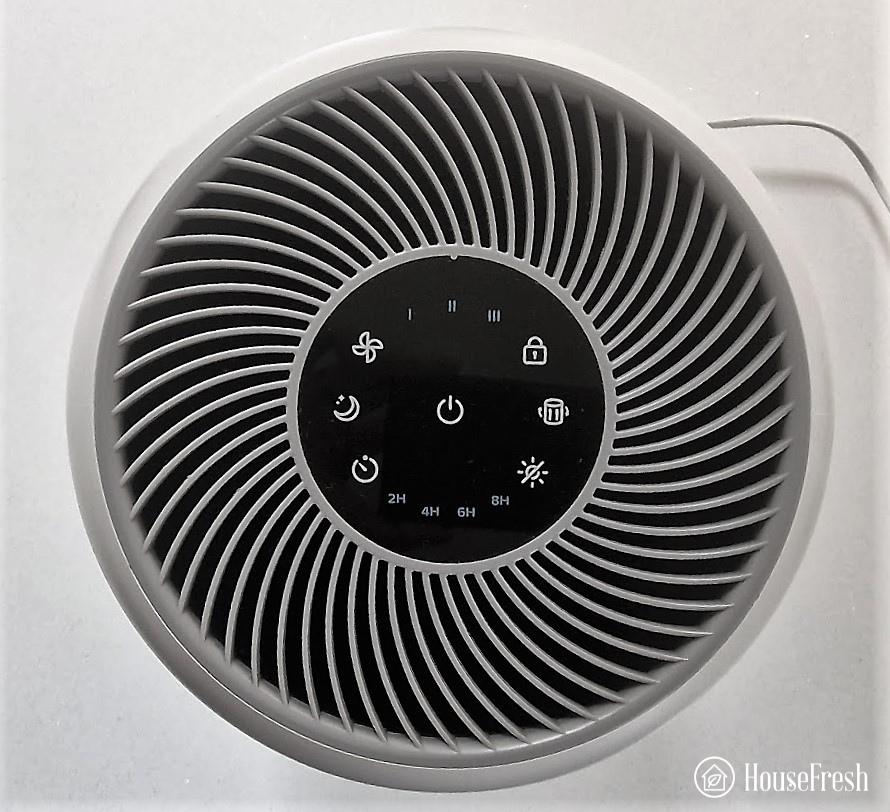
The Core 300 control panel has many of the same settings icons as the 300S. The main layout differences are the timer function, which is limited to 2/4/6/8 hour schedules, and a larger icon to remind you when to change the filter.
Operating the Core 300 is largely the same, utilizing an intuitive screen to cycle between fan speeds and settings, albeit with less functionality and no app or smart speaker compatibility.
Air filtration technology
Both the Core 300 and Core 300S use the same filters, making this a tie
Whichever unit you side with, it’s good to know that you get the same level of protection from Levoit’s three-in-one filter.
This cylindrical filter fits in effortlessly and provides comprehensive protection from even the smallest pollutant particles. It uses tried and tested mechanical filtration, ruling out any potentially harmful ionizer or UV technology.
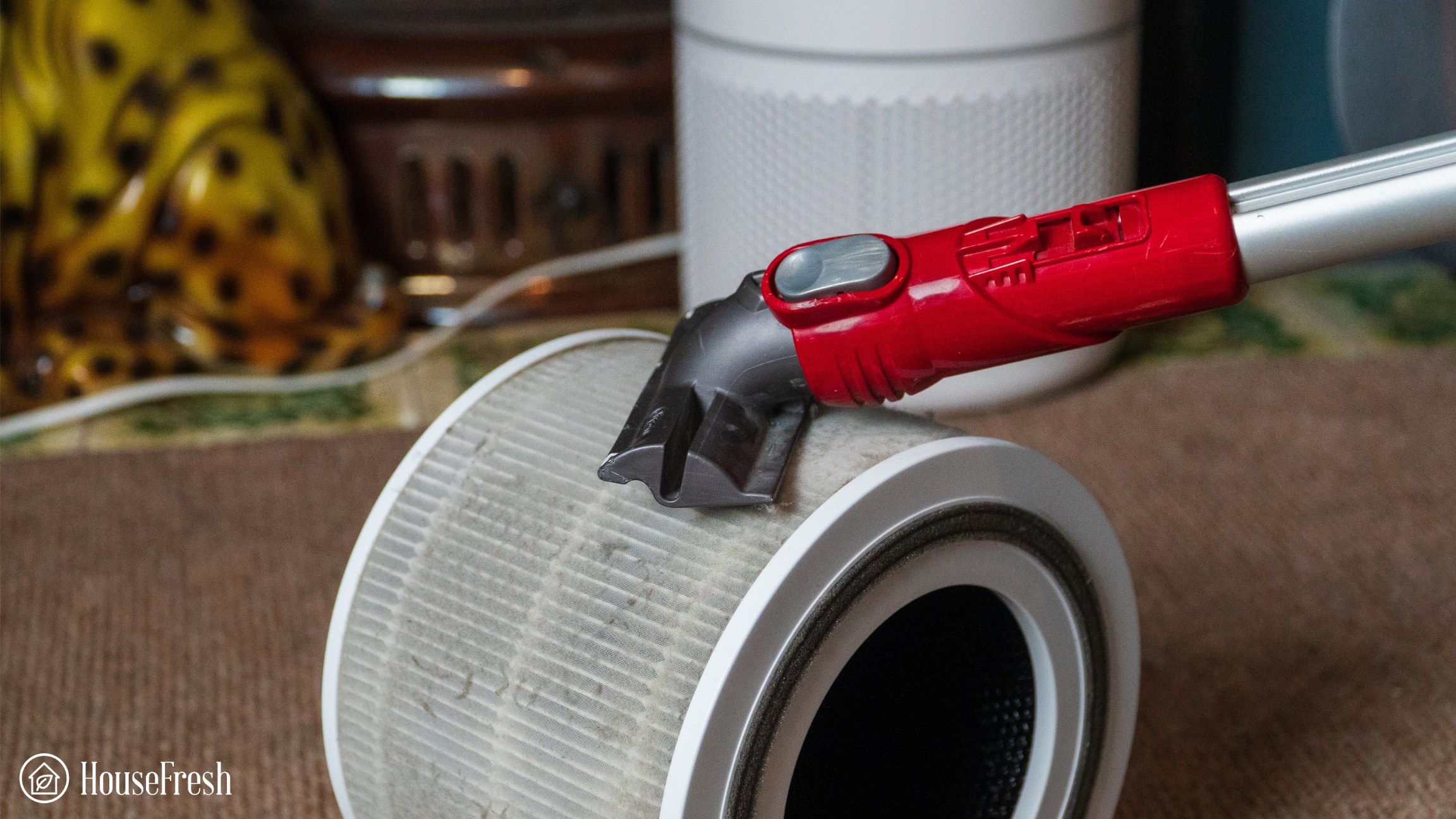
The first layer of defense comes from the nylon pre-filter, which captures larger particles like hair, lint, and dust. You can then vacuum out the dirt to improve filtration performance. This is a key step in the purification process, as it keeps your primary filter in tip-top shape for longer.
Next is the activated carbon filter, which removes VOC pollutants like odor and chemical fumes. This has been beefed up by Levoit’s trademarked ARC formula, preventing gasses from leaking into your space.
Tip
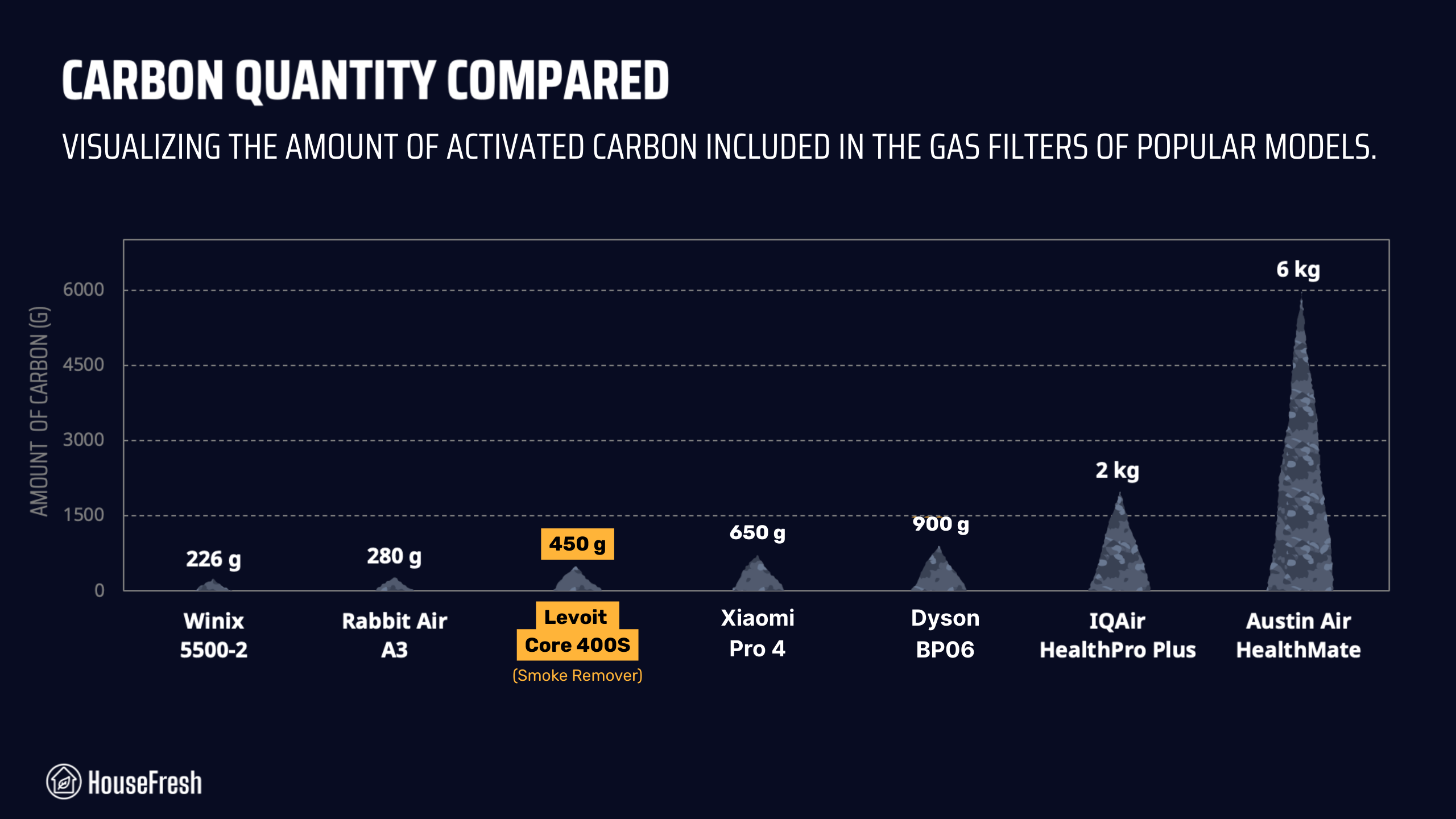
The more carbon a filter contains, the better it will work against VOCs. The standard Levoit filter contains between 40 and 50 grams of carbon.
So, if you’re looking to combat odors or chemical fumes, take a look at Levoit’s specific Pet or Toxin filters, which contain double the carbon content with 90 grams.
Finally, you’ll find the primary filter. This is the most important part, as it removes microscopic particles such as allergens, smoke, and bacteria. Although this filter is no longer advertised as HEPA, they still work similarly, and we found it highly effective at removing the smallest PM1 particles during our tests.
Installing the filter couldn’t be simpler. Both the 300 and 300S share the same design, where you twist the purifier body to open the filter compartment.
All you have to do is slot the filter in and reassemble the unit before turning it on.
Tip
New filters come wrapped in plastic packaging. Be sure to remove this polythene bag before you install the filter.
Air cleaning performance, compared
When it comes to air purification, the Core 300S wins. It cleared all traces of smoke particles in our test room one full minute faster than its predecessor.
💡exclusive code for HouseFresh for 10% off a single purchase on Levoit.com: HOUSE10
Every air purifier we review here at HouseFresh completes the same set of tests, so we can confidently compare them side-by-side.
How we test air purifiers
Read our full testing methodology.
The first test is the particle removal test, where we fill our 728 cubic feet test room with incense smoke and use our PurpleAir Zen sensor to record how long it takes for the air purifier to reach PM1 zero.
Our Core 300 and 300S tests showed that these units provide good value for money, clearing our space of all pollutants in 54 and 45 minutes, respectively.
With identical filters under the hood, it’s no wonder this was a tight contest. But thanks to the upgraded fan efficiency on the 300S, seen through its higher CADR scores, it proves to be the faster option. Although the 300 didn’t lose by much, every minute counts when it comes to breathing dirty and potentially dangerous air.
The Levoit Core 300S cleared our test room in 45 minutes
The Levoit Core 300 cleared our test room in 54 minutes
After carrying out our own tests, we can compare the units side-by-side to determine which purifier on the market offers the best value. Here’s a peek at how the Core 300 and 300S performed compared to other popular units we have tested.
Although the 300 and 300S aren’t the quickest air purifiers we’ve tested, we can clearly see that they lead the pack among the devices aimed for small-medium sized rooms, such as the Blue Pure 411 and the Medify MA-25.
Noise level test results, compared
When it comes to sound, the Core 300S is the better unit. It is a full two decibels quieter than the 300 when running at its highest fan speed.
💡exclusive code for HouseFresh for 10% off a single purchase on Levoit.com: HOUSE10
How much sound an appliance makes is often an annoying afterthought once you’re stuck with the unit for good.
If an air purifier is noisy or peaks at unbearable volumes, the reality is that it won’t get used that often. That’s why we record the decibel levels of each air purifier we test to give you the complete picture before you take the plunge.
During our testing, we found that the Levoit Core 300S was the quieter of the two units. At full speed, it peaked at 48 dB (quieter than a refrigerator hum or moderate rainfall) compared to the 50 dB created by the Core 300.
At their lowest speed settings, both units created 24 dB of noise. This is the equivalent of a whisper, so you can rest assured you’ll get a good night’s sleep with night mode activated on either of these units.
To help put these figures into context, here’s a look at how the Core 300 and 300S compare to other popular air purifiers on the market.
Tip
Noisiness is subjective, so be sure to listen to our sound test videos for each purifier below to judge for yourself.
Investing in an air purifier will cost more than the initial purchase price, with energy use being a key purchasing factor.
When testing the Levoit Core 300, we noted that it drew 35.5. watts on its highest speed setting. This equates to $37.32 per year if you were to use the air purifier 24/7, 365 days a year.
Although this might be a reasonable expenditure for some, we were even more impressed with the 300S, which only drew 21.8 watts on full power, bringing estimated annual energy costs down to $22.92.
Using either unit less frequently will bring down this expenditure. But with a smaller unit, we advise using the air purifier as much as possible to reap the rewards of clean air around the clock.
An added bonus of the 300S is its Auto mode, which automatically adjusts speeds whenever pollutant levels change. This means the unit will operate at a lower power once pollutants have subsided.
Another key cost to consider is filter replacements. Filter lifespans can vary greatly between manufacturers and models, so it’s wise to shop around and understand what you might pay in the long run before committing to a purchase.
As the Core 300 and 300S use the same filter, there’s no winner or loser here.
In line with their Core range ethos, Levoit offers reasonably priced replacement filters to keep your air at home cleaner for longer.
At the time of writing, a genuine Levoit filter replacement costs $29.98, which, according to Levoit, lasts between six to eight months.
𝐆𝐄𝐍𝐔𝐈𝐍𝐄 𝐑𝐄𝐏𝐋𝐀𝐂𝐄𝐌𝐄𝐍𝐓 𝐅𝐈𝐋𝐓𝐄𝐑: Designed specifically for the Core 300-P / Core 300S-P air purifiers to maintain its peak performance. Use genuine filters for premium quality and longer lifespan. We recommend replacing your filters every 6 to 8 months.
𝐇𝐄𝐏𝐀-𝐆𝐑𝐀𝐃𝐄 𝐏𝐄𝐑𝐅𝐎𝐑𝐌𝐀𝐍𝐂𝐄 𝐈𝐍 𝐒𝐋𝐄𝐄𝐏 𝐌𝐎𝐃𝐄: Helps Levoit Core 300-P achieve HEPA* filtration efficiency during Sleep Mode. Zero ozone emissions and ultra-quiet operation (≤26dB) in Sleep Mode. *Tested with IEST RP C001.7 by independent lab
Generic filters for these purifiers are widely available, which can help reduce costs even further. There’s no guarantee the replica filters have been built to the same standard as the official replacements offered by the manufacturer. But in the wake of Dyson challenging Levoit’s HEPA filter classification, it may well be worth the gamble.
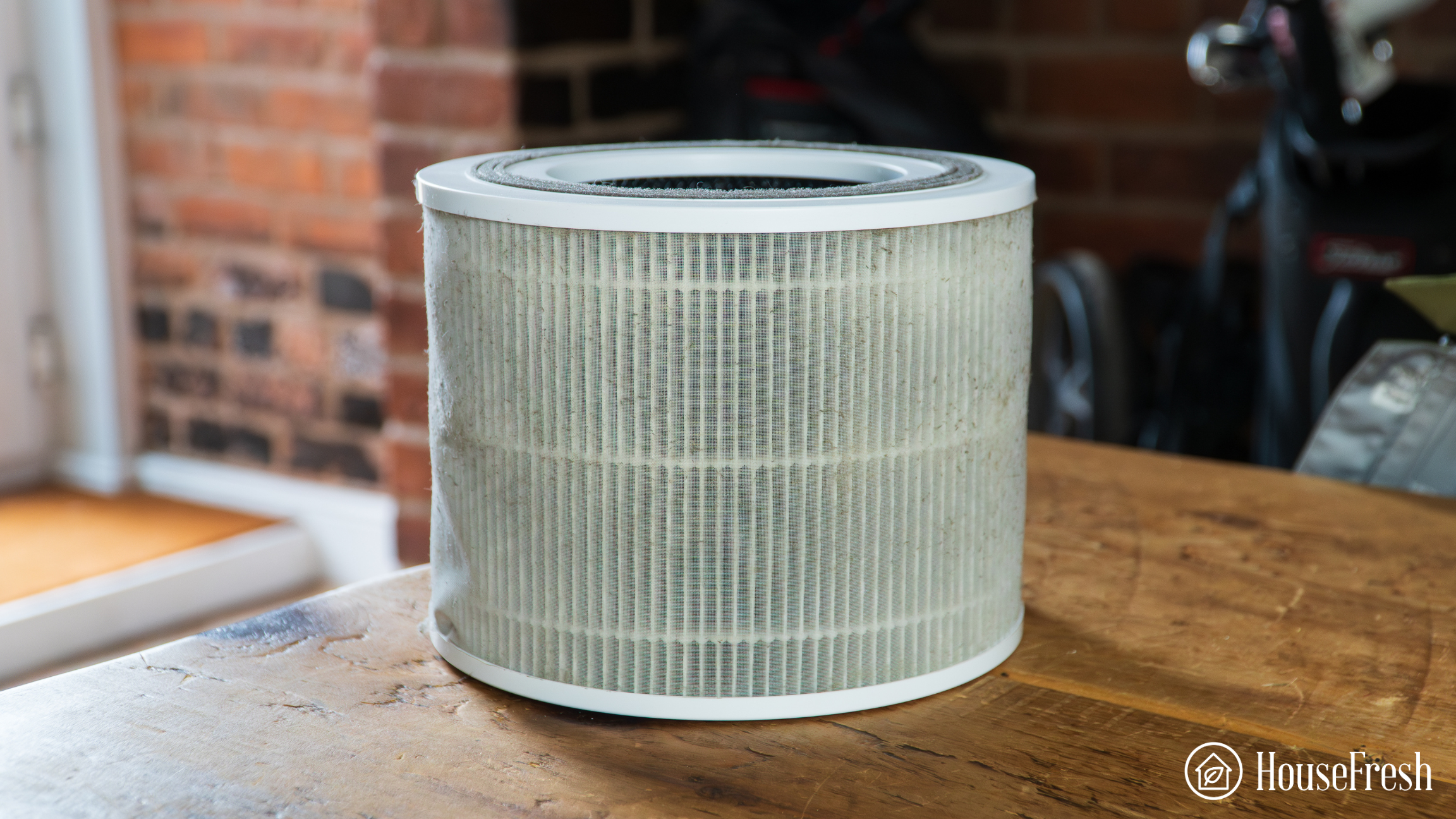
Most air purifiers use mechanical filters that capture airborne particles such as dust, dander, and debris in tightly woven fiberglass pleats.
Over time, these filters become clogged with pollutants and lose efficiency, which is when you should replace them.
Bottom Line: Should you get a Levoit Core 300 or a Core 300S?
The Core 300 and 300S ran a close race throughout our comparison, but which unit will win overall?
✅ If you want a speedy and smart air purifier capable of removing the smallest particles without excess noise or energy use — go for the Levoit Core 300S.
💡exclusive code for HouseFresh for 10% off a single purchase on Levoit.com: HOUSE10
✅ If you want an air purifier to use periodically without a large upfront investment — go for the Levoit Core 300.
💡exclusive code for HouseFresh for 10% off a single purchase on Levoit.com: HOUSE10
There isn’t much to separate the two air purifiers in terms of performance, with the Core 300S clearing our test space just one minute faster than the Core 300. But overall, the latest 300S unit offers more functionality and user-friendly features that will keep your air clean while costing less to run in the process.
Of course, if you’re not interested in smart features and the benefits they might bring, you may be tempted to save yourself $50. This will only work if you plan to use the purifier sporadically, as any savings will be lost in energy costs in the space of three years if used daily (you’ll pay $59.60 extra when running a Core 300 for a year compared to the 300s).
SOURCES
We calculated the monthly energy consumption costs with the help of the Department of Energy’s appliance energy calculator. We calculated yearly costs associated with running the Levoit Core 300 and 300S for 24 hours a day, 365 days a year. We ran this calculation utilizing the US average utility rate of $0.12/kWh as of January 2024.
At HouseFresh, we have been reviewing air quality products since 2010. In all these years, we learned not to rely on manufacturers’ claims and the ever-so-glowing marketing materials. That is why we buy products with our own money, so we can write unbiased reviews after we’ve had enough time to evaluate air quality products in our home lab. Every unit we recommend has been thoroughly tested to assess its performance, energy consumption, and noise levels emitted in real-life environments. If you have any questions about our testing process for different types of air quality products, just drop us an email at danny@housefresh.com.
Air purifiers have become essential in the battle for good air quality in our homes. With so many pollutants in the air like dust, pollen, dander, bacteria and viruses, wildfire smoke and traffic pollution, to name a few, your home could be negatively affecting your health without you even knowing. That’s where air purifiers come in.
The price is one of the biggest turn-offs of buying an air purifier. Ranging from <$50 up to >$1000, it’s money out of your pocket on a device that does one thing, and you can’t even see it working.
Even if money isn’t the issue, what do you do when smoke fills your home when wildfire suddenly rips through your town, state, or even blown from another country altogether, and you need a quick solution so your health isn’t at risk?
An air purifier is a fan (which most of us will already have in our homes) plus a filter. With all the engineering that goes into manufacturing air purifiers, can you make your own DIY unit? Will it be cheaper? And most importantly, will it be as effective as a store-bought purifier?
In this guide, we answer those burning questions by building our own DIY air purifier.
Stay tuned, and wish me luck. 🤞
Don’t worry; you won’t need a clean room laboratory, specialty tools or a master’s in engineering to make your own DIY air purifier. All you need are a few items you could find either lying around your home or down at your local hardware store and a little aptitude:
✔️ BOX FAN
✔️ MERV 13 FILTER
✔️ STRONG TAPE
✔️ SCISSORS
✔️ SCREWDRIVER
How to build your DIY air purifier
Okay, I’m not gonna lie to you; this is the first time I’ve attempted to build my own air purifier, but I’ve used them (and taken them apart) for our reviews for a while now, so I have a firm grasp on how they work.
On that note, let’s delve in and build ourselves an air purifier.
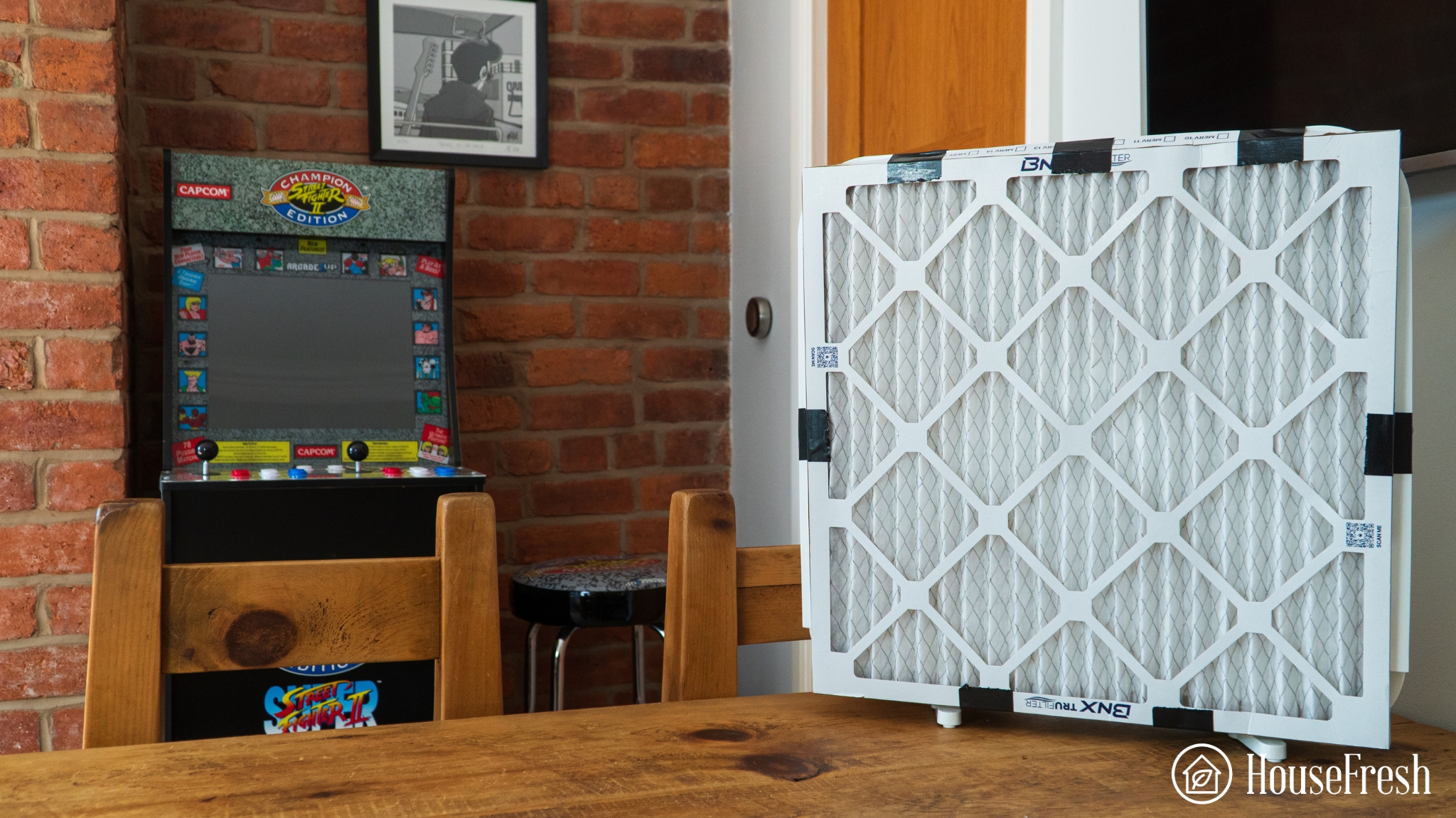
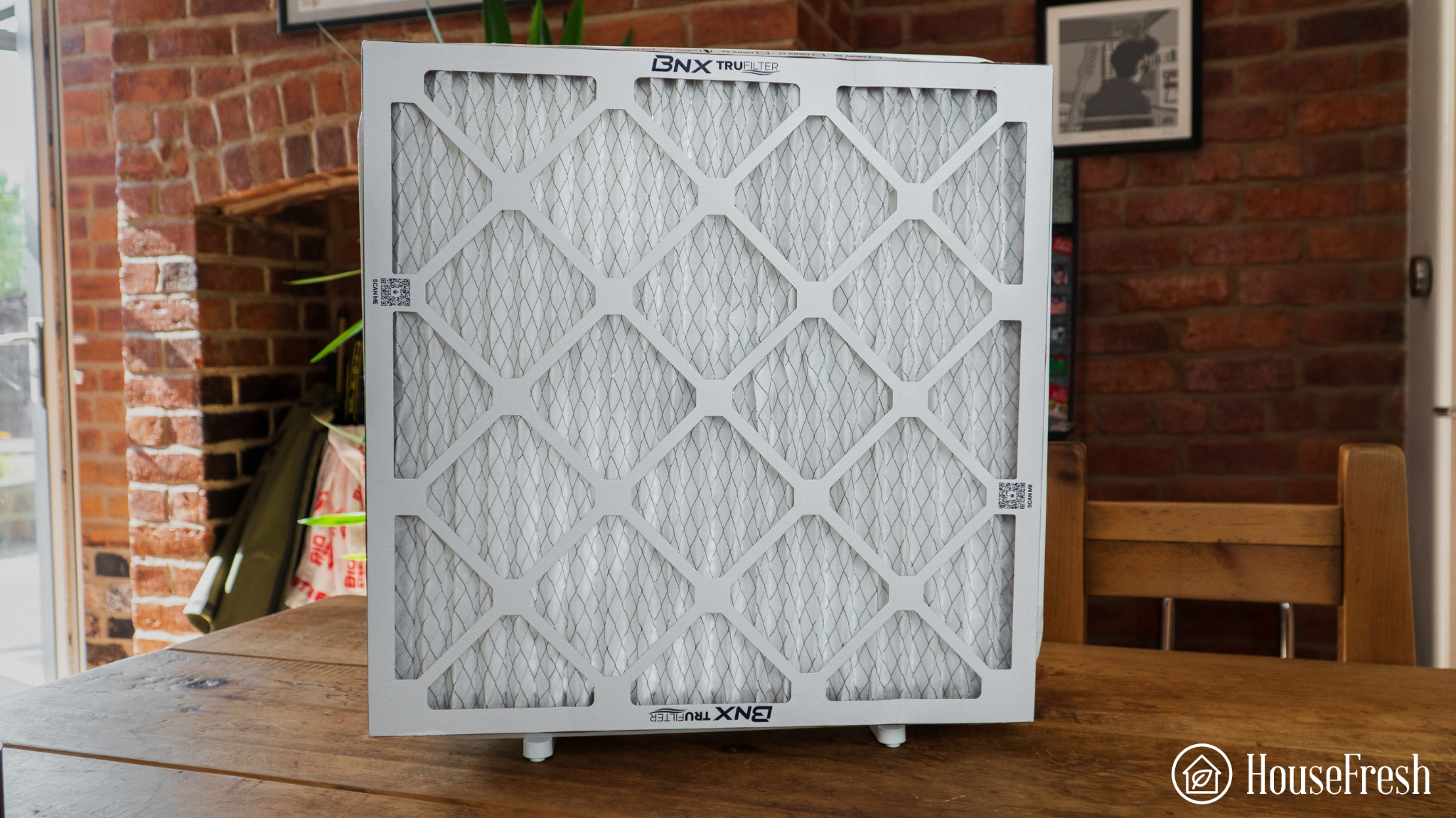
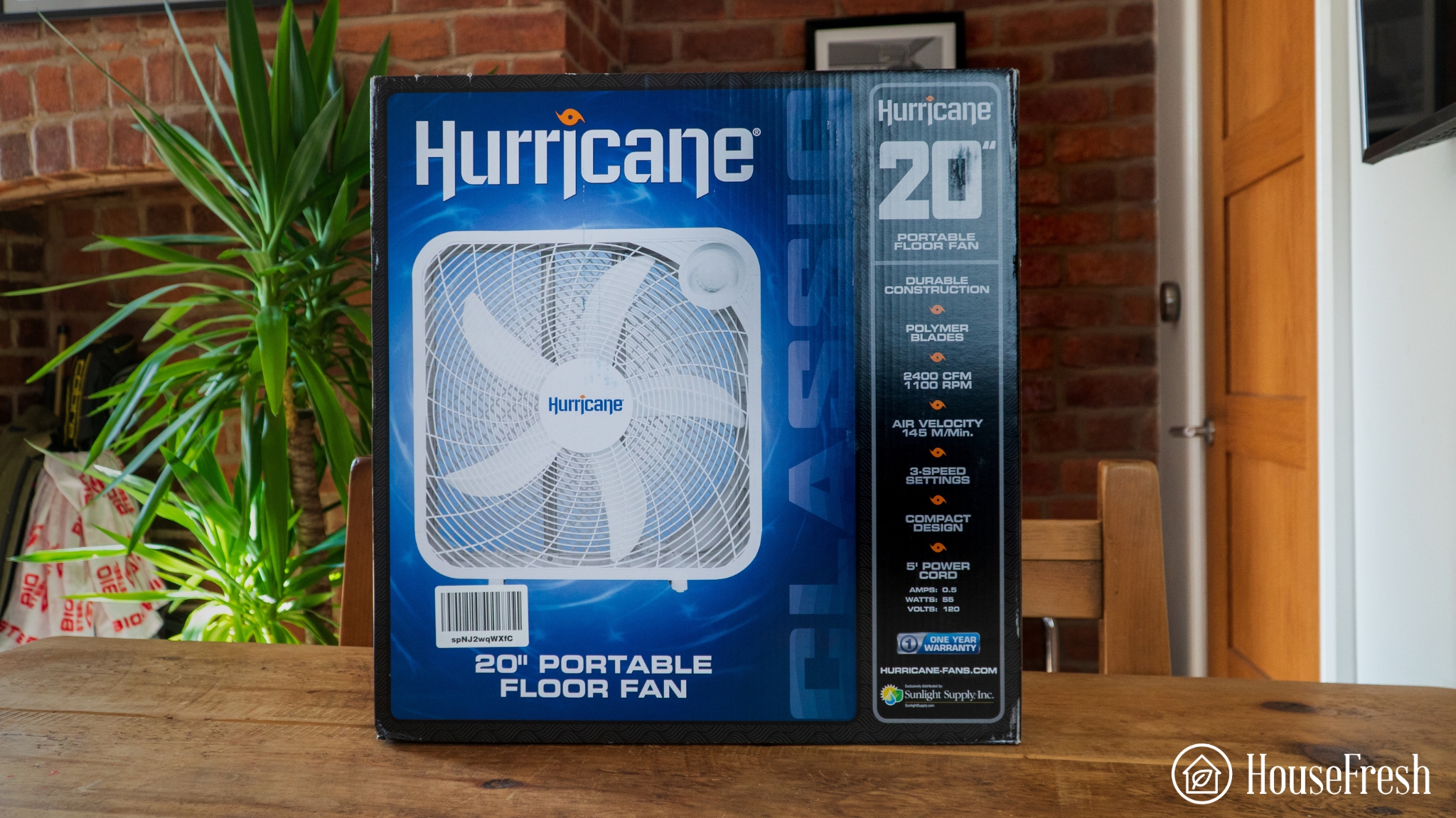
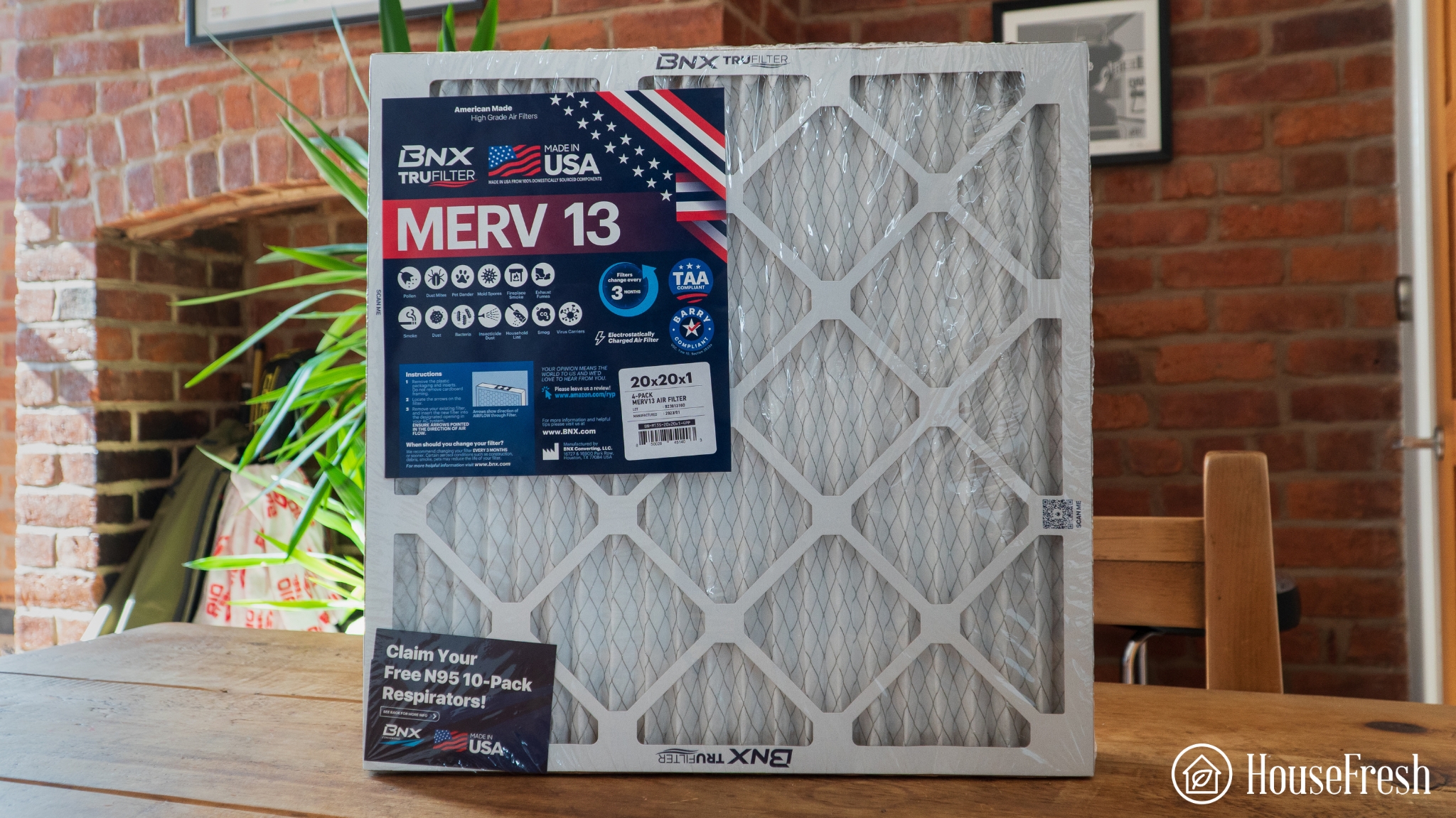
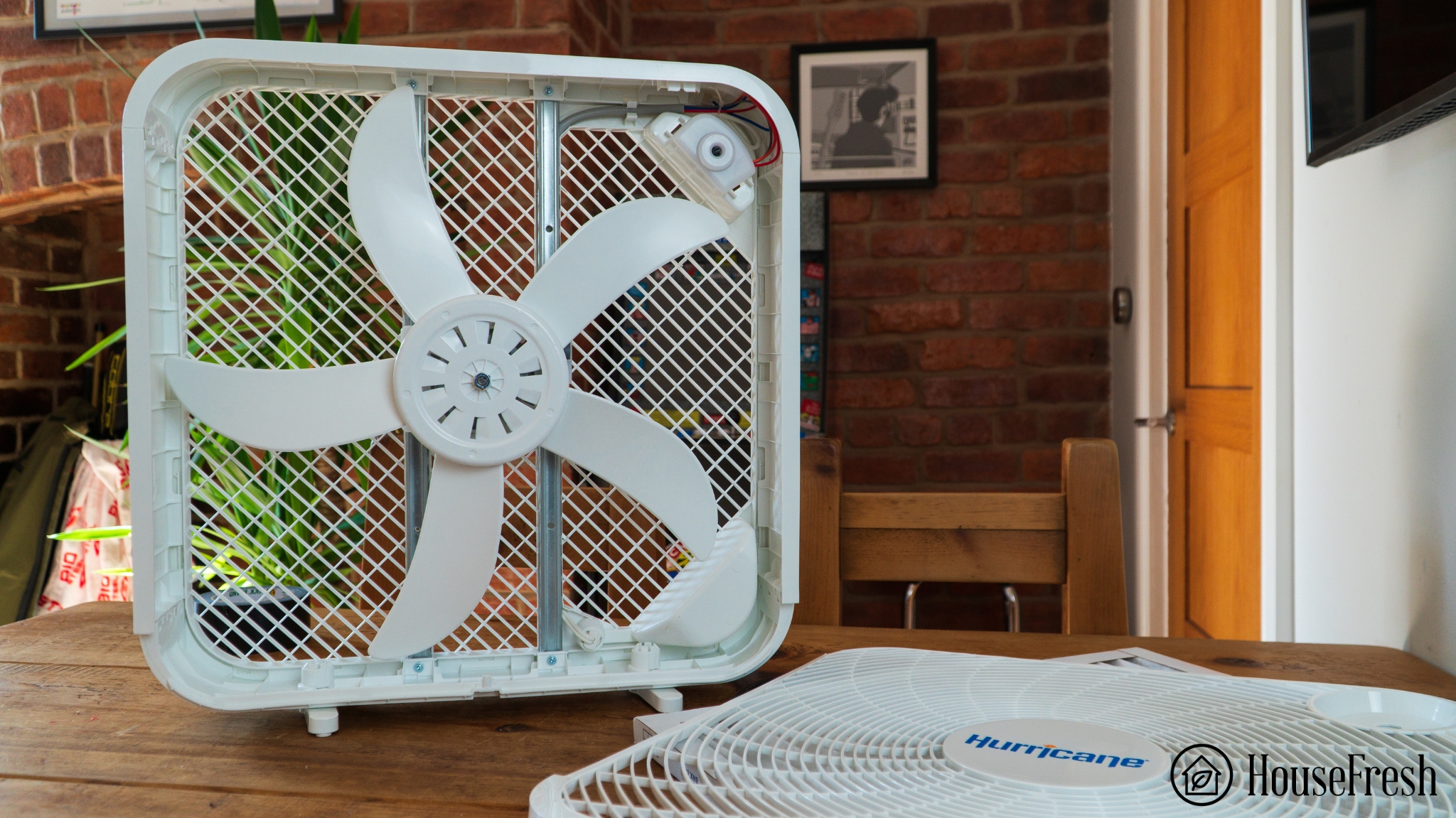
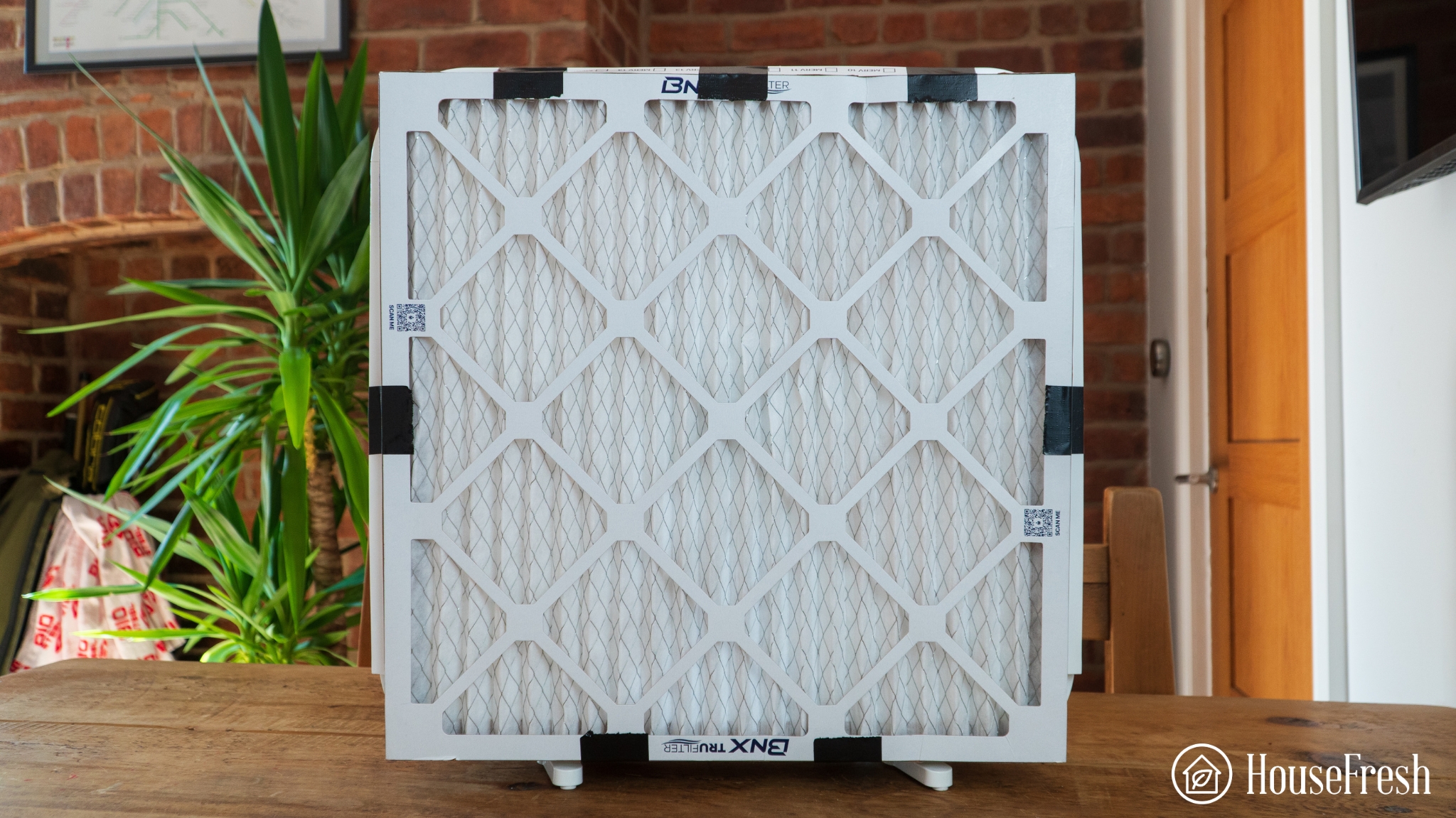
This is the easy part; I went to Amazon.com to find my materials so you can get the same fan and MERV 13 filter and follow this guide step-by-step with me. For the fan, I went for this unit from Hurricane as it was a good size, had good reviews and didn’t look too tricky to take apart. For the filter, I went with a BNX TruFilter 20x20x1 as you can see below:
You may have a few spare filters hanging around for the HVAC system in your home.
The primary consideration before you purchase is the size of the filter. You need a filter covering the whole fan, but not so big that it sticks over the sides.
Tip:Check your materials
The worst thing that can happen is that you put everything together, turn on the fan and it doesn’t work, or find a big hole in the filter that lets all those harmful particles through, rendering your hard work useless.
Unpack all your materials, check them and test them before you do anything else.
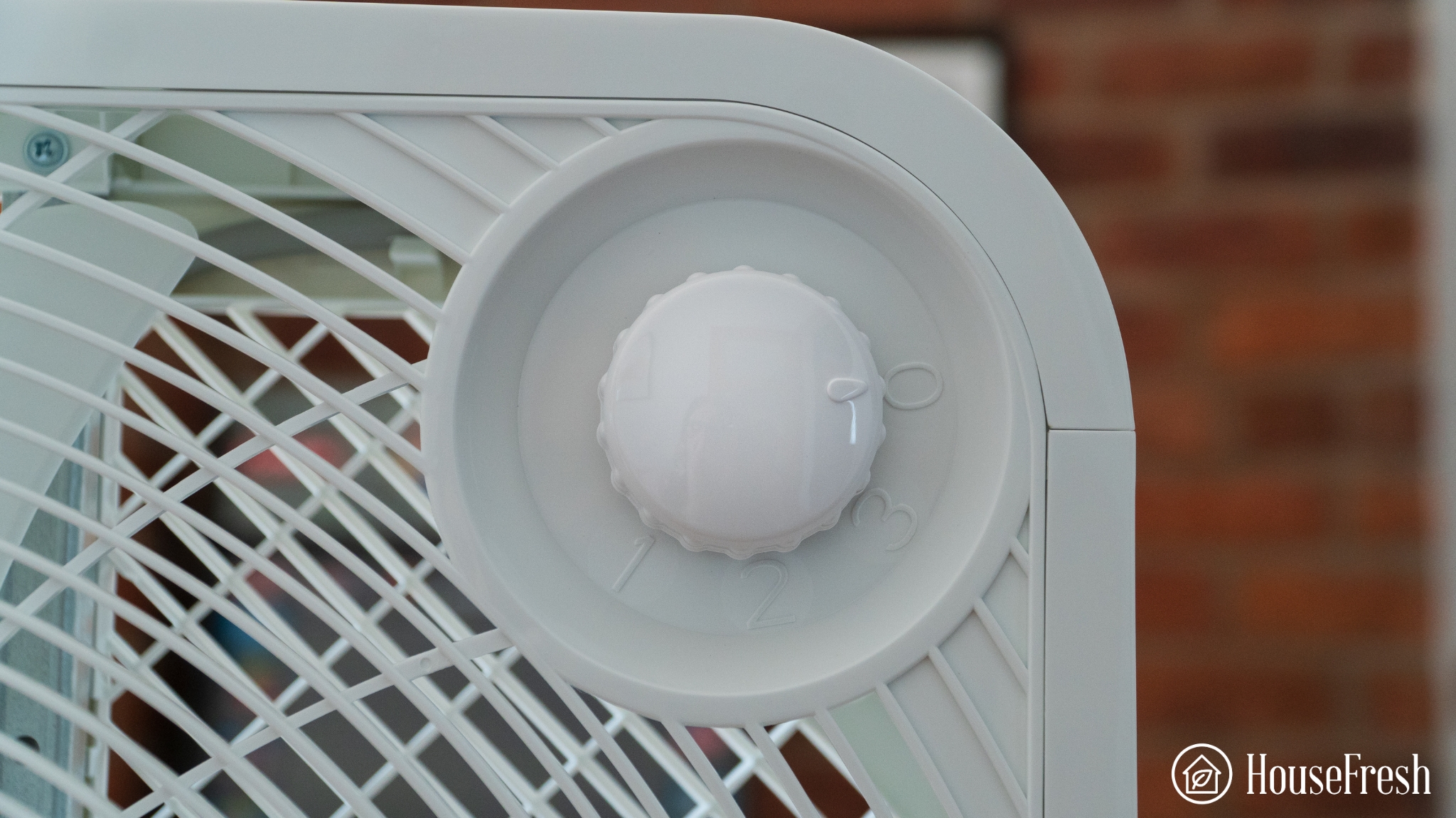
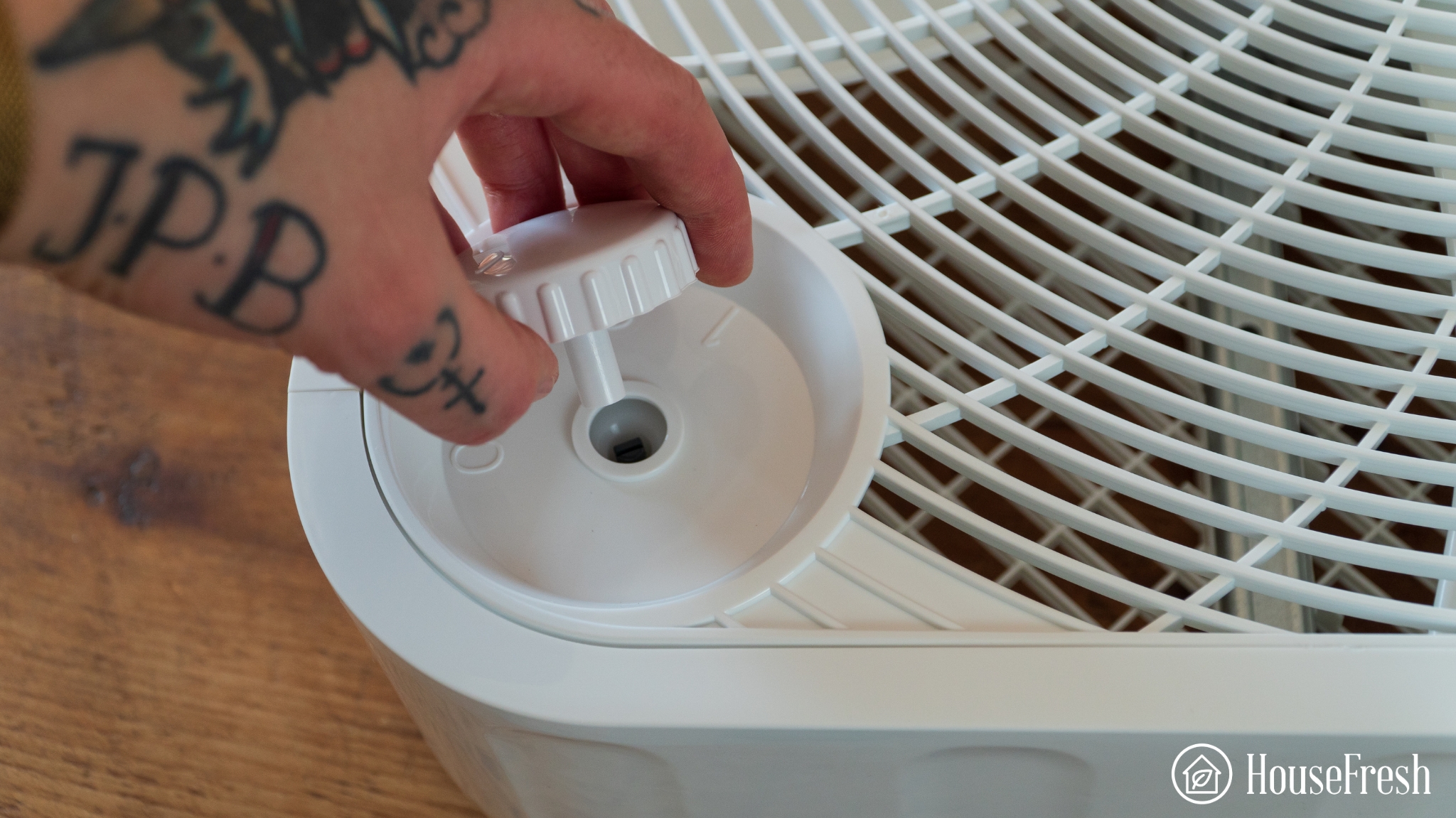
Step 2: Remove the fan speed dial
You need to remove the dial for two reasons:
So you can remove the grill easily.
So it doesn’t create a gap in the filter.
Before pulling the dial away, ensure it is set to the fan’s highest speed. This way, turning your DIY air purifier on will be set to its most effective speed. With The Hurricane, pulling the dial straight off using my hands was easy, but with other fans, you may need some pliers to grip and remove them.
Step 3: Remove the front grate from your fan
This is where the fun begins. Firstly, make sure your fan isn’t plugged in before you start.
With some fans, you’ll find that the grill is permanently attached to the unit; you may have to purchase some tinsnips. I would advise wearing goggles if it’s made of plastic, as plastic tends to fly when cut.
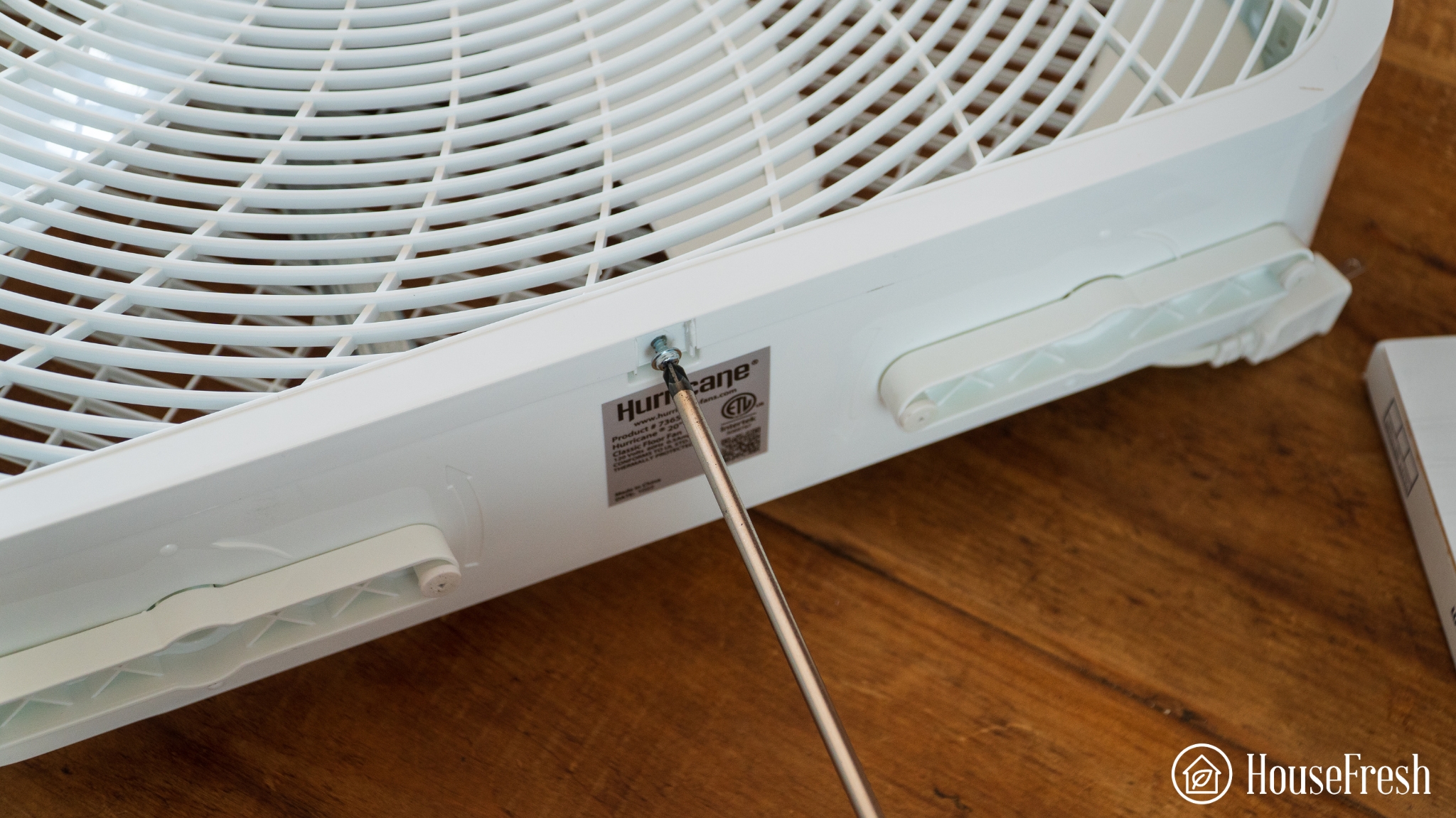
Another reason I went for the Hurricane fan is because it has a removable grill. You simply have to remove a screw at the bottom of the unit and slide the grill out.
Tip: “A light touch is the right touch”
Remember this golden rule when deconstructing anything,if you start pulling things apart that you don’t want to be, you’re likely to damage it and maybe even yourself.
Step 4: Attach the filter to the fan
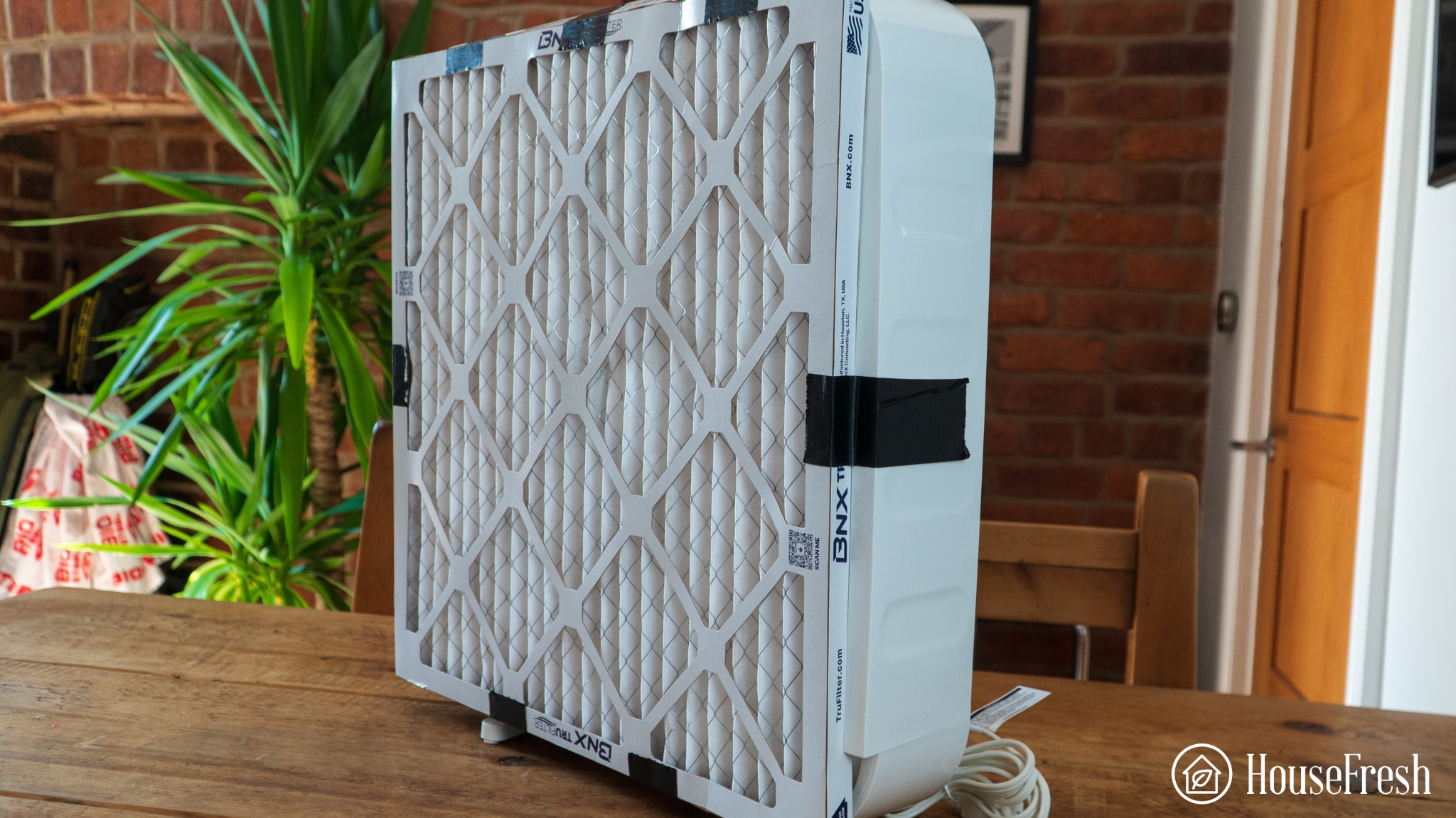
With the hard part over with, now you just need to attach the MERV 13 filter to the front of the fan where the grill used to be.
Because I did my measurements first, the filter I purchased fits perfectly over the fan with no overhang.
Tip
Before attaching the filter, you must double-check that there are no gaps where particles can escape into the air.
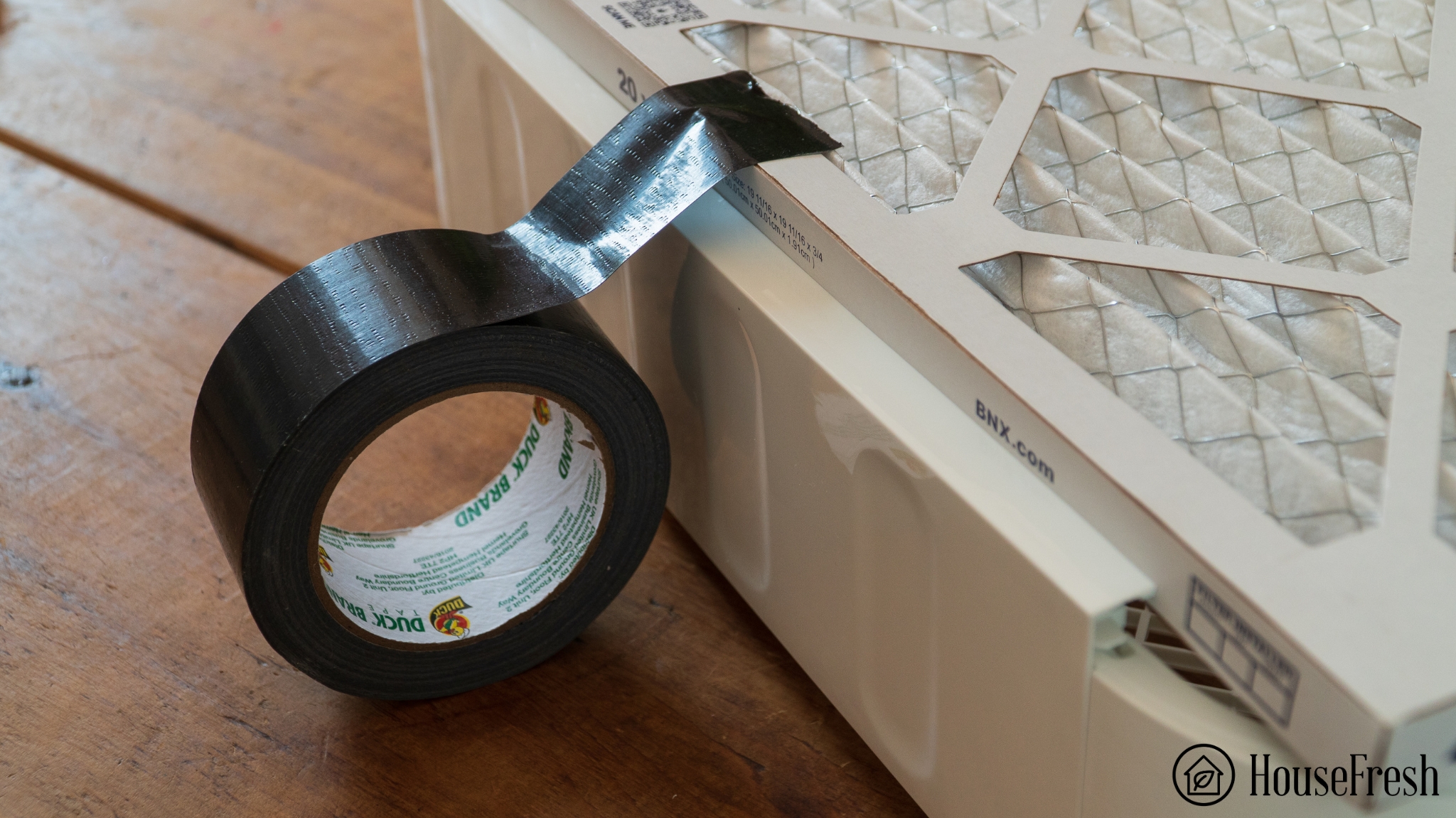
After those final checks, you can attach the filter to the fan. I used duct tape around different points of the fan as it’s durable and easily removed if you make a mistake, but feel free to use whatever you like, as long as it keeps the filter tightly attached and doesn’t leave any gaps.
Step 5: Turn on your DIY air purifier and enjoy your clean air
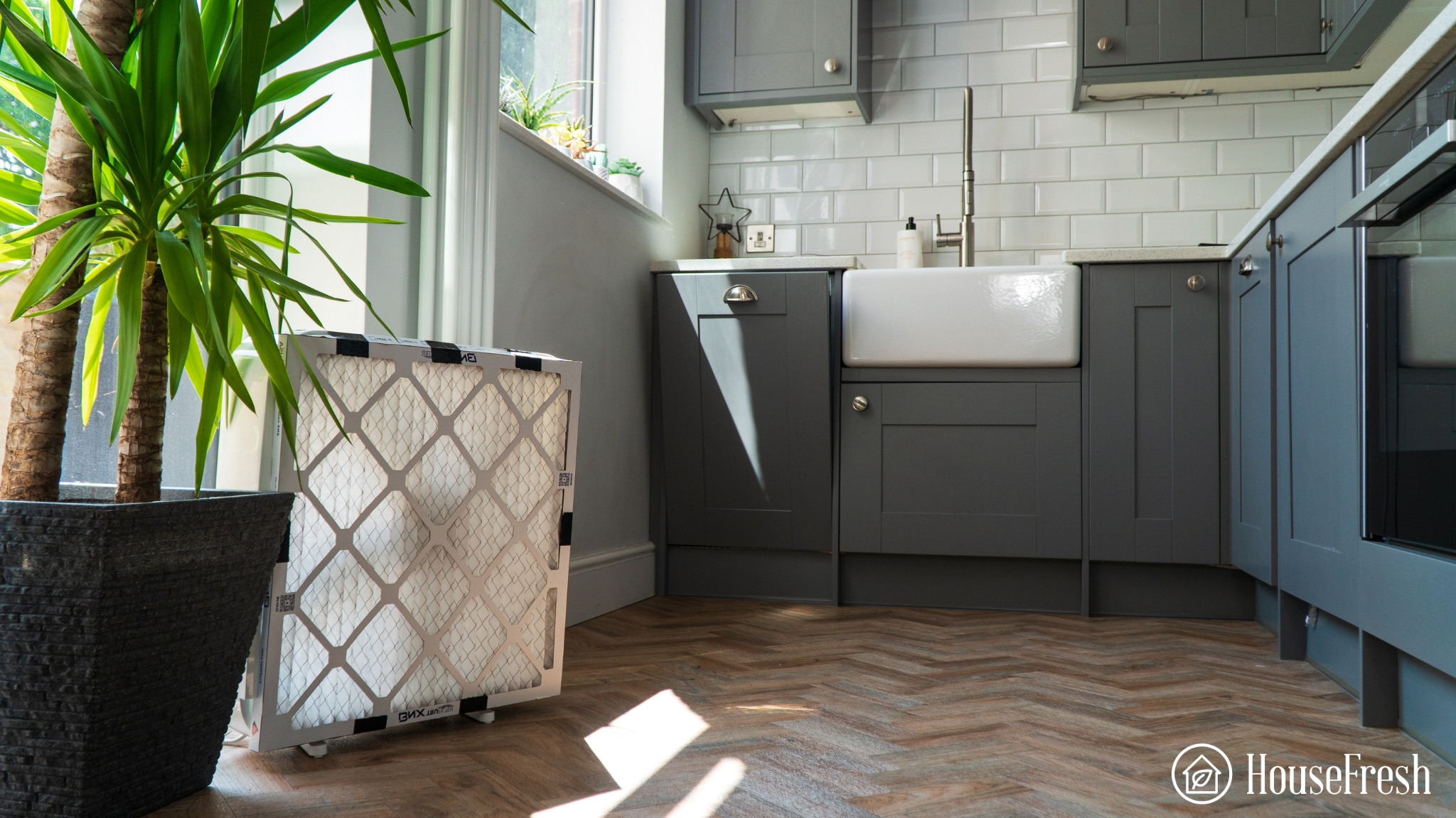
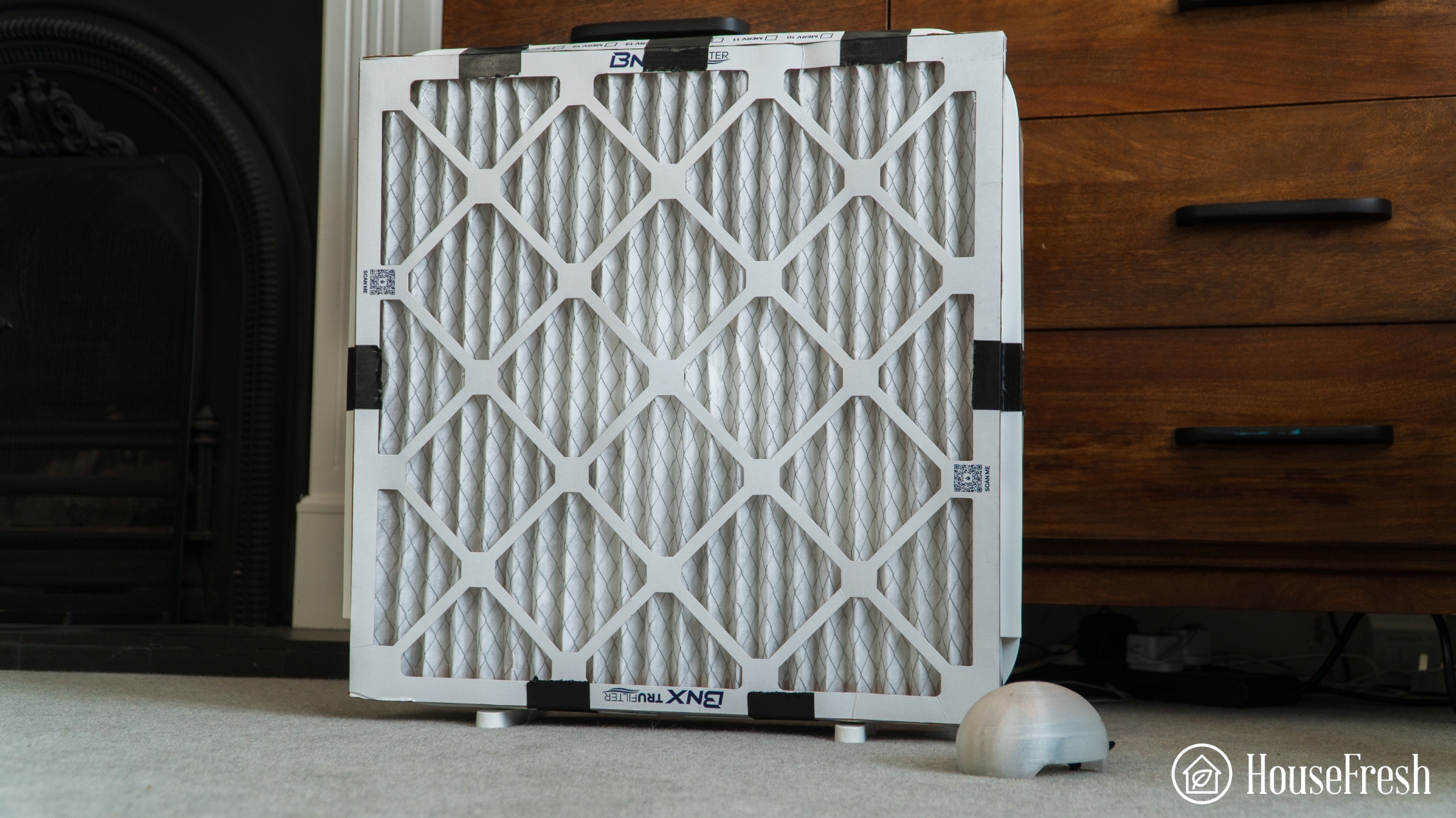
If you’ve followed our guide correctly, your DIY air purifier should fire up immediately on its highest speed setting. It may not look like the prettiest unit on the block like the Smart Air S or have any cool smart features like the Mila, but hey, you made it and you’ve saved yourself a bundle.
I will name it… TeddAir Max!
The TeddAir Max cleared our test room in 84 minutes
Just because I put this air purifier together doesn’t mean it can escape our performance testing room. To see if our TeddAir Max affects air quality, we wanted to put it through the same rigorous tests we subject to all the other units we review.
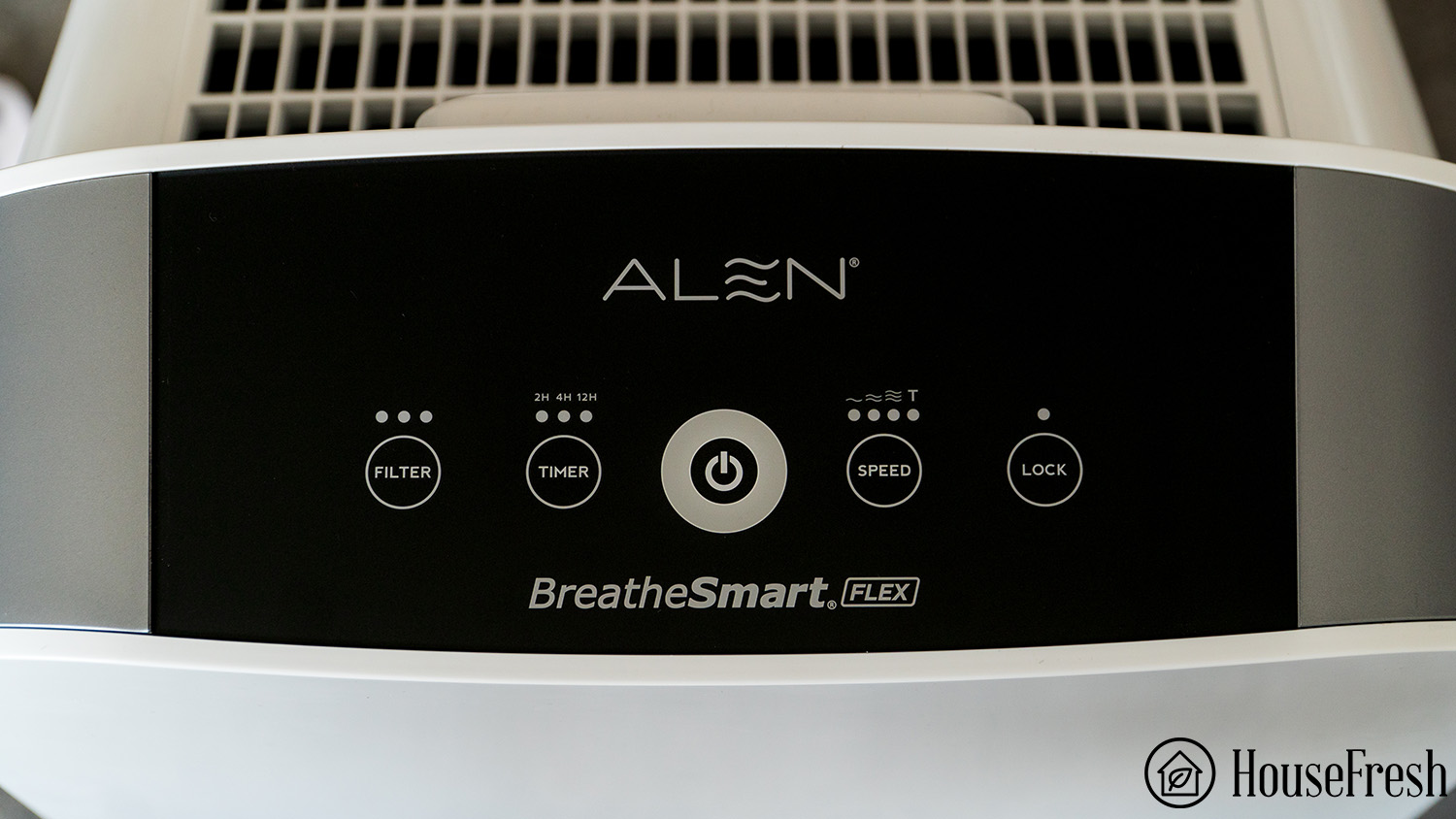
Our TeddAir Max air purifier cleared the simulated contaminants (incense smoke) from our performance testing room in 84 minutes. Even though it’s stuck together with tape, its performance was fair. It may not have outperformed units like the Alen BreatheSmart Flex, Smart Air S, Levoit Core 600S, Mila or the Blueair Blue Pure 311 Auto, which are all a similar size.
Still, it did clear all our simulated pollutants from the air at the same time as the Dyson PH04 (a unit that costs around $750!)
By putting the unit through this performance test, we can also estimate a CADR (Clean Air Delivery Rate). We calculate its CADR to be around 90 CFM (Cubic Feet per Minute) which (if it was a manufactured unit) isn’t great for the size of the fan and HEPA.
One issue I did find while testing was the noise. Because we removed the speed dial from the fan, it’s stuck on max speed, which is, unfortunately, pretty noisy.
Final thoughts
It may not be the most stylish-looking air purifier or the most efficient, but it shows that instead of spending hundreds of dollars on a unit, you can simply make your own at a fraction of the cost.
It’s not just about price; more and more areas in the U.S. are being affected by wildfire smoke, which can travel at an alarming rate, leaving you no time to get online to order an air purifier. You can assemble these components as a first-response action to protect yourself and your family.
There are no extra features like an auto mode, air quality sensors or an app to control your unit, but an air purifier in its purest form is still an air purifier.
At the end of the day, it’s a fan and a filter and this is the message the folks at Smart Air are trying to get across with their range of units that boast high efficiency over extra functions. And as we know from our air purifier reviews, more expensive doesn’t necessarily mean better.
At HouseFresh, we have been reviewing air quality products since 2010. In all these years, we learned not to rely on manufacturers’ claims and the ever-so-glowing marketing materials. That is why we buy products with our own money, so we can write unbiased reviews after we’ve had enough time to evaluate air quality products in our home lab. Every unit we recommend has been thoroughly tested to assess its performance, energy consumption, and noise levels emitted in real-life environments. If you have any questions about our testing process for different types of air quality products, just drop us an email at danny@housefresh.com.
The reality is that dust is a typical household issue that we must deal with pretty much every day. You can probably relate to the frustration that comes with finding dust in the places you cleaned just the day before.
Thart’s why the key is to clean often, and to clean properly.
A proactive approach will prevent grime buildups, nasty dust bunnies under the couch and crud nooks and crannies.
But what and where should you pay the most attention? And what can you do to keep dust at reasonable levels? I bring you some tricks and tips to keep on top of the problem.
As I mentioned above, regular cleaning is paramount. Yet, how to do it is as important as the frequency. So, why not press play on your favorite podcast and dive into a cleaning session following my top ten tips.
Tip 1: Dust with a microfiber cloth
Start by wiping dust off every surface in your apartment: tables, counters, shelves, knickknacks and electronics with a slightly damp microfiber cloth.
Microfiber is known to trap dust particles better than other fabrics thanks to the super tiny threads and synthetic nature that work like a magnet for dirt, oil and grease. Microfiber cloths will grab the dust instead of just pushing it off objects and stirring it into the air to resettle in other surfaces.
Add the following ingredients to a spray bottle:
2 cups of water,
1 cup of vinegar
2 tablespoons of olive oil
Optional: a few drops of your favorite essential oil
The vinegar will help cut through grime; the olive oil will polish and keep dust away longer. Spray the surfaces (except for electronics) and then wipe them clean with the rag. Always shake before using.
Tip 2: Clean places you don’t usually dust
Dust will accumulate on all sorts of surfaces, including those you don’t regularly reach in your everyday routine. Remove lint build ups from forgotten spots either with a microfiber cloth or vacuum them with suitable vac attachments. The more diligently you clean these overlooked areas, the less dust will circulate throughout your home.
Here’s a list of usually overlooked spots, but get creative! Try to tackle as many dust-hiding places in your apartment as possible:
Windows (glasses, ledges, sills and blinds)
Ceiling fans
Above doors and frames
Kitchen cabinets (inside and above)
Above the fridge
Light fixtures and light switches
Baseboards
Mirrors
Wall corners
Bookshelves (including the books)
Plants (their leaves accumulate dust that’s not just bad for you but also for them. Wipe them gently with a wet cloth)
Tip
As these are quite different surfaces if you switch cleaners to suit the needs of each one better, use another cloth to avoid mixing cleaners.
Look for high-quality cloths that will degrade less quickly and shed fewer microplastics. Or consider using a slightly damp Swedish dishcloth if you prefer a more natural option. These are made of organic materials and compostable.
Tip 3: Vacuum beyond the floor, always starting with upholstery and curtains
You want to vacuum in the right order to cut down on dust efficiently. Start with the couch, upholstered furniture, curtains and drapery. Textiles don’t just accumulate unseen debris but also decay into textile dust, producing unwanted stuff on their own.
After dusting and vacuuming fabrics, move on to the floors. Follow this sequence so that if anything redeposits on the floors, you’ll get it at the end. You’ll be preventing dust fallouts on already-cleaned surfaces.
Tip
Follow these tips to make vacuuming even more efficient:
Empty the canister of your bagless vac after every use. Wrap a disposable bag around the lid before opening it to make sure the dust falls directly into it.
Take the trash outside immediately after emptying your vacuum cleaner’s contents inside of it. Dust may reenter your living space if it sits in the trash can.
Keep your vacuum clean and unclogged; otherwise, the suction power could get compromised.
Consider getting a vacuum with a HEPA filter. They are way more efficient than regular ones, which usually shoot dust out the back end.
Tip 4: Use a rake on carpets and rugs
Carpets accumulate great amounts of dust that settles deep into the fibers and is hard to remove by just vacuuming — even if you do so regularly. A rake will shake loose a lot of lint, hair and debris, making it much easier for the vacuum to suck it all up.
Tip
This is more of a deep-clean, hands-on monthly task. However, bear in mind this will blow dirt into the air. Don’t save it for the end; you’ll get dust all over the recently cleaned room again.
Tip 5: Mop uncarpeted floors after vacuuming
A swift mopping with a microfiber mop is the perfect final touch. It will remove any dust leftovers and crud spots. Use warm water and your favorite cleaner to leave your apartment smelling fresh.
Just remember to wring the mop thoroughly until it’s just slightly damp; otherwise, dirty water can seep between cracks and under baseboards.
Tip
If you’re looking for more natural and safer floor cleaners, the EPA has a database with their Safer Choice Standard products.
Tip 6: Change the bedclothes weekly
We spend one-third of our lives in bed on average. No wonder mattresses, blankets, pillows and duvets accumulate our (and our pets) dead skin cells, dander and stray hairs. All of these are food for dust mites, microscopic bugs that nest in four out of five homes in the U.S. and are known to be one of the most common indoor allergens.
Once a week, remove the bed linen and shake out pillows and duvets to reduce dust and debris buildups. Vacuum the mattresses after allowing the bed to air out. Use essential oils for a final scented touch before making it up again.
Tip
Tea tree oil and lavender are fine options for a bed freshen-up that will also kill dust mites. Fill a spray bottle with cereal alcohol or vodka and a few drops of essential oil to splash on the mattress and pillows before putting in fresh sheets.
Make sure to wash the following with hot water:
Bed sheets, duvet covers, pillow covers.
Stuffed toys
Blankets and bed throws
Also, you can throw them into the washer every once in a while for an extra heat boost. Even if you’re not in contact with them, all fabrics will collect dust, dead skin cells and dander.
Tip 7: Clean vents and air filters
Vents and air filters are most susceptible to dust. If you happen to notice more lint and dirt than usual in your apartment, it’s probably time to change the filters. More than often, air filters get replaced every six months, but depending on the type of filter and area you live in, they might need replacement sooner.
When cleaning the vents, vacuum away as much dust as possible first. Then, take down all the removable parts and soak them in soapy water to loosen any grime. Scrub gently with a brush and let it dry completely before returning it. While it dries, use the vacuum to clean the dust from the vent inside as well.
Tip
You may as well check the exhaust fans from the kitchen and bathroom for crud buildups. Vacuum the units to remove as much debris as possible.
Tip 8: Use an air purifier
An air purifier will drastically reduce the amount of dust floating in the air and settling around your apartment. Air purifiers with high quality particle filters can remove dust particles from the air before they set on top of surfaces.
Our top recommendation for dust in a large apartment is the Coway Airmega ProX, a beautifully designed unit with a powerful fan and a two sets of True HEPA filters. If you’re on a budget, check out the Levoit Vital 200S, which offers excellent particle removal performance for less than $189.99. And if you’re concerned about sound, then nothing beats the PC fan-powered Luggable XL-7 from CleanAirKits. To find out more about these or other options, read our guide to the best air purifiers for dust.
Tip
An air purifier is an excellent ally for dusting chores. Have it on and running in the room you are cleaning; it will reduce the amount of lint flying into the air and resettling in already cleaned surfaces.
Tip 9: Clean your dryer machine
Dryers have a lint trap to prevent all that debris from getting blown outside the machine and into your apartment. The trap is not more than a screen mesh inside the dryer, but when clogged, the pressure of the cycle itself will make it renter the drum, leaking all the lint into your clothes and the surrounding air.
Tip
Check the dryer’s manual for instructions on how to clean the lint trap. Make sure to clean it regularly. The frequency will vary based on the pace at which lint accumulates.
Tip 10: Brush your pets in an easy-to-clean room
Regularly brushing and grooming your pets is a proactive way to keep up with their hair and dander circulating throughout your apartment, especially during the shedding seasons. However tempting as it may seem to brush them on the living room or bedroom, any fluff that escapes the brush will land on your couch, bed or rug and stick to the fabrics’ fibers.
Tip
If possible, choose a space with no carpet to groom your pets. Otherwise, take your pet-brushing sessions to the room in your apartment with as little fabric or textile as possible around.
Why is your apartment so dusty?
Dust does not come from just one source. It’s not uniform, nor is its composition universal. Instead, multiple elements could be building onto the dust you see in your apartment — which also varies based on the local environment and your home biome.
In a regular home, dust is usually made up of a combination of the following:
Skin cells and hair: our skin is constantly regenerating and fully renews every four weeks. Humans also lose over 50 to 100 hairs a day in normal circumstances. That means a lot of dead skin cells and hair are naturally shed into the environment regularly.
Pet dander: just like us humans, our pets also shed their fair amount of microscopic bits of dead skin and fur that will accumulate in your apartment if you don’t vacuum and clean upholstery regularly.
Textile fibers: this includes your clothes as well as bedroom linen, couches and upholstered furniture, curtains, carpets and rugs. Textiles are all over our homes, making them cozier. However, with time, all textiles naturally degrade and shed fibers that contribute to the dust forming around us.
Paper fibers: even toilet and tissue paper, as well as paper towels, are contributing to your household dust.
Food and cooking activities: while you are cooking, tiny food particles are released into the air and become airborne, eventually depositing and adding to the duts. Food debris, like crumbs, may also end up on the floor.
Insects: household dust also includes bits of insect remains, including those of dust mites, cockroaches and even the bug pests in your plants. When they die, these microscopic, creepy-crawly housemates end up building up on the airborne and settled dust around your apartment.
Pollen: an outdoor biological pollutant, pollen is produced by trees, grasses, flowers and weeds. One of the main components of household dust, the wind stirs and carries the airborne pollen particles into your apartment. It’s more intense during spring when trees and other plants pollinate. Yet, depending on the local vegetation, pollen season can go year-round.
Dirt and other outdoor particles: When you walk into your home wearing outdoor shoes, you’ll be inadvertently introducing small particles of soil. Soot from nearby streets, stirred-up street dust from passing cars and debris from nearby construction sites are also prone to enter through doors, cracks and windows.
Mold spores: mold is everywhere, even if there are no leaks in your apartment and it is well-maintained mold and mildew-wise, spores can enter your home through windows and doors.
Final thoughts
I guess there’s a subtle charm to dust. It’s in the fact that it tells the story of those who inhabit a home; it has trails of our habits, our feeding patterns and our ways of living.
That being said, and in a much more grounded sense, we are all in the big fight against dust. A dust-free apartment with no allergy triggers and a healthy environment to spend our day looks and feels better.
Luckily, that is absolutely achievable. Just keep up your regular dusting routine and take the time to make a deep-cleaning session once in a while.
If you’ve decided you need an air purifier and researched the units available, you’re most likely to have come across the Levoit brand. Levoit changed the game when they started engineering units in 2017 and have grown to be one of the most popular air purifier manufacturers on the planet.
The 300S is an upgrade on Levoit’s hugely successful 300 to fit in with their Core S (Smart) range. That means that the Core 300S comes with a built-in sensor that monitors the air quality in your home in real-time, making it possible for the air purifier to come on automatically when needed. You can see air quality levels in your room on the screen, or you can access the data on your phone through Levoit’s VeSync app.
But it begs the question, is it worth paying the extra $50 for the Core 300S over the 300?
To find out, we bought the Levoit Core 300S with our own money and put it through its paces to assess its air cleaning performance, sound levels at each fan speed, energy consumption, day-to-day usability and long-term maintenance costs.
How we test air purifiers
Read our full testing methodology.
With all this data, I will be able to compare the Levoit Core 300S to the more than 90 air purifiers we have tested to date. The result? A comprehensive review to help you decide if this is the right device for you.
The lowdown on the Levoit Core 300S
“The Levoit 300S improves on nearly every aspect of the successful Core 300 with its quicker air cleaning, lower energy usage and even new smart features. Whilst still only an air purifier for a small room, this is one of the best small room air purifiers out there.”
— Danny Ashton, HouseFresh Founder & Senior Writer
💡exclusive code for HouseFresh for 10% off a single purchase on Levoit.com: HOUSE10
If you don’t have time to read the full review, check out what I liked and what I think Levoit could have done better for the 300S.
What we really like
You can connect it to your smartphone through Levoit’s VeSync app to operate it remotely, set routines and more.
It comes with an auto mode thanks to its onboard air quality sensor.
It shows the quality of the air in the room in real time via a bright LED wheel around the control panel.
There are lots of generic filters available, so you can rest assured you won’t find it difficult to find filters in stock when the time comes to replace them
What we think could be better
It doesn’t come with enough activated carbon to deal with serious odors or VOCs.
I wish you could remove the pre-filter to clean it, but it’s a bonded all-in-1 cylindrical filter.
HouseFresh rating:
★★★★☆
Time to clean our 728 cubic feet test room (with the device running at top speed):
45 minutes
Air purifier technology:
3-Stage Filtration (pre-filter, main particle filter, high-efficiency activated carbon filter)
Recommended room size (4.8 air changes per hour):
219 sq. ft.
Clean air delivery rate (CADR):
Dust: 134 CFM Smoke: 126 CFM Pollen: 154 CFM
Dimensions (in inches / in cm):
8.7L x 8.7W x 14.2H inches (22L x 22W x 36H cm)
Weight (in pounds / in kg):
5.95 lbs (2.7 kg)
Filter life:
6 – 8 months
Noise level in decibels (measured from 3 ft. away with a sound level meter):
Speed 1: 38.9 dB Speed 2: 45.7 dB Speed 3: 54.5 dB
Electricity consumption in watts (recorded with an electricity usage monitor):
Estimated running cost (electricity consumption + official filter replacement):
$79.43 per year
Cost per CADR cfm (based on dust CFM as reported by AHAM):
$1.12
Manufacturer’s warranty:
2 years
Country of manufacture:
China
Basic design, intuitive functionality
Levoit has engineered the Core 300S to be extremely user-friendly without compromising on design.
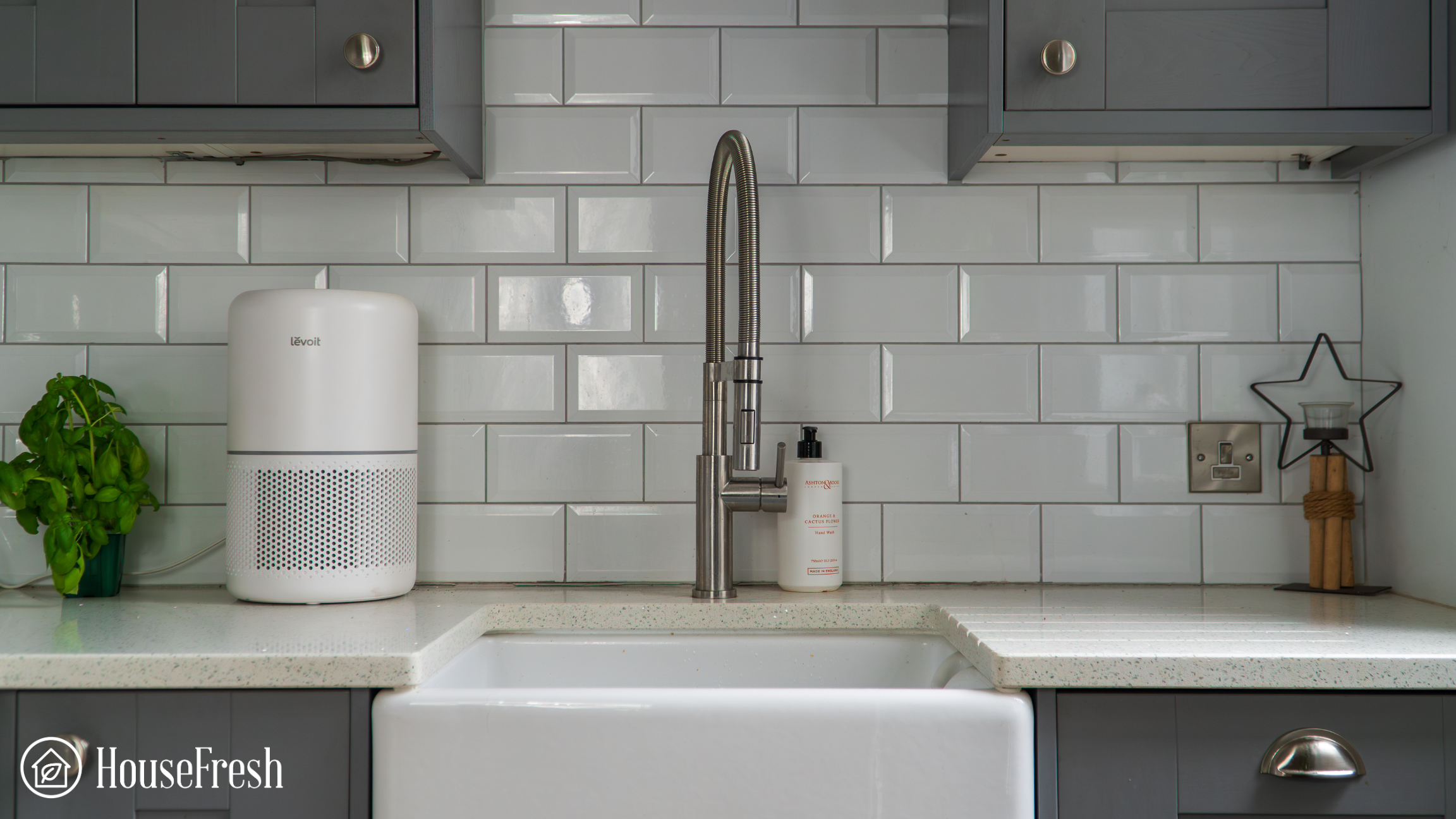
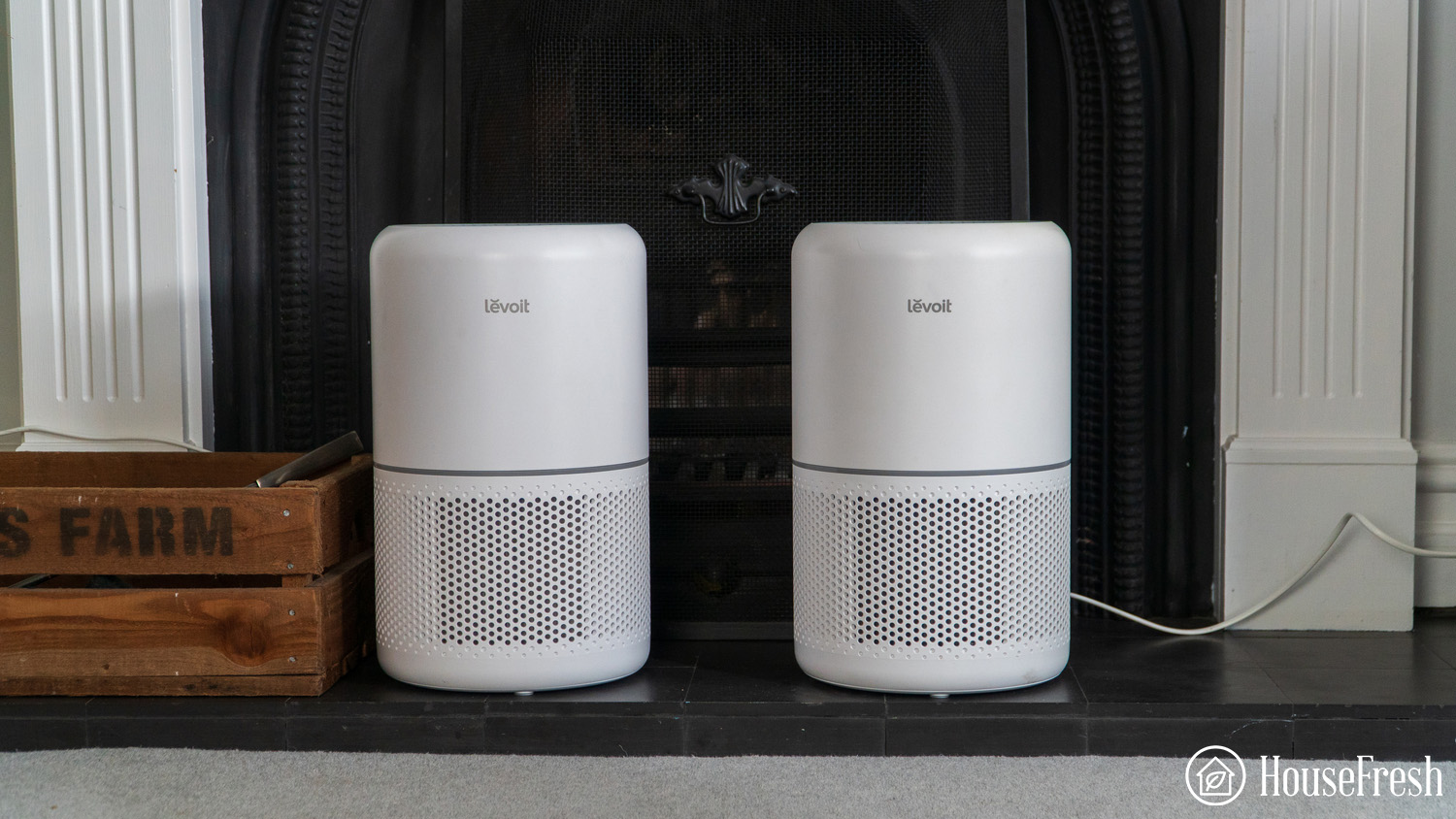
Levoit isn’t known for edgy designs, but that doesn’t mean the 300S looks bad. Its white, cylindrical body is compact, light and easy to move between rooms. It doesn’t take up much floor space and could also fit on a tabletop, desk or kitchen side.
💡exclusive code for HouseFresh for 10% off a single purchase on Levoit.com: HOUSE10
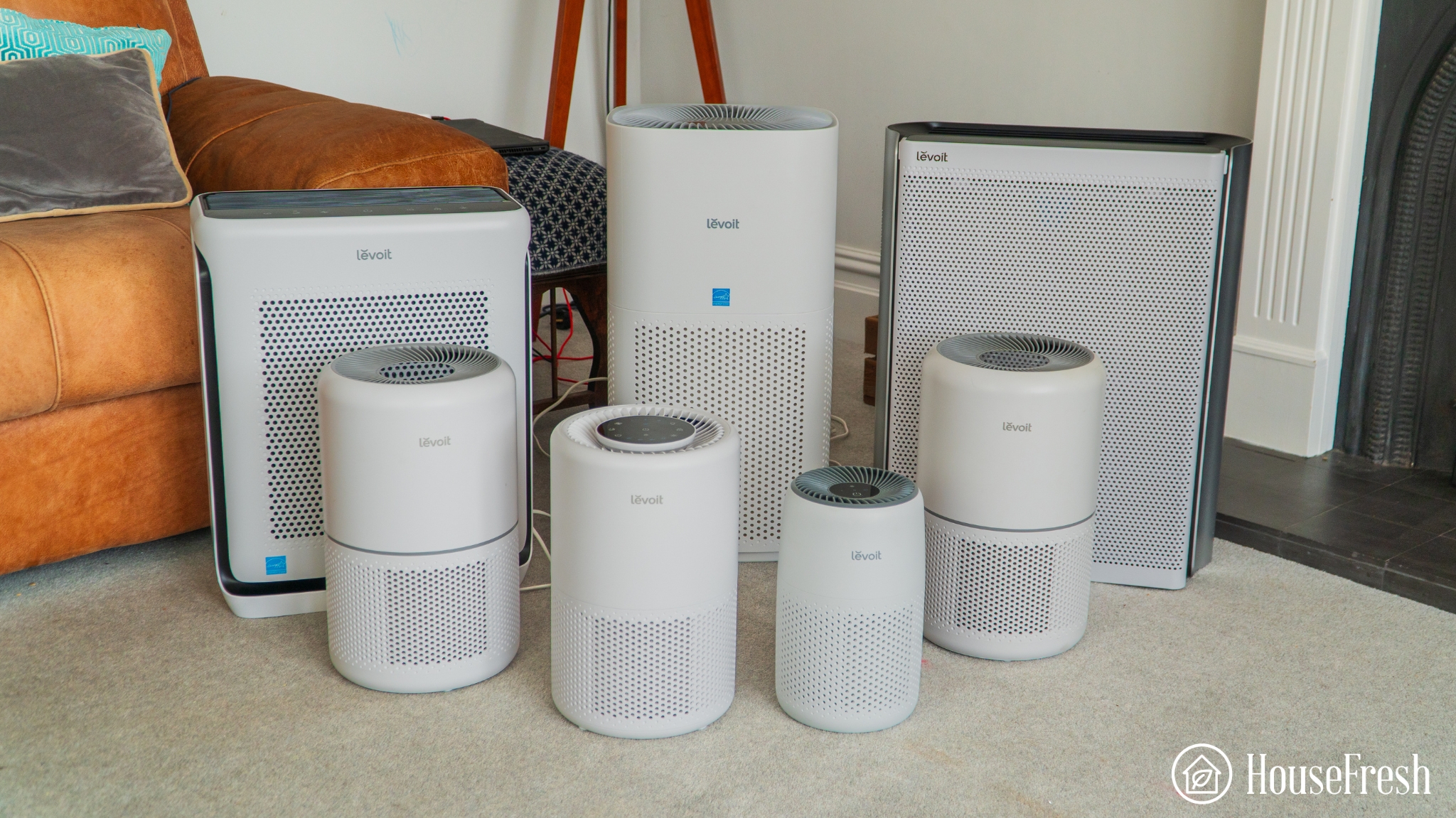
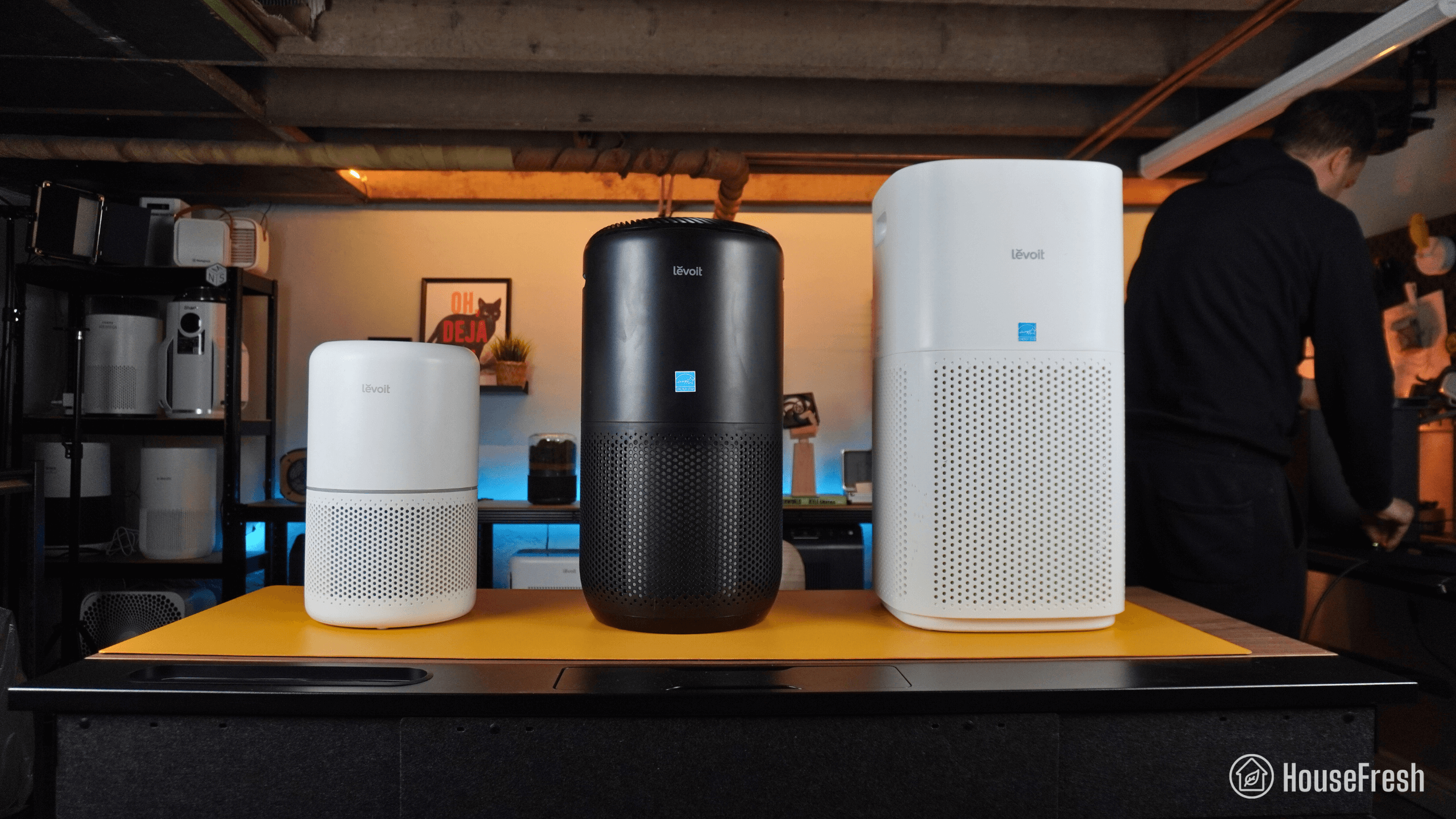
The 300S sits firmly in the “mid-size” category when you put it next to some of the other Levoit units we’ve tested. You can see in the image below how it compares to bigger Levoit devices such as the popular Vital 200S (left), the Core 600S (middle) and the EverestAir (right).
When comparing the 300S side-by-side with the 300, you will see that they look pretty much identical. The only visible differences can be found when looking at the control panel on top and when comparing the back of each devices.
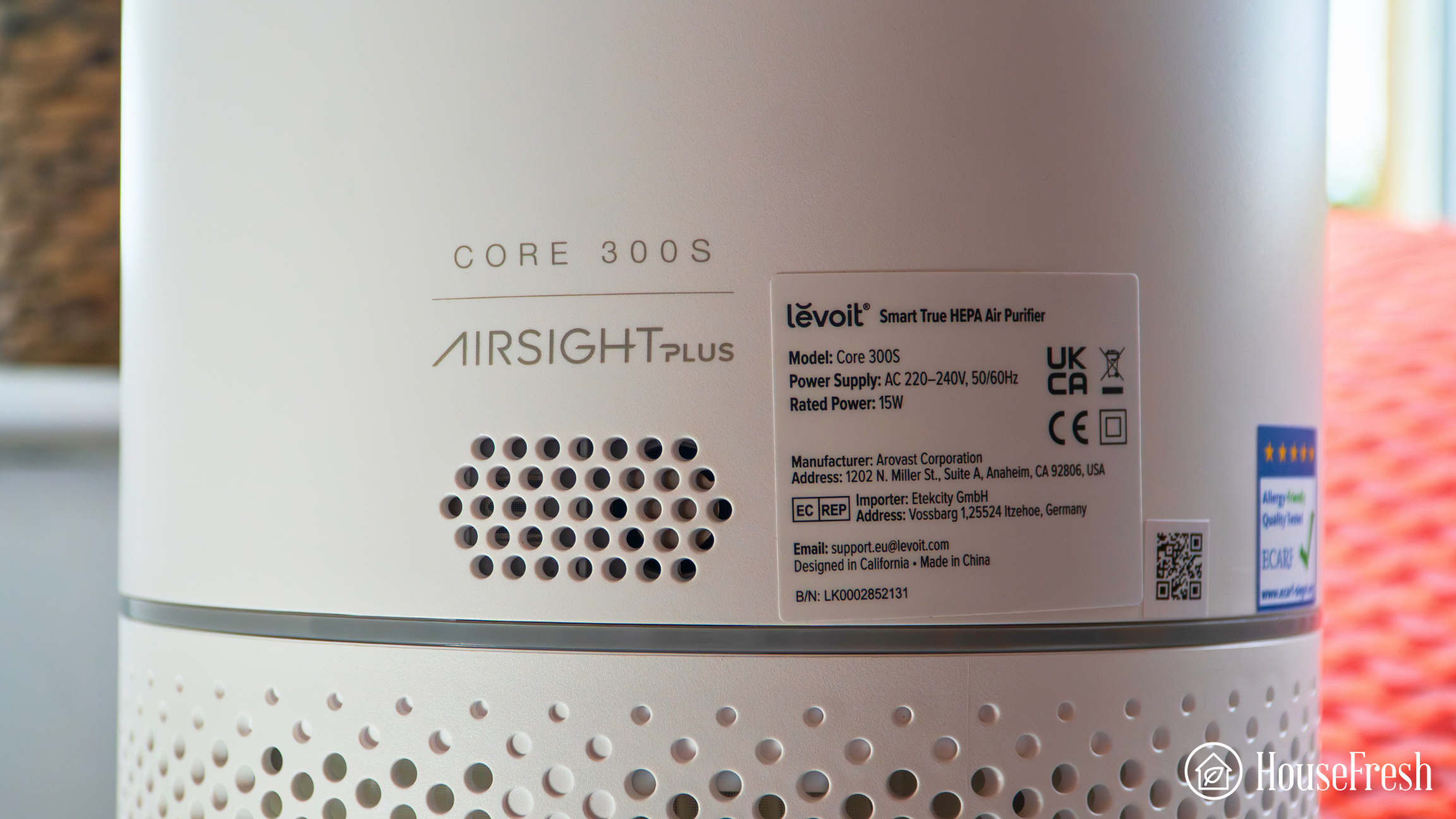
On the back of the Core 300S, you will find Levoit’s AirSight™ Plus air quality sensor. This feature scans the surroundings, detecting how many pollutants are in the air, in real time. You need to keep the air quality sensor unobstructed and free of dust for it to do its job effectively.
The 300S uses this air quality data to determine the most suitable fan speed when running in auto-mode, and it also stores it in the VeSync smartphone app.
But you won’t need to be looking at your phone all the time to find out how good the air quality is in your room because the 300S displays this information on the control panel on top of the device in the form of an LED color-coded ring around the power button:
This brings me to the controls of the Core 300S and I’ve got to say, they are intuitive and easy-to-use at a glance, which is something I’ve come to expect from Levoit at this point.
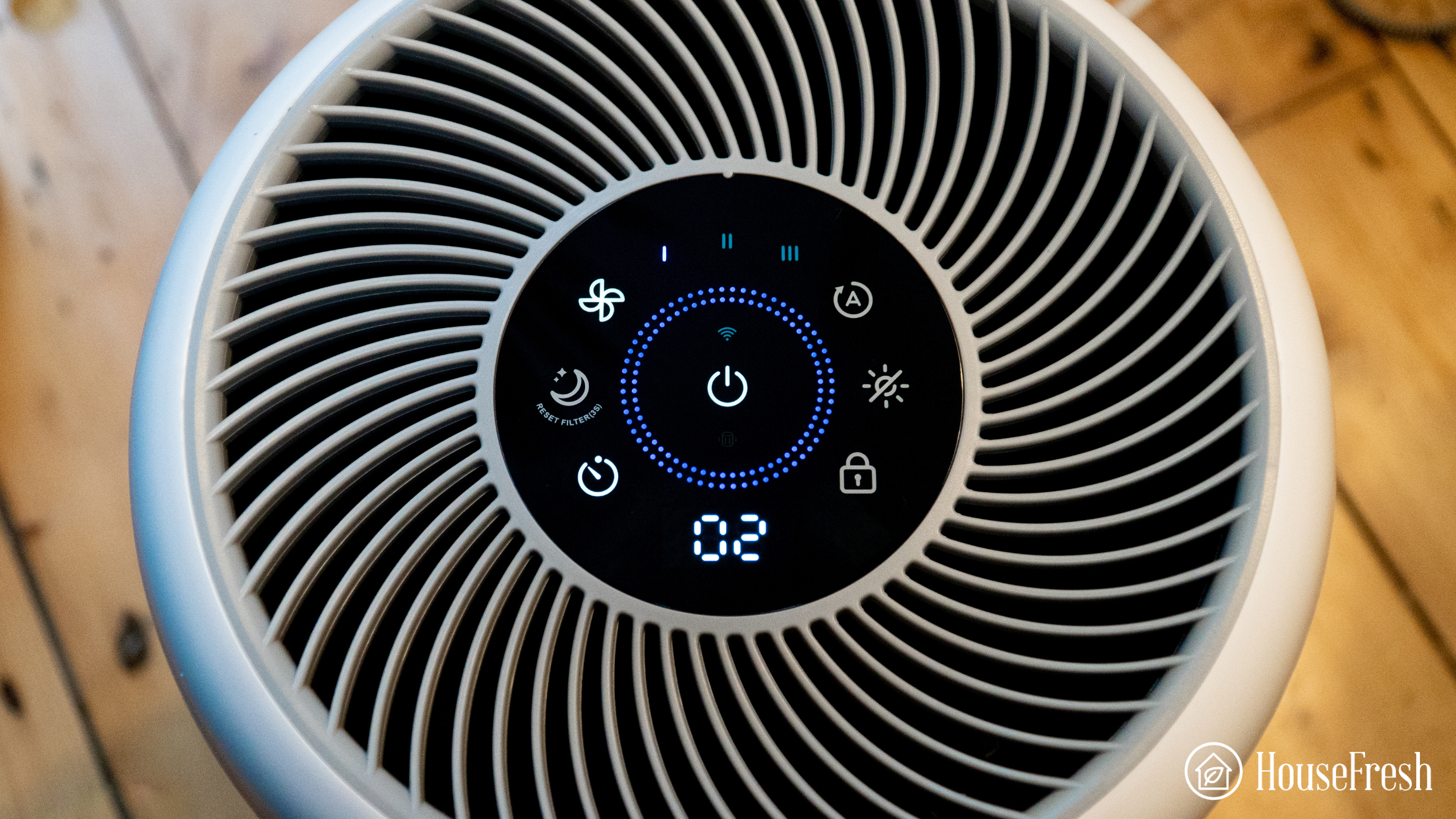
There are minimal button descriptions, but the icons used are pretty self-explanatory. Here are which functions each button controls:
Power
Press once to turn the power on/off. Press and hold to configure the air purifier and connect to the VeSync app.
Auto Mode
When engaged, this allows the 300S to automatically adjust its fan speed to neutralize the amount of pollutants in the air (perfect for when my cat farts).
Display Lights
You can turn off the display lights if you don’t want them distracting you. Ideal for when I’m using auto mode at night.
Display Lock
Pressing the button once locks the display so no settings can be altered. Press and hold for 3 seconds to unlock. Perfect if you have curious kids and/or pets.
Timer
You can set a timer to turn off your 300S for anything from 1-24 hours.
Night Mode/Filter Reset
Pressing the night mode button reduces the fan to its lowest speed and turns off the display lights for undisturbed sleep. To reset the filter indicator light, press and hold for 3 seconds.
Fan Speed
Cycle through three of the unit’s fan speeds.
There are a few more lights you will come across, all packed onto the control panel. On top are the fan speed indicators and the Wi-Fi signal to show that the unit is connected to your app. Below is the filter indicator light, which prompts you to replace the filter with a new one and an LED display to show the timer.
The smartphone app
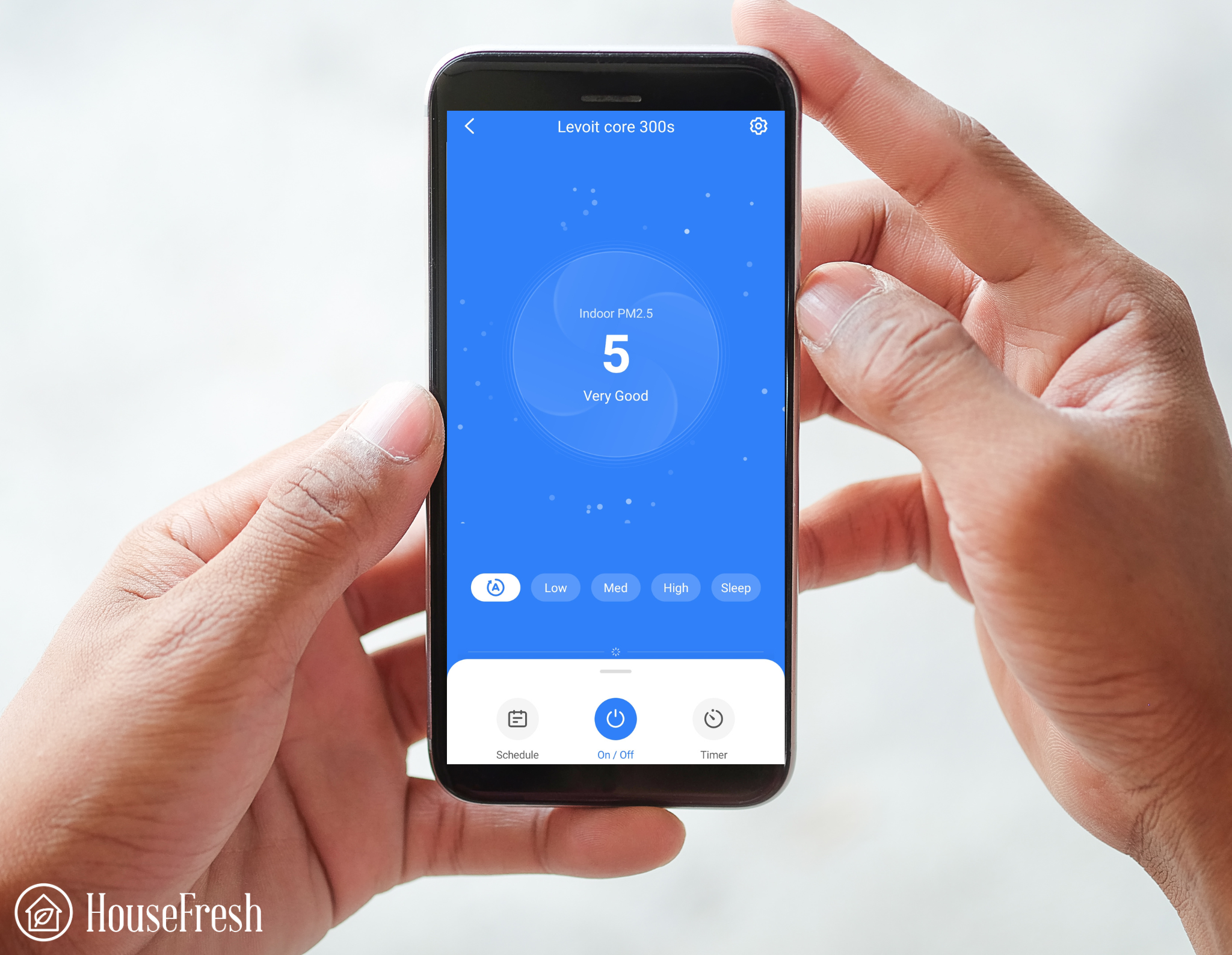
As I mentioned briefly in the introduction, Levoit models in the ‘S’ (Smart) range include the ability to connect to their VeSync smartphone app. This allows you to have complete control of your 300S and the capacity to monitor the quality of the air in your home from anywhere in the world.
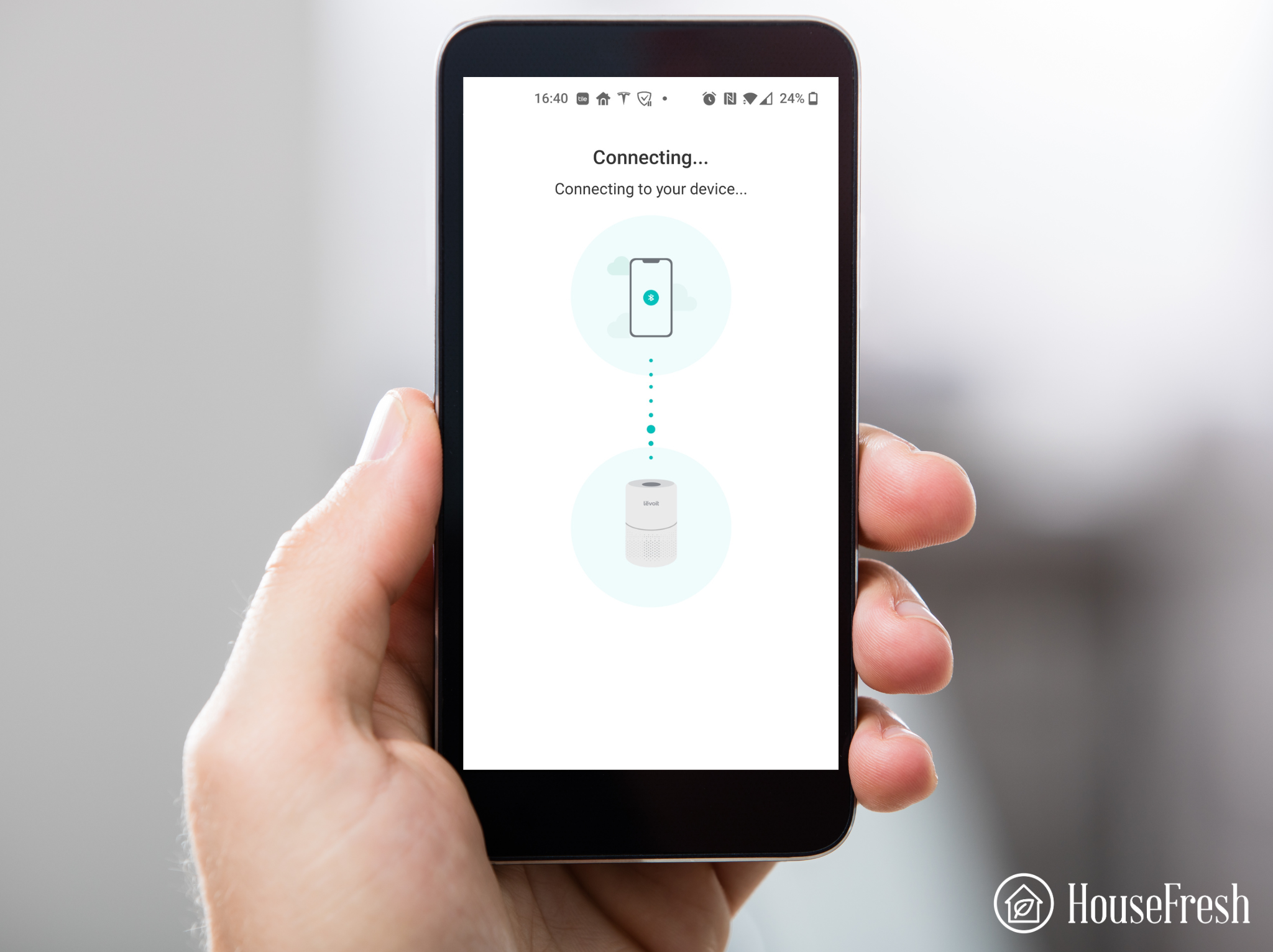
Connecting your device is a straightforward task and doesn’t take long. All you need is to have the app downloaded, have a good wifi connection and be next to your air purifier. You can even connect multiple units to control and monitor the air quality in each room.
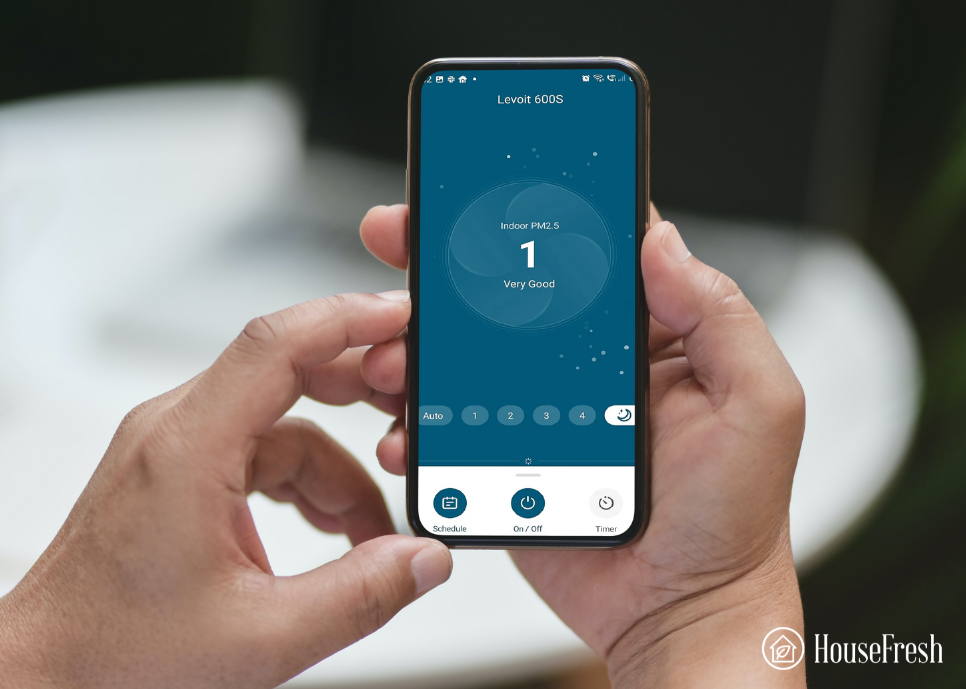
The app itself is very intuitive and easy to navigate. The air quality is displayed on the screen with buttons to control fan speeds, engage Auto or Sleep modes, and set a timer or schedule when you want the air purifier to power on and off.
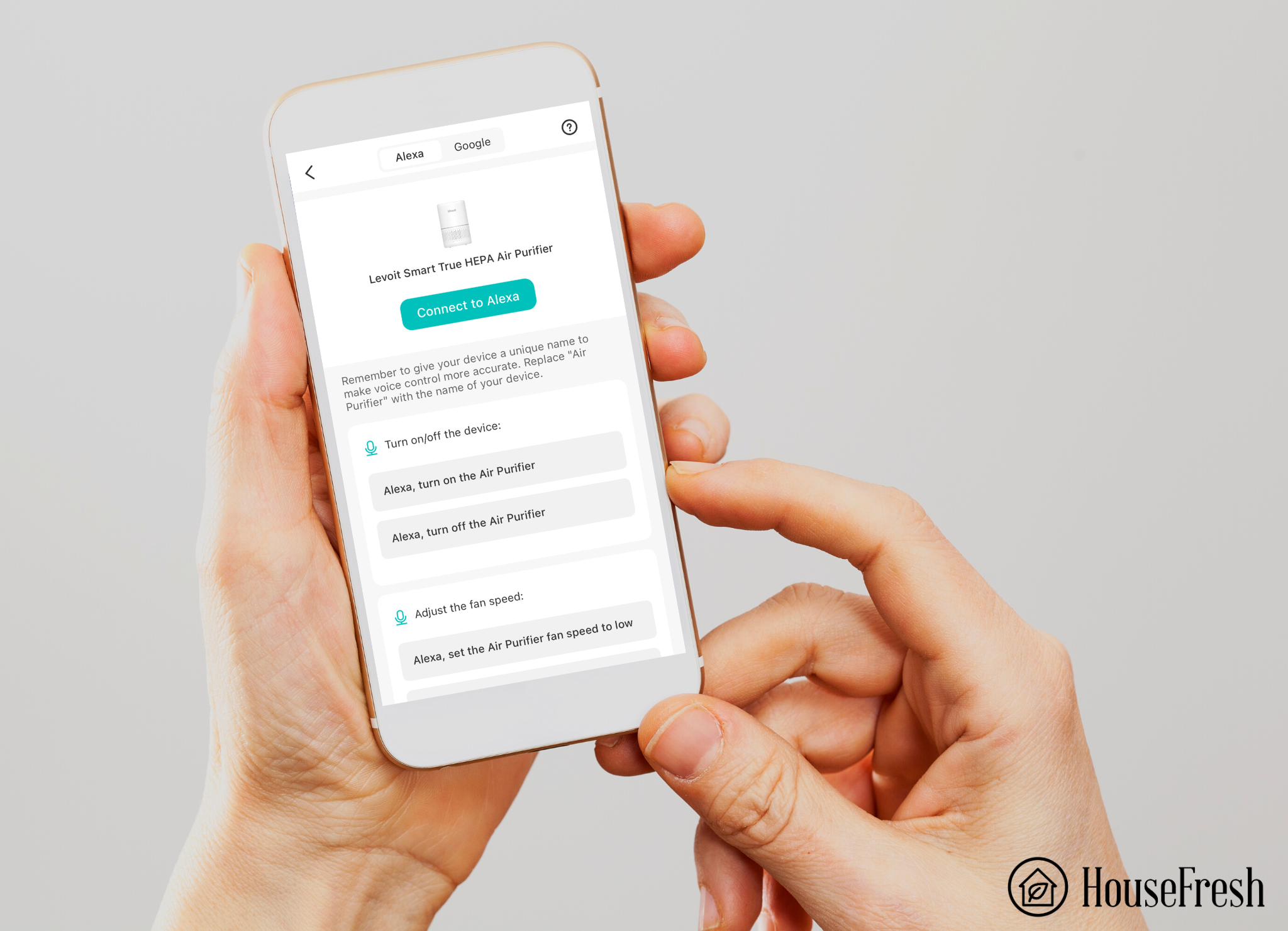
If you have smart home devices at home already, you will be pleased to learn that you can connect the VeSync app to your Alexa or Google Home device in order to enable voice commands.
Here’s what happened when I subjected my 300S to a burst of airborne pollutants at close range.
3-stage air filtration with activated carbon
Years after its release, Levoit was forced to remove all mentions of HEPA filtration from their marketing.
Levoit prides itself on the quality of its filters, and so it should, as we’ve never had any issues with them and found them to be extremely effective at removing harmful particles from the air. But a certain disruption has meant Levoit has had to make a few changes to their marketing materials.
Before I get into all that, let’s talk about the filter itself.
Pre Filter – This is the first line of defense by trapping larger particles like dust and dander from the air by capturing them in its fabric material. By removing these contaminants here, it prolongs the life of the main filter.
The pre-filter is the exterior layer of the Levoit Core 300S, so larger particles (such as pet hair and fluff) will get stuck to it. In order to extend the life of the other layers of the filter, you will need to vacuum the pre-filter regularly:
ARC Formula™ Activated Carbon Filter – This is made up of lots of small pieces of activated carbon that remove VOCs (Volatile Organic Compounds) and odors from the air using a process called adsorption. When these harmful pollutants hit the activated carbon they become stuck to it, unable to pass through.
Main Filter – This is where the magic happens. The main filter comprises of a tightly woven maze of fibers that trap microscopic particles (I always think of a fly trapped in a spider’s web), removing them from the air.
On August 15, 2023, Dyson contacted the National Advertising Division, stating that the branding of Levoit’s filters was misleading by classifying them as HEPA.
In response to this challenge, VeSync (Levoit’s parent company) “asserted its belief in the efficiency of its products” and promised to update its testing data. Months later, Levoit instead opted for removing all traces of the word HEPA from its branding, packaging and promotional material.
So, does this mean that Levoit particle filters are inherently bad? Not really.
HEPA is an efficiency standard for air filters, but that doesn’t mean that only filters certified as HEPA are good. For example, we have seen excellent air cleaning results with air purifiers like the CleanAirKits Luggable XL-7, which uses MERV 13 filters instead of HEPA.
As I mentioned, you can check the remaining lifespan of your filter in the VeSync app but don’t worry if you don’t have access to that, as a red warning light will appear on your control panel when the filter needs to be replaced.
When the time comes, it’s extremely simple to replace the filter:
Unplug your Core 300S
Turn the unit upside down and twist off the cap anti-clockwise
Pull out the filter and replace it with the new one
Twist the cap back on clockwise
Check out the process in my instructional video.
Tip
Levoit filters will arrive wrapped in plastic packaging, so it’s paramount that you remove all of this before inserting the new filter into your 300S. If you don’t, the filter simply won’t work, and you’ll probably start to notice an unpleasant burning smell coming from your air purifier.
The Levoit Core 300S cleared our 728-cubic-feet test room in 45 minutes
We test all the air purifiers in the same rooms following the same process to assess the performance of each unit individually, as well as to make it possible to compare the data against other air purifiers we review. In this section of the article, I will take you through our tests.
Particle removal test
For our particle removal test, we lit an incense stick to fill our 728-cubic-feet test room with simulated contaminants. We then turned on the Core 300S at its highest fan speed and used our PurpleAir Zen particle counter to monitor how long it took for the 300S to clear all PM1 pollutants from the air.
Here are the results:
The 300S cleared our room of contaminants in 45 minutes, making it fifteen minutes faster than the original Core 300 (54 minutes).
The Core 300S is a small air purifier, so I wasn’t expecting results to match units like the Levoit EverestAir (16 minutes) or the Blast Mini from Smart Air (15 minutes).
Considering its size, the 300S offers good air cleaning performance but there are other small air purifiers available today that proved to be more effective and that offer better value for your money like the Winix A231 (40 minutes) or the Philips 800 Series (43 minutes).
AIR PURIFIER MODEL
TIME TO CLEAN OUR TEST ROOM
LIST PRICE
AirFanta 3Pro
17 minutes
$159.99
Levoit Vital 200S
23 minutes
$189.99
Coway Airmega AP-1512HH (with ionizer)
26 minutes
$229.99
IKEA STARKVIND
32 minutes
$199.99
Levoit Vital 100S
37 minutes
$139.99
Winix A231 (with ionizer)
40 minutes
$99.99
Philips 800 Series
43 minutes
$139.99
Levoit Core 300S
45 minutes
$149.99
PuroAir 240
51 minutes
$199.00
Molekule Air Mini+
61 minutes
$359.99
Noise levels test
All air purifiers make noise; whether it be the fan spinning or the motor running it, the sound is unavoidable. The issue is that if your air purifier is too loud, the likelihood is that someone will switch it off eventually as nobody wants to have a noisy fan running while doing deep work or watching a movie.
That is why we used a sound level monitor to record how much noise the Core 300S generates at each fan speed:
Speed 1: 38.9 dBA
Speed 2: 45.7 dBA
Speed 3: 54.5 dBA
When comparing the performance you get when running at top speed with the noise generated (54.5 dB), the Core 300S doesn’t particularly stand out as neither quiet nor noisy:
AIR PURIFIER MODEL
SOUND LEVEL AT TOP SPEED (dBA)
TIME TO REACH PM1 ZERO AT TOP SPEED
Levoit Core 300
50.2 dB(A)
54 minutes
Philips 800 Series
51.3 dB(A)
43 minutes
Levoit Vital 100S
53.8 dB(A)
37 minutes
Levoit Core 300S
54.5 dB(A)
45 minutes
IKEA STARKVIND
57.4 dB(A)
32 minutes
Winix A231 (Zero Compact)
57.9 dB(A)
40 minutes
Molekule Air Mini+
67.4 dB(A)
61 minutes
When you compare it to other small air purifiers, you’ll see that the 300S is on par. As you can see in the table above, the Winix A231 is louder than the 300S so if you were considering going with the A231 based on our particle removal test, then this is something to keep in mind.
Noise is subjective, so we video each unit we test to give you a good idea of how much sound it makes. Here’s the noise the 300S makes at each fan speed.
The cost to run a Core 300S: $79.43 per year
1. Electricity costs = $24.44 per year
Air purifiers need electricity to run, so the amount of energy it uses should be high on your list of considerations when looking to buy one. As the cost of energy continues to rise, finding an energy-efficient air purifier is more important than ever, especially as it’s recommended you run your unit 24 hours a day.
The Core 300S is more energy-efficient than its predecessor, pulling 21.8 watts at its highest fan speed. Assuming you would run your 300S all day, every day at its top speed, this will add $24.44 to your annual electricity bill. Unless you’re living in a consistently highly polluted area, you won’t need to have it at this level all the time, so the cost will most likely be lower.
When we compare the energy consumption of the Core 300S to other similarly sized (and priced) air purifiers, you will find that the 300S is a lot more energy-efficient than most:
AIR PURIFIER MODEL
ENERGY CONSUMPTION AT TOP SPEED (watts)
TIME TO REACH PM1 ZERO AT TOP SPEED
Philips 800 Series
20.0 watts
43 minutes
Levoit Core 300S
21.8 watts
45 minutes
Levoit Vital 100S
27.3 watts
37 minutes
Levoit Core 300
35.5 watts
54 minutes
PuroAir 240
36.2 watts
51 minutes
IKEA STARKVIND
38.4 watts
32 minutes
Molekule Air Mini+
39.7 watts
61 minutes
Winix A231 (Zero Compact)
45.6 watts
40 minutes
2. Filter costs = $54.99 per year
As filters trap particles from the air, they become full over time because those particles have nowhere to go. Most air purifiers use filters that need replacing when full, so it’s important to factor the cost of replacing them into your budget.
Genuine Levoit filter replacements cost around $25.99 for the original and $35.99 for the higher-spec filters (which we highly recommend over the original filter). As each filter lasts from 6-8 months (depending on usage), you should budget for two a year ($54.99):
When combining energy consumption costs with filter replacement prices, we found that the Core 300S has some of the cheapest yearly running costs, second only to what we calculated when reviewing the Philips 800 Series:
AIR PURIFIER MODEL
ESTIMATED ELECTRICITY COST (per year)
FILTER REPLACEMENT COST (per year)
YEARLY MAINTENANCE COST
Philips 800 Series
$22.22
$29.99
$52.21
Levoit Core 300S
$24.44
$54.99
$79.43
IKEA STARKVIND
$42.65
$40.00
$82.65
Levoit Vital 100S
$30.32
$53.28
$83.60
Winix A231
$50.65
$49.99
$100.64
PuroAir 240
$40.21
$75.00
$115.21
Molekule Air Mini+
$44.10
$199.98
$244.08
We tested the Pureburg generic filters that you can buy for $24 for two filters and found they slowed air cleaning performance a little but did use pelleted activated carbon like the genuine Levoit filters – a good alternative if you want to lower long-term costs a little:
Bottom Line: Is the Levoit Core 300S worth it?
The Core 300S is a worthwhile upgrade on the Core 300 and a good choise for a small bedroom, dorm or home office.
The Levoit Core 300S is small, smart and highly efficient at removing harmful pollutants from your home. Most importantly, it is affordable.
But is it dated?
What was once one of the most affordable air purifiers on the market has been overtaken by one of the best air purifiers we tested in 2024: the AirFanta 3Pro. This model is part of a new generation of air purifiers powered by PC fans and designed to be built at home. So if the idea of a super silent but powerful small air purifier tickles your fancy, then check out our review of this awesome new device taking the air purification world by storm right now.
If you like the look of the Core 300S but have some more budget to play with or a large room to clean, then I recommend sizing up and going with the 400S instead. If you want to check out other newer models from Levoit, I suggest you take a look at the Vital 100S, which is priced in the same bracket as the 300S but outperformed it.
Now, if you want something about the same size as the Core 300S with a cylindrical size and HEPA filtration, then you should check out the Winix A230/Zero Compact and the Philips 800 Series.
I still recommend the Core 300S to people with a small budget who want a reliable unit with smart functionalities and app support, but the market has changed, and there are other pretty great air purifiers available today that offer better value.
Retailer
Lowest Ever
Highest Ever
Loading price history…
Unable to load price history data.
SOURCES
We calculated the yearly costs associated with running the Levoit Core 300S for 24 hours a day, 365 days per year, using the Appliance Energy Calculator from the U.S. Department of Energy as of December 2024.
Animals have been companions to humans for millennia. However, the place they occupy among us has changed considerably through the years. In the last century, for example, they have gone from being distant protectors who live in the backyard to family members who spend their lives under our roof and sometimes even sleep in our beds.
These changes in our relationship, especially the physical proximity to our pets, are causing more people to have allergy symptoms.
It turns out that allergies to dogs and cats affect 10% to 20% of the population worldwide and 12% of the U.S. population.
They are a response of the immune system, (over)reacting to normally harmless substances that, for some people, trigger symptoms like:
Sneezing
Itchy, watery eyes
Runny nose
Congestion
Scratchy throat
However, this does not mean an allergic person will suffer from them all. It varies from person to person, depending on the type of allergies they have and what they are allergic to.
For example, pet-related allergens can also trigger skin reactions, such as itchy, reddening and swollen skin patches (called hives) or eczema, as well as asthma symptoms like wheezing, difficulty breathing or chest tightness.
I get it, though: despite being sensitive to pet allergies, you may want to indulge in the joys of sharing your life with a furry friend. Enter hypoallergenic pets.
However, are these the real thing? Well, it’s complicated. So, to answer this question, we’ll need to understand allergens better, review some of the most common misconceptions surrounding pet allergies and debunk a few myths.
The biggest myths and misconceptions about pet allergies
Let’s look at the facts behind the myths:
Myth #1: Pet allergies are triggered by shed fur and hair
There is some truth to the fact that pet hair can collect outdoor allergens like pollen, mold and other debris. This could potentially lead to the fur causing allergy symptoms.
But the reality is that actual pet allergies have nothing to do with fur and hair.
Pet allergies are triggered by proteins found in pet dander (dead skin cells), saliva and urine. These proteins are very sticky and can cling to walls, carpets, furniture, bedding and clothes. Pet dander can linger in a home for up to six months, worsening allergy symptoms.
Myth #2: Only mammal pets trigger allergies
Most people are familiar with allergies to furry pets —which makes a lot of sense, as dogs and cats are Americans’ most common choices for pets.
Other mammals such as rabbits, guinea pigs, hamsters, rats and mice are also part of the hairy group whose proteins can trigger allergies. Less known, probably, is the fact that birds produce dander, too.
Bird dander is a combination of beta-keratine particles (the protein feathers are made of), bird dust and dirt particles that are released into the air each time a bird grooms itself, ruffles its feathers or flaps its wings. Plus, some parrots and other bird species are known as “Powder Down Birds” because they produce a whitish powder to protect and waterproof some of their feathers. Bird dust can also wreak havoc on your allergies.
Myth #3: If you are allergic to a specific pet, you’ll be allergic to them all
Each animal species produces different proteins —thus, allergens vary from one to another.
For example, dog allergens are called Canis familiaris (Can f 1 and Can f 2 are the most common ones), while cats’ are Felis domesticus (being Fel d 1 and Fel d 4 the most prevalent ones).
One person could be allergic to cats (or Fel d 1) but not dogs (Can f 1).
What’s more, each particular pet produces different amounts of allergens. As a result, someone could be allergic to one cat and not another, depending on their sensitivity to the Felis domesticus allergens.
Myth #4: Ongoing exposure to pets can help with pet allergies
This is a dangerous myth, as being constantly exposed to allergens can put the immune system under serious stress. For allergic people, unsupervised exposure can worsen symptoms and make them chronic.
On the other hand, somestudies have found that early childhood exposure (preferably before a child’s first year) to animals, including cats and dogs, may lower the risk of developing allergies later in life. Pets introduce certain microbes into the home environment that boost children’s immune system as it develops.
However, for those with an already established pet allergy, exposure with no backing treatment or guidance from an allergist won’t desensitize them. On the contrary, keeping a pet at home shouldn’t be something to take lightly.
Myth #5: There are hypoallergenic breeds of dogs and cats
This is simply not true.
While the misconception about pet fur triggering allergies made people believe that shorthaired breeds that shed less were hypoallergenic, all cats and dogs produce allergens to some extent.
Besides, research shows no direct link between low-shedding dogs and low levels of Can f 1 (dogs’ most prevalent allergens) present in their homes. On the contrary, even some alleged hypoallergenic dogs, such as Poodles, show higher concentrations of Can f 1 than other non-hypoallergenic breeds.
And yet, despite many scientific findings, some dog and cat breeds are still marketed as hypoallergenic:
There are those who claim that hypoallergenic breeds produce lower levels of allergy-triggering proteins. But protein levels vary from one animal to another more than among breeds, so there’s no guarantee that a specific breed will prove to be universally allergy-safe.
Buying a purebred dog or cat can be pricey, and many pet friends await adoption in shelters. If you want to share your life with a dog or a cat, your best option is to consult an allergy specialist, learn as much as possible about your specific triggers and then decide which pet would suit your needs best.
The most allergy-friendly pets
If you got to this point in my article, you will know that there isn’t just one perfect pet for people with allergies.
That being said, there are some alternatives to cats and dogs that could fit the bill in allergic households:
1. Reptiles and amphibians (herptiles)
These exotic pets are becoming more and more common, being chosen by 6.0 million U.S. homes. Popular reptile pets are lizards, including beardeddragons, geckos and chameleons, while favored amphibians are axolotls (they actually look like a Pokémon), salamanders and frogs.
While reptiles have dry and scaly skin and amphibians have smooth, slimy skin, neither of them produces the proteins that trigger pet allergies.
However, they have very specific environmental and dietary needs and require proper husbandry. Reptiles can also carry salmonella in their digestive tract, which can be contracted by people touching them or their environment. Plus, they need specialized veterinary care.
2. Fish
Fish are diverse and colorful pets that don’t produce the animal proteins furry ones do. In addition to this, fishkeeping can unlock the wonderful universe of aquarium hobbies; people can get really creative at this.
Keeping fish as a pet requires a fair amount of research upfront because there is a learning curve where mistakes can be made. But after understanding fish needs and routines, maintenance becomes easier. Plus, according to this study, watching your fish swim across the aquarium can reduce stress levels and anxiety.
3. Small mammals and rodents
More exotic mammals could be an option, depending on the proteins that trigger your allergies.
For example, the most prevalent allergens found in rabbits (Ory c 3) and guineapigs (Cav p 1) have been proven to differ from those produced by dogs and cats. So, finding out what exactly someone is allergic to is a good starting point for finding the right furry pet.
Five things you should do before you bring a pet home
Avoiding pets is not always possible, and not everybody is ready to make that choice.
The good news is there are some things that can make life much easier when it comes to preparing your home to receive a pet. Here are five suggestions to design a home environment that helps reduce allergic reactions to a minimum.
1. Visit an allergy expert
A lot of people with allergies decide to live with their pets, and they manage. Discuss your specific needs and options with an allergist. They will help identify the things you are allergic to and advise on the best approach. Immunotherapy (allergy shots) is a widely used treatment; medications like antihistamines can help alleviate symptoms. However, do not self-medicate. Always consult with the expert.
2. Create pet-free spaces in your home
Designate some areas where the new furry member of the family won’t be allowed to enter. Ideally, the allergy sufferers’ bedroom, but pet-free rooms could also include the home-office room, playroom or the areas where allergic ones spend most of their time. This will provide an allergen-free refuge for them and, in the case of their room, a smooth night’s sleep.
3. Invest in a HEPA filter air purifier
A true HEPA filter can remove over 99% of airborne particles, including pet dander and any other allergens. It will help a lot to reduce symptoms. A good idea is to place one in every room, but getting at least one for the designated pet-free room will make a huge difference.
Tip
If you are considering getting one but don’t have a clue as to where to start, check out our selection of air purifiers for allergies.
4. Consider replacing carpets with hard surface flooring
Carpets (and rugs) accumulate a lot of dust, debris and, of course, pet dander. Even if you vacuum regularly, pet allergens are sticky stuff and easily cling to carpet fibers and padding. Hard surface floors, on the other hand, are much more straightforward to clean and keep allergen-free.
5. Declutter your home
Try to reduce soft goods and upholstery around the house to a minimum —more so if you cannot replace carpet floors. All fabrics tend to collect pet allergens; dusting, vacuuming or moving around the house can stir them back into the air.
Tip
If you want to know more about how to keep your home dander-free, check out this guide.
Common questions about pet allergies
No matter how viral the concept of hypoallergenic pets is or may become, no furry pet is really allergy-proof.
There are many – and varied – lists of supposed hypoallergenic dogs and cats on the internet. If you were to read them all, you would notice that the advice provided by each list is not consistent. I would argue that these differences should make you question the reliability of the idea of hypoallergenic pets.
Additionally, the amount of allergens each pet produces varies, no matter what breed they are. And people’s sensitivity to animal proteins varies as well. That’s why one person could find that their “hypoallergenic” dog or cat doesn’t trigger any symptoms, while a different person could have an allergic reaction to the same breed.
Yes, you can! And vice versa as well. Each species produces a distinct protein or set of proteins that trigger allergy symptoms. A person can be allergic to one or some and not necessarily to all of them.
Sadly, no, they are not. Just like with dogs and cats, rabbits, guinea pigs and hamsters, allergens are specific to their species —although hamster allergens vary greatly among subspecies, too.
Besides, these small mammals have a diet high on hay, which is also a common allergy trigger among sensitive people.
Hedgehogs are known for producing very little dander and not triggering the most common pet allergies in humans. However, continuing with the trend, some people may show allergic reactions to these little guys.
Something else to consider about these spiky mammals is that it’s not uncommon to find a fungus called Trichophyton erinacei on their quills. The hedgehog itself could show no signs of fungal infection but still transmit it to people through handling or its bedding, leading to skin infections.
Another downside of hedgehogs is that they can carry Salmonella in their dropping. In fact, the CDC reported Salmonella outbreaks related to hedgehogs in 2020 and 2019.
You’ll probably already suspect an allergic reaction to your pet if any of these symptoms arise when they are around:
Sneezing
Itchy, watery eyes
Runny or stuffy nose
Congestion
Scratchy throat
Skin rashes or hives
Worsen asthma symptoms
However, getting tested and consulting an allergist is always advisable, just to be sure. It might surprise you to discover you are not allergic to your dear pet after all but rather reacting to other allergens they may carry in their fur (such as pollen) from outside.
Many kids with asthma are also allergic to animals. Pet allergens can trigger asthma flare-ups and more severe asthma symptoms, in which case having a pet at home would not be advisable. If your kids have asthma, consult with their pediatrician before deciding on bringing a pet home.
Wrapping up
After debunking some myths and right-doing popular misconceptions about pet allergies, it’s safe to say there’s no such thing as hypoallergenic pets. However, not all hope is lost. Knowing your allergies and understanding what triggers them could help you choose a suitable animal companion to live with.
Just one last tip: if you are serious about adopting a pet, a good way to test your sensitization to that specific animal is to spend some time with them before making the big decision. See how your body reacts to them. You may be pleasantly surprised!
Winix has a great range of air purifiers. We’ve bought a few ourselves and put them through their paces, like the 5300-2, 5500-2 and A231.
So we know as well as anybody that when a red light starts flashing on your Winix unit, it usually indicates that something’s wrong. This probably leads you to read through the manual (if you still have it) to determine what it means (if you can find it)… Cue the Indiana Jones theme song.
Well, you can put that hat and whip down because, in this guide, I’ll take you through what it means when a red light pops up on your Winix unit and how to fix it with little to no tools, no manuals and, best of all, no hassle.
What does the red light mean on my Winix air purifier?
A Winix air purifier has a few possibilities of what a red light means. Modern Winix units usually come with an AQI (Air Quality Indicator) that displays the air quality in your room using a color bar.
If the color bar is red, it means your air quality is poor, and you’ll need to increase its fan speed so it works harder at cleaning airborne pollutants.
Another red light you are likely to find on a Winix air purifier is the indicator that warns you when the filter inside needs a little TLC.
Whether it’s replacing the filter completely or conducting a little maintenance, the red light will soon vanish like the harmful pollutants your Winix unit is removing from the air in your home.
Here are my top tips on fixing that pesky red light.
5 steps to fix the Winix air purifier red light warning
Before you try any of these steps, always remember to turn off your air purifier first and unplug it from the wall.
Step 1: Make sure the filter is installed correctly
Your Winix air purifier may think it needs a new filter, but sometimes, your filter might be installed incorrectly.
Simply
Open up the filter compartment (this differs from unit to unit)
Remove the filter
Put the filter back in, making sure it’s installed correctly and fits snugly
Step 2: Check for blockages
You may be unaware of how much dust and dander your air purifier’s filter removes from your air, but it becomes clearly visible when you take a look at the filter itself.
If the filter is blocked up with contaminants, it won’t work effectively and may cause your unit to think it needs a replacement.
While there, check to see that the fan is clear of blockages. This is the perfect time to give your air purifier a little clean so your air purifier can run smoothly.
Step 3: Clean your air purifier thoroughly
Sometimes, instead of replacing the filter when the red light comes on, you can get more life out of it with a little spring cleaning.
You must be gentle because if you damage the pleats in the filter, it will no longer work.
If the previous steps don’t work, it’s time to bite the bullet and buy a replacement filter.
Unfortunately, HEPA filters don’t last forever, so when they are filled with particles, they become ineffective. The lifespan of a Winix filter is usually 12 months, but this can differ depending on how hard the filter is working.
Replacing a filter on your Winix air purifier is easy and painless:
Tip
Check out our YouTube channel, where we show you how to replace the filters on the units we’ve reviewed.
Step 5: Reset the filter indicator light
After each step, you must reset the filter indicator so the air purifier knows you have fixed/attempted to fix the issue.
Find the filter reset button (this is sometimes labeled, sometimes not, check the manual to find out)
Press and hold the button for 5 seconds using a small object like a paperclip
Release the button
If the red light comes back on, try another step on the list.
Common questions about the red light in Winix units
Some Winix models are different from others, but it is usually one of two methods to reset your air purifier.
There will be a button labeled ‘RESET’. Press and hold this down for 5 seconds using a paperclip and release.
In the absence of a reset button, there will be a tiny button next to the ‘check filter’ indicator.
It may be a fault with the air purifier itself (it is an electrical device, and sometimes they have faults). Contact the shop where you bought the unit, or you can contact Winix directly.
Yes.
HEPA filters work by trapping pollutants from the air that flows through it. If your filter is clogged, then it will become ineffective and you’ll basically be running a big, pointless fan.
This means your air purifier won’t output any clean air into your room.
The lifespan of any HEPA filter is conditional on how much pollution it is removing from your air. If you live in a highly polluted area (next to a highway, near a wildfire, extreme dust etc), you may need to change your filters more often than advised by the manufacturer.
With this in consideration, Winix advises that their filters have an expected lifespan of 12 months.
Technically, if the filter is full, you can, but don’t expect your unit to perform to its full capacity. As I mentioned above, when a filter is full of contaminants, it simply can’t trap anymore and stops being effective.
If it’s a fault with the warning light or one of the other issues highlighted above, simply reset the unit and use it normally.
Winix air purifiers that feature an AQI (Air Quality Indicator) use a smart sensor to monitor the quality of your air in real-time and display it on the unit’s control panel. This allows you to change the fan speed in accordance with the current amount of airborne pollutants in your room.
It shows this data using three colors:
Blue = Good air quality
Orange = Fair air quality
Red = Poor air quality
Final thoughts
A red light popping up on your Winix air purifier may seem scary but don’t worry, you don’t need to scramble through the trash looking for that manual (nobody keeps them anyway).
This is the most common fault on an air purifier and can be fixed with one of these five easy-to-follow steps.
90% of the time, the light indicates that the filter needs replacing, as all HEPA filters do periodically.
Remember, if none of these solutions work, contact Winix directly, as it may be a fault with the electrics in the air purifier.
Levoit is probably the best-selling air purifier brand in the United States. That fact will not surprise you if you, like me, have used Levoit air purifiers in your home.
Their product range includes top-end devices like the Levoit EverestAir, which is one of the fastest air purifiers we have tested, reaching PM1 zero in a swift 16 minutes. Levoit also produces budget-friendly air purifiers like the trusted Core 300, which managed to clean our room in 54 minutes.
So, we were excited to finally get a chance to test and review the Levoit Vital 200S. It has a more traditional look than the EverestAir or the Core series, and is aimed at medium-sized rooms up to 400 square feet.
We bought the Vital 200S with our own money so we could test it following the same methodology we have used to test over 100 air purifiers since 2020. In this review, I will share the results of our tests and my experience after having this device at home for well over two years now.
The pros and cons of the Levoit Vital 200S
A summary of our top-level findings after testing this air purifier following our methodology.
💡exclusive code for HouseFresh for 10% off a single purchase on Levoit.com: HOUSE10
“A super efficient fan combined with a high-quality particle and activated charcoal filter results in a powerful air purifier.
Retailing at $189.99, the Levoit Vital 200S gives you plenty of bang for your buck.”
It has a bonded filter, so once the carbon runs out (which usually happens within 6 months), you’ll have to replace the whole thing, even if the particle filter still has life in it.
The air quality sensor is an optical sensor, so you need to keep it clean for it to report accurate readings.
In August of 2023, Dyson officially challenged Levoit’s use of ‘True HEPA 13 filters’ in their marketing and advertising through the BBB National Programs National Advertising Division (NAD). As a result, Levoit removed all mentions of “HEPA H13” in their marketing materials for all their air purifiers (including the Vital 200S).
Now, it’s worth mentioning that a higher grade HEPA is not required to clean the air of even the tiniest particles, as lower grade filters still pick up these small particles in multiple passes. Still, we don’t appreciate manufacturers not being transparent about technical specifications.
Design and smart features
A rectangular design that houses a powerful fan, a bonded filter and an air quality sensor.
💡exclusive code for HouseFresh for 10% off a single purchase on Levoit.com: HOUSE10
Rather than use the cylindrical design we see with the Levoit Core series, the Vital 200S is a standard rectangle that pulls air from the front and pushes it out of the top.
Compared to the Levoit air purifier range, it shares a closer resemblance to the premium Levoit EverestAir, although I have to say I prefer the look of the pricier EverestAir — do you blame me? Have a look at it:
You will need to clean the optical sensor every two months to ensure it continues to be accurate when using the device on auto mode. This is one of the reasons why I prefer laser sensors, as I know many people will forget to clean the sensor and this will lead to the air quality readings not being as accurate as they could be.
From right to left you get an auto-mode button, a night mode button, the fan speed button, the power button, a timer button, a child lock button and lastly a button to turn the lights on and off. The power button is surrounded by an LED ring that changes color surrounded by lights that change color depending on indoor air quality.
The Vital 200S comes with app connectivity through the VeSync app, which is the app used by a range of Levoit gadgets and is well-rated across Android and Apple ecosystems.
The app uses Vesync, which is the app used by a range of Levoit gadgets and is well-rated across Android and Apple ecosystems.
I tested the Apple app, and it was easy to install and add the Vital 200S quickly. You can adjust the air purifier’s settings via the app and also see what the current indoor air quality rating is in the room where it’s set.
The main app screen has internal ads for different Levoit products, which I would prefer it didn’t, but once you go into the air purifier, there are no ads shown.
One feature that I haven’t seen in other Levoit air purifiers is a light detection mode that allows the device to switch off the display and run extra quiet when low light is detected. This is a great feature for those wanting to use it in a bedroom.
Filtration technology
An all-in-one particle filter with pelleted activated carbon. You will need to replace both filters even if only one of them needs replacing.
It comes with a bonded particle and gas filter that performed very well in our particle removal test.
The gas filter uses pelleted charcoal that is much better than the impregnated fabric we see with some manufacturers.
It comes with a removable pre-filter which is much easier to clean than the pre-filter in the cylindrical Core 300/300S.
While you do get a good amount of activated carbon in the Vital 200S, if you have serious issues with VOCs and gasses, you should look for an air purifier with a much bigger filter with lbs of activated carbon such as the Alen BreatheSmart 75i, the IQAir HealthPro Plus and the Austin Air HealthMate.
Remember that most air purifier filters will arrive in a plastic bag, so be sure to remove the filter from the bag before you switch it on; otherwise, it will make your air quality worse!
When the time comes to change the filter in your Levoit Vital 200S, you’ll find that the process is simple and straightforward.
Air cleaning performance
The real-world performance of the Levoit Vital 200S matches reported CADR scores.
Running at full speed, the Vital 200S brought the levels of PM1ug/m3 to zero in 23 minutes. That makes the Levoit Vital 200S one of the fastest units we have tested under $200.
The Levoit Vital 200S was able to complete our particle removal test faster than the popular Winix 5510 but without using an ionizer function.
As the table shows, the AirFanta 3Pro offered a higher clean air delivery rate for a cheaper price. This goes to show the power of PC fans compared to retail HEPA air purifiers.
Sound levels
In our testing, the sound levels of the Vital 200S ranged from 38.3to 57.7 dBA
As I always say, air purifiers that are too loud, get turned off eventually. That is why we used a sound meter to measure how much sound the Levoit Vital 200S generates from three feet away. We did this across all four fan speeds:
FAN SPEED
SOUND LEVEL
Speed 1
38.3 dB
Speed 2
41.9 dB
Speed 3
53.8 dB
Speed 4
57.7 dB
We can now compare the air cleaning performance and sound level at top speed against data from other air purifiers in the same price range:
As you can see from the table, the sound generated by the Vital 200S at top speed is quieter than that of most other air purifiers with a similar clean air delivery rate.
Running at the Vital 200S at speed 2 generates 42.5 dBA of sound, which is below the 45 dB(A) limit we have set for our quiet performance tests.
So I repeated the particle removal test with the 200S running at speed 2, and it managed to reach PM1 zero in 46 minutes.
As you can see from the table, the Vital 200S offers more powerful air cleaning performance at sub-45 dBA fan speeds than popular devices such as the Winix 5510 and the Coway Airmega 250S.
However, it is still no match to PC fan-powered air purifiers such as the Luggable XL-7 from CleanAirKits and the AirFanta 3Pro.
But sound can be very subjective, so we recorded a video of the air purifier running at different fan speeds:
Long-term running costs
Running a Levoit Vital 200S will cost you $99.47 per year, combining energy consumption costs and filter replacement prices.
As always, we used our energy meter, we recorded a maximum of 44.55 watts consumed by the Vital 200S when running at full speed. This equates to $49.48 per year if you were to keep it running 24 hours per day at its highest speed.
Here are the full results for each fan speed:
MODE
ENERGY USAGE
Standby
0.97 watts
Sleep mode
3.21 watts
Speed 1
5.71 watts
Speed two
8.01 watts
Speed 3
31.96 watts
Top Speed
44.55 watts
This tells me that the Levoit Vital 200S has a very efficient fan that can move a lot of air without excessive energy usage. It’s great to see that newer models of air purifiers can perform well AND be energy efficient.
Considering you need to replace the filter every 12 months and that the replacement costs $49.99, you can expect to also spend $49.99 per year on filters.
When we combine the estimated electricity costs with the filter replacement costs, you can see that the Vital 200S offers great value in the long term as well:
Regarding the filters themselves, you have other options in addition to the original filter: one aimed at those looking to deal with pet allergies, a smoke remover filter, and one that includes toxin absorbers. The price of these filters ranges from $49 to $65 dollars, so they are not cheap but they are also not super expensive.
If you want to reduce yearly running costs further, you will be happy to hear that there are many generic filters available for half the price of the genuine filters from Levoit – it’s worth mentioning that performance will vary:
Bottom line: Is the Levoit Vital 200S worth it?
With a list price of $189.99, it offers excellent value for the money, with air cleaning performance that matches units that cost twice the price.
If you want to get the best air cleaning for $ ratio and want to avoid ionizer technology, the Levoit Vital 200S is definitely worthy of consideration.
It includes many smart features that are normally only found on more expensive models but still manages to clean the air as effectively as we’ve seen from units like the iconic Winix 5500-2 but without the use of an ionizer.
Those with larger spaces will want to look at bigger units like the Levoit Core 600S ($299.99), but for those with a space between 400-500 square feet, the Vital 200S is a great choice as it will be able to keep your air clean for an affordable price.
Noise levels associated to the Vital 200S are lower than the average and it comes with a sleep mode and the possibility of turning off the lights of the display (not to disturb your sleep), making it a very good option for a medium-sized bedroom.
💡exclusive code for HouseFresh for 10% off a single purchase on Levoit.com: HOUSE10
Due to the lack of a True HEPA H13 filter, I don’t recommend this device for medical settings. However, as our in-house test showed, the Vital 200S can clean all tiny particles of 1 micron in 23 minutes. Air cleaning performance nearly three times as fast as the Levoit Core 300 ($99) and is only one minute slower than the larger Levoit Core 600S ($300).
For those who want to keep a medium-sized room clean of tiny particles and don’t want to spend more than $190, then the Levoit Vital 200S is well worth checking out. And if money is tighter, do check out the PC fan-powered AirFanta 3Pro.
If you decide to buy a Vital 200S and want to support the work we do at HouseFresh, please use this link so we can earn a commission at no extra cost to you. And if you have any questions about this device or about Levoit air purifiers in general, please drop them in the comments below and I’ll reply as soon as I can.
Founded in 1963, IQAir is one of the oldest air purifier brands around. Their high-end (and high-priced) units are manufactured in Germany, which makes them stand out at a time when most other brands have moved manufacturing to China.
I immediately became a big fan of the IQAir Healthpro Plus when I reviewed it in 2021, although it’s not cheap to buy or run, with filters costing up to $200 per year.
The IQAir Atem was released in 2017. It is aimed at people looking to use an air purifier in the car or as a portable unit for their desk.
At $399.99, it costs the same as some larger air purifiers we have reviewed, so it’s not cheap, but we had high expectations and wanted to see how well it performed at keeping the air inside our car clean.
There are two versions of the IQAir Atem, the Atem Desk and Atem Car, both priced at $399.99. The only difference is that the filter used in the Atem Desk can’t deal with gasses but the unit can be plugged into a traditional outlet — the car model uses the car DC power outlet.
In our home lab of 728 cubic ft, we light an incense stick to generate particle pollution and VOCs.
We set up our trusted Purpleair Indoor Sensor with the latest Bosch gas sensor to track levels of PM1ug/m3, PM2.5ug/m3 and PM10ug/m3 and VOCs in the air.
We switch the air purifier to its highest speed and measure how long it takes to get our room air quality down to PM1 level to 0.
For portable air purifiers, we repeat this test inside our Tesla Model 3 to see how good the unit is at cleaning the air in a small enclosed space.
We use an energy meter to measure precisely how much electricity is used when running the unit at the lowest and highest fan speed settings.
We track sound levels emitted by the air purifier at different fan speeds with the help of a commercial sound meter.
TL;DR The lowdown on the IQAir Atem Car
“The best car air purifier on the market. It cleaned our Tesla model 3 in 37 minutes, but it comes with a hefty price tag. It has a high-quality HEPA filter, which can remove gasses and odors. Still, for those on a budget, there are better value devices for keeping your air clean.”
— Danny Ashton, HouseFresh Founder & Senior Writer
If you don’t want to read my full review, here are my key findings to help you figure out if the IQAir Atem Car is the right air purifier for you:
What we really like
It cleaned our Tesla Model 3 in 37 minutes — 10 minutes quicker than the Smart Air QT3 and Westinghouse 1804.
Its design stands out for the right reasons.
The build quality is excellent, as expected from IQAir.
The HEPA filter is large and of high quality.
The app works well, but it’s a little slow to adjust to changes.
It’s quiet when running on low fan speeds.
What we think could be better
The price — at nearly $400, this is not an affordable air purifier.
Seat attachment didn’t work on our Tesla Model 3 as it has no adjustable headrests — it might be an issue if you drive a similar vehicle.
Touch buttons are not very intuitive and it was often easier to adjust using the app.
The specifications
Cost per CADR is a hefty $22.66 in comparison the Levoit Core 300 is 68 cents!
On paper, the IQAir Atem is a low-powered unit compared to traditional air purifier designs. Still, it’s entirely designed for vehicle use — with seat attachment and 12-24V DC power cable.
You can see the full breakdown below:
HouseFresh rating:
★★★★☆
Time to clean our Tesla Model 3 (with the device running at top speed):
37 minutes
Time to clean our 728 cubic feet test room (with the device running at top speed):
1 hour and 55 minutes
Air purifier technology:
HyperHEPA Plus Filter
Recommended room size (4.8 air changes per hour):
150 sq. ft. for car mode
Clean air delivery rate (CADR):
Dust: 39 CFM
Dimensions (in inches / in cm):
17.7H x 9W x 17.7D inches (29H cm x 29W x 10D cm)
Weight (in pounds / in kg):
5.2 lbs (2.4 kg)
Filter life:
1 year
Noise level in decibels (measured from 3 ft. away with a sound level meter):
Speed 1: 35.5 dB Speed 2: 40.5 dB Speed 3: 58.2 dB
Electricity consumption in watts (recorded with an electricity usage monitor):
As you can see, IQAir has gone for a modern design that will fit well in most vehicles, moving away from the clunky beige design we see with their larger units (and in other portable air purifiers).
Most of the car air purifiers we recommend have to be placed somewhere inside the car, but the IQAir Atem offers a few different options for where to put it.
The first and top option is to use the straps to put it in place around the headrest of the driver or passenger seat. In this way, it doesn’t take up any space and can be easily adjusted by passengers in the back.
Sadly, this way of securing the Atem is not as effective in a Tesla Model 3 because the headrests don’t have the normal rails. This didn’t deter me from strapping the Atem to my seat but, while it did fit, it wasn’t fully secure.
IQAir also recommends strapping it in an empty seat in the back. This isn’t perfect, as it uses up a full seat, but it’s a good option for those with headrests that don’t work with the IQAir Atem design.
When we compare the IQAir Atem to other portable units, you can see it’s much bigger and far less portable than other car air purifiers:
Similarly to some of the portable air purifiers, there is no screen on the Atem. Now, what I wasn’t expecting is the lack of physical buttons: everything is done with one touch by pressing the Atem logo that sits in the center of the device.
You will hear a sound when pressing the logo, but I found it was hard to hear it when there was a lot going on or the kids were in the car with me. That is why I ended up using the app to adjust the fan speed a lot more often than the button.
The car version of the IQAir Atem comes with IQAir’s famous HyperHEPA Plus filter that can clean the air from pollutants as well as gasses and odors. This is essential when driving on highways or roads with high levels of traffic pollution.
When you take the filter out of the IQAir Atem Car you can see where that $400 was spent.
The sizeable filter takes up a lot of space in the unit.
The HyperHEPA filter is clearly of high quality, similar to what is used in IQAir’s larger models. I was surprised at first to see a small, cheap-looking carbon-like filter on one side, but I realized that this was just a filter to protect the fan and isn’t used to clean the air.
The Atem Car’s HyperHEPA Plus is $10 more and includes gas filtration technology. The regular Atem Desk filter only includes HEPA without the ability to clean the air from odors and gasses.
The filters are easily removed once you click the button on the back of the device near the power cord.
Many air purifiers will ship their HEPA filters in plastic, so ensure you remove them before starting the unit, or it won’t work.
The Atem cleared our Tesla Model 3 in 37 minutes
Similarly to other portable air purifiers, I tested the IQAir Atem in two different environments: the interior of our Tesla Model 3 (around 97 cubic ft.) and inside our 728 cubic ft. test room.
In both cases, I first used an incense stick to fill the space with smoke pollutants. Then, I recorded how fast the IQAir Atem could clean the air while running at its top fan speed. As usual, I did this by measuring PM1.0ug/m levels in real time with the help of our industrial quality air quality sensor from PurpleAir, which uses the latest Bosch BME680/688 gas sensor.
It’s worth mentioning that before running this test inside my car, I ensured all internal fans in the Tesla Model 3 were switched off. The results of this test are based on running the IQAir at its highest possible fan speed while being plugged into the car:
Air cleaning performance test results
I expected the IQAir Atem would be faster than other portable units that we have tested like the Smart Air QT3. Still, I was impressed with how fast it could clean our Tesla Model 3 of particle pollution. See the comparison below:
When comparing the performance of the IQAir Atem to small corded air purifiers AND portable air purifiers cleaning the air inside our home lab, I was actually quite pleased to see how well the Atem faired:
Noise levels test results
The standard noise levels are very quiet on speeds 1 (35dB) and 2 (40dB) and you often forget that the air purifier is running. I changed the fan speed in the app to 100% and the noise is pretty noticeable at this speed (58dB), so I can understand why this is not the default.
Overall, the Atem runs a little louder than the Smart Air QT3 at both its lowest speed (35dB vs 32dB) and highest speed (58dB vs 49dB).
The cost to run an IQAir Atem: $106.46 per year
For a small air purifier, it’s not a cheap unit to run — it costs much more than other portable purifiers, due to the high price of its HyperHEPA plus filters.
1. Electricity costs = $16.47 per year
Like other small, portable air purifiers you can use inside your car or other vehicles, the IQAir Atem doesn’t use much energy. Our meter reading test showed that it pulls just 10.8 watts when running at its highest fan speed.
Assuming we run the IQAir Atem for 24 hours a day every day (365 days) non-stop, it would still only use $16.47 worth of energy.
2. Filter costs = $89.99 per year
Similar to the larger IQAir units, the filter costs associated to the IQAir Atem are much higher compared to other portable air purifiers. The HyperHEPA Plus Filter costs up to $89.99 per year and the HyperHEPA Plus costs $79.99, but it cannot deal with gasses and odors.
At the point of writing this review, no generic filters are available for the IQAir Atem Car, so you will have to stick to genuine IQAir filters. The only problem is that IQAir filters seem to be unavailable on Amazon, so you will need to get them directly from IQAir.com. Not as convenient as I would like.
Bottom line
The IQAir Atem is the best car air purifier on the market right now.
Yes, it isn’t as affordable as other portable air purifiers. Yes, the filters are not available to buy on Amazon and are quite expensive too. But one cannot deny the sheer air cleaning power of this device.
Those looking to save money would be better off with something like the Smart Air QT3 or the Westinghouse 1804.
But the IQAir Atem is my top pick for a car air purifier for those of you who drive through highly polluted highways and roads every day, and who have a good budget to spend. You won’t regret buying an air purifier from IQAir.
SOURCES
We calculated yearly costs associated with running the IQAir Atem Car 24 hours a day, 365 days per year utilizing the latest average energy prices as reported by the Bureau of Labor Statistics of $0.174/kWh as of May 2024.
At HouseFresh, we have been reviewing air quality products since 2010. In all these years, we learned not to rely on manufacturers’ claims and the ever-so-glowing marketing materials. That is why we buy products with our own money, so we can write unbiased reviews after we’ve had enough time to evaluate air quality products in our home lab. Every unit we recommend has been thoroughly tested to assess its performance, energy consumption, and noise levels emitted in real-life environments. If you have any questions about our testing process for different types of air quality products, just drop us an email at danny@housefresh.com.
Most of the time, you may see cigarette smoke described as a stinky nuisance. However, for some people, cigarette smoke can be so much worse. The minute you get a whiff of that distinctive smell, your sinuses start clogging up, and you may even find yourself sneezing. One study, in fact, found that 34% of healthy nonsmoking adults surveyed said they reported one or more nasal symptoms around cigarette smoke.
If you are one of those people who find yourself sensitive to cigarette smoke, you may wonder if you could possibly be allergic to cigarette smoke. Rest assured, it’s not your mind playing tricks on you. Cigarette smoke is linked to allergic responses and nasal symptoms, which we’ll explore more below. You can also learn ways to avoid and treat cigarette smoke allergies or sensitivities.
Is there such a thing as a cigarette or tobacco allergy?
Yes, you can be allergic to tobacco and even just plain old sensitive to cigarette smoke. Even more, for people who already have respiratory issues, cigarette smoke could also make the problem worse. You might also just be sensitive to cigarette smoke.
One study suggested that people can have an allergy to tobacco itself. Even dating back to 1933, skin tests published in the Journal of the American Medical Association showed some sensitivity to tobacco extract. The study also stated it was theorized that people might have allergic reactions to tobacco proteins. Today, studies continue to look at cigarette smoke allergies, and people report a wide range of health symptoms around secondhand smoke.
Sneezing
Runny nose
Congestion
Wheezing
Hoarseness
Difficulty with breathing
Headache
Watery eyes
Itchiness
Cigarette smoke may also make you more sensitive to allergens overall. In another study in the European Respiratory Journal, 39.5% of a passive smoking (or secondhand) group and 58.2% of an active smoking group had bronchial activity after being exposed to histamines. This suggests that even passive smokers may be affected by heightened allergic sensitivity.
Further, a report from the CDC stated that skin prick tests found more allergen sensitivity among secondhand smoke-sensitive people. Allergen sensitivity was at 70% for the smoke-sensitive group, compared to 27% for the non-sensitive group.
A test on mice in Frontier in Neuroscience showed that administering a cigarette smoke solution increased allergic responses. The study suggested that patients who already had allergic rhinitis and were exposed to cigarette smoke could experience worse rhinitis symptoms from the cigarette smoke.
You can also have allergy-like symptoms from smoke without actually being allergic to it. According to the Mayo Clinic, cigarette smoke may even cause non-allergic rhinitis. That’s when the mucus membranes in your nose become swollen and cause symptoms like a stuffy nose or sneezing, but it’s not caused by allergies.
One study found that cigarette smoke can actually cause rhinitis symptoms, which can lead to nasal congestion, runny nose, sneezing and itching. However, the study found those symptoms were independent of allergic sensitization. A study listed in the National Library of Medicine also stated that increased contact dermatitis is associated with smoking.
According to the Asthma and Allergy Foundation of America, secondhand smoke can have some severe impacts on children. Secondhand smoke is linked to asthma in children and can trigger asthma attacks. Children who breathe secondhand smoke often show stunted lung growth and get sick more often. Parents might notice wheezing and coughing. Children may even get more ear infections.
What you can do to alleviate tobacco smoke allergies
The most direct way to not be triggered by cigarette smoke is to of course avoid it. For instance, if you know where the smoking areas of certain buildings are, you might plan your walking route accordingly to avoid those areas.
2. Use air purifiers in the home
Air purifiers remove contaminants from the air, including smoke particulates. Out of more than 50 air purifiers we have tested in the past 12 months, our top pick for cigarette smoke is the Levoit EverestAir — outstanding performance all around in a beautifully designed unit for those with $500 to spend. If you’re on a tighter budget, then you should consider the Core 300S for solid air cleaning and odor removal for small rooms of up to 219 sq. ft.
3. Try nasal rinses
You might try rinsing your nose out with a Neti pot or similar product. This can help remove any allergens you inhaled from your nasal passages.
4. Look into at-home medicines
There are also medicines you can take, like nasal corticosteroids to reduce swelling in the nose, antihistamines or decongestants, as a few examples. Talk to your doctor before starting any new medicines and find out which might be best for you.
5. Ask your doctor about immunotherapy
Some treatments with the doctor can help target the problem on an immune system level. For instance, with allergy shots, doctors give shots that have the allergen in them and increase the dose over time to make the body less sensitive to that allergen.
6. Serious cases might require an epi-pen
In worst cases, an allergy can cause life-threatening reactions called anaphylaxis. If you have a severe allergy to tobacco, carry an epinephrine pen to administer in an emergency and then call 911.
The only way to know for sure if you are allergic to cigarette smoke is to get an allergy test. Talk to your primary care doctor about testing for a tobacco or cigarette smoke allergy. They might recommend running a whole panel for a complete allergy test to rule out any other causes.
The test is performed by doing a small injection of the allergen on your forearm to see if it causes a reaction in the skin. Sometimes the test involves putting the allergens on an adhesive patch that you leave on for a couple of days.
Final thoughts
The long and short is that, yes, you can have an allergy to tobacco smoke.
Some studies suggest allergic reactivity to tobacco. Others show that cigarette smoke can make already present allergy symptoms worse. It’s also possible that you may just be sensitive to cigarette smoke and it causes you to have non-allergic rhinitis that causes the characteristic stuffiness, runny nose and sneezing.
The only way to know for sure if it is an allergy is to have an allergy test performed by a doctor. Whether you’re sensitive to smoke or allergic to it, you have a number of options for clearing up the symptoms, from avoiding the smoke to air purifiers for removing smoke from your home to nasal rinses to medical treatments.
SOURCES
Asthma and Allergy Foundation of America. (2017). Tobacco Smoke. aafa.org
Asthma and Allergy Foundation of America. (2018). Allergy Treatments. aafa.org
Having a cat as a pet is pretty awesome. But despite being relatively low maintenance, there are a few cat caregiving duties many cat owners would rather do without. And having to deal with their litter box often takes the top spot as the worst thing about owning a cat.
In fact, according to a survey published on the Las Vegas Review Journal, 44% of cat owners polled said that the biggest concern they have is how their cat’s litter box affects their home’s general hygiene.
The good news is that an air purifier with good filters packed with activated carbon can help remove unwanted litter box smells, while removing the amount of cat hair and dander in the air. Read on for my top picks, based on over 100 tests I’ve conducted since 2020.
A large air purifier with a powerful fan and 400g of activated carbon to capture odors from the litter box.
💡exclusive code for HouseFresh for 10% off a single purchase on Levoit.com: HOUSE10
Based on our particle removal test, we estimate a PM1 CADR of 375 cfm at top speed for the EverestAir and 205 cfm at speed 2, while generating just 43.2 dBA of sound. This is a powerful air purifier that will provide five air changes per hour in spaces up to 562 sq. ft.
The EverestAir comes with 400g of pelleted activated carbon, which will adsorb unwanted smells while the air circulates through the device.
It comes with an onboard air quality sensor that displays readings on screen and on the smartphone app.
CONS
It doesn’t come cheap at $499.99 but often goes on sale for Prime Day and Black Friday.
The particle filter is not HEPA grade. This doesn’t affect the performance but it was initially sold as H13 HEPA.
It uses a bonded filter so you will need to replace the entire thing once the carbon is full, even if the particle filter still has life in it.
PROS
It outperformed more expensive devices such as the $700+ Rabbit Air A3 and the $800+ Dyson BP06.
The design stands out and looks like something Apple would create.
It comes with 400g of activated carbon as standard, which is a good amount for tackling litter box odors.
It has wheels to move it around the house without having to lift it.
You can adjust the angle of the vents on top.
This is a large air purifier that sits solidly on its base, so it can withstand a curious cat jumping on top of it. The wheels at the bottom only move in one direction, so it won’t slide around the floor easily unless you push it in the right direction.
2. Best under $200: AirFanta 3Pro(with activated carbon filters)
This PC fan-powered air purifier is the most powerful budget-friendly model we have tested.
Use the discount code HOUSEFRESH for 5% off when buying directly from AirFanta.
The 3Pro is a mini Corsi-Rosenthal box with a base at the bottom, four low resistance H11 particle filters packed with pelleted activated carbon at each side and an array of four PC fans on top. The result? An air purifier that offers a PM1 CADR of 353 cfm at top speed for less than $200.
You get a speed controller to set fan speeds. I recommend setting it to 6.54V, where it generates just 43.3 dBA of noise that won’t disturb your cat but still offers solid air cleaning performance.
This is the only high CADR air purifier that you can disassemble and fit inside a carry-on bag or backpack to take with you when you travel.
To deal with litter box smells you will need to buy the version of the 3Pro that comes with pelleted activated carbon, which will set you back $175.99 at the moment of writing this.
We are currently working on our written review of @Engineer_Wong’s AirFanta 3Pro, including new air cleaning performance data using HEPA + Carbon filters 🤓 pic.twitter.com/vYrDG3eGAm
With a colossal gas filter packed with 15 lbs of activated carbon and zeolite, the HealthMate is the best air purifier for VOCs we have tested.
The HealthMate from Austin Air is the air purifier with the largest amount of carbon in its filter and that is exactly what you will need if you have multiple cats and litter boxes at home, or if you want to tackle very bad litter box smells.
It filter is larger than most small air purifiers. In this photo you can see how its size compares next to the popular Levoit Core 300S. This is what 15 lbs of activated carbon look like!
It comes with a one-dial operation and a smooth top surface, so you can rest assured that your cat won’t accidentally change the settings when jumping on top of it.
CONS
It is one of the most power-hungry units we have tested, pulling 147.6 watts when running at top speed.
It doesn’t have any smart features or smartphone app controls. Similarly to the 3Pro above, the HealthMate is a set-and-forget unit.
Excellent at removing odors but its particle filtration is as good as much smaller devices like the Levoit Core 300 or the Xiaomi 4 Compact.
PROS
It comes with the largest carbon filter in the household purifier market.
The filter is packed with a carbon and zeolite mix that increases odor adsorbency.
This device is made in the USA and comes with a 5-year warranty.
The filters can last up to five (5!) years before needing to be replaced, which is a lot more than the usual 6-12 months.
4. Best for small spaces: Levoit Core 400S (with Smoke Remover filter)
A medium-sized cylindrical air purifier that will fit inside smaller rooms while still offering powerful air cleaning performance.
💡exclusive code for HouseFresh for 10% off a single purchase on Levoit.com: HOUSE10
In our tests, the 400S performed well with an estimated PM1 CADR of 213 cfm at top speed, which will be powerful enough to provide five air changes per hour in spaces as large as 319 sq. ft. If place in a room smaller than 300 sq. ft., the Core 400S will be able to circulate and clean the air a lot more often.
The Core 400S is a mid-sized device in Levoit’s Core range. It is larger than the popular Core 300S (left) but smaller than the Core 600S (right).
You get multiple filter options. Go for the Smoke Remover filter and you’ll get 450g of carbon — the highest amount across all options.
CONS
The European version of the 400S is less powerful than the U.S. version, so keep that in mind if you’re in Europe. Learn more about this on this video.
It uses a bonded filter so you will need to replace the entire thing once the carbon is used up, even if the particle filter still works.
The particle filter was initially sold as H13 HEPA but it isn’t HEPA. This won’t affect performance but you need to know.
PROS
The cylindrical design takes up less floor space while still offering good air cleaning performance.
It comes with an onboard sensor, an LED air quality indicator and auto-mode.
You get smartphone connectivity through the VeSync app.
The 400S with the Smoke Remover filter comes with the largest amount of carbon (450 g) in the entire Levoit range of air purifiers.
The only air purifier in Alen’s BreatheSmart line that doesn’t come with an ionizer, making it safer for pets. It also lacks smart features and app connectivity.
We estimate a PM1 CADR of 198 cfm at top speed, which will be good enough for five air changes per hour in rooms up to 297 sq. ft. It has a H13 HEPA filter and for litter box smell, I suggest going for the Odor Neutralizer option as it comes with more carbon than other filters in the Flex range.
The BP06 is the best air purifier I’ve tested from Dyson. It lacks smart functions and app support but is more affordable than other models in the Big+Quiet range.
Based on our tests, it has a PM1 CADR of 198 cfm at top speed and will provide five air changes per hour in rooms up to 297 sq. ft. It has an innovative wraparound fabric with 900g of carbon on top of the H13 HEPA filter to tackle litter box smells.
This is a small air purifier with a simple one-dial operation and no smart functions. It offers a PM1 CADR of 185 cfm at top speed, which will be good enough to provide five air changes per hour in spaces no larger than 277 sq. ft.
If you think it could be a good option for your home, make sure to opt for the additional activated carbon filter as it otherwise the HEPA alone won’t be able to remove litter box smells from the air.
What to look for when buying an air purifier for litter box smell
1. To remove odors, you will need a gas filter with a good amount of activated carbon
For an air purifier to capture unwanted odors, it must utilize activated carbon filters. These filters work by locking gasses (known as VOCs) into the pores of a carbon substrate in a process called adsorption. The filter’s more carbon equates to a larger surface area to lock in odors.
Bot all air purifiers use this type of filter as standard. Be sure to check whether the air purifier you are considering comes with a carbon filter and always favor those models with large amounts of pelleted carbon.
2. You might want to avoid units with ionizers
Many air purifiers use a bipolar ionization process to negatively charge particles in order to attract them to the filter so they can be removed from the air. The problem is that, in the process, these devices can generate small amounts of ozone which can be detrimental to the health of those with pre-existing respiratory conditions.
Ozone is a lung irritant, so if you worry about the health of your cat then you should stick to air purifiers without ionizers, like the ones on my list of recommendations.
3. Find an air purifier with a CADR that matches the size of your room
In order for an air purifier to be useful, it has to be able to provide at least five air changes per hour inside the room where you need it.
For litter box smell, you should aim at placing the air purifier close to the source of smells. If that is possible, then measure the room where you’ve placed the cat litter tray and use our CADR calculator to find out how much CADR you will need to ensure the device is powerful enough:
Common questions about litter box smell
Living in a smelly environment is a surefire way to induce stress and anxiety. Cats themselves are particularly fussy when it comes to toilet time and, if their litter box is unpleasant or dirty, they may find new places around the home to do their business, further compounding the issue.
But beyond unwanted smells spreading throughout your space, cat litter can threaten your health. As well as odor, ammonia will also be circulating throughout your air and exposure to this toxic gas can cause a raft of health complications — from headaches to nausea and, in severe cases, pneumonia.
Having more than one cat can create more odor around the litter box. If you live in a multi-cat household, you should consider getting the largest air purifier you can handle to make sure it will circulate the air quickly and have enough carbon to adsorb unwanted smells — the Austin Air HealthMate is my top pick for these cases.
And if you have multiple litter boxes spread around the home, then you should consider having an air purifier in each space like the affordable AirFanta 3Pro.
THINGS TO TRY
Increase ventilation around the affected area. If you can, move the litter box near an open window or doorway.
Hang an activated charcoal bag near the tray if you do not have the space or budget for an air purifier.
Be mindful of your cat’s diet. Protein-rich foods given to kittens can cause a real stink, so switch to adult-appropriate foods when right.
THINGS TO AVOID
Avoid using air fresheners or scented products near the litter box. Although this might help mask the smell of human noses, cats can be sensitive to new scents and some chemical fragrances can even be toxic.
Don’t let the contents of the litter box fester. Cat waste should be cleared as soon as possible and the litter should be changed at least once a week.
On top of the initial purchase cost of your air purifier, you can expect two ongoing costs: filter replacements and energy consumption.
Depending on the device, you will need to replace the filter between 6-12 months with some devices (like the Austin Air HealthMate) having filters that last up to five years. Always look for the cost of the filter replacement so you can estimate how much money you’ll need to spend each year.
Most modern air purifiers come ENERGYSTAR certified, meaning using them regularly won’t cost the earth. That said, you can use this energy cost calculator to check how much you can expect to spend based on the energy consumption of the device — check the SPECS table I put together for each device, as I added in there how much electricity in watts each air purifier pulls at each fan speed.
If you have any other questions about air purifiers you could use to help reduce the smell of your cat’s litter box, please drop them in the comments below and I will get back to you as soon as I see your question. Or if you prefer to contact me privately, just send me an email to danny@housefresh.com and I’ll do my best to reply when I get a chance.
Anyone who has spent time on a construction site will know just how dusty they can be. From small jobs such as DIY home improvements to large renovation projects, dust can quickly accumulate once work gets underway.
Dust is a big issue for many people, contributing to allergies and respiratory conditions if inhaled. Dust particles are usually microscopic, making them especially tricky to control – this is particularly challenging on a building site where airborne particles are constantly created and circulated.
While many tradespeople or clients will chalk this up to an occupational hazard or a necessary evil to get the job done, no one should compromise their health to fit that new kitchen or replaster old walls.
Combatting construction dust is much easier than you might imagine. Equipped with the right tool for the job — a powerful air purifier fitted with quality filters — you can eradicate dust quickly. Creating a clean, healthy environment for all on-site.
To find the best air purifiers for construction dust, we use data that we’ve collected through our performance tests to compare the units we own side-by-side. By doing this, we can find which units stand up to the challenge of effectively and efficiently clearing dust from rooms.
How we test air purifiers
Read our full testing methodology.
Staff picks: Top 3 air purifiers for construction dust
For those looking to clean up your construction site quickly, here’s a sneak peek at our top three air purifiers.
Learn more about each of these air purifiers below. I explained. why I picked each one and covered what you need to know before you decide which one is best for you.
For any construction worker concerned about the air they breathe while at work, the ALORAIR should be your first port of call. This powerful, robust and straightforward option makes it easy to transform air quality on-site.
Equipped with a MERV 10 filter (traditionally found in commercial units), alongside a HEPA and Activated Carbon filter, this air scrubber will leave no dust particles behind. It’s capable of cleaning 550 cubic feet of dirty air per minute.
What we really like
Most powerful unit on this list with a CADR score of 550 CFM
Well designed for use in a construction zone
It can be used with special ducts to target dust at the source
Large HEPA filters which can store plenty of particulate matter and are easily available on Amazon
What we think could be better
It will be overkill for everyday use at home
It makes a lot of noise
This is the toughest air purifier on this list too. It comes with rotomolded polyethylene (LLDPE) housing, making it able to withstand the demands of any construction site. While the anti-slip feet and stackable design add versatility, allowing you to use multiple units in conjunction for even greater cleaning capability.
Clean air delivery rate (CADR):
– Top speed PM1 CADR: XX cfm – Sub-45 dBA PM1 CADR: XX cfm – AHAM PM2.5 CADR: XX cfm (dust)
Filter technology:
Bonded particle filter with a layer of pelleted activated carbon and a removable pre-filter
Costing just over $200, the Honeywell HPA300 is punching well above its weight. For this price, you’ll get an air purifier with colossal power and long-lasting HEPA filters that will make light work of construction dust.
Despite being an older model, the HPA300 still competes with the latest and greatest air purifiers on the market. Primarily because it’s an out-and-out workhorse. With fans powerful enough to clean 300 cubic meters a minute within a medium to large-sized space, this purifier is an excellent addition to your toolbox.
What we really like
It’s super simple to use with a fool-proof control panel
It packs a punch thanks to its 300 CFM CADR score
Sturdy design and generous warranty will be helpful in construction areas
HEPA filters last longer than many rival alternatives
What we think could be better
It would be great to see a separate activated carbon filter to tackle VOCs
It runs a little loud on higher speed settings
As well as cutting costs when you initially purchase this purifier, you can also expect to save money on filter replacements. The readily available replacements come in three sets, setting you back just $23 per filter. This saving will come in handy on a building site, where high quantities of construction dust may see you needing to replace your HEPA filters more often than in a domestic setting.
HouseFresh rating:
★★★☆☆
Time to clean our 728 cubic feet test room (with the device running at top speed):
20 minutes
Air purifier technology:
Activated Carbon pre-filter and True HEPA filter
Recommended room size (4.8 air changes per hour):
465 sq. ft.
Clean air delivery rate (CADR):
Dust: 320 CFM Smoke: 300 CFM Pollen: 300 CFM
Dimensions (in inches / in cm):
20.8L x 10.83W x 22.38H inches (52.8L x 27.5W x 56.8H cm)
Weight (in pounds / in kg):
17 lbs (7.7 kg)
Filter life:
HEPA every 12 months, Pre-filters every 3 months
Noise level in decibels (measured from 3 ft. away with a sound level meter):
Speed 1: 43.6 dB Speed 2: 48.8 dB Speed 3: 53.9 dB Speed 4: 59.5 dB
Electricity consumption in watts (recorded with an electricity usage monitor):
With a massive CADR, smart functions and app connectivity — Levoit reminds us you can’t judge a book by its cover.
💡exclusive code for HouseFresh for 10% off a single purchase on Levoit.com: HOUSE10
The longer construction dust is left to linger in the air, the higher the likelihood of it being inhaled. That’s why it’s vital to act fast and remove particles as quickly as possible. This is where the Levoit Core 600S comes into play; being the fastest air purifier we’ve ever tested, clearing all traces of air pollutants in just 15 minutes.
Levoit has stacked this purifier full of air-cleaning capabilities. From their trademarked VortexAir fans that whip up a storm to the highly efficient H13, medical-grade HEPA filters can capture the tiniest dust particles in a single pass.
What we really like
It is a powerful air purifier, with a CADR of 410 CFM
It works wonders in larger-sized or open-plan spaces
It comes with lots of smart features that may come in handy when concentrating on other jobs
Highly energy efficient for such a powerful unit
What we think could be better
I wish the filters had a longer lifespan
Clean and modern design may not last for long on a construction site
The 600S is simple to use and relatively easy to maneuver too. You’ll find an Auto mode that monitors air quality and changes the fan speed accordingly, a Smartphone app that enables remote operation and a lightweight design that simply requires you to pop in a filter and hit the on switch to transform your air quality.
What to look for in an air purifier for construction dust
When you’re working on construction indoors, all that dust that’s launched into the air when you drill, hammer and saw can really affect your breathing. The CCOHS states that breathing in dust can lead to inflammation of your nose and throat, affect your breathing and even lead to diseases like pneumoconiosis.
An air purifier can eliminate those harmful contaminants from your air, but it has have certain specifications to do the job effectively.
When looking to buy an air purifier for construction dust, you have to ask yourself some questions so that you choose the right air purifier for your needs.
1. Does your chosen air purifier utilize HEPA filters?
When it comes to construction dust, particles range in size between 0.5 and 10.0 microns, so to remove them from the air you breathe, you’ll need filters that can capture minuscule particles efficiently.
Yale University recommends HEPA filters for eradicating dust. These filters are certified to capture at least 99.7% of particles as small as 0.3 microns, making them highly effective control measures. Some units may not use the word HEPA, like the Levoit Core 600S, but they still contain high-grade, quality filters capable of removing these tiny particles.
2. How large is the construction space you’ll be using the purifier on?
Air purifiers are designed to work at their optimum in a specific-sized space. Some units cater to larger, open-plan spaces and others aimed toward smaller rooms.
It’s paramount that you measure your space before you buy an air purifier so that you know what specifications to need from a unit. That’s why we built our CFM Calculator that will show you what clean air delivery rate (CADR) you will need to look for in an air purifier.
3. Do you move to various spaces throughout the day?
Those of you who move around while on the site to complete different parts of a project will require an air purifier that is easy to move and simple to set up.
While larger air purifiers may be helpful if working in an open-plan space, they are awkward to carry. This is where smaller units, such as the Honeywell HPA300 or Levoit Core 300, are more efficient, providing targeted protection in specific rooms or tighter spaces.
Be sure to check out the dimensions and weight of any purifier, as listed in our purifier specification table, to understand better how easy it is to transport.
4. Do you require protection for other airborne pollutants other than construction dust?
Construction sites are known to be dust magnets but are also a hotbed for other airborne pollutants that arise on the job. Solvents, adhesives, paints and cleaning supplies emit harmful gasses known as Volatile Organic Compounds (VOCs), which can result in serious health complications if exposed regularly.
To combat VOCs and construction dust, you must look for a purifier that utilizes Activated Carbon filters alongside your trusted HEPA.
Common questions about construction dust
Air purifiers are an incredibly effective way of eliminating construction dust from your space. Using a fan, air purifiers pull in air (including its contaminants) through filters that trap dust particles, removing them and leaving you with fresh clean air to breathe.
The best filter for removing any airborne pollutants like pollen, mold, bacteria and dust is a HEPA filter. These high efficiency filters use tightly woven fibers to form a maze that trap contaminants as they pass through.
The EPA backs us up stating that a HEPA filter is capable of removing 99.97% of dust from your air.
Drywall dust is larger and denser than normal household dust, so when you’re using an air purifier I would recommend a unit with a thick, removable pre-filter. Depending on how much drywall dust becomes airborne, it’s good practice to clean the pre-filter regularly with a damp cloth and/or vacuum to make sure it doesn’t become blocked.
There are a few methods to get rid of construction dust when you’re done.
Remove any airborne dust by running your air purifier at its highest fan speed
Get as much ventilation as possible by opening windows and doors
Use a vacuum cleaner that contains a HEPA filter
Wash any fabrics that were not covered
Wrapping up
Construction dust is one of the most prevalent sources affecting air quality around the world. Fine particles that accumulate from an array of construction processes become suspended in the air and can enter your respiratory system, contributing to health problems if left unchecked.
Cleaning the air and eradicating dust particles is simpler than you may think. A well-powered air purifier that uses quality HEPA filters will capture the vast quantities of particulate matter and help create a healthier environment for you to live or work in.
At HouseFresh, we have been reviewing air quality products since 2010. In all these years, we learned not to rely on manufacturers’ claims and the ever-so-glowing marketing materials. That is why we buy products with our own money, so we can write unbiased reviews after we’ve had enough time to evaluate air quality products in our home lab. Every unit we recommend has been thoroughly tested to assess its performance, energy consumption, and noise levels emitted in real-life environments. If you have any questions about our testing process for different types of air quality products, just drop us an email at danny@housefresh.com.
In simple terms, ionizers emit negative ions into the air, which can bond with positively charged ions (including certain types of particles) to create heavier charged particle that will drop to surfaces in your home or within the ionizer device itself, allowing you (or the device) to clean them up.
Here is a handy graphic for those of you who are visual learners:
Now you know how it works, let’s go through it in more depth:
There are invisible molecules made of ions in the air around us. Ions contain electrical charges, which are either positive (cation) or negative (anion) charges. When anions gain an electron, they become negative charges, but when cations lose an electron, they become positive charges.
So, the idea behind air ionizers is that they produce and release negative ions into the atmosphere, which are then attracted to and able to attach to positive particles in the air around you. This includes things like tobacco smoke or odors.
When negative and positive ions are attracted to one another, this creates an electrical charge, and the particles become stuck.
The stuck particles are then too weighty to remain in the atmosphere, so they fall onto positively charged surfaces around your home and stay there. This includes ceilings, walls, floors, tabletops, curtains, carpets and rugs. The particles can then be cleaned from these surfaces, removing them from your environment.
Some models of ionizer devices have metal plates built into them that collect these particles. These can then be wiped away from the plates.
While ionizers can be effective at removing certain things from your environment, they are nowhere near as effective as air purifiers and, in addition, can introduce many unwanted toxins into your home.
A 2021 study co-authored by Illinois Tech, Portland State University and Colorado State University researchers found that while ionizers could decrease certain VOCs from your environment, they led to an increase in others.
Researchers from The University of Texas found that the potential benefits of ionizers were overshadowed by the harmful pollutants and ultrafine particles created when running the device. These included ozone and formaldehyde, which increased significantly in the atmosphere.
A study from 2021 found that while ionizers could be helpful in effectively removing particulate matter from your environment, they could also potentially harm the health of some, especially asthma sufferers.
On the flip side, a 2017 study conducted by Australian researchers found that ionizers could be quite effective at removing particulate matter from large rooms with a footprint of 25 m3 or more. This was especially true compared to the particulate matter removal results of a high-flow HEPA filter air purifier in the same space. It’s important to note that the air purifier was much more successful in smaller rooms. In addition, the effectiveness of the air purifier and ionizer decreased as the room size grew.
Understanding the disadvantages of using an ionizer
As we’ve already discussed, while ionizers can effectively remove certain particulate matter from your environment, there are many more disadvantages.
Ionizers are not effective for removing larger particulate matter. This includes dust, pollen and pet dander. All these are known to be triggers for those with allergies or asthma.
Ionizers can cause asthmatics to suffer from increased symptoms, making them especially dangerous for people with asthma.
Ionizers cannot remove gasses and odors (including VOCs) and can even increase the presence of certain VOCs when running. VOCs can be extremely harmful to your health. In addition to various symptoms, including eye irritation, nose and throat, they have even been known to cause cancer.
Due to how ionizer devices work, they emit ozone as a side effect. While ozone has been shown to potentially help remove viruses from your environment (particularly from water), it has many detrimental qualities that could negatively affect your health.
Some of the more short-term effects may include:
Irritation of the throat
Pain in the chest
Coughing
Shortness of breath
In the long term, inhalation of ozone could lead to:
Decreased lung function and inflammation of lung tissue
Increased asthma symptoms and a higher probability of respiratory infections
The potential risks far outweigh whatever good could come from running ionizers in your home — especially if you have members of your household who are higher-risk individuals.
HouseFresh doesn’t recommend ionizers
“Ionizers have been proven to generate a lot of Ozone and Nitric Oxide, which can cause many health problems. We do not recommend air purifiers that use this technology as default and don’t offer options to turn it off.”
— Danny Ashton, HouseFresh Founder & Senior Writer
Final thoughts
Ionizers are an alternative device to air purifiers that work by emitting negative ions into your environment. This allows them to become attracted to certain positive ions, including various pollutants, causing them to fall from the air onto surfaces around your home.
While they can be effective (especially in water filtration systems and larger rooms exceeding 25 m3), there are many more negative health considerations with ionizer devices.
This is because they are ineffective at removing larger particles and also emit VOCs and ozone as a side effect. If you’re considering an ionizer in your home, conduct thorough research beforehand and carefully weigh the pros and cons.
While it’s tempting to buy into the rhetoric that ionizer device distributors are pushing, the science tells us that this is still a relatively low-researched field regarding the potential positive outcomes.
Unlike other pets, cats aren’t smelly. They are naturally clean creatures and can spend about half their day grooming themselves.
But here’s the thing: despite their cleanliness, some “cat smells” tend to accumulate around the house. Even if you have a regular cleaning routine, it’s not always enough.
It’s actually more common than you’d think; some cat parents don’t even notice mild cat odors. Noses can get used to smells and “go blind.”
The good news is the extra steps you could add to your household chores are quite manageable. So, without further ado, let’s get to some simple tips to boost your current routine and enjoy a fresh-smelling home.
6 instant hacks to get rid of cat odors in the house
A regular and sustainable routine that will keep cat odors at bay includes:
1. Increase airflow and let fresh air in
When your indoor air stagnates, any unwanted smell intensifies. Odors will linger and stick around on all kinds of surfaces. Opening windows and allowing outdoor air to circulate throughout your home will freshen up your living space, dissipating odors and pet allergens.
2. Keep the litter box clean
Litter boxes are a common source of foul smell. Regular cleaning and maintenance are paramount for a fresh-smelling home and a happy, healthy kitty.
Follow these tips to ensure an odor-free litter box:
1. Scoop out solids and clumped litter at least once a day; twice will be even better, especially if you have multiple cats.
2. Once a week, remove all the contents from the litter box and clean it thoroughly using soap and water. Refill it with fresh litter.
You should choose a fragrance-free soap because strong chemicals, like ammonia or bleach, can be harmful to cats.
Also, keep in mind that cats have a powerful sense of smell and can perceive even the slightest residual scent from heavily perfumed soaps. If your cat doesn’t like how their litter box smells, they might choose to relieve themselves elsewhere.
3. Vacuum and mop the floors under and around the box every time you deep clean the litter box.
4. Always seal the bag where you collected the waste and take it outdoors as promptly as possible.
5. Wash the litter scoop every time you use it to keep it clean.
Tip
Opt for unscented cat litter; most cats dislike scented ones.
Choose a convenient location for the litter box. It should be placed in a moderately active area of your home:
Placing it too far from social spaces might make it hard for your cat to find or unappealing to use.
Placing the litter box near noisy or vibrating appliances, like a washing machine, can stress them out.
Ensure the litter box setup offers your cat both privacy and tranquility while remaining easily accessible. Boxes with low sides and no lids are generally better. They allow your cat to see around and provide an escape route if needed, making them feel secure and in control.
Consider a robot litter box that will activate automatically after your cat uses them. However, you’ll need to empty the waste at least twice daily.
The number of litter boxes also matters. According to the Humane Society, you should have one litter box per cat in the household, plus one extra.
3. Vacuum, mop and dust regularly
In cat-friendly households, a great deal of dust is made of cat dander and hair. Those furry buildups that tend to accumulate in corners or fly around the room are adding to the cooped-in smell. Remove those unseen dusty odors by keeping surfaces clean:
Vacuum floors, carpets and hard surfaces at least once a week. Use a vacuum equipped with a HEPA filter; they are more effective at removing dust and dunder without recirculating it back into the air.
Mop all non-carpet floors at least once a week. Use pet-safe floor cleaners; avoid strong chemicals that release toxic fumes, like ammonia.
Tip
Focus on vacuuming and mopping your cat’s play areas, favorite hideouts, nap spots and any surface they frequent. This routine will reduce hair buildup and the resulting odors if performed weekly.
For those pesky hair spots on couches and upholstered furniture, either sprinkle a pair of rubber gloves with clean water to wipe the fabric and remove accumulated hair or use an efficient and reusable pet hair remover. To give your textiles a final deodorizing touch, spray them with the water and vinegar mix.
3. Clean hard surfaces with a 50/50 mix of white vinegar and water. Spray the mix and give your furniture a good wipe. The vinegar will clean and deodorize at the same time. Don’t worry about the vinegar smell; once the cleaner air dries, the scent will evaporate.
Tip
This cleaner is safe to use on many different surfaces like metal, plastics, wood (as long as it isn’t waxed), glass and leather.
Don’t use vinegar on natural stone surfaces; the acidity will eat away the stone. Instead, for those surfaces, make a cleaner with
2 cups of water
1 tablespoon of dishwashing soap
1 tablespoon of rubbing alcohol.
The rubbing alcohol will avoid any sope residue on the surfaces that, otherwise, would accumulate over time.
4. Pamper your pet with regular grooming and quality food
Although cats take good care of themselves, regular brushing will remove considerable amounts of loose hair, dirt and dander from their coat. A weekly brushing session for short-haired cats and daily brushing for long-haired ones will result in fewer hair build-ups floating around and sticking to clothes and couches.
When it comes to choosing their food, a nutritious, balanced diet will reduce hair shedding and lead to less strong-smelling waste. Discuss with the vet your cat’s specific needs to find the best-suiting food for them.
Tip
Even when high-quality, the food in your cat’s feeding bowl can cast a pungent smell.
Automatic feeders that release the right portion only at mealtime would avoid the constant odors coming from your cat’s bowl, and you’ll be fostering healthier routines for your kitty.
Also, keep the stored food properly sealed for a double benefit: no cat food smells in the pantry and fresh meals for your pet.
5. Clean your cat’s bedding
Keep their bedding, everyday blankets or wall hammocks clean to avoid smell and hair building up on the fabrics. Machine washing them once a week is a good rule of thumb, as the amount of hair won’t be too much for the washing machine.
For cushions or bedding with non-removable covers, handwash them with hot water and soap. Rinse thoroughly before putting them to dry.
Avoid any heavily scented detergent. Cats have a strong sense of smell.
Tip
All washing machines have filters or traps to collect hair and other debris during washing cycles. You should regularly clean these, or your laundry will be forever linty.
If in doubt about how to clean the filters, just search for the model’s manual on Google to find cleaning instructions.
You can also use a pet hair remover in your laundry to minimize the amount of hair stuck to your clothes.
6. Use an air purifier
Air purifiers with HEPA filters are known for helping with pet allergy symptoms, as they remove dander, dust, hair and a wide variety of airborne pollutants as small as 0.3 microns.
But they can help with smells, too. As long as an air purifier has activated carbon filters, it will remove odor particles through a process known as adsorption. Besides, ozone-free and non-ionic air purifiers are completely safe for pets.
Tip
When choosing an air purifier to place in the room with your cat’s litter box, opt for quieter ones to avoid any noise-related stress. Most manufacturers specify the noise levels in decibels (dB). If in doubt about which one you should get, check out our recommended air purifiers for litter box smells and air purifiers for pet odors.
Where to clean if the cat odors persist
Sometimes, cat smells linger on unexpected surfaces — this is particularly true for places that are not getting the attention needed in an everyday cleaning routine. And that’s completely normal considering there is just a limited amount of time we can dedicate to keeping our homes tidy and clean.
But if you are up for it, here are some suggestions to nail a thorough cleaning and get rid of those more persistent odors.
Step 1: Freshen up carpets with baking soda and vinegar
Every once in a while, on top of regular vacuuming, carpets need a good deep clean to freshen them up. Start by removing stubborn cat hair with a carpet rake. Then sprinkle a thin layer of baking soda and spray with white vinegar to get the bubbly, fizzing reaction. Let it act for at least 30 minutes, and finally, vacuum thoroughly.
Step 2: Clean hard surfaces that often go overlooked
Clean blinds, fans, light fixtures, shelves, drawers, woodwork and baseboards (below and behind them). All these items will collect dander and dust over time. Spray them with 50/50 vinegar and water mix and wipe them with a rug to make sure there is no lint left on any of them.
Tip
Pay attention to places your cat likes to rub against. Cats have scent glands they use to mark their territory with pheromones. Although these are almost imperceptible to humans, they can leave a scent behind, especially when they rub frequently against specific furniture, fabrics, or walls.
Use an enzymatic cleaner to wipe out any residue your cat may have left on the surfaces they rub against.
Step 3: Wash curtains and refresh upholstery with baking soda
Curtains and upholstered furniture absorb and trap odors, including those from your pet. That is why it’s imperative that you wash your curtains and pillow covers:
Anything that can be laundered should be.
Use white vinegar instead of softener; it will help neutralize the smells. Plus, it’s eco-friendly and your fabrics will still be soft when they dry.
For upholstered furniture, sprinkle baking soda, leave it overnight to soak up the odor and vacuum it up the next day. Spray them regularly with the 50/50 water and white vinegar solution.
Also clean your cat’s tree and carpeted cat shelves if you have any around the house. As cats spend so much time playing around these and napping in high spots where they feel safe and in control, hair and smells will undoubtedly build upon those carpeted surfaces.
Tip
For stubborn odors, use an enzymatic cleaner instead of baking soda. Spray a fine mist on the surfaces (don’t soak them) and let them air dry.
Step 4: Wash your walls and ceiling with vinegar
Over time, odors will soak into paint. So, at least once a year, give your walls and ceilings a deep clean. Make an all-purpose cleaner made of vinegar and warm water (in equal parts) and a tablespoon of dishwashing soap. Use a mop for hard-to-reach areas.
Step 5: Replace HVAC filters and check vent covers
Filters and vent covers collect dust, pet dander and hair. Your indoor air flows right through them, so when they are not regularly cleaned or replaced, the accumulated lint and debris will be recirculated throughout the house.
Filters and vent covers collect dust, pet dander and hair. Your indoor air flows right through them, so any accumulated lint and debris will be recirculated throughout the house. Make sure to replace HVAC filters periodically and keep vent covers free of hair and dust.
Step 6: Clean the fridge
As unexpected as this may seem, fridges are magnets for cat hair and dander. Unplug and separate it from the wall to vacuum and mop behind and under it.
Also, check the coils at the back and the slotted grate on the bottom that leads to the dripping pan. Vacuum and wipe clean both.
Tip
To further remove pet odors from the kitchen, clean or replace filters from appliances that have them.
Final thoughts
Maintaining a fresh and clean-smelling home requires some ongoing care, it’s true. But it’s worth it. With a boosted routine and a deep-cleaning session every once in a while, your home should be free from unwanted cat smells.
A balanced and nutritious diet, a clean litter box and regular grooming sessions will reduce one of the main sources of the smell: pet hair and dander. Your home will feel tidier and fresher; your kitty will definitely enjoy it as much as you.
Westinghouse was founded in 1886 by inventor George Westinghouse. Over the years, it has been involved in many markets, from nuclear power to buying the TV broadcaster CBS.
Today, many consumer products are created by Westinghouse – from commercial pressure washers to air purifiers. The Westinghouse 1804 is designed to be a portable air purifier with an onboard lithium-ion battery.
It’s relatively unique in the market as it combines a True HEPA filter with NCCO technology, a type of catalytic oxidation that, in lab tests, has been shown to reduce levels of VOCs.
In our home lab of 728 cubic ft, we light an incense stick to generate particle pollution and VOCs.
We set up our trusted Purpleair Indoor Sensor with the latest Bosch gas sensor to track levels of PM1ug/m3, PM2.5ug/m3 and PM10ug/m3 and VOCs in the air.
We switch the air purifier to its highest speed and measure how long it takes to get our room air quality down to PM1 level to 0.
For portable air purifiers, we repeat this test inside our Tesla Model 3 to see how good the unit is at cleaning the air in a small enclosed space.
We use an energy meter to measure precisely how much electricity is used when running the unit at the lowest and highest fan speed settings.
We track sound levels emitted by the air purifier at different fan speeds with the help of a commercial sound meter.
We take our air purifier tests seriously and never recommend any models until we thoroughly evaluate them in our home lab.
Using our in-house test data means we can avoid the marketing jargon used by many air purifier brands and have a simple way to show consumers how well a device will perform in their home.
TL;DR The lowdown on the 1804
“An impressive 47 minutes at removing all pollutants from our Tesla Model 3, I was impressed with how well the unit could run on battery power alone. I am still not sure how comfortable I am with the NCCO reactor as it’s still a new technology, but for its size, this unit is very efficient at removing particle pollution from the air.”
— Danny Ashton, HouseFresh Founder & Senior Writer
Small design with a solid leather-like handle makes it easy to move around
Fast at removing pollutants from our test environment of the Tesla Model 3 in 47 minutes
Quiet operation, especially when compared to pure HEPA-based portable air purifiers
Powerful battery of 3000 mAH that lasts up to eight hours
HEPA filters are cheap at $8
The NCCO filter only needs replacing every 5 years
What we think could be better
NCCO technology could potentially create chemical byproducts, similar to ionizer air purifiers
No smart mode like app support or auto-mode
Only two fan speeds to choose from
The specifications
Cost per CADR of $8.60 is higher than the Smart Air QT3 ($2) but less than the IQAir Atem ($10.23)
As we expect with a portable air purifier, this has a much lower CADR than we see with traditional designs used in the home. We expected it to perform less than the Atem or QT3 due to its lower CADR score.
This is the full breakdown:
HouseFresh rating:
★★★☆☆
Time to clean our Tesla Model 3 (with the device running at top speed):
47 minutes
Time to clean our 728 cubic feet test room (with the device running at top speed):
4 hours and 40 minutes
Air purifier technology:
True HEPA and NCCO
Recommended room size (4.8 air changes per hour):
23 sq. ft.
Clean air delivery rate (CADR):
Estimated: 15 CFM
Dimensions (in inches / in cm):
6.3L x 6.3W x 3.5H inches ( 28.39 x 21.41 x 18.28 cm)
Weight (in pounds / in kg):
2.12 lbs (0.96 kg)
Filter life:
3-4 months
Noise level in decibels (measured from 3 ft. away with a sound level meter):
Speed 1: 36.7 dB Speed 2: 39.8 dB
Estimated running cost (electricity consumption + official filter replacement):
$27.81 per year
Cost per CADR cfm (based on dust CFM as reported by AHAM):
$0.37
Manufacturer’s warranty:
3 years
Country of manufacture:
China
Easy to carry and simple design
The Westinghouse 1804 is a simple air purifier that is easy to carry around or keep in the car.
Weighing just one kilogram, the Westinghouse 1804 is light, small and easy to carry—the perfect combination for a portable air purifier.
The combination of white and cream colors with accent details in brown leather might not be everyone’s cup of tea, but it won’t stand out like a sore thumb in most vehicles.
If you’ve been browsing through portable air purifiers for a bit, you might recognize that the Smart Air QT3 shares the same color palette:
When comparing the Westinghouse 1804 with other car air purifiers we have tested, you will see that this unit blends into the group. It’s not as small as the PureZone Mini but it is definitely smaller than the QT3 and looks tiny compared to the IQAir Atem Car.
True HEPA and NCCO technology filtration
One of the standout features of the Westinghouse 1804 is that it uses a combination of True HEPA filtration with an NCCO reactor.
When you first receive the Westinghouse 1804, you will see that the True HEPA is wrapped in plastic, and the NCCO reactor is a foil wrapper.
Tip
Make sure to remove all the filter packaging; otherwise, the unit won’t work.
The True HEPA filter is pretty large, considering how small the Westinghouse 1804 is:
Upon closer inspection, I could see the True HEPA filter in the Westinghouse 1804 is of high quality, as one would expect from a big brand such as Westinghouse.
When it comes to replacing the filter, the process is pretty straightforward:
The one button on the right side makes removing the front case section easy. Once you open it, you can see the True HEPA first and then the NCCO zeolite filter behind it.
The Westinghouse 1804 is super easy to control as it only has one button that switches the unit on and then, with extra presses, changes the fan speed. It only has 2 fan speeds.
What is an NCCO reactor anyway?
I’ll be honest: when I first read the word ‘reactor’ after NCCO, I got slightly worried as it doesn’t sound safe at all.
Upon reading about it, I learned that NCCO stands for Nano Confined Catalytic Oxidation. NCCO technology uses ‘contained ozone’ in combination with zeolites (microporous, crystalline materials used as commercial adsorbents and catalysts) and other porous materials to decompose pollutants into water vapor and carbon dioxide.
When you open the NCCO reactor, we can see the Zeolite balls used in the NCCO process.
I didn’t like the mention of ozone, so I did some more research and found a study that states that there is no secondary pollution or re-release of pollutants in the NCCO process. This means that even though ozone is involved, and unlike ionizing technology, the Westinghouse 1804 shouldn’t be releasing ozone into the air.
This all sounds good, but I wanted to investigate further.
I noticed that the Westinghouse 1804 used special triangle screws to secure the front panel of the unit. Thanks to the magic of Amazon.com, I could obtain a set of specialized screwdrivers that allowed me to open up the Westinghouse 1804 so I could have a closer look under its hood to see what was hiding behind the front panel.
As soon as I removed the front panel, I could see the main fan, which is connected to the motherboard, 3200 mAH battery and a strange black box that seems to be part of the NCCO system.
Thanks to the magic of Google Lens, I identified this as a negative ion module, making me think that the Westinghouse’s NCCO reactor is just a zeolite filter combined with an old-fashioned ionizer function. Ionizers used to be super popular ten years ago but were pulled from the market as many units were found to release dangerous ozone levels.
This might explain why security bolts were used on the device, as this ionizer could generate high ozone levels if not enabled with the zeolite filter.
I used my ozone detector while running the Westinghouse 1804 inside my car and it didn’t take long for ozone levels to rise up to 0.3 ppb. This is a very low amount of ozone but it is not zero.
Of course, it is way lower than the 50 ppb threshold set in order to achieve a CARB certification, which the Westinghouse 1804 has.
I am disappointed to see the use of an ionizer and more so from their lack of openness about this with references to NCCO.
The 1804 cleared our TeslaModel 3 in 47 minutes
As we have been doing portable air purifier tests, we have been using our Tesla Model 3, creating incense smoke and then measuring how long each air purifier takes to remove all PM1ug/m3 pollutants.
The Tesla Model 3 has a reasonably small cabin with around 97 cubic feet of volume. Similar to our home lab tests, we used the industrial grade sensor in the Purpleair Indoor sensor to continuously track levels of PM1.0ug/m3, PM2.5ug/m3 and PM10.0 ug/m.
You can see our data below:
Air cleaning performance test results
With a CADR of 15 CFM, I was expecting it to perform to be a little better than the Pure Zone Mini, which has a CADR of 10 CFM, but I was surprised to see it perform as well as the QT3 and only 10 minutes slower than the $400 IQAir Atem.
Combining the ionizer “NCCO” and true HEPA allows it to remove pollutants much quicker than we would assume, going off the reported CADR scores alone.
While I was disappointed that the Westinghouse 1804 uses an ionizer, I can’t disagree that it performed well at removing pollutants in the car.
Noise levels test results
One area of the Westinghouse 1804 that stands out is the low level of sound used, with a maximum of 39.8 dB. This is similar to what we see with other brands that use ionizers like Blueair, as they can run the fan lower but clean the air more efficiently due to the use of an ionizer.
The Westinghouse performed well when compared with other portable units.
Sound can be very subjective, so we created a video of the Westinghouse 1804 running at both its fan speeds.
The cost to run a 1804: $27.81 per year
1. Electricity costs = $3.81
As we expect with a portable air purifier, the Westinghouse 1804 doesn’t use much energy, with 2.5 watts pulled at its highest speed.
2. Filter costs = $24
While the True HEPA filter replacements only cost $8 each, you need to change them every 4 months. You can even get the price down to $5 if you use generic filters.
This is much less than the IQAir Atem Car and just a little less than what we see with the Smart Air QT3.
When comparing the costs associated with running the Westinghouse 1804 with other portable air purifiers, it is clear that the 1804 is the most cost-efficient unit:
Bottom line
The Westinghouse 1804 is a powerful and cheap portable air purifier, but I do worry about the use of an ionizer.
At $129, the Westinghouse 1804 is cheap, especially compared to the $400 IQAir Atem Car. It performed well in our test to remove pollutants from our Tesla Model 3, but I am concerned about the use of an ionizer.
If you don’t worry too much about the ionizer and are happy to get better performance for a reasonable price, then the Westinghouse 1804 is worth a look.
But for most people, we would recommend the Smart Air QT3 as it’s cheaper to buy and has the same level of performance with zero risks of chemical by-products.
At HouseFresh, we have been reviewing air quality products since 2010. In all these years, we learned not to rely on manufacturers’ claims and the ever-so-glowing marketing materials. That is why we buy products with our own money, so we can write unbiased reviews after we’ve had enough time to evaluate air quality products in our home lab. Every unit we recommend has been thoroughly tested to assess its performance, energy consumption, and noise levels emitted in real-life environments. If you have any questions about our testing process for different types of air quality products, just drop us an email at danny@housefresh.com.
SOURCES
We calculated yearly costs associated with running the Westinghouse 1804 24 hours a day, 365 days per year utilizing the latest average energy prices as reported by the Bureau of Labor Statistics of $0.174/kWh as of May 2024.
Between increased wildfire smoke throughout 2023 and COVID-19, many people want to know how they can at least make the air in their homes purer. Enter the idea of house plants.
Easy to place around, inexpensive to purchase and an immediate uplifting addition to any décor style, it’s easy to see why the belief of house plants cleaning your air would be an appealing one.
Plus, there’s the idea that since they take in carbon and produce oxygen, maybe they’d clean the air in other ways, too. Unfortunately, plants do not clean air, and we’ll explore why.
Why does everyone believe plants clean the air?
It’s a common statement that house plants can clean your air.
The origins of this belief can be traced back to a 1989 NASA study. It looked at using different types of plants to reduce air pollution in combination with a type of carbon filter.
The study did state: “Low-light-requiring house plants, along with activated carbon plant filters, have demonstrated the potential for improving indoor air quality by removing trace organic pollutants from the air in energy-efficient buildings.”
Just by reading that statement, you may be able to see how easy it is to assume house plants can be of some benefit.
The biggest misconceptions of the NASA Clean Air Study
There are a number of problems with taking this study at face value. These include:
1. The study wasn’t for home use
The NASA study looked at improving air breathability in large-scale work settings. Simply placing plants in your home and expecting them to clean the air is an apples-to-oranges situation.
2. It’s an old study
It’s important to reiterate that the NASA experiment was a decades-old study from 1989. A further memo from the U.S. Environmental Protection Agency in 1992 stated that someone would have to put 680 house plants in their home to meet the same results of the NASA study, which happened in a test chamber.
3. The study used carbon filters
That’s right, the study used carbon filters in addition to the plants.
The study went on to state: “Activated carbon filters containing fans have the capacity for rapidly filtering large volumes of polluted air and should be considered an integral part of any plan using house plants for solving indoor air pollution problems.”
In short, even by the measures of this study, placing plants in your home is not the way to magically get perfect, clean air.
4. At best, results are modest
One study only found that house plants had a 0.9 – 9% to indoor ozone removal effectiveness.
5. Other studies outright suggest plants cannot remove VOCs
A literature review in Nature from 2020 discussed how someone would need to place 10-1,000 plants per square meter to equate to the same VOC removal that already happens when outdoor-to-indoor exchange happens in modern buildings.
Another problem with the NASA study is it looked at increasing air quality in old energy-efficient buildings from the 1970s, where air quality was already remarkably poor.
6. It would take genetically modified plants to clean the air
A startup called Neoplants wants to grow genetically modified plants specifically with the purpose of being able to clean harmful chemicals from the air.
6 science-backed benefits of indoor plants (beyond cleaning the air)
None of this means you should throw the fern plant from grandma’s estate out the window. There are very real emotional, mental and health benefits to house plants.
1. House plants may make you healthier
One study suggested that house plants can even improve diastolic blood pressure.
2. House plants can help improve your grades
The same review as above also found that house plants may help with academic achievement. Another study found that adding indoor plants to classrooms helped improve self-reported attention and well-being.
3. The most beautiful house plants create the most well-being
Research found that the more beautiful the plant was to those surveyed, the higher the participants rated their subjective well-being. Some of the most popular plants were bright, leafy specimens like palms, Ficus plants and Epipremnum.
4. Greenery even helped people feel better during lockdown
Another study looked at how house plants or green window views helped students at home during Covid-19. Greenery both indoors and outdoors helped support the mental health of the participants.
5. House plants can improve your mindfulness skills
One study looking at Chinese adults suggested that those who care for indoor house plants reported more mental well-being and had a greater mindfulness trait.
6. You may feel physically better with house plants
In addition to reporting increased positive emotions and less negative feelings, one study found that house plants helped reduce physical discomfort in participants.
Final thoughts
It turns out that, no, house plants are not magical little air purifiers straight from nature. This assumption has its origins in a 1989 NASA study that sought to use house plants in conjunction with carbon filters to clean up the air in 1970s energy-efficient work buildings. That doesn’t mean house plants are useless: they may make us healthier, happier, help with grades, reduce discomfort and even make us more mindful. Yet they’re still not air purifiers.
If you want truly clean indoor air, you’ll still need to use a mechanical air purifier. An air purifier works by forcing dirty air through a series of filters to remove large particles like dust, odors and even bacteria and PM 2.5 particulates. You can see the process here:
Levoit is one of the biggest air purifier manufacturers on the market, having sold millions of devices around the world.
The reason why Levoit units are so popular is because they managed to produce low-cost air purifiers with high performance and good quality materials. Knowing this, it’s no surprise why some of the best air purifiers we’ve tested came from Levoit, including the EverestAir, the Core 600S and the Vital 200S.
But, like any electrical appliance, issues can sometimes occur. In this article, we’ll look into the dreaded red light you will sometimes find flashing on the control panel of your Levoit.
What does the red light mean in a Levoit unit?
If the red light appears on your Levoit air purifier, you may as well throw it in the trash right now.
Just kidding!
This warning light is not the end of the world. In fact, it’s one of the most common issues Levoit users face, and there is usually a super simple solution.
The most common reason why there might be a red light on your Levoit right now is because the filter has reached the end of its lifespan. As Levoit uses mechanical filters, they will become saturated with particulate matter and, over time, lose efficiency.
However, you may also experience the red light if your filter is broken or incorrectly installed. And I’ve also encountered the red light after installing a new filter due to an internal glitch.
Four steps to fix the Levoit air purifier red light warning
Getting rid of the Levoit red light should be an easy fix. Follow these simple steps to get rid of it:
Step 1: Open the filter compartment
First things first, disconnect your device from the power source.
Once it is safe to proceed, open the filter compartment. The filter compartment will vary between models but is usually located inside the purifier chamber, which you access by twisting the casing or top/bottom of the device. Alternatively, it may be a simple hatch door located at the rear.
Step 2: Remove the filter from the unit
Levoit filters usually need to be replaced every 6-8 months. If you can’t quite remember the last time you changed yours, take a peek inside to check its condition.
Filters will display a deteriorated condition over time as they capture polluting particles such as hair, dust and smoke. If your filter resembles the one above, it’s time to clean the pre-filter.
Tip
Before going the filter replacement route (step 3), it’s worth testing if the red light is flashing due to the filter not being correctly installed.
If you remove the filter from your Levoit and you can see it’s clean (or if you’ve just installed a new filter but can’t seem to get rid of the red light), try reinstalling the filter and skipping to step 4 in order to reset the red light to see if that fixes the issue.
Levoit Core units have a cylindrical filter that is pretty straightforward to install. Some of them have a top with a legend, so you know the filter goes on top.
The filter on the LV-H132 is a bit different from most Levoit filters, so check out this video to learn how to place it correctly.
The filter in Levoit Vital units is completely different from the two above. Here is a video showing how to remove and replace it:
Lastly, if you own a Levoit EverestAir, then here is a video you can watch to see how to open the filter cover to properly remove and replace the filter:
Step 3: Change your filter
Whether your filter is clogged with pollutants or has broken entirely, you will need to replace it to continue cleaning the air effectively.
Start by carefully removing the old filter and disposing of it appropriately. Next, remove the outer plastic wrapping on your new filter and slot it into place before reassembling the purifier.
Step 4: Hit reset
Some users may find that the red light is still illuminated after you’ve changed the filter. If this is the case, you’ll need to manually reset the filter change timer.
To do this, hold down the filter change button for 3-5 seconds. After that, the light should disappear until it is time to replace the filter again.
For those using the Levoit PUR131, you will need to locate the reset button on the back of the unit and insert a small screwdriver for 5 seconds or until the unit beeps.
Common questions about the red light in Levoit units
If the red light has appeared on your Levoit as a routine filter change warning, there’s nothing stopping you from continuing to use your air purifier while you wait for the replacement to arrive. However, you can expect to see decreased efficiency during this time.
If you are confident the filter doesn’t need to be replaced, reset the warning light and make a mental note to manually schedule future filter changes
The recommended life span of a Levoit filter is between six and eight months, or as long as 15 months for their premium models, such as the Everest Air.
However, it’s important to clarify that a filter’s lifespan may differ between users, depending on how often they use their air purifier and the types of pollutants they commonly face. For example, cigarette smoke and construction dust will clog their filters much faster than everyday pollutants like pollen.
You can also slightly extend the working life of your filter by carefully vacuuming and cleaning the pre-filter from time to time. Never use water or cleaning solutions on the filter.
Once filters become saturated with pollutants, they dramatically lose performance.
As dirty air enters the unit, it passes through the filter, where pollutants are removed. If the filter is full, it hampers airflow (meaning less power) and allows more pollutants to slip through and recirculate into your space.
This is why filters are advertised with a lifespan and why it is so important to keep up with regular filter changes.
Final thoughts
The Levoit red light is one of the most common issues users face and, in the vast majority of cases, will be straightforward to rectify. Remember that red lights on Levoit air purifiers serve as filter warnings, so nine times out of ten, all you need to do is replace the filter.
If none of the solutions above worked for your Levoit red light issue, there may be an internal fault with the appliance. In this case, I recommend getting in touch with Levoit’s Help Center directly.
The “old house” smell is something we all know about and probably have felt at some time or another. However, there is no universal definition of it:
Some may describe it as a ‘musty’, ‘funky’ or ‘stale’ stench
Others might refer to it as a ‘dusty’ or ‘stuffy’ odor
There are those who would compare it to ‘BO’ or ‘smoker-house’ smell
The list goes on, but you get the idea.
For what it’s worth, there are many possible reasons for a house to smell “old.” Depending on the sources, the odor will vary. And the means to tackle the issue will, too.
Living with that smell can be tiring. The good news is that there are simple things you can do today to help you remove that old lingering smell. Let’s get to it!
6 quick-fire tips to get rid of old house smell
When houses are not properly ventilated, dampness and odors become trapped inside, lingering. In addition to dealing with high humidity levels and more structural fixes, you should address some common causes of stale smell.
Step 1: Ventilate the space to allow fresh air into the house
Increasing airflow is a straightforward and highly effective way of reducing humidity levels. Fresh air and sunlight will prevent home spaces from becoming damp, reducing the presence of mold and lingering odors in the long run.
To boost airflow, consider using fans to create cross-breezes, ensuring the air circulates into the darker corners of the house.
Tip
The sun’s UV rays are natural deterrents for microorganisms like bacteria, viruses and, most importantly, mold. Regular window glass filters out UV rays, so letting in the actual light is key.
Step 2: Thoroughly clean soft goods
Furniture and soft fabrics, like carpets, curtains or even the blanket you use to get cozy in front of the TV, hold onto odors. If these are not regularly cleaned, they will contribute to the stuffy smell in the house because over time, moisture can get trapped in the fibers of the fabric.
Give your furniture, upholstery and carpets a deep clean:
Sprinkle baking soda over your furniture and carpets
Leave it overnight to soak up the odor
Vacuum it up the next day
It usually takes at least 24 hours to do its job, but it might need a few days for stubborn smells. If the odor persists, you can repeat the process.
Tip
Mold spores are airborne and easily spread all over a room, including furnishings and upholstery. To clean the mold you must follow these steps:
Wear a mask and open the window of the room where you will be cleaning
Spray your furniture with 50% white vinegar, 50% water and a few drops of Tea Tree Oil mix
Scrub lightly any visible mold or mildew. Don’t get the furniture too wet in the process and make sure it dries completely. Otherwise, moisture will build up again.
Vacuum the surfaces with a HEPA filter vacuum. Regular vacuums will only spread the spores into the air.
Pro tip: For machine-washable items, adding borax and vinegar to the wash will help eliminate any spores.
Step 3: Deep-clean old appliances
Over time and with regular use, everyday appliances can unknowingly become reservoirs of old bits of food, grease and dirt. Leaks can also be hiding behind them. Vent hoods can get old and smelly and fail at removing odors from the air while you cook.
A thorough cleaning will go a long way:
Pull out your stove, fridge, washingmachine and dryer to clean under and behind them. Make sure there are no leaks.
Vaccum the fridge’s coils and clean the top as well.
Keep vents clean and replace old filters.
Step 4: Clean your floors, baseboards and fixtures
Unwanted odors can come from dust accumulating in floors and corners. If you have pets, pet dander and fur around the house will also cause smells to linger for longer. Dust, mop and vacuum frequently to maintain a clean and fresh environment.
Even seemingly overlooked areas like baseboards, light fixtures, ceiling fans and hard window treatments (such as blinds or shades) can absorb odors. Make sure to give these areas a thorough cleaning as well.
Tip
You can make your own natural DIY cleaner using:
✅ ½ cup of borax ✅ 2 cups of distilled white vinegar ✅ 16 ounces of hydrogen peroxide
Mix the borax with 32 ounces of hot water
Add the rest of the ingredients and mix
Use a sponge to apply the mixture to your walls and ceilings
Open a window and let it air dry
If there are still some areas where the smell lingers, just give them a touch-up
If you prefer a more radical take on walls and paint them anew, you can try using an odor-blocking primer.
Step 6: Clean and maintain your drains
Regular maintenance of drains will make a notable difference. Baking soda and white vinegar make an efficient, pipe-safe cleaner:
Put two tablespoons of baking soda down the drain
Pour ¼ cup of vinegar
Let it fizz for a few minutes
Pour hot water into the drain
Don’t use the sink for a couple of hours
Bonus: You can add a few drops of Tea Tree Essential Oil. It will give the drain a fresh-smelling scent and it also has an inhibitory effect on mold.
Tip
Regularly unclog kitchen and bathroom drains to reduce funky smells due to clogged p-traps or pipes.
In the kitchen, throwing greasy materials down the drain is rather common.
In the bathroom, soap residue can react to calcium in the water forming “soap scum” that will deposit in the lines.
Step 6: Use smell neutralizers
It takes time to completely banish lingering smells from a home. While you’re working on repairs and a whole house deep clean, from cupboards to furnaces and upholstery, having some natural odor absorbers distributed around the house can make a huge difference.
These absorbents will reduce the odor and freshen up your living space:
Place small bowls with baking soda, distilled white vinegar or coffee grounds in unintrusive spots around your home.
Slip dryer sheets into built-in cabinets and closets to help absorb excess humidity.
Place activated charcoal bags in enclosed spaces like kitchen drawers or closets.
What to do if the old house smell persists
A thorough clean will go a long way. It will improve your indoor air and eliminate more than a few lingering odors. However, more often than not, some stubborn smells are related to structural issues. While these may seem challenging to address, there are specific and actually manageable steps to take.
1. Check for pests
Rodents and roaches are not uncommon in old houses and buildings. They can hide and nest in walls, attics, crawl spaces and behind baseboards. Any small crack or damaged insulation is an entry to your home. Roach infestations produce a nutty, ugly odor, while rat pee and droppings will smell like musty ammonia.
You need to deal with the intruders to get to the root of the smell. However, you can use natural odor absorbers to ease the issue.
💡 Pro Tip: Looking for a pest control specialist in your area? Check out Angi’s database of certified professionals. If you are positive about having pests in your home, call a few different companies to compare budgets and proposed solutions. Good technicians should do a full inspection before issuing a quote.
2. Clean the air ducts and pipes of your HVAC system
The heating, ventilation and air conditioning (HVAC) system removes moisture from the air before redistributing it through the whole house or building. As the system dries the inside air, water vapor is removed through the condensate drain line. However, pipes can get clogged with dirt and debris, accumulating moisture and potentially leading to mold and mildew growth inside the system or the walls.
In particularly old houses, air ducts may accumulate dust, cigarette smoke residues, mold, grease and even the remnants of possible pest infestations. As a result, the air coming from the HVAC will smell stuffy, and the system will distribute the unwanted smell throughout the whole house.
Make sure the HVAC system works properly by doing regular maintenance. Check air intakes and replace filters every 60 to 90 days. With old, stuffy air filters, the HVAC unit needs to work harder and is more susceptible to malfunction.
💡 Pro Tip: Duct cleaning is not something to take lightly. If you plan to have the air ducts clean, take these EPA suggestions into consideration.
3. Uncover the most humid corners of your home
One of the most frequent causes of bad smell in a house is dampness, which can, in turn, lead to mold and mildew. According to the EPA, the ideal relative humidity in a home should be between 30% and 50%.
Fixing excessive humidity should be a top priority, as it can ruin your floors, paint or carpet and lead to mold lurking around the house and eventually to structural problems.
Here are some places you should check with the help of a humidity sensor:
Area of the House
Humidity Causes
How to Reduce Humidity
Foundations & Crawlspaces
If not well insulated or air-sealed, the base of your home will release an earthy, musty odor known as a “rising floor smell” that will soon impregnate the whole house from beneath.
Fix problems with seals and insulation. If the relative humidity is higher than 55%, a crawl space dehumidifier can help keep moisture levels in check.
Attics & Roofs
Leaky roofs, condensation, deficient insulation, or poor ventilation can cause excess moisture in your attic.
Fix any leaks and insulation issues. Consider getting a dehumidifier as it will extract water vapor and recirculate dryer air.
Pipes & Drains
Slow but constant drips under the sink or within the pipe chases will create a perfect humid, dark environment for mold and mildew to thrive, releasing a musty smell in the space.
Check the whole house for leaky pipes and fix them.
Walls
When walls are under-insulated or have no insulation, air can leak and condense inside, leading to moisture and dampness. Air leaks in the wall frequently lead to mold growth.
Keep an eye out for these common signs to detect mold growing inside a wall: 🚩 Yellow or brown water stains or discolorations 🚩 A cooler feeling on the wall compared to the surrounding areas 🚩 ‘Weeping’ walls (condensation) 🚩 Discolored spots, often mistaken for cooking oil splatters 🚩 Cracking, peeling, or bubbling paint
4. Call the chimney sweep
If your house has a chimney, make sure to get it swept at least once a year. This will ensure there are no dead animals, leaves or other debris clogging the chimney, leading to unpleasant smells in the room.
💡 Pro Tip: Look for certified, insured chimney sweeps to do the job. There are no licensing requirements for chimney sweeps in most U.S. states, so the safest way is to call a certified professional. The NCSG is the largest US chimney guild, with a comprehensive list of trusty sweepers.
5. Treat old wooden furniture and fixtures
A somewhat unexpected source of musty smell is old wood that, with time, has accumulated moisture and potentially developed mold to some extent.
All of these are oftentimes overlooked and yet a common source of unpleasant odors:
Doors
Trim around windows
Window treatments (such as blinds or shades)
Cupboards and cabinets
When it comes to these items, the best course of action will depend on the state of the wood. If it’s too degraded, it may be best to replace it. If that’s not the case, a fresh coat of paint will eliminate the musty smell stemming from them.
6. Get an air purifier
Air purifiers are efficient at removing airborne pollutants from your home air. Think dust, pollen, pet dander, mold spores and toxins. But they are also quite capable of dealing with the old house smell.
However, not all air purifiers are designed to tackle odors. When it comes to combating stubborn smells, air purifiers equipped with HEPAfilters (which can trap over 99% of airborne particles) and activated carbonfilters (which neutralize and eliminate odors) are your go-to choice.
Here are some tips to help you find the right unit for you:
Look for filters with a minimum of 5 lbs of loose-fill activated carbon to get the best results. Two large air purifiers that have large amounts of activated carbon are the Austin Healthmate and IQAir Healthpro Plus.
Get the right air purifier for your room size, guaranteeing 4.8 air changes per hour which is what the EPA recommends. If you have your floor space figure, you can use our CFM calculator to find what CADR you will need:
Final thoughts
The ill-famed old house smell is something we all want to avoid in our homes. Besides, it can be a sign of structural problems — the more reason to deal with it sooner than later. While finding the root cause is essential to address the issue, there are many DIY steps you can try to tackle the smell.
Dehumidifiers and air purifiers are efficient devices to consider. However, if you choose to get any of them, remember to keep your dehumidifier clean and regularly empty the water collection bin. For air purifiers, change the filter regularly, according to the manufacturer’s instructions and be sure to check that the CADR matches the room site you want to use it in.
You may have heard of the dangers of ozone in passing. Ozone carries vaguely sinister connotations of threats to our breathing and our planet. You may have even heard it contributes to the haze we can sometimes see out in the distance.
But what is ozone, what does it smell like, and how do you even recognize it?
According to the EPA, ozone is a type of gas that naturally occurs in the upper atmosphere. It comprises three oxygen atoms and is formed when UV radiation with the sun interacts with oxygen molecules. In its natural state in the upper atmosphere, it’s a force for good because it blocks out the amount of harmful radiation that can reach us.
However, ozone can also be manmade and ground-level, or tropospheric. High amounts of heat and sunlight can cause reactions between volatile organic compounds (VOC) and nitrogen oxides (NOx), two common air pollutants. Common sources of these pollutants include cars, trucks, gasoline vapors, chemical plants and oil-based paints. Because heat and sunlight usually cause the reactions, the smog or haze associated with ozone tends to happen in the summer. However, high mountain regions with snow or southern climates can still get ozone haze in other months, including winter.
So, what does ozone smell like?
Ozone has a distinctive smell. The California Air Resources Board reports that people say it smells like chlorine bleach. There are those who have described the smell of ozone as an electrical smell or even as a strange, sweet smell of burning plastic.
Whether you can smell it can depend on your own sensitivity levels. Some people can smell ozone when the levels are as low as 0.05 ppm (parts per million). And there are those who can even smell it during electrical charges or after lightning strikes.
8 serious health effects of ozone pollution
Ozone can cause a wide range of average effects on the body. The risks, as listed by the American Lung Association and the EPA, include:
1. Breathing problems
Greater obstruction in the airways can happen when breathing ozone, according to the EPA. Some noticeable immediate breathing problems include shortness of breath, wheezing, pain in the chest when taking a deep breath, coughing, throat irritation, chest tightness, asthma attacks, increased respiratory infection risk, pulmonary inflammation and increased hospital trips for those who have lung diseases like COPD.
2. Metabolic disorders
Research carried out by the School of Public Health in Taiwan has suggested that there is an increased risk of metabolic disorders such as diabetes if you breathe ozone for periods longer than eight hours for days, months or years, defined as long-term exposure.
3. Nervous system issues
Studies by Mexico’s National Institute of Neurology and Neurosurgery have shown that long-term ozone exposure can lead to headaches, decreased cognitive response, disturbances in the sleep-wake cycle, decrease in motor activity, neuronal dysfunctions, cell degeneration, and neurochemical alterations.
Different types of cancer can come from long-term ozone exposure, as well:
A study by the University of Washington Center for Clean Air Research suggests ozone exposure increases the risk for lung cancer. However, the carcinogenic effects of ozone are not fully understood, but it is known that ozone can damage DNA and proteins in lung cells, leading to cancer. Ozone can also increase the risk of lung infection, which in turn, can lead to cancer.
Research shows a correlation between ozone depletion and increased skin cancer incidence. This is likely because more harmful UV radiation can reach the Earth’s surface when the ozone layer is depleted, increasing a person’s risk of developing skin cancer. UV radiation is a known carcinogen, meaning it can cause cancer.
6. Cardiovascular mortality
A Peking University study showed that subjects without hypertension had a higher risk for CVD mortality associated with long-term exposure to ozone. This increased risk of cardiovascular mortality can lead to premature death.
7. Greater response to allergies
Breathing ozone can make your lungs more responsive and sensitive. According to the American Lung Association, eople with allergies may notice a stronger response to allergens from breathing ozone.
8. Premature death
When combined with other risk factors, long-term exposure to ozone can lead to premature death. A 2017 study by the Stockholm Environment Institute, showed that older adults had a higher risk of premature death, even when the ozone level was below the U.S. national standard.
Final thoughts
No one wants to die early because the air is smoggy. There are things we can all do to help.
If it’s possible, try carpooling or using public transportation over driving
Be careful not to spill fuel and keep gas caps tight
Keep your vehicle’s engine properly tuned
Choosing environmentally safe cleaning products or paints (zero-VOC)
Start mulching/composting yard waste
Use gas logs to replace wood
If you’re considering buying an air purifier, make sure to buy a unit without an ionizer function to ensure it will be ozone-free. We have shortlisted the best ozone-free air purifiers in a previous article.
SOURCES
American Lung Association. (2023). Ozone. lung.org
California Air Resources Board. (2020). What is Ozone? arb.ca.gov
When researching air purifiers for your home, you can’t help but come across Blueair. This well-known brand produces high-performance air purifiers designed and engineered by their Swedish team.
Pioneering the latest purification technology since 1996, Blueair offers units that not only clear the air of harmful pollutants using their unique HEPASilent™ filters, but they are designed and styled to fit into any modern home.
HEPASilent™ dual filtration technology allows BlueAir air purifiers to provide maximum cleaning performance on a lower power setting, which, in turn, means they use up to 29% less energy and emit up to 67% less noise (hence “HEPASilent”).
In this guide, I’m going to focus on air purifiers from Bluair’s Blue range.
This range offers a selection of units to suit a variety of room sizes and costs. For example, if you have a larger space to clean, the Blue Pure 211+ is the unit for you. if you’re on a tighter budget Blueair has you covered with the Blue Pure411+, but be aware this can only be used in small spaces.
How we test air purifiers
Read our full testing methodology.
By collecting all this data on each air purifier, we can find the best recommendations for your various needs and wants. For this guide, I compared all of the Blueair units we’ve tested side-by-side to pick four of the best.
Here are the considerations I made when choosing these recommendations:
HEPASilent™ Technology – Blueair states that this is the best filter they’ve ever produced, so we wanted all our recommendations to contain their leading tech.
Washable Pre-filters – Pre-filters trap larger particles that pass through an air purifier. Removing and washing a pre-filter is proven to prolong the life of a unit’s HEPA filter.
Energy Efficiency – The costs don’t end with the initial price of an air purifier. We wanted units that wouldn’t have you asking for a loan to run.
Staff picks: Top 3 Blueair air purifiers
Here are my top three recommendations out of Blueair’s vast range of air purifiers.
Last update on 2026-04-04 / Affiliate links / Images from Amazon Product Advertising API
Now you’re familiar with Blueair as a brand, the performance tests we conduct, what we’re looking for in a Blueair purifier and my top three recommendations, check out the rest of the guide, where I go into more detail about each unit I’ve selected.
My favorite Blueair air purifier that we’ve tested is the Blue Pure 311 Auto. When we tested this unit, we were pleasantly surprised with its cleaning performance clearing our 728 cubic feet home lab in 21 minutes. It’s not a large unit, but it sure acts like one. It is also quiet, easy to use and it definitely looks cool.
It doesn’t look like the conventional white boxes we’re used to reviewing (see the Levoit 600S) with its fabric pre-filter that you can customize to suit your home. Ours came in the Arctic Trail, but you can choose from four other colors: Night Waves, Archipelago Sand, Winter Reed or Aurora Light.
What we really like
A substantial step up in CADR from the 411+ — we’re talking 250 CFM from 120 CFM
It only uses 34.5 watts of power when running at full fan speed
The pre-filters are more muted colors with 4 options to choose from
It is extremely simple to operate — one button does everything
What we think could be better
Putting on the pre-filter takes patience and sometimes the filter can fall out when moving
I would like to see an integrated air quality sensor like we see in units from brands such as Levoit and Alen
Blueair doesn’t like to overcomplicate their products, so they’ve fitted the 311 Auto with one button that sits centrally on top of the unit to turn it on/off, control fan speed and engage auto mode.
When you twist off the top, it reveals the circular HEPASilent™ filter inside. Not only will the tightly woven maze of fibers trap harmful pollutants trying to pass through, but the 311 Auto also gives particles an electrical charge that makes them adhere to the fibers.
The 311 Auto cleared all the contaminants from our performance testing home lab in just 21 minutes. That’s pretty impressive when you compare it to much larger units like Alen’s BreatheSmart 75i (24 minutes) and the Healthpro Plus from IQAir (25 minutes), which is why it’s at the top of our list.
HouseFresh rating:
★★★★☆
Time to clean our 728 cubic feet test room (with the device running at top speed):
21 minutes
Air purifier technology:
True HEPASilent filter with activated charcoal
Recommended room size (4.8 air changes per hour):
388 sq. ft.
Clean air delivery rate (CADR):
Dust: 250 CFM Smoke: 250 CFM Pollen: 244 CFM
Dimensions (in inches / in cm):
20.5H x 10.2W x 10.2D inches (52.1H x 25.9W x 25.9D cm)
Weight (in pounds / in kg):
6.8 lbs (3.08 kg)
Filter life:
6 months
Noise level in decibels (measured from 3 ft. away with a sound level meter):
Speed 1: 35.8 dB Speed 2: 40.2 dB Speed 3: 59.4 dB
Electricity consumption in watts (recorded with an electricity usage monitor):
The 411+ is a serious upgrade on its predecessor, cleaning the air in our home lab 25 minutes faster than the 411. It’s also quiet, energy efficient and good looking.
Your budget is a crucial consideration to have when looking to buy an air purifier. Not only do you have to think about the initial cost, but also the cost of running the unit over time. Luckily, Blueair has the ideal solution with their Blue Pure 411+.
The 411+ is a substantial upgrade on the 411 (Blueair’s former release) with its vastly improved cleaning performance that cleared our room in 43 minutes, a whole 25 minutes faster than its predecessor.
What we really like
Excellent air cleaning performance for $ spent
Low noise — even when running at its top fan speed, the 411+ is one of the quietest air purifiers we have tested
A significant improvement on the previous generation model, the Blueair Blue Pure 411
The filter doesn’t contain activated carbon pellets, it is just impregnated carbon fabric — not as good as it could be against smells and VOCs
The size of the 411+ means you can place it on the floor or a tabletop, making it ideal for use in your kitchen, bathroom, bedroom or home office. As with other units in the Blue range, the 411+ has a washable pre-filter available in various colors, so you can choose which looks best with your decor. Another feature of the Blue range is its one-button operation that adjusts the fan speed.
Blueair has included their HEPASmart™ filter (for more info, see FAQs) in the 411+, allowing it to achieve its full CADR of 120 CFM on a mere 10 watts of electricity. This means the fan doesn’t have to work as hard, which is why this air purifier is so quiet.
HouseFresh rating:
★★★★☆
Time to clean our 728 cubic feet test room (with the device running at top speed):
43 minutes
Air purifier technology:
3-stage True HEPASilent filter with activated charcoal
Recommended room size (4.8 air changes per hour):
184 sq. ft.
Clean air delivery rate (CADR):
Smoke: 119 CFM Dust: 121 CFM Pollen: 131 CFM
Dimensions (in inches / in cm):
17H x 7.8W x 7.8D inches (43.18H x 19.812W x 19.812D cm)
Weight (in pounds / in kg):
3.4 lbs (1.54 kg)
Filter life:
6 months
Noise level in decibels (measured from 3 ft. away with a sound level meter):
Speed 1: 35.8 dB Speed 2: 41.9 dB Speed 3: 52.3 dB
Electricity consumption in watts (recorded with an electricity usage monitor):
This chic, rectangular air purifier is optimal at eliminating airborne contaminants in rooms around 540 sq. ft., making it the best choice for large rooms or open plan spaces.
Let’s start with its cleaning power. When we put the 211+ in our performance testing room, it made light work of clearing the pollutants from the air in 18 minutes with its high CADR of 350 CFM (Cubic Feet per Minute), which is only 1 minute longer than the huge Blast Mini air purifier from Smart Air.
Included is Blueair’s extremely effective HEPASmart™ filter that combines the traditional HEPA technology with an electrostatic charge and a sheet of bonded activated carbon to remove VOCs and tackle odors like cooking smells or that lovely aroma of wet dog.
What we really like
High CADR and performance in our home test lab
Customizable pre-filter selection
One-button operation makes it easy to use
It takes in air from 360 degrees, so it doesn’t matter if you have it against a wall
What we think could be better
After you’ve moved the 211 around your house, you might find that the top falls off when lifted — that’s because the movement detaches it
Lack of activated carbon pellets as it also uses impregnated carbon fabric like the 411+
We bought our 211+ in the bold Diva Blue pre-filter, but you can choose which color suits your home: Lunar Rock, Crystal Pink, Dark Shadow or Buff Yellow (my favorite, but I was outvoted).
Another positive feature in Blueair devices is that the filters are super easy to replace; the 211+ is no different. As you can see from my video, it takes less than 25 seconds to remove the old filter and put a new one in.
The running costs are higher with this unit compared to the 311 Auto above, but the 211+ is a larger air purifier that requires more energy to run, so factor this into your budget.
HouseFresh rating:
★★★★☆
Time to clean our 728 cubic feet test room (with the device running at top speed):
20 minutes
Air purifier technology:
HEPASilent™ Technology and Activated Charcoal Filter + Ionizer technology
Recommended room size (4.8 air changes per hour):
540 sq. ft.
Clean air delivery rate (CADR):
Dust: 350 CFM Smoke: 350 CFM Pollen: 350 CFM
Dimensions (in inches / in cm):
20H x 13W x 13D inches (51H x 33W x 33D cm)
Weight (in pounds / in kg):
12.98 lbs (5.89 kg)
Filter life:
6 – 8 months
Noise level in decibels (measured from 3 ft. away with a sound level meter):
Speed 1: 37.2 dB Speed 2: 45.8 dB Speed 3: 55.7 dB
Electricity consumption in watts (recorded with an electricity usage monitor):
The best air purifier and fan combo in our tests, the Pure Fan Auto cleared the air in our home lab 45 minutes faster than the fastest Dyson combo unit we’ve tested.
So, you need an air purifier to clean your air and a fan to keep you cool, but don’t want to pay for two separate devices? Well, the Pure Fan Auto is Blueair’s introduction into the combo market and they haven’t skimped out on cleaning prowess.
The Pure Fan Auto may be a short, boxy unit, but it towers over the rest of the competition in the fan/purifier combo market, including the two units we own from Dyson, the PH03 and the HP04, both of which cost significantly more to buy.
What we really like
It offers a powerful air cleaning performance, considering it’s also a fan
The design is super cool and portable — it will fit any room in your house and not look out of place
It comes with the always handy auto-mode
It is a lot smaller than other combo units with similar cleaning power
What we think could be better
It doesn’t contain any activated carbon so won’t be able to deal with any odors or gasses
The fan is not as effective as the Dyson combo units
In our performance testing room, the Pure Fan Auto cleared all the airborne pollutants we created in 26 minutes, while the PH03 took 70 minutes and the HP04 had a staggering time of 84 minutes.
This performance is attributed to a combination of the powerful motor inside the Pure Fan Auto and its thick HEPASilent™ filter. This filter is hugely efficient at trapping and removing microscopic particles that can harm your and your family’s health.
Blueair has included some cool extra features on this unit with a sleep mode that brings the fan down to its quietest fan speed and turns off all of the display lights and an auto mode that reacts to your air quality using a sensor and adjusts the fan accordingly.
If you’re looking for a highly efficient air purifier/fan combo with excellent performance and a stylish design, you should seriously consider the Pure Fan Auto.
HouseFresh rating:
★★★★☆
Time to clean our 728 cubic feet test room (with the device running at top speed):
26 minutes
Air purifier technology:
HEPASilent™ filtration technology
Recommended room size (4.8 air changes per hour):
326 sq. ft.
Clean air delivery rate (CADR):
Dust: 220 CFM Smoke: 210 CFM Pollen: 250 CFM
Dimensions (in inches / in cm):
15.5 x 12.9 x 11.2 inches (39 x 33 x 29cm)
Weight (in pounds / in kg):
11.6lbs (5.26kg)
Filter life:
6 months
Noise level in decibels (measured from 3 ft. away with a sound level meter):
Speed 1: 37.8 dB Speed 2: 47.9 dB Speed 3: 59.6 dB
Electricity consumption in watts (recorded with an electricity usage monitor):
Estimated running cost (electricity consumption + official filter replacement):
$89.84 per year
Cost per CADR cfm (based on dust CFM as reported by AHAM):
$1.21
Manufacturer’s warranty:
2-year warranty when you register your air purifier
Country of manufacture:
Designed and engineered in Sweden, assembled in China
What to look for when buying a Blueair air purifier
According to the World Health Organization, in 2020, an estimated 3.2 million deaths were attributed to household air pollution. It’s not just your mortality compromised by indoor contaminants, as exposure can lead to strokes, heart disease and respiratory diseases.
Air purifiers are the ideal solution for removing pollutants from the air in your home. Whether you want to avoid what I’ve mentioned above, suffer from allergies, have issues with traffic pollution or wildfire smoke, or even just want to keep litterbox odors at bay, there’s an air purifier that is right for the job.
Unfortunately, not all air purifiers are created equal, so it’s important you look for the right unit that matches your space and suits your needs. Here are a few things to consider when buying a Blueair air purifier.
1. The size of your room
Different Blueair air purifiers are engineered to work in different-sized spaces, so measuring your room beforehand is particularly important. If you buy an air purifier that’s too small, it won’t be effective, yet buying one that’s too big will be a waste of money and energy.
You can use our CADR calculator to find out how much CADR you need to thoroughly clean the air in your room:
2. The desired functionalities
Modern air purifiers can come with a multitude of extra features, from simple timers to wireless phone chargers. Some of Blueair’s units come with an auto mode where air purifier sensors measure the air quality and adjust the fan accordingly without you needing to touch anything.
If this is something you need/want, look for a Blueair unit that has “auto” in the title.
The latest models of the Blue Pure range are called Max. Some have an ‘i’ at the end, which indicates they have an onboard air quality sensor and app support. But be aware that all these extra features (such as auto and smart modes) come at an extra cost.
3. The long term running costs
When calculating your budget, it’s not just the unit’s initial cost you need to consider. Air purifiers need electricity to run, which costs money. Different Blueair units need different amounts of energy to run; that’s why we calculate the average annual cost per unit and put it on our ‘Specs & Features’ table.
Another additional cost to consider is replacing the filter in your air purifier. HEPA filters are the most effective way of removing particles from the air, but they have a shelf life. Once they become full of pollutants, they will no longer be effective.
Check out the ‘Specs & Features’ table to see how long the filter in each unit lasts so that you can factor this into your budget.
Common questions about Blueair
Blueair has pioneered this “genius” technology in order to get maximum effectiveness from a HEPA filter with less sound coming from the air purifier’s fan (the noise comes from the fan working at top speed).
This is done by combining an electrostatic charge with the traditional HEPA filter. The electrostatic charge makes particles stick to the maze of fibers in the HEPA-like magnets, so they have more chance of becoming trapped, removing them from the air.
Both Blueair and Levoit are known worldwide for their high-performance air purifiers. After our indepth performance tests and reviews, the team at HouseFresh regulary reccomend the Levoit range over the Blueair models. The main reason is that HEPASilent™ uses an ionizer that you can’t disable and potentially could bring chemical byproducts into your airspace. Blueair units are CARB certified but none of their Blue Pure range apart from the Pure Fan Auto have 0 levels of ozone.
As we test all of the air purifiers we review, we can compare them side-by-side. We pit the Levoit Core 600S VS Blueair Blue Pure 211+ in a battle royal to see which of these two cleaning giants comes out on top. Click the link to see which comes out on top.
HEPA filters work by trapping particles from the air when it passes through. As the particles don’t go anywhere, over time, the filter becomes full, restricts airflow and eventually becomes ineffective. At this point, it’s time to replace your filter with a new one so that you can continue to trap harmful contaminants from the air in your home.
Tip
All of the Blueair air purifiers I’ve recommended in this guide come with washable fabric pre-filters. By removing and cleaning your pre-filter, you will prolong the life of the HEPA filter.
Wrapping up
If it’s a Blueair air purifier you’re looking for, you’ve come to the right place. These recommendations have been made because of their cleaning power, filtration efficiency, price point and ease of use.
Follow our suggestions on what to look for in a Blueair unit, make certain considerations concerning room size, budget and functionality and read our ‘Specs & Features’ tables for each product to find the right air purifier for your home.
Alen are known worldwide for their range of air purifiers. This Austin-based company has been engineering and innovating since 1999, so they have a wealth of knowledge behind them. Their mission is to ” improve the quality of people’s lives” with their products; their vision is to “inspire a healthier life and provide peace of mind” for their customers.
Known for their simple yet elegant designs and heavy-duty filters, Alen air purifiers are extremely popular and trusted throughout the world. That’s why we wanted to get our hands on a few of their products to test and review.
First, we bought the BretheSmart 75i, which showed us how powerful Alen units can be. We then chose the BreatheSmart 45i, which was, again, very impressive. So we had to check the BreatheSmart Flex to see if Alen could keep up this streak (spoiler alert…it did).
As the 45i and Flex were so similar in size, we wanted to pit them against each other. This guide compares their test results, specifications, design, controls, filters, performance, sound and running costs to see which unit best suits your needs and budget.
How we test air purifiers
Read our full testing methodology.
TL;DR Which unit wins overall?
“The Alen Flex is best for most people and is a one of our favorite air purifiers for a medium sized space and allows for choice of filters and has Alen’s lifetime warranty for the lowest possible price. Yet I still run a Alen 45i in my office as I appreciate the auto-mode but it comes at a price bump that you should be aware of.”
— Danny Ashton, HouseFresh Founder & Senior Writer
Don’t want to read the full article? Don’t worry; I’ll condense it.
👍 App connectivity 👍 Ionizer is optional 👍 Very quiet at low fan speeds 👍 Has an auto mode
What we really like
👍 Lower price than the 45i with similar CADR 👍 Energy efficient 👍 Four filters to choose from 👍 Lifetime warranty
What we think could be better
👎 Looks plain 👎 Not as energy efficient as the flex 👎 Cheapest filter option doesn’t have activated carbon
What we think could be better
👎 No auto mode or app support 👎 Higher filter costs than some other brands 👎 Control panel is a little basic
The specifications compared side-by-side
When it comes to specs, the 45i is the winner as it’s lighter, quieter and, due to its higher CADR, tackles pollutants in larger rooms than the Flex.
When we compare two units side-by-side, we first look at their cleaning power. This is called CADR (Clean Air Delivery Rate) and is measured in CFM (Cubic Feet per Minute) to show us how effective an air purifier is at its job.
The 45i boasts a higher CADR at 245 CFM whilst the Flex falls slightly behind at 225 CFM. But, when we put these two units through our performance tests, that extra 20 CFM only translated to one-minute difference to clean the contaminants from our room.
It may win on paper, but the price difference between the 45i and the Flex is around $70 for that extra minute of cleaning performance.
H13 HEPA with an option for activated charcoal pellets
Recommended room size:
Up to 800 sq. ft.
Up to 700 sq ft
Clean air delivery rate (CADR):
245 CFM
225 CFM
Dimensions (in inches / in cm):
25H x 15W x 8.5D inches inches (63.58H x 38.1W x 21.5D cm)
25H x 15W x 8.5D inches (63.5 x 38.1 x 21.59 cm)
Weight (in pounds / in kg):
9.1 kg (20.1 lbs)
15 lbs (6.8 kg)
Filter life:
12 months
12 months
Noise level (low – high):
23dB – 49dB
25 – 50dB
Estimated energy consumption:
$52.56 per year
$25.23 per year
The design elements compared
When it comes to the design aesthetics, it’s a draw as these two both look virtually identical.
The technology inside these two units may differ, but looking at them side-by-side, you’ll see they are practically exactly the same. It’s too close to call a winner.
The subtle differences lay in the grill at the top of the unit, where the 45i has bigger square holes than the Flex and the control panel (which we’ll go into later) and the 45i sits a little higher on its stand.
The 45i is lighter, so it is easier to move, but they both feature a flat, removable front panel held on with magnets, curved edges and measure up the same size. To the untrained eye, you would never be able to tell the difference.
Ease of use and control panel compared
Regarding the control panel, the winner has to be the 45i thanks to its extra features, including an auto mode, ionizer and display brightness control.
They may be identical from the front, but when you look from above, you’ll see the differences on the control panel. Let’s start with our winner, the 45i.
Seven touch-sensitive round buttons are placed along the black glossy top of the 45i to adjust its settings.
Filter indicator with three lights (green, yellow, red) to warn you when the filter needs to be replaced
Light adjusts the brightness of the display between low, high and off
Power button in the center to turn the unit on and off
Speed switches between its four fan speeds (with the highest being Turbo speed)
Auto engages auto mode, where the unit uses data from its air quality sensor to adjust the fan speed according to the amount of pollutants in the air.
Lock allows you to disable the control panel after pressing and holding it for three seconds
Sometimes, you’ll find that air purifiers with touch-sensitive controls are lacking on the “sensitive” part, making them hard to operate. This isn’t the case with Alen air purifiers. From the units we’ve reviewed, we found the controls very easy to press, and little force is needed to activate them.
The display is bright enough to be seen in daytime but not so bright that it’s distracting, and the addition of a brightness control and the option to turn them off completely makes it even better.
We’re still not sold on ionizer technology, but the fact you can leave it turned off is better than it running constantly.
Both units come with an AQI (Air Quality Indicator) color wheel in the center of the control panel. Using data provided by the air purifier sensors, this light displays the air quality in your room using five colors.
Color
Air Quality
Purple
Very poor
Red
Poor
Orange
Average
Green
Good
Blue
Very good
The biggest difference between the features on the 45i and Flex is that the 45i comes with an auto mode. This uses the same air quality information from its sensor to adjunct the fan to suit the amount of pollutants in the air.
The Flex only has five buttons on its control panel: Filter, Timer, Power, Speed and Lock. The lack of auto mode is a detractor for me (you may not need one), but the addition of a timer is nice.
For all you tech heads out there, Alen has developed their own BreatheSmart smartphone app that connects to your unit through Wi-Fi or Bluetooth. Once connected, the app allows you to monitor the air quality in your room and control the unit settings from anywhere in the world.
The app is easy to navigate and control, and it looks great. Plus, you can add/monitor/control more than one BreatheSmart air purifier if you have them in multiple rooms. The app is available for iPhone and Android devices.
In terms of filtration technology, we face another draw: both units use the same filter technology.
Through our performance testing, we were impressed with all the filters from the Alen products we reviewed. Alen shows they mean business by only including heavy-duty, thick H13 (medical grade) HEPA filters with activated carbon pellets in their units.
As the 45i and Flex are the same size, Alen decided they could use the same filters for both. So that’s exactly what they did.
What differentiates these two air purifiers from many other models is that you can choose from five different variations of H13 HEPA filters to customize your unit to your needs and wants.
All of the above + 2.3 lbs of active carbon to absorb chemicals, VOCs and smoke
Each filter available uses H13 HEPA technology that is capable of trapping 99.9% of airborne particles as small as 0.1 microns (dust, dander, allergens, mold, bacteria and viruses).
With the exception of their basic B4-Pure filter, they contain various levels of activated carbon pellets. This is used in filters because of its ability to adsorb odors and other VOCs (Volatile Organic compounds). The more activated carbon a filter contains, the more contaminants it can remove.
If your home isn’t affected by many pollutants, we recommend you go for the B4-Fresh Filter. Suppose you’re buying an air purifier because your home is heavily polluted (e.g. wildfire smoke), we suggest you opt for the stronger FL40-H Heavy Smoke Filter that contains 2.3 lbs of activated carbon.
Segue sentence to introduce the concept of filter replacement. Here is what you can expect from both units when it comes to replacing the filters:
Tip
When you first unbox your Alen air purifier, be sure to remove the plastic packaging from the filter before you start using the unit. If you don’t, the filter won’t do its job, and the plastic may start to burn over time.
Air cleaning test results compared
When it comes to air cleaning performance, the Flex wins. The 45i may have been faster by one minute, but the Flex has a lower CADR, so it worked much harder to get its result.
If you’ve read a review on HouseFresh before, you’ll know that we test every air quality product we recommend in our own home lab. The Alen BreatheSmart Flex smashed the tests.
At HouseFresh, we don’t rely on manufacturer data for three main reasons:
Some air purifiers are tested in laboratory conditions; some are not
Manufacturers use different methods and equipment from each other
Some manufacturers may lie about their results
We knew that if we wanted to compare units side-by-side, we had to conduct our own performance tests under the same conditions and because you’re gonna be using your air purifier in your home, we want to test them in ours.
Every unit we review goes through the same performance tests where we fill our office (705 cubic ft) with simulated pollutants. We then turn the air purifier on at full fan speed to see how long it takes them to remove all the contaminants from the room.
Using our indoor sensor from Purpleair, which provides continual updates on PM1.0ug/m3, PM2.5ug/m3 and PM10.0 ug/m3, we monitor and collect data from every step of the process.
For an air purifier of this size and cost, we expected to see these two units give us a time of around 30 minutes, but we didn’t predict the difference to be so minimal.
Both units performed well in our performance testing room, with the 45i clearing all of our simulated contaminants from the air in 33 minutes and the Flex in 34 minutes.
Even though the 45i had a better time, it was by only 1 minute. This shows that the Flex is working harder overall as it has a lower CADR of 225 CFM compared to the 45i, which has 245 CFM.
With their performance times so close, this shows that you’re paying those extra dollars on features, not performance. So take that into serious consideration when choosing which unit suits your needs.
Tip
If your main focus is performance, check out the Levoit EverestAir that cleared our performance room in 13 minutes.
The 45i cleared our test room in 33 minutes
The Flex cleared our test room in 34 minutes
When we look at the data side by side from the Flex and 45i, it becomes clear how close they are in cleaning performance. With only a minute between them, the Flex works harder than the 45i to match its results. You probably won’t be able to tell the difference in a smaller room.
To see the performance of these two units on a larger scale, we compare the data next to that of other units of similar size/price/CADR that we’ve tested. As you can see, they sit quite far down the list, but not a million miles away from the competition.
Noise levels test results compared
When it comes to the sound emitted, the winner is the 45i, as it generates less noise. Although the 45i is only one decibel quieter than the Flex when running at its highest fan speed level.
Even though some manufacturers use buzzwords like “Whisper quiet” and “near silent,” air purifiers move air through their filters using a fan that is powered by a motor. This means all air purifiers generate sound. But some make more noise than others.
Both units have four fan speeds, including T for Turbo, so you would expect that they would emit the same amount of noise. But the Flex is ever so slightly louder than the 45i on paper, though we doubt you’d notice the difference with them running side by side.
BreatheSmart 45i
BreatheSmart Flex
Noise level (low – high):
23dB – 49dB
25 – 50dB
We’ve added this extra decibel to the Flex, working a little harder to match the 45i’s cleaning performance.
When you compare these two to some of the other air purifiers we’ve reviewed of similar size, you’ll see they are a little louder. But, 50dB (the loudest the Flex is at its highest fan speed) is equivalent to faint background music or a quiet office.
Tip
We don’t all know how loud decibels are and what some people consider loud, others may not. That’s why we take videos of all the air purifiers we review, recording each unit at their different fan speeds.
Check out both units here and see if you can tell the difference.
Regarding long-term costs, the clear winner is the Flex. The filters may cost the same, but the Flex triumphs when it comes to energy efficiency.
1. Yearly electricity costs = $25.23 (Flex) versus $52.56 (45i)
As they are electrical devices, air purifiers need energy to run. It’s recommended that you run your air purifier 24/7, so the more energy-efficient a unit is, the less it will cost you in the long run.
Depending on what unit you buy and the state you live in, the cost of running your unit will vary, and with energy costs rising each year, it’s something you should look into before purchasing an air purifier.
The difference in energy costs between the Flex and 45i is very noticeable. The annual cost of running the 45i can come to double what it costs to run the Flex, meaning it’s a hell of a lot more energy efficient.
2. Yearly filter costs = $89 (Flex) versus $89 (45i)
Another consideration you need to make when buying an air purifier is the cost of replacing the filters. The filters in air purifiers need replacing periodically (the manufacturer will tell you how long they last on average), and it’s not recommended that you wash them.
Both of our units will indicate when it’s time to replace your filter when three lights illuminate over the Filter button. Remember, if you don’t replace your filter when instructed to do so, your air purifier won’t run at maximum efficiency.
As both units use the same filters, the annual costs are the same. We’ve calculated this using the B4-Fresh filter, which we recommend for most household pollutants.
The filter in the Flex and 45i should be replaced every 12 months:
HEPA filters trap airborne pollutants in their tightly woven maze of fibers (think of a fly in a spider’s web), removing them from the air. Space inside the filter gets smaller as more and more pollutants become trapped, making the filter less effective.
Replacing your filter periodically ensures you’ll have plenty of room to trap those harmful contaminants from the air in your home.
These two air purifiers may have many similarities, but their unique characteristics will sway you towards one or the other.
✅ If you want an energy-efficient air purifier that works hard with lower annual running costs — go for the BreatheSmart Flex.
✅ If you want to pay a little extra for features like an auto mode and the choice of ionization — go for the BreatheSmart 45i.
It was a close call between the 45i and the Flex regarding design, filters and the numbers, with only one minute to separate them in our cleaning performance tests. The difference comes with the features included and the annual running costs.
When you’re choosing which unit best suits your needs, you’ll need to think about what is more important: features or energy efficiency.
At HouseFresh, we have been reviewing air quality products since 2010. In all these years, we learned not to rely on manufacturers’ claims and the ever-so-glowing marketing materials. That is why we buy products with our own money, so we can write unbiased reviews after we’ve had enough time to evaluate air quality products in our home lab. Every unit we recommend has been thoroughly tested to assess its performance, energy consumption, and noise levels emitted in real-life environments. If you have any questions about our testing process for different types of air quality products, just drop us an email at danny@housefresh.com.
SOURCES
We calculated the monthly energy consumption costs with the help of the Department of Energy’s appliance energy calculator. We calculated yearly costs associated with running both units for 24hs a day for 365 days. We ran this calculation utilizing the U.S. average utility rate of $0.12/kWh as of October 6th, 2023.
Few things affect a person’s quality of life more than good air. Data from the Institute for Health Metrics and Evaluation shows ambient particulate matter as the sixth leading cause of global excess deaths each year. The World Health Organization (WHO) claims that 93% of the world’s children breathe air with higher levels of pollution, and medical studies have demonstrated the connection to respiratory diseases, including lung cancer.
While rising global temperatures and the climate crisis are existential threats to humanity, air pollution from fossil fuels is an immediate risk to human life, with a study from Harvard University linking fine particulate matter (PM 2.5) to one in five excess deaths globally. These air particles, which occur naturally and through man-made activity, are roughly 2.5 micrometers in diameter — around 30 times smaller than a strand of human hair.
Removing pollution from the atmosphere and exposing the world’s population to clean air is a major priority, with the United Nations listing it as one of their Sustainable Development Goals. The benefits of clean air are plain to see: reduced illnesses and death, improved quality of life and healthier and more sustainable cities.
The U.S. Air Quality Index (AQI) is a widely-accepted barometer for air quality and ranks pollution levels based on the concentration of PM 2.5 particles in the atmosphere. These range from “Good,” with less than 12 µg/m3, to “Hazardous,” with more than 35 μg/m3.
To find out which cities around the world have the cleanest air, HouseFresh analyzed pollution levels in more than 500 global urban areas, ranking them to see which locations have the most and fewest good air days.
How we conducted this study
Particulate matter (PM 2.5) pollution data was sourced from the World Air Quality Index database of air quality measures, with supplementary data from the AirNet API. Pollution values represent PM 2.5 pollution levels in each city, expressed as micrograms per cubic meter of air, or µg/m3, an average of daily observations during a given year.
The number of “Good Air Days,” as defined under the U.S. Air Quality Index (AQI), was taken as the total number of days where the PM 2.5 concentration was below 12 µg/m3.
We have reviewed the data and, according to the World Air Quality Index, all air quality monitoring stations in Calama report good air quality, with three stations reporting that there has been good air quality for the last 12 months. We have double-checked this data against IQAir’s air quality data for Chile, and it also shows Calama as one of the cities with the cleanest air in the country regarding PM2.5 air pollution.
Even though this data is correct from a methodological point of view, it might not be reflective of other types of air quality issues experienced by residents of Calama. In fact, there is currently a decontamination plan being discussed by the local government to tackle PM10 pollution by regulating mining activities and their associated emissions in the area.
Key findings
Nine cities, including six in Australia and New Zealand, have 365 days of good air every year.
Zürich, Switzerland, and Reykjavik, Iceland, have the most ‘good air days’ in Europe, with 365 days of low pollution.
Los Angeles, Fresno and San Diego — all in California, have the lowest amount of good air days in the U.S., with less than 250 days with low pollution during the year.
Honolulu, Hawaii, has America’s lowest pollution for a major city, with 365 days where the PM 2.5 concentration is below 12 µg/m3.
Looking for clean air? Move to Australia
Improving air quality in major cities is an expensive challenge for metropolitan mayors around the world. WHO data shows that 9 in 10 people living in cities breathe polluted air. From transportation schemes to reduce car and bus emissions to renewable energy programs to decarbonize a city’s power grid, the world’s major cities are taking serious steps to reduce air pollution and improve the quality of life for their residents.
But if you’re looking to move to a city with clean air, our research shows that the best place to start is Australia. Six of the ten global urban areas with the most good air days can be found there, all of which benefit from 365 days a year without high levels of PM 2.5 matter in the atmosphere.
Sydney, Australia’s largest urban area, is one of these locations. It is frequently recognized as one of the world’s most livable cities and is home to more than 400 parks and green spaces. However, the city is growing rapidly. Research from the University of Wollongong has created a blueprint for Sydney to lower its air pollution moving forward, from banning diesel vehicles to reducing smoke pollution from wood heaters.
Only one city in the Americas enjoys 365 days of good air per year — Honolulu, Hawaii. Located around 2,000 miles from the U.S. mainland, its residents benefit from some of the cleanest city air in the world. This is likely a result of Hawaii’s strict anti-pollution regulations, and the state is recognized by the American Lung Association for its low PM 2.5 levels.
At the opposite end of the spectrum, four of India’s major cities have one day or less each year of good air. This could be a result of the country’s geography, where pollution in the country’s northern states is trapped by the Himalayan mountains — an occurrence felt especially in the winter months. As an emerging economy reliant on heavy industry and fossil fuel usage, 93% of its population is exposed to unsafe levels of PM 2.5 matter.
Los Angeles has fewer than five months of clean air each year
The White House Office of Science and Technology Policy lists a range of benefits from cleaner air, from the improvement of cognition and productivity to the reduction of environmental triggers for conditions like asthma and allergies. However, a report from the American Lung Association shows that 63 million Americans in 96 counties are subject to the country’s poorest levels of air quality.
Our research shows that six major urban areas in California have the lowest total number of good air days in the country, and its largest city Los Angeles has 71 fewer days with low pollution than anywhere else. With a sprawling urban population of 18 million people, the City of Angels is notorious for its smog and pollution.
It has some of the worst traffic corridors in the U.S., and reports from the Environmental Protection Agency suggest that pollution levels have been at their highest in the area since 2010. While other major urban areas in the state, including Fresno (240 good air days), San Diego (246 days) and Sacramento (294 days), are short of good air days, California’s state government has taken action to improve the state’s air quality record.
In November 2022, Governor Gavin Newsom unveiled a plan to reduce air pollution by 71% and greenhouse gas emissions by 85%. At the same time, the state is facing a battle to secure funding for a proposed high-speed rail line to connect Los Angeles and San Francisco — a plan that would cut carbon emissions by 100 million metric tons within 50 years.
America’s largest metropolitan area New York is a stark contrast to its West Coast counterpart. Despite being home to two million more residents than Los Angeles, it sees good air days for 340 days of the year, making it one of the country’s cleanest cities. New York City has cut its PM 2.5 pollution levels by 40% over the last 20 years, transforming itself away from toxic air quality that plagued the health of its residents for decades.
Nordic cities among Europe’s cleanest air locations
Air quality in Europe is subject to tougher regulation than other parts of the world. For the 27 countries in the European Union, a directive restricts the quantity of fine particulate matter in the atmosphere. Brussels took this a step further in November 2022, limiting PM 2.5 matter to 10 µg/m3 in response to data from the European Environment Agency, which links 307,000 excess deaths in the continent to air pollution.
Our research shows that two major European cities (both outside of the EU) have 365 days a year of good air — Zurich, Switzerland, and Reykjavik, Iceland. Located 600 miles off the coast of continental Europe, Iceland’s small population (approx. 300,000) and clean energy production contribute to its low particulate matter levels. Reykjavik is one of six Nordic cities with the most good air days, according to our research. Sweden, Finland, Denmark, Norway and Iceland cooperate directly on air quality through the Nordic Council.
However, three major cities in southeastern Europe have less than 100 good air days each year. The capitals of Pristina (27 days), Nicosia (75 days) and Sarajevo (97 days) are among Europe’s most polluted, according to our research. Kosovo’s energy sector is predominantly reliant on coal, with two major plants polluting Pristina’s air to such an extent that residents have protested against the state’s policy.
Lowering air pollution in the world’s major cities
Air pollution in major cities is a huge stumbling block for the world’s climate scientists. United Nations data predicts that 68% of the global population will live in urban areas by 2050. Yet air quality data shows that residents in many of the world’s largest cities struggle to enjoy good air days, potentially causing long-term damage to their respiratory health and well-being.
You can explore our full dataset of 500+ urban areas below, allowing you to see which cities have the most and fewest good air days where you live.
As our cities continue to grow and population centers become more concentrated, how can societies ensure sustainable living conditions for decades to come? Getting it right is central to the commitment made by national governments to the UN’s Sustainable Development Goals. A 2021 report on this issue found that most cities are shifting their focus toward the decarbonization of heavy industry and low-carbon transportation (e.g., vehicle emissions standards).
However, the clock is ticking on air quality as the urgency of the climate crisis mounts. With WHO data indicating that 80% of city dwellers are still exposed to excessive fine particulate matter levels, major metropolitan areas must continue to prioritize the health of their residents by directly targeting air pollution.
The method behind the study
To find the global and American Cities with the most and fewest good air days, we sourced particulate matter (PM 2.5) pollution from the World Air Quality Index database of air quality measures, with supplementary data from the AirNet API. Only cities that have data from at least two (2) monitoring stations for at least 300 days of the year 2022 were included in the dataset.
Pollution values represent PM 2.5 pollution levels in each city, expressed as micrograms per cubic meter of air, or µg/m3, an average of daily observations during a given year.
To arrive at these numbers, AQI PM2.5 was converted into µg/m3 values using a formula developed by AirNow, a partnership of the U.S. Environmental Protection Agency, National Oceanic and Atmospheric Administration (NOAA), National Park Service, NASA, Centers for Disease Control and tribal, state and local air quality agencies.
The number of “Good Air Days” was taken as the total number of days where the PM 2.5 concentration was below 12 µg/m3. This is defined under the U.S. Air Quality Index (AQI).
Cities in Ukraine were excluded from the comparison due to the ongoing military conflict having an inevitable impact on the level of air pollution.
New York City pollution levels were calculated by aggregating the data from Manhattan, The Bronx, Staten Island, Brooklyn and Queens by taking the median pm2.5 values on each day.
At HouseFresh, we have been reviewing air quality products since 2010, and this includes air quality monitors like the Purpleair Indoor Sensor II, which also provides shared air quality data with the world that helps support big data campaigns like this. If you have any questions about our testing process for different air-quality products, just email us at hello@housefresh.com.
Hopping into the driver’s seat, you may be met by a multitude of smells. Whether it’s that new car smell or less desirable odors such as last night’s takeaway.
But for weed smokers, the overpowering aroma is usually the skunky, earthy or even citrus odor that ignites the senses at first whiff.
While some pot smokers may be partial to weed’s lasting scent, most drivers would prefer their day-to-day vehicle not to honk of lemon haze. That’s why we’ve devised a five-step plan to remove stubborn odor and offered some top tips to keep your car smelling fresher for longer.
5 steps to get rid of weed smell in your car
Need to eliminate the lingering smell of weed in your car? Follow these five simple steps and you’ll have a brand-new smelling car in a flash.
Step 1: Let the breeze tackle the bud
Let’s get you started with an easy one. Roll down the windows and take a trip around the block.
Flooding your car with fresh air can work wonders at removing weed’s smell. While it might get chilly, aim to ventilate the car for at least 15-30 minutes to notice a difference.
Step 2: Clear junk out of the cabin
If your car looks anything like mine, it’s probably scattered with rolling papers, candy wrappers, empty cups and more.
Grab a trash can and clear all the rubbish out of the car. Don’t forget to look in all compartments, cup holders, door panels or anywhere else where litter could be hiding.
Once you’ve cleared out all the junk, it’s time to clean.
Using your preferred cleaning solution, freshen up your car’s interior, removing any dust, debris and any odour along with it.
Scents can cling to hard surfaces such as plastic, so don’t cut corners. Be sure to wipe down the dash, steering wheel and trim thoroughly.
Step 3: Vacuum the upholstery
The odor particles found in weed are notoriously clingy. As a result, fibrous materials, such as carpets, floor mats or seats, are likely to stink.
Start by vacuuming each section of upholstery. Don’t be afraid to get deep between the cracks, seek out any crevices and target under the front seats, too.
For leather seating, start by gently vacuuming, then move to a specialist cleaner and conditioner so not to cause any permanent damage.
Tip
Use a steam cleaner to remove stubborn, deep-rooted smells. (but try step 4 first)
Step 4: Absorb unwanted weed odors
At this point, you may not even recognize your shiny new car. But if weed smell persists, it is time to turn up the odor-busting ante.
Activated charcoal, baking soda and even coffee granules help eradicate odor. Liberally sprinkle these substances onto the floor and seating of your car and leave them overnight to absorb weed’s persistent smell. The next day, simply vacuum the granules away.
Step 5: Spray away smells
If you need fast results in a pinch, you can turn to deodorizing sprays or air fresheners.
Bear in mind that these will merely mask the scent of lingering weed. Whether you use essential oils, perfume or cleaning solutions, applying fragranced products to your car’s interior will achieve temporary rest bite from unwanted odor.
Air fresheners are filled with chemicals known as VOCs, which can be harmful to breathe.
Instead, consider using natural solutions such as lemon juice or vinegar. Or create your own potpourri using herbs, flowers and spices.
How to prevent weed smell in your car
Having spent time, energy and money removing the smell of weed from your car, it’s a good idea to keep it odor-free.
To help you do so, here are the 10 commandments of keeping weed’s smell at bay.
1. Don’t roll up a joint without rolling the windows down first. In an ideal world, you wouldn’t be smoking weed inside your car. If you’re just hanging out in your car and decide to roll a joint, remember that weed odor can spread fast. Don’t allow it to sink into your seats or carpets by simply increasing ventilation.
2. Cast away disused joints, papers and other paraphernalia. Leaving a roach or other pieces of trash in the car is sure to smell when you return.
3. Keep weed sealed. Storing your weed in an airtight container or resealable bags will lock away smells and prolong the quality of your buds.
4. Seek out alternative weed products. Enter any dispensary and you’ll find tons of odor-free products, from mojito-inspired mocktails to vapes or classic edibles, each of which is sure to get you high without leaving a scent.
5. Switch off the air recirculation feature. Air recirculation is great when using your car’s AC. But by switching it off, you’ll allow for extra airflow to enter from outside.
6. Deploy activated charcoal. A secret weapon for anyone looking to eradicate unwanted smells, activated charcoal captures odor particles in the porous substrate inside.
7. Reach for a dryer sheet. Can’t get your hands on activated charcoal? Raid the laundry room for dryer sheets, which can capture odors effectively, too.
8. Replace your car’s air filter. These filters suck up dust and debris, along with countless other odors. Replace them every six months, which can be done quickly at home or by a local mechanic.
9. Invest in ambiance. Smoking weed should be a relaxing and pleasurable experience. Why not utilize your favorite essential oil or look into Weed Odor Eliminators while smoking in your car?
10. Use an air purifier. Last but not least is one of the most effective methods to eradicate weed’s smell. Using a portable air purifier will improve airflow and capture odor particles as they pass through the unit.
Wrapping up
One of the downsides of weed is the lingering smell it leaves, long after the last joint has been smoked.
This smell can be made ten times worse when smoked or stored in a confined space like a car.
Be sure to keep your car clean, increase ventilation whenever smoking and invest in some odor-busting material such as activated carbon bags or, better yet, an air purifier with carbon filters.
Blueair has produced high-performing air purifiers for our homes for over two decades. It all started in 1996 when the company’s President, Bengt Rittri, wanted the same fresh, clean air for his children to breathe indoors as they had outside in the Swedish countryside.
Fast forward to the present day and Blueair is now one of the leading manufacturers of air purifiers worldwide, focusing on using state-of-the-art filter technology, simple operation and designs that reflect their Swedish heritage and innovation.
We wanted to put the Blue Pure 411 and the 411+ together to see if it is worth spending the extra money or if this upgraded unit is simply a marketing ploy to get you to spend more. The only way to find out was to put these two air purifiers side-by-side and see what difference a “+” sign really makes.
TL;DR: Which unit wins overall?
“A clear upgrade on the decent Blue Pure 411, the Blueair Blue Pure 411+ is an easy budget air purifier for those looking to clean a small space like a bedroom and who don’t want something that will create a lot of noise.”
— Danny Ashton, Founder & Senior Writer
We know your time is valuable, so here’s our quick-read pros and cons for each unit. If you want to delve further into our findings, read on for an in-depth look into this battle for clean air.
👍 Customizable color pre-filter 👍 Low noise output even at high fan speed 👍 Simple operation 👍 Filters easy to replace
👍 Low running costs 👍 Washable pre-filter 👍 One-button operation 👍 Bright and bold color
What we think could be better
What we think could be better
👎 No activated carbon pellets 👎 No extra features 👎 No carry handle
👎 No shell protecting the filter 👎 No timer 👎 No air quality sensor
The specifications compared side-by-side
Regarding specs, the 411+ is the clear winner with its lighter body weight, larger room coverage and higher cleaning power that cleared our performance testing room of contaminants in only 43 minutes.
Blueairs’ mission is to produce high-performing air purifiers for the modern home, and with these two units, they’ve succeeded.
While the 411+ retails around $30 more than the 411, it’s worth shelling out those extra dollars for its superior performance. The 411+ is also suited to larger rooms, is a couple of pounds lighter, and is more hardwearing.
17H x 7.8W x 7.8D inches (43.18H x 19.812W x 19.812D cm)
16.7H x 8W x 8D inches (42H x 20W x 20D cm)
Weight (in pounds / in kg):
3.4 lbs (1.54 kg)
5.3 lbs (2.4 kg)
Filter life:
6 months
6 months
Noise level (low – high):
17dB – 46dB
17dB – 46dB
Estimated energy consumption:
$10.51 per year
$10.51 per year
Design elements compared
When it comes to design aesthetics, the winner is the 411+ due to its protective casing around the filter that the 411 doesn’t have and its magnetic tab that keeps the cable tidy.
The variations may be subtle with these two units, but the little differences make the 411+ the winner.
First off, one of the things we disliked about the 411 was the exposure of the filter. This meant that the filter could get damaged if it got knocked or you picked it up by the body. Blueair must have thought the same, as they’ve added an outer casing to the 411+ that protects its filter and makes it easier to pick up.
Another minor design feature is the magnetic tab on the 411+. This attaches to the unit’s shell to keep the cable tidy and out of the way.
Both units also share many of the same design elements. The top of the circular unit houses the fan and motor and the bottom ⅔ is dedicated to the HEPASilent™ filter. Both units have fabric pre-filters that can be removed and washed (prolonging the life of the HEPA filter).
Blueair has put extra thought into its pre-filter by offering a range of colors to customize your unit to your taste or your home’s decor. The range includes Lunar Rock, Crystal Pink, Dark Shadow, Buff Yellow, Dive Blue and Saffron Red.
Ease of use and control panel design
When it comes to the control panel, the winner has to be 411+. Even though they are very similar, the 411+ looks sleeker, and the button is more sensitive when changing fan speeds.
When Blueair upgraded the 411 with the 411+, they kept the unit’s operation the same. One change they did make was a slight branding facelift to the control button. But, for me, that slight change made the difference.
Blueair likes to keep things simple. So simple that they opted for an easy-to-use one-button operation for their Blue Pure series. This means there are no complicated display screens or fingerprint-covered controls, no remotes to lose or apps to download.
With three fan speeds to choose from, Each press of the button cycles through them and turns the air purifier on/off. The button also acts as a filter replacement indicator. When the lights around the button glow red, the air purifier is ready for a new filter.
Air filtration technology
Both units use the same Blueair trademarked HEPASilent™ filters, so it’s a draw.
Blueair offers two different filters for the Blue Pure 411 series. Their Particle + Carbon Filter is included as standard, or you can opt for the SmokeBlock Filter. Each of these filters utilize Bluairs’ HEPASilent™ technology, capable of removing 99.97% of harmful particles and pollutants from the air in your home.
They’ve named it HEPASilent™ as it’s specially designed to require less air pressure, which means the motor doesn’t need to work as hard as it needs less energy to pull contaminants in. The less the motor has to work, the quieter the unit is.
The SmokeBlock version is packed with more activated carbon, which is the ingredient that removes smoke, odors and VOCs (Volatile Organic Compounds) from the air. We recommend you go for this option, especially if you do a lot of cooking, use chemicals or paint on a regular basis or if your air is affected by wildfire smoke.
Here is what you can expect from both units when it comes to replacing the filters:
When opening up the box of your new Blueair air purifier, you must twist off the top and remove all of the packaging from the filter before you start using the unit. If you don’t, the filter won’t work, and you will probably begin to notice a foul smell of the plastic packaging burning… not cool.
Air cleaning performance test results, compared
When it comes to air cleaning performance, the 411+ wins hands down. When we put both units through our performance cleaning tests, the 411+ cleared the contaminants from our room 25 minutes faster than the 411.
The similarities may be clear, but the differences become more apparent when you analyze each unit’s cleaning performance.
When looking for the right air purifier for your home, cleaning performance should be high on your priorities. Manufacturers usually provide performance data for you, but often, these tests are done in sterile lab conditions…not in a home.
To ensure we get fair, concise results, we test all the air purifiers we review under the same conditions, in a real room, in an actual home…our home.
We conduct all of our performance testing in our 705 cubic foot office that we fill with simulated pollution by lighting an incense stick and letting the smoke fill the room. Once the room is packed with pollutants, we turn the air purifier on at full fan speed and time how long it takes to remove the incense smoke from the air.
We monitor the whole process using our indoor sensor from Purpleair, which gives us updates on PM1.0ug/m3, PM2.5ug/m3 and PM10.0 ug/m3 in real-time so that we can give you the results.
Another reason we gather this performance data is so that we can compare air purifiers side-by-side. In the case of the 411 and 411+, the data we collect will show us if Blueairs’ upgrade is worth the money.
(Hint: It is)
The 411+ cleared our test room in 43 minutes
The 411 cleared our test room in 68 minutes
As you can see from our air cleaning tests, we have a clear winner here with the upgraded 411+, clearing our performance room 25 minutes faster than the standard 411 model.
Because we test the cleaning performance of every air purifier we review, we can compare them side-by-side to see how they perform against the competition.
Both of these units fall a little short when compared to larger units on the market, but that is because they are engineered to be most effective in smaller spaces. While the 411+ cleared our performance testing room faster than average (across all the air purifiers we’ve tested), the 411 proves that it’s a little slow and outdated.
Noise levels test results compared
When it comes to noise levels emitted, the vote is yet again tied as they both emit the same level of sound as each other.
When Blueair released the original 411, they made a quiet unit ideal for bedrooms using their HEPASilent™ technology. Thankfully, they’ve kept this aspect for the 411+.
At their lowest fan speed, both air purifiers emit a whisper-like 17 dB (quieter than a ticking watch), which you’ll hardly notice. Even at its highest fan speed of 46dB (average room noise), they’re quieter than many units on the market.
To show you what we mean, here’s a chart comparing noise levels to other popular units of similar size.
The chart shows that compared to other units of similar size and cleaning power, the 411 and 411+ are quieter. The Levoit Core 300 is louder, producing 24-48dB, as is the TaoTronics AP005, which emits 25-50dB of noise at its lowest and highest fan speeds.
Cost associated with running each air purifier
Even though they use the same filters and the same amount of energy, you need to run the 411 for longer, at higher speeds, using more energy in the long run.
1. Average yearly electricity costs = $10.51 (411+) versus $10.51 (411).
When buying an air purifier, it’s not only the initial cost of the unit you need to consider. Like many other home devices, air purifiers use electricity and electricity costs money (obviously.)
That’s why it’s essential to look at how much energy a unit draws before committing to a purchase as (now more than ever), energy costs rack up over time.
Luckily, Blueair is extremely energy conscious, making each of its units as energy efficient as possible, and these two are no exception. Both the 411 and 411+ need minimal electricity to run thanks to the HEPASilent™ filter and efficient motor.
The 411 loses this section as you’ll need to run it at higher speeds for longer periods than the 411+, which, in turn, will use more energy.
2. Yearly filter costs = $47.98 (411+) versus $47.98 (411+)
Another additional cost to consider when buying an air purifier is the price of replacement filters.
HEPA filters are effective at removing harmful pollutants as they are made up of a maze of tiny fibers that capture particles from the air as it passes through them. Because the particles have nowhere to go when trapped, HEPA filters fill up with them and become less effective over time.
It all depends on how polluted your room is, but on average, Blueair suggests you replace the HEPASilent™ filter every 6 months. You can use Blueair genuine filters or replace them with “unofficial” filters from another brand. The unofficial filters are usually cheaper, but we’ve only tested genuine Blueair filters, so I can’t testify to other brands.
As both air purifiers use the same filter replacements, the cost is the same.
This was a pretty easy battle. The data doesn’t lie. The 411 has been left obsolete with the introduction of its upgrade, the 411+. It may share many of the same attributes as its predecessor, but its cleaning performance surpasses the older model.
Most air purifier guides are written by freelance journalists who just repeat manufacturers’ claims and marketing slogans. Here at HouseFresh, we take all our air purifier reviews seriously, we refuse units in exchange for reviews and use our own money to avoid any sort of bias. We put every air purifier through our in-depth testing process in our own home, testing each unit’s cleaning power with an air quality sensor, measuring how much energy each unit uses with an electricity monitor and recording noise levels with a sound level meter.
SOURCES
We calculated the monthly energy consumption costs with the help of the Department of Energy’s appliance energy calculator. We calculated yearly costs associated with running both units for 24 hours a day for 365 days. We ran this calculation utilizing the U.S. average utility rate of $0.12/kWh as of October 6th, 2023.
Here at HouseFresh, we believe everyone should use an air purifier. After all, the air we breathe is literally killing us.
Figuring out if you need one for your home can be a long and winding journey, filled with endless statistics, jargon and miracle claims, which can often sound too good to be true.
To help you in your search, I’ve set out to answer the age-old question of do you actually need an air purifier, demystified what these machines can do to help improve your air quality and even given you a helping hand on how to find the perfect purifier for your needs.
So, do you really need an air purifier?
Not sure where to start or even if you need an air purifier? Work your way through this easy-to-digest flowchart to discover what’s best for you.
I’ve covered all the most common pollution types you might find in the average home and pointed you in the right direction should you find you might benefit from an air purifier.
If the flowchart led you to an air purifier, you might want to keep reading to learn more about it before spending any money.
How to choose the right air purifier for you
So, you’ve seen the light and been converted to the clean air crew. Now, all you have to do is pick the perfect unit for your specific needs. Sounds simple, right?
Not quite. A quick search for an air purifier on Amazon.com brings back thousands of results. And the kicker? Most of these are poorly designed and poorly made, so they won’t make a tangible difference to the air you breathe.
Fortunately, I’ve done the heavy lifting for you, researching the ins and outs of countless air purifiers and seeing how well they perform in our impartial reviews.
Just follow these five easy steps, and you’ll be well on your way to a clean-air oasis.
1. Identify the source(s) contributing to your dirty air
We can categorize pollutants as either external (pollution that occurs outdoors) or internal (pollution that stems from inside the home). It is worth clarifying that outdoor pollution will likely make its way indoors.
Here are some of the most likely culprits that might be affecting your space:
Internal sources
External sources
Pet dander
Traffic fumes
Cooking odors
Wildfire smoke
Gas stoves
Pollen
Mold and mildew
Bacteria and viruses
Dust
VOCs (chemical gases)
Weed/Cigarette smoke
Radon
2. Pick the right air filtration technology to eradicate these pollutants
Fighting fire with fire is the best form of attack when it comes to removing pollutants from your space. And by fire, we mean filters.
New technologies, such as Ionizers, Peco and UV lights, always crop up in the air purifier world. Many of them make big promises but deliver very little.
To remove pollutants from your space, I suggest you opt for tried and tested mechanical filters such as High Efficiency Particulate Air (HEPA), which are certified to remove at least 99.7% of particulate matter such as dust, pollen and smoke, as small as 0.3 microns in size.
The other subset of pollutants you’ll find in the home are Volatile Organic Compounds (VOCs). This term covers all the gasses and odors you’ll find in the average home, including carbon monoxide, secondhand cigarette smoke and even the dogs farts. You’ll need activated carbon filters to work alongside your HEPA filter to remove these from your space.
3. Measure the space you will use your air purifier in
This is where most people go wrong. Air purifiers are designed to work their magic in a specific-sized space. So if you buy a budget unit with small fans and a weaker motor, it will struggle to make a difference in a larger room.
Manufacturers often share a recommended room size to use the purifier in. Be sure to double-check this will:
A. Cover the intended space
Volume = room area (length x width) x ceiling height i.e 20ft length x 15ft width x 10ft height = 3000 cubic feet
B. Circulate the air in this space more than once an hour (to reap the best rewards, you should look for a unit that can perform at least four air changes per hour)
Minimum CADR = room volume x four air changes ÷ 60 minutes i.e 3000 cubic feet x 4 air changes ÷ 60 minutes = 200 CFM
If math wasn’t your strong suit at school you can put your room size into our CFM calculator and it will tell you what CADR you will need to achieve 4.8 air changes per hour which is what the EPA reccomends:
Tip
In addition to the size of the space, you should also consider the positioning of the unit. Bookmark our guide with tips on where to place your air purifier as you will need it once you buy a device.
4. Assess your budget
Investing in clean air is a shrewd move to make, but a good quality air purifier can range in price from 100 bucks up to 1000.
Prices will vary depending on how powerful the unit is, the technology it utilizes and the features it possesses. Units from industry-leading manufacturers such as IQAir and Alen will set you back more than those produced by value-for-money brands such as Levoit.
Tip
If your budget is stretched, prioritize cleaning power (CADR) and quality filters over fancy features, such as air sensors and apps.
Remember that there are ongoing costs associated with using an air purifier. As time passes and pollutants are captured, your filters will become saturated and need to be replaced. If you require constant protection from pollutants (i.e, live near the highway), you may also wish to find an energy-efficient purifier.
5. Closely evaluate your shortlisted air purifiers
Having ascertained the filtration type and room size suitability, you’ve probably added a few potential air purifiers to your wishlist. At this point, you’ll want to see how well the unit will slot into your space and whether it boasts any additional features.
If you live in a smaller home or apartment, avoiding the bulkier purifiers is probably best. Instead, why not opt for a compact and lightweight unit that can be popped on a shelf or moved from room to room?
For light sleepers, check out the operating volumes or look for a unit with a specialist Sleep mode that will enable you to breathe clean air throughout the night. Other handy Smart features include in-built air sensors, Auto or Eco modes that react to the changing air pollution levels, or even smart speaker compatibility, allowing you to activate your unit with voice commands.
Whether you have allergies or live near a busy road, you don’t have to suffer poor air quality inside your own home. But knowing if you need an air purifier, and which option to choose amongst the wealth of units available, can be somewhat overwhelming.
Our health is important, but when you bring a new life into this world, their health becomes paramount. You may have spent much time ensuring their environment is safe and comfortable, but have you considered what you can’t see?
Infants spend most of their time indoors, away from the pollution that plagues the outdoors, but the pollution present in our homes can be just as harmful to new lungs. So, how do we protect them?
Unfortunately, it’s not as easy as buying any old air purifier for a baby’s room; you need to find the right unit to match the space, check it uses the right technology and ensure it’s not too loud. The last thing you want is more sleepless nights due to a loud fan whirling in their ears.
Finding the right air purifiers matters, but don’t panic; we’re here to help. We’ve done all the hard work, so you don’t have to.
There are many air purifier review sites out there, but we’ve found that many of them don’t test the units themselves. Here at HouseFresh, we don’t rely on data gathered by manufacturers; we buy and test units ourselves in actual rooms in real homes.
Staff picks: Top 3 air purifiers for a baby’s nursery room
Life is fast-paced and every second counts, even more so when you have a new addition to the family. If you don’t have time to read every review, I got you. Here are my top three recommendations.
Last update on 2026-04-04 / Affiliate links / Images from Amazon Product Advertising API
In our home lab of 728 cubic ft, we light an incense stick to generate particle pollution and VOCs.
We set up our trusted Purpleair Indoor Sensor with the latest Bosch gas sensor to track levels of PM1ug/m3, PM2.5ug/m3 and PM10ug/m3 and VOCs in the air.
We switch the air purifier to its highest speed and measure how long it takes to get our room air quality down to PM1 level to 0.
We use an energy meter to measure precisely how much electricity is used when running the unit at the lowest and highest fan speed settings.
We track sound levels emitted by the air purifier at different fan speeds with the help of a commercial sound meter.
Your baby’s health is paramount, so you’ll need to ensure the air purifier you purchase has all the features needed to protect them while not disturbing their routine.
When looking for the perfect air purifiers for babies’ rooms, we had a few specifications in mind:
HEPA Filters – HEPA filters are the most effective filter for removing harmful particles from the air. Using a tight maze of fibers, pollutants become trapped as the air passes through.
Air Cleaning Performance – Air purifiers are not created equal; when finding the right one, consider its performance rating by checking the unit’s CADR (Clean Air Delivery Rate; learn more here).
Noise – When you have a baby, you know noise is everything, especially when you’ve just got them down after a long battle with tears. The sound from a unit’s fan varies between air purifiers, so finding a quiet yet highly-efficient unit is essential.
Still with me? Great. Let’s go into a bit more detail on each recommended air purifier so that you can choose which will fit perfectly into your baby’s nursery room.
When it comes to air purifiers, Levoit is the brand you will hear about time and again. Levoit has been producing highly effective units for over ten years. The Core S series shows you can combine cleaning technology and smart features into a budget air purifier for a baby’s nursery.
💡exclusive code for HouseFresh for 10% off a single purchase on Levoit.com: HOUSE10
The Core 600S blew us away with its cleaning power when we tested it in our home, clearing our simulated contaminants in just 15 minutes, making it one of the fastest units we’ve ever tested.
Inside the 600S is a high-powered fan and a three stages filter comprised of a pre-filter, an main HEPASmart™ filter and pieces of activated carbon with ARC Formula™. The pre-filter traps larger particles like dust, and the main filter traps harmful, microscopic particles like mold, bacteria and viruses, removing them from the air in your baby’s nursery, and the activated carbon adsorbs odors and VOCs (Volatile Organic Compounds).
What makes the 600S ideal for nurseries is its AirSight Plus™ smart laser dust sensor that monitors the quality of the air in real time. When in Auto Mode, the fan will automatically adjust to the data from the sensor, meaning you can turn it on and have a sound mind that your little one is protected.
Tip
You can also monitor the air quality from your smartphone using Levoits’ VeSync app.
What we really like
The app allows you to control the unit and monitor air quality.
Smart Air aims to make no-nonsense, powerful air purifiers that don’t cost the world. They focus on making units that perform to high standards in various sizes for different spaces, like the cute Smart Air S.
If you have the luxury of a larger nursery, you will need an air purifier that can tackle that amount of air to clean. That’s why we recommend the Blast Mini (don’t let the name fool you, it’s pretty big).
This beast of a unit is made from metal, making it one of the hardest-wearing air purifiers on the market. It can clean spaces up to 702 sq. ft with its high-performance fan and thick H13 HEPA filter. The Blast Mini doesn’t just talk the talk; it walks the walk, clearing our performance testing room in 12 minutes.
So, if you have the space and you’re more focused on cleaning pollutants from your nursery fast and efficiently over gadgets and extra functions, the Blast Mini will keep any nasty contaminants out of the air your baby breathes every day. And something worth mentioning, the unit has been designed to be safe for kids.
What we really like
Super durable.
It has a high CADR of 450 CFM.
The fastest air purifier we have tested.
Simple to use with only one dial to operate.
What we think could be better
Weighing 59 lbs, it’s a heavy unit.
I wish the control dial was on the front of the unit.
We all know that sacrifices have to be made when you have a new addition to the family, and budgets get a little tighter. Luckily Levoit is on hand with their Core S range. These high-performing air purifiers have the cleaning power and the technology to give you peace of mind when your baby is asleep in their nursery.
💡exclusive code for HouseFresh for 10% off a single purchase on Levoit.com: HOUSE10
Like the Core 600S, the 300S has the same app connectivity that allows you to monitor the air quality in your baby’s nursery, adjust the fan speed and control the settings like the built-in timer, Auto Mode, Sleep Mode and Child Lock in case you have an inquisitive infant on your hands.
Under the hood is Levoit’s three-stage filter comprising a pre-filter, a main filter and an activated carbon filter. Levoit offers three different filter options to customize your unit to your situation. For nurseries, we recommend going for the most powerful of them all: the four-stage Smoke Remover Filter that includes a custom high-efficiency activated carbon.
Alen is another well-known brand in the world of air purification, proven by their 20+ years in the game. Along with its large variety of units to suit a plethora of different-sized rooms, Alen is known for their heavy-duty filters and a lifetime guarantee, which comes in handy when you’ve got curious little ones around.
We’ve reviewed a few models from Alen, like the 75i and the 45i, but we recommend the BreatheSmart Flex for nurseries. The flex is Alen’s answer for those who want a powerful unit without all the bells and whistles that brands add to ramp up the price.
For those of you that like your electrical devices drenched in smart technology, let me introduce you to Mila. Founded in 2015, Mila is about making your life easier through tech. The Mila Air Purifier is a testament to this with its informative display, many settings and customizable filter choices.
When you first turn on the Mila, the unit calibrates and tells you, “Jiu-jitsu, I’m going to learn Jiu-Jitsu?” a nerdy nod to The Matrix for all you tech heads. There are plenty of settings to manually tune the Mila to how you want it and eight modes to choose from, but we mainly stuck to the “automagik” (Auto) mode.
The Mila app (available on iPhone and Android) looks fantastic and is easy to navigate. It allows you to change settings, check indoor and outdoor air quality in real-time and gives daily and weekly insights into your Air Quality Index; if all that wasn’t enough, Mila goes the extra mile by giving you data on VOCs, temperature, humidity and carbon monoxide levels in your home. When you have a new immune system to protect, all this information will give you peace of mind.
What we really like
Ideal for smart home connoisseurs.
Has an air quality monitor.
Auto Mode takes care of all settings.
Well designed, looks great.
What we think could be better
Replacement filters are on the expensive side.
On its highest fan speed, it reaches 59 dB.
Another pro of the Mila is how quiet it is when running at its lowest speed: only 37 decibels, which is equivalent to the sound of a quiet urban area. But don’t take my word for it, listen for yourself:
HouseFresh rating:
★★★★☆
Time to clean our 728 cubic feet test room (with the device running at top speed):
35 minutes
Air purifier technology:
HEPA (ranges from H12-H14) and ganular activated carbon filter
Recommended room size (4.8 air changes per hour):
217 sq. ft.
Clean air delivery rate (CADR):
Dust: 146 CFM Smoke: 140 CFM Pollen: 152 CFM
Dimensions (in inches / in cm):
12L x 12W x 15H inches (30.48L x 30.48W x 38.1H cm)
Weight (in pounds / in kg):
18 lbs (8.16 kg)
Filter life:
6 months
Noise level in decibels (measured from 3 ft. away with a sound level meter):
Speed 1: 37.5 dB Speed 3: 42.2 dB Speed 6: 54.8 dB Speed 8: 58.8 dB Speed 10: 59.2 dB
Electricity consumption in watts (recorded with an electricity usage monitor):
Estimated running cost (electricity consumption + official filter replacement):
$208.45 per year
Cost per CADR cfm (based on dust CFM as reported by AHAM):
$3.22
Manufacturer’s warranty:
1 year
Country of manufacture:
Designed in the U.S., assembled in China
What to look for when buying an air purifier for your baby’s nursery room
The EPA tells us that, on average, Americans spend approximately 90 percent of their time indoors, which may increase with the anxiety of taking a baby outdoors with their delicate immune systems, so the air in their nursery room (and the rest of the house) must be clear of pollutants.
Many different types of pollution can invade your baby’s nursery room and affect their health. For example:
When protecting our children, only the best will do. In the case of air purification, the “best” air purifier means the “right” purifier. When buying an air purifier for your baby’s nursery, there are some features an air purifier should have.
1. What filters does the air purifier use?
When it comes to removing microscopic pollutants from the air in your home, HEPA rules the game. That’s why all the air purifiers we’ve recommended use HEPA filters, as they are hands down the most effective way of keeping the air in your nursery clear of contaminants.
2. How loud is this air purifier?
If you have a baby, you’ll know that when they’re asleep, silence is paramount. Infant sleep is so important but can be very sporadic, so you don’t want to add any noise that may affect that. Unfortunately, you’ll never find a silent air purifier, as they need a spinning fan to work, but you can find quieter units than others.
In this guide, we purposely chose air purifiers with quiet running noise on low levels. We gather this data when we rigorously test each unit, measuring the sound they emit on all fan levels.
Here’s a comparison chart of each unit we’ve recommended:
📻 Sound is subjective; that’s why we also record videos of all the air purifiers we review, scrolling through each fan speed so that you can make your own mind up.
3. How much energy does the air purifier use?
Babies aren’t cheap; every penny counts. Air purifiers use electricity to run, but some use more than others. That’s why we add running costs to every review we publish so that you can compare each unit to find the one that matches your budget.
Common questions about air purifiers for a nursery room
Congestion is very common in babies due to their small nasal passages. It’s usually caused by breathing in pollutants like dust, bacteria, viruses, pollen and other allergens we can’t see in the air. While a lot of the time, these won’t cause any significant problems, it’s still uncomfortable for the baby to breathe and may mean a sleepless night.
Introducing an air purifier to their nursery will eliminate those pollutants from the air by capturing them in its HEPA filter.
Air purifiers don’t have to be in the center of the room but must be in a good position to capture airborne contaminants from your nursery. It comes down to the amount of space you have and the size of the unit you buy, but there are a few key do’s and don’ts when it comes to placement.
DO: Know where the air inlet and outlet vents are located.
DON’T: Block either air vents with furniture or bulky belongings.
DO: Place your purifier near known pollutant sources such as mold, dust or odors.
DON’T: Place your purifier near other large electricals that run on similar wavelengths.
DO: Position the air purifier near doorways, vents or passages to maximize airflow.
DON’T: Obstruct pathways through a room or block an exit.
Pollution doesn’t clock in and out daily, so air purifiers are designed to run 24/7. That’s why it’s important to consider the running costs of a unit before buying it. Our Specs & Features section includes the average cost to run each unit per year so you can match it to your budget.
As you’ve read, it’s essential to have clean, fresh, pollution-free air for your baby to breathe in their nursery, as prolonged exposure to contaminants can harm their development and overall health. Introducing an air purifier will drastically reduce pollution by removing those microscopic particles from the air.
Finding the right air purifier for your baby’s nursery doesn’t need to be daunting or expensive. Simply follow our guide and choose a unit that fits your budget, the size of your space and the features you want from an air purifier. Easy.
Most pet parents are no strangers to pee accidents around their home. A puppy in toilet training can have an occasional mishap, or a territorial cat may want to spray a corner to mark it as its own. Sometimes, you move to a home with old urine stains and just need to remove that ammonia-like odor from your life.
When pets pee on the carpet, and the spot is not properly treated in time, the urine penetrates deep into the carpet fibers; it can soak into the padding and subflooring before drying. The longer it sits, the farther it will expand, and the more deeply it will bind to the fibers.
That’s why, in this article, we’ll explore some natural cleaners and methods to treat pet urine stains. So that if an accident does happen, it becomes less stressful to deal with.
Three cleaning solutions for neutralizing pet urine smells
One key thing to understand about pet urine is that it’s not fresh pee that smells bad. Instead, the foul smell is produced by bacteria decomposing the urine. With time, urine crystallizes, sticking into the carpet’s fibers as it dries. Urine crystals trap bacteria that transform the urea contained in the urine into ammonia, gaining that pungent, irritating odor.
So, the quicker you act, the better, as you won’t give bacteria time to produce the stale, old urine smell. Your best bet is to use one of the following cleaning solutions:
1. Enzymatic cleaners
Efficient stain and odor removers, these cleaners have a bacteria-based formula capable of breaking down the organic compounds found in pet urine and droppings. The protease-based bacteria can break up new and old urine molecules, dissolve lingering odors and remove carpet stains without toxic chemicals.
Tip
You’ll need a good amount of enzymatic cleaners to remove urine from your carpet so opt for galon-sizede bottles of brands like Nature’s Miracle or unscented Anti Icky Poo.
2. Vinegar and baking soda
This miracle-maker duo is widely praised by the internet for dealing with unwanted smells. Pet-safe, eco-friendly, affordable and easy to find, vinegar and baking soda are great odor neutralizers. However, their efficiency largely depends on how they are used.
Vinegar is acidic (its main component is acetic acid) and neutralizes the alkaline salts in dried urine. On the other hand, baking soda is alkaline, hence an anti-acid capable of neutralizing acidic odors, like urine. However, when mixed, they produce a chemical reaction (the fizzing bubbling) that will cancel the properties of each, producing salted water as a result.
If used properly, each one will play its role in removing urine odors by neutralizing the bacteria in the urine, while the fizzy reaction will act on the carpet stains.
3. Hydrogen peroxide
Although widely known for its first aid uses, hydrogen peroxide is also a powerful cleaner capable of removing stubborn stains through an oxidation process (the same chemical reaction as bleach). Commonly found at a 3% H2O2 dilution, hydrogen peroxide is safe for many household uses and very efficient when dealing with stained fabrics.
Tip
Hydrogen peroxide is less aggressive than regular bleach but can still bleach out the dye of darker carpets. Try it in a corner to see how your carpet reacts before applying it on a wider surface.
Do not use hot water or steam cleaners. Heat can bind urine proteins into the carpet fibers, permanently setting the stain and odor. Besides, steam cleaners will introduce more moisture to the area and can drive the urine down into the carpet padding and subflooring, even if dry.
How to clean fresh pet urine from your carpet
As mentioned before, the sooner you get to deal with the pee on your carpet, the more manageable it will be. Taking swift action will greatly lessen the hassle, sparing you from long-term struggles with stubborn stains and lingering odors.
Upon finding pee on the carpet, follow these steps:
Step 1: Use paper towels or rags to soak up as much moisture as possible, fast
You want to avoid the pee from filtrating into the padding and subflooring. Start by soaking up as much urine as possible from the carpet surface with the help of paper towels or rags. Press down gently to help the paper towels blot down the moisture, but don’t scrub or press down too hard to avoid working the urine further down into the carpet.
Replace the paper towels with new ones and repeat the process until the area is barely damp.
Tip
If you can lift the carpet, put some paper towels under the soiled area to avoid further filtration.
Step 2: Use tape to delineate the problematic area
Once you have soaked as much liquid as possible and the stain starts to dry up, it can be tricky to see or remember the whole area that needs to be thoroughly cleaned. That’s why delimitating it can come in really handy for the whole process. You can use tape, display objects around it or even draw a circle on the carpet surface with your fingers.
Tip
Make a circle slightly bigger than the stain, as urine can spread through the fibers. Once you are at it, you want to make sure no patch is left untreated or that some drops of pee go unnoticed, only to develop a foul smell over time.
Step 3: Cover the area with baking soda and scrub the carpet
Sprinkle a generous amount of baking soda and let it stick to any remaining dampness. Scrub and rub the powder onto the carpet, as far down as possible, ideally to the bottom of the carpet backing. Add a tad more baking soda and let it absorb the smell as long as possible, at least a few hours. After that, vacuum the carpet to remove the baking soda.
Tip
It can take a couple of vacuuming sessions to fully remove all the leftovers. Empty and clean the vacuum’s bin once you are finished; don’t let the urine-smelling grime to sit on it.
Step 4: Clean any remaining stains with hydrogen peroxide or white vinegar
Once you have removed the urine and neutralized the odor, check for any remaining darker spots on the carpet. It is best to address them sooner rather than later; otherwise, they will be harder to eliminate.
Pour a small amount of hydrogen peroxide over the stains and gently dab them.
If hydrogen peroxide is too strong for your carpet, sprinkle more baking soda and spray white vinegar over it for the fizzing reaction.
Let it sit for about an hour, and then scrub it.
Lastly, vacuum the area to remove any leftover residue.
Bonus Tip: If an hour has passed, soak urine with an enzymatic cleaner
If the urine has been sitting there for longer than an hour, it probably got into the carpet padding. It’s best to bring in an enzymatic cleaner or white vinegar to soak the area with either of the two.
If you go for an enzymatic cleaner:
You want to completely soak the area with it. Enzymatic cleaners work better on damp, humid surfaces.
Keep spraying for as long as the manufacturers’ instructions say it takes the cleaner to eradicate stains and odors.
Make sure the cleaner penetrates the carpet fibers by rubbing it in.
After applying, let it dry naturally.
Caustic chemicals and detergents will kill the bacteria of the enzymatic cleaners, so if you choose to treat the urine using this type of cleaner, don’t apply any other product beforehand.
If you go for white vinegar:
Fill a spray bottle with a mix of 50% vinegar and 50% water.
Spray the delimited area with a generous amount of the vinegar mix.
While you spray, rub the area to help the liquid penetrate the fibers and get deep down.
Once applied, let it air dry. The smell of white vinegar will evaporate in a few days.
Tip
If you are trying to clean a pet urine stain in a carpet with tough fibers that won’t decolorate, you can spray 100% vinegar without the water.
How to get old cat urine smell out of your carpet
When urine has had time sitting on your carpet, it likely soaked through the carpet into the padding and subflooring, so you’ll have to clean deep. Besides, the smell will get more intense over time.
There are a few tricks to try before considering reflooring the room:
Step 1: Use a black light to uncover the dried urine spot(s)
Dried urine may not be visible to the naked eye. You’ll know it’s there because it smells, but the tricky part is finding the actual spot that needs cleaning.
Use a black light to track down the stain; the damaged areas will glow with a greenish or yellowish light thanks to the phosphorus in the urine. Once you’ve spotted it, make sure to mark it.
Tip
You don’t want to skimp here: urine may have soaked into the carpet pad, spreading through an area at least twice as large as it appears on the surface.
Step 2: Vacuum and rehydrate the area
Start by vacuuming the area thoroughly to remove as much soil as possible. It will make the cleaning process easier, with no debris or dirt interfering. Then, spray a small amount of cold water to rehydrate the urine.
At this point, the smell will probably intensify; that’s normal. As it gets moist, the urine will smell worse. But no cleaner will be able to break down the dried, crystallized urine either.
Step 3: Apply an enzymatic cleaner directly on the carpet
The protease enzymes will work their way through the slightly humid fiber and break down the urine molecules.
Instead of spraying, directly pour the enzymatic cleaner liberally into the carpet surface.
Rub it in to help the cleaner reach the underside of the carpet and the padding.
Let it sit for as long as the manufacturer’s instructions recommend.
Cover the area to keep it from completely drying out while the cleaner does its job.
Finally, let it air dry.
Tip
The urine smell is persistent; it probably won’t go away on the first try. Make a second and third application if necessary. However, let the spot dry between enzyme treatments.
Step 4: Clean the carpet with baking soda and vaccum
Once the enzymatic cleaner is dry, sprinkle the area with baking soda and let it neutralize any remaining odors. Vacuum the whole area. If the spot is near any walls or baseboards, wash those as well with the enzymatic cleaner.
If the smell lingers after this thorough cleaning, then the urine probably leached onto the subflooring.
Subfloorings are generally made of materials like wood that can absorb liquids, including urine. So, to completely eradicate the smell, you’ll need to neutralize it down there.
A professional can help eradicate smells by treating the subfloor and replacing the padding.
If you are up to doing it yourself, follow these steps:
Pull up the carpet and pad to get to the subfloor and find the stain.
Pour enzymatic cleaner into the stained area as you did in the carpet and then let it dry
Seal the area with a layer of oil-based, stain-blocking primer.
Check the padding condition; if it retains even a mild odor, it would be best to replace that bit.
Reinstall the carpet in the treated area.
How an air purifier can help remove pet urine smells
The best way to deal with cat urine smell around the house is to address any recent or old mishap and remove all traces from the carpet. Introducing an air purifier can help deal with the smell while the cleaning process is underway.
If you are planning on investing in an air purifier to tackle urine smell, make sure the unit you choose fits the following criteria:
✅ Activated carbon filtration — The only way an air purifier can help deal with unwanted smells is by filtrating odors with a layer of activated carbon that can adsorb contaminants in a gaseous state.
✅ HEPA filtration — While activated carbon is excellent for odor control, we still want to remove any particles generated from pet hair and dander, which can add to odor issues.
✅ Enough power to clean the air in your room — You need to choose an air purifier that will be able to effectively clean the air in a room as big as yours. If you have your floor space figure, you can use our CFM calculator to find what CADR you will need to look for before buying a unit:
At HouseFresh, we believe in providing honest air purifier reviews, even if a unit falls short of our expectations (or exceeds them). That is why we buy and test the units’ real-world performance in our own home lab.
Tip
Based on our results and hands-on experience, we’ve selected three air purifiers capable of combating urine smells effectively:
Our top pick is the EverestAir. The fastest air purifier we have ever tested, the EverestAir looks as good as it cleans the air.
Our budget pick is the Levoit Core 300. Excellent air cleaning performance for less than $100.
Dealing with pet urine stains and their lingering odors may feel like a daunting task. Yet, with the right knowledge and cleaners, you can tackle the problem and get rid of the unwanted smells.
Besides, if your pet is repeatedly urinating in a particular spot, eliminating any trace of it will also discourage them from any potential reoffending.
The sooner you address the stains, the better your chances of completely eliminating the smell. But while you are at it, an air purifier with HEPA and activated carbon filters will freshen up the air until you get to the root of it.
Alen is a well-known brand in the world of air purifiers and the Austin-based company has been building air purifiers since 1999. They currently have 72 employees and had a revenue of just under 30 million dollars last year.
One of their stand-out features is a lifetime guarantee — unique in the air purifier industry, but it does require you to sign up for their filter subscription. We have already reviewed the Alen 75i and 45i, which impressed us, although they are a little pricier than competitors with similar air cleaning performance.
The Alen Breathsmart Flex is based on the 45i but lacks the ionizer and smart features. It still has a similar level of air-cleaning power and looks very similar. We were keen to test the performance of the Breathsmart Flex in our home and see if it matched the performance of the Alen 45i.
Most air purifier reviews are just pictures and overly optimistic write-ups. Journalists at these publications are biased to sell the unit without digging deeper than running the air purifier a few times. We don’t have deals with manufacturers or a big corporation watching what we say, and we have no problem saying if an air purifier is terrible.
We don’t just take manufacturers at their word, either; we test all our units in our home lab to see how well they remove particles and share this data directly with you.
How we test air purifiers
Read our full testing methodology.
On paper, the Alen BreatheSmart Flex is very similar to the Alen 45i, although it lacks many smart features and an ionizer function. Read on to find out what differentiates these two Alen air purifiers.
The lowdown on the Alen BreatheSmart Flex
“A powerful and quiet air purifier without the bells and whistles you find with other models — that reduces the initial cost and you still get Alen’s lifetime warranty”
— Danny Ashton, HouseFresh Founder & Senior Writer
What we really like
Lower price for a similar CADR to the Alen 45i — both units cleaned all PM1 pollutants from our test room in exactly 34 minutes.
Maximum of 50.7 dB at its highest speed, which compares favorably with other competing models with this CADR.
24.2 watts at its highest setting makes this one of the most efficient air purifiers we have tested and keeps long-term costs low.
Options to choose filters for specific needs such as those with higher levels of activated charcoal for more severe issues with VOCs, gasses and odors.
Lifetime warranty, which is something you only get with Alen air purifiers.
What we think could be better
No smart features such as App support or Auto mode — you need to pay extra for the Alen 45i to get this.
Filter costs are higher with Alen, over $100 for the HeavySmoke filter that includes 2+ lbs of activated charcoal.
HouseFresh rating:
★★★★☆
Time to clean our 728 cubic feet test room (with the device running at top speed):
34 minutes
Air purifier technology:
H13 HEPA with an option for activated charcoal (Fresh, Odorcell and Heavy Smoke options available)
Recommended room size (4.8 air changes per hour):
296 sq. ft.
Clean air delivery rate (CADR):
Dust: 208.8 CFM Smoke: 191 CFM Pollen: 245.4 CFM
Dimensions (in inches / in cm):
25H x 15W x 8.5D inches (63.5 x 38.1 x 21.59 cm)
Weight (in pounds / in kg):
15 lbs (6.8 kg)
Filter life:
9-12 months
Noise level in decibels (measured from 3 ft. away with a sound level meter):
Speed 1: 35.7 dB Speed 2: 45.5 dB Speed 3: 50.7 dB
Electricity consumption in watts (recorded with an electricity usage monitor):
Estimated running cost (electricity consumption + official filter replacement):
$105.91 per year
Cost per CADR cfm (based on dust CFM as reported by AHAM):
$1.21
Manufacturer’s warranty:
Lifetime (with product registration & active filter subscription)
Country of manufacture:
China
A fairly standard “Alen-looking” air purifier
The Alen Flex has a simple design and a small footprint considering its power.
You get a fairly standard Alen design with the Alen Flex, with a shiny white cover and a control panel on top. This is the same design you will see across other Alen devices in the BreatheSmart series such as the 45i and the 75i.
It doesn’t particularly stand out, but it’s also unlikely to be something to start a conversation for the wrong reasons.
The control panel is simple and straightforward, in line with other air purifiers by Alen.
From left to right:
Filter indicator with three lights (green, yellow, red) to warn you when the filter needs to be replaced
Timer button to set the air purifier so it runs for 2, 4 or 12 hours before turning off automatically
Power button in the center to turn the unit on and off
Speed button to switch between fan speeds (with the highest being Turbo speed)
Lock button which allows you to lock the control panel after pressing and holding it for three seconds
Comparing the Alen Flex with the Alen 45i
If you have been researching Alen air purifiers for a while, you are likely to have run into another unit that looks A LOT like the Flex: the Alen BreatheSmart 45i.
When comparing the Flex to the 45i side by side, you will see that they both look as if they were to have been built from the same mold, with nearly identical design:
Both the Alen 45i and the Alen Flex have many of the same features, such as the child safety guard and a removable front cover that can be swapped out for five different colors.
The biggest difference comes when you compare the control panel of both units side by side:
The control panel of the Alen Flex lacks buttons for the ionizer, auto mode and options for adjusting the light.
That means that unlike the 45i, the Flex doesn’t come in an in-built ionizer function (yay for those who prefer mechanical filtration only!) or with an auto mode (it does however come with a timer function, which is not the same but it’s good to have).
Something worth noting: The Flex does not offer app support.
That said, you can connect your Alen Flex with the Alen air quality monitor, enabling you to understand your air quality and enable intelligent air purifier features. However, the monitor costs $129.
Tip
If smart functions are important to you, you should consider going for the Alen BreatheSmart 45i instead as it will offer more bang for your buck.
High quality customizable filters
As default you will get medical-grade H13 HEPA filtration, but you can choose different levels of carbon filtration as well.
As with all the Alen air purifiers, you will get to pick from four different options when buying your Flex:
All of the above + 2.3 lbs of active carbon to absorb chemicals, VOCs and smoke
Every single Alen filter includes medical-grade H13 HEPA filtration that captures 99.9% of particles as small as 0.1 micron (e.g. dust, allergens, and harmful fine pollutants).
That said, my recommendation would be to get at least the FL40 Filter, as it comes with 2.3 lbs of activated carbon that can help remove unwanted smells and dangerous gases from the air.
The additional cost on top of the basic B4-Pure Filter is not a lot, and you will get an activated carbon filter in addition to the H13 HEPA filter:
But if you just want an air purifier for allergies and do not need gas or odor removal, you can save a little money with the B4-Pure Filter filter option.
Tip
As with many HEPA-based air purifiers, the filters for the Alen Flex arrive inside a plastic bag, so be sure to remove them from the wrapping before you use them.
I was pleased to report that the Alen Flex filter had an ample red warning to remove the plastic, so I can’t imagine anyone ignoring this. I wish more air purifier manufacturers would do this.
Changing the filter in the Alen BreatheSmart Flex is pretty straightforward. You just need to remove the back panel and you will be able to access the filters. Check out the video below for a step-by-step guide:
The Alen Flex cleared our test room in 34 minutes
That’s the exact same time it took the more expensive Alen 45i, which uses an ionizer!
As with all the reviews we produce at HouseFresh, we tested the Alen Breathsmart Flex in our test room, which measures 728 cubic feet. We burned an incense stick to simulate indoor pollution and used two Purpleair laser particle counter sensors to record how long it took for the Alen Flex to remove PM1, PM2.5 and PM10 particles from the air.
You can see the test results in the chart below:
As you can see, the Alen Flex cleaned our test room at the exact same speed as the upgraded Alen BreatheSmart 45i. It will be effective for small to medium-sized rooms. For those with large rooms, you will want to look at the much larger Alen 75i.
Noise levels test results, compared
As with the Alen 45i, the Flex is one of the quietest air purifiers we have tested here at HouseFresh. At its highest level, it hits a maximum of 50.7 dB(A), less than the sound generated by a standard refrigerator.
In comparison, many air purifiers with similar power levels can reach beyond 55 dB and the Mila and IQAir Healthpro Plus go up to 59.2 dB and 61.2 dB, respectively. One feature of Alen air purifiers is that they also utilize pink noise, which is meant to be even more sleep-friendly white noise.
We know noise can be subjective, so here’s a video to allow you to hear the different noise levels associated with running the Alen Flex across each of the available fan speeds:
The cost to run an Alen Flex: $83,23 per year
This calculation assumes you will stick to OEM filter replacements from Alen.
1. Electricity costs = $25.23per year
Even at the highest speed, the Breathsmart Flex only pulled 24.2 watts, which is MUCH LESS than many competing air purifiers with this level of air cleaning performance. This means you can leave this unit on without worrying about large energy bills.
2. Filter costs = $58.00 per year
The Breathsmart Flex uses the same filter choices we see with the Alen 45i, and on average, they are a little higher than we see from budget brands like Levoit or Taotronics. For those looking for large amounts of activated carbon, you will also have to pay a little more as these filters cost more than the Pure version.
If you don’t mind choosing non-Alen filters, you can get generic filters that cost $45.99 instead of $58 to reduce this cost a little.
The perfect option for Alen fans who don’t want ionization technology and who don’t care about smart features.
The Alen Flex is the cheapest Alen air purifier sold. They can sell it at a lower cost than the Alen 45i as it lacks the ionizer and smart features. The Flex still benefits from the high level of air cleaning performance, filter options and lifetime warranty that all Alen brand air purifiers benefit from.
If you don’t mind giving up the smart and auto mode for timers, then the Alen Breathsmart Flex is an air purifier that will do an excellent job keeping small-medium-sized rooms clean. It doesn’t create too much noise and has very low energy consumption.
When you buy a house, you’re also purchasing an unexpected education in the systems that support it. Chief among these systems is the home’s ventilation and airflow, which most of us don’t think about until we deal with the challenge of ventilating a room without windows.
Whether it’s a finished basement that smells … unfinished or a bonus space converted into an unofficial bedroom, a windowless room can be challenging to ventilate correctly, especially in modern homes that are much more airtight than older ones.
And ventilation is essential for both your comfort and your health. Luckily, you have many options for ventilating a room without windows, ranging from no-cost, no-work alternatives to more ambitious projects.
Every space is different. Depending on the room’s location in the house and access to exterior walls, you can pursue a few different strategies for improving its airflow.
1. Improve airflow inside
The first step in improving ventilation is to improve the airflow within the space:
Open doors – The easiest thing to do is to open up (or remove) the door to the space, allowing the air from the rest of the house to flow into it and the stale air to flow out.
Declutter – If the room is packed full of stuff, air won’t be able to move. Removing extra furniture and storing everything out of the way will help improve ventilation.
Add fans – A doorway fan, ceiling fan, or even an inexpensive pedestal fan can create a healthier airflow.
2. Introduce fresh air
Improving airflow is critical, but a more comprehensive solution will involve bringing fresh air into the space. If the room has an exterior wall, you should consider finding a way to get outside air into the room:
Extractor fan – An in-wall air conditioner with a fan setting or an exhaust fan (sometimes called an extractor fan) can help bring fresher air into the room.
Transfer fan – Adding this to an interior wall can help bring air in from the rest of the house or a room with an exterior wall with a fan or AC unit installed.
If an air conditioner or exhaust fan is out of the question, consider more passive ventilating materials:
Air bricks: These bricks contain ventilation holes that allow air to pass through them. Installing one in an exterior wall will allow outside air to circulate.
Passive vents: Resembling a heating or cooling vent, these are air inlets with louvers that rely on natural air movement and pressure to ventilate a space.
Mechanical ventilation system: Installing a mechanical system is the most effective way to ventilate a windowless room. A Mechanical Ventilation with Heat Recovery (MVHR) or Single Room Heat Recovery (SRHR) system pulls stale, hot air from the room, extracts the heat, and then introduces fresh air back into the space. However, these systems can be expensive and complex to install, especially when retrofitted.
The best solution for ventilating a windowless room is to find ways to bring fresh air into the space—but if that’s not possible, or if passive ventilation techniques aren’t moving enough air, you can improve the situation with an air purifier.
Even if your solution adequately ventilates a windowless room, an air purifier can improve the air quality in the room even more.
That’s because passive ventilation systems and interior-mounted fans aren’t removing pollutants from the air—they’re just moving them around. Even if you’re pulling air from the rest of the house, you’re likely simply shifting a set of particulates from one space to another because they have nowhere to go.
It’s also worth mentioning that when bringing fresh air into a space, unless your ventilation system includes a filtering component, you’re probably bringing new pollutants into the room as well, exacerbating the situation.
An appropriately sized air purifier equipped with a high-efficiency particulate air (HEPA) filter combined with a passive ventilation system or some fans will capture those allergens and other particles and help ensure the mood you’re moving into your windowless room is clean and healthy.
Not sure which air purifier to get? We have ranked the best air purifiers based on hours of testing in our home lab. If you’re still unsure after reading that article, email Danny at danny@housefresh.com; he can help.
Why is ventilation so important?
One of the primary motivations for improving room ventilation is to eliminate damp or bad smells. Stale air has a scent caused by carbon dioxide (CO2) buildup and mold and mildew growth.
And air that isn’t moving can amplify other smells in the space, making it unpleasant to be in the room, which reduces its usefulness.
But a room lacking ventilation and fresh air isn’t just uncomfortable—it’s unhealthy. Contaminants like germs and dust can’t be filtered out without proper ventilation, which can help spread diseases and exacerbate conditions like asthma.
Just as important as your health is the health of the house itself. Poor ventilation can make a room more humid, leading to uncontrolled mold growth. Indoor mold can have a substantial and negative impact on your health, causing breathing difficulty, skin rashes and other allergic reactions.
Airflow is crucial in reducing humidity, as it allows the humid air to be vented outside and encourages drier air into the space.
Final thoughts
A windowless room can be an obstacle to getting the most enjoyment and use out of your home if it’s stuffy and unpleasant—not to mention the potentially negative impact on your health.
But you have a range of options for improving the situation, some of which cost very little money and time, so there’s no reason to put up with a lack of ventilation.
A few dollars, some creativity and an understanding of the vital importance of proper airflow are all you need to make a windowless room not just usable but enjoyable.